

Submitted:
17 June 2024
Posted:
17 June 2024
You are already at the latest version
Abstract
Mediterranean countries are a cauldron of cultural exchange, with a strong emphasis on wild plants in cuisine traditions. Many of these plants belong to the family Apiaceae. The common climate determines the common range of distribution. While many plants have wide distribution, the range of distribution of others is restricted to Western Mediterranean or North Africa. This review investigates wild plants from the family Apiaceae traditionally used as food in 13 study sites - 11 countries in the Mediterranean and adjacent territories - the mainland and 3 islands. The aim is to trace patterns of native distribution versus consumption. As a result, 81 wild umbellifers are listed, traditionally used as food. Their consumption and distribution patterns are described and discussed. Interestingly in 8 of the 13 study sites (61.5%) are recorded 50 plants (66.7% of all wild umbellifers, traditionally used as food) which are consumed in only one particular country. These are as follows: 8 taxa in Morocco, 9 taxa in Spain, 2 taxa in Sicily, 3 taxa in Bulgaria 3 taxa in Crete, 8 taxa in Armenia, 14 taxa in Turkey, and 3 taxa in Jordan. However, these 50 restrictedly consumed plants are distributed in more than one country (except 15 taxa, which are endemics). Many of the plants that are used in certain countries are not consumed by the neighboring people. The results of the two statistical tests, namely Jaccard index and heatmap clustering (double dendrogram) are discussed. The presence of an outlier, such as Bulgaria, which shares borders, history, and culture with Greece and Turkey, emphasizes the importance of local climate on plant distribution and consumption over cultural interactions. The same was observed for some pairs of countries, such as Spain and Morrocco and Turkey and Armenia, although they had the highest number of common plants, that are both distributed and consumed as food.
Keywords:
consumed wild umbellifers
; similarity
; distribution
; Jaccard index
; heatmap clustering
1. Introduction
The use of wild edible plants is intimately linked to the cultural history of a certain region, but also to the local identity and traditions of the populations The Mediterranean basin is a cauldron of different cultures, religious beliefs, which over the centuries have been mixed together due to great migrations of populations or to invasions and conquests. For instance, Muslim invaders conquered many European countries in the Middle Ages (10th and 11th centuries) [1]. Ottoman Empire expanded to the Wets and in 14th century on the Balkan peninsula and to Armenia [2]. Also, cultural relations can be expected between the eastern part of Spain and Sicily as the island was part of the Aragon Kingdom in 13th century. Moreover, Sicily was able to resist the demands of the maritime cities, namely Pisa and Genoa, and preserve a strong political core [3]. Cultural intersections are also known for Spain and Morocco in the Middle Ages [4]
The commercial trade across the Mediterranean Sea facilitated the exchange of knowledge between the different cultures that surrounded this area, including the use of wild plants as food. Thanks to Mediterranean traditions, a large number of them continue to be present in the food [5]. Native plants have been our most immediate source of food since ancient times. People all over the world experimented with and ate different parts of the plants they found growing locally. Many of these, were subjected to continuous selection and domestication processes over long periods of time, and as populations migrated to new territories, the plants also moved with them [6]. The result is a variety of eating styles with many common elements, but at the same time they differ in distinct local or regional traditions. The wild plants consumed by Mediterranean people have been the subject of interest since antiquity for their beneficial effects on human health. The relative longevity of these people is attributed to their diet. Indeed, the Mediterranean diet is considered a healthy and sustainable food model, combining respect for the biodiversity, creating a strong sense of cultural identity and continuity of these communities in the Mediterranean basin [7]. In Mediterranean countries, the traditional diet is usually based on the eating of a large number of plants collected from nature, including climbing plants with young edible sprouts, wild tubers and leafy vegetables, edible fruits of tree species, as well as aromatic plants used as spices [8,9]. There is increased interest in edible wild plants in recent years and the knowledge of their phytochemicals in the role of health care allows calling them “new functional foods” [10].
About 2300 different plants and fungi are collected from the nature as food in the Mediterranean region, many of these being umbellifers [11]. The Apiaceae family, consists of about 3780 species in 434 genera, most of which are native to the Mediterranean region and south-western Asia. It includes a large number of wild umbellifers used for different purposes from ancient times (food, traditional medicine) as well as in modern pharmaceutical and cosmetic industries [12,13].
The common Mediterranean climate determines common range of distribution of. many plants. While plenty of them grow all over the territory, some occur restrictedly ether to Western Mediterranean or to Eastern Mediterranean. Some plants grow only in North Africa while others do not reach so much to the South [14]. Thus, floristic specifics are the precondition for some plants to be used as food in some regions/countries and not in others.
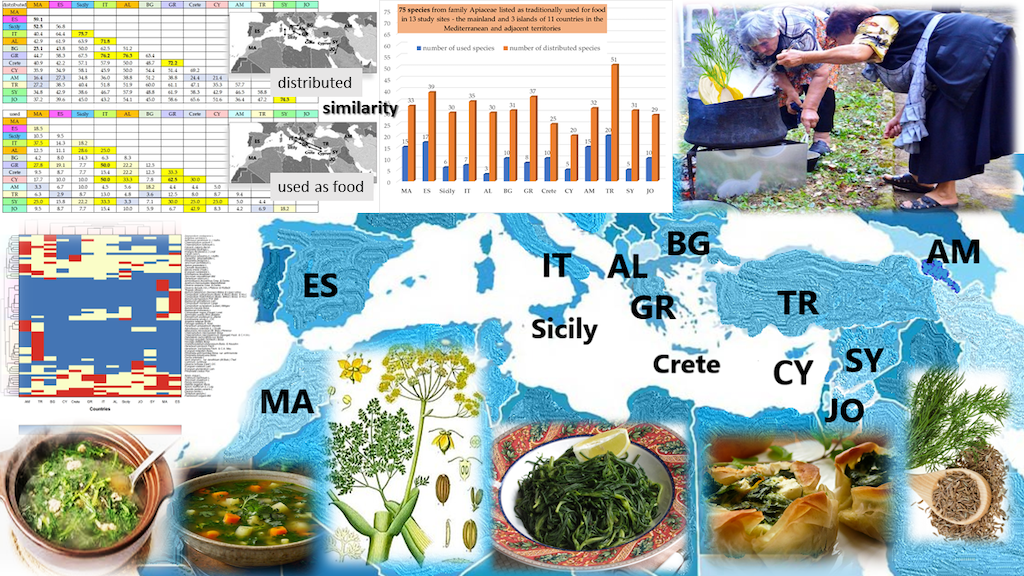
The aim of this review is to study wild plants from family Apiaceae traditionally used as food in 13 study sites - 11 countries, including 3 islands in the Mediterranean and adjacent territories (Figure 1) in order to trace patterns of native distribution and cultural exchange. The hypothesis is that countries that are neighboring will have high similarity in the use as food of wild umbellifers.
2. Results
2.1. Distribution of Wild Umbellifers, Traditionally Used as Food
As a result of our literature survey we come up with a list of 81 wild umbellifers, traditionally used as food in 13 study sites - the mainland and 3 islands of 11 countries in the Mediterranean and adjacent territories (Figure 1, Table 1).
The distribution of these 81 taxa is either all over the territory of the studied sites or restricted to certain parts (Table 1).
The listed 81 wild umbellifers, traditionally used as food (Table 1) are reduced to 75 taxa suitable for statistically analyses (as explained in Material and methods section). These 75 taxa are distributed as follows: 15 taxa in Morocco [15,16,17,18,19,20,21,22], 17 taxa in Spain [23,24,25], 6 taxa in Sicily [26,27,28,29], 7 taxa in South Italy [30,31,32,33,34], 3 taxa in Albania [32,34,35], 8 taxa in Greece [37,38], 10 taxa in Crete [37,39,40], 5 taxa in Cyprus [37,40], 20 taxa in Turkey [41,42,43,44], 10 taxa in Bulgaria [42,45,46,47,48,49], 15 taxa in Armenia [50,51,52,53,54,55,56], 5 taxa in Syria [57], 10 taxa in Jordan and Palestina [58,59,60,61] (Figure 2).
The highest number of edible wild umbellifers are reported for Turkey, followed by Spain, Armenia and Morocco (Figure 2). Similar pattern is seen in the distribution - Turkey, followed by Spain, Morocco and Armenia (Figure 2).
It is also shown that only about half or even less of the distributed edible umbellifers are consumed traditionally in each country (Figure 3). This indicates that the knowledge does not cross the borders that much as expected, because many of the plants that are used in certain country are not used by the neighbors. Armenia holds the record of utilization of wild edible umbellifers distributed on its territory (46.9%), followed by Morocco (45.5%), Spain (43.6%), Crete (40.0%) and Turkey (39.2%). Interestingly on the territory of Turkey are distributed the highest number (51 taxa) of the recognized as edible umbellifers (68%), but only 39.2% of them are used as food. Additionally, 14 taxa (70%) of these umbellifers are not consumed elsewhere and 6 of them are endemic plants (Figure 4). The lowest use of wild edible umbellifers distributed on its territory is observed in Albania (10.0%).
Some of the wild umbellifers, traditionally used as food have restricted distribution. In 8 of the 13 study sites (61.5%) are recorded 50 plants used as food only in one particular country (66.7% of all wild umbellifers, traditionally used as food). The distribution is as follows: 8 taxa in Morocco, 9 taxa in Spain, 2 taxa in Sicily, 3 taxa Bulgaria 3 taxa Crete, 8 taxa in Armenia, 14 taxa in Turkey and 3 taxa in Jordan (Figure 4). Of these 50 restrictedly consumed plants only 15 taxa (20 % of all documented umbellifers used as food) are distributed in only one country (Figure 4), namely 5 taxa endemic to Turkey - Diplotaenia turcica Pimenov & Kljuykov (syn. D. cachrydifolia non Boiss.), Chaerophyllum macropodum Boiss., Ferulago angulata (Schlecht.) Boiss., F. stellata Boiss. and 1 taxon endemic to Turkey and Armenia - Grammosciadium platycarpum Boiss. & Hausskn.; 4 taxa in Spain, 3 of them endemic to that country - Bunium balearicum (Sennen) Mateo & López Udías, Conopodium subcarneum (Boiss. & Reut.) Boiss. & Reut., and C. thalictrifolium (Boiss. & Reut.) Boiss. & Reut.; 1 taxon endemic to Morocco Anethum foeniculoides Maire & Wilzek, 1 taxon in Armenia Angelica tatianae Bordz, endemic to North Caucasus, Georgia and Azerbaijan; 1 taxon distributed in Jordan and few neighbor countries - Deverra tortuosa (Desf.) DC. (Table 1).
Additionally, the range of Conopodium marianum Lange, C. pyrenaeum (Loisel.) Miégev, Bunium pachypodum P.W. Ball etc., (Table 1). is restricted to Western Mediterranean. Plants growing only in North Africa are Deverra scoparia Coss. & Durieu, D. denudata (Viv.) Pfisterer & Podlech, etc.
2.2. Statistical Analyses of the Distribution of Wild Umbellifers, Traditionally Used as Food
2.2.1. Jaccard Index
Jaccard index (JI) revealed that the level of similarity between pairs of countries in traditional use of wild umbellifers as food, is rather different regarding the distribution pattern of edible wild umbellifers in same pairs of countries there.
The highest similarity regarding the distribution pattern of edible wild umbellifers is between Albania and Greece immediately followed by Italy and Greece, Sicily and Italy, Syria and Jordan, Greece and Crete, Italy and Albania (Figure 5).
While the highest similarity regarding the use pattern of wild umbellifers is between Greece and Cyprus, followed by South Italy and Greece, South Italy and Cyprus, Crete and Jordan, Morocco and South Italy, Greece and Crete, Greece and Syria, Crete and Cyprus etc. (Figure 5). Surprisingly on the contrary of expected high similarity in use pattern between Bulgaria and Turkey – both neighbouring countries and parts of Ottoman Empire, the Jaccard index is low. Also, low JI is calculated for the pair Turkey and Greece, both neighbouring countrieas and parts of Ottoman Empire. Additionally the use pattern similarity between Morocco and Spain is not high on the contrary of the expected (Figure 5).
In all cases the similarity regarding the use as food is marked by much lower indexes compared to the distribution pattern.
2.2.1. Heatmap Clustering
The heatmap (double dendrogram) highlights the similarities between all of the plants and countries studied in terms of Apiaceae wild plant distribution/food consumption patterns (Figure 5). The patterns are divided into three categories: not distributed and not used as food, distributed, but not used as food, and both distributed and used as food. The columns of the heatmap depict the similarities between patterns per country, while the rows represent the plants.
Countries cluster together according to their geographical proximity. Thus, Armenia is linked with Turkey, whereas Morocco is associated with Spain. (Figure 6). The remaining countries are clustered together as follows: the islands of Crete and Cyprus; Greece and Italy, as well as the more distant members Albania and Sicily; Jordan and Syria. Bulgaria is something of an outlier, despite having common borders with Turkey and Greece. In the pattern where plants are both distributed and consumed as food, the greatest parallels can be seen between Morocco and Spain, Greece and Italy, Crete and Cyprus, and Armenia and Turkey (Figure 6).
Plants cluster that deserves attention comprises Angelica tatianae Bordz, Ferulago setifolia K. Koch, Heracleum antasiaticum Manden., Astrodaucus orientalis (L.) Drude, Cachrys microcarpa M. Bieb. (syn. Bilacunaria microcarpa (M. Bieb.) Pimenov) and Chaerophyllum macropodum Boiss., Chaerophyllum macrospermum (Spengel) Fisch. & C. A. Mey., Diplotaenia turcica Pimenov & Kljuykov (syn D. cachrydifolia sensu P.H. Davis, non Boiss.), Ferulago angulata (Schlecht.) Boiss., Ferulago stellata Boiss., Grammosciadium platycarpum Boiss. & Hausskn., Heracleum persicum Fisch., Heracleum trachyloma Fisch. & C.A. Mey. Eryngium billardieri F. Delaroche, Pimpinella anthriscoides Boiss., Pimpinella kotschyana Boiss., Ferula orientalis L., Sium sisarum L., respectively used either only in Armenia or only in Turkey (Figure 6).
Next cluster of plants groups those used in Morocco (Ammodaucus leucotricus Coss. & Durieu, Deverra scoparia Coss. & Durieu, D. denudata (Viv.) Pfisterer & Podlech, Thapsia villosa L.) and associated with Spain (Bunium balearicum (Sennen) Mateo & López Udías B. macuca Boiss., B. pachypodum P.W. Ball, Bupleurum fruticosum L., B. gibraltaricum Lam., Conopodium marianum Lange, C. pyrenaeun (Loisel.) Miégev, Conopodium majus (Gouan) Loret) (Figure 6).
Scandix pecten-veneris L., Daucus carota L. and Tordylium apulum L. group in cluster which is related to the consumption of these plants in Greece, Crete and Cyprus, but also in some other countries (Figure 6).
3. Discussion
The consumption of wild umbellifers is basically well documented in all studied countries (Table 1).
The only plant that is reported “consumed wild” in all countries is Foeniculum vulgare L. Additionally it is important commercial vegetable for its swollen, bulb-like stem base and varieties are cultivated widely [62,63].
Some interesting cases that deserve special comments are Anethum graveolens L., Petroselinum crispum (Mill.) Fuss, Cuminum cyminum L. and Apium graveolens L. (Table 1, Figure 6). These are respectively dill, parsley, cumin and celery which are quite popular spices [64]. The dill, Anethum graveolens which is reported among the wild umbellifers used as food in Turkey and Jordan is native to Turkey and Jordan, but also to Albania, Bulgaria, Cyprus, Syria Morocco and Spain [14] (in the Jaccard Index are taken into account only study sites where the plant is native). This plant is introduced to Armenia Crete, Greece and Jordan. Interestingly it appears in reports of wild used umbellifers in Jordan (Table 1, [67]. The dill is naturalized in Italy, and casual to Sicily and Spain [14]. The dill is widely used in all countries being very popular spice, which is vastly cultivated. For example, is very popular food plant, cultivated commercially and in kitchen gardens in Bulgaria. It is not reported among the wild umbellifers used as food in this country. A. graveolens is wild but rare plant there (category “Endangered” according to the Red Data Book [65]. The well-known and widely used parsley, Petroselinum crispum (Mill.) Fuss is reported consumed from wild in Jordan. It is a native plant there, as well as in Morocco and Albania. Parsley is casual to Sicily and introduced to Armenia, Bulgaria, Greece, Turkey, Crete, Cyprus and naturalized to Spain [14]. Commercially grown and widely used cumin Cuminum cyminum L., is native to Irano-Turanian Region [66], including Jordan and Armenia (Table 1). It is consumed wild in Jordan [67]. The commercially cultivated celery, Apium graveolens L., which is native Albania, Bulgaria, Crete, Cyprus, Greece, Jordan, Italy, Morocco, Sicily, Spain, Syria and Turkey is consumed wild in Jordan and some provinces of Spain. Interestingly it is mentioned as used as food from the wild in Armenia, but it is introduced to this country (therefore this particular record was eliminated from the statistical analysis). The reported consumption of popular and commercially cultivated spices from wild in Jordan indicate this part of the world as a center of domestication of dill, parsley and cumin, and quite an ancient one [66].
Ferula is a key symbolic plant, known from antiquity and even before that. Levey, M. (1958) [68]. Ferula is associated to the production of perfume in Minoan civilization [69]. Unidentified Ferula (Ferula assa-foetida L., or F. orientalis L.) images are found on ancient Greek coins [70]. F. communis L. is important plant in Sicily during the antiquity [71]. Different species of the genus are used as food only in Jordan, Turkey, Morocco and South Italy (Table 1) although particularly F. communis L. is distributed not only in these countries, but also in Crete, Cyprus, and Greece.
4. Materials and Methods
The object of our study is the wild plant form family Apiaceae, traditionally used as food on the territory of 12 countries (mainland and 3 islands, Figure 1) in the Mediterranean and adjacent territories. We followed the principles for historical unity (e.g., Roman Empire, Byzant Empire, Visigothic Kingdom, Ostgothic Kingdom, Umayyad Caliphate Ottoman Empire, Aragon Kingdom, The Kingdom of Sicily etc.) [72], and the potential for cultural exchange, territorial neighborhood, phytoclimatic and floristic relationships.
We accessed Google Scholar, Web of Science, and PubMed to identify publications for the period 1990-2022 using the search string: “Spain”, “Morocco”, “Sicily”, “Italy”, “Albania”, “Greece”,” Crete”, “Cyprus”, “Turkey”, “Bulgaria”, “Armenia”, “Egypt”, “Syria”, “Jordan and Palestine”, “Kosovo”, North Macedonia” as well as “traditionally” “wild”, “food”, “plants”, “ethnobotany”, etc. These countries were selected according to the territorial neighborhoods but also historical cultural influences.
Following the PRISMA 2000 guidelines [73], the records were assessed for eligibility. Totally 452 papers were excluded either because 1) the information was not in accordance to the topic of this research; 2) the data on the traditional use was only about medicinal purposes; 3) the studies analyzed traditional food habits of the local populations but did not provide information about wild plants; 4) the records were for consumption of plants that were cultivated.
4.1. Distribution of Wild Umbellifers, Traditionally Used as Food
From the selected publications we extracted the information about the wild plants from family Apiaceae traditionally used as food in Spain [23,24,25], “Morocco [16,17,18,19,20,21,22], Sicily [26,27,28,29], Italy [30,31,32,33,34], Albania [32,34,35], Greece [37,38], Crete [37,39,40], Cyprus [37,40], Turkey [41,42,43,44], Bulgaria [42,45,46,47,48,49], Armenia [50,51,52,53,54,55,56], Syria [57], Jordan and Palestine [58,59,60,61]. We found that there are not enough studies and publications on the wild plants traditionally used as food in Egypt, Kosovo and North Macedonia providing sufficient data for the aim of this investigation.
4.2. Data Set Preparation and Analyses
We organized the reported data for each country in Excel tables. The range of distribution of each plant taxon on the territories of the studied countries was added in the tables following [14]. Some incorrections of the published data were noticed and eliminated in the Tables and analyses. For example, Oenanthe javanica (Blume) DC., Ostericum sieboldii (Miq.) Nakai and Ferula sinkiangensis K.M. Shen reported for Jordan and Palestina [67] are plant taxa distributed in the Far East but not in the Near East. Therefore, they are not included in Table 1, and the analysis. Also, Pimpinella anisum L. is not included in Table 1, and the analysis. This plant is reported among the umbellifers used form the wild in Jordan and Palestina [60]. However, it is cultivated, introduced, naturalized or casual in all studied countries but nowhere wild [14]. Additionally, Bunium macuca Boiss. reported to be used in Jordan and Palestina is not distrusted in this country because it is a west Mediterranean taxon. It is considered only for Spain in Table 1 and in the analyses of the use, but not for Jordan. Particular taxa are casual (alien species that do not form self-sustaining populations in the invaded region) or naturalized plants in some countries and these cases are discussed in the text with caution. For example, this is the case with lovage, Levisticum officinale W.D.J. Koch, which is often grown in herb gardens. It is native to Iran and Afghanistan [14] but not to Jordan, although it is reported to be consumed wild in this country. This taxon is excluded from the statistical analysis. The records about 6 wild umbellifers, traditionally used as food in our study sites are found to have peculiarities. Coriandrum sativum L. which is reported among the wild umbellifers used as food in Armenia and Turkey is native only to Jordan and Syria but introduced to Armenia, Turkey, Bulgaria, Albania, Greece, Crete and Cyprus. This worldwide popular spice is also naturalized to Italy, Morocco, and casual to Sicily and Spain. In the analyses wild carrot was considered to a species level, although it was specified that in Spain and Jordan it was Daucus carota L. subsp. maximus (Desf.) Ball Jazar Barri, while in Sicily it was the typical subspecies but in the other countries the subspecies level is not mentioned. Ferula assa-foetida L. is reported to be consumed as a wild plant in Jordan, but it is native only to Libya [14]. Same wild consumption is reported about Centella asiatica (L.) Urb. in Jordan which however, is native only to Georgia. Pastinaca sativa L. is a popular commercially cultivated vegetable in Europe. It is native to Albania, Bulgaria, Greece, Italy, Sicily, Spain Turky and Armenia. However, there are no reports for gathering from the wild in these countries nowadays. At the same time such use is reported about Jordan, where this plant is not distributed (Table 1). These peculiarities of the records made them not suitable for the statistical analyses and we excluded them from the calculations.
We marked which part of the plant was used as well as the way of consumption. Ethnobotanists, sometimes provided synonyms in the published original sources and a replacement with the accepted names was done following [14]. They were used to perform basic descriptive statistics.
4.2.1. Jaccard Similarity Coefficient or Jaccard Index JI
Jaccard similarity coefficient or JI is used when the level of similarity between two groups of elements should be identified [74]. We used JI to evaluate the similarity of use and simiarity of distribution respectively compareing coutries by pairs. JI is calculated using the following formula:
JI[%] = NAB* 100/ (NA+ NB– NAB)
Where
NA is the number of elements in study site A (country/ mainland or island)
NB is the number of elements in study site B (country/ mainland or island)
NAB is the number of elements available in both study sites (country/ mainland or island)
4.2.1. Heatmap Clustering
The clustered heatmap (double dendrogram) was created using Group Average (Unweighted Pair-Group) Clustering Method and Euclidian distance in NCSS Statistical Software [75].
5. Conclusions
This work, focused on the wild plants of the Apiaceae family traditionally used as food in some Mediterranean countries, has provided an overview of the most commonly consumed umbellifers, highlighting similarities and differences between the territories of reference. In particular, this survey revealed 81 specific and infraspecific taxa from Apiaceae family used traditionally as food in 11 Mediterranean countries and 3 islands. This also makes it possible to pass on to future generations traditional knowledge about wild edible plants, which in the particular context of the Mediterranean diet is of considerable relevance. The working statement that neighboring countries have high similarity in the use of wild umbellifers as food is confirmed with heatmap clustering statistical model. Similarities of consumption of umbellifers are found on geographical pattern based on plants’ range of distribution and cultural exchange.
Author Contributions
Conceptualization E.K.; methodology, E.K., B.V. and D.B.; data collection: E.K., G.M., R.A., B.V., A.A., K.S., M.R., A.T., P.M., and V.S.; formal analysis, DB, and E.K.; writing—original draft preparation E.K., DB and V.S.; writing, review, and editing, E.K., G.M., R.A., B.V., A.A., K.S., M.R., A.T., P.M. and V.S.; visualization, D.B. and E.K.; supervision, E.K.; project administration, E.K. and P.M. All authors have read and agreed to the published version of the manuscript.
Funding
Ekaterina Kozuharova is grateful for the financial support by the European Union—NextGenerationEU, through the National Recovery and Resilience Plan of the Republic of Bulgaria, Project № BG-RRP-2.004-0004-C01.
Institutional Review Board Statement
Not applicable.
Data Availability Statement
Not applicable.
Acknowledgments
We are grateful to Prof. F. Raimondo for the research inspiration, passion for botanical science and endless knowledge of plants, which he shared with us.
Conflicts of Interest
The authors declare no conflict of interest.
References
- Mundy, J. H. Europe in the High Middle Ages: 1150-1300. 3rd ed.; Routledge. Taylor and Fransis Group, London and NY, 2014; 1-432.
- Vryonis, S. Religious Change and Continuity in the Balkans and Anatolia from the Fourteenth through the Sixteenth Century. In Islam and cultural change in the Middle Ages. Ed. 1975. Vryonis, S. Ed.; Wiesbaden, H; 1975, Volume 4, pp. 127–141.
- Bresc, H. Medieval and modern Sicily and the kingdoms of Sardinia and Corsica. In A Companion to Sardinian History, 500–1500; Leyde, Brill. 2017; pp. 141–164. [CrossRef]
- Stenner, D. Mediterranean crossroads: Spanish-Moroccan relations in past and present. J North Afric. Stud. 2019 24, 7–16. [CrossRef]
- Torija-Isasa, M.; Matallana-González, M. A Historical Perspective of Wild Plant Foods in the Mediterranean Area. In Mediterranean Wild Edible Plants; Sánchez-Mata, M., Tardío, J., Eds.; Publisher: Springer, New York, NY, 2016; pp. 3–13. [Google Scholar] [CrossRef]
- Lewington, A. Plants for people. Penguin Random House. Transworld Publishers, London, 2003, pp.1-304.
- Dogan, Y. Traditionally used wild edible greens in the Aegean Region of Turkey. Acta Soc. Bot. Pol. 2012, 81, 329–342. [Google Scholar] [CrossRef]
- Molina, M.; Pardo-de-Santayana, M.; Tardío, J. Natural production and cultivation of Mediterranean wild edibles. In Mediterranean wild edible plants: Ethnobotany and food composition tables, de Cortes Sanchez-Mata, M., Javier Tardio, J., EdS.; Publisher: Springer, 2016. [Google Scholar]
- Sánchez-Mata, D.; Morales, R. The Mediterranean landscape and wild edible plants. In Mediterranean wild edible plants: Ethnobotany and Food Composition Tables; Sánchez-Mata, M., Tardío, J. Eds; Springer, New York, NY. 2016, pp.15-31. [CrossRef]
- Ceccanti, C.; Landi, M.; Benvenuti, S.; Pardossi, A.; Guidi, L. Mediterranean wild edible plants: Weeds or “new functional crops”? Molecules 2018, 23, 2299. [Google Scholar] [CrossRef] [PubMed]
- Benítez, G.; Molero-Mesa, J.; González-Tejero, M.R. Wild Edible Plants of Andalusia: Traditional Uses and Potential of Eating Wild in a Highly Diverse Region. Plants 2023, 12, 1218. [Google Scholar] [CrossRef] [PubMed]
- Sayed-Ahmad, B.; Talou, T.; Saad, Z.; Hijazi, A.; Merah, O. The Apiaceae: Ethnomedicinal family as source for industrial uses. Ind. Crop. Prod. 2017, 109, 661–671. [Google Scholar] [CrossRef]
- Gangwar, H.; Kumari, P.; Jaiswal, V. Phytochemically Rich Medicinally Important Plant Families. In Phytochemical Genomics: Plant Metabolomics and Medicinal Plant Genomics; Singapore: Springer Nature Singapore, 2023; pp. 35–68. [Google Scholar]
- Hand, R. (2011). Apiaceae. In Euro+Med-Plantbase – The information resource for Euro-Mediterranean plant diversity. www2bgbm.org/EuroPlusMed/TaxonDetail.asp¿NameCache=Apiaceae&PTRefFk=7500000. – Published at (accessed 10 February 2024).
- Nassif, F.; Tanji, A. Gathered food plants in Morocco: The long-forgotten species in ethnobotanical research. Life Sci. Leafl. 2013, 3, 17–54. [Google Scholar]
- Tanji, A.; Nassif, F. Edible weeds in Morocco. Weed Technology. 1995, 9, 617–620. [Google Scholar] [CrossRef]
- Fennane, M.; Ibn Tattou, M.; El Oualidi, J. Flore Pratique du Maroc. In Pteridophyta, Gymnospermae, Angiospermae (Lauraceae-Neuradaceae): Manuel de Détermination, Trav. l’Institut Sci. Série Bot; Volume 1, 1999.
- Fennane, M.; Ibn Tattou, M. Statistiques et commentaires sur l’inventaire actuel de la flore vasculaire du Maroc. Flora 2008, 1986, 1989. [Google Scholar]
- Fennane, M. Ibn Tattou, and J. El Oualidi. Flore pratique du Maroc, Dicotylédones (pp), Monocotylédones. In Travaux de l’Institut Scientifique Rabat, Série Botanique 40, Volume 3, 2014.
- Belahsen, R.; Tanji, A. Gathered food plants in Morocco: The long forgotten species in ethnobotanical research. Life Sci. Leafl. 2013, 3, 17–54. [Google Scholar]
- Tbatou, M.; Belahyan, A.; Belahsen, R. Wild edible plants traditionally used in the countryside of El Jadida, coastal area in the Center of Morocco. Life Sci. Leafl. 2016, 75, 28–48. [Google Scholar]
- Tbatou, M.; Fagroud, M.; Belahyan, A.; Belahsen, R. Wild edible plants traditionally used in the rural area of El Jadida (Center of Morocco): Assessing traditional knowledge erosion. Life Sci. Leafl. 2016, 78, 30–51. [Google Scholar]
- Tardío, J.; Pascual, H.; Morales, R. Wild food plants traditionally used in the province of Madrid, Central Spain. Econ. Bot. 2005, 59, 122–136. [Google Scholar] [CrossRef]
- Tardío, J.; Pardo de Santayana, M.; Morales, R. Ethnobotanical review of wild edible plants in Spain. Bot. J. Linn. Soc. 2006, 152, 27–72. [Google Scholar] [CrossRef]
- Morales, R.; Tardío, J.; Aceituno, L.; Molina, M.; Pardo de Santayana, M. Biodiversidad y Etnobotánica en España. In Memorias Real Sociedad, Española de Historia Natural, Madrid, Spain, 2011; pp. 157–208.
- Raimondo, F.M.; Lentini, F. Indagini entnobotaniche in Sicilia. I. Le piante della flora locale nella tradizione popolare delle Madonie (Palermo). Naturalista Siciliano, s. 1990, 4, 14–3. [Google Scholar]
- Giardina, G.; Raimondo, F.M.; Spadaro, V. A catologue of the plants growing in Sicily. Bocconea 2007, 20, 5–582. [Google Scholar]
- Schicchi, R.; Geraci, A. Verdure Spontanee per L’alimentazione e la Salute; Palermo University Press: Palermo, Italy, 2021. [Google Scholar]
- Mazzola, P. Le piante selvatiche nella tradizione alimentare dei Monti Nebrodi (Sicilia). Università di Palermo e Parco dei Nebrodi. pp. 174, 2020.
- Pieroni, A.; Nebel, S.; Santoro, R.F.; Heinrich, M. Food for two seasons: Culinary uses of non-cultivated local vegetables and mushrooms in a south Italian village. Int. J. Food Sci. Nutr. 2005, 56, 245–72. [Google Scholar] [CrossRef] [PubMed]
- Nebel, S.; Pieroni, A.; Heinrich, M. Ta chòrta: Wild edible greens used in the Graecanic area in Calabria, Southern Italy. Appetite 2006, 47, 333–342. [Google Scholar] [CrossRef] [PubMed]
- Pieroni, A.; Quave, C.L. Functional foods or food medicines? On the consumption of wild plants among Albanians and southern Italians in Lucania. In Eating and Healing Traditional Food as Medicine, Pieroni, A.; Leimer Price, L. Eds., Publisher: Haworth Press 2006, 101-129.
- Mattalia, G.; Quave, C.L.; Pieroni, A. Traditional uses of wild food and medicinal plants among Brigasc, Kyé, and Provençal communities on the Western Italian Alps. Genet. Resour. Crop. Ev. 2013, 60, 587–603. [Google Scholar] [CrossRef]
- Biscotti, N.; Pieroni, A. The hidden Mediterranean diet: Wild vegetables traditionally gathered and consumed in the Gargano area, Apulia, SE Italy. Acta Soc. Bot. Pol. 2015, 84. [Google Scholar] [CrossRef]
- Pieroni, A. Traditional uses of wild food plants, medicinal plants, and domestic remedies in Albanian, Aromanian and Macedonian villages in South-Eastern Albania. J. Herb. Med. 2017, 9, 81–90. [Google Scholar] [CrossRef]
- Pieroni, A.; Sõukand, R.; Quave, C.L.; Hajdari, A.; Mustafa, B. Traditional food uses of wild plants among the Gorani of South Kosovo. Appetite 2017, 108, 83–92. [Google Scholar] [CrossRef] [PubMed]
- Hadjichambis, A.C.; Paraskeva-Hadjichambi, D.; Della, A.; Elena Giusti, M.; De Pasquale, C.; Lenzarini, C.; Censorii, E.; Gonzales-Tejero, M.R.; Sanchez-Rojas, C.P.; Ramiro-Gutierrez, J.M.; Skoula, M.; Johnson, C.; Sarpaki, A.; Hmamouchi, M.; Jorhi, S.; El-Demerdash, M.; El-Zayat, M.; Pieroni, A. Wild and semi-domesticated food plant consumption in seven circum-Mediterranean areas. Int. J. Food Sci. Nutr. 2008, 59, 383–414. [Google Scholar] [CrossRef] [PubMed]
- Pieroni, A.; Cattero, V. Wild vegetables do not lie: Comparative gastronomic ethnobotany and ethnolinguistics on the Greek traces of the Mediterranean Diet of southeastern Italy. Acta Bot. Bras. 2019, 33, 198–211. [Google Scholar] [CrossRef]
- Della, A.; Paraskeva-Hadjichambi, D.; Hadjichambis, A.C. An ethnobotanical survey of wild edible plants of Paphos and Larnaca countryside of Cyprus J. Ethnobiol. Ethnomed. 2006, 2, 34. [Google Scholar] [CrossRef] [PubMed]
- Pieroni, A.; Sulaiman, N.; Polesny, Z.; Sõukand, R. From Şxex to Chorta: The Adaptation of Maronite Foraging Customs to the Greek Ones in Kormakitis, Northern Cyprus. Plants 2022, 11, 2693. [Google Scholar] [CrossRef] [PubMed]
- Dogan, Y.; Baslar, S.; Ay, G.; Mert, H.H. The use of wild edible plants in western and central Anatolia (Turkey). Econ. Bot. 2004, 58, 684–690. [Google Scholar] [CrossRef]
- Dogan, Y.; Nedelcheva, A.; Łuczaj, Ł.; Drăgulescu, C.; Stefkov, G.; Maglajlić, A.; Ferrier, J.; Papp, N.; Hajdari, A.; Mustafa, B.; Dajić-Stevanović, Z.; Pieroni A., A. Of the importance of a leaf: The ethnobotany of sarma in Turkey and the Balkans. J. Ethnobiol. Ethnomed. 2015, 11, 1–15. [Google Scholar] [CrossRef]
- Kaval, İ.; Behçet, L.; Çakilcioğlu, U. Survey of wild food plants for human consumption in Geçitli (Hakkari, Turkey). Indian J. Tradit. Know. 2015, 14, 183–190. [Google Scholar]
- Cakir, E.A. Traditional knowledge of wild edible plants of Igdir Province (East Anatolia, Turkey). Acta Soc. Bot. Pol. 2017, 86. [Google Scholar] [CrossRef]
- Stoyanov, N.; Kitanov, B. Wild useful plants. Bulgarian Academy of Sciences Publ. House, Sofia, 1960; pp. 480.
- Nedelcheva, A. An ethnobotanical study of wild edible plants in Bulgaria. Eurasia. J. Biosci. 2013, 7, 77–94. [Google Scholar] [CrossRef]
- Cheshmedzhiev, I.; Genchev, S.; Dimitrova, D.; Varbanova, K. Wild plants on our table. Zemizdat, Sofia, 1999; pp. 147.
- Ivanova, T.; Chervenkov, M.; Kozuharova, E.; Dimitrova, D. Ethnobotanical knowledge on herbs and spices in Bulgarian traditional dry-cured meat products. Diversity 2022, 14, 416. [Google Scholar] [CrossRef]
- Ivanova, T.; Marchev, A.; Chervenkov, M.; Bosseva, Y.; Georgiev, M.; Kozuharova, E.; Dimitrova, D. Catching the Green—Diversity of Ruderal Spring Plants Traditionally Consumed in Bulgaria and Their Potential Benefit for Human Health. Diversity 2023, 15, 435. [Google Scholar] [CrossRef]
- Grossheim, A.A. Plant resources of the Caucasus. Baku: Publishing house of AS of Azerbaijani SSR; 1946. (in Russian).
- Zolotnitskaya, S. Medicinal resources of the flora of Armenia. vols. 1–2. Yerevan; 1958–1965 (in Russian).
- Gubanov, I.; Krilova, I.; Tikhonova, V. Wild useful plants of the USSR. Moscow; 1976 (in Russian).
- Takhtajan, A. 1954—2001 Flora of Armenia. Vol. 6. Yerevan: Ed. Acad. Sci. Arm. SSR. (In Russian).
- Gabrielyan, E. Herbal medicine national register. Yerevan. 2001 (in Armenian).
- Bussmann, R.W. Ethnobotany of the Caucasus. XXVII; Springer International Publishing; 2017; pp. 746. ISBN 978-3-319-49411-1.
- Fayvush, G. Biodiversity of Armenia. Springer Cham; 2023; pp. 440. ISBN: 9783031343315.
- Sulaiman, N.; Pieroni, A.; Sõukand, R.; Polesny, Z. Food Behavior in Emergency Time: Wild Plant Use for Human Nutrition during the Conflict in Syria. Foods 2022, 11, 177. [Google Scholar] [CrossRef] [PubMed]
- Tukan, S.K.; Takruri, H.R.; Al-Eisawi, D.M. The use of wild edible plants in the Jordanian diet. Int. J. Food Sci. Nutr. 1998, 49, 225–235. [Google Scholar] [CrossRef] [PubMed]
- Tukan, S.K.; Takruri, H.R.; Ahmed, M.N. Food habits and traditional food consumption in the Northern Badia of Jordan. J. Saud. Soc. Food Nutr. 2011, 6, 1–20. [Google Scholar]
- Takruri, H.R.; Tukan, S.K.; Ahmad, M.N. Medicinal and edible wild plants used by the community of Northern Badia of Jordan. Jordan J. Agric. Sci. 2008, 4, 391–405. [Google Scholar]
- Ali-Shtayeh, M.S.; Jamous, R.M.; Al-Shafie, J.H.; Elgharabah, W.A.; Kherfan, F.A.; Qarariah, K.H.; Khdair, I.S.; Soos, I.M.; Musleh, A.A.; Isa, B.A.; Herzallah, H.M.; Khlaif, R.B.; Aiash, S.M.; Swaiti, G.M.; Abuzahra, M.A.; Haj-Ali, M.M.; Saifi, N.A.; Azem, H.K.; Nasrallah, H.A. Traditional knowledge of wild edible plants used in Palestine (Northern West Bank): A comparative study. J. Ethnobiol. Ethnomed. 2008, 4, 1–13. [Google Scholar] [CrossRef] [PubMed]
- Siviero, P.; Esposito, C.; De Masi, L. Il finocchio (Foeniculum vulgare var. dulce Mill.). Ess. Deriv. Agr. 2005, 75, 15–20. [Google Scholar]
- Mutlucan, M.; Erbaş, S.; Erdoğan, Ü. Fennel (Foeniculum vulgare) agriculture, problems and future in the world and in Turkey. In ISPEC 11th International conference on agriculture, animal sciences and rural development 3-5 March 2023 Muş-Turkiye.
- Norman, J. Herbs & Spices. DK Penguin Random House, UK; 2015, pp. 186.
- Peev, D.; Petrova, A.S.; Anchev, M.; Temniskova, D.; Denchev, C.M.; Ganeva, A.; Gussev, Ch.; Vladimirov, V. Red Data Book of the Republic of Bulgaria. Vol. 1. Plants and Fungi. Publisher: BAS & MoEW, Sofia, 2015; pp. 887. ISBN 978-954-9746-21-1.
- Kislev, M.E.; Hartman, A.; Galili, E. Archaeobotanical and archaeoentomological evidence from a well at Atlit Yam indicates colder, more humid climate on the Israeli coast during the PPNS period. J. Archaeol. Sci. 2004, 32, 1301–1310. [Google Scholar] [CrossRef]
- Nawash, O.; Shudiefat, M.; Al-Tabini, R.; Al-Khalidi, K. Ethnobotanical study of medicinal plants commonly used by local bedouins in the badia region of Jordan. J. Ethnopharmacol. 2013, 148, 921–925. [Google Scholar] [CrossRef]
- Levey, M. Research sources in Ancient Mesopotamian chemistry. Ambix 1958, 6, 149–154. [Google Scholar] [CrossRef]
- Oberlin, L. Meaning, Exchange, and Wine Economics: An Investigation into the Minoan Trickle Pattern Motif’s Presence and Use from the Early Minoan I-Late Minoan III Doctoral dissertation, <bold>2018</bold>, The University of Arizona.
- Koerper, H.; Kolls, A.L. The silphium motif adorning ancient Libyan coinage: Marketing a medicinal plant. Econ. Bot. 1999, 133–143. [Google Scholar] [CrossRef]
- Mosca, A. Natural Environmental Factors and Human Settlement in Western Sicily. The Example of Lilybaeum. 2018, In The Ancient City and Nature’s Economy in Magna Graecia and Sicily, Panel 2.1, Archaeology and Economy in the Ancient World 3, Bergemann, J., Rempe M. Eds., Heidelberg, Propylaeum; 2022; 79–92. [CrossRef]
- https://www.youtube.com/watch?v=UY9P0QSxlnI.
- Page, M.J.; McKenzie, J.E.; Bossuyt, P.M.; Boutron, I.; Hoffmann, T.C.; Mulrow, C.D.; Shamseer, L.; Tetzlaff, J.M.; Akl, E.A.; Brennan, S.E.; Chou, R.; Glanville, J.; Grimshaw, J.M.; Hróbjartsson, A.; Lalu, M.M.; Li, T.; Loder, E.W.; Mayo-Wilson, E.; McDonald, S.; McGuinness, L.A.; Stewart, L.A.; Thomas, J.; Tricco, A.C.; Welch, V.A.; Whiting, P.; Moher, D. The PRISMA 2020 statement: An updated guideline for reporting systematic reviews. BMJ. 2021, 88, 105906. [Google Scholar] [CrossRef] [PubMed]
- Real, R. , Vargas, J. M. The probabilistic basis of Jaccard’s index of similarity. Syst. Biol. 1996, 45, 380–385. [Google Scholar] [CrossRef]
- NCSS 2024 Statistical Software (2024). NCSS, LLC. Kaysville, Utah, USA, ncss.com/software/ncss (Accessed 10 April 2024).
Figure 1.
Study sites. Legend: JO – Jordan and Palestina; IT – South Italy: MA – Morocco; Sicily; ES – Spain; SY – Syria; TR – Turkey; AL – Albania; AM – Armenia; BG – Bulgaria; Crete; CY – Cyprus; GR – Greece.
Figure 1.
Study sites. Legend: JO – Jordan and Palestina; IT – South Italy: MA – Morocco; Sicily; ES – Spain; SY – Syria; TR – Turkey; AL – Albania; AM – Armenia; BG – Bulgaria; Crete; CY – Cyprus; GR – Greece.
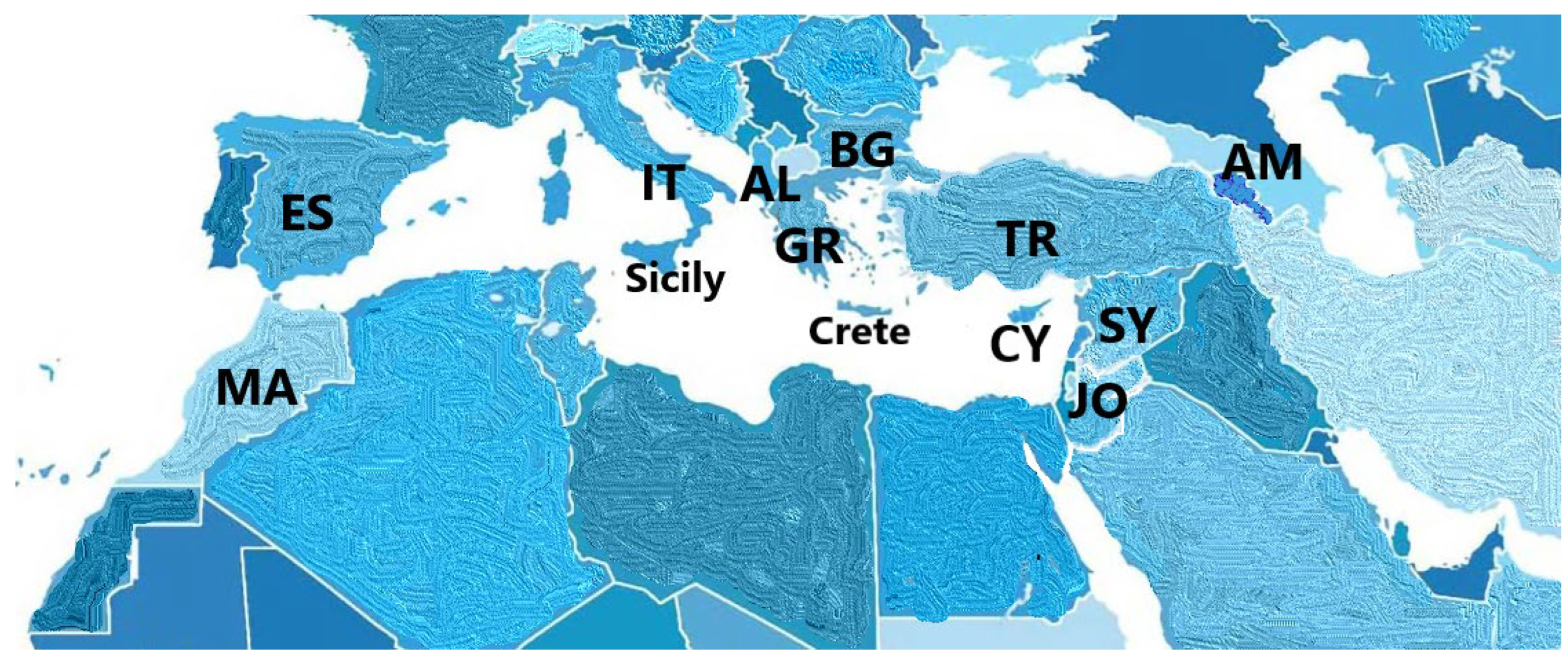
Figure 2.
Number of wild plants taxa from family Apiaceae used as food and distributed in each of the study sites.
Figure 2.
Number of wild plants taxa from family Apiaceae used as food and distributed in each of the study sites.
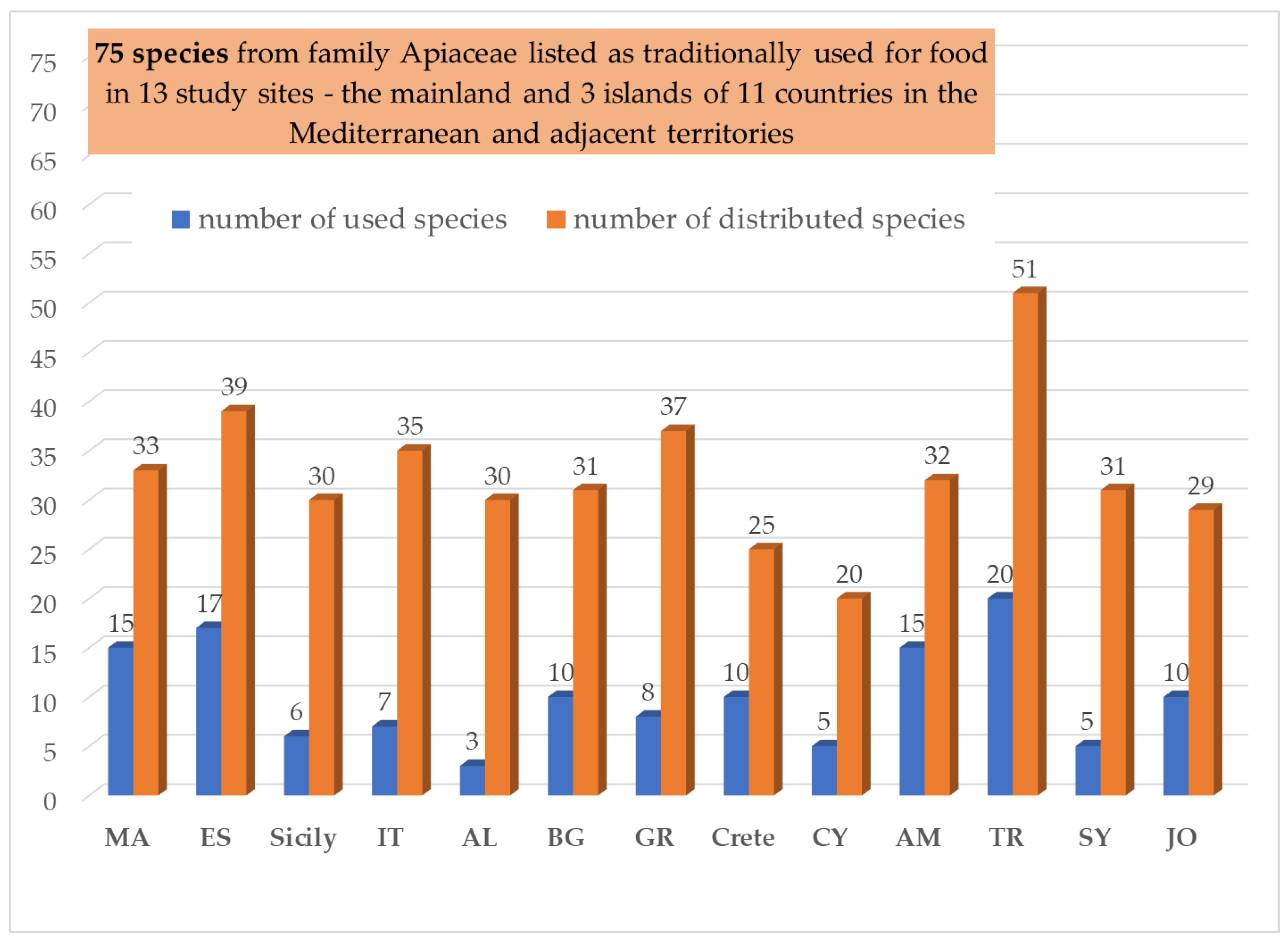
Figure 3.
Percent of traditionally consumed wild umbellifers versus distributed edible taxa in each country.
Figure 3.
Percent of traditionally consumed wild umbellifers versus distributed edible taxa in each country.
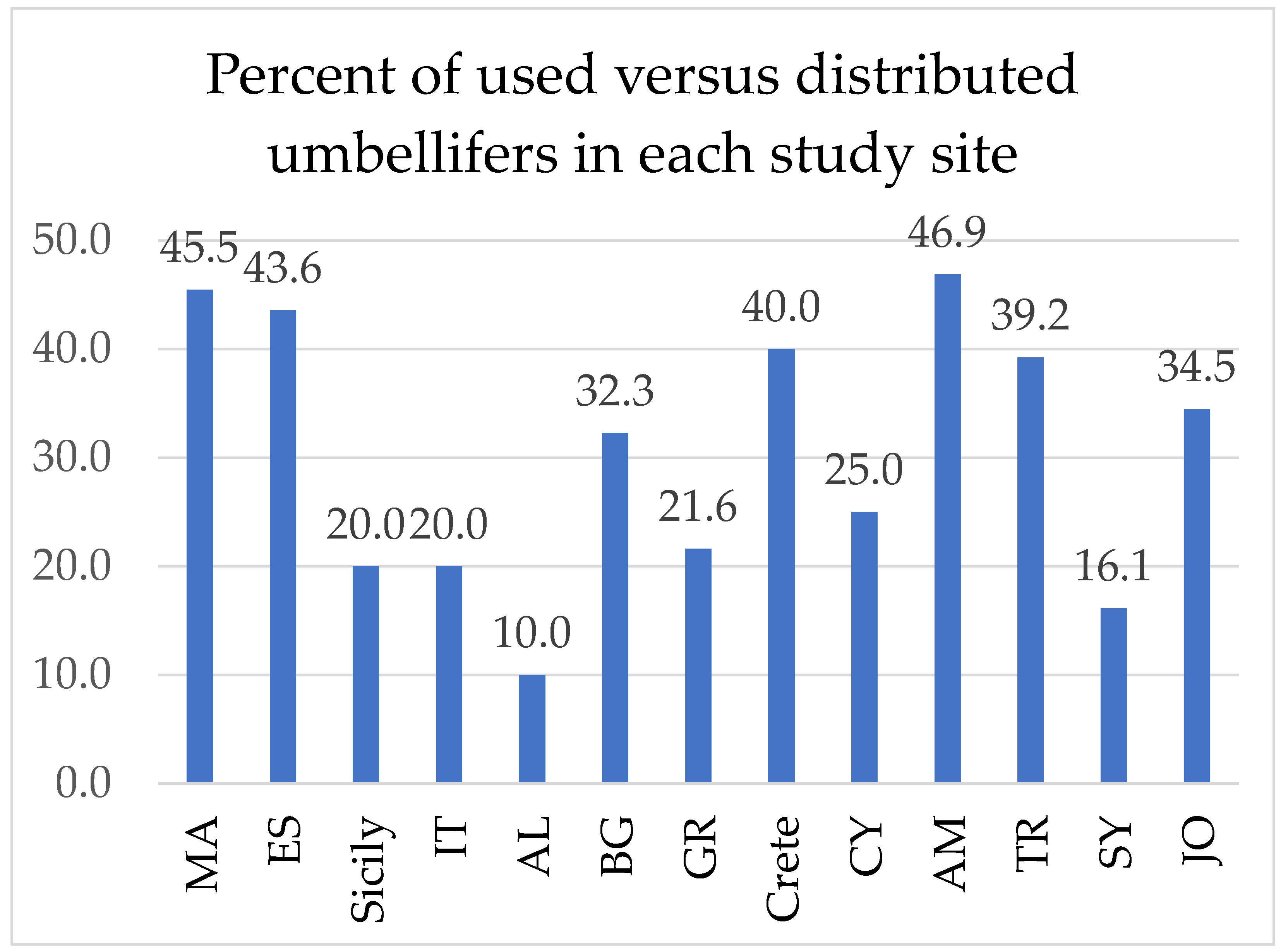
Figure 4.
Number of wild plants from family Apiaceae restrictedly used as food and distributed in each of the study sites.
Figure 4.
Number of wild plants from family Apiaceae restrictedly used as food and distributed in each of the study sites.
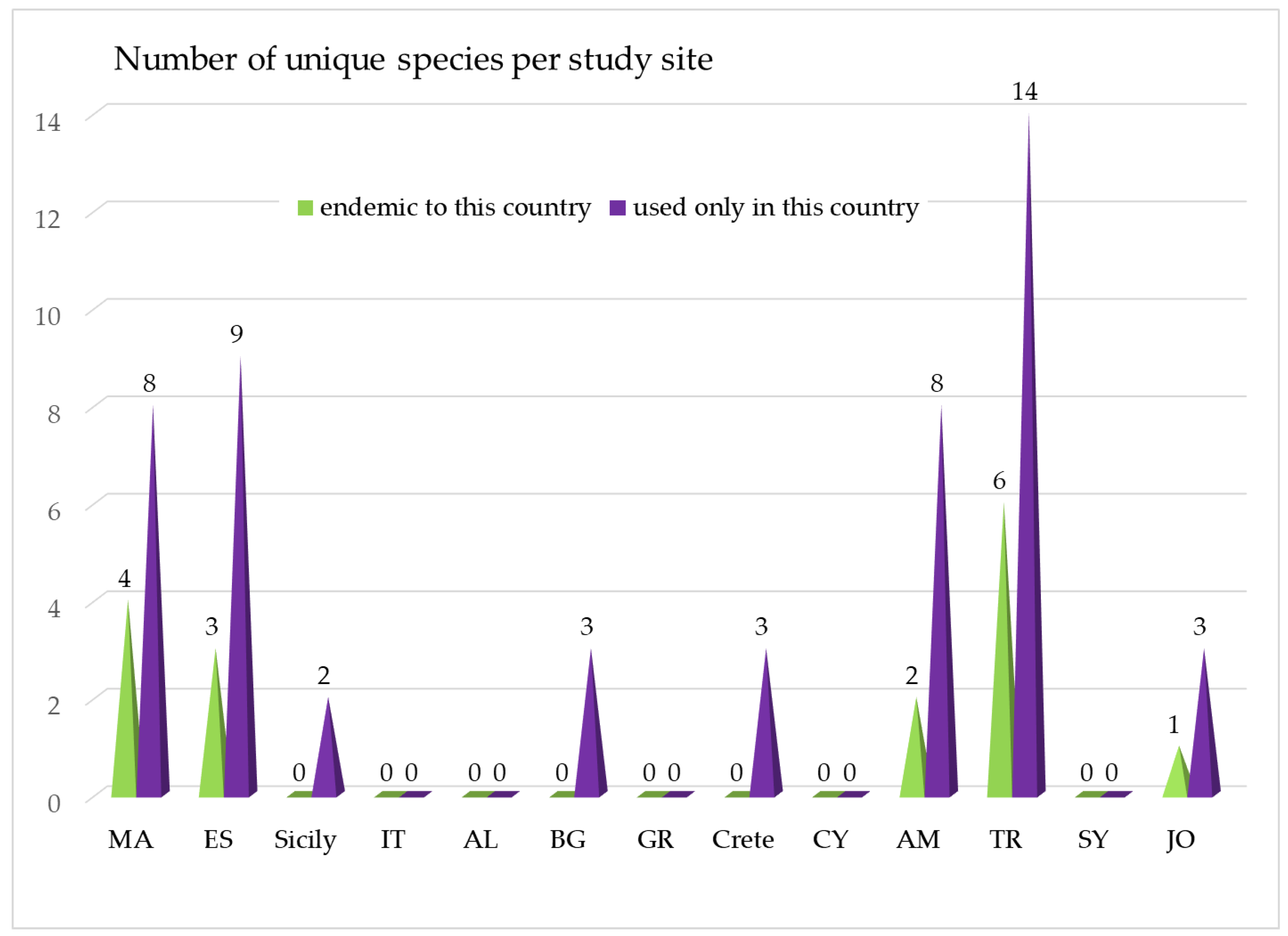
Figure 5.
Similarity between pairs of countries in both traditional use of wild umbellifers as food, and distribution of edible wild umbellifers, expressed as JI %.
Figure 5.
Similarity between pairs of countries in both traditional use of wild umbellifers as food, and distribution of edible wild umbellifers, expressed as JI %.
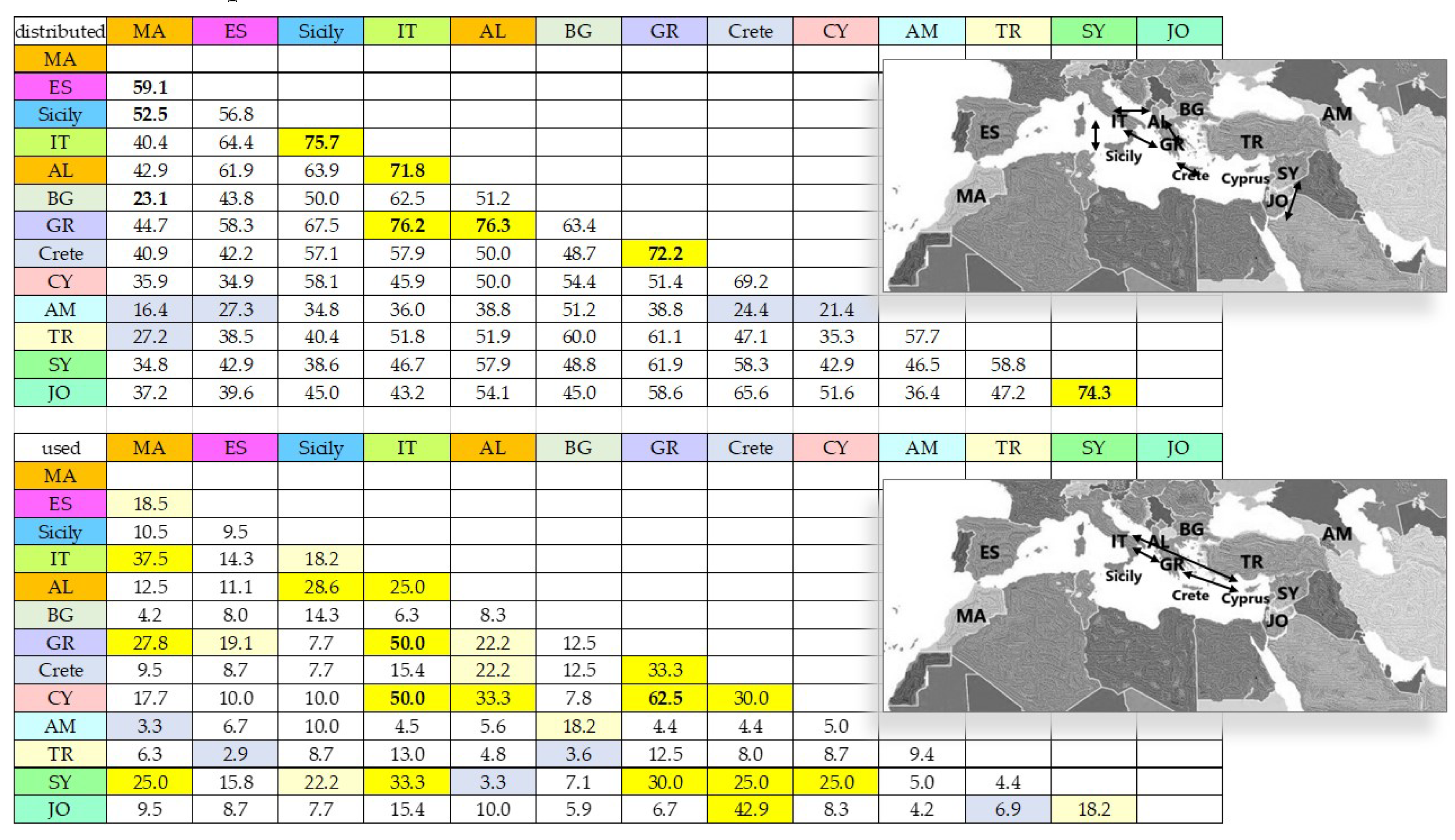
Figure 6.
Heatmap and dendrogram showing clustering of wild-growing Apiaceae plants with similar distribution and eaten pattern across the studied countries and clustering of countries with similar distribution and eaten pattern of the same plants. The colors used refer to specific patterns as follows: blue – not distributed and not used as food, yellow – distributed, but not used as food, and red – distributed and used as food.
Figure 6.
Heatmap and dendrogram showing clustering of wild-growing Apiaceae plants with similar distribution and eaten pattern across the studied countries and clustering of countries with similar distribution and eaten pattern of the same plants. The colors used refer to specific patterns as follows: blue – not distributed and not used as food, yellow – distributed, but not used as food, and red – distributed and used as food.
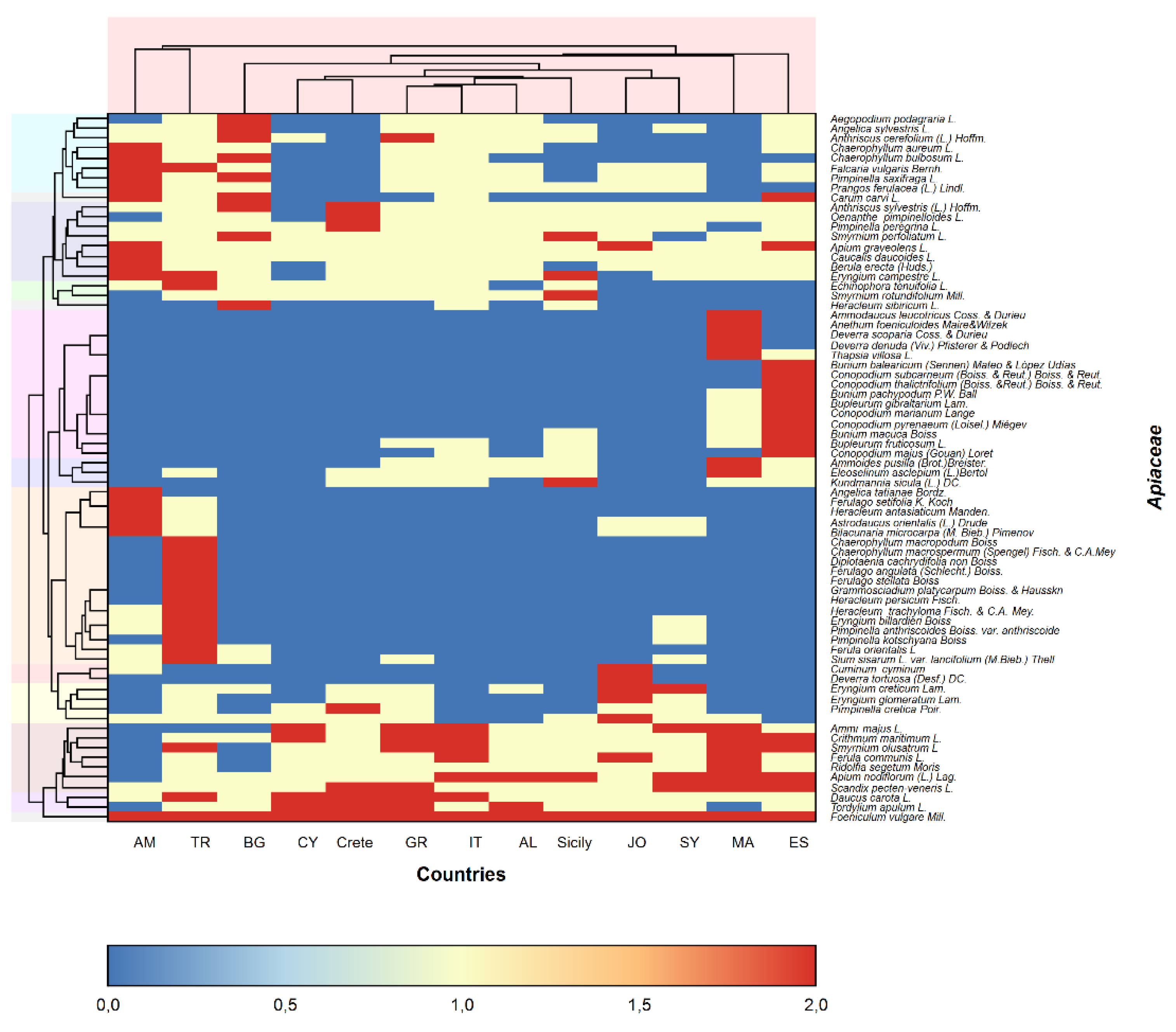

Table 1.
Wild plants from family Apiaceae traditionally used as food and their distribution in 11 Mediterranean countries and adjacent territories. Legend: JO – Jordan and Palestina; IT – South Italy; MA – Morocco; Sicily; ES – Spain; SY – Syria; TR – Turkey; AL – Albania; AM – Armenia; BG – Bulgaria; Crete; CY – Cyprus; GR – Greece. Note: asterisk marks those species that are collected in the field and eaten only in one or two of the 50 Spanish provinces, while all other species listed for Spain are used in three or more provinces. Distribution of the taxa basically follows Euro+Med-Plantbase [14], double asterisk marks the synonym names used in the original publications.
Table 1.
Wild plants from family Apiaceae traditionally used as food and their distribution in 11 Mediterranean countries and adjacent territories. Legend: JO – Jordan and Palestina; IT – South Italy; MA – Morocco; Sicily; ES – Spain; SY – Syria; TR – Turkey; AL – Albania; AM – Armenia; BG – Bulgaria; Crete; CY – Cyprus; GR – Greece. Note: asterisk marks those species that are collected in the field and eaten only in one or two of the 50 Spanish provinces, while all other species listed for Spain are used in three or more provinces. Distribution of the taxa basically follows Euro+Med-Plantbase [14], double asterisk marks the synonym names used in the original publications.
| Taxon | Presence in countries of the study area | Used as food | Used part and modes of application |
| Aegopodium podagraria L. | AL, BG, ES, GR, IT, TR | BG | Sprouts, salad raw, soup, |
| Ammi majus L. | AL, Crete, CY, GR, ES, IT, JO, MA, Sicily, SY, | SY | Inflorescence, added to yerba mate |
| CY | Aerial parts, salads | ||
| GR | Aerial parts, sauté | ||
| IT | Aerial parts boiled then on pasta, dressing with “pecorino” cheese and olive oil | ||
| MA | Stems | ||
| Ammodaucus leucotricus Coss. & Durieu | MA | MA | Seeds |
| Ammoides pusilla (Brot.) Breister. | AL, ES, GR, IT, MA, Sicily | MA | Aereal parts |
| Anethum foeniculoides Maire & Wilzek | MA | MA | Aerial parts, seeds |
| Anethum graveolens L. | native AL, BG, CY, ES, MA, TR, introduced to AM, Crete, GR, JO, SY; naturalized in IT, casual to Silicy,; |
TR | Aboveground, salad, seasoning, raw, plant is with yogurt |
| JO |
Seed Consumed cultivated in BG, as the plant is listed as Endangered in the Red Data Book |
||
| Angelica sylvestris L. | AL, AM, BG, ES, GR, IT, Sicily, SY, TR | BG | Sprouts, leaves, salad raw, soup, |
| Angelica tatianae Bordz. | AM | AM | Petiole, stem |
| Anthriscus cerefolium (L.) Hoffm. | native AM, AL, BG, CY, GR, Sicily, TR introduced to MA, IT, naturalised to ES |
BG | Leaves, shoots, salad raw, soup, spice |
| GR | Young aerial parts, boiled | ||
|
Anthriscus sylvestris (L.) Hoffm. |
AL, AM, BG, ES, GR, IT, JO, MA, Sicily, SY TR | AM | Stems, leaves |
| BG | Roots, leaves, shoots, salad raw, soup, pastry | ||
| Crete | Young aerial parts, fried in mixtures as a filling for pies | ||
| Apium graveolens L. | native AL, AM, BG, Crete, CY, ES, GR, IT, JO, MA, Sicily, SY, TR | JO | Petiole, leaves |
| AM | Leaves, roots | ||
| *ES | Leaves, raw in salads or stewed | ||
| Astrodaucus orientalis (L.) Drude | AM, JO, SY, TR | AM | Stems |
| Berula erecta (Huds.) Coville | AL, AM, BG, Crete, ES, GR, IT, JO, MA, SY, TR | AM | Leaves, fruits |
| Bunium balearicum (Sennen) Mateo & López Udías | ES | *ES | Tubers, raw as a snack |
| Bunium macuca Boiss. | ES, MA, Sicily |
ES | Tubers, raw as a snack (they taste chestnut) |
| Bunium pachypodum P.W. Ball | ES, MA | *ES | Tubers, raw as a snack |
| Bupleurum fruticosum L. | ES, GR, IT, MA, Sicily | *ES | Aerial parts, for hardening olives |
| Bupleurum gibraltaricum Lam. | ES, MA | *ES | Aerial parts for hardening olives |
| Cachrys microcarpa M. Bieb. (syn. ** Bilacunaria microcarpa (M. Bieb.) Pimenov & V.N. Tikhom. | AM, JO, SY, TR | AM | Stems, leaves |
|
Carum carvi L. |
AL, AM, BG, ES, IT, TR | AM | Stems, leaves, seeds |
| BG | Fruits, spice | ||
| *ES | Fruits | ||
| Centella asiatica (L.) Urb. | native in Georgia and tropical and subtropical Asia and Africa | JO | Above ground organs |
| Chaerophyllum aureum L. | AL, AM, BG, ES, GR, IT, TR | AM | Stems, leaves |
| Chaerophyllum bulbosum L. | AM, BG, GR, IT, TR | AM | Stems, leaves, roots |
| BG | Young shoots, corms, salad raw and stew | ||
| Chaerophyllum macropodum Boiss. | TR | TR | Eaten fresh |
| Chaerophyllum macrospermum (Spengel) Fisch. & C. A. Mey. | AM, TR | TR | Cooked as a stew or egg-vegetable dish; used in cheese production |
| Conopodium majus (Gouan) Loret | ES, IT, Sicily | ES | Tubers, raw as a snack (they taste chestnut) |
| Conopodium marianum Lange | ES, MA | ES | Tubers, raw as a snack |
| Conopodium pyrenaeun (Loisel.) Miégev | ES, MA | ES | Tubers, raw as a snack |
| Conopodium subcarneum (Boiss. & Reut.) Boiss. & Reut. | ES | *ES | Tubers, raw as a snack |
| Conopodium thalictrifolium (Boiss.) Calest. | ES | *ES | Tubers, raw as a snack |
| Coriandrum sativum L. | native to JO, SY, naturalized to IT, MA, casual to ES, Sicily; introduced to AL, AM, BG, GR, Crete, CY, TR |
AM | Stems, fruits |
| TR | Cooked as a stew or rice-vegetable dish; pie is made from its seeds | ||
| Crithmum maritimum L. | BG, Crete, CY, ES, GR, IT, JO, MA, Sicily, SY, TR | IT | Young leaves, shoots boiled and dressed with vinegar (or lemon juice) and olive oil |
| MA | Aerial parts | ||
| *ES | Leaves, for seasoning olives; raw in salads; roots, raw as a snack | ||
| CY | Young aerial parts, boiled, then pickled | ||
| GR | Young aerial parts, boiled, then pickled | ||
| Cuminum cyminum L. | AM, ES, JO, casual to Sicily and MA | JO | Seed |
| Daucus carota L. | AL, AM, BG, Crete,CY, ES, GR, IT, JO, MA, Sicily, SY, TR | CY | Young aerial parts, boiled |
| GR | Young aerial parts, boiled | ||
| IT | Root, roasted, boiled, fried | ||
| TR | Shoot and leaf meal, pancake, stew | ||
| Crete | Young aerial parts, boiled in mixtures | ||
| Daucus carota L. subsp. maximus (Desf.) Ball | AL, BG, Crete, CY, ES, GR, IT, JO, MA, Sicily, SY, TR | JO | Fleshy roots, eaten raw |
| *ES | Roots, as a snack, young leaves stewed | ||
| Daucus carota L. subsp. carota | AL, BG, Crete, CY, ES, GR, IT, MA, Sicily, TR | Sicily | Tender basal leaves and roots, raw in salads or stewed. |
| Deverra scoparia Coss. & Durieu | MA | MA | Shoots, core of roots, aerial parts |
| Devera denudata (Viv.) Pfisterer & Podlech | MA | MA | Shoots, core of roots |
| Deverra tortuosa (Desf.) DC. | JO | JO | Leaf and flower |
| Diplotaenia turcica Pimenov & Kljuykov (syn. **Diplotaenia cachrydifolia sensu P. H. Davis, non Boiss) | TR | TR | Cooked as a stew or egg-vegetable dish; used in brine and cheese production |
| Echinophora tenuifolia L. | AM, BG, Crete, CY, GR, IT, Sicily, TR |
TR | Shoot, flower, leaf soup, seasoning, drinking |
| Eleoselinum asclepium (L.) Bertol. | AL, Crete, GR, ES, IT, MA, Sicily, TR | MA | Aereal parts |
| Eryngium billardieri F. Delaroche. | TR, AM, SY | TR | Eaten fresh |
| Eryngium campestre L. | AL, AM, BG, Crete, ES, GR, IT, MA, Sicily, SY, TR | AM | Leaves, roots |
| Sicily | Sprouts, raw in salads. | ||
| TR | Shoot and leaf pie, stew | ||
| Eryngium creticum Lam. | AL, BG, Crete, CY, GR, JO, SY, TR, casual to IT |
JO | Vegetables leaves and stems, eaten raw as salad with garlic and yoghurt, or cooked as pastry |
| SY | Young aerial part, salad; steamed. | ||
| Crete, | Young aerial part, salad | ||
| Eryngium glomeratum Lam. | Crete, GR, JO, SY, TR | JO | Young aerial part, salad |
| Crete, | Young aerial part, salad | ||
| Falcaria vulgaris Bernh. | AL, AM, BG, ES, GR, IT, JO, SY TR, | TR | Aerial parts cooked as vegetable; leaves eaten in salads |
| AM | Stems | ||
| Ferula assa-foetida L. | native to Libya |
JO | Root |
| Ferula communis L. | AL, Crete, CY, ES, GR, IT, JO, MA, Sicily, SY, TR | IT | Inflorescences deep fried |
| MA | Unopen inflorescence | ||
| JO | Vegetables inflorescence, eaten cooked | ||
| Ferula orientalis L. | AM, BG, TR | TR | Cooked plant is with yogurt; used in brine and cheese production |
| Ferulago angulata (Schlecht.) Boiss. subsp. angulata | TR | TR | Used in cheese production |
| Ferulago angulata (Schlecht.) Boiss. subsp. carduchorum (Boiss. & Hausskn.) Chamberlain | TR | TR | Used in cheese production |
| Ferulago setifolia K. Koch | AM, TR | AM | Leaves, stems |
| Ferulago stellata Boiss. | TR | TR | Cooked as a stew or egg-vegetable dish; used in brine and cheese production |
|
Foeniculum vulgare Mill. |
AL,AM, BG, Crete, CY, ES, GR, IT, JO, MA, Sicily, SY TR |
AM | Stems, fruits |
| BG | Leaves, mericarps, spice | ||
| CY | Leaves and tender stems, raw as a snack or in salads, or stewed and cooked, seasoning (especially snails) | ||
| ES | Leaves and tender stems, raw as a snack or in salads, or stewed | ||
| GR | Leaves and tender stems, raw as a snack or in salads, or stewed, fried,saute | ||
| MA | Tender stems, tender leaves,roots after being peeled, seeds | ||
| TR | Aboveground meal, roasted, pilaf, as spice | ||
| JO | Seeds, as herbal tea seeds, boiled and added to bread leaves, dried and added to pickles, fruits foliage, eaten raw foliage, dried and added to cake as a condiment, foliage, eaten raw as salad, or cooked as soup | ||
| Sicily | Leaves and tender shoots, raw as a snack or in salads, or stewed; seeds as a condiment and for the herbal teas and digestive liquors preparation. | ||
| Crete | Leaves, fried in mixtures as a filling for pies or seasoning stewed potatoes and tomatoes | ||
| SY | Aerial part, spice added to zaatar and soups; fried with: eggs/ meat/potato | ||
|
Foeniculum vulgare subsp. piperitum (C. Presl.) Bég. |
AL | Young aerial parts and fruits boiled, then on pasta or in mixed vegetablesyoung leaves, shoots boiled and dressed with vinegar (or lemon juice) and olive oil | |
| IT | Young aerial parts and fruits boiled, then on pasta or in mixed vegetablesyoung leaves, shoots boiled and dressed with vinegar (or lemon juice) and olive oil | ||
| Grammosciadium platycarpum Boiss. & Hausskn. | TR, AL | TR | Eaten fresh |
| Heliosciadium nodiflorum (L.) W.D.J. Koch (**syn. Apium nodiflorum (L.) Lag.) | AL, BG, Crete, CY, ES, GR, IT, JO, MA, Sicily, SY, TR | AL | Aerial parts raw in salads; seasoning soups |
| IT | Aerial parts raw in salads; seasoning soups | ||
| ES | Tender leaves and stems, raw in salads. | ||
| Sicily | Tender leaves and stems, raw in salads or stewed. | ||
| SY | Young aerial part, appetizer | ||
| MA | Aerial parts | ||
| Heracleum antasiaticum Manden. | AM, TR | AM | Stems |
| Heracleum persicum Fisch. | TR | TR | Used in cheese production |
| Heracleum sibiricum L. | BG, IT, Sicily | BG | Leaves, shoots, salad raw, soup, spice |
| Heracleum trachyloma Fisch. & C.A. Mey. | TR, AM | TR | Leaves stffed, stems as spice, eaten raw afer bark is peeled |
| Kundmannia sicula (L.) DC. | Crete, ES, GR, IT, MA, Sicily, | Sicily | Basal leaves, stewed. |
| Levisticum officinale W. D. J. Koch | native to JO; introduced to BG, ES; casual to AL. naturalized in IT |
JO | Leaves |
| Oenanthe pimpinelloides L. | AL, BG, Crete, ES, GR, IT, JO, MA, Sicily, SY, TR | Crete | Young aerial parts, fried in mixtures in pies |
| Orlaya daucoides (L.) Greuter (syn. **Caucalis daucoides L.) | AL, AM, BG, Crete, CY, ES, GR, IT, JO, MA, Sicily, SY, TR | AM | Stems |
| Pastinaca sativa L. | AL, AM, BG, ES, GR, IT, Sicily, TR | JO | Leaves, root |
| Petroselinum crispum (Mill.) Fuss | native to JO, MA casual to Sicily; doubtfully native to AL, introduced to AM, BG, GR, Crete, CY, TR; naturalized to ES |
JO | Petiole, root, stem, leaves |
| Pimpinella kotschyana Boiss. | SY, TR, | TR | Used in rennet production |
| Pimpinella saxifraga L. | AL, AM, BG, GR, ES, IT, JO, SY, TR | AM | Seeds |
| BG | Root, leaves, fruits, salad raw, spice | ||
| Pimpinella cretica Poir. | Crete, CY, GR, JO, SY, TR | Crete | Young aerial parts, in mixtures for pies |
| Pimpinella peregrina L. | AL, AM, BG, Crete, CY, GR, IT, JO, Sicily, SY, TR | Crete | Young aerial parts, in mixtures for pies |
| Prangos ferulacea (L.) Lindl. | AL, AM, BG, GR, IT, JO, Sicily, SY, TR, | AM | Leaves |
| Pseudopimpinella anthriscoides (Boiss.) F. Ghahrem. & al. (syn. **Pimpinella anthriscoides Boiss.) | AM, SY, TR | TR | As spice; cooked as a stew or egg vegetable dish |
| Ridolfia segetum (Guss.) Moris | AL, Crete, CY, ES, GR, IT, JO, MA, Sicily, SY, TR | MA | Stems |
| Scandix pecten-veneris L. | AL, AM, BG, Crete, CY, ES, GR, IT, JO, MA, Sicily, SY, TR |
*ES | Young basal leaves, stewed |
| MA | Basal leaves | ||
| GR | Young leaves, soups | ||
| SY | Young aerial part, steamed with sleeq. | ||
| Crete | Young aerial parts, fried in mixtures, as a filling for pies | ||
| Sium sisarum var. lancifolium (M. Bieb.) Thell. | native AM, BG, GR, SY TR, casual to ES, IT |
TR | Used in cheese production |
|
Smyrnium olusatrum L. |
AL, Crete, CY, ES, GR, IT, JO, MA, Sicily, SY, TR |
TR | Eaten fresh |
| ES | Tender leaves and stems, raw in salads or stewed | ||
| MA | Stems, young shoots | ||
| GR | Young shoots, boiled, pastery | ||
| IT | Young shoots, boiled, pastery | ||
| Smyrnium perfoliatum L. | AL, AM, BG, CY, Crete, ES, GR, JO, IT, MA, Sicily, TR | Sicily | Tender leaves and stems, pickled in vinegar. |
| BG | Root, leaves, spice, soup | ||
| Smyrnium rotundifolium Mill. | AL, BG, Crete, CY, GR, IT, Sicily, TR |
Sicily | Tender leaves and stems, pickled in vinegar. |
| Thapsia villosa L. | ES, MA | MA | Peeled roots |
| Tordylium apulum L. | AL, BG, CY, Crete, GR, ES, IT, JO, Sicily, SY, TR | AL | Aereal part, boiled |
| CY | Young aerial parts, seasoning | ||
| Crete | Young aerial parts, in mixtures for pies | ||
| GR | Basal rosettes, boiled and pastery |
Disclaimer/Publisher’s Note: The statements, opinions and data contained in all publications are solely those of the individual author(s) and contributor(s) and not of MDPI and/or the editor(s). MDPI and/or the editor(s) disclaim responsibility for any injury to people or property resulting from any ideas, methods, instructions or products referred to in the content. |
© 2024 by the authors. Licensee MDPI, Basel, Switzerland. This article is an open access article distributed under the terms and conditions of the Creative Commons Attribution (CC BY) license (http://creativecommons.org/licenses/by/4.0/).
Copyright: This open access article is published under a Creative Commons CC BY 4.0 license, which permit the free download, distribution, and reuse, provided that the author and preprint are cited in any reuse.