

Submitted:
14 June 2024
Posted:
17 June 2024
You are already at the latest version
Abstract
This study examines the contribution of early executive functions (EFs) in the association between fluency in reading and arithmetic. Kindergarten children (N = 1,185) were assessed on Executive Functions skills and on reading and arithmetic fluency in Grade 1 and Grade 3. The analysis revealed that beyond the connection within each domain there is a unidirectional effect between fluency measures, with Grade 1 reading fluency significantly influencing the development of arithmetic fluency in Grade 3. Furthermore, the findings indicate that kindergarten EFs significantly contribute to arithmetic fluency at both time points and to reading fluency in the first grade. Early EF skills also emerged as a mediator of associations between fluency performance in reading and arithmetic, suggesting that the influence of EFs extends beyond individual academic domains. These findings have implications for understanding the cognitive mechanisms that underlie the relations between these academic skills.
Keywords:
Reading Fluency
; Arithmetic Fluency
; Executive Functions
1. Introduction
1.1. Fluency in Reading and Arithmetic: Development and Cross-Domain Association
Fluency in reading and simple arithmetic calculations are fundamental cornerstones required for overall academic development, daily life activities and success [1,2]. The measure of fluency (i.e., a combination of accuracy and speed) often serves as an indicator for the level of efficiency and automaticity in word reading [3,4,5,6] and simple single-digit arithmetic facts calculation, such as 4 + 5 = 9 and 6 × 3 = 18 [7,8,9].
Fluency acquisition, across both academic domains, relies on one-by-one serial coding. At this initial level, reading depends on the decoding of written graphemes (letters) into phonemes (sounds) [10]. With time, practice and repetitive print exposure, the reader becomes capable of automatically processing and retrieving larger orthographic units, such as whole words [11]. In a similar manner, calculation is based on serially reciting number words using concrete representations (such as fingers and objects) and verbal counting [12,13]. Gradually, efficient counting and decomposition strategies strengthen the association between the arithmetic equation and its correct answer [13], which, in turn, increases fluent and automatic memory-based retrieval of facts [14]. Well-established fluency promotes learning by freeing up cognitive resources for the execution of complex tasks, such as reading comprehension [e.g., 15] and algorithmic and multi-digit computation [16]. Parallel to the developmental course of typical fluency acquisition, there is also strong evidence for high rates of learning disabilities, which co-occur in both academic domains; these children with disabilities may not achieve fluency in either or both domains e.g., [17,18].
In recent years, a growing body of research on the development of fluency in reading and arithmetic has revealed substantial cross-domain correlation [19,20], which is also manifested in a high degree of overlap between these skills [21,22,23]. For instance, a cross-sectional research study by Balhinez and Shaul (2019) revealed a significant and consistent moderate correlation between fluency in reading and arithmetic among first-, second- and third-grade Hebrew-speaking students. Similar results were found in a series of longitudinal studies in elementary education across different languages and cultural backgrounds [e.g., Chinese: 24; English: 25; Greek: 26; Finnish: 20, 27-28] through the secondary school years [Germany: 29].
However, the characteristics of orthographies may also influence the dynamics observed in the cross-domain relationship between reading and arithmetic skills, specifically, the development of reading proficiency, which varies across languages [30]. In shallow orthographies characterized by consistent grapheme-phoneme correspondences, such as Hebrew, reading proficiency tends to develop more readily and rapidly [31] compared to deep and inconsistent orthographies such as English [32]. The developmental paths of reading fluency, influenced by orthographic complexity, highlight the need for a specific-language approach in studying cross-domain relations between reading and arithmetic skills. Combined with the overview of the correlational studies, there is clear evidence for a bidirectional affect between early reading and mathematics, particularly during the first years of elementary school [33,34,35,36,37]. However, the picture is far from conclusive, as findings on the extent of these mutual relations are mixed. Some have reported higher associations for early reading performance to later mathematic outcomes [33,36,37], while others have found stronger predictive power of early mathematics for later reading performance (35,38,39].
Potential explanations for the observed associations between both forms of fluency typically refer to a common genetic factor of timed measures [40,41], joint neural-brain regions activated during both math and reading task performance [42], and shared common underling cognitive mechanisms such as executive functions (EFs) [19,22,23,43].
Despite the fact that large bodies of literature have confirmed the association between reading and math skills among young students, several fundamental questions still remain unclear. First, as most of the reviewed studies investigated a wide range of reading and arithmetic-related skills, little is known about the cross-domain developmental relation of fluency outcomes. In addition, since the timed component in fluency-related tasks is considered as a separate construct from untimed measures [40,44], it is important to investigate these mechanisms separately. Even far less systematic research is available concerning the crossover effects between both types of fluency across different stages of acquisition. Second, given the joint reliance of reading and arithmetic on early cognitive mechanisms, such as EFs, an important unaddressed question is whether and how EFs longitudinally mediate the association between early fluency across both academic domains.
1.2. Executive Functions and Development of Fluency
Higher-order cognitive abilities are intensively involved in knowledge acquisition and the learning of new skills. These domain-general processes, which typically are referred to as executive functions, are responsible for self-regulation, goal-oriented behavior [45] and complex problem-solving [46,47]. The dominant framework by Miyake and his colleagues (2000) refers to three main interrelated subcomponent skills of EFs, namely, the ability to suspend an automatic response (inhibitory control), the ability to temporarily store and manipulate information (working memory, or WM), and the ability to shift between different tasks and operations (cognitive flexibility). Previous latent variable studies have demonstrated that executive-related abilities mostly tap into a single one-factor construct (unity) among early childhood samples [49] and cluster into separate constructs (diversity) over the course of development [50,51].
The childhood years represent a critical period in the growth of cognitive skills and therefore is perceived to have long-term effects on future school adjustment and scholastic achievement [52]. The extent to which EFs operate and contribute to reading and arithmetic appears to vary across the early childhood years [53]. Thus, less proficient learners rely more on cognitive resources compared to more skilled students [54]. In the early phases of reading acquisition, EFs might support the suppression of incorrectly deciphered words [55], the simultaneous storage and integration of phonological information into a single word [56] and efficient switching between different meta-linguistic aspects of spoken and printed words [57]. Similarly, EFs are thought to facilitate arithmetic calculations by deactivating inappropriate procedures and/or incorrect solutions [58], supporting flexible shifting between problems and procedures and facilitating the simultaneous execution of strategies [59,60].
There is a considerable amount of empirical evidence regarding the contribution of early EF skills to later reading [61,62] and arithmetic outcomes [46,58,59], especially during the first years of schooling [63,64,65]. However, to date, almost all research has focused on the predictive effect of early EFs on overall academic performance; a specific domain (literacy/mathematics) such as fluency, which is considered a core skill, has not been properly investigated. Given the strong relevance of EFs to academic performance and the tremendous growth of these components in young children, it is highly important to understand the nature of the long-term changes in the predictive role of EFs on fluency in reading and arithmetic across the major developmental periods of their acquisition.
As EFs seem to play a significant role in the development of both mathematics and reading, researchers are increasingly interested in the potential direct and indirect effects of EFs on the associations between learning-related skills.
1.3. Executive Functions as a Mediator
Alongside the fairly well-established contribution of EF skills to academic outcomes, some longitudinal datasets also support the reverse direction of influence from academic performance to EF skills. Specifically, a recent line of studies has shown that early EFs were positively predicted by various literacy skills [66,67,68] and math skills [66,69]. The reciprocal co-developing associations between academic achievements and EF skills are also manifested in the mutual growth effects across these two domains. Thus, children with better EF skills tend to show a stronger relative increase in the development of early academic skills and vice versa [34,70,71,72,73]. The theoretical framework for understanding the developmental effects of academic performance on EFs posits that academic-related activities create opportunities to practice multiple cognitive processes [74,75]. Thus, reading acquisition exercises higher-order skills, such as segmentation and integration, which involve the serial processing of alphabetic symbols into a whole word [34]. Similarly, early computational activities promote the ability to simultaneously hold and operate relevant information while applying the appropriate strategies to solve arithmetic problems [38,76].
Given the co-mutual beneficial influences between EFs and academic development, and the bidirectional relationship between reading and arithmetic, there is an inevitable question regarding the potential role of EFs as a mediator in the relationship between both types of fluency. To date, however, the few studies which have examined EF skills as a mediator in academic-related skills focused on the association between early and later arithmetic performance [77,78]. Both longitudinal studies revealed a consistent mediating effect of early EF skills in the developmental associations between mathematics performance from kindergarten through the first year of primary school among children with typical achievements and at risk for mathematics disability.
To the best of our knowledge, only one recent study, by Braak et al. (2022), has investigated the role of EFs as a mediator in the cross-domain association between mathematics and reading. Consistent with the reported results in research reviewed previously, first-grade EFs significantly explain the developmental correlations between kindergarten mathematics and fifth-grade mathematics and reading achievements. However, the study by Braak et al. (2022) is limited by its methodological weaknesses, such as the use of only one test to measure multiple EF subskills and the inclusion of a variety of academic skills, which range in complexity and cognitive requirements. In addition, despite the bidirectional nature of the associations between reading and mathematics, the authors only evaluated the developmental mediating effect of early EFs in a specific direction of the pathway, from math to reading. Thus, the main goal of our study is to elucidate and directly investigate whether and how early EF skills, before school transition, affect the relationship between fluency in reading and arithmetic from a bidirectional perspective. Understanding the nuanced pattern of the cross-domain associations between those key fundamental learning skills using a longitudinal systematic analysis of nationally representative data might provide unique insights into future research on assessment and educational intervention.
1.4. The Present Study
The purpose of this study is to examine the developmental nature of the relationship between fluency in reading and arithmetic and the role of early EFs in these cross-domain associations. Three research questions guided the work:
- (a)
- How does the cross-domain developmental relation between fluency in reading and arithmetic evolve across the major stages of their acquisition, and what is the direction of influence between these two skills?
Considering the robust relations between reading and arithmetic [19], it was hypothesized that fluency skill, in both academic domains, would show a consistent, significant correlation. However, considering the mixed findings in the literature regarding the strength and direction of the mutual cross-domain effect between reading and arithmetic [33,38] and the potential impact of orthographic transparency on reading fluency acquisition [30], we assume that there may be variability in the relative contribution between both types of fluency across the different developmental stages.
- (b)
- What is the relative contribution of kindergarten EFs in the development of fluency in reading and arithmetic?
We anticipate that the predictive power of EFs on fluency outcomes will vary over time, reflecting distinct developmental trajectories in reading and arithmetic skills. This hypothesis aligns with the notion that early EFs play a significant role in the development of new skills learning [79], such as fluency, in both reading and arithmetic during the early stages of acquisition. Given the high transparency of Hebrew orthography, which facilitates early reading fluency [31], we expect a relatively weaker impact of early EFs on reading fluency compared to arithmetic fluency during the advanced stages of formal schooling.
- (c)
- What is the effect of early EFs in mediating the association between early fluency in reading and arithmetic at each examined grade level?
Guided by the current scarce evidence on the issue [38], we propose that early EFs serve as a mediator in the cross-domain associations between both types of fluency.
2. Method
2.1. Participants
Participants in this longitudinal study were part of a large nationally representative sample of young children in the city of Haifa and the northern district of Israel. A total sample of 1,142 children participated in all tests during kindergarten (time 1), 798 participated in first grade (time 2), and 718 in third grade (time 3) of elementary school. The average age of the children at the start of the study was 71.14 months (SD = 5.87 months). All participants were typically developing native Hebrew speakers with normal IQ and no neurological disorders. All statistical analysis took the missing data into consideration.
2.2. Measures
2.2.1. Executive Functions in Kindergarten
Inhibition
Head-Toes-Knees-Shoulders (HTKS) [80] was used as a behavior regulation measure. The task, which is designed for young children, is mainly tapping into the ability to integrate several cognitive processes, such as attention, working memory and inhibitory control [81]. The children were instructed to do the opposite of the examiner’s instructions (e.g., touch their heads when told to touch their toes and vice versa). The first part consisted of two rules (head or toes) and the second part added two novel commands (knees or shoulders). After practice trials followed by the examiner’s feedback, the tests, which included 20 trials (10 trials for each part), were performed. Two points were given for each correct response at the first attempt. Self-correction from the incorrect to the correct response was given one point, and an incorrect response was given 0 points. The final total score for the 20 test items ranged between 0 and 40. The test-retest reliability for this test is .75.
Working Memory (WM)
Visual-Spatial WM, the Corsi frog backward test, adapted from the DEST-2 [82], was used. The task uses a colored printed card with seven lily pads, arranged in random order, along with a small plastic toy frog. The children are required to watch the frog’s jumping on the lily pads and then copy the frog’s jumps in reverse order. A practice trial was administrated, followed by instructive feedback. The difficulty of the tasks gradually increase, starting with blocks of a two-jump sequence and gradually increasing to blocks of seven jumps. The test is concluded when the children fail to correctly reproduce the sequence backwards on two consecutive trials in the same block. The capacity score is calculated based on the longest list length correctly recalled. Cronbach’s alpha indicating reliability is .81.
Auditory WM
The digit span backward test, [83] consists of a sequence of random numbers presented verbally, beginning with a sequence of two digits and increasing in length to blocks of seven digits. The children are instructed to repeat the digits in reverse order, from the last number they had heard to the first one. The test is discontinued when two mistakes occur with the same block. The capacity score is calculated based on the longest list correctly recalled. The test-retest reliability for this test is .72 (capacity).
The children’s size-ordering test (CSOT) [84] contains a list of common objects (e.g., window, book) read aloud at a rate of one item per second. Children are required to reproduce these verbally in order of size, from smallest to largest (e.g., book, window). The test comprises seven blocks with two items per block. The level of difficulty increases gradually, beginning with two items to a maximum of seven items. The test is discontinued when two mistakes occur in the same block. Granvald and Marciszko (2016) reported a reliability for the CSOT of 0.63.
Cognitive Flexibility
Sorting cards-shifting task, adapted from the Object Classification Task for Children [86] was used. As opposed to the original version of the OCTC which uses plastic toys, in the present study cards were presented. A practice trial was administered to ensure that the children were capable of sorting using overall visual features. The test requires sorting of six printed pictures into different groups according to three possible dimensions: size (big or small), color (red or yellow), and shape (car or plan). The task consisted of three conditions differentiated by the level of assistance provided by the examiner. It is started with the first condition and only if the child failed, the next condition was administered.
- (1)
- Free generation condition, where the child is required to sort the pictures without any clues or assistance and verbally name the common features of the grouped pictures. Then the examiner mixes up the cards and instructs the child to sort them by different dimensions. This procedure was repeated until the child correctly sorts the cards according to all three predetermined groupings (i.e., size, color and shape).
- (2)
- Identification condition, in which the examiner groups the cards by the specific dimension(s) in which the child failed to sort them in the free generation condition and asks him or her to identify the sorting category.
- (3)
- Explicit cueing condition, in which the examiner provides instructions on how to group the pictures by a specific dimension in which the child failed to classify them in the identification condition.
The score was calculated differently for each condition, with a maximum of 12 points for the highest level. Cronbach’s alpha indicated a reliability for this test of .75.
Fluency Measures for the First and Third Grades
Reading Fluency, Reading fluency was measured using the Test of Word Reading Efficiency [87, adapted from the TOWRE test, 88] as follows: The kamatz-patach subtest (a single-vowel test) was administered in the first grade, and a fully vowelized words subtest was administered in the first and third grades. The subtests of oral reading accuracy and fluency contain a list of words increasing in difficulty and varying in frequency, length and phonological and morphological structure. The children were requested to read the words aloud as quickly and accurately as possible. The total number of correct words read per 60 seconds was calculated.
Arithmetic Fact Fluency, First-grade arithmetic fluency performance was measured using addition and subtraction subtests (developed by the Safra team). Third-grade arithmetic fluency performance was measured using the WJ-III Math Fluency test [89]. Children are instructed to complete as many simple single-digit facts, skipping those they do not know. The total number of problems solved correctly is calculated. The reported reliability for the WJ-III Math Fluency test is between .90 and .93.
2.3. Procedure
Prior to the collection of the data, the required approvals were obtained from the Ministry of Education as well as the Ethics Committee of the university. In addition, consent forms were signed by the parents of the children examined. All the tests were administered to the participants individually during kindergarten time, but in a separate room, in two or three separate sessions of about 20 minutes each. In the first and third grades, the children were also tested individually in a separate room in two sessions of 45 minutes each. All tests were administered in random order.
2.4. Data Analysis Plan
The analysis proceeded in four stages. First, confirmatory factor analysis (with varimax rotation) was conducted to examine the construct validity of the kindergarten EF measures and the first-grade fluency tests in reading (kamatz and all-vowels word reading subtests) and arithmetic. A confirmatory factor analysis (CFA) was then employed using AMOS software (version 27.0) to reconfirm the validity of the obtained models for kindergarten EF and first-grade fluency constructs.
Second, descriptive statistics and bivariate correlations of the study variables and composite scores were calculated using SPSS 27.0. Third, Structural Equation Modeling (SEM) was conducted using Amos software to test the predictive relation of early EFs to later fluency performance in reading and arithmetic across first and third grades. Finally, a series of mediation models was utilized to examine the mediation effect of kindergarten EFs on the fluency cross-domain relationship in both directions (reading/arithmetic and vice versa) at each grade level (first and third grades). The mediation analysis was conducted using Model 4 of the add-on process macro [90]. This approach allows for simultaneously estimating the total, direct, and indirect effects of the main predictor on the dependent variable through the proposed mediator. The point estimate and the confidence intervals (CIs) for the indirect effects were estimated using a bias-corrected bootstrapping procedure with 10,000 resamples.
3. Results
3.1. Confirmatory Factor Analyses of the Observed Executive Functions and Fluency in Reading and Arithmetic Variables
First, we analyzed whether we could confirm the factor structure of early EFs for the whole kindergarten sample and subjected our data to factor analysis. Data reduction was obtained by conducting principal component extraction with varimax rotation on the kindergarten EF items (HTKS, OCTC, CSOT, digit span backwards, and Corsi frog backwards). The factor loadings ranged from .547 to .688. As reported in Table 1, the results suggest that these measures are reflective of a single unitary EF construct in kindergarten.
The confirmatory factor analysis (CFA) also reconfirmed the validity of the model (see Figure 1). This model provided an excellent fit for the data (χ2 = 6.852, df = 5, p = .232, NFI = .984, CFI = .995, TLI = .986, RMSEA = .018).
In the second CFA, we tested how well the observed variables reflected the fluency constructs in reading (kamatz and all-vowels word reading subtests) and arithmetic (addition and subtraction problem-solving subtests) in the first grade (see Figure 2). The model provided an excellent fit for the data (χ2 = .213, df = 1, p = .644, NFI = 1.00, CFI = 1.00, TLI = 1.00, RMSEA = .000).
3.2. Correlations
Descriptive statistics (means, standard deviations, maximum and minimum scores) at all-time points and correlations between measures are presented in Table 2.
Bivariate correlations were conducted to explore the possible relationships between the composite overall score of EFs and first- and third-grade fluency in reading and arithmetic (see Table 1). Significant correlations between EF composite scores and fluency tests throughout the examined grades ranged between .22 and .38.
The overall pattern of correlational extent between fluency measures varied from low to moderate. Specifically, fluency performance associations within the same academic domain were consistently moderate across grades. When comparing the cross-domain relationship between both types of fluency, correlations were moderate within grades (RF first grade and AF first grade r = .52, RF third grade and AF third grade r = .51) and across grades (RF first grade and AF third grade r = .38, RF third grade and AF first grade r = .45).
3.3. Predictive Relation of Early EFs to Later Fluency Skills in Reading and Arithmetic Structural Equation Modeling (SEM)
Structural equation modeling was used to examine the role of kindergarten EF skills in later reading and arithmetic fluency performance among first and third graders (see Figure 3). We began the analysis by fitting a fully saturated model to the data. The measurement model demonstrated good fit indices (χ2 = 86.412, df = 36, p < .001, NFI = .974, CFI = .984, TLI =.971, RMSEA = .034). An in-depth examination of the relationships between the study variables reveal nonsignificant predictive associations between kindergarten EF skills and reading fluency in the third grade as well as between arithmetic fluency in the first grade and reading fluency performance in the third grade. In order to reach a parsimonious model, these paths were removed.
Figure 3.
Structural equation model (SEM) of longitudinal relations between kindergarten EFs and fluency development in reading and arithmetic among first- and third-grade students. Nonsignificant correlation between initial status and growth factor are not shown.
Figure 3.
Structural equation model (SEM) of longitudinal relations between kindergarten EFs and fluency development in reading and arithmetic among first- and third-grade students. Nonsignificant correlation between initial status and growth factor are not shown.
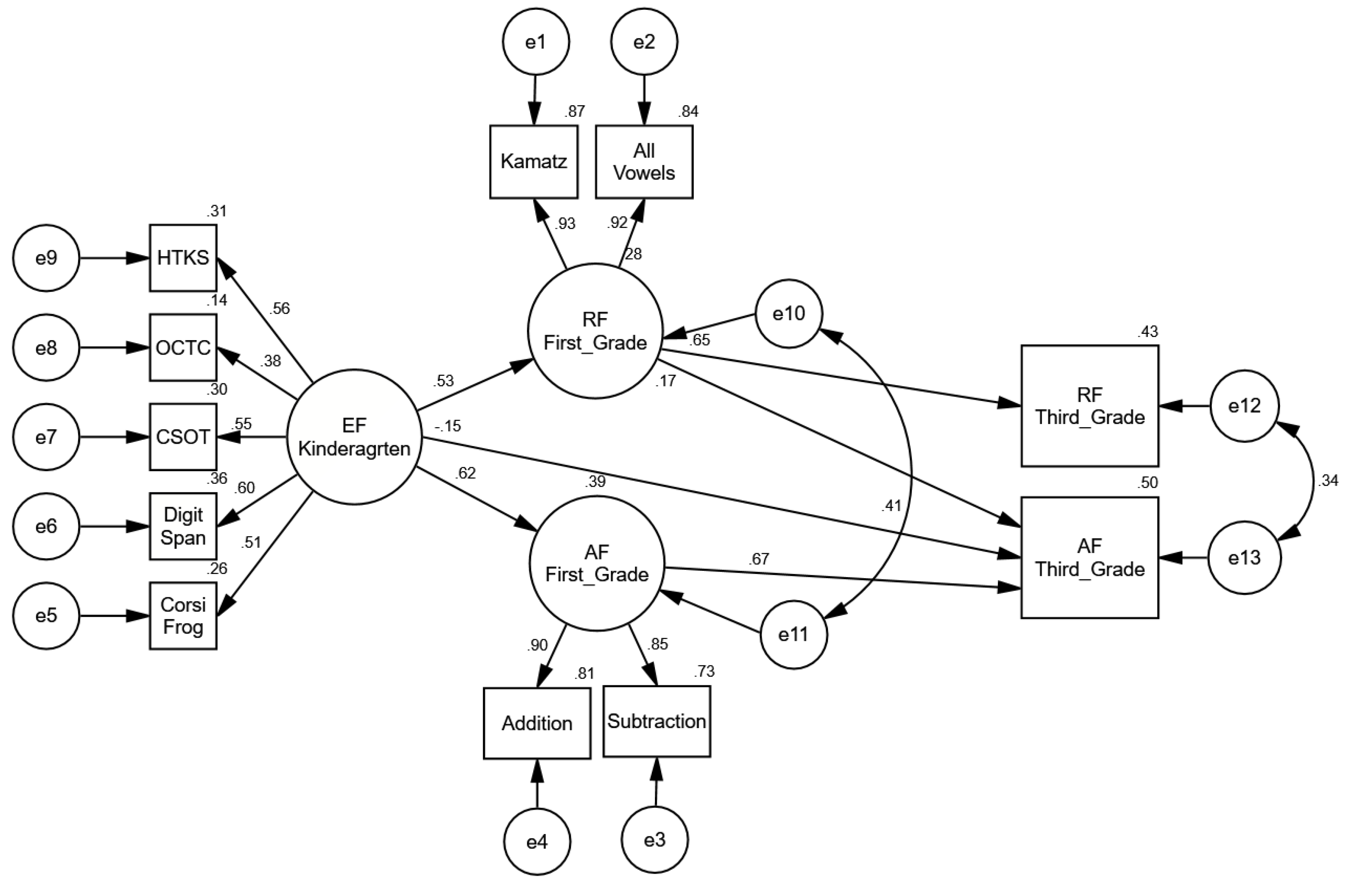
A comparison of the models’ fit indicated that the chi-square was not significantly impaired as a result of path removal (χ2 = 3.17, df = 2, p = .205). The final pruned model, presented in Figure 4, shows an excellent fit for the data (χ2 = 89.570, df = 38, p < .001, NFI = .973, CFI = .984, TLI = .972, RMSEA = .034). The EFs predicted both types of fluency outcomes in the first grade, as well as later arithmetic fluency in the third grade. First-grade reading fluency is positively and significantly related to third-grade fluency performance in both academic domains. As anticipated, first-grade arithmetic fluency is additionally predictive of later arithmetic fluency skill in the third grade.
3.4. Mediation Models
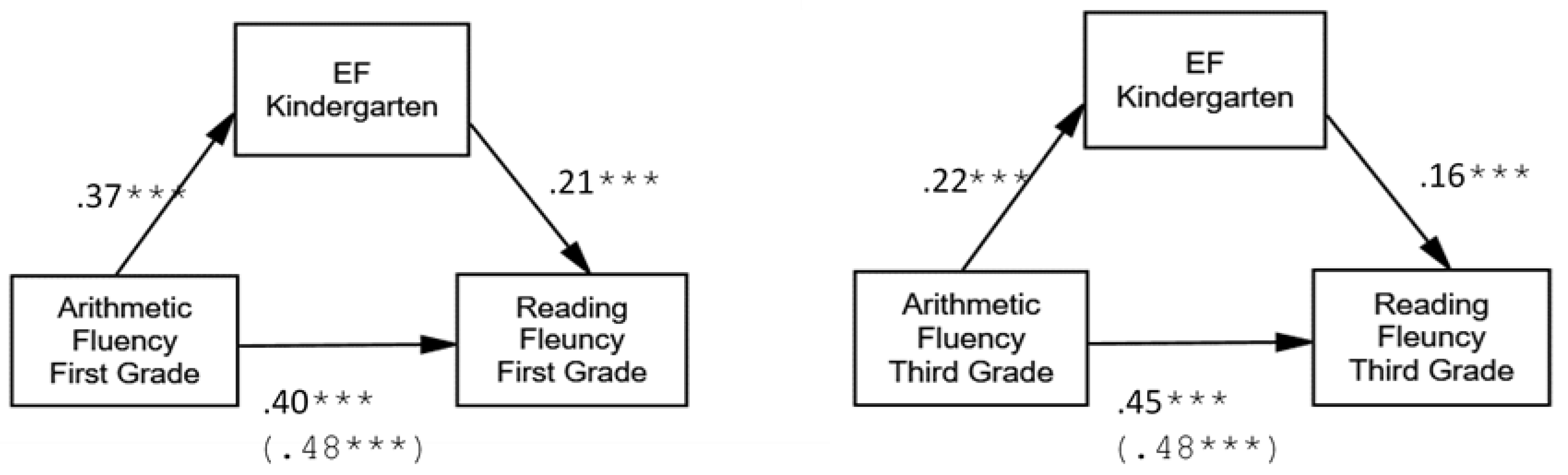
In light of the bidirectional effect between fluency in reading and arithmetic [29], we tested the mediation effect of EFs on the fluency cross-domain relationship in both directions (reading fluency → EFs → arithmetic fluency and vice versa). A mediation analysis was conducted using Model 4 of the add-on process macro [90]. This approach allows for simultaneously estimating the total, direct and indirect effects of the main predictor on the dependent variable through the proposed mediator. The point estimate and the confidence intervals (CIs) for the indirect effects were estimated using a bias-corrected bootstrapping procedure with 10,000 resamples. The mediation model is illustrated in Figure 4 and Figure 5, and path standardized coefficients are reported in Table 3 and Table 4. Overall, the mediation model analysis of the indirect effects suggests that these associations are reciprocal. Specifically, the findings indicate that reading fluency is positively related to increased EF skills, which, in turn, are associated with increased arithmetic fluency (see Table 3 and Figure 4). Thus, EFs mediate the relationship between reading fluency (as a predictor) and arithmetic fluency (as an outcome measure) in the first and third grades.
Examination of the paths in the opposite direction reveal significant relations between arithmetic fluency (as a predictor) and reading fluency (as an outcome measure), with EFs as a mediator. Again, the findings indicate that arithmetic fluency is positively related to increased EF skills, which, in turn, are associated with increased reading fluency (see Table 4 and Figure 5) in the first and third grades.
4. Discussion
The main aim of the present study is to investigate whether and how early EF skills affect the cross-domain relations between fluency in reading and arithmetic across different phases of skill acquisition. Novel aspects of the study include: (1) a systematic assessment of the longitudinal correlations and predictive relations of fluency in reading and arithmetic across the early elementary grades; (2) unique examination of the relative contribution of kindergarten EFs to the development of fluency in both academic domains; and (3) an inclusive investigation of the mediating effect of early EFs on the cross-domain relations between both types of fluency. To the best of our knowledge, this is the first study that has attempted to explain the cross-domain relationship between fluency in reading and arithmetic by examining the potential effect of common core EF components from a bidirectional perspective (reading→arithmetic and vice versa). In order to adequately capture the developmental nature of the complex relationships among these skills, a large, nationally representative sample of kindergarten children was followed from kindergarten to the third grade.
4.1. Cross-Domain Relations between Fluency in Reading and Arithmetic
Overall, the results of this study indicate that, consistent with past research, fluency performance in reading and arithmetic are significantly and positively correlated (ranged from weak to moderate). Despite the interrelations between these skills and previous evidence showing mutual effects between reading and arithmetic-related skills [e.g., 34,38, 43], bidirectional predictive relations were not found in the current study. Accordingly, our analysis reveals that the cross-domain predictive role of fluency is unidirectional, as first-grade reading fluency predicted arithmetic fluency performance in the third grade. A longitudinal study with academically at risk children [91] similarly found that only reading performance contributed to math growth from first through fourth grades. It should be noted that the reviewed studies are not directly comparable due to major differences in the analysis approach, measurement aspects (i.e., composite score on broad measures) and unique characteristics of the samples studied (typical achievers vs. at risk for learning difficulties).
Another possible explanation for the observed role of reading fluency in the development of arithmetic fluency is based on the premise that mathematics, and arithmetic fluency in particular, is a language-based knowledge [92,93]. Thus, learning simple calculation comprises reading-related skills, such as phonological awareness required for the retrieval of numeric words, processing, and encoding of symbols in the long-term memory [94], verbal retrieval abilities such as rapid automatized naming [95] and specialized vocabulary [26,96].
We also assume that the predictive interaction between fluency in reading and arithmetic might be further influenced by pedagogical aspects combined with specific features of the orthography examined. In the orthographically regular Hebrew language (i.e., graphemes-phonemes correspondence is both consistent and relatively easy to master), reading fluency is largely instructed and established by the end of the first grade [31]. By contrast, the formal instruction and practice of simple arithmetic calculations typically continue until the end of the third grade [97,98]. As Hebrew reading fluency increases faster and earlier compared to the ability to retrieve arithmetic calculations, it might be that fluent word reading performance relies on different skills and processes (such as metacognitive and/or metalinguistic components) than those required for the execution of simple calculations in the first year of primary school.
4.2. The Role of Early EF Skills in the Development of Fluency
In testing the long-term predictive role of kindergarten EFs in later fluency performance, we found a significant contribution of kindergarten EF components (which emerged as a single unitary construct) to first-grade reading and arithmetic fluency acquisition. On the other hand, by the third grade, early EFs significantly supported arithmetic fluency performance, but not reading fluency performance. The current results further corroborate other studies demonstrating that EFs are more predictive of children’s early math than reading achievement [70,100,101].
From a developmental perspective, the time specificity of the predictive effect of kindergarten EFs shared by fluency in both academic domains, which was obtained only in the first grade, might be associated with differences in the developmental timeline for the acquisition of fluency across both academic domains. Hence, the common significant importance of early EFs in fluency performance during the first year of formal school might indicate that both are at the initial stages of new skill learning. As noted in the introduction, in the beginning stages of fluency acquisition, the young learner performs complex activities, such as serial decoding of graphemes into phonemes while deciphering a new word and implementing calculation procedures (such as finger counting), which, in turn, lead to an increase in cognitive load. While reading fluency leads to the automatization of skillful actions and frees up cognitive resources by the third year of school, simple calculations still rely on EF processes, indicating that the retrieval of arithmetic facts has not yet reached an automatic level. These results strengthen the notion that the developmental trajectories of reading vs mathematical fluency are different, and that the development is domain specific and not general.
4.3. Executive Functions as Mediator in the Relationship between Fluency in Reading and Arithmetic
A very important and yet under-explored question is how and to what extent early EFs mediate the cross-domain relationship between fluency in reading and arithmetic. In light of the empirical indications for a time-dependent or time-specific impact on the directionality of the relations between the observed variables [91], and the potential differences in the growth trajectories between both types of fluency, we tested how these variables operate at a specific grade level.
A series of path analyses confirmed that kindergarten EFs account for a significant portion of the relation between fluency performance in reading and arithmetic at the two possible predictive pathways (reading→arithmetic and vice versa) across each examined time point (first and third grades). This is consistent with recent work by Braak et al. (2022), who reported that first-grade EFs mediate the indirect effect from kindergarten math performance to fifth-grade math and reading performance. These results might suggest that high proficiency in the core executive processes at a young age may set the stage for school successful fluency development in reading/arithmetic, which in turn may have positive transfer effects on fluency performance in the other academic domain.
A substantial body of scientific evidence demonstrates that fluency in both reading and arithmetic build upon similar information processing [91,102], cognitive strategies and procedures [20]. As previously stated, reading and simple arithmetic calculations entail the processing of symbolic representations (e.g., letters, numerals and mathematical symbols) [10,12]. Learning to read and perform arithmetic calculations rely on similar cognitive strategies, such as chunking which is required for the efficient recognition of common letter combinations and number equations [103,104,105]. Adequate implementation of common serial strategies [20] at the advanced stage of skills acquisition and gradually increased automatization facilitate the rapid and accurate retrieval of words and basic arithmetic facts [23,28] in fluency-timed measures. In this regard, EFs were found to support the generalization and application of cognitive mechanisms across different academic tasks [106]. Considering the above cumulative evidence with comparable scientific support [107,108,109], we have reached the conclusion that EFs facilitate the transfer of similar processes, and possibly act as a linking chain that promotes the cross-domain developmental association between fluency in reading and arithmetic.
Neuroimaging studies might also provide valuable insights into the intertwined nature of the associations between fluency performance and EF skills. Accordingly, overlapping network regions, which are activated during tasks requiring the rapid retrieval of phonological representation and numerical information [110], were also found to support EF skills [111,112]. As skill improves within one domain, it likely instigates neuroplastic changes in the shared networks which enhance cognitive abilities that extend to the other domain [113]. These neuroplastic changes underscore the interdependence of fluency skills in reading and arithmetic and underscore the pivotal role of EFs in facilitating their reciprocal benefits.
In conclusion, the current study illuminates the interconnected nature of fluency, a fundamental skill, in reading and arithmetic, underscoring the critical role of early EF skills in their development and cross-domain relationships. These findings further highlight the importance of cognitive processes in facilitating the acquisition of fluency and the transfer of skills across both academic domains.
4.4. Limitations and Implications
Despite the significant findings obtained in this study, there are several noteworthy limitations that should be taken into consideration in future research. While the current study benefited from a large, nationally representative sample, it is important to acknowledge that the sample was limited to typically developing children in a specific phase of fluency skill development. Moreover, the findings are limited to the specific characteristics of the Hebrew orthography, known for its relatively consistent and shallow structure. To provide a comprehensive understanding of the developmental trajectories of these skills and how the associations between fluency in reading and arithmetic may change or become more stable over time, future research should explore diverse groups (e.g., children with learning difficulties), with different cognitive profiles across a wider age range (e.g., older children and adolescents) and orthographies to better capture the heterogeneity within the population.
In addition, our study primarily focused on examining the role of EFs as a mediator, relying exclusively on fluency measures to evaluate reading and arithmetic skills. We did not consider other factors that could potentially influence the cross-domain associations. To gain a more comprehensive understanding of these relationships, it would be beneficial to explore additional measures that assess different aspects of reading and math-related skills, such as comprehension or problem-solving. Moreover, incorporating alternative variables that may interact with EFs, such as motivation and attentional control, could provide further insights into the complexities of the cross-domain relations. Another unresolved inquiry pertains to the underlying cognitive processes and neural mechanisms that facilitate the transfer of skills between these domains, with potential avenues for investigation through the utilization of neuroimaging techniques or experimental manipulations.
The results of the present study have imperative theoretical and practical implications. Theoretically, our study advances our knowledge about the delicate interplay between fluency in reading and arithmetic by highlighting the role of early EF skills. The identification of EFs as a mediating factor provides a new bidirectional perspective on the underlying cognitive mechanisms that contribute to the development of fluency in both academic domains. Developmentally, the data presented in this study shed light on the process of fluency acquisition by recognizing potential variations in the developmental trajectories of fluency in reading and arithmetic. Practically, educators and curriculum designers can consider incorporating cross-domain instruction that explicitly connects reading and arithmetic, leveraging the shared cognitive processes and strategies involved in both skills. Effective integration and incorporation of EF skill training (such as WM, inhibitory control, and cognitive flexibility) might foster the successful development of fluency in both academic domains among young learners. Ultimately, proactive assessment and identification of EF skills among kindergarten children with difficulties can inform targeted interventions, which eventually might narrow the achievement gap and promote more equitable educational outcomes for all learners.
Author Contributions
Conceptualization, S.S and R.B.; methodology, R.B.; formal analysis, S.S and R.B.; data curation, R.B.; writing—original draft preparation, R.B.; writing—review and editing, S.S and R.B.; supervision, S.S.; All authors have read and agreed to the published version of the manuscript.
Funding
This Research was founded by the Edmond J. Safra Foundation.
Institutional Review Board Statement
All the data was collected after receiving approval from the chief scientist of the Israeli Ministry of Education (approval file # 9667) and the Research Ethics Committee of the Faculty of Education at the University of Haifa (approval # 043/18).
Informed Consent Statement
consent forms from the parents of the children who participated in the study were received.
Data Availability Statement
The data is part of a large longitudinal study, it will be available upon request.
Acknowledgments
Great appreciation is conveyed to the students who participated in the present study as well as the parents and guardians who gave their permission to participate. In addition, we would like to thank the Edmond J. Safra Foundation for their generous support.
Conflicts of Interest
The authors declare no conflict of interest
References
- Price, G. R., Mazzocco, M. M., & Ansari, D. (2013). Why mental arithmetic counts: brain activation during single digit arithmetic predicts high school math scores. Journal of Neuroscience, 33(1), 156-163. [CrossRef]
- Ruddy, J., Ciancio, D., Skinner, C. H., & Blonder, M. (2019). Receiver operating characteristic analysis of oral reading fluency predicting broad reading scores. Contemporary School Psychology, 23, 245-257. [CrossRef]
- LaBerge, D., & Samuels, S. J. (1974). Toward a theory of automatic information processing in reading. Cognitive Psychology, 6(2), 293-323. [CrossRef]
- Meyer, M. S., & Felton, R. H. (1999). Repeated reading to enhance fluency: Old approaches and new directions. Annals of Dyslexia, 49, 283-306. [CrossRef]
- Wolf, M., & Katzir-Cohen, T. (2001). Reading fluency and its intervention. Scientific Studies of Reading, 5(3), 211-239. [CrossRef]
- Hudson, R. F., Lane, H. B., & Pullen, P. C. (2005). Reading fluency assessment and instruction: What, why, and how? The Reading Teacher, 58(8), 702-714. [CrossRef]
- Fuchs, L. S., Powell, S. R., Seethaler, P. M., Cirino, P. T., Fletcher, J. M., Fuchs, D., ... & Zumeta, R. O. (2009). Remediating number combination and word problem deficits among students with mathematics difficulties: A randomized control trial. Journal of Educational Psychology, 101(3), 561. [CrossRef]
- Vukovic, R. K., Lesaux, N. K., & Siegel, L. S. (2010). The mathematics skills of children with reading difficulties. Learning and Individual Differences, 20(6), 639-643. [CrossRef]
- Zaunmüller, L., Domahs, F., Dressel, K., Lonnemann, J., Klein, E., Ischebeck, A., & Willmes, K. (2009). Rehabilitation of arithmetic fact retrieval via extensive practice: a combined fMRI and behavioural case-study. Neuropsychological Rehabilitation, 19(3), 422-443. [CrossRef]
- Share, D. L. (1995). Phonological recoding and self-teaching: Sine qua non of reading acquisition. Cognition, 55(2), 151-218. [CrossRef]
- Logan, G. D. (1988). Toward an instance theory of automatization. Psychological Review, 95(4), 492.
- Crollen, V., & Noël, M. P. (2015). The role of fingers in the development of counting and arithmetic skills. Acta Psychologica, 156, 37-44. [CrossRef]
- Geary, D. C., Brown, S. C., & Samaranayake, V. A. (1991). Cognitive addition: A short longitudinal study of strategy choice and speed-of-processing differences in normal and mathematically disabled children. Developmental Psychology, 27(5), 787.
- Mabbott, D. J., & Bisanz, J. (2003). Developmental change and individual differences in children's multiplication. Child Development, 74(4), 1091-1107.
- Fuchs, L. S., Fuchs, D., Hosp, M. K., & Jenkins, J. R. (2001). Oral reading fluency as an indicator of reading competence: A theoretical, empirical, and historical analysis. Scientific Studies of Reading, 5(3), 239-256. [CrossRef]
- Fuchs, L. S., Fuchs, D., Compton, D. L., Powell, S. R., Seethaler, P. M., Capizzi, A. M., ... & Fletcher, J. M. (2006). The cognitive correlates of third-grade skill in arithmetic, algorithmic computation, and arithmetic word problems. Journal of Educational Psychology, 98(1), 29.
- Landerl, K., & Moll, K. (2010). Comorbidity of learning disorders: prevalence and familial transmission. Journal of Child Psychology and Psychiatry, 51(3), 287-294. [CrossRef]
- Moll, K., Kunze, S., Neuhoff, N., Bruder, J., & Schulte-Körne, G. (2014). Specific learning disorder: Prevalence and gender differences. PLoS One, 9(7), e103537. [CrossRef]
- Balhinez, R., & Shaul, S. (2019). The relationship between reading fluency and arithmetic fact fluency and their shared cognitive skills: A developmental perspective. Frontiers in Psychology, 10, 1281. [CrossRef]
- Koponen, T., Eklund, K., Heikkilä, R., Salminen, J., Fuchs, L., Fuchs, D., & Aro, M. (2020). Cognitive correlates of the covariance in reading and arithmetic fluency: Importance of serial retrieval fluency. Child Development, 91(4), 1063-1080. [CrossRef]
- Cirino, P. T., Child, A. E., & Macdonald, K. T. (2018). Longitudinal predictors of the overlap between reading and math skills. Contemporary Educational Psychology, 54, 99-111. [CrossRef]
- Koponen, T., Aunola, K., Ahonen, T., and Nurmi, J. E. (2007). Cognitive predictors of single-digit and procedural calculation skills and their covariation with reading skill. Journal of Experimental Child Psychology, 97(3), 220-241. [CrossRef]
- Korpipää, H., Koponen, T., Aro, M., Tolvanen, A., Aunola, K., Poikkeus, A. M., ... & Nurmi, J. E. (2017). Covariation between reading and arithmetic skills from Grade 1 to Grade 7. Contemporary Educational Psychology, 51, 131-140. [CrossRef]
- Georgiou, G. K., Wei, W., Inoue, T., Das, J. P., & Deng, C. (2020). Cultural influences on the relation between executive functions and academic achievement. Reading and Writing, 33, 991-1013. [CrossRef]
- Georgiou, G. K., Inoue, T., & Parrila, R. (2021). Developmental Relations Between Home Literacy Environment, Reading Interest, and Reading Skills: Evidence from a 3-Year Longitudinal Study. Child Development, 92(5), 2053-2068.
- Georgiou, G. K., Tziraki, N., Manolitsis, G., & Fella, A. (2013). Is rapid automatized naming related to reading and mathematics for the same reason(s)? A follow-up study from kindergarten to Grade 1. Journal of Experimental Child Psychology, 115(3), 481-496. [CrossRef]
- Koponen, T., Salmi, P., Eklund, K., and Aro, T. (2013). Counting and RAN: Predictors of arithmetic calculation and reading fluency. Journal of Educational Psychology, 105(1), 162. [CrossRef]
- Koponen, T., Salmi, P., Torppa, M., Eklund, K., Aro, T., Aro, M., ... and Nurmi, J. E. (2016). Counting and rapid naming predict the fluency of arithmetic and reading skills. Contemporary Educational Psychology, 44, 83-94. [CrossRef]
- Gnambs, T., & Lockl, K. (2022). Bidirectional effects between reading and mathematics development across secondary school. Zeitschrift für Erziehungswissenschaft, 1-27. [CrossRef]
- Georgiou, G. K., Parrila, R., & Papadopoulos, T. C. (2008). Predictors of word decoding and reading fluency across languages varying in orthographic consistency. Journal of Educational Psychology, 100(3), 566.
- Lipka, O., Katzir, T., & Shaul, S. (2016). The Basis of Reading Fluency in First Grade of Hebrew Speaking Children. In Reading Fluency (pp. 91-104). Springer, Cham.
- Caravolas, M., Lervåg, A., Mikulajová, M., Defior, S., Seidlová-Málková, G., & Hulme, C. (2019). A cross-linguistic, longitudinal study of the foundations of decoding and reading comprehension ability. Scientific Studies of Reading, 23(5), 386-402. [CrossRef]
- Bailey, D. H., Oh, Y., Farkas, G., Morgan, P., & Hillemeier, M. (2020). Reciprocal effects of reading and mathematics? Beyond the cross-lagged panel model. Developmental Psychology, 56(5), 912.
- Cameron, C. E., Kim, H., Duncan, R. J., Becker, D. R., & McClelland, M. M. (2019). Bidirectional and co-developing associations of cognitive, mathematics, and literacy skills during kindergarten. Journal of Applied Developmental Psychology, 62, 135-144. [CrossRef]
- Duncan, G. J., Dowsett, C. J., Claessens, A., Magnuson, K., Huston, A. C., Klebanov, P., ... & Sexton, H. (2007). School readiness and later achievement. Developmental Psychology, 43(6), 1428.
- Peng, P., Lin, X., Ünal, Z. E., Lee, K., Namkung, J., Chow, J., & Sales, A. (2020). Examining the mutual relations between language and mathematics: A meta-analysis. Psychological Bulletin, 146(7), 595.
- Spencer, M., Fuchs, L. S., Geary, D. C., & Fuchs, D. (2022). Connections between mathematics and reading development: Numerical cognition mediates relations between foundational competencies and later academic outcomes. Journal of Educational Psychology, 114(2), 273. [CrossRef]
- ten Braak, D., Lenes, R., Purpura, D. J., Schmitt, S. A., & Størksen, I. (2022). Why do early mathematics skills predict later mathematics and reading achievement? The role of executive function. Journal of Experimental Child Psychology, 214, 105306.
- Purpura, D. J., Logan, J. A., Hassinger-Das, B., & Napoli, A. R. (2017). Why do early mathematics skills predict later reading? The role of mathematical language. Developmental Psychology, 53(9), 1633.
- Hart, S. A., Petrill, S. A., & Thompson, L. A. (2010). A factorial analysis of timed and untimed measures of mathematics and reading abilities in school aged twins. Learning and Individual Differences, 20(2), 63-69.
- Petrill, S., Logan, J., Hart, S., Vincent, P., Thompson, L., Kovas, Y., & Plomin, R. (2012). Math fluency is etiologically distinct from untimed math performance, decoding fluency, and untimed reading performance: Evidence from a twin study. Journal of Learning Disabilities, 45(4), 371-381. [CrossRef]
- Andin, J., Fransson, P., Rönnberg, J., & Rudner, M. (2015). Phonology and arithmetic in the language–calculation network. Brain and Language, 143, 97-105.
- Ünal, Z. E., Greene, N. R., Lin, X., & Geary, D. C. (2023). What is the source of the correlation between reading and mathematics achievement? Two meta-analytic studies. Educational Psychology Review, 35(1), 4.
- Child, A. E., Cirino, P. T., Fletcher, J. M., Willcutt, E. G., & Fuchs, L. S. (2019). A Cognitive Dimensional Approach to Understanding Shared and Unique Contributions to Reading, Math, and Attention Skills. Journal of Learning Disabilities, 52(1), 15-30.
- Monette, S., Bigras, M., & Guay, M. C. (2011). The role of the executive functions in school achievement at the end of Grade 1. Journal of Experimental Child Psychology, 109(2), 158-173.
- Cragg, L., & Gilmore, C. (2014). Skills underlying mathematics: The role of executive function in the development of mathematics proficiency. Trends in Neuroscience and Education, 3(2), 63-68.
- Butterfuss, R., & Kendeou, P. (2018). The role of executive functions in reading comprehension. Educational Psychology Review, 30(3), 801-826.
- Miyake, A., Friedman, N. P., Emerson, M. J., Witzki, A. H., Howerter, A., & Wager, T. D. (2000). The unity and diversity of executive functions and their contributions to complex “frontal lobe” tasks: A latent variable analysis. Cognitive Psychology, 41(1), 49-100.
- Zelazo, P. D., & Müller, U. (2002). Executive function in typical and atypical development. Blackwell handbook of childhood cognitive development, 445-469.
- Bardikoff, N., & Sabbagh, M. (2017). The differentiation of executive functioning across development: Insights from developmental cognitive neuroscience. New perspectives on human development, 47(66), 27-46.
- Lee, K., Bull, R., & Ho, R. M. (2013). Developmental changes in executive functioning. Child development, 84(6), 1933-1953. [CrossRef]
- Zelazo, P. D., & Carlson, S. M. (2012). Hot and cool executive function in childhood and adolescence: Development and plasticity. Child Development Perspectives, 6(4), 354-360. [CrossRef]
- Espy, K. A., McDiarmid, M. M., Cwik, M. F., Stalets, M. M., Hamby, A., & Senn, T. E. (2004). The contribution of executive functions to emergent mathematic skills in preschool children. Developmental Neuropsychology, 26(1), 465-486.
- Bull, R., & Scerif, G. (2001). Executive functioning as a predictor of children's mathematics ability: Inhibition, switching, and working memory. Developmental Neuropsychology, 19(3), 273-293.
- Conners, F. A. (2009). Attentional control and the simple view of reading. Reading and Writing, 22(5), 591-613.
- Rohl, M., & Pratt, C. (1995). Phonological awareness, verbal working memory and the acquisition of literacy. Reading and Writing, 7(4), 327-360.
- Berninger, V. W., & Nagy, W. E. (2008). Flexibility in word reading: Multiple levels of representations, complex mappings, partial similarities and cross-modal connections. Literacy processes: Cognitive flexibility in learning and teaching.
- Cragg, L., Keeble, S., Richardson, S., Roome, H. E., & Gilmore, C. (2017). Direct and indirect influences of executive functions on mathematics achievement. Cognition, 162, 12-26.
- Clark, C. A., Pritchard, V. E., & Woodward, L. J. (2010). Preschool executive functioning abilities predict early mathematics achievement. Developmental Psychology, 46(5), 1176.
- Hecht, S. A. (2002). Counting on working memory in simple arithmetic when counting is used for problem solving. Memory & Cognition, 30(3), 447-455.
- De Franchis, V., Usai, M. C., Viterbori, P., & Traverso, L. (2017). Preschool executive functioning and literacy achievement in Grades 1 and 3 of primary school: A longitudinal study. Learning and Individual Differences, 54, 184-195.
- Kieffer, M. J., & Christodoulou, J. A. (2020). Automaticity and control: How do executive functions and reading fluency interact in predicting reading comprehension?. Reading Research Quarterly, 55(1), 147-166.
- Nguyen, T., & Duncan, G. J. (2019). Kindergarten components of executive function and third grade achievement: A national study. Early Childhood Research Quarterly, 46, 49-61.
- Cortés Pascual, A., Moyano Muñoz, N., & Quilez Robres, A. (2019). The relationship between executive functions and academic performance in primary education: Review and meta-analysis. Frontiers in Psychology, 10, 1582.
- Purpura, D. J., Schmitt, S. A., & Ganley, C. M. (2017). Foundations of mathematics and literacy: The role of executive functioning components. Journal of Experimental Child Psychology, 153, 15-34.
- ten Braak, D., Størksen, I., Idsoe, T., & McClelland, M. (2019). Bidirectionality in self-regulation and academic skills in play-based early childhood education. Journal of Applied Developmental Psychology, 65, 101064. [CrossRef]
- Mauer, E., Zhou, Q., & Uchikoshi, Y. (2021). A longitudinal study on bidirectional relations between executive functions and English word-level reading in Chinese American children in immigrant families. Learning and Individual Differences, 86, 101976. [CrossRef]
- Ober, T. M., Brooks, P. J., Homer, B. D., & Rindskopf, D. (2020). Executive functions and decoding in children and adolescents: A meta-analytic investigation. Educational Psychology Review, 32, 735-763.
- Clements, D. H., Sarama, J., & Germeroth, C. (2016). Learning executive function and early mathematics: Directions of causal relations. Early Childhood Research Quarterly, 36, 79-90.
- Blair, C., & Raver, C. C. (2015). School readiness and self-regulation: A developmental psychobiological approach. Annual Review of Psychology, 66, 711-731.
- Fuhs, M. W., & Day, J. D. (2011). Verbal ability and executive functioning development in preschoolers at head start. Developmental Psychology, 47(2), 404.
- McClelland, M. M., Cameron, C. E., Duncan, R., Bowles, R. P., Acock, A. C., Miao, A., & Pratt, M. E. (2014). Predictors of early growth in academic achievement: The head-toes-knees-shoulders task. Frontiers in Psychology, 5, 599.
- Stipek, D., Newton, S., & Chudgar, A. (2010). Learning-related behaviors and literacy achievement in elementary school-aged children. Early Childhood Research Quarterly, 25(3), 385-395.
- Evans, J. S. B., & Stanovich, K. E. (2013). Dual-process theories of higher cognition: Advancing the debate. Perspectives on Psychological Science, 8(3), 223-241.
- Peng, P., Barnes, M., Wang, C., Wang, W., Li, S., Swanson, H. L., ... & Tao, S. (2018). A meta-analysis on the relation between reading and working memory. Psychological Bulletin, 144(1), 48.
- Welsh, J. A., Nix, R. L., Blair, C., Bierman, K. L., & Nelson, K. E. (2010). The development of cognitive skills and gains in academic school readiness for children from low-income families. Journal of Educational Psychology, 102(1), 43. [CrossRef]
- Hassinger-Das, B., Jordan, N. C., Glutting, J., Irwin, C., & Dyson, N. (2014). Domain-general mediators of the relation between kindergarten number sense and first-grade mathematics achievement. Journal of Experimental Child Psychology, 118, 78-92. [CrossRef]
- McKinnon, R. D., & Blair, C. (2019). Bidirectional relations among executive function, teacher–child relationships, and early reading and math achievement: A cross-lagged panel analysis. Early Childhood Research Quarterly, 46, 152-165.
- Grenell, A., & Carlson, S. M. (2021). Individual differences in executive function and learning: The role of knowledge type and conflict with prior knowledge. Journal of Experimental Child Psychology, 206, 105079.
- Ponitz, C. C., McClelland, M. M., Matthews, J. S., & Morrison, F. J. (2009). A structured observation of behavioral self-regulation and its contribution to kindergarten outcomes. Developmental Psychology, 45(3), 605. [CrossRef]
- Wanless, S. B., McClelland, M. M., Acock, A. C., Chen, F. M., & Chen, J. L. (2011). Behavioral regulation and early academic achievement in Taiwan. Early Education & Development, 22(1), 1-28. [CrossRef]
- Nicolson, R. I., & Fawcett, A. J. (2004). The dyslexia early screening test-second edition (DEST-2). London: The Psychological Corporation.
- Wechsler, D. (1991). WISC-III: Wechsler intelligence scale for children: Manual. Psychological Corporation.
- McInerney, R. J., Hrabok, M., & Kerns, K. A. (2005). The children’s size-ordering task: a new measure of nonverbal working memory. Journal of Clinical and Experimental Neuropsychology, 27(6), 735-745. [CrossRef]
- Granvald, V., & Marciszko, C. (2016). Relations between key executive functions and aggression in childhood. Child neuropsychology, 22(5), 537-555.
- Smidts, D. P., Jacobs, R., & Anderson, V. (2004). The Object Classification Task for Children (OCTC): A measure of concept generation and mental flexibility in early childhood. Developmental Neuropsychology, 26(1), 385-401. [CrossRef]
- Schiff, R., Kahta, S., & Katzir, T. (2006). Single-word reading test: Vowelized and unvowelized word reading. Haddad Center, Bar-Ilan University, Ramat Gan, Israel.
- Torgesen, J. K., Rashotte, C. A. and Wagner, R. K. (1999). TOWRE: Test of word reading efficiency. Austin, TX: Pro-ed.
- Mather, N., & Schrank, F. A. (2001). Woodcock-Johnson® III. Handbook of Psychoeducational Assessment: A Practical Handbook A Volume in the EDUCATIONAL PSYCHOLOGY Series, 133.
- Hayes, A. F., & Rockwood, N. J. (2017). Regression-based statistical mediation and moderation analysis in clinical research: Observations, recommendations, and implementation. Behaviour research and therapy, 98, 39-57.
- Erbeli, F., Shi, Q., Campbell, A. R., Hart, S. A., & Woltering, S. (2021). Developmental dynamics between reading and math in elementary school. Developmental Science, 24(1), e13004. [CrossRef]
- Yore, L. D., Pimm, D., & Tuan, H. L. (2007). The literacy component of mathematical and scientific literacy. International Journal of Science and Mathematics Education, 5, 559-589. [CrossRef]
- O’Halloran, K. L. (2015). The language of learning mathematics: A multimodal perspective. The Journal of Mathematical Behavior, 40, 63-74. [CrossRef]
- De Smedt, B., Taylor, J., Archibald, L., & Ansari, D. (2010). How is phonological processing related to individual differences in children’s arithmetic skills?. Developmental Science, 13(3), 508-520. [CrossRef]
- Koponen, T., Georgiou, G., Salmi, P., Leskinen, M., & Aro, M. (2017). A meta-analysis of the relation between RAN and mathematics. Journal of Educational Psychology, 109(7), 977. [CrossRef]
- LeFevre, J. A., Polyzoi, E., Skwarchuk, S. L., Fast, L., & Sowinski, C. (2010). Do home numeracy and literacy practices of Greek and Canadian parents predict the numeracy skills of kindergarten children? International Journal of Early Years Education, 18(1), 55-70.
- Meyer, M. L., Salimpoor, V. N., Wu, S. S., Geary, D. C., & Menon, V. (2010). Differential contribution of specific working memory components to mathematics achievement in 2nd and 3rd graders. Learning and Individual Differences, 20(2), 101-109. [CrossRef]
- Rinne, L. F., Ye, A., & Jordan, N. C. (2020). Development of arithmetic fluency: A direct effect of reading fluency? Journal of Educational Psychology, 112(1), 110.
- Blair, C., Ursache, A., Greenberg, M., & Vernon-Feagans, L. (2015). Multiple aspects of self-regulation uniquely predict mathematics but not letter–word knowledge in the early elementary grades. Developmental Psychology, 51(4), 459. [CrossRef]
- Bull, R., Espy, K. A., & Wiebe, S. A. (2008). Short-term memory, working memory, and executive functioning in preschoolers: Longitudinal predictors of mathematical achievement at age 7 years. Developmental Neuropsychology, 33(3), 205-228. [CrossRef]
- Geary, D. C. (2011). Cognitive predictors of achievement growth in mathematics: a 5-year longitudinal study. Developmental Psychology, 47(6), 1539. [CrossRef]
- Hübner, N., Merrell, C., Cramman, H., Little, J., Bolden, D., & Nagengast, B. (2022). Reading to learn? The co-development of mathematics and reading during primary school. Child Development, 93(6), 1760-1776. [CrossRef]
- Binder, C., Haughton, E., & Bateman, B. (2002). Fluency: Achieving true mastery in the learning process. Professional Papers in Special Education, 2-20.
- Grabner, R. H., Reishofer, G., Koschutnig, K., & Ebner, F. (2011). Brain correlates of mathematical competence in processing mathematical representations. Frontiers in Human Neuroscience, 5, 130.
- McCauley, S. M., & Christiansen, M. H. (2015). Individual Differences in Chunking Ability Predict On-line Sentence Processing. In Cognitive Science.
- Marulis, L. M., Baker, S. T., & Whitebread, D. (2020). Integrating metacognition and executive function to enhance young children’s perception of and agency in their learning. Early Childhood Research Quarterly, 50, 46-54.
- Blair, C., & Razza, R. P. (2007). Relating effortful control, executive function, and false belief understanding to emerging math and literacy ability in kindergarten. Child Development, 78(2), 647-663. [CrossRef]
- Burgoyne, K., Malone, S., Lervag, A., & Hulme, C. (2019). Pattern understanding is a predictor of early reading and arithmetic skills. Early Childhood Research Quarterly, 49, 69-80.
- Spiegel, J. A., Goodrich, J. M., Morris, B. M., Osborne, C. M., & Lonigan, C. J. (2021). Relations between executive functions and academic outcomes in elementary school children: A meta-analysis. Psychological Bulletin, 147(4), 329.
- Pollack, C., & Ashby, N. C. (2018). Where arithmetic and phonology meet: the meta-analytic convergence of arithmetic and phonological processing in the brain. Developmental Cognitive Neuroscience, 30, 251-264.
- Dehaene, S., Molko, N., Cohen, L., & Wilson, A. J. (2004). Arithmetic and the brain. Current Opinion in Neurobiology, 14(2), 218-224.
- Chaddock-Heyman, L., Weng, T. B., Kienzler, C., Erickson, K. I., Voss, M. W., Drollette, E. S., ... & Kramer, A. F. (2018). Scholastic performance and functional connectivity of brain networks in children. PloS One, 13(1), e0190073. [CrossRef]
- Uchida, S., & Kawashima, R. (2008). Reading and solving arithmetic problems improves cognitive functions of normal aged people: a randomized controlled study. Age, 30, 21-29. [CrossRef]
Figure 1.
Confirmatory factor analyses (CFAs) of the observed EF variables in kindergarten.
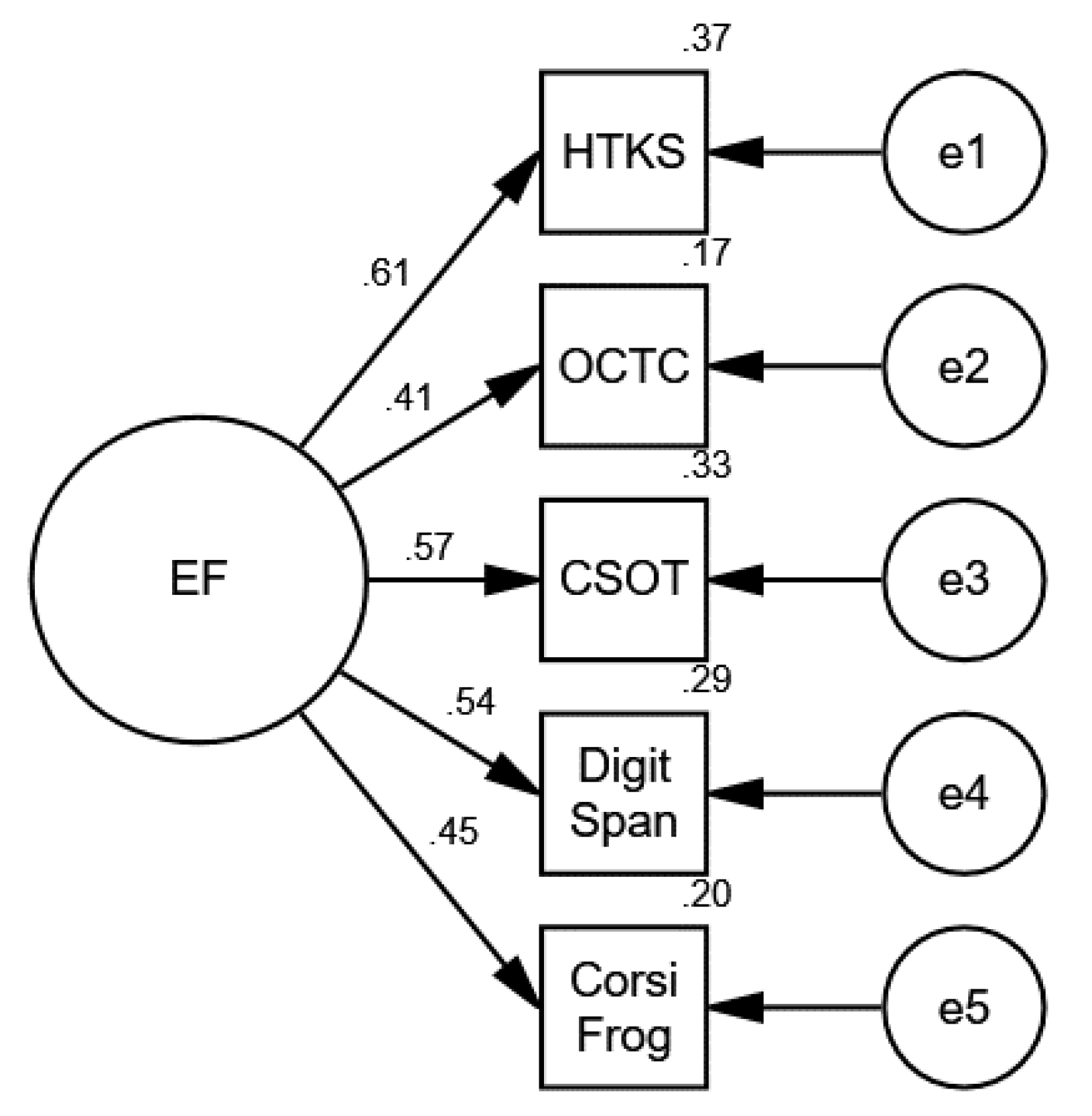
Figure 2.
Confirmatory factor analyses (CFA) of the observed reading and arithmetic fluency variables in the first grade.
Figure 2.
Confirmatory factor analyses (CFA) of the observed reading and arithmetic fluency variables in the first grade.
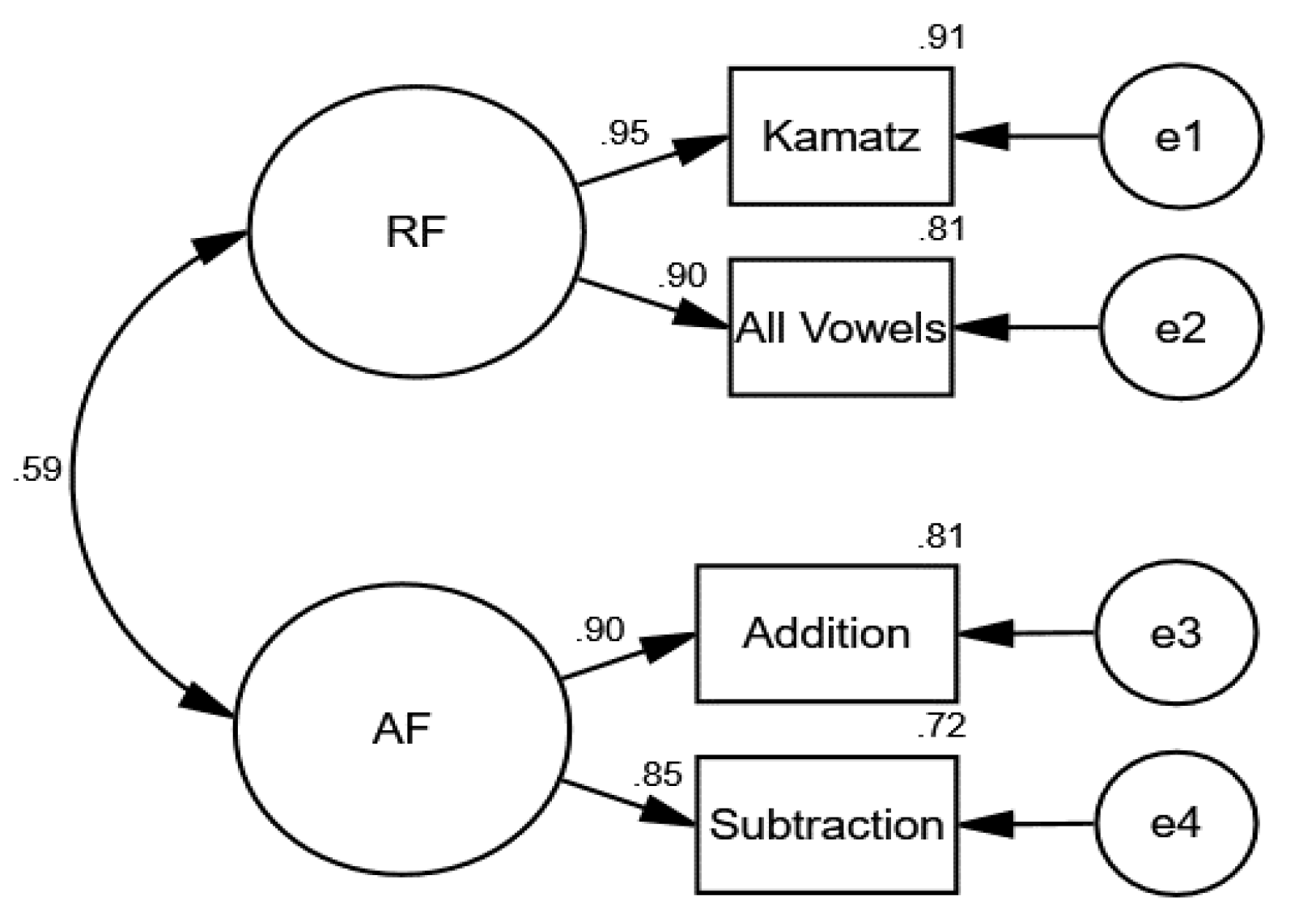
Figure 4.
EFs as a mediator of the relationship between reading fluency as a predictor and arithmetic fluency as the outcome measure in the first and third grades. Note: The figure presents standardized values. The total effect is presented in parentheses. *p < .05, **p < .01, ***p < .001.
Figure 4.
EFs as a mediator of the relationship between reading fluency as a predictor and arithmetic fluency as the outcome measure in the first and third grades. Note: The figure presents standardized values. The total effect is presented in parentheses. *p < .05, **p < .01, ***p < .001.
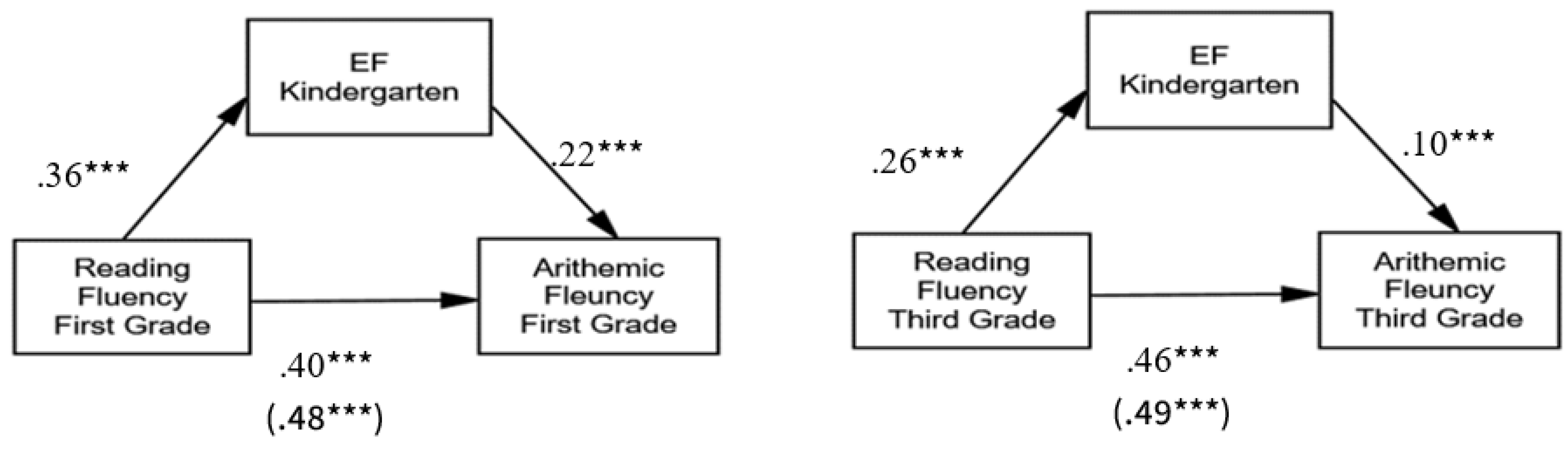

Table 1.
Principal Component Factor Analysis with Varimax Rotation: Factor Loadings of Kindergarten Executive Function Tests.
Table 1.
Principal Component Factor Analysis with Varimax Rotation: Factor Loadings of Kindergarten Executive Function Tests.
| Component | |
|---|---|
| HTKS | .688 |
| OCTC | .555 |
| Digit span backward | .561 |
| Corsi frog backward | .547 |
| CSOT | .649 |
Table 2.
Sample Descriptive Statistics and Correlations Between EF Composite Scores and Reading and Arithmetic Fluency in the First and Third Grades.
Table 2.
Sample Descriptive Statistics and Correlations Between EF Composite Scores and Reading and Arithmetic Fluency in the First and Third Grades.
| Observed variables | 1 | 2 | 3 | 4 | 5 |
|---|---|---|---|---|---|
| 1. Reading fluency first grade | - | ||||
| 2. Reading fluency third grade | .584** | - | |||
| 3. Math fluency first grade | .525** | .378** | - | ||
| 4. Math fluency third grade | .455** | .511** | .632** | - | |
| 5. EF (kindergarten) z score | .369** | .259** | .380** | .227** | - |
| N | 790 | 708 | 804 | 708 | 764 |
| Minimum | 0 | 0 | 0 | 0 | -1.06 |
| Maximum | 60 | 78 | 30 | 122 | 2.41 |
| Mean | 16.217 | 38.91 | 16.166 | 55.54 | .943 |
| Standard deviation | 10.537 | 11.65 | 5.989 | 17.65 | .581 |
**. Correlation is significant at the 0.01 level (2-tailed).
Table 3.
Reading fluency as a predictor of arithmetic fluency via EFs: direct and indirect effect in the first and third grades.
Table 3.
Reading fluency as a predictor of arithmetic fluency via EFs: direct and indirect effect in the first and third grades.
| 1st Grade | 3rd Grade | ||||||||||||
|---|---|---|---|---|---|---|---|---|---|---|---|---|---|
| Beta | B | SE | t | P | 95%CI | Beta | B | SE | t | P | 95%CI | ||
| Predicting the mediator EF | |||||||||||||
| Reading fluency | .367 | .019 | .019 | 9.16 | <.001 | [.015, .024] | .259 | .101 | .001 | 5.90 | <.001 | [.006, .013] | |
| Predicting the outcome arithmetic fluency | |||||||||||||
| Reading fluency | .406 | .220 | .021 | 10.31 | <.001 | [.178, .262] | .462 | .366 | .032 | 11.34 | <.001 | [.303, .430] | |
| EF | .225 | 2.289 | .400 | 5.71 | <.001 | [1.503, 3.076] | .106 | 2.165 | .835 | 2.59 | .009 | [.524, 3.807] | |
| Indirect effect via mediator | |||||||||||||
| .082 | .045 | .016 | -- | -- | [.052, .117] | .027 | .022 | .027 | -- | -- | [.007, .050] | ||
Table 4.
Arithmetic fluency as a predictor of reading fluency via EFs: direct and indirect effect in the first and third grades.
Table 4.
Arithmetic fluency as a predictor of reading fluency via EFs: direct and indirect effect in the first and third grades.
| 1st Grade | 3rd Grade | ||||||||||||
|---|---|---|---|---|---|---|---|---|---|---|---|---|---|
| Beta | B | SE | t | P | 95%CI | Beta | B | SE | t | P | 95%CI | ||
| Predicting the mediator EF | |||||||||||||
| Arithmetic fluency | .374 | .037 | .004 | 9.35 | <.001 | [.029, .044] | .226 | .011 | .002 | 5.09 | <.001 | [.007, .015] | |
| Predicting the outcome reading fluency | |||||||||||||
| Arithmetic fluency | .408 | .751 | .073 | 10.31 | <.001 | [.608, .895] | .455 | .574 | .051 | 11.34 | <.001 | [.474, .673] | |
| EF | .215 | 4.028 | .741 | 5.43 | <.001 | [2.572, 5.484] | .157 | 4.051 | 1.046 | 3.91 | <.001 | [2.016, 6.088] | |
| Indirect effect via mediator | |||||||||||||
| .080 | .148 | .032 | -- | -- | [.048, .114] | .035 | .045 | .011 | -- | -- | [.015, .060] | ||
Disclaimer/Publisher’s Note: The statements, opinions and data contained in all publications are solely those of the individual author(s) and contributor(s) and not of MDPI and/or the editor(s). MDPI and/or the editor(s) disclaim responsibility for any injury to people or property resulting from any ideas, methods, instructions or products referred to in the content. |
© 2024 by the authors. Licensee MDPI, Basel, Switzerland. This article is an open access article distributed under the terms and conditions of the Creative Commons Attribution (CC BY) license (http://creativecommons.org/licenses/by/4.0/).
Copyright: This open access article is published under a Creative Commons CC BY 4.0 license, which permit the free download, distribution, and reuse, provided that the author and preprint are cited in any reuse.


