

Submitted:
08 January 2026
Posted:
09 January 2026
Read the latest preprint version here
Abstract
This new frame work of thermodynamics consists of four parts:(1)The traditional thermodynamics (a brief one), relating to all the thermodynamical processes we meet in our life,work, ordinary research, and so on, covering an extremely immense scope. Numerous and numerous human practices confirm that all these processes are irreversible, and entropy tends to increase, never decreases; (2)The thermodynamics of thermal electrons in a magnetic field. The thermal electrons here are emitted at room temperature from two identical and parallel Ag-O-Cs emitters, A and B (work function 0.8eV) in a vacuum tube. The tube is applied by a static magnetic field parallel to A and B, bending the trajectories of the electrons, resulting in a weak asymmetry in their thermal motion(to left or to right). Emitter A, losing some net electrons, is charged positively; and emitter B, getting some net electrons, is charged negatively. An electric potential between A and B is formed, enabling the tube outputs a continuous tiny but macroscope current to an exterior load, e.g., a resistor, or a storage battery. (Reverse the direction of the magnetic field, the output current also reverses.) Due to the ceaseless output of electric energy, the internal energy of the tube should decrease slightly, and the whole tube follows to cool down slightly. The slightly cooled tube can automatically absorb waste heat from the ambient air (that is kept at a constant room temperature) to compensate its output electric energy. The experiment converts the waste heat from the ambient air to electric energy, directly violating the Kelvin-Planck statement of the second law. Two short experiment videos are included in this article. (3)Cosmic thermodynamics. The authors approve of the idea that the universe is gravitationally closed, and naturally, there should be an extremely immense ocean of thermal radiation in the central part of the closed universe. The 2.73K microwave background radiation discovered in 1965 should just be this immense heat ocean. Due to the big bang, all the about 2ⅹ1012 galaxies are now flying outward fiercely. When they reach their individual far-most positions in the closed universe,they will turn back one after another, fly towards the central region of the universe, passing through it, until reach their individual far most positions on the other side of the closed universe. Then they keep shuttling with extremely great amplitudes in the closed universe ceaselessly. There are numerous stars and many black holes in every galaxy. A black hole annexes any celestial body that it encounters. The directions of the shuttling of the galaxies are different in the 4p solid angle, so in a long, long duration, the 2×10¹² galaxies have numerous chances to meet each other in the central region. When a black hole encounters a star or another black hole in the central region in the shuttling, annexation happens. All the matter scattered to the extremely vast space by the big bang will thus be collected step by step, until finally assemble to be a single extraordinary immense black hole, the central black hole. On the other hand, the big bang and all its subsequent processes are all huge irreversible processes. They produce and eject immense amount of light and thermal radiation into the vast cosmic space. The light and thermal radiation are also impossible to fly off the closed universe, shuttling ceaselessly in the closed universe with much, much greater amplitudes. After a long, long relaxation time, by interchange heat with the rare cosmic atoms, molecules, dusts, rocks, etc., (they are all at 2.73K) in the metagalaxy region, they will finally mingle into the 2.73 heat ocean. The central black hole, containing all the real matter of the universe, has an extraordinary immense event horizon, will take in continuously and monotonically the thermal radiation from the 2.73K heat ocean with an extraordinarily great power, leading eventually to a new big band. A big band followed by a big assembling forms a big cycle. All the matter and an extremely great amount of energy in the universe are involved in the big cycle. (4)The new theoretical system of thermodynamics. The first law of thermodynamics is still energy conservation. Energy is conserved in amount wherever and whenever. It is a law of the universe. The new second law of thermodynamics is energy cycle. All the matter and energy are involved in a big cycle in the closed universe. Entropy may increase, it may also decrease. The general increase and general decrease of entropy match each other in a big cycle. Clausius’ Heat Death is an excessive anxiety.
Keywords:
traditional thermodynamics
; magnetic field is artificial demon for thermal electrons
; a closed universe
; an immense 2.73K heat ocean
; black holes are natural demons in the universe
; a big band and a big assembling constitute a big cycle
1. The Traditional Thermodynamics (a Brief Description)
At present time,we spend electric energy (equivalent to work) every day. One joule electric energy, as we use it, converts to one joule waste heat. There are numerous similar processes that convert work to waste heat, such as various frictions between two objects, a stone falls down to the ground, wind or water whirling, volcanic explosion, air leakage of a car tire, even metal rusting, and so on, covering an extraordinarily immense scope.
One joule electric energy converts to one joule waste heat exactly. Energy is conserved in amount wherever and whenever. That is the first law of thermodynamics.
Electric energy is useful energy, that means, it can be used to do work. Waste heat is useless energy, that means, it can never be used to do work again. All the energy source are useful energy that the nature grants us. Every piece of the energy source can be used do work once only. That is the second law of thermodynamics. According to this law, all the practical thermodynamical processes are irreversible, resulting in the monotonical increase of the entropy of the universe.
The second law of thermodynamics is always valid for almost all the artificial and natural processes known so far. The final fate of the universe is, as predicted by Clausius, all the useful energy in the universe changes to waste heat, and radiates to the infinitive vast cosmic space, leading the universe to Heat Death. [1,2,3,4,5]
2. Thermodynamics of the Thermal Electrons in a Magnetic Field
In the history of physics there were a few outstanding people who doubted profoundly and sharply the absolute single-direction of all the thermodynamical processes described by the traditional second law of thermodynamics. Among them, James Clerk Maxwell was the most genius and brave one.
Figure 1.
James Clerk Maxwell (1831-1879).
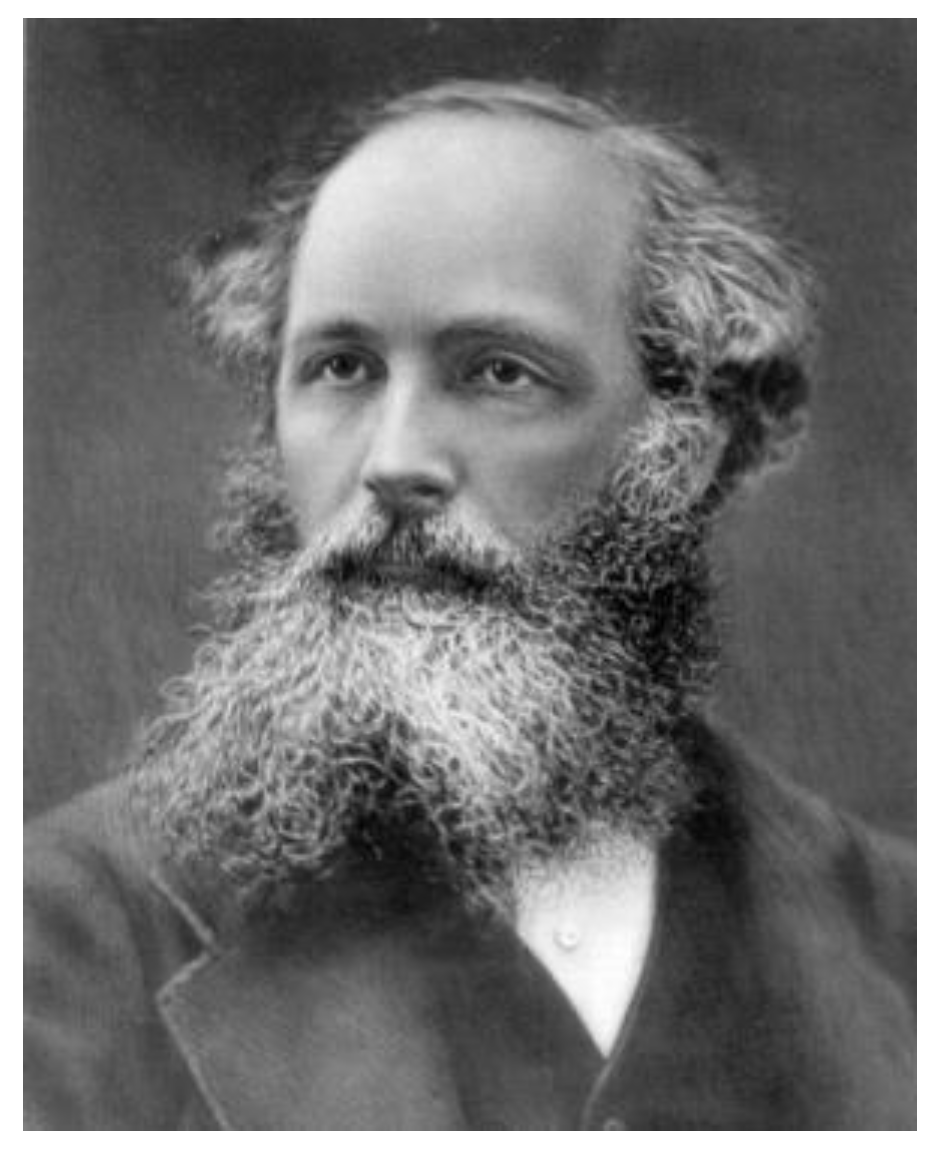
From 1866 to 1871, Maxwell immersed himself in the search for a way of how to convert waste heat back to work again. Limited by the historic level of science and
technology of his era, he did not successfully find such an experiment. Nevertheless, he wrote down his thoughts and experiences during his exploration into his famous textbook Theory of Heat published in 1871. He strongly hoped that in some future days this cherished wish of mankind would be realized by some inheritors.
In his exploration, Maxwell imagined to use a closed container filled up with air molecules. The container is divided by a separator into two parts, A and B, as shown in Figure 2. At the middle on the separator, there is a small door, which is controlled by an intellectual being. (Kelvin called Maxwell’s “intellectual being” jokingly a demon.)
At the beginning, the air in the container is at a thermal equilibrium state. The temperature and pressure of the air are uniform everywhere in the container.
Figure 2.
An air container of two parts, A and B. There is a small door at the middle of the separator, which is controlled by a small intellectual being.
Figure 2.
An air container of two parts, A and B. There is a small door at the middle of the separator, which is controlled by a small intellectual being.
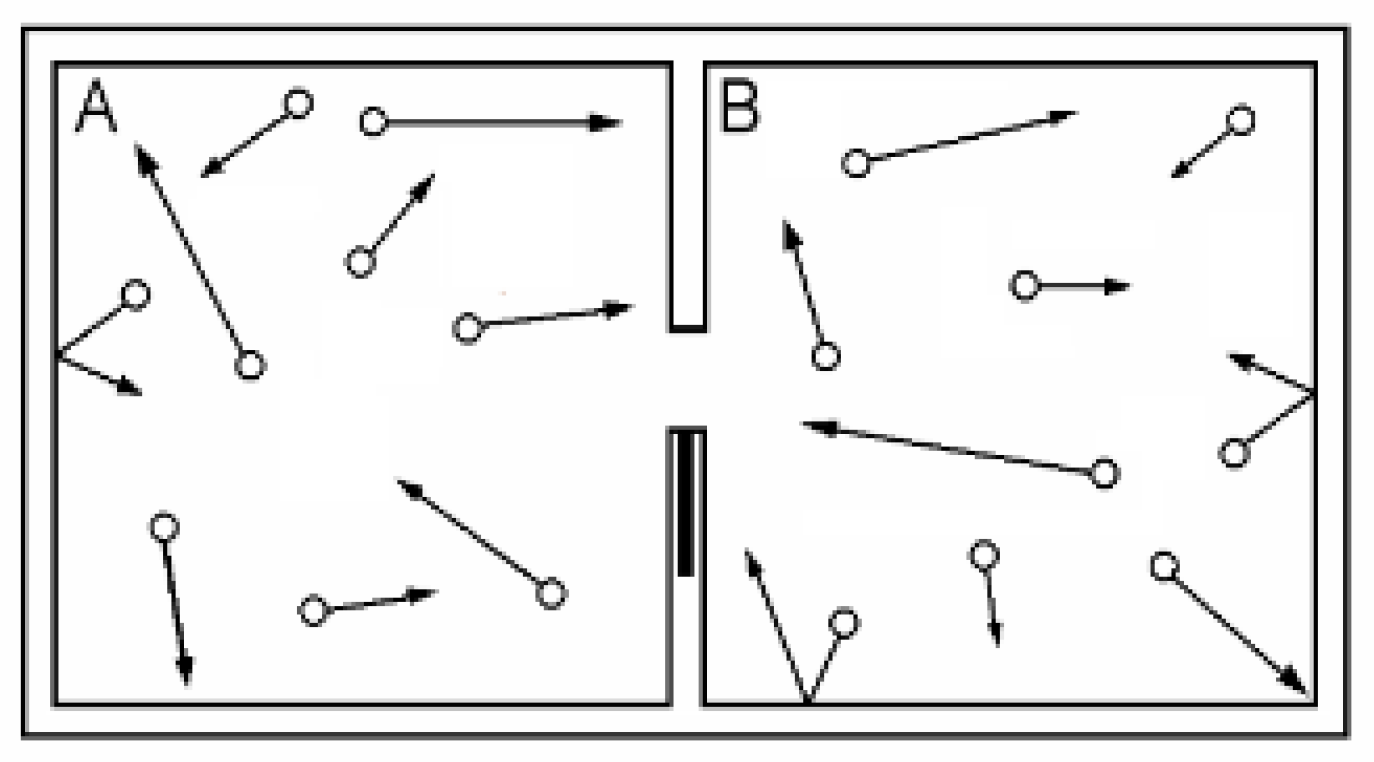
The demon has two typical work modes, described respectively as follows.
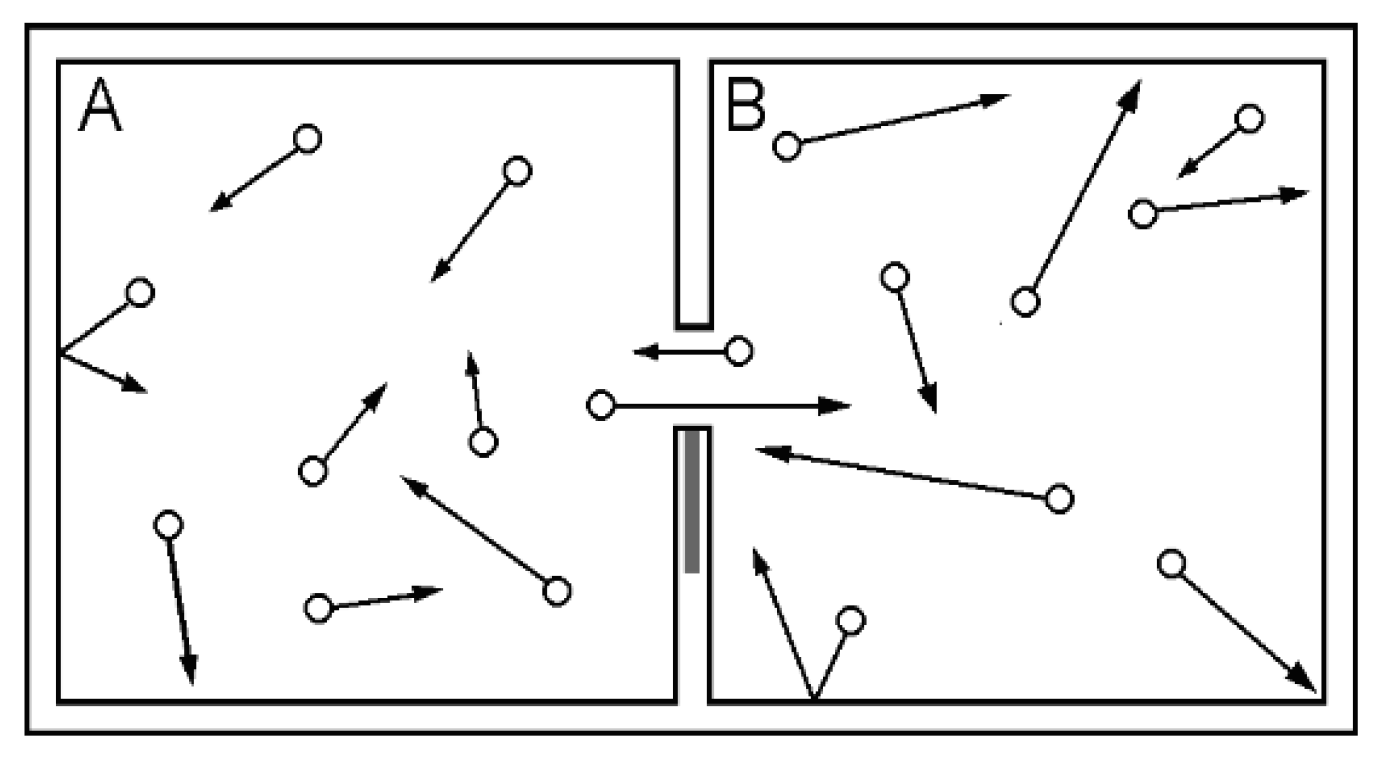
In the first mode, the demon permits the faster molecules to pass the door from A to B, and the slower molecules to pass the door from B to A, as shown in Figure 3. Gradually, the temperature in A drops down and the one in B rises up. A temperature difference between A and B emerges, enabling a part of the internal energy of the air in the container to be used to do work.
Figure 3.
A temperature demon.
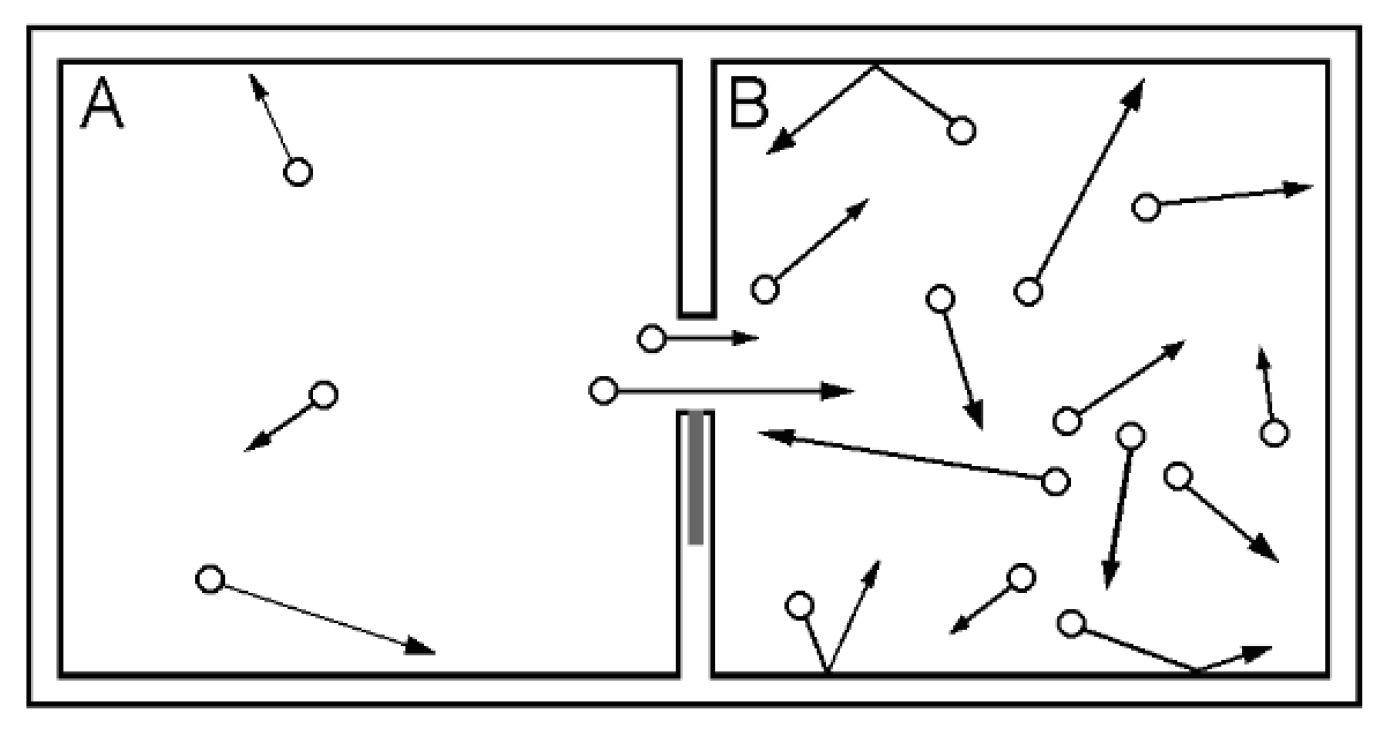
In the second work mode, the demon permits only the molecules of A to pass the door to B, and does not permit the molecules of B to pass the door to A, as shown in Figure 4. Gradually, the pressure in A drops down and the pressure in B rises up. A pressure difference between A and B emerges, also enabling a part of the internal energy of the air in the container to be used to do work.
Figure 4.
A pressure demon.
In the past about 150 years, many physicists,inventors and others, have made numerous efforts to design and even execute various experiments, hoping to find such a demon.
However, they all failed.
The two authors of this paper, in the past several decades (X. Y. Fu since 1960, 65 years already; Z. T. Fu since 2000, 25 years already), following Maxwell’s steps, insisted on searching for such an entropy reducing experiment. They finally replaced Maxwell’s gas molecules in the container by the thermal electrons in a vacuum tube, which contains two identical and paralelll Ag-O-Cs thermal electron emitters. Figure 5 (1) and (2) show such an electron tube, FX8-24, used in one of the experments. The work function of Ag-O-Cs surface is only 0.8 eV, the least one among all the known thermal electron emitters. They eject thermal electrons ceaselessly at room temperature (the so called “dark current” in the photomultipliers or night vision devices and so on). The
experiment can be performed with the whole closed circuit at a same room temperater, that is a great advantage. Of course, the anticipated output current and power are very, very weak. [6,7,8,9,10,11,12,13]
When no magnetic field is applied to the tube, there is no output current, as shown in Figure 5 (2).
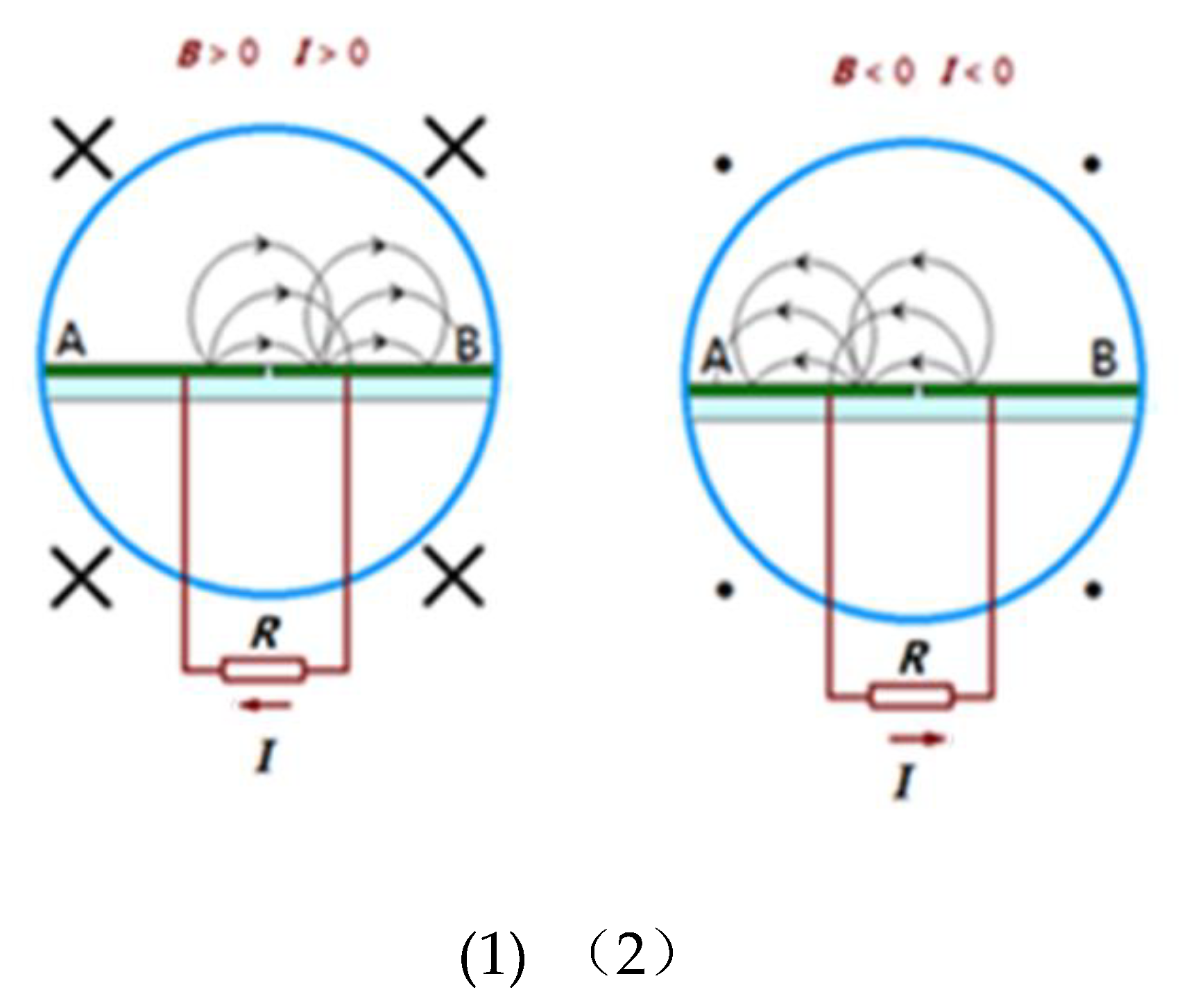
Then a static and uniform magnetic field (that is provided by one or a pair of permanent magnets) is applied to the tube, bending the trajectories of the thermal electrons in the tube. For the first time, the direction of the magnetic field points into the paper. It bends the trajectories of the thermal electrons as shown briefly in Figure 6 (1), resulting in a slight asymmetry (to left or to right) in the electrons’ thermal motion. The number of electrons emitted from A and fall into B in each second are slightly greater than the one of the electrons emitted from B and fall into A. Emiter A losing some net electrons continuously, charges positively; and emitter B, receiving some net electrons continuously, charges negatively. A potential difference between A and B emerges, enabling the electron tube to output a current and an electric power to an exterior load, a resistor R (or a storage battery.) For the second time, the direction of the magnetic field is opposite, pointing out from the paper. The direction of the output current is also opposite, see Figure 6 (2).
If the magnetic field keeps constant for a long duration (that is easy, just keep the permanent magnet stationary in the duration), the electron tube can output a stable electric current and a stable electric power in the duration. For examples, 30 seconds, 3 minutes, 1 hour, 3 hours, and so on, as long as the performers wish.
As the electron tube ceaselessly outputs electric energy to do work on the exterior resistor with a power P = I2R, as shown in Figure 6 (1) or (2), according to the first law of thermodynamics, the internal energy of the tube tends to decrease, though very slightly. And the temperature of the tube follows to drop down, also very slightly.
As the tube has cooled down slightly, it can spontaneously absorb the waste heat from the ambient air (that keeps at the original constant room temperature, a little warmer) to compensate its energy loss due to the output of electric energy.
The experiment verifies that 1 joule waste heat is possible to convert back to 1 joule electric energy, without producing other effects, violating the Kelvin-Planck statement of the second law of thermodynamics.
The following are two of such experimental videos.
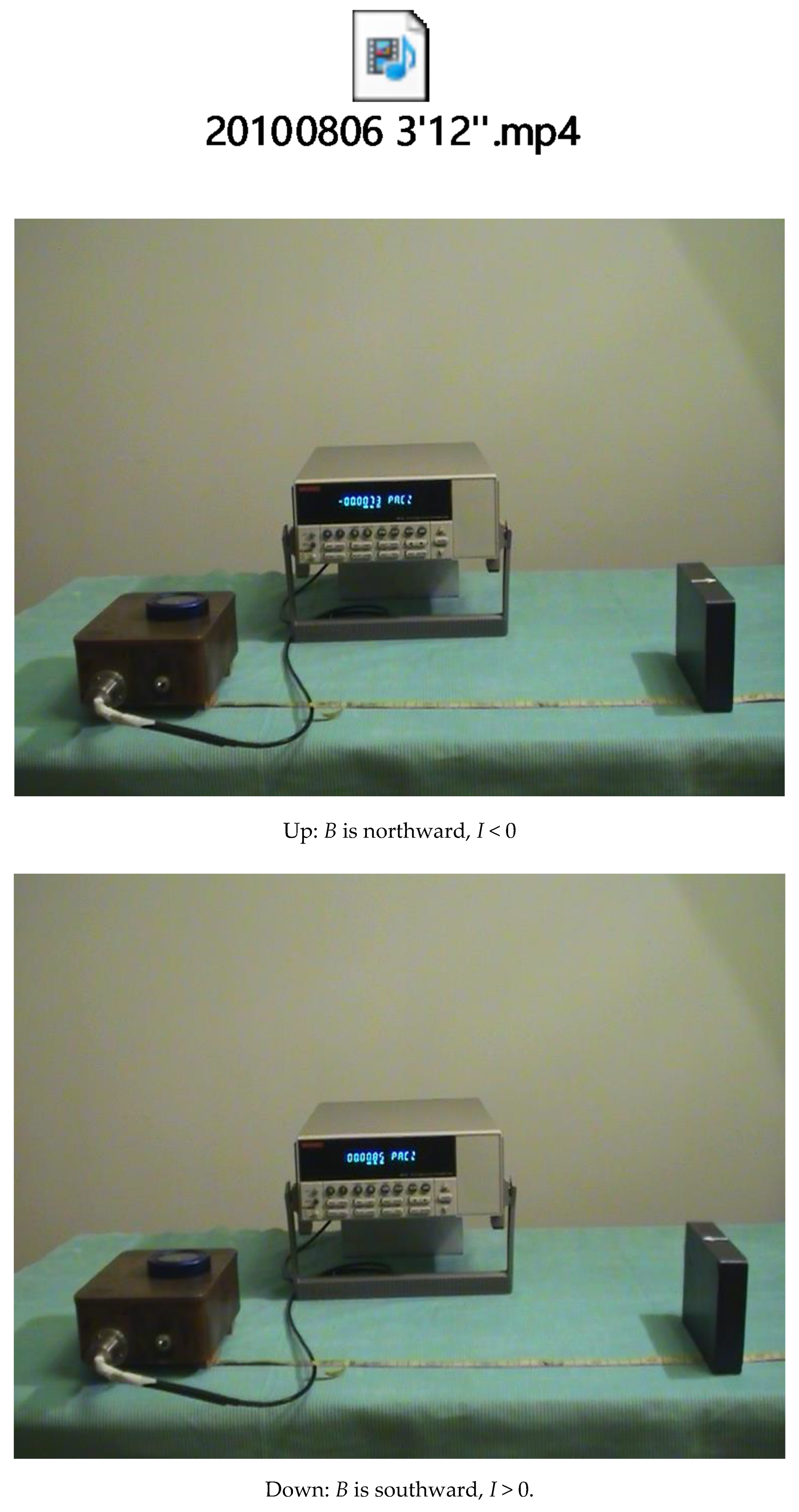
I. The video of the first experiment: when B is northward, I < 0; when B is southward, I > 0.

The whole video lasts for 100 seconds.
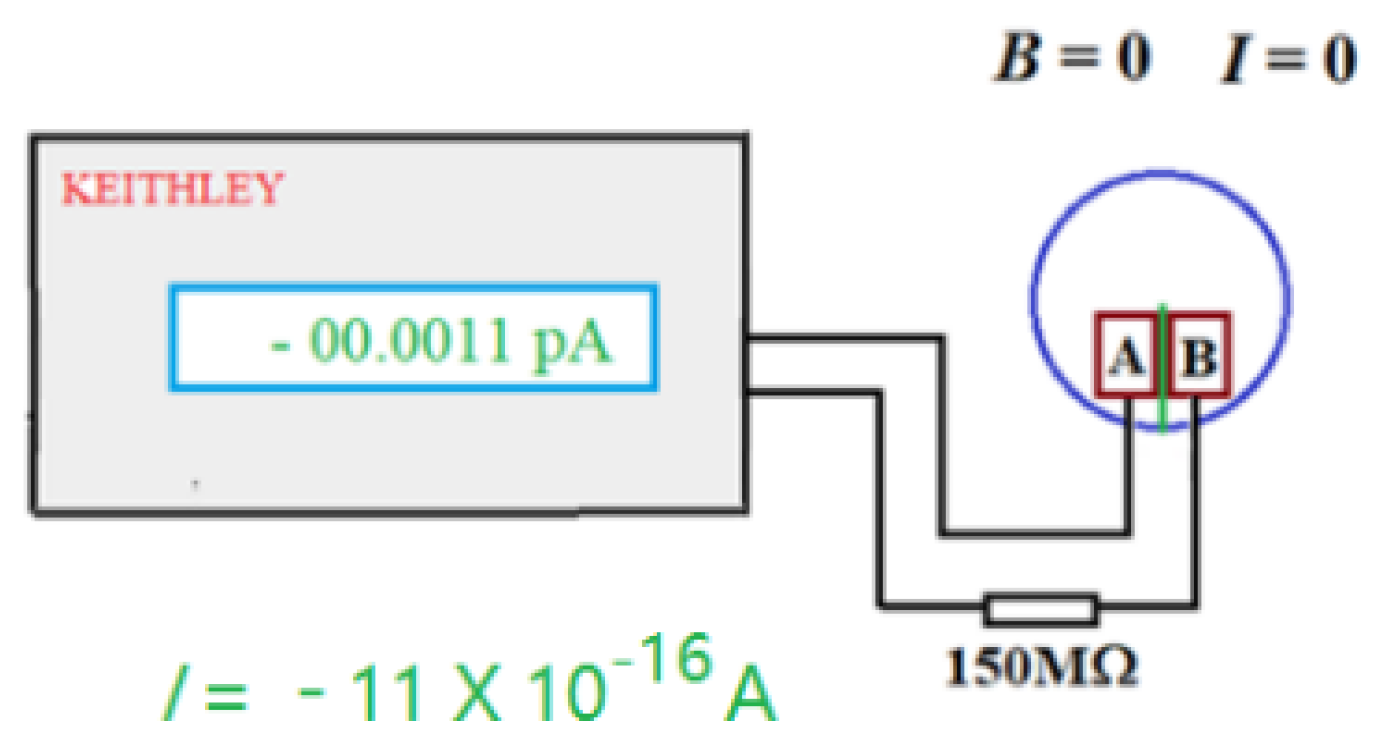
(1) From t = 0 seconds to t = 10 seconds, B = 0
For this duration, no magnetic field is applied to the vacuum tube. So, no real output current exists in the closed circuit, only a small fluctuating background current Io as shown in the video.
Why there is such a fluctuating current?
We hope the temperature of the laboratory we used is at a stable temperature, say, 20C. However, actually, the room we used is not a fine thermostatic laboratory, only a common dwelling room. Its temperature in every 24 hours has usually about 5C-10C changes. So actually, the room temperature is always changing in the duration, though very slowly. More ever, at any same time, the different points along the circuit might have different temperatures, including all the different junctions of two different metals. All these temperatures are changing slowly, and they are not changing at an exactly same step. Hence, along the whole circuit, there is a small and changing general Seebeck and Peltier effect, so Io is usually not zero, fluctuating ceaselessly. The video shows,
Io ≈ (-8 ~ -14) ⅹ10-16 A = (-0.8 ~ -1.4) fA,
(as shown in the simple drawing below)
(2) From t = 10 seconds to t = 40 seconds
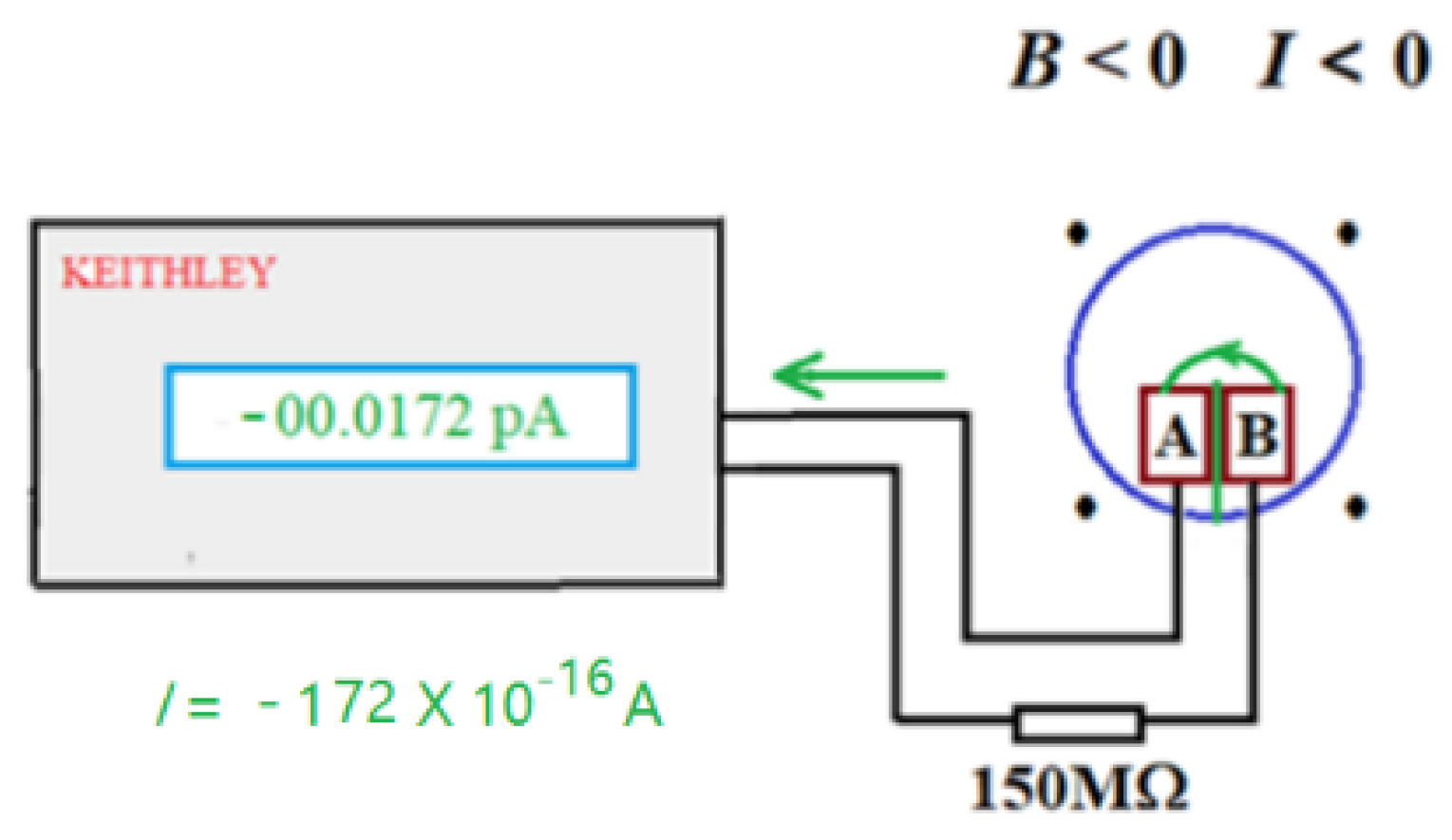
Move in a permanent magnet of 2 kg at t = 10 seconds, as shown in the video. There appears quickly a fundamental negative output current in the circuit, fluctuating slightly.
I ≈ (-140 ~ -190)ⅹ10-16 A = (-14.0 ~ -19.0) fA,
(3) From t = 40 seconds to t = 70 seconds
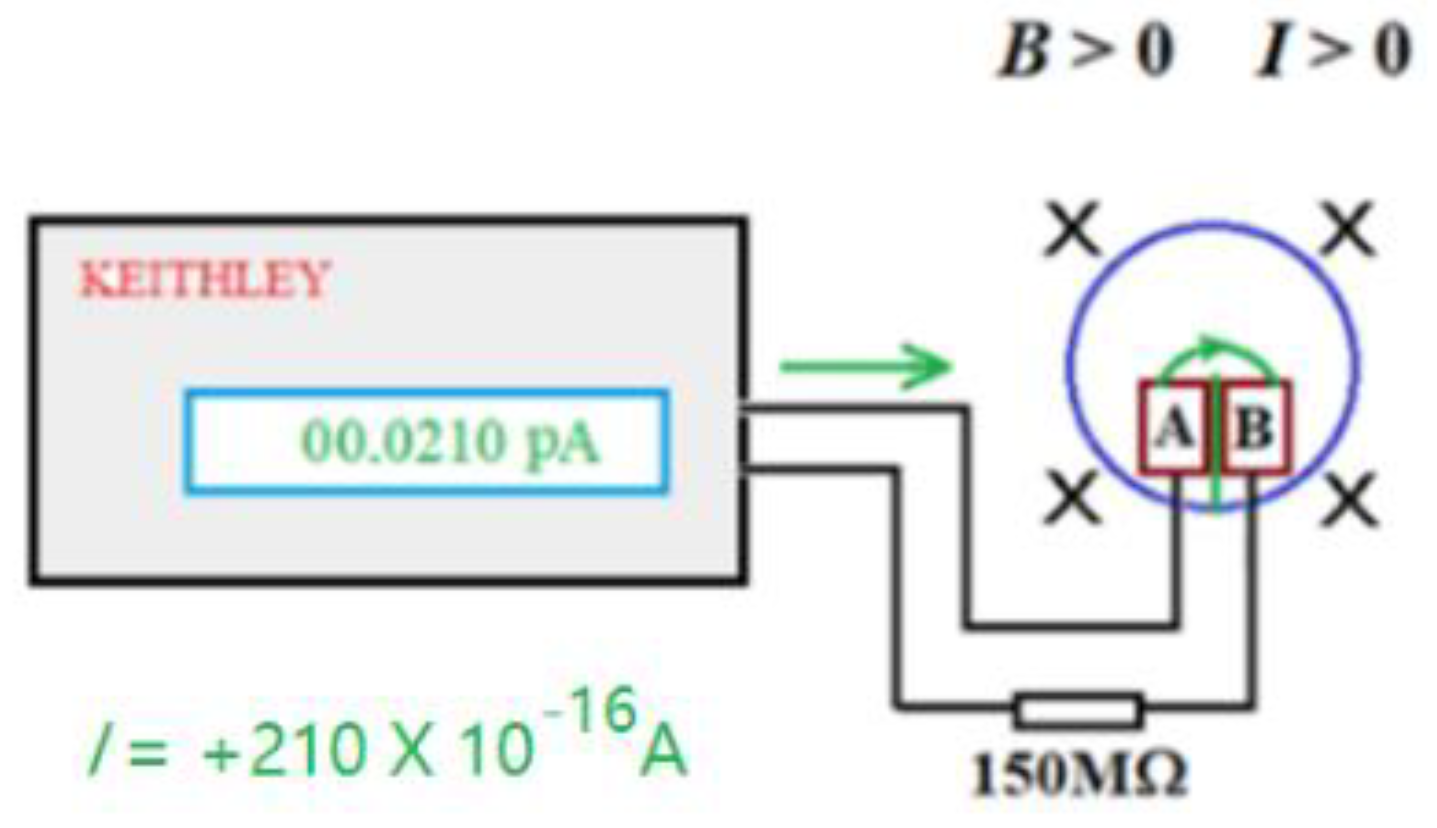
Reverse the direction of the magnetic field at t = 40 seconds, as shown in the video. The direction of the output current is also reversed. The output current becomes positive, fluctuating slightly.
I ≈ (+210 ~ +240)ⅹ10-16 A = (+21.0 ~ +24.0) fA
(4) From t = 70 seconds to t = 100 seconds
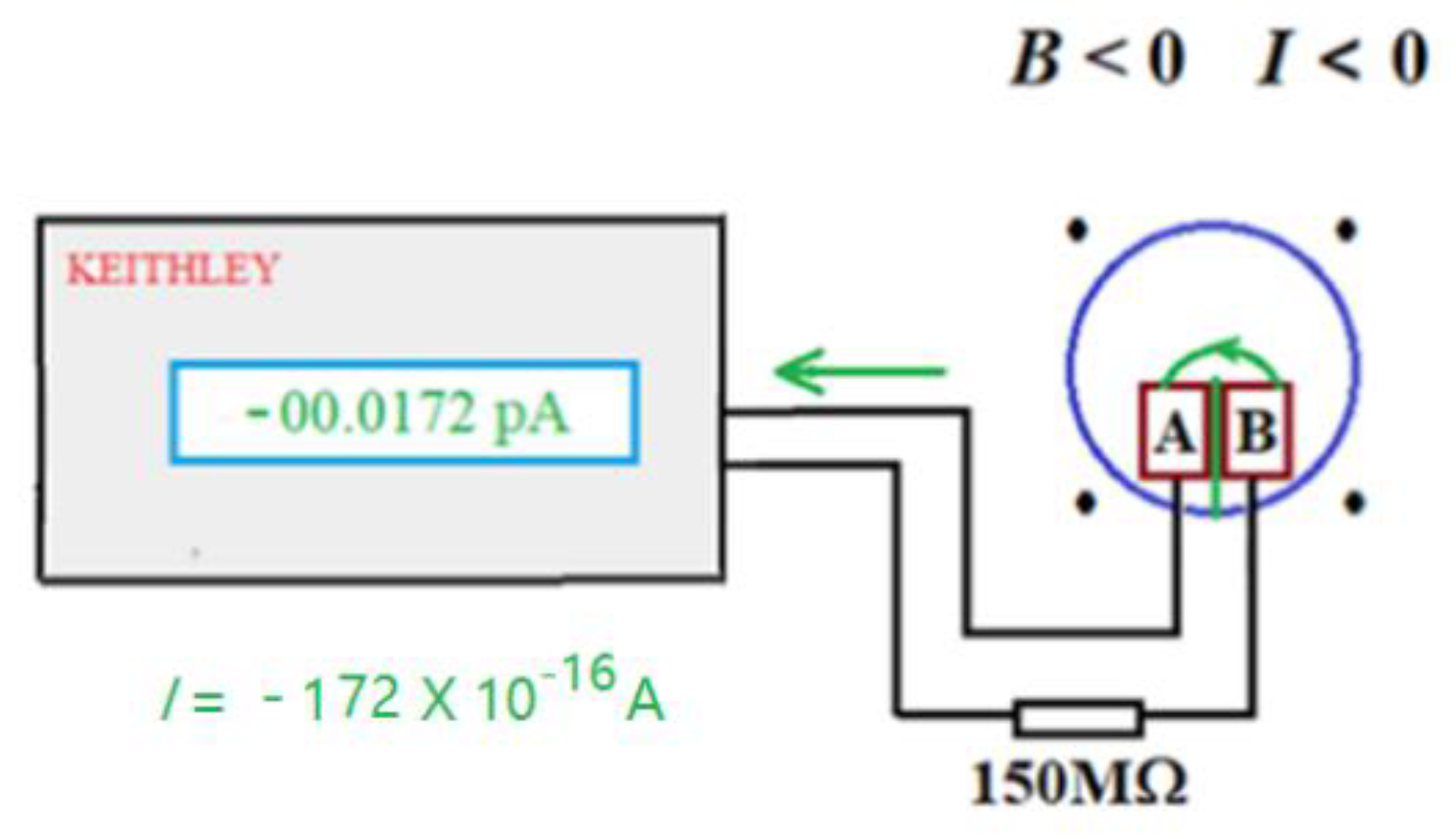
Restore the direction of the magnetic field to be negative again at t = 70 seconds, as shown in the video. The direction of the output current is also restored. The output current becomes negative again, fluctuating slightly.
I ≈ (-140 ~ -190)ⅹ10-16 A = (-14.0 ~ -19.0) fA,
And so on.
Two clear photoes of the set up of the experiment
(1) The general set up of the experiment
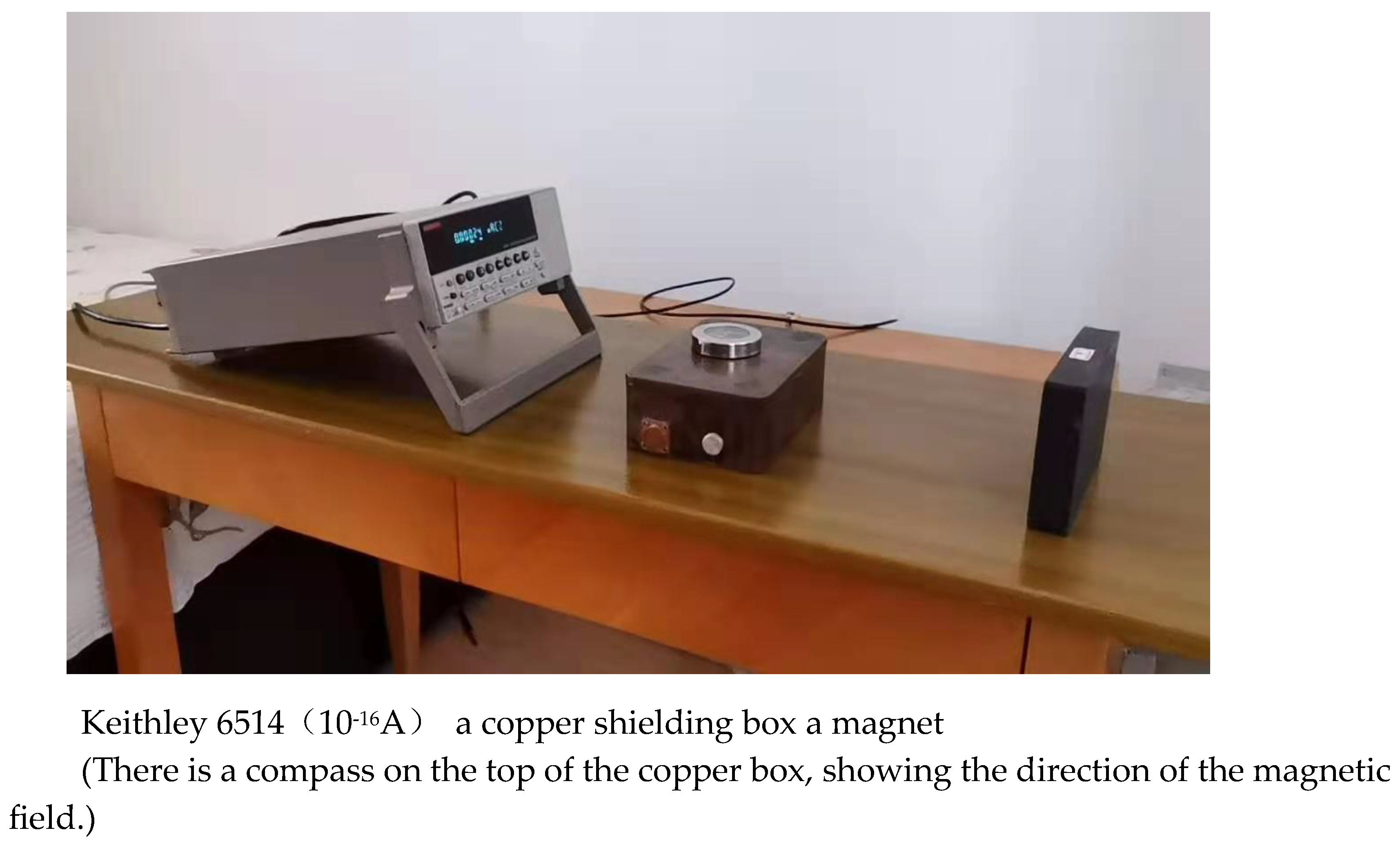
(2) The arrangement within the copper shielding box
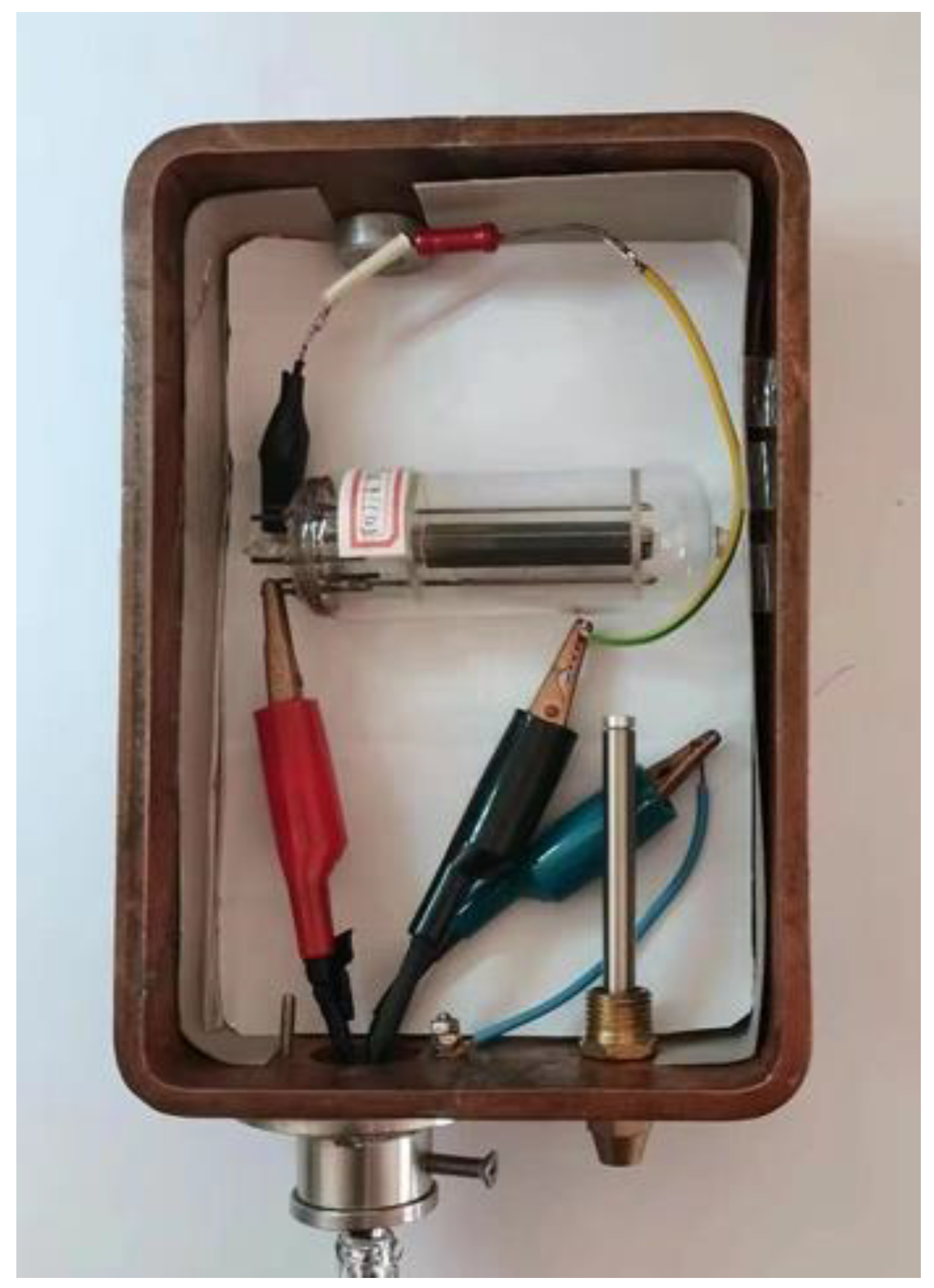
An electron vacuum tube, a resistor R = 150 M (the small red one at the top part), a
long metal tube containing a thermometer probe(at right-below), some lines,etc.
II. The video of the second experiment: measure therelation of B = B(d).
d is the distance of the magnet from the center of electron tube in the copper box. [15]
3. Cosmos Thermodynamics
Most astrophysicists today (including the two authors of this article) believe that the present universe was produced by a big bang. [21,22,23,24]
To try a further step: The authors approve of the idea that the universe is gravitationally closed, all the matter, radiation and so on in the closed universe are impossible to fly off it; at the middle part of the closed universe, naturally, there should be an extraordinarily immense permanent ocean of thermal radiation; the microwave background radiation discovered in 1965 is just this immense heat ocean. Because of the universe is closed, a big bang followed by a big assembling forms a big cycle. All the matter and energy in the universe are involved in the big cycle. Numerous and various black holes provide the assembling mechanism.
This article is a thermodynamical exploration of a cycling universe.
3.1. The Re-Assembling of All the Matter That Have Exploded into the Cosmic Space by the Big Bang
The authors, like most of today’s astrophysicists, approve of the theory of the
big bang established by Lemaitre, Hubble, Gamow, et al.
However, there is a major deficiency in the present cosmology: Where did the primitive atom (Lemaitre’s terminology) of the big bang, come from?
Most cosmologists just avoid this problem.
The authors assert that this problem is a crucial one in the big bang theory. It should not be avoided, absolutely.
The universe may be gravitationally closed, all the matter, all the electromagnetic radiations, and everything else,are impossible to fly off the closed universe. And, we take for granted, a big band will be followed by a big assembling, forming a big cycle. All the matter, all the electromagnetic waves, and all the other things in the universe, are involved in an extraordinarily immense cycle.
The big bang is only a special turning point in each big cycle.
However, for the first step, let us look back the current theory about the fundamental characteristics of the cosmic space.
According to the cosmology principle, adopt the Robertson Walker metric, Einstein’s field equation and the equation of state, and so on, one can finally derive the relation between the cosmos scale factor R and time t, R = R(t), as shown by equation (1) and Figure 1.
Figure 7.
Different space curve signs k result in different R = R(t). to represents our present time.
Figure 7.
Different space curve signs k result in different R = R(t). to represents our present time.
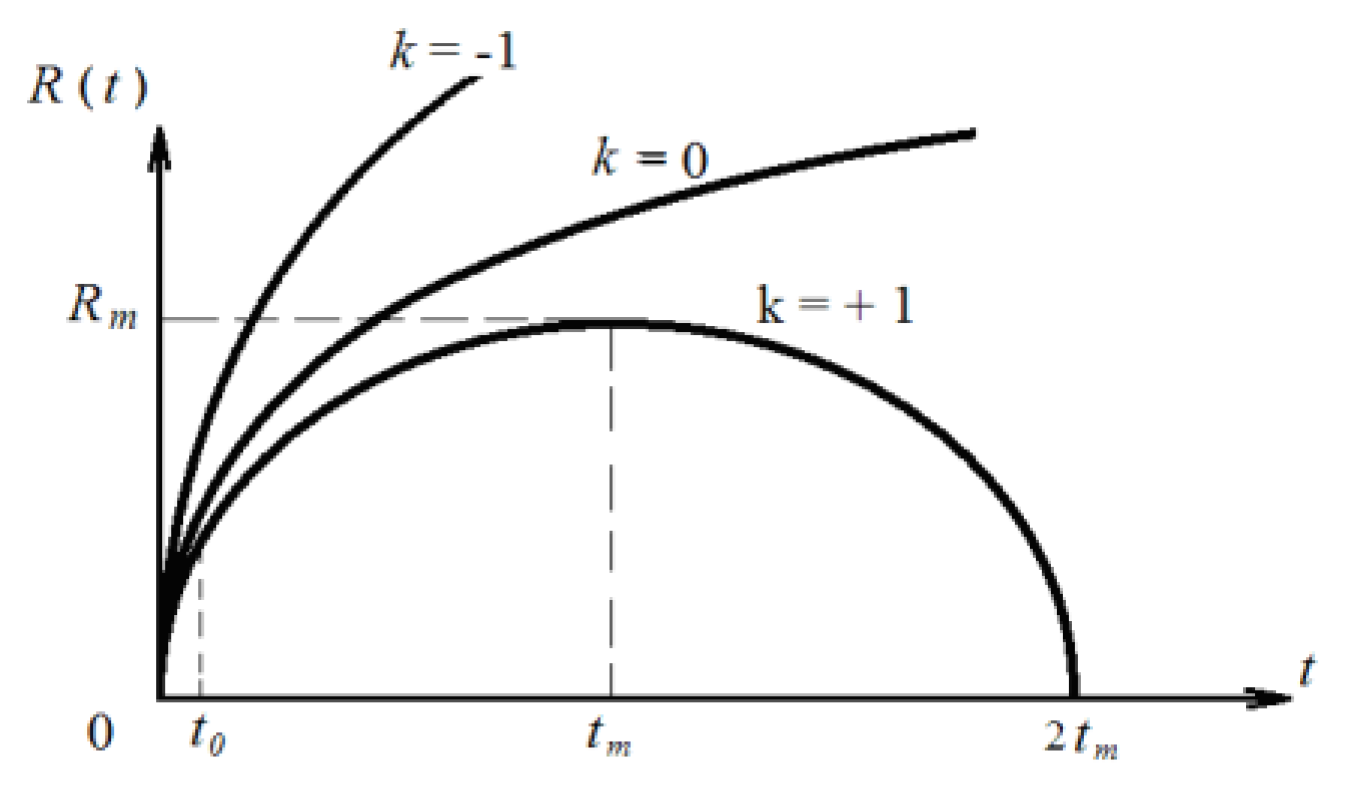
R = R(t) has three different situations, depends on the values of the space curve sign k:
(1)k = + 1,the cosmic space is closed. All the matter, radiation and so on that scattered into the cosmic space by the big bang, may fly outward, getting farther and father. However, after reaching their individual far-most positions in the closed universe, all of them will fly back one after another towards the central region of the closed universe again, passing through the central region with immense great kinetic energy, and then shuttling in the closed universe ceaselessly.
(2) k = 0,the cosmic space is flat. All the matter, radiation and so on that scattered into the vast cosmic space by the big bang can fly outward to the infinitely remote space, however, with a lower and lower kinetic energy, gradually approaching zero. They would never return back.
(3) k = -1,the cosmic space is open. All the matter, radiation and so on that scattered into the cosmic space by the big bang just fly very fast outward to the infinitely remote space. They will never return back.
The above descriptions of equation (1) and Figure 1 are correct, strict and profound, well recognized by most astrophysicists today. However, the theory is really abstract, and it is not easy to perceive it always clearly and put it into use easily in various cases. The authors think that this extremely profound theory might be enriched by a brief and intuitional explanation as follows.
Whether the universe is closed is determined by two factors:
(I) The total amount of the mass of the universe, that is the attractive factor. The mass mentioned here consists of common visible matter, dark matter, various
electromagnetic radiation, neutrinos, and many other kinds of matter still totally unknown to mankind up till now. According to the present knowledge, the dark matter is 5 times of the visible matter, seems very important.
(II) The total amount of the energy of the big bang, that is the repulsive factor.
The two factors contend against each other, determines the essential evolution of the universe.
If the first factor prevails over the second one, the universe is closed.
If the two factors are just “equivalent” each other, the universe is flat.
If the second factor prevails over the first one, the universe is open.
As have mentioned above, the authors approve of the first situation, k = + 1.
The authors also believe that in the middle part of the extraordinarily immense and closed universe, naturally, there should be an extremely immense ocean of equilibrium thermal radiation at some essentially stable state, some special temperature situation. The microwave background radiation at 2.73K discovered in 1965 should just be this extremely immense heat ocean. It is intrinsic and permanent in the closed universe. It is not produced by the big bang. [25,26,27,28]
More than 2 × 10 12 galaxies produced by the big bang are now flying fiercely outward. Their individual immense kinetic energies derived from the big bang are converting to their individual potential energies. When the galaxies reach their individual far-most positions in the closed universe, they will return back one after another, fly towards the central region of the closed universe with different tremendously great kinetic energies. It is of course impossible for them to return back to the start point of the big bang at a same time. All these galaxies will rush through the central region and fly towards their individual far-most positions on the other sides of the central region. Then, also because of the gravitational attraction, they will slow down, and finally return back again to the central region. In such a way, they will keep shuttling through the central region of the universe repeatedly, with different individual great amplitudes.
In every galaxy, there are numerous stars and many black holes and so on. Every black hole, once formed, takes in all the matter, the electromagnetic radiation and anything else that approach it, and gets larger.
The directions of the shuttling of the 2 × 10 12 galaxies are various in the 4 solid angle. Hence, their ceaseless shuttling offers numerous opportunities for them to meet each other in the central region. The numerous and numerous various celestial bodies in all these galaxies (may be, totally, more than 2 ×10²³ stars and other celestial bodies) will have numerous and numerous chances to approach even meet each other. Annexation happens whenever a black hole meets any another celestial body in the shuttling. Especially, the black holes of all the galaxy cores (e.g., the core black hole of the Milky Way) are extremely greater than the black holes of the star grade (with a mass of several, tens, even more stars). They are extremely important in the general annexation processes in the universe.
After an extremely long period of shuttling and annexations, finally, the total number of the black holes and other celestial bodies in the universe will begin to decrease. The masses of the survived black holes will become larger and larger, meanwhile, their shuttling amplitudes will become shorter and shorter. These two factors will greatly increase the chances of the survived black holes to encounter with the still shuttling celestial bodies. The general annexation processes in the whole universe will thus become faster and faster.
After an extremely long, long annexation duration, eventually, all the matter within the closed universe will inevitably be assembled together to form an extraordinarily immense central black hole,with its nuclear a rudiment of a new primitive atom for the next big bang.
In this assembling process, a really great part of the original kinetic and various potential energy of all the celestial bodies in the 2 ×10¹² galaxies are eventually concentrated into the central black hole, preserving directly a great amount of precious energy for the next big bang, without undergoing the process of entropy increase.
Black holes have an extremely important “collection mechanism” and “assembling mechanism”. Without their “collection mechanism” and “assembling mechanism”, the reassembling of all the matter is impossible to realize.
At that time, the picture of the universe will become very simple: In the infinitively vast universe, in its immense gravitationally closed central part, there is an extraordinarily immense and permanent very dilute heat ocean at a temperature of about 2.73K. And at the center of the immense 2.73K heat ocean, there is an even more massive central black hole, which contains all the real matters (particle matters) of the universe; and all these real matter is concentrated in the extremely middle prat of the central black hole. The geometric picture of the universe at that time is rather similar to the one of a hydrogen atom.
The formation of the central black hole accomplishes the first preparation for the next big bang: the reassembling of all the real matter.
The next problem is, how to overcome the deadly obstruction of the second law of thermodynamics to collect and assemble again the great amount of energy of light and thermal radiation that has scattered and mingled into the 2.73K heat ocean due to the big bang and all its subsequent processes, to form a new primitive atom, leading to a new big bang?
In our idea, the numerous and different black holes can accomplish this extremely difficult mission. They, especially the final central black hole, can eliminate the tremendously great entropy that was produced during the big bang and all its subsequent processes. How much energy in the form of light and thermal radiation a big bang and all its subsequent processes have scattered into the extremely vast 2.73K heat ocean, how much energy in the form of 2.73K thermal radiation, will all the black holes, especially the extremely immense central black hole, collect back from the heat ocean and assemble it again, leading to a new big bang. [26,27,28,29,30,31,32]
3.2. The Extraordinarily Immense 2.73K Heat Ocean Is a Permanent Existence in the Closed Universe
3.2.1. The 2.73K Heat Ocean Was Not Produced by the Big Bang
As is well known, in 1965, Penzias and Wilson unexpectedly discovered the 2.73K microwave background radiation coming from the remote space in all the directions. The microwave background radiation shows two fundamental characteristics: (1) isotropic, fundamentally uniform and stable in all the directions, (2) its spectrum coincides with Planck’s formula for the black body radiation at a temperature of about 2.73K. They are actually the same characteristics of the equilibrium thermal radiation in a cavity within a solid at the same temperature. Accordingly, the authors believe, what Penzias and Wilson discovered is an extremely immense and stable ocean of equilibrium thermal radiation at a temperature of 2.73K located at the central part of the closed universe. [25]
The word of isotropic here means: at any point in the 2.73K heat ocean, and similarly, at any point in the cavity within the solid at the same temperature, in any direction in the 4 solid angle, the intensity and spectrum of the thermal radiation are identical.
How large is the volume of the heat ocean? Or, how deep is the heat ocean?
The background microwave radiation is a thermal equilibrium radiation. It is impossible to measure the depth of the heat ocean by any astronomic observation.
The 2.73K heat ocean is also one of evidences that the universe is gravitationally closed. If the universe were not closed, the microwave radiation would have flied off to the infinitively vast cosmic space, and the heat ocean would have not kept so excellently stable for so long a duration.
Many researchers had a totally different opinion from ours. They believed that the microwave background radiation at 2.73K was produced by the big bang.
The authors, also accepted the present theory of cosmology established by Lemaitre, Hubble, Gamow et al that the present universe was produced by a big bang. After the big bang, the expanding primitive fireball was filled up with plasma and thermal radiation and expanded very quickly with its temperature drops down and down. Actually, in the interior of the expanding fire ball, the thermal radiation exchanged heat with the electrons and protons of the plasma ceaselessly, the two sides of heat exchanging always kept at the same dropping temperature. The plasma, having numerous electrons and protons, was opaque for the interior light and thermal radiation, prohibiting them to fly off the expanding fireball freely at light speed. The plasma and the thermal radiation always kept equilibrium during the expanding process.
The quick expanding process may even be considered as a fast quasi-equilibrium adiabatic expansion.
About 3.8ⅹ105 years after the big bang, when the interior temperature of the expanding primitive fire ball dropped down to about 3000K, the electrons and protons in the plasma combined to become hydrogen atoms. The neutral hydrogen atoms no longer exchanged heat with the thermal radiation; the fireball decoupled. The interior of the fireball became transparent for the light and thermal radiation. All the photons of the light and thermal radiation within the decoupled fire ball got free, and started immediately to fly off the fire ball at light speed in all the directions to the exterior extremely vast cosmic space. That was obviously a free ejection, not an “adiabatic expansion”.
The decoupled 3000K thermal radiation ejected freely in all the directions into the vast cosmic space, getting farther and farther. However, because the universe is gravitationally closed, the 3000K decoupled thermal radiation could not fly to the infinitively far cosmic space. The outward flying decoupled 3000 K thermal radiation, after reaching their possible far most positions in the closed universe, should turn back to the central part of the universe again. Then they will keep shuttling in the closed universe with extraordinarily greater amplitudes (much, much greater compared to the galaxies’ shuttling amplitudes that we have discussed above), meanwhile, becoming more and more dispersive.
Then, after an extremely long, long relaxation time, through exchanging heat with the rare cosmic matters such as electrons, protons, atoms, molecules, dusts, rocks and so on (all these cosmic matters are always kept at the background temperature 2.73K) in the metagalaxy region, finally mingle into the extremely vast 2.73K heat ocean. The vast 2.73K heat ocean is the final destination of the emitted decoupled thermal radiation.
(For more details about the fate of the ejected decoupled light and thermal radiation, read the appendix of this article, please.)
However, there are a part of the researchers who alleged that, after flied off the decoupled fire ball, the light and thermal radiation kept “expanding adiabatically” for an extremely long time, and expanded finally to the 2.73K microwave background equilibrium thermal radiation that we observe today. They believe, the 2.73K heat ocean is still expanding outward adiabatically at present days.
They speak of an “adiabatic expansion”. What do they mean by this phrase here?
The initial state of the “adiabatic expansion” was an equilibrium thermal radiation at 3000K in the decoupled fire ball 3.8ⅹ105 years after the big bang. At that time, for a far observer, every cubic meter within the decoupled fire ball may be regarded as a small point source of 3000K light and thermal radiation. And the final state (i.e., the state of the heat ocean today) is an equilibrium thermal radiation at 2.73K, occupying an extraordinarily immense cosmic space. According to these researches, the 2.73 heat ocean is still expanding at present time, getting even more greater and greater, colder and colder.
The authors are curious to ask, how about the numerous intermediate states in the “adiabatic expansion” claimed by these researchers? Were these intermediate states all at thermal equilibrium states? Or, were they are not equilibrium states?
Actually, started from the 3000K decoupled fireball at t = 3.8ⅹ105 years, all the photons in the degenerate fire ball are travelling outward freely at light speed in all the directions in the cosmic vacuum. All the intermediate states are spherical thermal radiation travelling outward at light speed from its original start point in the decoupled fire ball to the infinitively vast cosmic space.
It was not any expanding thermal equilibrium radiation.
If all the intermediate states were not equilibrium thermal radiation, how could the scattering thermal radiation from the decoupled fireball that flied outward freely at light speed to the vast space changed suddenly to a 2.73K equilibrium state?
The “expansion” that they spoke of should just be a free isotropic ejection of the photons from all the points in the decoupled light and thermal radiation in all the directions in the 4p solid angle at light speed to the infinitively vast space. Their behaviors are similar to the light and thermal radiation of the sun or any other star.
Hence the 2.73K microwave background radiation was not the afterglow of the decoupled fire ball.
The extraordinary 2.73K background radiation is an intrinsic existence in the closed universe, an extremely immense permanent heat ocean. It existed before the big bang. It exists now. It will exit in the future.
It was not produced by the big bang.
3.2.2. The Extraordinarily Immense 2.73 K Heat Ocean Itself
Now, let us surmise briefly the structure and picture of the 2.73K heat ocean itself.
As a preparation, let us first make a calculation of the mass density of the 2.73K equilibrium thermal radiation.
From Stefan-Boltzmann’s law, the radiation intensity from the surface of a black body (the energy emitted in unit time from unit area of a black body surface at a given temperature) at T = 2.73K is
As is well known, the relation between the radiation intensity from the surface of a black body j and the energy density of the equilibrium thermal radiation in a solid cavity at the same temperature u is
Hence, at T = 2.73K, the energy density of the immense heat ocean is
And,the mass density of the thermal radiation in the heat ocean is, (5)
Now, let us imagine to have a look at the picture of the 2.73K heat ocean. The whole heat ocean should locatted in the middle of the closed universe, being a very large sphere, and our metagalaxy is at the center of this vast heat ocean, represented by a very small circle, as shown in Figure 2.
Figure 2.
A heat ocean picture. The central small circle is the metagalaxy region. The bigger blue circle with a radius R1 is the 2.73 K region. Then, from R1 to R2, is the thermal radiation decaying region, with the temperature drops down gradually from 3K to 0K, as briefly shown by a light blue color. Out of R2, is the infinitively vast cosmic vacuum, T = 0, .
Figure 2.
A heat ocean picture. The central small circle is the metagalaxy region. The bigger blue circle with a radius R1 is the 2.73 K region. Then, from R1 to R2, is the thermal radiation decaying region, with the temperature drops down gradually from 3K to 0K, as briefly shown by a light blue color. Out of R2, is the infinitively vast cosmic vacuum, T = 0, .
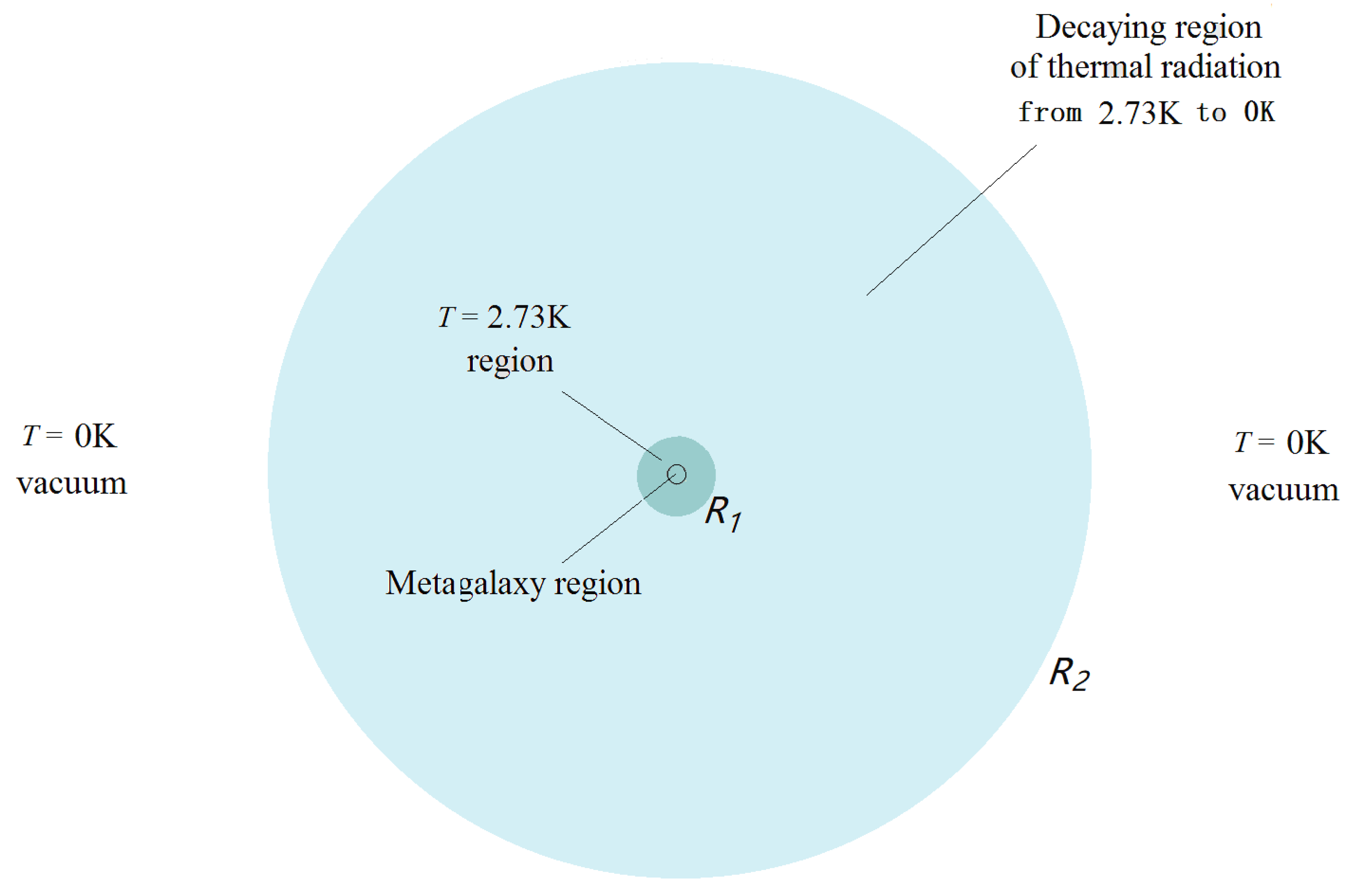
Figure 3.
We suppose the central part of the heat ocean is a spherical region of radius R1, filled up with 2.73K thermal radiation. Stretched outward from R1 to R2, the temperature of the thermal radiation decreases gradually from 2.73K to 0K, while the density of the thermal radiation decreases much more quickly to zero. Beyond R2 is the infinitively vast cosmic empty space.
Figure 3.
We suppose the central part of the heat ocean is a spherical region of radius R1, filled up with 2.73K thermal radiation. Stretched outward from R1 to R2, the temperature of the thermal radiation decreases gradually from 2.73K to 0K, while the density of the thermal radiation decreases much more quickly to zero. Beyond R2 is the infinitively vast cosmic empty space.
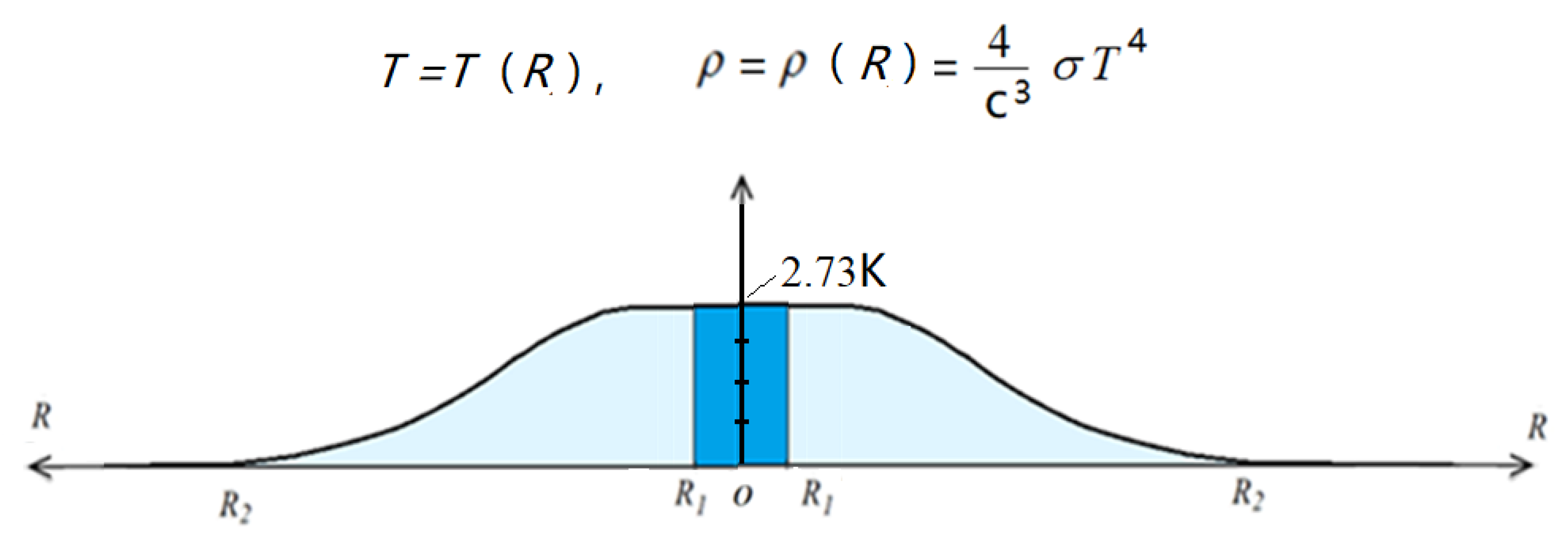
Containing the metagalactic region and within the radius of R1, is the T = 2.73K region, as briefly shown by the blue part in Figure 2. Astronomic observations tell us that our earth, our Milky way, the metagalaxy are all immersed in such an immense heat ocean at a temperature of 2.73K.
Then, from R1 to R2, is the thermal radiation decaying region, as roughly shown by the light-blue part in Figure 2; the temperature falls down gradually from 2.73K to 0K,
which corresponding to an also roughly similar but much more fast decaying mass density,
for is essentially proportional to T 4, as shown by (2) - (5).
Finally, out of R2, is the infinitively vast empty space, the cosmic vacuum.
In the 2.73K region, and also in the thermal radiation decaying region, all the outward flying photons undergo red shift. When they reached their individual possible far most sites in the gravitationally closed universe, they will turn back and fly towards the central region of the heat ocean again, undergoing blue shift. Passing through the central region, the blue shifted photons will fly to their individual far most sites on the other side of the central region, undergoing red shift again. In such a way, they will keep shuttling ceaselessly, passing through the central region repeatedly in the various directions in the 4 solid angle, with extraordinarily greater shuttling amplitudes (compared to the shuttling amplitudes of the galaxies that we have discussed above), and the whole closed heat ocean keeps fundamentally stable and equilibrium.
The heat ocean is extraordinarily immense, and its mass may be extraordinarily great, which might also contribute considerably to the gravitational close of the universe.
3.2.3. The Big Bang and All Its Subsequent Processes Are All Irreversible Processes, Resulting in the Immense Increase of the Thermal Radiation in the 2.73K Heat Ocean, Resulting in Immense Increase of Entropy of the Universe
(1)The big band is a tremendously great explosion. Like a supernova, it directly scattered extraordinarily tremendous amount of light and thermal radiation into the space. These light and thermal radiation cannot fly off the closed universe. They will keep shuttling in the closed universe ceaselessly with extraordinarily great amplitudes. After an extremely long relaxation time, they will finally mingle into the 2.73K heat ocean, meanwhile, increasing the entropy of the universe.
(2)As have discussed above, about 3.8×10⁵ years after the big bang, the interior temperature of the expanding primitive fire ball dropped down to about 3000K. The diameter of the decoupled fire ball at that time was approximately 106 light years (having an immense volume greater than the volume of the Milky Way), and it was at a very high temperature of 3000K. So, it had an extraordinary immense total amount of energy in the form of light and thermal radiation. As the whole fire ball became transparent, all these light and thermal radiation got free, they started immediately to fly off the decoupled fire ball at the speed of light in all the directions, and travelled into the farther extremely vast space. Then, because the universe is closed, they should also keep shuttling in the closed universe with extraordinarily greater amplitudes, becoming more and more dispersive. After a long relaxation time, they also mingle into the 2.73K heat ocean, increasing the energy of the heat ocean, increasing the entropy of the universe.
(3) In the further expansion of the fireball, all the real matter (mainly hydrogen and helium) of an immense amount within it changed into numerous nebulae, then changed into even more galaxies, and then changed into numerous and numerous stars and other celestial bodies. All these processes were also irreversible, sending immense amounts of light and thermal radiation into the heat ocean, producing extraordinarily immense entropy, too.
(4) Then in a long period, there formed early or late, extremely numerous and numerous stars in all the galaxies. Like the sun, most of these stars have averagely a lifetime of about 1010 years (may be much longer or shorter). The stars eject ceaselessly light and thermal radiation into the vast space due to the energy produced in their interior nuclear fusions of hydrogen and helium. All these light and heat also scatter into the closed universe, and finally mingle into the 2.73K heat ocean, increasing the entropy of the universe.
All the processes described in the above paragraphs deliver immense amount of light and thermal radiation into the 2.73K heat ocean, increasing the energy of the heat ocean tremendously, increasing the entropy of the universe tremendously. According to Clausisus’ famous prediction, all these processes leading the universe eventually to a peculiar state, the Heat Death.
3.3. The Re-Collection and Re-Assembling of Energy from the 2.73K Heat Ocean by the Numerous Various Black Holes, Especially by the Final Central Black Hole, Leading to a New Big Bang
In the heat ocean, the 2.73K thermal equilibrium radiation travels everywhere randomly and ceaselessly at the speed of light. Every black hole in the metagalaxy takes in the 2.73K thermal radiation at light speed from all the directions since its birth and throughout its long, long lifetime. Meanwhile, a black hole never delivers any thermal radiation to its exterior. Such a process is distinctly a single way collection of the thermal energy from the extremely cold 2.73K heat ocean to the black hole that is at an extremely “high latent temperature” (as it has an immense amount of internal energy). The process apparently violates Clausius’s statement of the second law of thermodynamics. Black holes are natural demons in the universe.
(A common bomb contains a great amount of chemical energy, that can do a great amount of work. From the point of view of the second law of thermodynamics, the bomb is equivalent to be at an extremely high latent temperature.)
Let us see 3 typical examples of black holes of different grades.
3.3.1. A Black Hole with a Mass 10 Times of the Sun.
As shown in Figure 4 (a),the mass of this black hole is M1 = 10 M = 10 × (2×1030) = 2 ×1031 kg. (8)
Its Schwarzschild radius is
When this M1 = 10 M black hole was formed, most of the matter and energy of its original star collapsed down into the new formed black hole. The great amount of the gravitational potential energy of the matter of the original star first converts to kinetic energy and heat step by step, move inward, and finally concentrates into the small new formed black hole. So, there is a great amount of internal energy in the black hole that is now highly concentrated in a very small volume —— the central part of the newly formed black hole. The central part of the black hole can be regarded to be equivalent at some extremely latent high temperature, see Figure 4 (a).
The volume and surface area of the black hole of the M1 = 10 M are
respectively, as shown in Figure 4 (a).
V1 = (4 /3)R13 = 1.13×10¹⁴m3,
S1 = 4 R12 = 1.13×10¹⁰m2
For comparison(especially their temperatures), imagine a volume V1′ in the 2.73K heat ocean having the same volume of V1 as shown in Figure 4 (b),
with a surface area of
V1′ = (V1) = 1.13×10¹⁴m3,
S1′ = (S1)= 4 R1′2 = 1.13×10¹⁰m2,
The internal energy of the 2.73K thermal radiation in the spherical volume V1′ is U1′= u V1′= 4.20×10-14×1.13×1014 = 4.75J. (14)
The latent temperature of the M1 = 10 M black hole (V1) is extremely high. But it does not emit any thermal radiation to the surrounding extremely cold 2.73K heat ocean. Contrarily, it just takes in the thermal radiation at the speed of light in all the directions from the extremely cold 2.73K heat ocean ceaselessly with a power
Pin = T44 R1′ 2 = 3.15×10-6×1.13×1010 = 3.56×10⁴J/s.
In each second, suppose the M1 = 10 M black hole takes in the 2.73K thermal radiation of a volume N1V1′ from the heat ocean, the number N1 here should be
N1 = P1 / U1′ = 3.56×10⁴ ÷ 4.75 = 7494 ≈ 7500.
In one day, the corresponding number of the energy U1′ collected from the heat ocean by the M1 = 10 M black hole is
Nday = 86400×7500 =6.5×10⁸.
In one year, the corresponding number is
Nyear =365×6.5×108 = 2.37×10¹¹.
In one million years, it is
N 106 years = 2.37×1011×106 = 2.37×10¹⁷.
One million years is a twinkle of an eye in the long, long lifetime of a black hole.
Figure 4.
A black hole of a mass M1 = 10M with a volume of V1 = 1.13×10¹⁴m3, and a sphere in the heat ocean with a same volume V1′= V1 (a) A black hole of M = 10M, R1 = 30km, V1 = 1.13×10¹⁴m3, its internal energy is considerably great; (b) In the heat ocean, in a same volume V1′= V1, the energy of the 2.73K thermal radiation is only U1′= 4.75J.
Figure 4.
A black hole of a mass M1 = 10M with a volume of V1 = 1.13×10¹⁴m3, and a sphere in the heat ocean with a same volume V1′= V1 (a) A black hole of M = 10M, R1 = 30km, V1 = 1.13×10¹⁴m3, its internal energy is considerably great; (b) In the heat ocean, in a same volume V1′= V1, the energy of the 2.73K thermal radiation is only U1′= 4.75J.
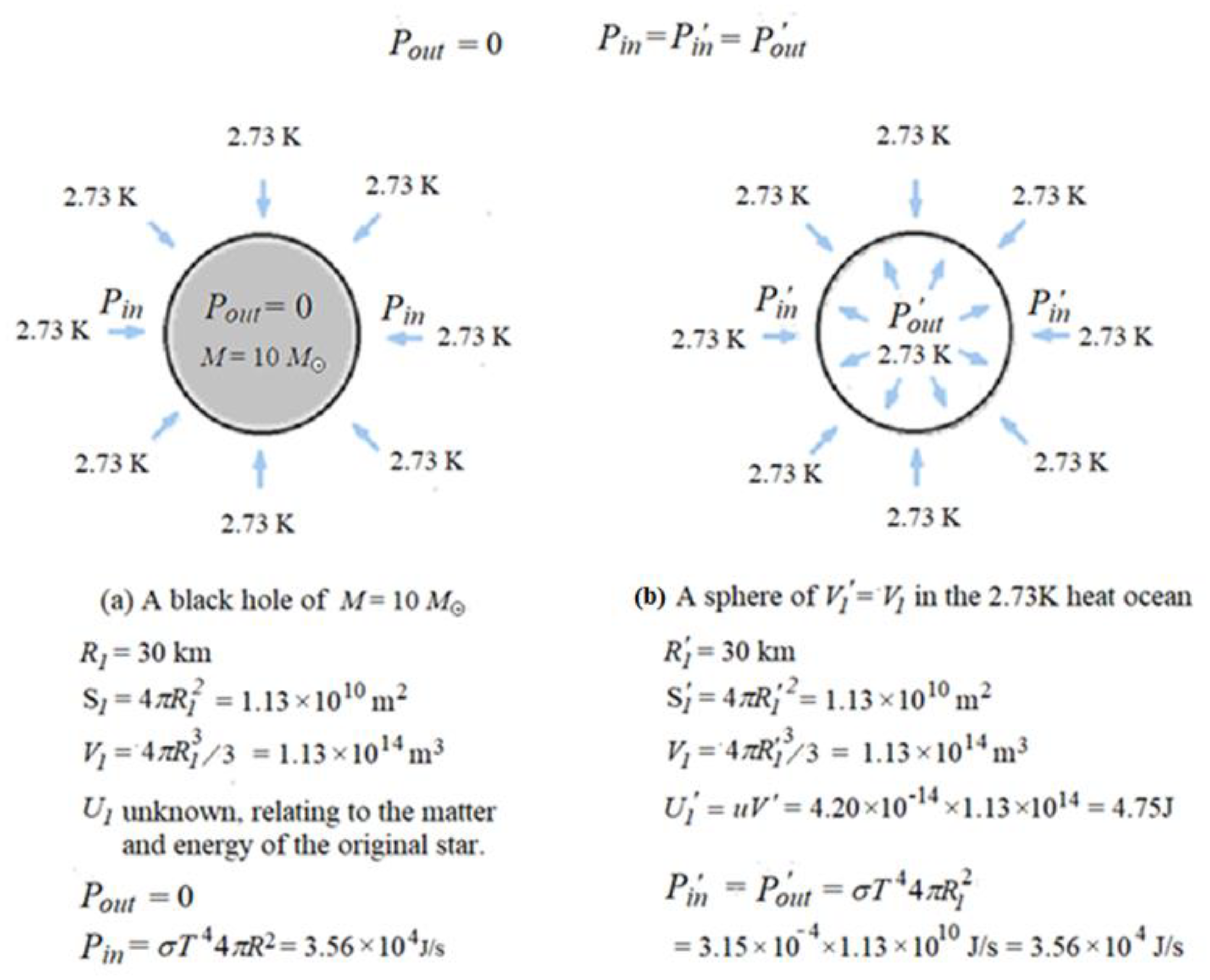
We conclude that, the 2.73K thermal radiation pouring automatically and ceaselessly at the speed of light from all the directions into the M1 = 10 M black hole is a typical process of spontaneous heat transfer from an extremely low temperature region (at 2.73K) to an extremely high latent temperature region (the black hole). Such a unidirectional process is apparently in contradiction to the Clausius statement of the second law of thermodynamics.
The black hole is actually a Maxwell’s demon.
Numerous and numerous such black holes in all the millions over millions of galaxies ceaselessly absorb a very great general amount of thermal radiation from the vast 2.73K heat ocean throughout their individual extremely long, long lifetimes. That is a great process of energy collection, also a great entropy reducing process.
3.3.2. The Central Black Hole of a Galaxy Core
A black hole of a galaxy core usually has approximately a mass of about 1010 times of the mass of M1 (actually may be much greater or much less), i.e.,
M2 ≈ 1010×M1 = 1010×10 M ,
The radius of its Schwarzschild sphere is
R2 ≈ 1010×R1 = 1010×30km
and the area of its event horizon S2 is about 1020 times of the area of S1. It absorbs the 2.73K thermal radiation from the heat ocean at a much greater power,
P2 in = T44 R22 = (3.15×10-6×1.13×1010) ×1020 = 3.56×1024 J/s.
If we still take U1′= u V1′ = 4.75J as an energy counting unit, the corresponding number N2 of the energy absorbed by M2 in each second is
N2 = P2 in / U1′ = 3.56×1024 J / 4.75J = 7.50×10²³
The thermal radiation collected by the M2 black hole from the heat ocean in each second is extremely greater than the one of the M1 = 10 M black hole. Meanwhile, the process reduces a much greater amount of entropy of the universe in each second.
The total rate of the collections of energy from the heat ocean by all the numerous and numerous black holes of galaxy cores in the whole metagalaxy region is of course tremendously greater, and the corresponding decrease of the entropy of the universe is also extraordinarily greater.
As all these above mentioned two kinds of black holes unite step by step (together with all the other celestial bodies in all the galaxies) through shuttling and annexations to form eventually the central black hole, they should carry all the energy that they have collected from the 2.73K heat ocean in their individual long, long lifetimes to enter the central black hole.
3.3.3. The Central Black Hole of the Universe
The central black hole contains all the real matter of the whole universe, having an extraordinarily immense amount of mass. Its radius is proportional to its mass. The area of its Schwarzschild sphere is proportional to the square of its radius. Hence, it has an extraordinarily immense spherical area. It will absorb the 2.73K thermal radiation from the extremely vast 2.73K heat ocean ceaselessly from all the directions at the speed of light. Hence, the power of its absorption of the thermal radiation from the immense heat ocean will be extraordinarily great. The internal energy of the central black hole will rise extraordinarily fast, and, monotonically.
Notice please, at that time, all the real matter in the universe had already been concentrated into the central black hole. There will be no longer any new mass of real matter to fall into the central black hole. The average energy possessed by per unit mass of the real matter in the central black hole will just rise and rise, extremely quick and monotonically. The interior matter should undergo a series of endothermic changes. By the end of all these endothermic changes, the energy possessed by per unit mass of the interior matter of the central black hole will reach an extremely high level. The authors assert that the matter in such an extreme state is closely identical to the “primitive matter” or “ylem” described by Lemaitre, Hubble, Gamow et al in their theory of the thermal big bang.
Nevertheless, the central black hole will continue to absorb energy extremely fast from the heat ocean ceaselessly. Its total internal energy will continue to increase. That means, its internal repulsive factor will continue to increase, extremely fast and monotonically. Such a unidirectional process should not go on and on as if without an end, when a threshold value of the repulsive factor is reached and exceeded, a new big bang breaks out!
4. Conclusion −−− A New Frame Work of Thermodynamics
In the above discussions, we have first described and demonstrated by two experiment videos of the special tests of artificial entropy reducing processes, the experiments of thermal electrons at room temperature in a magnetic field. It is very interesting and enlightening. It means a very tiny cycle of energy in the macroscopic world, sharply challenging the traditional second law of thermodynamics.
We also discussed the extraordinarily immense big cycle of matter and energy in the closed universe. A big bang and a big assembling constitute a big cycle. In general, the increase and decrease of entropy in a big cycle match each other. The entropy of the universe will never reach a maximum value, Clausius’s “Heat Death” is an excessive anxiety.
Hence, the old frame work of thermodynamics needs to be reformed. We put forward a new theoretical system for thermodynamics as follows, with the first law keeps unchanged, and the second law changes considerably.
(1) The first law of thermodynamics is energy conservation.
Energy is conserved in amount, wherever and whenever. It is a law of the universe. The total amount of energy of the universe keeps constant (Clausius’s word). And so on.
(2) The second law of thermodynamics is energy circulation.
All the matter and energy in the closed universe are involved in a big cycle. Entropy can either increase or decrease. The black holes are natural demons in the universe. In each big cycle of the universe, the increase and decrease of entropy match each other.
The new frame work of thermodynamics is obviously different from the old one, especially about the second law.
Nevertheless, the traditional second law of thermodynamics should not thus be
discarded completely. It is still valid in almost all of the numerous ordinary thermodynamical processes that we meet in our life, work, and ordinary research, covering an extraordinary scope.
Such a situation is rather similar to the one in mechanics.
Einstein’s special relativity reveals profoundly that Newton’s mechanics is no longer valid in some special situations. However, for almost all the practical mechanical problems we meet in our life, work and ordinary research, Newton’s mechanics is still valid. It is still accurate to an extremely high extent.
Similarly, for all the numerous ordinary thermodynamical processes we meet in our life, work and ordinary research, the traditional second law of thermodynamics is still valid, covering an extremely wide scope: entropy can only increase, never decrease.
About Entropy
Like energy, entropy is also a real equivalent quantity in physics. It also has many different forms, for examples, heat temperature quotient entropy, volume expanding entropy, phase change entropy, chemical entropy, and so on. They are equivalent each other.
Entropy is conserved in all reversible processes. This actually can be treated as a theorem, and may be regarded as the definition of entropy. The theorem provides a way to find the credible and accurate equivalent relations between the different forms of entropy: any amount of entropy in one form, can be converted reversibly to any other form of entropy.
However, unlike energy that keeps its amount unchanged wherever and whenever, entropy tends to increase spontaneously in numerous and numerous ordinary processes that we meet in our life, work and ordinary researches.
Fortunately, entropy can also decrease in the big cycle of matter and energy in the closed universe. Black holes are the natural demons in the universe. We need not to worry about the Heat Death as predicted by Clausius.
The artificial process, the experiment of thermal electrons within a special vacuum electron tube in a magnetic field, converts the waste heat of the ambient air to a very weak but already a macroscopic direct current. It challenges very profoundly and sharply the traditional second law of thermodynamics in the macroscopic world.
Some adding words
(1) The universe is extraordinary immense and mysterious. There are so many, many things in the universe still keep totally unknown and extremely mysterious to mankind. This article is just a tentative thermodynamical exploration of the big cycle of the matter and energy in the extraordinary immense closed universe. Mistakes and deficiencies are of course inevitable in such a primary exploration. Any discussions, criticism and suggestion to this article are warmly welcome.
(2) In our discussion, we claimed that the black holes are natural Maxwell’s demon in the universe. A black hole in the vast cosmic space does not release any energy to its exterior. It just ceaselessly takes in the thermal radiation from the 2.73K heat ocean in all the directions at the speed of light, reducing the entropy of the heat ocean, reducing the entropy of the universe. Black holes can annex any celestial bodies it encounters, that results in the general re-assembling of matter and energy, leading eventually to a new big bang.
Some people might argue that, according to Bekenstein, the “area entropy” of the event horizon of a black hole should increase when it takes in the 2.73K thermal radiation, and the general change of entropy for the process is still an increasing one, and so on.
The authors claim here that Bekenstein’s “area entropy” of a black hole is totally wrong. Actually, there are also several other serious physical mistakes in Bekenstein and Hawking’s “black hole thermodynamics”. Limited by space, we do not discuss these problems in this article; we have another article On Bekenstein and Hawking’s Black Hole Thermodynamics, discussing all of these problems in details. The article can be found through the Preprints ID: preprints-166919.
The pdf file of this article cannot demonstrate our experiment videos of the electron tube FX8-24. Only the word version can demonstrate the videos. The readers who are interested in the two experiment videos can find them in ID. preprints-180504/v7
Supplementary Materials
The following supporting information can be downloaded at the website of this paper posted on Preprints.org.
Appendix A
How did the thermal radiation of the decoupled fire ball fly off and eject freely into the vast cosmic space and their final destination.
As mentioned above, in our opinion, the 2.73K background radiation is an extraordinary immense stable heat ocean, a natural and permanent existence in the closed universe.
Some researchers’ opinions are different from ours. They believe that the 2.73K background radiation is produced by the big bang. And they believe further that the 2.73K background radiation is the afterglow of the thermal radiation of the decoupled fire ball, 3.8×10⁵ years after the big bang; from the decoupled thermal radiation to the present 2.73K background radiation, there was an “adiabatic expansion” of an extremely long duration. They believe further that the 2.73K microwave background radiation is still expanding at present days “adiabatically”.
We have explained above that their idea of the “adiabatic expansion” is not correct, the actual process should be a free ejection. When the decouple happened, the fire ball became transparent. All the thermal radiation (i.e., all of their photons) in the fireball got free, immediately started to fly off in all the directions at the speed of light to the exterior vast cosmic space, and traveled straight forward farther and farther. Obviously, it was just a free ejection, not an “adiabatic expansion”.
Now, let us show how the remnant 3,000K thermal radiation in the decoupled fire ball ejected freely to the exterior vast cosmic space and their final destination.
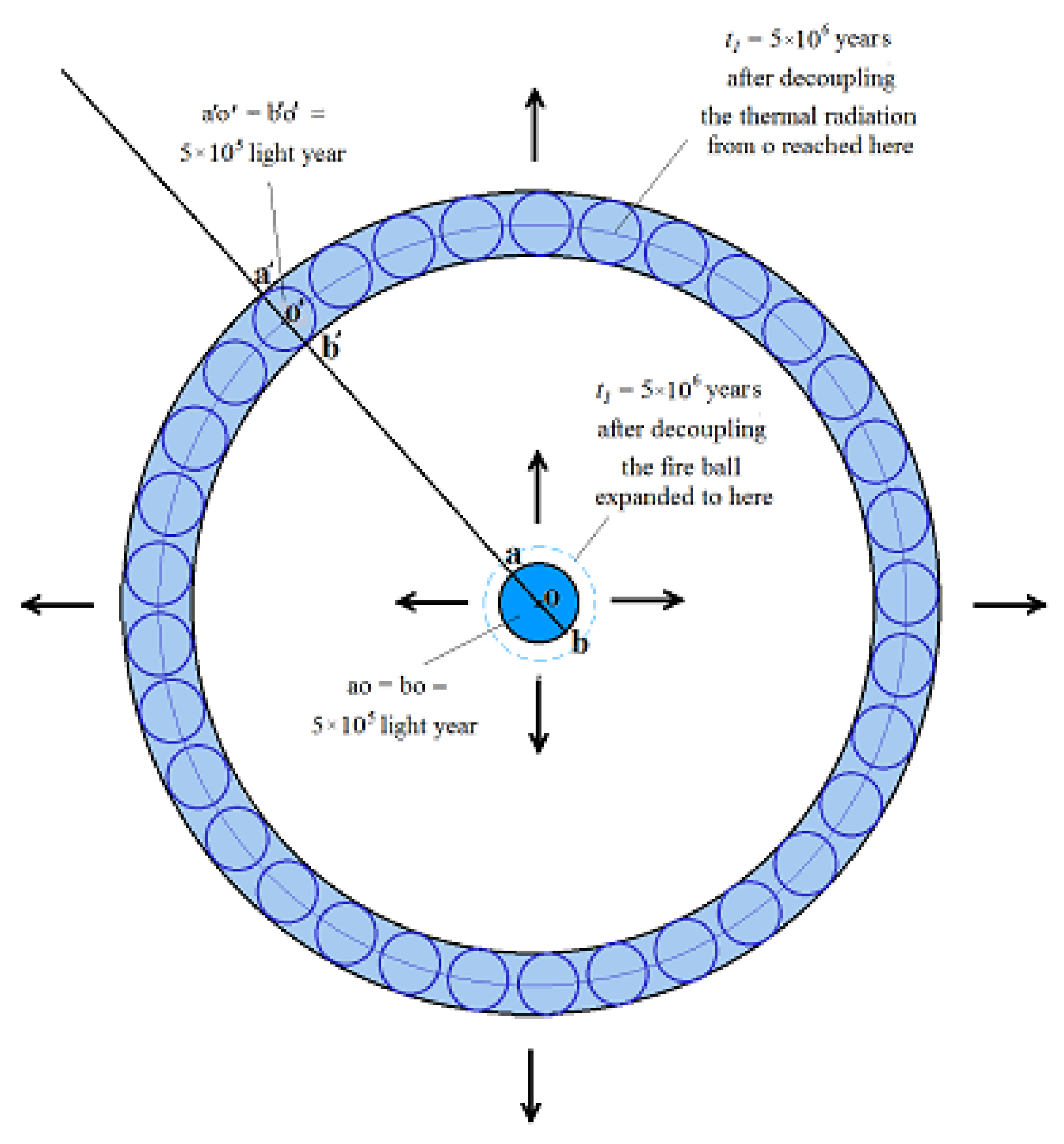
First, as shown in Figure 1, the small ball with the diameter ab in the central part of the figure represents the decoupled fireball, 3.8×10⁵ years after the big bang. Its radius is approximately oa ≈ 10 22 m = 5×10⁵ light years, with a volume rather greater than the Milky way, filled up with plasma at a high temperature of 3000K. Hence, according to Planck’s theory of black body radiation, the general thermal energy of the decoupled fireball is extraordinary great!
Let us see how the thermal radiation flied freely to the infinitively vast space.
5×10⁶ years later, all the thermal radiation from point o arrived at the spherical surface of the radius of oo’ = 5 ×10⁶ light years (take oo’ = 10 oa), as shown in Figure 1.
In the direction of oo’, the thermal radiation from point a reached point a’, the thermal radiation from point o reached point o’, the thermal radiation from point b reached point b’. All the thermal radiation in the direction of oo’ from all the points of
the decoupled fire ball aob now reached the corresponding points of an equal ball a’o’b’, which lay in the spherical layer a’b’. Obviously, a’b’ = 106 light years.
And all the thermal radiation ejected from the decoupled fireball aob in all the different directions in the 4 solid angle now all reached points within the whole spherical layer a′b′, as shown in Figure 1. The thickness of the spherical layer a′b′ (the big blue one) equals the diameter of the original small ball ab.
Figure 1.
The radius of the decoupled fire ball was about ao ≈ 5×10⁵ light years, 380,000 years after the big bang. The diameter is ab ≈ 106 light years. Once decoupled, all the thermal radiation within the whole decoupled fire ball aob began to fly off at the speed of light to leave it in all the directions. 5×10⁶ years later, the radiation from the whole sphere aob in the direction of oo′ reached a new place of a sphere a′o′b′, within the spherical layer a′b′ ≈ 106 light years′. And all the thermal radiation from the decoupled fire ball in all the directions in the 4 solid angle all reached the spherical layer a′b′ with a width of a′b′ = 106 light years, the big blue spherical layer in this figure.
Figure 1.
The radius of the decoupled fire ball was about ao ≈ 5×10⁵ light years, 380,000 years after the big bang. The diameter is ab ≈ 106 light years. Once decoupled, all the thermal radiation within the whole decoupled fire ball aob began to fly off at the speed of light to leave it in all the directions. 5×10⁶ years later, the radiation from the whole sphere aob in the direction of oo′ reached a new place of a sphere a′o′b′, within the spherical layer a′b′ ≈ 106 light years′. And all the thermal radiation from the decoupled fire ball in all the directions in the 4 solid angle all reached the spherical layer a′b′ with a width of a′b′ = 106 light years, the big blue spherical layer in this figure.
a′b′ = ab = 106 light years.
Then, 5 ×10⁷ years after the decouple, all the thermal radiation from point o arrived at the spherical surface of the radius of oo’’ = 5 ×10⁷ light years (oo’’ = 100 oa), as shown in Figure 2.
And in the direction of oo’’, the thermal radiation from point a reached point a’’, the thermal radiation from point o reached point o’’, the thermal radiation from point b reached point b’’. All the thermal radiation in the direction of oo’’ from all the points of the decoupled fire ball aob now reached the corresponding points of an equal ball a’’o’’b’’, which lay in the spherical layer a’’b’’.
And, all the thermal radiation from all the points of the decoupled ball aob in all the different directions in the 4 solid angle now all reached the points within the whole spherical layer a’’ b’’ (the big blue one). We have,
Figure 2.
5 ×10⁷ years after the decoupling, in the direction of oo’’, the radiation from o reached point o’’,and the radiation from a reached a’’, the radiation from b reached b’’. The radiation from all the points of the decoupling ball aob reached the corresponding points of ball a’’o’’b’’, laying in the spherical layer a’’b’’. And, the radiation from all the points of the ball aob in all the directions in the 4 solid angle reached the spherical layer a’’b’’.
Figure 2.
5 ×10⁷ years after the decoupling, in the direction of oo’’, the radiation from o reached point o’’,and the radiation from a reached a’’, the radiation from b reached b’’. The radiation from all the points of the decoupling ball aob reached the corresponding points of ball a’’o’’b’’, laying in the spherical layer a’’b’’. And, the radiation from all the points of the ball aob in all the directions in the 4 solid angle reached the spherical layer a’’b’’.
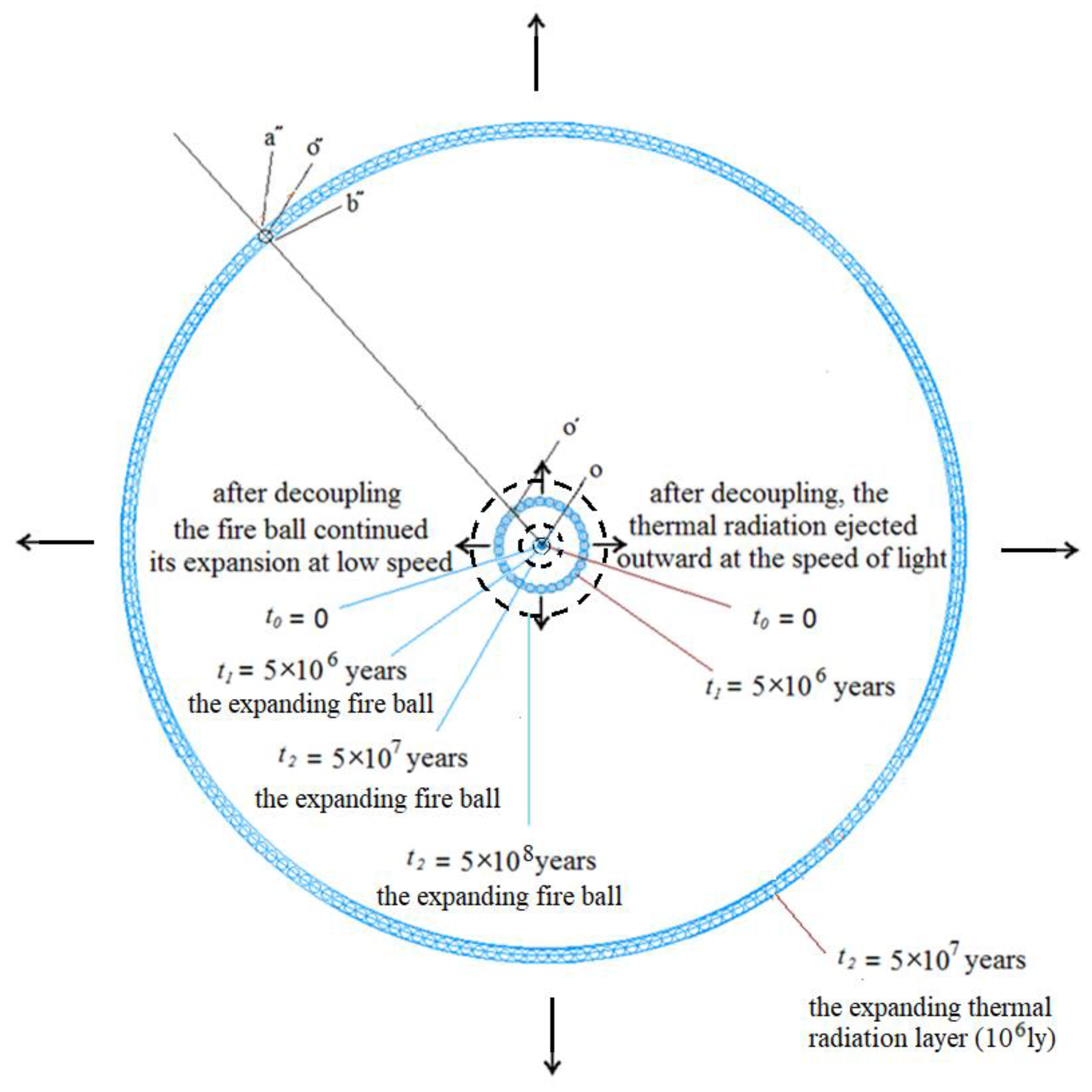
a’’ b’’ = a′b′ = ab = 106 light years
Similarly, 5 ×10⁸ years later,all the radiation from all the points of the decoupled ball aob and in all the different directions in the 4 solid angle, reached the correspondent points within the whole spherical layer a’’’b’’’ (the big blue one), obviously,
a’’’b’’’ = a’’b’’ = a′b′ = ab = 106 light years.
Then, 5 ××109 years later, 5 ×10¹⁰ years later,and so on, as the thermal radiation ejected
freely from the decoupled fireball aob, flied outward continuously at the speed of light, it always keeps within a spherical layer with a thickness of 106 light years,
… = a’’’’’b’’’’’ = a’’’’b’’’’= a’’’b’’’ = a’’b’’ = a’b’ = ab = 106 light years
The expanding of this spherical layer of the thermal radiation of 106 light years, (ab), a′b′, a’’b’’, a’’’b’’’, a’’’’b’’’’, a’’’’’b’’’’’ ……, and so on, should not go on and on at the light speed to the farther and farther space without an end. Because the space of the universe is gravitationally closed, when some utmost possible position is reached, the thermal radiation layer of 106 light years will no longer fly away. It will return back to the central region of the universe, passing through the central region of the heat ocean, travel to their far most positions on the other side of the central region. And, in such away, the layer of the 106 light years will keep shuttling in the closed universe ceaselessly, meanwhile, getting more and more dispersive.
Finally, after an extremely long, long relaxation time, by interactions (exchange heat) with the rare cosmic electrons, protons, atoms, molecules, dusts, rocks, and so on in the metagalaxy region (all these matters are kept at the temperature of 2.73K), all the thermal radiation from the decoupled fire ball will eventually mingle into the 2.73K heat ocean. That is their final destination.
So, the authors emphasize again that, the 2.73K background radiation discovered by Penzias and Wilson in 1965 is not the afterglow of the decoupled fire ball. It was not produced by the big bang. It itself is just an extremely immense and permanent 2.73K vast heat ocean in the closed universe. It is rather stable. It existed before the big bang, it exists now, and it will exist in the future.
References
- M. U. Shahzad, M. I. Asjad, S. Nafees, H.U. Rehman, Study of thermodynamical geometries of conformal gravity black hole The European Physical Journal C (2022) 82:1044. [CrossRef]
- R. Clausius, Uber den zweiten Hauptsatz der mechanischen Warmetheorie (1867).
- lord Kelvin, On the Dynamical Theory of Heat, etc., Transactions of the Royal Society of Edingburg (1851).
- J. C. Maxwell, Theory of Heat 328 (1871).
- W. Ehrenberg, Maxwell’s Demon. Scientific American 103-110 (1967).
- Richardson and Brown, Phil. Mag. 16, 353 (1908).
- Richardson, Phil. Mag. 16, 890 (1908); 18, 681 (1909).
- Schottky, Ann. der Phys. 44, 1011 (1914).
- L.H Germer, THE DISTRIBUTION OF INITIAL VELOCITIES AMONG THERMIONIC ELECTRONS (1925). [CrossRef]
- L. R. Koller, Phys. Rev. 36, 1639 (1930).
- N. R. Campbell, Phil. Mag. 12, 174 (1931).
- John E. Davey, Thermionic and Semiconducting Properties of〔Ag〕- Cs2O3, Ag, Cs, Journal of Applied Physics, Volume 28, Number 9, p.1031 (1957).
- A. H. Sommer PHOTOEMISSIVE MATERIALS Preparation, Properties, and Uses John Wiley & Sons (1968), Section 10.7.1, Chapter 10.
- X. Y. Fu, An Approach to Realize Maxwell’s Hypothesis,Energy Conversion and Management (1982).
- X. Y. Fu and Z. T. Fu, The Realization of Maxwell’s Hypothesis. arxiv /physics /0311104v1-v3 (2003-2016); MDPI preprints.org/manuscript/201607.0028/v1-v5 (2016-2018).
- X. Y. Fu and Z. T. Fu, A graphical survey on the electron’s trajectories in Fu & Fu’s experiment, preprints.org/manuscript/201607.0028/v4.
- Harvey S. Leff & Rex F. Andrew, Maxwell’s Demon, Entropy, Information, Computing (1990).
- Harvey S. Leff & Rex F. Andrew, Maxwell’s Demon 2, Entropy, Classical and Quantum Information, Computing (2003).
- Harvey S. Leff, Energy and Entropy: A Dynamic Duo. 281-285, CRC Press Taylor & Francis Group (2020),. [CrossRef]
- Kamarul Aizat Abdul Khalid, Thye Jien Leong, and Khairudin Mohamed, Review on Thermionic Energy Converters IEEE TRANSACTIONS ON ELECTRON DEVICES, VOL. 63, NO. 6, JUNE 2016.
- G. Lemaitre,On the Evolution of the Universe and the Hypothesis of the Primitive Atom (1927).
- E. Hubble,Distance and radial velocity among extra-galactic nebulae. Proc. Nat. Acad. Sci. 15, 168 – 173 (1929). [CrossRef]
- G.Gamow,The Creation of the Universe. New York Viking Press (1952).
- R. M. Wald,Space, Time and Gravitation, the Theories of the Big Bang and Black Holes, Chicargo University Press(1977).
- A. Penzias and R. Wilson, A Measurement of Excess Antenna Temperature. Astrophysics J. 142, 419 – 421 (1965). [CrossRef]
- E. H. Avrett and Herbert Gursky, Frontiers of Astrophysics. Harvard University Press 157 - 158 (1976).
- X. Y. Fu, and Z. T. Fu, The Origin of Energy for the Big Bang. arxiv.org/astrophysics /v1-v3 (2003), (Note: This is the original manuscript of the present article of the authors).
- Lizhi Fang方励之, R. Ruffini, 《相对论天体物理的基本概念》,上海科学技术出版社(1981).
- Zhao Zheng赵峥, Thermal Properties of Black Holes and Singularity of Time and Space 黑洞的热性质和时空奇异性,Beijing Normal University Press (1999).
- Wang Yong Jiu王永久, Physics of Black Holes, 黑洞物理学,Hunan Normal University Press (2000).
- Liu Liao刘辽 and Zhao Zheng赵峥, General Relativity广义相对论,高等教育出版社 (2004).
Figure 5.
The electron tube FX8-24.
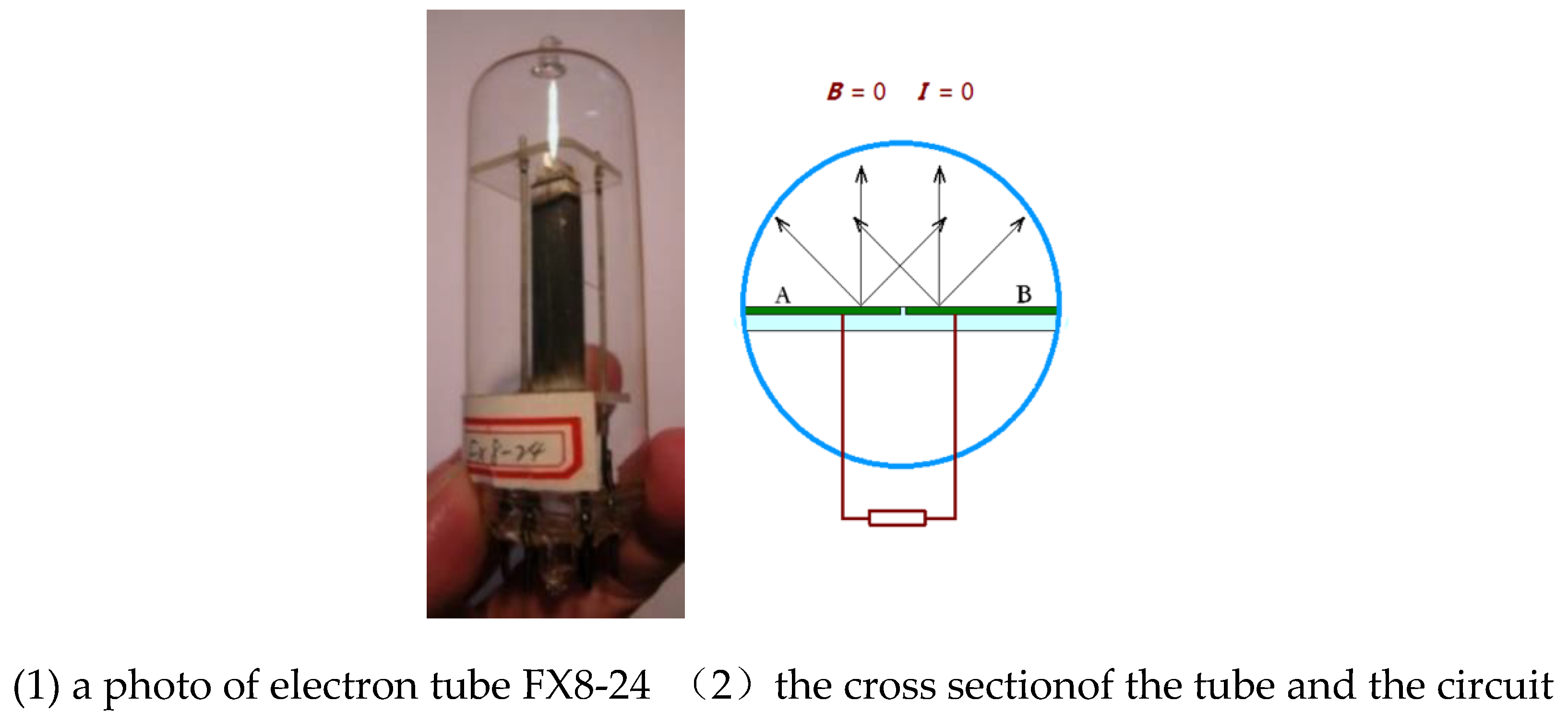
Figure 6.
An electric potential demon. (1) When the direction of the magnetic field enters into the paper, the output current is positive. (2) When the direction of the magnetic field leaves out the epaper, the output current is ngative.
Figure 6.
An electric potential demon. (1) When the direction of the magnetic field enters into the paper, the output current is positive. (2) When the direction of the magnetic field leaves out the epaper, the output current is ngative.
Disclaimer/Publisher’s Note: The statements, opinions and data contained in all publications are solely those of the individual author(s) and contributor(s) and not of MDPI and/or the editor(s). MDPI and/or the editor(s) disclaim responsibility for any injury to people or property resulting from any ideas, methods, instructions or products referred to in the content. |
© 2026 by the authors. Licensee MDPI, Basel, Switzerland. This article is an open access article distributed under the terms and conditions of the Creative Commons Attribution (CC BY) license (http://creativecommons.org/licenses/by/4.0/).
Copyright: This open access article is published under a Creative Commons CC BY 4.0 license, which permit the free download, distribution, and reuse, provided that the author and preprint are cited in any reuse.


