

Submitted:
14 June 2024
Posted:
14 June 2024
You are already at the latest version
Abstract
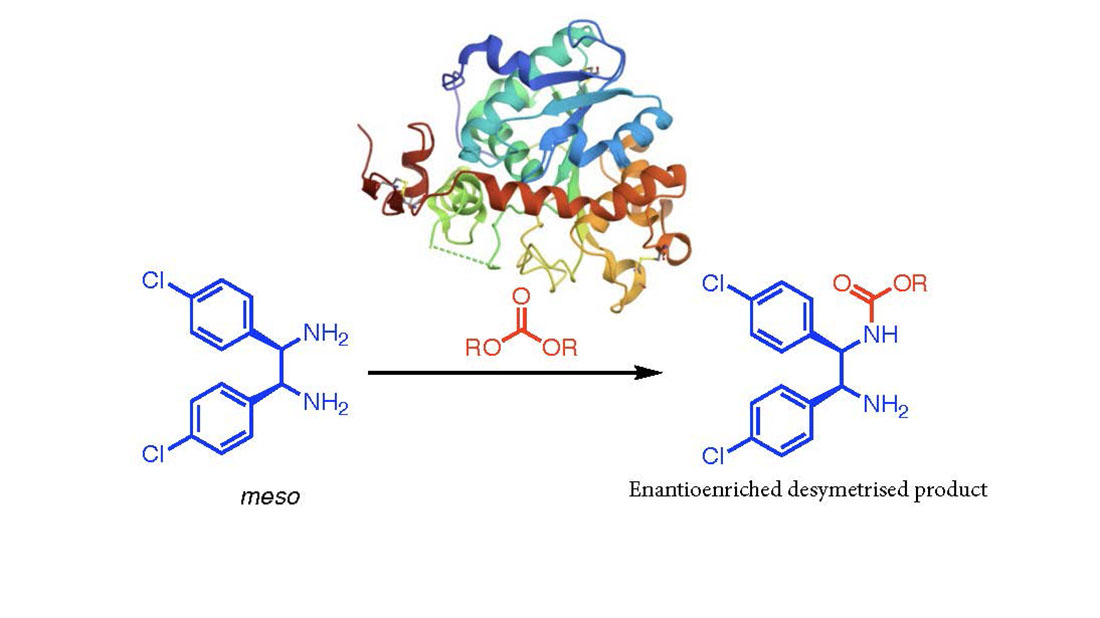
Herein we present the biocatalysed preparation of mono-N-carbamate-protected precursor of antitumoral Nutlin-3a, through enantioselective alkoxycarbonylation of meso-1,2-disubstituted-1,2-diaminoethane, using enzyme lipases and dialkyl carbonates as acylating agents. A series of supported or free lipase enzymes were screened in combination with commercially available diallyl-, diethyl and dimethyl- carbonate. The reactions were conducted at different temperatures, reaction times and with variable co-solvent systems to evaluate the effect on the enzyme catalytic activity. The best results in terms of conversion, enantiomeric excess and yield were obtained when lipase from Candida antarctica B (CAL-B) was used with diallyl carbonate (DAC) conducting the reaction solventless at 75 °C.
Keywords:
Biocatalysis
; Nutlin-3a
; desymmetrization
; vicinal meso-diamines
1. Introduction
Thanks to its role in cell cycle stabilisation and DNA integrity, the protein p53 is often called “the genome guardian”. Its function as tumour suppressor is widely recognized and has been subject of intense research as a strategic target in cancer therapy.[1] Sophisticated animal models have shown that targeting p53 level regulation in order to activate its protective response can be curative even in advanced tumours.[2,3,4] Among different approaches aimed at the retention and restoration of wild-type p53 function, the blockage of its antagonist oncoprotein MDM2 with small molecule inhibitors as chemotherapeutics is extensively investigated.[5,6] In fact, as the most frequent genomic alteration in cancer, the over-expression or genetic amplification of MDM2 leads to the inactivation of p53 through an auto-regulatory negative feedback loop.[7,8]
1,2,4,5-tetrasubstituted-4,5-cis-imidazolines, also known as Nutlins are potent and specific inhibitors of the p53-MDM2 protein-protein interaction (PPI) with anti-proliferative activity that inhibit tumour growth. The Nutlins family was developed via high-throughput screening at Hoffmann-La Roche and the preclinical drug Nutlin-3a, 1 (Figure 1) is one of the most studied compound.[9] Compound 1 was shown to bind MDM2 right in the p53 pocket with high affinity and represents a suitable leading compound for ligand structure optimization.[10,11]
Countless studies regarding the use of these heterocyclic drugs in basic cancer biology and clinical trials are nowadays pervasive in oncology literature.[12,13,14,15] However, their preparation in large scale is not trivial and requires considerable organic chemistry knacks and suitable facilities, which make them not readily accessible for testing. Furthermore, a quite high eudismic ratio between the levorotatory eutomer (-)-(4S,5R)-Nutlin (also referred to as Nutlin-3a) and distomer (+)-(4R,5S)-Nutlin (also referred to as Nutlin-3b) demands the enantiomers to be resolved to minimise possible side-effects upon administration of racemate.[16,17]
The original total synthesis of Nutlins initially reported by Hoffmann-La Roche, consists in the preparation of the racemic mixture from benzil (1,2-diphenylethane-1,2-dione) in 8 steps and requires two time-consuming and expensive chiral Supercritical Fluid Chromatography (SFC) separations for the isolation of the more potent enantiomer.[18,19]
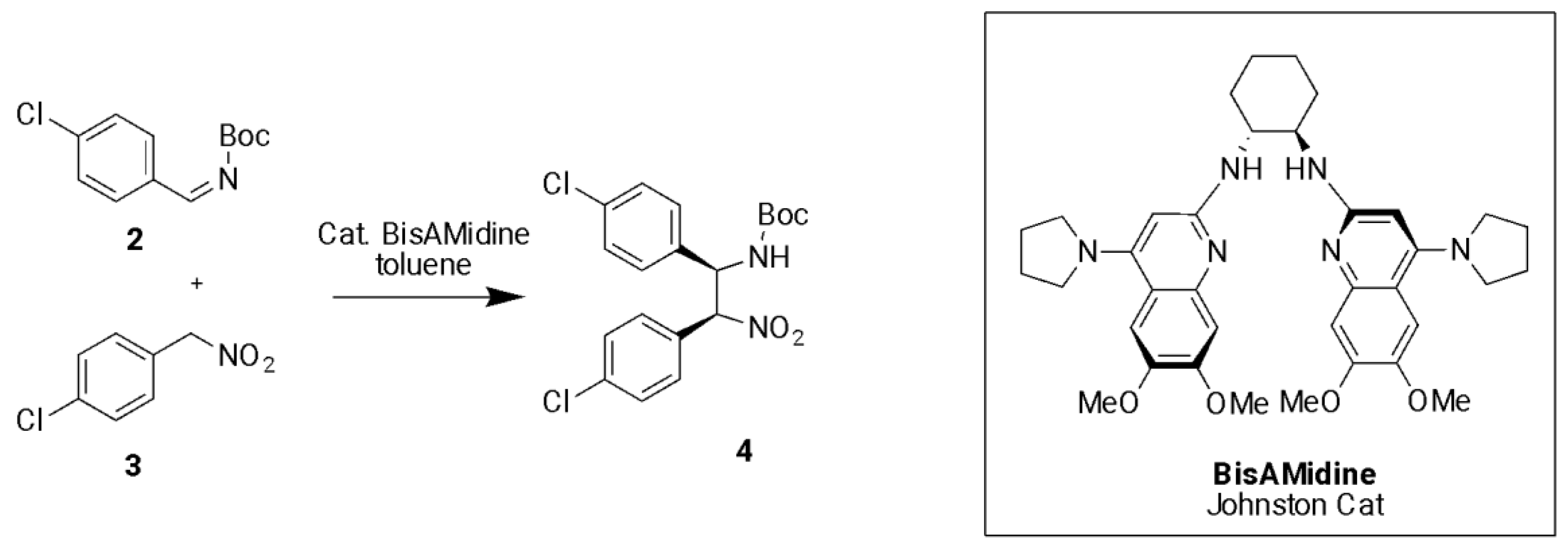
In 2011 Johnston and co-workers reported the first asymmetric synthesis of 1 through the formation of enantiopure key nitro-amine precursor 4. The latter was obtained in diastero- and enantioselective fashion via aza-Henry (also referred to as nitro-Mannich) reaction, catalysed by chiral organocatalyst bisAMidine.[20,21] Although high enantiomeric excess of 4 was reached, this synthetic pathway still presents drawbacks and problematic steps in terms of length, costs and efficiency. For instance, starting materials of asymmetric step, the aryl N-Boc imine 2 and nitromethane 3, are not easy to prepare as evidenced by rather low yields and long reaction time, in addition to hazardous handling of some needed reactants. Moreover, the scaling-up of subsequent chiral nitro compound reduction with the CoCl2/NaBH4 system seems to have reproducibility issues.
Figure 2.
Asymmetric Aza-Henry reported by Johnston and co-workers for the synthesis of enantiopure Nutlin-3a.
Figure 2.
Asymmetric Aza-Henry reported by Johnston and co-workers for the synthesis of enantiopure Nutlin-3a.
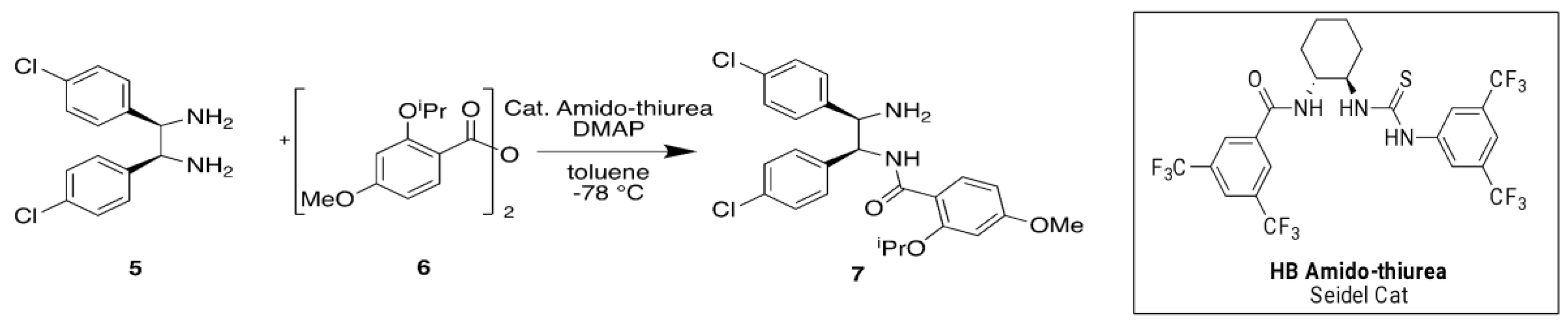
Later we reported an alternative expeditious synthesis that allowed us to reduce the number of steps, thus simplifying the overall production process.[22] Our strategy was based on a dual catalytic enantioselective process introduced by Siedel et al., for the desymmetrisation of prochiral 5, a vicinal meso-diamine which in turn could be easily obtained in two steps. In particular the nucleophilic catalyst 4-(dimethylamino)pyridine (DMAP) is used in combination with a chiral hydrogen-bonding (HB) amido-thiourea.[23] This catalytic system with an aryl anhydride 6 generates in situ an enantiomerically pure tight ion pair which induces the selectivity for the nucleophilic attack by the meso-diamine 5. A scalemic mixture of 84:16 ratio of monoamide precursor was achieved using a stoichiometric amount of chiral auxiliary at -78°C. Although the progress in terms of practical optimization and process simplification of reported strategies, we were keen to further improve selectivity and yields of the synthesis of (-)-Nutlin-3a 1 and its derivatives.
Figure 3.
Asymmetric meso-diamine desymmetrisation with Seidel HB-catalyst implemented by Trapella and co-workers for the synthesis of enantiopure Nutlin-3a.
Figure 3.
Asymmetric meso-diamine desymmetrisation with Seidel HB-catalyst implemented by Trapella and co-workers for the synthesis of enantiopure Nutlin-3a.
Hence, access to enantioenriched or enantiopure monoprotected cis-derivatives from meso-compound 5, as the key intermediate for (-)-Nutlin-3a preparation, has proved to be challenging, and requires expensive catalysts and time-consuming purifications, besides the environmental issues related to their preparation.
Recent advances in organic synthesis techniques showed that the replacement of chemical approaches with biocatalytic processes is an attractive alternative as it is advantageous in terms of environmental prevention, embracing the green chemistry principles. Indeed, enzymes have been employed as in the last 30 years for a wide variety of reactions, sometimes improving tedious asymmetric syntheses of complex molecules. Due to enzyme efficiency and selectivity, their application is widespread in biocatalyzed processes for the preparation of pharmaceuticals or natural bioactive compounds.[24]
Among biocatalysed asymmetric processes, there are a variety of prochiral symmetrical substrates that have been enantioselectively desymmetrised. It is known that, in contrast to common stereoselective kinetic resolutions that reach at most 50% yield, desymmetrisation carry the advantage that 100% of the substrate could be potentially converted into enantiopure product. Nowadays some enzymatic desymmetrisation, even in continuous-flow mode, have been scaled up for multigram preparative purposes with several substrates such as meso-diols, ketones or esters.[25,26] However, only a handful of studies describes the enzymatic desymmetrisation of prochiral meso-diamines as starting materials.[27,28,29,30,31,32] Most of enzymatic entioselective reactions explored by far in the literature do not use vicinal diamines.
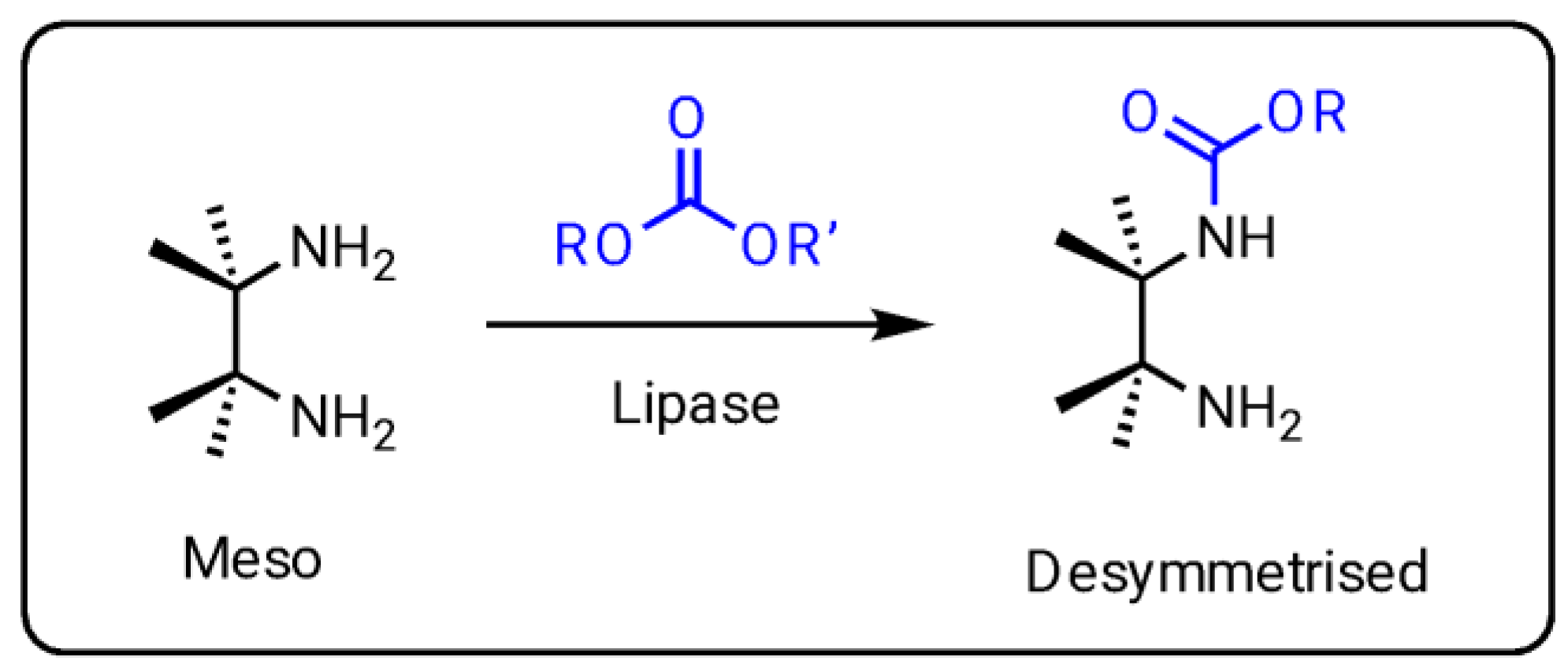
Almost the entirety of published works uses lipases, as it is a very versatile biological catalysts, in combination with dialkyl carbonate to give desymmetrised monocarbamate with high enantiopurity (Figure 4). Gotor et al. reported the first stereoselective mono-protection of 2-substituted 1,3-propanediamine derivatives through Pseudomonas cepacia (PSL-C) catalysed reaction in 1,4-dioxane.[27] Either nonactivated esters such as ethyl acetate, symmetric or non-symmetric carbonates were used. High enantiomeric excesses and good yields were achieved with PSL-C and diallyl carbonate (DAC), whereas either no reaction occurred with different lipases or equimolar diacylated product was formed with Candida antarctica type B (CAL-B). To this study followed a screening to assess the relationship between selectivity and the steric and electronic nature of substituent in position 2 of propane-diamines.[28,29] In particular authors underlined the importance of aromaticity of substituent for the enzymatic enantiorecognition mechanism. Prochiral pentane-1,5-diamines were also investigated as enzymatic substrates for PSL-C desymmetrisation and good results were obtained with ethyl methoxyacetate as acyl donor in 1,4-dioxane.[30] Similar work was carried out by Berkessel et al. where the stereoselective mono-Alloc (mono-Allyloxycarbonyl) protection of cis-1,2-diaminocyclohexane with lipase from CAL-B was reported.[10] Among various solvents tried, toluene seemed to give the best result in terms of reaction rate. Meso-1,2-diaryl-1,2-diaminoethanes were also assessed as enzymatic substrates with several lipases by Méndez-Sánchez et al..[32] Non-substituted diamine led to the highest conversion and enantiomeric excess of allyl aminocarbamate while moderate conversion was reached for para-substituted compounds, using CAL-A and CAL-B. This result encouraged us to develop and optimise a biocatalytic procedure for the asymmetric mono-protection of para-chlorophenyl ethanediamine 5, required for the preparation of Nutlin-3a, 1.
The so-obtained desymmetrised diamine compound is an optically active core that can be found in a wide range of biologically active compounds, besides Nutlin-3a.[33] This type of vicinal diamines are versatile building blocks that can also be found in a plethora of important organic structures, such as organocatalysts, chiral auxiliaries, chelating agents.[25,34,35,36] Thus, consistent biocatalytic methodology would permit the chemoenzymatic preparation of a broad library of derivatives, offering the possibility of orthogonal protecting strategies in mild and green operating conditions.
2. Results and Discussion
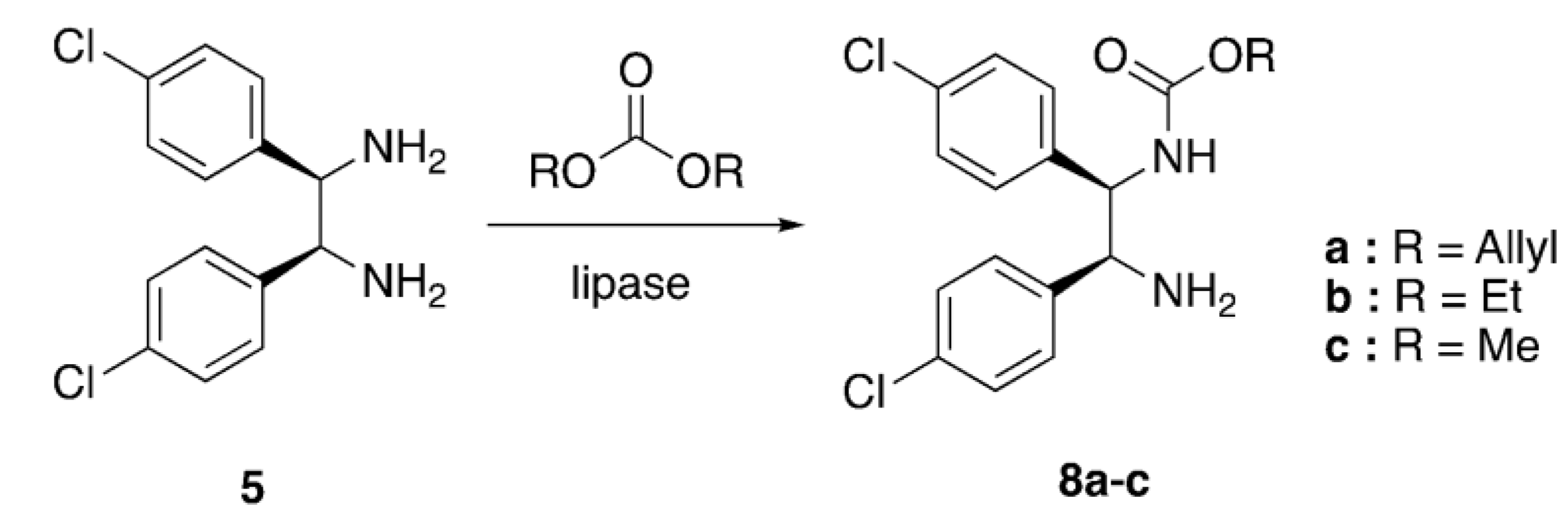
With the aim of finding the most suitable conditions to perform the enzymatic reaction in Scheme 1 in terms of yields and enantiomeric excesses, we systematically tuned reaction parameters such as lipases type, solvent, carbonate, temperature.
Scheme 1.
Lipase-catalysed asymmetric meso-diamine 5 desymmetrisation with green alkylcarbonates.
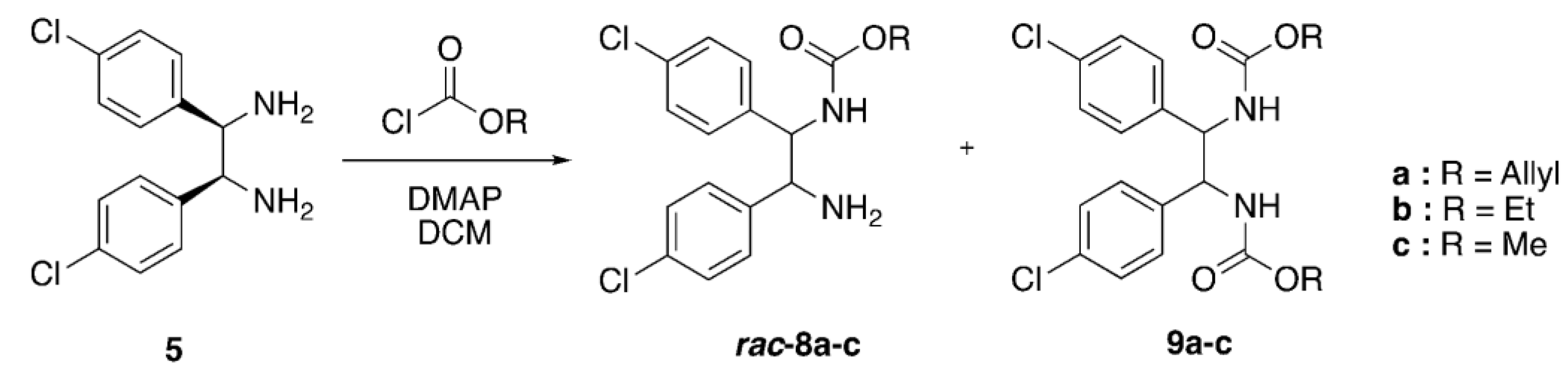
Racemic products, required as reference compounds for the measurement of enantiomeric excess by chiral HPLC, were also synthesised. The non-enzymatic alkoxycarbonylation of prochiral meso-diamine was performed at room temperature with appropriate chloroformates in the presence of dimethylaminopyridine (DMAP). Under these reaction conditions, the favourited formation of the dicarbamate 9 as a byproduct dropped the yield of the isolated monocarbamate product. Therefore, in order to minimise dialkylation the reaction mixture was cooled at 0 °C and kept at low concentration and the acylating agent was added portion wise. Nevertheless, purification by flash chromatography was always necessary to separate the mono- and the diamide species.
Scheme 2.
Racemic preparation of aminocarbamates with alkyl chloroformates with formation of undesired biscarbamates.
Scheme 2.
Racemic preparation of aminocarbamates with alkyl chloroformates with formation of undesired biscarbamates.
2.1. Enzyme Screening
In attempt to select the best performing enzyme for this reaction, several immobilised and free lipases were screened including immobilised Candida antarctica B, immobilised Rhizomucor miehei (RML), Aspergillus niger, Penicillum roqueforti, Liver acetone powder porcine, immobilised Pseudomonas cepacia (PSL-C), immobilised Candida rugosa, Pseudomonas fluorescens. Standard conditions were used in initial activity test, namely 60 mg of diamine 5, 2 mL of DAC (concentration 30 mg/mL) and 200 mg of enzyme (amine/enzime ratio 0,3:1) at 45 °C. Among these, Candida antarctica type B (CAL-B), Rhizomucor miehei (RML) and partially Liver acetone powder porcine showed to be able to catalyse the reaction. According to previously reported data, the best selectivity was achieved using CAL-B lipase immobilised on acrylic polymeric support. Good enantiopreference and no racemization through migration of carbamate group was observed on Alloc-derivative 8a (Table 1). Conversely, only product traces or no reaction were appreciated with the other lipases at those reaction conditions.

Table 1.
Enantioselective desymmetrisation of 0,2 mmol of diamine 5 with 2 mL of DAC with 200 mg of enzyme at 45°C under inert air condition for six days.
Table 1.
Enantioselective desymmetrisation of 0,2 mmol of diamine 5 with 2 mL of DAC with 200 mg of enzyme at 45°C under inert air condition for six days.
| Entry | lipase | yield (%)a | Ee (%)c |
|---|---|---|---|
| entry 1 | CAL-B | 27a | 76 |
| entry 2 | RML | 16a | 69 |
| entry 3 | Liver acetone powder porcine | 6a | 9 |
| entry 4 | Pseudomonas cepacia (PSL-C) | 2b | n.d |
| entry 5 | Candida rugosa | 4b | n.d |
| entry 6 | Pseudomonas fluorescens | 8b | n.d |
| entry 7 | Aspergillus niger | / | / |
| entry 8 | Penicillum roqueforti | / | / |
a Isolated yields were determined after purification by silica gel chromatography. Traces indicated the mass spectroscopy detection of the product, yet in minimum amounts. b Conversion determine by HPLC peaks integration. c Enantiomeric excesses were determined by chiral stationary phase HPLC. (n.d.: not determined).
Same preliminary screening protocol was applied also to diethyl carbonate (DEC) desymmetrisation. Equal to DAC desymmetrisation, the monocarbammate product 8b was present in traces after three days using enzyme from CAL-B and Pseudomonas cepacia (PSL-C), while other enzymes showed no significant activity toward diamine 5. Likewise, reaction with dimethyl carbonate (DMC) as acylating agent, traces of product 8c were detected only when using lipase from Pseudomonas fluorescens (PSL-C) and CAL-B.
2.2. Effect of Solvent
Since the organic carbonates are in liquid state at reaction temperatures, an organic solvent in this experiment would only act as a co-solvent helping the solubilization of meso-diamine and allowing smooth stirring of the enzyme. Also, a good co-solvent is especially desired in scaled-up syntheses, when large quantities of high-priced carbonate are needed. However, it is known that in some cases solvents used as reaction media could generate phenomena of enzymatic instability and deactivation. To assess the effect of co-solvents on enzyme activity in our system we selected the most used organic solvents in enzymatic reactions that were able to efficiently solubilize our substrates. Diallyl carbonate and lipase from Candida antarctica B were chosen for this evaluation as acyl agent and enzyme combination that led to the best conversion and enantiomeric excess. High-boiling solvents were preferred due to their suitability in a wide range of reaction temperatures (Table 2). Both toluene and 1,4-dioxane proved to be good solvents allowing a monophasic environment, but resulted to be not well-tolerated by the enzymes. The tertiary alcohol 2-methylbutan-2-ol (tert-amyl alcohol) was also tested as reaction co-solvent. This low toxic solvent showed only a slight decrease of enzymatic activity giving 23% yield making it a potential alternative for scale-ups when expensive carbonates are needed.
Table 2.
Enantioselective desymmetrisation of 60 mg (0,2 mmol) of compound 5 with 1 mL of DAC in 30 mL of solvent with 1g of supported Candida antarctica type B (0.06:1 ratio with diamine) at 45°C under inert air condition.
Table 2.
Enantioselective desymmetrisation of 60 mg (0,2 mmol) of compound 5 with 1 mL of DAC in 30 mL of solvent with 1g of supported Candida antarctica type B (0.06:1 ratio with diamine) at 45°C under inert air condition.
| Entry | solvent | yield (%)a |
|---|---|---|
| entry 1 | Toluene | traces |
| entry 2 | 1,4-dioxane | traces |
| entry 3 | tert-amyl alcoholb | 23% |
| entry 4 | ACN | - |
a Isolated yields were determined after purification by silica gel chromatography. Traces indicated the mass spectroscopy detection of the product yet in minimum amounts. b 3,5 mmol of compound 5 with 5 mL of DAC at 75 °C.
With the purpose of studying the enzymatic reaction on a milligrams scale, we mainly worked solventless, thus in this case, stoichiometric excess of carbonates not only acts as a reactant, but also as a reaction solvent.
2.3. Effect of Temperature
Reference reactions were performed at 45 °C as optimal reaction temperature of most lipases. However, temperature is an important parameter that can affect enzymatic processes, thus we tested efficiency after widen the temperature range. Interestingly, we observed that supported enzymes such as CAL-B, not only could tolerate higher temperatures, but also led to substantial improvement in the conversion rate towards monocarbamates, and enabled halving reaction time without affecting enantiomeric excess. Similar behaviour was observed using the three chemically diverse carbonates, DAC (Table 3, entries 1 and 3) DEC (Table 4, entries 1 and 2) and DMC (Table 5, entries 1 and 2). Specifically, keeping the reaction temperature at 75 °C endorsed moderate to good yields. This temperature was maintained for following experiments.
On the other hand, non-supported enzymes, namely Pseudomonas cepacia, Candida rugosa and Pseudomonas fluorescens, did not display the same trend (data not shown), probably due to enzyme instability and irreversible denaturation at high temperatures.
2.4. Effect of Reaction Time
Mono-derivatisation of diamines is particularly challenging since the resulting monoalkylated compound is usually more reactive than the starting diamine, leading to undesired bis-alkylated compound. As mentioned above, such bis-carbamated compound 9 was observed in non-enantioselective process as insoluble precipitate when oxycarbonyl chlorides such as methyl, ethyl and allyl chloroformate were used as acylating agents. Chromatographic purification was always required to separate the mixture of rac-8 and 9 in a ratio of 4:1.
Nonetheless, conversely to racemate preparation, we observed a slow reaction kinetic in enantioselective biocatalysed process with carbonates as it required several hours but no bis-acylation occurred.
2.5. Scaling Up
The best catalyst, namely CAL-B and no-cosolvent were selected for synthesis scale-up, to ensure the process remains efficient and safe with higher diamine concentration and lower catalyst loading. We observed no significant decrease on yield and enantiomeric excess (Table 3, entries 1-2 and 4; Table 4 entries 3 and 4, Table 5 entries 2-5) however in some cases more reaction time was required to achieve good conversion.
Table 3.
Enantioselective desymmetrisation of compound 5 with diallyl carbonate DAC in concentration range 30-70 mg/mL and supported CAL-B (in ratio with diamine) under inert air condition.
Table 3.
Enantioselective desymmetrisation of compound 5 with diallyl carbonate DAC in concentration range 30-70 mg/mL and supported CAL-B (in ratio with diamine) under inert air condition.
| Entry | Diamine mg |
diamine/DAC mg/mL |
Enzyme loadinga | T (°C) |
Time (days) |
Yield (%)b Ee (%)c |
|---|---|---|---|---|---|---|
| entry 1 | 60 | 30 | 0.3:1 | 45 | 6 | 27 76 |
| entry 2 | 200 | 50 | 0.5:1 | 45 | 6 | 14 83 |
| entry 3 | 60 | 30 | 0.3:1 | 75 | 3 | 65 80 |
| entry 4 | 500 | 70 | 0.5:1 | 75 | 3 | 65 89 |
a Ratio amine/enzyme in weight. a Isolated yields were determined after purification by silica gel chromatography. Traces indicated the mass spectroscopy detection of the product yet in minimum amounts. b Enantiomeric excesses were determined by chiral stationary phase HPLC. (n.d.: not determined).
Table 4.
Enantioselective desymmetrisation of compound 5 with diethyl carbonate DEC in concentration range 30-70 mg/mL and supported CAL-B (in ratio with diamine) under inert air condition.
Table 4.
Enantioselective desymmetrisation of compound 5 with diethyl carbonate DEC in concentration range 30-70 mg/mL and supported CAL-B (in ratio with diamine) under inert air condition.
| Entry | Diamine mg |
diamine/DEC mg/mL |
Enzyme loadinga | T (°C) | Time (days) | Yield (%)b Ee (%)c |
|---|---|---|---|---|---|---|
| entry 1 | 60 | 30 | 0.3:1 | 45 | 6 | trace n.d. |
| entry 2 | 60 | 30 | 0.3:1 | 75 | 3 | 16 72 |
| entry 3 | 200 | 67 | 0.5:1 | 75 | 4 | 22 78 |
| entry 4 | 500 | 50 | 0.5:1 | 75 | 3 | 30 53 |
a Ratio amine/enzyme in weight. b Isolated yields were determined after purification by silica gel chromatography. Traces indicated the mass spectroscopy detection of the product yet in minimum amounts. c Enantiomeric excesses were determined by chiral stationary phase HPLC. (n.d.: not determined).
Table 5.
Enantioselective desymmetrisation of compound 5 with dimethyl carbonate DMC in concentration range 30-70 mg/mL and supported CAL-B (w/w% diamine) under inert air condition.
Table 5.
Enantioselective desymmetrisation of compound 5 with dimethyl carbonate DMC in concentration range 30-70 mg/mL and supported CAL-B (w/w% diamine) under inert air condition.
| Entry | Diamine mg |
Diamine/DMC mg/mL |
Enzyme loadinga | T (°C) | Time (days) | Yield (%)b Ee (%)c |
|---|---|---|---|---|---|---|
| entry 1 | 60 | 30 | 0.3:1 | 45 | 6 | trace n.d. |
| entry 2 | 60 | 30 | 0.3:1 | 75 | 5 | 95 73 |
| entry 3 | 500 | 70 | 0.3:1 | 75 | 7 | 22 31 |
| entry 4 | 200 | 40 | 0.3:1 | 75 | 7 | 36 46 |
| entry 5 | 500 | 100 | 0.4:1 | 75 | 4 | 30 44 |
a Ratio amine/enzyme in weight. b Isolated yields were determined after purification by silica gel chromatography. Traces indicated the mass spectroscopy detection of the product yet in minimum amounts. c Enantiomeric excesses were determined by chiral stationary phase HPLC. (n.d.: not determined).
3. Materials and Methods
The biocatalysts Candida antarctica lipase type B (Lipozyme 435®, CAL-B) were provided by Novozymes (Lyngby, Denmark). All other lipases purchased from Sigma-Aldrich and used as received. Reactions were monitored by thin-layer chromatography TLC on silica gel and mass spectrometry.
Instruments: The mass spectra were recorded with a MICROMASS ZQ 2000 instrument. Thin-layer chromatography (TLC) for reaction monitoring was performed on precoated plates of silica gel Macherey-Nagel SIL Poligram / UV 254 (Merck, Darmstadt, Germany). For TLC stain 2% KMO4 aqueous solution was used.
Mass spectra were recorded by an ESI single-quadrupole mass spectrometer Waters ZQ 2000 (Waters Instruments UK). Reaction conversions of non-isolated products were determined with a Backmann System Gold 168 HPLC apparatus with LC Column Kinetex 5µm EVO C18 100 Å (250 Å, 4.6 mm) and wavelength UV detector fixed at 220 nm.
The products were purified with a medium pressure chromatographic system Isolera 1 (Biotage, Sweden): elution system and conditions used for each sample are reported in experimental section.
1H (400 MHz) NMR and 13C (101 MHz) NMR spectrum were obtained at ambient temperature using a Varian 400 MHz spectrometer and chemical shifts δ, expressed as part per million (ppm) were referenced to residual 1H signals of the deuterated solvents (δ 1H 7.26 for CDCl3, δ 1H 2.50 for DMSO-d6, and δ 1H 3.31 for CD3OD). Peaks assignments were aided by DEPT experiments. Coupling constants (J) are reported in Hertz and the following abbreviations were used to describe the multiplicity and shape of the peaks: s = singlet; d = doublet; dd = double doublet; t = triplet; td = triple doublet; m = multiplet.
Chiral separations for enantiomeric excess determination were performed under normal phase conditions on an Agilent 1100 Series; chiral columns type and elution methods (i.e., normal phase composition, flow rate) used for each sample are specified in experimental section.
The exact mass of the synthesized compounds was assessed by injecting 1 µL of 1mg/mL of each sample into a Vanquish Flex Ultra High-Performance Liquid Chromatography (UHPLC) system coupled to a High-Resolution Orbitrap Exploris 240 mass spectrometer ThermoFisher Scientific (Waltham, MA USA). All samples were analysed in positive mode.
Enzymatic reactions were performed with orbital shaker Incubator Innova ® 40 New Brunswick.
Specific rotation values of optically active aminocarbamates were measuered using a Polartronic H Schmidt + Haensch Polarimeter.
3.1. General Enzymatic Reaction
A solution of meso-diamine 5 (60-500mg, mmol) in dialkyl carbonate (30-100 mg/mL) was placed in an Erlenmeyer flask, under inert atmosphere, and 0.2-1 g of CAL-B were added (diamine: enzyme ratio 0,3:1-0,7:1). The mixture was gently shaken at 45-75°C in an orbital shaker for 3-6 days at 250 r.p.m. The mixture was cooled to room temperature and the reaction was finished by filtering off the enzyme which was rinsed twice with DCM. The solvent was evaporated under reduced pressure and the enantioenriched monocarbamate product 6 was purified by silica gel column chromatography (gradient solvent system: 30-100% Petroleum ether/AcOEt with 0.1% of NH4OH additive).
3.2. General Racemic Reaction
A previously dried 250 mL round bottom flask under Ar atmosphere was filled with a solution of meso-diamine 5 (500 mg, 1.78 mmol) and 240 mg (1.96 mmol, 1.1 equiv) of DMAP in 10 mL of freshly distilled DCM. The mixture was cooled to 0 °C and a solution of alkyl chloroformate (1.25 mmol, 0.7 equiv) in 20 mL of DCM was added dropwise through a dropping funnel over 30 min. The progress of the reaction was monitored both by thin-layer chromatography and mass spectrometry. When limiting starting material was completely consumed the solvent was evaporated and the crude material was purified over silica gel in isocratic column chromatography (solvent system: AcOEt/Petroleum ether 1:1 with 0.1% of NH4OH additive).
Allyl 2-amino-1,2,-bis(4-chlorophenyl)ethyl)carbamate 6a: TLC Rf (solvent system: AcOEt/Petroleum ether 1:1) = 0.28. ESI [M+H]+calc = 365.0818, ESI [M+H]+found = 365.0816, [M-NH2]+ = 348.06. FSC-HPLC Method A(Chiralpack-ID 250 mm x 4.6 mm, 5µm. %MP (Hex:IPA) = 90:10. Flow = 1.5 mL/min. UV: 254 nm): tR[(1S,2R)-6a] = 11.43 min (major ent), tR[(1R,2S)-6a] = 13.47 min (minor ent). Method B (Whelk-01 SS 100 mm x 4.6 mm, 1.8µm. %MP (Hex:IPA) = 80:20). Flow 1 mL/min): tR[(1S,2R)-6a] = 4.68 min (major ent), tR[(1R,2S)-6a] = 12.00 min (minor ent). 1H NMR (400 MHz, Methanol-d4) δ 7.40 – 7.25 (m, 8H), 5.77 (ddt, J = 16.2, 10.6, 5.4 Hz, 1H), 5.16 – 5.02 (m, 2H), 4.77 (d, J = 8.5 Hz, 1H), 4.36 (qdt, J = 13.5, 5.2, 1.6 Hz, 2H), 4.10 (d, J = 8.6 Hz, 1H). 13C NMR (101 MHz, CD3OD) δ 134.2, 130.5, 130.3, 129.7, 129.4, 117.3, 66.3, 62.1, 60.5. [] = + 12.5 (c 0.085, MeOH)
Ethyl 2-amino-1,2,-bis(4-chlorophenyl)ethyl)carbamate 6b: TLRf (solvent system: AcOEt/Petroleum ether 1:1) = 0.27. ESI [M+H]+calc = 353.0818, ESI [M+H]+found = 353.0817. FSC-HPLC: (Chiralpack-ID 250 mm x 4.6 mm, 5µm. %MP (Hex:IPA) = 95:5. Flow = 1.5 mL/min. UV: 254 nm): tR[(1S,2R)-6b] = 6.24 min (major ent), tR[(1R,2S)-6b] = 9.12 min (minor ent). 1H NMR (400 MHz, DMSO-d6) δ 7.62 (d, J = 9.3 Hz, 1H), 7.43 – 7.24 (m, 8H), 4.54 (t, J = 8.9 Hz, 1H), 3.98 (d, J = 8.4 Hz, 1H), 3.79 (p, J = 6.7 Hz, 2H), 1.02 (t, J = 7.1 Hz, 3H). 13C NMR (101 MHz, dmso) δ 219.5, 197.7, 194.3, 155.3, 143.2, 140.3, 131.5, 131.1, 129.7, 129.2, 127.8, 127.6, 60.6, 59.6, 58.8, 14.4. [] = + 14.9 (c 0.085, MeOH)
Methyl 2-amino-1,2,-bis(4-chlorophenyl)ethyl)carbamate 6c: TLC Rf (solvent system: AcOEt/Petroleum ether 1:1) = 0,3. ESI [M+H]+calc = 339.0662, ESI [M+H]+found = 339.0660. FSC-HPLC Method A: (Chiralpack-ID 250 mm x 4.6 mm, 5µm. %MP (Hex:IPA) = 95:5. Flowrate = 1.5 mL/min. UV: 254 nm): tR[(1S,2R)-6c] = 7.95 min, tR[(1R,2S)- 6c] = 10.19 min. Method B: (Whelk-01 SS 100 x 4.6 mm, 1.8 µm. %MP (Hex:IPA) = 80:20. Flowrate = 1 mL/min. UV: 228nm): tR[(1S,2R)-6c] = 4.88 min (major ent), tR[(1R,2S)- 6c] = 14.80 min (minor ent). 1H NMR (400 MHz, Chloroform-d) δ 7.3 – 7.2 (m, 4H), 7.0 (m, 2H), 7.0 – 6.9 (m, 2H), 5.7 (d, J = 8.2 Hz, 1H), 4.8 (s, 1H), 4.2 (d, J = 5.3 Hz, 1H), 3.6 (s, 3H), 1.6 – 1.4 (m, 2H). 13C NMR (101 MHz, cdcl3) δ 156.4, 140.2, 136.8, 133.7, 133.6, 128.9, 128.7, 128.5, 128.4, 59.3, 52.4. [] = + 16.0 (c 0.085, MeOH)
4. Conclusions
Desymmetrisation of prochiral compounds, i.e. the loss of an element of symmetry in the structure of a molecule, represents a convenient, as well as challenging, way used in organic synthesis to obtain enantiopure products. Enzymes can be ideal biocatalyst for this type of reactions, thanks to their enatio- and regioselectivity, besides the given advantages in terms of environment friendliness and sustainability. In particular, lipases are by far the most applied enzymes, even in industrial processes. However, even though there are a number of published works regarding enzymatic desymmetrisation of prochiral diesters, diols, and anhydrides among the literature,[25,26] diamines have remained elusive, especially vicinal meso-diamines. Here we have studied the biocatalytic desymmetrisation of this type of prochiral compounds, in particular examining the formation of enantioenriched monocarbamate compound, starting from prochiral meso-4-chlorophenyl ethanediamine 5 as test reaction. The products of alkoxycarbonylation, carbamates 6a-c, obtained with diverse aliphatic carbonates as acyl donors, represent key intermediates for the asymmetric synthesis of potent antineoplastic compound Nutlin-3a, 1. Notably, no bis-alkylated compound was observed through this process, whereas usually this undesired product is often observed in this kind of reaction.
First, we screened a series of commercially available lipases, and we selected the immobilised type B lipase from Candida antarctica (CAL-B), as it gave best results in terms of yield and enantiomeric excess.
Next, we screened a series of co-solvents, however this process can be successfully carried out in absence of solvents, using a large excess of dialkylcarbonate, thus acting as an acyl donor and as a solvent at the same time. Among co-solvents, we identified tert-amyl alcohol to slightly reduce enzymatic conversion, whilst other solvents showed dramatic decrease in enzyme activity. However, high solubility of the substrate 5 in the three of dialkylcarbonate used, namely diallyl, diethyl and dimethyl carbonate, endorsed to perform the reaction in absence of solvents, making this procedure more sustainable.
Overall, satisfactory to good isolated yield and enantiometic excess were obtained with carbonates DAC, DEC and DCM and no particular significant decreasing were registered using different reaction scale.
It is also worth noting that we could accelerate the rather low kinetic of conversion of the reaction by increasing temperature, as we registered comparable conversion with half reaction time, when passing from 45 to 75 °C as set up temperature. This was possible since immobilised lipase from CAL-B has high resistance and displayed activity also at this reaction conditions.
In summary, this work serves as spark for the almost unexplored diamine desymmetrizaion through a biocatalytic environment-friendly procedure.
Supplementary Materials
The following supporting information can be downloaded at the website of this paper posted on Preprints.org, Figure S1 1H-NMR spectrum of compound 6a; Figure S2 13C-NMR spectrum of compound 6a; Figure S3 Exact mass of compound 6a; Figure S4 1H-NMR spectrum of compound 6b; Figure S5 13C-NMR spectrum of compound 6b; Figure S6 Exact mass of compound 6b; Figure S7 1H-NMR spectrum of compound 6c; Figure S813C-NMR spectrum of compound 6c; Figure S9 Exact mass of compound 6c; Figure S10 Chiral HPLC rac-6a; Figure S11Chiral HPLC table 3 entry 1 6a; Figure S12 Chiral HPLC table 3 entry 2 6a; Figure S13 Chiral HPLC table 3 entry 3 6a; Figure S14 Chiral HPLC rac-6b; Figure S15 Chiral HPLC table 4 entry 2 6b; Figure S16 Chiral HPLC table 4 entry 3 6b; Figure S17 Chiral HPLC rac-6c; Figure S18 Chiral HPLC rac-6c; Figure S19 Chiral HPLC table 5 entry 2 6c; Figure S20Chiral HPLC table 5 entry 3 6c; Figure S21Chiral HPLC table 5 entry 4 6c; Figure S22 Chiral HPLC table 5 entry 5 6c.
Author Contributions
For research articles with several authors, a short paragraph specifying their individual contributions must be provided. The following statements should be used “Conceptualization, V.C. and C.T.; methodology, D.I, V.C. G.T.; software, G.C, M.C. G.T; validation, V.C., C.T., A.F. and C.B.; writing—original draft preparation, V.C., C. T.; writing—review and editing, C.T.; V.C. and A.F; project administration, V.C., D.I..; funding acquisition, C.T.. All authors have read and agreed to the published version of the manuscript.” Please turn to the for the term explanation. Authorship must be limited to those who have contributed substantially to the work reported.
Funding
This research was funded by the National Recovery and Resilience Plan (NRRP), Mission 04 Component 2 Investment 1.5—NextGenerationEU, Call for tender n. 3277 dated 30 December 2021. Award Number: 0001052 dated 23 June 2022 C.T. University of Ferrara FIRD 2023 V.C. University of Ferrara FAR 2023 C.T. and A.F.
Acknowledgments
We gratefully thank Erika Marzola for the HPLC experiments and for the laboratory activity support.
Conflicts of Interest
The authors declare no conflict of interest.
Sample Availability
Samples of the compounds 6a, 6b and 6c are available from the authors.
References
- Brown, C.J.; Lain, S.; Verma, C.S.; Fersht, A.R.; Lane, D.P. Awakening Guardian Angels: Drugging the P53 Pathway. Nat Rev Cancer 2009, 9, 862–873. [Google Scholar] [CrossRef] [PubMed]
- Martins, C.P.; Brown-Swigart, L.; Evan, G.I. Modeling the Therapeutic Efficacy of P53 Restoration in Tumors. Cell 2006, 127, 1323–1334. [Google Scholar] [CrossRef]
- Ventura, A.; Kirsch, D.G.; McLaughlin, M.E.; Tuveson, D.A.; Grimm, J.; Lintault, L.; Newman, J.; Reczek, E.E.; Weissleder, R.; Jacks, T. Restoration of P53 Function Leads to Tumour Regression in Vivo. Nature 2007, 445, 661–665. [Google Scholar] [CrossRef]
- Xue, W.; Zender, L.; Miething, C.; Dickins, R.A.; Hernando, E.; Krizhanovsky, V.; Cordon-Cardo, C.; Lowe, S.W. Senescence and Tumour Clearance Is Triggered by P53 Restoration in Murine Liver Carcinomas. Nature 2007, 445, 656–660. [Google Scholar] [CrossRef] [PubMed]
- Shangary, S.; Qin, D.; McEachern, D.; Liu, M.; Miller, R.S.; Qiu, S.; Nikolovska-Coleska, Z.; Ding, K.; Wang, G.; Chen, J.; et al. Temporal Activation of P53 by a Specific MDM2 Inhibitor Is Selectively Toxic to Tumors and Leads to Complete Tumor Growth Inhibition. Proc. Natl. Acad. Sci. U.S.A. 2008, 105, 3933–3938. [Google Scholar] [CrossRef] [PubMed]
- Wang, S.; Chen, F.-E. Small-Molecule MDM2 Inhibitors in Clinical Trials for Cancer Therapy. European Journal of Medicinal Chemistry 2022, 236, 114334. [Google Scholar] [CrossRef] [PubMed]
- Suzuki, K.; Matsubara, H. Recent Advances in P53 Research and Cancer Treatment. Journal of Biomedicine and Biotechnology 2011, 2011, 1–7. [Google Scholar] [CrossRef]
- Zhu, Y.; Wang, H.; Thuraisamy, A. MDM2/P53 Inhibitors as Sensitizing Agents for Cancer Chemotherapy. In Protein Kinase Inhibitors as Sensitizing Agents for Chemotherapy; Elsevier, 2019; pp. 243–266 ISBN 978-0-12-816435-8.
- Vassilev, L.T.; Vu, B.T.; Graves, B.; Carvajal, D.; Podlaski, F.; Filipovic, Z.; Kong, N.; Kammlott, U.; Lukacs, C.; Klein, C.; et al. In Vivo Activation of the P53 Pathway by Small-Molecule Antagonists of MDM2. Science 2004, 303, 844–848. [Google Scholar] [CrossRef]
- Vu, B.; Wovkulich, P.; Pizzolato, G.; Lovey, A.; Ding, Q.; Jiang, N.; Liu, J.-J.; Zhao, C.; Glenn, K.; Wen, Y.; et al. Discovery of RG7112: A Small-Molecule MDM2 Inhibitor in Clinical Development. ACS Med. Chem. Lett. 2013, 4, 466–469. [Google Scholar] [CrossRef]
- Ding, Q.; Zhang, Z.; Liu, J.-J.; Jiang, N.; Zhang, J.; Ross, T.M.; Chu, X.-J.; Bartkovitz, D.; Podlaski, F.; Janson, C.; et al. Discovery of RG7388, a Potent and Selective P53–MDM2 Inhibitor in Clinical Development. J. Med. Chem. 2013, 56, 5979–5983. [Google Scholar] [CrossRef]
- Coll-Mulet, L.; Iglesias-Serret, D.; Santidrián, A.F.; Cosialls, A.M.; De Frias, M.; Castaño, E.; Campàs, C.; Barragán, M.; De Sevilla, A.F.; Domingo, A.; et al. MDM2 Antagonists Activate P53 and Synergize with Genotoxic Drugs in B-Cell Chronic Lymphocytic Leukemia Cells. Blood 2006, 107, 4109–4114. [Google Scholar] [CrossRef] [PubMed]
- Ohnstad, H.O.; Paulsen, E.B.; Noordhuis, P.; Berg, M.; Lothe, R.A.; Vassilev, L.T.; Myklebost, O. MDM2 Antagonist Nutlin-3a Potentiates Antitumour Activity of Cytotoxic Drugs in Sarcoma Cell Lines. BMC Cancer 2011, 11, 211. [Google Scholar] [CrossRef] [PubMed]
- Deben, C.; Wouters, A.; De Beeck, K.O.; Van Den Bossche, J.; Jacobs, J.; Zwaenepoel, K.; Peeters, M.; Van Meerbeeck, J.; Lardon, F.; Rolfo, C.; et al. The MDM2-Inhibitor Nutlin-3 Synergizes with Cisplatin to Induce P53 Dependent Tumor Cell Apoptosis in Non-Small Cell Lung Cancer. Oncotarget 2015, 6, 22666–22679. [Google Scholar] [CrossRef] [PubMed]
- Chen, L.; Rousseau, R.F.; Middleton, S.A.; Nichols, G.L.; Newell, D.R.; Lunec, J.; Tweddle, D.A. Pre-Clinical Evaluation of the MDM2-P53 Antagonist RG7388 Alone and in Combination with Chemotherapy in Neuroblastoma. Oncotarget 2015, 6, 10207–10221. [Google Scholar] [CrossRef]
- Patel, S.; Player, M.R. Small-Molecule Inhibitors of the P53-HDM2 Interaction for the Treatment of Cancer. Expert Opinion on Investigational Drugs 2008, 17, 1865–1882. [Google Scholar] [CrossRef] [PubMed]
- ElSawy, K.; Verma, C.S.; Lane, D.P.; Caves, L. On the Origin of the Stereoselective Affinity of Nutlin-3 Geometrical Isomers for the MDM2 Protein. Cell Cycle 2013, 12, 3727–3735. [Google Scholar] [CrossRef] [PubMed]
- Fotouhi, N.; Liu, E.A.; Vu, B.T. Cis-Imidazolines as Mdm2 Inhibitors Intl. Pat. Appl. WO2005002575A1 2005.
- Bartkovitz, D.J.; Cai, J.; Chu, X.-J.; Li, H.; Lovey, A.J.; Vu, B.T.; Zhao, C. Chiral Cis-Imidazolines Intl. Pat. Appl. WO 2009/047161 2009.
- Davis, T.A.; Johnston, J.N. Catalytic, Enantioselective Synthesis of Stilbene Cis-Diamines: A Concise Preparation of (−)-Nutlin-3, a Potent P53/MDM2 Inhibitor. Chem. Sci. 2011, 2, 1076. [Google Scholar] [CrossRef]
- Davis, T.A.; Vilgelm, A.E.; Richmond, A.; Johnston, J.N. Preparation of (−)-Nutlin-3 Using Enantioselective Organocatalysis at Decagram Scale. J. Org. Chem. 2013, 78, 10605–10616. [Google Scholar] [CrossRef]
- Fantinati, A.; Bianco, S.; Cristofori, V.; Cavazzini, A.; Catani, M.; Zanirato, V.; Pacifico, S.; Rimondi, E.; Milani, D.; Voltan, R.; et al. Expeditious Synthesis and Biological Characterization of Enantio-Enriched (-)-Nutlin-3. ChemistrySelect 2017, 2, 8504–8508. [Google Scholar] [CrossRef]
- De, C.K.; Seidel, D. Catalytic Enantioselective Desymmetrization of Meso -Diamines: A Dual Small-Molecule Catalysis Approach. J. Am. Chem. Soc. 2011, 133, 14538–14541. [Google Scholar] [CrossRef]
- Faber, K. Biotransformations in Organic Chemistry: A Textbook; Springer-Verlag Berlin Heidelberg: Berlin, Heidelberg, 2011; ISBN 978-3-642-17393-6. [Google Scholar]
- Patti, A.; Sanfilippo, C. Breaking Molecular Symmetry through Biocatalytic Reactions to Gain Access to Valuable Chiral Synthons. Symmetry 2020, 12, 1454. [Google Scholar] [CrossRef]
- García-Urdiales, E.; Alfonso, I.; Gotor, V. Update 1 of: Enantioselective Enzymatic Desymmetrizations in Organic Synthesis. Chem. Rev. 2011, 111, PR110–PR180. [Google Scholar] [CrossRef]
- Busto, E.; Gotor-Fernández, V.; Montejo-Bernardo, J.; García-Granda, S.; Gotor, V. First Desymmetrization of 1,3-Propanediamine Derivatives in Organic Solvent. Development of a New Route for the Preparation of Optically Active Amines. Org. Lett. 2007, 9, 4203–4206. [Google Scholar] [CrossRef]
- Ríos-Lombardía, N.; Busto, E.; García-Urdiales, E.; Gotor-Fernández, V.; Gotor, V. Enzymatic Desymmetrization of Prochiral 2-Substituted-1,3-Diamines: Preparation of Valuable Nitrogenated Compounds. J. Org. Chem. 2009, 74, 2571–2574. [Google Scholar] [CrossRef]
- Rìos-Lombardìa, N.; Busto, E.; Gotor-Fernández, V.; Gotor, V. Synthesis of Optically Active Heterocyclic Compounds by Preparation of 1,3-Dinitro Derivatives and Enzymatic Enantioselective Desymmetrization of Prochiral Diamines. Eur. J. Org. Chem. 2010, 2010, 484–493. [Google Scholar] [CrossRef]
- Ríos-Lombardía, N.; Busto, E.; Gotor-Fernández, V.; Gotor, V. Chemoenzymatic Asymmetric Synthesis of Optically Active Pentane-1,5-Diamine Fragments by Means of Lipase-Catalyzed Desymmetrization Transformations. J. Org. Chem. 2011, 76, 5709–5718. [Google Scholar] [CrossRef]
- Berkessel, A.; Ong, M.-C.; Nachi, M.; Neudörfl, J.-M. Enantiopure Monoprotected Cis-1,2-Diaminocyclohexane: One-Step Preparation and Application in Asymmetric Organocatalysis. ChemCatChem 2010, 2, 1215–1218. [Google Scholar] [CrossRef]
- Méndez-Sánchez, D.; Ríos-Lombardía, N.; García-Granda, S.; Montejo-Bernardo, J.; Fernández-González, A.; Gotor, V.; Gotor-Fernández, V. Lipase-Catalyzed Desymmetrization of Meso-1,2-Diaryl-1,2-Diaminoethanes. Tetrahedron: Asymmetry 2014, 25, 381–386. [Google Scholar] [CrossRef]
- Shangary, S.; Wang, S. Small-Molecule Inhibitors of the MDM2-P53 Protein-Protein Interaction to Reactivate P53 Function: A Novel Approach for Cancer Therapy. Annu. Rev. Pharmacol. Toxicol. 2009, 49, 223–241. [Google Scholar] [CrossRef]
- Hashiguchi, S.; Fujii, A.; Takehara, J.; Ikariya, T.; Noyori, R. Asymmetric Transfer Hydrogenation of Aromatic Ketones Catalyzed by Chiral Ruthenium(II) Complexes. J. Am. Chem. Soc. 1995, 117, 7562–7563. [Google Scholar] [CrossRef]
- Bakhonsky, V.V.; Pashenko, A.A.; Becker, J.; Hausmann, H.; De Groot, H.J.M.; Overkleeft, H.S.; Fokin, A.A.; Schreiner, P.R. Synthesis and Antiproliferative Activity of Hindered, Chiral 1,2-Diaminodiamantane Platinum( ii ) Complexes. Dalton Trans. 2020, 49, 14009–14016. [Google Scholar] [CrossRef] [PubMed]
- Hirel, C.; Pécaut, J.; Choua, S.; Turek, P.; Amabilino, D.B.; Veciana, J.; Rey, P. Enantiopure and Racemic Chiral Nitronyl Nitroxide Free Radicals: Synthesis and Characterization. Eur J Org Chem 2005, 2005, 348–359. [Google Scholar] [CrossRef]
Figure 1.
Chemical structure of antitumoral compound Nutlin-3a.
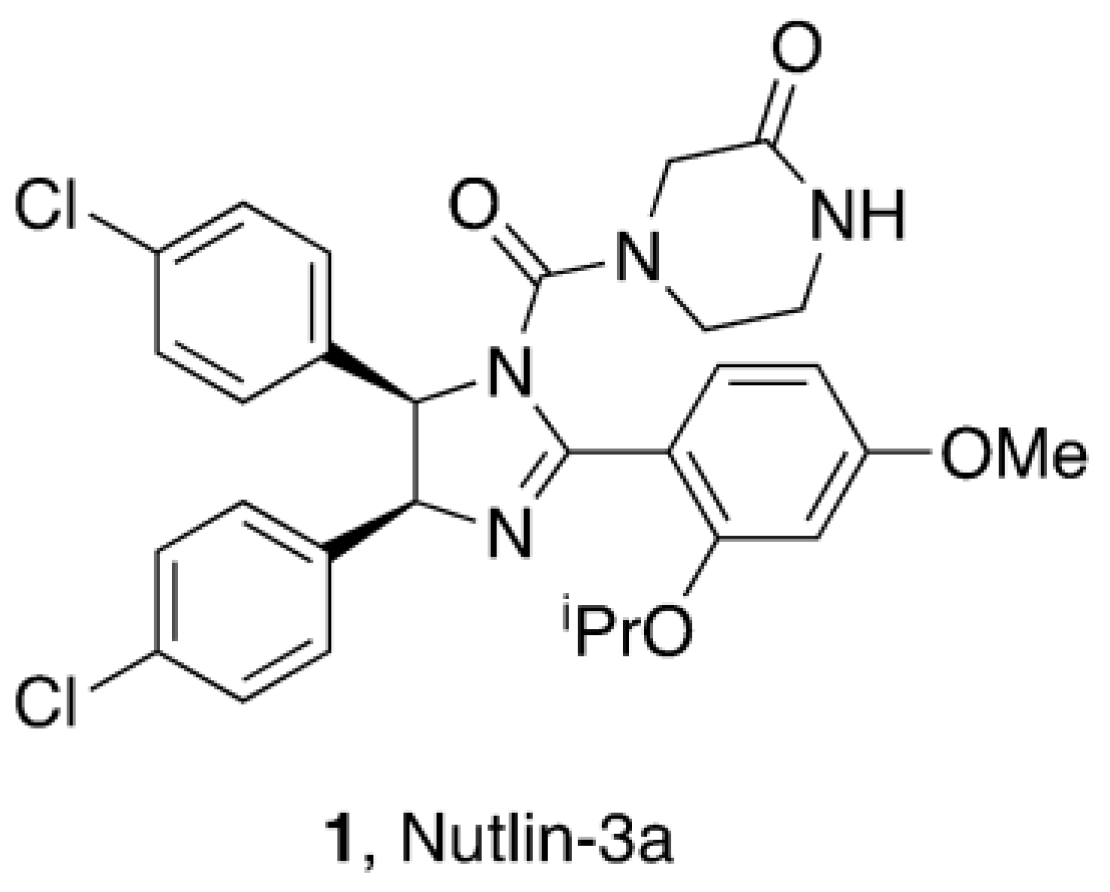
Figure 4.
Asymmetric desymmetrisation of prochiral meso-diamine biocatalysed by enzyme lipase.
Disclaimer/Publisher’s Note: The statements, opinions and data contained in all publications are solely those of the individual author(s) and contributor(s) and not of MDPI and/or the editor(s). MDPI and/or the editor(s) disclaim responsibility for any injury to people or property resulting from any ideas, methods, instructions or products referred to in the content. |
© 2024 by the authors. Licensee MDPI, Basel, Switzerland. This article is an open access article distributed under the terms and conditions of the Creative Commons Attribution (CC BY) license (http://creativecommons.org/licenses/by/4.0/).
Copyright: This open access article is published under a Creative Commons CC BY 4.0 license, which permit the free download, distribution, and reuse, provided that the author and preprint are cited in any reuse.


