

Submitted:
10 June 2024
Posted:
11 June 2024
You are already at the latest version
Abstract
This study investigated the magnitude and direction of inter-limb asymmetry in 21 professional female sepak takraw players across several task-specific tests. Five inter-limb asymmetry assessments were employed: unilateral countermovement jump (Uni-CMJ), bilateral countermovement jump (Bi-CMJ), single leg hop (SLH), triple hop test (THOP), and isokinetic concentric peak torque of the knee flexors and extensors at 60 deg/sec-1, 120 deg/sec-1 and 180 deg/sec-1 angular velocities. A “true” inter-limb asymmetry was only observed for Uni-CMJ jump height (16.62%) and THOP distance (6.09%). Kappa coefficients demonstrated fair agreement in the direction of asymmetry between the Uni-CMJ and Bi-CMJ tests for jump height (Kappa = 26.67), but only slight agreement for peak force (Kappa = 0.11), propulsive impulse (Kappa = -0.12) and eccentric impulse (Kappa = -0.14), respectively. Fair agreement was observed between the SLH and THOP (Kappa = 0.32). Slight to moderate agreement was found for concentric peak torque across angular velocities for the knee extensors (Kappa = 0.08 to 0.48) while fair to nearly perfect agreement was noted for the knee flexors (Kappa = 0.31 to 1). The Uni-CMJ and THOP are most sensitive to detect between-limb asymmetries in female sepak takraw players. However, given the inconsistency in asymmetry direction across tests, monitoring asymmetry direction is crucial for conditioning.
Keywords:
between-limb differences
; limb dominance
; jump landing
; kappa coefficient
1. Introduction
The Sepak takraw (or kick volleyball) is a sport originating out of Southeast Asia, which incorporates acrobatic gymnastic type movements to return a small woven ball (rattan ball) over a 1.52 m high net into an area approximately the size of a badminton doubles court (1). The sport requires three players on each team who may only use their head, chest, feet, or thighs to return the ball and score points (1). The gymnastic nature of sepak takraw incorporating explosive jumping movements, such as the sun back spike and roll back spike (see Figure 1), typically requires landings onto a single leg while retaining balance. Similar to other sports which utilize repeated jump landings during match-play and training (e.g., basketball, volleyball and soccer), exposure to repetitive musculoskeletal and joint load forces placed on the same leg may result in marked between-limb (inter-limb) asymmetry (2-5). Ultimately, this may lead to a decrement in functional performance and injury (6). Therefore, assessing inter-limb asymmetry in sepak takraw players is justified as part of a periodic monitoring system to guide strength and conditioning programs and potentially prevent injury (7, 8).
Specific training programs, which focus on reducing inter-limb asymmetry to improve functional performance capacity, remain controversial due to mixed outcomes or small reductions in asymmetry (9). Irrespective, documenting asymmetry can act as a return-to-play threshold after a sustaining a lower limb injury where a greater magnitude of asymmetry may be apparent (10, 11). Previous studies have often cited a >10% inter-limb asymmetry as having the potential to negatively impact physical performance and expose an athlete to an increased risk of injury (10, 12-14). However, inter-limb asymmetry is sport specific and can vary depending on the testing procedure (12, 15). For example, the direction of inter-limb asymmetry may not favor the same limb across different tests making limb dominance more complex to ascertain. Indeed, the direction of asymmetry between unilateral and bilateral jumping tests have been shown to have poor levels of agreement in soccer players (9, 16). This has led to the Kappa coefficient being employed (17) to assess the proportion of selected tests in which asymmetry favors the same limb between tests, beyond any test agreement occurring solely by chance (18, 19). While upon face validity, sepak takraw players may be susceptible to possessing limb dominance due to kicking, jumping and landing (20) repeatedly onto the same leg, females in particular may exhibit greater limb-asymmetries compared to male counterparts (21, 22). Therefore, females may be more prone to experiencing greater decrements in performance and/or injury risk. Nevertheless, to our knowledge, there are no studies which have investigated the presence of inter-limb asymmetry in sepak takraw players (and in females), with a general lack of empirical literature conducted across the sport.
Accordingly, the aim of this study was to investigate the magnitude and direction of asymmetry across several task-specific tests to determine if limb dominance and inter-limb asymmetry is present in a cohort of female sepak takraw players. Based on previous observations in female soccer players (22), we hypothesized that both the magnitude and direction of asymmetry would not be consistent across different task specific assessments.
2. Materials and Methods
2.1. The Experimental Approach to the Problem
This study utilized a within-subject cross-sectional research design, consistent with a previously documented descriptive observational approach for assessing asymmetry (22). A cohort of female sepak takraw players who currently competed in the Thailand professional league were recruited and assessed using a variety of task-specific assessments. All participants were required to attend the laboratory on a single occasion after refraining from strenuous activity for 48 hours preceding their arrival for experimental testing and 3 hours post-prandial (19). The laboratory visit included a warm-up and familiarization of all test procedures before commencing the experimental test protocol. A total of five inter-limb asymmetry assessments: unilateral countermovement jump (Uni-CMJ), bilateral countermovement jump (Bi-CMJ), single leg hop (SLH), triple hop test (THOP), and isokinetic peak torque of the leg extensors, were conducted with the players.
2.2. Participants
Twenty-one females (age, 20.9 ± 2.3 years; height, 1.63.1 ± 4.9 cm; body mass, 55.9 ± 6.7 kg; body mass index (BMI), 21.0 ± 1.9 kg·m2) from two professional sepak takraw clubs were recruited to participate in this study. The participants completed a brief health and activity questionnaire to ensure their eligibility. Study inclusion criteria included participants having > 1 year playing experience and currently participating in sepak takraw competition/training > 3 x per week. Participants were excluded from the study if they reported a serious injury/surgery in the past 6 months. Each participants’ dominant leg (DL) was identified via questionnaire as the limb that was frequently used to jump, land, and kick a ball. A formal sample size is not presented due to the exploratory nature of our study, however, the sample size is comparable to previous studies in this domain, which have examined inter-limb asymmetry across other sports (6, 23-25). All participants voluntarily provided their written informed consent to participate in the study after being informed of the potential benefits and risks of the investigation. The institutional research ethics committee of Mahidol University approved the study (MU-CIRB 2020/111/2108), which conformed with the latest amendment of the Declaration of Helsinki.
2.3. Procedures
A standardized warm-up consisting of 5 minutes of low-intensity jogging, followed by a single set of 10 x bodyweight squats, 10 x forward and lateral lunges, and 10 x leg swings in the frontal plane, were performed (15). Immediately prior to each task-specific jump and hop assessment, participants were allowed 3 practice trials to control for learning effects (6, 26), with verbal feedback provided to assist participants to attain technical proficiency. Participants were given a 5-minute break after completing the familiarization/practice trials before completing the task-specific assessments. A 10-minute recovery period was provided before moving to the next task.
Unilateral Countermovement Jump (Uni-CMJ) and Bilateral Countermovement Jump (Bi-CMJ). The participants performed the Uni-CMJ and Bi-CMJ on a force plate (Kistler Type 9286BA, Winterthur, Switzerland), which was connected to SMART tracker software (BTS SMART DX 5000, BTS Bioengineering, Italy) capable of collecting vertical ground reaction forces at a sample rate of 1600 Hz. The SMART tracker software was used to calculate both the concentric (propulsive) impulse force, representing the net force output during the upwards phase of jumping, and the eccentric impulse force, representing the net force output during the landing phase (15, 27). Peak force was determined as the maximum net force output during the propulsive phase of the jumps. For the Uni-CMJ, participants were instructed to step onto the force plate with their dominant leg and to maintain their hands on hips throughout the test. The jump began with a countermovement to a self-selected depth, followed by an explosive vertical acceleration to jump as high as possible. During the flight phase of the jump, the test limb was required to reach full extension before landing on the force plate (6). The non-test leg was flexed at the hip to approximately 90º during each trial. The same procedure was repeated for the non-dominant leg. For Bi-CMJ testing, the participants stood upright with the feet positioned on two adjacent force plates. The participants squatted to a self-selected depth of approximately 90º knee flexion before jumping as high as possible without pausing while keeping hands on their hips (28). Each Uni-CMJ and Bi-CMJ trials were separated by a 1-minute rest period. All metrics were averaged over the three trials for further analysis. Uni-CMJ and Bi-CMJ heights (cm) were calculated from flight time using the following formula: Jump height = (flight time2 x 9.81) / 8 x 100 (29).
Single Leg Hop (SLH) and Triple Hop (THOP) test. In the SLH and THOP, participants stood on one leg with their foot placed behind a marked line. In accordance with previous research (30), the SLH required participants to perform a countermovement before hopping horizontally forwards as far as possible and landing on the same leg. If not achieved, or if the participant removed their hands from their hips, the trial was repeated. A similar procedure was repeated for the THOP, but with participants performing three consecutive maximum hops on the same leg (30). In both hop tasks, swinging of the non-landing leg was permitted and the contribution of the upper limbs to increase jump distance was limited by instructing participants to maintain hands on their hips (31). Participants were instructed to land in a controlled manner and stick the landing of the final hop for at least 2 seconds (30). The SLH and THOP distance was measured using a standard tape measure and recorded to the nearest 0.01 m from the start line to the heel of the foot at landing. Three trials were performed for each leg with 1-minute rest permitted between trials. The greatest distance recorded from the 3 trials was used for data analysis (30).
Isokinetic Peak Torque. Participants performed an Isokinetic test (Biodex Medical Systems 4, NY, USA) to determine concentric quadriceps and hamstrings peak torque at angular velocities of 60 deg/sec-1, 120 deg/sec-1, and 180 deg/sec-1, respectively. The dynamometer was calibrated following manufacturer guidelines and a gravitational correction was applied. The participant was secured on the dynamometer chair via straps across the shoulders, waist and thigh of the tested leg. The axis of rotation of the lever arm was aligned with the lateral condyle of the tested knee and the cuff of the dynamometer lever attachment was attached to the proximal malleoli of the ankle. The leg range of motion (ROM) was set to a full range of motion: 0º (flexed) to 90º (full extension). The participants initially completed two submaximal efforts and one maximal effort of the quadriceps and hamstrings of the dominant leg. Participants then performed 5 repetitions of maximum concentric contractions of the quadriceps and hamstrings at each selected angular velocity with a 5-second rest interval between each repetition. Each angular velocity was separated by a 1-minute rest period. The same test procedure was then repeated on the non-dominant leg. Participants were advised to exert maximum effort throughout the range of motion and verbal encouragement was provided by the researcher. The researcher provided external motivation to the participants who were also allowed visual feedback of their peak torque curves in real-time to help attain maximal peak torque values. Intra-limb hamstring/quadriceps (H:Q) ratio was calculated as follows: concentric peak torque of the knee flexors / concentric peak torque of the knee extensors x 100 (7, 32).
2.4. Statistical Analyses
For Uni-CMJ, Bi-CMJ, SLH, and THOP tests, within-session (trial) reliability measures were assessed using both the coefficient of variation (CV) and two-way (i.e., variability among subjects and trials) random intraclass correlation coefficients (ICC) with absolute agreement and 95% confidence intervals (95% CI’s), ICC values were interpreted against the following benchmarks: > 0.9 = excellent, 0.75-0.9 = good, 0.5-0.75 = moderate, and <0.5 = poor (30). CV values were calculated as (SD / mean) x 100 and considered as good (<5%), moderate (5-10%), and poor (>10%), respectively (2, 20). For the Uni-CMJ, SLH, THOP and isokinetic peak torque tests, the percentage of inter-limb asymmetry was calculated using the Bilateral Strength Asymmetry (BSA) formula (33, 34) : BSA = (max value - min value / total value x 100). For Bi-CMJ, the Symmetry Index (SI) formula (33, 35) was employed: SI = (High – Low) / Total x 100. The usage of an ‘IF function' in Microsoft Excel was added to the end of the formulas: *IF (non-dominant leg < dominant leg, 1,-1) to illustrate the asymmetry direction without changing the magnitude (16).
Paired samples t-tests were used to examine for any differences in asymmetry metrics between the Uni-CMJ and Bi-CMJ tasks, SLH and THOP distance, and inter-limb H:Q ratio asymmetry (at each angular velocity). A one-way repeated measures analysis of variance (ANOVA) was employed to examine differences in asymmetry in both knee extensor and knee flexor concentric peak torque between angular velocities. To be deemed a “genuine” asymmetry, an inter-limb asymmetry had to exceed the CV of each leg (36, 37). The alpha level of statistical significance was set at p<0.05. Hedges’ g effect sizes were calculated for the magnitude of differences between limbs and interpreted using Hopkins’ benchmarks (38): < 0.20 = trivial; 0.20 - 0.60 = small; 0.61 – 1.20 = moderate; 1.21 - 2.0 = large; 2.01 - 4.0 = very large. Kappa coefficients were also used to determine the levels of agreement in the direction of asymmetry between Bi-CMJ vs. Uni-CMJ metrics, SLH vs. THOP jump distance, and concentric peak torque of knee flexor and extensor measures. In accordance with Viera and Garrett's (17) recommendations, Kappa coefficient values were interpreted as: 0.01 - 0.20 = slight; 0.21 - 0.40 = fair; 0.41 - 0.60 = moderate; 0.61 - 0.80 = substantial; 0.81 - 0.99 = nearly perfect. Jamovi computer software (Version 2.3) [https://www.jamovi.org] was used for statistical analysis. All data is presented as mean ± standard deviation (SD), unless otherwise stated.
3. Results
3.1. Reliability of Jump Tests
The within-subject reliability measures for the jump tests are presented in Table 1. In the Uni-CMJ, peak force exhibited moderate reliability across both legs, while jump height was only reliable in the right leg. Conversely, jump height in the left leg, propulsive impulse, and eccentric impulse had poor reliability. The Bi-CMJ demonstrated moderate reliability for jump height and peak force across both legs, with propulsive impulse reliable only in the left leg. Propulsive impulse in the right leg and eccentric impulse across both legs had poor reliability. CV values for the SLH showed moderate reliability whereas THOP had good reliability across both legs (see supplementary data). The variation in CV’s leading to only “true” asymmetries exhibited in Uni-CMJ jump height and THOP distance, respectively.
3.2. Agreement between Measurements across Trials
When considering the agreement between measurements across trials (Table 1), ICC values indicated good agreement for jump height and propulsive impulse in Bi-CMJ across both legs, with peak force showing moderate agreement. The left leg exhibited moderate agreement for eccentric impulse, while the right leg demonstrated poor reliability. In Uni-CMJ, jump height had good agreement, with moderate agreement observed for propulsive impulse and eccentric impulse across both legs (Table 1). ICC values for the THOP demonstrated good to excellent agreement across legs, with moderate to good agreement observed for the SLH (see supplementary data).

Table 1.
Within-session reliability of jump tests (n =21). Mean and [95% CI].
| Uni-CMJ | Bi-CMJ | |||
|---|---|---|---|---|
| Test Reliability | Left | Right | Left | Right |
| CV (%): | ||||
| Jump Height (cm) | 12.06 [9.05,15.06] |
9.41 [2.77,16.06] |
5.58 [2.67,8.50] |
7.89 [5.57,10.21] |
| Prop Impulse (N.s) | 15.44 [10.23,20.65] |
19.16 [12.75,25.57] |
8.24 [5.57,10.92] |
11.36 [8.73,13.99] |
| Ecc Impulse (N.s) | 19.68 [12.80,26.56] |
20.70 [16.00,25.41] |
20.86 [15.42,26.31] |
24.83 [19.45,30.22] |
| Peak Force (N) | 8.04 [4.62,11.45] | 8.91 [5.62,12.19] | 8.74 [5.98,11.49] | 7.37 [5.30,9.43] |
| ICC: | ||||
| Jump Height (cm) | 0.77 [0.63,0.88] |
0.82 [0.70,0.91] |
0.81 [0.69,0.90] |
0.81 [0.68,0.90] |
| Prop Impulse (N.s) | 0.62 [0.42,0.78] |
0.68 [0.51,0.82] |
0.87 0.78,0.93] |
0.79 [0.63,0.89] |
| Ecc Impulse (N.s) | 0.59 [0.39,0.76] |
0.68 [0.50,0.82] |
0.67 [0.49,0.81] |
0.47 [0.25,0.67] |
| Peak Force (N) | 0.65 [0.46,0.80] | 0.63 [0.44,0.79] | 0.71 [0.54,0.84] | 0.69 [0.52,0.83] |
Uni-CMJ = Uni-lateral countermovement jump; Bi-BMJ = Bi-lateral countermovement; CV = Coefficient of variation; ICC = Intraclass correlation coefficient; Prop = Propulsive; Ecc = Eccentric.
3.3. Absolute Jump Metrics and Isokinetic Concentric Peak Torque
Absolute jump metric and isokinetic concentric peak torque data (for each leg) is displayed in Table 2 and Table 4, respectively (see supplementary data for hop tests). A paired t-test revealed significant differences in asymmetry values across the Uni-CMJ and BI-CMJ tests. A significantly greater mean asymmetry was noted in the Uni-CMJ test for jump height, propulsive impulse and peak force, respectively (Table 3). However, there was no significant differences in mean asymmetry noted between SLH and THOP (n=19; p=0.400); see supplementary data). Similarly, concentric peak torque of the knee extensors (n=19; p=0.859) and knee flexors (p=0.240) was not significantly different when comparing asymmetry across the different angular velocities. In addition, intra-limb H:Q ratio was not significantly different between legs at each angular velocity (all p<0.05; Table 4).
3.4. Direction of Inter-Limb Asymmetry
In comparing the direction of asymmetry between the Uni-CMJ and Bi-CMJ tests, Kappa coefficients revealed fair agreement for jump height, but only slight agreement for peak force, propulsive impulse and eccentric impulse, respectively (Table 3). In contrast, fair agreement (Kappa = 0.32) was observed for jump distance between the SLH and THOP tests. In comparing the direction of asymmetry of concentric knee extensor peak torque between the different angular velocities, moderate agreement (n=19, Kappa = 0.48) was found between 60 deg/sec-1 and 180 deg/sec-1 and 60 deg/sec-1 and 120 deg/sec-1 (n=19, Kappa = 0.48) angular velocities, respectively. Only slight agreement (Kappa = 0.08) was found between 120 deg/sec-1 and 180 deg/sec-1. For concentric peak torque of the knee flexors, nearly perfect agreement (n=19, Kappa = 1) was observed between 60 deg/sec-1 and 120 deg/sec-1 angular velocities. Fair agreement (n=19, Kappa = 0.34) was found between 60 deg/sec-1 and 180 deg/sec-1 and between 120 deg/sec-1 and 180 deg/sec-1 (n=19, Kappa = 0.31), respectively.
Table 4.
Isokinetic concentric peak torque (N.m) of knee flexors and extensors with calculated intra-limb H:Q ratio and inter-limb (directional) asymmetry. Mean ± SD (unless otherwise stated).
Table 4.
Isokinetic concentric peak torque (N.m) of knee flexors and extensors with calculated intra-limb H:Q ratio and inter-limb (directional) asymmetry. Mean ± SD (unless otherwise stated).
| Angular Velocity | Left | Right | Inter-Limb Asymmetry (%) | Hedges g [95% CI] p-value |
|---|---|---|---|---|
| 60 deg/sec-1 | n=20 | |||
| Flexion | 69.56±12.77 | 75.97±10.58 | 10.79±8.04 | |
| Extension | 136.71±25.59 | 147.53±27.84 | 8.60±5.32 | |
| H:Q Ratio (%) | 51.26±6.95 | 52.32±7.02 | 0.15 [-0.30, 0.62]; p=0.513 | |
| 120 deg/sec-1 | n=19 | |||
| Flexion | 59.79±11.17 | 66.63±9.22 | 12.31±8.31 | |
| Extension | 111.13±18.79 | 119.54±19.32 | 8.23±5.27 | |
| H:Q Ratio (%) | 54.13±8.20 | 56.29±6.93 | 0.28 [-0.12, 0.71]; p=0.185 | |
| 180 deg/sec-1 | n=20 | |||
| Flexion | 53.45±11.40 | 57.75±11.08 | 10.30±8.46 | |
| Extension | 91.98±14.43 | 98.84±15.03 | 8.58±5.56 | |
| H:Q Ratio (%) | 58.62±12.09 | 58.85±9.78 | 0.02 [-0.34, 0.38]; p=0.908 |
N.B: Intra-limb ratio between knee flexors and extensors is indicated by gray bars.
In line with recommendations (22), given the variability in the direction of asymmetry across assessments, we present individual inter-limb asymmetry differences for jump height (Figure 2), propulsive impulse (Figure 3), and eccentric impulse (Figure 4), respectively (see supplementary data for other metrics).
4. Discussion
The main aim of this study was to quantify both the magnitude and direction of asymmetry across various task-specific tests among a cohort of professional female sepak takraw players. Our findings demonstrated that “true” asymmetry was only exhibited for Uni-CMJ jump height and THOP distance, respectively. When comparing similar metrics across assessments, significant differences in the magnitude of asymmetry values between the Uni-CMJ and Bi-CMJ tests were found. Specifically, significantly greater asymmetry for jump height, propulsive force, and peak force was revealed in Uni-CMJ compared to Bi-CMJ. However, Kappa coefficients indicated a general inconsistency in the direction of asymmetry across the different task-specific assessments and metrics. Taken together, our findings suggest that prioritizing the measurement of Uni-CMJ jump height and THOP distance is important in monitoring of sepak takraw players to identify between-limb imbalances.
The assessment of within-trial reliability revealed varying levels of consistency across different intra-limb task-specific metrics (Table 1 and supplementary data). The observation of variation across trials is well documented (6, 15, 22-24) with Uni-CMJ reliability in our study being more inconsistent than previously reported in youth soccer players (6, 15). Conversely, while the Uni-CMJ and Bi-CMJ within-trial reliability was in more in alignment with values previously reported for basketball players (24), participants generally performed the SLH and THOP with greater reliability compared to the jump tests (see supplementary data). The inherent variation across CMJ trials can likely be attributed to participant unfamiliarity with the specific assessments and testing protocols. To ensure the identification of “true“asymmetry, consideration of the variation between trials is important (36, 37). This entails evaluating whether the discrepancy between limbs (magnitude of asymmetry) exceeds the discrepancy within limbs (i.e., intra-limb CV’s), thereby signifying significance in the asymmetry assessment. We found that only Jump height in the Uni-CMJ and THOP assessments were able to distinguish true asymmetry between limbs, with the other assessments (Bi-CMJ and SLH) possessing relatively poor reliability within limbs; potentially masking genuine asymmetries.
In comparing similar metrics across tests, the magnitude of asymmetry was greater for jump height, propulsive impulse and peak force in the Uni-CMJ compared to the Bi-CMJ (effect size = moderate to large; Table 3). However, we did not observe any difference in the magnitude of asymmetry in concentric peak torque between knee flexor and extensor angular velocities, respectively, intra-limb H:Q asymmetry, or for hop distance in the SLH and THOP (see supplementary data). It is widely understood that the magnitude of asymmetry varies dependent on the task and the sport (2, 9, 15), making direct comparisons with past findings somewhat difficult. Nevertheless, in contrast to our observation of greater asymmetry across Uni-CMJ metrics, Bishop et al (15) reported lower magnitudes of asymmetry (across various jump metrics) in both the unilateral and bilateral versions of the CMJ in elite academy male soccer players, leading to non-significant differences between the jump tests. Similarly, lower asymmetry values for Uni-CMJ metrics have also previously been reported in elite youth female soccer players (22). While difficult to ascertain, in our study, the greater asymmetry values for the Uni-CMJ may be partly explained by disparities in the sport and the age of the participants. Alternatively, it is perhaps more likely that the greater asymmetry is related to the sepak takraw players being less familiar with performing unilateral jumps as part of training or weekly monitoring. In the Uni-CMJ, the neuromuscular system must coordinate asymmetrical force production and balance on a single leg, demanding enhanced stability and proprioceptive control (39). This likely contributes to variation in asymmetry metrics compared to the Bi-CMJ, emphasizing the importance of considering task-specific demands in lower-limb function assessment and adequate familiarization with test movement patterns. For instance, in sports such as sepak takraw that require repeated single leg stabilization while kicking (with the ball not touching the floor), Uni-CMJ asymmetry may differentiate between different player abilities. Therefore, future cross-sectional studies comparing asymmetry across different player levels (i.e., recreational, national, international) may be further explored. Extrapolating our findings, sepak takraw players should include unilateral plyometric exercises into regular training routines to help mitigate the magnitude of asymmetries across selected jump metrics over time.
The direction of the asymmetry can help in understanding which limb performed better when determining the magnitude of inter-limb asymmetry (12). Kappa coefficients indicated that the Uni-CMJ and Bi-CMJ showed only slight levels of agreement in the direction of asymmetry for propulsive impulse, eccentric impulse and peak force metrics, but fair agreement for jump height (Table 3). Similarly, fair agreement was found for hop distance between the SLH and THOP (see supplementary data), with fair to nearly perfect agreement calculated for the knee flexors when comparing concentric peak torque across the different angular velocities. In contrast, only slight to moderate agreement was observed for knee extensor peak torque across angular velocities. Our findings indicate that inter-limb differences were not consistent across comparable metrics between the different assessments, suggesting that individual asymmetry values should also be interpreted (22). For jump assessments, only 8 of 21 players exhibited asymmetry on the same limb for jump height, 12 out of 21 for peak force, 4 out of 21 players for propulsive impulse, and 9 out of 21 for eccentric impulse (Figure 2, Figure 3 & Figure 4 and supplementary data). However, the direction of asymmetry appeared slightly more consistent across hop tests (14 out of 21 players) and isokinetic knee flexor and extensor peak torque measures (knee flexor = 16 out of 19 players; knee extension = 14 out of 19 players). Thus, limb dominance characteristics were not uniform across comparable assessments, particularly when comparing jump metrics between the Uni-CMJ and Bi-CMJ tests. Our present findings support past work by Bishop et al (15) who reported an inconsistency in the direction of asymmetry between unilateral and bilateral countermovement jumps metrics in elite academy soccer players. A possible explanation for the lack of agreement between assessments is that the stance limb may potentially be stronger than the kicking limb when performing a unilateral task (13). Sepak takraw players frequently utilize their non-dominant leg to maintain balance while additionally having to participate in the propulsive action of jumping performance to precisely spike the ball. Therefore, it is plausible to assume that the non-dominant leg can perform better during a unilateral task in one-legged dominant sports. Accordingly, practitioners should employ assessments that replicate the movements of sepak takraw when determining asymmetry (15).
When evaluating the current findings, practitioners should be aware of the study limitations. While the players were familiarized with test procedures, anecdotally, a number of players did not perform the task-specific assessments as part of their routine (weekly) training monitoring. Moreover, as our observations are specific to female sepak takraw players, it is recommended that future work is conducted to contrast the magnitude and direction of inter-limb asymmetry with male counterparts. Finally, as the purpose of the present study was to describe the magnitude and direction of inter-limb asymmetry at a singular time point, there is a need to conduct longitudinal studies to assess the season-long changes of inter-limb asymmetry across task-specific assessments. This is important as limb dominance may be confounded due to heightened volumes of training and competitive scheduling throughout a season.
5. Conclusions
Determining the magnitude and direction of inter-limb asymmetry is specific to each sport, making its documentation valuable in defining the characteristics of the sport. “True” asymmetry differences were only noted for unilateral countermovement jump height and triple hop distance, suggesting that these two assessments should be prioritized in the monitoring of sepak takraw players to identify between-limb imbalances. Practitioners should be aware that players should be well-familiarized with task-specific assessments to identify true inter-limb asymmetry differences (i.e., increase within session reliability). Furthermore, due to the inconsistency in the direction of asymmetry (i.e., favoring the same limb), practitioners should select assessments based on the movement patterns typical to sepak takraw.
Supplementary Materials
The following supporting information can be downloaded at the website of this paper posted on Preprints.org. The following supporting information can be provided upon request to the corresponding author: kornkit.cha@mahidol.edu.
Author Contributions
All authors participated in the study design. KC and HZ managed player contact and data collection. CM and HZ analyzed the data and interpreted the statistical models. All authors contributed to the data interpretation, provided critical revisions, and CM edited and finalized the manuscript. All authors have read and agreed to the published version of the manuscript.
Funding
This study was supported by a grant from the Mahidol Scholarship Program 2018 awarded to Htet Zayar, College of Sports Science & Technology, Mahidol University, Nakhon Pathom, Thailand. The grant facilitated the research conducted for this manuscript. The funders had no role in study design, data collection and analysis, decision to publish, or preparation of the manuscript.
Institutional Review Board Statement
This study involves human participants and was approved by the Mahidol University Central Institutional Review Board protocol number (MU-CIRB 2020/140.1606).
Informed Consent Statement
Informed consent was obtained from all participants involved in the study.
Data Availability Statement
The data and statistical analyses that support the findings of this study are available on Open Science Framework: https://osf.io/uskpz/?view_only=afb13db665b44bdcb29f1d6730bd77ba.
Acknowledgments
We would sincerely thank all the participants who volunteered to take part in this study. Additionally, we extend our thanks to Dr. Chris Bishop from Middlesex University and Dr. Ariyaporn T Gaffin for their valuable correspondence.
Conflicts of Interest
The authors declare no conflict of interest.
References
- Jawis M, Singh R, Singh H, Yassin MJBJoSM. Anthropometric and physiological profiles of sepak takraw players. 2005;39(11):825-9.
- Bishop, C.; Read, P.; Lake, J.; Chavda, S.; Turner, A. Interlimb Asymmetries: Understanding How to Calculate Differences From Bilateral and Unilateral Tests. Strength Cond. J. 2018, 40, 1–6. [CrossRef]
- Dos’Santos T, Thomas C, Jones PAJS, Journal C. Assessing interlimb asymmetries: Are we heading in the right direction? 2021;43(3):91-100.
- Fort-Vanmeerhaeghe, A.; Gual, G.; Romero-Rodriguez, D.; Unnitha, V. Lower Limb Neuromuscular Asymmetry in Volleyball and Basketball Players. J. Hum. Kinet. 2016, 50, 135–143. [CrossRef]
- Hewit, J.K.; Cronin, J.B.; Hume, P.A. Asymmetry in multi-directional jumping tasks. Phys. Ther. Sport 2012, 13, 238–242. [CrossRef]
- Bishop, C.; Read, P.; Bromley, T.; Brazier, J.; Jarvis, P.; Chavda, S.; Turner, A. The Association Between Interlimb Asymmetry and Athletic Performance Tasks: A Season-Long Study in Elite Academy Soccer Players. J. Strength Cond. Res. 2020, 36, 787–795. [CrossRef]
- Bishop, C.; Coratella, G.; Beato, M. Intra- and Inter-Limb Strength Asymmetry in Soccer: A Comparison of Professional and Under-18 Players. Sports 2021, 9, 129. [CrossRef]
- Hart, L.M.; Cohen, D.D.; Patterson, S.D.; Springham, M.; Reynolds, J.; Read, P. Previous injury is associated with heightened countermovement jump force-time asymmetries in professional soccer players. Transl. Sports Med. 2019, 2, 250–256. [CrossRef]
- Bettariga, F.; Turner, A.; Maloney, S.; Maestroni, L.; Jarvis, P.; Bishop, C. The Effects of Training Interventions on Interlimb Asymmetries: A Systematic Review With Meta-analysis. Strength Cond. J. 2022, 44, 69–86. [CrossRef]
- Kyritsis, P.; Bahr, R.; Landreau, P.; Miladi, R.; Witvrouw, E. Likelihood of ACL graft rupture: not meeting six clinical discharge criteria before return to sport is associated with a four times greater risk of rupture. Br. J. Sports Med. 2016, 50, 946–951. [CrossRef]
- Renner, K.E.; Franck, C.T.; Miller, T.K.; Queen, R.M. Limb asymmetry during recovery from anterior cruciate ligament reconstruction. J. Orthop. Res. 2018, 36, 1887–1893. [CrossRef]
- Bishop, C.; Lake, J.; Loturco, I.; Papadopoulos, K.; Turner, A.; Read, P. Interlimb Asymmetries: The Need for an Individual Approach to Data Analysis. J. Strength Cond. Res. 2021, 35, 695–701. [CrossRef]
- Bishop, C.; Read, P.; McCubbine, J.; Turner, A. Vertical and Horizontal Asymmetries Are Related to Slower Sprinting and Jump Performance in Elite Youth Female Soccer Players. J. Strength Cond. Res. 2021, 35, 56–63. [CrossRef]
- Kannus PJIjosm. Isokinetic evaluation of muscular performance. 1994;15(S 1):S11-S8.
- Bishop, C.; Abbott, W.; Brashill, C.; Turner, A.; Lake, J.; Read, P. Bilateral vs. Unilateral Countermovement Jumps: Comparing the Magnitude and Direction of Asymmetry in Elite Academy Soccer Players. J. Strength Cond. Res. 2020, 36, 1660–1666. [CrossRef]
- Banyard HG, Nosaka K, Haff GGJTJoS, Research C. Reliability and validity of the load–velocity relationship to predict the 1RM back squat. 2017;31(7):1897-904.
- Viera AJ, Garrett JMJFm. Understanding interobserver agreement: the kappa statistic. 2005;37(5):360-3.
- Bishop, C.; Read, P.; Chavda, S.; Jarvis, P.; Turner, A. Using Unilateral Strength, Power and Reactive Strength Tests to Detect the Magnitude and Direction of Asymmetry: A Test-Retest Design. Sports 2019, 7, 58. [CrossRef]
- Gonzalo-Skok O, Dos' Santos T, Bishop CJTJoS, Research C. Assessing limb dominance and Interlimb asymmetries over multiple angles during change of direction speed tests in basketball players. 2023;37(12):2423-30.
- Hart NH, Nimphius S, Weber J, Spiteri T, Rantalainen T, Dobbin M, et al. Musculoskeletal asymmetry in football athletes: a product of limb function over time. 2016;48(7):1379-87.
- Bailey CA, Sato K, Burnett A, Stone MHJIjosp, performance. Force-production asymmetry in male and female athletes of differing strength levels. 2015;10(4):504-8. [CrossRef]
- Bishop C, Pereira LA, Reis VP, Read P, Turner AN, Loturco IJJoSS. Comparing the magnitude and direction of asymmetry during the squat, countermovement and drop jump tests in elite youth female soccer players. 2020;38(11-12):1296-303.
- Nicholson, G.; Bennett, T.; Thomas, A.; Pollitt, L.; Hopkinson, M.; Crespo, R.; Robinson, T.; Price, R.J. Inter-limb asymmetries and kicking limb preference in English premier league soccer players. Front. Sports Act. Living 2022, 4, 982796. [CrossRef]
- Pérez-Castilla, A.; García-Ramos, A.; Janicijevic, D.; Delgado-García, G.; De la Cruz, J.C.; Rojas, F.J.; Cepero, M. Between-session reliability of performance and asymmetry variables obtained during unilateral and bilateral countermovement jumps in basketball players. PLOS ONE 2021, 16, e0255458. [CrossRef]
- Taylor, J.B.; Nguyen, A.-D.; Westbrook, A.E.; Trzeciak, A.; Ford, K.R. Women’s College Volleyball Players Exhibit Asymmetries During Double-Leg Jump Landing Tasks. J. Sport Rehabilitation 2023, 32, 85–90. [CrossRef]
- Munro AG, Herrington LCJTJoS, Research C. Between-session reliability of four hop tests and the agility T-test. 2011;25(5):1470-7.
- Heishman, A.; Daub, B.; Miller, R.; Brown, B.; Freitas, E.; Bemben, M. Countermovement Jump Inter-Limb Asymmetries in Collegiate Basketball Players. Sports 2019, 7, 103. [CrossRef]
- Kons, R.L.; Ache-Dias, J.; Gheller, R.G.; Bishop, C.; Detanico, D. Bilateral deficit in the countermovement jump and its associations with judo-specific performance. Res. Sports Med. 2022, 31, 638–649. [CrossRef]
- Bosco C, Luhtanen P, Komi PVJEjoap, physiology o. A simple method for measurement of mechanical power in jumping. 1983;50:273-82.
- Dos’santos, T.; Thomas, C.; Jones, P.A.; Comfort, P. Asymmetries in single and triple hop are not detrimental to change of direction speed. J. Trainology 2017, 6, 35–41. [CrossRef]
- Stolberg M, Sharp A, Comtois AS, Lloyd RS, Oliver JL, Cronin JJS, et al. Triple and quintuple hops: Utility, reliability, asymmetry, and relationship to performance. 2016;38(3):18-25.
- Coratella, G.; Bellin, G.; Beato, M.; Schena, F. Fatigue affects peak joint torque angle in hamstrings but not in quadriceps. J. Sports Sci. 2014, 33, 1276–1282. [CrossRef]
- Bishop C, Read P, Chavda S, Turner A. Asymmetries of the Lower Limb. Strength and Conditioning Journal. 2016;38(6):27-32.
- Impellizzeri FM, Rampinini E, Maffiuletti N, Marcora SMJM, sports si, exercise. A vertical jump force test for assessing bilateral strength asymmetry in athletes. 2007;39(11):2044. [CrossRef]
- Shorter, K.A.; Polk, J.D.; Rosengren, K.S.; Hsiao-Wecksler, E.T. A new approach to detecting asymmetries in gait. Clin. Biomech. 2008, 23, 459–467. [CrossRef]
- Exell, T.A.; Irwin, G.; Gittoes, M.J.; Kerwin, D.G. Implications of intra-limb variability on asymmetry analyses. J. Sports Sci. 2012, 30, 403–409. [CrossRef]
- Giakas, G.; Baltzopoulos, V. Time and frequency domain analysis of ground reaction forces during walking: an investigation of variability and symmetry. Gait Posture 1997, 5, 189–197. [CrossRef]
- Hopkins, W.; Marshall, S.; Batterham, A.; Hanin, J. Progressive statistics for studies in sports medicine and exercise science. Med. Sci. Sports Exerc. 2009, 41, 3. [CrossRef]
- Van Soest A, Roebroeck M, Bobbert M, Huijing P, van Ingen Schenau GJM, sports si, et al. A comparison of one-legged and two-legged countermovement jumps. 1985;17(6):635-9.
Figure 1.
Sepak takraw players performing a roll back spike (permission was obtained for the use of these images).
Figure 1.
Sepak takraw players performing a roll back spike (permission was obtained for the use of these images).
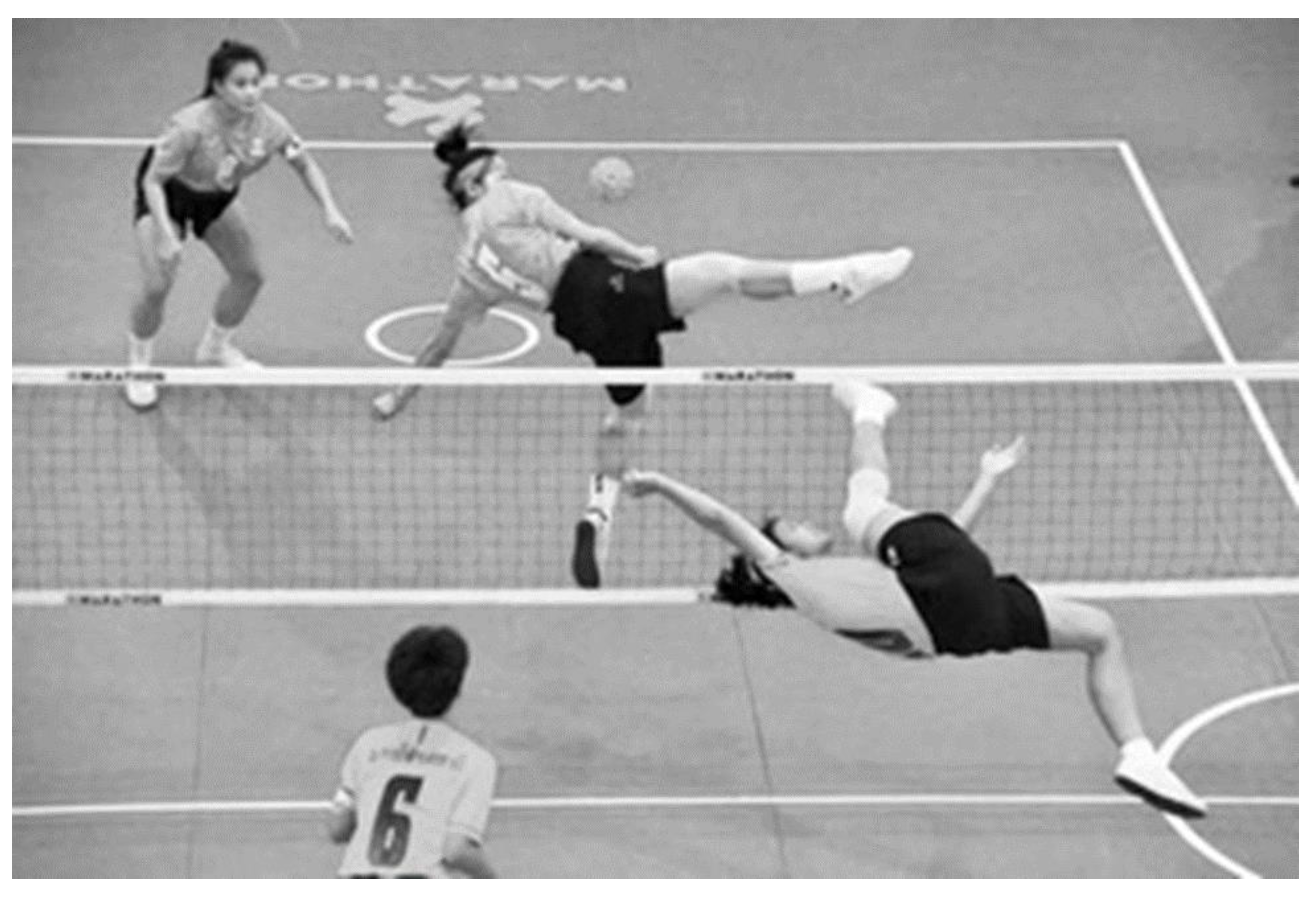
Figure 2.
Individual jump height asymmetry (across jump tests). N.B: Above 0 indicates right leg dominance and below 0 indicates left leg dominance.
Figure 2.
Individual jump height asymmetry (across jump tests). N.B: Above 0 indicates right leg dominance and below 0 indicates left leg dominance.
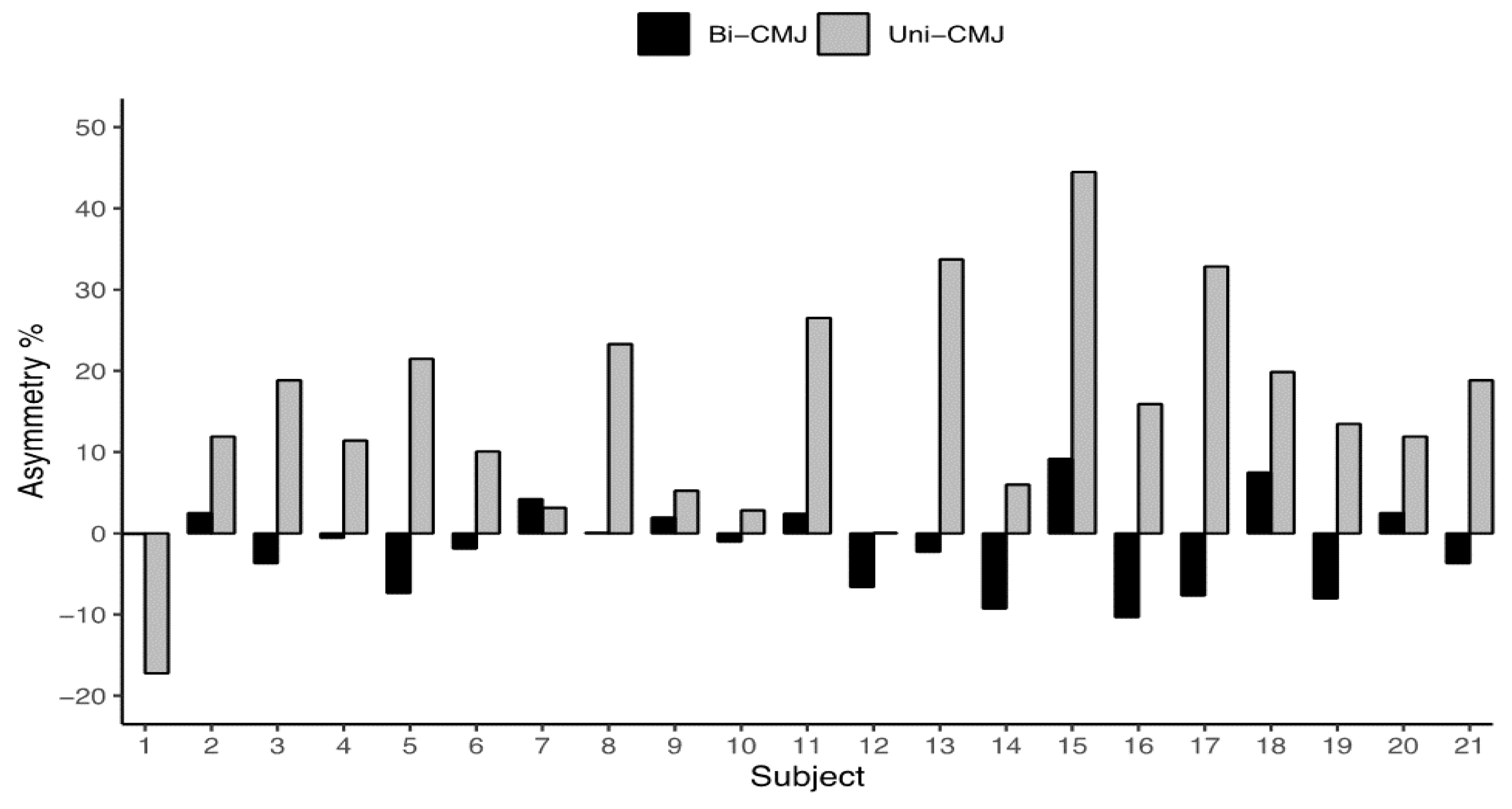
Figure 3.
Individual asymmetry in propulsive impulse (across jump tests). N.B: Above 0 indicates right leg dominance and below 0 indicates left leg dominance.
Figure 3.
Individual asymmetry in propulsive impulse (across jump tests). N.B: Above 0 indicates right leg dominance and below 0 indicates left leg dominance.
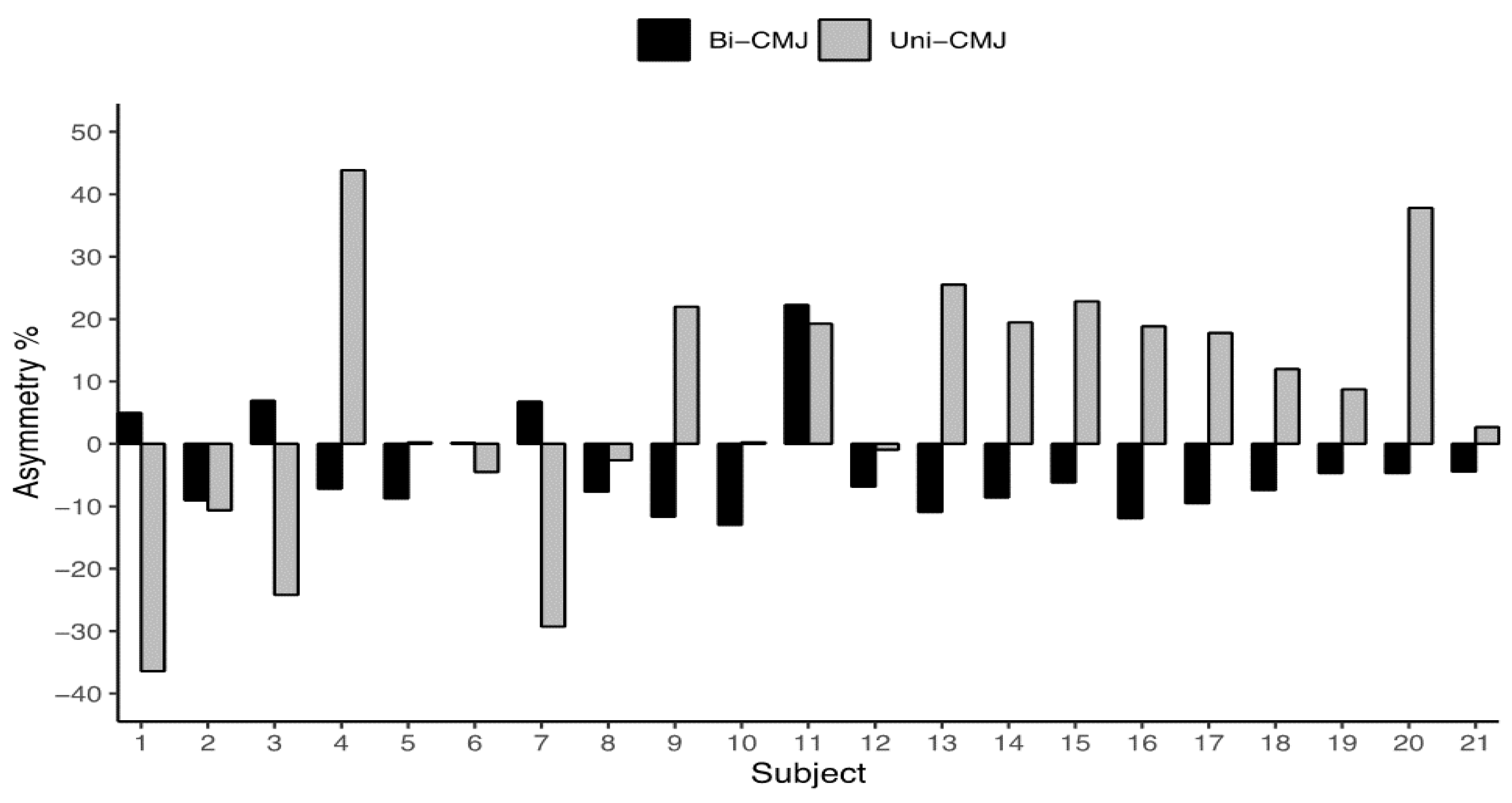
Figure 4.
Individual asymmetry in eccentric impulse (across jump tests). N.B: Above 0 indicates right leg dominance and below 0 indicates left leg dominance.
Figure 4.
Individual asymmetry in eccentric impulse (across jump tests). N.B: Above 0 indicates right leg dominance and below 0 indicates left leg dominance.
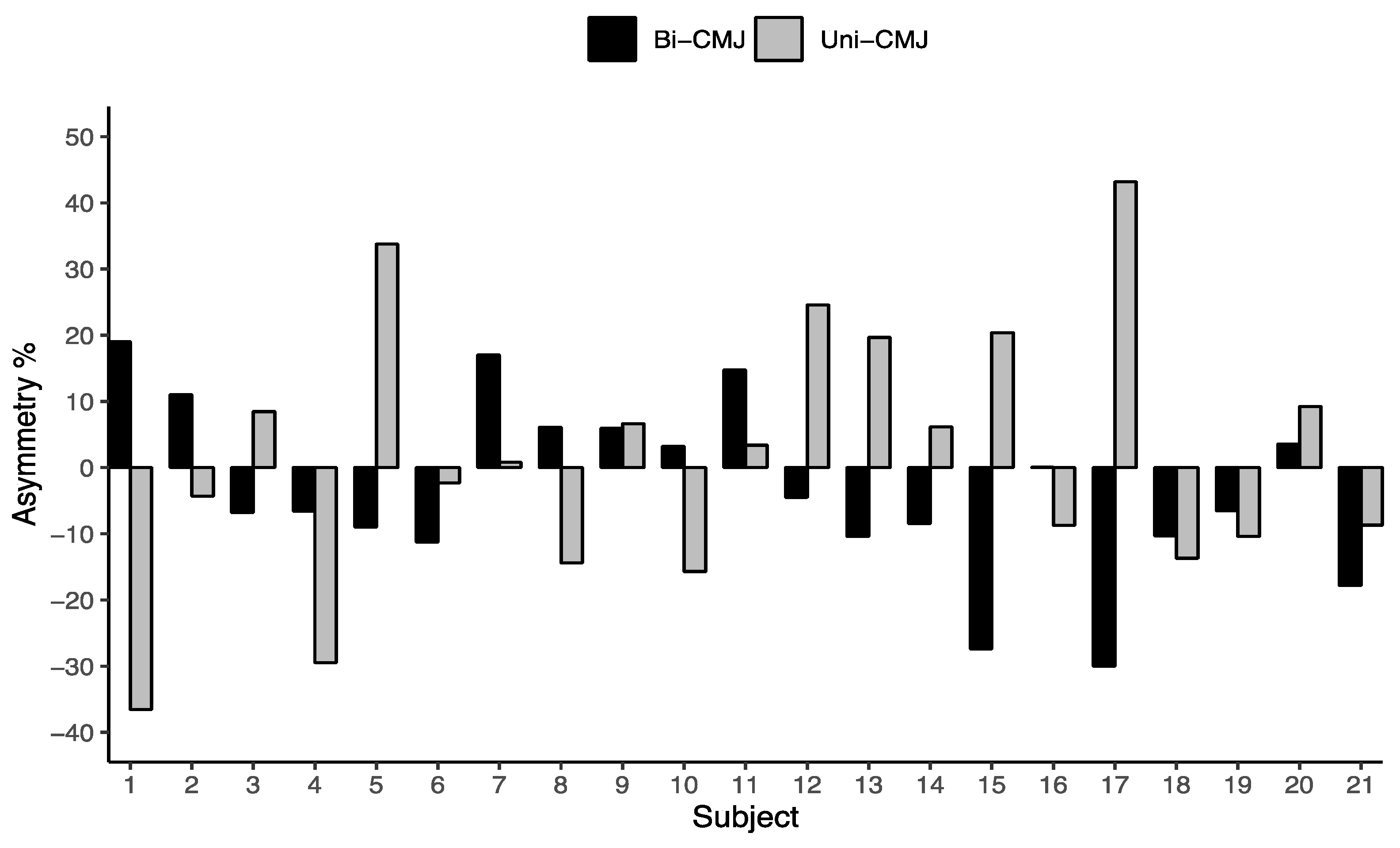
Table 2.
Absolute jump metric data (n = 21). Mean ± SD.
| Uni-CMJ | Bi-CMJ | |||
|---|---|---|---|---|
| Metric | Left | Right | Left | Right |
| Jump Height (cm) | 7.33±1.86 | 8.59±1.93 | 19.62±3.88 | 19.15±3.85 |
| Prop Impulse (N.s) |
81.43±22.86 | 88.83±31.40 | 73.55±17.12 | 64.07±16.54 |
| Ecc Impulse (N.s) | 347.40±101.83 | 358.53±131.71 | 320.30±116.93 | 297.89±89.76 |
| Peak Force (N) | 406.28±66.96 | 407.88±76.23 | 301.34±53.57 | 342.45±48.41 |
Uni-CMJ = Uni-lateral countermovement jump; Bi-CMJ = Bi-lateral countermovement jump; Prop = Propulsive; Con = Concentric; Ecc = Eccentric.
Table 3.
Mean inter-limb asymmetry values and Kappa coefficients for comparable metrics between jump tests (n = 21). Mean ± SD (unless otherwise stated).
Table 3.
Mean inter-limb asymmetry values and Kappa coefficients for comparable metrics between jump tests (n = 21). Mean ± SD (unless otherwise stated).
| Asymmetry Metric |
Uni-CMJ % | Bi-CMJ % | Uni-CMJ vs. Bi-CMJ Hedges g [95% CI] |
Kappa Coefficient |
|---|---|---|---|---|
| Jump height | 16.62±11.25 | 4.41±3.32 | -1.44 [-2.17, -0.87]; p<0.001 | 26.67 (Fair) |
| Prop Impulse | 17.14±13.04 | 6.16±7.15 | -1.02 [-1.76, -0.40]; p=0.003 | -0.12 (Slight) |
| Ecc Impulse | 15.26±12.04 | 10.55±7.55 | -0.46 [-0.98,0.01]; p=0.072 | -0.14 (Slight) |
| Peak Force | 12.47±9.00 | 7.21±5.12 | -0.70 [-1.34, -0.14]; p=0.022 | 0.11 (Slight) |
Uni-CMJ = Uni-lateral countermovement jump; Bi-CMJ = Bi-lateral countermovement jump; Prop = Propulsive; Ecc = Eccentric. N.B. Mean inter-limb asymmetry values are not directional.
Disclaimer/Publisher’s Note: The statements, opinions and data contained in all publications are solely those of the individual author(s) and contributor(s) and not of MDPI and/or the editor(s). MDPI and/or the editor(s) disclaim responsibility for any injury to people or property resulting from any ideas, methods, instructions or products referred to in the content. |
© 2024 by the authors. Licensee MDPI, Basel, Switzerland. This article is an open access article distributed under the terms and conditions of the Creative Commons Attribution (CC BY) license (http://creativecommons.org/licenses/by/4.0/).
Copyright: This open access article is published under a Creative Commons CC BY 4.0 license, which permit the free download, distribution, and reuse, provided that the author and preprint are cited in any reuse.