

Submitted:
09 June 2024
Posted:
11 June 2024
You are already at the latest version
Abstract
Abstract
Objectives: Aging may challenge life and even affect individuals' well-being and flourishing. This includes challenges of shrinking social relations and being by yourself in old age while using your personal strengths. The current study examines two important personal resources, i.e., the skill of positive solitude and the 24 character-strengths, that may be associated with flourishing in old age.
Methods: A convenience sample of 1085 community-dwelling adults (M = 57.20, SD = 6.24, range = 50-87), completed an online self-report survey with demographic measures and scales measuring personal strengths, the skill of positive solitude, and flourishing.
Results: As hypothesized, the 24 character-strengths and positive solitude, were each associated with flourishing, and positive solitude moderated the relationships between the 24 character-strengths and flourishing. The 24 character-strengths and flourishing relationship was stronger among participants with lower levels of positive solitude.
Conclusion: These findings highlight that despite the decrease in social relations which often characterizes old age, the skill of positive solitude serves as a valuable resource for flourishing in the later stages of life.
Keywords:
Flourishing
; loneliness
; positive solitude
; 24 character-strengths (VIA)
; well-being
1. Introduction
Aging can inflict substantial life adversities, such as decreased social connections and social support which may lead to loneliness (Jong-Gierveld, 1998) and undermine older adults’ well-being (Gerino et al., 2017). Alongside these age-related vulnerabilities, old age may contain strengths and flourishing (Mackenzie et al., 2018; Ylänne et al. 2009). Research has focused more on the weaknesses and dysfunctions of older adults than on their capabilities and strengths, and less is known about the personal resources that contribute to well-being during the second half of life (Gerino et al., 2017; Smith & Hollinger-Smith 2015). Thus, the question arises about what personal resources one possesses that may help life thrive and flourish despite the adversities.
Character strengths are considered valuable personal resources that have been the focus of a growing body of literature in recent years (Peterson & Seligman 2004). Nevertheless, the skill of positive solitude differs and is not included in the 24 character-strengths suggested by McGraph (2014). The skill of positive solitude is defined as a volitional inner process directed towards making time by oneself (without meaningful engagement with others) to become a meaningful experience (Ost Mor et al., 2020). Its importance increases during the second half of life, as older adults are required to spend a substantial portion of their time in solitude. Both the 24 character-strengths and the skill of positive solitude are separate capabilities that can enhance a person's adjustment and may be associated with the ability to flourish despite potential adversities encountered during middle and old age. While the 24 character-strengths focus on the positive aspects of personality that enable growth and development, positive solitude is a skill required to enjoy spending time alone without meaningful engagement with others (Bachman et al., 2022). Moreover, both terms share some similar attributes such as spirituality, creativity, and a sense of autonomy, which enable individuals to adapt and overcome stressful situations (Bachman et al., 2022; Henderson et al., 2013; Myers et al., 2000; Ryff & Singer, 2008). Following this line of thought, the aim of this investigation was to delineate the relationships between 24 character-strengths and flourishing in the second half of life and examine the moderating role of the skill of positive solitude in this relationship.
1.1. Flourishing
Flourishing is a state of overall well-being which describes the presence of good mental health (Keyes, 2002). Flourishing complies with both the hedonic well-being approach, which is concerned with happiness and subjective well-being (Diener et al., 1999), as well as with eudemonic well-being, which involves the sense of the individual’s perspective on his/her life meaning. Although there is a dispute between the hedonic and eudemonic approaches to well-being, well-being is probably best understood as a multidimensional phenomenon combining features from both approaches (and the concept of flourishing is derived from both approaches , see Silva & Caetano 2013).
The concept of flourishing is based on in the premise that people thrive and flourish when they function well in their relationships resulting in the experience positive emotions. A thriving life is not only associated with good relationships, but also with autonomy, a sense of self-efficacy, a sense of purpose, and with positive feelings related to enjoyment, involvement, and satisfaction (Diener et al., 2010).
1.2. The 24 Character-Strengths
One of the key elements of the school of positive psychology is the recognition of people's inherent strengths, which are not always apparent and need to be revealed (Peterson & Seligman, 2004). According to the school of positive psychology each person has different and unique personal strengths, and their recognition enables individuals to flourish.
A central concept in positive psychology which is related to personality strengths is "good character" (McGrath, 2014). The VIA (virtues in action) classification (Peterson & Seligman, 2004), which is the most well-known model in this field, includes 24 character-qualities, considered as the positive part of the personality (Niemiec, 2020). These characteristics can be arranged into six key-core virtues, each of which includes 3-6 strengths: wisdom and knowledge (comprises the virtues: Creativity, Curiosity, Judgment, Love of Learning, Perspective); courage (comprises the virtues: Bravery, Perseverance, Honesty, Zest); humanism (comprises the virtues: Love, Kindness, Social Intelligence) ; justice (comprises the virtues: Teamwork, Fairness, Leadership); Temperance (comprises the virtues: Forgiveness, Humility, Prudence, Self-Regulation), and transcendence (comprises the virtues: Appreciation of Beauty and Excellence, Gratitude, Hope, Humor, Spirituality) (Heintz & Ruch 2022; Peterson & Seligman 2004).
These strengths were characterized as good, stable, changeable, and ethically valued attributes, contributing to well-being. According to research, the endorsement of 24 character-strengths is associated with higher thriving, that is - with subjective, social, and psychological well-being (Gradisek, 2012; Peterson et al., 2007; Shoshani, 2019; Wagner et al., 2020).
Peterson and Seligman (2004) proposed that their classification of the 24 character-strengths and virtues is related to the Five Factor Model (FFM) of personality (McCrae & John, 1992; Costa & McCrae, 1994), which was supported by research (Macdonald et al., 2008). However, less research efforts were directed to studies that investigated the role of these strengths in the second half of life (Heintz & Ruch, 2022). This is a lacuna because although strengths are aptitude-like, and are thus stable across situations and time, they are still potentially flexible as each character strength has a different degree of flexibility (Heintz & Ruch, 2022; Peterson & Seligman, 2004). Moreover, although the 24 character-strengths have a biological and genetic base (Steger et al., 2007) they can also play different roles when their integral effect is evaluated during the second half of life (Carstensen et al., 2003; Heintz & Ruch, 2022; Peterson & Seligman, 2004; Urry & Gross, 2010) and may even improve throughout life via rituals and practices tailored to individual tendencies and needs (Heintz & Ruch 2022; Hutteman et al., 2014; Peterson & Seligman, 2004). Given that people in the second half of life tend to spend an increasing proportion of their time alone (Pauly et al., 2017), we suggest that the 24 character-strengths can be better utilized when it comes together with the skill of positive solitude. More specifically, under the negative effects of solitude like loneliness, character-strengths might not be utilized properly as human resources. However, motivation for positive solitude may improve one’s resources, and enhance the utilization of the character-strengths during the second half of life.
1.3. Positive Solitude
Positive solitude is a distinctive experience and capability/skill (Bachman et al., 2022) defined as the decision to devote time to a meaningful experience taken by oneself, which may occur with or without the presence of others (Ost Mor et al., 2020). Moreover, it has numerous distinctive features. At its core lies the ability to choose, which is based on a sense of autonomy, mastery, and competency - three characteristics that might develop over one's life (Larson, 1990; Thomas & Azmitia, 2019). Furthermore, because it is based on the freedom of choice, people may choose to experience positive solitude episodes even in the face of adversity.
Previous studies examining associations between solitude and social abilities, such as introversion, neuroticism, and sociability (Burger, 1995; Coplan et al., 2019a; Long et al., 2003), yielded inconsistent results (Coplan et al., 2019b). Studies have suggested that among adolescents and adults, the intrinsic motivation to spend time alone is linked with a personality tendency for solitude (Goossens, 2013), with a preference for solitude (Burger, 1995), with neuroticism (Burger, 1995; Long & Averill, 2003; Teppers et al., 2013), and even with a lack of sociability (Nelson, 2013). However, recent studies (Bachman et al., 2021; Nguyen et al., 2021; Ren et al., 2021) suggest that when the experience of solitude is volitional, it is associated with the trait of extroversion. These new findings are in line with theories suggesting that paradoxically, the ability to engage with others is closely related to the ability to be at ease in solitude (Winnicott, 1958). According to Winnicott (1958) the capacity to be alone is not really opposed to the ability to being with others but is rather a complementary ability that produces the dialectic between being alone and being with others, which lasts throughout life. This ability, akin to secure attachment (Storr, 1989), allows individuals to engage socially, when possible, while feeling comfortable to experience solitude when they chose to do so. Additionally, by maintaining significant connections with others individuals can experience being alone not as a state of loneliness but as a state of positive solitude. Conversely, when these complementary relationships do not exist, it can lead to feelings of anxiety and alienation when people are alone (Koch 1990, 1994).
Positive solitude is associated with a wide range of potential benefits. These benefits may greatly enhance people's emotional, psychological, and physical well-being (Palgi et al., 2021; Thomas & Azmitia, 2019). Since positive solitude may continue to develop in old age (Larson, 1990, 1997; Long et al., 2003; Thomas & Azmitia, 2019), it becomes especially pertinent when considering the challenges faced by older individuals, such as diminishing social connections. Embracing positive solitude in later years can provide numerous advantages and play a crucial role in fostering personal virtues tailored to their needs.
The skill of positive solitude encompasses various qualities that open up new possibilities for older individuals, including fostering achievements, problem-solving, future planning, intellectual growth, self-reflection and creativity, emotional rejuvenation, and relaxation (Bachman et al., 2022; Thomas and Azmitia 2019). Given the wide range of advantages and benefits associated with positive solitude, we believe that exploring the moderating influence of positive solitude on the relationship between the 24 character-strengths and flourishing could illuminate the nuanced interplay among individual strengths, positive solitude, and flourishing in later life.
1.4. The Current Study
The current study aims to deepen the existing knowledge regarding the associations linking two of the personal resources that contribute to resilience and well-being in the second half of life: The 24 character-strengths and the skill of positive solitude (Larson, 1990, 1997; Bachman et al., 2022; Peterson et al., 2007). We hypothesized that (H1) participants with higher levels of the 24 character-strengths will demonstrate higher levels of flourishing (H2) participants with higher levels of positive solitude will demonstrate higher levels of flourishing, and (H3) positive solitude will moderate the association between the 24 character-strengths and flourishing. Since there is no literature regarding the relationships between the variables examined in H3, the direction of the moderation was tentatively tested, and this hypothesis was framed as an exploratory analysis.
2. Method
2.1. Participants and Procedure
This study used data from a convenience sample collected through a free online cross-sectional survey. Data were collected during 2022. Community-dwelling adults completed Qualtrics web-based platform. Out of 10788 participants who visited the URL and completed the study, 9703 participants under the age of 50, were removed from this database. The participants mean age was 57.20; (N = 1085; SD = 6.24, range= 50-87), 71.5% of them were women, most of them were married (64.7%) and had an academic education (93.7%). The study received ethical approval on August 2023 by a departmental ethical review board (IRB) from the last author’s university.
2.2. Measures
Socio-demographic characteristics questionnaire: These included age, gender (categorized into 1= male, 2=female), marital status (categorized into 0=single, divorced or widowed; 1=married or cohabiting), and education (0=Less than a high school degree, 1=High school degree or GED, 2=Some college but no degree, 3=Certificate or technical degree, 4=Some graduate or professional school, 5=Associate's degree, 6=Bachelor's degree, 7=Completed Master's, Doctorate, or Professional degree (post-Bachelor's).
Flourishing was measured by the flourishing scale (Diener, 2009), which indicates by using a 1–7 scale (between 1= Strongly disagree to 7= Strongly agree), the degree of agreement with eight statements. Each statement refers to one of the following categories: good relationships, autonomy, a sense of self-efficacy, a sense of purpose, and positive feelings related to enjoyment, involvement, and life satisfaction. The items include statements such as: “I lead a purposeful and meaningful life "and "I am a good person and live a good life". An overall score is obtained by averaging the eight items (Diener, 2009). A high score represents higher psychological resources and strengths (Diener, 2009). The internal reliability was high (Cronbach’s α=.89).
The 24 Character-strengths were measured by the VIA Inventory of Strengths (VIA–IS; Peterson et al., 2004). The VIA–IS is a 96–item self–report questionnaire that uses a 5–point Likert scale to measure the degree to which respondents endorse the 24 character-strengths. An overall score is obtained by averaging the items (Peterson et al.,). The internal reliability was high (Cronbach’s α =.91).
The skill of Positive Solitude was measured using the Positive Solitude (PS) questionnaire (Palgi et al., 2021). This questionnaire was designed following procedures which conceptualized the theoretical basis of the concept of Positive Solitude. It contains 9-items which assess the extent by which people volitionally prefer experiences of being by themselves, that they perceive as beneficial. For example: "Time with myself encourages my creativity." Participants were asked to rate the items using a 5-point Likert scale, ranging from 1 = "strongly disagree" to 5 = "completely agree". The questionnaire score is computed by a mean score of all items, with a higher score reflecting higher positive solitude skills. Reliability was high (Cronbach’s α =.89).
2.3. Data Analysis
In order to test the study hypotheses, we performed statistical analyses using SPSS software version 27, with significant interaction probed by Model 1 of simple moderation, using the PROCESS 3.4 macro for SPSS (Hayes, 2018). Descriptive statistics and initial correlations of the study variables were computed.
The study hypotheses were examined through a hierarchical linear regression. In order to test Hypotheses 1 and 2, demographics and covariates (age, gender, education, and marital status) were entered in the first step. In the second step 24 character-strengths and the skill of positive solitude were entered. Finally, in order to examine the third hypothesis, in the third step, the interaction between 24 character-strengths X the skill of positive solitude on flourishing was calculated. Continuous predictors were mean centred before analyses. To rule out potential multicollinearity, a preliminary analysis was also performed. This analysis showed a tolerance rate ranging from .86 to .99 and a VIF of 1.00–1.16 for the study variables. These results indicate no multicollinearity problem (O’Brien, 2007).
3. Results
Table 1 shows the descriptive statistics of the study variables. As can be seen, significant and high positive correlation was found between the 24 character-strengths (in the general scale) and flourishing (r=.61; p < .001) and a moderate positive correlation between the skill of positive solitude and flourishing (r=.29; p < .001). In addition, a significant positive moderate correlation (r=.31; p < .001) was found between the 24 character-strengths in the general scale and the skill of positive solitude. Low significant positive correlation was found between years of education and flourishing, and between marital status and flourishing, indicating that it slightly tends to be more common among people with higher education (r=.10; p< .001), and married couples (r=.14; p < .001) (for further information see Table 1).
Furthermore, an examination of the correlations between each of the 24 character-strengths and the skill of positive solitude shows, on the one hand, significant moderately high and moderate positive correlations for strengths, such as appreciation of beauty and excellence (r=.38; p < .001), love of learning (r=.33; p < .001), Curiosity and hope (r=.30; p < .001), creativity, gratitude (r=.26; p < .001) and perspective (r=.25; p < .001), and on the other hand, non-significant or significant and positive but extremely low correlations (for the strengths: love, kindness, and teamwork).
Next, and following our hypotheses, we conducted a hierarchical linear regression to examine the relationships between the 24 character-strengths, the skill of positive solitude, and flourishing (see Table 2). After controlling for demographics in Step 1 (age, gender, education, marital status), the 24 character-strengths and the skill of positive solitude were entered in the second step. Following hypotheses 1 and 2, participants who reported higher 24 character-strengths (β=.58, p<.001) and better positive solitude skills (β=.10, p<.001) reported higher flourishing level.
Finally, in line with the third hypothesis, a significant interaction was found between the 24 character-strengths and the skill of positive solitude, who were entered in Step 3, which accounted for an additional 1% of the variance of flourishing (β=-.102, p<.001). The overall model explained 41% of the variance in flourishing.
To probe the significant interaction PROCESS 3.4 macro software was used (Hayes, 2018). Figure 1 presents the two-way interaction between the skill of positive solitude and the 24 character-strengths on flourishing. As can be seen, for participants who demonstrated low positive solitude skills (−1SD), the relationship between 24 character-strengths and flourishing was significant and positive (β=1.51, p>.001), while for participants who demonstrated high levels of positive solitude skills (+1SD), the relationship between the 24 character-strengths and flourishing was weaker, although positive and significant (β=1.11, p<.001).
4. Discussion
This study examined the association between flourishing and two valuable internal resources: the 24 character-strengths and the skill of positive solitude in the second half of life. The findings supported the proposed hypotheses.
In line with H1, our findings demonstrate a positive association between the 24 character-strengths and flourishing. Despite the scarcity of research on the 24 character- strengths in old age (Gander et al., 2020), this finding is consistent with few previous studies showing that the 24 character-strengths contribute to the individual's mental and psychological well-being in middle and late adulthood (Baumann et al. 2020; Heintz & Ruch 2022; Peterson & Seligman, 2004).
As hypothesized by H2, our findings demonstrate a positive association between positive solitude and flourishing. Our findings correspond well with current findings regarding the relationship between positive solitude and well-being in later life (Bachman et al., 2022; Nikitin et al., 2022). Given the decrease in social connections and social support in midlife and in old age (Jong-Gierveld, 1998), these results underscore the importance of positive solitude for thriving in these life periods.
Consistent with H3, positive solitude moderated the relationship between the 24 character-strengths and flourishing. This moderation demonstrated that while among those with lower positive solitude skills, the positive relationship between the 24 character-strengths and flourishing were highly significant, among those with higher positive solitude skills, although significant, these positive relationship were much weaker. Given that aging is associated with decreased social connections and social support which may lead to loneliness, the moderating effect of positive solitude in the association between the 24 character-strengths and flourishing highlight its importance in flourishing in mid and late life. This moderation can also reflect the unique interplay between the 24 character-strengths and positive solitude in flourishing. The moderating role of positive solitude can be interpreted as compensatory because under low levels of 24 character-strengths, higher levels of positive solitude is partially compensated these low levels and were associate with sufficient level of flourishing. Understanding this finding is crucial as it highlights the importance of not only possessing individual 24 character-strengths but also of being able to cultivate positive solitude skills which may function as an alternative personal resource to the 24 character-strengths. This insight underscores the value of developing and nurturing the skill of positive solitude alongside building one's character strengths.
While this study provides more evidence on the importance of the skill of positive solitude, it has several limitations that should be noted. First, its cross-sectional design impedes the ability to examine causality between the variables. Additionally, this study is based on self-report scales which are subjected to social desirability. Finally, data were collected on the internet in the US and the findings can be culturally biased to educated Western society and gender bound, as more women answered the questionnaires .
Nevertheless, this research provides evidence for the relevance of the skill of positive solitude to flourishing in the second half of life, as well as initial insights regarding the relationship between this ability and the 24 character-strengths. The correlations that were found in this study provide a first hint that in the second half of life, the skill of positive solitude is associated with specific personality strengths such as a love of learning and appreciation for beauty and excellence. Future studies may delve into this relationship and aim to deepen our theoretical understanding about the qualities of the skill of positive solitude. Understanding the qualities can pave the way to developing intervention strategies to promote the skill of positive solitude during this time in life. Such interventions may also aim at improving important tendencies such as love of learning, and appreciation for beauty and for excellence that do not dimmish throughout the years. Thus, the study contributes to the growing body of literature on positive solitude skills and the ways they can be enhanced in the second half of life.
Acknowledgments
We would like to acknowledge the VIA Institute for providing access to the data set.
References
- Bachman, N., Palgi, Y., & Bodner, E. (2022). Emotion regulation through music and mindfulness are associated with positive solitude differently at the Second Half of Life. International Journal of Behavioral Development, 46, 520–27. [CrossRef]
- Baumann, D., Ruch, W., Margelisch, K., Gander, F., & Wagner, L. (2020). Character strengths and life satisfaction in later life: An analysis of different living conditions. Applied Research in Quality of Life, 15, 329-347.
- Burger, J. M. (1995). Individual Differences in Preference for Solitude. Journal of Research in Personality, 29, 85–108. [CrossRef]
- Carstensen, L. L., Fung, H. H., & Charles, S. T. (2003). Socioemotional selectivity theory and the regulation of emotion in the second half of life. Motivation and Emotion 2003, 27, 103–123. [CrossRef]
- Coplan, Robert J., Hipson, W. E., Archbell, K. A., Ooi, L. L., Baldwin, D., & Bowker, J. C. (2019). Seeking more solitude: Conceptualization, assessment, and implications of aloneliness. Personality and Individual Differences, 148, 17–26. [CrossRef]
- Coplan, Robert J., Ooi, L. L., & Baldwin, D. (2019). Does it matter when we want to be alone? Exploring developmental timing effects in the implications of unsociability. New Ideas in Psychology, 53, 47–57. [CrossRef]
- Costa, P. T., Jr., & McCrae, R. R. (1994). Set like plaster? Evidence for the stability of adult personality. In T. F. Heatherton & J. L. Weinberger (Eds.), Can personality change? (pp. 21–40). American Psychological Association. [CrossRef]
- Dall, T. M., Gallo, P. D., Chakrabarti, R., West, T., Semilla, A. P., & Storm, M. V. (2013). An aging population and growing disease burden will require a large and specialized health care workforce by 2025. Health Affairs, 32, 2013-2020. . [CrossRef]
- Diener, E. (Ed.). (2009). Assessing well-being: The collected works of Ed Diener (Vol. 37). Springer Netherlands..
- Diener, E., Suh, E. M., Lucas, R. E., & Smith, H. L. (1999). Subjective well-being: three decades of progress. Psychological Bulletin, 125, 276. . [CrossRef]
- Diener, E., Wirtz, D., Tov, W., Kim-Prieto, C., Choi, D. W., Oishi, S., & Biswas-Diener, R. (2010). New well-being measures: short scales to assess flourishing and positive and negative feelings. Social Indicators Research, 97, 143-156. [CrossRef]
- Gerino, E., Rollè, L., Sechi, C., & Brustia, P. (2017). Loneliness, resilience, mental health, and quality of life in old age: A structural equation model. Frontiers in Psychology, 8, 2003..
- Gradišek, P. (2012). Character strengths and life satisfaction of slovenian in-service and pre-service teachers. Center for Educational Policy Studies Journal, 2, 167-180..
- Goossens, L. (2013). Affinity for aloneness in adolescence and preference for solitude in childhood: Linking two research traditions. The Handbook of Solitude: Psychological Perspectives on Social Isolation, Social Withdrawal, and Being Alone, 150–166. [CrossRef]
- Hayes, A. F. (2018). Introduction to mediation, moderation, and conditional process analysis 2nd ed.: A regression-based approach. Guilford Press. [CrossRef]
- Henderson, L. W., Knight, T., & Richardson, B. (2013). An exploration of the well-being benefits of hedonic and eudaimonic behaviour. Journal of Positive Psychology, 8, 322–336. [CrossRef]
- Heintz, S., & Ruch, W. (2022). Cross-sectional age differences in 24 character strengths: Five meta-analyses from early adolescence to late adulthood. The Journal of Positive Psychology, 17, 356-374. [CrossRef]
- Hutteman, R., Hennecke, M., Orth, U., Reitz, A.K., & Specht, J. (2014). Developmental tasks as a framework to study personality development in adulthood and old age. European Journal of Personality, 28, 267–278. [CrossRef]
- Keyes, C. L. (2002). The mental health continuum: from languishing to flourishing in life. Journal of Health and Social Behavior, 207-222..
- Koch, P. J. (1990). Solitude. The Journal of Speculative Philosophy, 181–210.
- Koch, P. J. (1994). Solitude: A philosophical encounter. Open Court Publishing.
- Larson, R. W. (1990). The solitary side of life: an examination of the time people spend alone from childhood to old age. Developmental Review, 10, 155–183. [CrossRef]
- Larson, R. W. (1997). The emergence of solitude as a constructive domain of experience in early adolescence. Child Development, 68, 80–93.
- Long, C. R., Seburn, M., Averill, J. R., & More, T. A. (2003). Solitude experiences: varieties, settings, and individual differences. Personality and Social Psychology Bulletin, 29, 578–583. [CrossRef]
- Macdonald, C., Bore, M., & Munro, D. (2008). Values in action scale and the Big 5: An empirical indication of structure. Journal of Research in Personality, 42, 787-799. . [CrossRef]
- Mackenzie, C. S., Karaoylas, E. C., & Starzyk, K. B. (2018). Lifespan differences in a self determination theory model of eudaimonia: A cross-sectional survey of younger, middle-aged, and older adults. Journal of Happiness Studies, 19, 2465-2487. . [CrossRef]
- McGrath, R. E. (2014). Scale- and Item-Level Factor Analyses of the VIA Inventory of Strengths. Assessment, 21, 4–14. [CrossRef]
- Myers, J. E., Sweeney, T. J., & Witmer, J. M. (2000). The wheel of wellness counseling for wellness: A holistic model for treatment planning. Journal of Counseling and Development, 78, 251–266. [CrossRef]
- Nelson, L. J. (2013). Going it alone: Comparing subtypes of withdrawal on indices of adjustment and maladjustment in emerging adulthood. Social Development, 22, 522–538. [CrossRef]
- Nguyen, T. T., Weinstein, N., & Ryan, R. M. (2021). The possibilities of aloneness and solitude. In R. J Coplan, J. Bowker, & L. Nelso (Eds.), The Handbook of Solitude. John Wiley & Sons, Ltd. [CrossRef]
- Niemiec, R. M. (2020). Six functions of character strengths for thriving at times of adversity and opportunity: A theoretical perspective. Applied Research in Quality of Life, 15, 551-572. . [CrossRef]
- Nikitin, J., Rupprecht, F. S., & Ristl, C. (2022). Experiences of solitude in adulthood and old age: The role of autonomy. International Journal of Behavioral Development, 46, 510-519. [CrossRef]
- O’Brien, R. M. (2007). A caution regarding rules of thumb for variance inflation factors. Quality and Quantity, 41, 673–690. [CrossRef]
- Ost Mor, S., Palgi, Y., & Segel-Karpas, D. (2020). The definition and categories of positive solitude: older and younger adults’ perspectives on spending time by themselves. The International Journal of Aging and Human Development, 009141502095737. [CrossRef]
- Palgi, Y, Segel-Karpas, D., Ost Mor, S., Hoffman, Y., Shrira, A., & Bodner, E. (2021). Positive solitude scale: theoretical background, development and validation. Journal of Happiness Studies 2021, 1–28. [CrossRef]
- Pauly, T., Lay, J. C., Nater, U. M., Scott, S. B., & Hoppmann, C. A. (2017). How we experience being alone: age differences in affective and biological correlates of momentary solitude. Gerontology, 63, 55–66. [CrossRef]
- Peterson, C., & Seligman, ME (2004). Character strengths and virtues: A handbook and classification (Vol. 1). Oxford University Press. .
- Peterson, C., Ruch, W., Beermann, U., Park, N., & Seligman, M. E. (2007). Strengths of character, orientations to happiness, and life satisfaction. The Journal of Positive Psychology, 2, 149-156. [CrossRef]
- Ren, D., Wesselmann, E. D., & Van Beest, I. (2021). Seeking solitude after being ostracized: A replication and beyond. Personality and Social Psychology Bulletin, 47, 426–440. [CrossRef]
- Ryff, C. D., & Singer, B. H. (2008). Know thyself and become what you are: a eudaimonic approach to psychological well-being. Journal of Happiness Studies, 9, 13-39.. [CrossRef]
- Saarikallio, S. H. (2012). Development and validation of the brief music in mood regulation scale (B-MMR ). Music Perception, 30, 97–105. [CrossRef]
- Shoshani, A. (2019). Young children’s character strengths and emotional well-being: development of the character strengths inventory for early childhood (CSI-EC). The Journal of Positive Psychology, 14, 86-102. [CrossRef]
- Silva, A. J., & Caetano, A. (2013). Validation of the flourishing scale and scale of positive and negative experience in Portugal. Social Indicators Research, 110, 469-478. [CrossRef]
- Smith, J. L., & Hollinger-Smith, L. (2015). Savoring, resilience, and psychological well-being in older adults. Aging & Mental Health, 19, 192-200.. [CrossRef]
- Steger, M. F., Hicks, B. M., Kashdan, T. B., Krueger, R. F., & Bouchard Jr, T. J. (2007). Genetic and environmental influences on the positive traits of the values in action classification, and biometric covariance with normal personality. Journal of Research in Personality, 41, 524-539. . [CrossRef]
- Storr, A. (1989). Solitude: A return to the self. Ballantine. https://books.google.co.il/books?hl=iw&lr=&id=FJzUXr5YFD8C&oi=fnd&pg=PR5&ots=t_aL7YBzMd&sig=uBDzTZqFmVwu-DfVt3UA65y9tNQ&redir_esc=y#v=onepage&q&f=false.
- Teppers, E., Klimstra, T. A., Damme, C. V., Luyckx, K., Vanhalst, J., & Goossens, L. (2013). Personality traits, loneliness, and attitudes toward aloneness in adolescence: Journal of Social and Personal Relationships, 30, 1045–1063. [CrossRef]
- Thomas, V., & Azmitia, M. (2019). Motivation matters: Development and validation of the Motivation for Solitude Scale – Short Form (MSS-SF). Journal of Adolescence, 70, 33–42. [CrossRef]
- Urry, H. L., & Gross, J. J. (2010). Emotion regulation in older age. Current Directions in Psychological Science, 19, 352–357. [CrossRef]
- Wagner, L., Gander, F., Proyer, R. T., & Ruch, W. (2020). Character strengths and PERMA: investigating the relationships of character strengths with a multidimensional framework of well-being. Applied Research in Quality of Life, 15, 307-328. . [CrossRef]
- Winnicott. D. W. (1958). The capacity to be alone. International Journal of Psycho-Analysis, 39, 416–420. [CrossRef]
- Ylänne, V., Williams, A., & Wadleigh, P. M. (2009). ageing well? older people’s health and well-being as portrayed in UK magazine advertisements. International Journal of Ageing and Later Life, 4, 33-62. [CrossRef]
Figure 1.
The skill of positive solitude moderates the relationship between the 24 character-strengths and flourishing.
Figure 1.
The skill of positive solitude moderates the relationship between the 24 character-strengths and flourishing.
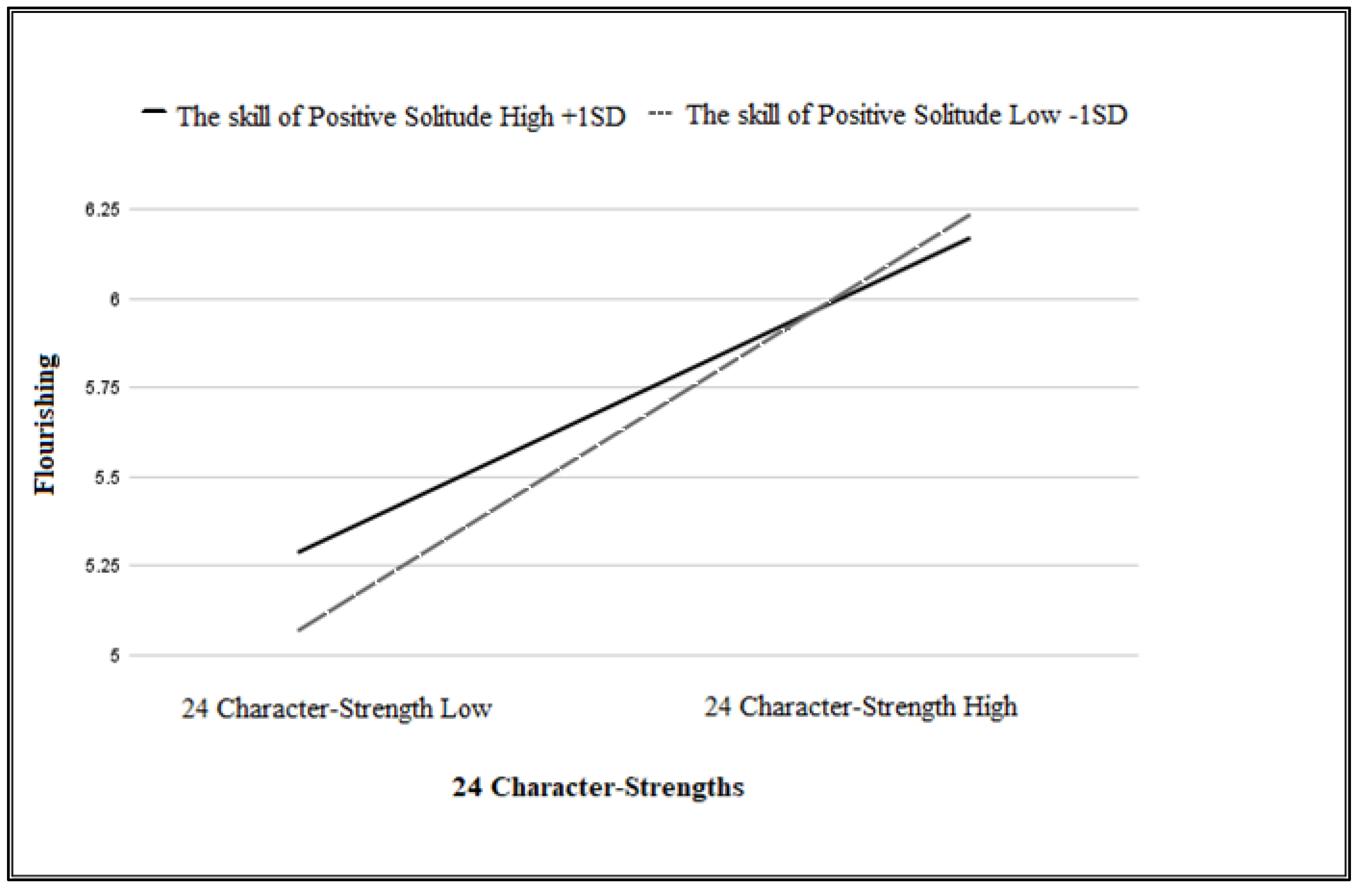

Table 1.
Descriptive Statistics and Correlations of the Study Variables (N=1085).
| M/% | SD | 1 | 2 | 3 | 4 | 5 | 6 | 7 | |
|---|---|---|---|---|---|---|---|---|---|
| 1. Age | 57.20 | 6.24 | 1 | ||||||
| 2. Gender | 71.5% | - | -.02 | 1 | |||||
| 3. Education | 5.26 | 2.03 | .02 | -.02 | 1 | ||||
| 4. Marital Status | 64.7% | - | -.10*** | -.09*** | .01 | 1 | |||
| 5. 24 character-strengths | 3.76 | .40 | .10*** | -.02 | .05 | .02 | 1 | ||
| 5. Flourishing | 5.70 | .90 | .03 | .05 | .10*** | 14*** | .61*** | 1 | |
| 6. The skill of positive Solitude | 3.85 | .74 | -.01 | .08*** | .17*** | -.06 | .31*** | .29*** | 1 |
*p<.05, **p <.01, ***p <.001.
Table 2.
Linear regression analysis examining the relationship between the skill of Positive Solitude and the 24 Character-Strengths on flourishing (N=1080).
Table 2.
Linear regression analysis examining the relationship between the skill of Positive Solitude and the 24 Character-Strengths on flourishing (N=1080).
| Model variables | B | SE | β | F | R2 | R2Δ |
|---|---|---|---|---|---|---|
| Step 1 | 9.27*** | .03*** | .03 | |||
| Age Gender |
-.001 .13 |
.004 .06 |
.05 .07* |
|||
| Education | .05 | .01 | .10*** | |||
| Marital Status | .28 | .06 | .14*** | |||
| Step 2 | 123.56*** | .41*** | .37 | |||
| 24 Character-Strengths The skill of PS |
1.32 .12 |
.06 .03 |
.57*** .09*** |
|||
| Step 3 | 110.43*** | .42*** | .01 | |||
| 24 Character-Strengths X The skill of PS | -.26 |
.06 |
-.10*** |
*p<.05, **p <.01, ***p <.001.
Disclaimer/Publisher’s Note: The statements, opinions and data contained in all publications are solely those of the individual author(s) and contributor(s) and not of MDPI and/or the editor(s). MDPI and/or the editor(s) disclaim responsibility for any injury to people or property resulting from any ideas, methods, instructions or products referred to in the content. |
© 2024 by the authors. Licensee MDPI, Basel, Switzerland. This article is an open access article distributed under the terms and conditions of the Creative Commons Attribution (CC BY) license (http://creativecommons.org/licenses/by/4.0/).
Copyright: This open access article is published under a Creative Commons CC BY 4.0 license, which permit the free download, distribution, and reuse, provided that the author and preprint are cited in any reuse.