

Submitted:
07 June 2024
Posted:
10 June 2024
You are already at the latest version
Abstract
Industrial fires at facilities including waste management sites, warehouses, factories, chemical works and fuel storage depots are relatively frequent occurrences. Often, these fires occur adjacent to urban communities and result in ground-level airborne pollutant concentrations that are well above guideline values. Land, water, livestock and crops may also be contaminated by the emissions and by firefighting activities. Moreover, impacted communities tend to have a higher proportion of minority ethnic populations, individuals with underlying health vulnerabilities, as well as those of lower socio-economic status. Nevertheless, this is an aspect of air quality that is under-researched, and so this review aims to highlight the public health hazards associated with industrial fires and the need for an effective, coordinated, public health response. We also review the range of monitoring techniques that have been utilised in such fires and highlight the role of dispersion modelling in predicting plume trajectories and in estimating population exposure. We recommend establishing 1-h guideline values for particulate matter to facilitate timely public health interventions and we highlight the need to review regulatory and technical controls for sites prone to fires, particularly in the waste sector.
Keywords:
Industrial fires
; airborne pollution
; public health hazard
; particulate matter (PM)
; Monitoring techniques
; dispersion modelling
; emergency response
; waste management
; landfill
; guideline values
1. Introduction
Airborne pollution from industrial fires represents a significant but under-researched public health hazard. These are fires that occur at chemical works, factories, warehouses, fuel storage depots, landfills, recyclables storage sites, and other similar facilities [1]. Many industrial fires occurred in close proximity to residential areas, that may also have sensitive receptors such as schools, hospitals and care homes for the elderly [2,3]. And affected communities may have a disproportionate number of disadvantaged or vulnerable inhabitants [4]. For many incidents, the resultant ambient air pollution concentrations often exceed guideline values (GVs), especially for particulate matter (PM). For example, Griffiths, et al. [5] in an analysis of monitoring data from 23 industrial fires, found incident-average concentrations for PM10 (PM with an aerodynamic diameter <10 µm) of up to 1450 µg m-3, compared to the WHO 24-h guideline of 50 µg m-3, with some 15 min averaged concentrations in excess of 6500 µg m-3. Modelling studies carried out on an open-cut coal mine in Australia predicted PM2.5 (PM with an aerodynamic diameter <2.5 µm) concentrations as high as 3700 µg m-3 during the initial phase of the fire [6], compared to the WHO 24-h guideline value of 15 µg m-3. And for a tyre fire in the UK town of Mexborough, a modelling study by Griffiths [7] predicted that as many as 7800 residents may have been exposed to 24-h averaged PM10 concentrations that exceeded the US EPA AQI category of ‘Hazardous’ (>425 µg m-3). Exceedances of GVs have also been documented for other harmful pollutants such as benzene [4], nitrogen dioxide (NO2), hydrogen cyanide (HCN), Hydrogen bromide (HBr) and hydrogen chloride (HCl) [1].
The frequency of industrial fires adds to the public health concern. For example in Serbia there were 1715 landfill fires in 2021 alone, affecting 42 million acres of land, with many of the fires involving illegally dumped waste [8]. Data from Sweden shows that there were 20.4 waste-fires per year over the period 2012 to 2018, with the frequency and intensity increasing with time [3]. In Istanbul, Turkey, for the period 2015 to 2020 there were 844 factory fires, whilst in the United States there were 37,910 fires at industrial and production facilities over the period 2011 to 2015 [2]. For the UK, where there is the national Air Quality in Major Incidents (AQinMI), response service, there were 74 fires that were considered to be ‘major incidents’ over the period 2009 to 2018, though the total number of fires in industrial and commercial premises is much higher [1,5]; for example, there were approximately 400 fires that the UK Health Security Agency were involved with in 2021 alone [9]. There is a concern that because some fires at waste management sites are secondary to adjacent wildfires that a warming climate may increase their frequency in the future [3]. Griffiths, et al. [5] note a seasonal trend in fire incidents, with summer months having a greater number of fires.
One of the aims of this review is to highlight the issue of air pollution hazards from industrial fires, facilitating a wider and better understanding of the public health implications and the need for appropriate planning for such events. We examine the range of different fire sources and their main emissions, how monitoring and modelling of such fires is carried out, the associated health effects, the suitability of current guideline values, the implications for justice and the need for further research. Our viewpoint is informed from previous involvement in the UK AQinMI service, as lead for one of the monitoring teams and in overall incident management. We have also recently published analyses of the monitoring data that was collected from the AQinMI service over the period 2009 to 2018 [1,5,7].
2. Types of Industrial Fires and Associated Pollutants
In this section we discuss the literature concerning the main combustion products emitted during uncontrolled fires at a range of industrial facilities. We look at ground-level plume concentrations that have been monitored during such fires, as well as pollutant concentrations in other environmental media, for example as a result of contamination by ash and/or firefighting activities.
Whilst all industrial facilities have a potential to catch fire and release harmful pollutants into the atmosphere, it has been shown that certain industrial categories, such as waste management, are more frequently involved [1]. This is likely due to poor on-site management such as the lack of separation of materials at waste management sites. Moreover, lower-risk facilities such as waste transfer sites are often regulated under less stringent regulations compared to high-risk chemical processes, which are very tightly regulated because of historical incidents (e.g., Seveso [10]). In addition, waste management is an industrial sector that can give rise to unregulated (illegal) accumulations of waste that are consequently more prone to fires [8]. Griffiths, et al. [1] have produced a classification of the industrial categories involved in UK fires (Figure 1) which shows that waste fires (tyres accumulations, mixed recyclables, residual recyclables and electrical waste) accounted for 87.1% of all significant major incident fires, with just one single chemical incident (pesticide manufacturer).
The materials burning, together with temperature and oxygen supply, will determine the mix of air pollutants and their emission rates from an industrial fire, whilst meteorological conditions will determine the extent of interaction between the plume and populations in adjacent urban areas. This said, the identification and quantification of airborne pollutant components will be dependent on the choice of monitoring technology employed. For example the Gasmet FTIR approach used to measure volatile organic and inorganic substances (VOCs and VICs respectively) in the UK AQinMI scheme has only 24 pre-set species that can be monitored, whereas mass spectral detection techniques will not be restricted in this way [1]. Thus, Brilli, et al. [11] detected 132 separate VOCs in the smoke from biomass burning using proton transfer reaction time-of-flight mass spectromic determination, and Koss, et al. [12] reported a similar numbers of components.
In a major systematic review of airborne pollutants released during the burning of various types of material, Lemieux, et al. [13] based their search on the 189 hazardous air pollutants (HAPs) mentioned in part III of the US Clean Air Act Amendments 1990. The data originated from both uncontrolled and controlled burning situations. The findings, summarised in Table 1, show that benzene, toluene, formaldehyde, acetaldehyde and acetone are major components of the combustion products for all categories, in terms of emission rate, as will be particulate matter (PM), though this is not reported. Semi-volatile compounds and those components that might adsorb onto PM, such as polycyclic aromatic hydrocarbons (PAHs) and polychlorinated dibenzodioxins/furans (PCDD/F) have also been quantified for many of the categories.
A further view of airborne pollutants that are likely to be emitted during the burning of different source materials is given in Table 2, which lists specific incidents (or groups of incidents according to combustion material type) and the associated concentration data. Also, included in the first four entries are the results of a review of emissions by source type, compiled by Wakefield [14], which identifies the most significant hazardous components, and identifies those likely to be in breach of guideline values. The incidents listed in Table 2 include fires at chemical works, landfill sites and a coal mine. Often, the monitoring reported in Table 2 involves a limited range of compounds, emphasising the importance of the choice of monitoring technology, as discussed further in Section 3. Moreover, the recorded concentrations will be dependent on the monitoring locations relative to the fire plume: they may be fixed existing ambient stations, or mobile monitoring points chosen to assess public exposure. An example of the latter is the UK‘s AQinMI scheme which is a national monitoring service comprising standardised equipment, and involving the deployment of two mobile monitoring teams to the fires [1,5]. The results of this monitoring, averaged by source material type, is shown in entries 5 to 9 of Table 2; it also allowed the ‘fingerprinting’ of emissions for different source materials so as to predict the likely substances that will be emitted in such fires as shown in Figure 2. Thus, xylenes were a significant part of the emissions from tyre fires whereas formaldehyde and NO2 are major components of fires involving wood. These findings were broadly in line with the characterisations of plume components reviewed by Lemieux, et al. [13] in Table 1.
Finally, it is important to emphasise that major incident fires in urban environments do not only affect the quality of air in neighbouring communities but also cause contamination of soil and water environments. For example, e-waste fires have been reported to significantly elevate the soil concentrations of chlorinated and brominated PAHs [22]. Also, areas adjacent to landfill fires have been subject to significant PAH contamination, with total concentrations of up to 300,000 µg kg-1 dw in the worst case, but with typical concentrations in the thousands of µg kg-1 (compared to reference concentrations ranging from 12 to 112 µg kg-1 [15]. PCDD/F and polychlorinated biphenyl (PCB) contamination is also a significant issue with landfill fires, with concentrations up to 7,900 µg kg-1 dw being reported [15], together with elevated concentrations in milk, meat and high lipid-content vegetables such as olives [15]. Metal contamination can also be an issue with some fires, depending on the nature of the material that is burning [15]. Land contamination can additionally give rise to waterway pollution through leachate-runoff, and the waterways can be polluted directly by effluent from firefighting activities [23,24].
3. Monitoring and of Industrial Fires
There are numerous techniques and instruments that have been used for the determination of airborne contaminants for applications that include occupational health and hygiene, regulatory ambient monitoring, and stack emission monitoring. However, this review considers only those methods that have been deployed for monitoring during uncontrolled industrial fires. The reason is that there is likely to have been a selection process that has considered the implications for accuracy of the complex plume that is likely to be encountered in such circumstances [5].
As discussed in Section 2, there are likely to be hundreds of individual chemical substances present in the plume from a major industrial fire. These substances will be present in the gaseous phase and also in solid and liquid aerosols. The challenge of any public health response to a major fire is to have a monitoring equipment inventory that has sufficient techniques to facilitate the collection and measurement of those substances that represent the greatest threat to the short- and long-term health of affected populations. The choice of monitoring technique is a compromise between providing an appropriate temporal resolution for often rapidly developing emergency situations (dependent on meteorology, e.g., wind direction and the development of the fire itself) and the need to accurately characterise the components and their concentrations within the plume [1]. Often, portable sensors are used because they will be able to provide near real-time information on airborne pollutant concentrations to the relevant public health responder, facilitating timely decision making on the appropriate public health intervention, e.g., to shelter indoors or to evacuate. The downside of portable monitors is that they tend to have higher detection limits (typically ppm for VOC/VIC analysis), lower accuracy and lower specificity compared to reference methods. Nevertheless, as long as these limitations are well characterised and understood, decisions on mitigation can be made with reasonable confidence.
Table 3 gives an overview of the range of monitoring techniques that have been used to measure pollutant concentrations during major industrial fires, along with detection limits where known. In the UK, the AQinMI service employed both portable continuous monitors (Osiris laser light scattering for PM, Gasmet FTIR (Fourier Transform Infrared) for VOCs and VICs, electrochemical for chlorine gas and carbon monoxide) and collection devices for later laboratory analysis (impinger solutions, filters, silica gel, thermal desorption tubes and PUF filters) [5]. Evaluations carried out on monitoring results obtained from actual industrial fires showed that PM measurements using the Osiris could be considered reliable because of the good agreement between monitored results obtained during co-location studies, as well as having single µg m-3 monitoring resolution [5]. For VICs and VOCs using the Gasmet continuous monitor, relative emission profiles matched those expected for the particular type of fire being monitored, e.g., tyre or other types of waste fire [1]. Also, reported concentrations for most substances were consistent with the results from other similar monitoring studies [5]. However, acrolein and phosphine were found to be reported at unrealistic concentrations, i.e., above limits that would result in serious health effects, when none were actually reported [1]. Cross-interference between the FTIR spectra of acrolein and phosphine and other, uncharacterised, substances in the plume was the likely explanation for the over-reporting (the FTIR has 24 pre-set substances for which there is calibration and correction for interference effects, but if an unknown substance is present in high concentrations, any overlap in spectra will not be accounted for). Nevertheless, the portable continuous monitoring techniques discussed above were used in practice as the primary source of data on which to base public health response decisions for more than 30 major industrial fires that had the potential to affect significant numbers of people in nearby communities [1,5].
Electrochemical cell-based devices have been deployed for some industrial fires. Typically, there will be an individual cell for each component being monitored, and whilst they have poorer detection limits than reference methods and are prone to cross interference for example NO2 and ozone [25], they have been found to be useful for the concentrations encountered during fires, particularly when monitoring firefighter exposure [26]. Photoionisation devices offer good detection limits for total VOCs but cannot differentiate between different VOC species and have a further disadvantage that some VOCs cannot be ionised at the energy emitted by the lamp leaving them unaccounted for [27]. Nevertheless, these devices can provide valuable information for an initial survey of concentrations during an incident [28]. Additionally, photoionisation data combined with information on the source material of a fire, and likely main pollutants [1,13,14] could provide a sufficient basis for an initial health risk assessment to be made.
The most accurate routine technique for determining VOCs is GC-MS, and in Table 3 there are examples of the use of both continuous automatic GC systems, as well as sampling followed by laboratory analysis. Continuous systems are generally associated with fixed location monitoring stations because of the size of the instrument and the requirement for services, as was the case with the Deer Park fire in Houston [28], although these types of instrument can be placed in monitoring vans [20]. A more convenient approach is to collect the samples in vacuum cannisters [26,34] or on adsorbent tubes (pumped or passive) and returned to the lab for analysis [31], although this delays the forwarding of monitoring information to the public health responders.

Table 3.
Overview of monitoring techniques reported in the literature to measure pollutants emitted from industrial fires.
Table 3.
Overview of monitoring techniques reported in the literature to measure pollutants emitted from industrial fires.
| Monitoring technique and principle | Context for monitoring | Determinands, with detection limits (dl) in parentheses, where available (in ppm, or ug/m3 for particulates). | Reference |
|---|---|---|---|
|
Continuous / real time techniques |
|||
| Laser light scattering (670nm) (Turnkey Osiris particulate monitor) | Included in equipment inventory for deployment to UK AQinMI fires. | Total suspended solids (TSP), PM10, PM2.5, and PM1 (all 0.1). | [5,29] |
| Low cost particulate sensors | Wildfires in california | PM2.5 PM10. See reference for performance characteristics. | [30] |
| Beta Attenuation monitor | Fire at open-cut coal min in Latrobe, Victoria, Australia. | PM2.5 (3.4 for 1-h) | [31,32] |
| Infrared (Gasmet DX4030/40) | Included in equipment inventory for deployment to UK AQinMI fires | Carbon dioxide (10), carbon monoxide (1), nitrous oxide (0.02), methane (0.11), sulfur dioxide (0.30), ammonia (0.13), hydrogen chloride (0.20), hydrogen bromide (3.0), hydrogen fluoride (0.2), hydrogen cyanide (0.35), formaldehyde (0.09), 1,3-butadiene (0.20), benzene (0.3), toluene (0.13), ethyl benzene (0.08), m-xylene (0.12), o-xylene (0.12), p-xylene (0.12), acrolein (0.25), phosgene (0.2), arsine (0.02), phosphine (0.2) and methyl isocyanate (0.25). | [1,5] |
| Proton Transfer Reaction Time-of-Flight Mass Spectrometry (PTR-TOF-MS) | Monitoring of a biomass fire | 132 separate VOCs (single ppb) | [11] |
| Automated gas chromatograph | Fire at International Terminals Company, chemical factory, Deer Park, Houston, Texas. | Range of VOCs and other hazardous air pollutants (HAPS) (0.4 ppb-C) | [4] |
| Electrochemical cell (GFG-Microtector II G460) | Industrial fires in Saudi Arabia (exposure by firefighters) | Carbon monoxide (1), hydrogen cyanide (0.5), ammonia (1), sulfur dioxide (0.1), hydrogen chloride (0.2), Hydrogen sulfide (0.2 ppm). | [26] |
| QRAE electrochemical cell |
Included in equipment inventory for deployment to UK AQinMI fires | Chlorine (dl) and carbon monoxide (dl) | [5] |
| ppbRAE photoionization detector |
Fire at International Terminals Company, chemical factory, Deer Park, Houston, Texas. | Total VOCs (ppb) | [28] |
| Jerome gold film electrical resistance analyser | Included in equipment inventory for deployment to UK AQinMI fires | Hydrogen sulfide (3 ppb) | [5,33] |
| Triple quadrupole mass spectrometer Trace atmospheric gas analyzer (TAGA IIe) | Chemical works (chlorine-based pool chemicals), Guelph, Ontario, Canada | HCl and Cl2 (0.5 µg m-3) | [20] |
| Mobile photochemical Monitoring station (MPAMS) and open-path FTIR | Fire at a naphtha cracking complex of a petrochemical complex in Yunling County, Taiwan in May 2011. | Ehylene, propane, butane, toluene, benzene, vinyl chloride monomer, 1,3-butadiene, all at ppb levels. | [17] |
| Non-continuous techniques | |||
| Tecora Delta Low flow pump (1 L min-1) with impinger: absorption into solution followed by wet chemical analysis | Included in equipment inventory for deployment to UK AQinMI fires |
Hydrogen cyanide, acetic acid, hydrogen sulfide, chromic acid (impinger solution of 0.05M sodium hydroxide). Ammonia (impinger solution of 0.05M sulfuric acid) | [5] |
| Tecora Delta low flow pump pump (1 L min-1) with PTFE filter + silver membrane | Included in equipment inventory for deployment to UK AQinMI fires |
Bromine and chlorine (dl dependent on sampling period). | [5] |
| Tecora Delta low flow pump (0.5 L min-1) with Silica gel – Supelco Orbo 53 | Included in equipment inventory for deployment to UK AQinMI fires. | Hydrogen fluoride, nitric acid, phosphoric acid, sulphuric acid, sulfur trioxide and arsine (dl dependent on sampling period). | [5] |
| Tecora Delta low flow pump (0.2 L min-1) with thermal desorption (TD) | Included in equipment inventory for deployment to UK AQinMI fires |
(All at ppb levels) 1,1,1-trichlorothane, 1,2-dichloroethane, 1,3-butadiene, 2,4-toluene diisocyanate, 2,6-toluene diisocyanate, acetone, acetonitrile, acrolein, acrylamide, acrylonitrile, benzene, CS2, chlorobenzene, chloroform, chloropicrin, dichloromethane, ethyl acrylate, ethyl benzene, ethyl isocyanate, ethylene oxide, formaldehyde, methyl acrylate, methyl bromide, methyl chloride, 2-butanone, methyl isocyanate, methyl isothiocyanate, methyl methacrylate, methyl styrene, phenol, phosgene, propane, styrene, tetrachloroethylene, tetrachloromethane, toluene, trichloroethylene, vinyl chloride, xylene, other volatile organic compounds (dl dependent on sampling period). | [5] |
| Tecora Delta low flow pump (10 L min-1) with gridded asbestos filter | Included in equipment inventory for deployment to UK AQinMI fires | Asbestos | |
| SUMMA 6-L vacuum canister for collection, followed by GC-MS | Industrial fires in Saudi Arabia (exposure by firefighters) | (All at ppb levels) 1,3-butadiene, acetone, trichloromonofluoromethane, 1,1-dichloro-ethene, methylene chloride, carbon disulfide, methyl tert-butyl ether, 1,2-dichloro-ethene, benzene, bromodichloromethane, methyl isobutyl ketone, heptane, toluene, tetrachloroethylene, ethylbenzene, m-xylene, o-xylene, p-xylene, styrene, 1,3,5-Trimethylbenzene, benzyl chloride and 1,2,4-Trichlorobenzene. | [26] |
| SUMMA 6-L vacuum canister for collection, followed by GC-MS | Buncefield oil storage fire) | (All at ppb levels) m- and o- and p-xylenes, toluene, benzene and ethyl benzene. | [34] |
| Cannister followed by GC-MS | Fire at open-cut coal mine in Latrobe, Victoria, Australia | Speciated VOCs (All at ppb levels) | [31] |
| Radiello diffusive sampler with adsorbent (modified scintered microporous polyethylene) | Fire at open-cut coal mine in Latrobe, Victoria, Australia | Speciated VOCs (All at ppb levels) | [31] |
| 2,4-dinitrophenylhydrazine (DNPH)-coated solid sorbent cartridges, collecting carbonyls as derivatives, followed by elution and analysis by high-performance liquid chromatography (HPLC). | Fire at open-cut coal mine in Latrobe, Victoria, Australia | Carbonyl compounds (e.g., formaldehyde, acetaldehyde, acrolein, acetone and benzaldehyde. | [31] |
| Tecora Echo high volume sampler (200 L min-1) with quartz filter. Gravimetric with extraction from filter. | Included in equipment inventory for deployment to UK AQinMI fires | Antimony, arsenic, cadmium, chromium, lead, manganese, nickel, platinum, thallium, vanadium, mercury, other metals, polycyclic aromatic hydrocarbons, polychlorinated biphenyls, pesticides | [5] |
| Polyurethane Foam (PUF) filters | Fire at open-cut coal mine in Latrobe, Victoria, Australia. Also included in equipment inventory for deployment to UK AQinMI fires | Dioxins and derivatives, including polychlorinated dibenzodioxins, furan and derivatives, including polychlorinated dibenzofurans. PAHs | [5,31] |
The selection of sampling location is also of critical importance since the monitoring data should ideally reflect public exposure. For some incidents, such as the Deer Park chemical works fire [4,28], existing monitoring networks were utilised to provide contemporaneous monitoring data. Moreover, with the increasing use of low cost sensors [35], it is likely that many future incidents may have readily available data from arrays of such sensors located in neighbouring areas. Nevertheless, there remains a requirement for a mobile monitoring capability, such as the UK’s AQinMI scheme [5].
4. Modelling of Public Exposure to Harmful Airborne Pollutants from Industrial Fires
Monitoring data, whilst providing real-world concentrations of harmful airborne pollutants released during industrial fires, is limited in terms of the spatial resolution of the monitoring and the choice of measurement locations. It is difficult to predict the exposure profile of the population from monitoring data alone, and so there is a requirement for plume modelling to support the estimation of likely exposure. There are a range of different models and approaches used, with some notable literature examples of the modelling of dispersion of pollutants from fires and chemical accidents detailed in Table 4. For example, in the UK, the Chemical Meteorology (CHEMET) service provides a semi-quantitative estimate of the plume path and to identify populations that are likely to be exposed. Timely precautionary public health advice can be provided on the basis of the CHEMET plume [5].
For more realistic modelling of ground level air pollutant concentrations, there are a range of options, including Gaussian, Lagrangian (puff and particle), Eulerian and Computational Fluid Dynamics (CFD) methods [43,44,47,48]. Modified Gaussian models, such as ADMS and ADMS-Urban are ideal for regulatory compliance work, but the assumption of a steady state across the modelling domain may be problematic for meso-scale dispersion calculations required for plume transport simulation over large areas [44]. Nevertheless, there are literature examples of the ADMS being used to simulate downwind emissions from fires [36,37], and it is stated that ADMS is suitable for modelling areas in the tens of km [37]. Other Gaussian approaches to the modelling of fires have also been reported [39]. Eulerian models, often operating on regional or continental scales, use a fixed grid, solving partial differential equations for transport and chemical reactions for each grid cell. Eulerian approaches can be considered as advanced simulators of dispersion and have been applied to an open-cut coal mine fire in Australia [6], though applications may be limited because there is a requirement for significant computational resources [44]. CFD approaches are also very computationally expensive [40], but provide the highest resolution modelling of all systems and are ideal for simulating dispersion over small areas (< 1km) that may have complex terrain and infrastructure. An example is the CFD modelling of the accidental release of vinyl chloride on a small geographical scale (within the boundary of a chemical works) [41]. One method of utilising CFD in wider scale dispersion calculations is in a coupled model, whereby CFD is used to model the fire conditions and initial development of the plume, followed by mesoscale meteorological modelling of dispersion over a wider area [40].
By far the most widely used approaches to the modelling of plume dispersion from fires are the Lagrangian methods, including, CALPUFF (California PUFF model), HYSPLIT (Hybrid Single Particle Lagrangian Integrated Trajectory), NAME (Numerical Atmospheric-dispersion Modelling Environment, as used by CHEMET) and ADMS-Star. Langrangian methods calculate the trajectories of discrete ‘puffs’ or groups of ‘particles’ of pollutants as they are influenced by meteorological conditions. These models can be used in backwards-mode to help in the identification of sources of elevated pollution concentrations [17,42] or odour [49]. They can also be used in forward mode to either calculate ground level concentrations and overall plume behaviour [46] or identify the ambient monitoring stations that a plume is likely to have passed over, thus allowing incident-relevant data on airborne pollutants to be identified [4,24,43].
One problem associated with all these approaches is the calculation of an accurate source emission rate. Often, because of the considerable uncertainty in this parameter, nominal emission rates are modelled, allowing a semi-quantitative evaluation of those areas that are likely to be affected and where the highest concentrations are expected. An example is the modelling of the complex and geographically disperse pattern of odour complaints subsequent to a methyl mercaptan release in France [43].
There are methods for calculating plume components and their emission rates, based on the composition and volume/area of the fire source material, together with data from standard combustion studies, and this has been used as a basis for modelling waste fires [37,45]. An alternative approach is to back-calculate emission rates, based on triangulated observations of monitoring data at several locations. ADMS-Star, a Lagrangian puff model, has the facility to make such calculations and this has been applied to a large tyre fire in Mexborough, UK, which was attended by two monitoring teams from the UK AQinMI scheme. ADMS-Star calculates an emission rate that fits the observed pollutant concentrations and meteorological conditions, and subsequently forward-models the evolution of the plume. Predicted ground level concentrations can be combined with population data to estimate an overall exposure profile [7]. Other approaches to estimating the exposure profile of affected populations have been reported, for example during a long-established fire in an open-cut mine [6].
5. Health Impacts of Major Incident Fires
As we have seen, reported airborne pollutant concentrations during major incident fires can reach levels that can be an order of magnitude higher than ambient standards, particularly for PM, which is the main focus of this section.
Short-term (24-h or less) air quality guideline values and AQI category boundaries for PM are based on epidemiological data on the effects of air pollutants on human health [50] and so exceedance of these levels indicate that adverse health effects are likely to occur, particularly for the most vulnerable members of the population (in terms of age and pre-existing health conditions). The magnitude of expected health effects within an exposed population can be estimated from established epidemiologically-derived risk factors for exposure. Thus, for PM10 there is a 0.41% increase in short-term mortality for every 10 µg m-3 increase in concentration (for PM2.5 the risk factor is and 0.65%)[51] and for all-cause hospital admissions there is a 0.18% increase for every 10 µg m-3 increase in PM10 concentration [52].
Whilst short-term effects of PM have been well characterised for periods of 24-h and above, it is known that physiological responses to PM can be observed over a much shorter exposure timeframe, i.e., a few hours. For example, upper respiratory tract inflammation has been observed in human volunteers exposed to diesel fumes containing PM10 concentrations ranging from 100 to 300 µg m-3 for exposure periods as short as 1 to 2 hours [53]. In addition, firefighters who are frequently exposed to high PM concentrations show evidence of inflammatory response after shifts [54,55], with pro-inflammatory proteins IL6 and IL8 remaining elevated in the bloodstream for at least 3 months after exposure [54].
Given the epidemiological and physiological evidence, we must conclude that the concentrations of PM reported in some incidents detailed in Table 2 would be expected to have had a short-term health impact on the exposed population, though evidence for the capture of these effects by syndromic surveillance (e.g., hospital emergency room admissions) is not clear cut. For example during the Buncefield oil storage fire in 2005, and the Chancery Lane fire in London in 2009, monitoring of doctors’ surgery visit data and calls to the UK National Health Service-Direct indicated that there were no detectable population-based health effects such as coughs, breathing difficulties, asthma admissions or respiratory infections in those communities most at risk from exposure [56]. Similarly, a syndromic surveillance programme carried out in the aftermath of arson-initiated landfill fires in Palermo, Sicily, did not register any increase in daily hospital admissions for respiratory diseases or other related health effects [21]. However, there is evidence of respiratory health effects from self-reported outcomes after an open-cut coal mine fire in Australia [6]. The study, which used individualised PM2.5 exposure data for participants, derived from modelling studies, found increases of 13% and 10% respectively for chronic cough and chronic phlegm per 10 µg m-3 increase in PM2.5 [6].
For PM exposure in the related field of wildfire research, health effects are well characterised [57,58,59,60] including for the more vulnerable members of the exposed population [61,62]. It is also important to emphasise that combustion-derived particulates have been found to be more toxic than ambient particulates due to the presence of a wide range of chemical toxins, including heavy metals and PAHs [63].
For pollutants other than PM, Table 1 and Table 2 show monitoring data for PAHs, PCDD/Fs, PCBs, metals, VICs and VOCs. Exceedances have been noted for several of these substances, for example benzene during the Deer Park fire in Texas [4]. In a study of ground-level concentrations of organic and inorganic substances during some 34 major incident fires, Griffiths, et al. [1] found exceedances of ambient short-term guidelines for NO2 (14 incidents exceeded the 0.11 ppm 1-h EU guideline value) and SO2 (0.13ppm EU 1-h guideline value was exceeded in 15 incidents; WHO 10 minute guideline of 0.19 ppm exceeded in 21 incidents; and UK 15 minute guideline of 0.10 ppm exceeded in 30 incidents). For other substances, HCN, HBr, HF and formaldehyde exceeded the Level 1 US Acute Exposure Guideline Levels (AEGLs), for which temporary non-disabling health effects might be expected [1].
Nevertheless, as previously discussed, incident monitoring is often carried out though networks of ambient air quality measurement stations. Due to prevailing meteorological conditions during such incidents, these stations may not necessarily be in the best location to identify where communities are exposed to the highest ground level concentrations. The advantage of a coordinated mobile monitoring network, such as the UK’s AQinMI scheme is that monitoring stations can be set up in locations where concentrations are predicted to be high, therefore allowing a more realistic estimation of population exposure, especially if combined with modelling.
6. Suitability of Guideline Values for PM
As discussed in previous sections, PM is one of the most health-impacting air pollutants to which communities adjacent to industrial fires are exposed. During such incidents, hourly and daily concentrations of PM10 and PM2.5 can be in the high hundreds of µg m-3, with some incidents even recording concentrations in the thousands of µg m-3 for PM10 [50]. And yet we also know that physiologically measurable effects of exposure, such as inflammatory response, can be evident after exposure periods of just hours [53,54,55,66].
Historically, short-term guideline values (GVs) for PM, such as those developed by the WHO, the US EPA, and the European Union, have been derived from epidemiological evidence of health effects over a 24-h period [66]. And whilst it has been acknowledged that health effects of PM exposure can manifest in much shorter timeframes, the notion of setting limits at averaging times as low as 1-h, as with ozone, has been dismissed because of the significant correlation between the concentrations of the 1-h maximum (in a 24-h period) with the 24-h average [66]. This said, there is some literature evidence that daily mortality [67] and COPD hospital admissions for over 65s [68] are more strongly associated with the daily maximum 1-h concentration rather than the 24-h average, suggesting that a 1-h GV might be beneficial [69,70].
However, the observation of a correlation between the concentrations of the 1-h maximum (in a 24-h period) with the 24-h average, does create an opportunity to predict exceedances of 24-h guidance based on 1-h concentrations. Such predictions would allow public health decisions, for example on whether to advise affected communities to stay indoors or evacuate, to be made at a much earlier stage, and so avoid the need to wait 24 hours to confirm a breach, which could be potentially harmful, particularly for those who are more vulnerable. Offering a 1-h short-duration PM exposure guideline aligns with the offering of organic and inorganic species guidelines as outlined in AEGLs [71] and ERPGs [72].
Several approaches have been used in the literature to derive de facto 1-h guideline values for both PM10 and PM2.5, as listed in Table 5. For Europe’s Common Air Quality Index (CAQI), 1-h thresholds for AQI category boundaries for PM10 were derived by dividing the 24-h concentration by a factor of 0.55; this is the ratio of the 24-h average concentration and the maximum 1-h concentration in the same period, based on ambient monitoring data from 52 sites throughout Europe over the period 2001 to 2004. 1-h values for PM2.5 were obtained by multiplying the 1-h PM10 AQI boundary thresholds by a factor of 0.6, which was the observed fraction of PM10 that is PM2.5. Stieb, et al. [73], using Canadian monitoring data, obtained a similar PM10 ratio to that used by CAQI, though they used a maximum 3-h concentration in a 24-h period.
However, being based on ambient monitoring data, the CAQI range (‘Very Low’ to ‘Very High’) of 0 - 100 µg m-3 and 0 – 180 µg m-3 for 24-h and 1-h boundary thresholds respectively for PM10 (0 – 60 µg m-3 and 15 – 110 µg m-3 respectively for PM2.5), is low compared to the typical concentrations recorded in major incident fires. Also, the descriptors employed by CAQI are not directly related to health. A more appropriate AQI for the magnitude of concentrations observed in industrial fires, wildfires and dust storm is the US EPA AQI, which ranges to 500 µg m-3 for PM2.5 and 605 µg m-3 for PM10, and which employs health based descriptors such as ‘unhealthy’ and ‘hazardous’ (see Table 5). Deary and Griffiths [50] have employed Receiver Operating Characteristic (ROC) statistical analysis, based on 38 million rolling 24-h periods of monitoring data from across the US to derive 1-h threshold concentrations that predict exceedances on the US EPA AQI classification boundary concentrations. The resultant 1-h threshold concentrations listed in Table 5 for both PM2.5 and PM10 will correctly predict 99% of all exceedances of the corresponding 24-h guidelines (99% True Positive Rate, TPR), based on the overall US dataset, though other TPRs, e.g., 100% or 95% can be chosen, thus allowing some flexibility with respect to balancing public perception of the number of false alarms with accuracy of predicting exceedances. In addition, the same authors have derived 1-h GVs for some of the WHO [51] Interim Targets and for a UK 24-h trigger to evacuate [78], which was similar to the value obtained from an earlier analysis on the same threshold, based on AQinMI data [5].
1-h GVs, as listed in Table 5, allow public health responders to protect exposed populations against the immediate effects of episodic air pollution from industrial fires, allowing timely guidance to be communicated, and appropriate mitigating measures to be actioned.
7. Environmental Justice and Socio-Economic Factors
Industrial sites are often located in close proximity to lower-income neighbourhoods, which may also have a higher representation of minority ethnic populations as well as poorer overall levels of health and lower overall educational attainment than the general population [4,79,80,81]. Routine emissions from such sites and the potential for accidental releases and fires, mean that economically disadvantaged and minority populations may be disproportionately exposed to airborne environmental hazards [4]. Moreover, such communities, might not have access to the resources and expertise needed to advocate for better environmental standards nor for taking mitigating measures such as relocation or personal protection [7]. Several of the fires listed in Table 2 concern issues of environmental justice, including the chemical fire at Deer Park [4] and landfill fires in Palermo [21]. In the UK, the 2010 waste trye fire at Mexborough was in very close proximity to neighbourhoods that had higher levels of deprivation and a greater proportion of individuals with pre-existing health conditions [7]. A range of actions have been suggested to reduce inequities [4,15,21]. Thus, for communities adjacent to existing sites, there is a requirement for: continuous airborne pollutant monitoring, both at the industrial sites and within the communities; improved public health communication during and after incidents; clear emergency protocols; syndromic surveillance monitoring protocols for affected populations; resources for post-incident monitoring of land, water, foodstuffs and livestock; enhanced regulation; and active community engagement in incident investigation and in raising awareness of potential health risks within the communities [4,15,21]. For future industrial developments, there is a requirement for clear zoning so that emissions and potential accidental releases will be well away from communities [4,21].
8. Conclusions, Recommendations and Research Needs
Airborne pollution from major industrial fires in urban settings is a significant yet under-researched public health hazard that disproportionately affects those from minority ethnic groups, those with underlying health conditions and those from disadvantaged and socio-economic groups. Ground level concentrations in such fires often exceed short-term health-based guideline values, and there is a risk of contamination of soil, water, crops and livestock from dry and wet deposition of pollutants and from firefighting activities.
Our review has highlighted the importance of having a robust monitoring capability that can be deployed during such incidents, and which can accurately characterize the most health-impacting pollutants and their concentrations. Moreover, there is a requirement for the provision of near real-time monitoring data to public health responders so that timely advice can be communicated to affected populations. However, due to the complexity of the plume and the number of individual chemical species present, there may be issues of cross-interference for some continuous techniques, for example, electrochemical or FTIR methods. Research is therefore required to enhance monitoring capabilities in preparation for major incident fires, evaluating techniques such as direct air sampling mass spectrometry (DS-MS) and differential optical absorption spectroscopy (DOAS) [82], and how such systems, which are often bulky and require significant services, might be made portable and deployed in practice [82,83]. The utilization of such equipment would require mobile monitoring vans to be available at key locations throughout a country or territory but would also require significant maintenance and calibration. Alternatively for more portable methods, such as FTIR gas analysis that are often currently employed [1], advanced machine learning or AI approaches could be researched for accurate characterization of individual plume components within the overall mix [84]. PM is probably the most significant health hazard from industrial fires and it is reassuring that portable monitoring systems, including low-cost sensors, have an acceptable level of accuracy [85,86] and can be deployed with good spatial resolution, as is the case in the US for wildfires [87]. Networks of sensors could be employed surrounding those industrial sites that are most prone to fires, as well as in adjacent communities, possibly also combining monitoring information with remote sensing to estimate the plume extent and overall population exposure [88]. The use of drones fitted with low-cost sensors, perhaps as swarms, could offer an alternative to characterising the plume extent, including in the vertical axis, helping estimate exposure for those living in high-rise buildings [89,90]. Modelling can also be utilised to accurately characterise plume concentrations, though the calculation of the emission rate of the fire remains a source of uncertainty [7]. This could possibly be overcome with higher spatial resolution monitoring data combined with back-calculation methods [7]. Additionally, research into coupled CFD/meteorological modelling and other advanced approaches may produce more accurate plume predictions [40].
The health impact of major incident fires is another key area for further research, especially given the high reported concentrations of airborne pollutants in many incidents, particularly for PM. Research is needed to identify the most appropriate syndromic surveillance approaches for industrial fires, both for future events but also in retrospectively evaluating health impacts. There is also a case for carrying out retrospective epidemiological studies on longer-term effects of industrial fires, where appropriate health data can be identified. Health effects should be investigated within a context of environmental justice, thus accounting for ethnicity, educational attainment, employment, socio-economic status and underlying health status.
Research is also needed into preventative measures, mitigation and the public health response. Preventative measures should focus on the planning system so that appropriate zoning of industrial and residential areas is in place. In addition, where industrial facilities are already adjacent to residential areas, regulatory and technical controls should be reviewed, together with the installation of appropriate monitoring technology. Community involvement should be encouraged where possible [4]. For incident response, there are exemplars from different countries, such as the UKs AQinMI service and the associated public health response [1,5,9,91,92]. Finally, to aid in the public health response to industrial fires, and the timeliness of decision making, 1-h guideline values for PM could be considered [50].
Author Contributions
Conceptualization, MED and SDG; methodology, MED and SDG; software, n/a; validation, n/a; formal analysis, MED and SDG; investigation, MED and SDG; resources, MED and SDG.; data curation, MED and SDG; writing—original draft preparation, MED and SDG; writing—review and editing, MED and SDG; visualization, MED and SDG; supervision, MED; project administration, MED and SDG; funding acquisition, n/a. All authors have read and agreed to the published version of the manuscript.
Funding
This research received no external funding.
Data Availability Statement
Data is contained within the article and in references therein.
Acknowledgments
We are grateful to Northumbria University for providing the resources to support this study.
Conflicts of Interest
The authors declare no conflicts of interest.
References
- Griffiths, S.D.; Entwistle, J.A.; Kelly, F.J.; Deary, M.E. Characterising the ground level concentrations of harmful organic and inorganic substances released during major industrial fires, and implications for human health. Environment International 2022, 162, 107152. [Google Scholar] [CrossRef] [PubMed]
- Alkış, S.; Aksoy, E.; Akpınar, K. Risk assessment of industrial fires for surrounding vulnerable facilities using a multi-criteria decision support approach and GIS. Fire 2021, 4, 53. [Google Scholar] [CrossRef]
- Ibrahim, M.A. Risk of spontaneous and anthropogenic fires in waste management chain and hazards of secondary fires. Resour Conserv Recy 2020, 159, 104852. [Google Scholar] [CrossRef]
- Goldman, G.T.; Desikan, A.; Morse, R.; Kalman, C.; MacKinney, T.; Cohan, D.S.; Reed, G.; Parras, J. Assessment of air pollution impacts and monitoring data limitations of a spring 2019 chemical facility fire. Environmental Justice 2022, 15, 362–372. [Google Scholar] [CrossRef]
- Griffiths, S.D.; Chappell, P.; Entwistle, J.A.; Kelly, F.J.; Deary, M.E. A study of particulate emissions during 23 major industrial fires: Implications for human health. Environ International 2018, 112, 310–323. [Google Scholar] [CrossRef] [PubMed]
- Johnson, A.L.; Gao, C.X.; Dennekamp, M.; Williamson, G.J.; Brown, D.; Carroll, M.T.; Ikin, J.F.; Del Monaco, A.; Abramson, M.J.; Guo, Y. Associations between respiratory health outcomes and coal mine fire PM2. 5 smoke exposure: a cross-sectional study. International Journal of Environmental Research and Public Health 2019, 16, 4262. [Google Scholar] [CrossRef] [PubMed]
- Griffiths, S.D. Analysis of monitoring data from Major Air Pollution Incidents: Translational lessons for Public Health and Community Resilience Policy and Practice. Northumbria University, Newcastle upon Tyne, 2024.
- UNEP. Wasted Air: Impact of Landfill Fires on Air Pollution and People’s Health in Serbia - Working Paper. Available online: https://wedocs.unep.org/20.500.11822/45428 (accessed on May).
- Urquhart, G.J.; Symington, M.; Foxall, K.; Harrison, H.; Sepai, O. Using science to respond to public exposures from chemical hazards during emergencies in England. Toxicology Research 2023, 12, 539–543. [Google Scholar] [CrossRef]
- O’Mahony, M.T.; Doolan, D.; O’Sullivan, A.; Hession, M. Emergency planning and the Control of Major Accident Hazards (COMAH/Seveso II) Directive: An approach to determine the public safety zone for toxic cloud releases. Journal of hazardous materials 2008, 154, 355–365. [Google Scholar] [CrossRef] [PubMed]
- Brilli, F.; Gioli, B.; Ciccioli, P.; Zona, D.; Loreto, F.; Janssens, I.A.; Ceulemans, R. Proton Transfer Reaction Time-of-Flight Mass Spectrometric (PTR-TOF-MS) determination of volatile organic compounds (VOCs) emitted from a biomass fire developed under stable nocturnal conditions. Atmos Environ 2014, 97, 54–67. [Google Scholar] [CrossRef]
- Koss, A.R.; Sekimoto, K.; Gilman, J.B.; Selimovic, V.; Coggon, M.M.; Zarzana, K.J.; Yuan, B.; Lerner, B.M.; Brown, S.S.; Jimenez, J.L. Non-methane organic gas emissions from biomass burning: identification, quantification, and emission factors from PTR-ToF during the FIREX 2016 laboratory experiment. Atmos Chem Phys 2018, 18, 3299–3319. [Google Scholar] [CrossRef]
- Lemieux, P.M.; Lutes, C.C.; Santoianni, D.A. Emissions of organic air toxics from open burning: a comprehensive review. Progress in Energy and Combustion Science 2004, 30, 1–32. [Google Scholar] [CrossRef]
- Wakefield, J.C. A Toxicological Review of the Products of Combustion. 2010.
- Estrellan, C.R.; Iino, F. Toxic emissions from open burning. Chemosphere 2010, 80, 193–207. [Google Scholar] [CrossRef] [PubMed]
- Reisen, F.; Gillett, R.; Choi, J.; Fisher, G.; Torre, P. Characteristics of an open-cut coal mine fire pollution event. Atmospheric Environment 2017, 151, 140–151. [Google Scholar] [CrossRef]
- Shie, R.-H.; Chan, C.-C. Tracking hazardous air pollutants from a refinery fire by applying on-line and off-line air monitoring and back trajectory modeling. Journal of hazardous materials 2013, 261, 72–82. [Google Scholar] [CrossRef]
- Ruokojärvi, P.; Ettala, M.; Rahkonen, P.; Tarhanen, J.; Ruuskanen, J. Polychlorinated dibenzo-p-dioxins and-furans (PCDDs and PCDFs) in municipal waste landfill fires. Chemosphere 1995, 30, 1697–1708. [Google Scholar] [CrossRef]
- Ruokojärvi, P.; Ruuskanen, J.; Ettala, M.; Rahkonen, P.; Tarhanen, J. Formation of polyaromatic hydrocarbons and polychlorinated organic compounds in municipal waste landfill fires. Chemosphere 1995, 31, 3899–3908. [Google Scholar] [CrossRef]
- Karellas, N.; Chen, Q.; De Brou, G.; Milburn, R. Real time air monitoring of hydrogen chloride and chlorine gas during a chemical fire. Journal of hazardous materials 2003, 102, 105–120. [Google Scholar] [CrossRef] [PubMed]
- Mazzucco, W.; Costantino, C.; Restivo, V.; Alba, D.; Marotta, C.; Tavormina, E.; Cernigliaro, A.; Macaluso, M.; Cusimano, R.; Grammauta, R. The management of health hazards related to municipal solid waste on fire in Europe: an environmental justice issue? International Journal of Environmental Research and Public Health 2020, 17, 6617. [Google Scholar] [CrossRef] [PubMed]
- Nishimura, C.; Horii, Y.; Tanaka, S.; Asante, K.A.; Ballesteros Jr, F.; Viet, P.H.; Itai, T.; Takigami, H.; Tanabe, S.; Fujimori, T. Occurrence, profiles, and toxic equivalents of chlorinated and brominated polycyclic aromatic hydrocarbons in E-waste open burning soils. Environ Pollut 2017, 225, 252–260. [Google Scholar] [CrossRef]
- Lönnermark, A.; Blomqvist, P. Emissions from an automobile fire. Chemosphere 2006, 62, 1043–1056. [Google Scholar] [CrossRef]
- Da Silva, D.O.; Arôxa, B.H.; Klausner, V.; Bastos, E.J.d.B.; Prestes, A.; Pacini, A.A. Report of Particulate Matter Emissions During the 2015 Fire at Fuel Tanks in Santos, Brazil. Air, Soil and Water Research 2020, 13, 1178622120971251. [Google Scholar] [CrossRef]
- Lin, C.; Gillespie, J.; Schuder, M.; Duberstein, W.; Beverland, I.J.; Heal, M.R. Evaluation and calibration of Aeroqual series 500 portable gas sensors for accurate measurement of ambient ozone and nitrogen dioxide. Atmospheric Environment 2015, 100, 111–116. [Google Scholar] [CrossRef]
- Alharbi, B.H.; Pasha, M.J.; Al-Shamsi, M.A.S. Firefighter exposures to organic and inorganic gas emissions in emergency residential and industrial fires. Science of the Total Environment 2021, 770, 145332. [Google Scholar] [CrossRef]
- Cui, P.; Schito, G.; Cui, Q. VOC emissions from asphalt pavement and health risks to construction workers. Journal of Cleaner Production 2020, 244, 118757. [Google Scholar] [CrossRef]
- An Han, H.; Han, I.; McCurdy, S.; Whitworth, K.; Delclos, G.; Rammah, A.; Symanski, E. The Intercontinental Terminals Chemical Fire Study: a rapid response to an industrial disaster to address resident concerns in Deer Park, Texas. International journal of environmental research and public health 2020, 17, 986. [Google Scholar] [CrossRef] [PubMed]
- Turnkey Instruments Limited. Osiris. Available online: https://turnkey-instruments.
- South Coast AQMD. Air Quality Sensor Performance Evaluation Center. Available online: https://www.aqmd.gov/aq-spec/evaluations (accessed on June).
- Reisen, F.; Cope, M.; Emmerson, K.; Galbally, I.; Gillett, R.; Keywood, M.; Molloy, S.; Powell, J.; Fisher, G.; Torre, P. Analysis of air quality during the Hazelwood mine fire. 2016.
- Met One Instruments. Available online: https://metone.com/wp-content/uploads/2019/04/bam-1020_detection_limit.pdf (accessed on June).
- Able Instruments. Available online: https://able.co.uk/product/gas-analysers/j605/ (accessed on 13th May).
- Targa, J.; Kent, A.; Stewart, R.; Coleman, P.; Bower, J.; Webster, H.; Taylor, J.; Murray, V.; Mohan, R.; Aus, C. Initial review of air quality aspects of the Buncefield Oil Depot Explosion. 2006.
- Liu, G.; Moore, K.; Su, W.-C.; Delclos, G.L.; De Porras, D.G.R.; Yu, B.; Tian, H.; Luo, B.; Lin, S.; Lewis, G.T. Chemical explosion, COVID-19, and environmental justice: Insights from low-cost air quality sensors. Science of the Total Environment 2022, 849, 157881. [Google Scholar] [CrossRef]
- Carruthers, D.J.; McKeown, A.M.; Hall, D.J.; Porter, S. Validation of ADMS against wind tunnel data of dispersion from chemical warehouse fires. Atmospheric Environment 1999, 33, 1937–1953. [Google Scholar] [CrossRef]
- Ladd, C. Approaches to fire modelling with ADMS. In Proceedings of the ADMS 5 User Group Meeting, Edinburgh; 2018. [Google Scholar]
- Biočanin, R.; Stefanov, S.; Urošević, S.; Mekić, S. Modeling of pollutants in the air in terms of fire on dumps/Modelowanie zanieczyszczeń powietrza w warunkach pożaru na wysypisku. Ecological Chemistry and Engineering S 2012, 19, 609–616. [Google Scholar] [CrossRef]
- Rasmussen, B.; Duijm, N.J.; Markert, F. Airborne releases from fires involving chemical waste—A multidisciplinary case study. Journal of hazardous materials 1998, 57, 259–275. [Google Scholar] [CrossRef]
- Baggio, R.; Filippi, J.B.; Truchot, B.; Couto, F.T. Local to continental scale coupled fire-atmosphere simulation of large industrial fire plume. Fire safety journal 2022, 134, 103699. [Google Scholar] [CrossRef]
- Efthimiou, G.; Andronopoulos, S.; Tavares, R.; Bartzis, J. CFD-RANS prediction of the dispersion of a hazardous airborne material released during a real accident in an industrial environment. Journal of Loss Prevention in the Process Industries 2017, 46, 23–36. [Google Scholar] [CrossRef]
- Vukmirović, Z.B.; Unkašević, M.; Lazić, L.; Tošić, I. Regional air pollution caused by a simultaneous destruction of major industrial sources in a war zone. The case of April Serbia in 1999. Atmospheric Environment 2001, 35, 2773–2782. [Google Scholar] [CrossRef]
- Leelőssy, Á.; Ludányi, E.L.; Kohlmann, M.; Lagzi, I.; Meszaros, R. Comparison of two Lagrangian dispersion models: a case study for the chemical accident in Rouen, January 21-22, 2013. Időjárás 2013, 117, 435–450. [Google Scholar]
- Tagliaferri, F.; Invernizzi, M.; Capelli, L. A sensitivity analysis applied to SPRAY and CALPUFF models when simulating dispersion from industrial fires. Atmospheric Pollution Research 2022, 13, 101249. [Google Scholar] [CrossRef]
- Ainslie, B.; Jackson, P. The use of an atmospheric dispersion model to determine influence regions in the Prince George, BC airshed from the burning of open wood waste piles. Journal of environmental management 2009, 90, 2393–2401. [Google Scholar] [CrossRef] [PubMed]
- Webster, H. Modelling the plume from the Buncefield Oil Depot fire. Chemical Hazards and Poisons Report 2006, 6. [Google Scholar]
- Deary, M.E.; Uapipatanakul, S. Evaluation of the performance of ADMS in predicting the dispersion of sulfur dioxide from a complex source in Southeast Asia: implications for health impact assessments. Air Quality, Atmosphere & Health 2014, 7, 381–399. [Google Scholar]
- Holmes, N.S.; Morawska, L. A review of dispersion modelling and its application to the dispersion of particles: An overview of different dispersion models available. Atmospheric environment 2006, 40, 5902–5928. [Google Scholar] [CrossRef]
- Smethurst, H.; Witham, C.; Robins, A.; Murray, V. An exceptional case of long range odorant transport. Journal of wind engineering and industrial aerodynamics 2012, 103, 60–72. [Google Scholar] [CrossRef]
- Deary, M.E.; Griffiths, S.D. A novel approach to the development of 1-hour threshold concentrations for exposure to particulate matter during episodic air pollution events. Journal of Hazardous Materials 2021, 418, 126334. [Google Scholar] [CrossRef]
- WHO. WHO global air quality guidelines, Particulate matter (PM2.5 and PM10), ozone, nitrogen dioxide, sulfur dioxide and carbon monoxide.; World Health Organisation: Geneva, Switzerland, 2021. [Google Scholar]
- Chen, R.; Chu, C.; Tan, J.; Cao, J.; Song, W.; Xu, X.; Jiang, C.; Ma, W.; Yang, C.; Chen, B. Ambient air pollution and hospital admission in Shanghai, China. Journal of hazardous materials 2010, 181, 234–240. [Google Scholar] [CrossRef] [PubMed]
- Behndig, A.; Mudway, I.; Brown, J.; Stenfors, N.; Helleday, R.; Duggan, S.; Wilson, S.; Boman, C.; Cassee, F.R.; Frew, A. Airway antioxidant and inflammatory responses to diesel exhaust exposure in healthy humans. European Respiratory Journal 2006, 27, 359–365. [Google Scholar] [CrossRef] [PubMed]
- Greven, F.E.; Krop, E.J.; Spithoven, J.J.; Burger, N.; Rooyackers, J.M.; Kerstjens, H.A.; Van der Heide, S.; Heederik, D.J. Acute respiratory effects in firefighters. American journal of industrial medicine 2012, 55, 54–62. [Google Scholar] [CrossRef] [PubMed]
- Swiston, J.R.; Davidson, W.; Attridge, S.; Li, G.T.; Brauer, M.; van Eeden, S.F. Wood smoke exposure induces a pulmonary and systemic inflammatory response in firefighters. European respiratory journal 2008, 32, 129–138. [Google Scholar] [CrossRef]
- Elliot, A.J. Syndromic surveillance in the Health Protection Agency. Chemical Hazards and Poisons Report 2010, 17, 22–26. [Google Scholar]
- Black, C.; Tesfaigzi, Y.; Bassein, J.A.; Miller, L.A. Wildfire smoke exposure and human health: Significant gaps in research for a growing public health issue. Environmental toxicology and pharmacology 2017, 55, 186–195. [Google Scholar] [CrossRef] [PubMed]
- Faustini, A.; Alessandrini, E.R.; Pey, J.; Perez, N.; Samoli, E.; Querol, X.; Cadum, E.; Perrino, C.; Ostro, B.; Ranzi, A. Short-term effects of particulate matter on mortality during forest fires in Southern Europe: results of the MED-PARTICLES Project. Occupational and environmental medicine 2015, 72, 323–329. [Google Scholar] [CrossRef]
- Haikerwal, A.; Akram, M.; Del Monaco, A.; Smith, K.; Sim, M.R.; Meyer, M.; Tonkin, A.M.; Abramson, M.J.; Dennekamp, M. Impact of fine particulate matter (PM 2.5) exposure during wildfires on cardiovascular health outcomes. Journal of the American Heart Association 2015, 4, e001653. [Google Scholar] [CrossRef]
- Wettstein, Z.S.; Hoshiko, S.; Fahimi, J.; Harrison, R.J.; Cascio, W.E.; Rappold, A.G. Cardiovascular and cerebrovascular emergency department visits associated with wildfire smoke exposure in California in 2015. Journal of the American heart association 2018, 7, e007492. [Google Scholar] [CrossRef]
- Finlay, S.E.; Moffat, A.; Gazzard, R.; Baker, D.; Murray, V. Health impacts of wildfires. PLoS currents 2012, 4. [Google Scholar] [CrossRef]
- Holm, S.M.; Miller, M.D.; Balmes, J.R. Health effects of wildfire smoke in children and public health tools: a narrative review. Journal of exposure science & environmental epidemiology 2021, 31, 1–20. [Google Scholar]
- Wegesser, T.C.; Pinkerton, K.E.; Last, J.A. California wildfires of 2008: coarse and fine particulate matter toxicity. Environmental health perspectives 2009, 117, 893–897. [Google Scholar] [CrossRef]
- Bhui, K.; Newbury, J.B.; Latham, R.M.; Ucci, M.; Nasir, Z.A.; Turner, B.; O’Leary, C.; Fisher, H.L.; Marczylo, E.; Douglas, P. Air quality and mental health: evidence, challenges and future directions. BJPsych open 2023, 9, e120. [Google Scholar] [CrossRef]
- Cao, Z.; Zhou, J.; Li, M.; Huang, J.; Dou, D. Urbanites’ mental health undermined by air pollution. Nature Sustainability 2023, 6, 470–478. [Google Scholar] [CrossRef]
- WHO. Review of evidence on health aspects of air pollution: REVIHAAP project: technical report. In Review of evidence on health aspects of air pollution: REVIHAAP project: technical report; 2013.
- Simpson, R.W.; Williams, G.; Petroeschevsky, A.; Morgan, G.; Rutherford, S. Associations between outdoor air pollution and daily mortality in Brisbane, Australia. Archives of Environmental Health: An International Journal 1997, 52, 442–454. [Google Scholar] [CrossRef]
- Morgan, G.; Corbett, S.; Wlodarczyk, J. Air pollution and hospital admissions in Sydney, Australia, 1990 to 1994. American journal of public health 1998, 88, 1761–1766. [Google Scholar] [CrossRef] [PubMed]
- Michaels, R.A.; Kleinman, M.T. Incidence and apparent health significance of brief airborne particle excursions. Aerosol Science & Technology 2000, 32, 93–105. [Google Scholar]
- Michaels, R.A. Airborne particle excursions contributing to daily average particle levels may be managed via a 1 hr standard, with possible public health benefits. Aerosol Science and Technology 1996, 25, 437–444. [Google Scholar] [CrossRef]
- EPA. Access Acute Exposure Guideline Levels (AEGLs) Values. Available online: https://www.epa.gov/aegl/access-acute-exposure-guideline-levels-aegls-values#chemicals (accessed on 27/03/2019).
- American Industrial Hygiene Association. Current ERPG® Values (2016). 2016.
- Stieb, D.M.; Burnett, R.T.; Smith-Doiron, M.; Brion, O.; Shin, H.H.; Economou, V. A new multipollutant, no-threshold air quality health index based on short-term associations observed in daily time-series analyses. Journal of the Air & Waste Management Association 2008, 58, 435–450. [Google Scholar]
- Van den Elshout, S.; Léger, K.; Nussio, F. Comparing urban air quality in Europe in real time: A review of existing air quality indices and the proposal of a common alternative. Environment International 2008, 34, 720–726. [Google Scholar] [CrossRef]
- Airly. Air Quality Index CAQI and AQI – Methods of Calculation. Available online: https://airly.org/en/air-quality-index-caqi-and-aqi-methods-of-calculation/ (accessed on May).
- US Federal Register. National ambient air quality standards for particulate matter. Final Rule. 2013.
- Perlmutt, L.D.; Cromar, K.R. Comparing associations of respiratory risk for the EPA Air Quality Index and health-based air quality indices. Atmospheric environment 2019, 202, 1–7. [Google Scholar] [CrossRef]
- Brunt, H.; Russell, D. Public health risk assessment and air quality cell for a tyre fire, Fforestfach, Swansea. Chemical Hazards and Poisons Report 2012, 7–12. [Google Scholar]
- Bell, M.L.; Zanobetti, A.; Dominici, F. Evidence on Vulnerability and Susceptibility to Health Risks Associated With Short-Term Exposure to Particulate Matter: A Systematic Review and Meta-Analysis. American journal of epidemiology 2013, 178, 865–876. [Google Scholar] [CrossRef] [PubMed]
- Makri, A.; Stilianakis, N.I. Vulnerability to air pollution health effects. Int J Hyg Environ Health 2008, 211, 326–336. [Google Scholar] [CrossRef] [PubMed]
- Shrestha, R.; Flacke, J.; Martinez, J.; Van Maarseveen, M. Environmental Health Related Socio-Spatial Inequalities: Identifying “Hotspots” of Environmental Burdens and Social Vulnerability. International Journal of Environmental Research and Public Health 2016, 13, 691. [Google Scholar] [CrossRef] [PubMed]
- Badjagbo, K.; Sauvé, S.; Moore, S. Real-time continuous monitoring methods for airborne VOCs. TrAC Trends in Analytical Chemistry 2007, 26, 931–940. [Google Scholar] [CrossRef]
- Shen, L.; Qin, M.; Sun, W.; Fang, W.; Sun, Y.; Gao, L.; Xie, P.; Duan, J.; Wang, D.; Lu, X. Cruise observation of SO2, NO2 and benzene with mobile portable DOAS in the industrial park. Guang pu xue yu Guang pu fen xi= Guang pu 2016, 36, 1936–1940. [Google Scholar] [PubMed]
- Riad, M.M.; Sabry, Y.M.; Khalil, D. On the detection of volatile organic compounds (VOCs) using machine learning and FTIR spectroscopy for air quality monitoring. In Proceedings of the 2019 36th National Radio Science Conference (NRSC); 2019; pp. 386–392. [Google Scholar]
- Farooqui, Z.; Biswas, J.; Saha, J. Long-Term Assessment of PurpleAir Low-Cost Sensor for PM2. 5 in California, USA. Pollutants 2023, 3, 477–493. [Google Scholar] [CrossRef]
- Robinson, D.L.; Goodman, N.; Vardoulakis, S. Five Years of Accurate PM2. 5 Measurements Demonstrate the Value of Low-Cost PurpleAir Monitors in Areas Affected by Woodsmoke. International Journal of Environmental Research and Public Health 2023, 20, 7127. [Google Scholar] [CrossRef]
- Gupta, P.; Doraiswamy, P.; Levy, R.; Pikelnaya, O.; Maibach, J.; Feenstra, B.; Polidori, A.; Kiros, F.; Mills, K. Impact of California fires on local and regional air quality: The role of a low-cost sensor network and satellite observations. GeoHealth 2018, 2, 172–181. [Google Scholar] [CrossRef] [PubMed]
- Yang, H.; Ruiz-Suarez, S.; Reich, B.J.; Guan, Y.; Rappold, A.G. A Data-Fusion Approach to Assessing the Contribution of Wildland Fire Smoke to Fine Particulate Matter in California. Remote Sensing 2023, 15, 4246. [Google Scholar] [CrossRef]
- Ragbir, P.; Kaduwela, A.; Passovoy, D.; Amin, P.; Ye, S.; Wallis, C.; Alaimo, C.; Young, T.; Kong, Z. UAV-based wildland fire air toxics data collection and analysis. Sensors 2023, 23, 3561. [Google Scholar] [CrossRef] [PubMed]
- Seiber, C.; Nowlin, D.; Landowski, B.; Tolentino, M.E. Tracking hazardous aerial plumes using IoT-enabled drone swarms. In Proceedings of the 2018 IEEE 4th World Forum on Internet of Things (WF-IoT); 2018; pp. 377–382. [Google Scholar]
- Stewart-Evans, J.; Kibble, A.; Mitchem, L. An evidence-based approach to protect public health during prolonged fires. International Journal of Emergency Management 2016, 12, 1–21. [Google Scholar] [CrossRef]
- Stewart-Evans, J.; Hall, L.; Czerczak, S.; Manley, K.; Dobney, A.; Hoffer, S.; Pałaszewska-Tkacz, A.; Jankowska, A. Assessing and improving cross-border chemical incident preparedness and response across Europe. Environment international 2014, 72, 30–36. [Google Scholar] [CrossRef] [PubMed]
Figure 1.
Relative frequency of different sources of major incident fires in the UK for the period 2009 to 2018 [1].
Figure 1.
Relative frequency of different sources of major incident fires in the UK for the period 2009 to 2018 [1].
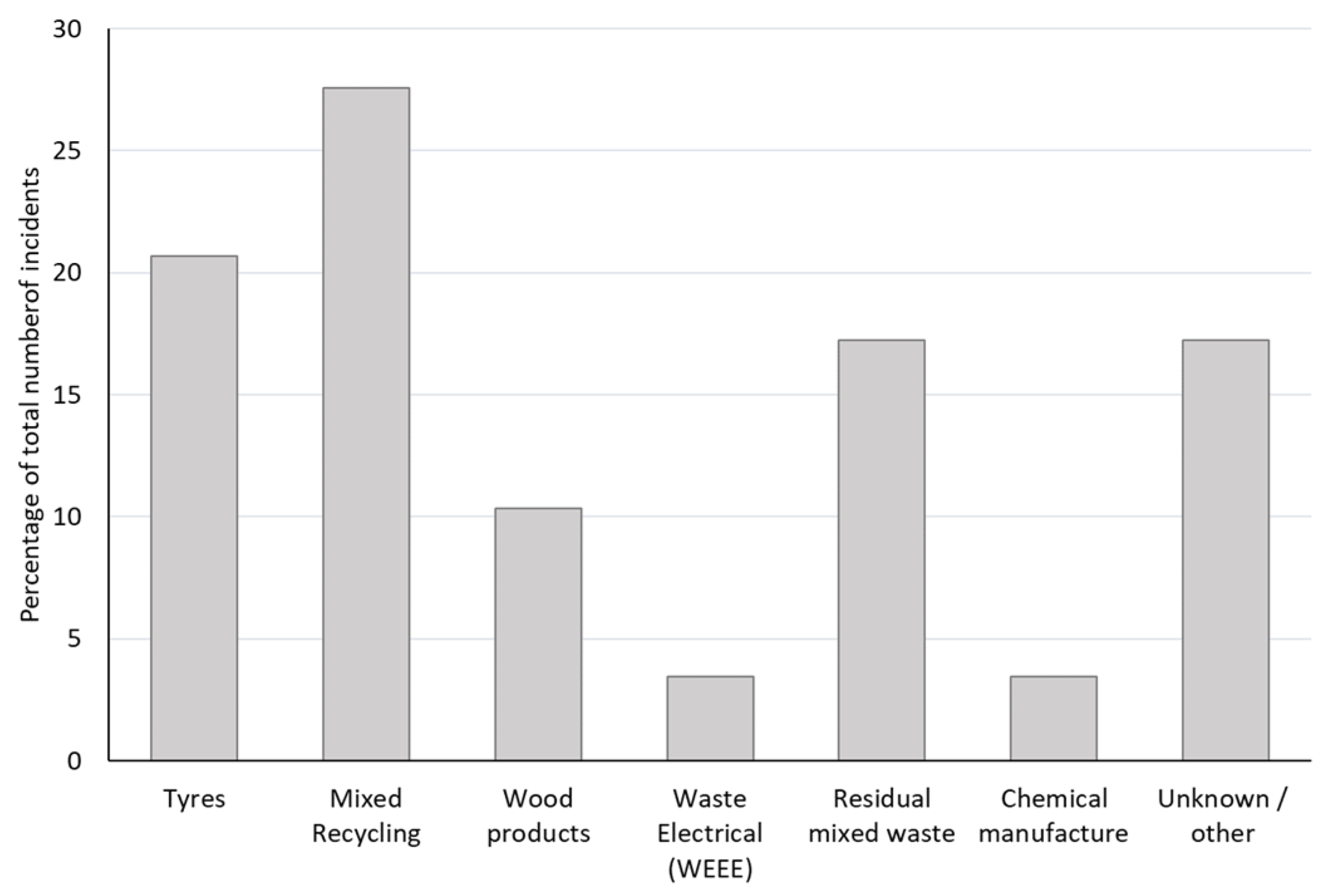
Figure 2.
Polar plot showing relative emissions for a range of different industrial fire source-materials. Replotted from Griffiths, et al. [1].
Figure 2.
Polar plot showing relative emissions for a range of different industrial fire source-materials. Replotted from Griffiths, et al. [1].
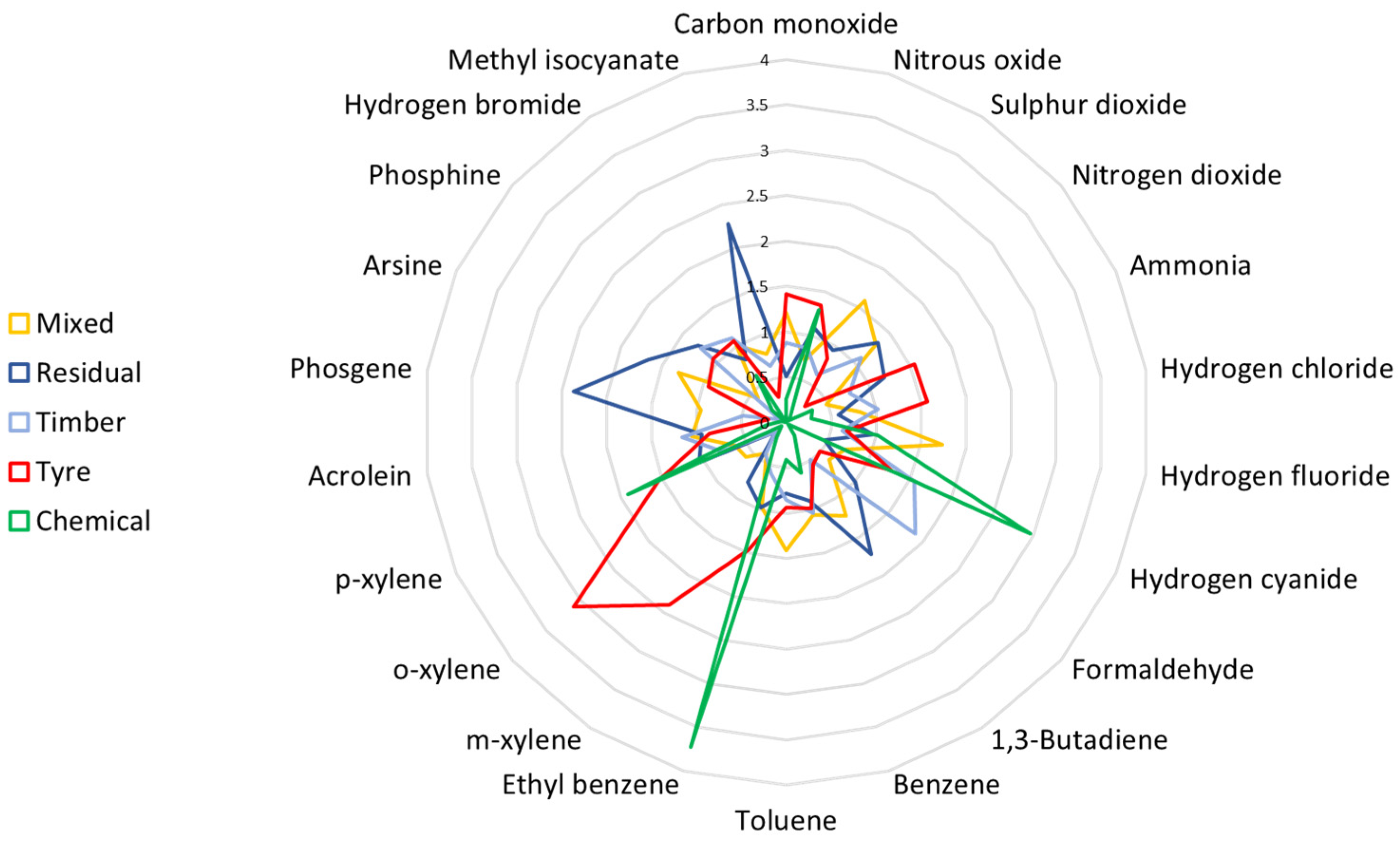
Table 1.
Emission rates of key airborne pollutants during the burning of materials that might typically be components of industrial fires. Summarised from Lemieux, et al. [13].
Table 1.
Emission rates of key airborne pollutants during the burning of materials that might typically be components of industrial fires. Summarised from Lemieux, et al. [13].
| Emission rates (mg kg-1 unless otherwise stated) for different categories of substance | |||||
|---|---|---|---|---|---|
| Material burning | VOCs | sVOCS | Carbonyls | PAHs | PCDDs/Fs |
| Fuel oil | Benzene, 1022; toluene,42; ethyltoluenes,22; xylenes, 25; 1,2,4-trimethylbenzene, 32. | Not listed | Formaldehyde, 303; acetaldehyde, 63; acrolein, 39; acetone, 35; benzaldehyde, 104. | Naphthalene, 162; acenaphthylene, 99; fluoranthene, 20; 1-methylfluorene, 26; anthracene, 15. | HpCDD, 7.07 x 10⁻⁵; OCDD, 1.34 x 10⁻⁴; TCDF, 2.05 x 10⁻⁴; HxCDF, 1.86 x 10⁻⁵ (data for crude oil). |
| Household waste | Benzene 980; styrene 527 ; toluene 372 ; ethylbenzene 182 ; chloromethane 163. |
Phenol 113 ; 3- or 4-cresol 44.1 ; 2-cresol 24.6 ; bis(2-ethylhexyl) phthalate 23.8 ; isophorone 9.3. | Formaldehyde 444 ; acetaldehyde 428 ; acetone 254 ; benzaldehyde 152 ; propionaldehyde 113. | Naphthalene 11.4 ; phenanthrene 5.3 ; fluorine 3.0 ; fluoranthene 2.8 ; chrysene 1.8. | Total PCDD/Fs: 5.8 x 10⁻³; TEQ‡ PCDD/Fs: 7.7 x 10⁻⁵; |
| Burning of scrap tyres | Benzene, 2180; toluene, 1368; styrene, 653; ethylbenzene, 378; limonene, 460. | Phenol, 533; 1-methylnaphthalene, 279; 2-methylnaphthalene, 390; bis(2-ethylhexyl)phthalate, 23.8; isophorone, 9.3. | Formaldehyde, 444; acetaldehyde, 428; acetone, 254; benzaldehyde, 152; propionaldehyde, 113. | Acenaphthene, 1368; naphthalene, 651; phenanthrene, 245; fluoranthene, 398; pyrene, 93. | Not listed |
| Automobile shredder residue | Toluene, 10690; benzene, 9584; styrene, 6528; ethylbenzene, 4964; chlorobenzene, 1718. | Bis(2-ethylhexyl) phthalate, 2058; benzenebutanenitrile, 3340; phenol, 990; benzaldehyde, 1690; 1,2-dichlorobenzene, 110. |
Not listed | Naphthylene, 883.3; acenaphthylene, 150.0; fluorene, 38.0; phenanthrene, 231.3; anthracene, 35.7. | TCDD; PeCDF, 1.40; TCDF, 1.80; HxCDF, 0.40; PeCDD, 0.30. |
| Wood burning (tropical forest) | Benzene, 400; toluene, 250; acetonitrile, 180; methyl chloride, 100; xylenes, 60. | Furan, 480; 2-methylfuran, 170; 3-furfural, 370; 2,5-dimethylfuran, 30; 3-methylfuran, 3. | Formaldehyde, 1400; methanol, 2000; acetaldehyde, 650; acetone, 620; 2,3-butanedione, 920; acrolein, 180. | Total PAHs, 25.0. | Total PCDDs/Fs, 0.0067) |
‡ Toxic equivalency.
Table 2.
Measured concentrations of the main organic, inorganic and particulate air pollutants released during a range of industrial fires.
Table 2.
Measured concentrations of the main organic, inorganic and particulate air pollutants released during a range of industrial fires.
| Incident or fire type | Details | Airborne pollutants and concentrations (if known) | Reference |
|---|---|---|---|
| Burning of polymeric materials | Qualitative data from a review of such fires |
CO, HCN, HCl/HBr/HF, NOx, SO2, organic irritants (acrolein/formaldehyde), inorganic irritants (phosgene/ammonia), PAHs, PCDD/Fs, PM (bold indicates likelihood of high concentrations relative to standards). | [14] |
| Burning of wood materials | Qualitative data from a review of such fires | NOx, acrolein/formaldehyde, PAHs, PCDD/Fs, PM | [14] |
| Burning of rubber tyres | Qualitative data from a review of such fires |
CO, HCN, HCl/HBr/HF, NOx, SO2, P2O5, organic irritants (acrolein/formaldehyde), inorganic irritants (phosgene/ammonia), PAHs, PCDD/Fs, PM (bold indicates likelihood of high concentrations relative to standards). | [14] |
| Burning of oil and petrol | Qualitative data from a review of such fires | SO2, organic irritants (acrolein/formaldehyde), PAHs, PCDD/Fs, PM (bold indicates likelihood of high concentrations relative to standards). | [14] |
| Tyre fires | Based on ambient monitoring carried out as part of the UK’s AQinMI service | Incident-mean concentrations (ppb for gases and µg m-3 for PM) with the maximum 1 min concentration in parentheses: CO, 0.58 (3.01); HCN, 0.09 (0.48); ammonia, 0.22 (1.07); HBr, 0.53 (2.76); HCl, 0.05 (0.47); HF, 0.02 (0.28); NO, 0.23 (0.42); NO2, 0.03 (0.74); phosgene, 0.01 (0.24); SO2, 0.08 (0.7); benzene, 0.16 (1.13); 1,3-butadiene, 0.03 (1.45); ethyl benzene, 0.08 (1.31); formaldehyde, 0.03 (0.2); methyl isocyanate, 0.02 (0.22); m-xylene, 0.02 (0.62); o-xylene, 0.1 (1.5); p-xylene, 0.09 (0.72); toluene, 0.16 (3.74); arsine, 0.02 (0.12); PM10, 115 (6527); PM2.5, 27.8 (652) | [1,5]‡ |
| Fires involving mixed recycling | Based on ambient monitoring carried out as part of the UK’s AQinMI service | Incident-mean concentrations (ppb for gases and µg m-3 for PM) with the maximum 1 min concentration in parentheses: CO, 0.78 (10.7); HCN, 0.17 (46.1); ammonia, 0.14 (4.74); HBr, 0.66 (5.66); HCl, 0.07 (66.2); HF, 0.08 (5.56); NO, 0.14 (2.32); NO2, 0.11 (0.77); phosgene, 0.17 (0.85); SO2, 0.68 (2.52); benzene, 0.2 (15.5); 1,3-butadiene, 0.49 (3.15); ethyl benzene, 0.1 (8.54); formaldehyde, 0.12 (0.88); methyl isocyanate, 0.01 (0.46); o-xylene, 0.01 (0.7); p-xylene, 0.23 (1.48); toluene, 0.36 (3.76); arsine, 0.01 (0.79); PM10, 83 (6527); PM2.5, 24.4 (652) | [1,5]‡ |
| Fires involving timber | Based on ambient monitoring carried out as part of the UK’s AQinMI service | Incident-mean concentrations (ppb for gases and µg m-3 for PM) with the maximum 1 min concentration in parentheses: CO, 0.48 (12.3); HCN, 0.23 (24.7); ammonia, 0.16 (11); HBr, 0.7 (44.3); HCl, 0.06 (11.2); HF, 0.07 (7.81); NO, 0.07 (2.21); NO2, 0.5 (147); phosgene, 0.25 (17.7); SO2, 0.09 (9.51); benzene, 0.24 (6.93); 1,3-butadiene, 0.16 (23.9); ethyl benzene, 0.08 (6.81); formaldehyde, 0.44 (23.5); methyl isocyanate, 0.01 (0.35); m-xylene, 0 (0.98); o-xylene, 0.01 (1.28); p-xylene, 0.2 (6.27); toluene, 0.34 (23.2); arsine, 0 (1.76); PM10, 28 (848); PM2.5, 12.6 (306) | [1,5]‡ |
| Fires involving WEEE materials | Based on ambient monitoring carried out as part of the UK’s AQinMI service | Incident-mean concentrations (ppb for gases and µg m-3 for PM) with the maximum 1 min concentration in parentheses: CO, 0.41 (2.58); HCN, 0.05 (0.49); ammonia, 0.03 (0.18); HBr, 0.52 (2.34); HCl, 0.02 (0.22); HF, 0.07 (0.31); NO, 0.04 (0.32); NO2, 0.04 (0.32); phosgene, 0.06 (0.39); SO2, 0.29 (0.82); benzene, 0.38 (1.34); 1,3-butadiene, 0.1 (0.73); ethyl benzene, 0.0 (0.07); formaldehyde, 0.02 (0.25); methyl isocyanate, 0.0 (0.0); m-xylene, 0.0 (0.08); o-xylene, 0.0 (0.0); p-xylene, 0.0 (0.0); toluene, 0.75 (1.78); arsine, 0.02 (0.13); PM10, 37.9 (174); PM2.5, 31.6 (154) | [1,5]‡ |
| Fires involving residual recycling materials | Based on ambient monitoring carried out as part of the UK’s AQinMI service | Incident-mean concentrations (ppb for gases and µg m-3 for PM) with the maximum 1 min concentration in parentheses: CO, 0.37 (16.3); HCN, 0.13 (17.4); ammonia, 0.25 (10.5); HBr, 0.98 (31.3); HCl, 0.03 (7.02); HF, 0.05 (2.48); NO, 0.11 (0.48); NO2, 0.44 (4.33); phosgene, 1.43 (9.23); SO2, 0.06 (0.69); benzene, 0.2 (4.21); 1,3-butadiene, 0.27 (25); ethyl benzene, 0.11 (3.04); formaldehyde, 0.15 (4.96); methyl isocyanate, 0.2 (1.45); m-xylene, 0.01 (0.86); p-xylene, 0.24 (4.91); toluene, 0.31 (9.02); arsine, 0.12 (0.9); PM10, 136.9 (6141); PM2.5, 79.1 (652) | [1,5]‡ |
| Landfill fires | Various controlled and uncontrolled landfill sites: the soils and vegetation adjacent to these sites were sampled for PAHs, and PCBs that had settled with the PM from the plume | Total PAHs ranged up to 300,000 µg kg-1 dry weight (dw), though typically concentrations were in the thousands of µg kg-1 (compared to reference concentrations ranging from 12 to 112 µg kg-1. PCDD/Fs total PCB concentrations ranged from 0.2 to 7,900 µg kg-1 dw. | [15] |
| Open-cut coal-mine fire in Latrobe, Victoria, Australia, February 2014 | Burned for 45 days, creating a dense plume that affecting ca. 45,000 residents in local towns. The most affected location was the nearest town of Morwell, 0.5 km from the mine. | Concentrations given are ranges observed during fire at the most affected location: PM2.5 5.4-731 µg m-3 for 24-h averaging period), CO (0-17.4 ppm); NO2 (2-44 ppb), SO2 (0-35 ppb); benzene (1.1-14 ppb for 24-h averaging period), toluene (0.5-4.8 ppm for 24-h averaging period), ethylbenzene (0.5-0.6 ppb for 24-h averaging period), xylenes (0.18-0.56 ppb for 7-d averaging period). 1,3-butadiene (0.5-2.5 ppb for 24-h averaging period), formaldehyde (1.4-7.6 ppb), B(a)P (0.1-8.2 ng m-3). | [16] |
| Fire at International Terminals Company Deer Park Chemical plant, Harris County, Texas, USA | Fire affected several tanks containing naphtha and xylene and burned for 3 days. |
benzene (highest recorded value of 32,000ppb in the industrial area, but measurements in the hundreds of ppb in other locations), isoprene (up to 1000 ppb), 1,3-butadiene (up to 1700 ppb), H2S (69.7 to 119.2 ppb) | [4] |
| Fire at a naphtha cracking complex of a petrochemical complex in Yunling County, Taiwan in May 2011. | Fire burned for 10 hours. The site is adjacent to a residential area of 61,600 people. | Ehylene (57 ppb), propane (7 ppb), butane (6 ppb), toluene (2 ppb), benzene (21 ppb), vinyl chloride monomer (389 ppb), 1,3-butadiene (35 ppb). | [17] |
| Landfill fire in Sweden | Test site at which there was a controlled fire for monitoring purposes, but where an unplanned fire also broke out. Monitoring was carried out for both. | Total PAHs 810 ng m-3, total PCBs, 590 ng m-3, PCDD/Fs 2.88 to 20.54 ng m-3 (0.051 to 0.427 ng m-3TEQ). | [15,18,19] |
| Fire at a pool chemical manufacturing facility in Guelph, Ontario, Canada in August 2000 | Initial explosion at the factory, followed by a fire that lasted for over 60-h |
HCl, average over the survey period was 22 µg m-3, with a maximum instantaneous value of 350 µg m-3 and chlorine gas were monitored over the period of the fire. For Cl2 the average was 12 µg m-3, with a maximum of 570 µg m-3. | [20] |
| Fire at oil storage depot at Buncefield, Hertfordshire, UK in December 2005. | The fire burned for 5 days, though the high combustion temperature gave rise to a very buoyant plume that crossed to mainland Europe. | m-and p-Xylene 230 ppb, o-xylene 140 ppb, toluene 160 ppb, benzene 170 ppb, ethyl benzene 82 ppb, PM10 1000 µg m-3. | [1,5] |
| Fire at Bellolampo Landfill, Palermo, Sicily, Italy | Fire extended to a surface area of up to 120,000 m2 and lasted 18 days. | Ambient monitoring stations recorded an average of 50 µg m-3 PM10 over the first 24-h, falling to 20 µg m-3 thereafter. Elevated air and soil concentrations of dioxins were determined in soil exposed to the plume, as well as in milk samples in affected farms. Elevated heavy metals concentrations detected in soils. | [21] |
‡including from supplementary material.
Table 4.
Review of studies that have modelled the release and dispersion of air pollutants from industrial fires or incidents.
Table 4.
Review of studies that have modelled the release and dispersion of air pollutants from industrial fires or incidents.
| Dispersion models (categorised by type) | Summary of study and results | Ref |
|---|---|---|
| Gaussian | ||
| ADMS (Atmospheric Dispersion Modelling System) | This was the simulation of the release of pollutants from a chemical warehouse fire that was contained within the building and where the emissions from a buoyant plume were made through roof vents and doors. The effect of the ADMS building module was studied. The results were compared to wind tunnel tests. | [36] |
| ADMS | Simulation of a fire at a car recycling plant. Particular focus was on parameters used, e.g., source temperature, area, exit velocity and emission rate. The best performance against monitoring data was for an area source. | [37] |
| UK CHEMET | Routinely used, particularly in the early phase of a fire to track the dispersion of plumes from fires or chemical releases. Basic model that calculates plume path. Larger incidents may also be modelled using NAME (see below). | [1,5] |
| EPA Screen Model; 3 | Simulation of worst case scenario for ground level concentrations of pollutants from an uncontrolled tyre dump fire (mg m-3): CO (674), PM (652) and PAH (24) concentrations 500m downwind of the fire. | [38] |
| General Gaussian plume model after first calculating the plume rise. | The study aimed to simulate concentrations of airborne contaminants in adjacent areas in the case of a fire at a chemical and pharmaceutical plant in Denmark. A range of different meteorological conditions were modelled. | [39] |
| CFD | ||
| CFD code coupled with a mesoscale metreological model | Simulation of PM emission during a hypothetical industrial fire. The CFD component was used to accurately parameterize the fire and developing plume, which was then modelled on a meso-scale using the meteorological model. The results were compared to a system where the CFD component was replaced by the ForeFire model. | [40] |
| CFD-RANS (Computational Fluid Dynamics Reynolds-Averaged Navier Stokes) | CFD-RANS was used to calculate dispersion for the accidental release of 900Kg of vinyl chloride monomer at an industrial facility. Modelling was restricted to the chemical facility boundaries, comparing the predicted concentrations with real monitoring data. Performance was considered satisfactory, especially given that there were uncertainties in wind direction. | [41] |
| Eulerian | ||
| TAPM (The Air Pollution Model, CSIRO), combined with a Chemical Transport Model | Open-cut coal mine fire in Latrobe, Victoria, Australia. Allowed the calculation of personalized mean 24-h (0-56 µg m-3) and peak 12-h (0-879 µg m-3) PM2.5 exposure for a range of participants who were also asked about health effects of the fire. | [6] |
| Lagrangian | ||
| HYSPLIT (Hybrid Single Particle Lagrangian Integrated Trajectory) | Fire at a naphtha cracking complex of a petrochemical complex in Yunling County, Taiwan in May 2011. Used back-trajectory model to trace monitored pollutants (propane, butane, toluene, benzene, vinyl chloride, 1,3-butadiene to the source of the fire from distances up to 10km. | [17] |
| HYSPLIT | Fire following bombing of industrial facilities in Serbia during the Kosovo war. Used in back-trajectory mode to identify the likely source of elevated concentrations of aerosol-bound PAHs, dioxins, and furans that were detected in Greece. | [42] |
| HYSPLIT | Modelling dispersion of pollutants at a fire involving six tanks of a 179-tank fuel storage facility in port of Santos, Brazil. Used in forward mode to calculate trajectories for the fire, with results showing that the plume was mainly carried out to sea, explaining the relatively small increases in PM10 observed at monitoring stations in the city. | [24] |
| HYSPLIT and PyTREX | Accidental release of methyl mercaptan from a chemical works in Rouen, France. Unknown emission rate, so a nominal concentration was modelled in forward mode to try and explain the very geographically and temporally separated reports of odour nuisance (in Paris and London and over a period of more than 24 hours). Both models gave similar results. | [43] |
| HYSPLIT | Fire at a chemical plant in Houston, Texas. Used in forward mode to predict a range of possible trajectories of the plume and identify which monitoring stations would have been subject to elevated airborne pollutants from the fire. | [4] |
| CALPUFF and SPRAY | Hypothetical refinery fire. Sensitivity analysis of the key model parameters that might affect the calculation of ground level concentrations of a (tracer) gas. Of the model parameters tested (source diameter, temperature, height and exit velocity), diameter was found to be the most sensitive. | [44] |
| CALPUFF | Burning of wood waste from trees killed by the Mountain Pine Beetle, British Columbia, Canada. Modelled the meteorological conditions, and distances from the centre of the city of Prince George, where wood burning could be permitted (based upon exceedances of the Canada standard for PM2.5). | [45] |
| ADMS-Star | Tyre fire at Mexborough, UK in 2010. Used back-calculation method to estimate emission rates. Predicted 24-h average concentrations for those exposed to the plume. Estimated that 7856 residents may have been exposed to PM10 concentrations in the US EPA AQI category of ‘Hazardous’ (>425 µg m-3). | [7] |
| NAME | Fire at fuel storage site (20 tanks) at Buncefield, Hertfordshire, UK. Used a nominal concentration of tracer gas in the model to allow calculation of the dispersion in three dimensions. Accurately modelled plume rise and geographical spread. Corroborated by satellite imagery. | [46] |
Table 5.
Summary of derived 1-h GVs for PM.
| Limit or guideline | 24-h concentration / µg m-3 | Derived 1-h concentration / µg m-3 (if available) |
|---|---|---|
| PM10 | ||
| CAQI‡ Low | 12 | 25‡ |
| CAQI Medium | 25 | 50‡ |
| CAQI High | 50 | 90‡ |
| CAQI Very High | 100 | 180‡ |
| WHO AQG⁕ | 45 | - |
| WHO Interim Target 4 / EU 24-h guideline | 50 | - |
| WHO Interim Target 3 | 75 | 109† |
| WHO Interim Target 2 | 100 | 146† |
| WHO Interim Target 1 | 150 | |
| US EPA AQI 100: Unhealthy for sensitive groups | 155 | 227† |
| US EPA AQIΨ 150: Unhealthy | 255 | 427† |
| US EPA AQI 200: Very unhealthy | 355 | 707† |
| US EPA AQI 300: Hazardous | 425 | 945† |
| UK threshold for evacuation | 320 | 510† |
| PM2.5 | ||
| CAQI Low | 10 | 15‡ |
| CAQI Medium | 20 | 30‡ |
| CAQI High | 30 | 55‡ |
| CAQI Very High | 60 | 110‡ |
| WHO AQG | 15 | - |
| WHO Interim Target 4 / EU 24-h guideline | 20 | - |
| WHO Interim Target 3 | 30 | 48† |
| WHO Interim Target 2 | 50 | 63† |
| WHO Interim Target 1 | 70 | 93† |
| US EPA AQI 100: Unhealthy for sensitive groups | 35 | 45† |
| US EPA AQI 150: Unhealthy | 55.5 | 70† |
| US EPA AQI 200: Very unhealthy | 150.5 | 183† |
| US EPA AQI 300: Hazardous | 250 | 345§ |
Disclaimer/Publisher’s Note: The statements, opinions and data contained in all publications are solely those of the individual author(s) and contributor(s) and not of MDPI and/or the editor(s). MDPI and/or the editor(s) disclaim responsibility for any injury to people or property resulting from any ideas, methods, instructions or products referred to in the content. |
© 2024 by the authors. Licensee MDPI, Basel, Switzerland. This article is an open access article distributed under the terms and conditions of the Creative Commons Attribution (CC BY) license (http://creativecommons.org/licenses/by/4.0/).
Copyright: This open access article is published under a Creative Commons CC BY 4.0 license, which permit the free download, distribution, and reuse, provided that the author and preprint are cited in any reuse.


