

Submitted:
06 June 2024
Posted:
11 June 2024
You are already at the latest version
Abstract
According to the International Union for Conservation of Nature Red List, the scalloped hammerhead (Sphyrna lewini) is a critically endangered species, primarily due to intense fishing and other anthropogenic effects such as pollution. Nowadays, plastic debris contamination is a subject of concern due to its extensive presence in the sea and the digestive tracts of many fish species. The possible effects of plastic debris as a vector of other pollutants are still unknown. We analyzed the digestive tract of hammerhead sharks to investigate the correlation between plastic and other anthropic debris contamination and feeding habits in the eastern region of the Gulf of California. A total of 58 specimens were analyzed from the coastal area, revealing a plastic occurrence frequency of 79.3%. Of these, 91.4% corresponded to fibers, and 8.6% to fragments. The composition of the polymers was primarily cellulose (64.4%). According to their diet, these organisms exhibit benthopelagic habits, feeding both in the water column and on the seabed. These results indicate a high level of contamination of anthropogenic cellulosic microfibers in the area. This changed according to the year, indicating that the anthropic debris ingestion is related to the discharges of human activities and their seasonality rather than to a selection process by the sharks. Although cellulosic microfibers are recognized as a biomaterial, they can harm marine species, posing an additional threat to this iconic shark.
Keywords:
marine litter
; plastic debris
; shark feeding
; polymers
; cellulose-based fibers
; cotton
; microplastics
1. Introduction
The flow of anthropic particles such as plastics into the ocean is expected to reach 29 million metric tons per year shortly [1]. With the accelerating plastic production, the pressure on ecosystems on land and sea is steadily increasing [2], and plastic debris has been reported in virtually all marine and coastal ecosystems [3,4,5]. Over time, this debris fragments into smaller pieces, such as microplastics, due to physical, biological, and chemical processes, increasing its availability to a broader range of organisms [6]. Therefore, plastic ingestion has already been reported in various marine trophic groups, including bony fishes and batoids in the studied area[7,8].
However, despite recent advances in research on plastic ingestion in marine fauna, its consequences in top marine predators remain largely uninvestigated[9,10,11]. Unlike lower trophic levels, top marine predators face not only the direct ingestion of plastics but also the potential transfer and bioaccumulation of plastics across trophic levels. This could explain the high levels of contaminants found in top predatory fish species [12,13].
Specifically for sharks, there are few studies on plastic ingestion despite the important role these species play in the food web structure [14,15,16]. Sharks are also considered a sentinel group in marine pollution monitoring because of their position as apex predators and potential exposure to bioaccumulation [17]. While a small number of studies confirm the ingestion of plastics in sharks in various geographic regions [9,11,14,16], no information has been obtained about the scalloped hammerhead shark (Sphyrna lewini), a widely distributed and critically endangered species with declining numbers in many parts of its geographical range [18]. There are reports that this species ingests macroplastics, although it is not specified what type[19]. However, studies assessing plastic ingestion in the Gulf of California for this species are nonexistent.
The scalloped hammerhead shark is a circumtropical semi-coastal species [20], with juveniles inhabiting shallow coastal zones where they feed on benthic fish and crustaceans [21,22]. Coastal waters are particularly susceptible to plastic contamination due to the high input of plastic debris from land-based sources [23,24]. This situation can lead to prolonged exposure to contaminants during the maturation of juvenile sharks [25]. Specifically, the feeding strategy of juvenile hammerheads makes them highly susceptible to ingesting dense polymer particles that accumulate on the seafloor. This accumulation forms a significant source of contamination for predators that feed on bottom-dwelling prey[26].
This study evaluated juvenile scalloped hammerhead sharks' ingestion of plastic debris in the southeastern Gulf of California. Previous studies have reported a high presence of plastic debris in coastal sediments in this area[8,27]. Hence, the presence of plastics in the gastrointestinal tract of sharks is expected. We attempted to investigate the quantity and type of plastic ingested, determine differences in feeding habits, and assess the frequency of plastic ingestion.
2. Materials and Methods
Juveniles of scalloped hammerhead sharks were caught off the estuarine system of Santa Maria la Reforma (southeastern Gulf of California). Despite the arid and dry climate of the area, significant agricultural and shrimp farming activities take place [28], and intensive small-scale fisheries are also developed there [29]. The system has an area of 53,140 m² [30]. and is classified as a Type III 5 wave-dominated estuary with a barrier island and two large inlets that have permanent exchange with the sea [31]. Specimens used in this study were caught over two years and five months (from September 2019 to March 2022) at random intervals in two fishing grounds. One location is at 25.035038° N, -108.464851° W, where shark fishing vessels operate, and the other is at 25.099534° N, -108.418764° W, where specimens were selected from the bycatch of the small-scale Pacific Sierra (Scomberomorus sierra) fishery. The fishing operations utilized surface gillnets deployed from small-scale boats denominated skiffs or Mexican pangas [32] equipped with 90-hp outboard engines. The individuals were placed on ice and transported to the laboratory, where they were kept frozen at -10°C.
The sex, weight (g), and total length (cm) of every specimen were recorded. Gastrointestinal tracts were removed from each shark from the top of the esophagus to the rectum. Stomach content analysis was conducted to identify prey items and anthropic residues, following a methodology with some modifications proposed by Barletta et al.[23]. Precautions were taken to prevent contamination of samples with plastic or other anthropic debris from supplementary sources: (1) Access to the laboratory facilities was restricted, and personnel wore 100% cotton lab coats and disposable nitrile gloves during all steps of the procedure; (2) Before use, work surfaces and equipment were thoroughly cleansed with filtered distilled water, and all equipment was oven-dried and checked for contamination. (3) Blank controls were conducted throughout all stages of the procedure by placing two clean Petri dishes near the work area. These dishes were filtered and analyzed between samples to identify any potential contamination from the laboratory atmosphere, following the procedure described by Barboza et al.[33].
As well-established and tested protocols for extracting anthropic debris from the tissue of large marine predators are limited, this study established a methodology based on a selection of protocols [34,35,36]. Firstly, to avoid contamination of the samples by external particles, the presence of plastic objects near the work area was avoided, 100% cotton clothes were used, and all glassware, aluminum boats, Whatman ® filters were put under previous treatment under the oven at 400 ◦C for 4 h, the glassware, weighing dishes, and dissection equipment were rinsed with methanol, acetone, and finally with distilled water before use, which as well were filtered using a 1.2 μm Whatman® GF/C fiberglass filter. Finally, microscopic observation and filtration were performed inside special plastic cabinets to avoid contamination of the samples, and a clean Petri dish was placed inside the working area for each set of samples as a blank, which remained open when the sample was exposed to the environment [37,38,39].
Gastrointestinal contents from each stomach and intestine were examined under a stereoscopic microscope (Zeiss Stemi 508), and any ingested particles suspected of being plastic were isolated using tweezers. Prey items were counted, weighed, and grouped into taxonomic categories. After the prey items were digested, the counts were based on identifiable parts, such as otoliths for fish, claws, and legs for crustaceans, and beaks for cephalopods[40]. Upon identifying both suspected plastic particles and prey items in the organic tissue, the stomach and intestine lining were scraped with a scalpel and washed with distilled water to collect all potential anthropic debris attached to the tissue. Scraped-off and washed materials were collected in a Petri dish and placed on a heating plate.
After being left to evaporate excess water for 24 hours, the samples were subjected to chemical digestion using a solution of 30% hydrogen peroxide for 12 hours at room temperature[36]. Following chemical digestion, the resulting liquid was filtered through 10 µm filters with a 4.7 cm diameter using a suction pump. The filters were then inspected under a stereoscopic microscope fitted with a Zeiss AxioCam ERC 5s digital camera for the presence of plastic particles that could not be identified in the previous steps. Only those particles that met the physical characteristics established in the "Microplastics Identification Guide" [41] were quantified and classified for subsequent analysis by microscope Fourier transform infrared spectroscopy using an attenuated total reflectance accessory (μ-FTIR-ATR). The particles were classified according to their shape (fibers and fragments), color, and size. For each particle that was identified as a potential plastic particle, a single image was captured using the Zeiss ZEN imaging software. This image was then used for subsequent measurements of the particle's length and width.
The samples were analyzed via μ-FTIR-ATR using Nicolet™ iN™ 10 equipment with a diamond crystal (D-SlidIR) and a mercury cadmium telluride detector cooled by liquid nitrogen. The samples were read at a pressure between 15 and 25 psi, with an aperture between 150 × 150 μm and 250 × 250 μm. The spectra were recorded as the average of 16 scans in the spectral range of 650–4000 cm-1 at a high resolution of 4 cm-1. At least 60% of the particles were classified as possible MPs from each site, and 100% of the particles found in the blank controls were analyzed via μ-FTIR-ATR.
To investigate ontogenetic changes in diet, size groups of the scalloped hammerhead shark were identified using length-frequency polygons generated through a Kernel Density Estimate (KDE) [42]Using the equation 1:
Where h is the bandwidth and K(x) is the Gaussian kernel function. The Sheather-Jones bandwidth selection method for kernel density estimation was utilized[7]. The KDE procedure was performed using the freely distributed software RStudio Version 1.2.1355 (RStudio Team, 2020) and Matlab R2021a (The MathWorks, 2021). The mean and standard deviation were calculated for each cohort identified.
To determine if the sample size was adequate to describe the diet of each size class of the scalloped hammerhead shark, randomized cumulative prey curves were constructed for each shark to assess the representativeness of the sampling effort. The order in which samples were analyzed was randomized 1000 times for each new cumulative prey item sample using Chao's 2 estimator to determine the absolute number of prey items. It is based on the number of rare species found in a sample[43], and the notation is in equation 2:
Where S2 is the estimated number of prey species, Sobs is the observed number of prey species in the stomach, Q1 is the number of singletons (taxa represented by a single occurrence in the field campaign), and Q2 is the number of doubletons (two or more occurrences in the field campaign) [44]. When a cumulative prey curve approaches an asymptote, the number of stomachs analyzed is deemed adequate for describing the dietary habits of the predator under study. The asymptote of the curve represents the minimum sample size necessary to adequately describe the diet.
To quantify the significance of prey items and anthropic debris in the diet of hammerhead sharks, an abundance matrix was constructed, comprising the relative abundance of prey items and polymers. This matrix included every analyzed hammerhead shark as columns and prey and polymer items as rows. As the quantity of prey and anthropic debris in the gut varies considerably between individual sharks, a multivariate comparison would not be relevant. Therefore, the data was sample-standardized, as the unit of sampling cannot be tightly controlled [44]. After standardizing, the samples were expressed as a percentage composition of each prey and anthropic debris category, with each column adding to 100. Subsequently, Bray-Curtis similarity matrices were generated from this dataset, considering sex, size, and sampling years as factors. To test the null hypothesis (H0) that the diet and ingestion of anthropic debris of the analyzed species did not differ according to these factors, PERMANOVA+ was employed [44]. In the event of significant differences, a Canonical Analysis of Principal Coordinates (CAP) [44] was undertaken. This method enables the construction of a constrained ordination based on any distance or dissimilarity measure, which displays a cloud of multivariate points following a specific a priori hypothesis.
Prey items and anthropic debris polymers were overlaid as vectors on top of the CAP to determine their importance according to the factors, in case significant results were found. The trajectory of the vector can be interpreted to indicate the importance of each prey or polymer to the diet of the hammerhead shark according to certain factors. Both axes have a scale from –n to n, in which the point 0,0 is the centroid- the location where all the points would be located if the null hypothesis was true, or in this case if a certain prey or polymer item would not differ according to any factor a priori established [44].
3. Results
A total of 58 juvenile scalloped hammerhead sharks were captured and subjected to analysis. The mean total length (TL) was 76.4 cm (SD = 15.9), while the mean weight was 2287.2 g (SD = 1545.7). Of these, 33 were females and 25 were males. Four distinct cohorts were identified with the KDE function: extra small (48.4-57.5 cm), small (57.6-78.7 cm), medium (78.8-108.9 cm), and large (109-121 cm).
3.1. Prey and plastic ingestion.
Of the 58 stomachs examined, 41 had prey items (70.7%) and 46 individuals had possible plastic debris (79.3%). Three prey groups were found: teleost fish had the highest frequency of occurrence with 64.3%, followed by decapod crustaceans with 28.6%, and cephalopods (squids) with 4.8%. A total of 1924 pieces of debris were found in the gastrointestinal tract of scalloped hammerheads. Of these, 1758 were fibers (91.4%) and 166 were fragments (8.6%). Lengths ranged from 0.024 mm to 7.087 mm. The dominant colors after chemical digestion were blue (43.15%), followed by black (29.04%), red (8.33%), transparent (6.45%), yellow (5.29%), and gray (4.52%), while orange, brown, white, and green accounted for the remaining 3.22% (Table 1) (Figure 1).
The potential presence of anthropic debris was investigated using Fourier transform infrared spectroscopy with attenuated total reflection (FTIR-ATR). This analytical technique enables the identification of the functional groups present in a given compound [45] A total of 457 particles (23.8%) were examined. Due to budget restrictions, not all particles could be analyzed. These results were extrapolated to all the obtained particles. Of the total of the particles analyzed 24.9% did not match with any polymer and were reported as not identified (NI). When leaving these particles out, the remaining particles indicate the presence of eight distinct polymer types. Cellulose was identified as the most abundant polymer, occurring with a frequency of 64.4%. This compound is commonly used in the textile industry. Cellulose is also an important component of cigarette butts. This was followed by PET, which constituted 12.8%, a polymer that is abundant in the environment due to its use in water or soda bottles. Cotton and polyester were detected in 12.5% and 3.8% respectively, these polymers are widely used in the textile industry. Cellophane is a polymer commonly manufactured for bags used to store food and constitutes 3.2% of the total. The remaining materials were polypropylene at 1.2%, which is used for ropes in fishing gear as well as a component of face masks, and acrylic at 1.2%, which is a polymer widely used in fishing gear for many fisheries globally. In the region, the material is employed in the manufacture of fishing rods used to catch tuna. And rayon at 0.9% a compound used mainly in fabrics for the textile industry (for further details, please refer to Figure 2 and Table 2).
Chao's estimator indicated that the number of stomachs analyzed was representative of a meaningful statistical analysis of diet. The diet and anthropic ingestion of this species were not found to be significantly related to sex (Pseudo-F1,71 = 0.67243, p < 0.05), size (Pseudo-F2,71 = 1.1862, p < 0.05), or any of the interactions (size-sex Pseudo-F2,71 = 1.002, p < 0.05; size-year Pseudo-F1,71 = 1.52, p < 0.05; sex-year Pseudo-F2,71 = 0.61, p < 0.05; size-sex-year Pseudo-F3,71 = 1.31, p < 0.05). However, differences were found according to year (Pseudo-F2,71 = 2.01, p > 0.05). Pairwise comparisons revealed that the years 2019 and 2020 were not statistically different from one another. However, all other combinations were statistically distinct (see supplementary material Table 1).
These results were confirmed by CAP, as no distinct groups were formed based on the factors of size and sex but clear groups were formed according to year (Figure 3). In terms of prey, decapod crustaceans were eaten mainly during the years 2019-2020 and 2022, whilst squid was eaten during the year 2021. Fish were eaten in all years according to the vectors. In terms of polymers, the vectors of cotton, cellophane, rayon, and acrylic were close to the centroid, indicating that they were consumed similarly in different years. Cellulose was more present during the years 2019-2020, PET had a higher presence during the years 2021-2022, polypropylene had a higher presence during the year 2022, and polyester had a higher presence from 2019 to 2021.
4. Discussion
This study marks the first time that anthropogenic debris contamination in the gastrointestinal tract of juvenile scalloped hammerhead sharks in the Gulf of California has been assessed. Also provides the first data on the presence of microplastics and other anthropogenic debris in this species, contributing to the documentation of the presence of plastic debris in the Gulf of California. This is a region where the presence of plastic in coastal sediments and fish has been reported [8,27].
The extensive use and improper disposal of anthropogenic products as litter have led to their presence in estuarine and marine habitats [46]. This has resulted in the ingestion of these products by marine organisms becoming a common phenomenon. Juvenile hammerhead sharks remain in coastal environments for extended periods to feed and seek refuge from other predators [25], making them vulnerable to ingesting debris particles resulting from anthropogenic activities in these areas.
The diet observed in this and other studies for hammerhead sharks, which includes fish, benthic crustaceans, and coastal cephalopods [21,47], confirms that juvenile sharks are benthopelagic feeders. Hammerhead sharks feed both in the water column and at the bottom, which makes them vulnerable to consuming debris found on the seafloor and in the water column. The high frequency of occurrence of microplastics and other anthropic particles (79.3%) corroborates this observation. Plastic debris and anthropic particles with high-density sinks accumulate on the seabed [48]. The present study found a higher frequency of occurrence than in Haller's round ray for the same area [8]. This suggests that the hammerhead shark's predation in the neritic area also contributes to a higher occurrence of anthropic particles. This is because this species feeds in the water column[49].
The majority of the debris found in the gastrointestinal tract of the hammerhead shark consisted of fibers, as reported in previous studies [50,51,52,53]. This may be because fibers are widely used in various human activities, including clothing (textiles), fisheries, civil engineering (geotextiles), and agriculture. As a result, their production has increased by approximately 2% per year, and they are now found in aquatic and terrestrial environments [54]. These microfibers are transported through wastewater systems to treatment plants and through the atmosphere into aquatic systems, where they accumulate in the oceans and shorelines [55]. This can pose a significant risk of environmental contamination and organisms.
In terms of the components of the debris found, the most common material was cellulose. Cellulose is not a microplastic, it is a natural polymer that can be considered an anthropogenic particle found in the environment. The current focus of marine research is on the issue of plastic pollution[56,57,58,59]. It has been discovered that synthetic cellulose fibers are also prevalent [60]. In the past, these fibers were often confused with petroleum-based plastic fibers because was assumed that all fibers are plastics. However, recent studies have begun to distinguish between fibers of cellulosic polymers and synthetic textile fibers [61]. They are harvested from natural resources and manufactured from cellulosic materials. For example, rayon is manufactured using viscose, from cellulose, a natural component found in plants, it undergoes several chemical processes to transform into its final form, making it a semisynthetic fiber [51]. These fibers from natural polymers are anthropogenic particles with unknown environmental issues, additives or dyes associated with them could potentially be harmful to marine organisms [61].
Another source of cellulose that is often overlooked is cigarette butts. These constitute one of the most common types of litter in urban areas, with an estimated 4.5 trillion discarded annually, representing 22-46% of visible litter [62]. Once discarded, they are transported by rain or rivers to coastal areas [63]. Cigarette butts are composed of nearly 95% microscopic-sized fibrous cellulose acetate. Although it is a photodegradable polymer, it does not degrade easily and may persist in the environment for more than ten years [62]. Currently, there is still no sustainable disposal method or recycling technology established for this waste.
Polyester, which accounted for over 3.8%, is also used in textiles. This indicates that over 80% of textile particles were found in the gastrointestinal tract of hammerhead sharks. As previously stated, debris originating from textiles is transported from households to rivers and eventually to the ocean through the wastewater systems of cities. Unfortunately, water treatment plants typically lack filters designed to capture these particles. The influx of plastic debris from textiles is a significant concern in terms of contaminating coastal environments with airborne particulates.
The other fibers found were consistent with plastics commonly used by fishers, such as plastic bottles for water, sodas, and other beverages, plastic bags, and fishing gear. These anthropogenic factors contribute to the presence of plastic and other anthropic particles in the region. From these particles is interesting that the results indicate that the highest presence of polypropylene, one of the main components of face masks, was in the year 2022, two years after the start of the COVID-19 pandemic. During this global health crisis, the use of personal protection equipment (PPE) to safeguard the human population was very prominent, which resulted in vast plastic pollution to the marine environment [64,65,66]. Face masks were effective and cheap protective equipment widely used, with polypropylene as their major component [67]. It has been studied that face masks can release fibers if they are discarded into the environment and with their gradual aging and decomposition, the whole mask would completely become microplastics [68]. Although these results are not conclusive, likely, the increase of this polymer in the digestive tracts of the analyzed hammerhead sharks is a consequence of the pollution derived from the COVID-19 pandemic.
The studied area is considered the largest estuarine system in northwest Mexico and a very important fishing ground in the Gulf of California. It is highly productive in terms of fishing and the economic activities derived from it. However, fisheries can be considered an anthropogenic activity with a significant effect on microplastic pollution due to the materials used in their fishing gears and other associated contamination, along with the wastewater from nearby cities [69]. Furthermore, given the importance of the industry to the local economy, the estuarine system is situated close to human settlements, increasing the risk of contamination.
5. Conclusions
Juveniles of scalloped hammerhead sharks spend extended periods in coastal environments, making them vulnerable to accidentally ingesting microfibers due to their presence in the water column and on the seafloor. Especially for anthropogenic cellulose fibers, this polymer has become a major component of this type of microplastic pollution. Although they are considered natural fibers, the additives or dyes attached to them may affect the organisms inhabiting aquatic environments. Additionally, in the case of polypropylene fibers, we cannot conclude with certainty that this is a post-COVID-19 pandemic consequence, but their appearance suggests a potential correlation.
For this reason, it is necessary to expand our understanding of these (MPs and anthropogenic fibers) emerging pollutants to comprehend their potential impact on marine organisms. Further analysis of other marine species in the area during this period is needed to indicate if these findings are a consequence of the wide use of face masks at the time.
Supplementary Materials
The following supporting information can be downloaded at the website of this paper posted on Preprints.org. Table S1: title.
Author Contributions
“Conceptualization, L.R.M. and F.A.; methodology, L.M., X.G., L.R.M., J.R.R.H., R.C.G. and F.A.; software, F.A.; validation, L.R.M., J.R.R.H., R.C.G. and F.A; formal analysis, L.M., X.G. L.R.M. and F.A.; investigation, L.M., L.R.M. and F.A.; resources, L.M., L.R.M. and F.A.; data curation, L.M., X.G., L.R.M., J.R.R.H., R.C.G. and F.A.; writing—original draft preparation, L.M. and F.A.; writing—review and editing, X.G., L.R.M., J.R.R.H., R.C.G. and F.A.; visualization, L.R.M. and F.A.; supervision, L.R.M. and F.A.; project administration, F.A.; funding acquisition, L.M. and F.A. All authors have read and agreed to the published version of the manuscript.” Please turn to the CRediT taxonomy for the term explanation.
Funding
The Institute of Marine Sciences and Limnology (ICML) from the National Autonomous University of México (UNAM), funded the sapling program and laboratory research and analysis through the COVID-19 research grant, and paid the processing charge fee for this article.
Institutional Review Board Statement
“The animal study protocol was approved by the Ethics Committee of the Instituto de Ciencias del Mar y Limnología on May 28th 2024.”
Informed Consent Statement
“Not applicable.”
Data Availability Statement
Data supporting reported results can be found at https://www.icmyl.unam.mx/uninmar/
Acknowledgments
We thank C. Suarez for their help in the sampling, analysis and edition of the final manuscript. We also thank A. Garcia for providing the shark specimens.
Conflicts of Interest
“The authors declare no conflicts of interest.”
References
- Plastics Europe AISBL Plastics-the-Fast-Facts-2023. Available online: https://plasticseurope.org/es/wp-content/uploads/sites/4/2023/10/Plastics-the-fast-Facts-2023.pdf (accessed on 29 August 2023).
- Ostle, C.; Thompson, R.C.; Broughton, D.; Gregory, L.; Wootton, M.; Johns, D.G. The Rise in Ocean Plastics Evidenced from a 60-Year Time Series. Nat Commun 2019, 10. [Google Scholar] [CrossRef] [PubMed]
- Barletta, M.; Lima, A.R.A. Systematic Review of Fish Ecology and Anthropogenic Impacts in South American Estuaries: Setting Priorities for Ecosystem Conservation. Front Mar Sci 2019, 6. [Google Scholar] [CrossRef]
- Gago, J.; Galgani, F.; Maes, T.; Thompson, R.C. Microplastics in Seawater: Recommendations from the Marine Strategy Framework Directive Implementation Process. Front Mar Sci 2016, 3. [Google Scholar] [CrossRef]
- Shim, W.J.; Thomposon, R.C. Microplastics in the Ocean. Arch Environ Contam Toxicol 2015, 69. [Google Scholar] [CrossRef]
- Pirsaheb, M.; Hossini, H.; Makhdoumi, P. Review of Microplastic Occurrence and Toxicological Effects in Marine Environment: Experimental Evidence of Inflammation. Process Safety and Environmental Protection 2020, 142, 1–14. [Google Scholar] [CrossRef]
- Salazar-Pérez, C.; Amezcua, F.; Rosales-Valencia, A.; Green, L.; Pollorena-Melendrez, J.E.; Sarmiento-Martínez, M.A.; Tomita Ramírez, I.; Gil-Manrique, B.D.; Hernandez-Lozano, M.Y.; Muro-Torres, V.M.; et al. First Insight into Plastics Ingestion by Fish in the Gulf of California, Mexico. Mar Pollut Bull 2021, 171. [Google Scholar] [CrossRef] [PubMed]
- Pinho, I.; Amezcua, F.; Rivera, J.M.; Green-Ruiz, C.; Piñón-Colin, T. de J.; Wakida, F. First Report of Plastic Contamination in Batoids: Plastic Ingestion by Haller’s Round Ray (Urobatis Halleri) in the Gulf of California. Environ Res 2022, 211. [Google Scholar] [CrossRef] [PubMed]
- Bernardini, I.; Garibaldi, F.; Canesi, L.; Fossi, M.C.; Baini, M. First Data on Plastic Ingestion by Blue Sharks (Prionace Glauca) from the Ligurian Sea (North-Western Mediterranean Sea). Mar Pollut Bull 2018, 135, 303–310. [Google Scholar] [CrossRef]
- Sampaio, C.L.S.; Leite, L.; Reis-Filho, J.A.; Loiola, M.; Miranda, R.J.; de Anchieta, C.C. Nunes, J.; Macena, B.C.L. New Insights into Whale Shark Rhincodon Typus Diet in Brazil: An Observation of Ram Filter-Feeding on Crab Larvae and Analysis of Stomach Contents from the First Stranding in Bahia State. Environ Biol Fishes 2018, 101, 1285–1293. [Google Scholar] [CrossRef]
- Smith, L.E. Plastic Ingestion by Scyliorhinus Canicula Trawl Captured in the North Sea. Mar Pollut Bull 2018, 130, 6–7. [Google Scholar] [CrossRef] [PubMed]
- Nelms, S.E.; Galloway, T.S.; Godley, B.J.; Jarvis, D.S.; Lindeque, P.K. Investigating Microplastic Trophic Transfer in Marine Top Predators. Environmental Pollution 2018, 238, 999–1007. [Google Scholar] [CrossRef] [PubMed]
- Setälä, O.; Fleming-Lehtinen, V.; Lehtiniemi, M. Ingestion and Transfer of Microplastics in the Planktonic Food Web. Environmental Pollution 2014, 185, 77–83. [Google Scholar] [CrossRef] [PubMed]
- Alomar, C.; Deudero, S. Evidence of Microplastic Ingestion in the Shark Galeus Melastomus Rafinesque, 1810 in the Continental Shelf off the Western Mediterranean Sea. Environmental Pollution 2017, 223, 223–229. [Google Scholar] [CrossRef] [PubMed]
- Hussey, N.E.; MacNeil, M.A.; Siple, M.C.; Popp, B.N.; Dudley, S.F.J.; Fisk, A.T. Expanded Trophic Complexity among Large Sharks. Food Webs 2015, 4, 1–7. [Google Scholar] [CrossRef]
- Maes, T.; van Diemen de Jel, J.; Vethaak, A.D.; Desender, M.; Bendall, V.A.; van Velzen, M.; Leslie, H.A. You Are What You Eat, Microplastics in Porbeagle Sharks From the North East Atlantic: Method Development and Analysis in Spiral Valve Content and Tissue. Front Mar Sci 2020, 7. [Google Scholar] [CrossRef]
- Alves, L.M.F.; Nunes, M.; Marchand, P.; Le Bizec, B.; Mendes, S.; Correia, J.P.S.; Lemos, M.F.L.; Novais, S.C. Blue Sharks (Prionace Glauca) as Bioindicators of Pollution and Health in the Atlantic Ocean: Contamination Levels and Biochemical Stress Responses. Science of the Total Environment 2016, 563–564, 282–292. [Google Scholar] [CrossRef] [PubMed]
- Rigby, C.L.; Dulvy, N.K.; Carlson, J.; Fernando, D.; Jabado, S.; Liu, R.W.; Marshall; Romanov, N.; Sherley; Winker, R.B.& Scalloped Hammerhead (Sphyrna Lewini) Supplementary Information for Sphyrna Lewini.
- Cliff, G.; Dudley, S.F.J.; Ryan, P.G.; Singleton, N. Large Sharks and Plastic Debris in KwaZulu-Natal, South Africa. In Proceedings of the Marine and Freshwater Research; 2002; Vol. 53; pp. 575–581. [Google Scholar]
- Compagno, L. FAO Species Catalogue. Vol. 4. Sharks of the World. An Annotated and Illustratred Catalogue of Shark Species Known to Date. Part 1. Hexanchiformes to Lamniformes. FAO Fisheries Synopsis 1984, 4, 1–249. [Google Scholar]
- Torres-Rojas, Y.E.; Hernández-Herrera, A.; Galván-Magaña, F.; Alatorre-Ramírez, V.G. Stomach Content Analysis of Juvenile, Scalloped Hammerhead Shark Sphyrna Lewini Captured off the Coast of Mazatlán, Mexico. Aquat Ecol 2010, 44, 301–308. [Google Scholar] [CrossRef]
- Piercy, A.N.; Carlson, J.K.; Sulikowski, J.A.; Burgess, G.H. Age and Growth of the Scalloped Hammerhead Shark, Sphyrna Lewini, in the North-West Atlantic Ocean and Gulf of Mexico. Marine and Freshwater Research 2007, 58, 34–40. [Google Scholar] [CrossRef]
- Barletta, M.; Costa, M.F.; Dantas, D. V. Ecology of Microplastics Contamination within Food Webs of Estuarine and Coastal Ecosystems. MethodsX 2020, 7. [Google Scholar] [CrossRef] [PubMed]
- Browne, M.A. Sources and Pathways of Microplastics to Habitats. Marine anthropogenic litter 2015, 229–244. [Google Scholar]
- Galván-Magaña, F.; Castillo-Geniz, J.L.; Hoyos-Padilla, M.; Ketchum, J.; Klimley, A.P.; Ramírez-Amaro, S.; Torres-Rojas, Y.E.; Tovar-Ávila, J. Shark Ecology, the Role of the Apex Predator and Current Conservation Status. Adv Mar Biol 2019, 83, 61–114. [Google Scholar] [CrossRef] [PubMed]
- Bravo Rebolledo, E.L.; Van Franeker, J.A.; Jansen, O.E.; Brasseur, S.M.J.M. Plastic Ingestion by Harbour Seals (Phoca Vitulina) in The Netherlands. Mar Pollut Bull 2013, 67, 200–202. [Google Scholar] [CrossRef] [PubMed]
- Alvarez-Zeferino, J.C.; Ojeda-Benítez, S.; Cruz-Salas, A.A.; Martínez-Salvador, C.; Vázquez-Morillas, A. Microplastics in Mexican Beaches. Resour Conserv Recycl 2020, 155, 104633. [Google Scholar] [CrossRef]
- Toscano, A.; Luisa, A.; Ochoa, E.; Robadue, D. La Evaluacion/Sistematizacion de La Experienca Del Proceso Para Establecer Una Estrategia de Manejo Para La Conservacion y Desarrollo de Bahia Santa Maria. –Un Documento Sintetiza de Los Resultados Del Estudio;
- Ramirez-Rodriguez, M.; Amezcua, F.; Aguilar-Moreno, A. Fisheries Management of Mexican and Central American Estuaries; Amezcua, F., Bellgraph, B., Eds.; Springer Netherlands: Dordrecht, 2014; ISBN 978-94-017-8916-5.
- Flores-Verdugo, F.; Gonzalez-Farias, F.; Zaragoza-Araujo, U. Ecological Parameters of the Mangroves of Semi-Arid Regions of Mexico: Important for Ecosystem Management. In; 1993; pp. 123–132.
- Amezcua, F.; Ramirez, M.; Flores-Verdugo, F. Classification and Comparison of Five Estuaries in the Southeast Gulf of California Based on Environmental Variables and Fish Assemblages. Bull Mar Sci 2019, 95, 139–159. [Google Scholar] [CrossRef]
- Johnson, A.F.; Moreno-Báez, M.; Giron-Nava, A.; Corominas, J.; Erisman, B.; Ezcurra, E.; Aburto-Oropeza, O. A Spatial Method to Calculate Small-Scale Fisheries Effort in Data Poor Scenarios. PLoS One 2017, 12, e0174064. [Google Scholar] [CrossRef] [PubMed]
- Barboza, L.G.A.; Lopes, C.; Oliveira, P.; Bessa, F.; Otero, V.; Henriques, B.; Raimundo, J.; Caetano, M.; Vale, C.; Guilhermino, L. Microplastics in Wild Fish from North East Atlantic Ocean and Its Potential for Causing Neurotoxic Effects, Lipid Oxidative Damage, and Human Health Risks Associated with Ingestion Exposure. Science of the Total Environment 2020, 717, 134625. [Google Scholar] [CrossRef] [PubMed]
- Avio, C.G.; Gorbi, S.; Regoli, F. Experimental Development of a New Protocol for Extraction and Characterization of Microplastics in Fish Tissues: First Observations in Commercial Species from Adriatic Sea. Mar Environ Res 2015, 111, 18–26. [Google Scholar] [CrossRef] [PubMed]
- Lusher, A.L.; McHugh, M.; Thompson, R.C. Occurrence of Microplastics in the Gastrointestinal Tract of Pelagic and Demersal Fish from the English Channel. Mar Pollut Bull 2013, 67, 94–99. [Google Scholar] [CrossRef] [PubMed]
- Zhao, J.; Ran, W.; Teng, J.; Liu, Y.; Liu, H.; Yin, X.; Cao, R.; Wang, Q. Microplastic Pollution in Sediments from the Bohai Sea and the Yellow Sea, China. Science of the Total Environment 2018, 640–641, 637–645. [Google Scholar] [CrossRef] [PubMed]
- Jabeen, K.; Su, L.; Li, J.; Yang, D.; Tong, C.; Mu, J.; Shi, H. Microplastics and Mesoplastics in Fish from Coastal and Fresh Waters of China. Environmental Pollution 2017, 221, 141–149. [Google Scholar] [CrossRef] [PubMed]
- Li, J.; Yang, D.; Li, L.; Jabeen, K.; Shi, H. Microplastics in Commercial Bivalves from China. Environmental Pollution 2015, 207, 190–195. [Google Scholar] [CrossRef] [PubMed]
- Ramírez-Álvarez, N.; Rios Mendoza, L.M.; Macías-Zamora, J.V.; Oregel-Vázquez, L.; Alvarez-Aguilar, A.; Hernández-Guzmán, F.A.; Sánchez-Osorio, J.L.; Moore, C.J.; Silva-Jiménez, H.; Navarro-Olache, L.F. Microplastics: Sources and Distribution in Surface Waters and Sediments of Todos Santos Bay, Mexico. Science of the Total Environment 2020, 703. [Google Scholar] [CrossRef] [PubMed]
- Ellis, J.K. Diet of the Sandbar Shark, Carcharhinus Plumbeus, in Chesapeake Bay and Adjacent Waters. Theses, and Masters Projects 2003.
- Marine & Environmental Research Institute Guide to Microplastics Identification; 2015;
- Silverman, B.W. Density Estimation for Statistics and Data Analysis; Routledge, 1998; ISBN 9781315140919.
- Chao, A. Nonparametric Estimation of the Number of Classes in a Population. Scandinavian Journal of Statistics 1984, 11, 265–270. [Google Scholar]
- Magurran, A. Measuring Biological Diversity; USA: Blackwell Science Ltd, 2006. [Google Scholar]
- Xu, J.L.; Thomas, K. V; Luo, Z.; Gowen, A.A. FTIR and Raman Imaging for Microplastics Analysis: State of the Art, Challenges and Prospects. Trends in Analytical Chemistry 2019, 119. [Google Scholar] [CrossRef]
- Costa, M.F.; Barletta, M. Microplastics in Coastal and Marine Environments of the Western Tropical and Sub-Tropical Atlantic Ocean. Environ Sci Process Impacts 2015, 17, 1868–1879. [Google Scholar] [CrossRef] [PubMed]
- Klimley, A.P. Social Organization of Schools of the Scalloped Hammerhead, Sphyrna Lewini (Griffith y Smith), in the Gulf of California, University of California: San Diego, La Jolla, 1983.
- Adams, J.K.; Dean, B.Y.; Athey, S.N.; Jantunen, L.M.; Bernstein, S.; Stern, G.; Diamond, M.L.; Finkelstein, S.A. Anthropogenic Particles (Including Microfibers and Microplastics) in Marine Sediments of the Canadian Arctic. Science of the Total Environment 2021, 784. [Google Scholar] [CrossRef] [PubMed]
- Summers, E.; Du, J.; Park, K.; Kaiser, K. How Does Buoyancy Behavior Impact Microplastic Transport in an Estuarine Environment? Science of the Total Environment 2023, 899. [Google Scholar] [CrossRef] [PubMed]
- Capillo, G.; Savoca, S.; Panarello, G.; Mancuso, M.; Branca, C.; Romano, V.; D’Angelo, G.; Bottari, T.; Spanò, N. Quali-Quantitative Analysis of Plastics and Synthetic Microfibers Found in Demersal Species from Southern Tyrrhenian Sea (Central Mediterranean). Mar Pollut Bull 2020, 150. [Google Scholar] [CrossRef] [PubMed]
- Gago, J.; Carretero, O.; Filgueiras, A. V.; Viñas, L. Synthetic Microfibers in the Marine Environment: A Review on Their Occurrence in Seawater and Sediments. Mar Pollut Bull 2018, 127, 365–376. [Google Scholar] [CrossRef] [PubMed]
- Justino, A.K.S.; Lenoble, V.; Pelage, L.; Ferreira, G.V.B.; Passarone, R.; Frédou, T.; Lucena Frédou, F. Microplastic Contamination in Tropical Fishes: An Assessment of Different Feeding Habits. Reg Stud Mar Sci 2021, 45. [Google Scholar] [CrossRef]
- Valente, T.; Sbrana, A.; Scacco, U.; Jacomini, C.; Bianchi, J.; Palazzo, L.; de Lucia, G.A.; Silvestri, C.; Matiddi, M. Exploring Microplastic Ingestion by Three Deep-Water Elasmobranch Species: A Case Study from the Tyrrhenian Sea. Environmental Pollution 2019, 253, 342–350. [Google Scholar] [CrossRef] [PubMed]
- Dris, R.; Gasperi, J.; Rocher, V.; Tassin, B. Synthetic and Non-Synthetic Anthropogenic Fibers in a River under the Impact of Paris Megacity: Sampling Methodological Aspects and Flux Estimations. Science of The Total Environment 2018, 618, 157–164. [Google Scholar] [CrossRef] [PubMed]
- Rebelein, A.; Int-Veen, I.; Kammann, U.; Scharsack, J.P. Microplastic Fibers — Underestimated Threat to Aquatic Organisms? Science of the Total Environment 2021, 777, 146045. [Google Scholar] [CrossRef] [PubMed]
- Costa, M.; Ferreira, E.; F, D. De; Cardozo, I.; Miranda, D.; Costa, D.O.; Am, C.; Meigikos, R.; Vezzone, M. ´ i Evaluation of Microplastic and Marine Debris on the Beaches of Niter o Oceanic Region, Rio De Janeiro, Brazil. 2021. [Google Scholar] [CrossRef]
- Qiao, R.; Sheng, C.; Lu, Y.; Zhang, Y.; Ren, H.; Lemos, B. Microplastics Induce Intestinal Inflammation, Oxidative Stress, and Disorders of Metabolome and Microbiome in Zebrafish. Science of the Total Environment 2019, 662, 246–253. [Google Scholar] [CrossRef] [PubMed]
- Ugwu, K.; Herrera, A.; Gómez, M. Microplastics in Marine Biota: A Review. Mar Pollut Bull 2021, 169. [Google Scholar] [CrossRef] [PubMed]
- Wang, S.; Chen, H.; Zhou, X.; Tian, Y.; Lin, C.; Wang, W.; Zhou, K.; Zhang, Y.; Lin, H. Microplastic Abundance, Distribution and Composition in the Mid-West Pacific Ocean. Environmental Pollution 2020, 264, 114125. [Google Scholar] [CrossRef] [PubMed]
- Henry, B.; Laitala, K.; Klepp, I.G. Microfibres from Apparel and Home Textiles: Prospects for Including Microplastics in Environmental Sustainability Assessment. Science of the Total Environment 2019, 652, 483–494. [Google Scholar] [CrossRef] [PubMed]
- Savoca, S.; Capillo, G.; Mancuso, M.; Faggio, C.; Panarello, G.; Crupi, R.; Bonsignore, M.; D’Urso, L.; Compagnini, G.; Neri, F.; et al. Detection of Artificial Cellulose Microfibers in Boops Boops from the Northern Coasts of Sicily (Central Mediterranean). Science of the Total Environment 2019, 691, 455–465. [Google Scholar] [CrossRef] [PubMed]
- Benavente, M.J.; Caballero, M.J.A.; Silvero, G.; López-Coca, I.; Escobar, V.G. Cellulose Acetate Recovery from Cigarette Butts. In Proceedings of the Environment, Green Technology, and Engineering International Conference; MDPI: Basel Switzerland, February 25, 2019; p. 1447. [Google Scholar]
- Roder Green, A.L.; Putschew, A.; Nehls, T. Littered Cigarette Butts as a Source of Nicotine in Urban Waters. J Hydrol (Amst) 2014, 519, 3466–3474. [Google Scholar] [CrossRef]
- Haque, F.; Fan, C. Prospect of Microplastic Pollution Control under the “New Normal” Concept beyond COVID-19 Pandemic. J Clean Prod 2022, 367, 133027. [Google Scholar] [CrossRef] [PubMed]
- Shukla, S.; Khan, R.; Saxena, A.; Sekar, S. Microplastics from Face Masks: A Potential Hazard Post Covid-19 Pandemic. Chemosphere 2022, 302, 134805. [Google Scholar] [CrossRef] [PubMed]
- Picó, Y.; Barceló, D. Microplastics and Other Emerging Contaminants in the Environment after COVID-19 Pandemic: The Need of Global Reconnaissance Studies. Curr Opin Environ Sci Health 2023, 33, 100468. [Google Scholar] [CrossRef] [PubMed]
- Dey, T.K.; Rasel, Md.; Roy, T.; Uddin, Md.E.; Pramanik, B.K.; Jamal, M. Post-Pandemic Micro/Nanoplastic Pollution: Toward a Sustainable Management. Science of The Total Environment 2023, 867, 161390. [Google Scholar] [CrossRef] [PubMed]
- Shen, M.; Zeng, Z.; Song, B.; Yi, H.; Hu, T.; Zhang, Y.; Zeng, G.; Xiao, R. Neglected Microplastics Pollution in Global COVID-19: Disposable Surgical Masks. Science of The Total Environment 2021, 790, 148130. [Google Scholar] [CrossRef] [PubMed]
- Zhang, X.; Li, S.; Liu, Y.; Yu, K.; Zhang, H.; Yu, H.; Jiang, J. Neglected Microplastics Pollution in the Nearshore Surface Waters Derived from Coastal Fishery Activities in Weihai, China. Science of The Total Environment 2021, 768, 144484. [Google Scholar] [CrossRef] [PubMed]
Figure 1.
Representative images of the most abundant microfibers found in the gastrointestinal tracts of juveniles of scalloped hammerhead sharks. A. blue fiber (43.15%), B. black fiber (29.04%) observed direct in gastric tissue, C. red (8.33%), D. transparent fiber (6.45%), and E. yellow fiber (5.29%).
Figure 1.
Representative images of the most abundant microfibers found in the gastrointestinal tracts of juveniles of scalloped hammerhead sharks. A. blue fiber (43.15%), B. black fiber (29.04%) observed direct in gastric tissue, C. red (8.33%), D. transparent fiber (6.45%), and E. yellow fiber (5.29%).
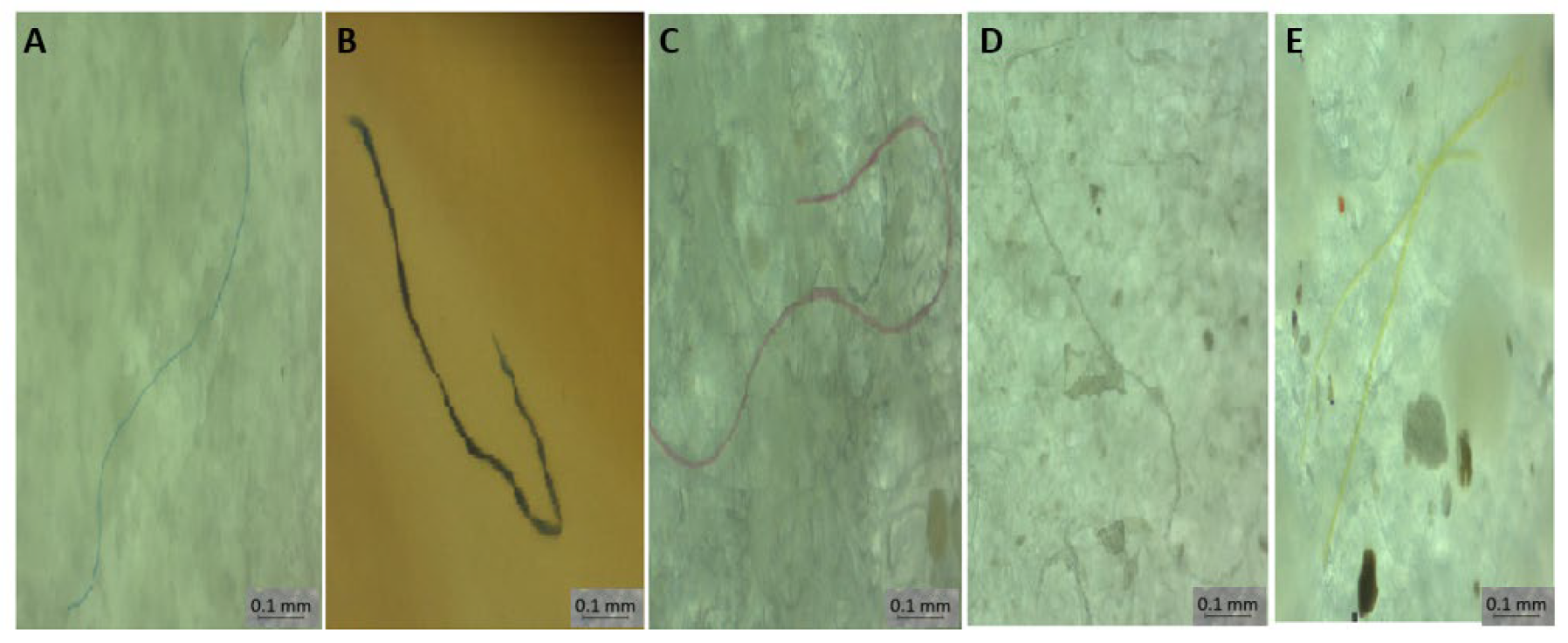
Figure 2.
ATR-FTIR spectra of the most representative antroophic particles found in the gastrointestinal tract of juveniles of scalloped hammerhead shark: A. rayon, B. polyethylene terephthalate, C. polyethylene, D. cotton.
Figure 2.
ATR-FTIR spectra of the most representative antroophic particles found in the gastrointestinal tract of juveniles of scalloped hammerhead shark: A. rayon, B. polyethylene terephthalate, C. polyethylene, D. cotton.
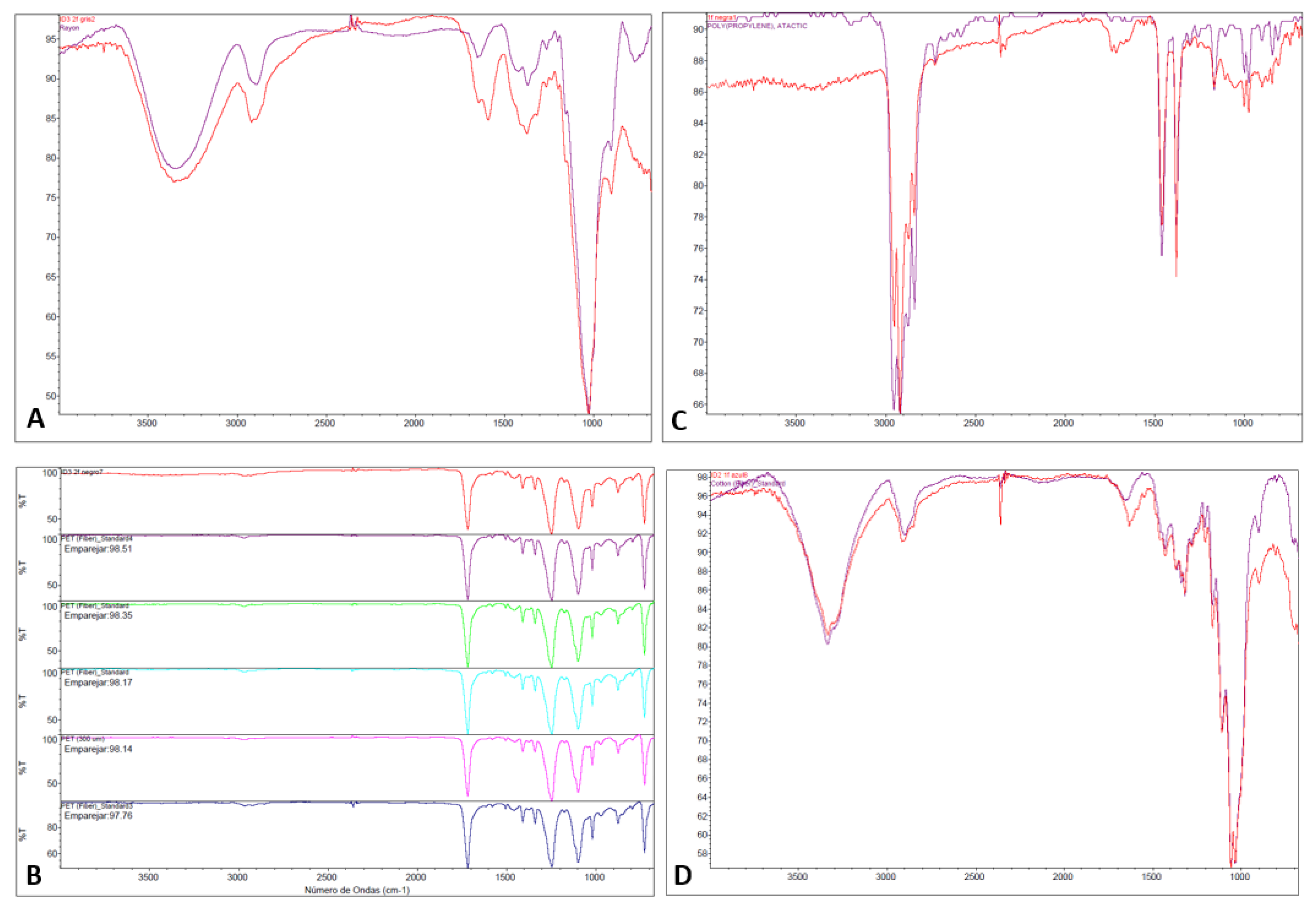
Figure 3.
Canonical analysis of principal coordinates (CAP) describing the feeding behavior and debris ingestion of juveniles of scalloped hammerhead sharks in the different analyzed years. The vectors indicate the importance of each prey item and polymer found in the gastrointestinal tract of this species.
Figure 3.
Canonical analysis of principal coordinates (CAP) describing the feeding behavior and debris ingestion of juveniles of scalloped hammerhead sharks in the different analyzed years. The vectors indicate the importance of each prey item and polymer found in the gastrointestinal tract of this species.
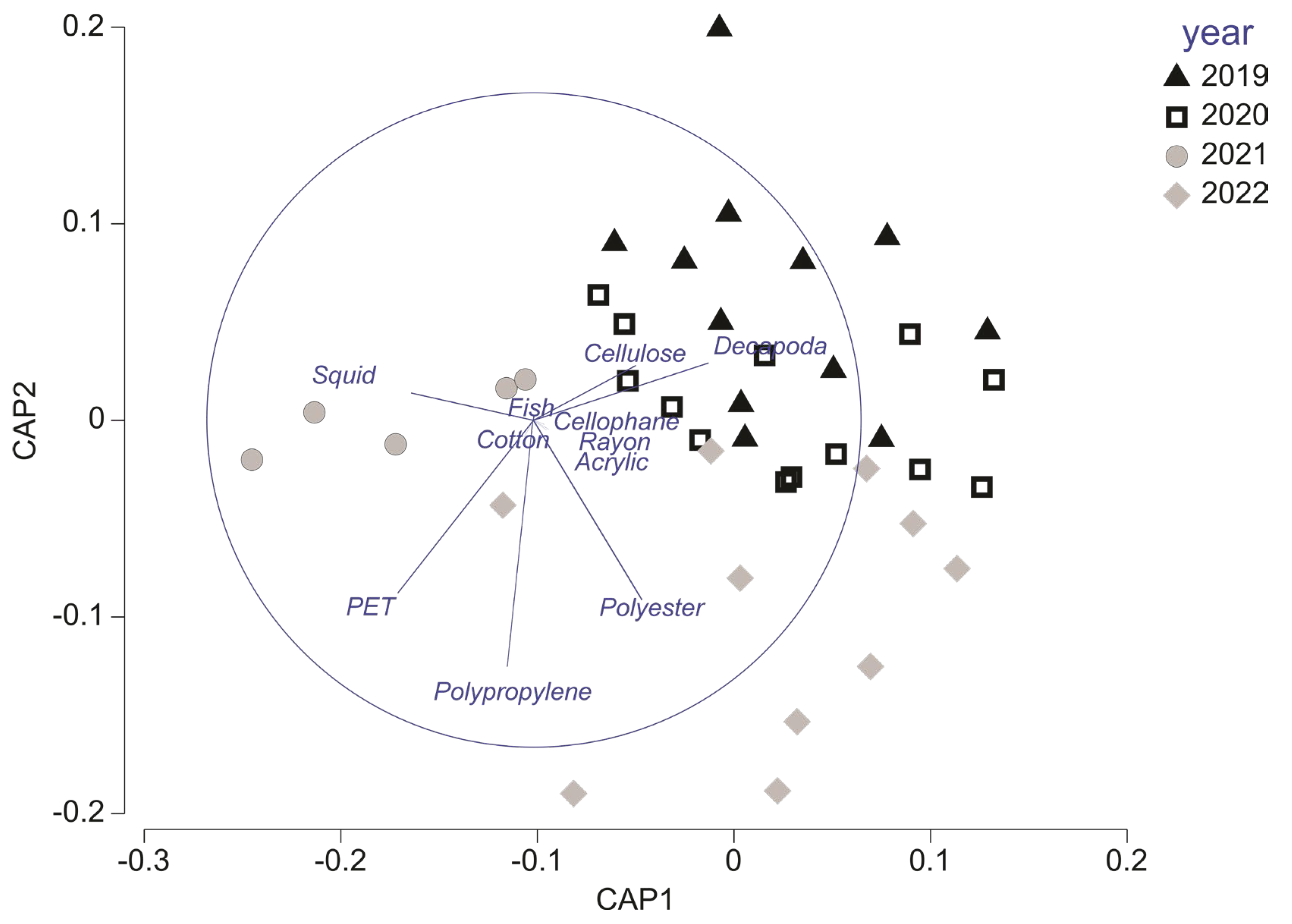

Table 1.
Mean length (mm) of anthropic debris for the most abundant colors found in the gastrointestinal tract of the different sizes of juveniles of scalloped hammerhead shark (SD = standard deviation). ES: Extra small, S= small, M= medium, L= large.
Table 1.
Mean length (mm) of anthropic debris for the most abundant colors found in the gastrointestinal tract of the different sizes of juveniles of scalloped hammerhead shark (SD = standard deviation). ES: Extra small, S= small, M= medium, L= large.
| Size | Blue | Black | Red | Transparent | Yellow | Gray |
| ES | 0.231 (SD ± 0.12) | 0.213 (SD ± 0.14) | 0.237 (SD ± 0.13) | 0.292 (SD ± 0.13) | 0.234 (SD ± 0.13) | |
| S | 0.929 (SD ± 1.3) | 1.214 (SD ± 1.2) | 1.510 (SD ± 1.7) | 1.028 (SD ± 1.1) | 0.677 (SD ± 0.92) | 0.348 (SD ± 0.28) |
| M | 0.327 (SD ± 0.29) | 0.405 (SD ± 0.52) | 0.908 (SD ± 1.3) | 0.435 (SD ± 0.53) | 0.716 (SD ± 0.48) | 0.238 (SD ± 0.1) |
| L | 0.350 (SD ± 0.34) | 0.961 (SD ± 1.2) | 0.111 (SD ± 0.09) | 2.925 (SD ± 2.3) | 0.249 (SD ± 0.3) | 0.930 (SD ± 0.66) |
Table 2.
Summary of analyzed polymer found in the gastrointestinal tract of juvenile scalloped hammerhead sharks.
Table 2.
Summary of analyzed polymer found in the gastrointestinal tract of juvenile scalloped hammerhead sharks.
| Polymer | Number of particles | Min-Max & Mean length (mm) | Frequency (%) |
| Cellulose Cotton Polyester |
221 | 0.050-7.041 & 1.216 | 64.4 |
| 43 | 0.176-2.473 & 1.158 | 12.5 | |
| 13 | 0.531-0.226 & 0.350 | 3.8 | |
| PET Cellophane |
44 | 0.131-4.301 & 1.283 | 12.8 |
| 11 | 1.931-0.426 & 1.174 | 3.2 | |
| Polypropylene Rayon Acrylic |
4 | 0.202-1.679 & 0.946 | 1.2 |
| 3 | 0.221-1.948 & 0.997 | 0.9 | |
| 4 | 0.601-1.932 & 1.222 | 1.2 | |
Disclaimer/Publisher’s Note: The statements, opinions and data contained in all publications are solely those of the individual author(s) and contributor(s) and not of MDPI and/or the editor(s). MDPI and/or the editor(s) disclaim responsibility for any injury to people or property resulting from any ideas, methods, instructions or products referred to in the content. |
© 2024 by the authors. Licensee MDPI, Basel, Switzerland. This article is an open access article distributed under the terms and conditions of the Creative Commons Attribution (CC BY) license (http://creativecommons.org/licenses/by/4.0/).
Copyright: This open access article is published under a Creative Commons CC BY 4.0 license, which permit the free download, distribution, and reuse, provided that the author and preprint are cited in any reuse.


