

Submitted:
06 June 2024
Posted:
11 June 2024
You are already at the latest version
Abstract
Rice (Oryza spp.) is mostly grown directly from seed and sown on wet or dry seed beds or usually used as transplants on nursery bed. With all the economically important viral diseases in the world, Rice yellow mottle virus (RYMV), is only prevalent in rice-growing countries in Africa. RYMV had turned out to be the main rice production constraint in Africa, throughout the last 20–25 years, causing yield loss of 10 to 100%, depending on age of the plant at the time of infection, degree of varietal susceptibility and the exiting climatic conditions. Good agricultural practices and utilization of biotechnological tools in the development of improved resistant cultivars have been extensively active in controlling the disease. This review focused on RYMV, its epidemiology, serological and molecular typing, disease management and the way forward for sustainable rice production.
Keywords:
Rice yellow mottle virus
; sub-Saharan Africa
; constraint
; management
1. Introduction
Rice is very crucial in tackling food security challenges across the globe [1]. It is currently one of the main staple foods in Africa with an annual production of 38 million tons; serving as a basic dietary source for people across the continent [2]. Even though rice was traditionally linked with the Asian countries, its consumption is becoming very popular in Africa because of increase in human population and urbanization coupled with changes in lifestyle, which demands increase in rice [3,4]. In West Africa, rice is the solitary dominant supply of nutrient and vitality emerging as the third important cereal in all of Africa after maize and sorghum. Usually, rice is eaten as a prepared meal; however, it is also used industrially and processed into wine, rice cakes, and the rice straw is fed to livestock [5].
Rice farming provides great employment opportunities from the irrigation schemes to the drainage system as well as the totality of the rice value chain. Additionally, the contribution of rice production to African nations’ revenue cannot be underestimated. The rising role played by rice in the food basket of consumers at present has made it a political crop, and the price of rice and its availability influences social stability of most African countries [6]. After the 2007–2008 food crisis, there has been a threefold increase in the world value of rice making the regular global price of rice not restored to its’ worth as before [7].
In sub-Saharan Africa (SSA), rice consumption excessively exceeds production, however, with an efficient system of rice cultivation, importation of rice would be reduced, and export increased considerably. Rice consumption in SSA in 2018 was projected to be about 33.2 MT, out of which 15.5 MT was imported, corresponding to 33% of that traded in the world market [8]. Rice import bill was estimated at US$ 6.4 billion in 2018 and was about 16.6 MT in Africa in the trade year 2020/2021 [9].
As part of the Sustainable Development Goal (SDG) 2; food security is a very important component. Rice is a basic staple for food security and social stability in SSA [10]. Over the past decade, the demand for rice has risen at a rate of 6% per annum [8], making it the commodity with the fastest growth rate in the world and has contributed extremely to global food security [11] during the past half century.
Increased rice production is hampered by several factors: notably, the persistent abiotic and biotic factors [12]. These include low soil fertility mainly with sub-optimal nitrogen, high incidence of pests and diseases such as Rice yellow mottle disease.
Rice yellow mottle disease, caused by Rice yellow mottle virus (RYMV) is a major challenge to rice production in Africa. It is the known economically important viral disease of rice by means of its nativity to SSA [13,14]. RYMV affects all types of rice cultivation including lowland, upland, rainfed and floating mangrove rice [15]. The disease was initially described and named by Bakker [16]. He discovered the virus causal agent for the yellow mottling in rice present in Kisumu-Kenya along Lake Victoria. The indigenous rice (local/wild rice derivates) already present in the African countries were tolerant and have been adapted to the virus [17,18]. RYMV came to the forefront once new high yielding exotic rice varieties were brought into Africa from South-east Asia. The Asian rice (O. staiva L) is a good colonizer and established well in many African ecologies almost immediately after it was introduced to West Africa [19]. Initial introductions like Sindano (IR22), Basmati 217 among others mostly proved to be highly susceptible to the virus [20]. According to [21] the increase in rice cultivation to meet its high demand for consumption across the continent in connection to availability of water for sequential plantings throughout the year heightened the RYMV incidence.
Infection of the plant can occur at all stages from transplanting to booting. Since booting is when meiosis happens, stresses at this stage may reduce rice grain yield [22]. Also, depending on the type of rice genotype grown, the RYMV strain type and the time of infection; the heads produce grains which are unfilled resulting in yield loss, which may range between 10-100% [13,23] whereas plants under severe attack may die [5].
Even though there is a significant relationship between symptom intensity and yield loss, yield loss permits better prejudice of the isolates and varietal response to RYMV infection than symptom expression or plant height [17]. RYMV has been persistently very severe in some regions that farmers tend to desert their fields to plant new rice fields whereas susceptible cultivars have been eliminated by the disease because it can cause unexpected epidemic upsurge [15,24].
Plants infected by RYMV are mottled and show varying intensities of yellow to orange coloration of the leaves which could be mistaken for iron toxicity or nitrogen deficiency [25]. Infection is also characterized by stunted growth, sterile flowers and reduced tillering leading to poor panicle exertion, grain discoloration and grain or spikelet sterility [5,18].
The threats posed by RYMV to food security has gained much attention. The objective of this review is therefore to expose the balance duality of RYMV and its agronomic significance. The strategies for sustainable management that have been deployed and the success that has been achieved would also be highlighted. The knowledge from this review is expected to guide breeding program (breeders), the scientific community and national policies on response to the management of RYMV in Africa.
2. Epidemiology of Rice Yellow Mottle Virus
RYMV is transmitted by insect vectors through the tripartite connection between plants, insects and viruses and or mechanical movement [26]. The virus is transmitted by several species of beetles, most of which belong to the Coleoptera: Chrysomelidae [27]. About fifteen species of beetles have been observed as insect vectors for RYMV [28]. This group of insects were the first to be recognized as vectors of RYMV after Bakker discovered the disease. Later, it was observed that their population was on the low compared to the high incidence of the disease. This gave the intuition that other insect vectors could be involved in the transmission of the disease, especially at the seedling stage where they distribute the virus at little to near the ground levels but the possibility of these vectors contaminating the plant was not ruled out [16]. Insects from the order Coleoptera, Orthoptera, Homoptera and Diptera are well-documented to be effective vectors of RYMV [29]. All these insect vectors of RYMV can be grouped into four according to their morphology and chewing or feeding mouthparts as beetles (e.g., Sesselia pusilla, Chaetocnema pulla), grasshoppers (e.g., Conocephalus merumontanus, Conocephalus longipennis), leafhoppers (e.g., Cofana spectra, Nephotettix modulates) and true flies (e.g., Diopsis thoracica) [30].
Among these insect vectors, Homoptereans are the most virulent and they have biting and sucking mouthparts. Coleoptera and Orthoptera on the other hand have chewing mouthparts. Most Coleopterans and Orthopterans feed non-persistently to transmit RYMV [31,32] whereas others like the Trichispa sericea (rice hispid) transmit semi-persistently holding the virus between one to three days [18,32]. Some insect vectors have been presented in Figure 1. For non-persistent transmission, after acquiring the virus with their stylet (made up of two canals) which they pierce directly upon chewing an infected rice, they transmit the virus immediately through subsequent feeding to a healthy plant by using the first canal to draw up and sieve the plant sap whereas the second canal injects the virus particle into the plant [33].
Generally, non-circulative viruses are transmitted in a non-persistent or semi-persistent manner. Non-circulative transmission of viruses is the primary and easiest strategy employed by plant virus vectors. According to [34] with this kind of transmission, the insect vector slurped the virus throughout feeding and right away it attaches itself to coating of the cuticle in the stylets. The virus merely hangs on the coating to be rapidly injected into the new host, for a small number of minutes after acquiring. Importantly, non-persistent viruses are picked up within seconds to minutes of feeding and transmitted quickly as well. Consequently, insect vectors that pick up non-persistent viruses upon short feeding times on infected plants and can promptly transmit to uninfected plants are known to be highly efficient vectors.
In the case of semi-persistent viruses, the insect vectors need an extended time (minutes to hours) before they can acquire the virus and spread to healthy plants [35]. A vector feeding on an infected plant for a very long interval could have reduced effectual acquisition and transmission and sometimes can even end the process of transmission [36].
Mites have been reported to also spread RYMV. Mite vectors of RYMV have been reported from the families Eriophyidae and Tarsonemidae [16].
Farm implements, human activities (such as fertilizer application), and plant-to-plant contact, also result in mechanical transmission of the virus. Wind-mediated leaf-to-leaf contact, guttation fluids and irrigation water can also spread the virus [26]. Grazing livestock on infected field spread the viruses as they trample upon infected plant to healthy plants [37]. Transplanting rice into a field in which infected rice seed from a previous crop has germinated can be another source of RYMV transmission to a healthy crop. The virus can also be transmitted between xylem cells through pit membranes [38].
Additionally, RYMV has the tendency of infecting wild species of Oryza as well as several weed species. In the lowlands, insect vectors live off infected wild rice, weed hosts, or self-grown plants, and secondary transmission occurs by wind-mediated leaf-to-leaf interaction, mechanical transmission, or insect vectors [27]. Even though the virus can be found during the development stages of the seed, the virus is not seed transmitted [39].
3. Symptomatology
Symptoms of RYMV mostly are done by visual assessment of the coloration of the rice plants. This is easy to distinguish with rice genotypes that are highly susceptible to RYMV than resistant genotypes [41]. Infected leaves transform from the normal green coloration to yellow stripes with streaks and splotch as the first symptom. Rice genotypes that are more susceptible to RYMV infection have more pronounced symptoms compared to resistant genotypes (Figure 2, Figure 3, Figure 4 and Figure 5). Likewise, young plants that are infected display noticeable symptoms than old, infected plants, and virulent strains exhibit advanced symptoms than mild strains [42]. Within 14-21 days after initial symptom expression, the spots mature to par with the leaf veins and the colour further changes from yellow to orange amidst mottling and wilting for most rice varieties.
The International Rice Research Institute (IRRI) has technically advanced a standard evaluation system (SES) on a scale of odd numerals from 1-9 for the visual diagnostic of symptoms expressed by RYMV. The scale connotes the symptoms descriptions on the basis of coloration of the leaves as well as the degree of severity of infection as; 1- No symptoms, 3 - Leaves green but with spare dots or streaks and less than 5% of height reduction, 5 - Leaves green or pale green with mottling and 6 to 25% of height reduction, flowering slightly delayed, 7- Leaves pale yellow or yellow and 26-75% of height reduction, flowering delayed, 9 - Leaves turn yellow or orange, more than 75% of height reduction, no flowering or some plants dead, modified by [41].
Sometimes, rice field infected with RYMV might be confused with iron or nitrogen nutrient insufficiency, obvious with the colour change but because RYMV can be spread by vectors, infected area appears to be in patches whereas nutrient deficiency spans over a stretch or vast area on the field [25]. Additional symptoms include stunted growth, twisting of emerging young leaves, reduction in the total count of the spikelet, decreased tillering, no flowering synchrony, frail exertion of the rice panicle resulting in complete or incomplete sterility [16,44]. There is drastic reduction in the yield of the plant and the few grains that would develop turn brown. Infected plants might eventually die [26].
4. Description and Organization of RYMV
RYMV belong to the family Solemoviridae and the genus Sobemovirus [45]. The virus capsid has 29 kDa coat protein (CP) subunits assembled [15] in a T-3 icosahedral structure. It has positive-sense single stranded RNA (+ssRNA) genome with 25-28 nm diameter and 4.0–4.5 kb size with the Malian and Nigerian strains having 4,500nt and 4,451nt, respectively [46]. The virus particle is made up of about 20% RNA and 80% protein with no lipids or carbohydrates [13,47,48]. The icosahedral structure has a molecular mass of 1.4 X10⁶ Da and it’s secured by divalent cations (Ca2+), pH-dependent protein–protein interaction, and salt bridges between protein and RNA [49]. The 5' terminus of the genome of RYMV is a viral genome-linked protein (VPg) in the place of a cap as the 3' end is not polyadenylated [46]. The lack of cap and poly(A) tail point to the 5′ and 3′ untranslated regions (UTR-s) recompense their function with the 5′UTR bounding covalently to the viral genome-linked protein (VPg) [50]. About 330 of them are in non-coding regions together with a satellite RNA (satRNA; 220 nt; viroid-like RNA) requiring a helper virus for replication yet does not partake in the infection development [51].
The coding sequences from 5′ to 3′ consist of five open reading frames (ORFs; Figure 6); ORF1, ORFx, ORF2a, ORF2b, and ORF3 [52]. ORF1 and ORF3 may vary depending on the strain whereas ORF2a and ORF2b are known as the conserved regions [53]. ORF1 codes for PI (first protein), which participates in suppression of silencing and virus movement. The P1is required for systemic infection of the plant because it is used for the spread of the virus [54] and helps in suppressing virus-induced gene silencing (VIGS) [55]. ORFs 1, 2a and 2b are translated from the genomic RNA whereas ORF3 encoding the coat protein, is translated from a sub-genomic RNA. ORFx (Px, protein ‘x’) overlays the 5′ end of ORF2a and continues a little distance upstream of ORF2a. ORFx does not have an AUG initiation codon but expresses initiation of non-AUG; CUG codon by leaky scanning and ribosomal frameshift mechanism between ORF1 and ORF2a initiation codons. The overlapping ORF2a and ORF2b, encrypt the replicational polyprotein which cleaves to give the serine protease together with P10 and P8, viral genome-linked protein (VPg) and the RNA dependent RNA polymerase (RdRP), respectively. VPg is identified to manipulate virulence in opposition to resistance given by the two major genes (RYMV1 and RYMV2) [15,56]. The serine polyprotein protease and the two additional proteins, P10 and P8 have functions that are unknown [48].
The RNA-dependent RNA polymerase (RdRP) protein is for replicating the genome as well as for carrying out transcription. ORF3 encodes the viral coat protein (CP) in charge of long-distance cell-to-cell movement, virus packaging, and stability [38,54]. The CP in RYMV genome is very necessary for full systemic infection to be established in O. sativa. Also, virus encapsidation is important before long-distance movement takes effect [13].
5. Serological and Molecular Typing of RYMV
Diagnosis of RYMV with serologically can be done with the leaf sap from infected rice plants between 14-21 days old [18]. The leaf sap obtained can be diluted to the 10th-11th factor with the end point varying on the source the source of inoculum. As the temperature increases, the number of days for the virus to stay infective reduces. For instance, at 27 to 29°C, the virus can remain infective for almost 35 days in the raw sap. Furthermore, the virus slowly drops its infecting power at temperatures around 55°C to 70°C [42]. On the other hand, as the temperature decreases, the virus can retain its ability to infect for a prolonged period. At a storage temperature of 4°C, the crude sap can be infective for 84 days whereas at 9°C, it can stay for up to 71 days [16]. The virus can equally be preserved in air-dried herbarium pressers, and it can still replicate at a better frequency [18].
Immunologically, five main serotypes of RYMV have been typed: Ser1, Ser2, Ser3, Ser4 and Ser5. The West African serotypes are Seer1, Ser2, and Ser3 whereas Ser4 and Ser5 are East African serotypes [13,57]. Molecular typing of RYMV is centered on the sequences of the ORF3 and ORF1 coding for the CP and the movement protein, P1, respectively. Currently, molecular typing of these serotypes identified six strains as S1ca, S1wa, S2, S3, Sa and Sg in West Africa [58] and S4, S5 and S6 in East Africa [59].
These strains have a variety of pathogenic properties spanning from infection abilities to symptom intensities on the rice and wild grasses [60]. The divergence existing here results from the amino-acid and nucleotide differences between the East and West African strains at 14% with low variation within strain and high variation between the East African (Tanzanian) isolates [61,62].
Molecularly, the differences in virulence among strains is consequently of polymorphism of amino acid in the bipartite nuclear targeting sequence motif and around conserved positions 151 to 154 of the CP gene [61]. Serologically, there are two amino acids, at positions 115 (alanine against threonine) and 191 (valine toward threonine), which regularly distinguish between the main serotypes. These two positions are situated in antigenic sites and segmented by the antigenic determinant in the conserved region by differentiating monoclonal antibodies. Therefore, these two polymorphic positions can be used to explain cross-reactivity connecting RYMV strains [63].
6. Replication and Establishment
Before successful infection can be established, there must be a compatible molecular interaction between host plant and the virus. The viral infectivity mechanism must be able to overcome the host-plant defenses to ease encapsidation, replication, translation, movement, and assembly [48]. When the genomic RNA of incoming virion particle enters the cytoplasm of the host cell, the co-translational disassembly mechanism begins uncoating for RNA replication. It has been established that the particles of RYMV can completely disassemble only after initiation of RNA translation [64]. According to [65] the viral replication complex (VRC) replicates the budding complementary negative sense RNA with the initial +ssRNA. The (−) RNAs undergo translation and replication cycles to produce more (+) mRNAs. The (+) mRNAs constructs are expended to manufacture new viral proteins and more (−) RNA. The genome is eventually encapsidated to give new virus particles.
New viral particles are conveyed through the plasmodesmata from one cell to the other in the vascular tissues for systemic multiplication [66]. These newly formed viral particles stay in the xylem vessels and are then carried together with intercellular solutes to new cells. The movement protein (ORF1) and coat protein (ORF3) aid in the use of the host protein to modify the plasmodesmata which transports the viral particles by active passage [67]. The size exclusion limit strategy for active transport is deployed for carrying new particles across the plasmodesmata in RYMV [68]. The viral particles of RYMV usually confine in a variety of host plant cells including the nucleus, vacuole vesicles, mesophyll, bundle sheath, vascular parenchymal cells, epidermis and chloroplast [69,70]. Contingent on the host’s plant stage/age of infection there could be the transitional (acidic pH dependent) or swollen isoforms (basic pH dependent) more present throughout early infection, as the compact isoforms (Ca2+dependent) are abundant in the course of late infection and these different isoforms influence viral particle stability [70].
7. Influence of Environmental Factors
Cultivated rice and few wild grass species are the major hosts of RYMV. The virus has different geographic diversity, and the outmost diversification is recognized within East African strains. [53,71]. Symptom expression by RYMV could be strongly influenced by light intensity, day length, humidity, temperature, growth stage of the plant among other factors [72]. Therefore, severity, prevalence and phylotypes of RYMV change substantially with rainfall intensity, temperature, and relative humidity.
Environmental factors influence the virus distribution and diversity in a particular geographical area. Environment and climate change can have effect on pathogen and vector reproduction, host plant growth and susceptibility, transmission and dispersal, survival, and establishment activity in addition to host-virus interaction [73]. In irrigated areas or lowland rice farming, throughout the rainy season, RYMV disease prevalence and severity were recorded highest between 60-82% with a total rainfall of 167 mm and temperature ranging from 16.8 to 27.7˚C. For instance, with a relative humidity of 70.4%, wind speed of 4 km/h and temperature range of 20 to 31˚C, RYMV prevalent (82%) and severity (55%) was very high in the coastal zone of Tanzania [74]. There is also evident these weather parameters influence distribution of RYMV phylotypes within fields and geographical areas. An example is the association of the S4-lm phylotype (Lake Malawian strain) and S6 strain of RYMV to low temperature (13.3˚C) and rainfall (13.7 mm), respectively in Tanzania. The most RYMV disease prevalence and severity were detected solitary in locations with strong wind conditions, that is, wind speed of 9.3 and 18.5 km/h [74].
8. Strategies for Sustainable Management
Integrated pest management (IPM) approaches involving the use of cultural and prophylactic measures have been recommended to control the disease [12]. It has been demonstrated that some traditional agricultural practices, namely; seedbed to field transplant and elimination of the wild rice and grasses that are alternative host of both virus and insects hiding places, can influence the agro-ecological modifications on the diversity and the dynamics of the viral populations; consequently, RYMV prevalence in fields [75]. Some other cultural techniques like removal of rice ratoons, weeds, and sedges before planting in addition to destruction of crop residue after harvest is effective in managing the disease. Managing insect vectors population to levels below the threshold in the nursery and in the fields surrounding the nurseries is equally necessary to manage vectors of important viruses [76].
Unselective use of chemicals against the beetle vectors, spraying a light layer of petrol or insecticides on the surface of water in paddy farms to cause the insects to drop into the water by stretching a cord over the leaves or dropping granulated insecticides in the water of the paddy field making it hostile for the larvae of vector insects are precautionary practical approach [18]. Planting exactly in correspondence to the time and especially in periodic intervals to keep back irrigation water between planting to give a rice free period and so restrict the buildup of the virus infection and insect vector population [20] are also ways of preventing RYMV. Furthermore, delayed planting up until insect population declines or early transplanting before the outbreak of insect vector, diversifying varieties planted on a single plot or crop rotation, site change for nurseries, sowing from dry seeding by raising nurseries under rainfed instead of irrigation, using recommended spacing of plants, rouging of infected plants and immediate replanting of healthy plants, reduction of fertilizer application such as urea on attacked field and flooding of tilled plots while waiting for transplanting in turn to regulate the degree of spread of the disease are all protective measures used to manage RYMV [77]. All these activities aim at disturbing and interrupting the life cycle of the vectors or the disease and improving the plant health [78].
However, IPM for RYMV is best achieved when resistant cultivars are used together with cultural and prophylactic methods to give the most efficient control against this virus [13]. This is because resistant cultivars present an extremely economical, ecologically sound, and maintainable endorsed control [79]. Hence, currently, the new trend is breeding for improved resistant cultivars to control RYMV. In developing these resistant varieties or cultivars, single gene or many genes have been used in a hierarchical approach to obtain partial or highly resistant cultivars [13]. However, the disease is not fully under control especially in places where the disease occurs in epidemic fraction. Possible sources of resistance to the virus are obtained from screening of Oryza germplasm [20] and are engaged as donors to varieties in resistance programs. Resistance in rice to RYMV is addictive in nature and polygenic [80]. No variety is yet commercially available that has both high resistance and other desirable agronomic traits [5].
9. Basis of Resistance Cultivars to RYMV
Generally, disease resistant cultivars are developed based on qualitative disease resistance genes to exhibit monogenic or near complete resistance under the control of major genes [81]. Qualitative disease resistance can be described based on two models: gene-for-gene and the matching allele model [82]. Genetic resistance is the best feasible option for economical and sustainable long-term RYMV management [5]. Gene-for-gene resistance includes initiation of resistance proteins specifically nucleotide binding domain leucine-rich repeat proteins (NB-LRR), which partake in pathogen attack and beginning of plant defense mechanisms. Nelson et al. [81] related that plants that are resistant usually have genetically dominant (R genes) and most of them encrypt the NB-LRR proteins. Correspondingly for a virus infection to be completely established, there must be a matching allele for resistance which is given out to susceptibility factors; as in absence of host factors [83]. At times, the genes expressed in the matching allele stimulate recessive resistance. In the plant host, the recessive host factors comprise eukaryotic-translation initiation factors (eIFs) namely, eIF4E and eIF4G and its isoforms. The main form of resistance against plant viruses is the mechanism of recessive resistance by loss-of-function of susceptibility (S genes) [84]. In the study of genetics and molecular biology for management strategies against RYMV, the recognition of resistance genes and quantitative trait loci (QTLs) have been retrieved or genetically sourced from O. sativa and O. glaberrima [85].
Major resistance genes identified in species of rice in Africa O. glaberrima are Rymv-1, Rymv-2 and RYMV3 [58]. Molecular mechanisms convening resistance in RYMV from Oryza species stem from the monogenic recessive resistance trait Rymv-1 [86], which was mapped on chromosome 4 [87]. Rymv-1 was revealed to encode eIF(iso)4G. Before an infection is established, the eIF(iso)4G recruited completely interacts with VPg during pro-viral interaction whereas in antiviral interactions, mutations caused by contradictions in the eIF(iso)4G impede infection interaction with the VPg of RYMV to give a resistant phenotype. An allelic form, Rymv1-1 is typical of susceptible varieties, although there are four other allelic variants which are connected to diverse levels of resistance for RYMV. Relatively, Rymv1-2 was mapped from O. sativa, and Rymv1-3, Rymv1-4 and Rymv1-5, the three clear-cut resistance alleles were mapped from the indigenous African rice species, O. glaberrima [88]. These different allelic forms of resistance are known to be as a result of conjoining evolution [78]. Chemically, one amino acid difference, a substitution with glutamic acid (E) for a lysine (K) at positions E309K and E321K in the middle of eIF (iso)4G gene conveys the contrast between Rymv1-1 and Rymv1-2 [89] but the resistance in Rymv1-2 does not give out a very stern immunity, somehow, it permits restricted replication and movement of the wild type of RYMV [90].
There have been reports of breakdown in resistance of Rymv1-2 because of mutations in the VPg of some RYMV isolates [15]. Nonetheless, substitutions in VPg of RYMV that caused resistance break in Rymv1-2 did not work in Rymv1-4 plants [88]. Comparably, just a minor group of VPg of RYMV mutants are responsible for resistance breakdown in Rymv1-3, and this same subset can overwhelm the resistance in Rymv1-2 [78]. Even so, virulence isolate is a consequent of mutation in the direct biochemical interaction between the VPg of the RYMV and the eIF(iso)4G of the host rice plant predetermined by Rymv-1 [15]. Therefore, accessions with Rymv-1 display complete resistance and they are classified as highly resistant accessions.
Consistent with [91], resistance gene RYMV3 infer nucleotide binding (NB) and leucine-rich repeat domain protein (NLRs) against the virus programs from the Mla-like clade of NLRs. Hence, the basis for this resistance from RYMV3 is to oppose the virus by casting a recognition complex with the viral coat protein (CP).
Quantitative trait loci (QTLs), the region of DNA responsible for controlling a specific trait have also been identified to express partial resistance to RYMV in some cultivars of rice apart from the resistance induced by Rymv-1. Using QTL information in breeding is one of the main applications of marker-assisted selection (MAS). This is the ideal of using markers linked to certain trait (resistance in this case) to select individuals with characteristics of interest. These QTLs have been delineated on the rice chromosomes 1, 2, 7 and 12 [72,92] in dissimilar environments and using distinct resistance criteria, they justify almost 30% of resistance. QTL present on chromosome 12 is concerned in balancing epistasis with a region of chromosome 7 to clarify 36% of virus content [93]. An association flanked by resistance gene with plant architecture and development was proposed by phenotypic connection and colocalization of QTLs. In upland japonica rice varieties, this affiliation might clarify, at any rate partly, the average resistance intensity usually detected. On the other hand, on chromosome 12, the QTL of resistance was set to be independent of plant morphology, achieving a chiefly good candidate for introgression into indica rice varieties. The consequence of this QTL on chromosome 12 has been used to produce a near-isogenic line, and its interplay with a locus on chromosome 7 has been affirmed in an IR64 genetic background [94]. The durability of a genetic resistance is most effectual over time when marshaled in an environmental hotspot for disease development [95]. The stability of a resistant gene is dependent on the pathogen variability, nature of resistance, and environmental factors [96,97,98].
Attempts to introgress major RYMV resistance genes and QTLs resistance via conventional breeding methods have been established in vain [99]. The reason been the recessive nature of resistance presented by most RYMV genes. MAS permits effective selection of RYMV recessive alleles even in the heterozygous state. Selfing or test crossing is not a necessity to detect RYMV alleles in breeding populations, therefore, hasten the breeding development and saves time. Using marker assisted breeding (MAB) presents the chance to put together more tough and stronger forms of resistance to RYMV by bringing together R and/or S genes with QTLs. Hence, it is vital to understand the influence of each of the RYMV major resistance genes either as solitary or in composite with other resistance genes in advance to distribution.
As reported by [100,101], using candidate QTLs as combined RYMV major resistance genes or in a single genetic background intend to significantly heighten the strength of resistance because partial resistance retards the breakdown of the major resistance genes. Meaning, for a lasting resistance to Rymv1-2 and other major genes, more QTLs should be detected and incorporated for partial resistance in breeding programs in SSA. Along with it, another way to boost the stability of a major resistance gene is to merge with another major gene particularly those that stop the contact with the viral genome’s conserved domains throughout the infection cycle [102]. As a result, the genetic adjustment of virulent variants to their environments and hosts could be decreased [101]. According to [103], the QTL on chromosome 12 exhibits its partial resistance through detaining the movement of RYMV into the mestome or the bundle sheath cells.
Screening the multigenic families for assessment of genes from eIF4E and eIF4G for possible candidates to code for partial resistance from QTLs against RYMV; three members of the eIF4G were revealed as good candidates. On the other hand, another school of thought on studies in plant-virus interactions discloses that members of the eIF4E family do not implicate resistance [104]. Lately, outside the eIF4E gene, QTL1 was delineated as Rymv2 [105]. Detailed analysis on Rymv2 demonstrates its connection with a regulator of active defense mechanism on the rice homolog of CPR5 (constitutive expresser of pathogenesis related genes-5) linked to a point or nonsense mutation in the CPR5-1 sequence [106]. The sequencing of the candidate region showed one nucleotide deletion leading to a truncated and certainly non-functional protein.
The gene codes a transmembrane nucleoprotein to control effector incited immunity by regulatory cell cycle and defense mechanisms. CPR5 undertakes a conformational switch from oligomer to monomer regarding the activation of immunoreceptors. When this happens, there is loss of function and this results in the discharge of cycling dependent kinase inhibitors and the permeabilization of the nuclear pore complex, which set in motion basic resistance to many pathogens [107]. Research has proven that focusing on specific host genes for gene modification becomes tricky because of incomplete number of plant-interacting proteins [91]. Notwithstanding the resistance to pathogens, the mutants with loss of function mostly come out with phenotypes that have undesirable traits for crop improvement [108]. Fortunately, O. glaberrima accessions with Rymv-2 do not exhibit undesirable traits.
The third type of resistance is from a major gene (R) as RYMV 3, originating from O. Glaberrima and mapped on chromosome 11, which codes for NB-LRR [108]. In plants, representing amongst the most varied and infinite division of R-gene families, the LRR proteins could be unstable amid strongly related plants because of existing or nonexistence of polymorphism [109]. Considering the molecular background of NB-LRR gene, virus resistance is articulated in two kinds; the hypersensitivity reaction where the virus is confined at the primary infection site. In the second type, there is the extreme reaction, where the cell- to-cell movement of the virus is totally halted [110].
An amino acid substitution at positions K779R and A823V on RYMV3 locus, produced two mapped candidate alleles, NirRYMV 3-R1 and NirRYMV 3-x. The third allele, NIrRYMV 3-y, is as a result of a truncated protein in the LRR area where substitution occurs on the 11th amino acid [108]. RYMV 3 resistance shows characteristic of maximum reaction where symptoms do not even express after infection 108.
Resistance mediated from the recessive genes (Rymv-1 and Rymv-2) have very little polymorphisms, warranted by conservative selection resulting in low mutation rates. On the other hand, resistance from dominant R-gene; RYMV 3, is extremely polymorphic with its frequent polymorphism leading to discovery of quite a number of non-synonymous mutations [108]. Selection pressures endorse the evolution of new receptors noticed in almost all LRR genes [109] and this result in offsetting pathogen effectors. Therefore, RYMV3 has a remarkably high gene variability which may grant resistance to other pathogens [111]. Accordingly, [112] reports most R genes have been recognized to be race-specific and present resistance to a lone or few strain(s) of a given pathogen. A maximized form of resistance from the recessive Rymv-1 and the dominant RYMV 3 resistance genes might be able to allow greatly wanted broad-spectrum resistance to RYMV and additional pathogens in rice. The different systems present detailed understanding into the process by which viruses adjust to plant immunity and provide vital information for the development of ecological resistance contrary to viral diseases of cereals [91].
10. Conclusion
The deleterious effects of RYMV have led to the extrapolation of some positive outlook of this disease. Bringing to light the nuisance associated with RYMV resistance management accompanied by rapid evolution of the virus and resistance-breaking variants been observed across SSA, it is important to pay great attention to this disease. Promising genes have been mapped out for resistance (Rymv-I, Rymv-2, RYMV 3) for incorporation into farmer/consumer preferred varieties against the different serotypes and strains of this virus from different biodiversity. Molecular, biochemical, and proteolytic studies have brought out enhanced management strategies for RYMV. This would help African countries to reach rice sufficiency soon only if scientists and breeders would continue to embrace these insights for improved cultivars and farmers on their side would plant these improved varieties with all the IPM strategies.
11. Future Prospects
For the time being, though there’s not been any emphasis on the diversity of the genetic structure of the virus and cultural practices, analysis by in-depth sequencing is underway in turn to describe and contrast exactly the intra-host genetic diversity and structure conditional on the cultivation mode and to the host (wild or cultivated). Even as studies of this nature gives a fair insight on the genes and proteins expressed in RYMV-rice interactions, there has not been high throughput genome-based technologies, like RNA-seq to investigate RYMV-rice interactions. Elucidating the diverse transcriptomic responses between compatible and incompatible RYMV-rice interactions and explaining the genes included in this procedure, RNA-seq based approaches must be practical. It is necessary to build on the achievement by genomic localization of SNPs related to the major resistance genes by advance discovery for use in genomic-assisted breeding. Homozygous lines can be technologically advanced through double haploid breeding when combined with MAS for an inexpensive utilization of strong RYMV resistant varieties. A similar task is demanded to find other important genes and to a greater extent screen host-virus protein interactors to recognize and authenticate supplementary host factors that help or subdue the virus. So, as more susceptible genes are discovered and substantiated to present additional breeding options for RYMV resistance, these genes could be altered with clustered regularly interspaced short palindromic repeats technology (CRISPR-Cas9) to interrupt the interface with viral proteins which could cause these susceptible host plants not to be preferred by the virus, therefore giving resistance.
When any of these interaction factors are picked out, a reverse genetics approach might be expended to ascertain novel host S genes that can be adapted by genome editing to weaken susceptibility. To respond positively to a future RYMV-free/tolerance era, these schemes might issue instant accessions and help create a huge germplasm base and the understanding needed.
Author Contributions
Linda Appianimaa Abrokwah – Conceptualization, Original Draft Preparation, Review & Editing; Stephen Kwame Torkpo - Conceptualization, Original Draft Preparation, Review & Editing; Samuel Kwame Offei- Conceptualization, Original Draft Preparation, Review & Editing; Guilherme da Silva Pereira- Review & Editing; Allen Oppong- Review & Editing; John Eleblu - Review & Editing ; All authors approved submission of manuscript.
Funding
None.
Conflicts of Interest
None.
References
- Mohidem, N.A.; Hashim, N.; Shamsudin, R.; Che Man, H. Rice for Food Security: Revisiting Its Production, Diversity, Rice Milling Process and Nutrient Content. Agric. 2022, 12, 741. [Google Scholar] [CrossRef]
- FAOSTAT. http://faostat.fao.org. 2020. accessed on 02/05/2022.
- Seck, P.A.; Touré, A.A.; Coulibaly, J.Y.; Diagne, A.; Wopereis, M.C. Africa's rice economy before and after the 2008 rice crisis. In Realizing Africa's rice promise. CABI. Wallingford, UK. 2013, pp. 24–34.
- Macauley, H.; Ramadjita, T. Cereal crops: Rice, maize, millet, sorghum, wheat. Feeding Africa Conference, Dakar-Senegal. 2015.
- Asante, M.D.; Amadu, B.; Traore, V.S.E.; Oppong, A.; Adebayo, M.A.; Aculey, P.; Marfo, E.A.; Kang, K.H. Assessment of Korean rice lines for their reaction to rice yellow mottle virus in Ghana. Heliyon 2020, 6, e05551. [Google Scholar] [CrossRef] [PubMed]
- Seck, P.A.; Tollens, E.; Wopereis, M.C.; Diagne, A.; Bamba, I. Rising trends and variability of rice prices: Threats and opportunities for sub-Saharan Africa. Food policy 2010, 35, 403–411. [Google Scholar] [CrossRef]
- Soullier, G.; Demont, M.; Arouna, A.; Lançon, F.; Del Villar, P.M. The state of rice value chain upgrading in West Africa. Glob. Food Secur. 2020, 25, 100365. [Google Scholar] [CrossRef] [PubMed]
- Falkendal, T.; Otto, C.; Schewe, J.; Jägermeyr, J.; Konar, M.; Kummu, M.; Watkins, B.; Puma, M.J. Grain export restrictions during COVID-19 risk food insecurity in many low-and middle-income countries. Nat. Food 2021, 2, 11–14. [Google Scholar] [CrossRef] [PubMed]
- https://www.statista.com. Accessed on 02/05/2022.
- Arouna, A.; Lokossou, J.C.; Wopereis, M.C.S.; Bruce-Oliver, S.; Roy-Macauley, H. Contribution of improved rice varieties to poverty reduction and food security in sub-Saharan Africa. Glob. Food Secur. 2017, 14, 54–60. [Google Scholar] [CrossRef]
- https://www.irri.org -Rice to zero hunger. Accessed on 03/05/2022.
- Séré, Y.; Fargette, D.; Abo, M.E.; Wydra, K.; Bimerew, M.; Onasanya, A.; Akator, S.K. Managing the major diseases of rice in Africa. In Realizing Africa's rice promise. CABI. Wallingford, UK: 2013, pp. 213–228.
- Kouassi, N.K.; N'guessan, P.; Albar, L.; Fauquet, C.M.; Brugidou, C. Distribution and characterization of Rice yellow mottle virus: a threat to African farmers. Plant Dis. 2005, 89, 124–133. [Google Scholar] [CrossRef] [PubMed]
- 14. CABI, 2021. Rice yellow mottle virus. Accessed on 03/05/2022.
- Hebrard, E.; Fargette, D.; Konate, F.G.; Inera, O.; Faso, B. Rice yellow mottle virus. Desk Encyclopedia Plant Fungal Virol, 2009, 88, 302. [Google Scholar]
- Bakker, W. Characterization and Ecological Aspects of Rice Yellow Mottle Virus in Kenya. Agricultural Research Reports 829, Wageningen, 1974, pp.1-152.
- Konate, G.; Fargette, D. Overview of Rice yellow mottle virus. In: Plant Virology in sub-Saharan Africa, Proceedings of a Conference, 2001, Organized by IITA. pp. 1–17.
- Abo, M.E.; Sy, A.A.; Alegbejo, M.D. Rice yellow mottle virus (RYMV) in Africa: evolution, distribution, economic significance on sustainable rice production and management strategies. J. Sustain. Agric. 1998, 11, 85–111. [Google Scholar] [CrossRef]
- Nayar, N.M. Evolution of the African Rice: a historical and biological perspective. Crop Sci. 2012, 52, 505–516. [Google Scholar] [CrossRef]
- Thresh, J.M. The ecology of tropical plant viruses. Plant Pathol. 1991, 40, 324–339. [Google Scholar] [CrossRef]
- Reckhaus, P.M.; Randrianangaly, S. Rice yellow mottle virus (RYMV) on rice in Madagascar. IRRI Newsletter 1990, 15, 30. [Google Scholar]
- Hardke, J.T. Arkansas rice production handbook. University of Arkansas Division of Agriculture Cooperative Extension Service MP192, Little Rock. Arkansas. 2013, pp.
- Hubert, J.; Luzi-Kihupi, A.; Hébrard, E.; Lyimo, H.J.F. Farmers’ knowledge and perceptions of rice yellow mottle virus in selected rice growing areas in Tanzania. Int. J. Sci. Res. 2016, 5, 549–559. [Google Scholar]
- Ndikumana, I.; Pinel-Galzi, A.; Négussié, Z.; Msolla, S.N.C.; Njau, P.; Singh, R.K.; Choi, I.R.; Bigirimana, J.; Fargette, D.; Hébrard, E. First Report of Rice yellow mottle virus on Rice in Burundi. Plant Dis. 2012, 96, 1230–1230. [Google Scholar] [CrossRef] [PubMed]
- Thottappilly, G.; Rossel, H.W. Evaluation of resistance to rice yellow mottle virus in Oryza species. Indian J. Virol. 1993, 9, 65–73. [Google Scholar]
- Suvi, W.T.; Shimelis, H.; Laing, M. Breeding rice for rice yellow mottle virus resistance in Sub-Saharan Africa: A review. Acta Agric. Scand., B Soil Plant Sci. 2019, 69, 181–188. [Google Scholar] [CrossRef]
- Kraehmer, H.; Thomas, C.; Vidotto, F. Rice production in Europe. Rice production worldwide, 2017, pp.93-116.
- Koudamiloro, A.; Nwilene, F.E.; Togola, A.; Akogbeto, M. Insect vectors of rice yellow mottle virus. J. Insects 2015. [CrossRef]
- Nwilene, F.E. Current status and management of insect vectors of Rice yellow mottle virus (RYMV) in Africa. Int. J. Trop. Insect Sci. 1999, 19, 179–185. [Google Scholar] [CrossRef]
- Koudamiloro, A.; Nwilene, F.E.; Silue, D.; Togola, A.; Oyetunji, O.; Sere, Y.; Akogbeto, M. Identification of insect vectors of Rice yellow mottle virus (RYMV) in Benin. J. Entomol. 2014, 11, 153–162. [Google Scholar] [CrossRef]
- Uzest, M.; Drucker, M.; Blanc, S. La transmission d’un complexe: pas si simple. Cas du virus de la mosaïque du chou-fleur [Transmission of a complex: not so simple. The case of Cauliflower mosaic virus]. Virologie (Montrouge) 2011, 15, 192–204. [Google Scholar]
- . [CrossRef] [PubMed]
- Wang, P.; Liu, J.; Lyu, Y.; Huang, Z.; Zhang, X.; Sun, B.; Li, P.; Jing, X.; Li, H.; Zhang, C. A review of vector-borne rice viruses. Viruses 2022, 14, 2258. [Google Scholar] [CrossRef] [PubMed]
- January, B. Relationship between insect vectors abundance and occurrence of rice yellow mottle virus in farmers’ fields in Kilombero district. Doctoral dissertation, Sokoine University of Agriculture, Tanzania. 2012. pp. 1–62.
- Ng, J.C.; Falk, B.W. Virus-vector interactions mediating nonpersistent and semipersistent transmission of plant viruses. Annu. Rev. Phytopathol. 2006, 44, 183–212. [Google Scholar] [CrossRef] [PubMed]
- Whitfield, A.E.; Rotenberg, D. Disruption of insect transmission of plant viruses. Curr. Opin. Insect Sci. 2015, 8, 79–87. [Google Scholar] [CrossRef] [PubMed]
- Gutiérrez, S.; Michalakis, Y.; Van Munster, M.; Blanc, S. Plant feeding by insect vectors can affect life cycle, population genetics and evolution of plant viruses. Funct. Ecol. 2013, 27, 610–622. [Google Scholar] [CrossRef]
- Sarra, S.; Oevering, P.; Guindo, S.; Peters, D. Wind-mediated spread of Rice yellow mottle virus (RYMV) in irrigated rice crops. Plant Pathol. 2004, 53, 148–153. [Google Scholar] [CrossRef]
- Opalka, N.; Brugidou, C.; Bonneau, C.; Nicole, M.; Beachy, R.N.; Yeager, M.; Fauquet, C. Movement of rice yellow mottle virus between xylem cells through pit membranes. Proceed. Natl. Acad. Sci. 1998, 95, 3323–3328. [Google Scholar] [CrossRef] [PubMed]
- Konate, G.; Sarra, S.; Traore, O. Rice yellow mottle virus is seed-borne but not seed transmitted in rice seeds. Eur. J. Plant Pathol. 2001, 107, 361–364. [Google Scholar] [CrossRef]
- https://inaturalist.ca/observations Accessed on 25/10/2023.
- Abo, M.E.; Alegbejo, M.D.; Sy, A.A.; Misari, S.M. “An overview of the mode of transmission, host plants and methods of detection of rice yellow mottle virus.” J. Sustain; Agric. 2000, 17, 19–36.
- Salaudeen, M.T.; Banwo, O.O.; Kashina, B.D.; Alegbejo, M.D. Current status of research on rice yellow mottle Sobemovirus. Arch. Phytopathol. Plant Prot. 2010, 43, 562–572. [Google Scholar] [CrossRef]
- https://thefarmdreams.com/the-ultimate-guide-to-rice-production-in-ghana/ 31/08/2023.
- Sereme, D.; Ouedraogo, I.; Neya, B.J.; Zida, P.E.; Yao, N.; Sie, M. Screening improved rice varieties (Oryza spp.) for their resistance/tolerance to rice yellow mottle virus in West Africa. Int. J. Agric. Innov. Res. 2016, 5, 2319–1473. [Google Scholar]
- Current ICTV Taxonomy Release | ICTV (release 2022). Date accessed: 10/11/2023.
- Yassi, M.N.A.; Ritzenthaler, C.; Brugidou, C.; Fauquet, C.; Beachy, R.N. Nucleotide sequence and genome characterization of rice yellow mottle virus RNA. J. Gen. Virol. 1994, 75, 249–257. [Google Scholar] [CrossRef]
- Sõmera, M.; Sarmiento, C.; Truve, E. Overview on Sobemoviruses and a Proposal for the Creation of the Family Sobemoviridae. Viruses 2015, 7, 3076–3115. [Google Scholar] [CrossRef] [PubMed]
- Odongo, P.J.; Onaga, G.; Ricardo, O.; Natsuaki, K.T.; Alicai, T.; Geuten, K. Insights into natural genetic resistance to Rice yellow mottle virus and implications on breeding for durable resistance. Front. Plant Sci. 2021, 12, 671355. [Google Scholar] [CrossRef] [PubMed]
- Hull, R. The sobemovirus group. IN: The Plant Viruses. Editor: Koenig, R. Springer: New York, USA.1988, 113-146.
- Truve, E.; Fargette, D. Sobemovirus, Classification and nomenclature of viruses: ninth report of the International Committee on Taxonomy of Viruses. Academic Press, Elsevier, London, United Kingdom. 2012, p 1185–1189.
- Bamford, D.; Zuckerman, M. Encyclopedia of virology. 4th Edition. Elsevier/Academic Press. 2021.
- Ling, R.; Pate, A.E.; Carr, J.P.; Firth, A.E. An essential fifth coding ORF in the sobemoviruses. Virol. 2013, 446, 397–408. [Google Scholar] [CrossRef] [PubMed]
- Fargette, D.; Pinel, A.; Abubakar, Z.; Traoré, O.; Brugidou, C.; Fatogoma, S.; Hébrard, E.; Choisy, M.; Séré, Y.; Fauquet, C.; Konaté, G. Inferring the evolutionary history of Rice yellow mottle virus from genomic, phylogenetic, and phylogeographic studies. J. Virol. 2004, 78, 3252–3261. [Google Scholar] [CrossRef] [PubMed]
- Bonneau, C.; Brugidou, C.; Chen, L.; Beachy, R.N.; Fauquet, C. Expression of the Rice Yellow Mottle Virus P1 Proteinin Vitroandin Vivoand Its Involvement in Virus Spread. Virol. 1998, 244, 79–86. [Google Scholar] [CrossRef] [PubMed]
- Voinnet, O.; Pinto, Y.M.; Baulcombe, D.C. Suppression of gene silencing: a general strategy used by diverse DNA and RNA viruses of plants. Proc. Natl. Acad. Sci. 1999, 96, 14147–14152. [Google Scholar] [CrossRef] [PubMed]
- Pinel-Galzi, A.; Dubreuil-Tranchant, C.; Hébrard, E.; Mariac, C.; Ghesquière, A.; Albar, L. Mutations in Rice yellow mottle virus polyprotein P2a involved in RYMV2 gene resistance breakdown. Front. Plant Sci. 2016, 7, 1779. [Google Scholar] [CrossRef] [PubMed]
- N'guessan, P.; Pinel, A.; Caruana, M.L.; Frutos, R.; Sy, A.; Ghesquière, A.; Fargette, D. Evidence of the presence of two serotypes of Rice yellow mottle sobemovirus in Côte d'Ivoire. Eur. J. Plant Pathol. 2000, 106, 167–178. [Google Scholar] [CrossRef]
- Omiat, E.G.; Asante, M.D.; Traoré, V.S.E.; Oppong, A.; Ifie, B.E.; Ofosu, K.A.; Aribi, J.; Pinel-Galzi, A.; Comte, A.; Fargette, D.; Hébrard, E. Genetic diversity and epidemic histories of rice yellow mottle virus in Ghana. Virus Res. 2023, 329, 199106. [Google Scholar] [CrossRef]
- Hebrard, E.; Poulicard, N.; Rakotomalala, M. Rice yellow mottle virus (Solemoviridae). In: Encyclopedia of virology. Elsevier. Amsterdam, Netherlands. 2020, pp.675–680.
- Poulicard, N.; Pinel-Galzi, A.; Traoré, O.; Vignols, F.; Ghesquière, A.; Konaté, G.; Hébrard, E.; Fargette, D. Historical contingencies modulate the adaptability of Rice yellow mottle virus. PLoS Pathog. 2012, 8, e1002482. [Google Scholar] [CrossRef]
- Pinel, A.; N’guessan, P.; Bousalem, M.; Fargette, D. Molecular variability of geographically distinct isolates of Rice yellow mottle virus in Africa. Arch. Virol. 2000, 145, 1621–1638. [Google Scholar] [CrossRef] [PubMed]
- Abubakar, Z. , Ali, F., Pinel, A., Traore, O., N'Guessan, P., Notteghem, J.L., Kimmins, F., Konate, G. and Fargette, D., 2003. Phylogeography of Rice yellow mottle virus in Africa. J. Gen. Virol. 2003; 84, 733–743. [Google Scholar]
- Fargette, D.; Pinel, A.; Halimi, H.; Brugidou, C.; Fauquet, C.; Van Regenmortel, M. Comparison of molecular and immunological typing of isolates of Rice yellow mottle virus. Arch. Virol. 2002, 147, 583–596. [Google Scholar] [CrossRef] [PubMed]
- Tamm, T.; Suurväli, J.; Lucchesi, J.; Olspert, A.; Truve, E. Stem-loop structure of Cocksfoot mottle virus RNA is indispensable for programmed− 1 ribosomal frameshifting. Virus Res. 2009, 146, 73–80. [Google Scholar] [CrossRef] [PubMed]
- Souza, P.F.N. Masters of manipulation: how do positive-sense RNA viruses employ plant proteins to replicate, move from cell to cell, and overcome antiviral immunity? J. Plant Dis. Protect. 2020, 127, 425–440. [Google Scholar] [CrossRef]
- Heinlein, M. Plant virus replication and movement. Virol. 2015, 479, 657–671. [Google Scholar] [CrossRef] [PubMed]
- Nummert, G.; Sõmera, M.; Uffert, G.; Abner, E.; Truve, E. P1-independent replication and local movement of Rice yellow mottle virus in host and non-host plant species. Virol. 2017, 502, 28–32. [Google Scholar] [CrossRef]
- Kouassi, N.K.; Chen, L.; Siré, C.; Bangratz-Reyser, M.; Beachy, R.N.; Fauquet, C.M.; Brugidou, C. Expression of rice yellow mottle virus coat protein enhances virus infection in transgenic plants. Arch. Virol. 2006, 151, 2111–2122. [Google Scholar] [CrossRef] [PubMed]
- Ndjiondjop, M.N.; Brugidou, C.; Zang, S.; Fargette, D.; Ghesquière, A.; Fauquet, C. High resistance to rice yellow mottle virus in two cultivated rice cultivars is correlated with failure of cell-to-cell movement. Physiol. Mol. Plant Pathol. 2001, 59, 309–316. [Google Scholar] [CrossRef]
- Brugidou, C.; Opalka, N.; Yeager, M.; Beachy, R.N.; Fauquet, C. Stability of rice yellow mottle virus and cellular compartmentalization during the infection process in Oryza sativa (L.). Virol. 2002, 297, 98–108. [Google Scholar] [CrossRef]
- Pinel-Galzi, A.; Traoré, O.; Séré, Y.; Hébrard, E.; Fargette, D. The biogeography of viral emergence: Rice yellow mottle virus as a case study. Curr. Opin. Virol. 2015, 10, 7–13. [Google Scholar] [CrossRef]
- Albar, L.; Lorieux, M.; Ahmadi, N.; Rimbault, I.; Pinel, A.; Sy, A.A.; Fargette, D.; Ghesquière, A. Genetic basis and mapping of the resistance to rice yellow mottle virus. I. QTLs identification and relationship between resistance and plant morphology. Theor. Appl. Genet. 1998, 97, 1145–1154. [Google Scholar] [CrossRef]
- Jones, R.A.C. Future scenarios for plant virus pathogens as climate change progresses. Adv. Virus Res. 2016, 95, 87–147. [Google Scholar] [PubMed]
- Hubert, J.; Lyimo, H.J.; Luzi-Kihupi, A. Geographical variation, distribution and diversity of Rice yellow mottle virus phylotypes in Tanzania. Am. J. Plant Sci. 2017, 8, 1264. [Google Scholar]
- Poulicard, N.; Hubert, J.; Sester, M.; Pinel, A.; Fargette, D.; Hebrard, E. Effects of the cultural practices on the Rice yellow mottle virus populations in East Africa. [O22]. CIRAD. Aussois, France, 15 January 2017/19 January 2017, p. 38.
- Reckhaus, P.M.; Andriamasintseheno, H.E. Development of an IPM strategy to fight RYMV and constraints to its implementation in Madagascar. Rice yellow mottle virus (RYMV): economic importance, diagnosis and management strategies (AA Sy, J. Hughes, A. Diallo, Eds.). M’bé, WARDA, Ivory Coast, pp.232-236. 1995.
- Coulibaly, Y.M. The RYMV or rice mosaic: a threat to the intensification of rice cultivation in the Office du Niger. First International Symposium on the Rice Yellow Mottle Virus (RYMV), West African Rice Development Association. Bouake, Cote d'Ivoire, 18-22 September 1995.
- Traoré, O.; Pinel-Galzi, A.; Sorho, F.; Sarra, S.; Rakotomalala, M.; Sangu, E.; Kanyeka, Z.; Séré, Y.; Konaté, G.; Fargette, D. A reassessment of the epidemiology of Rice yellow mottle virus following recent advances in field and molecular studies. Virus Res. 2009, 141, 258–267. [Google Scholar] [CrossRef] [PubMed]
- Salaudeen, M.T. Relative resistance to Rice yellow mottle virus in rice. Plant Prot. Sci. 2014, 50, 1–8. [Google Scholar] [CrossRef]
- Lorieux, M.; Petrov, M.; Huang, N.; Guiderdoni, E.; Ghesquière, A. Aroma in rice: genetic analysis of a quantitative trait. Theor. Appl. Genet. 1996, 93, 1145–1151. [Google Scholar] [CrossRef]
- Nelson, R.; Wiesner-Hanks, T.; Wisser, R.; Balint-Kurti, P. Navigating complexity to breed disease-resistant crops. Nat. Rev. Genet. 2018, 19, 21–33. [Google Scholar] [CrossRef] [PubMed]
- Fraile, A.; García-Arenal, F. The coevolution of plants and viruses: resistance and pathogenicity. Adv. Virus Res. 2010, 76, 1–32. [Google Scholar]
- Wang, A.; Krishnaswamy, S. Eukaryotic translation initiation factor 4E-mediated recessive resistance to plant viruses and its utility in crop improvement. Mol. Plant Pathol. 2012, 13, 795–803. [Google Scholar] [CrossRef]
- Hashimoto, M.; Neriya, Y.; Yamaji, Y.; Namba, S. Recessive resistance to plant viruses: potential resistance genes beyond translation initiation factors. Front. Microbiol. 2016, 7, 1695. [Google Scholar] [CrossRef]
- Pidon, H.; Ghesquière, A.; Cheron, S.; Issaka, S.; Hebrard, E.; Sabot, F.; Kolade, O.; Silué, D.; Albar, L. Fine mapping of RYMV3: a new resistance gene to Rice yellow mottle virus from Oryza glaberrima. Theor. Appl. Genet. 2017, 130, 807–818. [Google Scholar] [CrossRef]
- Ndjiondjop, M.N.; Albar, L.; Fargette, D.; Fauquet, C.; Ghesquière, A. The genetic basis of high resistance to rice yellow mottle virus (RYMV) in cultivars of two cultivated rice species. Plant Dis. 1999, 83, 931–935. [Google Scholar] [CrossRef] [PubMed]
- Albar, L.; Ndjiondjop, M.N.; Esshak, Z.; Berger, A.; Pinel, A.; Jones, M.; Fargette, D.; Ghesquière, A. Fine genetic mapping of a gene required for Rice yellow mottle virus cell-to-cell movement. Theor. Appl. Genet. 2003, 107, 371–378. [Google Scholar] [CrossRef]
- Albar, L.; Bangratz-Reyser, M.; Hébrard, E.; Ndjiondjop, M.N.; Jones, M.; Ghesquière, A. Mutations in the eIF (iso) 4G translation initiation factor confer high resistance of rice-to-Rice yellow mottle virus. Plant J. 2006, 47, 417–426. [Google Scholar] [CrossRef]
- Rakotomalala, M.; Pinel-Galzi, A.; Albar, L.; Ghesquière, A.; Rabenantoandro, Y.; Ramavovololona, P.; Fargette, D. Resistance to Rice yellow mottle virus in rice germplasm in Madagascar. Eur. J. Plant Pathol. 2008, 122, 277–286. [Google Scholar] [CrossRef]
- Hébrard, E.; Pinel-Galzi, A.; Bersoult, A.; Siré, C.; Fargette, D. Emergence of a resistance-breaking isolate of Rice yellow mottle virus during serial inoculations is due to a single substitution in the genome-linked viral protein VPg. J. Gen. Virol. 2006, 87, 1369–1373. [Google Scholar] [CrossRef] [PubMed]
- Bonnamy, M.; Pinel-Galzi, A.; Gorgues, L.; Chalvon, V.; Hébrard, E.; Chéron, S.; Nguyen, T.H.; Poulicard, N.; Sabot, F.; Pidon, H.; Champion, A. Rapid evolution of an RNA virus to escape recognition by a rice nucleotide-binding and leucine-rich repeat domain immune receptor. New Phytol. 2023, 237, 900–913. [Google Scholar] [CrossRef] [PubMed]
- Ghesquière, A.; Albar, L.; Lorieux, M.; Ahmadi, N.; Fargette, D.; Huang, N.; McCouch, S.R.; Nottéghem, J.L. A major quantitative trait locus for rice yellow mottle virus resistance maps to a cluster of blast resistance genes on chromosome 12. Phytopathol. 1997, 87, 1243–1249. [Google Scholar] [CrossRef] [PubMed]
- Pressoir, G.; Albar, L.; Ahmadi, N.; Rimbault, I.; Lorieux, M.; Fargette, D.; Ghesquière, A. Genetic basis and mapping of the resistance to rice yellow mottle virus. II. Evidence of a complementary epistasis between two QTLs. Theor. Appl. Genet. 1998, 97, 1155–1161. [Google Scholar] [CrossRef]
- Ahmadi; N. , Albar, L.; Pressoir, G.; Pinel, A.; Fargette, D.; Ghesquière, A. Genetic basis and mapping of the resistance to Rice yellow mottle virus. III. Analysis of QTL efficiency in introgressed progenies confirmed the hypothesis of complementary epistasis between two resistance QTLs. Theor. Appl. Genet. 2001, 103, 1084–1092. [Google Scholar]
- Kobayashi, K.; Sekine, K.T.; Nishiguchi, M. Breakdown of plant virus resistance: can we predict and extend the durability of virus resistance? J. Gen. Plant Pathol. 2014, 80, 327–336. [Google Scholar] [CrossRef]
- Maule, A.J.; Caranta, C.; Boulton, M.I. Sources of natural resistance to plant viruses: status and prospects. Mol. Plant Pathol. 2007, 8, 223–231. [Google Scholar] [CrossRef] [PubMed]
- Gómez, P.; Rodríguez-Hernández, A.M.; Moury, B.; Aranda, M.A. Genetic resistance for the sustainable control of plant virus diseases: breeding, mechanisms and durability. Eur. J. Plant Pathol. 2009, 125, 1–22. [Google Scholar] [CrossRef]
- Fonseca, J.P.; Mysore, K.S. Genes involved in nonhost disease resistance as a key to engineer durable resistance in crops. Plant Sci. 2019, 279, 108–116. [Google Scholar] [CrossRef] [PubMed]
- Ndjiondjop, M.N.; Albar, L.; Sow, M.; Yao, N.; Djedatin, G.; Thiemélé, D.; Ghesquière, A. Integration of molecular markers in rice improvement: a case study on resistance to Rice yellow mottle virus. In: Realizing Africa's rice promise CABI. Wallingford UK: 2013, pp. 161–172.
- Mundt, C.C. Durable resistance: a key to sustainable management of pathogens and pests. Infect. Genet. Evol. 2014, 27, 446–455. [Google Scholar] [CrossRef] [PubMed]
- Fuchs, M. Pyramiding resistance-conferring gene sequences in crops. Curr Opin. Virol. 2017, 26, 36–42. [Google Scholar] [CrossRef] [PubMed]
- Rimbaud, L.; Papaïx, J.; Rey, J.F.; Barrett, L.G.; Thrall, P.H. Assessing the durability and efficiency of landscape-based strategies to deploy plant resistance to pathogens. PLoS Comput. Biol. 2018, e1006067. [Google Scholar] [CrossRef] [PubMed]
- Ioannidou, D.; Lett, J.M.; Pinel, A.; Assigbetse, K.; Brugidou, C.; Ghesquière, A.; Nicole, M.; Fargette, D. Responses of Oryza sativa japonica sub-species to infection with Rice yellow mottle virus. Physiol. Mol. Plant Pathol. 2000, 57, 177–188. [Google Scholar] [CrossRef]
- Boisnard, A.; Albar, L.; Thiéméle, D.; Rondeau, M.; Ghesquière, A. Evaluation of genes from eIF4E and eIF4G multigenic families as potential candidates for partial resistance QTLs to Rice yellow mottle virus in rice. Theor. Appl. Genet. 2007, 116, 53–62. [Google Scholar] [CrossRef]
- Thiémélé, D.; Boisnard, A.; Ndjiondjop, M.N.; Chéron, S.; Séré, Y.; Aké, S.; Ghesquière, A.; Albar, L. Identification of a second major resistance gene to Rice yellow mottle virus, RYMV2, in the African cultivated rice species, O. glaberrima. Theor. Appl. Genet. 2010, 121, 169–179. [Google Scholar] [CrossRef]
- Orjuela, J.; Deless, E.T.; Kolade, O.; Chéron, S.; Ghesquière, A.; Albar, L. A recessive resistance to rice yellow mottle virus is associated with a rice homolog of the CPR5 gene, a regulator of active defense mechanisms. Mol. Plant-Microbe Interact. 2013, 26, 1455–1463. [Google Scholar] [CrossRef] [PubMed]
- Gu, Y.; Zebell, S.G.; Liang, Z.; Wang, S.; Kang, B.H.; Dong, X. Nuclear pore permeabilization is a convergent signaling event in effector-triggered immunity. Cell 2016, 166, 1526–1538. [Google Scholar] [CrossRef] [PubMed]
- Pidon, H.; Chéron, S.; Ghesquière, A.; Albar, L. Allele mining unlocks the identification of RYMV resistance genes and alleles in African cultivated rice. BMC Plant Biol. 2020, 20, 1–14. [Google Scholar] [CrossRef] [PubMed]
- Marone, D.; Russo, M.A.; Laidò, G.; De Leonardis, A.M.; Mastrangelo, A.M. Plant nucleotide binding site–leucine-rich repeat (NBS-LRR) genes: active guardians in host defense responses. Int. J. Mol. Sci. 2013, 14, 7302–7326. [Google Scholar] [CrossRef]
- Dodds, P.N.; Rathjen, J.P. Plant immunity: towards an integrated view of plant–pathogen interactions. Nat. Rev. Genet. 2010, 11, 539–548. [Google Scholar] [CrossRef] [PubMed]
- Trovão, N.S.; Baele, G.; Vrancken, B.; Bielejec, F.; Suchard, M.A.; Fargette, D.; Lemey, P. Host ecology determines the dispersal patterns of a plant virus. Virus Evol. 2015, 1. [Google Scholar] [CrossRef]
- Burdon, J.J.; Barrett, L.G.; Rebetzke, G.; Thrall, P.H. Guiding deployment of resistance in cereals using evolutionary principles. Evol. Appl. 2014, 7, 609–624. [Google Scholar] [CrossRef]
Figure 1.
Images of some insect vectors of RYMV from left to right;(i) Diopsis longicornis (example of a leafhopper observed by Manuel Ruedi), (ii) an adult chrysomelid beetle; Chaetocnema paspalae (observed by Stephen Thorpe), (iii) Conocephalus longipennis, (iv) Cofana spectra from iNaturalist.canada [40] Accessed on 25/10/2023. (v) Sesselia pusilla Credit: [28].
Figure 1.
Images of some insect vectors of RYMV from left to right;(i) Diopsis longicornis (example of a leafhopper observed by Manuel Ruedi), (ii) an adult chrysomelid beetle; Chaetocnema paspalae (observed by Stephen Thorpe), (iii) Conocephalus longipennis, (iv) Cofana spectra from iNaturalist.canada [40] Accessed on 25/10/2023. (v) Sesselia pusilla Credit: [28].


Figure 2.
An asymptomatic rice plants on the field. [43] ( Accessed on 31/08/2023).
Figure 2.
An asymptomatic rice plants on the field. [43] ( Accessed on 31/08/2023).
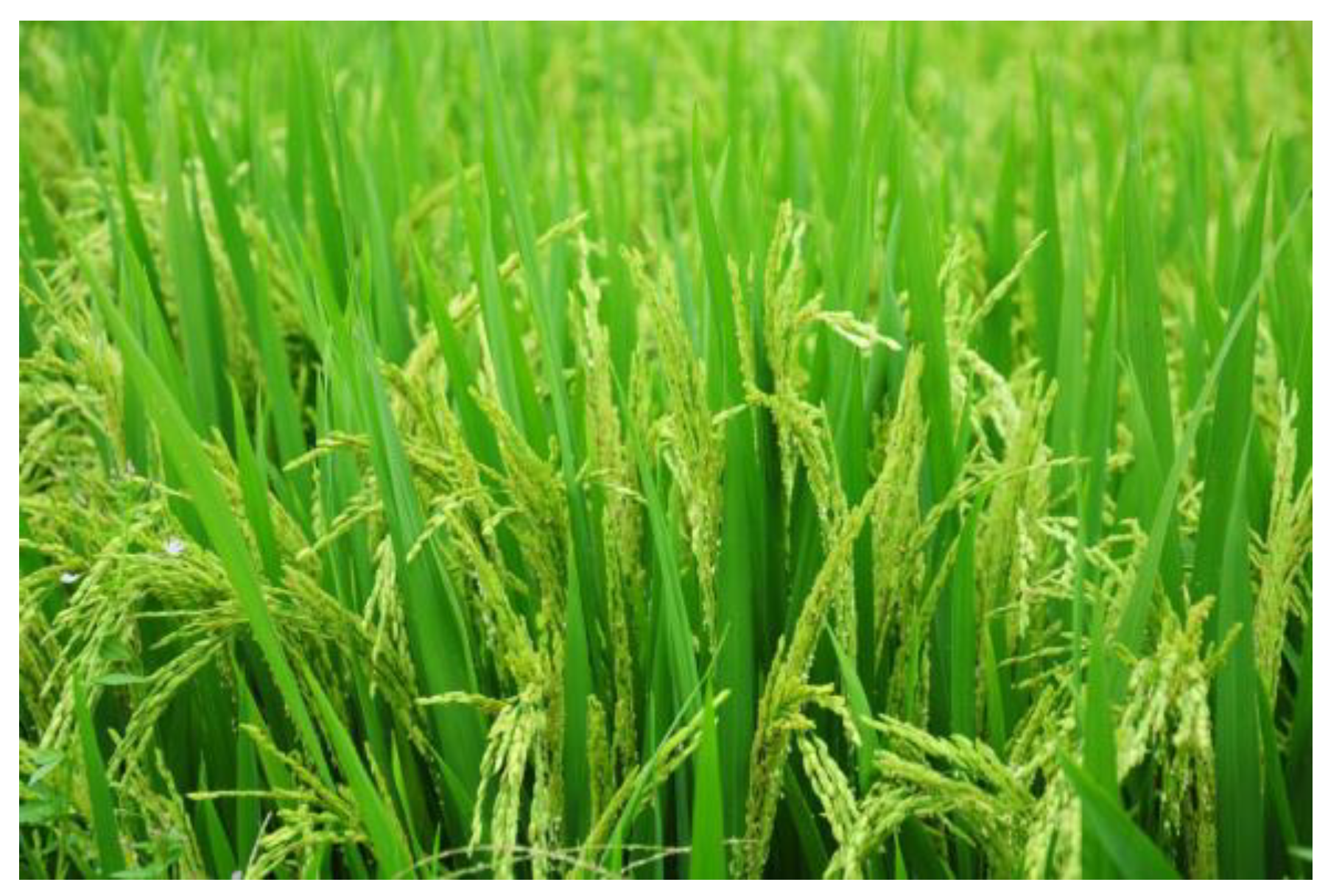
Figure 3.
Leaves coloration symptoms of RYMV; yellow mottle or orange depending on the genotype [14].
Figure 3.
Leaves coloration symptoms of RYMV; yellow mottle or orange depending on the genotype [14].
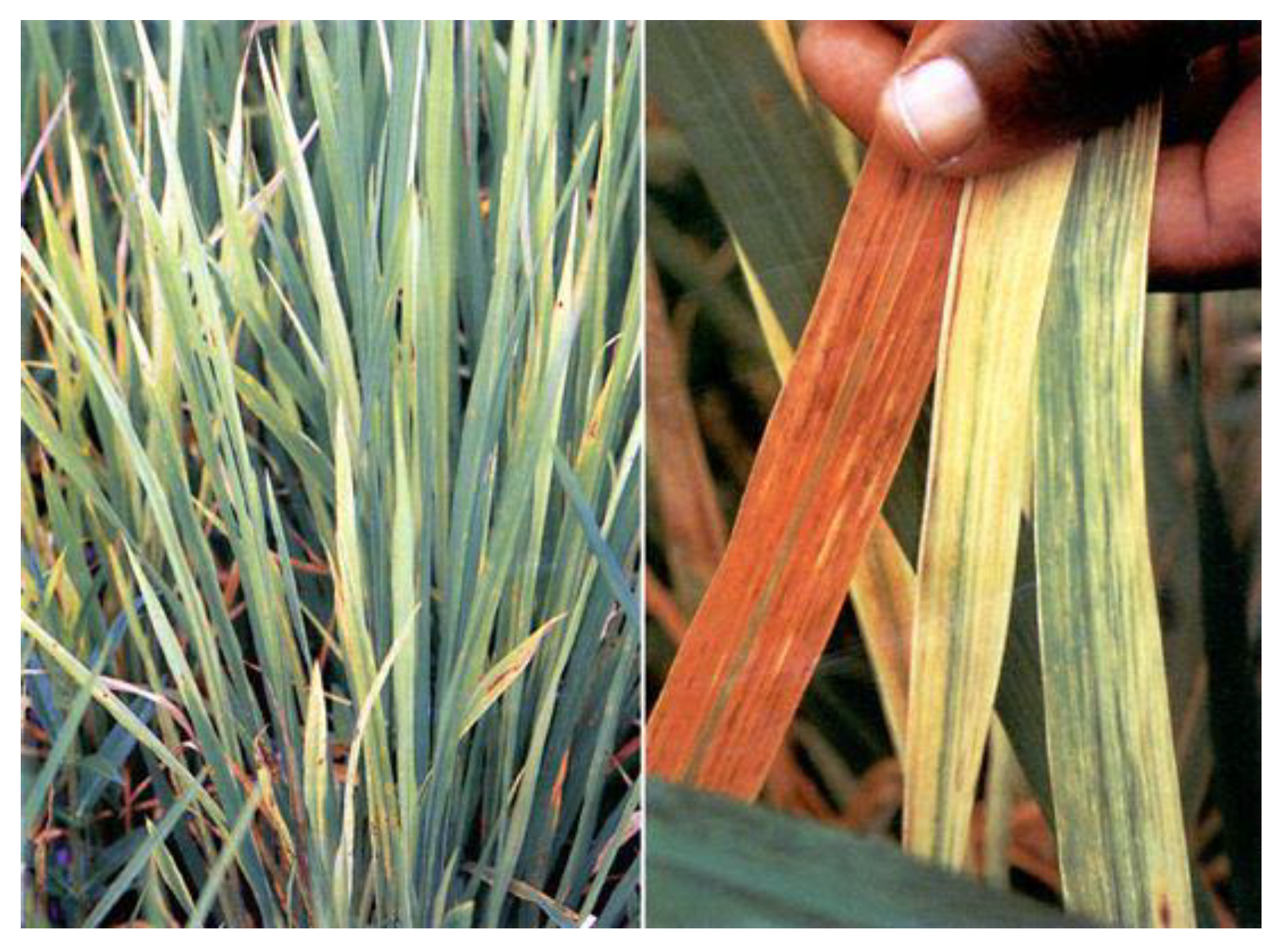
Figure 4.
Yellowing and stunting of RYMV-affected plants. Non-infected plants are uniformly green [14].
Figure 4.
Yellowing and stunting of RYMV-affected plants. Non-infected plants are uniformly green [14].
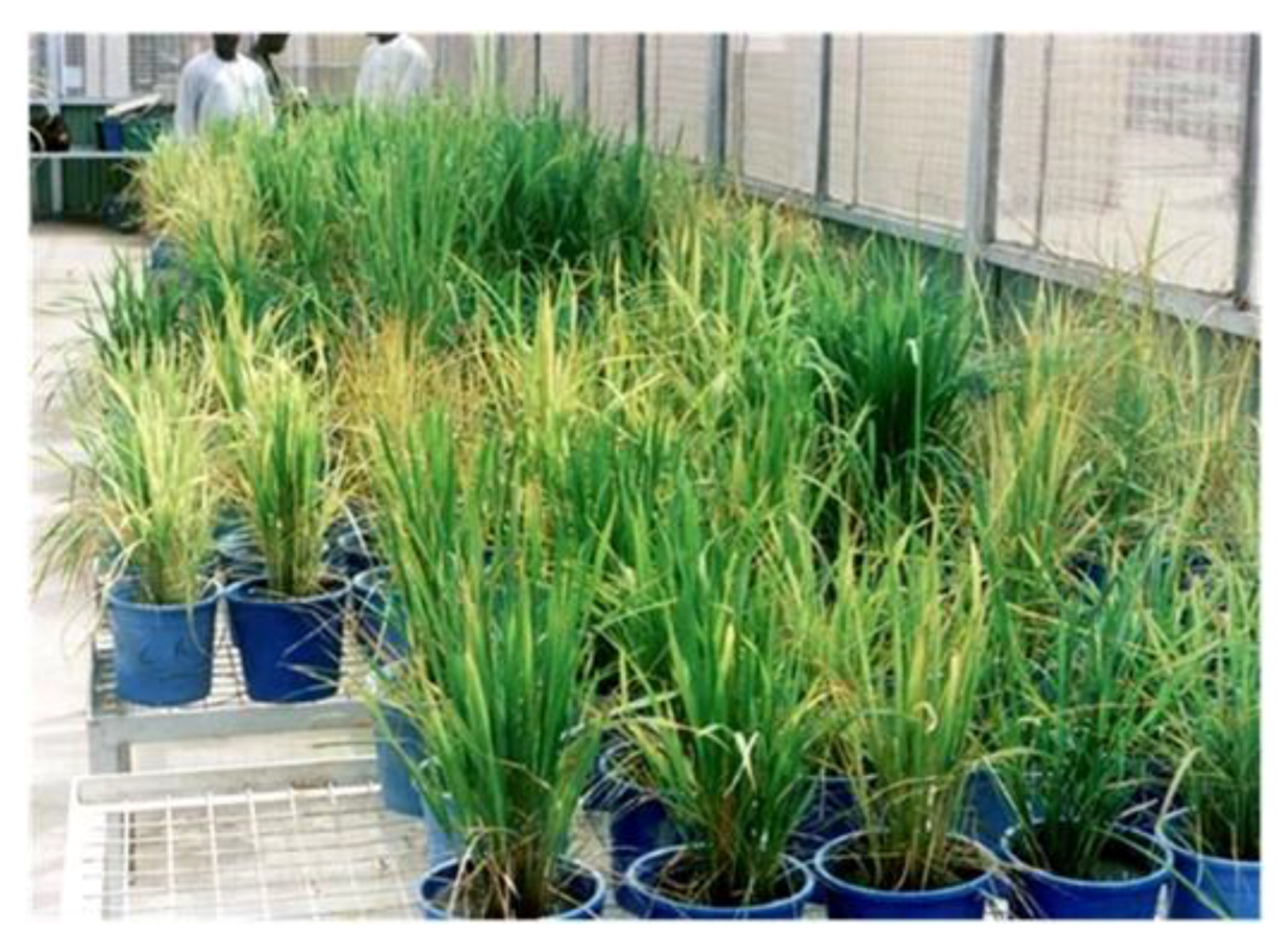
Figure 5.
Field symptoms; a patch of dry leaves of a rice variety severely attacked by RYMV [14].
Figure 5.
Field symptoms; a patch of dry leaves of a rice variety severely attacked by RYMV [14].
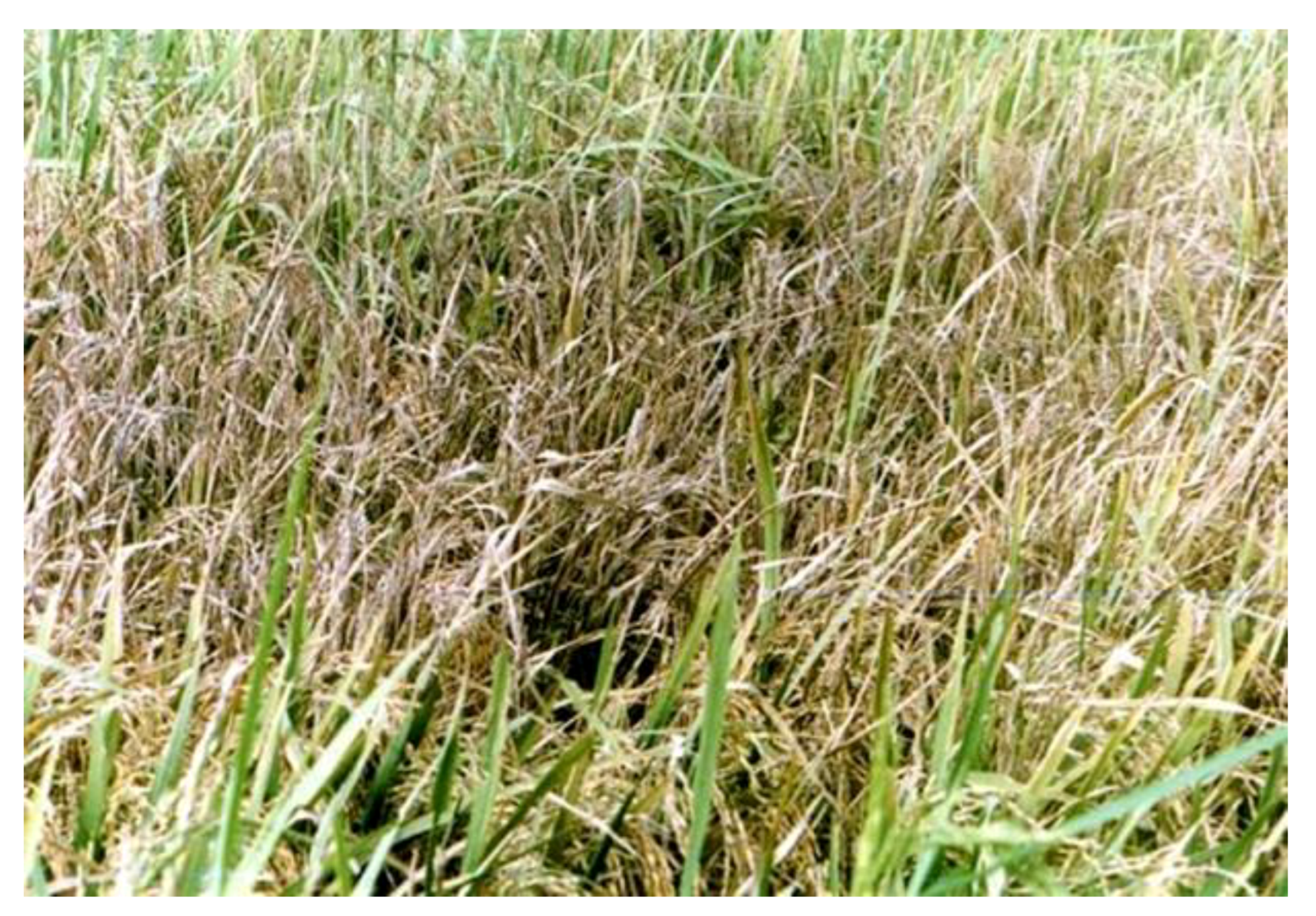
Figure 6.
A typical RYMV genome. ORF1, P1: first protein; ORFx, Px: protein "x"; TM: transmembrane domain; ORF2a, Pro-serine protease; VPg, viral genome-linked protein; P10:10kDa protein; ORF2b, RdRp: RNA-dependent RNA polymerase, CP: coat protein, gRNA: genomic RNA; sgRNA: sub genomic RNA, -1RNA; -1 ribosomal frameshift. Credit: [47].
Figure 6.
A typical RYMV genome. ORF1, P1: first protein; ORFx, Px: protein "x"; TM: transmembrane domain; ORF2a, Pro-serine protease; VPg, viral genome-linked protein; P10:10kDa protein; ORF2b, RdRp: RNA-dependent RNA polymerase, CP: coat protein, gRNA: genomic RNA; sgRNA: sub genomic RNA, -1RNA; -1 ribosomal frameshift. Credit: [47].

Disclaimer/Publisher’s Note: The statements, opinions and data contained in all publications are solely those of the individual author(s) and contributor(s) and not of MDPI and/or the editor(s). MDPI and/or the editor(s) disclaim responsibility for any injury to people or property resulting from any ideas, methods, instructions or products referred to in the content. |
© 2024 by the authors. Licensee MDPI, Basel, Switzerland. This article is an open access article distributed under the terms and conditions of the Creative Commons Attribution (CC BY) license (http://creativecommons.org/licenses/by/4.0/).
Copyright: This open access article is published under a Creative Commons CC BY 4.0 license, which permit the free download, distribution, and reuse, provided that the author and preprint are cited in any reuse.