
Submitted:
05 June 2024
Posted:
05 June 2024
You are already at the latest version
Abstract
The bulk planetary compositions are thought to be linked to the chemical abundances of their host stars. The abundances of 8 key rock-forming elements and the key planetary abundance ratios in G– and F–type main sequence stars located in the Solar neighborhood within 50 pc were statistically analyzed. The averaged C/O, Mg/Si, and Fe/Si elemental ratios of the planetary systems have a crucial role in the chemical composition and the mineralogy of a rocky planet's interior. We also studied the variation of the calculated Ca/Si, Al/Si, Na/Si and Fe/Si ratios in the samples of the examined stars using the Ca, Al, Na, and Fe abundances from the catalog and then attempt to constitute plausible occurrence trends of the analyzed abundance ratios for the rocky planet population in the near – solar galactocentric distances. Considering these results, we provide simple predictions for the most likely bulk compositions of the potential rocky planets. We further apply our results to compare them to the solar averaged abundance ratios, finding that the key elemental ratios for rocky planet composition in the Solar System are not typical amongst most of the studied stellar samples.
Keywords:
element abundance
; elemental ratio
; rocky planet
; stellar abundance
; solar
; mineralogy
1. Introduction
1.1. On the Chemical Composition of the Stars and Their Planets
Since host stars and their planets form within the same protoplanetary disk, therefore there is a relationship between the chemical compositions of the stars and their orbiting planets. CI–chondrite abundances and the Earth's relative bulk composition of major rock – forming elements are close to that of the Sun [1,2].
Space–based (Kepler, TESS) and ground–based exoplanet surveys (HARPS) have revealed many dependences between the characteristics of exoplanets and the physical properties of their host stars [3]. Previous studies have demonstrated that giant planets are more frequent around high-metallicity stars [4,5,6,7]. The iron abundance of host stars does not have a determining role in terrestrial planet formation, small planets could be formed even around metal-poor stars [8]. Adibekyan et al. [9] found that low–mass planet host stars have higher Mg/Si ratios than the giant planet hosts. This result indicates that the Mg/Si ratio plays an essential role in rocky planet formation. The mass abundances of refractory elements (Mg, Si and Fe) have a great importance in the the conditions of the planet formation [10].
The Mg/Si mineralogical ratio is slightly higher for stars that host low–mass planets compared to stars without detected planets [9,11]. Other α-elements (Ca, Al, Na) are also important factors for the bulk compositions of the terrestrial planets, thus the planet formation frequency depends on the enhancements of α - elements in stars.
As presented by Haywood [12] and Adibekyan et al. [13,14] the iron–poor planet - hosting stars exhibit an enhancement of α - elements and it can also be observed that low–mass planets that can be formed at a wide range of metallicities [15].
Previous studies in this area have focused mostly on the C/O, Mg/Si and Fe/Si abundances of F-, G- and K-type stars. As opposed it, this study not only focus on C/O, Mg/Si and Fe/Si ratios, but it statistically analyses the mean values of Ca/Si, Al/Si and Na/Si abundance ratios, which are also essential factors in respect of the mantle and crustal mineralogy of rocky planets.
The most important mineralogical ratios are the C/O, Mg/Si and Fe/Si, which determine the structural properties and bulk chemical compositions of rocky planets. The C/O ratio determines the distribution of silicon between carbide and oxide mineral constituents. The Mg/Si ratios controls the silicate mineralogy and the relative sizes of planetary cores depend on the Fe/Si ratio. The Solar C/O and Mg/Si values are 0.54 and 1.05 [16,17]. Several extrasolar planetary host stars have been found to have relatively high C/O values above 0.8. The terrestrial planets of these stars will be different in composition from the Solar System bodies and having C– rich mineralogies with a large amount of carbon–enriched mineral species (SiC, TiC, Fe3C, graphite etc.). The idea of the potential existence of carbon–rich planets has been derived from Kuchner and Seager [18]. demonstrated that the most of C-rich planet – hosting stars can be found in the galactic bulge.
The varying Mg/Si ratio may result in considerable compositional variations in planetary mineralogy. For the bulk planetary Mg/Si ratio less than 1, Mg is present in pyroxenes (MgSiO3) and the excess Si is in feldspars or SiO2 in very low–Mg/Si planets.
For Mg/Si ratio ranging from 1 to 2, planetary building blocks ara made from the combination of olivine and pyroxenes, which is distributed by the Mg/Si ratio. For Mg/Si values above 2, all Si is built in the olivine (Mg2SiO4) and the excess Mg constitutes MgO or MgS [19]. Accordingly, Mg–rich rocky planets may have upper mantles with transition zones, which are dominated by olivine and ferropericlase (Fp). Solid planetary building blocks forming interior to the water ice line (T < 150K) show an increase in Mg2SiO4 and a decrease in MgSiO3 with the increasing Mg/Si ratio of the host stars, which related to the higher [Fe/H] [20].
The budget and relative abundances of these elements in rocky exoplanets might be unlike from that of Earth, but they constitute the largest fraction of planet – building materials making up more than 95 % of the total mass of silicate planets. In terms of the results of McDonough [21] 94.6 mol % of Earth has been made up from O, Fe, Mg and Si. Calcium, aluminium plus sodium is calculated to be 2.6 by mol % of Earth and other elements give the remaining 2.8 mol %.
To estimate the possible occurence of different planetary compositions in the solar neighborhood, the study focuses on these seven elements that form the major elemental abundance ratios for planetary minerology of rocky–silicate planets.
A broad range of metallicities and the variability of abundances of key rock–forming elements in planet host stars are thought to yield a high mineralogical diversity in rocky planet population of the Galaxy. Studying the distributions of the key elemental abundance ratios, the explored compositional diversity can provide information about that how can be common is the relevant Solar System abundances and the Earth's mineralogy within our Galaxy.
1.2. Great Mineralogical Diversity for Rocky Planet Population
The variability of important elemental ratios in stars can lead to harbor compositionally different type of planets. The study of the spectroscopically determined elemental abundances of stellar photospheres provides insight into the approximate bulk mineral composition of rocky planets.
Bedell et al. [22] found that C/O and Mg/Si ratios of stars in solar – metallicity range are homogeneous within 10 % in the solar neighborhood. It may be implied for the terrestrial exoplanets have a low compositional diversity. At the same time, more studies show that there is a relatively high diversity in stellar Mg/Si and C/O elemental ratios [23,24,25]. Bond et al. [19] and Carter and Bond et al. [26] also suggest that a diverse range of terrestrial planetary compositions may exist within exoplanetary systems. In summary, the observed variations in the key ratios (C/O, Mg/Si, Fe/Si) of terrestrial planet-forming elements (O, Fe, Mg, Si and C) in planetary host stars implies that a wide variety of chemical and mineral composition are likely to exist in the Galaxy [24]. Accordingly, the varying abundance ratios between planet-building elements may result in merely different crustal and mantle mineral composition for solid planets.
Previous studies highlihgt the importance of the planetary compositions for planet habitability as known on Earth, since the planet's chemistry is crucial for the existence of plate tectonics [27,28].
We present our results for the examined chemical properties of the selected G and F - stars in the local region of the Milky Way Galaxy within 50 pc galactic distance from the Sun. Several members in the analyzed sample are Sun-like stars, but all objects in the set of main – sequence stars have metallicities relatively close to the solar value.
We show that the variability of the abundance ratios of Mg/Si, C/O, Ca/Si, Al/Si, Na/Si and Fe/Si may result in a relatively high diversity in the bulk mineralogy of rocky planets. In addition, more categories of the examined star samples need to be made on whether the distribution of analyzed key elementary ratios for rocky planets exhibit similar abundance trends in G- and F -stars for the case of the full available spectrum of C/O ratios, low–C/O range (< 0.65) and stars that are being known orbited by planets.
The one of the main purposes of this study is to explore how the variation of Mg/Si, C/O plus the four elemental abundance ratios can influence the mineral diversity of rocky planets in the Galaxy. Another main goal is to analyze the distributions of relevant elementary ratios to understand the extent of compositional diversity of rocky planets and we attempt to estimate how unique the bulk mineralogical composition of the Earth is.
2. Methods
2.1. Stellar Element Abundances and Star Samples
We utilize the sample of selected elemental abundances of main–sequence G–and F–spectral type stars loceted within 50 pc from the Sun, which have been derived from the stellar element abundance database of the Hypatia Catalog [29]. This work porvides chemical abundances and abundance ratios of 6 refractory (Mg, Si, Fe, Ca, Al, Na) and 2 volatile elements (C, O) for G– and F–spectral type main – sequence stars. More selection criteria have been applied for the scheme of star lists for instance the distances of stars from the Sun, close – to solar metallicity and all stellar elemental abundances in the source database for the studied elemental ratios. The final stellar samples for analysis consist of 512 G and 258 F-type stars. The examined samples contain thin disc stars, which had been observed by high – resolution spectroscopic surveys. The selected G - dwarf stars (4900 < Teff < 6400 K) can be found in the metallicity range of – 0.9 < [Fe/H] < + 0.6. The selected F – type main – sequence stars (5700 K< Teff < 7200 K) belong to the metallicity range of – 0.8 < [Fe/H] < + 0.6.
Planet–harboring stars have also been collected in the samples, which have been discovered up to 15 October 2023 (NASA Exoplanet Archive) [30]. 79 host stars have been identified in the sample of G–stars and 13 hosts are being found among F–stars.
2.2. Statistical Modeling
Since the compositions of forming rocky planets depend on the chemical compositions of the galactic enviroment in which they formed, thus, the distribution trends and the mean values of the examined elemental ratios can only be applied to describing the chemical characteristics of rocky planet population in the solar neighborhood. In terms of it, the predictions of results of the analyses will be applicable in the Galactic thin disk within about few hundreds of parsecs from the Sun.
Both the known planet–host stars and the non – host stars also were examined in the same way, using the concerning data of elemental ratios in two analyzed C/O spectrum (0 < C/O < 1.31 and C/O < 0.65). Oxygen–rich bulk mineralogy could be formed in low C/O planetary systems thus the distributions of C/O ratios below 0.5 have also been analyzed in both star samples. It is neccessary to compare the mean values six abundance ratios of known planet–host with the ratios of non– host G – and F - type stars. Additionally, it needs to give a comprehensive image from the common, the rare and the exotic bulk mineralogies of the potential rocky planet population. It is also examined that how effect the demonstrated compositional diversity on the frequency of the plate tectonics on low–mass rocky planets.
We study plausible linkages between the distributions of stellar abundance ratios of the analyzed major rock–forming elements. Distances, properties of the galactic disk and the spectral types of the sample stars have been obtained by using the stellar properties option in the catalog. After computing the Mg/Si, C/O, Ca/Si, Al/Si, Na/Si and Fe/Si molar ratios, we calculated the mean values for all in the sample. Furthermore, we have plotted the supersolar, solar identical and subsolar values comparing with each other Mg/Si ratio, the carbon – to oxygen ratio, Ca/Si, Al/Si, Na/Si and Fe/Si ratios for analyzing their distribution.
In order to focus the plausible bulk chemical and mineralogical composition of planetary mantles and crusts, we analyze only the C, O, Mg and Si abundances among the major rock-forming species.
For simplicity, we mainly focus only on the abundant potential mineral constituents, which may be the characteristic components in the mantle and crustal mineralogy for rocky planets and most of the minor accessory minerals have not been considered. Moreover, we focus solid planetary building blocks that formed around the potential host stars in the region of terrestrial planet formation inside the water ice line.
In the statistical modeling the variability of elemental ratios is being considered in the metal–poor and metal–rich regime of the studied metallicity range.
3. Results
We find that the variability of Mg/Si, C/O, Ca/Si, Al/Si, Na/Si and Fe/Si ratios results in a moderately high diversity in terms of the bulk elemental composition and mineralogy in potential rocky planets for both the G– and F–type stars.
3.1. Distribution of the Key Abundance Ratios in the Full Examined C/O Spectrum
The number of G–stars and F-stars with calculated Mg/Si, Ca/Si, Al/Si and Na/Si ratios in the sample of full examined C/O spectrums (0 – 1.31 for G – stars, 0 – 1.18 for F - stars) are 512 and 258, respectively. The calculated Fe/Si ratio are 501 and 258 for G – and F – stars.
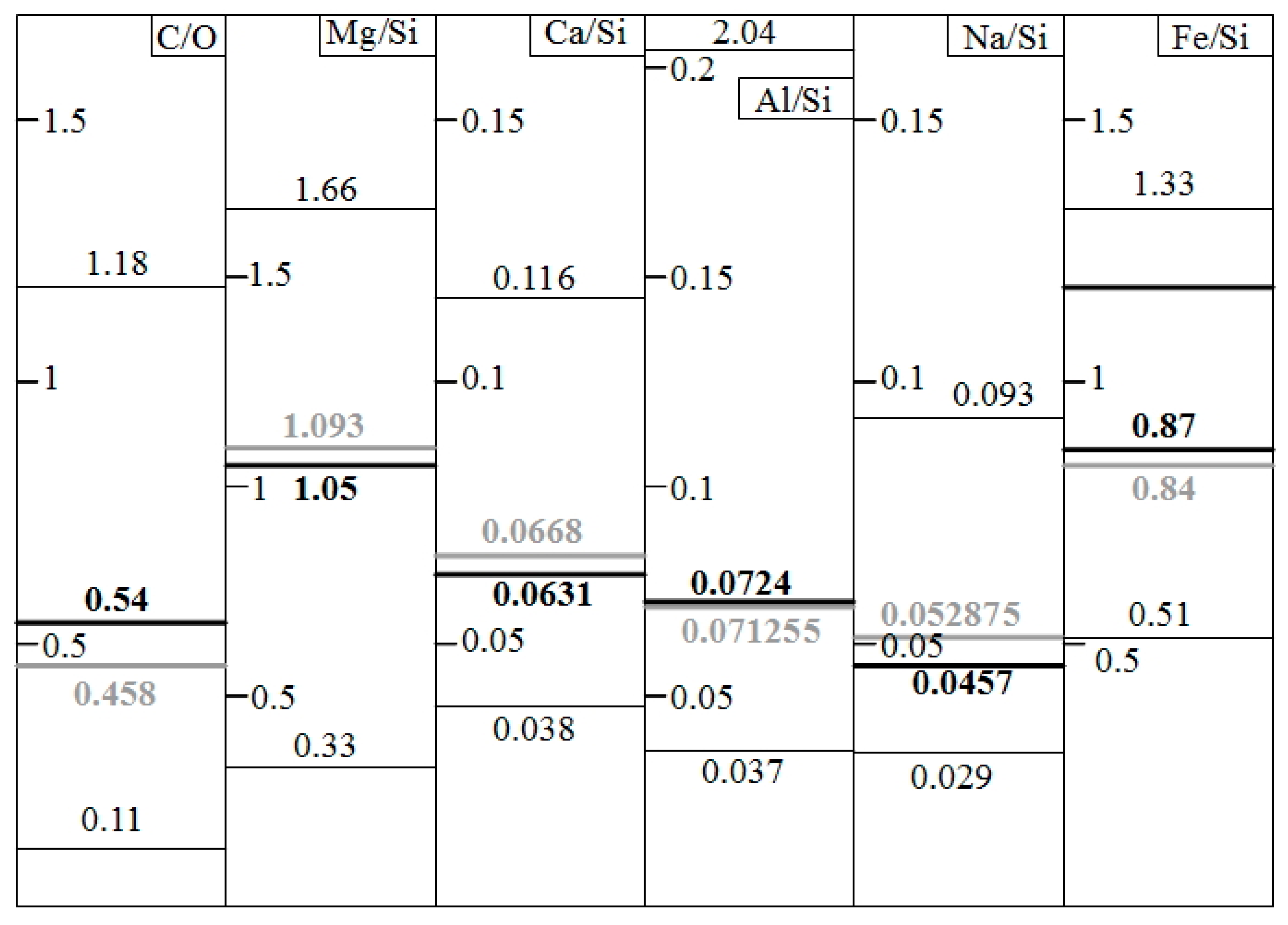
Our results indicate that most of G– and F–type stars with subsolar C/O and supersolar Mg/Si ratios present Ca/Si, Al/Si and Na/Si ratios, which are higher than the solar relevant values (Figure 1a,b).
The abundance variations of essential rock – forming elements can yield many mineral species, increasing the diversity of crustal and mantle mineralogy in the Galaxtic rocky planet population.
Not only the physical and chemical processes, but also the biological processes play an important role in the origin and evolution of minerals on Earth. Biological processes can increase mineral diversity as observed on Earth. Moreover, Hazen and his colleagues [31] concluded that Earth is unique in its mineralogical composition.
Note that the stellar C/O ratios do not necessarily a strong correlation with the bulk C/O ratios of rocky planets [32]. However, the bulk refractory element ratios of rocky exoplanets directly correlate with the host star refractory ratios (Mg/Si, Fe/Si,) [33]. Carter – Bond et al. [24] found that Mg–depleted and Ca – Al – enriched silicate planets can frequently be formed around low–Mg/Si stars.
As shown in Figure 1a,b., most of G – and F – stars with higher Mg/Si values than solar exhibit relatively high Ca –, Al –, and Na - abundances and they can be characterized by super–solar Ca/Si, Al/Si and Na/Si ratios, respectively. Consequently, the lower mantle of the most Mg-depleted silicate planets formed in low Mg/Si planetary systems is thought to be composed mostly of MgSiO3 pv/ppv and SiO2 depending on the Mg/Si ratio. At the same time, the amount of Ca–perovskite in the lower mantle of Mg–depleted planets may be smaller than in the case of the most Mg– rich rocky planets. It should be noted that the possible upper mantle composition of the lowest–Mg/Si planets is being dominated by garnets, diopside and its high-pressure phase, however the mineral assemblage in the upper mantle zone is unlikely to have a relatively large amount of Al–rich minerals.
Figure 1a.
Mean values for the abundance ratios of C/O, Mg/Si, Ca/Si, Al/Si, Na/Si and Fe/Si (denoted by gray lines) in G – type stars, relative to the relevant solar average values (denoted by black lines).
Figure 1a.
Mean values for the abundance ratios of C/O, Mg/Si, Ca/Si, Al/Si, Na/Si and Fe/Si (denoted by gray lines) in G – type stars, relative to the relevant solar average values (denoted by black lines).
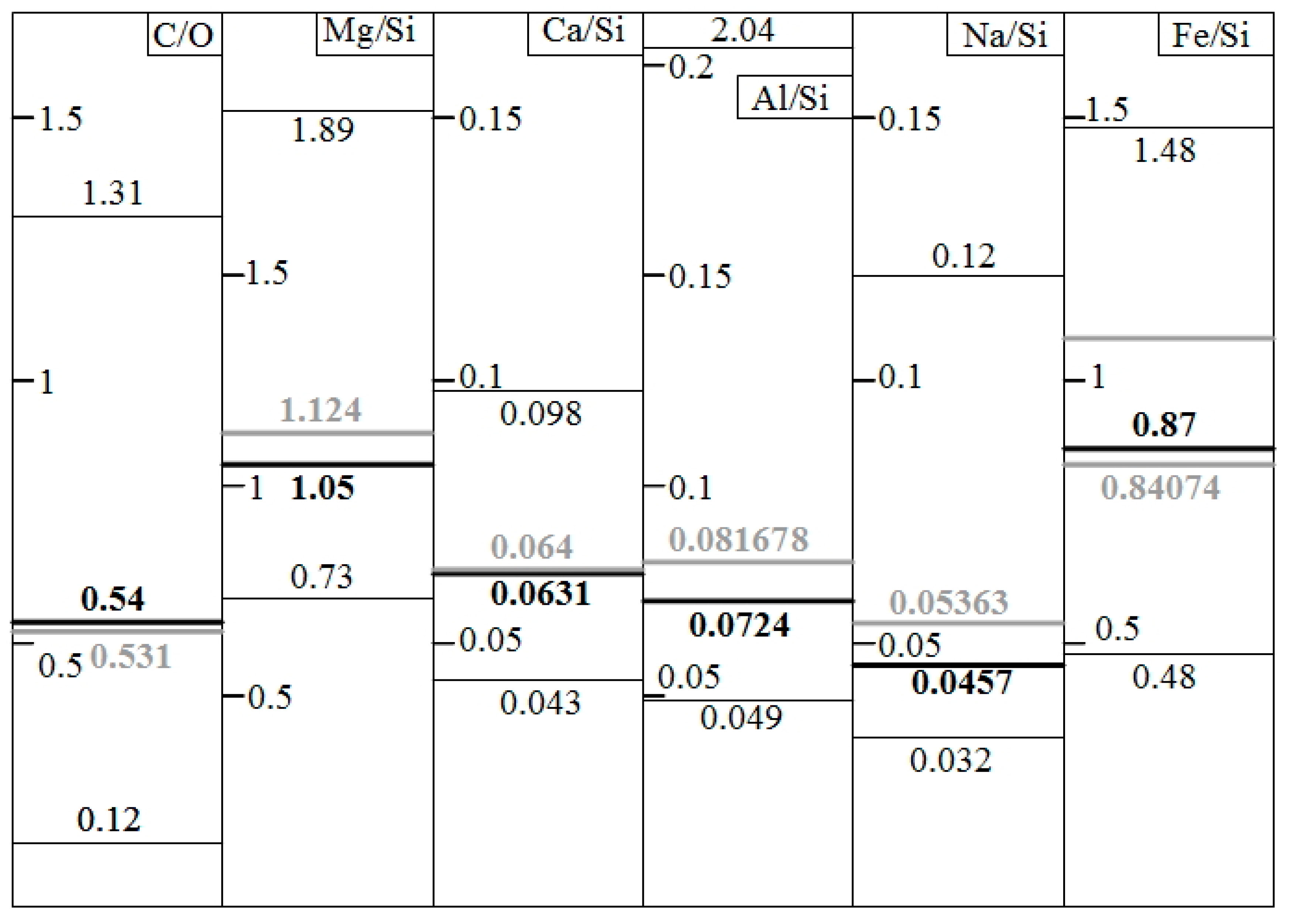
Figure 1b.
Calculated mean values for C/O, Mg/Si, Ca/Si, Al/Si, Na/Si and Fe/Si abundance ratios (denoted by gray lines) in F- type stars. Reference values of the relevant solar abundance ratios are indicated by black lines.
Figure 1b.
Calculated mean values for C/O, Mg/Si, Ca/Si, Al/Si, Na/Si and Fe/Si abundance ratios (denoted by gray lines) in F- type stars. Reference values of the relevant solar abundance ratios are indicated by black lines.
The upper mantle of silicate planets formed in high–Mg/Si systems, consists mainly of Mg and Al–rich mineral phases (olivine, ferropericlase, spinel), and the lower mantle may contain relatively larger amounts of ferropericlase and Ca–perovskite than solar ones compared to the MgSiO3 pv and ppv.
Figure 2 shows that Al/Si values are the largest super–solar elementary ratios for G - stars, the most glaring values are being showed in the –C/O;+Mg/Si range and in the +C/O;+Mg/Si range. In contrast to G–stars, the most super–solar ratios related to subsolar ratios in the pattern of F–stars are found to be in case of the Ca/Si and Na/Si values, which have also been appeared in the – C/O;+Mg/Si and in the +C/O;+Mg/Si ranges (Figure 3). The proportion of the subsolar and supersolar Fe/Si ratios of G - and F – type stars are moderately variable in the different C/O–Mg/Si ranges. The stellar Fe/Si values in the – C/O;+Mg/Si range are being lower than the Solar System averaged iron – to silicon ratio.
The most analyzed G– and F– type stars belongs to the – C/O;+Mg/Si range, in which the number of the supersolar values related to the subsolar Ca/Si, Al/Si, Na/Si and Fe/Si ratios exhibit similar variability for the case of both spectral types.
On the basis of the obtained distributions of abundance ratios we apply a simple 3 – layer planetary interior model in our study, mainly basaltic crust, forsterite - pyroxene upper mantle, bridgmanite–dominated and ferropericlase rich lower mantle have been predicted in most cases for the Earth–sized or slightly smaller potential rocky exoplanets in the solar neighborhood. Our results imply that the most terrestrial exoplanets may have an Earth–like or smaller core mass fraction as constrained by the observed Fe/Si distributions.
3.2. Distribution of the Key Abundance Ratios in the C/O Range < 0.65
The number of G–stars and F-stars with calculated Mg/Si, Ca/Si, Al/Si and Na/Si ratios in the examined spectrums of C/O < 0.65 are 403 and 244, respectively. The calculated Fe/Si ratio are 391 for G–stars and 244 for F – stars.
In the Mg/Si range 1 – 1.1, there are 91 G –, and 55 F – stars. The most G- (187), and F – stars (83) in the sample belong to Mg/Si range 1.11 – 1.3. 42 G – stars and 22 F – stars lie between 1.31 and 1.5 Mg/Si values, while 13 G – stars and 4 F – stars can be characterized by Mg/Si values above 1.5. It has been found that in the C/O range containing values lower than 0.65 the G – and F – type stars have a similar distribution in Mg/Si, which implies that the chemical conditions for the formation of the planetary mantle and crustal building blocks can be similar around different spectral–type young stars in the solar galactocentric distance. This observed distribution of Mg/Si values suggests that the probability of the formation of rocky–type planets with bulk Mg/Si ranging from 1.1 – 1.3 much higher than that of the Mg–poor (Mg/Si < 1.1) and the Mg – rich (Mg/Si > 1.5) planets.
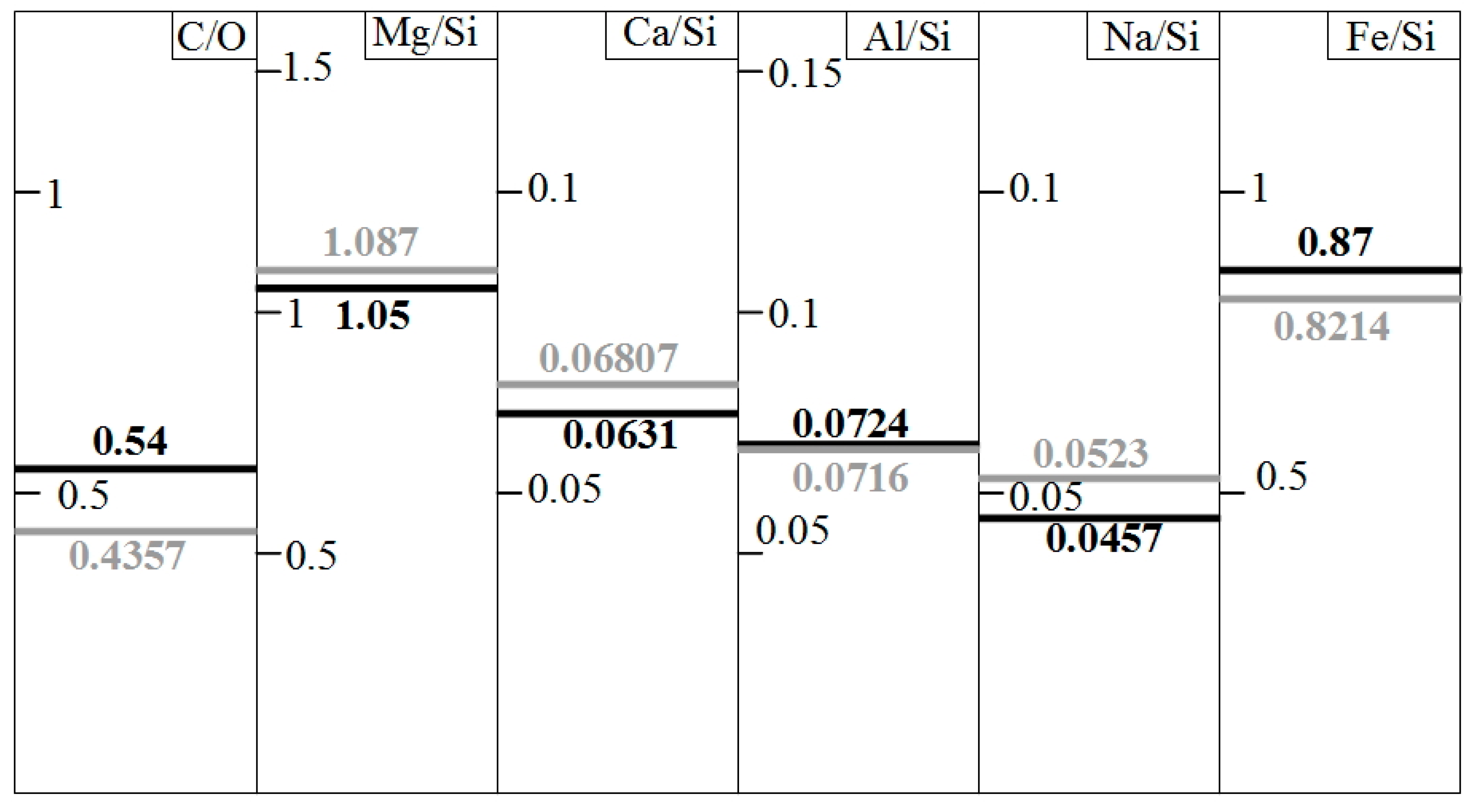
The mean values of stellar Mg/Si ratios for G– and F-stars are higher not only in the full examined spectrum of C/O ratio but the mean stellar Mg/Si ratios for G – and F stars in the C/O spectrum below 0.65 are also higher than the solar averaged Mg/Si (Figure 4a,b), also confirms that the solar chemical composition is not typical amongst the values of sample stars in respect of the relative abundance of key planet–building elements.
Figure 4a.
Mean values of the six analyzed elemental ratios in G – stars in case of the C/O ratios ranging from 0 – 0.65. Mean values of the stellar abundance ratios indicate by gray lines, and the black lines denote the relevant Solar values for reference.
Figure 4a.
Mean values of the six analyzed elemental ratios in G – stars in case of the C/O ratios ranging from 0 – 0.65. Mean values of the stellar abundance ratios indicate by gray lines, and the black lines denote the relevant Solar values for reference.
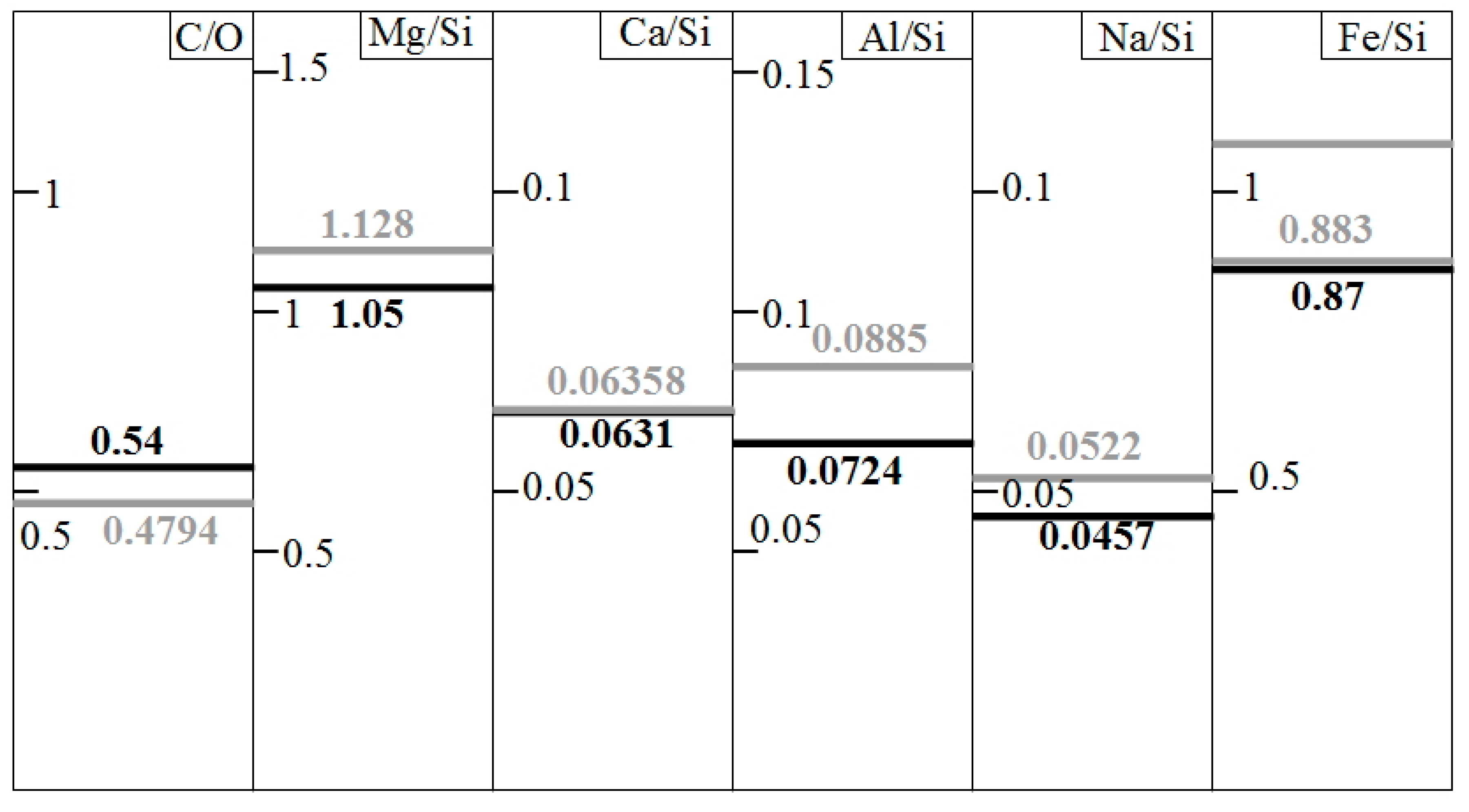
Figure 4b.
Mean values of the six examined elemental ratios (fray lines) in F – stars for the case of C/O range 0 – 0.65. The relevant Solar abundance ratios are denoted by black lines.
Figure 4b.
Mean values of the six examined elemental ratios (fray lines) in F – stars for the case of C/O range 0 – 0.65. The relevant Solar abundance ratios are denoted by black lines.
3.3. Distribution of C/O Ratios Below 0.5
The distribution of the stellar C/O values below 0.5 carbon– to oxygen ratio being shown in Table 1.
The number of C/O values gradually decreases from the C/O range 0.41 – 0.50 to the range of 0-0.10 in case of G – and F – stars, too. The number of C/O ratios for G - stars below 0.5 (203) is 39.6 percent of the sample of the examined G – stars in the full C/O spectrum (512). As opposed it the number of C/O ratios for F - stars below 0.5 (180) is 69.7 percent of the full spectrum C/O sample for F – stars (258). These results show that more terrestrial planets could have formed in oxygen and water – rich enviroments within extrasolar planetary systems around F – stars than G - stars.
In low – C/O protoplanetary disks, more oxygen is built into water molecules in contrast to the high – C/O disks, in which a larger fraction of oxygen makes CO molecules rather than water molecules. Therefore, water will present in greater amounts in the planetary materials (ices, atmospheres) of the outer region of low – C/O planetary systems. Additionally, a more considerable fraction of the rocky planets with water and oxygen–rich BSP mineralogy are predicted to form in the terrestrial planet formation zone for the case of oxygen – rich PPD chemistry. The O–rich conditions can yield such an olivine dominated upper mantle composition and a MgO – bearing lower mantle composition for rocky planets containing accessory mineral assemblages with O – rich species, the composition of which depends on the stellar and bulk planetary C/O, Mg/Si and Ca/Si ratios. MgO, magnesium peroxide (MgO2) and CaO2 may be present in the deep mantle conditions of high–Mg/Si rocky Earth–mass planets and super–Earths depending on the elevated oxygen abundances of planet–harboring stars and the conditions of the O – rich enviroments in rocky planetary interiors [34,35,36].
In conclusion, a significant fraction of the potential rocky exoplanets around G – and F–stars are thought to have magnesium – rich mineralogy with O–rich species compared to the Solar System rocky planet compositions. The chemical conditions in the low–C/O planetary systems can also contribute to the great diversity of rocky planet compositions.
This factor determines the mineralogical characteristics of rocky planets in the most planetary systems in the Solar neighborhood. The elemental abundance analyses shows that the major fractions of the thin disc G–and F - stars are likely to harbor rocky planets, most of them have relatively high bulk Mg/Si ratios and they have formed under low C/O chemical conditions in PPDs. Therefore, we concluded that most of the higher Mg/Si planets are likely to have higher water content compared to planets that formed in low-Mg/Si planetary systems.
3.4. Distribution of the Key Abundance Ratios in Planet–Host Stars
More than 6000 exoplanets have been confirmed, up to date. Our samples of known planet–host stars contain 79 G – stars (C/O = 0.17 – 0.80) with 60 low – C/O (< 0.65) members and 13 F–stars, each one of these F–stars have C/O ratios ranging between 0.35 – 0.58.
We also examine the distribution of key abundance ratios for both G – and F – stars with known planetary companions, finding that the most analysed elementary ratios show similar distribution trend in G – star samples (full examined C/O spectrum, range of C/O < 0.65 and planet–host stars) except the values of C/O and Fe/Si ratios. The mean value of C/O ratio (0.575) is obtained to be higher than solar in the sample of planet – hosting stars examined in the full C/O spectrum (Figure 5a). Interestingly, the mean Fe/Si ratio is calculated to be similar in the G – star samples of full C/O spectrum and in the planet–harboring stars, while its value is being slightly higher than solar in the sample of C/O < 0.65.
Figure 5a.
Gray lines show the mean of the analyzed ratios in planet – hosting G – stars for the range of full C/O spectrum and for C/O values ranging from 0 – 0.65. Black lines show the Solar averages of the ratios of key planet – building elements.
Figure 5a.
Gray lines show the mean of the analyzed ratios in planet – hosting G – stars for the range of full C/O spectrum and for C/O values ranging from 0 – 0.65. Black lines show the Solar averages of the ratios of key planet – building elements.

Figure 5b.
The mean values of the six ratios in planet–harboring F–stars of the C/O range 0 – 0.65. Solar ratios are also shown by black lines.
Figure 5b.
The mean values of the six ratios in planet–harboring F–stars of the C/O range 0 – 0.65. Solar ratios are also shown by black lines.

F – stars with known planets exhibit similar abundance trends to the samples of G – and F–stars with and without planets in case of the C/O, Ca/Si, Al/Si and Na/Si ratios, but the mean Mg/Si is slightly lower, and the mean Fe/Si is slightly higher than solar (Figure 5b). The reason for this may be that the known planet – hosting stars of the F – star sample are very few (13) to be sufficient to an exact and reliable abundance analyses.
9 G - stars host super – Earth (Mp < 10 M), 12 G - stars host Neptune – like planets (Mp < 30 M) and 58 G - stars have Jovian planets (Mp ≥ 30 M). 13 F - stars host gas giant planets (Mp ≥ 30 M).
G - host stars with different type planets exhibit similar distribution trends to that of the stars of entire G – sample except the Neptune – like planet and Jovian hosts, which have mean C/O values higher than solar. The sample of G–type super-Earth hosts includes lower C/O and Fe/Si, slightly higher Ca/Si, Al/Si and Na/Si values than solar, which distribution trend also reflects the characteristic trend for the total sample of G – stars (Table 2).
Interestingly, the mean Mg/Si ratio of G – type super - Earth hosts higher than the average of Mg/Si ratio for case of both G – and F – stars without known planetary companion, highlighting that low – mass planets are more frequent around stars with high Mg/Si ratio [9].
3.5. The Common Mineralogical Compositions for Rocky Planets
We demonstrated that a greatest fraction of G – and F – type stars are characterized by an increased Mg/Si ratio and a decreased C/O ratio compared to the solar relevant values. The most common composition for the potential terrestrial planets of these stars can be characterized by Mg – rich crustal plus mantle mineralogy and possibly greater water budget compared to the Solar System terrestrial planets. The Fe/Si ratios are lower than solar for both G – and F – stars plausibly linked to the formation of smaller core mass fractions.
Moreover, the most common compositions for the rocky planetary mantles in the solar neighborhood can be described by mineral assemblages that slightly richer in Ca – bearing minerals (Ca – pv, ppv) in the lower mantles, and Ca –, Al – and Na – bearing minerals (pyroxenes, garnets) in the upper mantles.
3.6. Rare and Exotic Bulk Mineralogies in the Rocky Planet Population
At the same time, we suggest that the variable stellar Mg/Si and C/O ratios in some cases may result in rare BSP compositions yielding unique crustal and mantle mineral assemblages for rocky planets.
It has also been found that a large fraction of low – Mg/Si stars have a variable degree of carbon enrichment compared to that of the higher - Mg/Si stars.
14 stars amongst the G – stars (2.73 %) have C/O ratios above 0.8 and 4 stars have C/O ratio higher than 1. The sample of F – stars contain 7 stars with C/O ratios above 0.8 (2.71 %), 4 of them have C/O ratio larger than 1. These results highlight that C - rich planetary systems not only are frequent in the globular clusters, but they may exist in the galactic thin disk.
60 (G) and 65 (F) stars exhibit lower than 1 Mg/Si values. If they have rocky planets then those may have a very different mantle and crustal mineralogy from those of the terrestrial planetary bodies of the Solar System.
59 stars present Mg/Si values ranging between 0.80 – 0.99 for both the G and F star sample. The forming terrestrial planets in the low – Mg/Si planetary systems are expected to be Si – rich, having upper mantles consisting mainly of olivine, diopside - phases, pyrope and SiO2. Their lower mantles are likely composed of MgSiO3 pv/ppv and a relatively small amounts of MgO. Considering of the observed stellar Mg /Si abundances and GCE models, the extremely low Mg/Si planetary systems are likely to be very rare in spiral galaxies. Mg/Si values lower than 0.5 have been found in 0 and 1 stellar compositions in the G - star and F star samples, respectively. In very low – Mg/Si systems, the upper mantle of Mg – depleted planet made of diopside – phases, Fe – rich garnets and SiO2, the lower mantle build up from MgSiO3 pv/ppv and high – pressure SiO2. The SiO2 - rich magmas produce andesite/rhyolite igneous rocks, and the granitic crust contains a great number of feldspars and it build up mostly from felsic igneous rocks.
If the bulk Mg/Si ratio of BSP is lower than 0.5, the Mg is in MgSiO3 pv/ppv in the lower mantle, while the excess Si constitutes high – pressure SiO2 phases, which present as dominant mineral in the greatest mass fraction of the mantle. In extremely rare case, the bulk Mg/Si ratio of a solid planet may be close in zero yielding to a „silica planet” with crustal and mantle composition made mostly from SiO2.
In summary, the largest fraction of analyzed G – and F – stars, having subsolar C/O and suprasolar Mg/Si, Ca/Si, Al/Si, Na/Si ratios, can harbor rocky planets with different bulk mineralogies from that of solar terrestrial planets. The similar or closely solar identical sets of the six examined abundance ratios can rarely be found in the stars of the thin disc at solar galactocentric distances based on the obtained results (Table 3).
3.7. The Great Compositional Diversity for Rocky Planets and the Plate Tectonics
Many publications deal with the conditions of plate tectonics on massive rocky planets [37,38,39,40,41,42].
The planetary mass and composition, the structural properties, the adequate pressures and the temperatures of rocky planet interiors, moreover the plate mobility and the characteristics of mantle convection may be the most important conditions for plate tectonics on terrestrial exoplanets. Different mantle-building minerals have merely different thermoelastic properties, therefore the mineralogical composition of the mantle plays a crucial role in the efficiency of the mantle dynamics. Note that the presence of light alloying elements such as sulphur strongly affect the melting temperature of iron [43]. In this manner, the number of light elements is an essential factor for the thermal evolution of terrestrial planetary cores, which is closely related to the existence of magnetic field and the thermal evolution of the mantle. The view that plate tectonics might be a crucial factor to the formation and to evolution of life on terrestrial exoplanets is being widespread.
The mantle and the core composition of terrestrial planets can be highly diverse in the Galaxy and both factors depend on the major abundance ratios (C/O, Mg/Si) and other elemental ratios (Ca/Si, Al/Si, Na/Si, Fe/Si, S/Fe). Studying the key elemental abundance ratios of planet – building materials can contribute for a good estimate of the occurrence of plate tectonics in the Galaxy. We focus on the assumed optimal ranges of C/O, Mg/Si and Fe/Si elemental abundance ratios, in which the likelihood of compositionally favorable conditions can relatively be optimal for the tectonic processes on rocky planets.
The terrestrial planets in our solar System have a chemical similarity (the O, Fe, Mg, and Si elements), but a large difference in structure and mineralogical composition of their mantles. For instance, the core radius fraction of Venus, Earth and Mars is moderately similar, but the core radius of Mercury is surprisingly great compared to the total radius. Otherwise, the dominant phases in the mineral assemblage of Earth's lower mantle are MgSiO3 pv / ppv, ferropericlase and Ca – perovskite. The MgSiO3 pv have the largest mass fraction of the mantle materials in the whole mantle of Earth. The martian mantle is likely to be composed of olivine and its higher - pressure phases, garnets and pyroxenes. Similarly, the planet condititions of rocky planets can also be diverse in the planetary systems and in the Galaxy. However, it is neccessary to consider that the bulk Mg/Si ratios of rocky planets in the planetary systems are not significantly different from the Mg/Si abundances of their host stars. In this manner, our goal is to study the observed chemical properties of the examined G – and F – stars and to review which mantle compositions influence mostly the effficiency of mantle convection and plate moving.
Carbon planets can not be ideal candidates for sustaining efficient mantle conventions over long – time, owing to the high thermal conductivity and viscosity of carbon – rich mantle – consisting of materials. The estimation is being constrained to the low C/O stars since plate tectonics on carbon planets is less likely than on silicate planets Stamenković and Seager (2016) [27]. Thus, we have selected those G – and F – stars from the sample, which have C/O values lower than 0.65. These relatively low – C/O stars have been further selected based on the Mg/Si value ranging from 1 – 2.
Experiments confirm that the viscosity of iron – rich ferropericlase (Fp) (Mg,Fe)O is reduced at the lowermost mantle conditions of Earth (Reali et al. 2019) [44]. Note that the reological behavior of Fp may strongly influence the viscosity structure in the lower mantle zone of terrestrial planets more massive than Earth and having higher bulk Mg/Si ratio.
The one of the most important factors of plate tectonics is plate yielding, which is the most critical condition for plate motions and subduction. The structural properties and chemical/mineralogical composition largely affect the degree of planet yielding [27].
Stamenković and Seager [27] suggest that those terrestrial exoplanets forming in protoplanetary–disks with a high concentration of Si and Na abundances are unlikely to sustain long–term, steady–state plate tectonics. Their examinations have been compositionally focused on that how the variable abundances of refractory and moderately volatile elements affect the planetary dynamics. Researchers find that the bulk planetary composition of lower alkali and Si abundance result in more mobile tectonic plates, which are most likely to sink to the astenosphere. In contrast, the alkali and silica enrichment in the crustal material can yield inmobile top layer, which is unlikely to sink. The alkali– and Si–rich outermost solid layer of terrestrial planets is similar to the higher positive chemically buoyant continental–type crust on Earth, which may not be able to subduct efficiently.
The relatively long – term plate tectonic regime on rocky planets depends on the crustal and mantle mineral composition, the concentration of radiogenic heat elements, planet mass and structure, other factors (surface temperature, water content etc.). Amongst these planet conditions, we focused on those relative elemental abundances in the sample, which can yield favorable mantle and crustal composition for plate tectonics.
The plausible bulk compositions of rocky planets in tight ranges of stellar C/O and Mg/Si values can only be „Earth – like” containing olivine – dominated upper mantle and MgSiO3 – perovskite dominated lower mantle mineralogies. Based on our estimations, the bulk mineralogy of relatively low – mass rocky planets (~ 1 – 3 Earth – mass) only approximates the mineralogy of BSE if the C/O and Mg/Si values of the host stars distribute ranging between ~ 0.5 - 0.65; ~ 1 and 1.3, respectively.
The rheological behavior of the constituent minerals in the lower mantle of high – Mg/Si Earth–mass planets and low – mass super - Earths may results in slightly more dynamic concective system being owing to the greater amounts of Fp, which alter the viscosity contrast between the top and the bottom of the mantle. The small viscosity contrast regime in the mantles can increase the efficiency of mantle convection. The viscosity structure can influence the crustal/lithospheric thickness of the planet, which factor is also very important in respect to occur subduction and tectonic processes. Moreover, the high Mg/Si modifies the crustal and lithospheric composition, thus it would have a negative effect on the mechanical properties and hence the dynamic behavior of the lithosphere.
Since the thermal evolution of the mantle and the core are tight correlation, the efficiency of plate tectonics is suggested to be dependent on in a small extent the variations of light elements in core composition.
We estimate that the expected number of planets, which can be able to sustain plate tectonics. They could have formed for the case of one - sixth of the rocky exoplanets considering the favorable range of stellar C/O and Mg/Si abundance ratios. However, it is likely that only a small fraction of these planets can sustain long – term plate movings over billion - year timescales.
3.8. The Set of the Examined Stellar Abundance Ratios and the Earth's Atypical Bulk Mineralogy
As seen in the analysis of the sets of the six examined stellar abundance ratios, the set of the solar values is different from most of the sets of stellar abundances. On that basis, the set of the solar abundance ratios and the Earth's bulk mineralogy are thought to likely be rare in the solar neighborhood. The events of the special post – accretion evolution have also contributed to the formation of Earth's unique mineralogy.
The planets in the Solar System are thought to have formed form same disk of gas and dust that formed the Sun. The location of the planet formation in the protoplanetary disk, the physical processes of the nebular and post – nebular disk accretion also influence the final bulk composition of terrestrial planets. However, the set of the average abundances of key rock – forming elements in the Solar System is the primary chemical condition for forming the bulk mineralogy of Earth and other Solar System planets. In summary, the set of the key abundance ratios and the special events and processes in the evolutionary history of our planet were the determining factors for the formation of the Earth's atypical bulk mineralogy.
It is known that specific elemental ratios in stars with planets are very important for the formation of geologically active rocky planets. The adequate values of C/O, Mg/Si, Fe/Si and even several key elemental ratios (Ca/Si, Al/Si, Na/Si) in bulk planet composition might considerably contribute to the conditions of the long – term geodynamics and the evolution of complex life. In addition, it is likely that favorable sets of these specific elementary ratios in host stars may increase the likelihood for the formation of their rocky exoplanets being Earth – like.
For the Sun, slightly higher C/O and Fe/Si, slightly lower Ca/Si, Al/Si, Na/Si and lower Mg/Si ratios have been indentified compared to the most of stars and thus the set of the 6 solar analysed abundance ratios is found to be different from the majority of abundance sets in the examined G – and F – star samples.
The most common rock – forming minerals are likely to dominate on the most Earth – like planets. However, Hystad et al. 2015 [45] argued that, considering the number of rare minerals, the probability of Earth's mineralogy on another Earth – like planets is remarkably low. They conclude that Earth's mineralogy is unique in the cosmos since the likelihood is extremely low that two planets are being identical in all aspects of their initial chemical and physical conditions during the formation processes. Moreover, the biological factor also contributes to the Earth's mineral diversity.
The one of the initial chemical conditions for rocky planet formation is the set of the key planetary abundance ratios having a high variability, which also affect the occurence of rare minerals. For instance, the rare element Be is essential amongst the rare mineral - forming elements. The significant fraction of beryillium minerals is rare, these are known only from a few localities on Earth. The occurence of several Be – silicate mineral species depends on the bulk crustal abundance ratios Mg/Si, Ca/Si, Al/Si, Na/Si, which are in relation to the same ratios of bulk Earth and solar averages.
Earth's Be – budget depends on the condition of its accretion, however it also depends on solar averaged Be abundances, which is obtained to be A(Be)NLTE = 1.32±0.05 considering the NLTE effects [46]. Planet host stars have similar Be abundances, significant differences might not be present. The Be abundances for solar analog stars are also similar to the solar value [47]. At the same time, Be abundances for G – and F – type planet – host and non–host stars taken from the literature [47,48,49] show that the solar Be abundance is higher than that of the most stars.
It has been thought that highly siderophile elements (HSE, gold, platinum etc.) is delivered by large impacts during the early – stage evolution of Earth. Korenaga and Marchi [50], argued that the impactor's (core) metals with their HSE budget could retain in the mantle. These metals could be transported towards the Earth's crust on billion – year timescales due to the mixing by mantle convection. This process could contribute to the enrichment of crustal gold and platinum budget.
Accordingly, the mode of convection (sluggish, stagnant or mobile lid) plays a crucial role not only in the geological activity, but in the evolution of crustal mineralogy and petrology of a terrestrial planet. The active geodynamics, mantle convection has been working in the Earth's interior for several billion years.
The set of the six solar analysed abundance ratios in this study, a lower than solar Be abundances in the most examined stellar samples adopted from the literature and the large impact events of the Earth's post – accretion evolution indicates that Earth not only unique in the essential abundance ratios for bulk mineralogy, but it can also be rare or unique in respect of the crustal mineralogy in the near – solar galactic population of rocky planets.
4. Discussion
The distribution analyses show that the primary mineralogy of potential rocky planets in solar neighborhood is likely similar to that of the Solar System terrestrial planets, but the mantle mineralogy of the most rocky planets around the systems of G - and F- stars may be more enriched in Mg – rich species, such as olivine and magnesiowustite. The obtained distributions and calculated mean values for the prime elemental abundance ratios C/O and Mg/Si clearly indicate that the Solar System averages of these ratios differ from the most stellar values in both examined C/O spectrum. Solar C/O is slightly higher, while the solar Mg/Si is lower than the stellar averages. Solar Ca/Si, Al/Si and Na/Si ratios are also deviate from the mean stellar values, they are lower than the most stellar ratios of G – and F – stars, except Al/Si values in the F – star samples. The set of the examined solar abundance ratios in this type of pattern is not common, implying that the composition of the solar terrestrial planet – building materials and thus the Earth's bulk mineralogy can not be typical in the rocky planet population of the Solar neighborhood.
In this paper, we have analysed the abundances of 5 key elements (O, C, Fe, Mg, Si) plus metallic elements (Ca, Al, Na) in G – and F - type stars, which can be located the Solar galactic neighborhood by using the concenring data of Hypatia Catalog. We have examined the effect of the variability of C/O and Mg/Si elemental ratios on the mineralogical composition of rocky planets.
We infer that the mineral diversity of rocky planets in the Galaxy may be greater than previously thought. The varying C/O ratio may result in a more diverse range of bulk mineral compositions for Mg-depleted, medium – range Mg/Si and Mg-rich planets, too. Stellar variations of the abundances of Mg, Si, C, and O by determining the mantle mineral composition greatly affect the efficiency of mantle convection, plate tectonics and geological activity of rocky planets.
The abundance of Al and Ca in the most Mg - depleted planets are too low to constitute larger amounts of Al – and Ca – rich mineral phases. At the same time, low – Mg/Si rocky planets can anomalously be existed with relatively high Al– and Ca abundance in their BSP compositions. The majority of high – Mg/Si rocky planets are rich in Al and Ca having silicate mantles with larger amounts of Al – and Ca - bearing minerals than found on Earth.
The revealed linkages in the variations of elemental ratios refer to the thin disk population but they are thought to be reflected in the changes in the alpha element distribution between different stellar populations. The future research and the further evolution of Galactic Chemicial Evolution (GCE) models can reveal that our results may not only be valid for the solar neighborhood, but their validity can be extended for the large fraction of thin disk population at the solar galactocentric distances on farther region of the Milky Way Galaxy.
5. Conclusions
The observed variability of the abundance of planet – building elements and the elemental abundance ratios can contribute to the compositional diversity of not only rocky planets, but all planetary objects in the Galaxy. Our work highlights that the mineralogical diversity may be very high in the rocky planet population of the solar neighborhood. More comparative analyses of the all-important stellar abundance ratios in the future can help to better understand the formation and evolutionary history of Solar System and our own planet: Earth.
Author Contributions
Conceptualization, P.F. and A.G.; methodology, P.F.; validation, P.F. and A.G.; data curation, P.F..; writing—original draft preparation, P.F. and A.G..; project administration, A.G..; All authors have read and agreed to the published version of the manuscript.
Acknowledgments
This research is based on use of the Hypatia Catalog Database, an online compilation of stellar abundance data as described in Hinkel et al. (2014, AJ, 148, 54), which was supported by NASA's Nexus for Exoplanet System Science (NExSS) research coordination network and the Vanderbilt Initiative in Data-Intensive Astrophysics (VIDA). This work has made use of data from NASA Exoplanet Archive (https://exoplanetarchive.ipac.caltech.edu), which is operated by the California Institute of Technology, under contract with the National Aeronautics and Space Administration under the Exoplanet Exploration Program.
Conflicts of Interest
The authors declare no conflicts of interest.
References
- Lodders, K. Solar System Abundances and Condensation Temperatures of the Elements. The Astrophysical Journal 2003, 591, 1220–1247. [Google Scholar] [CrossRef]
- Wang, H. S.; Lineweaver, C.H.; Ireland T., R. The volatility trend of protosolar and terrestrial elemental abundances. Icarus 2019, 328, 287–305. [Google Scholar] [CrossRef]
- Cabral, N.; Lagarde, N.; Reylé, C.; Guilbert – Lepoutre, A.; Robin, A. C. Chemical composition of planet building blocks as predicted by stellar population synthesis. Astronomy & Astrophysics 2019, 622, A49. [Google Scholar]
- Gonzalez, G. The stellar metallicity-giant planet connection. Monthly Notices of the Royal Astronomical Society 1997, 285, 403–412. [Google Scholar] [CrossRef]
- Santos, N. C.; Israelian, G.; and Mayor, M. Spectroscopic [Fe/H] for 98 extra-solar planet-host stars. Exploring the probability of planet formation. Astronomy & Astrophysics 2004a, 415, 1153–1166. [Google Scholar]
- Fischer, D. A.; Valenti, J. The planet – metallicity correlation. The Astrophysical Journal 2005, 622, 1102–1117. [Google Scholar] [CrossRef]
- Johnson, J. A.; Aller, K. M.; Howard, A. W.; Crepp, J. R. Giant Planet Occurrence in the Stellar Mass-Metallicity Plane. Publications of the Astronomical Society of the Pacific 2010, 122, 905–915. [Google Scholar] [CrossRef]
- Ida, S.; Lin, D. N. C. Toward a Deterministic Model of Planetary Formation. II. The Formation and Retention of Gas Giant Planets around Stars with a Range of Metallicities. The Astrophysical Journal 2004, 616, 567–572. [Google Scholar] [CrossRef]
- Adibekyan, V. Z.; Santos, N. C.; Figueira, P.; Dorn, C.; Sousa, S. G.; Delgado Mena, E.; Israelian, G.; Hakobyan, A. A.; Mordasini, C. From stellar to planetary composition: Galactic chemical evolution of Mg/Si mineralogical ratio. Astronomy & Astrophysics 2015, 581, L2. [Google Scholar]
- Adibekyan; V. Formation and evolution of exoplanets in different environments. Non-Stable Universe: Energetic Resources, Activity Phenomena, and Evolutionary Processes. ASP Conference Series, 2017a, 511, p.70. ArXiv.1701.01661. Byurakan, Armenia, 19-23 September 2016.
- Adibekyan; V.; Gonçalves da Silva, H. M; Sousa S. G., Santos, N. C.; Delgado Mena, E.; Hakobyan, A. A. Mg/Si mineralogical ratio of low-mass planet hosts. Correction for the NLTE Effects. Astrophysics 2017b, 60, 325–332. [CrossRef]
- Haywood, M. A peculiarity of metal-poor stars with planets? Astronomy & Astrophysics 2008, 482, 673–676. [Google Scholar]
- Adibekyan, V. Z. ; Delgado, Mena E.; Sousa, S. G.; Santos, N. C.; Israelian, G.; Gonzalez Hernandez, J. I.; Mayor, M.; Hakobyan, A. A. Exploring the α-enhancement of metal-poor planet-hosting stars. The Kepler and HARPS samples. Astronomy & Astrophysics 2012a, 547, A36. [Google Scholar]
- Adibekyan, V. Z.; Santos, N. C.; Sousa, S. G.; Israelian, G.; Delgado Mena, E.; Gonzalez Hernandez, J. I.; Mayor, M.; Lovis, C.; Udry, S. Overabundance of α-elements in exoplanet-hosting stars. Astronomy & Astrophysics 2012b, 543, A89. [Google Scholar]
- Buchhave, L. A.; Latham, D. W.; Johansen, A.; Bizzarro, M.; Torres, G.; Rowe, J. F.; Batalha, N. M.; Borucki, W. J.; Brugarnyer, E.; Caldwell, C.; Bryson, S. T.; Ciardi, D. R.; Cochran, W. D.; Endl, M.; Esquerdo, G. A.; Ford, E. B.; Geary, J. C.; Gilliland, R. L.; Hansen, T.; Isaacson, H. , An abundance of small exoplanets around stars with a wide range of metallicities. Nature 2012, 486, 375–377. [Google Scholar] [CrossRef] [PubMed]
- Asplund, M.; Grevesse, N.; Sauval, J. The solar chemical composition. Cosmic Abundances as Records of Stellar Evolution and Nucleosynthesis 2005, 336, 25. [Google Scholar] [CrossRef]
- Asplund, M.; Grevesse, N.; Sauval, A. J.; Scott, P. The chemical composition of the Sun. Annual Review of Astronomy & Astrophysics 2009, 47, 481–522. [Google Scholar]
- Kuchner, M. J. , Seager, S. Extrasolar carbon planets. arXiv:astro-ph/0504214 2005, preprint.
- Bond, J.C.; O’Brien, D. P.; Lauretta, D. S. (2010) The compositional diversity of extrasolar terrestrial planets. I. In situ simulations. The Astrophysical Journal 2010, 715, 1050–1070. [Google Scholar] [CrossRef]
- Bitsch, B.; Battistini, C. Influence of sub- and super-solar metallicities on the composition of solid planetary building blocks. Astronomy & Astrophysics 2020, 633, A10. [Google Scholar]
- McDonough, W. F. Compositional model for the Earth's core. In Treatise on Geochemistry, ed; R., W., Carlson., H., D., Holland., K., K., Turekian., Eds.; Publisher: Elsevier, 2003; 2, pp. 547 – 568. [Google Scholar]
- Bedell, M.; Bean, J. L.; Meléndez, J.; Spina, L.; Ramírez, I.; Asplund, M.; Alves – Brito, A.; dos Santos, L.; Dreizler, S.; Yong, D.; Monroe, TW.; Casagrande, L. The Chemical Homogeneity of Sun-like Stars in the Solar Neighborhood. The Astrophysical Journal 2018, 865, 68. [Google Scholar] [CrossRef]
- Delgado - Mena, E.; Israelian, G.; González - Hernández, J. I.; Bond J., C. , Santos N. C., Udry S., and Mayor M. Chemical clues on the formation of planetary systems: C/O versus Mg/Si for HARPS GTO sample. The Astrophysical Journal 2010, 725, 2349–2358. [Google Scholar] [CrossRef]
- Carter, –; Bond, J. C.; O’; Brien, D. P.; Mena, E.; Israelian, G.; Santos N., C.; Gonzá; lez -, Herná; ndez, J. I. ; Low – Mg/Si planetary host stars and their Mg – depleted terrestrial planets. The Astrophysical Journal 2012a, 747, L2. [Google Scholar] [CrossRef]
- Fortney, J. J. On the carbon – to – oxygen ratio measurement in nearby Sun – like stars. Implications for planet formation and the determination of stellar abundances. The Astrophysical Journal Letters 2012, 747, L27. [Google Scholar] [CrossRef]
- Carter, –; Bond, J. C.; O’; Brien, D. P.; Raymond, S. The compositional diversity of extrasolar terrestrial planets. II. Migration Simulations. The Astrophysical Journal 2012b, 760, 44. [Google Scholar] [CrossRef]
- Stamenković, W.; Seager, S. Emerging possibilities and insuperable limitations of exogeophysics: The example of plate tectonics. The Astropysical Journal 2016, 825, 78. [Google Scholar] [CrossRef]
- Unterborn, C. T.; Hull, S. D.; Stixrude, L; Teske, J. K.; Johnson, J. A.; Panero, W. L. Stellar chemical clues as to the rarity of exoplanetary tectonics. Habitable Worlds 2017: A System Science Workshop, 4034, Laramie, Wyoming, USA, 13-17 November 2017.
- Hinkel, N.R.; Timmes, F.X.; Young, P.A.; Pagano, M.D.; Turnbull, M.C. Stellar abundances in the solar neighborhood: the Hypatia Catalog. The Astronomical Journal 2014, 148, 54. [Google Scholar] [CrossRef]
- NASA Exoplanet Archive: https://exoplanetarchive.ipac.caltech.edu/ 15 October 2023.
- Hazen, R. M.; Grew, E. S.; Downs, R. T.; Golden, J.; Hystad, G. Mineral ecology: chance and necessity in the mineral diversity of terrestrial planets. The Canadian Mineralogist 2015, 53, 295–324. [Google Scholar] [CrossRef]
- Thiabaud, A.; Marboeuf, U.; Alibert, Y.; Leya, I.; Mezger, K. Elemental ratios in stars vs planets. Astronomy & Astrophysics 2015, 580, A30. [Google Scholar]
- Valencia, D.; Ikoma, M.; Guillot, T.; Nettelmann, N. Composition and fate of shortperiod super-Earths. The case of CoRoT-7b, Astronomy & Astrophysics 2010, 516, A20. [Google Scholar]
- Lobanov, S. S.; Zhu, O.; Holtgrewe, N.; Prescher, C.; Prakapenka, V. B.; Oganov, A.R.; Goncharov A., F. Stable magnesium peroxide at high pressure. Scientific Reports 2015, 5, 13582. [Google Scholar] [CrossRef] [PubMed]
- Nelson, J. R.; Needs, R.J.; Pickard, C. J. Calcium peroxide from ambient to high pressures. Physical Chemistry Chemical Physics 2015, 17, 6889–6895. [Google Scholar] [CrossRef]
- Futó, P. The rocky planets with magnesium – rich mantle composition. In: LII. Lunar and Planetary Science Conference, Virtual Conference,Abstract: 1017, Houston, USA, 15-19 March 2021.
- O'Neill, C.; Lenardic, A. Geological consequences of super-sized Earths. Geophysical Research Letters 2007, 34, L19204. [Google Scholar] [CrossRef]
- Valencia, D.; O'Connell, R. J. Inevitability of plate tectonics on super – Earths. The Astropysical Journal 2007, 670, L45–L48. [Google Scholar] [CrossRef]
- Korenaga, J. On the likelihood of plate tectonics on super – Earths: does size matter? The Astropysical Journal Letters 2010, 725, L43–L46. [Google Scholar] [CrossRef]
- Stein, C.; Finnenkötter, A.; Lowman, J. P.; Hansen, U. The pressure-weakening effect in super-Earths: Consequences of a decrease in lower mantle viscosity on surface dynamics. Geophysical Research Letters 2011, 38, L21201. [Google Scholar] [CrossRef]
- Stamenković, W.; Noack, L.; Breuer, D.; Spohn, T. The influence of pressure – dependent viscosity on the thermal evolution of super – Earths. The Astropysical Journal 2012, 748, 41. [Google Scholar] [CrossRef]
- Tackley, P. J.; Ammann, M.; Brodholt, J. P.; Dobson, D. P.; Valencia, D. Mantle dynamics in super-Earths: Post - perovskite rheology and self - regulation of viscosity. Icarus 2013, 225, 50–61. [Google Scholar] [CrossRef]
- Fischer, R. A.; Cambbell, A. J.; Reaman, D. M.; Miller, N. A.; Heinz, D. L.; Dera, P.; Prakapenka V., B. Phase relations in the Fe–FeSi system at high pressures and temperatures. Earth and Planetary Science Letters 2013, 373, 54–64. [Google Scholar] [CrossRef]
- Reali, R.; Jackson, J. M.; Van Orman, J.; Bower, D. J.; Carrez, P.; Cordier, P. Modeling viscosity of (Mg,Fe)O at lowermost mantle conditions. Physics of the Earth and Planetary Interiors 2019, 187, 65–75. [Google Scholar] [CrossRef]
- Hystad, G.; Downs, R. T.; Grew E., S.; Hazen R., M. Statistical analysis of mineral diversity and distribution: Earth's mineralogy is unique. Earth and Planetary Science Letters 2015, 426, 154–157. [Google Scholar] [CrossRef]
- Korotin, S.; Kučinskas, A. Abundance of beryllium in the Sun and stars: The role of non-local thermodynamic equilibrium effects. Astronomy & Astrophysics 2022, 657, L11. [Google Scholar]
- Takeda, Y.; Tajitsu, A.; Honda, S.; Kawanomoto, S.; Ando, H.; Sakurai, T. Beryllium Abundances of Solar-Analog Stars. Publications of the Astronomical Society of Japan 2011, 63, 697–713. [Google Scholar] [CrossRef]
- Gálvez – Ortiz, M. C.; Delgado – Mena, E.; González Hernandez, J. I.; Israelian, G.; Santos, N. C.; Rebolo, R.; Ecuvillon, A. Beryllium abundances in stars with planets. Extending the sample. Astronomy & Astrophysics 2011, 530, A66. [Google Scholar]
- Santos, N. C.; Israelian, G. ; García, López R.J.; Mayor, M.; Rebolo, R.; Randich, S.; Ecuvillon, A; Domínguez, Cerdeña C. Are beryllium abundances anomalous in stars with giant planets? Astronomy & Astrophysics 2004b, 427, 1085–1096. [Google Scholar]
- Korenaga, J. Marchi, S. Vestiges of impact-driven three-phase mixing in the chemistry and structure of Earth’s mantle. Proceedings of the National Academy of Sciences 2022, 120, e2309181120. [Google Scholar] [CrossRef] [PubMed]
Figure 2.
The averages of G – type stellar Ca/Si, Al/Si, Na/Si and Fe/Si ratios for the cases of – C/O,+Mg/Si; +C/O; – Mg/Si; +C/O; + Mg/Si and – C/O; – Mg/Si ranges. – and + denote the sub – and super – solar values of C/O and Mg/Si ratios. The columns of the table blue color denote the super – solar, pink color denotes the solar – identical and the red color indicates the sub – solar average values of the elemental ratios. .
Figure 2.
The averages of G – type stellar Ca/Si, Al/Si, Na/Si and Fe/Si ratios for the cases of – C/O,+Mg/Si; +C/O; – Mg/Si; +C/O; + Mg/Si and – C/O; – Mg/Si ranges. – and + denote the sub – and super – solar values of C/O and Mg/Si ratios. The columns of the table blue color denote the super – solar, pink color denotes the solar – identical and the red color indicates the sub – solar average values of the elemental ratios. .
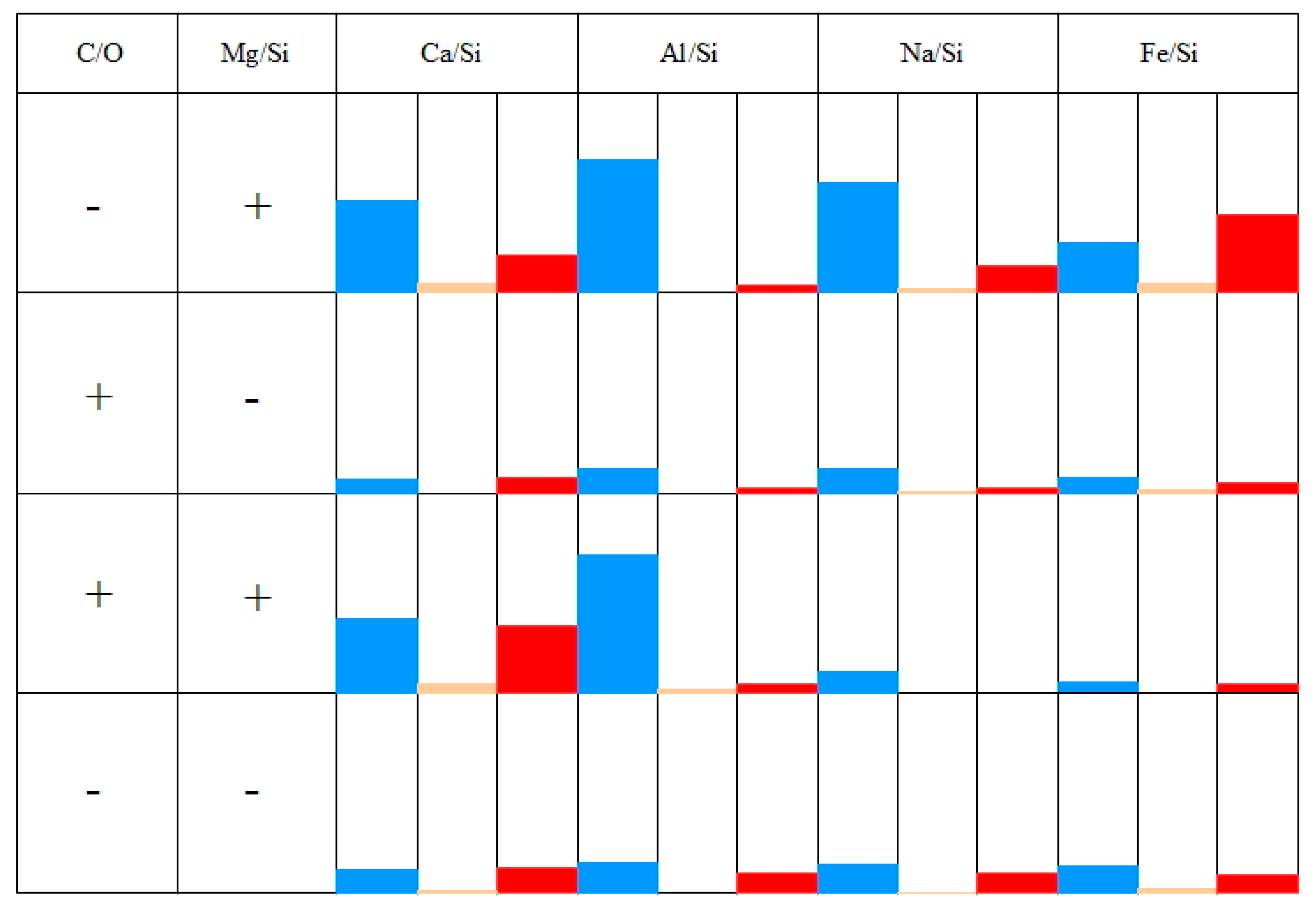
Figure 3.
The averages of F – type stellar Ca/Si, Al/Si, Na/Si and Fe/Si ratios for the cases of – C/O,+Mg/Si; +C/O; – Mg/Si; +C/O; + Mg/Si and – C/O; – Mg/Si ranges. – and + denote the sub – and super – solar values of C/O and Mg/Si ratios. The columns of the table blue color is the super – solar, pink color is the solar – identical and the red color is the sub – solar average values of elemental ratios.
Figure 3.
The averages of F – type stellar Ca/Si, Al/Si, Na/Si and Fe/Si ratios for the cases of – C/O,+Mg/Si; +C/O; – Mg/Si; +C/O; + Mg/Si and – C/O; – Mg/Si ranges. – and + denote the sub – and super – solar values of C/O and Mg/Si ratios. The columns of the table blue color is the super – solar, pink color is the solar – identical and the red color is the sub – solar average values of elemental ratios.
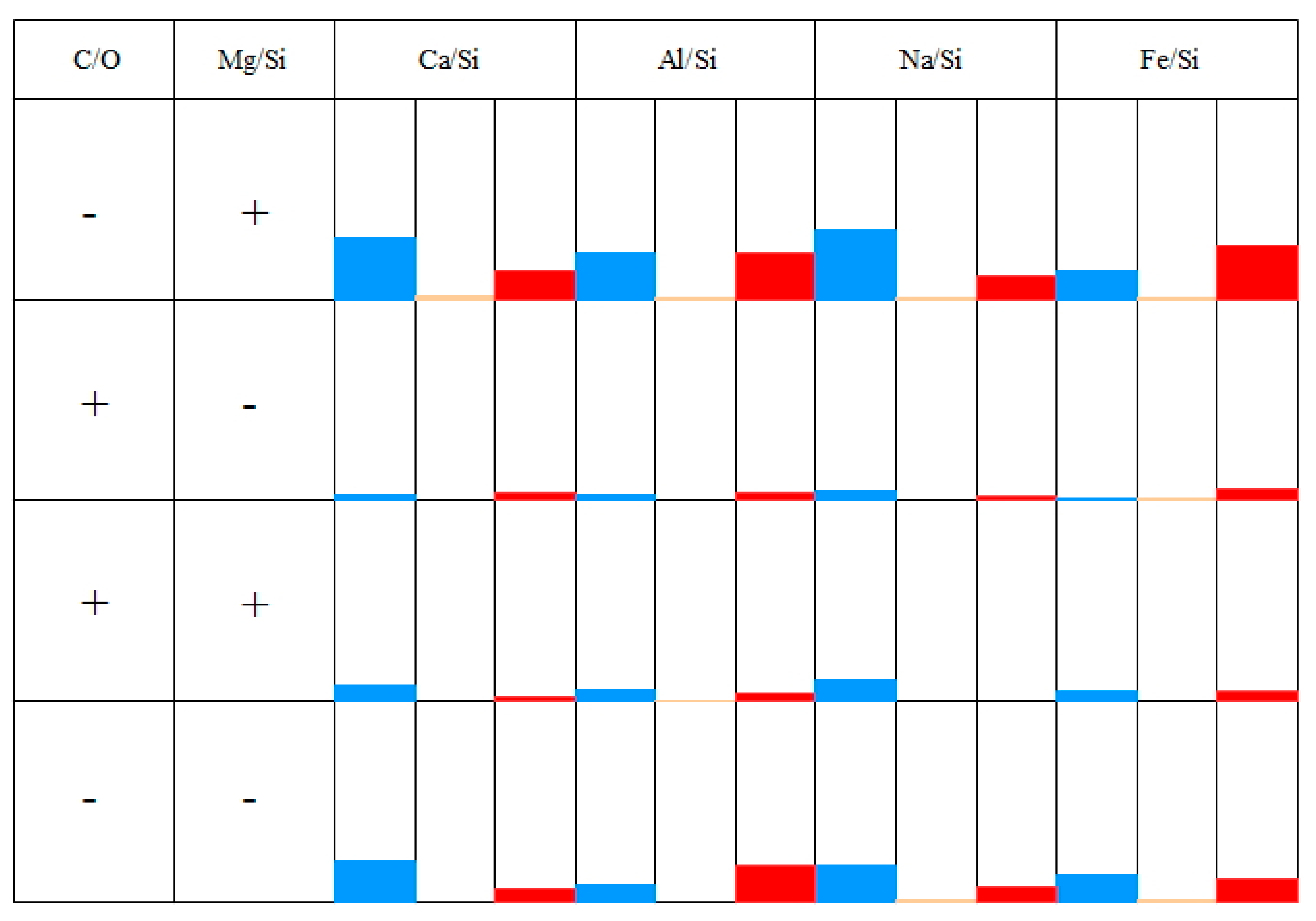

Table 1.
The distribution of the stellar C/O values (C/O< 0.5).
| C/O | 0.41-0.50 | 0.31-0.40 | 0.21-0.30 | 0.11-0.20 | 0-0.10 |
| G - stars | 132 | 46 | 20 | 5 | 0 |
| F - stars | 91 | 65 | 19 | 5 | 0 |
Table 2.
Mean C/O, Mg/Si, Ca/Si, Al/Si, Na/Si and Fe/Si ratios for G -, and F - type super – Earth, Neptune – like and Jovian – planet host stars.
Table 2.
Mean C/O, Mg/Si, Ca/Si, Al/Si, Na/Si and Fe/Si ratios for G -, and F - type super – Earth, Neptune – like and Jovian – planet host stars.
| Planet-type | Spectral-type | C/O | Mg/Si | Ca/Si | Al/Si | Na/Si | Fe/Si |
|---|---|---|---|---|---|---|---|
| Super-Earth | G | 0.52 | 1.184 | 0.06412 | 0.090 | 0.0544 | 0.8177 |
| F | - | - | - | - | - | - | |
| Neptune-like | G | 0.5866 | 1.1458 | 0.06535 | 0.0889 | 0.06117 | 0.869 |
| F | - | - | - | - | - | - | |
| Jovian | G | 0.58 | 1.1855 | 0.06235 | 0.881 | 0.05727 | 0.8688 |
| F | 0.5146 | 1.0246 | 0.06547 | 0.076 | 0.0575 | 0.90 | |
Table 3.
Closely solar identical sets of C/O and Mg/Si stellar ratios in the examined sample for G – type and F – type stars.
Table 3.
Closely solar identical sets of C/O and Mg/Si stellar ratios in the examined sample for G – type and F – type stars.
| G-type star | C/O | Mg/Si |
| HIP 116937/HD 222595 | 0.56 | 1.06 |
| HIP 35145/HD 55647 HIP 100963/HD 195034 HIP 27417/HD 38949 HIP 45859/HD 80355 HIP 36129/HD 57813 HIP 68162/ HD 121504* HIP 102018/HD 196800 |
0.52 0.53 0.55 0.53 0.56 0.55 0.55 |
1.03 1.05 1.05 1.03 1.03 1.03 1.07 |
| F-type stars | C/O | Mg/Si |
| HIP 14954/HD 19994 | 0.56 | 1.03 |
| HIP 75379/HD 137052 HIP 81662/ HD 150554 HIP 21158/HD 28676 |
0.54 0.56 0.54 |
1.05 1.05 1.06 |
Disclaimer/Publisher’s Note: The statements, opinions and data contained in all publications are solely those of the individual author(s) and contributor(s) and not of MDPI and/or the editor(s). MDPI and/or the editor(s) disclaim responsibility for any injury to people or property resulting from any ideas, methods, instructions or products referred to in the content. |
© 2024 by the authors. Licensee MDPI, Basel, Switzerland. This article is an open access article distributed under the terms and conditions of the Creative Commons Attribution (CC BY) license (http://creativecommons.org/licenses/by/4.0/).
Copyright: This open access article is published under a Creative Commons CC BY 4.0 license, which permit the free download, distribution, and reuse, provided that the author and preprint are cited in any reuse.