

Submitted:
03 June 2024
Posted:
04 June 2024
You are already at the latest version
Abstract
Effective solar forecasting has become a critical topic in the scholarly literature in recent years due to the rapid growth of photovoltaic energy production worldwide and the inherent variability of this source of energy. Due to the technological and econonomic limitations of energy storage solutions, using other, mosty conventional, sources to cover energy shortfalls and at the same time utilising solar surpluses production becomes necessary. The need to optimize energy systems, ensuring power continuity, and balancing energy supply and demand has led to the development of various forecasting methods and approaches based on meteorological data or photovoltaic plant characteristics. This article presents the results of a meta-review of the solar forecasting literature, including the current state of knowledge and methodological discussion. It presents a comprehensive set of forecasting methods, evaluates current classifications, and proposes a new synthetic typology. The article emphasizes the increasing role of artificial intelligence (AI) and machine learning (ML) techniques in improving forecast accuracy, alongside traditional statistical and physical models. It explores the challenges of hybrid and ensemble models, which combine multiple forecasting approaches to enhance performance. The paper addresses the emerging trends in solar forecasting research, such as the integration of big data and advanced computational tools. Additionally, from a methodological perspective, the article outlines a rigorous approach to the meta-review research procedure, addresses the scientific challenges associated with conducting bibliometric research, and highlights best practices and principles. This includes defining research questions, selecting eligibility criteria, literature search, data extraction, synthesis, and assessing bias and quality. The article contributes to the solar forecasting field by providing up-to-date knowledge, along with insights on the emerging trends, future research directions, and anticipating implications for the theory and practicce.
Keywords:
forecasting
; solar
; energy
; irradiance
; photovoltaic
; state of the art
; systematic literature review (SLR)
; meta-review
; overviews of review
; bibliometric
; classification
; method
1. Introduction
In recent years, the production of clean energy has attracted significant interest. Solar power has been systematically strengthening its position among renewables, and the number and capacity of solar photovoltaic plants have grown rapidly in many countries. Fast progress into carbon neutrality and net zero emission economies with significant use of photovoltaic technology is only possible with effective accumulation and compensation systems to balance solar surpluses and shortfalls with other sources. Strong volatility and intermittency of solar energy generation require the leveraging advance of adequate forecasting methods concerning meteorological and geographical characteristics of plant location [1,2]. Forecasting solar irradiance is essential in planning and operations to deal with energy supply and demand uncertainty, balance and optimise the system, and ensure power continuity [3,4,5,6,7,8]. Accurate forecasting is crucial at all levels of an energy system, including control, operation, management, financial viability of energy companies, and the trajectories of sustainable and responsible innovation. Spatial resolution and time horizon determine the application of forecasts. Controlling power distribution, ensuring network stability and voltage regulation requires a time horizon in seconds [4,9], forecasts from minutes to hours support power reserve management and load optimisation [10], day-ahead forecasts are used for transmission planning and unit commitment [5,7], and a year scale for capacity/network global management [6,11].
The importance of solar energy forecasting is reflected in numerous publications. The bibliometric study has revealed 12,156 works (articles, chapters, etc.) during the period 2013-2023 (database: Scopus; search query: TITLE-ABS-KEY (solar AND forecasting) AND PUBYEAR > 2012 AND PUBYEAR < 2024). A significant increase in the number of articles on solar energy forecasting dates to 2018, with over 1,000 per year. There is also a rapid growth in systematic reviews (SR) and meta-analyses that synthesise the results of previous studies.
Systematic reviews accomplish transparent and rigorous procedures to bring together evidence from multiple studies and summarise the current state of knowledge [12]. The popularity of SR has resulted in the need to synthesise the evidence bases by conducting overviews of reviews and developing methodological tools and guidelines [13,14].
Meta-review (MR) evaluates and synthesises evidence from existing systematic literature reviews (SLR) [15,16] and in this way, facilitates broad comparisons [17]. It is referred to in the literature as an overview of reviews (OR) [18], meta-meta-analysis, tertiary study, umbrella review, and overviews of systematic reviews. Recently, it has gained increased popularity [17,19], but is still underrated in the field of renewables forecasting. The main advantage of MR is to provide a summary synthesis of the analysed reviews to expand research issues beyond those addressed in the individual reviews and to combine them [19]. It is considered particularly useful in areas where many literature reviews have already been published since it allows integration and condenses knowledge [18].
Although the method is not new (e.g., [17,20]), the rapid growth of data and the new advances in search tools and electronic databases have posed new challenges in mapping the state of the art, especially in interdisciplinary topics [21], e.g., engineering management or production management research. The article addresses the problem of determining the meta-review methodology’s scopes, techniques, and conditions in solar forecasting. To the best of our knowledge, this is the first comprehensive overview of reviews on solar forecasting. The article analysed the scope of the review articles. The research focused on a typology of solar forecasting methods.
This article is organised as follows: in the next section, the concept and methodology of meta-review, along with the approach employed in this article, are presented. Then, a bibliometric and text analysis of reviews on solar radiation forecasting is summarised. Concluding the reviews, a typology of solar forecasting models and methods is discussed. The article ends with a summary and future research directions.
2. Meta-Review Concept and Applied Research Methodology
2.1. Meta Reviews in Literature
The literature review serves both as an introduction to research and as a method on its own. It is a key part of every research project or paper since, as referring to current knowledge, it explains a theory behind and meets the paradigm of continuity, accumulation and development of scientific knowledge [18]. It provides evidence for defining the research gap and motivation [22] and opportunities, challenges and guidelines for future research [23]. Although a literature review is a mandatory step in research, it might vary depending on aims and provides different contributions. Among literature review, the following types could be distinguished: scoping review, selective review, tutorial review, theoretical review, algorithmic review, computational review, meta-analysis, qualitative systematic review, and meta-review [18]. Considering quality and confidence, it increases from a narrative review through a scoping review and a rapid review to a systematic review [12].
A systematic literature review that uses rigorous and transparent methods to summarise the available knowledge is a well-established and widely used method. Methodological discipline, which lies behind SLR, impacts the synthesis and evaluation of the materials and information and significantly affects the quality of associated further research [24]. The accelerating popularity of SLRs relates to a high degree to the availability of tools for automatic digital-aid quantitative and qualitative analyses, i.e., the frequency of keyword occurrences, methods, cross-citations, and grouping. Rapidly evolving digital tools such as text mining powered with natural language processing enable replicable rapid large-scale analysis and, in some cases, provide a more comprehensive and objective summary [25]. However, automatic research procedures without human judgment on the quality of research and its context risk compromising the quality and credibility of conclusions. Digital tools do not replace expert knowledge for developing selection criteria and interpreting results. They increase the ability of experts to collect information, disseminate it to non-experts, and promote interdisciplinary research [25].
An overview of reviews is a type of systematic review of a large but aggregated number of papers to generalise information contained in previous publications or primary sources with clearly structured procedures. Although some unique methodological challenges, many methods used to conduct SLR are suitable for overviews of reviews [22]. The meta-review procedure is quite similar to formalised systematic reviews, although this method focuses on systematic reviews rather than primary studies [21].
A general framework for SLR and meta-analysis consists of the following steps: (i) defining the objectives and research question(s), (ii) selecting eligibility criteria, (iii) literature search, (iv) data extraction and synthesis, (v) assessing bias risk and quality, (vi) overview and interpretation of results, and (vii) concluding the overview [19,22]. The overview framework might be divided into two stages: first – developing and populating with four steps: (i) specification of the aims and scope, (ii) specification of the eligibility criteria, (iii) selection search methods, (iv) data extraction, and second stage – identification and mapping evaluations that consist of (i) assessing the risk of bias and (ii) certainty of the evidence, (iii) synthesis and summary the findings, (iv) interpretation of findings and concluding [16]. Overviews could follow the PRISMA (Preferred Reporting Items for Systematic Reviews and Meta-Analyses) framework, which consists of the subsequent phases: identification, screening, and included [23,26]. It obligates to (i) define clear scope, (ii) do strategic searches, (iii) consider the datedness of the SRL, (iv) address overlap among SLR, (v) apply review quality tools, and (vi) report the meta-review findings. The synthesis of reviews may take the form of narrative, semi-quantitative, or quantitative [14]. In examining the overlap of studies in meta-reviews calculating the corrected covered area index might be useful [13,14].
The main principle of overviews is complete and transparent reporting of previous reviews [15]. The roles of meta-review are to identify gaps in the literature, to explore and contrast reviews, and to summarise the evidence from broad comparisons [17]. Identifying the inconsistencies between systematic reviews includes, among others research questions, samples, quality and selection criteria [17]. Summarising and concluding the literature review findings and evidence might benefit new uncovering information [21].
2.2. Research Methodology
This meta-review aims to examine and collate systematic reviews, summarise the evidence and identify the main themes of the analysis on solar forecasting. The reviews were compared based on input data, methods analysed, classification, and findings. The research process adapted in this work has been illustrated in Figure 1. It consists of translating the aim of the work into search strings and inclusion and exclusion criteria. A broad approach was chosen to ensure no important publication was missed. First, a wide range of keywords was selected, and subsequently, irrelevant terms were eliminated to identify those that could characterise actual and relevant reviews. The original set of solar, radiation, irradiance, and photovoltaic terms was limited to solar. The set covered initially: review, state, recent, advance, trend, development, taxonomy, categorisation, and classification turned out to be sufficient for a review in keywords. The result search query combined the terms (Scopus): TITLE ((forecast* OR predict*) AND solar) AND KEY (review). The literature dataset was also supplemented according to the snowballing procedure. Finally, a retrospective procedure was applied to remove non-relevant publications and discard duplicates. The search was conducted in Elsevier’s Scopus, Web of Science Core Collection (WoS) and IEEE Xplore and covered the period until 1.1.2024. Exclusion criteria were papers that were not written in English and conference papers.
Upon initial bibliographical analysis, it was discovered that the earliest review-type publications were released in the 21st century [27], but the most significant increase has been recorded since 2013. It should be noted that the first works were not a typical review but rather a presentation and discussion of methods with examples [28,29] and the literature review aims to provide background to select methods for testing and comparison [30]. Analyses of reviews conducted in recent years are more comprehensive and stick to the methodology, but this is not the rule, especially in the case of conference presentations, e.g. [31,32,33]. The actual analysis covers the last 10 years.
Examining the content of the received sets of articles at the preliminary screening at the initial stage of the study, numerous papers have been identified that focus on the evaluation, comparison and discussion of various methods/models/techniques on the same data [34,35,36,37,38,39]. They were excluded from the further analysis. There are also works containing lists of articles on solar forecasting with limited aggregation and summary [29]. Moreover, as mentioned above, articles that aim to improve/develop forecasting methods often include an in-depth literature review [30,40]. The state-of-the-art provides the background for the proposed forecast models [41,42]. A solar techniques review might also precede a discussion on power systems security, scheduling and operations [43].
A particular type of review paper focuses on bibliometric analysis. The main advantage of literature reviews using bibliometric analysis and clustering software is the number of references considered. Some works rely on quantitative bibliometrics performed using software such as VOSviewer, which allows for keyword screening [44] or Google Scholar database and its search engine [45]. Text mining undoubtedly has great potential in the literature review. The challenge of automatic review is the proper dictionary construction, selection and interpretation of terminology and their association to provide in-depth analysis and synthesis with text-mining software [45].
Sometimes, the declared review is not a classical exploration literature review but can be labelled as a reverse/confirmation review. This means that defined a priori methods are evaluated with examples of use [28,36,46,47]. Such works can be referenced as reviews of techniques described in the literature with the presentation of their advantages and disadvantages [5,48]. Some articles consist of general or summarising discussions on selected aspects of solar forecasting in power systems and penetration of solar power generation with supporting in-depth reviews and citations [49,50,51]. The final list of publications includes synthesising and classifying works in solar forecasting. The next section contains review papers on solar energy forecasting that were selected as the basis for this meta-review. Table 1 contains abbreviations used in the text.
3. Reviews on Solar Radiation Forecasting
3.1. Bibliometric Analysis of Reviews
The first stage of analysis revealed 36 noteworthy reviews containing an analysis, synthesis, and classification of works on solar forecasting. According to the Scopus database, 28 papers were classified as reviews and 9 as articles. Figure 2 illustrates the distribution of articles by subject area and by year. Table 2 includes the names of journals that published the reviews.
3.2. Typology of the Scope of Solar Forecasting Reviews
Appendix 1 includes the list of reviews. All the analysed papers emphasise that the research on solar forecasting is rapidly expanding. This is related to the increasing penetration of solar PV due to its environmental and economic benefits. The works indicate that energy is the foundation for economic and social growth. Precise forecasting plays a crucial role in the shift towards a more renewable energy profile and in cutting costs in the power system [62,66].
The reviews mainly covered the analysis of primary data, sometimes with references to the results of previous reviews, e.g. [1,54,65,67]. However, the conclusion from previous research might be used as inspiration. Antonanzas et al. (2016) [62] informed about the need for analysis of the economic consequences of forecasts regarding solar energy, Gandhi et al. (2024) [73] took up the challenge of comprehensively reviewing the value of solar forecasts and the cost of errors.
The works concern solar, a combination of solar and wind, or such factors as loads, market price, etc. Table 3 includes the scope of selected solar forecasting reviews. In the case of solar, forecasting variables are mainly GHI or solar PV output [67].
In principle, all the reviews consider classical error metrics to forecast comparisons. The most used were Mean Absolute Percentage Error (MAPE), Root Mean Square Error (RMSE), Mean Absolute Error (MAE), Coefficient of Determination (R2) and their derivatives, e.g. normalised RMSE (NRMSE), Median Absolute Percentage Error (MdAPE). However, other metrics were also noted [62], e.g. Kolmogorov–Smirnov Integral [1,8], Nash-Sutcliffe efficiency [1], and others.
Among the papers, there are general overviews, but also papers dedicated to methods of one type or even focusing on a homogeneous subclass of models, allowing a deeper look into the structure of the models and collating the results. Particular attention is given to methods that can be categorised as AI [6,29,58,64,66]. These include articles comparing various AI models [63] and comparing the AI model with other empirical models [57]. AI methods were already well represented in the first comprehensive reviews [28,57]. In recent years, the number of articles using various AI techniques to predict solar energy has increased exponentially. This can be related to software development and the ease of using statistical or ML methods [49]. Some works focus on methods dedicated to a selected time horizon, e.g. intra-hour [8]. Table 4 includes the scopes of reviews due to method classification.
4. Solar energy Forecasting Methods and Their Classification
4.1. Solar Forecasting Process and Data
Considering solar forecasting, there are three main approaches depending on input data: (i) models that utilise endogenous data (historical series from the PV plant [76]), (ii) models based on exogenous data (sky or satellite images, meteorological characteristics, e.g. as solar irradiance, humidity, wind speed, cloud cover, air temperature), and (iii) mix that analyse different sets of inputs [62]. The popular inputs are (i) historical and current irradiance, (ii) meteorological data, (iii) sky images and (iv) others [8]. Type sources of data can be sky cameras, sensor networks, and satellites [7]. In the case of solar energy forecasting applications, solar radiation is considered the most significant parameter, with a correlation over 0.98 with PV power output [59]. It is the most exploited, both in his first works [28] and now. Among other meteorological data used [71], the sunshine hours and air temperature are found to be adequate inputs [38]. The most popular input parameters are temperature, humidity, wind speed, and less frequently: wind direction, precipitation, cloud cover, solar zenith angle, pressure and others [53]. Recently, air pollution has attracted the attention [66].
Among the variety of methods, artificial intelligence has gained significant attention due to its high effectiveness and accuracy in forecasting solar energy generation [66,72]. AI research in solar forecasting is rapidly growing with expanded applications [6,45]. The most common term in articles on solar radiation forecasting is ANN rather than other ML or DL models [6], although this is changing [66].
The AI models on solar irradiance are used in three ways: (i) structural models based on other meteorological and geographical data, (ii) time-series models based only on the historical data on solar irradiance, and (iii) hybrid based on both solar irradiance and other exogenous variables [6].
The advantages of ANN include: (i) less formal statistical training, (ii) 2) detection of complex non-linear relationships between variables, and (iii) multiple training algorithms [48]. AI methods outperform traditional methods in many cases [65] due to the excellent performance in the description of non-linear and complex processes [66]. However, the comparative advantage of ANN was not always noted. The spatio-temporal vector autoregressive (VAR) model for spatially sparse data may result in lower forecast error [35]. In certain conditions, the ANN and ARIMA methods are equal in terms of the quality of forecasting [6]. The significant disadvantages of ANN are: (i) the "black box" nature, which means that the input data and the result are known, without information about the process inside, (ii) the need for more computational power, and (iii) the tendency to overfit [48].
The general data mining process for predictive analysis consists of (i) data selection, (i) preprocessing, (iii) transformation, (iv) data mining, (v) interpretation/evaluation and (iv) knowledge. In the case of ANN prediction tasks in solar energy applications cover: (i) selection of input and output data; (ii) division of the set into training, test, and verification sets; (iii) development of the model; (iv) selection and training parameters, error calculation and verification; (v) selection of the model [38,57]. This can be abbreviated to the process of building a machine learning model through (i) data preparation, including the input parameters, (ii) the selection of features, and (iii) the development of the model with evaluation [66,76]. It is generally consistent with the process of deploying time series techniques [77]. In the case of physical models, one of the most challenging stages is developing a model to map the relations between input variables and output variables [43].
The role of pre-processing or data feature selection has already been emphasised as a stage that improves the quality of data and thus increases the accuracy of the forecast [4,5,55,59,61,66] even in the first review works [28]. Attention is paid to the post-processing phase to model local effects [28,46,61] as a practice to improve the initial forecasts. In the case of ML, post-processing methods might include discriminant analysis and principal component analysis, naive Bayes classification and Bayesian networks, and data mining approaches [6]. Other techniques are wavelet transform, Kalman filter, empirical mode decomposition, self-organisation map, normalisation, trend free [78]. Post-processing task could be divided into: (i) deterministic-to-deterministic, (ii) probabilistic-to-deterministic, (iii) deterministic-to-probabilistic, and (iv) probabilistic-to-probabilistic [61].
4.2. Solar Forecasting Models Classifications
Solar forecasting methods do not have a set of consistent classification criteria [54]. It is not uncommon for reviews to have overlapping proposals for grouping prognostic approaches, e.g. [42]. Details on the classification of solar energy forecast models in analysed reviews are provided in Annex 1.
Traditionally, in the first works, and repeated later, forecasting methods are broadly classified into (i) statistical (based on historical time series, e.g. ANN, MPL, SVM, ARIMA, RNN), (ii) physical models (based on atmospheric methodological data, e.g. NWP), and (iii) ensemble approach [30,33,65] or hybrid [79], sometimes with distinction persistence method [7]. The following breakdown of forecasting techniques is also proposed: (i) persistence method, (ii) physical techniques (NWP and satellite-based), (iii) linear statistical approaches (e.g. ARMA), (iv) artificial neural networks, and (v) fuzzy logic models [5]. Generally, ANN is classified as a statistical method. However, other AI methods, such as ML models, ELM, and SVM, are sometimes clustered in advanced methods [75]. Combining statistical and ML models in the data-driven class was also proposed [80].
Another proposition of classification is: (i) the empirical approach based entirely on data, and (ii) the dynamical approach practical for modelling large-scale solar radiation prediction [48]. Two basic classes of models can be identified based on the forecast horizon criterion: (i) for short-term forecasts up to 6 h (extrapolation and statistical processes), and (ii) for forecasts up to two days ahead or beyond (NWP models). A further standard division is that between (i) probabilistic (providing confidence intervals, in which values are considered within a certain probability) and (ii) deterministic (single value) [33,60].
In the case of ML methods, they can be classified into (i) supervised learning (e.g. linear regression, generalised linear models, nonlinear regression, support vector machines/support vector regression, decision tree learning/Breiman bagging, nearest neighbour, Markov chain), (ii) unsupervised learning (e.g. k-means and k-methods clustering, hierarchical clustering, Gaussian mixture models, cluster evaluation), and (iii) ensemble learning [6]. Another proposition is generalised (GM), ensemble-based (EM), cluster-based (CM), decomposition-based (DM), decomposition-cluster-based (DCM), transition-based (TM), and postprocessing-based (PM) machine-learning models [66].
Many works emphasise the advantages of hybrid and ensemble approaches in improving forecasting accuracy and providing promising solutions for different forecasting horizons [5,45,50,54,75,78]. Ensemble models combine the results of many individual models, while hybrid models combine different techniques or algorithms and take advantage of ensemble techniques, creating sophisticated model structures.
The combining approach could serve as the primary method in a hierarchical multiple-step approach but can also be applied in the pre-processing or post-processing stage [30]. However, they must be tuned appropriately [5]. Generally, they surpass the best alternative single approach, although this is not always the case [30]. Simple techniques might give high accuracy if the input parameters are properly selected, filtered and pre-processed [9].
In the ensemble approach, there are two methods: (i) "competitive" (parallel) when the final forecast is an average of the individual forecasts, and (ii) "cooperative" (sequential) when the prediction process consists of a sequence of sub-tasks solved individually and the final forecast is a sum of the subtask outputs [30,50,65]. Combining, boosting, blending, and slacking methods can be considered in sequential ML. In the case of the parallel, a popular technique is bagging [76].
4.3. Forecasting Techniques’ Adequacy to Forecast Horizon and Resolution
Many works address the problem of fitting the model to the forecast horizon. Early work indicated that models such as ARIMA are suitable for modelling linear time series, and ANN is preferred for modelling nonlinear time series [81]. As the forecasting approaches depend on available data and also on the required forecasting horizon, many works summarise the existing methods versus the time and assess forecasting suitability for forecast horizon and data resolution [1,5,6,7,28,49,53,65,81].
Table 6 presents differences in classification in the analysed reviews — a summary of the graphically presented adequacy of forecasting techniques to temporal and spatial resolution, in many cases adapted from previous studies.
To generalise, the persistence approach is dedicated to very short-term/intra-hour, statistical for very short, short and medium-term/intra-hour and intra-day, and statistical for short, medium and long-term/intra-day and day-ahead. In detail, persistence is dedicated to seconds time horizon and distance up to 10 m, statistical models, e.g. ARMA, ARX, NARX for resolution up to 10 m, methods, e.g. ANN, SVR for longer distance and temporal resolution from minutes to hours, NWP from hours to days, sky image from 1 m to 2 km and satellite from 1 km to 10 km [5].
Considering only the time horizon, preferred methods for the following ranges: from 1 min to 10 mins − persistence of ground measurements, from 10 mins to 1 h − ground-based cloud motion vectors (CMVs) data-driven methods, from 1 h to 5 h − satellite-based CMVs and od 5 h to 10 days − NWP models [46]. Total sky images are adequate up to 1 km, satellite images up to 100 km and temporal resolution to a few hours (intra-hour, intra-day), statistical for maximum intra-day forecasts and 1 km, and physical from 1 h and distance from 1 km [81]. The forecast horizon longer than a week ahead with granularity time over 1 h is available only by NWP models [6]. However, hybrid models break the stratification. The components might originate from different groups and utilise various data sources in the sequence or parallel approach. The classical taxonomy of solar energy forecasting techniques based on the relationship between space-time resolution needs to be updated. Statistical methods are frequently considered as pre- and post-processing tools, not a standalone category, and NWPs also with very high resolution can provide the required results [49]. The adequacy of the model to the data needs to be revised also in the case of artificial intelligence taking into account it dynamic development.
5. Development of Solar Energy Forecasting Models Classification
The study of review works revealed inconsistencies in the classification, fragmentation, and duplication of proposals. What draws attention are the fuzzy criteria for the models’ clustering.
Physical models, also known as "white box" models, are based on a theoretical foundation, fundamental laws, and principles, covered in mathematical equations that describe the relationship between the characteristics of a photovoltaic system, solar irradiance, and other environmental and geographical factors that determine the photovoltaic output. These models don’t require a large amount of historical data, but still. Their accuracy depends on the availability of weather forecast data [3,76], which must be developed a priori. The most common physical models are numerical weather forecast models (NWP) [81].
It is emphasised that statistical approaches do not require a full understanding and knowledge of the process and rely on mapping the relation between operation data series along with NWP data. They assume that the future values are determined by its past values [3,76]. However, forecasting based on a model, e.g. ARIMA, begins with initial data exploration, determining the factors influencing its form, and speculations on components and trends. The model should pass substantive verification and explain the phenomenon under study.
Many times, AI models are categorised as a statistical approach. The AI/ML/DL techniques heavily rely on statistical methods. They have common roots, although considering the dynamic development of AI capabilities, distinctions should be made between auto-regressive models and AI-based models in which unsupervised learning algorithms decide on the structure and parameters of the models and adapt them to training data. This problem is sometimes avoided by calling both classical statistical models and AI data-driven models [76].
The challenge is to review hybrid models, although the attempts have been made (e.g., [50,63,74]). In the general case of having n methods, the number of possible approaches is a sum of combinations with/without repetitions for every possible number of elements from 1 to n. Creativity in creating hybrid and ensemble models is limited by the problem of overfitting, which may occur in redundant analyses.
A summary of the adequacy of forecasting models to the time horizon and data source has been proposed by, among other [54,67]. Table 7 includes a modified version of the proposition based on selected review papers that consider AI models’ growing capabilities. It is worth noting that the same lagged or unlagged data can be used in different approaches for model training or direct forecasting.
6. Conclusions
Creating new knowledge is a complex process that involves recognising the state of the art. The literature review plays a crucial role in various scientific disciplines, both as a research genre and as a methodological one, and it cannot be overstated. This work has compared various review studies on solar forecasting that adopt different perspectives and analyse divergent data to identify recent advancements in the field. Renewable energy, particularly solar, has gained much attention over the past two decades, and the trend continues.
The study has shown that there is no single accurate and efficient solar forecasting method for every application. The analysed reviews vary significantly in their approach to the topic, scope, texts included, and the conclusions drawn from them. Some are comprehensive, while others are quite limited and selective. However, there are also common elements among them. In solar energy forecasting technologies, there is potential to enhance accuracy, efficiency, effectiveness, and flexibility through novel, combined interpretable AI models, making adaptations through pre-processing and post-processing improvements.
The authors have attempted to synthesize the typology of forecasting methods presented in the reviewed reviews and to identify each technique’s scope of applicability. Nevertheless, the taxonomy of models, their adequacy to the data, and expected results need to be further revised. The advancement of AI unveils fresh opportunities in the real-time prediction of images and data.
This meta-review serves as a comprehensive analysis. Considering the dynamic development of review research, there is undoubtedly a need for further research and updating of current conclusions. In-depth studies may involve comparisons of selected works from a more homogeneous collection to assess the motivation behind each project and the characteristics and quality of the data used to present state-of-the-art. Future studies might pay attention to hybrid models, analysis of their structure validity, and their classification.
This work allows readers to better understand the solar forecasting methods currently in use and the possibilities of their application in real-world applications. Identifying development trends also creates a substantive basis for further conceptual work on elaborating and implementing new robust solar forecasting methods.
Author Contributions
J.N. and E.C. were responsible for the study concept and research design; J.N., Ł.N., and H.S.R. developed the concept; E.C. performed the analysis; J.N., E.C., and H.S.R. were responsible for data interpretation; J.N. discussed the results and contributed to the final manuscript; J.N., E.C., Ł.N., and H.S.R. wrote and edited the text. All authors have read and agreed to the published version of the manuscript.
Funding
The research was conducted in the framework of the projects No. WZ/WIZ-INZ/3/2023 and WZ/WIZ-INZ/2/2022 of Bialystok University of Technology, and financed from the subsidy granted by the Ministry of of Science and Higher Education of the Republic of Poland.
Conflicts of Interest
The authors declare no conflict of interest.
Appendix A

Table A1.
Reviews on solar forecasting (sorted by year).
| Nr | Cited by | Title, Author (Year) | Classification of methods, period, database | Comments and/or findings |
|---|---|---|---|---|
| 1 | 591 | Review of solar irradiance forecasting methods and a proposition for small-scale insular grids Diagne et al. (2013) [28] |
Distinction: (1) statistical models: (i) linear models or time series models, e.g. persistence, preprocessing (to obtain stationary or remove seasonality), ARIMA, CARDS, (ii) non-linear models, e.g. ANN, WNN; (2) cloud imagery and satellite-based models; (3) NPW models; (4) hybrid models. | An in-depth review of the methods for forecasting solar irradiance. Keywords: Solar irradiance, Forecast models, Statistical models, NWP models, Postprocessing methods. |
| Data: n/a | ||||
| 2 | 756 | Solar forecasting methods for renewable energy integration Inman et al. (2013) [70] |
Distinction: (1) regressive methods: (i) linear stationary models (AR, MA, ARMA, ARMAX), (ii) non-linear stationary models, (iii) linear non-stationary models (ARIMA, ARIMAX); (2) AI: (i) ANN, (ii) Early networks, (iii) multi-layer networks; k-NN; (3) remote sensing models; (4) NWP: (i) global forecast system, (ii) regional NWP models; (5) local sensing; (6) hybrid systems. |
Identification: forecast variable and horizon, method, exogenous variables, data. One of the conclusions: Integration of approaches: NWP/satellite models with stochastic learning methods might result in higher-quality forecasts. Keywords: weather-dependent renewable energy, Solar forecasting, Solar meteorology, Solar variability, Solar energy integration, Evolutionary forecasting methods. |
| Data: 30 papers, 2011-2013. | ||||
| 3 | 207 | The artificial neural network for solar radiation prediction and designing solar systems: a systematic literature review Qazi et al. (2015) [57] |
Distinction: (1) monthly solar prediction; (2) hourly solar radiation prediction; (3) ANN for solar systems, such as solar water heating systems, solar refrigeration systems, PV panels, etc. | Identification: input parameters, no. of stations, ANN type, no. of neurons, prediction error, data intervals. ANN models predict solar radiation more accurately than statistical, conventional, linear, non-linear and fuzzy logic models. Keywords: Solar energy, Solar radiation prediction, Solar systems, Data mining, Artificial neural network |
| Data: 24 relevant papers, 2006-2013 Databases: ACM Digital library, IEEE Xplorer, SpringerLink, ISI web of knowledge, ScienceDirect, Wiley. | ||||
| 4 | 861 | Review of photovoltaic power forecasting Antonanzas et al. (2016) [62] |
Forecasting techniques classification: (1) PV performance model (physical); (2) statistical models: (i) regressive methods (linear stationary models, e.g. ARMA, linear non-stationary models, e.g. ARIMA, non-linear stationary models, e.g. NARMAX); (ii) AI techniques (ANN, k-NN, RF); (3) Hybrid models. Concerning the time horizon and origin of inputs: (1) exogenous, (2) endogenous, (iii) cumulated and (1) intra-hour, (2) intra-day, day-ahead, and (3) longer. Concerning output: (1) deterministic (single/point) and (2) probabilistic (range of plausible values with probability). |
Identified elements: forecast horizon, forecast resolution, method, variables. Main conclusions: (1) The most common are ANN techniques. (2) The economic impact of solar energy forecasting has not been sufficiently studied. Keywords: solar energy, solar power forecasting, value of forecasting, grid integration. |
| Data 60 papers, 2007-2016 | ||||
| 5 | 1,152 | Machine learning methods for solar radiation forecasting: A review Voyant et al. (2017) [6] |
Classes of machine learning methods: (1) supervised learning (linear regression, generalised linear models, nonlinear regression, SVM/support vector regression, decision tree learning/Breiman bagging, nearest neighbour, Markov chain), (3) unsupervised learning (k-means and k-methods clustering, hierarchical clustering, Gaussian mixture models, cluster evaluation), and (3) ensemble learning. | Identified elements: location, horizon, evaluation criteria, dataset, results. Keywords: solar radiation forecasting, machine learning, artificial neural networks, support vector machines, regression. |
| Data: 24 papers related to global radiation forecasting combining machine learning methods, 1997-2015 and 21 papers related to global solar radiation forecasting using single machine learning methods, 2001-2015. | ||||
| 6 | 392 | Application of support vector machine models for forecasting solar and wind energy resources: A review Zendehboudi et. al. (2018) [58] |
Classes of SVM for solar: (i) air heater system, (ii) radiation, (iii) collector and photovoltaic systems, (iv) insolation, (v) solar irradiation. | One of the conclusions: SVM modelling is famous for its simplicity, efficiency, and low computational cost. Keywords: support vector machine, solar energy, wind energy, forecasting models |
| Data: 75 publications (on solar 42 articles), 2009-2017 Databases: ScienceDirect, Engineering Village, ISI Web of Science, Google Scholar, Elsevier, IEEE Xplore, Springer, Taylor & Francis, ASME, Hindawi and Wiley. | ||||
| 7 | 351 | History and trends in solar irradiance and PV power forecasting: A preliminary assessment and review using text mining Yang et al. (2018) [45] |
Solar forecasting method: (1) time series, (2) regression, (3) NPW, (4) machine learning, and (5) image-based forecasting. | Selected conclusions: (1) Combining and adjusting forecasts allows for improving accuracy. (2) Text mining has great potential in literature reviews. Keywords: Text mining, Solar forecasting, Review, Photovoltaics. |
| Data: 1000 abstracts from Google Scholar search results, 249 full texts from ScienceDirect, plus 6 recent articles from 2016 and 2017. | ||||
| 8 | 304 | Review on probabilistic forecasting of photovoltaic power production and electricity consumption Van Der Meer et al. (2018) [60] |
Following probabilistic forecasting methods of solar power and load forecasting: (1) statistical approach (parametric and nonparametric); (2) physical approach (parametric and nonparametric); (3) hybrid approach. | Indication: forecast horizon and resolution, method, assumed probability, distribution function, variables and results. One of the conclusions is that no one model is universally applicable to all circumstances. Keywords: probabilistic forecasting, electricity consumption, photovoltaic, solar radiation, irradiance, prediction interval. |
| Data: 41 papers on solar and 22 on load forecasting, 2007-2017. | ||||
| 9 | 568 | Solar photovoltaic generation forecasting methods: A review Sobri et al. (2018) [65] |
Classification of solar PV forecasting methods: (1) time-series statistical (ANN, SVM, Markov chain, autoregressive, regression), (2) physical (NWP, sky imagery, satellite imaging) and (3) ensemble methods (cooperative, and competitive). | Indication: forecast method, horizon, performance metrics, forecast error, measurement, computational time, input variables, forecast variable, data period, location, and comparison methods. One of the conclusions: AI methods outperform the traditional methods Keywords: solar photovoltaic, renewable energy power plant, modelling and planning, spatial and temporal horizons, smart grid forecasting. |
| Data: 74 papers, 2010-2017. | ||||
| 10 | 70 | A Systematic Literature Review on big data for solar photovoltaic electricity generation forecasting De Freitas Viscondi and Alves-Souza (2019) [71] |
SLR on big data models for solar photovoltaic electricity generation forecasts. Most popular: SVM, ANN, ELM, GB and RF. |
Main conclusion: multiple ML algorithms are more accurate in solar radiation modelling and forecasting. ELM seems to be replacing ANN in solar power forecasting. Keywords: Systematic Literature Review, solar energy forecasting, machine learning data mining. |
| Data: 38 papers for final evaluation, 01/2013-05/2017. Databases: Web of Science, Science Direct, IEEE and Google Scholar. | ||||
| 11 | 155 | Advanced Methods for Photovoltaic Output Power Forecasting: A Review Mellit et al. (2020) [64] |
Classification of: (1) ML-based methods, (2) DL-based methods, (3) Hybrid methods for the forecast of PV. | Indication: method, time horizon, parameters, point or regional, forecast, region and PV nominal power accuracy. Selected significant findings: (1) In most cases, AI models perform well only on sunny days. (2) The accuracy of AI models decreases over longer time horizons. (3) Hybrid models improve forecasting accuracy and combine input sources. Keywords: photovoltaic plant, power forecasting, artificial intelligence techniques, machine learning, deep learning. |
| Data: 26 papers on ML, 4 papers on DL, 12 on hybrid models, 2010-2019. | ||||
| 12 | 156 | A comprehensive review of hybrid models for solar radiation forecasting Guermoui et al. (2020) [74] |
Classes of hybrid models: (1) GELA), (2) CELA, (3) DELA, (4) DCELA, (5) EELA, (6) RELA. |
One conclusion is that hybrid models outperform stand-alone models in all the studied cases with different inputs and outputs. Keywords: solar resource estimation, hybrid models, machine learning. |
| Data: 13 papers on GELA, 2005 2019, 14 papers on CELA, 2012 -2017, 14 papers on DELA, 2006-2019, 4 papers on DCELA, 2015-2018, 29 papers on EELA, 2015-2017, 19 papers on RELA, 2011-2020. | ||||
| 13 | 544 | A review and evaluation of the state-of-the-art in PV solar power forecasting: Techniques and optimization Ahmed et al. (2020) [59] |
Classification of PV techniques: (i) persistence, (2) physical model, (3) statistical techniques: (i) time series, (ii) ML, e.g. ANN, MLP, RNN, FFNN, FBNN. | Identification: model, accuracy, input selection and correlation analysis, data pre-processing, parameter, forecast horizon. One conclusion: Among ANNs, CNN or its hybrid forms are the most promising for short-term forecast horizons. Keywords: solar power forecasting technique, wavelet transform, deep convolutional neural network, long short term memory, optimisation, forecast accuracy. |
| Data: 17 papers on ANN, 2010-2019; 10 papers DNN 2016-2019. | ||||
| 14 | 120 | A review on deep learning models for forecasting time series data of solar irradiance and photovoltaic power Rajagukguk et al. (2020) [53] |
Study of DL models (RNN, LSTM, GRU, CNN CSTM) in PV power and solar irradiance. | Identification: forecast horizon, interval, model, input parameter, historical data, RMSE. Main conclusions: Each model selected to discuss (RNN, LSTM, GRU, CNN–LSTM) has strengths and limitations. DL models outperformed other ML models in solar irradiance and PV power prediction. Keywords: deep learning; time series data; solar irradiance; PV power; evaluation metric. |
| Data: 12 papers on solar irradiance; 12 papers on PV power forecasting; 2005-2020. | ||||
| 15 | 22 | A review on solar forecasting and power management approaches for energy-harvesting wireless sensor networks Sharma and Kakkar (2020) [75] |
Classification of techniques: (1) persistence (2) statistical models: (i) time series models, (ii) ANN; (3) advanced models (i) novel models (SVM, SLM, ML, genetic algorithm, sky imagers, fuzzy logic); (ii) hybrid models; (4) physical (NWP). | Identification and clustering of parameters, techniques, and observations. One of the conclusions is that hybrid models show a promising solution for different forecasting horizons. Keywords: adaptive duty cycling, energy neutral state, energy prediction, prediction horizons. |
| Data: classification of 82 papers, 1999-2019. | ||||
| 16 | 122 | Solar irradiance measurement instrumentation and power solar generation forecasting based on Artificial Neural Networks (ANN): A review of five years research trend Pazikadin et al. (2020) [72] |
Identification of instrumentation for irradiance measurement: (1) pyranometer, (2) pyrheliometer, (3) multi-filter rotating shadow band radiometer, (4) rotating shadow-band radiometer. Distinction of single ANN and ANN hybrid system. |
Identification: research area, input parameters, accuracy, observations and findings. The main conclusions: (1) Among AI approaches ANN is the most widely used algorithm. (2) ANN hybrid systems result in more. Keywords: irradiance, solar, photovoltaic, forecasting, artificial neural networks. |
| Data: 6 papers on pyranometer; 5 papers on pyrheliometer; 5 papers on multi-filter rotating shadow band radiometer; 33 works on the ANN algorithm; 8 works on the ANN hybrid system. February 1st, 2014 to February 1st, 2019. Database: Direct Science, IEEE Xplore, Google Scholar, MDPI, and Scopus. | ||||
| 17 | 85 | Solar irradiance resource and forecasting: a comprehensive review Kumar et al (2020) [46] |
Classes of methods: (1) Data-driven methods: time-series models (e.g. ARIMA), RLS models, ML, sensor networks for solar forecasting; (2) Image-based forecasting models: satellite images, ground-based sky images; (3) NWP models. | Focuses on sensor networks for forecasting. Review the suitability of methods for different forecast horizons Keywords: n/a |
| Data: n/s | ||||
| 18 | 129 | A review and taxonomy of wind and solar energy forecasting methods based on deep learning Alkhayat and Mehmood (2021) [68] |
Taxonomy of deep learning solar and wind forecasting: (1) approach: (a) deterministic, (b) probabilistic; (2) forecasting: (a) deep learning, (b) hybrid; (3) evolution: (a) metrics, (b) runtime, statistical testing, (c) benchmarking, (d) weather types, (e) input timesteps, (f) data resolution, (g) data fusion, (h) decomposition; (4) optimisation: (a) hyperparameter tuning, (b) parameter tuning, (c) overfitting, (d) training acceleration; (5) horizon: (a) ultrashort, (b) short, (c) medium, (d) long; (6) data: (a) time series, (b) spatial, (c) sky images; (7) preprocessing: (a) normalisation, (b) cleaning, (c) changing resolution, (d) transformation, (e) augmentation, (f) correlation analysis, (g) clustering, (h) modelling, (i) decomposition, (j) feature selection. | Identification: objective, forecast horizon, preprocessing, deep learning, optimisation, Dataset, evaluation & comparison. The main findings are that there is more interest in hybrid models and, recently, more interest in probabilistic forecasting. Keywords: deep learning, renewable energy forecasting, solar energy, wind energy taxonomy, hybrid methods |
| Papers indexed WoS, ranked in the first quartile from 2016 to 2020. 12 survey papers on renewable energy forecasting; 4 papers on CNN-based models; 15 papers on RNN based models; 4 SAE-based models for wind; 2 papers on DBN; 6 papers on others; 45 papers on hybrid for wind; 22 papers on hybrid models for solar; 3 papers on hybrid for solar & wind energies; 16 papers for probabilistic forecasting. | ||||
| 19 | 109 | A review on global solar radiation prediction with machine learning models in a comprehensive perspective Zhou et al. (2021) [66] |
Categorisation of ML models: (1) generalised (ANN, e.g. MLP, kernel-based, e.g. SVM, tree-based, e.g. RF, others, e.g. ARIMA), (2) ensemble-based (parallel and series ensemble-based), (3) cluster-based, (4) decomposition-based (generalised and residual decomposition-based), (5) decomposition-cluster-based, (6) transition-based, (7) post-processing-based models. | Identification: categories, search algorithms, FS methods, predicting models, parameters, location, time scale and period, evaluation indicators. One of the main conclusions: The combined ML models will be a popular topic in the future. Keywords: global solar radiation, machine-learning model, feature selection, input parameters, predictive modelling. |
| Data: 232 papers, January 2001 - December 2020. | ||||
| 20 | 147 | Deep learning models for solar irradiance forecasting: A comprehensive review Kumari and Toshniwal (2021) [47] |
The most popular DL models: LSTM, DBN, CNN, echo state network (ESN), RNN, gated recurrent unit (GRU) and hybrids. | It proved the superiority of deep learning models in solar forecasting applications. Keywords: renewable energy, Solar energy, deep learning, forecasting, long short-term memory, deep belief network, echo state network |
| Data: n/a. | ||||
| 21 | 46 | Hybrid Techniques to Predict Solar Radiation Using Support Vector Machine and Search Optimization Algorithms: A Review Álvarez-Alvarado et al. (2021) [63] |
Identification of works combining SVM and search algorithms: genetic algorithms, glowworm swarm optimisation, firefly algorithm, particle swarm optimisation algorithm, wavelet, and data mining. | Identification: time horizon, optimisation model, kernel function and errors (MAPE, RMSMAE, RRMSE). Main conclusions: (1) SVM models are faster and perform better than ANN. (2) Search algorithms could improve the performance of the SVM Keywords: solar radiation, support vector machine, heuristic algorithm, renewable energy, solar energy systems. |
| Data: 10 papers, 2015-2020. | ||||
| 22 | 32 | Intra-hour irradiance forecasting techniques for solar power integration: A review Chu et al. (2021) [8] |
Classification of methods: (1) data-driven methods (regressive methods, conventional SL, DL methods); (2) local-sensing methods based on sky imagers or sensor networks; (3) hybrid methods which integrate data-driven methods and local-sensing methods. Application: (1) probabilistic and (2) spatial forecasts. |
Identification: forecast variables and horizons, methods, input variables, data. One of the conclusions: There is still significant potential for improving techniques. Keywords: n/a. |
| Data: 36 papers, 2013-2021. | ||||
| 23 | 57 | Post-processing in solar forecasting: Ten overarching thinking tools Yang and Van Der Meer (2021) [61] |
Post-processing task categories: (1) deterministic-to-deterministic: (i) regression, (ii) filtering, (iii) resolution change; (2) probabilistic-to-deterministic: (i) summarising predictive distribution, (ii) combining deterministic forecasts; (3) deterministic-to-probabilistic: (i) analogue ensemble, (ii) method of dressing, (iii) probabilistic regression; and (4) probabilistic-to-probabilistic: (i) calibrating ensemble forecasts, (ii) combining probabilistic forecasts. | It emphasises the value of post-processing in improving the initial forecasts. Keywords: solar forecasting, post-processing, review, probabilistic forecasting. |
| Data: n/a | ||||
| 24 | 43 | A comprehensive review and analysis of solar forecasting techniques Singla et al. (2022) [1] |
Forecasting techniques based on data sets: (1) time series, (2) structural, and (3) the hybrid. Forecasting techniques based on structure, operation, and utilisation: (1) regression – ARIMA, (2) Markov, (3) NWP, (4) empirical, (5) ANN, (6) SVM, (7) DL, (8) hybrid model, traditionally categorised into: (A) statistical, (B) physical and (C) hybrid models. |
Identification: place, time ahead, training, period, testing, period, input and output variables, technique, errors. It discusses the essential constituents that affect the accuracy of solar prediction: data granularity, time horizon, geographical location, selection of meteorological parameters, air pollution, climatic effects, night hour and normalisation,6model selection, pre-processing techniques, training and testing period, aggregation of sample results. ANN-based models outperform the others, and hybridisation can improve their accuracy. Keywords: forecasting techniques, hybrid models, neural network, solar forecasting, error metric, support vector machine (SVM). |
| Data: 94 papers, 2005-2020. | ||||
| 25 | 31 | A comprehensive review for wind, solar, and electrical load forecasting methods Wang et.al (2022) [3] |
Classification criteria and methods: (1) modelling principle (physical and statistical); (2) temporal scale (ultra-short-term, short-term, mod-long-term); (3) spatial scale (station, regional); (4) result displaying ways (deterministic and uncertain). | Identification: object(s), method(s), temporal scale, spatial scale, errors, focus, summarised highlights. Keywords: wind power, solar power, electrical load, forecasting, numerical weather prediction, correlation. |
| Data: 11 papers 2015-2019 SCI-Q1 with higher citation. Identification of 21 review papers 2013-2021. | ||||
| 26 | 85 | A review of solar forecasting, its dependence on atmospheric sciences and implications for grid integration: Towards carbon neutrality Yang et al. (2022) [49] |
Classes of methods: based on (1) sky cameras, (2) satellite data, (3) NWP. | One of the conclusions is that the classic stratification of solar forecasting approaches has become outdated. The potential research topics have been proposed. Five aspects of solar forecasting were revealed: (1) base forecasting methods, (2) post-processing, (3) irradiance-to-power conversion, (4) verification, and (5) grid-side implications. Keywords: review, solar forecasting, atmospheric sciences, power systems, grid integration, carbon neutrality. |
| Data: n/a. | ||||
| 27 | 29 | Completed Review of Various Solar Power Forecasting Techniques Considering Different Viewpoints Wu et al. (2022) [56] |
Classification of PV forecasting: (1) physical; (2) statistical: (i) time series, (ii) ML, (iii) Dl; (3) hybrid models. | One of the findings is that probabilistic forecasts are useful for managing PV system operations. Identification: input data, pre-processing methods, input data optimisation, forecasting model, accuracy. Keywords: solar power generation, forecasting, ensemble method, machine learning, deep learning, probabilistic forecasting. |
| Data: 16 papers on hybrid models, 2018-2021. | ||||
| 28 | 36 | Critical Review of Data, Models and Performance Metrics for Wind and Solar Power Forecast Prema et al. (2022) [69] |
Forecasting techniques: (1) statistical models (GARCH, ARIMA, Moving Average, persistence model, regression); (2) physical model; (3) intelligent techniques (neural network, neuro-fuzzy, optimisation, Markov chain model). Classification of machine learning models: (1) supervised learning: (a) classification (NN, Nearest Neighbour, SVM, Discriminant Analysis, Naïve Bayes), (b) regression (NN, Decision Networks, Linear regression GLM, SVM, ensemble methods); (2) unsupervised learning: clustering (NN, Hidden Markov model, k-means, k-medoids, fuzzy C-means, Gaussian Mixture). |
Models can broadly be classified into statistical and machine learning. Methods can be explored for each of the components of the time series. Most of the ensemble models do not consider spatio-temporal information. Keywords: forecast techniques, forecast models, solar power, wind power. Identification: the model used, data duration, errors, brief descriptions. Keywords: forecast techniques, forecast models, solar power, wind power. |
| Data: 10 papers for statistical solar forecasting 2018-2020; 8 papers on machine learning, 2015-2020. | ||||
| 29 | 11 | Review on Spatio-Temporal Solar Forecasting Methods Driven by In Situ Measurements or Their Combination with Satellite and Numerical Weather Prediction (NWP) Estimates Benavides Cesar et al. (2022) [52] |
Classification: (1) traditional statistical methods; (2) machine learning: (i) traditional machine learning; (ii) advanced deep learning method; and (3) hybrid methods. | One conclusion is that hybrid models combine the advantages of different models. Spatio-temporal applications require large amounts of data from different and representative areas. Identification: model, location, data source, time resolution, forecast horizon, area. Keywords: solar forecasting, spatio-temporal, in situ measurements, review, statistical methods, physical methods, machine learning methods, deep learning methods, hybrid methods. |
| Data: 33 papers on statistical methods, 2011-2021; 24 papers on traditional machine learning methods, 2013-2020; 16 papers on deep learning methods, 2018-2021; 9 papers on physical methods, 2013-2019; 4 papers on hybrid methods, 2018-2021. | ||||
| 30 | 19 | Solar Photovoltaic Power Forecasting: A Review Iheanetu (2022) [9] |
Classification: (1) physical: (i) based on temporal and (ii) spatial and temporal information; (2) statistical: (direct and indirect, (ii) based on forecasting horizon, (iii) single or regional, (iv) probabilistic and deterministic; (3) hybrid. | Identification: forecast horizon, forecast method, forecast error. Recently, ML and AI techniques have been frequently used in solar PV output power forecasting. Keywords: renewable energy, solar, photovoltaic, forecasting, data-driven, machine learning, modelling. |
| Data: 22 papers, 2011-2021. | ||||
| 31 | 20 | Systematic Review on Impact of Different Irradiance Forecasting Techniques for Solar Energy Prediction Sudharshan et al. (2022) [54] |
Classification: (1) persistence models, (2) physical models, (3) time series models, and AI models: (4) ML, (5) DL, (6) special AI models, and (7) probabilistic, (8) hybrid and ensemble models. | Identification: model, location, forecast horizon, data, conclusion. The outperformance of ensemble and hybrid models is visible. Keywords: solar energy, forecast, time series models, hybrid model, ensemble learning, AI techniques. |
| Data: 18 papers on hybrid models, 8 on ensemble learning models, 4 on probabilistic models, 4 on special artificial intelligence models, 13 on DL models, 14 on ML models; 2013-2022. | ||||
| 32 | 4 | A comprehensive review of solar irradiation estimation and forecasting using artificial neural networks: data, models and trends El-Amarty et al. (2023) [4] |
Classification of ANN models: (1) single ANN (Elman neural network, ELM, MLP, RBF, BPNN, DL); (2) hybrid ANN (ANN+optimisation algorithm, ANN + statistical algorithms, ANN+ML). | Identification: input parameters, ANN type, ANN architecture, performance indicators, training/testing dataset size, N of sites & locations, results with compared methods. It was found that the high accuracy of single ANN models can be improved by combining ANN models with other algorithms in hybrid models. Keywords: solar irradiation, climate condition, feature selection, ANN model, forecasting horizon, deep learning. |
| Data: IEEE Xplore, Science Direct, ResearchGate, Elsevier, and the Google Scholar, 80 papers, 2015-2022. | ||||
| 33 | 18 | A Comprehensive Review on Ensemble Solar Power Forecasting Algorithms Rahimi et al. (2023) [50] |
Diversification of: (1) ensemble methods on competitive (including data diversity and parameter diversity perspectives) and (2) cooperative methods (including pre-processing and post-processing). | Identification: time ahead, input variables, output variables, perspectives, and forecasting method. Keywords: ensemble methods, solar forecasting, cooperative ensemble forecasting. |
| Data: 13 papers, 2015-2022. | ||||
| 34 | 5 | A Review of State-of-the-Art and Short-Term Forecasting Models for Solar PV Power Generation Tsai et al. (2023) [55] |
Classification: (1) NN, (2) ML, (3) DL, (4) hybrid and ensemble models, (5) statistical. | Identification: method, model, type, parameter used, accuracy, main contribution, advantages, disadvantages. The following points of future studies have been indicated: weather variable predictions, modelling through cloud images, solar PV power generation forecasting, data preprocessing, improvement of inaccurate or missing data, and integration with the power system. Keywords: predictive models, weather research and forecasting (WRF), solar irradiance, solar PV power, renewable energy sources. |
| Data: WoS, IEEE Xplore, MDPI, Engineering Village, and Google Scholar, 71 papers, 2020-2023 | ||||
| 35 | 15 | Classification and Summarization of Solar Irradiance and Power Forecasting Methods: A Thorough Review Yang et al. (2023) [67] |
Classification of forecasting methods: (1) statistical: (i) regressive, (ii) AI; (2) physical: (i) NWP, (ii) satellite imaging, (iii) sky imaginary; (3) hybrid: (i) GELA, (ii) CELA, (iii) DELA, (iv) DCELA, (v) EELA, (vi) REAL; (4) other (post-processing, probabilistic). | Identification: temporal resolution, spatial resolution, input variables, forecast variables, performance metrics, characteristics. Keywords: hybrid methods, physical methods, preprocessing methods, solar irradiance and power forecasting, statistical methods. |
| Data: 7 review papers, 2013-2020; 24 os ststistical, 2009-2017; 18 on physical, 1978-2016; 72 papers on hybrid, 2005-2019; 13 papers on others, 2009-2016; | ||||
| 36 | 20 | How solar radiation forecasting impacts the utilization of solar energy: A critical review Krishnan et al. (2023) [11] |
Classification: (1) ML models (ANN, SVM, k-NN, Markov chain, multivariate adaptive regression splines, RF, M5 model tree, classification and regression tree, DL); (2) NWP; (3) satellite imaging; (4) sky imager; (5) hybrid models. | Identification: model, time horizon, input variables, location, forecast variable, errors. Non-linear statistical models provide short-term forecasts for 0-6 hours and long-term forecasts for months to years. NWP covers intermediate forecasting time scales of 6-48 hours. For 0-3 hour forecasts, sky imager and satellite imagery techniques can be used. Keywords: solar radiation, time horizon, spatial resolution, temporal resolution, evaluation metrics. |
| Data: 4 papers on satellite imaging, 2018-2020; 11 papers on NWP, 2011-2020 7 papers on hybrid, 2024-2022 31 papers on ML, 2010-2021 |
*Acooring to Scopus, 13.04.2024
References
- Singla, P.; Duhan, M.; Saroha, S. A Comprehensive Review and Analysis of Solar Forecasting Techniques. Front. Energy 2022, 16, 187–223. [Google Scholar] [CrossRef]
- Chodakowska, E.; Nazarko, J.; Nazarko, Ł.; Rabayah, H.S.; Abendeh, R.M.; Alawneh, R. ARIMA Models in Solar Radiation Forecasting in Different Geographic Locations. Energies 2023, 16, 5029. [Google Scholar] [CrossRef]
- Wang, H.; Zhang, N.; Du, E.; Yan, J.; Han, S.; Liu, Y. A Comprehensive Review for Wind, Solar, and Electrical Load Forecasting Methods. Glob. Energy Interconnect. 2022, 5, 9–30. [Google Scholar] [CrossRef]
- El-Amarty, N.; Marzouq, M.; El Fadili, H.; Bennani, S.D.; Ruano, A. A Comprehensive Review of Solar Irradiation Estimation and Forecasting Using Artificial Neural Networks: Data, Models and Trends. Env. Sci Pollut Res 2023, 30, 5407–5439. [Google Scholar] [CrossRef] [PubMed]
- Ssekulima, E.B.; Anwar, M.B.; Al Hinai, A.; El Moursi, M.S. Wind Speed and Solar Irradiance Forecasting Techniques for Enhanced Renewable Energy Integration with the Grid: A Review. IET Renew. Power Gener. 2016, 10, 885–989. [Google Scholar] [CrossRef]
- Voyant, C.; Notton, G.; Kalogirou, S.; Nivet, M.-L.; Paoli, C.; Motte, F.; Fouilloy, A. Machine Learning Methods for Solar Radiation Forecasting: A Review. Renew. Energy 2017, 105, 569–582. [Google Scholar] [CrossRef]
- Barbieri, F.; Rajakaruna, S.; Ghosh, A. Very Short-Term Photovoltaic Power Forecasting with Cloud Modeling: A Review. Renew. Sustain. Energy Rev. 2017, 75, 242–263. [Google Scholar] [CrossRef]
- Chu, Y.; Li, M.; Coimbra, C.F.M.; Feng, D.; Wang, H. Intra-Hour Irradiance Forecasting Techniques for Solar Power Integration: A Review. iScience 2021, 24, 103136. [Google Scholar] [CrossRef] [PubMed]
- Iheanetu, K.J. Solar Photovoltaic Power Forecasting: A Review. Sustainability 2022, 14, 17005. [Google Scholar] [CrossRef]
- Nazarko, J.; Jurczuk, A.; Zalewski, W. ARIMA Models in Load Modelling with Clustering Approach. In Proceedings of the 2005 IEEE Russia Power Tech; IEEE: St. Petersburg, Russia, June, 2005; pp. 1–6. [Google Scholar]
- Krishnan, N.; Kumar, K.R.; Inda, C.S. How Solar Radiation Forecasting Impacts the Utilization of Solar Energy: A Critical Review. J. Clean. Prod. 2023, 388, 135860. [Google Scholar] [CrossRef]
- Samarasinghe, G.; Lagisz, M.; Santamouris, M.; Yenneti, K.; Upadhyay, A.K.; De La Peña Suarez, F.; Taunk, B.; Nakagawa, S. A Visualized Overview of Systematic Reviews and Meta-Analyses on Low-Carbon Built Environments: An Evidence Review Map. Sol. Energy 2019, 186, 291–299. [Google Scholar] [CrossRef]
- Hennessy, E.A.; Johnson, B.T. Examining Overlap of Included Studies in Meta-reviews: Guidance for Using the Corrected Covered Area Index. Res. Synth. Methods 2020, 11, 134–145. [Google Scholar] [CrossRef]
- Hennessy, E.A.; Johnson, B.T.; Keenan, C. Best Practice Guidelines and Essential Methodological Steps to Conduct Rigorous and Systematic Meta-Reviews. Appl. Psych Health Amp; Well 2019, 11, 353–381. [Google Scholar] [CrossRef] [PubMed]
- Lunny, C.; Brennan, S.E.; Reid, J.; McDonald, S.; McKenzie, J.E. Overviews of Reviews Incompletely Report Methods for Handling Overlapping, Discordant, and Problematic Data. J. Clin. Epidemiol. 2020, 118, 69–85. [Google Scholar] [CrossRef] [PubMed]
- Lunny, C.; Brennan, S.E.; McDonald, S.; McKenzie, J.E. Toward a Comprehensive Evidence Map of Overview of Systematic Review Methods: Paper 1—Purpose, Eligibility, Search and Data Extraction. Syst Rev 2017, 6, 231. [Google Scholar] [CrossRef] [PubMed]
- Ballard, M.; Montgomery, P. Risk of Bias in Overviews of Reviews: A Scoping Review of Methodological Guidance and Four-item Checklist. Res. Synth. Methods 2017, 8, 92–108. [Google Scholar] [CrossRef] [PubMed]
- Schryen, G.; Sperling, M. Literature Reviews in Operations Research: A New Taxonomy and a Meta Review. Comput. Oper. Res. 2023, 157, 106269. [Google Scholar] [CrossRef]
- López-López, J.A.; Rubio-Aparicio, M.; Sánchez-Meca, J. Overviews of Reviews: Concept and Development. Psicothema 2022, 175–181. [Google Scholar] [CrossRef]
- Meltzer, H. Review of Reviews in Industrial Psychology, 1950?1959. Pers. Psychol. 1960, 13, 31–58. [Google Scholar] [CrossRef]
- Sarrami-Foroushani, P.; Travaglia, J.; Debono, D.; Clay-Williams, R.; Braithwaite, J. Scoping Meta-Review: Introducing a New Methodology: Scoping Meta-Review. Clin. Transl. Sci. 2015, 8, 77–81. [Google Scholar] [CrossRef] [PubMed]
- Gates, M.; Gates, A.; Guitard, S.; Pollock, M.; Hartling, L. Guidance for Overviews of Reviews Continues to Accumulate, but Important Challenges Remain: A Scoping Review. Syst Rev 2020, 9, 254. [Google Scholar] [CrossRef] [PubMed]
- Reis, J.; Melão, N. Digital Transformation: A Meta-Review and Guidelines for Future Research. Heliyon 2023, 9, e12834. [Google Scholar] [CrossRef] [PubMed]
- Czakon, W. Metodyka systematycznego przeglądu literatury. PO 2011, 57–61. [Google Scholar] [CrossRef]
- Grubert, E.; Siders, A. Benefits and Applications of Interdisciplinary Digital Tools for Environmental Meta-Reviews and Analyses. Environ. Res. Lett. 2016, 11, 093001. [Google Scholar] [CrossRef]
- Jing, Y.; Wang, C.; Chen, Y.; Wang, H.; Yu, T.; Shadiev, R. Bibliometric Mapping Techniques in Educational Technology Research: A Systematic Literature Review. Educ Inf Technol 2023. [Google Scholar] [CrossRef]
- Kalogirou, S.A. Artificial Neural Networks in Renewable Energy Systems Applications: A Review. Renew. Sustain. Energy Rev. 2001, 5, 373–401. [Google Scholar] [CrossRef]
- Diagne, M.; David, M.; Lauret, P.; Boland, J.; Schmutz, N. Review of Solar Irradiance Forecasting Methods and a Proposition for Small-Scale Insular Grids. Renew. Sustain. Energy Rev. 2013, 27, 65–76. [Google Scholar] [CrossRef]
- Yesilbudak, M.; Colak, M.; Bayindir, R. A Review of Data Mining and Solar Power Prediction. In Proceedings of the 2016 IEEE International Conference on Renewable Energy Research and Applications (ICRERA); IEEE: Birmingham, United Kingdom, 2016; pp. 1117–1121. [Google Scholar]
- Ren, Y.; Suganthan, P.N.; Srikanth, N. Ensemble Methods for Wind and Solar Power Forecasting—A State-of-the-Art Review. Renew. Sustain. Energy Rev. 2015, 50, 82–91. [Google Scholar] [CrossRef]
- Hemavathi, U.; Medona, A.C.V.; Dhilip Kumar, V.; Raja Sekar, R. Review for the Solar Radiation Forecasting Methods Based on Machine Learning Approaches. J. Phys.: Conf. Ser. 2021, 1964, 042065. [Google Scholar] [CrossRef]
- Panamtash, H.; Mahdavi, S.; Zhou, Q. Probabilistic Solar Power Forecasting: A Review and Comparison. In Proceedings of the 2020 52nd North American Power Symposium (NAPS), Tempe, AZ, USA, 11 April 2021; IEEE; pp. 1–6. [Google Scholar]
- Huang, C.-L.; Wu, Y.-K.; Li, Y.-Y. Deterministic and Probabilistic Solar Power Forecasts: A Review on Forecasting Models. In Proceedings of the 2021 7th International Conference on Applied System Innovation (ICASI); Chiayi, Taiwan, 24 September 2021; IEEE; pp. 15–18. [Google Scholar]
- Thaker, J.; Höller, R. A Comparative Study of Time Series Forecasting of Solar Energy Based on Irradiance Classification. Energies 2022, 15, 2837. [Google Scholar] [CrossRef]
- André, M.; Dabo-Niang, S.; Soubdhan, T.; Ould-Baba, H. Predictive Spatio-Temporal Model for Spatially Sparse Global Solar Radiation Data. Energy 2016, 111, 599–608. [Google Scholar] [CrossRef]
- Ayvazoğluyüksel, Ö.; Filik, Ü.B. Estimation Methods of Global Solar Radiation, Cell Temperature and Solar Power Forecasting: A Review and Case Study in Eskişehir. Renew. Sustain. Energy Rev. 2018, 91, 639–653. [Google Scholar] [CrossRef]
- Rajasekaran, M.; Selvakumar, A.I.; Rajasekaran, E. Review on Mathematical Models for the Prediction of Solar Radiation. IJEECS 2019, 15, 56. [Google Scholar] [CrossRef]
- Yadav, A.K.; Chandel, S.S. Solar Radiation Prediction Using Artificial Neural Network Techniques: A Review. Renew. Sustain. Energy Rev. 2014, 33, 772–781. [Google Scholar] [CrossRef]
- Mohanty, S.; Patra, P.K.; Mohanty, A.; Harrag, A.; Rezk, H. Adaptive Neuro-Fuzzy Approach for Solar Radiation Forecasting in Cyclone Ravaged Indian Cities: A Review. Front. Energy Res. 2022, 10, 828097. [Google Scholar] [CrossRef]
- Bamisile, O.; Cai, D.; Oluwasanmi, A.; Ejiyi, C.; Ukwuoma, C.C.; Ojo, O.; Mukhtar, M.; Huang, Q. Comprehensive Assessment, Review, and Comparison of AI Models for Solar Irradiance Prediction Based on Different Time/Estimation Intervals. Sci Rep 2022, 12, 9644. [Google Scholar] [CrossRef] [PubMed]
- Guermoui, M.; Gairaa, K.; Ferkous, K.; Santos, D.S.D.O.; Arrif, T.; Belaid, A. Potential Assessment of the TVF-EMD Algorithm in Forecasting Hourly Global Solar Radiation: Review and Case Studies. J. Clean. Prod. 2023, 385, 135680. [Google Scholar] [CrossRef]
- Guermoui, M.; Melgani, F.; Danilo, C. Multi-Step Ahead Forecasting of Daily Global and Direct Solar Radiation: A Review and Case Study of Ghardaia Region. J. Clean. Prod. 2018, 201, 716–734. [Google Scholar] [CrossRef]
- Li, B.; Zhang, J. A Review on the Integration of Probabilistic Solar Forecasting in Power Systems. Sol. Energy 2020, 210, 68–86. [Google Scholar] [CrossRef]
- Zwane, N.; Tazvinga, H.; Botai, C.; Murambadoro, M.; Botai, J.; De Wit, J.; Mabasa, B.; Daniel, S.; Mabhaudhi, T. A Bibliometric Analysis of Solar Energy Forecasting Studies in Africa. Energies 2022, 15, 5520. [Google Scholar] [CrossRef]
- Yang, D.; Kleissl, J.; Gueymard, C.A.; Pedro, H.T.C.; Coimbra, C.F.M. History and Trends in Solar Irradiance and PV Power Forecasting: A Preliminary Assessment and Review Using Text Mining. Sol. Energy 2018, 168, 60–101. [Google Scholar] [CrossRef]
- Kumar, D.S.; Yagli, G.M.; Kashyap, M.; Srinivasan, D. Solar Irradiance Resource and Forecasting: A Comprehensive Review. IET Renew. Power Gener. 2020, 14, 1641–1656. [Google Scholar] [CrossRef]
- Kumari, P.; Toshniwal, D. Deep Learning Models for Solar Irradiance Forecasting: A Comprehensive Review. J. Clean. Prod. 2021, 318, 128566. [Google Scholar] [CrossRef]
- Mohanty, S.; Patra, P.K.; Sahoo, S.S. Prediction and Application of Solar Radiation with Soft Computing over Traditional and Conventional Approach – A Comprehensive Review. Renew. Sustain. Energy Rev. 2016, 56, 778–796. [Google Scholar] [CrossRef]
- Yang, D.; Wang, W.; Gueymard, C.A.; Hong, T.; Kleissl, J.; Huang, J.; Perez, M.J.; Perez, R.; Bright, J.M.; Xia, X.; et al. A Review of Solar Forecasting, Its Dependence on Atmospheric Sciences and Implications for Grid Integration: Towards Carbon Neutrality. Renew. Sustain. Energy Rev. 2022, 161, 112348. [Google Scholar] [CrossRef]
- Rahimi, N.; Park, S.; Choi, W.; Oh, B.; Kim, S.; Cho, Y.; Ahn, S.; Chong, C.; Kim, D.; Jin, C.; et al. A Comprehensive Review on Ensemble Solar Power Forecasting Algorithms. J. Electr. Eng. Technol. 2023, 18, 719–733. [Google Scholar] [CrossRef] [PubMed]
- Assaf, A.M.; Haron, H.; Abdull Hamed, H.N.; Ghaleb, F.A.; Qasem, S.N.; Albarrak, A.M. A Review on Neural Network Based Models for Short Term Solar Irradiance Forecasting. Appl. Sci. 2023, 13, 8332. [Google Scholar] [CrossRef]
- Benavides Cesar, L.; Amaro E Silva, R.; Manso Callejo, M.Á.; Cira, C.-I. Review on Spatio-Temporal Solar Forecasting Methods Driven by In Situ Measurements or Their Combination with Satellite and Numerical Weather Prediction (NWP) Estimates. Energies 2022, 15, 4341. [Google Scholar] [CrossRef]
- Rajagukguk, R.A.; Ramadhan, R.A.A.; Lee, H.-J. A Review on Deep Learning Models for Forecasting Time Series Data of Solar Irradiance and Photovoltaic Power. Energies 2020, 13, 6623. [Google Scholar] [CrossRef]
- Sudharshan, K.; Naveen, C.; Vishnuram, P.; Krishna Rao Kasagani, D.V.S.; Nastasi, B. Systematic Review on Impact of Different Irradiance Forecasting Techniques for Solar Energy Prediction. Energies 2022, 15, 6267. [Google Scholar] [CrossRef]
- Tsai, W.-C.; Tu, C.-S.; Hong, C.-M.; Lin, W.-M. A Review of State-of-the-Art and Short-Term Forecasting Models for Solar PV Power Generation. Energies 2023, 16, 5436. [Google Scholar] [CrossRef]
- Wu, Y.-K.; Huang, C.-L.; Phan, Q.-T.; Li, Y.-Y. Completed Review of Various Solar Power Forecasting Techniques Considering Different Viewpoints. Energies 2022, 15, 3320. [Google Scholar] [CrossRef]
- Qazi, A.; Fayaz, H.; Wadi, A.; Raj, R.G.; Rahim, N.A.; Khan, W.A. The Artificial Neural Network for Solar Radiation Prediction and Designing Solar Systems: A Systematic Literature Review. J. Clean. Prod. 2015, 104, 1–12. [Google Scholar] [CrossRef]
- Zendehboudi, A.; Baseer, M.A.; Saidur, R. Application of Support Vector Machine Models for Forecasting Solar and Wind Energy Resources: A Review. J. Clean. Prod. 2018, 199, 272–285. [Google Scholar] [CrossRef]
- Ahmed, R.; Sreeram, V.; Mishra, Y.; Arif, M.D. A Review and Evaluation of the State-of-the-Art in PV Solar Power Forecasting: Techniques and Optimization. Renew. Sustain. Energy Rev. 2020, 124, 109792. [Google Scholar] [CrossRef]
- Van Der Meer, D.W.; Widén, J.; Munkhammar, J. Review on Probabilistic Forecasting of Photovoltaic Power Production and Electricity Consumption. Renew. Sustain. Energy Rev. 2018, 81, 1484–1512. [Google Scholar] [CrossRef]
- Yang, D.; Van Der Meer, D. Post-Processing in Solar Forecasting: Ten Overarching Thinking Tools. Renew. Sustain. Energy Rev. 2021, 140, 110735. [Google Scholar] [CrossRef]
- Antonanzas, J.; Osorio, N.; Escobar, R.; Urraca, R.; Martinez-de-Pison, F.J.; Antonanzas-Torres, F. Review of Photovoltaic Power Forecasting. Sol. Energy 2016, 136, 78–111. [Google Scholar] [CrossRef]
- Álvarez-Alvarado, J.M.; Ríos-Moreno, J.G.; Obregón-Biosca, S.A.; Ronquillo-Lomelí, G.; Ventura-Ramos, E.; Trejo-Perea, M. Hybrid Techniques to Predict Solar Radiation Using Support Vector Machine and Search Optimization Algorithms: A Review. Appl. Sci. 2021, 11, 1044. [Google Scholar] [CrossRef]
- Mellit, A.; Massi Pavan, A.; Ogliari, E.; Leva, S.; Lughi, V. Advanced Methods for Photovoltaic Output Power Forecasting: A Review. Appl. Sci. 2020, 10, 487. [Google Scholar] [CrossRef]
- Sobri, S.; Koohi-Kamali, S.; Rahim, N. Abd. Solar Photovoltaic Generation Forecasting Methods: A Review. Energy Convers. Manag. 2018, 156, 459–497. [Google Scholar] [CrossRef]
- Zhou, Y.; Liu, Y.; Wang, D.; Liu, X.; Wang, Y. A Review on Global Solar Radiation Prediction with Machine Learning Models in a Comprehensive Perspective. Energy Convers. Manag. 2021, 235, 113960. [Google Scholar] [CrossRef]
- Yang, B.; Zhu, T.; Cao, P.; Guo, Z.; Zeng, C.; Li, D.; Chen, Y.; Ye, H.; Shao, R.; Shu, H.; et al. Classification and Summarization of Solar Irradiance and Power Forecasting Methods: A Thorough Review. CSEE JPES 2023, 9, 978–995. [Google Scholar] [CrossRef]
- Alkhayat, G.; Mehmood, R. A Review and Taxonomy of Wind and Solar Energy Forecasting Methods Based on Deep Learning. Energy AI 2021, 4, 100060. [Google Scholar] [CrossRef]
- Prema, V.; Bhaskar, M.S.; Almakhles, D.; Gowtham, N.; Rao, K.U. Critical Review of Data, Models and Performance Metrics for Wind and Solar Power Forecast. IEEE Access 2022, 10, 667–688. [Google Scholar] [CrossRef]
- Inman, R.H.; Pedro, H.T.C.; Coimbra, C.F.M. Solar Forecasting Methods for Renewable Energy Integration. Prog. Energy Combust. Sci. 2013, 39, 535–576. [Google Scholar] [CrossRef]
- De Freitas Viscondi, G.; Alves-Souza, S.N. A Systematic Literature Review on Big Data for Solar Photovoltaic Electricity Generation Forecasting. Sustain. Energy Technol. Assess. 2019, 31, 54–63. [Google Scholar] [CrossRef]
- Pazikadin, A.R.; Rifai, D.; Ali, K.; Malik, M.Z.; Abdalla, A.N.; Faraj, M.A. Solar Irradiance Measurement Instrumentation and Power Solar Generation Forecasting Based on Artificial Neural Networks (ANN): A Review of Five Years Research Trend. Sci. Total Environ. 2020, 715, 136848. [Google Scholar] [CrossRef] [PubMed]
- Gandhi, O.; Zhang, W.; Kumar, D.S.; Rodríguez-Gallegos, C.D.; Yagli, G.M.; Yang, D.; Reindl, T.; Srinivasan, D. The Value of Solar Forecasts and the Cost of Their Errors: A Review. Renew. Sustain. Energy Rev. 2024, 189, 113915. [Google Scholar] [CrossRef]
- Guermoui, M.; Melgani, F.; Gairaa, K.; Mekhalfi, M.L. A Comprehensive Review of Hybrid Models for Solar Radiation Forecasting. J. Clean. Prod. 2020, 258, 120357. [Google Scholar] [CrossRef]
- Sharma, A.; Kakkar, A. A Review on Solar Forecasting and Power Management Approaches for Energy-harvesting Wireless Sensor Networks. Int J Commun. 2020, 33, e4366. [Google Scholar] [CrossRef]
- Gaboitaolelwe, J.; Zungeru, A.M.; Yahya, A.; Lebekwe, C.K.; Vinod, D.N.; Salau, A.O. Machine Learning Based Solar Photovoltaic Power Forecasting: A Review and Comparison. IEEE Access 2023, 11, 40820–40845. [Google Scholar] [CrossRef]
- Chodakowska, E.; Nazarko, J.; Nazarko, Ł. ARIMA Models in Electrical Load Forecasting and Their Robustness to Noise. Energies 2021, 14, 7952. [Google Scholar] [CrossRef]
- Gupta, A.; Gupta, K.; Saroha, S. A Review and Evaluation of Solar Forecasting Technologies. Mater. Today: Proc. 2021, 47, 2420–2425. [Google Scholar] [CrossRef]
- Raza, M.Q.; Nadarajah, M.; Ekanayake, C. On Recent Advances in PV Output Power Forecast. Sol. Energy 2016, 136, 125–144. [Google Scholar] [CrossRef]
- Erdener, B.C.; Feng, C.; Doubleday, K.; Florita, A.; Hodge, B.-M. A Review of Behind-the-Meter Solar Forecasting. Renew. Sustain. Energy Rev. 2022, 160, 112224. [Google Scholar] [CrossRef]
- Widén, J.; Carpman, N.; Castellucci, V.; Lingfors, D.; Olauson, J.; Remouit, F.; Bergkvist, M.; Grabbe, M.; Waters, R. Variability Assessment and Forecasting of Renewables: A Review for Solar, Wind, Wave and Tidal Resources. Renew. Sustain. Energy Rev. 2015, 44, 356–375. [Google Scholar] [CrossRef]
Figure 1.
The study flow diagram.
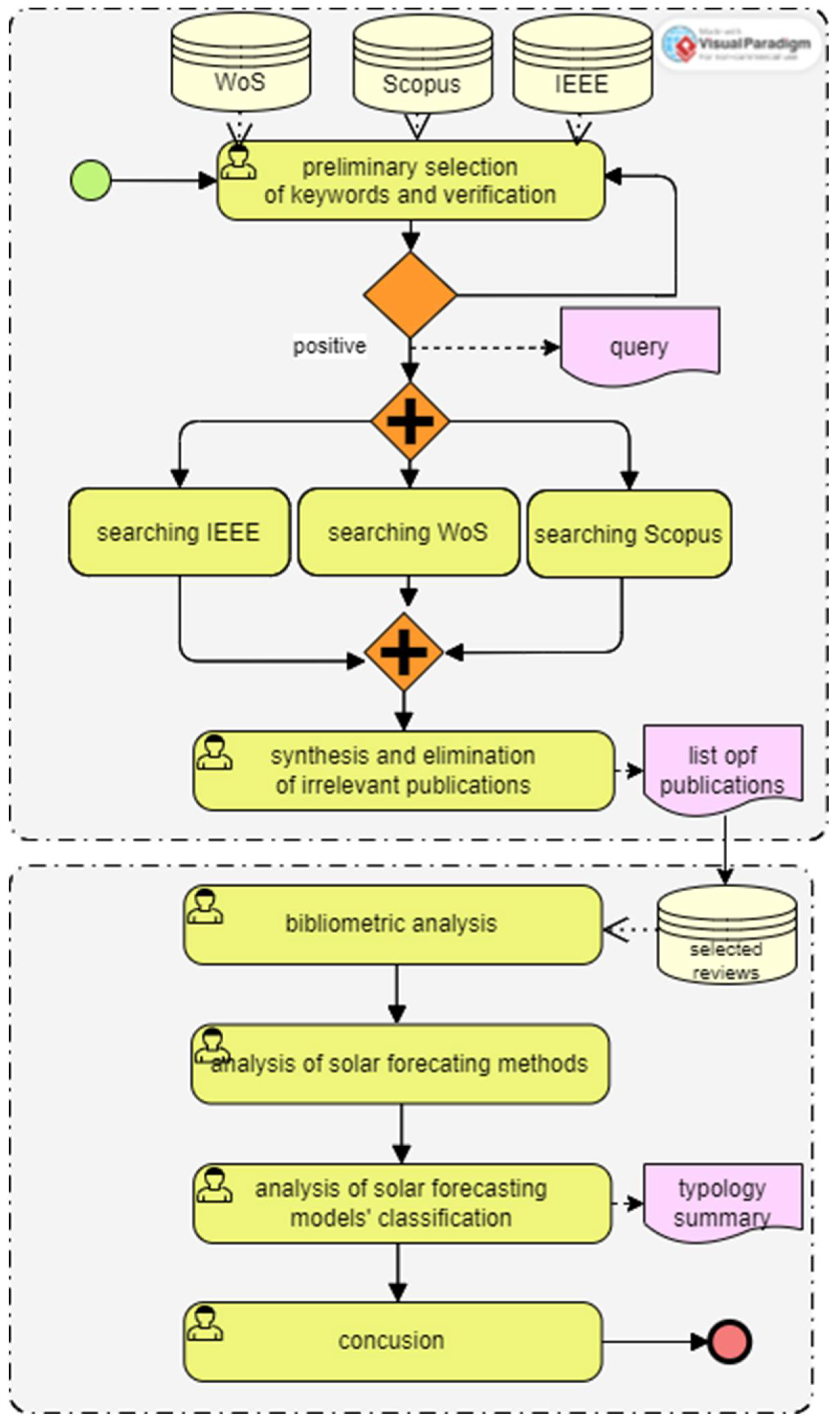
Figure 2.
(a) Document by subject area according to Scopus; (b) Document by year.
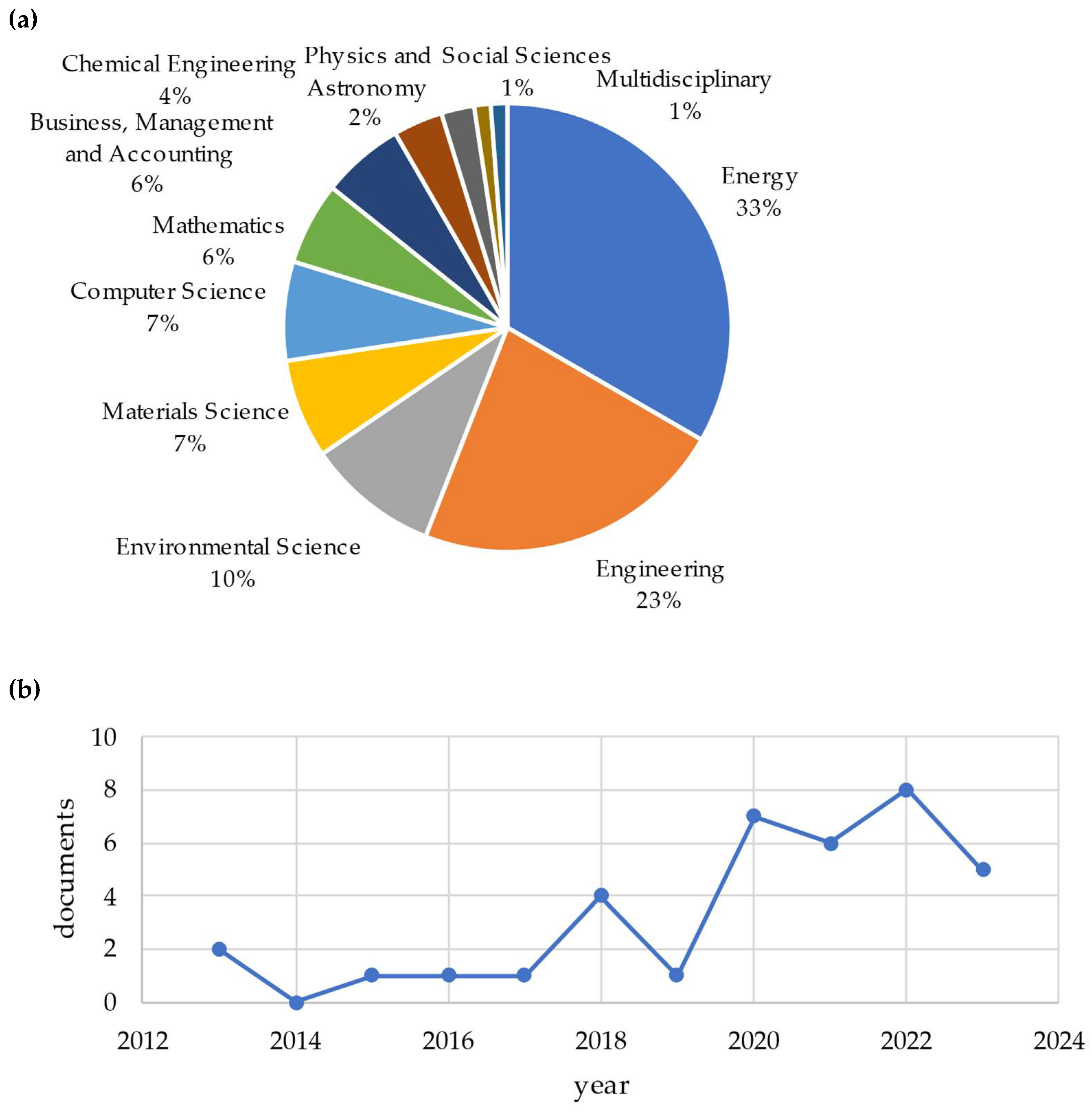
Table 1.
List of abbreviations.
| Abbreviation | Description |
|---|---|
| AI | artificial intelligence |
| ANN | artificial neural networks |
| AR | autoregressive |
| ARIMA | autoregressive integrated moving average |
| ARX | autoregressive with eXogenous input |
| BPNN | back propagation neural network |
| CELA | cluster-based ensemble learning approach |
| CNN | convolutional neural network |
| CNN–LSTM | convolutional neural network- long short-term memory |
| CRO | conversion rate optimisation |
| CS | Cuckoo search |
| DBN | deep belief network |
| DCELA | decomposition clustering-based ensemble learning approach |
| DCGSO | distance-correlation-based gene set analysis |
| DCNN | deep convolutional neural networks |
| DELA | decomposition based ensemble learning approach |
| DL | deep learning |
| DNI | direct normal irradiance |
| DNN | deep neural network |
| EELA | evolutionary based ensemble learning approach |
| ELM | extreme learning machine |
| ESDLS | evolutionary seasonal decomposition least |
| FBNN | feedback neural network |
| FFA | fire-fly algorithm |
| FFBP | feed-forward back propagation |
| FFNN | feed-forward neural network |
| FL | fuzzy logic |
| GB | gradient boosting |
| GELA | general ensemble learning approach |
| GHI | global horizontal irradiance |
| GRU | gated recurrent unit |
| k-NN | k-nearest neighbours |
| LMD | local mean decomposition |
| LS | least squares |
| LSTM | long short-term memory |
| MA | moving average |
| ML | machine learning |
| MLP | Multi-Layer Perceptron |
| MLFF | multi-layered feed-forward |
| MLP | multi-layer perceptron |
| NARMAX | non-linear AR-eXogenous |
| NN | neural networks |
| NWP | numerical weather prediction |
| OP | optimally pruned |
| PSO | particle swarm optimization algorithm |
| PV | photovoltaic |
| RBF | radial basis function network |
| RELA | residual based ensemble learning approach |
| RF | random forest |
| RLS | recursive least square |
| RNN | recurrent neural network |
| SAE | stacked autoencoder-based models |
| SL | stochastic learning |
| SVM | support vector machine |
| SVR | support vector regression |
| WT | wavelets transformation |
| WNN | wavelet neural network |
| WoS | Web of Science |
| VARX | vector autoregressive model with exogenous variables |
| n/s | not specified |
Table 2.
Journals published analysed reviews on solar forecasting.
| Journal | Nr of reviews | Reviews |
|---|---|---|
| Energies | 5 | [52,53,54,55,56] |
| Journal of Cleaner Production | 5 | [11,42,47,57,58] |
| Renewable and Sustainable Energy Reviews | 5 | [28,49,59,60,61] |
| Solar Energy | 3 | [43,45,62] |
| Applied Sciences | 2 | [63,64] |
| Energy Conversion and Management | 2 | [65,66] |
| CSEE Journal of Power and Energy Systems | 1 | [67] |
| Energy and AI | 1 | [68] |
| Environmental Science and Pollution Research | 1 | [4] |
| Frontiers in Energy | 1 | [1] |
| Global Energy Interconnection | 1 | [3] |
| IEEE Access | 1 | [69] |
| IET Renewable Power Generation | 1 | [46] |
| iScience | 1 | [8] |
| Journal of Electrical Engineering & Technology | 1 | [50] |
| Progress in Energy and Combustion Science | 1 | [70] |
| Renewable Energy | 1 | [6] |
| Sustainability | 1 | [9] |
| Sustainable Energy Technologies and Assessments | 1 | [71] |
| Science of The Total Environment | 1 | [72] |
Table 3.
The thematic scope of reviews.
| Scope of review | Reviews |
|---|---|
| Solar forecasting | Diagne et al. (2013) [28] Inman et al. (2013) [70] Qazi et al. (2015) [57] Antonanzas et al. (2016) [62] Voyant et al. (2017) [6] Yang et al. (2018) [45] Sobri et al. (2018) [65] De Freitas Viscondi and Alves-Souza (2019) [71] Mellit et al. (2020) [64] Guermoui et al. (2020) [74] Ahmed et al. (2020) [59] Rajagukguk et al. (2020) [53] Pazikadin et al. (2020) [72] Kumar et al (2020) [46] Zhou et al. (2021) [66] Álvarez-Alvarado et al. (2021) [63] Chu et al. (2021) [8] Yang and Van Der Meer (2021) [61] Singla et al. (2022) [1] Yang et al. (2022) [49] Wu et al. (2022) [56] Benavides Cesar et al. (2022) [52] Iheanetu (2022) [9] Sudharshan et al. (2022) [54] El-Amarty et al. (2023) [4] Rahimi et al. (2023) [50] Tsai et al. (2023) [55] Yang et al. (2023) [67] |
| Solar, wind, and electrical load forecasting | Wang et.al (2022) [3] |
| Solar and wind | Zendehboudi et. al. (2018) [58] Alkhayat and Mehmood (2021) [68] Prema et al. (2022) [69] |
| Photovoltaic production and electricity consumption | Van Der Meer et al. (2018) [60] |
| Solar forecasting and node-level power management | Sharma and Kakkar (2020) [75] |
Table 4.
The scope of reviews and classification of solar forecasting models included in the review papers.
Table 4.
The scope of reviews and classification of solar forecasting models included in the review papers.
| Persistence | Statistical (time series & AI) | Time series (regressive) | AI | ANN | ML | DL | SVM | Hybrid | Ensemble | Advanced (hybrid & AI) |
Physical /NWP | Cloud & satellite imaging | Remote sensing | Local sensing | Postprocessing | Probabilistic | Other | |
| Diagne et al. (2013) [28] | + | + | + | + | ||||||||||||||
| Inman et al. (2013) [70] | + | + | + | + | + | + | ||||||||||||
| Qazi et al. (2015) [57] | + | |||||||||||||||||
| Pazikadin et al. (2020) [72] | + | |||||||||||||||||
| El-Amarty et al. (2023) [4] | + | |||||||||||||||||
| Antonanzas et al. (2016) [62] | + | + | + | |||||||||||||||
| Van Der Meer et al. (2018) [60] | + | + | + | |||||||||||||||
| Singla et al. (2022) [1] | + | + | + | |||||||||||||||
| Wu et al. (2022) [56] | + | + | + | |||||||||||||||
| Iheanetu (2022) [9] | + | + | + | |||||||||||||||
| Sharma and Kakkar (2020) [75] | + | + | + | + | ||||||||||||||
| Sobri et al. (2018) [65] | + | + | + | |||||||||||||||
| Voyant et al. (2017) [6] | + | |||||||||||||||||
| Alves-Souza (2019) [71] | + | |||||||||||||||||
| Zhou et al. (2021) [66] | + | |||||||||||||||||
| Yang et al. (2018) [45] | + | + | + | + | ||||||||||||||
| Mellit et al. (2020) [64] | + | + | + | |||||||||||||||
| Zendehboudi et. al. (2018) [58] | + | |||||||||||||||||
| Rajagukguk et al. (2020) [53] | + | |||||||||||||||||
| Alkhayat and Mehmood (2021) [68] | + | |||||||||||||||||
| Kumari and Toshniwal (2021) [47] | + | |||||||||||||||||
| Ahmed et al. (2020) [59] | + | + | + | |||||||||||||||
| Guermoui et al. (2020) [74] | + | |||||||||||||||||
| Kumar et al (2020) [46] | +* | + | + | |||||||||||||||
| Chu et al. (2021) [8] | +* | + | + | |||||||||||||||
| Álvarez-Alvarado et al. (2021) [63] | + | |||||||||||||||||
| Yang and Van Der Meer (2021) [61] | + | |||||||||||||||||
| Wang et.al (2022) [3] | + | + | ||||||||||||||||
| Yang et al. (2022) [49] | + | + | ||||||||||||||||
| Prema et al. (2022) [69] | + | + | + | |||||||||||||||
| Benavides Cesar et al. (2022) [52] | + | + | + | |||||||||||||||
| Sudharshan et al. (2022) [54] | + | + | + ** | + | + | +*** | + | + | + | |||||||||
| Rahimi et al. (2023) [50] | + | |||||||||||||||||
| Tsai et al. (2023) [55] | + | + | + | + | +*** | * | ||||||||||||
| Yang et al. (2023) [67] | + | + | + | + | ||||||||||||||
| Krishnan et al. (2023) [11] |
* data-driven; ** including special AI; *** hybrid & ensemble.
Table 6.
Proposed approaches due to temporal and spatial resolution.
| Family of forecasting | Spatial resolution | Temporal resolution | Reviews |
|---|---|---|---|
| Persistence | 0 km – 0.005 km 0.01 km – 0.1 km 0 km – 0.005 km |
0 – 0.1 h 0 – 0.1 h 0 – 0.08 h |
[60] [67] [1,28] |
| Time series (statistical) | 0 km – 0.1 km 0.01 km – 5 km 0.01 km – 10 km 0 km – 0.5 km 0.001 km – 2 km |
0 h – 50 h 0 h – 1000 h 0.05 h – 800 h 0 h – 20 h 0.01 h – 800 h |
[60] [67] [62] [1,28] [70] |
| NPW | 1 km – 100 km 2 km – over 120 km 5 km – 500 km 1 km – over 10 km 1 km – over 100 km 5 km – 20 km |
0.5 – over 1000 h 1 h – over 1000 h 0.5 h – 500 h 5 h – over 100 h 0.5 h – over 1000 h 2 h – 36 h |
[60] [67] [62] [8] [1,28] [70] |
| Hybrid Hybrid (data-driven) |
0.01 km – over 100 km 0 km – 15 km |
0 h – over 1000 h 0 h - over 100 h |
[67] [8] |
Table 7.
Adequacy of models to time horizon and data.
| Geographical and meteorological (e.g. clear sky data, zenith angle, pressure, humidity) | Cloud and satellite imaginary data (e.g. GHI, cloud cover, cloud position, wind speed) | NPW data (e.g. temperature, humidity, DNI, daytime) | Historical data (e.g. meteorological data, NWP data, DNI & GHI, cloud & satellite imaging) | Real-time monitoring data (e.g. real-time NWP data, real-time power data) | Very short term | Short term | Medium-term | Long term | |
|---|---|---|---|---|---|---|---|---|---|
| Persistence models | + | + | |||||||
| Physical models | + | + | + | + | + | + | |||
| Regresive models (AR, MA, ARMA, ARIMA, SARIMA, VARX, ARIMAX, NARMAX) | + | + | + | + | + | + | + | ||
| AI models (ANN, BPNN, DCNN, SVM, SVR, ELM, FL) |
+ | + | + | + | + | + | + | + | |
| Hybrid and ensemble models | + | + | + | + | + | + | + | + | + |
Disclaimer/Publisher’s Note: The statements, opinions and data contained in all publications are solely those of the individual author(s) and contributor(s) and not of MDPI and/or the editor(s). MDPI and/or the editor(s) disclaim responsibility for any injury to people or property resulting from any ideas, methods, instructions or products referred to in the content. |
© 2024 by the authors. Licensee MDPI, Basel, Switzerland. This article is an open access article distributed under the terms and conditions of the Creative Commons Attribution (CC BY) license (http://creativecommons.org/licenses/by/4.0/).
Copyright: This open access article is published under a Creative Commons CC BY 4.0 license, which permit the free download, distribution, and reuse, provided that the author and preprint are cited in any reuse.


