
Submitted:
03 June 2024
Posted:
04 June 2024
You are already at the latest version
Abstract
Teachers’ time resources are becoming increasingly scarce and time poverty will have a direct impact on the long-term sustainability of their professional development. However, the current state of teachers’ time poverty and its potential harmful consequences are unclear. Therefore, this research conducts two cross-sectional studies to investigate the current situation and group differences in time poverty among Chinese teachers (Sample 1), as well as the influence of teachers’ time poverty on job burnout (Sample 2). The results indicate that: (1) there is a high level of time poverty among teachers; (2) there is no significant difference in gender, teaching years, or teaching section, and there is a significant difference in teaching responsibilities; (3) time poverty could positively and significantly predict job burnout, and job burnout could positively and significantly predict mental health; (4) mental health factors (including depression, anxiety and stress) play the mediating role in the relationship between teachers’ time poverty and job burnout. To create a sustainable development environment for teachers, it is suggested that teachers improve time management skills and establish a self-regulation mechanism; schools should clarify the boundaries of teachers’ work and respect their right to rest; and society should provide positive and adequate spiritual support.
Keywords:
Primary and secondary school teachers
; Teachers’ time poverty
; Job burnout
; Mental health
; Sustainability of teacher professional development
; Teacher development environment
1. Introduction
Teachers’ time has attracted more and more attention from various countries and academic communities. Teachers throughout the world now frequently struggle with issues like long work hours [1], an unsustainable work schedule [2], and a lack of autonomy in their time management [3]. These issues collectively indicate to the scarcity of teachers’ time resources [4,5], often known as teachers’ time poverty [6].
Teachers’ time poverty not only increases their workload and contributes to job burnout [7], but it also creates mental health issues [8], threatening the long-term sustainability of their professional development [9]. It is worth highlighting that teachers in many countries are suffering from negative emotional problems caused by job burnout [10,11], as well as serious mental health issues such as teacher depression, anxiety, and stress [12,13]. Previous studies have found that long-term depression and anxiety in teachers can exacerbate job burnout and increase the risk of turnover [14,15], damaging the teacher development environment [16]. As a result, enhancing the internal and external environment under teachers’ time poverty is an essential step toward resolving job burnout and addressing mental health issues.
However, on the one hand, the existing research on “teacher’s time” mostly emphasizes the factual “quantity” of teachers’ working hours [17], while neglecting the subjective “sense of time” experienced by teachers [18]. Furthermore, it is unclear whether teachers’ time resources are limited. On the other hand, prior research has mostly focused on examining the possible negative outcomes of teacher burnout or mental health issues by treating them as ante-dependent variables [19,20]. Time poverty has not been considered a significant factor in the investigation of its effects on teachers’ mental health and job burnout, and the internal influencing mechanism of the three factors is yet unknown.
In summary, this study develops a theoretical framework based on the Scarcity Theory and the Conservation of Resources Theory (COR), and argues that job burnout is caused by time resource consumption, with mental health factors potentially acting as mediators. Therefore, the main research questions include: (1) What is the present level of time poverty among primary and secondary school teachers? Is there a significant difference in time poverty between various types of teachers? (2) How does teachers’ time poverty affect job burnout? Do mental health factors (including depression, anxiety and stress) play a mediation role? The research findings can not only properly evaluate if teachers’ time resources are scarce but also provide scientific evidence support for reducing job burnout and protecting teachers’ mental health. Furthermore, it can provide decision-making reference for enhancing teachers’ working environments and encouraging the sustained development of teachers’ career.
2. Theoretical Framework and Research Hypothesis
2.1. Scarcity Theory and Teacher’s Time Poverty
Poverty is typically assessed based on income [21]. However, despite the ongoing rise in wealth, individual satisfaction has not seen a proportional improvement [22]. Nations and educational communities have progressively acknowledged the significant role of “time” as a non-financial element in enhancing individuals’ well-being and advancing socially sustainable progress, hence heightening focus on “time poverty”. Because of varying disciplinary perspectives, the conception of time poverty has not reached a unified. However, it can be broadly divided into objective and subjective levels. From the perspective of the objective, time poverty emphasizes the insufficient quantity of time allotted to various activities, such as physical exercise [23]. On the subjective level, it emphasizes the individual’s subjective feeling of time poverty, such as their feeling that they do not have enough time to accomplish work [24] and housework [25]. Although the research on the objective “quantity” of time might well answer the structural allocation of teachers’ working time, that is, to explore the real amount of time occupied by teachers’ actual work. Nevertheless, it is important to distinguish between an actual lack of time and a perceived scarcity of time [6]. In other words, the objective time number also needs to be subjectively perceived by individuals, which consequently impacts their cognitive processes, emotions, and behavior [26]. Therefore, this study focuses on the subjective level to explore teachers’ time poverty.
At the same time, the Scarcity Theory argues that scarcity is a psychological state in which individuals’ aspirations and needs are not met due to actual or perceived lack of resources [27]. Based on the Scarcity Theory, this study regards time as a scarce resource and emphasizes teachers’ subjective perception of time scarcity, whether it is an actual shortage of time or a perception of time scarcity. Therefore, teacher time poverty refers to teachers’ feeling that they have too many things to do, but have not enough time to do them [6]. It emphasizes teachers’ subjective feelings about whether time resources are scarce. Furthermore, considering the complexity and cross-temporal character of teachers’ work [28], as well as the relevant studies on the structure of teachers’ working time [29], this study concludes that:
Hypothesis 1 (H1).
Teachers’ time poverty has no significant difference in gender, teaching years and teaching sections.
Hypothesis 2 (H2).
Teachers’ time poverty has significant difference in job responsibilities.
2.2. COR Theory, Job Burnout and Mental Health
Hobfoll (2001) established the Conservation of Resources Theory (COR) to describe the interplay of resources between individuals and the social environment, and he argues that job burnout is caused by resource consumption [30]. Furthermore, during this process, the individual’s internal resources, including emotional resources, will have a specific influence on it [30]. Wright and Bonett (1997) pointed out that mental health factors can be used as emotional resources, and negative mental health factors, such as depression and anxiety, are positively correlated with individual burnout [31]. In other words, there are issues with teachers, such as how non-teaching working time consumes teaching time and encroaches on family time [32]. These issues make teachers’ time resources increasingly scarce, consume their emotional reserves, exacerbate their mental health issues, such as depression, anxiety, and stress, and ultimately lead to an increase in job burnout.
Teacher job burnout refers to a state of exhaustion experienced by teachers due to long working hours, high workload and excessive work intensity [33]. More than half of teachers in China experience emotional exhaustion and are becoming weary of their teaching responsibilities [34]. This not only directly diminishes their passion and satisfaction [35], but also increase the risk of turnover [36]. Furthermore, it negatively affects the development of students and schools [37]. In addition, studies have shown that there is a significant positive relationship between time poverty and teacher job burnout. Tianyu Liu and Qiang Wang (2024) explored the mediating role of teachers’ time poverty and found that time poverty, as a mediating variable, could positively and significantly predict teachers’ emotional exhaustion (a dependent variable) [38]. In other words, teachers will feel that they do not have enough time to do their own work, which will increase their time poverty, resulting in job burnout [39]. Therefore, we can infer that:
Hypothesis 3 (H3).
Teachers’ time poverty could directly and positively predict job burnout.
In addition, teachers’ mental health issues are most commonly associated with negative emotional states such as depression, anxiety, and stress. [13]. Although no direct research has been conducted on the association between time poverty and mental health issues among teachers, some studies have found that time poverty is connected to psychological characteristics such as depression and anxiety. For example, Roxburgh (2004) discovered that time poverty could positively predict depression when investigating the relationship between different family roles and depression [40]. Urakawa et al. (2020) found that time poverty could cause individual anxiety, tension and other psychological results [41]. According to the similar psychological reaction rules of the above groups, it is inferred that:
Hypothesis 4 (H4).
Teachers’ time poverty could significantly and positively predict mental health (including depression, anxiety, and stress).
Previous studies have explored the negative effects of teachers’ mental health on their job burnout. For example, Kessler et al. (1988) believed that teachers under long-term work pressure would not only produce mental health problems such as anxiety, stress and depression, but also lead to job burnout [42]. Yachao Li et al. (2021) found that teachers’ positive mental health factors could negatively and significantly predict their job burnout [43]. Therefore, we can infer that:
Hypothesis 5 (H5).
Teachers’ mental health could significantly and positively predict job burnout.
In summary, based on the Scarcity Theory [27], Conservation of Resources Theory (COR) [30] and related existing research, this study infers the relationship between teachers’ time poverty, job burnout and mental health factors. To be specific, we propose that teachers who lack sufficient time resources may deplete their mental health resources, leading to the onset and exacerbation of negative psychological emotions such as depression, anxiety, and stress. Consequently, teachers may eventually experience a sense of burnout. Therefore, we can infer that:
Hypothesis 6 (H6).
Teachers’ negative mental health could play the mediating role in the relationship between teachers’ time poverty and job burnout.
It is worth mentioning that mental health is treated as a whole in order to assess its mediating effect. Simultaneously, to better validate the relationship between variables and strengthen the credibility of the mediation model, this study investigates the mediating effects of three mental health factors: depression, anxiety, and stress, respectively. We can infer that:
Hypothesis 7 (H7).
Teachers’ depression, anxiety and stress could play mediating roles in the relationship between teachers’ time poverty and job burnout, respectively.
Hypothesis 3 to 7 are depicted in Figure 1.
3. Methods
3.1. Participants
In this study, two data collections were randomly selected from primary and secondary school teachers in Beijing, China. In order to fully understand the reality of teachers’ time poverty, 713 teachers (Sample 1) were collected (456 females, 42.77 ± 18.27 years old). At the same time, in order to better explore the relationship between teachers’ time poverty and job burnout, and reveal the mediating role of mental health factors (including depression, anxiety, and stress), another sample of the 549 teachers (Sample 2) were collected (346 females, 41.35 ± 10.22 years old).
3.2. Measures
Teachers’ Time Poverty. In this study, we use Teachers’ Time Poverty Scale (TTPS) to measure teachers’ subjective feelings of time poverty [6]. This scale includes seven items (e.g., “I feel that my teaching hours are often taken up by transactional work.”), rated by Likert 5-point scoring system, in which 1 = strongly disagree, 2 = disagree, 3 = generally, 4 = agree, and 5 = strongly agree. Higher scores indicating higher teachers’ time poverty. The values of coefficient α in the two samples are 0.914 and 0.972.
Teacher Job Burnout. To measure teacher job burnout, we use Maslach Burnout Inventory (MBI-ES) developed by Maslach and Jackson (2003) [33]. Also using a 5-point scale, the higher the score, the more serious the teacher burnout. In this study, the values of coefficient α is 0.931.
Teachers’ Mental Health. We adopt the Depression, Anxiety and Stress Scale (DASS-21, Chinese Version) revised by Gong Xu et al. [44]. Higher scores indicating more severe mental health problems in teachers. In this study, the values of coefficient α is 0.966.
3.3. Data Analysis
We used the statistics software of SPSS 26.0 with the PROCESS macro (http://www.afhayes.com) to answer the research question [45]. For Sample 1, descriptive statistics, comparative analysis of means, analysis of variance were used to analyze the overall level of teachers’ time poverty, and then to deeply understand the differences of different types of teachers’ time poverty from the dimensions of gender, teaching age, teaching sections and job responsibilities. For Sample 2, teachers’ time poverty is used as an independent variable, mental health as an intermediary variable, and job burnout as an outcome variable to measure the correlation between variables by the descriptive statistics, correlation analysis, the linear regression and the bias-corrected bootstrapping method.
4. Results
4.1. Current Situation and Difference Analysis of Teachers’ Time Poverty
This study first analyzes the current situation of teachers’ time poverty in Sample 1, whose demographic statistics are shown in Table 1.
Because the scale employs 5-point Likert values, the theoretical average (neutral value) of each assessment question regarding teachers’ time poverty is 3 points. If the measured score of teachers’ time poverty is 3 points, the time poverty of primary and secondary school teachers is considered to be in the middle level; if the score is less than 3, the teachers’ time poverty level is considered to be lower; and if the score is greater than 3, it is considered that the level of teachers’ time poverty is high.
As shown in Table 2, the minimum value of the investigated teachers’ time poverty is 1, the maximum value is 5, and the mean value is 3.45. From the perspective of scores in each dimension, the highest average score of “I feel that teaching hours are often taken up by transactional work” was 3.65. “I feel that I do not have enough time to share family responsibilities” was 3.52. “I feel that my time is very fragmented” and “I often feel that I do not have enough time at work” were 3.50. “" I feel that I do not have enough time with my friends” and “There is no autonomy in the allocation of my time” had lower mean values of 3.49 and 3.09, respectively.
In addition, in order to verify research Hypothesis 1 and Hypothesis 2, this study examines the phenomenon of teachers’ experiencing time poverty from several perspectives, including gender, years of teaching, teaching sections and teaching responsibilities. The results of Analysis of Variance are shown in Table 3: First, in terms of gender, the value of P value is 0.38, which is higher than the significance level of 0.05. Meanwhile, the P value for each sub-dimension of time poverty is greater than 0.05, indicating that the gender of primary and secondary school teachers does not have a significant effect on time poverty. That is, both male and female teachers have the problem of time poverty. Secondly, in terms of teaching age, the P-values are all more than 0.05, indicating that teaching years will have no significant impact on teacher time poverty. In other words, teachers at any stage of professional development have the problem of time poverty. Thirdly, in terms of school sections, the P-values are all higher than the significance level of 0.05, indicating that school segment factors have no significant impact on teacher time poverty. That is, teachers at the primary, middle, and high school sections all face the issue of time poverty.
However, in terms of job responsibilities, the P-values are all lower than 0.05, indicating that job responsibilities would have a significant impact on the time poverty of primary and secondary school teachers. Teacher responsibilities can reflect teacher workload, that is, teacher workload has a significant difference in time poverty. The findings show that teachers who are solely responsible for teaching, teachers who are responsible for teaching and class management, and teachers who are responsible for teaching, class management, and school administration have distinct responsibilities that reflect the varying workloads, as well as significant differences in time poverty. The higher the workload of teachers, the more serious the experience of time poverty. Therefore, both Hypothesis 1 and Hypothesis 2 are supported.
4.2. Teachers’ Time Poverty Effect on Job Burnout: The Mediating Role of Mental Health
4.2.1. Preliminary Analyses
Means, standard deviations (SD) and correlations among the study’s variables are shown in Table 4. All correlations between variables were statistically significant (p < 0.01). Specifically, time poverty was positively and significantly related to job burnout (r = 0.748) and mental health (r = 0.322). It shows that the higher the level of teachers’ time poverty, the more serious the job burnout and mental health problems will be. Meanwhile, teachers’ time poverty was positively and significantly related to depression (r = 0.280), anxiety (r = 0.274), stress (r = 0.343), indicating that with the enhancement of teachers’ feeling of time poverty, the level of teachers’ depression, anxiety and stress will rise accordingly. Moreover, teachers’ mental health was positively and significantly related to job burnout (r = 0.458), showing that with the aggravation of teachers’ mental health problems (such as depression, anxiety and increased pressure), teachers’ job burnout level will also increase. In addition, the means ranged from 22.92 to 29.10, and the SD ranged from 5.92 to 11.48. All these results provided a preliminary support for hypothesis verification.
4.2.2. Testing for the Hypothetical Model
To verify Hypothesis 3, a direct linear regression model of teachers’ time poverty and job burnout was built. The results showed that teachers’ time poverty positively and significantly predicted job burnout (β = 0.748, p < 0.001) even after controlling for the effects of gender and age. Therefore, Hypothesis 3 were supported.
Next, to verify Hypothesis 4, Hypothesis 5, and Hypothesis 6, the mediation model with teachers’ mental health as a mediator between teachers’ time poverty and job burnout was formulated using the No. 4 Model in the PROCESS macro [45].
The results in Table 5 showed that teachers’ time poverty was positively associated with teachers’ mental health (β = 0.624, p < 0.001, 95% CI: [ 0.470, 0.779]). Teachers’ mental health was positively associated with job burnout (β = 0.113, p < 0.001, 95% CI: [0.087, 0.139]). All the path coefficients and adjusted R2 values were also displayed in Figure 2.
Additionally, the 95% confidence interval of teachers’ mental health, as a judgment index of mediating effect between teachers’ time poverty and job burnout, ranged from 0. 040 to 0.105 (not including zero) and R2= 0.104. These results all indicated that teachers’ mental health partially mediated the relation between teachers’ time poverty and job burnout. Therefore, Hypothesis 3, Hypothesis 4, and Hypothesis 5 were supported.
At the same time, in order to further verify the path relationship between variables, we also conducted mediation tests on the three sub-variables of mental health (depression, anxiety and stress) respectively. As can be seen from Table 6, Table 7 and Table 8, teachers’ time poverty was positively associated with depression (β = 0.183, p < 0.001, 95%CI: [0.130, 0.235]) and anxiety (β = 0.186, p < 0.001, 95%CI: [0.131, 0.241]) and pressure (β = 0.255, p < 0.001, 95%CI: [0.197, 0.314]). In addition, teachers’ depression (β = 0.338, p < 0.001, 95%CI: [0.263, 0.413]), anxiety (β = 0.281, p < 0.001, 95%CI: [0.208, 0.355]) and stress (β = 0.261, p < 0.001, 95%CI: [0.192, 0.330]) were positively associated with job burnout. All the path coefficients and adjusted R2 values were also displayed in Figure 3, Figure 4 and Figure 5.
Additionally, the 95% confidence interval of teachers’ depression, anxiety and stress, as judgment index of mediating effects between teachers’ time poverty and job burnout, were as follows: 0. 034-0.094, 0. 027-0.083 and 0. 039-0.099 (all without zero). These results all indicated that teachers’ depression, anxiety and stress play a partial mediating role in the relationship between time poverty and job burnout, respectively. Therefore, Hypothesis 7 was supported.
5. Discussion
The lack of resources for teachers’ time is getting scarce, and time poverty is now a widespread issue for teachers worldwide. This will ruin the environment for teacher education and endanger the long-term sustainability of teacher professional development. Therefore, this study designed two cross-sectional studies. On the one hand, Sample 1 (N = 713) was used to investigate the current situation and group differences of time poverty among teachers in China. On the other hand, based on the theoretical framework of the Scarcity Theory [27] and the Conservation of Resources Theory (COR) [30], this study argues that job burnout is caused by the exhaustion of time resources, and mental health issues, such as teachers’ internal emotional reserves, may act as a mediating variable. Sample 2 (N = 549) was conducted to build a mediating model to explore how time poverty affects teacher job burnout and whether mental health factors (including depression, anxiety, stress) could play mediating roles.
In the following, we further explained the conclusions of each question, proposed the corresponding practical implications for the findings, and summarized the limitations of the study.
5.1. The Reality and Difference Characteristics of Time Poverty among Primary and Secondary School Teachers
First and foremost, the research findings indicate that primary and secondary school teachers in China face a high incidence of time poverty. Specifically, it represents the fact that teachers’ teaching time is frequently taken by transactional work, and teachers claim they do not have enough time to improve their abilities and professional growth, and their time is severely fragmented. Simultaneously, teachers frequently feel that they do not have enough time for their families and connections with others, causing the boundaries between work and family to become blurred. For example, according to the TALIS 2018 teacher working hours survey report, primary and secondary school teachers in China work more hours per week than teachers in 48 other countries and regions, but spend the least amount of time in class [46].Other studies have found that teachers spend too much time dealing with student disputes and coordinating the relationship between parents and schools, so that teachers’ time for their own professional development is scarce [47]. All of this indicates that non-teaching activities consume the majority of teachers’ daily teaching time, resulting in a steady loss of autonomy in time management. This will immediately cause teachers to believe that time resources are scarce, exacerbating their experience of time poverty and endangering the sustainability of their career development.
Secondly, this study compares and analyzes the possible differences in time poverty of teachers from different dimensions such as gender, teaching years and teaching sections. The findings show that teachers’ time poverty is not significantly different by gender, teaching years, or teaching sections. In other words, both male and female teachers, regardless of their stage of professional growth, whether primary school, middle, or high school teachers, face the issue of time poverty. This research result presents a novel insight into the actual shortage of time resources among teachers. Additionally, it offers new empirical evidence to support the notion of teachers’ time poverty [6], thereby broadening the theoretical framework.
Finally, it is important to highlight that this study indicates that primary and secondary school teachers’ time poverty is significantly impacted by their responsibility. In other words, teachers’ responsibilities reflect their workload, which has a direct impact on teachers’ sense of time poverty. As teachers take on more responsibility, they also accumulate more duties, leading to an intensified feeling of time poverty. In China, with the normalization of the “double reduction policy” and the deepening of the “after-class service” in primary and secondary schools [48], the contradiction between teachers’ service willingness and life practice is constantly intensified, resulting in teachers’ work burden [49]. And it also directly causes teachers’ time poverty and breaks the balance between teachers’ work and life. As consequently, it has a harmful impact on teachers, students and school development. Overall, the findings of this study illustrate the problem of time poverty among primary and secondary school teachers in China and other countries. Meanwhile, this differs from previous research, and this is the first study to show that teacher workload has a direct impact on time poverty. The findings not only broaden the application breadth of the Scarcity Theory [27], but also give factual support for teachers in reducing their workload.
5.2. Teachers’ Mental Health as a Mediator between Time Poverty and Job Burnout
Firstly, teachers’ time poverty has a positive and significant predictive effect on mental health (including depression, anxiety and stress). That is, the greater the teachers’ time poverty, the more severe their negative mental health issues, such as depression, anxiety and stress. The results of this study are consistent with the previous measurement results of time poverty in other occupational groups [40,41], and enrich the correlation relationship between time poverty and mental health factors such as depression, anxiety, and stress in teacher groups.
Secondly, the study find that teachers’ mental health factors (including depression, anxiety and stress) have a positive and significant predictive effect on their job burnout. In other words, the more significant teachers’ mental health issues are, the higher their degrees of depression, anxiety, and stress, as well as job burnout. This study demonstrates quantitatively that mental health factors have a detrimental impact on job burnout among primary and secondary school teachers, broadening the research scope of teachers’ mental health and job burnout.
Finally, teachers’ mental health factors (including depression, anxiety and stress) play a partial mediating role in time poverty and job burnout. This indicates that teachers’ time poverty will cause and aggravate depression, anxiety, stress and other negative psychological emotions, thus increasing their sense of job burnout. To be specific, time is a crucial resource, and teachers are experiencing a scarcity of it due to growing social demands and increased workload. This has led to an intensification of their feeling of time poverty. And this will constantly deplete teachers’ psychological resources, causing mental health issues such as depression, anxiety, and stress, and contributing to teachers’ sense of job burnout. Furthermore, the results of this study enlighten us that if teachers have enough healthy psychological resources, safeguarding those resources can help prevent teachers’ job burnout [50]. That is to say, we believe that teachers’ positive mental health can be used as a protective factor to reduce the negative impact of time poverty on teachers’ job burnout [7]. It is worth mentioning that this study creatively combines the Scarcity Theory [27] with the Conservation of Resources Theory (COR) [30], and establishes the theoretical framework of this study, so expanding the research scope of related theories. All in all, it reveals the internal mechanism between time poverty and job burnout, which provides a new intervention perspective for protecting teachers’ mental health and alleviating their job burnout.
5.3. Practical Significance
Consistent with the COR theory of Hobfolletal [30], this study argues that teachers’ job burnout can be affected by many factors, such as social development, school system and teachers’ own influence. Based on this, we have proposed pertinent countermeasures and recommendations from the perspectives of teachers, school administrators, and society in order to lessen job burnout, safeguard teachers’ mental health, further promote the sustainable development of the teaching profession, and create a positive environment for teachers.
First of all, from the perspective of teachers themselves, on the one hand, teachers should improve their own time management awareness and time management ability. To be specific, teachers should be able to reasonably plan and arrange working time and family time, and form a suitable working rhythm and life rhythm to reduce the sense of time poverty [7,38,47]. On the other hand, teachers have to learn to protect their mental health. Teachers, for example, could develop a self-adjustment system to resolve and redirect negative psychological distress, thereby promoting mental well-being, enhancing occupational satisfaction, and mitigating job burnout [47,51].
Secondly, from the perspective of school administrators, on the one hand, schools should fundamentally address the issue of teachers’ time poverty. Schools should establish clear boundaries for teachers’ work and respect their right to rest and autonomy in time management. Because of the complicated and spanning nature of teachers’ responsibilities, the traditional boundary between work and family has progressively diminished. It has now become commonplace for most teachers to utilize their leisure time to complete jobs such as lesson preparation and application work materials [52]. This undoubtedly adds to the workload of teachers and exacerbates the issue of time poverty. As a result, school administrators should fairly plan and arrange teachers’ work, do “subtracting” teacher work content, limit the frequency of working time that interferes with family time, and respect their right to rest [7]. In addition, the school should also respect teachers’ autonomy in their time management. Nowadays, it is common for teachers to spend their teaching time on non-teaching tasks. As a result, school administrators should offer teachers with a relatively free and relaxed time environment, as well as limit the frequency of non-essential tasks that interfere with teaching duties. By allocating time for teachers to autonomously manage their teaching responsibilities and enhance their professional skills, teachers can be freed from the burden of time constraints and alleviate job burnout [53]. On the other hand, school administrators should pay attention to teachers’ mental health problems. For example, mental health education and training for teachers are regularly carried out. It is also possible to investigate new avenues for teachers’ mental health education, such as holding expert lectures and on-site psychological counseling [54].
Finally, in order to achieve rapid development and efficiency, society’s expectations of teachers should be acceptable, as well as corresponding with teachers’ actual situations. Furthermore, society needs to do a better job of guiding public opinion in the right direction and giving teachers enough positive spiritual support [55].
5.4. Limitations and Future Research
This research has relevant theoretical and practical significance, but there are some limitations. When investigating time poverty and teacher job burnout, this study created only one mediation variable of mental health. In future research, other variables could be added to investigate the relationship between chain mediating variables. For example, Zhang et al. (2023) explored the individual mediating effect and the chain mediating effect of teacher-student relationships and teachers’ well-being when exploring the influencing factors of teacher burnout [10]. In view of this, in the future research, we could explore more available variables to explore the mechanism of teachers’ time poverty influence.
6. Conclusions
In order to ensure the sustainability of teacher professional development, this research conducts two cross-sectional studies. It investigates the current situation and group differences of time poverty among teachers in China. Furthermore, it also reveals a novel internal mechanism between time poverty and job burnout, with mental health factors (including depression, anxiety and stress) playing intermediary roles. The findings creatively combine the Scarcity Theory [27] with the Conservation of Resources Theory (COR) [30], and expand the research scope of related theories. Meanwhile, we put forward relevant countermeasures and suggestions from three aspects of teachers, school administrators, and society to create a positive and sustainable environment for teachers.
Author Contributions
Conceptualization, T.L. and Q.W.; Formal analysis, T.L. and Q.W.; Investigation, T.L. and Q.W.; Methodology, T.L. and Q.W.; Data curation, T.L. and Q.W.; Writing - original draft, T.L. and Q.W.; Writing – review & editing, T.L. and Q.W.; Supervision, Q.W.; Funding acquisition, Q.W. All authors have read and agreed to the published version of the manuscript.
Funding
This research is funded by the Beijing Office for Education Science Planning, China. “Beijing Education Science Planning 2023 priority project” [grant number 3059-0012] (Project title: Current situation and international comparison of science education in primary and secondary schools in Beijing).
Informed Consent Statement
Informed consent was obtained from all subjects involved in the study. The study did not involve human or animal experiments.
Data Availability Statement
Not applicable.
Acknowledgments
The authors of this work thank the directors and teachers of the primary and secondary schools for their willingness to participate in this study. Thanks to Beijing Office for Education Science Planning for supporting us.
Conflicts of Interest
The authors declare no conflict of interest.
References
- OECD. TALIS 2018 Results (Volume II): Teachers and School Leaders as Valued Professionals. Available online: http://www.oecd.org/education/talis-2018-results-volume-ii-19cf08df-en.htm (accessed on 23 March 2020).
- te Braak, P.; Van Droogenbroeck, F.; Minnen, J.; van Tienoven, T. P.; Glorieux, I. Teachers’ working time from time-use data: Consequences of the invalidity of survey questions for teachers, researchers, and policy. Teach. Teach Educ. 2022, 109. [Google Scholar] [CrossRef]
- Wermke, W.; Hostfalt, G. Contextualizing Teacher Autonomy in time and space: a model for comparing various forms of governing the teaching profession. J. Curriculum Stud. 2014, 46, 58–80. [Google Scholar] [CrossRef]
- Hargreaves, A. Teachers’ work and the politics of time and space. Int. J. Qual Stud Educ. 1990, 3, 303–320. [Google Scholar] [CrossRef]
- Song, H. A Time Sociological Analysis on Teachers’ Workload. J. East China Norm. Univ. 2023, 41, 1–15. [Google Scholar] [CrossRef]
- Liu, T. Y.; Yang, X. T.; Meng, F. H.; Wang, Q. Teachers Who are Stuck in Time: Development and Validation of Teachers’ Time Poverty Scale. Psychol Res Behav Ma. 2023, 16, 2267–2281. [Google Scholar] [CrossRef]
- García-Arroyo, J. A.; Segovia, A. O.; Peiró, J. M. Meta-analytical review of teacher burnout across 36 societies: The role of national learning assessments and gender egalitarianism. Psychol. Health, 2019, 34, 733–753. [Google Scholar] [CrossRef]
- Kreuzfeld, S.; Felsing, C.; Seibt, R. Teachers’ working time as a risk factor for their mental health-findings from a cross-sectional study at German upper-level secondary schools. BMC Public Health. 2022, 22. [Google Scholar] [CrossRef]
- Klassen, R. M.; ChiU, M. M. Effects on Teachers’ Self-Efficacy and Job Satisfaction: Teacher Gender, Years of Experience and Job Stress. J. Educ Psychol. 2010, 102, 741–756. [Google Scholar] [CrossRef]
- Zhang, W.; He, E.; Mao, Y.; Pang, S.; Tian, J. How Teacher Social-Emotional Competence Affects Job Burnout: The Chain Mediation Role of Teacher-Student Relationship and Well-Being. Sustainability. 2023, 15, 2061. [Google Scholar] [CrossRef]
- Caterina, F.; Ilaria, B.; Luciano, R.; Ylenia, P.; Domenica, F.; Paolo, E. S.; Paula, B.; Alessandro, P. Teacher Confidence in Professional Training: The Predictive Roles of Engagement and Burnout. Sustainability 2020, 12. [Google Scholar] [CrossRef]
- Scheuch, K.; Haufe, E.; Seibt, R. Teachers’ health. Dtsch Arztebl Int. 2015, 112, 347–356. [Google Scholar] [CrossRef] [PubMed]
- [13]Yang, R. J.; You, X. Q.; Zhang, Y.; Lian, L.; Feng, W. Teachers’ mental health becoming worse: The case of China. Int. J. Educ Dev. 2019, 70. [Google Scholar] [CrossRef]
- Wu, X.; Qi, Y.; Zang, W. Overall Features and Influencing Factors of Primary and Secondary School Teachers’ Job Burnout in China. J. South China Norm. Univ. Soc. Sci. Ed. 2019, 1, 37–42. [Google Scholar]
- Ratanasiripong, P.; China, T.; Ratanasiripong, N. T.; Toyama, T. Resiliency and mental health of school teachers in Okinawa. J. Health Res. 2020, 35, 470–481. [Google Scholar] [CrossRef]
- Zhang, X.; Li, S.; Wang, S.; Xu, J. L. Influence of job environment on the online teaching anxiety of college teachers in the online teaching context: The mediating role of subjective well-being. Front Public Health. 2022, 10. [Google Scholar] [CrossRef] [PubMed]
- Looi, C. K; Song, Y. J. Orchestration in a networked classroom: Where the teacher's real-time enactment matters. Comput Educ. 2013, 69, 510–513. [Google Scholar] [CrossRef]
- Seibt, R.; Kreuzfeld, S. Influence of work-related and personal characteristics on the burnout risk among full- and part-time teachers. Int. J. Env Res Pub He. 2021, 18. [Google Scholar] [CrossRef] [PubMed]
- Roberts, A.; LoCasale-Crouch, J.; Hamre, B.; DeCoster, J. Exploring teachers’ depressive symptoms, interaction quality, and children’s social-emotional development in head start. Early Educ Dev. 2016, 27, 642–654. [Google Scholar] [CrossRef]
- Liu, J.; Wang, W.; Hu, Q.; Wang, P. C.; Lei, L.; Jiang, S. The relationship between phubbing and the depression of primary and secondary school teachers: A moderated mediation model of rumination and job burnout. J. Affect Disorders. 2021, 295, 498–504. [Google Scholar] [CrossRef]
- Giurge, L. M.; Whillans, A.V.; West, C. Why time poverty matters for individuals, organizations and nations. Nat Hum Behav. 2020, 4, 993–1003. [Google Scholar] [CrossRef]
- Williams, J. R.; Masuda, Y. J.; Tallis, H. A measure whose time has come: Formalizing time poverty. Soc Indic Res. 2016, 128, 265–283. [Google Scholar] [CrossRef]
- Banwell, C.; Hinde, S.; Dixon, J.; Sibthorpe, B. Reflections on expert consensus: A case study of the social trends contributing to obesity. Eur J Public Health. 2005, 15, 564–568. [Google Scholar] [CrossRef]
- Lehto, A. M. Time pressure as a stress factor. Loisir Soc-Soc Leis. 1998, 21, 491–511. [Google Scholar] [CrossRef]
- Kleiner, S. Subjective time pressure: general or domain specific? Soc Sci Res. 2014, 47, 108–120. [Google Scholar] [CrossRef] [PubMed]
- Whillans, A. V.; Dunn, E. W.; Smeets, P.; Bekkers, R.; Norton, M. I. Buying time promotes happiness. P. Natl Acad Sci Usa. 2017, 114, 8523–8527. [Google Scholar] [CrossRef] [PubMed]
- Mullainathan, S.; Shafir, E. Scarcity: Why having too little means so much.; Allen Lane: London, Britain, 2013. [Google Scholar]
- Lauermann, F. Teacher responsibility from the teacher’s perspective. Int. J. Educ Res. 2015, 65, 75–89. [Google Scholar] [CrossRef]
- Allen, R.; Benhenda, A.; Jerrim, J.; Sims, S. New evidence on teachers’ working hours in England. An empirical analysis of four datasets. Res Pap Educ. 2020, 36, 657–681. [Google Scholar] [CrossRef]
- Hobfoll, S.E. The influence of culture, community, and the nested-self in the stress process: Advancing Conservation of Resources theory. Appl Psychol-Int Rev. 2001, 50, 337–370. [Google Scholar] [CrossRef]
- Wright, T.A.; Bonett, D.G. The contribution of burnout to work performance. J. Organ. Behav. Int. J. Ind. Occup. Organ. Psychol. Behav. 1997, 18, 491–499. [Google Scholar] [CrossRef]
- Tang, Y. It’s not only Work and Pay: The Moderation Role of Teachers’ Professional Identity on their Job Satisfaction in Rural China. Appl Res Qual Life. 2020, 15, 971–990. [Google Scholar] [CrossRef]
- Maslach, C.; Jackson, S.E. The measurement of experienced burnout. J. Occup Behav. 1981, 2, 99–113. [Google Scholar] [CrossRef]
- Gao, X.; Wei, F.; Zhou, X. L. An Ecosystem Perspective on Why Teachers Burnout: Analysis based on Ecosystem Theory. Res. Educ Dev. 2023, 2, 44–51. [Google Scholar] [CrossRef]
- Li, J.; Xue, E. Y.; Liu, Y. X. The Chain Mediating Role of Teachers’ Job Stress in the Influence of Distributed School Leadership on Job Satisfaction: Evidence from China, the United States, England, and Australia. Behav Sci. 2024, 14. [Google Scholar] [CrossRef]
- Pan, H.-L.W.; Chung, C.-H.; Lin, Y.-C. Exploring the Predictors of Teacher Well-Being: An Analysis of Teacher Training Preparedness, Autonomy, and Workload. Sustainability. 2023, 15, 5804 https:// doiorg/103390/su15075804. [Google Scholar] [CrossRef]
- Imran, N.; Rahman, A.; Chaudhry, N.; Asif, A. Effectiveness of a school-based mental health intervention for school teachers in urban Pakistan: a randomized controlled trial. Child Adol Psych Men. 2022, 16. [Google Scholar] [CrossRef] [PubMed]
- Liu, T. Y.; Wang, Q. The Longitudinal Association between Stress Mindset and Emotional Exhaustion among Teachers: The Mediating Effect of Time Poverty. Educ Sci Res. 2024, 2, 51–57. [Google Scholar]
- Dugan, A. G.; Matthews, R. A.; Barnes-Farrell, J. L. Understanding the roles of subjective and objective aspects of time in the work-family interface. Community Work Fam. 2012, 15, 149–172. [Google Scholar] [CrossRef]
- Roxburgh, S. “There just aren’t enough hours in the day”: The mental health consequences of time pressures. J. Health Soc Behav. 2004, 32, 115–131. [Google Scholar] [CrossRef] [PubMed]
- Urakawa, K.; Wang, W.; Alam, M. Empirical Analysis of Time Poverty and Health-Related Activities in Japan. J. Fam Econ Iss. 2020, 41, 520–529. [Google Scholar] [CrossRef]
- Kessler, R.C.; Turner, J.B.; House, J.S. Effects of unemployment on health in a community survey: Main, modifying, and mediating effects. J. Soc. Issues 1988, 44, 69–85. [Google Scholar] [CrossRef]
- Li, Y. C.; Huang, Z. W.; Chang, K.; Li, X.; Zhang, H. Research on the relationship between teachers’ job burnout and mental health in Beijing colleges and universities from the perspective of psychological capital. China Med Her. 2021, 18, 64–67. [Google Scholar]
- Gong, X.; Xie, X. Y.; Xu, R.; Luo, Y. J. Psychometric properties of the Chinese versions of DASS-21 in Chinese college students. Chinese J. Clin Psychol. 2010, 18, 443–446. [Google Scholar] [CrossRef]
- Hayes, A. F. Introduction to mediation, moderation, and conditional process analysis: a regression-based approach. The Guilford Press, 2013.
- Liang W., Y. Job Demands, Job Resources and Teachers’ Job Satisfaction: An Empirical Study Based on the Shanghai Data from the TALIS 2018 Results. Educ Res. 2020, 41, 102–115. [Google Scholar]
- Zhao, Y.; Fu, W. L. Traceability and relief of the scarcity of teachers’ independent development time: Reflection based on temporal sociology. Theory Pract Educ. 2022, 42, 17–21. [Google Scholar]
- Qian, H. Y.; Walker, A.; Chen, S.Y. The ‘Double-Reduction’ Education Policy in China: Three Prevailing Narratives. J. Educ Policy. 2023. [CrossRef]
- Hallsten, L.; Voss, M.; Stark, S.; Josephson, M.; Vingård, E. Job Burnout and Job Wornout as Risk Factors For Long-term Sickness Absence. Work J. Prev Asses Rehabil. 2011, 38, 181–192. [Google Scholar] [CrossRef]
- Zhang, M.; Bai, Y.; Li, Z. Z. Effect of Resilience on the Mental Health of Special Education Teachers: Moderating Effect of Teaching Barriers. Psychol Res Behav Ma. 2020, 13, 537–544. [Google Scholar] [CrossRef]
- Oberle, E.; Schonert-Reichl, K. A. Stress Contagion in The Classroom? The Link between Classroom Teacher Burnout and Morning Cortisol in Elementary School Student. Soc Sci Med. 2016, 159, 30–37. [Google Scholar] [CrossRef] [PubMed]
- Zhang, J. J.; He, X. Y. Analysis of Social Time Structure of Teachers’ Burden and Its Governance Path. Educ Res Mon. 2023, 7, 11–18. [Google Scholar] [CrossRef]
- Räsäne, K.; Pietarinen, J.; Väisänen, P.; Pyhältö, K.; Soini, T. Experienced burnout and teacher-working environment fit: a comparison of teacher cohorts with or without persistent turnover intentions. Res Pap Educ. 2024, 39, 227–330. [Google Scholar] [CrossRef]
- Tian, L. L. Effective strategies for relieving teachers’ psychological pressure in educational reform. J. Chinese Soc Educ. 2016, 4, 76–79. [Google Scholar]
- Fiorilli, C.; Albanese, O.; Gabola, P.; Pepe, A. Teachers’ Emotional Competence and Social Support: Assessing the Mediating Role of Teacher Burnout. Scand J. Educ Res. 2017, 61, 127–138. [Google Scholar] [CrossRef]
Figure 1.
Hypothesis model of the relation among teacher’s time poverty, mental health factors and job burnout.
Figure 1.
Hypothesis model of the relation among teacher’s time poverty, mental health factors and job burnout.
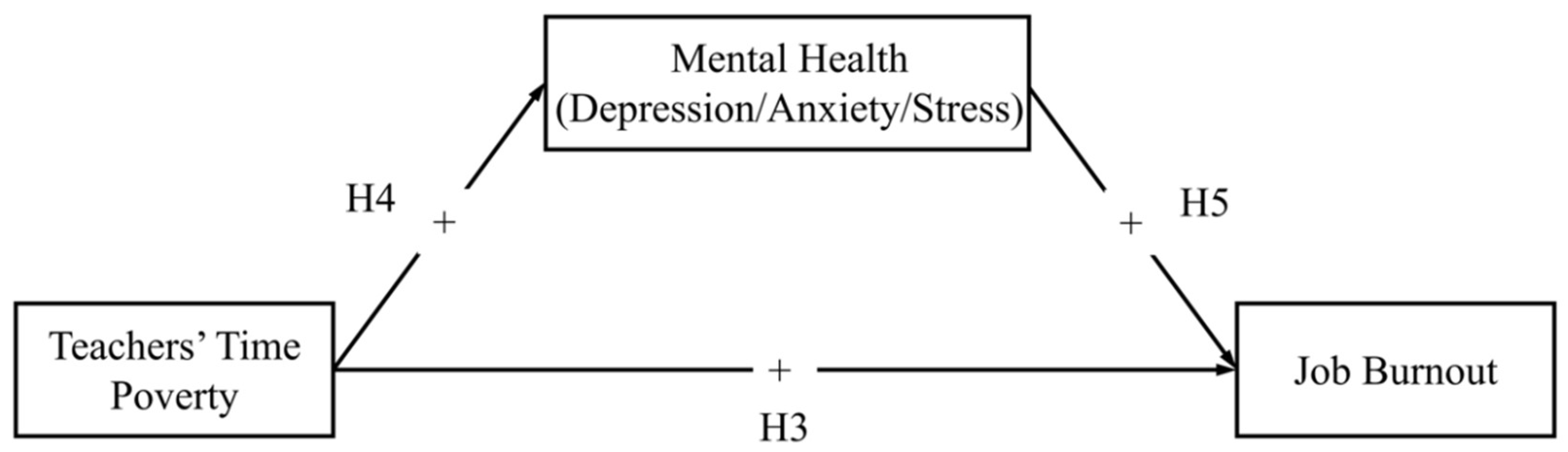
Figure 2.
Mediation model of teachers’ mental health between time poverty and job burnout. Note:***p < 0.001
Figure 2.
Mediation model of teachers’ mental health between time poverty and job burnout. Note:***p < 0.001
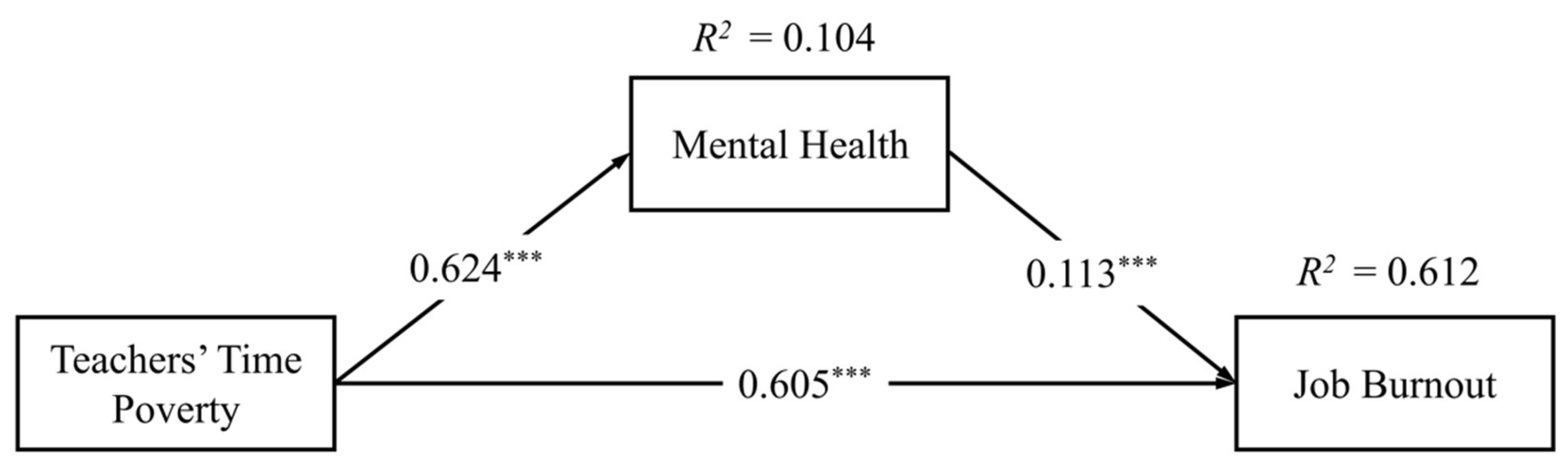
Figure 3.
Mediation model of teachers’ depression between time poverty and job burnout.
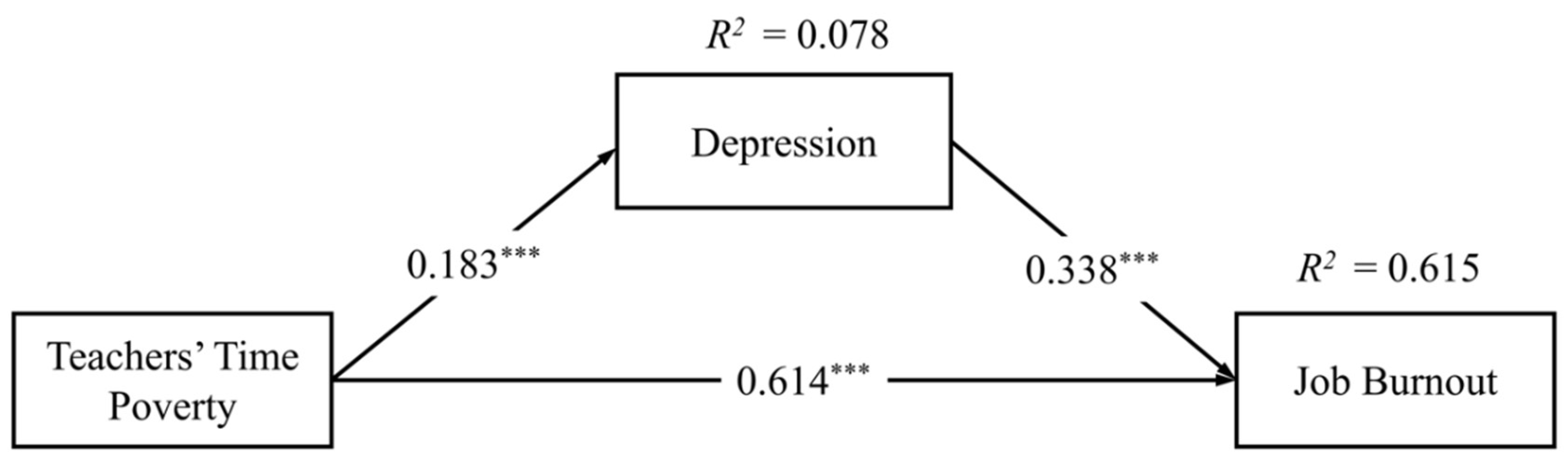
Figure 4.
Mediation model of teachers’ anxiety between time poverty and job burnout.
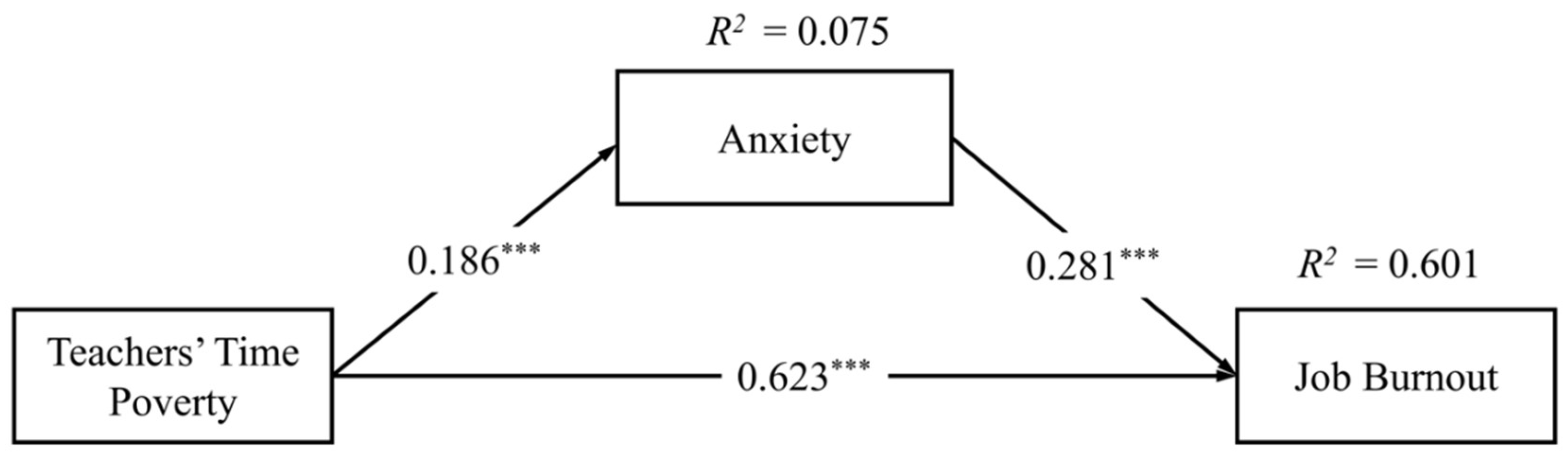
Figure 5.
Mediation model of teachers’ stress between time poverty and job burnout.
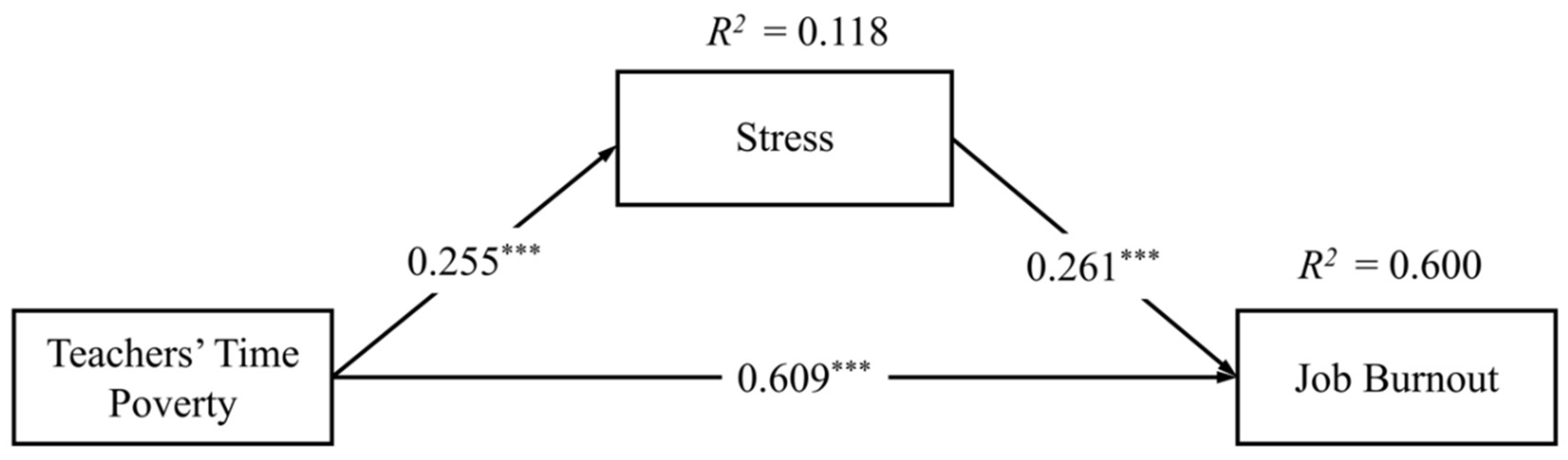

Table 1.
Demographic information of primary and secondary school teachers.
| Item | Categories | Number | Percentage (%) |
|---|---|---|---|
| Years of teaching | 0-5years old | 120 | 16.8 |
| 6-10 years old | 48 | 6.7 | |
| 11-20 years old | 99 | 13.9 | |
| 21 years above | 446 | 62.5 | |
| Sections of teaching | Primary school | 397 | 55.6 |
| Junior high school | 203 | 32.9 | |
| Senior high school | 113 | 24.2 | |
| Responsibilities of job | Teaching | 349 | 48.9 |
| Teaching and class management | 369 | 31.0 | |
| Teaching, class management and school affairs | 143 | 20.0 |
Table 2.
Descriptive statistics of time poverty among primary and secondary school teachers.
| Variable | M | SD |
|---|---|---|
| Teachers’ Time Poverty | 3.45 | 0.85 |
| 1.I feel that my time is very fragmented. | 3.50 | 1.09 |
| 2. There is no autonomy in the allocation of my time. | 3.09 | 1.05 |
| 3. I often feel that I do not have enough time at work. | 3.50 | 1.01 |
| 4. I feel that I do not have enough time to improve my skills. | 3.37 | 1.06 |
| 5. I feel that teaching hours are often taken up by transactional work. | 3.65 | 1.10 |
| 6. I feel that I do not have enough time to share family responsibilities. | 3.52 | 1.03 |
| 7. I feel that I do not have enough time with my friends. | 3.49 | 0.98 |
Table 3.
Comparison of time poverty among different types of primary and secondary school teachers.
| Variable | Time poverty | Time fragmentation | Time autonomy | Working time | Skill improvement time | Transactional work time | Family time | Friend time | ||||||||
|---|---|---|---|---|---|---|---|---|---|---|---|---|---|---|---|---|
| F | Sig. | F | Sig. | F | Sig. | F | Sig. | F | Sig. | F | Sig. | F | Sig. | F | Sig. | |
| Gender | 0.77 | 0.38 | 2.12 | 0.14 | 0.03 | 0.85 | 2.22 | 0.13 | 0.75 | 0.38 | 1.01 | 0.31 | 0.25 | 0.61 | 0.10 | 0.75 |
| Teaching age | 0.23 | 0.95 | 1.08 | 0.37 | 0.70 | 0.61 | 0.16 | 0.98 | 0.44 | 0.81 | 0.87 | 0.49 | 0.29 | 0.91 | 0.35 | 0.88 |
| Teaching section | 0.23 | 0.79 | 0.19 | 0.82 | 0.27 | 0.76 | 0.97 | 0.37 | 0.65 | 0.51 | 0.02 | 0.97 | 1.65 | 0.19 | 2.31 | 0.10 |
| Job responsibilities | 6.94 | 0.00 | 1.80 | 0.02 | 2.84 | 0.03 | 4.40 | 0.00 | 2.70 | 0.00 | 14.66 | 0.00 | 8.27 | 0.00 | 4.30 | 0.00 |
Note: * indicates a mean significance level of 0.05.
Table 4.
Means, standard deviations, and correlations statistics (n=549).
| Variables | M | SD | 1 | 2 | 3 | 4 | 5 | 6 |
|---|---|---|---|---|---|---|---|---|
| 1.Time poverty | 22.92 | 5.920 | ||||||
| 2.Job burnout | 25.97 | 6.873 | 0.748** | |||||
| 3.Mental | 29.10 | 11.480 | 0.322** | 0.458** | ||||
| 4.Depression | 9.402 | 3.867 | 0.280** | 0.435** | 0.909** | |||
| 5.Anxiety | 9.371 | 4.018 | 0.274** | 0.401** | 0.954** | 0.810** | ||
| 6.Stress | 10.327 | 4.404 | 0.343** | 0.447** | 0.939** | 0.753** | 0.864** |
Note. **p < 0.01 (2-tailed).
Table 5.
Mediation model of teachers’ mental health between time poverty and job burnout.
| Predictors | Mental health | Job burnout | ||||
|---|---|---|---|---|---|---|
| β | SE | 95% CI | β | SE | 95% CI | |
| Time poverty | 0.624*** | 0.079 | [0.470, 0.779] | 0.605*** | 0.025 | [0.555, 0.655] |
| Mental health | 0.113*** | 0.013 | [0.087, 0.139] | |||
| R2 | 0.104 | 0.612 | ||||
| F | 63.161 | 430.871 | ||||
Note. Bootstrap sample size =5000; ***p < 0.001.
Table 6.
Mediation model of teachers’ depression between time poverty and job burnout.
| Predictors | Depression | Job burnout | ||||
|---|---|---|---|---|---|---|
| β | SE | 95% CI | β | SE | 95% CI | |
| Time poverty | 0.183*** | 0.027 | [0.130, 0.235] | 0.614*** | 0.025 | [0.565, 0.663] |
| Depression | 0.338*** | 0.038 | [0.263, 0.413] | |||
| R2 | 0.078 | 0.615 | ||||
| F | 46.387 | 435.514 | ||||
Note. Bootstrap sample size =5000; ***p < 0.001.
Table 7.
Mediation model of teachers’ anxiety between time poverty and job burnout.
| Predictors | Anxiety | Job burnout | ||||
|---|---|---|---|---|---|---|
| β | SE | 95% CI | β | SE | 95% CI | |
| Time poverty | 0.186*** | 0.028 | [0.131, 0.241] | 0.623*** | 0.025 | [0.573, 0.673] |
| Anxiety | 0.281*** | 0.037 | [0.208, 0.355] | |||
| R2 | 0.075 | 0.601 | ||||
| F | 44.500 | 411.190 | ||||
Note. Bootstrap sample size =5000; ***p < 0.001.
Table 8.
Mediation model of teachers’ stress between time poverty and job burnout.
| Predictors | Stress | Job burnout | ||||
|---|---|---|---|---|---|---|
| β | SE | 95% CI | β | SE | 95% CI | |
| Time poverty | 0.255*** | 0.030 | [0.197, 0.314] | 0.609*** | 0.026 | [0.558, 0.660] |
| Stress | 0.261*** | 0.035 | [0.192, 0.330] | |||
| R2 | 0.118 | 0.600 | ||||
| F | 73.085 | 410.098 | ||||
Note. Bootstrap sample size =5000; ***p < 0.001.
Disclaimer/Publisher’s Note: The statements, opinions and data contained in all publications are solely those of the individual author(s) and contributor(s) and not of MDPI and/or the editor(s). MDPI and/or the editor(s) disclaim responsibility for any injury to people or property resulting from any ideas, methods, instructions or products referred to in the content. |
© 2024 by the authors. Licensee MDPI, Basel, Switzerland. This article is an open access article distributed under the terms and conditions of the Creative Commons Attribution (CC BY) license (http://creativecommons.org/licenses/by/4.0/).
Copyright: This open access article is published under a Creative Commons CC BY 4.0 license, which permit the free download, distribution, and reuse, provided that the author and preprint are cited in any reuse.


