

Submitted:
31 May 2024
Posted:
03 June 2024
You are already at the latest version
Abstract
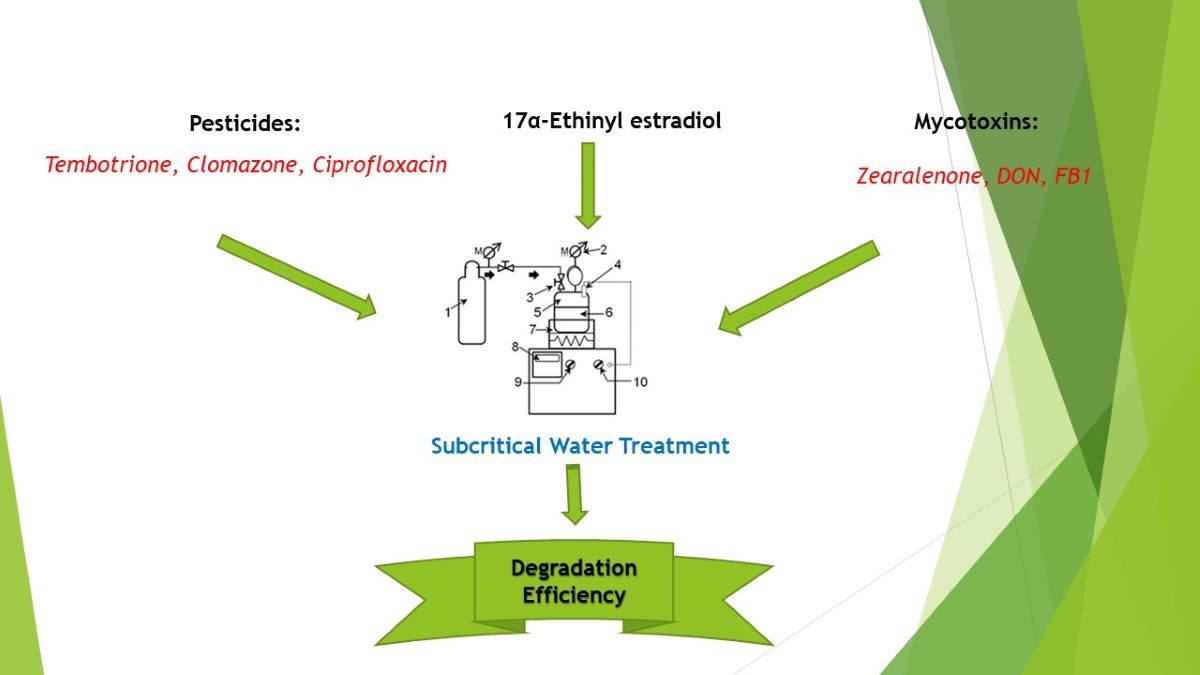
In this research the efficiency of degradation of different organic contaminant classes, including pesticides (tembotrione, clomazone), pharmaceuticals (ciprofloxacin, 17α-ethinyl estradiol) and mycotoxins (zearalenone, deoxynivalenol, fumonisin B1), by subcritical water treatment, was studied in model systems. All experiments were conducted in a house-made batch type pilot reactor. The research was focused on the optimization of the treatment parameters by using moderate treatment conditions. Optimization of the remediation processes of water contaminated with 17α-ethinyl estradiol, tembotrione, clomazone, ciprofloxacin, was conducted by testing different homogeneous and heterogeneous catalysts, as well as different gas atmospheres (nitrogen and carbon-dioxide) for pressurization of the process system. Mycotoxins in water were degraded without catalysts and all experiments were conducted in nitrogen atmosphere. Optimization was conducted by defining the optimal combination of the treatment temperature and time, oriented towards energy saving and minimization of the technical requirements. The degradation efficiency in all tested samples was determined by HPLC analysis.
Keywords:
water pollutants
; remediation
; subcritical water decomposition
; pesticides
; pharmaceuticals
; mycotoxins
1. Introduction
Incorporation of green and sustainable technologies for remediation of contaminated sites has become an imperative in environmental practice and global policy trends. Green remediation of contaminated air, water, soil or sediments, imply more environmentally-friendly and sustainable approaches, to reduce overall environmental impact, by using clean technologies, renewable energy sources, or living organisms, either microorganisms, which are often genetically modified to enable specific biotransformation (bioremediation), or absorbing or metabolizing plants (phytoremediation). There are numerous available remediation techniques, which depend mostly on the type of contamination to be treated (pesticides, heavy metals, POPs – persistent organic pollutants, petroleum etc.), the extent of contamination, and environmental compartment to be treated. Some of the available techniques can be applied in-situ, whereas others require ex-situ approach.
Popular remediation techniques encompass in-situ chemical oxidation or reduction of organic contaminants, electrokinetically-enhanced remediation, the use of activated carbon, bioreactors with microbial biotransformation, etc. Volatile and semi-volatile soil contaminants can be removed by inducing controlled airflow under a vacuum, whereas other contaminants can be extracted by organic solvents or chelating agents, in case of heavy metals contamination [1, 2]. These agents, however, require further management and disposal of used chemicals and obtained fractions. In this respect superheated water demonstrates incomparable advantages, considering it`s green character, safety and low price. Pressurized hot water shows remarkable chemical reactivity, potentiating decomposition reactions of the contaminants [3]. Not only hot compressed water can be used as a reactive medium, but heated to adequate temperature and keeping it in a liquid state by pressurisation, water can be used as a green solvent in the extraction processes, replacing toxic organic solvents. This is owing to the fact that polarity of water decreses with heating, mimicing unpolar organic solvents. Near critical point (374°C, 218 bars), and especially above critical point, water behavior, physico-chemical and solvating porperties, as well as reactivity, change dramatically, producing a fluid with unique properties [4]. With heating, both viscosity and dielectric constant of water decrease, whereas auto-dissociation increases substantially, catalyzing numerous reactions due to rise in concentration of OH- and H+ ions.
In remediation processes superheated water was mostly used as a green extraction solvent, rather than a reactive medium. Nazrul Islam et al. [5] investigated the influence of a temperature of subcritical water in continuous system for the removal of different polycyclic aromatic hydrocarbons (PAHs). The efficiency of the removal depended on a temperature, with naphthalene being fully removed already at 150°C, whereas phenanthrene, fluoranthene, and pyrene required higher extraction temperatures (250-300°C) for 95% removal efficiency. The authors applied quite high pressure of 100 bars at a flow rate of 0.5-2 ml/min. Similar conditions were applied for the removal of phthalate esters from contaminated soil [6], reaching the efficiency of 80-90% in spiked soil samples at 250°C and 100 bars. Pesticides, namely diazinon, parathion, phenthoate, and O-ethyl O-p-nitrophenyl phenylphosphonothionate (EPN), were best extracted from contaminated soil by passing a water heated to 150°C at 20 bars for 20 min, at a flow rate of 0.5 ml/min, achieving extraction efficiency of 99.9 % [7]. Even dioxins were quite efficiently removed from contaminated soil at relatively modest temperatures. The extraction temperature could have been reduced on account of the extraction time, thus balancing operational parameters to achieve feasibility. Four hours of extraction at 350, 300 and 150°C yielded in 99.4%, 94.5% and 60% of PCDDs (polychlorinated dibenzodioxins) extraction efficiency, respectively [8]. The authors confirmed previously established fact that the pressure didn`t affect significantly the efficiency of the process. Groundwaters contaminated with polyfluoroalkyl compounds (PFAS) were treated at high temperatures (≥600 °C) by supercritical water oxidation (SCWO), achieving complete combustion and producing carbon dioxide, water, and corresponding anion acids, which can be considered safe after neutralization [9]. In steady conditions, after 3h of treatment, the concentration of PFAS dropped from ~50 ppm level to almost undetectable level (70 ppt).
Tavlarides et al. [10] proposed a two-stage model for the destruction of polychlorinated biphenyls (PCBs) and polycyclic aromatic hydrocarbons (PAHs) in contaminated sediments by applying high pressure green technologies. The authors proposed the extraction of these unpolar persistent organic pollutants by supercritical carbon-dioxide, modified with 5% methanol, and subsequent treatment by SCWO at 550°C. In SCWO process the excess of oxygen to organic compounds was kept at 20%, producing safe products such as H2O, CO2, inorganic ions, and chlorides, and achieving 99.95% conversion rate in less than a minute. Albahnasawi [11] applied SCWO for the destruction of 2,4,6-trinitrotoluene in waters. At temperature of 500°C, reaction time of 120 seconds, and an oxidant excess of 150%, the removal efficiency was 99.9%. The temperatures above 500°C are recommended since they assure further destruction of formed toxic intermediates, such as toluene, nitrobenzene, naphthalene, and simple alkanes.
In this research the efficiency of degradation of different contaminant classes, including pesticides (tembotrione, clomazone), pharmaceuticals (ciprofloxacin, 17α-ethinyl estradiol) and different mycotoxins (zearalenone, deoxynivalenol (DON), fumonisin B1 (FB1)), by subcritical water under moderate conditions was studied. The focus of the research was to achieve satisfying degradation efficiency under mild conditions, accentuating energy saving and acceptable technical requirements of the process and equipment. Different operational parameters including temperature and time, as well as different gas atmospheres, homogeneous and heterogeneous catalysts, were tested. According to literature search, under investigated temperatures, subcritical water has not yet been used as a remediation tool for the tested contaminants, thus this research provides valuable results leading to greener and economical remediation approaches. Literature search also revealed the lack of data concerning green degradation of specific organic compounds encompassed by this investigation.
2. Materials and Methods
2.1. Chemicals and Reagents
Model systems of the investigated pesticides (tembotrione, clomazone) and pharmaceuticals (ciprofloxacin, 17α-ethinylestradiol), with concentration of 0.05 mmol/l, were prepared by dissolving the appropriate amount of standards in ultrapure water, and then adding, where appropriate, the catalyst until tested concentration. Two studied herbicides, tembotrione (TEMB, C17H16ClF3O6S; Mr = 440.80; CAS No. 335104-84-2; ≥ 98% purity) and clomazone (CLO, C12H14ClNO2; Mr = 239.70; CAS No. 81777-89-1, 98.8% purity), as well as two studied pharmaceuticals, ciprofloxacin (CIP, C17H18FN3O3; Mr = 331.34; CAS No. 85721-33-1; ≥ 98% purity) and 17α-ethinylestradiol (EE2, C20H24O2; Mr = 296.40; CAS No. 57-63-6; ≥ 98% purity), were purchased from Sigma−Aldrich, USA.
The mycotoxin solutions used for the degradation experiment were prepared by evaporating a certain amount of the stock solutions reconstituting them in deionized water, so that the final concentrations of fumonisin B1 (FB1) was 1390 mmol/l, zearalenone 1570 mmol/l, and the concentration of deoxynivalenol (DON) was 1687 mmol/l. FB1, DON and zearalenone analytical standards were purchased from BiopureTM, Romer Labs® Holding GmbH (Solid Standards Art. No. 10000306, 10000301 and 10000308, respectively), Tulin, Austria. These stock solutions were stored at -18°C.
Sodium hydroxide (NaOH) was acquired from Centrohem (Stara Pazova, Serbia), whereas hydrochloric acid (HCl) was obtained from Zorka (Šabac, Serbia). Used Zeolite (particle size 60 μm) was provided by Zeoworld doo, Serbia. K2Cr2O7, KMnO4, and H2O2 were p.a. grade and were obtained from Centrohem (Stara Pazova, Serbia).
Sigma−Aldrich products, acetonitrile (ACN, C2H3N; Mr = 41.05; CAS No. 75-05-8; 99.9%) and orthophosphoric acid (H3PO4; Mr = 97.99; CAS No. 7664-38-2; 85%, p. a.) were used as the components of the binary mobile phase during high-performance liquid chromatographic (HPLC) analysis of TEMB, CLO, CIP, and EE2. For the analysis of DON and zearalenone, HPLC gradient grade methanol and acetonitrile were used (Merck, Darmstadt, Germany). Ethyl acetate was G.R. grade (Lach-Ner, s.r.o., Czech Republic). O-phthalaldehyde reagent (OPA) for FB1 derivatization, was prepared by dissolving 40 mg of OPA (Sigma, St. Louis, P 0657, ≥ 99 %) in 1 ml of methanol, diluting it with 5 ml of 0.1 mol/l Na2B4O7 (Zorka, Šabac, Serbia), and adding 50 μl of 2-mercaptoethanol (Serva, Heidelberg, Germany).
2.2. Subcritical water treatment
The treatment of model systems of different water contaminants was carried out in a house-made subcritical water reactor (Figure 1.) Pressurization gases, nitrogen (99.999%) and carbon-dioxide (99.995%), were provided by Messer, Germany. Reaction vessel, with a total capacity of 1.7l, was heated with a heating rate of approximately 10°C/min. Agitation during the process was achieved by the movements of vibrational platform with variable vibrating frequencies between 1 Hz and 5 Hz. In all experiments the agitation was performed at the 3 Hz.
The samples were placed in the reaction vessel. Homogeneous catalysts were dissolved previously in samples to concentration of 0.001 mol/l, while zeolite was pre-mixed (1 mg/ml) before filling the reaction vessel. The pressurization to 10 bars with, either nitrogen or carbon-dioxide, was carried out though gas inlet built in the reaction vessel lid. Pressure was controlled by built-in manometer. The reaction vessel was then placed on a heating/vibrating platform and after the operational temperature was reached, time was measured. Operating temperature was maintained by a digital temperature controller. After the treatment, the process vessel was immediately cooled in a flow-through water-bath at 20±2°C. Depressurization was done by valve opening and purging gases through a valve. Obtained aqueous fractions were separated by filtration through a Whatman filter paper, grade 1, and stored in a refrigerator at 4°C for HPLC analysis.
2.3. HPLC Analysis
Ultrafast liquid chromatograph with diode array and fluorescence detectors (UFLC-DAD/RF, Shimadzu Nexera, Japan), equipped with an Eclipse XDB-C18 nonpolar column (150 mm × 4.6 mm i.d., particle size 5 μm), was used to follow the efficiency of the subcritical water degradation of selected herbicides and pharmaceuticals. The mixture of ACN and water acidified with H3PO4 0.1%. was used a as mobile phase. The following conditions were applied for the HPLC analysis of investigated compounds in isocratic mode: (a) TEMB, 60 : 40 (ACN : H2O, v/v), flow rate 1.0 ml/min, injection volume 20 µl, column temperature 25°C, absorption maximum with DAD detector at 284 nm; (b) CLO, 60 : 40 (ACN : H2O, v/v), flow rate 1.0 ml/min, injection volume 20 µl, column temperature 25°C, absorption maximum with DAD detector at 210 nm; (c) CIP, 20 : 80 (ACN : H2O, v/v), flow rate 0.8 ml/min, injection volume 10 µl, column temperature 25 °C, absorption maximum with DAD detector at 289 nm; and (d) EE2, 80 : 20 (ACN : H2O, v/v), flow rate 0.7 ml/min, injection volume 10 µl, column temperature 40 °C, excitation and emission wavelengths of EE2 for RF detector were 220 nm and 310 nm. The Adrona water purification system was used to obtain ultrapure water.
For mycotoxin determination HPLC Dionex UltiMate 3000 Series system with a DAD and FLD 3100 (Thermo Scientific, Germany) detectors was used. Analytical system consisted of the autosampler WPS-3000, degasser, quaternary pump, and Hypersil Aqua GOLD column (150×3 mm, particle size 3 μm, Thermo Scientific, Germany). Separation was done at the temperature of 30°C. The system was controlled by Chromeleon®7 software (Thermo Scientific). For FB1 determination, samples were derivatized with OPA at a ratio of 1:1 (v/v), and 10 μl were injected into the HPLC system after 1 min. The mobile phase for FB1 determination by FLD, at λex 335 nm and λem 445 nm, was the mixture of MeOH and 0.1 mol/l NaH2PO4 (extra pure, Merck, Darmstadt, Germany) (77:23, v/v), adjusted to pH 3.35 with H3PO4 (p.a. Centrohem, Stara Pazova, Serbia), filtered through 0.22 μm membrane filter (nylon, LLG, Meckenheim, France), at a flow rate of 0.8 ml/min. Detection of zearalenone was done by FLD at λex 275 nm and λem 455 nm, after chromatographic separation with 50% acetonitrile at a flow rate of 1 ml/ml. For DON determination by HPLC the mobile phase consisted of 5% acetonitrile at a flow rate of 1 ml/min. The detection of DON was performed by DAD at 220 nm.
3. Results and Discussion
3.1. Decomposition of Herbicides and Pharmaceuticals in Subcritical Water
TEMB is a selective herbicide used for the control of a broad spectrum of broadleaf and grassy weeds in corn and other crops. Despite having relatively short half-life (from 4 to 56 days) [12] the compound represents a risk to environment since it is retained by soil and leached to ground waters, and also due to confirmed eco-toxicity of its metabolites [13]. The removal of pesticide residues in the environment is mostly carried out by different chemical, biochemical, sometimes physico-chemical (adsorption or extraction) methods, or by photocatalysis. Photocatalysis using different newly-synthesized catalysts and irradiation sources often offer a satisfactory remediation efficiency. For TEMB Wang et al. [14] synthesized bismuth oxychloride nanosheets and used them in combination with high-pressure mercury lamp (2500 W, λ = 250–400 nm, light intensity 85500–99500 lx), UV lamp (20 W, λ = 10–400 nm, light intensity 115–120 lx), and xenon lamp (20 W, λ = 365–800 nm, light intensity 3600–3700 lx). Used catalyst increased the photolytic degradation efficiency 12.3–36.9 times in distilled water under different light irradiations, due to formation of highly reactive species by the catalyst. No reports were found for the remediation of waters contaminated with TEMB by subcritical water.
CLO is another herbicide, also used for broad leaf weeds in crops like potatoes, beans, peas, carrots, and also in cotton, rice, corn and soybeans. This herbicide is poorly retained by soil, leaching and contaminating groundwaters. Considering it`s stability in wide pH range, poor hydrolysis and photodegradation, it is understandable why it`s residues represent a threat to environment [15]. Most of the CLO degradation in waters occurs microbiologically. Aerobically, CLO is degraded more slowly (half-life 47.3 days) in comparison to anaerobic conditions, in which a half-life of 7.9 days has been reported [16]. CLO degradation in waters has been tested by applying UV irradiation in combination with TiO2 catalyst at pH 10.3. HPLC analysis revealed the formation of numerous organic intermediates and ionic products [17]. Even though some organochlorine pesticide, such as dieldrin, mirex, and p,p′-DDD were successfully degraded in subcritical water with the addition of hydroxy-peroxide [18], no reports were found for CLO
CIP is a broad-spectrum fluoroquinolone antibiotic, used to treat different types of bacterial infections, such as eye and ear infections, urinary tract infections, pneumonia, sexually transmitted infections, skin and bone infections and others, in cases when other antibiotics are not efficient. Complete degradation of CIP was achieved by micro-/nanostructured manganese-oxide composites prepared with Pseudomonas bacteria. Full degradation, without formation of toxic intermediates, was achieved in broad pH (4-6) and temperature (15–45°C) range [19]. This antibiotic was also efficiently removed from water by UV/H2O2 photocatalytic degradation [20]. The samples were irradiated at 254 nm with light intensity of 0.3 W/m2. Ciprofloxacin was best removed at pH 3.2 with the addition of 200 mg/l of H2O2. Formed intermediary products were analyzed by gas chromatography, revealing the presence of phenolic antioxidants and phthalates.
Stavbar et al. [21] investigated degradation of amoxicillin and ciprofloxacin in sub- and supercritical water in synthetic hospital water. The authors used a flow-through reactor with heaters and a HPLC pump which provided sufficient pressure (200-300 bars) to maintain water in a liquid state. Water treated at different oxidation temperatures (200-500°C) during 20 min was tested for total organic carbon (TOC) and chemical oxygen demand (COD), and degradation products were analyzed by LC–MS/MS. Both antibiotics were efficiently removed at high temperatures, producing mostly CO2 and H2O. At the highest tested temperature (500°C) COD was reduced for 76%, whereas at the same temperature TOC reduced for 63%.
EE2 is a synthetic pharmaceutical analog of natural estrogen 17β-estradiol found in common contraceptives. This pharmaceutical is also used in the treatment of other conditions such as acne vulgaris, breast cancer, gynecological disorders, and to alleviate menopausal symptoms [22]. Recently, increased levels of EE2 have been detected in sewage effluents and, considering that this hormone agonist has about 100-fold higher affinity to estrogen receptors, being a cause of myriad of adverse health effects, such as headache, nausea, gynecomastia, sexual disfunction, it`s monitoring in sewage waters has high relevance.
A group of authors studied simple photodegradation of EE2 by sun-like spectrum in natural river matrix during 72h [23]. The degradation followed first order kinetics with degradation halftime of 22.8 h. The addition of sea salt, oxidizing agent (ozone) and temperature increase, significantly accelerated degradation, reducing the half-life to 1.1h. Degradation products were detected by HPLC analysis revealing mostly hydrogenated derivatives with retained steroidal structure. Reis et al. [24] studied electrochemical degradation of 5 ppm aqueous model system of 17α-ethinyl estradiol by using boron/carbon anode and stainless-steel cathode, with the addition of salts, like Na2SO4 and NaCl. The authors carried out extensive studies identifying not only degradation products by ultra-high performance liquid chromatography-quadrupole time-of-flight mass spectrometry (UHPLC-QToF-MS), but also conducting in vivo experiments for the remaining estrogenic activity. The authors concluded that, despite non-detected parent compound, there was still remaining estrogenic activity [24]. Other authors used oxidant activators (peroxidase enzyme replicas – TAML) in combination with H2O2 to degrade 17α-ethinyl estradiol reducing its estrogenicity in vitro and fish feminization in vivo [25, 26]. Robinson et al. [27] studied biochemical degradation of 17α-estradiol in aqueous systems, comparing aerobic and anaerobic conditions. The authors concluded that the contaminant was more persistent under anaerobic conditions than under aerobic conditions. Reports about utilization of superheated water for addressing water contamination by this endocrine disruptor, have not been found.
Since there is an obvious lack of available research reports on the use of subcritical water for the removal of organic pollutants, degradation of selected organic contaminants in subcritical water under relatively moderate conditions was compared in inert (N2) and reactive (CO2) atmospheres, and water boosted with different homogenous and heterogenous catalysts (Table 1, Figure 2). The treatment was carried out at 200°C for 60 minutes. The efficiency of certain decomposition reactions in subcritical water increased in the presence of CO2 via formation of carbonic acid that dissociated, liberating H+, and acting, in fact, as an acid catalyst. Another acidic catalyst that was tested was HCl. Homogenous catalysts that acted by potentiating oxidation included K2Cr2O7, KMnO4 and H2O2, whereas zeolite acted by strong adsorptive potential, accumulating reactants in energy defective centers.
TEMB was almost completely degraded under all applied conditions, not requiring the use of catalyst. Pressurisation with CO2 (equivalent to acidic conditions) resulted in total removal, as well as alkaline conditions of NaOH. Increase of oxidation potential by tested oxidative catalysts (K2Cr2O7, KMnO4 and H2O2) had practically the same effect, indicating that TEMB can be degraded in subcritical water by different pathways, both hydrolysis and oxidation, as well as, presumably, by other reaction types, which can be confirmed only after selective HPLC analysis. It can be speculated that hydrolysis had slightly lower degradation potential, since in pure N2 atmosphere, where predominantly hydrolysis is taking place, as well as with zeolite as a catalyst in N2 atmosphere, few precents lower degradation efficiency was noticed.
Both the type of the catalyst, as well as the gas atmosphere, seemed to have expressed influence on CLO degradation in subcritical water, since the efficiency varied from 19.6% (K2Cr2O7) to 89.5% (H2O2), which was unexpected since both inorganic compounds are strong oxidizing agents. Apparently, some other chemical reactions are involved in CLO degradation in subcritical water, requiring more rigorous conditions. Analysis of formed intermediates might give more insights into CLO degradation pathways.
Figure 2.
Chromatograms portraying the removal efficiency of (a) CIP, (b) EE2, and (c) TEMB (0.05 mmol/l) after 60 min of subcritical water treatment using different catalysts and atmospheres, compared to selected aqueous solutions (0.05 mmol/l) of pollutants standards.
Figure 2.
Chromatograms portraying the removal efficiency of (a) CIP, (b) EE2, and (c) TEMB (0.05 mmol/l) after 60 min of subcritical water treatment using different catalysts and atmospheres, compared to selected aqueous solutions (0.05 mmol/l) of pollutants standards.
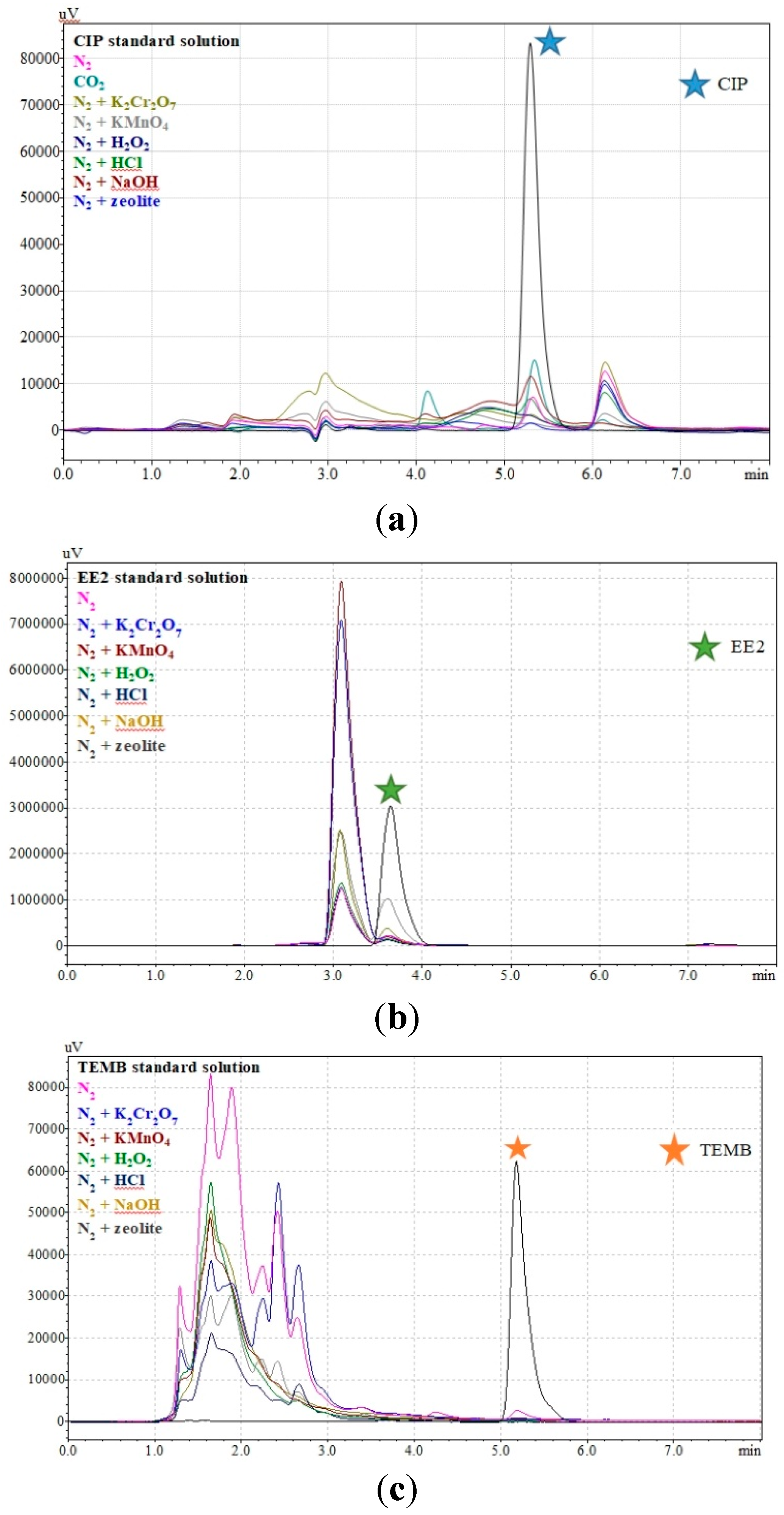
Predominant degradation pathway of CIP in subcritical water was presumably an oxidative decay since even slight addition of oxidants resulted in 100% degradation. CO2 atmosphere, obviously, did not favor CIP degradation, since the efficiency was about 11% lower in comparison to inert nitrogen atmosphere. Carbonic acid that is formed by pressurisation with carbon-dioxide seems to interfere with breakage of some chemical bonds.
Degradation efficiency of EE2 varied from ~63% (with zeolite) to satisfying ~98.7% (K2MnO4). Other tested oxidants, as well as HCl, yielded in decomposition efficiency close to that of K2MnO4. Zeolite exhibited the lowest impact on degradation of 17α-ethinyl estradiol, suggesting that degradation of this organic compound occurs better in homogeneous systems, and suggesting that adsorption is not effective. Surprisingly, the efficiency of degradation in CO2 atmosphere, and with HCl, varied for about 24%, considering that the major influence of CO2 is the formation of more acidic environment.
3.2. Decomposition of Selected Mycotoxins in Subcritical Water
Decomposition of three most common Fusarium mycotoxins found in feed, grains and food, namely zearalenone, DON and FB1, in subcritical water, was studied. These mycotoxins are quite omnipresent, compromising health status of humans and animals. Thus, finding a green, safe and economical solutions for their degradation can be of high importance.
Zearalenone is mostly produced by Fusarium fungi, contaminating crops like maize, wheat, oats, rice and barley. Health risks associated with the exposure to zearalenone are mostly due to its estrogenic and anabolic activities, interfering normal reproduction of farm animals [28]. DON, also known as vomitoxin, is also produced by Fusarium species, mostly F. graminearum and F. culmorum, contaminating grains like oats, corn, rye, barley, wheat and rice. Contamination of feed with mycotoxins can cause significant economic losses in husbandry linked to negative effects on bone marrow production of blood elements, necrosis of the digestive tract, gastroenteritis, feed refusal etc. [29]. In contrast to zearalenone, deoxynivalenol is thermo-unstable, exhibiting highest degradation rates with heating. Nevertheless, other methods for its reduction in contaminated feed are often used in practice, mostly chemical and biochemical methods with different strains of bacteria [30]. Borràs-Vallverdú et al. [31] managed to reduce the concentration of DON in wheat for 75%, exposing it to ammonia vapors at 90°C, whereas other authors tested the use of saturated ozone solution [32, 33]. As in the case of zearalenone, there were no reports in scientific literature describing the use of subcritical water for decontamination of infested cereals, or for the decomposition of these dangerous fugal metabolites whatsoever. For the time being the degradation methods of zearalenone mostly include chemical, physical or biological methods (by microorganisms and enzymes), that can compromise the nutritional value and sensory properties.
Taking into consideration that zearalenone is relatively heat stable up to 160°C, a novel non-thermal degradation approach has been proposed by using cold plasma [34]. This technique utilizes plasma state of a gas, a mixture of charged particles, free radicals, gas molecules and electrons, that has been shown to be effective also in decomposition of other organic contaminants, such as pesticides. By using the air as a plasma gas, the authors deduced that zearalenone degradation efficiency increased with voltage and time, reaching 98.3% at 50 KV during 120 s treatment. Even though subcritical water has been used for the extraction of some mycotoxins, namely aflatoxin [35], to best of our knowledge the degradation of mycotoxins by the same technique has not been reported in the literature.
Fumonisins are class of mycotoxins, produced by the fungus F. verticillioides, F. proliferatum, and F. fujikuroi. Structurally, they are similar to sphingosine, the major precursors of sphingolipids, disrupting their metabolism by competitive inhibition of sphinganine and sphingosine N-acyltransferase [36]. Fumonisins cause neurological diseases (leucoencephalomalacia) in horses and pulmonary edema in swine, and have been associated with increased esophageal cancer in humans [37]. The most widespread and most closely associated with toxic and carcinogenic action is fumonisin belonging to B series of these compounds, FB1. As in the case of previously addressed mycotoxins, in practice, funomisines too, are mostly degraded in contaminated feed by bacterial consortiums or enzymes, thus relying mostly on biochemical methods [38]. Xing et al. [39] tested the effectiveness of cinnamon oil in fumonisine model systems, and calculated 94% degradation efficiency for FB1 after exposure to 280 μg/ml of cinnamon oil, at 30°C during 120h [39]. Alternatively, UV-induced photolysis or photocatalytic degradation, has been reported [40], but there were no reports on the use of subcritical water.
In this investigation the decomposition of three selected mycotoxins in subcritical water was tested at two different temperatures, 200°C and 230°C, to define the influence of the temperature on the degradation efficiency. In all cases the reaction vessel was pressurized with N2 to 10 bars, allowing observation of the effects of sole water temperature, rather than chemical reactivity that can be potentiated in some cases by pressurizing the system with CO2 or air/oxygen [41, 42]. Temperature is considered to be a key parameter of sub- and supercritical water reactivity, potentiating dramatically decomposition reactions at higher temperatures [4]. Higher temperatures, however, impose the concerns linked with the chemical resistance of the reaction system and pressure increase, thus requiring more challenging process control. For this reason, in this work not very high temperatures of superheated water were tested at different times. Resulting solutions were subsequently screened by HPLC analysis (Table 2) allowing calculation of the degradation efficiency.
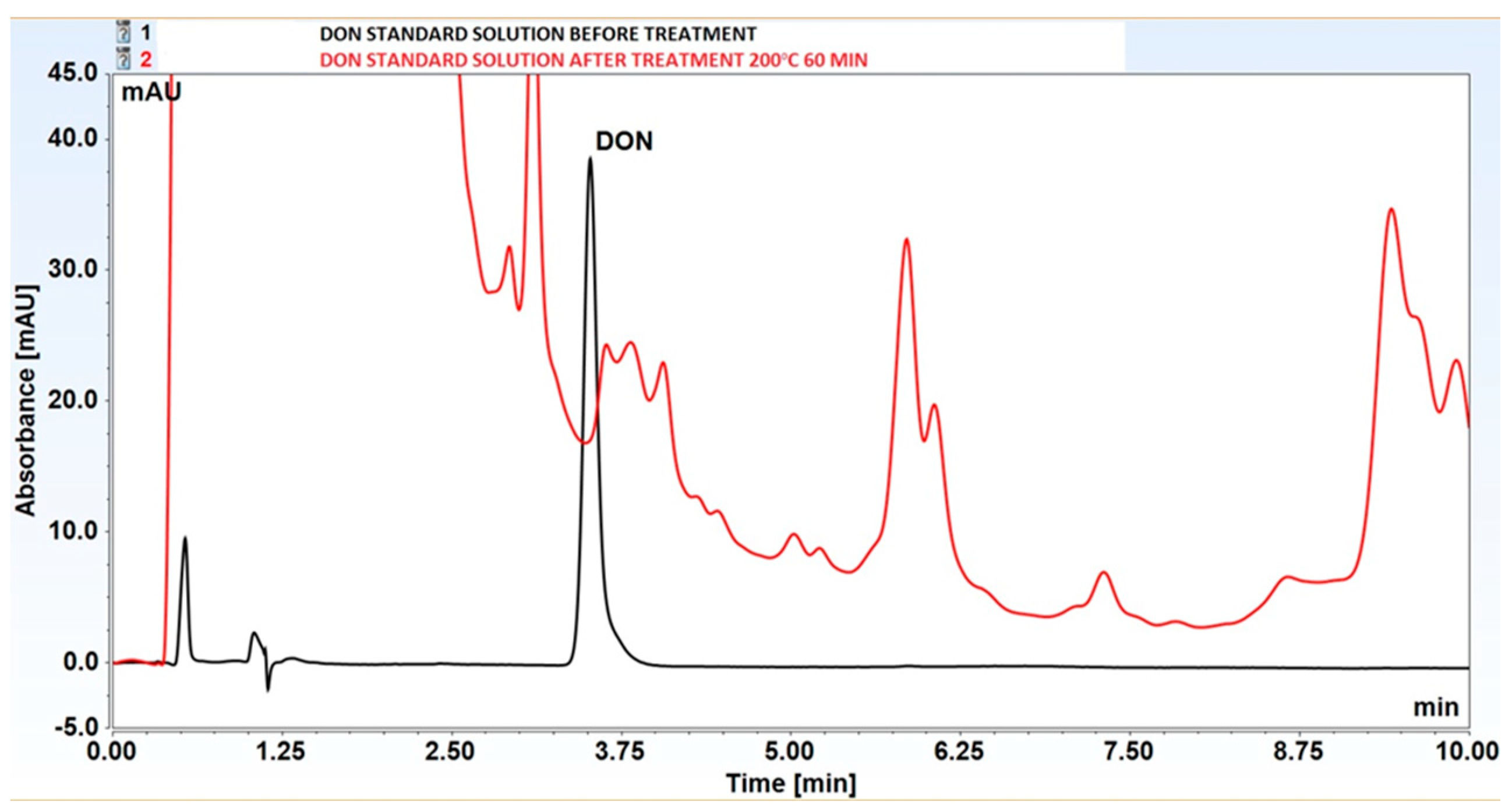
At 200°C the degradation of DON and FB1 was complete, even at shorter treatment times (60 min) (Figure 2 and Figure 3), whereas 90% of zearalenone was degraded applying the same treatment time (Figure 4). Further improvement of the efficiency of zearalenone degradation was assessed by varying two parameters, both temperature and time. Moderate prolongation of the treatment time to 100 min already yielded in full zearalenone degradation, same as did the temperature increase for 30°C, maintaining shorter treatment times of 60 min.
Figure 2.
Original chromatogram depiting full degradation of deoxynivalenol in subcritical water at 200°C, 60 min.
Figure 2.
Original chromatogram depiting full degradation of deoxynivalenol in subcritical water at 200°C, 60 min.
Giving the lack of literature data on degradation of these three common mycotoxins in superheated water, it can be assumed that satisfactory degradation efficiency could have been achieved even at lower temperatures, which would represent very favorable option in respect to equipment requirements and energy saving. This first reported investigation of this kind, thus, represents a valuable input towards further optimization of the remediation processes for mycotoxins contamination of different commodities and environmental samples. Another option that should be taken into account in further investigation is the use of even lower temperatures in combination with different catalysts, or different reactive gas atmospheres for reactivity increase. The reported preliminary screening of mycotoxins degradation in subcritical water provides a guideline for further research, especially in the development of large-scale remediation processes, taking into consideration the safety of pure water, low cost and possibility to build on-site flow-through systems.
4. Conclusions
This work for the first time reports the degradation of TEMB, CLO, CIP, EE2, zearalenone, DON, and FB1, belonging to different chemical classes, in subcritical water under moderate conditions. Almost complete degradation of tested organic pollutants, including different herbicides, pharmaceuticals, and mycotoxins, was achieved by careful optimization of the treatment temperature and time, pressurization gas, as well as catalyst selection. TEMB was fully degraded even without catalyst addition in inert N2 atmosphere applying the treatment temperature of 200°C. Under investigated conditions CLO was degraded least efficiently, reaching, nevertheless, satisfying 89.5% with H2O2 addition. Further improvement of CLO degradation in subcritical water can be achieved by temperature increase. For CIP, predominant degradation pathway in subcritical water was presumably an oxidative decay, as all tested oxidant catalysts resulted in 100% degradation. CO2 atmosphere, obviously, did not favor CIP degradation, since the efficiency was about 11% lower in comparison to inert N2 atmosphere. EE2 was degraded to the extent of ~98.7% at 200°C with addition of 0.001 mol/l of K2MnO4. Full degradation of all tested mycotoxins, namely zearalenone, DON, and FB1, was achieved at the temperatures of 200°C. Zearalenone, however, required prolongation of the process for 40 min in comparison to other two mycotoxins, or, alternatively, temperature increase by 30 °C, maintaining operational temperature of 200 °C. Taking everything into account, the proposed green and economical technology is perspective for remediation of different food and feed commodities, as well as environmental samples, considering the safety of the process, low price, and possibility of designing continuous reactors for on-site remediation. Further investigations are, however, required to define, in first place, the formed intermediates by chromatographic analyses, as well as their safety.
CRedit Authorship Contribution Statement
Jaroslava Švarc-Gajić: Conceptualization, Methodology, Writing – original draft; Tanja Brezo-Borjan: Investigation; Sandra Jakšić; Investigation, Data curation, Formal analysis; Vesna Despotović: Investigation, Data curation, Formal analysis; Nina Finčur: Data curation, Formal analysis; Szabolcs Bognár: Investigation, Data curation, Formal analysis; Dušica Jovanović: Investigation; Daniela Šojić Merkulov: Methodology, Writing - Review & Editing, Resources.
Funding
This work is funded by the Science Fund of the Republic of Serbia (In situ pollutants removal from waters by sustainable green nanotechnologies ‒ CleanNanoCatalyze, Grant No. 7747845).
Acknowledgments
This work is supported by the Ministry of Education, Science and Technological Development of the Republic of Serbia (Grants Number: 451-03-68/2020-14/200134; 451-03-66/2024-03/200125 and 451-03-65/2024-03/200125).
Declaration of competing Interest
The authors declare that they have no known competing financial interests or personal relationships that could have appeared to influence the work reposted in this work.
References
- Peters, R.W. Chelant extraction of heavy metals from contaminated soils. J. Hazard. Mater. 1999, 66(1-2), 151-210. [CrossRef]
- Soares, A. A.; Albergaria, J. T.; Fernandes Domingues, V.; da Conceição, M.; Alvim-Ferraz, M.; Delerue-Matos, C. Remediation of soils combining soil vapor extraction and bioremediation: benzene, Chemosphere, 2010, 80(8), 823-828 . [CrossRef]
- Švarc-Gajić, J. Remediation of environmental contamination by subcritical and supercritical water. In Environmental Remediation for Agri-Food Industry Using Nanotechnology and Sustainable Strategies. Putnik, P.; Šojić Merkulov D., Eds. Elsevier, 2024.ISBN: 9780443132988.
- Švarc-Gajić, J. Sampling and Sample Preparation in Analytical Chemistry. Nova Science Publishers, New York. 2011.
- Nazrul Islam, M.; Young-Tae, J.; Park, J.H. Remediation of PAHs contaminated soil by extraction using subcritical water, J. Ind. Engin. Chem. 2012, 18(5), 1689-1693 . [CrossRef]
- Chang, M. S.; J.; Shen, Y.; Yang, S. H.; Wu, G. J. Subcritical water extraction for the remediation of phthalate ester-contaminated soil, J. Hazard. Mater. 2011, 192(3), 1203-1209 . [CrossRef]
- Nazrul Islam, M.; Young-Tae, J.; Sun-Kook, J.; Park, J. H. Evaluation of subcritical water Extraction process for remediation of pesticide-contaminated soil. Water Air Soil Pollut. 2013, 224, 1652. [CrossRef]
- Hashimoto, S.; Watanabe, K.; Nose, Morita, M. Remediation of soil contaminated with dioxins by subcritical water extraction. Chemosphere 2004, 54(1), 89-96. [CrossRef]
- Scheitlin, C. G.; Dasu, K.; Rosansky, S.; Espina Dejarme, L.; Siriwardena, D.; Thorn, J.; Mullins, L.; Haggerty, I.; Shqau, K.; Stowe, J. Application of supercritical water oxidation to effectively destroy per- and polyfluoroalkyl substances in aqueous matrices. ACS EST Water 2023, 3(8), 2053–2062.
- Tavlarides, L. L.; Zhou, W.; Anitescu G. Supercritical fluid technology for remediation of pcb/pah-contaminated soils/sediments. Proceedings of the 2000 Conference on Hazardous Waste Research.
- Albahnasawi. A. Supercritical water oxidation: a breakthrough approach for remediation TNT-contaminated pink water, Energy Sources, Part A: Recovery, Utilization, and Environmental Effects, 2023, 45(3), 9283-9296. [CrossRef]
- Dong, X.; Chen, Z.; Chu, Y.; Tong, Z.; Gao, T.; Duan, T.; Wang, M. Degradation, adsorption, and bioaccumulation of novel triketone HPPD herbicide tembotrione, Environ. Sci. Pollut. Res. Int. 2023, 30(28),72389-72397. [CrossRef]
- Rani, N.; Duhan, A.; Tomar, D.; Ultimate fate of herbicide tembotrione and its metabolite TCMBA in soil, Ecotoxicol. Environ. Safety 2020, 203, . [CrossRef]
- Wang, X.; Wen, S.; Shi, T.; Li, W. X.; Pei, L.; Hua, R. Photocatalysis of the triketone herbicide tembotrione in water with bismuth oxychloride nanoplates: Reactive species, kinetics and pathways, J. Environ. Chem. Engin. 2022, 10(5), . [CrossRef]
- Van Scoy, A. R.; Tjeerdema, R. S. Environmental fate and toxicology of clomazone. Rev. Environ. Contam. Toxicol. 2014, 229, 35-49. [CrossRef]
- Tomco, P. L.; Holstege, D. M.; Zou, W.; Tjeerdema, R. S. Microbial degradation of clomazone under simulated California rice field conditions, J. Agric. Food Chem. 2010, 58(6), 3674-80. https://doi: 10.1021/jf903957j. PMID: 20178392.
- Abramović, B. F.; Despotović, V. N.; Šojić, D.V.; Orčić, D. Z.; Csanádi, J.J.; Četojević-Simin, D. D. Photocatalytic degradation of the herbicide clomazone in natural water using TiO2: kinetics, mechanism, and toxicity of degradation products, Chemosphere, 2013, 93(1), 166-171 . [CrossRef]
- Jones, A.D.; Morehead, A.T.; Yang, Y. Degradation and extraction of organochlorine pollutants from environmental solids under subcritical water conditions, Molecules 2023, 28, 5445. [CrossRef]
- Li, L.; Liu, J.; Zeng, J.; Li, J.; Liu, Y.; Sun, X.; Xu, L.; Li, L. Complete degradation and detoxification of ciprofloxacin by a micro-/nanostructured biogenic Mn oxide composite from a highly active Mn2+ oxidizing Pseudomonas strain, Nanomaterials (Basel) 2021, 11(7), . [CrossRef]
- Borba, F. H.; Schmitz, A.; Pellenz, L.; Bueno, F.; Kasper, N.; Wenzel, B. M.; Baroni, S.; Dall’Oglio, I. C.; Módenes, A. N. Genotoxicity and by-products assessment in degradation and mineralization of ciprofloxacin by UV/H2O2 process, J. Environ. Chem. Eng. 2018, 6(6), 6979-6988, . [CrossRef]
- Stavbar, S.; Knez Hrnčič, M.; Premzl, K.; Kolar, M.; Šostar Turk, S. Sub- and super-critical water oxidation of wastewater containing amoxicillin and ciprofloxacin, J. Supercrit. Fluids, 2017, 128, 73-78. [CrossRef]
- Edwards, D. R.; Heid, M.R.; Ahmed, A. 17β-Estradiol and 17α-ethinyl estradiol exhibit immunologic and epigenetic regulatory effects in NZB/WF1 female mice, Endocrinology 2019, 160(1), 101-118, htps://doi: 10.1210/en.2018-00824.
- Nejedly, T.; Klimes, J. A model of natural degradation of 17-α-ethinylestradiol in surface water and identification of degradation products by GC-MS. Environ. Sci. Pollut. Res. Int. 2017, 24(29), 23196-23206. [CrossRef]
- Reis, R.; Dhawle, R.; Du Pasquier, D.; Tindall, A. J.; Frontistis, Z.; Mantzavinos, D.; de Witte, P.; Cabooter, D. Electrochemical degradation of 17α-ethinylestradiol: Transformation products, degradation pathways and in vivo assessment of estrogenic activity, Environ. Inter. 2023, 176,. [CrossRef]
- Chen, J. L.; Ravindran, S.; Swift, S.; Wright, L. J.; Singhal N. Catalytic oxidative degradation of 17α-ethinylestradiol by FeIII-TAML/H2O2: estrogenicities of the products of partial, and extensive oxidation. Water Res. 2012, 46(19), 6309-6318. [CrossRef]
- Mills, M.; Arias-Salazar, K.; Baynes, A.; Shen, L. Q.; Churchley, J.; Beresford N.; Gayathri, C.; Gil, R. R.; Kanda, R.; Jobling, S.; Collins, T. J. Removal of ecotoxicity of 17α-ethinylestradiol using TAML/peroxide water treatment, Sci. Rep. 2015, 5, 10511 . [CrossRef]
- Robinson, J. A.; Ma, Q.; Staveley, J. P.; Smolenski, J W. J.; Ericson J. Degradation and transformation of 17α-estradiol in water-sediment systems under controlled aerobic and anaerobic conditions, Environ. Toxicol. Chem. 2017, 36(3), 621-629. [CrossRef]
- Zhang, G. L.; Feng, J. Y. L.; Song, L.; Zhou, X. S. Zearalenone: A mycotoxin with different toxic effect in domestic and laboratory animals’ granulosa cells, Sec. Toxicogenomics 2018, 9. [CrossRef]
- Chu, F.S. Mycotoxins, Toxicology. In Encyclopedia of Food Sciences and Nutrition, 2nd ed.; Caballero, B.; Academic Press, 2023, pp. 4096-4108, ISBN 9780122270550, . [CrossRef]
- Wang, Y.; Wang, G.; Dai, Y.; Wang, Y.; Lee, Y. W.; Jianhong Xu, I. S. Biodegradation of deoxynivalenol by a novel microbial consortium, Front. Microbiol. 2020, 10, . [CrossRef]
- Borràs-Vallverdú, B.; Ramos, A. J.; Vicente Sanchis, S. M.; Rodríguez-Bencomo, J. J. Deoxynivalenol degradation in wheat kernels by exposition to ammonia vapours: A tentative strategy for detoxification, Food Control, 2020, 118, htps://doi.org/10.1016/j.foodcont.2020.107444.
- Chao, S.; Jia, J.; Wub, S.; Sun, X. Saturated aqueous ozone degradation of deoxynivalenol and its application in contaminated grains, Food Control 2016, 69, htps://doi.org/10.1016/j.foodcont.2016.04.041.
- Krstović, S.; Krulj, J.; Jakšić, S.; Bočarov-Stančić, A.; Jajić, I. Ozone as decontaminating agent for ground corn containing deoxynivalenol, zearalenone, and ochratoxin, A. Cereal Chem. 2021, 98, 135-143. [CrossRef]
- Zheng, Z.; Huang, Y.; Liu L.; Chen, L. Y.; Wang, Y.; Li, C. Zearalenone degradation by dielectric barrier discharge cold plasma: The kinetics and mechanism., Foods. 2022, 11(10), 1494. https://doi: 10.3390/foods11101494.
- Gbashi, S., Madala, N. E., Adebo, O.A., Piater, L., Phoku, J. Z., Njobeh, P. B. Subcritical water extraction and its prospects for aflatoxins extraction in biological materials. In Aflatoxin-Control, Analysis, Detection and Health Risks. Bola Abdulra'uf L. (ed), 2017. http://dx.doi.org/10.5772/intechopen.68706.
- Chen, J.; Wei, Z.; Wang, Y.; Long, M.; Wu, W.; Kuca, K. Fumonisin B1: mechanisms of toxicity and biological detoxification progress in animals, Food Chem. Toxicol. 2021, 149, . [CrossRef]
- Steyn, P. S. Mycotoxins in cereals. In ICC Handbook of 21st Century Cereal Science and Technology; Shewry, P.R.; Koksel H.; Taylor, J. R. N. Eds; Elsevier, 2023, pp 111-112. ISBN 978-0-323-95295-8. [CrossRef]
- Zhao, Z.; Zhang, Y.; Gong, A,; Liu, N.; Chen, S.; Zhao, X.; Li, X.; Chen, L.; Zhou, C.; Wang, J. Biodegradation of mycotoxin fumonisin B1 by a novel bacterial consortium SAAS79, Appl. Microbiol. Biotechnol. 2019, 103,7129–7140. [CrossRef]
- Xing, F.; Hua, H.; Nimal Selvaraj, J.; Guiuan, Y.; Zhao, Y.; Zhou, L.; Liu, Y. Degradation of fumonisin B1 by cinnamon essential oil, Food Control 2014, 38, 37-40, . [CrossRef]
- Jevtić, I.; Jakšić, S.; Četojević-Simin, D.; Uzelac, M.; Abramović, B. UV-induction of photolytic and photocatalytic degradation of fumonisins in water: reaction kinetics and toxicity. Environ. Sci. Pollut. Res. Int. 2021, 28(38), 53917-53925. [CrossRef]
- Švarc-Gajić, J.; Rodrigues, F.; Moreira, M.; Delerue-Matos, C.; Morais, S.; Doresh, O.; Silva, A.M.; Bassani, A.; Dzedik, V.; Spigno, G. Chemical composition and bioactivity of oilseed cake extracts obtained by subcritical and modified subcritical water. Bioresour. Bioproces. 2022 . [CrossRef]
- Švarc-Gajić, J.; Brezo-Borjan, T.; Gosselink, R. J. A.; Slaghek, T. M.; Šojić-Merkulov, D.; Ivetić, T.; Bognár, S.; Stojanović, Z. Optimization and potentials of Kraft lignin hydrolysates obtained by subcritical water at moderate temperatures, Processes 2022, 10, 2022, 2049. [CrossRef]
Figure 1.
Schematic diagram of subcritical water reactor: (1) gas cylinder; (2) manometer; (3) input gas valve; (4) thermocouple for temperature measurement; (5) coverlid of the reactor; (6) reaction vessel; (7) vibrating platform; (8) digital temperature controller; (9) main switch; (10) switch for the vibrating platform.
Figure 1.
Schematic diagram of subcritical water reactor: (1) gas cylinder; (2) manometer; (3) input gas valve; (4) thermocouple for temperature measurement; (5) coverlid of the reactor; (6) reaction vessel; (7) vibrating platform; (8) digital temperature controller; (9) main switch; (10) switch for the vibrating platform.
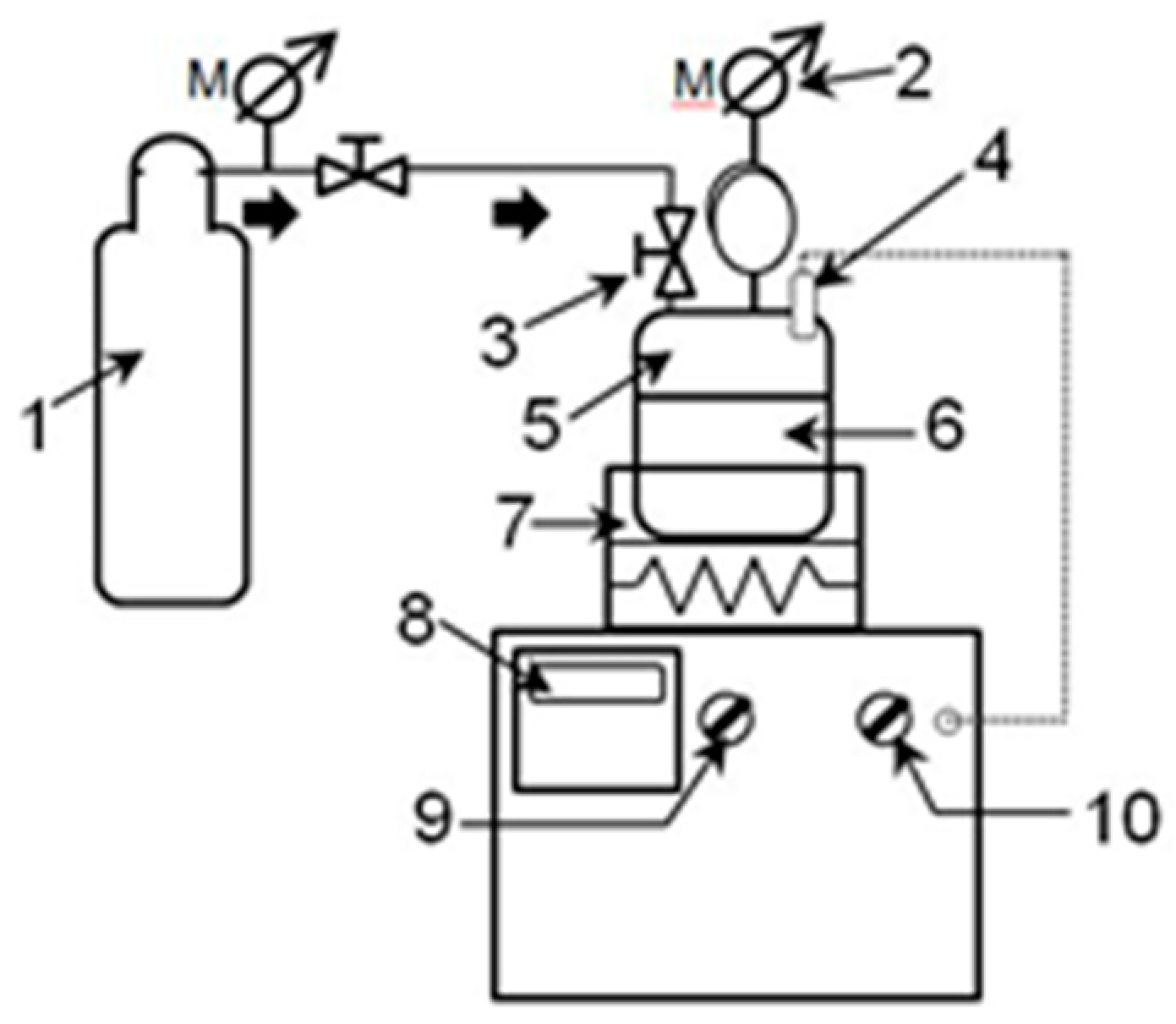
Figure 3.
Original chromatogram depicting full degradation of feminizing B1 in subcritical water at 200°C, 60 min.
Figure 3.
Original chromatogram depicting full degradation of feminizing B1 in subcritical water at 200°C, 60 min.
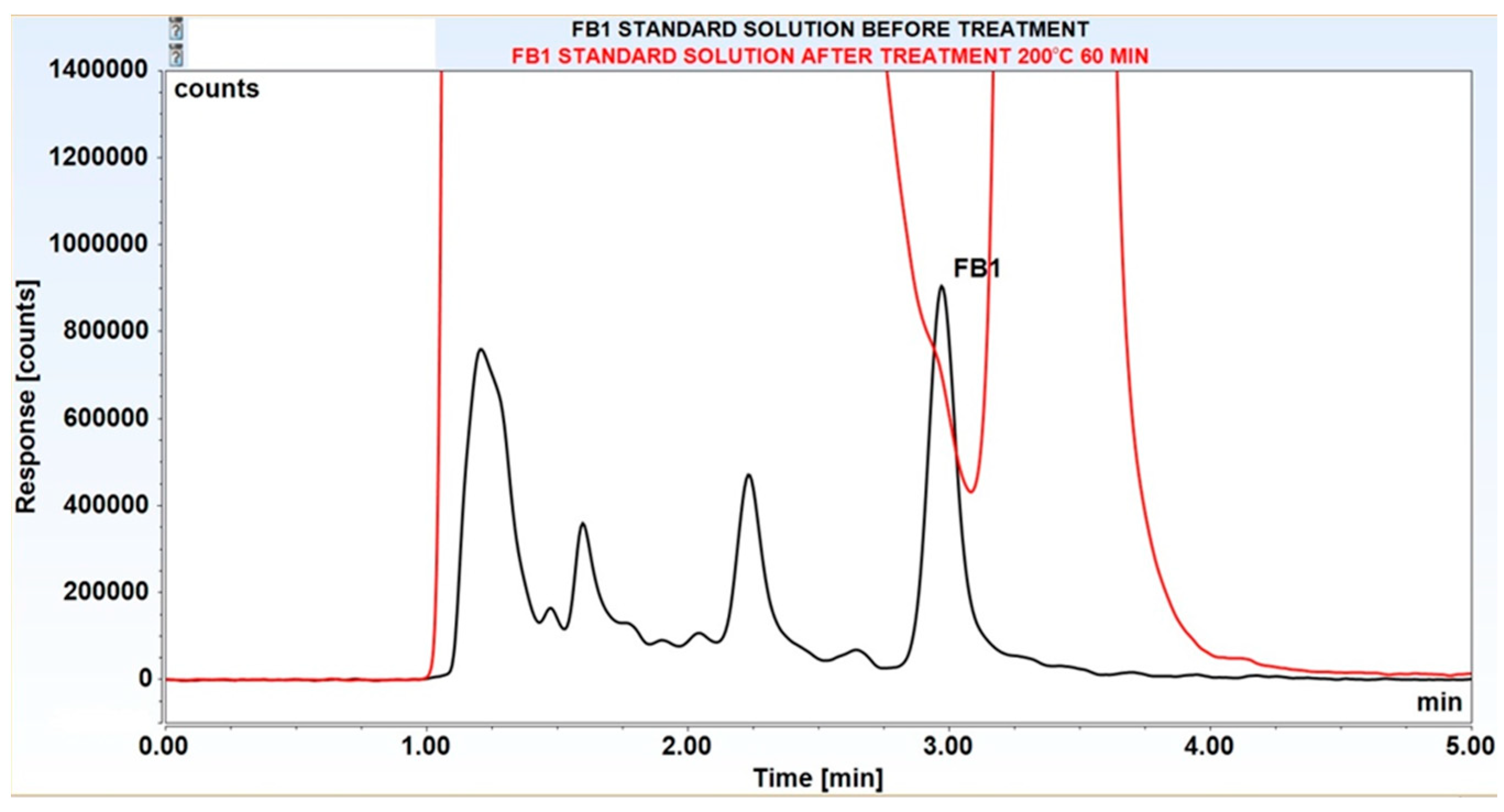
Figure 4.
Original chromatogram of zearalenone treatment by subcritical water at 200°C, 60 min.
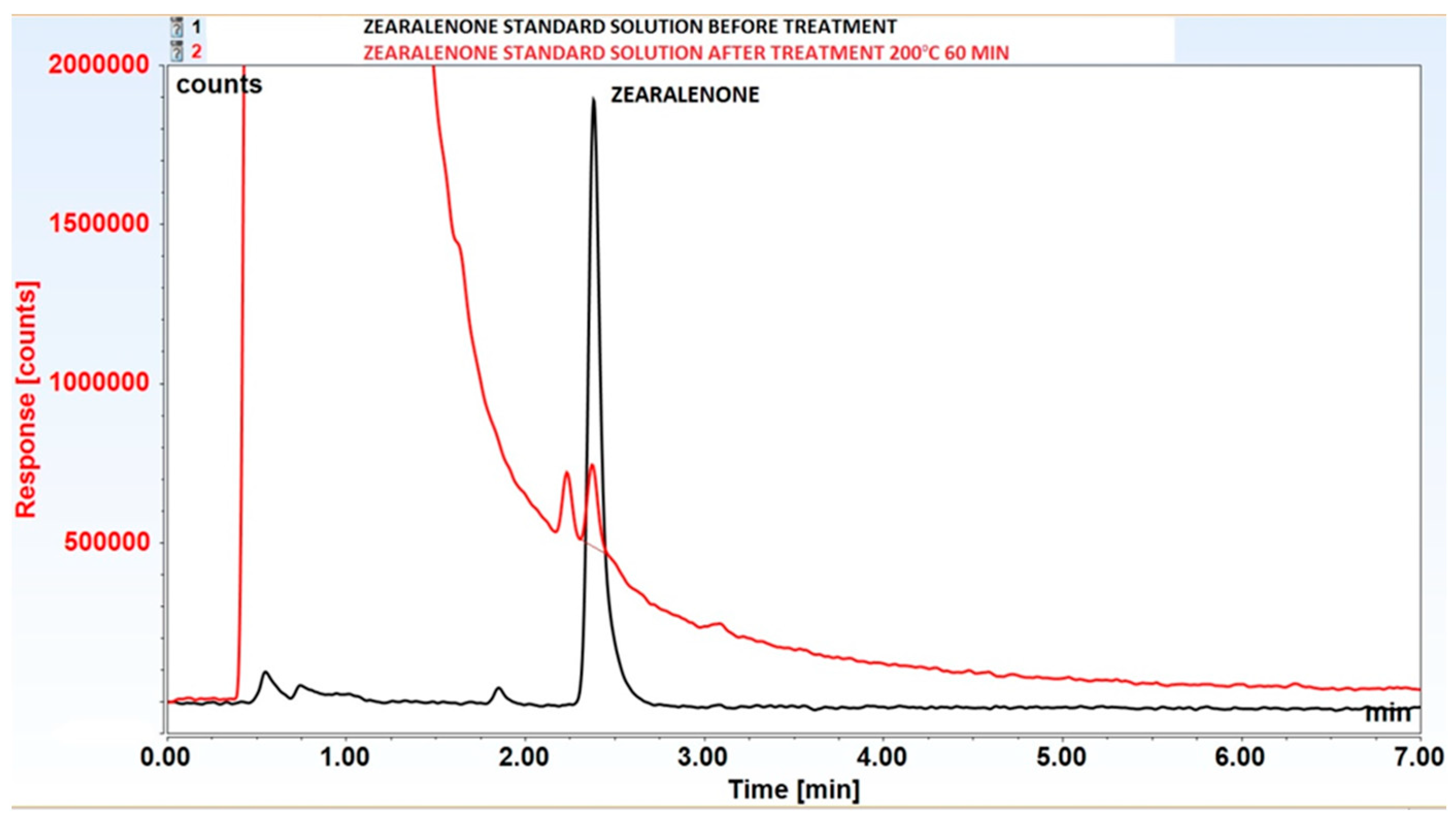

Table 1.
Degradation efficiency of selected organic pollutants by subcritical water using different catalysts.
Table 1.
Degradation efficiency of selected organic pollutants by subcritical water using different catalysts.
| Degradation efficiency (%) | ||||
| Conditions | TEMB | CLO | CIP | EE2 |
| N2 | 96.54±0.2* | 52.58±0.1 | 93.04±0.3 | 91.28±0.3 |
| CO2 | 100.00±0.2 | 61.17±0.1 | 81.98±0.3 | 70.96±0.2 |
| K2Cr2O7 | 99.67±0.1 | 19.62±0.7 | 100.00±0.1 | 97.74±0.3 |
| KMnO4 | 99.68±0.2 | 35.42±0.6 | 100.00±0.1 | 98.65±0.2 |
| H2O2 | 100.00±0.1 | 89.51±0.4 | 100.00±0.1 | 93.49±0.3 |
| HCl | 98.59±0.2 | 49.51±0.5 | 97.59±0.1 | 94.89±0.3 |
| NaOH | 100.00±0.1 | 51.92±0.5 | 94.53±0.3 | 87.18±0.2 |
| Zeolite | 98.50±0.2 | 38.95±0.6 | 98.96±0.2 | 62.89±0.3 |
*mean value of three treatments±2SD; temperature 200°C; time 1h; gas pressure 10 bars; catalyst concentration 0.001 mol/l for homogenous catalysts; 1 mg/ml for zeolite.
Table 2.
Degradation efficiency of mycotoxins by subcritical water.
| Degradation efficiency (%) | ||||
| Temperature (°C) | Time (min) | Zearalenone | DON | FB1 |
| 200°C | 60 | 90±0.5* | 100±0.1 | 100±0.2 |
| 200°C | 100 | 100±0.2 | n.a.** | n.a. |
| 230°C | 60 | 100±0.2 | n.a. | n.a. |
*mean value of three treatments±2SD; ** not applicable.
Disclaimer/Publisher’s Note: The statements, opinions and data contained in all publications are solely those of the individual author(s) and contributor(s) and not of MDPI and/or the editor(s). MDPI and/or the editor(s) disclaim responsibility for any injury to people or property resulting from any ideas, methods, instructions or products referred to in the content. |
© 2024 by the authors. Licensee MDPI, Basel, Switzerland. This article is an open access article distributed under the terms and conditions of the Creative Commons Attribution (CC BY) license (http://creativecommons.org/licenses/by/4.0/).
Copyright: This open access article is published under a Creative Commons CC BY 4.0 license, which permit the free download, distribution, and reuse, provided that the author and preprint are cited in any reuse.