

Submitted:
31 May 2024
Posted:
31 May 2024
Read the latest preprint version here
Abstract
The advancement of mechanization in forestry has bolstered productivity within the sector while simultaneously precipitating impacts necessitating deeper comprehension for the attainment of heightened levels of environmental sustainability in forestry management. The aim of this study was to apply an instrument for assessing the environmental damage and impacts of forest harvesting in commercial Eucalyptus plantations, based on a combination of methodologies. The environmental impact assessment methodology for forest harvesting was applied by combining interaction network approaches and impact assessment matrices. This methodology was then applied to a commercial Eucalyptus plantation in the municipality of São Pedro, state of São Paulo, Brazil. The results show that timber transportation activities had the highest positive and negative environmental indices. The most significant negative impacts refer to the depletion of water resources and erosion, while the positive impacts are regional development and job creation. The most significant changes, both positive and negative, were observed in a greater number of environmental impacts for the physical and anthropic environment, with fewer for the biotic environment. The combination of methodologies has potential as an expedient tool for planning forestry operations, providing practical results for decision-making, making production more sustainable and applicable to different crops and production systems.
Keywords:
Forestry
; Environmental impact of forest harvesting
; Interaction networks
; Eucalyptus
; Forestry industry
1. Introduction
The production paradigm with a greater emphasis on sustainability is constantly expanding in the context of policy development, with the aim of supporting decision-making and promoting improvements in the environmental, social and economic performance of processes, products or services. Sustainable production in forestry has as its pillars the use of "forests and forest lands in a conscious manner, at a rate that maintains their biodiversity, productivity, regeneration capacity, vitality and their potential to fulfill, now and in the future, relevant ecological, economic and social aspects" [1].
The Brazilian forest-based industry plays an important role in the global economy and human well-being, being responsible for the production of inputs for more than five thousand by- products or services “in forest ecosystems” [2].
Planted forests represent an appropriate form of soil management and are less impactful than various intensive crops [3,4]. They are especially recommended for degraded regions characterized by low fertility or unsuitable for agricultural practices [5,6].
The Brazilian planted forest industry carries out planting, harvesting and replanting activities on 9.94 million hectares. In addition, it recorded gross revenue of US$51 billion, setting new production records, with remarkable quantities of 25 million tons of pulp, 11 million tons of paper and 8.5 million cubic meters of wood panels [7].
Currently, the Brazilian forest harvesting scenario is dominated by large companies [8], which have more than 500 employees and employ sophisticated forest harvesting technologies aimed at reducing costs, high yields and environmental impacts on a smaller scale [9].
In the context of environmental impact assessment (EIA) in the forestry sector, various methodologies have been integrated into different lines of research. Among these approaches are the ad hoc system, checklists, map overlays, interaction networks and simulation models [10,11]. The choice, adaptation and development of the EIA method depend on the specific objectives of the assessment. Each tool has advantages and disadvantages, focusing specifically on the problems and goals previously established.
The purpose of Environmental Impact Assessment (EIA) is to identify the environmental effects resulting from projects in the biotic, physical, social and economic domains [12]. In addition to preventing adverse impacts, this methodology provides a basis for strategic decisions in the short and long term [13].
Currently, there are a series of EIA methodologies available in works related to the topic and inserted in various lines of research, such as: ad hoc system; checklists, map overlays; interaction networks and simulation models [14]. The choice of the EIA, adaptation and development method depends on the objectives of the evaluation, since each tool has positive and negative points, and specifically analyzes the defined problems and objectives.
The EIA aims to detect the environmental impacts resulting from the enterprise on the biotic, physical, social and economic environment, in addition to allowing strategic decision-making in the short and long term [15]. The AIA methodology, in addition to being seen as a tool to prevent adverse effects, also to assist and guide decision-making so that when planning the installation of new projects it is possible to explore the possibilities of environmental intervention in a sustainable way [16].
In Brazil, the common applicability of Environmental Impact Assessment (EIA) extends to compliance with environmental licensing prerequisites and national legislation. However, there is significant potential for using these methodologies as adaptable and simplified tools for monitoring work routines in the field.
Important studies [17] analyze and review recently proposed reforms to the current EIA system in Brazil. According to the authors, three proposals for changes to the EIA system have been documented, but studies on the efficiency and effectiveness of EIA are still incipient and generally retrospective, evaluating changes that have already been implemented. Furthermore, the low institutional capacity of government agencies is one of the main barriers, along with the complexity of carrying out studies and applying them in a practical way in the day-to-day activities of institutions.
In a bibliographic review study, 131 scientific productions on Brazilian environmental licensing based on EIA between 1985 and 2015 were analyzed. The results were grouped into themes such as: study of the EIA system, assessment of the quality of these studies and discussions on the methodologies applied. Most studies examined highly complex cases, especially hydroelectric plants. In contrast, few studies have addressed the methods applied, adaptations for different applicability, highlighting deficiencies in the different stages of EIA. Furthermore, analyzes of the consistency of Environmental Impact Studies (EIA) revealed recurring deficiencies [18].
In the context of the growth of the forestry sector, there is a need to develop and improve expedient tools for environmental, social and economic management, with a view to their effective application in the dynamic routine of the forestry industry.
Given the current technological development of forest-based industry, in which forest harvesting in many companies is usually mechanized, there is a growing need for tools to monitor the positive and negative impacts of the activity, not only in terms of harvesting yields in productive areas, but also its interface with conservation areas and the region where the production unit is located. The industry lacks expeditious methodologies that provide results for short- and long-term decision-making, as well as covering the different dimensions involved in EIA, i.e. physical, biotic and anthropic.
This study aims to integrate environmental impact assessment methodologies to guide the perception of the significance of aspects and impacts and adapt an agile and simplified assessment tool. This tool will assist in the development of preventive and mitigating procedures, as well as in the management of environmental impacts arising from the forestry production cycle, such as forest harvesting.
2. Materials and Methods
2.1. Description of the Forest Harvesting Site and Process
The study was carried out on a farm with commercial plantations of Eucalyptus spp, with a total area of 194.37 hectares, located in the municipality of São Pedro, in the state of São Paulo, Brazil (coordinates 22°32'55" South and 47°54'50" West, 550m altitude). Forest harvesting takes place throughout the year, during 3 uninterrupted shifts (morning, afternoon and evening). The database collection period covered the fall and winter seasons (May to August) in 2018 and 2019. Data was always collected after forest harvesting activities.
The soil of the region is classified as yellow-red latosol, with good infiltration capacity, low fertility and the area is susceptible to erosion [18].
In addition to the eucalyptus planting areas, there are fragments of Atlantic Forest (semideciduous seasonal forest) that allow commercial planting, designated as preservation areas and legal reserves.
According to data from the Brazilian Forestry Institute [19], the Atlantic Forest is present in 17 Brazilian states, stretching from Rio Grande do Sul to Rio Grande do Norte. Each region has specific characteristics in terms of vegetation, soil, relief, diversity and richness of fauna, as well as climatic variations. However, there are common elements between the different locations, such as high rainfall, resulting from the proximity to the sea and the influence of humid winds from the ocean. Furthermore, the Atlantic Forest covers a range of climates and microclimates, including the humid subtropical climate in the South, areas influenced by a tropical climate and transition regions with the caatinga in the Northeast.
What differentiates the current long log and short log systems is the field processing model, in the short log system the wood is extracted and processed into logs (according to the required dimensions) at the cutting site; In the long log system, trees are cut and delimbed and then sent to the transport site. According to the same author, harvesting modules also differ, for example, for short logs the most common is the combination of harvester (cutting and processing) and forwarder (loading) and for long logs the skidder is commonly used) and feller-buncher (cutting and delimbing) [20]. Harvesting and forest transport can be carried out manually, semi-mechanized and mechanized.
Mechanized harvesting consisted of harvesting modules with mobile units, 8 to 10 harvesters and 3 forwarders, both Komatsu®. The wood remained in the field for 60 to 90 days to dry and was then transported by bi-train/tri-train trucks in a month-long logistics operation.
Each activity of a project can generate positive or negative impacts when interacting with the environment. Therefore, the environmental aspect concerns the cause of the environmental impact, that is, the activities that are part of the analyzed process or its components. From an on-site visit, the environmental impacts visible in the field and in accordance with each aspect were identified, as well as the need to classify the aspects (check list methodology):
The flow of activities is exemplified in Figure 1:
2.2. Data Collection
Data collection consisted of identifying in the field the environmental aspects and impacts inherent to forest harvesting operations (post-harvest) – opening and maintaining roads, cutting, felling trees, lifting, dismantling and transportation, during on-site visits, as well as such as literature reviews. Field visits were carried out before the harvest period and after the harvest period.
For literature reviews, the Scopus, Web of Science and Scielo databases were consulted for articles from the last five years, using the following terms in Portuguese and English: “forest harvest and environmental impacts”; “eucalyptus forest harvesting”, “assessment of the impacts of forest harvesting”, “forest management” and “impact of forestry operations”.
Based on an on-site visit, the environmental impacts visible in the field were identified and noted according to each environmental aspect, in the physical, biotic and anthropic dimensions, as well as the need to classify the aspects, using the checklist methodology. After listing the impacts and aspects that were noticeable in the field, five interaction networks were drawn up for each stage of the forest harvesting activity. The checklist was applied on site in order to list the main noticeable direct impacts and subsequently applied to the network of interactions and weighted in the EIA matrix.
2.3. Interactions Networks
The tool integrates relationships relating to an impact in terms of its cause, condition and effect, thus resulting in a concise analysis in order to identify impacts and their interrelationships, as well as the level of detail of indirect impacts. These networks establish the relationships between the activities of an enterprise and the impacts it causes, from the first, second or third order, which varies according to the level of detail defined [11,22]. The aspects and impacts surveyed in the interaction networks were transposed into the Rapid Impact Assessment Matrix (RIAM) for subsequent weighting and calculation of the Impact Indices (ES – Environmental Score).
2.4. Adaptation of the Environmental Impact Assessment Matrix
The RIAM Matrix method [23] consists of a systemic analysis of environmental impacts derived from an activity that generates a degree of modification in the environment in which it is inserted, which evaluates the modifications caused to the environmental components by the impact and its effects, as well as being characterized by generating rapid results associating the impacts and their effects. The methodology is based on standardized assessment criteria, where the impacts of a project’s activities are weighted and assessed. These criteria are divided into A and B (A1 = importance, A2 = magnitude, B1 = permanence, B2 = reversibility and B3 = accumulation).
The RIAM adopts an ES linked to each of the environmental components, which uses five criteria to calculate it, divided into two groups (A and B). The criteria in the first group are used to assess the importance and magnitude of the change caused by the impact: A1=importance of the change and A2= magnitude of the change [24]. The criteria in the second group are associated with the effects that the changes have on the population living in the area of direct influence and on the borders of the region affected by the environmental damage: B1= permanence of the change, B2= reversibility and B3= accumulation. This index makes it possible to qualify and quantify positive and negative impacts.
The ES Is calculated using the following expression:
where A1, A2, B1, B2 and B3 are the values assigned to the impact assessment criteria (dimensionless), as shown in Table 1:
(ES) = (A1 x A2) x (B1 + B2 + B3),
According to the method, each criterion in group A is the result of a simple multiplication of the scores and, for the criteria in group B, values are added together resulting in a simple sum:
(a1) x (a2) = aT,
(b1) + (b2) + (b3) = bT
(aT) x (bT) = ES
In which:
(a1) and (a2) are individual scoring criteria for group (A);
(b1) to (b3) are the individual criteria scores for group (B);
aT is the result of multiplying all the scores (A);
bT is the sum of all scores (B)
ES is the evaluation score for impact.
Another point to note is that the criteria in group A have a numerical scale that starts off negative, then zero and then positive. In group B, the value zero should be avoided, and the scale ranges from 1 to 3, where the value 1 represents a neutral situation.
Given that the method makes the theoretical definition of several criteria, the
RIAM establishes that these criteria must satisfy two principles:
- Universality and importance of the criterion;
- Characteristic of the criterion that classifies it for group A or B.
In summary, the Pastakia method [25] operates with five criteria. Group A contains two of these five criteria and Group B has three, as described and scored below:
2.4.1. Group A Criteria:
- Geographical extent of affected groups (A1): Weights the measure of importance of the geographical scope of the impact, assessed in relation to the spatial boundaries or human interests it will affect.
A1= 4: International;
A1= 3: National;
A1= 2: Regional (Basin, State);
A1= 1: Location (Sub-basin, municipality);
A1= 0: None/Few.
- Magnitude of impact (A2): estimates the benefits or severity of the change that has occurred;
A2= 3: Positive benefits;
A2= 2: Significant improvement in condition;
A2= 1: Improvement in condition;
A2= 0: Null;
A2= -1: Negative evaluation of the state;
A2= -2: Considerable negative change in status;
A2= -3: Significant change in state (negative).
2.4.2. Group B Criteria:
- Stability of the impact (B1): delimits whether the impact is permanent or temporary.
B1= 1: No change;
B1= 2: Temporary;
B1= 3: Permanent.
- Reversibility (B2): defines whether the impacts are reversible and whether there are corrective measures capable of reducing, altering or avoiding the problem.
B2= 1: No possibility;
B2= 2: Reversible;
B2= 3: Irreversible.
- Cumulative (B3): estimates whether the impact will be one-off or cumulative over time, based on its effects.
B3= 1: no change;
B3= 2: non-cumulative/isolated;
B3= 3: cumulative/ synergistic.
The methodology requires specific evaluation parameters, depending on the project to be evaluated. Each component was addressed in the three categories of analysis:
- Physical environment: parameters related to aspects of climate, soils, relief and hydrology.
- Biotic environment: biological parameters such as flora and fauna.
- Anthropic environment: analysis involving social aspects such as rural workers and the local/regional community, such as occupational health and safety risks, income generation, jobs and changes to the landscape for local residents.
3. Results
3.1. Interaction Networks
The networks facilitate links between the activities carried out by the project and the resulting direct and indirect environmental impacts. It is also worth noting that the tool makes it easier to visualize indirect impacts, as well as to target their respective causes [26,27].
Interaction networks were applied with the purpose of evaluating the interaction of environmental aspects and impacts in the operation of wind farms. This study demonstrated that the aspects interact with other environmental impacts, forming a chain of dependent ideas in the operation phase of the enterprise [26]. The network can be built by integrating specific environmental impacts, based on prior knowledge of the environmental effects of certain actions on certain environmental systems and the theoretical elaboration of the interaction network by type of project. This aims to assist reasoning during studies of environmental aspects and impacts, when the interaction network can be adjusted to the specificities of the environment in the area to be affected.
The forest harvesting stage has various aspects and direct and indirect impacts. Thus, the most significant environmental aspect in the interaction networks is related to heavy machinery traffic, with a focus on road opening and maintenance activities and logging. Each of these primary impacts is also related to secondary and tertiary impacts, demonstrating that this activity presents a greater complexity of variables to be monitored within the forest harvesting process.
Figure 2 shows an example of one of the interaction networks developed in the study:
The largest share of impacts on the physical environment was in the network of interactions designed for road opening and maintenance. The timber loading network had the highest percentage of impacts on the biotic environment and the timber storage and drying network had the highest percentage of impacts on the anthropic environment (Figure 3, Figure 4 and Figure 5).
Although the harvesting phases are mechanized, manpower is used to control machines such as harvesters and forwarders, as well as trucks and tractors, as well as OHS teams and harvesting supervisors present in the forestry module (Figure 2).
The hiring of labor is lower compared to semi-mechanized or manual harvesting, and this characteristic is reflected in the impact assessment matrices when scoring the scale and magnitude of the beneficial impact. Figure 3, Figure 4 and Figure 5 show the distribution of impacts in each environment according to each of the five networks developed:
Some environmental impacts are present in more than one interaction network, but what differentiates them is the scale, intensity and magnitude of occurrence for each operation, as well as the level of change they will cause in the physical, biotic or anthropic environment.
In all phases it was possible to observe that the percentage of negative impacts is greater than the positive ones. Loading and transport activities had the highest impact rates, both negative and positive. The ES of negative impacts for forestry loading was 5% greater than for forestry transport, however, the ES of moderately negative impacts (of larger scale and magnitude of negative change) was greater for forestry transport. Although forest loading and transport activities occur concomitantly and are complementary, forest transport has greater potential for changes in the physical, biotic and anthropic environments.
Both harvest phases presented similar percentages (slightly variable) regarding the ES of positive impacts, except for storage and drying of wood in the field. This is because other activities involve hiring labor and purchasing inputs.
3.2. RIAM Matrices
According to the weighting applied to the matrices for each phase of forest harvesting, it was possible to distinguish and identify positive and negative impacts and damages according to the changes that each stage causes in the physical, biotic or anthropic environment.
The impacts identified in the interaction networks, resulting from each activity/operation, which were transposed into the RIAM matrices were:
- Road maintenance: improved road quality, less susceptibility to erosion, protection of the soil structure, siltation, erosion, changes in physical properties, damage to conservation areas for flora and fauna, opening of clearings, soil compaction, accidents, health problems, absence or death, regional development, income generation, soil, water and air pollution, waste generation, job creation and regional development.
- Logging: location and disorientation in the local landscape, relationship with the local community, supply of organic matter, damage to conservation areas, opening of clearings, soil compaction, siltation, erosion, accidents, greenhouse effect, health problems, absence or death, regional development, income generation, soil, water and air pollution, waste generation, job creation, regional development.
- Storing and drying wood: location and disorientation, hiding places for dangerous animals, accidents, soil compaction, silting up, health problems, absence or death, job creation and regional development.
- Wood loading: damage to rural roads, soil compaction, siltation, damage to conservation areas (flora and fauna), opening of clearings, greenhouse effect, accidents, health problems, absence or death, regional development, income generation, soil, water and air pollution, waste generation and job creation.
- Road transportation: improvement in road quality, soil compaction, silting, damage to conservation areas, erosion, greenhouse effect, accidents, health problems, absence or death, regional development, income generation, soil, water and air pollution, waste generation, job creation, regional development and depletion of water resources.

Table 2.
Example RIAM Matrix fragment for road transportation activity.
| Rapid Impact Assessment Matrix - RIAM | |||||||||||
|---|---|---|---|---|---|---|---|---|---|---|---|
| Activity or operation |
Environmental aspect |
Environmental Impact | Medium | A1 | A2 | B1 | B2 | B3 | IMPACT INDEX (ES) |
NUM. VALUE (RV) |
ENVIRONMENTAL IMPACT LEVEL |
| Wood transportation |
Truck traffic | Improved road quality | Anthropic | 1 | 2 | 2 | 2 | 3 | 14 | 2 | Not very positive |
| Soil compaction | Physical | 1 | -2 | 3 | 2 | 3 | -16 | -2 | Slightly negative | ||
| Siltation | Physical | 1 | -3 | 3 | 2 | 3 | -24 | -3 | Moderately Negative | ||
| Damage to conservation areas (> number of flora species) | Biotic | 1 | -3 | 3 | 2 | 3 | -24 | -3 | Moderately Negative | ||
The ES within each forest harvesting activity is detailed below (Figure 6, Figure 7, Figure 8, Figure 9 and Figure 10):
According to the impact indices obtained (ES) and based on the results achieved in each of the five stages of forest harvesting, the following are guidelines for managing the most prominent (moderately negative) impacts:
Table 3.
Guidelines for managing the most significant impacts.
| Activity or operation | Environmental aspect | Environmental Impact |
Guideline for impact management |
|---|---|---|---|
| Road opening and maintenance/wood transportation | Soil extraction for road construction/Truck traffic | Siltation | Carry out a survey of the technologies available for micro-planning forest harvesting operations (be they mathematical models, drones, geoprocessing, etc.), map sites susceptible to erosion (both pre-harvest and post-harvest), carry out a periodic assessment of environmental aspects and impacts, draw up and update field operating procedures, and constantly train rural workers. Create a panel with the environmental aspects and impacts inherent in the operations and keep it visible at support points in the field. |
| Road opening and maintenance/Timber transportation | Soil extraction for road construction/Truck traffic | Erosions | |
| Road opening and maintenance | Machine handling | Soil compaction | |
| Road opening and maintenance/wood transportation | Soil extraction for road construction/Truck traffic | Damage to conservation areas (> number of flora species) | Map the native vegetation preservation areas directly affected by harvesting operations, carry out the assessment of environmental aspects and impacts periodically, include the care and location of these areas in operating procedures and in the training of field teams. In addition, keep flora inventories of preservation areas up to date, in order to ensure that important species are not suppressed. Create a panel with the environmental aspects and impacts inherent to the operations and keep it visible at the support points in the field. |
| Road opening and maintenance | Soil extraction for road construction | Opening clearings | |
| Road opening and maintenance | OHS risks | Dismissal or death | Train field crews in all harvesting operating procedures. Create a panel with the OHS aspects and impacts inherent in the operations and keep it visible at the support points in the field. |
| Cutting and harvesting/ Loading timber | OHS risks | Dismissal or death | |
| Wood transportation | OHS risks | Accidents | |
| Road opening and maintenance | Purchasing inputs | Soil, water and air pollution | Periodically carry out analyses to monitor the quality of water bodies, soil and air, in order to ensure that they are not contaminated or exceed the limits permitted by Brazilian legislation. |
| Wood transportation | Wet roads | Depletion of water resources | Plan the amount of water resources needed to maintain rural roads and monitor/record the amount used in each operation. |
4. Discussion
The activity of opening and maintaining roads stands out in terms of its positive impacts on the anthropic environment due to the use of tractors, a greater number of workers and trucks, as well as its negative impacts on the physical and biotic environment due to the opening of quarries for soil extraction, which are sometimes close to conservation areas. These soil extraction sites require authorization from municipal environmental agencies.
The positive impacts with the highest ES were improved road quality (ES=21, physical environment), less susceptibility to erosion (ES=21, physical environment), regional development (ES=24, anthropic environment), income generation (ES=24, anthropic environment) and regional development (ES=24, anthropic environment). The negative impacts with the highest ES were damage to conservation areas related to flora (ES= -32, biotic environment), the opening of clearings (ES= -32, biotic environment) and loss of life or death (ES = -27, anthropic environment).
A bibliographic review was conducted of sustainability impact assessment in forestry operations, analyzing 109 studies and their focal themes [1]. Most of the studies focused on environmental aspects; the most used sustainability indicators were greenhouse gas emissions, carbon stock, and global warming potential; followed by energy use and cumulative energy demand. In addition to these issues, fewer studies addressed topics such as accidents, health and safety and potential human toxicity, which belong to the social pillar of sustainability.
Forestry work, especially logging and extraction operations, is associated with a high risk of death or accidents, so safety, health and risk assessments seem to be the most popular among the social aspects of forestry operations. However, few studies address this topic, perhaps due to a lack of data, which may be an indicator of the growing relevance of social aspects [1,28,29,30,31].
The activity of felling and extracting timber (Figure 7) stands out in terms of positive impacts on the anthropic environment due to the fact that machines (harvesters) are used which require operators and safety and management teams, as well as negative impacts on the physical environment due to the traffic of heavy machinery and the consumption of fossil fuels and the anthropic environment due to the risk of accidents when working with large machines. The negative impacts with the highest ES were absence or death (ES= -24, anthropic environment), greenhouse effect (ES= -18, physical environment) and regional development (ES=24, anthropic environment) as for positive impacts.
The activity of stockpiling and drying timber has a low level of modification of the environment, the highlight being negative impacts in terms of soil compaction due to the deposition of timber piles, often close to conservation areas, as well as siltation due to the rolling of logs into water bodies or inside reserve areas. The negative impacts with the highest ES were soil compaction (ES= -7, physical environment), siltation (ES= -7, physical environment), and removals or deaths (ES= -6, anthropic environment).
The activity of loading wood (Figure 9) stands out in terms of the level of modification of the environment by heavy machinery traffic and the positive impacts on the anthropic environment. The negative impacts with the highest ES were displacement or death (ES= -21, anthropic environment) and greenhouse effect (ES= -18, physical environment). The positive impact with the highest ES was regional development.
The timber transportation activity (Figure 10) stands out in terms of positive impacts on the anthropic environment due to the hiring of truck drivers and security teams, as transportation, as well as logging, takes place continuously throughout the week. As for the negative impacts, they are due to the aspects that can cause changes to the physical and biotic environments. The negative impacts with the highest ES were depletion of water resources (ES= -28, physical environment) and erosion (ES= -18, physical environment). The positive impacts with the highest ES were regional development (ES= 36, anthropic environment) and job creation (ES= 24, anthropic environment). Furthermore, among the activities that make up forest harvesting, transportation is the one that takes the most time and planning, mainly due to logistical costs in Brazil (transportation is by road) [31,32].
In general, comparing all the harvesting stages and their harmful and beneficial impacts, it is clear that the ES and the number of negative impacts is the majority. However, most of the physical, biotic and anthropic impacts are related to the good management and operational practices carried out by the farm's employees, i.e. managing aspects and impacts can prevent environmental, social and economic problems.
Research carried out in the last decade on mechanized wood harvesting in natural forests in the Amazon, with adequate planning, concludes that a rigorously planned and executed forest harvesting with rigorous technical criteria not only minimizes environmental impacts in the physical, biotic and anthropic environments, but also significantly reduces the total costs of wood harvesting [32,33].
A study carried out in 2017 assessed the impacts associated with timber harvesting and transportation in the state of Tennessee, using life cycle assessment. The work compared the impacts with those assessed for forest harvesting in studies carried out for other regions of the USA. Negative impacts such as changes in soil suitability for different crops, water quantity and quality and air pollution were identified, as well as positive impacts such as the potential energy benefit obtained from wood (20,107 MJ / dry ton) when compared to that of fossil energy (1052 MJ / dry ton) [34]
The first cradle-to-grave life cycle assessment study on forestry operations in Iran provides comprehensive regionalized life cycle inventory (LCI) data on the Iranian forestry sector. In this work, the results show that forest transportation is the main critical point in most of the intermediate environmental impact categories, such as global warming, or in the final categories, such as human health [35].
Another study, also on the life cycle, quantitatively assessed current forest management practices for wood production in the USA. As a result of this study, it was found that the greatest greenhouse gas (GHG) emissions are related to fuel consumption for the harvesting and loading processes. These stages of the timber production process contributed more to total GHG emissions than harvesting and processing within the boundaries of the system [36].
In a study conducted in southern Finland, the impacts of timber loading on the physical properties of forest soils were investigated. The results indicate that forest harvesting activities can cause damage and disturbance to the soil, such as compaction, furrow formation and soil mixing. These effects have repercussions on the structure and functions of the soil, thereby compromising forest productivity [37].
Research has analyzed the environmental effects associated with forest harvesting operations using different levels of mechanization. It was noted that the fully mechanized system, known as short logs or "cut to length", stood out for its superior performance in the final stages of felling, showing lower adverse environmental impacts [38].
The short log harvesting method (cut-to-length) consists of sectioning the tree into logs during harvesting and before transportation, while the full tree method consists of just harvesting and transporting them without sectioning them. The short log harvesting method, when carried out in a fully mechanized system, generally results in timber products of better quality and consistency than the whole tree method in a more environmentally conscious, versatile and safe way [20,39,40,41].
According to the literature, the majority of works published in the last 15 years deal with the assessment of environmental impacts in a specific manner, analyzing variables individually. These studies address soil compaction, impacts on air, soil and water quality, ergonomic issues, the relationship between the local community and forestry production activities and, mainly, the operational performance of the machines used in forestry operations. However, there is a lack of studies focused on the comprehensive management of environmental impacts, considering integrated planning and monitoring that consider the complexity of anthropic, biotic and abiotic variables [1,4,15,17,25].
A multidisciplinary approach is needed to deal with the complex problems associated with machine/soil/plant interactions. Certain relationships between mitigation techniques and their performance can only be fully understood through holistic projects and forest planning actions focused on impact mitigation [42,43,44,45,46].
Publications in recent years demonstrate the interest of the community and researchers in aggregating knowledge and outlining strategies in order to support scientifically based changes, as well as developing tools to solve environmental problems arising from productive activities [25]. On the other hand, there is a lack of greater research related to forest harvesting and its impacts beyond the production scope.
5. Conclusions
It was concluded that, according to the methodology applied, the most significant changes were observed in the physical and anthropic environments, with wood transport presenting the highest rates of environmental impact. The combination of methodologies allowed the adaptation of an integrated planning tool for the environmental management of forest harvesting. This adaptation made it possible to qualify the most significant environmental impacts, both positive and negative. Furthermore, the study contributes to the practical application in real time, with field data, of an agile management tool, applicable to day-to-day forestry operations and adaptable to different forestry models and productivity conditions.
However, the integration of environmental impact assessment methods still requires greater systematization and research to follow technological developments in harvesting and large-scale productivity. In addition to the existing gap in practical methodologies for environmental monitoring, prevention and mitigation, there is a need for more case studies for the development of low-cost tools. There are great opportunities to develop work to assess environmental impacts and damages from an economic point of view in the medium and long term, evaluating the interaction with ecosystem services and the subjectivity of weightings in environmental impact assessments with regard to methodologies that depend on quantifications.
Supplementary Materials
The following supporting information can be downloaded at the website of this paper posted on Preprints.org, Figure S1. Flowchart of the forest harvesting process; Figure S2. Interaction networks developed in the study; Figure S6. ES for road opening and maintenance evaluation matrix; Figure S7. ES for logging evaluation matrix; Figure S8. ES for wood stock and drying evaluation matrix; Figure S9. ES for wood loading evaluation matrix and Figure S10. ES for wood stock and drying evaluation matrix.
Author Contributions
Conceptualization, C.P.A.F.; methodology, C.P.A.F.; validation, C.P.A.F. and A.I.R.; data collect and formal analysis, C.P.A.F.; writing—original draft preparation, C.P.A.F.; M.P.S.M; J.V.B.C; G.A.M.; L.H.F.A. and A.I.R.; writing—review and editing, J.V.B.C; L.H.F.A; G.S.S and G.A.M.; visualization, C.P.A.F. and supervision, A.I.R. All authors have read and agreed to the published version of the manuscript.
Funding
This study was financed in part by the Coordenação de Aperfeiçoamento de Pessoal de Nível Superior - Brasil (CAPES) - Finance Code 001, grant number 33004170001P6.
Data Availability Statement
Suggested Data Availability Statements are available in section “MDPI Research Data Policies” at https://www.mdpi.com/ethics.
Acknowledgments
Acknowledgments to the Postgraduate Program in Environmental Sciences of São Paulo State University “Júlio de Mesquita Filho” (UNESP), the partner authors in this article and the forestry company that collaborated with the area to carry out the study and collect data.
Conflicts of Interest
The authors declare no conflicts of interest. The funders had no role in the design of the study; in the collection, analyses, or interpretation of data; in the writing of the manuscript; or in the decision to publish the results.
References
- Schweier, J.; Magagnotti, N.; Labelle, E.R.; Athanassiadis, D. Sustainability Impact Assessment of Forest Operations: a Review. Curr. For. Rep. 2019, 5, 101–113. [Google Scholar] [CrossRef]
- IBÁ. Indústria Brasileira de Árvores - Relatório Anual 2022. 2021. São Paulo. Available in: https://www.iba.org/.
- Oliveira, A.B.; Paz, D.A.S.; da Silveira, K.C. EXPANSÃO DA SILVICULTURA DO EUCALIPTO E TRANSFORMAÇÕES NO USO DA TERRA EM MUNICÍPIOS DO OESTE MARANHENSE. InterEspaço: Revista de Geografia e Interdisciplinaridade 2020, 5, 202006. [Google Scholar] [CrossRef]
- Feng, Y.; Audy, Jean-F. Silvicultura 4.0: Um framework para a cadeia de suprimentos florestal no contexto da Indústria 4.0. Gestão & Produção. 2020. v. 27. [CrossRef]
- Guerino, R.M.G.; de Morais, I.L.; da Santos, A.B.S.; Campos, R.M. Expansion and socio-environmental impacts of the culture of Eucalyptus spp. (Myrtaceae) in Brazil: a literature panorama. Research, Society and Development 2022, 11, e48811326751. [Google Scholar] [CrossRef]
- Soman, H.; Kizha, A.R.; Roth, B.E. Impacts of silvicultural prescriptions and implementation of best management practices on timber harvesting costs. Int. J. For. Eng. 2019, 30, 14–25. [Google Scholar] [CrossRef]
- IBÁ. Indústria Brasileira de Árvores - Relatório Anual 2022. 2023. São Paulo. Disponível em: https://www.iba.org/.
- Lei Complementar 123/2006. Lei Complementar Nº 123, de 14 de dezembro de 2006. Disponível em: https://www.planalto.gov.br/ccivil_03/leis/lcp/lcp123.
- Britto, P.C.; Jaeger, D.; Hoffmann, S.; Robert, R.C.G.; Vibrans, A.C.; Fantini, A.C. Impact Assessment of Timber Harvesting Operations for Enhancing Sustainable Management in a Secondary Atlantic Forest. Sustainability 2019, 11, 6272. [Google Scholar] [CrossRef]
- Alberts, R.C.; Retief, F.P.; Cilliers, D.P.; Roos, C.; Hauptfleisch, M. Environmental impact assessment (EIA) effectiveness in protected areas. Impact Assess. Proj. Apprais. 2021, 39, 290–303. [Google Scholar] [CrossRef]
- Martins, T.S.; Junior, G.N.d.R.C. Avaliação de Impacto Ambiental: Uma Revisão Sistemática sob a Ótica Metodológica. E&S Eng. Sci. 2018, 7, 29–41. [Google Scholar] [CrossRef]
- Penadés-Plà, V.; Martínez-Muñoz, D.; García-Segura, T.; Navarro, I.J.; Yepes, V. Environmental and Social Impact Assessment of Optimized Post-Tensioned Concrete Road Bridges. Sustainability 2020, 12, 4265. [Google Scholar] [CrossRef]
- Sánchez, L. E. Avaliação de Impacto Ambiental - Conceitos e Métodos - 3ª Ed. 2020. Oficina de textos: São Paulo, Brasil. pp. 69-81.
- Banyal, S.; Aggarwal, R.; Bhardwaj, S. A review on methodologies adopted during environmental impact assessment of development projects. J. Pharmacogn. Phytochem. 2019, 8, 2108–2119. [Google Scholar] [CrossRef]
- Harker, K.J.; Arnold, L.; Sutherland, I.J.; Gergel, S.E. Perspectives from landscape ecology can improve environmental impact assessment. FACETS 2021, 6, 358–378. [Google Scholar] [CrossRef]
- Ritter, C.D.; McCrate, G.; Nilsson, R.H.; Fearnside, P.M.; Palme, U.; Antonelli, A. Environmental impact assessment in Brazilian Amazonia: Challenges and prospects to assess biodiversity. Biol. Conserv. 2017, 206, 161–168. [Google Scholar] [CrossRef]
- Proto, A.R.; Bacenetti, J.; Macrì, G.; Zimbalatti, G. Roundwood and bioenergy production from forestry: Environmental impact assessment considering different logging systems. J. Clean. Prod. 2017, 165, 1485–1498. [Google Scholar] [CrossRef]
- IBGE. Mapa de solos do Brasil. Ministério do Planejamento, Orçamento e Gestão. 2001. Disponível em: https://www.ibge.gov.
- IBF. Brazilian Forestry Institute. Available at: https://www.ibflorestas.org.
- Labelle, E.R.; Lemmer, K.J. Selected Environmental Impacts of Forest Harvesting Operations with Varying Degree of Mechanization. Croat. J. For. Eng. 2019, 40, 239–257. [Google Scholar] [CrossRef]
- Pereira, D. P.; Carmo, F. C. de A.; Guimarães, P. P.; Neto, P. N. de M.; Moreira, G. L.; Silva, E. P. M. Aprendizagem da mecanização e colheita florestal por meio da metodologia de painéis interativos. Agropecuária Científica no Semiárido. 2022. v. 18, n. 1, p. 94-97. [CrossRef]
- de Jesus, M.S.; da Silva, M.G.; Tavares, M.d.S.; Silva, L.G.O.d.C.; dos Santos, R.E.M.; Brandão, T.M.; Costa, I.M.N.B.d.C.; Amorim, E.O.C. Métodos de avaliação de impactos ambientais: uma revisão bibliográfica/ Environmental impact assessment methods: a literature review. Braz. J. Dev. 2021, 7, 38039–38070. [Google Scholar] [CrossRef]
- Pastakia, C.M.; Jensen, A. The rapid impact assessment matrix (Riam) For eia. Environ. Impact Assess. Rev. 1998, 18, 461–482. [Google Scholar] [CrossRef]
- Fonseca, A.; Sánchez, L.E.; Ribeiro, J.C.J. Reforming EIA systems: A critical review of proposals in Brazil. Environ. Impact Assess. Rev. 2017, 62, 90–97. [Google Scholar] [CrossRef]
- Duarte, C.G.; Dibo, A.P.; Sánchez, L.E. O que diz a pesquisa Acadêmica sobre Avaliação de Impacto e Licenciamento Ambiental no Brasil? Ambiente Soc. 2017, 20, 261–292. [Google Scholar] [CrossRef]
- Nogueira, L.R.d.S.; Ribeiro, A.; de Medeiros, G.A.; Martins, A.C.G.; Longo, R.M. ANÁLISE INTEGRADA DOS ASPECTOS E IMPACTOS AMBIENTAIS DA ATIVIDADE OPERACIONAL EM PARQUE EÓLICO NO SUDOESTE DA BAHIA / BRASIL. Rev. Gestão Sustentabilidade Ambient. 2020; 9, 40–63. [CrossRef]
- da Silva, B.R.; da Silva, W.C.; Gonçalves, M.F.; Friaes, E.P.P.F.; Pedroso, A.J.S.; da Costa, B.O.; Rocha, C.B.R.; Júnior, R.N.C.C. Principais metodologias de Avaliação de Impacto Ambiental no território brasileiro. Conjecturas 2022, 22, 2137–2146. [Google Scholar] [CrossRef]
- Schettino, S.; Azevedo, P.T.O.; Caçador, S.S.; Minette, L.J.; Guimarães, N.V. Estudo comparativo dos índices de qualidade de vida no trabalho florestal em atividades com e sem mecanização. Agropecuária Científica No Semiárido 2020, 16, 20–26. [Google Scholar] [CrossRef]
- Korneeva, Y.; Simonova, N.; Shadrina, N. The Psychosocial Risk Factors Evaluation and Management of Shift Personnel at Forest Harvesting. Forests 2022, 13, 1447. [Google Scholar] [CrossRef]
- Gumus, S.; Okan, S.U.; Hatay, T.Y. Analysis of work accidents in wood harvesting: a case study of the East Black Sea region. Forestist 2020, 70, 1–7. [Google Scholar] [CrossRef]
- Schettino, S.; Minette, L.J.; Lima, R.C.A.; Nascimento, G.S.P.; Caçador, S.S.; Vieira, M.P.L. Forest harvesting in rural properties: Risks and worsening to the worker’s health under the ergonomics approach. Int. J. Ind. Ergon. 2021, 82, 103087. [Google Scholar] [CrossRef]
- Leite, E.S.; Santos, J.S.; Gomes, B.M.; Nóbrega, J.C.A.; Nóbrega, R.S.A. Compactação do solo causada pelo harvester e intensidade de tráfego do forwarder na colheita florestal. Sci. For. 2020, 48, e3075. [Google Scholar] [CrossRef]
- Pinto, A.C.M.; de Souza, A.L.; de Souza, A.P.; Machado, C.C.; Minette, L.J.; Vale, A.B.D. Análise de danos de colheita de madeira em floresta tropical úmida sob regime de manejo florestal sustentado na Amazônia ocidental. Rev. Arvore 2002, 26, 459–466. [Google Scholar] [CrossRef]
- Picchio, R.; Mederski, P.S.; Tavankar, F. How and How Much, Do Harvesting Activities Affect Forest Soil, Regeneration and Stands? Curr. For. Rep. 2020, 6, 115–128. [Google Scholar] [CrossRef]
- Abbas, D.; Handler, R.M. Life-cycle assessment of forest harvesting and transportation operations in Tennessee. J. Clean. Prod. 2018, 176, 512–520. [Google Scholar] [CrossRef]
- Kouchaki-Penchah, H.; Moaf, A.J.; Kougir-Chegini, Z.; Lang, M.N. Cradle to gate environmental impact assessment of the Iranian forestry operations. Environ. Impact Assess. Rev. 2023, 102, 107183. [Google Scholar] [CrossRef]
- Zhao, J.; Smith, W.; Wang, J.; Zhang, X.; Bergman, R. Life-cycle impact assessment of hardwood forest resources in the eastern United States. Sci. Total. Environ. 2023, 909, 168458. [Google Scholar] [CrossRef] [PubMed]
- Toivio, J.; Helmisaari, H.-S.; Palviainen, M.; Lindeman, H.; Ala-Ilomäki, J.; Sirén, M.; Uusitalo, J. Impacts of timber forwarding on physical properties of forest soils in southern Finland. For. Ecol. Manag. 2017, 405, 22–30. [Google Scholar] [CrossRef]
- Labelle, E.R.; Lemmer, K.J. Selected Environmental Impacts of Forest Harvesting Operations with Varying Degree of Mechanization. Croat. J. For. Eng. 2019, 40, 239–257. [Google Scholar] [CrossRef]
- Rodrigues, C.K.; Lopes, E.D.S.; Müller, M.M.L. Avaliação da qualidade estrutural do solo em colheita mecanizada (harvester e forwarder) de Eucalyptus grandis. Agrarian 2020, 13, 56–62. [Google Scholar] [CrossRef]
- Labelle, E.R.; Hansson, L.; Högbom, L.; Jourgholami, M.; Laschi, A. Strategies to Mitigate the Effects of Soil Physical Disturbances Caused by Forest Machinery: a Comprehensive Review. Curr. For. Rep. 2022, 8, 20–37. [Google Scholar] [CrossRef]
- Bayle, G. Ecological and social impacts of eucalyptus tree plantation on the environment. J. Biodivers. Conserv. Bioresour. Manag. 2019, 5, 93–104. [Google Scholar] [CrossRef]
- McEwan, A.; Marchi, E.; Spinelli, R.; Brink, M. Past, present and future of industrial plantation forestry and implication on future timber harvesting technology. J. For. Res. 2019, 31, 339–351. [Google Scholar] [CrossRef]
- Titus, B.D.; Brown, K.; Helmisaari, H.-S.; Vanguelova, E.; Stupak, I.; Evans, A.; Clarke, N.; Guidi, C.; Bruckman, V.J.; Varnagiryte-Kabasinskiene, I.; et al. Sustainable forest biomass: a review of current residue harvesting guidelines. Energy, Sustain. Soc. 2021, 11, 1–32. [Google Scholar] [CrossRef]
- de Jesus França, L.C.; Júnior, F.W.A.; e Silva, C.S.J.; Monti, C.A.U.; Ferreira, T.C.; de Oliveira Santana, C.J.; Gomide, L.R. Forest landscape planning and management: A state-of-the-art review. Trees, For. People 2022, 8, 100275. [Google Scholar] [CrossRef]
- Savari, M.; Damaneh, H.E. Factors influencing local people’s participation in sustainable forest management. Arab. J. Geosci. 2020, 13, 1–13. [Google Scholar] [CrossRef]
Figure 1.
Flowchart of the forest harvesting process ([21], adapted]).
Figure 1.
Flowchart of the forest harvesting process ([21], adapted]).
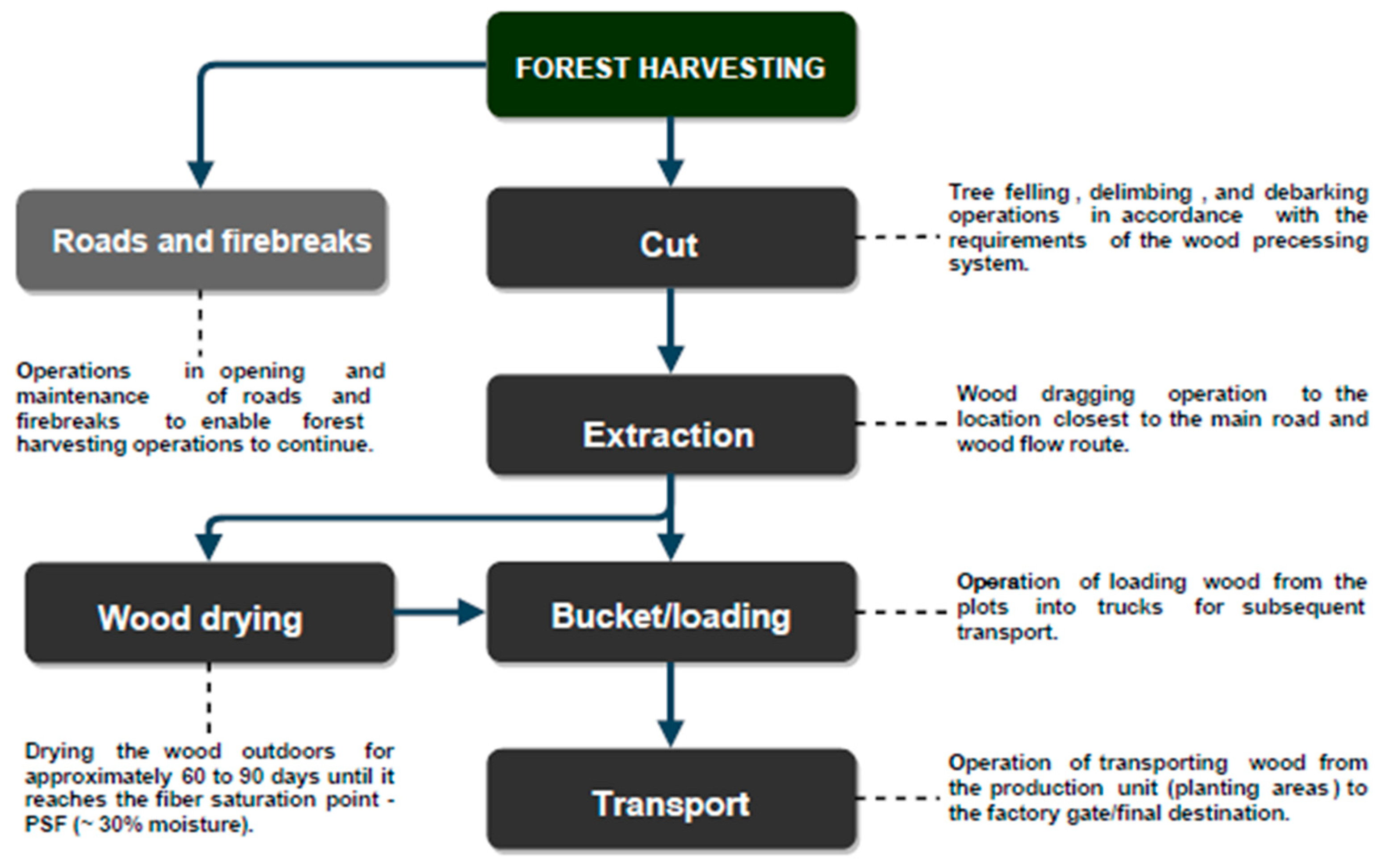
Figure 2.
Interaction networks developed in the study (2019).
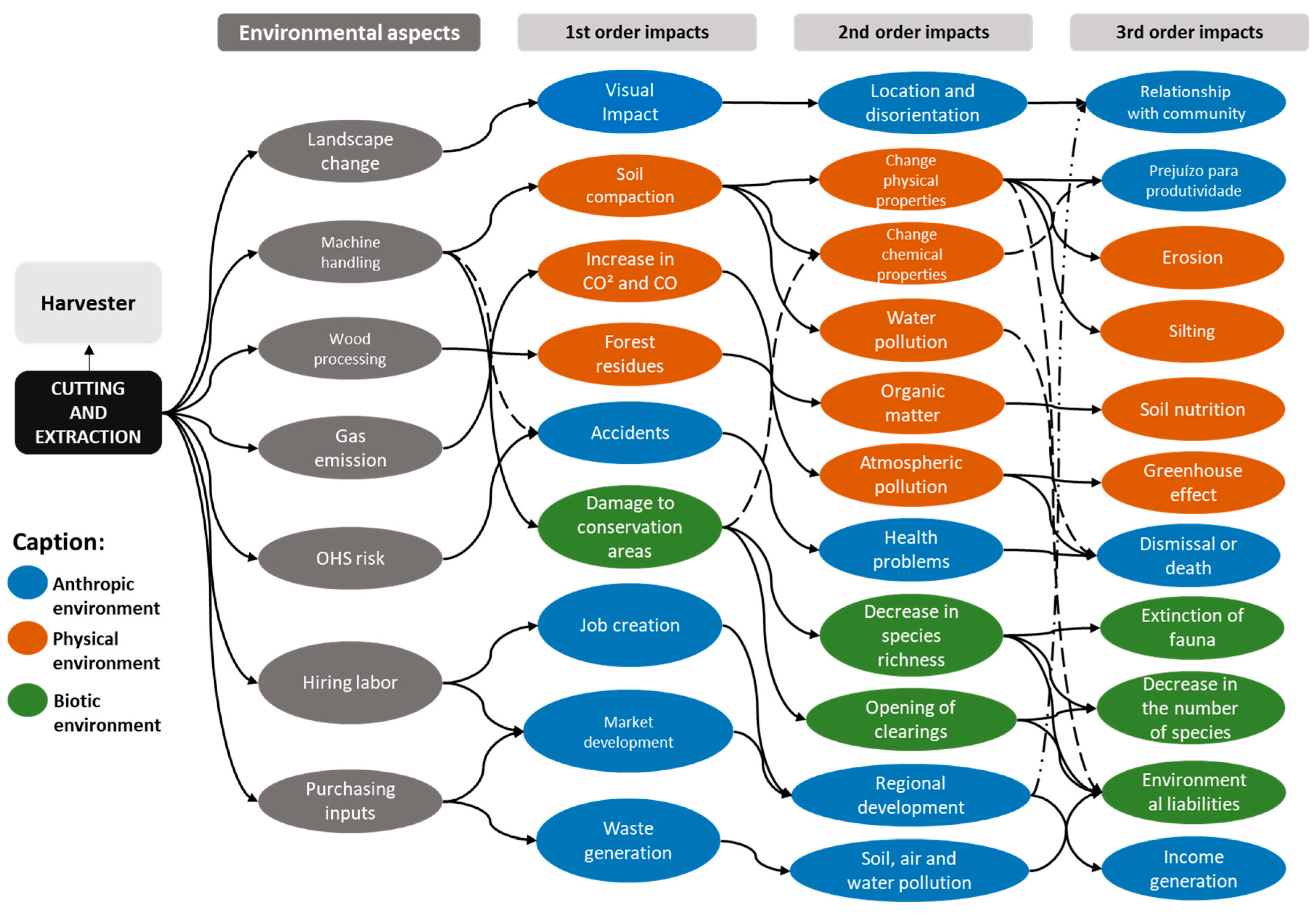
Figure 3.
Classification of impacts for networks of interactions for road opening and maintenance and logging activities.
Figure 3.
Classification of impacts for networks of interactions for road opening and maintenance and logging activities.
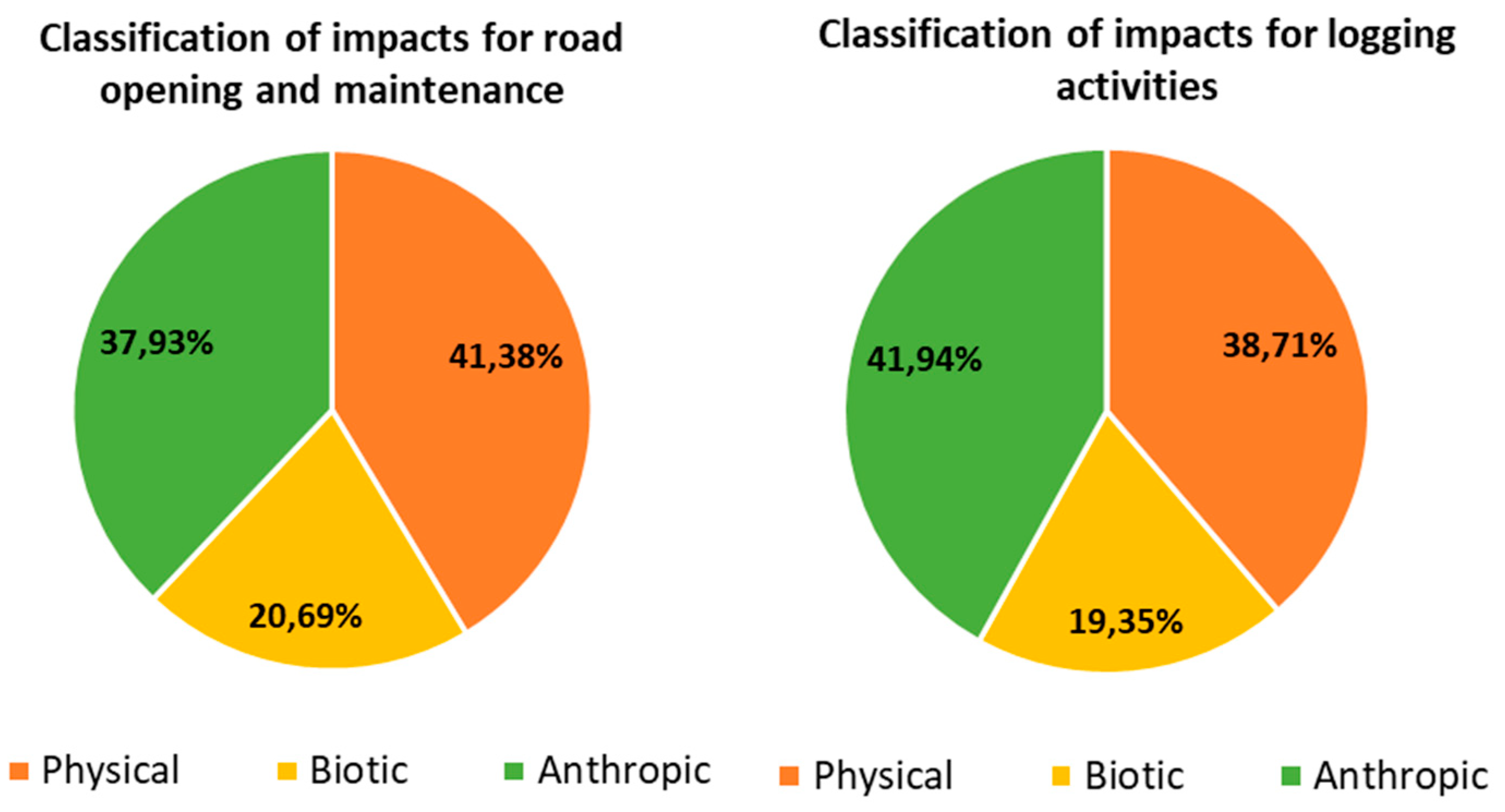
Figure 4.
Classification of impacts for networks of interactions for timber storage and drying and timber loading activities.
Figure 4.
Classification of impacts for networks of interactions for timber storage and drying and timber loading activities.
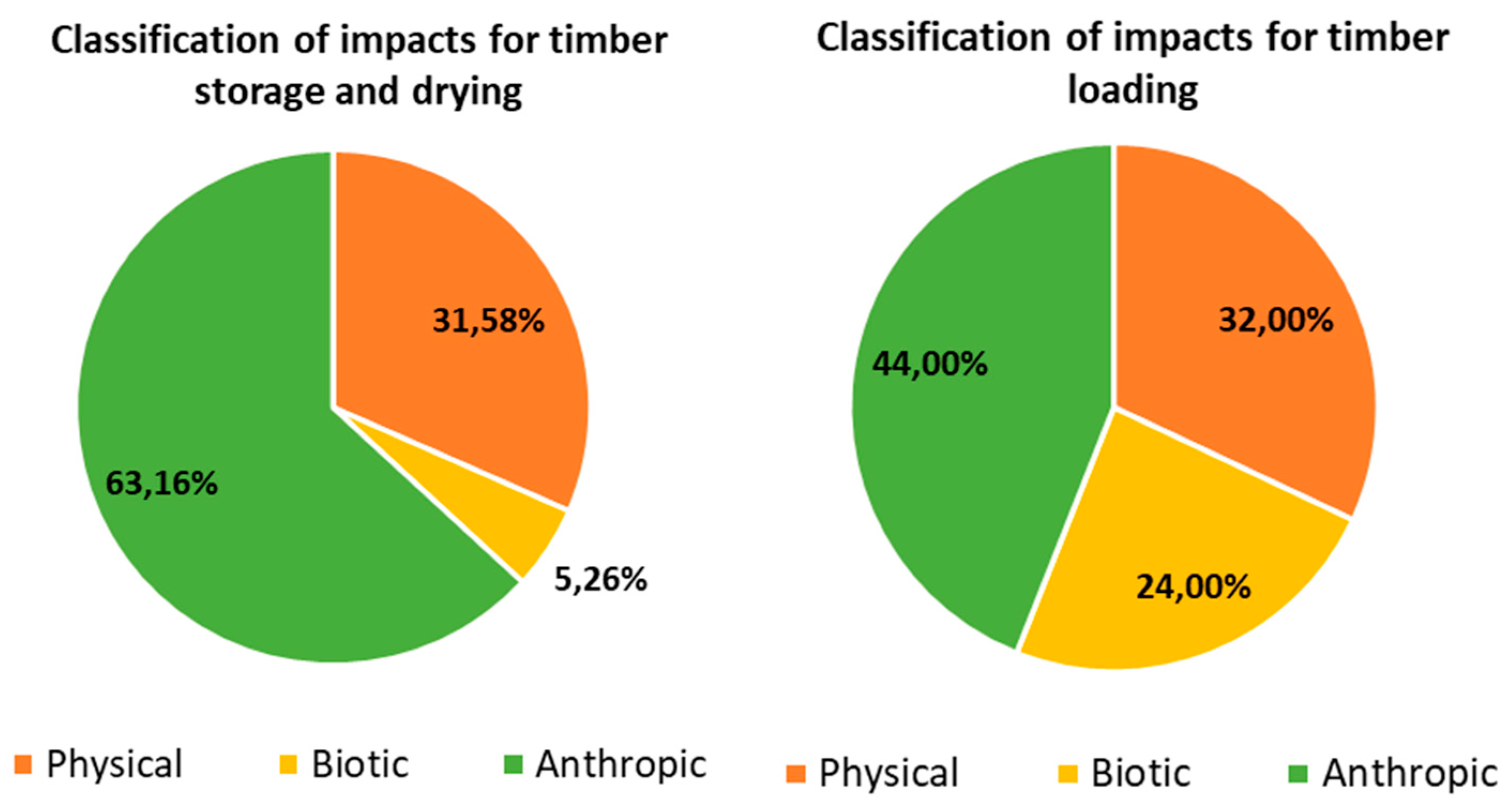
Figure 5.
Classification of impacts for the interaction network for timber transportation activities.
Figure 5.
Classification of impacts for the interaction network for timber transportation activities.
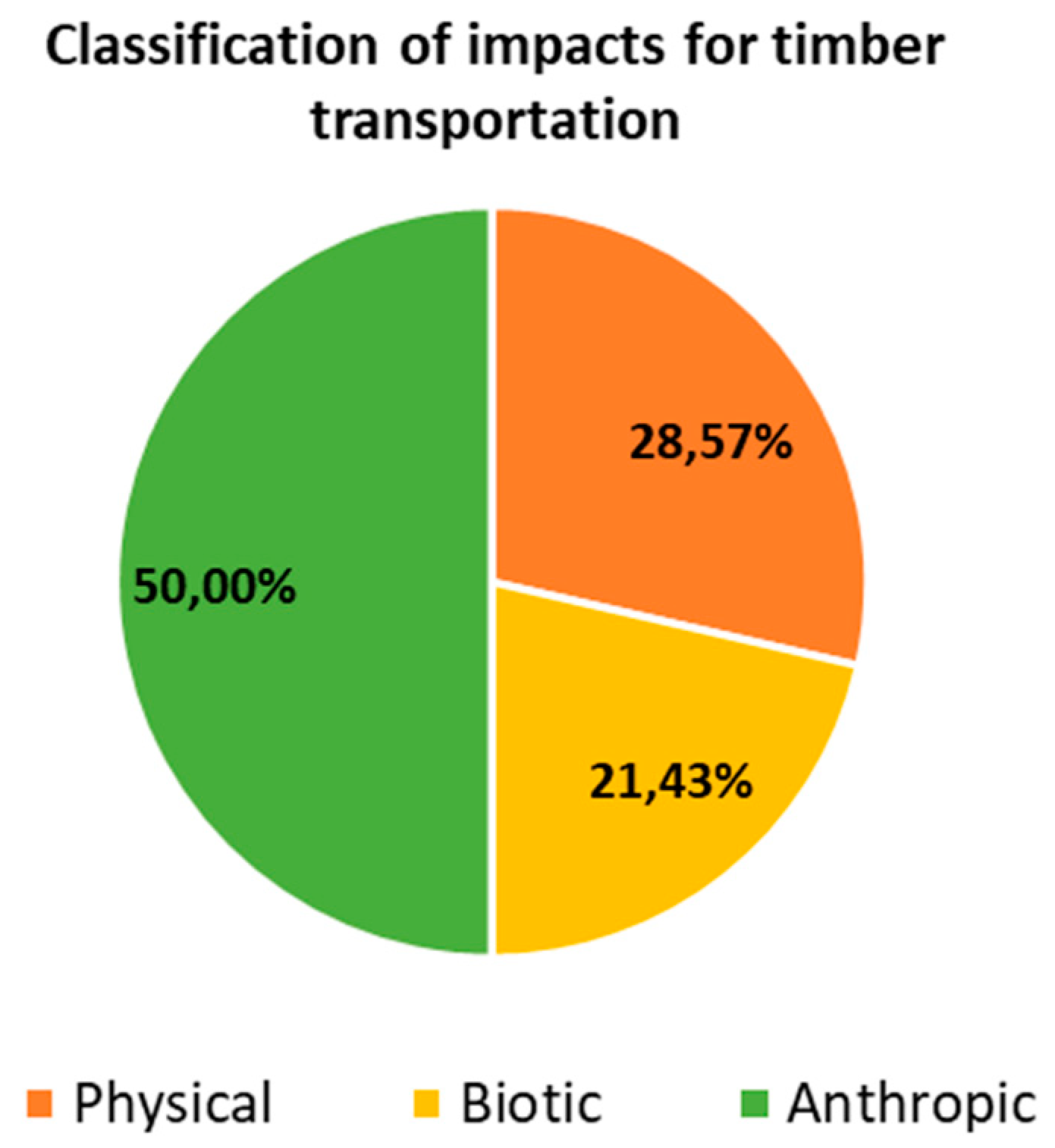
Figure 6.
ES for road opening and maintenance evaluation matrix. Note: The colors of the environmental impacts relate to the following environmental aspects: brown - extraction of soil for road construction; blue: movement of machinery; yellow - acquisition of inputs and green - hiring of labor.
Figure 6.
ES for road opening and maintenance evaluation matrix. Note: The colors of the environmental impacts relate to the following environmental aspects: brown - extraction of soil for road construction; blue: movement of machinery; yellow - acquisition of inputs and green - hiring of labor.
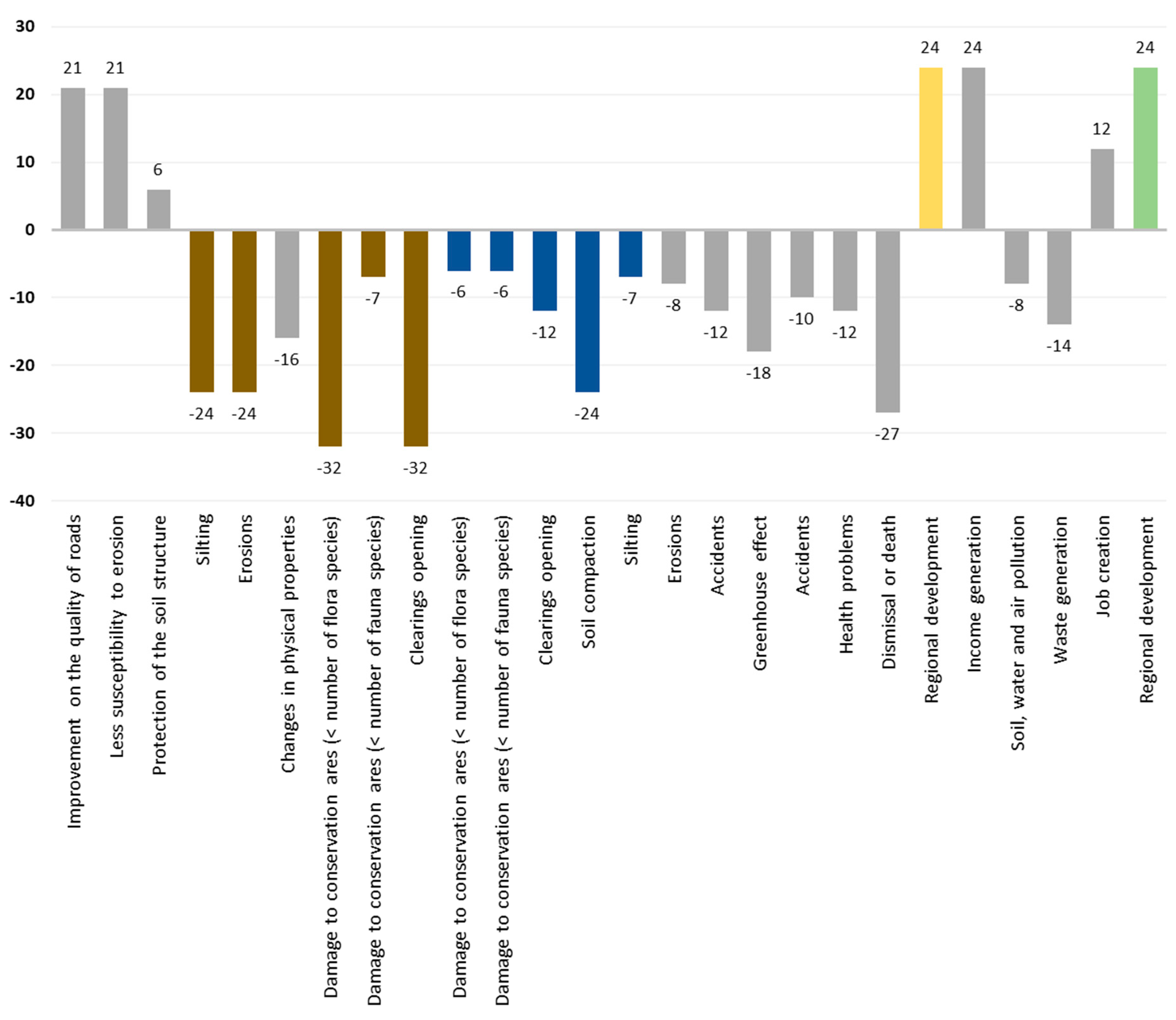
Figure 7.
ES for logging evaluation matrix.
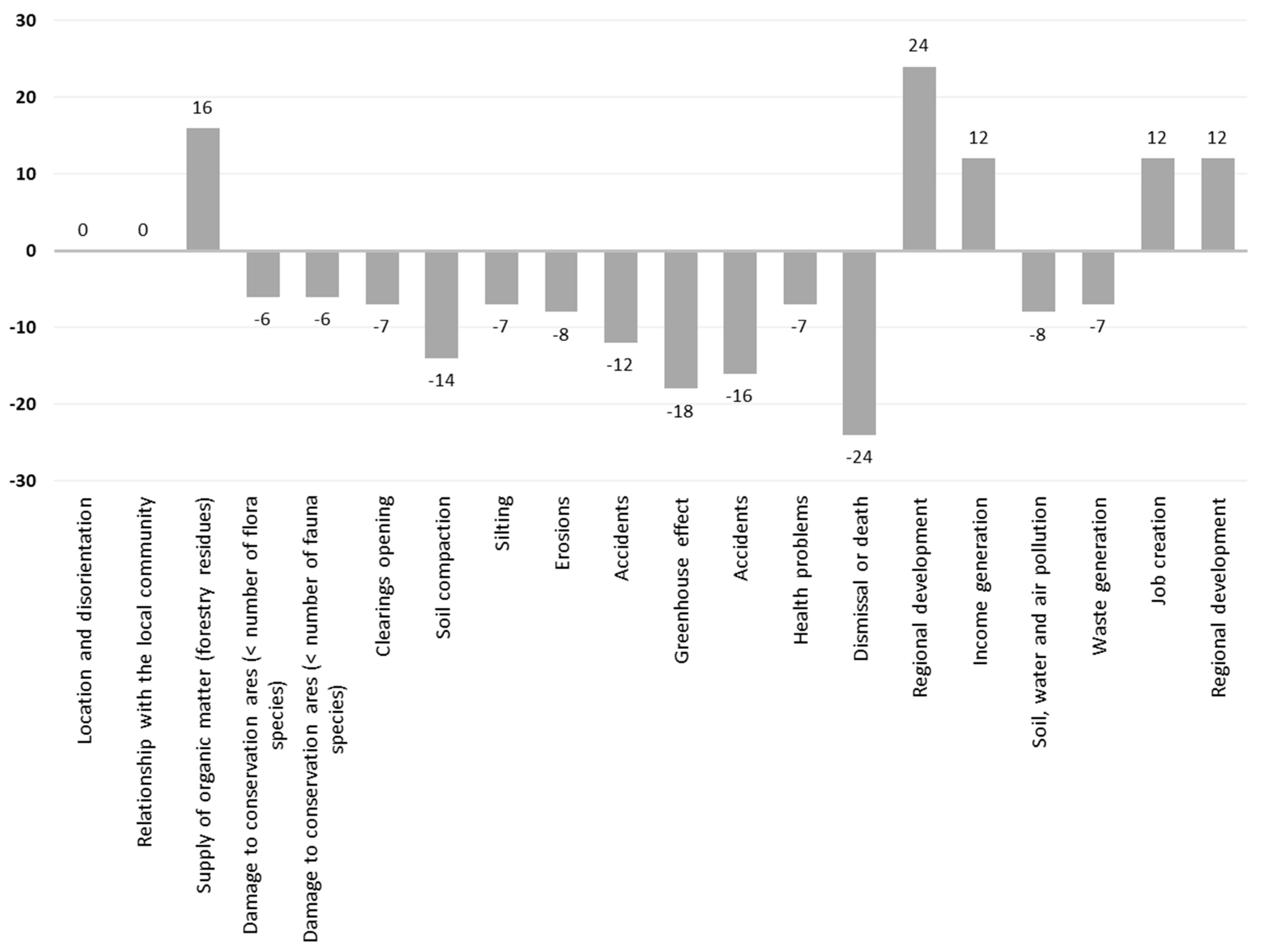
Figure 8.
ES for wood stock and drying evaluation matrix.
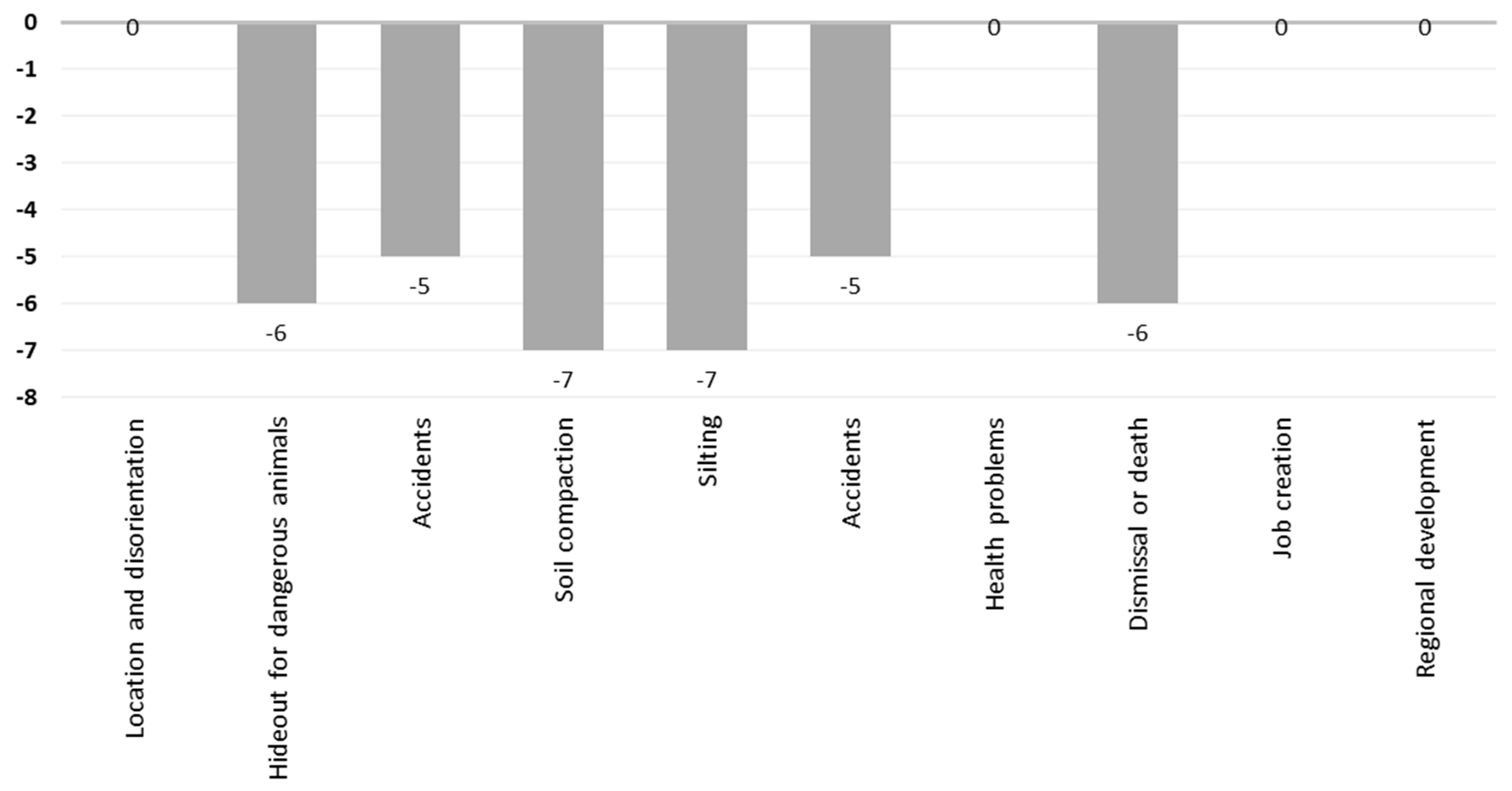
Figure 9.
ES for wood loading evaluation matrix. Note: The colors of the environmental impacts relate to the following environmental aspects: yellow - purchasing inputs and blue - hiring labor.
Figure 9.
ES for wood loading evaluation matrix. Note: The colors of the environmental impacts relate to the following environmental aspects: yellow - purchasing inputs and blue - hiring labor.
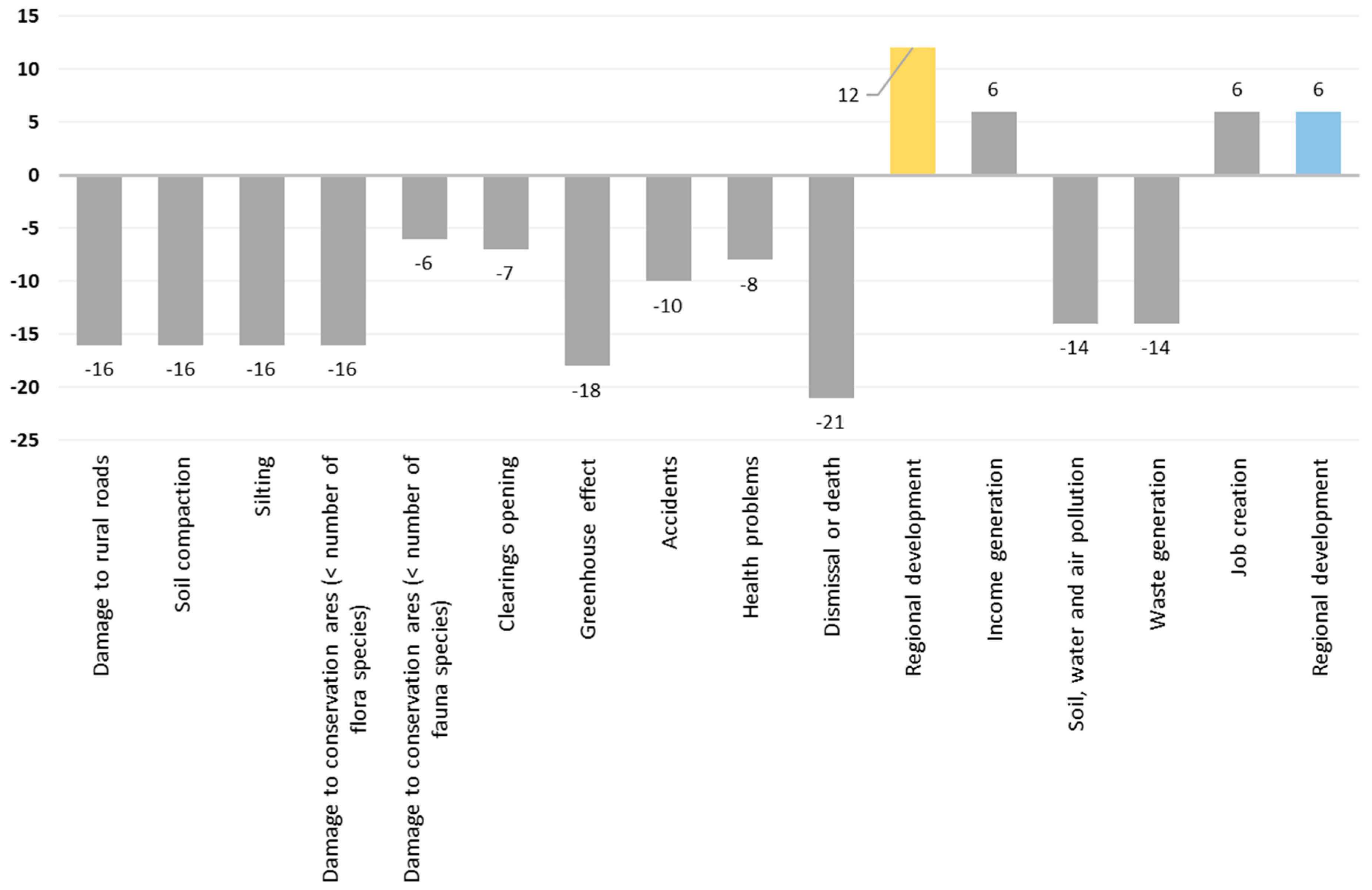
Figure 10.
ES for wood stock and drying evaluation matrix. Note: The colors of the environmental impacts relate to the following environmental aspects: green - purchasing inputs and red - hiring labor.
Figure 10.
ES for wood stock and drying evaluation matrix. Note: The colors of the environmental impacts relate to the following environmental aspects: green - purchasing inputs and red - hiring labor.
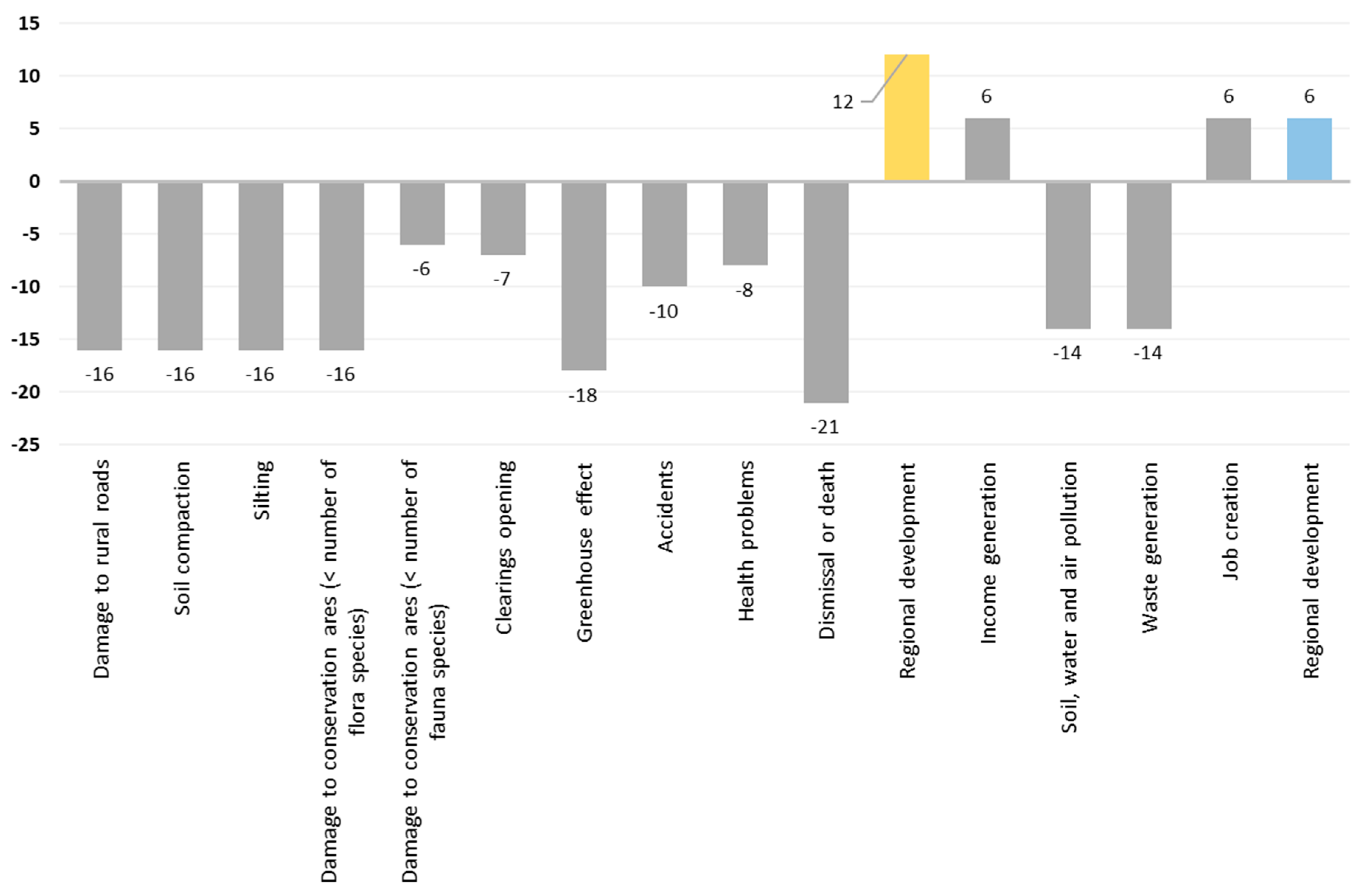
Table 1.
Scale of numeric and alphanumeric values – impact assessment [17].
Table 1.
Scale of numeric and alphanumeric values – impact assessment [17].
| Value Range (ES) | Numerical Scale | Environmental Impact Class |
|---|---|---|
| 108 a 72 | 05 | Extremely Positive |
| 71 a 36 | 04 | Significantly Positive |
| 35 a 19 | 03 | Moderately Positive |
| 18 a 10 | 02 | Not very positive |
| 09 a 01 | 01 | Very Little Positive |
| Zero | 0 | Unchanged |
| -01 a – 09 | -01 | Very Slightly Negative |
| -10 a -18 | -02 | Slightly negative |
| -19 a -35 | -03 | Moderately Negative |
| -36 a -71 | -04 | Significantly Negative |
| -72 a -108 | -05 | Extremely Negative |
Disclaimer/Publisher’s Note: The statements, opinions and data contained in all publications are solely those of the individual author(s) and contributor(s) and not of MDPI and/or the editor(s). MDPI and/or the editor(s) disclaim responsibility for any injury to people or property resulting from any ideas, methods, instructions or products referred to in the content. |
© 2024 by the authors. Licensee MDPI, Basel, Switzerland. This article is an open access article distributed under the terms and conditions of the Creative Commons Attribution (CC BY) license (http://creativecommons.org/licenses/by/4.0/).
Copyright: This open access article is published under a Creative Commons CC BY 4.0 license, which permit the free download, distribution, and reuse, provided that the author and preprint are cited in any reuse.