

Submitted:
28 May 2024
Posted:
29 May 2024
Read the latest preprint version here
Abstract
Building integrated photovoltaics (BIPV) consists of PV panels that are integrated into the building as part of the construction. This technology has advantages such as the production of electricity without necessary additional land area. This paper provides a literature review about the recent developments in urban building energy modelling, including tools and methods, and the effect of PV systems on building outdoor and indoor environments. It is also intended to provide a critical analysis on how PV systems affect the urban environment, both from an energy and a comfort point of view. The urban heat island development is introduced and related with the existence of PV systems. It is concluded that data acquisition is still a weakness in urban building energy modelling, especially in what concerns non-geometric data, which leads to a major source of errors. The availability of data is a challenge because frequently they are not accessible, due to privacy, high-cost or other reasons. Also, methodologies to develop precise archetypes for creating urban building energy models are lacking.
Keywords:
urban building energy modelling
; PV systems
; solar energy
; urban heat island
1. Introduction
Energy has been in focus due to its importance either in economy, climate change or political decisions. On one hand, countries want to ensure energy independence and security relatively to other nations, competitiveness, and economic standing [1]. On the other hand, it is necessary to reduce the emissions of carbon dioxide (CO2) and greenhouse gases, to mitigate climate change.
Some solutions are transverse and allow for the achievement of energy sustainability, which can be defined as “the provision of energy such that it meets the needs of the present without compromising the ability of future generations to meet their needs” [2]. In this way, in addition to the reduction of energy needs, the promotion of diversifying the energy sources in the energy mix, and the increasing of energy production from renewable sources is needed. One of the main renewable sources used for energy production is the sun. Solar energy can be converted into thermal or electrical energy [3]. To generate electricity, solar photovoltaic (PV) can be used. Solar energy and geothermal heat only represented, in 2020, about 2% of buildings renewable share [4]. This means that is important to increase distributed energy systems, namelly solar PV. There are still challenges to increase the penetration of solar PV. For example, cities combine large electricity consumptions with limited space, which restricts access to eligible solar surfaces [5].
Incorporating PV technologies into buildings, not only increases the electricity production, but can also affect energy loads and comfort. These aspects must be considered and optimized to increase sustainability and, therefore, the share of electricity produced from solar PV.
Cities are responsible for more than 50% of the global population, 80% of global gross domestic product (GDP), two-thirds of global energy consumption, and more than 70% of annual global carbon emissions [6]. Considering that cities are the main drivers of the European Union’s (EU) economy, the EU is promoting policies to make urban areas more sustainable, competitive, and healthier, while tackling climate challenges [7].
As the International Energy Agency (IEA) stated [6], countries cannot meet their climate targets without optimizing building energy efficiency and energy demand. Buildings play an important role in world energy consumption and, consequently, in the environment. In 2022, building operations were responsible for 30% of global final energy consumption and 26% of global energy-related carbon dioxide (CO2) emissions [8]. In the EU, building energy consumption is more significant. According to the European Commission, they account for 43% of final consumption and 36% of CO2 emissions in the EU [9]. Overall, buildings are responsible for a large share of total energy consumption and CO2 emissions.
It is also known that people spend most of their time inside buildings, whether at work or at home. Therefore, it is necessary to guarantee adequate indoor conditions to maintain thermal comfort and air quality. In ideal circumstances, this will lead to the use of energy to satisfy the needs of the building occupants. However, sometimes, the energy bills are too high for the end-users, which may lead to energy poverty, that happens when householders don’t have access to essential energy services [10]. The innovation in new efficient technologies can reduce the price and increase their acceptance, which is crucial to alleviate energy poverty and be in line with energy transition.
2. Building Energy Modelling and PV Systems in the Urban Environment
Building energy simulation tools are important to predict and analyse building energy consumption, CO2 emissions, and indoor conditions. This is particularly important to analyse the impact of new efficient technologies in buildings, without being necessary to install the solutions. They focus essentially on heat transfer through the envelopes [11].
There are many software tools that may be used for building energy simulation. However, some tools are better suited than others, according to the desired objective. In fact, in addition to the experience of the user, and hardware availability, the first criterion for selecting a building energy analysis program is the ability of the program to deal with the application [12]. Pan et al. [13], categorize 157 studies into five application scenarios: performance-driven design, operational optimization, building-to-grid interaction, digital twin, and urban modelling. The distribution of the studies across the various application scenarios is presented in Figure 1.
According to VanDerHorn and Mahadevan [14], a digital twin can be defined as “a virtual representation of a physical system (and its associated environment and processes) that is updated through the exchange of information between the physical and virtual systems”. Using this definition, it is possible to state that, in the case of urban building energy modelling, the digital twin will consist of a virtual representation of city buildings, that is updated in terms of energy systems, through the exchange of information between the physical buildings and its virtual representation.
To understand digital twins for building energy simulation either for single buildings or at an urban scale, it is important to know some concepts, like building information model (BIM), building energy model (BEM), urban building energy model (UBEM), and Internet of Things (IoT). The first one, the BIM, is a comprehensive digital representation of a building and typically contains information about its geometry and systems, spaces and zones, and the project structure/schedule [15]. However, BIM does not contain the entire energy information about the building. For that, it is necessary to create a BEM that is a physics-based model of building energy use [16]. Usually, the creation of BEM starts with a BIM, which adds information about, for example, lights, occupancy, heating, ventilating, and air conditioning (HVAC) systems, and renewable systems. BEM can be simulated by software to analyse the energy performance of buildings. BIM and BEM offer high-fidelity projects at the component level [17]. However, the integration of real-time sensing data with the static information provided by BIM models is possible with, for example, the emergence of the IoT [18]. IoT can be defined as the “interconnection of sensing and actuating devices providing the ability to share information across platforms through a unified framework, developing a common operating picture for enabling innovative applications” [17,18].
The interaction between real-time data with the virtual and the physical entity is, indeed, an advantage relatively to simulations with static and historical data. This allows not only to evaluate the performance of the building, but also to improve decision-making, through continuously updated information, monitoring, and prediction of actual and future conditions of the buildings, both in the design and operational phases, [19].
An UBEM follows an identical concept to a BEM. It means that the physical models of heat and mass flow through the buildings applied to a BEM are the same for a UBEM but applied on a larger scale, to more buildings. Also, BEM and UBEM have different objectives. The first one intends to analyse the energy performance of individual buildings, to optimize the energy efficiency at the building level during design and construction phases. UBEM has the objective of supporting decision-making for properly designing and optimizing energy systems at the urban level [20]. Due to the larger scale of UBEM, compared to BEM, the simulation requires significant automation procedures and computational prowess during data input, model generation, simulation, calibration, and execution [21]. Also, modelling an urban energy system has challenges due to the complexity of urban systems, lack of data, and extensive amount of time and modelling effort to achieve accurate urban scale modelling [22].
Building integrated photovoltaics (BIPV) consists of PV panels that are integrated into the building as part of the construction. This technology has advantages such as the production of electricity without necessary additional land area. Also, BIPV can be used as, for example, exterior protection of a window, which means that the cooling needs decrease while there is simultaneous production of electricity [23]. In general, according to Zhang et al. [24], building surfaces available for integration of PV systems are façades (Figure 2), roofs (Figure 3), windows and overhead glazing (Figure 4), and sunshades (Figure 5). On the other hand, Building Attached Photovoltaics (BAPV) consists of PV systems that are attached to existing building envelopes [25], for example through an installation with brackets into a roof.
The performance of BIPV systems is affected by several parameters, such as building orientation, panel slope, solar cell type, ambient temperature, geographical location, and shading [30]. In fact, in terms of geographical location, due to a higher amount of solar radiation near to zenith, in tropical regions BIPV were mostly installed on roofs [31]. In contrast, in non-tropical regions, the amount of solar radiation near to zenith decreases with latitude, which reduces the electricity production in roof solar PV panels, while favouring the electricity production in panels placed on vertical walls.
It is known that in the northern hemisphere in non-tropical regions, the best orientation for a solar panel is South. However, in BIPV, along with energy performance, the installation of solar PV panels is also dependent on aesthetics and architectural aspects, which makes implies making decisions during the design phase [32]. Other factors, such as daylighting performance and energy consumption of the building, are fundamental to design an efficient BIPV system.
The outdoor environment also influences PV system performance. In the same way, PV systems have an impact on the outdoor environment, for example in the air temperature or building energy use. This idea about how the built environment and PV system performance are related is synthesized in a review made by Sailor et al. [33]. It was stated that the air temperature, air pollution, soiling, and shading provoked by the urban environment, impact the electricity output of PV systems. In fact, in terms of temperature, the higher the PV surface temperature, the lower its efficiency. Therefore, due to the low thermal mass of PV panels, these surfaces heat faster than urban surroundings, which can reduce the PV output. In addition, Urban Heat Island (UHI) effects can decrease the efficiency of the PV panels. In terms of shading, it was referred that partial shading from surroundings or trees is a challenge to improve the PV output. On the other hand, concerning the effect of PV panels on air temperature or building energy consumption, Sailor et al. explained that the results of studies are not convergent. In terms of air temperature, although PV panels can warm the air during the day and cool during the night, it is necessary to use realistic values for urban surfaces, PV efficiency, and PV installation characteristics. Also, the air conditioning loads can differ according to the albedo of the surfaces, building insulation, and building characteristics and constructions. It was also noted that integrating PV systems into shade structures can be beneficial in hot climates while producing electricity. However, regarding thermal comfort, high solar reflectance structures are preferable because they have a lower mean radiant temperature.
The thermal impact of PV panels on the surrounding environment is usually neglected, and often only the electricity production from this type of technology is analysed. However, due to the low thermal inertia of these systems compared to urban constructions, lower reflectance of radiation at higher wavelengths and shading, this can influence the air temperature, which is directly related with a microclimate effect and the formation of UHI, and consequently affect the thermal loads of buildings. Furthermore, these types of converters, can also influence the comfort of people. In the literature, there are recent studies and reviews that address the impact of microclimate effects, namely the UHI formation on urban environment. Mirabi and Davies [34] reviewed the impact of different types of urban infrastructures, such as rails, road networks and systems and utility corridors, on UHI effect. Zhou et al. [35] reviewed the interaction between PV systems in the urban environment through CFD analysis. Zhu et. al [36] developed a review addressing the impact of urban green infrastructure on microclimate effect and building energy consumption. Susca et al. [37] performed a review on the relation between green wall installation and UHI effect and building energy use.
However, critical reviews presenting the effect of photovoltaic systems and urban surfaces on microclimate effects, namely in what concerns UHI formation, building performance and outdoor and indoor comfort, are still few. This paper aims to fill this gap, presenting a novel literature review addressing this topic, focusing on the use of urban building energy modelling as a tool to fulfil the aforementioned objectives.
3. Urban Building Energy Modelling
UBEMs can be categorized into top-down and bottom-up models. The first ones rely on aggregated historical data to express the relationship between energy use and drivers like socio-economic variables and climate conditions. This approach is based on statistical methods, whereby it is independent of detailed technological descriptions and simpler. Nevertheless, this modelling is less suitable for examining changes in technology for current and future development studies.
On the other hand, bottom-up models are made from extensive data on a disaggregated level, which allows to estimate the individual energy consumption and, consequently, the whole energy use of the city or district. Based on the level of detail in the end-use information and the applied methodology, bottom-up models can be divided into three main categories: statistical, engineering (physical), and hybrid models [38]. The statistical models use historical data and regression analyses to establish relationships between the energy use of the buildings and their characteristics. The second one takes advantage of the physical and technological properties of the individual buildings, to estimate the energy consumption of each one. These models have high flexibility and allow to evaluate different energy efficiency scenarios. Finally, hybrid models refer to when these two methods are combined, for example, modelling the buildings according to physical characteristics and estimating the occupancy schedule from statistical data. Nevertheless, Reinhart and Cerezo Davila [39] classified bottom-up engineering models, which include physical models of heat and mass transfer in and around buildings as “urban building energy modelling”.
According to Figure 6, a UBEM requires five steps: data pre-processing, model generation, simulation, calibration, and application. The first consists of acquiring geometric and non-geometric data, weather data, energy measurements, and building templates. The second is the creation of a geometric model using the geometric data collected. After that, the simulation involves the generation of load profiles, indoor temperatures, and energy use. It is created based on the geometric model developed in the step before, non-geometric data, such as occupancy and equipment schedule, weather data, and building templates. The simulation is calibrated resorting to historical energy measurements, to achieve the energy model closest to reality. The energy model created can be used for different applications.
An overview of the acquisition of geometric and non-geometric data is given next, based on the works performed by Wang et al. [40] and Johari et al. [38]. Starting with geometric data, this type of information is necessary to design a geometric model, such as building footprints and heights, window-wall ratios, number of stories, and terrain data. This information can be achieved using existing databases, for example, using a shapefile that can be used for a Geographic Information System (GIS) such as QGIS. Other direct modelling approaches are achieved using Light Detection and Ranging (LiDAR) and oblique photogrammetry. When studying a larger number of buildings, a common practice is to use archetypes to estimate the non-geometric data, because it is difficult to model and acquire data for each building. In this way, the archetypes can be classified into deterministic or probabilistic classifications. The deterministic classified buildings according to their typology, age, shape, and floor area. Also, if HVAC system data are available, this could be another indicator to classify them. Relatively to a probabilistic classification, the archetypes are formed based on historical energy demand data, which could increase the accuracy faced by deterministic classifications. They both agree that the major current challenges related to data acquisition rely on non-geometric data, especially in what concerns archetype development, due to higher uncertainties associated. The access of data to develop the archetypes is still a challenge, due to data privacy or high cost. In addition, there is a lack of methodologies to determine the occupant’s behaviour and energy use profile.
Abolhassani et al. [41] developed a novel workflow for detailed urban energy modelling, which used an occupancy archetype approach, intending to reduce the uncertainty associated with occupancy behaviour. They categorized archetypes based on building use type and year of construction, obtaining occupancy, lighting, electrical equipment, and ventilation schedules. The construction archetypes follow an identical procedure. It was reported that occupancy behaviour has the most impact on heating and cooling needs, and its uncertainty can be reduced through more accurate feedback and smart energy management systems.
Sasso et al. [42] follow a common approach and categorize archetypes based on construction period, type of heating system, location, and urban setting. This work presented a study on the thermal performance of office buildings in Switzerland and can highlight future works on thermal optimal retrofit through energy-efficient measures on envelope and heating systems. However, this study does not consider ventilation systems, nor the accuracy of the results in terms of archetype characterization.
Borges et al. [43] studied a hybrid approach, combining deterministic and cluster methods, to characterize archetypes for urban models. As seen in Figure 7, first the buildings are grouped according to their use. After that, with machine learning, they are analysed as a clustering considering energy consumption. Finally, a fragmentation is made, considering the construction period. This technique showed granularity of results when compared to separate deterministic or clustering methods: it represented more accurately heterogeneities of buildings than deterministic methods, while better distinguishing key aspects of the building compared to cluster approaches. However, the application of this approach is complex and requires more time than a pure deterministic or cluster method. Also, this study does not show the impact of the hybrid approach on UBEM simulation results.
A reference building could be characterized from deterministic methods, through the average values obtained after audit of different buildings of the same archetype. On the other hand, the methods could be probabilistic, and the values not obtained from the average but instead from uniform or normal distributions, which could improve the simulation accuracy but increase the simulation time. In addition, the buildings could be characterized from non-pure deterministic methods like using standards such as those of the American Society of Heating, Refrigerating and Air-Conditioning Engineers (ASHRAE), that present reference values for the same category.
Any input unreliability can lead to an error in energy consumption. The occupancy behaviour, namely occupancy schedule, due to its variability and prediction difficulty, is one of the major sources of uncertainty in the building energy consumption and it has been studied in recent years [44]. Fu et al. [45] developed a study in China, that generated an approach to identify residential buildings occupancy patterns and to describe profiles of typical families. Four occupancy patterns for workdays and five for weekends were found, and the average occupation time was 20.3 hours per day during weekdays and 20.1 hours per day during weekends. By far, the bedroom is the division with the most occupation. This paper was developed considering factors like the characteristics of householders, namely in what concerns age, work status, and educational experience. However, although the study was carried out in different geographical locations across China, it didn’t consider other countries. Another major drawback of this study is the fact that it only includes data from the summer season, from June to September 2017.
Ferrando et al. [46], based on a study developed in 21 buildings in Milan, created data-driven schedules for electric use and occupancy from smart meters and assessed the impact of these schedules on energy results of UBEM at different time and spatial scales. They found that fixed and predefined schedules tend to underestimate the energy results when compared to schedules with measured data. Still, for simulations at the urban scale, fixed schedules seem to be enough to describe energy patterns. On the other hand, for small groups of buildings, randomizing the schedules can bring variability to the model energy results. Although this study was performed over a year and with different time and spatial scales, it was only developed for the residential sector and a specific region of Italy.
Fu and Miller [47] show an approach to predict energy consumption in buildings using data collected from Google Trends. It was found that the searched volume of information on certain topics is correlated with building energy use. This fact helps to improve the prediction of the energy model. This study has been made only for education and office buildings, and only 293 power meters of 2380 have a high correlation with Google Trends.
Park et al. [48] developed an approach named CROOD, which allows to estimate the building occupancy from mobile device connections without ground-truth calibration. It was found that CROOD can estimate with reasonable accuracy the number of occupants of the building from the number of mobile devices. On the other hand, this approach is limited by building size, type, and system. In addition, this approach works better with a limited variable number of people in the building. Also, this approach was made in one educational building, making it necessary to test it in larger and different ones to confirm the results.
The number of people in the building can have a significant influence, for example in the HVAC design, and a bad estimation can be one of the causes of errors in the design. Besides that, it may influence individual and urban building modelling and be one of the errors in the estimation of energy consumption. This fact led, in recent years, to research new approaches to predict with accuracy the number of people in buildings. Although innovative approaches were proposed, the major gap identified was the impossibility of extrapolating the general approach to estimate the number of people in other types of buildings. In addition, the possibility to extrapolate for different other countries and regions or different seasons is still a weakness of these studies.
Calibration and validation of the simulation is a key part of the modelling process [49]. Urban energy modelling is no exception, and this step is required to improve the precision of the results and bring the virtual energy model closer to reality. For urban energy modelling calibration, Bayesian inference is “the process of fitting a probability model to a set of data and summarizing the results by a probability distribution on parameters of the model and unobserved quantities such as predictions of new observations” [50]. It is gaining interest and has been studied by different researchers in recent years. Tardioli et al. [51] exploit a non-deterministic Bayesian framework to identify sets of representative parameters for the building clusters and to calibrate the model, due to the necessity to overcome problems of data scarcity and to scale the solution for large applications. They found that the method has better performance for large groups of buildings when compared to single buildings, because errors tend to eliminate each other. However, more studies must confirm these results, especially at higher time scales. Dilsiz et al. [52] conducted research studying the influence of using different spatial and time scales in urban building energy simulation results, using a validated Bayesian calibration approach. They stated that for an annual time period the accuracy can increase by performing a calibration with building-level data. However, this brings concerns about privacy and complexity. On the other hand, performing calibration of annual data instead of monthly data can increase the accuracy at an aggregated level. In addition, this study highlights the need to perform research for detailing with more accuracy the performance of building-integrated solar energy systems.
Weather data is important information to UBEM simulations, because weather conditions, such as humidity and exterior temperature, have a direct influence on building energy demand. Therefore, the precision of weather data selection is important for high accuracy of results. In addition, it is also reported that considering the urban microclimate affected by urban heat island (UHI) significantly influenced the energy consumption of the buildings [53].
Liu et al. [54] carried out research in Hong Kong, a high-density city, comparing the building thermal performance with and without considering the microclimate effect. MesoNH-TEB was used for urban microclimate data in EnergyPlus. They found that the thermal performance of buildings is highly affected by the surroundings, especially during hot seasons and in high-density urban areas. Because of that, not considering the microclimate can lead to an underestimation of about 140% in building overheating. Still, there are a lot of uncertainties present in the measures.
Xu et al. [55] investigated the influence of weather datasets on building thermal performance in a high-density city, through a comparison between microclimate datasets and a typical meteorological year. They found that the bias error is half when using microclimate datasets. The microclimate data were developed by coupling measured weather data with an increment temperature local model due to anthropogenic heat.
Katal et al. [56] studied a dynamic approach to integrate urban microclimate and building/thermal energy models, in Montreal. They used CityFFD, which is made to predict the microclimate features due to aerodynamics, coupled with CityBEM. It was stated that the spatial variation of local air temperature during the hottest time could reach 15 ºC, which has a great impact on building thermal performance. In addition, the energy consumption of buildings using microclimate data results in a 5 to 23 % variation, when compared to uniform weather data.
A novel review conducted by Sezer et al. [57], considered different urban microclimate software tools, such as Envi-MET, OpenFoam, and CityFFD. Depending on their characteristics, they can be coupled with different energy simulation tools. For example, ENVI-met can be used to increase the accuracy of building energy load estimation with TRNSYS, ESPr, or EnergyPlus, and OpenFoam can be integrated with CitySIM or EnergyPlus, to consider the convective effect on urban energy simulations. They stated that coupling Computational Fluid Dynamics (CFD) with building energy models is a common coupling strategy but requires high computational costs and increased simulation time. In addition, it is referred that there are still few studies in the literature about coupling strategies.
Table 1 presents the major characteristics and the references of the software tools used to model the urban microclimate.
ENVI-met was developed in 1998 by Bruse and Fleer [58]. This software can simulate microscale interactions between the atmosphere, vegetation, and surfaces. To model the atmosphere, it calculates mean air flow using Navier-Stokes equations, temperature and humidity with advection-diffusion equations, and turbulence and radiative fluxes. In addition, the software models the soil, vegetation, ground surface, and walls.
Thomas et al. [59] used ENVI-met to study the effectiveness of green walls on the modification of microclimate in an urban academic campus. It was possible to conclude that the green walls reduce the ambient average temperature by 1.3 to 1.6 ºC in Winter and 0.4 to 0.5 ºC in Summer. The software was used to model the interactions between plants and air, to estimate the ambient air temperature, water vapor pressure, relative humidity, and mean radiant temperature.
Forouzandeh [60] predicted the surface temperature of buildings using ENVI-met. The effect of different variables, such as the inside building temperature, was explored. It was found that ENVI-met cannot predict with accuracy the surface temperature during all days and hours of the year. The Winter results showed more accuracy than the Summer ones.
Aleksandrowicz et al. [61] assessed the accuracy of the new version of ENVI-met in determining the mean radiant temperature. It was shown that the accuracy of the simulation to determine reflective radiation fluxes increased with the new version. However, the mean radiant temperature obtained is still low and less accurate. Another problem described was the high simulation time, which limits the application to large-scale areas.
Wong et al. [62] coupled OpenFoam, which is an open-source 3D CFD software, with weather research forecasting (WRF) and EnergyPlus, to create an urban microclimate model, considering multi-scale effects, combined with building energy models. In this study, the outputs of WRF, which reproduced the mesoscale climate conditions, served as boundary and initial conditions for OpenFoam, which was used to refine the microclimate model and combined with EnergyPlus to assess the building energy demand.
Mirza et al. [63] used OpenFoam to analyse the effect of building temperature on air temperature and wind velocity and profile. It studied the changes in the infrastructure, including the addition of a vegetation cover to assess the cooling effect provoked by it. OpenFoam was used to model the microclimate effect and was proven effective in studying the effect of variables such as water bodies, humidity, and albedo.
Kadaverugu et al. [64] improved the accuracy of the urban microclimate model, downscaling the wind flow into mesoscale to a building scale, using OpenFoam. Therefore, it was possible to assess microscale effects, such as vegetation, and to study several parameters, like tracing hazard residues or pollutants for hot-spot identification and thermal comfort due, for example, to changes in the wind.
Mortezazadeh et al. [65] presented the structure of a novel simulation tool called CityFFD, developed to respond to large-scale problems, including describing airflow around buildings, natural ventilation, and thermal stratification. It models the airflow using non-dimensional Navier-Stokes equations and introduces novel turbulence models based on the Smagorinsky Large Eddy Simulation method. As weaknesses, the lack of wall functions, radiation, vegetation and pollutants models were reported. Wang et al. [66] developed a study that first validated the CityFFD software and WRF-CityFFD combined method. It was concluded that with the combined method, it was possible to achieve an accurate wind distribution, especially in coastal areas and with a limited number of meteorological stations.
Urban building energy modelling tools should be chosen specifically according to the purpose of the work or the simulation approach, due to their great heterogeneity [67]. Other factors such as the experience of the user or the availability of the program, especially if it is an open-access software, influence the choice of software. Some of the tools that can be used for urban simulation are the following: CityBES [68], City Energy Analyst (CEA) [69], CitySim [70], UMI [71], and URBANopt [72]. The main characteristics of the existing software tools are indicated in Table 2.
CityBES is a software developed in 2016 by Hong et. al [68]. It is a web-based software that allows energy retrofit analysis, urban energy planning, building operations improvement, and energy benchmarking from a small group of buildings to all buildings of a city. The 3D modelling of the urban buildings in CityGML is an open-source software. The energy modelling is made using Energy Plus and OpenStudio. The architecture of the software is presented in Figure 8. On one hand, CityBES enables the analysis can be made, not only for a group of buildings but also for each building separately. However, this fact can increase the time of simulation and the computational requirements. Another problem with this tool is that Energy Plus can’t consider the inter-building effects, such as radiant heat exchange between building exterior surfaces, and the microclimate effect.
Teso et al. [73] developed a study in Venice, where CityBES was used to do an energy analysis of four common conservation retrofit measures. They were the replacement of the existing windows for more efficient ones, applying insulation in the interior of the roof and the exterior of the external wall, and, finally, the upgrade of the heating system through a replacement of the boilers for more recent and advanced ones. This work doesn’t consider the microclimate effects either, due to software constraints, and the heat transfer through mutual radiation between exterior surfaces of surrounding buildings. As reported before, one limitation of CityBES is the fact that it does not consider the microclimate effect. Therefore, Hong et al. [74] carried out research with CityBES where a microclimate map for San Francisco was created and applied as weather data, allowing to study the microclimate effect. Although it was possible to analyze the microclimate effect in San Francisco, for other cities it is not possible, yet, to do the same study with CityBES.
CEA was first presented by Fonseca et al. [69], in 2016. It is an open-source framework that enables energy, carbon, and financial analysis of building and infrastructure retrofit, and also to find optimal energy generation schemes, promoting the energy systems optimization at neighbourhood and district scales. With CEA, it is possible, in addition to other features, to assess, on a spatiotemporal scale, the availability of the resource, estimate the building energy demand and simulate conversion, storage, and distribution technologies. This tool seems to be an interesting tool to evaluate energy systems in urban building energy modelling. However, in terms of solar energy, it only allows to estimate the rooftop solar potential and the technical potential of rooftop solar collectors, photovoltaic (PV) systems, and PV-thermal collectors. This fact makes this tool-less suitable for estimating the potential of building integrated PV technologies.
Oraiopoulos et al. [75] investigated the future energy demand in representative Swiss communities, using CEA, considering future scenarios relative to climate change, building envelope, and energy systems retrofit. This tool was suitable for this objective, due to the objective of the work involving not only an analysis of building envelope retrofitting, but also an energy system analysis.
Mosteiro-Romero and Schlueter [76] studied the effect of occupants and microclimate on the demand and, consequently, on the performance and cost of the energy systems, using CEA. The energy systems studied were PV systems, heat pumps, chillers, and thermal networks. In this paper, CEA seems adequate for the aim of the study, due to having the possibility of estimating the solar PV potential, modelling the thermal networks, and integrating a microclimate and occupancy approach.
Robinson et al. [70] introduced a software for urban building energy modelling in 2009 called CitySIM, which was conceived for planned urban settlements with sustainable plans. It allows to simulate the energy demand of the buildings and to determine the energy supply from renewable and conventional energy systems. The software contains thermal models, radiation models to consider the radiance effects between buildings, behavioural models to estimate, among other aspects, the occupancy behaviour, and plant and equipment models, which include either HVAC or energy conversion systems.
Chen et al. [77] used CitySIM to calculate solar-induced wall temperature in a group of buildings and used that parameter as thermal boundary conditions in a CFD model. Although the software was capable of determining the hourly irradiation in the walls and the respective temperature, the effect of the shielding of surrounding buildings on wall temperature was not considered and the stratification temperature was not calculated.
Adilkhanova et al. [78] conducted research in the high-density city of Seoul, to study the climate and the integration of high-albedo materials to prevent urban overheating and to study the energy implications, using CitySIM for urban building energy modelling. The fact that this software has longwave and shortwave radiation models to take into account the radiance effects between the surroundings, neighbour buildings, and the ground, is a huge advantage to achieve the objectives.
Khan et al. [79] studied the combined impact of urban overheating and heatwaves on building thermal performance, using CitySIM. The software allowed to perform detailed dynamic energy simulations at the neighbour scale. Some of the outputs obtained with the software consist of the building energy and electricity demand, surface shortwave irradiance, and surface longwave balance. Once more, the advantage of this tool was the fact that it was possible to use detailed radiance models, based on simple electrical circuit analogy, with a resistor-capacity network.
Reinhart et al. [71] presented in 2013 a Rhinoceros-based urban modelling design tool to perform evaluations of operational energy consumption, daylighting, and walkability, called UMI. It uses Rhinoceros as the CAD platform to build the 3D geometric model, Energy Plus to perform building energy simulations, Daysim for daylight simulations, and, also, custom Python scripts that allow the assessment of walkability.
Buckley et al. [80] used UMI in a study in Dublin to evaluate energy retrofit policies in terms of energy cost, CO2 emissions, and energy use intensity. It tested a novel approach where an EU database called Tabula was used, which contains more information than the one required by UMI. It was found that this approach allows to provision of accurate assessments and district-level energy policy evaluations.
Wang et al. [81] performed a study in Beijing where the carbon emissions of the building through numerical simulations were evaluated with UMI. In this paper, the microclimate was considered, using a tool of UMI, called Urban Weather Generator. To calculate the carbon emissions of the building stock, UMI calculates the operational energy consumption, and, also, the embodied energy consumption. This allows to calculate, in a similar way, the operational and the embodied carbon emissions.
Buckley et al. [82] evaluated the energy profile of a neighbourhood with commercial and residential buildings, using UMI. The sharing of the solar power potential and district heating/cooling systems were considered. The software also allows to estimate the actual and future energy demand of the buildings, based on climate change projections.
URBANopt [72] is an open-source tool that was developed by NREL (National Renewable Energy Laboratory, USA) in 2016. OpenStudio allows to perform detailed simulations at individual building levels using EnergyPlus, estimating the building energy demands. The software allows to evaluate building-to-building shading and solar access. In addition, it is possible to assign several energy systems, such as community-scale PV, central heating and cooling plants, ground source heat pumps, and energy storage systems.
Wang et al. [83] used URBANopt to evaluate the impact of energy efficient measures and distributed energy resources on a community’s energy usage, carbon emissions, and peak demand, in Denver, Colorado. To achieve these goals, different modules were used to assess different energy efficient measures, that combine different scenarios of distributed energy resources and building models. In addition, grid-interactive models were used to optimize PV and battery system size and dispatch.
Flores et al. [84] developed an accurate energy model for a community where only minimal building and energy use data were available. URBANopt was used to achieve a detailed, accurate, and physics-based model that represents the energy usage of the community.
Ge et al. [85] studied the effect of vertical meteorological patterns in China, through the creation of a building energy model developed in URBANopt. It was possible to estimate the heating and cooling loads of the buildings and assess the effect of the urban blocks.
4. Effect of Photovoltaic Systems on the Indoor and Outdoor Environment
In recent years, different studies were carried out where the orientation of the BIPV and its effect on the building indoor environment were analysed. Uddin et al. [86] developed a research on the potential of energy conservation with the application of different types of semi-transparent integrated PV window systems in Bangladesh, through a numerical simulation in Energy Plus. It was found, as expected, that the south-facing integrated window systems generate more electricity and consume less electricity for lighting. Still, although east-face windows produce less electricity, the energy consumption is inferior due to less energy consumption in air conditioning. It is important to note that this country has a typical tropical climate and is located in the East region; therefore, the results can not be extrapolated for Portugal and other EU countries.
Nicoletti et al. [87] developed a mathematical approach to assess the electricity production of solar PV blinds. The parametric study was developed in the city of Rome in Italy. It was found that the maximum electricity production was achieved for southeast or southwest orientations. In addition, automating the closing of PV blinds can increase electricity production. However, in this study it was not possible to develop a method capable of achieving a compromise between electricity production, energy consumption, and daylighting performance.
In China, Feng et al. [88] carried out a study that assessed the potential of BIPV for residential buildings. They concluded that rooftops are the best choice to implement BIPV, followed by South (especially in high-latitude regions), and East and West façades, respectively. North façades can be adequate for areas with lower solar irradiation and with a lot of clouds. In this study the use of electrical storage for BIPV was not considered.
Along with BIPV orientation, shadow effects also have an effect on daylight performance, building consumption, and electricity production. Surrounding buildings may influence the solar radiation that reaches the panels and needs to be considered. In this context, the study of BIPV at an urban scale has been studied in recent years. Ye et al. [89] proposed a multi-objective framework for maximizing the solar PV potential, while minimizing PV area and enabling proper sunshade, to improve the electricity generation and the indoor sunshade, using PV-integrated sunshade devices. The study was developed in Hong Kong and considered real weather conditions and shading caused by obstructions, such as other buildings. An optimized solution was obtained in terms of PV shading, considering the balance between energy generation, cooling needs, and daylight performance. However, it was stated that the precise determination of window positions and building surface reflectance were a challenge to model the power potential of PV shades.
Liu et al. [90] made a multi-objective optimization to improve energy and environmental performance in residential blocks, including energy consumption, PV energy potential, and daylight performance. It was found that 58 Pareto solutions, increased the PV energy potential by 52.7% and sunlight hours by 50%, and reduced the energy consumption by 1.5%. The study was conducted in China in an ideal residential block. Nevertheless, it was highlighted that a lot of time was needed to perform the simulations and only some specific variables were chosen to obtain the optimization, such as building type, number of floors, and open space location. None of these variables include parameters that affect the performance of BIPV, such as shades or materials.
Xiang and Matusiak [91] explored the effect of balcony shading on façade integrated PV and on the daylight performance of high-rise buildings. Architectural aspects of the system were also assessed. It was found that it is important to avoid shading on lower-floor living rooms and southern surfaces, because of the high solar potential. Although this study produced some interesting findings in terms of the effect of shading, in this case, due to balconies, it did not assess economic aspects nor evaluate with accuracy the real efficiency of façade integrated PV.
Fan et al. [92] used the DaySim tool to investigate the indoor lighting environment to determine the optimal area ratio of different materials of skylight-integrated PV. It was found that cities with sufficient sunshine need a higher area of PV materials. In addition, possible shading can be necessary to avoid excessive lighting and glare. A weakness of this study consists in not considering factors that affect daylight, such as the type of skylight and the geometrical configuration of interior rooms.
To assess the economic potential of BIPV, Mendis et al. [93] conducted a study in Sri Lanka, which evaluated horizontally inclined PV-integrated shading strategies. It was found that horizontally inclined installations with a distance-to-length ratio of 4 and inclination of 30º are significantly more efficient than typical vertical installations. However, the effect of PV-integrated shading devices on daylight performance has not been studied.
Besides energy consumption, BIPV has the potential to improve thermal and visual comfort in buildings. The solar transmittance of the technology, allowing the sun to enter the rooms, affects the visual comfort of buildings. Also, the heat gains or shadow effects of BIPV can affect both thermal comfort and energy consumption.
Lee et al. [94] performed research to evaluate the potential of applying PV modules to light shelf reflectors, to improve indoor comfort and energy efficiency. They found that, in Summer and mid-season, the lighting consumption was lower due to an increase in the amount of natural light. However, the efficiency of modules was higher in mid-season due to relatively lower temperatures, and with increasing module area, both cooling and heating energy consumption increased.
Wang et al. [95] studied the effect of semi-transparent PV windows on indoor thermal comfort. It was found that the change of illuminance in different ranges has a significant impact on the thermal sensation. Furthermore, with semi-transparent PV windows, the indoor air temperature has higher variation when compared with simple clean glass and also presents a higher value. This was felt also by occupants who reported a warmer and uneven environment.
Yadav et al. [96] compared the thermal performance of opaque PV Trombe walls with semi-transparent ones. It was found that with semi-transparent cells, it is possible to achieve higher efficiency due to lower PV cell temperature, although the indoor air temperature is higher. On the other hand, opaque PV Trombe walls allow higher levels of indoor thermal comfort.
Taşer et al. [30] performed a novel review that stated that BIPV is more adequate for moderate, temperate, and sub-tropical regions, due to an increase in the indoor air temperature, which is not beneficial for indoor thermal comfort. In terms of the number of studies in the literature, it was indicated that there are more studies focusing on the effect of BIPV on energy performance, but few on indoor comfort. As a consequence, the effect of BIPV on both energy performance and comfort, either visual or thermal, has been not studied.
In the last years, the study on the relation between PV systems and urban environment has been made, and there have been updates on the state of the art. In this sense, the integration of PV systems into building systems and structures, such as roads and parking lots, has been studied. Ding et al. [97] performed research that analysed the energetic, economic, and environmental effects of the integration of solar PV into bus parking lots. It was found that solar PV can meet about 50% of the electricity demand of electric buses, the longest payback time being about 6.2 years, and, therefore, can reduce the emission of pollutants. However, the study does not evaluate the effect of these structures in the urban climate.
On the other hand, Serrone et al. [98] assessed the potential of substitution of asphalt road pavements, for a cool one with integrated PV panels, to mitigate the UHI. Although, in terms of air temperature and predicted mean vote, the solutions do not present significant differences, the mean radiant temperature was 4ºC higher for integrated PV roads, which may influence thermal comfort. Still, PV roads can meet 20 times the demand for lighting, whereby they may be used for other applications, such as vehicle charging. However, the simulations were performed only in July.
To evaluate the impact on cooling loads in buildings caused by the integration of PV, Garshasbi et al. [99] carried out research in Sydney during two summer months. It was found that PV can increase the ambient air temperature between 0.6 to 2.3 ºC, which translates into an increase in cooling loads, depending on wind intensity and direction, and characteristics of urban surfaces, such as the emissivity. It was also referred the importance of using PV panels with high reflection of light in higher wavelengths, to mitigate the increasing air temperature caused by these systems.
In a review performed by Elhabodi et al. [100], the increase in air temperature due to BIPV systems was assessed, the causes identified, and solutions to mitigate it were identified. It was stated that the increase in cell temperature led to a decrease in efficiency, and also the release of heat to the exterior increased ambient air temperature. Also, PV panels are made with low albedo materials which cause an increase in cell temperature and, consequently, enhanced the UHI effect and the cooling loads. However, PV panels can act as shading devices for buildings, which may reduce the cooling needs.
As mitigation strategies, thermal control of PV panels through ventilation systems can help to increase efficiency and mitigate the UHI effect. In addition, the adoption of, for example, green spaces with high albedo in the cities, PV panels attached to cool roofs, or semi-transparent PV panels integrated into buildings, can help to decrease the air temperature. However, it was reported that, in the future, studies should focus on different applications and types of PV panels in urban areas to explore the link between PV and UHI.
5. Conclusions
Urban building energy modelling has a great potential, as it may be used for several different applications. For example, it can be used to predict energy consumption and to estimate the energy and economic potential of retrofit measures at the district level, without the need for detailed simulations of each building. Additionally, it can be used as a basis for the creation of a digital twin, allowing instant monitoring of energy consumption.
The methodology to create a bottom-up urban building energy model (UBEM) seems to be well-identified in the literature. First of all, it is necessary to process and acquire the buildings data, and use them in the model creation and simulation. Afterwards, it is necessary to create the geometric and energy models. Calibration and validation are final steps to guarantee the precision and accuracy of the urban building energy model.
However, in the literature, some problems and gaps are related to UBEM simulation. The complexity of the modelling is still an issue. On one hand, creating a detailed energy model can require a lot of time, for example in what concerns the creation of a geometric model. The creation of the buildings, assignment of the shades and trees, substantially increase the difficulty of modelling. In fact, it was found that most studies do not consider the effect of the terrain and the elevation. However, it is important to take them into account to estimate with precision the energy potential of PV systems. On the other hand, the more complex the system, the longer the simulation time will be.
It was concluded that data acquisition is still a weakness in urban building energy modelling, especially in what concerns non-geometric data, which is one of the major sources of errors. The availability of data is a challenge because many times they are not accessible, due to privacy or high-cost reasons. Methodologies to develop precise archetypes for creating UBEM are also lacking.
In recent years, research related to Bayesian calibration has been carried out. The studies revealed that this type of calibration approach can increase the accuracy of the model. However, it requires high complexity, compared to common calibration approaches based on statistical indicators.
In relation to weather data, the studies refer the importance of considering the microclimate effect. Despite the underestimation of overheating due to the microclimate effect, those studies do not consider the urban heat island (UHI). This can significantly influence the energy loads of a building and the comfort of the occupants, either inside or outside. A common approach to consider the microclimate effect and estimate the comfort and energy consumption of a building is to combine CFD with energy modelling software. In this way, with CFD, it is possible to consider the convective effects and to predict with detail wind effects. The choice of the software needs to be made according to the desired application and considering the capabilities of the programs to create a coupling strategy. However, the process is complex, and it is necessary to explore different coupling methods, because there are few studies on the matter.
PV systems can be used either integrated or attached to buildings, and affect their energy and daylight performance, as well as the comfort of occupants. In recent years, the orientation and inclination to install PV systems has been studied. In terms of orientation, South façades or rooftops (in the Northern Hemisphere) are the best locations to install PV panels to maximize electricity production. However, the literature is inconclusive and presents contradictory results concerning the suitable location and orientation to find an optimal compromise between energy consumption, daylight performance, and electricity production.
The dependence of electricity generation, energy consumption, and daylight performance with PV shading devices has been addressed. These systems can ensure that excessive light does not enter in rooms, which, consequently, will influence energy consumption, at the same time that electricity is produced. However, like in the case of orientation, there are still few studies addressing shading solutions to find the optimal balance between electricity production, daylight performance, and energy consumption. The accuracy of the models in the determination of the real PV system efficiency or building surface reflectance, has been stated as a weakness of the studies.
Relatively to indoor thermal and visual comfort, the impact of PV systems has been studied. On one hand, although thermal comfort is related to visual comfort, it depends especially on air temperature, either in terms of magnitude or variation, whereby the studies have addressed the general energy impact of PV systems on buildings. On the other hand, visual comfort has been improved, along with shading to reduce excessive lighting, with indoor strategies at the building level to evenly disperse the light in a comfortable way to occupants throughout the rooms.
PV systems also affect the outdoor environment. The studies pointed to an increase in air temperature and accentuation of UHI during hot periods with higher solar radiation, due to PV systems. This happens due to a lower thermal mass of PV panels, which makes the cell temperature increase faster than the surrounding urban surfaces. Consequently, the cell temperature increase causes the efficiency of PV panels to decrease. However, the studies are not consistent regarding the magnitude of the effect of PV on UHI, and there is a need for more studies with real values of PV characteristics and urban surfaces. In addition, the balance between the increase of UHI and the reduction of building cooling loads due to shading is not well identified.
Together with the air temperature, the average radiant temperature is a parameter to considered to evaluate outdoor thermal comfort. The studies indicated that PV shades have a higher mean radiant temperature than urban shades, due to lower light reflectance at higher wavelengths. Still, studies have revealed the need to study different technologies of PV panels and types of urban surfaces in urban environments to evaluate the effect of PV panels on UHI. Notwithstanding, it is necessary to explore different mitigation strategies for UHI caused by PV technologies and use realistic values for PV panels and urban surfaces, specifically regarding emissivity and reflectance at each wavelength.
The present article presented an up-to-date review about urban building energy modelling and how it can be used for predicting the urban heat island effect and their relationship with building energy performance and comfort. It reviewed urban building energy modelling tools and their applications. It also reviewed the urban heat island effect and its causes, which include building surface type and PV systems. The following conclusions may be summarised by:
- A bottom up UBEM approach is well identified in the literature; however, the complexity level of the modelling needs to be carefully assessed; on one hand, a detailed UBEM can lead to a precise simulation; on the other hand, high complexity requires a lot of time for modelling and simulation.
- Poor data acquisition, especially in what concerns non-geometric data, can lead to large errors in the results; calibration and validation of the model, despite complexity, contribute to mitigate the differences obtained.
- Urban heat islands can influence building energy loads; to predict the impact, the coupling between UBEM and radiation and convective models must be considered.
- With the integration of PV panels in building envelopes, in addition to electricity generation, the daylight and energy performance are affected; the reviewed studies are not conclusive about the relationship between these variables.
- The relation between PV systems and indoor thermal and visual comfort must be studied at building level.
- Due to lower thermal mass, PV cell temperatures increase faster than the surrounding urban surface temperatures, due to the solar radiation; consequently, PV efficiency decreases and can promote an increasing in outdoor temperature and building cooling loads; however, the studies do not show consistent results.
- PV systems have higher mean radiant temperatures than urban shades, due to lower light reflectance at higher wavelengths; therefore, PV shades can lead to a lower outdoor comfort level than regular shades.
The reviewed literature suggests a relation between PV systems and urban heat islands. Consequently, building energy performance and comfort can be affected by PV. However, more studies are needed, because there are not consistent results in the literature. The authors recommend further investigation of this issue. UBEM can be used to predict urban heat islands in cities and allows to estimate building energy performance. The coupling between UBEM and convective models can increase the precision of results. Also, incorporating PV thermal models, it is possible to study the relation between PV and urban heat islands.
References
- Energy Independence and Security". energy.gov. https://www.energy.gov/eere/energy-independence-and-security (accessed 21 November 2023).
- Hollaway, L.C. "19 - Sustainable energy production: Key material requirements," in Advanced Fiber-Reinforced Polymer(FRP) Composites for Structural Applications (Second Edition). Ed. J. Bai, 2013, Woodhead Publishing. pp. 675–701.
- Solar Energy". seia.org. https://www.seia.org/initiatives/about-solar-energy (accessed 21 November 2023).
- RENEWABLES 2023 GLOBAL STATUS REPORT - RENEWABLES IN ENERGY DEMAND," REN 21, 2023. Accessed: 22 November 2023. [Online]. Available: https://www.ren21.net/wp-content/uploads/2019/05/GSR2023_Demand_Modules.pdf.
- Solar Cities: 21 solar solutions for the city energy transition," Solar Power Europe, 2023. Accessed: 22 November 2023. [Online]. Available: https://fedarene.org/wp-content/uploads/2023/06/1423_SPE_Energy_Cities_report_03_6c81e208b0.pdf.
- IEA, "Empowering Cities for a Net Zero Future," IEA, Paris, 2021. Accessed: 22 November 2023. [Online]. Available: https://www.iea.org/reports/empowering-cities-for-a-net-zero-future, License: CC BY 4.0.
- Energy and smart cities". European Comission, energy.ec.europa.eu. https://energy.ec.europa.eu/topics/research-and-technology/energy-and-smart-cities_en (accessed 22 November 2023).
- IEA, "Buildings," IEA, Paris, 2023. Accessed: 22 November 2023. [Online]. Available: https://www.iea.org/energy-system/buildings.
- A. Symons. "The EU green buildings plan aims to slash emissions - but this European country isn’t happy". euronews.com. https://www.euronews.com/green/2023/02/06/the-eu-green-buildings-plan-aims-to-slash-emissions-but-this-european-country-isnt-happy (accessed 22 November 2023).
- A. Widuto, "Energy Poverty in the EU," European Parliament, 2023. Accessed: 22 November 2023. [Online]. Available: https://www.europarl.europa.eu/RegData/etudes/BRIE/2022/733583/EPRS_BRI(2022)733583_EN.pdf.
- Choi, K.; Park, S.; Joe, J.; Kim, S.-I.; Jo, J.-H.; Kim, E.-J.; Cho, Y.-H. Review of infiltration and airflow models in building energy simulations for providing guidelines to building energy modelers. Renew. Sustain. Energy Rev. 2023, 181, 113327. [Google Scholar] [CrossRef]
- Harish, V.; Kumar, A. A review on modeling and simulation of building energy systems. Renew. Sustain. Energy Rev. 2016, 56, 1272–1292. [Google Scholar] [CrossRef]
- Pan, Y.; Zhu, M.; Lv, Y.; Yang, Y.; Liang, Y.; Yin, R.; Yang, Y.; Jia, X.; Wang, X.; Zeng, F.; et al. Building energy simulation and its application for building performance optimization: A review of methods, tools, and case studies. Adv. Appl. Energy 2023, 10, 100135. [Google Scholar] [CrossRef]
- VanDerHorn, E.; Mahadevan, S. Digital Twin: Generalization, characterization and implementation. Decis. Support Syst. 2021, 145, 113524. [Google Scholar] [CrossRef]
- de Wilde, P. Building performance simulation in the brave new world of artificial intelligence and digital twins: A systematic review. Energy Build. 2023, 292, 113171. [Google Scholar] [CrossRef]
- About Building Energy Modelling". energy.gov. https://www.energy.gov/eere/buildings/about-building-energy-modeling (accessed 22 November 2023).
- Tang, S.; Shelden, D.R.; Eastman, C.M.; Pishdad-Bozorgi, P.; Gao, X. A review of building information modeling (BIM) and the internet of things (IoT) devices integration: Present status and future trends. Autom. Constr. 2019, 101, 127–139. [Google Scholar] [CrossRef]
- Deng, M.; Menassa, C.C.; Kamat, V.R. From BIM to digital twins: a systematic review of the evolution of intelligent building representations in the AEC-FM industry. J. Inf. Technol. Constr. 2021, 26, 58–83. [Google Scholar] [CrossRef]
- Agouzoul, A.; Tabaa, M.; Chegari, B.; Simeu, E.; Dandache, A.; Alami, K. Towards a Digital Twin model for Building Energy Management: Case of Morocco. Procedia Comput. Sci. 2021, 184, 404–410. [Google Scholar] [CrossRef]
- Battini, F.; Pernigotto, G.; Gasparella, A. District-level validation of a shoeboxing simplification algorithm to speed-up Urban Building Energy Modeling simulations. Appl. Energy 2023, 349, 121570. [Google Scholar] [CrossRef]
- Ang, Y.Q.; Berzolla, Z.M.; Reinhart, C.F. From concept to application: A review of use cases in urban building energy modeling. Appl. Energy 2020, 279, 115738. [Google Scholar] [CrossRef]
- Abbasabadi, N.; Ashayeri, M. Urban energy use modeling methods and tools: A review and an outlook. J. Affect. Disord. 2019, 161, 106270. [Google Scholar] [CrossRef]
- Kirimtat, A.; Tasgetiren, M.F.; Brida, P.; Krejcar, O. Control of PV integrated shading devices in buildings: A review. J. Affect. Disord. 2022, 214, 108961. [Google Scholar] [CrossRef]
- Zhang, X.; Lau, S.-K.; Lau, S.S.Y.; Zhao, Y. Photovoltaic integrated shading devices (PVSDs): A review. Sol. Energy 2018, 170, 947–968. [Google Scholar] [CrossRef]
- Fouad, M.; Shihata, L.A.; Mohamed, A. Modeling and analysis of Building Attached Photovoltaic Integrated Shading Systems (BAPVIS) aiming for zero energy buildings in hot regions. J. Build. Eng. 2018, 21, 18–27. [Google Scholar] [CrossRef]
- Solar Cells and Modules". csem.ch. https://www.csem.ch/en/technical-focus/solar-cells-and-modules (accessed 22 November 2023).
- K. Pickerel. "An alternative to typical solar installations: Building-integrated photovoltaics". solarpowerworldonline.com. https://www.solarpowerworldonline.com/2015/07/an-alternative-to-typical-solar-installations-building-integrated-photovoltaics/ (accessed 22 November 2023).
- FLEXLAB. "Building Integrated Photovoltaics". flexlab.lbl.gov. https://flexlab.lbl.gov/building-integrated-photovoltaics (accessed 22 November 2023).
- Design framework for BIPV shading devices". pvmagazine.com. https://www.pv-magazine.com/2022/12/06/design-framework-for-bipv-shading-devices/ (accessed 22 November 2023).
- Taşer, A.; Koyunbaba, B.K.; Kazanasmaz, T. Thermal, daylight, and energy potential of building-integrated photovoltaic (BIPV) systems: A comprehensive review of effects and developments. Sol. Energy 2023, 251, 171–196. [Google Scholar] [CrossRef]
- Mangkuto, R.A.; Tresna, D.N.A.T.; Hermawan, I.M.; Pradipta, J.; Jamala, N.; Paramita, B. ; Atthaillah Experiment and simulation to determine the optimum orientation of building-integrated photovoltaic on tropical building façades considering annual daylight performance and energy yield. Energy Built Environ. 2024, 5, 414–425. [Google Scholar] [CrossRef]
- Zomer, C.; Fossati, M.; Machado, A. Designing with the Sun: Finding balance between aesthetics and energy performance in Building-integrated photovoltaic buildings. Sol. Compass 2023, 6, 100046. [Google Scholar] [CrossRef]
- Sailor, D.; Anand, J.; King, R. Photovoltaics in the built environment: A critical review. Energy Build. 2021, 253, 111479. [Google Scholar] [CrossRef]
- Mirabi, E.; Davies, P.J. A systematic review investigating linear infrastructure effects on Urban Heat Island (UHIULI) and its interaction with UHI typologies. Urban Clim. 2022, 45, 101261. [Google Scholar] [CrossRef]
- Zhou, Q.; Dong, P.; Li, M.; Wang, Z. Analyzing the interactions between photovoltaic system and its ambient environment using CFD techniques: A review. Energy Build. 2023, 296, 113394. [Google Scholar] [CrossRef]
- Zhu, S.; Causone, F.; Gao, N.; Ye, Y.; Jin, X.; Zhou, X.; Shi, X. Numerical simulation to assess the impact of urban green infrastructure on building energy use: A review. J. Affect. Disord. 2023, 228. [Google Scholar] [CrossRef]
- Susca, T.; Zanghirella, F.; Colasuonno, L.; Del Fatto, V. Effect of green wall installation on urban heat island and building energy use: A climate-informed systematic literature review. Renew. Sustain. Energy Rev. 2022, 159, 112100. [Google Scholar] [CrossRef]
- Johari, F.; Peronato, G.; Sadeghian, P.; Zhao, X.; Widén, J. Urban building energy modeling: State of the art and future prospects. Renew. Sustain. Energy Rev. 2020, 128, 109902. [Google Scholar] [CrossRef]
- Reinhart, C.F.; Davila, C.C. Urban building energy modeling – A review of a nascent field. J. Affect. Disord. 2016, 97, 196–202. [Google Scholar] [CrossRef]
- Wang, C.; Ferrando, M.; Causone, F.; Jin, X.; Zhou, X.; Shi, X. Data acquisition for urban building energy modeling: A review. J. Affect. Disord. 2022, 217, 109056. [Google Scholar] [CrossRef]
- Abolhassani, S.S.; Amayri, M.; Bouguila, N.; Eicker, U. A new workflow for detailed urban scale building energy modeling using spatial joining of attributes for archetype selection. J. Build. Eng. 2021, 46, 103661. [Google Scholar] [CrossRef]
- Sasso, F.; Chambers, J.; Patel, M.K. Space heating demand in the office building stock: Element-based bottom-up archetype model. Energy Build. 2023, 295, 113264. [Google Scholar] [CrossRef]
- Borges, P.; Travesset-Baro, O.; Pages-Ramon, A. Hybrid approach to representative building archetypes development for urban models – A case study in Andorra. Build. Environ. 2022, 215, 108958. [Google Scholar] [CrossRef]
- Nejadshamsi, S.; Eicker, U.; Wang, C.; Bentahar, J. Data sources and approaches for building occupancy profiles at the urban scale – A review. J. Affect. Disord. 2023, 238, 110375. [Google Scholar] [CrossRef]
- Fu, J.; Hu, S.; He, X.; Managi, S.; Yan, D. Identifying residential building occupancy profiles with demographic characteristics: using a national time use survey data. Energy Build. 2022, 277, 112560. [Google Scholar] [CrossRef]
- Ferrando, M.; Ferroni, S.; Pelle, M.; Tatti, A.; Erba, S.; Shi, X.; Causone, F. UBEM's archetypes improvement via data-driven occupant-related schedules randomly distributed and their impact assessment. Sustain. Cities Soc. 2022, 87, 104164. [Google Scholar] [CrossRef]
- Fu, C.; Miller, C. Using Google Trends as a proxy for occupant behavior to predict building energy consumption. Appl. Energy 2022, 310, 118343. [Google Scholar] [CrossRef]
- Park, J.Y.; Nweye, K.; Mbata, E.; Nagy, Z. CROOD: Estimating crude building occupancy from mobile device connections without ground-truth calibration. J. Affect. Disord. 2022, 216, 109040. [Google Scholar] [CrossRef]
- Oraiopoulos, A.; Howard, B. On the accuracy of Urban Building Energy Modelling. Renew. Sustain. Energy Rev. 2022, 158, 111976. [Google Scholar] [CrossRef]
- Hou, D.; Hassan, I.; Wang, L. Review on building energy model calibration by Bayesian inference. Renew. Sustain. Energy Rev. 2021, 143, 110930. [Google Scholar] [CrossRef]
- Tardioli, G.; Narayan, A.; Kerrigan, R.; Oates, M.; O’donnell, J.; Finn, D.P. A methodology for calibration of building energy models at district scale using clustering and surrogate techniques. Energy Build. 2020, 226, 110309. [Google Scholar] [CrossRef]
- Dilsiz, A.D.; Nweye, K.E.; Wu, A.J.; Kämpf, J.H.; Biljecki, F.; Nagy, Z. How spatio-temporal resolution impacts urban energy calibration. Energy Build. 2023, 292, 113175. [Google Scholar] [CrossRef]
- Singh, M.; Sharston, R. Quantifying the dualistic nature of urban heat Island effect (UHI) on building energy consumption. Energy Build. 2022, 255, 111649. [Google Scholar] [CrossRef]
- Liu, S.; Kwok, Y.T.; Ren, C. Investigating the impact of urban microclimate on building thermal performance: A case study of dense urban areas in Hong Kong. Sustain. Cities Soc. 2023, 94, 104509. [Google Scholar] [CrossRef]
- Xu, L.; Tong, S.; He, W.; Zhu, W.; Mei, S.; Cao, K.; Yuan, C. Better understanding on impact of microclimate information on building energy modelling performance for urban resilience. Sustain. Cities Soc. 2022, 80, 103775. [Google Scholar] [CrossRef]
- Katal, A.; Mortezazadeh, M.; Wang, L. (.; Yu, H. Urban building energy and microclimate modeling e From 3D city generation to dynamic simulations. Energy 2022, 251, 123817. [Google Scholar] [CrossRef]
- Sezer, N.; Yoonus, H.; Zhan, D.; Wang, L. (.; Hassan, I.G.; Rahman, M.A. Urban microclimate and building energy models: A review of the latest progress in coupling strategies. Renew. Sustain. Energy Rev. 2023, 184, 113577. [Google Scholar] [CrossRef]
- Bruse, M.; Fleer, H. Simulating surface–plant–air interactions inside urban environments with a three dimensional numerical model. Environ. Model. Softw. 1998, 13, 373–384. [Google Scholar] [CrossRef]
- Thomas, G.; Thomas, J.; Mathews, G.M.; Alexander, S.P.; Jose, J. Assessment of the potential of green wall on modification of local urban microclimate in humid tropical climate using ENVI-met model. Ecol. Eng. 2023, 187, 106868. [Google Scholar] [CrossRef]
- Forouzandeh, A. Prediction of surface temperature of building surrounding envelopes using holistic microclimate ENVI-met model. Sustain. Cities Soc. 2021, 70, 102878. [Google Scholar] [CrossRef]
- Aleksandrowicz, O.; Saroglou, T.; Pearlmutter, D. Evaluation of summer mean radiant temperature simulation in ENVI-met in a hot Mediterranean climate. J. Affect. Disord. 2023, 245, 110881. [Google Scholar] [CrossRef]
- Wong, N.H.; He, Y.; Nguyen, N.S.; Raghavan, S.V.; Martin, M.; Hii, D.J.C.; Yu, Z.; Deng, J. An integrated multiscale urban microclimate model for the urban thermal environment. Urban Clim. 2020, 35, 100730. [Google Scholar] [CrossRef]
- Mirza, S.; Niwalkar, A.; Anjum, S.; Bherwani, H.; Singh, A.; Kumar, R. Studying impact of infrastructure development on urban microclimate: Integrated multiparameter analysis using OpenFOAM. Energy Nexus 2022, 6, 100060. [Google Scholar] [CrossRef]
- Kadaverugu, R.; Purohit, V.; Matli, C.; Biniwale, R. Improving accuracy in simulation of urban wind flows by dynamic downscaling WRF with OpenFOAM. Urban Clim. 2021, 38, 100912. [Google Scholar] [CrossRef]
- Mortezazadeh, M.; Wang, L.L.; Albettar, M.; Yang, S. CityFFD – City fast fluid dynamics for urban microclimate simulations on graphics processing units. Urban Clim. 2022, 41, 101063. [Google Scholar] [CrossRef]
- Wang, J.; Wang, L. (.; You, R. Evaluating a combined WRF and CityFFD method for calculating urban wind distributions. J. Affect. Disord. 2023, 234, 110205. [Google Scholar] [CrossRef]
- Ferrando, M.; Causone, F. An Overview of Urban Building Energy Modelling (UBEM) Tools. Build. Simul. 2020, 16, 3452–3459. [Google Scholar]
- T. Hong, Y. Chen, S.H. Lee and M. Piette, "CityBES: A Web-based Platform to Support City-Scale Building Energy Efficiency," presented at the 5th International Urban Computing Workshop, San Francisco, United States, August, 2016.
- Fonseca, J.A.; Nguyen, T.-A.; Schlueter, A.; Marechal, F. City Energy Analyst (CEA): Integrated framework for analysis and optimization of building energy systems in neighborhoods and city districts. Energy Build. 2016, 113, 202–226. [Google Scholar] [CrossRef]
- D. Robinson, F. Haldi, P. Leroux, D. Perez, A. Rasheed and U. Wilke, "CITYSIM: Comprehensive Micro-Simulation of Resource Flows for Sustainable Urban Planning," presented at the IBPSA 2009 - International Building Performance Simulation Association 2009, Glasgow, Scotland, 27–30 July 2009.
- Reinhart, C.; Dogan, T.; Jakubiec, A.; Rakha, T.; Sang, A. Umi – An Urban Simulation Environment For Building Energy Use, Daylighting And Walkability. 2017 Building Simulation, Chambéri, France, 26–28 August 2013; pp. 476–483.
- Polly, C. Kutscher, D. Macumber, M. Schott, S. Pless, B. Livingood and O. Geet, "From Zero Energy Buildings to Zero Energy Districts," presented at the American Council for an Energy Efficient Economy - 2016 Buildings Summer Study, United States, 2016.
- Teso, L.; Carnieletto, L.; Sun, K.; Zhang, W.; Gasparella, A.; Romagnoni, P.; Zarrella, A.; Hong, T. Large scale energy analysis and renovation strategies for social housing in the historic city of Venice. Sustain. Energy Technol. Assessments 2022, 52, 102041. [Google Scholar] [CrossRef]
- Hong, T.; Xu, Y.; Sun, K.; Zhang, W.; Luo, X.; Hooper, B. Urban microclimate and its impact on building performance: A case study of San Francisco. Urban Clim. 2021, 38, 100871. [Google Scholar] [CrossRef]
- Oraiopoulos, A.; Hsieh, S.; Schlueter, A. Energy futures of representative Swiss communities under the influence of urban development, building retrofit, and climate change. Sustain. Cities Soc. 2023, 91, 104437. [Google Scholar] [CrossRef]
- Mosteiro-Romero, M.; Schlueter, A. Effects of Occupants and Local Air Temperatures as Sources of Stochastic Uncertainty in District Energy System Modeling. Energies 2021, 14, 2295. [Google Scholar] [CrossRef]
- Chen, G.; Rong, L.; Zhang, G. Comparison of urban airflow between solar-induced thermal wall and uniform wall temperature boundary conditions by coupling CitySim and CFD. J. Affect. Disord. 2020, 172, 106732. [Google Scholar] [CrossRef]
- Adilkhanova, I.; Santamouris, M.; Yun, G.Y. Coupling urban climate modeling and city-scale building energy simulations with the statistical analysis: Climate and energy implications of high albedo materials in Seoul. Energy Build. 2023, 290, 113092. [Google Scholar] [CrossRef]
- Khan, H.S.; Paolini, R.; Caccetta, P.; Santamouris, M. On the combined impact of local, regional, and global climatic changes on the urban energy performance and indoor thermal comfort—The energy potential of adaptation measures. Energy Build. 2022, 267, 112152. [Google Scholar] [CrossRef]
- Buckley, N.; Mills, G.; Reinhart, C.; Berzolla, Z.M. Using urban building energy modelling (UBEM) to support the new European Union's Green Deal: Case study of Dublin Ireland. Energy Build. 2021, 247, 111115. [Google Scholar] [CrossRef]
- Wang, J.; Liu, W.; Sha, C.; Zhang, W.; Liu, Z.; Wang, Z.; Wang, R.; Du, X. Evaluation of the impact of urban morphology on commercial building carbon emissions at the block scale – A study of commercial buildings in Beijing. J. Clean. Prod. 2023, 408, 137191. [Google Scholar] [CrossRef]
- Buckley, N.; Mills, G.; Letellier-Duchesne, S.; Benis, K. Designing an Energy-Resilient Neighbourhood Using an Urban Building Energy Model. Energies 2021, 14, 4445. [Google Scholar] [CrossRef]
- Wang, J.; El Kontar, R.; Jin, X.; King, J. Electrifying High-Efficiency Future Communities: Impact on Energy, Emissions, and Grid. Adv. Appl. Energy 2022, 6, 100095. [Google Scholar] [CrossRef]
- Flores, R.; Houssainy, S.; Wang, W.; Robertson, J.; Cu, K.N.; Polly, B.; Faramarzi, R.; Maclay, J.; Brouwer, J. Developing and tuning a community scale energy model for a disadvantaged community. Energy Build. 2023, 285, 112861. [Google Scholar] [CrossRef]
- Ge, J.; Wang, Y.; Zhou, D.; Gu, Z.; Meng, X. Building energy demand of urban blocks in Xi'an, China: Impacts of high-rises and vertical meteorological pattern. J. Affect. Disord. 2023, 244, 110749. [Google Scholar] [CrossRef]
- Uddin, M.; Ji, J.; Wang, C.; Zhang, C. Building energy conservation potentials of semi-transparent CdTe integrated photovoltaic window systems in Bangladesh context. Renew. Energy 2023, 207, 512–530. [Google Scholar] [CrossRef]
- Nicoletti, F.; Cucumo, M.A.; Arcuri, N. Building-integrated photovoltaics (BIPV): A mathematical approach to evaluate the electrical production of solar PV blinds. Energy 2023, 263, 126030. [Google Scholar] [CrossRef]
- Feng, X.; Ma, T.; Yamaguchi, Y.; Peng, J.; Dai, Y.; Ji, D. Potential of residential building integrated photovoltaic systems in different regions of China. Energy Sustain. Dev. 2023, 72, 19–32. [Google Scholar] [CrossRef]
- Ye, Y.; Zhu, R.; Yan, J.; Lu, L.; Wong, M.S.; Luo, W.; Chen, M.; Zhang, F.; You, L.; Wang, Y.; et al. Planning the installation of building-integrated photovoltaic shading devices: A GIS-based spatiotemporal analysis and optimization approach. Renew. Energy 2023, 216, 119084. [Google Scholar] [CrossRef]
- Liu, K.; Xu, X.; Huang, W.; Zhang, R.; Kong, L.; Wang, X. A multi-objective optimization framework for designing urban block forms considering daylight, energy consumption, and photovoltaic energy potential. J. Affect. Disord. 2023, 242, 110585. [Google Scholar] [CrossRef]
- Xiang, C.; Matusiak, B.S. Façade Integrated Photovoltaics design for high-rise buildings with balconies, balancing daylight, aesthetic and energy productivity performance. J. Build. Eng. 2022, 57, 104950. [Google Scholar] [CrossRef]
- Fan, Z.; Yang, Z.; Yang, L. Daylight performance assessment of atrium skylight with integrated semi-transparent photovoltaic for different climate zones in China. J. Affect. Disord. 2020, 190, 107299. [Google Scholar] [CrossRef]
- Mendis, T.; Huang, Z.; Xu, S.; Zhang, W. Economic potential analysis of photovoltaic integrated shading strategies on commercial building facades in urban blocks: A case study of Colombo, Sri Lanka. Energy 2020, 194, 116908. [Google Scholar] [CrossRef]
- Lee, H.; Zhao, X.; Seo, J. A Study of Optimal Specifications for Light Shelves with Photovoltaic Modules to Improve Indoor Comfort and Save Building Energy. Int. J. Environ. Res. Public Heal. 2021, 18, 2574. [Google Scholar] [CrossRef] [PubMed]
- Wang, H.; Lin, C.; Hu, Y.; Zhang, X.; Han, J.; Cheng, Y. Study on indoor adaptive thermal comfort evaluation method for buildings integrated with semi-transparent photovoltaic window. J. Affect. Disord. 2023, 228. [Google Scholar] [CrossRef]
- Yadav, S.; Hachem-Vermette, C.; Eranki, G.A.; Panda, S.K. Performance evaluation of building integrated semitransparent and opaque photovoltaic Trombe wall systems employing periodic thermal models. Energy Build. 2023, 294, 109834. [Google Scholar] [CrossRef]
- Ding, X.; Zhang, Z.; Zhang, W.; Yue, X.; Zhang, Y. Evaluation of the energy-economic-environment potential of urban-scale photovoltaic bus parking lots: The case of Tianjin, China. J. Clean. Prod. 2023, 425, 138983. [Google Scholar] [CrossRef]
- Del Serrone, G.; Peluso, P.; Moretti, L. Photovoltaic road pavements as a strategy for low-carbon urban infrastructures. Heliyon 2023, 9, e19977. [Google Scholar] [CrossRef]
- Garshasbi, S.; Khan, A.; Santamouris, M. On the cooling energy penalty of urban photovoltaics: a case study in Sydney, Australia. Energy Build. 2023, 294, 113259. [Google Scholar] [CrossRef]
- Elhabodi, T.S.; Yang, S.; Parker, J.; Khattak, S.; He, B.-J.; Attia, S. A review on BIPV-induced temperature effects on urban heat islands. Urban Clim. 2023, 50, 101592. [Google Scholar] [CrossRef]
Figure 1.
Distribution of the selected studies across various application scenarios according to [13].
Figure 1.
Distribution of the selected studies across various application scenarios according to [13].
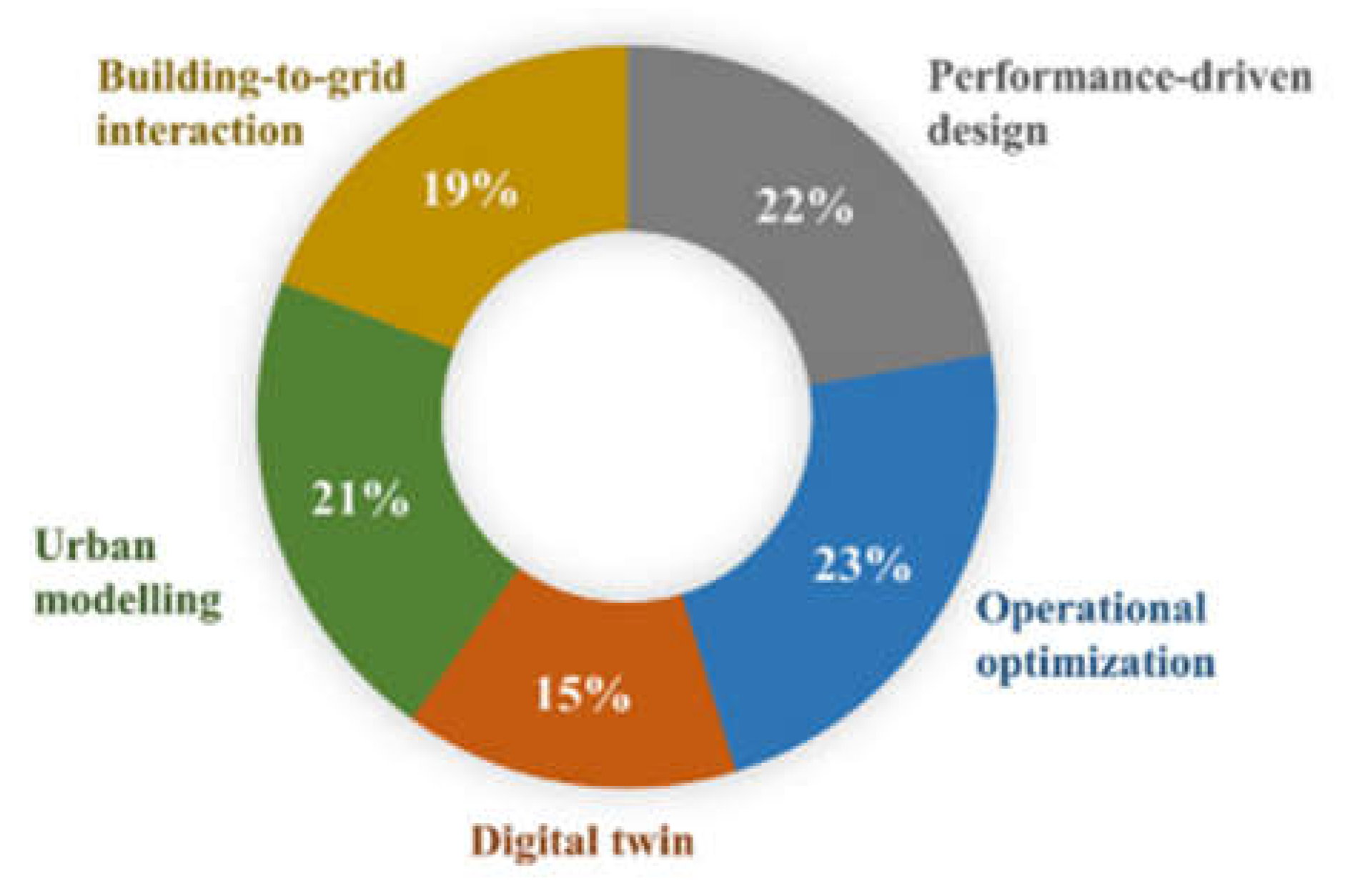
Figure 2.
Façade of CSEM constituted by the BIPV system [26].
Figure 2.
Façade of CSEM constituted by the BIPV system [26].
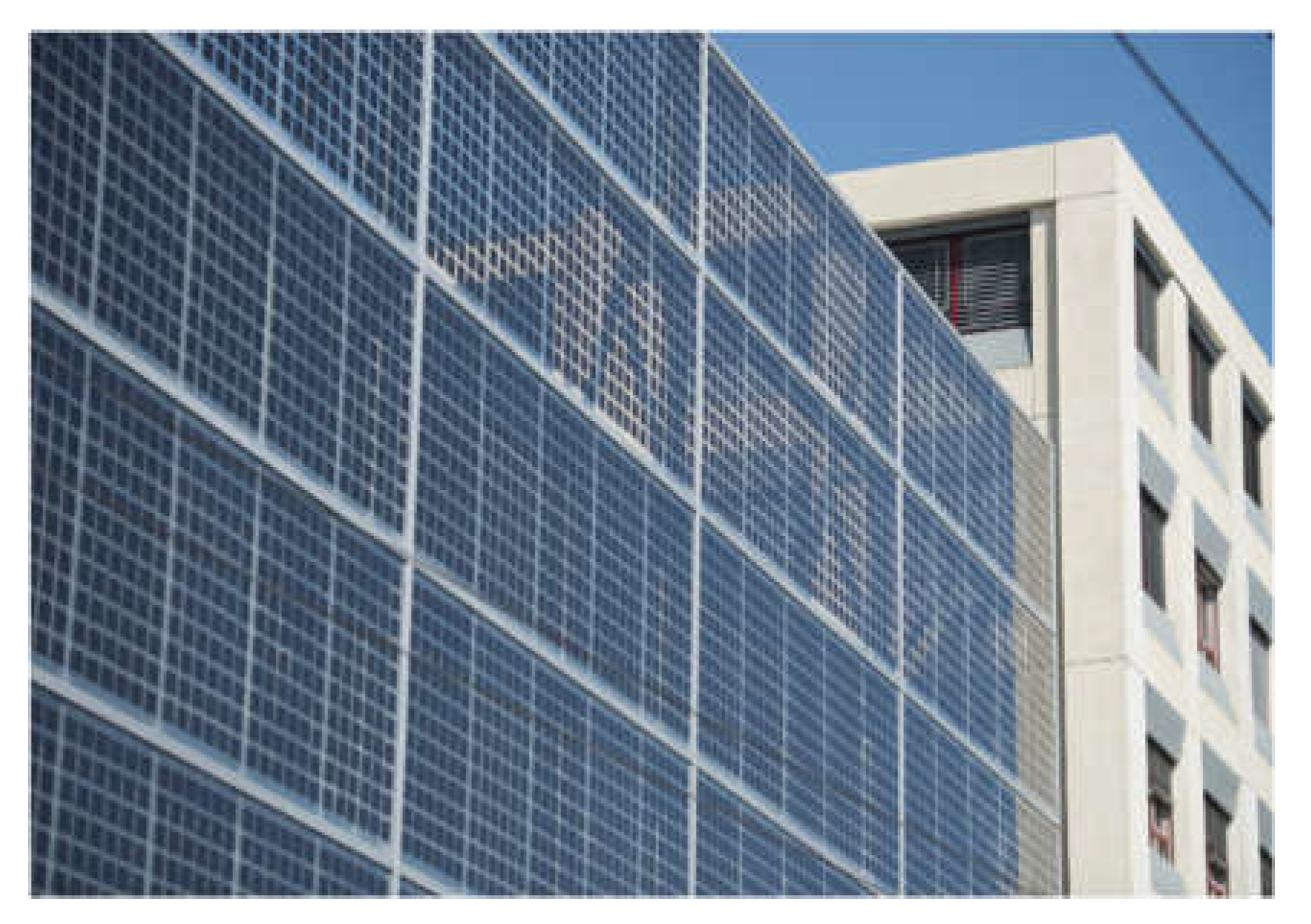
Figure 3.
Example of a roof-integrated PV system [27].
Figure 3.
Example of a roof-integrated PV system [27].
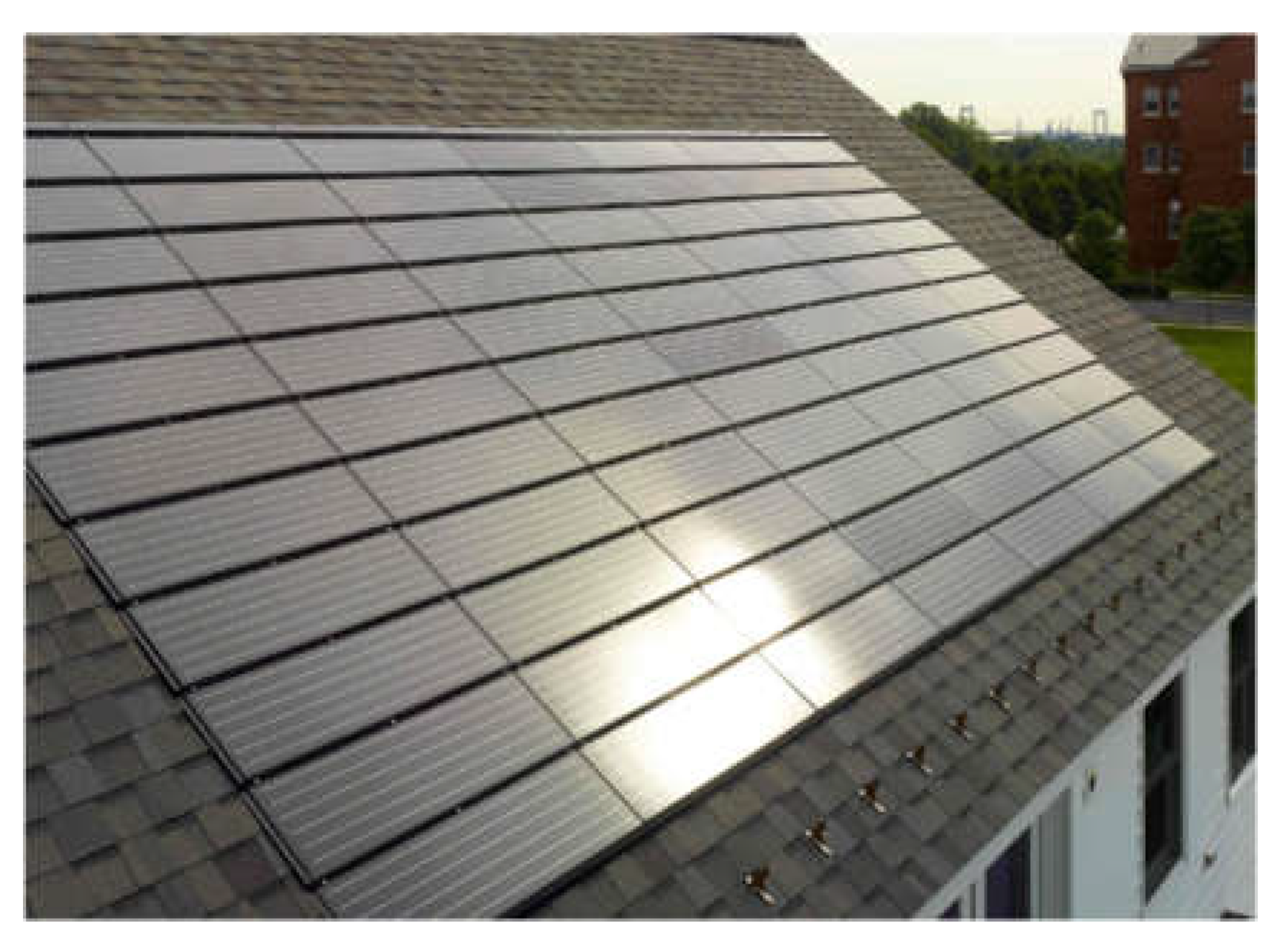
Figure 4.
Example of a window-integrated PV system [28].
Figure 4.
Example of a window-integrated PV system [28].
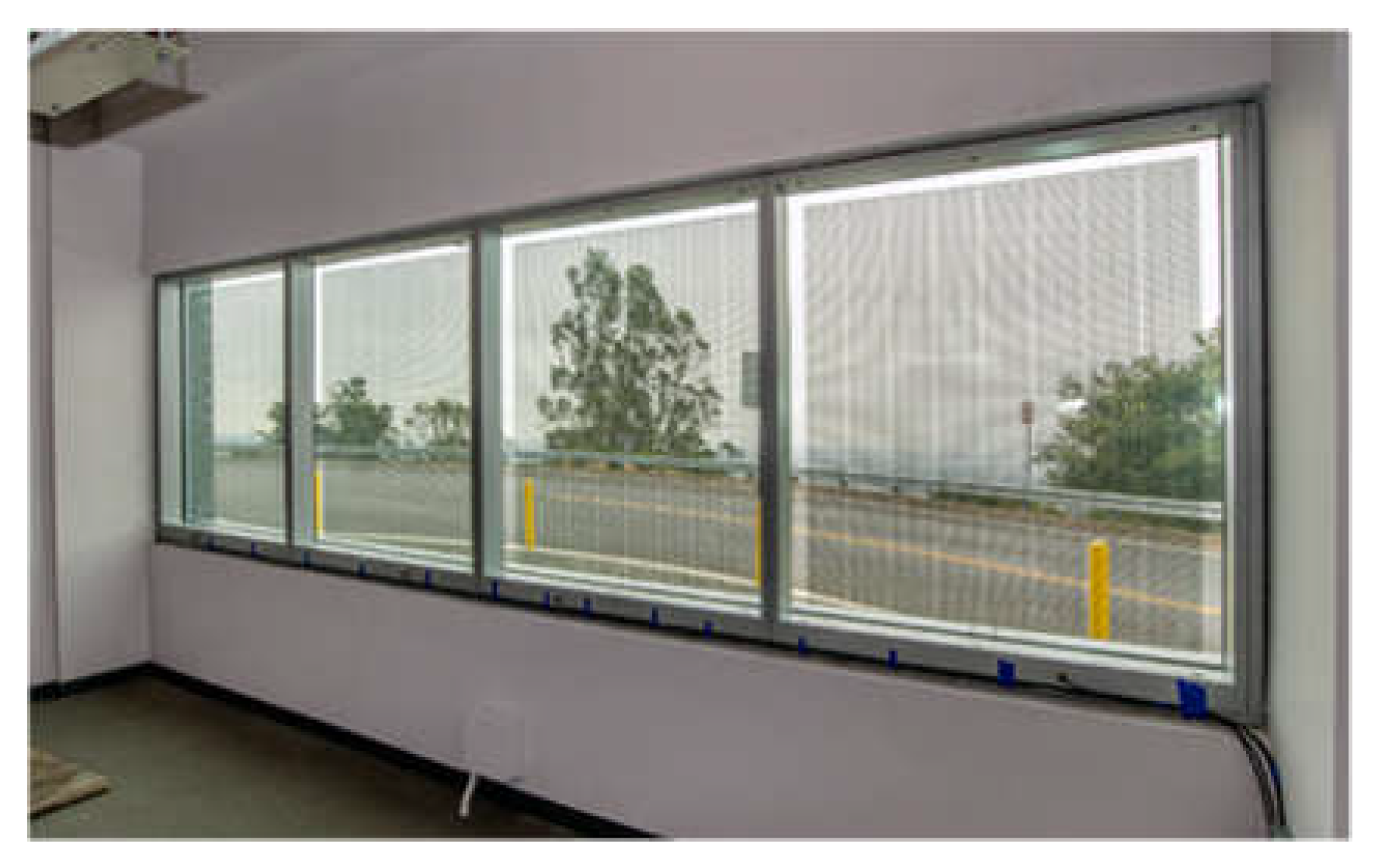
Figure 5.
PV system acting as shading device in a building [29].
Figure 5.
PV system acting as shading device in a building [29].
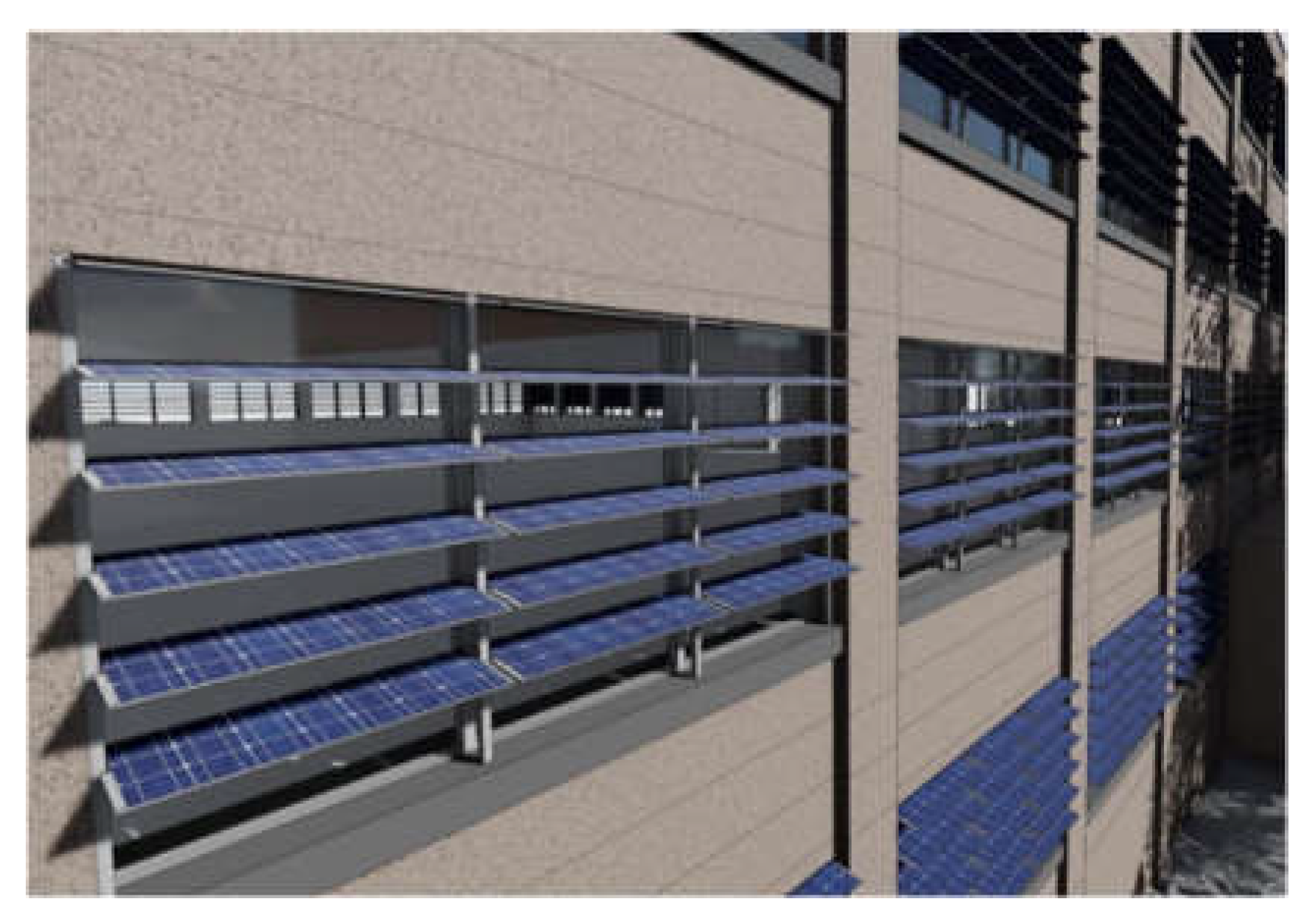
Figure 6.
UBEM workflow illustrating the five main steps [21].
Figure 6.
UBEM workflow illustrating the five main steps [21].
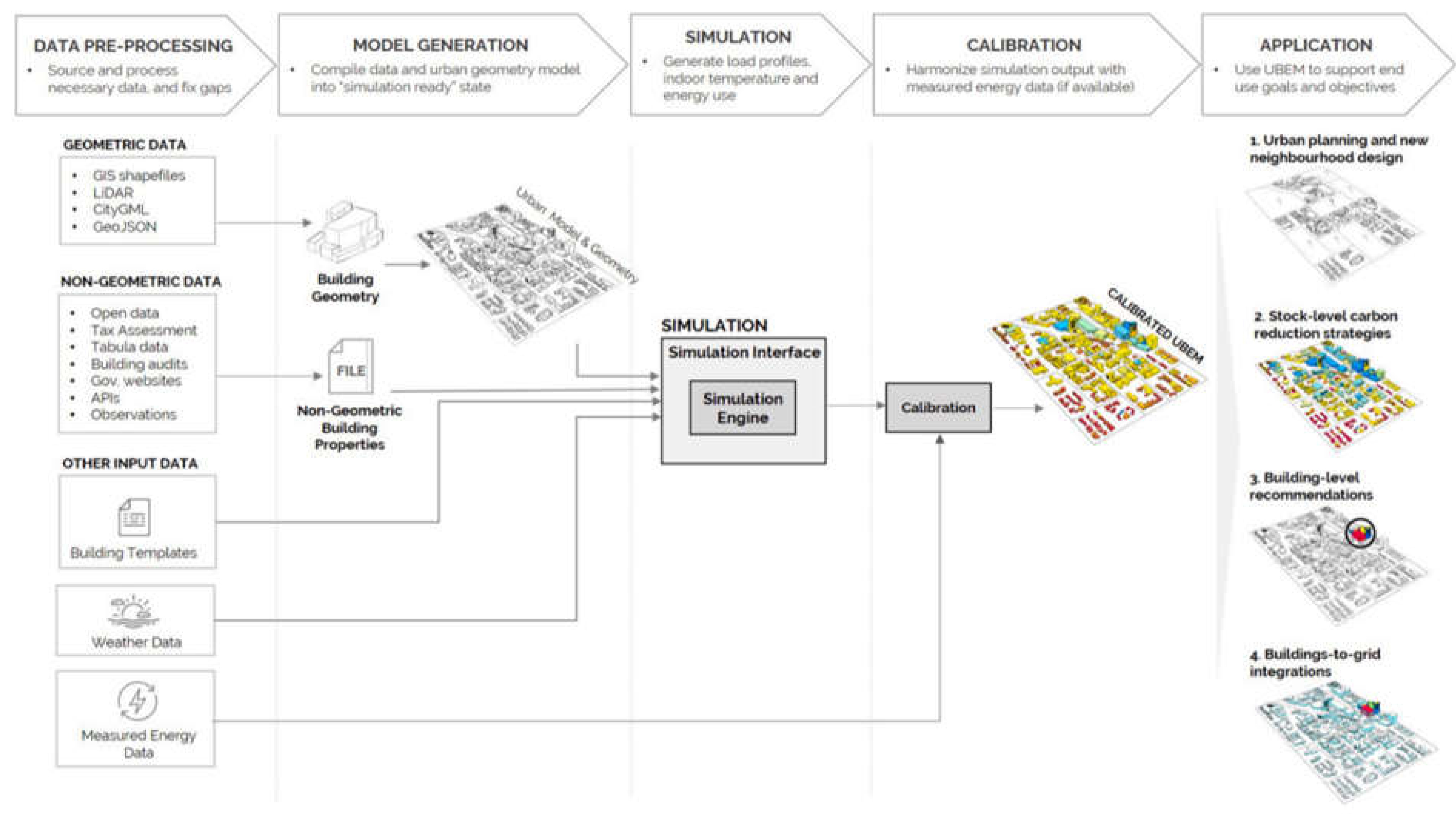
Figure 7.
Approaches to develop the archetypes [43].
Figure 7.
Approaches to develop the archetypes [43].
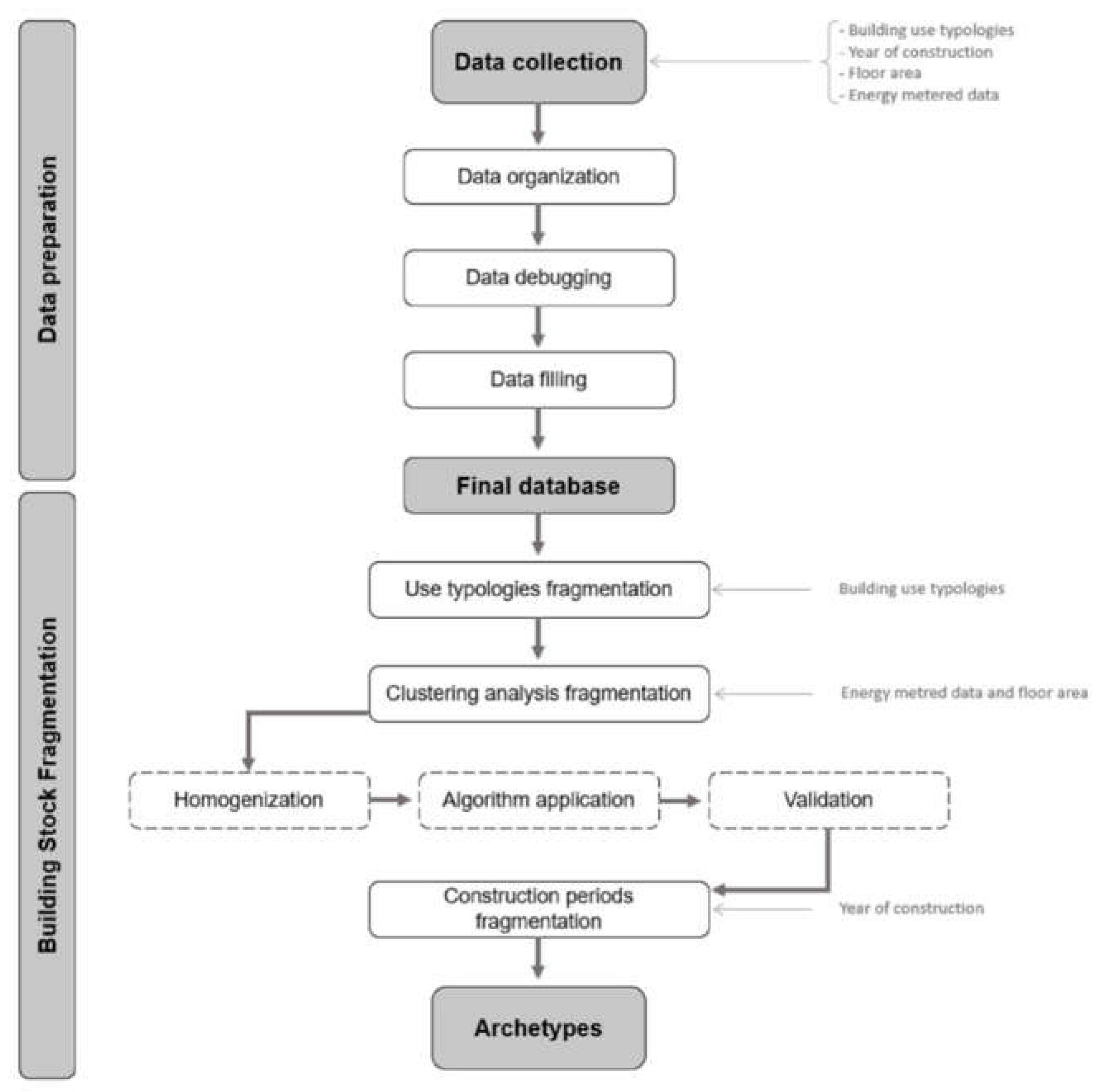
Figure 8.
Architecture of CityBES [68].
Figure 8.
Architecture of CityBES [68].
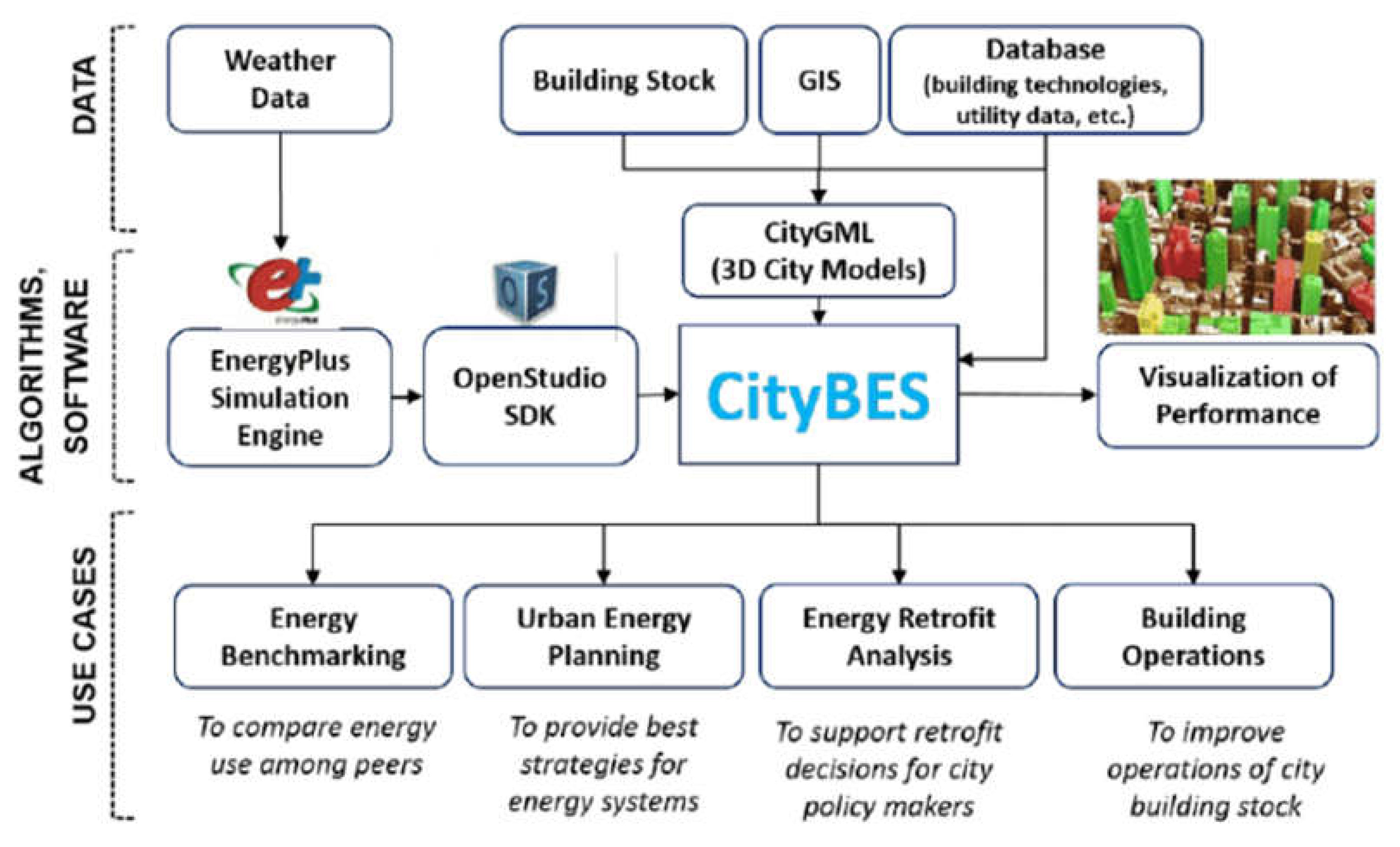

Table 1.
Software tools used to model the urban microclimate.
| Software | Characteristics | Reference |
|---|---|---|
| ENVI-met | Allows energy retrofit analysis, urban energy planning, building operations improvement, and energy benchmarking; Simulation time and computational requirements are too high; Adequate to study the impact of common energy efficiency measures; Does not consider the microclimate effect. |
[58], [59], [60], [61] |
| OpenFOAM | Suitable to assess the building demand and the performance of energy systems and renewable energy resource potential; Only allows to estimate the solar potential at rooftops. |
[62], [63], [64] |
| CityFFD | Contains thermal radiation, behaviour, plant and equipment models; Detailed radiation models, based on simple electrical circuit analogy, allowing to determine surface longwave and shortwave radiance. |
[65], [66] |
Table 2.
Software tools to perform Urban Building Energy simulations.
| Software | Characteristics | Reference |
|---|---|---|
| CityBES | Allows energy retrofit analysis, urban energy planning, building operations improvement, and energy benchmarking; Simulation time and computational requirements are too high; Adequate to study the impact of common energy efficiency measures; Does not consider the microclimate effect. |
[68,73,74], |
| CEA | Suitable to assess the building demand and the performance of energy systems and renewable energy resource potential; Only allows to estimate the solar potential at rooftops. |
[69,75,76], |
| CitySIM | Contains thermal radiation, behaviour, plant and equipment models; Detailed radiation models, based on simple electrical circuit analogy, allowing to determine surface longwave and shortwave radiance. |
[70,77,78,79], |
| UMI | Rhinoceros-based urban modelling design tool; Indicated to assess walkability and to perform daylight and building energy simulations; Allows to evaluate retrofit measures, calculation of operational and embodied carbon emissions, and estimate solar power potential. |
[71,80,81,82], |
| URBANopt | Allows to perform detailed simulations at individual building level; Allows to evaluate building-to-building shading and solar access. |
[72,83,84,85], |
Disclaimer/Publisher’s Note: The statements, opinions and data contained in all publications are solely those of the individual author(s) and contributor(s) and not of MDPI and/or the editor(s). MDPI and/or the editor(s) disclaim responsibility for any injury to people or property resulting from any ideas, methods, instructions or products referred to in the content. |
© 2024 by the authors. Licensee MDPI, Basel, Switzerland. This article is an open access article distributed under the terms and conditions of the Creative Commons Attribution (CC BY) license (http://creativecommons.org/licenses/by/4.0/).
Copyright: This open access article is published under a Creative Commons CC BY 4.0 license, which permit the free download, distribution, and reuse, provided that the author and preprint are cited in any reuse.


