

Submitted:
28 May 2024
Posted:
28 May 2024
You are already at the latest version
Abstract
In this paper, the ratio of gross agricultural production (GAP) and agricultural carbon emission is defined as agricultural carbon emission efficiency (ACEE). Considering rural labor transfer (RLT) increases the agricultural machinery intensity (AMI), the two are substitutes for each other and may interact with agricultural carbon emission efficiency (ACEE), we constructed a Simultaneous Equations Model (SEM) of ACEE, RLT and AMI, and analyzed the interaction mechanism of these three variables by using the Three-Stage Least Squares (3SLS) method to solve the endogeneity of the model. The following conclusions are drawn. First, RLT and AMI significantly promote the improvement of ACEE, while the improvement of ACEE and AMI further promotes RLT. Secondly, the causal relationship and influence mechanism of ACEE, RLT and AMI are interactive and multi-directional. An increase in AMI promotes ACEE, but an increase in ACEE inhibits an increase in AMI, suggesting that the marginal rate of substitution of machinery for labor is decreasing. Finally, China has significant regional heterogeneity. Labor transfer and machinery are only direct factors in increasing ACEE, while factors such as economic base, technology level and farmers' attitudes provide environmental support for the effective improvement of ACEE.
Keywords:
agricultural carbon emission efficiency
; rural labor transfer
; machinery intensity
1. Introduction
The November 4, 2016: The Paris Agreement, joined by 193 countries and the European Union, entered into force, which differently positions developed and developing countries in international carbon emissions reduction and requires member states to autonomously accomplish the carbon reduction targets set. In March 2021, China, the world's largest developing country, pledged to achieve carbon peaking by 2030, and by 2060 to be carbon neutral. More than 63.06% of China's total carbon emissions come from the industrial sector, but the agricultural sector remains important for achieving overall carbon reduction goal [1]. With 17% of China's greenhouse gases originating from agriculture, compared to 7% in the U.S. and 11% globally [2]. In 2022, China's Ministry of Agriculture published the Implementation Plan for Reducing Emissions and Sequestering Carbon in Agricultural and Rural Areas, proposing to carry out agricultural production in a way that conserves resources and protects the environment, and to accomplish the goal of realizing carbon emissions reduction while maintaining economic growth.
With the advancement of urbanization in China, there is an irreversible trend of rural labor transfer to non-rural areas as well as non-agricultural production sectors [3]. In 1978, when China's reform took place, the urbanization rate of its resident population was 17.9%, while in 2020 it grew to 63.9%, with the resident urban population increasing from 170 million to 900 million [4]. According to forecasts, China's urbanization rate will reach 78.6% in 2040, corresponding to an urban population of 1.05 billion, an increase of 150 million from 2020, of which about 74 million will come from agricultural migration [5]. The main reasons for agricultural labor transfer are the rising demand for labor due to China's urbanization and the large income gap between urban and rural areas. In 2021, China's per capita disposable income in rural areas was 18,900 yuan, while in urban areas it was 47,400 yuan, or 2.5 times as much as the per capita disposable income in rural areas [6]. Under the condition that there is no restriction on the migration of rural labor, the urban-rural income gap leads to higher opportunity costs for farmers to engage in agricultural production, and the potential price of agricultural labor rises [4]. According to induced innovation theory, an increase in the relative price of a factor is followed by a technological change to reduce the use of that factor. That is, technological progress can allow abundant factors to substitute for scarce factors, offsetting the constraints on economic growth imposed by scarce factors. In the Cobb Douglas production function, capital and labor are substitutes for each other. When the price of labor rises, its demand will fall, producers choose substitutes for labor to maintain the level of output [7]. Labor substitutes include means of production such as machinery, pesticides, and fertilizers. Pesticides and fertilizers are indirect substitutes for labor, increasing output when the amount of labor remains constant. Machinery is a direct substitute for labor, including tillage machinery, fertilizer application machinery, irrigation machinery, etc. They directly replace labor in production [8]. Both substitutes for labor can generate carbon emissions, but because the use of indirect substitutes such as fertilizers and pesticides in modern agriculture usually requires machinery to achieve, and because the level of agricultural machinery technology can affect the efficiency of the use of fertilizers and pesticides, it directly or indirectly affects agricultural carbon emissions [9]. Therefore, compared with indirect substitutes such as fertilizers and pesticides, agricultural machinery intensity affects the level of agricultural carbon emissions more comprehensively and is more closely related to agricultural labor and production. According to statistics, the mechanization rate of agricultural cultivation in China has risen from 29.1% in 2000 to 71.25% in 2020, while the proportion of people employed in the primary sector has declined from 50.0% to 23.6% [6]. Against this background, this paper questions whether agricultural labor transfer affects the efficiency of agricultural carbon emissions when machinery substitution is added to the analytical framework. If there is a significant impact, is the impact positive or negative?
2. Literature Review
The "carbon" in agricultural carbon emissions does not only refer to carbon dioxide, but also to the standard carbon for greenhouse gas conversion. Current research on agricultural carbon emissions focuses on the measurement and efficiency of carbon emissions. Volume 4 of the IPCC Guidelines for National Greenhouse Gas Inventories defines that agricultural carbon emissions come from production activities on agricultural land and forest land, including tilling, irrigation, fertilizer application, pesticide application, use of agricultural films, use of agricultural machinery, etc [10]. In China, forestry is conducted through state-owned forest farms, and this paper focuses more on the relationship between the labor transfer of small farmers and the efficiency of carbon emissions, so only the carbon emissions from agricultural land production activities are studied in this paper. West and Marland systematically explored carbon emissions from small-scale agriculture and classified its carbon sources into four main categories, namely fertilizers, pesticides, agricultural irrigation, and seed cultivation [11]. Xu et al. measured agricultural carbon emissions from the perspective of energy consumption in agricultural production and selected six types of energy such as gasoline and diesel for estimation [12]. The former analyzes the carbon emissions from the agricultural production process, while the latter analyzes the carbon emissions from energy consumption in agricultural production. Both the production process and energy consumption require the participation of agricultural machinery, which is the vehicle for fertilizers, pesticides, and energy to generate carbon emissions [13,14]. In this paper, we refer to the research of Yang et al. to include the agricultural production process and energy consumption into the agricultural carbon emission measurement system, and consider fertilizers, pesticides, agricultural films, land tilling, irrigation and diesel fuel as the sources of agricultural carbon emissions, which is more in line with the reality of the production methods of small farmers in China, and is also easier to calculate [15].
Agricultural carbon emission efficiency is the production efficiency of carbon emissions as an undesired output. Currently, the main methods for measuring the efficiency of agricultural carbon emissions are Data Envelopment Analysis (DEA) and its derivative methods [16]. Pang et al. used the DEA method to analyze China's agroecological efficiency and concluded that it is mainly influenced by technical efficiency and population density [17]. Chen & Li measured the agricultural carbon emission efficiency in some Chinese cities using the SBM model and the ML efficiency index and concluded that China's development of low-carbon agriculture is at a low level [18]. The DEA and its derivatives have many advantages, such as the ability to evaluate the value of efficiency in the presence of undesired outputs [19]. For the measurement of agricultural carbon emission efficiency, DEA methods are effective, but the analysis of factors affecting agricultural carbon emission efficiency has limitations. When using the DEA methods to calculate agricultural carbon emission efficiency, the input indicators usually include agricultural capital, labor, machinery, pesticides, and other variables that are highly related to agricultural production [20]. Therefore, the impact of these variables on agricultural carbon emission efficiency can only be reflected in the final efficiency index calculated by the DEA methods, and regression analysis of efficiency using econometric methods will produce serious endogeneity, making it difficult to analyze the specific impact.
Kaya in 1993 IPCC seminar for the first time put forward the Kaya Identity Equation and the concept of carbon productivity, specifically expressed as "carbon productivity = GDP/CO2", that is, the level of GDP output per unit of CO2 [21]. At present, there is no unified definition of carbon emission efficiency in the academic circles, and its academic significance is to measure the maximum economic output brought by the least carbon emissions, so carbon productivity is fully reflective of the efficiency of carbon emissions and can avoid the endogeneity problem mentioned above. Some scholars analyzed the direct link between GDP and carbon emissions or energy consumption, Mielnik analyzed the degree of industrialization in developing countries by using the ratio of carbon emissions to energy consumption as a carbon index [22]. Ang assessed the evolutionary patterns of climate change in industrialized and developing countries using the energy intensity (energy/GDP) in combination with the carbon factor (carbon/energy) [23]. Zhang analyzed eight industrial countries and five developing countries using GHG emissions per capita per GDP as an indicator [24]. Sun constructed a decarbonization index using CO2 emissions intensity (CO2 emissions/GDP) [25]. Zhang analyzed the relationship between CO2 emission intensity (CO2 emission/GDP) and China's economic growth, industrial structure and urbanization [26]. Efficiency in economics refers to the benefit generated under a certain cost, and in the context of China's carbon emissions reduction, governments take carbon emissions as an assessment index, and agricultural carbon emissions becomes the hidden cost of farmers, while gross agricultural product is the benefit of farmers [27]. Therefore, this paper refers to the method of Kaya and other scholars, replacing carbon emissions with agricultural carbon emissions, GDP with gross agricultural product (GAP), and the ratio of gross agricultural production/agricultural carbon emissions as the efficiency of agricultural carbon emissions. The advantage of this approach is that it firstly circumvents endogeneity and multicollinearity that may arise in the regression process, and secondly directly correlates gross agricultural product and carbon emissions. Finally gross agricultural product and agricultural carbon emissions are like the two ends of the scales, the government and individuals need to pursue a balance between the two, and the approach in this paper analyzes efficiency while taking equity into account.
According to the New Economics of Labor Migration (NELM) theory farmers will decide where their labor will go based on the principle of utility maximization [28]. When the income gap between urban and rural areas becomes wider, there is a phenomenon of farmers moving to non-agricultural areas and non-agricultural sectors, which is defined by academics as rural labor transfer [29,30]. The existing literature does not yet have a uniform measure of rural labor transfer. Lu and Xie use panel data on the number of rural laborers to measure rural labor transfer and analyze its impact on the use of agrochemicals [31]. Li & Feng, Li & Sufyan, on the other hand, define rural labor transfer as the ratio of the number of migrant workers to the total family labor force for analysis [32,33]. Neither of the above methods can reflect the rural labor transfer in a comprehensive way. Firstly, the rural labor force at different points in time can only reflect the changes in the quantity of the labor force, but not its structure. With the development of China's rural economy, some farmers are engaged in non-agricultural work in the countryside, which is counted in the rural labor force but belongs to the labor force that has been transferred to the non-agricultural sector. Secondly, the number of migrant workers can only reflect the unidirectional transfer from rural to urban areas. Moreover, farmers who migrate to cities may still work in agriculture, and the number of migrant workers can only reflect the transfer of farmers to non-agricultural areas but not to the non-agricultural sector. In this paper, we refer to the method of Huang and Zheng & Gao, i.e., Rual Labor Transfer Ratio = (Employment in Rural Areas - Employment in Agriculture) / Employment in Rural Areas [34,35].
Some scholars believe that the transfer of rural labor to non-agricultural areas will lead to the phenomenon of idle farmland and forest land in the countryside, while the loss of labor leads to a decrease in agricultural yields and an increase in the price of agricultural products, and a decrease in the gross domestic product of agriculture [36,37,38]. Other scholars have also argued that the substitution of agricultural machinery resulting from the transfer of rural labor will reduce the cost of agricultural production and improve the efficiency of land use, thereby increasing the gross agricultural product [39,40,41]. Regarding the impact of rural labor transfer on agricultural carbon emissions, some scholars believe that rural labor transfer has changed the status quo of China's smallholder economy to a certain extent, and that large-scale production will reduce the misuse of chemical fertilizers and pesticides, thus reducing agricultural carbon [42,43,44]. Su held the opposite view, arguing that the large-scale production and labor gap generated by the labor transfer will lead farmers to increase machinery inputs actively or passively, and the use of machinery requires the burning of a large amount of gasoline or diesel fuel, leading to a rise in agricultural carbon emissions [45]. In summary, there is no unified conclusion on the impact of rural labor transfer on agricultural output and agricultural carbon emissions, while this paper links agricultural output and carbon emissions, constructs the indicator of agricultural carbon emission efficiency = gross agricultural product/agricultural carbon emissions, and incorporates the substitution of agricultural machinery into the analytical framework, to analyze whether the transfer of rural labor affects the efficiency of agricultural carbon emissions.
3. Theoretical Framework
To maintain agricultural output, farmers no longer practice labor-intensive farming but increase the use of other means of production, such as fertilizers, agricultural films, diesel fuel, and pesticides. Agricultural machinery substitutes for labor to put these means of production into agricultural production and maintains or increases agricultural output [46]. However, the excessive use of fertilizers and diesel fuel, etc. will pollute the environment, increase the amount of carbon emissions from agriculture, and accelerate the greenhouse effect. Efficiency and equity have always been the main factors that economists weigh when analyzing problems. For agricultural carbon emissions, on the one hand, it is an inevitable product of production, and under the condition that the production method and technology level remain unchanged, the higher the carbon emissions represent the greater the output, and the carbon reduction behavior that ignores the output will affect the efficiency. On the other hand, the direct beneficiaries of agricultural production are the producers, but agricultural carbon emissions have a strong externality, the negative impact on the environment will reduce the utility of non-producers, and sustained carbon emissions will reduce equity. Therefore, it is not very meaningful to simply study the quantity of output of carbon emissions. China's 14th Five-Year Plan explicitly lists the reduction of carbon dioxide emissions generated per unit of GDP as one of its goals and utilizes this indicator to weigh the balance between economic gains and carbon emissions [47]. As said earlier, this paper defined the ratio of gross agricultural production (GAP) to carbon emissions as carbon efficiency in a narrow sense, i.e., the gross GAP per unit of carbon emissions.
This paper extends the Kaya identity and derives the following equations:
Where C represents the agricultural carbon emissions, M denotes the agricultural machinery quantity, A indicates the area of arable land, and GAP and P signify gross agricultural production and the rural labor force quantity respectively. ACEE represents agricultural carbon emission efficiency, shown in reciprocal form. TL denotes the technical level of agricultural production, i.e. the GAP contribution per unit of agricultural machinery. AMI indicates the intensity of machinery usage, and NS stands for the level of natural resources, i.e. the amount of arable land per capita. By differentiating and transforming Equation 1, the following equation is obtained:
In the above equation, the level of agricultural technology (TL) and the level of natural resources (NS) are exogenous factors, and it is difficult for producers to change them in a short period. Therefore, under the condition that the exogenous variables are controlled, ∆C are affected by ∆ACEE, ∆AMI and ∆P. The numerator C and the denominator GAP of ACEE are the incremental functions of the means of production such as pesticides, fertilizers and diesel, i.e., these means of production contribute to GAP and at the same time increase carbon emissions [40,48]. Therefore, ∆C is directly affected by means of production such as pesticides, fertilizers and diesel. M does not directly increase C but influences it through energy consumption and participation in production [32]. For example, the diesel consumed by machinery generates carbon emissions [49]. The use of machinery for plowing and irrigation increases carbon emissions from the land [50]. Machinery increases the efficiency of fertilizer, pesticide and film use, and these means of production increase carbon emissions [51,52]. Because of the indirect relationship between M and C, this paper treats M independently of ACEE and uses the ratio of M and A as a new variable. Finally, ∆P is not a stock variable but a flow variable, so rural labor transfer (RLT) can better reflect ∆P.
According to Figure 1, when rural labor force transfers to non-agricultural areas and sectors, the decrease in labor force leads to an increase in machinery and other means of production such as fertilizers, pesticides, and diesel fuel. Machinery generates carbon emissions by using fertilizers, pesticides, and diesel, as well as tilling and irrigating the land, and increases GAP. Agricultural carbon emissions and GAP together constitute the carbon efficiency of agriculture. Therefore, the following research hypotheses are proposed to test the effects of labor transfer to non-agricultural industries and machinery on the carbon emission efficiency of agriculture:
Hypothesis 1a. Rural labor transfer will impact agricultural carbon emission efficiency.
Hypothesis 1b. Agricultural machinery intensity will impact agricultural carbon emission efficiency.
Local governments in China often set agricultural carbon reduction targets and take corresponding measures. Examples include the adoption of clean energy such as electricity or solar energy, the promotion of high-yield and low-emission technology models for rice, the promotion of resource utilization of livestock and poultry waste, and the provision of subsidies for the renewal of agricultural machinery [53]. Changes in the efficiency of agricultural carbon emissions usually need to be supported by improvements in production technology. This will have an impact on the scale and structure of factor inputs to agriculture, which in turn affects the transfer of rural labor and the intensity of agricultural machinery [54]. At the same time, labor and agricultural machinery are direct substitutes for each other [35]. With changes in the level of technology, production efficiency and relative prices, labor and machinery will also affect each other. Based on the above discussion, this paper proposes hypothesis 2:
Hypothesis 2. There are interactive influence mechanisms among agricultural carbon emission efficiency, rural labor transfer and agricultural machinery intensity.
4. Data and Model
4.1. Data
This paper selects panel data from 31 provinces in China from 2000 to 2021 for analysis (Excluding Hong Kong, Macau and Taiwan), all data come from “China Statistical Yearbook” and “China Rural Statistical Yearbook”. The core explanatory variables are agricultural carbon emission efficiency, rural labor transfer and agricultural machinery intensity. As discussed above, this paper aims to measure efficiency in a more direct way, that is, the ratio of GAP to agricultural carbon emissions:
As mentioned above, there are six main sources of agricultural carbon emissions, including carbon emissions directly or indirectly from fertilizers, pesticides and agricultural films used in agricultural production, carbon emissions from diesel fuel consumed in the operation of agricultural machinery, and carbon emissions from irrigation and tilling of land by agricultural machinery. Agricultural machinery is not included in these six sources of agricultural carbon but can indirectly affect the amount of agricultural carbon emissions by increasing the efficiency of their utilization. Therefore, excluding machinery from the carbon emission sources does not affect the accuracy of the carbon emission calculation and reduces the endogeneity of the model in this paper. The calculation equation for the quantity of agricultural carbon emissions E is the sum of the product of each carbon source and its carbon emission factor, as follows:
E denotes the total agricultural carbon emissions, Ei denotes the input of each carbon source, and εi denotes the carbon emission factor of each carbon source, and the main carbon emission coefficients are shown in Table 1:
By calculating the agricultural carbon emission data of 31 provinces in China from 2000 to 2021, Figure 2 shows the distribution of agricultural carbon emission in China in 2021. Agricultural carbon emissions have a certain aggregation effect, and the big provinces of agricultural carbon emissions are mainly concentrated in North China, Northeast China, and Central China, followed by Guangdong, Sichuan, and Xinjiang, which are also big provinces in terms of carbon emissions. The above regions and provinces are all important agricultural output provinces in China, and there is correlation between agricultural carbon emissions and agricultural output.
In 1984, China relaxed the restriction on population mobility. It means people who have rural hukou (rural household registration) can move to cities and work there, while people with urban household registration can move to rural areas to work. The rural labor force is counted as the labor force permanently residing in the countryside (more than 6 months), the vast majority of which has a rural household registration. Agricultural labor force refers to those who do farm work regardless of whether their work area is in a rural area or not. There are different statistical criteria for the two types of labor force data, with rural labor force based on household registration and work area, the agricultural labor force based on the type of work, and the combination of the two can reflect regional and structural changes in the labor force. By researching literatures, the method of Huang and Zheng & Gao can comprehensively represent rural labor transfer, so this paper define the number of rural labor transfer as the number of rural labor force minus the number of agricultural labor force [34,35]. Due to different population bases in different provinces, we use the ratio of the number of rural labor force transfer to the number of rural labor force to measure the level of rural labor transfer:
As discussed above, the intensity of agricultural machinery in this paper denoted by the ratio of machinery power to the amount of cultivated land:
Figure 3 shows that China's agricultural carbon efficiency, rural labor transfer, and agricultural machinery intensity maintain roughly the same trend, which is consistent with the previous analysis [6]. From 2000-2015, all three maintained growths, however, agricultural carbon emission efficiency and agricultural labor transfer began to grow at a faster rate after 2015, while the agricultural machinery intensity departed from the two and showed a downward trend. The main reason for this is that China implemented a new “Environmental Protection Law” in 2015, which imposed stricter requirements on local governments and enterprises to reduce pollution. Meanwhile, after the Paris Agreement came into effect in 2016, the Chinese government began to fulfill the content of the agreement and put carbon emissions under stricter control. For example, increasing fines for polluters, incorporating environmental governance into government performance appraisals, and encouraging the use of clean energy [56]. It is difficult to analyze the interaction mechanism between the three simply from the figure, and this paper will use the model to analyze it in more detail.
4.2. Model
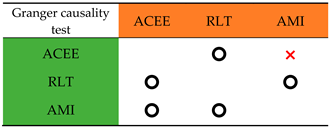
In this paper, we first conduct Granger Causality test on the three core explanatory variables. We find that rural labor force transfer and agricultural machinery intensity granger cause carbon emission efficiency, it is consistent with hypothesis 1. Except that agricultural carbon emission efficiency does not Granger causal agricultural machinery intensity, three core explanatory variables all have Granger causality, it is almost consistent with hypothesis 2.
The results of Granger Causality test show that there is a causal relationship among agricultural carbon emission efficiency, rural labor force transfer and agricultural machinery intensity. Since it is difficult to effectively present the interactions among the variables in the system in a single-equation model, this paper constructs Simultaneous Equation Model (SEM) of agricultural carbon emission efficiency, rural labor force transfer and agricultural machinery intensity. The advantage of SEM is that it not only considers the causal relationship between variables, but also effectively solves the endogeneity problem. The system of simultaneous equations in this paper is:
In Simultaneous Equation Model system, due to the causal relationship between variables, it is not possible to divide the variables by explanatory variables and explained variables, but the variables should be divided into endogenous variables and exogenous variables. The endogenous variables in this paper are agricultural carbon emission efficiency, rural labor transfer and agricultural machinery intensity, while the exogenous variables are selected with reference to other scholars into three dimensions of Policy environment, Economic development, and Natural environment. Totaling 15 variables:

Table 3.
Exogenous variables.
| Type | Variables | Description | Abbreviation | ||
| Policy environment | Education level of rural labor force | Average years of education | Edu | ||
| R&D capability of province | Ratio of R&D expenditure to GDP | RD | |||
| Tax burden of province | Ratio of taxes to GDP | Tax | |||
| Openness level of province | Ratio of exports and imports to GDP | Open | |||
| Technical level of province | Ratio of technology market turnover to GDP | Tech | |||
| Economic development | Urbanization level of province | Percentage of urban population | Urban | ||
| Agricultural investment of province | Investment in fixed assets in agriculture | AI | |||
| Industrial structure of province | Ratio of agricultural output to total output | InS | |||
| Population density of province | Population per unit area | PD | |||
| Unemployment rate of province | Unemployment rate | Unemp | |||
| Income of farmers | Farmers' disposable income | Income | |||
| Rural-urban income gap of province | Difference between urban and rural income | Gap | |||
| Natural environment | Quantity of rainfall of province | Quantity of rainfall | Rainfall | ||
| Land slope of province | Average slope of land | Slope | |||
| Disaster of province | Agricultural disaster area | Dia | |||
The six most explanatory exogenous variables were selected for each of the three equations. are exogenous variables for equation (7), including education level, agricultural investment, disaster, quantity of rainfall, openness level and industrial structure. are exogenous variables for equation (8), including urbanization level, population density, tax burden, rural-urban income gap, education level and openness level. are exogenous variables for equation (9), including income, unemployment rate, technical level, land slope, rural-urban income gap and R&D capability.
Table 4.
Descriptive statistics of endogenous variables.
| Variable | Observations | Mean | Std. Dev. | Min | Max | |
| Endogenous variables | ACEE | 682 | 8.361 | 4.917 | 1.851 | 35.301 |
| RLFT | 682 | 0.88 | 1.177 | -0.217 | 11.604 | |
| AMI | 682 | 0.6 | 0.35 | 0.132 | 2.698 | |
| Exogenous variables |
Edu | 682 | 7.338 | 0.986 | 2.236 | 10.25 |
| Rain | 682 | 6.729 | 0.505 | 5.303 | 7.711 | |
| Urban | 682 | 50.9 | 16.178 | 13.89 | 89.6 | |
| Open | 682 | 0.292 | 0.36 | 0.008 | 1.721 | |
| AI | 682 | 4.737 | 1.334 | 0.097 | 7.367 | |
| InS | 682 | 0.141 | 0.089 | 0.002 | 0.573 | |
| Dia | 682 | 0.221 | 0.161 | 0 | 0.936 | |
| Tech | 682 | 0.012 | 0.023 | 0 | 0.175 | |
| RD | 682 | 0.014 | 0.011 | 0.001 | 0.065 | |
| Tax | 682 | 0.076 | 0.027 | 0.034 | 0.2 | |
| Unemp | 682 | 3.475 | 0.716 | 0.76 | 6.5 | |
| Gap | 682 | 2.778 | 0.553 | 1.842 | 5.646 | |
| Slope | 682 | 1.171 | 1.29 | 0.004 | 5.414 | |
| Income | 682 | 8.776 | 0.771 | 7.193 | 10.559 | |
| PD | 682 | 5.287 | 1.483 | 0.742 | 8.275 |
4. Result
4.1. Main Results
Because SEM is a complex system composed of multiple equations, there is the possibility of mutual causality among the variables, and it is necessary to identify the model of the simultaneous equations to determine whether it can be estimated by regression. The simultaneous equation model system constructed in this paper contains 3 endogenous variables (K=3) and 15 predetermined variables (G=15). Equation (7) contains 3 endogenous variables (Ki=3) and 6 predetermined variables (Gi=6), and the rank of its matrix = K-1 = 2, which meets the rank condition of identification. Meanwhile, according to the order condition, G- Gi= 15- 6 = 9 is greater than Ki- 1 = 3 - 1 = 2 in equation (7), so it is over-identified. The recognition results of the rank and order conditions of equation (8) and equation (9) are the same as those of equation (6), which are also over- identified. Therefore, after judging the rank and order conditions, it can be concluded that SEM meets the identification conditions and the estimated parameters in all equations are estimable and analyzable in this paper [57].
The Three-Stage Least Squares (3SLS) method is the optimal GMM estimator when the disturbance terms satisfy the conditional homoskedasticity and is better than the Two-Stage Least Squares (2SLS) method [58]. Considering the potential correlation of the endogenous variables and the possible correlation among the stochastic disturbance terms of the equations, the Three-Stage Least Squares (3SLS) method was used to estimate equations (7) to (9) as a whole. In order to eliminate the heteroskedasticity problem to a certain extent, some variables were logarithmized, and the correlation coefficients of the endogenous variables of the equations showed that the correlation coefficients were less than 0.4, which indicated that there was no significant multicollinearity problem. The following results were obtained using the 3SLS method [59].
Table 5.
Result.
| VARIABLES | ACEE | RLFT | AMI |
| RLFT | 2.777*** | 0.109*** | |
| (0.324) | (0.0332) | ||
| AMI | 8.263*** | 1.407*** | |
| (1.068) | (0.163) | ||
| ACEE | 0.0463*** | -0.0302*** | |
| (0.0102) | (0.00649) | ||
| Constant | -25.32*** | -4.696*** | -0.693* |
| (3.733) | (0.545) | (0.355) | |
| Observations | 682 | 682 | 682 |
| R-squared | 0.090 | 0.548 | 0.324 |
*** p<0.01, ** p<0.05, * p<0.1.
As shown in Model 1, the estimated coefficients of rural labor transfer and agricultural machinery intensity are significantly positive at the 1% level, accelerating the transfer of rural labor force and increasing the intensity of agricultural machinery will lead to an increase in the efficiency of agricultural carbon emissions. On the one hand, the transfer of rural labor force leads to the need for farmers to increase the input of other material factors to replace labor. Machinery, fertilizers and pesticides and other means of production increase agricultural carbon emissions while at the same time significantly increasing total agricultural output, leading to a rise in agricultural carbon emission efficiency. Although the rising intensity of agricultural machinery increases the amount of agricultural carbon emissions, the use of mechanical irrigation technology, mechanical fertilizer technology, mechanical farming technology and large-scale operation improves the efficiency of the utilization of factors of production, which has a more positive impact on the improvement of total agricultural output. Therefore, in general, the positive contribution of agricultural machinery inputs to carbon emission efficiency is greater than the negative inhibiting effect.
As can be seen from Model 2, the estimated coefficients of agricultural carbon emission efficiency and agricultural machinery intensity are significantly positive, and the increase of carbon emission efficiency and agricultural machinery intensity positively promotes the transfer of rural labor. The increase of agricultural carbon emission efficiency means that the same carbon emission can produce more output, the input and output of agricultural factors are more harmonious with the ecological environment, the demand for necessary rural labor decreases, and the phenomenon of farmers going out to work increases. The increase of agricultural machinery input not only reflects the technological progress of agricultural production, but also the popularization of agricultural mechanization makes it possible for agricultural production to obtain more output with less labor input, improves labor productivity, and promotes the transfer of rural labor to non-agricultural industries.
Model 3 shows that the estimated coefficients of rural labor transfer are significantly positive at the 1% level, and the estimated coefficients of agricultural carbon emission efficiency are significantly negative at the 1% level. The transfer of rural labor has a positive effect on increasing the agricultural machinery intensity, while the increase of agricultural carbon emission efficiency reduces the input of agricultural machinery. The positive effect of rural labor force transfer on agricultural machinery input is because with the reduction of surplus rural labor force, farmers must use agricultural machinery to replace labor force production to maintain the level of total agricultural output, leading to an increase in agricultural machinery input per unit of arable land [35]. The increased efficiency of agricultural carbon emissions will increase the income of local governments and farmers. In the context of carbon reduction in China, the government will actively provide new carbon-reducing technologies and cleaner production methods, and establish environmental protection laws that will enable farmers to change their production habits, leading to a decrease in the intensity of agricultural machinery [56].
4.2. Regional Heterogeneity
China has a vast territory, and the economic development and geomorphological characteristics of each region are different, with strong regional heterogeneity. Resource endowment, agricultural production conditions, and the level of economic development all affect the interaction mechanism among the three variables. In this paper, we refer to the methodology of the China Bureau of Statistics, which divides China into four parts: Eastern, Central, Western and Northeastern:
Table 6.
Distribution of the Eastern, Central, Western and Northeastern.
| Eastern | Central | Western | Northeastern | |
| Beijing, Tianjin, Hebei, Fujian, Shanghai, Zhejiang, |
Shanxi, Anhui, Jiangxi, Hebei, Hubei, Henan | Inner Mongolia, Guangxi, Chongqing, Sichuan, | Heilongjiang, Liaoning, Jinlin | |
| Shandong, Guangdong, Hainan | Guizhou, Yunnan, Tibet, Shaanxi, | |||
| Ningxia, Xinjiang, Qinghai, Gansu |
The results in Table 7 show that rural labor transfer and agricultural machinery intensity in the East significantly contribute to agricultural carbon emission efficiency at 1% level. Agricultural carbon emission efficiency and agricultural machinery intensity significantly contribute to rural labor transfer at 1% level. This is consistent with the national results. However, rural labor transfer in the east significantly reduces agricultural machinery intensity and agricultural carbon emission efficiency has no effect on machinery intensity. This is because industries in eastern China are mainly based on manufacturing and services, with a good economic base and a high level of education among farmers. When the transfer of agricultural labor occurs, farmers do not only seek substitution of factors of production, but are more likely to combine agriculture with manufacturing and service industries, resulting in a reduction in the number of agricultural machinery used, and the intensity of agricultural machinery is detached from the effect of carbon emission efficiency. The interaction mechanism of the three variables in the central is almost diametrically opposite to that of the whole China. Rural labor transfer and agricultural machinery intensity significantly reduce agricultural carbon emission efficiency at 1% level. Agricultural machinery intensity has no effect on rural labor transfer, while carbon emission efficiency significantly increases rural labor transfer. Both rural labor transfer and agricultural carbon emission efficiency significantly reduce agricultural machinery input. The main reason for this is that central China is the least economically developed and most populous region in China, and many farmers will flock to work in cities or other economically developed regions every year, leading to the most difficult reversal of the labor transfer trend in central China. The low level of economic development means that farmers are unable to implement cleaner production methods to cope with the labor migration gap, and the misuse of pesticides and fertilizers emits large amounts of carbon dioxide. The low level of technology leads to low carbon productivity of machinery and low carbon efficiency in agriculture. The huge urban-rural income gap reduces farmers' willingness to engage in agricultural production, and agricultural machinery and labor gradually lose their substitution properties, even to the extent that arable land is abandoned and occupied, then the number of agricultural machinery is forced to decrease. Therefore, even if the efficiency of agricultural carbon emissions increases, it will not be able to change the trend of the rise in the transfer of agricultural labor and the decrease in the intensity of agricultural machinery. The explanation for negative R-squared value is shown in Appendix A。
As Table 8 shown, the western region is in line with the whole China’s results, mainly because of its vast territory, large population and medium level of economic development, which is more reflective of the situation in the whole China. There is no interaction mechanism between the intensity of agricultural machinery and carbon emission efficiency in the Northeast region, but the rest is consistent with the whole China. The main reason for this is that the Northeast has a very good agricultural and industrial base, both as a major food-producing province and a traditional industrial base. The three northeastern provinces now have 448 million mu of arable land, accounting for 23.4 per cent of the country's total, with per capita arable land 3.4 times the national average, and possessing the leading agricultural machinery technology and large-scale operation level in the country. This has led to a low marginal carbon contribution of agricultural machinery in the Northeast, it is difficult to increase machinery inputs to promote carbon efficiency and change the existing pattern of agricultural machinery with an increase in carbon efficiency. When rural labor transferred, farmers prefer to seek substitution of other factors of production to improve yields rather than agricultural machinery.
4.3. Robustness Test
To ensure the robustness of the regression results, this paper adopts the method of replacing the two endogenous variables of rural labor force transfer and agricultural machinery intensity by the negative of the growth rate of the agricultural labor force and comprehensive mechanization rate to conduct the robustness test. When the rural labor force undergoes positive transfer, the agricultural labor force will have negative growth, so we choose the negative of the growth rate of the agricultural labor force to replace the rural labor force transfer. Although it cannot reflect the structural change of rural labor force transfer, it can reflect the direction change. The comprehensive mechanization rate of crop cultivation, planting and harvesting is chosen as a replacement indicator, which is measured by the Ministry of Agriculture of China. It is calculated by the weighted average of 0.4, 0.3 and 0.3 for plowing, seeding and harvesting respectively. The level of mechanized plowing refers to the percentage of mechanized plowing area in the sown area that should be plowed (the sown area that should be plowed is equal to the total sown area minus the no-till sown area), the level of mechanized sowing and the level of mechanized harvesting refers to the percentage of mechanized sowing area and mechanized harvesting area in the sown area and the harvested area, respectively. The comprehensive mechanization rate of crop plowing, seeding and harvesting directly reflects the level of mechanized crop operations in the region [60].
Meanwhile, to ensure the robustness of the regression method, the 2SLS method is utilized to regress the original data. As shown from Table 8, the robustness test of the replacing variables remains consistent with the original results in direction and significance of regression coefficients, while the results of 2SLS are very close to the original results. It shows that the regression results in this paper are robust [58].
5. Conclusions and Implications
In this paper, we use the provincial panel data of China from 2000 to 2021 to construct a simultaneous model of agricultural carbon emission efficiency, rural labor transfer and agricultural machinery intensity, and use the 3SLS method for regression analysis to draw the following conclusions. First, rural labor transfer and agricultural machinery intensity significantly contribute to agricultural carbon emission efficiency. The overall modernization level of Chinese agriculture is still low, and the growth of marginal output value from machinery substitution due to rural labor transfer is higher than the growth of marginal carbon emissions. Moreover, the current trend of rural labor force transfer is difficult to reverse, and both the increase in agricultural machinery inputs and the improvement of carbon emission efficiency will further promote the transfer of rural labor force to non-agricultural. Second, the causality and transmission mechanism of agricultural carbon emission efficiency, rural labor force transfer and agricultural machinery intensity are not unidirectional, but interactive and complex, and it cannot simply be assumed that machinery substitution due to rural labor force transfer improves agricultural carbon emission efficiency. The interactive effects of the two variables may not be in the same direction, for example, an increase in the intensity of agricultural machinery promotes agricultural carbon emission efficiency, but an increase in agricultural carbon emission efficiency inhibits the increase in the intensity of agricultural machinery, which suggests that the marginal contribution of machinery to carbon emission efficiency in agricultural production is diminishing, and that we cannot rely on mechanization and large-scale production to improve the efficiency of agricultural carbon emission. Finally, China has significant regional heterogeneity. Especially in the eastern and central parts of the country, differences in economic development and technology levels lead to almost opposite results. Therefore, increasing machinery inputs to replace labor in some regions is not necessarily effective in improving the efficiency of agricultural carbon emissions, and local governments need to formulate policies tailored to local conditions. Labor transfer and machinery are only the direct factors to improve the efficiency of agricultural carbon emissions, while the economic base, technology level and farmers' attitudes provide the environmental support for the effective improvement of the efficiency of agricultural carbon emissions.
Based on the research conclusions, this paper puts forward the following suggestions. First of all, promote the transfer of rural land from farmers to agribusinesses to realize large-scale operation. Land transfer can effectively utilize the idle or abandoned farmland after the large-scale transfer of rural labor, and more professional and enthusiastic operators can operate the transferred land on a large scale, providing a good situation for other production factors to replace the labor force and improving the efficiency of agricultural production. Second, strengthen the research of agricultural machinery technology and accelerate the upgrading of clean agricultural machinery to cope with the gap in the number of rural laborers and the increase in costs. Increase subsidies to farmers for the purchase of cleaner production tools and materials and provide training to farmers. Finally, properly handle the relationship between rural labor transfer and agricultural mechanization. Make good use of the comparative advantages of labor and machinery to improve the total efficiency of agricultural production. Through the combination of agriculture and manufacturing services, encourage farmers to move to non-agricultural industries rather than non-agricultural areas.
Author Contributions
Conceptualization, P.Z. and K.L.M.; Methodology, P.Z. and K.L.M.; Software, P.Z.; Formal analysis, P.Z. and K.L.M.; data curation, P.Z.; Validation, P.Z. and K.L.M.; Writing—original draft preparation, P.Z.; Writing—Revision, review, editing, P.Z. and K.L.M.; Visualization, P.Z. and K.L.M.; Supervision, K.L.M. All authors have read and agreed to the published version of the manuscript.
Funding
This study was supported by the Program for Developing and Supporting the Next-Generation of Innovative Researchers at Hiroshima University.
Institutional Review Board Statement
Not applicable.
Informed Consent Statement
Not applicable.
Data Availability Statement
All data generated or analyzed during this study are included in this article.
Conflicts of Interest
The authors declare no conflicts of interest.
Appendix A
In ordinary linear regression, R-squared cannot be negative, however, in 2SLS and 3SLS, some explanatory variables enter the model as instrumental variables, and when the instrumental variables are used to fit the structural model, it is still the observed values of endogenous variables that are used to measure R-squared, so the explanatory variables used in the model residuals measure are different from those used in the fitted model, and the sum of residual squares is likely to be greater than the total sum of squares, and R-squared will be negative.
References
- Duan, Z. Y., X. N. Wang, X. Z. Dong, H. Y. Duan and J. N. Song. "Peaking industrial energy-related co2 emissions in typical transformation region: Paths and mechanism." SUSTAINABILITY 12 (2020). [CrossRef]
- Huang, X. Q., X. C. Xu, Q. Q. Wang, L. Zhang, X. Gao and L. H. Chen. "Assessment of agricultural carbon emissions and their spatiotemporal changes in China, 1997-2016." International Journal of Environmental Research and Public Health 16 (2019). [CrossRef]
- Lu, H., H. Xie and G. Yao. "Impact of land fragmentation on marginal productivity of agricultural labor and non-agricultural labor supply: A case study of Jiangsu, China." Habitat International 83 (2019): 65-72. https://www.sciencedirect.com/science/article/pii/S0197397518303849. [CrossRef]
- Lu, H. and H. Huan. "Does the transfer of agricultural labor reduce China’s grain output? A substitution perspective of chemical fertilizer and agricultural machinery." Frontiers in Environmental Science 10 (2022): 961648. [CrossRef]
- Ren, Z. P. and J. Z. Liang. China population situation report 2024. China: Yuwa Population Research Think Tank, 2022.
- Bureau, C. S. "China statistical yearbook." Beijing: China Statistical Bureau (2022): 35-36.
- Ruttan, V. W. and Y. Hayami. "Toward a theory of induced institutional innovation." The Journal of development studies 20 (1984): 203-23.
- Wenhua, L., L. Moucheng and M. Qingwen. "China's ecological agriculture: Progress and perspectives." Journal of Resources and Ecology 2 (2011): 1-7.
- Ali, R., R. Ishaq, K. Bakhsh and M. A. Yasin. "Do agriculture technologies influence carbon emissions in Pakistan? Evidence based on ARDL technique." Environmental Science and Pollution Research 29 (2022): 43361-70. [CrossRef]
- Van Amstel, A. IPCC 2006 guidelines for national greenhouse gas inventories. 2006.
- West, T. O. and G. Marland. "A synthesis of carbon sequestration, carbon emissions, and net carbon flux in agriculture: Comparing tillage practices in the United States." Agriculture, Ecosystems & Environment 91 (2002): 217-32. [CrossRef]
- Xu, L., M. Fan, L. Yang and S. Shao. "Heterogeneous green innovations and carbon emission performance: Evidence at China’s city level." Energy Economics 99 (2021): 105269. [CrossRef]
- Kalantari, F., O. Mohd Tahir, A. Mahmoudi Lahijani and S. Kalantari. "A review of vertical farming technology: A guide for implementation of building integrated agriculture in cities." Presented at 2017. Trans Tech Publ, 24, 76-91. [CrossRef]
- Rehman, A., L. Jingdong, R. Khatoon, I. Hussain and M. S. Iqbal. "Modern agricultural technology adoption its importance, role and usage for the improvement of agriculture." Life Science Journal 14 (2016): 70-74.
- Yang, H., X. Wang and P. Bin. "Agriculture carbon-emission reduction and changing factors behind agricultural eco-efficiency growth in China." Journal of Cleaner Production 334 (2022): 130193. [CrossRef]
- Zhou, C., C. Shi, S. Wang and G. Zhang. "Estimation of eco-efficiency and its influencing factors in Guangdong province based on super-sbm and panel regression models." Ecological Indicators 86 (2018): 67-80. ttps://doi.org/10.1016/j.ecolind.2017.12.011. https://www.sciencedirect.com/science/article/pii/S1470160X17307914. [CrossRef]
- Pang, J., X. Chen, Z. Zhang and H. Li. "Measuring eco-efficiency of agriculture in China." Sustainability 8 (2016): 398. [CrossRef]
- Chen, Y. and M. Li. "The measurement and influencing factors of agricultural carbon emissions in China’s western Taiwan straits economic zone." Nature Environment & Pollution Technology 19 (2020). [CrossRef]
- Fukuyama, H. and W. L. Weber. "A directional slacks-based measure of technical inefficiency." Socio-Economic Planning Sciences 43 (2009): 274-87. [CrossRef]
- Cecchini, L., S. Venanzi, A. Pierri and M. Chiorri. "Environmental efficiency analysis and estimation of co2 abatement costs in dairy cattle farms in Umbria (Italy): A sbm-dea model with undesirable output." Journal of Cleaner Production 197 (2018): 895-907. [CrossRef]
- Kaya, Y. and K. Yokobori. Global environment, energy, and economic development held at the United Nations university. Tokyo, 1993.
- Mielnik, O. and J. Goldemberg. "The evolution of the carbonization index in developing countries." Energy Policy 27 (1999).
- Ang, B. W. "Is the energy intensity a less useful indicator than the carbon factor in the study of climate change?" Energy Policy 27 (1999): 943-46.
- Zhang, Z., J. Qu and J. Zeng. "A quantitative comparison and analysis on the assessment indicators of greenhouse gases emission." Journal of Geographical Sciences 18 (2008): 387-99. [CrossRef]
- Sun, J. W. "The decrease of co2 emission intensity is decarbonization at national and global levels." Energy Policy 33 (2005): 975-78.
- Zhang, Y.-J., Z. Liu, H. Zhang and T.-D. Tan. "The impact of economic growth, industrial structure and urbanization on carbon emission intensity in China." Natural hazards 73 (2014): 579-95. [CrossRef]
- Zhang, H.-L., R. Lal, X. Zhao, J.-F. Xue and F. Chen. "Opportunities and challenges of soil carbon sequestration by conservation agriculture in China." Advances in agronomy 124 (2014): 1-36.
- Stark, O. and O. Stark. "The migration of labor." (1991).
- Ge, D., H. Long, Y. Zhang and S. Tu. "Analysis of the coupled relationship between grain yields and agricultural labor changes in China." Journal of Geographical Sciences 28 (2018): 93-108. [CrossRef]
- Yao, S., Y. Guo and X. Huo. "An empirical analysis of the effects of China’s land conversion program on farmers’ income growth and labor transfer." Environmental Management 45 (2010): 502-12.
- Lu, H., H. Xie, Q. Chen and J. Jiang. "Impact of agricultural labor transfer and structural adjustment on chemical application: Comparison of past developments in the ecological civilization pilot zones of China and their future implications." Sustainability 10 (2018): 1909. [CrossRef]
- Li, F., S. Feng, H. Lu, F. Qu and M. D’Haese. "How do non-farm employment and agricultural mechanization impact on large-scale farming? A spatial panel data analysis from Jiangsu province, China." Land Use Policy 107 (2021): 105517. [CrossRef]
- Li, L., S. U. Khan, C. Guo, Y. Huang and X. Xia. "Non-agricultural labor transfer, factor allocation and farmland yield: Evidence from the part-time peasants in loess plateau region of northwest China." Land Use Policy 120 (2022): 106289. [CrossRef]
- Huang, D., S. Ding and C. Tan. "Poverty reduction and spatial spillover effect of rural labor transfer—Based on the analysis of provincial panel date." Chinese Journal of Agricultural Resources and Regional Planning (2021): 20210713-1407.
- Zheng, J. and M. A. Gao. "Study on the effects of agricultural mechanization and rural labor transfer on total factor productivity in agriculture—An empirical test based on panel data of 31 provinces (cities and autonomous regions) in mainland China. Fujian trib." Humanit. Soc. Sci. Bimon (2021): 59-71.
- Zhou, H., J. Yan, K. Lei, Y. Wu and L. Sun. "Labor migration and the decoupling of the crop-livestock system in a rural mountainous area: Evidence from Chongqing, China." Land Use Policy 99 (2020): 105088. [CrossRef]
- Xu, D., X. Deng, S. Guo and S. Liu. "Labor migration and farmland abandonment in rural China: Empirical results and policy implications." Journal of environmental management 232 (2019): 738-50. [CrossRef]
- Duan, W., N. J. Hogarth, J. Shen, Y. Zhang and Q. Chen. "Effects of rural-urban labour migration on household forest management in the context of rural reform and development in China." Small-scale Forestry 20 (2021): 543-68. [CrossRef]
- Ji, Y., X. Yu and F. Zhong. "Machinery investment decision and off-farm employment in rural China." China Economic Review 23 (2012): 71-80. [CrossRef]
- Chang, H.-H. and A. K. Mishra. "Chemical usage in production agriculture: Do crop insurance and off-farm work play a part?" Journal of environmental management 105 (2012): 76-82.
- Luo, X., Z. Zhang, X. Lu and L. Zhang. "Topographic heterogeneity, rural labour transfer and cultivated land use: An empirical study of plain and low-hill areas in China." Papers in Regional Science 98 (2019): 2157-79.
- Ju, X., B. Gu, Y. Wu and J. N. Galloway. "Reducing China’s fertilizer use by increasing farm size." Global environmental change 41 (2016): 26-32. [CrossRef]
- Zhao, C., X. Kong and H. Qiu. "Does the expansion of farm size contribute to the reduction of chemical fertilizers?—Empirical analysis based on 1274 family farms in China." J. Agrotech. Econ 40 (2021): 110-21.
- Wu, H., H. Hao, H. Lei, Y. Ge, H. Shi and Y. Song. "Farm size, risk aversion and overuse of fertilizer: The heterogeneity of large-scale and small-scale wheat farmers in northern China." Land 10 (2021): 11111. [CrossRef]
- Su, M., R. Jiang and R. Li. "Investigating low-carbon agriculture: Case study of China’s Henan province." Sustainability 9 (2017): 2295. [CrossRef]
- Rehman, A., H. Ma, M. K. Khan, S. U. Khan, M. Murshed, F. Ahmad and H. Mahmood. "The asymmetric effects of crops productivity, agricultural land utilization, and fertilizer consumption on carbon emissions: Revisiting the carbonization-agricultural activity nexus in Nepal." Environmental Science and Pollution Research 29 (2022): 39827-37. [CrossRef]
- Hepburn, C., Y. Qi, N. Stern, B. Ward, C. Xie and D. Zenghelis. "Towards carbon neutrality and China’s 14th five-year plan: Clean energy transition, sustainable urban development, and investment priorities." Environmental Science and Ecotechnology 8 (2021): 100130.
- Long, X., Y. Luo, H. Sun and G. Tian. "Fertilizer using intensity and environmental efficiency for China’s agriculture sector from 1997 to 2014." Natural hazards 92 (2018): 1573-91. [CrossRef]
- Guo, Y., L. Tong and L. Mei. "Spatiotemporal characteristics and influencing factors of agricultural eco-efficiency in Jilin agricultural production zone from a low carbon perspective." Environmental Science and Pollution Research 29 (2022): 29854-69. [CrossRef]
- Kuang, B., X. Lu, M. Zhou and D. Chen. "Provincial cultivated land use efficiency in China: Empirical analysis based on the sbm-dea model with carbon emissions considered." Technological Forecasting and Social Change 151 (2020): 119874. [CrossRef]
- Kennedy, S. "Energy use in American agriculture." Sustainable energy term paper 5 (2000): 1-26.
- Luo, M., F. Liu and J. Chen. "Data-driven evaluation and optimization of agricultural sustainable development capability: A case study of northern Anhui." Processes 9 (2021): 2036. "Data-driven evaluation and optimization of agricultural sustainable development capability: A case study of northern Anhui." Processes 9 (2021): 2036. [CrossRef]
- Wang, G., M. Liao and J. Jiang. "Research on agricultural carbon emissions and regional carbon emissions reduction strategies in China." Sustainability 12 (2020): 2627. [CrossRef]
- Cui, Y., S. U. Khan, Y. Deng, M. Zhao and M. Hou. "Environmental improvement value of agricultural carbon reduction and its spatiotemporal dynamic evolution: Evidence from China." Science of the Total Environment 754 (2021): 142170: 142170. [CrossRef]
- Zhuang, T. "Analysis of the impact of tourism on agricultural carbon emissions-based on the mediating effect of nonagricultural transfer of labor in China." Presented at Wiley Online Library, 47, 375-92. [CrossRef]
- Liu, Z., Z. Deng, G. He, H. Wang, X. Zhang, J. Lin, Y. Qi and X. Liang. "Challenges and opportunities for carbon neutrality in China." Nature Reviews Earth & Environment 3 (2022): 141-55. [CrossRef]
- Zellner, A. and H. Theil. "Three-stage least squares: Simultaneous estimation of simultaneous equations." In Henri Theil’s contributions to economics and econometrics: Econometric theory and methodology. Springer, 1992, 147-78.
- Belsley, D. A. "Two-or three-stage least squares?" Computer Science in Economics and Management 1 (1988): 21-30 Management 1 (1988): 21-30.
- Bakhsh, K., S. Rose, M. F. Ali, N. Ahmad and M. Shahbaz. "Economic growth, co2 emissions, renewable waste and FDI relation in Pakistan: New evidences from 3sls." Journal of environmental management 196 (2017): 627-32. [CrossRef]
- Liao, W., F. Zeng and M. Chanieabate. "Mechanization of small-scale agriculture in China: Lessons for enhancing smallholder access to agricultural machinery." Sustainability 14 (2022): 7964. [CrossRef]
Figure 1.
Interaction of Labor Transfer, Machinery, and Carbon Emission Efficiency.
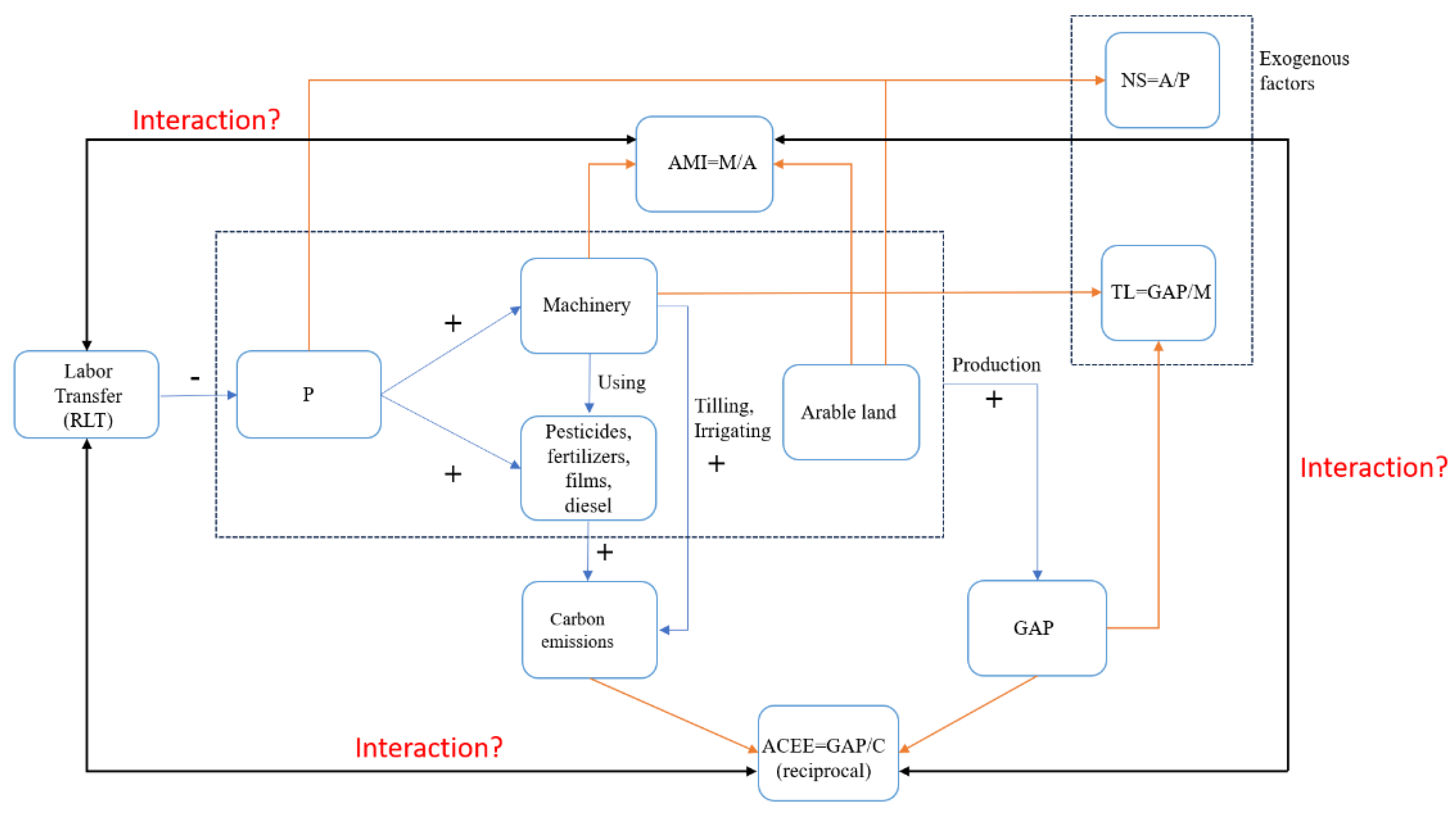
Figure 2.
Distribution of agricultural carbon emissions in 2021 in China.
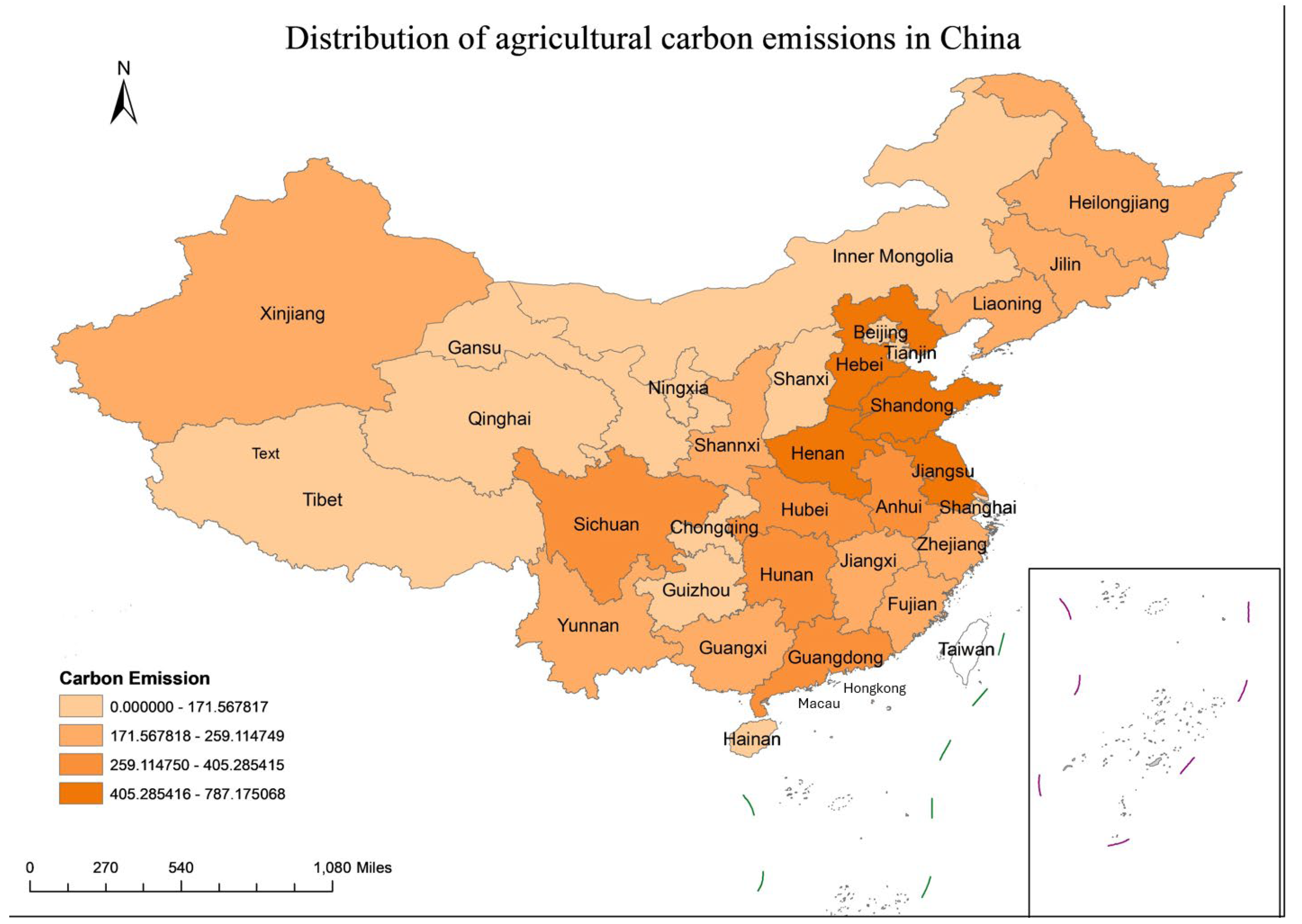
Figure 3.
Trends in Agricultural Carbon Emission Efficiency, Rural Labor Transfer and Agricultural Machinery Intensity in China, 2000-2021. Data from the China Statistical Yearbook in 2000–2021.
Figure 3.
Trends in Agricultural Carbon Emission Efficiency, Rural Labor Transfer and Agricultural Machinery Intensity in China, 2000-2021. Data from the China Statistical Yearbook in 2000–2021.
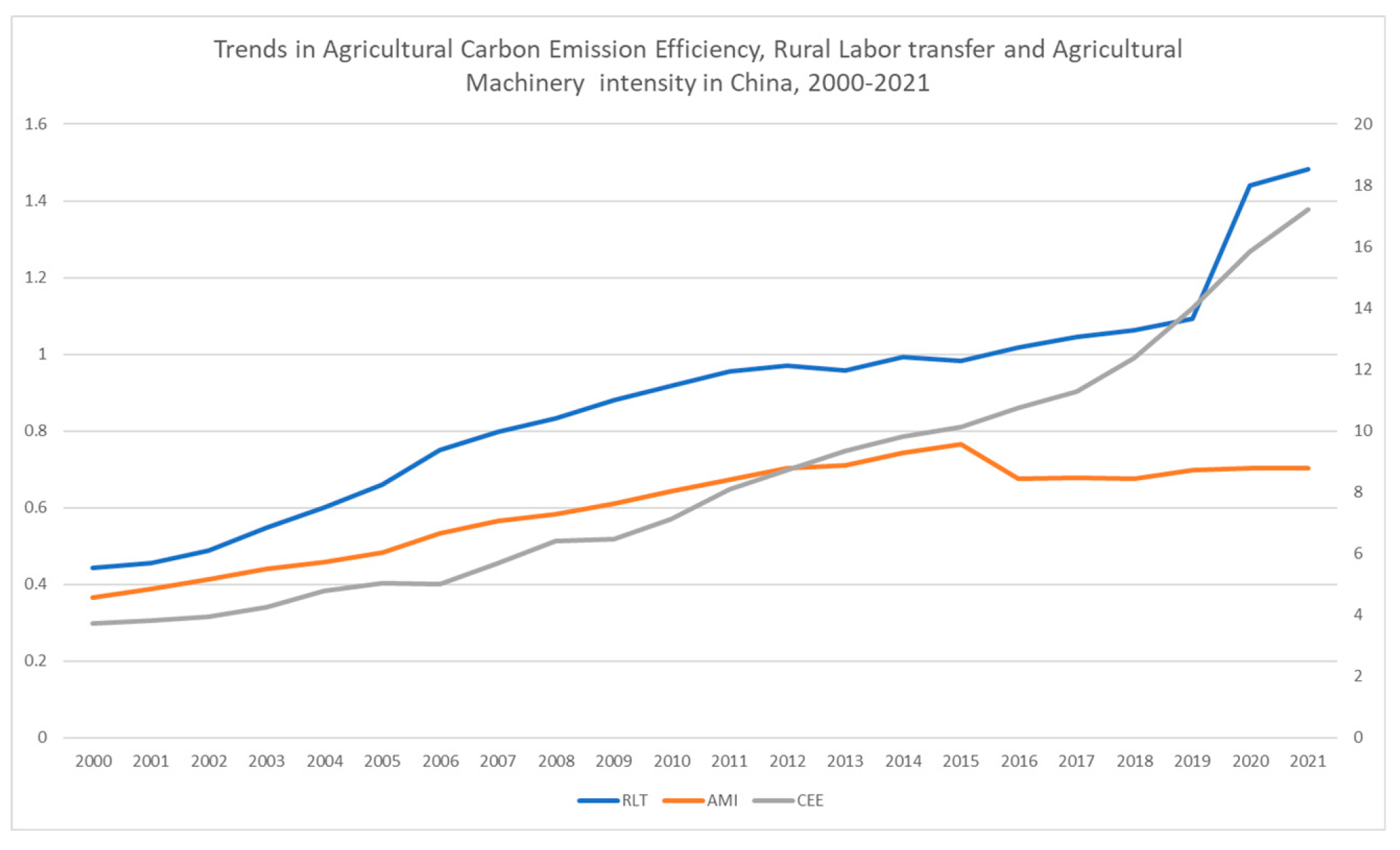
Table 1.
Agricultural carbon emission coefficients.
| Source | Coefficient | Reference |
|---|---|---|
| fertilizer | 0.8956kg/kg | Oak Ridge National Laboratory, USA |
| pesticide | 4.9341kg/kg | Oak Ridge National Laboratory, USA |
| diesel | 0.5927kg/kg | IPCC |
| agricultural film | 5.18kg/kg | Institute of Agricultural Resources and Ecological Environment, Nanjing Agricultural University |
| tilled farmland area | 3.126kg/hm2 | School of Biology and Technology, China Agricultural University |
| irrigation area | 25kg/hm2 | Dubey & Lal |
Note1: Agricultural carbon emission coefficients refer Zhuang (2023) [55].
Table 2.
Granger Causality test.
Note2: Does Green Granger cause Orange?
Table 7.
Rustles of the Eastern and Central.
| Eastern | Central | |||||
| VARIABLES | ACEE | RLT | AMI | ACEE | RLT | AMI |
| RLT | 1.976*** | -0.380*** | -2.614*** | -0.167*** | ||
| (0.214) | (0.0584) | (0.744) | (0.0413) | |||
| AMI | 11.40*** | 1.398*** | -5.182*** | -0.0313 | ||
| (1.846) | (0.454) | (1.690) | (0.232) | |||
| ACEE | 0.256*** | -0.0242 | 0.0716*** | -0.0199** | ||
| (0.0405) | (0.0153) | (0.0163) | (0.00790) | |||
| Constant | -67.63*** | -5.873*** | -2.707*** | -56.35*** | -1.421 | -2.705*** |
| (6.455) | (1.756) | (1.035) | (5.430) | (1.093) | (0.417) | |
| Observations | 220 | 220 | 220 | 132 | 132 | 132 |
| R-squared | 0.381 | 0.468 | -0.244 | 0.787 | 0.589 | 0.617 |
*** p<0.01, ** p<0.05, * p<0.1.
Table 8.
Rustles of the Western and Northeastern.
| Western | Northeastern | |||||
| VARIABLES | ACEE | RLT | AMI | ACEE | RLT | AMI |
| RLT | 9.457*** | 3.139*** | 5.614*** | 0.547*** | ||
| (2.072) | (0.283) | (1.975) | (0.0597) | |||
| AMI | 2.198** | 0.219*** | 5.911 | 1.032*** | ||
| (1.112) | (0.0614) | (3.616) | (0.256) | |||
| ACEE | 0.0142*** | -0.119*** | 0.0249* | -0.0105 | ||
| (0.00398) | (0.0142) | (0.0140) | (0.00777) | |||
| Constant | -17.45*** | 1.009*** | -6.905*** | -33.64*** | 0.0347 | -0.188 |
| (5.662) | (0.248) | (0.988) | (11.60) | (0.651) | (0.300) | |
| Observations | 264 | 264 | 264 | 66 | 66 | 66 |
| R-squared | 0.414 | 0.325 | -1.240 | 0.748 | 0.766 | 0.764 |
*** p<0.01, ** p<0.05, * p<0.1.
Table 9.
Robustness test.
| Replacing variables | 2SLS | |||||
| VARIABLES | ACEE | RLT | AMI | ACEE | RLT | AMI |
| RLT | 26.19*** | 4.332*** | 1.830*** | 0.105*** | ||
| (2.220) | (0.698) | (0.338) | (0.0347) | |||
| AMI | 1.553*** | 0.0591*** | 8.036*** | 1.229*** | ||
| (0.312) | (0.0124) | (1.105) | (0.172) | |||
| ACEE | 0.0390*** | -0.340*** | 0.0375*** | -0.0424*** | ||
| (0.00359) | (0.0463) | (0.0105) | (0.00675) | |||
| Constant | 2.034*** | -0.0754*** | -2.246*** | -27.37*** | -4.572*** | -1.047*** |
| (0.502) | (0.0168) | (0.274) | (3.868) | (0.575) | (0.387) | |
| Observations | 682 | 682 | 682 | 682 | 682 | 682 |
| R-squared | -6.196 | 0.045 | -0.836 | 0.222 | 0.576 | 0.309 |
*** p<0.01, ** p<0.05, * p<0.1.
Disclaimer/Publisher’s Note: The statements, opinions and data contained in all publications are solely those of the individual author(s) and contributor(s) and not of MDPI and/or the editor(s). MDPI and/or the editor(s) disclaim responsibility for any injury to people or property resulting from any ideas, methods, instructions or products referred to in the content. |
© 2024 by the authors. Licensee MDPI, Basel, Switzerland. This article is an open access article distributed under the terms and conditions of the Creative Commons Attribution (CC BY) license (http://creativecommons.org/licenses/by/4.0/).
Copyright: This open access article is published under a Creative Commons CC BY 4.0 license, which permit the free download, distribution, and reuse, provided that the author and preprint are cited in any reuse.


