

Submitted:
27 May 2024
Posted:
28 May 2024
You are already at the latest version
Abstract
Intermittent fasting (IF) has been indicated as a valuable alternative to the classical caloric restriction dietary regimen for lowering body weight and preventing obesity-related complications such as metabolic syndrome and type II diabetes. However, is it effective? In this review article, we analyzed over 50 clinical studies in which IF, conducted by alternate day fasting (ADF) or time-restricted feeding (TRF), was compared with the caloric restriction approach. We evaluated the different roles of IF in treating and preventing human disorders such as metabolic syndrome, type II diabetes, and some types of cancer, as well as the usefulness of IF in reducing body weight and cardiovascular risk factors such as hypertension. Furthermore, we explored the cellular pathway targeted by IF to exert their beneficial effects by activating effector proteins that modulate cell functions and resistance to oxidative stress. In contrast, we investigated the concerns for human health related to the adoption of IF dietary regimen, highlighting the profound debate on weight loss regimens. We have examined and compared several clinical trials to formulate an updated conception regarding IF and its therapeutic potential.
Keywords:
intermittent fasting (IF)
; alternate day fasting (ADF)
; time-restricted feeding (TRF)
; obesity
; dietary regimen
1. Introduction
Among the current dietary regimens leading to weight loss, reducing risk factors for several disorders including hypertension, dyslipidemia, obesity, inflammation, insulin resistance, and more in general metabolic syndrome (MetS), and improving health benefits over aging-dependent diseases, intermittent fasting (IF) has gained significant attention as a practical method in nutritional strategy (Figure 1) [1,2,3,4]. In particular, IF could offer some advantages over classical calorie restriction (CR), although the main goal of both CR and IF is to limit the intake of energy. The main distinction was that although IF consumed little or no food during fasting, CR continued to eat regularly [5]. . Currently, CR is considered the typical dietary method to lose or maintain weight; however, it has been proven to be difficult to sustain for many people, with a high risk of late weight rebound when used for an extended period. Thus, some improvements in this scenario have been achieved by combining intermittent CR and temporal management, replacing a basic long-term CR regimen [6]. In fact, it has been established that adherence to CR, in which a reduction of 20%–40% of caloric intake occurs, sharply declines over a long period of time, and many people acquire noticeable weight by the year's end [7,8]. In contrast, IF has been hypothesized to be superior in terms of patients’ compliance [9,10,11], although other research revealed that IF’s high dropout rate—which was 38% for IF compared with CR—limited its ability to maintain compliance over the long run [12,13]. In the mid-term, the absence of the need to control calories during the eating day could be one of the reasons for better patient compliance. In general, considering the purpose of the two approaches, the effects of CR and IF substantially overlap across numerous aspects [14]. Interestingly, in a specific context, IF could provide superior effectiveness than CR; thus, in this article, a fine analysis was conducted to better understand situations for which IF could be preferred to CR and vice versa in order to help the scientific community, patients, and individuals who need specific nutritional interventions like these.
According to these clues, IF has been investigated in clinical trials applying different IF regimens because different IF approaches have been developed and are discussed in the next paragraph. However, from the first application of the IF dietary regimen, the still controversial question is “in improving health benefits, including weight loss, is IF supe-rior to CR?” In this article, we attempt to offer an outlook of IF practice by discussing the advantages and discordances on the application of the mentioned nutritional intervention. We have analyzed several representative clinical studies for different purposes with different endpoints to provide evidence to answer the question described above.
Before entering into the critical analysis of the clinical studies analyzed here, we would like to start this manuscript with a brief mention about the origin of fasting and the relative religious and social implications, which opened the way to the formulation of nutritional intervention in which fasting is crucial, which is still present in some populations and ethnicities.
1.1. Fasting: An Hystorical and Social View
For medical, spiritual, or political purposes, fasting is generally understood as an intentional period of time during which one abstains from eating [15]. This practice has been known since ancient times, and several philosophers and physicians such as Socrates, Hippocrates, Galen, Aristoteles, Paracelsus, Plato, and several religious communities documented fasting in ancient writings as having physiological or spiritual benefits [16,17,18]. For example, Plato, who wrote: ”I fast for greater physical and mental efficiency,” based his idea of food consumption on moderation, indicating that excess in feeding should be deprecated because of this behavior conduct to developing various diseases. Remarkably, to healthy body he indicated aliments that should be assumed with strong frequency (fish, legumes, milk, cereals, honey, and fruits), whereas with significant moderation confectionery, meat, and wine could be eaten. Plato’s nutritional indications shared several features with the Mediterranean diet [16]. Again, "Fasting is the greatest remedy--the physician within," is attributed to Paracelsus, one of the three founding fathers of Western medicine. In agreement with the recommendation provided by Hippocrates, a Greek physician, who suggested drink and/or food abstinence for patients showing evident symptoms of disorders, wrote “if you eat when you are sick, it will make you sick” [19]. Historically, religious fasting was a common divinatory practice that involved pursuing a certain types of food abstinence for spiritual purposes [20]. In fact, Christianism acknowledges 40 days of fasting in the desert as preparation for divine revelations, as described in the Old Testament. Furthermore, local Christian churches gradually adopted conventions of fasting, in part to supplant earlier pagan and Jewish fasting practices. [20]. In fact, Christianism acknowledges 40 days of fasting in the desert as preparation for divine revelations, as described in the Old Testament. Furthermore, local Christian churches gradually adopted conventions of fasting, in part to supplant earlier pagan and Jewish fasting practices. Moreover, one of the earliest documented instances of severe starvation in history was St. Catherine of Siena during the Christian era. Her diet consisted solely of vegetables and water, which she self-imposed as a restrictive routine. This was among the earliest types of holy fasting, clearly inspired by a strong sense of religious conviction. Known by the name inedia prodigiosa, this disorder is categorized as anorexia mirabilis [21]. Finally, the monastic practice of fasting had great prosperity in the fourth and fifth centuries, with asceticism—driven by a sense of penance and self-humiliation as a monk sought communion with his God—serving as the primary motivation [22]. In medieval period, women frequently emulated St. Catherine, who professed to only eat the Eucharist in order to demonstrate her purity, penitence, devotion, and strength of spirit. The issue of repeated holy fasting was quickly recognized by the clergy, who responded with detailed rules emphasizing good deeds over fasting for beatification. Anorexia mirabilis appeared to vanish during the Renaissance, only to resurface later as a form of protest, heretical, socially harmful, and occasionally thought to have Satanic roots [23]. Again, in Judaism, a lot of nutritional rules have been proposed. Accordingly, believers observe diverse fast days within a year, principally on days of penitence (i.e., Yom Kippur, the Day of Atonement in which religious fasting is observed on the first day of the seventh month of the Hebrew calendar. It is anticipated that giving up eating pleasure will enhance one's capacity to concentrate on repentance. The Yom Kippur fast persists for 25 h, starting before nightfall on the evening before the holiday and ending after sunset on the actual day of Yom Kippur) [24,25].
A more structured religious fasting approach is Ramadan, a pillar of Islam, through which fasting believers seek to achieve soul purity. According to this religious practice, millions of Muslims are asked to abstain from food and liquids during the fasting month of Ramadan, which spans 28–30 days, from sunrise (Sahur) to sunset (Iftar) each year. Interestingly, because both fasts include feast and fast periods, Ramadan fasting and a modified IF approach, namely alternate day fasting (ADF, that is detailed in the next paragraph), are comparable. During Ramadan, the feast and fast periods last an average of 12 h each. Drinking liquids is prohibited during Ramadan fast periods, but it is allowed at all times under any IF nutritional regimen, which represents a marked distinction between the two types of fasting [20,26]. Traditionally, Muslims who fast throughout Ramadan have one major meal after sunset and one smaller meal before dawn. However, some Muslims eat one more meal before going to bed [27]. During Ramadan, Muslims eat a wider range of meals than they do during the year. Additionally, during Ramadan, sweet foods and beverages are consumed more frequently [28]. However, there are significant differences in managing this religious nutritional practice on the basis of different geographical areas, fasting duration, methodological approaches, medications, dietary habits, seasonal changes, daylight exposure, cultural norms, and physical activity [20]. Probably for these reasons, several empirical investigations of this feeding approach did not reach convergent results with respect to healthy benefits, including nutrients intake, improvements in body mass index (BMI) and body weight [29,30], blood pressure [31,32], total cholesterol, low-density lipoprotein cholesterol (LDL-C), and high-density lipoprotein cholesterol (HDL-C). Furthermore, there are conflicting results regarding whether fasting during Ramadan lowers or raises the LDL/HDL ratio [32,33,34]. Lastly, it seems that during Ramadan, the ratio of total cholesterol to HDL-C decreases [20]. Blood glucose levels and the total lipid profile are also found to have similar inconsistencies [35,36].
Finally, fasting has also been identified as a usual instrument for political protests in the contemporary period. The main actor in fasting for political purpose was Mahātmā Gandhi. Throughout his life, he fasted at least 14 times, and three times the abstinence from food was longer than 21 days. He wrote: “When you fast, the Light will illuminate you and spread on earth” [37]. During the English-Irish social and political conflict, several episodes of fasting by Irish activists have been recorded. In 1920, Terence Mac-Swiney, a politician who was elected mayor of Cork, after his detention, fasted for 74 days until his death. On the same day, another Irish activist, Joseph Murphy, who had protested for 76 days in a hunger strike, passed away [19]. Later, several components of the Irish Republican Army fasted to protest the inhumane conditions of the Maze prison in Belfast. In this context, it is emblematic the death of a member of the mentioned group, Bobby Sands, after 66 days of fasting [38]. Cuban dissidents during the era of Fidel Castro, such as Pedro Luis Boitel (1961), Guillermo Fariñas (2006), Jorge Luis García Pérez (2009), and Orlando Zapata (2010), protested by hunger strike to bring to attention the conditions of dissidents, the political action of the government, and the censorship of information, including the Internet. Unfortunately, some of these activists died because of starvation [39,40].
In our country, fasting for political reasons has been described several times. In particular, several protests for civil rights in the last century interested Italy. The Italian politician Marco Pannella, the historic leader of the Radical Party, has used this tool of nonviolent struggle on several occasions. Pannella has always linked his actions, in which he fed himself only with cappuccinos, to demand attention for the law by public authorities and for civil rights [41]. Before him, Danilo Dolci and Aldo Capitini used this instrument of political struggle in Italy [42]. Furthermore, Sardinian independence activist Salvatore "Doddore" Meloni died on July 17, 2017, after 66 days of hun-ger strike, in Uta prison (Cagliari, Italy) [43]. In summary, from ancient periods to the modern era, fasting has characterized the religious and political life of humans. Beyond this, fasting became of medical interest at the beginning of 1900. One of the first scientists to apply fasting as a medical intervention was Herbert M. Shelton (1895-1985). During his career as a physician, he supervised more than 30,000 fasts between 1925 and 1970, providing evidence on the benefits of this practice on the human body. He wrote in one of his writings: ”Fasting must be recognized as a fundamental and radical process that is older than any other mode of caring for the sick organism, for it is employed on the plane of instinct and has been employed since life was first introduced upon the earth. Fasting is nature’s own method for ridding the body of diseased tissues, excess nutrients, and accumulations of waste and toxins” [44,45,46]. During the same historical period, several scientific approaches were conducted to evaluate the effect of reduced caloric intake and undernutrition on living organisms. The pioneering work of McCay on the effect of CR demonstrated a significant impact on longevity and lifespan [47,48]. This provided the basis for future nutritional interventions based on CR in all aspects until IF. This narrative and fascinating history of the involvement of McCay in investigating CR was nicely reviewed by McDonald and Ramsey [49].
During the years to improve the benefits of IF, including therapeutic outcomes different methods were described and are detailed in the next paragraph.
1.2. A General View of IF Approaches
Because of the success of nutritional interventions based on CR in weight loss, different approaches to reduce caloric intake have been described with the aim of improving the benefits on body weight and increase the compliance of patients mainly in long-term interventions. One of these approaches is represented by IF, which is defined as a period of fasting combined with days of ad libitum eating, has gained popularity as an alternative to CR [50]. This latter therapy from over ten years is the gold-standard therapy to reduce weight in obese patients [51]. Nevertheless, as previously mentioned, a lot of patients experienced significant difficulties in properly adhering to a continuous CR nutritional plan due to the daily limitation in food consumption [52]. Accordingly, it has been observed that adherence to continuous CR declines after approximately 1 month of intervention and continues to decrease afterward [7,53,54]. Considering this significant issue in CR dietary regimen, different IF approaches in which fasting and feeding was alternate have been recently proposed based also on some positive health benefits observed [4]. In fact, a recent meta-analysis of randomized clinical trials conducted by Gu and coworkers showed that nutritional interventions based on IF produced positive effects on most of the considered outcome (weight, body, BMI, waist circumference (WC), fasting glucose, and triglyceride levels. In this study, the scientists considered each type of IF regimen (type of IF are reported in Table 1) applied in randomized clinical studies. This criterion of inclusion allowed to analyze 43 randomized clinical trials with a total of 2,483 participants (1,277 intervention group; 1,206 control group) with an intervention time of at least 1-month (median 3-months). CR (continuous energy restriction, a Mediterranean diet, and Dietary Approaches to Stop Hypertension (DASH)) and non-intervention diet (usual diet of the subjects without any modifications) were the eating patterns in the control group. Results showed some positive impact of IF in reducing body weight, WC, and fat mass with no effects on lean mass compared with non-intervention diet. Again, IF improved blood lipid conditions and insulin resistance compared with non-intervention diets. However, in this meta-analysis, IF did not show a superior profile with respect to CR for the out-comes considered. Furthermore, not all men and women or the overweight or obese population experienced the same effects from IF [55]. I Interestingly, the only characteristic in women that was shown to be significantly lowered after IF was found to be the fat mass parameter, suggesting that IF may have little influence in this sub-population. In contrast, it was discovered that IF dramatically decreased triglyceride levels and weight in males. Unfortunately, the authors of the abovementioned study were unable to qualitatively analyze the energy intake of men and women because of different randomized clinical trial settings, mainly in calorie restriction. Presumably, although it is not perfectly understood why this gender-based difference occurred, the gaps between males and females in energy intake, differences in the distribution of fat around the body, and sex hormones could play a crucial role in different responses to nutritional intervention [55]. Another meta-analysis considered different IF approaches with respect to the previously presented studies, and the effects in reducing body weight were compared with those of the classical CR. Elortegui Pascual and coworkers included, in their analysis, 24 randomized clinical trials for a total of 1768 individuals, which were suitable based on the PICO inclusion criteria [56]. The retrieved clinical studies were analyzed using random effect network analysis. They obtained results similar to those of the studies conducted by Gu and collaborators. In fact, based on the discussed meta-analysis, it can be concluded that IF is a viable weight loss approach and equivalent to CR, although some differences were observed related to different IF approaches [57]. Similar results were obtained from Schroor et al. in a meta-analysis in which 28 randomized clinical trials (n = 2043) were included, and the outcomes considered were anthropometrics and cardiometabolic risk markers in healthy adults. Compared with CR diets, the IF dietary regimen did not produce significantly better improvements in anthropometrics and cardiometabolic risk indicators. However, there were larger decreases in WC and fat-free mass [58]. In addition, considering the specific population, the results did not differ from those previously presented. In fact, a recent meta-analysis, using a random-effects model, conducted by Cheung and collaborators in which the Chinese population was considered demonstrated heterogeneity on the considered outcomes [59]. In particular, based on the proposed inclusion criteria, the authors considered nine random-ized clinical trials for a total of 899 individuals, and the IF dietary regimen applied for at least 3 weeks in the intervention groups (different types of interventions) was compared with controls (ad libitum diet and CR). By comparing the obtained results with control groups, the researchers found a significant reduction in body weight (-2.61 kg compared with control, ad libitum diet; -1.40 kg compared with CR group; overall -2.20 kg with re-spect to both control groups), BMI (-1.37 kg/m2 compared with control, ad libitum diet; - 0.55 kg/m2 compared with CR group; overall -1.07 kg/m2 with respect to control groups), fat mass (−1.55 kg with respect to control groups), LDL-C (-4.11 mg/dL compared with ad libitum group; -0.01 mg/dL compared with CR), and triglyceride levels (-2.22 mg/dL com-pared with ad libitum control group; −5.94 mg/dL compared with CR). In contrast, WC (-2-12 cm over both controls), total cholesterol levels (−1.43 mg/dL compared with ad libitum control group; +2.69 compared with CR group; −0.63 mg/dL considering both controls), blood pressure (systolic and diastolic pressure values −1.99 mmHg and −1.84 mmHg, respectively), fasting glucose and insulin resistance (homeostasis model assessment of insulin resistance, HOMA-IR) (glucose levels −8.42 mg/dL with respect to the ad libitum control group; but no positive results vs. CR +1.65 mg/dL; HOMA-IR -0.48 with respect to control groups), HDL-C (-0.92 mg/dL compared with ad libitum group; +0.88 mg/dL compared with CR) were not significantly affected by the IF intervention. Adherence to the nutritional intervention was high, ranging from 84% to 97.5%. No serious adverse effects were reported globally. In conclusion, the studies confirmed that IF could be useful in reducing weight, whereas IF could not be helpful in improving some cardiometabolic parameters, including blood pressure [59]. This contrasted with a previous meta-analysis (694 individuals from different countries), in which a similar trend was observed, but the authors indicated a significant reduction in systolic blood pressure (-4.15 mmHg) [60], while longer IF interventions were found to positively modify the pressure outcome with statistically significant results (one-year observational study, 1422 individuals; -10.9 mmHg for systolic pressure and -5.8 mmHg for diastolic pressure) [61]. A more inclusive meta-analyses was conducted by Kim and collaborators, analyzing randomized clinical studies from 2011 to 2021 in which IF (all approaches based on IF), and CR were compared. Eligibility criteria accounted for an inclusive analysis of 16 randomized clinical trials for a total of 1438 individuals (BMI 24 45 kg/m2; 18 – 70 years old; interventions 12 – 52 weeks). Results showed that IF and CR similarly performed in reducing body weight, and additionally, no statistically significant differences were found in LDL-C, total cholesterol levels, BMI, body fat mass, or fat free mass between the groups [62].
Although IF sounds good for use in weight reduction and management, with improved outcomes with respect to the non-interventional groups, its superior profile with respect to CR needs to be further investigated by designing long-term clinical trials, personalizing the appropriate IF interventions to maximize, where possible, the positive outcomes, and reducing shortcomings related to the application of different IF dietary regimens. Accordingly, because IF results in similar weight loss and metabolic improvement compared with CR, it could be utilized as a valid alternative to CR for improving patient compliance and adherence to the proposed nutritional intervention. On the other hand, neither IF’s impact nor its attrition rate were greater than CR’s.
In general, when applying IF during the period of restriction of caloric intake, only 25% of normal caloric intake is allowed. However, the stage of restriction could differ in IF from hours to days, considering that diverse IF-based approaches have been proposed. Drinking water is often allowed. Table 1 summarizes the different approaches based on IF.
All varieties of IF involve fasting intervals that are sustained over a typical night-long fast of 8–12 h [71]. Among the different approaches reported in Table 1, alternate day fasting (ADF) is one of the most used and studied IF approaches. This strategy for reducing calorie intake involves alternating feasting days in which individuals have no restrictions on the types or quantities of foods consumed over 24 h, with fasting days in which individuals are required to limit caloric intake. In this case, individuals can choose to consume 25% of their energy needs (approximately 500 kcal per day), which is called modified ADF, or alternatively, they can consume only water, which is termed zero-calorie ADF (Figure 2). This more extreme version of the diet requires individuals to fast completely for a 36-h period and feast only during a 12-h window. The fast day meal can be consumed all at once or spread throughout the day, and the timing throughout the day is optional. Interestingly, accumulating data indicate that not only are fasting periods per se important for maintenance and improvement of metabolic health but also the timing of meals matters, favoring early intake of calories rather than late in the evening [72], although participants generally prefer to consume the meal at dinner time so they can engage in their habitual social eating patterns [4,73,74,75,76,77]. Furthermore, ADF, compared with CR, could exhibit superior compliance with respect to CR [10,78], lacking the burden of persistent nutritional deprivation and other negative effects [5]. In dramatic contrast, other studies have reported that ADF could not be a possible dietary regimen because of extensive and constant hunger, as reported in different studies [79,80]. Surely, hunger could negatively modify the adherence and enthusiasm of individuals involved in fasting. Considering the importance of ADF, we have dedicated a section in which several clinical studies were analyzed in depth and different ADF-based approaches were investigated.
A modified version of IF is represented by the 5:2 diet, which involves a fast of 24 h twice a week and five feasts on other days per week. Fast days can occur on consecutive or non-consecutive days in the week [74]. The 5:2 diet is a simple and efficient method for reducing weight and enhancing metabolic health. It is far easier for many individuals to follow than a traditional diet involving CR. The strategy has an added benefit in that, should it prove successful, underprivileged populations may benefit most from it [81,82]. The majority of weight management regimens currently in use contain complicated information about diet, food composition, coping mechanisms, behavior, food journals, exercise, and other topics. In addition, they typically require significant lifestyle adjustments and incur expenditures, such as those associated with commercial diet substitutes. Even for those who possess substantial socioeconomic means and lead orderly lives and routines, all of these needs might be challenging to comprehend and execute. Participants from middle-class to upper-class backgrounds are included in the majority of studies in this area, and the results usually show poor adherence and very moderate weight loss. Those with high stress levels, a high frequency of unforeseen events, and limited resources may find 5:2 particularly promising because it is considerably simpler and less demanding. However, even 5:2 places a lot of pressure on fasting days, and its overall adherence may be just as low as that of other regimens [83]. Hajek and colleagues analyzed the effect of a 5:2 diet on a population recruited in a city zone of high deprivation conducting a randomized controlled trial (ISRCTN79408248). They enrolled 300 obese participants (adults, BMI ≥ 30 kg/m2 (or ≥ 28 kg/m2, with co-morbidities) and then randomly divided them into three different groups and 1 year follow-up [control group, Standard Brief Advice (SBA) - diet and physical activity (n = 100); 5:2 self-help instructions (5:2SH) (n = 100); or 5:2SH plus six once-weekly group support sessions (n= 100). Results indicated that adherence was significant during the first 6 weeks (74%), whereas a dramatic decline after six months (31%) and one year was observed (22%). Furthermore, after 6 months, 5:2SH and SBA achieved similar modest results in reducing weight (-1.8 kg and -1.7 kg, respectively). Also, the analysis at one year were comparable. Interestingly, the 5:2SH group who received group support sessions showed favorable value regarding the weight loss with respect to the 5:2SH group without group support sessions at six weeks (-2.3 kg vs -1.5 kg). after one year not statistically, significant results were obtained. In summary, the introduction of a group support session could improve the efficacy of the intervention and should be adopted especially in the zone in which deprivation is high [83]. A small non-blinded randomized controlled clinical study (NCT04319133) evaluated the effects of a 5:2 diet for eight weeks on different body parameters in 50 subjected presenting BMI ≥ 25 kg/m2, a WC of 90 cm, and fasting blood glucose < 125 mg/dL (at each group, control (no fasting without restriction) and intervention (5:2 diet) was assigned 25 participants). Results indicated that during the 8-week intervention period, there was no discernible difference between the non-fasting and fasting groups in terms of the mean change in BMI, muscle mass, fat mass, and % body fat. In the intervention group, there was a slight variation in body weight. Unfortunately, no comparison with CR can be performed because there was not a CR group as a control [84]. These findings contrasted with a recent study conducted by Fudla and colleagues in which 40 obese male students (age 18-25 years old) were enrolled for a randomized clinical trial and completed the investigation with a fasting compliance ≥ 85%. Individuals were randomly assigned to the intervention group (n = 20) and control (n = 20). The control group continued to eat as usual and recorded their consumption using a three-day, 24-h recall, whereas the intervention group fasted for two nonconsecutive days each week and kept a food diary. Following a four-week fasting, there was a statistically significant difference in the reduction of energy intake and BMI between the control and intervention groups. Individuals in the intervention group showed a reduction in their BMI of about 0.47 kg/m2 (P < 0.05) and an increase in calorie consumption of approximately 406.68 cal (34.6%) with P < 0.001. In contrast, the control group showed a drop in BMI of 0.11 kg/m2 and an increase in energy intake of approximately 321.73 cal. A similar trend was observed when considering fat intake [85]. Moreover, the effects of IF 5:2 intervention were evaluated in a randomized clinical study (IRCT20100524004010N31) in patients affected by non-alcoholic fatty liver disease (NAFLD) compared with a control group (no fasting, usual dietary regimen). Kord Varkaneh and colleagues used a computer-generated random-numbers approach to randomly assign eligible persons with NAFLD (n = 24) to either the IF (5:2) group or the non-interventional control group (n = 25) (no modification with respect to the usual dietary regimen) and followed them for twelve weeks. The participants were first stratified based on their age and BMI respectively (BMI = 25–40 kg/m2, age 18 - 50 years old, NAFLD - grade 2). Also in this case, results presented discrepancies in found statistically significant outcomes. In fact, weight loss, anthropometric obesity indicators, and parameters re-lated to the NAFLD condition (liver enzymes, inflammatory biomarkers, hepatic steatosis, and triglyceride levels) were significantly reduced after the dietary 5:2 intervention. Other important parameters, including HDL-C, LDL-C, total cholesterol, insulin, fasting blood sugar, and HOMA-IR, were not statistically affected by the proposed dietary intervention. Unfortunately, no control group assigned to CR was present, and accordingly, no direct comparison can be performed. Results were in line with the higher degree of discrepancies found by applying the IF 5:2 diet, although, interestingly, the use of IF in individuals suffering from a specific metabolic disorder such as NAFLD significantly reduced the parameters related to the pathological condition [86].
Time-restricting feeding (TRF), also known as time-restricted eating (TRE), is another popular approach in which fasting occurs every day with variable hours; it is a unique form of IF in that it does not require individuals to monitor their energy intake or count calories during the eating window [87]. In fact, it involves confining the eating window to a specified number of hours per day (typically 4 to 8 h), and fasting with water or zero-calorie beverages for the remaining day, allowing the duration of the fast to be 14 – 18 h [4,74]. For example, an illustration of TRF is if you decide to eat all your food for the day in a period of 8 h, such as from 10 a.m. to 6 p.m., the remaining 16 h represents the fasting period, during which no calories should be consumed. Unfortunately, at present, there are no large clinical studies on this novel dietary intervention [88,89]. However, some indications could be extracted by analyzing the described outcomes. Moro and colleagues enrolled 34 male resistance-trained subjects, who were randomized to receive either a normal diet (100 % of their energy divided into three meals consumed at 08:00 a.m., 01:00 p.m., and 08:00 p.m.) or TRF and followed for 8 weeks of intervention. Interestingly, the related findings highlighted that resistance training combined with an IF regimen (TRF), where all calories are ingested within an 8-h window each day, may enhance certain health-related indicators, reduce fat mass, and preserve muscle mass in male resistance-trainers. This suggests that TRF could be used by athletes during their maintenance periods of training, when the objective is to retain muscle mass while decreasing fat mass, although larger interventions are necessary to confirm the reported findings [88]. Gabel and colleagues conducted the first clinical trial (NCT02948517) that scrutinized the impact of TRF in an obese population. They investigated the effects of an 8-h food restriction (TRF) on body weight and metabolic disease risk factors in obese individuals after 12 weeks of treatment. Individuals with a BMI ranging from 30 to 45 kg/m2 and aged between 25 and 65 years were selected and randomized into an intervention group (n = 23; TRF 8-h eating window; ad libitum 10:00 a.m. – 06:00 p.m., fast 06:00 p.m. - 10:00 a.m.) or control group (n = 23; usual habits and diet). Results indicated that the TRF regimen caused a mild reduction in weight and energy intake (-2.6% and -341 kcal/day, respectively). Several parameters were not significantly affected by the dietary regimen. In fact, parameters such as fat mass, triglyceride levels, LDL-C, HDL-C, diastolic blood pressure, HOMA-IR, fasting insulin, and fasting glucose were not significantly modified by the proposed dietary regimen. In contrast, a significant reduction in systolic blood pressure (-7 mmHg) was observed [89]. Cienfuegos and coworkers conducted the first clinical trial (NCT03867773) to evaluate different TRF regimens (4-h and 6-h) on 58 obese patients (BMI 30 – 50 kg/m2). The 4-h TRF group (n = 19) was given instructions to fast from 07:00 a.m. to 03:00 p.m. (20-h fast) and eat ad libitum from 03:00 p.m. to 07:00 p.m. every day for the 8-week intervention. The 6-h TRF group (n = 20) was told to fast from 07:00 a.m. to 01:00 p.m. (18-h fast) and eat whenever they pleased from 01:00 p.m. to 07:00 p.m. every day. The control group (n = 19) was established, and patients did not receive nutritional indications. TRF participants were not asked to track their calorie intake during the feeding windows, nor were there any restrictions on the kinds or amounts of food that they could eat. While black tea, coffee, and diet sodas are energy-free beverages that can be consumed throughout the fasting window, TRF participants were encouraged to drink a lot of water. Compared with controls, 4- and 6-h TRF led to similar decreases in body weight (about 3%), insulin resistance, and oxidative stress after eight weeks. Without tracking calories, energy intake was decreased by about 550 kcal/day in both TRF groups. These results imply that 4- and 6-h TRF cause modest drops in body weight over the course of eight weeks, indicating their potential as weight loss therapies. In addition, these diets may enhance certain elements of cardiometabolic health [90]. A randomized clinical trial was conducted by Liu and colleagues to evaluate the performance of TRF over classical CR (NCT03745612). They enrolled 139 patients (BMI 25- 45 kg/m2; 18 -75 years old) with no significant disorders related to overweight and obese conditions who did not participate in weight-loss programs. Individuals were randomly assigned to the TRF (n = 69) or daily CR (n = 70) groups and followed for one year. Results showed that adherence to the trial was relatively high (84.0 ± 16.1% and 83.8 ± 12.6% considering TRF and CR groups, respectively). Notably, considering the interventional period of 12 months, there were no significant differences in the two groups' average caloric deficit or the proportions of calories from fat, carbs, and protein. No statistical differences were found in body weight reduction between the two groups (TRF -8.0 kg and CR -6.3 kg; net differences -1.6 kg). In both groups, the proportions of individuals who had lost more than 5%, 10%, and 15% of their body weight at 12 months were comparable. Furthermore, the individuals in both groups experienced comparable decreases in their baseline BMI (TRF -2.9 kg/m2 and CR -2.3 kg/m2) and WC (TRF -8.8 cm and CR -7.0 cm). Notably, the reduction in body composition parameters was comparable between the two groups, with no observed changes in the amount of lean mass, visceral fat in the abdomen, subcutaneous fat, and liver fat lost by the TRF and CR diet groups. Furthermore, over a 12-month period, TRF and CR were linked to lower systolic (TRF -8.1 mmHg and CR -7.7 mmHg) and diastolic (TRF -5.1 mmHg and CR -3.8 mmHg) blood pressure, with no discernible group difference. Finally, fasting glucose levels, 2-h postprandial glucose levels, HOMA–IR, and lipid levels were comparable between the two selected groups during the period of the study. As previously mentioned for other studies, during the investigated trial, no relevant adverse effects (death or severe un-desired effects) were detected, whereas minor undesired effects, including headache, appetite decrease, dizziness, fatigue etc. were found to occur with similar frequency in both groups [91]. In summary, this further presented study confirmed a similar impact of IF and CR dietary regimen in reducing body weight, while successfully both reduced the daily calorie consumption, experiencing an identical success rate in obese patients by ap-plying both nutritional interventions. In contrast, another trial indicated the greater effectiveness of TRF over CR in reducing body weight in patients with type 2 diabetes mellitus (T2DM). In fact, in a 6-month randomized clinical trial involving 75 individuals (HbA1c levels 6.5% - 11.0%, age 18 - 80 years old, and BMI 30 – 50 kg/m2) suffering from T2DM, they were randomly divided 1:1:1 into three groups: TRF (ad libitum 12:00 p.m. and 8:00 p.m. daily without monitoring caloric intake with no restriction on foods and fasted from 8:00 p.m. to 12:00 p.m. the following day, in which individuals were encouraged to drink abundant water allowing energy-drinks consumption), CR (reduction of energy intake by 25%), and control (usual habits and eating. In comparison to controls, the TRF group's body weight had considerably dropped by month six (−3.56%), but not in the CR group (−1.78%). In comparison to controls, HbA1c levels dropped in the TRF (-0.91%) and CR (-0.94%) groups without significant differences. Blood pressure, plasma lipid levels, medication effect score, and time in the euglycemic range were all the same for all group [92].
As reported in Table 1, the TRF can be modified on the basis of the adopted eating windows. In particular, if the eating widows with no restrictions on feeding are at the early hour of the day, the approach is known as early TRF (eTRF), whereas if the eating window occurs later in the day, the TRF is called late TRF (lTRF). Are there indications for the most efficacious TRF methods? Recently, a preclinical study showed that mice fed a high-fat diet for 14 weeks followed by a nutritional intervention based on eTRF or lTRF for 8 h for five weeks were more susceptible to reducing body weight and improving metabolic state when eTRF was adopted. In particular, animals were divided into control groups (ad libitum high-fat diet or low-fat diet, n = 24) vs. animals treated with eTRF (n = 24) and lTRF (n = 24). Results showed that in comparison to mice fed the lTRF diet and control group (ad libitum high fat diet), eTRF resulted in reduced body weight and fat depots, as well as lower levels of insulin, glucose, cholesterol, C-peptide, TNFα, leptin, and alanine ami-notransferase. Compared with the control groups, the TRF diet, both eTRF and lTRF showed significant decrease considering inflammatory and fat formation phenomena, whereas eTRF was associated with advanced hepatic circadian rhythms with higher amplitudes and clock protein expression levels. In summary, TRF enhanced the metabolic status of muscular and adipose tissues. In particular, compared with high-fat diet-fed mice, but similar to low-fat diet-fed mice, eTRF leads to reduced body weight, lipid profile, and inflammation in addition to enhanced insulin sensitivity and fat oxidation. These statistics emphasize the importance of timing meals compared with ad libitum food, especially during the first several hours of the activity period [93]. The effects of eTRF and lTRF on humans were evaluated in one of the first clinical trials (randomized crossover trial NCT02633722) designed for this purpose. Hutchison and coworkers investigated the effects of 9-h TRF, eTRF, or lTRF on glucose tolerance in men at risk for T2DM. In two 7-day TRF conditions and for 7 days of baseline assessment, fifteen men (BMI 33.9 ± 0.8 kg/m2, age 55 ± 3 years old) with constant glucose monitor. There was a two-week washout period between the participants’ randomization to either eTRF (08:00 a.m. – 05:00 p.m.) or lTRFd (12:00 p.m. to 09:00 p.m.). As a result, regardless of when TRF is started (eTRF or lTRF), this study has shown that in men at risk for T2DM, a week of TRF improves glucose responses to meals [94]. Similarly, Sutton and coworkers investigated the effects of TRF on oxidative stress, blood pressure, and insulin sensitivity in prediabetic men in a five-week, randomized, crossover, isocaloric, and eucaloric controlled feeding trial. They enrolled several individuals, but unfortunately only eight men completed the trial. In any case, they (aged 56 ± 9 years old) showed a mean BMI of 32.2 ± 4.4 kg/m2, fasting insulin of 25.1 ± 14.5 mU/L, fasting glucose of 102 ± 9 mg/dL, and 2-h glucose tolerance of 154 ± 17 mg/dL. Blood pressure and mean lipid levels were within the standard ranges. Results showed that in males with prediabetes, eTRF reduced blood pressure, oxidative stress, insulin sensitivity, and insulin levels, even though food intake was the same as that in the control group, and no weight loss occurred. Our study was the first randomized controlled experiment to demonstrate the benefits of IF for human weight loss and food intake [95]. To confirm this conclusion, a larger cohort with more strictly controlled free-living periods should be included in this experiment. In general, large-scale, long-term randomized controlled trials are necessary because of the ease of use of TRF and its effectiveness in improving glycemic outcomes. In the last year, a meta-analysis has been published investigating which practice among eTRF and lTRF could produce more beneficial effects on the human body. To shed some light on this controversial discussion, Liu and coworkers analyzed 12 randomized clinical trials including 730 obese or overweight individuals using a network meta-analysis to evaluate the impact of both TRF dietary interventions on blood pressure, lipid profiles, glycemic metabolism, and body weight. Compared with non-TRF, eTRF and lTRF both produced moderate reductions in body weight and insulin resistance. It is interesting to note that improvement in insulin resistance was more successful with eTRF than with lTRF (eTRF vs. lTRF: −0.44; P < 0.05), although there was no statistically significant variation in weight loss (eTRF vs. lTRF: −0.31 kg; P > 0.05). Furthermore, compared with non-TRF, eTRF rather than lTRF showed significant advantages in blood pressure and glucose metabolism. Lipid profiles, blood pressure, and fasting blood glucose levels were not significantly altered between early and later TRE. According to the meta-analysis, there is no relevance in which methods could be chosen to effectively manage weight and obtain metabolic benefits [96]. Interestingly, Xie and colleagues investigated the effect of different approaches of TRF on health benefits in non-obese individuals with no diseases. In order to examine the effects of the two TRF regimens in healthy adults who are not obese, a five-week randomized trial was conducted (ChiCTR2000029797). Using a computer-based random-number generator, 90 participants were randomized to either the eTRF (n = 30), mild-TRF (mTRF) (n = 30), or control groups (n = 30). After completing the five-week experiment, eighty-two participants - 28 in the eTRF, 26 in the mTRF, and 28 in the control groups - were evaluated. The alteration in insulin resistance was the main result. Although participants and caregivers were not blinded to group assignment, researchers who evaluated the results were. Inter-estingly, eTRF improved insulin sensitivity more than mTRF. In addition, eTRF, but not mTRF, improved fasting glucose, decreased BMI and obesity, reduced inflammation, and boosted the variety of microbes in the gut. Throughout the experiment, no significant adverse events were recorded. In summary, eTRF outperformed mTRF in terms of improving insulin resistance and associated metabolic markers.
According to the findings in the mentioned studies, an interesting clinical study (ISRCTN32122407) has been registered by Lynch and coworkers with the aim of evaluating, by comparing the effects of eTRF vs. lTRF, changes in metabolic disease risk factors and their impacts on social well-being and quality of life in a group of persons who self-assess to be at elevated risk of developing T2DM. The authors will evaluate different parameters including modifications of i) insulin resistance using the HOMA-IR method, ii) LDL-C levels in plasma, iii) body weight and composition, iv) dietary energy intake, v) metabolic disease risk factors (i.e. blood pressure, oral glucose tolerance, fasting plasma levels of lipids and glucose). Eligible individuals aged 18–65 years with a BMI ≥ 25 kg/m2 were enrolled in this study and randomized to eTRF (7:00 a.m. to 03:00 p.m.), llTRF (12:00 p.m. to 08:00 p.m.), or control group (unlimited eating window) and followed for 10 weeks. Despite the interesting outcomes to be discussed, at the moment of writing this review article, the results have not been published because the study was recently completed and the related publications were planned for April 2024 [70].
To instauration of further darkness on IF dietary approach and in particular on 8-h TRF dietary intervention, the last month a communication at the “Epidemiology and Prevention Lifestyle & Cardiometabolic Health” meeting organized by the American Heart Association reported the results of a study that is highly controversial with respect to the presented ones. In particular, Chen and coworkers, in a communication titled “P192 - Association Between Time-Restricted Eating and All-Cause and Cause-Specific Mortality” reported the results of a large observational study to understand the long-term effects of TRF. They compared data from the Centers for Disease Control and Prevention's National Death Index database, which contains information on deaths in the United States from 2003 to December 2019, with information regarding dietary patterns for participants in the annual 2003–2018 National Health and Nutrition Examination Surveys (NHANES). They considered 20,078 individuals who had undergone 8-h TRF. Surprisingly, the outcomes of the study showed that eating for less than 8 h was substantially linked to a higher risk of car-diovascular death (HR, 1.96) compared with eating for 12 – 16 h. Individuals with cancer (HR, 2.72) and adults with cardiovascular disease (HR, 2.06) also showed this connection. Except for eating for 8 - 10 h or longer in patients with cardiovascular disease, other eating times were not linked to cardiovascular mortality (HR, 1.64). Eat for more than 16 h was linked to a lower risk of cancer death in individuals with cancer (HR, 0.46), but no other significant relationships were observed between eating duration and all-cause or cancer mortality in the whole population or sick subsamples. Remarkably, TRF with a meal duration of less than 8 h was substantially linked to an increased risk of cardio-vascular mortality in the general population (91%), as well as in individuals with cancer or cardiovascular disease. These results contradict the long-term benefits of 16:8 TRF in reducing cardiovascular mortality [97,98]. Despite some limitations (i.e., reliance on self-annotated dietary data, which could affect the assessment of eating patterns), this study is in total disagreement with most studies reporting the benefits of TRF on healthy status. However, we need confirmations of these findings to propose a better dietary intervention based on the TRF approach.
2. Food Intake Restriction: An In-Depth Outlook
As previously discussed, IF refers to eating patterns that require consumption of little or no calories for a period of time, typically a minimum of 12 h, followed by a period of ad libitum eating. IF has gained increasing popularity as an alternative to continuous CR because it does not require patients to vigilantly monitor energy intake or meticulously track calories every day, nor does it forbid individuals from eating certain food groups. Moreover, some intermittent fasting regimens permit individuals to eat freely during certain periods of the day. Taken together, all these features make IF an attractive and simple lifestyle that is easy to incorporate into adult daily life. Research has mainly targeted two types of IF, namely ADF and TRF.
Recently, there has been increasing interest in improving dietary interventions through various nutritional regimens such as IF, which has gained much public interest as a weight loss approach. Since fasting is known to stimulate adaptive cellular responses, including improved glucose regulation, increased stress resistance, suppressed inflammation, and autophagy upregulation, it is hypothesized that altering body metabolism will lead to long-term health benefits [1,99,100]. In the following paragraphs, the main IF protocols based on ADF will be analyzed through completed clinical trials aimed at investigating the potential health benefits of these approaches whether they are used in obese, diabetic adults or healthy, non-overweight adults. In fact, as nicely reviewed by Varady and colleagues [101], ADF could represent a promising strategy in preventing diseases, including chronic diseases, by modifying the impact of different (chronic) disorder risk factors, as highlighted for the CR dietary regimen [102,103,104,105]. Accordingly, human [79,106,107] and animal studies [108,109] have provided evidence concerning ADF and the risk of certain chronic diseases, such as T2DM, cardiovascular disease, and cancer. Considering the risk factors for T2DM, studies have indicated that the effects were comparable to those found by applying CR as a nutritional intervention. Specifically, ADF showed significant glucose uptake mediated by insulin, whereas the effects on insulin concentration and fasting glucose were not significant [107]. Regarding cardiovascular risk factors, ADF could lower total cholesterol and triacylglycerol levels, increasing HDL-C concentrations, whereas controversial results were reported considering blood pressure values [79]. There is currently no exhaustive information regarding cancer risk in humans improved by the ADF dietary regimen; however, research on animals has shown decreased incidence of lymphoma, longer survival following tumor inoculation, and decreased rates of proliferation of many proliferating cell types. Remarkably, some investigations aimed at evaluating the effects of ADF on neurological diseases such as epilepsy [110], resistant anxiety [111], and depression and psychiatric diseases [112]. Also in this case, the results were not always significant and highlighted that the dietary intervention did not negatively impact psychiatric diseases in the selected patients. In effect, IF showed a slight positive influence on diminishing depression scores, whereas no significant results were obtained for mood or anxiety. Lastly, a recent investigation regarded autoimmune diseases. It has been hypothesized that ADF could play a crucial role in improving the status of patients with autoimmune disorders such as multiple sclerosis, psoriasis, thyroid syndromes, and systemic lupus erythematosus. Unfortunately, the incomplete evidence provided by limited studies, which were inconclusive, did not allow the establishment of a real efficacy of IF/ADF on autoimmune disorders. Because of the importance of this topic related to ADF, further investigation is required to establish the best practices for IF and its long-term impact [113].
According to the results in animals and in the limited clinical trials, ADF may successfully modify a number of risk variables, preventing chronic disease, and it may modify disease risk to a degree comparable or even better to that of CR. It is important to note that there are not converging evident. In the next paragraph, we have detailed some interesting and contrasting clinical trials in which IF based on the ADF dietary regimen was employed to investigate different human health benefits.
2.1. Examples of Clinical Trials Showing ADF-Based Approach as Primary Dietary Intervention
Obesity increases the individual risk of developing coronary artery disease (CAD), and weight loss remains the gold strategy for improving cardiometabolic health and parameters. ADF as a tool to facilitate weight loss and lower vascular disease risk was thoroughly investigated to assess whether it can produce superior health improvements compared with CR in obese adults. Several short-term studies were performed to establish ADF safety, tolerability, and adherence as well as to compare changes in weight, body composition, lipids, and insulin sensitivity with those produced by a standard weight-loss diet. In summary, ADF is a safe, efficacious, and tolerable approach to weight loss [71,114] and a viable diet option to help obese individuals lose weight and decrease CAD risk [115] (UIC-004-2009). However, the results for IF and CR in terms of body weight and lipid composition appeared to be similar. In fact, all obese subjects enrolled in these studies showed a decrease in body weight, percentage body fat, total cholesterol, LDL-C, triacylglycerol concentrations, and systolic blood pressure after 8 weeks of diet [114,115]. Moreover, the rate of weight loss remained constant during the controlled food intake and self-selected food intake phases [115], and some studies indicated that adherence to ADF was high and did not appear to increase the risk of weight regain 24 weeks after completing the intervention [114]. Similar results were reached when patients were randomized to 1 of 3 groups for 8 weeks according to the fast day mealtime: lunch, dinner, or small meals. No parameters showed significant changes between the three groups, suggesting that there is considerable flexibility in the timing of the fast day meal during ADF. Obese subjects may consume the meal at dinner or as small meals throughout the day and experience similar weight loss, body composition, and cardiovascular benefits as the traditional lunchtime approach, which has important clinical implications in terms of diet tolerability [116].
Similarly, when ADF studies are performed for the mid-term period, the results suggest that IF is a successful but not superior weight loss approach compared with CR [117,118,119]. Twenty-four obese participants randomized to consume either the 5:2 diet or a standard energy-restricted diet (500 cal reduction per day) for 6 months exhibited a significant reduction in body weight and systolic blood pressure regardless of the dietary intervention. In addition, there was no significant difference in the amount of weight loss or waist circumference reduction, diastolic blood pressure, fasting blood glucose, or blood lipids in either dietary group [118] (ACTRN12614000396628). In contrast, a study conducted on 88 obese women randomly assigned to one of for groups, namely IF70, an IF diet at 70% of calculated baseline energy requirements per week; IF100, an IF diet at 100% of calculated baseline energy requirements per week; CR70, a continuous restriction at 70% of calculated baseline energy requirements daily; or control, 100% of calculated baseline energy requirements daily, for 8 weeks showed that IF reduced weight and fat mass and improved total and low-density lipoprotein cholesterol more than DR when prescribed at matched energy restriction. However, IF prescribed for energy balance did not improve health compared with other groups, despite modest weight loss [120] (NCT01769976). One hundred overweight and obese participants were randomized to ADF (alternating every 24-h between consuming 25% or 125% of energy needs); CR (consuming 75% of needs every day); or control (consuming 100% of needs every day) for 24 weeks (NCT00960505). Interestingly, ADF and CR similarly increased the free fat mass:total mass ratio and decreased circulating leptin, without affecting the VAT (visceral adipose tissue):SAT (subcutaneous adipose tissue) ratio or other measured adipokines [117]. These patients were then enrolled in a further 6-month weight-maintenance phase in which participants in the alternate-day fasting group were instructed to consume 50% of their energy needs as a lunch on fast days and 150% of energy needs split between three meals on alternating feast days, while participants in the daily calorie restriction group were instructed to consume 100% of energy needs split between three meals every day. Although this study bears several limitations related to the short duration of the maintenance phase, the lack of attention received by the control group relative to the intervention groups, the higher dropout rate in the alternate-day fasting group, which may have also introduced a possible selection bias between groups or the enrollment of metabolically healthy obese individuals, which may have hindered the ability of the interventions to produce greater improvements in measuring cardiovascular disease risk indicators. Results confirmed that the ADF diet was not superior to the daily CR nutritional intervention with regard to adherence, weight loss, weight maintenance, or improvement in risk indicators for cardiovascular disease [12]. Analogous results were obtained by Sundfør and colleagues who investigated the effects of intermittent energy restriction versus continuous energy restriction on weight loss, maintenance, and cardiometabolic risk factors in men and women with abdominal obesity and at least one additional component of metabolic syndrome (NCT02480504). A total of 122 participants were randomized to intermittent or continuous energy restriction. A 6-month weight-loss phase, including 10 visits with dieticians, was followed by a 6-month maintenance phase without additional face-to-face counseling. The intermittent energy restriction group was advised to consume 400/600 kcal (female and male, respectively) on two non-consecutive days. Based on dietary records, both groups reduced energy intake by 26-28% [121]. After 1 year, weight loss was similar among participants in the intermittent and continuous energy restriction groups, and there were favorable improvements in waist circumference, blood pressure, triglycerides, and HDL-cholesterol, with no difference between the groups. Weight regain was minimal and similar between the intermittent and continuous energy restriction groups, thus confirming that intermittent energy restriction is as effective, but not superior to continuous energy restriction, at inducing clinically significant weight loss and maintenance and improving cardiometabolic risk factors in free-living men and women with abdominal obesity and at least one additional component of metabolic syndrome [121].
When investigated together with physical exercise to assess the effect on serum sterol signatures, body weight, body composition, and metabolic parameters in overweight or obese adults, evidence suggests that exercise with or without ADF improves cholesterol metabolism and increased physical activity has a greater effect on cholesterol biosynthesis than weight reduction or CR [122]. Of the 112 overweight or obese participants randomly assigned to four groups: ADF and exercise (E-ADF); ADF; exercise; and control, 31 completed the trial. After 8 weeks, the E-ADF and ADF groups lost more body weight and fat mass than the control group; desmosterol, all cholesteryl esters, and oxysterols significantly decreased in the exercise group; and changes in metabolic ratios of desmosterol and 7-DHC to cholesterol, which reflect cholesterol biosynthesis, negatively correlated with changes in physical activity, but not with changes in calorie intake or body weight [122].
The benefits of a very low-calorie diet on glucose homeostasis are well recognized, and IF has popular appeal, although implementation in people with diabetes can be discouraging in view of the risk of hypoglycemia caused by changing the requirements for medication with weight loss. Nonetheless, experimental and preliminary clinical data indicate that fasting may not only reduce body weight but also improve insulin sensitivity and have beneficial effects on blood pressure. Li and colleagues investigated the effects of a 1-week fasting period compared with usual care in T2DM. Forty-six diabetic patients were enrolled in the study and were divided into fasting or control groups; of the fasting group, only 17 participants out of 23 completed the study. The fasting program consisted of 2 pre-fasting days where subjects received a low-calorie (approx. 1200 kcal) and low-salt diet with intake of pure cooked rice and vegetables only, followed by 7 modified fasting days where participants received unrestricted amounts of water, herbal tea (no black or green tea), 200 mL fruit juice and small standardized quantities of light vegetable soup with a maximum total daily energy intake of 300 kcal. A normocaloric diet was reached again thereafter, and the participants were then advised to follow the recommendations of a Mediterranean diet. People allocated to the control group were advised to follow the principles of a Mediterranean diet. Fasting took place only once in the 4-month period, and outcomes were assessed at baseline and after 4 months. Despite limitations, namely the small size of the population in a single center, the group differences between the control and fasting set that may introduce bias in the group comparisons, the absence of outcome assessment immediately after the fasting intervention, and the lack of a detailed dietary adherence assessment, the results of this study suggested that fasting was well accepted, without any serious adverse events. After 4 months, the mean weight decreased by 3.5 kg and 2.0 kg in the fasting vs. control group, respectively, consistent with a greater reduction in abdominal circumference. Fasting led to a significant decrease in systolic/diastolic blood pressure and increased quality of life, whereas for HbA1c, insulin, and HOMA-index, only non-significant improvements were observed [123]. In a non-blinded randomized parallel group interventional trial, participants with T2DM treated with metformin and/or hypoglycemic medication, followed a 500-600 kcal diet for 2 days per week for 12 weeks. A total of 41 participants were randomized 1:1 to consecutive (n = 19) or non-consecutive (n = 22) day fasts to establish whether the risk of hypoglycemia was greater with 2 consecutive days of a very-low-calorie diet than with 2 non-consecutive days of a very-low-calorie diet. Evidence shows that IF was associated with a twofold increase in hypoglycemia on fasting days ; however, there were no episodes of severe hypoglycemia, and most participants did not experience hypoglycemia. Because of the low overall hypoglycemia event rate, it was not possible to determine if there was a significant difference in hypoglycemia between the treatment arms. These observations suggest that the risk of hypoglycemia appears to be more dependent on individual characteristics than on the fasting pattern. Moreover, the intervention resulted in weight loss, reduced HbA1c levels, and a small improvement in the quality of life experienced by patients in both arms [124]. Interestingly, when compared with daily CR, ADF produces superior reductions in HOMA-IR (a marker of insulin resistance).
Forty-three insulin-resistance participants who underwent a 12-month study that compared ADF (25% energy needs on fast days; 125% energy needs on alternating feast days) with CR (75% energy needs every day) were further examined to assess the effects of alternate-day fasting with those of daily CR on body weight and glucoregulatory factors. In insulin-resistant participants, weight loss was not different between ADF and CR by month 12, relative to controls, and fat mass and BMI decreased similarly from ADF and CR. Nevertheless, ADF produced greater decreases in fasting insulin and insulin resistance compared with CR and the control regimen by month 12 [125].
Insulin resistance, abdominal obesity, hyperglycemia, hypertension, and dyslipidemia define a metabolic disorder known as MetS, which is a major and prevalent risk factor for cardiovascular disease and diabetes. In a single-center, randomized clinical trial (IRCT201509092395N8). Arefe and colleagues compared the effects of calorie restriction and modified alternate-day fasting diet on the treatment of adults with metabolic syndrome. Seventy participants diagnosed with metabolic syndrome were randomly allocated into two groups to follow either calorie restriction or a modified alternate-day fasting diet for 8 weeks (75% energy restriction during the 3 fast days and then ate a diet that providing 100% of their energy needs on each feed day). Anthropometric parameters, blood pressure, fasting plasma glucose, fasting insulin, HOMA-IR, and lipid profile were measured at baseline and after the conclusion of the trial. The results demonstrated that compared with a CR diet, adherence to an ADF diet has a more beneficial effect on reducing body weight and waist circumference, improving systolic blood pressure and fasting plasma glucose levels. However, these findings do not suggest any difference between the ADF and CR diets in terms of BMI, lipid profile, or diastolic blood pressure. Although a greater reduction in fasting insulin levels and HOMA-IR were detected in the ADF group, these changes did not reach statistical significance when compared with CR [126]. Patients with MetS were also analyzed to examine the effects of IF on cardiometabolic health and gut microbiota. Intervention consisted of 8 weeks of “2-day” modified IF, in which 39 patients (n = 21 in the IF group and n=18 in the control group) were included. In the following randomized clinical trial (NCT03608800), patients in the IF group reduced their daily energy intake by 75% for 2 nonconsecutive days a week and followed an ad libitum diet the other 5 days, for 8 weeks. The 8-week IF caused significant changes in circulating biomarkers, including those for inflammation, oxidative stress, and endothelial function, thus resulting in systemic anti-inflammatory effects, as evidenced by significantly decreased circulating levels of sCD40L, which is known to play an essential role in platelet activation and atherogenesis. Gut-related metabolites, including LPS and SCFAs, also improved. Importantly, these effects appear to be associated with alterations in gut microbiota composition, microbial-related metabolites, and activated metabolic pathways in the gut microbiome. IF resulted in gut bacteria alteration and activated microbial metabolic pathways that were strongly associated with improvements in cardiovascular biomarkers. Similar to other IF studies, a 4.0% reduction in body weight was observed, which was paralleled by a significant decrease in fat mass and visceral fat. Significant improvements were also observed in serum triglycerides, insulin, and HOMA-IR within the IF group although the was not a significant effect of 8-week 2-day IF on dyslipidemia and glucose metabolism compared with the control group [127].
It is noteworthy that there is still debate about the safety and efficiency of CR and IF, particularly in healthy humans. In fact, although chronically increased caloric intake has negative effects on human health and CR is known to extend health span and lifespan in mod-el organisms, continuous CR has also been associated with depleted circulating leukocytes, immunosuppression, and reduced bone density [128,129,130]. Moreover, some studies have shown the adverse effects of recurring fasting periods, as discussed in some cohorts where skipping breakfast is associated with an elevated risk of coronary heart disease, T2DM, and other adverse factors [131,132]. Stekovic and colleagues examined the effects of strict ADF on cardiovascular parameters, such as heart rate, blood pressure, cholesterol levels, cardiovascular disease risk, body composition, and the metabolome and proteome of healthy, non-overweight adults, in order to assess both the effectiveness and safety of such intervention [133]. Thirty long-term ADF healthy adults who had been performing ADF for more than 6 months on their own prior to enrollment in the study were compared to 60 healthy, non-ADF performing controls in a cross-sectional analysis followed by a randomized controlled trial where all subjects of the control group were further randomized to either control (which continue their current ad libitum eating behaviors) or 4-week ADF intervention group in a 1:1 ratio (NCT02673515). What emerges from these studies is that individuals performing ADF in the randomized controlled trial did not fully compensate for the lack of caloric intake on the fasting days with elevated calorie intake on the feast days, thus reaching significant levels of CR (37.4%) throughout the intervention, which led to a reduction of BMI by more than 1 kg/m2. Analyses of body composition by dual-energy X-ray absorptiometry (DEXA) revealed that fat reduction preferably influenced the trunk fat, in particular the android area, which is believed to be the most lipotoxic one [134,135]. Despite a statistically significant body weight reduction in the ADF vs. control group in the 4-week intervention trial, no changes in insulin sensitivity were observed. It seems plausible to assume that in healthy individuals who are already highly insulin sensitive at baseline, ADF does not further improve the parameters of insulin sensitivity. Similarly, not clinically or statistically relevant differences were detected in insulin sensitivity parameters between the long-term ADF and control groups. According to these data, ADF may lead to improved cardiovascular health because it significantly reduced the Framingham risk score (risk in percent to develop a cardiovascular disease in the next 10 years) after 4 weeks, showing improved cardiovascular markers, reduced systolic and diastolic blood pressure, heart rate, arterial and pulse pressure, and pulse wave velocity, while having a significant impact on blood lipids after > 6 months of intervention. On the other hand, > 6 months of ADF did not cause a decline in bone mineral density or white blood cell count, as reported for longer periods of constant CR [130,136,137], which makes this nutritional intervention a suitable alternative to continuous CR. To support the contribution of ADF to long-term health span improvements and cardioprotective effects, analyses of the metabolic and proteomic changes that occur between fast and feast days revealed that pathways of essential PUFAs omega-3/6 linolenic and linoleic, respectively, and arachidonic acid concomitantly with long chain fatty acids β-oxidation were enriched, whereas metabolites from the urea cycle, ammonia recycling, and several pathways associated with pro-aging amino acid metabolism were substantially depleted. Furthermore, serum levels of ketone bodies such as β-hydroxybutyrate which is related to anti-aging and cardioprotective properties [138], were found to be still elevated after > 6 months of ADF on fasting days; interestingly, after 4-weeks intervention β-hydroxybutyrate levels were high even on samplings collected on non-fasting days, suggesting persistently changed ketone metabolism due to the rhythmic fasting periods. The study also revealed the modulation of the thyroid axis by the periodic depletion of energy intake: short-term ADF was sufficient to reduce circulating triiodothyronine (fT3) levels, which is maintained and consistent with a greater secretion of para-thyroid hormone (PTH) in those practicing ADF for > 6 months. Because there was no difference in the circulating levels of thyroid-stimulating hormone (TSH) and free thyroxine, providing evidence for normal function of the thyroid gland, low levels of fT3 have been intensively linked to longevity in humans [139]. Although there are several limitations due to the lack of baseline values for the long-term cohort, the relatively low number of participants, or the approach to the recruitment of subjects that could have introduced a selection bias toward participants who were already knowledgeable and/or interested in ADF, this study sheds light on the physiological impact of ADF and eventually supports its safety as a clinically relevant intervention [133]. The ADF studies included in this narrative review are detailed in Table 2.
3. Conclusions and Future Perspectives
In this review article, we have analyzed dietary interventions based on IF, which are mainly used to lower body weight, reduce risk factors for disorders, and improve health benefits. Regrettably, it is necessary to improve the quality and quantity of clinical trials to provide evidence to put an end to this nutritional intervention. In fact, if from a side some investigation showed significant results on the proposed outcomes, other ones were found in contrast with positive findings. Furthermore, at this moment, it is not possible to establish a possible superior profile of IF with respect to CR. Contradictions should be quickly solved, thus restricting skepticism, and limiting overemphasis around this nutritional approach. Furthermore, considering that to reduce weight and strengthen heart health, cutting back on daily eating time to a maximum of 8 h a day has become increasingly common in recent years, we need to have a clear perception of the long-term health implications of time restriction on eating, such as disease risk factors. Also consider the extremely recent on death issues related to a specific TRF approach raised from a new report before sponsoring and proposing IF as a gold standard for body weight management. Further and more convincing evidence is required. Although promising, the IF dietary regimen has not yet demonstrated a clear superior profile compared with the well-established nutritional intervention based on CR. It is expected that future clinical studies will shed light on the darkness that currently exists around IF.
Author Contributions
Conceptualization, S.B. and R.T.; methodology, S.B., R.T., S.P. and V.C..; investigation, S.B., R.T., S.P. and V.C.; data curation, S.B., R.T., S.P. and V.C.; writing—original draft preparation, S.B. and R.T.; writing—review and editing, S.B., R.T., S.P. and V.C.; supervision, S.B. All authors have read and agreed to the published version of the manuscript.
Funding
This research received no external funding.
Data Availability Statement
Not applicable.
Conflicts of Interest
The authors declare no conflicts of interest.
References
- de Cabo, R.; Mattson, M.P. Effects of Intermittent Fasting on Health, Aging, and Disease. N Engl J Med 2019, 381, 2541–2551. [Google Scholar] [CrossRef] [PubMed]
- Sainsbury, A.; Wood, R.E.; Seimon, R.V.; Hills, A.P.; King, N.A.; Gibson, A.A.; Byrne, N.M. Rationale for novel intermittent dieting strategies to attenuate adaptive responses to energy restriction. Obes Rev 2018, 19 Suppl 1, 47–60. [Google Scholar] [CrossRef]
- Mattson, M.P.; Longo, V.D.; Harvie, M. Impact of intermittent fasting on health and disease processes. Ageing Res Rev 2017, 39, 46–58. [Google Scholar] [CrossRef] [PubMed]
- Vasim, I.; Majeed, C.N.; DeBoer, M.D. Intermittent Fasting and Metabolic Health. Nutrients 2022, 14. [Google Scholar] [CrossRef] [PubMed]
- Longo, V.D.; Mattson, M.P. Fasting: molecular mechanisms and clinical applications. Cell Metab 2014, 19, 181–192. [Google Scholar] [CrossRef]
- O'Connor, S.G.; Boyd, P.; Bailey, C.P.; Shams-White, M.M.; Agurs-Collins, T.; Hall, K.; Reedy, J.; Sauter, E.R.; Czajkowski, S.M. Perspective: Time-Restricted Eating Compared with Caloric Restriction: Potential Facilitators and Barriers of Long-Term Weight Loss Maintenance. Adv Nutr 2021, 12, 325–333. [Google Scholar] [CrossRef]
- Dansinger, M.L.; Gleason, J.A.; Griffith, J.L.; Selker, H.P.; Schaefer, E.J. Comparison of the Atkins, Ornish, Weight Watchers, and Zone diets for weight loss and heart disease risk reduction: a randomized trial. JAMA 2005, 293, 43–53. [Google Scholar] [CrossRef] [PubMed]
- Anderson, J.W.; Konz, E.C.; Frederich, R.C.; Wood, C.L. Long-term weight-loss maintenance: a meta-analysis of US studies. Am J Clin Nutr 2001, 74, 579–584. [Google Scholar] [CrossRef] [PubMed]
- Del Corral, P.; Chandler-Laney, P.C.; Casazza, K.; Gower, B.A.; Hunter, G.R. Effect of dietary adherence with or without exercise on weight loss: a mechanistic approach to a global problem. J Clin Endocrinol Metab 2009, 94, 1602–1607. [Google Scholar] [CrossRef]
- Varady, K.A. Intermittent versus daily calorie restriction: which diet regimen is more effective for weight loss? Obes Rev 2011, 12, e593–601. [Google Scholar] [CrossRef]
- Pannen, S.T.; Maldonado, S.G.; Nonnenmacher, T.; Sowah, S.A.; Gruner, L.F.; Watzinger, C.; Nischwitz, K.; Ulrich, C.M.; Kaaks, R.; Schubel, R. , et al. Adherence and Dietary Composition during Intermittent vs. Continuous Calorie Restriction: Follow-Up Data from a Randomized Controlled Trial in Adults with Overweight or Obesity. Nutrients 2021, 13. [Google Scholar] [CrossRef] [PubMed]
- Trepanowski, J.F.; Kroeger, C.M.; Barnosky, A.; Klempel, M.C.; Bhutani, S.; Hoddy, K.K.; Gabel, K.; Freels, S.; Rigdon, J.; Rood, J. , et al. Effect of Alternate-Day Fasting on Weight Loss, Weight Maintenance, and Cardioprotection Among Metabolically Healthy Obese Adults: A Randomized Clinical Trial. JAMA Intern Med 2017, 177, 930–938. [Google Scholar] [CrossRef] [PubMed]
- Halpern, B.; Mendes, T.B. Intermittent fasting for obesity and related disorders: unveiling myths, facts, and presumptions. Arch Endocrinol Metab 2021, 65, 14–23. [Google Scholar] [CrossRef] [PubMed]
- Rajpal, A.; Ismail-Beigi, F. Intermittent fasting and 'metabolic switch': Effects on metabolic syndrome, prediabetes and type 2 diabetes. Diabetes Obes Metab 2020, 22, 1496–1510. [Google Scholar] [CrossRef]
- Attina, A.; Leggeri, C.; Paroni, R.; Pivari, F.; Dei Cas, M.; Mingione, A.; Dri, M.; Marchetti, M.; Di Renzo, L. Fasting: How to Guide. Nutrients 2021, 13. [Google Scholar] [CrossRef]
- Skiadas, P.K.; Lascaratos, J.G. Dietetics in ancient Greek philosophy: Plato's concepts of healthy diet. Eur J Clin Nutr 2001, 55, 532–537. [Google Scholar] [CrossRef] [PubMed]
- Fidanza, F. Diets and dietary recommendations in ancient Greece and Rome and the school of Salerno. Prog Food Nutr Sci 1979, 3, 79–99. [Google Scholar] [PubMed]
- Waterlow, J.C. Diet of the classical period of Greece and Rome. Eur J Clin Nutr 1989, 43 Suppl 2, 3–12. [Google Scholar]
- Kerndt, P.R.; Naughton, J.L.; Driscoll, C.E.; Loxterkamp, D.A. Fasting: the history, pathophysiology and complications. West J Med 1982, 137, 379–399. [Google Scholar]
- Trepanowski, J.F.; Bloomer, R.J. The impact of religious fasting on human health. Nutr J 2010, 9, 57. [Google Scholar] [CrossRef]
- Galassi, F.M.; Bender, N.; Habicht, M.E.; Armocida, E.; Toscano, F.; Menassa, D.A.; Cerri, M. St. Catherine of Siena (1347-1380 AD): one of the earliest historic cases of altered gustatory perception in anorexia mirabilis. Neurol Sci 2018, 39, 939–940. [Google Scholar] [CrossRef] [PubMed]
- Arbesmann, R. Fasting and Prophecy in Pagan and Christian Antiquity. Traditio 2017, 7, 1–71. [Google Scholar] [CrossRef]
- Harris, J.C. Anorexia nervosa and anorexia mirabilis: Miss K. R--and St Catherine Of Siena. JAMA Psychiatry 2014, 71, 1212–1213. [Google Scholar] [CrossRef] [PubMed]
- Visioli, F.; Mucignat-Caretta, C.; Anile, F.; Panaite, S.A. Traditional and Medical Applications of Fasting. Nutrients 2022, 14. [Google Scholar] [CrossRef] [PubMed]
- Venegas-Borsellino, C.; Sonikpreet; Martindale, R.G. From Religion to Secularism: the Benefits of Fasting. Current Nutrition Reports 2018, 7, 131–138. [Google Scholar] [CrossRef] [PubMed]
- Persynaki, A.; Karras, S.; Pichard, C. Unraveling the metabolic health benefits of fasting related to religious beliefs: A narrative review. Nutrition 2017, 35, 14–20. [Google Scholar] [CrossRef] [PubMed]
- Roky, R.; Chapotot, F.; Hakkou, F.; Benchekroun, M.T.; Buguet, A. Sleep during Ramadan intermittent fasting. J Sleep Res 2001, 10, 319–327. [Google Scholar] [CrossRef] [PubMed]
- Fedail, S.S.; Murphy, D.; Salih, S.Y.; Bolton, C.H.; Harvey, R.F. Changes in certain blood constituents during Ramadan. Am J Clin Nutr 1982, 36, 350–353. [Google Scholar] [CrossRef] [PubMed]
- Kul, S.; Savas, E.; Ozturk, Z.A.; Karadag, G. Does Ramadan fasting alter body weight and blood lipids and fasting blood glucose in a healthy population? A meta-analysis. J Relig Health 2014, 53, 929–942. [Google Scholar] [CrossRef]
- Sadeghirad, B.; Motaghipisheh, S.; Kolahdooz, F.; Zahedi, M.J.; Haghdoost, A.A. Islamic fasting and weight loss: a systematic review and meta-analysis. Public Health Nutr 2014, 17, 396–406. [Google Scholar] [CrossRef]
- Fakhrzadeh, H.; Larijani, B.; Sanjari, M.; Baradar-Jalili, R.; Amini, M.R. Effect of Ramadan fasting on clinical and biochemical parameters in healthy adults. Ann Saudi Med 2003, 23, 223–226. [Google Scholar] [CrossRef] [PubMed]
- Sarraf-Zadegan, N.; Atashi, M.; Naderi, G.A.; Baghai, A.M.; Asgary, S.; Fatehifar, M.R.; Samarian, H.; Zarei, M. The effect of fasting in Ramadan on the values and interrelations between biochemical, coagulation and hematological factors. Ann Saudi Med 2000, 20, 377–381. [Google Scholar] [CrossRef] [PubMed]
- Maislos, M.; Khamaysi, N.; Assali, A.; Abou-Rabiah, Y.; Zvili, I.; Shany, S. Marked increase in plasma high-density-lipoprotein cholesterol after prolonged fasting during Ramadan. Am J Clin Nutr 1993, 57, 640–642. [Google Scholar] [CrossRef] [PubMed]
- Ziaee, V.; Razaei, M.; Ahmadinejad, Z.; Shaikh, H.; Yousefi, R.; Yarmohammadi, L.; Bozorgi, F.; Behjati, M.J. The changes of metabolic profile and weight during Ramadan fasting. Singapore Med J 2006, 47, 409–414. [Google Scholar] [PubMed]
- Ahmed, N.; Farooq, J.; Siddiqi, H.S.; Meo, S.A.; Kulsoom, B.; Laghari, A.H.; Jamshed, H.; Pasha, F. Impact of Intermittent Fasting on Lipid Profile-A Quasi-Randomized Clinical Trial. Front Nutr 2020, 7, 596787. [Google Scholar] [CrossRef] [PubMed]
- Ramadan, J. Does fasting during Ramadan alter body composition, blood constituents and physical performance? Med Princ Pract 2002, 11 Suppl 2, 41–46. [Google Scholar] [CrossRef]
- Jack, H.A. The Gandhi Reader: A Sourcebook of His Life and Writings; Grove Press: 1994.
- https://www.washingtonpost.com/archive/politics/1981/10/04/prisoners-end-fasting-in-belfast/; accessed on 23 May 2024.
- http://news.bbc.co.uk/2/hi/americas/8533350.stm; acceseed on 23 May 2024.
- https://www.cubacenter.org/archives/2023/5/25/cubabrief-cuban-student-leader-pedro-luis-boitel-martyred-51-years-ago-today-eu-high-representative-begins-high-level-visit-to-cuba-ngos-call-on-eu-to-address-cubas-human-rights-crisis; accessed on 23May 2024.
- https://www.ilsecoloxix.it/italia/2016/05/19/news/pannella-46-anni-di-digiuni-il-primo-nel-1969-1.37958505; accessed on 23 May 2024.
- Stella, A. SCRITTI DI ALDO CAPITINI. Annali della Scuola Normale Superiore di Pisa. Classe di Lettere e Filosofia 1975, 5, 379–412. [Google Scholar]
- https://www.corriere.it/cronache/17_luglio_05/sardegna-morto-sciopero-fame-l-indipendentista-doddore-4037bca8-618d-11e7-bdfb-e027df3feb8d.shtml; accessed on 23 May 2024.
- Oswald, J.A. Yours for Health: The Life and Times of Herbert M. Shelton; Franklin Books: 1989.
- Shelton, H.M. The Science and Fine Art of Fasting; Martino Fine Books: 2013.
- Shelton, H.M.G.; Cridland, R.G. Fasting Can Save Your Life; American Natural Hygiene Society: 1996.
- McCay, C.M.; Crowell, M.F.; Maynard, L.A. The Effect of Retarded Growth Upon the Length of Life Span and Upon the Ultimate Body Size. The Journal of Nutrition 1935, 10, 63–79. [Google Scholar] [CrossRef]
- McCay, C.M.; Crowell, M.F.; Maynard, L.A. The effect of retarded growth upon the length of life span and upon the ultimate body size. 1935. Nutrition 1989, 5, 155–171. [Google Scholar]
- McDonald, R.B.; Ramsey, J.J. Honoring Clive McCay and 75 years of calorie restriction research. J Nutr 2010, 140, 1205–1210. [Google Scholar] [CrossRef]
- Santos, H.O.; Genario, R.; Tinsley, G.M.; Ribeiro, P.; Carteri, R.B.; Coelho-Ravagnani, C.F.; Mota, J.F. A scoping review of intermittent fasting, chronobiology, and metabolism. Am J Clin Nutr 2022, 115, 991–1004. [Google Scholar] [CrossRef]
- Jensen, M.D.; Ryan, D.H.; Apovian, C.M.; Ard, J.D.; Comuzzie, A.G.; Donato, K.A.; Hu, F.B.; Hubbard, V.S.; Jakicic, J.M.; Kushner, R.F. , et al. 2013 AHA/ACC/TOS guideline for the management of overweight and obesity in adults: a report of the American College of Cardiology/American Heart Association Task Force on Practice Guidelines and The Obesity Society. Circulation 2014, 129, S102–138. [Google Scholar] [CrossRef]
- Moreira, E.A.; Most, M.; Howard, J.; Ravussin, E. Dietary adherence to long-term controlled feeding in a calorie-restriction study in overweight men and women. Nutr Clin Pract 2011, 26, 309–315. [Google Scholar] [CrossRef] [PubMed]
- Sacks, F.M.; Bray, G.A.; Carey, V.J.; Smith, S.R.; Ryan, D.H.; Anton, S.D.; McManus, K.; Champagne, C.M.; Bishop, L.M.; Laranjo, N. , et al. Comparison of weight-loss diets with different compositions of fat, protein, and carbohydrates. N Engl J Med 2009, 360, 859–873. [Google Scholar] [CrossRef] [PubMed]
- Das, S.K.; Gilhooly, C.H.; Golden, J.K.; Pittas, A.G.; Fuss, P.J.; Cheatham, R.A.; Tyler, S.; Tsay, M.; McCrory, M.A.; Lichtenstein, A.H. , et al. Long-term effects of 2 energy-restricted diets differing in glycemic load on dietary adherence, body composition, and metabolism in CALERIE: a 1-y randomized controlled trial. Am J Clin Nutr 2007, 85, 1023–1030. [Google Scholar] [CrossRef]
- Gu, L.; Fu, R.; Hong, J.; Ni, H.; Yu, K.; Lou, H. Effects of Intermittent Fasting in Human Compared to a Non-intervention Diet and Caloric Restriction: A Meta-Analysis of Randomized Controlled Trials. Front Nutr 2022, 9, 871682. [Google Scholar] [CrossRef]
- Higgins, J.P.T.; Green, S. Cochrane Handbook for Systematic Reviews of Interventions; Wiley: 2011.
- Elortegui Pascual, P.; Rolands, M.R.; Eldridge, A.L.; Kassis, A.; Mainardi, F.; Le, K.A.; Karagounis, L.G.; Gut, P.; Varady, K.A. A meta-analysis comparing the effectiveness of alternate day fasting, the 5:2 diet, and time-restricted eating for weight loss. Obesity (Silver Spring) 2023, 31 Suppl 1, 9–21. [Google Scholar] [CrossRef]
- Schroor, M.M.; Joris, P.J.; Plat, J.; Mensink, R.P. Effects of Intermittent Energy Restriction Compared with Those of Continuous Energy Restriction on Body Composition and Cardiometabolic Risk Markers - A Systematic Review and Meta-Analysis of Randomized Controlled Trials in Adults. Adv Nutr 2024, 15, 100130. [Google Scholar] [CrossRef]
- Cheung, K.; Chan, V.; Chan, S.; Wong, M.M.H.; Chung, G.K.; Cheng, W.Y.; Lo, K.; Zeng, F. Effect of Intermittent Fasting on Cardiometabolic Health in the Chinese Population: A Meta-Analysis of Randomized Controlled Trials. Nutrients 2024, 16. [Google Scholar] [CrossRef] [PubMed]
- Wang, W.; Wei, R.; Pan, Q.; Guo, L. Beneficial effect of time-restricted eating on blood pressure: a systematic meta-analysis and meta-regression analysis. Nutr Metab (Lond) 2022, 19, 77. [Google Scholar] [CrossRef]
- Wilhelmi de Toledo, F.; Grundler, F.; Bergouignan, A.; Drinda, S.; Michalsen, A. Safety, health improvement and well-being during a 4 to 21-day fasting period in an observational study including 1422 subjects. PLoS One 2019, 14, e0209353. [Google Scholar] [CrossRef]
- Kim, K.-K.; Kang, J.-H.; Kim, E.M. Updated Meta-Analysis of Studies from 2011 to 2021 Comparing the Effectiveness of Intermittent Energy Restriction and Continuous Energy Restriction. Journal of Obesity & Metabolic Syndrome 2022, 31, 230–244. [Google Scholar] [CrossRef]
- Schoonakker, M.P.; van den Burg, E.L.; van Peet, P.G.; Lamb, H.J.; Numans, M.E.; Pijl, H. Chapter 21 - Intermittent fasting. In Visceral and Ectopic Fat; Lamb, H.J., Ed.; Elsevier, 2023; pp. 307–319. [Google Scholar] [CrossRef]
- Cui, Y.; Cai, T.; Zhou, Z.; Mu, Y.; Lu, Y.; Gao, Z.; Wu, J.; Zhang, Y. Health Effects of Alternate-Day Fasting in Adults: A Systematic Review and Meta-Analysis. Front Nutr 2020, 7, 586036. [Google Scholar] [CrossRef] [PubMed]
- Brandhorst, S.; Choi, I.Y.; Wei, M.; Cheng, C.W.; Sedrakyan, S.; Navarrete, G.; Dubeau, L.; Yap, L.P.; Park, R.; Vinciguerra, M. , et al. A Periodic Diet that Mimics Fasting Promotes Multi-System Regeneration, Enhanced Cognitive Performance, and Healthspan. Cell Metab 2015, 22, 86–99. [Google Scholar] [CrossRef] [PubMed]
- Wei, M.; Brandhorst, S.; Shelehchi, M.; Mirzaei, H.; Cheng, C.W.; Budniak, J.; Groshen, S.; Mack, W.J.; Guen, E.; Di Biase, S. , et al. Fasting-mimicking diet and markers/risk factors for aging, diabetes, cancer, and cardiovascular disease. Sci Transl Med 2017, 9. [Google Scholar] [CrossRef]
- Wang, R.; Lv, X.; Xu, W.; Li, X.; Tang, X.; Huang, H.; Yang, M.; Ma, S.; Wang, N.; Niu, Y. Effects of the periodic fasting-mimicking diet on health, lifespan, and multiple diseases: a narrative review and clinical implications. Nutr Rev 2024. [Google Scholar] [CrossRef] [PubMed]
- Longo, V.D.; Panda, S. Fasting, Circadian Rhythms, and Time-Restricted Feeding in Healthy Lifespan. Cell Metab 2016, 23, 1048–1059. [Google Scholar] [CrossRef] [PubMed]
- Kim, J.; Song, Y. Early Time-Restricted Eating Reduces Weight and Improves Glycemic Response in Young Adults: A Pre-Post Single-Arm Intervention Study. Obes Facts 2023, 16, 69–81. [Google Scholar] [CrossRef]
- Lynch, S.; Johnston, J.D.; Robertson, M.D. Early versus late time-restricted feeding in adults at increased risk of developing type 2 diabetes: Is there an optimal time to eat for metabolic health? Nutr Bull 2021, 46, 69–76. [Google Scholar] [CrossRef]
- Tinsley, G.M.; La Bounty, P.M. Effects of intermittent fasting on body composition and clinical health markers in humans. Nutr Rev 2015, 73, 661–674. [Google Scholar] [CrossRef]
- Di Francesco, A.; Di Germanio, C.; Bernier, M.; de Cabo, R. A time to fast. Science 2018, 362, 770–775. [Google Scholar] [CrossRef]
- Kalam, F.; Gabel, K.; Cienfuegos, S.; Ezpeleta, M.; Wiseman, E.; Varady, K.A. Alternate Day Fasting Combined with a Low Carbohydrate Diet: Effect on Sleep Quality, Duration, Insomnia Severity and Risk of Obstructive Sleep Apnea in Adults with Obesity. Nutrients 2021, 13. [Google Scholar] [CrossRef]
- Varady, K.A.; Cienfuegos, S.; Ezpeleta, M.; Gabel, K. Clinical application of intermittent fasting for weight loss: progress and future directions. Nat Rev Endocrinol 2022, 18, 309–321. [Google Scholar] [CrossRef]
- Varady, K.A.; Gabel, K. Safety and efficacy of alternate day fasting. Nat Rev Endocrinol 2019, 15, 686–687. [Google Scholar] [CrossRef]
- Klempel, M.C.; Kroeger, C.M.; Varady, K.A. Alternate day fasting increases LDL particle size independently of dietary fat content in obese humans. Eur J Clin Nutr 2013, 67, 783–785. [Google Scholar] [CrossRef]
- Chen, S.; Han, R.; Liu, H. A Bibliometric and Visualization Analysis of Intermittent Fasting. Front Public Health 2022, 10, 946795. [Google Scholar] [CrossRef]
- Alhamdan, B.A.; Garcia-Alvarez, A.; Alzahrnai, A.H.; Karanxha, J.; Stretchberry, D.R.; Contrera, K.J.; Utria, A.F.; Cheskin, L.J. Alternate-day versus daily energy restriction diets: which is more effective for weight loss? A systematic review and meta-analysis. Obes Sci Pract 2016, 2, 293–302. [Google Scholar] [CrossRef]
- Heilbronn, L.K.; Smith, S.R.; Martin, C.K.; Anton, S.D.; Ravussin, E. Alternate-day fasting in nonobese subjects: effects on body weight, body composition, and energy metabolism. Am J Clin Nutr 2005, 81, 69–73. [Google Scholar] [CrossRef]
- Patterson, R.E.; Laughlin, G.A.; LaCroix, A.Z.; Hartman, S.J.; Natarajan, L.; Senger, C.M.; Martinez, M.E.; Villasenor, A.; Sears, D.D.; Marinac, C.R. , et al. Intermittent Fasting and Human Metabolic Health. J Acad Nutr Diet 2015, 115, 1203–1212. [Google Scholar] [CrossRef]
- Mosley, M.; Spencer, M. The FastDiet-revised & updated: lose weight, stay healthy, and live longer with the simple secret of intermittent fasting; Simon and Schuster: 2015.
- Cook, F.; Langdon-Daly, J.; Serpell, L. Compliance of participants undergoing a '5-2' intermittent fasting diet and impact on body weight. Clin Nutr ESPEN 2022, 52, 257–261. [Google Scholar] [CrossRef]
- Hajek, P.; Przulj, D.; Pesola, F.; McRobbie, H.; Peerbux, S.; Phillips-Waller, A.; Bisal, N.; Myers Smith, K. A randomised controlled trial of the 5:2 diet. PLoS One 2021, 16, e0258853. [Google Scholar] [CrossRef]
- Witjaksono, F.; Prafiantini, E.; Rahmawati, A. Effect of intermittent fasting 5:2 on body composition and nutritional intake among employees with obesity in Jakarta: a randomized clinical trial. BMC Res Notes 2022, 15, 323. [Google Scholar] [CrossRef]
- Fudla, H.; Mudjihartini, N.; Khusun, H. Effect of four weeks of 5:2 intermittent fasting on energy intake and body mass index among obese male students aged 18-25. Obes Med 2021, 25, 100353. [Google Scholar] [CrossRef]
- Kord Varkaneh, H.; Salehi Sahlabadi, A.; Gaman, M.A.; Rajabnia, M.; Sedanur Macit-Celebi, M.; Santos, H.O.; Hekmatdoost, A. Effects of the 5:2 intermittent fasting diet on non-alcoholic fatty liver disease: A randomized controlled trial. Front Nutr 2022, 9, 948655. [Google Scholar] [CrossRef]
- Rothschild, J.; Hoddy, K.K.; Jambazian, P.; Varady, K.A. Time-restricted feeding and risk of metabolic disease: a review of human and animal studies. Nutr Rev 2014, 72, 308–318. [Google Scholar] [CrossRef]
- Moro, T.; Tinsley, G.; Bianco, A.; Marcolin, G.; Pacelli, Q.F.; Battaglia, G.; Palma, A.; Gentil, P.; Neri, M.; Paoli, A. Effects of eight weeks of time-restricted feeding (16/8) on basal metabolism, maximal strength, body composition, inflammation, and cardiovascular risk factors in resistance-trained males. J Transl Med 2016, 14, 290. [Google Scholar] [CrossRef]
- Gabel, K.; Hoddy, K.K.; Haggerty, N.; Song, J.; Kroeger, C.M.; Trepanowski, J.F.; Panda, S.; Varady, K.A. Effects of 8-hour time restricted feeding on body weight and metabolic disease risk factors in obese adults: A pilot study. Nutr Healthy Aging 2018, 4, 345–353. [Google Scholar] [CrossRef]
- Cienfuegos, S.; Gabel, K.; Kalam, F.; Ezpeleta, M.; Wiseman, E.; Pavlou, V.; Lin, S.; Oliveira, M.L.; Varady, K.A. Effects of 4- and 6-h Time-Restricted Feeding on Weight and Cardiometabolic Health: A Randomized Controlled Trial in Adults with Obesity. Cell Metab 2020, 32, 366–378 e363. [Google Scholar] [CrossRef]
- Liu, D.; Huang, Y.; Huang, C.; Yang, S.; Wei, X.; Zhang, P.; Guo, D.; Lin, J.; Xu, B.; Li, C. , et al. Calorie Restriction with or without Time-Restricted Eating in Weight Loss. N Engl J Med 2022, 386, 1495–1504. [Google Scholar] [CrossRef] [PubMed]
- Pavlou, V.; Cienfuegos, S.; Lin, S.; Ezpeleta, M.; Ready, K.; Corapi, S.; Wu, J.; Lopez, J.; Gabel, K.; Tussing-Humphreys, L. , et al. Effect of Time-Restricted Eating on Weight Loss in Adults With Type 2 Diabetes: A Randomized Clinical Trial. JAMA Netw Open 2023, 6, e2339337. [Google Scholar] [CrossRef] [PubMed]
- Tsameret, S.; Chapnik, N.; Froy, O. Effect of early vs. late time-restricted high-fat feeding on circadian metabolism and weight loss in obese mice. Cell Mol Life Sci 2023, 80, 180. [Google Scholar] [CrossRef] [PubMed]
- Hutchison, A.T.; Regmi, P.; Manoogian, E.N.C.; Fleischer, J.G.; Wittert, G.A.; Panda, S.; Heilbronn, L.K. Time-Restricted Feeding Improves Glucose Tolerance in Men at Risk for Type 2 Diabetes: A Randomized Crossover Trial. Obesity (Silver Spring) 2019, 27, 724–732. [Google Scholar] [CrossRef] [PubMed]
- Sutton, E.F.; Beyl, R.; Early, K.S.; Cefalu, W.T.; Ravussin, E.; Peterson, C.M. Early Time-Restricted Feeding Improves Insulin Sensitivity, Blood Pressure, and Oxidative Stress Even without Weight Loss in Men with Prediabetes. Cell Metab 2018, 27, 1212–1221. [Google Scholar] [CrossRef] [PubMed]
- Liu, J.; Yi, P.; Liu, F. The Effect of Early Time-Restricted Eating vs Later Time-Restricted Eating on Weight Loss and Metabolic Health. J Clin Endocrinol Metab 2023, 108, 1824–1834. [Google Scholar] [CrossRef] [PubMed]
- https://www.abstractsonline.com/pp8/#!/20343/presentation/379; accessed on 23 May 2024.
- https://newsroom.heart.org/news/8-hour-time-restricted-eating-linked-to-a-91-higher-risk-of-cardiovascular-death; accessed on 23 May 2024.
- Rynders, C.A.; Thomas, E.A.; Zaman, A.; Pan, Z.; Catenacci, V.A.; Melanson, E.L. Effectiveness of Intermittent Fasting and Time-Restricted Feeding Compared to Continuous Energy Restriction for Weight Loss. Nutrients 2019, 11. [Google Scholar] [CrossRef]
- Patikorn, C.; Roubal, K.; Veettil, S.K.; Chandran, V.; Pham, T.; Lee, Y.Y.; Giovannucci, E.L.; Varady, K.A.; Chaiyakunapruk, N. Intermittent Fasting and Obesity-Related Health Outcomes: An Umbrella Review of Meta-analyses of Randomized Clinical Trials. JAMA Netw Open 2021, 4, e2139558. [Google Scholar] [CrossRef]
- Varady, K.A.; Hellerstein, M.K. Alternate-day fasting and chronic disease prevention: a review of human and animal trials. Am J Clin Nutr 2007, 86, 7–13. [Google Scholar] [CrossRef] [PubMed]
- Heilbronn, L.K.; Ravussin, E. Calorie restriction and aging: review of the literature and implications for studies in humans. Am J Clin Nutr 2003, 78, 361–369. [Google Scholar] [CrossRef]
- Kritchevsky, D. Caloric restriction and cancer. J Nutr Sci Vitaminol (Tokyo) 2001, 47, 13–19. [Google Scholar] [CrossRef]
- Manco, M.; Mingrone, G. Effects of weight loss and calorie restriction on carbohydrate metabolism. Curr Opin Clin Nutr Metab Care 2005, 8, 431–439. [Google Scholar] [CrossRef]
- Minamiyama, Y.; Bito, Y.; Takemura, S.; Takahashi, Y.; Kodai, S.; Mizuguchi, S.; Nishikawa, Y.; Suehiro, S.; Okada, S. Calorie restriction improves cardiovascular risk factors via reduction of mitochondrial reactive oxygen species in type II diabetic rats. J Pharmacol Exp Ther 2007, 320, 535–543. [Google Scholar] [CrossRef]
- Heilbronn, L.K.; Civitarese, A.E.; Bogacka, I.; Smith, S.R.; Hulver, M.; Ravussin, E. Glucose tolerance and skeletal muscle gene expression in response to alternate day fasting. Obes Res 2005, 13, 574–581. [Google Scholar] [CrossRef]
- Halberg, N.; Henriksen, M.; Soderhamn, N.; Stallknecht, B.; Ploug, T.; Schjerling, P.; Dela, F. Effect of intermittent fasting and refeeding on insulin action in healthy men. J Appl Physiol (1985) 2005, 99, 2128–2136. [Google Scholar] [CrossRef]
- Hsieh, E.A.; Chai, C.M.; Hellerstein, M.K. Effects of caloric restriction on cell proliferation in several tissues in mice: role of intermittent feeding. Am J Physiol Endocrinol Metab 2005, 288, E965–972. [Google Scholar] [CrossRef]
- Anson, R.M.; Guo, Z.; de Cabo, R.; Iyun, T.; Rios, M.; Hagepanos, A.; Ingram, D.K.; Lane, M.A.; Mattson, M.P. Intermittent fasting dissociates beneficial effects of dietary restriction on glucose metabolism and neuronal resistance to injury from calorie intake. Proc Natl Acad Sci U S A 2003, 100, 6216–6220. [Google Scholar] [CrossRef] [PubMed]
- Hohn, S.; Dozieres-Puyravel, B.; Auvin, S. History of dietary treatment: Guelpa & Marie first report of intermittent fasting for epilepsy in 1911. Epilepsy Behav 2019, 94, 277–280. [Google Scholar] [CrossRef]
- Wiersielis, K.; Yasrebi, A.; Degroat, T.J.; Knox, N.; Rojas, C.; Feltri, S.; Roepke, T.A. Intermittent fasting disrupts hippocampal-dependent memory and norepinephrine content in aged male and female mice. Physiol Behav 2024, 275, 114431. [Google Scholar] [CrossRef] [PubMed]
- Fernandez-Rodriguez, R.; Martinez-Vizcaino, V.; Mesas, A.E.; Notario-Pacheco, B.; Medrano, M.; Heilbronn, L.K. Does intermittent fasting impact mental disorders? A systematic review with meta-analysis. Crit Rev Food Sci Nutr 2023, 63, 11169–11184. [Google Scholar] [CrossRef] [PubMed]
- Barati, M.; Ghahremani, A.; Namdar Ahmadabad, H. Intermittent fasting: A promising dietary intervention for autoimmune diseases. Autoimmun Rev 2023, 22, 103408. [Google Scholar] [CrossRef]
- Catenacci, V.A.; Pan, Z.; Ostendorf, D.; Brannon, S.; Gozansky, W.S.; Mattson, M.P.; Martin, B.; MacLean, P.S.; Melanson, E.L.; Troy Donahoo, W. A randomized pilot study comparing zero-calorie alternate-day fasting to daily caloric restriction in adults with obesity. Obesity (Silver Spring) 2016, 24, 1874–1883. [Google Scholar] [CrossRef]
- Varady, K.A.; Bhutani, S.; Church, E.C.; Klempel, M.C. Short-term modified alternate-day fasting: a novel dietary strategy for weight loss and cardioprotection in obese adults. Am J Clin Nutr 2009, 90, 1138–1143. [Google Scholar] [CrossRef] [PubMed]
- Hoddy, K.K.; Kroeger, C.M.; Trepanowski, J.F.; Barnosky, A.; Bhutani, S.; Varady, K.A. Meal timing during alternate day fasting: Impact on body weight and cardiovascular disease risk in obese adults. Obesity (Silver Spring) 2014, 22, 2524–2531. [Google Scholar] [CrossRef] [PubMed]
- Trepanowski, J.F.; Kroeger, C.M.; Barnosky, A.; Klempel, M.; Bhutani, S.; Hoddy, K.K.; Rood, J.; Ravussin, E.; Varady, K.A. Effects of alternate-day fasting or daily calorie restriction on body composition, fat distribution, and circulating adipokines: Secondary analysis of a randomized controlled trial. Clin Nutr 2018, 37, 1871–1878. [Google Scholar] [CrossRef] [PubMed]
- Conley, M.; Le Fevre, L.; Haywood, C.; Proietto, J. Is two days of intermittent energy restriction per week a feasible weight loss approach in obese males? A randomised pilot study. Nutr Diet 2018, 75, 65–72. [Google Scholar] [CrossRef]
- Kalam, F.; Gabel, K.; Cienfuegos, S.; Wiseman, E.; Ezpeleta, M.; Steward, M.; Pavlou, V.; Varady, K.A. Alternate day fasting combined with a low-carbohydrate diet for weight loss, weight maintenance, and metabolic disease risk reduction. Obes Sci Pract 2019, 5, 531–539. [Google Scholar] [CrossRef] [PubMed]
- Hutchison, A.T.; Liu, B.; Wood, R.E.; Vincent, A.D.; Thompson, C.H.; O'Callaghan, N.J.; Wittert, G.A.; Heilbronn, L.K. Effects of Intermittent Versus Continuous Energy Intakes on Insulin Sensitivity and Metabolic Risk in Women with Overweight. Obesity (Silver Spring) 2019, 27, 50–58. [Google Scholar] [CrossRef] [PubMed]
- Sundfor, T.M.; Svendsen, M.; Tonstad, S. Effect of intermittent versus continuous energy restriction on weight loss, maintenance and cardiometabolic risk: A randomized 1-year trial. Nutr Metab Cardiovasc Dis 2018, 28, 698–706. [Google Scholar] [CrossRef] [PubMed]
- Cho, A.R.; Moon, J.Y.; Kim, S.; An, K.Y.; Oh, M.; Jeon, J.Y.; Jung, D.H.; Choi, M.H.; Lee, J.W. Effects of alternate day fasting and exercise on cholesterol metabolism in overweight or obese adults: A pilot randomized controlled trial. Metabolism 2019, 93, 52–60. [Google Scholar] [CrossRef] [PubMed]
- Li, C.; Sadraie, B.; Steckhan, N.; Kessler, C.; Stange, R.; Jeitler, M.; Michalsen, A. Effects of A One-week Fasting Therapy in Patients with Type-2 Diabetes Mellitus and Metabolic Syndrome - A Randomized Controlled Explorative Study. Exp Clin Endocrinol Diabetes 2017, 125, 618–624. [Google Scholar] [CrossRef]
- Corley, B.T.; Carroll, R.W.; Hall, R.M.; Weatherall, M.; Parry-Strong, A.; Krebs, J.D. Intermittent fasting in Type 2 diabetes mellitus and the risk of hypoglycaemia: a randomized controlled trial. Diabet Med 2018, 35, 588–594. [Google Scholar] [CrossRef]
- Gabel, K.; Kroeger, C.M.; Trepanowski, J.F.; Hoddy, K.K.; Cienfuegos, S.; Kalam, F.; Varady, K.A. Differential Effects of Alternate-Day Fasting Versus Daily Calorie Restriction on Insulin Resistance. Obesity (Silver Spring) 2019, 27, 1443–1450. [Google Scholar] [CrossRef] [PubMed]
- Parvaresh, A.; Razavi, R.; Abbasi, B.; Yaghoobloo, K.; Hassanzadeh, A.; Mohammadifard, N.; Safavi, S.M.; Hadi, A.; Clark, C.C.T. Modified alternate-day fasting vs. calorie restriction in the treatment of patients with metabolic syndrome: A randomized clinical trial. Complement Ther Med 2019, 47, 102187. [Google Scholar] [CrossRef] [PubMed]
- Guo, Y.; Luo, S.; Ye, Y.; Yin, S.; Fan, J.; Xia, M. Intermittent Fasting Improves Cardiometabolic Risk Factors and Alters Gut Microbiota in Metabolic Syndrome Patients. J Clin Endocrinol Metab 2021, 106, 64–79. [Google Scholar] [CrossRef] [PubMed]
- Kroemer, G.; Lopez-Otin, C.; Madeo, F.; de Cabo, R. Carbotoxicity-Noxious Effects of Carbohydrates. Cell 2018, 175, 605–614. [Google Scholar] [CrossRef]
- Tang, D.; Tao, S.; Chen, Z.; Koliesnik, I.O.; Calmes, P.G.; Hoerr, V.; Han, B.; Gebert, N.; Zornig, M.; Loffler, B. , et al. Dietary restriction improves repopulation but impairs lymphoid differentiation capacity of hematopoietic stem cells in early aging. J Exp Med 2016, 213, 535–553. [Google Scholar] [CrossRef] [PubMed]
- Villareal, D.T.; Fontana, L.; Das, S.K.; Redman, L.; Smith, S.R.; Saltzman, E.; Bales, C.; Rochon, J.; Pieper, C.; Huang, M. , et al. Effect of Two-Year Caloric Restriction on Bone Metabolism and Bone Mineral Density in Non-Obese Younger Adults: A Randomized Clinical Trial. J Bone Miner Res 2016, 31, 40–51. [Google Scholar] [CrossRef] [PubMed]
- Ballon, A.; Neuenschwander, M.; Schlesinger, S. Breakfast Skipping Is Associated with Increased Risk of Type 2 Diabetes among Adults: A Systematic Review and Meta-Analysis of Prospective Cohort Studies. J Nutr 2019, 149, 106–113. [Google Scholar] [CrossRef] [PubMed]
- Sievert, K.; Hussain, S.M.; Page, M.J.; Wang, Y.; Hughes, H.J.; Malek, M.; Cicuttini, F.M. Effect of breakfast on weight and energy intake: systematic review and meta-analysis of randomised controlled trials. BMJ 2019, 364, l42. [Google Scholar] [CrossRef] [PubMed]
- Stekovic, S.; Hofer, S.J.; Tripolt, N.; Aon, M.A.; Royer, P.; Pein, L.; Stadler, J.T.; Pendl, T.; Prietl, B.; Url, J. , et al. Alternate Day Fasting Improves Physiological and Molecular Markers of Aging in Healthy, Non-obese Humans. Cell Metab 2019, 30, 462–476 e466. [Google Scholar] [CrossRef] [PubMed]
- Kang, S.M.; Yoon, J.W.; Ahn, H.Y.; Kim, S.Y.; Lee, K.H.; Shin, H.; Choi, S.H.; Park, K.S.; Jang, H.C.; Lim, S. Android fat depot is more closely associated with metabolic syndrome than abdominal visceral fat in elderly people. PLoS One 2011, 6, e27694. [Google Scholar] [CrossRef]
- Kelli, H.M.; Corrigan, F.E., 3rd; Heinl, R.E.; Dhindsa, D.S.; Hammadah, M.; Samman-Tahhan, A.; Sandesara, P.; O'Neal, W.T.; Al Mheid, I.; Ko, Y.A. , et al. Relation of Changes in Body Fat Distribution to Oxidative Stress. Am J Cardiol 2017, 120, 2289–2293. [Google Scholar] [CrossRef] [PubMed]
- Schafer, A.L. Decline in Bone Mass During Weight Loss: A Cause for Concern? J Bone Miner Res 2016, 31, 36–39. [Google Scholar] [CrossRef] [PubMed]
- Meydani, S.N.; Das, S.K.; Pieper, C.F.; Lewis, M.R.; Klein, S.; Dixit, V.D.; Gupta, A.K.; Villareal, D.T.; Bhapkar, M.; Huang, M. , et al. Long-term moderate calorie restriction inhibits inflammation without impairing cell-mediated immunity: a randomized controlled trial in non-obese humans. Aging (Albany NY) 2016, 8, 1416–1431. [Google Scholar] [CrossRef] [PubMed]
- Newman, J.C.; Covarrubias, A.J.; Zhao, M.; Yu, X.; Gut, P.; Ng, C.P.; Huang, Y.; Haldar, S.; Verdin, E. Ketogenic Diet Reduces Midlife Mortality and Improves Memory in Aging Mice. Cell Metab 2017, 26, 547–557 e548. [Google Scholar] [CrossRef]
- Rozing, M.P.; Westendorp, R.G.; de Craen, A.J.; Frolich, M.; Heijmans, B.T.; Beekman, M.; Wijsman, C.; Mooijaart, S.P.; Blauw, G.J.; Slagboom, P.E. , et al. Low serum free triiodothyronine levels mark familial longevity: the Leiden Longevity Study. J Gerontol A Biol Sci Med Sci 2010, 65, 365–368. [Google Scholar] [CrossRef]
Figure 1.
PubMed results for the two search attempts. Panel A shows the results of the search using the terms “caloric restriction” OR “calorie restriction”. Panel B shows the results of the search using the terms “intermittent fasting” OR “alternate day fasting”. The search was performed on 23rd May 2024 (source PubMed https://pubmed.ncbi.nlm.nih.gov/; accessed on 23rd Mau 2024).
Figure 1.
PubMed results for the two search attempts. Panel A shows the results of the search using the terms “caloric restriction” OR “calorie restriction”. Panel B shows the results of the search using the terms “intermittent fasting” OR “alternate day fasting”. The search was performed on 23rd May 2024 (source PubMed https://pubmed.ncbi.nlm.nih.gov/; accessed on 23rd Mau 2024).
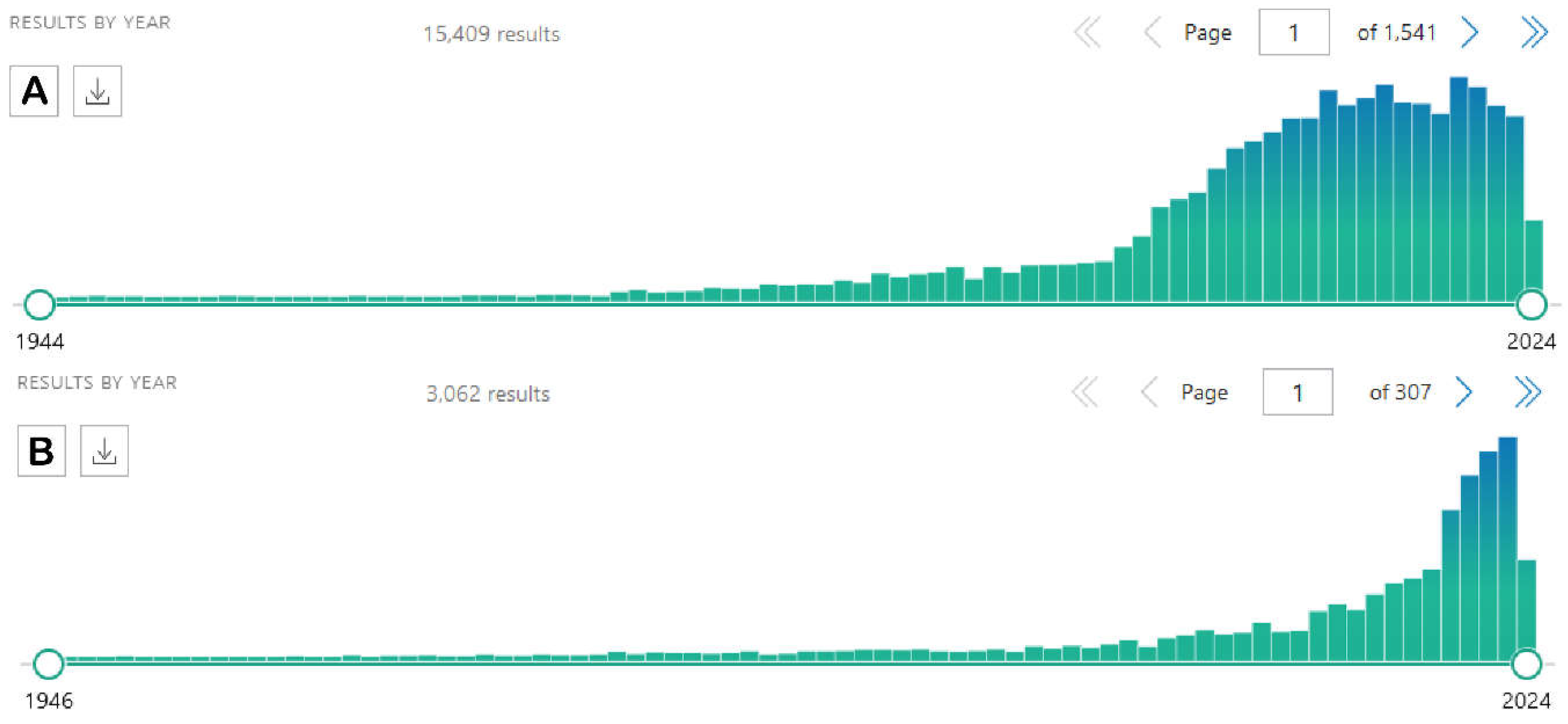

Table 1.
Main dietary interventions based on IF approach [63].
Table 1.
Main dietary interventions based on IF approach [63].
| IF method | Features | References |
|---|---|---|
| ADF Alternate day fasting |
A day of eating is alternate to a day ad libitum is alternate to a day of fasting (25% of usual food intake, approximately 500 kcal) | [64] |
| IF 5:2 | A five-days with normal eating and two days of severe fasting (food intake restricted to 500 - 800 cal) | [57] |
| FMD Fasting-mimicking diet |
A five-day fasting dietary regimen centered around natural, healthful items and ingredients (healthy fats and fiber-rich carbohydrate) with no refined carbohydrate (25% of usual food intake and less than 10% of protein) | [65,66] |
| PF Periodic fasting |
Water-only fasting or FMD for at least two days in succession repeated each month (involves a maximum daily energy intake of 250 kcal for about one week – 5-day diet affording 750-1100 kcal) | [67] |
| TRF Time-restricting feeding |
Daily no energy intake (or restricted amount) for 12 - 20 h, with eating window of 4 - 12 h (reduction of at least 20% of caloric intake) | [68] |
| eTRF Early time-restricting feeding |
Modified TRF in which calories restriction occurs in the first 6 -8 h of the day (i.e., eating window starts at 08:00 a. m. to at the maximum 02:00 p.m.) | [69] |
| lTRF Late time-restricting feeding |
Modified TRF in which the eating window starts late in the day, usually from 02:00 p. m. to at the maximum 08:00 p.m.) | [70] |
Table 2.
Overview of the selected clinical studies based on ADF approach.
| Clinical trial | Participants | Trials weeks | Intervention |
Body weight (kg) |
WC |
Blood pressure (mmHg) |
Plasma lipids (mg/dL) |
Glucoregulatory factors (mg/dL) |
Adherence and tolerability | Ref | ||
| Overweight and obese | UIC-004-2009 | 16 obese subjects (12 females, 4 males); age 35–65 y, BMI 30 -39.9 kg/m2 | 10 | 3 intervention phases: • 2-w pre-loss control phase (usual eating and exercise habits) • 4-w weight loss/ADF controlled food intake phase (25% of energy needs on the fast day (24 h) and ad libitum food on each alternate feed day (24 h)) • 4-w weight loss/ADF self-selected food intake phase (25% of energy needs on the fast day and ad libitum food on the feed day) |
-5.8 | NA | SBP -9.5 | TG -38 | FI NA |
No drop in adherence during the different phases | [115] | |
| TC -37 | ||||||||||||
| FPG NA |
||||||||||||
| DBP -1.5 | ||||||||||||
| LDL-C -29 | ||||||||||||
| HOMA-IR NA |
||||||||||||
| HDL-C +2 | ||||||||||||
| Randomized, parallel-arm feeding trial | 74 subjects with BMI 30 - 39.9 kg/m2; age 25 - 65 y | 10 | ADF lunch (ADF-L): 25% of baseline energy needs on the fast day (24 h), and ad libitum on each alternating feed day (24 h) |
-3.5 | NA | SBP -2 | TG -6 | FI 0 μIU/mL |
Adherence to the fast day energy goal was similar for each group . Compliance of ADF meal was high in each intervention group | [116] | ||
| TC -1 | ||||||||||||
| FPG -2 | ||||||||||||
| DBP -1 | LDL-C -2 | |||||||||||
| HOMA-IR -0.3 |
||||||||||||
| HDL-C -2 | ||||||||||||
| ADF dinner (ADF-D): 25% of baseline energy needs on the fast day (24 h), and ad libitum on each alternating feed day (24 h) |
-4.1kg | NA | SBP -5 | TG -9 | FI -2 μIU/mL |
|||||||
| TC -5 | ||||||||||||
| FPG -1 | ||||||||||||
| DBP -3 | LDL-C 0 | |||||||||||
| HOMA-IR -0.8 |
||||||||||||
| HDL-C 0 | ||||||||||||
| ADF-small meals (ADF-SM): 25% of baseline energy needs on the fast day (24 h), and ad libitum on each alternating feed day (24 h) |
-4kg | NA | SBP -6 | TG -1 | FI -2 μIU/mL |
|||||||
| TC -1 | ||||||||||||
| FPG -2 | ||||||||||||
| DBP -1 | LDL-C +1 | |||||||||||
| HOMA-IR -0.8 |
||||||||||||
| HDL-C -1 | ||||||||||||
| Pilot study | 26 subjects, aged 18 -55 y; BMI 30 kg/m2 | 8 | zero-calorie ADF (n =14) | -8.2 | NA | SBP NA | TG -25 | FI +3 μU/mL FPG +6 HOMA-IR NA |
No relevant safety changes over the 8-w; zero-cal ADF is safe and tolerable and not associated with weight regain after 24 w of follow-up | [114] | ||
| TC -31.8 | ||||||||||||
| DBP NA | LDL-C -22.6 |
|||||||||||
| HDL-C -4.2 |
||||||||||||
| CR (n=12): -400 kcal/day | -7.1 | NA | SBP NA |
TG -2.8 | FI -0.2 μU/mL FPG +3.3mg/dl HOMA-IR NA |
|||||||
| TC -21.7 | ||||||||||||
| DBP NA |
LDL-C -16.9 |
|||||||||||
| HDL-C -4.2 |
||||||||||||
| Randomized controlled trial NCT00960505. |
79 subjects, BMI 25 -40 kg/m2; men and women aged 18-65 y | 24 (12 Control feeding period, 12 self-selected feeding) |
ADF (n=25) alternating every 24-h between consuming 25% or 125% of energy needs |
NA | NA | SBP NA |
TG NA |
FI -7.4 μIU/mL |
NA | [117] | ||
| TC NA |
||||||||||||
| FPG 0 | ||||||||||||
| DBP NA |
LDL-C NA |
|||||||||||
|
HOMA-IR -1.88 |
||||||||||||
| HDL-C NA |
||||||||||||
| CR(n=29) consuming 75% of needs every day |
NA | NA | SBP NA |
TG NA |
FI -4.4 μIU/mL |
|||||||
| TC NA |
||||||||||||
| FPG +5.2 | ||||||||||||
| DBP NA |
LDL-C NA |
|||||||||||
| HOMA-IR -0.79 |
||||||||||||
| HDL-C NA |
||||||||||||
| CONTROL (n=25) consuming 100% of needs every day |
NA | NA | SBP NA |
TG NA |
FI +0.6 μIU/mL |
|||||||
| TC NA |
||||||||||||
| FPG +5.2 |
||||||||||||
| DBP NA |
LDL-C NA |
|||||||||||
| HOMA-IR +0.5 |
||||||||||||
| HDL-C NA |
||||||||||||
| Randomized, controlled, long-term study www.clinicaltrials.gov NCT02480504. |
112 subjects, aged 21-70 y; BMI 30-45 kg/m2 | 1 y (6 months weight loss, 6 months weight maintenance) |
5:2 approach consumption of 400/600 kcal (female/male) on each of two nonconsecutive days a week and to consume food as usual the remaining five days a week |
-9.1 | -8 | SBP -1.9 | TG -0.31 mmol/L |
FI NA |
None of the participants withdrew. Participants in the IF group reported stronger feelings of hunger. Adverse events and larger weight regain than in the CR group |
[121] | ||
| TC +0.7 mmol/L |
||||||||||||
| FPG -0.2 mmol/L |
||||||||||||
| DBP -3 | ||||||||||||
| LDL-C -0.03 mmol/L |
||||||||||||
| HOMA-IR NA |
||||||||||||
| HDL-C +0.13 mmol/L |
||||||||||||
| CR reduction of energy intake seven days a week |
-9.4 | -9.2 | SBP -3.6 | TG -0.11 mmol/L |
FI NA |
|||||||
| TC +0.17 mmol/L |
||||||||||||
| FPG 0 mmol/L |
||||||||||||
| DBP -2.9 | ||||||||||||
| LDL-C +0.08 mmol/L |
||||||||||||
| HOMA-IR NA |
||||||||||||
| HDL-C +0.13 mmol/L |
||||||||||||
| Single-centre, parallel group randomized controlled trial ACTRN12614000396628 |
23 males, aged 55–75 y, BMI ≥ 30 kg/m2 | 6 months | 5:2 approach n=11 restricted daily calorie intake to 600 cal on the fast day for two non-consecutive days per week and eat ad libitum on the remaining 5 days |
-5.3 | -8 | SBP -14 | TG -0.3 mmol/L |
FI NA |
No adverse side effects experienced in either dietary group. Over half of participants on the 5:2 diet experienced hunger after 2 w with slight progress over time- Compliance rates were similar in both dietary groups |
[118] | ||
| TC 0 mmol/L |
||||||||||||
| FPG -0.1 mmol/L |
||||||||||||
| DBP -0.2 | LDL-C -0.09 mml/L |
|||||||||||
| HOMA-IR NA |
||||||||||||
| HDL-C +0.04 mmol/L |
||||||||||||
| SERD (standard energy-reduced diet) n=12continuous daily energy-restricted diet (500- cal daily reduction from average requirement) | -5.5 | -6.4 | SBP -10.2 | TG -0.2 mmol/L |
FI NA |
|||||||
| TC +0.2 mmol/L |
||||||||||||
| FPG -0.2 mmol/L |
||||||||||||
| DBP -3.7 | LDL-C -0.45 mmol/L |
|||||||||||
| HOMA-IR NA |
||||||||||||
| HDL-C 0 mmol/L |
||||||||||||
| Randomized, controlled, parallel-arm diet trial NCT0365253 | 31 subjects, aged 20–65 y; BMI >23 kg/m2 | 8 | E-ADF (ADF and exercise) 25% of daily recommended energy intake (approximately 500 kcal) on each fast day (24 h), and food ad libitum on each feed day (24 h). The fast day and feed day were repeated every other day, and the fast day occurred 3 days per week. Exercise - training and aerobic exercise. |
-3.9 | NA | SBP NA |
TG -43.6 | FI -3.87 μIU/mL |
NA | [122] | ||
| TC +15.1 | ||||||||||||
| FPG -14.1 |
||||||||||||
| DBP NA |
LDL-C +17.8 | |||||||||||
| HOMA-IR -1.12 |
||||||||||||
| HDL-C +6 | ||||||||||||
| ADF 25% of daily energy intake (approximately 500 kcal) on each fast day (24 h), and food ad libitum on each feed day (24 h). The fast day and feed day were repeated every other day, and the fast day occurred 3 days per week |
-3.9 | NA | SBP NA |
TG +12.6 | FI +3.21 μIU/mL |
|||||||
| TC +5.4 | ||||||||||||
| FPG -9.7 |
||||||||||||
| DBP NA |
||||||||||||
| LDL-C 0 |
||||||||||||
| HOMA-IR +0.68 |
||||||||||||
| HDL-C +2.9 |
||||||||||||
| EXERCISE exercise intervention included resistance training and aerobic exercise. |
-2 | NA | SBP NA |
TG -87.9l | FI +0.04 μIU/mL |
|||||||
| TC +20.3 | ||||||||||||
| FPG -1.3 |
||||||||||||
| DBP NA |
LDL-C +26.7 |
|||||||||||
| HOMA-IR +0.01 |
||||||||||||
| HDL-C +11.2 |
||||||||||||
| CONTROL | -0.2 | NA | SBP NA |
TG +53.2 |
FI +5.19 μIU/mL |
|||||||
| TC +33.2 |
||||||||||||
| FPG -4 |
||||||||||||
| DBP NA |
LDL-C +16.9 |
|||||||||||
| HOMA-IR +1.10 |
||||||||||||
| HDL-C +5.7 |
||||||||||||
| Longitudinal study | 31 subjects, BMI 30-49.9 kg/m2; aged 18 - 65 y | 6 months (3 months weight-loss, 3 months weight-maintenance) | ADF low-carbohydrate intervention | -5.5 | NA | SBP -7 | TG -14 | FI -4 μIU/mL |
Adherence was high amongst those who completed the study. High dropout (40%), particularly in the first few months of intervention | [119] | ||
| TC -12 | ||||||||||||
| FPG 0 |
||||||||||||
| DBP -4 | LDL-C -10l |
|||||||||||
| HOMA-IR -0.7 |
||||||||||||
| HDL-C -2 |
||||||||||||
| T2DM | Non-blinded randomized parallel group interventional trial ACTRN12614000402640 | 37 subjects aged >18 y with T2DM treated with metformin and/or any combination of hypoglycemic agents, HbA1c 50–86 mmol/mol; 15 females and 22 males. | 12 | Diet with consecutive fasting days (n = 18) |
-3.1 | -1.6 | SBP -3 | TG +0.1 mmol/dL | FI NA |
Hypoglycemic events (53) during 84 days of observation affecting 15 participants which required further medication adjustments in 9 out of 37 subjects | [124] | |
| TC +0.1 mmol/dL | ||||||||||||
| FPG -1.3 mmol/dL |
||||||||||||
| DBP -2 | LDL-C +0.15 mmol/dL |
|||||||||||
| HOMA-IR NA |
||||||||||||
| HDL-C +0.1 mmol/dL |
||||||||||||
| Diet with non-consecutive fasting days (n = 19) |
-3.6 | -3.4 | SBP -4 | TG 0.1 mmol/dL |
FI NA |
|||||||
| TC -0.4 mmol/dL |
||||||||||||
| FPG -1.1 mmol/dL |
||||||||||||
| DBP -3 | ||||||||||||
| LDL-C -0.1 mmol/dL |
||||||||||||
| HOMA-IR NA |
||||||||||||
| HDL-C 0 mmol/dL |
||||||||||||
| NCT00960505. | 43 insulin-resistant individuals, aged 18 - 65 y, BMI 25-39.9 kg/m2 | 12 months | ADF (n=11) • 6 months weight-loss: 25% of baseline energy needs as a lunch on fast days and 125% of baseline energy needs over three meals on alternating feast days • 6 months maintenance phase: 50% of energy needs as a lunch on fast days and 150% of energy needs over three meals on alternating feast days |
-8 | NA | SBP -9 | TG -27 | FI -12 μIU/mL |
ADF participants consumed almost twice as many calories on fast days but still observed greater metabolic effects compared with CR participants | [125] | ||
| TC +4 | ||||||||||||
| FPG -3 |
||||||||||||
| DBP -5 | LDL-C +7 |
|||||||||||
| HOMA-IR -3 |
||||||||||||
| HDL-C +3 |
||||||||||||
| CR (n=17) • 6 months weight-loss: 75% of baseline energy needs over three meals every day • 6 months maintenance phase: 100% of energy needs over three meals every day |
-5 | NA | SBP -7mmHg |
TG -6 | FI -1 μIU/mL |
|||||||
| TC -6 | ||||||||||||
| FPG -4 |
||||||||||||
| DBP -2 | LDL-C -6 |
|||||||||||
| HOMA-IR -0.9 |
||||||||||||
| HDL-C +2 |
||||||||||||
| CONTROL (n=15) not changing usual eating and activity habits |
0kg | NA | SBP -1 | TG -8 | FI -3 μIU/mL |
|||||||
| TC -1 | ||||||||||||
| FPG +4 |
||||||||||||
| DBP -3 | LDL-C 0 |
|||||||||||
| HOMA-IR 0.5 |
||||||||||||
| HDL-C +2 |
||||||||||||
| Randomized controlled clinical pilot study | 32 subjects, aged 25 - 75 y with a manifest and treated T2DM | 7 days of intervention 4 months trial |
ADF n=16 2 pre-fasting days with moderate caloric restriction (approx. 1200 kcal) followed by 7 modified fasting days with nutritional energy intake of 300 kcal/day by liquids only and subsequent stepwise re-introduction of ordinary food items over 3 days |
-3.5 | -4.4 | SBP -13.9 | TG -26.6 | FI -3.5 μU/mL |
Fasting was well accepted, no serious adverse events. | [123] | ||
| TC -0.5 | ||||||||||||
| FPG -10.6 |
||||||||||||
| DBP -9 | LDL-C -2.6 l |
|||||||||||
| HOMA-IR -1.5 |
||||||||||||
| HDL-C +6.5 |
||||||||||||
| CONTROL n=16 following the principles of a Mediterranean diet |
-2 | -0.3 | SPB +0.4 | TG -2.5 | FI -0.2 μU/mL |
|||||||
| TC -15.5 | ||||||||||||
| FPG -38.4 |
||||||||||||
| DBP +3.2 | LDL-C -7.8 |
|||||||||||
| HOMA-IR -1.5 |
||||||||||||
| HDL-C -2.3 |
||||||||||||
| Metabolic syndrome | Single-center, randomized clinical trial IRCT201509092395N8 | 69 subjects, aged 25–60 y overweight (BMI 25-40 kg/m2), 41 males and 28 femalesdiagnosed with MetS | 8 - |
ADF n=35 75% energy restriction during 3 fast days and 100% of energy needs on feed day |
-4.1 | -4 | SBP -13 | TG -52 | FI -2.41 μU/mL |
no complaint due to difficulties with diet adherence |
[126] | |
| TC -11 | ||||||||||||
| FPG -5 |
||||||||||||
| DBP -8 | LDL-C -5 |
|||||||||||
| HOMA-IR -0.72 |
||||||||||||
| HDL-C 0 |
||||||||||||
| CR n=34 75% of energy needs each day |
-1.7 | -1 | SBP -1 |
TG -40 | FI -1.56 μU/mL |
No complaint due to difficulties with diet adherence | ||||||
| TC -8 | ||||||||||||
| FPG 0 |
||||||||||||
| DBP -5 | LDL-C -1 |
|||||||||||
| HOMA-IR -0.39 |
||||||||||||
| HDL-C 0 |
||||||||||||
| Randomized controlled trial NCT03608800 | 39 subjects with MetS, 21 males and 18 femalesaged 30 - 50 y | 8 | ADF n= 21 75% energy restriction for 2 non-consecutive days a week and an ad libitum diet the other 5 days |
-3.5 | -2.5 | SBP -5.3 |
TG –0.22 | FI NA |
91.3% of participants were compliant | [127] | ||
| TC –0.04 | ||||||||||||
| FGP NA |
||||||||||||
| DBP -2.5 | LDL-C +0.02 |
|||||||||||
| HOMA-IR -0.75 |
||||||||||||
| HDL-C +0.5 |
||||||||||||
| CONTROL n= 18 routine diet without dietary instructions |
-1.2 | -1.1 | SBP -4.9 | TG 0 | FI NA |
78.3% of participants were compliant | ||||||
| TC -0.27 | ||||||||||||
| FGP NA |
||||||||||||
| DBP -2.1 | LDL-C +0.55 |
|||||||||||
| HOMA-IR -0.09 |
||||||||||||
| HDL-C +0.16 |
DBP= diastolic blood pressure; SBP= systolic blood pressure; FI= fasting insulin; FPG = fasting plasma glucose; HDL-C = high- density lipoprotein cholesterol; HOMA-IR = homeostasis model assessment for insulin resistance; LDL- C = low- density lipoprotein cholesterol; NA = not applicable (parameter not measured); TC= total cholesterol ; TG= triglycerides; WC = waist circumference.
Disclaimer/Publisher’s Note: The statements, opinions and data contained in all publications are solely those of the individual author(s) and contributor(s) and not of MDPI and/or the editor(s). MDPI and/or the editor(s) disclaim responsibility for any injury to people or property resulting from any ideas, methods, instructions or products referred to in the content. |
© 2024 by the authors. Licensee MDPI, Basel, Switzerland. This article is an open access article distributed under the terms and conditions of the Creative Commons Attribution (CC BY) license (http://creativecommons.org/licenses/by/4.0/).
Copyright: This open access article is published under a Creative Commons CC BY 4.0 license, which permit the free download, distribution, and reuse, provided that the author and preprint are cited in any reuse.


