
Submitted:
21 May 2024
Posted:
21 May 2024
Read the latest preprint version here
Abstract
ct (Do not insert blank lines, i.e. \\)
\abstract{We propose an \(E_8 \otimes E_8\) unification of the standard model with pre-gravitation, on an exceptional Lie algebra-valued space . Each of the \(E_8\) has in its branching an $SU(3)$ for space-time and an $SU(3)$ for three fermion generations. The first \(E_8\) further branches to the standard model \(SU(3)_c \otimes SU(2)_L \otimes U(1)_Y\) and describes the gauge bosons, Higgs and the left chiral fermions of the standard model. The second \(E_8\) further branches into a right-handed counterpart (pre-gravitation) \(SU(3)_{grav}\otimes SU(2)_R \otimes U(1)_g\) of the standard model, and describes right chiral fermions, a Higgs, and twelve gauge bosons associated with pre-gravitation, from which general relativity is emergent. We account for 208 out of the 496 degrees of freedom of \(E_8 \otimes E_8\) and propose an interpretation for the remaining 288, motivated by the trace dynamics Lagrangian of our theory. We explain how the two copies of \(SU(3)_{spacetime}\) together give rise to a 6D spacetime with signature $(3,3)$ which upon symmetry breaking gives rise to our 4D spacetime and to a second 4D anti-spacetime with flipped signature.
Keywords:
unification
; exceptional Lie groups
; octonions
; exceptional Jordan algebra
; standard model
; gravitation
1. Underlying Motivation for the Present Approach to Unification
Quantum field theory, and the standard model of particle physics, are usually formulated on a classical background spacetime which obeys the laws of classical general relativity. The presence of a classical spacetime in quantum theory should be treated as an approximation, even at energy scales much lower than Planck energy scale, such as the scales accessible to present day accelerators. This is because the presence of a classical spacetime requires that the universe must be dominated by classical material bodies such as stars and galaxies. In the absence of such bodies, only microscopic quantum systems will be present, and then it is a consequence of the Einstein hole argument that the underlying spacetime manifold (with its point structure) cannot be operationally defined. This is because operational distinguishability of spacetime points requires that the spacetime be overlaid by a classical metric. But such a classical metric cannot in general be produced by quantum matter sources, because the latter obey the quantum superposition principle and are delocalised, unlike classical material bodies.
It can therefore be convincingly argued that the assumption of a classical spacetime pre-assumes the dominant existence of classical systems in the universe. This statement is independent of the energy scale under consideration. Now, classical material bodies are a limiting case of quantum systems, which obey the laws of quantum field theory. Therefore the current formulation of quantum field theory and of the standard model of particle physics on a classical spacetime background is an approximation. There must exist a reformulation of quantum field theory, even at low energies, which does not depend on classical spacetime. Our attempt to arrive at such a reformulation also turns out to be a guide to a quantum theory of gravity, and to a unification of the standard model with gravitation.
In the search for such a reformulation, three new aspects must be necessarily addressed. Firstly, there should be a dynamics more general than quantum field theory, which can potentially be made free of classical spacetime. The theory of trace dynamics [1,2] developed by Stephen Adler and collaborators is a possible candidate for such a dynamics. This is a matrix valued Lagrangian dynamics on classical Minkowski spacetime, which possesses a novel conserved charge known as the Adler-Millard charge, which makes it a precursor of quantum field theory. Trace dynamics is assumed to hold at time scales of the order of Planck time, and the statistical thermodynamics of this theory leads to emergence of quantum field theory at time scales much larger than Planck time.
Secondly, there should be a means to incorporate gravitation in trace dynamics, in a manner independent of spacetime and its accompanying metric. In this we have been guided by the noncommutative geometry programme of Connes and collaborators, and the attendant spectral action principle [3]. The spectral action principle casts the action for general relativity and Yang-Mills gauge fields in terms of the eigenvalues of the Dirac operator, and these eigenvalues play the role of dynamical variables, as an alternative to the metric and to the gauge field vector potentials. In order to incorporate gravitation into trace dynamics, these eigenvalues are raised to the status of operators, one operator per eigenvalue. A Lagrangian is constructed from the trace of these operators, and incorporates pre-gravitation, Yang-Mills gauge degrees of freedom, and chiral fermions in a unified manner. The Lagrangian defines an `atom of space-time-matter’ (an STM atom) and the fundamental universe is made of enormously many copies of such STM atoms. Subsequent to the big bang event, a quantum-to-classical transition precipitates a symmetry breaking that gives rise to our present symmetry broken universe.
Thirdly, one must give up on the classical spacetime manifold and its point structure, and replace it by a more fundamental physical space from which spacetime emerges. In this search we have been guided by the role of the Dirac operator as a dynamical variable, and by the fact that this operator is closely related to a Clifford algebra and to the quaternions. Also, it is known that there are only four normed division algebras, the reals , the complex numbers , the quaternions and the octonions . Why should nature use only real numbers in the construction of spacetime? We are proposing that in quantum theory, prior to the said symmetry breaking, physical space is labeled by quaternions / octonions. Elementary particle states are described not by complex numbers, but by complex quaternions and complex octonions. The associated symmetry groups are those which are directly associated with the octonions, starting with the smallest exceptional Lie group which is the automorphism group of the octonions. The other four exceptional groups have their corresponding Lie algebras arising as composition Lie algebras over and , respectively [4]. Furthermore, the division algebras relate to the Lorentz group in higher dimensional spacetimes, as follows: . There hence arises the possibly that 10D spacetime is of importance to the unified theory.
There then remains to specify the symmetry group of the unified theory, and its branching pattern upon symmetry breaking. We are proposing that the symmetry group is , and the pattern of symmetry breaking presented in this paper is strongly motivated by the Freudenthal-Tits magic square which selects certain Lie algebras as composition Lie algebras made from tensor products of normed division algebras. Moreover, the transition from octonions (related to exceptional Lie algebras) to quaternions (related to symplectic Lie algebra) to complex numbers (related to favours inclusions involving a smaller Lie group plus an . Thus the following inclusions are in a way special:
This claim is also supported by the Jordan pairs and Jordan triple systems construction of exceptional algebras, in the work of Truini and collaborators [5], using the so-called magic star.
The eventual picture of the emergent universe that we seek to confirm is shown in Figure 1 below. The symmetry breaking is the electroweak symmetry breaking which branches a 6D spacetime into a 4D spacetime and a 4D anti-spacetime with flipped signature . The geometry of the first 4D spacetime is governed by a broken symmetry, and the geometry of the second, flipped, spacetime is governed by the broken electroweak symmetry. The weak interaction is presented as the `gravity’ of the second spacetime, although from the perspective of our spacetime it appears as a broken internal symmetry. Left chiral fermions reside on the flipped 4D spacetime, and right chiral fermions on our 4D spacetime, and two Higgs bosons couple the fermions of these two spacetimes. QCD color is present as a part of the fibre bundle on the flipped spacetime with the unbroken internal gauge symmetry . The corresponding fibre bundle on our spacetime is the unbroken internal symmetry , these being the two newly predicted theories in addition to the four already known ones. Spacetime is described by quaternions, more precisely by split biquaternions. Octonions arise only while describing the internal symmetries and over the bundle. This overall scenario is currently under development and a small part of it is the content of the present paper.
It is proposed that is the precursor of general relativity which arises after symmetry breaking of the . The unbroken has recently been suggested as a possible fifth force which might explain the phenomenology of Milgrom’s MOND (Modified Newtonion Dynamics) [6]. There is evidence in the literature, for instance in the works of Ashtekar [7], and of Woit [8,9], that general relativity can be treated as a Yang-Mills gauge theory of symmetry. Our ongoing investigations attempt to put general relativity and the weak interaction on the same footing, except that they have opposite parity.
2. Introduction to the Model
In this paper we present the 248 dimensional fundamental representation (rep) of branched into our proposed subgroups for understanding a unified theory with gravitation on an octonionic background. The motivation for using this group is based on our previous work on unification using octonions [10,11]. We describe our space mapped by the octonions to be a prespacetime manifold on which all the fermions, bosons (including gravity) are present and follow trace dynamics (a collapse theory). The octonions are related with the Exceptional Lie groups intrinsically, therefore subgroups like , used in the standard model naturally arise in the prespacetime manifold. What we call internal symmetry in spacetime manifold is geometrical dynamics on this prespacetime octonionic manifold. An important aspect of is that the adjoint representation is the fundamental representation, therefore we are able to write the fermions and the bosons using the same rep, something that is desired in our pre-spacetime trace dynamics theory [12].
There are works of other researchers as well who have been looking at and for a unified theory. One of the earliest attempts was in string theory, which proposed an based heterotic string theory [13,14]. There have been some recent attempts using the octonions from Manogue, Dray, and Wilson [15]. Pavsic also discusses about the physical origins of [16]. Pavsic talks about SO(8,8) unification and the fact that the generators of SO(8,8) (total 120) and the spinors of (total 128) sum up to 248 which is the adjoint/fundamental rep of is an important sign.
In the next section we present the maths of branching into our desired maximal subgroup of . In the sections following that we will propose the physical interpretation and the reasons for choosing the desired gauge-group.
3. Branching of
unification not only gives us all the fundamental particles including fermions and bosons but also a spacetime on which post-symmetry-breaking fields could be defined and an internal space where three generations of fermions exist as triplets. The left-right symmetric gauge group arising in our theory is given as where this gauge group involves all the interactions prescribed by the octonionic theory. The rep is written as broken into the two separate . Each gets branched into a SU(3) by the following rule [17]
Our corresponding E will then branch into SU(3) ⊗ SU(3) ⊗ SU(3). One SU(3) (call it ) gives the interpretation of an internal space for three generations, the second SU(3) gives strong interaction. The remaining SU(3) branches into giving us three generations of fermions following . From the other we get three generations of fermions that obey the pre-gravitational gauge group . The motivation for having a right-handed chiral gravitation under this gauge group is given in section III and the explanation for using is given in section IV. The Higgs couples the left and the right sector post SSB, giving us the Dirac fermions (with the exception of neutrino) with appropriate electric charge and mass.
The in branching of is to be interpreted as the group causing rotations on the octonionic coordinates, the subgroup of this is which causes rotations in quaternions (to be interpreted as rotations in 3-D space). We will call it , this is explained in more detail in section III.
Branching rule for 27, , 78 representations of E into SU(3) ⊗ SU(3) ⊗ SU(3) is given as,
The last SU(3) further branches into SU(2) ⊗ U(1), with its 3, and 8 breaking as,
Substituting the above three equations in the branching of E,
These three representations of contain all left chiral fermions and their right chiral anti-particles including all three generations, all gauge bosons, and Higgs doublet with antiparticles as this symmetry breaking is prior to spontaneous symmetry breaking of . Similarly we can do the branching of the other whose will contain all right chiral fermions and their left chiral anti-particles also including all three generations. In this section we try to recognise all the fermions we got in E branching and in next section we will talk about internal geometry we get from and spacetime geometry from remaining SU(3) of .
: these particles can be recognised as (, 2)(1) state found in the branching of 78 representation of . This state shows that these quarks are triplets for (as we have three generations), triplet for (showing strong interaction), doublet for (weak interaction) and 1/6 as weak hypercharge. If we calculate electric charge for each quark, we get
Their anti-particle state
: is also present as (3, 3, 2)(-1) following same symmetry but with -1/6 weak-hyper charge giving -2/3 and 1/3 as electric charges respectively. So in all we get 36 left chiral quarks including all three generations and anti-particles.
Next we go to the leptons
: these particles can be recognised as (, 1, 2)(-1) state found in representation of . This state shows that left chiral leptons are triplet for , singlet for (does not show strong interaction), doublet for and with -1/2 as weak hypercharge.
We can also find their anti-particle state
: as (3, 1, 2)(1) following same symmetry but with opposite weak-hyper charge which leads to 0 and 1 electric charges. This makes the count for left chiral leptons as 12 including all three generations and anti-particles.
We also find all the adjoint representations of our symmetry group in adjoint representation of E which leads to the bosons. (1, 8, 1)(0) includes adjoint representation of SU(3) which are all 8 gluons that mediate strong interaction. (1, 1, 3)(0) is the adjoint rep of SU(2) which leads to weak bosons and (1, 1, 1)(0) is U(1) boson. After spontaneous symmetry breaking of , we get three massive Weak bosons(W, W, Z) and one massless Photon. We can also see a state (1, 1, 2) which is a doublet of SU(2) with its anti-particle (1, 1, 2) (opposite U(1) charge) that can be recognized as the Higgs, as we are prior to spontaneous symmetry breaking. Post symmetry breaking the weak bosons and fermions gain masses and Higgs become a singlet. So in total we have 16 bosons for the left chiral part.
Now we try to induce spacetime using the remaining SU(3) which we have in E using Equation (2) and see how all fermions and bosons are present in it. We will use all the equations from Equation (3) to Equation (11) in order to further branch E.
This big branching of 248 rep of E contains all the left chiral fermions, their anti-particles and all gauge bosons responsible for interaction among them. After this breaking, we can see that all the left chiral quarks represented as (1, 3, 3, 2) are coming as singlet of the SU(3) while all leptons represented as (3, 3, 1, 2) as a triplet. We have a total of 36 quarks and 12 leptons. After invoking SU(3) degree of freedom we get 36 quarks and 36 leptons. Like quarks all bosons are also singlet of SU(3) with their total number as 16.
Out of 248 degrees of freedom, we have 8 d.o.f. for spacetime, 8 d.o.f. for internal space corresponding to 3 generations, 16 bosons, and 72 fermions which means that out of 232 particles we can identify 88 left chiral particles.
Next, we analyze the Right Chiral part of the (extended) Standard Model which comes from another E branching to SU(3) ⊗ E. Branching rules follow a similar calculation from Eqn. (1) to Eqn. (10) but with a different interpretation of all the gauge groups.
We give a brief description of this gauge group here but a more detailed description is given in section III and also in [18,19]. [To obtain correct hypercharges, we here define where for a color triplet, and for a color singlet. We thank David Chester for pointing this out to us]. Here SU(3) gives all three generations by creating an internal space. SU(3) gives a Gravi-Strong interaction [18] where just like u and d quarks are triplets of SU(3), the u and e becomes triplets of SU(3). This interaction is mediated by eight “gravi-gluons" that are represented by the adjoint representation of SU(3) and acquires a state (1, 8, 1)(0). The SU(2)⊗ U(1) gives us four massless gauge bosons similar to SU(2)⊗ U(1) represented as (1, 1, 3)(0) and (1, 1, 1)(0). After spontaneous symmetry breaking of this gauge group into U(1), we get a pre-gravitation interaction mediated by three “Weak-Lorentz" bosons and one photon-type boson which we call “Dark Photon". This symmetry breaking is induced by the Higgs doublet (1, 1, 2) with its anti-particle also present in branching of E. So in total we have 16 bosons similar to what we have for left chiral part.
There is a difference in the Spontaneous Symmetry breaking of our left chiral gauge group and right chiral gauge group. In the former, fermions acquire square-root masses which can only be done by coupling with U(1) gauge field while right chiral fermions acquire electric charges which can only be done by coupling with U(1) gauge field. So our two Higgs doublets, each one for different chirality are taking part in a certain mechanism where post SSB, they are coupling left chiral fermions with U(1) field in such a way that left chiral fermions can acquire square-root masses while they are coupling right chiral fermions with U(1) so that they could acquire electric charges (see Figure 1). Similarly, the right-handed up-quark and down quark will become triplets of SU(3) and the left-handed up quark will become a triplet of SU(3). Therefore post Spontaneous Symmetry breaking each fermion with both chiralities acquires mass, electric charge, and QCD colour that is in agreement with the standard model. However, SU(2) and SU(2) remain to be parity violating and this has been shown before by Furey [20] and us[19]. A preliminary analysis of the Lagrangian of the theory, relating it to three generations, has been carried out in [11]. The bosonic part of the Lagrangian has been discussed in detail in [21], where the weak mixing angle is also derived from first principles. For discussion of the Lagrangian see Section 6.2 below.
We can also find all the Right fermions and their anti-particles in this branching.
: these particles can be recognized as (, , 2)(1) present in the 78 dimensional representation of E Eqn. (10). Triplet for SU(3)(three generations), triplet for (“gravi-color") and doublet for (pre-gravitation interaction) with 1/6 as “Weak-Lorentz" charge. Instead of electric charge, we have for right chiral fermions that obeys the relation:
here is “Weak-Lorentz" charge and is iso-spin z component.
From this equation, we see that e has 1/3 , u has 2/3 , and d has 1 . This is experimentally correct. This is one of the main motivations for coming up with a pre-gravitation gauge group defined in this manner. More on it in the next section. We can also find their anti-particle state : represented as (3, 3, 2)(-1) following same symmetry with -2/3 and 1/3 respectively.
Next we have : represented by the state (, 1, 2)(-1) found in representation of E Eqn. (9). Triplet for SU(3), singlet for SU(3) and doublet for SU(2) with -1/2 as “Weak-Lorentz" hyper-charge.
Their anti-particles
: are present in 27 representation of E in Eqn.(8) as (3, 1, 2)(1) with 1/2 as “Weak-Lorentz" hyper charge and 0, 1 as respectively.
In total we have 9 up quarks, 9 electrons, 3 neutrinos and 3 down quarks and their equal anti-particles so we have 24 quarks and 24 leptons.
In the same manner, as for left chiral fermions, we can introduce spacetime for this E as well; then the branching of this E would be similar to Eqn. (11) but here spacetime representations are a bit different for leptons and quarks than in the left chiral part. We have
represented as (1, , , 2)(-1), so up quark and e both are singlet for SU(3) and is represented as (, , 1, 2)(-1) behaving as triplet for SU(3). After involving spacetime degree of freedom, we get 18 + 18 quarks (18 up and 18 down) and 18 + 18 leptons, including all three generations and anti-particles. All 16 gauge bosons for right chiral part are also a singlet for SU(3).
Hence we can identify 36 quarks + 36 leptons + 16 bosons = 88 particles out 232 degree of freedom.
We can therefore represent everything in a single unified representation of E⊗ E as (248, 1)⊕ (1, 248). So in total, we can identify 144 degrees of freedom as fermions, 32 degrees of freedom as bosons, and 32 degrees of freedom creating spacetime and internal generation space, out of a total of 496 degrees of freedom. This leaves 288 unaccounted for degrees of freedom; we return to address them in the Discussion section.
4. Octonionic Space, Fermions and Gauge Fields, Including Pre-gravitation
We propose an 8-D non-commutative space mapped by the octonions coordinates [10]. The automorphism group of the octonions is with the maximal subgroup . The eight-dimensional real representation of in the branching of is to be interpreted as the source for the 8 octonionic directions in our prespacetime manifold. The has the subgroup that causes rotations in 3-D and is the automorphism group of quaternions that map the 4-D spacetime . Another important aspect is that we have branching of both the , therefore we talk of a complexified space with octonionic coordinates. Another important aspect to notice here is that the neutrinos are the only triplets of irrespective of parity, therefore this rotation in the internal space might be related to neutrino oscillations, further research needs to be done to say more. In Section 7 below, we explain in some detail as to how the part of branching gives rise to a 6D space-time and to a symmetry which could be the possible origin of Connes time.
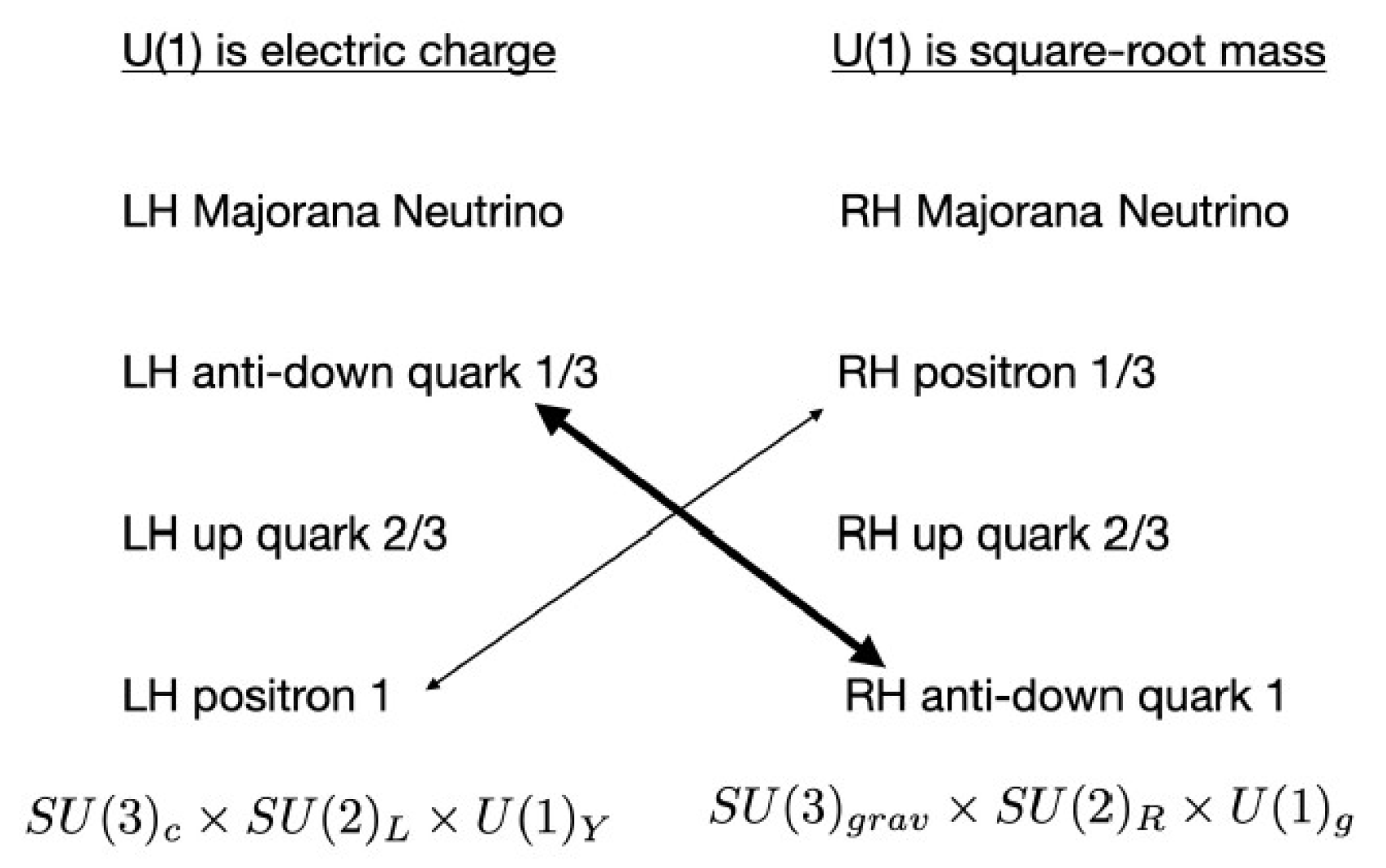
We now give a short justification for the pre-gravitaion gauge group which has been proposed earlier in [18]. The electric charge ratio of the down quark, up quark, and electron is 1:2:3, surprisingly enough the square root mass ratio of the electron, up quark, down quark is 1:2:3. We do no take this to be a mere coincidence. In [19], we showed the left-right symmetric representation of fermions, the proposal is that just like we have for the left-handed fermions that gives electric charge to the fermions, we have a for the right-sector that gives square-root mass to the fermions. In the right-sector, the electrons are triplets and have a square-root mass 1/3, whereas the down quark is a singlet and has a square-root mass 1. The right-handed down quark with square-root mass 1 is coupled to the left-handed down quark triplet with electric charge 1/3 and we get a Dirac quark with square-root mass 1 and electric charge 1/3. Similarly when the right-handed electron triplet with square-root mass 1/3 couples with a left-handed electron with electric charge 1 we get a Dirac electron with square-root mass 1/3 and electric charge 1. This can be represented via Figure 1 as shown.
The is to be interpreted as gravi-color and results in a gravitational interaction of the electron and up quark triplets. This interaction is confined to small length scales and is therefore not manifested in large scale gravity but we suggest that the effects of will be important for understanding the gravitational effects of subatomic particles like the electron. We propose that the will break into that corresponds to dark photon, whereas general relativity is emergent from the pre-gravitation. Theories have been proposed with the dark photon as a contender to explain dark matter[22] and testable experiments have also been proposed for the same[23]. We are also providing the emergence of the dark matter from symmetry breaking where is giving us the ”Lorentz bosons" as mediators for chiral gravity. chiral gravity has been used in Loop quantum gravity as the gauge group for Ashtekar variables [7] that are cannonical variables in spatial hypersrufaces in the ADM formalism of gravity [24].
The understanding of gravity is very intrinsically related to the problem of mass. Why the stress-energy tensor bends spacetime? The problem of mass is also related to the problem of three generations, why the three generations are exactly similar apart from their mass? In the next section we try to answer this and our internal space (not internal in a pre-spacetime octonionic space) of SU(3) generation.
5. Triality, Jordan Matrices, Spin(9), and Three Generations
In the above analysis, we have invoked an for three generations. The existence of three generations can be motivated from the triality of , its relation to the octonions, and their associated exceptional Lie groups. Triality is also crucial in explaining the observed mass ratios for the three generations [18].
There have been some recent attempts to understand the three generations of fermions through the language of octonions. Gillard and Gresnigt talk about the three generations of fermions through the algebra of Sedenions and [25]. The broader purview of the community is shifting towards the view that the triality of SO(8) is related to the three generations. We have oursleves related the three generations using the 3x3 Hermitian Jordan matrices with octonionic entries [11,18] and obeying the exceptional Jordan algebra whose automorphism group is . The automorphism group of the complexified exceptional Jordan algebra is ; this group is also the symmetry group of the Dirac equation in 10D space-time. There have been attempts before to interpret one of the from the maximal subgroup of to represent the rotation group for 3 generations [26,27].
We have , therefore the three generations of fermions discussed in [25] are related to spinors that we will now create from . Another interesting thing to note is that spinors will be 2x2 matrices with octonionic entries, therefore we will show shortly how our previous work on three generations from and Gresnigt’s construction [25] are related to three generations via triality.
Consider the following matrices:
Here are the octonions, and are the Pauli matrices, therefore the algebra is . These 9 matrices square to -1, and anti-commute with each other, therefore these can be used to make the generators of . Let’s call the generators as , i = 1,.., 9.
The fermionic creation and annihilation operators satisfying
and are given as:
These are the annihilation operators and correspondingly we will have the creation operators s. The idempotent V is given as:
The total 16 spinors created (following Furey and Dixon [28,29,30,31]) by acting the creation operator on the idempotent are given by:
It is interesting to note that the spinors created this way are 2x2 matrices with octonionic entries. The 2x2 exceptional Jordan matrices are spinors of spin(10). It has been shown by Dray and Manogue [32] that , . Therefore, the 16 spinors form the subalgebra of . Also, the 16 spinors from obtained here are related to the 16 spinors created by Gresnigt from to understand three generations via .This relates the three generations created by Gresnigt to our work in via triality in the following manner:
Triality of octonions is a map from that is achieved via the group SO(8) [33]. The octonionic spinors of that are to be interpreted as particles under [28,30,31] can be mapped to an element of via the following map:
Here depicts the charge corresponding to that octonion. And three elements of with same diagonal entries a, b, c and octonionic entries x, y, z respectively can be mapped to an element of as follows
We can now calculate the eigen-values of these matrices to obtain real numbers [34]. It has been shown in [18] that the eigen-values are related to the mass-ratios of charged fermions. Therefore while going from all the way to and then to its eigen-values, we are invoking the triality that is related to the three generations. The problem of the three generations is also the problem of the mass ratios!
is the automorphism group of the Octonions and has the maximal subgroup responsible for the colour of particles written in octonionic representation. is the automorphism group of and has the maximal subgroup where the other comes for generation [26]. All the three generations follow same spinorial dynamics, the only difference is between the mass, and it is a standard procedure in QFTs to write the three generations field as a column vector under . Post symmetry breaking of , the three generations obtain different mass and hence different Yukawa potentials, they can no longer be written as 3⊗1 column vector and the group breaks. However, the triality of the Octonions seems to suggest that there is some non-trivial relation between the three generations, therefore prior to Higgs mechanism, the group that comes from the maximal subgroup of is being used instead of .
6. Discussion
6.1. The Unaccounted for Degrees of Freedom
Our unified group contains every fundamental structure including spacetime, all chiral fermions, and their three generations, and all bosons. However this comes with some additional degrees of freedom whose states cannot be identified with our usual standard model particles. In this section, we attempt to give certain explanations for these unaccounted degrees of freedom. Each E will give us ten unaccounted states, with five being conjugate (anti-particle) to the other five. We list the five independent unaccounted states from Eqn. (12):
Post symmetry breaking the electric charges corresponding to the above states in that order are 2/3, 0, 2, (2/3 and 1/3 doublet), and 2/3 respectively.
There are a total of 144 unaccounted fermions from each , the total from both sides is 288. The total number of physical fermions from our theory are also 144, so there is a 1:2 ratio of accounted and unaccounted fermions. In the subsection below, we argue that the 288 d.o.f. go into the making of two composite Higgs, 144 each. Such a composite Higgs should be looked for at the LHC.
6.2. Overview of the Octonionic Theory
Our theory is a matrix-valued Lagrangian dynamics on an octonionic space, motivated as a pre-quantum, pre-spacetime theory, i.e., a reformulation of quantum field theory which does not depend on an external classical time [35,36]. It is a generalisation of Adler’s theory of trace dynamics, so as to include pre-gravitation. Quantum field theory and classical space-time and gravitation are emergent from this dynamics under suitable approximations. The fundamental universe is a collection of `atoms of space-time-matter’, an atom being a 2-brane described by matrix-valued dynamical variables on octonionic space and having the action principle (of the unified interactions)
This action defines a 2-brane residing on a split-bioctonionic space. This means that each of the two matrices and have sixteen components, one component per coordinate direction of the split bioctonion. This 16-dim space has symmetry. We separate the two dynamical variables into bosonic and fermionic parts, each of which again has sixteen coordinate components:
Left-Right symmetry breaking separates the bosonic dynamical variable into its left-chiral part defined over 8D octonionic space and the right chiral part defined over the 8D splt octonionic space. Similarly the fermionic dynamical variable separates into its left chiral part defined over 8D octonionic space and its right chiral part defined over the split octonionic space.
The Yang-Mills coupling constant arises as a consequence of the symmetry breaking, prior to which the theory is scale invariant, having only an associated length scale L but no other free parameter. The symmetries of the bioctonionic space are spacetime symmetries with the full symmetry being and with symmetry breaking introducing branching as discussed earlier in the paper, and also introducing interactions and coupling constants.
By defining new variables
we can also express the Lagrangian as
We can next expand each of these four terms inside of the trace Lagrangian as explored thoroughly in the paper [21], using the definitions of and given above:
This form of the Lagrangian displays terms for the bosonic variables (gauge fields), the fermionic part of the action (leading to the Dirac equations upon variation), and terms bilinear in fermionic varaibles (related to the Higgs). A preliminary analysis of this Lagrangian, relating it to three generations, has been carried out in [11]. The bosonic part of the Lagrangian has been discussed in detail in [21], where the weak mixing angle is also derived from first principles. In future work we hope to report as to how the Lagrangian relates to the fermions and bosons reported in the present paper, including the unaccounted for terms discussed in the previous subsection. We note that the (8x3=24) fermions of the three generations contribute 24 x 24 = 576 = 288 x 2 terms to the Lagrangian, which are bilinear in and . It is striking that this is twice the number 288 of unaccounted degrees of freedom. Recall also that there are 144 physical fermions as demonstrated earlier in the paper.The terms bilinear in the and possibly describe the two Higgs doublets of the theory, and hence it could be that the 288 unaccounted d.o.f. go into constituting two composite Higgs (144 for each Higgs) and hence that there are no new predicted fermions. Such a possibility is currently under investigation. We also note that there are (208-144=64=32x2) non-fermionic d.o.f. and these account for the 32 bosons corresponding to the (2x16=32) space-time d.o.f. (8+8 = 16 dimensional split bioctonioc space and the factor 2 because this space is complexified).
Such a pre-spacetime, pre-quantum dynamics is in principle essential at all energy scales, not just at the Planck energy scale [11]. Whenever a physical system has only quantum sources, the coordinate geometry of spacetime is non-commutative; and when that is an octonionic geometry, the spacetime symmetries result in the standard model and its unification with pre-gravitation, as we have seen in the present paper. Fermionic states are spinors (left minimal ideals) of the Clifford algebra made from octonionic chains. Following the earlier work of other researchers, we constructed such states for three generations of left chiral and right chiral quarks and leptons [18,19], and their associated bosons. We argued in these papers that pre-gravitation is the right-handed counterpart of the standard model with the associated symmetry group being . This is confirmed by the reps found in the present paper; furthermore the symmetry unifies the spacetime with the matter and gauge degrees of freedom living on this spacetime, into a common unified description. Doing so has also introduced new so-called unaccounted fermions which are truly beyond the standard model, and whose physical significance and experimental consequences remain to be understood.
The Dirac equation resulting from this Lagrangian dynamics has an symmetry, and its real eigenvalues are determined by the characteristic equation of the exceptional Jordan algebra , whose automorphism group is . These eigenvalues can be found for three generations of Dirac quarks and Dirac leptons, and also for three generations of left chiral fermions or right chiral fermions. Since the left chiral fermions are charge eigenstates, and right chiral fermions are square-root mass eigenstates, these eigenvalues help explain the strange mass ratios of quarks and leptons [18,37]. This is because experimental measurements invariably employ charge eigenstates, which are distinct from mass eigenstates.
The octonionic theory has similarities with string theory, but also differs from it in crucial ways. Our theory is also for extended objects in 10D spacetime and has an symmetry. However, we build the Fock space of states for particles, not on a 10D Minkowski spacetime vacuum, but on the octonion-valued twistor space, which is a spinor spacetime, as if a `square-root’ of the 10D Minkowski spacetime. The non-commutative octonion geometry has to be an essential feature of quantum theory even at low energy scales, not just at the Planck scale. Only then can the standard model be understood. The extra dimensions are complex and not to be compactified - these are the dimensions along which the internal symmetries lie. Finally, the Hamiltonian of the theory is in general not self-adjoint; thus enabling the quantum-to-classical transition, and otherwise becoming self-adjoint in the approximation in which quantum field theory is recovered from trace dynamics. Further evidence for trace dynamics comes from the result that the theory admits supra-quantum nonlocal correlations predicted by the Popescu-Rohrlich bound in the CHSH inequality, but disallowed by quantum mechanics. This constitutes strong evidence that quantum theory is approximate, and emergent from trace dynamics in a coarse-grained approximation [38,39]
The non-associativity of the octonions does bring its own challenges when they are employed in field theory. There is evidence that the challenges are eased when one uses split octonions. See e.g., the work of Gogberashvili [40] where rotations in the space of split octonions have been considered. It was shown therein that Lorentz transformations satisfy associativity when split octonions are employed. In the Freudenthal-Tits magic square as well, the space-time Lorentz algebras arise when one of the two composite algebras under consideration is split. In our own research programme, we employ split bioctonions to construct emergent spacetime. Furthermore, the work of Boyle and Farnsworth [41] extends the Connes noncommutative geometry programme to the non-associative case, rendering it plausible that Connes time is admissible in our octonionic theory.
We also note the Coleman-Mandula theorem: a no-go theorem which states that the space-time symmetry (Lorentz invariance) and internal symmetry of the S-matrix can only be combined in a trivial way, i.e., as a direct product. However, this does not prevent the unification of gravitation and the standard model, on which the present paper is based. This is because the theorem applies only to the spontaneously broken phase, in which the Minkowski metric is present. The unified phase does not have a metric, and hence not the Minkowski metric either, and hence the Coleman-Mandula theorem does not apply to the unified symmetry.
The octonionic theory employs the octonions to define a non-commutative coordinate geometry. The symmetries of the geometry dictate the existence of standard model chiral fermions, gauge bosons, and pre-gravitation. Clifford algebras made from octonionic chains define spinorial states for the fermions, and the exceptional Jordan algebra determines values of the standard model parameters. The matrix-valued Lagrangian dynamics determines evolution of these particles. Classical general relativity emerges from pre-gravitation as a result of a quantum-to-classical spontaneous localisation which confines classical systems to our familiar 4D spacetime. However, quantum systems always live in the octonionic space, which has complex extra dimensions which are never compactified. Further work is in progress so as to attempt taking this unification program to completion.
7. Dirac Operator, and the Origin of 6D Spacetime
We propose that the , in its decomposition, gives rise to the 15 dimensional symmetry of a 6D spacetime with three time coordinates and three space coordinates. The 16th degree of freedom could offer a possible explanation of Connes time through a which accompanies this decomposition. Thus what we have in mind is that each of the two undergoes an branching, with the two emerging s having opposite parity, and together they are mapped to the six imaginary directions of a split biquaternion. A 6D Dirac operator is defined as a gradient operator on this 6D space formed by the imaginary directions of the split biquaternion, and its square gives rise to the Klein-Gordon operator on 6D spacetime with signature . The that originates along with, could be a possible explanation for Connes time. We now explain this construction in some detail, making the Dirac operator the key focus of the discussion.
Dirac (1928) was looking for a linearised version of the Klein-Gordon equation
The sought for linear equation is written as
The self-adjoint operator D on the left hand side of this equation is the Dirac operator, and one demands that acting D twice on yields the Klein-Gordon equation, i.e., . The operator must equal the Klein-Gordon operator which appears on the left side of Eqn. (32). For this to be possible, the symbols must satisfy the following relations, as is easily verified
Because the anti-commute with each other they cannot be numbers. But they can be matrices. Dirac found a set of matrices which satisfy these relations, and are now known as Dirac matrices:
The Dirac matrices can be expressed in terms of the Pauli spin matrices as follows
This is known as the Pauli-Dirac representation. Eqn. (33) is the celebrated Dirac equation and it can also be written in the following compact notation
where we have set and . If an electromagnetic field defined in terms of the four-vector potential is present, then we must replace the derivative operator as so that the Dirac equation now becomes
Here, and . The wave function is a four component column spinor
where each of the four entries is a complex number which satisfies the Klein-Gordon equation. The matrices form a Clifford algebra: i.e., the elements of the algebra anti-commute, and each element squares to I or to . This particular Clifford algebra is . Clifford algebras are closely related to the quaternions and that leads us to ask what the Dirac equation, and in particular the Dirac operator, has to do with the quaternions.
In one of his lectures Michael Atiyah [42] notes that the Dirac operator was first discovered, not by Dirac, but by Hamilton, when the latter discovered the quaternions. This is a deep remark with far-reaching implications. What Atiyah means is that if we take the three imaginary directions of the quaternion and define the 3D Dirac operator in physical space as the gradient operator
then its square is minus the Laplacian: . Recall that a quaternion q is defined as
where the four are real numbers, and the set of quaternions is denoted . If the coefficients are complex numbers then we have a complex quaternion , also called a biquaternion, and the algebra is now . The Clifford algebra associated with quaternions is and with biquaternions it is . The automorphism group of the quaternions is (automorphisms are transformations that preserve the quaternionic multiplication rule), and quaternions generate rotations in 3D space. Biquaternions generate the Lorentz algebra and we recall that is the double cover of the Lorentz group on 4D Minkowski spacetime. (Interestingly, is the double cover of . More on this below). If we define the conjugate of a quaternion as then , and if then a 3D rotation belonging to the group leaves the quadratic form invariant. This is why a 3D vector can also be represented using a quaternion, as . In fact given a quaternion the product is given by, after writing , ,
where and are respectively the standard scalar product and cross product of vectors in 3D space. Thus the rules of vector multiplication are already contained in the algebra of quaternions, and in fact quaternions were invented prior to vector analysis in 3D. The two are equivalent but vectors became popular and successful, whereas quaternions were mostly forgotten in theoretical physics.
Let us return to Atiyah’s remark. What about four-dimensional Minkowski spacetime? If we define the 4D quaternionic gradient operator
then it is obvious that cannot yield the Klein-Gordon operator because we need four non-commuting quantities, but we have only three. The imaginary commutes with the quaternionic imaginaries. Yet there is a gradient operator which can be made using biquaternions which coincides with the Dirac operator , but in six spacetime dimensions with signature . The familiar Dirac operator D is a special case of as we describe below. If we insist on describing the Dirac operator as a quaternionic gradient operator (á la Atiyah) as we do, it is not possible to escape the conclusion that our universe has six spacetime dimensions, not four, and the two extra dimensions are time-like. The six dimensional spacetime, after a symmetry breaking, contains within it a 4D Minkowski spacetime and an overlapping 4D anti-Minkowski space-time with flipped signature: the two 4D spacetimes share one time and one space direction. While the Riemannian geometry of our space-time is due to the gravitational interaction, that of the anti-spacetime is due to the weak force. The weak force is not an internal symmetry but a spacetime symmetry masquerading as an internal symmetry. Prior to symmetry breaking there is a gravi-weak unification in 6D space-time. This theme will be developed in detail in subsequent investigations. The biquaternions naturally provide the Dirac operator as the gradient operator of the 6D spacetime and the Dirac operator D on 4D space-time is a special case of .
The quaternions per se do not go well with 4D special relativity, because the absolute magnitude of a quaternion is positive definite. Whereas it is left invariant by 4D rotations in Euclidean space, it is not invariant under the Lorentz transformations which leave the spacetime interval invariant. Biquaternions come to the rescue on this count. Consider a Hermitian biquaternion, which is defined as having the property where is the complex conjugate of q. A Hermitian biquaternion has a scalar part which is real, and a vector part which is imaginary: . We have for its norm: which has the desired Lorentz invariant form. If we take the anti-Hermitian biquaternion which satisfies then giving the Lorentz invariant quadratic form with flipped signature.
A point in 4D Minkowski spacetime is represented using a Hermitian biquaternion as
A Lorentz transformation must preserve its norm and is represented by action of a quaternion q which sends x to with where u and v are quaternions and . A rotation is given by and a boost by . A detailed discussion of special relativity in the language of quaternions can be found in the works of Lambek [43,44,45], and elsewhere as well.
Corresponding to the Hermitian biquaternion, we define the following 4D quaternionic gradient operator
It is also a Hermitian biquaternion, and under Lorentz transformations it transforms just like x, that is . Using the operator Maxwell’s equations of electrodynamics can be compactly written as
Here, the field tensor F is a biquaternion defined by and it transforms under Lorentz transformations as . The charge-current density J is defined by and also transforms as .
The 4D quaternionic gradient operator serves a useful purpose in special relativity and in Maxwell’s electrodynamics. Clearly though, it is inadequate for writing down the Dirac equation. To get there, we must follow a different path, which inevitably guides us to a 6D space-time.
There is a long history of researchers attempting to write the Dirac equation using a real quaternionic gradient operator (Dirac [46], Conway [47], Lambek [44], Morita [48]). The attempt eventually succeeded; here we follow the analysis of Morita (1986) [48] in their paper titled `A role of quaternions in the Dirac theory’. The abstract of the paper says, and we quote: “The Dirac theory is treated by noting that the Lorentz group is realised by a subset of , each element being characterised by a pair of unit quaternion (rotation) and pure quaternion (boost)." Here, by Lorentz group Morita means the one for 4D spacetime, i.e., and by pure quaternion is meant one that has only the vector part: .
Morita considers special matrices A belonging to and having the property and with . These are matrices with quaternionic entries of the form
Defining the matrix for the space-time vector x, the matrix A generates a Lorentz transformation via . Here the matrices are defined as
and the vector part generates boosts. Rotations are generated by the matrices where
The Lorentz matrix A is generated by a pair of pure quaternions p and q and is also specified by a pair of unit quaternion a and pure quaternion :
defines rotations and is made from the matrices, and describes boosts and is made from the pure matrices. Defining and , the matrices obey the Clifford algebra which corresponds to the original Clifford algebra of the Dirac matrices: . Defining the two component spinor with quaternionic entries, the Dirac equation can now be written as
which corresponds to and its complex conjugate. This quaternionic form of the Dirac equation illustrates the geometric role played by quaternions in constructing the gradient operator. And yet, this form of the Dirac operator is nowhere as neat as the 3D Dirac operator (40) and we should strive to do better. Some progress has been made by Lambek. Nonetheless the quaternionic Dirac equation strongly hints at the significance of 6D spacetime, because the occurrence of and is result of an arbitary choice. We could equally have made two other choices: and , or and .
To get to the sought for quaternionic gradient operator, consider the Clifford algebra , which has three generating vectors (let us denote them by the symbol e). That is, we have . The algebra has eight elements . These can be separated into two quaternionic parts and . In the second set, ; defining the second set can be written as . Here, is the analogue of the split-complex number: . Hence is called the algebra of split biquaternions, and denoted . It can also be written as where . The complexification of is the algebra and is denoted . This is the algebra we are interested in now. Between them, the two copies of have six distinct imaginary units: and . Let us denote the first set as and the second set as . Now let us consider the six-dimensional vector, which generalises the Hermitian biquaternion:
where . The magnitude of this vector is
and hence it describes a space-time interval in 6D spacetime with signature and having the symmetry group . Consider next the following proposal for the Dirac operator
which is a natural generalisation of the 3D quaternionic gradient operator (40). The square of is
which is the sought for Klein-Gordon operator on 6D spacetime with signature (3, 3). We see that by going to a 6D spacetime with three time-like directions we can appreciate Atiyah’s remark that the Dirac operator was first discovered by Hamilton.
We can now propose the following as the Dirac equation in 6D space-time:
There is no need for gamma matrices! The Clifford algebra of the quaternions already does the job that the gamma matrices were introduced to do. Here is a six-component Dirac spinor with six complex numbers as its entries. We are careful to note that the source on the right hand side is not mass, but some more general source charge Q relevant to the gravi-weak unification on 6D, from which electric charge and mass are both emergent after the electroweak symmetry breaking.
One could object to the appearance of the in the operator . Dirac himself was looking for a formulation of his equation using only real quaternions, and was not interested in the biquaternions. However, we defend the appearance of the i as follows: we are seeking a quantum theory without classical time, and noncommutativity in time, as in the operator , is welcome. Furthermore, we have argued earlier that an elementary particle such as the electron does not experience spacetime as classical, or real. Therefore, the appearance of the imaginary unit i in the spacetime vector (52) and in the operator (54) should not be a surprise. We do get a classical spacetime description after squaring, as in (53) and in (55), and this classical spacetime is what is experienced by bosons and by classical objects. It is one of the central themes of this book that spacetime and elementary particles ought to be described by the same mathematical entity: hence the use of complex split biquaternions for describing both of them is appropriate and reassuring. The anti-Hermitian part of the complex split biquaternion is associated with an anti-matter dominated mirror copy of our universe, which got separated from our universe at the epoch of electroweak symmetry breaking.
Our four dimensional universe (and its associated flipped 4D copy, which is also a part of physical reality) emerge from the 6D universe. There is considerable literature on geometry in a 6D spacetime with (3, 3) signature. Highly relevant for us is the (1985) paper of Patty and Smalley [49] titled `Dirac equation in a six-dimensional spacetime’. The authors show that a (3+3) spacetime can be divided into six copies of (3+1) subspaces. 6D spaces are also of interest from the viewpoint of a superluminal extension of (3+1) special relativity, and it has been shown that a 6D spacetime is the smallest one which can accommodate a superluminal as well as a subliminal branch of (3+1) spacetime [50]. Quaternions and three temporal dimensions have been studied also by Lambek [45] who writes in the abstract of his paper: “The application of quaternions to special relativity predicts a six-dimensional universe, which uncannily resembles ours, except that it admits three dimensions of time. Yet its mathematical description with the help of quaternions gains in transparency, due to the crucial observation that every skew-symmetric four-by-four real matrix is the sum of two matrices representing multiplication by vector quaternions on the left and on the right respectively.” His two sets of vector quaternions are the same as those we use in Eqn. (52) above. The physical interpretation of three non-commuting time dimensions will also have to be discussed. One might speculate that the three times might correspond to the three fermion generations, one time per generation, and perhaps the three times might have some role to play in flavor mixing and neutrino oscillations? Six dimensional spacetimes (3+3) spacetimes were studied extensively in a series of papers by Cole [51] and also by Teli [52]. An early work on `quaternions and quantum mechanics’ is Conway (1948) [47]. Very relevant for us is also Kritov (2021) [53] who shows that the Clifford algebra can be used to make two copies of 4D spacetime with relatively flipped signatures. Dartora and Cabrera (2009) [54] have studied `The Dirac equation in six-dimensional SO(3,3) symmetry group and a non-chiral ’electroweak’ theory’. An old (1950) paper by Podolanski [55] studies unified field theory in six dimensions, and in fact the abstract starts by saying `The geometry of the Dirac equation is actually six-dimensional’. An elegant (2020) paper by Venancio and Batista [56] analyses `Two-Component spinorial formalism using quaternions for six-dimensional Spacetimes’. An insightful (1993) work by Boyling and Cole [57] studies the six-dimensional (3+3) Dirac equation and shows that particles have spatial spin-1/2 and temporal spin-1/2. See also Brody and Graefe (2011) [58] and Chester et al. [42]. In the context of twistor theory, six dimensional spacetime has been suggested by Sparling [60] and analysed by Mason et al. [61].
In Equation (50) we have two sets of quaternionic imaginaries, which are parity reverses of each other. After symmetry breaking, each set is associated with an automorphism group . It is chiral: being for one set, and being for the other set. The former gives rise to the weak interaction on the second copy of spacetime, whereas the latter gives rise to general relativity in our 4D spacetime.
In view of these earlier works and the above discussion in this section, we believe we have a strong case for developing the weak interaction as geometry of a 4D spacetime with flipped signature, and then going on to gravi-weak unification in six dimensions (3+3). Also, now having seen the Dirac operator as a quaternionic gradient operator on (3+3) spacetime we can begin to understand why the operator relates to Einstein-Hilbert action of general relativity. It is because curvature is the square of the connection and connection is related to the space-time gradient operator. This helps us understand why the Dirac operator is so significant in geometry; in our proposal for unification of interactions, the Lagrangian is bilinear in the Dirac operator on an octonionic space, and hence the unified Lagrangian is a kind of generalised Einstein gravity in higher dimensions.
In the standard model, there is a which is the symmetry of the axial vector current, in addition to the which is the symmetry of the vector current, and the projection to chiral symmetry eigenstates is performed by . This structure is essential for the Coleman-Mandula no-go theorem. There opens up the possibility that the additional mentioned at the start of this section could be identified with [one copy for our universe, and one copy for the anti-matter dominated mirror universe] and also identified with the Connes time parameter.
An extension of the work of Pavsic [16], which considers rotational actions of symmetry, seems promising in the context of the unbroken symmetry. The work [40] considers associativity of split octonions in symmetric space, also possibly relevant in the unbroken phase. These aspects will be studied in future work.
References
- Adler, S.L. Generalized quantum dynamics. Nuclear Physics B 1994, 415, 195–242. [Google Scholar] [CrossRef]
- Stephen L. Adler. Quantum theory as an emergent phenomenon: The Statistical Mechanics of Matrix Models as the Precursor of Quantum Field Theory; Cambridge University Press, 2004.
- Connes, A. Gravity coupled with matter and the foundation of non-commutative geometry. Communications in Mathematical Physics 1996, 182, 155–176. [Google Scholar] [CrossRef]
- Ramond, P. Introduction to exceptional Lie groups and algebras 1976. Cal Tech Report CALT-68-577.
- Truini, P. Exceptional Lie Algebras, SU(3) and Jordan Pairs, 2011, [arXiv:math-ph/1112.1258].
- Finster, F.; Isidro, J.M.; Paganini, C.F.; Singh, T.P. Theoretically Motivated Dark Electromagnetism as the Origin of Relativistic Modified Newtonian Dynamics. Universe 2024, 10, 123. [Google Scholar] [CrossRef]
- Ashtekar, A. New variables for classical and quantum gravity; Physical Review Letters. 57 (18): 2244–2247. Bibcode:1986PhRvL..57.2244A, 1986. [CrossRef] [PubMed]
- Woit, P. Euclidean Twistor Unification, 2021, [arXiv:hep-th/2104.05099].
- Woit, P. Spacetime is Right-handed, 2023, [arXiv:hep-th/2311.00608].
- Tejinder P. Singh. Trace dynamics and division algebras: Towards quantum gravity and unification.; Zeitschrift fur Naturforschung A 76, 131, arXiv:2009.05574v44 [hep-th], 2020. [CrossRef]
- Tejinder P. Singh. Quantum gravity effects in the infra-red: A theoretical derivation of the low energy fine structure constant and mass ratios of elementary particles; Eur. Phys. J. Plus 137, 664 (2022), arXiv:2205.06614, 2022. [CrossRef]
- Abhinash Kumar Roy and Anmol Sahu and Tejinder P. Singh. Trace dynamics, and a ground state in spontaneous quantum gravity; 10.1142/s021773232150019x; Modern Physics Letters A, 2020.
- Gross, David J. and Harvey, Jeffrey A. and Martinec, Emil and Rohm, Ryan. Heterotic String; Phys. Rev. Lett. 54, 502; 10.1103/PhysRevLett.54.502, 1985.
- Volker Braun and Yang-Hui He and Burt A Ovrut and Tony Pantev. A Standard Model from E8⊗E8 Heterotic String theory; Journal of High Energy Physics; 2005. [CrossRef]
- Corinne A. Manogue, Tevian Dray, Robert A. Wilson. Octions: An E8 description of the Standard Model; arXiv:2204.05310, 2022.
- Matej Pavsic. A novel view on the physical origin of E8; J. Phys. A: Math. Theor. 41 332001, arXiv:0806.4365, 2008.
- Slansky, R.. Group Theory for Unified Model Building; Phys. Rept. 79, 1, 1981.
- V. Bhatt, R. Mondal, V. Vaibhav, T.P. Singh. Majorana neutrinos, exceptional Jordan algebra, and mass ratios for charged fermions; J. Phys. G: Nucl. Part. Phys. 49 045007, arXiv:2108.05787, 2022.
- Vatsalya Vaibhav, Tejinder P Singh. Left-right symmetric fermions and sterile neutrinos from complex split biquaternions and bioctonions; Adv. Appl. Clifford Algebras 33, 32 (2023) arXiv preprint arXiv:2108.01858, 2021.
- Furey, C. A demonstration that electroweak theory can violate parity automatically (leptonic case); International Journal of Modern Physics A, Volume 33, Issue 04, Pg 1830005, 2018.
- Raj, S.; Singh, T.P. A Lagrangian with E8×E8 symmetry for the standard model and pre-gravitation I. – The bosonic Lagrangian, and a theoretical derivation of the weak mixing angle; arxiv.2208.09811, 2022. [CrossRef]
- Essig, R. et al. Dark Sectors and New, Light, Weakly-Coupled Particles; arXiv:1311.0029, 2013. [CrossRef]
- Holdom, Bob. Two U(1)’s and ϵ charge shifts; Physics Letters B. 166 (2): 196–198. Bibcode:1986PhLB..166..196H. ISSN 0370-2693, 1986. [CrossRef]
- Arnowitt, R.; Deser, S.; Misner, C.. Dynamical Structure and Definition of Energy in General Relativity; Physical Review. 116 (5): 1322–1330. Bibcode:1959PhRv..116.1322A, 1959. [CrossRef]
- Adam B Gillard, Niels G Gresnigt. Three fermion generations with two unbroken gauge symmetries from the complex sedenions; Eur. Phys. J. C 79, 446 (2019), 2019, arXiv:1904.03186. [CrossRef]
- Latham Boyle. The Standard model, the Exceptional Jordan algebra, and Triality; e-print, arXiv:2006.16265v1 [hep–th] (2020)., 2020.
- Ivan Todorov, Michel Dubois-Violette. Deducing the symmetry of the Standard Model from the automorphism and structure groups of the exceptional Jordan algebra, 2017. [CrossRef]
- C. Furey. Standard Model Physics from an Algebra?; Ph. D. thesis, University of Waterloo. arXiv:1611.09182 [hep-th], 2015., 2015.
- Geoffrey M. Dixon. . Division algebras, octonions, quaternions, complex numbers and the algebraic design of physics; Kluwer, Dordrecht, 1994., 1994.
- Furey, C. SU(3)C×SU(2)L×U(1)Y(×U(1)X) as a symmetry of division algebraic ladder operators; The European Physical Journal C, 2018. [CrossRef]
- Furey, C. Three generations, two unbroken gauge symmetries, and one eight-dimensional algebra; 10.1016/j.physletb. 2018.08.032; Physics Letters B, 2018.
- Tevian Dray, Corinne A. Manogue. Octonionic Cayley Spinors and E6; Comment. Math. Univ. Carolin. 51, 193-207, arXiv:0911.2255, 2010.
- C.Baez, J. The Octonions; Bull.Am.Math.Soc.39:145-205,2002, arXiv:math/0105155 [math.RA], 2001.
- Tevian Dray, Corinne A. Manogue. The Exceptional Jordan Eigenvalue Problem; IJTP 38, 2901-2916, arXiv:math-ph/9910004, 1999.
- Singh, Tejinder P.. Quantum theory without classical time: A route to quantum gravity and unification; arXiv:2110.02 062v1, 2021.
- Singh, Tejinder P.. Gravitation, and quantum theory, as emergent phenomena; J. Phys. Conf. Series 2533, 012013 (2023) arXiv:2110.02062v1, 2023.
- Singh, T.P. Why Do Elementary Particles Have Such Strange Mass Ratios?—The Importance of Quantum Gravity at Low Energies †. Physics 2022, 4, 948–969, [arXiv:physics.gen-ph/2209.03205]. [CrossRef]
- Ahmed, R.G.; Singh, T.P. A violation of the Tsirelson bound in the pre-quantum theory of trace dynamics; arxiv.2208.02209, 2022. [CrossRef]
- Singh, T.P. Two Dark Clouds on the Space-Time Horizon. Preprints 2024, 2024040210 2024. [CrossRef]
- Gogberashvili, M. Rotations in the Space of Split Octonions. Advances in Mathematical Physics 2009, 2009, 1–11. [Google Scholar] [CrossRef]
- Boyle, L.; Farnsworth, S. Non-commutative geometry, non-associative geometry and the standard model of particle physics. New Journal of Physics 2014, 16, 123027. [Google Scholar] [CrossRef]
- Chester, D.; Marrani, A.; Rios, M. Beyond the Standard Model with Six-Dimensional Spinors. Particles 2023, 6, 144–172. [Google Scholar] [CrossRef]
Figure 1.
The proposed emergence of our universe from the breaking of symmetry.
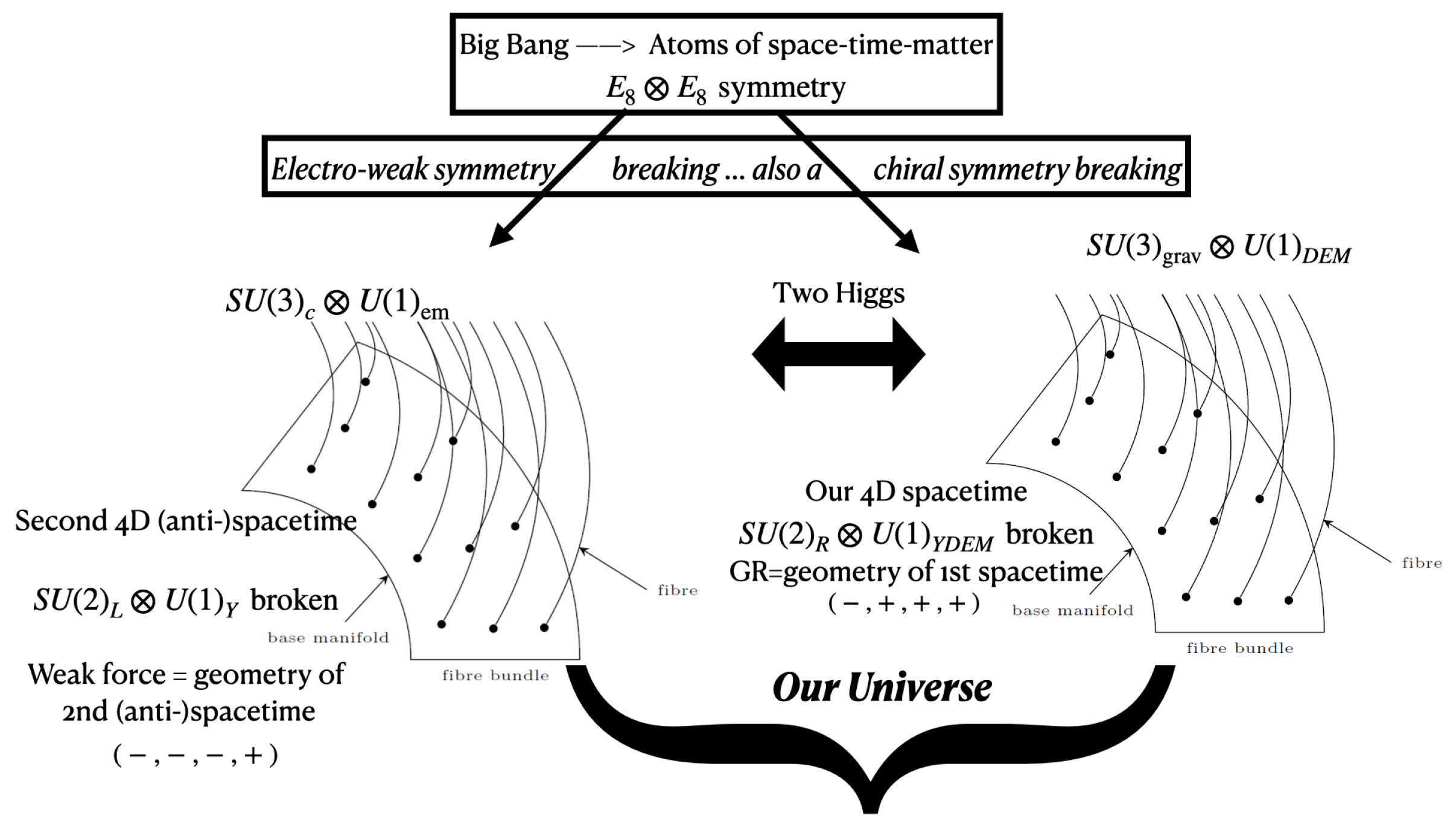
Figure 2.
Left-Right fermions [18]
Figure 2.
Left-Right fermions [18]
Disclaimer/Publisher’s Note: The statements, opinions and data contained in all publications are solely those of the individual author(s) and contributor(s) and not of MDPI and/or the editor(s). MDPI and/or the editor(s) disclaim responsibility for any injury to people or property resulting from any ideas, methods, instructions or products referred to in the content. |
© 2024 by the authors. Licensee MDPI, Basel, Switzerland. This article is an open access article distributed under the terms and conditions of the Creative Commons Attribution (CC BY) license (http://creativecommons.org/licenses/by/4.0/).
Copyright: This open access article is published under a Creative Commons CC BY 4.0 license, which permit the free download, distribution, and reuse, provided that the author and preprint are cited in any reuse.