

Submitted:
20 May 2024
Posted:
20 May 2024
You are already at the latest version
Abstract
The paper presents the reconstruction of paleoenvironmental conditions in the Gdansk, Bornholm and Arcona Basins of the Baltic Sea over the last millennium. A complex study (including geochemical, XRF, grain size, AMS and micropalaeontological analyses) of five sediment cores, retrieved by short gravity corer of Niemistö type, was performed. The cores are mainly represented by undisturbed silty muds of olive-grey and grey colours. The age models for the cores were built based on Pb distribution along the sediment sequences as radiocarbon dating resulted in excessively old age. Despite generally very low foraminiferal amount and diversity the increased inflow activity was reconstructed during the Medieval Climate Anomaly. The strongly positive North Atlantic Oscillation (NAO) index during this period led to a prevalence of westerlies over the Baltic region and stronger saltwater intrusions. In the recent sediments, the reconstructed inflow frequency demonstrates a decadal variability rather than the reduction, although, the general decline compared to the Medieval Climate Anomaly is seen.
Keywords:
North Sea water inflows
; Bottom water paleosalinity
; Surface water productivity
; Benthic foraminifera
; short sediment cores
; Arcona Basin
; Bornholm Basin
; Gdansk Basin
1. Introduction
The Baltic Sea is one of the largest brackish water bodies characterized by strong and permanent stratification. The pycnocline separating the surface and deep water restricts the process of vertical mixing. Sporadic inflows of dense, saline, oxygen-enriched waters of the North Sea have a strong influence on the hydrochemical conditions of the isolated bottom layer [1]. The salinity of bottom waters and their saturation with oxygen have a key impact on the development and state of benthic ecosystems [2]. Due to the complex topography of the Baltic Sea bottom, the propagation of inflow waters is limited, and the effect of their influence decreases with distance from the Danish straits due to the mixing with the waters of the Baltic Sea [3]. Only strong inflows transporting large amounts of highly saline (17–25 PSU) water into the Western Baltic can impact the deep-water conditions in the Central Baltic to a significant degree [3,4,5,6]. Saline and dense water fill the chain of deep basins one by one. The main branch of the North Sea water flows from the Arkona to the Bornholm Basin through the Bornholm Gat. Further, the waters of the inflow spread along the Stolpe Furrow to the Central Baltic — the main branch is directed to the Gotland Basin and the smaller branch flows into the Gdansk Basin [1,3].
The natural variability in water exchange between the Baltic and North Seas, as well as the climate over the Baltic region, are strongly affected by the alteration in the North Atlantic Oscillation (NAO) [7,8,9,10]. During the “positive” NAO phase the strong westerlies govern the saline water into the Baltic Sea and transport warm air masses to Central Europe. The “negative” NAO mode is associated with the decrease in westerlies followed by the inflows reduction and extremely cold winters [7,11].
Increasing anthropogenic load under the recent climate warming has a pronounced negative influence on the oxygen content in the bottom waters [12,13,14,15]. Moreover, many studies on the Baltic Sea environment [13,14,16,17,18] report a decrease in inflows frequency observed since the 1980s favouring the expansion of oxygen deficiency zones in the bottom water layer. However, following the analysis of Mohrholz, the observed reduction in inflows is rather a variability with a 25–30-year period.
The sediment archives provide long sets of information on the environmental conditions required for evaluation of the present and prediction of future changes, as well as for assessment of anthropogenic role in these processes. The paleoenvironmental records of comparable climate regimes can serve as a context for the study of the present environmental evolution. Hereby, investigations of the Medieval Climatic Anomaly (MCA), the interval of comparable warm conditions with the recent warming, can contribute to a profound understanding of the latter [8,12].
Data on the distribution of benthic foraminifera in sediment cores can provide information on variations in the saline water intrusions from the North Seas in the past. This information is crucial to understand the role of atmospheric circulation patterns in inflow formation, as well as to draw conclusions on the current and future dynamics of inflows under climatic changes. Due to the very high sedimentation rate, the Baltic Sea cores represent great material for the detailed reconstruction of recent environments, considering the age of 1 cm from 2.6 to 100 years. However, well-known issues concerning the radiocarbon dating of Baltic sediments and the scarcity of calcareous microfossils due to the brackish conditions and high level of dissolution require the multi-proxy approach including the other indicators of the near-bottom dynamic and alternative dating methods. In the works of [19,20,21], the potential for studying foraminiferal assemblages counting not only shells but also organic remains was shown.
The Gdansk Basin represents a relatively poorly studied area regarding the long-term environmental changes in the context of the saline water inflows. Moreover, a review of sediment archives data showed an almost complete lack of foraminiferal information for the Late Holocene. Most of the palaeoreconstructions carried out in the Central Baltic are aimed at the reconstruction of the surface water conditions based on the diatom data, f.e. [22,23,24,25]. In the exclusive economic zone of Russia in the southeastern part of the Baltic Sea, reconstructions based on foraminifera studies are represented by very few works performed more than 20 years ago [26,27]. In a study [28], an alternative method of reconstruction of the changes in the salinity of bottom waters based on the bromine content in sediments was applied. However, in all these studies, the reconstructions are characterised by relatively low resolution.
In this paper, we focus on the Gdansk Basin environment during the last millennium in relation to the Western Baltic with attention to comparable climatic events of modern warming and the MCA. The variations in the saline waters’ intrusions across a large lateral hydrographic gradient are reconstructed in the frame of the modelled changes in NAO.
1.1. Study Region
1.1.1. Arkona Basin
The Arkona Basin is characterized by a maximum depth of about 50 m. On the west and northwest, the basin is connected to the Kattegat through the Great Belt, the Belt Sea and Öresund. These are rather narrow straits with shallow sills of 8–18 m. From the east, the Arkona Basin is connected to the Bornholm Basin by the Bornholm Gat without a significant sill [29]. The sediment cover was formed under the combined influence of the initial glacial sedimentation, post-glacial morphological development and hydrodynamic activity [29]. The main sources of recent sediment material are coastal erosion, riverine land-derived material, local bioproductivity, inflowing suspended matter from the North Sea, and atmospheric deposition [29,30]. The finer muddy material collects in the depocenter of about 50 m depth [31] as organic-rich mud with an average thickness of 4.7 m [32].
Depending on the frequency of saline inflows, the hilocline occupies a depth between 20 and 35 m [33]. The well-mixed brackish surface layer has a salinity of about 8 PSU. It overlays the dense saline bottom layer that occupies the central part of the Arkona Basin and is distinguished by a high salinity of 15–20 PSU [33,34].
1.1.2. Bornholm Basin
The Bornholm Basin, located in the southwestern part of the Baltic Sea, has a relatively simple bathymetry with a maximum depth of approximately 100 m in the central part [35]. The large channel, the Bornholm Gat, connects the basin with the Arkona Basin on the west, while the Stolpe Furrow leads to the Gotland and the Gdansk Basins situated eastward [36,37]. The bottom sediments of deeper areas are represented by muddy soft material. In contrast, the shallower region close to Bornholm Island is covered by sand and hard clay [36]. The basin is characterized by high spatial variations in accumulation rates. According to [38], the accumulation rate of the silty-clay material changes in a relatively wide range from 0.5 to 2 mm y-1. Consequently, the thickness of Holocene sediments is highly variable and ranges between 0 and 12 m within the deepest part [37,39]. The sediment material is mainly delivered from wave-induced erosion of the coasts, biogenic production, riverine inflow and suspended material inflow from the Arkona Basin [30,37,39]. The permanent halocline situated between depths of 50 and 70 m [40] separates surface water with a salinity of 7.5–8.5 PSU from the deep layer where salinity reaches 14–18 PSU [36].
1.1.3. Gdansk Basin
The Gdansk Basin is located in the southeastern part of the Baltic Sea and includes shallow-water coastal plateaus and the Gdansk Deep, delineated by the 80 m isobath. The average depth of the basin is about 40 m, and the maximum depth is 114 m (Gdansk Deep) [41]. The basin is separated from the Gotland Basin by the Gdansk-Gotland Sill with a maximum depth of 86 m. Late Quaternary sediments of the basin are represented by three main lithostratigraphic units: glacial clays and silts (sediments of the Baltic Ice Lake), transitional clays (sediments of the Yoldia Sea and Ancylus Lake) and post-glacial muddy sediments of Littorina Sea [42,43]. The zones of silts and muds accumulation are generally found in the hydro-dynamically non-active areas below the permanent halocline depth (50–80 m) [42,44,45]. The organic carbon content increases in deep water muds to 5–11%. Outside the deep areas, silty and sandy sediments cover moraine deposits [41,44]. In the Gdansk Basin, the linear sedimentation rate (LSR) changes highly depending on the coring site location due to the patchiness of the environment. Based on the data on short sediment cores studied by [46], for the upper 10 cm of the sediments, the average LSR amounts to 0.9–2.1 mm y-1 (Gdansk Basin) and 0.7–3.9 mm y-1 (Gdansk Deep). The studies of long sediment cores report the average LSRs for the Gdansk Basin of 0.1–2.0 mm y-1 [41], 0.6 mm y-1 [47] and 1.8–2.1 mm y-1 [48].
The water column of the basin is two-layered and consists of a surface (active) layer and a deep layer. Such structure results from the large river discharge and sporadic inflows of North Sea water which form a strong vertical salinity gradient [1,3,49]. In the Gdansk Deep, the boundary between the surface and deep layers is located at a depth of approximately 70–75 m [45]. As a result, the hydrochemical conditions of the bottom water layer are formed under the influence of the saline water intrusions. In the Gdansk Basin, the salinity varies from 6–9 PSU near the surface to 10.4–14.4 PSU near the bottom. The water temperature ranges from 3.9 to 8.7 °C in the bottom layer, and from 5 to 17.8 °C in the surface layer [41]. The limited water exchange between the Gdansk Basin and the rest of the Baltic Sea, as well as the influx of large amounts of organic matter to the sediments, leads to the frequent formation of anoxic conditions in the bottom water and hydrogen sulfide contamination of waters [41,44,50].
2. Materials and Methods
For the present study, five sediment cores were sampled during the 43rd and 44th cruise of the R/V Akademik Boris Petrov (summer and autumn of 2018) in the three sub-basins of the Baltic Sea (Table 1, Figure 1). The cores were retrieved by a short gravity corer of Niemistö type equipped with a transparent plastic tube (6 cm in diameter), which allows sampling of sediments with an undisturbed surface layer. The latter condition is crucial for studying recent changes in ecosystems [51]. Cores ABP-43035 and ABP-43105 were sampled in the Gdansk Deep at a water depth of 104 m and 105 m, respectively; core ABP-43026 was sampled at the Gdansk-Gotland Sill at a water depth of 78 m. The sea depths at sampling stations in the Arkona and Bornholm Basins were 45 m (ABP-44059) and 89 m (ABP-44063), respectively. Such arrangement of the sampling stations allows studying the spatial heterogeneity of the influence of inflows and climate change on the Baltic Sea ecosystem. The thicknesses of the sampled sediments were 56 cm (ABP-43026), 46 cm (ABP-43035), 54 cm (ABP-43105), and 48 cm (ABP-44059 and ABP-44063).
Onboard, the cores were lithologically described inside the plastic tubes and then were sampled into 1 cm slices. The sediment colour was determined following the Munsell Soil Color Chart. The upper 5 cm of the sediments were stained with an 80% ethanol solution of Rose Bengal to identify live foraminifera [51]. In the following study, these samples were used only for the micropaleontological analysis. The rest of the material was frozen to prevent the dissolution of carbonate shells. Due to the small diameter of the corer tube, the amount of material in a 1-cm thick sample was not enough to perform all analyses. Therefore, the samples taken below 5 cm of the core depth were split in the following way: the odd-numbered samples were used for micropalaeontological analysis (due to the extremely low foraminiferal concentration the whole sample was needed for the analysis); the even-numbered samples were used for the rest of analyses.
2.1. Grain Size Analysis
The grain size composition of the sediments was determined with a laser diffraction particle size analyzer SALD-2300 (Shimadzu, Japan). The measurements were performed with a 2-cm resolution (excluding the upper 5 cm stained with Rose Bengal). Organic carbon was preliminarily removed from the samples by treatment with hydrogen peroxide. The dispersion of the sediments before the measurement was carried out in two steps: first, the sodium tripolyphosphate was added to the samples and they were left for 24 hours; second, the samples were placed in the ultrasonic bath for 5 minutes. Statistical processing of the results was carried out in the program Gradistat [52]. The type of sediment was determined following Folk classification [53]. The content of the sortable silt (SS, 10–63 µm) and the distribution of its mean size along the core were interpreted to obtain information about past changes in the near-bottom current intensity following [54,55].
2.2. Geochemical Analyses
2.2.1. Loss on Ignition
The loss on ignition (LOI) estimation was performed at 2-cm resolution except for the top 5 cm of the cores which were stained with Rose Bengal and became unsuitable for the analysis. Prior to the analyses, wet sediments were dried at 90 °C and ground to a powder. The ground samples were again dried at 90–100 °C and then placed in a desiccator to protect the material from humidity. The LOI was determined by ashing the 1 gram of dried sediments at 550 °C for more than 3 hours (until a constant weight was reached) and calculating the resulting mass difference. For the Baltic Sea sediments, the LOI values provide an estimate of the total organic carbon content [56,57].
2.2.2. XRF Analysis
For the determination of Mn, Ti, Fe, Si, Al, Zr, Rb, and Pb concentrations in the sediment cores, an X-ray fluorescence spectrometer (Vanta C Series, OLYMPUS) was applied. The measurements were performed on wet bulk sediments in GeoChem mode with 1-cm resolution. The single samples were placed in plastic crucibles and covered with a 5-μm thick plastic film to prevent contamination of the analyzer. The measurement time for each sample was 180 seconds. To recalculate the concentration of elements to the dry weight of sediments, the content of water in the samples was determined by the ratio of Rayleigh and Compton peaks following the modified method of [58] according to [59]. The concentrations of elements and their ratios were used as indicators of the environmental conditions.
Mn is highly redox-sensitive and can serve as an indicator of the diagenetic processes. The distribution of Mn concentrations and Mn/Ti and Fe/Mn ratios in sediment cores were applied as proxies for the redox transitions [60,61,62]. Normalization of Mn to Ti (Mn/Ti ratio) allows compensating variations in Mn concentration caused by terrigenous input [24]. As was shown by [62], a high Mn/Ti ratio documents Mn enrichment as a result of diagenetic relocation. According to various studies [60,63,64], under anoxic conditions, Mn mobilizes, separates from Fe and diffuses along concentration gradients until precipitation at new oxic/post-oxic boundary. Therefore, a stable Mn/Fe ratio indicates no element fractionation under oxic conditions [60]. On the contrary, peaks in Mn/Fe distribution reflect Mn mobilization under suboxic diagenesis. Si/Ti ratio was used as a proxy for biogenic silica content reflecting past productivity, mainly diatom [60,65,66]. Zr/Rb ratio can be used as a grain-size proxy as Rb adsorbs mainly to clay minerals, whereas Zr resides in silts and coarser grains [67,68]. Here, we applied the Zr/Rb ratio to reconstruct changes in the intensity of the near-bottom currents. As stronger currents carry greater coarse-grained sediments, higher Zr/Rb ratios correspond to periods of near-bottom currents intensification.
2.3. Microfossil Analysis
For the benthic foraminiferal analysis, the wet counting method was applied as described in [19,20,21,69]. Wet counting allows identifying tests in every state of dissolution including inner organic linings (IOL). IOL counting is particularly important for the organic-rich sediments of the Baltic Sea which are characterised by a high degree of carbonate material dissolution and low concentrations of shells. The micropalaeontological analysis was performed at a resolution of 1 cm (0–5 cm interval) and 2 cm (rest of the cores' lengths). Around 30 grams of wet sediments were sieved through 63 μm mesh using tapped fresh water. The usage of distilled water was proven to cause the dissolution of fragile calcareous shells [21,69]. Depending on preservation state and size, all individuals were identified under a stereomicroscope Olympus SZX16 to species or genus level following [69,70,71]. The IOLs and Cribroelphidium spp. individuals were counted separately and then combined. Benthic foraminiferal concentrations are represented as the number of individuals of the same genera per gram of wet sediments (n/g), as counting of IOLs allows determining only the genus of the dissolved shell. Variations in the number of Cribroelphidium individuals were applied as an indicator of salinity of more than 12 PSU [72] to reconstruct the variation in saline water inflows.
2.4. Dating and Age Modelling
In the Poznan Radiocarbon Laboratory (Poland), the radiometric accelerator mass spectrometry (AMS) 14C dating of six samples was performed (two samples from each core retrieved in the Gdansk Basin). Owing to the lack of carbonate material, the bulk sediments showing sufficient organic carbon content (over 2%) were chosen for the dating. The AMS 14C dates were converted to calendar years (cal. a BP) using Calib8.2 software and a terrestrial (IntCal20) calibration curve [73]. The terrestrial calibration curve was chosen due to the shallowness of the Baltic Sea Basin [74,75], high input of organic matter from the surrounding land and, in particular, to the Gdansk Basin. The calendar age is presented as a median value, 1950 year is taken as the zero point.
It is widely known that dating of bulk sediments from the Baltic Sea is associated with the multiple-source errors induced by the down-slope material re-deposition, contamination with older re-suspended organic matter, the unknown ratio of terrestrial and marine material, and highly variable local reservoir effects [76,77,78,79,80]. As was shown by [79], the dating error (overestimation) increases in the up-core direction (i.e., the younger the sediment, the larger the error). Therefore, when dating the bulk sediments of the Baltic Sea, especially the upper layers of sedimentary sequence (up to 1 meter depth), alternative methods are increasingly used. One of the most common methods for the determination of the relative age of the sediments is based on the distribution of Pb concentrations along the core sections, f.e. [12,75,77,78,81,82]. There are well-known historical Pb concentration peaks, resulting from anthropogenic pollution, which are assigned exact calendar ages: 1 AD (1949 cal. a BP, Roman peak); 1200 AD (750 cal. a BP, medieval increase); and the 1970s, (-20 cal. a BP, modern pollution) [83,84,85]. These Pb-peaks form exact isochrones that can be used in the dating of Baltic sediments [77]. However, the distribution of the Pb is not always uniform from core to core and the above-described peaks are not well recognised in all sediment sequences. Nevertheless, as was shown in [83,84], at approximately 1000 cal a BP, a significant and sharp increase of Pb concentration in lake sediments took place after which the concentrations have never returned to the near background levels. Thus, in this study, we used rapid and continuous increase in Pb concentration as a marking point for 1000 cal a BP, similar to [81]. To construct the age models the CLAM software version 4.0.4 [86] and linear interpolation were applied. Due to the presence of intact surface sediments the tops of the cores were assumed to correspond to the year of coring – 2018 CE (-68 BP).
3. Results
3.1. Lithology
The cores retrieved in the Gdansk Basin can be divided into three sediment units following the change in the lithological composition: (U1) the uppermost interval of loose thin lamination of olive, grey, and black mud saturated with water and covered with a black highly watered fluffy layer of few millimetres thick; (U2) layer of olive, olive-grey, and dark grey less watered and, accordingly, denser homogeneous muddy sediments compacting downcore; (U3) the lower unit of compacted homogeneous clayey muds (gyttia) of lighter olive-grey and grey colours. It is worth noting that, in the ABP-43026 core, U3 was represented by grey-blue clays. In the cores collected in the Bornholm and Arkona Basins, only units 2 and 3 were present (Figure 2).
In the ABP-43026 core, the sortable silt (SS) content varied widely (7–52%) (Figure 3). In the clays of the U3 (49–56 cm), the SS content changed sharply within the range of 7–27%. Further upcore (to 41cm), the SS content remained consistently low (16–20%). At 38–39 cm core depth, the SS content increased sharply to 40% and remained high (39–52%) up to the core top. Against the general background of increased values, an interval of high SS content (47–52%) was seen at 28–25 cm core depth. The distribution of SS mean size showed two peaks (36 and 34 µm) at 52–53 and 42–43 cm, respectively. In the 29–25 cm interval, a higher SS mean size of 27–28 µm was measured.
In the sediment core ABP-44035, the SS content varied in the relatively narrow range of 13–29% against which lower concentrations (13–19%) were measured in the 18–25 cm interval (Figure 3). The distribution of SS mean size was very close to the SS content variations. The values were relatively small and varied in a narrow range of 16–20 µm.
In the sediment core ABP-43105, in the 49–21 cm interval, the SS content decreased gradually from 34 to 18% in the upcore direction (Figure 3). In the overlying interval of 21–15 cm, the SS content increased sharply (from 18 to 52%) and remained high (52–39%) up to the core top. In the same top interval (15–7 cm), the SS mean size increased to 21–27 µm.
In the sediment core ABP-44059, the SS content was considerably high (42–60%) (Figure 4). This parameter changed in a sawtooth manner, demonstrating a general rising trend in the upcore direction with peaks and intervals of high values at 45–46 cm (56%), 31–32 cm (54%), 26–21 cm (57–58%), 16–11 (58–60%), and 8–7 cm (57%). The distribution of the SS mean size followed the distribution of the SS content varying in a narrow range of increased values (24–27 µm).
Generally, in the sediment core ABP-44063, the SS content was relatively low and varied in a narrow range of 16–21%. At 10 cm core depth, the SS content increased sharply to 26% and remained elevated until the core top. The character of SS mean size values repeated the distribution of the SS content changing in a narrow range of 16–21 µm.
3.2. Age Model and Sedimentation Rate
According to the AMS dating results (Table 2), the sediment core ABP-43026 dated back to 7721 cal. a BP at 42 cm core depth. Together with the very low LOI values and bluish-grey colour of the clayey sediments of U3 (56–49 cm), this too “old” date allowed us to assume that lower U3 was accumulated during the Ancylus Lake phase. In the overlying sediments (U1 and U2), only the modern Pb pollution peak (-20 cal. a BP) was recognizable at 11 cm (Figure 2). Taking into account, the relatively “young” AMS date at 8 cm of 664 cal. a BP and very “old” date at 42 cm core-depth we assumed the extremely low sedimentation rate due to the highly dynamic hydrology on the shallow Gdansk-Gotland Sill. Therefore, this core was only considered as background describing the general sill condition.
Based on the AMS dating (Table 2), sediment core ABP-43035 represented the last 4036 cal a BP (date at 40 cm core depth). The LSR decreased to the core top from 0.17 mm y-1 (40–10 cm) to 0.04 mm y-1 at (10–0 cm). However, the core was obtained from the Gdansk Deep which is characterised by a calm sedimentation regime and absence of conditions for such low LSR, as well as for sharp drop of the values, especially in the upcore direction. Therefore, AMS results were excluded from the age modelling. Increases in Pb concentrations at 15 and 39 cm (Figure 2) were interpreted as modern Pb pollution peak (-20 cal. a BP) and the start of medieval increase (1000 cal. a BP), correspondingly. The resulting LSR decreased in the downcore direction from 3.1 to 0.24 mm y-1.
The AMS dating of the ABP-43105 core gave the age of 2098 cal. a BP at 50 cm. At the same time, the age of the sediment at 8 cm core depth was 3429 cal. a BP, which indicated contamination by the redeposited older material. The lateral transport of material was also evident from the high values of SS parameters reflecting active palaeohydrodynamic. Therefore, upper AMS date was excluded from the calculations. The resulting overall LSR calculated considering only lower AMS date would be 0.2 mm y-1, which is too low for the core location. In view of the low LSRs and AMS dating reversal, only ages based on the Pb distribution were considered: -20 cal. a BP at 11 cm and 1000 cal. a BP at 49 cm. The resulting LSRs changed from 2.3 to 0.4 mm y-1.
Taking into account high uncertainties associated with the AMS dating of the Gdansk Basin sediments, cores of the Western Baltic, which were collected and analysed later, were subjected only to Pb dating. In the ABP-44059 core, -20 cal. a BP was assigned to the increase in Pb concentration at 11 cm, while 1000 cal. a BP was connected to high concentrations at 34 cm. In ABP-44063 core, these dates were referred to 10 and 28 cm, correspondingly (Figure 2). The resulting sedimentation rates decreased downcore from 2.3 to 0.2 mm y-1 (ABP-44059) and from 2.1 to 0.2 mm y-1 (ABP-44063).
3.3. Geochemical Characteristics of Sediments
In the ABP-43026 core, the clays of the lower unit (56–49 cm) were characterised by low values of LOI (7–10%) (Figure 3). In the overlying layer of silty sediments (49–7 cm), the LOI values showed a steady increase from 9 to 24%, against which an interval of lower values (17–21%) was seen at 24–31 cm core depth. In the overlying interval (17–6 cm), the LOI values varied abruptly in the range of 19–24% with a decreasing trend. The Mn concentration, as well as the Mn/Ti and Mn/Fe ratios, demonstrated a similar distribution pattern in the sediments. The highest values were measured in the lower part of the section. The values of these indicators decreased in the upcore direction, and, above 43 cm, they changed in a narrow range. The Si/Ti ratio had a sawtooth distribution with a wide range of values. High values were seen at depths of 55–50, 45–41, 38–38 and 35–34 cm. In the interval of 34–31 cm, the values decreased, after which they remained reduced to a depth of 25 cm. Further upcore, the ratio showed an abrupt increase until reaching the maximum values at a depth of 17 cm, after which the values sharply decreased. In the overlying interval, several single peaks of high values were noted: 15–13, 12–11, 9–8 and 6–5 cm. The Zr/Rb ratio in the lower part of the section, to a depth of 40 cm, repeated the distribution pattern of the SS mean size — two intervals of increased values were situated at depths of 53–52 and 45–41 cm. In the rest of the core, the ratio was comparatively lower and varied within a narrow range.
In the ABP-43035 core, the LOI changed in a narrow range of 18–22% (Figure 3). In the intervals of 37–30 and 17–8 cm, slightly higher values of the LOI were measured: 21–22% and 19–20%, respectively. The Mn concentrations and Mn/Ti and Mn/Fe ratios were characterized by a similar distribution along the section. High Mn concentrations and Mn/Ti ratio were measured in the lower interval (43–34 cm), the Mn/Fe ratio was increased at a depth of 39–34 cm. In overlying sediments, both ratios and Mn concentrations were elevated in the interval 22–18 cm. A slight increase in these parameters was noticeable in the uppermost studied part of the core. The Si/Ti ratio changed sharply along the section in a relatively wide range. Intervals of increased values were located at 42–37, 35–34 and 25–22 cm core depth. Above 17 cm, a sawtooth increase in values was noticeable until reaching a maximum value in the upper horizon. The Zr/Rb ratio fluctuated in a narrow range. In the lower part of the core, the Zr/Rb ratio was characterized by higher values, which decreased in the upcore direction.
Sediment core ABP-43105 was characterised by a relatively narrow range of high LOI values (Figure 3), against which two intervals of a gradual decrease in the values were distinguished at 47–30 cm (from 20 to 17%) and 23–16 cm (from 20 to 18%). The distribution of the Mn/Fe ratio differed slightly from the variations in the Mn/Ti ratio and Mn concentrations, which practically repeated each other’s graphs. All indicators were characterized by a stable distribution, against which the intervals of increased values were distinguishable at 50–47, 42–39, 27–20, 15–14 and 12–10 cm. The Si/Ti ratio was characterized by increased values in the intervals: 42–32, 17 –15 and 9–7 cm. The distribution of Zr/Rb along the section changed in a narrow range and could be divided into three intervals: a smooth decrease in values (50–29 cm), a sharp increase in values to a maximum level (29–25 cm), and a subsequent decrease in values.
In the lower part (48–39 cm) of the ABP-44059 core, the LOI value increased from 14 to 19% (Figure 3), after which it varied in a narrow range of 17–19% (until 28 cm of the core depth). In the interval of 28–22 cm, the LOI values gradually decreased from 19 to 15%. At 20–14 cm core depth, the values were relatively elevated (17–18%). Further upcore, the values droped to 15% (12–11cm) after which values showed a smooth increase to 17% at 6 cm. In the distribution of Mn concentrations and Mn/Ti and Mn/Fe ratios, increased values were recognizable in the intervals: 44–37, 33–30, 27–26 and 20–17 cm. Further upcore, the values decreased, reaching minimum values at the top of the section. The Si/Ti ratio changed in a sawtooth pattern with sharp fluctuations in a wide range of elevated values. High ratios were obtained in the intervals: 44–37, 31–28, 22–18, 10–9 and 7–6 cm. The Zr/Rb ratio was also characterized by a sawtooth graph and relatively high values. In the lower part of the core (48–39 cm), the values decreased, then increased again at 39–21 cm. Peaks of the high values were distinguishable at depths: 48–44, 42–40, 29–27, 25–24, 22–20 and 6–5 cm.
In the ABP-44063 core, at 48–24 cm depth, the LOI values increased gradually from 14% to 21% (Figure 3). Further upcore (24–8 cm), there was a smooth decrease in values from 21 to 17%, against which a single peak of 37% was seen at 14–13 cm. Close to the core top (8–6 cm), the LOI values increased abruptly from 17 to 20%. The distribution of Mn concentrations and Mn/Ti and Mn/Fe ratios were very close. The values varied in a narrow range against which the peaks of high values stood out sharply at 46–45, 26–23, 15–14 and 13–10 cm. The Si/Ti ratio was significantly lower compared to the ABP-44059 core, also retrieved in the Western Baltic. High Si/Ti ratios were calculated for the following intervals: 48–46, 42–34, 16–14 and 11–10 cm. The Zr/Rb ratio was also lower compared to the nearby ABP-44059 core and variated in the very narrow range. In the middle part of the core (29–19 cm), there was an interval of relatively lower values.
3.4. Distribution of the Benthic Foraminifera
In all studied cores, the carbonate benthic foraminifera were represented by two species of the genus Cribroelphidium — C. excavatum and C. incertum. Since both these species indicate an increase in the salinity of bottom waters (to 12 PSU and more) (Lutze 1965), they were combined for the discussion of the results. Furthermore, it was possible to determine only the genus of the inner organic linings. The only exception was core ABP-44059, in which single shells of Gyroidinoides spp., Eponides sp. and Ammonia sp. were found in the sediments.
In the sediments of the ABP-43026 core, the concentration of shells was in the narrow range of low values (0–8 n/g) (Figure 3). The lower interval of 56–44 cm was barren of foraminifera. In the overlying sediments, the foraminiferal concentration rose stepwise until reaching the highest value of 8 n/g at 22 cm. In the following interval of 22–0 cm, shell concentration decreased again to an average value for the interval (less than 2 n/g), except for the single peak of 6 n/g at 10 cm core depth. In the ABP-43035 sediment core, the maximum foraminiferal concentration (20 n/g) among the cores retrieved in the Gdansk Basin was recorded at a 40 cm core depth. Further upcore, concentration decreased to 1 n/g at 32 cm and remained in the narrow range of 0–5 n/g in the following sediments (32–0 cm). In the ABP-43105 core, the concentration of foraminiferal shells changed in a sawtooth manner and varied within a narrow range of 0–8 n/g. The intervals of elevated foraminiferal concentrations were at 45–46 and 34–11 cm.
In the sediments of the ABP-44059 core, shell concentrations varied within a wide range ― 6–54 n/g (Figure 4). In the lower interval (47–31 cm), shell concentrations were relatively low, but two intervals of higher values were distinguished at 45–42 cm (20–21 n/g) and 35–32 cm (18–23 n/g). In the interval of 30–22 cm, shell concentration increased abruptly from 11 to 45 n/g and remained high (19–54 n/g) to a depth of 4 cm. In the upper part of the section (4–0 cm), foraminiferal concentrations again decreased to 6–16 n/g.
The distribution of shells in the ABP-44063 core was close to ABP-44059, but a distinctive feature was the sharp variation of values in a wide range. The lower interval (47-35 cm) was characterized by very low values (1–10 n/g), followed by a sharp sawtooth increase in concentrations up to 45 n/g at 25 cm. In the overlying sediments (21–15 cm), a decrease in concentrations from 39 to 16 n/g was noted, after which the values remained relatively stable (17–25 n/g) to a depth of 9 cm. In the rest of the core (6–0 cm), the values changed sharply in the wide range of 3–33 n/g.
In cores retrieved in the Gdansk and Bornholm Basins, in the surface sediments stained with Rose Bengal, no living benthic foraminifera were found. In the upper centimetres of the sections, the IOL predominated, accounting for more than 90%. Only in core ABP-44059, obtained in the Arkona Basin, living foraminifera content was less than 4% within the 0–1 cm layer.
4. Discussion
The palaeoenvironmental conditions of the Late Holocene in the three basins of the Baltic Sea are discussed in the framework of the following climate regimes: the Dark Ages (DA) c. 1550–1150 cal. a BP; the Medieval Climatic Anomaly (MCA) c. 1000–600 cal. a BP; the Little Ice Age (LIA) c. 600–100 cal. a BP; and the Modern Warm Period (MoWP) c. 100 cal. a BP to present [12,13,21,89]. The variations in the NAO over the studied period after [8,87,88,90,91] are considered one of the forces governing the water exchange between the North and Baltic Seas.
The foraminiferal diversity of the studied Gdansk and Bornholm Basins' sediments was extremely low — assemblage was represented by two species of the carbonate genus Cribroelphidium: C. excavatum and C. incertum. No agglutinated specimens were found. In the core retrieved in the Arcona Basin, single shells of Gyroidinoides spp., Eponides sp. and Ammonia sp. were detected. This distribution pattern is consistent with the general west-east diversity decrease in the Baltic Sea [92,93]. Although, the overall diversity is still low compared to six benthic foraminiferal species found in the Bornholm Basin [21] or thirteen species reported by [94] for the Mecklenburg Bay (the south-western part of the Baltic Sea) and the same number in Kattegat [95].
In the core ABP-43026 retrieved on the Gdansk-Gotland Sill, the bottom layer (U3) of bluish clay sediments was accumulated during the cold Ancilus Lake phase as follows from the overlying AMS date. Very low organic content and high Si/Ti ratio (Figure 3), corresponding to the diatom abundance, reflect the cold-water conditions. The absence of foraminifera corresponds to the freshwater conditions. The coarse material inclusion, which is an evident from the abrupt peaks in Zr/Rb and SS parameters in the bottom part of the U2, reflects the highly dynamic hydrological conditions probably associated with the Litorina transgression. The latter is most likely reflected in the simultaneous peak of Mn parameters corresponding to the change in the redox state during the transition to a brackish environment. The first appearance of foraminiferal shells in the same interval supports this conclusion. The younger sediments (U2 and U1) represent the Litorina and Post-Littorina Seas due to the core location on the topographic height of the Sill associated with the extremely low sedimentation rates. According to the scheme of inflowing water propagation by [41], the Gdansk-Gotland Sill is on the pass of the North Sea water coming to the Gdansk Basin from the Stolpe Furrow. On the Sill, the proximity of the halocline to the bottom causes the erosion of sediments by the inner waves occurring at the halocline [96]. This core is only considered during the discussion of the Gdansk Basin environment as representing the contrasting condition of the Sill.
4.1. The Dark Ages
The lower sections of the cores retrieved in the Western Baltic (ABP-44059 and ABP-44063) were accumulated during the DA period characterised by general cooling in Europe [97]. According to the air temperature reconstruction by [98], during the DA, the temperatures in the Sweden were considerably low. In both cores, this period corresponds to the lower amount of organic matter in the sediments (Figure 4). Accumulation of less organic matter in the sediments could result from a decrease in the productivity of surface waters caused by a cooling of the climate. During the DA, the decrease in organic matter content was also noted in the other cores retrieved in the Baltic Sea [21,79]. High Si/Ti ratios in studied cores reflect the high role of the diatoms in primary production. As was shown by many studies [7,99,100], the diatoms have a competitional advantage after cold winters, therefore their high abundance in the sediments is consistence with the general cooling during the DA. It is worth mentioning that the Si/Ti ratio in the sediments of the Arcona Basin (ABP-44059 core) is twice time high as in the Bornholm Basin (ABP-44063 core). The earlier time of bloom onset due to the earlier establishment of thermal stratification in the much shallower coring site in the Arcona Basin could be the possible reason for the higher overall yearly production compared to Bornholm Basin. Generally, relatively stable Mn parameters correspond to the ventilated water column and the absence of the element fractionation. Ventilation of the near-bottom layer by inflow waters could be an additional factor that lowers the concentration of accumulated organic matter due to its oxidation.
In the studied sediments accumulated in the Western Baltic during the DA (Figure 4), the abundance of Cribroelphidium spp. is generally lower compared to the rest of the cores. The latter together with low Zr/Rb ratio and SS mean size and content within the core ABP-44063 correspond to calm hydrodynamic conditions under moderate inflow frequency in the Bornholm Basin. In the Arcona Basin (ABP-44059 core), higher foraminifera abundance, as well as elevated Zr/Rb ratio and SS mean size and content indicate intensive near-bottom dynamic connected to the inflow’s activity. Reconstruction of NAO showed that close to the end of the DA the index was moderately positive [88], which is responsible for not-so-strong westerly winds in the Baltic region and, consequently, moderate near-bottom water exchange between the Baltic and North Seas which affected mainly the Arcona Basin. Weaker halocline due to the lower salinity reconstructed for the Bornholm Basin could lead to stronger organic matter oxidation which is reflected in the lower organic content in the studied core. Unfortunately, the sediments corresponding to the DA period were not retrieved by the cores from the Gdansk Basin.
4.2. The Medieval Climatic Anomaly
The following interval of the MCA corresponds to the relatively stable climate conditions of warm and dry summers, the air temperatures were about 0.5 °C higher than during MoWP with the warmest period occurring at 730–700 cal a BP [15]. The positive NAO phase during the MCA [8,87] induced the transport of the warm air masses to Europe which resulted in the warmer winter temperatures. In the studied cores of the Western Baltic (Figure 4), the organic matter content is high as a consequence of the higher surface productivity associated with the warmer climate. According to the reconstructions of the environmental conditions in the Baltic Sea [12,79,89,101], the accumulation of organic-rich and often layered sediments is noted during the MCA, as the consequence of higher surface water temperatures. At the same time, the Si/Ti ratio in the studied sediments of Arcona and Bornholm Basins demonstrates decreasing and lower values, correspondingly, compared to the DA, which indicates a decrease in the abundance of diatoms. Most likely, higher surface water temperatures led to the dominance of nitrogen-fixing cyanobacteria in primary production. The same pattern in the distribution of the primary producents during the warm period of the MCA was noted in the studies of the Gotland Basin sediments [12,101]. Moreover, in the Arcona Basin section, peaks of high Si/Ti values correspond to relative depressions in organic matter content indicating the preference for colder conditions by diatoms. In both sediment cores, the peaks in the distribution of Mn content and ratios coincide with the higher organic content reflecting Mn enrichment as a result of possible diagenetic relocation under hypoxic conditions. Stronger halocline due to an increase in bottom salinity could be further condition favouring better organic matter preservation due to the poor ventilation.
The pronounced increase in Cribroelphidium spp. abundance in the studied sediments of Arcona and Bornholm Basins (Figure 4) corresponds to high near-bottom salinity due to the frequent inflows during the MCA. Furthermore, the simultaneous increase in the SS content and mean size in the Arcona Basin indicates the intensive near-bottom hydrodynamic which results from the proposed intensification of the inflows. According to micropaleontological data by [21], in the Bornholm Basin, the MCA period was characterized by the most prominent intensification in bottom water-mass exchange compared to the entire Late Littorina Sea stage. The strongly positive NAO phase during the MCA [8,87] increased the westerly wind speed which, in turn, contributed to the intensification of salt-water intrusions from the North Sea [14,102].
Similarly to the cores of the Western Baltic, in the Gdansk Deep sediments, the increase in organic matter content is distinguishable during the warm MCA interval reflecting the intensification in the surface water productivity (Figure 3). Relatively low Si/Ti ratios imply a decrease in the role of diatoms in production. In the distribution of Mn parameters, no signs of suboxic diagenesis could be seen.
Despite the impracticability of precise conditions reconstruction due to the low foraminiferal concentrations in the sediments of the Gdansk Basin, some interpretations for bottom water salinity could be provided by the records. The sediments of the ABP-43035 core (Gdansk Deep) corresponding to the MCA are characterised by the maximal concentration of calcareous shells compared to the whole record, as well as compared to the other cores retrieved in the Gdansk Basin (Figure 3). The high concentrations of Cribroelphidium spp. indicate the salinity increase as a result of the intensification of near-bottom water exchange which was prominently reflected in the studied cores of the Western Baltic. The lower foraminiferal abundance in the Gdansk Deep sediments compared to the Western Baltic reflects the salinity decrease as a consequence of the further position of the coring sites from the source of the inflow. Moreover, in the other core from the Gdansk Deep (ABP-43105 core), the increase in foraminiferal abundance is only minor corresponding to the complex topography of the basin separating the coring sites with the same depth by elevation which most likely hampers the inflowing water propagation or induces mixing with subsequent decrease in salinity (Figure 1). In both cores, against the generally low Zr/Rb ratios (Figure 3), reflecting the calm conditions associated with the position of the core well below the halocline, slightly elevated values correspond to the MCA interval. The latter is also true for the distribution of SS parameters in which the increase is more pronounced. Based on above mentioned, we can conclude the moderate increase in salinity and near-bottom hydrodynamic under the influence of transformed inflowing water reaching the Gdansk Basin during the MCA.
4.3. The Little Ice Age
Unfortunately, the limitations of the obtained dates do not allow precise sediment section subdivisions. Presumably, lying above the MCA sediments demonstrating the relative decrease in the organic matter content (Figure 3) due to the reduced surface bioproductivity could be assigned to the LIA when the temperatures dropped again [15]. Generally, lower LOI values accompanied by the elevated Si/Ti ratio indicate an increase in diatom production associated with the cooling. In the sediments of Arcona and Bornholm Basins (Figure 4), as well as in the Gdansk Deep (Figure 3), a decrease in concentrations of Cribroelphidium spp. indicate the reduction in the frequency of inflows which was also found in studies performed for the other areas of the Baltic Sea [21,79,103]. During the LIA, the dominance of a negative NAO index [87,88] led to the decline in westerlies and the subsequent reduction of saline water intrusion to the Baltic Sea. Generally, lower Zr/Rb ratios and SS parameters in the Gdansk Basin sediments support the minor near-bottom dynamic.
4.4. The Modern Warm Period
The top intervals of studied sediments were assigned to the period of modern climate warming when sea surface temperatures were comparable to the MCA and were 2 °C higher relative to the preceding LIA [12]. Throughout the MoWP, the organic matter content in all studied sediment sections is elevated as a reflection of high surface productivity under warmer sea conditions similar to the MCA regime. Generally, the Si/Ti ratio is elevated denoting high production of diatoms contributing to the increase in organic matter content. The latter leads to an increase in oxygen consumption in the bottom water layer and consequently to the development of hypoxia [12,89,101]. The accumulation of laminated sediments together with the expansion of oxygen deficiency zones in the bottom water layer during the MoWP were also reported by several other studies of the deep basins of the Baltic Sea [12,14,79,89]. In the studied cores of the Western Baltic, no laminated sediments were found therefore mainly oxic depositional environment was proposed.
Moreover, in the Arkona Basin, living foraminifera in the surface sediments imply oxygenated bottom water at the coring time. According to the comprehensive review of coring data by [89], sediments of the Bornholm Basin were not affected by hypoxic conditions. Nevertheless, it is worth noticing the very high peak in the organic matter content and simultaneous high Mn parameters in the Bornholm sediments (ABP-44063 core, Figure 4) which could reflect the Mn mobilization under the presence of at least short-leaving hypoxia in bottom waters and then subsequent precipitation during the oxygenation. In the same horizon, the foraminiferal abundance is low indicating the deficiency in bottom waters renewal which could be an additional factor for the better preservation of organic matter. As was shown by many studies, f.e. [14,17], throughout the recent history, the Bornholm Basin was repeatedly affected by hypoxia and even anoxia. In the cores retrieved in the Gdansk Basin, only the uppermost centimetres corresponding to the last ca. 10 years were represented by laminated sediments affected by hypoxia.
In contrast to the MCA, sediments corresponding to the MoWP demonstrate a lower abundance of Cribroelphidium spp. reflecting the ongoing period of moderate inflow activity initiated during the LIA (Figures 3, 4). The only exception is the sediments of Arcona Basin (ABP-44059 core, Figure 4) where foraminiferal concentrations were even higher than during the MCA. Considering the proximity of the basin to the entrance to the Baltic Sea, pronouncedly high values of SS parameters throughout the core section, reflecting the active hydrodynamic environment, indicate the constant influence of saltwater intrusions. Most likely, the majority of these inflows do not reach the further deep basins due to their medium strength and baroclinic nature. Within the MoWP, a predominantly negative NAO index [87,88] was responsible for the less frequent westerlies which resulted in the reduction of the near-bottom water renewal in the Baltic Sea [3]. Unfortunately, the age model does not allow precise correlation of the signal in the cores to the existing data on the inflows' statistic, nonetheless, some comparison can be made. According to the revision of the inflow measurement data by [4], there exists not a widely reported reduction in the inflows started in the 1980s, but a variability with a main period of 25–30 years. The very close fluctuation, around 15–30 years, is recognizable in the foraminiferal data of the studied cores of Western Baltic during the MoWP. The combined effect of the restricted bottom-water renewal together with the ongoing climate warming during the MoWP enhanced by an excess supply of nutrients (viz. phosphates) of the anthropogenic sources led to the widespread propagation of oxygen deficiency zones in the modern Baltic Sea [12,14,17]. However, to draw a more certain conclusion concerning the inflows dynamic and their role in the development of the hypoxic and anoxic conditions further detailed complex study of well-dated recent sediment archives from different sub-basis is necessary.
5. Conclusions
The environmental conditions concerning saline water inflows in the western and south-eastern Baltic Sea during the last millennium were reconstructed based on the complex sediment analysis. The foraminiferal assemblage demonstrated particularly low diversity. Agglutinated specimens were absent and the calcareous group was dominated by the specimens of Cribroelphidium genus. Living individuals were found only within the maximal proximity to the inflow entrance — in the Arkona Basin. Despite extremely high carbonate material dissolution, counting of foraminiferal IOLs allowed the application of the micropalaeontological method for the reconstruction of the inflows' dynamic.
In the Gdansk Basin, the sedimentation was strongly affected by the local topography. Thereby, at the Gdansk-Gotland Sill characterised by high hydrodynamic activity, dense Ancylus clays were recovered in such a short sediment sequence and upper layers were represented by Littorina and Post-Littorina material of very low sedimentation rates. In turn, sediments of Gdansk Deep were affected by lateral redeposition which led to the radiocarbon age reversal in the upper part of the core ABP-43105.
Studied sediments cover two comparable warm periods, the MCA and MoWP, during which the content of organic matter demonstrates the relative increase as a result of enhanced surface water productivity due to the higher sea surface temperatures. The Gdansk Deep sediments were characterized by overall high organic matter content resulting from the combination of the higher material input due to the coast vicinity and better preservation due to the calm hydrodynamic conditions. The production of diatoms is generally higher during the periods of colder conditions (the DA and LIA) but also within the MoWP. However, biomarker studies are necessary to draw certain conclusions about the role of different producers in organic matter accumulation in the past. It is worth noting, that in the sediments of the western Baltic Sea corresponding to these warm periods, the lamination was absent, but high peaks in Mn parameters could imply short-leaving hypoxic conditions resulting from the combination of higher sea surface bioproductivity and stronger water-column stratification. In the Gdansk Basin, the lamination in the top sediment layers reflects repeating hypoxia during the MoWP probably enhanced by increasing anthropogenic load.
During the MCA, the prominent marine influence was reflected by an increase in benthic foraminifera not only in the sediments of the Western Baltic but also in the sediments of the significantly easterly located Gdansk Deep indicating strong and often inflows. The predominantly positive NAO index during this period was responsible for strong westerlies governing the saline water into the Baltic Sea. During the intervals of the DA, LIA, and MoWP, the minor increase in bottom water salinity was reconstructed which corresponds to the negative NAO phase leading to the weakening of the westerly winds and decrease in inflows. However, in the Arcona Basin, moderate (during the DA) and pronounced (during the MoWP) increases in inflows reflect regional marine influence due to the vicinity of the Danish Straits. We can conclude the connection between the intensity of North Sea water inflows and variations in the NAO index on the larger time periods.
The high resolution of the studied sediment archives allowed a rough comparison of the reconstructed inflows in the Western Baltic to the existing measurement data. Further detailed study of well-dated dated sediment cores in relation to the direct measurements data will improve the understanding of past and future environmental dynamics.
Author Contributions
Conceptualization, E.P. and L.K; methodology, E.P. and T.P.; investigation, E.P., T.P. and L.K.; writing—original draft preparation, E.P., T.P. and L.K.; writing—review and editing, E.P., T.P. and L.K.; visualization, E.P. and T.P. All authors have read and agreed to the published version of the manuscript.
Funding
Sediment cores collection, lithological description, and LOI analysis were funded by state assignment of IO RAS (theme No. FMWE-2024-0025). Foraminiferal, grain size, and geochemical analyses and interpretation of the data obtained for the palaeoreconstruction were funded by RSF (grant No. 22-17-00170, https://rscf.ru/en/project/22-17-00170/).
Data Availability Statement
The link to the data archive on PANGAEA digital data library will be provided during the review.
Acknowledgments
The author would like to express gratitude to Evgenia Dorokhova for the partial performance of grain size analysis and help with the XRF and grain size data processing.
Conflicts of Interest
The authors declare no conflicts of interest. The funders had no role in the design of the study; in the collection, analyses, or interpretation of data; in the writing of the manuscript; or in the decision to publish the results.
References
- Mohrholz, V., Naumann, M., Nausch, G., Krüger, S. & Gräwe, U. Fresh oxygen for the Baltic Sea — An exceptional saline inflow after a decade of stagnation. J. Mar. Syst. 2015, 148.
- Hermelin, J. O. R. Distribution of Holocene benthic foraminifera in the Baltic Sea. J. Foraminifer. Res. 1987, 17. [Google Scholar] [CrossRef]
- Matthäus, W. The history of investigation of salt water inflows into the Baltic Sea - from the early beginning to recent results. Meereswissenschaftliche Berichte Mar. Sci. Reports 2006, 65, 1–65. [Google Scholar]
- Mohrholz, V. Major Baltic inflow statistics - Revised. Front. Mar. Sci. 2018, 5, 1–16. [Google Scholar] [CrossRef]
- Dickson, R. R. A recurrent and persistent pressure-anomaly pattern as the principal cause of intermediate-scale hydrographic variation in the European shelf seas. Dtsch. Hydrogr. Zeitschrift 1971, 24, 97–119. [Google Scholar] [CrossRef]
- Dickson, R. R. The prediction of major Baltic inflows. Dtsch. Hydrogr. Zeitschrift 1973, 26, 97–105. [Google Scholar] [CrossRef]
- Dippner, J. & Voss, M. Climate reconstruction of the MWP in the Baltic Sea area based on biogeochemical proxies from a sediment record. Baltica 2004, 17, 5–16.
- Schimanke, S., Meier, H. E. M., Kjellström, E., Strandberg, G. & Hordoir, R. The climate in the Baltic Sea region during the last millennium simulated with a regional climate model. Clim. Past 2012, 8, 1419–1433.
- Seip, K. L., Grøn, Ø. & Wang, H. The North Atlantic oscillations: Cycle times for the NAO, the AMO and the AMOC. Climate 2019, 7, 1–10.
- Mohrholz, V., Dutz, J. & Kraus, G. The impact of exceptionally warm summer inflow events on the environmental conditions in the Bornholm Basin. J. Mar. Syst. 2006, 60, 285–301.
- Alheit, J. & Hagen, E. Long-term climate forcing of European herring and sardine populations. Fish. Oceanogr. 1997, 6.
- Kabel, K. et al. Impact of climate change on the Baltic Sea ecosystem over the past 1,000 years. Nat. Clim. Chang. 2012, 2, 871–874. [CrossRef]
- Jilbert, T. & Slomp, C. P. Rapid high-amplitude variability in baltic sea hypoxia during the holocene. Geology 2013, 41, 1183–1186.
- Carstensen, J. et al. Hypoxia in the Baltic Sea: Biogeochemical cycles, benthic fauna, and management. Ambio 2014, 43, 26–36. [CrossRef] [PubMed]
- Reckermann, M., Omstedt, A., Pawlak, J. & Storch, H. Climate Change in the Baltic Sea region - What do we know? Soc. Dimens. Clim. Chang. Adapt. Coast. Reg. - Find. from Transdiscipl. Res. 2014, 19–32.
- Conley, D. J., Humborg, C., Rahm, L., Savchuk, O. P. & Wulff, F. Hypoxia in the Baltic Sea and Basin-Scale Changes in Phosphorus Biogeochemistry. Environ. Sci. Technol. 2002, 36, 5315–5320.
- Conley, D. J. et al. Hypoxia-Related Processes in the Baltic Sea. Environ. Sci. Technol. 2009, 43.
- Feistel, R., Nausch, G. & Wasmund, N. State and evolution of the Baltic Sea, 1952-2005: a detailed 50-year survey of meteorology and climate, physics, chemistry, biology, and marine environment. (John Wiley & Sons, 2008).
- Concheyro, A., Caramés, A., Amenábar, C. R. & Lescano, M. Nannofossils, foraminifera and microforaminiferal linings in the Cenozoic diamictites of Cape Lamb, Vega Island, Antarctica. Polish Polar Res. 2014, 35, 1–26.
- Boonstra, M., Ramos, M. I. F., Lammertsma, E. I., Antoine, P. O. & Hoorn, C. Marine connections of Amazonia: Evidence from foraminifera and dinoflagellate cysts (early to middle Miocene, Colombia/Peru). Palaeogeogr. Palaeoclimatol. Palaeoecol. 2015, 417, 176–194.
- Binczewska, A., Moros, M., Polovodova Asteman, I., Sławińska, J. & Bąk, M. Changes in the inflow of saline water into the Bornholm Basin (SW Baltic Sea) during the past 7100 years – evidence from benthic foraminifera record. Boreas 2018, 47, 297–310.
- Witkowski, A., Borówka, R. K., Gregorowicz, P., Osadczuk, A. & Wawrzyniak-Wydrowska, B. Palaeoenvironmental changes in the area of the Szczecin Lagoon (the south western Baltic Sea) as recorded from diatoms. Stud. Quat. 21, 153–165.
- Andrén, E., Andrén, T. & Kunzendorf, H. Holocene history of the Baltic Sea as a background for assessing records of human impact in the sediments of the Gotland Basin. The Holocene 2000, 10.
- Sohlenius, G., Emeis, K.-C., Andrén, E., Andrén, T. & Kohly, A. Development of anoxia during the Holocene fresh–brackish water transition in the Baltic Sea. Mar. Geol. 2001, 177.
- Emeis, K. C., Struck, U., Blanz, T., Kohly, A. & Voß, M. Salinity changes in the central Baltic Sea (NW Europe) over the last 10 000 years. Holocene 2003, 13, 411–421.
- Saidova, K. M. Modern biocenoses of benthic foraminifera, stratigraphy and paleogeography of the Holocene of the Baltic Sea based on foraminifera, Sedimentation in the Baltic Sea. (1981).
- Lukashina, N. Foramimifera. in Geology of the Gdansk Basin, Baltic Sea (ed. Emelyanov, E.) 134–137 (Yantarnyi Skaz, 2002).
- Grigoriev, A. et al. Late-glacial and Holocene palaeoenvironments in the Baltic sea based on a sedimentary record from the Gdansk Basin. Clim. Res. 2011, 48, 13–21. [CrossRef]
- Bunke, D. et al. Natural and Anthropogenic Sediment Mixing Processes in the South-Western Baltic Sea. Front. Mar. Sci. 2019, 6.
- Christiansen, C. et al. Material transport from the nearshore to the basinal environment in the southern Baltic Sea. J. Mar. Syst. 2002, 35, 133–150. [CrossRef]
- Porz, L., Zhang, W. & Schrum, C. Density-driven bottom currents control development of muddy basins in the southwestern Baltic Sea. Mar. Geol. 2021, 438, 106523.
- Lemke, W. Sedimentation und paläogeographische Entwicklung im westlichen Ostseeraum (Mecklenburger Bucht bis Arkonabecken) vom Ende der Weichselvereisung bis zur Litorinatransgression. (Institut für Ostseeforschung Warnemünde, 1998).
- Lass, H. U. & Mohrholz, V. On dynamics and mixing of inflowing saltwater in the Arkona Sea. J. Geophys. Res. Ocean. 2003, 108.
- Kouts, T. & Omstedt, A. Deep water exchange in the Baltic Proper. Tellus, Ser. A 1993, 45 A, 311–324.
- KÖGLER, F. & LARSEN, B. The West Bornholm basin in the Baltic Sea: geological structure and Quaternary sediments. Boreas 1979, 8, 1–22.
- Stigebrandt, A. & Kalén, O. Improving Oxygen Conditions in the Deeper Parts of Bornholm Sea by Pumped Injection of Winter Water. Ambio 2013, 42, 587–595.
- Christoffersen, P. L., Christiansen, C., Jensen, J. B., Leipe, T. & Hille, S. Depositional conditions and organic matter distribution in the Bornholm Basin, Baltic Sea. Geo-Marine Lett. 2007, 27, 325–338.
- Zalewska, T., Przygrodzki, P., Suplińska, M. & Saniewski, M. Geochronology of the southern Baltic Sea sediments derived from 210Pb dating. Quat. Geochronol. 2020, 56, 101039.
- Emelyanov, E., Christiansen, C. & Michelsen, O. Geology of the Bornholm Basin. (1995).
- Sohlenius, G., Emeis, K.-C., Ân, E. A., Ân, T. A. & Kohly, A. Development of anoxia during the Holocene fresh±brackish water transition in the Baltic Sea.
- Emelyanov, E. M. Geology of the Gdansk Basin, Baltic Sea (in Russian). (2002).
- Voipio, A. The Baltic Sea. (Elsevier, 1981).
- Winterhalter, B. Late-Quaternary stratigraphy of Baltic Sea basins - a review. Bull. Geol. Soc. Finl. 1992, 64. [Google Scholar] [CrossRef]
- Glasby, G. P., Szefer, P., Geldon, J. & Warzocha, J. Heavy-metal pollution of sediments from Szczecin Lagoon and the Gdansk Basin, Poland. Sci. Total Environ. 2004, 330, 249–269.
- Leppäranta, M. & Myrberg, K. Physical oceanography of the Baltic Sea. (Springer Science & Business Media, 2009). 2009.
- Suplińska, M. M. & Pietrzak-Flis, Z. Sedimentation rates and dating of bottom sediments in the Southern Baltic Sea region. Nukleonika 2008, 53, 105–111.
- Zachowicz, J., Miotk-Szpiganowicz, G., Kramarska, R., Uścinowicz, S. & Przezdziecki, P. A critical review and reinterpretation of bio-, litho- and seismostratigraphic data of the Southern Baltic deposits. Polish Geol. Inst. Spec. Pap. 2008, 23, 117–138.
- Staniszewski, A., Lejman, A. & Pempkowiak, J. Horizontal and vertical distribution of lignin in surface sediments of the Gdańsk Basin. Oceanologia 2001, 43, 421–439.
- Görlich, K., Görlich, E. A., Tomala, K., Hrynkiewicz, A. Z. & Hung, P. Q. 57Fe Mössbauer study of a sediment column in the Gdańsk Basin, Baltic Sea: Palaeoenvironmental application. Mar. Geol. 1989, 88, 49–69.
- Kuliński, K. & Pempkowiak, J. Carbon Cycling in the Baltic Sea. GeoPlanet: Earth and Planetary Sciences vol. 7 (2012).
- Schönfeld, J.; et al. The FOBIMO (FOraminiferal BIo-MOnitoring) initiative-Towards a standardised protocol for soft-bottom benthic foraminiferal monitoring studies. Mar. Micropaleontol. 2012, 94–95, 1–13. [Google Scholar] [CrossRef]
- Blott, S. J. & Pye, K. GRADISTAT: a grain size distribution and statistics package for the analysis of unconsolidated sediments. Earth Surf. Process. Landforms 2001, 26, 1237–1248.
- Folk, R. L. The Distinction between Grain Size and Mineral Composition in Sedimentary-Rock Nomenclature. J. Geol. 1954, 62, 344–359. [Google Scholar] [CrossRef]
- McCave, I. N., Manighetti, B. & Robinson, S. G. Sortable silt and fine sediment size/composition slicing: Parameters for palaeocurrent speed and palaeoceanography. Paleoceanography 1995, 10, 593–610.
- McCave, I. N. & Hall, I. R. Size sorting in marine muds: Processes, pitfalls, and prospects for paleoflow-speed proxies. Geochemistry, Geophys. Geosystems 2006, 7.
- Leipe, T. et al. Particulate organic carbon (POC) in surface sediments of the Baltic Sea. Geo-Marine Lett. 2011, 31.
- Jensen, J. B., Moros, M. & Endler, R. The Bornholm Basin, southern Scandinavia: a complex history from Late Cretaceous structural developments to recent sedimentation. Boreas 2017, 46, 3–17.
- Boyle, J. F., Chiverrell, R. C. & Schillereff, D. Approaches to Water Content Correction and Calibration for µXRF Core Scanning: Comparing X-ray Scattering with Simple Regression of Elemental Concentrations. in 373–390 (2015). [CrossRef]
- Laskina, D., Dorokhova, E. & Koroleva, Y. Water content and Pb concentrations in the bottom sediments of the Gdansk Deep (South-Eastern Baltic Sea) according to the portable X-ray fluorescence analyzer Olympus VANTA C. RJES (2024). [CrossRef]
- Marsh, R., Mills, R. A., Green, D. R. H., Salter, I. & Taylor, S. Controls on sediment geochemistry in the Crozet region. Deep Sea Res. Part II Top. Stud. Oceanogr. 2007, 54, 2260–2274.
- Kylander, M. E., Ampel, L., Wohlfarth, B. & Veres, D. High-resolution X-ray fluorescence core scanning analysis of Les Echets (France) sedimentary sequence: new insights from chemical proxies. J. Quat. Sci. 2011, 26, 109–117.
- van der Land, C.; et al. Paleo-redox fronts and their formation in carbonate mound sediments from the Rockall Trough. Mar. Geol. 2011, 284, 86–95. [Google Scholar] [CrossRef]
- Thomson, J., Higgs, N. C., Croudace, I. W., Colley, S. & Hydes, D. J. Redox zonation of elements at an oxic/post-oxic boundary in deep-sea sediments. Geochim. Cosmochim. Acta 1993, 57, 579–595.
- Huckriede, H. & Meischner, D. Origin and environment of manganese-rich sediments within black-shale basins. Geochim. Cosmochim. Acta 1996, 60, 1399–1413.
- Brown, E. T., Johnson, T. C., Scholz, C. A., Cohen, A. S. & King, J. W. Abrupt change in tropical African climate linked to the bipolar seesaw over the past 55,000 years. Geophys. Res. Lett. 2007, 34.
- Agnihotri, R., Altabet, M. A., Herbert, T. D. & Tierney, J. E. Subdecadally resolved paleoceanography of the Peru margin during the last two millennia. Geochemistry, Geophys. Geosystems 2008, 9.
- Rothwell, R. G., Hoogakker, B., Thomson, J., Croudace, I. W. & Frenz, M. Turbidite emplacement on the southern Balearic Abyssal Plain (western Mediterranean Sea) during Marine Isotope Stages 1–3: an application of ITRAX XRF scanning of sediment cores to lithostratigraphic analysis. Geol. Soc. London, Spec. Publ. 2006, 267, 79–98.
- Wang, M. A 600-year flood history in the Yangtze River drainage: Comparison between a subaqueous delta and historical records. Chinese Sci. Bull. 2011, 56, 188–195. [Google Scholar] [CrossRef]
- Brodniewicz, I. Recent and some holocene foraminifera of the southern baltic sea. Acta Palaentologica Pol. 1965, X, 131–236. [Google Scholar]
- Kaminski, M. A. & Gradstein, F. M. Atlas of Paleogene cosmopolitan deep-water agglutinated foraminifera. (Grzybowski Foundation, 2005).
- Polovodova, I. & Schonfeld, J. FORAMINIFERAL TEST ABNORMALITIES IN THE WESTERN BALTIC SEA. J. Foraminifer. Res. 2008, 38.
- Lutze, F. Zur Foraminiferen-Fauna der Ostsee. Meyniana 1965, 15, 75–142. [Google Scholar]
- Reimer, P. J.; et al. The IntCal20 Northern Hemisphere Radiocarbon Age Calibration Curve (0–55 cal kBP). Radiocarbon 2020, 62, 725–757. [Google Scholar] [CrossRef]
- Virtasalo, J. J.; et al. Ichnological trends along an open-water transect across a large marginal-marine epicontinental basin, the modern Baltic Sea. Sediment. Geol. 2011, 241, 40–51. [Google Scholar] [CrossRef]
- Virtasalo, J. J.; et al. Middle Holocene to present sedimentary environment in the easternmost Gulf of Finland (Baltic Sea) and the birth of the Neva River. Mar. Geol. 2014, 350, 84–96. [Google Scholar] [CrossRef]
- Olsen, J., Rasmussen, P. & Heinemeier, J. Holocene temporal and spatial variation in the radiocarbon reservoir age of three Danish fjords. Boreas 2009, 38, 458–470.
- Zillén, L., Lenz, C. & Jilbert, T. Stable lead (Pb) isotopes and concentrations - A useful independent dating tool for Baltic Sea sediments. Quat. Geochronol. 2012, 8, 41–45.
- Lougheed, B. C.; et al. Bulk sediment 14C dating in an estuarine environment: How accurate can it be? Paleoceanography 2017, 32, 123–131. [Google Scholar] [CrossRef]
- Häusler, K.; et al. Mid- to late Holocene environmental separation of the northern and central Baltic Sea basins in response to differential land uplift. Boreas 2017, 46, 111–128. [Google Scholar] [CrossRef]
- Andrén, E.; et al. Medieval versus recent environmental conditions in the Baltic Proper, what was different a thousand years ago? Palaeogeogr. Palaeoclimatol. Palaeoecol. 2020, 555. [Google Scholar] [CrossRef]
- Lougheed, B. C.; et al. Using an independent geochronology based on palaeomagnetic secular variation (PSV) and atmospheric Pb deposition to date Baltic Sea sediments and infer 14C reservoir age. Quat. Sci. Rev. 2012, 42, 43–58. [Google Scholar] [CrossRef]
- Ryabchuk, D. V.; et al. Impact of climate change on sedimentation processes in the eastern Gulf of Finland during the Middle to Late Holocene. Boreas 2021, 50, 381–403. [Google Scholar] [CrossRef]
- Renberg, I., Persson, M. W. & Emteryd, O. Pre-industrial atmospheric lead contamination detected in Swedish lake sediments. Nature 1994, 368, 323–326.
- Renberg, I., Brännvall, M. L., Bindler, R. & Emteryd, O. Atmospheric lead pollution history during four millennia (2000 BC to 2000 AD) in Sweden. Ambio 2000, 29, 150–156.
- Renberg, I., Bindler, R. & Brännvall, M. L. Using the historical atmospheric lead-deposition record as a chronological marker in sediment deposits in Europe. Holocene 2001, 11, 511–516.
- Blaauw, M. Methods and code for ‘classical’ age-modelling of radiocarbon sequences. Quat. Geochronol. 2010, 5, 512–518. [Google Scholar] [CrossRef]
- Trouet, V.; et al. Persistent positive north atlantic oscillation mode dominated the medieval climate anomaly. Science (80-. ). 2009, 324, 78–80. [Google Scholar] [CrossRef] [PubMed]
- Olsen, J., Anderson, N. J. & Knudsen, M. F. Variability of the North Atlantic Oscillation over the past 5,200 years. Nat. Geosci. 2012, 5, 808–812.
- Zillén, L., Conley, D. J., Andrén, T., Andrén, E. & Björck, S. Past occurrences of hypoxia in the Baltic Sea and the role of climate variability, environmental change and human impact. Earth-Science Rev. 2008, 91, 77–92.
- Cook, E. R., D’Arrigo, R. D. & Mann, M. E. A Well-Verified, Multiproxy Reconstruction of the Winter North Atlantic Oscillation Index since <scp>a.d.</scp> 1400*. J. Clim. 2002, 15.
- Luterbacher, J. et al. Reconstruction of sea level pressure fields over the Eastern North Atlantic and Europe back to 1500. Clim. Dyn. 2002, 18.
- Ojaveer, H.; et al. Status of Biodiversity in the Baltic Sea. PLoS One 2010, 5, e12467. [Google Scholar] [CrossRef] [PubMed]
- Snoeijs-Leijonmalm, P., Schubert, H. & Radziejewska, T. Biological oceanography of the Baltic Sea. (Springer Science & Business Media, 2017).
- Kostecki, R. & Radziejewska, T. The foraminiferal record in the Holocene evolution of the Mecklenburg Bay (south-western Baltic Sea). Oceanol. Hydrobiol. Stud. 2021, 50, 169–183.
- Groeneveld, J.; et al. Assessing proxy signatures of temperature, salinity, and hypoxia in the Baltic Sea through foraminifera-based geochemistry and faunal assemblages. J. Micropalaeontology 2018, 37, 403–429. [Google Scholar] [CrossRef]
- Blazhchishin, A. I. Paleogeografiya i evolyutsiya pozdnechetvertichnogo osadkonakopleniya v Baltiiskom more. (1998).
- Bond, G.; et al. A pervasive millennial-scale cycle in North Atlantic Holocene and glacial climates. Science (80). 1997, 278, 1257–1266. [Google Scholar] [CrossRef]
- Seppä, H.; et al. Trees tracking a warmer climate: the Holocene range shift of hazel (Corylus avellana) in northern Europe. Holocene 2015, 25, 53–63. [Google Scholar] [CrossRef]
- Fogg, G. E. The phytoplanktonic ways of life. New Phytol. 1991, 118, 191–232. [Google Scholar] [CrossRef] [PubMed]
- Wasmund, N., Nausch, G. & Matthäus, W. Phytoplankton spring blooms in the southern Baltic Sea—spatio-temporal development and long-term trends. J. Plankton Res. 1998, 20, 1099–1117.
- van Wirdum, F.; et al. Middle to late holocene variations in salinity and primary productivity in the central Baltic Sea: A multiproxy study from the landsort deep. Front. Mar. Sci. 2019, 6, 1–22. [Google Scholar] [CrossRef]
- Harff, J. et al. Late Quaternary Climate Variations Reflected in Baltic Sea Sediments. in The Baltic Sea basin (eds. Jan Harff, Svante Björck & Peer Hoth) (Springer, 2011). [CrossRef]
- Kotilainen, A. T. et al. Echoes from the Past: A Healthy Baltic Sea Requires More Effort. Ambio 2014, 43.
Figure 1.
Map of the study area and location of the coring sites. The direction of the inflow pathways of North Sea water is redrawn based on the combination of [1,3]. Bathymetry data — Baltic Sea Bathymetry Database v0.9.3.
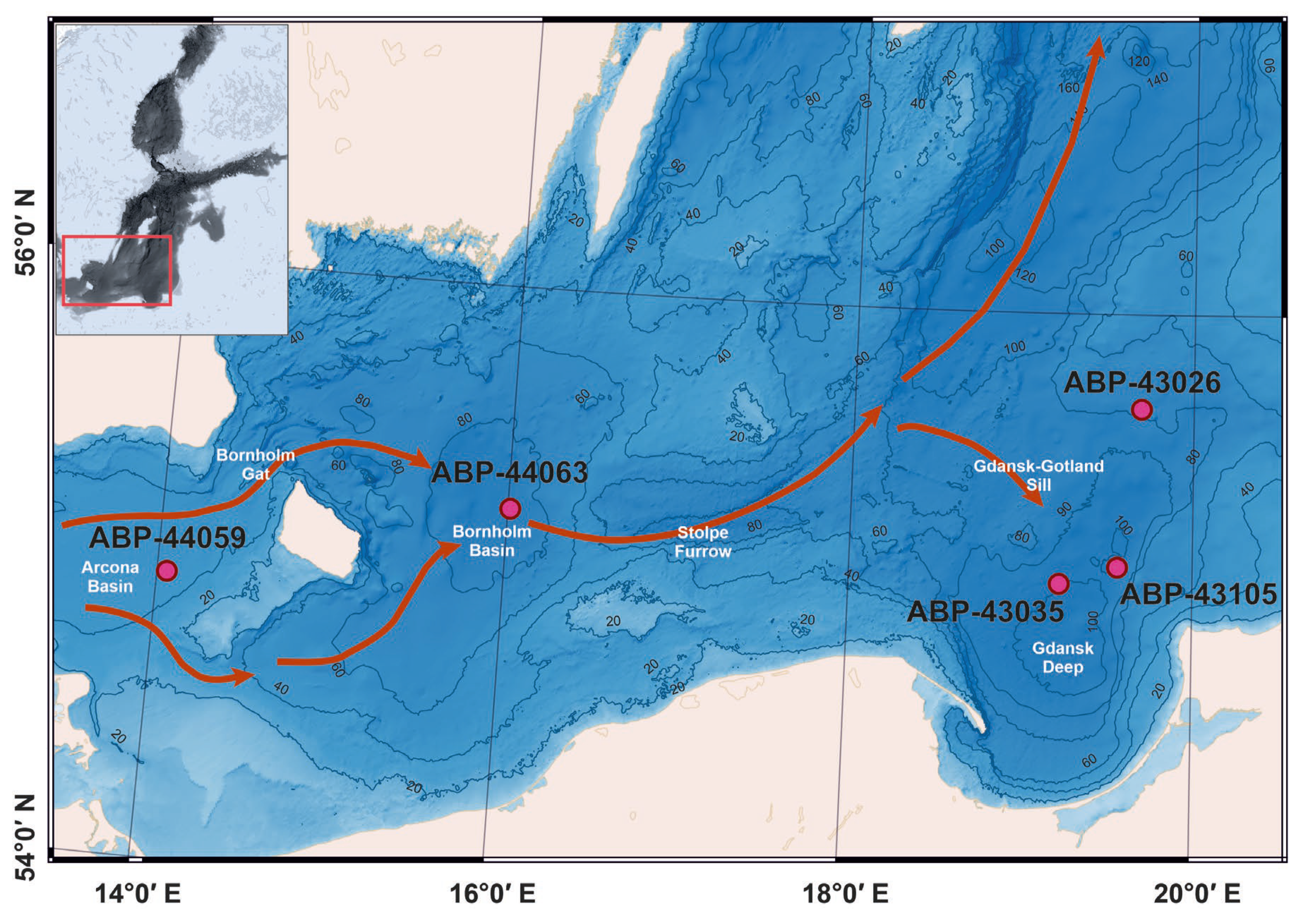
Figure 2.
Lithological composition of the studied cores together with the Pb distribution. Colours are identified as codes in accordance with the Munsell Soil Color Chart. The AMS dates are indicated in blue, and the Pb dates (isochrones) are in purple.
Figure 2.
Lithological composition of the studied cores together with the Pb distribution. Colours are identified as codes in accordance with the Munsell Soil Color Chart. The AMS dates are indicated in blue, and the Pb dates (isochrones) are in purple.
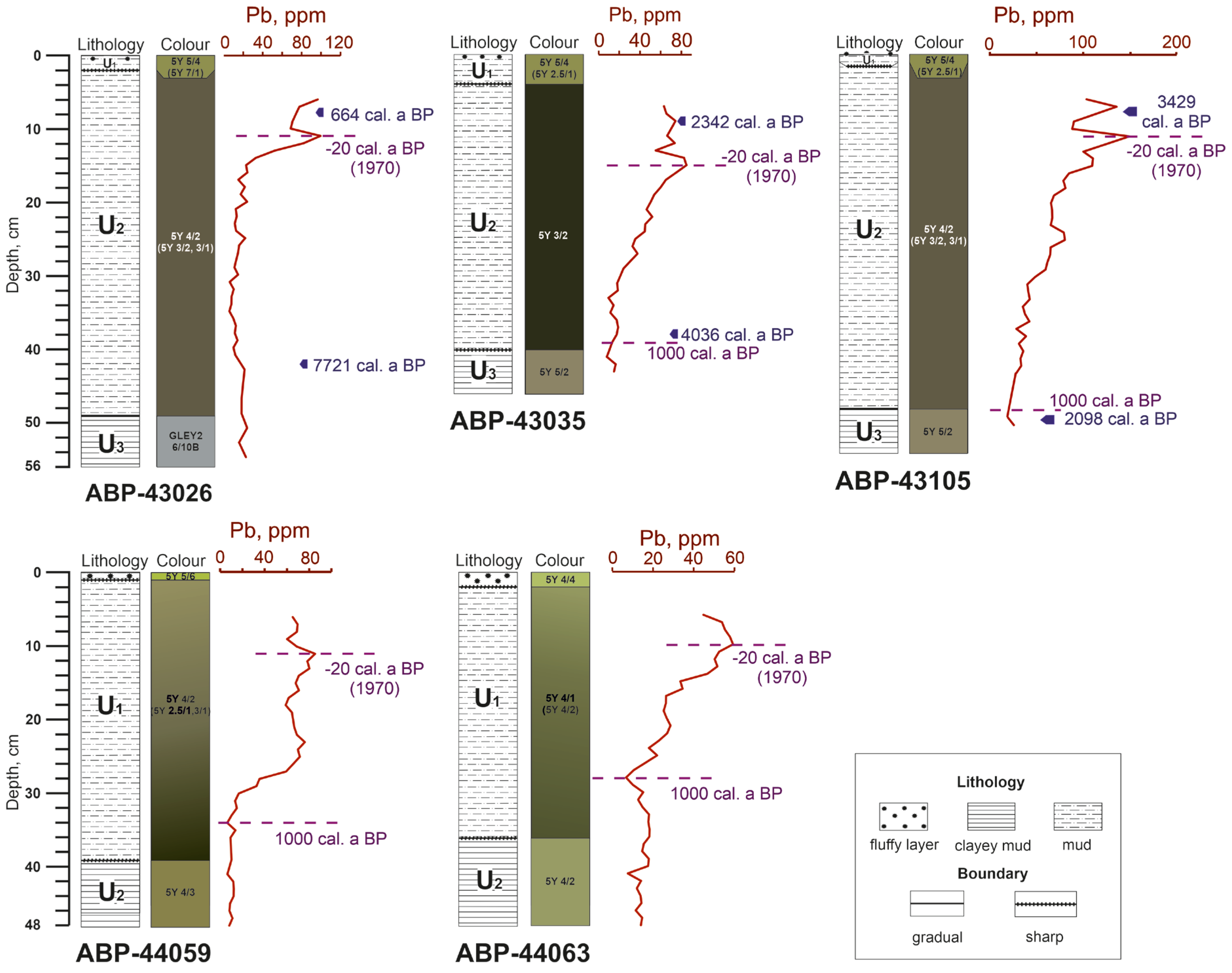
Figure 3.
The variability of sediment geochemistry (LOI and XRF), micropalaeontological and grain size (SS mean size and content) data in the cores retrieved in the Gdansk Basin. Cribroelphidium spp. includes both calcareous shells and IOLs. Warm climate periods are shaded in light red. The Main Holocene climate events are marked as follows: MCA – Medieval Climate Anomaly; MoWP – Modern Warm Period.
Figure 3.
The variability of sediment geochemistry (LOI and XRF), micropalaeontological and grain size (SS mean size and content) data in the cores retrieved in the Gdansk Basin. Cribroelphidium spp. includes both calcareous shells and IOLs. Warm climate periods are shaded in light red. The Main Holocene climate events are marked as follows: MCA – Medieval Climate Anomaly; MoWP – Modern Warm Period.
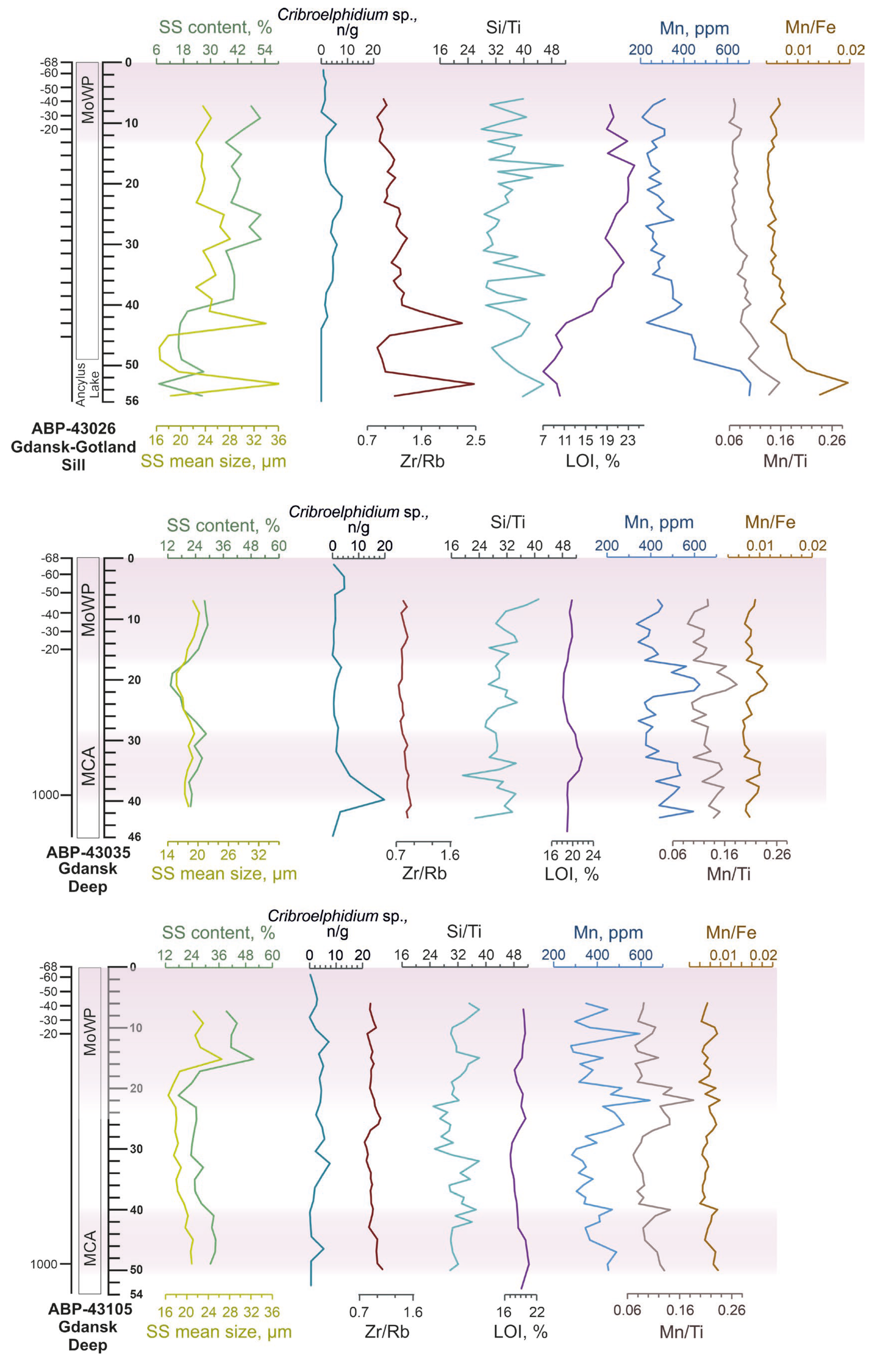
Figure 4.
The variability of sediment geochemistry (LOI and XRF), micropalaeontological and grain size (SS mean size and content) data in the cores retrieved in the Arcona and Bornholm Basins. Cribroelphidium spp. includes both calcareous shells and IOLs. Warm climate periods are shaded in light red. The Main Holocene climate events are marked as follows: DA – Dark Ages; MCA – Medieval Climate Anomaly; LIA – Little Ice Age; MoWP – Modern Warm Period. The reconstructed NAO index during the last c. 1.5 ka is represented according to [87,88]. The shaded blue areas indicate periods of negative NAO phase.
Figure 4.
The variability of sediment geochemistry (LOI and XRF), micropalaeontological and grain size (SS mean size and content) data in the cores retrieved in the Arcona and Bornholm Basins. Cribroelphidium spp. includes both calcareous shells and IOLs. Warm climate periods are shaded in light red. The Main Holocene climate events are marked as follows: DA – Dark Ages; MCA – Medieval Climate Anomaly; LIA – Little Ice Age; MoWP – Modern Warm Period. The reconstructed NAO index during the last c. 1.5 ka is represented according to [87,88]. The shaded blue areas indicate periods of negative NAO phase.
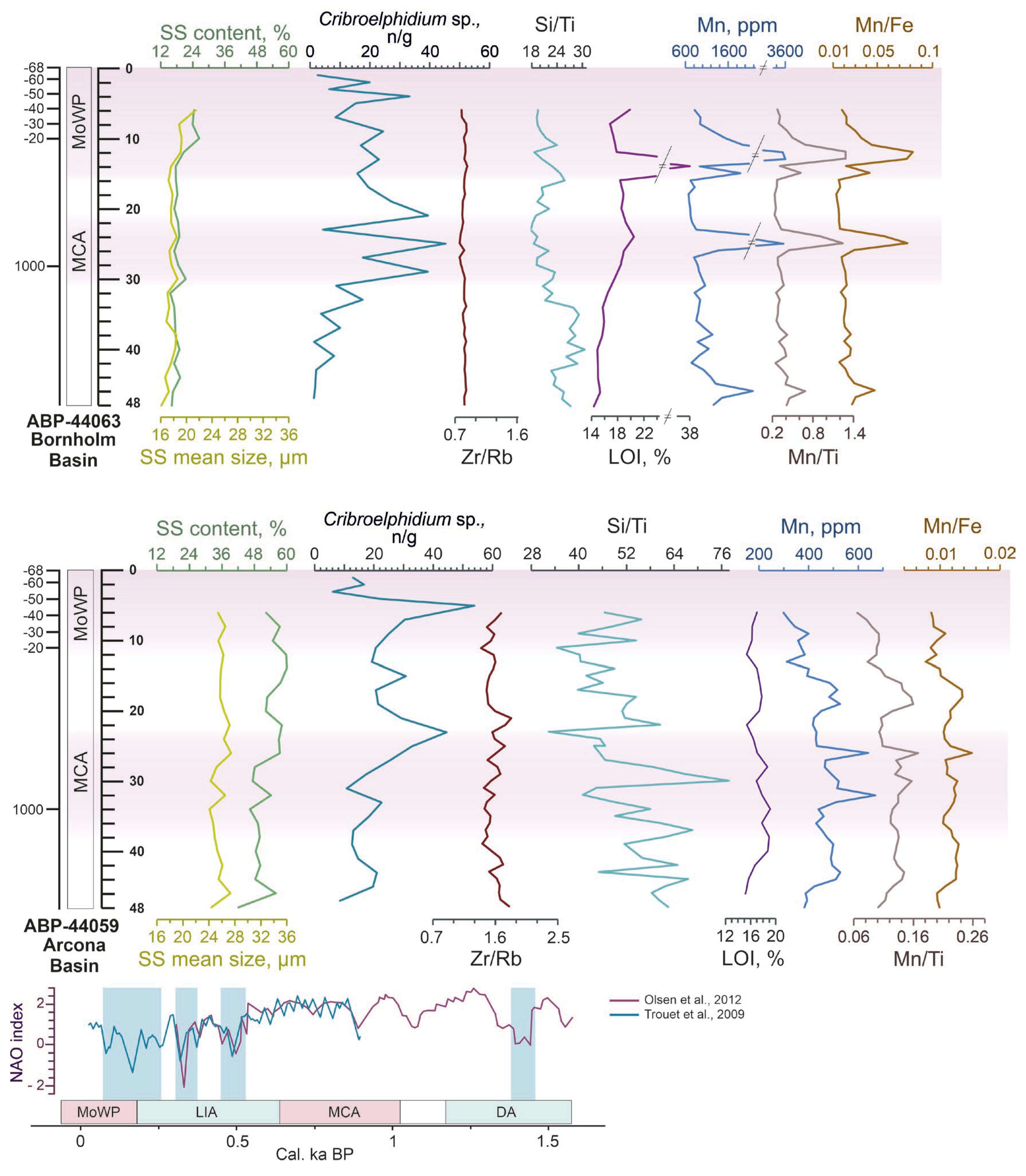

Table 1.
Sampling sites and studied cores information.
| Station name | Coordinates | Water depth, m |
Coring Area | Core length, cm |
|---|---|---|---|---|
| ABP-43026 | 55.6849 N; 19.6917 E | 78 | Gdansk-Gotland Sill | 56 |
| ABP-43035 | 55.0982 N; 19.2267 E | 104 | Gdansk Deep | 46 |
| ABP-43105 | 55.1566 N; 19.5639 E | 105 | Gdansk Deep | 54 |
| ABP-44059 ABP-44063 |
54.9563 N; 14.0577 E 55.2597 N; 16.0145 E |
45 89 |
Arcona Basin Bornholm Basin |
48 48 |
Table 2.
Results of radiocarbon dating. Radiocarbon ages were calibrated using Calib8.2 and the “IntCal20” calibration curve.
Table 2.
Results of radiocarbon dating. Radiocarbon ages were calibrated using Calib8.2 and the “IntCal20” calibration curve.
| Lab. code | Core depth (cm) | Dated material | 14C age (a BP) |
Error ± | Calibrated age median (cal a BP) |
|---|---|---|---|---|---|
| ABP-43026 | |||||
| Poz-121066 | 7–8 | Bulk sediment | 710 | 30 | 664 |
| Poz-121841 | 41–42 | Bulk sediment | 6890 | 40 | 7721 |
| ABP-43035 | |||||
| Poz-121363 | 9–10 | Bulk sediment | 2320 | 30 | 2342 |
| Poz-121067 | 39–40 | Bulk sediment | 3695 | 30 | 4036 |
| ABP-43105 | |||||
| Poz-121068 | 7–8 | Bulk sediment | 3225 | 30 | 3429 |
| Poz-121070 | 49–50 | Bulk sediment | 2130 | 30 | 2098 |
Disclaimer/Publisher’s Note: The statements, opinions and data contained in all publications are solely those of the individual author(s) and contributor(s) and not of MDPI and/or the editor(s). MDPI and/or the editor(s) disclaim responsibility for any injury to people or property resulting from any ideas, methods, instructions or products referred to in the content. |
© 2024 by the authors. Licensee MDPI, Basel, Switzerland. This article is an open access article distributed under the terms and conditions of the Creative Commons Attribution (CC BY) license (http://creativecommons.org/licenses/by/4.0/).
Copyright: This open access article is published under a Creative Commons CC BY 4.0 license, which permit the free download, distribution, and reuse, provided that the author and preprint are cited in any reuse.


