

Submitted:
17 May 2024
Posted:
20 May 2024
You are already at the latest version
Abstract
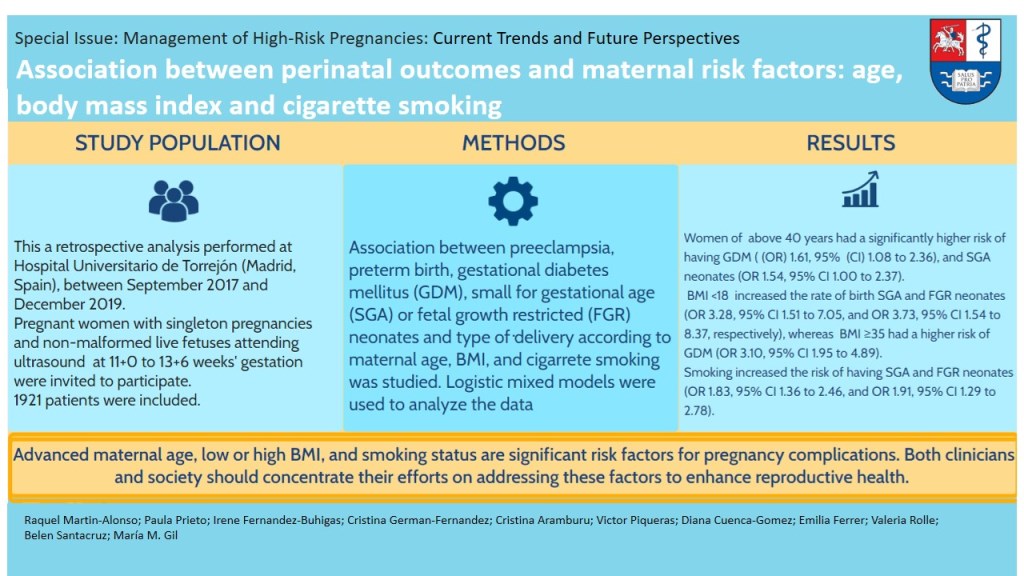
Objective: To analyse the association between maternal risk factors such as age, body mass index (BMI) and cigarette smoking, with perinatal outcomes. Materials and Methods: This a retrospective analysis from prospectively collected data performed at Hospital Universitario de Torrejón (Madrid, Spain), between September 2017 and December 2019. All pregnant women with singleton pregnancies and non-malformed live fetuses attending their routine ultrasound examination at 11+0 to 13+6 weeks' gestation were invited to participate. Association between preeclampsia, preterm birth, gestational diabetes mellitus (GDM), small for gestational age (SGA) or fetal growth restricted (FGR) neonates and type of delivery according to maternal age, BMI, and cigarrete smoking was studied. Logistic mixed models were used to analyze the data. Results: 1921 patients were included in the analysis. Women of 40 years old had a significantly higher risk of having GDM (Odds Ratio (OR) 1.61, 95% Confidence Interval (CI) 1.08 to 2.36), and SGA neonates (OR 1.54, 95% CI 1.00 to 2.37). Women with a BMI <18 had an increased rate of birth SGA and FGR neonates (OR 3.28, 95% CI 1.51 to 7.05, and OR 3.73, 95% CI 1.54 to 8.37, respectively), whereas women with a BMI ≥35 had a higher risk of GDM (OR 3.10, 95% CI 1.95 to 4.89). Smoking increased the risk of having SGA and FGR neonates (OR 1.83, 95% CI 1.36 to 2.46, and OR 1.91, 95% CI 1.29 to 2.78). Conclusions: Advanced maternal age, low or high BMI, and smoking status are significant risk factors for pregnancy complications. Both clinicians and society should concentrate their efforts on addressing these factors to enhance reproductive health.
Keywords:
cigarette smoking
; body mass index
; age
; pregnancy
; preeclampsia
; diabetes
; obesity
; fetal
; labour
; birth weight.
1. Introduction
Maternal characteristics such as age, body mass index (BMI) or cigarette smoking are important risk factors for pregnancy complications. Multiple studies have shown the association between these factors and adverse perinatal outcomes [1,2,3,4,5].
Many countries have reported a decline in birth rates, although the proportion of births in older women have increased [6,7]. Advanced maternal age (AMA), defined as pregnant women of 40 years and older, could be responsible for a substantial proportion of the increased rate of low birth weight (LBW) <2500g, small for gestational age (SGA) and preterm delivery observed in the past decades [8,9,10]. There are also other complications that have been described in advanced aged mothers such as preeclampsia (PE) and gestational diabetes mellitus (GDM) [5,11,12,13]. A 2019 meta-analysis that studied the adverse perinatal outcomes related to advanced maternal age, included 10 studies, and concluded that women aged between 35-40 and older were more likely to present overweight, GDM and gestational hypertension. Additionally, they were at a higher risk for adverse perinatal outcome such as preterm delivery or low birth weight babies [5]. It has also been reported that AMA mothers, are more likely than younger women to experience labor dystocia [14] and cesarean delivery [10,11,15,16,17].
Obesity prevalence is increasing worldwide [18,19]. Maternal obesity carries significant risks and is likely to be associated with adverse perinatal outcomes such as GMD, gestational hypertension, PE or large-for-gestational-age fetuses (LGA), and this risks appear to increase along with the severity of the condition [2,19,20,21]. Due to these obesity-related maternal disorders, obesity might increases the risk of medically indicated preterm birth, but whether obesity increases the risk for spontaneous preterm birth is still unknown [22]. At last, obesity, has also been described as a risk factor for both, programmed and intrapartum cesarean section [23,24]. The basis of many of these complications is likely to be related to the altered metabolic state associated with morbid obesity [25,26].
Despite the current obesity epidemic, maternal underweight remains a common but less studied condition also with potential adverse perinatal outcomes [27]. Low maternal BMI at the beginning of the pregnancy, has been associated with preterm labor, LBW, SGA, fetal growth restriction (FGR), and cesarean section; these risks increasing with the severity of the condition [3,22,27,28,29,30].
Smoking during pregnancy not only affects women’s own health, but may also be associated with adverse perinatal and offspring outcomes, like preterm birth, LBW, SGA and FGR [1,4,31] with a dose-dependent increase in risks [1]. Paradoxically, smoking during pregnancy has been associated with a reduced risk of preeclampsia [32,33].
In this study we aimed to analyse the association between these three maternal risk factors, age, BMI and smoking, and adverse perinatal outcomes.
2. Materials and Methods
2.1. Study Design and Population
This a retrospective analysis from prospectively collected data derived from a cohort study conducted to screen for preterm PE in the routine population [34]. All pregnant women with singleton pregnancies and non-malformed live fetuses attending their routine ultrasound examination at 11+0 to 13+6 weeks’ gestation at Hospital Universitario de Torrejón (Madrid, Spain) between September 2017 and December 2019 were invited to participate. Association between PE, preterm birth, GDM, SGA or FGR neonates and type of delivery according to BMI, maternal age, and smoking status at the beginning of the pregnancy was studied. This study was approved by the local Research Ethics Committee and all women provided written consent form.
During the 11+0 to 13+6 weeks hospital visit, patient characteristics and medical history were recorded in a clinical database (ViewPoint® software, GE Healthcare; Munich, Germany) including maternal age, race (White, Black, South Asian, East Asian, or Mixed), method of conception (natural or using assisted reproductive technology defined as in vitro fertilization or use of ovulation drugs), smoking during pregnancy, weight, height (BMI was calculated as Kg/m2), medical and obstetric history. The obstetric history included parity (parous or nulliparous if no previous pregnancies at ≥24 weeks of gestation), and for parous women, previous PE, and gestational age at delivery of previous baby.
2.2. Pregnancy Outcomes
Participants were followed up according to the clinical protocols, and any pregnancy complication, as well as delivery data, were recorded by reviewing hospital/regional records or contacting delivering hospitals or the women’s general medical practitioners/midwives.
PE was diagnosed according to the American College of Obstetricians and Gynecologists [35]. GDM was diagnosed by a sequential model (O’Sullivan test and, if positive 100mg Oral Glucose Tolerance Test (OGTT) according to the Diabetes in Pregnancy Spanish Group (Grupo Español de Diabetes y embarazo, GEDE) [36]. Preterm birth was defined as delivery before 37 weeks of gestation. Neonatal weight was assessed within the first 24 hours of life and converted to centiles using The Fetal Medicine Foundation charts [37]. SGA was diagnosed when birth weight was <10th centile, and FGR when birth weight was <3rd.
2.3. Statistical Analysis
Descriptive data were expressed as the median and interquartile range (IQR) and in proportions (absolute and relative frequencies). We studied the association of preterm birth, PE, GDM, fetal growth disorders (birth weight percentiles below the 10th, the 3rd, and above the 95th) and type of delivery with first, maternal age (40 or more years compared to the group of less than 40), second, BMI (35 or more and less than 18 compared to the group between 18 and 35) and third, smoking status. For each variable of interest, we adjusted a multiple logistic regression model. Adjusted odds Ratio (aORs), their 95% confidence intervals (CIs) and p-values were computed. The level of significance was set at 0.05. All analyses were carried out with the statistical software R in its version 4.3.0 [38] and the packages Table 1 [39] and sjPlot [40].
3. Results
3.1. Study Population and Pregnancy Outcomes
3.2. Risk Factors for Pregnancy Complications
3.2.1. Maternal Age
There were 145 pregnant women of 40 years old or more at the beginning of the pregnancy. After adjusting for possible confounders, this group of women showed a significantly higher risk of having GDM (aOR 1.61, 95% CI 1.08 to 2.36, p = 0.018), and SGA neonates (aOR 1.54, 95% CI 1.00 to 2.37, p = 0.049). However, no association was detected between maternal age ≥ 40 and preterm birth, mode of delivery, PE, or FGR (Table 3 and A1).
3.2.2. Body Mass Index
29 women had a BMI <18 at the beginning of pregnancy. These women showed an increased rate of birth SGA (aOR 3.28, 95% CI 1.51 to 7.05, p = 0.002) and FGR neonates (aOR 3.73, 95% CI 1.54 to 8.37, p = 0.002). No significant differences were found in either group in the incidence of preterm delivery, mode of delivery or PE (Tables 3 and A2).
There were 90 women with a BMI ≥35. This group had a higher risk of GDM (aOR 3.10, 95% CI 1.95 to 4.89, p <0.001) (Table 3). When using BMI as a continuous variable, the risk of GDM increases with increasing BMI (aOR 1.11, 95% CI 1.08 to 1.13, p <0.001) (Table A3). Besides, there was an association between BMI ≥35 and fetal birth weight >95th centile (aOR 3.50, 95% CI 1.37 to 8.91, p = 0.009) (Tables 3 and A3). The risk of cesarean section was also increased (aOR 2.12, 95% CI 1.25 to 3.54).
3.1.3. Smoking
There were 274 smokers at the beginning of the pregnancy. Pregnant smokers were at a higher risk of having SGA (aOR 1.83, 95% CI 1.36 to 2.46) and FGR (aOR 1.91, 95% CI 1.29 to 2.78) fetuses (Tables 3 and A4). Smoking was not associated with, preterm birth, mode of delivery, PE, or GDM.
4. Discussion
4.1. Main Findings of the Study
This study showed that, first, AMA and obesity are significant risk factors for GDM and second, advanced maternal age, BMI <18 and smoking at the beginning of the pregnancy are risk factors for developing SGA and FGR fetus.
4.2. Comparison with Previous Studies
Similar to previous studies, we identified AMA, body mass index or cigarette smoking as important maternal risk factors that must be consider while planning pregnancy care [1,2,3,4,5].
Women are postponing childbearing to their late 30s, and beyond 40 all around the world, but particularly in high-income countries [6,7]. In our cohort 7.5% of pregnant women were 40 years old or more at the beginning of the pregnancy. Consistent with prior studies, our research confirms a higher incidence of GDM in older women [5,10,11,12]. This observation aligns with the well-stablished trend of decreased pancreatic β-cell function and insulin sensitivity with age [41,42]. As Cnattingius et al. and Khalil et al. [8,11] described in their studies, we also found an association between AMA and the increased risk of low birth weight. However, the underlying mechanism behind this association remains undetermined. Khalil et al. [11] carried out a retrospective study that included 76158 singleton pregnancies. They concluded that not only AMA is a risk factor for GDM and SGA, but also for preeclampsia and cesarean section. In contrast, we found no evidence to establish an association between AMA and PE, nor with mode of delivery, although this might be due to our smaller sample size. Consistent with our findings, they also demonstrated no significant association between AMA and preterm delivery [11]. However, Pinheiro et al. [5], described in their meta-analysis and increased risk of preterm birth with increased maternal age. This inconsistency among the results, could be explained by differences in the definition of preterm delivery, differentiation between spontaneous or iatrogenic preterm labour and baseline characteristics of the populations.
Obesity is a chronic disease whose prevalence is increasing worldwide, and is a major contributor to poor health and adverse perinatal outcomes [2,20,21,22,43]. In Spain 10-15% of women in reproductive age are obese and around 20-29% are overweight [44]. As previously described [2,20,21,45,46,47,48], we found that high BMI associates a higher risk of GDM and LGA babies, although the latter was not found statistically significant after adjusting for other confounders. The associations of maternal adiposity with LGA infants might be explained by fetal over-nutrition, since an increased placental transfer of nutrients to the fetus might lead to an increased synthesis of insulin and insulin-like growth factors, both of which are growth-promoting hormones [49].
On the other hand, around 3.5% of the women in Spain are underweight, being more prevalent (between 5-10%) in women at reproductive age [44]. However, it remains a much less studied condition than obesity. In our sample, 1.6% of women had a BMI <18.5, which is lower than reported. Consistent with the existing literature, we have found that maternal pre-pregnancy underweight was associated with an increased risk of LBW [3,22,27,28,29,30].
Interestingly, unlike most previous published studies [2,3,20,22,27,28,45], we have not found an association between extreme BMI in either side and PE, preterm birth nor mode of delivery. These negative results could be related to a smaller than expected proportion of this conditions in our study.
Finally, smoking is a known risk factor for adverse perinatal outcomes including LBW, SGA and FGR [4,31], which is consistent with our results. The mechanisms that could explain why maternal smoking may affect intrauterine growth and birth weight, include vasoconstriction caused by nicotine (by inducing maternal catecholamine release), increased carboxyhaemoglobin levels in umbilical arteries which results in fetal hypoxia [50,51] or a decreased concentration of leptin [52]. On the other hand, we didn’t find any association between smoking and PE, which was also reported on a recent meta-analysis and systematic review [32,33]. In our study no association was found between smoking and mode of delivery; however, Li et al. performed a retrospective cohort study with 20477 (14,6%) women who smoked during pregnancy and 119396 controls, that revealed that women who smoked were more likely to have a caesarean section for non-reassuring fetal status (adjusted odds ratio (OR) 1.16, 95% CI 1.07 to 1.26, p < 0.001) [53]. Contrary to previous studies [1,54,55] we did not found either an association with preterm birth. Liu et al. [55] found that maternal smoking during either the first or second trimester of pregnancy was associated with an increased risk of preterm birth. These differences could be explained by the much smaller sample size of our study, as well as by differences in the maternal characteristics of the populations or in the number of cigarettes smoked per day that may contribute as confounders.
4.3. Clinical Implications
National efforts should prioritize raising awareness of modifiable risk factors before pregnancy, including maintaining healthy weight and promoting pregnancies at optimal maternal ages. Although AMA and increased BMI are not modifiable once gestation occurs, perinatal outcomes can still be improved by an early detection of pregnancy complications such as GDM and SGA.
On the other hand, smoking is a modifiable risk factor. Women of reproductive age or those who are pregnant and smoke should be strongly encouraged and supported to quit smoking before conception or during the early stages of the pregnancy. Antenatal clinics should incorporate smoking cessation interventions, with heavy smokers receiving personalized counseling and follow-up tailored to their specific risks.
4.4. Strengths and Limitations
The main strength of this study relies on the fact of being a prospective unselected cohort from a non-referral center, which is likely representative of the general population in our city.
However, its observational nature is a primary limitation, preventing the establishment of definite associations. Additionally, the limited number of cases for extreme ranges in all variables or for adverse perinatal outcomes may have hindered the identification of significant predictors.
5. Conclusions
Advanced maternal age, low or high BMI, and smoking status are significant risk factors for pregnancy complications. Both, clinicians and society, should concentrate their efforts on addressing these factors to enhance reproductive health.
Supplementary Materials
The following supporting information can be downloaded at the website of this paper posted on Preprints.org. Appendix Supplementary Table A1. Association between maternal age >40 and preeclampsia, preterm delivery (>37 w), Gestational Diabetes, Fetal growth and mode of delivery. Appendix Supplementary Table A2. Association between BMI <18 and preeclampsia, preterm delivery (>37 w), Gestational Diabetes, Fetal growth and mode of delivery. Appendix Supplementary Table A3. Association between BMI >40 and preeclampsia, preterm delivery (>37 w), Gestational Diabetes, Fetal growth and mode of delivery. Appendix Supplementary Table A4. Association between smoking and preeclampsia, preterm delivery (>37 w), Gestational Diabetes, Fetal growth and mode of delivery.
Author Contributions
Conceptualization: PP, RMA, IFB, MMG. Data curation: PP, IFB, MMG. Formal analysis: PP, IFB, RMA, VR, MMG. Investigation: PP, RMA, IFB, CGF, CA, VP, EF, MMG, BS. Methodology: IFB, MMG, BS. Project administration: MMG, BS. Supervision: MMG, BS. Validation: PP, RMA, IFB, VR, MMG, BS. Writing—original draft: PP, RMA, IFB, MMG, BS. Writing—review & editing: PP, RMA, IFB, VR, MMG, BS. Visualization: CGF, CA, VP, EF. Statistics: VR.
Funding
Gil MM was awarded a Leonardo grant from the BBVA Foundation to conduct this study. This study was also supported by a grant from Instituto de Salud Carlos III (ISCIII) PI18/01749. iMaterna Foundation (Registry No: 2148) provided smaller grants to support the study and General Electrics (GE Medical Systems, Zipf, Austria) via Health Net Connections (HNC, Spain) provided the software (ViewPoint®) to collect the data. None of these bodies had any involvement in the study design; in the collection, analysis, and interpretation of data; in the writing of the report; and in the decision to submit the article for publication.
Informed Consent Statement
The study was approved by each one of the Local Research Ethics Committees at the participant centers. All women gave written informed consent.
Data Availability Statement
The data presented in this study are available on request from the corresponding author and conditioned to approval from the relevant Research Ethics Committees due to data protection regulations.
Acknowledgments
The authors are grateful to all participants and their attending obstetricians, nurses, midwives, and technicians for facilitating the performance of this study. This study is part of the Ph.D. Thesis of Dr Raquel Martin-Alonso for Universidad Francisco de Vitoria. The data included in this study is part of the PREVAL-DECREASE study. M.M.G. was awarded a Leonardo grant from the BBVA Foundation to conduct this study, which was also supported by a grant from Instituto de Salud Carlos III (ISCIII) PI18/01749 and iMaterna Foundation (No: 2148).
Conflicts of Interest
The authors declare no conflict of interest.
References
- Tarasi, B.; Cornuz, J.; Clair, C.; Baud, D. Cigarette smoking during pregnancy and adverse perinatal outcomes: a cross-sectional study over 10 years. BMC Public Health. 2022, 22, 2403. [Google Scholar] [CrossRef] [PubMed]
- Santos, S.; Voerman, E.; Amiano, P.; Barros, H.; Beilin, L.J.; Bergström, A.; et al. Impact of maternal body mass index and gestational weight gain on pregnancy complications: an individual participant data meta-analysis of European, North American and Australian cohorts. BJOG Int J Obstet Gynaecol. 2019, 126, 984–995. [Google Scholar] [CrossRef]
- Nakanishi, K.; Saijo, Y.; Yoshioka, E.; Sato, Y.; Kato, Y.; Nagaya, K.; et al. Severity of low pre-pregnancy body mass index and perinatal outcomes: the Japan Environment and Children’s Study. BMC Pregnancy Childbirth. 2022, 22, 121. [Google Scholar] [CrossRef] [PubMed]
- Ko, T.J.; Tsai, L.Y.; Chu, L.C.; Yeh, S.J.; Leung, C.; Chen, C.Y.; et al. Parental Smoking During Pregnancy and Its Association with Low Birth Weight, Small for Gestational Age, and Preterm Birth Offspring: A Birth Cohort Study. Pediatr Neonatol. 2014, 55, 20–27. [Google Scholar] [CrossRef] [PubMed]
- Pinheiro, R.L.; Areia, A.L.; Mota Pinto, A.; Donato, H. Advanced Maternal Age: Adverse Outcomes of Pregnancy, A Meta-Analysis. Acta Médica Port. 2019, 32, 219–226. [Google Scholar] [CrossRef] [PubMed]
- Martin, J.A.; Hamilton, B.E.; Osterman, M.J.K.; Driscoll, A.K. Births: Final Data for 2019. Natl Vital Stat Rep Cent Dis Control Prev Natl Cent Health Stat Natl Vital Stat Syst. 2021, 70, 1–51. [Google Scholar]
- World Health Organization. Regional Office for Europe. (2008). Atlas of health in Europe: 2nd edition 2008, 2nd ed. World Health Organization. Regional Office for Europe. https://apps.who.int/iris/handle/10665/107365.
- Cnattingius, S.; Forman, M.R.; Berendes, H.W.; Isotalo, L. Delayed childbearing and risk of adverse perinatal outcome. A population-based study. JAMA 1992, 268, 886–890. [Google Scholar] [CrossRef]
- Aldous, M.B.; Edmonson, M.B. Maternal age at first childbirth and risk of low birth weight and preterm delivery in Washington State. JAMA 1993, 270, 2574–2577. [Google Scholar] [CrossRef]
- Cleary-Goldman, J.; Malone, F.D.; Vidaver, J.; Ball, R.H.; Nyberg, D.A.; Comstock, C.H.; et al. Impact of maternal age on obstetric outcome. Obstet Gynecol. 2005, 105, 983–990. [Google Scholar] [CrossRef]
- Khalil, A.; Syngelaki, A.; Maiz, N.; Zinevich, Y.; Nicolaides, K.H. Maternal age and adverse pregnancy outcome: a cohort study: Maternal age and pregnancy complications. Ultrasound Obstet Gynecol. 2013, 42, 634–643. [Google Scholar] [CrossRef]
- Bianco, A.; Stone, J.; Lynch, L.; Lapinski, R.; Berkowitz, G.; Berkowitz, R.L. Pregnancy outcome at age 40 and older. Obstet Gynecol. 1996, 87, 917–922. [Google Scholar] [CrossRef] [PubMed]
- Smithson, S.D.; Greene, N.H.; Esakoff, T.F. Pregnancy outcomes in very advanced maternal age women. Am J Obstet Gynecol 2022, 4, 100491. [Google Scholar] [CrossRef] [PubMed]
- Waldenström, U.; Ekéus, C. Risk of labor dystocia increases with maternal age irrespective of parity: a population-based register study. Acta Obstet Gynecol Scand. 2017, 96, 1063–1069. [Google Scholar] [CrossRef] [PubMed]
- Callaway, L.K.; Lust, K.; McIntyre, H.D. Pregnancy outcomes in women of very advanced maternal age. Aust N Z J Obstet Gynaecol. 2005, 45, 12–16. [Google Scholar] [CrossRef] [PubMed]
- Edge, V.; Laros, R.K. Pregnancy outcome in nulliparous women aged 35 or older. Am J Obstet Gynecol. 1993, 168, 1881–1884. [Google Scholar] [CrossRef] [PubMed]
- Bayrampour, H.; Heaman, M. Advanced maternal age and the risk of cesarean birth: a systematic review. Birth Berkeley Calif. 2010, 37, 219–226. [Google Scholar] [CrossRef] [PubMed]
- Poston, L.; Caleyachetty, R.; Cnattingius, S.; Corvalán, C.; Uauy, R.; Herring, S.; et al. Preconceptional and maternal obesity: epidemiology and health consequences. Lancet Diabetes Endocrinol. 2016, 4, 1025–1036. [Google Scholar] [CrossRef] [PubMed]
- Ehrenberg, H.M.; Dierker, L.; Milluzzi, C.; Mercer, B.M. Prevalence of maternal obesity in an urban center. Am J Obstet Gynecol. 2002, 187, 1189–1193. [Google Scholar] [CrossRef]
- Sebire, N.J.; Jolly, M.; Harris, J.P.; Wadsworth, J.; Joffe, M.; Beard, R.W.; et al. Maternal obesity and pregnancy outcome: a study of 287,213 pregnancies in London. Int J Obes Relat Metab Disord J Int Assoc Study Obes. 2001, 25, 1175–1182. [Google Scholar] [CrossRef]
- Chu, S.Y.; Callaghan, W.M.; Kim, S.Y.; Schmid, C.H.; Lau, J.; England, L.J.; et al. Maternal obesity and risk of gestational diabetes mellitus. Diabetes Care. 2007, 30, 2070–2076. [Google Scholar] [CrossRef]
- Álvarez Cuenod, J.S.; Sánchez Sánchez, V.; González Martín, J.M.; Emergui Zrihen, Y.; Suarez Guillén, V.; Ribary Domingo, A.; et al. Valores extremos del IMC materno: factores determinantes de peores resultados obstétricos y perinatales. Clínica E Investig En Ginecol Obstet. 2022, 49, 100754. [Google Scholar] [CrossRef]
- McDonald, S.D.; Han, Z.; Mulla, S.; Beyene, J.; Knowledge Synthesis Group. Overweight and obesity in mothers and risk of preterm birth and low birth weight infants: systematic review and meta-analyses. BMJ. 2010, 341, c3428. [Google Scholar] [CrossRef]
- Poobalan, A.S.; Aucott, L.S.; Gurung, T.; Smith, W.C.S.; Bhattacharya, S. Obesity as an independent risk factor for elective and emergency caesarean delivery in nulliparous women - systematic review and meta-analysis of cohort studies. Obes Rev. 2009, 10, 28–35. [Google Scholar] [CrossRef] [PubMed]
- Ramsay, J.E.; Ferrell, W.R.; Crawford, L.; Wallace, A.M.; Greer, I.A.; Sattar, N. Maternal obesity is associated with dysregulation of metabolic, vascular, and inflammatory pathways. J Clin Endocrinol Metab. 2002, 87, 4231–4237. [Google Scholar] [CrossRef]
- Delhaes, F.; Giza, S.A.; Koreman, T.; Eastabrook, G.; McKenzie, C.A.; Bedell, S.; et al. Altered maternal and placental lipid metabolism and fetal fat development in obesity: Current knowledge and advances in non-invasive assessment. Placenta 2018, 69, 118–124. [Google Scholar] [CrossRef]
- Han, Z.; Mulla, S.; Beyene, J.; Liao, G.; McDonald, S.D.; Knowledge Synthesis Group. Maternal underweight and the risk of preterm birth and low birth weight: a systematic review and meta-analyses. Int J Epidemiol. 2011, 40, 65–101. [Google Scholar] [CrossRef]
- Liu, P.; Xu, L.; Wang, Y.; Zhang, Y.; Du, Y.; Sun, Y.; et al. Association between perinatal outcomes and maternal pre-pregnancy body mass index. Obes Rev Off J Int Assoc Study Obes. 2016, 17, 1091–1102. [Google Scholar] [CrossRef] [PubMed]
- Chen, Y.H.; Li, L.; Chen, W.; Liu, Z.B.; Ma, L.; Gao, X.X.; et al. Pre-pregnancy underweight and obesity are positively associated with small-for-gestational-age infants in a Chinese population. Sci Rep. 2019, 9, 15544. [Google Scholar] [CrossRef]
- Rahman, M.M.; Abe, S.K.; Kanda, M.; Narita, S.; Rahman, M.S.; Bilano, V.; et al. Maternal body mass index and risk of birth and maternal health outcomes in low- and middle-income countries: a systematic review and meta-analysis: Body mass index and pregnancy and health outcomes. Obes Rev. 2015, 16, 758–770. [Google Scholar] [CrossRef]
- Banderali, G.; Martelli, A.; Landi, M.; Moretti, F.; Betti, F.; Radaelli, G.; et al. Short and long term health effects of parental tobacco smoking during pregnancy and lactation: a descriptive review. J Transl Med. 2015, 13, 327. [Google Scholar] [CrossRef]
- England, L.; Zhang, J. Smoking and risk of preeclampsia: a systematic review. Front Biosci J Virtual Libr. 2007, 12, 2471–2483. [Google Scholar] [CrossRef] [PubMed]
- Wang, J.; Yang, W.; Xiao, W.; Cao, S. The association between smoking during pregnancy and hypertensive disorders of pregnancy: A systematic review and meta-analysis. Int J Gynaecol Obstet Off Organ Int Fed Gynaecol Obstet. 2022, 157, 31–41. [Google Scholar] [CrossRef] [PubMed]
- Cuenca-Gómez, D.; de Paco Matallana, C.; Rolle, V.; Valiño, N.; Revello, R.; Adiego, B.; Mendoza, M.; Molina, F.S.; Carrillo, M.P.; Delgado, J.L.; Wright, A.; Santacruz, B.; Gil, M.M. Performance of first-trimester combined screening for preterm pre-eclampsia: findings from cohort of 10 110 pregnancies in Spain. Ultrasound Obstet Gynecol. 2023, 62, 522–530. [Google Scholar] [CrossRef] [PubMed]
- Hypertension in pregnancy. Report of the American College of Obstetricians and Gynecologists’ Task Force on Hypertension in Pregnancy. Obstet Gynecol. 2013, 122, 1122–1131. [Google Scholar]
- Documento de consenso. Asistencia a la gestante con diabetes. Guía práctica clínica actualizada en 2014. Grupo Español de Diabetes y Embarazo (GEDE). Av Diabetol 2015, 31, 45–59. [Google Scholar]
- Nicolaides, K.H.; Wright, D.; Syngelaki, A.; Wright, A.; Akolekar, R. Fetal Medicine Foundation fetal and neonatal population weight charts. Ultrasound Obstet Gynecol. 2018, 52, 44–51. [Google Scholar] [CrossRef] [PubMed]
- [R Core Team (2023). _R: A Language and Environment for Statistical Computing_. R Foundation for Statistical Computing, Vienna, Austria. <https://www.R-project.org/>.].
- Rich B (2023). _table1: Tables of Descriptive Statistics in HTML_. R package version 1.4.3, <https://CRAN.R-project.org/package=table1>.
- Lüdecke D (2023). _sjPlot: Data Visualization for Statistics in Social Science_. R package version 2.8.14, .
- Fulop, T.; Larbi, A.; Douziech, N. Insulin receptor and ageing. Pathol Biol. 2003, 51, 574–580. [Google Scholar] [CrossRef] [PubMed]
- Szoke, E.; Shrayyef, M.Z.; Messing, S.; Woerle, H.J.; Van Haeften, T.W.; Meyer, C.; et al. Effect of Aging on Glucose Homeostasis. Diabetes Care 2008, 31, 539–543. [Google Scholar] [CrossRef] [PubMed]
- NCD Risk Factor Collaboration (NCD-RisC). Trends in adult body-mass index in 200 countries from 1975 to 2014: a pooled analysis of 1698 population-based measurement studies with 19·2 million participants. Lancet Lond Engl. 2016, 387, 1377–1396. [Google Scholar] [CrossRef]
- Cardona, M.S. ENSE Encuesta Nacional de Salud España 2017, 2017, 37.
- Wei, Y.M.; Yang, H.X.; Zhu, W.W.; Liu, X.Y.; Meng, W.Y.; Wang, Y.Q.; et al. Risk of adverse pregnancy outcomes stratified for pre-pregnancy body mass index. J Matern Fetal Neonatal Med. 2016, 29, 2205–2209. [Google Scholar] [CrossRef]
- Catalano, P.M.; McIntyre, H.D.; Cruickshank, J.K.; McCance, D.R.; Dyer, A.R.; Metzger, B.E.; et al. The Hyperglycemia and Adverse Pregnancy Outcome Study. Diabetes Care 2012, 35, 780–786. [Google Scholar] [CrossRef]
- Hashemi-Nazari, S.S.; Najafi, F.; Rahimi, M.A.; Izadi, N.; Heydarpour, F.; Forooghirad, H. Estimation of gestational diabetes mellitus and dose–response association of BMI with the occurrence of diabetes mellitus in pregnant women of the west of Iran. Health Care Women Int. 2020, 41, 121–130. [Google Scholar] [CrossRef]
- Rezaei, M.; Rajati, F.; Fakhri, N. Relationship between body mass index and gestational diabetes mellitus. Tehran Univ Med J 2019, 77, 246–251. [Google Scholar]
- Kelly, A.C.; Powell, T.L.; Jansson, T. Placental function in maternal obesity. Clin Sci. 2020, 134, 961–984. [Google Scholar] [CrossRef]
- Horta, B.L.; Victora, C.G.; Menezes, A.M.; Halpern, R.; Barros, F.C. Low birthweight, preterm births and intrauterine growth retardation in relation to maternal smoking. Paediatr Perinat Epidemiol. 1997, 11, 140–151. [Google Scholar] [CrossRef] [PubMed]
- Lambers, D.S.; Clark, K.E. The maternal and fetal physiologic effects of nicotine. Semin Perinatol. 1996, 20, 115–126. [Google Scholar] [CrossRef]
- Mantzoros, C.S.; Varvarigou, A.; Kaklamani, V.G.; Beratis, N.G.; Flier, J.S. Effect of Birth Weight and Maternal Smoking on Cord Blood Leptin Concentrations of Full-Term and Preterm Newborns 1. J Clin Endocrinol Metab. 1997, 82, 2856–2861. [Google Scholar] [CrossRef] [PubMed]
- Li, R.; Lodge, J.; Flatley, C.; Kumar, S. The burden of adverse obstetric and perinatal outcomes from maternal smoking in an Australian cohort. Aust N Z J Obstet Gynaecol. 2019, 59, 356–361. [Google Scholar] [CrossRef]
- Shah, N.R.; Bracken, M.B. A systematic review and meta-analysis of prospective studies on the association between maternal cigarette smoking and preterm delivery. Am J Obstet Gynecol. 2000, 182, 465–472. [Google Scholar] [CrossRef]
- Liu, B.; Xu, G.; Sun, Y.; Qiu, X.; Ryckman, K.K.; Yu, Y.; et al. Maternal cigarette smoking before and during pregnancy and the risk of preterm birth: A dose–response analysis of 25 million mother–infant pairs. PLoS Med. 2020, 17, e1003158. [Google Scholar] [CrossRef]

Table 1.
Maternal characteristics of the study population according to risk factors.
| Overall (n =1921) | Maternal Age | Body mass index | Smoker | |||||
|---|---|---|---|---|---|---|---|---|
| Less than 40 (n=1776) | 40 or more (n=145) | < 18 (n=29) | 18 to <35 (n=1802) | ≥ 35 | No | Yes | ||
| (n=90) | (n=1647) | (n=274) | ||||||
| Maternal age in years, | 33.6 | 33.1 | 41.2 | 29.8 | 33.7 | 32.8 | 33.8 | 32.3 |
| median (IQR) | (30.0, 36.6) | (29.7, 35.9) | (40.5, 42.2) | (24.5, 33.9) | (30.1, 36.6) | (30, 36) | (30.3, 36.6) | (29.0, 36.0) |
| Body mass index in Kg/m2, median (IQR) | 24.0 | 23.9 | 24.9 | 17.2 | 23.9 | 38.0 | 24.0 | 24.4 |
| (21.7, 27.5) | (21.6, 27.5) | (22.2, 27.5) | (16.87, 17.5) | (21.7, 27) | (36.4, 40.3) | (21.7, 27.5) | (21.8, 27.6) | |
| Smoker, n (%) | 274 (14.3%) | 259 (14.6%) | 15 (10.3%) | 6 (20.7%) | 254 (14.1%) | 14 (15.6%) | 0 | 274 (100%) |
| Race, n (%) | ||||||||
| White | 1873 (97.5%) | 1735 (97.7%) | 138 (95.2%) | 29 (100%) | 1756 (97.4%) | 88(97.8%) | 1601 (97.2%) | 272 (99.3%) |
| Black | 30 (1.6%) | 24 (1.4%) | 6 (4.1%) | 0 | 28 (1.6%) | 2 (2.2%) | 28 (1.7%) | 2 (0.7%) |
| East Asian | 9 (0.5%) | 8 (0.5%) | 1 (0.7%) | 0 | 9 (0.5%) | 0 | 9 (0.5%) | 0 |
| Mixed | 5 (0.3%) | 5 (0.3%) | 0 | 0 | 5 (0.3%) | 0 | 5 (0.3%) | 0 |
| South Asian | 4 (0.2%) | 4 (0.2%) | 0 | 0 | 4 (0.2%) | 0 | 4 (0.2%) | 0 |
| Nulliparity n (%) | 847 (44.1%) | 796 (44.8%) | 51 (35.2%) | 14(48.3%) | 802 (44.5%) | 31(34.4%) | 713 (43.3%) | 134 (48.9%) |
| Conception n (%) | ||||||||
| Spontaneous | 1798 (93.6%) | 1692 (95.3%) | 106 (73.1%) | 29 (100%) | 1683(93.4%) | 86 (95.6%) | 1539 (93.4%) | 259 (94.5%) |
| Assisted reproductive techniques | 123(6.4%) | 84 (4.7%) | 39 (26.9%) | 0 | 119 (6.6%) | 4 (4.4%) | 108 (6.6%) | 15 (5.5%) |
| Chronic hypertension n (%) | 28 (1.5%) | 22 (1.2%) | 6 (4.1%) | 0 | 22(1.2%) | 6(6.7%) | 25 (1.5%) | 3 (1.1%) |
| Diabetes Mellitus n (%) | ||||||||
| Type 1 | 10 (0.5%) | 9 (0.5%) | 1 (0.7%) | 0 | 9 (0.5%) | 1 (1.1%) | 10 (0.6%) | 0 |
| Type 2 | 5 (0.3%) | 4 (0.2%) | 1 (0.7%) | 0 | 5 (0.3%) | 0 | 4 (0.2%) | 1 (0.4%) |
| APS and/or SLE n (%) | 22 (1.1%) | 20 (1.1%) | 1 (1.4%) | 0 | 22 (1.2%) | 0 | 22 (1.3%) | 0 |
| Previous preeclampsia n(%) | 55 (2.9%) | 52 (2.9%) | 3 (2.1%) | 1 (3.2%) | 49 (2.7%) | 5 (5.6%) | 49 (3.0%) | 6 (2.2%) |
| Previous neonate’s birth weight <10th percentile n(%) | 259 (13.5%) | 234 (13.2%) | 25 (17.2%) | 5 (16.1%) | 245(13.6%) | 9(10%) | 213 (12.9%) | 46 (16.8%) |
| Previous neonate’s birth weight <3rd percentile n(%) | 127 (6.6%) | 112 (6.3%) | 15 (10.3%) | 4 (12.9%) | 120 (6.7%) | 3(3.3%) | 102 (6.2%) | 25 (9.1%) |
| Previous Gestational Diabetes n (%) | 67 (3.5%) | 57 (3.2%) | 10 (6.9%) | 0 | 57(3.2%) | 10(11.1%) | 56 (3.4%) | 11 (4.0%) |
| Previous preterm birth n(%) | 83 (4.3%) | 74 (4.2%) | 9 (6.2%) | 1 (3.4%) | 80 (4.4%) | 2 (2.2%) | 69 (4.2%) | 14 (5.1%) |
| Previous fetal weight > 95% percentile n (%) | 34 (3.2%) | 32 (3.3%) | 2 (2.1%) | 0 (0%) | 29 (2.9%) | 5 (8.5%) | 29 (3.1%) | 5 (3.6%) |
Results are expressed as median (interquartile rage, IQR) and n and percentage (%) as required; APS: Antiphospholipid Syndrome; SLE: Systemic lupus-erithematosus.
Table 2.
Pregnancy outcomes according to maternal risk factors.
| Overall (n=1921) | Maternal Age | Body mass index | Smoker | |||||
|---|---|---|---|---|---|---|---|---|
| Less than 40 (n=1776) | 40 or more (n=145) | < 18 (n=29) | 18 to 35 (n=1802) | ≥ 35 (n=90) | No (n=1647) | Yes (n=274) | ||
| Neonatal outcome, n (%) | ||||||||
| Live birth | 1916 (99.7%) | 1771 (99.7%) | 145 (100%) | 29 (100%) | 1797 (99.7%) | 90 (100%) | 1643 (99.8%) | 273 (99.6%) |
| Neonatal death | 2 (0.1%) | 2 (0.1%) | 0 | 0 | 2 (0.1%) | 0 | 2 (0.1%) | 0 |
| Stillbirth | 3 (0.2%) | 3 (0.2%) | 0 | 0 | 3 (0.2%) | 0 | 2 (0.1%) | 1 (0.4%) |
| Gestational age at birth in weeks, median (IQR) | 39.0 | 39.0 | 39.0 | 39.0 | 39.0 | 39.0 | 39.0 | 39.0 |
| (38.0, 40.0) | (38.0, 40.0) | (38.0, 40.0) | (38.0, 40.0) | (38.0, 40.0) | (38.0, 40.0) | (38.0, 40.0) | (38.0, 40.0) | |
| Preterm birth n (%) | 118 (6.1%) | 108 (6.1%) | 10 (6.9%) | 4 (13.8%) | 108 (6.0%) | 6 (6.7%) | 104 (6.3%) | 14 (5.1%) |
| Labour onset n (%) | ||||||||
| Spontaneous | 967 (50.3%) | 899 (50.6%) | 68 (46.9%) | 11 (37.9%) | 927 (51.4%) | 29 (32.2%) | 840 (51.0%) | 127 (46.4%) |
| Induced | 817 (42.5%) | 753 (42.4%) | 64 (44.1%) | 14(48.3%) | 749 (41.6%) | 54 (60.0%) | 684 (41.5%) | 133 (48.5%) |
| No labour | 137 (7.1%) | 124 (7.0%) | 13 (9.0%) | 4 (13.8%) | 126 (7%) | 7 (7.8%) | 123 (7.5%) | 14 (5.1%) |
| Mode of delivery n (%) | ||||||||
| Elective cesarean section | 93 (4.8%) | 84 (4.7%) | 9 (6.2%) | 3 (10.3%) | 84 (4.7%) | 6 (6.7%) | 83 (5.0%) | 10 (3.6%) |
| Emergency cesarean section | 288 (15.0%) | 261 (14.7%) | 27 (18.6%) | 1 (3.4%) | 265 (14.7%) | 22 (24.4%) | 244 (14.8%) | 44 (16.1%) |
| Instrumental | 326 (17.0%) | 304 (17.1%) | 22 (15.2%) | 4 (13.8%) | 311 (17.3%) | 11 (12.2%) | 278 (16.9%) | 48 (17.5%) |
| Vaginal | 1214 (63.2%) | 1127 (63.5%) | 87 (60.0%) | 21 (72.4%) | 1142 (63.4%) | 51 (56.7%) | 1042 (63.3%) | 172 (62.8%) |
| Birth weight in grams, | 3200 | 3200 | 3200 | 3030 | 3200 | 3500 | 3210 | 3080 |
| median (IQR) | (2900, 3500) | (2910, 3500) | (2790, 3510) | (2600, 3220) | (2900, 3500) | (3220, 3770) | (2920, 3520) | (2760, 3360) |
| Birth weight percentile | 31.5 | 31.7 | 29.8 | 15.9 | 31.5 | 61.9 | 33.7 | 20.5 |
| Median (IQR) | (12.6, 59.0) | (12.9, 58.8) | (9.75, 59.8) | (2.85, 45.6) | (12.6, 58.8) | (30.2, 79.1) | (14.0, 61.0) | (6.72, 42.1) |
| Birth weight <10th percentile, n (%) | 413 (21.5%) | 375 (21.1%) | 38 (26.2%) | 14 (48.3%) | 385 (21.4%) | 14 (15.6%) | 326 (19.8%) | 87 (31.8%) |
| Birth weight <3rd percentile, n (%) | 186 (9.7%) | 170 (9.6%) | 16 (11.0%) | 9 (31.0%) | 174 (9.7%) | 3 (3.3%) | 143 (8.7%) | 43 (15.7%) |
| Birth weight >95th percentile, n (%) | 38 (2.0%) | 34 (1.9%) | 4 (2.8%) | 0 (0%) | 31 (1.7%) | 7 (7.8%) | 37 (2.2%) | 1 (0.4%) |
| Developed preeclampsia n(%) | 82 (4.3%) | 69 (3.9%) | 13 (9.0%) | 1 (3.4%) | 73(4.1%) | 8 (8.9%) | 73 (4.4%) | 9 (3.3%) |
| Developed pregnancy hypertension n (%) | 43 (2.2%) | 38 (2.1%) | 5 (3.4%) | 0 | 36 (2.0%) | 7 (7.8%) | 36 (2.2%) | 7 (2.6%) |
| Developed gestational diabetes n (%) | 455 (23.7%) | 406 (22.9%) | 49 (33.8%) | 3 (10.3%) | 408 (22.6%) | 44 (48.9%) | 386 (23.4%) | 69 (25.2%) |
Results are expressed as median (interquartile rage, IQR) and n and percentage (%) as required.
Table 3.
Summary results from multiple logistic regression analyses.
| Pregnancy complication | Maternal Age ≥ 40 (n=145) | BMI <18 (n=29) | BMI≥35 (n=90) | Smoking (n=274) | ||||
|---|---|---|---|---|---|---|---|---|
| aOR (95% CI) | p | aOR (95% CI) | p | aOR (95% CI) | p | aOR (95% CI) | p | |
| Preterm delivery | 0.99 (0.45 to 1.96) | 0.970 | 2.67 (0.77 to 7.13) | 0.077 | 1.01 (0.38 to 2.26) | 0.978 | 0.78 (0.42 to 1.36) | 0.415 |
| Cesareansection | 1.13 (0.70 to 1.79) | 0.612 | 0.71 (0.20 to 1.92) | 0.539 | 2.12 (1.25 to 3.54) | 0.005 | 0.97 (0.68 to 1.36) | 0.851 |
| Vaginal delivery | 0.87 (0.57 to 1.32) | 0.504 | 1.35 (0.60 to 3.27) | 0.478 | 0.63 (0.38 to 1.03) | 0.064 | 1.04 (0.78 to 1.40) | 0.786 |
| Birth weight<10th percentile | 1.54 (1.00 to 2.37) | 0.049 | 3.28 (1.51 to 7.05) | 0.002 | 0.73 (0.40 to 1.34) | 0.308 | 1.83 (1.36 to 2.46) | <0.001 |
| Birth weight <3rd percentile | 1.19 (0.63 to 2.11) | 0.569 | 3.73 (1.54 to 8.37) | 0.002 | 0.31 (0.10 to 1.02) | 0.055 | 1.91 (1.29 to 2.78) | 0.001 |
| Birth weight >95th percentile | 1.31 (0.44 to 3.89) | 0.623 | 1.19 (0.07 to 18.84) | 0.908 | 3.50 (1.37 to 8.91) | 0.009 | 0.15 (0.01 to 0.70) | 0.061 |
| Preeclampsia | 2.00 (0.91 to 4.11) | 0.070 | 0.97 (0.05 to 4.85) | 0.977 | 1.94 (0.76 to 4.31) | 0.129 | 0.79 (0.35 to 1.56) | 0.522 |
| Gestational diabetes mellitus | 1.61 (1.08 to 2.36) | 0.018 | 0.32 (0.05 to 1.07) | 0.118 | 3.10 (1.95 to 4.89) | <0.001 | 1.06 (0.76 to 1.45) | 0.745 |
BMI: Body Mass Index; aOR: adjusted Odds Ratio (the complete models are provided in the supplemental material); CI: Confidence Index; p: p-value. Highlighted in bold p<0.05.
Disclaimer/Publisher’s Note: The statements, opinions and data contained in all publications are solely those of the individual author(s) and contributor(s) and not of MDPI and/or the editor(s). MDPI and/or the editor(s) disclaim responsibility for any injury to people or property resulting from any ideas, methods, instructions or products referred to in the content. |
© 2024 by the authors. Licensee MDPI, Basel, Switzerland. This article is an open access article distributed under the terms and conditions of the Creative Commons Attribution (CC BY) license (http://creativecommons.org/licenses/by/4.0/).
Copyright: This open access article is published under a Creative Commons CC BY 4.0 license, which permit the free download, distribution, and reuse, provided that the author and preprint are cited in any reuse.


