

Submitted:
17 May 2024
Posted:
20 May 2024
You are already at the latest version
Abstract
EU politics on decarbonizing shipping is an argumentative struggle in which actors try to make others see the problem and policy solutions according to their views and seek to position other actors in a specific way. This article critically analyses, by means of argumentative discourse analysis, the politics and policy process related to the recent adoption of the FuelEU Maritime regulation, the world’s most ambitious legislation for decarbonizing maritime shipping. Different storylines and discourses as well as agency of policy actors on the problems and policy options defining the meaning of decarbonization are analysed. Two discourses framed the debates, focusing on (i) incremental change and technology neutrality to meet moderate emission reductions and maintain competitiveness, and (ii) transformative change and technology specificity to meet zero emissions and gain competitiveness and global leadership in the transition towards a hydrogen economy. Policy actors successfully used discursive agency strategies such as multiple functionality and vagueness to navigate between and resolve conflicts between the two discourses. Both discourses are associated with the overarching ecological modernization discourse and failed to include issue of a just transition. The heritage of the ecological modernization discourse creates lock-ins for a broader decarbonization discourse, thus stalling a just transition.
Keywords:
Decarbonization
; discourse analysis
; discursive agency
; low-carbon fuels
; politics of meaning
; shipping
; zero-carbon fuels
1. Introduction
Transporting 80 % of the world’s trade by volume, international shipping is vital to the world economy (United Nations Conference on Trade and Development, 2022). Widespread outsourcing and an increased sophistication of logistics provisions mean that the international shipping industry has evolved to having an integral and strategic role within many global industries (Coe, 2014). But the maritime sector has significantly high levels of greenhouse gas (GHG) emissions, and without new policies, they are estimated to rise significantly (Bullock et al., 2020). According to the fourth GHG study of the International Maritime Organization (IMO, 2020), international shipping emitted 1 076 million tonnes carbon dioxide equivalents a year in 2018, corresponding to some 2.89 % global GHG emissions, and such emissions could double by 2050. Oil products constitute >99 % of total energy for international shipping. In 2021 biofuels met <0.5 % of total energy demand from international shipping (International Energy Agency (IEA), 2022). Reducing the use of fossil fuels and GHG emissions of international shipping is a major challenge for the maritime sector. Achieving ambitious GHG goals critically depends on widespread deployment of low and zero carbon (LoZeC) fuels for marine propulsion (Pettit et al., 2018; IEA, 2022). All LoZeC fuels known today, such as biofuels, biogas, and renewable fuels of non-biological origin (RFNBOs)[1] have different potentials, advantages, limitations and costs (Wang & Wright; 2021; Cullinane & Yang, 2022; Solakivi et al., 2022), and strong policy is needed to scale up production and use of these fuels.
In 2018, the IMO adopted an initial climate strategy for international shipping, aiming to reduce carbon intensity of ships by at least 40 % by 2030 and 70 % by 2050. Total emissions shall be cut by at least 50 % by 2050, compared to 2008 (IMO, 2018). To complement the strategy, IMO (2021) adopted a set of short-term measures including mandatory goal-based operational and technical requirements. The IMO initial strategy was widely criticized for lacking high ambitions (Doelle & Chircop, 2019; Joung et al., 2020; Rayner et al., 2021; Bullock et al., 2022; Leeuwen & Monios, 2022; Bach & Hansen, 2023), and the IMO climate strategy was revised in 2023, setting a net-zero emissions target by mid-century and interim targets for 2030 and 2040 (IMO, 2023). This criticism and the slow progress in IMO motivated EU policymakers to act unilaterally and present and adopt EU policies for decarbonizing shipping (Wettestad & Guldbrandsen, 2022; Vogler, 2023). After two years of negotiations, the co-legislators of the EU, the Council of the EU (Council) and the European Parliament (EP), agreed on the FuelEU Maritime (FEUM) regulation to stimulate the uptake of LoZeC fuels in maritime transport (EU, 2023a), and to include of shipping in the EU emissions trading system (EU ETS) (EU, 2023b).
This paper aims to critically analyse the policy process and politics in the EU on decarbonizing maritime shipping. It focuses on FEUM, a highly interesting case of decarbonization and clean energy transition to reach the EU target of climate neutrality. It is the first legislation ever for stimulating uptake of LoZeC fuels and decarbonizing maritime shipping. It represents a policy domain with several vested interests and nested policy domains, e.g., climate policy, energy policy, transport policy, industry policy, innovation and technology policy, agricultural policy and forestry policy (Urban et al., 2024), providing insights on variety of interests from politics, business and civil society. Analysing policy does not only include effects and effectiveness, but the narratives, discourses and argumentation attached to meaning making and framing of problems encountered in society, different policy options and the ambiguities of policymaking (Hajer, 1995; Dryzek, 2007; Lynggaard, 2019). As discussed by von Malmborg (2023a, 2024a), EU politics on decarbonizing shipping is an argumentative struggle in which actors try to make others see the problem and policy solution according to their views and seek to position other actors in a specific way. To understand policies for decarbonizing maritime shipping, such as FEUM, one must understand the meanings and politics of the policy (cf. Cairney, 2023). Such analysis could further our understanding of the politics of the clean energy and just transition more broadly (cf. Kuzemko et al., 2019; Bressand & Ekins, 2021; Pearse, 2021). There are only few studies on the politics related to the decarbonization of maritime shipping (e.g., Earsom & Delreux, 2021; De Beukelaer, 2022, 2023; Wettestad & Guldbrandsen, 2022; Vogler, 2023; von Malmborg, 2023a, 2024a, 2024b), but none analysing in-depth how different policy actors engage in giving meaning to the concept of ‘decarbonizing maritime shipping’ as a basis for adopting legitimate policies. This paper aims at filling this research gap. Applying argumentative discourse analysis (Hajer, 1995) in combination with theory on discursive interaction strategies and discursive agency (Dewulf & Bouwen, 2012; Lynggaard & Triantafillou, 2023), tapping the conversation on decarbonizing maritime shipping, this paper analyses the following research questions:
- How did the meaning decarbonizing maritime shipping evolve?
- What storylines and discourses framed the policy debate?
- What conflicts and coalitions were present in the policy debate?
- How did different policy actors interact and communicate to agree to structure and institutionalize a common discourse that could frame a broadly legitimate policy in a landscape of competing discourses?
2. Research on Policy for Decarbonizing Maritime Shipping
A complex set of political, institutional, organizational, structural, behavioural, market and non-market failures constitute barriers to decarbonization of international shipping (Rayner, 2021; Dyrhauge & Rayner, 2023). For instance, split incentives between ship-owners and hirers decreases owners’ motivation to invest in solutions benefiting others. In addition, investors tend to be risk averse. Many banks have reduced their ship financing commitments, restricting access to capital and credit necessary for technology retrofits. Finally, interests of incumbent players represent a huge political challenge for decarbonizing shipping, as in decarbonization in general (Nasiritousi, 2017; Overland, 2018; Paterson & Laberge, 2018; Bressand & Ekins, 2021; Newell et al., 2021; Paterson, 2021). They refer to high costs of alternatives to fossil fuels and long lifetimes of investments in ships as well as concerns of global competitiveness of the EU shipping industry that could face costly transitions, why they prefer global policy under IMO rather than EU policy (Dyrhauge & Rayner, 2023). Incumbent shipping companies, shipping trade associations and the fossil fuel industry often accept the need to deliver a ‘fair share’ of GHG emission reductions but insist that policy instruments must not inhibit economic growth (Rayner et al, 2021).
Steen et al. (2019) and Bergek et al. (2021) argue that different LoZeC technologies have different advantages and disadvantages making them suitable for different sector segments, why there is a need for segment specific policies. Harahap et al. (2023, p. 11) argue that a “combination of demand pull-types of instruments, technology-push instruments, and fiscal policies are essential to meet the net-zero emissions in the shipping sector”. Bach et al. (2020, p. 16) argue more specifically for the need of “further funding possibilities, market stimulation measures, development of educational policies, and creation of further synergies between the [technological innovation systems for different LoZeC fuels]”. It is particularly important to uphold and further strengthen climate policy to create incentives for production and uptake of LoZeC technologies (Bach et al., 2020). Various states and organizations at the IMO have proposed market-based measures (MBMs) as a cost-effective solution to reduce GHG emissions from international shipping (Leeuwen & Koppen, 2016; Shi, 2016; Lagouvardou et al. 2020; Psaraftis et al., 2021). Leeuwen and Koppen (2016) argues that how companies respond to economic stimuli generated by MBMs depends on the kind of environmental strategy they employ. They conclude that incumbents in the shipping sector is mostly crisis-oriented, meaning that staying within compliance is the main ambition. The cost-inducing fee-based or cap-and-trade based MBMs that are considered by IMO fit well with this crisis-oriented focus. This potential will be much larger when the MBMs are able to support a change to a process-oriented strategy. Finally, Leeuwen and Koppen (2016) argue that more needs to be done by governmental actors, non-governmental organizations (NGOs), and cargo-owners to move ship owners to a process-oriented strategy, i.e., facilitating investments to develop preventive technologies, raising awareness of end-consumers and supporting information-based MBMs that improve corporate branding and market access. De Beukelaer (2022, 2023) analysed the political economy of the potential re-uptake of wind propulsion to decarbonize shipping, finding that full decarbonization requires a combination of technological innovation and reduced demand of transport services, whereby he joins the ‘sufficiency’ school of climate governance (Sorrell, 2015).
There is a small but increasing body of literature on policy processes for decarbonizing maritime shipping, none so far using discourse analysis. Focusing on influential actors in IMO climate governance, Earsom and Delreux (2021) analysed to role of the EU in the negotiations on the IMO initial climate strategy. They found that the EU’s goal achievement was the result of a mechanism triggered by (i) its overarching objective for action in the IMO on GHG emissions in international shipping, (ii) an entrepreneurial coalition partner sharing the same goals; and (iii) mounting momentum for action in the IMO. The leadership of the EU in forming international environmental agreements has attracted attention among scholars (Kalfagianni & Young, 2022). The EU holds normative power, but concerns are raised about its leadership being perceived as a form of soft imperialism by other states, particularly in the Global South (Afionis & Stringer, 2014). The same holds true for tensions between internal policy coherence and the EU’s aspiration to exercise global environmental leadership. Credibility is essential to enhance persuasion. Vogler and Stephan (2007) argue that for the EU to be able to convince others to follow its lead, it needs to live up to its own high standards of environmental protection. The European Green Deal presented by the European Commission (EC) in 2019 (EC, 2019), and the subsequent adoption of FEUM and the inclusion of shipping in EU ETS in 2023 (EU, 2023a, 2023b), are means for the EU to show such ‘exemplary leadership’ (Tobin et al., 2023; von Malmborg, 2024a). Also focusing on influential actors, von Malmborg (2024a) analysed the strategies of the EC and Transport & Environment (T&E), the European confederation of green mobility NGOs, as policy entrepreneurs in the policy process leading to the adoption of FEUM. Through extensive coalition-building and successful problem and policy framing, T&E gathered enough support to stand the grounds against heavy lobbying from incumbents and raise the ambition of the FEUM regulation. In a related study, von Malmborg (2023a) identified two advocacy coalitions in the policy process on FEUM, one stalling policy change and one advocating disruptive change. The co-legislators reached consensus on a middle-ground after negotiations in a bargaining mode. Negotiations through bargaining instead of deliberation hampered policy learning across the two coalitions (von Malmborg, 2024b).
In all, previous research on the political economics and policy on decarbonization of shipping indicates a need for strengthened climate policy and a mix of policy instruments, including segment/technology specific measures, to overcome different barriers. Crisis-oriented incumbents are stalling change, while more process-oriented, progressive companies could help push forward the decarbonization. In the case of FEUM, different coalitions with different views and narratives about the problem and suitable solutions competed in an argumentative struggle for monopoly of their views as the basis for how to design the legislation. How a problem and solution is framed and building of coalitions have big impact on acceptance among legislators. This research tells us about different arguments, but not how different policy actors interacted and argued for their cases. This paper will fill that research gap.
3. Discourse Analysis
Simply put, politics is about translating values into narratives about problems and viable policy solutions, which are further developed and concretized into political proposals on goals, strategies and policy instruments. These are situated within discursive frames, i.e. cognitive and normative structures that affect and limit social actors (Lynggaard, 2019). Discursive framing is central to politics and the policy process, i.e. the process of public policy and the complex interactions involving people and organizations, events, contexts and outcomes over time (Dryzek, 1997; Weible, 2023).
Discourse analysis has become widely accepted for analysing policy, also environmental policy. Hajer (1995) and Dryzek (1997) presume that discourses facilitate and hinder political entities’ and societies’ understanding and action on certain social or physical phenomena negotiated in policymaking. Discourse analysis ‘offers a reflexive understanding of “the political” and transforms the practice of environmental] policy analysis’ (Feindt & Oels, 2005, p. 169). Discourse analysis has been used increasingly to analyse EU politics (Howarth & Torfing, 2005; Lynggaard, 2019), including EU environmental, energy and climate politics (Machin, 2019; Bressand & Ekins, 2021; Dunlop, 2022; von Malmborg, 2023b).
Most discourse analytical approaches assume that our conceptions of ‘real-world’ phenomena is constructed through processes of social meaning-making, which rely on the use of language as well as social practices (Foucault, 1973; Laclau & Mouffe, 1985; Hajer, 1995; Schiffrin et al., 2001; Keller, 2012). The use of discourse analysis in political science has been influenced by a variety of philosophical and disciplinary traditions, partially translated into analytical approaches, e.g., Discourse Theory (Laclau & Mouffe, 1985), Argumentative Discourse Analysis (Hajer, 1995), Deliberative Discourse Analysis (Dryzek, 1997), Sociology of Knowledge Approach to Discourse (Keller, 1998). Featuring many applications to the environmental policy domain but less so in the energy or transport policy domains, these approaches all focus on discourses related to policymaking (Keller & Poferl, 2011). These approaches presume that discourses facilitate and hinder how political entities and societies understand and act on certain social or physical phenomena that are negotiated in environmental or energy policymaking.
Studies of environmental policy discourses are mostly based on approaches focusing on sociocultural meaning structures (Feindt & Oels, 2005; Hajer & Versteeg, 2005; Leipold et al., 2019), acknowledging that environmental problems are social constructs. These meaning structures are reached by identifying the properties of text, speech or the symbolic aspect of actions, often related to a specific problem area, such as climate governance (Oels, 2005; Bäckstrand & Lövbrand, 2019) or overall structures of environmental policy such as ecological modernization (Machin, 2019). Concepts such as ‘decarbonization’ and ‘maritime decarbonization’, analysed in this paper, are constantly disputed in a struggle for knowledge, interpretation, meaning and implementation.
In this study, argumentative discourse analysis (ADA) is used in combination with theory on discursive interaction strategies (Dewulf & Bouwen, 2012) and discursive agency (Lynggaard & Triantafillou, 2023). The reason to choose ADA is that it was developed to study environmental policy. The phrase argumentative discourse analysis is derived from the suggestion that it is better to speak of an argumentative turn than a linguistic turn. In ADA, analysis goes beyond the investigation of different interpretations of (technical) facts alone. The challenge for ADA is to find ways of combining analysis of the discursive production of ‘reality’, with analysis of the socio-political practices from which social constructs emerge and in which actors are engaged. ADA is based on three interrelated elements: discourse, practices and meaning. The allocation of meaning in each context is thus analysed in terms of particular forms of discourse within the context of the particular practices in which the discourse is produced. Hence ADA is not simply about analysing arguments -– it is much more about analysing politics as a play of ‘positioning’ at particular ‘sites’ of discursive production (Hajer, 2002). ADA includes several conceptual tools that facilitate empirical research: discourse, storyline, discourse coalition, discourse structuration, and discourse institutionalization. All are intended to overcome static gaps between individuals and institutions and therefore aim to understand how interrelationships are constantly produced, reproduced, challenged, and transformed.
Hajer (1995, p. 44) defines discourses as “a specific ensemble of ideas, concepts, and categorizations that are produced, reproduced, and transformed in a particular set of practices and through which meaning is given to physical and social realities”. These patterns determine the understanding of specific practices and events in the policy process. They are fundamental to the formation and expression of political truth claims, engagement in, and the self-positioning of individuals and collectives for or against policy change (Fischer, 2003; Leipold & Winkel, 2017).
The concept of storyline is a key concept in discourse analysis. They are narratives on social phenomena that play a significant role in clustering of knowledge, positioning of actors and creation of coalitions among the actors within a given policy domain (Hajer, 1995, 2002; Hajer & Versteeg, 2005). They are the means through which different elements of physical and social phenomena are united into specific, closed problems and given meaning. Discourse coalitions comprise sets of storylines, the actors who adhere to and articulate such storylines, and practices that are consistent with the storylines. Unlike advocacy coalitions, which are based on collaboration of actors with shared beliefs (Jenkins-Smith et al., 2018), ‘discourse coalitions are not necessarily based on shared interests and goals, but rather on shared terms and concepts through which meaning is assigned to social and physical processes and the nature of the policy problem under consideration is constructed’ (Hajer, 1996, p. 247). Building on Foucauldian discourse theory, Hajer assumes that it is neither possible nor analytically necessary to deduce ‘beliefs’ (a mental/actor-centred category) from discursive events and patterns. Discourse coalitions are formed on shared narratives which are articulated in a condensed form through storylines. What is more, Hajer (1995, 1996) argues that actors with different beliefs might build a single discourse coalition in case they are able to articulate their distinct perspectives within the same narrative/storyline.
When policy actors frame the meaning of an issue in diverging terms, they must deal with this difference in further conversation. Hajer (1995, 2002) argues that interdiscursive communication can create new meanings and new identities and help overcome dualities between conflicting discourses for the discourses to frame a new or change an existing policy. Interdiscursive communication may alter cognitive patterns and create new cognitions and new positionings. Hence, it fulfils a key role in processes of political change. Unless a discourse is hegemonic, meaning socially or culturally predominant in the policy debates, no actor usually fully controls the policy process or can impose single-handedly its preferred framing. Discursive hegemony is achieved through discourse structuration, whereby the storylines and agents of a discourse coalition achieve coherence and credibility, and discourse institutionalization, where the concepts articulated by a discourse coalition come to be acted on within the policy process and replace previous understandings of the issue (Hajer, 1995; Bulkeley, 2020). Discourse institutionalization may be achieved by drawing on resources such as knowledge, legitimacy, power, and demonstration of material benefits. Only in favourable circumstances can policy entrepreneurs or policy brokers with key positions in the policy process change the dominant policy image and foster institutional change (Anderson et al., 2020). Policy entrepreneurs can use different discursive interaction strategies for discursively (re)framing the policy, e.g., frame incorporation, frame disconnection, frame polarization, frame accommodation, and frame reconnection (Dewulf & Bouwen, 2012), or different discursive agency strategies (Lynggaard & Triantafillou, 2023).
Drawing on the notion of interdiscursive communication, discourse analysts have recently come to focus on discursive agency (Leipold & Winkel, 2017; Lynggaard & Triantafillou, 2023). Leipold and Winkel (2017, p. 524) define discursive agency as “an actor’s ability to make him/herself a relevant agent in a particular discourse by constantly making choices about whether, where, when, and how to identify with a particular subject position in specific story lines within this discourse”. Lynggaard and Triantafillou (2023) propose three general types of discursive agency: (i) manoeuvring within a given discursive framework, (ii) navigating between different and conflicting discourses, and (iii) transforming existing discourses. They also propose seven strategies for discursive agency that policy actors can use in relation to the general types: (i) normative power, (ii) manipulation, (iii) exclusion, (iv) multiple functionality, (v) vagueness, (vi) rationalism, and (vii) securitization. In discourse manoeuvring, policy actors can use normative power to ‘propagate policy change or stability by strict reference to the normative power of existing hegemonic discourse”, or manipulation to “consolidate existing policy by pretending paradigm change’ (Lynggaard & Triantafillou, 2023, p. 1941). In discourse navigation, policy actors can use exclusion to ‘argue that one discourse is more legitimate than another’, multiple functionality to ‘argue that a policy must accommodate legitimate (but conflicting) discourses’, and vagueness to ‘’ropagate a policy change by general and vague articulations of discourse(s) downplaying discursive conflicts”. Finally, in discourse transformation, a policy actor can use rationalism to ‘invoke novel scientific ideas and findings to challenge and reform an existing policy and discourse’, or securitization to ‘propagate policy change based on another discourse than the hitherto hegemonic one to address a threat to polity survival’. How policy actors decide on which of the seven discursive agency strategies to engage in to influence policy depends on the discursive situation.
4. Methodolgy
4.1. Argumentative Discourse Analysis
To analyse the discourses and discursive agency related to FEUM, a case study approach was used (Yin, 1994). This approach is suitable because the research problems are qualitative in nature. As for discourse analysis, I will use Hajer’s (1995) Argumentative Discourse Analysis (ADA). The reason to choose ADA is that it was developed to study environmental policy and focus on argumentation rather than arguments. As mentioned, previous studies indicate that EU politics on decarbonizing maritime shipping is an argumentative struggle between different actors with competing views on problems and appropriate policy design (von Malmborg, 2023a, 2024a). Taking the idea of a social construction of social and physical phenomena seriously, it is not individuals or organizations that are subject to in-depth analysis as the practices in which they engage. Thus, an emphasis on the argumentative dimension refers not so much to the analysis of the noun ‘argument’ as to the verb to ‘argue’ (Hajer, 1995, 2002). While the analysis of arguments could very well have been done within the framework of more traditional approaches to discourse analysis, ADA tracks how people position each other through language use or how they are positioned through commonly used discourses (Hajer, 2002; Hajer & Versteeg, 2005; Cotton et al., 2014). Of course, people can also be quite literally framed by discourse, but the poststructuralist orientation of discourse analysis emerges here in the assumption that this always happens through (re)creation of special relationships. A characteristic of ADA is that it has a strong empirical focus and attempts to shed light on many mechanisms that come into play that produce specific political ‘realities’. Policy discourses pull together a multitude of actors with their own legitimate perspectives and modes of talking or engaging in an issue, and the ADA aims to uncover these relationships. In practice, the ADA draws out the embedded contextual factors in which policy strategies emerge by focusing upon the linguistic strategies that actors mobilize in public dialogue over environmental decision-making.
4.2. Notes on Material and Data Analysis
The study focuses on politics, discourses and discursive agency in supranational policymaking in EU. Thus, it analyses storylines, discourses and discourse coalitions including actors at different levels of EU policymaking, i.e. the EC as agenda-setter, the Council and the EP as co-legislators, the governments of 27 member states (MSs) as the ones representing MSs in Council negotiations, companies, business associations, environmental organizations, think tanks and other interest groups (IGs). This approach is justified by the fact that they are all part of the multilevel governance setting of policymaking processes in the EU as a polity (Hooghe & Marks, 2001; Bache & Flinders, 2004; Hix, 2007). Many studies of coalitions in the EU exclude the EC, MSs, the Council and the EP, and focus on coalitions of IGs only. This gives knowledge about the ones trying to influence the decision-makers, but it tells little about storylines, discourses and coalitions among the actors that finally decides on EU policy. Thus, it is relevant to include the EC, the Council and the EP as they often ‘speak’ for different discourse coalitions in the final negotiations. It is also relevant to include the governments of MSs since they are the ones that should transpose EU law into national legislation and are actively influencing the EC, the EP and other MSs in the Council. MSs constitute the Council, one of the co-legislators. However, narratives and storylines of a MS government are often the results of national negotiations and can change with the next election, which can be held during an ongoing negotiation. The case is similar for the EP, where negotiations take place between party groups and committees, and elections are held every fifth year. As an example, the EP has been strong on climate policy the last decades (Wettestad et al., 2012; Dupont et al., 2023), but there is increasing support for climate deniers in the upcoming EU elections in spring 2024. The European far right is negatively polarizing and currently waging a ‘cultural war’ on ambitious EU-level climate policies (Cunningham et al., 2024). The top candidate of far-right Sweden Democrats in the 2024 EU elections has told he want to repeal the European Green Deal (EGD) (EC, 2019) and Fit for 55 climate package (EC, 2021a).
The EP consists of 705 Members of the EP (MEPs), belonging to seven party groups.[2] MEPs are elected every five years. The last elections to the EP were held in spring 2019, with EPP as the largest party (24.2 %), S&D (20.5 %) in second place, followed by Renew Europe (14.4 %) and the Greens/EFA (9.9 %). The president and commissioners of the EC are usually former national ministers appointed for five-year terms. The governments of EU MSs and the EP approved the current president of the EC Ursula von der Leyen (Germany, conservative) and the commissioners, including transport commissioner Adina Vălean (Romania, national liberal), in autumn 2019. They entered office in November 2019.
Data was collected using a mixed method approach combining qualitative text analysis and semi-structured interviews. As for texts, data was collected from official and confidential documents presenting positions of different policy actors (Table 1), such as (i) policy papers from the EC (Directorate-General for Transport (DG MOVE), (ii) positions of the Council and member states (MS), (iii) positions of the EP and its party groups and committees, (iv) reports and policy papers from T&E as policy entrepreneur on FEUM, (v) stakeholders’ responses to the public consultation on FEUM and stakeholders’ position papers, and (vi) editorials, open editorials and articles in newspapers and magazines. In all, 83 text documents and one online conference video were analysed.
Decision-making in the Council and in the tripartite inter-institutional negotiations between the Council, the EP and the EC (trilogues) is secluded (Reh et al., 2013; Roederer-Rynning & Greenwood, 2021) and most research on EU policy draws on voting results in the Council and the EP since it is hard for scholars to get access to the negotiations. In this study, collaboration with the Swedish Ministry of Infrastructure, responsible for transport policy, provided the possibility to get access to reports on negotiations in the Council shipping working party and trilogues sent by Sweden’s Permanent Representation to the EU to the Ministry of Infrastructure. Getting access to Sweden’s reports is relevant since Sweden held the Council Presidency during final trilogue negotiations on FEUM and was the one making the deals with the EP on behalf of the 27 MSs in the Council. Such sharing of confidential information for research purposes is generally very rare (Lundgren et al., 2022). These provided a unique opportunity to analyse positions and changes in positions as well as the argumentation of different actors and the co-legislators during negotiations in the Council and the trilogues. This is a methodological merit, which gives possibilities to analyse in more detail the argumentation and discursive agency of different actors. I judge the likelihood that the findings based on Sweden’s reports would be systematically affected by bias to be limited. Swedish officials’ reporting from the meetings should have no incentives to falsely convey the positions of other EU MSs, the EC or the EP to the Government Offices of Sweden, since those positions are used to formulate Swedish negotiation strategies in the Council, and negotiation strategies in the trilogue negotiations as Council Presidency.
To identify views and narratives of companies, business associations, environmental organizations and think tanks, in addition to those mentioned in the EC public consultation and position statements, searches were made using Google. Searches were made for ‘fueleu+maritime’, ‘shipping+decarbon*’, ‘maritime+decarbon*’, ‘shipping+decarbon*’, ‘fueleu+maritime+compan*’, ‘fueleu+maritime+ngo’, ‘electrofuels+eu’, and ‘rfnbo+eu’.To get a better understanding of positions and narratives of key actors in the policy process, but more particularly the argumentative turns and discursive agency of these actors, the qualitative text analysis was complemented with five interviews with key individuals at the most important organizations in the case, the EC, T&E, the EP and the Council (Table 2). The EC and T&E where the main architects, the policy entrepreneurs, behind the competing proposals in the policy process on FEUM (von Malmborg, 2024a). In addition to interviews with these actors, interviews were also held with representatives of the Council and the EP as co-legislators. These were the transport attaché of Swedish Presidency of the Council, and the lead political assistants of the EP rapporteur on the FEUM file. These two persons were spokespersons for the Council and the EP at ‘technical’ level and key in the inter-institutional negotiations between the Council and the EP, as most negotiations were held at this level. They provided the political lead negotiators with technical, strategic, and tactical policy advise for the political negotiations leading to agreement and adoption of the FEUM regulation. The EP and the Council are the co-legislators in the EU, and the ones that must reach consensus on a policy. The Swedish transport attaché also acted as chair of the Council transport working group during final trilogue negotiations, consolidating positions of MSs.
The qualitative text analysis of the written and audiovisual material was done manually and searched for views and narratives of various policy actors (mainly as collectives) on decarbonization of shipping, alternative shipping fuels, RFNBOs, electrofuels, policy design related to the FEUM regulation. What problem framing and policy options did the EC propose and what were the justifications for these proposals? What were the responses and counterproposals presented by the governments of different MSs, the Council as an institution, the EP rapporteur and the EP as an institution, and different IGs? Did the views and storylines change during the policy process?
First, data was coded as storylines. Actors’ views and narratives on problems, including levels of emission reductions required, were consolidated and categorized as problem storylines (PROB1–PROB4). Views and narratives on scope of the policy, and overall approaches to and design elements of policies were consolidated into different storylines and categorized as policy storylines related to the specific policy domain (POL1–POL10). Maturity was reached when no more new or contradictory views or narratives were identified to add to existing storylines or constitute new ones. In general, narratives and storylines on policies were related to specific design elements of policies. Dichotomies of narratives and storylines were grouped as lines of dispute in two dimensions related to the emergency of the problem, and the associated need for stronger or weaker policy, making it possible to group storylines into discourses. Storylines related to wide scope and radical change are considered to advocate stronger policy, while storylines related to narrow scope and incremental change are considered to advocate weaker policy. The policy actors were then plotted in a matrix using a mix of clustering and storylines as relations (Weible & Workman, 2022) to find out who shared storylines and who belonged to different discourse coalitions.
Since both FEUM and EU ETS shipping addresses GHG emission reductions not only for intra-EU voyages, but also all extra-EU voyages to and from ports of call in third countries, it could be expected that third country shipping companies and third countries would have made attempts to influence EU policy. No official documents indicating such advocacy was found, but the Commission mentions that some international players were critical towards including extra-EU shipping in EU ETS (EC, 2021e). No initiatives of advocacy from third countries were directed towards the Swedish Presidency during the trilogues. In the report of the EP rapporteur[3] on FEUM (Warborn, 2022) and the final report from the EP on FEUM (EP, 2022), all organizations which have provided input are listed. All of these, except World Shipping Council (WSC), were European IGs and companies. The responses to the EC public consultation (EC, 2021f) mainly came from EU citizens and organizations. Out of 136 responses, 18 came from companies, IGs and academics outside the EU, half of which came from the UK. Other countries represented were Norway, the United States, Türkiye, Hong Kong, Switzerland, Canada, and Brazil. In addition, several international environmental NGOs (ENGOs) were active in the policy discussions, collaborating with T&E. These are all included in the analysis. This said, the views, narratives and storylines identified, and the composition of discourse coalitions could look different if more secluded advocacy of third countries and third country organizations could be identified.
5. EU Policy for Decarbonizing Maritime Shipping
Shipping is a key sector for the EU economy. About three quarters of all international trade in and out of the EU is carried by sea (European Maritime Safety Agency, 2023), and the sector contributes with EUR 149 billion to EU gross domestic product and two million jobs in 2020, of which 685,000 at sea (Oxford Economics, 2020). The EU fleet consists of 23,400 vessels and constitutes 39.5 % of the world fleet. The European shipping industry is diversified and includes transportation of goods by sea, transport of people by sea, service, and offshore support vessels, and towing and dredging at sea. Freight transport, including towing and dredging (53 %) followed by passenger transport (37 %) are the two largest segments regarding employment (Oxford Economics, 2020).
Indicators showed that rising GHG emissions from maritime shipping is problematic. The EU shipping sector emitted 138 million tonnes carbon dioxide in 2018, corresponding to some 11 % of all EU transport carbon dioxide emissions and 3–4 % of total EU carbon dioxide emissions (EC, 2021c). The GHG emissions from EU maritime transport (i.e., emissions related to intra-EU routes and incoming and outgoing routes), increased by 48 % between 1990 and 2008 (EC, 2013). In the same period, total GHG emission in the EU decreased by 11 % why the share of emissions from shipping rose. EU-related emissions from shipping are expected to further increase by 51 % by 2050 compared to 2010-levels if no policy instruments are adopted. This can be compared to the EU target of net-zero emissions by 2050. According to the European Commission (2021c, 2021e), the current fuel mix in the maritime sector is made up of >99 % fossil fuels. This is due to insufficient incentives for operators to reduce GHG emissions and a lack of mature, affordable, and globally utilisable alternatives to fossil fuels in the sector.
The issue of decarbonizing the EU maritime sector entered the EU policy agenda with the 2013 strategy for integrating maritime transport emissions in the EU’s GHG reduction policies (EC, 2013). However, prior to FEUM and the inclusion of shipping in EU ETS in 2023, international shipping was the only mode of transport not included in the EU’s commitment for GHG emissions reductions (Dyrhauge & Rayner, 2023). In the 2013 strategy, the Commission proposed a three-staged approach:
- Requirements for ships to monitor, report and verify GHG emission,
- Setting a GHG target for shipping, and
- Introduce policy instruments to reach the target.
The first stage included establishment of the EU regulation on monitoring, reporting and verification of emissions of additional GHGs and emissions from additional ship types, first adopted in 2015 and revised in 2023 (EU, 2023c). The second stage included the indicative target to reduce GHG emissions from the transport sector by 90 % by 2050, included in the Climate Target Plan (European Commission, 2020).
The third step was the proposal in the Fit for 55 package to establish the FEUM regulation (2021b) and include shipping in EU ETS (EC, 2021d), both adopted in 2023. This step was part of implementing the EGD, which was presented in December 2019 by the newly instated President of the EC, Ursula von der Leyen, as a response to the climate and environmental challenges facing the world, manifested in the United Nations Paris Agreement on climate change. The EGD is EU’s climate plan and green growth strategy up to 2050. As part of EGD, a new European Climate Law (ECL) was adopted in July 2021 (EU, 2021), stating that EU greenhouse gas (GHG) emissions shall be reduced by 55 % by 2030, and that the EU will be climate-neutral by 2050. To realize these targets, EC presented in July 2021 a broad legislative package to make EU legislation Fit for 55 (EC, 2021a). As for EU ETS and FEUM, the purpose was to make maritime shipping contribute to reaching EU’s new climate targets by setting a price on GHG emissions from maritime shipping and requiring the shipping sector to use low and zero-carbon fuels and reduce GHG emissions, (EC, 2021b, 2021c).
After a combination of deliberative negotiations and bargaining, the Council and the EP reached a political agreement on FEUM on 23 March 2023 (von Malmborg, 2023a, 2024a). FUEM was formally adopted by the EP and the Council in July 2023 (EU, 2023), establishing the world’s most ambitious legislation to stimulate deployment of LoZeC fuels and decarbonizing maritime shipping, beyond the borders of the EU. In short, FEUM provides that:
- GHG intensities from shipping well-to-wake[4] should be reduced by 2 % from 2025, 6 % from 2030, 14.5 % from 2035, 31 % from 2040, 62 % from 2045 and 80 % from 2050,
- A multiplier of 2 can be applied when using renewable fuels of non-biological origin (RFNBOs)[5] to reduce GHG emission intensities. A sub-quota of 2 % for RFNBOs will be adopted by 2034, if an EC’s analysis of the RFNBO market shows that a multiplicator is not enough to drive market development beyond 1 % in the fuel mix by 2031,
- ships moored at the quayside in a port of call in an EU member state (MS) shall connect to on-shore power supply and use it for all its electrical power demand at berth, unless they can demonstrate that they use an alternative zero-emission technology, and
- If these requirements are not met, ships shall pay a penalty. Revenues from penalties shall be allocated to the MSs, for use to support rapid deployment and use of renewable and low-carbon fuels in the maritime sector, given that they report every five years to the EC.
These requirements apply to ships above 5 000 gross tonnage[6] and encompass 100 % of their intra-EU voyages and 50 % of their voyages between EU ports of call and ports of call located in third countries.
6. Storylines and Argumentation
The following subsections present the storylines and argumentations identified related to problem framings and related framings of policy options of different policy actors. How a condition is framed as a problem influences how we think about the problem (Knaggård, 2015). This enables coupling to certain policies, but not to others (Herweg, 2016). As summarized in Table 3, this case identified 14 storylines, four on the problem framing (PROB1–PROB4) and ten on policy framing (POL1–POL10). They evolved in a dialectic conversation. Taken together, they constitute two competing discourses (see section 7), providing two different meanings of ‘decarbonizing maritime shipping’. The main lines of conflict in the negotiations between the co-legislators related to the framing of the problem (including competitiveness, levels of emission reductions and views of maritime fuels), the basic nature of the policy instrument (technology neutral or technology specific), and the allocation of revenues from penalties. Storylines and argumentation related to these elements are presented and discussed in the following sub-sections.
Views also differed on addressees and scope of the regulation, but these were not as decisive for the design of the FEUM regulation and easily reconciled. For instance, the EU regulation on monitoring, reporting and verification of GHG emissions from ships does not include ships below 5,000 gross tonnage. Thus, there is no legal basis – at the moment – to include smaller ships in FEUM. The situation was identical for the introduction of shipping in EU ETS. Sentiments for taking account for national/regional conditions was found not only in the Council, but also in the EP and was easily resolved, which rendered some temporal exemptions.
6.1. Problem Framing
All policy actors agreed that the main aim of the FEUM regulation was for the shipping sector to contribute to meeting the EU target on climate neutrality by 2050. However, views differed on nature and urgency of the problem and thus to what extent GHG emissions should be reduced to 2050 and interim checkpoints in 2030, 2035, 2040 and 2045.
According to the EC and incumbents in the maritime and fossil fuel industries, climate change is a threat to our economies and all sectors must reduce emissions, but competitiveness and economic growth must not decrease. EU policy on decarbonization of shipping must consider the fact that maritime transport services in EU and between EU and third countries can be provided by operators of all nationalities. The global nature of the sector underlines the importance of flag neutrality and a favourable regulatory framework, which would protect the competitiveness of EU ports, ship owners and ship operators (ECSA & ICS, 2021). A level playing field for ship operators and shipping companies in terms of levelized costs for shipowners and ship operators is critical to a well-functioning EU market for maritime transport (EC, 2021b). This implies that not only intra-EU voyages should be covered by EU policy, but all ships making port calls in the EU. The need for a level playing-field was not disputed in the policy domain, but views differed on what is meant with ‘competitiveness’.
In its Climate Target Plan (CTP), EC argued that a 90 % reduction in transport sector GHG emissions is needed by 2050 to achieve economy wide climate neutrality by 2050 (EC, 2020). All transport modes, including shipping, will have to contribute to the efforts. The necessary technology development and deployment should happen already by 2030 to prepare for much more rapid change thereafter. In its proposal for the FEUM regulation, EC (2021c, p. 1) argued that “renewable and low-carbon fuels should represent 6–9 % of the maritime transport fuel mix in 2030 and 86–88 % by 2050 to contribute to the EU economy wide GHG emissions reduction targets.” An important framing condition for the EC was that the costs of LoZeC fuels are high and will remain high for decades, and that current supply is limited. Stimulating further innovation for decarbonizing maritime shipping through lower costs of alternative fuels will keep its competitiveness; both at global level by ensuring the operation of trade links, and at EU level through continuous quality leadership (EC, 2013).
As for the ambition of the FEUM regulation, the EC proposed moderate GHG intensity targets for 2025–2050 (EC, 2021b): -2 % from 2025, -6 % from 2030, -13 % from 2035, -26 % from 2040, -59 % from 2045 and -75 % from 2050. When designing the legislation, the EC wabbled the targets to allow the fossil fuel industry to switch from oil to liquid natural gas (LNG) and the green fuels industry time to ramp up production:
“We have made a conscious choice to start with maybe a lower ambition level, to give time to the market to develop and to ensure that in time these necessary quantities of green fuels will be available to everyone who needs them,” said Roxana Lesovici, a member of the cabinet of EU transport commissioner Adina Vălean, speaking at a conference on green innovation in the maritime sector in September 2021.[7]
In dialectic response to the above problem framing, ENGOs and progressive companies in the maritime value chain stressed that climate change is an emergency, and that emission reductions must be on par with the Paris Agreement targets, thus be reduced significantly also in a short-term perspective. All fossil fuels must be banned, and use of the most effective alternative fuels, i.e. RFNBOs, must be drastically increased. Thus, T&E, together with Seas at Risk and the Getting to Zero Coalition[8] called on the EU to set a clear target for zero-emission shipping by 2050, and make sure that new policy works towards achieving the EU target of climate neutrality by 2050. Leaders of companies and NGOs in the Getting to Zero Coalition (2022) stated that:
”As the EU member states already support full decarbonization of international shipping by 2050 in the IMO, setting this target at home would also strengthen the EU’s position globally and drive progress towards global regulation. Emission reductions should be 100 % in 2050.”
As for the ambition of the FEUM regulation, T&E proposed much higher and steeper GHG intensity reduction targets for 2025–2050 (T&E, 2022b): -6 % from 2025, -15 % from 2030, -26 % from 2035, -59 % from 2040, -95 % from 2045 and -100 % from 2050.
In the Council of transport ministers, most MSs supported EC’s proposal on moderate GHG targets. However, Austria, Belgium, Denmark, Germany, Ireland, Luxemburg, the Netherlands and Sweden, emphasized in a joint statement[9] at the EU transport ministers’ meeting in Luxemburg on 2 June 2022, that FEUM needs more ambition and a proactive legislative framework to reduce GHG emissions from the sector, meeting the target of climate neutrality by 2050. They stressed that higher ambitions on the demand side are needed to contribute to strengthen the competitiveness of the EU maritime sector and provide planning reliability for fuel suppliers, ship owners and operators. Higher ambitions are also needed to maintain EU and MS credibility in their efforts to promote an ambitious global GHG reduction strategy within the IMO, which is crucial to maintain a level playing field.
In the EP, FEUM was handled by the Committee on transport and tourism (TRAN), in combination with the Committee on environment, public health and food safety (ENVI) and the Committee on industry, research and energy (ITRE). Mr Jörgen Warborn (Member of the European Parliament (MEP) from Sweden), representing European People’s Party (EPP), was holding the lead as TRAN’s rapporteur. In his draft report, Warborn (2022) supported the ambition level for reduced GHG intensities proposed by the EC. However, the ENVI committee, the Greens, the Lefts, Social democrats (S&D) and Renew Europe (liberals) argued for higher ambitions. After negotiations between the party groups, TRAN (2022) adopted the draft report with amendments. While keeping the EC’s proposed cuts for 2025 and 2030, TRAN introduced higher cuts to GHG intensity from 2035 onwards: i.e., -20 % from 2035, -38 % from 2040, -64 % from 2045 and -80 % from 2050. The EP adopted the final report with support from EPP, S&D and Renew Europe. The file passed without any amendments. The Greens and ENVI opted for a 100 % GHG intensity reduction by 2050 in line with the proposal of T&E, with no success. The Greens’ shadow rapporteur in TRAN, MEP Jutta Paulus, criticized the rejection of the amendments proposed by Greens and ENVI (Cuffe & Paulus, 2022):
“A majority of conservatives, liberals and social democrats in the EP wants to relieve the shipping industry of its obligations in climate and environmental protection, although the EU officially advocates stricter requirements on the international stage,” she said.
6.2. Policy Framing
A vast majority (95 %) of stakeholders confirmed in the public consultation (EC, 2021f) that it is ‘very relevant’ or ‘relevant’ to promote the uptake of LoZeC fuels and diversify the fuel mix of maritime transport to accelerate the decarbonization of international shipping. Most agreed that decarbonization of shipping requires a combination of demand-pull and technology-push types of policy instruments (cf. Harahap et al., 2023). Among the latter are further funding possibilities to stimulate innovation (cf. Bach et al., 2020), which will be provided by FEUM through the allocation of revenues from FuelEU penalties.
6.2.1. Pushing Technology through Funding
A majority of actors, including the EC, the EP, business associations, companies and ENGOs argued that revenues from the penalties should be allocated to an EU wide fund that would finance innovation projects to support the rapid deployment and the use of LoZeC fuels in the maritime sector, by stimulating (i) production of larger quantities of LoZeC fuels, (ii) construction of appropriate bunkering facilities or onshore power supply infrastructure in ports, and (iii) development, testing and deployment of the most innovative technologies in the fleet to achieve significant emission reductions. An EU wide fund, like the Innovation Fund (EC, 2021b) or a new Ocean Fund (EP, 2022), would pool EU resources to finance innovation of the most promising technologies by economies of scale, giving highest return of investment.
MSs in the Council had a different view. In response to the EC proposal, they argued that innovation projects would better be funded by MSs, who could allocate funding to decarbonization projects that are most innovative from a national perspective. Thus, they argued in unison that penalties should be collected by and allocated to the MSs. However, the main reason behind this was rather for MSs to keep some competence in the implementation of FEUM. There is a constant debate on subsidiarity and the need for collective action on the EU level. MSs often contest EU energy and climate policy based on either sovereignty (subsidiarity claims) (Wettestad et al., 2012; Herranz-Surralés, 2019; Herranz-Surralés & Solorio, 2022). MSs usually want room for manoeuvring, flexibility, related to national circumstances. Since the entry into force of the Lisbon Treaty in 2009, energy, climate and transport policy are shared competence between MSs and the EU, with energy policy being based on Article 194 of the Treaty on the Functioning of the European Union (TFEU) (EU, 2012). EU climate policy is based on Articles 191–193 of TFEU. EU transport policy is based on Articles 90–100 of TFEU. In response to the subsidiarity principle, the EC claimed in its FEUM proposal the need for exclusive action on EU level, with no room for member state flexibility:
“Without action at EU level, a patchwork of regional or national requirements across EU members states would risk triggering the development of technical solutions that may not necessarily be compatible with each other. /…/ As the problem drivers identified in the context of this proposal do not fundamentally differ from one EU member state to another and given the cross-border dimension of sector’s activities, these issues can be best addressed at EU level. EU action can also inspire and pave the way to develop future measures accelerating the uptake of alternative fuels at global level.” (EC, 2021b, p. 4–5).
Thus, EC proposed a regulation instead of a directive. A regulation is effective towards the legal subjects (in this case shipping companies) directly, while a directive must be transposed into national legislation, opening for MSs implementing EU provisions in different ways. Allocating revenues from penalties to MSs gives them some room for manoeuvring.
6.2.2. Pulling Demand of LoZeC Fuels
The central element of FEUM is pulling demand by requiring shipowners to use LoZeC fuels. In accordance with neo-classic economic theory (Azar & Sandén, 2011), the EC held that innovation is best stimulated by technology neutral policy. Given the array of technologies used in the sector (Christodoulou & Cullinane, 2022), EC’s policy proposal for FEUM suggested that an increased uptake of LoZeC fuels should be stimulated by a goal-based approach, setting technology neutral GHG intensity reduction targets (see section 6.1), without legislators telling which fuel(s) to use (EC, 2021b, 2021c). The EC proposal was heavily influenced by shipping associations, incumbent shipping and fossil-fuel companies (InfluenceMap, 2023), arguing that the most effective, zero-emission fuels like RFNBOs are too expensive and that investments in their production is costly and associated with high economic risks and low profits. Industry associations such as the European Community Shipowners’ Associations (ECSA), the International Chamber of Shipping (ICS), the World Shipping Council (WSC) and FuelsEurope advocated that a technology neutral and goal-based approach such as GHG intensity targets would be more suitable than a blending mandate (e.g. ECSA & ICS, 2021).
T&E in collaboration with other ENGOs, business associations and progressive companies from the maritime value chain had a different view on how to stimulate innovation of LoZeC fuels, particularly RFNBOs. They argued in dialectic response, that the technology neutral approach proposed by the EC and the incumbent shipping and fossil fuel industry will see ship operators choose the cheapest fuel options to cut emissions, LNG and biofuels, fuels that ENGOs oppose. T&E and allies argued that RFNBOs are key to reduce emissions by 100 % and reach decarbonization by 2050. The share of LoZeC fuels must be at least 18 % in 2030 and 85 % in 2040 (T&E, 2022b).
Thus, T&E and allies, such as Seas at Risk, members of Getting to Zero Coalition, the Clean Air Task Force, a US based ENGO pushing for technology and policy changes needed to achieve a zero-emissions planet at an affordable cost, Environmental Defense Fund, a US based ENGO, and progressive companies and organizations across the maritime value chain, wanted EU lawmakers to spur the uptake of RFNBOs via the inclusion of technology specific measures such as multipliers and mandatory sub-quotas (T&E, 2022c, 2022d). Technology specific measures are considered the best to stimulate innovation according to evolutionary economic theory (Foray, 2018). According to, i.a., Getting to Zero Coalition, Environmental Defense Fund, Maersk, Global Maritime Forum, Siemens and Hydrogen Europe, EU policymakers should set a target of at least 5 % scalable zero-emission fuels used in shipping activities covered by EU regulation by 2030. This would “help make the ensuing rapid scale-up and uptake of RFNBOs commercially viable by 2030, thus making the 2050 energy transition end date within reach” (Getting to Zero Coalition, 2022). T&E (2022c, 2022d) and a large coalition of actors in the maritime shipping value chain (eFuel Alliance, 2022) recommended policymakers in the Council and the EP to go even further and:
- set a minimum share of >6 % RFNBOs use on ship operators from 2030, >12 % from 2035, >24 % from 2040, >36 % from 2045 and >48 % from 2050, and
- bridge the cost-competitiveness gap with other alternative fuels via introduction of a multiplier of 5 for RFNBOs.
According to T&E and its allies (T&E, 2022b, 2022c), high(er) sub-quotas will stimulate market development and deployment of RFNBOs. This could help unlock massive investments and job opportunities in Europe and globally, as well as contribute to making the EU the leading global supplier of zero-emission shipping and fuel production technology. This is also important from a strategic autonomy perspective, giving first movers’ advantage to the EU hydrogen economy, T&E claimed in tandem with green politicians in the EP (Cuffe & Paulus, 2022).
In the Council, most MSs supported the technology neutral approach of the EC, but Austria, Belgium, Denmark, Germany, Ireland, Luxemburg, and the Netherlands, influenced by T&E and their national shipping and fuel industries, who are first movers in green shipping and green shipping fuels, opted for a multiplier and sub-quota on RFNBOs. Negotiations in the Council led EU transport ministers to agree on a compromise and call for a multiplier of 2 for RFNBOs (Council, 2022).
The EP was also divided on this issue. EP rapporteur Warborn and EPP shared the view of the EC and the majority of MSS and proposed a technology neutral approach (Warborn, 2022). However, the Greens, the Lefts and ENVI, inspired by T&E and eFuel Alliance, opted for a 6 % sub-quota and a multiplier of 5 for RFNBOs (Cuffe & Paulus, 2022). S&D and Renew Europe shared the sentiment of the technology specific approach but suggested a sub-quota of 2 % and a multiplier of 2. After negotiations, the TRAN committee agreed on a multiplier of 2 and a sub-quota of 2 % for the use of RFNBOs from 2030. This was adopted in the EP plenary with support from EPP, Renew Europe and S&D.
7. Discourses and Coalitions
As presented in section 6, the EU institutions, MSs, party groups, companies and IGs had different views on the discursive framing of problems and suitable solutions for the FEUM regulation. We can identify two strands of storylines developed in dialectic conversation with each other. Argumentation in each strand developed as the storylines were criticized by opponents. The main lines of dispute, critical for the design of FEUM, were the urgency of climate action and associated ambition levels of GHG reductions and the storylines on how to best stimulate the innovation and uptake of LoZeC fuels, particularly RFNBOs.
From analysing the storylines of different policy actors, two discourses and related discourse coalitions can be identified (Figure 1), focusing on: (i) technology-neutrality for incremental change to reach moderate emission reductions, and (ii) technology-specificity aiming at transformative change for climate neutrality. Discourse coalitions comprise sets of storylines, the actors who adhere to and articulate such storylines, and practices that are consistent with the storylines. The incremental change coalition, which was subordinate in terms of members but dominant in terms of capital invested, comprised of the EC, most MSs, EPP, ECSA, WSC, ICS, incumbent shipping companies and the fossil-fuel industry. The transformative change coalition, dominant in terms of number of members but not invested capital, comprised ENGOs like T&E, CATF, SaR and EDF, a small group of MSs, the green-left party groups in the EP, GtZC, eFuel Alliance, and progressive companies from the maritime shipping value chain. A shared understanding of the policy problem or policy proposal does not necessarily mean that members of a discourse coalition share a similar worldview. This explains why EPP and most MSs in the Council, having agreed to the EU target on climate neutrality by 2050, were part of the same discourse coalition as the fossil-fuel industry. They did not share beliefs, but they shared a set of storylines.
The incremental change discourse was worried about economic impacts of high costs of alternatives to fossil fuels, especially RFNBOs,[10] the need for transition fuels and thus aims at more moderate emission reductions. According to its storylines, high ambitions for emission reductions risk reducing the competitiveness of the EU maritime sector. To address these problems, storylines to frame policy focused on technology neutrality and the need for a goal-based approach where legislators do not pick ‘winning’ technologies. These storylines were ‘invented’ by the EC as a policy entrepreneur, under heavy influence of lobbying by international and European shipping associations, incumbent shipping companies and the fossil fuel industry (InfluenceMap, 2023). The EC communicated its storylines in the proposal for the FEUM regulation (EC, 2021b, 2021c). In addition, it sought to gather support for its discursive framing by participating in conferences and stakeholder consultations in the European Sustainable Shipping Forum and the European Ports Forum, as well as being present at the negotiations in the Council and in the trilogue negotiations. Here, the main purpose was to influence and answer questions from MSs, MEPs and other stakeholders, and to act as an ‘entrepreneurial gatekeeper’; selecting, rejecting or reshaping the ideas that floated around in the “policy primeval soup” (Kingdon, 1984, p. 140).
The transformative change discourse framed the problem as climate change as an emergency and thus a need for ambitious GHG emission reductions, banning fossil fuels and a need for rapid scale-up of production and deployment of zero-carbon maritime fuels. The discursive framing of the policy to address these problems includes technology specific policy with sub-quotas and a multiplier for the most advanced and effective zero-carbon fuels, i.e. RFNBOs. It was argued that this could help unlock massive investments and job opportunities in Europe and globally, and that it will increase competitiveness of the EU maritime sector as a frontrunner in the clean transition, becoming a leading global supplier of zero-emission shipping and fuel production technology, as well as gaining first mover advantage to the EU hydrogen economy. These storylines were ‘invented’ by T&E as a policy entrepreneur, in collaboration with other ENGOs and progressive actors in the maritime value chain, as a response to the EC proposal on FEUM. Through careful construction of a broad coalition of allies (T&E, 2022c), T&E found effective ways to leverage the knowledge and skills of others towards a common goal. Such policy network is a repository of knowledge, know-how, war stories, and professional gossip, and can be vital sources of information for policy entrepreneurs (Petridou & Mintrom, 2021). Advocating a different framing than the EC, T&E and allies particularly wanted to influence the Council and the EP once the EC had presented its proposal. To communicate the storylines and gather support for these alternative discursive framings, T&E and allies wrote reports, position papers, op-eds and participated in expert group meetings, conferences and targeted stakeholder consultations such as the European Sustainable Shipping Forum and the European Ports Forum. T&E and allies had no influence on the EC proposal, but was rather successful in its communication towards some MSs and the EP, Thus, the storylines of T&E were told also by progressive MSs and green-leftish party groups in the EP in negotiations in the Council and the EP.
Both discourses were legitimate, but neither of them was hegemonic, meaning socially or culturally predominant in the policy debates on FEUM. Discursive hegemony is achieved through discourse structuration and discourse institutionalization (Hajer, 1995; Bulkeley, 2020). Discourse institutionalization may be achieved by drawing on resources such as knowledge, legitimacy, power, and demonstration of material benefits. In the case of FUEM, both discourses were coherent and credible, thus structured. In addition, both the EC and T&E had knowledge, statistics and technical-economic analysis as a backbone for presenting their problem framings and policy options. The concepts, elements and storylines articulated by both discourse coalitions were acted on in the policy process, but none of them replaced each other’s understandings of the issue, why they were not fully institutionalized. As discussed by von Malmborg (2024a), the EC and T&E as policy entrepreneurs coupled their own strands of problems, policies and politics in their respective part of the policy domain, but they were not able to couple all streams entirely. In a sense, the two competing discourses were semi-hegemonic.
8. Discursive Agency to Reach Consensus
Discursive frames are not only cognitive and normative structures that influence and constrain social actors. They are political resources that can be harnessed in a strategic way (Lynggaard, 2019). Discursive framing is an inherently political process. As Baumgartner and Jones (1993, p. 6) put it, “every interest, every group, every policy entrepreneur has a primary interest in establishing a monopoly – a monopoly on political understandings concerning the policy of interest, and an institutional arrangement that reinforces that understanding”. Here, monopoly can be understood as discursive hegemony. As a result, different discursive frames often compete.
Not all discursive frames work. They must make sense, be acceptable and appeal to a sufficiently large constituency to rally wide support (Benford & Snow, 2000). The most effective frames are usually those that appeal to a hegemonic discourse with well-established interest, cognitive scripts, norms and identities (Bocquillon, 2018). Moreover, for a discourse to durably shape politics, it needs to become embedded in an institutional framework consisting of stable organizational, procedural and normative structures (Baumgartner & Jones, 1993; Lenschow & Zito, 1998; Nilsson, 2005). Only through a process of discourse institutionalization can the reconfiguration of the policy space, and incidentally the coherence between certain discourses and discursive frames, become generally accepted and durable (Bocquillon, 2018; Bressand & Ekins, 2021).
There were two competing discourses and discourse coalitions in the EU on decarbonization of maritime shipping, one including among others the EC, a majority of MSs and incumbents, the other including among others T&E, other ENGOs, progressive companies, and several party groups in the EP. With no truly hegemonic discourse, discursive agency on FEUM can be characterized as interdiscursive communication ‘navigating between different and conflicting discourses’. The aim of such navigation is to mutate the competing discourses into one. In the case of FEUM, this means one discourse that could frame a consensual agreement on the FEUM policy between the Council and the EP as co-legislators. Lynggaard and Triantafillou (2023) outline three specific strategies of agency for such navigation: (i) exclusion, (ii) multiple functionality, and (iii) vagueness. These are related to the different discursive interaction strategies proposed by Dewulf and Bouwen (2012). Table 4 outlines the interlinkages between the discursive interaction strategies and the strategies for discursive agency analysed in this paper.
The transformative change discourse evolved as a critical response to the incremental change discourse. The two discourses continued to evolve in dialectic conversation with each other. Once mature, actors of the two discourse coalitions tried to influence members of the Council and the EP as co-legislators to make them legitimate. These institutions moulded the discourses and the discursive frames in intra-institutional negotiations which were then used to frame their respective negotiation mandates on FEUM (Council, 2022; EP, 2022). The discourses were further moulded in inter-institutional negotiations between the co-legislators, who eventually found a compromise (Figure 2).
8.1. Exclusion Increased Polarization
The initial attempts to navigate between competing discourses were made by EC and T&E and their allies while trying to influence different stakeholders, particularly MSs in the Council and party groups in the EP when they were preparing negotiations on their mandates for the upcoming trilogues. The two discourses and related policy proposals were polarized. In dialectic conversations with the EC proposal, T&E and its allied interacted with the EC’s storylines and discursive frames by ‘exclusion’ as a discursive agency strategy, criticizing, polarizing and disconnecting the challenging elements from the ongoing conversation as irrelevant and unimportant, e.g. moderate emission reductions and technology neutrality implying that fossil LNG could still be used. T&E together with Seas at Risk, an association of ENGOs dedicated to marine protection, argued that the Fit for 55 package related to shipping does not add up to the Paris Agreement goal of limiting global heating to 1.5 degrees, nor the EU target on climate neutrality by 2050 (T&E, 2022a). Dr. Lucy Gilliam, senior shipping policy officer at Seas at Risk argued that:
“The most insidious aspect of the proposals is that they will create a system that incentivises a shift from one fossil-fuel to another. In its current form, FuelEU Maritime will actually incentivise the use of fossil gas in form of LNG for shipping well into the 2040s” (Seas at Risk, 2022).
Responding to the critique of including LNG in FEUM, slowing the adoption of zero-emission fuels while locking in reliance on fossil gas, the EC argued that a sudden switch to RFNBOs is unrealistic due to supply issues. Joaquim Nunes de Almeida, director for energy-intensive industries and mobility with the EC’s DG for Growth, said:
“We have to be aware of the constraints in which industry is operating right now, and right now the truth of the matter is that you still have very little renewables and hydrogen or decarbonised forms of energy available in Europe” (Euractive, 2021).
The EC and allies did the same with the T&E storylines. For instance, industry players, such as CLIA Europe, a cruise lines trade association, and SEA Europe, a group representing shipbuilders and maritime equipment manufacturers, obstructed attempts to make the purchase of RFNBOs compulsory, as the current low supply makes these fuels hugely expensive (Euractive, 2021). A sub-quota on RFNBOs will increase costs for the shipping sector to meet the GHG target by 20–30 %, they argued. In addition, WSC expressed concern that the RFNBO sub-quota proposed by T&E could lead to unnecessary complexity rather than long-term investment in low-carbon paths, distracting from the goal to reduce GHG intensity so that achieving interim quotas becomes the focus.
The discursive agency of exclusion did not help to solve the differences between the discourses, rather it increased the polarization. The Council and the EP adhered to different discourses and discourse coalitions respectively.
8.2. Trilogues as a Venue for Reaching Consensus
The principal policy venues in policymaking on EU legislation are the negotiations in the Council, the EP and so-called trilogues, i.e. tripartite negotiations between the Council, the EP and the EC (Pollack, 2014). Informal trilogues have become an institutionalized standard operating procedure in the EU’s ordinary legislative procedure since the entry into force of the Lisbon Treaty in December 2009 (Brandsma, 2015; Roederer-Rynning, 2019). Under co-decision, negotiation in trilogues can facilitate cooperation between the two co-legislators, by creating ‘mutual confidence, and positive trust spirals’ and by augmenting ‘skills at political compromise’ (March & Olsen, 1998, p. 960). In trilogue meetings, the institutions are represented by negotiating delegations tasked with facilitating and finding a legislative compromise through consensus between institutions. The main actors in the political navigation to reach consensus on FEUM, which took place in the trilogue negotiations between the Council, the EP and the EC in spring 2023, were the Council, or rather the rotating Council Presidency, represented by the transport attaché and the EU ambassador of the Swedish Presidency and their team, and the EP, represented by rapporteur Warborn, his team of political assistants and fellow MEPs from different party groups and committees. The Council and the EP represented each of the discourses and discourse coalitions – although somewhat changed (see section 8.3). In addition, the EC, represented by a director, a head of unit and policy officers from DG MOVE, took part to answer questions but also to be an ‘entrepreneurial gatekeeper’. All institutions were also represented by their legal services.
Consensus between the EU co-legislators can be reached in different ways. The mode of negotiation to be found in general EU decision-making processes, including trilogues, is contextually determined (Elgström & Jönsson, 2011). Processes of learning have resulted in changes in the EU’s negotiation style: problem-solving has become increasingly institutionalized within the EU machinery (Elgström & Jönsson, 2011). Day-to-day negotiations are largely deliberative exercizes trying to reach agreement through the force of the better argument. Convincing others of the right thing to do, rather than bargaining via threats and promises, is the morally superior way of interaction in the EU (Heisenberg, 2008; Naurin & Wallace, 2008; Elgström & Jönsson, 2011; Roederer-Rynning & Greenwood, 2021). Under certain circumstances, however, conflictual bargaining occurs. The pattern varies with levels of politicization and polarization and type of policy, and according to the stage in the decision-making process (Elgström & Jönsson, 2011).
In the case of FEUM, the issues of emission reduction trajectories and technology neutral goal-based vs. technology specific policies and policy design options such as level of sub-quota and multiplier were highly politicized (von Malmborg, 2023a, 2024b). The high salience and level of politicization relates to FEUM, together with the inclusion of shipping in EU ETS, being the first EU policy in a field that require rather high emission reductions. Expectations were high for ambitious emission reduction targets and policies that could gain EU leadership in the clean energy transition, but incumbents required low impacts on competitiveness of EU shipping in a truly globalized sector. In addition, FEUM had the potential to be the world’s most ambitious legislation for decarbonizing maritime shipping, with the EU having ambitions to be a global leader in climate governance (von Malmborg, 2024a). In all, this made negotiations in the trilogues to be of a bargaining rather than deliberative mode (cf. von Malmborg, 2023a) stalling policy learning across coalitions (von Malmborg, 2024b).
8.3. Multiple Functionality Incorporated Elements of Competing Discourses
While discursive agency through ‘exclusion’ led to increased polarization of the competing discourses, discursive agency of MS governments and politicians in the EP took the form of ‘multiple functionality’. It involves “arguing that a policy embedded in a less-than-legitimate discourse must accommodate to a conflicting but legitimated discourse” (Schmidt, 2008, p. 312). In this case, with two legitimate, semi-hegemonic discourses, bargaining and discursive agency between the Council and the EP as the legislative proponents of the two discourses resulted in both coalitions including elements from the other, competing discourse. This started in the intra-institutional negotiations leading to the Council and the EP adopting their negotiation mandates for the trilogues. With seven MSs in the Council opting for a sub-quota on RFNBOs, the Council agreed to include a multiplier of 2 for RFNBOs. In the EP, the rapporteur supported the initial EC proposal, but negotiations with S&D, Renew Europe, the Greens and the Lefts resulted in higher emission reductions, a multiplier of 2 and a sub-quota of 2 % for RFNBOs. This was not identical to the proposal by T&E, but the sentiment and storylines of the transformative change discourse were intact. Both the Council and the EP negotiation mandates (Council, 2022; EP, 2022) accommodated elements of legitimate but conflicting discourses (cf. Lynggaard & Triantafillou, 2023).
In the trilogues, multiple functionality was first used by the EC in dialectic conversation in an attempt to find consensus on the issue of allocating revenues from FuelEU penalties. Both EC and EP argued in line with T&E and allies as well as the incumbent shipping industry that revenues should be allocated to an EU fund. In contrast, MSs argued that revenues should be allocated to MSs. Multiple functionality implies incorporating a downgraded reformulation of a challenging element and reconnecting frames by taking both elements seriously and taking away the incompatibility between them (Lynggaard & Triantafillou, 2023). The EC could accept allocation to MSs, if MSs report every five years how much money they have spent on financing innovation projects for decarbonizing maritime shipping and who have got funding. The EP could accept this compromise proposal of the EC.
The main line of dispute between the two discourses was the emission reduction trajectories and the question of technology neutral or technology specific policy. Acting as a policy broker in Council negotiations and trilogue negotiations, the rotating Council Presidency also utilized multiple functionality to find compromises between the competing discourses on these issues. Late in the trilogues, the Swedish Council Presidency suggested a ‘sunrise clause’ on RFNBOs. They could accept the GHG target for 2050 proposed by EP, but not as steep for 2030–2045, and suggested that a sub-quota of 2 % and increasing is introduced by 2034 instead of 2030, if an EC analysis shows that the market development of RFNBOs is not satisfactory. In its compromise proposal, the Swedish Council Presidency incorporated a downgraded reformulation of a challenging element (high emission reductions) and reconnected frames by taking both elements seriously and taking away the incompatibility between them (possible inclusion of sub-quota for RFNBOs in the future). The different proposals on GHG emission reductions discussed as well as the final agreement are presented in Figure 3.
8.4. The Ecological Modernization Discourse Provided Vagueness
Multiple functionality helped the co-legislators find consensus, but the original discourses were intact. For a discourse to durably shape politics, it needs to become embedded in an institutional framework consisting of stable organizational, procedural and normative structures (Baumgartner & Jones, 1993; Lenschow & Zito, 1998; Nilsson, 2005). Only through a process of discourse institutionalization can some discourses and discursive frames become generally accepted and durable (Bocquillon, 2018; Bressand & Ekins, 2021). The third discursive agency strategy proposed by Lynggaard and Triantafillou (2023, p. 6-7) is vagueness, “which works by claiming that there is no contradiction between the discourses informing the policy at hand. Vagueness involves propagating a policy change by referring to discourse(s) in very general and vague terms, downplaying discursive conflicts”. They suggest that the sustainability discourse offers such a case.
In the case of FUEM, such an overarching, blurring and vague discourse, incorporating the two competing discourses, is found in the hegemonic discourse on ecological modernization (Spaargaren & Mol, 1992; Hajer, 1995; Jänicke, 2020). As insightfully discussed by Haas et al. (2022), EU energy and climate policy within the EGD, to which FEUM belongs, is well rooted in the ecological modernization discourse, which focuses on market rationality, the role of technology, efficiency and businesses in environmental policymaking, leaving out neo-Malthusian political ecology and ecological Marxist issues like ‘sufficiency’ (Sorrell, 2015), ‘social justice’ and ‘inclusion’ (Eckersley, 2004; Bailey et al., 2011). EGD is one of six priorities for the 2019–2024 period of work of the von der Leyen Commission and “a new growth strategy aimed at transforming the EU into a fair and prosperous society, with a modern, resource-efficient and competitive economy where there will be no net GHG emissions by 2050 and where economic growth is decoupled from resource use” (EC, 2019, p. 1). Ecological modernization has been the main discourse in EU environmental policy for a long time (Baker, 2007; Machin, 2019), and has been a strong discourse in global climate governance since the adoption of the Kyoto Protocol (Bäckstrand & Lövbrand, 2019). The EGD can be seen as the culmination of a longer process of climate policy transformation in the EU, “from narrow, separate climate and energy policy initiatives to broader coordinated packages aimed at achieving increasingly ambitious climate targets” (Skjærseth, 2021, p. 26) thought to inspire innovation, new jobs and economic growth. But despite high-level commitment to urgent transformational change, current policies still reflect an understanding of sustainability that is steeped in techno-economic narratives of innovation and market rationalities (Olsson et al., 2021). And as claimed by Varoufakis and Adler (2020), EGD looks impressively holistic on paper, but “its capacity to transform Europeans’ lives is circumscribed by the Commission’s commitment to the austerian straitjacket of the ‘stability and growth pact’, which has condemned Europe to chronic stagnation”. In short, EGD is a plan for preservation, not transformation.
Both discourse coalitions on decarbonization of shipping made use of economic arguments for their causes, focusing on green technology, innovation, markets, companies and competitiveness. The incremental change discourse referred to high capital expenditures, long commercial life of existing vessels and high costs of RFNBOs, thus that it would be more expensive to reach a given target if there is a sub-quota for RFNBOs. It also saw a risk of technology lock-in and stranded assets. In addition, some actors mentioned the competition with other economic sectors for LoZeC fuel feedstocks, including road transport and aviation, which may increase fuel prices for shipping. The transformative change discourse argued for the need to stimulate swift innovation of advanced fuels that could create jobs and gain the EU first-mover advantage in the transition to climate neutrality and a green hydrogen economy.
However, both discourses left out important issues discussed in global climate governance such as ‘energy and climate justice’ (Sultana, 2022; Osička et al., 2023) and a ‘just, equitable and socially inclusive’ energy and climate transition (McCauley & Heffron, 2018; Routledge et al., 2018; Newell et al., 2021; Wang & Lo, 2021; Bouzarovski, 2022). This is problematic. Due to the need for decarbonization, the cost of shipping will increase – about 7 % in the EU (most of which are due to increased fuel costs) according to the EC’s impact assessment (EC, 2021c). However, costs for shipowners from third countries are expected to increase by 17.8 % by 2050. As argued by Shaw and De Beukelaer (2022), ‘shipping decarbonization would likely make raising living standards for the world’s poorest difficult, costing development opportunities, as already limited resources would be consumed by higher shipping costs’. In comparison, the issues of ‘just, equitable and inclusive’ transition are discussed at the IMO as part of the discussions on policy measures to reach the new climate target on climate neutrality by mid-century. Neither was there a discussion on reducing demand for maritime transport services (cf. De Beukelaer, 2022, 2023). Oels (2005) claims that a neoliberal governmentality limits climate policy to focus on efficiency which will not be sufficient to prevent global warming.
Crespy and Munta (2023) as well as Dupont et al. (2023, p. 7), argue that ‘policies and tools associated with the just transition inside the EU do not lead to a just transition that adequately addresses environmental and social problems’. The set-up and institutional design of EU institutions hamper their implementation of a just transition (Minto & Mergaert, 2018). Especially in areas where the EU does not hold much legal competence, such as social affairs policy, they have limited ability to overcome the institutional factors that hamper implementation of a just transition (Magnusdottir & Kronsell, 2015; Minto & Mergaert, 2018). In EGD, the just transition is seen broadly as a transactional and financial transfer policy through the Just Transition Mechanism and the Social Climate Fund with targeted financial support to affected regions (Filipović et al., 2022).
As argued by Bressand and Ekins (2021), the second-generation energy transition that is required for decarbonization requires transformation of social organization involved at an order of magnitude greater than it was for the first-generation transformation focusing on renewable electricity. This seems not to have reached the minds of EU policy actors on decarbonization of maritime shipping. Evidently, the heritage of the ecological modernization discourse creates path-dependency and lock-ins (Pierson, 2000) for a broader discourse on decarbonization needed for a just transition to reach climate neutrality.
9. Conclusions – the Meaning of Decarbonizing Maritime Shipping
This paper has critically analysed the politics related to FEUM as a policy for decarbonizing maritime shipping. Applying argumentative discourse analysis based on interviews and qualitative text analysis, the paper analysed the storylines and discourses as well as discursive agency of different policy actors in meaning-making of the concept decarbonizing maritime shipping.
Two discourses and discourse coalitions with different sets of storylines that evolved in dialectic conversations were identified. The first, incremental change discourse, was led by the EC, influenced by the incumbent shipping and fossil-fuel industries, and supported by most MSs in the Council and the EPP party group in the EP. On the other hand, a transformative change discourse was led by T&E and supported by ENGOs, producers of RFNBOs, progressive shipping companies, green, liberal and social democrat politicians in the EP, and seven MSs in the Council.
The paper shows that competing storylines on the urgency of climate action, economic interests and stimulation of innovation of the two discourse coalitions shaped the discourses and discursive framing of the policy discussed by the co-legislators. The concept of competitiveness was important in the conversations. It was used in both discourses, but with different meanings. The transformative change discourse related competitiveness to new opportunities for European industry leadership gained from the clean transition, while the incremental change discourse related competitiveness to maintaining current shares of the global shipping market, which could be threatened by the clean transition due to higher fuel costs. The incumbent shipping and fossil-fuel industry wanted to slow down the energy transition since profits of LoZeC fuels compared to fossil fuels are too low for the fossil-fuel industry to invest in such production (cf. Christophers, 2022). The economic risks of RFNBOs are considered too high. While increased uptake of transformative technologies such as RFNBOs can bring capital costs down, perceived technical risk can further increase such cost. Interests of incumbent players represents a huge political challenge for decarbonization of shipping (cf. Rayner, 2021). This confirms results from studies of climate governance and the clean energy transition in general (Paterson & Laberge, 2018; Bressand & Ekins, 2021). On the contrary, ENGOs, green and leftish parties, progressive companies in the maritime value chain called for a first-mover advantage in the ‘green energy race’ (cf. Lachapelle et al., 2017) to a hydrogen economy from strict rules on RFNBOs. Incumbents managed to influence the EC as agenda-setter, proposing more moderate emission reductions and a technology neutral, goal-based approach with no special treatment of the more innovative but also more expensive RFNBOs. The latter coalition managed to influence the EP and the Council to call for special treatment of RFNBOs.
As for environmental concerns, there was a debate on moderate or 100 % emission reductions by 2050, the latter given the EU target of climate neutrality. At the end of the day, the co-legislators agreed on legislation with higher ambitions for GHG intensity reductions than proposed by the EC, but not to 100 % by 2050, and they introduced a multiplier and potentially a sub-quota to stimulate innovation of RFNBOs. In addition, EC proposed to ban biofuels based on food and feed crops because of ambiguities about their decarbonization potential and sustainability, a proposal welcomed by T&E and allies but criticized only by countries with high production of such biofuels.
This paper shows that (argumentative) discourse analysis in combination with analysis of discursive agency can trace how the meaning of the concept of ‘decarbonizing maritime shipping’ (Table 5) evolved as it was moulded by institutional settings in dialectic conversations. Its meaning never solidifies but is constantly the object of political contestation. This politics of meaning, applied to FEUM, shows how politics is conducted, and how different policy actors actively position themselves in such a context. In this case, the elements of both discourses moulded through discursive agency of exclusion and multiple functionality into a political compromise. A political compromise was also facilitated by vagueness and blurring of the two competing discourses, which, it is argued, both belong to the overarching discourse of ecological modernization with a focus on economics, markets and technology. Exclusion was used early in the process, when T&E and the EC competed to gain support for their storylines in the Council and the EP, but did not help resolve the differences, rather increase the polarization. Multiple functionality was successfully used in negotiations in the Council, the EP and at the very end of the policy process, in the final trilogue meeting, when the competing coalitions had to find consensus on a compromise. This temporal aspect of using different discourse agency strategies adds to the work of Lynggard and Triantafillou (2023).
Discourse analysts have generally been reluctant to provide strategic policy advice. Criticizing this reluctance, Lynggaard and Triantafillou (2023) extended the scope of discourse analysis to include discursive agency in an attempt to utilize discourse analysis with the tools to include advice that may change or modify how discourses are utilized in shaping policy. I try to bring on this attempt. As for policy advice from this study, the analysis of discursive agency and interaction strategies provides important knowledge to policy actors on how competing storylines and discourses can be dealt with in the policy process. As shown, political influence partly depends on the ability of policy actors to navigate between different and competing discourses.
Funding
This work was financially supported by the Swedish Energy Agency (Grant No. P2021-00238).
Data availability statement
The paper uses data from reports of Sweden’s Permanent Representation to the EU to the Government Offices of Sweden from negotiations in the Council of the EU (transport) and tripartite negotiations between the Council, the European Parliament and the European Commission. These reports are confidential and kept in the repository of Linköping University. Other data sources used are referred to and are publicly available on the internet.
Acknowledgements
The author is grateful to valuable comments on a draft version of this paper from participants in the InterAct Conference on International Law-Making: Actors in Shipping and Climate Change, Copenhagen, May 2024.
Conflict of interest statement
The author worked part time as deputy director at the Swedish Ministry for Rural Affairs and Infrastructure during the time of the empirical study. In this role, he was member of the Swedish team that negotiated the FuelEU Maritime initiative in the Council of the EU, including in the Swedish Presidency of the EU team that negotiated with the European Parliament and the European Commission to reach an agreement in spring 2023 between the co-legislators of the EU. The author judges the likelihood that the findings of this research would be systematically affected by bias to be limited. Swedish officials participating in and reporting from the meetings should have no incentives to falsely convey the positions of other EU Member States, the Commission, the Council, and the Parliament to the Government Offices of Sweden and the Permanent Representation of Sweden to the EU, since those positions are used to formulate negotiation strategies of Sweden and the Council.
References
- Anderson, S.E. , De Leo, R.A. & Taylor, K. (2020) Policy entrepreneurs, legislators, and agenda setting: Information and influence, Policy Studies Journal, 48(3), 587-611. [CrossRef]
- Azar, C. & Sandén, B. (2011) The elusive quest for technology-neutral policies, Environmental Innovation and Societal Transition, 1(1), 135-139. [CrossRef]
- Bach, H. & Hansen, T. (2023) IMO off course for decarbonisation of shipping? Three challenges for stricter policy, Marine Policy, 147, 105379. [CrossRef]
- Bach, H. , Bergek, A., Bjørgum, Ø., Hansen, T., Kenzhegaliyeva, A. & Stehen, M. (2020) Implementing maritime battery-electric and hydrogen solutions: A technological innovation systems analysis, Transportation Research Part D: Transport and Environment, 87, 102492. [CrossRef]
- Bache, I. & Flinders, M. (2004) Multi-level Governance, Oxford, UK: University Press.
- Bäckstrand, K. & Lövbrand, E. (2019) The road to Paris: Contending climate governance discourses in the post-Copenhagen era, Journal of Environmental Policy & Planning, 21(5), 519-532. [CrossRef]
- Bailey, I. , Gouldson, A. & Newell, P. (2011) Ecological modernisation and the governance of carbon: A critical analysis, Antipode, 43(3), 682-703. [CrossRef]
- Baker, S. (2007) Sustainable development as symbolic commitment: Declaratory policy and the seductive appeal of ecological modernisation in the European Union, Environmental Politics, 16(2), 297-317. [CrossRef]
- Baumgartner, F. & Jones, B.D. (1993) Agenda and instability in American politics, Chicago, IL: Chicago University Press.
- Benford, R.D. & Snow, D.A. (2000) Framing processes and social movements: An overview and assessment, Annual Review of Sociology, 26(1), 611-639. [CrossRef]
- Bergek, A. , Bjørgum, Ø., Hansen, T., Hanson, J. & Steen, M. (2021) Sustainability transitions in coastal shipping: The role of regime segmentation, Transportation Research Interdisciplinary Perspectives, 12, 100497. [CrossRef]
- Bocquillon, P. (2018) (De-)Constructing coherence? Strategic entrepreneurs, policy frames and the integration of climate and energy policies in the European Union, Environmental Policy and Governance, 28(5), 339-349. [CrossRef]
- Bouzarovski, S. (2022) Just transitions: A political ecology critique, Antipode, 54(4), 1003-1020. [CrossRef]
- Bows-Larkin, A. (2014) All adrift: aviation, shipping, and climate change policy, Climate Policy, 15(6), 681-702. [CrossRef]
- Brandsma, G.J. (2015) Co-decision after Lisbon: The politics of informal trilogues in European Union lawmaking, European Union Politics, 16(2), 300-319. [CrossRef]
- Bressand, A. & Ekins, P. (2021) How the decarbonisation discourse may lead to a reduced set of policies in Europe in the 2020s, Energy Research & Social Science, 78, 102118. [CrossRef]
- Bulkeley, H. (2020) Discourse coalitions and the Australian climate change policy network, Environment and Planning C: Government and Policy, 18, 727-748. [CrossRef]
- Bullock, S. , Mason, J., Broderick, J. & Larking, A. (2020) Shipping and the Paris climate agreement: a focus on committed emissions, BCM Energy, 2, 5. [CrossRef]
- Bullock, S., Mason, J. & Larkin, A. (2022) The urgent case for stronger climate targets for international shipping, Climate Policy, 22(3), 301-309. [CrossRef]
- Cairney, P. (2023) The politics of policy analysis: theoretical insights on real world problems, Journal of European Public Policy, 30(9), 1810-1838. [CrossRef]
- Christodoulou, A. & Cullinane, K. (2022) Potential alternative fuel pathways for compliance with the ‘FuelEU Maritime Initiative’, Transportation Research Part D: Transport and Environment, 112, 103492. [CrossRef]
- Christophers, B. (2022) Fossilised capital: Price and profit in the energy transition, New Political Economy, 27(1), 146-159. [CrossRef]
- Coe, N.M. (2014) Missing links: Logistics, governance and upgrading in a shifting global economy, Review of International Political Economy, 21(1), 224-256. [CrossRef]
- Cotton, M. , Rattle, I. & Van Alstine, J. (2014) Shale gas policy in the United Kingdom: An argumentative discourse analysis, Energy Policy, 73, 427-438. [CrossRef]
- Council (2022) Press release. Fit for 55 package: Council adopts its position on three texts relating to the transport sector, Brussels: Council of the European Union. https://www.consilium.europa.eu/en/press/press-releases/2022/06/02/fit-for-55-package-council-adopts-its-position-on-three-texts-relating-to-the-transport-sector/ (Last accessed 2 October 2023).
- Crespy, A. , & Munta, M. (2023) Lost in transition? Social justice and the politics of the EU green transition, Transfer: European Review of Labour and Research, 29(2), 235-251. [CrossRef]
- Cuffe, C. & Paulus, J. (2022) FuelEU Maritime deal lets shipping off the hook, Euractive, 17 October 2022. https://www.euractiv.com/section/shipping/opinion/fueleu-maritime-deal-lets-shipping-off-the-hook/.
- Cullinane, K. & Yang, J. (2022) Evaluating the costs of decarbonizing the shipping industry: A review of the literature, Journal of Marine Science & Engineering, 10(7), 946. [CrossRef]
- De Beukelaer, C. (2022) Tack to the future: is wind propulsion an ecomodernist or degrowth way to decarbonise maritime cargo transport? Climate Policy, 22(3), 310-319. [CrossRef]
- De Beukelaer, C. (2023) Trade Winds: A Voyage to a Sustainable Future for Shipping, Manchester, UK: Manchester University Press.
- Dewulf, A. & Bouwen, R. (2012) Issue framing in conversations for change: Discursive interaction strategies for “doing differences”, Journal of Applied Behavioral Science, 48(2), 168-193. [CrossRef]
- Doelle, M. & Chircop, A. (2019) Decarbonizing international shipping: An appraisal of the IMO’s Initial Strategy, Review of European, Comparative and International Environmental Law, 28(3), 268-277. [CrossRef]
- Dryzek, J.S. (1997) The Politics of the Earth: Environmental Discourses, Oxford: Oxford University Press.
- Dupont, C., Moore, B., Boasson, E. L., Gravey, V., Jordan, A., Kivimaa, P., Kulovesi, K., Kuzemko, C., Oberthür, S., Panchuk, D., Rosamond, J., Torney, D., Tosun, J., & von Homeyer, I. (2023). Three decades of EU climate policy: Racing toward climate neutrality? WIREs Climate Change, 15(1), e863. [CrossRef]
- Dyrhauge, H. & Rayner, T. (2023) Transport: evolving EU policy towards a ‘hard-to-abate’ sector, In: Rayner, T., Szulecki, K., Jordan, A.J. & Oberthür, S. (eds.), Handbook on European Union Climate Change Policy and Politics, Cheltenham: Edward Elgar; 305-320.
- Earsom, J. & Delreux, T. (2021) A nice tailwind: The EU’s goal achievement at the IMO initial strategy, Politics & Governance, 9(3), 401-411. [CrossRef]
- EC (2013) Communication from the European Commission to the European Parliament, the Council, the European Economic and Social Committee and the Committee of the Regions: Integrating maritime transport emissions in the EU's greenhouse gas reduction policies, COM(2013) 479 final, Brussels: European Commission. https://climate.ec.europa.eu/system/files/2016-11/com_2013_479_en.pdf.
- EC (2019) The European Green Deal, COM(2019) 640 final, Brussels: European Commission. https://ec.europa.eu/info/sites/default/files/european-green-deal-communication_en.pdf.
- EC (2020) Communication from the Commission to the European Parliament, the Council, the European Economic and Social Committee and the Committee of the Regions: Stepping up Europe’s 2030 climate ambition. Investing in a climate-neutral future for the benefit of our people, COM(2020) 562 final, Brussels: European Commission. https://eur-lex.europa.eu/legal-content/EN/TXT/PDF/?uri=CELEX:52020DC0562&from=en.
- EC (2021a) Fit for 55: Delivering on the proposals, Brussels: European Commission. https://commission.europa.eu/strategy-and-policy/priorities-2019-2024/european-green-deal/delivering-european-green-deal/fit-55-delivering-proposals_en.
- EC (2021b) Proposal for a regulation of the European Parliament and of the Council on the use of renewable and low-carbon fuels in maritime transport and amending Directive 2009/16/EC, COM(2021) 562 final, Brussels, European Commission. https://eur-lex.europa.eu/legal-content/EN/TXT/?uri=CELEX%3A52021PC0562&qid=1632150729354.
- EC (2021c) Commission staff working document. Impact assessment Accompanying the Proposal for a Regulaticn of the European Parliament and of the Council on the use of renewable and low-carbon fuels in maritime transport, SWD(2021) 635 final, Brussels, European Commission. https://eur-lex.europa.eu/LexUriServ/LexUriServ.do?uri=SWD:2021:0635:FIN:EN:PDF.
- EC (2021d) Proposal for a Directive of the European Parliament and of the Council amending Directive 2003/87/EC establishing a system for greenhouse gas emission allowance trading within the Union, Decision (EU) 2015/1814 concerning the establishment and operation of a market stability reserve for the Union greenhouse gas emission trading scheme and Regulation (EU) 2015/757, 2021/0211 (COD), Brussels, European Commission. https://eur-lex.europa.eu/resource.html?uri=cellar:618e6837-eec6-11eb-a71c-01aa75ed71a1.0001.02/DOC_1&format=PDF.
- EC (2021e) Commission Staff Working Document: Impact Assessment Report Accompanying the Proposal for a Directive of the European Parliament and of the Council amending Directive 2003/87/EC establishing a system for greenhouse gas emission allowance trading within the Union, Decision (EU) 2015/1814 concerning the establishment and operation of a market stability reserve for the Union greenhouse gas emission trading scheme and Regulation (EU) 2015/757, SWD(2021) 601 final, Part 4, Brussels: European Commission. https://eur-lex.europa.eu/resource.html?uri=cellar:7b89687a-eec6-11eb-a71c-01aa75ed71a1.0001.01/DOC_4&format=PDF.
- EC (2021f) Consultation on a proposal for reducing CO2 emissions from shipping – encouraging the use of low-carbon fuels, Brussels: European Commission. https://ec.europa.eu/info/law/better-regulation/have-your-say/initiatives/12312-CO2-emissions-from-shipping-encouraging-the-use-of-low-carbon-fuels/F_en.
- Eckersley, R. (2004) The Green State: Rethinking Democracy and Sovereignty, Cambridge, MA: MIT Press.
- ECSA & ICS (2021) FuelEU Maritime – Avoiding Unintended Consequences. Efficacy and implications of potential measures, including new EU fuel standards, to help decarbonise international shipping, Brussels: European Community Shipowners’ Associations. https://www.ics-shipping.org/wp-content/uploads/2021/05/FuelEU-Maritime-Avoiding-Unintended-Consequences-1.pdf.
- eFuel Alliance (2022) Position statement on the European Commission FuelEU Maritime proposal: Green European maritime space, Brussels: eFuel Alliance. https://www.efuel-alliance.eu/fileadmin/user_upload/eFuel_Alliance_PositionPaper_FuelEU_Maritime_February.pdf.
- Elgström, O. & Jönsson, C. (2011) Negotiation in the European Union: bargaining or problem-solving? Journal of European Public Policy, 7(5), 684-704. [CrossRef]
- EP (2022) Sustainable Maritime Fuels (FuelEU Maritime Initiative), P9_TA(2022)0367, Brussels: European Parliament. https://www.europarl.europa.eu/doceo/document/TA-9-2022-0367_EN.pdf.
- EU (2012) Consolidated version of the Treaty on the Functioning of the European Union, Official Journal of the European Union, OJ C 328/210 26.10.2012. https://eur-lex.europa.eu/LexUriServ/LexUriServ.do?uri=CELEX:12012E/TXT:en:PDF.
- EU (2021) Regulation (EU) 2021/1119 of the European Parliament and of the Council of 30 June 2021 establishing the framework for achieving climate neutrality and amending Regulations (EC) No 401/2009 and (EU) 2018/1999 (‘European Climate Law’), Official Journal of the European Union, OJ L 243, 9.7.2021, pp. 1-17. https://eur-lex.europa.eu/legal-content/EN/TXT/PDF/?uri=CELEX:32021R1119.
- EU (2023a) Regulation (EU) 2023/1805 of the European Parliament and of the Council of 13 September 2023 on the use of renewable and low-carbon fuels in maritime transport, and amending Directive 2009/16/EC, Official Journal of the European Union, OJ L 234/48 22.9.2023. https://eur-lex.europa.eu/legal-content/EN/TXT/PDF/?uri=CELEX:32023R1805.
- EU (2023b) Directive (EU) 2023/959 of the European Parliament and of the Council of 10 May 2023 amending Directive 2003/87/EC establishing a system for greenhouse gas emission allowance trading within the Union and Decision (EU) 2015/1814 concerning the establishment and operation of a market stability reserve for the Union greenhouse gas emission trading system (Text with EEA relevance), Official Journal of the European Union, OJ L 130/134 16.5.2023. https://eur-lex.europa.eu/legal-content/EN/TXT/PDF/?uri=OJ:L:2023:130:FULL.
- EU (2023c) Regulation (EU) 2023/957 of the European Parliament and of the Council of 10 May 2023 amending Regulation (EU) 2015/757 in order to provide for the inclusion of maritime transport activities in the EU Emissions Trading System and for the monitoring, reporting and verification of emissions of additional greenhouse gases and emissions from additional ship types (Text with EEA relevance), Official Journal of the European Union, OJ L 130/105 16.5.2023. https://eur-lex.europa.eu/legal-content/EN/TXT/PDF/?uri=CELEX:32023R0957&qid=1706552509232.
- Euractive (2021) Lack of green maritime fuels makes liquid natural gas a necessity says Commission, Euractive, 29 September 2021. https://www.euractiv.com/section/shipping/news/lack-of-green-maritime-fuels-makes-liquid-natural-gas-a-necessity-says-commission/.
- Euractive (2022) Parliament backs EU’s maritime fuel law to curtail shipping emissions, Euractive, 20 October 2022. https://www.euractiv.com/section/shipping/news/parliament-backs-eus-maritime-fuel-law-to-curtail-shipping-emissions/.
- European Maritime Safety Agency (2023) The EU Maritime Profile – overview of the EU maritime economy, Lisbon: European Maritime Safety Agency. https://www.emsa.europa.eu/eumaritimeprofile/section-1-overview-on-the-eu-maritime-economy.html.
- Feindt, P.H. & Oels, A. (2005) Does discourse matter? Discourse analysis in environmental policy making, Journal of Environmental Policy & Planning, 7(3), 161-173. [CrossRef]
- Fischer, F. (2003) Reframing Public Policy: Discursive Politics and Deliberative Practices, Oxford: Oxford University Press. https://academic.oup.com/book/7484.
- Foray, D. (2018) On sector-non-neutral innovation policy: towards new design principles, Journal of Evolutionary Economics, 29, 1379-1397. [CrossRef]
- Foucault, M. (1973) The Birth of the Clinic: An Archaeology of Medical Perception. London: Tavistock.
- Seas at Risk (2022) Shipping is not fit for 55, Euractive, 16 March 2022. https://www.euractiv.com/section/shipping/opinion/shipping-is-not-fit-for-55-with-only-months-left-for-the-eu-to-get-it-right/.
- Getting to Zero Coalition (2022) Europe can be a global leader in shipping decarbonisation, Euractive, 8 April 2022. https://www.euractiv.com/section/shipping/opinion/europe-can-be-a-global-leader-in-shipping-decarbonisation/ (Last accessed 2 October 2023).
- Haas, T. , Syrovatka, F. & Jürgens, I. (2022) The European Green Deal and the limits of ecological modernisation, Culture, Practice & Europeanization, 7(2), 247-261. [CrossRef]
- Hall, P.A. (1993) Policy paradigms, social learning, and the state: The case of economic policymaking in Britain, Comparative Politics, 25(3), 275-296. [CrossRef]
- Hajer, M. (1995) The Politics of Environmental Discourse: Ecological Modernization and the Policy Process, Oxford: Oxford University Press.
- Hajer, M. (1996) Ecological modernization as cultural politics, In: Lash, S., Szerszynski, B. & Wynne, B. (eds.), Risk, Environment and Modernity: Towards a New Ecology, London: Sage; 246-268.
- Hajer, M.A. (2002) Discourse analysis and the study of policy making, European Political Sciences 2(1), 61-65. [CrossRef]
- Hajer, M.A. & Versteeg, W. (2005) A decade of discourse analysis of environmental politics: Achievements, challenges, perspectives, Journal of Environmental Policy & Planning 7(3), 175-184. [CrossRef]
- Harahap, F. , Nurdiawati, A., Conti, D., Leduc, S. & Urban, F. (2023) Renewable marine fuel production for decarbonised maritime shipping: Pathways, policy measures and transition dynamics, Journal of Cleaner Production, 415, 137906. [CrossRef]
- Heisenberg, D. (2008) How should we best study the Council of Ministers? In: Naurin, D. & Wallace, H. (eds.), Unveiling the Council of the European Union: Games Governments Play in Brussels, Basingstoke, UK: Palgrave Macmillan; 261-276.
- Herranz-Surralés, A. (2019) Energy policy and European Union politics, Oxford Research Encyclopedia of Politics, Oxford: Oxford University Press. [CrossRef]
- Herranz-Surralés, A. & Solorio, I. (2022) Energy and climate crises, In: Graziano, P.R. & Tosun, J. (eds.), Elgar Encyclopedia of European Union Public Policy, Cheltenham, UK: Edward Elgar; 377-388.
- Herweg, N. (2016) Explaining European agenda-setting using the multiple streams framework: the case of European natural gas regulation, Policy Sciences, 49, 13-33. [CrossRef]
- Hix, S. (2007) The European Union as a polity (I), In: Joergensen, K., Pollack, M. & Rosamond, B., eds., The Sage Handbook of European Union Politics, London: Sage; 141-158.
- Hooghe, L. & Marks, G. (2001) European Integration and Multilevel Governance. Boulder, CO: Rowman & Littlefield.
- Howarth, D. R. , & Torfing, J. (2005) Discourse theory in European Politics: Identity, Policy and Governance, London: Palgrave Macmillan.
- IEA (2022) International Shipping: Tracking Report 2022, Paris: International Energy Agency. https://www.iea.org/reports/international-shipping.
- IMO (2018) IMO Strategy on Reduction of GHG Emissions From Ships, London: International Maritime Organization. https://www.imo.org/en/OurWork/Environment/Pages/IMO-Strategy-on-reduction-of-GHG-emissions-from-ships.aspx.
- IMO (2020) Fourth IMO GHG study, London: International Maritime Organization. https://www.imo.org/en/OurWork/Environment/Pages/Fourth-IMO-Greenhouse-Gas-Study-2020.aspx.
- IMO (2021) Further shipping GHG emission reduction measures adopted, Press briefing 17 June 2021, London: International Maritime Organization. https://www.imo.org/en/MediaCentre/PressBriefings/pages/MEPC76.aspx.
- IMO (2023) 2023 IMO Strategy on Reduction of GHG emissions from ships, London: International Maritime Organization. https://wwwcdn.imo.org/localresources/en/MediaCentre/PressBriefings/Documents/2023%20Strategy%20%20on%20Reduction%20of%20GHG%20emissions%20from%20ships%20as%20adopted%20subject%20to%20any%20final%20editorials_.pdf.
- InfluenceMap (2023) Lobbying FuelEU Maritime, London: InfluenceMap CIC. https://europe.influencemap.org/policy/EU-FuelEU-Maritime-437.
- Jänicke, M. (2020) Ecological Modernisation – a paradise of feasibility but no general solution, In: Metz, L., Okamura, L. & Weidner, H. (red), The Ecological Modernization Capacity of Japan and Germany: Energy Policy and Climate Protection, Wiesbaden: Springer Nature; 13-23. [CrossRef]
- Jenkins-Smith, H.C. , Nohrstedt, D., Weible, C.M. & Ingold, K. (2018) The advocacy coalition framework: An overview of the research programme, In: Weible, C.M. & Sabatier, P.A. (eds.), Theories of the Policy Process, 4th ed, New York, NY: Routledge, pp. 135-172.
- Joung, T.H. , Kang, S.G., Lee, J.K. & Ahn, J. (2020) The IMO initial strategy for reducing greenhouse gas (GHG) emissions, and its follow-up actions towards 2050, Journal of International Maritime Safety, Environmental Affairs, and Shipping, 4(1), 1-7. [CrossRef]
- Keller, R. (1998) Müll – die gesellschaftliche Konstruktion des Wertvollen. Die öffentliche Diskussion über Abfall in Deutschland und Frankreich, Opladen: VS Verlag für Sozialwissenschaften.
- Keller, R. (2012) Doing Discourse Research. An Introduction for Social Scientists, London: Sage.
- Keller, R. & Poferl, A. (2011) Umweltdiskurse und Methoden der Diskursforschung.“ In: Groß, Mattias (ed.), Handbuch Umweltsoziologie, Wiesbaden: VS Verlag für Sozialwissenschaften; 199-220.
- Knaggård, Å. (2015). The multiple streams framework and the problem broker, European Journal of Political Research, 54(3), 450-465. [CrossRef]
- Kuzemko, C., Lawrence, A. & Watson, M. (2019) New directions in the international political economy of energy, Review of International Political Economy, 26(1), 1-24. [CrossRef]
- Lachapelle, E. , MacNeil, R. & Paterson, M. (2017) The political economy of decarbonisation: from green energy ‘race’ to green ‘division of labour’, New Political Economy, 22(3), 311-327. [CrossRef]
- Laclau, E. & Mouffe, C. (1985) Hegemony and Radical Democracy in Hegemony and Socialist Strategy, London: Verso.
- Leeuwen, J. van & Koppen, C.S.A. van. (2016) Moving sustainable shipping forward: The potential of market-based mechanisms to reduce CO2 emissions from shipping, Journal of Sustainable Mobility, 3(2), 42-66. https://www.researchgate.net/publication/312403791_Moving_Sustainable_Shipping_Forward_The_Potential_of_Market-based_Mechanisms_to_Reduce_CO2_Emissions_from_Shipping.
- Leeuwen, J. van & Monios, J. (2022) Decarbonisation of the shipping sector – Time to ban fossil fuels? Marine Policy, 146, 105310. [CrossRef]
- Leipold, S. & Winkel, G. (2017) Discursive agency: (Re-)conceptualizing actors and practices in the analysis of discursive policymaking, Policy Studies Journal, 45(3), 510–534. [CrossRef]
- Leipold, S. , Feindt, P.H., Winkel, G. & Keller, R. (2019) Discourse analysis of environmental policy revisited: traditions, trends, perspectives, Journal of Environmental Policy & Planning 21(5), 445-463. [CrossRef]
- Lenschow, A. & Zito, A.R. (1998) Blurring or shifting of policy frames? Institutionalization of the economic-environmental policy linkage in the European Community, Governance, 11(4), 415-441. [CrossRef]
- Lindstad, E. , Lagemann, B., Railland, A., Gamlem, G.M. & Valland, A. (2021) Reduction of maritime GHG emissions and the potential role of E-fuels, Transportation Research Part D: Transport and Environment, 101, 103075. [CrossRef]
- Lundgren, M. , Tallberg, J. & Pedersen, C. (2022) Member State Influence in the Negotiations on the Neighbourhood, Development and International Cooperation Instrument (NDICI), EBA Report 2022:07, Stockholm, Sweden: The Expert Group for Aid Studies (EBA). https://eba.se/wp-content/uploads/2022/12/Member-State-Influence-in-the-Negotiations-on-the-Neighbourhood-Development-and-International-Cooperation-Instrument_EBA_2022_07.pdf.
- Lynggaard, K. (2019) Discourse Analysis and European Union Politics, London: Palgrave-MacMillan.
- Lynggaard, K. & Triantafillou, P. (2023) Discourse analysis and strategic policy advice: Manoeuvring, navigating, and transforming policy, Journal of European Public Policy, 30. [CrossRef]
- Machin, A. (2019) Changing the story? The discourse of ecological modernisation in the European Union, Environmental Politics, 28(2), 208-227. [CrossRef]
- Magnusdottir, G. L. , & Kronsell, A. (2015) The (in)visibility of gender in Scandinavian climate policy-making, International Feminist Journal of Politics, 17(2), 308-326. [CrossRef]
- March, J.G. & Olsen, J.P. (1998). The institutional dynamics of international political orders, International Organization, 52, 943-969. [CrossRef]
- McCauley, D. & Heffron, R. (2018) Just transition: Integrating climate, energy and environmental justice, Energy Policy, 119, 1-7. [CrossRef]
- Minto, R. , & Mergaert, L. (2018) Gender mainstreaming and evaluation in the EU: Comparative perspectives from feminist institutionalism, International Feminist Journal of Politics, 20(2), 204-220. [CrossRef]
- Nasiritousi, N. (2017) Fossil fuel emitters and climate change: Unpacking the governance activities of large oil and gas companies, Environmental Politics, 26(4), 621-647. [CrossRef]
- Naurin, D. & Wallace, H. (2008) Introduction: from rags to riches, In: Naurin, D. & Wallace, H. (eds.), Unveiling the Council of the European Union: Games Governments Play in Brussels, Basingstoke, UK: Palgrave Macmillan, 1-20.
- Newell, P. , Paterson, M. & Craig, M. (2021) The politics of green transformations: An introduction to the special section, New Political Economy, 26(6), 903-906. [CrossRef]
- Nilsson, M. (2005) Learning, frames, and environmental policy integration: The case of Swedish energy policy, Environment and Planning C: Politics and Space, 23(2), 207-226. [CrossRef]
- Oels, A. (2005) Rendering climate change governable: From biopower to advanced liberal government? Journal of Environmental Policy & Planning, 7(3), 185-207. [CrossRef]
- Olsson, D. , Öjehag-Pettersson, A. & Granberg, M. (2021) Building a sustainable society: Construction, public procurement policy and ‘best practice’ in the European Union, Sustainability, 13(13), 7142. [CrossRef]
- Osička, J., Szulecki, K. & Jenkins, K.E.H. (2023) Energy justice and energy democracy: Separated twins, rival concepts or just buzzwords? Energy Research & Social Science, 104, 103266. [CrossRef]
- Overland, I. (2018) EU climate and energy policy: New challenges for old energy suppliers, In: Godzimirski, J.M. (ed.), New Political Economy of Energy in Europe, Cham: Palgrave Macmillan; 73-102. [CrossRef]
- Oxford Economics (2020) The Economic Value of the EU Shipping Industry, 2020, London: Oxford Economics. https://www.ecsa.eu/news/download-2020-update-economic-value-eu-shipping-industry-oxford-economics.
- Paterson, M. (2021) ‘The end of the fossil fuel age’? Discourse politics and climate change political economy, New Political Economy, 26(6), 923-936. [CrossRef]
- Paterson, M. & Laberge, X.P. (2018) Political economies of climate change, WIREs Climate Change, 9(2), e506. [CrossRef]
- Pearse, R. (2021) Theorising the political economy of energy transformations: Agency, structure, space, process, New Political Economy, 26(6), 951-963. [CrossRef]
- Petridou, E. & Mintrom, M. (2021) A research agenda for the study of policy entrepreneurs, Policy Studies Journal, 49(4), 943-967. [CrossRef]
- Pettit, S., Wells, P., Haider, J. & Abouarghoub, W. (2018) Revisiting history: Can shipping achieve a second socio-technical transition for carbon emissions reduction? Transportation Research Part D: Transport and Environment, 58, 292-307. [CrossRef]
- Pierson, P. (2000) Increasing returns, path dependence and the study of politics, American Political Science Review, 94(2), 251-267. [CrossRef]
- Pollack, M.A. (2014) Theorizing EU policy-making, In: Wallace, H., Pollack, M.A. & Young, A.R. (eds). Policy-making in the European Union, 7th ed., Oxford: Oxford University Press, 12-45.
- Prehn, M. (2021) Climate strategy in the balance who decides? Marine Policy, 131, 104621. [CrossRef]
- Rayner, T. (2021) Taking the slow route to decarbonisation? Developing climate governance for international transport, Earth System Governance, 8, 100100. [CrossRef]
- Rayner, T. , Oberthür, S. & Hermwill, L. (2021) A sectoral perspective on international climate governance: Key findings and research priorities, Earth System Governance, 8, 100105. [CrossRef]
- Rayner, T. , Szulecki, K., Jordan, A.J. & Oberthür, S. (2023) Handbook on European Union Climate Change Policy and Politics, Cheltenham: Edward Elgar.
- Reh, C. , Héritier, A., Bressanelli, E. & Koop, C. (2013) The informal politics of legislation: Explaining secluded decision making in the European Union, Comparative Political Studies, 46(9), 1112-1142. [CrossRef]
- Roederer-Rynning, C. (2019) Passage to bicameralism: Lisbon’s ordinary legislative procedure at ten, Comparative European Politics, 17, 957-973. [CrossRef]
- Roederer-Rynning, C. & Greenwood, J. (2021) Black boxes and open secrets: trilogues as ‘politicised diplomacy’, West European Politics, 44(3), 485-509. [CrossRef]
- Routledge, P. , Cumbers, A. & Derickson, K.D. (2018) States of just transition: Realising climate justice through and against the state, Geoforum, 88, 78-86. [CrossRef]
- Sabatier, P. (1999) Theories of the Policy Process, Boulder, CO: Westview Press.
- Schiffrin, D. , Tannen, D. & Hamilton, H. (2001) The Handbook of Discourse Analysis, Oxford: Blackwell.
- Schmidt, V.A. (2008) Discursive institutionalism: The explanatory power of ideas and discourse, Annual Review of Political Science, 11(1), 303-326. [CrossRef]
- Shaw, A. & De Beukelaer, C. (2022) Why should we talk about a just and equitable transition for shipping? UNCTAD Transport and Trade Facilitation Newsletter, 96, 93. https://unctad.org/news/why-should-we-talk-about-just-and-equitable-transition-shipping.
- Skjærseth, J.B. (2021) Towards a European Green Deal: The evolution of EU climate and energy policy mixes, International Environmental Agreements: Politics, Law and Economics, 21(1). 25-41. [CrossRef]
- Solakivi, T. , Paimander, A. & Ojala, L. (2022) Cost competitiveness of alternative maritime fuels in the new regulatory framework, Transportation Research Part D: Transport and Environment, 113, 103500. [CrossRef]
- Sorrell, S. (2015) Reducing energy demand: A review of issues, challenges and approaches, Renewable and Sustainable Energy Review, 47, 74-82. [CrossRef]
- Spaargaren, G. & Mol, A.P.J. (1992) Sociology, environment, and modernity: Ecological modernization as a theory of social change, Society & Natural Resources, 5(4), 323-344. [CrossRef]
- Steen, M., Bach, H., Bjørgum, Ø., Hansen, T. & Kenzhegaliyeva, A. (2019). Greening the fleet: A technological innovation system (TIS) analysis of hydrogen, battery electric, liquefied biogas, and biodiesel in the maritime sector, SINTEF report, 2019(93). https://lucris.lub.lu.se/ws/files/69087233/GREENFLEET_TIS_analysis_report_2019.pdf.
- Sultana, F. (2022) Critical climate justice, The Geographical Journal, 188(1), 118-124. [CrossRef]
- T&E (2020) FuelEU Maritime public consultation: Detailed T&E briefing, Brussels: Transport & Environment. https://www.transportenvironment.org/wp-content/uploads/2021/07/FuelEU%20Maritime%20Public%20Consultation%20-%20detailed%20T&E%20briefing_final.pdf.
- T&E (2022a) ‘Arbitrary’ exemptions leave many heavily polluting ships unregulated, Brussels : Transport & Environment. https://www.transportenvironment.org/discover/arbitrary-exemptions-leave-many-heavily-polluting-ships-unregulated/ (Last accessed 2 October 2023).
- T&E (2022b) FuelEU Maritime: T&E analysis and recommendations. How to drive the uptake of sustainable fuels in European shipping, Brussels: Transport & Environment. https://www.transportenvironment.org/wp-content/uploads/2022/02/20220324_TE-Report-FuelEU-Maritime.pdf.
- T&E (2022c) Broad industry-NGO coalition calls for EU hydrogen quota for shipping, Brussels: Transport & Environment. https://www.transportenvironment.org/discover/broad-industry-ngo-coalition-calls-for-eu-hydrogen-quota-for-shipping/ (Last accessed 2 October 2023).
- T&E (2022d) Joint letter to the European Parliament and the Council of the European Union, Brussels: Transport & Environment. https://cdn.catf.us/wp-content/uploads/2022/06/16135420/joint-letter-fueleu-maritime-and-afir.pdf (Last accessed 2 October 2023).
- Tobin, P. , Torney, D. & Biedenkopf, K. (2023) EU climate leadership: domestic and global dimensions, In: Rayner, T., Szulecki, K., Jordan, A.J. & Oberthür, S. (eds.), Handbook on European Union Climate Change Policy and Politics, Cheltenham: Edward Elgar; 187-200.
- TRAN (2022) Report on the proposal for a regulation of the European Parliament and of the Council on the use of renewable and low-carbon fuels in maritime transport and amending Directive 2009/16/EC, A9-0233/2022, Brussels: European Parliament. https://www.europarl.europa.eu/doceo/document/A-9-2022-0233_EN.pdf.
- United Nations Conference on Trade and Development (2022) Review of Maritime Transport 2022, Geneva: United Nations Conference on Trade and Development. https://unctad.org/publication/review-maritime-transport-2022.
- Urban, F. , Nurdiawati, A. & Harahap, F. (2024) Sector coupling for decarbonization and sustainable energy transitions in maritime shipping in Sweden, Energy Research & Social Science, 107, 103366. [CrossRef]
- Varoufakis, Y. & Adler, D. (2020) The EU’s green deal is a colossal exercise in greenwashing, The Guardian, 7 February 2020. https://www.theguardian.com/commentisfree/2020/feb/07/eu-green-deal-greenwash-ursula-von-der-leyen-climate (last accessed 15 November 2023).
- Vogler, J. (2023) Global dimensions of EU climate, energy and transport policies, In: Rayner, T., Szulecki, K., Jordan, A.J. & Oberthür, S. (eds.), Handbook on European Union Climate Change Policy and Politics, Cheltenham: Edward Elgar; 144-157.
- Vogler, J. & Stephan, H.R. (2007) The European Union in global climate governance: Leadership in the making? International Environmental Agreements: Politics, Law and Economics, 7, 389-413. [CrossRef]
- von Malmborg, F. (2023a) Advocacy coalitions and policy change for decarbonisation of international maritime transport: The case of FuelEU maritime, Maritime Transport Research, 4, 100091. [CrossRef]
- von Malmborg, F. (2023b) First and last and always: Politics of the ‘energy efficiency first’ principle in EU energy and climate policy, Energy Research & Social Science, 101, 103126. [CrossRef]
- von Malmborg, F. (2024a) At the controls: Politics and policy entrepreneurs in EU policymaking to decarbonise maritime transport, Review of Policy Research, 41, 12609. [CrossRef]
- von Malmborg, F. (2024b) Explaining differences in policy learning in the EU ‘Fit for 55’ climate policy package, European Policy Analysis, in press.
- Wang, X. & Lo, K. (2021) Just transition: A conceptual review, Energy Research & Social Science, 82, 102291. [CrossRef]
- Wang, Y. & Wright, L.A. (2021) A comparative review of alternative fuels for the maritime sector: Economic, technology, and policy challenges for clean energy implementation, World, 2(4), 456-481. [CrossRef]
- Warborn, J. (2022) Draft report on the proposal for a regulation of the European Parliament and of the Council on the use of renewable and low-carbon fuels in maritime transport and amending Directive 2009/16/EC, C9-0333/2021, Brussels: European Parliament. https://www.europarl.europa.eu/doceo/document/TRAN-PR-729908_EN.pdf .
- Weible, C.M. (2023) The scope and focus of policy process research, In: Weible, C.M. (ed.), Theories of the Policy Process, 5th ed., New York, NY: Routledge; 1-25.
- Weible, C.M. & Workman, S. (2022) Methods of the Policy Process, New York, NY: Routledge.
- Wettestad, J. & Guldbrandsen, L.H. (2022) On the process of including shipping in EU emissions trading: Multi-level reinforcement revisited, Politics and Governance, 10(1), 4848. [CrossRef]
- Wettestad, J., Eikeland, P.O. & Nilsson, M. (2012). EU climate and energy policy: A hesitant supranational turn, Global Environmental Politics, 12(2), 67-86. http://www.mitpressjournals.org/doi/pdf/10.1162/GLEP_a_00109 .
| [1] | RFNBOs are derived from hydrogen made with renewable electricity and include electrofuels like green hydrogen, e-methanol, e-methane, ammonia, and e-diesel. |
| [2] | European People’s Party (EPP, Christian Democrats), Progressive Alliance of Socialists and Democrats (S&D, social democrats), Renew Europe (liberals), Greens/European Free Alliance (Greens/EFA, greens), European Conservatives and Reformists (ECR, conservatives), Identity and Democracy (ID, nationalists), the Left (GUE/NGL, left). |
| [3] | The responsible committee of the EP appoints an MEP, a so-called rapporteur, to draft a report with amendments to the EC proposal. The rapporteur is also acting as the EP’s lead negotiator in trilogue negotiations between the EP, the Council and the EC. |
| [4] | A well-to-wake approach means including GHG emissions from the entire life cycle of fuels, from extraction to use onboard. GHGs included are carbon dioxide, methane and nitrous oxide. |
| [5] | RFNBOs are derived from hydrogen made with renewable electricity and include electrofuels like e-hydrogen, e-methanol, e-methane, e-ammonia, and e-diesel. |
| [6] | The threshold of 5 000 gross tonnage encompasses 55 % of all ships calling ports in the EU but are responsible for 90 % of GHG emissions. |
| [7] | Fit for 55 on all fronts? Can Europe lead innovation in green maritime? Online conference organised by Euractive on 23 September. https://www.youtube.com/watch?v=7ls1zFOpsPY
|
| [8] | The Getting to Zero Coalition is a partnership between the Global Maritime Forum and the World Economic Forum, aimed at accelerating the rollout of deep-sea zero emission vessels powered by zero emission fuels. More than 150 companies have joined the coalition. |
| [9] | |
| [10] | Cost-competitiveness of RFNBOs, which are considered the most effective way to decarbonise maritime shipping, is expected to wait beyond 2050 (Lindstad et al., 2021; Solakivi et al., 2022). |
Figure 1.
Discourse coalitions related to FuelEU Maritime.
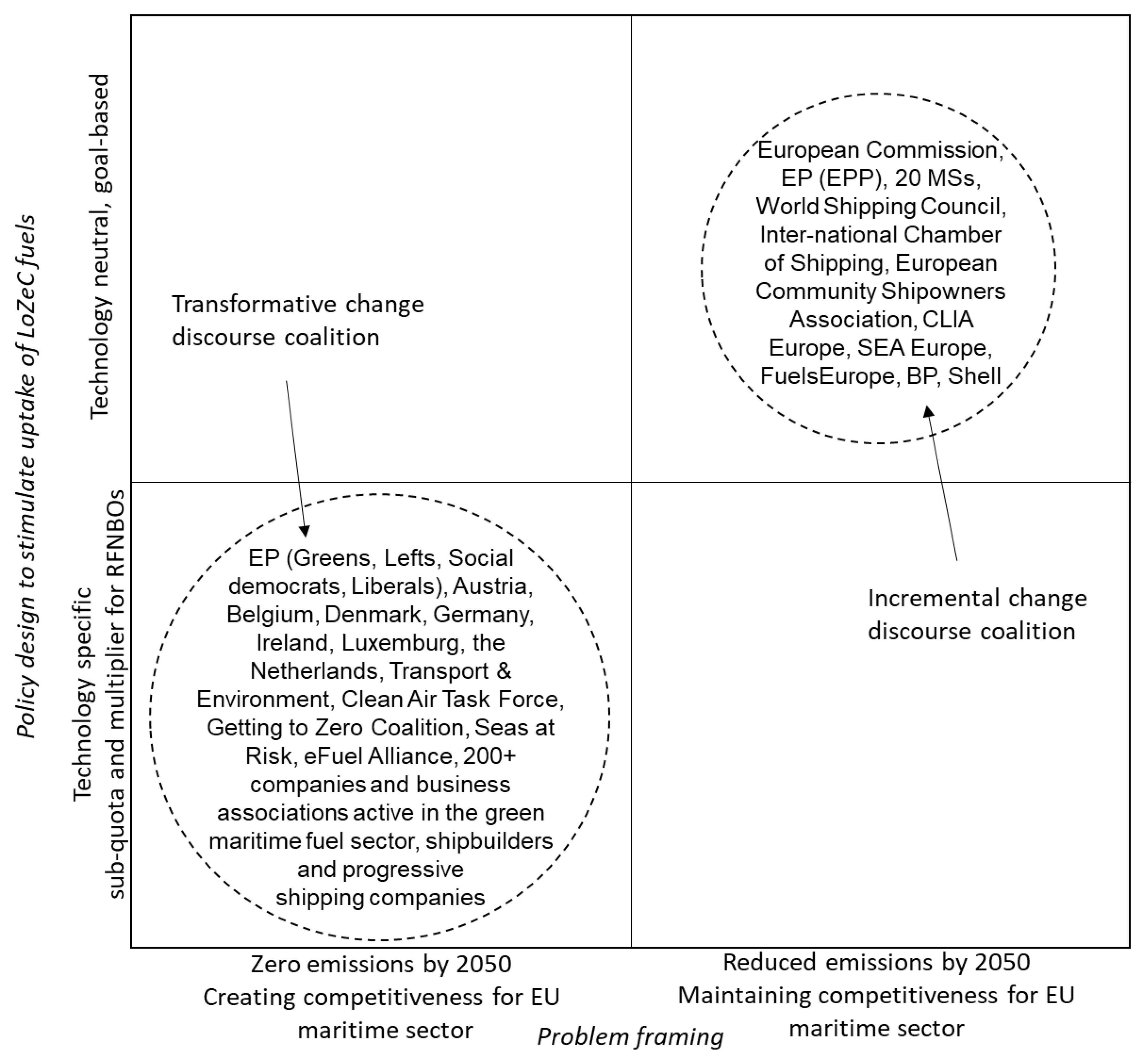
Figure 2.
Discursive agency shaping the meaning of ‘decarbonizing maritime shipping’ and framing the FuelEU Maritime regulation.
Figure 2.
Discursive agency shaping the meaning of ‘decarbonizing maritime shipping’ and framing the FuelEU Maritime regulation.
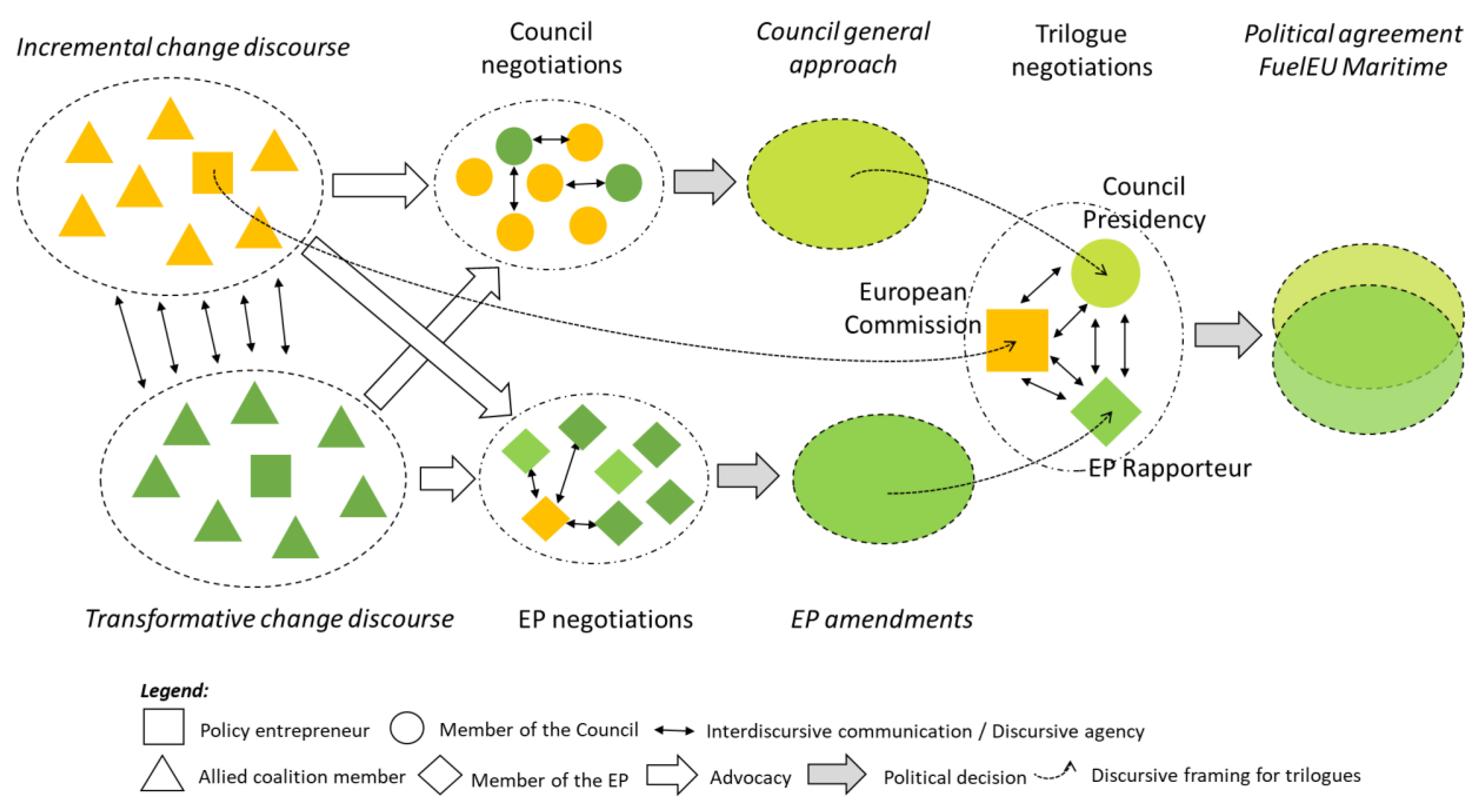
Figure 3.
Trajectories for reduction of GHG intensities in FuelEU Maritime [% of 2020 level] Modified after von Malmborg (2023a, 2024a).
Figure 3.
Trajectories for reduction of GHG intensities in FuelEU Maritime [% of 2020 level] Modified after von Malmborg (2023a, 2024a).
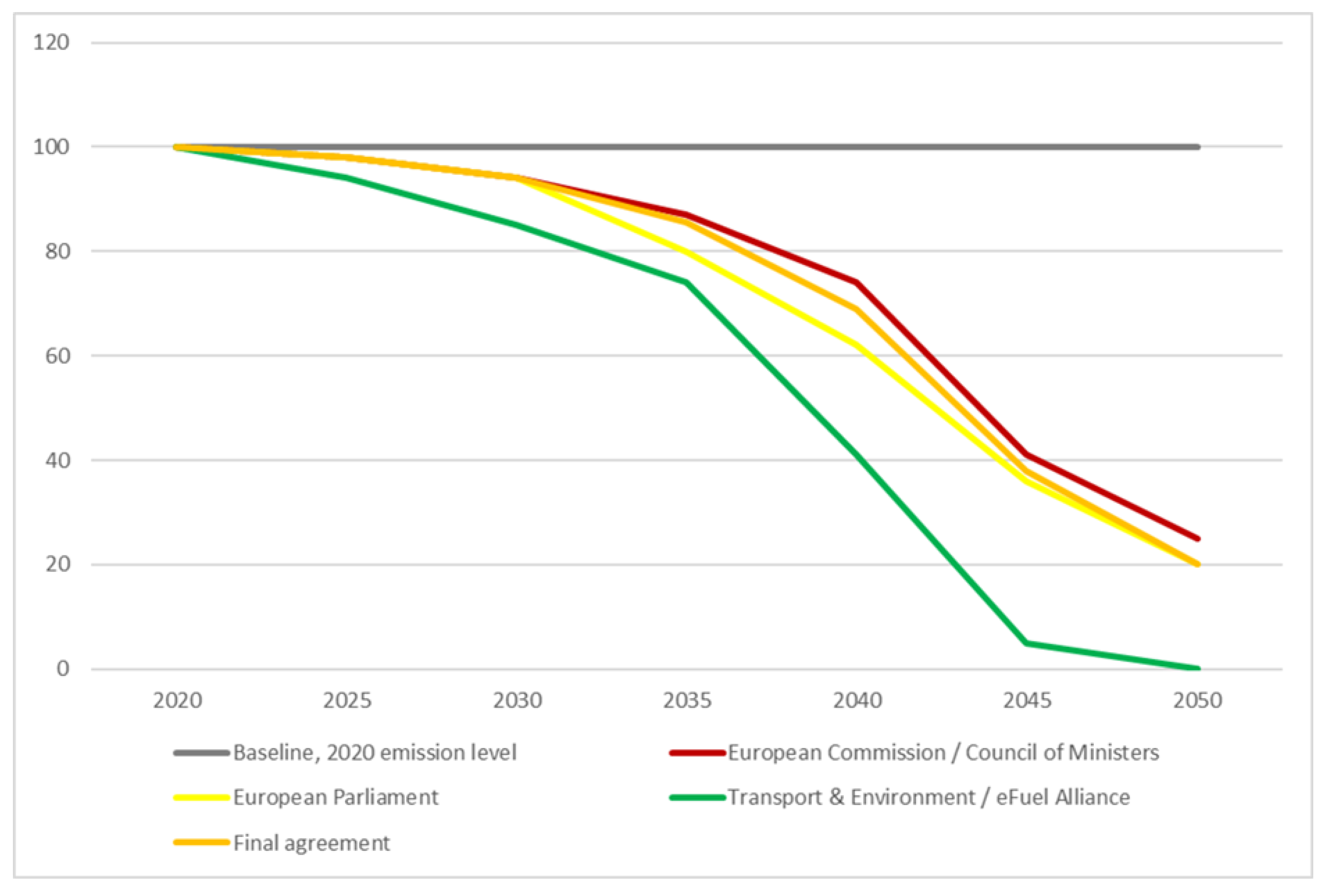

Table 1.
Documents analysed.
| Policy actors | Documents |
|---|---|
| European Commission | Strategy for integrating maritime transport emissions in the EU’s GHG reduction policies (EC, 2013) European Green Deal (EC, 2019) Climate target plan (EC, 2020) Fit for 55 package (EC, 2021a) Commission’s proposal for FEUM (EC, 2021b) Commission’s Regulatory Impact Assessment for FEUM (EC, 2021c) Commissions proposal for including shipping in EU ETS (EC, 2021d) Commission’s Regulatory Impact Assessment for including shipping in EU ETS (EC, 2021e) Fit for 55 on all fronts? Can Europe lead innovation in green maritime? Online conference organized by Euractive on 23 September 2021. https://www.youtube.com/watch?v=7ls1zFOpsPYc Lack of green maritime fuels makes liquid natural gas a necessity says Commission (Euractive, 2021) |
| Transport & Environment (T&E) | FuelEU Maritime public consultation: Detailed T&E briefing (T&E, 2020) Arbitrary exemptions leave many heavily polluting ships unregulated (T&E, 2022a) FuelEU Maritime: Analysis and recommendations. How to drive the uptake of sustainable fuels in European shipping (T&E, 2022b) Broad industry-NGO coalition calls for EU hydrogen quota for shipping (T&E, 2022c) Joint open letter to the European Parliament and the Council (T&E, 2022d) |
| Interest groups | Answers to the Commission’s public consultation on FEUM (EC, 2021f) “Fit for 55” Statement by CLIA Europe, 14 July 2021. https://maritimes.gr/en/fit-for-55-statement-by-clia-europe/ FuelEU Maritime – Avoiding Unintended Consequences. Report by European Community Shipowners’ Associations (ECSA) and International Chamber of Shipping (ICS) (ECSA & ICS, 2021) FuelEU Maritime Regulation. SEA Europe position paper, 30 November 2021. https://www.seaeurope.eu/images/files/2021/Position-papers/Regulatory-Affairs/20211130_fueleu-maritime_sea-europe-position-paper_final.pdf World Shipping Council position paper on FuelEU Maritime, 2021. https://static1.squarespace.com/static/5ff6c5336c885a268148bdcc/t/635112327a9a1b1a7f8ea56a/1666257466735/WSC_FuelEU_PP_Oct2022_0.1.pdf World Shipping Council statement on the FuelEU trilogue completion, 23 Macrh 2023. https://static1.squarespace.com/static/5ff6c5336c885a268148bdcc/t/641c1eecc29eac3f1b4596e3/1679564525333/WSC+statement_+FuelEU_Trilogue_completion.pdf Lobbying FuelEU Maritime (InfluenceMap, 2023) Europe can be a global leader in shipping decarbonization (Getting to Zero Coalition, 2022) Shipping is not Fit For 55 – with only months left for the EU to get it right (Seas at Risk, 2022) Position statement by the eFuel Alliance on the European Commission FuelEU Maritime proposal: Green European maritime space (eFuel Alliance, 2022) Ambitious marine fuel standards: Tackling climate change and developing business opportunities. Joint open letter by Danish Shipping and others to the European Parliament, European Commission and the Swedish Council Presidency, 9 December 2022. https://www.worldshipping.org/statements/ambitious-marine-fuel-standards Statement by ECSA on the FuelEU Maritime negotiations, 15 February 2023. https://www.ecsa.eu/news/ecsa-statement-fueleu-maritime-negotiations Joint statement by ECSA and T&E on FuelEU Maritime, 31 May 2022. https://www.ecsa.eu/news/joint-statement-ecsa-and-te-fueleu-maritime Joint Statement of ECSA, European Waste-Based and Advanced Biofuels, eFuel Alliance, the Advanced Biofuels Coalition and GoodFuels on FuelEU Maritime, 1 June 2022. https://www.ecsa.eu/news/joint-statement-ecsa-ewaba-efuel-alliance-advanced-biofuels-coalition-and-goodfuels-fueleu |
| Member states and the Council | Sweden’s reports from 38 meetings in the Council shipping working party (September 2021 to March 2023), the transport ministers’ meeting in June 2022., and two meetings of the Committee of Permanent Representatives (COREPER). Joint statement by Austria, Belgium, Denmark, Germany, Ireland, Luxemburg, the Netherlands and Sweden on the FuelEU Maritime, 2 June 2022. https://archief27.sitearchief.nl/archives/sitearchief/20230906150753/https://www.permanentrepresentations.nl/binaries/nlatio/documenten/publications/2022/06/02/joint-statement-on-fueleu-maritime/Statement+TTE+-+FuelEU+Maritime.pdf Council general approach on the proposal for FEUM (Council, 2022) |
| European Parliament | Draft report on the proposal for FEUM (Warborn, 2022) Amendments on the proposal for FEUM of the EP Committee on Transport and Tourism (TRAN, 2022) EP amendments on the proposal for FEUM (EP, 2022) Parliament backs EU’s maritime fuel law to curtail shipping emissions (Euractive, 2022) FuelEU Maritime deal lets shipping off the hook (Cuffe & Paulus, 2022) |
| Trilogue negotiations | Sweden’s reports from eight inter-institutional technical meetings and two political trilogue meetings of the Council, the EP and the EC |
Table 2.
Interviews.
| Organization | Interviewees | Interview conducted |
|---|---|---|
| European Commission | Head of Unit, DG MOVE Policy officer, DG MOVE |
March 2023 March 2023 |
| European Parliament | Political assistant to the rapporteur | March 2023 |
| Transport & Environment | Policy officer | August 2022 |
| Permanent Representation of Sweden to the EU (Council) | Transport attaché | March 2023 |
Table 3.
Storylines identified among actors in the EU policy domain on decarbonization of maritime shipping.
Table 3.
Storylines identified among actors in the EU policy domain on decarbonization of maritime shipping.
| Policy issue | Storylines related to strong policy | Storylines related to moderate policy |
|---|---|---|
| Views on climate change and emission reductions | PROB1. Climate change is an emergency, and all sectors must decarbonize. Climate neutrality 2050 is the goal. Emission reductions must be on par with the Paris Agreement targets, thus be reduced significantly also in a short-term perspective. High ambitions are important for the EU shipping sector to increase competitiveness, and for EU and member states to gain credibility in discussion on a global regime for decarbonizing shipping. A level playing field is important. | PROB3. Climate change is a threat to our economies and all sectors must reduce emissions, but economic growth must not be jeopardized. The shipping sector is global, and competitiveness of the EU shipping industry must be protected by a level playing field. |
| Views on maritime fuels | PROB2. All fossil fuels must be banned, and use of the most effective zero-emission fuels must be drastically increased. | PROB4. Emission reductions should be moderate as there is a lack of supply of LoZeC fuels for the moment. The use of fossil fuels must be reduced, but liquified natural gas is a necessary transition fuel, despite it being a fossil fuel. Cost increases for the shipping industry should be moderate. |
| How should the EU stimulate innovation of the green shipping fuels? | POL1. Innovation is facilitated by technology specific policies. To stimulate decarbonization of maritime shipping. Technology specific sub-quota (2–6 % and increasing) and high multiplier (2–5) for RFNBOs | POL6. Innovation is facilitated by technology neutral policies. To stimulate decarbonization of maritime shipping, a technology neutral, goal-based approach with no sub-quota or multiplier for RFNBOs should be used. |
| Addressees of the regulation | POL2. Requirements on shipping companies should be complemented with requirements on fuel suppliers to ensure that fuel suppliers in European ports deliver compliant fuels to ships in sufficient quantities | POL7. There is contractual freedom. FEUM should not include requirements on fuel suppliers. This can be dealt with in the EU Renewable Energy Directive. |
| Scope of the regulation | POL3. Ships above 400 gross tonnage should be included to cover as many ships and emissions as possible.POL4. Exemptions shall be limited in scope and time to safeguard the integrity of the policy. | POL8. Ships above 5,000 gross tonnage should be covered to start with as the only these ships are covered by the EU regulation on monitoring, reporting and verification of emissions.POL9. Exemptions must be made to account for regional differences, such as passenger shipping to small islands and remote areas, ice-classed ships and navigation in ice, and render the policy legitimacy in member states. |
| How should incomes penalties be allocated? | POL5. Incomes from penalties should be allocated to an EU fund for financing innovation related to decarbonization of shipping. An EU Fund will pool resources to finance innovation of the most promising technologies by an economics of scale, giving highest return of investment. | POL10. Incomes from penalties should be allocated to member states for financing innovation related to decarbonization of shipping. Member state funding safeguards financing innovation of technologies most pertinent from national perspectives. |
Table 4.
Strategies for discursive agency and discursive interaction to deal with different and competing discourses Source: Based on Dewulf and Bouwen (2012) and Lynggaard and Triantafillou (2023).
Table 4.
Strategies for discursive agency and discursive interaction to deal with different and competing discourses Source: Based on Dewulf and Bouwen (2012) and Lynggaard and Triantafillou (2023).
| Agency strategy Interaction strategy |
Exclusion | Multiple functionality | Vagueness |
|---|---|---|---|
| Polarization | √ | – | – |
| Disconnection | √ | – | – |
| Incorporation | – | √ | – |
| Accommodation | – | √ | – |
| Reconnection | – | √ | (√) |
Table 5.
Meaning of ‘decarbonizing maritime shipping’.
| Discourse | Decarbonization of maritime shipping |
|---|---|
| Incremental change discourse | Transition to climate neutrality is a threat to growth and competition of the European maritime industry. Since LoZeC fuels are costly, transitional fuels must be allowed, and emission reductions in the sector should be moderate, reaching -90 % by 2050. This target should be met by technology neutral policy. |
| Transformative change discourse | Transition to climate neutrality is an opportunity for increasing competitiveness of the European maritime sector. Since LoZeC fuels are costly, massive innovation is needed and fossil fuels must be banned. Since climate change is an emergency, emissions must be reduced with 100 % by 2050 at the latest. This target should be met by technology specific policy. |
| Ecological modernization discourse | Transition to climate neutrality is an opportunity for increasing competitiveness of the European maritime sector. Since LoZeC fuels are costly, massive innovation is needed but transitional fuels must be allowed, and emission reductions in the sector should be moderate, reaching -90 % by 2050. This target should be met by a combination of technology neutral and technology specific. |
Disclaimer/Publisher’s Note: The statements, opinions and data contained in all publications are solely those of the individual author(s) and contributor(s) and not of MDPI and/or the editor(s). MDPI and/or the editor(s) disclaim responsibility for any injury to people or property resulting from any ideas, methods, instructions or products referred to in the content. |
© 2024 by the authors. Licensee MDPI, Basel, Switzerland. This article is an open access article distributed under the terms and conditions of the Creative Commons Attribution (CC BY) license (http://creativecommons.org/licenses/by/4.0/).
Copyright: This open access article is published under a Creative Commons CC BY 4.0 license, which permit the free download, distribution, and reuse, provided that the author and preprint are cited in any reuse.


