

Submitted:
14 May 2024
Posted:
15 May 2024
You are already at the latest version
Abstract
Within the polyurethanes market, only 0.1% are from renewable sources. With the continuing concern about climate change and greenhouse gases in the atmosphere, the substitution of monomers and processes derived from petrochemical sources is crucial for the development of biomaterials. Therefore, polyhydroxyurethanes have propose due to their synthesis route with the incorporation of monomers from renewable sources such as vegetable oils and the substitution of isocyanates known for their high toxicity, carcinogenicity and petrochemical origin, and the use of carbon dioxide. There are few reports on the use of soybean oil and the possible application of these materials in wound healing applications. Based on this, polyhydroxyurethanes were obtained from carbonated soybean oil and two diamines, one aliphatic: 1,4-butadiamine (putrescine), and one cycloaliphatic: 1,3-cyclohexanobis(methylamine), and they were physiochemically, mechanically, and thermally characterized. Four polyhydroxyurethanes were obtained, with stability to hydrolytic and oxidative media, thermal stability above 200 °C, tensile strength between 0.9-1.1 MPa, elongation at break between 81 and 222%. And water absorption up 102% and contact angle between 63,70 and 101,39. Achieving new formulations of biobased NIPHUs that represent a more sustainable process which allow to achieve the physicochemical, mechanical, and thermal properties required for the preparation of wound dressings.
Keywords:
non-isocyanate-polyhydroxyurethanes
; soybean oil
; wound dressing
1. Introduction
There is a growing demand for biomaterials, especially polyurethanes, for tissue engineering that can mimic tissue properties and behavior. Even though different polyurethanes have been proposed and investigated, with many being commercially available, less than 0.1% of the total polyurethanes currently available on the market come from renewable sources [1]. Common synthesis routes for polyurethanes involve the use of polyols and isocyanates [2]. The source of these monomers is petrochemical [3], and isocyanates have been found to be toxic, especially aromatic isocyanates, due to their degradation products [4].
One of the areas in which polyurethanes have been used is wound dressing applications, as they have advantages such as biocompatibility, mechanical properties similar to those of human skin, and flexibility [5,6]. However, the currently available wound dressings present disadvantages in the treatment of chronic wounds, including poor antibacterial activity, poor anti-inflammation activity, differences in mechanical strength from human skin, limited ability to absorb exudates, and inadequate gas exchange [5,7], which affect the healing process.
Film dressings have a better relationship of the material to the adjacent tissue, causing less damage upon removal [8]. In addition, they achieve a higher antibacterial activity compared to hydrogels, hydrocolloids [8,9]. Although some dressings as generated with different techniques such as electrospun nanofibers have great advantages with compatibility or antibacterial activity, in the case of nanofibers by promoting cell adhesion they have greater damage to adjacent tissue [10]. Also, film dressings present higher chemical resistance required for biomedical applications [11].
Although currently there is a wide range of products for this purpose, so far, an ideal dressing has not been created, so the search for the material that will accelerate the healing process and help to reduce the development of chronic or non-healing wounds that represent high burden on the health system, continues.
For this reason, recent research has focused on new polyurethane synthesis routes that allow the incorporation and use of bio-based monomers and the substitution of isocyanates, and polyhydroxyurethanes (PHUs) are promising materials [1]. One of the synthesis routes comprises the use of carbon dioxide (CO2) and the incorporation of bio-based monomers from renewable sources, such as vegetable oils [12]. In this route, cyclic carbonates are ring-opened with amines, whereby an alkoxyl ion is produced which forms a hydroxyurethane bond upon reaction with amines, leading to the production of PHUs [13]. For the generation of cyclic carbonates, vegetable oils can be used as they present several advantages due to their chemical composition; vegetable oils have a double bond that allow for different chemical modifications, which generate a wide variety of polymers with diverse mechanical, physicochemical, and biological properties, thus allowing their use in various applications [14]. Another advantage of this synthesis route is the 100% atomic reaction wherein CO2 acts as an aprotic and reactive solvent [12].
Soybean oil has been used in the synthesis of polyurethanes due to the presence of unsaturated fatty acids in its chain, which are susceptible to chemical modifications such as epoxidation and carbonation. Its application allows the characteristic urethane bond to form. Although the synthesis route using soybean oil generates five-carbon cyclic carbonates, which are less reactive than those with six carbons, the renewable characteristic of soybean oil allows the incorporation of more sustainable production processes. Additionally, soybean oil is a low-cost raw material and has been proven to be biocompatible in biomedical applications [15].
Specifically for wound dressings, Gholami and Yeganeh generated PHUs from soybean oil crosslinked with epichlorohydrin, with the inclusion of cationic azethidinium groups to improve the antibacterial properties of these dressings. The mechanical properties were a tensile strength of 6 MPa, an elongation at break of 200%, and water absorption of 30%, and these dressing were non-cytotoxic to L929 fibroblasts, generating a moist environment suitable for low to moderately exuding wounds [16].
Therefore, the search for biomaterials from renewable sources that can be used in more sustainable synthesis routes is crucial. The aim of this investigation is to determine the physicochemical, mechanical, and thermal properties of bio-based NIPHUs obtained from modified soybean oil with the incorporation of a cycloaliphatic diamine in the chain to increase the mechanical properties; these bio-based NIPHUs are generated to be potential candidates for wound dressing applications.
2. Materials and Methods
2.1. Materials
Epoxidized soybean oil (ESBO) was purchased from MPQ MapriQuim SAS (Bogotá, Colombia). Tetrabutylammonium bromide (TBABr), 1,4 butadiamine (BDA), and 1,3-cyclohexanobis(methylamine) (CHM) were procured from Sigma-Aldrich Co., LLC (USA). Additionally, 30% hydrogen peroxide and sodium bicarbonate were purchased from PanReac AppliChem ITW Reagents (Darmstadt, Germany). CO2 was purchased from Messer (Bogotá, Colombia), and phosphate buffer from VWR (Radnor, PA, USA).
2.2. Soybean Oil Carbonatation
To obtain carbonated soybean (CSBO), the procedure developed by Guzman et al. (2017) was followed. ESBO and the catalyst TBABr at 5% mol with respect to the epoxide content were placed in a 160 mL high-pressure reactor (Parr Instrument Company, USA) at 105 °C. When the desired temperature was reached, CO2 was continuously injected into the mixture at a pressure of 6.0 MPa. The reaction was run for 24 h at 500 rpm [17]. When the reaction was completed, the mixture was cooled to room temperature (25 °C).
2.3. Synthesis of Non-Isocyanate Polyhydroxyurethanes (NIPHUs)
NIPHUs were obtained based on the methodology proposed by Raden Amirah et al., 2013. Briefly, the obtained CSBO was heated to 60 °C. Then, the amines BDA and CHM were added in different proportions (Table 1) to reach a 1:2 molar ratio of cyclocarbonate to amine. The mixture was left under agitation at 60° C for 5 min, and then transferred to a mold and left curing at 90 °C for 12 h [18].
2.4. Characterization
The characteristic chemical structures of ESBO, CSBO, and NIPHUs were evaluated via Fourier-transform infrared (FTIR) spectroscopy using an ATR-FTIR spectrometer (Agilent Cary 630 FTIR Spectrometer) in the range of 400 and 4000 cm-1. The spectra were obtained at a spectral resolution of 4 cm-1 for an average of 24 scans. The molecular structures of products of carbonation reactions were analyzed via proton nuclear magnetic resonance to obtain 1HNMR and 13CNMR spectra using a Bruker Avance Neo 400 MHz spectrometer and CDCl3 as the solvent.
2.5. Swelling
Sample disks (6 mm in diameter) was immersed in 1.5 mL of distilled water and incubated for 21 days at 37 °C [19]. Water absorption was calculated after 1, 2, 3, 5, 6, 24, 26, 28, 30, 48, 50, 52, 144, 168, 216, 288, 360, 456, and 504 h, with the initial weight (Wo) and final weight (Ws), according to the following equation:
2.6. Contact Angle
The hydrophilic characteristic of the obtained NIPHUs was measured via the sessile drop method using an OCA20 device (Data Physics, Filderstadt, Germany) with deionized water at 25 °C. At least 15 measurements were taken per sample [20].
2.7. Hydrolytic and Oxidative Degradation
Degradation was evaluated in terms of mass loss. Hydrolytic degradation was performed in phosphate buffer (PBS 1x: 137 mM NaCl, 10 mM phosphate, and 2.7 mM KCl) at a pH of 7.4. Oxidative degradation was evaluated in a 3% H2O2 solution [21]. The NIPHU samples (between 20 and 60 mg) were immersed in 2 mL of each solution for 21 days at 37°C. Their weight was recorded every three days.
2.8. Mechanical Test
The stress–strain tests were performed using a DMA 850 (TA Instruments, New Castle, DE, USA), wherein the maximum stress, percentage of elongation, and Young's modulus of the PHUs were determined (following the ASTM D638-10). A 5 kN load cell with a jaw displacement speed of 25 mm min-1 was used [19]. Three specimens of 20 mm × 5 mm × xx mm (length × width × thickness) were tested.
2.9. Thermal Characterization
The thermal stability of the obtained NIPHUs was evaluated with thermogravimetric analysis (TGA) in the range of 25°C to 600°C under a nitrogen atmosphere at a heating rate of 25 °C min-1.
2.10. Statistical Analysis
All experiments were performed at least three independent times. The data were reported as mean ± standard deviation and were analyzed using one-way analysis of variance (ANOVA) to determine statistical significance. A p-value of less than 0.05 was considered significant. Tukey’s multiple comparison test was performed to determine significant differences between pairs.
3. Results
Epoxidized soybean oil reacted with CO2 and TBABr to generate carbonated soybean oil. From the FTIR spectra of ESBO and CSBO, it is evident that the conversion of epoxy groups, with a peak at 834 cm−1, to cyclic carbonate groups occurred, with the appearance of new signals at 1046, 1200, and 1801 cm−1 (Figure 1a). Similarly, the 1H RMN spectrum presented in Fig. 1b indicates that the signals of epoxy groups in ESBO at 2.80-3.20 ppm disappear in CSBO, with the appearance of new signals at 4.45-5.10 ppm corresponding to cyclic carbonate groups [22,23]. Additionally, the 13C RMN spectrum presents a signal at 155 ppm due to the carbonyl group of cyclic carbonates in CSBO and indicates the disappearance of the signals at 54.16 and 56.75 ppm corresponding to the epoxy groups [22].
The following reactions occurs for the carbonatation and synthesis of the NIPHUs.
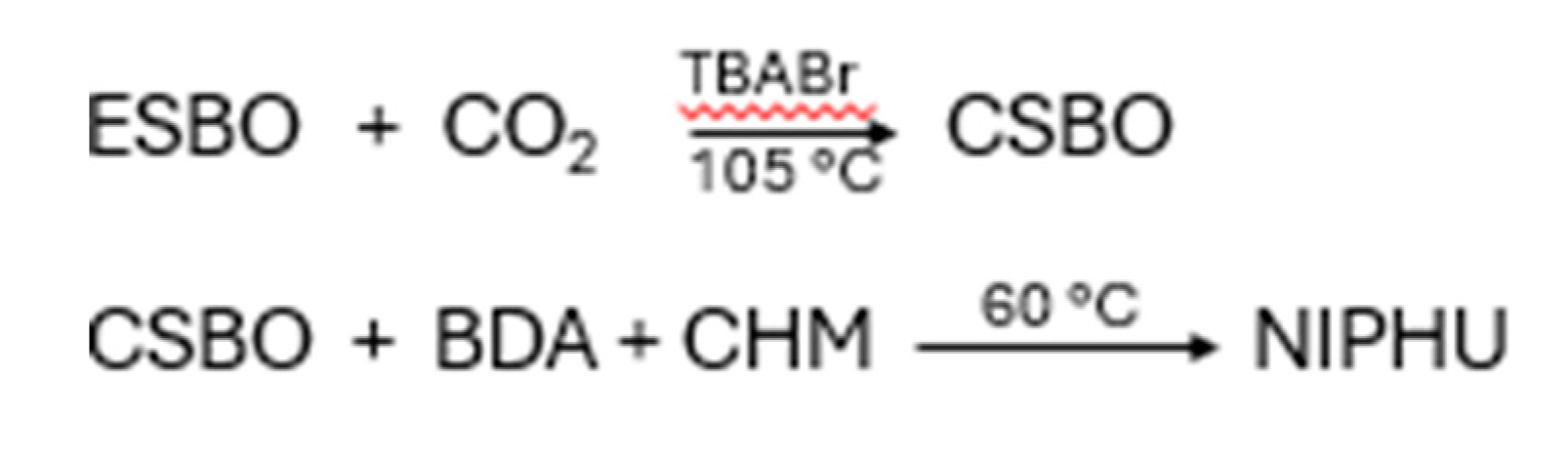
Afterwards, NIPHUs were synthetized from CSBO, 1,4 butadiamine (BDA), and 1,3-cyclohexanobis(methylamine) (CHM). However, the synthesis of NIPHUs with a content of CHM over 50% resulted in brittle materials that broke during the demolding process; therefore, these NIPHUs were not characterized (Figure 2a). The disappearance of the 1801 cm-1 peak during reaction and the appearance of the peaks at 1689, 1536, and 3309 cm−1 corresponding to the stretching of urethane carbonyl, the combination of C-N stretching/N-H bending, and urethane N-H/hydroxyl OH stretching vibrations, respectively (Figure 2b), confirmed that NIPHUs were obtained. Additionally, there were C–N bond stretching around 1250 cm−1 and stretching vibrations of the C–O bond at 1141 cm−1 [24,25]. No differences were observed from the FTIR spectra of the synthetized NIPHUs.
The hydrophilicity or hydrophobicity of the obtained NIPHUs were evaluated by measuring the contact angle degree and water absorption rate (Figure 2). The surface wettability of these NIPHUs changed with the inclusion of CHM in the chains. With a lower content of CHM, a more hydrophilic behavior with a contact angle of 63,70 (NIPHU-50/50) was observed compared to the contact angle of 101,39 of the NIPHU without CHM (NIPHU-100/0). However, the water absorption rate was similar for NIPHUs with or without CHM, with a maximum absorption over 456 h (19 days) after an equilibrium was reached at 102,88% and 104,29%, respectively (Figure 2b). No mass loss was observed within the 21 days of analysis for all the NIPHUs synthetized from CSBO and BDA/CHM in the hydrolytic and oxidative medium.
The thermograms of the NIPHUs in Figure 3 display a three-stage weight loss process. The NIPHUs showed a stable behavior up to 200 °C, and their degradation occurred after 350 °C [26].
The developed NIPHUs exhibited a tensile strength in the range of 0.5 to 1.13 MPa (Table 2). The Young’s modulus was in the range of 0.002 MPa to 0.009 MPa. The elongation at break was in the range of 81 to 273%, increasing with a decrease in CHM content in the material.
4. Discussion
Increasing concern about the environmental impact of different polymer synthesis routes, especially those of polyurethanes, has prompted the search for new renewable and eco-friendly sources. The incorporation and use of bio-based monomers and the substitution of isocyanates is a promising route, and polyhydroxyurethanes (PHUs) have garnered attention, especially in biomedical applications. Therefore, this work aimed to synthesize non-isocyanate polyhydroxyurethanes from soybean oil, BDA, and CHM and characterize their physicochemical, mechanical, and thermal properties.
The results show that the modification of ESBO with carbon dioxide can generate CSBO which is necessary for the aminolysis reaction to obtain NIPHUs (Figure 1). Similar procedures have been performed by several authors in recent years. Patel et al. prepared CSBO at 750 psi (5.17 MPa) and 110°C for 48 h and obtained the same results as this investigation. Nevertheless, the time used in this research was reduced by 24 h [27] .
The reaction of the modified soybean oil with different combinations of BDA and CHM allowed us to obtain NIPHU films. Increasing the percentage of CHM in the matrix generated brittle NIPHUs which broke during the demolding process; therefore, these NIPHUs were not considered for potential wound dressing applications. The results show that the inclusion of CHM improves the mechanical properties of these NIPHUs, but an excess does not lead to flexible materials.
In comparison with polyurethanes, PHUs present the limitation of higher water absorption due to the hydroxyl groups adjacent to the urethane linkages [28]. In this regard, the incorporation of CHM to the backbone of the NIPHUs increases their hydrophilicity (Figure 3b) but does not significantly affect water absorption. As reported in other investigations, the synthesis of NIPHUs by using BDA generates hydrophobic materials [27] Therefore, a moist environment is desired to create dressings that allow for better interaction with water. As expected, a direct correlation between bulk hydrophilicity and crosslink density of networks has been observed in previous research [6]. Due to the hydrophobic characteristics of the NIPHUs synthetized with carbonated soybean oil, the interaction between these materials and hydrolytic and oxidative media is low; in this study, there was no mass loss within the 21 days of the study, indicating the stability of the synthetized NIPHUs in relation to the time of wound healing. For would dressing applications, materials with a suitable water absorption rate are desired for their ability to absorb exudates and provide a moist environment suitable for the wound healing process, as well as a cooling sensation [29].
The thermal stability of the NIPHUs was evaluated with thermogravimetric analysis. All the NIPHUs present thermal stability up to 200°C, and weight loss was observed at temperatures under 100°C that might be due to the moisture present in the samples. In agreement with other studies, the three stages of degradation could be attributed to the degradation of urethane linkages during the first stage and then polymer degradation during the second and third stages [30]. The degradation of the soft segment of these NIPHUs is related to the CSBO structure.
Finally, in terms of mechanical properties, the tensile strength of the NIPHUs agrees with that of similar NIPHUs generated from CSBO. Patel et al. synthesized NIPHUs from CSBO and BDA with a tensile strength of 0.4878 MPa [27], compared to a tensile strength of 0.97 MPa of the NIPHU-100/0 in this study. Compared with polyurethanes synthesized for wound dressing applications, the tensile strength is in the range of 0.7 to 18 MPa for dermal cell culture [26], making them good candidates for wound dressings. Nevertheless, the mechanical properties of NIPHUs are lower when compared to conventional polyurethanes, such as those synthesized from vegetable oils like castor oil. Different blends of castor oil with aliphatic, cycloaliphatic, and aromatic isocyanates possess a maximum tensile strength of 16.86 MPa [31], while polyurethanes synthesized from carbonated soybean oil and isophorone diisocyanate have a tensile strength ranging from 5 to 17 MPa [6]. This remains a limitation in the application of NIPHUs to biological environments, and inclusion of mixtures of different diamines could overcome this.
In this study, the inclusion of CHM in the formulation did not modify the tensile strength of the materials but influenced the elongation at break, increasing it from 81.13 % to 273.21%. This increase influences the flexibility of the dressing, which is an important key in the design for the comfort of patients [16]. Likewise, Gholami prepared a wound dressing from CSBO but with the inclusion of isocyanates, which reached an elongation at break between 140% to 390% [6]. These results show that the chemical or physical crosslinking in NIPHUs is not high enough to allow the free movement of the chains, but the tensile strength is high enough to create a dressing for application on the wound zone, along with an appropriate water absorption rate to create an adequate moist environment for the progress of the wound healing stages.
5. Conclusions
A number of studies have been conducted aiming to avoid the use of petrochemical monomers and to utilize eco-friendly synthesis routes for the synthesis of removable monomers. Soybean oil is a vegetable oil that can be modified with carbon dioxide to obtain novel wound dressings. The incorporation of 50% (molar percentage) of CHM in the NIPHU formulation (a cycloaliphatic diamine) increased the elongation at break from 81.13 % to 273.21%, making the obtained NIPHUs more suitable for wound dressing applications without significant modifications to the physical, chemical, and thermal properties. NIPHUs obtained from vegetables oils, such as soybean oil, can be used in an eco-friendly manner for the fabrication of wound dressings that can replace existing PU dressings.
Author Contributions
Conceptualization, M.MG, M.F.V and L.E.D.; methodology, M.MG, M.F.V and L.E.D; formal analysis, M.MG, M.F.V and L.E.D; investigation, M.MG, M.F.V and L.E.D; resources M.F.V and L.E.D; data curation, M.MG.; writing—original draft preparation, M.MG; writing—review and editing, M.MG, M.F.V and L.E.D.; visualization, M.MG; supervision, M.F.V. and L.E.D; project administration, M.F.V and L.E.D.; funding acquisition, M.MG, M.F.V and L.E.D. All authors have read and agreed to the published version of the manuscript.
Funding
This research was funded by Universidad de La Sabana, grant number ING-282-2021.
Institutional Review Board Statement
Not applicable.
Acknowledgments
To the Universidad de La Sabana for the funding of the project. M.MG thanks to Universidad de La Sabana for the Carlos Jordana scholarship for the doctoral studies.
Conflicts of Interest
The authors declare no conflicts of interest. The funders had no role in the design of the study; in the collection, analyses, or interpretation of data; in the writing of the manuscript; or in the decision to publish the results.
References
- Wendels, S.; Avérous, L. Biobased Polyurethanes for Biomedical Applications. Bioact Mater 2021, 6, 1083–1106. [Google Scholar] [CrossRef] [PubMed]
- Gostev, A.A.; Karpenko, A.A.; Laktionov, P.P. Polyurethanes in Cardiovascular Prosthetics. Polymer Bulletin 2018, 1–15. [Google Scholar] [CrossRef]
- Mokhtari, C.; Malek, F.; Manseri, A.; Caillol, S.; Negrell, C. Reactive Jojoba and Castor Oils-Based Cyclic Carbonates for Biobased Polyhydroxyurethanes. Eur Polym J 2019, 113, 18–28. [Google Scholar] [CrossRef]
- Gennen, S.; Grignard, B.; Thomassin, J.M.; Gilbert, B.; Vertruyen, B.; Jerome, C.; Detrembleur, C. Polyhydroxyurethane Hydrogels: Synthesis and Characterizations. Eur Polym J 2016, 84, 849–862. [Google Scholar] [CrossRef]
- Carayon, I.; Szarlej, P.; Gnatowski, P.; Piłat, E.; Sienkiewicz, M.; Glinka, M.; Karczewski, J.; Kucińska-Lipka, J. Polyurethane Based Hybrid Ciprofloxacin-Releasing Wound Dressings Designed for Skin Engineering Purpose. Adv Med Sci 2022, 67, 269–282. [Google Scholar] [CrossRef]
- Gholami, H.; Yeganeh, H. Vegetable Oil-Based Polyurethanes as Antimicrobial Wound Dressings: In Vitro and in Vivo Evaluation. Biomedical Materials (Bristol) 2020, 15. [Google Scholar] [CrossRef]
- Yang, J.M.; Huang, Y.F.; Dai, J.J.; Shi, X.A.; Zheng, Y.Q. A Sandwich Structure Composite Wound Dressing with Firmly Anchored Silver Nanoparticles for Severe Burn Wound Healing in a Porcine Model. Regen Biomater 2021, 8. WE - Science Citation Index Expanded (SCI-EXPANDED). [Google Scholar] [CrossRef]
- Laurano, R.; Boffito, M.; Ciardelli, G.; Chiono, V. Wound Dressing Products: A Translational Investigation from the Bench to the Market. Engineered Regeneration 2022, 3, 182–200. [Google Scholar] [CrossRef]
- Maaz, M.; Maqsood, S.; Gull, N.; Tabish, T.A.; Zia, S.; Ullah, R.; Muhammad, S.; Arif, M. Polymer-Based Biomaterials for Chronic Wound Management : Promises and Challenges. Int J Pharm 2021, 598, 120270. [Google Scholar] [CrossRef]
- Zhang, C.; Yang, X.; Yu, L.; Chen, X.; Zhang, J.; Zhang, S.; Wu, S. Electrospun Polyasparthydrazide Nanofibrous Hydrogel Loading with In-Situ Synthesized Silver Nanoparticles for Full-Thickness Skin Wound Healing Application. Mater Des 2024, 239. [Google Scholar] [CrossRef]
- Samatya Yılmaz, S.; Aytac, A. The Highly Absorbent Polyurethane/Polylactic Acid Blend Electrospun Tissue Scaffold for Dermal Wound Dressing. Polymer Bulletin 2023, 1–27. [Google Scholar] [CrossRef]
- Haniffa, M.A.C.M.; Munawar, K.; Ching, Y.C.; Illias, H.A.; Chuah, C.H. Bio-Based Poly(Hydroxy Urethane)s: Synthesis and Pre/Post-Functionalization. Chem Asian J 2021, 16, 1281–1297. [Google Scholar] [CrossRef]
- Carré, C.; Ecochard, Y.; Caillol, S.; Avérous, L. From the Synthesis of Biobased Cyclic Carbonate to Polyhydroxyurethanes: A Promising Route towards Renewable Non-Isocyanate Polyurethanes. ChemSusChem 2019, 12, 3410–3430. [Google Scholar] [CrossRef]
- Mubofu, E.B. Castor Oil as a Potential Renewable Resource for the Production of Functional Materials. Sustainable Chemical Processes 2016, 4, 1–12. [Google Scholar] [CrossRef]
- Yang, X.; Wang, S.; Liu, X.; Huang, Z.; Huang, X.; Xu, X.; Liu, H.; Wang, D.; Shang, S. Preparation of Non-Isocyanate Polyurethanes from Epoxy Soybean Oil: Dual Dynamic Networks to Realize Self-Healing and Reprocessing under Mild Conditions. Green Chemistry 2021, 23, 6349–6355. [Google Scholar] [CrossRef]
- Gholami, H.; Yeganeh, H. Soybean Oil-Derived Non-Isocyanate Polyurethanes Containing Azetidinium Groups as Antibacterial Wound Dressing Membranes. Eur Polym J 2021, 142. WE - Science Citation Index Expanded (SCI-EXPANDED). [Google Scholar] [CrossRef]
- Guzmán, A.F.; Echeverri, D.A.; Rios, L.A. Carbonation of Epoxidized Castor Oil: A New Bio-Based Building Block for the Chemical Industry. Journal of Chemical Technology and Biotechnology 2017, 92, 1104–1110. [Google Scholar] [CrossRef]
- Raden Siti Amirah, H.; Ahmad Faiza, M.; Samsuri, A. Synthesis and Characterization of Non-Isocyanate Polyurethane from Epoxidized Linoleic Acid – A Preliminary Study. Adv Mat Res 2013, 812, 73–79. [Google Scholar] [CrossRef]
- Uscátegui, Y.L.; Díaz, L.E.; Valero, M.F. In Vitro and in Vivo Biocompatibility of Polyurethanes Synthesized with Castor Oil Polyols for Biomedical Devices. J Mater Res 2019, 34, 519–531. [Google Scholar] [CrossRef]
- Mi, H.Y.; Jing, X.; Hagerty, B.S.; Chen, G.; Huang, A.; Turng, L.S. Post-Crosslinkable Biodegradable Thermoplastic Polyurethanes: Synthesis, and Thermal, Mechanical, and Degradation Properties. Mater Des 2017, 127, 106–114. [Google Scholar] [CrossRef]
- Weems, A.C.; Wacker, K.T.; Carrow, J.K.; Boyle, A.J.; Maitland, D.J. Shape Memory Polyurethanes with Oxidation-Induced Degradation: In Vivo and in Vitro Correlations for Endovascular Material Applications. Acta Biomater 2017, 59, 33–44. [Google Scholar] [CrossRef]
- Ahmad, Z.R.; Mahanwar, P.A. Synthesis and Properties of Foams from a Blend of Vegetable Oil Based Polyhydroxyurethane and Epoxy Resin. Cellular Polymers 2022, 41, 163–186. [Google Scholar] [CrossRef]
- Wang, T.; Deng, H.; Li, N.; Xie, F.; Shi, H.; Wu, M.; Zhang, C. Mechanically Strong Non-Isocyanate Polyurethane Thermosets from Cyclic Carbonate Linseed Oil. Green Chemistry 2022, 24, 8355–8366. [Google Scholar] [CrossRef]
- Ahmad Zubir, S.; Mat Saad, N.; Harun, F.W.; Ali, E.S.; Ahmad, S. Incorporation of Palm Oil Polyol in Shape Memory Polyurethane: Implication for Development of Cardiovascular Stent. Polym Adv Technol 2018, 29, 2926–2935. [Google Scholar] [CrossRef]
- Buffa, J.M.; Mondragon, G.; Corcuera, M.A.; Eceiza, A.; Mucci, V.; Aranguren, M.I. Physical and Mechanical Properties of a Vegetable Oil Based Nanocomposite. Eur Polym J 2018, 98, 116–124. [Google Scholar] [CrossRef]
- Mistry, P.; Chhabra, R.; Muke, S.; Narvekar, A.; Sathaye, S.; Jain, R.; Dandekar, P. Fabrication and Characterization of Starch-TPU Based Nanofibers for Wound Healing Applications. Materials Science and Engineering C 2021, 119, 111316. [Google Scholar] [CrossRef] [PubMed]
- Patel, P.; de Souza, F.M.; Gupta, R.K. Study of Soybean Oil-Based Non-Isocyanate Polyurethane Films via a Solvent and Catalyst-Free Approach. ACS Omega 2024, 9, 5862–5875. [Google Scholar] [CrossRef]
- Hu, S.; Chen, X.; Torkelson, J.M. Isocyanate-Free, Thermoplastic Polyhydroxyurethane Elastomers Designed for Cold Temperatures: Influence of PDMS Soft-Segment Chain Length and Hard-Segment Content. Polymer (Guildf) 2022, 256. [Google Scholar] [CrossRef]
- Almasian, A.; Najafi, F.; Eftekhari, M.; Ardekani, M.R.S.; Sharifzadeh, M.; Khanavi, M. Polyurethane/Carboxymethylcellulose Nanofibers Containing Malva Sylvestris Extract for Healing Diabetic Wounds: Preparation, Characterization, in Vitro and in Vivo Studies. Materials Science and Engineering C 2020, 114. [Google Scholar] [CrossRef]
- Cornille, A.; Serres, J.; Michaud, G.; Simon, F.; Fouquay, S.; Boutevin, B.; Caillol, S. Syntheses of Epoxyurethane Polymers from Isocyanate Free Oligo-Polyhydroxyurethane. Eur Polym J 2016, 75, 175–189. [Google Scholar] [CrossRef]
- Uscategui, Y.L.; Diaz, L.E.; Gomez-Tejedor, J.A.; Valles-Lluch, A.; Vilarino-Feltrer, G.; Serrano, M.A.; Valero, M.F.; Uscátegui, Y.L.; Díaz, L.E.; Gómez-Tejedor, J.A.; et al. Candidate Polyurethanes Based on Castor Oil (Ricinus Communis), with Polycaprolactone Diol and Chitosan Additions, for Use in Biomedical Applications. Molecules 2019, 24, 237. [Google Scholar] [CrossRef] [PubMed]
Figure 1.
(a) FTIR spectra of ESBO and CSBO; (b) 1H RMN spectra of ESBO (blue) and CSBO (red); (c) 13C RMN spectra of ESBO (blue) and CSBO (red).
Figure 1.
(a) FTIR spectra of ESBO and CSBO; (b) 1H RMN spectra of ESBO (blue) and CSBO (red); (c) 13C RMN spectra of ESBO (blue) and CSBO (red).
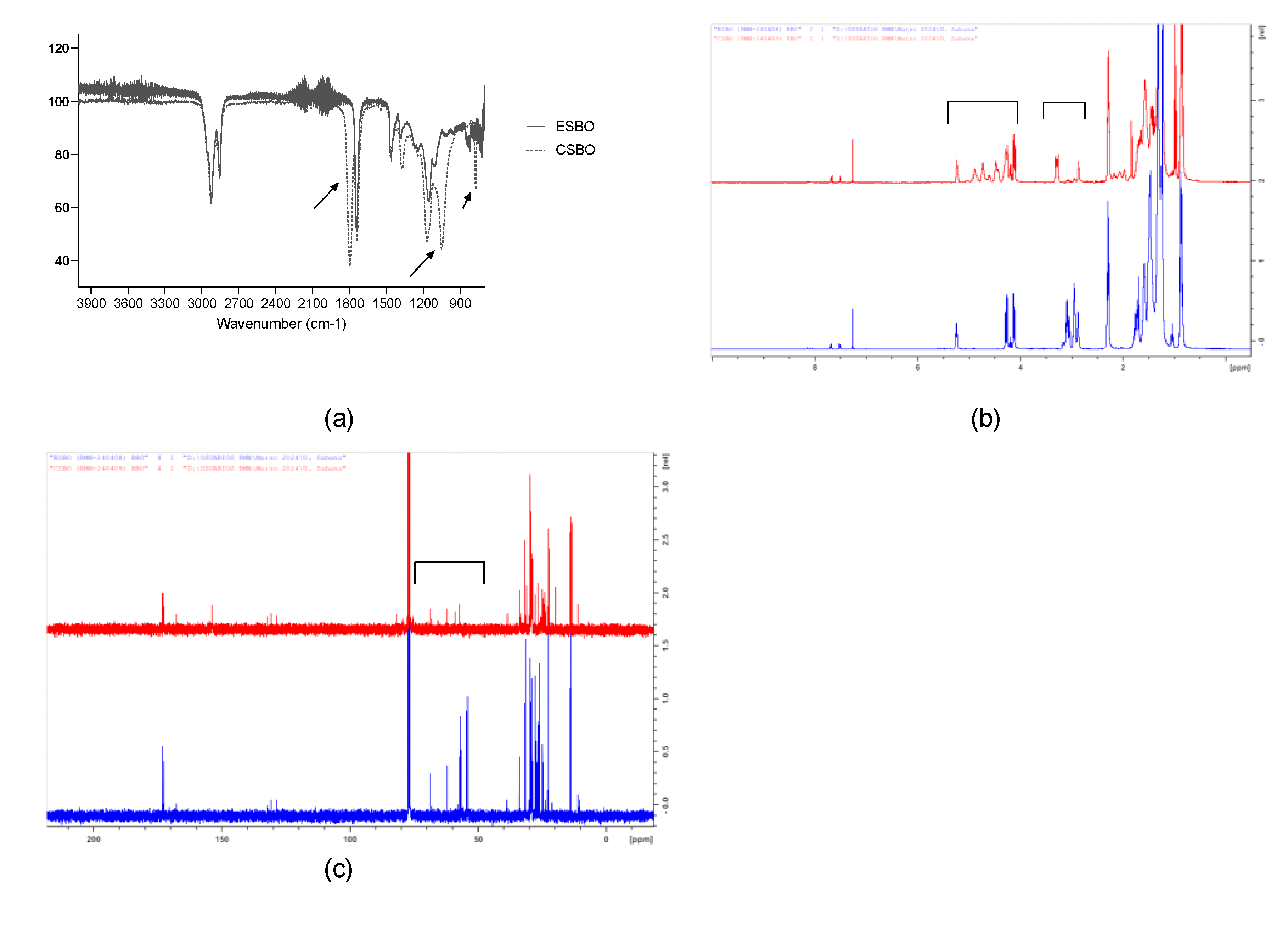
Figure 2.
(a) NIPHU films synthesized from CSBO and different combinations of BDA and CHM; (b) FTIR spectra of synthetized NIPHU films.
Figure 2.
(a) NIPHU films synthesized from CSBO and different combinations of BDA and CHM; (b) FTIR spectra of synthetized NIPHU films.
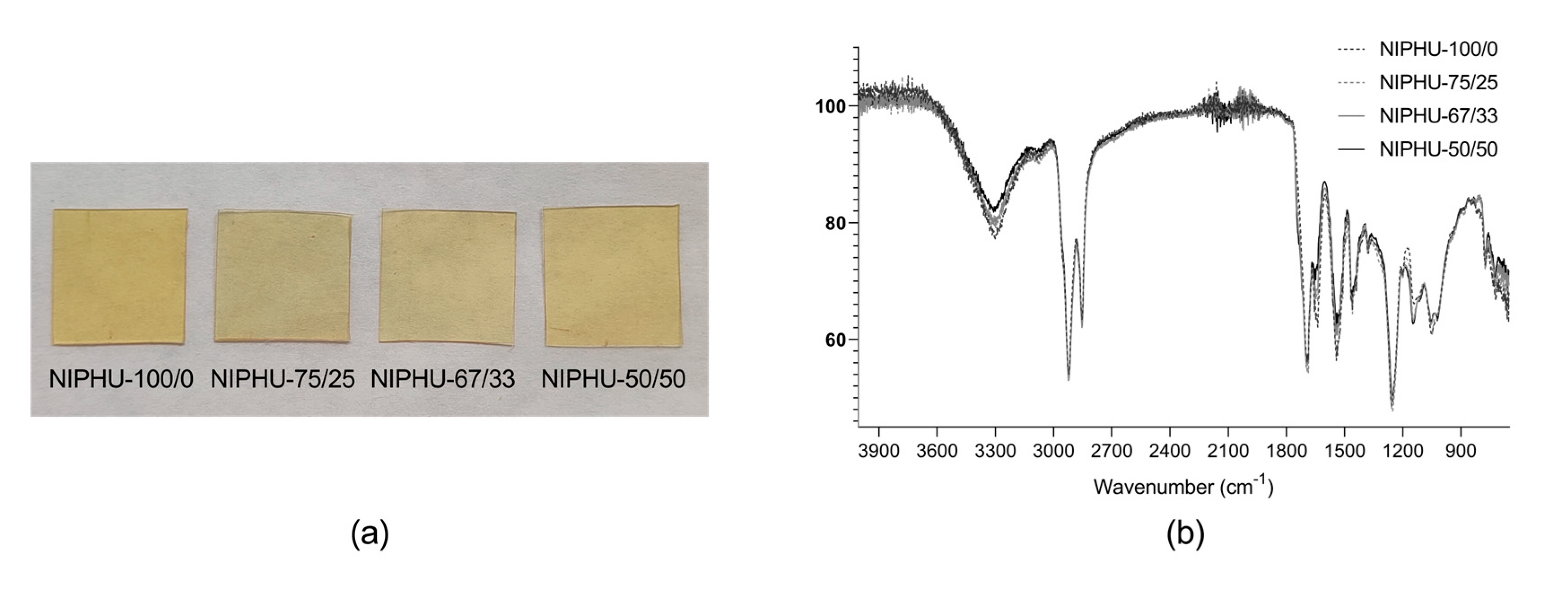
Figure 3.
(a) Contact angle measurements, mean ± SD (n = 15); (b) water absorption rate (%) over 192 h, mean ± SD (n=3). .
Figure 3.
(a) Contact angle measurements, mean ± SD (n = 15); (b) water absorption rate (%) over 192 h, mean ± SD (n=3). .
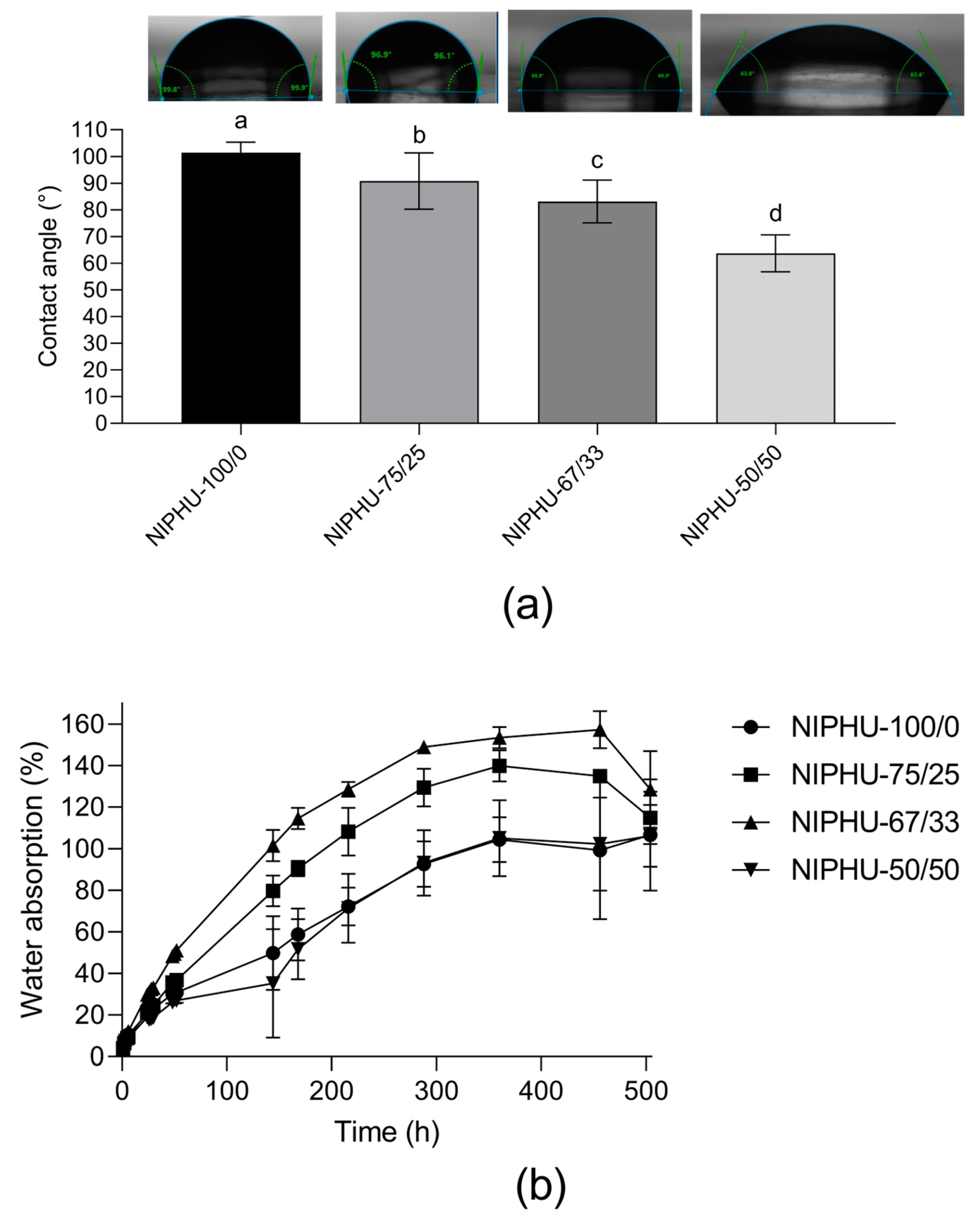
Figure 4.
Thermograms of the synthesized NIPHUs: (a) thermogravimetric (TG) curve and (b) derivative of the thermogravimetric (DTG) curve.
Figure 4.
Thermograms of the synthesized NIPHUs: (a) thermogravimetric (TG) curve and (b) derivative of the thermogravimetric (DTG) curve.
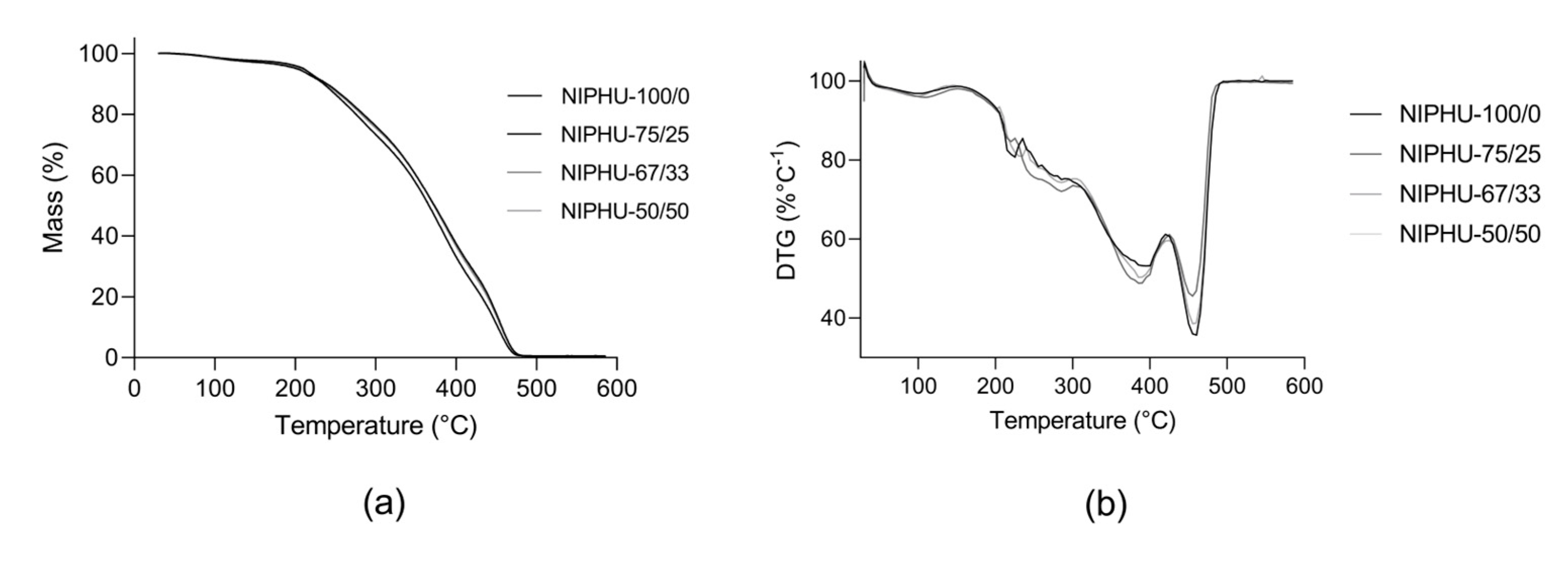

Table 1.
Composition of non-isocyanate polyhydroxyurethane films.
| ID SAMPLE | BDA (% molar) | CHM (% molar) |
|---|---|---|
| NIPHU-100/0 | 100 | 0 |
| NIPHU-75/25 | 75 | 25 |
| NIPHU-67/33 | 67 | 33 |
| NIPHU-50/50 | 50 | 50 |
| NIPHU-33/67 | 33 | 67 |
| NIPHU-25/75 | 25 | 75 |
| NIPHU-0/100 | 0 | 100 |
Table 2.
Young’s modulus, tensile strength and elongation at break of NIPHUs synthetized from CSBO and different contents of BDA and CHM. The data are expressed as mean ± SD (n = 3).
Table 2.
Young’s modulus, tensile strength and elongation at break of NIPHUs synthetized from CSBO and different contents of BDA and CHM. The data are expressed as mean ± SD (n = 3).
| Sample | Young’s modulus (MPa) | Tensile strength (MPa) | Elongation at break (%) |
|---|---|---|---|
| NIPHU-100 | 0.009 ± 0.002 a | 0.97 ± 0.16 a | 81.13 ±18.82 a |
| NIPHU-75/25 | 0.006 ± 0.001 a,b | 1.13 ± 0.05 a | 145.89 ± 39.69 a,b |
| NIPHU-67/33 | 0.002 ± 0.001 b | 0.49 ± 0.22 a | 207.65 ± 31.05 b,c |
| NIPHU-50/50 | 0.003 ± 0.0005 b,c | 0.96 ± 0.07 a | 273.21 ± 17.62 c |
* According to the analysis of variance and Tukey’s pairwise comparison test, means that do not share the same letter are significantly different (p < 0.05).
Disclaimer/Publisher’s Note: The statements, opinions and data contained in all publications are solely those of the individual author(s) and contributor(s) and not of MDPI and/or the editor(s). MDPI and/or the editor(s) disclaim responsibility for any injury to people or property resulting from any ideas, methods, instructions or products referred to in the content. |
© 2024 by the authors. Licensee MDPI, Basel, Switzerland. This article is an open access article distributed under the terms and conditions of the Creative Commons Attribution (CC BY) license (http://creativecommons.org/licenses/by/4.0/).
Copyright: This open access article is published under a Creative Commons CC BY 4.0 license, which permit the free download, distribution, and reuse, provided that the author and preprint are cited in any reuse.


