

Submitted:
10 May 2024
Posted:
14 May 2024
You are already at the latest version
Abstract
Background/Objectives: The aim of the project is a longitudinal assessment of body image and mental health in scoliosis females pre-, postoperatively and in a follow-up, and implementation (one group-CBT scoliosis sample, CBTSS) or not (second group-control scoliosis sample, CSS) of CBT interventions. A healthy female sample (HFS) was also selected for comparative purposes. Methods. 36 in total AIS patients participated in the 1st and 2nd study phases, whereas 23 were eligible in the follow-up. Regarding HFS, 18 participants were included in the study. The CBT intervention took place pre- and postoperatively, during the patients' stay in hospital. Participants completed the Spinal Appearance Questionnaire (SAQ), Body Esteem Scale (BES) and Strengths and Difficulties Questionnaire-25 (SDQ-25). Body image was also assessed using a virtual reality-based application “Avatar Scoliosis 3D”. Results: The difference between the desired and objective, actual body shape is significant preoperatively both in the CBTSS and CSS at p
Keywords:
adolescent idiopathic scoliosis
; XR (extended reality)
; virtual mirror
; cognitive-behavioral therapy
; body image
; mental health
1. Introduction
1.1. Adolescent Idiopathic Scoliosis (AIS)
Adolescent idiopathic scoliosis (AIS) is by far the most common type of scoliosis, with a prevalence of 2–3% in children aged 10 to 16 years. Girls are at greater risk of progression, by a ratio of 3.6:1 [1]. AIS is three-dimensional spinal deformity, consisting of lateral deviation of the vertebral column with rotation of the vertebrae, and sagittal spinal curvature disruption [1,2]. As in many other diseases, attention is paid to the genetic determinants of scoliosis [1,3]. AIS is recognized as a chronic disease with consequences, like many other orthopedic diseases [4,5] on many planes. In particular, AIS with a high Cobb angle can result in the reduction of a patient’s physical capacity, neurological disorders and, in extreme cases, to cardio-respiratory failure and premature death [6]. The treatment options in AIS include observation, brace prescription, posture training, reassurance and surgery [7]. The indications for AIS operative treatment are a steadily increasing angle of curvature up to a 45-50 degree Cobb angle, neurological disorders and pain as well as aesthetic reasons connected to rib hump or lumbar curve in some cases [6]. What is more, patients with progressive AIS may have several pronounced body deformities, including scapular and rib prominence, uneven shoulder level, and an asymmetric waist. These easily visible body deformities can have negative impact on an adolescent’s’ personality development, levels of self-esteem, self- and body image. [8,9,10]. Specifically, Auerbach et al. [9] indicated greater back-related body image disturbances in patients with scoliosis compared with healthy controls.
Spinal fusion surgery with instrumentation often successfully reduces severe curves and minimizes the risk of curve progression [11,12]. Unfortunately, a surgeon’s’ technical successes do not necessarily translate into patient satisfaction with surgical outcomes. In fact, patient satisfaction with the surgical result appears unrelated to the physical benefits of spinal fusion surgery, which include the preservation of pulmonary function and the prevention of osteoarthritis [13]. The cosmesis of the back and shoulders, however, is critically important to adolescents with idiopathic scoliosis, making the patient’s perception of their postoperative silhouette an indicator of satisfaction with the surgical result [14].
1.2. Body Representations in AIS Patients
To date, not much is known about changes in AIS patients’ body representation across a longer time frame. Noonan et al. have shown a lower body image may persist for several years in surgically-treated AIS patients [15]. In addition, they found that the perception of self-image might also deteriorate with time. Interestingly, Koch et al. indicated that AIS patients who reported neutrality with the postoperative cosmesis, experienced multiple coping problems and a more critical, negative view of themselves and, at the same time, continued to perceive themselves as less attractive than their peers [16].
Several studies concerning body image disorders (BID) in clinical samples, e.g., patients treated due to anorexia nervosa (AN), observed that those patients overestimate their body size in different visual size estimation tasks [17,18,19] as well as in non-visual measures [20]. Researchers also indicated that women with BID neither see their own body nor other weight-matched persons differently than controls, but they evaluate them differently in terms of what weight is desirable [21]. In the current project it is assumed that a similar phenomenon, regarding body shape (body disfigurement) estimation, might occur within AIS population. It should be underlined that results concerning the issue of body shape evaluation seem contradictory. On the one hand, it was revealed that body dissatisfaction is related to the altered (disfigured) shape and the weight of the individual, but, on the other hand, improvement of body shape and weight loss does not necessarily modify (decrease) body dissatisfaction [22].
Thus, scoliosis patients following surgical treatment might further overestimate body deformities, e.g., the magnitude of rib hump, scapular and rib prominence, uneven shoulders or asymmetric waistline, and at the same time, experience body image disturbances in the long term. The magnitude of such overestimation has been found to be susceptible to the instruction wording such that a focus on ‘knowledge’ v. ‘feelings’ often reduced or even revoked the overestimation [23,24]. However, it is still unclear under which circumstances patients with AIS may be locked on a negative image of their bodies, and that this perception cannot be reset even after a significant improvement in body shape following surgical treatment. Accordingly, patients with AIS might need support in changing the perception of their desired body shape and in feeling positive about the cosmetic results of scoliosis surgical treatment.
1.3. The Assessment of Body Image
The assessment of body distortion can be done in various ways, but so far no gold standard has been identified. Questionnaires are available to assess perceived somatosensory abnormalities (e.g., temperature, size, pressure, and posture), or body awareness, and can be complemented by drawings or animations of perceived disturbances [25,26,27].
Experimental tools usually require the estimation or judgement of certain properties of the body, under various environmental circumstances. For instance, the integrity of body or movement representations has been assessed by having subjects estimate the size of their body parts, perform motor imagery, visually recognize body-object interactions, or by determining the order of segments that make up a particular movement [28].
Clinical observations indicate that body perception disturbances might be even solely observed while performing movements than in static conditions [29]. Therefore, movement-dependent assessments would correspond better with real-world body-environment interactions, and could offer new avenues for understanding body distortion and its correlates in AIS.
Over the last few decades, the successful implementation of virtual reality (VR) in psychological assessment and treatment, has provided specialists with a technology that by its very nature seems to be particularly suitable in the area of body image disturbances. Above all, these applications improve upon traditional assessment methods based on silhouettes by adding the third dimension to the figures presented to the user; consequently, the figures are more realistic and this makes it easier for participants to identify with them [30]. What is more, figures that represent the body of the participant can be modified in order to reproduce different components of his or her body image, for example, the perceived body image or the ideal body image. Moreover, the use of immersive systems, such as VR glasses or head-mounted displays, allows participants to come face-to-face with their virtual body in the same physical environment and in actual size or shape [31].
To summarize, VR exposure seems to be a very useful technology for conducting experimental studies into the nature of body image distortion and body image dissatisfaction. Taking these advantages into account, we recently developed the application of biometric avatars in VR as a useful tool to investigate body representation and changes within it during the treatment of AIS [31]. All the avatars were created on the basis of 3D scans of bodies of real female patients with thoracic scoliosis. The “Avatar Scoliosis 3D” is an innovative 3D, interactive-XR application, loosely based on the virtual-mirror concept, and contains a number of predefined avatars, each with a different Cobb angle. It is possible to change a selected avatar to one with a different Cobb angle (lower or higher), should the patient decide the visualization of the original is incompatible with their own perception [31].
The main advantage of this application is that, as it is immersive, the user can manipulate the figure while both are in the same virtual environment, which implies that the figure presented to the user has a similar size. This realistic full-body avatar responds to full-body movements in all movement planes in a real-time. In conclusion, this application using biometric avatars in VR can be recognized as a useful tool to investigate changes within body image in AIS. This method can also assess several dimensions or indices of body image (the perceived body shape, the desired body shape) [31].
1.4. Cognitive-Behavioral (CBT) Interventions for Body Image Disorders in AIS Patients
As mentioned earlier, Koch et al. [16] suggested that patients with AIS might need support in changing their desired body shape and in feeling positive about the cosmetic results of surgical treatment. Considering this issue, multiple experimental studies suggest that cognitive-behavioral therapy (CBT) is highly effective in treating severely negative body image and even improves other areas of psychosocial functioning [32,33]. Thus, CBT methods could be used to assess and modify some expectations and emotions related to body shape before and following the AIS surgical treatment. Specifically, CBT sessions would engage AIS patients in writing down and discussing their own appearance-preoccupying rituals, e.g., inspection in a mirror, as well as time-consuming efforts to manage, repair, or alter one’s appearance, usually by perfectionistic grooming regimens.These therapeutic goals could be achieved by integrating different CBT methods: countering, alternative interpretation, label shifting, and deactivating presurgical body shape beliefs [33].
1.5. Study Objectives
Due to current levels of knowledge, especially the unequivocal research results regarding body image disturbances before and following AIS surgical treatment, there is strong justification for broadening the research field through a longitudinal evaluation of changes within BID in relations to variables not yet analyzed in this context, e.g., mental health. What is more, longitudinal changes within BID will be assessed by means of quantitative psychological tests as well as VR-related methods. Moreover, those issues have not been analyzed in AIS patients following CBT interventions.
Finally, the aim of the project is a longitudinal assessment of changes in the psychosocial functioning (in terms of body image and mental health) of females with AIS pre- and postsurgical treatment and in a follow-up, and implementation (group one-CBT scoliosis sample, CBTSS) or not (group two-control scoliosis sample, CSS) of CBT interventions. In particular, the following factors will be assessed: body image (by means of a novel methodology applying VR-related tasks and traditional paper-based scales), mental health (according to the following criteria: emotional symptoms, behavioral disorders, hyperactivity, concentration disorders, problems with peer relations and pro-social behavior). A group of healthy female adolescents (healthy female sample, HFS) will also be selected for comparative purposes.
2. Material and Methods
The research combines quantitative and modern VR strategies in order to gain a better understanding of the analyzed scope of AIS patient functioning.
2.1. Study Design
The study design is longitudinal and cross-sectional. A paper summarizing the study design, study objectives and protocol has been published before patients’ enrolment to the study [34].
The longitudinal aspect of the study concerns evaluation of changes within body image and mental health of AIS patients subjected to psychotherapeutic intervention (CBTSS) or not (CSS), at three time points:
1. Preoperatively, at the Department of Pediatric Orthopaedics and Traumatology, and the Department of Spine Disorders and Pediatric Orthopedics, Poznan University of Medical Sciences, Poznan, Poland (1st study phase);
2. Postoperatively (within 2 weeks following surgery), at the Department of Pediatric Orthopedics and Traumatology, and the Department of Spine Disorders and Pediatric Orthopedics, Poznan University of Medical Sciences, Poznan, Poland (2nd study phase);
3. A minimum of 6 months after operative treatment, after spondylodesis (spinal fusion) has stabilized and natural compensatory mechanisms have emerged, in relation to the area affected by fusion (via correspondence) (3rd study phase).
The cross-sectional aspect of the research concerns differences in body image and mental health between three study groups: CBTSS, CSS and HFS.
2.2. Recruitment to the Study
The project was conducted according to the guidelines of the Declaration of Helsinki. The study protocol was approved beforehand by the Bioethical Commission at the Poznan University of Medical Sciences (No. 695/18, No. 800/22) and by the Center for Safety Research at the University of Security in Poznan (No. 001/2018 and No 001./2022).
2.2.1. CBTSS and CSS
Recruitment to the study was in accordance with the inclusion criteria (females; aged 12–18 years; thoracic scoliosis; qualified for surgical treatment due to AIS by means of posterior spinal fusion) and the exclusion criteria (previous spinal surgery; other serious medical conditions; previous diagnosis of mental impairment). We decided to take a homogenous group of females with thoracic scoliosis into account only. It was previously revealed that, amongst other radiological data, only the value of postoperative thoracic-apical translation had a significant influence on the perception of trunk deformity. Specifically, a higher thoracic-apical translation decreases the probability of positive perception of body shape following surgical treatment [35].
Concerning recruitment to the study, a list of patients qualified for surgical treatment due to AIS (sample basis) and who fulfilled the inclusion criteria was available, and using a table of numbers, individuals were randomly selected either to the CBTSS (experimental group) or CSS (control) when reporting to the Clinic for surgery. Simple randomization can be trusted to generate similar numbers in the two trial groups and to generate groups that are roughly comparable in terms of known (and unknown) prognostic variables.
Four versions of study information sheets were developed, to provide potential participants and parents with information about the possible risks and benefits of taking part in the trial: two - for participants from the CBTSS and their parents; two for participants from the CSS and their parents. They were developed with the help of a psychologist, the author of the study (EM), before the initiation of the study project. Then, both scoliosis samples (experimental and control) were fully informed of the study type. After that, they gave their informed written consent for participation in the study.
To prevent contamination, the groups were asked not to mention the intervention to anyone outside of the group until the study was completed. For the requirements of this project, no patient was required to return to the Clinic. Participation was voluntary and the patient and their parent could withdraw from the study at any point, without this affecting their right to pursue further treatment at the same Clinic. The protocol of the study was described in detail to all subjects at the time of recruitment.
All patients were treated for idiopathic scoliosis by two orthopaedic surgeons, the authors of the study (MG and MT). Patients had their scoliosis corrected with hybrid instrumentation using hooks and screws [36]. Scoliosis correction was the first spine surgery performed in these subjects. We have not found any post-operative complications that might have affected the outcomes.
2.2.2. Healthy Female Sample
Firstly, two versions of the study information sheets (for HFS participants and their parents) were developed, to provide potential participants and parents with information about the possible benefits of taking part in the trial. The schools attended by the students in the healthy female sample were chosen at random, as were the class tutors to whom we sent a study participation request containing information for students and parents. They were fully informed of the study type. Then, they gave their informed written consent for participation in the study.
The following entry criteria to the healthy female sample were applied: females; age range of 12 to 18; and no scoliosis or other spinal deformities confirmed in the clinical examination.
The Adams forward bend test was used to assess suspected scoliosis in this sample, according to the methodology proposed by Santos [36]. The evaluator, pediatric orthopedist, being one of the study authors (MG), was positioned behind the student and asked the child to undertake a trunk flexion, inclining the head and allowing the arms to fall towards the ground. The evaluator observed the symmetry of the thoracic and lumbar spine in order to identify the presence of spinal deformity. Gibbosity was defined as the condition of over-curvature opposed to a contralateral flattening. The possible results for this test was: suspicion of scoliosis (gibbosity presence) or absence of scoliosis (gibbosity absence) [37]. Following the clinical examination, each study participant received written information about results of the Adams test.
2.3. Enrolment Process in CBTSS, CSS and HFS
Figure 1 presents a flowchart to summarize the recruitment process of participants to the study and data collection, with details. It demonstrates the step-by-step enrolment process whereby 36 in total out of 40 available AIS patients who participated in the 1st and 2nd study phases. Regarding the 3rd study phase, 4 CBTSS patients and 7 patients in the CSS were uncontactable. Thus, 25 in total out of 36 AIS patients, were eligible in the follow-up. In the HFS group, 29 participants were originally eligible, of whom 10 refused to participate and 1 was diagnosed with scoliosis upon clinical investigation and dropped out, leaving 18 included in the study.
2.4. The CBT Intervention Content for the CBTSS (Experimental Group)
The CBT intervention took place pre- and postoperatively, during the patients’ stay in the Clinic. The number of planned therapeutic sessions depended on the patient’s needs. After hospital discharge, continuity of care and CBT support through telecommunication devices (e-mail, chat, and telephone as preferred) was offered to CBTSS. Contacts were not scheduled and depended only on each patient’s needs.
The length of the intervention was designed to optimize attendance with the time required to develop the needed skills. An individual format was used for the intervention, as evidence suggests that there is no difference in outcome between individual and group therapy [38]. The CBT was administered by a CBT psychotherapist. The intervention was modeled after the CBT body image therapy of Thompson [39].
The presurgical sessions included discussing emotions and beliefs that are involved with negative body image and consequences of behavior that negative body image promotes, such as dieting, checking, and avoidance behaviors. Participants also discussed activators of negative body image, such as sociocultural, peer, and familial and health-related factors. Some developmental antecedents of their body image, along with immediate sources of body image distress, were also highlighted. In addition, a presurgical session included writing down and discussing patients’ appearance-preoccupying rituals. Examples might include inspection in a mirror and frequent weighing, as well as time-consuming efforts to manage, repair, or alter one’s appearance, usually by perfectionistic grooming regimens. During another presurgical session, participants were asked to write down and discuss what they believe would happen if their distressing body part was openly revealed. The goal of this discussion was to discover the personal maladaptivity of their assumptions, which serves to guide dysfunctional body image thoughts, feelings, and behaviors. The reality of each assumption was challenged and discussed. Participants were also asked to discuss the behaviors they used to compensate for their body image, if any. The goal of this discussion was to improve the patient’s relationship with their body by expanding their control over it and learning pleasure in treating their body right.
The length and the content of postsurgical sessions were strongly dependent on individual patient needs. CBT sessions were steered towards the reduction of distressing self-consciousness. It was explained that negative thoughts toward own’s silhouette are learned and, therefore, can be unlearned, specifically bearing in mind meaningful visual improvement of body shape following surgical treatment. Firstly, patients were taught relaxation techniques, including deep breathing and progressive muscle relaxation. Secondly, participants were also taught how to refrain from critical self-talk by substituting more objective sensory descriptions of their corrected body parts. The therapist modelled corrective body talk with examples provided by the patient, and then discussed its benefits. Furthermore, thought stopping, paired with relaxation, were introduced as a way to extinguish subjective distress. This technique, described by Thompson [39], refers to (a) stopping the negative self-talk in midstream, (b) looking at activating events and maladaptive private body talk to discover the inherent cognitive errors that are producing body image emotional reactions, and (c) listening to more rational, accurate self-statements that correct the errors.
To summarize, the CBT intervention was aimed at supporting AIS patients in accepting their actual body shape, changing their desired body shape in a more realistic manner and in feeling positive about the cosmetic results of surgical treatment.
2.5. Analyzed Data
2.5.1. Socio-Demographic Data (CBTSS, CSS, HFS)
All study participants were investigated about current age, place of residence, school attended, weight and height (to obtain body mass index, BMI).
2.5.2. Radiological and Clinical Data (CBTSS, CSS)
Radiological and clinical assessment was performed pre-and postsurgery. Standard X-rays of the spine in anterior–posteriori and lateral projections was performed. Parameters submitted for analysis included: the value of the Cobb angle of the scoliosis in the main curve, the kyphosis angle in the thoracic spine, the lordosis angle in the lumbar spine, the distance (in centimeters) from the center of the vertebra at the scoliosis peak to the central sacral vertical line (CSVL), as a measurement of trunk decompensation and, and defined as the degree of translation, scoliosis Lenke type, the location of the main curve, and percent of scoliosis correction after operative treatment.
Additionally, data on age when scoliosis was diagnosed, data if scoliosis was previously diagnosed in a family member, and data on duration of possible brace treatment (in months), as well as data on the presence of any chronic diseases was gathered.
2.5.3. Body Image (CBTSS, CSS, HFS)
2.5.3.1. Paper-Based Scales. Adolescents Were Assessed Using the Polish Versions of the Spinal Appearance Questionnaire (SAQ for Patients) [35], and Body Esteem Scale (BES) [40]
To rate satisfaction-dissatisfaction with different aspects of spinal appearance, study participants were tested with a SAQ [41,42]. The SAQ was developed from the Walter Reed Visual Assessment Scale [43], which contains images of trunk profiles depicting various degrees of trunk deformity caused by scoliosis only. However, the SAQ instrument is divided into 2 sections: the first relies on drawings adapted from the WRVAS, and the second contains textual questions rating dissatisfaction with other aspects of spinal deformity appearance. The SAQ has been supported as reliable, valid, and responsive. The individual scale items have been recorded as having good to excellent test–retest reliability (Spearman’s rho, 0.57–0.99) for patients and parents [40]. Within each scale, there was high internal consistency (Cronbach’s alpha 0.7). In addition, the SAQ provides many details about spinal appearance and a clear explanation of concerns about spinal deformity and improvements. Sanders et al. [41] indicated the SAQ domain scores correlate with curve magnitude and appear to measure patients’ perceptions of different aspects of their curves. The SAQ also demonstrates excellent responsiveness to surgical curve correction. The differing scales appear to correlate with different components of scoliosis, as should be expected, indicating that the scale identifies clinically evident problems and that the patients and their parents notice these issues. However, the least responsive SAQ domain to surgery was the Chest [42]. The SAQ for patients consists of 20 items. These items form the following nine subscales: General, Curve, Prominence, Trunk shift, Waist, Shoulders, Kyphosis, Chest and Surgical scar. Questions no. 8, 18 and 20 are open-ended questions that focus on which aspect of deformity is the most bothersome to patients. Question no. 8 reads: which form of deformity bothers you the most out of these 5 categories of images?, question no. 18: of questions 9–17, which are the most important to you?, whereas question no. 20 reads What would you like to change the most about your body shape? The remaining items are scored from 1 (best) to 5 points (worst). Each domain as well as total score are usually expressed as the average of all item responses and, therefore, the range is from 1 to 5 points. As scores increase the assessment of patients’ spinal appearance worsens [41,42]. Considering the psychometric properties of the Polish version of SAQ-patient form [39], the Cronbach’s alpha value of the general result of the SAQ was excellent, and equaled 0.91. Similarly, the test-retest reliability was excellent and equaled 0.98. These values are comparable with the psychometric properties of the original English version [35]. The percentage of subjects scoring minimum (floor effect) was 4.9 (2 patients) and there was no ceiling effect [35]. The Cronbach’s alpha value of the general result of SAQ-pl parent form was excellent and equaled 0.81 in the test and 0.83 in the retest. Similarly, the test–retest reliability was excellent and equaled 0.99. There were no floor or ceiling effects, regarding the total score of SAQ-pl for parents. However, a moderate floor effect was observed in 5 domains: Trunk shift (9.80 %), Waist (9.80 %), Shoulders (14.60 %), Kyphosis (29.30 %) and Chest (31.70 %). Meanwhile, a moderate ceiling effect was observed in the following two domains of the SAQ-pl parent form: Waist (19.50 %) and Chest (29.30 %) [43]. Patients from the CBTSS and the CSS did not preoperatively answer question no. 17 (about a surgical scar), whereas healthy female adolescents did not answer questions no. 8 (which form of deformity bothers you the most out of these 5 categories of images?) and no. 17.
Study participants were also asked to complete the BES which permits the qualification of the subject’s attitude towards his or her own body. The BES is comprised of 35 items grouped into three gender specific subscales. The subscales for women include Sexual Attractiveness, Weight Concern, and Physical Condition, whereas body esteem in men is examined with regards to Physical Attractiveness, Upper Body Strength, and Physical Condition domains. In women, the Sexual Attractiveness subscale refers to the perception of body components whose image cannot be modified by physical exercise (e.g., shape of lips, breasts) [40,45]. The attitude towards these body parts is associated with the emphasis of female sexuality, and their image can be modified solely by cosmetic procedures (e.g., makeup). In contrast, the Weight Concern subscale refers to completely different components of the appearance, namely, body parts whose image can be improved by physical exercise or diet. Finally, the third subscale, Physical Condition, pertains to such parameters as stamina, strength, and agility. Each BES statement can be scored using a 5-item Likert-type scale, where 1 corresponds to having strong negative feelings, 5 to having strong positive feelings, and 3 represents a neutral midpoint. A higher BES score indicates a higher level of body esteem [40,45]. The BES very quickly gained popularity, not only because of its form, which is easy and quick to administer, but also due to its psychometric properties. Research conducted by the authors of the BES showed that results obtained with this scale are correlated with general self-esteem. Studies have been conducted to examine the internal consistency and test-retest reliability of the BES [45]. Lipowska and Lipowski [38] created a Polish version of the BES along with the norms for age and sex clusters. A high reliability of the Polish BES has been confirmed. The coefficient of reliability for the entire tool was Cronbach’s alpha = 0.93. The coefficients of reliability for female subscales are respectively: for Sexual Attractiveness – Cronbach’s alpha = 0.80, for Weight Concern – Cronbach’s alpha = 0.89, and for Physical Condition – Cronbach’s alpha = 0.82 [40].
2.5.3.2. VR Tasks
Adolescents’ body image was also assessed using a novel VR-based application called “Avatar Scoliosis 3D”. The detailed data concerning the assumptions, development, technical setup and research procedures using this application, was introduced in detail in our earlier study [31].
The final version of the “Avatar Scoliosis 3D” application comprises both hardware and software components. The hardware includes a projection device, specifically the Acer H6512BD projector (Acer Inc., New Taipei City, Taiwan), for large-screen projection of a 3D, movable avatar character. Motion data is captured using Vive Trackers 3.0 by the HTC company (HTC Corporation, New Taipei City, Taiwan). A total of six trackers are utilized, placed on the patient’s body: two on the hands, two on the feet, one on the forehead, and one on the waist.
The application was developed using the Unity engine, version 2019.4.37 (Unity Technologies, San Francisco, CA, USA). VR interactions and camera movements are facilitated through the SteamVR plugin for the Unity engine, version 2.7.3 (Valve Corporation, Bellevue, WA, USA), available on the Unity Asset Store platform and compatible with the SteamVR desktop application (available on the Valve Steam platform, version 1.24), and the Vive Input Utility plugin for Unity Engine, version 1.17.0. These assumptions remained unchanged. However, in the final application, there was a change in the software used to simulate avatar movement (inverse kinematic solver). The Final IK plugin was deemed unsuitable and was replaced by BioIK, version 2.0 (purchased through the Unity Asset Store platform). In the BioIK plugin, avatars’ skeletons were constructed with appropriately placed joints in anatomically correct positions. This was done considering the anatomical limits of movement for each joint and ensuring that it was not possible to deform the avatar during the application’s use beyond what the human body can actually achieve. The application was tested thoroughly by the researchers, as shown in Figure 2.
Using this application of biometric avatars that can reflect participants’ current movement, they must choose those figures that best fit their self-perceived and their desired body shape. The results of VR-tasks were analyzed on an ordinal scale.
Experimental Procedures for CBTSS and CSS
In short, based on the “Avatar Scoliosis 3D” application, an experimental procedure using a library of realistic virtual-3D avatars to allow for realistic body manipulations and a naturalistic-scenario presentation of these avatars was developed. In general, the investigator provided all participants with a verbal description of the purpose of the VR tasks, via the “Avatar scoliosis 3D”, explaining the components of the VR experience. Participants were told that they will be participating in a study examining their perception of actual and desired body shape [31]. In particular, the procedure comprised two experimental sessions (E1 and E2), in which avatars were presented on an immersive life-size stereoscopic display that mimics in virtual reality the situation of looking at oneself in a mirror. Patients were able to see the selected avatar in motion [31]. Participants completed two method-of-adjustment tasks (MoA), the first referring to current body shape (E1) and the second referring to desired body shape (E2) [31]. In the E1 and E2 tasks participants are shown each avatar, corresponding to the following ranges of Cobb’s angle: Avatar no. 1 presents a Cobb angle of 10–19; no. 2 presents a Cobb angle of 20–29; no.3 presents a Cobb angle of 30–39; no. 4 presents a Cobb angle of 40–49; no. 5 presents a Cobb angle of 50–59; no. 6 presents a Cobb angle of 60–69; and no. 7 presents a Cobb angle of 70–79 [31].
At the beginning of each experiment, the investigator provided the instruction, after which the avatar appeared. In E1, the instruction given was as follows: “Please adjust the body shape on screen until it matches your current body!”. In E2, the instruction was modified to “Please adjust the body shape on screen until it matches your ideal, desired body shape”. During the session, it was possible to change the selected avatar to one with a different Cobb angle (lower or higher) if the patient’s perception was incompatible with the visualization of the initial avatar. Although there was no set time limit to a session, participants were instructed to rely on their instinct and to not linger too long over a decision [31].
Due to specified technical requirements of this application, VR tasks were conducted during the 1st and 2nd study phase, at the Department of Pediatric Orthopedics and Traumatology, and the Department of Spine Disorders and Pediatric Orthopedics, only.
Experimental Procedures for HFS
The experimental procedure for control, healthy female adolescents was also developed, for comparative purposes. We assumed that in both experimental tasks (E1 and E2) healthy females should adjust avatar no. 1. At the beginning of each experiment, the investigator provided the instruction, after which the avatar appeared. In E1, the instruction given was as follows: “Please adjust the body shape on screen until it matches your current body!”. In E2, the instruction was modified to “Please adjust the body shape on screen until it matches your ideal, desired body shape” [31].
2.5.4. Mental Health
To investigate participants’ mental health in five areas of clinical interest: emotional problems, hyperactivity, peer problems, conduct problems or pro-social behavior, the Polish version of the Strengths and Difficulties Questionnaire-25 (SDQ-25), designed by Goodman in 1997, was applied [46,47,48]. It is a structured, 25-items questionnaire which is commonly used for behavioral and emotional problems as well as assessing the relationships of children and adolescents [46,47].
There are three different versions of the questionnaire: the parent version and teacher version covering all ages and a self-reported version which is used only among adolescents. Each item of the SDQ-25 can be answered as “Not True”, “Somewhat True” and “Certainly True”, each answer is scored from 0 to 2 points where ‘not true’ receives either 0 or 2 depending on the template [46,47]. The score for each of the subscales is obtained adding the points of the five items from each subscale, thus generating a score which ranges from 0 to 10. The scores from the subscales of hyperactivity, emotional problems, conduct and relationship are added together generating a total score of difficulties ranging from 0 to 40. The points from the pro-social scale are not incorporated in the total score of difficulties, as the absence of pro-social behavior is conceptually different from the presence of psychological difficulties [46,47]. According to Goodman’s findings [46], the Cronbach’s alpha coefficient for the different scores and informants are generally satisfactory (mean 0.73). Another study by Goodman [47] demonstrated a mean retest stability of 0.62 for the parent-rated SDQ despite a very long interval of 4 to 6 months. Considering criterion-related validity, high SDQ-25 values were found to be connected with a considerably higher risk of a relevant DSM-IV diagnosis. Considering the psychometric properties of the Polish version of SDQ-25 [48], the factor analysis suggested a four-component structure of SDQ (Emotional, Conduct, Hyperactivity, Peers), which explains 41.60 % of total variance. The Cronbach’s alpha value equaled 0.76. for the SDQ-25 total score, 0.67 for emotional symptoms, 0.38 for conduct problems, 0.55 for hyperactivity and 0.46 for interpersonal relationships [48].
2.6. Data Analyses and Processing Methods
In terms of descriptive statistics of quantitative features, the following indicators were determined: mean, median, minimum and maximum values, standard deviation, 95% confidence intervals. In respect to qualitative features, the number of units that belong to described categories of a given feature and respective percentages were calculated. Referring to longitudinal study design, to compare differences in results between the three time points, the repeated measures ANOVA, the Greenhouse-Geisser correction with multiple comparisons’ Tukey test or the Friedman test with Dunn Bonferroni multiple comparisons test were performed. The Spearman’s rank correlation coefficient was used for calculating correlations between quantitative variables. Comparisons between two groups were performed using the t-test or the Mann-Whitney test. Comparisons between multiple groups were performed using the one-way AVOVA test, the F Welch test (with the Tukey multiple comparison test) or the Kruskal-Wallis test with the Dunn-Bonferroni multiple comparison test. The relationship between qualitative variables was tested using the chi2 test, the Fisher exact test or the Fisher-Freeman-Halton test. The accepted border level of statistical significance was p=0.05 and, therefore, any test results where the p value exceeded this level were treated as insignificant. Statistical calculations were performed through Statistica software.
VR-Tasks analysis. The results of the VR-tasks were analyzed on an ordinal scale. Thus, from different experimental tasks conducted with the CBTSS, CSS and HFS, the following indicators were extracted: (1st indicator) participants’ estimated current body shape at the time of E1; (2nd indicator) participants’ desired body shape at the time of E2; (3rd indicator) participants’ actual body shape (based on the radiographic parameters or clinical examination) (for the 1st, 2nd and 3rd indicators, median, minimum and maximum values and lower and upper quartiles were calculated); (4th indicator) the difference between the patients’ estimated current body shape at the time of E1, as compared to participants’ actual (based on the radiographic parameters or clinical examination) body shape; (5th indicator) difference between the desired body shape at the time of E2, as compared to participants’ actual (based on the radiographic parameters or clinical examination) body shape; (6th indicator) the difference between participants’ current estimated body shape at the time of E1, as compared to participants’ desired body shape at the time of E2.
3. Results
3.1. Characteristics of Study Samples
Table 1 presents detailed socio-demographic, clinical and radiological characteristics of study samples (data in CBTSS and CSS were gathered pre- and postoperatively).
Participants’ current age was 14.17 (SD 2.01),14.50 (SD 1.50) and 13.56 (SD 1.15) in the CBTSS, CSS and HFS, respectively. All patients in the CBTSS and CSS had thoracic scoliosis. In the CBTSS, Lenke type 1 of scoliosis was identified in 12 patients (66.67), type 2 in 2 patients (11.11%), type 3 in 2 patients (11.11%) and type 6 in the remaining 2 patients (11.11%). Referring to the CSS, type 1 was indicated in 9 patients (50%), type 2 in 3 patients (16.67%), type 3 in 3 patients (16.67%) and type 6 in 3 patients (16.67%).
Fifteen patients (83.33%) in CBTSS and 16 patients (88.89%) in CSS were prescribed bracing prior to surgery for an average of 24.11months (SD 20.20) and 35.06 months (SD 25.43) in a CBTSS and CSS, respectively.
Average value of the Cobb’s angle in the main curve preoperatively was 55.3 degrees (SD 9.7) in the CBTSS and 62.16 degrees (10.70) in the CSS, whereas postoperatively 23.22 degrees (SD 7.69) in the CBTSS and 24.27 degrees (SD 8.76) in the CSS. The percentage of postoperative correction in the main curve equaled 60.50 (SD 11.67) in the CBTSS and 61.5 (SD 11.46) in the CSS.
The mean duration of CBT in CBTSS was preoperatively 5.22 hrs (SD 2.0), and postoperatively 5.80 (SD 2.24).
The additional data on all study groups are summarized in Table 1.
Considering the sociodemographic data, all study groups differed with regard to place of residence (p=0.00002) only. Considering clinical and radiological data, CBTSS and CSS differ significantly in regards to preoperative and postoperative lordosis angle in the lumbar spine (p=0.008 and p=0.020, respectively).
3.2. Descriptive Statistics of Study Measures
3.2.1. Body Image
3.2.1.1. Paper-Based Scales
Table 2 presents the distribution of the questionnaire results for the SAQ Firstly, the mean presurgical SAQ total scores were 3.50 (SD 0.46) and 3.10 (SD 0.80) in the CBTSS and the CSS, respectively. The postsurgical total scores were 2.30 (SD 0.98) and 2.30 (SD 1.0) in the CBTSS and the CSS, respectively. In the follow-up, the mean SAQ total score was 1.94 (SD 0.72) and 2.34 (0.79) in the CBTSS and CSS, respectively.
The CBTSS exhibit before and after surgery the most self-criticism toward Waist, whereas the CSS both pre- and postoperatively toward the General domain. In the follow-up, the most self-criticism is exhibited in both scoliosis samples in the General domain, also (for details see Table 2). Additionally, Table 3 shows the answers given to questions no. 8 and 18.
Table 4 presents descriptive statistics regarding the BES subscales for female adolescents: feeling of sexual attractiveness, weight control and physical condition. After accounting for the results of the BES to Polish sten norms, it was shown that in the sexual attractiveness subscale, the most frequently preoperative values were low stens observed in 9 CBTSS patients (49.43%) and also low stens observed in 9 CSS patients (49.43%). In the weight concern subscale the most frequent were high stens observed preoperatively in 7 CBTSS patients (38.33%) and in 8 CSS patients (43.88%). In the physical condition subscale the only indicated values were low sten observed in 18 patients (100%) pre-and postoperatively in both study groups. Referring to postsurgical data, in the sexual attractiveness subscale, the most frequently values were low and high stens observed in the same amount of CBTSS patients (7, that is 38.33%) CBTSS patients (49.43%) and low stens observed in 8 CSS patients (43.88%). In the weight concern subscale the most frequent were high stens observed in10 CBTSS patients (55.54%) and in 9 CSS patients (49.43%). Regarding follow-up data, in the sexual attractiveness domain, the most frequent were high stens observed in 6 patients (33.32) in the CBTSS, but low stens in 8 CSS patients (43.88%), in the weight concern domain the most frequent were high stens in 7 CBTSS patients (38.33%) and medium stens in 5 (27.77%) CSS patients, whereas in the physical condition domain the most frequent were low stens indicated in 6 (33.32 %) CBTSS patients and 7 (38.33%) CSS patients.
Detailed results concerning BES in HFS are presented in Table 4.
3.2.1.2. VR Tasks
Table 5 presents results within the VR tasks. Regarding the CBTSS, the median of the 1st indicator was 4.0 (out of 7) preoperatively and 2.0 postoperatively. The median of the 2nd indicator in this sample was 2.00 preoperatively and 1.0 postoperatively. The median of the 3rd indicator was 6.00 preoperatively and 2.0 postoperatively.
In the CSS, the median of the 1st indicator was 4.0 preoperatively and 2.0 postoperatively. The median of the 2nd indicator in this sample was 2.0 preoperatively and 2.0 postoperatively. The median of the 3rd indicator was 6.00 preoperatively whereas postoperatively it was 2.00.
Regarding the 4th indicator, the analyzed differences are insignificant in both the CBTSS and CSS. This means, patients from both groups did not overestimate their perception of current body shape as compared to their objective body shape.
In reference to 5th indicator, the difference is significant preoperatively both in CBTSS and CSS at p<0.000001, meaning that patients from both scoliosis samples experience body dissatisfaction preoperatively, but not postoperatively.
Regarding the last indicator, referring to discrepancy between the estimated and desired body shape, differences are significant in CBTSS both pre- and postoperatively at p=0.0007 and p=0.029, respectively. In CSS, this difference is significant preoperatively at p=0.002. The detailed results regarding VR tasks in the HFS are summarized in Table 2.
3.2.2. Mental Health
Table 6 presents descriptive statistics within SDQ-25 results. The mean presurgical total score in CBTSS was 17.56(5.0) and 16.89(4.53) following surgery; in the CSS 15.61 (4.41) and 16.22 (4.91), respectively. Regarding follow-up, the mean total score was 17.92 (SD 6.91) and 15.90 (SD 4.58) in the CBTSS and CSS, respectively. Detailed results referring to individual domains and HFS are summarized in Table 6.
3.3. Comparative Analyses
3.3.1. Longitudinal Analyses
Table 7. presents the results of longitudinal analyses referring to questionnaire results and VR tasks in the CBTSS and CSS. The comparative analyses were planned as follows: presurgical/postsurgical (for VR tasks) and presurgical/postsurgical/follow-up, with post-hoc tests, when appropriate (for questionnaire results).
Regarding VR tasks, the only significant differences between pre-and postsurgical results, were confirmed, as expected for the 1st and 3rd indicator in both the CBTSS and CSS (p=0.002 and p=0.002, respectively).
Regarding SAQ-total score, significant differences occurred within CBTSS (p=0.0001). In this sample, patients perceived postoperative body shape more positive than before surgery (p=0.007), and this tendency remained stable in a follow-up (p=0.018).
Regarding BES, significant differences occurred within the CBTSS and in the weight concern domain only (p=0.009). Patients from this sample exhibited a more positive attitude toward their weight postoperatively than before the surgery, and this tendency remained stable in a follow-up. Concerning SAQ-25 total score, significant differences occurred in the CSS only (p=0.010). However, post-hoc analyses revealed differences bordering on statistical significance. For details, see Table 7.
3.3.2. Cross-Sectional Analyses
Table 8. presents the results of cross-sectional analyses referring to questionnaire results and VR tasks, between the CBTSS, CSS and HFS. Comparisons between the two groups were performed using the t-test or the Mann-Whitney test. Comparisons between multiple groups were performed using the one-way AVOVA test, the F Welch test (with the Tukey multiple comparison test) or the Kruskal-Wallis test with the Dunn-Bonferroni multiple comparison test.
Regarding the VR tasks (1st to 3rd indicators), significant differences occurred preoperatively only. The results of post-hoc tests revealed differences, as expected, between CBTSS and HHS and CSS and HFS, but not between CBTSS and CSS.
In relation to the presurgical questionnaire results, significant differences were identified in SAQ (total scores and all individual domains) and the Conduct problem domain of SDQ-25. However, the results of post-hoc tests revealed that preoperatively the CBTSS and CSS did not differ significantly. The differences referred to concerned comparisons between the CBTSS/HFS and the CSS/HFS, as expected, only (for details see Table 8).
In relations to postsurgical comparisons, any significant differences between all study groups were identified.
In regards to the follow-up results, the significant difference between all study groups in regard to the Curve domain of SAQ was identified. Post-hoc tests revealed a significant difference between the CBTSS and the CSS (the CBTSS exhibited less criticism toward body curve than the CSS). Furthermore, a significant difference was identified in regard to Weight concern of BES (post-hoc tests revealed the CBTSS scored higher than the HFS). Finally, a significant difference was identified in regard to Conduct problems of the SDQ-25 (post-hoc tests revealed higher results in the CSS when compared to the HFS).
4. Discussion
The project was expected to provide new knowledge that should inspire further applied research and could make a significant contribution to the development of guidelines for good interdisciplinary rehabilitation of AIS patients undergoing spinal fusion. In particular, the significance of CBT intervention dedicated to modify expectations and emotions related to pre- and postoperative body image and mental health, was analyzed.
4.1. The Longitudinal Examination of Body Representation in and Mental Health in AIS
We believe a detailed longitudinal exploration of the dynamics of patient psychological impairment due to body disfigurement in the course of surgical treatment may shed new light on factors determining patients’ functioning and, therefore, constitute useful implications for spine clinicians.
Considering the issue of body representation, it has long been conceptualized as a hierarchical construct with different components [49]. As there is no clear evidence for any such distinction, a dimensional model has recently been developed [50]. In this model, body representation is a conglomerate of multiple body representations that can be characterized in terms of how explicit v. implicit they are and in how much they are perceptual v. conceptual. The body representations are informed by different senses and modalities, such as vision, proprioception or even social comparison and can be integrated into higher-level representations [21].
In our study, interestingly, the discrepancy between the estimated and desired body shape (analyzed via VR tasks, as 6th indicator), referring to patient dissatisfaction with body shape, was present preoperatively, as expected, both in the CBTSS and CSS. However, this discrepancy remained, surprisingly, significant immediately following the surgery in the CBTSS only. However, referring to another factor of patient dissatisfaction (5th indicator, disparities between the desired and actual body shape), it was revealed that patients from both scoliosis samples experienced body dissatisfaction preoperatively, but not postoperatively. Perhaps, this result occurred due to the relatively small sample sizes. Furthermore, as indicated above, due to the specific technical setup of the “Scoliosis 3D” application, we could not perform VR tasks at patients’ homes and verify, if this tendency remained stable in a longer follow-up after the surgery. This issue should be checked perhaps during a planned hospital check-up.
Considering the issue of patients’ accuracy in the estimation of the severity of body deformity (4th indicator in VR tasks analysis), we revealed in both clinical samples that patients did not over- or underestimate their perception of current body shape as compared to their objective (based on radiographic parameters) body shape. This means, in the clinical context, that AIS patients might not need support in learning more accurate perception of their deformities’ severity. It would be interesting to verify, if this trend is similar in the course of AIS brace treatment, in females with less severe trunk deformities.
Taking into account the results of other body image assessment tools, e.g., SAQ, patients from the CBTSS improved their perceptions of scoliosis-related body deformity. This tendency remained stable further following surgical treatment. Referring to another body image-related assessment tool, BES, we revealed, interestingly, that the CBTSS exhibited postoperatively and in a follow-up more positive attitude toward their weight (in particular, to body parts whose image can be improved by physical exercise or diet), when compared to presurgical results.
To date, no other longitudinal studies have examined mental health in terms of emotional problems, hyperactivity, peer problems, conduct problems or pro-social behavior pre- and postoperatively in AIS. The only study conducted in AIS by means of SDQ-25 concerned longitudinal assessment of AIS patients’ mental health in the course of Cheneau brace treatment [51]. It was revealed that the majority of AIS patients, from the perspective of both children and parents, are within the normal range when compared to the established norms, indicating good psychosocial adaptation to scoliosis deformity and brace-treatment regimen. Interestingly, after accounting for the significance of differences in the SDQ-25 results between three assumed evaluations (within the range of 6 months), the presented results support previous findings regarding improvement of patient functioning and emotional reactions in particular after the initial period of tension and then in the course of orthosis treatment, as evaluated from the parent perspective 51]. However, it was emphasized by the authors, after Bonferroni correction, the indicated differences became insignificant. Authors also revealed, associations between monthly and daily duration of brace-wearing and psychological functioning of AIS patients, especially when considering worsened hyperactivity/inattention, peer relation and emotional problems, as bracing time increased [51]. Another study referring to emotional problems in AIS patients concerned prospectively assessed Scoliosis-Related Anxiety and Impression of Trunk Deformity, however, in brace-treated adolescents [52]. Interestingly, in the current study, concerning longitudinal analyses of SDQ-25 results, significant differences occurred in the CSS only, however, with post-hoc tests results on a border on statistical significance. In that way, we cannot conclude, as expected, that AIS patients (with or without CBT) improve their mental health in a shorter and longer time frame following surgical treatment.
4.3. The Significance of CBT Intervention in AIS Patients (Cross-Sectional Analyses)
Considering psychological interventions for patients undergoing spinal surgery, a systematic review performed by van Nekierk et al. [53] revealed six studies focused on patients with AIS undergoing spinal surgery [52,53,54,55,56,57,58,59]. Most of them were randomized clinical trials (RCTs) [55,56,57,58,59,60,61] and excluded patients with psychological, cognitive, and/or developmental conditions [54,55,56,57,58,60,61]. In those papers, the significance of the two main categories of interventions were described: brief educational interventions for patients in managing postspinal surgery pain and/or anxiety [55,56,57,59,60] and intensive multidisciplinary care models [54,61].
The first kind of interventions incorporated components such as guided imagery and relaxation training [53,54,55,56,57], specific medical information teaching [56,57,58,60] and music therapy [59]. In general, most studies did not report convincing evidence of brief educational interventions being more efficacious than routine medical care in improving outcomes. Although most studies compared interventions with routine medical care, one RCT performed by Nelson, Adamek, and Kleibe did not [59]. In this trial, both study groups received postoperative music therapy, with one also receiving preoperative music-assisted relaxation training. Researchers reported significant within-group, but not between-group, differences in anxiety and pain levels, highlighting the need for research comparing music therapy with routine care alone [59].
Referring to efficacy of intensive multidisciplinary care models, the authors reported improvements in patient outcomes, with one focusing on mental health outcomes, pain levels, and satisfaction with care, and the other on length of hospital stay [52,53,54,55,56,57,58,59]. For example, Ying and Fu [61] compared routine nursing care with Rosenthal effect based nursing, where nurses offered proactive mental healthcare post spinal surgery and provided mental health training for family members to monitor patients’ mental well-being [61]. Researchers reported that the intervention was significantly more efficacious than routine medical care in improving depressive and anxiety symptoms, quality of life, pain levels, and satisfaction with nursing [61].
Meanwhile, Hinrichsen, Revenson, and Shinn [62] performed a cross-sectional study in 1985 comparing the psychological well-being of adolescents who attended a scoliosis self-help group with those who sought information about the group but did not yet attend. They found no significant between-group differences for most outcomes, including psychosomatic symptoms [62].
In the current study, we focused on one category of intervention only (cognitive-behavioral therapy). It was modeled after the CBT body image therapy of Thompson [39] and aimed to support patients in accepting their actual body shape, changing their desired body shape in a more realistic manner and, especially important for satisfaction with treatment outcome, in feeling positive about the cosmetic results of surgical treatment. In the current study, we aimed to investigate CBT significance in a longer time frame, not only immediate following the spinal surgery at the hospital ward. Girls with previous spinal surgery, other than AIS serious medical condition and mental impairment, were not included in the analyses. Additionally, by means of modern VR techniques, we focused on two body image issues: body image distortion (5th indicator of related to body deformity over- and underestimation) and body image dissatisfaction (6th indicator related to disparities between body shape estimated by patients and objective body shape). Mental health issues were investigated in terms of specified areas such as emotional problems, hyperactivity, peer problems, conduct problems or pro-social behavior. Those areas of mental health were analyzed in scoliosis patients in the course of conservative treatment only.
Accounting for cross-sectional study analyses, any significant disparities following the surgery, during hospital stay, in questionnaire results between all study groups and between both scoliosis samples, were identified. However, we noticed, in a longer time frame, a scoliosis sample which received CBT, experienced a more positive attitude toward body curve (SAQ domain), compared to a scoliosis sample without therapy. What is more, the CBT group was at the same time less concerned about their weight, than healthy controls. We must bear in mind, this tendency was similar in CBT when accounting for longitudinal Weight concern analyses: patients’ attitude toward their weight significantly improved immediately after the surgery and in a longer time frame. In that way, we notice that received therapeutic support has improved AIS patients’ functioning in a broad context of body experience, not only limited to a scoliosis-related deformity.
4.4. Strengths and Limitations of the Current Study
The innovative aspect of this project was the combination of longitudinal assessment and cross-sectional research strategies, thanks to which an assessment on multiple planes of the effects of the surgical scoliosis treatment method could be performed. In addition, the efficacy of CBT interventions was evaluated by modern VR-based methodology. Also, a control group of healthy female adolescents helped us to better understand the phenomenon of over-underestimation of body deformity and of body dissatisfaction in AIS.
Some limitations of the present study should be noted. The clinical sample size at baseline (n=36 in total) was relatively small. What is more, drop-outs from the final, follow-up evaluation, especially in the CSS, must be noted. Furthermore, the current study specifically investigated female patients only, this may have had an impact on the distribution of scores and limit the generalizability of the findings on the whole population of adolescents with scoliosis. In addition, our VR-based methodology was designed to investigate body image in thoracic scoliosis patients only. Thus, in another study, a similar VR-based method could be designed for lumbar or thoraco-lumbar scoliosis patients to investigate specific for those locations deformities, e.g., waist asymmetry, and their consequences for body image dissatisfaction or body deformity over- and underestimation. Furthermore, the current study did not address other psychological variables, influencing body schema perception, e.g., emotional awareness, emotion regulation or level of anxiety due to physical appearance. Thus, future studies would benefit from testing these characteristics at baseline and including them in longitudinal data analyses.
4.4. Future Research Implications
Considering future research implications, some of them were already pointed above. Furthermore, in the clinical context, we believe the current set of VR could be used and tested (via cross-sectional and longitudinal strategies) in exposure-based treatments. Specifically, AIS patients with high BIDs persistent in a longer follow-up after surgery, irrespective of successful treatment outcome, could use the VR experience to see their figures more realistically. Thanks to the use of VR glasses or head mounted displays, patients could face their virtual body in the same actual shape. This could make it easier for patients to identify with them.
What is more, the efficacy of CBT in AIS could be assessed in a longer frame, to verify if positive effects of this therapeutic intervention for body representation and body experiencing (weight concern) consolidated.
4.5. Conclusions
The results of present study may have important implications for the development of standards of BID treatments in scoliosis patients. On the one hand, we revealed that, irrespective of received therapeutic support, AIS patients estimate accurately the size of trunk deformity pre-and postoperatively, as well as experience body dissatisfaction preoperatively, but not postoperatively. On the other hand, promising evidence suggests that CBT interventions aimed specifically at supporting patients in feeling positive about the cosmetic results of surgical treatment, may be effective in a longer time frame at improving body image in AIS clinical samples, being not limited to experiencing body deformity only.
Supplementary Materials
Figure S1: Participant flowchart. Figure S2: Internal testing of the Avatar Scoliosis 3D application. Table S1: Socio-demographic, clinical and radiological characteristics of study samples. Table S2: Spinal Appearance Questionnaire-descriptive statistics. Table S3: Spinal Appearance Questionnaire: distribution of results of item no. 8, no. 18. Table S4: Body Esteem Scale-descriptive statistics. Table S5: The virtual reality tasks-descriptive statistics. Table S6: Strengths and Difficulties Questionnaire-25-descriptive statistics. Table S7: Longitudinal analyses in CBTSS and CSS. Table S8: Cross-sectional analyses between the CBTSS, CSS and HFS
Author Contributions
Conceptualization, E.M., and M.G. Methodology, E.M.; F.G.; J.G.; M.G; Software, F.G.; J.G. Validation, E.M., F.G. and M.G.; Formal Analysis, E.M., and M.G.; Investigation, M.T. and M.G; Resources, E.M., F.G. and M.G.; Data Curation, M.T. and M.G.; Writing – Original Draft Preparation, E.M. Writing – Review & Editing, A.S. and F.G; Visualization, F.G. and Supervision, M.G; Project Administration, E.M. and M.G.; Funding Acquisition, E.M. and M.G.;
Funding
This project was funded by the National Science Centre, Poland (grant number: 2017/27/B/NZ5/02109).
Institutional Review Board Statement
The project was conducted according to the guidelines of the Declaration of Helsinki, and approved by the Bioethical Comission at Poznan University of Medical Sciences (No. 695/18, No. 800/22) and by the Center for Safety Research at the University of Security in Poznan (No. 001/2018, no. 001/2022).
Informed Consent Statement
Informed consent was obtained from all subjects involved in the study.
Data Availability Statement
The data presented in this study are available on request from the corresponding author. The data are not publicly available due to privacy.
Acknowledgments
This work was only supported by the the National Science Centre, Poland (grant number: 2017/27/B/NZ5/02109).
Conflicts of Interest
The authors declare no conflict of interest.
References
- Weinstein, S.L. Adolescent idiopathic scoliosis: prevalence and nature history. In: The paediatric spine: principle and practice. Weinstein, S.L, Editor; LWW, New York, USA, 1994, 463-78.
- Chung, N., Cheng, Y.H., Po, H.L., Ng, W.K., Cheung, K.C., Yung, H.Y., et al. Spinal phantom comparability study of Cobb angle measurement of scoliosis using digital radiographic imaging. J Orthop Translat. 2018, 15, 81–90. [CrossRef]
- Lehmann, T.P., Juzwa, W., Filipiak K,, et al. Quantification of the asymmetric migration of the lipophilic dyes, DiO and DiD, in homotypic co-cultures of chondrosarcoma SW-1353 cells. Mol Med Rep. 2016, 14, 4529-4536. [CrossRef]
- Glowacki, M., Ignys-O’Byrne, A., Ignys, I., Wroblewska, K. Limb shortening in the course of solitary bone cyst treatment--a comparative study. Skeletal Radiol. 2011, 40, 173-179. [CrossRef] [PubMed]
- Lehmann T.P, Juzwa, W., Filipiak K, et al. Quantification of the asymmetric migration of the lipophilic dyes, DiO and DiD, in homotypic co-cultures of chondrosarcoma SW-1353 cells. Mol Med Rep. 2016, 14, 4529-4536. [CrossRef]
- Głowacki, M. Wartość wybranych czynników prognostycznych w leczeniu operacyjnym skoliozy idiopatycznej, 1st. ed., Ośrodek Wydawnictw Naukowych, Poznan, Poland, 2002.
- Wong, A.Y.L., Samartzis, D., Cheung, P.W.H., Cheung, J.P.Y. How Common Is Back Pain and What Biopsychosocial Factors Are Associated With Back Pain in Patients With Adolescent Idiopathic Scoliosis? Clin Orthop Relat Res. 2019,477,676–86. [CrossRef]
- Clayson, D., Luz-Alterman, S., Cataletto, M.M., Levine, D.B. Longterm psychological sequelae of surgically versus nonsurgically treated scoliosis. Spine 1987, 12, 983-6. [CrossRef] [PubMed]
- Auerbach, J.D., Lonner, B.S., Crerand, C.E., et al. Body image in patients with adolescent idiopathic scoliosis: validation of the Body Image Disturbance Questionnaire—Scoliosis Version. J. Bone Joint Surg. Am. 2014, 96, e61. [CrossRef]
- Misterska, E., Glowacki, M., Harasymczuk, J. Personality characteristics of females with adolescent idiopathic scoliosis after brace or surgical treatment compared to healthy controls. Med Sci Monit. 2010, 16, CR606-CR615.
- Ashman, R.B., Herring, J.A., Johnston, C.E., et al. TSRH spinal instrumentation. Hundley and Associates, Dallas, USA, 1993.
- Tolo, V.T. Surgical treatment of adolescent idiopathic scoliosis. Semininars in Spine Surgery Scoliosis, 1991, 3, 220–9.
- Haher, T.R., Merola, A., Zipnick, R.I., et al. Meta-analysis of surgical outcome in adolescent idiopathic scoliosis: a 35-year English literature review of 11,000 patients. Spine 1995,14, 1575–84. [CrossRef]
- Theologis, T.N., Jefferson, R.J., Simpson, A.H., et al. Quantifying the cosmetics defect of adolescent idiopathic scoliosis. Spine 1993,18, 909–12. [CrossRef] [PubMed]
- Noonan, K.J., Dolan, L.A., Jacobson, W.C., Weinstein, S.L. Long-term psychosocial characteristics of patients treated for idiopathic scoliosis. J. Pediatr. Orthop. 1997, 17, 712–17. [CrossRef] [PubMed]
- Koch, K.D., Buchanan, R., Birch, J.G., Morton, A.A., Gatchel, R.J., Browne, R.H. Adolescents undergoing surgery for idiopathic scoliosis: how physical and psychological characteristics relate to patient satisfaction with the cosmetic result. Spine 2001, 26, 2119-24. [CrossRef] [PubMed]
- Farrell, C., Lee, M., Shafran, R. Assessment of body size estimation: a review. Eur. Eat. Disord. Rev 2005, 13, 75–88. [CrossRef]
- Gardner, R.M., Brown, D.L. Body size estimation in anorexia nervosa: a brief review of findings from 2003 through 2013. Psychiatry Res 2014, 219, 407–410. [CrossRef] [PubMed]
- Cash, T.F., Deagle, E.A. The nature and extent of body-image disturbances in anorexia nervosa and bulimia nervosa: a meta-analysis. International Journal of Eating Disorders 1997, 22, 107–125. [PubMed]
- Gaudio, S., Brooks, S.J., Riva, G. Nonvisual multisensory impairment of body perception in anorexia nervosa: a systematic review of neuropsychological studies. PLoS ONE 2014, 9, e110087. [CrossRef] [PubMed]
- Mölbert, S.C., Thaler, A., Mohler, B.J., Streuber, S., Romero, J., Black, M.J., Zipfel, S., Karnath, H.O., Giel, K.E. Assessing body image in anorexia nervosa using biometric self-avatars in virtual reality: Attitudinal components rather than visual body size estimation are distorted. Psychological Medicine 2017, 26, 1-12.
- Manzoni, G.M., Cesa, G.L., Bacchetta, M., Castelnuovo, G., Conti, S., Gaggioli, A., Mantovani, F., Molinari, E., Cárdenas-López, G., Riva, G. Virtual Reality-Enhanced Cognitive-Behavioral Therapy for Morbid Obesity: A Randomized Controlled Study with 1 Year Follow-Up. Cyberpsychology, Behaviour and Social Networking. 2016, 19, 134-40. [CrossRef]
- Toppenberg, H.L. HIV‐status acknowledgment and stigma reduction. Maastricht, The Netherlands, 2014.
- Earnshaw, V.A., Chaudoir, S. From Conceptualizing to Measuring HIV Stigma: A Review of HIV Stigma Mechanism Measures. AIDS Behavior 2009;13, 1160–1177. [CrossRef] [PubMed]
- Lewis, J.S., McCabe, C.S. Body Perception Disturbance (BPD) in CRPS. Pract Pain Manag. 2010, 10, 1–6.
- Mehling, W.E., Gopisetty, V., Daubenmier, J., Price, C.J., Hecht, F.M., Stewart, A. Body Awareness: Construct and Self-Report Measures. PLoS ONE. 2009, 4, e5614. [CrossRef] [PubMed]
- Moseley, G.L. I can’t find it! Distorted body image and tactile dysfunction in patients with chronic back pain. PAIN 2008, 140, 239–243. [CrossRef] [PubMed]
- Roosink, M., McFadyen, B.J., Hébert, L.J., Jackson, P.L., Bouyer, L.J., Mercier, C. Assessing the perception of trunk movements in military personnel with chronic non-specific low back pain using a virtual mirror. PLoS One 2015, 10, e0120251. [CrossRef] [PubMed]
- Hodges, P.W., Smeets, R.J. Interaction between pain, movement and physical activity: Short-term benefits, long-term consequences, and targets for treatment. Clin J Pain. 2014, 31, 97–107. [CrossRef]
- Ferrer-García, M., Gutiérrez-Maldonado, J. The use of virtual reality in the study, assessment, and treatment of body image in eating disorders and nonclinical samples: a review of the literature. Body Image 2012, 9, 1-11. [CrossRef]
- Misterska, E., Górski, F., Tomaszewski, M., Bun, P., Gapsa, J., Słysz, A., Głowacki, M. “Scoliosis 3D”—A Virtual-Reality-Based Methodology Aiming to Examine AIS Females’ Body Image. Appl. Sci. 2023, 13, 2374. [CrossRef]
- Grant, J.R., Cash, T.F. Cognitive-behavioral body-image therapy: Comparative efficacy of group and modest-contact treatments. Behav. Ther. 1995, 26, 69–84. [CrossRef]
- Rosen, J.C., Saltzberg, E., Srebnik, D. Cognitive behavior therapy for negative body image. Behav. Ther. 1989, 20, 393–404. [CrossRef]
- Misterska, E.; Glowacki, M. Longitudinal assessment of changes in psychosocial functioning of patients with adolescent idiopathic scoliosis using virtual reality before, during and after treatment: a quantitative and qualitative study. J. Med. Sci., 2020, 89, e370. [CrossRef]
- Misterska, E., Głowacki, M., Harasymczuk, J. Assessment of spinal appearance in female patients with adolescent idiopathic scoliosis treated operatively based on Spinal Appearance Questionnaire. Med. Sci. Monit. 2011, 17, 404–410. [CrossRef]
- Kim, Y.J., Lenke, L.G., Kim, J. et al. Comparative analysis of pedicle screw versus hybrid instrumentation in posterior spinal fusion of adolescent idiopathic scoliosis. Spine, 2006, 31, 291–98. [CrossRef] [PubMed]
- Santos, C.I., Cunha, A.B., Braga, V.P., Saad, I.A., Ribeiro, M.A., Conti, P.B. Occurrence of postural deviations in children of a school of Jaguariúna, São Paulo, Brazil, 2009.
- Turner-Stokes L., Erkeller-Yuksel, F., Miles, A., Pincus, T., Shipley, M., Pearce S. Outpatient cognitive behavioral pain management programs: a randomized comparison of a group-based multidisciplinary versus an individual therapy model. Arch. Phys. Med. Rehabil. 2003, 84, 781–788. [CrossRef] [PubMed]
- Thompson JK. Body image, eating disorders, and obesity. Washington, DC: American Psychological Association, 1996.
- Lipowska, M., Lipowski, M. Polish normalization of the Body Esteem Scale. Health Psychol Rep, 2013, 1, 72‒81. [CrossRef]
- Sanders, J.O., Harrast, J.J., Kuklo, T.R., et al.: The Spinal Appearance Questionnaire: results of reliability, validity, and responsiveness testing in patients with idiopathic scoliosis. Spine 2007, 32, 2719–22. [CrossRef]
- Bago, J., Climent, J.M., Pineda, S., Gilperez, C. Further evaluation of the Walter Reed Visual Assessment Scale: Correlation with curve pattern and radiological deformity. Scoliosis 2007, 2, 12–18. [CrossRef]
- Pineda, S., Bago, J., Gilperez, C., Climent, J.M. Validity of the Walter Reed visual assessment scale to measure subjective perception of spine deformity in patients with idiopathic scoliosis. Scoliosis 2006, 8, 1–18. [CrossRef] [PubMed]
- Misterska, E., Głowacki, M., Adamczyk, K., Jankowski, R. Patients’ and Parents’ Perceptions of Appearance in Scoliosis Treated with a Brace: A Cross-Sectional Analysis. J Child Fam. Stud. 2014, 23, 1163-1171. [CrossRef]
- Franzoi S., L., Shields, S., A. The Body Esteem Scale: Multidimensional Structure and Sex Differences in a College Population. J Pers. Assess., 1984, 48, 173-8. [CrossRef]
- Goodman, R. The strengths and difficulties questionnaire: a research note. J. Child Psychol. Psychiatry Allied Discip. 1997, 38, 581–586. [CrossRef] [PubMed]
- Goodman R. Psychometric properties of the Strengths and Difficulties Questionnaire (SDQ). J Am Acad Child Adolesc Psychiatry 2001, 40, 1337–1345. [CrossRef] [PubMed]
- Mazur, J., Tabak, I., Kololo, H.. Toward a better assessment of child and adolescent mental health status. Polish version of strengths and difficulties questionnaire. Dev. Period Med 2007, 11, 13–24.
- de Vignemont, F. Body schema and body image – Pros and cons. Neuropsychologia 2010, 48, 669–680. [CrossRef] [PubMed]
- Longo, M.R. Implicit and explicit body representations. Eur. Psychol 2015, 20, 6–15. [CrossRef]
- Glowacki, M., Misterska, E., Adamczyk, K., Latuszewska, J. Changes in Scoliosis Patient and Parental Assessment of Mental Health in the Course of Cheneau Brace Treatment Based on the Strengths and Difficulties Questionnaire. J Dev Phys Disabil. 2013, 25, 325-342. [CrossRef] [PubMed]
- Glowacki, M., Misterska, E., Adamczyk, K., Latuszewska, J. Prospective Assessment of Scoliosis-Related Anxiety and Impression of Trunk Deformity in Female Adolescents Under Brace Treatment. J Dev Phys Disabil. 2013, 25, 203-220. [CrossRef] [PubMed]
- van Niekerk, M., Richey, A., Vorhies, J., Wong, C., Tileston, K. Effectiveness of psychosocial interventions for pediatric patients with scoliosis: a systematic review. World J Pediatr Surg 2023, 6, e000513. [CrossRef] [PubMed]
- Chan, C.Y.W., Loo, S.F., Ong, J.Y., et al. Feasibility and outcome of an accelerated recovery protocol in Asian adolescent idiopathic scoliosis patients. Spine 2017, 42, E1415–22. [CrossRef]
- Charette, S., Fiola, J.L., Charest, M-C., et al. Guided imagery for adolescent post-spinal fusion pain management: a pilot study. Pain Manag Nurs 2015, 16, 211–20. [CrossRef]
- LaMontagne, L.L., Hepworth, J.T., Cohen, F., et al. Cognitive-behavioral intervention effects on adolescents’ anxiety and pain following spinal fusion surgery. Nurs Res 2003, 52, 183–90. [CrossRef] [PubMed]
- LaMontagne, L., Hepworth, J.T., Salisbury, M.H., et al.. Effects of coping instruction in reducing young adolescents’ pain after major spinal surgery. Orthop Nurs 2003, 22, 398–403. [CrossRef]
- LaMontagne, L.L., Hepworth, J.T., Cohen, F., et al. Adolescent scoliosis: effects of corrective surgery, cognitive-behavioral interventions, and age on activity outcomes. Appl Nurs Res 2004, 17, 168–77. [CrossRef] [PubMed]
- 59. Nelson K, Adamek M, Kleiber C. Relaxation training and postoperative music therapy for adolescents undergoing spinal fusion surgery. Pain Manag Nurs 2017;18:16–23.
- Rhodes, L., Nash, C., Moisan, A., et al.. Does preoperative orientation and education alleviate anxiety in posterior spinal fusion patients? A prospective, randomized study. J Pediatr Orthop 2015, 35, 276–9.
- Ying, L., Fu, W. The positive role of rosenthal effect-based nursing in quality of life and negative emotions of patien ts with scoliosis. Int J Clin Exp Med 2020, 13, 3900–6.
- Hinrichsen, G.A., Revenson, T.A., Shinn, M. Does self-help help? J Soc Issues 1985, 41, 65–87.
Figure 1.
Participant flowchart.
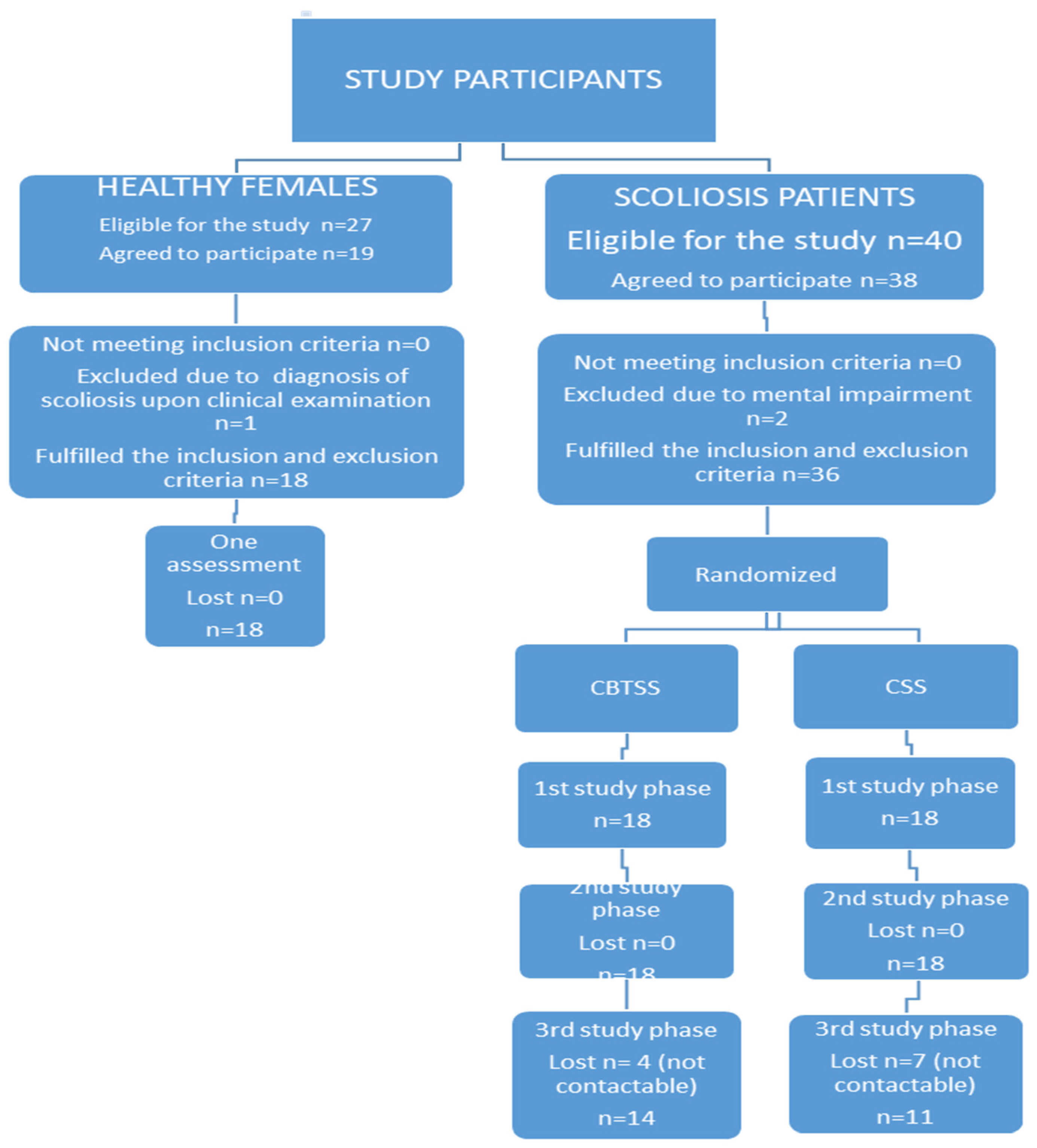
Figure 2.
Internal testing of the Avatar Scoliosis 3D application.
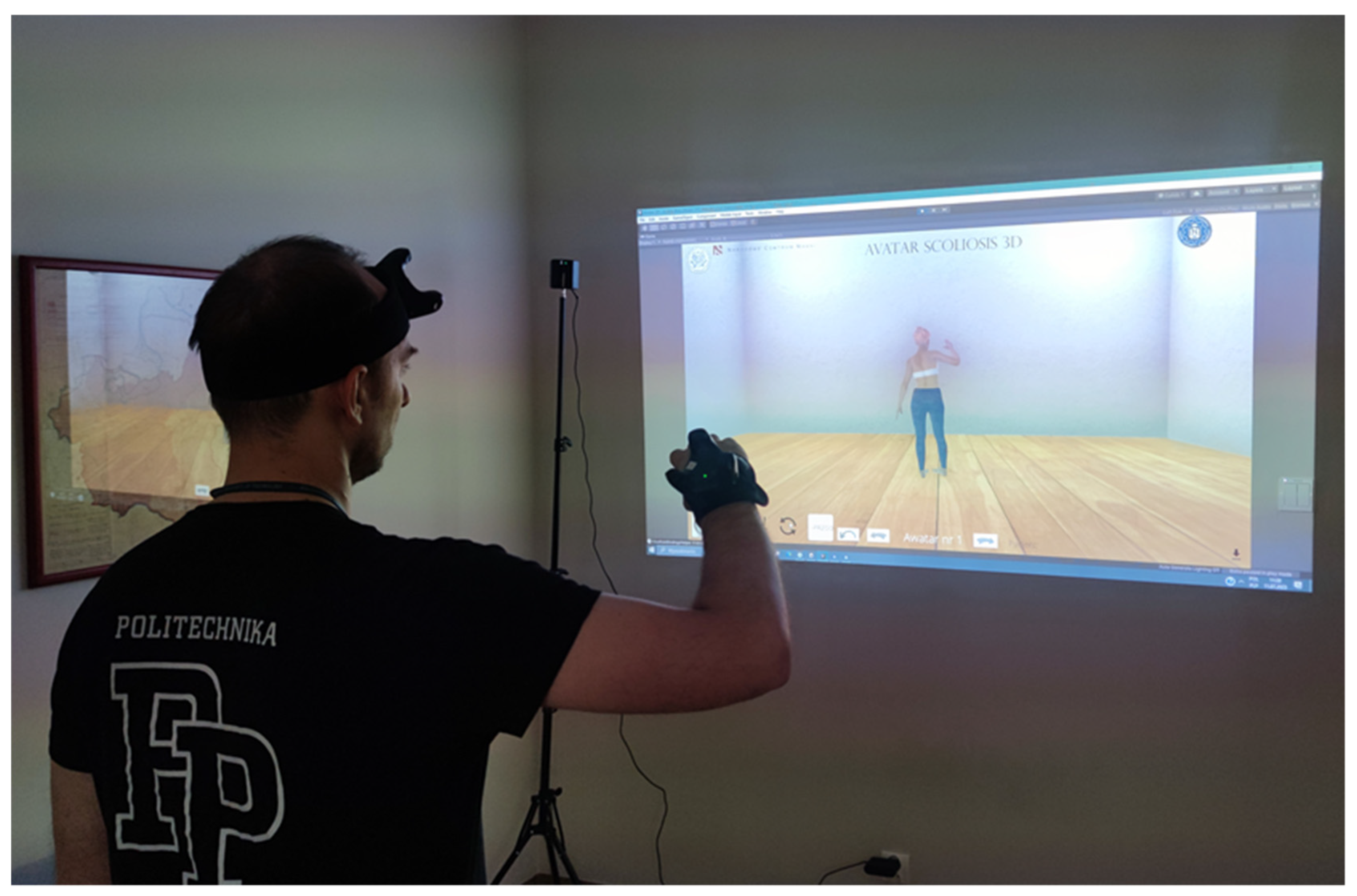

Table 1.
Socio-demographic, clinical and radiological characteristics of study samples.
| CBTSS | CSS | HFS | p value comparison CBTSS/CSS/HFS |
|||||||
| Mean (SD) | Range (Min-Max) |
n (%) | Mean (SD) | Range (Min-Max) |
n (%) | Mean (SD) |
Range (Min-Max) |
n (%) | ||
| Socio-demographic characteristics | ||||||||||
| Place of residence |
p=0.00002* |
|||||||||
| Rural | p=0.060 | - | 3 (16.67) | - | - | 7 (38.89) | - | - | 0 (0) | |
| City below 25, 000 inhabitants | p=0.207 | - | 8 (44.4) | - | - | 2 (11.11) | - | - | 3 (16.67) | |
| City between 25, 000 and 200, 000 inhabitants | - | - | 4 (22.22) | - | - | 7(38.89) | - | - | 1 (5.56) | |
| City over 200, 000 inhabitants | - | - | 3 (16.67) | - | - | 2 (11.11) | - | - | 14 (77.77) | |
| School attended | - | |||||||||
| Elementary | - | - | 9 (50.00) | - | - | 9 (50.00) | - | - | 15 (83.33) | p=0.060 |
| Secondary | - | - | 9 (50.00) | - | - | 9(50.00) | - | - | 3 (16.66) | |
| Age at current [years] | 14.17 (2.01) | 12-17 | - | 14.50 (1.50) | 12-17 | - | 13.56 (1.15) | 12-16 | - | p=0.060 |
| Age at scoliosis diagnosis [years] | 9.9 (3.10) | 5-14 | - | 10.11 (2.56) | 5-14 | - | - | - | - | p=0.816 |
| Weight [kg] | 53.22 (9.61) | 35-70 | - | 52.33 (11.01) | 38-85 | - | 62.00 (15.71) | 40-100 | - | p =0.086 |
| Height [cm] | 160.17 (6.40) | 149-174 | - | 160.89 (5.99) | 153-172 | - | 163.00 (6.75) | 153-176 | - | p=0.392 |
| Body Mass Index | 20.63884(2.88) | 15.77-27.01 | - | 20.16(3.8) | 16.14-31.60 | - | 23.19(5.06) | 17.09-35.42 | - | p=0.076 |
| Family history of scoliosis | - | - | 5 (27.78) | - | - | 6 (33.33) | - | - | 2(11.11) | p= 0.370 |
| Comorbidities | - | - | 3(16.67) | - | - | 3 (16.67) | - | - | 4(22.22) | p<1 |
| Clinical and radiological characteristics | CBTSS | CSS |
p value comparison CBTSS/CSS (preoperatively/ postoperatively) |
|||||||
| Preoperatively | Postoperatively | Preoperatively | Postoperatively | |||||||
| Mean (SD) |
Range (Min-Max) |
Mean (SD) |
Range (Min-Max) |
Mean (SD) |
Range (Min-Max) |
Mean (SD) |
Range (Min-Max) |
|||
| Duration of CBT [hours] | 5.22 (2.0) | 2-9 | 5.80 (2.24) | 1-9 | - | |||||
| Duration of brace treatment prior to surgery [in months] | 24.11(20.20) | 0-72 | - | 35.06(25.43) | 0-84 | - | p=0.162 | |||
| Cobb angle in the main curve | 61.33 (8.0) | 52-78 | 23.22 (7.69) | 16-50 | 62.16 (10.70) | 46-86 | 24.27 (8.76) | 12-46 | p=0.793/p=0.466 | |
| Kyphosis angle in the thoracic spine | 26.33(19.11) | 6-40 | 18.94(7.99) | 7-37 | 21.22(11.31) | 4-38 | 18.28 (7.58) | 4-32 | p=0.419/p=0.799 | |
| Lordosis angle in the lumbar spine | 48.61(9.98) | 24-70 | 39.28(10.44) | 12-64 | 38.33 (11.72) | 15-60 | 30.59 (10.95) | 6-55 | p=0.008*/p=0.020* | |
| Apical translation of the central sacral vertical line (CSVL) according to the Harms Study Group) [cm] | 4.43(1.96) | 0.3-8.7 | 1.51(1.31) | 0-5.8 | 4.97 (1.87) | 1.3-8.6 | 1.68 (0.82) | 0.5-3.2 | p=0.410/p=0.254 | |
| % of scoliosis correction | - | 60.50 (11.67) | 34-76 | - | 61.50 (11.46) | 38-81 | p=0.949 | |||
Note: CBT SS-CBT scoliosis sample; CSS- control scoliosis sample; HFS- healthy female sample; *p<0.05.
Table 2.
Spinal Appearance Questionnaire-descriptive statistics.
| Mean (SD) | 95% Confidence interval (from-to) |
Range (Min-Max) |
Mean (SD) | 95% Confidence interval (from-to) |
Range (Min-Max) |
Mean (SD) | 95% Confidence interval (from-to) |
Range (Min-Max) |
||
| Preoperatively | Postoperatively | Follow-up | ||||||||
| CBTSS | ||||||||||
| SAQ | ||||||||||
| General | 4.15(0.38) | 3.96-4.34 | 3.33-4.66 | 3.69(1.544) | 2.92-4.45 | 2.0-8.33 | 3.33(1.04) | 2.71-3.96 | 1.67-5.00 | |
| Curve | 3.39(0.85) | 2.97-3.81 | 2.0-5.0 | 1.50(1.04) | 0.98-2.09 | 1.0-5.0 | 1.08(0.28) | 0.91-1.24 | 1.00-2.00 | |
| Prominence | 2.25(0.67) | 1.92-2.58 | 1.0-3.5 | 1.11(0.37) | 0.93-1.30 | 1.0-2.5 | 1.08(0.19) | 0.96-1.19 | 1.00-1.50 | |
| Trunk shift | 2.75(0.80) | 2.35-2.58 | 1.0-4.5 | 1.44(0.66) | 1.12-1.77 | 1.0-3.0 | 1.15(0.32) | 0.96-1.34 | 1.00-2.00 | |
| Waist | 4.26(0.95) | 3.79-4.73 | 1.67-5.0 | 2.75(1.57) | 1.98-3.54 | 1.0-5.0 | 2.10(1.40) | 1.25-2.95 | 1.00-5.00 | |
| Shoulders | 3.63(0.54) | 3.37-3.91 | 2.50-4.5 | 2.08(0.97) | 1.60-2.57 | 1.0-4.0 | 2.00(0.94) | 1.43-2.57 | 1.00-3.50 | |
| Kyphosis | 2.44(0.78) | 2.05-2.83 | 1.0-4.0 | 1.39(0.61) | 1.09-1.70 | 1.0-3.0 | 1.38(0.65) | 0.99-1.78 | 1.00-3.00 | |
| Chest | 3.81(1.38) | 3.12-4.49 | 1.0-5.0 | 2.61(1.58) | 1.83-3.40 | 1.0-5.0 | 1.88(1.44) | 1.0-2.76 | 1.00-5.00 | |
| Surgical scar | - | - | - | 1.94(1.21) | 1.34-2.55 | 1.00-5.00 | 1.30(0.63) | 0.93-1.69 | 1.00-3.00 | |
| Total score | 3.50(0.46) | 3.27-3.73 | 2.25-4.0 | 2.30(0.98) | 1.81-2.78 | 1.25-4.06 | 1.94 (0.72) | 1.50-2.37 | 1.25-3.31 | |
| CSS | ||||||||||
| SAQ | ||||||||||
| General | 3.87(0.61) | 3.57-4.17 | 2.33-4.67 | 3.19(0.99) | 2.70-3.68 | 2.00-5.00 | 3.43(1.03) | 2.70-4.17 | 2.00-5.00 | |
| Curve | 3.22(0.88) | 2.79-3.66 | 1.00-5.00 | 1.61(1.29) | 0.98-2.25 | 1.00-5.00 | 1.70(0.67) | 1.21-2.18 | 1.00-3.00 | |
| Prominence | 2.08(0.84) | 1.66-2.50 | 1,00-4.50 | 1.39(0.68) | 1.06-1.73 | 1.00-3.50 | 1.30(0.35) | 1.05-1.55 | 1.00-2.00 | |
| Trunk shift | 2.50(0.91) | 2.05-2.95 | 1.00-4.50 | 1.64 (1.03) | 1.13-2.14 | 1.00-4.50 | 1.45(0.64) | 0.99-1.91 | 1.00-3.00 | |
| Waist | 3.59(1.21) | 2.99-4.20 | 1.00-5.00 | 2.85(1.58) | 2.07-3.64 | 1.00-5.00 | 2.90(1.41) | 1.89-3.91 | 1.00-5.00 | |
| Shoulders | 3.14(1.07) | 2.61-3.67 | 1.0-5.00 | 2.11(1.21) | 1.51-2.71 | 1.00-5.00 | 2.35(1.08) | 1.58-3.12 | 1.00-3.50 | |
| Kyphosis | 2.17(0.99) | 1.68-2.66 | 1.00-5.00 | 1.56(1.29) | 0.91-2.20 | 1.00-5.00 | 1.30(0.83) | 0.95-1.64 | 1.00-2.00 | |
| Chest | 3.22(1.61) | 2.42-4.02 | 1.00-5.00 | 2.58(1.60) | 1.77-3.38 | 1.00-5.00 | 2.60(1.26) | 1.70-3.50 | 1.00-5.00 | |
| Surgical scar | - | - | - | 1.72(0.75) | 1.35-2.10 | 1.00-3.00 | 1.30(0.67) | 0.82-1.78 | 1.00-3.00 | |
| Total score | 3.10(0.80) | 2.71-3.50 | 1.25-4.63 | 2.30 (1.00) | 1.80-2.80 | 1.25-4.56 | 2.34(0.79) | 1.77-2.91 | 1.25-3.44 | |
| HFS (one assessment) | ||||||||||
| SAQ | ||||||||||
| General | 3.07(0.80) | 2.68-3.47 | 2.00-4.33 | |||||||
| Curve | 1.11(0.32) | 0.95-1.71 | 1.00-2.00 | |||||||
| Prominence | 1.083(0.19) | 0.99-1.18 | 1.00-1.50 | |||||||
| Trunk shift | 1.22(0.31) | 1.07-1.38 | 1.00-2.00 | |||||||
| Waist | 2.93(1.08) | 2.39-3.46 | 1.00-5.00 | |||||||
| Shoulders | 2.11(0.95) | 1.64-2.58 | 1.00-3.50 | |||||||
| Kyphosis | 1,39(0.61) | 1.09-1.69 | 1.00-3.00 | |||||||
| Chest | 2.47(1.31) | 1.82-3.12 | 1.00-5.00 | |||||||
| Surgical scar | - | - | - | |||||||
| Total score | 2.14(0.54) | 1.87-2.41 | 1.38-3.06 | |||||||
Note: CBT SS-CBT scoliosis sample; CSS- control scoliosis sample; HFS- healthy female sample; SAQ-Spinal Appearance Questionnaire; SD-standard deviation.
Table 3.
Spinal Appearance Questionnaire: distribution of results of item no. 8, no. 18.
| CBTSS | CSS | HFS | |||||
|---|---|---|---|---|---|---|---|
| Preoperatively | Postoperatively | Follow-up | Preoperatively | Postoperatively | Follow-up | ||
|
Which form of deformity bothers you the most out of these 5 categories of images? (Item no. 8) |
n (%) | ||||||
| None | 0 (0) | 7 (38.33) | 7 (38.33) | 2 (11.11) | 7 (38.33) | 3 (16.67) | 18 (100) |
| Rib prominence | 3 (16.67) | 2 (11.11) | 1 (5.55) | 4 (22.22) | 2 (11.11) | 0 (0) |
- |
| Flank prominence | 5 (27.77) | 3 (16.67) | 0 (0) | 2 (11.11) | 3 (16.67) | 2 (11.11) | |
| Head Chest Hips | 4 (22.22) | 1 (5.55) | 3 (16.67) | 7 (38.33) | 1 (5.55) | 2 (11.11) | |
| Shoulder level | 3 (16.67) | 4 (22.22) | 1 (5.55) | 1 (5.55) | 4 (22.22) | 2 (11.11) | |
| Spine prominence | 3 (16.67) | 1 (5.55) | 1 (5.55) | 2 (11.11) | 1 (5.55) | 1 (5.55) | |
| Of questions 9-17which are the most important to you? (Item no. 18) | n (%) | ||||||
| None | 1 (5.55) | 5 (27.77) | 8 (44.44) | 5 (27.77) | 12 (76.66) | 5 (27.77) | 14 (77.78) |
| A question on the desire to have a correct trunk shape | 6 (38.33) | 4 (22.22) | 2 (11.11) | 5 (27.77) | 2 (11.11) | 2 (11.11) | 0 (0) |
| A question on better appearance in clothing | 2 (11.11) | 3 (16.67) | 1 (5.55) | 1 (5.55) | 0 (0) | 0 (0) | 1 (5.55) |
| A question on symmetrical hips | 1 (5.55) | 0 (0) | 0 (0) | 0 (0) | 0 (0) | 1 (5.55) | 0 (0) |
| A question on even waist | 4 (22.22) | 2 (11.11) | 0 (0) | 6 (38.33) | 3 (16.67) | 0 (0) | 3 (16.67) |
| A question on even length of legs | 0 (0) | 0 (0) | 0 (0) | 0 (0) | 0 (0) | 0 (0) | 0 (0) |
| A question on symmetrical breasts | 0 (0) | 0 (0) | 0 (0) | 0 (0) | 0 (0) | 0 (0) | 0 (0) |
| a question on even chest in the front | 0 (0) | 0 (0) | 0 (0) | 0 (0) | 0 (0) | 0 (0) | 0 (0) |
| A question on symmetrical shoulders | 3 (16.67) | 1 (5.55) | 0 (0) | 1 (5.55) | 0 (0) | 2 (11.11) | 0 (0) |
| A question on surgical scar | - | 2 (11.11) | 2 (11.11) | - | 1 (5.55) | 0 (0) | 0 (0) |
Note CBTSS-CBT scoliosis sample; CSS- control scoliosis sample; HFS- healthy female sample;.
Table 4.
Body Esteem Scale-descriptive statistics.
| Mean (SD) | 95% Confidence interval (from-to) |
Range (Min-Max) |
Mean (SD) | 95% Confidence interval (from-to) |
Range (Min-Max) |
Mean (SD) | 95% Confidence interval (from-to) |
Range (Min-Max) |
|
| Preoperatively | Postoperatively | Follow-up | |||||||
| CBTSS | |||||||||
| BES for females | |||||||||
| Sexual Attractiveness | 47.00(7.32) | 43.36-50.64 | 37.00-63.00 | 48.17(8.23) | 44.08-52.26 | 38.00-62.00 | 49.46(6.70) | 45.42-53.50 | 38.00-59.00 |
| Weight Concern | 33.27(9.56) | 28.53-38.03 | 20.00-50.00 | 36.33(8.27) | 32.21-40.45 | 20.00-50.00 | 37.54(9.01) | 32.10-42.99 | 20.00-50.00 |
| Physical Condition | 32.44(6.72) | 29.10-35.79 | 23.00-45.00 | 33.39(6.63) | 30.09-36.69 | 25.00-45.00 | 31.46(7.30) | 27.05-35.87 | 18.00-45.00 |
| Reference to sten norms (n/%) | Low | Medium | High | Low | Medium | High | Low | Medium | High |
| Sexual Attractiveness | 9(49.43) | 4(22.22) | 5(27.77) | 7(38.33) | 4(22.22) | 7(38.33) | 4(2.22) | 3(16.67) | 6(33.32) |
| Weight Concern | 6(33.32) | 5(27.77) | 7(38.33) | 1(5.55) | 7(38.33) | 10(55.54) | 1(5.55) | 5(27.77) | 7(38.33) |
| Physical Condition | 18(100) | 0(0) | 0(0) | 18(100) | 0(0) | 0(0) | 6(33.32) | 4(22.22) | 3(16.67) |
| CSS | |||||||||
| BES for females | |||||||||
| Sexual Attractiveness | 45.11(8.66) | 40.81-49.22 | 20.00-59.00 | 46.94(6.79) | 43.56-50.32 | 34.00-60.00 | 44.20(3.91) | 41.40-47.00 | 41.00-54.00 |
| Weight Concern | 33.33(10.52) | 28.10-38.56 | 15.00-50.00 | 37.50(7.52) | 33.76-41.24 | 24.00-50.00 | 33.60(8.47) | 27.54-39.66 | 18.00-50.00 |
| Physical Condition | 32.28(7.65) | 28.48-36.08 | 15.00-45.00 | 32.61(7.24) | 29.01-36.21 | 20.00-45.00 | 27.40(6.47) | 22.77-32.03 | 18.00-38.00 |
| Reference to sten norms (n/%) | Low | Medium | High | Low | Medium | High | Low | Medium | High |
| Sexual Attractiveness | 9(49.43) | 6(33.33) | 3(16.67) | 8(43.88) | 5(27.77) | 5(27.77) | 8(43.88) | 1(5.55) | 1(5.55) |
| Weight Concern | 6(33.33) | 4(22.22) | 8(43.88) | 1(5.55) | 8(43.88) | 9(49.43) | 1(5.55) | 5(27.77) | 4(22.22) |
| Physical Condition | 18(100) | 0(0) | 0(0) | 18(100) | 0(0) | (0) | 7(38.00) | 2(11.11) | 1(5.55) |
| HFS (one assessment) | |||||||||
| BES for females | |||||||||
| Sexual Attractiveness | 44.11(5.30) | 41.48-46.74 | 31.00-53.00 | ||||||
| Weight Concern | 28.06(7.97) | 24.09-32.02 | 15.00-44.00 | ||||||
| Physical Condition | 30.83(8.18) | 26.77-34.90 | 16.00-44.00 | ||||||
| Reference to sten norms (n/%) | Low | Medium | High | ||||||
| Sexual Attractiveness | 9(49.43) | 8(43.88) | 1(5.55) | ||||||
| Weight Concern | 9(49.43) | 7(38.00) | 2(11.11) | ||||||
| Physical Condition | 18(100) | 0(0) | 0(0) | ||||||
Note CBT SS-CBT scoliosis sample; CSS- control scoliosis sample; HFS- healthy female sample; BES-Body Esteem Scale; SD-standard deviation.
Table 5.
The virtual reality tasks-descriptive statistics.
| VR tasks | Median | Range (min-max) |
Lower quartile-upper quartile | Median | Range (min-max) | Lower quartile/ upper quartile |
Median | Range (min-max) |
Lower quartile/ upper quartile |
| CBTSS Preoperatively/ postoperatively |
CSS Preoperatively/ postoperatively |
HFS | |||||||
| 1st indicator | 4.00/2.00 | 3.00-7.00/ 1.00-3.00 |
3.00-6.00/ 2.00-3.00 |
4.00/2.00 | 2.00-7.00/ 1.00-4.00 |
3.00-5.00/ 2.00/2.00 |
1.00 | 1.00-4.00 | 1.00-2.00 |
| 2nd indicator | 2.00/1.00 | 1.00-3.00/ 1.00-3.00 |
1.00-3.00/ 2.00-3.00 |
2.00/2.00 | 1.00-3.00/ 1.00-3.00 |
1.00-2.00/ 1.00/2.00 |
1.00 | 1.00-3.00 | 1.00-1.00 |
| 3rd indicator | 6.00/2.00 | 5.00-7.00/ 1.00-5.00 |
5.00-6.00/ 1.00-2.00 |
6.00/2.00 | 4.00-7.00/ 1.00-4.00 |
5.00-7.00/ 1.00-2.00 |
1,00 | 1.00-1.00 | 1.00-1.00 |
| 4th indicator | p=0.287/p=0.908 | p=0.907/p=1 | p=0.090 | ||||||
| 5th indicator | p<0.000001*/p=1 | p<0.000001*/p=1 | p=1 | ||||||
| 6th indicator | p=0.0007*/p=0.029* | p=0.002*/p=0.287 | p=0.200 | ||||||
Note 1st indicator: participants’ estimated current body shape at the time of E1; 2nd indicator: participants’ desired body shape at the time of E2; 3rd indicator: participants’ actual body shape (based on the radiographic parameters or clinical examination; 4th indicator: difference between the patients’ estimated current body shape at the time of E1, as compared to participants’ actual (based on the radiographic parameters or clinical examination) body shape; 5 th indicator: the difference between the desired body shape at the time of E2, as compared to participants’ actual (based on the radiographic parameters or clinical examination) body shape; 6th indicator: the difference between participants’ current estimated body shape at the time of E1, as compared to participants’ desired body shape at the time of E2; CBT SS-CBT scoliosis sample; CSS- control scoliosis sample; HFS- healthy female sample; VR-virtual reality; *p<0.05.
Table 6.
Strengths and Difficulties Questionnaire-25-descriptive statistics.
| Mean (SD) | 95% Confidence interval (from-to) |
Range (Min-Max) |
Mean (SD) | 95% Confidence interval (from-to ) |
Range (Min-Max) |
Mean (SD) | 95% Confidence interval (from-to) |
Range (Min-Max) |
|
| Preoperatively | Postoperatively | Follow-up | |||||||
| CBTSS | |||||||||
| SDQ-25 | |||||||||
| Emotional symptoms | 4.11(2.78) | 2.73-5.50 | 0,00-9.00 | 3.11(2.42) | 1.91-4.32 | 0.00-7.00 | 3.69(2.46) | 2.20-5.18 | 0.00-7.00 |
| Conduct problems | 3.50(1.72) | 2.64-4.36 | 1,00-7.00 | 3.11(1.32) | 2.45-3.77 | 1.00-7.00 | 3.38(2.79) | 1.70-5.07 | 1.00-11.00 |
| Hyperactivity/Inattention | 4.94(1.55) | 4.17-5.72 | 3,00-8.00 | 5.67(1.33) | 5.01-6.33 | 3.00-8.00 | 5.00(1.52) | 4.08-5.92 | 3.00-8.00 |
| Peer Relation Problems | 5.00(0.97) | 4.52-5.48 | 4,00-7.00 | 5.00(1.33) | 4.34-5.66 | 2.00-7.00 | 5.85(2.15) | 4.54-7.15 | 4.00-12.00 |
| Pro-social Behavior | 7.50(1.76) | 6.63-8.37 | 3,00-10.00 | 7.67(1.85) | 6.75-8.59 | 4.00-10.00 | 7.46(1.76) | 6.39-8.52 | 4.00-9.00 |
| Total score | 17.56(5.00) | 15.07-20.04 | 10,00-27.00 | 16.89(4.53) | 14.63-19.14 | 10.00-27.00 | 17.92(6.91) | 13.75-22.10 | 11.00-35.00 |
| CSS | |||||||||
| SDQ-25 | |||||||||
| Emotional symptoms | 3.56(2.50) | 2.31-4.80 | 0.00-8.00 | 3.50(2.28) | 2.37-4.63 | 0.00-8.00 | 3.20(2.20) | 1.63-4.77 | 0.00-8.00 |
| Conduct problems | 2.61(0.98) | 2.12-3.10 | 1.00-5.00 | 2.72(1.18) | 2.14-3.31 | 1.00-5.00 | 2.50(1.27) | 1.59-3.41 | 1.00-5.00 |
| Hyperactivity/Inattention | 4.56(1.58) | 3.77-5.34 | 1.00-7.00 | 5.28(1.56) | 4.50-6.06 | 2.00-7.00 | 5.50(1.71) | 4.27-6.72 | 3.00-8.00 |
| Peer Relation Problems | 4.89(1.23) | 4.28-5.50 | 3.00-8.00 | 4,72(1.27) | 4.09-5.36 | 2.00-6.00 | 4.70(0.82) | 4.11-5.29 | 3.00-6.00 |
| Pro-social Behavior | 7.22(2.41) | 6.02-8.42 | 2.00-10.00 | 8.00(1.81) | 7.10-8.90 | 4.00-10.00 | 6.60(1.90) | 5.24-7.96 | 3.00-9.00 |
| Total score | 15.61(4.41) | 13.42-17.80 | 10.00-26.00 | 16.22(4.91) | 13.78-18.66 | 7.00-26.00 | 15.90(4.58) | 12.62-19.18 | 10. 00-26.00 |
| HFS (one assessment) | |||||||||
| SDQ-25 |
- |
||||||||
| Emotional symptoms | 5.17(2.60) | 3.88-6.46 | 0.00-10.00 | ||||||
| Conduct problems | 4.00(1.24) | 3.39-4.61 | 2.00-7.00 | ||||||
| Hyperactivity/Inattention | 5.06(1.73) | 4.19-5.92 | 2.00-8.00 | ||||||
| Peer Relation Problems | 4.78(1.35) | 4.11-5.45 | 2.00-6.00 | ||||||
| Pro-social Behavior | 7.28(2.24) | 6.16-8.39 | 3.00-10.00 | ||||||
| Total score | 19.00(5.38) | 16.32-21.68 | 9.00-29.00 | ||||||
Note CBTSS-CBT scoliosis sample; CSS- control scoliosis sample; HFS- healthy female sample; SDQ-25-Strengths and Difficulties Questionnaire-25; SD-standard deviation.
Table 7.
Longitudinal analyses in CBTSS and CSS.
| SAQ-total score | Comparison Presurgical/postsurgical/follow-up | |||||
| CBTSS | CSS | |||||
| p=0.0001* |
p=0.304 |
|||||
| Comparison Presurgical/ postsurgical: p=0.007* |
Comparison Postsurgical/ follow-up: p=0.980 |
Comparison Presurgical/ follow-up: p=0.018* |
||||
| BES-Sexual attractiveness | p=0.383 | p=0.710 | ||||
| BES-Weight concern | p=0.009* | p=0.268 | ||||
| Comparison Presurgical/postsurgical: p=0.040* | Comparison Postsurgical/follow-up: p=0.082 |
Comparison Presurgical/follow-up: p=0.010* |
||||
| BES-Physical condition | p=0.096 | p=0.385 | ||||
| SDQ-25-total score | p=0.447 | p=0.010* | ||||
| Comparison Presurgical/postsurgical: p=0.057 | Comparison Postsurgical/follow-up: p=0.057 |
Comparison Presurgical/follow-up: p=1 |
||||
| VR tasks | Comparison Presurgical/postsurgical | |||||
| 1st indicator | p=0=0002* | p=0.0002* | ||||
| 2nd indicator | p=0.142 | p=0.361 | ||||
| 3rd indicator | p=0.0002* | p=0.0002* | ||||
Note: CBT SS-CBT scoliosis sample; CSS- control scoliosis sample; HFS- healthy female sample; 1st indicator: participants’ estimated current body shape at the time of E1; 2nd indicator: participants’ desired body shape at the time of E2; 3rd indicator: participants’ actual body shape (based on the radiographic parameters or clinical examination; CBT SS-CBT scoliosis sample; CSS- control scoliosis sample; HFS- healthy female sample; VR-virtual reality; SAQ-Spinal Appearance Questionnaire; BES-Body Esteem Scale; SDQ-25-Strengths and Difficulties Questionnaire-25; *p<0.05.
Table 8.
Cross-sectional analyses between the CBTSS, CSS and HFS.
| Preoperatively | Postoperatively | Follow-up | |
| Comparison CBTSS/CSS/HFS | Comparison CBTSS/CSS/HFS | Comparison CBTSS/CSS/HFS | |
| VR tasks | - | ||
| 1st indicator | p<0.00001*, CA:p=1, CB:p=0.0009*,CC:p=0.00008* | p=0.314 | |
| 2nd indicator | p<0.000001*, CA:p=1, CB:p=0.000004*,CC:p=0.000007* | p=0.312 | |
| 3rd indicator | p<0.000001*, CA:p=1, CB:p=0.000002*,CC:p=0.0000001* | p=0.850 | |
| SAQ | |||
| General | p=0.0007*, CA:p=0.377, CB:p=0.0001*,CC:p=0.001* | p=0.432 | p=0.366 |
| Curve | p<0.00001*, CA: p=1; CB:p=0.000001*; CC: p=0.000005* | p=0.984 | p=0.004*, CA: p=0.091, CB: p=1, CC: p=0.091 |
| Prominence | p<0.00001*, CA: p=1; CB:p=0.000006*; CC: p=0.0003* | p=0.667 | p=0.081 |
| Trunk shift | p<0.00001*, CA: p=1; CB:p=0.000001*; CC: p=0.0001* | p=0.691 | p=0.371 |
| Waist | p=0.003*, A: p=0.301; B:p=0.000001*; C: p=0.000005* |
p=0.910 | p=0.137 |
| Shoulders | p=0.001*,CA: p=0.500; CB:p=0.0001*; CC: p=0.018* | p=0.734 | p=0.649 |
| Kyphosis | p=0.0005*, CA: p=0.784; CB:p=0.001*; CC: p=0.042* | p=0.466 | p=0.967 |
| Chest | p=0.003*, CA: p=0.301; CB:p=0.000001*; CC: p=0.000005* |
p=0.987 | p=0.176 |
| Surgical scar | - | - | - |
| Total score | p=0.026*, CA:p=0.751, CB:p=0.024*, CC:p=0.402 | p=0.937 | p=0.575 |
| BES for females | |||
| Sexual Attractiveness | p=0.712 | p=0.630 | p=0.522 |
| Weight Concern | p=0.165 | p=0.661 | p=0.0143, CA: p=0.514; CB: p=0.010*; CC: p=0.231 |
| Physical Condition | p=0.780 | p=0.849 | p=0.400 |
| SDQ-25 | |||
| Emotional symptoms | p=0.185 | p=0.623 | p=0.098 |
| Conduct problems | p=0.006*, CA: p=0.220; CB:p=0.551; CC: p=0.005* | p=0.419 | p=0.014*, CA: p=;1 CB: p=0.103; CC: p=0.028* |
| Hyperactivity/Inattention | p=0.627 | p=0.427 | p=0.700 |
| Peer Relation Problems | p=0.867 | p=0.554 | p=0.308 |
| Pro-social Behavior | p=0.993 | p=0.582 | p=0.388 |
| Total score | p=0.368 | p=0.650 | p=0.236 |
Note: CBT SS-CBT scoliosis sample; CSS- control scoliosis sample; HFS- healthy female sample; 1st indicator: participants’ estimated current body shape at the time of E1; 2nd indicator: participants’ desired body shape at the time of E2; 3rd indicator: participants’ actual body shape (based on the radiographic parameters or clinical examination; CBT SS-CBT scoliosis sample; CSS- control scoliosis sample; HFS- healthy female sample; VR-virtual reality; SAQ-Spinal Appearance Questionnaire; BES-Body Esteem Scale; SDQ-25-Strengths and Difficulties Questionnaire-25; CA-Comparison A: CBTSS/CSS, CB-Comparison B: CBTSS/HFS; CC-Comparison C: CSS/HFS; ; *p<0.05.
Disclaimer/Publisher’s Note: The statements, opinions and data contained in all publications are solely those of the individual author(s) and contributor(s) and not of MDPI and/or the editor(s). MDPI and/or the editor(s) disclaim responsibility for any injury to people or property resulting from any ideas, methods, instructions or products referred to in the content. |
© 2024 by the authors. Licensee MDPI, Basel, Switzerland. This article is an open access article distributed under the terms and conditions of the Creative Commons Attribution (CC BY) license (http://creativecommons.org/licenses/by/4.0/).
Copyright: This open access article is published under a Creative Commons CC BY 4.0 license, which permit the free download, distribution, and reuse, provided that the author and preprint are cited in any reuse.


