

Submitted:
13 May 2024
Posted:
14 May 2024
You are already at the latest version
Abstract
Providing user confidence in Mobile Government Services (MGS) is essential for the success of mobile government. This study aimed to test the moderating role of techno-skepticism in the impact of crisis management on mobile government. Some scholars have stated that government investment in mobile government services for public administration during the financial crisis is a critical issue for crisis management. In the constantly evolving and changing world, the rapid advancement of technology in modern societies has prompted an acceleration in investments in information and communication technologies. However, due to several inadequacies, citizens seem to respond negatively to the use of certain public technological services, leading them to develop a perspective of techno-skepticism. This issue has been cited in numerous scholarly studies as a critical subject for the effective implementation of technological innovations. The effectiveness of digital technology in the procurement of public services is highly dependent on the perceptions and behaviors of users. In this context, this study measured the attitudes of the participants and the connections between techno-skepticism, mobile government use, and crisis management among Northern Cyprus residents over 18 years old. The study employed a quantitative approach. A 5-point Likert scale was used to collect data by modifying the survey questions to fit the scope of the study. The study participants were selected using the random sampling method to acquire data from a total of 402 citizens. The study findings revealed that techno-skepticism mediates the impact of crisis management on mobile government. As a result, techno-skepticism is a critical and decisive factor in citizens’ mobile government use, affecting its utilization frequency. Techno-skepticism was also found to play a vital role in mobile government use. The current study represents a pioneering effort in testing the moderating role of techno-skepticism in the impact of crisis management on mobile government. It also provides various contributions to theory and practice, particularly in the fields of mobile government and the use of digital technologies.
Keywords:
techno-skepticism
; mobile government use
; crisis management
; Northern Cyprus
1. Introduction
Sustainable development is a means by which people will share prosperity equally, both today and in the future. In this context, the relations between population, resources, environment and development need to be regulated [1]. However, in developing countries, the social sustainability of projects created with information and communication technologies for development such as e-government or mobile state is sad [2].
States all around the world are implementing projects within the scope of smart cities. The most important of these applications are e-government or m-government projects. The aim here is to create sustainable and livable cities on a micro scale, and on a macro scale, the state realizes a proactive management approach by involving the society in the process[3].
According to some researchers, e-government centers should be established within universities in order to ensure the sustainability of the e-government eco-systems[4].Technology is an important phenomenon that must be followed effectively and quickly in the transformation of public services. For example, when an important technological invention is introduced; If it takes a long time for this technology to be adopted by society, there is a possibility that it will become obsolete. In this context, both political and financial investments in public investments are not only a heavy burden on the state, but also carry a high risk of failure. In this context, knowledge, stability and sustainability are very important in e-government and mobile government studies [4].
In order to understand what the balance and sustainability of e-government or m-government is, it is necessary to examine the “Public Value Approach”[5,6].In this approach, it is suggested that the objectives of public institutions should be aimed at creating value. However, in order to achieve the objectives, it must be a legitimate basis, supported by stakeholders, politically sustainable and administratively feasible [7].
The World Bank introduced the concept of governance in its report titled “Sub-Saharan Africa: From Crisis to Sustainable Growth” in 1989. Governance systematically adds new actors to the system and, in the political sense, encourages the democracy-based approach of the citizen on the axis of pluralism [8]. In this context, e-government and m-government in the digital age are seen as opportunities in terms of providing sustainable solutions to problems. Additionally, the concept of “Governance” refers to interactive and participatory management with non-state actors. In this context, the concept is of great importance for the sustainability of e-government. Another important point here is that with the inclusion of information technologies in public business processes, the state needed experts in this field. Therefore, it has led to cooperation with non-governmental organizations and the private sector. Finally, the roles given to government stakeholders are very important in terms of the sustainability of e-government and m-government.
The SARS-Cov-2 (COVID-19) pandemic caused a vast global crisis. Countries have attempted to meet various criteria to manage the situation; while there have also been failures to comply with several other criteria [9]. Such circumstances frequently result in mistrust and fear among people, including physical and financial problems and potential psychological issues. Skepticism and fearfulness, in particular, ultimately limit humanitarian development [10].
With the outbreak of the COVID-19 pandemic, supporting the implementation of mobile government through digital technologies has been a preferred public service approach by governmental institutions and organizations worldwide. Pandemics like COVID-19, which has caused financial and various other crises on a global scale, have impelled governments to develop several policies and strategies in particular. As a result, governments succeeded in delivering public services remotely during the pandemic when the entire world was under quarantine. Mobile Government strategies refer to the provision of governmental services to constituents through mobile technologies and devices without regard to spatial or temporal constraints [11,12,13].
The advantages of a mobile government strategy include improved productivity, financial savings, increased fairness and openness, an effort to close the digital gap, and improved government-citizen interaction government as well as those from various other disciplines.
Although scholars and practitioners have been interested in mobile government as an innovative service tool, there is no data on the moderating role of techno-skepticism in the impact of crisis management on mobile government in the literature. Furthermore, while several studies have explored techno-skepticism, these studies were related to aspects of the techno-skepticism concept, such as the digital divide, confidentiality, and stress, etc. According to [14], the disparity in income distribution, infrastructural concerns, and educational issues are among the key factors causing the digital divide. In this context, the existence of such negative aspects in a developing nation like Northern Cyprus are indicators of the digital divide.
In the Turkish Republic of Northern Cyprus, there were 819,982 registered mobile subscribers as of the first quarter of 2021, which translates to a penetration rate of roughly 215%. The number of active subscribers was 655,758[15] A sizable website called e-Government Gateway (portal) offers access to all public services from a single station. The gateway’s mission is to deliver public services to citizens, businesses, and public institutions effectively and efficiently by utilizing information and communication technologies. The following are the applications listed as e-Government services in Northern Cyprus: The Deputy Prime Ministry, Ministry of Tourism, Culture, Youth and Sports, and the Ministry of Public Works and Transport provide Electronic Document Management System Document Verification services. The Information Technologies and Communications Authority delivers online training services. The Ministry of Electronic Document Management System provides a Document Verification service. The services provided by the Ministry of Labor and Social Security are the registered information in the Social Security Office and the Electronic Document Management System Document Verification services. The Ministry of Economy and Energy delivers Document Verification services through the Electronic Document Management System. The service provided by the Customs and Taxation Administration is identity verification. The Security Forces Command provides services related to processing operations, delay of military service, and mobilization services via e-Government. The Ministry of Interior delivers document verification services in the Electronic document management system. The Electronic Document Management System of the Northern Cyprus Prime Ministry provides document verification and identity verification services. In addition to a lawyer portal, the Northern Cyprus courts provide marriage information services. The Northern Cyprus central bank announces daily exchange rates. The Ministry of Finance offers document verification services through an electronic document management system. The Ministry of National Education and Culture delivers document verification services through the MEB (MNE) information and Electronic document management systems. The Lotteries Administration serves lottery inquiries. The Official Collection Department and Records Office assists in querying new data for business organizations, personally owned companies, and search and query information for other business companies. The Ministry of Health offers patient analysis and COVID-19 test results, Vaccine Information Certificates, and document verification services through the Electronic Document Management System. Similarly, the Ministry of Agriculture and Natural Resources provides document verification services through an Electronic document management system. The Trade Office provides import and export certificates and allows queries for personal vehicle registration. Finally, the e-Government service for the General Secretariat of the Supreme Election Board and Permanent Electoral Registers provides registration services to voters. All these services are delivered through the E-government Portal. Furthermore, all these services are accessible via mobile devices.
Mobile government usage is defined by the motto ‘anytime, anywhere’. Citizens need to be able to access public services using mobile devices whenever and wherever they want. The use of mobile government mandates the use of mobile devices and other technologies. Thus, members of society are urged to familiar themselves with new technologies. Additionally, individuals must have faith in mobile government services. It is anticipated that citizens will rapidly adopt technology if the society believes in it, is aware of it, and if mobile government comprises applications that are user-friendly, helpful to users, and offer numerous features like friendliness [11] However, when people view the technology with suspicion and fear, such a mindset negatively affects the use of information and communication technologies in public services. It also undermines the crisis management strategies adopted by the government. Nowadays, it is necessary to use internet-based technologies of the public administration for more effective and functional use. In this context, it is necessary to strengthen the technological infrastructure for communication between public institutions and citizens. E-government and m-government applications, which emerged with the integration of information and communication technologies into public services, are not used at the desired level in Northern Cyprus as in developing countries. Although one of the most important reasons for this seems to be the inadequacy of the ICT infrastructure, problems such as security, surveillance, uncertainty and complexity that arise with the use of applications have brought skepticism. In this context, the research aims to examine the negative effects of techno skepticism on the use of mobile government applications and put attention on the subject. However, the literature review revealed that previous research has not focused on the moderating role of techno-skepticism in the relationship between crisis management perceived and mobile government use. Therefore, this study aimed to analyze this relationship, supporting it with techno-skepticism theory. The study is noteworthy and unique in terms of its two primary contributions to the literature. First of all, it is the first study of its kind in Northern Cyprus and one of the few in the world to focus on the role of techno-skepticism in the relationship between crisis management and mobile government use. Second, the study helps outline the requirements for boosting the mobile government frequency in Northern Cyprus.
The population of the study consists of citizens aged 18 and over living in the Turkish Republic of Northern Cyprus. The Turkish Republic of Northern Cyprus is not recognized by many countries except Turkey. The other part of the island is among the countries of the European Union. In this context, the “E-government gateway” is an important development for the TRNC, which was created with the support of Turkey. However, since e-government or mobile government are projects created together with information and communication technologies, it brings with it many problems and obstacles, especially in developing countries such as TRNC [2].
2. Literature Review
2.1. Crisis Management
A crisis is a situation that originates and ripens unexpectedly and suddenly, progresses quickly, and is confronted without any prior preparation. Inaccurate assessments may result in collapse; however, it can serve as an opportunity if evaluated correctly [16]. A crisis is defined as a significant mismatch between the organization’ expectations and current events [17]. A crisis is an exceptional event that causes damage and negative impacts on organizations. Therefore, crisis management is considered an important action necessary to track the causes and consequences of the crisis in order to prevent or prevent the recurrence of these exceptional events [18]. Regardless of whether they arise due to internal or environmental aspects for an institution or organization, all crises result in uncertainty [9] and the ripple effects of these crises in many organizations occur in different sizes and structures. Every institution, including public administration and the institutions and organizations that operate within it, is susceptible to such crisis scenarios. However, because public administration is unique compared to other sectors, any crisis experienced has a particular meaning and significance in terms of its characteristics, contents, and degree of influence [10].
Crisis management in public administration refers to the following aspects: It aims to prevent service interruptions, institutional reputation, damage, or loss of public trust and support, to recognize and avert large-scale problems that may derive from the instutional environment before they occur and spiral out of control. If a crisis has already arisen, then it involves taking the necessary steps, if possible, to zero the material and moral damage to the legal entity of the public institution and the harm to the public interest; however, if zeroing is not possible, then its aim is to minimize it by any means necessary.
At this point, it is necessary to reiterate that not all negative situations constitute a crisis; thus, they cannot be referred to as such. Institutions should be conscious of this reality. Since it is implausible to characterize any negative experience as a crisis, it is important for institutions to distinguish which challenges they encounter qualify as a crisis to guide them towards the best course of action. Nevertheless, for negativity to be considered a crisis, it must also have organizational and environmental elements. In this context, the following is a summary of the primary characteristics of a crisis originating from organizational or environmental issues[19]:
If it starts to pose a threat to the organization’s ultimate projections and even its existence
If the organizations prevention and prediction strategies remain incapable
If it requires an urgent response and a deadline
If it astonishes via a sudden and unexpected change
If it is intensive for decision-makers
If it causes fear and panic
If it is difficult to control
If it represents a vital turning point.
In this context, previous studies have indicated that integrating information and communication technologies into services is crucial for managing crises and minimizing the possibility that such services will be affected by any crisis in public administration [20]. There are several barriers to this happening, despite the perception that employing information and communication technologies in public services will foresee various situations and subsequently offer solutions. However, government strategies and policies may fail to achieve their goals due to citizens’ reluctance to adopt new technologies. It is stated that crisis management is an important management model when evaluated within the scope of public administration and developments related to public administration [21]. Public institutions and organizations that perform certain duties are accused of acting slowly and making slow decisions. One of the reasons for this is that managers and employees are bound by the legislation, which prevents a flexible management style and makes the current structure cumbersome. However, a flexible management approach is required for good crisis management [22]. In this context, since public administration tends to maintain the current situation and is closed to change, its sensitivity to change, development, social demands, changing tendencies of target groups and market conditions, in short, its level of flexibility is lower compared to other institutions. This situation shows that it is a huge challenge for public organizations to adapt when environmental conditions change [22].
A crisis model is being developed in order to prevent sudden problems and to take and implement the necessary measures when a problem arises. In this context, crisis management is as important in public organizations as it is in the private sector. However, in crisis situations, more responsibility should be given to public institutions and organizations, and initiatives such as reducing formalities and overcoming bureaucracy should be increased. Thus, by saving the structure from cumbersomeness and rigid hierarchy, it is necessary to popularize the flexible management approach and delegation of authority, and to make preparatory arrangements in order to make and implement quick decisions in extraordinary situations and crisis periods [23]. Various crises experienced around the world in recent years have revealed that public institutions and organizations must be prepared for all types of crises, regardless of the cause [24].
Today’s needs have an increasingly complex structure. The frequency and diversity of crises are increasing both domestically and globally. In this context, the concept of crisis management requires an area of expertise in the public sector. In addition, expec-tations from public institutions and organizations responsible for providing services to citizens have increased much more than in the past. In order to avoid disruption of ser-vices, it has become mandatory for public institutions to manage well any crisis that may occur within themselves or any other crisis [25].Therefore, the next section of this study will discuss the concept of tech-no-skepticism, which considerably affects the utilization of technology.
2.2. Crisis Management and Mobile Government
The mobile government application field was theorized by Ibrahim Kushchu in the early 2000s. According to [11], mobile government involves public institutions strategically using all kinds of mobile technologies and their applications and services to benefit citizens, businesses, and themselves. Mobile government, which allows providing better services to the public by using mobile technologies, does not limit time and space. It enables you to receive public services quickly and easily. In addition, mobile government is an important development that will take e-government further. Since the 70s, e-government has envisaged public institutions providing services to citizens using information technologies almost everywhere in the world. In addition, public institutions in the Turkish Republic of Northern Cyprus provide various services under the name of TRNC e-government portal [26].
Turkish Republic of Northern Cyprus, “e-government gateway” is a large website that provides access to public services from a single point. With the “e-government gateway”, citizens, businesses and public institutions can provide public services both effectively and efficiently through information and communication technologies. “E-government gateway” provides services in both English and Turkish. When entering the site, there is a search button to easily access the desired service. Under the search button, there are “e-services, institutions, municipalities, government transactions and quick solution” buttons. Under these buttons are the “most used services”. In the rest of the page, there are “news and announcements”, “document verification, life in Cyprus, Newly added services and Atam (Mustafa Kemal Atatürk)” buttons. There is a “forgot your password” button at the end of the page, as it is thought that the password may be forgotten. In the last part of the page, developments regarding the “e-government gateway” are shared on social media. When you enter the “e-services” tab, there are “institutional services, municipal services, university services, company services, new services, favorites, other government portal access” services. Briefly, e-services offered by official institutions are included. The “Institutions” tab includes the list of legislative, executive and judicial institutions of the TRNC state. Information about institutions can be obtained by using the relevant links with the help of the list. The e-service list can be accessed both on the e-government portal and on the websites of the relevant institutions. In the “Municipalities” tab, e-services offered by 28 municipalities in 6 districts through the “e-government gateway” and the transportation, water, etc. connected to the municipalities. Information and application services are provided regarding services such as. The “government services” tab contains detailed information and issues regarding government services that concern citizens. In the “Quick solution” tab, complaints, suggestions, questions and requests can be submitted via e-government.
In the “e-government” gateway, content-oriented services are generally for informational purposes. In this context, it is essential to direct the services to their owners. Various rules have been determined to ensure the security of people making transactions through the “e-government portal” regarding privacy, usage and copyrights, which is another issue that citizens care about most. In addition, measures have been taken to provide a reliable presentation of both the system and the visual infrastructure on the e-government gateway. The site contains questions and answers that citizens may want to ask. In this way, people will be able to see detailed answers when they have questions about the “e-government gateway” [26].
In short, mobile devices have an important place in mobile government. Mobile devices have caused significant changes since they entered our lives. States, their institutions and public services have new duties regarding this change. Mobile innovation is entering our lives in many areas, from health to education, from transportation to public security and social services. With mobile government applications, citizens are directed to learn and innovate so that they can participate in public life. Due to the mobile state structure, public officials and citizens are in active cooperation. Therefore, mobile government benefits both citizens and public officials [27].
Developments in mobile technologies affect all public spaces of both developed and developing countries [27]. In addition, mobile government has many advantages. These advantages; better and faster availability, emergency response, efficiency, cost effectiveness, corruption prevention, and real-time communication [28,29,30,31]. The Mobil state has caused changes in individual, social and public attitudes, behaviors and under-standings [27]. Most of the articles on MGov are based on behavioral theory and mostly analyze issues related to the attitudes and behavior of the public, individuals and society [31,32]. Therefore, Al-Hubaishi, Ahmad and Hussain [33]emphasize the role of public authorities, stating that the primary responsibility of the government is to both provide basic community services and provide citizens with information access while using technological tools. Developments in mobile technologies affect all public spaces in both developed and developing countries. [27]. Governments have started to address emergencies and street-level security issues [34]; in other words, online public services have been used to respond during times of crisis that call for immediate action [20]. They have primarily begun to make rational decisions and utilize new procedures to rebuild online public services [35]. A review of the literature on mobile government widely identified that online services such as mo-bile banking, credit card services, and online payment systems are a means of using the mobile government system [36]. However, using mobile technology would enable to mediate security services, according to [34]. Furthermore, mobile government security services could be employed as a timely response system, establishing links between government agencies such as hospitals, fire departments, rescue services, emergency action teams, and civil and military departments [34].
The use of advanced Global Positioning System (GPS) functions has made mobile devices a substantial tool in developing most inter-departmental communication for inter-governmental emergency and security management [37,38]. The most significant reason for emergency-related losses, according to [20] is the inability of government entities to provide individuals with the information and assistance they require. Every government in the world should use mobile devices to shorten reaction times and de-liver information promptly and quickly. Such aspects necessitate the adoption of mobile government services to potentially receive appropriate information about emergencies and lessen the impact of crises [39,40]. A community crisis is an anomalous occurrence. Rosenthal, an American scientist, believes that a crisis is “an event that brings a serious threat to the fundamental values and behavior structure of the social system and asks for critical decisions under the circumstances of timeliness and uncertainty” [20].
The warning systems for public crises are well established in some developed countries, and the ability to handle and manage public crises in most cases has improved practically. However, in developing nations such as Northern Cyprus, the intensified polarization between the rich and the poor hinders social progress, forcing governments to confront complex public security-oriented challenges. It is possible to overcome such crises and provide security for the community via the utilization of new technologies [20].
It is necessary to recognize that social, technical, political, institutional, and eco-nomic issues pose challenges to the ability of developing systems to respond to crises [21]. Despite the rapid growth in the literature, there seems to be limited research on crisis management and mobile government applications [20]. When implementing m-government applications, citizens initially confront various difficulties. Nonetheless, standard solutions and patterns have not been established in the m-government system since the system does not have a widespread application, and all local agencies and government organizations demand data with varying structures in all around the world. There are also security concerns for public privacy. Currently, there is no rational mo-bile-based public safety management mechanism in place. Scientists pay lesser atten-tion to mobile-based security services. Citizens and government agencies, particularly in developing nations like Northern Cyprus, are unfamiliar with such phenomena. However, it is possible to consider the advancements in security services as a critical tool for crisis management [20].
In this context, the following is hypothesized in this study:
H1: Crisis management has a significant and positive impact on mobile government
2.3. Moderating Effect (Role) of Techno-Skepticism
2.3.1. Techno-Skepticism
On occasion, skepticism negatively affects our lives. Attitudes towards technology were previously defined with the term ‘ancient skepticism’ [41]. The risk of God breaking off its relation with technology was considered detrimental, and people approached technology with extreme suspicion until verifying its innocence or essentiality. Skeptics worried that the technology might affect individuals adversely, socially, environmentally, and economically. They also argued that technology would under-mine social cohesiveness and promote individualism and isolation [42,43] [44]. [45]assessed technological skepticism in three main subgroups; simple skepticism, techno-phobias (plain pessimists), and entropy pessimism.
Simple skepticism: It signifies that technology has drawbacks that cannot be ignored or taken lightly, and its liability needs to be proven. However, some scientists claim that a risk assessment is necessary to determine whether technology has drawbacks or not [46,47,48].
Technophobes (plain pessimists): Technological pessimism refers to the rejection of all new technologies. Such individuals are pessimistic about the fate of humanity. For instance, they believe that social issues such as poverty, inequality, and ecosystem degradation will arise. They advocate for a return to a ‘low-tech’ or ‘no technology’ life-style for a sustainable future [49,50,51,52,53,54,55,56,57,58].
Entropy Pessimism — Malthusianism: Emphasizing that technological advance-ment should not be deemed as absolute progress, they believe that crises, shortages, and population growth will yield increased social complicatedness that will render systems too complex to sustain; therefore, a social collapse will be inevitable. Here, the idea frequently referred to as ‘prophets of the apocalypse’ for being representatives of such attitude with this viewpoint. The overtly pessimistic attitudes in their study [45,59,60,61] suggest that technology at some point led to the ‘doomsday’.
[62] stated that techno-skepticism stems from the use of technology and refers to a negative assessment of attitudes and views towards technology. Crises, scarcity, and social intricacy emphasized by entropy pessimists have come to the fore again as a result of the COVID-19 pandemic; consequently, the pandemic period in which this study was conducted is considered suitable for the application of the theory. However, the effects of the COVID-19 pandemic were not limited to worldwide fatalities and economic ca-tastrophes, as it also caused destructive psychosocial effects. Nevertheless, it seems as though its effects will endure longer than anticipated. The trauma of insulation, lone-liness, fear of death, and distance from loved ones demonstrates that society needs to be restructured physically and psychologically.
The recent experiences have also led people to incorporate technology more into their daily lives. Whether they are public or private, including health, education, public agencies, and private companies, all sectors have sought ways to serve citizens with digital tools, integrating technology into the business process. As a result, while technology was already an indispensable element, it has how become one of the vital tools in our lives [63]. However, state agencies and municipal governments have integrated information technologies into public services to deliver better services and respond promptly to emergencies. States and citizens have both recently appreciated the sig-nificance of platforms such as e-government and mobile government, which states have attempted to establish quicker, particularly in light of the pandemic. However, there are numerous factors affecting mobile government use. It is better to focus on [64] while assessing the factors affecting e-government. These are development, management, institutional structure, technical infrastructure, human resources, and internet portals. Techno-skepticism and digital/electronic/mobile government terms are social phenomena debated jointly in theory and practice. Particularly since techno-skepticism is a relatively new term in the literature, there are some synonyms such as digital division, technostress, doubt, uncertainty, and complexity. However, such contradictions in terms have negatively impacted the usage of mobile government services and prevented the establishment of the intended state-citizen relationship level. Therefore, the adoption of information technologies in public services affects social value negatively [65]. This value displays significant variations in developed and developing nations. For in-stance, societies in developing and underdeveloped countries opt out of accessing services, while developed countries may instantly exploit the latest networks and information technologies. Despite the existence of portals for e-government, digital government, or mobile government services, these services may not be accessible to the general population in the country due to a lack of information technology infrastructure, low internet access rates among citizens, and the high cost of information and communication technologies.
[66] identified four major obstacles to accessing e-government, mobile government, and digital government services within the context of the digital divide. These are intellectual disability, inexperience in accessing digital media, discomfort with computers and technological tools, and indifference or apathy towards new technologies. Additionally, the physical barrier refers to the lack or absence of a computer, internet access, or technical equipment. The skill barrier, however, refers to the fact that digital domains are difficult for users to utilize without experience and that the user’s degree of education is insufficient for using the accessed digital domain. Finally, the user barrier comprises digital domains with restricted access or that are only available for exclusive use (paid, registered, etc.). These issues pose barriers to potential information technology-based crisis management.
The literature review on crisis management and techno-skepticism revealed that almost no study has reported on the relationship between crisis management and techno-skepticism. In particular, the concept of techno-skepticism is both very new and struggling to acquire traction in the literature. Along with the pandemic, tech-no-skepticism has become a popular topic discussed under various distinct concepts. Scientists have conducted several kinds of research focusing on the damaging effects of digital technology usage that has spread to almost every industry during the pandemic. Although this concept is new, especially in scientific studies, the term ‘digital divide’ gained considerable ground and popularity with the emergence of the pandemic since it yielded a consequential effect on societal inequity [67]. The foremost issue was the dif-ficulty in accessing information. Hence, the failure to provide citizens with information access resulted in various gaps. Such gaps have a critical and detrimental effect on in-dividual rights. The emergence of the digital divide in the information age is evidence that the authorities have not given the digital divide sufficient attention [68,69,70,71]. The pandemic also worsened the scenario at a time when issues with digital access were still not fixed. This situation has given rise to online and remote access, leading to social exclusion and injustice during the pandemic. Although having mobile phones, desktop computers, or laptops has become normal for some individuals, a vast majority of the population (46%) continues to be offline worldwide [72].
Everyone has the right to reliable and affordable access to the digital community. Therefore, governments should re-consider their current policies of taxing digital de-vices, especially in times of crisis, so that the majority of the population, particularly those with low income, have the opportunity to use their rights for remote access. In this context, the literature review identified no study on the subject of how tech-no-skepticism affects the use of mobile government for crisis management.
In this context, another hypothesis proposed in this study is as follows:
H2: Techno-skepticism has a moderating effect on (role in) the impact of crisis management on mobile government.
3. Conceptual Framework
As it attempted to clarify the relationship between crisis management and mobile government usage intention from a techno-skepticism perspective, this study also aimed to uncover the moderating effect of techno-skepticism. In this context, Figure 1 illustrates the theoretical research model.
3.1. Research Questions
•Does the use of mobile government affect crisis management?
• Does techno-skepticism affect the perception of crisis management?
• Does techno-skepticism affect the use of mobile government?
• Does techno-skepticism have a mediating role in the impact of crisis management on mobile state?
3.2. Research Model
As developments in mobile technologies directly affect people’s daily lives, government efforts to benefit from it have increased. Public services, which started with e-government, have been depredated to mobile technologies that people con-stantly have in order to provide services to more citizens, resulting in the emergence of mobile state. This situation led governments to want to make maximum use of e-government and mobile government applications in order to effectively manage possible crises. In this context, [73] investigated the impact of e-government use on citizen engagement during the COVID-19 crisis in China. The variables in the re-search are e-government usage, government reputation, government transparency, trust in government and citizen engagement. By measuring the research with structural equation modeling, the authors found that the use of e-government had a significant positive effect on citizens’ perceptions of trust in government, govern-ment transparency and reputation, but had no effect on citizen engagement. However, the researchers found an indirect relationship by conducting a moderator analysis. As a result of the moderator analysis, they found that it moderated the relationship between e-government use and citizen participation during the COVID-19 crisis. On the other hand, we thought that techno skepticism might have an effect on the management of crisis perception with the use of mobile govern-ment, and we added techno skepticism as a moderator variable to the model. The model below shows the dependent, independent and moderator variables of the study.
The study adopted the quantitative research method. The questionnaire technique was used as the data collection tool. In the positivist approach, rooted in Comte’s terms ‘impersonal formation’ and ‘entities or powers,’ the instruments used for apprehending behaviors are observation and rationalism [74].
3.3. Measurement Scale
Measurement scales whose reliability and validity were previously confirmed were employed for the statements used in the research. In addition, the evaluation tool was a 5-point Likert-type scale with the following categories: 1-strongly agree, 2-agree, 3-undecided, 4-disagree, and 5-strongly disagree. The scale for techno-skepticism developed by [75], the scale for mobile government use by [76], and the scale for crisis management by [77] adapted to the study were used. Academicians specialized in their fields and handed to the participants to answer translated these measurement scales, originally developed in the English language, into Turkish. Besides the assistance of two specialists, the scales were also evaluated through field research on mobile government and partial improvements were made to their clarity and comprehension.
3.4. Pilot Test
One hundred Northern Cyprus residents received the internet address (URL) in-formation for the questionnaire form via WhatsApp, Messenger, and other social media platforms. In terms of sample independence, the random sampling method was em-ployed to choose 100 citizens, as this method is viewed as a strategy that can be used to avoid potential dependency among the participants [78]. After this initial phase, pilot test implemented with 80 respondents. After the pilot test results were found to be positive and it was clear that there was no statistical issue, the study proceeded.
Conceptually, the designed quantitative questionnaire consisted of three sub-sections. The purpose of the first sub-section was to identify the demographic pro-files of the participants. The questions were asked about their most preferred techno-logical tools and the social media platforms they use, considering their nationality, age, gender, education, and the issue of accessing the internet in underdeveloped and developing countries.
Questions related to statements adapted from available sources were listed in the second sub-section to avoid reliability and validity issues. All relevant items were scored using a 5-point Likert scale. The data for the questionnaire were chosen by ran-dom sampling in Northern Cyprus, where the majority of the population are Turkish Cypriots. Additionally, Northern Cyprus citizens natively speak the Turkish language and use it officially. Therefore, the questionnaire was translated from English into Turkish. An academician (expert) in the social sciences approved the translation, and the approved questionnaire is provided in the section on the authors’ contributions.
3.5. Data Collection
Data collection was carried out using an online questionnaire developed by Google Docs, a digital survey generation program, to assess the moderating role of techno-skepticism of citizens residing in Northern Cyprus with their perception of crisis management and the use of mobile devices to receive services from government offices. Although online surveys are convenient tools for communicating with relevant and hard-to-reach individuals [79], respondents’ acquaintance with using Web browsers limit the effectiveness of the data collection process [80]. In this study, every participant had a smartphone, which meant that they were able to conduct the online survey. To select the citizens that would participate in the survey, targeted random-sampling and snowball-sampling methods were used [81]. The process of collecting the necessary data was initiated in October 2021 and ended in March 2022. Residents of Northern Cyprus were eligible to participate in the study. In the first stage, one hundred Northern Cyprus residents received the internet address (URL) information for the questionnaire form via WhatsApp, Messenger, and other social media platforms. In terms of sample inde-pendence, the random sampling technique was used to choose 100 citizens, considering that this strategy can be used to avoid potential dependency among the participants [79]. In the second stage, questionnaires were sent to the participants via social media with the request to direct additional participants to collect the richest data through snowball sampling [82]. The snowball method garnered a total of 450 replies with active participation. However, only 402 responses were valid since 48 were determined to be in the non-response category. The total population of Northern Cyprus is 382,230 [83], and therefore, 402 participants corresponded to sufficient data for the study [84]. With the assumption that all citizens in Northern Cyprus receive equal mobile government services and activities, demographic factors such as gender, race, educational level, industry, and occupation were not considered as limiting factors.
This study employed a highly structured methodology and a questionnaire as a data collection tool. The ethics committee of Near East University approved the questionnaire and advice to keep the records in a non-identifiable manner indicating the purpose of the research, the authors of the study, and the anonymity of the responses. Individuals taking part in the study were given access to the survey results online through social media (Whats-app, Facebook, Instagram, Messenger). The participants’ consent was initially obtained before they took part in the study, and they were advised that they were free to withdraw at any time. Data collection began in mid-October immediately after the COVID-19 lockdown period in Northern Cyprus ended and continued for one and a half months (5.10.2021-20.11.2021).
The survey was designed to identify the relationship between citizens’ use of mo-bile government applications and techno-skepticism. The survey consisted of 38 questions, five of which were demographic questions and the others were in the form of statements about mobile government use and crisis management. There were seven negative statements in the survey designed to measure techno-skepticism; however, there were 11 and 7 positive expressions for mobile government use and crisis management, respectively. The reliability coefficient of the techno-stress measurement tool was calculated by the Cronbach’s alpha method, and the reliability coefficient of the test and the validity coefficient were 0.89 and 0.75, respectively. Statements from the ICT scale were adopted and added to the survey since there were fewer questions about the mobile government scale. The mobile government scale was established using the ICT scale developed by [76]. The reliability coefficient of this scale was calculated as 0.862 using the Cronbach’ alpha method. The validity coefficient of the test was 0.883. Similar study done by [77]showed the reliability coefficient for the crisis management scale was calculated as 0.82 using the Cronbach’s alpha method, and the validity coefficient was 0.90. Table 1 depicts a descriptive summary of the respondents’ demographic information.
3.6. Measures
This study adopted scales for crisis management, intention to use mobile government, and techno-skepticism and data were collected via previously prepared scales whose validity and reliability had been tested. Table 1 illustrates the demographic features of the participants in detail.
Approximately 54.7% (n = 220) of the participants were male and 42.8% (n = 172) were female. The respondents’ ages varied in groups, ranging from 18 to 60 years old and over. Among the different groups, those in the 30-40 age group were dominant, constituting 28.1% (n = 113) of the total respondents, followed by the 21-30 (25.9% n=104) and 41-50 (23.4%, n=94) age groups. Table 1 displays detailed information on the demographic distribution of the respondents
According to Table 1, 172 participants were male, and 220 were female; however, ten (10) participants did not specify their gender. The participants’ ages were as follows: 15 were in the 18–20, 104 in the 21–30, 113 in the 31–40, 94 in the 41–50, 69 in the 51–60, and seven in the over 61 age group. In terms of the educational status of the participants, 18 were primary school graduates, 197 were high school graduates, 164 had undergraduate degrees, and 23 had postgraduate education. While 271 participants were working in the private sector, 101 were in the public sector. However, 30 participants did not provide details with regard to the sector in which they were working. While 336 participants had Northern Cyprus nationality, 2 were Northern Cyprus+TR citizens, and the other 64 participants were nationals of various different countries. The following sections provide information about the reliability, validity, and confirmatory factor analysis of the scales.
3.7. Measurement Tools
The reliability and validity coefficients were calculated for the crisis management, mobile government use, and techno-skepticism scales, and then confirmatory factor analyses were carried out in the study. Thus, confirmatory factor analyses verified the structures of all three scales.
3.8. Crisis Management
The Cronbach’s alpha value for the Northern Cyprus data was determined to be 0.877 in the analysis of the reliability of the crisis management scale. The fact that the computed values were higher than 0.7 indicated that the scale was reliable [85]. Furthermore, confirmatory factor analysis to verify the scale’s construct validity confirmed the scale’s structure (CMIN/DF 2.347, GFI 0.951, NFI 0.841, CFI 0.901, RMSEA 0.051).
3.9. Mobile Government
In the analysis for the reliability of the Mobile Government scale, the Cronbach’s alpha value for the Northern Cyprus data was determined to be 0.930. As a result, since the calculated values were above 0.7, the scale was deemed to be reliable [85]. Confirmatory factor analysis to verify the scale’s construct validity also confirmed the scale’s structure (CMIN/DF 3,540, GFI 0.911, NFI 0.932, CFI 0.988, RMSEA 0.061).
3.10. Techno-Skepticism
The Cronbach’s alpha value for the Northern Cyprus data was determined to be 0.864 in the analysis of the reliability of the techno-skepticism scale. the computed value above 0.7 proved that the scale was reliable [85]. Moreover, confirmatory factor analysis conducted to verify the scale’s construct validity confirmed the scale’s structure (CMIN/DF 2.347, GFI 0.951, NFI 0.841, CFI 0.901, RMSEA 0.051).
Table 2 illustrates the descriptive statistics for the scores attained from the scales as well as the mean and standard deviation values.
A detailed analysis of Table 2 reveals that the Northern Cyprus participants scored an average of 3.411±0.835 crisis management, 2.691±0844 on the mobile government scale, and 2.940±0.846 points on the techno-skepticism scale, according to a scale ranging from 1.00 as the lowest to 5.00 as the highest. Correlation analysis was carried out in this direction to determine whether there was a linear relationship between the variables and identify the direction and strength of this relationship, if it existed. Table 3 displays the results of the correlation analysis.
For the data collected from Northern Cyprus participants, the results of the correlation analysis demonstrated that crisis management had a significant and positive relationship with techno-skepticism (r = 0.332, p < 0.05) and mobile government (r = 0.495, p < 0.05). Furthermore, the relationship between techno-skepticism and mobile government (r = 0.522, p < 0.05) was also significant and favorable (positive). These findings suggest that the higher the Northern Cyprus participants scored for crisis management, the higher they would score on the techno-skepticism and mobile government scales. Similarly, the higher the Northern Cyprus participants scored for techno-skepticism, the higher they would score in the mobile government.
4. Regression Analysis
The Process Macro was employed to test the hypotheses in the study model (Figure 1). Today, researchers describe the Process Macro as a simple tool for a contemporary technique; accordingly, it is utilized frequently in the analysis of models [86,87]. As a supplement to the SSPS program, [88] developed the Process Macro software in response to concerns about the causal steps approach developed by [89]. Process Macro was preferred in the analysis since it eliminated several imperfections in the casual step approach and produced robust statistical results [87,88]. Process Macro uses lower and upper confidence intervals based on the bootstrapping method rather than a significance coefficient (p). The lower and upper confidence intervals should not include 0 (zero) for the hypotheses to be accepted. In this context, the results of the bootstrap analysis are given in Table 4.
Hypothesis 1: Crisis management has a significant and positive impact on mobile government.
As illustrated in Table 4, the perception of crisis management has a positive impact on mobile government (β = 3653, CI = [0.282, 0.447], t = 8.7059, p < 0.05). These findings mean that Hypothesis 1 can be accepted. This conclusion also signifies that as the perception of crisis management increases, the use of mobile governments will rise in parallel.
Hypothesis 2: Techno-skepticism has a moderating role in the impact of crisis management on mobile government.
Hypothesis 2, which suggests that SW has a moderating effect on the relationship between the fear of COVID-19 and intention to cease employment, is supported by the results reflecting such a relationship (β = 0.1026, 95% CI = [0.004, 0.202], t = 2.035, p < 0.05).
Hypothesis 2, indicating that techno-skepticism has a moderating role in the relationship between crisis management perception and mobile government use, is supported by the results mirroring such a relationship.
The bootstrap results in Table 4 illustrate that among the participants in Northern Cyprus, crisis management had a positive and statistically significant effect on mobile government (β=0.3653, SE=0.0420, p<0.05, 95% CI= [0.2828, 4478]) and techno-skepticism (β =0.3368, SE =0.0478, p<0.05, 95% CI= [0.2429, 0.4308]). The indirect effect of crisis management on mobile government was also tested to find a mediating effect. This means that, there is a mediating effect, and it would be statistically significant if the lower and upper confidence intervals contained nonzero numbers[88] . The bootstrap results in Table 4 demonstrates that techno-skepticism plays a moderating role in the impact of crisis management on the mobile government (β =0.1350, SE =0.0302, 95% BCA CI = [0.0792, 1974]). These findings indicate that techno-skepticism plays a moderating role in the impact of crisis management on mobile government.
5. Discussion
If policy makers agree with Burksiene, Dvorak and Duda [90], m-participation can be a very useful technique to support social marketing and encourage and facilitate innovation with diverse participants.
Information and communication technologies continue to be a central force in the transformation to contemporary public administration in developing countries such as Northern Cyprus. [91]. [92]However, e-government or m-government reduces the management cost for sustainable public service, improves transparency and accountability, and reduces corruption[93,94,95,96,97,98]However, there are also some difficulties. High fees to users, lack of cooperation and integration between government institutions, resistance to change, limited awareness of e-government and m-government hinder the success of developing states in e-government and m-government [99,100,101]. Considering the expectations of e-government and m-government, more sustainable ways should be determined to address the problems and problems that prevent its success. However, in the use of e-government or m-government, trust in the government, trust in the internet, information quality and service quality affect citizens’ use of e-government or m-government. In addition, citizens need trust after using m-government in order for it to be sustainable [102].
However, it is argued that it is not enough for society members to be aware of mobile applications. Contemporary information and communication technologies, knowledge and skills, and the attitudes, understanding and behavior of public officials seem much more important for effective and high-quality government processes. In other words, they argue that public leaders should be more involved in developing MGov [90].
In particular, in order to ensure social resilience, government officials need to be trained on how to work more efficiently with existing resources. The reason is that although crisis management resources are very important, the crisis is being managed with decreasing resources. In this context, the allocation of scarce resources required for crisis management is of great importance in ensuring organizational resilience [103]. In addition, the State must pay attention to its humane defense ability. The society must have this culture and skills, as well as the awareness of being able to take or reduce precautions against the crisis. Therefore, the government should formulate crisis management measures by taking into account general, local and personal conditions [104].
This study aimed to empirically assess the effect of crisis management perception on the intention of mobile government use grounding on techno-skepticism theory. To the best of the authors’ knowledge, the current study principally emphasized techno-skepticism as a factor for regulatory impact, proposing a model to exemplify how perceptions of crisis management might expand the use of mobile government. This study also strived to shed light on the motivations advancing the perception of crisis management and the intention of mobile government use among Northern Cyprus citizens, aiming to reveal the effect of crisis management perception on efforts to transform technology-based crises such as techno-skepticism into opportunities. Therefore, the study makes a valuable contribution to the mobile government services literature theoretically and practically. During the COVID-19 pandemic, citizens experienced a sharp decline in their ability to access the desired information and facilities when seeking government services; additionally, they encountered substantial difficulties in obtaining the required amenities. Indeed, factors such as panic, income insecurity, fear, distress, and frustration arising from the threat of the pandemic combined with difficulties in accessing public services resulted in adverse effects on citizens. These findings proved that crisis management perception positively impacted mobile government use intention. The more the perception of crisis management increases, the more the intent to use the mobile government increases among the citizens living in Northern Cyprus. This finding indicates that although citizens had a high level of techno-skepticism, their reactions were positive towards mobile government use during crisis. One of the key findings of this study was the moderating role of techno-skepticism between crisis management and intention to use mobile government. To the best of the authors’ knowledge, this is the first attempt to empirically test the relationship between crisis management, mobile government use, and techno-skepticism. Therefore, this aspect significantly contributes to mobile government science, especially in the era of mobile government services.
Studies on mobile government use have become more prevalent, especially after the COVID-19 pandemic temporarily induced a process of isolation. This study primarily focused on the mediating effect of techno-skepticism. As a result, it assessed the moderating role of techno-skepticism and its impact on mobile government use, addressing the gap in the literature through the participation of 402 citizens from Northern Cyprus.
Nowadays, almost all individuals, institutions, or organizations are connected with technology to a certain extent. Even if technology has the potential to generate enormous advantages with widespread adoption, it might also become the crux of the problems for some states transitioning to e-government or mobile government-based applications at a certain point. Rapidly evolving technology sometimes radically alters the way in which business operate. Such incidents may cause suspicion among some users who strive to receive services through mobile government.
The ‘Northern Cyprus E-Government Gateway’ is the fastest growing e-government application in Northern Cyprus. The e-government interfaces are accessible to citizens through smart-mobile devices. While acting as a platform for citizens to acquire information about public services, the gateway fosters communication between the government and the public. Nevertheless, not all public services currently have applications available. Communication costs for applications and user adoption are the constraints limiting the success of e-government and mobile government use. These were the financial crisis of the 1970s and the consequences of financial difficulties for many governments. Therefore, The New Public Administration (NPM) model strongly emphasizes citizen participation in public services and the formulation of public policies [105].
Mobile and electronic government may offer an interactive service to the citizen. In this context, it attempts to promote problem solving, decision-making, and public service improvement by delivering up-to-date information at the right time and legitimacy to its citizens [105]. The use of electronic and mobile government, which enables individuals to engage with the state, is influenced by several critical factors. In particular, trust, word of mouth (WOM), social impact, and remedial conditions make it possible for citizens to trust in mobile government. However, the lack of a trustworthy environment induces skepticism.
This study also emphasizes that providing infrastructure for mobile government use alone appears to be insufficient for the states in the ‘new normal’ era [106], where services are provided and received through technological tools and increasing internet access due to the COVID-19 pandemic. According to [107], the most critical bottleneck in progress is the lack of skilled personnel in the Northern Cyprus information management sector and its exposure to such a deficiency at a time when knowledge and information might advance for the benefit of society and the nation. As a result, the government’s initiatives toward mobile government applications should be considered together with the user manuals of these technologies and the required training should be offered for their use. As [108] emphasized, it is crucial to initiate studies to improve the digital literacy of citizens in making macro-scale political decisions. This study was only conducted in Northern Cyprus; consequently, the generalizability of its outcomes is limited. Despite these limitations, it offers an opportunity to compare and conduct research in other fields or nations by assessing the similarities, differences, and underlying reasons.
6. Conclusion and Future Directions
Today, computer use and internet access are essential tools in interactions between governments and citizens. While providing numerous public services, governments strive to develop websites with more information, improve service performance, and build trust among citizens. However, e-government manifests itself in crises caused by social, economic, and other factors specific to local communities. Mobile technology offers several opportunities for governments to make e-government more inclusive [109]. Making governmental websites or e-government portals compatible with mobile devices (mobile-friendly) will make them widely accessible to broad segments of society. Nevertheless, mobile phones are the primary means of connection to the internet and web technologies in developing countries such as Northern Cyprus. Mobile devices assist in overcoming the obstacles confronting citizens-state interaction due to techno-skepticism. However, it is still unclear whether mobile technologies fully realize their potential in e-government goals in terms of improving the efficiency of crisis management and what measures they can take to combat techno-skepticism in this context. While addressing this question, this article analyzes the mobile capacity of Northern Cyprus, a small island developing country, using the theory of techno-skepticism. The study also focuses on whether mobile paradigms are developing correctly for citizens to manage crises and whether using mobile government supports crisis management.
The potential for e-government to advance democratic principles has been the subject of numerous studies for several years [110,111,112]. However, relatively few studies have focused specifically on mobile government use for crisis management and how governments approach the gaps in techno-skepticism in electronic or mobile service delivery, although a considerable volume of work has been done on e-government, mobile government, and the digital government aspects. Such issues continue to remain among the most critical gaps in the literature. In times of crisis, public and private organizations can leverage information technology infrastructure [113]. Given the wide range of possible outcomes, every crisis is unique. However, factors such as IT infrastructure, technological resources, and human-technology coexistence contribute to crisis management efforts [113]. The COVID-19 pandemic has specifically impacted the evolution of digital transformation in the provision of public services [114]. Due to the pandemic-related problems, every public institution and organization has attempted to improve its digital infrastructure to continue its public services.
7. Implications
7.1. Theoretical Implications
This study proposed theoretical implications for mobile government-related studies. The use of mobile government has been expanding rapidly as mobile technologies become a part of daily life worldwide. Thus, the study examined how the public sector’s involvement in crisis management via mobile government infrastructures affects individuals’ intention to continue mobile government use despite the perceived techno-skepticism. In addition, it established theoretical points related to perceived techno-skepticism for future mobile government studies. The study also offered insightful findings about the public’s intentions toward continuous mobile government use. In this context, the results demonstrated several implications for mobile government science. The most critical outcome of this study was the discovery of a correlation between rising mobile government use and a growing perception of crisis management. Studies in the literature have reported that information and web-based technologies positively have impacted crisis management. Hence, improving information technology infrastructures, creating e-government portals compatible with mobile devices, and making them user-friendly, practical, concise, and comprehensible are critical issues in giving support for using mobile government services. Such initiatives would also secure effective management from this angle and enable citizens to profit from the maximum use of the e-government investments allocated by the financial expenditures of the states. Global crises such as the COVID-19 pandemic might also strengthen and make the system more competent and effective in responding to pressing issues such as access to information. Finally, to better manage crises, governments should take action to counteract techno-skeptical thinking that could impede the implementation of mobile government.
Unlike the limited scope of earlier studies, our findings conveyed a fresh viewpoint on mobile government use. Additionally, it not only contributed to the mobile government literature but also to the digital government and e-government literature. Finally, this study contributed significantly to improving researchers’ and policy makers’ insights in understanding the impact of techno-skepticism on mobile government use. The reason is that some citizens’ skepticism in e-government and mobile government applications significantly affects the applications. According to [117], even a single person’s skeptical approach towards technology significantly affects the development of active use of technology. In this context, being able to get information anytime, anywhere sometimes causes the user to be skeptical. This situation brings with it insecurity and skepticism [117].
In addition to the contributions to the theory outlined above, e-government and mobile government use have increased rapidly despite the detrimental effects of techno-skepticism on technology use [105].
7.2. Political Implications
From an administrative perspective, user intention to continue employing mobile government depends on user retention and long-term success. The current study provides several practical contributions and recommendations for government agencies, mobile government and e-government service providers, and application developers. In particular, service providers are strongly encouraged to enhance system quality, ensure stable system operation, prioritize privacy and security, and respond quickly, considering the issue of eliminating uncertainty and complexity in system quality. In particular, in order to manage the effect of techno skepticism well, for instance, user-friendly interfaces, presentations with video and visual content, and information maps could boost the number of users and prevent techno skepticism. It is also possible to invite users to actively participate in tests related to system development and design. Techno-skepticism also brings with it a lack of confidence among citizens regarding political neutrality. In this context, governments need to create confirmation platforms for e-government and mobile state applications. Thus, skepticism of citizens can be turned into an opportunity. Given that receiving administrative information is a key motivation for citizens to use mobile government, it is safe to assume that poor information quality is the critical factor in creating confusion, uncertainty, and skepticism among users; therefore, government agencies and service providers should make every effort to guarantee information quality. To provide and maintain the sustainability of the required information quality level, the information provided by the administration must be reliable, intact, accurate, methodical, systematic, well In review structured, simple, intelligible, and explicit. Providers should also ensure that service is provided any time it is required. Moreover, government agencies should use advanced information technologies to satisfy users according to popular choices.
7.3. Practical Implications
Practically, the results of this study have at least three policy implications. The results of this study suggest that techno skepticism plays a mediating role in the impact of techno skepticism on crisis management and the mobile state. One consequence of this is that techno-skepticism and crisis management perception should be given importance by public institutions and organizations and public administrators in the development of the mobile state. The second conclusion of this study is that there should not be a weak point that would raise suspicion after citizens use mobile government. According to the results of this study, efforts towards citizens’ use of mobile government should focus on information security, privacy, confidentiality, easy understandability, providing accurate, timely and interactive services and related improvements. In this context, the second conclusion is that in order for mobile government services to be sustainable, it is necessary to focus on the benefits and satisfaction obtained by citizens, as the usefulness and satisfaction perceived by citizens significantly affect their reuse of mobile government. The final conclusion is that while policy practitioners support technological innovation, they should also consider its impact on sustainable development. Because increasing technological innovation activities is an important determinant in achieving sustainable development goals.
8. Limitations
As with any other literature, this study also has some limitations. The survey was only conducted within Northern Cyprus borders; consequently, the outcomes limit its generalizability. Despite its limitations, this study provides an opportunity to observe and elaborate on causes, similarities or differences in distinct branches, and their underlying reasons. No prior study has analyzed the techno-skepticism caused by the utilization of mobile government services. It would also be interesting to compare the techno-skepticism between recent and long-standing mobile and electronic government services to observe if there is a significant difference. However, the findings of this study will guide decision-makers on how to establish a productive and successful managerial system for mobile government use and contribute to identifying ways to eliminate techno-skepticism.
Cyprus is a small island developing country and home to two different communities (Turkish and Greek). However, data for the study were only gathered in Northern Cyprus. One can hypothesize that residents of Northern Cyprus have different perceptions than those of Southern Cyprus or other countries. Techno-skepticism, crisis management, and mobile government factors may also apply to citizens living in other small island countries. However, it is impossible to generalize the outcomes for all societies; therefore, future studies are advised to collect responses from a pool comprising more diverse nationalities. The findings of this study address the subjects of accessing a particular e-government system with mobile devices (North Cyprus E-Government Gateway) and citizens living in Northern Cyprus. Although several published studies have advocated the use of mobile government to manage crises [118] they also showed that this strategy produced diverse outcomes when used in research on techno-skepticism and related subjects (83). Future studies should focus on testing correlations between other variables to extend the generalizability of our findings (digital divide, technostress). Finally, it is necessary to compare developing nations with others, such as members of the European Union, to measure their technological awareness and responses to the use of technology in managerial context.
Conflicts of Interest
The authors declare no conflict of interest.
References
- C. ZAFER and P. VARDARLIER, “Toplumsal Gürültüden Toplumsal Hareketlere Sosyal Medyanın Rolü: Arap Baharı ve Gezi Parkı Olayları Örneği,” Afyon Kocatepe Üniversitesi Sosyal Bilimler Dergisi, vol. 21, no. 2, pp. 379–390, Jun. 2019, doi: 10.32709/akusosbil.472857. [CrossRef]
- N. M. Ochara and T. Mawela, “Enabling Social Sustainability of E-Participation through Mobile Technology,” Inf Technol Dev, vol. 21, no. 2, pp. 205–228, Apr. 2015, doi: 10.1080/02681102.2013.833888. [CrossRef]
- H. Chourabi et al., “Understanding smart cities: An integrative framework,” in Proceedings of the Annual Hawaii International Conference on System Sciences, IEEE Computer Society, 2012, pp. 2289–2297. doi: 10.1109/HICSS.2012.615. [CrossRef]
- S. Bilimi, K. Yönetimi, A. Dalı, B. Dalı, and U. T. Curaci, “Hacettepe Üniversitesi Sosyal Bilimler Enstitüsü E-DEVLET ARAŞTIRMA MERKEZLERİNİN İNCELENMESİ: TÜRKİYE İÇİN BİR MODEL ÖNERİSİ.”.
- M. Moore, “Promoting Good Government by Supporting Institutional Development?,” IDS Bull, vol. 26, no. 2, pp. 89–96, 1995, doi: 10.1111/j.1759-5436.1995.mp26002010.x. [CrossRef]
- C. R. Talbot, “Competing Public Values and Performance,” 2017. [Online]. Available: https://www.researchgate.net/publication/314686976.
- M. H. Moore, “Managing for Value: Organizational Strategy in ‘For-Profit,’ ‘Non-Profit’ and Governmental Organizations.”.
- N. E. Üniversitesi et al., “SİYASET, EKONOMİ ve YÖNETİM ARAŞTIRMALARI DERGİSİ G-7 ve G-20 Ülkelerinde İyi Yönetişim Nasıl Olmalı?: Teorik Bir Değerlendirme How Should Good Governance Be In The G7 and G20 Countries?: A Theoretical Review Mine IŞIK,” vol. 6, no. 5, p. 5, 2018, [Online]. Available: www.siyasetekonomiyonetim.org.
- H. Gül and F. Çelebi, “Koronavirüs (Covid-19) Pandemisinde Başlıca Gelişmiş ve Gelişmekte Olan Ülkelerde Kriz Yönetiminin Değerlendirilmesi”, [Online]. Available: https://rega.kuleuven.be.
- D. K. Ahorsu, C. Y. Lin, V. Imani, M. Saffari, M. D. Griffiths, and A. H. Pakpour, “The Fear of COVID-19 Scale: Development and Initial Validation,” Int J Ment Health Addict, vol. 20, no. 3, pp. 1537–1545, Jun. 2022, doi: 10.1007/s11469-020-00270-8. [CrossRef]
- Kushchu, “Positive Contributions of Mobile Phones to Society.” [Online]. Available: www.mgovernment.org.
- D. Ishmatova and T. Obi, “m-Government Services: User Needs and Value,” I-WAYS, Digest of Electronic Commerce Policy and Regulation, vol. 32, no. 1, pp. 39–46, 2009, doi: 10.3233/iwa-2009-0163. [CrossRef]
- C. Wang and T. S. H. Teo, “Online service quality and perceived value in mobile government success: An empirical study of mobile police in China,” Int J Inf Manage, vol. 52, Jun. 2020, doi: 10.1016/j.ijinfomgt.2020.102076. [CrossRef]
- “[ Hakemsiz Yazılar J Freelance Articles.”.
- “Bilgi Teknolojileri ve Haberleşme Kurumu | BTHK.” Accessed: May 02, 2024. [Online]. Available: https://www.bthk.org/tr.
- M. Akdağ, “HALKLA İLİŞKİLER VE KRİZ YÖNETİMİ *.”.
- “17”.
- M. Abdalla, L. Alarabi, and A. Hendawi, “Crisis management art from the risks to the control: A review of methods and directions,” Information (Switzerland), vol. 12, no. 1. MDPI AG, pp. 1–13, Jan. 01, 2021. doi: 10.3390/info12010018. [CrossRef]
- M. Akdağ, “HALKLA İLİŞKİLER VE KRİZ YÖNETİMİ *.
- C. Lemonakis and A. Zairis, “Crisis Management and the Public Sector: Key Trends and Perspectives.” [Online]. Available: www.intechopen.com.
- “21”.
- “22”.
- U. Rosenthal and A. Kouzmin, “1993); international and domestic disruptions in the delivery of 2771,” 1997. [Online]. Available: http://jpart.oxfordjournals.org/.
- S. Erten, G. Bebek, and M. Koyutürk, “Vavien: An algorithm for prioritizing candidate disease genes based on topological similarity of proteins in interaction networks,” Journal of Computational Biology, vol. 18, no. 11, pp. 1561–1574, Nov. 2011, doi: 10.1089/cmb.2011.0154. [CrossRef]
- “25”.
- “KKTC e-Devlet Kapısı.” Accessed: May 02, 2024. [Online]. Available: https://edevlet.gov.ct.tr/.
- V. Burksiene, J. Dvorak, and M. Duda, “Upstream social marketing for implementing mobile government,” Societies, vol. 9, no. 3, Sep. 2019, doi: 10.3390/soc9030054. [CrossRef]
- E. Goyal and S. Purohit, “Using moodle to enhance student satisfaction from ICT,” in Proceedings - IEEE International Conference on Technology for Education, T4E 2011, 2011, pp. 191–198. doi: 10.1109/T4E.2011.37. [CrossRef]
- H. Sheng, F. Hall, S. Trimi CBA, H. Sheng, and S. Trimi, “XXXX Electronic Government.”.
- I. Almarashdeh and M. K. Alsmadi, “How to make them use it? Citizens acceptance of M-government,” Applied Computing and Informatics, vol. 13, no. 2, pp. 194–199, Jul. 2017, doi: 10.1016/j.aci.2017.04.001. [CrossRef]
- M. Mpinganjira, “Online Store Service Convenience, Customer Satisfaction and Behavioural Intentions: A Focus on Utilitarian Oriented Shoppers,” Journal of Economics and Behavioral Studies, vol. 7, no. 1, pp. 36–49, 2015.
- S. K. Saha, P. Duarte, S. C. Silva, and G. Zhuang, “The Role of Online Experience in the Relationship Between Service Convenience and Future Purchase Intentions,” Journal of Internet Commerce, vol. 22, no. 2, pp. 244–271, 2023, doi: 10.1080/15332861.2022.2045767. [CrossRef]
- H. S. Al-Hubaishi, S. Z. Ahmad, and M. Hussain, “Assessing M-Government Application Service Quality and Customer Satisfaction,” Journal of Relationship Marketing, vol. 17, no. 3, pp. 229–255, Jul. 2018, doi: 10.1080/15332667.2018.1492323. [CrossRef]
- F. Shahzad, G. Y. Xiu, I. Khan, and J. Wang, “m-Government Security Response System: Predicting Citizens’ Adoption Behavior,” Int J Hum Comput Interact, vol. 35, no. 10, pp. 899–915, Jun. 2019, doi: 10.1080/10447318.2018.1516844. [CrossRef]
- S. K. Sharma, A. Al-Badi, N. P. Rana, and L. Al-Azizi, “Mobile applications in government services (mG-App) from user’s perspectives: A predictive modelling approach,” Gov Inf Q, vol. 35, no. 4, pp. 557–568, Oct. 2018, doi: 10.1016/j.giq.2018.07.002. [CrossRef]
- M. A. Shareef, V. Kumar, U. Kumar, and Y. K. Dwivedi, “E-Government Adoption Model (GAM): Differing service maturity levels,” Gov Inf Q, vol. 28, no. 1, pp. 17–35, Jan. 2011, doi: 10.1016/j.giq.2010.05.006. [CrossRef]
- ““Embedding Neoliberalism: Global Health and the Evolution of the Global Intellectual Property Regime,” 1995.
- S. Moon, “WHO’s role in the global health system: What can be learned from global R&D debates?,” Public Health, vol. 128, no. 2. pp. 167–172, Feb. 2014. doi: 10.1016/j.puhe.2013.08.014. [CrossRef]
- R. Online, A. Aloudat, K. Michael, J. Yan, and A. Aloudat, “Location-Based Services in Emergency Management-from Government to Location-Based Services in Emergency Management-from Government to Citizens: Global Case Studies Citizens: Global Case Studies Location-Based Services in Emergency Management-from Government to Location-Based Services in Emergency Management-from Government to Citizens: Global Case Studies Citizens: Global Case Studies Location-Based Services in Emergency Management-from Government to Citizens: Global Case Studies,” 2007. [Online]. Available: https://ro.uow.edu.au/infopapers.
- T. Isagah and M. A. Wimmer, “Mobile government applications: Challenges and needs for a comprehensive design approach,” ACM International Conference Proceeding Series, vol. Part F128003, pp. 423–432, Mar. 2017, doi: 10.1145/3047273.3047305. [CrossRef]
- “Thinking through Technology: The Path between Engineering and Philosophy - Carl Mitcham - Google Kitaplar.” Accessed: May 02, 2024. [Online]. Available: https://books.google.com.cy/books?hl=tr&lr=&id=0uF-EAAAQBAJ&oi=fnd&pg=PR5&dq=thinking+through+technology+the+path+between+&ots=Md74BkVsyr&sig=yW-LAXl5pMG5UtpTsamWIxdNehY&redir_esc=y#v=onepage&q=thinking%20through%20technology%20the%20path%20between&f=false.
- D. Burston, “Remembering The Sane Society: An American Lament,” Psychoanalytic Inquiry, vol. 44, no. 1. Routledge, pp. 116–123, 2024. doi: 10.1080/07351690.2023.2296385. [CrossRef]
- “Love and Its Disintegration,” 1956.
- I. I., “Tools for Conviviality.
- C. Kerschner and M. H. Ehlers, “A framework of attitudes towards technology in theory and practice,” Ecological Economics, vol. 126, pp. 139–151, Jun. 2016, doi: 10.1016/j.ecolecon.2016.02.010. [CrossRef]
- K. R. Solomon et al., “Ecological risk assessment of atrazine in North American surface waters,” Environ Toxicol Chem, vol. 15, no. 1, pp. 31–76, Jan. 1996, doi: 10.1002/etc.5620150105. [CrossRef]
- W. N. Evans and J. D. Graham, “Risk Reduction or Risk Compensation? The Case of Mandatory Safety-Belt Use Laws,” 1991. [Online]. Available: https://www.jstor.org/stable/41760616.
- J. P. Bound and N. Voulvoulis, “Pharmaceuticals in the aquatic environment - A comparison of risk assessment strategies,” Chemosphere, vol. 56, no. 11, pp. 1143–1155, Sep. 2004, doi: 10.1016/j.chemosphere.2004.05.010. [CrossRef]
- H. P. Segal, “Technology, Pessimism, and Postmodernism: Introduction,” Technology, Pessimism, and Postmodernism, pp. 1–10, 1994, doi: 10.1007/978-94-011-0876-8_1. [CrossRef]
- J. Ellul, “The Technological System Translated from the French by Joachim Neugroschel,” 1980.
- A. Feenberg, “Marcuse or Habermas: Two Critiques of Technology 1.
- T. W. Luke, “Citation Classics and Foundational Works ONE-DIMENSIONAL MAN A Systematic Critique of Human Domination and Nature-Society Relations,” 2000.
- “53”.
- A. R. Drengson, “Four Philosophies of Technology.
- P. Ariès, “Décroissance ou barbarie.
- B. G. Baykan, “From limits to growth to degrowth within French green politics,” Env Polit, vol. 16, no. 3, pp. 513–517, Jun. 2007, doi: 10.1080/09644010701251730. [CrossRef]
- G. Kallis, C. Kerschner, and J. Martinez-Alier, “The economics of degrowth,” Ecological Economics, vol. 84. pp. 172–180, Dec. 2012. doi: 10.1016/j.ecolecon.2012.08.017. [CrossRef]
- S. 1940- Latouche, “Sobrevivir al desarrollo : de la descolonización del imaginario económico a la construcción de una sociedad alternativa,” 2007, Accessed: May 02, 2024. [Online]. Available: https://icariaeditorial.com/mas-madera/3781-sobrevivir-al-desarrollo-de-la-descolonizacion-del-imaginario-economico-a-la-construccion-de-una-sociedad-alternativa.html.
- T. F. H. Allen, J. A. Tainter, and T. W. Hoekstra, “Supply-Side Sustainability,” Supply-Side Sustainability, Dec. 2003, doi: 10.7312/ALLE10586/HTML. [CrossRef]
- J. A. Tainter, “Problem Solving: Complexity, History, Sustainability.
- A. H. Sorman and M. Giampietro, “The energetic metabolism of societies and the degrowth paradigm: Analyzing biophysical constraints and realities,” J Clean Prod, vol. 38, pp. 80–93, Jan. 2013, doi: 10.1016/j.jclepro.2011.11.059. [CrossRef]
- S. Llorens Gumbau, M. Salanova Soria, and M. Ventura Campos, “Efectos del tecnoestrés en las creencias de eficacia y el burnout docente: un estudio longitudinal,” Revista de orientacion educacional, ISSN-e 0719-5117, ISSN 0716-5714, No. 39, 2007, págs. 47-65, no. 39, pp. 47–65, 2007, Accessed: May 02, 2024. [Online]. Available: https://dialnet.unirioja.es/servlet/articulo?codigo=2347007.
- “63”.
- A. Naralan, “E-DEVLET’E ETKĐ EDEN FAKTÖRLER.
- “65”.
- J. A. G. M. van Dijk, “Digital divide research, achievements and shortcomings,” Poetics, vol. 34, no. 4–5, pp. 221–235, Aug. 2006, doi: 10.1016/j.poetic.2006.05.004. [CrossRef]
- X. Cai, “ Jan A. G. M. van Dijk. The Deepening Divide: Inequality in the Information Society . Thousand Oaks, CA: Sage, 2005, 240 pp., ISBN 141290403X (paperback) ,” Mass Commun Soc, vol. 11, no. 2, pp. 221–224, Apr. 2008, doi: 10.1080/15205430701528655. [CrossRef]
- M. J. Stern, A. E. Adams, and S. Elsasser, “Digital inequality and place: The effects of technological diffusion on internet proficiency and usage across rural, Suburban, and Urban Counties,” Sociol Inq, vol. 79, no. 4, pp. 391–417, Nov. 2009, doi: 10.1111/j.1475-682X.2009.00302.x. [CrossRef]
- J. C. Witte, “The Internet and Social Inequalities.
- J. A. G. M. Van Dijk, “Digital Divide: Impact of Access,” in The International Encyclopedia of Media Effects, Wiley, 2017, pp. 1–11. doi: 10.1002/9781118783764.wbieme0043. [CrossRef]
- M. Milakovich and J.-M. Wise, Digital Learning. Edward Elgar Publishing, 2019. doi: 10.4337/9781788979467. [CrossRef]
- G. Watts, “COVID-19 and the digital divide in the UK,” Lancet Digit Health, vol. 2, no. 8, pp. e395–e396, Aug. 2020, doi: 10.1016/s2589-7500(20)30169-2. [CrossRef]
- T. S. Amosun, J. Chu, O. H. Rufai, S. Muhideen, R. Shahani, and M. K. Gonlepa, “Does e-government help shape citizens’ engagement during the COVID-19 crisis? A study of mediational effects of how citizens perceive the government,” Online Information Review, vol. 46, no. 5, pp. 846–866, Aug. 2022, doi: 10.1108/OIR-10-2020-0478. [CrossRef]
- Ali. Balcı, Sosyal bilimlerde araştırma : yöntem, teknik ve ilkeler. Pegem A Yayıncılık, 2001.
- M. Tarafdar, Q. Tu, B. S. Ragu-Nathan, and T. S. Ragu-Nathan, “The impact of technostress on role stress and productivity,” Journal of Management Information Systems, vol. 24, no. 1, pp. 301–328, 2007, doi: 10.2753/MIS0742-1222240109. [CrossRef]
- J. Pablo Hernández-Ramos, ; Fernando Martínez-Abad, F. J. García Peñalvo, ; M Esperanza, H. García, and M. José Rodríguez-Conde, “Teacher Attitude Scale Regarding the Use of ICT. Reliability and Validity Study.” [Online]. Available: http://bit.ly/valoracion_escala.
- D. Abdullah ÇALIŞKAN Toros Üniversitesi, “Türk Sosyal Bilimler Araştırmaları Dergisi /Journal of Turkish Social KRİZ YÖNETİMİ: BİR ÖLÇEK GELİŞTİRME ÇALIŞMASI”.
- R. H. Green, “Sampling design and statistical methods for environmental biologists,” p. 257, 1979, Accessed: May 02, 2024. [Online]. Available: https://books.google.com/books/about/Sampling_Design_and_Statistical_Methods.html?hl=tr&id=_psJ7PlyJ_wC.
- E. Deutskens, K. De Ruyter, and M. Wetzels, “An assessment of equivalence between online and mail surveys in service research,” Journal of Service Research, vol. 8, no. 4. pp. 346–355, May 2006. doi: 10.1177/1094670506286323. [CrossRef]
- D. J. Solomon, “Recommended Citation Recommended Citation Solomon,” Practical Assessment, Research, and Evaluation, vol. 7, no. 19, 2000, doi: 10.7275/404h-z428. [CrossRef]
- M. Goodman, “Future Crimes,” 2017. [Online]. Available: http://www.sanantoniobookreviews.com/.
- “Snowball sampling in management research: a review,... - Google Akademik.” Accessed: May 02, 2024. [Online]. Available: https://scholar.google.gr/scholar?hl=tr&as_sdt=0%2C5&q=.+Snowball+sampling+in+management+research%3A+a+review%2C+analysis%2C+and+guidelines+for+future+research.+In%3A+Annual+Meeting+of+the+Southern+Management+Association&btnG=.
- “İstatistik Kurumu > ANASAYFA.” Accessed: May 02, 2024. [Online]. Available: https://stat.gov.ct.tr/.
- John. Gill and Phil. Johnson, “Research Methods for Managers,” pp. 1–288, 2010.
- L. SÜRÜCÜ and A. MASLAKÇI, “VALIDITY AND RELIABILITY IN QUANTITATIVE RESEARCH,” Business & Management Studies: An International Journal, vol. 8, no. 3, pp. 2694–2726, Sep. 2020, doi: 10.15295/bmij.v8i3.1540. [CrossRef]
- “Regression Analysis and Linear Models: Concepts, Applications, and ... - Richard B. Darlington, Andrew F. Hayes - Google Kitaplar.” Accessed: May 06, 2024. [Online]. Available: https://books.google.com.cy/books?hl=tr&lr=&id=YDgoDAAAQBAJ&oi=fnd&pg=PP1&dq=darlington+and+hayes&ots=8iF_wSeDuF&sig=gavsNtCcyBPo6x775OXR4kZ26tE&redir_esc=y#v=onepage&q=darlington%20and%20hayes&f=false.
- S. Gürbüz and F. Şahin, Sosyal bilimlerde araştırma yöntemleri : felsefe - yöntem -analiz.
- “darlington and hayes 2017 - Google Akademik.” Accessed: May 06, 2024. [Online]. Available: https://scholar.google.gr/scholar?hl=tr&as_sdt=0%2C5&q=darlington+and+hayes+2017&btnG=.
- A. Pardo and M. Román, “Reflexiones sobre el modelo de mediación estadística de baron y kenny,” Anales de Psicologia, vol. 29, no. 2, pp. 614–623, 2013, doi: 10.6018/analesps.29.2.139241. [CrossRef]
- V. Burksiene, J. Dvorak, and M. Duda, “Upstream social marketing for implementing mobile government,” Societies, vol. 9, no. 3, Sep. 2019, doi: 10.3390/soc9030054. [CrossRef]
- T. M. Choi, C. H. Chiu, and H. K. Chan, “Risk management of logistics systems,” Transportation Research Part E: Logistics and Transportation Review, vol. 90. Elsevier Ltd., pp. 1–6, Jun. 01, 2016. doi: 10.1016/j.tre.2016.03.007. [CrossRef]
- J. Choudrie, E. D. Zamani, E. Umeoji, and A. Emmanuel, “Implementing E-government in Lagos State: Understanding the impact of cultural perceptions and working practices,” Gov Inf Q, vol. 34, no. 4, pp. 646–657, Dec. 2017, doi: 10.1016/j.giq.2017.11.004. [CrossRef]
- B. E. Asogwa, “Electronic government as a paradigm shift for efficient public services: Opportunities and challenges for Nigerian government,” Library Hi Tech, vol. 31, no. 1, pp. 141–159, 2013, doi: 10.1108/07378831311303985. [CrossRef]
- S. Basu, “E-government and developing countries: an overview,” International Review of Law, Computers & Technology, vol. 18, no. 1, pp. 109–132, Mar. 2004, doi: 10.1080/13600860410001674779. [CrossRef]
- U. Myint, “CORRUPTION: CAUSES, CONSEQUENCES AND CURES,” 2000.
- M. C. Lio, M. C. Liu, and Y. P. Ou, “Can the internet reduce corruption? A cross-country study based on dynamic panel data models,” Gov Inf Q, vol. 28, no. 1, pp. 47–53, Jan. 2011, doi: 10.1016/j.giq.2010.01.005. [CrossRef]
- R. Kumar Shakya, “PROCUREMENT GOVERNANCE FRAMEWORK: SUCCESS TO E-GOVERNMENT PROCUREMENT (E-GP) SYSTEM IMPLEMENTATION.”.
- A. Neupane, J. Soar, K. Vaidya, and J. Yong, “Willingness to adopt e-procurement to reduce corruption Results of the PLS Path modeling”, doi: 10.1108/TG-03-2014-0007. [CrossRef]
- K. J. Bwalya and S. Mutula, “A conceptual framework for e-government development in resource-constrained countries: The case of Zambia,” Information Development, vol. 32, no. 4, pp. 1183–1198, Sep. 2016, doi: 10.1177/0266666915593786. [CrossRef]
- N. Nkwe, “E-Government: Challenges and Opportunities in Botswana,” 2012. [Online]. Available: www.ijhssnet.com.
- M. A. Sarrayrih and B. Sriram, “Major challenges in developing a successful e-government: A review on the Sultanate of Oman,” Journal of King Saud University - Computer and Information Sciences, vol. 27, no. 2, pp. 230–235, 2015, doi: 10.1016/j.jksuci.2014.04.004. [CrossRef]
- W. Li and L. Xue, “Analyzing the critical factors influencing post-use trust and its impact on Citizens’ continuous-use intention of E-Government: Evidence from Chinese municipalities,” Sustainability (Switzerland), vol. 13, no. 14, Jul. 2021, doi: 10.3390/su13147698. [CrossRef]
- S. Park, M. Graham, and E. A. Foster, “Improving Local Government Resilience: Highlighting the Role of Internal Resources in Crisis Management,” Sustainability 2022, Vol. 14, Page 3214, vol. 14, no. 6, p. 3214, Mar. 2022, doi: 10.3390/SU14063214. [CrossRef]
- F. Kong and S. Sun, “Better understanding the catastrophe risk in interconnection and comprehensive disaster risk defense capability, with special reference to China,” Sustainability (Switzerland), vol. 13, no. 4, pp. 1–11, Feb. 2021, doi: 10.3390/su13041793. [CrossRef]
- Saylam and M. Yıldız, “Conceptualizing citizen-to-citizen (C2C) interactions within the E-government domain,” Government Information Quarterly, vol. 39, no. 1. Elsevier Ltd., Jan. 01, 2022. doi: 10.1016/j.giq.2021.101655. [CrossRef]
- M. Molino et al., “Wellbeing costs of technology use during Covid-19 remote working: An investigation using the Italian translation of the technostress creators scale,” Sustainability (Switzerland), vol. 12, no. 15, Aug. 2020, doi: 10.3390/SU12155911. [CrossRef]
- B. Cavusoglu, “Knowledge Economy and North Cyprus,” Procedia Economics and Finance, vol. 39, pp. 720–724, 2016, doi: 10.1016/s2212-5671(16)30285-4. [CrossRef]
- M. Penado Abilleira, M. L. Rodicio-García, M. P. Ríos-de Deus, and M. J. Mosquera-González, “Technostress in Spanish University Teachers During the COVID-19 Pandemic,” Front Psychol, vol. 12, Feb. 2021, doi: 10.3389/fpsyg.2021.617650. [CrossRef]
- J. Wang, W. Bao, L. Sun, X. Zhu, B. Cao, and P. S. Yu, “Private Model Compression via Knowledge Distillation.” [Online]. Available: https://github.com/jwanglearn/Private.
- M. E. Milakovich, “The Internet and Increased Citizen Participation in Government”, [Online]. Available: http://www.jedem.orgCC:CreativeCommonsLicense,2010.
- J. Ignacio Criado, G. Martínez-Fuentes, and A. Silván, “Social Media for Political Campaigning. The Use of Twitter by Spanish Mayors in 2011 Local Elections,” Public Administration and Information Technology, vol. 1, pp. 219–232, 2012, doi: 10.1007/978-1-4614-1448-3_14. [CrossRef]
- J. Scott, “Creative cities: Conceptual issues and policy questions,” J Urban Aff, vol. 28, no. 1, pp. 1–17, Jan. 2006, doi: 10.1111/j.0735-2166.2006.00256.x. [CrossRef]
- S. Ling, G. Pan, and P. R. Devadoss, “E-Government Capabilities and Crisis Management: Lessons from E-Government Capabilities and Crisis Management: Lessons from Combating SARS in Singapore Combating SARS in Singapore,” 2005. [Online]. Available: www.who.int/csr/sars/en/.
- D. Agostino, M. Arnaboldi, and A. Lampis, “Italian state museums during the COVID-19 crisis: from onsite closure to online openness,” Museum Management and Curatorship, pp. 362–372, 2020, doi: 10.1080/09647775.2020.1790029. [CrossRef]
- L. G. Kun and D. A. Bray, “F ollowing the anthrax events of October-Information Infrastructure Tools for Bioterrorism Preparedness Building Dual-or Multiple-Use Infrastructures Is the Task at Hand for State and Local Health Departments,” 2001.
- “116”.
- C. Pelau, D. C. Dabija, and I. Ene, “What makes an AI device human-like? The role of interaction quality, empathy and perceived psychological anthropomorphic characteristics in the acceptance of artificial intelligence in the service industry,” Comput Human Behav, vol. 122, Sep. 2021, doi: 10.1016/j.chb.2021.106855. [CrossRef]
- F. Bélanger and L. Carter, “The impact of the digital divide on e-government use,” Commun ACM, vol. 52, no. 4, pp. 132–135, Apr. 2009, doi: 10.1145/1498765.1498801. [CrossRef]
Figure 1.
Research Model.
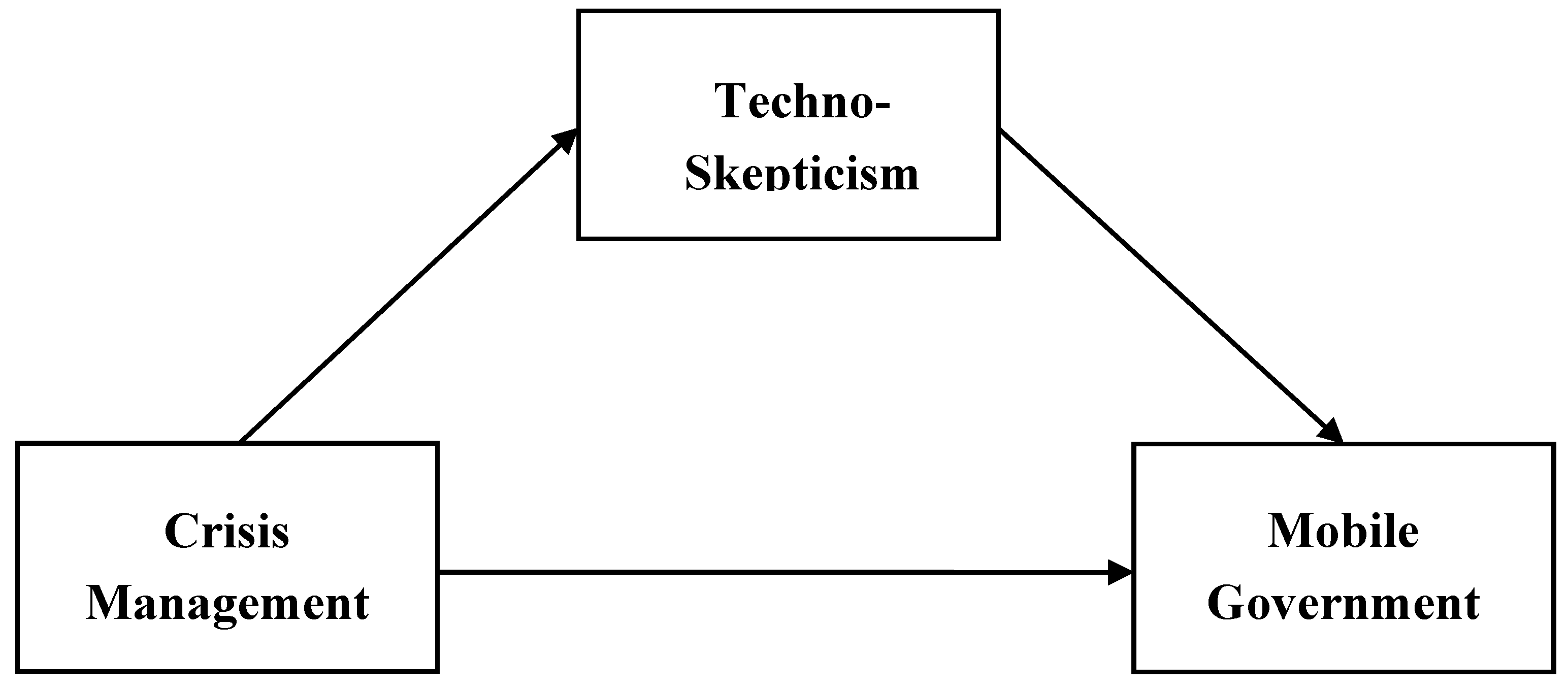

Table 1.
Demographic information of respondents.
| Count (n) | Rate (%) | |
|---|---|---|
| Gender | ||
| Male | 172 | 42.8 |
| Female | 220 | 54.7 |
| Not-specified | 10 | 2.5 |
| Age Group | ||
| 18-20 | 15 | 3.7 |
| 21-30 | 104 | 25.9 |
| 31-40 | 113 | 28.1 |
| 41-50 | 94 | 23.4 |
| 51-60 | 69 | 17.2 |
| 61 and over | 7 | 1.7 |
| Educational Status | ||
| Primary School Graduate | 18 | 4.5 |
| High School Graduate | 197 | 49.0 |
| Bachelor’s Degree | 164 | 40.8 |
| Postgraduate | 23 | 5.7 |
| Sector Occupied | ||
| Private Sector | 271 | 67.4 |
| Public Sector | 101 | 25.1 |
| Not-specified | 30 | 7.5 |
| Nationality | ||
| NORTHERN CYPRUS | 336 | 83.6 |
| NORTHERN CYPRUS + TR | 2 | 0.5 |
| Other | 64 | 15.9 |
| Total | 402 | 100.00 |
1 Source: Authors.
Table 2.
Descriptive Statistics for the Scores Attained from Scales.
| N | Minimum | Maximum | Average | Standard Deviation | |
|---|---|---|---|---|---|
| Crisis Management | 402 | 1.00 | 5.00 | 3.411 | 0.835 |
| Mobile Government | 402 | 1.00 | 5.00 | 2.691 | 0.844 |
| Techno-Skepticism | 402 | 1.00 | 5.00 | 2.940 | 0.846 |
Table 3.
Correlation Analysis Results.
| NORTHERN CYPRUS | |||||
|---|---|---|---|---|---|
| Variables | Mean | SD | 1 | 2 | 3 |
| 1. Crisis Management | 3.412 | 0.835 | 1 | ||
| 2. Techno-Skepticism | 2.940 | 0.846 | 0.332** | 1 | |
| 3. Mobile Government | 2.691 | 0.844 | 0.495** | 0.522** | 1 |
Table 4.
Bootstrap Results.
| Path | Coeff | SE | t | p | LLCI | ULCI |
|---|---|---|---|---|---|---|
| CM → MG | 0.3653 | 0.0420 | 8.7059 | 0.000 | 0.2828 | 0. 4478 |
| CM→ TS | 0.3368 | 0.0478 | 7.0509 | 0.000 | 0.2429 | 0. 4308 |
| TS → MG | 0.4008 | 0.0414 | 9.6774 | 0.000 | 0. 3194 | 0. 4822 |
| Mediating Effect (Indirect effect) | ||||||
| Coeff | SE | LLCI | ULCI | |||
| CM →TS →MG | 0.1974 | 0.1974 | 0.1974 | 0.1974 | ||
CY: Crisis Management, TS: Techno-Skepticism, MG: Mobile Government
Disclaimer/Publisher’s Note: The statements, opinions and data contained in all publications are solely those of the individual author(s) and contributor(s) and not of MDPI and/or the editor(s). MDPI and/or the editor(s) disclaim responsibility for any injury to people or property resulting from any ideas, methods, instructions or products referred to in the content. |
© 2024 by the authors. Licensee MDPI, Basel, Switzerland. This article is an open access article distributed under the terms and conditions of the Creative Commons Attribution (CC BY) license (http://creativecommons.org/licenses/by/4.0/).
Copyright: This open access article is published under a Creative Commons CC BY 4.0 license, which permit the free download, distribution, and reuse, provided that the author and preprint are cited in any reuse.