

Submitted:
20 May 2024
Posted:
20 May 2024
Read the latest preprint version here
Abstract
Field of ResearchThis research study investigates the role of distributed leadership and culture within small enterprises in Malta, an area in which there has been very limited research. It focuses on the interaction between these two elements and their impact on organizational behaviour and effectiveness. Several studies (Jardon et al 2019; Cope et al., 2011; de Oliveira et al., 2015; Mohanty et al., 2012;) suggest that effective leadership and culture are vital elements in the successful endeavours of small organizations. Schein (2006) further asserts that they are two different faces on the same coin and the dyadic interaction characterizes “how leaders create culture and how culture defines and creates leaders”. Distributed Leadership is a systematic practice of interactions and synergies between leaders, followers, and the situation (Spillane 2013). It is different from traditional leadership, which involves top-down management because it tends to be more democratic and participatory, whereby influence and decision-making are shared among multiple individuals rather than being controlled by a single leader. (Xhemajli et al. 2022) MethodologyAdopting a naturalistic approach and guided by an interpretivist, constructivist epistemological stance, this research delves into the intricate interplay between leadership and culture within small businesses. The chosen research methodology employs Grounded Theory, recognized for its robust and systematic process facilitating the observation of patterns through intensive iterative and highly analytical procedures (Charmaz, 2015).In the initial stages of field research, characterized by 'responsive interviewing' (Rubin and Rubin, 2012), data sampling commenced with convenience sampling. This initial phase gradually evolved into a refined strategy incorporating selective sampling and theoretical sampling (Corbin and Strauss, 2015). The shift in sampling approaches reflects a deliberate focus on collecting data based on its specific contribution to the development and comprehension of the dimensions, properties, and characteristics of key concepts.The induction of theory is a product of successive comparative analyses, involving the systematic comparison of data points to identify both similarities and variations. Abductive reasoning is integral throughout the analytical process, with particular emphasis during constant comparative analysis of categories, leading to theoretical integration (Charmaz, 2006). This meticulous approach aligns with the assertion of Strauss and Corbin (2015) that grounding theory in data enhances the likelihood of deriving theories that authentically reflect reality.The key advantage of using this approach is that the analysis carried out goes beyond deep exploration and rich description and actually develops a framework that explains the phenomena observed (Parker and Roffey, 1997, p.218). This is very important if the findings are to contribute to the knowledge enhancement of any field of practiceThe culmination of this research effort is the presentation of a set of interconnected concepts, intricately woven together into an emergent parsimonious model (Corbin and Strauss, 2015). This model serves to explain the dynamic interplay between leadership and culture, elucidating its tangible impact on the effectiveness of small enterprises. Research Contribution:Implications for PracticeThis research contributes to the literature on leadership and organizational culture in small enterprises, particularly in the context of Malta where such studies are scarce. By providing an initial exploration of these phenomena and their impact on organizational behavior, this paper lays the groundwork for further inquiry into this important area. Furthermore, the study offers practical insights for leaders of small enterprises by elucidating leadership behaviors observed in established organizations. Through applied cases, it demonstrates how the abstract concept of culture can be translated into a practical instrument that supports leadership and organizational development. This not only enriches the understanding of leadership dynamics but also provides tangible strategies for implementation. Moreover, the research contributes empirical evidence on the development of leadership functions within small enterprises, emphasizing the potential of shared and distributed leadership models. By grounding its findings in data, the study equips leaders with a deeper understanding of how these leadership approaches can shape organizational development, fostering more effective management practices in small businesses. Methodologically, the adoption of Grounded Theory methodology showcases its efficacy in exploring complex management phenomena. By employing this approach, the researchers were able to gather rich descriptions and develop an explanatory framework, highlighting its applicability in studying nuanced organizational dynamics. Implications for Policy and TheoryThis research also holds significant implications for policymakers, academic researchers and institutions involved in supporting small businesses. By providing insights into distributed leadership and cultural influences on organizational effectiveness, it offers a basis for informed policy formulation and support mechanisms. The conceptual model emerging from this study serves as a foundation for designing more targeted policies that cater to the unique needs of small enterprises. By understanding the intricacies of leadership dynamics and cultural contexts, policymakers can develop interventions that foster a conducive environment for small business growth and sustainability. Additionally, academic researchers can use these findings to further refine theoretical frameworks and empirical studies in the field, contributing to ongoing scholarly dialogue and knowledge advancement.
Keywords:
Leadership
; Organizational Culture
; Distributed Leadership
; Grounded Theory
Introduction
This research study evaluates the role of distributed leadership and culture within small enterprises in Malta. It focuses on the interaction between these two elements and their impact on organizational development. Small enterprises form an integral part of the Island’s economy. From an ‘economic value added’ perspective, small firms in Malta represent twenty-five percent of the total business economy, which is in sharp contrast with other countries across the EU where the industry is dominated by large firms. Notwithstanding their significance to the national economic model, and social impact, studies on the dynamics of Leadership with specific emphasis on Distributed Leadership and Organizational Culture within Small Enterprises in the small state of Malta, are limited. It is broadly acknowledged, that studies on the dynamic behaviour of small businesses, may pose a greater challenge than the observation of more structured larger organisations (Rizzo 2011), so this may be one of the main limiting factors.
Several studies (Jardon et al 2019; Cope et al., 2011; de Oliveira et al., 2015; Mohanty et al., 2012;) suggest that effective leadership and culture are vital elements in the successful endeavours of small organizations. Schein (2006) further asserts that they are two different faces on the same coin and the dyadic interaction characterizes “how leaders create culture and how culture defines and creates leaders”.
This research study explores the possible interrelationships between variants of Distributed Leadership and cultural perspectives within small enterprises, and the effect that these two elements have on the trajectory of such organisations. Leadership and culture are active elements within an organisation, and the small firm is no exception. Aquilina (2014) claims that the business behaviour of small firms tends to be dynamic and evolves over time. A Distributed Leadership approach may bring opportunities to a growing and evolving enterprise (Cope et al 2011).
Topic Area
Distributed Leadership is a systematic practice of interactions and synergies between leaders, followers, and the situation (Spillane 2013). It is different from traditional leadership, which involves top-down management because it tends to be more democratic and participatory, whereby influence and decision-making are shared among multiple individuals rather than being controlled by a single leader. (Xhemajli et al. 2022). Distributed leadership has generated substantial interest among researchers, policymakers, and practitioners, and it has provoked debates and discussions within the field as it challenges traditional views on the relationship between formal leadership and organisational performance (Harris 2013). The small enterprise may achieve a competitive advantage and improved employee engagement through an effective leadership function, augmented by a strong organizational culture (Jardon 2019); (Mohanty et al 2012). One of the most widespread definitions of culture is given by Edgar Shein “A pattern of shared basic assumptions that was learned by a group as it solved its problems of external adaptation and internal integration….,” (Schein, 2004) Culture may be perceived as a set of principles, values and attitudes that underpin an organization and which establish the foundation for the decision-making process. Literature provides several other interpretations of cultural paradigms and although none of these can be considered fully comprehensive, they offer further insight into this concept (Lumby et al, 2009).
Since empirical studies on organisation culture and distributed leadership practices within small businesses in Malta are rather limited, this study attempts to address this gap and contribute to the academic body of knowledge on this subject area. Through this research study, a number of proposition statements stemming from the grounded data are formulated on the role that both distributed leadership and culture play in the prosperity or decline of small businesses.
Theoretical Foundations
Leadership and the Small Enterprise
Throughout the past years, the subject of leadership gained immense popularity within the management field, with many researchers considering leadership behavior as an important factor that influences how an organization functions (Wu, 2009), (Zheltoukhova & Suckley, 2014), (O'Regan & Lehmann, 2008), (Laurentiu, et al., 2017). However there seems to be a lack of cohesion between the various leadership models (Offord et al 2016). The ontological view of leadership appears to be evolving over time (Khan et al 2016), and ‘the definition of leadership will continue to develop as scholars, researchers, and practicing leaders gain greater insight into the concept.’ (Winston and Patterson, 2006). There is substantial literature that focuses on leadership and its connections to culture and performance within large organizations (Bass et al., 2003; Klein et al 2013; Kumar and Kaptan, 2007, Arham et al., 2013), however the study of leadership behavior, in particular distributed leadership, within smaller version of enterprises is very limited (Francos & Matos 2015). Distributed leadership is defined as an emergent group where two or more individuals share the roles and functions of leadership (Bolden, 2011, Gronn, 2002). Existing research on the subject is primarily conducted within the confines of large organizations assuming that small enterprises are simply a scaled-down model. This is however challenged by Hill et al (2002) claiming that there is a broad recognition that small Enterprises have their own characteristics which influence their operating models and pose several challenges. (Hill , et al., 2002).
Characteristics of Small and Large Enterprises
Smaller organizations tend to be more agile than larger ones due to a flatter hierarchy and a less bureaucratic environment however, this poses additional responsibilities on the owner-manager as the person needs to possess a myriad of skills and knowledge to effectively manage the various functions of the organization. In fact, within the context of a Small Microenterprise, Mbunga et al (2013) in their study concluded, that poor leadership, management and entrepreneurship are key factors that limit growth. From a leadership influence point of view, various studies (Bridge and O’Neill); (Laurentiu, et al., 2017) claim that leadership influence in Small enterprises differs from larger organizations due to the fact that the owner exerts a direct influence on employees, whereas, in larger organizations, this resonance is insulated by the various layers of the management hierarchy. In a predictable business environment, the approach of an owner providing an exclusive compelling vision that motivates others may have benefits. However, in the current business landscape, it is possible that employees in small companies have a better grasp of the latest technological advancements, commercial developments, and shifts in consumer behavior compared to their employers. Consequently, making specific operational and strategic choices might yield better results when entrusted to these knowledgeable employees.
Distributed Leadership
A resistance to relinquish some degree of control by the owner - manager may lead to a problematic situation in a rapidly changing environment (Bridge and O’Neill). Within this line of thought, Cooney (2005) claims that ‘It is arguable that despite the romantic notion of the entrepreneur as a lone hero, the reality is that successful entrepreneurs either built teams about them or were part of a team throughout’. This notion of ‘shared leadership’ or ‘distributed leadership’ challenges traditional knowledge as it involves a shift in the mindset on how we perceive leadership as a practice (Harris 2013). It diverges from traditional leadership frameworks characterized by top-down management, as this leadership approach adopts a more democratic and participatory style. In this model, influence and decision-making responsibilities are distributed among multiple individuals, rather than being centralized in the hands of a single leader. It is defined by Spillane (2013) as being the systematic practice of interactions and synergies between leaders, followers, and the situation. Bennet et al. (2003) propose that distributed leadership is founded on three key principles. Firstly, it suggests that leadership emanates from a cluster of network individuals. Secondly, it advocates for openness to leadership parameters, including those both within and beyond the confines of the organization. Thirdly, it emphasizes the distribution of expertise across many individuals, rather than a select few. This approach to leadership may pose certain challenges in its application. According to Harris (2013), the key issues may be ‘The Culture, Organization structure and distance’ Research supports the notion that implementing distributed leadership can encounter significant challenges related to organizational culture, structure, and physical distance.
These potential challenges are further substantiated in the sense that distributed leadership requires a cultural shift from traditional hierarchical models to more collaborative and participative practices. This shift may encounter resistance as it requires a change in working behaviour. Such cultural transformations are complex and can encounter difficulties stemming from deeply rooted practices and attitudes (Hickey et al., 2022). The traditional organizational structure and internal distances, often characterized by rigid hierarchies and bureaucratic barriers, can hinder the adoption of distributed leadership. For distributed leadership to be effective, organizations need to embrace more flexible, closer and decentralized structures that allow for shared decision-making and collective responsibility. This transition can be challenging as it involves redefining roles, responsibilities, and workflows (MIT Sloan, 2022) These challenges highlight the need for comprehensive strategies that address cultural, structural, and spatial barriers to successfully implement distributed leadership in organizations.
Defining Culture
Within organizations in general, culture is the tacit social structure that influences the manner in which people behave. One of the most widespread definitions of culture is given by Edgar Shein “A pattern of shared basic assumptions that was learned by a group as it solved its problems of external adaptation and internal integration, that has worked well enough to be considered valid and, therefore, to be taught to new members as the correct way to perceive, think, and feel in relation to those problems” (Schein, 2004). In simplified terms, culture can also be defined as the way things are done throughout the organization. Refining the research focus onto smaller-scale businesses, Miller (2014) proposes that “The stronger people’s identification with the organization’s values and purpose, the stronger the culture tends to be”. When cultural norms are aligned with the employees’ personal values, exceptional synergy is generated toward organizational development (Groysberg, et al., 2018). Within the context of the Small Enterprise, Blackburn (2003) however warns, that due to its elusive nature, transcending the culture of the small enterprise from abstract to factual is difficult, as in a study conducted on the subject, responses indicated that most owner-managers were either indifferent or explicitly distanced themselves from the notions of the enterprise culture
The Components of Culture
The culture within an organization typically refers to a number of distinct yet interrelated components. They include shared basic values, internal behavioral norms, various historical recollections, and organizational behavioral patterns. (Homburg & Pflesser , 2000). Other more recent studies, (Mohanty et al 2016), propose that culture may be characterized as bureaucratic, innovative and supportive with each category having both positive and negative effects on organizational effectiveness, in some cases enhancing commitment and productivity, but in other instances potentially hindering change, diversity, and growth. These elements have a strong influence on the manner in which each individual and the organization behave and operate, furthermore, culture is perceived differently by different people within the structure and as a result, an enterprise may have a core culture and various other sub-cultures throughout the business, especially as the enterprise develops. (Mohanty et al 2016). Therefore, an adequate understanding of the structure and components of culture is very important as these intrinsic values form the foundation and philosophy for organizational procedures and practices (Hatch, 1993).
The Instrumentalization of Culture
Organizational culture, when effectively utilized by management, may be instrumental in navigating the complexities of an enterprise. It can be leveraged to adapt the organization to emerging opportunities, while also bridging the gap between top management strategies and the practical expertise of frontline employees. Tichy, (1983) reinforces this argument by stating that culture has a pervasive influence on employees, organization strategy, and key stakeholders. Smaller firms have an inherent competitive edge over larger organizations in terms of their agility and speed to adapt. Culture may therefore become a critical element that enables the small enterprise to remain nimble in its decision-making process.
The Culture–Leadership Interplay
Claims referring to close connections between organizational culture and leadership performance within management literature, appear to be quite abundant (Brettel et al., 2015; Dabic et al., 2018; Fatima and Bilal, 2019). However there seems to be a scarcity of empirical work within the smaller scale enterprises. A study of Jardon and Martinez-Cobas (2019) on small organizations, claims that the interaction between leadership and culture has been supported by opposing perspectives. The functionalist approach, sustaining that the leader conditions culture through actions and behavior and the anthropological perspective claiming that culture shapes leadership. (Jardon and Martínez-Cobas, 2019). In the same context, a theoretically congruent perspective through the leadership lens is offered by Mohanty (2016). This work presents the idea that transactional leaders operate strictly within the parameters of organizational culture whilst transformational leaders shape their organization’s culture to fit the new vision, shared beliefs and practices with Leaders and followers sharing mutual objectives both at personal and organizational development levels. This interaction may perhaps be better summarized by the statement that “The organization’s culture develops in a large part from its leadership, while the culture of an organization can also affect the development of its leadership“ (Mohanty et al 2016).
The leadership – culture phenomenon in small enterprises appears to possess very dynamic characteristics with various factors influencing the interplay and development of the key elements. The role of a leader and organization culture may need to evolve as the business environment changes. At start-up stage, culture is driven by the founder and is characterized by agility, centralized decision making and unstructured communications. As the enterprise grows, new cultural dilemmas emerge, the organization may require more structured decision-making processes, delegation becomes an important factor for growth (Miller , 2014) and new culture imported by newly engaged employees may dilute the current norms and practices. At the consolidation and establishment stage, the enterprise may need to become more bureaucratic and formalized to support better performance. An effective communications culture between the various divisions hence becomes vital at a stage where the enterprise needs to remain dynamic to respond efficiently to emerging opportunities and challenges.
SMEs–Macro Context
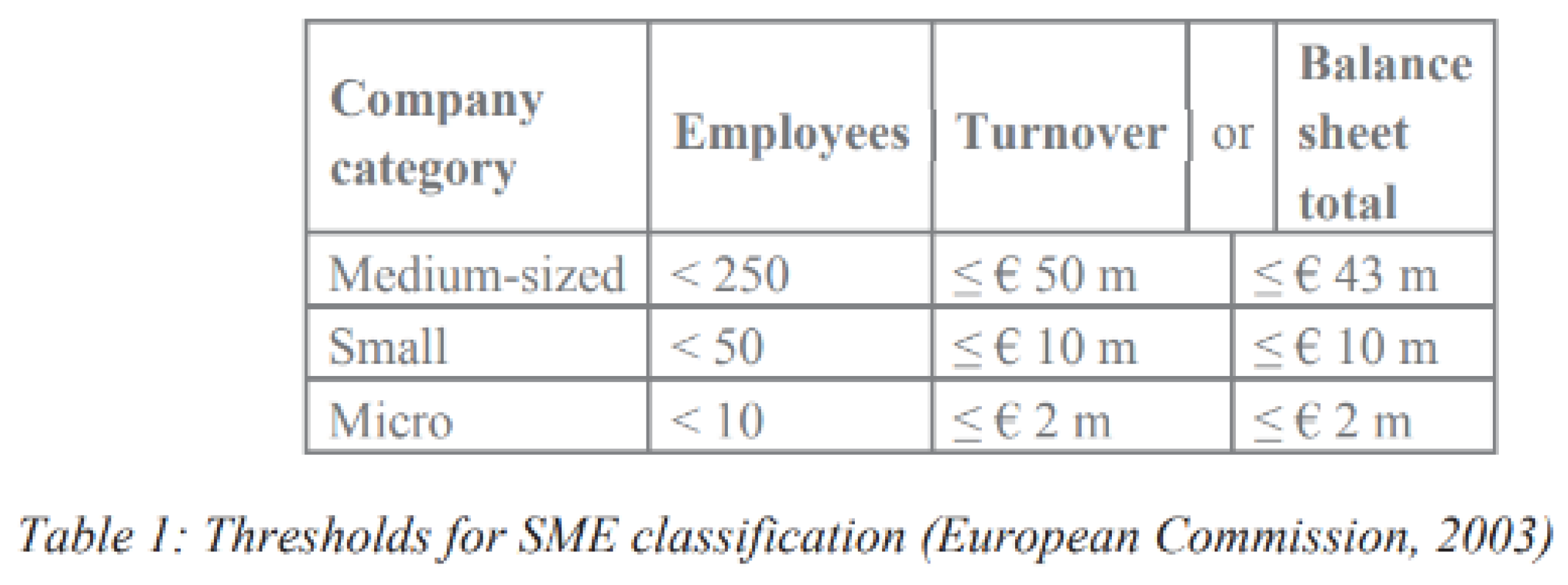
There seems to be a general agreement between economists and analysts that the economic health of a nation is dependent upon the performance of domestic enterprises, in particular SMEs. This is sustained by the OECD whereby their report stated that ‘SMEs play a key role in national economies around the world, generating employment, value-added and contribution to innovation’. This setting prevails within the EU where according to the online EU publication (https://ec.europa.eu/growth/smes_en) “Small and medium-sized enterprises (SMEs) are the backbone of Europe's economy. They represent 99% of all businesses in the EU. They employ around 100 million people, account for more than half of Europe’s GDP and play a key role in adding value in every sector of the economy” The European Commission (2003) defines SMEs based on criteria related to the number of employees and turnover or balance sheet total as outlined in Table 1:
The Small Enterprises in Malta
The European Commission fact sheet for the year 2021 outlines that Small Organizations in Malta amount to 2,163 or 6.6% of the total number of enterprises. These small organizations employ 26.5% of the total number of persons employed on the Island with an economic contribution of 1.8 Billion of a total Economic Value Added of 7.3 billion.
Figure 1.
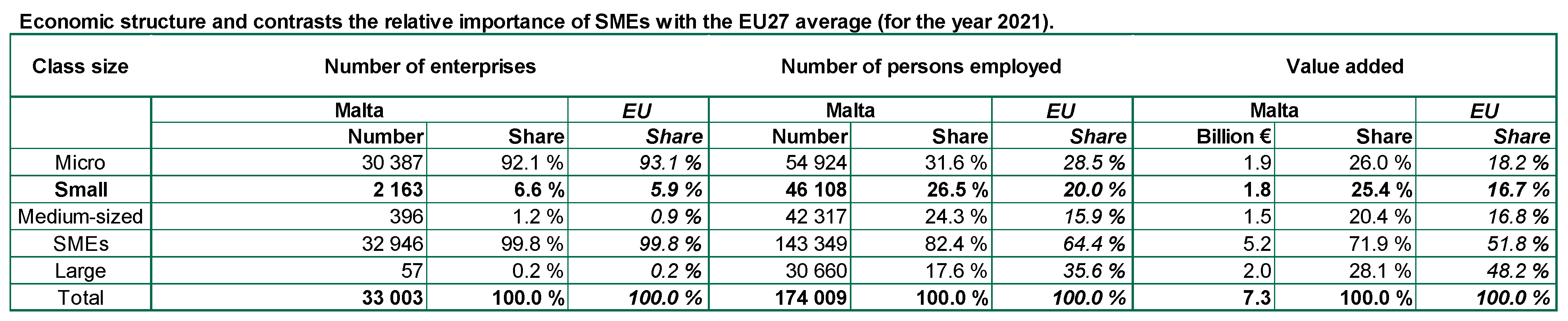
Despite the considerable influence they have on the country's economic model, there is a scarcity of empirical understanding regarding the behavior and performance of small organizations (Rizzo 2011). This limited insight into this area is not surprising as according to Curran and Blackburn (2001), several attempts at conducting research within the Small Enterprise realm turns out to be unreliable due to a lack of individualization of systematic fieldwork. Other limiting factors appear to be the proper sizing, accessibility and heterogeneity of the small enterprise sector. Adding to this, some small business owners seem to doubt the importance of academic research hence diminishing the applicability of theoretical propositions.
Methodology
The approach to research in a small firm needs to reflect the unique characteristics, context and individuals, active within the enterprise. Through a naturalistic approach, and an interpretivist, constructivist epistemological stance, the researchers have applied a Grounded Theory approach to research the interplay between leadership and culture in small businesses. Through this epistemological worldview, the researchers embrace the philosophical stance whereby different subjects may have diverse viewpoints based on their own construction of meaning as they interact with their environment through the perception of their experience and social perspective. Consequently, the researchers can never be completely detached from their own values and beliefs, inevitably informing the manner in which data are interpreted, gathered and analyzed (Charmaz, 2015). The researchers’ professional experience in the field of research will be an important component that will augment the quality of data throughout the interpretation, reflexive and analysis processes. Ontologically, the researchers adopts an idealistic stance, adhering to Gill and Johnson (1991) proposition of an ideographic viewpoint which is characterized by methods of ‘theory development’ through induction, generation and use of qualitative data and flexible methodical structures. To effectively seek an answer to this paper’s research question, the required approach seeks to enable patterns, categories and themes on leadership behavior and organizational culture to be built bottom-up from the data through an inductive process. Literature in management suggests that typical inductive research usually necessitates a qualitative design that allows answering ‘how’ and ‘why’ questions to determine organizational processes over time (Eriksson & Kovalainen, 2016).
The main purpose of this research paper is to develop an initial theoretical proposal based on grounded data on the role that distributed leadership and culture play in the prosperity or decline of an organization. To achieve this scope, the researchers adopted the methodological framework of Grounded Theory. This was originally developed by Barney Glaser and Anselm Strauss as a method of comparative analysis that allows researchers to discover theory from data (Glaser and Strauss 1967, p.1). These authors intended their work to be for the use of sociologists who were generating sociological theory (Glaser and Strauss 1967, p.6). Grounded Theory has since then been adopted and used in several fields including Management. There is evidence that managers are more likely to endorse findings that derive from qualitative research rather than the traditional quantitative survey measurements as the primary source of data collection (Shankar and Goulding 2000). In fact, the approach adopted in this research study is in line with these research developments, where grounded theory is being used as a methodology using the interpretative approach to undertake management research (Goulding 2002).
In grounded theory, the researcher originates a general abstract theory of a process or interaction which is grounded in data collected by participants. It is to be pointed out that given the relatively small number of participants in this research study, theoretical saturation is not attained. Therefore, the model presented will be an initial framework that emanates from the data. ‘This process involves using multiple stages of data collection and the refinement and interrelationship of categories of information’ (Creswell 2018). Induction of theory is achieved through successive comparative analyses whilst abductive reasoning occurs at all stages of analysis, but particularly during the constant comparative analysis of categories to other categories that leads to theoretical integration (Charmaz 2006). As argued by Strauss and Corbin (2015) since the theory is grounded in data itself, the theories derived are more likely to be an accurate reflection of reality. The key advantage of using this approach is that the analysis carried out goes beyond deep exploration and rich description and actually develops a framework that explains the phenomena observed (Parker and Roffey, 1997, p.218). This is very important if the findings are to contribute to the knowledge enhancement of any field of practice.
Data Gathering, Analysis and Coding
Charmaz & Thornberg (2021) in their guidelines to construct a grounded theory study urge researchers to be transparent and describe how the study will be conducted, how the samples will be obtained and to state clearly how and why the participants are included and how the researchers apply grounded theory and data collection methods. They also define the gathering of rich data as being the understanding and collecting of experiences of people who have had or are having particular experiences. In fact, Glaser and Strauss (1967), Charmaz (2006) emphasize on the importance of process and action and the importance of continuously seeking to understand the basic social and psychological processes as the data collection strategy informs the emerging analysis. Rich data represents an openness to the empirical world and a conviction to try to understand the experiences of people who may have a completely different perspective from the researcher. Charmaz & Thornberg (2021)
Twelve distinct Interviews with senior leaders and owners of Established Maltese Small enterprises with open-ended questions were used to generate data from participants. Birks and Mills (2015) explain the distinction between data generation and data collection and state that the generation of data occurs when the researcher is actively participating in the production of material that will be analyzed. This close interaction between the researcher and interviewee is reflective of the researcher’s claimed philosophical position based on constructivism and interpretivism. During the initial stages of field research which are in the form of ‘responsive interviewing’ (Rubin and Rubin 2005), data sampling initially involved convenience sampling to take advantage of the researcher’s access to a network capital. Eventually, the focus was shifted to purposive sampling aimed at participants who would likely have the desired characteristics and experiences to develop the emerging themes and concepts. Theoretical sampling is applied to further densify the key concepts emerging from the data. The constant data generation and the concept and categories comparative processes were continuously augmented by reflexive memoing to stimulate analytic inertia.
The analysis of data is conducted via a coding process through concepts emerging from the data which were identified, labelled and categorized. Throughout the initial phase of coding, open coding was carried out by reviewing data at a granular level down to phrases and expressions (Bartlett and Payne, 1997) with the aim of ensuring that the researchers avoid neglecting any important categories as well as enabling the verification and saturation of categories in the process (Holton, 2007). Charmaz & Thornberg (2021) emphasize the importance of ‘tolerating ambiguity’ and keeping an open mind to what the data is suggesting to ensure that the codes fit the data rather than the other round. The first set of data was used to refine the trajectory for further data gathering. In a Grounded Theory approach data collection and analysis is a simultaneous process meaning, that as new data is gathered it must be analyzed and this analysis will then inform the next data-gathering strategy. In this manner, the data absorbed is focused on themes that emerge from the data itself (Charmaz, 1995, p.31). Since data collection is guided by the analysis of previous data, Grounded Theory makes use of Theoretical Sampling (Corbin and Strauss 2015) meaning that data is collected on the basis of its contribution towards the development and understanding of a concept rather than by reference to quantitative formulae. Conceptual and theoretical saturation was not achieved due to the limited amount of interviews.
Analysis of Preliminary Research
This research project focuses on the leadership behavior and cultural norms within small enterprises in Malta. The population of this study was composed of Twelve owner-managers who are currently leading well-established organizations in diverse industries varying from Information technology and systems, architecture and design services and financial services and investments, hospitality and retail. The initial participants were selected on the basis of the accomplishments and reputation they have managed to build over the years, the close professional relationship with the researchers and their high degree of experience and academic background. Intensive interviewing was conducted, which took the form of guided conversations whereby participants expressed their views and perspectives on the topics of leadership and culture. This enabled the researchers to gather and concurrently analyze profound insights on these subjects. All interviewees were given an introduction letter to establish ethical and confidentiality parameters together with a consent form. The interview duration ranged from about twenty minutes to about forty minutes. Transcribing the interviews was an extremely laborious process that took approximately six to eight hours for each interview. The researchers adopted an approach whereby interviews which are saved into a digital file are dictated and automatically typed via a word processor. This process enabled the researchers to thoroughly review and obtain a deeper understanding of each interview whilst reflecting and developing thoughts that are recorded as memos.
Data Analysis Framework
Qualitative data were analyzed by means of MAXQDA software. Preliminary coding was conducted via Microsoft excel however once data started accumulating, MAXQDA’s powerful data mapping functions allowed the researchers to process and articulate higher volumes of data. All transcribed word documents were imported into MAXQDA and each document was fragmented into the numerous incidents which were relevant to the IN-VIVO coding framework. This process yielded five hundred and forty-four IN-VIVO codes and enabled the researchers to gain a profound insight into the participants’ business environment. At this point, the researchers started conceptualizing the codes into themes and categories some of which had extended properties. The researchers adopted the classifying framework proposed by Corbin and Strauss (2015) in which categories are labeled as contextual conditions, actions and consequences. Each transcribed document was analyzed again and coded segments were then linked to the respective category. This recursive process of contrasting data eliminates any possibility that the researchers would inadvertently contaminate data with any prejudice or bias. Figure 2a shows a snapshot of this framework.
Contextual conditions represent the key aspects that shape the actions leading to the consequences. This is however not a linear process but more of a cyclical one where the consequences can have an iterative influence on contextual conditions. Figure 2b below illustrates this interaction.
The findings from this preliminary research project offer a model that comprises the categories and key concepts of leadership and culture within Small Enterprises. The prevailing concepts provide a structure that explains the dynamics and perceptions of this phenomenon. Contextual conditions are determined by the type of culture and the interrelationship between leadership and culture. These conditions stimulate actions related to leadership style, management capabilities, structure and cultural change. The results of these actions become the prevailing consequences and outcomes which are mainly the implementation and effective use of performance management systems and incremental business growth.
Context
The development of the leadership role into a function: A structured decision-making approach in established small organisations, becomes an important stage within the initial growth phases of an enterprise and a context that triggers actions for paradigm shifts to occur. This study shows that owner/managers of small organizations, recognize the fact, that as the small enterprise started growing, certain responsibilities had to be detached from the traditional leader’s role and shifted towards a separate function within an organizational structure to create a more participatory style of leadership. This change, which at times required additional costs related to human capital, was perceived as a necessary investment for the potential growth of the organziation. This participatory leadership approach was also supported by a transformational leadership style whereby, rather than taking action themselves, owner/managers preferred to coach and train key individuals to effectively make decisions and manage situations on their behalf. This indicates that in established Maltese Small organizations, formal and informal leadership are not incompatible or oppositional, but rather are different parts of leadership practice. .Within this context, it also transpires that the main challenges presented in the literature related to the application of distributed leadership within an organization were somehow overcome in the established small enterprises being reviewed in this study. There were a few contrasting views on the concept of shared leadership emerging from the perceived initial need to control and micro-manage each process however the same participant also expressed a desire to gradually transform the organziation into one where employees may become part owners and share responsibilities and returns.
Leadership - Culture Interplay: The extensive examination of the connection between leadership and organizational culture holds significant importance in management literature. The analysis conducted so far on the data gathered during this research project has identified a functionalist perspective, positing that leadership shapes culture and invertedly that culture shapes leadership, aligning with an anthropological viewpoint. The majority of participants underscored the importance of preserving the current organizational culture while simultaneously encouraging new hires to either assimilate or exit. Additionally, several respondents highlighted the significance of recruiting individuals whose cultural inclinations align with the organization's, citing the facilitation of smoother organizational management. Conversely, most participants found it necessary to adjust their leadership approach as the organization expanded, embracing and integrating new cultural dynamics to foster business growth.. Overall, the interviews revealed a clear interaction between leadership and culture, impacting recruitment, assimilation, and organizational growth
Culture: The examination of the contextual themes of organizational culture was an important topic for the researchers to accomplish one of the main objectives set in the research question. An analysis of the prevailing cultural characteristics from the data gathered reveals that an entrepreneurial culture and a culture of innovation and experimentation were the most dominant aspects. The entrepreneurial culture was described as an environment in which risk-taking is not only tolerated but also a key component within the business process. Many respondents actually believe that this is an intrinsic trait (entrepreneurial). Closely linked to the Entrepreneurial culture is the innovation and experimentation inclination of most leaders of small Firms. All respondents showed that at various stages of the business lifecycle, the adoption of various creative initiatives were vital and these ranged from developing innovative software at the startup stage to 'pushing the boundary’ of the creative department. It is however recognized that this approach yields mistakes and whilst there should be parameters set in place to tolerate this, employees still need to be held somehow accountable. Culture is viewed as a dynamic component within the organization. Respondents highlighted the importance of implementing interventions to shape the organization's culture, especially during leadership change or development. Additionally, many participants illustrated how culture underwent transformation as the organization expanded. These significant cues can offer insights into the gradual integration of a distributed form of leadership within the enterprise culture. The initially 'Top-Down' leadership culture evolved into one that allowed the emergence of multiple leaders. The data collected from participants indicated that this shift occurred because leaders acknowledged the necessity of shared leadership for the fostering of growth. This recognition likely sparked a strong willingness to embrace change, surpassing the desire to maintain strict control over the organization. The data also showed how culture required constant cultivation, protection and shaping to remain in congruence with the changing environment, the organization's vision and human resources’ motivational triggers. In fact, particularly from a people's perspective, all interviewees emphasized on this aspect. Matters such as adequate remuneration and low staff turnover ratios and an approach whereby the leader strives at achieving ' dedication, trustworthiness and reciprocal respect' all indicate a strong commitment at fostering excellent relationships with staff. The majority of participants have expressed their readiness to elevate their connections to a personal level when needed, intervening and providing support for staff in private matters. This reflects a strong sense of trust, openness, and respect in the relationships.
Action
Leadership in action : In terms of leadership, several respondents were very receptive to the fact that at a certain point, the company needed to evolve from its existing operational paradigm. Sensing either potential stagnation in the decision-making process or the need for a more effective leadership function due to contextual change, owner-managers took action and sought additional high-level assistance through consultants or attracting better human capital and empowering people to share in the leadership function within the organization. This occurred despite initial apprehensions about letting go of even very basic functions. Many respondents explained how their role changed into one that became primarily concerned with motivating people whilst drifting away from the centralized leadership role of the owner-manager which some described as being an inefficient structure. These insights underscore the importance of distributed leadership, delegation, and empowerment in navigating organizational change and growth whilst acknowledging that there needs to be more tolerance for errors when involving more people in leadership and decision-making.
Organizational Structuring: All Leaders explained that at some point, their respective enterprise required actions to set up articulated reporting systems and a structure. This action provided evidence of a shared leadership purpose, which seemingly encounters less resistance in small organizations due to its size and limited complexity. The most basic setup involved the founder-leader assuming a less operational role, focusing on strategic aspects of the organization whilst delegating day-to-day tasks to other senior employees or family members. All interviewees sustained that the absence of delegation is a key growth limiting factor. From a leadership perspective, the formulation of a structure meant a shift in Leadership style and culture. This shows that as their organizations evolved, different leadership capabilities were required. An array of management skill-set to plan, organize and control was also necessary whilst organizational culture evolved in a way in which decisions were no longer taken exclusively by one person.
Management actions: Data from the participants clearly shows that general management competencies are very important attributes that founder-leaders should possess to navigate successfully the business environment. Skills such as delegating, organizing, planning and coordinating are necessary during the initial stages as well as when the organization starts to evolve and grow. A basic financial and marketing background seems to be of critical importance, especially during the initial stages of the organization. Human resources management appeared to be a key aspect with all interviewees sharing different experiences in people management. The data gathered from the interviews also showed that leaders appreciate the importance of investing time with employees to support them in their problems whilst investing resources in the growth, learning and development of employees. All participants explained (in their own way) that at some point, responsibilizing key employees and delegating important tasks become an inevitable process. These management interventions help to shape entrepreneurs of small enterprises into more ‘mature leaders’ (Thorpe et al 2006) who are able to disseminate shared vision, effectively delegate tasks and recognize that the realization of vision requires the contribution from other people. This open management style together with the willingness to relinquish some control are important elements at fostering forms of distributed entrepreneurial leadership in small enterprises.
Consequences and Outcomes
Growth Limiting Factors: Participants commented about some factors which in their opinion limit their organization's growth potential. One of the main challenges is the effective delegation of tasks within the organization's structure. When this is not managed properly, leaders are forced to do certain tasks themselves at the cost of sacrificing focus on general organizational development. The lack of skilled human resources appears to be another major factor hindering further enterprise expansion. Leaders are trying to mitigate this risk by investing in their people to retain talent and optimize productivity, but certain growth strategies cannot materialize without additional resources.
An Architecture of Performance Management Systems: The results from the actions and strategies outlined by the respondents suggest that performance management and a high-performance culture are central elements of the leadership and culture interaction. All participants explained extensively the importance of performance measurement to create a balanced culture between the organization's stakeholders. The architecture of the various systems implemented to manage performance has common characteristics which generate timely, meaningful and accurate information for effective decision-making. These systems are used to manage sales processes, reward and remuneration mechanisms, customer service levels, productivity, efficiency and project costs. Performance management systems support the distributed leadership function by facilitating the management of resources and delegation, enabling leaders of the small enterprise to attend to other important strategic aspects of the organization. These systems also contribute to shaping organizational culture by creating an environment in which objectives, accountability and responsibilities ('Key Performance Indicators) are more clearly defined, communicated, endorsed and executed.
All participants expressed a desire for more growth. Despite some limiting factors and a general approach towards cautious incremental growth, all respondents are well prepared to evaluate and capture new opportunities which would contribute positively towards the prosperity of their business enterprise.
A Conceptual Model Emanating from Data
The researchers’ aim is to present a theoretical model that is grounded in the data gathered during the interviews, which model possesses an explanatory capacity of the phenomenon being studied. The definition of theory according to Birks and Mills (2015) is “an explanatory scheme comprising a set of concepts related to each other through logical patterns of connectivity”. A Grounded Theory is not simply a set of categories that are connected together into a theory (Glaser and Strauss 1967), proper theoretical integration is the result of high-level analytical thinking and advanced conceptualization techniques.
The researchers applied analytical thinking at the early stages of the data-gathering process by extrapolating elements of the data to which the researchers were theoretically sensitive and which were also relevant to the developing theory. Theoretical sensitivity and the ability of the researchers to conceptualize the leadership – culture phenomena to the emerging abstract themes, was augmented by a preliminary literature review, Data analysis and the researcher’s professional experience in the field of study. The analytical description of these extracts is recorded in the memos which were disseminated throughout the coding phases. Conceptual and Theory development determined the sampling trajectory and as more data was being populated, analyzed, and contrasted, early relationships started forming and concepts developing. The researchers finally connected the developing concepts into an emergent conceptual framework built on the foundation of a preliminary core category. “The core category captures in a few words the major theme or the essence of the study and enables all the other categories and concepts to be integrated around it to form the theoretical explanation of why and how something happens” Corbin and Strauss (2015)
Data gathered from the interviews, which shaped the themes and categories, led to the formulation of a number of propositions around the concept of Leadership and Culture with particular emphasis on the distributed and shared leadership style.
- Organizational culture in small enterprises plays an important role in organizational performance, it influences distributed leadership effectiveness and connects the various dimensions of organizational behavior.
- Leaders in established small enterprises in Malta maintain a centralized transformational and transactional leadership role during the embryonic stages of the enterprise and gradually develop the leadership role into a distributed and shared leadership function through formal structures, systems, and continuous support.
- Management competencies are an essential quality for leaders of established enterprises, to effectively formulate an architecture of systems and ensure that mechanisms are in place to manage performance, define accountability and sustain a broader distributed leadership approach at the various stages of enterprise development.
Figure 3 below is an illustration showing that Distributed Leadership and Culture in established small enterprises are cohesive elements and behave in a fluid and congruent manner throughout the various stages of enterprise development
Whilst the ongoing grounded theory research has not yet reached a point of theoretical saturation, it has allowed the researchers to propose the tentative model depicted in Figure 3.
Figure 3.
The Leadership – Culture Model in Maltese Small Enterprises.

The above key concepts may be summarized into an emerging substantive conceptual framework which proposes that leaders in established small organizations within a small state like Malta shape their enterprise culture to support their organizational goals, whilst the evolution of an internal culture has a direct influence on the effectiveness of leaders which often entails the development of a style into one which is less centralized. Leadership and Culture are closely intertwined and are dynamic elements in the context of a business environment dominated by constant change.
Research Contribution
Implications for Practice
This research contributes to the literature on leadership and organizational culture in small enterprises, particularly in the context of Malta where such studies are scarce. By providing an initial exploration of these phenomena and their impact on organizational behavior, this paper lays the groundwork for further inquiry into this important area.
Furthermore, the study offers practical insights for leaders of small enterprises by elucidating leadership behaviors observed in established organizations. Through applied cases, it demonstrates how the abstract concept of culture can be translated into a practical instrument that supports leadership and organizational development. This not only enriches the understanding of leadership dynamics but also provides tangible strategies for implementation.
Moreover, the research contributes empirical evidence on the development of leadership functions within small enterprises, emphasizing the potential of shared and distributed leadership models. By grounding its findings in data, the study equips leaders with a deeper understanding of how these leadership approaches can shape organizational development, fostering more effective management practices in small businesses.
Methodologically, the adoption of Grounded Theory methodology showcases its efficacy in exploring complex management phenomena. By employing this approach, the researchers were able to gather rich descriptions and develop an explanatory framework, highlighting its applicability in studying nuanced organizational dynamics.
Implications for Policy and Theory
This research also holds significant implications for policymakers, academic researchers and institutions involved in supporting small businesses. By providing insights into distributed leadership and cultural influences on organizational effectiveness, it offers a basis for informed policy formulation and support mechanisms.
The conceptual model emerging from this study serves as a foundation for designing more targeted policies that cater to the unique needs of small enterprises. By understanding the intricacies of leadership dynamics and cultural contexts, policymakers can develop interventions that foster a conducive environment for small business growth and sustainability. Additionally, academic researchers can use these findings to further refine theoretical frameworks and empirical studies in the field, contributing to ongoing scholarly dialogue and knowledge advancement.
Limitations
Whilst the design of this research project has enabled focus on leadership and culture within small enterprises at a micro level, this approach has limitations in assessing macro level phenomena, the broader economic and social factors which may be impacting the small enterprise. Furthermore, the researchers’ philosophical stance to construct reality based on the participants own experiences, may limit the production of generalized findings on the subject area.
As previously stated, full conceptual and theoretical saturation could not be achieved due to the limited scale of the study so far. However, further densification of the key concepts through theoretical sampling will lead to the complete integration of a theoretical model emanating from data.
Recommendations for Future Research
Once the Grounded Theory model on Small enterprises leadership and culture is fully developed, this could be suggested for evaluation in other small states in order to assess its geographical relevance. Additional viewpoints, for example, the employees’ may be added to broaden the conceptual perspective and further strengthen the theoretical model.
References
- AQUILINA, R. 2014. IT strategizing of small firms in Malta: a grounded theory approach. Robert Gordon University, PhD thesis.
- Arham, A. F. 2014. Leadership and performance: The case of Malaysian SMEs in the services sector. International Journal of Asian Social Science, 4, 343-355. Retrieved from http://www.aessweb.com/journal/5007.
- Arham, A. F., Boucher, C., & Muenjohn, N. 2013. Leadership and entrepreneurial success: A study of SMEs in Malaysia. World Journal of Social Sciences, 3(5), 117-130. Retrieved from http://www.wjsspapers.com/.
- Bartlett, D. & Payne, S. 1997, "Grounded theory : its basis, rationale and procedures" in Understanding social research: perspectives on methodology and practice, eds. G. McKenzie, J. Powell & A. Powell R.,.
- Bass, B.M., Avolio, B.J., Jung, D.I. and Benson, Y. (2003), “Predicting unit performance by assessing transformational and transactional leadership”, Journal of Applied Psychology, Vol. 88.
- Bennett, N., Wise, C., Woods, P. and Harvey, J. (2003) Distributed Leadership.
- Nottingham: National College for School Leadership. (Bolden - University of Exeter Discussion Papers in Manageme, p. 7).
- Birks, M. and Mills, J., 2015. Grounded theory: A practical guide. Sage.
- Blackburn, R. A., Hart, M., & Wainwright, T. 2013b. Small business performance: Business, strategy and owner-manager characteristics. Journal of Small Business and Enterprise Development, 20(1), 8–27. [CrossRef]
- Bolden, R. 2011. Distributed Leadership in Organizations: A Review of Theory and Research. International Journal of Management Reviews, 13(3), 251–269. [CrossRef]
- Brettel, M., Chomik, C. and Flatten, T.C. (2015), “How organizational culture influences innovativeness, proactiveness, and risk-taking: fostering entrepreneurial orientation in SMEs”, Journal of Small Business Management, Vol. 53 No. 4, pp. 868-885. [CrossRef]
- Bridge, S., & O’Neill, K. (2017). Understanding Enterprise: Entrepreneurs and Small Business. Bloomsbury Publishing. https://books.google.com.mt/books?id=o_ZGEAAAQBAJ.
- Charmaz, K 1991. Good days, bad days: The self in chronic illness and time. Rutgers University Press.
- Charmaz, K. 1995, "Grounded Theory" in Rethinking methods on psychology, eds. J.A. Smith, R. Harre & L. Van Lagenhove, Sage, London, pp. 26-49.
- Cooney, T.M. 2005. Editorial: what is an entrepreneurial team? International Small Business Journal, 23, pp. 226– 235. [CrossRef]
- Cope et al. - 2011 - Exploring Distributed Leadership in the Sm, p. 13).
- Corbin, J. & Strauss, A. 2015, Basics of Qualitative Research, 4th Edition, Sage Publications, Thousand Oaks, CA.
- Creswell J., William E. Hanson, Vicki L. Clark Plano and Alejandro Morales, Qualitative Research Designs: Selection and Implementation, The Counseling Psychologist 2007; 35; 236. [CrossRef]
- Dabic, M., Lažnjak, J., Smallbone, D. and Švarc, J. (2018), “Intellectual capital, organisational climate, innovation culture, and SME performance”, Journal of Small Business and Enterprise Development, Vol. 26 No. 4, pp. 522-544. [CrossRef]
- De Oliveira, J., Escrivão, E., Nagano, M. S., Ferraudo, A. S., & Rosim, D. (2015a). What do small business owner-managers do? A managerial work perspective. Journal of Global Entrepreneurship Research, 5(1), 19. [CrossRef]
- Eriksson, P. and Kovalainen, A. 2016. Qualitative methods in business research. Thousand Oaks, CA: Sage Falmer Press, London, pp. 173- 195.
- Fatima, T. and Bilal, A.R. 2019, “Achieving SME performance through individual entrepreneurial orientation: an active social networking perspective”, Journal of Entrepreneurship in Emerging.
- Economies, Vol. 12 No. 3, pp. 399-411.
- Franco , M. & Matos , P. G., 2013. Leadership styles in SMEs: a mixed-method approach. Springer Science+Business Media New York.
- Gill, J. and Johnson, P., (1991), Research Methods for Managers, Paul Chapman Publishing, London.
- Glaser, B.G. & Strauss, A.L. 1967, The discovery of grounded theory, 3rd edition, Aldine Transaction, New Brunswick.
- GOULDING, C., 2002. Grounded theory. A practical guide for management, business and market researchers. London: SAGE Publications.
- Groysberg, B., Lee , J., Price, J. & Cheng, J. Y.-J., 2018. Corporate Culture. Harvard Business Review , February , pp. 2-8.
- Gronn, P. 2002. Distributed Leadership. In: Leithwood, K., et al. Second International Handbook of Educational Leadership and Administration. Springer International Handbooks of Education, vol 8. Springer, Dordrecht. [CrossRef]
- Harris, A. (2013). Distributed Leadership: Friend or Foe? Educational Management Administration & Leadership, 41(5), 545–554. [CrossRef]
- Harris, A., & DeFlaminis, J. (2016). Distributed leadership in practice: Evidence, misconceptions and possibilities. Management in Education, 30(4), 141–146. [CrossRef]
- Hatch, M. J. (1993). The Dynamics of Organizational Culture. The Academy of Management Review, 18(4), 657–693. [CrossRef]
- Hickey, N.; Flaherty, A.;Mannix McNamara, P. Distributed Leadership: A Scoping Review Mapping Current Empirical Research. Societies 2022, 12, 15. [CrossRef]
- Hill, J., Nancarrow, C. and Tiu Wright, L. 2002, "Lifecycles and crisis points in SMEs: a case approach", Marketing Intelligence & Planning, Vol. 20 No. 6, pp. 361-369. [CrossRef]
- Holton, J.A. 2007, in The SAGE handbook of grounded theory, eds. A. Bryant & K. Charmaz, Sage, London, pp. 265-289.
- Homburg , C. & Pflesser , C., 2000. A Multiple-Layer Model of Market-Oriented Organizational Culture :.
- Measuremnet issues and performance outcome. Journal of Marketing Research, Volume XXXVII, pp. 449-462.
- Jardon & Martínez-Cobas. 2019. Leadership and Organizational Culture in the Sustainability of Subsistence Small Businesses: An Intellectual Capital Based View. Sustainability, 11(12), 3491. [CrossRef]
- Johnson, P. 2015. Evaluating qualitative research: past, present and future. Qualitative Research in Organizations and Management: An International Journal, 10 (4): 320-324. [CrossRef]
- Khan, Z. A., Nawaz, A., & Khan, I. 2016. Leadership Theories and Styles: A Literature Review. Journal of Resources Development and Management, 16, 1-7.https://www.researchgate.net/profile/Allah-Nawaz-2/publication/293885908_.
- Leadership_Theories_and_Styles_A_Literature_Review/links/56bcd3ad08ae9ca20a4cdea2/Leadership-Theories-and-Styles-A-Literature-Review.pdf.
- Kathy Charmaz & Robert Thornberg (2021) The pursuit of quality in grounded theory, Qualitative Research in Psychology, 18:3, 305-327. [CrossRef]
- Klein, A. S., Cooke, R. A. & Wallis, J., 2013. The impact of leadership styles on organizational culture and firm effectiveness: An empirical study. Journal of Management & Organization, 19(3), pp. 241-254. [CrossRef]
- Kumar, C.R. and Kaptan, S.S. 2007, The Leadership in Management: Understanding Leadership Wisdom, APH Publishing, New Delhi.
- Laurentiu, M., Adriana , B. & Mgdalena , M., 2017. Comparison of the leadership styles pratcticed by Romanain and Dutch SME owners. International Journal of organizational leadership , Volume 6, pp. 4-16.
- Lumby, J. and Foskett, N., 2009. Leadership and culture. In International handbook on the preparation and development of school leaders (pp. 43-60). Routledge.
- Mbunga K., Mbunga M. Wangoi M.,Ogada J. 2013 : Factors Affecting the Growth of Micro and Small Enterprises: A Case of Tailoring and Dressmaking Enterprises in Eldoret, International Journal of Business and Social Science Vol. 4 No. 5.
- Miller , J., 2014. Keeping culture, purpose and values at the heart of your SME, London : Chartered Institute of Personnel and Development.
- MIT Sloan Management Review 2022. https://mitsloan.mit.edu/ideas-made-to-matter/why-distributed-leadership-future-management.
- Mohanty, A., Dash, M., & Pattnaik, S. 2016. Study of Organization Culture and Leadership Behaviour in Small and Medium Sized Enterprises.
- Offord, M., Gill, R., & Kendal, J. 2016. Leadership between decks: a synthesis and development of engagement and resistance theories of leadership based on evidence from practice in Royal Navy warships. Leadership and Organization Development Journal, 37(2), 289-304. [CrossRef]
- O'Regan , N. & Lehmann, U., 2008. The impact of Strategy, Ledership and Culture, on organisational perfromance : a case study of a SME. Int. J. Process Management and Benchmarking.
- Parker, L.D. & Roffey, B.H. 1997, "Methodological themes - Back to the drawing board: revisiting grounded theory and the everyday accountant’s and manager’s reality", Accounting, Auditing and Accountability Journal, vol. 10, no. 2, pp. 212-247. [CrossRef]
- RIZZO, A., 2011. Strategic orientation and organizational performance of small firms in Malta: a grounded theory approach. http://openair.rgu.ac.uk.
- Schein, E.H. (2004). Organizational culture and leadership (3rd ed.). John Wiley & Sons.
- SHANKAR, A. and GOULDING, C., 2000. ‘Interpretive consumer research: two more contributions to theory and practice. Qualitative Marketing Research: An International Journal, 4(1), pp. 7-16. [CrossRef]
- Spillane, J. (2013) The practice of leading and managing teaching in educational organisations, in Leadership for 21st Century Learning, Centre for Educational Research and Innovation, OECD Publishing.
- Strauss, A. 1987, Qualitative analysis for social scientists, Cambridge University Press, New York.
- Thorpe, R., Gold, J., Holt, R. and Clarke, J. (2006). Imma-turity: the constraining of entrepreneurship. International Small Business Journal, 24, pp. 232–252. (Cope et al. - 2011 - Exploring Distributed Leadership in the Sm, p. 16).
- Tichy, N. (1983), "THE ESSENTIALS OF STRATEGIC CHANGE MANAGEMENT", Journal of Business Strategy, Vol. 3 No. 4, pp. 55-67. [CrossRef]
- Turner J. & Baker A. (2018) European Journal of Training and Development, vol. 42 no. 7/8.
- Winston, B. E., & Patterson, K. (2006). An Integrative Definition of Leadership. International Journal of Leadership Studies, 1, 6-66.
- Wu, F.Y. (2009), “The relationship between leadership styles and foreign English teacher’s job satisfaction in adult English cram schools: evidences in Taiwan”, The Journal of American Academy of Business, Vol. 14 No. 2, pp. 75-82.
- Zheltoukhova, . K. & Suckley, L., 2014. Hands-on or hands-off: effective keadership and mangement in SMEs, London: Chartered Institute of Personnel and Development.
- Xhemajli, A., Luta, M., & Neziraj, E. (2022). Applying Distributed Leadership in Micro and Small Enterprises of Kosovo. WSEAS TRANSACTIONS ON BUSINESS AND ECONOMICS, 19, 1860–1866. [CrossRef]
Figure 2.
a.
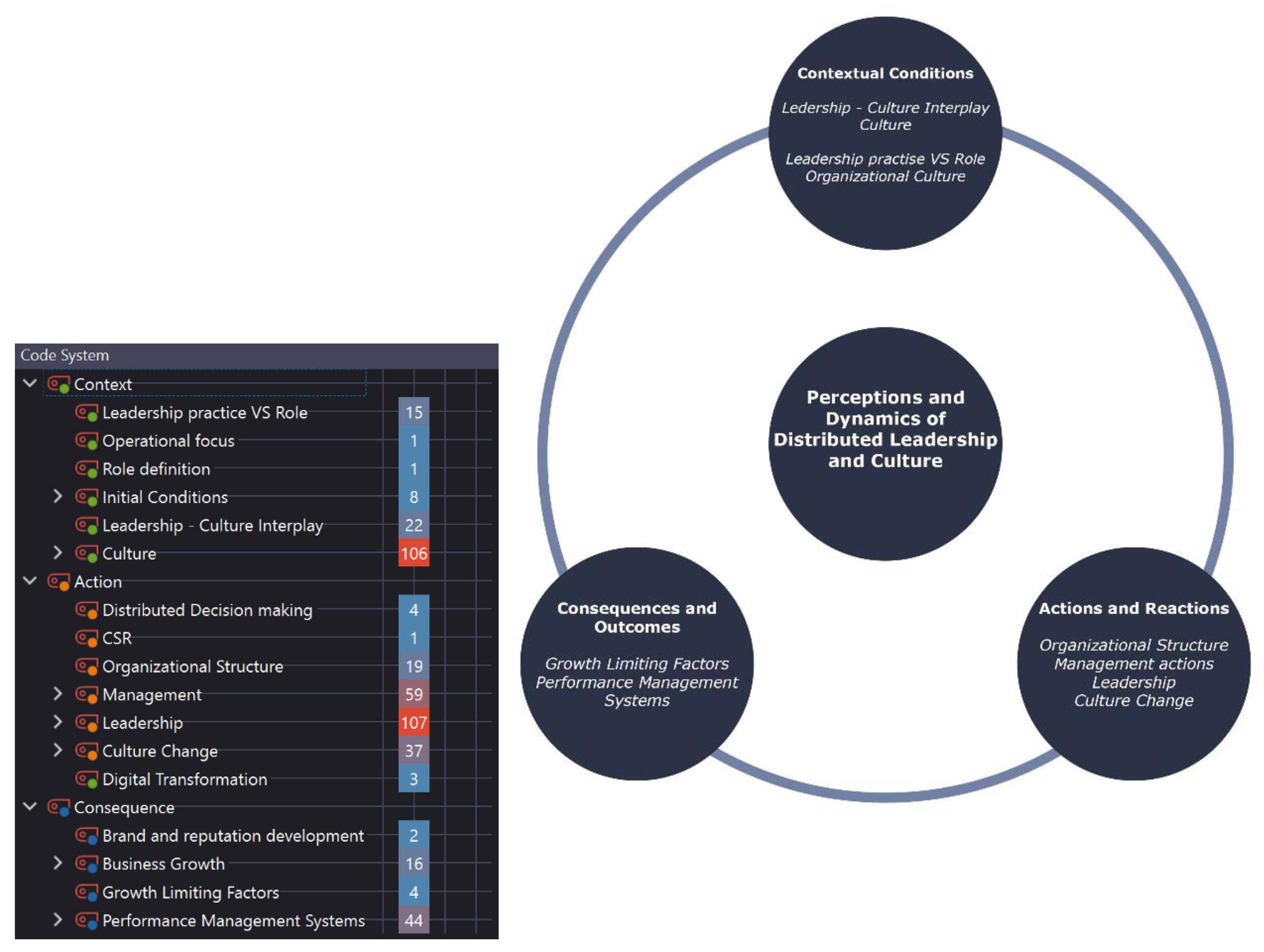

Table 1.
Thresholds for SME classification (European Commission, 2003).
 |
Disclaimer/Publisher’s Note: The statements, opinions and data contained in all publications are solely those of the individual author(s) and contributor(s) and not of MDPI and/or the editor(s). MDPI and/or the editor(s) disclaim responsibility for any injury to people or property resulting from any ideas, methods, instructions or products referred to in the content. |
© 2024 by the authors. Licensee MDPI, Basel, Switzerland. This article is an open access article distributed under the terms and conditions of the Creative Commons Attribution (CC BY) license (http://creativecommons.org/licenses/by/4.0/).
Copyright: This open access article is published under a Creative Commons CC BY 4.0 license, which permit the free download, distribution, and reuse, provided that the author and preprint are cited in any reuse.


