
Submitted:
12 May 2024
Posted:
13 May 2024
You are already at the latest version
Abstract
The interest in obtaining new composite materials with diverse properties has created a growing interest in natural fi-bers as reinforcement in polymers, which has generated an impact in sectors such as automotive and construction, dis-placing synthetic fibers. Properties such as low density, low cost, and rene.wable make these fibers an attractive alterna-tive to reduce environmental impact. Their application in polymers, such as polypropylene, polyethylene, and epoxy resins, has allowed the modification of polymeric composite materials' mechanical and physical properties (NFRP). This review focuses on investigating the status of natural fiber-reinforced polymers. It analyzes their worldwide demand, chemical characteristics, physical and mechanical properties, and various applications in different sectors and indus-tries. In addition, the advantages and disadvantages of NFRPs are highlighted, highlighting their potential for new ap-plications.
Keywords:
Natural fibers
; Reinforced Polymers
; Composites
; Properties
1. Introduction
The use of fiber-reinforced polymers (FRP) has been in construction industry applications for several years; its use has spread to different sectors over time. FRP composites are composed of fibers that act as reinforcement or fillers in a polymer matrix. These fibers can be inorganic or of organic origin. The predominant focus has been using synthetic fiber-reinforced polymer composites (SFRP) in high-performance applications, such as aerospace or automotive, where mechanical properties and light weight are critical, considering that the application of these reinforced materials should not be in areas where the physical and mechanical properties are not highly demanding. However, the high cost and high energy demand associated with producing these reinforcing materials pose challenges in terms of environmental sustainability. The lack of adequate recycling of these materials can also pose environmental problems in case of excessive use [1].
The use of natural fibers as reinforcing material has experienced a progressive replacement of synthetic fibers in various applications, such as the automotive, maritime, aerospace, and construction industries, among others [2,3]. This transition is largely due to the intense research carried out in recent years to develop more biodegradable and environmentally friendly materials that offer improved characteristics and attractive physical and mechanical properties. These improvements include lower density, higher strength, processing flexibility, and higher stiffness while reducing the associated costs [2,3,4].
Composites made from natural fibers, compared to those made from glass fibers, exhibit a notable advantage in terms of light weight due to their respective densities. Natural fibers have densities ranging from 1.2 to 1.6 g/cm3, while glass fibers have densities ranging from 2.16 to 2.68 g/cm3 [5,6] This difference in density gives composites with natural fibers a significant advantage in applications where weight is a critical factor. By reducing the density of the reinforcing material, components made with natural fibers become lighter.
The manufacture of natural fibers consumes about 82% less energy compared to glass fibers [6]. In addition to their low density, natural fibers offer a number additional benefits that make them an attractive option in various applications. These advantages include their non-abrasive property, which minimizes wear and prolongs the service life of surfaces in contact with these materials. Also, their non-toxic nature makes them safe for handling and use in applications that require environmentally and health-inert materials. Another property is an electrical insulator. In addition, natural fibers have good resistance to high temperatures. These properties together make natural fibers a valuable and versatile option for various industrial applications, offering a range of characteristics to suit different needs. In the polymer sector, natural fiber reinforcement has become an essential adoption in the automotive and construction industries [7,8,9,10,11,12].
Therefore, it is essential to achieve new research in developing and studying thermoplastic and thermoset composites reinforced with natural fibers. The main objective of this review is to present an analysis of the current development of NFRPs. The worldwide demand for the production of vegetable fibers and their relevant chemical and physical properties are presented. The different types of NFRP are also addressed, along with their advantages and disadvantages, physical and mechanical properties, and current applications. In addition, the author’s views on the prospects for applying these natural fiber-reinforced materials are provided.
2. Classification of Vegetables Fibers
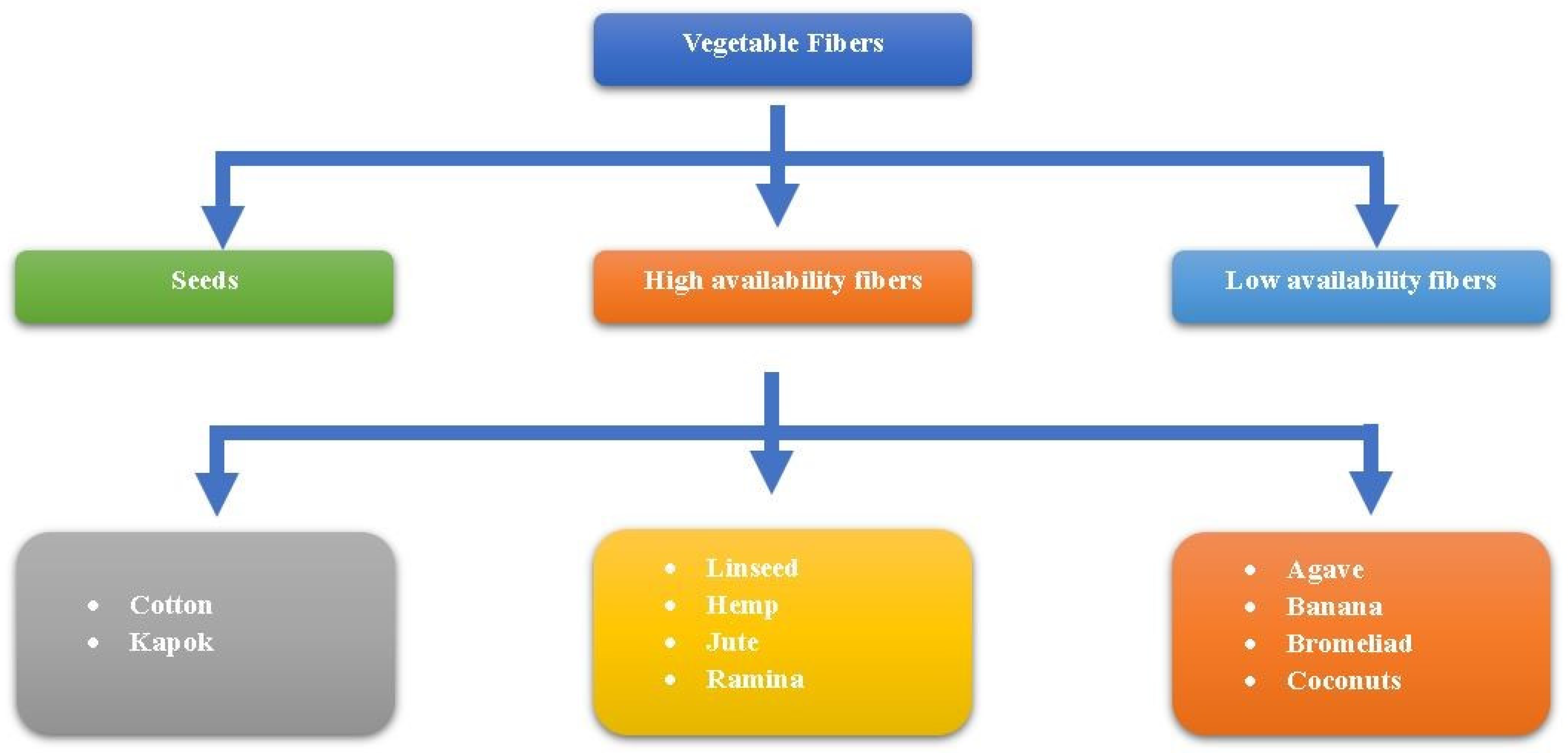
Vegetable fibers, often called continuous filaments or discrete elongated pieces, resemble yarns or ropes and can be spun into filaments, threads, or ropes. These versatile fibers have applications as components in composite materials and manufacturing paper sheets or felt [13]. The classification of plant fibers encompasses three main types: fibers from seeds, high-availability fibers, and low-availability fibers. Each category comes from different plant sources, as detailed in Figure 1 [14]. Table 1 shows the global production of some fibers worldwide.
Figure 1.

| Type of fiber | Fibers extracted from | Countries of origin | World production (103 ton) |
|---|---|---|---|
| Flax | Bast | Canada, France, Belgium, Spain | 830 |
| Hemp | Bast | China, France, Philippines, Poland, Spain | 214 |
| Jute | Bast | India, Egypt, Guyana, Jamaica, Ghana, Malawi, Sudan, Tanzania, Brazil, China, Bangladesh | 2300 |
| Kenaf | Bast | India, Bangladesh, USA, Iraq, Tanzania, Jamaica, South Africa, Cuba, Togo, Thailand | 970 |
| Ramie | Bast | China, Brazil, Philippines, India | 100 |
| Abaca | Leaf | Philippines, Ecuador, Costa Rica, Colombia | 70 |
| Curaua | Leaf | Brazil, Venezuela, Guyana, Columbia | >1 |
| Pineapple | Leaf | Philippines, Thailand, Indonesia | 74 |
| Sisal | Leaf | Brazil, East Africa, Haiti, Venezuela, Antiqua, Kenya, Tanzania, India | 378 |
| Coir | Seed | India, Sri Lanka, Philippines, Malaysia, Brazil | 100 |
| Cotton | Seed | China, India, USA | 25,000 |
| Oil Palm | Seed | Malaysia, Indonesia | 40 |
| Bagasse | Grass | Brazil, India, China | 75,000 |
| Bamboo | Grass | India, China, Indonesia | 30,000 |
- Vegetable Fibers:
Vegetable fibers are extracted from various plants and have been used for centuries in a variety of applications. Among them, hemp (Cannabis sativa) is one of the most versatile and widely used in the manufacture of reinforced polymers. Hemp stands out for its high mechanical strength and lightweight, which makes it an excellent choice for applications where the strength-to-weight ratio is important.
Fibers are obtained from different sources and can be obtained naturally, and each of them may differ in their properties, but generally there are some similarities between them. Table 2 lists their advantages and disadvantages, and Table 3 shows the chemical composition of some fibers reported in the literature to obtain composites materials with different polymers.
Table 2.
Advantages and disadvantages of natural fibers [17].
Table 2.
Advantages and disadvantages of natural fibers [17].
| Advantages | Disadvantages |
|---|---|
|
|
Table 3.
Chemical composition of some vegetable fibers.
| Fiber | Cellulose [wt%] |
Lignin [wt%] |
Hemicellulose [wt%] |
Pectin [wt%] |
Wax [wt%] |
Moisture [wt%] |
Ash [wt%] |
Micro-fibrillar angle [°] | Ref. |
|---|---|---|---|---|---|---|---|---|---|
| Abaca | 56-63 | 7-9 | 20-25 | - | 3 | - | - | 20-25 | [13] |
| Bamboo | 26-43 | 1-31 | 30 | - | - | 9.16 | - | - | [18] |
| Banana | 83 | 5 | - | - | - | 10.71 | - | 11-12 | [18] |
| Coir | 37 | 42 | - | - | - | 11.36 | - | 30.45 | [13] |
| Cotton | 82.7-91 | - | 3 | - | 0.6 | 7.85-8.5 | - | - | [13] |
| Curauá | 73.6 | 7.5 | 9.9 | - | - | - | - | - | [18] |
| Flax | 64.1-71.9 | 2-2.2 | 64.1-71.9 | 1.8-2.3 | 1.7 | 8-1.2 | - | 5-10 | [19] |
| Hemp | 70.2-74.4 | 3.7-5.7 | 17.9-22.4 | 0.9 | 0.8 | 6.2-1.2 | 0.8 | 2-6.2 | [18] |
| Jute | 61-71.5 | 12-13 | 17.9-22.4 | 0.2 | 0.5 | 12.5-13.7 | 0.5-2 | 8 | [20] |
| Kenaf | 45-57 | 21.5 | 8-13 | 0.6 | 0.8 | 6.2-12 | 2-5 | 2-6.2 | [13] |
| Rachis | 42.75 | 26 | - | - | - | - | - | 28-37 | [18] |
| Ramie | 68.6-91 | 0.4-0.7 | 5-14.7 | 1.9 | - | - | - | 69-83 | [13] |
| Rice husk | 38-45 | - | 12-20 | - | - | - | 20 | - | [18] |
| Sea Grass | 57 | 5 | 38 | 10 | - | - | - | - | [18] |
| Sisal | 78 | 8 | 10 | - | 2 | 11 | 1 | - | [13] |
3. Physical and Mechanical Properties of Vegetables Fibers
Vegetable fibers contain micro levels of fibers and matrices; their main composition is a combination of cellulose, lignin, and hemicellulose matrices; the properties of the natural fiber, such as mechanical strength and flexibility, are given by the structure of the different components in the fiber (Figure 2).
Table 4 presents some of the most relevant mechanical properties of various vegetable fibers compared to synthetic fibers.
The properties of materials reinforced with natural fibers are obtained from the volume fraction of the components, type of fibers, and distribution of the components in the solid. Heat treatment in diverse fiber-polymer composite materials is being investigated to improve the properties of these materials. These treatments may include chemical modifications, heat treatments, or external coupling agents that improve the bonding between the fibers and the matrix [21].
Another crucial aspect in developing materials reinforced with natural fibers is the prediction of Young’s modulus and composite strength. Several mathematical models established for specific systems have been implemented, allowing comparisons with experimental data obtained through mechanical tests.
It is important to note that while the incorporation of natural fibers can significantly improve certain properties of the composite material, there are also challenges in terms of fiber homogeneity and dispersion. These factors can affect the variability of properties and require careful optimization during the manufacturing process. To advance the field of natural fiber-reinforced materials, a multidisciplinary approach encompassing materials engineering, polymer chemistry, and solid mechanics is needed. In addition, the application of advanced characterization techniques, such as electron microscopy and image analysis, is essential to understanding the structure and mechanical behavior of composites [21].
4. Applications of Vegetable Fibers
Botanical types are widely used to classify natural fibers. According to Rowell R. [25], this approach identifies five specific types of natural fibers: (i) bark fibers, such as jute, flax, hemp, rami, and kenaf; (ii) leaf fibers, such as banana, sisal, agave, and pineapple; (iii) seed fibers, such as coir, cotton, and kapok; (iv) grass and reed fibers, such as wheat, corn, and rice; and (v) other types, such as roots and wood. It is important to mention that some crops can produce more than one type of fiber. For example, jute, flax, hemp, and kenaf have both bark and kernel fibers, while agave, coconut, and oil palm have both fruit and stalk fibers. Likewise, cereal grains also contain both stem and kernel fibers Table 5, [23].
Several previously cited researches have addressed the use of natural fibers as a fundamental element in the creation of composite materials, being applied in contexts such as the improvement of automotive interiors (such as roofs, side panel coatings, rear panels, and seats) [37,38].
In the natural fibers, the presence of polar groups such as hydroxyls, as well as components such as dead cells, wax, and oil, together with their limited fire resistance, results in an initial incompatibility between natural fibers in their raw state and polymers, which can lead to the formation of aggregates. Additionally, natural fibers’ high water absorption capacity leads to lower interface strength compared to composites based on glass or carbon fibers. Developing environmentally friendly composite applications is crucial to thoroughly understanding the fundamental properties and constituents of natural fibers. In addition, specific attributes such as length, flexibility, and strength must be satisfied to employ natural fibers in textile manufacturing.
Abaca-derived fibers have significant potential as a raw material in the textile industry due to their robustness and ability to resist moisture and salt water [29]. On the other hand, Biduri fibers present a hollow structure that acts as a kind of air medium or trap, which could be beneficial in applications where heat flow needs to be regulated and controlled [39]. In addition, Biduri fiber is hypoallergenic, soft, and hydrophobic [29].
Munawar et al. [40] have documented that ramie fibers, pineapple, and sansevieria leaves demonstrate natural thermal insulation qualities, renew their origin, and are in harmony with the environment. Also, sansevieria leaves are revealed as superior-performance plant fiber composite components, given their remarkable potential in terms of mechanical properties. In a separate study, Kandachar and Bruwer [41] report that hemp fiber, thanks to its exceptional strength and stiffness, is particularly suitable as a reinforcing agent in biocomposites, Natural Fiber Reinforced Plastics (Composites).
Natural fiber-reinforced composites use natural fibers themselves as the reinforcing component. These fibers are characterized by their abundance, renewable nature, biodegradability, and lower density compared to other synthetic materials used for reinforcement [42,43]. Some of the natural fibers commonly used as reinforcement include rice husk [44], henequen [45], banana [46], abaca [47], birch fibers [48], Hemp [49], jute [43,44,45,46,47,48,49,50], sisal [52,53], flax [54,55], curaua fibers [56], sour-weed [57], among others.
The composite manufacturing process involves a combination of components, including the matrix phase, which consists of natural resins, thermoplastics, and thermosets [58]; this matrix phase plays the role of binder, fusing the elements to form the composite. Among the natural resins used are wheat starch, corn starch, potato starch, biodegradable polyesters, and poly acids, among others [59]. On the other hand, thermosetting polymers include options such as epoxy, polyesters, and phenolics, among others. In addition, thermoplastic polymers, such as polycarbonate, polyvinyl chloride, nylon, polystyrene, polyethylene, among others, are also used in this mixture [49,50,51,52,53,54,55,56,57,58].
When employing plant fibers as reinforcement, it is essential to consider crucial factors, including fiber thermal stability, total fiber volume, fiber fraction or percentage, fiber size, fiber orientation, texture, wetting capacity, and moisture content [37].
The biodegradation capacity of plant fibers can contribute to ecosystem health and to their low cost and high performance, which meets the economic objectives of the industry. At the end of their life cycle, when polymers are reinforced with natural fibers for combustion or landfill processes, the amount of CO2 released by these fibers is balanced with the amount of CO2 absorbed during their growth [8,9,10,11,12,13,14,15,16,17,18,19,20,21,22,23,24,25,26,27,28,29,30,31,32,33,34,35,36,37,38,39,40,41,42,43,44,45,46,47,48,49,50,51,52,53,54,55,56,57,58,59,60,61,62].
Synthetic fibers of glass, carbon, and aramid, reinforced with polymeric matrices, offer significant advantages in terms of stiffness and strength-to-weight ratio in many applications compared to conventional construction materials. However, despite these advantages, researchers are working on developing natural composites for the widespread use of synthetic fiber-reinforced polymer composites, which are facing a decline due to their high initial costs. An additional significant challenge is that the production of synthetic composites consumes much energy and hurts the environment by the pollution generated during the production and recycling of these synthetic materials. A list of various plant fiber-reinforced polymer resins, as reported in various studies, is presented in Table 6.
5. Advantages of Plant Fiber Reinforced Plastics
Environmentally friendly composite materials have found diverse commercial applications due to their advantages, such as lower abrasiveness for processing equipment, renewability, lower energy consumption in processing, lightweight, non-toxicity, easy availability, low cost, and biodegradable properties. However, there are challenges to overcome, such as thermal stability, moisture absorption of natural fibers, and poor adhesion between these fibers and the matrix material, which are vital factors to consider in developing these materials [75]. The choice of natural fiber-reinforced materials as composites is due to several fundamental reasons [76].
I. Composites show good adaptability in different conditions since when any fiber is combined with other materials, it improves its mechanical properties significantly compared to other materials.
II. The tensile strength of composites is approximately 4 to 6 times higher than steel or aluminum, making them high-strength materials.
III. The strength-to-weight ratio of composites is higher than other materials, which makes them ideal for applications where high strength with reduced weight is sought.
IV. Composites have a high stiffness-to-mechanical strength ratio compared to other composite materials, making them structurally efficient.
V. Composites are lighter than other materials, such as wood and metals. These properties are widely used in manufacturing automobiles and airplanes since their lighter weight improves fuel efficiency and increases travel speed.
VI. Composites offer excellent resistance to environmental and chemical damage, making them ideal for applications in harsh environments.
VII. Composite materials exhibit high impact resistance, making them suitable for applications requiring increased shock and impact resistance.
VIII. Their ability to eliminate joints and simplify integrative designs makes them attractive in applications where reducing parts and assemblies is desirable.
IX. Composites exhibit exceptional corrosion resistance and good flame retardancy, making them suitable for applications where high protection against corrosive environments and fire hazards is needed.
X. composites offer good insulation and excellent thermal properties, making them useful in applications where effective temperature control is required.
In addition to the abovementioned advantages, natural fiber-reinforced composites also offer significant environmental benefits. Natural fibers are derived from renewable sources, such as plants; these materials reduce dependence on non-renewable resources and contribute to carbon footprint mitigation compared to traditional petroleum-based composite materials. Using natural fibers in composite materials can also promote the local economy and sustainability of the agricultural industry, as many fibers come from crops. Incorporating these materials into the industry can create economic opportunities for rural communities and encourage sustainable agricultural practices [5,6,7,8,9,10,11].
Another advantage of natural fiber-reinforced composites is their biodegradability. As concerns about environmental pollution and polymer waste increase, the ability to decompose naturally at the end of their useful life without leaving toxic residues. It represents a significant advance in the search for more sustainable solutions. It is essential to mention that while natural fiber-reinforced composites offer many advantages, there are also specific challenges to overcome in their development and application. The natural variability of the fibers, which can depend on factors such as the type of plant or the extraction process, can affect the uniformity and consistency of the material’s properties.
Therefore, continued research and development in this area is essential to optimize and refine the manufacture of natural fiber-reinforced composites, addressing the above challenges while maximizing their environmental and economic benefits.
6. Mechanical and Physical Properties of Composites
The mechanical properties of thermoplastic composites can be enhanced by improving fiber-matrix compatibility. These composites have also been shown to be biocompatible, making them promising options as biomaterials [77]. Several investigations have been carried out to study the effect of different factors on the mechanical behavior of polymer composites reinforced with natural fibers.
To improve the adhesion between the fibers and the polymer matrix, compatibilizers such as maleated ethylene, maleated polypropylene and some linear polymers grafted with acrylic are used [78,79], for example, in the case of HDPE composites with cellulose fiber at fiber concentrations between 10% and 30%, it has been observed that the incorporation of maleated ethylene produces a notable increase in tensile strength and tensile modulus. This positive effect is attributed to the coupling reaction, specifically an ester bond, between the maleated ethylene and the hydroxyl groups of the cellulose. This reaction improves the bonding between the fiber and the matrix, leading to a significant improvement in the mechanical properties of the composite [78]. In addition to compatibilizers, other factors such as fiber content and orientation, type of fiber used, surface treatments and processing techniques can also influence the mechanical behavior of composites reinforced with natural fibers.
It is important to note that the design and development of thermoplastic composites reinforced with natural fibers is a constantly evolving field of research. The optimization of the compatibility between the fiber and the matrix, as well as the search for new and more effective additives and treatments, are active areas of study with the aim of further improving the mechanical and functional properties of these materials. Furthermore, the study of their biocompatibility opens up exciting prospects for their application in biomedical and healthcare applications.
Reddy S. S. and Husain S.P. [80], conducted a study on the development and testing of natural fiber reinforced composites using polyester resin. According to their findings, the mechanical properties of polymer composites reinforced with sisal and hemp increased with increasing fiber fraction and fiber weight. The combination of hemp and sisal composites showed the best results. The interfacial adhesion between the matrix and the fibers mainly influenced the tensile properties of the composites reinforced with natural fibers (both thermoplastic and thermoset). In addition, it was found that chemical modifications of composite materials can improve their mechanical properties. Similar investigations on natural fibers such as bamboo, hemp, flax and kenaf also reveal that the mechanical properties of fiber-reinforced composites depend on various fiber parameters, including loading, length, aspect ratio, orientation and adhesion to the matrix. Sakthive M. and Ramesh S. [10], focused their study on the mechanical properties of polymer composites reinforced with natural fibers, specifically banana, coconut and sisal. They found that natural composites reinforced with banana obtained the best performance among the various combinations of natural fibers. These composites proved to be suitable for the manufacture of automotive seat shells, among other applications.
On the other hand, Carrasco et al. [21] investigated the mechanical properties of HDPE/wood fiber composites, evaluating two types of coupling agent: Epolane C-18 and Silane 174. The results indicated that the use of Silane coupling agents produced composites with better mechanical properties compared to wood fiber composites treated with Epolane or without any treatment. Pedroso and Rosa [81] fabricated recycled LDPE blends with corn starch and studied their mechanical, thermal and morphological properties. The addition of corn starch to the LDPE reduced the flow index and tensile strength, while the modulus increased. It was observed that the largest decrease in the melt flow index and tensile strength was most evident in the blends with 40 and 50 wt% corn starch.
Men et al. [82] developed a copolymer based on corn starch grafted onto polystyrene (starch-g-PS) using [EMIM]Ac ionic liquid as solvent and potassium persulfate. The resulting copolymer showed that the polystyrene side chains were evenly distributed over the starch backbone, suggesting that dissolving starch in ionic liquid before grafting polystyrene is a methodology for the synthesis of amphiphilic copolymers. Another study developed by Bing Zeng et al. [83] shows the elaboration of a mixture of poly(butylene succinate) (PBS) with thermoplastic starch (TPS), to improve the miscibility between TPS and PBS, the PBS reagent (RPBS) was first synthesized with the NCO terminal group and then mixed with thermoplastic starch. It was observed that the composite polymer obtained from the mixture improved its mechanical properties, tensile strength up to 10 times more than TPS, using only 10 wt% of RBS, water absorption decreased as the percentage of RPSB increased, thus the applications of these materials could be expanded. On the other hand, authors such as Chegdani et al. [84] studied the tribological properties of polypropylene reinforced with different types of natural fibers (bamboo, sisal and miscanthus), observing a viscoelastic behavior of the fiber that contributed to a deformation on the surface of the material during machining, increasing the surface strength in the contact area. Amri et al. [85] added graphene oxide to a bioplastic based on cassava starch, observing improvements in tensile strength and Young’s modulus with increasing graphene oxide concentration, although elongation tended to decrease. Chaka et al. [86] studied the compressive strength of recycled PET reinforced with natural banana and sisal fibers, showing that natural fiber-based composites were 36% lighter than glass-reinforced polymers and showed a maximum compression set of 3.1 MPa, suggesting that the use of natural fibers is a viable and economical alternative for the recycling of plastics such as PET. Khan et al., (2014) observed the mechanical properties of composites using okra as reinforcement in a matrix with phenol-formaldehyde and concluded that 30% okra fiber in the composite obtained the maximum tensile strength and deflection values.
Studies such as that of Bansal et al. [87] formulated a composite based on sesame residues and low density polyethylene, observing that gamma irradiation improved the mechanical properties of the composite, especially the test with 30 wt% of sesame irradiated with 125 kGy showed significant improvements [88]. According to the mechanical tests the test with 30 wt% sesame seed irradiated with 125 kGy was the one that showed improvements in its mechanical properties. Another similar study was conducted by Rahman et al. [88] in which, they studied gamma irradiations on polypropylene reinforced with okra fiber and polypropylene with jute fiber, both with 40% fiber concentration. The results showed that polypropylene with okra fiber improved its mechanical properties such as tensile strength, tensile modulus, elongation at break, impact resistance compared to polypropylene with jute fiber. Singh A. S. and Thakur V., [89] investigated the mechanical properties of natural fiber-reinforced polymers, finding that the tensile strength, compressive strength and wear resistance of urea-formaldehyde resin increased significantly when reinforced with fiber. Flax fiber showed a wide application potential in the fabrication of polymer composites reinforced with natural fibers. Maleque et al. [90] developed an aluminum composite reinforced with coconut fiber for brake pad applications in the automotive industry, observing that better mechanical properties were obtained with 5% and 10% coconut fibers. Alaneme et al. [91] studied the mechanical properties and corrosion behavior of the hybrid composite of aluminum reinforced with silicon carbide and bamboo leaf ash, the results showed that the hardness, ultimate tensile strength and percentage elongation of the hybrid composite, decrease with increasing bamboo leaf ash content. In addition, they showed high corrosion resistance compared to the simple reinforced composite. Sen T. et al. [92] studied various industrial applications of natural hemp, kenaf, flax and ramie fibers, while Shinji Ochi, [93] investigated the tensile properties of bamboo fiber reinforced biodegradable plastic, concluding that the tensile strength of composites increases with increasing fiber content up to 70%, showing an extremely high tensile strength of 265 N/mm2. Natural fibers have been cultivated and used mainly in rural developing countries in the manufacture of bags, brooms, fishing nets and filters [76]. Depending on the natural fiber, a long list of variations in its properties can be found [94]. Table 7 lists the physical and mechanical properties of various composites.
7. NFRP’s Applications
Today, natural fiber reinforced composites (NFRPs) are gaining ground in various industries due to their outstanding qualities. These qualities include low density, biodegradability, recycling potential, acceptable specific strength, convenient availability, reduced tool wear during the molding process, improved acoustic properties, reduced cost and ease in the manufacturing process. Although NFRPs find applications in several areas, they stand out mainly: a) the automotive industry, b) construction, and c) the sports industry. Although in other areas their presence may be less significant, it is in the automotive industry where the demand is most notorious. In this section, we will concentrate exclusively on automotive applications.
Figure 3.
Applications of NFRPs in the automotive field [63,64,65,66,67,68,69,70,71,72,73,74,75,76,77,78,79,80,81,82,83,84,85,86,87,88,89,90,91,92,93,94,95,96,97,98,99,100,101,102,103,104,105].
Figure 3.
Applications of NFRPs in the automotive field [63,64,65,66,67,68,69,70,71,72,73,74,75,76,77,78,79,80,81,82,83,84,85,86,87,88,89,90,91,92,93,94,95,96,97,98,99,100,101,102,103,104,105].
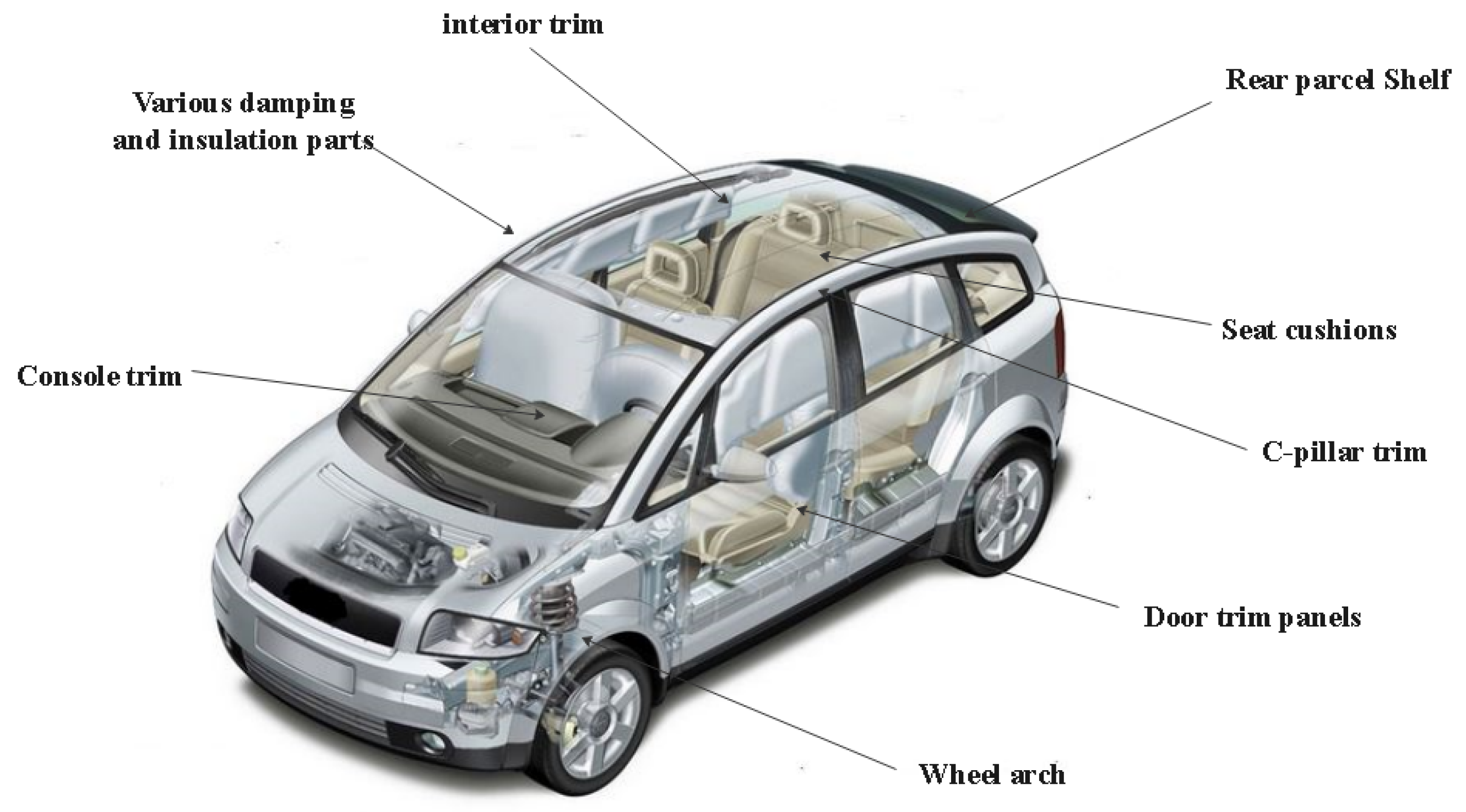
Table 8.
Compilation of NFRP applications in the automotive industry [106,107].
| Manufacturer | Car model | Applications |
|---|---|---|
| Audi | A2, A3, A4, A4 Avant, A6, A8, Roadstar, Coupe | Boot-liner, spare tire-lining, side and back door panel, seat back, and hat rack |
| BMW | 3,5 and 7 series and other Pilot | Seat back, headliner panel, boot-lining, door panels, noise insulation panels, and molded foot well linings. |
| Citroen | C5 | Interior door paneling |
| Daimler | A, C, E, and S class, EvoBus | Pillar cover panel, door panels, car windshield/car dashboard, and business table |
| Fiat | Punto, Brava, Marea, Alfa Romeo 146, 156, 159 | Door panel |
| Ford | Mondeo CD 162, Focus | Floor trays, door inserts, door panels, B-pillar, and boot-liner |
| General Motors | Cadillac De Ville, Chevrolet Trail Blazer | Seat backs, cargo area floor mat |
| Honda | Pilot | Cargo area |
| Lotus | Eco Elise | Body panels, spoiler, seats, and interior carpets |
| Mercedes Benz | C, S, E, and A classes | Door panels, glove box, instrument panel support, insulation, molding rod, seat backrest panel, trunk panel, and seat surface/backrest |
| Opel | Vectra, Astra, Zafira | Door panels, pillar cover panel, head-liner panel, and instrumental panel |
| Peugeot | 406 | Front and rear door panels, seat backs, and parcel shelf |
| Renault | Clio, Twingo | Rear parcel shelf |
| Rover | 2000 and others | Rear storage shelf/panel, and insulations |
| Toyota | ES3 | Pillar garnish and other interior parts |
| Volkswagen | Passat Variant, Golf, A4, Bora | Seat back, door panel, boot-lid finish panel, and boot-liner |
| Volvo | V70, C70 | Seat padding, natural foams, and cargo floor tray |
8. Challenges and Opportunities
Despite the wide variety of applications that natural fiber-reinforced composites have in the automotive industry and other sectors such as construction and sports, as well as in various products, there are still challenges in their large-scale implementation and development. Some of the main obstacles and areas of opportunity include improved mechanical properties, moisture and fire resistance, the inherent variability of natural fibers and complications in the manufacturing process. Adhesion between the fiber and matrix is a major concern, as it has a direct impact on delamination. Manufacturers should further investigate properties such as wetting, adhesion and weight ratio between fiber and matrix materials to prevent delamination in composites. Machining these composite materials also poses challenges, as fiber shedding and delamination are common problems observed by researchers during the machining process.
Despite the renewability and recyclability of the matrices and reinforcements used, solutions must be proposed to facilitate the recycling process and reduce operating costs [59].
9. Definitions
- -
- Abaca: abaca or banana fiber is cellulosic fiber obtained from banana fiber (Musa sepi-entum). It is generally found in tropical countries such as the Philippines and Ecuador, and its production is based on banana crop waste [70].
- -
- Bamboo: bamboo is a plant belonging to the grass family, its production is typically found in Indonesia, India and China [26].
- -
- Banana/Musa: banana fiber, obtained by processing the bark of the banana tree, is a type of lignocellulosic fiber, its major production is located in India, with about 22% of world production [101].
- -
- Coir: light and strong fiber, extracted from coconut husk, compared to other fibers, coconut fiber has more lignin and less cellulose and hemicellulose. The country with the largest production of coir is located in Kerala, India with approximately 60% of the world demand [32,65].
- -
- Cotton: a fiber with a high amount of cellulose and a low percentage of hemicellulose, the countries with the highest cotton production are China, USA, India and Pakistan [25].
- -
- Hemp: a fiber based on cellulose, hemicellulose, lignin and pectin. It is the second most cultivated fiber worldwide [49].
Abbreviations
| FRP | Fiber Reinforced Polymer |
| PP | Polypropylene |
| PE | Polyethylene |
| NFRPs | Natural Fiber Reinforced Polymer |
| HDPE | High Density Polyethylene |
| Kgy | Unit of radiation in the English system, amount of energy absorbed by the system. [J/Kg]. |
References
- S. K. Ramamoorthy, M. Skrifvars, and A. Persson, “A review of natural fibers used in biocomposites: Plant, animal and regenerated cellulose fibers,” Polym. Rev., vol. 55, no. 1, pp. 107–162, 2015. [CrossRef]
- M. J. John and S. Thomas, “Biofibres and biocomposites,” Carbohydr. Polym., vol. 71, no. 3, pp. 343–364, 2008. [CrossRef]
- A. K. Bledzki and J. Gassan, “Composites reinforced with cellulose_Bledzki_1999.pdf,” Prog. Polym. Sci., vol. 24, pp. 221–274, 1999, [Online]. Available online: http://ac.els-cdn.com/S0079670098000185/1-s2.0-S0079670098000185-main.pdf?_tid=af34542c-0260-11e7-a49c-00000aab0f27&acdnat=1488800173_c95596c7ddcc4673fe88c8ec84262bb9.
- A. K. Mohanty, M. Misra, and G. Hinrichsen, “Biofibres, biodegradable polymers and biocomposites: An overview,” Macromol. Mater. Eng., vol. 276–277, pp. 1–24, 2000. [CrossRef]
- H. M. Akil, M. F. Omar, A. A. M. Mazuki, S. Safiee, Z. A. M. Ishak, and A. Abu Bakar, “Kenaf fiber reinforced composites: A review,” Mater. Des., vol. 32, no. 8–9, pp. 4107–4121, 2011. [CrossRef]
- V. Chauhan, T. Kärki, and J. Varis, “Review of natural fiber-reinforced engineering plastic composites, their applications in the transportation sector and processing techniques,” J. Thermoplast. Compos. Mater., vol. 35, no. 8, pp. 1169–1209, 2022. [CrossRef]
- J. Holbery and D. Houston, “Natural-fiber-reinforced polymer composites in automotive applications,” Jom, vol. 58, no. 11, pp. 80–86, 2006. [CrossRef]
- N. Jauhari, R. Mishra, and H. Thakur, “Natural Fibre Reinforced Composite Laminates - A Review,” Mater. Today Proc., vol. 2, no. 4–5, pp. 2868–2877, 2015. [CrossRef]
- M. Jawaid and H. P. S. Abdul Khalil, “Cellulosic/synthetic fibre reinforced polymer hybrid composites: A review,” Carbohydr. Polym., vol. 86, no. 1, pp. 1–18, 2011. [CrossRef]
- M. R. Sanjay, G. R. Arpitha, and B. Yogesha, “Study on Mechanical Properties of Natural - Glass Fibre Reinforced Polymer Hybrid Composites: A Review,” Mater. Today Proc., vol. 2, no. 4–5, pp. 2959–2967, 2015. [CrossRef]
- J. Agarwal, S. Sahoo, S. Mohanty, and S. K. Nayak, “Progress of novel techniques for lightweight automobile applications through innovative eco-friendly composite materials: A review,” J. Thermoplast. Compos. Mater., vol. 33, no. 7, pp. 978–1013, 2020. [CrossRef]
- S. Brischetto, “Analysis of natural fibre composites for aerospace structures,” Aircr. Eng. Aerosp. Technol., vol. 90, no. 9, pp. 1372–1384, 2018. [CrossRef]
- F. Ahmad, H. S. Choi, and M. K. Park, “A review: Natural fiber composites selection in view of mechanical, light weight, and economic properties,” Macromol. Mater. Eng., vol. 300, no. 1, pp. 10–24, 2015. [CrossRef]
- R. Vinayagamoorthy, “A review on the polymeric laminates reinforced with natural fibers,” J. Reinf. Plast. Compos., vol. 36, no. 21, pp. 1577–1589, 2017. [CrossRef]
- O. Adekomaya, T. Jamiru, R. Sadiku, and Z. Huan, “A review on the sustainability of natural fiber in matrix reinforcement - A practical perspective,” J. Reinf. Plast. Compos., vol. 35, no. 1, pp. 3–7, 2016. [CrossRef]
- K. Majeed et al., “Potential materials for food packaging from nanoclay/natural fibres filled hybrid composites,” Mater. Des., vol. 46, pp. 391–410, 2013. [CrossRef]
- M. F. Gomez Berrezueta and P. W. Méndez, “Polipropileno Reforzado con Fibra Natural para Fabricación de Paneles Internos de las Puertas de un Automóvil,” INNOVA Res. J., vol. 2, no. 10.1, pp. 109–137, 2017. [CrossRef]
- M. S. Huda, L. T. Drzal, A. K. Mohanty, and M. Misra, “Chopped glass and recycled newspaper as reinforcement fibers in injection molded poly(lactic acid) (PLA) composites: A comparative study,” Compos. Sci. Technol., vol. 66, no. 11–12, pp. 1813–1824, 2006. [CrossRef]
- R. M. Rowell, A. R. Sanadi, D. F. Caulfield, and R. E. Jacobson, “Utilization of Natural Fibers in Plastic Composites: Problems and Opportunities,” Lignocellul. Compos., pp. 23–51, 1997, [Online]. Available online: http://www.fpl.fs.fed.us/documnts/pdf1997/rowel97d.pdf.
- J. Summerscales, N. P. J. Dissanayake, A. S. Virk, and W. Hall, “A review of bast fibres and their composites. Part 1 - Fibres as reinforcements,” Compos. Part A Appl. Sci. Manuf., vol. 41, no. 10, pp. 1329–1335, 2010. [CrossRef]
- D. Nabi Saheb and J. P. Jog, “Natural fiber polymer composites: A review,” Adv. Polym. Technol., vol. 18, no. 4, pp. 351–363, 1999. [CrossRef]
- D. Rouison, M. Sain, and M. Couturier, “Resin transfer molding of natural fiber reinforced composites: Cure simulation,” Compos. Sci. Technol., vol. 64, no. 5, pp. 629–644, 2004. [CrossRef]
- R. M. Rowell, The use of biomass to produce bio-based composites and building materials. Woodhead Publishing Limited, 2014.
- R. M. Rowell, “Natural fibres: Types and properties,” Prop. Perform. Nat. Compos., pp. 3–66, 2008. [CrossRef]
- J. Singh Dhaliwal, “Natural Fibers: Applications,” Gener. Dev. Modif. Nat. Fibers, pp. 1–23, 2020. [CrossRef]
- W. Fatriasari, W. Syafii, N. J. Wistara, K. Syamsu, and B. Prasetya, “The characteristic changes of betung bamboo (Dendrocalamus asper) pretreated by fungal pretreatment,” Int. J. Renew. Energy Dev., vol. 3, no. 2, pp. 133–143, 2014. [CrossRef]
- K. Oksman et al., “Review of the recent developments in cellulose nanocomposite processing,” Compos. Part A Appl. Sci. Manuf., vol. 83, pp. 2–18, 2016. [CrossRef]
- U. S. Gupta, M. Dhamarikar, A. Dharkar, S. Tiwari, and R. Namdeo, “Study on the effects of fibre volume percentage on banana-reinforced epoxy composite by finite element method,” Adv. Compos. Hybrid Mater., vol. 3, no. 4, pp. 530–540, 2020. [CrossRef]
- A. Karimah et al., “A review on natural fibers for development of eco-friendly bio-composite: characteristics, and utilizations,” J. Mater. Res. Technol., vol. 13, pp. 2442–2458, 2021. [CrossRef]
- O. Suparno, “Potensi Dan Masa Depan Serat Alam Indonesia Sebagai Bahan Baku Aneka Industri,” J. Teknol. Ind. Pertan., vol. 30, no. 2, pp. 221–227, 2020. [CrossRef]
- I. P. C. and S. R., “Characterization of a new natural cellulosic fiber extracted from Derris scandens stem,” Int. J. Biol. Macromol., vol. 165, pp. 2303–2313, 2020. [CrossRef]
- Y. G. Thyavihalli Girijappa, S. Mavinkere Rangappa, J. Parameswaranpillai, and S. Siengchin, “Natural Fibers as Sustainable and Renewable Resource for Development of Eco-Friendly Composites: A Comprehensive Review,” Front. Mater., vol. 6, no. September, pp. 1–14, 2019. [CrossRef]
- A. Putra, I. Prasetiyo, and Z. Selamat, Green Acoustic Absorber from Pineapple Leaf Fibers. 2020.
- S. N. Kane, A. Mishra, and A. K. Dutta, “Post-treatment Effect of Particleboard on Dimensional Stability and Durability Properties of Particleboard Made From Sorghum Bagasse,” J. Phys. Conf. Ser., vol. 755, no. 1, 2016. [CrossRef]
- A. Heri Iswanto, S. Supriyanto, W. Fatriasari, and A. Susilowati, “Effect of particle treatment and adhesive type on physical, mechanical, and durability properties of particleboard made from Sorghum Bagasse,” IOP Conf. Ser. Earth Environ. Sci., vol. 126, no. 1, 2018. [CrossRef]
- F. A. Syamani, D. Ramatia, Sudarmanto, F. Akbar, S. S. Kusumah, and D. Hermawan, “Combination of citric acid and maltodextrin as bonding agent in sorghum bagasse particleboard,” IOP Conf. Ser. Mater. Sci. Eng., vol. 935, no. 1, 2020. [CrossRef]
- S. K. S and S. S. Hiremath, Natural Fiber Reinforced Composites in the Context of Biodegradability: A Review, vol. 1–5. Elsevier Ltd., 2020.
- K. tak Lau, P. yan Hung, M. H. Zhu, and D. Hui, “Properties of natural fibre composites for structural engineering applications,” Compos. Part B Eng., vol. 136, no. September 2017, pp. 222–233, 2018. [CrossRef]
- S. Hassanzadeh and H. Hasani, “A review on milkweed fiber properties as a high-potential raw material in textile applications,” J. Ind. Text., vol. 46, no. 6, pp. 1412–1436, 2017. [CrossRef]
- S. S. Munawar, K. Umemura, and S. Kawai, “Characterization of the morphological, physical, and mechanical properties of seven nonwood plant fiber bundles,” J. Wood Sci., vol. 53, no. 2, pp. 108–113, 2007. [CrossRef]
- P. Kandachar and R. Brouwer, “Applications of bio-composites in industrial products,” Mater. Res. Soc. Symp. - Proc., vol. 702, pp. 101–112, 2002. [CrossRef]
- K. Joseph, R. D. Tolêdo Filho, B. James, S. Thomas, and L. H. de Carvalho, “a Review on Sisal Fiber Reinforced Polymer Composites,” Rev. Bras. Eng. Agrícola e Ambient., vol. 3, no. 3, pp. 367–379, 1999. [CrossRef]
- V. Chaudhary, P. K. Bajpai, and S. Maheshwari, “Effect of moisture absorption on the mechanical performance of natural fiber reinforced woven hybrid bio-composites,” J. Nat. Fibers, vol. 17, no. 1, pp. 84–100, 2020. [CrossRef]
- J. Wei and C. Meyer, “Utilization of rice husk ash in green natural fiber-reinforced cement composites: Mitigating degradation of sisal fiber,” Cem. Concr. Res., vol. 81, pp. 94–111, 2016. [CrossRef]
- P. J. Herrera-Franco and A. Valadez-González, “A study of the mechanical properties of short natural-fiber reinforced composites,” Compos. Part B Eng., vol. 36, no. 8, pp. 597–608, 2005. [CrossRef]
- K. Oksman, A. P. Mathew, R. Långström, B. Nyström, and K. Joseph, “The influence of fibre microstructure on fibre breakage and mechanical properties of natural fibre reinforced polypropylene,” Compos. Sci. Technol., vol. 69, no. 11–12, pp. 1847–1853, 2009. [CrossRef]
- M. Cai, H. Takagi, A. N. Nakagaito, Y. Li, and G. I. N. Waterhouse, “Effect of alkali treatment on interfacial bonding in abaca fiber-reinforced composites,” Compos. Part A Appl. Sci. Manuf., vol. 90, pp. 589–597, 2016. [CrossRef]
- M. Mejri, L. Toubal, J. C. Cuillière, and V. François, “Hygrothermal aging effects on mechanical and fatigue behaviors of a short- natural-fiber-reinforced composite,” Int. J. Fatigue, vol. 108, pp. 96–108, 2018. [CrossRef]
- A. Q. Dayo et al., “Natural hemp fiber reinforced polybenzoxazine composites: Curing behavior, mechanical and thermal properties,” Compos. Sci. Technol., vol. 144, pp. 114–124, 2017. [CrossRef]
- R. Basak, P. L. Choudhury, and K. M. Pandey, “Effect of Temperature Variation on Surface Treatment of Short Jute Fiber-Reinforced Epoxy Composites,” Mater. Today Proc., vol. 5, no. 1, pp. 1271–1277, 2018. [CrossRef]
- V. Chaudhary, P. K. Bajpai, and S. Maheshwari, “Studies on Mechanical and Morphological Characterization of Developed Jute/Hemp/Flax Reinforced Hybrid Composites for Structural Applications,” J. Nat. Fibers, vol. 15, no. 1, pp. 80–97, 2018. [CrossRef]
- J. Giridhar, Kishore, and R. M. V. G. K. Rao, “Moisture absorption characteristics of natural fibre composites,” no. April, pp. 141–150, 1986.
- P. K. Bajpai, K. Debnath, and I. Singh, “Hole making in natural fiber-reinforced polylactic acid laminates: An experimental investigation,” J. Thermoplast. Compos. Mater., vol. 30, no. 1, pp. 30–46, 2017. [CrossRef]
- A. Arbelaiz, B. Fernández, J. A. Ramos, and I. Mondragon, “Thermal and crystallization studies of short flax fibre reinforced polypropylene matrix composites: Effect of treatments,” Thermochim. Acta, vol. 440, no. 2, pp. 111–121, 2006. [CrossRef]
- J. Andersons, E. Sparniņš, R. Joffe, and L. Wallström, “Strength distribution of elementary flax fibres,” Compos. Sci. Technol., vol. 65, no. 3–4, pp. 693–702, 2005. [CrossRef]
- S. N. Monteiro et al., “Natural Curaua Fiber-Reinforced Composites in Multilayered Ballistic Armor,” Metall. Mater. Trans. A Phys. Metall. Mater. Sci., vol. 46, no. 10, pp. 4567–4577, 2015. [CrossRef]
- F. A. Chaves and D. Jiménez, “Physico-mechanical and wear properties of novel sustainable sour-weed fiber reinforced polyester composites,” Nanotechnology, vol. 29, no. 27, 2018.
- C. Alves et al., “Ecodesign of automotive components making use of natural jute fiber composites,” J. Clean. Prod., vol. 18, no. 4, pp. 313–327, 2010. [CrossRef]
- K. G. Satyanarayana, G. G. C. Arizaga, and F. Wypych, “Biodegradable composites based on lignocellulosic fibers-An overview,” Prog. Polym. Sci., vol. 34, no. 9, pp. 982–1021, 2009. [CrossRef]
- H. Ku, H. Wang, N. Pattarachaiyakoop, and M. Trada, “A review on the tensile properties of natural fiber reinforced polymer composites,” Compos. Part B Eng., vol. 42, no. 4, pp. 856–873, 2011. [CrossRef]
- B. C. Mitra, “Environment friendly composite materials: Biocomposites and green composites,” Def. Sci. J., vol. 64, no. 3, pp. 244–261, 2014. [CrossRef]
- P. Wambua, J. Ivens, and I. Verpoest, “Natural fibres: Can they replace glass in fibre reinforced plastics?,” Compos. Sci. Technol., vol. 63, no. 9, pp. 1259–1264, 2003. [CrossRef]
- K. L. Fung, X. S. Xing, R. K. Y. Li, S. C. Tjong, and Y. W. Mai, “An investigation on the processing of sisal fibre reinforced polypropylene composites,” Compos. Sci. Technol., vol. 63, no. 9, pp. 1255–1258, 2003. [CrossRef]
- H. Anuar and A. Zuraida, “Improvement in mechanical properties of reinforced thermoplastic elastomer composite with kenaf bast fibre,” Compos. Part B Eng., vol. 42, no. 3, pp. 462–465, 2011. [CrossRef]
- S. Harish, D. P. Michael, A. Bensely, D. M. Lal, and A. Rajadurai, “Mechanical property evaluation of natural fiber coir composite,” Mater. Charact., vol. 60, no. 1, pp. 44–49, 2009. [CrossRef]
- H. P. Guimarães Santafé, F. P. Duarte Lopes, and S. N. Monteiro, “Mechanical properties of tensile tested coir fiber reinforced polyester composites,” 65th ABM Int. Congr. 18th IFHTSE Congr. 1st TMS/ABM Int. Mater. Congr. 2010, vol. 6, pp. 4987–4993, 2010.
- I. O. Bakare, F. E. Okieimen, C. Pavithran, H. P. S. Abdul Khalil, and M. Brahmakumar, “Mechanical and thermal properties of sisal fiber-reinforced rubber seed oil-based polyurethane composites,” Mater. Des., vol. 31, no. 9, pp. 4274–4280, 2010. [CrossRef]
- M. Ashok Kumar, G. Ramachandra Reddy, Y. Siva Bharathi, S. Venkata Naidu, and V. Naga Prasad Naidu, “Frictional coefficient, hardness, impact strength, and chemical resistance of reinforced sisal-glass fiber epoxy hybrid composites,” J. Compos. Mater., vol. 44, no. 26, pp. 3195–3202, 2010. [CrossRef]
- B. H. Lee, H. J. Kim, and W. R. Yu, “Fabrication of long and discontinuous natural fiber reinforced polypropylene biocomposites and their mechanical properties,” Fibers Polym., vol. 10, no. 1, pp. 83–90, 2009. [CrossRef]
- A. K. Bledzki, A. A. Mamun, and O. Faruk, “Abaca fibre reinforced PP composites and comparison with jute and flax fibre PP composites,” Express Polym. Lett., vol. 1, no. 11, pp. 755–762, 2007. [CrossRef]
- B. H. Lee, H. S. Kim, S. Lee, H. J. Kim, and J. R. Dorgan, “Bio-composites of kenaf fibers in polylactide: Role of improved interfacial adhesion in the carding process,” Compos. Sci. Technol., vol. 69, no. 15–16, pp. 2573–2579, 2009. [CrossRef]
- C. W. Chin and B. F. Yousif, “Potential of kenaf fibres as reinforcement for tribological applications,” Wear, vol. 267, no. 9–10, pp. 1550–1557, 2009. [CrossRef]
- Z. N. Azwa and B. F. Yousif, “Characteristics of kenaf fibre/epoxy composites subjected to thermal degradation,” Polym. Degrad. Stab., vol. 98, no. 12, pp. 2752–2759, 2013. [CrossRef]
- R. M. N. Arib, S. M. Sapuan, M. M. H. M. Ahmad, M. T. Paridah, and H. M. D. Khairul Zaman, “Mechanical properties of pineapple leaf fibre reinforced polypropylene composites,” Mater. Des., vol. 27, no. 5, pp. 391–396, 2006. [CrossRef]
- M. S. Anbupalani, C. D. Venkatachalam, and R. Rathanasamy, “Influence of coupling agent on altering the reinforcing efficiency of natural fibre-incorporated polymers – A review,” J. Reinf. Plast. Compos., vol. 39, no. 13–14, pp. 520–544, 2020. [CrossRef]
- K. N. Keya, N. A. Kona, F. A. Koly, K. M. Maraz, M. N. Islam, and R. A. Khan, “Natural fiber reinforced polymer composites: history, types, advantages, and applications,” Mater. Eng. Res., vol. 1, no. 2, pp. 69–87, 2019. [CrossRef]
- R. S. Jagadish and B. Raj, “Properties and sorption studies of polyethylene oxide-starch blended films,” Food Hydrocoll., vol. 25, no. 6, pp. 1572–1580, 2011. [CrossRef]
- R. G. Raj, B. V. Kokta, D. Maldas, and C. Daneault, “Use of wood fibers in thermoplastics. VII. The effect of coupling agents in polyethylene–wood fiber composites,” J. Appl. Polym. Sci., vol. 37, no. 4, pp. 1089–1103, 1989. [CrossRef]
- O. Faruk and A. K. Bledzki, “Wood Plastic Composite: Present and Future,” Wiley Encycl. Compos., 2012. [CrossRef]
- T. Of, N. Fiber, R. Composites, and W. Polyester, “Development and Testing Of Natural Fiber Reinforced Composites With Polyester Resin,” Int. J. Eng. Sci. Res. Technol., vol. 2, no. 10, pp. 2701–2706, 2013.
- A. G. Pedroso and D. S. Rosa, “Mechanical, thermal and morphological characterization of recycled LDPE/corn starch blends,” Carbohydr. Polym., vol. 59, no. 1, pp. 1–9, 2005. [CrossRef]
- Y. Men, X. Du, J. Shen, L. Wang, and Z. Liu, “Preparation of corn starch-g-polystyrene copolymer in ionic liquid: 1-Ethyl-3-methylimidazolium acetate,” Carbohydr. Polym., vol. 121, pp. 348–354, 2015. [CrossRef]
- J. B. Zeng, L. Jiao, Y. D. Li, M. Srinivasan, T. Li, and Y. Z. Wang, “Bio-based blends of starch and poly(butylene succinate) with improved miscibility, mechanical properties, and reduced water absorption,” Carbohydr. Polym., vol. 83, no. 2, pp. 762–768, 2011. [CrossRef]
- F. Chegdani, S. Mezghani, M. El Mansori, and A. Mkaddem, “Fiber type effect on tribological behavior when cutting natural fiber reinforced plastics,” Wear, vol. 332–333, pp. 772–779, 2015. [CrossRef]
- A. Amri et al., “Properties enhancement of cassava starch based bioplastics with addition of graphene oxide,” IOP Conf. Ser. Mater. Sci. Eng., vol. 345, no. 1, 2018. [CrossRef]
- K. T. Chaka, F. E. Ahmed, L. H. Zegeye, and B. G. Worku, “Compressive Strength of Floor Tile Composites from Recycled PET Reinforced with Natural Fibers,” J. Nat. Fibers, vol. 00, no. 00, pp. 1–14, 2022. [CrossRef]
- N. Bansal, S. Ahuja, S. Lal, and S. Arora, “Agricultural-waste Sesamum indicum L. / recycled-low density polyethylene bio- composites: Impact of gamma radiation on mechanical and thermal properties,” 2023. [CrossRef]
- A. N. M. Masudur Rahman, S. Alimuzzaman, R. A. Khan, and J. Hossen, “Evaluating the performance of gamma irradiated okra fiber reinforced polypropylene (PP) composites: comparative study with jute/PP,” Fash. Text., vol. 5, no. 1, 2018. [CrossRef]
- A. S. Singha and V. K. Thakur, “Mechanical properties of natural fibre reinforced polymer composites,” Bull. Mater. Sci., vol. 31, no. 5, pp. 791–799, 2008. [CrossRef]
- M. A. Maleque, A. Atiqah, R. J. Talib, and H. Zahurin, “New natural fibre reinforced aluminium composite for automotive brake pad,” Int. J. Mech. Mater. Eng., vol. 7, no. 2, pp. 166–170, 2012.
- K. K. Alaneme, B. O. Ademilua, and M. O. Bodunrin, “Mechanical properties and corrosion behaviour of aluminium hybrid composites reinforced with silicon carbide and bamboo leaf ash,” Tribol. Ind., vol. 35, no. 1, pp. 25–35, 2013.
- T. Sen and H. N. J. Reddy, “Various Industrial Applications Of Hemp, Kinaf, Flax and Ramie Natural Fibres,” vol. 2, no. 3, 2011.
- S. Ochi, “Tensile Properties of Bamboo Fiber Reinforced Biodegradable Plastics,” Int. J. Compos. Mater., vol. 2, no. 1, pp. 1–4, 2012. [CrossRef]
- Farideh Namvar et al. et al., “Potential Use of Plant Fibres and their Composites for Biomedical Applications,” Bioresources, vol. 9, no. 3, pp. 5688–5706, 2016, [Online]. Available online: http://bioresources.com.
- S. J. Eichhorn et al., “Current international research into cellulosic fibres and composites,” J. Mater. Sci., vol. 36, no. 9, pp. 2107–2131, 2001. [CrossRef]
- M. G. Maya, S. C. George, T. Jose, M. S. Sreekala, and S. Thomas, “Mechanical properties of short sisal fibre reinforced phenol formaldehyde eco-friendly composites,” Polym. from Renew. Resour., vol. 8, no. 1, pp. 27–42, 2017. [CrossRef]
- S. Sabinesh, “Investigation on Tensile and Flexural properties of Cotton Fiber Reinforced Isophthallic Polyester Composites,” Int. J. Curr. Eng. Technol., vol. 2, no. 2, pp. 213–219, 2013. [CrossRef]
- N. Lu, R. H. Swan, and I. Ferguson, “Composition, structure, and mechanical properties of hemp fiber reinforced composite with recycled high-density polyethylene matrix,” J. Compos. Mater., vol. 46, no. 16, pp. 1915–1924, 2012. [CrossRef]
- T. Gurunathan, S. Mohanty, and S. K. Nayak, “A review of the recent developments in biocomposites based on natural fibres and their application perspectives,” Compos. Part A Appl. Sci. Manuf., vol. 77, pp. 1–25, 2015. [CrossRef]
- N. M. Barkoula, B. Alcock, N. O. Cabrera, and T. Peijs, “Flame-Retardancy Properties of Intumescent Ammonium Poly(Phosphate) and Mineral Filler Magnesium Hydroxide in Combination with Graphene,” Polym. Polym. Compos., vol. 16, no. 2, pp. 101–113, 2008.
- H. Das, P. Saikia, and D. Kalita, “Physico-mechanical properties of banana fiber reinforced polymer composite as an alternative building material,” Key Eng. Mater., vol. 650, pp. 131–138, 2015. [CrossRef]
- T. Sonar, S. Patil, V. Deshmukh, and R. Acharya, “Natural Fiber Reinforced Polymer Composite Material-A Review,” IOSR J. Mech. Civ. Eng., pp. 142–147, 2015.
- A. Honda, M. Morita, A. Taniguchi, A. Tabuchi, and S. Kubo, “Successful extracorporeal membrane oxygenation for a patient with nearly fatal hypoxemia induced by transfusion-related acute lung injury,” Japanese J. Anesthesiol., vol. 64, no. 11, pp. 1181–1185, 2015.
- H. Yan Cheung, M. po Ho, K. tak Lau, F. Cardona, and D. Hui, “Natural fibre-reinforced composites for bioengineering and environmental engineering applications,” Compos. Part B Eng., vol. 40, no. 7, pp. 655–663, 2009. [CrossRef]
- B. M. Zaidi, J. Zhang, K. Magniez, H. Gu, and M. Miao, “Optimizing twisted yarn structure for natural fiber-reinforced polymeric composites,” J. Compos. Mater., vol. 52, no. 3, pp. 373–381, 2018. [CrossRef]
- L. Mohammed, M. N. M. Ansari, G. Pua, M. Jawaid, and M. S. Islam, “A Review on Natural Fiber Reinforced Polymer Composite and Its Applications,” Int. J. Polym. Sci., vol. 2015, 2015. [CrossRef]
- O. Faruk, A. K. Bledzki, H. P. Fink, and M. Sain, “Progress report on natural fiber reinforced composites,” Macromol. Mater. Eng., vol. 299, no. 1, pp. 9–26, 2014. [CrossRef]
Figure 2.
Schematic of the structure of a natural plant fiber [24].
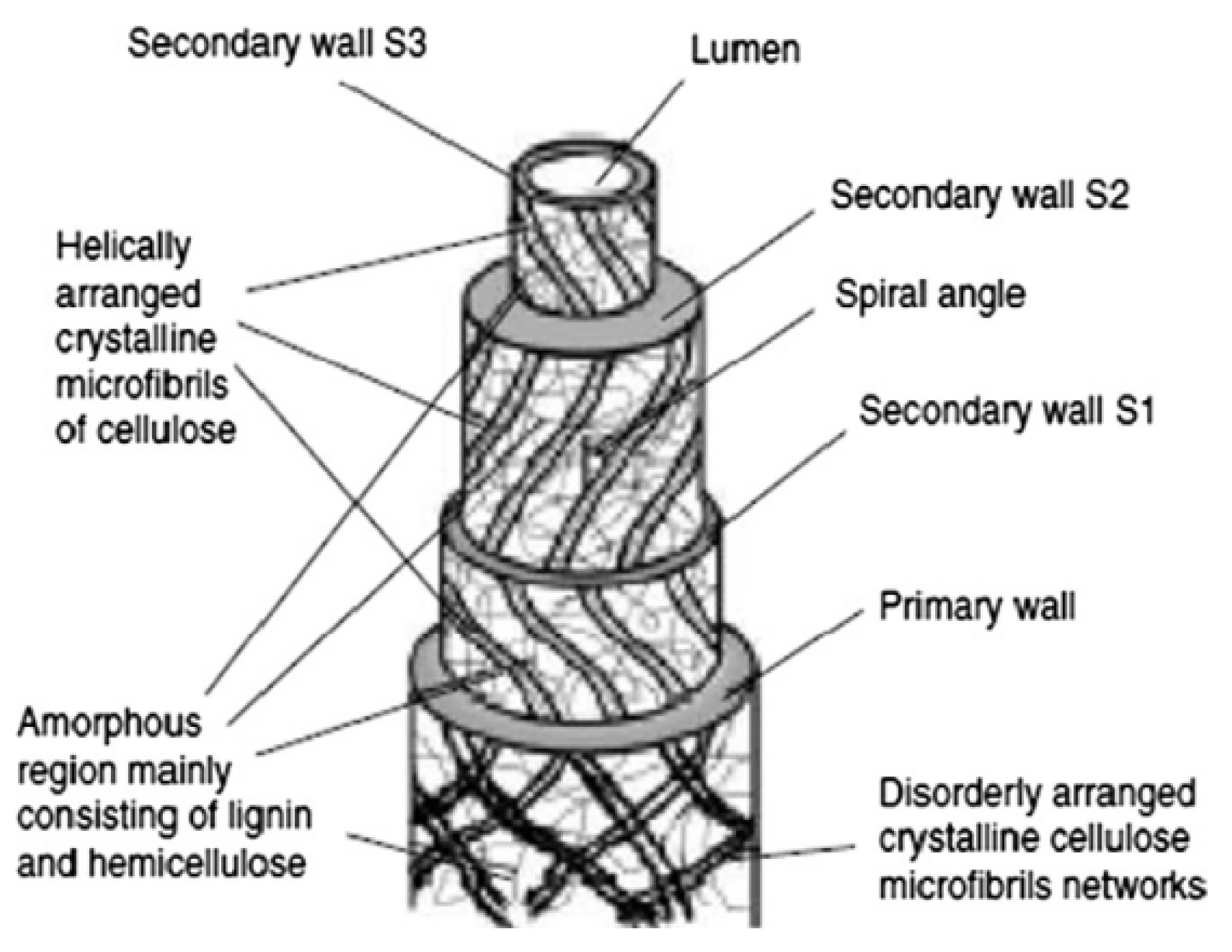
Table 4.
Properties of different natural fibers [14].
Table 4.
Properties of different natural fibers [14].
| Vegetable Fibers |
Density (g/cm3) |
Diameter (μm) |
Tensile Strength (MPa) | Module of Young’s (GPa) | Breaking strain (%) |
|---|---|---|---|---|---|
| Abaca | 1.5 | 10-30 | 400 | 12 | 3-10 |
| Alpha | 0.89 | - | 350 | 22 | 5.8 |
| Bagasse | 1.25 | 490 | 70 | 17 | 3-5 |
| Bamboo | 0.88-1.1 | 100-200 | 391-713 | 18-55 | 1.3 |
| Banana | 1.35 | 50-250 | 500-550 | 12-20 | 5-6 |
| Coconuit | 0.8 | 100-450 | 131-175 | 4-13 | 15-40 |
| Coir | 1.2 | 10-16 | 175 | 4-6 | 30 |
| Cotton | 1.5-1.6 | 20 | 287-597 | 5-13 | 7-8 |
| Curagua | 1.38 | 66 | 913 | 50-70 | 3.9 |
| Date palm | 1-1.2 | 14-18 | 97-196 | 2.5-5.4 | 2-4.5 |
| Flax | 1.5 | 50-100 | 345-1035 | 50-70 | 2.7-3.2 |
| Hemp | 1.1 | 120 | 389-900 | 35 | 1.6 |
| Henequen | 1.49 | 180 | 430-580 | 10.1-16.3 | 1.6 |
| Ixora | 1.2-1.3 | 10 | 500-600 | - | 5-6 |
| Jute | 1.3 | 260 | 393-773 | 23-27 | 1.4 |
| Kenaf | 1.31 | 106 | 427-519 | 23-27 | 1.8 |
| licuri | - | 132-165 | 287-597 | 5-13 | 7.8 |
| nettle | 1.5 | 20-80 | 650 | 38 | 1.7 |
| Oil palm | 0.7-1.55 | 150-250 | 248 | 25 | 3.2 |
| Palmira palm tree | 1.2 | 300-320 | 276 | 8.99 | 3.08 |
| Piasava | 1.4 | - | 134-143 | 1.07-4.59 | 7.8-21.9 |
| Pineapple | 0.8-1,6 | 25-34 | 400-627 | 14.5 | 1.44 |
| Ramia | 1.5 | 34 | 560 | 24.5 | 2.5 |
| Sisal | 1.5 | 50-80 | 511-635 | 9.4-22 | 2.0-2.5 |
| Softwood kraft | 1.5 | - | 1000 | 40 | 4.4 |
| Spider silk | 0.014 | 2-8 | 875-972 | 11-13 | 17-18 |
| Talipot | - | 80-800 | 143-263 | 10-13 | 5.1 |
| Vetiver | 1.5 | 100-220 | 247-723 | 12-49.8 | 1.6-2.4 |
| Wool | - | 20-30 | 120-174 | 2.3-3.4 | 25-35 |
| Linen | 1.4 | 12-60 | 8000 | 50-70 | 2.7-3.5 |
| Synthetic fibers | |||||
| Aramid | 1.4 | - | 3000-3150 | 63-67 | 3.3-3.7 |
| Carbon | 1.4 | 5-9 | 4000 | 230-240 | 1.4-1.8 |
| E-Glass | 2.5 | 9-15 | 200-3500 | 70 | 2.5 |
| S-Glass | 2.5 | 5-25 | 4570 | 86 | 2.8 |
Table 5.
Types of vegetable fibers and their use.
| Natural fibers | Applications | Ref. |
|---|---|---|
| Abaca | They include textiles, clothing, functional papers such as money, magazine paper, checks, and composite materials | [25] |
| Bamboo | They include lactic acid, construction, vinegar, charcoal, methane, composite reinforcement, footwear, food, textiles, pulp and paper production, shock absorbers, and bioenergy sources. | [26] |
| Banana/Musa | Banana/Musa They include products such as ropes, placemats, paper cardboard, rope threads, tea bags, high-quality textile fabrics, paper money, mushrooms, arts/crafts, ropes, cushion covers, tablecloths, curtains, natural wastewater absorbents colored, oil absorbent, lightweight compounds, and biofertilizers | [27,28] |
| Biduri | Biduri Heat insulating materials | [29] |
| Coir | Coir They are fillers used as reinforcement in composite materials and lightweight composites. | [27,28,29,30] |
| Collagen fiber | Collagen fiber Their application is tissue manipulation and the use of sewing thread for surgery. | [30] |
| Cotton | Cotton Their applications are in fabrics, clothing, and threads in the furniture industry as covering materials. | [25] |
| Derris scanden | Alternative reinforcing agents to replace synthetic fibers in polymer matrix composites are being investigated. | [31] |
| Hemp | These include bags, tarps, carpets, ropes, furniture materials, fabrics, textiles, garden mulches, fleeces and felts, lightweight composites, composites, and the geotextile and geotextile insulation industry. | [32] |
| Jute | These include bags, sacks, carpets, carpet upholstery, geotextiles for transport or construction, electrical insulation and ropes, tarpaulins, packaging, furniture materials, fabrics, and lightweight composites. | [30] |
| Pineapple | Pineapple Included are bags, tablecloths, mats, ropes, paper pulp material, tote bags, composites, lightweight duck cloth, conveyor belt cords, coasters, and other interior design products and applications in livestock breeding and agriculture. | [33] |
| Kenaf | There are products made from pulp and paper. | [30] |
| Ramie | They include textiles, paper, pulp, yarn, biofuel, fabric, oil, resin, wax, foods made from seeds, composites, livestock and agriculture. | [30] |
| Silk | Cloth and silk thread are found | [30] |
| Wool | The party favors and wool thread is included [32]. | [30] |
| Sorghum bagasse | These include particle board, sugar production sources, and pulp and paper. | [29,30,31,32,33,34,35,36] |
Table 6.
Compilation of different plastic resins reinforced with natural fibers.
| Natural fiber reinforcement | Polymer resin (Matrix) |
Properties studied | Ref. |
|---|---|---|---|
|
Polypropylene |
|
[62] |
|
Polypropylene |
|
[63] |
|
|
|
[64] |
|
Epoxy-CY205 |
|
[65] |
|
Polyester resin |
|
[66] |
|
Rubber seed oil-based polyurethane |
|
[67] |
|
Epoxy resin |
|
[68] |
|
Polypropylene |
|
[46] |
|
Polypropylene |
|
[69] |
|
Polypropylene |
|
[70] |
|
Poly lactic acid (PLA) |
|
[71] |
|
Epoxy resin |
|
[72] |
|
Epoxy resin |
|
[74] |
|
Polypropylene |
|
[74] |
Table 7.
Physical and mechanical properties of natural fiber reinforced polymers.
| Fiber | Tensile strength (MPa) | Elongation at break (%) | Young´s modulus (GPa) | Density (g/cm3) |
Ref. |
|---|---|---|---|---|---|
| Yute | 400-800 | 1.5 | 10-30 | 1.46 | [95] |
| Sisal (Henequen) | 400-700 | 05-14 | 09-12 | 1.45 | [96] |
| Coconut fiber | 175 | 30 | 4-6 | 1.2 | [97] |
| Hemp | 550-900 | 1.6 | 70 | 1.48 | [98] |
| Cotton | 287-597 | 2-10 | 6-10 | 1.21 | [99] |
| Pineapple | 413 | 1.6 | 6.21 | 1.526 | [100] |
| Abaca | 980 | 10-12 | 9.0-28 | 1.5 | [9] |
| Kenaf | 930 | 1.6 | 53 | 1.45 | [21] |
| Ramie | 511-635 | 3.6-3.8 | 9.4-22 | 1.5 | [76] |
| Oil palm | 71 | 11 | 1.703 | - | [76] |
| Flax | 500-1500 | 2.7-3.2 | 27.6 | - | [76] |
| Banana | 10.854 | 6.085 | 1.63 | 1.02 | [101] |
| Bagasse | 290 | 1.1 | 17 | 1.25 | [76] |
| Kevlar 49 | 3650 | 2.5 | 124 | 1.44 | [76] |
| Date palm | 97-196 | 2-4.50 | 2.50-5.40 | 1-1.20 | [102] |
| Bamboo | 73-505 | 4.11 | 10-40 | 4.3 | [103] |
Disclaimer/Publisher’s Note: The statements, opinions and data contained in all publications are solely those of the individual author(s) and contributor(s) and not of MDPI and/or the editor(s). MDPI and/or the editor(s) disclaim responsibility for any injury to people or property resulting from any ideas, methods, instructions or products referred to in the content. |
© 2024 by the authors. Licensee MDPI, Basel, Switzerland. This article is an open access article distributed under the terms and conditions of the Creative Commons Attribution (CC BY) license (https://creativecommons.org/licenses/by/4.0/).
Copyright: This open access article is published under a Creative Commons CC BY 4.0 license, which permit the free download, distribution, and reuse, provided that the author and preprint are cited in any reuse.


