

Submitted:
10 May 2024
Posted:
12 May 2024
You are already at the latest version
Abstract
Saffron, renowned for its aroma and flavor, is susceptible to adulteration due to its high value and demand. Current detection methods, including ISO standards, often fail to identify specific adulterants such as safflower or turmeric up to 20% (w/w). Therefore, the quest continues for robust screening methods using advanced techniques to tackle this persistent challenge in safeguarding saffron quality and authenticity. Advanced techniques like Time of Flight Secondary Ion Mass Spectrometry (TOF-SIMS), with its molecular specificity and high sensitivity, offer promising solutions. Samples of pure saffron and saffron adulterated with safflower and turmeric at three levels of inclusion (5%, 10%, and 20%) were analyzed without prior treatment. Spectral analysis revealed distinct signatures for pure saffron, safflower, and turmeric. Through Principal Component Analysis (PCA), TOF-SIMS effectively discriminated between pure saffron and saffron adulterated with turmeric and safflower at different inclusion levels. The variation between the groups is attributed to the characteristic peaks of safflower and the amino group peaks and mineral peaks of saffron. Additionally, a study was conducted to demonstrate that semi-quantification of the level of safflower inclusion can be achieved from the normalized values of its characteristic peaks in the saffron matrix.
Keywords:
Saffron
; Safflower
; Turmeric
; Authenticity
; Adulteration
; TOF-SIMS
; Mass spectrometry
; innovative methods
1. Introduction
Spices are natural plant products containing pungent or aromatic substances and are widely used as a food flavor enhancer. Their trade has one of the longest and richest histories of any industry. Among them, saffron represents one of the most valuable and highly appreciated spice throughout the world mainly due to its peculiar aroma, flavor, taste and color. Saffron derives from the flower of Crocus sativus which is comprised of the three red stigmas included in the flower that are consequently collected and dried under special conditions to produce the final spice. Saffron is cultivated in many environments characterized by different pedo-climatic conditions such as Iran, India, Afghanistan, Greece, Morocco, Spain and Italy with Iran representing the largest producer in the world, covering 90% of the global production. Its global production is estimated at 418 t y-1 [1]. According to the producer State, peculiar agronomical (corm planting, fertilization and irrigation) and post-harvest techniques (drying and storing) are adopted for this spice production leading to a number of types of saffron with peculiar characteristic and quality traits. In addition to being an excellent culinary spice, saffron is also renowned for its constituent’s biological activity and health-promoting properties including anticonvulsant [2], anti-inflammatory [3], anti-tumor [4], anti-oxidant [5], antiatherogenic [6] and antidepressant [7] activity, as well as enhancement of learning and memory capacity [8,9]. Major compounds involved in the color, taste, and aroma of saffron are crocin, picrocin and safranal: specifically, crocin (C44H64O24, water soluble crocetin esters) is responsible for the strong coloring capacity, picrocrocin (C10H14O7, monoterpene glycoside, precursor of safranal) gives the bitter flavor, and safranal (C10H14O) gives the characteristic odor and aroma [10]. Over 150 constituents have been reported to chemically characterize the stigma of saffron, including lipophilic carbohydrates, proteins, minerals, mucilage, starch, gums, vitamins, many pigments such as α and β carotenes, alkaloids, xanthone carotenoid, mangicrocin and saponins [4]. Saffron quality strictly depends by several factors including agronomical growing conditions, post-harvest techniques and crocin, picrocrocin and safranal contents. According to ISO (3632 1, 2:2010) [11] saffron quality is classified into three categoris, namely I (high quality), II (medium quality) and III (low quality) on the based on specific ranges of the three molecules crocin, picrocrocin and safranal. In general, the higher the content of these three main compounds is, the higher is the quality of saffron. Due to the high price, labor required for plantation and production together with the increasing demand for this spice throughout the world, the cases of saffron adulteration have been dramatically increased in the last years [12]. Saffron can be adulterated in different ways including the mixing with nature based or biological compounds such as flour species of other plants (Calendula officinalis, Carthamus tinctorius L., Gardenia jasminoides Ellis, etc.), powdered spices of plant origin (Curcuma longa etc.), animal origin-based compounds (shredded and dyed meat fibers or dipping with honey), chemical based or synthetic compounds such as artificial dyes (carminic acid, Ponceau 4R, Sudan (I-IV), etc.) or saffron floral parts (style, stamen of wild ancestral or variant of saffron) [12].
As already reported, the protocol ISO 3632-2, issued by the International Organization for Standardization represents the current standard method for saffron quality analysis [11]. This method combines the UV-vis spectroscopy and high-performance liquid chromatography (HPLC) to determine the color strength and crocin content and finally define the saffron quality level. Despite its widespread use, it has been demonstrated that saffron adulterants (safflower, marigold, or turmeric) up to 20% (w/w) were not detected by the ISO normative [13]. Numerous efforts have been put in place by researchers to develop robust screening methods for identifying saffron adulteration. To date, several analytical methodologies relying on different approaches have been developed to detect saffron fraud including physical methods, chromatographic techniques, spectroscopic techniques, molecular or DNA-based methods and sensor based techniques, as recently reviewed by Kumari et al., 2021 [12]. Although accurate and readily available, each technique could suffer from limitations derived from the nature of the adulterants, sample loss, time-consuming sample preparation and concentration level of adulterants. Moreover, they are not suitable for online quality analysis, especially in large scale and industrial applications [12,14,15]
A metabolomics integrated approach serves as an alternative strategy for detecting saffron adulteration, employing untargeted methods for comparative studies and classification through multivariate statistical analysis. Techniques such as untargeted analysis, ambient mass ionization, high-resolution mass spectrometry (HRMS), and non-targeted NMR-based metabolomics are explored to identify potential markers for authenticity assessment and the detection of emerging frauds [16,17,18,19,20,21]. In recent work, we applied, for the first time, direct analysis in real-time (DART) ionization coupled with an untargeted HRMS approach using an Orbitrap mass analyzer to assess saffron authenticity [22]. Our method effectively discriminated between pure saffron and adulterated samples, even at low inclusion levels (5-10%), which would not be traceable with the official ISO normative.
Continuing our exploration of advanced techniques for assessing saffron authenticity, we expanded our analytical methods to include the Time of Flight Secondary Ion Mass Spectrometry (TOF-SIMS) technique. This technique provides a relatively high mass spectral signature of the outer surface while offering lateral chemical distribution with minimal prior preparation. It is renowned for its molecular specificity and high sensitivity [23,24,25]. Additionally, it is considered a nondestructive technique that analyzes samples on a micro scale [26]. Compared to conventional techniques, TOF-SIMS is particularly valuable especially in case of paucity of sample or when it is costly. Moreover, it is environmentally friendly, as it requires no extraction or complicated chemical sample preparation.
The application of this technique in food analysis has seen significant development over the last two decades. The distribution of capsaicin, the heat-triggering compound, in Capsicum peppers was investigated using the TOF-SIMS technique imaging mode [27]. It was found to be concentrated in the pockets between the outer part of palisade cells and the septum cuticle, as well as in the intercellular spaces of the placenta and the intraocular septum. TOF-SIMS has been also used to detect chlorinated pesticides on the surface of cultivated mushrooms and in olives [28,29]. Through multivariate analysis, particularly PCA, TOF-SIMS effectively discriminates between untreated olives with pesticides and those that have been treated, whether washed or unwashed before analysis. In another application using TOF-SIMS and PCA, researchers demonstrated that the extraction method for the color bixin from Orellana fruit seeds at 130°C is not the most effective [30]. Their analysis, incorporating sample heating, revealed that the degradation of this component begins at 70°C. Through PCA, they demonstrated structural changes in the bixin molecule with varying heating temperatures. Piras et al [31] examined the chemical composition of Sardinian myrtle’s alcoholic extract, and PCA distinguished two groups based on the concentrations of triacontanoic acid and other compounds.
We applied the TOF-SIMS technique coupled with principal component analysis to discriminate between pure saffron and adulterated saffron with safflower and/or turmeric at concentration levels below 20%. Our objective is to establish a fast, simple, and robust screening analytical methodology for detecting plant adulterants in saffron samples. Therefore, in this study, we investigated and developed a simple and straightforward protocol based on directly analyzing a minimum portion of the solid sample by skipping any prior treatment, aiming to achieve robust results in a short time. For statistical analysis, data mining was carried out by using the multivariate data analysis software specifically designed for TOF-SIMS data.
To our knowledge, saffron, turmeric, and safflower powders have not been analyzed before by TOF-SIMS. Hence, the signatures of the dried Stigma of Crocus sativus L. (saffron), dried petals of Carthamus tinctorius plant (safflower), and dried rhizome of Curcuma Longa plant (turmeric) are presented for the first time. Although TOF-SIMS is recognized more for its qualitative capabilities than its quantitative precision, primarily due to the phenomenon called matrix effect [32], our exploration was extended to semi-quantitative analysis of safflower in the saffron matrix. The study and discussion of the semi-quantification of safflower in saffron matrix provide novel insights to the fast identification of this potential adulterant.
2. Materials and Methods
2.1. Sample Preparation
Pure Italian saffron powdered samples (n = 4) derived from different regions of origin (purchased and certified from Italian producers or Consortia of producers), along with saffron adulterated with safflower and turmeric at three different levels, namely 5%, 10%, and 20% (n = 3 each level), were analyzed without any prior treatment. 100% pure safflower and turmeric powder were also obtained and analyzed. The safflower powder is the result of drying and grinding the petals of the flower of the plant Carthamus tinctorius, which were harvested fresh. Pure turmeric powder is obtained by drying and grinding the rhizome of the plant Curcuma longa L. Less than 15 mg of powder from each reference was deposited and lightly pressed using a spatula onto a double-sided adhesive tape. The adhesive tape is affixed to the other side of an aluminum support, which serves to hold the sample in the multi-sample holder during the analysis.
2.2. TOF-SIMS Analysis
TOF-SIMS spectral and imaging data in this study were performed using a TOF-SIMS V instrument (IONTOF GmbH, Münster, Germany). The samples were analyzed using a 25 keV liquid metal ion gun source. A flood gun was used to provide low energy electrons (20 eV) for compensating any surface charge. The powder samples were raster scanned randomly with an analyzed area of 500*500 µm2 in three to six different areas. A 0.1 pA Bi3+ beam was used for 1000 seconds for a total primary ion beam dose below 5 × 10¹¹ ions/cm2, thereby ensuring static conditions. Data acquisition in positive and negative polarity modes and subsequent processing were performed using SurfaceLab 6.7 (ION-TOF GmbH, Münster, Germany). Mass calibration was done using H+, C2H3+, C2H5+, 41K+, C2H5O+ peaks for positive mode and using CH-, OH-, C2-, C4H- for negative mode. All recorded spectra were offline corrected using the advanced TOF correction feature to gain in mass resolution. Typical mass calibration was between 2000 and 3500 on C3H5+ ion and between 2400 and 3800 on C4H-. It is considered a reasonable mass resolution for insulating samples having irregular surface and void spaces between the powder particles.
2.3. Statistical Analysis
A multivariate statistical approach was used for data processing in order to improve the separation between the different sample groups. Principle Component Analysis (PCA) was accomplished using Spectragui, an external software from NESCA/Bio, Washington University, that is adapted for IONTOF data [33]. PCA is a robust and versatile multivariate statistical method capable of reducing dimensionality and revealing patterns. It transforms a dataset of correlated variables into a new set of uncorrelated (orthogonal) variables known as principal components (PCs). This transformation results in a reduction in variables, as the new PC axes are defined through the recombination of the original variables. The significance of each PC is determined by the amount of variance it captures. Results of the analysis are presented through score and loading plots. The former indicates the projection of a sample onto PCs while the latter represents the projection of original variables onto the new PCs. Consequently, loadings plot provides the contributions of the original variables to the newly created PCs, elucidating which variables drive the observed differences within the samples. On the contrary the score plot of two PCs provides insights into the samples positioning in the multivariate space, showing the 95% confidence limit for each group.
3. Results and Discussions
3.1. Characterization of Pure Saffron, Safflower and Turmeric
Positive ion spectra of pure saffron, safflower, and turmeric powders are offset overlaid in Figure 1a and 1b. For the PCA analysis, only the positive spectra were utilized and, therefore, presented and discussed in this work.
On the other hand, as these samples are being analyzed for the first time using TOF-SIMS technique, individual negative and positive spectra of each reference are provided in the Supplementary Information (Figures S1–S3). Although peak identification is not the main focus of this study, masses assignment was tentatively done on the base of mass resolution and by combining information from spectra acquired in positive and negative ion mode, along with referencing available literature for some of the components. It is worthy to be noted that in the literature, the interest in saffron, safflower, and turmeric varies significantly in terms of purpose, type of analysis, and the specific part of the plant under study. For instance, research on safflower predominantly focuses on its seeds rather than other parts, including the flower. Additionally, most studies are mostly addressed to investigate the bioactive compounds within their respective botanical families, pushing the research to deepen this area and report on the new discovery and identification of new compounds belonging to these categories [34,35,36,37,38,39,40,41,42]. Table S1 consolidates information from various types of studies, such as proximate and phytochemical analyses, highlighting the most prevalent compound or family of compounds for each product along with their potential concentrations. In Table S1 all chemical compounds useful for our research were included.
Upon visual inspection of the spectra collected for pure saffron, safflower and turmeric (Figure 1), the signature of each sample appeared to be distinct, showcasing different major organic peaks. At a closer examination, these spectra revealed low-intensity secondary ions related to minerals, further distinguishing between the three references.
In the low-mass region (below m/z 100), the positive spectra of these three spices showed signals assigned to potassium ions (K+ at m/z 39) and short hydrocarbon fragments (mainly CnH2n+1 with n=2, 3, and 4, and CnH2n-1 with n=3 to 6). Saffron exhibited the highest intensity for the potassium ion, while safflower had the lowest. Concerning the hydrocarbon fragments, safflower showed the highest yield with a broader range of possible combinations although their relative intensities varied from one replicate to another. Secondary ions with amino groups were predominantly detected in saffron (like C3H8N+ at m/z 58, C5H3N+ at m/z 77, C4H12N2O+ at m/z 104), and to a lesser extent in the turmeric spectrum (C3H8N+). According to Kawecki et al [19] these peaks are considered as a result of only amino acid fragmentation, indeed [18,19] the first two mentioned peaks are common to most amino acids while the third one could be attributed to glutamine.
In the mass region between 100 and 600 m/z of the saffron spectrum, the most intense peaks detected were fragment ions of both inorganic and organic origins. We attributed the peaks at m/z 148.9, 156.9, 174.9, and 212.8 to K2PO2+, K2PO3+, K2H2PO3+, and K3PO4H+ ions, respectively. The organic peaks at 184 and 430 remain unassigned. According to the respective mass resolution, the software attributed these ions to undeconoic fatty acid (C10H22O2+) and alpha-tocopherol (C29H50O2+), respectively, although they have not been reported in the literature for Saffron.
On the contrary, potassium and phosphorus were found as the predominant minerals in saffron, setting it apart from safflower and turmeric. According to our data, the K positive ion and PO3 negative ion and their recombination dominate saffron spectra. In the high-mass region of the saffron positive spectrum (>700 m/z), multiple clusters of peaks are assigned to crocin, the compound responsible for saffron’s red color. Crocin includes the family of crocetin molecules esterified with one or two or a combination of glucose, gentiobiose, gentiotriose, or neapolitanose units [21,43,44]. The suggested peak assignments with the fragmentation pattern are presented Figure 1b. Although these crocin fragments provided a direct identification of saffron, due to their low intensity during the suggested time of analysis, they were not included in the statistical analysis.
Concerning safflower spectrum (Figure 1), a series of cluster ions were found to mainly characterized the mass region above m/z 100. Taking into account safflower components, these 14 clusters, spaced by 14 atomic mass units and ranging from m/z 381 to m/z 565 were attributed to fragments extracted from the triacylglycerol of a single fatty acid or a combination of two, such as linoleic acid (18:2) with alpha-linolenic acid (18:3) or with palmitic acid (16:0) (refer to Table S1). Indeed, their signature, when analyzed with TOF-SIMS, shows the same pattern — a cluster of 5 to 6 ions with a 1 H difference [45,46,47,48,49,50] and their presence in safflower petals ranges between 4 to 8% in total [16,51]. Moreover, the molecular ion of each of these fatty acids was present also in the negative spectrum but at lower intensity with respect the fragments of the triacylglycerol, which was also present in the negative spectrum between 300 and 600 u.m.a. Certainly, other possibilities are also to be considered. Two organic peaks observed at m/z 113 and 179 with the proposed chemical formulas C8H9O3+ and C9H13O3+, respectively, can be also assigned as fragmentations of the triacylglycerol.
As for the turmeric spectrum (the blue spectrum in Figure 1), the dominant peaks in the mass region above m/z 120 could be assigned to one of the bioactive compounds in the turmeric sample—curcumin. The molecular ion [M+H] with the chemical formula C21H21O6+ of curcumin is observed at m/z 369, accompanied by five proposed fragmentations at m/z 329, 219, 177, 147, and 137, as illustrated in Figure 1.
3.2. Characterization of Saffron Adulterated with Safflower and Turmeric
In Figures S4 and S5 the TOF-SIMS spectra of saffron adulterated with 20% turmeric (Saf80:20Turm) and 20% safflower (Saf80:20Saffl) are shown. By a direct comparison of spectra acquired for pure turmeric (Figure 1) and for saffron adulterated with turmeric (Figure S4) it is interesting to note that the peaks associated with the curcumin molecule and its fragmentations in the pure turmeric spectra are absent in the spectra of saffron adulterated with 20% turmeric. Although 20% w/w is considered a high concentration, the secondary ions emitted from turmeric appear to be masked or suppressed by the saffron matrix, a phenomenon not uncommon in TOF-SIMS analysis [32]. On the other hand, when the spectra of pure safflower and the respective adulterated saffron are compared, the clusters of ions in the mass region between 300 and 600 u.m.a, which are characteristic fingerprints of safflower, persist even in adulterated saffron with safflower, even at lower levels of inclusion. In this context, unraveling the intricacies of SIMS data for the purpose of discriminating between different groups could be more effectively accomplished through the application of multivariate procedures. For major details check figures in the supporting information.
3.3. Data Processing and Statistical Analysis
In this study, Principal Component Analysis (PCA) via the Spectragui software, adapted for IONTOF recorded data, was employed. As previously noted, powder samples of pure saffron and saffron adulterated with variable amounts of safflower and turmeric (at 5%, 10%, and 20% w/w levels for each adulterant) were analyzed repeatedly across different areas and at various times.
In the first step of our investigation, only the TOF-SIMS spectra obtained from the 20% level of adulteration for either turmeric (Saf80:20Turm) or safflower (Saf80:20Saffl) were considered for PCA analysis alongside pure saffron (Saf100). Consequently, three distinct data groups were established and compared. Only the peaks with a threshold for the signal over background ratio and minimum count set at 3 and 10000, respectively were considered for PCA analysis. The idea behind this selection was to assess whether the peaks with higher yields in their respective spectra, mostly originating from the organic components of the sample, capture the differences between the groups.
Before PCA analysis, the selected peaks underwent normalization to the total spectral intensity and were mean-centered. Mean-centering was employed to ensure that the observed variance was genuinely attributable to differences among the samples, rather than differences in sample means. The interpretation of results focused on the first two principal components (PCs) as their combined variances exceeded 98%. As depicted in Figure S6, Saf80:20Saffl (blue group) was well discriminated from Saf80:20Turm (red group) and pure saffron while no separation was obtained between this last and samples adulterated with turmeric (Saf80:20Turm). Upon closer examination of the spectra, we observed that, for most selected variables, the intra-group variation of their intensities are much higher than the inter-group variation.
In order to improve PCA results, the list of peaks for statistical analysis was refined by taking into account only those showing a signal over background ratio of 3 but a minimum intensity of 500 counts. Moreover, only the variables with higher variation between the three groups were considered. In the light of this, the PCA analysis was performed on the base of 146 selected peaks for the three groups, following the same pre-processing steps. Results are depicted in Figure 2a. Only the first 2 principal components (PCs) were considered, as their combined variances exceeded 98%.
Figure 2a displays the score plot of the first Principal Component (PC) versus the samples, while Figure 2b illustrates the loadings of the first PC versus the corresponding variables. PC1, capturing the highest variation among the samples, distinguishes adulterated saffron with 20% safflower (depicted as blue dots with negative scores) from the other two groups. The significant negative loading values for this separation are attributed to the clusters of peaks in the mass region m/z 300-600.
The variance-capturing PC2, presented in Figure 3a, with a 5% variance, facilitates the statistical separation between saffron pure adulterated with safflower and turmeric. The variables responsible for this distinction are highlighted in Figure 3b through their negative loadings.
Notably, secondary ions at m/z 88, 136 and 242, proposed assignments as C5H8N+, C8H10NO+and (C8H11N)2+, representing amino acid fragments, play a key role. In fact, saffron is renowned for its elevated protein content compared to safflower and turmeric. Various studies have been conducted to determine the type and quantity of its amino acids [52,53] and the respective profile were used for differentiating saffron from different geographical origins [53]. Additionally, other variables which contribute to the separation of saffron from the other two groups are of mineral origin. Saffron is rich in minerals, including easily detectable percentages such as ~1% potassium, 0.2% magnesium, 0.4% phosphorus, and 0.11% calcium. Identified mineral fragments include Ca+, CaOH3+, K2OH+, KPOH2+, and KPO4H3+, with m/z values of 40, 59, 95, 123, and 137, respectively [20,37,54].
Figure 4 illustrates the two-dimensional separation among the three groups of samples, analyzed with a 95% confidence limit. PCA analysis successfully discriminated between pure saffron and saffron adulterated at a 20% inclusion level. Intra-group variation is minimal, while the distinction among the three groups is prominently evident. Based on the previous results, PCA was conducted on three new sample groups: pure saffron, saffron adulterated with different percentages of safflower, and saffron adulterated with different percentages of turmeric. The two-dimensional separation of these groups based on the first two components is illustrated in Figure 5. Similar to what already displayed for saffron adulterated with 20% level of safflower and turmeric, the primary variation among these three groups was attributed to the characteristic peaks of safflower.
The secondary variation, depicted by the loading plot based on PC2, was mostly associated to minerals peaks and amino peaks. While the discrimination between the groups is evident, it is not highly pronounced. In terms of saffron adulterated with safflower at different levels, the intra-group variation was relatively high. As shown in Figure S7, when each level of inclusion is considered as a separate group, the score of the group (Saf95:5Saffl) was closer to pure saffron than that of (Saf80:20Saffl). Regarding the saffron samples adulterated with turmeric, when each group with a different inclusion level is considered separately, they could not be discriminated from pure saffron.
3.4. Semi-Quantification of Safflower
As known, 99% of escaped ions from the sample exist in a neutral state and the probability of ionization or de-excitation as these ions pass through the surface is significantly influenced by the electronic properties of the matrix, the so-called “matrix effect” [32]. Therefore, the fragmentation under the beam and the reorganization on the surface of the secondary ions primarily depend on the sample constituents and their quantities. Therefore, the emission yield (peak intensity) of secondary ions could be influenced by the matrix composition, leading sometimes to either enhanced or suppressed emission of specific fragments. Consequently, TOF-SIMS is not considered a direct quantitative technique. However, in some cases, it allows for relative concentration analysis when samples with different concentrations of a given compound within the same matrix are compared.
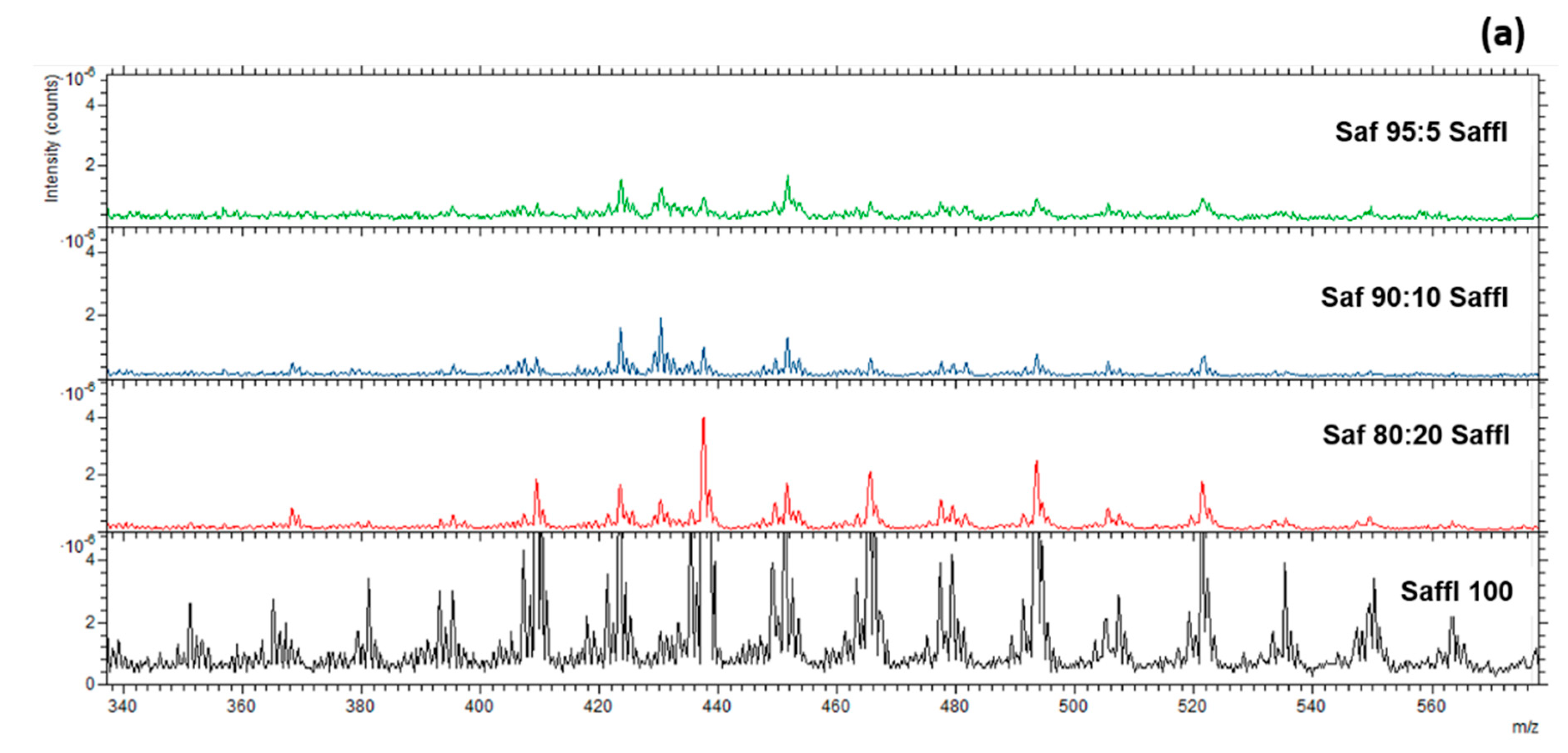
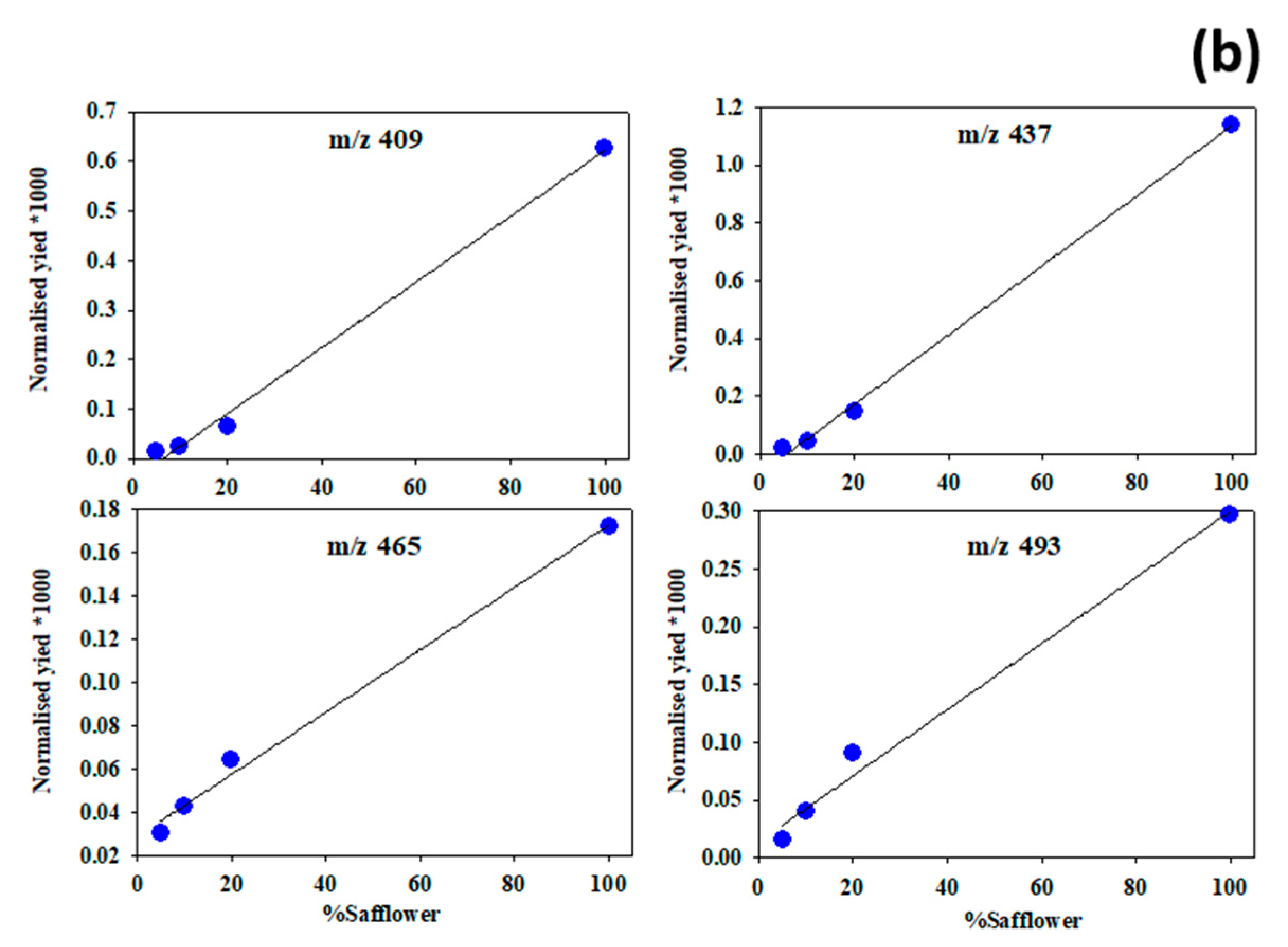
In this section, the study focused on the emission yield of the characteristic peaks of safflower, found in the mass range between 300 and 600. These peaks, demonstrating a higher loading in PC1, contribute to the significant variation observed between adulterated samples with safflower and the remaining samples. Figure 6 illustrate the variations in the normalized yield emission of the characteristic peaks of saffron with the percentage of inclusion. A proportionality between peak intensities and safflower percentages is well-defined, especially in the percentage range below 20%. The variation of the normalized intensities of the presented peaks (m/z 409, 437, 465 and 493) follows a linear trend with the percentage of safflower, achieving an R2 value over 0.98 for the fitted curve.
Each point represents an average of the analyzed regions of each sample, and the standard deviation is within the size of the points. Even when excluding the data points of pure safflower peaks from the calculation, given its distinct matrix from the adulterated saffron with safflower, the results still indicate a linear variation with an R2 of the same magnitude. These findings appear promising taking into account limitations of the current technique in performing quantification analysis. Results obtained in this work reach a dual scope: firstly, demonstrate that the method developed is suited for the rapid screening and qualitative assessment of a questioned saffron sample: as shown, the presence of specific peaks provide a clear evidence of safflower inclusion. Secondly, for an assessment of the percentage of inclusion, the calculation of the normalized intensities of these peaks should suffice.
4. Conclusions
A reliable method has been successfully developed to verify saffron authenticity by discriminating pure saffron from saffron adulterated with turmeric and safflower at inclusion levels below 20%. This was achieved by analyzing a few milligrams of powder samples without any prior treatment using the TOF-SIMS technique. Spectra of pure saffron, pure turmeric, and pure safflower were recorded for the first time. Despite the complexity of peak assignment, some bioactive compounds, fatty acids, amino acids, and mineral fragments were identified. A supervised list of peaks was considered for PCA analysis. The discrimination between the groups of pure saffron and adulterated saffron with turmeric and with safflower, separately, at 5%, 10%, and 20% inclusion levels together, was evident in a new bi-dimensional representation but not as highly pronounced when only adulteration with 20% of each adulterant is considered. The variation between the groups is attributed to the characteristic peaks of safflower and the amino group peaks and mineral peaks of saffron. In the case of saffron adulterated with turmeric, the different levels of inclusion in various groups were not easily distinguishable from pure saffron when considered individually. In the case of saffron adulterated with safflower, the level of inclusion can also be calculated from the normalized safflower characteristic peak intensities, which exhibit a linear variation with the percentage of safflower in the saffron matrix.
Supplementary Materials
The following supporting information can be downloaded at the website of this paper posted on Preprints.org, Figure S1: Positive and negative spectra of pure saffron powder analyzed with 0.1 pa Bi3+ current and a raster size of 500*500 µm2; Figure S2: Positive and negative spectra of pure safflower powder analyzed with 0.1 pa Bi3+ current and a raster size of 500*500 µm2; Figure S3: Positive and negative spectra of pure turmeric powder analyzed with 0.1 pa Bi3+ current and a raster size of 500*500 µm2; Table S1: proximate and photochemical composition of Saffron, Safflower and turmeric powders as reported in the literature and chemical structure of some compounds; Figure S4: Positive spectra overlay of pure turmeric and saffron adulterated with 20% turmeric (inverted). The asterisk (*) symbol denotes the signature peaks of curcumin molecule; Figure S5: Positive spectra overlay of pure safflower and saffron adulterated with 20% safflower (inverted). The asterisk (*) symbol denotes the signature peaks of turmeric; Figure S6: PC1 v/s PC2 scores plot of pure saffron (green), saffron adulterated with 20% of safflower (Saff80:20Safl, blue), and with turmeric (Saff80:20Turm, red). The ellipses around the points define the 95% confidence limit for each sample group; Figure S7: PC1 v/s PC2 scores plot of pure saffron (Saf) and the three different groups of Saffron adulterated with 5%, 10% and 20% of Safflower (saffl)and the two groups of saffron adulterated with 5 and 20% of turmeric (Turm). The ellipses around the points define the 95% confidence limit for each sample group.
Author Contributions
Conceptualization, A.B. and L.M.; methodology, A.B. and EDA, L.M., validation, A.B.; formal analysis, O.A.A. and A.B.; writing—original draft preparation, A.B.; writing—review and editing, A.B., EDA, R.P. and L.M.; visualization, A.B.; supervision, A.B. and L.M.; funding acquisition, A.B and L.M. All authors have read and agreed to the published version of the manuscript.
Funding
This research was funded by the Joint Bilateral Agreement CNR/CNRS-L (Italy-Lebanon), Biennial Programme 2018–2019 entitled “Innovative Mass Spectrometry approaches to safeguard saffron authenticity and to combat food frauds”.
Acknowledgments
The authors kindly acknowledge, for supporting part of the research, the AGRITECH project - PNRR MUR-M4C2 New technologies and methodologies for traceability, quality, safety, measurements and certifications to enhance the value and protect the typical traits in agri-food chains- Investimento 1.4 “National research Centre for Agricultural Technologies” Agritech CUP HUB – B63D21015240004.
Conflicts of Interest
The authors declare no conflicts of interest.
References
- Eghbali, S.; Farhadi, F.; Askari, V.R. An Overview of Analytical Methods Employed for Quality Assessment of Crocus Sativus (Saffron). Food Chem. X 2023, 20, 100992. [Google Scholar] [CrossRef] [PubMed]
- Sunanda, B.P.V.; Rammohan, B.; Kumar, A. The Effective Study of Aqueous Extract of Crocus Sativus Linn. (Saffron) in Depressed Mice. Int. J. PharmTech Res 2014, 6, 1143–1152. [Google Scholar]
- Poma, A.; Fontecchio, G.; Carlucci, G.; Chichiriccò, G. Anti-Inflammatory Properties of Drugs from Saffron Crocus. Anti-inflamm. Anti-Allergy Agents Med. Chem. 2012, 11, 37–51. [Google Scholar] [CrossRef] [PubMed]
- Samarghandian, S.; Borji, A. Anticarcinogenic Effect of Saffron (Crocus Sativus L.) and Its Ingredients. Pharmacognosy Res. 2014, 6, 99–107. [Google Scholar] [CrossRef] [PubMed]
- Papandreou, M.A.; Kanakis, C.D.; Polissiou, M.G.; Efthimiopoulos, S.; Cordopatis, P.; Margarity, M.; Lamari, F.N. Inhibitory Activity on Amyloid-β Aggregation and Antioxidant Properties of Crocus Sativus Stigmas Extract and Its Crocin Constituents. J. Agric. Food Chem. 2006, 54, 8762–8768. [Google Scholar] [CrossRef] [PubMed]
- Sheng, L.; Qian, Z.; Zheng, S.; Xi, L. Mechanism of Hypolipidemic Effect of Crocin in Rats: Crocin Inhibits Pancreatic Lipase. Eur. J. Pharmacol. 2006, 543, 116–122. [Google Scholar] [CrossRef] [PubMed]
- Lopresti, A.L.; Drummond, P.D. Saffron (Crocus Sativus) for Depression: A Systematic Review of Clinical Studies and Examination of Underlying Antidepressant Mechanisms of Action. Hum. Psychopharmacol. 2014, 29, 517–527. [Google Scholar] [CrossRef] [PubMed]
- Hosseinzadeh, H.; Karimi, G.; Niapoor, M. Antidepressant Effect of Crocus Sativus L. Stigma Extracts and Their Constituents, Crocin and Safranal, in Mice. Acta Hortic. 2004, 650, 435–445. [Google Scholar] [CrossRef]
- Pitsikas, N.; Zisopoulou, S.; Tarantilis, P.A.; Kanakis, C.D.; Polissiou, M.G.; Sakellaridis, N. Effects of the Active Constituents of Crocus Sativus L., Crocins on Recognition and Spatial Rats’ Memory. Behav. Brain Res. 2007, 183, 141–146. [Google Scholar] [CrossRef]
- Cagliani, L.R.; Culeddu, N.; Chessa, M.; Consonni, R. NMR Investigations for a Quality Assessment of Italian PDO Saffron (Crocus Sativus L.). Food Control 2015, 50, 342–348. [Google Scholar] [CrossRef]
- ISO-3632-2-2010 Part 1: Specification, Part 2: Test Methods. International Organisation for Standardization, Geneva.
- Kumari, L.; Jaiswal, P.; Tripathy, S.S. Various Techniques Useful for Determination of Adulterants in Valuable Saffron: A Review. Trends Food Sci. Technol. 2021, 111, 301–321. [Google Scholar] [CrossRef]
- Sabatino, L.; Scordino, M.; Gargano, M.; Belligno, A.; Traulo, P.; Gagliano, G. HPLC/PDA/ESI-MS Evaluation of Saffron (Crocus Sativus L.) Adulteration. Nat. Prod. Commun. 2011, 6, 1873–1876. [Google Scholar] [CrossRef] [PubMed]
- Cheng, J.H.; Sun, D.W. Hyperspectral Imaging as an Effective Tool for Quality Analysis and Control of Fish and Other Seafoods: Current Research and Potential Applications. Trends Food Sci. Technol. 2014, 37, 78–91. [Google Scholar] [CrossRef]
- Zhang, C.; Wang, Q.; Liu, F.; He, Y.; Xiao, Y. Rapid and Non-Destructive Measurement of Spinach Pigments Content during Storage Using Hyperspectral Imaging with Chemometrics. Meas. J. Int. Meas. Confed. 2017, 97, 149–155. [Google Scholar] [CrossRef]
- Mansouri, F.; Ben Moumen, A.; Richard, G.; Fauconnier, M.L.; Sindic, M.; Elamrani, A.; Serghini Caid, H. Proximate Composition, Amino Acid Profile, Carbohydrate and Mineral Content of Seed Meals from Four Safflower (Carthamus Tinctorius L.) Varieties Grown in North-Eastern Morocco. OCL - Oilseeds fats, Crop. Lipids 2018, 25, 1–9. [Google Scholar] [CrossRef]
- Prasad, S.; Gupta, S.C.; Tyagi, A.K.; Aggarwal, B.B. Curcumin, a Component of Golden Spice: From Bedside to Bench and Back. Biotechnol. Adv. 2014, 32, 1053–1064. [Google Scholar] [CrossRef] [PubMed]
- Amalraj, A.; Pius, A.; Gopi, S.; Gopi, S. Biological Activities of Curcuminoids, Other Biomolecules from Turmeric and Their Derivatives – A Review. J. Tradit. Complement. Med. 2017, 7, 205–233. [Google Scholar] [CrossRef] [PubMed]
- Kawecki, M.; Bernard, L. Database of Proteinogenic Amino Acid Reference Spectra for Bismuth-Cluster ToF-SIMS. II. Positive Polarity. Surf. Sci. Spectra 2018, 25. [Google Scholar] [CrossRef]
- Feizy, J.; Jahani, M.; Moradi, E.; Ahmadi, S. Measurement of Minerals in S Affron ’ s Stamens, Petals and Styles. 2022, 10, 215–225. [CrossRef]
- Pittenauer, E.; Koulakiotis, N.S.; Tsarbopoulos, A.; Allmaier, G. In-Chain Neutral Hydrocarbon Loss from Crocin Apocarotenoid Ester Glycosides and the Crocetin Aglycon (Crocus Sativus L.) by ESI-MSn (n = 2, 3). J. Mass Spectrom. 2013, 48, 1299–1307. [Google Scholar] [CrossRef]
- De Angelis, E.; Pilolli, R.; Bejjani, A.; Guagnano, R.; Garino, C.; Arlorio, M.; Monaci, L. Optimization of an Untargeted Dart-Hrms Method Envisaging Identification of Potential Markers for Saffron Authenticity Assessment. Foods 2021, 10. [Google Scholar] [CrossRef]
- Belu, A.M.; Graham, D.J.; Castner, D.G. Time-of-Flight Secondary Ion Mass Spectrometry: Techniques and Applications for the Characterization of Biomaterial Surfaces. Biomaterials 2003, 24, 3635–3653. [Google Scholar] [CrossRef] [PubMed]
- Bertrand, P. Static SIMS for Analysis of Molecular Conformation and Orientation. Appl. Surf. Sci. 2006, 252, 6986–6991. [Google Scholar] [CrossRef]
- Benninghoven, A. Surface Analysis by Secondary Ion Mass Spectrometry (SIMS). Surf. Sci. 1994, 299–300, 246–260. [Google Scholar] [CrossRef]
- Bejjani, A.; Noun, M.; Della-Negra, S.; Tannous, R.; Chalhoub, G.; Hamdan, M.; Nsouli, B. Topography Measurements Using High Mass Resolution Time-of-Flight Secondary Ion Mass Spectrometry: Application to Banknotes. Anal. Chem. 2019, 91, 8864–8872. [Google Scholar] [CrossRef] [PubMed]
- Tyler, B.J.; Peterson, R.E.; Lee, T.G.; Draude, F.; Pelster, A.; Arlinghaus, H.F. ToF-SIMS Imaging of Capsaicinoids in Scotch Bonnet Peppers (Capsicum Chinense). Biointerphases 2016, 11, 02A327. [Google Scholar] [CrossRef] [PubMed]
- Cliff, B.; Weibel, D.E.; Lockyer, N.P.; Jungnickel, H. Detection of Chlorinated Pesticides on the Surface of Fungus Using ToF-SIMS. Appl. Surf. Sci. 2003, 204, 710–713. [Google Scholar] [CrossRef]
- Focardi, S.; Ristori, S.; Mazzuoli, S.; Tognazzi, A.; Leach-scampavia, D.; Castner, D.G.; Rossi, C. ToF-SIMS and PCA Studies of Seggianese Olives and Olive Oil. Colloids Surf. A: Physicochem. Eng. Asp. 2006, 279, 225–232. [Google Scholar] [CrossRef]
- Bittencourt, C.; Felicissimo, M.P.; Pireaux, J.-J.; Houssiau, L. Study of Annatto from Bixa Orellana Seeds: An Application of Time-of-Flight Secondary Ion Mass Spectrometry. Spectrosc. Eur. 2005, 17. [Google Scholar]
- Piras, F.M.; Dettori, M.F.; Magnani, A. ToF-SIMS PCA Analysis of Myrtus Communis L. Appl. Surf. Sci. 2009, 255, 7805–7811. [Google Scholar] [CrossRef]
- TOF-SIMS: Surface Analysis by Mass Spectrometry; Vickerman, J.C., Briggs, D., Eds.; 2nd editio.; IM publications, 2013, ISBN 978-1-906715-17-5.
- Graham, D.J.; Castner, D.G. Multivariate Analysis of ToF-SIMS Data from Multicomponent Systems: The Why, When, and How. Biointerphases 2012, 7, 1–12. [Google Scholar] [CrossRef]
- Hosseini, A.; Razavi, B.M.; Hosseinzadeh, H. Pharmacokinetic Properties of Saffron and Its Active Components. Eur. J. Drug Metab. Pharmacokinet. 2018, 43, 383–390. [Google Scholar] [CrossRef] [PubMed]
- Melnyk, J.P.; Wang, S.; Marcone, M.F. Chemical and Biological Properties of the World’s Most Expensive Spice: Saffron. Food Res. Int. 2010, 43, 1981–1989. [Google Scholar] [CrossRef]
- Maggi, M.A.; Bisti, S.; Picco, C. Sa Ff Ron: Chemical Composition and Neuroprotective Activity. 1–15.
- Moratalla-López, N.; Bagur, M.J.; Lorenzo, C.; Martínez-Navarro, M.E.; Rosario Salinas, M.; Alonso, G.L. Bioactivity and Bioavailability of the Major Metabolites of Crocus Sativus L. Flower. Molecules 2019, 24, 1–24. [Google Scholar] [CrossRef] [PubMed]
- Aissa, R.; Ibourki, M.; Bouzid, H.A.; Bijla, L.; Oubannin, S.; Sakar, E.H.; Jadouali, S.; Hermansyah, A.; Goh, K.W.; Ming, L.C.; et al. Phytochemistry, Quality Control and Medicinal Uses of Saffron (Crocus Sativus L.): An Updated Review. J. Med. Life 2023, 16, 822–836. [Google Scholar] [CrossRef] [PubMed]
- Wang, S.; Cao, J.; Deng, J.; Hou, X.; Hao, E.; Zhang, L.; Yu, H.; Li, P. Chemical Characterization of Flavonoids and Alkaloids in Safflower (Carthamus Tinctorius L.) by Comprehensive Two-Dimensional Hydrophilic Interaction Chromatography Coupled with Hybrid Linear Ion Trap Orbitrap Mass Spectrometry. Food Chem. X 2021, 12, 100143. [Google Scholar] [CrossRef] [PubMed]
- Kotha, R.R.; Luthria, D.L. Curcumin: Biological, Pharmaceutical, Nutraceutical, and Analytical Aspects. Molecules 2019, 24, 1–27. [Google Scholar] [CrossRef] [PubMed]
- Nelson, K.M.; Dahlin, J.L.; Bisson, J.; Graham, J.; Pauli, G.F.; Walters, M.A. The Essential Medicinal Chemistry of Curcumin. J. Med. Chem. 2017, 60, 1620–1637. [Google Scholar] [CrossRef]
- Meng, F.; Zhou, Y.; Ren, D.; Wang, R. Turmeric: A Review of Its Chemical; Elsevier Inc., 2018. ISBN 9780128115183.
- Aiello, D.; Siciliano, C.; Mazzotti, F.; Di Donna, L.; Athanassopoulos, C.M.; Napoli, A. Molecular Species Fingerprinting and Quantitative Analysis of Saffron (Crocus Sativus L.) for Quality Control by MALDI Mass Spectrometry†. RSC Adv. 2018, 8, 36104–36113. [Google Scholar] [CrossRef] [PubMed]
- Koulakiotis, N.S.; Pittenauer, E.; Halabalaki, M.; Tsarbopoulos, A.; Allmaier, G. Comparison of Different Tandem Mass Spectrometric Techniques (ESI-IT, ESI- and IP-MALDI-QRTOF and VMALDI-TOF/RTOF) for the Analysis of Crocins and Picrocrocin from the Stigmas of Crocus Sativus L. Rapid Commun. Mass Spectrom. 2012, 26, 670–678. [Google Scholar] [CrossRef]
- Amemiya, T.; Tozu, M.; Ohashi, Y. Time-of-Flight Secondary Ion Mass Spectrometry Can Replace Histochemistry Demonstration of Fatty Acids in the Retina. Jpn. J. Ophthalmol. 2004, 48, 287–293. [Google Scholar] [CrossRef]
- Keune, K.; Hoogland, F.; Boon, J.J.; Peggie, D.; Higgitt, C. Evaluation of the “Added Value” of SIMS: A Mass Spectrometric and Spectroscopic Study of an Unusual Naples Yellow Oil Paint Reconstruction. Int. J. Mass Spectrom. 2009, 284, 22–34. [Google Scholar] [CrossRef]
- Sjövall, P.; Rossmeisl, M.; Hanrieder, J.; Kuda, O.; Kopecky, J.; Bryhn, M. Dietary Uptake of Omega-3 Fatty Acids in Mouse Tissue Studied by Time-of-Flight Secondary Ion Mass Spectrometry (Tof-Sims). Anal. Bioanal. Chem. 2015, 407, 5101–5111. [Google Scholar] [CrossRef] [PubMed]
- Adams, K.J.; DeBord, J.D.; Fernandez-Lima, F. Lipid Specific Molecular Ion Emission as a Function of the Primary Ion Characteristics in TOF-SIMS. J. Vac. Sci. Technol. B, Nanotechnol. Microelectron. Mater. Process. Meas. Phenom. 2016, 34. [Google Scholar] [CrossRef] [PubMed]
- Grehk, T.M.; Berger, R.; Bexell, U. Investigation of the Drying Process of Linseed Oil Using FTIR and ToF-SIMS. J. Phys. Conf. Ser. 2008, 100, 6–10. [Google Scholar] [CrossRef]
- Nagata, Y.; Ishizaki, I.; Waki, M.; Ide, Y.; Hossen, M.A.; Ohnishi, K.; Miyayama, T.; Setou, M. Palmitic Acid, Verified by Lipid Profiling Using Secondary Ion Mass Spectrometry, Demonstrates Anti-Multiple Myeloma Activity. Leuk. Res. 2015, 39, 638–645. [Google Scholar] [CrossRef]
- Erbaş, S.; Mutlucan, M. Investigation of Flower Yield and Quality in Different Color Safflower Genotypes. Agronomy 2023, 13. [Google Scholar] [CrossRef]
- Wang, L.; Qin, Y.; Wang, Y.; Zhou, Y. Changes of Anthocyanin and Amino Acid Metabolites in Saffron Petals (Crocus Sativus L.) during Fermentation Based on Untargeted Metabolomics. Lwt 2024, 192, 115724. [Google Scholar] [CrossRef]
- Priscila del Campo, C.; Garde-Cerdán, T.; Sánchez, A.M.; Maggi, L.; Carmona, M.; Alonso, G.L. Determination of Free Amino Acids and Ammonium Ion in Saffron (Crocus Sativus L.) from Different Geographical Origins. Food Chem. 2009, 114, 1542–1548. [Google Scholar] [CrossRef]
- G, C.; Lanza, B. Nutrients and Heavy Metals in Flowers and Corms of the Saffron Crocus (Crocus Sativus L.). Med. Aromat. Plants 2016, 05. [Google Scholar] [CrossRef]
Figure 1.
Positive TOF-SIMS spectra of pure saffron (red), safflower (green), and turmeric (blue) are shown in regions a) 20-240 m/z and b) 240-940 m/z with individual intensity scales. For visual clarity, the regions above 120 u.m.a and above 700 u.m.a are multiplied by 10 consecutively. The chemical structure of the crocin1 molecule as well as the curcumin molecule and the putative fragmentations, are presented in the red and blue spectra, respectively.
Figure 1.
Positive TOF-SIMS spectra of pure saffron (red), safflower (green), and turmeric (blue) are shown in regions a) 20-240 m/z and b) 240-940 m/z with individual intensity scales. For visual clarity, the regions above 120 u.m.a and above 700 u.m.a are multiplied by 10 consecutively. The chemical structure of the crocin1 molecule as well as the curcumin molecule and the putative fragmentations, are presented in the red and blue spectra, respectively.

Figure 2.
(a) PC1 (93%) score plot for TOF-SIMS spectra of pure saffron (green), saffron adulterated with 20% safflower (blue), and with 20% turmeric (red). (B) PC1 loading plot for the score plot shown in part (a).
Figure 2.
(a) PC1 (93%) score plot for TOF-SIMS spectra of pure saffron (green), saffron adulterated with 20% safflower (blue), and with 20% turmeric (red). (B) PC1 loading plot for the score plot shown in part (a).
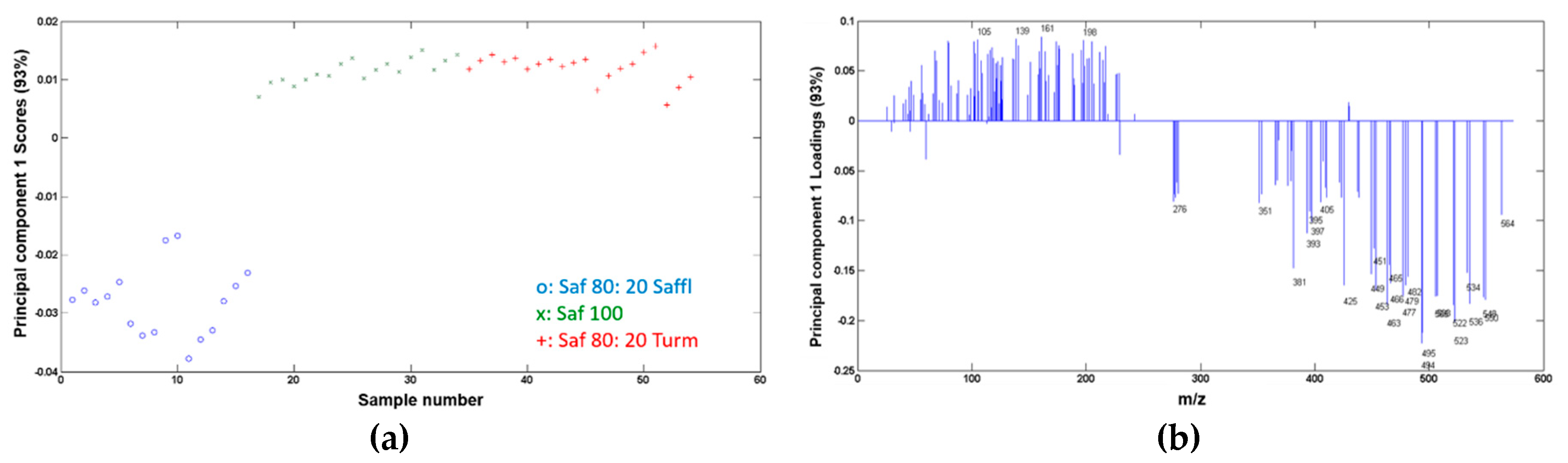
Figure 3.
(a) PC2 (5%) score plot for TOF-SIMS spectra of pure saffron (green), saffron adulterated with 20% safflower (blue), and with 20% turmeric (red). (B) PC2 loading plot for the score plot shown in part (a).
Figure 3.
(a) PC2 (5%) score plot for TOF-SIMS spectra of pure saffron (green), saffron adulterated with 20% safflower (blue), and with 20% turmeric (red). (B) PC2 loading plot for the score plot shown in part (a).
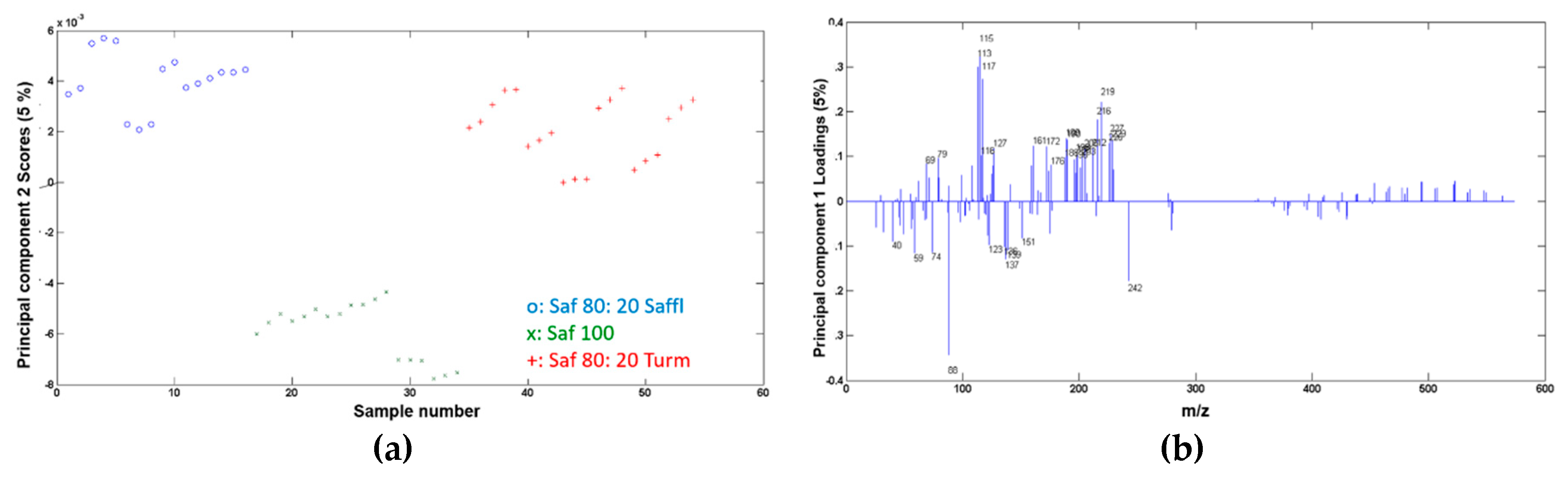
Figure 4.
PC1 v/s PC2 scores plot of pure saffron (green), saffron adulterated with 20% safflower (blue), and with 20% turmeric (red). The colored ellipses around the points define the 95% confidence limit for each sample group.
Figure 4.
PC1 v/s PC2 scores plot of pure saffron (green), saffron adulterated with 20% safflower (blue), and with 20% turmeric (red). The colored ellipses around the points define the 95% confidence limit for each sample group.
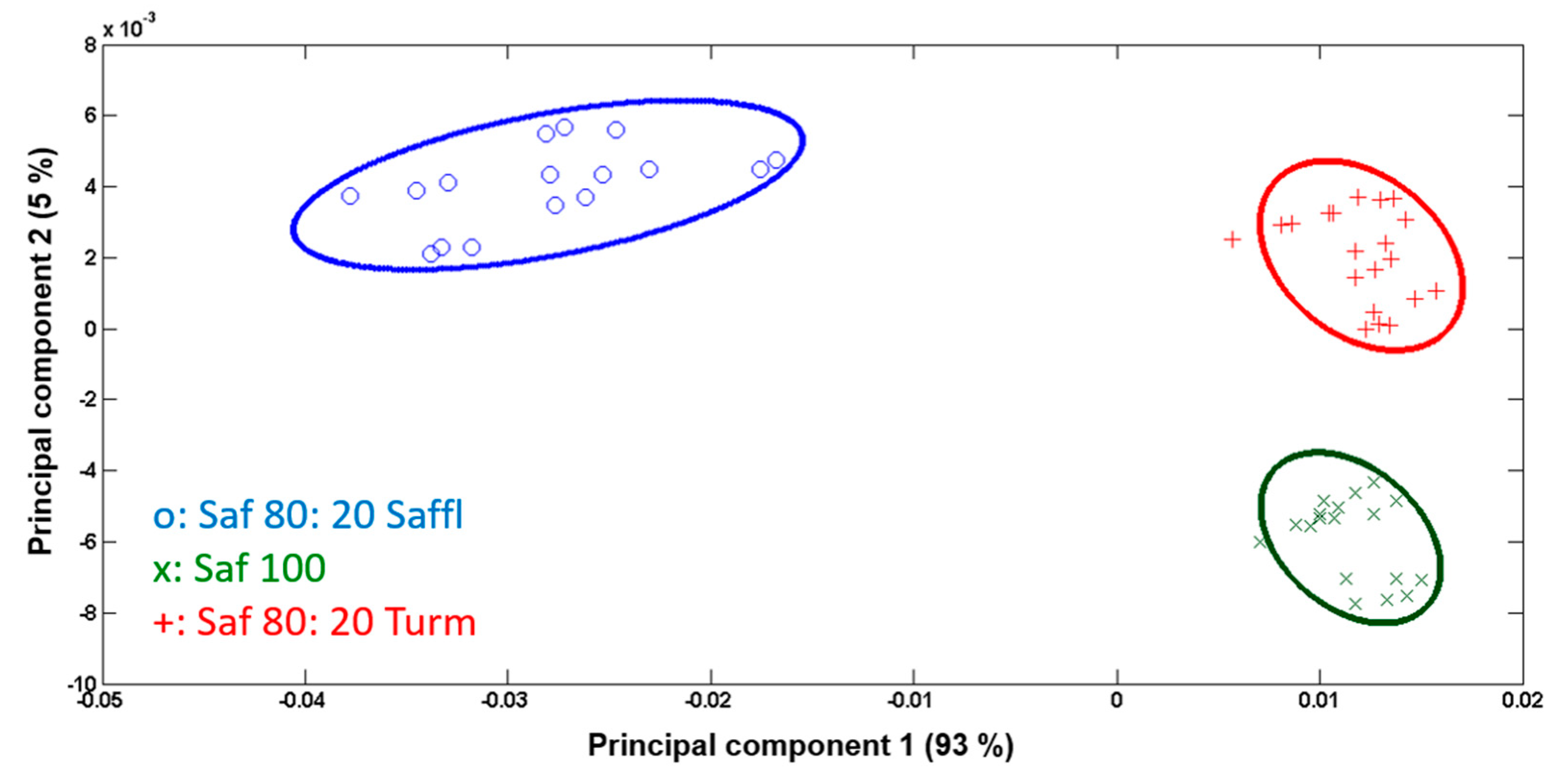
Figure 5.
PC1 v/s PC2 scores plot of pure saffron (green), saffron adulterated with safflower (blue), and with turmeric (red). The ellipses around the points define the 95% confidence limit for each sample group.
Figure 5.
PC1 v/s PC2 scores plot of pure saffron (green), saffron adulterated with safflower (blue), and with turmeric (red). The ellipses around the points define the 95% confidence limit for each sample group.

Figure 6.
Variation of the characteristic peaks of Safflower in the adulterated saffron samples at 5% (Saf 95:5 Saffl), 10%(Saf 90:10 Saffl), and 20 %(Saf 80:20 Saffl) and in pure safflower (Saffl 100) presented a) by overlaying their normalized mass spectra and b) comparing the variation of 4 major peaks intensities with Safflower % in the samples.
Figure 6.
Variation of the characteristic peaks of Safflower in the adulterated saffron samples at 5% (Saf 95:5 Saffl), 10%(Saf 90:10 Saffl), and 20 %(Saf 80:20 Saffl) and in pure safflower (Saffl 100) presented a) by overlaying their normalized mass spectra and b) comparing the variation of 4 major peaks intensities with Safflower % in the samples.
Disclaimer/Publisher’s Note: The statements, opinions and data contained in all publications are solely those of the individual author(s) and contributor(s) and not of MDPI and/or the editor(s). MDPI and/or the editor(s) disclaim responsibility for any injury to people or property resulting from any ideas, methods, instructions or products referred to in the content. |
© 2024 by the authors. Licensee MDPI, Basel, Switzerland. This article is an open access article distributed under the terms and conditions of the Creative Commons Attribution (CC BY) license (http://creativecommons.org/licenses/by/4.0/).
Copyright: This open access article is published under a Creative Commons CC BY 4.0 license, which permit the free download, distribution, and reuse, provided that the author and preprint are cited in any reuse.


