

Submitted:
08 May 2024
Posted:
09 May 2024
You are already at the latest version
Abstract
Energy management, especially in communities, is attracting growing interest, but is often marred by confusion between the terms "Energy Information System" (EIS) and "Energy Man-agement System" (EMS). This ambiguity hinders understanding of their use and role in improv-ing energy performance. Our objective is to clarify these terms and their contribution to energy management. We used a mixed qualitative and quantitative approach to evaluate and compare the criteria of definition, objective, functionality, role, as well as correlated elements such as or-ganizational structure, responsibilities, planning and policy, according to the requirements of ISO 50001, in addition to criteria specific to the two systems. The study reveals differences in the roles of the EIS and the SME, with a complementarity of 40% between the two systems, depend-ing on the positioning of the EIS in relation to the elements of the SME process. The EIS plays a crucial role in facilitating the implementation of the EMS according to ISO 50001. This clarifica-tion contributes to a better understanding of the respective roles of these systems in energy management, thus helping communities to improve their energy performance in an effective manner.
Keywords:
“Energy Information System”
; “ISO 50001”
; “Energy Management System”
; Energy
1. Introduction
As part of the energy and climate policy of the Evreux Porte de Normandie (EPN) commune, which includes 74 municipalities, the commune's general management decided to implement efficient energy management to reduce its energy consumption. This efficient energy management is the implementation of an Energy Management System (EMS) according to the ISO 50001 standard in a pilot community of the EPN agglomeration. However, this approach faces a major challenge: the lack of awareness of the complexity of energy management by the said municipality, both in terms of understanding the concepts and practical implementation, due to the significant size of its real estate.
Energy management is a complex and time-consuming subject for local authorities, according to Aymard Caroline of "DeltaConso Expert". This is because their assets are disparate in terms of use and performance, with a multitude of sites to manage and many regular or occasional users [1]. All these problems make it difficult to collect energy data from different sources in a heterogeneous environment.
However, in its approach to energy data collection as part of an energy audit, the ISO 50001 standard recommends, in paragraphs "6.6. Planning for energy data collection" and "9.1. Monitoring, measurement, analysis and evaluation of energy performance and the EMS ", the metering system method, which groups together a set of devices for measuring, recording and analyzing energy performance.
But, when the data is collected in an automated manner and used by energy management software, the term "Energy Management Information System" (EMIS) is preferred to "metering system". And the term ISEM (Information System and Energy Management) or EIS (Energy Information System) is sometimes preferred to EMIS in a fully equivalent manner, according to the Technical Energy Environment Association (ATEE) [2]. And in Natural Resources Canada 's guide and planning tool , the term ISEM stands for "Information System on Energy Management" [3]. For GIMELEC [4], the Energy Information System (EIS) is similar to the Energy Management System (EMS), with a more developed or elaborate data collection function.
In view of these elements of approach or understanding, we note the use of different terminologies to talk about energy management with the same objective around an approach of continuous improvement of energy performance. In this case, how can these terminologies be reconciled with improving energy performance?
The main objective of this article is to clarify the distinction between the Energy Information System (EIS) and the Energy Management System (EMS), an area that has been little explored in research and scientific literature. Therefore, we try to highlight the objective and functional differences, as well as the epistemological differences and different processes between the EIS and the EMS. This comparative approach will be reinforced by a statistical analysis, allowing a better understanding of the nuances between these two systems essential to energy management.
The ultimate goal is to understand the objectives and role of the Energy Information System (EIS) in relation to the Energy Management System (EMS). This understanding could facilitate the adoption of the ISO 50001 standard by organizations with significant assets, especially certain communities, by promoting environmental impacts such as reducing the carbon footprint and conserving energy resources. It could also facilitate the adoption of the ISO 50001 standard by organizations with significant assets, particularly certain communities, by promoting environmental impacts such as carbon footprint reduction and energy conservation, economic benefits such as reduced energy costs, and positive human and social impacts through the involvement and effective management of internal teams around collective projects focused on concrete actions.
Clarification of these concepts would contribute to a better understanding of the respective roles of these systems in energy management, thus enabling communities to improve their energy performance in an efficient manner.
2. Methodology
Four main criteria guided our approach: the definition and objectives of the two systems under review, related elements such as organizational structure, roles and responsibilities, planning, organization operation and policy, in the framework of the Energy Management System (EMS) according to the ISO 50001 standard. We also considered other aspects of both systems, as well as the positioning of the Energy Information System (EIS) in relation to the elements of the EMS process. Given the lack of scientific publications on this comparative study, our epistemological approach was based on some thirty literary sources from various disciplines, including engineering, as well as encyclopedias and thesis work. This enabled us to consolidate the notions and definitions of key terms such as "energy", "system", "information" and "management", as well as specific expressions such as "information system" and "energy management system". This literature also enabled us to draw up a conceptual diagram of the Energy Information System (EIS) flows and to use that of the continuous improvement process of the Energy Management System (EMS) in accordance with ISO 50001.
Given the importance and the stakes of this study, we carefully carried out analyses based on an evaluation protocol defined by the characteristics of definition, objective, function, role and/or principle of the two systems. These analyses were supplemented by the study of the four sets of comparative elements of the Energy Management System (EMS) in relation to the Energy Information System (EIS) to carry out a qualitative analysis of duality of all points elements to compare. Each element of comparison was analyzed objectively, based on an understanding of the meaning given by the standard, scientific and engineering literature, as well as with Cartesian logic, to know if it was an element of differentiation or complementarity between both systems. The results of this analysis were converted from qualitative variables into numerical data for quantitative evaluation.
3. Results
3.1. The Energy Concept
According to Feynman [5], energy is a very difficult concept to define: "... It's a very abstract idea, because it's a mathematical principle". The same is true for Poincaré; but if we project the principle of the concept of energy in all its generality and apply it to the universe, all that remains is this: "there is something that remains constant" [5].
It was Max Planck who first understood the essential significance of this law of conservation of energy: in a work published in 1887 entitled The Principle of Conservation of Energy [6]. Energy is defined by the fact that it is conserved, and is identified by the entropy of a physical system, according to physicist Etienne KLEIN in the IFG Parenthèse Culture 22 conference on energy.
According to the Larousse dictionary, energy is a force in action.
We don't claim to give an academic definition of energy here, given its complexity, but to summarize our understanding of the concept of energy as follows: we could define energy as an invisible force in action characterized by conservation, and identify it by a quantity that characterizes the capacity of a physical system to undergo spontaneous transformations.
In other words, energy is an invisible force in action, characterized by its conservation, and is identified by the entropy of a physical system.
So, to consume energy is to transform low-entropy energy by another form of energy with higher entropy.
3.2. The System Concept
The term "system" is commonly used in almost every field: mathematics, physics, astronomy, physiology, computer science, economics and finance... to name but a few.
The notion of "system" is defined as follows: "a system is a set of identifiable, interdependent elements, i.e. linked together by relationships such that, if one of them is modified, the others are also modified, and consequently the whole system is modified, transformed. It is also a bounded set, the limits of which are defined according to the objectives (properties, goals, projects, finalities) we wish to emphasize" [7].
To understand systems theory, according to Edgar Morin, we can approach it from two different angles, each within one of the standard paradigms: the analytical approach and the systems approach.
In our study, we'll be relying on the systems approach, which relates to or affects a system as a whole, looks at the interactions between elements, considers the effects of interactions, relies on global perception, modifies groups of variables at once, and leads to multi-disciplinary teaching [8].
In other words, a system can be defined as an organized totality of endogenously and exogenously interacting elements with the characteristics of the three "sub-levels" of Edgar Morin's systems theory: cybernetics, "systemism" and systemics.
3.3. The Concept of Information
Information is a concept from the discipline of Information and Communication Sciences (ICS). Etymologically speaking, "information" is that which gives form to the mind. It comes from the Latin verb "informare", meaning "to give form to" or "to form an idea of" [9].
The concept of information theory, according to E. Morin, is based above all on the conformity between a message transmitted and the message received. It is to be distinguished from communication theory, which is not simply the transmission but the creation and circulation of content [8].
In other words, the term "Information" refers to the action of bringing news to the attention of the public, of communicating events and current events, according to the Académie française. From a computer science point of view, information is an element of knowledge translated into a set of signals according to a given code, with a view to being stored, processed or communicated. [10].
To summarize, we can define the concept of information as the restitution of collected data processing, giving a message, an explanation or knowledge, of a situation, a state or a system, with a view to being stored or communicated.
3.4. The Management Concept
The concept of management is a set of techniques for managing, organizing and administering an entity to achieve its objectives [11].
Other management approaches consist of [12]:
- Setting objectives (strategic and operational),
- Choosing the means to achieve them,
- Implement these means (search for efficiency),
- Monitor implementation and results,
- Ensure regulation based on this control (Governance).
We can thus understand that the concept of management could be defined as an approach based on the following functions: steering (setting strategic and operational objectives), monitoring/evaluating results, organizing, leading, delegating and directing.
3.5. Energy Information System (EIS)
A first approach to Energy Information Systems (EIS) for buildings is defined as performance monitoring software, data acquisition hardware, and communication systems used to store, analyse, and display building energy data [13].
Public Services and Procurement Canada refers to Information Systems on Energy Management (ISEM) as a system that provides relevant information and helps to make energy performance visible to employees and key departments in the organization, enabling them to take concrete actions intended to create financial value for the organization. [3].
According to GIMELEC's presentation, the Energy Information System collects and analyzes consumption data and facilitates the day-to-day management of energy and fluids [4].
The Energy Information System is therefore an organization, an operation and a set of resources (material, software, data, procedures, human, etc.), structured and unstructured, that allows to automatically collect, store, memorize and process energy data into information in order to make it available (in the form of data, texts, sounds, images, etc.) to disseminate it within and between organizations.
The objective of the Energy Information System (EIS) is to collect all the energy performances, both specific and global, internal and external to the organization, in order to provide the right information, at the right time, on the right support (screen, smartphone, etc.), to the right people who can analyze, decide, act and evaluate the results. We immediately see one of the main roles of the EIS: that of automatically centralizing the data collected from several heterogeneous energy-consuming systems.
In other words, the basic objective of an Energy Information System (EIS) is to provide information, especially statistical information that allows knowledge and regular monitoring of the organization's energy consumption situation.
The functionalities of the EIS are based on four conceptual dimensions, namely:
- The Functional dimension: its main activities are to produce, promote and disseminate energy data; but also and above all to develop a map of the organization's heritage and energy consumed.
- The Human Dimension: The actors in the human dimension of the Energy Information System are characterized by the actors in the project phase, the actors in the operational phase and the asset manager.
- The Organizational dimension: it is characterized by the definition of the governance and the design of an urbanization of energy data for the construction of an architecture of the Energy Information System.
- The Technological dimension: it presents the Energy Information System as the support for the collection, processing, storage and dissemination of energy data in a cycle of data processing and management processes.
The Energy Information System (EIS) enables the daily operational needs to be met. It is linked through integration to the organization's information system and performance indicators, as well as to users through communication tools. It automatically centralizes various available information related to energy, which can be taken into account at the level of an "energy" metering plan and all the energy performances of all types of assets (buildings, transportation, public lighting, green spaces, ...) of the organization or community [14].
The Energy Information System (EIS) is the support and the communication channel between the Energy Management System (EMS), the Energy Operating System (EOS) and the outside of the organization or community. This communication channel is represented as follows (see Figure 1 below):
- The Energy Management System (EMS) transmits general information to the Energy Operating System (EOS) through the Energy Information System (EIS).
- The EIS collects, stores and processes basic information from the EOS, inputs energy information flows and transforms them into decision information for the EMS and/or disseminates the energy information to the partners of the organization or community.
- Finally, the EOS produces basic information and executes the orders of the EMS.
3.6. Energy Management System (EMS)
The term “Energy Management” has different meanings to different people and context in different fields.
The Verein Deutscher Ingénieur (VDI)-Guideline 4602 (2007) [15]provides a standard definition of energy management: “Energy management is the proactive, organized and systematic coordination of procurement, conversion, distribution and use of energy to meet the requirements, taking into account environmental and economic objectives”. Turner (2004) [15]defines it as the judicious use of energy to accomplish prescribed goals. Energy management is also a real "taking charge" of the energy position within the organization. It is not a matter of a machine or of highly sophisticated equipment, but above all of an entire organization, made up of decisions, objectives, methods, skills, behavior and motivation: a matter of men and women, of a team [16].
This leads us to believe that the term energy management has different meanings depending on the author or actor. For example, some believe that energy management is "the effective and efficient use of energy to reduce energy consumption and minimize costs". For others, energy management is generally defined as a set of activities aimed at managing the efficient and judicious use of energy to achieve prescribed objectives.
According to the ISO 50001 standard, “An energy management system (EMS) is the set of correlated or interacting elements of an organization used to establish an energy policy, objectives, and processes to achieve those energy objectives”.
In other words, we note that “The Energy Management System is a system aimed to establish an energy policy, objectives, energy targets, action plans and one or more processes to achieve these objectives and energy targets ” according to ISO 50001[17].
And the EMS aims to continually improve energy performance to reduce consumption and therefore costs. It is also a management and control system that helps organizations to measure their energy consumption in detail, identify levers for action and plan improvements.
Based on the functions of management, we could say that the Energy Management System focuses on the following four functions: Steer, i.e. to set goals for the organization and control them; Organize, by distributing and coordinating the work of your teams; Animate, by mobilizing individuals around common goals; Lead, by making decisions to achieve goals.
However, in the context of the ISO 50001 standard, the energy management system is based on the functionalities of the set of correlated elements, which are presented as follows: Table 1.
The EMS according to the ISO 50001 standard is based on the model defined in the diagram in Figure 2 which describes the flow of the process of continuous improvement of energy performance, including efficiency, uses and energy consumption of the body.
3.7. Comparative Tables of the Different Concepts or Approaches of the Two Systems
Our comparative study of the Energy Information System (EIS) and the Energy Management System (EMS) is carried out according to the criteria of definition, objective, role of correlated elements of the ISO 50001 standard or other elements of comparison. Each element is analysed according to the identified characteristics of the corresponding systems. Table 2.

Table 4.
Elements of comparison on the other elements of analysis of the two systems.
| Other elements of comparison | EMS | EIS | Analysis |
|---|---|---|---|
| Energy targets | Significant Energy Uses (SEU) | All heritage and SEU | DIFF |
| Reference Energy Situations (RES) | There are quantified benchmarks that serve as a basis for comparing performance | There are quantified references that serve as a basis for comparing performance and energy consumption. | DIFF |
| Energy performance indicators (EPI) | It is a measure defined by the organization on a more limited scope | It is a measure defined by the organization, over a wider area of application. | DIFF |
| Internal audits | It is an independent and objective activity to provide assurance on the level of control of its activities within a defined scope. | It is an independent and objective activity to ensure the level of control of its technical operations and energy data flows. | DIFF |
| Purchasing process | To improve energy performance | To monitor energy performance. | DIFF |
Another observation from the study is that the scope of the EIS is broader than that of the EMS (see Figure 3).
3.8. Positioning of the EIS in relation to the EMS
The study of the positioning of the Energy Information System (EIS) in relation to the Energy Management System (EMS) is carried out on the basis of the role that the EIS plays in the elements of the EMS process. Each element of the process is analyzed according to its need to request or use the functionalities of the EIS.
EIS role, in relation to the continuous improvement process, Plan Do Check Act, of the EMS.
Table 5.
Positioning of the elements of the EMS process in relation to the EIS.
| Elements of the process | EMS role | EIS role | Analysis |
|---|---|---|---|
| Energy policy | General Management defines commitments, objectives and resource allocations. | The EIS provides management with the right energy information at the right time to define energy policy. | EIS DR |
| Energy planning | The action plans are:
|
The EIS provides energy consumption data during the initial energy diagnosis to create an inventory of the different stations.It also makes it easy to identify SEU and energy saving potential, and to automate, store and communicate on EPIs.The EIS serves as a function and support for collecting, storing and processing energy data to develop the action plan and communicate. | EIS DR |
| Implementation and operation | These are the following actions:
|
The EIS provides, through a database, structured data, for the search for possible improvements, benchmarks, energy audits. | EIS DR |
| Management review | An evaluation of the effectiveness of the action plans will be carried out, with guidelines based on the energy performance to be achieved. | The EIS is not directly required | EIS NR |
| Verification | The actions taken are measured, controlled and monitored: check and act | The EIS plays a supporting role in the collection, storage, processing, control and communication of energy performance data. | EIS DR |
| Monitoring, measurement and analysis | Monitoring of measurable results of energy efficiency or energy consumption related to energy use, compared to the reference energy situation. | The EIS serves as a channel to provide the EMS with measurable results of energy efficiency related to energy use compared to the reference energy situation. | EIS DR |
| Non-compliance, correction, corrective and preventive actions | It is :
|
The EIS includes the provision of energy consumption data and EPIs to energy stakeholders to analyze compliance or non-compliance with normative requirements. | EIS DR |
| EMS internal audit | Internal controls of the EMS are planned at regular intervals to ensure compliance with normative requirements, energy objectives and targets defined via the energy strategy; Ensure that the EMS is properly implemented and maintained |
The EIS provides information for the internal audit of the EMS to ensure compliance with normative requirements, energy objectives and targets defined in the energy strategy. | EIS DR |
EIS DR: EIS Directly Requested by the elements of the EMS process; EIS NR: EIS Not directly Requested by elements of the EMS process.
Summary of each System's roles
Table 6.
Overview of the roles of each System.
| Role of the Energy Information System | Role of the Energy Management System |
|---|---|
|
|
|
|
|
|
|
|
|
|
Evaluation of the EIS & EMS benchmarking study
Table 7.
Evaluation of the EIS & EMS benchmarking study.
| EMS / EIS | |||
|---|---|---|---|
| DIFF | EIS DR | EIS NR | |
| Elements of comparison on the definition and objectives of the two systems | 2 | 0 | 0 |
| Elements of comparison on the correlated elements of the two systems | 5 | 0 | 0 |
| Elements of comparison on the other elements of the analysis of the two systems | 5 | 0 | 0 |
| Positioning of the elements of the EMS process in relation to the EIS | 0 | 7 | 1 |
| Total observed results: | 12 | 7 | 1 |
| DIFF : | The elements of comparison represent different concepts, approaches or scope of the two systems. |
| EIS DR :: | EIS Directly Required by the elements of the EMS process. |
| EIS NR : | EIS Not directly Requested by elements of the EMS process. |
4. Discussion
The comparative study, based on the criteria of concept, definition, objective, function, role of the set of correlated elements of the ISO 50001 standard or other elements of analysis, and complemented by the positioning of the EIS in relation to the elements of the EMS process, seems to show us different partitions, characterized by notions, approaches or by the field of application of the two systems, as well as in their functioning. It has also allowed us to observe a complementarity between the two systems: the EIS is directly or indirectly called upon by EMS process elements, as part of an operational implementation of the EMS.
On the other hand, it is interesting to note that the Canadian government's Public Services and Procurement defines the Energy Management Information System (EMIS) as a device providing relevant information aimed at making energy performance visible. This definition has similarities with the characteristics of an Energy Information System (EIS), although EMIS also incorporates management functionalities in the background.
Out of about twenty elements of comparison, we observed about a dozen differences in the functioning of the two systems, i.e. 60% autonomy, where the EMS can operate without the EIS. And 40% representing the dependence of the EMS on the EIS. This shows that each system has a defined role in an organization, with different predominance.
According to the Energy Information System flow in Figure 1, we can see that the Energy Information System (EIS) is the support and communication channel between the Energy Management System (EMS), the Energy Operating System (EOS) and the outside of the body. This communication channel allows the Energy Management System (EMS) to transmit general information to the Energy Operating System (EOS) through the Energy Information System (EIS). The EIS collects, stores, and processes basic information from the EOS, receives energy information streams, and transforms them into decision information for the EMS and/or disseminates the energy information to the organization's end users or partners. Finally, the EOS produces basic information and executes the orders of the EMS. Thus, the Energy Information System (EIS) makes it possible to meet the operational needs of energy consumption among stakeholders (Energy Manager, Energy Referent, Shared Energy Advisor (SEA) and/or Decision Makers, etc.). It is linked by integration to the organization's information system and performance indicators, allowing end users to monitor or diagnose energy consumption in real time using communication tools.
The EIS also makes it possible to automatically exploit all energy data and find what is important to improve efficiency, facilitate daily management, enhance investments, reduce operating costs, monitor and optimize contracts, unite and raise awareness, evolve easily, prepare for certification, etc. It can provide an overview of energy consumption on sites and its distribution during the energy audit; because its scope extends to the organization’s heritage. This could justify the selection of Significant Energy Uses (SEU) of the organization’s assets.
As part of an energy review, the EIS can also identify the areas of potential energy savings and prioritize the potential for overall and specific improvement to complete the analysis of the Significant Energy Uses and constitute a certification area for the EMS.
The Energy Management System (EMS), according to the ISO 50001 standard, shows us a flow process of continuous improvement of energy consumption, based on a set of correlated elements of the requirements of the said standard. This flow process is defined in several phases, namely: carrying out an energy management review; defining the energy policy and planning; organizing the implementation and operation of the EMS; managing the monitoring, verification, measurement and analysis of energy solutions; also checking non-compliance, corrections, corrective and preventive actions, as well as the internal audit of the EMS.
This energy management and control helps organizations to measure their energy consumption in detail, identify levers for action through process implementation and plan improvements. This provides a structuring framework for the organization. Because energy management involves making decisions, implementing methods, modifying uses in the direction of the same energy policy, etc.
With a focus on equipment and Significant Energy Uses (SEU), the EMS can improve energy efficiency, reduce overall energy consumption and protect against rising energy prices. This increase is due to the peak electrical loads that can be observed in an energy information system. It also makes it possible to comply with legal requirements, strengthen the competitiveness of the organization and obtain certification according to the ISO 50001 standard.
The comparative study also showed us that the main similarities between the Energy Information System (EIS) and the Energy Management System (EMS) lie in the fact that both systems remain structured and structuring in an important heritage environment. Where energy management is a complex and time-consuming subject.
On the other hand, the significant differences of the two systems are found in the concepts, notions, definitions or approach of the elements of comparison described in the table numbers 1 to 5. These are the elements of comparison on the definition and objectives, on the correlated elements of the EMS and other elements of analysis of the two systems.
In summary, the Energy Information System (EIS) is of particular interest to the Energy Management System (EMS). This is because it is positioned as a system linked or complementary to the EMS, capable of performing the following functions:
- To play a facilitating role in the implementation of the EMS and, above all, to identify the certification scope of the ISO 50001 standard,
- Serve as a support, communication and information channel for the EMS and stakeholders,
- Cover asset and energy inventory management functions,
- Provide global and specific energy data for the EMS,
- Facilitate energy performance diagnostics for the EMS,
- Identify significant energy use,
- Facilitate daily management,
- Reduce operating costs.
In other words, the Energy Information System is a “Facility Management” tool or facilitator for the installation or operational implementation of the Energy Management System.
5. Conclusions
The comparative study between the Energy Information System and the Energy Management System according to ISO 50001 was the subject of a scientific study of the concept, approach, design and function of the two systems. This study, based on the criteria of definition, objective, functionality, role or set of correlated elements of the ISO 50001 standard and supplemented by other criteria specific to the two systems (EIS and EMS), has shown that they are related or complementary up to 40%, depending on the position of the EIS in relation to the elements of the EMS process.
The Energy Information System (EIS) makes it possible to satisfy operational needs, i.e. to automatically generate and use all the global and specific energy data in order to facilitate the diagnosis of energy performance, to identify significant energy consumption, to facilitate daily management and to reduce operating costs, etc. The EIS can also be used as a support tool. It can also serve as a support, communication and information channel for the EMS and stakeholders. In other words, it plays a facilitating role in the implementation of the EMS and especially in the identification of the certification scope of the ISO 50001 standard.
On the other hand, the Energy Management System (EMS) is a management and control system that helps organizations to measure their energy consumption in detail, to identify action levers through the implementation of processes, and to plan for continuous improvement. It is a real "taking charge" of the energy position within the body.
Compared to the Energy Management System (EMS), the comparative study carried out clearly shows that the Energy Information System (EIS) is positioned as a support tool or facilitator in the implementation of the EMS according to the ISO 50001 standard in an organization with significant assets, where energy management is a complex and time-consuming issue. Because the two systems are 40% linked or complementary, according to the comparative study.
This clarification of these two concepts should contribute to a better understanding of the respective roles of these systems in energy management, thus enabling communities to effectively improve their energy performance.
In the context of technological advances, innovative equipment and processes play a driving role in improving energy management, energy efficiency, and energy cost control. However, these advances do not fully address the challenge of integrated energy consumption management for organizations with significant real estate assets. Integrating an Energy Information System (EIS) within these organizations could be a first step toward automated energy management. For example, quickly identifying energy savings opportunities and defining the certification scope for implementing an Energy Management System (EMS) compliant with ISO 50001 would be a significant step forward for this standard.
References
- C. Aymard, « Logiciel de suivi énergétique pour votre collectivité », DeltaConso Expert. Consulté le: 9 juillet 2022. [En ligne]. Disponible sur: https://www.deltaconso-expert.fr/secteurs/gestion-energetique-collectivite/.
- ATEE, « Guide des logiciels de gestion énergétique ». mars 2016. Consulté le: 21 août 2022. [En ligne]. Disponible sur: https://atee.fr/efficacite-energetique/maitrise-de-lenergie/mesurer-la-consommation-denergie-audits.
- D. générale des services intégrés Services publics et Approvisionnement Canada, Systèmes d’information sur la gestion de l’énergie : guide et outil de planification. Canada: Ressources naturelles Canada. Office de l’efficacité énergétique, 2010. Consulté le: 22 janvier 2023. [En ligne]. Disponible sur: https://publications.gc.ca/site/fra/9.637837/publication.html.
- Gimélec, « Systèmes d’information énergétique : Recommandations pour les décideurs… », 6 novembre 2015. Consulté le: 14 août 2022. [En ligne]. Disponible sur: https://fr.slideshare.net/Gimelec/systmes-dinformation-nergtique.
- N. Hervé, P. Venturini, et V. Albe, « La construction du concept d’énergie en cours de physique : analyse d’une pratique ordinaire d’enseignement », RDST. Recherches en didactique des sciences et des technologies, no 10, Art. no 10, déc. 2014. [CrossRef]
- É. Klein, « 1. L’énergie, une grandeur « qui se conserve » », in L’énergie à découvert, C. Jeandel et R. Mosseri, Éd., in À découvert., Paris: CNRS Éditions, 2017, p. 39. Consulté le: 25 janvier 2023. [En ligne]. Disponible sur: http://books.openedition.org/editionscnrs/10913.
- J.-C. Lugan, « La définition des systèmes », vol. 5e éd., 2738 vol., in Que sais-je ?, vol. 5e éd., Paris cedex 14: Presses Universitaires de France, 2009, p. 32-50. Consulté le: 28 janvier 2023. [En ligne]. Disponible sur: https://www.cairn.info/la-systemique-sociale--9782130575528-p-32.htm.
- E. Morin, « La théorie des systèmes et la théorie de l’information. », Ed. Du Seuil., vol. Introduction à la pensée complexe, p. 3, 1990.
- Encyclopédie, « Information », Wikipédia. 19 janvier 2023. Consulté le: 29 janvier 2023. [En ligne]. Disponible sur: https://fr.wikipedia.org/w/index.php?title=Information&oldid=200585973.
- Académie française, « Dictionnaire de l’Académie française ». Consulté le: 29 janvier 2023. [En ligne]. Disponible sur: https://www.dictionnaire-academie.fr/article/A9I1218.
- Le Dictionnaire, « Définition management », LE DICTIONNAIRE. Consulté le: 31 janvier 2023. [En ligne]. Disponible sur: https://www.le-dictionnaire.com/definition/management.
- Encyclopédie, « Management », Wikipédia. 24 janvier 2023. Consulté le: 30 janvier 2023. [En ligne]. Disponible sur: https://fr.wikipedia.org/w/index.php?title=Management&oldid=200749121.
- Piette et al.- 2012 - Intelligent Building Energy Information and Contro.pdf ». Consulté le: 9 octobre 2022. [En ligne]. Disponible sur: https://eta-publications.lbl.gov/sites/default/files/LBNL-5894E.pdf.
- E. S. Kouaho, « Mise en œuvre du Système de Management de l’Energie selon la norme ISO 50001 dans une Collectivité : Cas Evreux Porte de Normandie. », Thèse Professionnelle, CESI, Rouen, 2020.
- O. M. Rouhani et A. Beheshtian, « Energy Management: Energy Science and Technology -Volume 12 », Studium Press LLC, U.S.A., vol. 12, p. 26, 2015.
- C. CHABANEL et C. RAFFRAY - ADEME Service Communication, Système de management de l’énergie ce sont les entreprises qui en parlent le mieux, Agence L’Effet papillon. 2015.
- ISO et AFNOR, « ISO 50001:2018(en), Energy management systems — Requirements with guidance for use ». AFNOR Energies., 17 janvier 2023. Consulté le: 28 novembre 2023. [En ligne]. Disponible sur: https://www.iso.org/obp/ui/#iso:std:iso:50001:ed-2:v1:en.
Figure 1.
Energy Information System Flow.
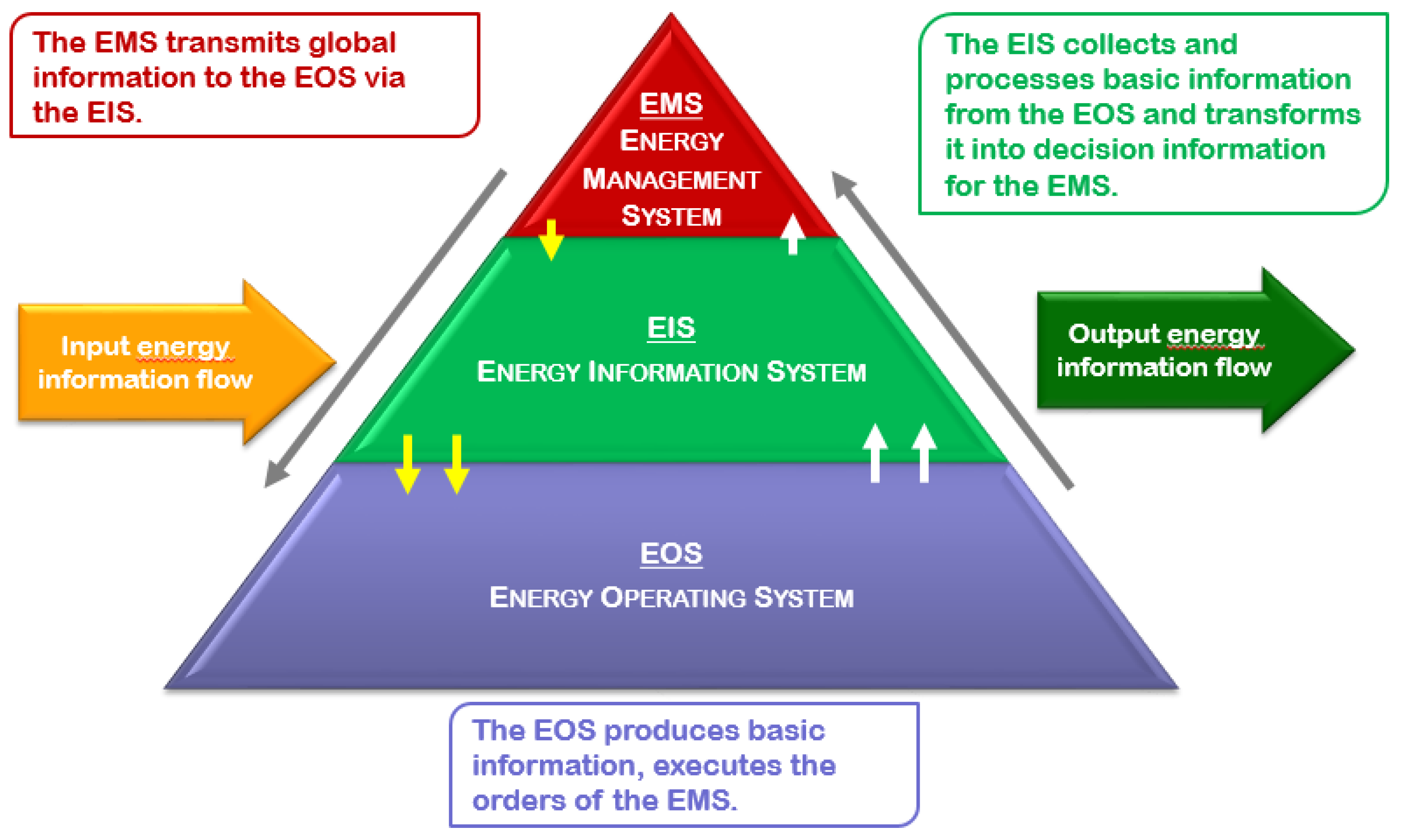
Figure 2.
EMS PDCA continuous improvement process flow.
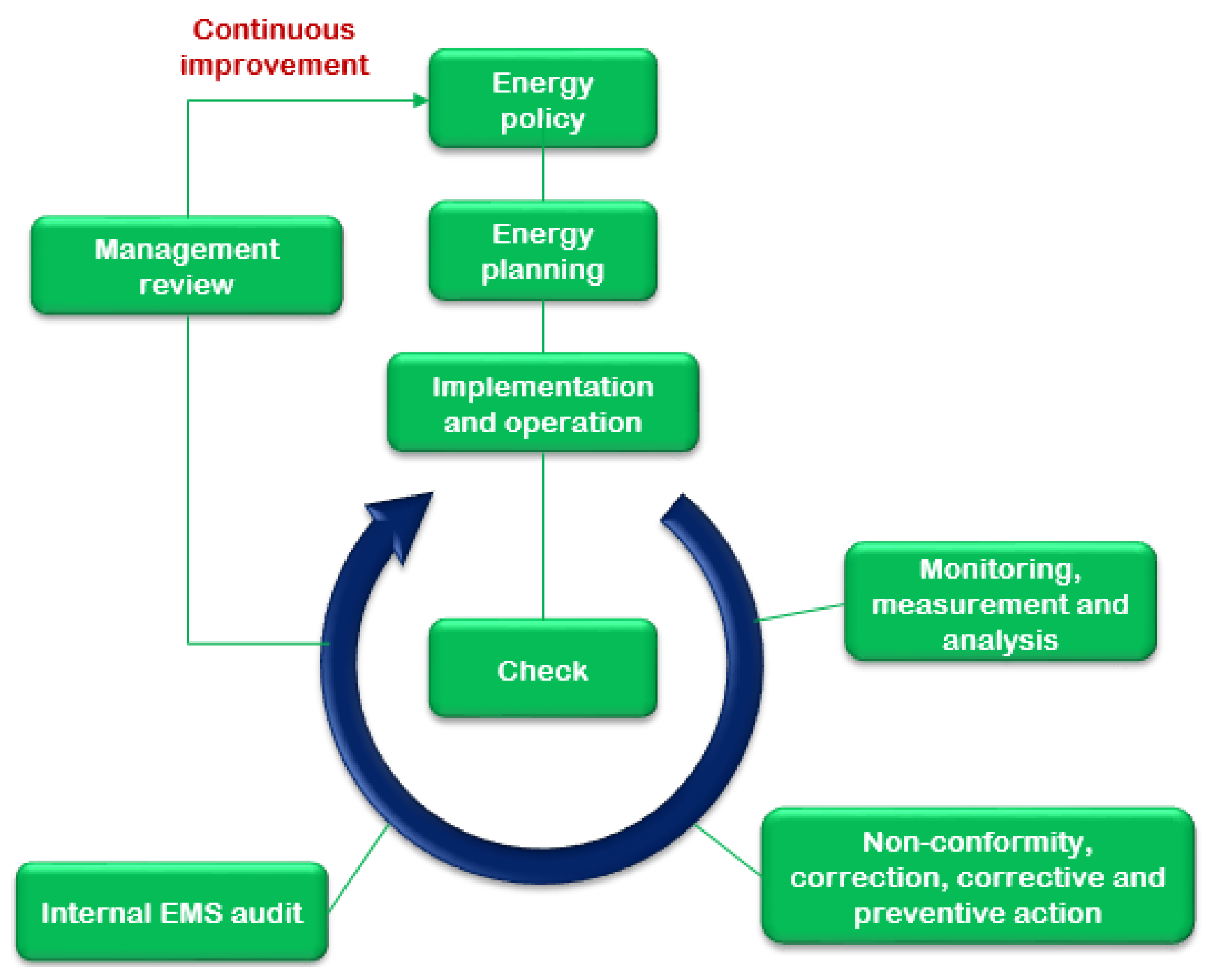
Figure 3.
Scope of EIS and EMS.
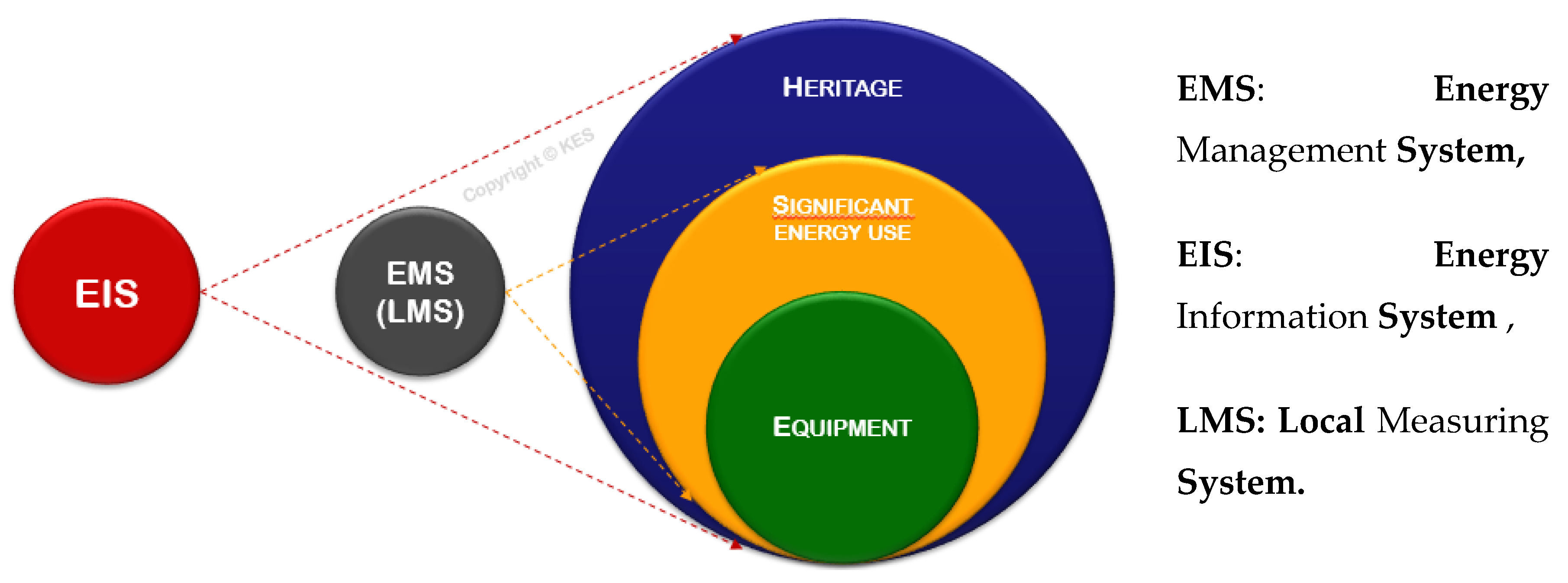
Table 1.
Functionality of correlated EMS elements.
| Energy policy to manage |
|
|---|---|
| Implementation and operation to be organized |
|
| Review that needs to be animated |
|
| Planning to lead |
|
Table 2.
Elements for comparing the definition and objectives of the two systems.
| Elements of comparison | EMS | EIS | Analysis |
|---|---|---|---|
| Definition | System aimed to establish an energy policy, objectives, energy targets, action plans and one or more processes to achieve these objectives and energy targets. | System aimed at organizing and operating a set of resources (material, software, data, procedures, people , etc.) structured and unstructured allowing to automatically collect, store, memorize, process energy data into information in order to make it available (in the form of data, texts, sounds, images, etc.) to disseminate it within and between organizations | DIFF |
| Objectives | Optimize energy performance. | Energy data generation and dissemination | DIFF |
DIFF: The elements of the comparison represent different concepts, approaches or scope of the two systems.
Table 3.
Elements of comparison on the correlated elements of the two systems.
| Correlated elements of comparison | EMS | EIS | Analysis |
|---|---|---|---|
| OrganizationalStructure | This term refers to the hierarchical framework that defines an energy policy. | This term refers to the hierarchical framework that defines an internal department or work organization for its EIS. | DIFF |
| Roles and Responsibilities | An energy officer is appointed by the management to set up an energy team to establish and maintain the management system. He/she is responsible for the proper monitoring of the EMS. | A project manager is appointed by management to set up and implement a technical and organizational platform for the production and dissemination of energy data. | DIFF |
| Planning | This term refers to:
|
This term refers to:
|
DIFF |
| Organization Functioning | The organization defines energy performance targets to be achieved. | The organization defines the energy data and performance to be made available to decision makers. | DIFF |
| Energy Policy | Formal expression by the management of the intentions, general orientations and commitments regarding the energy performance of an organization. | Formal expression by the Information Systems Department to translate the commitments of the General Management regarding energy performance. | DIFF |
Disclaimer/Publisher’s Note: The statements, opinions and data contained in all publications are solely those of the individual author(s) and contributor(s) and not of MDPI and/or the editor(s). MDPI and/or the editor(s) disclaim responsibility for any injury to people or property resulting from any ideas, methods, instructions or products referred to in the content. |
© 2024 by the authors. Licensee MDPI, Basel, Switzerland. This article is an open access article distributed under the terms and conditions of the Creative Commons Attribution (CC BY) license (http://creativecommons.org/licenses/by/4.0/).
Copyright: This open access article is published under a Creative Commons CC BY 4.0 license, which permit the free download, distribution, and reuse, provided that the author and preprint are cited in any reuse.