

Submitted:
24 April 2024
Posted:
26 April 2024
You are already at the latest version
Abstract
Exploring for green and affordable protection of perishable fruit like cherry tomato is of significance. Here the protective efficacy and its underpinnings of coating with oleaster gum, alone or incorporated with cuminal, on cherry tomatoes stored at ambient temperature were investigated. The composite coating of oleaster gum with 0.1% cuminal reduced decay, respiration rate, weight loss, and softening of the fruit and decelerated their decreases of total soluble solids, titratable acidity, and soluble proteins, and therefore maintained their marketability. Furthermore, it reduced the accumulation of O•− 2and H2O2 in fruit, and mitigated cell membrane lipid oxidation and permeabilization, thereby retarding their senescence. Instrumentally, it elevated the activities of superoxide dismutase, catalase, peroxidase, and ascorbate peroxidase and the levels of ascorbic acid and glutathione. This potentiation of the fruit antioxidant system makes the composite coating a promising approach to keeping the postharvest quality of perishable fruit.
Keywords:
Oleaster gum
; Cuminal
; Cherry tomato
; Fruit quality
; Antioxidant system
1. Introduction
Most fruit and vegetables suffer severe postharvest quality loss and are susceptible to disease during storage and distribution [1]. Cherry tomato (Solanum lycopersicum var. cerasiforme) fruit are globally popular owing to their attractive appearance, unique flavor, and juicy texture [2], as well as marvelous nutrition of rich vitamins, minerals, and bioactive compounds like carotenoids and flavonoids [3]. The fruit can be consumed fresh or processed for sauces, puree, ketchup, and more [4]. Nevertheless, being climacteric, the fruit are highly perishable and with only short postharvest life [5]. Fast physio-biochemical processes like transpiration, respiration, and ethylene emissions accelerate the fruit ripening, rendering them susceptible to phytopathogenic attacks, and less marketable and nourishing [6]. Meanwhile, market always expects the fruit a relatively long shelf life with maximal freshness.
Low temperature storage can mitigate the loss of freshness and extend the shelf-life of cherry tomatoes by reducing their respiration and minimizing the microbial growth, but often cause chilling injury to the fruit [7]. Although several other techniques like hypobaric storage in high relative humidity, modified atmosphere packaging, atmosphere controlling, and sanitizing treatments (UV-C, ozone, chemical sanitizers, and natural antimicrobials, among others) have been used to extend the shelf life of the fruit, they are expensive to apply on industrial scale or with detrimental residues often rejected by informed consumers [8,9]. Coating is an affordable technology to prolong postharvest life of fruit and reduce their quality deterioration [10].
Among diverse coating formulae, natural gum-based ones have garnered considerable attention in fruit preservation by virtue of their sustainability, convenience, and versatility when compared with synthetic packaging [11]. These competitive advantages have been demonstrated in a wide array of fruit and vegetables including tomato [2], strawberry [12], apricot [13], mushroom [14], and guava [15]. Exuded from the stems by olive tree (Elaeagnus angustifolia L.) of Elaeagnacea (Araliaceae) family, oleaster gum (OG) consists of heteropolysaccharides with motifs of various monosaccharides such as arabinose, galactose, rhamnose, and mannose and their derivatives like uronic acid [16,17]. Auspiciously, OG demonstrates antioxidant, antimicrobial, anti-inflammatory, and anti-cancer efficacy in various backgrounds. With hydration capacity like that of gum arabic, OG can form gel and stabilize emulsion in water [18]. Together with other types of botanical extracts, these attributes can be employed to formulate bioactive coating to achieve promising potency in postharvest protection [19].
Essential oils possess a wide spectrum of bioactivity notably including antimicrobial and antioxidant activities, and can be added to hydrocolloid as natural food preservatives [1]. Cuminal (CA), a dominating component of cumin essential oil, is widely used in food, medicine, and fragrance cosmetics [20,21]. CA has noteworthy antimicrobial [22], anti-toxigenic [23], and anti-neoplastic [24] properties in various application situations. When capsuled in porous starch, it forms stable hydrogen bonds with oxygens of carbohydrate hydroxyl-2,3 [25], and this interaction overcomes certain drawbacks such as hydrophobicity and fast volatility that impede its sustainable release and function. Sharing some structural similarity with but being more hydrophilic and tensile than starch, OG is also a potential matrix to establish such a slow-release system of CA, but this potential was not investigated. Moreover, in postharvest handling, to our knowledge, the employment of OG alone or together with CA in the preservation of fresh fruit and vegetables has not been reported.
Herein, the efficacy of OG-based coating with or without incorporation of CA in keeping postharvest quality of cherry tomatoes during room temperature storage was assessed together with the investigation of the underpinning mechanism.
2. Materials and Methods
2.1. Materials
Cherry tomato fruit experiencing no pesticide spray were harvested on a tomato farm in Yongjing, Gansu, China, and brought immediately to the Postharvest Laboratory of Gansu Agricultural University. Fruit of uniform shape, size, color, and maturity, and without mechanical injuries and diseases were selected for the experiment.
OG was procured from trees of E. angustifolia L. in the Gobi Desert of Hetian, Xinjiang, China and dried in air. CA (CAS # 122-03-2) was purchased from Macklin Biotechnology, Shanghai, China.
2.2. Methods
2.2.1. Preparation of Coating Solutions
According to published method [13,18] with some modifications, we crushed OG and sifted it through 100 mesh after removing visible impurities. The obtained OG powder (2 g) was dissolved in sterilized distilled water (100 mL) and agitated for 2 h at 45 °C with a magnetic stirrer. As a plasticizer to improve the strength and pliability of the coating, glycerol was added (1%, v/v) to the OG solutions cooled to 20 °C. CA emulsion in Tween 80 (0.1%, v/v) was mixed with the above solution to obtain the final coating solutions with 1% (mg/mL) OG and varying concentrations of CA (0, 0.1, and 0.2%, v/v). All the coating solutions were sonicated and kept static until application.
2.2.2. Coating Treatment
Fruit were cleaned with tap water and dried in air. Dip the fruit in coating solution (distilled water as control) for about 0.5 min [26] and dry them in air. Fruit were divided into four groups (Control, OG, OG + 0.1% CA, and OG + 0.2% CA). Each group was with three replicates wherein each replicate had 50 fruit. All fruit were packed accordingly in plastic crispers and stored at 25 °C and 85 ~ 95% RH [27]. Samples were randomly taken from each group at 0, 3, 6, 9, 12, and 15 d for analyses.
2.2.3. Evaluation of Decay Index and Marketability
The decay index and marketability of fruit were assessed according to the previous method with slight modification [7]. The decay index was defined as the percentage of fruit exhibiting decay symptoms such as mold spots or rot in each group. The fungal growth symptoms on the fruit surface were evaluated visually using a scale where 0 = no symptoms of decay, 1 = 1~10%, 2 = 11~25%, 3 = 26~50%, 4 = 50~75%, and 5 ≥ 75% decay. The decay index was calculated using the following formula.
The levels of color, aroma, and shriveling of fruit were determined as a whole organoleptically with a 1–5 rating scale, where 1 = unusable, 2 = usable, 3 = fair, 4 = good, and 5 = excellent. Fruit receiving ratings of 4 or above were deemed marketable and counted to calculate the marketability of the fruit via the formula below.
2.2.4. Measurement of Respiration Rate, Weight Loss, and Firmness
Fruit respiration rate was determined by detecting CO2 production via an infrared CO2 determinator (JFQ-3150H, Beijing, China) and the results were expressed in mg kg-1 h-1.
Fruit of each group were weighed at 0, 3, 6, 9, 12, and 15 d during the storage. Weight loss was calculated as difference between weights at initial and specific time points divided by initial weight.
Fruit firmness was measured, via a fruit firmness analyzer (GY-4, TOP Instrument, Zhejiang, China) with a 3-mm probe, at three different positions on the fruit equator and the results were expressed in newton (N).
2.2.5. Determination of Total Soluble Solids (TSS), Titratable Acidity (TA), and Soluble Protein Levels
TSS content (%) was analyzed as Brix with a digital refractometer (PR-32, Atago, Japan) calibrated with distilled water [27].
TA (%) was assessed by titrating samples with 0.1 N NaOH. The results were reported as g citric acid equivalents per 100 g of fresh weight [4] wherein the acid factor of citric acid is 0.064.
Determined by Coomassie brilliant blue G-250 method, total soluble protein content was expressed in mg kg-1 on a fresh weight basis [28].
2.2.6. Determination of Membrane Permeability and Malondialdehyde (MDA) Content
Cell membrane permeability was determined with the previous operations after minor modifications [29]. Fruit slices (10 g) were placed in 40 mL deionized water incubated at 25 °C, and the conductivity was determined at 0 and 3 h with a conductometer (DDS-307A, Ridao, Shanghai) and recorded as E0 and E1, respectively. The samples were transferred to boiling-water incubation for 0.5 h and then cooled down immediately to 25 °C; the conductivity was recorded as E2. Calculate the cell membrane permeability with the following formula:
MDA content was determined according to the relevant methods [29]. Fruit flesh (3 g) was homogenized in 6 mL precooled trichloroacetic acid (TCA) and centrifuged for 20 min at 12000 × g at 4 °C. The supernatant (2 mL) was reacted with 2 mL 0.67% (w/v) 2-thiobarbituric acid, and the absorbance was determined at 450, 532, and 600 nm after 20 min incubation in boiling water. The MDA content was calculated with the following formulae and expressed in mol kg-1.
CMDA (µmol L-1) = 6.45 × (OD532− OD600) − 0.56 × OD450
2.2.7. Determination of and H2O2
content was quantified using an established scientific protocol [30]. Briefly, 5 g of fruit flesh was homogenized in 15 mL 60 mmol L-1 phosphate buffer (pH 7.8) at 4 °C for 15 min. The supernatant (1 mL) was mixed with 0.1 mL 10 mmol L-1 hydroxylamine hydrochloride and kept at 37 °C for 20 min; the absorbance at 530 nm was measured. A standard curve of NaNO2 was used to calculate the content in μmol per gram of fresh weight.
H2O2 content was evaluated based on a previous approach [31]. Concisely, fruit flesh (5 g) was homogenized in 50 mL 5% TCA (w/v) at 4 °C and centrifuged at 10000 × g at 4 °C for 15 min. The supernatant (0.5 mL) was mixed with 0.5 mL 10 mmol L-1 K3PO4 buffer (pH 7.0) and 1 mL 1 mol L-1 KI solution, and 390 nm absorbance was tested using a UV-spectrophotometer (UV-754, Precision & Scientific Instrument, Shanghai, China). H2O2 content was calculated via a standard curve of analytical pure H2O2 dissolved in acetone, and the results were in mmol kg-1.
2.2.8. Analyses of Antioxidant Enzyme Activities
At 4 °C, fruit flesh (5 g) was homogenized in 20 mL 50 mmol L-1 phosphate buffer (pH 7.8) containing 1.0 mmol L-1 EDTA, 0.3% (v/v) Triton X-100, and 2% (w/v) polyvinylpyrrolidone (PVP). The solution was centrifuged at 10000 × g for 20 min, and the supernatant was collected for assays of enzyme activities.
Superoxide dismutase (SOD) activities were assayed as described in a previous study [32]. One unit of SOD activity was defined as the amount of enzyme needed to inhibit 50% nitroblue tetrazolium reduction tested at 560 nm and expressed in U kg-1.
Catalase (CAT) activities were assayed with slight modifications following the method described previously [33]. The reaction mixture consisted of 0.1 mL enzyme extract and 2.9 mL 20 mmol L-1 H2O2. Absorbance at 240 nm was recorded for 3 min at 30 s intervals, with distilled water as blank reference. One unit of CAT activity was defined as a decrease of 0.01 per minute in 240 nm absorbance and expressed in U kg-1.
Peroxidase (POD) activities were determined following a methodology with slight modifications [34]. The reaction mixture consisted of 1 mL 50 mmol L-1 phosphate buffer (pH 5.5), 1 mL 25 mmol L-1 guaiacol, 0.5 mL 2% (v/v) H2O2, and 0.5 mL enzyme extract. Absorbance at 470 nm was recorded at 30 s intervals for 3 min, with distilled water as blank reference. One unit of POD activity was defined as an increase of 0.01 per minute in 470 nm absorbance, and the results were in U kg-1.
Ascorbate peroxidase (APX) activities were measured according to the relevant method [35] with slight modifications. The reaction mixture included 0.1 mL enzyme extract, 2.6 mL 50 mmol L-1 phosphate buffer (pH 7.0), and 0.3 mL 30% (v/v) H2O2. Absorbance at 290 nm was recorded at 30 s intervals for 3 min, with distilled water as blank reference. One unit of APX activity was defined as a decrease of 0.01 per minute in 290 nm absorbance, and the results were in U kg-1.
2.2.9. Determination of Ascorbic Acid (AsA) and Glutathione (GSH) Levels
AsA content was assayed by the 2, 6-dichlorophenolindophenol method [36]. Briefly, flesh (5 g) was homogenized in 10 mL 20 g L-1 oxalic acid, and the solution volume was adjusted to 100 mL with the oxalic acid. After 20 min centrifugation at 8000 × g, 10 mL supernatant was collected and titrated with 2,6-dichlorophenolindophenol until the pink lasted for more than 15 s, and the concentrations were expressed in mg kg-1.
GSH content was measured following a previous method [37] with slight modifications. Flesh (5 g) was homogenized in 10 mL precooled 5% (w/v) TCA containing 5 mmol L-1 EDTA-Na2 and centrifuged at 8000 × g for 20 min at 4 °C. The reaction mixture containing 1 mL enzyme extract, 1 mL sodium phosphate buffer (100 mmol L-1, pH 7.6), and 0.5 mL 4 mmol L-1 dithionitrobenzoic acid was incubated at 25 °C for 10 min, and the 412 nm absorbance was measured. GSH content was calculated via a standard curve of GSH, and the results were in mmol kg-1.
2.3. Statistical Analysis
The results were mean ± standard error (SE) of experiments in triplicate. The data were analyzed by SPSS 25 and plotted with Origin 8.5, and Duncan’s multiple test at p < 0.05 was conducted.
3. Results
3.1. Fruit Decay Index and Marketability
Microbial spoilage and physiological decay affect the appearance and marketability of cherry tomatoes. After 15 d storage at 25 ± 1 °C, the levels of visible mold growth in coated fruit were significantly lower than those of fruit without coating (Figure 1A). The coating significantly reduced the decay index (Figure 1B) and improved the marketability (Figure 1C) of the fruit, and both the composite coatings with CA were more effective than the plain coating of OG alone. Notably, between the composite coatings, doubling the CA concentration showed no further decrease of decay index, but, unexpectedly, a reduction of fruit marketability. Thus, the formula OG+0.1% CA was selected for further analyses.
3.2. Respiration Rate, Weight Loss, and Firmness
Respiration rate is closely connected with the senescence of postharvest fruit. The respiration rate of all the fruit increased first and then decreased along the storage (Figure 2A). Respiration peaks were observed on day 6 in the fruit without coating and on day 9 in coated fruit, suggesting a peak delay attendant upon coating. Around day 6 to 9, the fruit without coating demonstrated significantly higher respiration rates than those coated. The fruit with composite coating showed the lowest respiration rate in all fruit from day 0 onwards. On day 15, the respiratory rate of fruit with composite coating was 20.56 % and 15.58 % lower than that of fruit with no coating and plain coating, respectively, and 18.08 % lower than those of all fruit at initial day 0. In short, the coating reduced the respiration and also delayed the respiration peak of the fruit.
Changes in and severity of weight loss reflect the quality deterioration intensity of fruit. Here, the weight loss of all the fruit continuously increased along the storage, and, from day 6 onwards, the data of the coated fruit were significantly lower than that of the fruit without coating. The fruit with composite coating showed the lowest weight loss among the samples at most points of storage (Figure 2B). Weight loss of postharvest tomato is mainly related to its respiration and transpiration rates. Notably, the weight loss of coated fruit at day 15 was significantly lower than that of fruit without coating wherein the fruit with composite coating showed the lowest weight loss (6.15 %).
Firmness reflects the ripening and softening states of postharvest fruit. Here, the firmness of all the fruit decreased along the storage; however, the fruit with composite coating showed a significantly higher firmness in most of the storage time (Figure 2C). In contrast, no significant difference was observed in firmness between the fruit with plain coating and without coating. Notably, the firmness of all the fruit reduced steadily before day 12 but slumped then. At day 15, the fruit with composite coating were with highest firmness of 4.8 N among all the fruit.
3.3. TSS, TA, and Soluble Protein Content
TSS content is an important attribute of the edible qualities of fruit. TSS of all the fruit increased in the first 3 d storage and then diverged with a steady decline in fruit without coating and a further rise until the day 6 in the coated fruit (Figure 3A). From day 9 onwards, significant differences exist in the TSS content between the fruit groups wherein the fruit with composite coating were with the highest (6.02 %) TSS followed by those with plain coating (5.57 %) next and without coating (4.78 %) last.
TA is important in determining fruit taste, flavor, and sensory qualities. Here, TA of all the fruit steadily decreased before day 12 and subsequently experienced a slump (Figure 3B); nonetheless, the fruit with composite coating always showed a significant higher TA than others. At day 15, the highest TA was in fruit with composite coating (0.21 %), followed by 0.15 and 0.12 % in fruit with plain coating and without coating, respectively.
Soluble proteins in plant cells are mainly enzymes involved in various metabolisms and stress resistance [28]. Total soluble protein content of all the fruit decreased along the storage; meanwhile, significant differences exist between the control and composite coating groups. However, no significant difference was observed between the control and plain coating groups from day 6 onwards (Figure 3C). At day 15, the highest total soluble protein content was observed in composite coating group (15.89 mg kg-1), followed by the plain coating group (13.56 mg kg-1) and the control group (0.12 mg kg-1) then.
3.4. Membrane Permeability and MDA Content
Membrane permeability reflects the integrity or damage severity of cellular membrane [32] and, of plant cells, is generally determined by analyzing the relative electrical conductivity of plant tissues. Here, the membrane permeability of all fruit increased during storage (Figure 4A), and it increased faster in fruit without coating than in fruit coated, suggesting that the coating retarded the elevation of cell membrane permeability of the fruit. At day 15, the fruit with composite coating showed the lowest membrane permeability (52.56 %) in all fruit, and significant differences were observed between the composite coating group and other groups, illustrating that composite coating reduced the damage of membrane integrity and delayed the senescence of cherry tomatoes during storage. Over accumulation of MDA oxidatively damaged cellular membrane system and resulted in an increase in membrane permeability (Figure 4B). The MDA contents of all the fruit increased gradually, but those of coated groups were significantly lower than their counterpart data of the control. At day 15, the composite coating group had the lowest MDA content (49.06 mol kg-1), and significant differences were observed between coated and control groups.
3.5. and H2O2 Content
and H2O2 are important intracellular reactive oxygen species (ROS), and their excessive accumulation irreversibly damages the cells [38]. Here, the content demonstrated S-shaped curves during storage in all groups, but the highest concentrations of were consistently observed in control group (Figure 4C). At day 15, the level of in composite coating group (53.6 μmol kg-1) was significantly lower than those in other two groups. Meanwhile, H2O2 content in all groups showed single-peak curved changes during the storage, and peaks were observed at day 6 (Figure 4D). At day 15, H2O2 content in the control group (0.29 mmol kg-1) was significantly higher than those of coated groups. Taken together, the composite coating effectively reduced the accumulation of ROS, and the reason to this appears interesting.
3.6. Antioxidant Enzyme Activities
The activities of SOD, CAT, POD, and APX were elevated by the coatings; nonetheless, slight perturbation on the rhythms of enzyme activity variation over time was observed. The fruit with composite coating always showed the highest activities of these enzymes during the storage, followed by fruit with plain coating and then by fruit without coating (Figure 5). Notably, the change rhythm of POD differed with those of other three enzymes. POD activities in both coated groups first peaked around day 9, but the fruit with composite coating maintained their peak levels until day 12 and then slumped in a way of plain-coated fruit after peak day 9. In contrast, the POD of control fruit experienced no sharp increase and leveled down during late observation. Still, the fruit with composite coating showed the highest POD activities among all fruit in most time cases, especially after day 9 (Figure 5C).
Although the investigated enzyme activities decreased in a synchronized manner from the appearance of peaks onwards, the fruit with composite coating always showed the highest activities of all the four enzymes at the end of the observation. The SOD activity in fruit with composite coating was 103.55 U kg-1, 1.07 and 1.54-times of those in fruit with plain coating and without coating, respectively. The CAT activities in both coated groups were significantly higher than that in the control group. Remarkably, the POD activity in fruit with composite coating was the highest (11.97 U kg-1), followed by those with plain coating (9.60 U kg-1) and without coating (9.37 U kg-1). As was the situation of CAT, the highest APX activity was recorded still in fruit with composite coating (95.25 U kg-1) while the value in control group was significantly lower (65.49 U kg-1). Collectively, the application of composite coating potentiated antioxidant enzyme activities of the cherry tomatoes during the storage.
3.7. AsA and GSH Contents
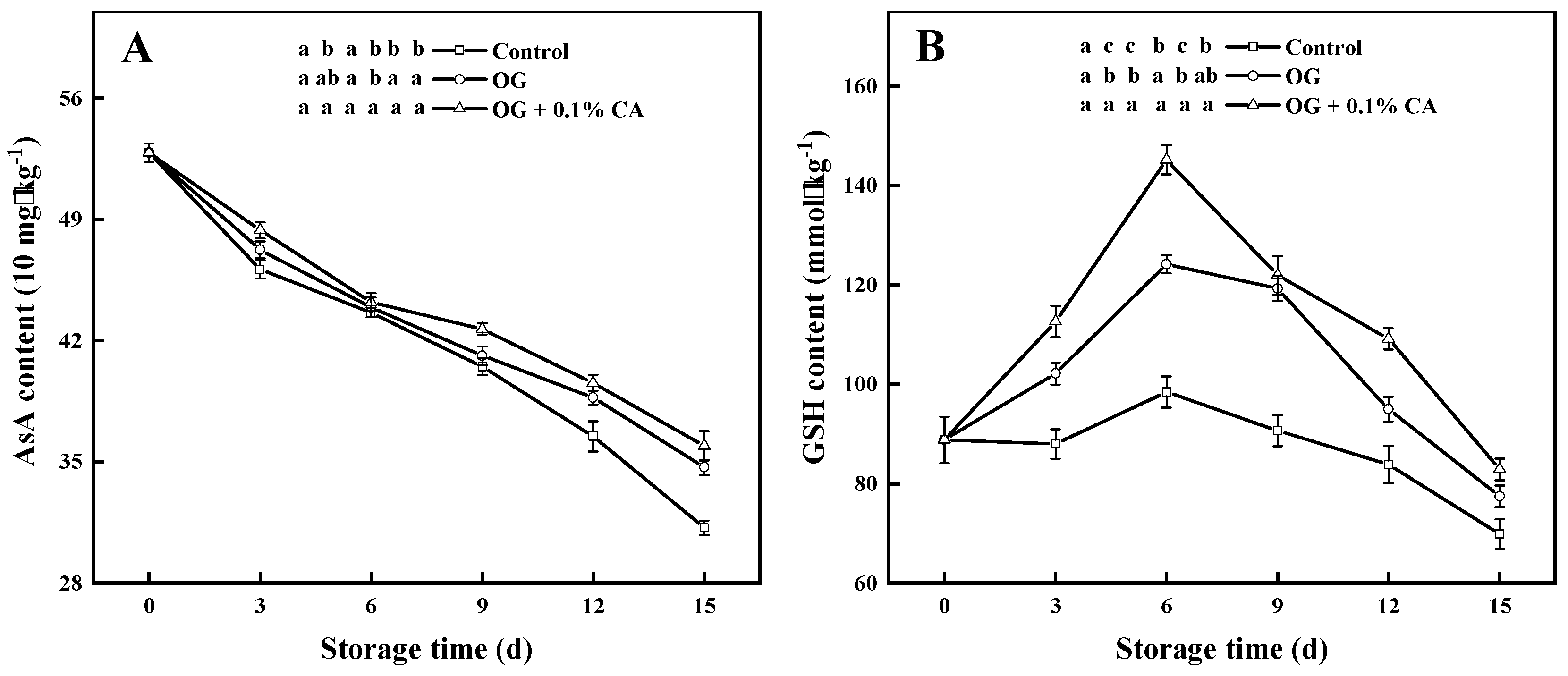
Apart from enzymatic machinery, ROS can also be removed by multiple nonenzymatic components particularly such as AsA and GSH, working by donating electrons to ROS molecules [39]. Here, AsA contents in all fruit steadily reduced during the storage (Figure 6A), but the coated fruit always kept relatively higher AsA, especially in late period. At day 15, the AsA content of composite coating group was significantly higher than those of other two groups. Additionally, GSH contents in all fruit increased over the first 6 d storage to peaks and then decreased (Figure 6B). The fruit with composite coating possessed the highest GSH content (82.89 mmol kg-1) at day 15, followed by the plain coating group and then the control group. Altogether both coatings effectively retarded the decrease of AsA and GSH contents, more notably the composite one, thereby conserving the antioxidant capacity of the fruit during storage.
4. Discussion
Postharvest cherry tomatoes deteriorate fast due to their highly perishable nature, resulting in susceptibility to pathogens and physiological decay [7]. Herein, both plain and composite coating treatments effectively decreased the decay and preserved the marketability of the fruit during storage wherein the composite coatings were more efficacious than the plain coating without CA. Predominantly, this difference was attributed to the involvement of CA, well demonstrating antimicrobial and antioxidant activities [40], in the fruit protection. Composite coating containing essential-oil components curbs the growth of surface microorganisms and regulates the disease resistance of fruit, thereby inhibiting the decay and maintaining the overall quality of the fruit [41]. A reported illustration of the point is the composite coating tomato fruit with pectin incorporated with oregano essential oil [42].
Postharvest fruit continuously consume their nutrients to support cellular respiration for energy during storage. Higher rate respiration consumes larger amounts of nutrients, thus begetting fast maturing, aging, and softening and easy decaying of the fruit [43]. Tomato fruit experience rapid weight reduction and softening owing to the water loss mainly caused by transpiration and high respiration, bringing on the loss of firmness of the fruit flesh [44]. Herein, composite coating significantly inhibited the respiration, slowing down the physiological metabolism, and thus reduced the weight loss and retained the firmness of tomato fruit. This effect is owing to the suppressing of gas exchange through fruit surface by the coating with specific polysaccharides and the increased fruit surface hydrophobicity as a result of the incorporation of lipophilic compounds into the coating. Coating minimizes the fruit transpiration and respiration partly by covering their stomata, lenticels, and micro pores and limiting the gas exchange of O2 and CO2, thereby decreasing the loss of fruit water and firmness [45]. Similar effects and their underpinnings were reported on the coated fruit of strawberry [12], sweet cherry [46], guava [47], and mango [48] previously. While the respiration and transpiration rates and physiological ripening slow down, the fruit quality and sensorial property losses are mitigated [49].
TA, TSS, and soluble protein contents reflect fruit mature and senescence state. TA, mainly on account of organic acids, accumulates during the fruit development stage and then is consumed as respiratory substrates in central carbon metabolism [50] during the ripening and senescence of the fruit [51]. Organic acids such as citric and malic acids are principal substrates involved in the respiration of climacteric fruit [6]; thus, postharvest depletion of acidity is expected in fruit with high respiration. Variations of fruit TSS since harvest are closely related to both the hydrolysis of polysaccharides along the ripening and the respiratory consumption of these hydrolysates [52]. Soluble proteins in fruit are mainly enzymes involved in various metabolisms and stress responses. A reduction in soluble protein content is mainly attributed to oxidation of certain proteins during storage, resulting in the inactivation of related enzymes and the accumulation of less soluble proteins in tissue [53]. Herein, composite coating delayed the decline of TSS, TA, and soluble protein content largely owing to the reduction of respiration. Coating suppresses the respiration and thus slows the synthesis and degradation of metabolites, hence less nutrient consumption [27,54]. Accordingly, gum coatings of strawberry [12], sweet cherry [55], and fresh cut apricot [56] maintain high levels of TSS, TA, and soluble proteins in the fruit tissues.
Senescence of postharvest fruit is closely related to the abnormal accumulation of ROS. Under favorable circumstances, the generation and elimination of ROS achieves homeostasis, and the intracellular ROS are maintained at low levels, thus curbing the oxidative damage to cellular components and the formation of toxic products [33]. Postharvest fruit, however, experience multiple stresses from both environment cues and internal physiological happenings, and these detrimental stresses vitiate the ROS homeostasis. The resultant overaccumulation of ROS accelerates the fruit senescence progress [39]. Water loss as a typical physiological stress causes excessive formation of ROS; the consequent oxidative damage, usually characterized by pronounced membrane lipid peroxidation and compromised membrane integrity, occasions metabolism disorders and further accelerates quality deterioration and senescence of the postharvest fruit [28,54]. Herein, composite coating effectively decreased the accumulation of and H2O2, and mitigated the elevation of cell membrane permeability. To improve the antioxidant efficacy, certain bioactive compounds such as plant polysaccharides and essential oils have been incorporated into the coating; such incorporation enriches the protection of fruit against membrane lipid peroxidation, membrane integrity destruction, and fast senescence [57,58,59].
Endogenously, postharvest fruit deploy enzymatic and non-enzymatic arsenals to scavenge ROS and mitigate oxidative damage to cells [60]. The antioxidant enzyme machinery transforms ROS into less detrimental metabolites. Typically, SOD converts the more reactive through disproportionation reaction into H2O2, and then this intermediate is further converted into innocuous H2O and O2 by CAT, POD, and APX collaboratively [61]. Herein, composite coating potentiated the enzymatic antioxidant machinery of the fruit as evidenced by the increased activities of SOD, CAT, POD, and APX. This potentiation was underpinned collaboratively by the performance of bioactive components of the composite coating. Application of citral induces systemic acquired resistance in plant against pathogens [62], the cornerstone of which is the elevation of antioxidant gene expression to remove the extra ROS [63]. Furthermore, the antioxidant activities of CA and OG per se quench part of the fruit ROS, thereby reducing the oxidative stress on the fruit and retarding their senescence [64,65]. Accordingly, the composite coating preserved overall quality of the cherry tomato fruit effectively. Consistent with our findings, Tragacanth gum coating regulates oxidative stress on postharvest apricots and therefore keeps the quality of the fruit [13].
Non-enzymatically, endogenous antioxidant substances play crucial roles in scavenging the fruit ROS. Among them, AsA and GSH in the versatile ascorbate-glutathione cycle are the dominant ones; the levels of these pivotal molecules are critical in maintaining the homeostasis of intracellular antioxidant system and thus in alleviating the oxidative damage to fruit cells [66]. Herein, the fruit with composite coating kept higher levels of AsA and GSH than their counterparts in the control group; higher levels of AsA and GSH consolidate a more effective defense against various oxidative attacks. Taken together, the composite coating reinforced both the enzymatic and non-enzymatic antioxidant machineries to alleviate stresses, retarded the fruit senescence and thus preserved their quality.
5. Conclusions
The composite coating of OG and CA effectively reduced the postharvest decay and maintained marketability of cherry tomatoes stored at 25 °C and 85 ~ 95% RH. The coating with OG+0.1% CA reduced weight loss, respiration rate, and softening of the fruit and decelerated their decreases of total soluble solids, titratable acidity, and soluble proteins. Furthermore, the coating reduced the accumulation of and H2O2, and thus decreased the MDA production and the cell membrane permeabilization, mitigating the oxidative damage to the cells and, therefore, retarding the fruit senescence. Concomitantly and as underpinnings, the composite coating elevated the activities of SOD, CAT, POD, and APX and the levels of AsA and GSH. This potentiation of the fruit antioxidant system was largely attributed to the integration of coating-component actuated fruit stress responses and the antioxidant activities of the components per se.
Author Contributions
Conceptualization, Z.Z and Y.B.; methodology, Z.Z. and D.P.; software, R.D.; validation, R.D., Z.Z. and X.D.; formal analysis, Z.Z.; investigation, R.D. and X.D.; resources, Z.Z and Y.B.; data curation, R.D.; writing—original draft preparation, Z.Z and R.D.; writing—review and editing, Z.Z, R.D. and D.P.; visualization, R.D.; supervision, Z.Z and Y.B.; project administration, Z.Z and Y.B.; funding acquisition, Z.Z and Y.B. All authors have read and agreed to the published version of the manuscript.
Funding
This research was funded by National Natural Science Foundation of China, grant number 32260582 and 31360416, and Provincial Natural Science Foundation of Gansu Province, grant number 21JR7RA807.
Data Availability Statement
The data presented in this study are available on request from the corresponding author. The data are not publicly available due to privacy.
Conflicts of Interest
The authors declare no conflicts of interest.
References
- Jiang, H.; Zhang, W.; Xu, Y.; Zhang, Y.; Pu, Y.; Cao, J.; Jiang, W. Applications of Plant-Derived Food by-Products to Maintain Quality of Postharvest Fruits and Vegetables. jiaoTrends Food Sci. Technol. 2021, 116, 1105–1119. [Google Scholar] [CrossRef]
- Li, C.; Tao, J.; Zhang, H. Peach Gum Polysaccharides-Based Edible Coatings Extend Shelf Life of Cherry Tomatoes. 3 Biotech 2017, 7, 168. [Google Scholar] [CrossRef] [PubMed]
- Fagundes, C.; Palou, L.; Monteiro, A.R.; Pérez-Gago, M.B. Hydroxypropyl Methylcellulose-Beeswax Edible Coatings Formulated with Antifungal Food Additives to Reduce Alternaria Black Spot and Maintain Postharvest Quality of Cold-Stored Cherry Tomatoes. Sci. Hortic. 2015, 193, 249–257. [Google Scholar] [CrossRef]
- Álvarez, A.; Manjarres, J.J.; Ramírez, C.; Bolívar, G. Use of an Exopolysaccharide-Based Edible Coating and Lactic Acid Bacteria with Antifungal Activity to Preserve the Postharvest Quality of Cherry Tomato. LWT 2021, 151, 112225. [Google Scholar] [CrossRef]
- Tzortzakis, N.; Xylia, P.; Chrysargyris, A. Sage Essential Oil Improves the Effectiveness of Aloe Vera Gel on Postharvest Quality of Tomato Fruit. Agronomy 2019, 9, 635. [Google Scholar] [CrossRef]
- Nawab, A.; Alam, F.; Hasnain, A. Mango Kernel Starch as a Novel Edible Coating for Enhancing Shelf- Life of Tomato (Solanum Lycopersicum) Fruit. Int. J. Biol. Macromol. 2017, 103, 581–586. [Google Scholar] [CrossRef] [PubMed]
- Safari, Z.S.; Ding, P.; Juju Nakasha, J.; Yusoff, S.F. Combining Chitosan and Vanillin to Retain Postharvest Quality of Tomato Fruit during Ambient Temperature Storage. Coatings 2020, 10, 1222. [Google Scholar] [CrossRef]
- Ali, A.; Maqbool, M.; Ramachandran, S.; Alderson, P.G. Gum Arabic as a Novel Edible Coating for Enhancing Shelf-Life and Improving Postharvest Quality of Tomato (Solanum Lycopersicum L.) Fruit. Postharvest Biol. Technol. 2010, 58, 42–47. [Google Scholar] [CrossRef]
- Buendía−Moreno, L.; Soto−Jover, S.; Ros−Chumillas, M.; Antolinos, V.; Navarro−Segura, L.; Sánchez−Martínez, M.J.; Martínez−Hernández, G.B.; López−Gómez, A. Innovative Cardboard Active Packaging with a Coating Including Encapsulated Essential Oils to Extend Cherry Tomato Shelf Life. LWT 2019, 116, 108584. [Google Scholar] [CrossRef]
- Al-Juhaimi, F.Y. Physicochemical and Sensory Characteristics of Arabic Gum-Coated Tomato (Solanum Lycopersicum L.) Fruits during Storage: Tomato Fruits Coated with Gum Arabic. J. Food Process. Preserv. 2014, 38, 971–979. [Google Scholar] [CrossRef]
- Salehi, F. Edible Coating of Fruits and Vegetables Using Natural Gums: A Review. Int. J. Fruit Sci. 2020, 20, S570–S589. [Google Scholar] [CrossRef]
- Tahir, H.E.; Zou, X.; Shi, J.; Mahunu, G.K.; Zhai, X.; Mariod, A.A. Quality and Postharvest-Shelf Life of Cold-Stored Strawberry Fruit as Affected by Gum Arabic (Acacia Senegal) Edible Coating. J. Food Biochem. 2018, 42, e12527. [Google Scholar] [CrossRef]
- Ali, S.; Anjum, M.A.; Nawaz, A.; Naz, S.; Ejaz, S.; Sardar, H.; Saddiq, B. Tragacanth Gum Coating Modulates Oxidative Stress and Maintains Quality of Harvested Apricot Fruits. Int. J. Biol. Macromol. 2020, 163, 2439–2447. [Google Scholar] [CrossRef] [PubMed]
- Nasiri, M.; Barzegar, M.; Sahari, M.A.; Niakousari, M. Application of Tragacanth Gum Impregnated with Satureja Khuzistanica Essential Oil as a Natural Coating for Enhancement of Postharvest Quality and Shelf Life of Button Mushroom (Agaricus Bisporus). Int. J. Biol. Macromol. 2018, 106, 218–226. [Google Scholar] [CrossRef] [PubMed]
- Etemadipoor, R.; Mirzaalian Dastjerdi, A.; Ramezanian, A.; Ehteshami, S. Ameliorative Effect of Gum Arabic, Oleic Acid and/or Cinnamon Essential Oil on Chilling Injury and Quality Loss of Guava Fruit. Sci. Hortic. 2020, 266, 109255. [Google Scholar] [CrossRef]
- Hamidpour, R.; Hamidpour, S.; Hamidpour, M.; Shahlari, M.; Sohraby, M.; Shahlari, N.; Hamidpour, R. Russian Olive (Elaeagnus Angustifolia L.): From a Variety of Traditional Medicinal Applications to Its Novel Roles as Active Antioxidant, Anti-Inflammatory, Anti-Mutagenic and Analgesic Agent. J. Tradit. Complement. Med. 2017, 7, 24–29. [Google Scholar] [CrossRef] [PubMed]
- Sharifian-Nejad, M.S.; Shekarchizadeh, H. Physicochemical and Functional Properties of Oleaster (Elaeagnus Angustifolia L.) Polysaccharides Extracted under Optimal Conditions. Int. J. Biol. Macromol. 2019, 124, 946–954. [Google Scholar] [CrossRef] [PubMed]
- Ncama, K.; Magwaza, L.S.; Mditshwa, A.; Tesfay, S.Z. Plant-Based Edible Coatings for Managing Postharvest Quality of Fresh Horticultural Produce: A Review. Food Packag. Shelf Life 2018, 16, 157–167. [Google Scholar] [CrossRef]
- Rashid, Z.; Khan, M.R.; Mubeen, R.; Hassan, A.; Saeed, F.; Afzaal, M. Exploring the Effect of Cinnamon Essential Oil to Enhance the Stability and Safety of Fresh Apples. J. Food Process. Preserv. 2020, 44, e14926. [Google Scholar] [CrossRef]
- Lin, L.; Liao, X.; Li, C.; Abdel-Samie, M.A.; Siva, S.; Cui, H. Cold Nitrogen Plasma Modified Cuminaldehyde/β-Cyclodextrin Inclusion Complex and Its Application in Vegetable Juices Preservation. Food Res. Int. 2021, 141, 110132. [Google Scholar] [CrossRef]
- Ramya, S.; Loganathan, T.; Chandran, M.; Priyanka, R.; Kavipriya, K.; Pushpalatha, G.L.G.L.; Aruna, D.; Abraham, G.; Jayakumararaj, R. ADME-Tox Profile of Cuminaldehyde (4-Isopropylbenzaldehyde) from Cuminum Cyminum Seeds for Potential Biomedical Applications. J. Drug Deliv. Ther. 2022, 12, 127–141. [Google Scholar] [CrossRef]
- Alizadeh Behbahani, B.; Noshad, M.; Falah, F. Cumin Essential Oil: Phytochemical Analysis, Antimicrobial Activity and Investigation of Its Mechanism of Action through Scanning Electron Microscopy. Microb. Pathog. 2019, 136, 103716. [Google Scholar] [CrossRef]
- Li, H.; Huang, Y.; Addo, K.A.; Yu, Y.; Xiao, X. Effects of Cuminaldehyde on Toxins Production of Staphylococcus Aureus and Its Application in Sauced Beef. Food Control 2022, 137, 108960. [Google Scholar] [CrossRef]
- Ghosh, S.; Kundu, M.; Dutta, S.; Mahalanobish, S.; Ghosh, N.; Das, J.; Sil, P.C. Enhancement of Anti-Neoplastic Effects of Cuminaldehyde against Breast Cancer via Mesoporous Silica Nanoparticle Based Targeted Drug Delivery System. Life Sci. 2022, 298, 120525. [Google Scholar] [CrossRef] [PubMed]
- Ma, Y.; Wang, Z.; Wang, Y.; Zhang, S. Molecular Insight into the Interactions between Starch and Cuminaldehyde Using Relaxation and 2D Solid-State NMR Spectroscopy. Carbohydr. Polym. 2022, 278, 118932. [Google Scholar] [CrossRef] [PubMed]
- Suhag, R.; Kumar, N.; Petkoska, A.T.; Upadhyay, A. Film Formation and Deposition Methods of Edible Coating on Food Products: A Review. Food Res. Int. 2020, 136, 109582. [Google Scholar] [CrossRef] [PubMed]
- Kumar, A.; Saini, C.S. Edible Composite Bi-Layer Coating Based on Whey Protein Isolate, Xanthan Gum and Clove Oil for Prolonging Shelf Life of Tomatoes. Meas. Food 2021, 2, 100005. [Google Scholar] [CrossRef]
- Yu, K.; Zhou, L.; Xu, J.; Jiang, F.; Zhong, Z.; Zou, L.; Liu, W. Carboxymethyl Cellulose-Based Water Barrier Coating Regulated Postharvest Quality and ROS Metabolism of Pakchoi (Brassica Chinensis L.). Postharvest Biol. Technol. 2022, 185, 111804. [Google Scholar] [CrossRef]
- Han, Z.; Wang, Z.; Bi, Y.; Zong, Y.; Gong, D.; Wang, B.; Li, B.; Sionov, E.; Prusky, D. The Effect of Environmental pH during Trichothecium Roseum (Pers.:Fr.) Link Inoculation of Apple Fruits on the Host Differential Reactive Oxygen Species Metabolism. Antioxidants 2021, 10, 692. [Google Scholar] [CrossRef]
- Huan, C.; Jiang, L.; An, X.; Yu, M.; Xu, Y.; Ma, R.; Yu, Z. Potential Role of Reactive Oxygen Species and Antioxidant Genes in the Regulation of Peach Fruit Development and Ripening. Plant Physiol. Biochem. 2016, 104, 294–303. [Google Scholar] [CrossRef]
- Carvalho, R.L.; Cabral, M.F.; Germano, T.A.; de Carvalho, W.M.; Brasil, I.M.; Gallão, M.I.; Moura, C.F.H.; Lopes, M.M.A.; de Miranda, M.R.A. Chitosan Coating with Trans-Cinnamaldehyde Improves Structural Integrity and Antioxidant Metabolism of Fresh-Cut Melon. Postharvest Biol. Technol. 2016, 113, 29–39. [Google Scholar] [CrossRef]
- Zhou, Q.; Ma, C.; Cheng, S.; Wei, B.; Liu, X.; Ji, S. Changes in Antioxidative Metabolism Accompanying Pitting Development in Stored Blueberry Fruit. Postharvest Biol. Technol. 2014, 88, 88–95. [Google Scholar] [CrossRef]
- Jiang, A.; Zuo, J.; Zheng, Q.; Guo, L.; Gao, L.; Zhao, S.; Wang, Q.; Hu, W. Red LED Irradiation Maintains the Postharvest Quality of Broccoli by Elevating Antioxidant Enzyme Activity and Reducing the Expression of Senescence-Related Genes. Sci. Hortic. 2019, 251, 73–79. [Google Scholar] [CrossRef]
- Fan, X.-J.; Zhang, B.; Yan, H.; Feng, J.-T.; Ma, Z.-Q.; Zhang, X. Effect of Lotus Leaf Extract Incorporated Composite Coating on the Postharvest Quality of Fresh Goji (Lycium Barbarum L.) Fruit. Postharvest Biol. Technol. 2019, 148, 132–140. [Google Scholar] [CrossRef]
- Xu, F.; Zhang, K.; Liu, S. Evaluation of 1-Methylcyclopropene (1-MCP) and Low Temperature Conditioning (LTC) to Control Brown of Huangguan Pears. Sci. Hortic. 2020, 259, 108738. [Google Scholar] [CrossRef]
- Mu, Y.; Feng, Y.; Wei, L.; Li, C.; Cai, G.; Zhu, T. Combined Effects of Ultrasound and Aqueous Chlorine Dioxide Treatments on Nitrate Content during Storage and Postharvest Storage Quality of Spinach (Spinacia Oleracea L.). Food Chem. 2020, 333, 127500. [Google Scholar] [CrossRef] [PubMed]
- Wang, F.; Zhang, X.; Yang, Q.; Zhao, Q. Exogenous Melatonin Delays Postharvest Fruit Senescence and Maintains the Quality of Sweet Cherries. Food Chem. 2019, 301, 125311. [Google Scholar] [CrossRef] [PubMed]
- Ge, Y.; Tang, Q.; Li, C.; Duan, B.; Li, X.; Wei, M.; Li, J. Acibenzolar-S-Methyl Treatment Enhances Antioxidant Ability and Phenylpropanoid Pathway of Blueberries during Low Temperature Storage. LWT 2019, 110, 48–53. [Google Scholar] [CrossRef]
- Meitha, K.; Pramesti, Y.; Suhandono, S. Reactive Oxygen Species and Antioxidants in Postharvest Vegetables and Fruits. Int. J. Food Sci. 2020, 2020, e8817778. [Google Scholar] [CrossRef]
- Abbdellaoui, M.; Bouhlali, E.; Bouhlali, E.d.T.; Rhaffari, L.E. Chemical Composition and Antioxidant Activities of the Essential Oils of Cumin (Cuminum Cyminum) Conducted Under Organic Production Conditions. J. Essent. Oil Bear. Plants 2019, 22, 1500–1508. [Google Scholar] [CrossRef]
- Yousuf, B.; Wu, S.; Siddiqui, M.W. Incorporating Essential Oils or Compounds Derived Thereof into Edible Coatings: Effect on Quality and Shelf Life of Fresh/Fresh-Cut Produce. Trends Food Sci. Technol. 2021, 108, 245–257. [Google Scholar] [CrossRef]
- Rodriguez-Garcia, I.; Cruz-Valenzuela, M.R.; Silva-Espinoza, B.A.; Gonzalez-Aguilar, G.A.; Moctezuma, E.; Gutierrez-Pacheco, M.M.; Tapia-Rodriguez, M.R.; Ortega-Ramirez, L.A.; Ayala-Zavala, J.F. Oregano (Lippia Graveolens) Essential Oil Added within Pectin Edible Coatings Prevents Fungal Decay and Increases the Antioxidant Capacity of Treated Tomatoes. J. Sci. Food Agric. 2016, 96, 3772–3778. [Google Scholar] [CrossRef] [PubMed]
- Wu, S.; Lu, M.; Wang, S. Effect of Oligosaccharides Derived from Laminaria Japonica-Incorporated Pullulan Coatings on Preservation of Cherry Tomatoes. Food Chem. 2016, 199, 296–300. [Google Scholar] [CrossRef]
- Azmai, W.N.S.M.; Latif, N.S.A.; Zain, N.M. Efficiency of Edible Coating Chitosan and Cinnamic Acid to Prolong the Shelf Life of Tomatoes. J. Trop. Resour. Sustain. Sci. 2019, 7, 47–52. [Google Scholar] [CrossRef]
- Vignesh, R.M.; Nair, B.R. Improvement of Shelf Life Quality of Tomatoes Using a Novel Edible Coating Formulation. Plant Sci. Today 2019, 6, 84–90. [Google Scholar] [CrossRef]
- Mahfoudhi, N.; Hamdi, S. Use of Almond Gum and Gum Arabic as Novel Edible Coating to Delay Postharvest Ripening and to Maintain Sweet Cherry (P Runus Avium) Quality during Storage: Almond Gum as Novel Edible Coating. J. Food Process. Preserv. 2015, 39, 1499–1508. [Google Scholar] [CrossRef]
- Murmu, S.B.; Mishra, H.N. The Effect of Edible Coating Based on Arabic Gum, Sodium Caseinate and Essential Oil of Cinnamon and Lemon Grass on Guava. Food Chem. 2018, 245, 820–828. [Google Scholar] [CrossRef]
- Khaliq, G.; Muda Mohamed, M.T.; Ali, A.; Ding, P.; Ghazali, H.M. Effect of Gum Arabic Coating Combined with Calcium Chloride on Physico-Chemical and Qualitative Properties of Mango (Mangifera Indica L.) Fruit during Low Temperature Storage. Sci. Hortic. 2015, 190, 187–194. [Google Scholar] [CrossRef]
- Maringgal, B.; Hashim, N.; Mohamed Amin Tawakkal, I.S.; Muda Mohamed, M.T. Recent Advance in Edible Coating and Its Effect on Fresh/Fresh-Cut Fruits Quality. Trends Food Sci. Technol. 2020, 96, 253–267. [Google Scholar] [CrossRef]
- Etienne, A.; Génard, M.; Lobit, P.; Mbeguié-A-Mbéguié, D.; Bugaud, C. What Controls Fleshy Fruit Acidity? A Review of Malate and Citrate Accumulation in Fruit Cells. J. Exp. Bot. 2013, 64, 1451–1469. [Google Scholar] [CrossRef]
- Eshetu, A.; Ibrahim, A.M.; Forsido, S.F.; Kuyu, C.G. Effect of Beeswax and Chitosan Treatments on Quality and Shelf Life of Selected Mango (Mangifera Indica L.) Cultivars. Heliyon 2019, 5, e01116. [Google Scholar] [CrossRef]
- Ruelas-Chacon, X.; Contreras-Esquivel, J.C.; Montañez, J.; Aguilera-Carbo, A.F.; Reyes-Vega, M.L.; Peralta-Rodriguez, R.D.; Sanchéz-Brambila, G. Guar Gum as an Edible Coating for Enhancing Shelf-Life and Improving Postharvest Quality of Roma Tomato (Solanum Lycopersicum L.). J. Food Qual. 2017, 2017, e8608304. [Google Scholar] [CrossRef]
- Yan, L.; Zheng, H.; Liu, W.; Liu, C.; Jin, T.; Liu, S.; Zheng, L. UV-C Treatment Enhances Organic Acids and GABA Accumulation in Tomato Fruits during Storage. Food Chem. 2021, 338, 128126. [Google Scholar] [CrossRef] [PubMed]
- Li, Z.; Zhang, W.; Li, X.; Liu, H.; Li, F.; Zhang, X. Combined Effects of 1-Methylcyclopropene and Tea Polyphenols Coating Treatment on the Postharvest Senescence and Reactive Oxygen Species Metabolism of Bracken (Pteridium Aquilinum Var. Latiusculum). Postharvest Biol. Technol. 2022, 185, 111813. [Google Scholar] [CrossRef]
- Dong, F.; Wang, X. Guar Gum and Ginseng Extract Coatings Maintain the Quality of Sweet Cherry. LWT 2018, 89, 117–122. [Google Scholar] [CrossRef]
- Hashemi, S.M.B.; Mousavi Khaneghah, A.; Ghaderi Ghahfarrokhi, M.; Eş, I. Basil-Seed Gum Containing Origanum Vulgare Subsp. Viride Essential Oil as Edible Coating for Fresh Cut Apricots. Postharvest Biol. Technol. 2017, 125, 26–34. [Google Scholar] [CrossRef]
- Shakir, M.S.; Ejaz, S.; Hussain, S.; Ali, S.; Sardar, H.; Azam, M.; Ullah, S.; Khaliq, G.; Saleem, M.S.; Nawaz, A.; et al. Synergistic Effect of Gum Arabic and Carboxymethyl Cellulose as Biocomposite Coating Delays Senescence in Stored Tomatoes by Regulating Antioxidants and Cell Wall Degradation. Int. J. Biol. Macromol. 2022, 201, 641–652. [Google Scholar] [CrossRef] [PubMed]
- Zhang, W.; Zhao, H.; Jiang, H.; Xu, Y.; Cao, J.; Jiang, W. Multiple 1-MCP Treatment More Effectively Alleviated Postharvest Nectarine Chilling Injury than Conventional One-Time 1-MCP Treatment by Regulating ROS and Energy Metabolism. Food Chem. 2020, 330, 127256. [Google Scholar] [CrossRef] [PubMed]
- Zhang, X.; Zhang, X.; An, L.; Du, M.; Tian, Y. Effect of Polysaccharide Derived from Osmunda Japonica Thunb-Incorporated Carboxymethyl Cellulose Coatings on Preservation of Tomatoes. J. Food Process. Preserv. 2019, 43, e14239. [Google Scholar] [CrossRef]
- Lin, Y.; Lin, H.; Fan, Z.; Wang, H.; Lin, M.; Chen, Y.; Hung, Y.-C.; Lin, Y. Inhibitory Effect of Propyl Gallate on Pulp Breakdown of Longan Fruit and Its Relationship with ROS Metabolism. Postharvest Biol. Technol. 2020, 168, 111272. [Google Scholar] [CrossRef]
- Zhang, X.; Zhou, Y.; Li, J.; Gu, X.; Zhao, L.; Li, B.; Wang, K.; Yang, Q.; Zhang, H. Pichia Caribbica Improves Disease Resistance of Cherry Tomatoes by Regulating ROS Metabolism. Biol. Control 2022, 169, 104870. [Google Scholar] [CrossRef]
- Jiang, Y.; Ji, X.; Zhang, Y.; Pan, X.; Yang, Y.; Li, Y.; Guo, W.; Wang, Y.; Ma, Z.; Lei, B.; et al. Citral Induces Plant Systemic Acquired Resistance against Tobacco Mosaic Virus and Plant Fungal Diseases. Ind. Crops Prod. 2022, 183, 114948. [Google Scholar] [CrossRef]
- Piechowiak, T.; Grzelak-Błaszczyk, K.; Sójka, M.; Skóra, B.; Balawejder, M. Quality and Antioxidant Activity of Highbush Blueberry Fruit Coated with Starch-Based and Gelatine-Based Film Enriched with Cinnamon Oil. Food Control 2022, 138, 109015. [Google Scholar] [CrossRef]
- Banani, H.; Olivieri, L.; Santoro, K.; Garibaldi, A.; Gullino, M.L.; Spadaro, D. Thyme and Savory Essential Oil Efficacy and Induction of Resistance against Botrytis Cinerea through Priming of Defense Responses in Apple. Foods 2018, 7, 11. [Google Scholar] [CrossRef] [PubMed]
- Xu, Y.; Cai, Z.; Ba, L.; Qin, Y.; Su, X.; Luo, D.; Shan, W.; Kuang, J.; Lu, W.; Li, L.; et al. Maintenance of Postharvest Quality and Reactive Oxygen Species Homeostasis of Pitaya Fruit by Essential Oil P-Anisaldehyde Treatment. Foods 2021, 10, 2434. [Google Scholar] [CrossRef]
- Zhu, J.; Wu, H.; Sun, Q. Preparation of Crosslinked Active Bilayer Film Based on Chitosan and Alginate for Regulating Ascorbate-Glutathione Cycle of Postharvest Cherry Tomato (Lycopersicon Esculentum). Int. J. Biol. Macromol. 2019, 130, 584–594. [Google Scholar] [CrossRef]
Figure 1.
Visual appearance (A), decay index (B), and percentage marketability (C) of cherry tomatoes without coating and coated with OG, with OG+0.1% CA, and with OG+0.2% CA, after 15 d storage at 25 °C and 85~95 % RH. All the coated fruit showed lower decay index and better marketability than the control, and among them the fruit with composite coating with OG and 0.1% CA showed the best appearance and marketability. Bars represent standard errors (±SE). Different lowercase letters mean statistically significant difference (p < 0.05).
Figure 1.
Visual appearance (A), decay index (B), and percentage marketability (C) of cherry tomatoes without coating and coated with OG, with OG+0.1% CA, and with OG+0.2% CA, after 15 d storage at 25 °C and 85~95 % RH. All the coated fruit showed lower decay index and better marketability than the control, and among them the fruit with composite coating with OG and 0.1% CA showed the best appearance and marketability. Bars represent standard errors (±SE). Different lowercase letters mean statistically significant difference (p < 0.05).
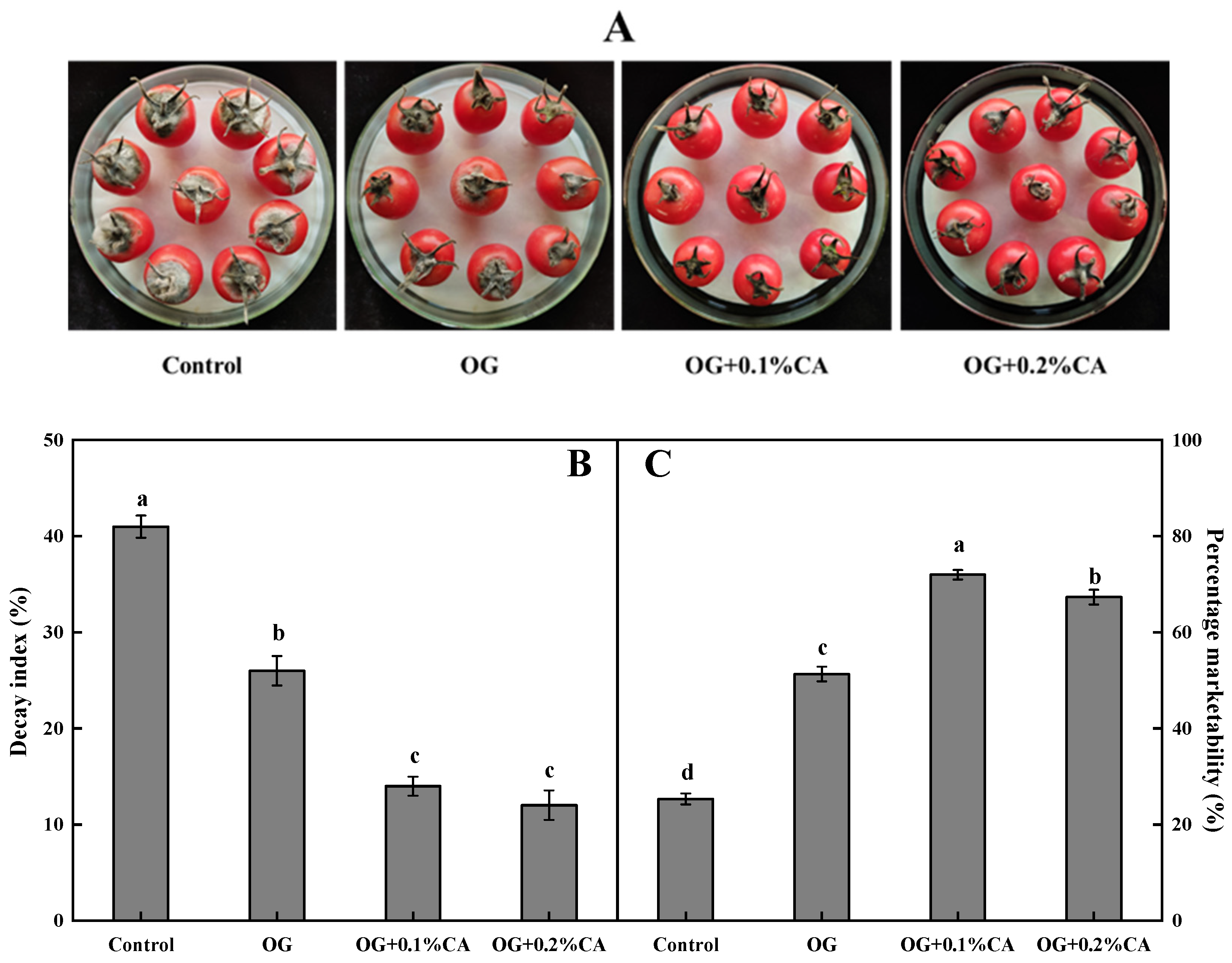
Figure 2.
Composite coating of OG and 0.1% CA delayed and significantly lowered respiration peak (A), and mitigated the fruit weight loss (B) and loss of firmness (C) of the cherry tomatoes stored at 25 °C and 85~95 % RH. Bars represent standard errors (±SE). Different lowercase letters mean statistically significant difference (p < 0.05).
Figure 2.
Composite coating of OG and 0.1% CA delayed and significantly lowered respiration peak (A), and mitigated the fruit weight loss (B) and loss of firmness (C) of the cherry tomatoes stored at 25 °C and 85~95 % RH. Bars represent standard errors (±SE). Different lowercase letters mean statistically significant difference (p < 0.05).
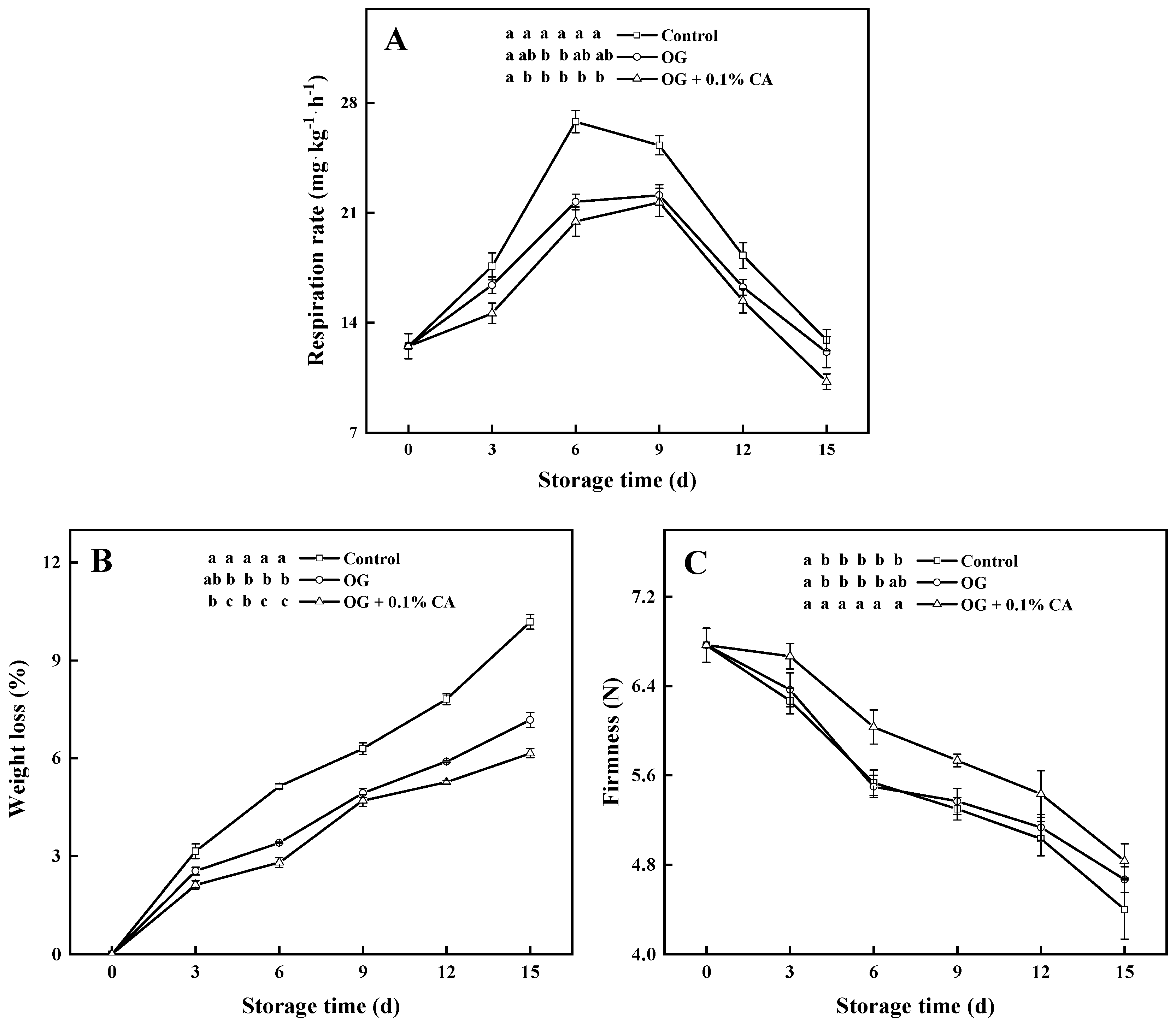
Figure 3.
Composite coating of OG and 0.1% CA retarded the decline of TSS (A), TA (B), and total soluble protein (C) contents in cherry tomatoes stored at 25 °C and 85~95 % RH. Bars represent standard errors (±SE). Different lowercase letters mean statistically significant difference (p < 0.05).
Figure 3.
Composite coating of OG and 0.1% CA retarded the decline of TSS (A), TA (B), and total soluble protein (C) contents in cherry tomatoes stored at 25 °C and 85~95 % RH. Bars represent standard errors (±SE). Different lowercase letters mean statistically significant difference (p < 0.05).
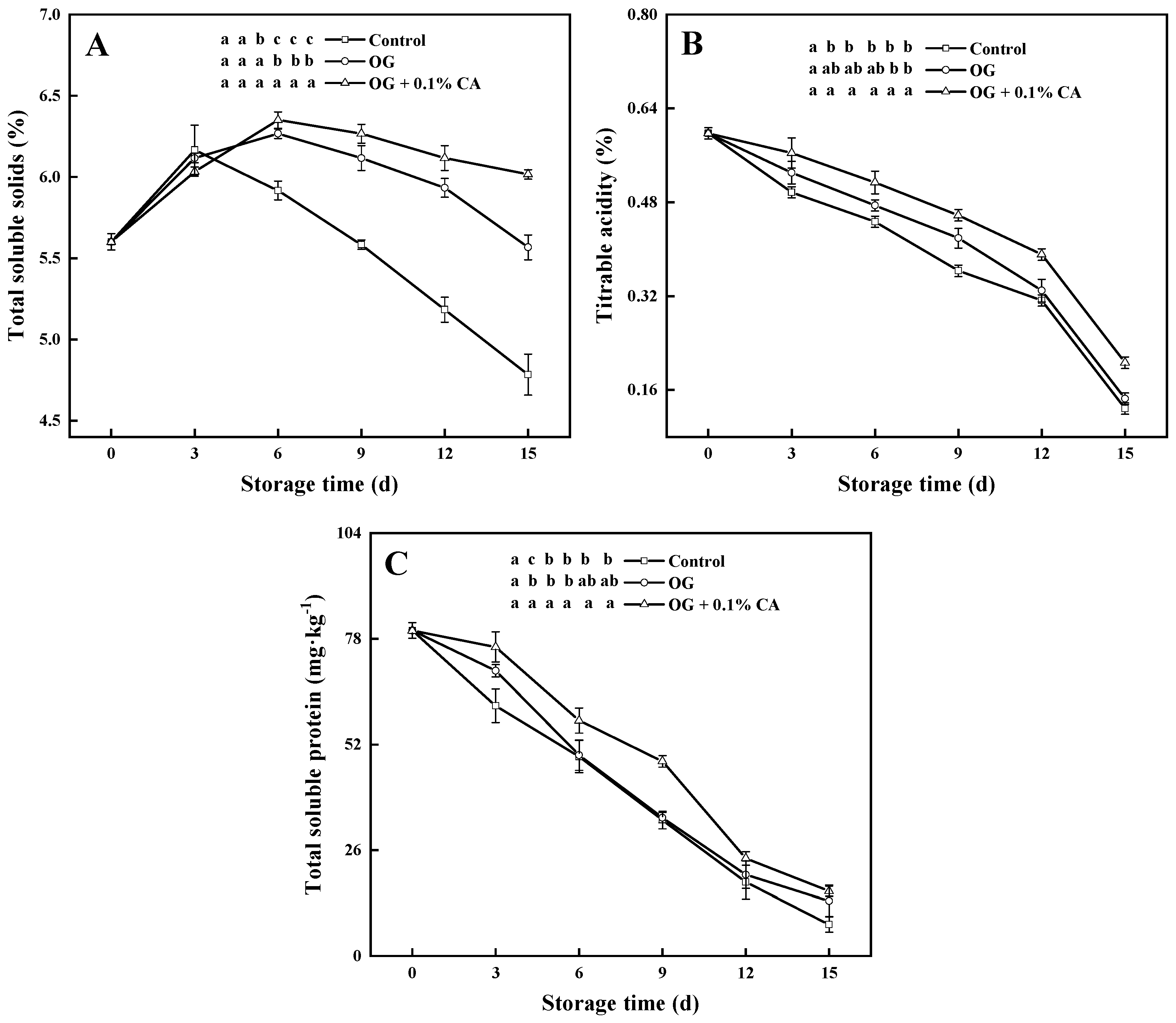
Figure 4.
Composite coating of OG and 0.1% CA mitigated cell membrane permeabilization (A), reduced MDA production (B), and lowered (C) and H2O2 (D) generation in cherry tomatoes stored at 25 °C and 85~95 % RH. Bars represent standard errors (±SE). Different lowercase letters mean statistically significant difference (p < 0.05).
Figure 4.
Composite coating of OG and 0.1% CA mitigated cell membrane permeabilization (A), reduced MDA production (B), and lowered (C) and H2O2 (D) generation in cherry tomatoes stored at 25 °C and 85~95 % RH. Bars represent standard errors (±SE). Different lowercase letters mean statistically significant difference (p < 0.05).
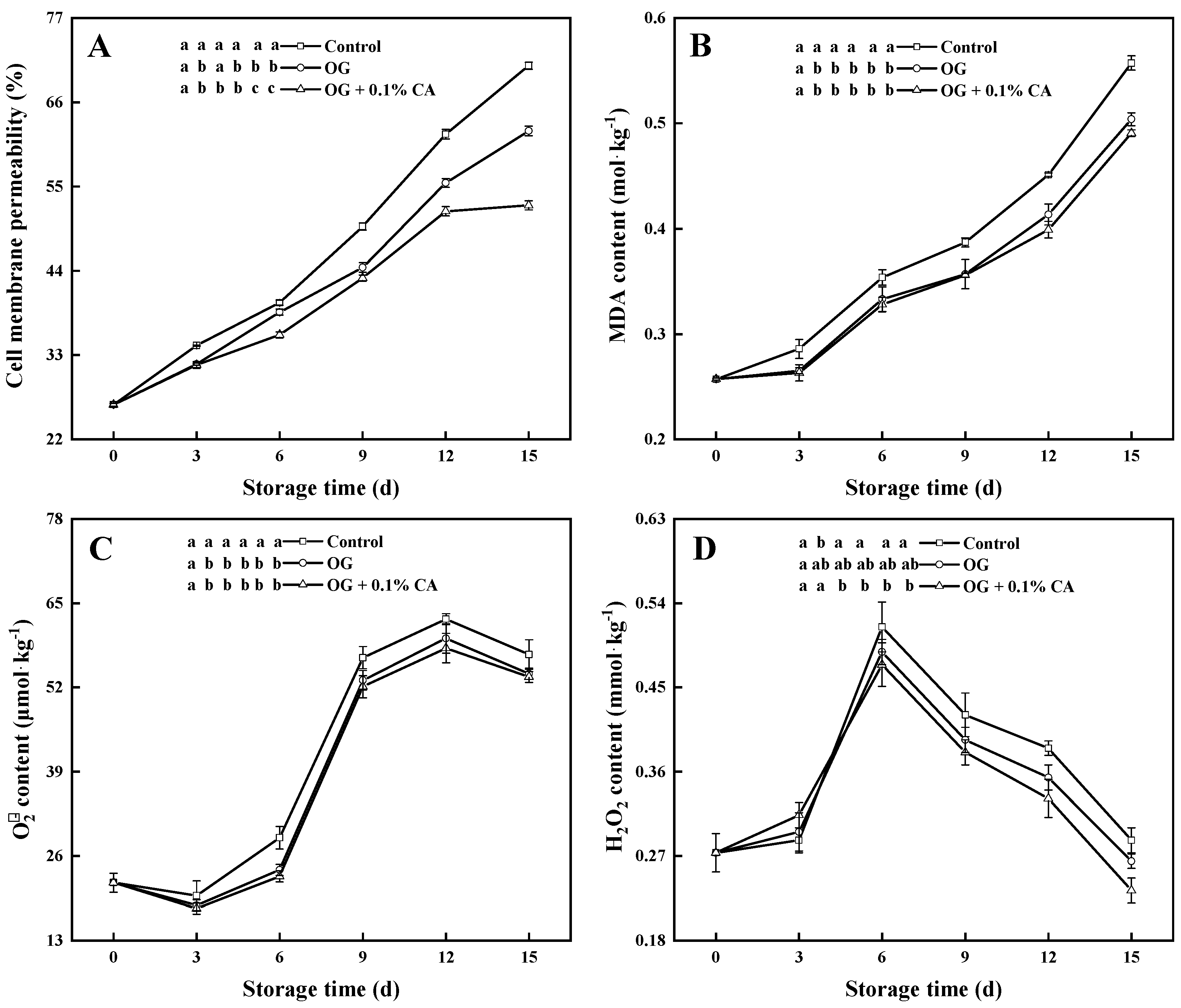
Figure 5.
When stored at 25 °C and 85~95 % RH, the cherry tomatoes with composite coating of OG and 0.1% CA kept higher activities of antioxidant enzyme SOD (A), CAT (B), POD (C), and APX (D) than the control fruit and the fruit with plain coating of OG. Bars represent standard errors (±SE). Different lowercase letters mean statistically significant difference (p < 0.05).
Figure 5.
When stored at 25 °C and 85~95 % RH, the cherry tomatoes with composite coating of OG and 0.1% CA kept higher activities of antioxidant enzyme SOD (A), CAT (B), POD (C), and APX (D) than the control fruit and the fruit with plain coating of OG. Bars represent standard errors (±SE). Different lowercase letters mean statistically significant difference (p < 0.05).

Figure 6.
When stored at 25 °C and 85~95 % RH, the cherry tomatoes with composite coating of OG and 0.1% CA showed higher levels of AsA (A) and GSH (B) than the control fruit and the fruit with plain coating of OG. Bars represent standard errors (±SE). Different lowercase letters mean statistically significant difference (p < 0.05).
Figure 6.
When stored at 25 °C and 85~95 % RH, the cherry tomatoes with composite coating of OG and 0.1% CA showed higher levels of AsA (A) and GSH (B) than the control fruit and the fruit with plain coating of OG. Bars represent standard errors (±SE). Different lowercase letters mean statistically significant difference (p < 0.05).
Disclaimer/Publisher’s Note: The statements, opinions and data contained in all publications are solely those of the individual author(s) and contributor(s) and not of MDPI and/or the editor(s). MDPI and/or the editor(s) disclaim responsibility for any injury to people or property resulting from any ideas, methods, instructions or products referred to in the content. |
© 2024 by the authors. Licensee MDPI, Basel, Switzerland. This article is an open access article distributed under the terms and conditions of the Creative Commons Attribution (CC BY) license (https://creativecommons.org/licenses/by/4.0/).
Copyright: This open access article is published under a Creative Commons CC BY 4.0 license, which permit the free download, distribution, and reuse, provided that the author and preprint are cited in any reuse.


