

Submitted:
22 April 2024
Posted:
23 April 2024
You are already at the latest version
Abstract
Quantum nonlocality represents correlation properties between subsystems of a composite quantum system, usually including the four types: Bell nonlocality, steerability, entanglement, and quantum correlation (quantum discord).
Given a basis \(e_{AB}=\{|e_{ij}\>\}_{i\in[d_A],j\in[d_B]}\) for the Hilbert space \(\H_A\otimes \H_B\) of a bipartite system $AB$, a density operator \(\rho^{AB}\) (quantum state) of $AB$ can be represented as a \(d_Ad_B\times d_Ad_B\) matrix \(\hat{\rho}_{e_{AB}}=[\]\), called the density matrix of a density operator \(\rho^{AB}\). A natural question is what is the relationship between the quantum nonlocality of a density operator \(\rho^{AB}\) and its corresponding density matrix \(\hat{\rho}_{e_{AB}}\)? In this work, we discuss the relationships between quantum locality and basis, and prove that one type of quantum locality of density operators and that of their density matrices under a basis are the same if and only if the chosen basis is the tensor product of the bases of subsystems. Consequently, different bases define different quantum nonlocality density operators.
Keywords:
basis-dependence
; density operator
; density matrix
; classical correlation
; separability
; unsteerability
; Bell locality
1. Introduction
Quantum nonlocality, also called quantum correlation, represents correlation properties between subsystems of a composite quantum system, including Bell nonlocality, steerability, entanglement, and quantum correlation.
Bell nonlocality of bipartite states is demonstrated by some local quantum measurements whose statistics of the measurement outcomes cannot be explained by a local hidden variable (LHV) model [1,2]. Such a nonclassical feature of quantum mechanics can be used in device-independent quantum information processing [2]. For more discussions on Bell nonlocality, please refer to Clauser and Shimony [3], Home and Selleri [4], Khalfin and Tsirelson [5], Tsirelson [6], Zeilinger [7], Werner and Wolf [8], Genovese [9], and Buhrman et al. [10], and [11,12,13,14].
Einstein-Podolsky-Rosen (EPR) steering, as a form of quantum correlation, was first observed by Schrdinger [15] in the context of the well-known EPR paradox [16,17,18,19]. EPR steering arises in scenarios wherein some local quantum measurements on one part of a bipartite system are used to steer the other part. This scenario demonstrates EPR steering if the obtained ensembles cannot be explained by a local hidden state (LHS) model [20]. Following a close analogy of criteria for other forms of quantum nonlocality, Cavalcanti et al. [21] developed a general theory of experimental EPR steering criteria and derived several criteria applicable to discrete and continuous-variable observables. Saunders et al. [22] contributed experimental EPR steering by using Bell local states. Bennet et al. [23] derived arbitrarily loss-tolerant tests, thereby enabling us to perform a detection loophole free demonstration of EPR steering with parties separated by a coiled 1-km-long optical fiber. Händchen et al. [24] presented an experimental realization of two entangled Gaussian modes of light that shows a steering effect in one direction but not in the other. The generated one-way steering provides new insight into quantum physics and may open a new field of applications in quantum information. EPR steering, as an intermediate form of quantum correlation between entanglement and Bell nonlocality, allows for entanglement certification when the measurements performed by one of the parties are not characterized (or are untrusted); it has many applications, such as quantum key distribution [25,26,27], quantum benchmark for qubit teleportation[28], subchannel discrimination in a quantum evolution [29], and so on. Therefore, it has been widely researched, see [30,31,32,33,34,35,36,37,38,39].
Just like quantum steering, quantum entanglement was also recognized by Einstein, Podolsky, Rosen [16], and Schrdinger [15] in 1935. It is a property of a composite quantum system involving nonclassical correlations between subsystems and then having potential for many quantum processes, including canonical ones: quantum cryptography, quantum teleportation, and dense coding.
A bipartite entanglement state reveals correlations between the two subsystems. However, some separable states may reveal some correlations. Such states are just the states that have nonzero quantum discord. Quantum discord induced by H. Ollivier and W.H. Zurek in [40] is a measure of the quantumness of correlations but not a quantum property of states. Considered measurement-induced disturbance, Luo [41] classified correlations between subsystems into classical correlations and quantum correlations by introducing classical correlated (CC) states and quantum correlated states. It was found that a CC state is a separable state [40,41,42,43] and so any entangled state must be a QC state. Thus, quantum correlations have been applied in some quantum computing tasks without entanglement [44], the study of quantum key distribution [45], three-spin XXZ chain with three-spin interaction [46] and so on.
It is well-known that the four types of quantum nonlocality have the following relations:
equivalently,
From the mathematical definitions of quantum locality (Bell locality, separability and classical correlation), we see that these properties depend only on the algebraic structures of the density operators (quantum states) and should be independent of the choice of basis for the Hilbert space of a system . However, in applications and experiments, density operators are usually written as matrices under a chosen basis for . As we known, different bases lead to different matrix representations of operators. Thus, different choice of bases may induce different quantum locality of density matrices, which we called basis-dependent quantum nonlocality.
In the sequence sections, we discuss the relationships between these quantum locality and basis, and find that quantum locality of density operators and their density matrices under a basis are the same only when the basis is a tensor product of the bases of subsystems.
2. Basis Dependent Separability
According to quantum mechanics, a quantum system S is described by a -dimensional complex Hilbert space (called the state space of S) with a right-linear inner product and the states of the system are denoted by positive operators of trace 1 on . The set of all states of S is denoted by . Thus,
where is the -algebra of all bounded linear operators on . The elements of are called the mixed states of S. A unit vector in is said to be a pure state of S and the set of all pure states of S is denoted by We also use to denote the set
By the postulates of quantum mechanics, the state space of the composite system of A and B is given by the tensor product space of the state spaces and of A and B, respectively.
2.1. Concepts and Notations
Recall that a state is said to be separable if it can be written as the form of
for some states and with . Otherwise, it is said to be entangled. Moreover, a pure state is said to be separable if it can be written as the form for some and . Otherwise, it is called to be entangled.
2.2. Separability Depending on Basis
Let be an orthonormal basis (ONB) for and be the coordinate mapping:
for all in . We call the vector the coordinate state of a state of .
We want to discuss the relationship between the separability of the coordinate state and that of the original (abstract) state . For convenience, we write . Let and be the canonical -bases for and , respectively. Then we get the canonical -basis (with )
for . Thus, the definition (2) of U becomes
for all in . For example,
leading to
for all , where is the matrix with -entry , called the density matrix of under basis and written as due to the relation (5).
Equation (4) shows that the coordinate mapping U transforms the basis states as separable states . Generally, is not necessarily separable even if is separable. For example, we let and and for and , respectively, and define an ONB for by
Clearly, is a separable state of , but
which can not be written as a tensor product of two qubits and then not separable. If, however, we choose a “separable basis":
then the coordinate state of reads
which is separable.
This observation leads to the following conclusion.
Theorem 1.
Let where for some ONBs and for and , respectively. Then
(a) A pure state is a separable state of if and only if its coordinate state is a separable state of .
(b) A density operator is a separable state of if and only if its density matrix is a separable state of .
Proof. For every separable state , it holds that
for all . Writing and implies that
and so is a separable state in .
Conversely, let be a separable state. Then Equation (6) holds for some states and of and , respectively. Put and , then and so since U is injective. Hence, is separable. This shows that is separable if and only if is separable.
First, we let be a separable state of . Then
which is the tensor product of two density matrices. Thus, is a separable density matrix. □
Conversely, we let be a separable density matrix. Then for some density matrices and where and . Define density operators on and on by
for all , then we compute that
and so which is separable. The proof is completed.
Similarly, one can check the following.
Theorem 2.
Let , where for some ONBs and for and , respectively. Then
(a) A pure state is separable if and only if its coordinate state is separable.
(b) A density operator is separable if and only if its density matrix is separable.
The following theorem shows that the condition (resp. ) is necessary for the conditions and in Theorem 1 (resp. Theorem 2) to be satisfied.
Theorem 3.
Let be an orthonormal basis for and and U be fined by Equation (2). Then the following statements are equivalent (TFSAE).
(a) The coordinate mapping U preserves separability of pure states in both directions, i.e., is separable if and only if is separable.
(b) The coordinate mapping U preserves separability of density operators in both directions, i.e., a density operator is separable if and only if its density matrix is separable.
(c) There exist unitary operators such that when , ; when , either , or , where is the swap operator: .
(d) There exist orthonormal bases and for and , respectively, such that when , for all ; When , either for all , or for all .
Proof.: Suppose that holds. Let be a convex combination of product states. It suffices to prove that is separable for each n. Fixed n and write
then
which is separable using . Hence, is separable. It follows from Theorem 1 that the density matrix is separable, i.e., is separable. Conversely, let be separable. Then the density matrix is separable and therefore the density operator is separable (Theorem 1). Thus, we can write for some separable pure states of , where with . Since and is separable (using ) for all n, we see that is separable. Now, follows. Clearly, implies . □
: Take ONBs and for and , respectively, and define unitary operators and by
and put . Then we obtain a commutative diagram Figure 1:
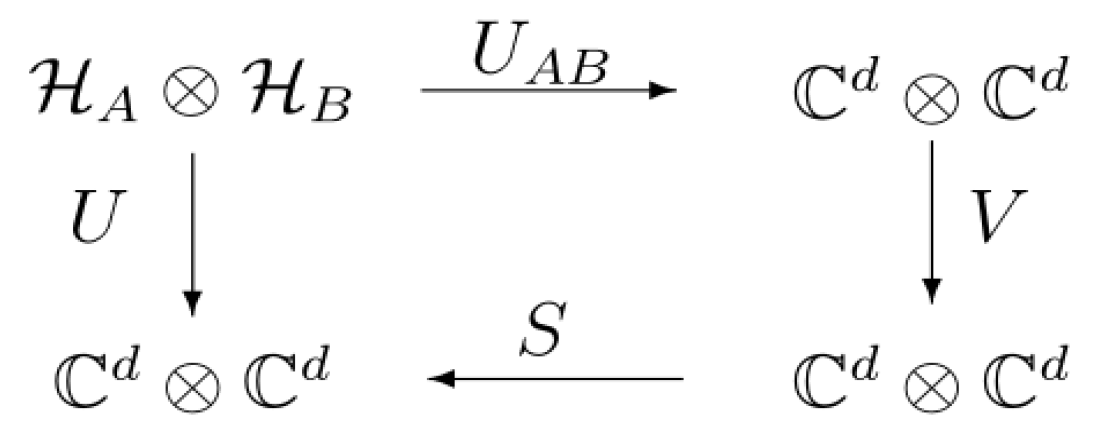
Let be valid. Since both U and preserve separability of pure states in both directions, so does V, i.e., is separable if and only if is separable. It follows from [47] that there are unitary operators on and on such that when , ; when , either , or . Thus, condition follows by letting (). See Figure 2 for the last case.
: Suppose that condition is satisfied. From the definition of U, we see that for all and where and are the canonical -bases for and , respectively. Put and for all .
When , we have
for all ;
When , if , then we have
for all ; if , then we have
for all , here the fact that and were used. Now, condition follows.
: Suppose that condition is satisfied. Let and be any states of and , respectively. Then
When for all , we have
where and
When for all , we have and write
Thus,
where and This shows that U maps any separable pure state as a separable pure state.
Conversely, we assume that for some states and of and , respectively. Let us show that is separable. To do this, we let
Then
and so for all Hence, . Since either for all , or and for all , we have either
or
This shows that is separable. Thus, U preserves separability of pure states in both directions and so condition is satisfied. The proof is completed.
3. Basis Dependent Bell Locality
In this section, we will discuss relationship between Bell locality and basis. To describe and discuss Bell locality, the following mathematical definitions were given by [14] abstracted from the literatures [2,20].
3.1. Concepts and Notations
To describe Bell locality of a bipartite state , we use x and y to denote the labels of POVMs of Alice and Bob and use a and b to denote their measurement outcomes, respectively. Thus, their POVM choices are denoted by and respectively, where . These POVMs form measurement assemblages (MA) of A and B: and respectively.
The following concepts were given in [14].
(1) A state is said to be Bell local for a given measurement assemblage if there exists a probability distribution (PD) such that, for each and , there exist PDs and , respectively, for which it holds that
for all .
Equation (7) is said to be a local hidden variable model (LHVM) of w.r.t. MA and is said to be an LHV with PD .
(2) A state is said to be Bell nonlocal for if it is not Bell local for .
(3) A state is said to be Bell local if for every , there exists a PD such that Equation (7) holds.
(4) A state is said to be Bell nonlocal if it is not Bell local, i.e., is not Bell local for some .
Let denote the set of all states that are Bell local for , denote the set of all states that are Bell nonlocal for , the set of all Bell local states of ; denote the set of all states that are Bell nonlocal. Thus, we see from the definition that
3.2. Bell Locality Depending on Basis
Let where for some ONBs and for and , respectively. Define unitary operators:
and for every linear operator , define a matrix
Since
for all , we have
Let and be measurement assemblages (MAs) of and , respectively, where and are POVMs of systems A and B, respectively. Then and are POVMs of systems and , respectively, where
Hence, and be MAs of and , respectively. Using Equation (10) yields that for all
Thus, if and only if Since Bell locality and separability of pure states are the same [48] for pure states, we see from Theorem 1 that a pure state in is Bell local if and only if its coordinate state is Bell local.
As a conclusion, we obtain the following.
Theorem 4.
Let where for some ONBs and for and , respectively. Then
(a) A pure state is a Bell local state of if and only if its coordinate state is a Bell local state of .
(b) A density operator is a Bell local state of if and only if its density matrix is a Bell local state of with -entry .
Similarly, one can check the following.
Theorem 5.
Let , where for some ONBs and for and , respectively. Then
(a) A pure state is a Bell local state of if and only if its coordinate state is a Bell local state of .
(b) A density operator is Bell local if and only if its density matrix is Bell local with -entry .
Using Theorem 3, Theorems 4 and 5, once can check the following.
Theorem 6.
Let be an orthonormal basis for and and U be fined by Equation (2). Then TFSAE.
(a) The coordinate mapping U preserves Bell locality of pure states in both directions, i.e., is Bell local if and only if is Bell local.
(b) A density operator is Bell local if and only if its density matrix is Bell local with -entry .
(c) There exist unitary operators such that when , ; when , either , or , where is the swap operator: .
(d) There exist orthonormal bases and for and , respectively, such that when , for all ; When , either for all , or for all .
Proof.
Use the implications:
□
4. Basis Dependent Unsteerability
In this section, we will discuss relationship between unsteerability and basis.
4.1. Concepts and Notations
Recall that [14] a state of is said to be unsteerable from A to B with an MA where is a POVM of system A if there exists a PD and a set of system B such that
where is a PD for all . is said to be unsteerable from A to B if it is unsteerable from A to B with any MA . is said to be steerable from A to B if it is not unsteerable for some MA . A pure state is said to be unsteerable from A to B if so is its density operator . Similarly, one define unsteerability from B to A. It is easy to see that a state that is unsteerable either from A to B or from B to A is Bell local. Thus, a pure state is unsteerable either from A to B or from B to A is separable.
4.2. Unsteerability Depending on Basis
Let where for some ONBs and for and , respectively. Then a density operator on has the corresponding density matrix of under the basis is
where and are unitary operators given by Equations (8) and (9). In this case, for any MA of system A, we have
where is the unit matrix. Thus, is unsteerable from A to B (resp. with MA ) if and only if its density matrix is unsteerable from A to B (resp. with MA ).
Similarly, when and for all , we have
where S is the swap operator on . Thus,
This shows that is unsteerable from A to B (resp. with MA ) if and only if its density matrix is unsteerable from B to A (resp. with MA ).
From these observations, we obtain the following.
Theorem 7.
Let where for some ONBs and for and , respectively. Then
(a) A pure state is unsteerable from A to B if and only if its coordinate state is unsteerable from A to B.
(b) A density operator is unsteerable from A to B if and only if its density matrix is unsteerable from A to B.
Theorem 8.
Let , where for some ONBs and for and , respectively. Then
(a) A pure state is unsteerable from A to B if and only if its coordinate state is unsteerable from B to A.
(b) A density operator is unsteerable from A to B if and only if its density matrix is unsteerable from B to A.
Using Theorem 1 and the fact that a pure state is unsteerable from A to B if and only if it is separable [48], combining Theorem 7, one can check the following.
Theorem 9.
Let and be an orthonormal basis for and and U be defined by Equation (2). Then TFSAE.
(a) is unsteerable from A to B if and only if is unsteerable from A to B.
(b) A density operator is unsteerable from A to B if and only if its density matrix is unsteerable from A to B.
(c) There exist unitary operators such that when , .
(d) There exist orthonormal bases and for and , respectively, such that for all .
Using Theorem 1 and the fact that a pure state is unsteerable from A to B if and only if it is separable [48], combining Theorem 8, one can check the following.
Theorem 10.
Let and be an orthonormal basis for and U be defined by Equation (2). Then the following (a) and (b) are equivalent.
(a) is unsteerable from A to B if and only if is unsteerable from A to B.
(b) A density operator is unsteerable from A to B if and only if its density matrix is unsteerable from A to B.
If (a) or (b) holds, then
(c) There exist unitary operators such that , or .
(d) There exist orthonormal bases and for and , respectively, such that for all , or for all .
5. Basis Dependent Classical Correlation
In this section, we will discuss relationship between classical correlation and basis.
5.1. Concepts and Notations
Recall that [41,42,43] a state of is said to classically correlated (CC) if there exists a rank-1 projective measurement such that
otherwise, is said to be quantum correlated (QC). A pure state is said to be CC (resp. QC) if its density operator is CC (resp. QC).
Luo in [41] proved that a state of is CC if and only if it can be represented as
where is a PD, and are some ONBs for and , respectively. This implies that every CC state is separable while a separable state is not necessarily CC. But a bipartite pure state is CC if and only if it is separable ([48] [Theorem 5.1]).
5.2. Classical Correlation Depending on Basis
Let where for some ONBs and for and , respectively. Then a density operator on has the corresponding density matrix of under the basis :
which is equal to the matrix representation of the operator
under the canonical -basis (with )
for . With this basis, a linear operator X on is usually identified with matrix representation . Thus,
where and are unitary operators given by Equations (8) and (9).
Similarly, when and for all , we have
where S is the swap operator on .
Theorem 11.
Let where for some ONBs and for and , respectively. Then
(a) A pure state is CC if and only if its coordinate state is CC.
(b) A density operator is CC if and only if its density matrix is CC with -entry .
Theorem 12.
Let , where for some ONBs and for and , respectively. Then
(a) A pure state is CC if and only if its coordinate state is CC.
(b) A density operator is CC if and only if its density matrix is CC with -entry .
Using Theorems 11 and 12, once can check the following.
Theorem 13.
Let be an orthonormal basis for and U be fined by Equation (2). Then TFSAE.
(a) is CC if and only if is CC.
(b) A density operator is CC if and only if its density matrix is CC with -entry .
(c) There exist unitary operators such that when , ; when , either , or , where is the swap operator: .
(d) There exist orthonormal bases and for and , respectively, such that when , for all ; When , either for all , or for all .
6. Conclusions
Usually, a density operator (quantum state ) of a bipartite system is represented as a matrix under a basis for the Hilbert space of the system , called the density matrix of the density operator . In this work, we have discussed the relationships between quantum locality and basis, and observed that all density operators and their density matrices under a basis have the same quantum locality if and only if the basis is a product basis of two bases of subsystems. Consequently, different choices of bases may induce different quantum locality; equivalently, different bases define different quantum nonlocality, which we called basis-dependent quantum nonlocality. Also, entangled basis can generate quantum nonlocality of a density matrix from a separable density operator.
Author Contributions
The work of this paper was accomplished by Kaifeng Hu, Zhihua Guo, Huaixin Cao and Ling Lu. Moreover, all authors have read the paper carefully and approved the research contents that were written in the final manuscript.
Institutional Review Board Statement
Not applicable.
Informed Consent Statement
Informed consent was obtained from all subjects involved in the study.
Data Availability Statement
Not applicable.
Acknowledgments
This work was supported by the National Natural Science Foundation of China under Grant Nos. 12271325, 11871318, and the Special Plan for Young Top-notch Talent of Shaanxi Province under Grant No. 1503070117.
Conflicts of Interest
The authors declare no conflict of interest.
References
- Bell, J.S. On the Einstein Podolsky Rosen paradox. Physics 1964, 1, 195–200. [Google Scholar] [CrossRef]
- Brunner, N.; Cavalcanti, D.; Pironio, S.; Scarani, V.; Wehner, S. Bell nonlocality. Rev. Mod. Phys. 2014, 86, 419–478. [Google Scholar] [CrossRef]
- Clauser, J.F.; Shimony, A. Experimental tests and implications. Rep. Prog. Phys. 1978, 41, 1881–1927. [Google Scholar] [CrossRef]
- Home, D.; Selleri, F. Bell’s theorem and the EPR paradox. Rivista Del Nuovo Cimento. 1991, 14, 1–96. [Google Scholar] [CrossRef]
- Khalfin, L.; Tsirelson, B. Quantum/classical correspondence in the light of Bell’s inequalities. Found. Phys. 1992, 22, 879–948. [Google Scholar] [CrossRef]
- Tsirelson, B.S. Some results and problems on quantum Bell-type inequalities. Hadronic J. Suppl. 1993, 8, 329–345. [Google Scholar]
- Zeilinger, A. Experiment and the foundations of quantum physics. Rev. Mod. Phys. 1999, 71, S288–S297. [Google Scholar] [CrossRef]
- Werner, R.F.; Wolf, M.M. All-multipartite Bell-correlation inequalities for two dichotomic observables per site. Phys. Rev. A 2001, 64, 032112. [Google Scholar] [CrossRef]
- Genovese, M. Research on hidden variable theories: a review of recent progresses. Phys. Rep. 2005, 413, 319–396. [Google Scholar] [CrossRef]
- Buhrman, H.; Cleve, R.; Massar, S.; de Wolf, R. Nonlocality and communication complexity. Rev. Mod. Phys. 2010, 82, 665–698. [Google Scholar] [CrossRef]
- Zhao, L.J.; Guo, Y.M.; Li-Jost, X.; Fei, S.M. Quantum nonlocality can be distributed via separable states. Sci. China-Phys. Mech. Astron. 2018, 61, 070321. [Google Scholar] [CrossRef]
- Long, G.L.; Qin, W.; Yang, Z.; Li, J.L. Realistic interpretation of quantum mechanics and encounter- delayed-choice experiment. Sci. China-Phys. Mech. Astron. 2018, 61, 030311. [Google Scholar] [CrossRef]
- Yang, Y.; Cao, H.X.; Chen, L.; Huang, Y.F. Λk-Nonlocality of multipartite states and the related nonlocality inequalities. Int. J. Theor. Phys. 2018, 57, 1498–1515. [Google Scholar] [CrossRef]
- Cao, H.X.; Guo, Z.H. Characterizing Bell nonlocality and EPR steering. Sci. China-Phys. Mech. Astron. 2019, 62, 030311. [Google Scholar] [CrossRef]
- Schro¨dinger, E. Discussion of probability relations between separated systems. Math. Proc. Camb. Phil. Soc. 1935, 31, 555–563. [Google Scholar] [CrossRef]
- Einstein, A.; Podolsky, B.; Rosen, N. Can quantum-mechanical description of physical reality be considered complete? Phys. Rev. 1935, 47, 777. [Google Scholar] [CrossRef]
- Reid, M.D. Demonstration of the Einstein-Podolsky-Rosen paradox using nondegenerate parametric amplification. Phys. Rev. A 1989, 40, 913–923. [Google Scholar] [CrossRef] [PubMed]
- Werner, R.F. Quantum states with Einstein-Podolsky-Rosen correlations admitting a hidden-variable model. Phys. Rev. A 1989, 40, 4277–4281. [Google Scholar] [CrossRef] [PubMed]
- Qu, Z.Y.; Pereira, S.F.; Kimble, H.J.; Peng, K.C. Realization of the Einstein-Podolsky-Rosen paradox for continuous variables. Phys. Rev. Lett. 1992, 68, 3663. [Google Scholar]
- Wiseman, H.M.; Jones, S.J.; Doherty, A.C. Steering, entanglement, nonlocality, and the Einstein- Podolsky-Rosen paradox. Phys. Rev. Lett. 2007, 98, 140402. [Google Scholar] [CrossRef]
- Cavalcanti, E.G.; Jones, S.J.; Wiseman, H.M.; Reid, M.D. Experimental criteria for steering and the EinsteinPodolsky-Rosen paradox. Phys. Rev. A 2009, 80, 032112. [Google Scholar] [CrossRef]
- Saunders, D.J.; Jones, S.J.; Wiseman, H.M.; Pryde, G.J. Experimental EPR-steering using Bell-local states. Nat. Phys. 2010, 6, 845–849. [Google Scholar] [CrossRef]
- Bennet, A.J.; Evans, D.A.; Saunders, D.J.; Branciard, C.; Cavalcanti, E.G.; Wiseman, H.M.; Pryde, G.J. Arbitrarily loss-tolerant Einstein-Podolsky-Rosen steering allowing a demonstration over 1 km of optical fiber with no detection loophole. Phys. Rev. X 2012, 2, 031003. [Google Scholar]
- Händchen, V.; Eberle, T.; Steinlechner, S.; et al. Observation of one-way Einstein-Podolsky-Rosen steering. Nat. Photonics 2012, 6, 596–599. [Google Scholar] [CrossRef]
- Branciard, C.; Cavalcanti, E.G.; Walborn, S.P.; et al. One-sided device-independent quantum key distribution: Security, feasibility, and the connection with steering. Phys. Rev. A 2012, 85, 010301. [Google Scholar] [CrossRef]
- Wittmann, B.; Ramelow, S.; Steinlechner, F.; et al. New J. Phys. 2012, 14, 053030. [Google Scholar]
- Steinlechner, S.; Bauchrowitz, J.; Eberle, T.; et al. Strong Einstein-Podolsky-Rosen steering with unconditional entangled states. Phys. Rev. A 2013, 87, 022104. [Google Scholar] [CrossRef]
- Reid, M.D. Signifying quantum benchmarks for qubit teleportation and secure quantum communication using Einstein-Podolsky-Rosen steering inequalities. Phys. Rev. A 2013, 88, 062338. [Google Scholar] [CrossRef]
- Piani, M.; Watrous, J. Necessary and sufficient quantum information characterization of Einstein-Podolsky- Rosen steering. Phys. Rev. Lett. 2015, 114, 060404. [Google Scholar] [CrossRef]
- Zukowski, M.; Dutta, A.; Yin, Z. Geometric Bell-like inequalities for steering. Phys. Rev. A 2015, 91, 032107. [Google Scholar] [CrossRef]
- Quintino, M.T.; Ve`rtesi, T.; Cavalcanti, D.; et al. Inequivalence of entanglement, steering, and Bell nonlocality for general measurements. Phys. Rev. A 2015, 92, 032107. [Google Scholar] [CrossRef]
- Zhu, H.; Hayashi, M.; Chen, L. Universal steering inequalities. Phys. Rev. Lett. 2016, 116, 070403. [Google Scholar] [CrossRef]
- Sun, K.; Ye, X.J.; Xu, J.S.; et al. Experimental quantification of asymmetric Einstein-Podolsky-Rosen steering. Phys. Rev. Lett. 2016, 116, 160404. [Google Scholar] [CrossRef] [PubMed]
- Quan, Q.; Zhu, H.J.; Liu, S.Y.; et al. Steering Bell-diagonal states. Sci. Rep. 2016, 6, 22025. [Google Scholar] [CrossRef]
- Chen, J.L.; Ren, C.L.; Chen, C.B. Bell’s nonlocality can be detected by the violation of Einstein-Podolsky-Rosen steering inequality. Sci. Rep. 2016, 6, 39063. [Google Scholar] [CrossRef]
- Cavalcanti, D.; Skrzypczyk, P. Quantum steering: a review with focus on semidefinite programming. Rep. Prog. Phys. 2017, 80, 024001. [Google Scholar] [CrossRef]
- Yu, S.; Chen, Q.; Zhang, C.; et al. All entangled pure states violate a single Bell’s inequality. Phys. Rev. Lett. 2012, 109, 120402. [Google Scholar] [CrossRef]
- Sun, K.; Ye, X.J.; Xu, J.S.; et al. Experimental quantification of asymmetric Einstein-Podolsky-Rosen steering. Phys. Rev. Lett. 2016, 116, 160404. [Google Scholar] [CrossRef] [PubMed]
- Skrzypczyk, P.; Navascues, M.; Cavalcanti, D. Quantifying einstein-podolsky-rosen steering. Phys. Rev. Lett. 2014, 112, 180404. [Google Scholar] [CrossRef]
- Ollivier, H.; Zurek, W.H. Quantum discord: A measure of the quantumness of correlations. Phys. Rev. Lett. 2001, 88, 017901. [Google Scholar] [CrossRef]
- Luo, S. Using measurement-induced disturbance to characterize correlations as classical or quantum. Phys. Rev. A 2008, 77, 022301. [Google Scholar] [CrossRef]
- Guo, Z.H.; Cao, H.X.; Chen, Z.L. Distinguishing classical correlations from quantum correlations. J. Phys. A: Math. Theor. 2012, 45, 145301. [Google Scholar] [CrossRef]
- Guo, Z.H.; Cao, H.X.; Qu, S.X. Structures of three types of local quantum chan- nels based on quantum correlations. Found. Phys. 2015, 45, 355–369. [Google Scholar] [CrossRef]
- Knill, E.; Laflamme, R. Power of one bit of quantum information. Phys. Rev. Lett. 1998, 81, 5672. [Google Scholar] [CrossRef]
- Su, X.L. Applying Gaussian quantum discord to quantum key distribution. Chin. Sci. Bull. 2014, 59, 1083–1090. [Google Scholar] [CrossRef]
- Yue, H.D.; Zhang, Y.; Gong, J. Quantum discord in three-spin XXZ chain with three-spin interaction. Sci. China-Phys. Mech. Astron. 2012, 55, 1641–1645. [Google Scholar] [CrossRef]
- Zhang, Y.; Cao, H.X.; Guo, Z.H. Strongly separable operators on finite dimensional tensor product spaces. Acta Math. Sinica 2011, 54, 959–972. [Google Scholar]
- Cao, H.X.; Zhang, C.Y.; Guo, Z.H. Some measurement-based characterizations of separability of bipartite states. Int. J. Theor. Phys. 2021, 60, 2558–2572. [Google Scholar] [CrossRef]
Figure 1.
The unitary operator V on .
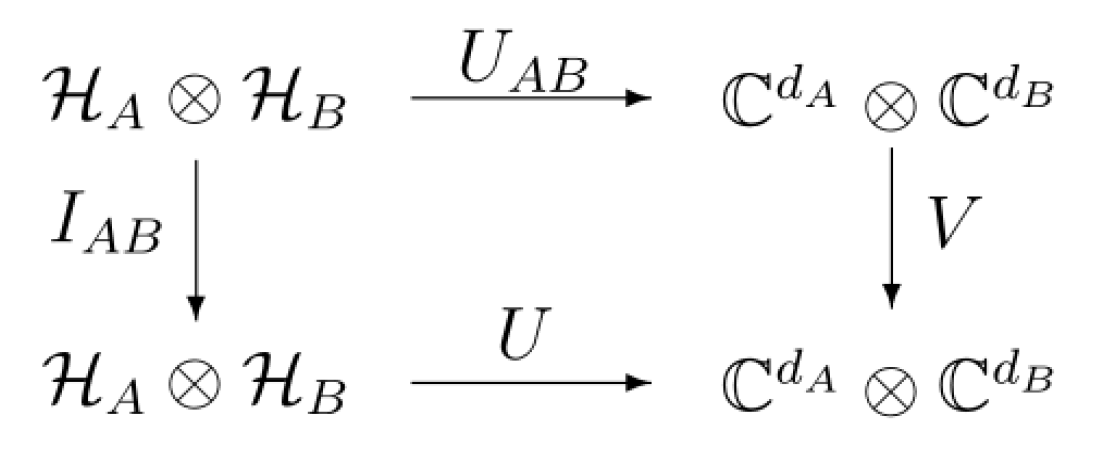
Figure 2.
Decomposition of U.
Disclaimer/Publisher’s Note: The statements, opinions and data contained in all publications are solely those of the individual author(s) and contributor(s) and not of MDPI and/or the editor(s). MDPI and/or the editor(s) disclaim responsibility for any injury to people or property resulting from any ideas, methods, instructions or products referred to in the content. |
© 2024 by the authors. Licensee MDPI, Basel, Switzerland. This article is an open access article distributed under the terms and conditions of the Creative Commons Attribution (CC BY) license (http://creativecommons.org/licenses/by/4.0/).
Copyright: This open access article is published under a Creative Commons CC BY 4.0 license, which permit the free download, distribution, and reuse, provided that the author and preprint are cited in any reuse.