

Submitted:
11 April 2024
Posted:
16 April 2024
Read the latest preprint version here
Abstract
This paper explores the transformative impact of computational pharmaceutics, integrating AI, multi-scale modeling, quantum computing, AI-driven drug discovery, and blockchain frameworks. Molecular dynamics simulations provide insights into atomic behaviors crucial for drug design. Quantum computing reduces computational costs for simulating protein-drug interactions. AI and Graph Neural Networks accelerate drug discovery and personalized medicine. Blockchain frameworks facilitate secure pharmacogenetic data sharing. These advancements revolutionize drug development, offering unprecedented efficiency, innovation, and personalized treatments.
Keywords:
Computational Pharmaceutics
; AI
; multi-scale modeling
; quantum computing
; drugdiscovery
; blockchain frameworks
I. Introduction
A. Definition and Evolution of Computational Pharmaceutics
Computational pharmaceutics has evolved significantly over time. Initially, pharmaceutical research heavily relied on mathematical and statistical calculations (Nainwal et al., 2022). The field progressed from quantitative structure-activity relationship (QSAR) studies to computer-aided drug design (CADD), leading to rational drug design (Abd-Algaleel et al., 2021). Modern computational pharmacology utilizes models and simulations for drug discovery, focusing on molecular interactions and compound design (Sadiku et al., 2019). Recent advancements include the application of artificial intelligence and machine learning in predicting drug payload in nanocarriers (Saharan et al., 2022; Chaudhari and Chaudhari 2024)). Computational pharmaceutics now offers a multiscale approach, incorporating various modeling techniques for drug delivery and formulation development, benefiting both industry and academia (Ouyang & Smith, 2015). This historical journey showcases how computers have revolutionized pharmaceutical research, enhancing efficiency and success in drug discovery and development.
The field of computational pharmaceutics has evolved significantly over the years. Initially, computations in pharmaceutical formulations involved correlating variables with responses and regression analysis, leading to the development of specialized software packages for pharmacokinetics and drug discovery (Abd-Algaleel et al., 2021; Nainwal et al., 2022). Subsequently, computational chemistry applications became integral in drug discovery workflows, supporting various stages of drug development such as process chemistry, analytical research, and solid form design (Abramov et al., 2022). The evolution continued with the transition from quantitative structure-activity relationship (QSAR) studies to advanced computer-aided drug design (CADD) techniques like structure-based drug design (SBDD) and ligand-based drug design (LBDD), facilitated by the rise of artificial intelligence and machine learning in predicting drug payload in nanocarriers (Sadiku et al., 2019; Saharan et al., 2022; Chaudhari and Md 2024). These advancements have revolutionized drug discovery from empirical approaches to rational design strategies.
Computational pharmaceutics involves utilizing computational modeling techniques to understand drug delivery mechanisms and develop new delivery systems.(Ouyang & Smith, 2015; Sadiku et al., 2019) It encompasses molecular modeling for rational drug design, compound screening, and studying formulation at a molecular level (Hussain et al., 2023; Ouyang & Smith, 2015). This field explores various drug delivery systems like cyclodextrins, liposomes, and polymeric systems. Computational pharmaceutics aids in predicting drug behavior, investigating chemical interactions, and designing compounds, offering a valuable tool for pharmaceutical scientists and computational chemists. By bridging the gap between pharmaceutics and molecular modeling, computational pharmaceutics provides a systematic approach to enhance drug development and formulation processes.
B. Significance of Integrating AI and Multi-Scale Modeling in Pharmaceutics
The integration of AI and multi-scale modeling is considered significant in pharmaceutics due to its potential to revolutionize drug discovery and development processes (DiNuzzo, 2022; Pokhriyal et al., 2023). AI offers a third-party perspective on manufacturing techniques, recommending improvements for optimal efficiency (Muqtadiroh et al., 2022). It accelerates drug development, reduces costs, enhances returns on investment, and improves drug safety (Pareek et al., 2022). AI's ability to deepen mechanistic understanding of diseases through modeling and simulation of biological networks is crucial for advancing drug discovery (Pareek et al., 2022; Sharma, 2022). Additionally, AI's role in identifying new drugs faster and cheaper is a game-changer, despite existing challenges. Overall, the integration of AI and multi-scale modeling holds promise in streamlining pharmaceutical research, improving healthcare outcomes, and addressing industry challenges.
Figure 1.
Transforming Drug Discovery with AI and Modeling.
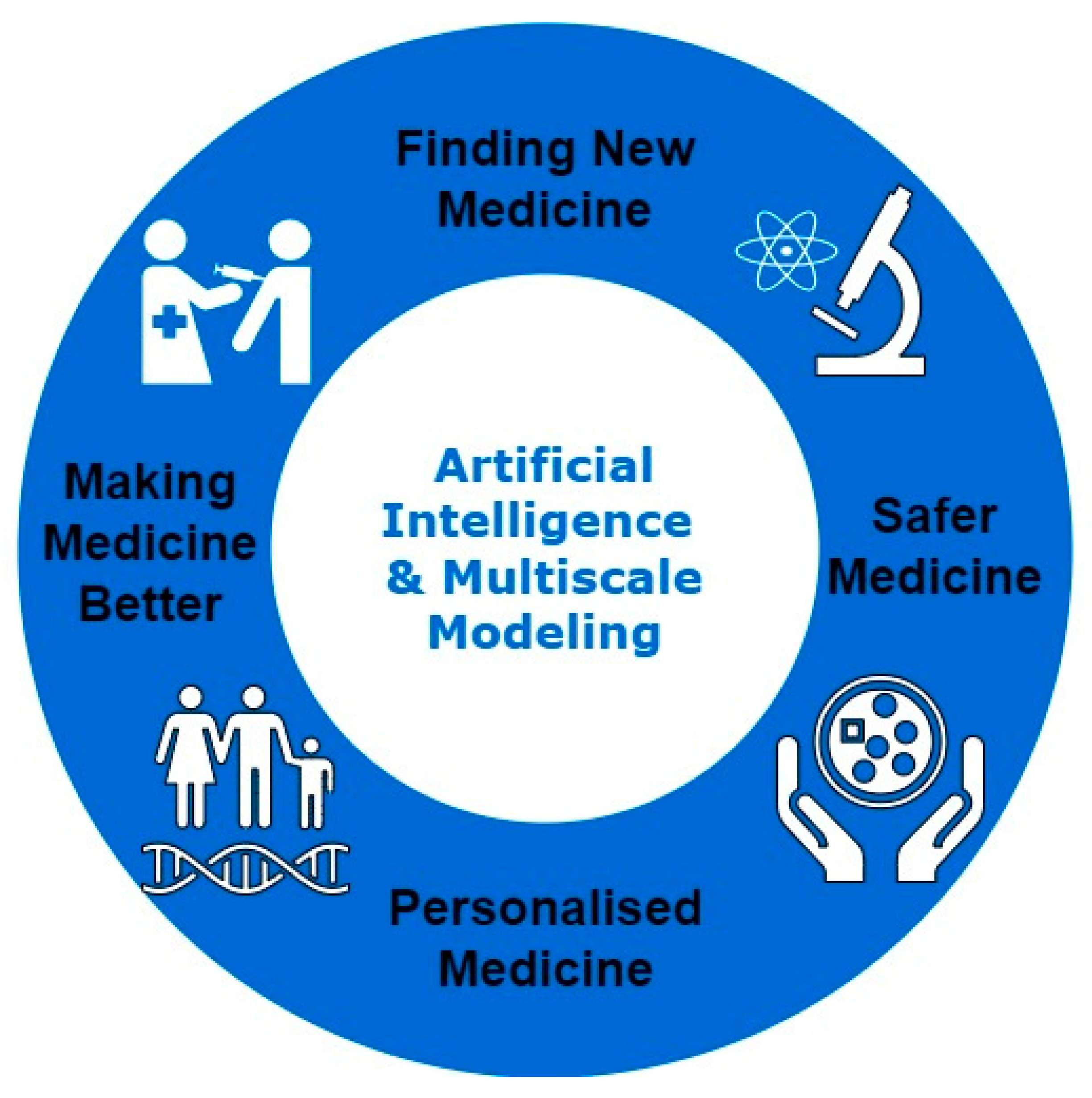
Integrating AI in pharmaceutics enhances formulation development by expediting trials and optimizing resources (Chavda, 2023; Goud et al., 2023; Jiang et al., 2022; Vora et al., 2023). AI algorithms analyze biological data to identify disease targets, predict interactions, and optimize drug discovery processes, reducing costs and animal testing (S. Wang et al., 2022). AI-based formulation design models provide limited yet promising designs, minimizing trial runs and resource wastage. AI aids in predicting product properties, optimizing drug formulations, and streamlining development processes for solid dosage forms. Furthermore, AI and ML applications in drug manufacturing improve process parameters, ensuring optimum output quality in large-scale medication synthesis. Overall, AI's integration in pharmaceutics through various algorithms and models significantly contributes to advancing formulation development processes.
The integration of Artificial Intelligence (AI) and Multi-Scale Modeling in pharmaceutics is poised to bring about significant paradigm shifts. AI offers the promise of enhancing drug discovery and development processes by leveraging data and knowledge for modeling biological networks (DiNuzzo, 2022). Multi-Scale Modeling, facilitated by machine learning algorithms, can assist in approximating functions in high dimensions, aiding in tasks like molecular dynamics and non-Newtonian flows (Wanjul et al., 2023). Furthermore, the use of Graph Neural Networks (GNN) in Multi-Omics data analysis can prioritize molecular targets and decipher core signaling pathways in complex diseases, leading to personalized precision medicine and drug resistance investigations (Weinan et al., 2023). This integration is expected to accelerate the identification of new drugs, cut costs, and create more effective treatments, ultimately saving lives (Zhang et al., 2023).
C. Overview of Computational Approaches in Pharmaceutics
Key computational approaches in pharmaceutics molecular dynamic simulations, docking studies, quantum phase estimation calculations, virtual screening methods, and machine learning included in Table 1. These approaches have revolutionized drug discovery by enabling the modeling and prediction of drug payload in nanocarriers (Abd-Algaleel et al., 2021). Additionally, computational support is provided for process chemistry, analytical research and development, and drug product formulation, with a focus on solid form design through virtual screening methods (Abramov et al., 2022). Quantum computers are also utilized for simulating chemical systems, with active space selection protocols enhancing accuracy in quantum computational treatments of pharmaceutical systems (Izsák et al., 2023). Furthermore, ligand screening benefits from fast computational methods, deep learning predictions, and iterative screening approaches, facilitating the identification of diverse and potent ligands for protein targets (Sadybekov & Katritch, 2023). Lastly, a combined computational approach involving structural similarity assessment, machine learning, and molecular modeling aids in identifying promising pharmaceutical agents from large virtual repositories of synthesizable molecules.
Computational approaches play a crucial role in addressing challenges in pharmaceutical science by aiding in drug repurposing, lead identification, drug metabolism prediction, and ligand discovery (Adhikary & Basak, 2020; Ashfaq et al., 2022; Chauhan et al., 2023; Sadybekov & Katritch, 2023). These approaches involve techniques such as structure-based virtual screening, molecular docking, molecular dynamics simulations, and bioinformatics tools to expedite drug development processes, minimize costs, and enhance efficacy and safety assessments. By leveraging computational modeling, researchers can study physiological parameters, drug interactions, toxicity concerns, and predict drug metabolism, leading to the establishment of therapeutic dosage regimens and the identification of potential drug candidates. The integration of computational intelligence with pharmaceutical research enables the exploration of vast chemical spaces, accelerates lead discovery, and facilitates the development of safer and more effective treatments for various diseases, including the ongoing COVID-19 pandemic.
Computational pharmaceutics plays a pivotal role in modern drug discovery and formulation development (Hussain et al., 2023). By utilizing computational models and simulations, researchers can gain insights into molecular interactions, drug delivery mechanisms, and formulation behaviors (Sadiku et al., 2019). This approach enables the rational design of drugs, prediction of drug behavior, and development of novel drug delivery systems (Ouyang & Smith, 2015). The use of computational tools allows for a deeper understanding of the complex processes involved in pharmaceutical science, ranging from small drug molecules to nanoparticles, ultimately aiding in the optimization of drug efficacy and safety profiles (Douroumis et al., 2015). Overall, computational pharmaceutics bridges the gap between theoretical modeling and practical applications, revolutionizing the pharmaceutical industry by enhancing drug development processes and facilitating the creation of more effective medications.

Table 1.
comprehensive comparison of computational approaches in pharmaceutics.
| Computational Approach | Techniques/Tools | Impact on Pharmaceutical Science | Key References |
|---|---|---|---|
| Molecular Dynamic Simulations | Molecular dynamics software (e.g., GROMACS, AMBER, NAMD). | Facilitates the rational design of drug delivery systems, enhances understanding of drug behavior in complex environments. | Abd-Algaleel et al. (2021) |
| Docking Studies | Molecular docking software (e.g., Autodock, GOLD, Glide). | Expedites drug discovery processes, aids in hit identification and lead optimization. | Ashfaq et al. (2022); Chauhan et al. (2023); Sadybekov & Katritch (2023) |
| Quantum Phase Estimation Calculations | Quantum chemistry software (e.g., Gaussian, NWChem, Q-Chem). | Improves accuracy in quantum mechanical calculations, aids in understanding complex chemical systems. | Izsák et al. (2023) |
| Virtual Screening Methods | Virtual screening software (e.g., Schrödinger Suite, OpenEye, MOE). | Expedites lead discovery, minimizes costs, aids in drug repurposing efforts. | Abramov et al. (2022); Adhikary & Basak (2020); Sadybekov & Katritch (2023) |
| Machine Learning | Machine learning algorithms (e.g., neural networks, random forests, support vector machines). | Enhances predictive accuracy, facilitates data-driven drug discovery, aids in identifying novel chemical entities. | Sadybekov & Katritch (2023) |
| Bioinformatics Tools | Bioinformatics software (e.g., PyMOL, Chimera, BLAST). | Enables better understanding of biological systems, aids in drug-target interaction studies, facilitates personalized medicine. | Ashfaq et al. (2022); Chauhan et al. (2023) |
| Role in Drug Development | Computational chemistry techniques, in silico modeling, data mining approaches. | Accelerates drug development timelines, reduces failure rates, enables precision medicine approaches. | Adhikary & Basak (2020); Ashfaq et al. (2022); Chauhan et al. (2023); Sadybekov & Katritch (2023) |
| Impact on Pharmaceutical Science | Enhanced understanding of molecular interactions, expedited drug development timelines, improved drug safety profiles. | Facilitates the development of safer and more effective medications, enables precision medicine, reduces development costs. | Abd-Algaleel et al. (2021); Hussain et al. (2023); Sadiku et al. (2019); Ouyang & Smith (2015); Douroumis et al. (2015) |
| Applications | Computational modeling of physiological parameters, drug-drug interactions, toxicity prediction, dose-response modeling. | Enhances drug efficacy and safety profiles, aids in personalized medicine approaches, optimizes therapeutic regimens. | Abd-Algaleel et al. (2021); Hussain et al. (2023); Sadiku et al. (2019); Ouyang & Smith (2015); Douroumis et al. (2015) |
II. Past Achievements in Computational Pharmaceutics
A. Role of Quantum Mechanics (QM) in Predicting Molecular Properties
Quantum mechanics plays a crucial role in predicting molecular properties in Pharmaceutics by enabling accurate calculations of electronic properties of drug-like molecules (Atz et al., 2022). This is particularly valuable for tasks like drug design and substance discovery, where predicting properties such as atomization energy is essential (Atz et al., 2022; Tielker et al., 2021)(Pozzan, 2020). Quantum mechanics methods provide a detailed understanding of the electronic state of molecules, aiding in the study of drug metabolism and interactions with cytochromes from a mechanistic perspective. Additionally, machine learning techniques, such as Multilevel Graph Convolutional Neural Networks, have shown promise in predicting molecular properties by considering the complex quantum interactions of molecules, thus enhancing research progress in drug development (Lu et al., 2019).
Advancements in pharmaceutics using Quantum Mechanics (QM) include the application of quantum computing to simulate chemical systems (Mahesh & Shijo, 2023), accelerate drug discovery processes (Izsák et al., 2023), and enhance drug development through quantum algorithms like molecular docking and QSAR models (Izsák et al., 2023; P.-H. Wang et al., 2023). Quantum computing enables the accurate description of molecular environments, selection of active spaces for quantum computational treatment, and prediction of protein structures for drug design (Blunt et al., 2022). Recent progress in quantum algorithms has significantly reduced the computational cost of simulating complex protein-drug interactions, showcasing the potential for faster and more efficient drug development processes. These advancements demonstrate the promising role of quantum technologies in revolutionizing pharmaceutical research and development.
B. Molecular Dynamics Simulation for Understanding Physical Motion
Molecular dynamics (MD) simulation is a crucial computational technique for comprehending the physical motions of atomic and molecular particles. By utilizing Newton's equations of motion and molecular mechanics force fields, MD simulations reveal the dynamic evolution of systems (Takemura & Kitao, 2023; B. Xu, 2023). This approach is extensively employed in various fields like materials science, theoretical chemistry, and computational biology to study biomacromolecules' conformational changes, protein-ligand interactions, and membrane shaping induced by protein families like the BAR domain superfamily (Arya & Bhatt, 2021; Rizzuti, 2022). MD simulations have a significant impact on drug discovery, molecular biology, and predicting macromolecular structures and functions, making them invaluable tools for researchers. These simulations provide atomic-level insights into molecular motions, aiding in the accurate analysis of biomolecular interactions within dynamic environments.
Current advancements in using simulation techniques for optimizing pharmaceutical formulations include the adoption of Quality by Design (QbD) principles, such as Design of Experiments (DoE) (Abramov et al., 2022), and the application of artificial neural networks (ANNs) for data analysis and optimization (Hathout & Saharan, 2022). Additionally, machine learning algorithms, specifically Bayesian optimization, have been proposed to accelerate the design of biopharmaceutical formulations by efficiently identifying optimal conditions with minimal experiments required (Narayanan et al., 2021). These techniques enable systematic exploration of formulation parameters, leading to the production of pharmaceutical products with desired properties and high quality while minimizing risks associated with degradation processes. Optimization techniques play a crucial role in saving time and bringing profits to the pharmaceutical industry (S. Wang et al., 2022).
C. Molecular Modeling in Investigating Structural and Energetic Aspects
Molecular modeling techniques, such as computer-assisted drug design (CADD) and molecular mechanics, play a crucial role in investigating structural and energetic aspects in pharmaceutics. These methods provide detailed insights into the atomic-level description of molecular systems, allowing for the study of biological, inorganic, and polymeric systems (Umashankar & Gurunathan, 2011). By utilizing quantum mechanical (QM) or first-principles-based methods, molecular modeling can offer information on the structural, dynamical, mechanistic, and electronic properties of biological systems relevant to drug design (Douroumis et al., 2015). The Born-Oppenheimer approximation in molecular mechanics enables the calculation of molecular structures and energies based on nuclear motions, separating the study of nuclear motions, vibrations, and rotations from electron movements (Ouyang & Smith, 2015). Overall, molecular modeling aids in understanding drug delivery mechanisms, developing new drug delivery systems, and facilitating rational drug design in the pharmaceutical field.
Molecular modeling has offered valuable insights into pharmaceutical formulations by elucidating key molecular mechanisms. It has been instrumental in understanding drug delivery systems, such as nanoscale vehicles' behavior in the bloodstream, drug loading, controlled release, and nanoparticle interactions with membranes (Bunker & Róg, 2020). Additionally, computational approaches have been pivotal in investigating excipient-protein interactions to enhance the stability of protein-based therapeutics over extended periods (Pandya et al., 2018). These simulations predict formulation properties, reducing the need for extensive experimental testing, and provide detailed molecular insights beyond experimental capabilities (Katiyar & Jha, 2018). Furthermore, molecular modeling techniques have been applied to various drug delivery systems, including cyclodextrins, liposomes, and polymeric systems, aiding in the design and development of novel pharmaceutical formulations (Douroumis et al., 2015; Ouyang & Smith, 2015).
D. Process Modeling for Numerical Simulation in Manufacturing
Process modeling plays a crucial role in numerical simulation within pharmaceutical manufacturing by enhancing process understanding, reducing experimentation costs, improving product quality, and enabling process control (Russell & Capece, 2022). It allows for the development of accurate simulation models that consider various unit operations, material attributes, and operating variables (Z. Wang et al., 2019; Yeom et al., 2019). Through mechanistic modeling tools like the discrete element method (DEM), simulations can provide insights into powder behavior, particle interactions, and process dynamics, particularly in processes like milling, blending, granulation, and coating (Arastoopour et al., 2022). Additionally, computational fluid dynamics (CFD) approaches aid in the design, scale-up, and optimization of pharmaceutical drying processes, leading to increased production efficiency and reduced costs (Z. Wang & Ierapetritou, 2018). Overall, process modeling in pharmaceutical manufacturing facilitates scientific understanding, quality control, and optimization of manufacturing processes.
Figure 2.
Process Modeling for Pharmaceutical Manufacturing.
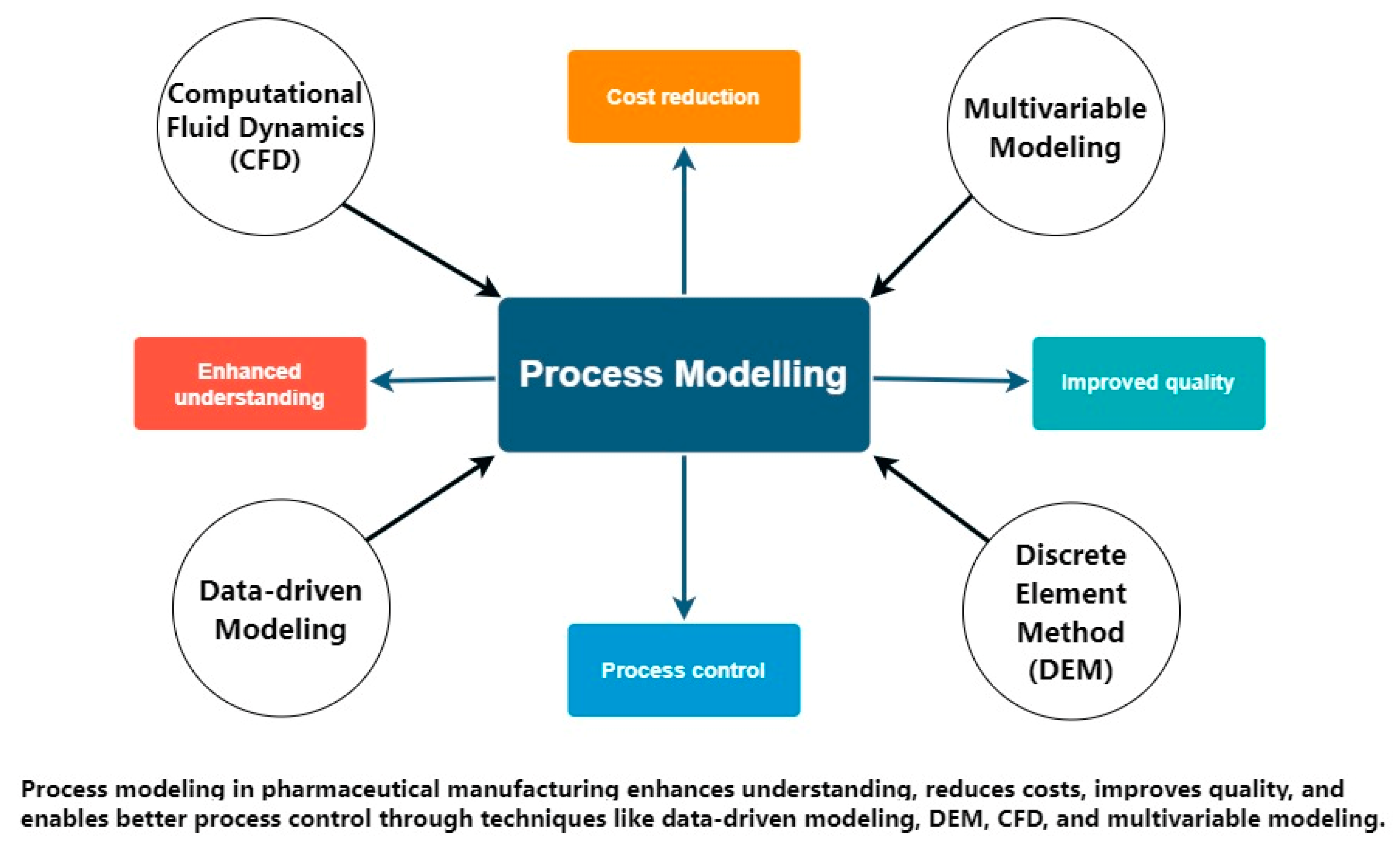
Process modeling for numerical simulation has been successfully applied in various aspects of pharmaceutical manufacturing. For instance, data-driven modeling methods have enabled accurate modeling for drug molecular design, retrosynthetic analysis, and manufacturing process optimization (Dong et al., 2023). Mechanistic models, such as the discrete element method (DEM), have been utilized for powder-related processes like milling, blending, granulation, and coating, enhancing process understanding and control (Dong et al., 2023; Russell & Capece, 2022). Multivariable modeling techniques have been employed in tablet manufacturing to optimize processes, monitor quality attributes, and improve process control, especially in continuous manufacturing settings (Shi et al., 2021). Additionally, simulation modeling frameworks have been developed for pharmaceutical tablet manufacturing processes via wet granulation, aiding in process design, analysis, and optimization for improved product quality (Yeom et al., 2019). These examples showcase the diverse applications and benefits of process modeling in pharmaceutical manufacturing.
E. Physiologically Based Pharmacokinetic (PBPK) Modeling for Predicting PK/PD
PBPK modeling plays a crucial role in predicting the pharmacokinetic/pharmacodynamic behavior of pharmaceutical formulations (Deepika & Kumar, 2023; Denninger et al., 2023; Elmokadem et al., 2023). By integrating in vitro dissolution data with PBPK tools, such as PK-Sim and GastroPlus®, accurate predictions of human pharmacokinetics can be achieved. These models are recognized by regulatory authorities for predicting organ concentration-time profiles, daily intake doses, and various population-specific responses. Additionally, PBPK models can be extended to cover sensitive populations and specific compartments like cerebrospinal fluid, enhancing the understanding of xenobiotic disposition in different sub-parts of the body. Furthermore, the incorporation of Bayesian tools in PBPK modeling allows for the quantification of uncertainty in model parameters, improving the accuracy of predictions. Overall, PBPK modeling aids in optimizing drug development, risk assessment, toxicity evaluation, and various other aspects of pharmaceutical research (Krstevska et al., 2022).
Physiologically Based Pharmacokinetic (PBPK) modeling has made significant strides in pharmaceutics. PBPK models aid in predicting organ concentration-time profiles, pharmacokinetics, and daily intake doses of xenobiotics (Conolly et al., 2023; Lancheros Porras et al., 2024). These models have been extended to encompass sensitive populations like pediatric, geriatric, and pregnant individuals, enhancing their applicability (Deepika & Kumar, 2023). PBPK modeling facilitates the development of quantitative adverse outcome pathways for various toxicological endpoints, such as developmental neurotoxicity and hepatotoxicity, contributing to toxicity assessments (Denninger et al., 2023). Additionally, PBPK models coupled with in vitro dissolution techniques offer a promising approach to predict the in vivo performance of drug candidates, aiding in formulation development and optimizing drug delivery strategies. Overall, PBPK modeling serves as a valuable tool in pharmaceutical research, enabling more accurate predictions and informed decision-making.
F. Contribution of Artificial Intelligence (AI) and Machine Learning Algorithms
AI and machine learning algorithms play crucial roles in computational pharmaceutics by aiding in drug development, formulation, and testing (Borkotoky et al., 2022; Quazi & Fatima, 2023; Vora et al., 2023). These technologies analyze biological data to identify disease-associated targets, predict drug interactions, and optimize research processes, leading to more efficient drug discovery and increased chances of successful approvals (Đuriš et al., 2021). Machine learning tools help in analyzing large datasets generated by Process Analytical Technologies, providing a better understanding of pharmaceutical formulations and processing (Srivastava, 2022). Additionally, AI enhances the prediction of pharmacokinetics, toxicity, and drug properties, facilitating the design of more effective and safer therapeutics. Overall, the integration of AI and machine learning in computational pharmaceutics accelerates drug development, improves productivity, and enhances clinical trials.
AI and machine learning have significantly optimized formulations, reduced costs, and preserved expert knowledge in various domains. In pharmaceuticals, AI/ML applications have enhanced drug product formulation and process development, leading to more efficient and automated processes (Chavda, 2023). Additionally, in the field of biopharmaceutical formulations, Bayesian optimization algorithms have accelerated the design process by efficiently transferring historical information as prior knowledge, enabling the engineering of multiple biophysical properties simultaneously while minimizing risks associated with degradation processes (De Paola & Danger, 2023). Moreover, in the context of automated machine learning (AutoML), leveraging historical performance data to reduce the search space for ML pipelines has shown promising results in improving ML outcomes and optimizing configuration-space culling strategies (Narayanan et al., 2021). These advancements showcase how AI and ML algorithms have revolutionized optimization, cost reduction, and knowledge preservation in various industries.
III. Current Problems in AI Application in Pharmaceutics
A. Lack of Sufficient Data and Challenges in Data Sharing
The challenges faced due to the lack of sufficient data in AI applications in computational pharmaceutics include compromised performance of AI systems (Patil et al., 2023), potential missing of crucial details due to the vast amount of available data (Liang et al., 2022), and the inability to fully utilize large-scale data with traditional statistical analysis methods (Shanbhogue et al., 2021). These challenges hinder the efficiency and accuracy of drug development processes, leading to delays, increased costs, and potential failures at clinical and marketing levels. To address these issues, advanced AI algorithms such as machine learning and deep learning are being employed to analyze data and improve decision-making in pharmaceutical research and application (W. Zhou et al., 2021). Despite these challenges, continued investment and development in AI have the potential to significantly enhance drug development processes and improve patient outcomes (Li et al., 2022).
Current challenges in data sharing and privacy protection in computational pharmaceutics include difficulties in safeguarding data integrity, privacy, and ownership (Chen et al., 2023), regulatory and institutional challenges in addressing data breaches and misuse, and the evolving landscape of data collection and privacy laws (Dankar, 2023). To address these challenges, a data-sharing privacy protection model (DS2PM) based on blockchain and federated learning mechanisms has been proposed, showing superior performance in ensuring data security and integrity. Additionally, the implementation of unified data protocols, interoperable health data transfer regimes, and clear regulations on data flows can contribute significantly to enhancing data protection and sharing practices in computational pharmaceutics. By adopting best practices and transparent research access frameworks, the field can navigate the complexities of data sharing while upholding privacy standards.
B. Need for Interpretable Machine Learning Methods
The current challenges in developing interpretable machine learning methods for pharmaceutical applications include the difficulty in understanding the internal logic of black-box models, especially in medical datasets with issues like imbalanced classes and missing data (Y. Wang & Tuerhong, n.d.). Researchers are addressing these challenges by introducing prototype-based interpretable models capable of handling such issues while maintaining transparency and performance, even proposing strategies to combine the interpretability of these models with the power of ensembles (Ghosh et al., 2022). Additionally, the study of interpretability in machine learning, particularly in the context of multimedia computing, has gained significant interest due to the black-box nature of contemporary ML models like deep neural networks, with a focus on applications such as text-image cross-modal representation learning and face recognition (Gao & Guan, 2023).
C. Addressing the High Cost and Lengthy Research Time in Pharmaceutical Experiments
The high cost and lengthy research time in pharmaceutical experiments are primarily influenced by various factors. These include the complexity of studies, increased regulatory oversight, high attrition rates of candidates, and late-stage failures in clinical studies (Light & Warburton, 2011; Poduri, 2021). Additionally, challenges such as the need to meet regulatory requirements, potential toxicity of new chemicals, and the time-consuming development process significantly impact research efforts and costs (Conway, 1993; Michielan & Moro, 2010). Moreover, the shift towards studying more complex diseases, escalating clinical trial sizes and costs, and the late identification of failures during clinical studies contribute to the economic burden faced by pharmaceutical companies (Polasek & Schuck, 2023). Overall, these factors collectively drive up the expenses and extend the duration of pharmaceutical research endeavors, posing significant challenges to the industry.
Current computational methods in pharmaceutics aim to address challenges like study complexity, regulatory oversight, candidate attrition, and late-stage clinical failures. These methods include in silico modeling for toxicity prediction (Tugcu et al., 2023), computational support for drug development workflows (Abramov et al., 2022; Tugcu et al., 2023), in silico trials for regulatory evaluation (Jose et al., 2022), prediction of genotoxic impurities and off-target pharmacology (Brigo et al., 2022), and computer simulations for drug design and mechanism of action insights (Adhikary & Basak, 2020). By leveraging these approaches, the pharmaceutical industry can enhance efficiency, reduce costs, and improve decision-making processes throughout the drug development lifecycle, ultimately contributing to the development of safer and more effective medicinal products.
IV. Future Scenarios in Computational Pharmaceutics
A. Paradigm Shift in Drug Delivery Development with QbD Strategy
The Quality by Design (QbD) strategy is poised to revolutionize drug delivery development by enhancing product quality, reducing side effects, and improving therapeutic effectiveness (D. Patil et al., 2023; Song, 2023; Vipanchi et al., 2023). QbD involves a comprehensive approach, focusing on risk assessment, critical material attributes (CMAs), and critical process parameters (CPPs) to ensure exceptional quality without extensive regulatory burden (Jupally et al., 2023; Mehrotra et al., 2023). By integrating QbD principles into pharmaceutical processes and analytical development, the industry can achieve better quality medicines throughout the product lifecycle. QbD not only improves efficiency and consistency in manufacturing but also leads to rapid production, cost savings, enhanced knowledge, robustness, and reduced uncertainty, ultimately benefiting pharmaceutical industrialists and meeting regulatory standards. The future of drug delivery development will be shaped by QbD's ability to optimize formulations, control manufacturing variables, and ensure high-quality, targeted drug delivery systems.
Quality by Design (QbD) in pharmaceuticals emphasizes the integration of process understanding by incorporating advanced analytical techniques, manufacturing technologies, and Quality Risk Management (QRM) principles (Pazhayattil et al., 2023). QbD ensures pharmaceutical quality by controlling critical product and process parameters through advanced analytical techniques like spectroscopy and chromatography (Babar et al., 2022). It shifts from traditional Quality by Testing (QbT) to a scientific approach, focusing on understanding and controlling formulation and manufacturing variables to assure product quality (Kharb & Rathore, 2022). QbD involves defining Quality Target Product Profile, identifying critical quality attributes, establishing design space, and implementing a control strategy to ensure predefined product quality (Jagtap et al., 2022). This systematic approach aligns with regulatory guidelines, enhances process reproducibility, and allows for flexibility in adapting to changes in process parameters while maintaining product quality (Hocharoen et al., 2021).
B. Acceleration of Drug Production through Continuous Manufacturing
Computational pharmaceutics plays a crucial role in facilitating the transition towards continuous manufacturing in the pharmaceutical industry. Tools like PharmaPy enable the digital design of optimized manufacturing routes, covering batch, continuous, and hybrid systems, thus supporting quality-by-design (QbD) principles (Nambiar et al., 2022). Additionally, the development of digital twins using hybrid multizonal compartment models and adaptive strategies addresses challenges specific to continuous pharmaceutical manufacturing, such as integrating multi-scale information and adapting to operational changes (Laky et al., 2022). Furthermore, the application of computational tools, including molecular modeling techniques and data science advancements, accelerates research on amorphous solid dispersions (ASDs), which are suitable for continuous manufacturing due to their ease of production and avoidance of multiple excipients (Ouranidis et al., 2021). These advancements in computational pharmaceutics enhance process understanding, quality assurance, and resource optimization, driving the industry towards continuous manufacturing.
The implementation of Process Analytical Technology (PAT) systems significantly enhances the efficiency and speed of drug production through continuous manufacturing. PAT tools enable real-time monitoring and control of critical process parameters, leading to improved product quality and reduced material wastage (McDermott, 2023; Williams et al., 2023; Xiong et al., 2023). By utilizing PAT systems, pharmaceutical companies can optimize bioprocessing operations, such as cell culture monitoring and metabolic activity assessment, resulting in increased productivity and process robustness (Kumari et al., 2023; Thakur et al., 2022). Additionally, the application of PAT in traditional Chinese medicine manufacturing facilitates quality control, process understanding, and continuous improvement throughout the product life-cycle, ultimately enhancing production efficiency and product quality. Overall, the integration of PAT systems in continuous manufacturing not only ensures consistent quality but also enables adaptive process control for rapid optimization and enhanced performance of drug production processes.
C. Integration of Modeling Methods for Enhanced Process Understanding
The integration of modeling methods in pharmaceutics can significantly enhance process understanding by providing a comprehensive digital representation of the real system. Mechanistic models based on fundamental physical laws and empirical data can identify dependencies between process parameters and critical quality attributes, aiding in the design of a holistic control strategy (Dong et al., 2023). Hybrid modeling, which combines process knowledge with data-driven insights, is particularly valuable in resource-intensive industries like biopharmaceuticals, enabling the optimization of processes throughout development and manufacturing (Russell & Capece, 2022). Additionally, process simulation using tools like the discrete element method (DEM) can improve product quality, reduce experimentation costs, and enhance process understanding in pharmaceutical manufacturing processes such as milling, blending, granulation, and coating (Rischawy et al., 2022).
The integration of modeling methods for enhanced process understanding offers significant benefits in in vitro and in vivo process simulation. By utilizing integrated mathematical models, mechanistic modeling, and system dynamics, a deeper insight into the behavior of chemical process systems, disease development mechanisms, and drug responses can be achieved (Stevanovic, 2023; Yazdanpanah, 2022). This approach aids in predicting system behavior, optimizing processes, and reducing the cost and time required for experimentation and technology transfer in chemical compound development (Erhardt et al., 2019). Moreover, the integration of in vitro-in vivo correlation (IVIVC) models, incorporating nonlinear-mixed effects models and Bayesian frameworks, allows for reliable prediction of in vivo serum concentration-time courses based on in vitro data, supporting formulation changes without additional bioequivalence trials (Kargl et al., 2020). This comprehensive integration enhances process understanding and facilitates more efficient and effective simulations in both laboratory and clinical settings.
D. Challenges and Strategies: Multi-Scale Modeling, Data Sharing, Experimental Methods, Talent Training, and Cultural Change
Integrating multi-scale modeling in computational pharmaceutics faces several challenges. Decision makers in the pharmaceutical industry often exhibit reluctance towards adopting quantitative systems pharmacology (QSP) computational modeling, hindering the broader application of disease modeling (Gieschke & Carr, 2022). The complexity of multi-scale spatiotemporal processes and feedback mechanisms necessitates advanced modeling methods (Butner et al., 2023). Generic frameworks for multi-scale modeling are still lacking, posing a challenge to the scientific community (Chopard et al., 2018). Scarce exposure data, the emergence of biological therapeutics, and determining the impact of proteins on drug efficacy present additional hurdles in designing mathematical models for drug discovery (Niklas et al., 2013; Peletier & Gabrielsson, 2015). Validated kinetic models at the cellular level are crucial for accurate predictions in drug development, highlighting the importance of detailed organ models and efficient multi-scale models (Niklas et al., 2013).
Data sharing in computational pharmaceutics can be enhanced by leveraging blockchain technology (Albalwy et al., 2022), modern cryptographic tools (Barrett, 2022), and self-enforcing data sharing platforms (Hie et al., 2018). These solutions address challenges related to data ownership and privacy by ensuring secure and equitable access to genomic data, maintaining confidentiality of underlying drugs and targets (Ding et al., 2020), and providing services guaranteeing data protection between owners and collectors. Additionally, establishing unified data protocols, interoperable health data transfer regimes, and open health initiatives can further contribute to overcoming regulatory and institutional challenges in data sharing. By implementing these innovative technologies and frameworks, the pharmaceutical industry can advance collaboration efforts, improve data sharing practices, and foster more effective and cooperative biomedical research.
High-throughput and automatic experimental methods can significantly accelerate computational pharmaceutical approaches by streamlining processes and enhancing efficiency. These methods, such as native mass spectrometry (native MS) for experimental validation (M. Zhou et al., 2022), High Throughput Experimentation (HTE) for diverse screenings (Allen et al., 2022), and the merger of HTE with data science for predictive modeling (J. Xu et al., 2022), enable rapid data generation and analysis. By combining computational predictions with automated experimental workflows, researchers can expedite the design and testing of enzyme inhibitors and drug compounds. Leveraging parallel optimization techniques like multi-core CPU usage for drug screening further enhances the speed and accuracy of high-throughput processes (H. Zhou, 2023). Overall, the integration of high-throughput and automatic experimental methods optimizes pharmaceutical research pipelines, leading to faster drug discovery and development.
Current computational science training programs often focus on scientific programming fundamentals like numerical algorithms and parallel programming techniques (Bisbal, 2019). In contrast, pharmaceutics training programs may lack alignment with industry needs, leading to gaps in practical skills and knowledge required for pharmaceutical roles (Ab & Ambos, 2000; Balakrishnan et al., 2020). The pharmaceutical industry faces challenges in finding candidates with expertise in areas like solid phase synthesis, computational chemistry, and informatics (Balakrishnan et al., 2018). Both academia and industry professionals agree on the necessity of training programs to bridge these skill gaps and enhance graduates' employability in the pharmaceutical sector (Saunders et al., 2020). To address these issues, a collaborative approach between academia and industry is recommended, incorporating practical experiences, case studies, training programs, and industry-aligned curricula.
To fully embrace computational techniques in the pharmaceutical industry, significant cultural changes are essential. These changes include shifting mindsets towards accepting the predictive power of simulations in drug discovery (Hariry & Barenji, 2023), implementing robust data strategies that incorporate advanced analytics and machine learning algorithms, and adapting to digital transformations that encourage the use of new technologies like 3D printing and precision medicine (Yang, 2022). Additionally, the industry needs to prioritize innovation through research and development while ensuring compliance with evolving technological advancements (Edwards et al., 2021; Yang, 2022). Embracing a patient-centric approach and changing existing regulatory policies are also crucial cultural shifts required to leverage the benefits of artificial intelligence and big data in drug development (Maithani et al., 2022).
Conclusion
Computational pharmaceutics, which involves the integration of artificial intelligence and multi-scale modeling, brings about a significant transformation in the drug discovery and development processes by leveraging advanced technologies and methodologies. The Quality by Design (QbD) strategy plays a crucial role in elevating the overall product quality and therapeutic effectiveness within the realm of drug delivery development, emphasizing a proactive and systematic approach to ensuring desired outcomes. Quantum computing, as a cutting-edge technology, holds immense potential in streamlining computational costs associated with simulating intricate protein-drug interactions, thereby contributing to an enhanced efficiency in drug development processes through optimized algorithms and processing capabilities. The utilization of artificial intelligence in the field of pharmaceutics empowers researchers and scientists to create detailed models and conduct simulations of complex biological networks, thus expediting the pace of drug discovery processes and enabling a deeper understanding of underlying mechanisms. Within the pharmaceutical industry, quantum computing introduces a novel multilayer embedding approach that paves the way for a multitude of future applications and innovations, showcasing the intersection of quantum principles with traditional pharmaceutical practices to drive advancements in drug development.
References
- Abd-Algaleel, S. A., Abdel-Bar, H. M., Metwally, A. A., & Hathout, R. M. (2021). Evolution of the Computational Pharmaceutics Approaches in the Modeling and Prediction of Drug Payload in Lipid and Polymeric Nanocarriers. Pharmaceuticals , 14(7). [CrossRef]
- Ab, R., & Ambos, M. (2000). New industrial training program for interns and postdoctoral fellows. Journal of Molecular Graphics & Modelling, 18(6), 615.
- Abramov, Y. A., Sun, G., & Zeng, Q. (2022). Emerging Landscape of Computational Modeling in Pharmaceutical Development. Journal of Chemical Information and Modeling, 62(5), 1160–1171. [CrossRef]
- Adhikary, T., & Basak, P. (2020). Interdisciplinary approaches incorporating computational intelligence in modern pharmacognosy to address biological problems. In Lecture Notes in Electrical Engineering (pp. 11–19). Springer Singapore.
- Albalwy, F., McDermott, J. H., Newman, W. G., Brass, A., & Davies, A. (2022). A blockchain-based framework to support pharmacogenetic data sharing. The Pharmacogenomics Journal, 22(5-6), 264–275. [CrossRef]
- Allen, C. L., VanGelder, K. F., & Maguire, C. K. (2022). Implementation of high throughput experimentation across medicinal chemistry, process chemistry and materials science. In ACS Symposium Series (pp. 23–33). American Chemical Society.
- Arastoopour, H., Gidaspow, D., & Lyczkowski, R. W. (2022). Application of multiphase flow simulation in pharmaceutical processes. In Mechanical Engineering Series (pp. 299–316). Springer International Publishing.
- Arya, H., & Bhatt, T. K. (2021). Molecular dynamics simulations. In The Design & Development of Novel Drugs and Vaccines (pp. 65–81). Elsevier.
- Ashfaq, U. A., Shahid, F., & Munir, S. (2022). Computational approaches for drug-metabolizing enzymes: Concepts and challenges. In Biochemistry of Drug Metabolizing Enzymes (pp. 29–72). Elsevier.
- Atz, K., Isert, C., Böcker, M. N. A., Jiménez-Luna, J., & Schneider, G. (2022). Δ-Quantum machine-learning for medicinal chemistry. Physical Chemistry Chemical Physics: PCCP, 24(18), 10775–10783. [CrossRef]
- Babar, A. V., Jain, G., Patel, J., Sharma, R., Khan, S., & Patel, R. (2022). Qbd approach in hplc method development and validation of tamoxifen. International Journal of Pharmaceutical Sciences and Medicine, 7(9), 90–105. [CrossRef]
- Balakrishnan, A., Kunhikatta, V., Nair, S., Khera, K., Viji, P. C., & Thunga, G. (2020). Training needs assessment for employability in pharmaceutical industries. Open Access Macedonian Journal of Medical Sciences, 8(A), 239–244. [CrossRef]
- Balakrishnan, A., Thunga, G., Nair, S., Kunhikatta, V., & Khera, K. (2018). Bridging the gap between industry and academia in pharmaceutical education. Indian Journal of Pharmaceutical Education, 52(4s), s7–s10. [CrossRef]
- Barrett, J. S. (2022). Data Sharing and Collaboration. In Fundamentals of Drug Development (pp. 431–443). Wiley. [CrossRef]
- Bisbal, P. (2019). Training computational scientists to build and package open-source software. The Journal of Computational Science Education, 10(1), 74–80. [CrossRef]
- Blunt, N. S., Camps, J., Crawford, O., Izsák, R., Leontica, S., Mirani, A., Moylett, A. E., Scivier, S. A., Sünderhauf, C., Schopf, P., Taylor, J. M., & Holzmann, N. (2022). A perspective on the current state-of-the-art of quantum computing for drug discovery applications. [CrossRef]
- Borkotoky, S., Joshi, A., Kaushik, V., & Nath Jha, A. (2022). Machine learning and artificial intelligence in therapeutics and drug development life cycle. In Drug Development Life Cycle. IntechOpen.
- Brigo, A., Naga, D., & Muster, W. (2022). Increasing the Value of Data Within a Large Pharmaceutical Company Through In Silico Models. Methods in Molecular Biology , 2425, 637–674.
- Bunker, A., & Róg, T. (2020). Mechanistic Understanding From Molecular Dynamics Simulation in Pharmaceutical Research 1: Drug Delivery. Frontiers in Molecular Biosciences, 7, 604770. [CrossRef]
- Butner, J. D., Dogra, P., Cristini, V., Deisboeck, T. S., & Wang, Z. (2023). Computational approaches for multiscale modeling. In Encyclopedia of Cell Biology (pp. 251–260). Elsevier.
- Chaudhari, Y., & Chaudhari, M. (2024). AI for Pharmacist. Pharmacy Infoline. [CrossRef]
- Chaudhari, Y., & Md, F. (2024). How Machine Learning Models Can Revolutionize Pharma and healthcare. Pharmacy Infoline. [CrossRef]
- Chauhan, S. S., Jamal, T., Singh, A., Sehrawat, A., & Parthasarathi, R. (2023). Structure-based virtual screening. In Cheminformatics, QSAR and Machine Learning Applications for Novel Drug Development (pp. 239–262). Elsevier.
- Chavda, V. P. (2023). Artificial intelligence and machine learning-based formulation and process development for drug products. In Bioinformatics Tools for Pharmaceutical Drug Product Development (pp. 183–195). Wiley. [CrossRef]
- Chen, Y., Li, J., Wang, F., Yue, K., Li, Y., Xing, B., Zhang, L., & Chen, L. (2023). DS2PM: A data-sharing privacy protection model based on blockchain and federated learning. IEEE Internet of Things Journal, 10(14), 12112–12125. [CrossRef]
- Chopard, B., Falcone, J.-L., Kunzli, P., Veen, L., & Hoekstra, A. (2018). Multiscale modeling: recent progress and open questions. Multiscale and Multidisciplinary Modeling Experiments and Design, 1(1), 57–68. [CrossRef]
- Conolly, R. P., Clewell, H. J., Moore, M. M., Campbell, J. L., Cheng, W., & Gentry, R. R. (2023). PBPK modeling to evaluate maximum tolerated doses: A case study with 3-chloroallyl alcohol. Frontiers in Pharmacology, 14, 1088011. [CrossRef]
- Conway, J. (1993). Cardiovascular research in the pharmaceutical industry: a personal appeal for rationalizing development. European Journal of Clinical Pharmacology, 45(5), 395–396. [CrossRef]
- Dankar, F. K. (2023). Practices and challenges in clinical data sharing. [CrossRef]
- Deepika, D., & Kumar, V. (2023). The Role of “Physiologically Based Pharmacokinetic Model (PBPK)” New Approach Methodology (NAM) in Pharmaceuticals and Environmental Chemical Risk Assessment. International Journal of Environmental Research and Public Health, 20(4). [CrossRef]
- Denninger, A., Becker, T., Westedt, U., & Wagner, K. G. (2023). Advanced In Vivo Prediction by Introducing Biphasic Dissolution Data into PBPK Models. Pharmaceutics, 15(7). [CrossRef]
- De Paola, G., & Danger, R. V. (2023, June 5). Efficient FDP optimization for AI enhanced decision making. Day 4 Thu, June 08, 2023. SPE EuropEC - Europe Energy Conference featured at the 84th EAGE Annual Conference & Exhibition, Vienna, Austria. [CrossRef]
- Ding, B., Zhou, J., Cheng, H., Zhicong, H., Xu, M., & Wang, T. (2020). Data sharing and data analytics implementing local differential privacy. https://typeset.io/papers/data-sharing-and-data-analytics-implementing-local-22zje4qt32.
- DiNuzzo, M. (2022). How artificial intelligence enables modeling and simulation of biological networks to accelerate drug discovery. Frontiers in Drug Discovery, 2. [CrossRef]
- Dong, Y., Yang, T., Xing, Y., Du, J., & Meng, Q. (2023). Data-driven modeling methods and techniques for pharmaceutical processes. Processes (Basel, Switzerland), 11(7), 2096. [CrossRef]
- Douroumis, D., Fahr, A., Siepmann, J., & Snowden, M. (2015). Computational pharmaceutics: application of molecular modeling in drug delivery. https://typeset.io/papers/computational-pharmaceutics-application-of-molecular-1nyslsuaae.
- D. Patil, H., B Patil, C., V. Patil, V., & S. Patil, P. (2023). An overview on quality by design. Asian Journal of Research in Pharmaceutical Science, 49–55.
- Đuriš, J., Kurćubić, I., & Ibrić, S. (2021). Review of machine learning algorithms’ application in pharmaceutical technology. Arhiv Za Farmaciju, 71(4), 302–317. [CrossRef]
- Edwards, T., Foloppe, N., Harris, S. A., & Wells, G. (2021). The future of biomolecular simulation in the pharmaceutical industry: what we can learn from aerodynamics modelling and weather prediction. Part 1. understanding the physical and computational complexity of in silico drug design. Acta Crystallographica. Section D, Structural Biology, 77(Pt 11), 1348–1356. [CrossRef]
- Elmokadem, A., Zhang, Y., Knab, T., Jordie, E., & Gillespie, W. R. (2023). Bayesian PBPK modeling using R/Stan/Torsten and Julia/SciML/Turing.Jl. CPT: Pharmacometrics & Systems Pharmacology, 12(3), 300–310. [CrossRef]
- Erhardt, E. M., Ursino, M., Biewenga, J., Jacobs, T., & Gasparini, M. (2019). Bayesian knowledge integration for an in vitro-in vivo correlation model. Biometrical Journal. Biometrische Zeitschrift, 61(5), 1104–1119. [CrossRef]
- Gao, L., & Guan, L. (2023). Interpretability of Machine Learning: Recent Advances and Future Prospects. http://arxiv.org/abs/2305.00537.
- Ghosh, S., Baranowski, E. S., Biehl, M., Arlt, W., Tino, P., & Bunte, K. (2022). Interpretable Models Capable of Handling Systematic Missingness in Imbalanced Classes and Heterogeneous Datasets. http://arxiv.org/abs/2206.02056.
- Gieschke, R., & Carr, R. (2022). Conceptual and organizational barriers to quantitative systems pharmacology modeling of pathophysiological systemic drug hypotheses. CPT: Pharmacometrics & Systems Pharmacology, 11(12), 1556–1559. [CrossRef]
- Goud, J. S., Elisetti, S. K., Kaur, N., Singh, R., Saini, K. S., & Arora, V. (2023). Artificial intelligence in formulation and product design of BCS class I and II drugs. In Micro-Electronics and Telecommunication Engineering (pp. 481–494). Springer Nature Singapore.
- Hariry, R. E., & Barenji, R. V. (2023). Embracing digital technologies in the pharmaceutical industry. In Control Engineering in Mechatronics (pp. 141–165). Springer Nature Singapore.
- Hathout, R. M., & Saharan, V. A. (2022). Computer-Aided Formulation Development. In Computer Aided Pharmaceutics and Drug Delivery (pp. 73–98). Springer Nature Singapore.
- Hie, B., Cho, H., & Berger, B. (2018). Realizing private and practical pharmacological collaboration. Science, 362(6412), 347–350. [CrossRef]
- Hocharoen, L., Noppiboon, S., & Kitsubun, P. (2021). Toward QbD Process Understanding on DNA Vaccine Purification Using Design of Experiment. Frontiers in Bioengineering and Biotechnology, 9, 657201. [CrossRef]
- Hussain, R., Haider, Z., Khalid, H., Fatmi, M. Q., Carradori, S., Cataldi, A., & Zara, S. (2023). Computational Medicinal Chemistry applications to cure Asian-prevalent strain of Hepatitis C Virus. In ChemRxiv. [CrossRef]
- Izsák, R., Riplinger, C., Blunt, N. S., de Souza, B., Holzmann, N., Crawford, O., Camps, J., Neese, F., & Schopf, P. (2023). Quantum computing in pharma: A multilayer embedding approach for near future applications. Journal of Computational Chemistry, 44(3), 406–421. [CrossRef]
- Jagtap, K., Chaudhari, B., & Redasani, V. (2022). Quality by Design (QbD) concept Review in Pharmaceuticals. Asian Journal of Research in Chemistry, 303–307. [CrossRef]
- Jiang, J., Ma, X., Ouyang, D., & Williams, R. O., 3rd. (2022). Emerging Artificial Intelligence (AI) Technologies Used in the Development of Solid Dosage Forms. Pharmaceutics, 14(11). [CrossRef]
- Jose, J., S, S., Mathew, B., & Parambi, D. G. T. (2022). Trial Approach for Biomedical Products: A Regulatory Perspective. Combinatorial Chemistry & High Throughput Screening, 25(12), 1991–2000. [CrossRef]
- Jupally, P., Damagundam, S., & Domaraju, P. (2023). Quality by design (QBD) tool for quality control in pharmaceutical industry. International Journal of Pharmaceutical Sciences and Nanotechnology(IJPSN), 16(2), 6480–6487. [CrossRef]
- Kargl, M., Regitnig, P., Müller, H., & Holzinger, A. (2020). Towards a better understanding of the workflows: Modeling pathology processes in view of future AI integration. In Artificial Intelligence and Machine Learning for Digital Pathology (pp. 102–117). Springer International Publishing.
- Katiyar, R. S., & Jha, P. K. (2018). Molecular simulations in drug delivery: Opportunities and challenges. Wiley Interdisciplinary Reviews. Computational Molecular Science, 8(4), e1358. [CrossRef]
- Kharb, M., & Rathore, K. S. (2022). QbD approach: A framework for integrating quality into pharmaceutical products. Journal of Pharmaceutical Research International, 1–11.
- Krstevska, A., Đuriš, J., Ibrić, S., & Cvijić, S. (2022). In-Depth Analysis of Physiologically Based Pharmacokinetic (PBPK) Modeling Utilization in Different Application Fields Using Text Mining Tools. Pharmaceutics, 15(1). [CrossRef]
- Kumari, R., MM College of Pharmacy, MM (DU), Mullana, Ambala, Haryana, Kumar, R., Bisht, A., Sharma, V., MM College of Pharmacy, MM (DU), Mullana, Ambala, Haryana, MM College of Pharmacy, MM (DU), Mullana, Ambala, Haryana, & MM College of Pharmacy, MM (DU), Mullana, Ambala, Haryana. (2023). A descriptive review on process analytical technology. Indian Journal of Health Care, Medical & Pharmacy Practice, 4(1), 1–12.
- Laky, D., Casas-Orozco, D., Rossi, F., Mackey, J. S., Reklaitis, G. V., & Nagy, Z. K. (2022). Determination of probabilistic design spaces in the hybrid manufacture of an active pharmaceutical ingredient using PharmaPy. In Computer Aided Chemical Engineering (pp. 2131–2136). Elsevier.
- Lancheros Porras, K. D., Alves, I. A., & Novoa, D. M. A. (2024). PBPK Modeling as an Alternative Method of Interspecies Extrapolation that Reduces the Use of Animals: A Systematic Review. Current Medicinal Chemistry, 31(1), 102–126. [CrossRef]
- Liang, L., Hu, J., Sun, G., Hong, N., Wu, G., He, Y., Li, Y., Hao, T., Liu, L., & Gong, M. (2022). Artificial Intelligence-Based Pharmacovigilance in the Setting of Limited Resources. Drug Safety: An International Journal of Medical Toxicology and Drug Experience, 45(5), 511–519. [CrossRef]
- Light, D. W., & Warburton, R. (2011). Demythologizing the high costs of pharmaceutical research. BioSocieties, 6(1), 34–50.
- Li, L., Zeng, L., Gao, Z., Yuan, S., Bian, Y., Wu, B., Zhang, H., Yu, Y., Lu, C., Zhou, Z., Xu, H., Li, J., Zhao, P., & Heng, P.-A. (2022). ImDrug: A benchmark for deep imbalanced learning in AI-aided drug discovery. [CrossRef]
- Lu, C., Liu, Q., Wang, C., Huang, Z., Lin, P., & He, L. (2019). Molecular Property Prediction: A Multilevel Quantum Interactions Modeling Perspective. arXiv: Computational Physics. https://typeset.io/papers/molecular-property-prediction-a-multilevel-quantum-3fm5z9ic6f.
- Mahesh, V., & Shijo, S. (2023). Accelerating drug discovery with quantum computing. In Evolution and Applications of Quantum Computing (pp. 175–181). Wiley. [CrossRef]
- Maithani, M., Chawla, V., & Chawla, P. A. (2022). Computers in Pharmaceutical Analysis. In Computer Aided Pharmaceutics and Drug Delivery (pp. 593–621). Springer Nature Singapore.
- McDermott, L. (2023). Process analytical technology (PAT) model lifecycle management. Spectroscopy , 9–13. [CrossRef]
- Mehrotra, S., Salwa, A., & Kumar, L. (2023). Implementation of Quality by Design in the Formulation and Development of Nanocarrier-Based Drug Delivery Systems. Critical Reviews in Therapeutic Drug Carrier Systems, 40(3), 1–46. [CrossRef]
- Michielan, L., & Moro, S. (2010). Pharmaceutical perspectives of nonlinear QSAR strategies. Journal of Chemical Information and Modeling, 50(6), 961–978. [CrossRef]
- Muqtadiroh, F. A., Purnomo, M. H., & Purnama, I. K. E. (2022). AI in the pharmaceutical industry promises cheaper, faster, better drugs (R. Ernunsari & S. Phillips (eds.)). Monash University. [CrossRef]
- Nainwal, N., Bahuguna, R., Banerjee, S., & Saharan, V. A. (2022). Historical developments on computer applications in pharmaceutics. In Computer Aided Pharmaceutics and Drug Delivery (pp. 39–72). Springer Nature Singapore.
- Nambiar, A. G., Singh, M., Mali, A. R., Serrano, D. R., Kumar, R., Healy, A. M., Agrawal, A. K., & Kumar, D. (2022). Continuous Manufacturing and Molecular Modeling of Pharmaceutical Amorphous Solid Dispersions. AAPS PharmSciTech, 23(7), 249. [CrossRef]
- Narayanan, H., Dingfelder, F., Condado Morales, I., Patel, B., Heding, K. E., Bjelke, J. R., Egebjerg, T., Butté, A., Sokolov, M., Lorenzen, N., & Arosio, P. (2021). Design of Biopharmaceutical Formulations Accelerated by Machine Learning. Molecular Pharmaceutics, 18(10), 3843–3853. [CrossRef]
- Niklas, J., Diaz Ochoa, J. G., Bucher, J., & Mauch, K. (2013). Quantitative Evaluation and Prediction of Drug Effects and Toxicological Risk Using Mechanistic Multiscale Models. Molecular Informatics, 32(1), 14–23. [CrossRef]
- Ouranidis, A., Davidopoulou, C., Tashi, R.-K., & Kachrimanis, K. (2021). Pharma 4.0 Continuous mRNA Drug Products Manufacturing. Pharmaceutics, 13(9). [CrossRef]
- Ouyang, D., & Smith, S. C. (2015). Introduction to computational pharmaceutics. In Computational Pharmaceutics (pp. 1–5). John Wiley & Sons, Ltd.
- Pandya, A., Howard, M. J., Zloh, M., & Dalby, P. A. (2018). An Evaluation of the Potential of NMR Spectroscopy and Computational Modelling Methods to Inform Biopharmaceutical Formulations. Pharmaceutics, 10(4). [CrossRef]
- Pareek, V., Sharma, L., Kumar, S., & Sharma, V. (2022). Need for artificial intelligence in pharmaceutical industry and its limitations. Journal of the Indian Academy of Geriatrics, 18(4), 217. [CrossRef]
- Patil, P., Kumar Nrip, N., Hajare, A., Hajare, D., K. Patil, M., Kanthe, R., & T. Gaikwad, A. (2023). Artificial intelligence and tools in pharmaceuticals: An overview. Journal of Advanced Pharmaceutical Technology & Research, 2075–2082.
- Pazhayattil, A. B., Sharma, S., Philip, J. P., Gischewski-Silva, M., & Ingram, M. (2023). Quality by design (QbD) process design. In AAPS Introductions in the Pharmaceutical Sciences (pp. 11–28). Springer International Publishing.
- Peletier, L. A., & Gabrielsson, J. (2015). Challenges in pharmacology modelling. Journal of Dynamics and Differential Equations, 27(3-4), 941–959. [CrossRef]
- Poduri, R. (2021). Pharmaceutical industry, academia, regulatory authorities and end user collaboration in successful drug discovery and development. In Drug Discovery and Development (pp. 465–471). Springer Singapore.
- Pokhriyal, P., Chavda, V. P., & Pathak, M. (2023). Future prospects and challenges in the implementation of AI and ML in pharma sector. In Bioinformatics Tools for Pharmaceutical Drug Product Development (pp. 401–416). Wiley. [CrossRef]
- Polasek, T. M., & Schuck, V. (2023). Improving the Efficiency of Clinical Pharmacology Studies. Clinical Pharmacology in Drug Development, 12(8), 771–774. [CrossRef]
- Pozzan, A. (2020). QM Calculations in ADMET Prediction. Methods in Molecular Biology , 2114, 285–305.
- Quazi, S., & Fatima, Z. (2023). Role of artificial intelligence and machine learning in drug discovery and drug repurposing. In Structural and Functional Aspects of Biocomputing Systems for Data Processing (pp. 182–197). IGI Global.
- Rischawy, F., Briskot, T., Schimek, A., Wang, G., Saleh, D., Kluters, S., Studts, J., & Hubbuch, J. (2022). Integrated process model for the prediction of biopharmaceutical manufacturing chromatography and adjustment steps. SSRN Electronic Journal. [CrossRef]
- Rizzuti, B. (2022). Molecular simulations of proteins: From simplified physical interactions to complex biological phenomena. Biochimica et Biophysica Acta: Proteins and Proteomics, 1870(3), 140757. [CrossRef]
- Russell, A., & Capece, M. (2022). Pharmaceutical Process Modeling. AAPS PharmSciTech, 23(4), 91. [CrossRef]
- Sadiku, M. N. O., Reeves, S. M., & Musa, S. M. (2019). The impact of computational pharmacology. European Scientific Journal, 15(9). [CrossRef]
- Sadybekov, A. V., & Katritch, V. (2023). Computational approaches streamlining drug discovery. Nature, 616(7958), 673–685. [CrossRef]
- Saharan, V. A., Banerjee, S., Penuli, S., & Dobhal, S. (2022). History and present scenario of computers in pharmaceutical research and development. In Computer Aided Pharmaceutics and Drug Delivery (pp. 1–38). Springer Nature Singapore.
- Saunders, R., Cardoso, S., Le Pouésard, M., Breslin, C., Myers, K., Swift, M., & Collins, T. (2020). Addressing essential skills gaps among participants in an OHS training program: a pilot study. Policy and Practice in Health and Safety, 18(2), 169–185. [CrossRef]
- Shanbhogue, M. H., Thirumaleshwar, S., Tegginamath, P. K., & Somareddy, H. K. (2021). Artificial Intelligence in Pharmaceutical Field - A Critical Review. Current Drug Delivery, 18(10), 1456–1466. [CrossRef]
- Sharma, A. K. (2022, November 9). A study on the applicability of AI in Pharmaceutical Industry. 2022 1st International Conference on Computational Science and Technology (ICCST). 2022 1st International Conference on Computational Science and Technology (ICCST), CHENNAI, India. [CrossRef]
- Shi, G., Lin, L., Liu, Y., Chen, G., Luo, Y., Wu, Y., & Li, H. (2021). Pharmaceutical application of multivariate modelling techniques: a review on the manufacturing of tablets. RSC Advances, 11(14), 8323–8345. [CrossRef]
- Song, W. (2023). The mechanism and design strategy of metal-organic frameworks in drug delivery. Applied and Computational Engineering, 7(1), 188–195. [CrossRef]
- Srivastava, R. (2022). Transformation of drug discovery towards artificial intelligence: An in silico approach. In Density Functional Theory - Recent Advances, New Perspectives and Applications. IntechOpen.
- Stevanovic, J. S. (2023). Process system integration. International Journal of Research and Innovation in Applied Science, VIII(IV), 78–82.
- Takemura, K., & Kitao, A. (2023). Molecular dynamics. In Plasma Membrane Shaping (pp. 431–443). Elsevier.
- Thakur, G., Masampally, V., Kulkarni, A., & Rathore, A. S. (2022). Process Analytical Technology (PAT) Implementation for Membrane Operations in Continuous Manufacturing of mAbs: Model-Based Control of Single-Pass Tangential Flow Ultrafiltration. The AAPS Journal, 24(4), 83. [CrossRef]
- Tielker, N., Eberlein, L., Hessler, G., Schmidt, K. F., Güssregen, S., & Kast, S. M. (2021). Quantum-mechanical property prediction of solvated drug molecules: what have we learned from a decade of SAMPL blind prediction challenges? Journal of Computer-Aided Molecular Design, 35(4), 453–472.
- Tugcu, G., Sipahi, H., Charehsaz, M., Aydın, A., & Saçan, M. T. (2023). Computational toxicology of pharmaceuticals. In Cheminformatics, QSAR and Machine Learning Applications for Novel Drug Development (pp. 519–537). Elsevier.
- Umashankar, V., & Gurunathan, S. (2011). In SilicoTools for Molecular Modeling. In General, Applied and Systems Toxicology. John Wiley & Sons, Ltd. [CrossRef]
- Vipanchi, V., Fatima, M., & Domaraju, P. (2023). Quality by Design approach for nanosystem based topical drug delivery. German Journal of Pharmaceuticals and Biomaterials, 2(1), 01–17. [CrossRef]
- Vora, L. K., Gholap, A. D., Jetha, K., Thakur, R. R. S., Solanki, H. K., & Chavda, V. P. (2023). Artificial Intelligence in Pharmaceutical Technology and Drug Delivery Design. Pharmaceutics, 15(7). [CrossRef]
- Wang, P.-H., Chen, J.-H., Yang, Y.-Y., Lee, C., & Tseng, Y. J. (2023). Recent advances in quantum computing for drug discovery and development. IEEE Nanotechnology Magazine, 1–5. [CrossRef]
- Wang, S., Di, J., Wang, D., Dai, X., Hua, Y., Gao, X., Zheng, A., & Gao, J. (2022). State-of-the-Art Review of Artificial Neural Networks to Predict, Characterize and Optimize Pharmaceutical Formulation. Pharmaceutics, 14(1). [CrossRef]
- Wang, Y., & Tuerhong, G. (n.d.). A Survey of Interpretable Machine Learning Methods. Retrieved April 11, 2024. [CrossRef]
- Wang, Z., & Ierapetritou, M. (2018). Global sensitivity, feasibility, and flexibility analysis of continuous pharmaceutical manufacturing processes. In Computer Aided Chemical Engineering (pp. 189–213). Elsevier.
- Wang, Z., Pan, Z., He, D., Shi, J., Sun, S., & Hou, Y. (2019). Simulation modeling of a pharmaceutical tablet manufacturing process via wet granulation. Complexity, 2019, 1–16. [CrossRef]
- Wanjul, P. B., Mourya, S. P., & Gangad, V. L. (2023). Future directions of AI in pharma : Innovation in pharmaceutical industry. International Journal For Multidisciplinary Research, 5(3). [CrossRef]
- Weinan, Lei, H., Xie, P., & Zhang, L. (2023). Machine learning-assisted multi-scale modeling. Journal of Mathematics and Physics, 64(7). [CrossRef]
- Williams, T., Kalinka, K., Sanches, R., Blanchard-Emmerson, G., Watts, S., Davies, L., Knevelman, C., McCloskey, L., Jones, P., Mitrophanous, K., Miskin, J., & Dikicioglu, D. (2023). Machine learning and metabolic modelling assisted implementation of a novel process analytical technology in cell and gene therapy manufacturing. Scientific Reports, 13(1), 834. [CrossRef]
- Xiong H.-S., Zhang Q., Zhang S.-N., Cai J.-Y., Su J., Zhu Y.-H., & Yan K.-J. (2023). [Methodology and application of process analytical technology (PAT) for traditional Chinese medicine manufacturing:a review]. Zhongguo Zhong yao za zhi = Zhongguo zhongyao zazhi = China journal of Chinese materia medica, 48(1), 22–29.
- Xu, B. (2023). The application of molecular dynamic simulations. Applied and Computational Engineering, 7(1), 147–151.
- Xu, J., Kalyani, D., Struble, T., Dreher, S., Krska, S., Buchwald, S. L., & Jensen, K. F. (2022). Roadmap to pharmaceutically relevant reactivity models leveraging High-Throughput Experimentation. In ChemRxiv. [CrossRef]
- Yang, H. (2022). Transforming pharma with data science, AI and machine learning. In Data Science, AI, and Machine Learning in Drug Development (pp. 1–17). Chapman and Hall/CRC.
- Yazdanpanah, N. (2022). Process development and integration by mathematical modeling and simulation tools. In Integration and Optimization of Unit Operations (pp. 273–292). Elsevier.
- Yeom, S. B., Ha, E.-S., Kim, M.-S., Jeong, S. H., Hwang, S.-J., & Choi, D. H. (2019). Application of the Discrete Element Method for Manufacturing Process Simulation in the Pharmaceutical Industry. Pharmaceutics, 11(8). [CrossRef]
- Zhang, H., Goedegebuure, S. P., Ding, L., Hawkins, W., DeNardo, D., Fields, R. C., Chen, Y., Payne, P., & Li, F. (2023). M3NetFlow: a novel multi-scale multi-hop multi-omics graph AI model for omics data integration and interpretation. In bioRxiv. [CrossRef]
- Zhou, H. (2023, January 6). High-efficiency drug design research based on virtual high-throughput screening. 2023 International Conference on Intelligent Supercomputing and BioPharma (ISBP). 2023 International Conference on Intelligent Supercomputing and BioPharma (ISBP), Zhuhai, China. [CrossRef]
- Zhou, M., Schultz, K., Wilson, J., Kruel, A., Thibert, S., Bracken, C., Orton, D., Gibbons, B., Chu, R., McNaughton, A., & Pasa-Tolic, L. (2022). High-throughput native mass spectrometry as experimental validation for in silico drug design. Office of Scientific and Technical Information (OSTI). [CrossRef]
- Zhou, W., Li, X., Han, L., & Fan, S. (2021). Application of network pharmacology based on artificial intelligence algorithms in drug development. In Network Pharmacology (pp. 35–73). Springer Singapore.
Disclaimer/Publisher’s Note: The statements, opinions and data contained in all publications are solely those of the individual author(s) and contributor(s) and not of MDPI and/or the editor(s). MDPI and/or the editor(s) disclaim responsibility for any injury to people or property resulting from any ideas, methods, instructions or products referred to in the content. |
© 2024 by the authors. Licensee MDPI, Basel, Switzerland. This article is an open access article distributed under the terms and conditions of the Creative Commons Attribution (CC BY) license (http://creativecommons.org/licenses/by/4.0/).
Copyright: This open access article is published under a Creative Commons CC BY 4.0 license, which permit the free download, distribution, and reuse, provided that the author and preprint are cited in any reuse.