

Submitted:
22 November 2025
Posted:
26 November 2025
Read the latest preprint version here
Abstract
We reformulate fundamental physics as the solution to an entropy optimization problem rather than an enumeration of axioms. Modeling the scientific method operationally—preparation, evolution, and measurement—we maximize the relative entropy of the final state relative to the initial preparation, subject to a measurement constraint. In the linear regime, the maximization of entropy yields the Dirac equation. Extending this to the most general non-linear constraint naturally reproduces the spectral action, leading to Einstein–Hilbert gravity and Yang–Mills gauge theory. Furthermore, imposing positivity and realness requirements on the partition function singles out (3{+}1) dimensions as the unique satisfying case. Thus, the apparent complexity of modern physics—forces, symmetries, and dimensionality—emerges not as a set of arbitrary postulates, but as the necessary solution to a single inference principle.
Keywords:
foundations of physics
1. Introduction
Statistical mechanics (SM), in the formulation developed by E.T. Jaynes [1,2], is founded on an entropy optimization principle. Specifically, the Boltzmann entropy is maximized under the constraint of a fixed average energy :
The Lagrange multiplier equation defining the optimization problem is:
where and are Lagrange multipliers enforcing the normalization and average energy constraints, respectively. Solving this optimization problem for yields the Gibbs measure:
where is the partition function.
By comparison, Quantum Mechanics (QM) is not formulated as the solution to an optimization problem, but rather consists of a collection of postulates [3,4]:
- State Space: Every physical system is associated with a complex Hilbert space, and its state is represented by a ray (an equivalence class of vectors differing by a non-zero scalar multiple) in this space.
- Observables: Physical observables correspond to Hermitian (self-adjoint) operators acting on the Hilbert space.
- Dynamics: The time evolution of a quantum system is governed by the Schrödinger equation, where the Hamiltonian operator represents the system’s total energy.
- Measurement: Measuring an observable projects the system into an eigenstate of the corresponding operator, yielding one of its eigenvalues as the measurement result.
- Probability Interpretation: The probability of obtaining a specific measurement outcome is given by the squared magnitude of the projection of the state vector onto the relevant eigenstate (Born rule).
Physical theories have traditionally been constructed in these two distinct ways. Some, like QM, are defined through a set of mathematical axioms that are first postulated and then verified against experiments. Others, like SM, emerge as solutions to optimization problems subject to experimentally verified constraints.
We propose to generalize the optimization methodology of E.T. Jaynes to encompass all of physics, aiming to derive the fundamental theory from a single optimization problem over measurement outcomes. To that end, we introduce the following axiom:
Axiom 1
(Physics). Physics is the solution to:
where is the prior belief (preparation), λ enforces total probability, and τ is the Lagrange multiplier enforcing the geometric constraint .
The paper proceeds as follows. In Section 2, we solve the entropic optimization problem explicitly. We identify a “dimensional filter” which excludes geometries not leading to a real positive-definite partition function, uniquely selecting (3+1) dimensions as the requisite background. Then, we apply the entropic solution to this specific geometry. We show that in the linear regime, the optimal solution corresponds to the Dirac equation. Finally, we generalize to the non-linear regime, where the measurement constraint naturally reproduces the spectral action, thereby recovering Yang-Mills gauge theory and Einstein-Hilbert gravity from a single inference principle.
2. Results
Theorem 1
(Entropic Time Evolution). The general solution of the relative entropy optimization problem (Axiom 1) yields the exponential evolution of the state vector:
This derivation makes no assumption about the complex nature of the constraint. If the operator is anti-Hermitian, this yields the unitary Schrödinger propagator. If is Hermitian, this yields the Diffusion kernel.
Proof.
We minimize the Lagrangian with respect to the density operator . Note that .
Collecting terms inside the trace implies the operator equation:
Exponentiating yields the updated state. We absorb the normalization constants () into the partition function Z:
We consider the evolution of the prior over an infinitesimal step . Utilizing the Symmetric Trotter Formula (valid to ):
We now apply the definition of pure states, where . The equation above describes a similarity transformation of the form , where . For the density operator to factorize in this manner, the underlying state vector must evolve according to the linear map M:
Finally, we define the physical time parameter t to match standard units, setting :
□
This result constitutes a constructive derivation of the axiomatic foundations of Quantum Mechanics. By enforcing the Principle of Maximum Relative Entropy on the density operator, the standard postulates (Axioms 1–5) emerge not as independent assumptions, but as necessary consequences of the statistical mechanics of operators.
Crucially, this derivation inverts the standard logical order of Quantum Mechanics. Rather than postulating a wavefunction and trying to derive a probability interpretation, we postulate the probability density and derive the wavefunction as a mathematical representation of the pure state ideal.
- State Space (Axiom 1): The variational principle requires the partition function Z to converge for the probability distribution to be normalizable (). This condition naturally restricts valid solutions to trace-class operators, formally reconstructing the Hilbert space structure.
- Observables (Axiom 2): The observables of Quantum Mechanics correspond to the constraint operators inside the trace functional. Just as the Hamiltonian constrains the average energy, other observables correspond to constraints on other moments of the distribution.
- Dynamics (Axiom 3): Theorem 1 proves that the exponential evolution is the unique trajectory that maximizes entropy relative to a prior. The Schrödinger equation is simply the differential form of this optimal information transport.
- Probability and Measurement (Axioms 4 & 5): The “Measurement Problem” vanishes in this formulation because the ontological primitive is the probability density , not the wavefunction. The Born Rule is not an *ad hoc* postulate; it is the definition of the ensemble itself. Consequently, Measurement is fundamentally a statistical process, not a physical collapse. Observing a specific outcome is mathematically equivalent to conditioning the probability distribution—the same as any other statistical theory.
Thus, Quantum Mechanics is revealed to be the statistical thermodynamics of operator algebras. The “weirdness” of measurement disappears once we recognize that the theory describes the dynamics of a probability density from the very start.
2.1. Dimensional Selection of the Wavefunction
2.1.1. Field-Theoretic Entropic Functional
We begin this section by formulating the Principle of Maximum Relative Entropy for a matrix-valued field configuration . The total optimization functional is constructed as follows:
Expanding the terms explicitly as integrals over the spacetime manifold :
Where:
- is the density matrix field at point x, acting on the internal degrees of freedom.
- tr denotes the trace over the internal matrix indices.
- and are the global Lagrange multipliers.
Solving the Euler-Lagrange equations yields the matrix-valued solution:
Crucially, we must distinguish between the global normalization and the local algebraic properities of the field.
We define the partition density as the local trace of the unnormalized field state:
The global partition function Z is then the integral of this density over the manifold:
This distinction is vital for the following reason: while Z is merely a number that ensures the total probability is unity, the partition density depends on the local algebraic structure of . For the theory to be physically consistent, must be real-valued and non-negative at every point x. This requirement will act as a Dimensional Filter on the allowable spacetime algebras.
2.1.2. The Algebraic Necessity of the Exponential
To rigorously analyze the properties of the partition density , we must first identify the mathematical structure of the field.
The maximum entropy solution derived above takes the form of an exponential: . The existence of this function imposes a strict constraint on the theory. Unlike standard Quantum Mechanics, where states are often treated as abstract vectors, the entropic formulation requires the generators to belong to a unital associative algebra. This is because the exponential is defined via its power series:
To compute this series, the object A must support addition, scalar multiplication, and, crucially, non-commutative multiplication (). A vector space alone is insufficient.
The natural algebra encoding the geometry of a spacetime with metric signature is the Clifford Algebra . To connect this geometric algebra to the thermodynamic properties of the Trace, we utilize the Wedderburn-Artin theorem. This theorem guarantees that every Clifford algebra is isomorphic to a matrix algebra (or a direct sum thereof) over a specific number field (Real, Complex, or Quaternion). This isomorphism allows us to treat the spacetime geometry and the matrix thermodynamics in a unified framework.
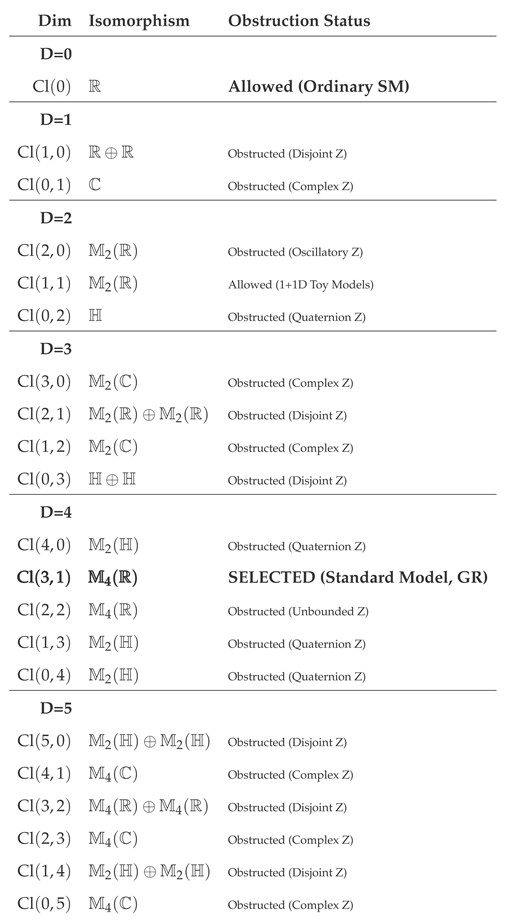
2.1.3. Dimensional Obstructions
We now classify the low-dimensional geometric algebras by testing whether their matrix representations support a valid, probabilistic partition function. We apply two filters:
- Algebraic Closure: The partition function Z must be a unique scalar in . This eliminates algebras isomorphic to Complex () or Quaternionic () matrices, as well as Reducible algebras (Direct Sums) which imply disjoint logical sectors.
- Statistical Stability: The partition function must be strictly positive (). This eliminates geometries where the constraint operator is skew-symmetric (Elliptic/Euclidean) or unbounded (Split), preventing the convergence of the partition sum.
We demonstrate these exclusions via two theorems.
Theorem 2
(The Complex Filter). A valid solution requires the partition density Z to be a unique Real scalar.
- Algebras isomorphic to or matrices yield non-real probabilities (unless constrained externally).
- Reducible algebras (Direct Sums) yield tuple probabilities , failing to describe a single unified vacuum.
This theorem eliminates all odd dimensions () and complex/quaternionic even dimensions.
This leaves only the Simple Real algebras: , , , and . We distinguish them via the spectral properties of their geometric operators.
Theorem 3
(The Stability Filter). Among the algebras isomorphic to Simple Real matrices, only the Lorentzian signatures guarantee a strictly positive, convergent partition function.
Proof.
We examine the trace of the exponential evolution based on the geometric nature of the operator H:
- Euclidean Geometry (): The natural geometric operator (the Dirac operator) is elliptic and skew-symmetric in the real representation. Its eigenvalues are purely imaginary (), leading to an oscillatory partition function , which inevitably takes negative values.
- Split Geometry (): The geometric operator is ultrahyperbolic. The presence of two time dimensions implies the energy spectrum is unbounded from below. This "instability of the vacuum" prevents Z from converging to a finite value, making the probability distribution undefined.
- Lorentzian Geometry ( & ): The geometric operator is hyperbolic. The causal structure allows for a strictly positive energetic spectrum (bounded from below). In the Majorana representation, the Hamiltonian is real and symmetric, guaranteeing positive eigenvalues and a convergent sum of decaying exponentials .
While is algebraically valid, it represents 1+1D "Toy Models" lacking transverse degrees of freedom. Thus, stands as the unique, non-trivial geometry satisfying all entropic consistency conditions. □
2.2. The Entropic Dirac Equation
Having established that is the unique low-dimensional geometry capable of supporting a real-valued entropic probability density, we now examine the dynamics of this allowed solution. Specifically, we show that the equation governing the evolution of the density field corresponds to the Dirac equation, expressed in the language of Spacetime Algebra[5].
2.2.1. The Real Algebra Representation
In Section 2.1.3, we utilized the isomorphism . To perform calculations, we fix a faithful matrix representation. We select a Majorana representation, where the gamma matrices are real-valued matrices.
The generators of the algebra are mapped as follows
In this representation, the density field is a real matrix field.
2.2.2. The Geometric Constraint Generator
In standard approaches, the Hamiltonian is often postulated based on phenomenological energy spectra. Here, however, we determine via a principle of Geometric Generality.
We seek the most general linear operator that acts upon the degrees of freedom of the field within the constraints of the specific geometry .
- The State Space: In the spacetime algebra , the wavefunction (spinor) corresponds to an element of the even sub-algebra.
- Locality and Transformations: The field varies across the spacetime manifold. To constrain these variations without introducing arbitrary biases, we must define a connection that accounts for all possible local geometric transformations available to the algebra. The generators of the local gauge group acting on the even subalgebra form the Lie algebra . This implies a connection (gauge potential) :where is the pseudoscalar (the geometric equivalent of the imaginary unit i).
- The Generalized Covariant Derivative: We must also account for spacetime translations (). Combining translations with the local connection yields the full covariant derivative, which serves as the fundamental geometric constraint on the manifold:
To construct the scalar constraint generator required for the Entropic Hamiltonian, we consider the generator of time translations. We project the covariant derivatives onto the spatial hypersurface spanned by the spatial gammas . The most general first-order linear operator constructible from these components is:
where m represents the scalar invariant (mass) ensuring the operator closes algebraically. This is precisely the Dirac Hamiltonian, representing the encoded information about how the geometry curves and twists in the spatial directions.
2.2.3. Emergence of the Linear Evolution
With the generator now determined, we return to the entropic solution derived in Eq. 15:
We make the physical identification of the Lagrange multiplier with the coordinate time (), and identify the prior as the initial condition of the field.
To determine the equation of motion, we differentiate the entropic solution with respect to the evolution parameter. Crucially, we treat the density field as an element of a Left Ideal (representing a pure state spinor). This allows the constraint operator to act via the Left Regular Representation:
Substituting the explicitly derived geometric form of :
We multiply the entire equation from the left by . Recall that in the selected signature, the time-like direction squares to minus one ():
Rearranging all terms to the left side groups the temporal and spatial derivatives into the full Dirac operator:
Recognizing that in the signature, the covariant vector derivative is , this equation describes the free propagation of the probability amplitude:
2.2.4. Recovery of the Spinor Wavefunction
The equation above applies to the density object . However, standard quantum mechanics implies the Dirac equation applies to a spinor . We recover this description physically by decomposing the density matrix.
In the spacetime algebra , a “pure state” corresponds to a minimal left ideal. We can therefore decompose the density matrix into a geometric spinor and a primitive idempotent E (a projection operator defining the reference frame):
Substituting this ansatz into the transport equation derived above, :
Because the constraint operator D acts via the Left Regular Representation (updating the active state relative to the background), the derivative acts on the active spinor , while the dual reference frame factors out to the right:
For this equality to hold for any generic non-zero state (where the projector ), the geometric object must itself satisfy the condition:
Thus, the standard Dirac equation is derived not as a mechanical axiom, but as the requisite linear transport equation describing the conservation of information in a geometry.
2.3. Emergence of Gravity and Yang-Mills
Having established the local structure of the Dirac operator D via the internal matrix algebra, we now extend the Maximum Entropy principle to the global manifold. The vacuum is not a single point; it is a statistical ensemble of spectral modes defined over the infinite-dimensional Hilbert space .
To recover the dynamics of Gravity and Gauge fields, we apply the principle of Maximum Entropy to the global Density Operator .
2.3.1. The Global Entropic Functional
We define the Von Neumann entropy S of the vacuum state :
where denotes the infinite-dimensional trace over the spectrum of D.
For the system to admit a thermodynamic description, we must impose constraints on the total probability and the energy content of the vacuum. In Spectral Geometry, the Dirac operator D corresponds to the fundamental momentum, and its square plays the role of the Hamiltonian (kinetic energy). We therefore impose the following constraints:
- Unitary Normalization: The vacuum probabilities must sum to unity.
- Spectral Energy Variance: To ensure stability against high-frequency divergences, we constrain the expectation value of the geometric Laplacian . This fixes the energy scale of the geometry.
2.3.2. The Variational Principle
We construct the Lagrangian functional to maximize the entropy subject to these constraints. We introduce as the multiplier for normalization, and as the multiplier for the energy constraint (anticipating the standard spectral dimension of ):
To find the stationary state, we compute the functional derivative :
Solving for the density operator yields the canonical Boltzmann distribution for the spectral spacetime:
Here, Z is the partition function required for normalization. is physically identified as the energy cutoff scale (or the temperature of the geometry). The partition function is obtained by the global trace:
2.3.3. Gravity and Yang-Mills from the Heat Kernel
The partition function derived above is exactly the trace of the Heat Kernel on the manifold. The physical action of the theory is identified with this partition function. As , we utilize the standard Heat Kernel expansion for the squared Dirac operator [6,7]:
The Seeley-DeWitt coefficients generate the bosonic action:
- (Cosmological Constant):.
- (Einstein-Hilbert):.
- (Yang-Mills):.
Thus, General Relativity and Gauge Theory emerge universally as the thermodynamic equilibrium state of the spectral vacuum.
2.3.4. Departure from Equilibrium: The Role of Experiment
In the phenomenological application of the Spectral Action, the functional is defined with a general cutoff function f rather than a pure exponential:
Our entropic derivation singles out the exponential as the “ideal gas” solution. The general function f used in the Standard Model calculations represents the realistic vacuum, which may exhibit deviations from pure equilibrium. We reconcile these via the Inverse Laplace Transform:
Substituting this into the action:
This reformulation interprets the Spectral Action as a Superstatistic. The function is the probability density of the effective temperature scales.
- A pure exponential action implies (Perfect Equilibrium).
- The specific coefficients required to match the Standard Model Higgs and gauge couplings correspond to a specific distribution that departs from the delta function.
This allows for the numerical fixing of the action via experiment: the coupling constants measured in the laboratory essentially map out the deviation of the physical universe from the maximal entropy state.
3. Discussion
We have reformulated fundamental physics not as a set of dynamical laws assumed a priori, but as the inevitable solution to a problem of optimization. By starting from the strict premise that only measurements exists as ontological devices, and applying the Principle of Maximum Entropy to construct the least biased model consistent with those measurements, we recover the structure of spacetime and the general form of physical laws as output.
3.1. The Necessity of Algebra from Inference
Our derivation begins with a singular input: a set of measurement records. To process these records without bias, we employ the Principle of Maximum Entropy. However, the very act of applying this principle dictates the mathematical structure of the theory.
The solution to a MaxEnt variational problem is invariably an exponential family of the form . The mathematical operation of exponentiation is defined via a power series:
This operation strictly requires the definitions of addition, multiplication, and scalar multiplication. Therefore, we do not postulate that nature is algebraic; we deduce that any consistent theory of inference must be algebraic. If we are to relate measurements to one another probabilistically, they must form an algebra. This realization moves the foundation of physics from "geometric assumptions" (manifolds, coordinates) to "informational necessities."
Generalizing statistical mechanics from the reals to the algebras is thus the largest possible extensions of SM that the mathematics of exponential forms allow.
3.2. The Statistical Origin of Physical Law
With the algebra established as the necessary language of inference, fundamental physics emerges as the statistical equilibrium of that algebra.
Functionally, the theory is defined by the entropic maximization:
Here, Nature is defined not by a state vector, but by the constraint . This is the spectral capacity of the observer—the ceiling on information density allowed by the algebraic relations. The resulting equations of motion (General Relativity and Yang-Mills) are not arbitrary rules; they are the probability distributions that remain maximally non-committal while strictly satisfying the algebraic conditions required to perform the measurement.
3.3. Operational Interpretation: The Operator Transport
The theory does not describe an object evolving in time; it describes the operator transport of information from a preparation to a readout. Specifically, the evolution of the density matrix is given by:
This equation reveals that the "dynamics" of the theory is actually a Bayesian-like update. The term updates the observer’s prior information () with the constraints imposed by the measurement geometry ().
The "Measurement Problem" vanishes because the theory never claims to describe an independent reality evolving in isolation. There is no collapse of the wavefunction, only the continuous updating of the observer’s information relative to and constrained by the measurements. The entire formalism is a description of the inference channel connecting the prior to the posterior. This contrast with ordinary QM in which the updating is from to , requiring a collapse mechanism to connect to a probability measure.
3.4. The Universe as the Least Biased Representation
The most radical consequence of this view is that the Universe itself—the smooth Riemannian manifold of spacetime populated by fields—is not the container of the measurements, but the least biased representation of them.
Standard physics assumes the stage (spacetime) exists, and actors (fields) move upon it. We reverse this. We start with the actors (measurements in an algebra) and find that the stage is output of the inference.
- Geometry: We do not assume dimensions. We find that is the specific spectral geometry selected by the inference because all other dimensional configurations do not result in a partition function valued in the reals, and therefore fail to satisfy the requirements of probability theory.
- Forces: We do not assume the existence of Gauge or gravitational forces. The Yang-Mills and GR action emerges simply as the result of the most general algebraic constraint supported by the optimization problem.
In conclusion, we do not inhabit a pre-fabricated axiomatically-existing universe; rather, we inhabit an ensemble of measurements, and we construct the least-committal picture of the universe via inference.
4. Conclusion
E. T. Jaynes reoriented statistical mechanics by recasting it as inference: maximum entropy provides the least-biased assignment compatible with stated constraints, making standard rules consequences of an information principle rather than extra physical postulates. Building on this insight, we treat measurements themselves as the primary reality and derive the laws of nature as the solution to a statistical inference problem.
Our contribution is to formulate physics as a variational optimization: we maximize the entropy of the observer’s path through measurements subject to the constraints of the measurement algebra. This naturally yields exponential-family transports, connecting Jaynesian equilibrium structure to dynamical physics equations as maximum-entropy information flow.
Methodologically, this replaces axiom enumeration with least-commitment inference. We do not assume a pre-existing "Universe" that is subsequently observed; rather, the set of measurement records is mapped to its least biased representation. Pushing the algebra of these measurements to its maximal mathematically consistent generality reveals a rigid selection mechanism:
- Enforcing the requirements of probability theory—specifically the existence of a real-valued partition function—fixes the spectral geometry to dimensions.
- Enforcing the most general algebraic constraint supported by the optimization yields the form of the dynamics—Dirac matter, Einstein–Hilbert gravity, and Yang–Mills gauge sectors.
This perspective preserves Jaynes’ central virtue—maximal non-commitment given stated information—at the level of full theory formation.
Statements and Declarations
- Funding: This research received no specific grant from any funding agency in the public, commercial, or not-for-profit sectors.
- Competing Interests:
- Data Availability Statement:
Funding
This research received no specific grant from any funding agency in the public, commercial, or not-for-profit sectors.
Data Availability Statement
No datasets were generated or analyzed during the current study. During the preparation of this manuscript, we utilized a Large Language Model (LLM), for assistance with spelling and grammar corrections, as well as for minor improvements to the text to enhance clarity and readability. This AI tool did not contribute to the conceptual development of the work, data analysis, interpretation of results, or the decision-making process in the research. Its use was limited to language editing and minor textual enhancements to ensure the manuscript met the required linguistic standards.
Conflicts of Interest
The author declares that he has no competing financial or non-financial interests that are directly or indirectly related to the work submitted for publication.
References
- Jaynes, E.T. Information theory and statistical mechanics. Physical review 1957, 106, 620. [Google Scholar] [CrossRef]
- Jaynes, E.T. Information theory and statistical mechanics. II. Physical review 1957, 108, 171. [Google Scholar] [CrossRef]
- Dirac, P.A.M. The principles of quantum mechanics; Number 27; Oxford university press, 1981. [Google Scholar]
- Von Neumann, J. Mathematical foundations of quantum mechanics: New edition; Princeton university press, 2018; Vol. 53. [Google Scholar]
- Hestenes, D. Spacetime physics with geometric algebra. American Journal of Physics 2003, 71, 691–714. [Google Scholar] [CrossRef]
Disclaimer/Publisher’s Note: The statements, opinions and data contained in all publications are solely those of the individual author(s) and contributor(s) and not of MDPI and/or the editor(s). MDPI and/or the editor(s) disclaim responsibility for any injury to people or property resulting from any ideas, methods, instructions or products referred to in the content. |
© 2025 by the authors. Licensee MDPI, Basel, Switzerland. This article is an open access article distributed under the terms and conditions of the Creative Commons Attribution (CC BY) license (http://creativecommons.org/licenses/by/4.0/).
Copyright: This open access article is published under a Creative Commons CC BY 4.0 license, which permit the free download, distribution, and reuse, provided that the author and preprint are cited in any reuse.