
Submitted:
15 April 2024
Posted:
15 April 2024
You are already at the latest version
Abstract
Abstract Background: Hypochlorous acid (HA) is a potent disinfectant with broad-spectrum antimicrobial activity against bacteria, fungi, and viruses. Aim: This study aimed to investigate the factors that influence the stability of hypochlorous acid (HOCl) and their impact on its disinfectant properties Methods: This study explored the stability of hypochlorous acid, emphasizing factors that affect its disinfectant efficiency, such as pH level, temperature, and the presence of organic materials. Findings: Our investigation revealed that HOCl is the most stable and effective disinfectant under weakly acidic conditions, where the undissociated form of hypochlorous acid is predominant. Although it is stable under various conditions, its efficacy is compromised by the presence of heavy metals, organic matter, and UV radiation. Conclusions: This comprehensive analysis concludes that, while hypochlorous acid is a highly effective disinfectant, understanding and maintaining the optimal conditions for its stability is crucial for maximizing its disinfection potential. Implications: The findings can be used to formulate new guidelines and regulations to guide the proper formulation, storage, and use of stable HOCL as disinfectants.
Keywords:
hypochlorous acid
; HOCL
; disinfectant stability
; surface disinfectants
; electrochemical activation
; electrolysis
Introduction
Hypochlorous acid (HOCl) is a powerful disinfectant commonly used in various industries and settings. It is a weak acid produced naturally by white blood cells to defend against pathogens. (Nguyen et al., 2021) HOCl is highly effective in killing bacteria, viruses, and other microorganisms by disrupting their cellular structures and metabolic processes. It is non-toxic, non-irritating, eco-friendly, and safe to use on various surfaces and even on the human body when used properly and at recommended concentrations. (Eryılmaz & Palabıyık, 2013) (Fukuzaki, 2006) (Ishihara et al., 2017) (Block & Rowan, 2020) Due to its broad-spectrum antimicrobial properties, HOCl has gained popularity as an environmentally friendly alternative to traditional disinfectants. (Overholt et al., 2018)(Boecker et al., 2023)(Wang et al., 2007)(Nguyen et al., 2021)
It is versatile and commonly used in healthcare facilities, food processing industries, water treatment plants, and household cleaning products. It is also used to produce sterilizing water with available chlorine concentrations conducive to disinfection (Qin et al., 2002), as well as for wound care. (Wang et al., 2007) Also, there is a grow trend in the use of HOCL for surface disinfection.(Ishihara et al., 2017). Park et al. (2007)
In addition, HOCl acts rapidly to kill pathogens. They can rapidly penetrate cell walls and disrupt microbial structures and enzymes, leading to their inactivation. HOCl is also available in various forms such as sprays, wipes, and solutions. It can be easily applied using standard cleaning equipment or personal protective gear. Table 1 shows the comparative advantages of this method relative to other traditional disinfectants. (McDonnell & Sattar, 2006) (Omidbakhsh & Russell, 1999).
However, one key issue affecting the efficacy and practicality of hypochlorous acid (HOCl) as a disinfectant is its stability. Under optimal pH conditions, HOCl is a potent disinfectant, but it is inherently unstable and can soon decompose into less effective disinfection by-products, such as chloramines or hypochlorite ions, or convert into oxygen or chlorate (Busch et al., 2019; Lee et al., 2023) (Committee, 2001), (Nguyen et al., 2021). The stability of HOCl is also temperature-dependent, with higher temperatures leading to faster decomposition rates (Yamada et al., 2023). Additionally, the presence of carbonate species in water can catalyze the decay of HOCl, affecting its efficacy as a disinfectant. (Brodfuehrer et al., 2020).
Furthermore, there are concerns that repeated use of HOCl could result in the development of antimicrobial resistance. (Block & Rowan, 2020) This resistance can compromise the overall efficacy of HOCl in controlling and eliminating harmful microorganisms, posing a significant challenge in healthcare settings in which disinfection is crucial.
The practicality of using HOCl as a disinfectant is also affected by the stability concerns. The limited stability of HOCl necessitates its careful handling, storage, and transportation to maintain its efficacy. (Khalid et al., 2021) If not properly handled or stored, HOCl can degrade quickly, rendering it less effective as a disinfectant. (Ishihara et al., 2017)
Additionally, hypochlorous acid is unstable under ultraviolet light, sunlight, contact with air, and elevated temperatures and high relative humidity..(Ishihara et al., 2017), or in the presence of certain organic compounds and inorganic ions that can lead to the rapid consumption of hypochlorous acid and decrease its antimicrobial activity. (Ishihara et al. (2017)
Despite efforts to stabilize HOCl through various chemical control measures and technologies (pH adjustments, use of stabilizing agents, and advanced formulations), there are limitations to its stability over extended periods (Ishihara et al., 2017), especially when exposed to unfavorable environmental conditions, such as elevated temperatures and UV radiation. (Li et al., 2019)
Interestingly, despite the growing interest in HOCl as a disinfectant, there is limited end-user understanding of the factors that influence its stability and how they impact its effectiveness. (Nguyen et al., 2021) Additionally, the stability of HOCl in water treatment and its interaction with organic matter and other chemical species are complex and not fully understood. (Terhalle et al., 2018) This knowledge gap suggests that further research is needed to fully understand and optimize the conditions for HOCl stability (Aniyyah et al., 2022; LI, 2021).
Therefore, this study aimed to investigate the factors influencing the stability of hypochlorous acid (HOCl) and their impact on its disinfectant properties. Currently, there is a growing interest in the use of HOCL as a disinfectant owing to its effectiveness against a broad range of microorganisms (Ono et al., 2012). (2021). However, the stability of hypochlorous acid remains a concern, as it reduces its efficacy as a disinfectant. Nguyen et al. (2021)
Factors Affecting the Stability of Hypochlorous Acid
Several factors that can lead to breakdown or reduced efficacy of HOCl have been identified.
- pH Sensitivity: HOCl is the most effective disinfectant when it is in its undissociated form (HOCl). At lower pH levels (more acidic), HOCl can rapidly dissociate into hypochlorite ions (OCl-), which have reduced antimicrobial activity, whereas at lower pH, it can release chlorine gas, which is hazardous. (Ishihara et al., 2017)
- Temperature: Higher temperatures (≥ 25 °C) can accelerate the degradation of HOCl. The rate of degradation increases as the temperature increases further, causing HOCl to break down into hypochlorite ions and lose its antimicrobial effectiveness.
- Light: Exposure to sunlight or UV radiation can break down HOCl molecules, thereby reducing their disinfecting power. When HOCl absorbs light energy, it can undergo photolysis, leading to the formation of chloride and hypochlorite ions.
- Time: HOCl has a limited shelf life, and its stability decreases over time. Gradually, HOCl molecules degrade into chloride and hypochlorite ions, reducing their ability to effectively disinfect.
- Organic matter: When HOCl reacts with organic substances such as proteins and other biological materials, it can form chloramines. Chloramines have reduced antimicrobial activity compared to HOCl. (Committee, 2001)
- Metal ions: Some metal ions, such as copper, can catalyze the decomposition of HOCl into chloride and hypochlorite ions, reducing its effectiveness as a disinfectant. (Block & Rowan, 2020).(Committee, 2001)
- Generation and Delivery: The generation of hypochlorous acid as a disinfectant can be complicated and requires electrolysis of saltwater or specialized devices. Appropriate equipment and procedures must be performed to ensure the stability and effectiveness of the hypochlorous acid product.
To ensure the effectiveness of HOCl as a disinfectant, it is important to control these factors and safely store and use HOCl solutions. Therefore, special formulation, handling, and storage conditions are required to maintain the concentration and microbicidal activity of hypochlorous acid molecules. (Nguyen et al. (2021)
Current Research Findings on HOCL Stability Issues
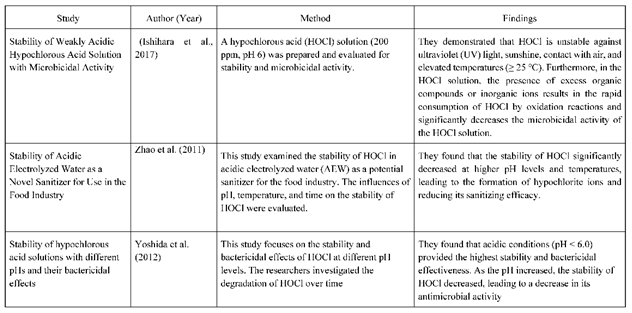
Table 2 shows some of the few relevant empirical studies that have investigated the stability of hypochlorous acid (HOCl). A study by (Ishihara et al. (2017), (Zhao et al 2017). (2011) (Yoshida et al. 2012), (Nagata et al. 2000), and Kurosaka et al. (1992) highlighted the importance of controlling factors, such as pH, temperature, light exposure, and time, to maintain the stability and effectiveness of HOCl as a disinfectant.
Although some variations in the experimental conditions and methodologies exist, collectively, they provide insights into the stability issues surrounding HOCl and contribute to understanding its limitations and optimal use as a disinfectant. They are almost unanimous in corroborating the reality of the HOCl instability and its impact on efficacy. Therefore, it is imperative to overcome this issue to maintain disinfectant efficacy, extend shelf life, and minimize potential health risks associated with degraded or low-concentration HOCl solutions.
The Consequences of Instability of HOCl as a Disinfectant
Unstable hypochlorous acid (HOCl) can have several consequences, some of which include the following.
- Reduced disinfectant efficacy HOCl is known for its powerful broad-spectrum antimicrobial properties. However, an unstable and less effective HOCl may require higher concentrations or longer contact times to achieve the same level of germicidal activity.(Ishihara et al., 2017).
- Shorter shelf life: Stability issues can lead to a shorter shelf life for HOCl-based products. The degradation of HOCl in solution reduces the concentration of active HOCl available for disinfection, thus shortening the shelf life of the product. This can be problematic in industries or applications in which long-term storage or infrequent use is required.
- Potential health risks: The use of degraded products containing reduced HOCl concentration or hypochlorite ions may have potential health risks.(Block & Rowan, 2020) Hypochlorite ions are less selective in their antimicrobial action compared to HOCl, and they can also interact with organic matter present on surfaces or in the environment to form potentially harmful byproducts.(Nguyen et al., 2021) These byproducts include chloramines and chlorinated organic compounds, which can be irritating to the skin, eyes, and respiratory system. (Office et al., 2004) In some cases, they can also be toxic or carcinogenic.
Overall, ensuring the stability of HOCl is crucial for maintaining its disinfectant efficacy, extending the shelf life of products, and minimizing the potential health risks associated with degraded or low-concentration HOCl solutions.
Challenges Faced and Current Efforts to Enhance the Stability of Hypochlorous Acid as Disinfectant
The Current Challenges
The stability issues associated with HOCl present numerous challenges for industries and organizations that rely on HOCl as a disinfectant. These challenges can impact various aspects of operation and effectiveness. Some of the challenges faced are as follows:
- Inconsistent disinfection efficacy: Instability of HOCl can lead to inconsistent disinfection efficacy. As HOCl degrades into less-effective hypochlorite ions (OCl-), the concentration of active disinfectants decreases. This can result in variable germicidal activity, which requires higher concentrations or longer contact times to achieve the desired level of disinfection. This inconsistent efficacy poses a significant challenge for ensuring proper sanitization and preventing the spread of infections.
- Increased costs: Reduced disinfectant efficacy due to stability issues can increase costs for organizations. Higher concentrations of HOCl may be required to compensate for degradation and achieve the desired level of disinfection. This can lead to increased consumption of HOCl and additional expenses associated with the procurement, storage, and application of disinfectants. The need for larger quantities and increased frequency of applications can affect budgets and potentially strain resources.
- Shortened shelf life: Stability issues can shorten the shelf life of HOCl-based disinfectants, resulting in a higher risk of expired or ineffective disinfectants within the organization. This challenge can disrupt supply chains, require more frequent reordering, and increase inventory management complexity.
- Regulatory compliance: Industries and organizations that utilize HOCl as a disinfectant must comply with the regulatory guidelines and standards for efficacy and safety. Stability issues that compromise the efficiency of disinfectants or generate potentially harmful degradation byproducts can pose challenges in meeting regulatory and accreditation requirements.
- Reputation and customer trust: Stability issues with HOCl-based disinfectants can affect an organization's reputation and customer trust. Businesses in industries such as healthcare, hospitality, and food services rely heavily on effective disinfection to maintain a safe environment for both staff and visitors. Any resultant instability can result in inconsistent disinfection or inferior quality of products, which can erode customer confidence and lead to reputational damage.
To address these challenges, industries and organizations may need to invest in research and development to enhance the stability of HOCl-based disinfectants. Additionally, collaboration with regulatory bodies and adherence to industry standards can help maintain compliance and address the potential risks associated with stability issues.
Enhanced stability can result in improved disinfection efficacy, cost-effectiveness, longer shelf-life, regulatory compliance, and increased trust and confidence. Investing in research and development in this area can have far-reaching benefits for various industries that rely heavily on HOCl for sanitization.
Ongoing Research and Developments on Stability of HOCl
Ongoing research efforts to improve the stability of hypochlorous acid (HOCl) as a disinfectant have focused on various aspects, including formulation optimization and delivery systems. This section provides an overview of some of the ongoing research efforts in this field.
- Formulation optimization, including pH adjustment and the addition of buffering agents, can improve stability and shelf life. Researchers are currently investigating different formulations and techniques that can enhance the stability of HOCl. This includes the study of the effects of pH, temperature, and other factors on HOCl stability. By perfecting the formulation, researchers have aimed to minimize the degradation of HOCl into less effective hypochlorite ions and extend its shelf life. (Khalid et al., 2021) (McBain AJ, et al. 2003)
- Stabilizing agents: Adding stabilizers such as inorganic salts or phosphates can help minimize the decomposition of HOCl(Nguyen et al., 2021). Research is ongoing to identify suitable stabilizing agents to enhance the stability of HOCl. Some studies have explored the use of additives such as buffering agents, chelating agents, and surfactants to stabilize HOCl solutions.(Nguyen et al., 2021), (Fox LJ, et al, 1992)
- Alternative delivery systems: Researchers are exploring alternative delivery systems, including the use of encapsulation techniques that involve enclosing HOCl in micro- or nanosized particles to protect them from degradation and interactions with the environment. These encapsulated systems can provide controlled release of HOCl, maximizing its stability and efficacy. See, for example, Doganay and Doganay H. (2019)
- Storage and handling conditions: Researchers are currently studying the impact of storage and handling conditions on the stability of HOCl. Factors such as light exposure, humidity, and packaging materials can affect the stability of the HOCl solutions. By this, researchers aim to develop recommended storage and handling guidelines to maintain the stability of HOCl.(Ishihara et al., 2017) (Wang et al., 2007).
- Synergistic combinations: Several studies have explored the use of synergistic combinations of different stabilizing agents or techniques to enhance the stability of HOCl. For example, combining pH stabilization with encapsulation, or using a combination of ROS scavengers and cross-linking agents. For example, Kim, J. H., Moon, J. H., Cheong, K. C. (2016), Shi, B., Zhang, D., Tsui, T.H., & Chen, R. (2018), Yang, C., Li, H., Wei, H., & Zhang, Y. (2014), Oh, J.C., Kim, Y., & Oh, S.G. (2018), Lee, J.H., Kim, H.K., Park, S.H., & Kang, M.H. (2014)
- Analytical methods: Regular monitoring of the pH, concentration, and other relevant parameters of the HOCl solution can help identify any changes in stability and take necessary actions to maintain its effectiveness.(Ishihara et al., 2017). The development of robust analytical methods for assessing the stability of HOCl is an ongoing research effort. Researchers are developing rapid and accurate analytical techniques to monitor the degradation of HOCl over time. These methods can help understand the kinetics of HOCl degradation and evaluate the efficacy of stabilizing agents and formulation optimization strategies. See, for example, Lee, J., Lee, Y., and Kim, H. (2017), Abu-Omar, M.M., Abu-Rumeileh, R.G., & Kodeh, F.S. (2019), Martins, R.C., Miquelini, M., Neves, A.A.R., Moreira, N.C., 2019. (2017), Buettner, K., & Lackmann, J.-W. (2012), and
- Anode materials and electrode modifications: Researchers are currently investigating various anode materials and modifications to improve the stability of HOCl during electrolysis. For example, some studies have explored the use of electrodes coated with metal oxides or alloys to enhance stability and minimize the degradation of HOCl. For instance, (Chen et al. (2013) (Zhang et al. 2015)
Overall, ongoing research efforts to improve the stability of HOCl as a disinfectant are multidisciplinary and involve formulation chemistry, materials science, and analytical techniques. By addressing stability issues, these research efforts aimed to enhance the effectiveness and reliability of HOCl-based disinfectants, contributing to better disinfection practices in various industries.
Current Manufacturing Techniques and Formulations to Enhance its Stability
In addition to the various research and development initiatives discussed above, manufacturers are exploring several promising methods and technologies to enhance the stability and shelf life of hypochlorous acid (HOCl) solutions. These include:
- Acidic electrolyzed water (AEW) generators: AEW generators produce HOCl via a process called electrolysis. The generators created a stable HOCl solution using salt, water, and electricity. By generating HOCl on demand, these generators can provide a fresh and stable solution with an extended shelf life.
- Optimizing electrolysis conditions, such as current density and pH control, can affect the stability of HOCl and extend its shelf life.
- Controlled-release systems: Researchers have developed controlled-release systems that can release HOCl slowly over a specified period. These systems typically involve encapsulation of HOCl in polymers or nanostructures. Controlled release of HOCl can prevent its degradation and maintain its stability for an extended period.
- Reactive oxygen species (ROS) scavengers: Reactive oxygen species, such as superoxide anions, can degrade HOCl. The addition of scavengers that neutralize ROS can help stabilize HOCl and prevent its degradation. Examples of ROS scavengers include antioxidants such as ascorbic acid, tocopherols, and thioctic acid. See for example, (Eryilmaz & Palabiyik, 2013; Geir Hermod Almås, 2018; Issa-Zacharia et al., 2011; Li et al., 2023; Zhang et al., 2021)
- Cross-linking agents: Cross-linking agents enhance the stability of HOCl by forming chemical bonds that protect it from degradation. One example is the use of polyvinylpyrrolidone (PVP) as a crosslinking agent to stabilize HOCl solutions.
These methods, formulations, and technologies hold promise for improving the stability and shelf life of HOCl solutions, enabling enhanced disinfection practices in various industries, such as healthcare, food processing, and water treatment. This suggests that stability issues can be mitigated through innovative production methods, opening the possibility of making it a viable option for various disinfection applications (Eryılmaz & Palabıyık, 2013; LI, 2021).
Summary, Conclusion and Recommendations
Summary
This study aimed to explore and investigate the factors that influence the stability of HOCl and their impact on its efficacy. A review of the existing literature has shown that the stability of HOCl as a disinfectant remains a complex and multifaceted issue that requires further investigation and the development of new strategies to enhance its stability and effectiveness.
The key issues surrounding the stability of hypochlorous acid (HOCl) as a disinfectant include its susceptibility to degradation and conversion into less effective (and often harmful) disinfection byproducts when exposed to light, heat, pH extremes, and certain organic materials. This degradation reduces the disinfection efficacy and shortens its shelf life. Maintaining the stability of HOCl is crucial to its effectiveness as a disinfectant.
Accordingly, researchers have explored various techniques and formulations to increase the stability of HOCl and extend its shelf life. Manufacturers and end-users can help mitigate stability issues by adopting techniques, technologies, and best practices alluded to. Continued research and development in this area are important for improving the reliability and effectiveness of HOCl disinfectants.
Conclusion
In conclusion, addressing the stability issues of hypochlorous acid is of utmost significance for its wider use and effectiveness in disinfection. By prolonging the shelf life and maintaining its efficacy, we can ensure the reliability, consistency, and cost-effectiveness of HOCl as a powerful disinfectant, leading to improved infection control and public health outcomes.
Recommendations to End-Users on Maintaining the Stability of HOCl
In addition to the chemical and technological steps taken to ensure and maintain the stability of HOCl during manufacturing, it is also essential that end-users comply with the following best practices to help prolong its stability as a disinfectant (Su et al., 2009).:
- pH Control: Maintain the pH of the HOCl solution around neutral (pH 7), where HOCl is most stable, to ensure maximum efficacy. (Ishihara et al., 2017)
- Proper Storage: Store HOCl in dark, cool environments, away from sunlight, and heat to prevent decomposition. Use containers that do not promote breakdown and ensure that they are labeled and sealed correctly.(Block & Rowan, 2020)
- Minimizing Exposure to Contaminants: Prevent the solution from meeting metals or organic materials that could accelerate degradation or reduce disinfecting power. (Mayer & Ryan, 2017)
- Monitor concentration: The concentration of HOCL is regularly checked and adjusted to ensure that it maintains the appropriate available chlorine levels and disinfecting properties, avoiding concentrations that are too low to be effective or so high that they can damage surfaces or equipment. (Nguyen et al., 2021)
- Water Quality: Use water that is as free from organic contaminants and impurities as possible to reduce the formation of harmful disinfection by-products and maintain available chlorine levels for disinfection.(Nguyen et al., 2021)
- Safe Handling Procedures: Follow safe handling procedures, including wearing appropriate personal protective equipment, to protect against potential hazards.
- Adhere to industry-specific guidelines and manufacturer recommendations for the use of HOCL, considering the type of application and required disinfection strength.
- Use As Intended: Apply HOCL only as directed for the specific disinfection tasks intended to maximize its benefits and reduce wastage or potential hazards. (Nguyen et al., 2021)
- End users should carefully assess their usage and consider alternative disinfection methods that may offer similar or better efficacy without the associated risks.
- Monitoring disinfection by-products and vigilance in managing microbial resistance are essential to ensure the safe and effective use of HOCL as a disinfectant.
In summary, following the above listed end-users' best practices can help mitigate these issues by improving the stability and on-site generation of HOCl, making it a more practical option for disinfection purposes (Brodfuehrer et al., 2020; LI, 2021; Yamada et al., 2023)
Recommendations for Further Research and Development
The associated challenges discovered in this study necessitate ongoing research and development to improve the stability and safety of HOCl in its various applications (` (LI, 2021; Mehendale et al., 2023) `). Such research is essential to ensure efficacy and safety in various settings and applications. Gould (1996) Future research in this field should focus on exploring new methods to improve the stability of HOCL:
- Understanding the degradation pathways of HOCl,
- Optimizing its formulation and pH levels,
- Studying its compatibility with materials,
- Assessment of the potential for microbial resistance to HOCl and development of strategies to mitigate this risk.
- Customizing application research focused on developing specialized formulations tailored to specific applications, such as wound care, food sanitation, or water treatment, that can maintain stability under conditions unique to those environments, and
- Update and refine regulatory guidelines and standards for the production, storage, and application of HOCl to ensure stable and effective use across industries.
Overall, ongoing research on the stability of HOCl is critical for maximizing its advantages as a potent sporicidal disinfectant while minimizing risks. Continual research efforts in these areas can provide a scientific basis for improving HOCl products and their applications.
The Significance of This Study, Its Novelty and Limitations
This research can help end-users and other researchers to gain a deeper understanding of the stability and effectiveness of HOCL as a disinfectant, leading to the development of improved formulations. Additionally, it can contribute to the development of regulations and guidelines that standardize the production, storage, and application of HOCL. In addition, the findings of this study have significant implications for the development of new disinfectants and improvement of existing ones.
This study is both novel and significant because it provides new insights into the stability of HOCl, which has not been extensively studied before. However, this study is a limited review of the existing literature rather than an empirical study on the stability of HOCl. Further empirical research is needed to fully understand the stability of HOCl under different conditions and determine its long-term effects on the environment. Overall, the stability of hypochlorous acid as a disinfectant is a critical area of research that can lead to optimization of its effectiveness.
Funding
This study did not receive any external funding.
Institutional Review Board Statement
The study was conducted in accordance with the Declaration of Helsinki. However, the literature review did not require institutional review board approval, as no patient information was obtained or used.
Informed Consent Statement
Not applicable. No identifiable patient information is available or published.
Data Availability Statement
Raw study data are not readily available online, but can be made available on request, following local regulations and policies.
Conflict of interest
The authors declare that they have no conflicts of interest related to this study.
Author Contributions
Fatimah A and Abba A conceptualized the research and wrote the original draft; Aisha AE and A Amoudi reviewed the literature; Saeed A and Ibrahim A collected resources, and reviewed the script; All authors reviewed the script.
References
- Asghar, A., Raman, A. A., Daud, W M A. W. (2015, January 5, 2015). Advanced oxidation processes for in-situ production of hydrogen peroxide/hydroxyl radical for textile wastewater treatment: A review. https://www.sciencedirect.com/science/article/pii/S0959652614009408.
- Block, M S., & Rowan, B G. (2020, September 1). Hypochlorous Acid: A Review. [CrossRef]
- Boecker, D., Zhang, Z., Breves, R., Herth, F J., Kramer, A., & Bulitta, C. (2023, January 1, 2023). Antimicrobial efficacy, mode of action and in vivo use of hypochlorous acid (HOCl) for prevention or therapeutic support of infections. https://pubmed.ncbi.nlm.nih.gov/37034111.
- Committee, N R C S D W. (2001, January 1, 2001). The Chemistry of Disinfectants in Water: Reactions and Products. https://www.ncbi.nlm.nih.gov/books/NBK234591/#ddd00180.
- Eryilmaz, M. and Palabiyik, I. M. (2013). Hypochlorous acid: analytical methods and antimicrobial activity. In Tropical Journal of Pharmaceutical Research (Vol. 12, Issue 1). [CrossRef]
- Geir Hermod Almås. (2018). Preparation for controlled release of hypochlorous acid (Patent US20180117081A1). US Patent.
- Gustin, J. (2005, January 1, 2005). Safety of chlorine production and chlorination processes.
- Issa-Zacharia, A., Kamitani, Y., Miwa, N., Muhimbula, H., & Iwasaki, K. (2011). Application of slightly acidic electrolyzed water as a potential non-thermal food sanitizer for the decontamination of fresh ready-to-eat vegetables and sprouts. Food Control, 22(3–4), 601–607. [CrossRef]
- Ishihara, M., Murakami, K., Fukuda, K., Nakamura, S., Kuwabara, M., Hattori, H., Fujita, M., Kiyosawa, T. and Yokoe, H. (2017, January 1, 2017). Stability of Weakly Acidic Hypochlorous Acid Solution with Microbicidal Activity. [CrossRef]
- Jeffcoat, S B. (2011, February 1). On-site Sodium Hypochlorite Generation Reduces Storage and Risks. [CrossRef]
- Khalid, N., Sulaiman, N., Aziz, N A., Taip, F S., Sobri, S., M.A.R., N. (2021, January 3, 2021). Stability of electrolyzed water: from the perspective of food industry. [CrossRef]
- Kuwertz, R., Martinez, I G., Vidaković-Koch, T., Sundmacher, K., Turek, T., & Kunz, U. (2013, September 1). Energy-efficient chlorine production by gas-phase HCl electrolysis using an oxygen-depolarized cathode. Electrochemistry communications, 34, 320-322. [CrossRef]
- Lee, S L., O’Connor, T., Yang, X., Cruz, C N., Chatterjee, S., Madurawe, R D., Moore, C., Yu, L X., & Woodcock, J. (2015, March 19). Modernizing Pharmaceutical Manufacturing: from Batch to Continuous Production. Journal of pharmaceutical innovation, 10(3), 191-199. [CrossRef]
- 14. Li, Z., Wang, X., Li, X., Guo, S., Li, S., Chen, B., Cheng, Y., Xu, H., & Yan, W. (2023). Optimization of electrolysis process, storage conditions, and sterilization effect of slightly acidic electrolytic water prepared using a titanium suboxide electrode. Journal of Environmental Chemical Engineering, 11(3), 109679. [CrossRef]
- Mayer, B K., Ryan, D R. (2017, January 1, 2017).017). Impact of advanced oxidation processes on disinfection byproducts for drinking water treatment. The handbook of environmental chemistry, 345-386. [CrossRef]
- McDonnell, G., & Russell, A D. (1999, January 1). Antiseptics and Disinfectants: Activity, Action, and Resistance. [CrossRef]
- Nguyen, K., Bui, D., Hashemi, M., Hocking, D M., Mendis, P., Strugnell, R A., Dharmage, S C. (2021, January 1, 2021). The Potential Use of Hypochlorous Acid and a Smart Prefabricated Sanitizing Chamber to Reduce Occupation-Related COVID-19 Exposure. [CrossRef]
- Nguyen, K., Bui, D., Hashemi, M., Hocking, D M., Mendis, P., Strugnell, R A., Dharmage, S C. (2021, January 1, 2021). The Potential Use of Hypochlorous Acid and a Smart Prefabricated Sanitizing Chamber to Reduce Occupation-Related COVID-19 Exposure. https://www.ncbi.nlm.nih.gov/pmc/articles/PMC7837568/.
- Office, N., Restoration., & GOV, U. (2004, January 1). Reactivity Documentation. https://cameochemicals.noaa.gov/reactivity/documentation/RG44-RG1.
- Omidbakhsh, N., & Sattar, S A. (2006, June 1). Broad-spectrum microbicidal activity, toxicological assessment, and material compatibility of a new generation of accelerated hydrogen peroxide-based environmental surface disinfectants. American journal of infection control, 34(5), 251-257. [CrossRef]
- Overholt, B., Reynolds, K., & Wheeler, D. (2018, November 25). A Safer, More Effective Method for Cleaning and Disinfecting GI Endoscopic Procedure Rooms. https://www.ncbi.nlm.nih.gov/pmc/articles/PMC6255518/.
- Park, G W., Boston, D M., Kase, J A., Sampson, M N., & Sobsey, M D. (2007, July 15). Evaluation of Liquid- and Fog-Based Applications of Sterilox Hypochlorous Acid Solution for Surface Inactivation of Human Norovirus. Applied and environmental microbiology, 73(14), 4463-4468. [CrossRef]
- Sudrajat, A., Handayani, E M., Tamaldin, N., & Yamin, A K M. (2018, January 1). Principle of generator HHO hybrid multistack-type production technologies to increase HHO gas volume. SHS web of conferences, 49, 02016-02016. [CrossRef]
- Wang, L., Bassiri, M., Najafi, R., Najafi, K H B R M A N R., Yang, J., Khosrovi, B., Hwong, W., Barati, E., Belisle, B., Celeri, C., & Mc, R. (2007, April 11). Hypochlorous acid as a potential wound care agent: part I. Stabilized hypochlorous acid: a component of the inorganic armamentarium of innate immunity.
- Why does Hype affect chlorine gas safety? (2023, January 1, 2023). https://www.wateronline.com/doc/why-all-the-hype-about-chlorine-gas-safety-0001.
- Zhang, C., Wang, X., Du, J., Gu, Z., & Zhao, Y. (2021). Reactive Oxygen Species-Regulating Strategies Based on Nanomaterials for Disease Treatment. Advanced Science, 8(3). [CrossRef]

Table 1.
Comparison of the stability, safety and efficacy of Hydrochlorous Acid with other Disinfectants.
Table 1.
Comparison of the stability, safety and efficacy of Hydrochlorous Acid with other Disinfectants.
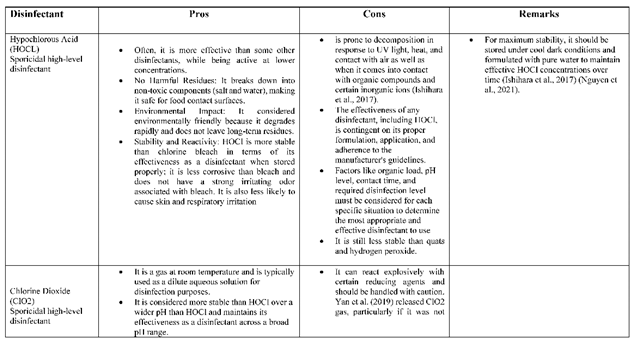

Table 2.
Studies on HOCL Stability.
Disclaimer/Publisher’s Note: The statements, opinions and data contained in all publications are solely those of the individual author(s) and contributor(s) and not of MDPI and/or the editor(s). MDPI and/or the editor(s) disclaim responsibility for any injury to people or property resulting from any ideas, methods, instructions or products referred to in the content. |
© 2024 by the authors. Licensee MDPI, Basel, Switzerland. This article is an open access article distributed under the terms and conditions of the Creative Commons Attribution (CC BY) license (https://creativecommons.org/licenses/by/4.0/).
Copyright: This open access article is published under a Creative Commons CC BY 4.0 license, which permit the free download, distribution, and reuse, provided that the author and preprint are cited in any reuse.


