

Submitted:
12 April 2024
Posted:
15 April 2024
You are already at the latest version
Abstract
Citizen science substantially contributes to large-scale biodiversity monitoring and the enhancement of public literacy. While both of the contributions largely depend on the public’s self- regulated learning. In this study, we employed a mix- method approach, incorporating both a questionnaire survey of 133 participants and interviews with 12 volunteers, aiming to explore the feature of self- regulated learning in citizen science, as well as identify the main factors impacting it. The volunteers are all different ages, from different jobs, with varying educational backgrounds. The findings revealed that the educational background of volunteers did not significantly impact their self-regulated learning. However, an increased frequency of participation was linked to higher levels of self-regulated learning. Furthermore, achievement goal orientation mediates the prediction of self-regulation by scientific epistemology. These insights underscore the importance of enhancing citizen science's impact on scientific literacy by fostering self-regulated learning among participants. This can be achieved through explicit instruction in scientific epistemology and by fostering a sense of achievement to boost achievement goal orientations. Additionally, our study advocates for the promotion of social interaction between students and out- of- school citizen scientists in school-based citizen science projects. The main innovation of this study is to consider volunteers as learners, not merely as contributors of data.
Keywords:
citizen science
; self- regulated learning
; scientific epistemological views
; achievement- goal orientation
1. Introduction
Citizen science refers to the participation of non-scientists (i.e., people who are not professionally trained in project-relevant disciplines) in scientific research practices, with the intended goal of promoting adults’ and students’ scientific literacy, advancing new scientific knowledge, solving real-world problems, and bridging the gap between science and the public [1–3(pp. 13)]. As one of the integral forms of “public engagement in science”, citizen science is obviously beneficial to citizenship science education, an essential elements in science education and scientific literacy [4]. As articulated, citizen science endeavors to enhance public scientific literacy, yet, the attainment of this objective is not guaranteed. The effectiveness of these endeavors largely depends on the individuals' self-directed learning. This situation echoes the well- known proverb, “you can lead a horse to river, but you cannot make it drink”, highlighting the critical role of individual learning in acquisition of scientific literacy. Despite the importance of this individual learning, the specific mechanisms through which citizen science volunteers learn remain poorly understood. Although some researchers have initiated investigation into the personal dimensions of volunteers within citizen science projects, mainly on effectiveness and experience, for example, motivation [5] science inquire skill [6], and science identity [7], comprehensive research that examines how citizen science volunteers learn and identifies the factors that influence their learning in this context remains scarce.
To gain an in- depth understanding of how volunteers learn in citizen science, self- regulated learning was selected as an insightful lens into understanding how individuals learn, because it inherently capture the constructive and self- directed nature of learning process [8]. In considering the dynamics of self-regulated learning, the exploration of epistemological views and motivational factors becomes indispensable. It has been demonstrated in science education that individual epistemological views will affect perception, cognitive processes, and learning strategies [9]. Theories of achievement goal orientation align closely with the principles of self-regulation. This congruence is evident as these theories not only elucidate the reasons behind individuals' desire to learn and the methods by which they evaluate their progress and achievements but also have been shown to influence metacognitive judgments [10], an area that overlaps significantly with self-regulated learning. Investigating the individual differences among self-regulated learning, particularly within the context of citizen science, helps unveils the intricate interplay between individual learners and the non-formal science learning environments. Analyzing how scientific epistemological views and achievement goal orientations influence self-regulated learning can lead to deeper insights into educational strategies that enhance learner autonomy and effectiveness, ultimately contributing to improved scientific literacy and lifelong science learning skill. To contribute to the existing research gap, the following two research questions were formulated:
Research question 1: are there individual differences on self- regulated learning?
Research question 2: how does the self- regulated learning of citizen science volunteers influenced by scientific epistemological views and achievement goal orientation?
2. Literature Review and Hypotheses Development
In this section, we clarify the central concepts that constitute the foundation of the theoretical framework guiding our study. Additionally, we outline the hypotheses formulated to address the research questions posed.
2.1. Self- Regulated Learning and Its Role in Citizen Science
The concept of self-regulated learning (SRL) describes the self- directive process in which individuals actively and consciously monitor, regulate, and control their own learning [11]. Regardless of the context— be it formal education or informal learning, across age groups from preschool children to adults, and spanning environments from computer-based to face- to- face learning settings— SRL plays a pivotal role. This significance is rooted in its potential to facilitate the diagnosis of learning needs, the formulation of objectives, the planning process, the application of strategies, and the monitoring of effort towards self-directed learning [12,13]. In citizen science, although it is difficult to find empirical findings on self-regulated learning in citizen science, it was believed that SRL prompts could foster scientific inquiry, e.g., doing scientific observation, understanding the purpose of data collection, making self- reflection on hypothesis [14]. The effectiveness of volunteers’ learning in citizen science requires a greater level of SRL as compared to that required in formal science learning. This is due to the unique context of autonomous learning in citizen science, where volunteers must independently determine when, where and how to learn scientific knowledge and skills. Regardless of whether volunteers are passively receiving training or actively learning, they need to engage in self-regulated learning. This is essential for their transformation from marginal participants to citizen scientists, for improving their understanding of science, and for learning how to do science. Therefore, it’s imperative to highlight the critical need to examine the status of SRL among participants in citizen science projects. Notably, prior research into SRL, particularly within the realm of online courses, has revealed significant variability in self-regulation capabilities across different demographics, including age and gender [15]. Such findings enlightened us to explore whether similar individual disparities exist within the context of citizen science, so as to provide volunteers with personalized learning support. Consequently, the following hypothesis (H1) has been formulated to address research question 1.
H1:There are significant differences in SRL based on gender, age, educational background, and frequency of participation.
2.2. Scientific Epistemological View and Its Role in Citizen Science
Epistemology, the study of knowledge and knowing, has long been one of the cornerstones of philosophy [16]. Epistemological view (or personal epistemology) is individual’s belief about the nature of knowledge (view about what knowledge is) and nature of knowing (view about knowledge acquisition) [17], related not only to school learning, but is an essential component of lifelong learning, in and out of school [18]. Science Epistemological Views (hereafter SEVs) concerns individual’s view about nature of knowledge and knowing in science, including nature of science and nature of scientific inquiry [19]. In science education, SEVs have been viewed as higher order thoughts, proved to influence learning orientation, learning processes and learning outcomes. For example, a survey of students in the laboratory exercises found that students who hold a constructivist scientific perspective are more inclined to negotiate meaning with their peers and are more invested in explaining experimental results [21]. Moreover, students with constructivist-oriented SEVs tended to attain better science learning outcomes than those with empiricist- aligned SEVs [22]. Scientific epistemology in citizen science has also received attention. For example, researchers evaluated citizen science participants in astronomy and found that the SEVs of these participants improved significantly after participating in citizen science [23], and citizen scientists can better understand the nature of science than non-citizen scientists [24]. However, the question of whether SEVs influence self- regulated learning and motivations among participants in citizen science remains to be further explored.
2.3. Achievement Goal Orientation and Its Role in Citizen Science
Achievement- goal theory posits the idea that people have an overarching orientation towards tasks, which can be described through mainly two general orientations: mastery orientation, which refer to attaining knowledge and developing competence, and performance orientation, which refer to outperforming peers or demonstrating one’s competence [25,26]. According to researchers [27,28], achievement- goal theory aligns particularly well with the concept of SRL. Because, as in a nutshell, SRL refers to self- generated thoughts, feelings and behaviors that are oriented to attaining goals [29]. This definition underscores that for individuals to effectively regulate their learning, they must establish specific goals or standards to monitor and measure their progress. A large number of studies have focused on the motivations of participants in citizen science, and have found a variety of motivational factors, such as, love of science, environmental concerns, support research efforts, as well as wanting to learn and gain knowledge [24,30]. Whereas, very few research have used a theory- based approach to measure motivation in citizen science with standardized methodology [31]. Achievement goal theory provides a framework for understanding the motivational factors that propel volunteers to complete tasks in citizen science projects, highlighting how situational influences can shape motivation. Given the theory's emphasis on goal orientation, moreover, since all volunteers participated on a voluntary basis, this study specifically focuses on the achievement goal orientations of volunteers and the goal avoidance orientation is not considered.
2.4. Relationship of SRL, SEVs and Achievement Goal Orientation
Exploring the interconnections among SEVs, SRL, and achievement goal orientation offers a lens through which to examine learning mechanisms of volunteers, as holistic learners instead of data contributors, integrating cognitive, emotional, and behavioral sides of learning. To start with, there is an interplay between students’ epistemological position and choices of self-regulation. For instance, students with a constructivist- oriented epistemology of science tended to apply more meaningful learning strategies in science learning and gain better science learning outcomes than those with empiricist- oriented [32,33]. According to the study conducted with 116 ninth-grade students, epistemological beliefs in science predict self- regulation [34]. Therefore, the research hypothesis we established as:
H2:
SEVs positively predicts self- regulated learning in citizen science.
Subsequently, several empirical studies unraveled the relationship between individuals’ epistemological beliefs and motivation [35]. The result showed that epistemological views influenced motivation. Students who tend to think communication and negotiation are important in science are more likely to maintain intrinsic goal orientations while learning science [36]. Focusing on achievement goal orientation, in a study for 484 pre-service teachers, SEVs predicted both mastery and performance approached goal [37]. Therefore, the hypothesis we established is:
H3.1:
SEVs predicts mastery approached goal motivation;
H3.2:
SEVs predicts performance approached goal motivation.
It is generally accepted that achievement goal orientation affects learners’ SRL. But it may differ between mastery- approached and performance- approached orientation. According to study using behavioral logs to trace SRL, mastery-approached goals positively predicted SRL processes, specifically predicted note-taking, information- seeking and monitoring [38]. Also it has been proved in a study involved 824 middle school student that individuals with higher mastery goal orientation are more inclined to invest greater effort, own stronger self- control, and utilize deeper learning strategies [39]. This inclination stems from their aim to develop personal competence, leading them to adjust their learning progress and apply learning strategies based on their own performance. Whereas, performance- approached goals negatively predicted some SRL strategies [40] and students with high performance goals tends to seek less help [41]. Because individuals who adopt a performance orientation are assumed to be focused more on performing better than others, demonstrating their ability, and gaining extrinsic rewards. Accordingly, the hypotheses were proposed as follows:
H4.1:
Mastery approached goal motivation positively predicts SRL.
H4.2:
Performance approached goal motivation negatively predicts SRL.
There is little direct evidence demonstrating the relationship among the three variables. In spite of this, researchers have discovered mediation role of motivation in the relations between learning strategies and epistemological beliefs has been proven among undergraduate students in science learning [42]. That’s to say, a more sophisticated scientific epistemological understanding leads students to perceive scientific knowledge as evolving rather than static and this perception can stimulate volunteers' motivation to actively engage in the process of scientific knowledge creation, subsequently influencing their SRL behaviors. Therefore, the hypotheses were formulated as follows:
H5.1:
SEVs predicts SRL through mastery approached orientation.
H5.2:
SEVs predicts SRL through performance approached orientation.
Finally, a theoretical hypotheses model is displayed in the Figure 1, to address the research question 2.
3. Methodology
To address two major research questions concerning individual differences and the relationships among variables, and to validate the corresponding research hypotheses, this section answered the following questions: What is the citizen science project that serves as the basis for this research context? Which instruments were employed to quantify the three variables? How was data collected and analyzed?
3.1. Research Context
Hundreds of citizen science projects share some common features, including explicit goals for participants, contribution for science, scaffoldings for scientific inquiry, interaction mechanism, and technology infrastructure [43,44]. This study also incorporated these characteristics into its citizen science project called “My Natural Treasure Box- City Insects Family Tree” (initiated by Shanghai. Natural History Museum, DachengXiaochong Studio, Systematic Entomology Lab of Shanghai Normal University, and Shanghai Society for Entomology) which is composed of the following components.
- Goals for participants: participants are explicitly presented with the goal of searching for insects that have not yet been discovered or documented in the literature, and to explore whether insects previously reported are still extant.
- Scientific contribution: in biodiversity, the “Linnean shortfall” refers to the fact that only a fraction of the planet’s species have been described [45]. Up to the present, new insect species can still be collected, discovered, and published in the urban area of Shanghai [46] as well as other regions of China [47]. While insect taxonomists face a variety of challenges on searching for new species across broader geographical ranges, which needs the integration among professionals and amateurs [48]. This citizen science project contributes to the insect taxonomy & nomenclature, biodiversity, insect biogeography, and insect conservation.
- Scaffoldings for scientific inquiry: to enhance participants' engagement in insect surveys, the project equips volunteers with a comprehensive workflow. This includes the selection of sampling locations and paths, the observation and photography of specimens with detailed collection data (whether physical or photographic), the comparison with documented records, and the identification of insect subspecies. Additionally, it provides volunteers with access to a wealth of learning materials, encompassing online resources related to insect species and books on insect checklist.
- Interaction mechanism: a combination of online and offline interactions is available to promote collaboration in this project. Volunteers can communicate instantly via social media platforms with entomologists about the nomenclature of newly discovered species. Researchers respond at their convenience. Surveys conducted in the field foster offline interactions. Shanghai's 16 districts have been divided into 16 teams, each led by an insect enthusiast who conducts outdoor entomological surveys regularly. A team of experts participates in various district activities or organizes a collective survey event. Experts also explain their survey methodologies and different insects' features throughout these investigations.
- Technology infrastructure: this project has developed an online platform named “Hear & See Everything”, which, through a novel set of features including photo upload functions, GPS technology, intelligent voice recognition, and intelligent image recognition technologies, allows users to take photos and upload species information. This encourages volunteers to conduct insect surveys and data uploads anytime and anywhere. A data quality assurance team, composed of entomological researchers and some professional volunteers, operates in the backend of this platform to review the data. This ensures that the insect images uploaded by users are assigned the correct names and categories, and feedback on the identification results is provided to the users.
On the whole, this project has resulted in the recording of more than 6,000 insect data entries in Shanghai district, as well as the discovery of more than 49 new records of Shanghai insect species. Furthermore, it has culminated in the publication of the “Shanghai Insect List 2023” which documents 3,090 species.
3.2. Research Instruments
The questionnaire consisted of four sections. The first section contains demographic information, and survey frequency. In the second part, this study adopted SEVs items from Tsai & Liu [49], which can be categorized into four dimensions: “Invented and Creative”, “Theory- laden”, “Changing and Tentative”, “Social Negotiation”. Their questionnaire was originally developed for high school students and teachers. The items were scored using a Likert scale of 1 (strongly disagree) to 5 (strongly agree). In the third part, we used items with five dimensions adapted from self- regulated learning questionnaire [50], namely, “Planning and time management”, “Metacognition”, “Study environment”, and “Effort regulation”. Participants rated this part from 1 (not at all true of me) to 7 (very true of me). The fourth part was comprised of items from achievement goal questionnaire [51] mainly to survey participants’ motivation scored on five- Likert scale. The dimensions and items were developed according to Elliot & McGregor [52], with four types goals in the framework: mastery- approach goal, performance- approach goal, mastery- avoidance goal and performance- avoidance goal respectively. Regarding the participants in this study all volunteered and actively participated in citizen science activities and their motivation factors were seldomly related to avoidance components. Thus, this study only adopted the approach components.
In order to gain a deeper understanding of participants' SRL, SEVs, and motivation, this study developed an interview protocol (see Appendix A) and conducted online interviews with 12 volunteers engaged in citizen science.
3.3. Data Collections
At first, each original research instruments were adapted to the insects’ survey context and then has undergone forward translation (from English to Mandarin) and back-translation (from Mandarin to English) by two researchers. Negotiations and revisions were made to reach consensus on expressions that differ greatly. Next, a panel of six experts recruited to examine the appropriateness of all dimensions and items. The panelists were specialists in entomology, science education, and informal science learning. Then, pilot- testing was conducted to ensure the content validity. During the pilot- test phase, there were 43 valid questionnaires collected. High-low group method [53], correcting item-total correlations [54], alpha if item deleted [55], and factor loading [56] were applied in the item analysis. Eventually, 2 invalid items were therefore modified or dropped (see appendix B) and formal questionnaire formed. Overall, 152 responses were obtained by distributing an online survey to people who voluntarily participated in the insects’ survey, and the online questionnaire includes a monetary incentive for completion. 20 cases were eliminated to ensure the quality of data based on a preliminary screening of data since for having a completion time under 3 minutes, selecting same answer choice across multiple items, or never participating in the survey [57]. A final sample of 133 respondents were eventually put into the subsequent analysis. Participant information is recorded in Table 1. Additionally, there are 15.63% (n= 20) of teachers and 14.84% (n= 19) of students according to occupation, followed by engineers (6.25%), designers (3.91%), corporate staffs (5.47%), freelancer (3.13%), stay-at-home mothers (2.34%), translators (2.34%), civil servants (1.56%), doctor (1.56%), etc.
As for the interview part, 12 volunteers who had filled out the questionnaire voluntarily signed up for interviews, which were conducted via an online telephone conference. Among the 12 interviewees, there was 1 student, 3 teachers, and one each of an illustrator, a foreign trade staff, an auditor, and a carpenter etc.
3.4. Data Analysis
3.4.1. Reliability and Validity
The composite reliability (CR) was used to assess the reliability of instruments. Convergent validity and discriminate validity of instruments were assessed to examine the validity of all the dimensions and constructs using confirmatory factor analysis (CFA). CR refers to the internal consistency of latent constructs and reflect true reliability than alpha because construct loadings are allowed to vary [58]. The rule of thumb for CR criteria is it need to be above 0.70 [59]. Convergent validity was assessed using Average Variance Extracted (AVE) and standardized factor loadings. AVE represents the average amount of variance that a construct explains in its indicators relative to the overall variance of its indicators, exceeding the 0.5 threshold support the convergent validity of latent constructs [60]. Standardized factor loadings should be at least 0.5 and, ideally 0.7 [61], which means the construct explains at least 25% or ideally 49% of the variance of each indicator. Discriminant validity examine whether the construct can be distinguished from others and was analyzed by employing AVE- share variance approach, which implies that if the square root of AVE for each construct is greater than its correlation with other constructs, then it can conclude the discriminant validity has been achieved [62]. This means the latent variable is distinct and unique because it explains more variance of the indicators than other variables.
As shown in Table 2, the remaining items’ standardized factor loadings were found to be statistically significant (p< 0.01) ranging from 0.501~ 0.979 (> 0.5) and most of estimates are ideally exceed 0.7. The dimension of “The theory-laden quality of scientific exploration”, 2 items in SEVs (S1, I1), 1 item in SRL (SE4) have been deleted as the factor loading of these were under 0.5. The dimensions’ composite reliability (CR) values were between 0.754 and 0.908 (> 0.70), showing good internal consistency. Concerning the average variance extracted (AVE) values, all AVE values ranged from 0.506 to 0.751, surpassing 0.5, which indicate the acceptable convergent validity of dimensions.
Discriminant validity of questionnaire was analyzed by comparing the AVE and squared correlation coefficients of the constructs. There is an evidence of discriminant validity in Table 3, as the square root of AVE on the diagonal for each dimension exceeds the correlations with others (off- diagonal values in the corresponding rows and columns).
3.4.2. Relationship of All the Variables
To measure the relationships among variables, structural equation modelling (SEM) was applied. SEM allows researchers to estimate complex relationships among multiple dependent and independent variables considering measurement error of observed variables simultaneously [63]. As SEVs and motivation’ critical ratio of the skewness and kurtosis (obtained by dividing the skewness values or excess kurtosis value by their standard errors) were beyond ± 3.29, it’s concluded that the data are non-normal [64] (see appendix C). Robust maximum likelihood (MLR) was used addressing the non-normality concerns. Because MLR was found to be robust to non-normality data while also yielding more accurate standard error estimates [65]. SPSS 29.0 and MPlus 8.0 were used to analyze the data. Various goodness- of- fit indices were used to detect how well the specified model fits the empirical data. The Chi-square normalized by degrees of freedom (χ2/df) should not exceed 3, comparative fit index (CFI) should exceed 0.9, adjusted goodness of fit index (AGFI) should be greater than 0.9, non-normed fit index (NNFI) should exceed 0.9, root mean squared error (RMSEA) should be less than 0.08, and root mean square residual (SRMR) values are deemed ideal less than 0.05 [66].
4. Results
Through a mixed research method, combining questionnaires and interviews, we sought to explore the status of volunteer self-regulated learning in citizen science and its influencing factors. Firstly, the findings about the research question 1 related to volunteers’ individual differences on SRL (see Section 4.1). Secondly, how was SRL predicted by SEVs and achievement goal orientation was reported (see Section 4.2).
4.1. Individual Differences on SRL(H1)
As indicated in the ANOVA comparison results on gender, age and educational background differences (see Table 4), male volunteers scored higher on study environment (t = 3.605, p< 0.05, d= 0.352), which mainly bring the statistical difference on SRL. In terms of age and education background- related variability, the study findings suggest there are no significant differences on all the dimension in SRL.
As depicted in Figure 2, the analysis revealed significant disparities in self- report SRL among volunteers based on their frequency of participation in field insect surveys. Specifically, volunteers who have engaged in such activities only once exhibit markedly lower time management scores (M± SD= 3.796± 1.671) compared to those who have participated on more than three occasions (M± SD= 4.736± 1.483), F (2, 130) = 3.805, p< 0.05, η2;= 0.055. Furthermore, when evaluating the learning environment dimension, volunteers who have participated thrice demonstrate significantly elevated scores (M± SD= 6.161± 0.910) relative to individuals with twice field survey (M± SD= 5.497± 1.229) and only a single participation experience (M± SD= 4.830± 1.315), F (2, 130) = 12.529, p< 0.01, η2;= 0.162. This pattern extends to effort management as well, where volunteers with more than three participations (M± SD= 6.075± 0.934) manifest significantly superior scores compared to those who have participated just once (M± SD= 5.236± 1.270) and twice (M± SD= 5.745± 0.790), F (2, 130) = 6.981, p< 0.01, η2;= 0.097.
Regarding SRL, responses can be divided into participants who are casual and unplanned, and those who are well-regulated managers. The casual and unplanned participants, such as CT, a part-time photographer and a full- time carpenter, rarely employ self-regulated learning strategies in insect surveys, stating, “I’ve always been quite spontaneous, looking around wherever I go, rarely making plans, I feel” and “As for learning, basically, I pay attention when I see something, note its features and name, might forget it a few days later, see it again, and then reinforce the memory. I can’t say I devote too much energy to this.” Well-regulated managers are more evident among participants with teaching professions. For example, BHH, a nature education teacher, mentioned, “Those things won’t take up my time for outdoor insect surveys. I almost always have one to two hours of this outdoor survey daily. The route would be planned in advance; otherwise, it’s impossible to complete the survey. In learning, make a checklist, tick off each item upon completion. I find this very effective.” Similarly, HDY, also a teacher, employs self-regulated learning strategies to aid learning, “When we do it, we have our notebook, record it down, and after finishing, improve it to form a mind map, classifying the insects and pictures we see.”
The aforementioned results substantiate Hypothesis 1, demonstrating that individual differences in SRL are predominantly manifested through participation experiences. This finding underscores the pivotal role of active engagement in the citizen science survey process and unveils the potential impact of participation experiences on cultivating effective SRL strategies.
4.2. Relationship among SEVs, SRL and Achievement Goal Orientation (H2~ H5.2)
To answer the question 2, SEM was used to analyze relationship among variables. It turned out that the structural model had a good fit (= 35.593, df= 22, = 1.618 < 2, RMSEA= 0.068< 0.08, CFI= 0.967> 0.95, TLI= 0.946> 0.9, SRMR= 0.045< 0.05). The results as shown in Table 5 provide support for hypothesized relationships. Specifically, SEVs had a significantly positive direct effect on self- regulated learning (β= 0.374, p< 0.05), with a 95% confidence interval (CI) of [0.073, 0.516] excluding zero. SEVs also positively predicted mastery- approached goal (β= 0.334, p< 0.01). Whereas, SEVs didn’t significantly influence achievement- approached goal (β= 0.007, p> 0.05). And SRL was positively predicted by both mastery- approached goal (γ= 0.276, p< 0.01) and achievement- approached goal (γ= 0.308, p< 0.01). What’s more, SEVs had a significantly positive indirect effect on SRL via mastery- approached goal motivation (γ= 0.308, p< 0.01). However, when set achievement- approached goal as mediator, the relationship was not significantly supported, with a 95% CI of [-0.159, 0.188], including zero.
As illustrated in the Figure 3, there is a close correlation between mastery- approached goal and performance- approached goal (r= 0.370). Moreover, corresponding indicators can significantly predict SEVs and SRL. Overall, these indicators account for a substantial 37.7% of the variance of Self-Regulated Learning.
The interview results of participants also supported the mediating effect of motivation. Taking a participating middle school student as an example, his responses on scientific epistemology suggest an alignment with constructivist perspectives due to his understanding of the tentative, creative, and negotiable nature of scientific knowledge. He introduced a personal project, stating, "My recent novel project explores the dynamic relationships between certain butterfly populations and their host plants in the Songjiang District. Observing how some butterflies vanished with urban development affecting their host plants prompted me to investigate why host plants have such a significant impact on butterfly populations." "In terms of insect taxonomy, I believe it is always a changing topic since the classification of various species certainly evolves with the standards of classification." This understanding of science enables him to develop intrinsic motivation, fostering a drive to participate for the sake of acquiring entomological knowledge, "When I first saw a longhorn beetle, I found it to be an incredibly fascinating creature because of its long antennae. As I encountered more and more insects, I was amazed at their diversity, which filled me with joy and even a sense of awe." Based on this understanding and motivation, he has established a planned, self-regulated learning and investigation routine, "Every weekend, I usually spend at least half a day, if not a full day, collecting insect specimens in my community or further places in Shanghai. Every day after school, I need to find about 20 minutes to feed the insects I'm raising." Moreover, this participant also displayed a strong performance-oriented motivation. He mentioned, "Besides personal satisfaction, I often share these findings in class groups or pet lover groups. Their likes provide encouragement, and discovering new species brings a sense of fulfilment and self-worth," indicating that without scientific understanding and resulting motivation, an individual lacks the drive to act, and different types of motivation interact with each other.
5. Discussion
In order to position citizen scientists as learners rather than mere data contributors, this study explores the characteristics of SRL in citizen science from the perspective of self-regulated learning. It uncovers the current status of SRL among citizen science volunteers, as well as the factors influencing SRL— SEVs and motivation. Ultimately, it identifies individual differences in SRL, and it also elucidates how SEVs mediate SRL through motivation. The following discussion will address the reasons behind these findings and their implications.
5.1. Individual Differences: Causes, Contexts and Implications
According to the findings, differences in SRL among volunteers were significant only with respect to gender and frequency of participating, while no notable differences were identified regarding educational backgrounds or age groups. The similar scores of SRL observed across different age groups may be attributed to the developmental nature of awareness, strategies, and behavioral capacities in SRL, which tend to stabilize in middle or high school [67]. The lack of difference based on educational background in this study might be due to the informal learning context of volunteer participation, relying more on personal reflection and self-management. In terms of gender, existing research has indeed identified superior performance in self-management, planning, learning environment management, self-monitoring, and reflection among female students at elementary and middle school levels compared to males [68,69]. However, in informal science learning contexts predominantly involving adult learners, females may lose more autonomy in choosing learning and research environments due to their primary responsibilities at home. The differences in SRL brought about by varying participation frequencies did not extend to metacognitive differences, possibly because metacognitive abilities require targeted training tasks [70]. Meanwhile, the accumulation of experience in citizen science activities enhances familiarity with tasks, improving self-judgment in specific learning contexts, thus aiding the enhancement of other aspects of SRL.
In summary, it is the inclusive nature of citizen science that facilitates the participation of volunteers from all ages and educational backgrounds in scientific research, thereby contributing to biodiversity. Remarkably, despite the inherent differences among these participants, their levels of SRL remain consistent, with the primary variance lying solely in their frequency of involvement. It becomes evident that deeper engagement fosters heightened levels of SRL, empowering participants with a greater sense of control and experience, thereby facilitating further independent learning pursuits. This insight serves as a compelling impetus for fostering a culture within citizen science projects that encourages novice participants to progressively deepen their involvement, thereby enhancing their learning experiences and contributions to scientific endeavors.
5.2. Relationships of SRL, SEVs and Achievement Goal Orientation: Causes and Implication
This study identifies the direct predictive role of scientific epistemology and motivation on SRL, consistent with findings in the context of science learning, learners with a better understanding of science participate in more regulatory processes [71]. A distinct finding of this study is that, unlike research indicating a negative correlation between performance goal orientation and SRL among college students—suggesting that reliance on external motivation hampers self-regulation [72]— performance goal orientation in citizen science positively predicts SRL. This is attributed to the voluntary participation context of citizen science, where external motivation can effectively stimulate autonomous learning. This suggests that enhancing participants' intrinsic motivation through positive feedback, relevance design, and adaptive participation modes [73] is beneficial. Since performance goals can directly foster SRL, external recognition for volunteers is valuable. Therefore, designing citizen science activities to enhance volunteers' sense of achievement and implementing achievement sharing mechanisms are necessary for promoting autonomous learning behaviors in public participation in citizen science.
Furthermore, this study discovers the mediating role of mastery goal orientation between scientific epistemology and SRL, aligning with existing research that individuals with a better understanding of science are more mastery-oriented in their learning approach, preferring to seek additional strategies and methods for learning adjustment over those with a performance orientation [71]. A survey of university students with an average age of 24.9 years also indicates the mediating role of motivation between epistemology and SRL strategies [74], extending the understanding of epistemology, motivation, and SRL in the domain of science, particularly within citizen science. This insight underscores the importance of stimulating participants' multifaceted motivations in citizen science, especially in igniting interest in scientific knowledge and the drive to explore the unknown, for leveraging SEVs effectively and enhancing public learning behaviors and the impact of citizen science.
6. Conclusion
The principal contribution of this study lies in examining the characteristics of volunteers in citizen science from the perspectives of learners and learning processes. Our findings reveal that volunteers who engage more frequently in citizen science investigations demonstrate superior self-regulated learning capabilities. Interestingly, educational background does not introduce any differences among volunteers. Motivation serves as a mediator, facilitating the impact of scientific epistemology on self-regulated learning. This research offers insights into citizen science in educational settings, emphasizing that citizen science constitutes an integral part of citizenship science education. As it provides a method for participants to address socio- scientific issues, enabling virtually anyone (regardless of their educational background, age, or profession) to contribute in some way 4. Citizen science is also aligned with Sustainable Development Goals (SDG), which provide opportunities for the development of knowledge, skills, attitudes and values among all people towards achieving quality education [75]. In this study, no significant differences were observed in self-regulated learning, scientific epistemology, and motivation across various professional backgrounds, and most participants were identified as teachers and students. Despite the emergent trend of incorporating citizen science into school, primarily focusing on students, this approach may inadvertently reduce the authenticity of citizen science tasks and limit opportunities for cooperation among students, teachers and members out of schools. Therefore, we suggest that school-based citizen science activities could benefit from adopting a project-based learning approach while maintaining collaboration with volunteers from diverse professional backgrounds outside the school. This recommendation aligns with findings from Markula & Aksela [76], which advocate for project-based learning as a means to foster collaboration and certain scientific practices. This strategy aims to prevent the isolation of students from genuine scientific exploration, ensuring their integration into the broader scientific community.
Citizen science projects can be designed in a more effective way based on our findings. The level of volunteers' self-regulated learning is influenced by the frequency of participation, scientific epistemology, and mastery-approach motivation. This result extends research in the field of self-regulated learning into the context of informal science learning. Self-regulated learning, being a function of the personal, behavior, and environment [77],underscores the substantial influence of the environment. Therefore, in designing citizen science projects, it is crucial to specify learning methods and strategies clearly. Training should not only cover how to conduct and recognize investigations, such as insect surveys, but should also explain the nature of science through concrete examples. The success of the insect survey citizen science project that this study is based on can be attributed to the enhancement of participants' performance-approach goals through museum exhibitions of volunteers’ work, the regular online publication of insect survey results and individual performances, which in turn promoted self-regulated learning. With all the support to facilitate self- regulated learning, volunteers can become the masters of their learning journey, rather than merely suppliers of data.
This study has some limitations. Due to constraints on the number of survey questions and the duration of the survey, the cultural and theoretical dimensions of scientific epistemology were not included, hindering a comprehensive exploration of epistemology. Besides, the difference in domain-specific strategies between informal science learning and the strategies outlined in existing self-regulated learning questionnaires designed for formal learning contexts rendered the latter inapplicable to this study. Thus, they were not incorporated, and further research is needed to explore effective learning strategies for citizens within the realm of citizen science.
Author Contributions
Conceptualization, R.H. and Y.Y.; methodology, R.H.; software, R.H..; validation, R.H.; formal analysis, R.H.; investigation, R.H. and Y.Y.; resources, R.H.; data curation, R.H.; writing—original draft preparation, R.H.; writing—review and editing, R.H., J.P. and M.A.; visualization, R.H. and J.P.; supervision, J.P. and M.A.; funding acquisition, R.H, Y.Y.. All authors have read and agreed to the published version of the manuscript.
Funding
This research was funded by China Association for Science and Technology, grant number KXYJS2022061 and Sailing Program of Shanghai Science and Technology Innovation Action Plan, grant number No. 23YF1427900
Institutional Review Board Statement
The study was conducted in accordance with the Declaration of East China Normal University and approved by the University Committee on Human Research Protection for studies involving humans.
Informed Consent Statement
Informed consent was obtained from all subjects involved in the study.
Data Availability Statement
The data presented in this study are openly available in Open Science Framework (OSF) at https://osf.io/72msk (accessed 11 April 2024).
Acknowledgments
Gratitude is extended to Professor Xinning Pei from East China Normal University for guidance on the research tools. Thanks, are also given to Yulong Ma for assistance with the interviews, and to Cao KanZhao and Jianqiu Kang for their help in developing the research instruments.
Conflicts of Interest
The authors declare no conflicts of interest.
Appendix A
- Interview Protocol
Why did you participate in this survey? Are you interested in insects? What sparked your interest in insects? Reflecting on your upbringing, can you recall an event that cultivated this interest?
How do you manage your learning and investigation of insects in your daily work or study routine?
What factors do you think influence your participation in insect surveys?
Since joining the Insect Genealogy Project, do you feel that you have gained new insights into insects, biology, or science? Share your experiences and insights gained from your insects’ survey.
Appendix B

Table A.
Pilot survey analysis results
| Items | Extreme Values Comparison | Item-Total Correlation | Homogeneity Test | ||||
| Cut-off Score | Item-Total Correlation | Item-Total Correlation | Cronbach's Alpha after Item Deletion | Communalities | Factor loadings | Notes | |
| SRL1 | 6.541 | .803** | 0.762 | 0.918 | 0.604 | 0.777 | |
| SRL2 | 5.71 | .755** | 0.708 | 0.92 | 0.536 | 0.732 | |
| SRL3 | 5.879 | .742** | 0.696 | 0.92 | 0.487 | 0.698 | |
| SRL4 | 4.392 | .663** | 0.604 | 0.922 | 0.36 | 0.6 | |
| SRL5 | 5.262 | .616** | 0.566 | 0.922 | 0.427 | 0.654 | |
| SRL6 | 5.785 | .607** | 0.551 | 0.923 | 0.385 | 0.621 | |
| SRL7 | 6.957 | .585** | 0.532 | 0.923 | 0.334 | 0.578 | |
| SRL8 | 10.042 | .809** | 0.778 | 0.918 | 0.665 | 0.815 | |
| SRL9 | 5.59 | .685** | 0.633 | 0.921 | 0.451 | 0.671 | |
| SRL10 | 4.949 | .523** | 0.485 | 0.924 | 0.329 | 0.573 | |
| SRL11 | 4.949 | .558** | 0.519 | 0.924 | 0.37 | 0.608 | |
| SRL12 | 2.846 | .504** | 0.455 | 0.924 | 0.282 | 0.531 | Revise |
| SRL13 | 5.217 | .716** | 0.686 | 0.921 | 0.564 | 0.751 | |
| SRL14 | 6.047 | .731** | 0.711 | 0.922 | 0.619 | 0.787 | |
| SRL15 | 4.472 | .613** | 0.586 | 0.923 | 0.471 | 0.686 | |
| SRL16 | 4.367 | .421** | 0.363 | 0.926 | 0.188 | 0.434 | Delete |
| SRL17 | 3.337 | .665** | 0.634 | 0.922 | 0.467 | 0.683 | |
| SRL18 | 4.961 | .727** | 0.688 | 0.92 | 0.502 | 0.709 | |
| SRL19 | 5.371 | .659** | 0.602 | 0.922 | 0.366 | 0.605 | |
| SRL20 | 3.834 | .508** | 0.441 | 0.925 | 0.194 | 0.441 | |
| SRL21 | 7.474 | .653** | 0.617 | 0.922 | 0.443 | 0.666 | |
| Criteria | >=3 | >=0.4 | >=0.4 | <=0.926 | >=0.2 | >=0.45 | |
| SEV1 | 3.77 | .515** | 0.438 | 0.85 | 0.326 | 0.571 | |
| SEV2 | 4.427 | .709** | 0.657 | 0.841 | 0.592 | 0.769 | |
| SEV3 | 5.164 | .800** | 0.767 | 0.838 | 0.684 | 0.827 | |
| SEV4 | 4.894 | .685** | 0.622 | 0.842 | 0.54 | 0.735 | |
| SEV5 | 2.465 | .479** | 0.374 | 0.855 | 0.289 | 0.537 | Delete |
| SEV6 | 6.528 | .833** | 0.802 | 0.836 | 0.724 | 0.851 | |
| SEV7 | 5.986 | .668** | 0.593 | 0.842 | 0.398 | 0.631 | |
| SEV8 | 4.943 | .555** | 0.442 | 0.852 | 0.276 | 0.525 | |
| SEV9 | 5.221 | .675** | 0.612 | 0.842 | 0.49 | 0.7 | |
| SEV10 | 4.554 | .700** | 0.647 | 0.841 | 0.503 | 0.709 | |
| SEV11 | -0.347 | -0.118 | -0.265 | 0.896 | 0.128 | -0.357 | Revise |
| SEV12 | 4.643 | .712** | 0.648 | 0.84 | 0.582 | 0.763 | |
| SEV13 | 1.896 | 0.204 | 0.066 | 0.874 | 0 | -0.011 | Revise |
| SEV14 | 7.697 | .851** | 0.822 | 0.834 | 0.749 | 0.865 | |
| SEV15 | 5.609 | .747** | 0.7 | 0.839 | 0.511 | 0.715 | |
| SEV16 | 6.5 | .811** | 0.78 | 0.838 | 0.682 | 0.826 | |
| Criteria | >=3 | >=0.4 | >=0.4 | <=0.857 | >=0.2 | >=0.45 | |
| M1 | 8.303 | .772** | 0.624 | 0.817 | 0.591 | 0.768 | |
| M2 | 6.708 | .675** | 0.573 | 0.828 | 0.528 | 0.727 | |
| M3 | 5.244 | .578** | 0.468 | 0.842 | 0.4 | 0.632 | Revise |
| M4 | 7.157 | .769** | 0.624 | 0.816 | 0.525 | 0.725 | |
| M5 | 7.488 | .851** | 0.759 | 0.785 | 0.721 | 0.849 | |
| M6 | 8.572 | .833** | 0.73 | 0.791 | 0.648 | 0.805 | |
| Criteria | >=3 | >=0.4 | >=0.4 | <=0.841 | >=0.2 | >=0.45 | |
Appendix C
Table B.
Results of the normality test
| Variables | Skewness | Kurtosis | Kolmogorov-Smirnova | Shapiro-Wilk | |||||||
| M | SD | Value | SE. | Z- scores | Value | SE. | Z | Statistic | Sig. | Statistic | |
| TM1 | 3.77 | 1.881 | 0.173 | 0.21 | 0.82381 | -1.203 | 0.417 | -2.88489 | 0.206 | <.001 | 0.909 |
| TM2 | 4.29 | 1.918 | -0.204 | 0.21 | -0.971429 | -1.25 | 0.417 | -2.9976 | 0.176 | <.001 | 0.906 |
| TM 3 | 4.33 | 1.898 | -0.224 | 0.21 | -1.066667 | -1.151 | 0.417 | -2.76019 | 0.164 | <.001 | 0.918 |
| TM 4 | 3.98 | 1.786 | -0.087 | 0.21 | -0.414286 | -1.24 | 0.417 | -2.97362 | 0.191 | <.001 | 0.916 |
| TM5 | 4.61 | 1.829 | -0.437 | 0.21 | -2.080952 | -0.961 | 0.417 | -2.30456 | 0.214 | <.001 | 0.898 |
| SE1 | 5.44 | 1.554 | -1.178 | 0.21 | -5.609524 | 0.73 | 0.417 | 1.7506 | 0.246 | <.001 | 0.836 |
| SE2 | 5.44 | 1.544 | -1.014 | 0.21 | -4.828571 | 0.373 | 0.417 | 0.894484 | 0.197 | <.001 | 0.854 |
| SE3 | 5.24 | 1.488 | -0.618 | 0.21 | -2.942857 | -0.475 | 0.417 | -1.13909 | 0.183 | <.001 | 0.896 |
| SE4 | 5.19 | 1.538 | -0.79 | 0.21 | -3.761905 | -0.09 | 0.417 | -0.21583 | 0.205 | <.001 | 0.893 |
| EF1 | 5.52 | 1.241 | -1.022 | 0.21 | -4.866667 | 1.173 | 0.417 | 2.81295 | 0.242 | <.001 | 0.874 |
| EF2 | 5.63 | 1.228 | -1.182 | 0.21 | -5.628571 | 1.556 | 0.417 | 3.731415 | 0.258 | <.001 | 0.852 |
| EF3 | 5.68 | 1.131 | -1.107 | 0.21 | -5.271429 | 1.923 | 0.417 | 4.611511 | 0.247 | <.001 | 0.862 |
| Meta1 | 5.45 | 1.258 | -1.302 | 0.21 | -6.2 | 2.081 | 0.417 | 4.990408 | 0.235 | <.001 | 0.827 |
| Meta2 | 5.07 | 1.509 | -0.762 | 0.21 | -3.628571 | -0.092 | 0.417 | -0.22062 | 0.199 | <.001 | 0.899 |
| Meta3 | 4.53 | 1.64 | -0.314 | 0.21 | -1.495238 | -0.635 | 0.417 | -1.52278 | 0.146 | <.001 | 0.934 |
| Meta4 | 5.06 | 1.491 | -0.8 | 0.21 | -3.809524 | -0.012 | 0.417 | -0.02878 | 0.199 | <.001 | 0.896 |
| Meta5 | 5.4 | 1.342 | -0.801 | 0.21 | -3.814286 | 0.266 | 0.417 | 0.63789 | 0.181 | <.001 | 0.884 |
| EVSS1 | 4.07 | 0.837 | -0.602 | 0.21 | -2.866667 | 0.149 | 0.417 | 0.357314 | 0.221 | <.001 | 0.833 |
| EVSS2 | 4.37 | 0.712 | -0.802 | 0.21 | -3.819048 | -0.126 | 0.417 | -0.30216 | 0.306 | <.001 | 0.766 |
| EVSS3 | 4.56 | 0.656 | -1.192 | 0.21 | -5.67619 | 0.229 | 0.417 | 0.549161 | 0.4 | <.001 | 0.664 |
| EVSS4 | 4.22 | 0.791 | -0.597 | 0.21 | -2.842857 | -0.591 | 0.417 | -1.41727 | 0.264 | <.001 | 0.806 |
| EVSS5 | 4.53 | 0.669 | -1.281 | 0.21 | -6.1 | 1.03 | 0.417 | 2.470024 | 0.379 | <.001 | 0.691 |
| EVSC1 | 3.96 | 0.891 | -0.578 | 0.21 | -2.752381 | -0.05 | 0.417 | -0.1199 | 0.232 | <.001 | 0.855 |
| EVSC2 | 3.53 | 1.118 | -0.515 | 0.21 | -2.452381 | -0.445 | 0.417 | -1.06715 | 0.234 | <.001 | 0.892 |
| EVSC3 | 4.32 | 0.803 | -1.189 | 0.21 | -5.661905 | 1.579 | 0.417 | 3.786571 | 0.294 | <.001 | 0.767 |
| EVSC4 | 4.45 | 0.69 | -1.014 | 0.21 | -4.828571 | 0.346 | 0.417 | 0.829736 | 0.341 | <.001 | 0.734 |
| EVST1 | 2.8 | 1.062 | 0.13 | 0.21 | 0.619048 | -0.655 | 0.417 | -1.57074 | 0.19 | <.001 | 0.91 |
| EVST2 | 4.06 | 0.683 | -0.366 | 0.21 | -1.742857 | 0.154 | 0.417 | 0.369305 | 0.295 | <.001 | 0.805 |
| EVST3 | 3.44 | 1.083 | -0.597 | 0.21 | -2.842857 | -0.164 | 0.417 | -0.39329 | 0.246 | <.001 | 0.886 |
| EVST1 | 4.32 | 0.669 | -0.483 | 0.21 | -2.3 | -0.743 | 0.417 | -1.78177 | 0.278 | <.001 | 0.772 |
| EVST2 | 4.35 | 0.665 | -0.543 | 0.21 | -2.585714 | -0.698 | 0.417 | -1.67386 | 0.291 | <.001 | 0.764 |
| EVST3 | 4.37 | 0.764 | -1.36 | 0.21 | -6.47619 | 2.573 | 0.417 | 6.170264 | 0.297 | <.001 | 0.746 |
| MG1 | 3.92 | 0.897 | -0.668 | 0.21 | -3.180952 | 0.145 | 0.417 | 0.347722 | 0.266 | <.001 | 0.852 |
| MG2 | 4.38 | 0.714 | -0.95 | 0.21 | -4.52381 | 0.534 | 0.417 | 1.280576 | 0.303 | <.001 | 0.761 |
| MG3 | 4.32 | 0.734 | -0.943 | 0.21 | -4.490476 | 0.691 | 0.417 | 1.657074 | 0.282 | <.001 | 0.771 |
| PG4 | 2.5 | 1.197 | 0.314 | 0.21 | 1.495238 | -0.797 | 0.417 | -1.91127 | 0.165 | <.001 | 0.894 |
| PG5 | 3.06 | 1.078 | -0.268 | 0.21 | -1.27619 | -0.296 | 0.417 | -0.70983 | 0.235 | <.001 | 0.898 |
| PG6 | 2.56 | 1.137 | 0.044 | 0.21 | 0.209524 | -0.856 | 0.417 | -2.05276 | 0.229 | <.001 | 0.886 |
References
- National Academies of Sciences, Engineering, and Medicine, N. A. of S., Engineering, and Medicine. Learning Through Citizen Science: Enhancing Opportunities by Design |The National Academies Press. https://nap.nationalacademies.org/catalog/25183/learning-through-citizen-science-enhancing-opportunities-by-design (accessed 2023-05-16).
- Haklay, M. (Muki); Dörler, D.; Heigl, F.; Manzoni, M.; Hecker, S.; Vohland, K. What Is Citizen Science? The Challenges of Definition. In The Science of Citizen Science; Vohland, K., Land-Zandstra, A., Ceccaroni, L., Lemmens, R., Perelló, J., Ponti, M., Samson, R., Wagenknecht, K., Eds.; Springer International Publishing: Cham, 2021; pp 13–33. [CrossRef]
- Aristeidou, M.; Herodotou, C. Online Citizen Science: A Systematic Review of Effects on Learning and Scientific Literacy. Citiz. Sci. Theory Pract. 2020, 5, 11. [Google Scholar] [CrossRef]
- Vesterinen, V.-M.; Tolppanen, S.; Aksela, M. Toward Citizenship Science Education: What Students Do to Make the World a Better Place? Int. J. Sci. Educ. 2016, 38, 30–50. [Google Scholar] [CrossRef]
- Jones, M. G.; Childers, G.; Andre, T.; Corin, E. N.; Hite, R. Citizen Scientists and Non-Citizen Scientist Hobbyists: Motivation, Benefits, and Influences. Int. J. Sci. Educ. Part B 2018, 8, 287–306. [Google Scholar] [CrossRef]
- Stylinski, C. D.; Peterman, K.; Phillips, T.; Linhart, J.; Becker-Klein, R. Assessing Science Inquiry Skills of Citizen Science Volunteers: A Snapshot of the Field. Int. J. Sci. Educ. Part B 2020, 10, 77–92. [Google Scholar] [CrossRef]
- Harwell, T. A.; Low, R.; Mattheis, A.; Riedinger, K.; Fischer, H. Is Citizen Science Queering Science? An Exploration of the Personal Dimensions of Engaging LGBTQ+ Citizen Science Volunteers. Int. J. Sci. Educ. Part B 2023, 13, 116–130. [Google Scholar] [CrossRef]
- Boekaerts, M. Self-Regulated Learning: Where We Are Today. Int. J. Educ. Res. 1999, 31, 445–457. [Google Scholar] [CrossRef]
- Liu, S.; Tsai, C. Differences in the Scientific Epistemological Views of Undergraduate Students. Int. J. Sci. Educ. 2008, 30, 1055–1073. [Google Scholar] [CrossRef]
- Broadbent, J.; Panadero, E.; Lodge, J. M.; Fuller-Tyszkiewicz, M. The Self-Regulation for Learning Online (SRL-O) Questionnaire. Metacognition Learn. 2023, 18, 135–163. [Google Scholar] [CrossRef]
- Persico, D.; Manganello, F.; Passarelli, M.; Pozzi, F. Is GBL Good for Teachers? A Game for Teachers on How to Foster Students’ Self-Regulated Learning. Educ. Sci. 2023, 13, 1180. [Google Scholar] [CrossRef]
- Tzimas, D. E.; Demetriadis, S. N. Impact of Learning Analytics Guidance on Student Self-Regulated Learning Skills, Performance, and Satisfaction: A Mixed Methods Study. Educ. Sci. 2024, 14, 92. [Google Scholar] [CrossRef]
- Sitzmann, T.; Ely, K. A Meta-Analysis of Self-Regulated Learning in Work-Related Training and Educational Attainment: What We Know and Where We Need to Go. Psychol. Bull. 2011, 137, 421–442. [Google Scholar] [CrossRef] [PubMed]
- Hiller, S. E.; Kitsantas, A. Fostering Student Metacognition and Motivation in STEM through Citizen Science Programs. In Metacognition: Fundaments, Applications, and Trends: A Profile of the Current State-Of-The-Art; Peña-Ayala, A., Ed.; Springer International Publishing: Cham, 2015; pp. 193–221. [Google Scholar] [CrossRef]
- Schwam, D.; Greenberg, D.; Li, H. Individual Differences in Self-Regulated Learning of College Students Enrolled in Online College Courses. Am. J. Distance Educ. 2021, 35, 133–151. [Google Scholar] [CrossRef]
- Buehl, M. M.; Alexander, P. A. Beliefs About Academic Knowledge. Educ. Psychol. Rev. 2001, 13, 385–418. [Google Scholar] [CrossRef]
- Hofer, B. K.; Pintrich, P. R. The Development of Epistemological Theories: Beliefs About Knowledge and Knowing and Their Relation to Learning. Rev. Educ. Res. 1997, 67, 88–140. [Google Scholar] [CrossRef]
- Hofer, B. K. Personal Epistemology Research: Implications for Learning and Teaching. 2001.
- Koepnick, B.; Flatten, J.; Husain, T.; Ford, A.; Silva, D.-A.; Bick, M. J.; Bauer, A.; Liu, G.; Ishida, Y.; Boykov, A.; Estep, R. D.; Kleinfelter, S.; Nørgård-Solano, T.; Wei, L.; Players, F.; Montelione, G. T.; DiMaio, F.; Popović, Z.; Khatib, F.; Cooper, S.; Baker, D. De Novo Protein Design by Citizen Scientists. Nature 2019, 570, 390–394. [Google Scholar] [CrossRef]
- Schwartz, R.; Lederman, N. What Scientists Say: Scientists’ Views of Nature of Science and Relation to Science Context. Int. J. Sci. Educ. 2008, 30, 727–771. [Google Scholar] [CrossRef]
- Tsai, C.-C. “Laboratory Exercises Help Me Memorize the Scientific Truths”: A Study of Eighth Graders’ Scientific Epistemological Views and Learning in Laboratory Activities. Sci. Educ. 1999, 83, 654–674. [Google Scholar] [CrossRef]
- Tsai, C.; Liu, S. Developing a Multi-dimensional Instrument for Assessing Students’ Epistemological Views toward Science. Int. J. Sci. Educ. 2005, 27, 1621–1638. [Google Scholar] [CrossRef]
- Price, C. A.; Lee, H.-S. Changes in Participants’ Scientific Attitudes and Epistemological Beliefs during an Astronomical Citizen Science Project. J. Res. Sci. Teach. 2013, 50, 773–801. [Google Scholar] [CrossRef]
- Jones, M. G.; Childers, G.; Andre, T.; Corin, E. N.; Hite, R. Citizen Scientists and Non-Citizen Scientist Hobbyists: Motivation, Benefits, and Influences. Int. J. Sci. Educ. Part B 2018, 8, 287–306. [Google Scholar] [CrossRef]
- Elliot, A. J.; Shell, M. M.; Henry, K. B.; Maier, M. A. Achievement Goals, Performance Contingencies, and Performance Attainment: An Experimental Test. J. Educ. Psychol. 2005, 97, 630–640. [Google Scholar] [CrossRef]
- Linnenbrink-Garcia, L.; Barger, M. M. Achievement Goals and Emotions. In International Handbook of Emotions in Education; Routledge, 2014.
- Bernacki, M. L.; Byrnes, J. P.; Cromley, J. G. The Effects of Achievement Goals and Self-Regulated Learning Behaviors on Reading Comprehension in Technology-Enhanced Learning Environments. Contemp. Educ. Psychol. 2012, 37, 148–161. [Google Scholar] [CrossRef]
- Greene, J. A.; Hutchison, L. A.; Costa, L.-J.; Crompton, H. Investigating How College Students’ Task Definitions and Plans Relate to Self-Regulated Learning Processing and Understanding of a Complex Science Topic. Contemp. Educ. Psychol. 2012, 37, 307–320. [Google Scholar] [CrossRef]
- Zimmerman, B. J. Becoming a Self-Regulated Learner: An Overview. Theory Pract. 2002, 41, 64–70. [Google Scholar] [CrossRef]
- Maund, P. R.; Irvine, K. N.; Lawson, B.; Steadman, J.; Risely, K.; Cunningham, A. A.; Davies, Z. G. What Motivates the Masses: Understanding Why People Contribute to Conservation Citizen Science Projects. Biol. Conserv. 2020, 246, 108587. [Google Scholar] [CrossRef] [PubMed]
- Levontin, L.; Gilad, Z.; Shuster, B.; Chako, S.; Land-Zandstra, A.; Lavie-Alon, N.; Shwartz, A. Standardizing the Assessment of Citizen Scientists’ Motivations: A Motivational Goal-Based Approach. Citiz. Sci. Theory Pract. 2022, 7, 25. [Google Scholar] [CrossRef]
- Tsai, C.-C. An Analysis of Scientific Epistemological Beliefs and Learning Orientations of Taiwanese Eighth Graders. Sci. Educ. 1998, 82, 473–489. [Google Scholar] [CrossRef]
- Tsai, C.-C.; Liang, J.-C. The Development of Science Activities via On-Line Peer Assessment: The Role of Scientific Epistemological Views. Instr. Sci. 2009, 37, 293–310. [Google Scholar] [CrossRef]
- Koksal, M. S.; Yaman, S. An Investigation of the Epistemological Predictors of Self-Regulated Learning of Advanced Science Students. Sci. Educ. 2012, 21, 45–54. [Google Scholar]
- Paulsen, M. B.; Feldman, K. A. Student Motivation and Epistemological Beliefs. New Dir. Teach. Learn. 1999. [Google Scholar] [CrossRef]
- Lin, T.-J.; Deng, F.; Chai, C. S.; Tsai, C.-C. High School Students’ Scientific Epistemological Beliefs, Motivation in Learning Science, and Their Relationships: A Comparative Study within the Chinese Culture. Int. J. Educ. Dev. 2013, 33, 37–47. [Google Scholar] [CrossRef]
- Kaya, G. I. The Relations between Scientific Epistemological Beliefs and Goal Orientations of Pre-Service Teachers. J. Educ. Train. Stud. 2017, 5, 33–42. [Google Scholar] [CrossRef]
- Bernacki, M. L.; Byrnes, J. P.; Cromley, J. G. The Effects of Achievement Goals and Self-Regulated Learning Behaviors on Reading Comprehension in Technology-Enhanced Learning Environments. Contemp. Educ. Psychol. 2012, 37, 148–161. [Google Scholar] [CrossRef]
- Schweder, S. Mastery Goals, Positive Emotions and Learning Behavior in Self-Directed vs. Teacher-Directed Learning. Eur. J. Psychol. Educ. 2020, 35, 205–223. [Google Scholar] [CrossRef]
- Vaessen, B. E.; Prins, F. J.; Jeuring, J. University Students’ Achievement Goals and Help-Seeking Strategies in an Intelligent Tutoring System. Comput. Educ. 2014, 72, 196–208. [Google Scholar] [CrossRef]
- Huet, N.; Escribe, C.; Dupeyrat, C.; Sakdavong, J.-C. The Influence of Achievement Goals and Perceptions of Online Help on Its Actual Use in an Interactive Learning Environment. Comput. Hum. Behav. 2011, 27, 413–420. [Google Scholar] [CrossRef]
- Sen, S.; Yilmaz, A.; Yurdagül, H. An Evaluation of the Pattern between Students’ Motivation, Learning Strategies and Their Epistemological Beliefs: The Mediator Role of Motivation. Sci. Educ. Int. 2014, 25, 312–331. [Google Scholar]
- Frigerio, D.; Richter, A.; Per, E.; Pruse, B.; Vohland, K. Citizen Science in the Natural Sciences. In The Science of Citizen Science; Vohland, K., Land-Zandstra, A., Ceccaroni, L., Lemmens, R., Perelló, J., Ponti, M., Samson, R., Wagenknecht, K., Eds.; Springer International Publishing: Cham, 2021; pp. 79–96. [Google Scholar] [CrossRef]
- Herodotou, C.; Aristeidou, M.; Sharples, M.; Scanlon, E. Designing Citizen Science Tools for Learning: Lessons Learnt from the Iterative Development of nQuire. Res. Pract. Technol. Enhanc. Learn. 2018, 13, 4. [Google Scholar] [CrossRef]
- Brito, D. Overcoming the Linnean Shortfall: Data Deficiency and Biological Survey Priorities. Basic Appl. Ecol. 2010, 11, 709–713. [Google Scholar] [CrossRef]
- Song, X.-B.; Tang, L.; Peng, Z. Flanged Bombardier Beetles from Shanghai, China, with Description of a New Species in the Genus Eustra Schmidt-Goebel (Coleoptera, Carabidae, Paussinae). ZooKeys 2018, No. 740, 45–57. [Google Scholar] [CrossRef]
- Zhang, W.-X.; Yin, Z.-W. Two New Species of Batrisini (Coleoptera: Staphylinidae: Pselaphinae) from Nanling Mountain Area, China. Insects 2022, 13, 119. [Google Scholar] [CrossRef] [PubMed]
- Audisio, P. Insect Taxonomy, Biodiversity Research and the New Taxonomic Impediments. Fragm. Entomol. 2017, 49, 121–124. [Google Scholar] [CrossRef]
- Tsai, C.; Liu, S. Developing a Multi-dimensional Instrument for Assessing Students’ Epistemological Views toward Science. Int. J. Sci. Educ. 2005, 27, 1621–1638. [Google Scholar] [CrossRef]
- Broadbent, J.; Panadero, E.; Lodge, J. M. The self-regulation for learning online (SRL-O) questionnaire. https://link.springer.com/article/10.1007/s11409-022-09319-6#Tab8 (accessed 2023-06-04).
- Elliot, A. J.; Murayama, K. On the Measurement of Achievement Goals: Critique, Illustration, and Application. J. Educ. Psychol. 2008, 100, 613–628. [Google Scholar] [CrossRef]
- Elliot, A. J.; McGregor, H. A. A 2 × 2 Achievement Goal Framework. J. Pers. Soc. Psychol. 2001, 80, 501–519. [Google Scholar] [CrossRef] [PubMed]
- Fan, C. T. Note on Construction of an Item Analysis Table for the High-Low-27-per-Cent Group Method. Psychometrika 1954, 19, 231–237. [Google Scholar] [CrossRef]
- Howard, K. I.; Forehand, G. A. A Method for Correcting Item-Total Correlations for the Effect of Relevant Item Inclusion. Educ. Psychol. Meas. 1962, 22, 731–735. [Google Scholar] [CrossRef]
- Raykov, T. Alpha If Item Deleted: A Note on Loss of Criterion Validity in Scale Development If Maximizing Coefficient Alpha. Br. J. Math. Stat. Psychol. 2008, 61, 275–285. [Google Scholar] [CrossRef]
- Gorsuch, R. L. Exploratory Factor Analysis: Its Role in Item Analysis. J. Pers. Assess. 1997, 68, 532–560. [Google Scholar] [CrossRef]
- Meade, A. W.; Craig, S. B. Identifying Careless Responses in Survey Data. Psychol. Methods 2012, 17, 437–455. [Google Scholar] [CrossRef]
- Peterson, R. A.; Kim, Y. On the Relationship between Coefficient Alpha and Composite Reliability. J. Appl. Psychol. 2013, 98, 194–198. [Google Scholar] [CrossRef] [PubMed]
- Hair, J. F.; Howard, M. C.; Nitzl, C. Assessing Measurement Model Quality in PLS-SEM Using Confirmatory Composite Analysis. J. Bus. Res. 2020, 109, 101–110. [Google Scholar] [CrossRef]
- Cheung, G. W.; Cooper-Thomas, H. D.; Lau, R. S.; Wang, L. C. Reporting Reliability, Convergent and Discriminant Validity with Structural Equation Modeling: A Review and Best-Practice Recommendations. Asia Pac. J. Manag. 2023. [Google Scholar] [CrossRef]
- Hair, J. Multivariate Data Analysis. Fac. Res. Publ. 2009. [Google Scholar]
- Fornell, C.; Larcker, D. F. Evaluating Structural Equation Models with Unobservable Variables and Measurement Error. JMR J. Mark. Res. Pre-1986 1981, 18, 39. [Google Scholar]
- Hair, J. F.; Hult, G. T. M.; Ringle, C. M.; Sarstedt, M.; Danks, N. P.; Ray, S. An Introduction to Structural Equation Modeling. In Partial Least Squares Structural Equation Modeling (PLS-SEM) Using R: A Workbook; Hair, Jr., J., F., Hult, G. T. M., Ringle, C. M., Sarstedt, M., Danks, N. P., Ray, S., Eds.; Classroom Companion: Business; Springer International Publishing: Cham, 2021. [Google Scholar] [CrossRef]
- Mishra, P.; Pandey, C. M.; Singh, U.; Gupta, A.; Sahu, C.; Keshri, A. Descriptive Statistics and Normality Tests for Statistical Data. Ann. Card. Anaesth. 2019, 22, 67–72. [Google Scholar] [CrossRef] [PubMed]
- Shi, D.; DiStefano, C.; Zheng, X.; Liu, R.; Jiang, Z. Fitting Latent Growth Models with Small Sample Sizes and Non-Normal Missing Data. Int. J. Behav. Dev. 2021, 45, 179–192. [Google Scholar] [CrossRef] [PubMed]
- Hooper, D.; Coughlan, J.; Mullen, M. R. Structural Equation Modelling: Guidelines for Determining Model Fit. Electron. J. Bus. Res. Methods 2008, 6, 53–60. [Google Scholar]
- Kuhn, D. A Developmental Model of Critical Thinking. Educ. Res. 1999, 28, 16–46. [Google Scholar] [CrossRef]
- Liu, X.; He, W.; Zhao, L.; Hong, J.-C. Gender Differences in Self-Regulated Online Learning During the COVID-19 Lockdown. Front. Psychol. 2021, 12. [Google Scholar] [CrossRef]
- Zimmerman, B. J.; Martinez-Pons, M. Student Differences in Self-Regulated Learning: Relating Grade, Sex, and Giftedness to Self-Efficacy and Strategy Use. J. Educ. Psychol. 1990, 82, 51–59. [Google Scholar] [CrossRef]
- Fleur, D. S.; Bredeweg, B.; van den Bos, W. Metacognition: Ideas and Insights from Neuro- and Educational Sciences. Npj Sci. Learn. 2021, 6, 1–11. [Google Scholar] [CrossRef] [PubMed]
- Ho, H. N. J.; Liang, J.-C.; Tsai, C.-C. The Interrelationship Among High School Students’ Conceptions of Learning Science, Self-Regulated Learning Science, and Science Learning Self-Efficacy. Int. J. Sci. Math. Educ. 2022, 20, 943–962. [Google Scholar] [CrossRef]
- Pintrich, P. R. The Role of Motivation in Promoting and Sustaining Self-Regulated Learning. Int. J. Educ. Res. 1999, 31, 459–470. [Google Scholar] [CrossRef]
- Pateman, R.; Dyke, A.; West, S. The Diversity of Participants in Environmental Citizen Science. 2021, 6, 9. 6. [CrossRef]
- Richter, T.; Schmid, S. Epistemological Beliefs and Epistemic Strategies in Self-Regulated Learning. Metacognition Learn. 2010, 5, 47–65. [Google Scholar] [CrossRef]
- Hernández-Ramos, J.; Pernaa, J.; Cáceres-Jensen, L.; Rodríguez-Becerra, J. The Effects of Using Socio-Scientific Issues and Technology in Problem-Based Learning: A Systematic Review. Educ. Sci. 2021, 11, 640. [Google Scholar] [CrossRef]
- Markula, A.; Aksela, M. The Key Characteristics of Project-Based Learning: How Teachers Implement Projects in K-12 Science Education. Discip. Interdiscip. Sci. Educ. Res. 2022, 4, 2. [Google Scholar] [CrossRef]
- Harati, H.; Sujo-Montes, L.; Tu, C.-H.; Armfield, S. J. W.; Yen, C.-J. Assessment and Learning in Knowledge Spaces (ALEKS) Adaptive System Impact on Students’ Perception and Self-Regulated Learning Skills. Educ. Sci. 2021, 11, 603. [Google Scholar] [CrossRef]
Figure 1.
The conceptual model of the relationship among SEVs, SRL and motivation.
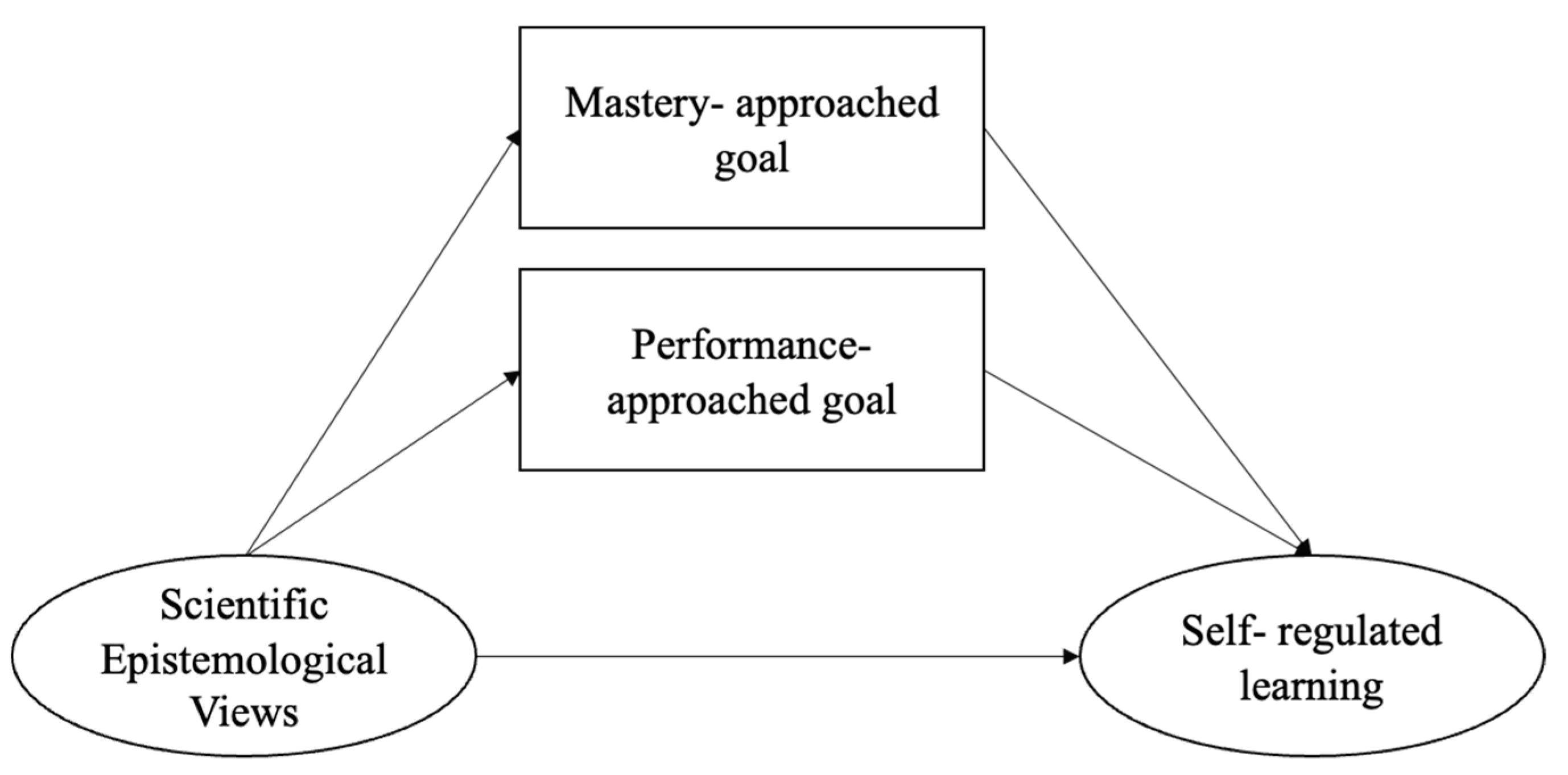
Figure 2.
SRL differences on participation frequency. Note: *p< 0.05, **p< 0.01, ***p< 0.001. TM= time management, SE= study environment, EF= effort regulation, MC= meta cognition, SRL= self- regulated learning
Figure 2.
SRL differences on participation frequency. Note: *p< 0.05, **p< 0.01, ***p< 0.001. TM= time management, SE= study environment, EF= effort regulation, MC= meta cognition, SRL= self- regulated learning
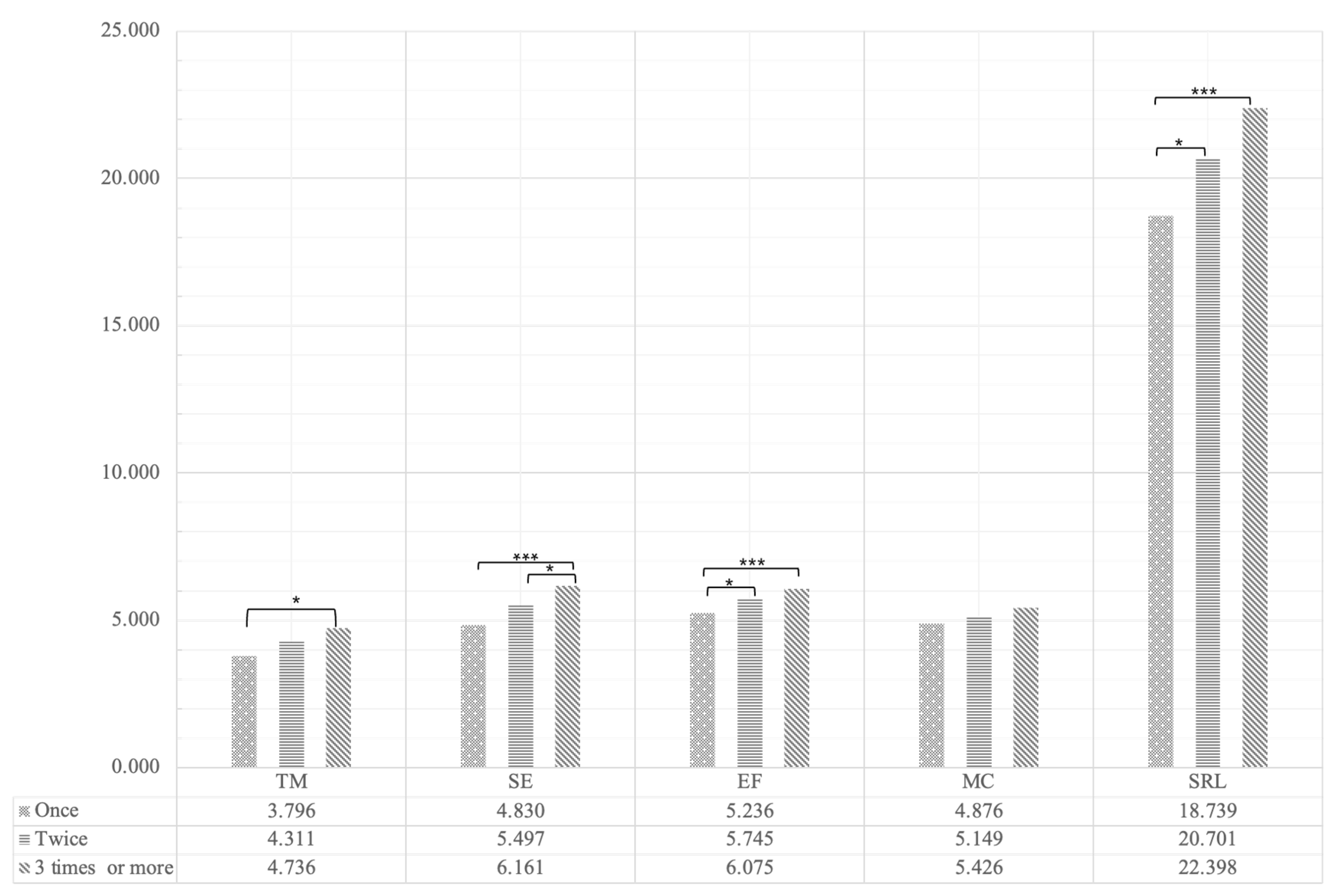
Figure 3.
Indirect model of SEVs, SRL and achievement goal motivation.
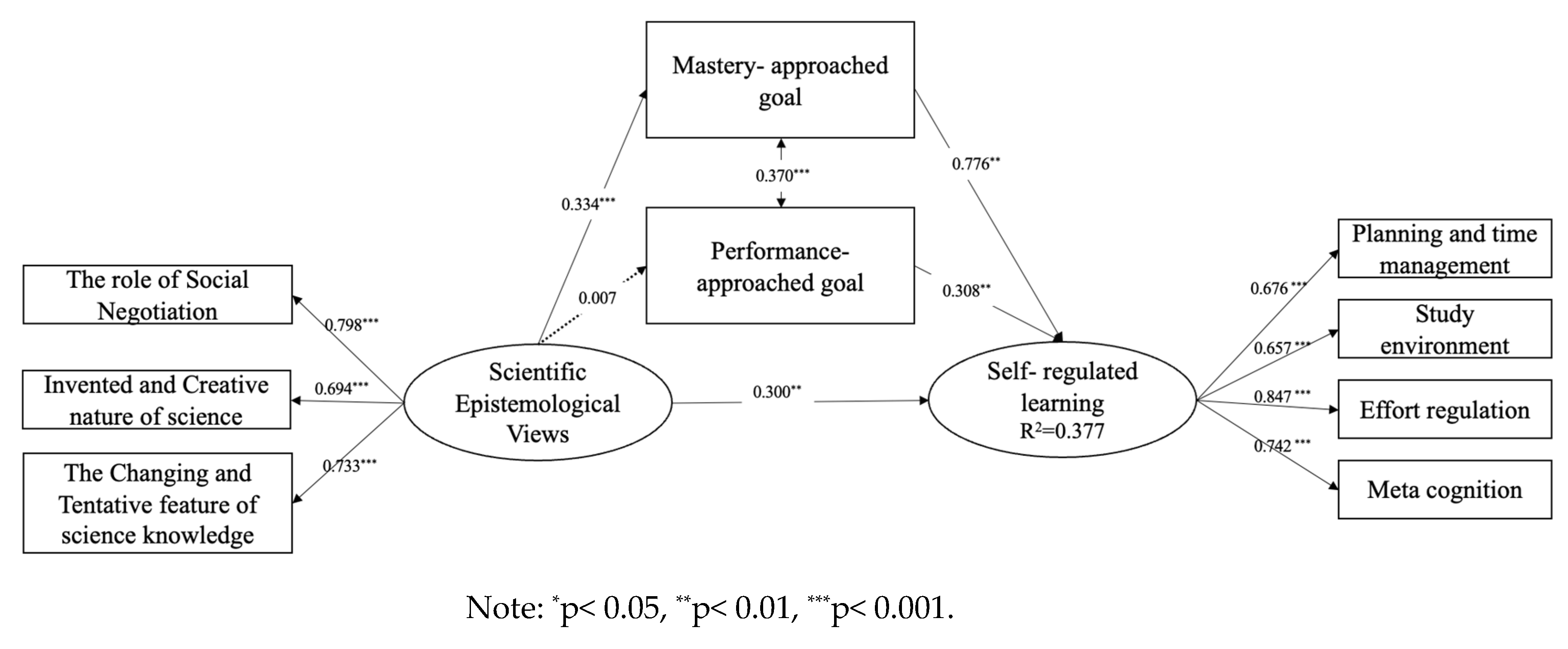
Table 1.
Demographics (n= 133).
| Variable | Value | Frequency (%) |
|---|---|---|
| Gender | Male | 75 (56.40%) |
| Female | 58 (43.60%) | |
| Age | Under 25 | 28 (21.10%) |
| 26~ 35 | 36 (27.10%) | |
| 36~ 45 | 59 (44.40%) | |
| Above 46% | 10 (7.50%) | |
| Educational background | High school students | 19 (14.30%) |
| Vocational degree | 12 (9%) | |
| Bachelor's degree | 69 (51.90) | |
| Master’s and Doctoral degree | 33 (24.80%) |
Table 2.
Composite Reliability and Convergent Validity.
| Construct | Dimension | Item | Parameters of Significance Test | Item Reliability | Composite Reliability | Convergent Validity | ||||
|---|---|---|---|---|---|---|---|---|---|---|
| Est. | S.E. | Est./S.E. | P | R- Square | CR | AVE | ||||
| SEVs | Social Negotiation | S2 | 0.745 | 0.066 | 11.260 | *** | 0.555 | 0.834 | 0.563 | |
| S3 | 0.823 | 0.053 | 15.466 | *** | 0.677 | |||||
| S4 | 0.555 | 0.082 | 6.732 | *** | 0.308 | |||||
| S5 | 0.843 | 0.042 | 20.216 | *** | 0.710 | |||||
| Invented & Creative | I1 | 0.501 | 0.088 | 5.700 | *** | 0.251 | 0.769 | 0.537 | ||
| I3 | 0.838 | 0.044 | 18.92 | *** | 0.703 | |||||
| I4 | 0.811 | 0.065 | 12.423 | *** | 0.658 | |||||
| Tentative Feature | T1 | 0.878 | 0.050 | 17.706 | *** | 0.770 | 0.881 | 0.712 | ||
| T2 | 0.867 | 0.041 | 21.065 | *** | 0.752 | |||||
| T3 | 0.784 | 0.049 | 16.171 | *** | 0.615 | |||||
| SRL | Time Management | M1 | 0.844 | 0.038 | 22.039 | *** | 0.712 | 0.908 | 0.667 | |
| M2 | 0.859 | 0.035 | 24.572 | *** | 0.739 | |||||
| M3 | 0.888 | 0.026 | 34.573 | *** | 0.789 | |||||
| M4 | 0.803 | 0.038 | 21.335 | *** | 0.646 | |||||
| M5 | 0.671 | 0.063 | 10.591 | *** | 0.45 | |||||
| Study Environment | SE1 | 0.730 | 0.066 | 11.047 | *** | 0.533 | 0.813 | 0.593 | ||
| SE2 | 0.828 | 0.052 | 16.068 | *** | 0.686 | |||||
| SE3 | 0.749 | 0.062 | 12.065 | *** | 0.561 | |||||
| Effort Regulation | ER1 | 0.861 | 0.036 | 24.105 | *** | 0.742 | 0.900 | 0.751 | ||
| ER2 | 0.949 | 0.019 | 49.597 | *** | 0.9 | |||||
| ER3 | 0.782 | 0.056 | 13.838 | *** | 0.611 | |||||
| Meta Cognition | C1 | 0.693 | 0.064 | 10.792 | *** | 0.48 | 0.875 | 0.587 | ||
| C2 | 0.834 | 0.034 | 24.534 | *** | 0.695 | |||||
| C3 | 0.821 | 0.039 | 21.329 | *** | 0.675 | |||||
| C4 | 0.835 | 0.046 | 18.060 | *** | 0.697 | |||||
| C5 | 0.622 | 0.074 | 8.414 | *** | 0.387 | |||||
| Motivation | Mastery Goal | M1 | 0.717 | 0.067 | 10.713 | *** | 0.515 | 0.754 | 0.506 | |
| M2 | 0.718 | 0.066 | 10.96 | *** | 0.516 | |||||
| M3 | 0.699 | 0.066 | 10.553 | *** | 0.489 | |||||
| Performance Goal | P4 | 0.566 | 0.093 | 6.101 | *** | 0.32 | 0.797 | 0.580 | ||
| P5 | 0.979 | 0.116 | 8.460 | *** | 0.958 | |||||
| P6 | 0.679 | 0.094 | 7.23 | *** | 0.461 | |||||
Note: *p< 0.05, **p< 0.01, ***p< 0.001.
Table 3.
Discriminate validity.
| Dimensions | M | SD | Discrimination Validity | ||||||||
|---|---|---|---|---|---|---|---|---|---|---|---|
| 1 | 2 | 3 | 4 | 5 | 6 | 7 | 10 | 11 | |||
| 1.Time Management | 4.197 | 1.589 | 0.817 | ||||||||
| 2.Learning Environment | 5.376 | 1.302 | 0.414 | 0.770 | |||||||
| 3.Effort Regulation | 6.103 | 0.948 | 0.576 | 0.573 | 0.867 | ||||||
| 4.Meta Cognition | 5.612 | 1.091 | 0.703 | 0.444 | 0.630 | 0.766 | |||||
| 5.Social Negotiation | 5.101 | 1.180 | 0.077 | 0.274 | 0.192 | 0.258 | 0.750 | ||||
| 6.Invented & Creative | 4.419 | 0.574 | 0.163 | 0.087 | 0.226 | 0.22 | 0.567 | 0.733 | |||
| 7.Tentative Feature | 4.246 | 0.643 | 0.187 | 0.263 | 0.302 | 0.327 | 0.58 | 0.497 | 0.844 | ||
| 10.Mastery- Approached | 4.348 | 0.627 | 0.326 | 0.327 | 0.425 | 0.317 | 0.281 | 0.238 | 0.221 | 0.711 | |
| 11.Performance Approached | 4.206 | 0.641 | 0.393 | 0.247 | 0.287 | 0.382 | 0.004 | 0.022 | -0.008 | 0.351 | 0.762 |
Table 4.
Individual differences on SRL.
| SRL | TM | SE | EF | MC | |||
|---|---|---|---|---|---|---|---|
| Sex | Female (n=58) | M±SD | 19.664±4.807 | 3.948±1.638 | 5.121±1.434 | 5.489±1.291 | 5.107±1.228 |
| Male (n=75) | M±SD | 20.765±3.654 | 4.389±1.533 | 5.573±1.162 | 5.707±0.905 | 5.096±1.150 | |
| t | 5.329* | 0.760 | 3.605* | 3.989 | 0.372 | ||
| Age | <25 (n=28) | M±SD | 20.362±4.179 | 3.936±1.793 | 5.667±0.964 | 5.774±0.965 | 4.986±1.368 |
| 26~35 (n=36) | M±SD | 19.174±3.644 | 4.089±1.371 | 4.935±1.345 | 5.306±1.076 | 4.844±1.101 | |
| 36~45 (n=59) | M±SD | 20.600±4.568 | 4.312±1.666 | 5.429±1.392 | 5.655±1.191 | 5.203±1.137 | |
| >46 (n=10) | M±SD | 22.213±3.507 | 4.640±1.268 | 5.833±1.125 | 6.000±0.629 | 5.740±0.971 | |
| t | 1.670 | 0.665 | 2.354 | 1.627 | 0.148 | ||
| Edu | H (n=19) | M±SD | 20.393±4.067 | 4.042±1.822 | 5.667±0.839 | 5.737±0.991 | 4.947±1.330 |
| V (n=12) | M±SD | 21.394±5.130 | 4.850±1.807 | 5.333±1.456 | 5.694±1.185 | 5.517±1.043 | |
| B (n=69) | M±SD | 20.631±4.346 | 4.273±1.548 | 5.425±1.443 | 5.696±1.147 | 5.238±1.184 | |
| M (n=33) | M±SD | 19.097±3.549 | 3.891±1.431 | 5.121±1.151 | 5.333±0.986 | 4.752±1.072 | |
| t | 1.320 | 1.202 | 0.770 | 0.957 | 1.916 |
Note: *p< 0.05, **p< 0.01, ***p< 0.001. Edu= educational background, TM= time management, SE= study environment, EF= effort regulation, MC= meta cognition, SRL= self- regulated learning, H= High school students, V= Vocational degree, B= Bachelor's degree, M= Master’s & Doctoral degree.
Table 5.
Structural model results.
| Hypothesis and Path | Estimate | S.E. | 95%CI | Hypothesis test |
|---|---|---|---|---|
| Directed effects | ||||
| SEVs⇨ SRL | 0.300* | 0.115 | [0.073, 0.516] | Support H2 |
| SEVs⇨ Mastery- approached goal | 0.334** | 0.103 | [0.109, 0.522] | Support H3.1 |
| SEVs⇨ Performance- approached goal | 0.007 | 0.102 | [-0.191, 0.208] | Reject H3.2 |
| Mastery- approached goal⇨ SRL | 0.276** | 0.102 | [0.057, 0.477] | Support H4.1 |
| Performance- approached goal⇨ SRL | 0.308** | 0.105 | [0.079, 0.490] | Reject H4.2 |
| Indirected effects | ||||
| SEVs⇨ Mastery- approached goal⇨ SRL | 0.092* | 0.040 | [0.068, 0.474] | Support H5.1 |
| SEVs⇨ Performance- approached goal⇨ SRL | 0.002 | 0.034 | [-0.159, 0.188] | Reject H5.2 |
Note: *p< 0.05, **p< 0.01, ***p< 0.001.
Disclaimer/Publisher’s Note: The statements, opinions and data contained in all publications are solely those of the individual author(s) and contributor(s) and not of MDPI and/or the editor(s). MDPI and/or the editor(s) disclaim responsibility for any injury to people or property resulting from any ideas, methods, instructions or products referred to in the content. |
© 2024 by the authors. Licensee MDPI, Basel, Switzerland. This article is an open access article distributed under the terms and conditions of the Creative Commons Attribution (CC BY) license (http://creativecommons.org/licenses/by/4.0/).
Copyright: This open access article is published under a Creative Commons CC BY 4.0 license, which permit the free download, distribution, and reuse, provided that the author and preprint are cited in any reuse.


