
Submitted:
03 April 2024
Posted:
03 April 2024
You are already at the latest version
Abstract
In the following article I analyze the determinants of regular internet users in the Italian regions. The data is analyzed both in terms of static analysis and also through the application of the k-Means algorithm optimized with the Elbow method. Subsequently, an econometric model is presented for estimating regular internet users in the Italian regions based on variables that reflect the state of technological innovation and digital culture. The results are analyzed and discussed in light of the implications that digitalisation has for triggering economic growth.
Keywords:
Innovation
; Innovation and Invention
; Management of Technological Innovation and R&D
; Technological Change
; Intellectual Property and Intellectual Capital
1. Introduction
This article endeavors to delve
into the pivotal role regular internet users play in the socio-economic
landscape of diverse regions across Italy. By undertaking a comprehensive
investigation, this study aims to shed light on the multifaceted impact of
internet usage on crucial aspects such as digital inclusion, and innovation
within these regions. Through meticulous analysis, the research intends to
discern and elucidate the nuanced variations in internet usage patterns,
digital skills, and access to online resources among residents across different
Italian regions. Moreover, the study endeavors to dissect the intricate interplay
between government policies, digital infrastructure, and socio-cultural
dynamics, elucidating their collective influence on shaping internet access and
usage patterns. By meticulously scrutinizing the relationship between internet
usage and various socio-economic indicators, this research seeks to offer
invaluable insights into the potential of regular internet users as catalysts
for fostering digital inclusion, and nurturing innovation within Italian
communities. Furthermore, the findings of this study hold significant
implications for policymakers, businesses, and civil society organizations,
providing them with actionable insights to craft targeted interventions geared
towards promoting digital literacy, expanding internet access, and harnessing
the full potential of the digital economy across different regions of Italy. By
leveraging the empirical evidence and nuanced understanding garnered through
this research, stakeholders can devise informed strategies and initiatives
tailored to address the specific needs and challenges prevalent in each region,
thereby fostering a more inclusive, equitable, and prosperous digital ecosystem
across the nation.
In addition to the broader
examination of internet usage across different regions of Italy, this study
will pay particular attention to the regional disparities between Northern
Italy and Southern Italy. These regional inequalities have long been a subject
of scrutiny due to variations in economic development, infrastructure, and
access to resources. By incorporating a comparative analysis between Northern
and Southern Italy, this research aims to uncover the nuanced differences in
internet adoption, digital skills, and online engagement between these regions.
Northern Italy has enjoyed higher levels of economic prosperity, better
infrastructure, and greater access to education and technology compared to
Southern Italy. Consequently, there may be disparities in internet usage
patterns, with residents in Northern Italy potentially exhibiting higher rates
of internet penetration, digital literacy, and utilization of online resources
compared to their counterparts in Southern Italy. Moreover, the study will delve
into the underlying factors contributing to these regional disparities,
including differences in educational attainment, employment opportunities, and
investment in digital infrastructure. By unpacking the complex interplay
between regional inequalities and internet usage, this research aims to provide
actionable insights for policymakers, businesses, and civil society
organizations. Strategies and initiatives can be tailored to address the
specific challenges faced by each region, whether it involves improving access
to broadband infrastructure in rural areas of Southern Italy, implementing
digital literacy programs in underserved communities, or fostering local
innovation ecosystems.
The article continues as follows:
the second section contains the literature review, the third section shows data
about regional and macro-regional trends and inequalities, the fourth section
presents a clusterization with k-Means algorithm optimized with the Elbow
Method, the fifth section contains the econometric model, the sixth section
shows the policy implications, the seventh sections concludes.
2. Literature Review
Adamczyk & Betlej (2021)
explore digital exclusion among the elderly in Poland, highlighting how
socioeconomic factors contribute to disparities in digital access and literacy.
This study is critical in understanding the barriers faced by older populations
in accessing digital technologies, which can exacerbate social isolation and
reduce access to essential services. AlHeneidi & Smith (2021) delve into
the adverse effects of information overload and internet addiction on students’
well-being and academic performance. Their research underscores the importance
of managing digital consumption to safeguard mental health and academic
success, offering a valuable perspective on the balance between digital
engagement and wellness. Božić & Jakšić (2020) investigate Croatian users’
perceptions of online privacy and security, revealing concerns that may deter
engagement with digital platforms. This study contributes to the broader
discourse on trust in digital environments, emphasizing the need for
transparent and user-friendly security measures to foster digital confidence.
Cariolle, Elkhateeb, & Maurel (2024) address a pressing issue of our time:
the relationship between internet use and political misinformation in Africa.
Their research is pivotal in understanding how digital platforms can both
enable access to information and facilitate the spread of misinformation,
posing challenges to informed citizenship and democratic processes. Cho,
Betensky, & Chang (2023) present a groundbreaking study on the potential
link between internet usage and dementia risk. By examining this correlation
within a population-based cohort, their findings contribute to the ongoing
debate about digital technology’s cognitive impacts, offering insights that
could influence future recommendations for healthy internet use practices.
Chomanski and Lauwaert (2023)
delve into the complexities of online consent, questioning the adequacy of
information provided to users in digital environments. Their work underscores a
critical debate within AI & Society about the balance between user autonomy
and the practicalities of informed consent in rapidly evolving online spaces.
Densmaa, Kaliinaa, and Sembeejav (2021) shift the focus to the geographical and
cultural context of Mongolia, exploring the current landscape and future
trajectories of social media. This study contributes to a broader understanding
of digital globalization, emphasizing localized trends and their implications
for global digital culture. Dey, Saha, and Saha (2021) address the pressing
issue of internet addiction among Indian undergraduate students, offering a
statistical analysis of its prevalence and factors contributing to this
phenomenon. Their research enriches the discourse on digital well-being,
presenting evidence-based insights into the psychological impacts of pervasive
internet use. Dogruel (2021) and Dogruel, Facciorusso, and Stark (2022) both
examine user perceptions of algorithmic decision-making, albeit from slightly
different angles. The former study uses mixed methods to explore folk theories
of how algorithms operate, revealing a gap in understanding among internet
users. The latter research extends this inquiry, focusing on users’ awareness
of algorithmic influence and its perceived impact on personal autonomy.
Duplaga (2021) investigates the
relationship between internet use and health outcomes in older populations,
providing valuable insights into how digital engagement can affect the health
and well-being of older adults and the elderly. This research highlights the
potential of the internet to influence health-related knowledge, behaviors, and
access to health resources, which is crucial for informing healthcare policies
and practices aimed at these age groups. El Archi et al. (2022) delve into the
psychological underpinnings of internet use, examining the co-occurrence of
adult ADHD symptoms and problematic internet use alongside impulsivity, emotion
regulation, anxiety, and depression. Their findings shed light on the complex
interplay between psychological factors and online behaviors, offering
implications for mental health interventions and the understanding of internet
addiction. Fornari (2020) profiles individual behaviors in the realm of online
experiences, offering insights into how internet use integrates into daily
life. This study underscores the diversity of digital engagement and its
implications for understanding social and individual dynamics in the digital
age. Gavaravarapu et al. (2022) address the phenomenon of the ’infodemic’
during the COVID-19 pandemic, focusing on its impact on food and nutrition
perceptions and practices among Indian internet users. This research is
particularly relevant for understanding how misinformation can affect public
health behaviors and attitudes, emphasizing the need for accurate information
dissemination during health crises. Ghasemi, Yousefi, and Zhang (2021) explore
the technical aspects of internet use, specifically the efficiency and
scalability of internet-scale video streaming over Named Data Networking (NDN).
Their work contributes to the ongoing efforts to improve the technical
infrastructure of the internet, ensuring that it can meet the growing demand
for high-quality, scalable video content delivery.
Huang et al. (2021) delve into the
behavioral shifts observed in China during the COVID-19 pandemic, specifically
focusing on substance and internet use. Their study reveals significant changes
in these behaviors, contributing to the broader understanding of how crises
affect mental health and addiction patterns. This research is crucial for
developing targeted public health strategies and support systems in the wake of
global emergencies. Jäckle, Burton, Couper, Vine, and Horn (2023) explore
innovative data collection methodologies through event-triggered surveys within
the Understanding Society Innovation Panel. Their work assesses the response
and measurement quality of this approach, offering valuable insights for
improving longitudinal social research’s efficiency and effectiveness. This
exploration is key to enhancing data collection methods in social sciences,
especially in dynamically changing societal conditions. Kapsa and Musial-Karg
(2021) provide an empirical analysis of internet users’ opinions on public
e-services, reflecting on user satisfaction and areas for improvement in
electronic governance. Their findings underscore the importance of user-centric
design and feedback in the development of e-government services, aiming to
boost public engagement and satisfaction. Kharisma (2022) examines the
relationship between internet use and social capital in Indonesia, offering
evidence on how digital engagement influences community and individual social
networks. This study contributes to the discourse on the internet’s role in
fostering or hindering social cohesion, highlighting the nuanced effects of
digital technologies on societal structures. Knuutila, Neuder, and Howard
(2020) address the global fears associated with disinformation on the internet
and social media across 142 countries. Their work sheds light on the perceived
harms of online misinformation, emphasizing the need for robust digital
literacy and critical thinking skills to combat the spread of false
information.
Knuutila, Neudert, and Howard
(2022) delve into global perceptions of misinformation, modeling how risk
perceptions towards fake news vary across 142 countries. Their study, conducted
through the Harvard Kennedy School (HKS) Misinformation Review, provides
insight into the widespread concern about misinformation and its potential to
influence public opinion and behavior, emphasizing the need for effective
strategies to combat fake news on a global scale. Kokka et al. (2021) explore
the impact of problematic internet use on adolescent sleep, synthesizing
research findings through a systematic review. This work highlights the
negative consequences of excessive internet use on sleep quality among
adolescents, underscoring the importance of addressing digital wellness in this
age group to promote better sleep hygiene and overall health. Kung and
Steptoe’s studies in 2023 examine the shift in internet use patterns among
older adults in England due to the COVID-19 pandemic and its implications for
psychological well-being. Their research reveals that changes in digital
engagement can have significant effects on the mental health of older
populations, indicating the dual role of the internet as both a source of
support and potential stressor during times of crisis. Kuzyk (2023)
investigates the use of internet tools in the marketing communications of
agribusinesses in Ukraine, providing a unique perspective on how digital
technologies are being leveraged in the agricultural sector. This study
illustrates the growing importance of online platforms in marketing strategies
and the potential benefits they offer for reaching and engaging with target
audiences more effectively.
Leogrande (2024) provides a dual
focus on the Italian context, first by exploring the distribution and dynamics
of knowledge workers across Italian regions, and second, by examining the
innovation within the production systems of these regions. These studies are
significant for understanding regional disparities in economic development and
the potential of knowledge-based work and innovation to drive growth and
competitiveness in a highly diversified national context like Italy. Such
insights are crucial for policymakers aiming to foster balanced regional
development and innovation ecosystems. Liu (2021) delves into the
intersectionality of multiple identities and its impact on the digital health
divide, quality of life, and loneliness among older adults in the UK. This work
highlights the nuanced ways in which intersecting social identities can
exacerbate or mitigate digital inequalities and their consequent effects on
health and social well-being. Liu’s research underscores the need for inclusive
digital health strategies that recognize and address the varied experiences of
older adults. Maitlall (2023) investigates the potential of daily internet use
to alleviate the risk of dementia in older adults. This inquiry into the
relationship between digital engagement and cognitive health suggests a
promising avenue for preventive strategies against dementia, emphasizing the
importance of understanding and harnessing the benefits of internet use in
aging populations. Maslakov et al. (2020) critique the perceived negative
impact of internet use among teenagers, characterizing it as a waste of time.
This perspective contributes to ongoing debates about digital consumption among
youth, calling for a balanced view that recognizes both the challenges and
opportunities presented by the internet in terms of educational and
developmental outcomes.
Melnyk, Shchehliuk, Leshchukh, and
Litorovych (2021) examine the digitization processes within the economies of
Ukraine and Poland, focusing on both national and regional dimensions. This
comparative study sheds light on the varying speeds and strategies of digital
transformation in these neighboring countries, highlighting the impact of
digitization on economic development and the challenges and opportunities it
presents for regional growth and integration into global markets. Mishra,
Kamath, Madhusudana, and Mandal (2021) delve into the internet health-seeking
behaviors of individuals in South India, revealing patterns and preferences in
how people seek health information online. This study contributes to the
understanding of digital health literacy and its implications for public health
strategies, especially in the context of improving access to accurate and
reliable health information. Narayanan (2020) focuses on the European Union’s
internet users’ attitudes towards cookie consent, providing insights into the
factors that influence customer decisions in the digital consent process. This
empirical research is crucial for understanding privacy concerns and the
effectiveness of consent mechanisms in the age of data protection regulations
like the GDPR, informing better practices for user privacy and data handling. Nielek,
Pawlowska, Rydzewska, and Wierzbicki (2021) explore the adaptation of web
algorithms to address cognitive aging, presenting a novel approach to making
digital environments more accessible and user-friendly for the aging
population. This study acknowledges the growing importance of digital
inclusion, especially for older adults, and the need for technology to adapt to
the diverse capabilities of its users. Nzeakor and Nwoke (2023) investigate the
relationship between internet access and cybercrime victimization in Abia
State, Nigeria, highlighting the dark side of digital accessibility. Their work
emphasizes the need for robust cybersecurity measures and awareness campaigns
to protect internet users in regions with growing online connectivity against
the risks of cybercrime.
Oki, Uleanya, and Lukose (2021)
investigate the factors influencing the adoption of online retail shopping
among internet users in Buffalo City, South Africa. Their research highlights
the importance of understanding local consumer behaviors and the barriers to
e-commerce adoption in developing economies, providing insights that can guide
businesses and policymakers in fostering more inclusive digital marketplaces. Özsoy
and Muschert (2020) delve into the digital divide in Northeast Anatolia,
Turkey, by comparing high-skill and low-skill internet users. This comparative
study sheds light on the broader issue of digital inequalities in the global
south, emphasizing the need for targeted interventions to bridge the digital
skills gap and ensure equitable access to the benefits of digital technologies.
Perrone (2020) discusses the challenge of digital literacy in Italy, noting
that Italians have one of the lowest levels of digital skills in Europe. This
situation has been exacerbated by the COVID-19 pandemic, revealing the critical
importance of digital competence for navigating the modern world and the
implications of insufficient digital infrastructure and education. Schomakers,
Lidynia, and Ziefle (2020) focus on user preferences for privacy-preserving
data markets, underscoring the demand for anonymity and control over personal
information. Their work contributes to the ongoing debate on digital privacy,
highlighting the need for transparent and user-centric approaches to data
handling and exchange in the digital economy. Sercer, Pokopec, and Branilovic
(2020) examine the role of the internet as a source of business information in
the metal industry, illustrating the critical importance of digital resources
for industry-specific knowledge and competitive advantage. This study reflects
the broader trend of digital transformation in various sectors, highlighting
the internet’s role in facilitating access to information, innovation, and
business development.
Seynstahl et al. (2023) delve into
the dynamics of health-related internet use among outpatient oncology patients,
particularly under the magnifying glass of the COVID-19 pandemic. Their study
likely highlights the increased reliance on digital resources for health
information and support during periods of restricted physical access to
healthcare services, underscoring the internet’s role in patient education and
empowerment in challenging times. SN, M. L. (2022) examines consumer behavior
towards online shopping in Bangalore City, reflecting broader trends in
e-commerce adoption and the factors influencing online buying decisions. This
study contributes to understanding how digital marketplaces can better cater to
consumer needs and preferences, particularly in a rapidly growing digital
economy like India’s. Walsh (2020) focuses on the complexities of intellectual
property (IP) protection for artificial intelligence innovations, drawing on
the Electronic Frontier Foundation’s comments to the US Patent and Trademark
Office (USPTO). This reference points to the evolving debate around IP law and
its adequacy in addressing the unique challenges posed by AI technologies,
emphasizing the need for legal frameworks that promote innovation while
ensuring fair use and competition. WANJIRU (2021) explores the impact of media
convergence on privacy intrusion among regular internet users in Nairobi City
County, Kenya. This investigation sheds light on the privacy challenges faced
by digital users in an era of converging technologies, highlighting the
tensions between media consumption benefits and the risks of personal data
exposure. Yu and Fiebig (2020) present a cross-lagged panel analysis of
internet use and cognition among middle-aged and older adults in China,
offering insights into the potential cognitive benefits of digital engagement
for older populations. This study contributes to the discourse on digital
inclusion, suggesting that internet use may play a positive role in maintaining
or enhancing cognitive function in later life.
Zhavoronkova, Zhavoronkov, and
Kovalenko (2021) delve into the elements of the digital economy globally and
specifically in Ukraine, offering insights into how digitalization influences
economic sectors through the lens of Industry 4.0. Their study likely
emphasizes the transformative role of digital technologies in reshaping
industries, enhancing productivity, and fostering innovation, with a particular
focus on the Ukrainian context. This research contributes to understanding the
opportunities and challenges associated with the digital economy’s evolution. Zhou,
Igarashi, and Kawabuchi (2023) examine the impacts of internet use on
self-rated health among adults in China, employing a hybrid model to analyze
data from a national panel survey. Their findings contribute to the ongoing
debate about the health implications of digital engagement, suggesting that
internet use can have both static and dynamic effects on individuals’ health
perceptions. This study underscores the importance of considering the nuanced
health outcomes associated with increasing digital connectivity, particularly
in a rapidly digitizing society like China. Žitkienė, Girčys, Zitke, and
Bartuševičienė (2021) present a model exploring the impact of social networks
on the internet marketing strategies of enterprises. By analyzing the
interactions between businesses and consumers on social platforms, their research
highlights the growing significance of social media in shaping marketing
practices and consumer engagement. This study provides valuable insights for
enterprises looking to leverage social networks for marketing, emphasizing the
role of digital communication channels in contemporary business strategies.
Below is a summary of the articles presented in the literature analysis (Table 1).
3. Rankings and Regional Inequalities
Istat 1
calculates regular internet users in Italian regions. Regular
internet users are defined as the “Percentage of people aged 11 years and older
who used the Internet at least once a week in the 3 months preceding the
interview”. The data refers to the period between 2005 and 2022 in the 20
Italian regions.
Trend of regular internet users in Italian regions in 2022. From the analysis of
data on the percentages of Internet use in Italian regions in 2022 we can
calculate some relevant indicators such as mean, median, range, variance and
standard deviation. The average Internet usage is 74.85%, indicating that on
average about three-quarters of the population in different regions uses the
Internet regularly. The median is 75.4%, slightly higher than the average,
indicating that half of the regions have an Internet usage rate exceeding
75.4%. The range is 17 percentage points, with the highest percentage of use
recorded in Trentino-Alto Adige (81.5%) and the lowest in Calabria (64.5%).
This highlights a significant gap in Internet access between the regions with
the highest and lowest usage. The variance is 15.89 and the standard deviation
is approximately 3.99, indicating that there are significant variations in
Internet usage between regions, but these variations are not extremely large.
The regions with the highest Internet use are Trentino-Alto Adige (81.5%),
Lombardy (80.1%) and Veneto (78.7%), all located in northern Italy. This may
reflect greater availability of digital infrastructure and services. On the
contrary, the regions with the lowest use are Calabria (64.5%), followed by
Basilicata and Puglia (both at 70.3%), highlighting greater difficulty in
accessing or less propensity to use the Internet in some areas of southern
Italy. The analysis suggests that there are regional disparities in Internet
access and use in Italy, with the gap most evident between the north and south
of the country (Figure 1).
Trends in regular internet users in Italian regions between 2005 and 2022.
Between 2005 and 2022, Italy witnessed significant growth in internet access
across its different regions, with absolute and percentage changes reflecting
large changes in citizens’ habits and digital accessibility. In Piedmont, the
percentage of internet users rose from 28.1% to 75.4%, with an increase of
47.3% and a percentage change of 168.33%. Valle d’Aosta showed a similar trend,
with an increase from 28.1% to 75.3%. Liguria, starting from a base of 25.2%,
reached 76.4%, highlighting the highest absolute growth among the Nordic
regions with a +51.2% and a percentage change of 203.17%, marking a ’impressive
expansion of internet use. Northern Italian regions such as Lombardy and
Trentino-Alto Adige exceeded 80% coverage, with 80.1% and 81.5% respectively,
demonstrating strong digital adherence. Veneto and Emilia-Romagna were no
exception, both recording significant growth and reaching internet penetration
rates of 78.7% and 78.7% respectively. In the Centre, Tuscany and Umbria showed
notable increases, with Tuscany reaching 76.4% and Umbria 75.4%, both with
absolute growth close to 50 percentage points. The southern regions, starting
from lower percentage bases in 2005, recorded the greatest percentage growth.
Sicily, in particular, saw the most notable jump, from a modest 16.7% to a
robust 70.6%, a surge of 53.9 percentage points and an extraordinary percentage
growth of 322.75%. Campania and Puglia followed with significant increases,
demonstrating how even regions with lower initial access have bridged the
digital divide impressively. The data highlights not only a general improvement
in internet access throughout Italy, but also a marked reduction in the digital
divide between the North and South of the country, with the southern regions
showing the fastest growth rates. The positive trend reflects the efforts made
at national and regional level to improve the digital infrastructure and
increase the accessibility and use of the internet among the Italian
population. Between 2005 and 2022, Italy saw significant growth in internet
access across its different regions, with absolute and percentage changes
reflecting broad changes in citizens’ digital habits and accessibility. In
Piedmont, the percentage of internet users rose from 28.1% to 75.4%, with an increase
of 47.3% and a percentage change of 168.33%. Valle d’Aosta showed a similar
trend, with an increase from 28.1% to 75.3%. Liguria, starting from a base of
25.2%, reached 76.4%, highlighting the highest absolute growth among the Nordic
regions with a +51.2% and a percentage change of 203.17%, marking a ’impressive
expansion of internet use. Northern Italian regions such as Lombardy and
Trentino-Alto Adige exceeded 80% coverage, with 80.1% and 81.5% respectively,
demonstrating strong digital adherence. Veneto and Emilia-Romagna were no
exception, both recording significant growth and reaching internet penetration
rates of 78.7% and 78.7% respectively. In the Centre, Tuscany and Umbria showed
notable increases, with Tuscany reaching 76.4% and Umbria 75.4%, both with
absolute growth close to 50 percentage points. The southern regions, starting
from lower percentage bases in 2005, recorded the greatest percentage growth.
Sicily, in particular, saw the most notable jump, from a modest 16.7% to a
robust 70.6%, a surge of 53.9 percentage points and an extraordinary percentage
growth of 322.75%. Campania and Puglia followed with significant increases,
demonstrating how even regions with lower initial access have bridged the
digital divide impressively. The data highlights not only a general improvement
in internet access throughout Italy, but also a marked reduction in the digital
divide between the North and South of the country, with the southern regions
showing the fastest growth rates. This positive trend reflects the efforts made
at national and regional level to improve the digital infrastructure and
increase the accessibility and use of the internet among the Italian population
(Figure 2).
Trend of regular internet users in the Italian macro-regions.
To analyze the data
provided relating to the percentage of regular internet users in the Italian
macro-regions, we observe the percentages of internet users for 2005 and 2022,
the absolute change (Var Ass) and the percentage change (Var Per) between these
two years. The Northern region saw significant growth in internet users, with
an absolute change of +49.5 percentage points and a percentage change of
+170.1%. This indicates that in 2022, almost four times more people use the
internet than in 2005. Both of these sub-regions of the North showed similar
growth to that of the overall North, with absolute changes around +50
percentage points and slightly lower percentage changes than the overall North.
The North-East shows the highest percentage growth (+173.96%). The Center had a
smaller increase than the North, with an absolute change of +47.6 percentage
points and a percentage change of +161.9%. Despite this, growth remains
notable, indicating a consolidation of internet use. The South, South, and
Islands recorded the greatest percentage changes, with the South and Islands
exceeding +260%. This reflects substantial growth starting from much lower
percentage bases than in the North and Center, indicating an important
digitalization process in these areas. At a national level, the growth of
internet users was +49.8 percentage points, with a percentage change of
+193.02%. This shows how Italy as a whole has made great progress in spreading
the use of the internet. All Italian regions saw a significant increase in
internet users from 2005 to 2022. The trend reflects the global trend towards
greater digitalisation and the growing importance of the internet in daily
life. Despite widespread growth, significant disparities persist between the
North and South, with the South, the South and the Islands starting from much
lower percentages. Their higher percentage growth compared to the North and
Center reflects a recovery process. The general increase in the use of the
internet is a positive sign for the Italian economy and society, indicating
greater opportunities for access to information, education and digital services
for an ever-increasing number of citizens. The data highlights the importance
of continuing to invest in digital infrastructure and digital literacy programmes,
particularly in regions where growth has started from lower levels, to ensure
that all citizens can benefit from the opportunities offered by the digital age
(Figure 3).
North-South divide.
The digital divide between the North and the South of Italy is a
reality highlighted by data on internet use in the various regions between 2005
and 2022. Initially, the North had significantly higher percentages of internet
users than the South, a trend which, although it has reduced over time,
remains. Growth in Internet use in the southern regions has been notable, with
percentage changes exceeding those in the northern regions, indicating a
vigorous attempt to close the technology gap. Despite this impressive growth,
the distance in terms of absolute percentages of internet users remains,
underlining the existence of a persistent disparity between the more connected
North and the less digital South. This situation reflects not only the
infrastructural and socioeconomic differences between Italian regions but also
the need for targeted commitment to overcome these obstacles. Investments in
digital infrastructure, digital literacy programs and incentives for innovation
are essential to effectively reduce the digital divide. While progress towards
closing this gap is evident, the path requires coordinated and persistent
action from all stakeholders, including government institutions, the private
sector and local communities. In this way, it will be possible to ensure that
the opportunities offered by the digital age are accessible to all Italians,
regardless of their region of residence.
Regular internet users have grown
in all Italian regions and macro-regions. On average between 2005 and
2022, regular internet users grew by 191.81% in the Italian regions. In 2022,
approximately 74.9% of the population over the age of 11 had regular access to
the internet. However, macro-regional gaps between North and South persist
despite this inequality in internet access having been significantly reduced.
To increase regular users’ access to the Internet in Italian regions, it is
crucial to adopt a multidimensional political-economic approach. At the heart
of this approach there must be a significant investment in broadband
infrastructure, especially in less developed areas, to ensure that high-speed
Internet access is a widespread reality. At the same time, it is essential to
encourage local businesses to digitalize, offering tax breaks and advantageous
financing for the purchase of digital technologies and staff training. This
should be accompanied by robust digital literacy programs that aim to equip
citizens of all ages with the skills needed to navigate the digital world, with
a particular focus on disadvantaged communities and older adults. The expansion
of e-government services represents another strategic lever to promote the use
of the Internet, simplifying citizens’ access to public services and concretely
demonstrating the benefits of digitalisation. It is also important to support
the ecosystem of innovative startups through incubators, dedicated funding and
support programs, to stimulate the creation of technological solutions that can
further expand the use of the Internet. Synergy between the public and private
sectors through targeted partnerships can accelerate the development of digital
infrastructure and educational projects, combining resources and know-how.
Finally, a constant commitment to research and development in the information
and communication technologies sector is essential to keep Italy at the
forefront of digital innovation. Only through a joint and coordinated
commitment, which includes strategic investments, education and innovation,
will it be possible to reduce the digital divide and ensure fair and universal
access to the benefits offered by the digital age for all Italian citizens.
4. Clusterization with k-Means Algorithm
To apply k-Means clustering
optimized with the Elbow Method on the given data, we first need to prepare the
data appropriately and then execute the clustering algorithm along with the
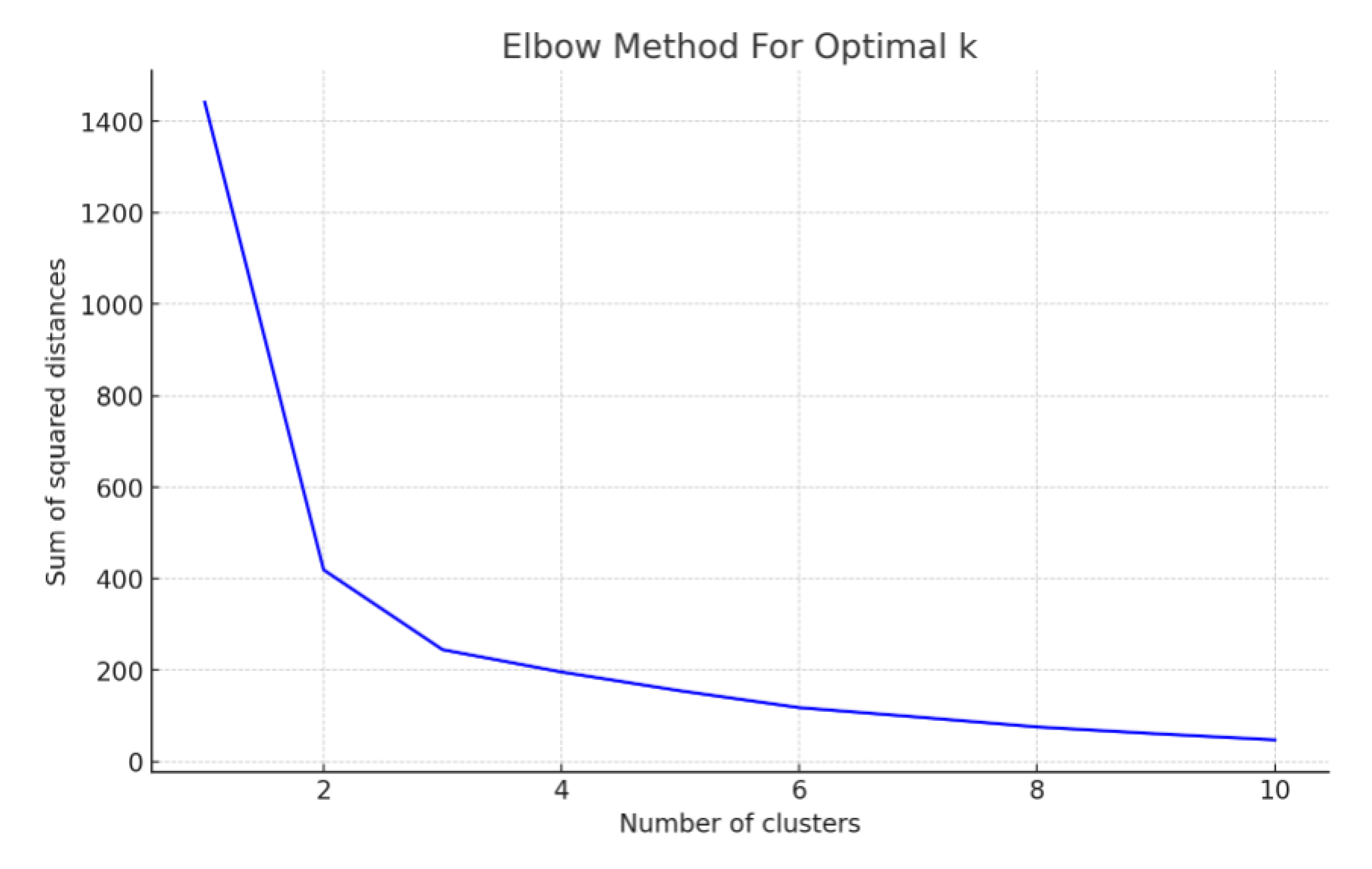
Elbow Method to determine the optimal number of clusters. The Elbow Method
plot shows the sum of squared distances for each number of clusters (k) from 1
to 10. The "elbow point" on this plot indicates the most appropriate
number of clusters, as it represents the point where the decrease in the sum of
squared distances begins to slow down, suggesting diminishing returns with
additional clusters. To select the optimal number of clusters, we look for the
point on the curve that appears as an elbow. Based on the plot, the elbow point
seems to be at k=3 or k=4, indicating that either 3 or 4 clusters might be
appropriate for our dataset.
Figure 4.
Elbow Method.
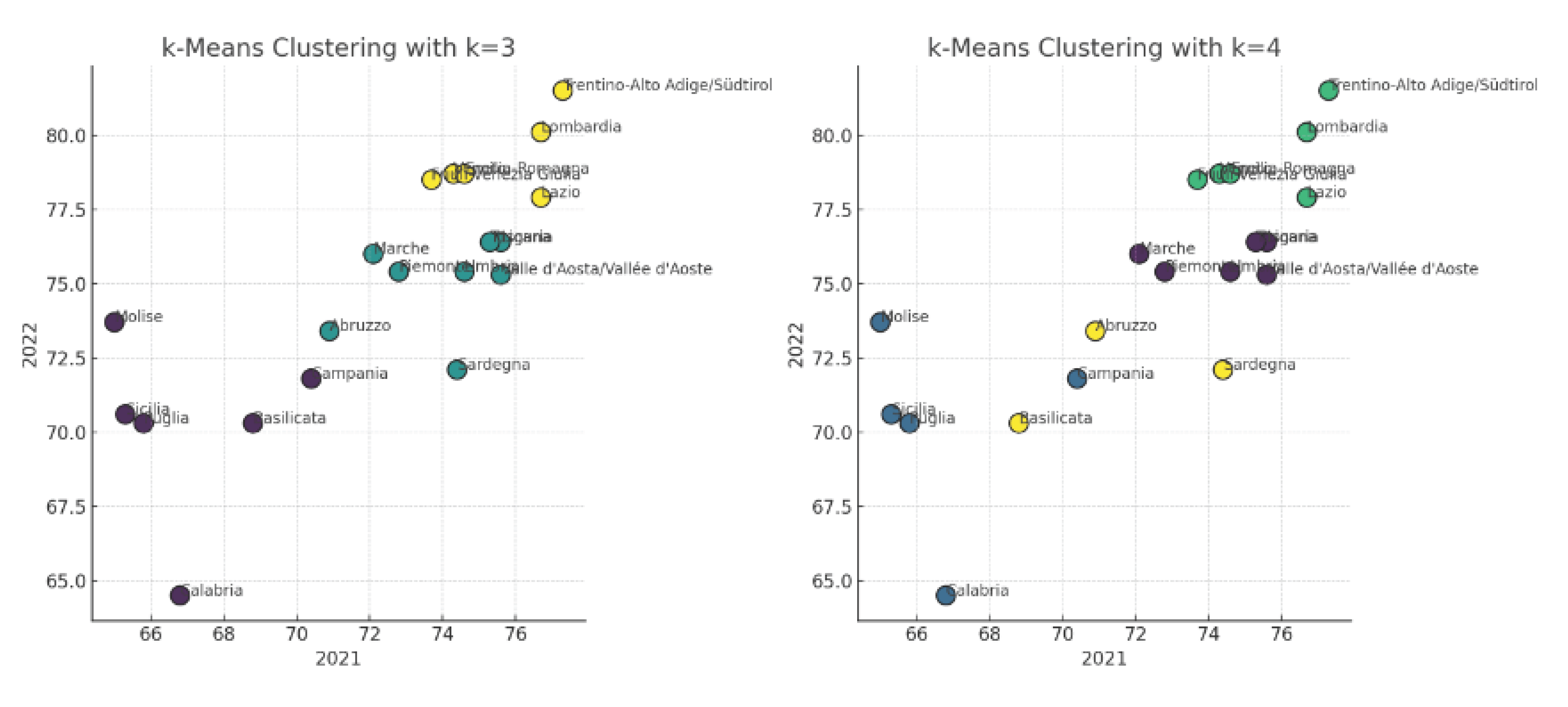
Let’s compare the case of the
Elbow Method with k=3 and k=4.
Figure 5.
The scatter plots illustrate the clustering results for k=3 and k=4 using the most recent data from 2021 and 2022. Each point represents a region, coloured according to its cluster assignment, with the region names annotated for clarity.
Figure 5.
The scatter plots illustrate the clustering results for k=3 and k=4 using the most recent data from 2021 and 2022. Each point represents a region, coloured according to its cluster assignment, with the region names annotated for clarity.
Below we analyse the
characteristics of the two clusterings:
- With k=3: the clusters seem to distinguish between regions with different levels of internet usage growth over the years. However, the separation between some clusters appears slightly broad, suggesting a general grouping rather than a precise segmentation.
- With k=4: introducing an additional cluster provides a finer segmentation of the regions, potentially offering a more nuanced understanding of the differences in internet usage patterns among the regions.
These visualizations can help
identify similarities and differences in internet usage trends across different
regions, with the choice between k=3 and k=4 depending on the desired level of
granularity and the specific context of your analysis. To show the composition
of each cluster for k=4 we can group the regions by their cluster assignment
and list them accordingly. Let’s organize the regions into their respective
clusters.
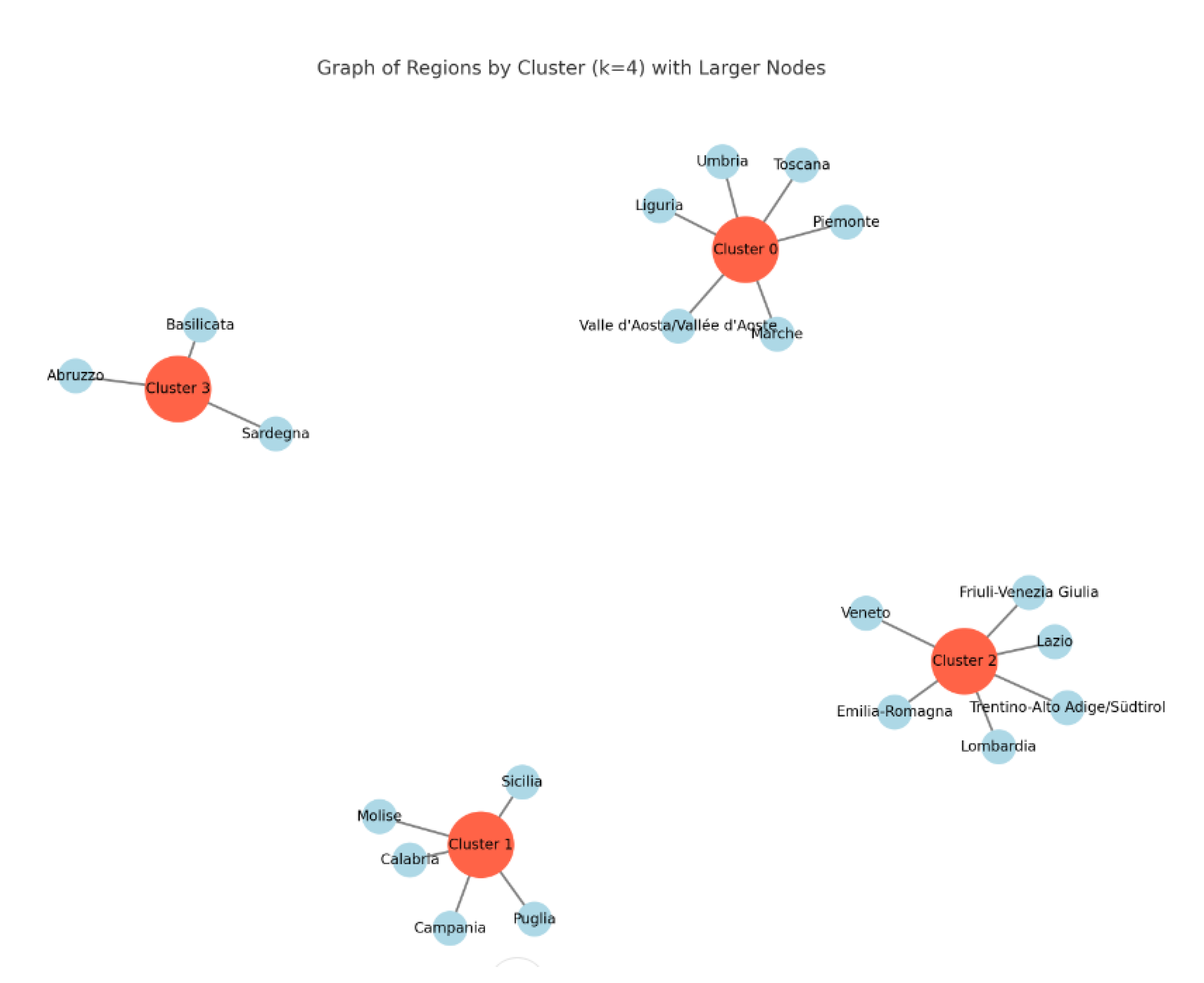
The composition of each cluster
for k=4 is as follows:
- Cluster 0: Contains regions with a moderate to high increase in internet usage, including Piemonte, Valle d’Aosta/Vallée d’Aoste, Liguria, Friuli-Venezia Giulia, Emilia-Romagna, Toscana, Umbria, Marche, and Lazio.This cluster is characterized by regions that have consistently shown growth in internet usage, starting from a relatively higher base compared to those in Cluster 1. The regions in this cluster have demonstrated an ability to adopt digital technologies steadily over time. The regions in Cluster 0 likely had better initial infrastructure and education around digital technologies, allowing for steady growth. This cluster’s performance is crucial because it indicates regions that are advancing towards saturation in internet usage but still have room for growth and improvement, especially in reaching complete coverage and maximizing the internet’s potential benefits.
- Cluster 1: Comprises regions that have seen a significant increase but started from lower initial values, including Molise, Campania, Puglia, Calabria, and Sicilia. These regions had lower initial internet usage rates but have seen significant increases over time. This suggests that despite starting from a disadvantage, there has been substantial effort and progress in closing the digital divide. The rapid growth in these regions could be due to several factors, including increased investment in digital infrastructure, government initiatives to boost digital literacy, and the growing awareness of the internet’s benefits. However, these areas might still face challenges in reaching the levels of more developed regions, indicating the need for continued support and investment.
- Cluster 2: Includes regions with the highest internet usage rates over the years, such as Lombardia, Trentino-Alto Adige/Südtirol, Veneto, and Friuli-Venezia Giulia. Featuring regions with the highest internet usage rates, this cluster represents the forefront of digital adoption in Italy. These regions have not only high rates of internet usage but also likely better access to high-speed internet and a more digitally literate population. Being leaders in digital adoption, these regions set benchmarks for others. Their advanced status suggests a transition towards leveraging the internet for more sophisticated applications and services, such as e-government, smart cities, and digital innovation ecosystems. However, maintaining growth and addressing saturation challenges will be key for these regions.
- Cluster 3: Features regions with varying degrees of internet usage growth, including Abruzzo, Basilicata, and Sardegna. This cluster includes regions with varying growth rates, likely indicating mixed levels of infrastructure development and digital literacy. These regions have neither the lowest starting points nor the highest current usage rates, positioning them in a middle ground of digital adoption. The diverse growth rates within this cluster suggest that tailored approaches are necessary to address the specific challenges and opportunities in each region. There might be potential for rapid growth with targeted interventions, such as enhancing digital infrastructure, promoting digital skills training, and encouraging the adoption of digital services.
- Inizio modulo
Overall, the clustering reveals
not just the disparities in internet usage across Italy but also highlights the
potential strategies for fostering digital inclusion and growth. While regions
in Cluster 2 lead the way, those in Clusters 0, 1, and 3 demonstrate the
various stages and challenges in achieving widespread and effective digital
adoption. Targeted policies and investments are essential to support the
continued growth of internet usage, ensuring that the benefits of digital
transformation are shared widely across all regions (Figure 6).
Figure 6.
Clusters are represented by light coral nodes, larger in size to emphasize their role as the grouping mechanism. Regions are depicted in light gray, maintaining a distinguishable presence while ensuring the focus remains on the cluster distribution.
Figure 6.
Clusters are represented by light coral nodes, larger in size to emphasize their role as the grouping mechanism. Regions are depicted in light gray, maintaining a distinguishable presence while ensuring the focus remains on the cluster distribution.
5. The Econometric Model
In this paragraph I analyze the
application of econometric models for estimating the value of regular internet
users. I used the ISTAT-BES dataset for the 20 Italian regions in the period
2004-2022. The econometric models used are Panel Data with Random Effects,
Panel Data with Fixed Effects, Pooled OLS, and Dynamic Panel. The variables
used are shown in the following Table 2.
Specifically, we estimated the
following equation:
Where i=20 and t=[2004;2022].
There is a positive relationship
between RIU and
- KW: the positive relationship between RIU and KW in Italian regions can be explored through a multifaceted lens, considering the socio-economic and technological landscapes of Italy. Regular internet users, defined as individuals who use the internet frequently for various purposes such as information seeking, communication, entertainment, and services, constitute a significant portion of the population in developed countries, including Italy. Knowledge workers, on the other hand, are professionals whose primary job is to create, distribute, or apply knowledge, often relying heavily on digital tools and the internet for their work. The relationship between these two groups is symbiotic and mutually reinforcing, especially in the context of Italian regions, which exhibit diverse levels of digital infrastructure, economic development, and educational attainment. Italian regions with better digital infrastructure naturally facilitate a higher number of regular internet users. This, in turn, creates a conducive environment for knowledge workers who rely on digital connectivity for accessing information, collaborating with peers, and executing knowledge-intensive tasks. Regions that prioritize internet accessibility thus attract and nurture knowledge economies. Knowledge workers contribute significantly to the economic development of their regions through innovation, entrepreneurship, and the creation of high-value jobs. A dense population of regular internet users can drive the demand for digital services and content, which further stimulates innovation and economic opportunities for knowledge workers. The proliferation of regular internet users in a region often correlates with higher educational attainment and a culture of continuous learning, as the internet provides access to vast educational resources, online courses, and knowledge exchange platforms. This environment is beneficial for knowledge workers who need to continuously update their skills and knowledge base to remain competitive. Italy, with its rich cultural heritage, has seen the growth of creative industries that leverage digital technologies. Regular internet users, through their consumption patterns, support the growth of these industries, where many knowledge workers are employed. The interaction between internet users and knowledge workers in creative sectors fosters innovation and cultural dissemination. The positive dynamics between regular internet users and knowledge workers highlight the importance of policies that support digital literacy, broadband infrastructure development, and the digital transformation of public and private sectors. Italian regions that invest in these areas are likely to experience a virtuous cycle of growth driven by the synergy between internet-savvy citizens and knowledge workers. the relationship between regular internet users and knowledge workers in Italian regions illustrates the broader theme of how digital engagement and knowledge economies are interlinked. Regions that harness this relationship effectively can accelerate their transition towards knowledge-based economies, marked by innovation, high-value employment, and inclusive growth (Figure 7).
- AOC: the positive relationship between RIU and the AOC across Italian regions can be understood as a foundational element for digital inclusion and the development of digital skills across the populace. This relationship is crucial in an era where digital literacy is not just an asset but a necessity for participation in the modern economy and society. The availability of computing devices and internet connectivity in households is a critical first step toward digital inclusion, allowing individuals of all ages to become regular internet users. Italian regions with higher rates of household digital infrastructure are likely to have a larger proportion of the population engaging with digital platforms for education, work, entertainment, and social interaction. This infrastructure supports the development of digital literacy, which is fundamental for thriving in the digital age. In regions with widespread access to computers and the internet, students and lifelong learners have better opportunities to access educational resources, online courses, and learning communities. This access is essential for developing the skills needed in knowledge-driven economies and supports the educational journey from primary school through to higher education and beyond. The correlation between regular internet usage and the availability of digital tools at home also extends to the realm of work. Telecommuting, remote work, and digital entrepreneurship are increasingly prevalent, supported by digital infrastructure. Italian regions with better home computing and internet access are likely to see higher participation rates in these forms of employment, contributing to economic diversity and resilience. Regular internet users, facilitated by household digital access, are more likely to engage in civic and social activities online. This includes accessing government services, participating in public consultations, and engaging with community groups. Such engagement is vital for a healthy democratic process and for fostering community bonds. The positive relationship between regular internet use and household digital infrastructure highlights the need for targeted policies to reduce digital divides. Italian regions varying in economic development and infrastructure can benefit from national and regional policies aimed at ensuring equitable access to digital tools and internet connectivity. Investment in digital infrastructure is not only an investment in technology but also in human capital and regional competitiveness. Regular access to the internet and digital tools at home fosters innovation by enabling individuals to learn new skills, collaborate with others, and access markets beyond their immediate geography. Regions with higher levels of digital access at home can foster a culture of innovation and entrepreneurship, contributing to economic growth and the diversification of the regional economy (Figure 8).
- C10E: the positive relationship between Regular Internet Users and Companies with at Least 10 Employees with Web Sales to End Customers highlights a symbiotic dynamic that fuels the digital economy’s growth. This relationship underscores how consumer behavior online can drive business practices and, conversely, how the digital strategies of companies can influence internet usage patterns. Regular internet users represent a vast market of potential customers for companies. As more people use the internet regularly for various aspects of their lives, including shopping, businesses with a robust online presence and e-commerce capabilities stand to gain significantly. The presence of these users creates demand for online shopping, encouraging companies to develop or enhance their web sales platforms. The behavior and expectations of regular internet users drive companies to innovate and improve their online offerings. Businesses are motivated to adopt user-friendly web interfaces, secure payment systems, and efficient online customer service. Companies with at least 10 employees are typically at a stage where investments in web sales infrastructure can significantly impact their reach and profitability, responding dynamically to the needs of the online consumer base. Regular internet users tend to engage more deeply with brands online through social media, blogs, and forums. Companies that actively manage their online presence and engage with customers through these channels can build stronger brand loyalty. This engagement strategy is particularly effective for companies with web sales, as it directly influences purchasing decisions. The interactions and transactions of regular internet users provide companies with valuable data on consumer preferences, behavior, and trends. Companies that leverage this data can tailor their web sales strategies to better meet market demand, personalize marketing efforts, and optimize their product and service offerings. This data-driven approach is more feasible for companies with the infrastructure to process and analyze online sales data, usually those with at least 10 employees. The growth of web sales among companies contributes to the broader digital economy, creating jobs and fostering innovation. This economic vitality encourages more individuals to become regular internet users, whether for employment, education, or leisure, creating a positive feedback loop that benefits both businesses and consumers. In regions where a higher percentage of companies engage in web sales, there’s likely to be improved internet infrastructure and higher digital literacy rates among the population. This environment fosters a culture of digital engagement, making it easier for individuals to become regular internet users and participate in the digital economy. The relationship between regular internet users and companies with significant web sales to end customers is also influenced by the policy and regulatory environment. Supportive policies can help businesses overcome barriers to e-commerce, while ensuring that the digital market remains competitive and accessible to new entrants.
There is a negative relationship between RIU and:
- CCE: exploring the negative relationship between "Regular Internet Users" and "Cultural and Creative Employment" across Italian regions requires a nuanced understanding of the digital landscape and its impact on the cultural and creative sectors. This counterintuitive relationship might suggest that as internet usage becomes more pervasive, certain aspects of cultural and creative employment face challenges. The rise of digital platforms and technologies can disrupt traditional cultural and creative industries, such as publishing, music, and film. As regular internet usage increases, traditional consumption patterns shift towards digital media and entertainment, potentially reducing demand for physical media and traditional cultural experiences. This shift can negatively impact employment in sectors not fully transitioned to digital models. The internet has facilitated the rise of dominant platforms in various cultural and creative sectors (e.g., streaming services for music and video, digital marketplaces for books and art). These platforms can monopolize market access, making it difficult for smaller, local cultural producers and creative workers to compete. Regions with a high number of regular internet users might see a concentration of market power that disadvantages local cultural employment.The digital economy has been criticized for creating a "value gap," where the revenues generated by digital content consumption do not adequately compensate the creators. Regular internet usage amplifies content consumption but does not necessarily translate to equitable financial returns for creators, potentially undermining sustainable employment in cultural and creative fields. While the digital transformation offers new opportunities for cultural and creative professionals, it also requires new skills and competencies. A gap may emerge between the digitally skilled and those less proficient, potentially leading to a decrease in employment opportunities for the latter group in regions where internet usage is prevalent but digital literacy and access to digital tools are uneven. Regular internet users often seek instant and free access to a wide range of content, which can alter consumer expectations and devalue traditional cultural products and experiences. This shift can affect sectors like theater, museums, and live performances, impacting employment in these areas as they struggle to compete with digital alternatives. The internet has facilitated the rise of freelance and gig work in cultural and creative sectors. While this offers flexibility, it can also lead to job insecurity, reduced benefits, and financial instability for many workers. Regions with high levels of internet penetration might see a shift towards more precarious forms of employment in cultural and creative industries.
6. Political Implications
To increase the value of regular
internet users, governments should implement a multifaceted approach
encompassing various economic policies. Firstly, investment in digital
infrastructure is paramount, ensuring widespread and affordable internet
access, particularly in underserved regions. Simultaneously, initiatives
promoting digital literacy must be prioritized, fostering proficiency in
navigating online platforms and ensuring all demographics can benefit.
Encouraging e-commerce among small and medium-sized enterprises (SMEs) through
incentives and reduced regulatory barriers expands access to goods and services
for regular internet users. Open data initiatives should be embraced, releasing
government data to spur innovation and inform decision-making. Supporting
digital entrepreneurship via funding, mentorship, and incubation services
empowers users to contribute to economic growth. Moreover, safeguarding online
privacy and security through regulations enhances trust in digital
technologies. Promoting remote work options, investing in digital healthcare
infrastructure, and expanding online education opportunities further enrich the
value of regular internet users. Finally, ensuring inclusive policy development
guarantees that economic benefits are equitably distributed across society,
bridging digital divides and fostering a more prosperous digital ecosystem.
7. Conclusion
The percentage of regular internet
users grew on average in the Italian regions by 191.81% between 2005 and 2022,
going from 25.7% to 74.9%. This growth also occurred at the macro-regional
level. The macro-regions that have grown the most are the southern
macro-regions, namely the Islands with +281.72%, the South with 262.05% and the
South with 254.27%. However, if we look at the absolute values then we can
notice the presence of a significant gap between the southern regions, which
are more backward, and the northern regions, which on the contrary have higher
levels of regular internet users. The North-East is the leading macro-region
with a level of regular internet users of 78.9. These trends are also confirmed
by the clustering with the k-Means algorithm optimized with the Elbow method
which shows the presence of 4 clusters among the Italian regions. Finally, the
econometric model highlights how the number of regular internet users tends to
grow with the growth of knowledge workers, the increase in the availability of
computers in families and the increase in companies with at least 10 employees
who have e-commerce. However, the further growth of regular internet users is
certainly an objective of economic policy. Digitalisation is in fact a
significant driver for economic growth at a country level. In this regard, it
is necessary for policy makers to invest both at an infrastructural level and
at an educational system level to increase the presence of regular internet
users in the Italian regions.
Funding
The author received no financial support for the research, authorship, and/or publication of this article.
Data Availability Statement
The data presented in this study are available on request from the corresponding author.
Declaration of Competing Interest
The author declares that there is no conflict of interests regarding the publication of this manuscript. In addition, the ethical issues, including plagiarism, informed consent, misconduct, data fabrication and/or falsification, double publication.
Appendix
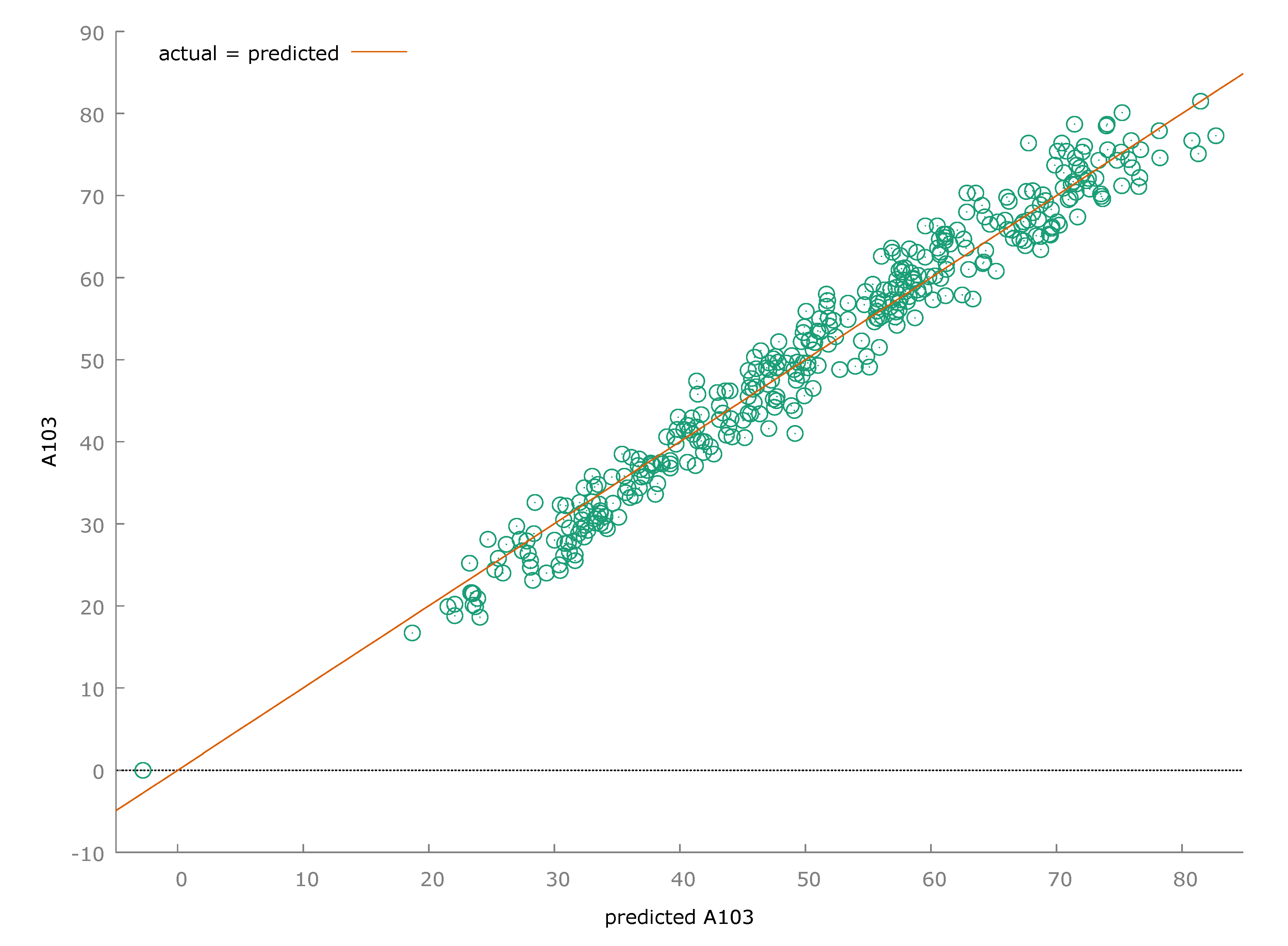
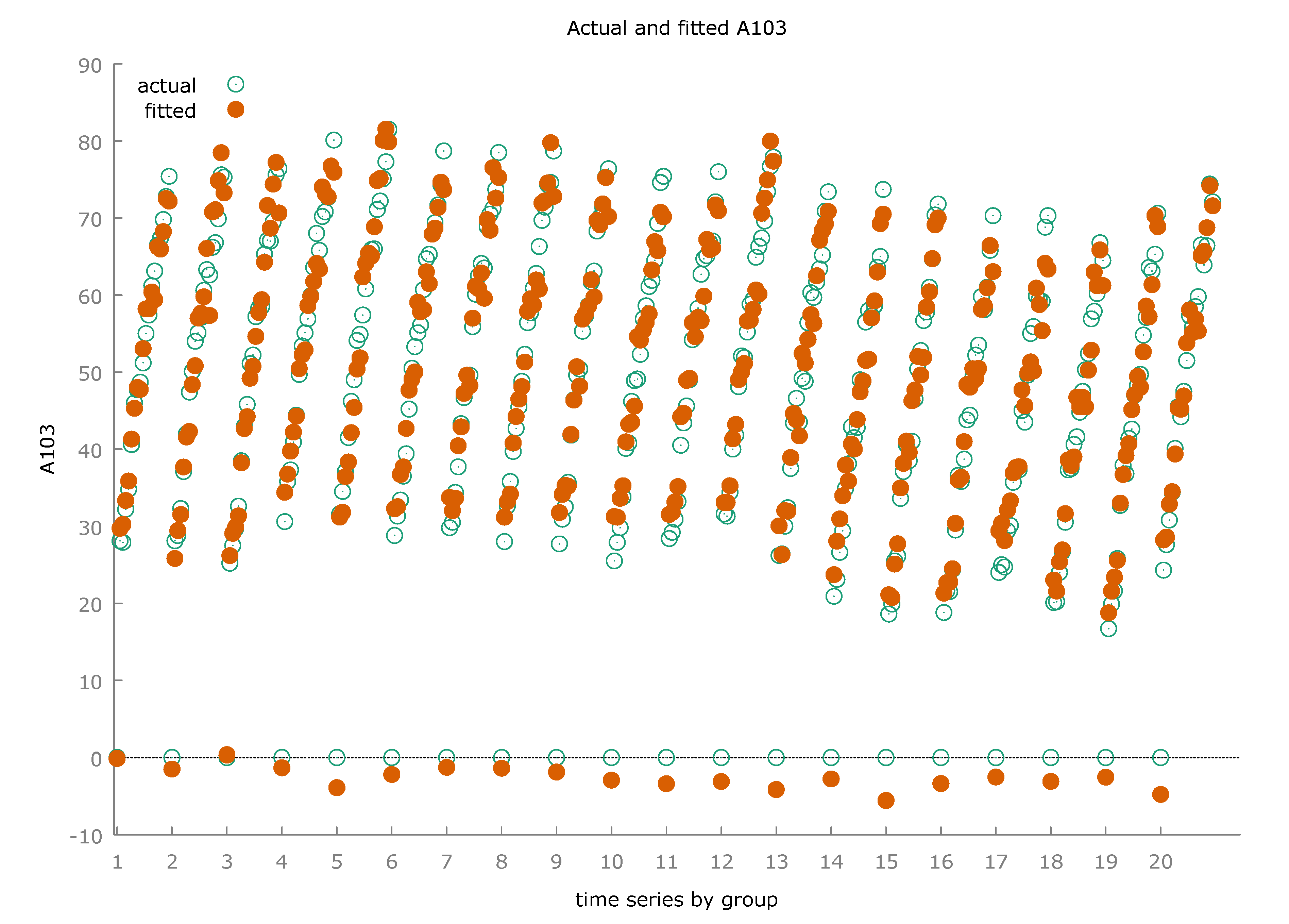
Pooled OLS, using 380 observations
Included 20 cross-sectional units
Time-series length = 19
Dependent variable: A103
| Coefficient | Std. Error | t-ratio | p-value | ||
| const | −2.76929 | 0.545588 | −5.076 | <0.0001 | *** |
| A100 | 0.521801 | 0.0797505 | 6.543 | <0.0001 | *** |
| A101 | −0.681804 | 0.410373 | −1.661 | 0.0975 | * |
| A104 | 0.913055 | 0.0117563 | 77.67 | <0.0001 | *** |
| A106 | 0.398547 | 0.0395038 | 10.09 | <0.0001 | *** |
| Mean dependent var | 48.32500 | S.D. dependent var | 19.21350 | |
| Sum squared resid | 3470.095 | S.E. of regression | 3.041971 | |
| R-squared | 0.975198 | Adjusted R-squared | 0.974933 | |
| F(4, 375) | 3686.165 | P-value(F) | 1.7e-299 | |
| Log-likelihood | −959.4322 | Akaike criterion | 1928.864 | |
| Schwarz criterion | 1948.565 | Hannan-Quinn | 1936.682 | |
| rho | 0.412070 | Durbin-Watson | 1.108938 |
Fixed-effects, using 380 observations
Included 20 cross-sectional units
Time-series length = 19
Dependent variable: A103
| Coefficient | Std. Error | t-ratio | p-value | ||
| const | −2.55691 | 0.521423 | −4.904 | <0.0001 | *** |
| A100 | 0.608559 | 0.0813078 | 7.485 | <0.0001 | *** |
| A101 | −1.24798 | 0.417743 | −2.987 | 0.0030 | *** |
| A104 | 0.906341 | 0.0114356 | 79.26 | <0.0001 | *** |
| A106 | 0.439458 | 0.0403187 | 10.90 | <0.0001 | *** |
| Mean dependent var | 48.32500 | S.D. dependent var | 19.21350 | |
| Sum squared resid | 2721.360 | S.E. of regression | 2.764827 | |
| LSDV R-squared | 0.980549 | Within R-squared | 0.979458 | |
| LSDV F(23, 356) | 780.2932 | P-value(F) | 1.1e-288 | |
| Log-likelihood | −913.2526 | Akaike criterion | 1874.505 | |
| Schwarz criterion | 1969.069 | Hannan-Quinn | 1912.029 | |
| rho | 0.225170 | Durbin-Watson | 1.412789 |
Joint test on named regressors -
Test statistic: F(4, 356) = 4243.54
with p-value = P(F(4, 356) > 4243.54) = 7.85498e-299
Test for differing group intercepts -
Null hypothesis: The groups have a common intercept
Test statistic: F(19, 356) = 5.15512
with p-value = P(F(19, 356) > 5.15512) = 6.0114e-11
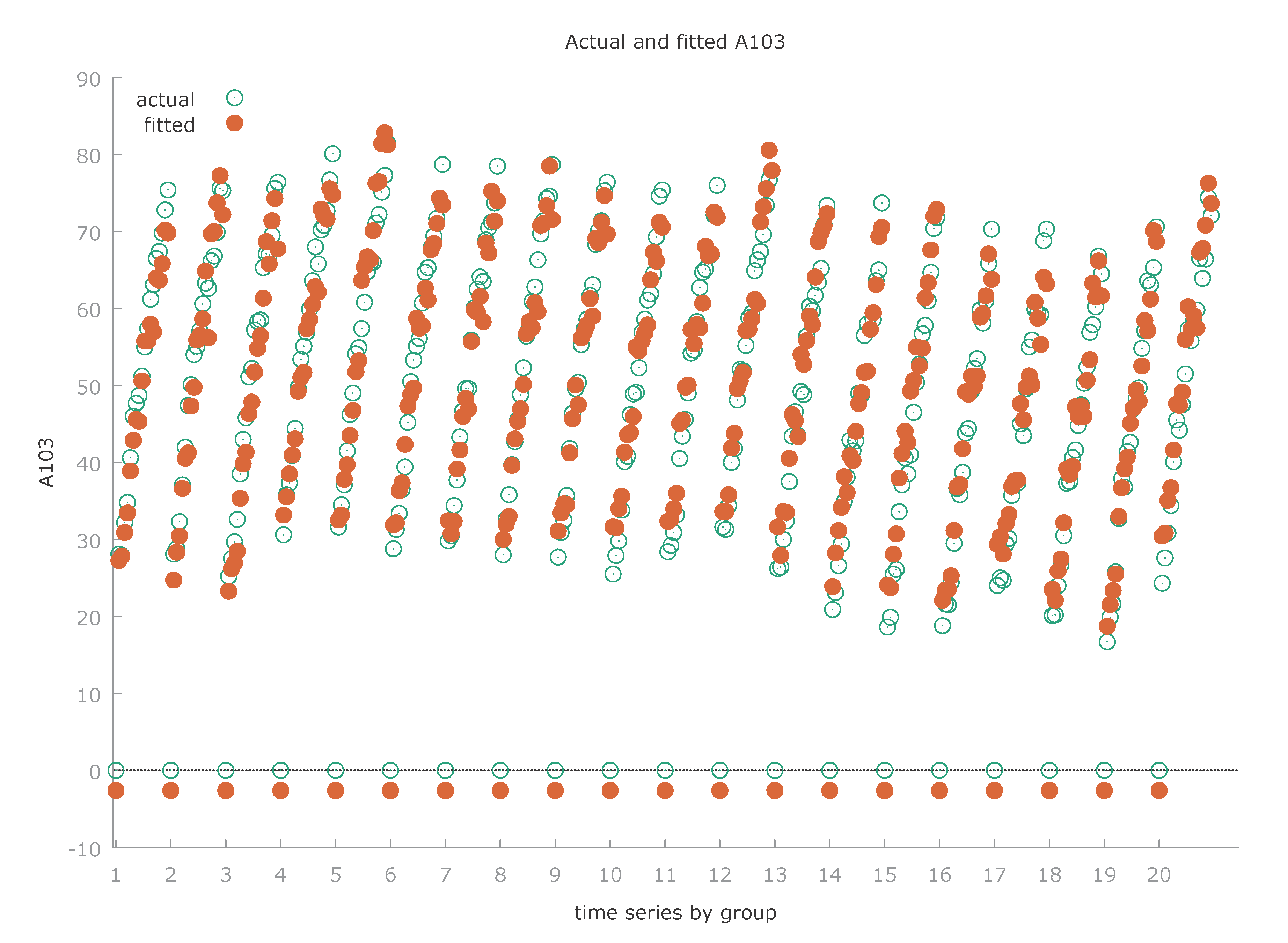
Random-effects (GLS), using 380 observations
Using Nerlove’s transformation
Included 20 cross-sectional units
Time-series length = 19
Dependent variable: A103
| Coefficient | Std. Error | z | p-value | ||
| const | −2.60727 | 0.615063 | −4.239 | <0.0001 | *** |
| A100 | 0.592216 | 0.0793174 | 7.466 | <0.0001 | *** |
| A101 | −1.14260 | 0.407521 | −2.804 | 0.0051 | *** |
| A104 | 0.907821 | 0.0112407 | 80.76 | <0.0001 | *** |
| A106 | 0.431800 | 0.0393443 | 10.97 | <0.0001 | *** |
| Mean dependent var | 48.32500 | S.D. dependent var | 19.21350 | |
| Sum squared resid | 3490.312 | S.E. of regression | 3.046760 | |
| Log-likelihood | −960.5359 | Akaike criterion | 1931.072 | |
| Schwarz criterion | 1950.773 | Hannan-Quinn | 1938.889 | |
| rho | 0.225170 | Durbin-Watson | 1.412789 |
’Between’ variance = 2.1591
’Within’ variance = 7.16147
theta used for quasi-demeaning = 0.614479
Joint test on named regressors -
Asymptotic test statistic: Chi-square(4) = 17286.1
with p-value = 0
Breusch-Pagan test -
Null hypothesis: Variance of the unit-specific error = 0
Asymptotic test statistic: Chi-square(1) = 93.2733
with p-value = 4.55501e-22
Hausman test -
Null hypothesis: GLS estimates are consistent
Asymptotic test statistic: Chi-square(4) = 3.81437
with p-value = 0.431711
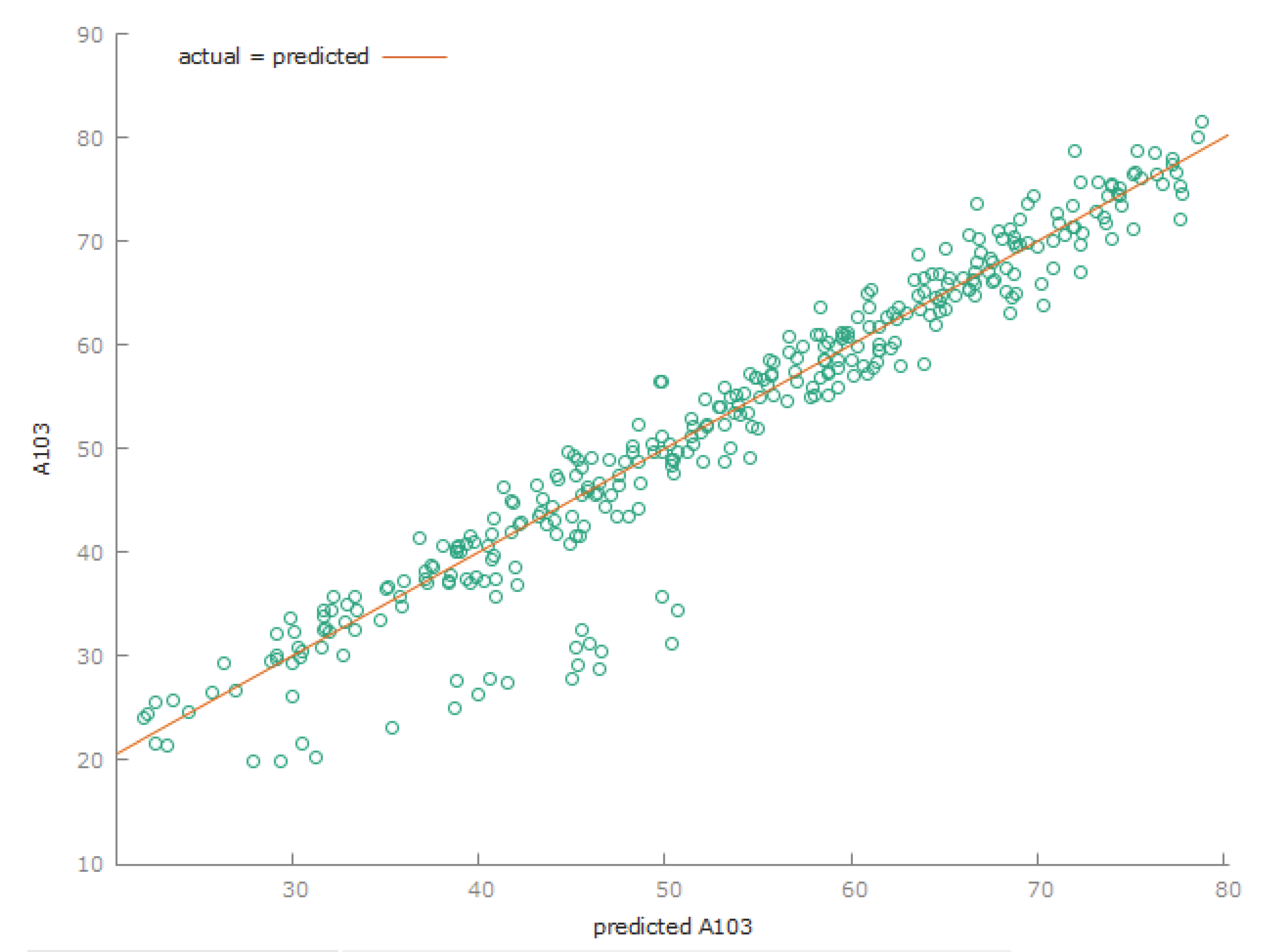
1-step dynamic panel, using 340 observations
Included 20 cross-sectional units
Dependent variable: A103
| Coefficient | Std. Error | z | p-value | ||
| A103(-1) | 0.593919 | 0.0484052 | 12.27 | <0.0001 | *** |
| A100 | 0.333465 | 0.0426152 | 7.825 | <0.0001 | *** |
| A101 | −1.06539 | 0.227510 | −4.683 | <0.0001 | *** |
| A104 | 0.431094 | 0.0555874 | 7.755 | <0.0001 | *** |
| A106 | 0.0996582 | 0.0368274 | 2.706 | 0.0068 | *** |
| Sum squared resid | 5754.906 | S.E. of regression | 2.909140 |
Number of instruments = 140
Test for AR(1) errors: z = -3.5765 [0.0003]
Test for AR(2) errors: z = -1.33003 [0.1835]
Sargan over-identification test: Chi-square(135) = 65.8821 [1.0000]
Wald (joint) test: Chi-square(5) = 17659.7 [0.0000]
| 1 |
References
- Adamczyk, M., & Betlej, A. (2021). Social determinants of digital exclusion in an ageing society. The case of Poland. Entrepreneurship and Sustainability Issues, 8(3), 122.
- AlHeneidi, H. H., & Smith, A. P. (2021). Exploring the influence of information overload, internet addiction, and social network addiction, on students’ well-being and academic outcomes. In Human Mental Workload: Models and Applications: 5th International Symposium, H-WORKLOAD 2021, Virtual Event, November 24–26, 2021, Proceedings 5 (pp. 116-135). Springer International Publishing.
- Božić, S., & Jakšić, D. (2020). Users’ Perception of Online Privacy and Security in Croatia–A Survey. Communication Management Review, 5(02), 6-29.
- Cariolle, J., Elkhateeb, Y., & Maurel, M. (2024). Misinformation technology: Internet use and political misperceptions in Africa. Journal of Comparative Economics.
- Cho, G., Betensky, R. A., & Chang, V. W. (2023). Internet usage and the prospective risk of dementia: A population-based cohort study. Journal of the American Geriatrics Society, 71(8), 2419-2429.
- Chomanski, B., & Lauwaert, L. (2023). Online consent: how much do we need to know?. AI & SOCIETY, 1-11.
- Densmaa, O., Kaliinaa, G., & Sembeejav, T. (2021). The Current Situation and Future Trends of Social Media in Mongolia. International Journal of Innovative Technologies in Social Science, (4 (32)).
- Dey, S. P., Saha, R., & Saha, I. (2021). Prevalence and predictors of internet addiction among eastern indian undergraduate general college students: An institute-based study. Indian Journal of Social Psychiatry, 37(3), 289-294.
- Dogruel, L. (2021). Folk theories of algorithmic operations during Internet use: A mixed methods study. The Information Society, 37(5), 287-298.
- Dogruel, L., Facciorusso, D., & Stark, B. (2022). ‘I’m still the master of the machine.’Internet users’ awareness of algorithmic decision-making and their perception of its effect on their autonomy. Information, Communication & Society, 25(9), 1311-1332.
- Duplaga, M. (2021). The association between Internet use and health-related outcomes in older adults and the elderly: a cross-sectional study. BMC Medical Informatics and Decision Making, 21(1), 150.
- El Archi, S., Barrault, S., Brunault, P., Ribadier, A., & Varescon, I. (2022). Co-occurrence of adult ADHD symptoms and problematic internet use and its links with impulsivity, emotion regulation, anxiety, and depression. Frontiers in Psychiatry, 13, 792206.
- Fornari, R. (2020). Internet in everyday life: Profiling individual behaviour in the field of online experience. DigitCult-Scientific Journal on Digital Cultures, 5(1), 17-28.
- Gavaravarapu, S. M., Seal, A., Banerjee, P., Reddy, T., & Pittla, N. (2022). Impact of ‘infodemic in pandemic’on food and nutrition related perceptions and practices of Indian internet users. Plos one, 17(4), e0266705.
- Ghasemi, C., Yousefi, H., & Zhang, B. (2021). Internet-scale video streaming over NDN. IEEE Network, 35(5), 174-180.
- Huang, Q., Chen, X., Huang, S., Shao, T., Liao, Z., Lin, S.,... & Shen, H. (2021). Substance and Internet use during the COVID-19 pandemic in China. Translational psychiatry, 11(1), 491.
- Jäckle, A., Burton, J., Couper, M. P., Vine, J., & Horn, D. (2023). Trialling event-triggered data collection in the Understanding Society Innovation Panel: response and measurement quality. Understanding Society Working Paper 2023-09, https://www. understandingsociety. ac. uk/research/publications/557841.
- Kapsa, I., & Musial-Karg, M. (2021, October). The Internet Users’ Opinions on Public E-Services: Empirical Analysis. In Proceedings of the 14th International Conference on Theory and Practice of Electronic Governance (pp. 117-122).
- Kharisma, B. (2022). Surfing alone? The Internet and social capital: evidence from Indonesia. Journal of Economic Structures, 11(1), 8.
- Knuutila, A., Neuder, L., & Howard, P. (2020). Global fears of disinformation. Perceived Internet and Social Media Hams in 142 Countries.
- Knuutila, A., Neudert, L. M., & Howard, P. N. (2022). Who is afraid of fake news? Modeling risk perceptions of misinformation in 142 countries. Harvard Kennedy School (HKS) Misinformation Review, 3(3).
- Kokka, I., Mourikis, I., Nicolaides, N. C., Darviri, C., Chrousos, G. P., Kanaka-Gantenbein, C., & Bacopoulou, F. (2021). Exploring the effects of problematic internet use on adolescent sleep: a systematic review. International journal of environmental research and public health, 18(2), 760.
- Kung, C. S., & Steptoe, A. (2023). Changes in internet use patterns among older adults in England from before to after the outbreak of the COVID-19 pandemic. Scientific Reports, 13(1), 3932.
- Kung, C. S., & Steptoe, A. (2023). Internet use and psychological wellbeing among older adults in England: a difference-in-differences analysis over the COVID-19 pandemic. Psychological Medicine, 53(11), 5356-5358.
- Kuzyk, O. (2023). Internet Tools in Marketing Communications of Agribusinesses in Ukraine. Universal Journal of Agricultural Research, 11(2), 217-229.
- Leogrande, A. (2024). Knowledge Workers across the Italian Regions.
- Leogrande, A. (2024). The Innovation of the Production System in the Italian Regions.
- Liu, B. C. P. (2021). The impact of intersectionality of multiple identities on the digital health divide, quality of life and loneliness amongst older adults in the UK. The British Journal of Social Work, 51(8), 3077-3097.
- Maitlall, J. (2023). Can Daily Internet Use Alleviate Dementia Risk in Older Adults?. Psychiatry Advisor, NA-NA.
- Maslakov, S. I., Shitova, N. V., Tutaeva, V. I., & Kolesnikova, A. V. (2020). TEENAGERS’WASTE OF TIME ON THE INTERNET. Revista Turismo Estudos e Práticas-RTEP/UERN, (5), 1-7.
- Melnyk, M., Shchehliuk, S., Leshchukh, I., & Litorovych, O. (2021). Digitization of the Economies of Ukraine and Poland: National and Regional Dimensions. Economic Annals-XXI/Ekonomìčnij Časopis-XXI, 191.
- Mishra, A., Kamath, R., Madhusudana, K., & Mandal, R. (2021). Internet Health Seeking Behavior of Individuals Visiting a Tertiary Care Teaching Hospital in South India. Annals of the Romanian Society for Cell Biology, 16815-16827.
- Narayanan, L. (2020). Cookies ‘n’consent: An empirical study on the factors influencing customer attitudes towards cookie consent among internet users in EU (Doctoral dissertation, Dublin Business School).
- Nielek, R., Pawlowska, J., Rydzewska, K., & Wierzbicki, A. (2021). Adapting algorithms on the web to deal with cognitive aging. Multiple Pathways of Cognitive Aging: Motivational and Contextual Influences, 368.
- Nzeakor, O. F., & Nwoke, C. N. (2023). INTERNET ACCESS AND CYBERCRIME VICTIMIZATION EXPERIENCE IN ABIA STATE, NIGERIA. FUOYE JOURNAL OF CRIMINOLOGY AND SECURITY STUDIES, 2(1).
- Oki, O. A., Uleanya, C., & Lukose, J. M. (2021). Factors Influencing the Adoption of Online Retail Shopping amongst the Internet Users in Buffalo City South Africa. Multicultural Education, 7(5), 1-17.
- Özsoy, D., & Muschert, G. (2020). A comparison of high-skill and low-skill internet users in Northeast Anatolia, Turkey. Digital inequalities in the global south, 177-195.
- Perrone, A. (2020). Italy’s bad internet connection: Italians have one of the lowest levels of digital skills in Europe and are struggling to understand implications of the new pandemic world. Index on Censorship, 49(2), 43-45.
- Schomakers, E. M., Lidynia, C., & Ziefle, M. (2020). All of me? Users’ preferences for privacy-preserving data markets and the importance of anonymity. Electronic Markets, 30(3), 649-665.
- Sercer, M., Pokopec, I. M., & Branilovic, M. G. (2020). The role and importance of the Internet as a source of business information in metal industry. Economic and Social Development: Book of Proceedings, 213-221.
- Seynstahl, S., Erickson, N., Jost, N., Wuerstlein, R., Fey, T., Nasseh, D.,... & Heinemann, V. (2023). Health-related internet use among outpatient oncology patients and the impact of the Covid-19 pandemic.
- SN, M. L. (2022). A Study on Buying Behavior of Consumer towards Online Shopping with Reference to Bangalore City. The journal of contemporary issues in business and government, 28(4), 1422-1431.
- Walsh, K. (2020). USPTO request for comments on intellectual property protection for artificial intelligence innovation–public comment by the electronic frontier foundation.
- WANJIRU, K. N. (2021). EXPLORING ROLE OF MEDIA CONVERGENCE IN INTRUSION OF PRIVACY: EXPERIENCES OF REGULAR INTERNET USERS IN NAIROBI CITY COUNTY, KENYA.
- Yu, D., & Fiebig, D. G. (2020). Internet use and cognition among middle-aged and older adults in China: A cross-lagged panel analysis. The Journal of the Economics of Ageing, 17, 100262.
- Zhavoronkova, G., Zhavoronkov, V., & Kovalenko, N. (2021). Elements of the digital economy in the world and Ukraine. Industry 4.0, 6(3), 114-118.
- Zhou, M., Igarashi, I., & Kawabuchi, K. (2023). Static and Dynamic Impacts of Internet Use on Self-Rated Health among Adults in China: A Hybrid Model Analysis Based on National Panel Survey Data. International Journal of Environmental Research and Public Health, 20(2), 1003.
- Žitkienė, R., Girčys, V., Zitke, M., & Bartuševičienė, I. (2021). Model of impact of social networks on internet marketing of enterprises. In The 20th International Scientific Conference Globalization and its Socio-Economic Consequences 2020 Zilina, Slovak Republic, October 21-22, 2020/T. Kliestik (Ed.). Ulis: EDP Sciences, 2021.
Figure 1.
The percentage of regular internet users across Italian regions in 2022. Each bar represents a region, with the length indicating the percentage of the population that are regular internet users. Trentino-Alto Adige has the highest percentage, while Calabria has the lowest. Source: ISTAT-BES. Elaboration of the author.
Figure 1.
The percentage of regular internet users across Italian regions in 2022. Each bar represents a region, with the length indicating the percentage of the population that are regular internet users. Trentino-Alto Adige has the highest percentage, while Calabria has the lowest. Source: ISTAT-BES. Elaboration of the author.
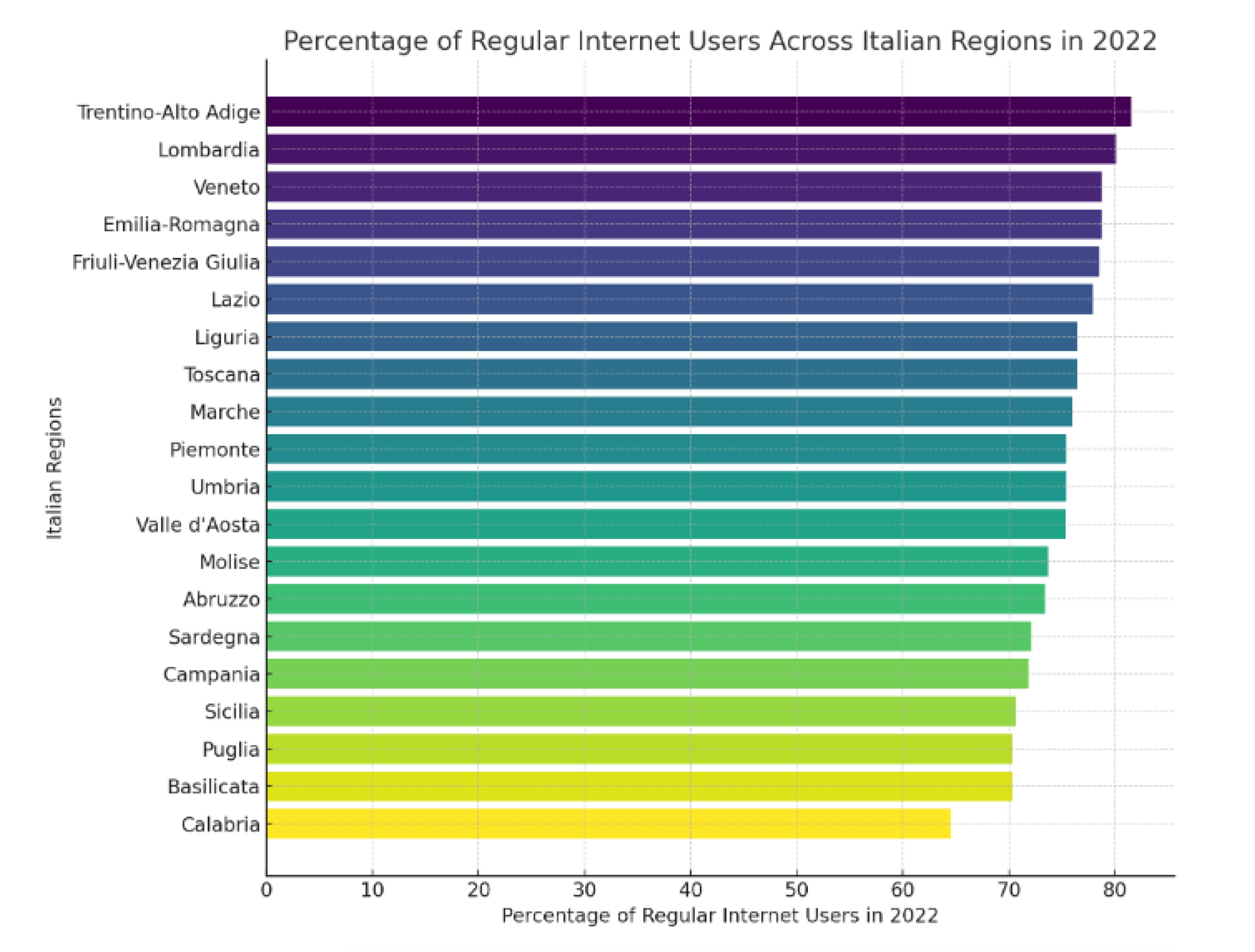
Figure 2.
The graph shows the percentage of internet users in Italian regions in 2022, alongside the percentage change from 2005 to 2022. The graph highlights significant growth across all regions, with some regions experiencing particularly remarkable increases. Source: ISTAT-BES. Elaboration of the author.
Figure 2.
The graph shows the percentage of internet users in Italian regions in 2022, alongside the percentage change from 2005 to 2022. The graph highlights significant growth across all regions, with some regions experiencing particularly remarkable increases. Source: ISTAT-BES. Elaboration of the author.
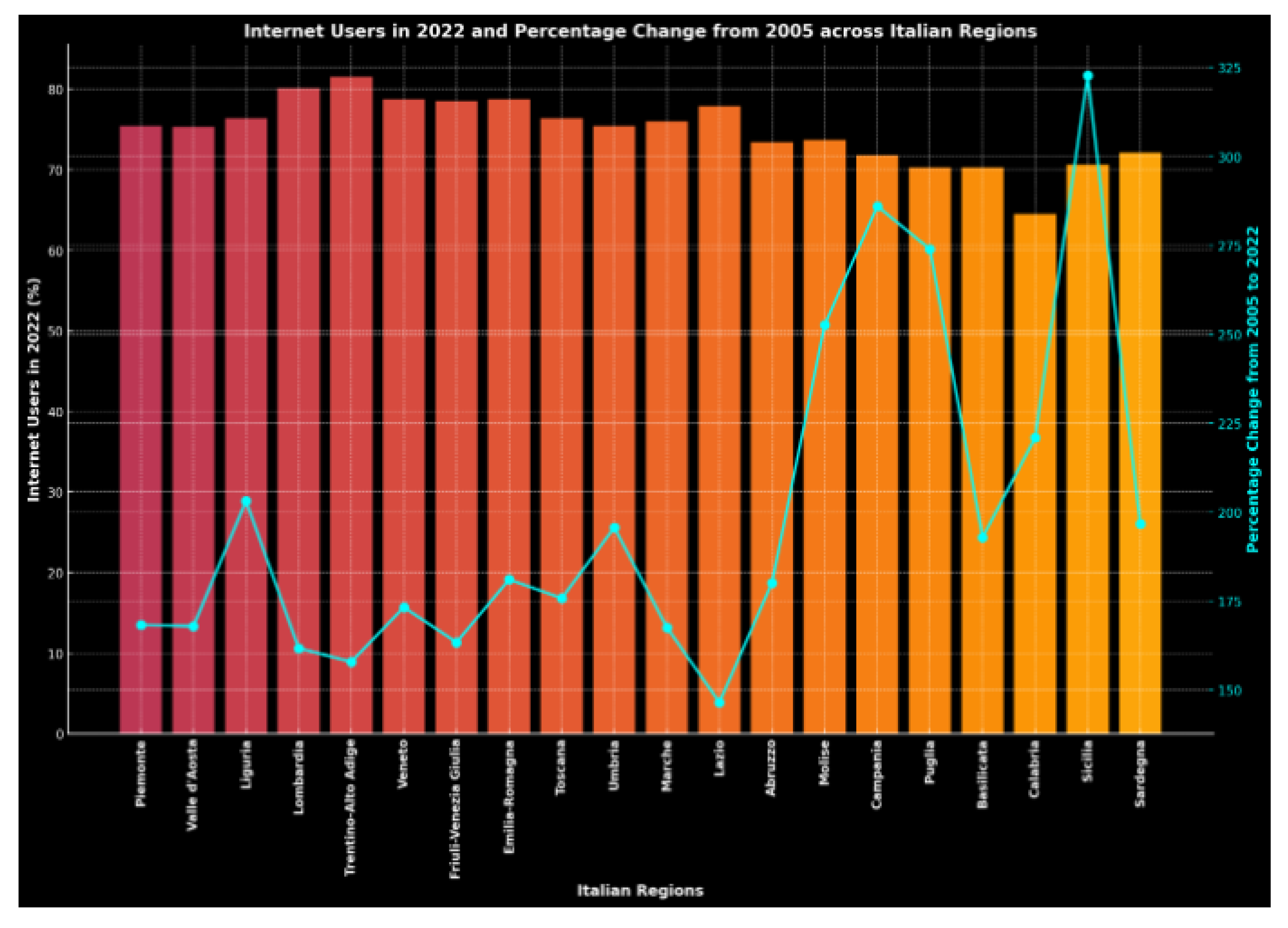
Figure 3.
Regular Internet Users across Italian regions. The graph illustrates the percentage of internet users in 2022 and the percentage change from 2005 across Italian macro-regions. The graph demonstrates significant growth in internet usage across all macro-regions, with the Mezzogiorno and the islands (Isole) showing particularly dramatic increases in percentage terms. Source: ISTAT-BES. Elaboration of the author..
Figure 3.
Regular Internet Users across Italian regions. The graph illustrates the percentage of internet users in 2022 and the percentage change from 2005 across Italian macro-regions. The graph demonstrates significant growth in internet usage across all macro-regions, with the Mezzogiorno and the islands (Isole) showing particularly dramatic increases in percentage terms. Source: ISTAT-BES. Elaboration of the author..
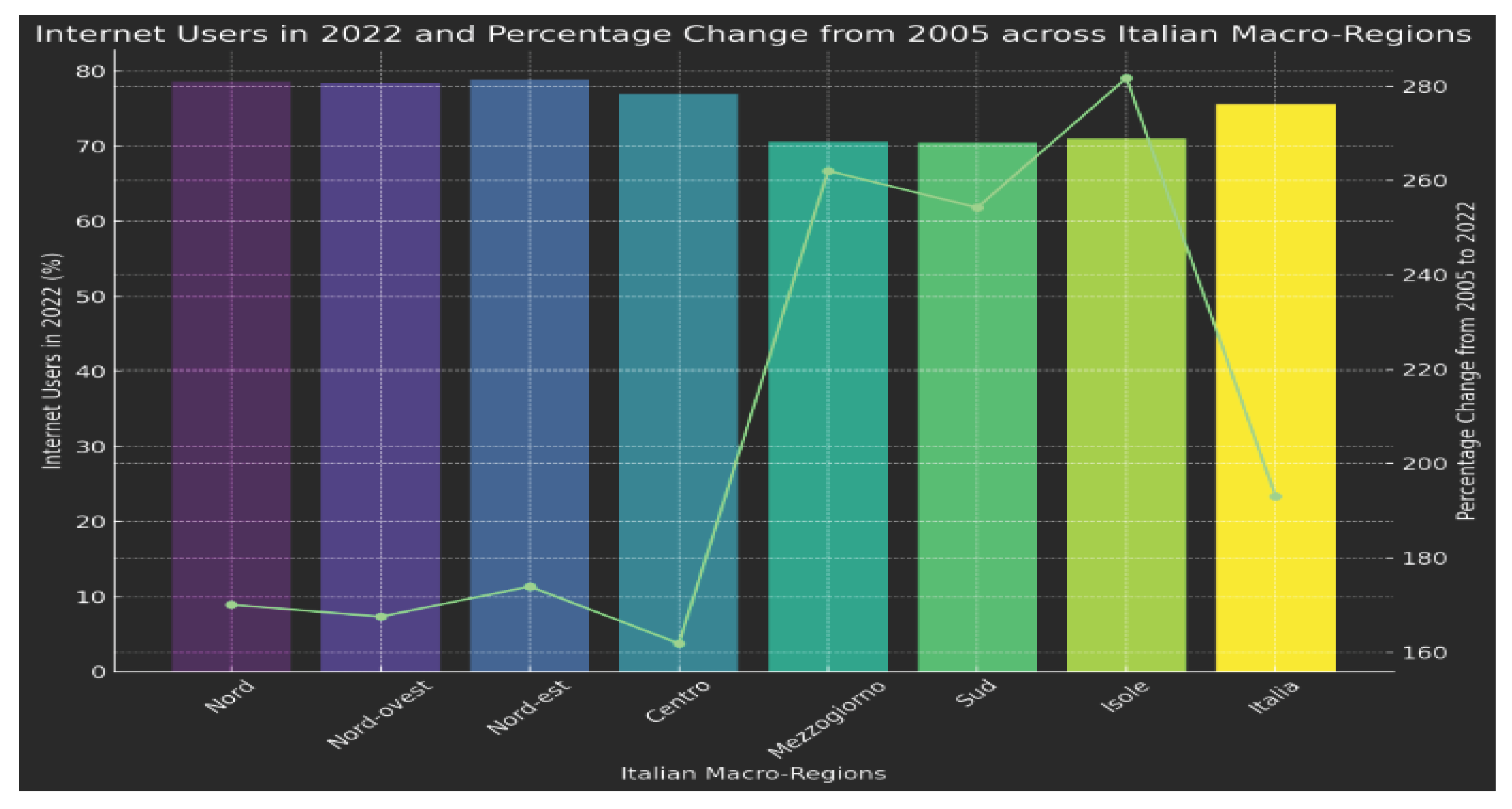
Figure 7.
The complex relationship between RIU and KW.
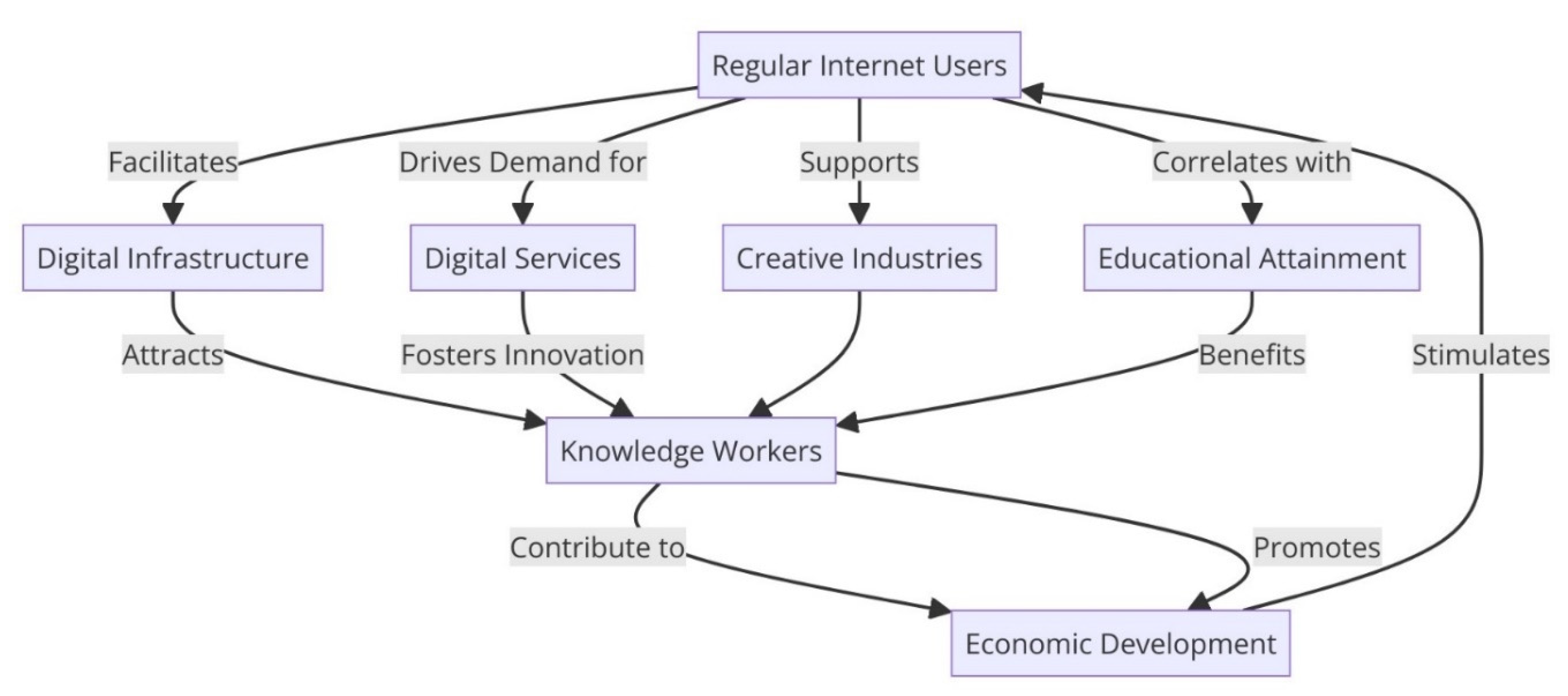
Figure 8.
Regular internet users and availability of at least one computer and Internet connection in the family.
Figure 8.
Regular internet users and availability of at least one computer and Internet connection in the family.
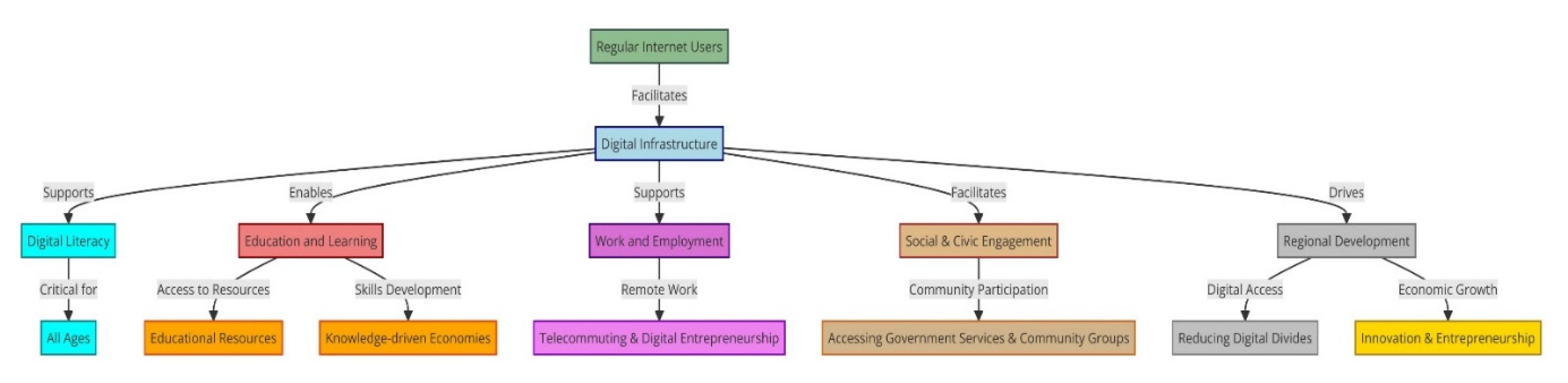

Table 1.
Synthesis of the Literature Review by Topic.
| Synthesis of the Literature Review by Topic | |
|---|---|
| Topic | References |
| Digital Exclusion and Inclusion | Adamczyk, M., & Betlej, A. (2021); Božić, S., & Jakšić, D. (2020); Özsoy, D., & Muschert, G. (2020); Perrone, A. (2020). |
| Internet Use and Health | Cho, G., Betensky, R. A., & Chang, V. W. (2023); Duplaga, M. (2021); El Archi, S., Barrault, S., Brunault, P., Ribadier, A., & Varescon, I. (2022); Kokka, I., Mourikis, I., Nicolaides, N. C., Darviri, C., Chrousos, G. P., Kanaka-Gantenbein, C., & Bacopoulou, F. (2021); Kung, C. S., & Steptoe, A. (2023) (two articles); Maitlall, J. (2023); Seynstahl, S., Erickson, N., Jost, N., Wuerstlein, R., Fey, T., Nasseh, D., ... & Heinemann, V. (2023); Zhou, M., Igarashi, I., & Kawabuchi, K. (2023). |
| Internet, Society, and Behaviour | AlHeneidi, H. H., & Smith, A. P. (2021); Cariolle, J., Elkhateeb, Y., & Maurel, M. (2024); Chomanski, B., & Lauwaert, L. (2023); Densmaa, O., Kaliinaa, G., & Sembeejav, T. (2021); Dey, S. P., Saha, R., & Saha, I. (2021); Dogruel, L. (2021); Dogruel, L., Facciorusso, D., & Stark, B. (2022); Fornari, R. (2020); Gavaravarapu, S. M., Seal, A., Banerjee, P., Reddy, T., & Pittla, N. (2022); Huang, Q., Chen, X., Huang, S., Shao, T., Liao, Z., Lin, S., ... & Shen, H. (2021); Kapsa, I., & Musial-Karg, M. (2021); Kharisma, B. (2022); Knuutila, A., Neuder, L., & Howard, P. (2020); Knuutila, A., Neudert, L. M., & Howard, P. N. (2022); Maslakov, S. I., Shitova, N. V., Tutaeva, V. I., & Kolesnikova, A. V. (2020); Mishra, A., Kamath, R., Madhusudana, K., & Mandal, R. (2021); Nzeakor, O. F., & Nwoke, C. N. (2023); Oki, O. A., Uleanya, C., & Lukose, J. M. (2021); SN, M. L. (2022); WANJIRU, K. N. (2021); Yu, D., & Fiebig, D. G. (2020). |
| Digital Economy and Innovation | Leogrande, A. (2024) (two articles); Melnyk, M., Shchehliuk, S., Leshchukh, I., & Litorovych, O. (2021); Zhavoronkova, G., Zhavoronkov, V., & Kovalenko, N. (2021). |
| Internet and Marketing | Kuzyk, O. (2023); Žitkienė, R., Girčys, V., Zitke, M., & Bartuševičienė, I. (2021). |
| Privacy and Security | Narayanan, L. (2020); Schomakers, E. M., Lidynia, C., & Ziefle, M. (2020). |
| Intellectual Property and AI | Walsh, K. (2020). |
| Aging and Internet Use | Liu, B. C. P. (2021); Nielek, R., Pawlowska, J., Rydzewska, K., & Wierzbicki, A. (2021). |
Table 2.
The Econometric Model.
| The Econometric Model | |||
|---|---|---|---|
| Label | Variable | Acronym | Relationship |
| A103 | Regular internet users | RIU | |
| A100 | Knowledge workers | KW | + |
| A101 | Cultural and creative employment | CCE | - |
| A104 | Availability of at least one computer and Internet connection in the family | AOC | + |
| A106 | Companies with at least 10 employees with web sales to end customers | C10E | + |
Disclaimer/Publisher’s Note: The statements, opinions and data contained in all publications are solely those of the individual author(s) and contributor(s) and not of MDPI and/or the editor(s). MDPI and/or the editor(s) disclaim responsibility for any injury to people or property resulting from any ideas, methods, instructions or products referred to in the content. |
© 2024 by the authors. Licensee MDPI, Basel, Switzerland. This article is an open access article distributed under the terms and conditions of the Creative Commons Attribution (CC BY) license (http://creativecommons.org/licenses/by/4.0/).
Copyright: This open access article is published under a Creative Commons CC BY 4.0 license, which permit the free download, distribution, and reuse, provided that the author and preprint are cited in any reuse.


