

Submitted:
21 March 2024
Posted:
21 March 2024
You are already at the latest version
Abstract
Curcumin, as the main active component of Turmeric (Curcuma Longa), has been demonstrated with various bioactivities. However, its potential therapeutic applications are hindered by challenges such as poor solubility and bioavailability, rapid metabolism, and pan-assay interference properties. Recent advancements have aimed to overcome these limitations by developing novel curcumin analogues and modifications. This brief review critically assesses recent studies on synthesising different curcumin analogues, including metal complexes, nano particulates, and other curcumin derivatives, focused on the antioxidant, anti-inflammatory, and anticancer effects of curcumin and its modified analogues. Exploring innovative curcumin derivatives offers promising strategies to address the challenges associated with its bioavailability and efficacy and valuable insights for future research directions.
Keywords:
curcumin
; modification
; anti-inflammatory
; antioxidant
; anticancer
; curcumin analogues
1. Introduction
Turmeric is one of the most used culinary spices in Asian countries. Turmeric is the dried rhizome of Curcuma longa L and is cultivated in tropical and subtropical regions. India is the world’s largest producer and consumer of turmeric (Wanninger et al., 2015). The rich yellow colour and potential biological activities of turmeric are attributed to the presence of curcuminoids (Wanninger et al., 2015, Vyas et al., 2013). Turmeric has been traditionally used as a medicinal herb to promote blood and relieve pain in Asian countries (mainly India and China) (Vyas et al., 2013). Curcumin, a polyphenol, is found to be the major bioactive compound in turmeric (Figure 1).
As a PAINS (pan-assay interference) compound, curcumin demonstrates various types of behaviours. It exhibits covalent labelling of proteins, metal chelation, redox reactivity, aggregation, membrane disruption, fluorescence interference, and structural decomposition. As a result, when determining the activity of curcumin using different assays, these potential modes of assay interferences need to be accounted for (Simmler et al., 2013). In global literature, two major red flags have popped up on the bioactivity profiles of curcumin reported to date: 1) the rate at which this compound, or mixture, is reported as being bioactive and especially 2) the relatively high ratio of positive activities seen in proportion to the total number of distinct bioactivities reported: just over 300 as assessed using the NAPRALERT database (Nelson et al., 2017).
Curcumin has been shown to exhibit antioxidant, anti-inflammatory, antimicrobial, anticancer, and antimutagenic properties, enabling it to be used as a supplement for various health conditions. Several reports over the last few decades have specified the potent therapeutic potential of curcumin against various cancers (Kunnumakkara et al., 2008). It has been shown to prevent the growth and metastasis of various tumours through the regulation of different transcription factors, growth factors, inflammatory cytokines, protein kinases and enzymes (Kunnumakkara et al., 2008, Shishodia et al., 2007). Some of the key pathways of Curcumin, as per their biological properties, have been highlighted in Figure 2. Curcumin also inhibited the proliferation of cancer cells, induced apoptosis and suppressed angiogenesis (Aggarwal et al., 2004). This review provides an overview of some of the novel curcumin analogues, metal complexes, nano particulates and various curcumin derivatives which have shown promising and enhanced anticancer, anti-inflammatory and antioxidant activities when compared with curcumin. Furthermore, we discuss the potential clinical benefits of these curcumin modifications in the treatment of various diseases while proposing several exciting directions for future research.
2. Chemistry of Curcumin – Structure and Properties
Curcumin (diferuloylmethane), an orange-yellow crystalline powder (molecular formula of C21H20O6), is an active compound of the perennial herb Curcuma longa L. (commonly known as turmeric). The yellow-pigmented fraction of Curcuma longa contains curcuminoids (demethoxycurcumin, Bis-demethoxycurcumin) which are chemically related to its principal ingredient, Curcumin. It was first isolated in 1815 by Vogel and Pelletier, obtained in crystalline form in 1870, and identified as 1,6-heptadiene-3,5-dione-1,7-bis(4-hydroxy-3-methoxyphenyl) -(1E,6E) or diferuloylmethane (Fadus et al., 2016). The feruloyl methane structure of curcumin was subsequently confirmed in 1910 through the original work and synthesised by Lampe (Priyadarsini, K.I., 2014). Curcumin is very little or not soluble at all in aqueous solutions. Still, it is soluble in organic solvents such as dimethyl sulfoxide (DMSO), ethanol, methanol, or acetone. It has a melting point of 183°C, and molecular weight of 368.37 g/mol (Grykiewicz et al., 2012, Esatbeyoglu et al., 2012, Gupta et al., 2011, Priyadarsini, K.I., 2013).
Spectrophotometrically, curcumin has a maximum absorption (λmax) of 430 nm in methanol. In acetone, the maximum absorbance of curcumin can be accomplished at 415 to 420 nm (Mbese et al., 2019). Curcumin gives a bright yellow hue at a pH of 2.5 to 7 and changes to red when it reaches a pH of 7 (neutral) (Mbese et al., 2019). On the contrary, tetrahydrocurcumin (THC), which is one of the major metabolites of curcumin is found to be relatively stable at neutral or basic pH. The molecule is soluble in 0.1 M sodium hydroxide (NaOH) but remains stable only for 1–2 h. A major degrading product was found to be a Trans-6-(40-hydroxy-30-methoxyphenyl)-2,4-dioxo-5-hexenal and vanillin, where ferulic acid and feruloyl methane were identified as minor degradation products. A study by Tomren demonstrated that complexation with cyclodextrin stabilises curcumin in aqueous solutions (Tomren et al., 2008).
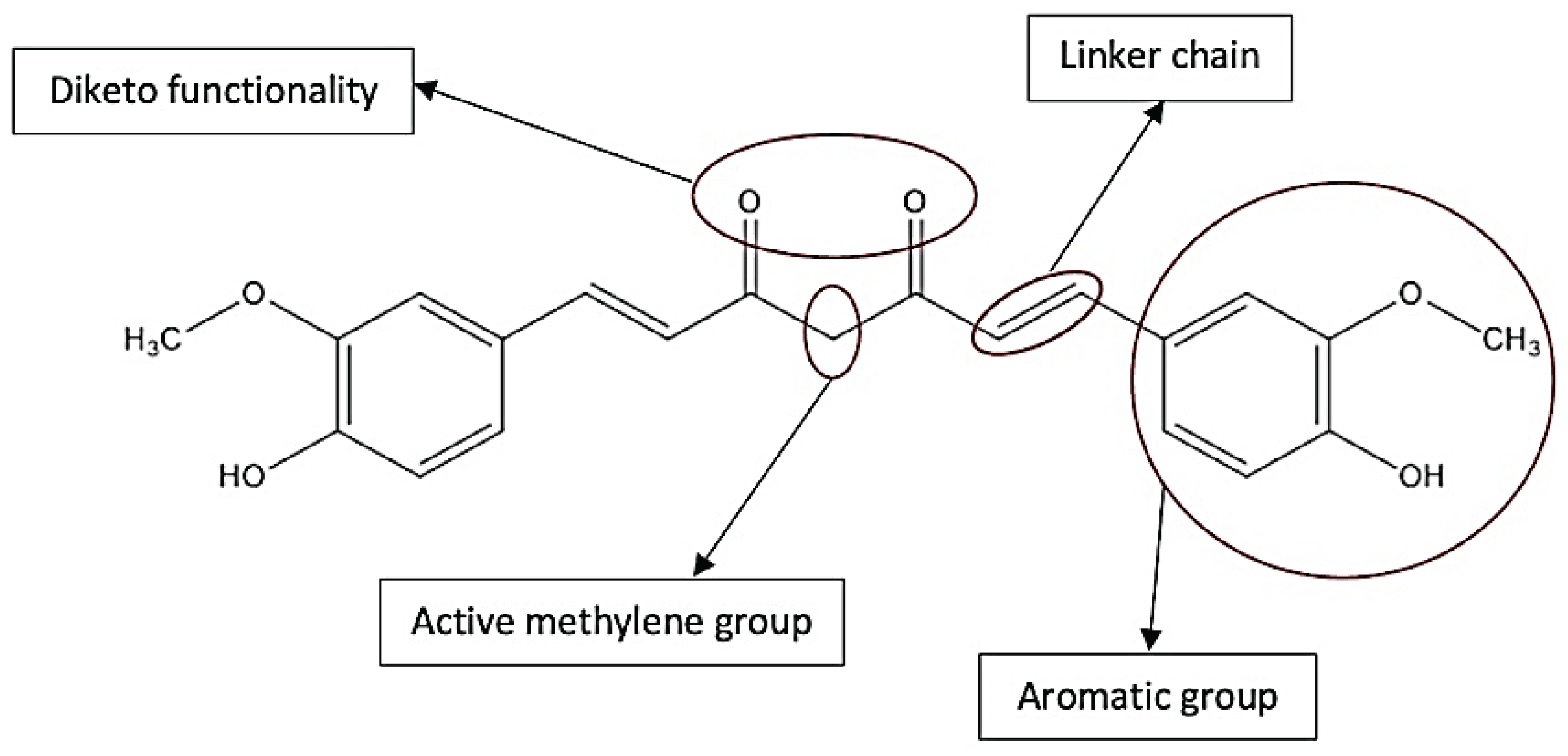
Structurally, curcumin is a symmetrical molecule consisting of four chemical entities, aryl side chains linked together by a linker in the presence of a diketo functional group, two double bonds, and an active methylene moiety (Figure 3). Studies have been performed on each of these sites in search of a potential site for suitable modifications to improve curcumin’s solubility, bioavailability and efficacy (Vyas et al., 2013). Modification of curcumin not only improved its pharmacological activity and affected receptor binding but also enhanced its physiochemical and pharmacokinetic properties (Tomren et al., 2008). For example, several curcumin derivatives have shown enhanced antitumor and anti-inflammatory activities when compared to curcumin due to the high level of methylation, the unsaturation of the diketone moiety and a low level of hydrogenation. In addition, many hydrogenated curcumin analogues have shown potent antioxidant activity (Rodridgues et al., 2019).
Figure 3.
Curcumin structure shows four major reactive sites.
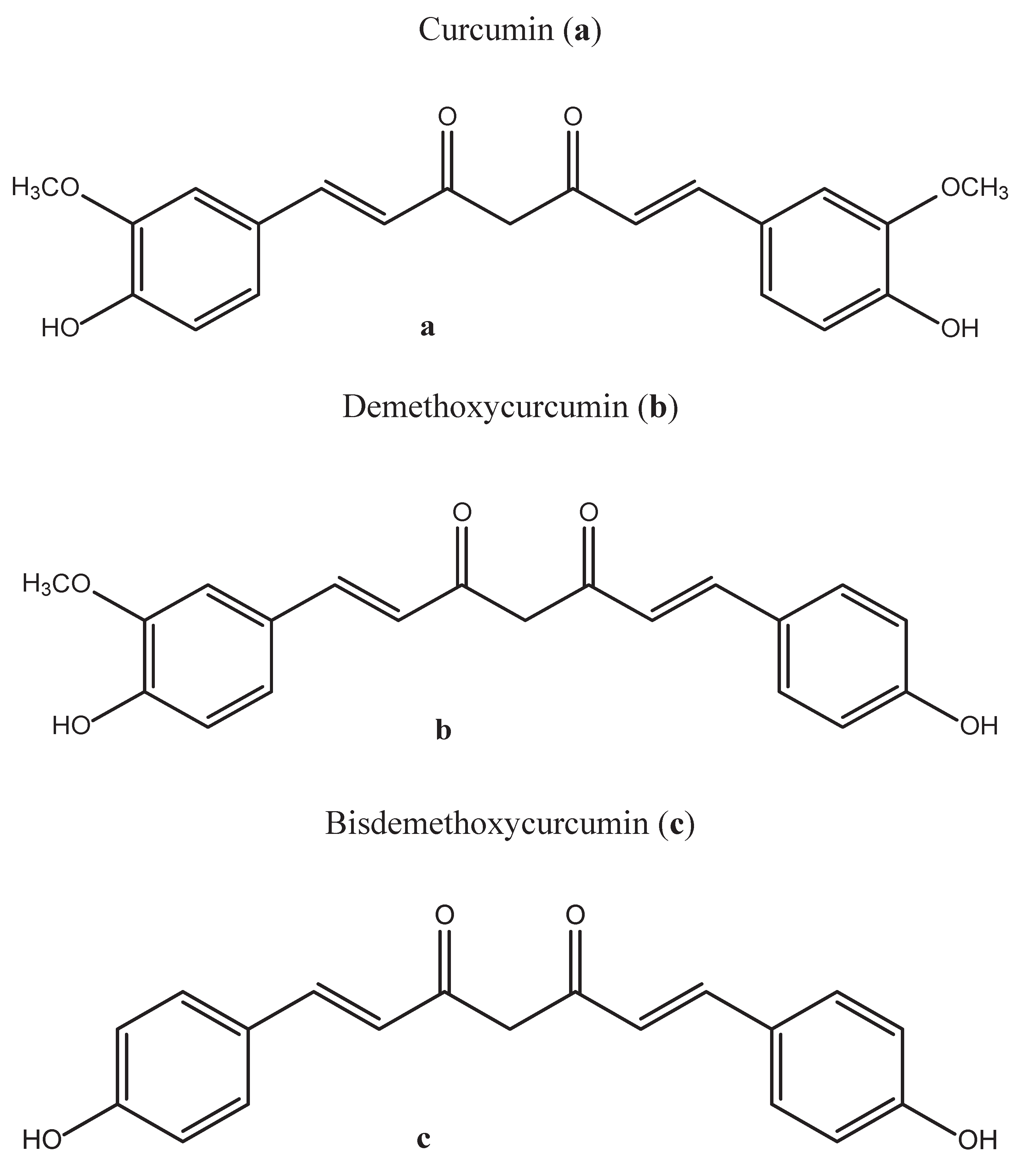
After the work undertaken by Aggarwal and co-workers in the 1990s on its potential anticancer effect, the pace of curcumin research has grown tremendously, with more than 50,000 citations to date. Over time, curcumin has become one of the most studied topics in different branches of chemistry, including inorganic, organic, physical, and analytical chemistry. In organic and inorganic chemistry, synthetic derivatives and extraction of curcumin and metal chelating abilities through the β-diketo and OH groups to form novel structural entities with modified biochemical activities have been studied (Aggarwal et al., 1995). The perceptive difficulty of using curcumin as a potent medicinal agent is its poor solubility in an aqueous solution, which severely limits absorption and reaches optimal therapeutic activity in the human body (Anand et al., 2007). It is reported that ethanol is the preferred solvent for extracting curcuminoids from turmeric. The natural curcuminoids of significance are curcumin (a), demethoxycurcumin (b) and bisdemethoxycurcumin (c) which account for approximately 77%, 18% and 5% of the composition of turmeric, respectively (Rodridgues et al., 2019). Compared to other organic solvents, such as dimethyl sulfoxide (DMSO) (25 µg/mL) and ethanol (10 µg/ml), the solubility of curcumin in water (< 0.1 µg/mL) is extremely low.
Furthermore, curcumin exists in both enolic and beta-diketone forms. It is found stable at acidic pH but unstable at neutral and basic pH, and it is then degraded down to ferulic acid and feruloyl methane (Vyas et al., 2013). A diketone moiety is formed by these carbonyl groups which exists in keto-enolic tautomeric forms (Figure 3), where dynamically more stable enol-form exists in the solid phase and in acidic solutions (Tonnesen and Karlsen et al., 1985). To yield an enolate moiety, deprotonation takes place under mild alkaline conditions. Hence, these facile tautomeric conversions are assumed to subsidise curcumin’s rapid metabolism. In unmodified curcumin, unsaturated carbonyls are a good Michael acceptor and can undergo nucleophilic additions under biological conditions that may enhance its bioavailability. Although several strategies have been tried, limited success has been achieved in terms of modulating curcumin’s metabolism, resulting in ill-defined and unstable products. As a result, several research groups have attempted and are still studying the structural motif of curcumin to slow down its metabolism and improve its potency and efficacy.
Figure 3.
Schematic representation of Keto-enol tautomerism of curcumin.

3. Methods
Over 130 publications and sources related to curcumin were searched to conduct literature searches, and 46 curcumin analogues studied in recent years have been reported for their chemical and biological properties, including various in vivo and in vitro properties. Relevant publications were searched in PubMed (https://pubmed.ncbi.nlm.nih.gov (accessed on 29 December 2023), ScienceDirect (https://www.sciencedirect.com (accessed on 29 December 2023), and Google Scholar (https://scholar.google.com (accessed on 29 December 2023), using various names of curcumin and its related functions such as antioxidant, anticancer, anti-inflammatory, analogues, solubility and bioavailability as keywords. A literature search was conducted independently by the lead author (KK). The keywords were finalised by the two authors, the lead author (KK) and the corresponding author (CGL), and all the authors assessed and agreed upon them. The final list of selected publications was assessed and agreed upon by all participating authors, where overlaps were eliminated. The search was restricted to articles published only in English. The chemical structure of curcumin, its major active sites and enol-keto tautomerism and tables were adopted with minor modifications (Wanninger et al., 2015).
4. Strategies for Improving the Therapeutic Window of Curcumin
A promising and innovative way to overcome the issue, as identified by numerous researchers, is to look for new drug delivery systems and to produce new synthetic curcumin analogues, nano particulates, and metal complexes (Mary et al., 2017). Curcumin modification has also facilitated overcoming drawbacks and enhanced solubility, bioavailability, and effectiveness, thus leading to higher bioactivity with reduced toxicity (Chakraborti et al., 2013). Curcumin has been reported to be a safe, natural therapeutic agent as it did not cause any known severe adverse effects, even at doses as high as 8 g per day in humans (Padhye et al., 2009), which might be attributed to its low solubility and bioavailability. Numerous approaches have been undertaken to improve the drug effect of curcumin. However, low water solubility and bioavailability of curcumin cause a major concern, limiting its therapeutic convenience due to the percentage (75%) of curcumin gets excreted in the feces, indicating its poor absorption in the gastrointestinal tract (gut) (Padhye et al., 2009). To increase the effect of curcumin, a combination of other therapeutic agents like piperine was used to interfere with glucuronidation (Ding et al., 2015). For curcumin to be a viable therapeutic agent, two factors are considered and researched: its low water solubility and bioavailability, and the other concerns its rapid metabolism. These two factors have been tackled in different studies over the years by adopting two strategies (1) synthesising its analogues through modification of its structural motif and (2) employing novel drug delivery systems. However, there has been limited success in avoiding curcumin’s rapid metabolism and enhancing its solubility and bioavailability even after numerous attempts (Padhye et al., 2009).
5. Novel Drug Delivery Systems
To increase the stability of curcumin, novel drug delivery systems such as nanoparticles, metal complexes, liposomes, solid dispersion, microemulsion, micelles, nano gels, and dendrimers have been explored to increase the absorption and bioavailability of curcumin (Feng at el., 2017). Wang and co-workers have developed curcumin micelles for the stabilisation of curcumin by a mixture of surfactant molecules, such as sodium dodecyl sulphate, cetyltrimethylammonium bromide (CTAB), Tween 80, Triton X-100 and pluronic polymers (Wang et al., 2010). Various self-emulsifying curcumin formulations have been developed successfully with particle sizes of approximately 30 nm, and approximately 99% of curcumin loading showed a 10–14-fold greater absorption rate in male Wistar strain rats (Setthacheewakul et al., 2010). Another approach was attempted by Gao et al. (2010) for curcumin nanosuspension (CUR-NS), which was stabilised by d-α-tocopheryl polyethylene glycol 1000 succinate (TPGS) and was later examined for its pharmacokinetics after intravenous administration to rabbits and mice. Close observation of these formulations suggested an increase in the plasma concentration of curcumin by 3.8 times, increasing its bioavailability. In addition, micro-emulsions of curcumin, which are considered isotropic nanostructures and stable solutions comprising of surfactant, oil and water were also prepared to increase its bioavailability (Gao et al., 2010).
Ganta and co-workers have reported that curcumin nanoemulsion when administrated orally increased the bioavailability of the standard chemotherapeutic drug paclitaxel up to 5.2-fold, and there was a 3.2-fold increase in its accumulation at the tumor site in an oral administration to SKOV-3 (human ovarian cancer) tumour-bearing xenografts mice models (Ganta et al., 2010). Nano-formulations based on dextransulfate–chitosan mixtures are widely accepted for oral, intravenous, and controlled delivery purposes. In a study by Anitha et al., (2011) quantification of cellular uptake of curcumin encapsulated in dextransulfate–chitosan NPs was performed using a spectrophotometric method in a panel of cancer cells including the L929 (Mouse fibroblast cells), MCF-7 (human breast cancer cells), PC-3 (human prostate cancer cells) and MG 63 (human osteosarcoma cells). The curcumin formulation showed greater inhibitory activity against the MCF-7 cells compared to the other tested cell lines (Anitha et al., 2011).
Yadav and co-workers implemented this technique into their study and developed cyclodextrin–curcumin self-assembly, which exhibited higher efficacy compared to curcumin in inhibiting tumour necrosis factor (TNF)-induced expression of NF-κB regulated genes (VEGF, MMP-9 and cyclin D1) and unregulated death receptors (DR4 and DR5) in KBM-5 (myelogenous leukemia cells) (Yadav et al., 2010). As a comparison, Yallapu et al. in 2010 showed that a self-assembled curcumin complex with poly-β-cyclodextrin had anti-proliferative properties against prostate cancer cells. The presence of curcumin in the complex downregulated anti-apoptotic Bcl-2 and Bcl-xL and induced pro-apoptotic Bax family proteins, thus stimulating apoptosis in the prostate cancer cells.
Another novel difluoro curcumin formulation was reported by Dandawate et al. (2012), generally called CDF and shown to have greater anticancer activity. The CDF conjugate with β-cyclodextrin (CDFCD) in 1: 2 proportions exhibited significantly lower IC50 values when tested against a group of cancer cell lines - BXPC-3, MDA-MB-231 and PC-3 compared to CDF alone. Further in vivo studies in mice revealed that the conjugate favourably accumulated in the pancreas, the levels of CDF-β-cyclodextrin conjugate in the pancreas were 10 times higher than that in serum, following intravenous administration of an aqueous CDF-β-cyclodextrin preparation. These studies suggest that the self-assembly of β-cyclodextrin and CDF may significantly enhance the bioavailability and tissue distribution of these curcumin analogues (Dandawate et al., 2012). Manju et al., in 2011, synthesised polyvinyl pyrrolidone–curcumin conjugate to enhance the water solubility of curcumin. Self-assembly of the drug-conjugate was done in an aqueous solution to form nano-sized micellar aggregates, which were cationic and stable against hydrolytic degradation. The cytotoxic potential of the conjugate was evaluated against the L929 fibroblast cells, indicating that the conjugate has higher cytotoxicity than free curcumin, possibly due to its enhanced aqueous solubility and polymer-mediated drug internalisation (Manju et al., 2011).
Sohail et al. 2021 reported a study on the nanoformulation of Dimethoxycurcumin (DiMC), also known as dimethylcurcumin, to improve its solubility and stability. By complexation with hydroxypropyl- γ-cyclodextrin, the commercial curcumin containing DiMC could acquire increased solubility and stability. Recently, solid dispersions (SDs) of DiMC were prepared with polyethylene glycol (PEG) 4000, PEG 6000 and poloxamer 188 as carriers using the fusion method and polyvinylpyrrolidone (PVP K30) as a carrier using the solvent evaporation method, respectively. The formulation using PVP K30 at a ratio of 10:1 to DiMC was the best, where DiMC dispersed in an amorphous form with a cumulative dissolution of more than 83% in 5 mins. These results showed that the drug dissolution rate could be improved significantly by utilising all SDs (Sohail et al., 2021). Another study by Wei et al. performed experiments to achieve dicarbonyl curcumin analogues via aldol condensation reaction of aldehydes and ketones, achieving a final yield of above 50% for all novel compounds showing >95% purity by HPLC analysis (Wei et al., 2022).
Additionally, a study conducted by reported a formulation of nanocurcumin in the form of a curcumin nanocrystal powder where the authors assessed its physiochemical properties as well as the antibacterial, antioxidant, anticancer and anti-inflammatory action. The nanocurcumin has reportedly been used as a novel drug delivery approach for biomaterials in dentistry. Azad and co-workers (2024) reported that methods utilising emulsifiers such as carbohydrate complexes, polyethoxylated hydrogenated castor oil, lipid complexes, phospholipid complexes, polysorbates, water-dispersible nanopreparations, and spray drying could also be used to increase the solubility of curcumin BioCurc, Cavacurcmin, CurcuWIN, Hydrocurc, Meriva, Nanocurcumin, Novasol, Theracurmin, and Turmipure Gold.
Even though a wide range of available literature suggests that these new strategies on curcumin-based nano-particulate formulations demonstrate some promise of curcumin to be used as a therapeutic agent, the issue of rapid metabolism of curcumin remains a matter of concern.
6. Structural Analogues of Curcumin and Their Anticancer, Antioxidant and Anti-Inflammatory Activity
Curcumin is a symmetrical β-diketone and incorporates structural changes at different active sites (methylene group, diketo functionality, linker chain and an aromatic/aryl side chain) (Rodrigues et al., 2019). Various researchers have conducted several studies to date to modify the structure of curcumin, simultaneously reforming its pharmacological efficacy. This review covers several structural modifications of curcumin targeting three active sites – an aromatic side chain, diketo functionality and an active methylene group. Several analogues that could not be classified under the abovementioned groups have been separately studied for their In vivo and In vitro studies in the next section of the review. The following account elaborates on some of the literature reported in the past 15 years, focusing on the main reactive sites and the subsequent enhancement in their bioactivity. Potential anticancer, antioxidant and anti-inflammatory studies indicating their IC50 values for each curcumin analogue have been reported in Table 1.
Amide-containing curcumin analogues (1-2) were synthesised by Banuppriya et al. (2018), targeting aromatic side chains, which indicated enhanced water solubility. The target molecule(s) was achieved by hydrolysis in the presence of sodium hydroxide and methanol (Scheme 1). Both compounds were tested for their anticancer activity, which indicated an inhibition in the HeLa cancer cell growth, showing an increase in the p53 level. The compounds were compared with curcumin, which suggested enhanced aqueous solubility and in vitro stability. LogP analysis confirmed that the compounds possessed good lipophilicity, making them potential anticancer agents with a better tendency to cross the blood-brain barrier. El-Gazzar et al., (2016) reported 6 novel (3-8) (Scheme 1) symmetrical curcumin analogues through modifications to the aromatic side chain by substituting the phenolic -OH with different linkers. The analogues reportedly demonstrated radioprotective potential by in vivo studies. Rats model was used to analyse these compounds, where whole-body gamma irradiation was performed on rats to a 7 Gy single dose. The blood samples were collected from the plasma to test for their antioxidant and oxidative stress markers. The rats also demonstrated elevated levels of anti-inflammatory markers such as IL-6, TNF-α and NF-kB. The synthesised analogues by NF-kB inhibition confirmed the post-protective effect in this study.
Hsieh et al. (2017) synthesised various curcumin analogues where compound 9 indicated higher anti-proliferative activity. The compound was synthesised under an acid catalysis reaction using an appropriate ester at 45-50 °C in THF, forming a hydroxyl ester compound. Compound 9 indicated 10-fold potency when compared to curcumin both in vitro and in vivo also indicating a synergistic activity when used with doxorubicin against a triple negative breast cancer cell line (Hsieh et al., 2017). A series of novel curcumin quinoline hybrids from several substitutions of 3-formyl-2-quinolones and vanillin were synthesised by Raghavan et al. (2015). Compound 10 indicated the most potent activity when investigated for their cytotoxicity against a panel of representative cell lines, A549, MCF-7, SKOV3 and H460. Its potency was determined due to the morphological changes in SKOV3 cell lines and apoptotic cell death by arresting the cells in S and G2/M phases. In addition, six symmetric curcumin analogues by Ciochina et al. (2014) were synthesised by the condensation of the appropriate aldehydes with acetyl acetone-boric oxide complex in ethyl acetate in the presence of tributyl borate and n-butylamine. The analogues were investigated for their antioxidant and anticancer activity, where compounds 11 and 12 demonstrated a greater potential to be chemopreventive agents due to their low cytotoxic potential (Ciochina et al., 2014). Lopes-Rodrigues et al. (2017) synthesised compound 13 to understand the role of curcumin derivatives on P-glycoprotein (P-gp) indicators. Synthesis was performed under reflux conditions using curcumin, an. Cs2CO3 and Bu4NBr in the presence of acetone and propargyl bromide solution at 60 °C for 4h, producing an orange solid product through recrystallisation as a final step. The compound inhibited P-gp activity, caused cell cycle arrest at the G2/M phase, and increased cell death by apoptosis in a Multi drug resistance (MDR) chronic myeloid leukaemia cell line. Furthermore, Cao et al. in 2014 synthesised three curcumin analogues through conjugation with bioactive compounds via ester bonds, where 14 showed the strongest antiproliferative activity when investigated in four cell lines, namely Hep G2, LX-2, SMMC7221 and MDA-MB-231 indicating IC50 values ranging from 0.18 to 4.25 μM.
Scheme 2.
Structural analogues of Curcumin (9-14).
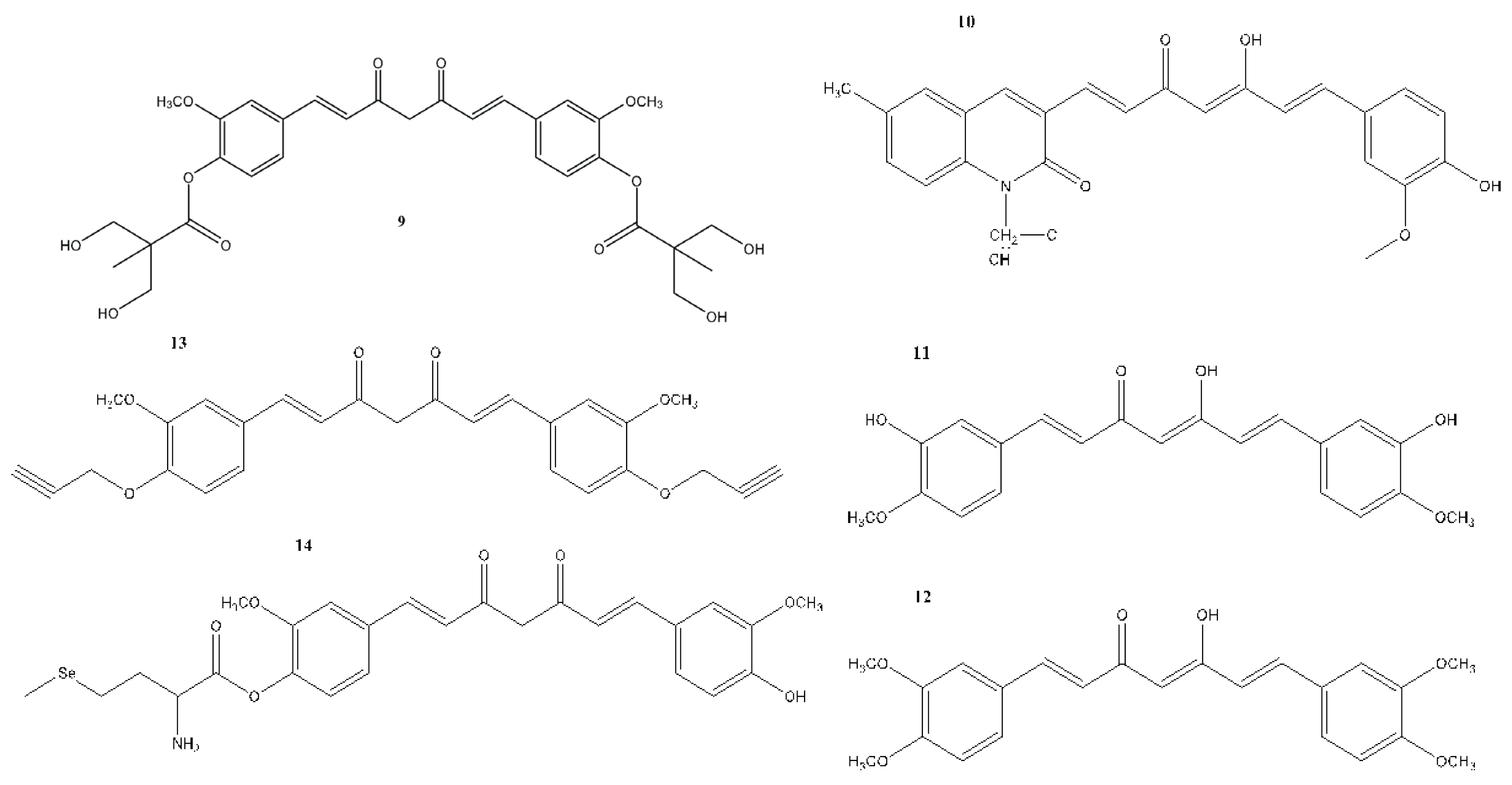
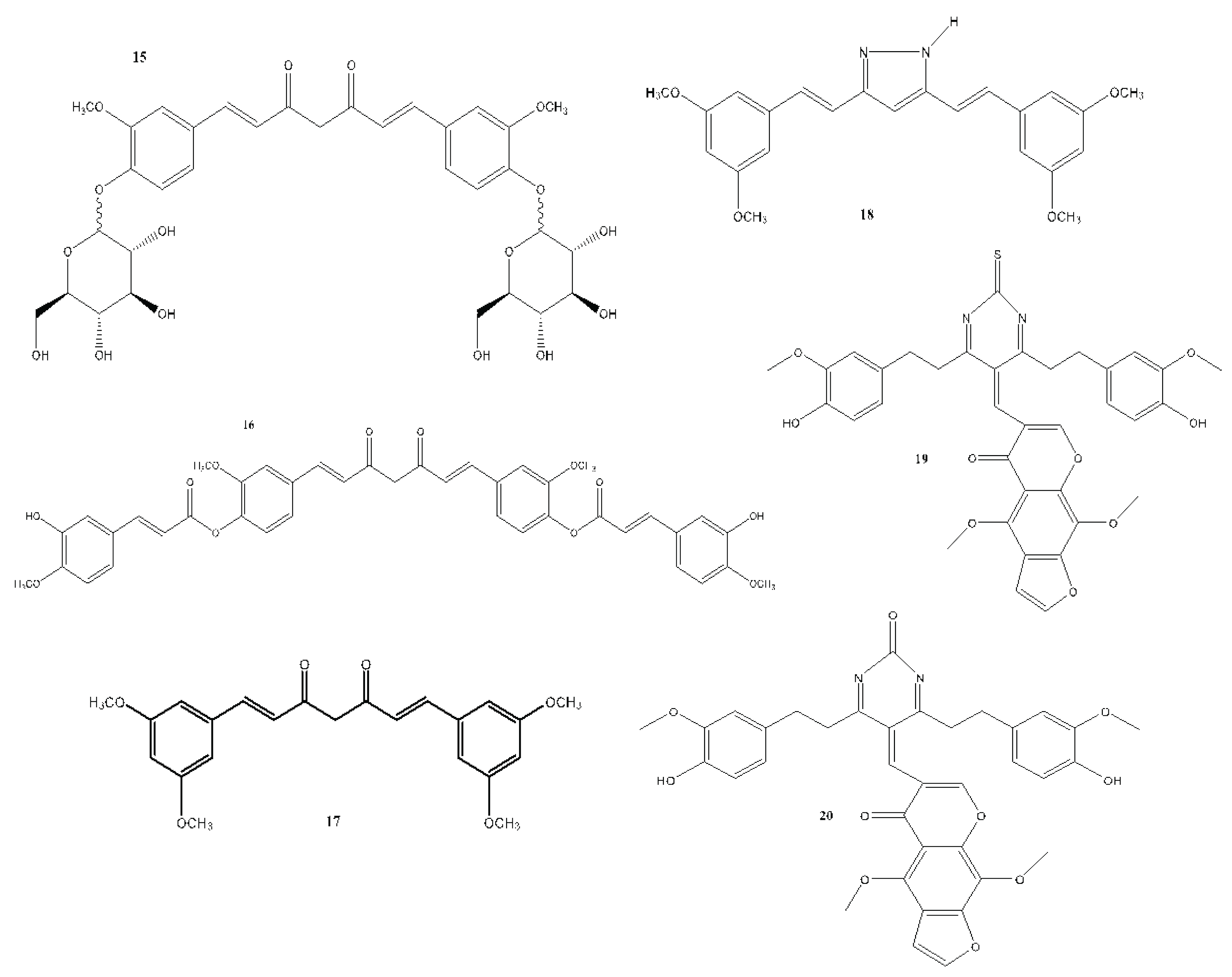
Rao et al. (2014) synthesised and evaluated the biological activity of curcumin-b-di-glucoside and tetrahydrocurcumin-b-di-glucoside by a bi-phasic reaction medium. The conjugated analogues showed a significant inhibition in colon and breast cancer cell lines against MCF-7, HT-29 and A549 cell lines where compound 15 indicated the best anticancer activity. In addition, several analogues were synthesised by Feng et al. (2015) by combining cinnamic acid and curcumin and evaluated their antioxidant, antibacterial and anticancer activity. The analogue 16, containing hydroxyl and methoxy groups as the active ingredient, indicated a greater anticancer activity compared to the other analogues. Kanwar et al. (2011) synthesised dimethoxycurcumin (17) and reported its anticancer properties against MCF-7 breast cancer cells which confirmed cell death through cell cycle arrest and induction of apoptosis. Lien and co-workers, in 2015, designed and synthesised several curcumin analogues and evaluated their ability to degrade the HER2 gene. Compound 18 was achieved via the modification of diketo group of dimethoxycurcumin using acetic acid indicating better ability than other curcumin analogues and curcumin in inhibiting the HER2 expression and further induction of G2/M cell cycle arrest followed by apoptosis. A series of novel heterocyclic curcumin analogues were designed by Borik et al. (2018), and their anticancer activity by MTT assay was evaluated amongst MCF-7 and HepG2 as well as a normal cell line HFB4. Out of the 14 novel analogues synthesised, two compounds (19, 20) showed better anticancer activity than curcumin. Synthesis was carried out by a one pot condensation reaction, an acid catalysed Biginelli reaction, with three components, i.e., furochromone carbaldehyde, curcumin and urea to give the corresponding derivatives. These analogues were compared against the already existing cancer drugs – 5-fluorouracil and doxorubicin (Borik et al., 2018).
Scheme 3.
Structural analogues of Curcumin (15-20).
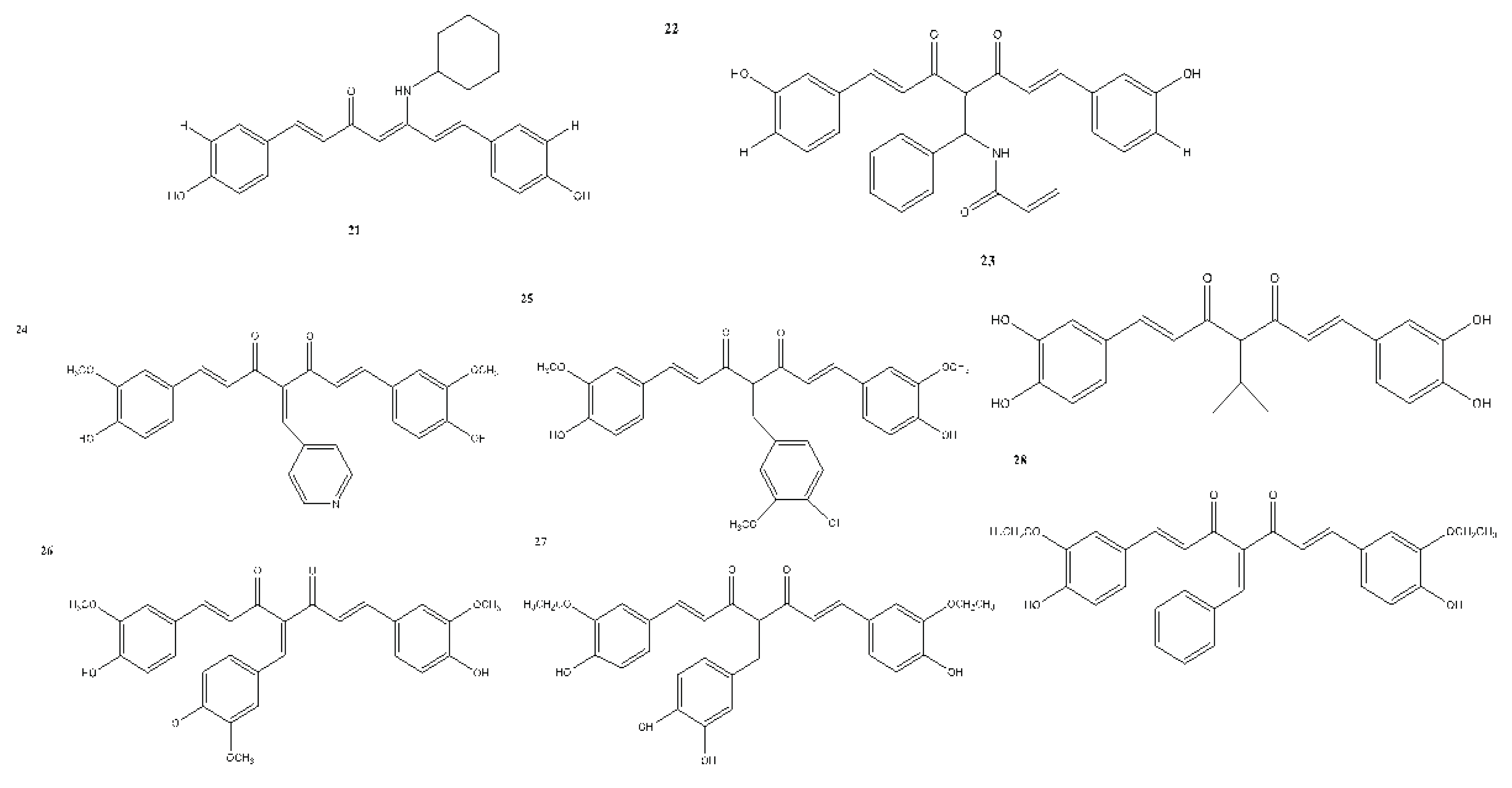
Thirteen analogues of curcumin were synthesised by Vreese et al. (2016) with a central β enaminone fragment substituting the β-diketone moiety to improve the solubility and bioactivity of curcumin utilising the microwave-assisted irradiation method. The cytotoxicity studies were performed amongst EA.hy926, HT-29 and Caco-2 cell lines. Compound 21 was revealed to be the most potent amongst the other potent analogues, indicating strong cytotoxic effects. Hacker and co-workers in 2016 reported a remarkable study investigating both in vitro and in vivo anticancer effects of a curcumin analogue, named C-150 (22) against glioma cells. The analogue consisted of meta-hydroxyphenyl side chains and β-phenyl- β-acryl-amido branched central motif. C-150 was studied for its cytotoxicity activity against eight glioma cell lines, GBM 1-6, U251 MG and U373 MG to understand the role it plays in mediating transcription factors and proteins. It was reported to be an effective NF-kB inhibitor in the in vitro model, and it proved to be 30 times more potent than curcumin in inducing the expression of genes and proteins in ER stress. C-150 analogue was also studied using the in vivo model, which showed an increase in the survival of an experimental set of animal models compared to the vehicle control. A dimethylated curcumin analogue (23) was identified and studied by Tu et al. (2017), which was substituted at the active methylene site, demonstrating to be the most potent amongst various curcumin analogues when tested for its cytoprotective activity against t-BHP-induced death of Hep G2 cells. The compound also indicated increased stability, a mechanism dependent on activating the Nrf-2 signalling pathway. Simultaneously, a curcumin analogue, 4-(4-Pyridinyl methylene) (24), having a modification at the active methylene site, was discovered by Fan and co-workers (2017) and was studied for its antitumor action. Due to its regulatory effects for Heat shock protein – Hsp90, it was identified as an active molecule for treating myeloid leukaemia.
Similarly, another curcumin analogue, 4-(4-hydroxy-3-methoxy-phenyl-methyl (C086) (25), having an active methylene site modification, was discovered by Wu et al. (2015). It also indicated that C086 was an Hsp90 inhibitor, revealing it could lead to the dual suppression of Abl kinase activity and Hsp90 chaperone function. Rišiaňová and co-workers (2017) presented the synthesis and characterisation of three Knoevenagel condensates, the analogues (26-28) were further studied for their cytotoxic effect in vitro, SOD mimetic and GSH oxidation capacity in a human colon carcinoma cell line DLD-1. All the compounds exhibited anti-proliferative effect and a significant reduction in multi-drug resistance also indicating a decrease in SOD enzymes which expose the tumor cells to more oxidative stresses.
Scheme 4.
Structural analogues of Curcumin (21-28).
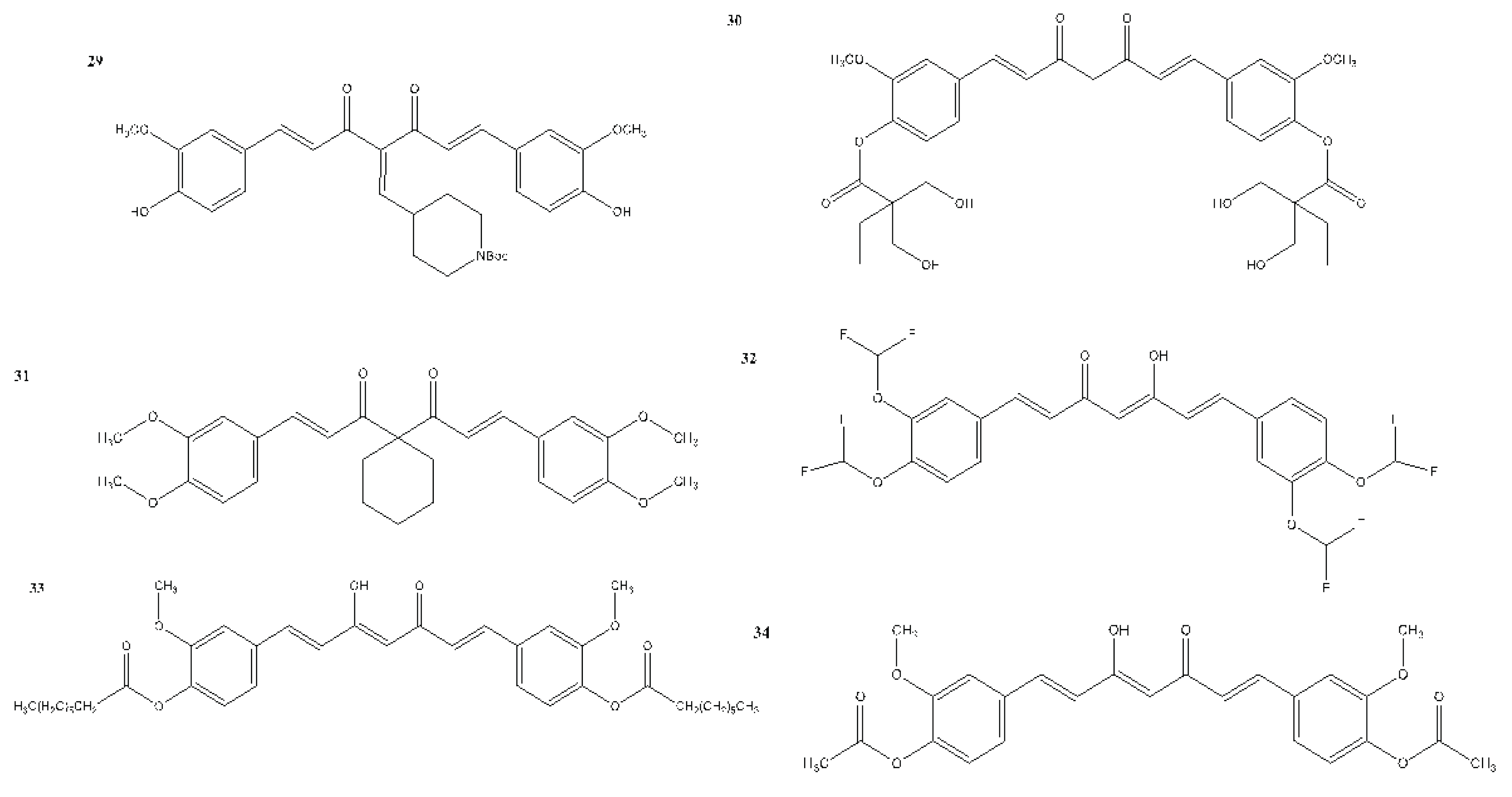
Additionally, Srivastava et al. (2016) also investigated four Knoevenagel condensates of curcumin via a reaction with an aldehyde in the presence of DMF and a catalytic amount of piperidine. The analogues were tested for their antiproliferative activity in MCF-7 cell lines and their capacity to disrupt microtubules and induce p53-dependent apoptosis, where compound 29 demonstrated the highest apoptotic activity. In 2021, Chui et al. reported a synthesis of compound 30 by esterification of curcumin in water and alcohol to increase its aqueous solubility. Compound 30 showed higher cytotoxicity, exhibiting 10 times higher potency against the doxorubicin-resistant MDA-MB-231 cell lines than curcumin. It also demonstrated a synergistic activity when used with doxorubicin against breast cancer. The compound further suppressed MDA-MB-231 TNBC cell invasion by regulating the MAPK/ERK/AKT signalling pathway and cell cycle. Lu et al. (2023) recently reported a study on the synthesis of the diketone analogue of curcumin, FLLL32 (31), (E)-3-(3,4-dimethoxyphenyl-1-[1-[(E)-3-(3,4-dimethoxyphenyl)prop2-enoyl] cyclohexyl]prop-2-en-1-one. FLLL32 targets the transcription factor STAT3 for tumor cell proliferation, survival metastasis and drug resistance. It is known to be more selective in targeting than curcumin due to the two hydrogen atoms replacement on the central carbon of curcumin with a spirocyclohexyl ring (Lu et al., 2023). FLLL32 has been studied for its anti-proliferation properties amongst human osteosarcoma 143.98.2 cells, showing a decrease in cell growth and a delay in tumor growth through the reduction of cell proliferation. The analogue also induced cell apoptosis in a mouse model of the 143.98.2 xenograft nude.
Furthermore, Gong et al. (2024) reported curcumin analogues containing halogen atoms or nitrogen atoms containing substituents on the benzene rings. The analogues were prepared for castration-resistant prostate cancer cell inhibition where compound 32 exhibited dose-dependent cytotoxicity against 22RV1 cells when analysed using a standard MTT ((3-(4,5-dimethylthiazol-2-yl)-2,5-diphenyltetrazolium bromide) method. The average half maximum inhibitory concentration at 48 h and 72 h was reported to be 8.791 and 8.516 μM, respectively. Furthermore, a study by Zarei et al. (2024) has recently reported the synthesis of curcumin dioctanoate (33), curcumin diacetate (34) and curcumin dibutanoate (35) by the reaction between curcumin and the corresponding aldehydrides in the presence of a catalytic amount of 4-dimethylamino pyridine (DMAP). Out of the three ester analogues of curcumin, curcumin dibutanoate (35) showed remarkably increased solubility in food grade oils. Compound 35 showed a potent antioxidant activity using the DPPH method and presented an antioxidant activity of 1.92%. Curcumin dibutanoate showed more stability against oxidation and heat when compared to Curucmin (Zarei et al., 2024).
Scheme 5.
Structural analogues of Curcumin (29-34).
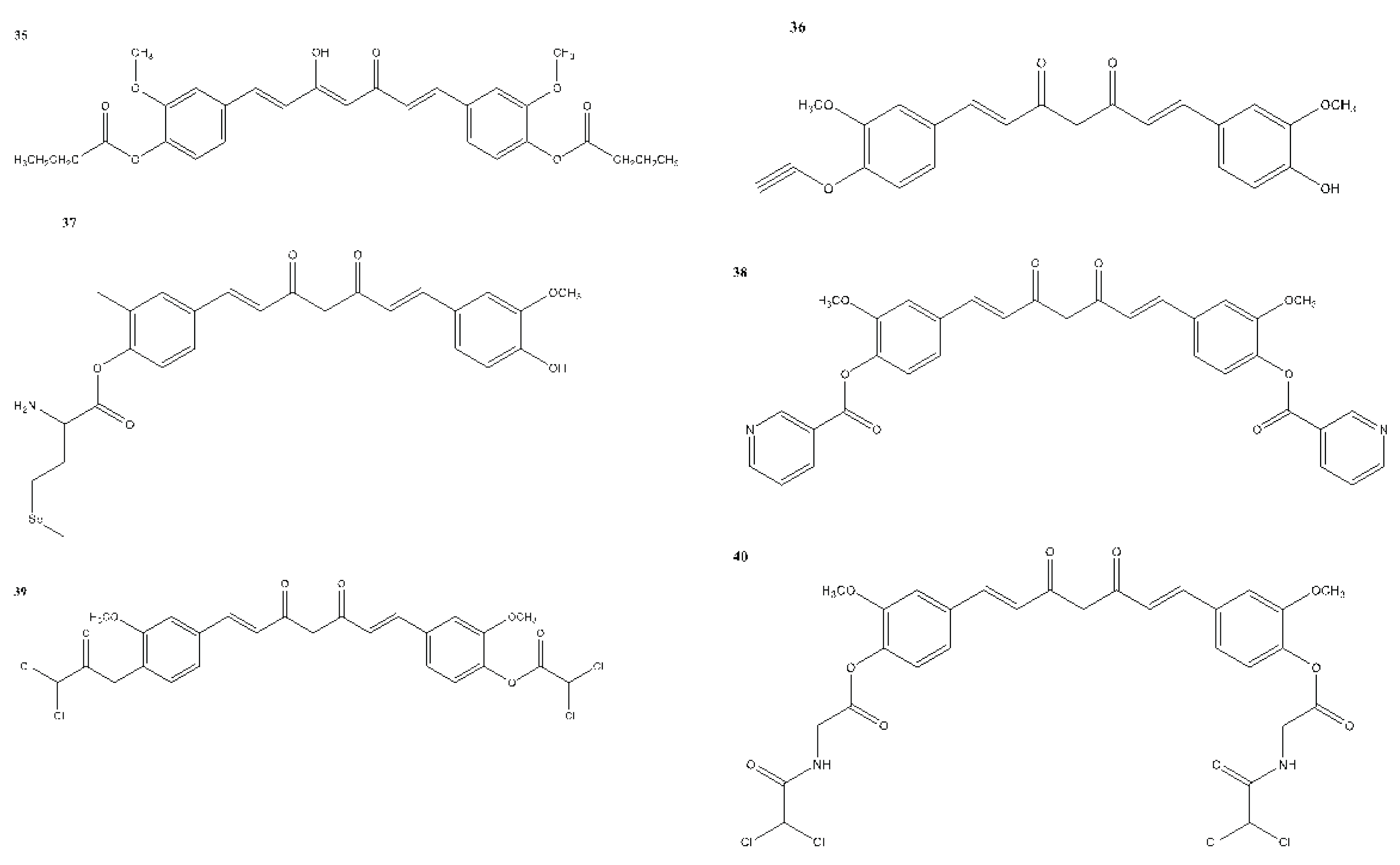
Recently, a review highlighting recent advances of curcumin analogues in breast cancer conducted by Yin and co-workers (2022) have reported various studies on curcumin analogues with improved solubility and bioavailability compared to curcumin. Compound 36 was synthesised through a substitution reaction involving the phenolic hydroxy group of curcumin. The analogue demonstrated growth in inhibition when tested for its cytotoxicity against SUM149 and MDA-MB-231 cancer cell lines with IC50 values of 11.20 and 18.00 μM, respectively. It also showed significant potency in inducing cancer cell apoptosis and down-regulating the NF-kB signalling pathway. Compound 37 was achieved by the synthesis of curcumin with selenomethionine, demonstrating a potent antiproliferative activity and improved bioavailability in MDA-MB-231 cells with an IC50 of 0.52 μM (Yin et al., 2022). Compounds 38, 39 and 40 were also synthesised and reported for their corresponding activity, as mentioned in the review by Yin et al. (2022). In 2019, compound 38 was synthesised and reported to have enhanced solubility and stability by combining curcumin and niacin. It exhibited antiproliferative activity in breast cancer cells and selectively induced G2/M cell cycle arrest and tumor cell apoptosis. Similarly, in 2022, compounds 39 and 40 were synthesised through conjugation of curcumin and dichloroacetate, displaying high selectivity and significant activity on antiproliferative and anti-migrating activities against MDA-MB-231 cells with an EC50 value of 0.42 and 0.78 μM, respectively. Compound 40 also achieved a significant balanced property of solubility in water (Yin et al., 2022).
Scheme 6.
Structural analogues of Curcumin (35-40).
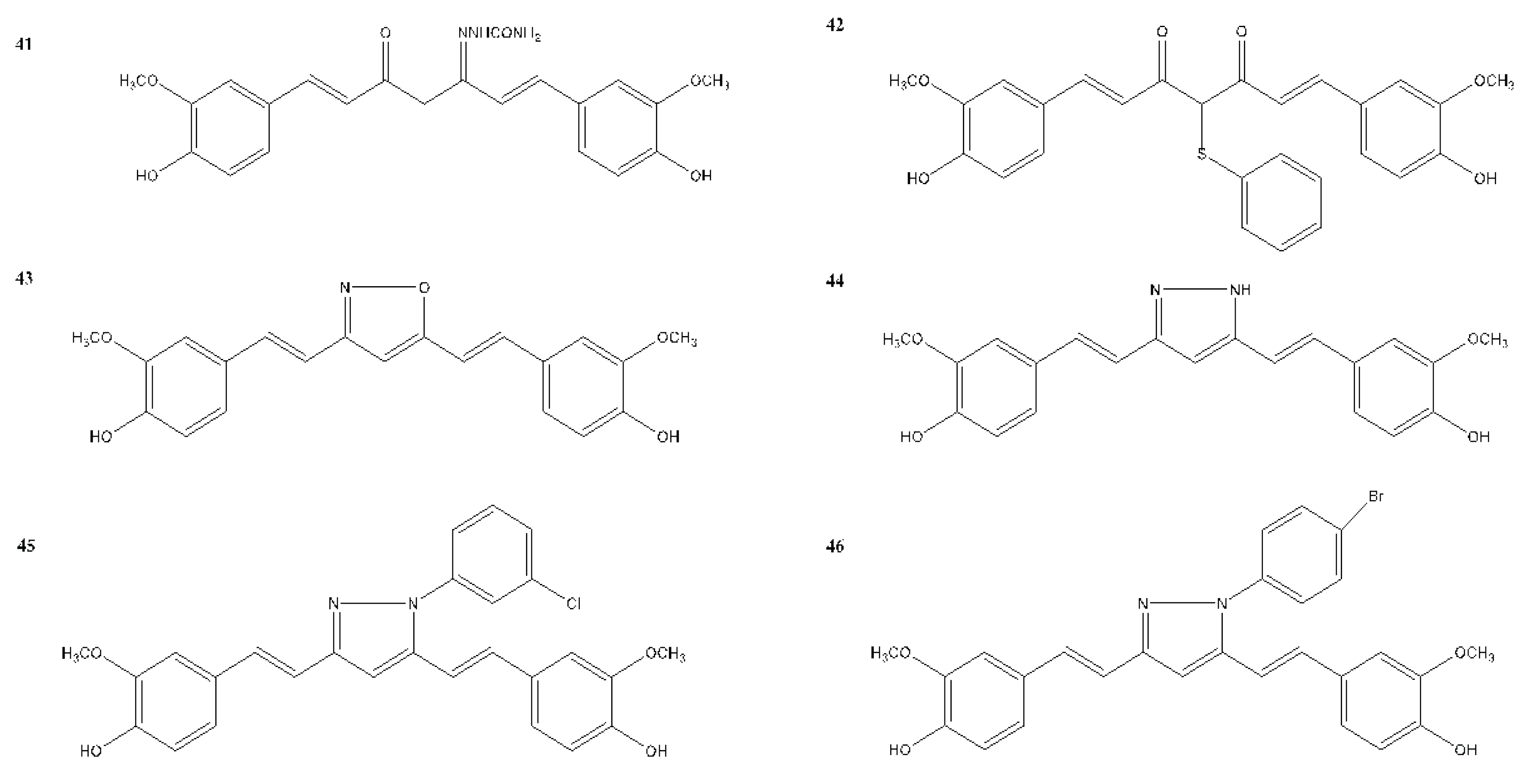
Additionally, Yin et al. (2022) have reported compounds (41-46) with modifications to their diketone and active methylene sites. Compound 41 modification was performed by replacing one of the β-carbonyl with semicarbazone moiety, demonstrating efficient antiproliferative activity against breast cancer MCF-7 cells in vitro. Similarly, compound 42 was synthesised by an original procedure via sulfenic acid condensation, which exhibited higher antiproliferation potency than curcumin against breast cancer MDA-MB-231 cells (IC50 = 15.00 μM). Compounds 43 and 44 were identified as isoxazole curcumin analogues and substituted at the diketone site. Compound 43 displayed more potent antitumor activity than curcumin in MCF-7 and MCF-7R cells, IC50 = 13.10, 12.00 μM, respectively. Compound 44 demonstrated high solubility and stability, which showed a significant effect in inhibiting STAT3 and was also found to be more potent than curcumin against MDA-MB-231 and MCF-7 cells, IC50 = 3.37 and 2.56 μM, respectively. It was found to be in favour of suppressing cell migration, and invasion and inducing apoptosis. In addition, compound 45, a curcumin pyrazole analogue, was synthesised by base-catalysed cyclisation of curcumin with the corresponding phenyl-hydrazine. It also induced cell death by arresting the cell cycle in the SubG1 phase and induced cell damage by impairing the mitochondrial membrane potential against breast cancer MCF-7 cells (IC50 = 34.99 μM). Lastly, compound 46 was synthesised through condensation of tetrahydrocurcumin with hydrazine, which was substituted with the 4-bromo-phenyl group at the pyrazole ring. It demonstrated antiproliferative activity against three representative cell lines using in vitro MTT assays. Compound 46 showed significant growth inhibition against MCF-7 cancer cell lines (IC50 = 5.80 μM).
Scheme 7.
Structural analogues of Curcumin (41-46).
7. In Vitro and In Vivo Studies on the Antioxidant, Anti-inflammatory, and Anticancer Activities of Curcumin and Its Analogues
Numerous in vitro investigations have consistently demonstrated the potent antioxidant properties of curcumin . It can mitigate oxidative stress by scavenging free radicals and enhancing endogenous antioxidant defences . Furthermore, in vitro studies have elucidated the anti-inflammatory effects of curcumin through modulation of key inflammatory pathways and attenuation of pro-inflammatory mediator production. These findings have been further corroborated by in vivo studies. Various preclinical models of inflammation-associated diseases, including but not limited to arthritis, colitis, and neuroinflammatory disorders, highlight the therapeutic potential of curcumin and its analogues.
Moreover, both in vitro and in vivo studies support the anticancer activity of curcumin. They involve suppression of tumour growth, apoptosis induction, inhibition of angiogenesis, and modulation of various signalling pathways implicated in carcinogenesis . Collectively, these studies underscore the multifaceted pharmacological effects of curcumin and its analogues. This advocates for their exploration as promising candidates for developing novel therapeutics targeting oxidative stress, inflammation, and cancer.
7.1. Antioxidant Activity
The antioxidant potential of curcumin and its analogues has been extensively investigated in both preclinical and clinical studies. For instance, Chen et al. (2015) demonstrated the superior stability and DPPH scavenging activity of liposomal curcumin compared to free curcumin. Additionally, Priya et al. (2015) explored the antioxidant activity of various curcumin metal complexes, highlighting their ability to chelate metal ions and scavenge free radicals. Further investigations by Shen et al. (2007) and Gorgannezhad et al. (2016) revealed that certain curcumin complexes, such as Cur-Cu (II) and Cur-Mn (II), exhibited enhanced antioxidant properties compared to free curcumin, possibly through mechanisms involving proton or electron donation.
Moreover, preclinical studies have elucidated the involvement of various signalling pathways in curcumin’s antioxidant activity. For instance, Hatcher et al. (2008) demonstrated that curcumin increased antioxidant defence mechanisms in rats, while Feng et al. (2017) showed its efficacy in reducing prostatic adenocarcinoma growth. Dall’Acqua et al. (2015) found the effect of Curcuma longa L. extract (150 mg/kg of total curcuminoids) on healthy rats’ in vivo antioxidant effects. The experiment was carried out over 33 days, and changes in the metabolome of the 24-hour urine samples were evaluated using 1H NMR and HPLC–MS. The results indicate that the oral administration of Curcuma extract to healthy rats has an in vivo antioxidant effect, as it decreases the urinary levels of allantoin, m-tyrosine, 8-hydroxy-2′-deoxyguanosine, and nitrotyrosine.
Another study by Jakubczyk et al. (2020) evaluated the effect of curcumin on oxidative stress markers. Four studies with a total of 308 participants were included in the meta-analysis. The average curcumin dose was 645 mg/24 h, and the participants were supplemented with curcumin for an average of 67 days. Using curcumin significantly increased the total antioxidant capacity (TAC) and showed a tendency to decrease the concentration of malondialdehyde (MDA) in plasma. The study concludes that curcumin can reduce MDA concentration and increase total antioxidant capacity, indicating that it may help reduce oxidative stress . Moreover, Salehi et al. (2021) assessed the effects of curcumin supplementation on inflammatory, oxidative stress markers, muscle damage, and anthropometric indices in women with moderate physical activity. The double-blind, placebo-controlled clinical trial was conducted on 80 women. The results indicated that 8-week curcumin administration could significantly improve Serum C-reactive protein (CRP), total antioxidant capacity (TAC), malondialdehyde (MDA), lactate dehydrogenase (LDH) levels, body composition, and maximum oxygen uptake (VO2 max).
Deshmukh et al. (2019) have synthesised a library of 18 compounds from curcumin of α, α’-bis(1H-1,2,3-triazol-5-ylmethylene) ketones and evaluated them for their in vitro antitubercular and antioxidant activities against their respective strains. The results showed that some of the compounds from the series displayed good antitubercular and antioxidant activities. The compound 8l was found to be the most active antitubercular agent with a MIC value of 3.125 µg/mL against Mtb H37Rv. Compounds 8e and 8m also displayed potent antioxidant activities with IC50 values of 15.60 and 15.49 µg/mL, respectively .
7.2. Anti-Inflammatory Activity
Inflammation is implicated in the pathogenesis of numerous diseases, and curcumin and its analogues have shown promising anti-inflammatory effects both in vitro and in vivo. Studies have indicated that curcumin inhibits various inflammatory pathways, including lipo-oxygenase and cyclo-oxygenase activities, nitric oxide production and ROS generation in different cell types (Hatcher et al., 2008). Kato et al. (2023) investigated the anti-inflammatory activities of curcumin solid dispersions (C-SDs) in rats. They observed that smaller particle sizes of C-SDs were associated with increased bioavailability and anti-inflammatory effects. Khan et al. (2012) reported the potent anti-arthritic activity of synthesised curcuminoids in rat models of acute carrageenan-induced paw edema and chronic adjuvant arthritis with minimal toxicity.
Several clinical trials have also evaluated curcumin’s anti-inflammatory effects in patients with rheumatoid arthritis (RA) and metabolic diseases. Chandran and Goel (2019) demonstrated improved disease activity scores in RA patients receiving curcumin alongside conventional treatment. Similarly, Panahi et al. (2012) observed reductions in serum cytokine levels after curcumin administration in patients with metabolic diseases.
Patwardhan et al. (2011) investigated the anti-inflammatory activity of the synthetic curcumin analogue, dimethoxy curcumin (DiMC), in murine and human lymphocytes. DiMC and curcumin suppressed the proliferation of murine splenic lymphocytes and the secretion of cytokines. They also scavenged basal ROS and depleted GSH levels in lymphocytes. Thiol-containing antioxidants were found to play a role in their anti-inflammatory activity. Moreover, both DiMC and curcumin inhibited lymphocytes post-Con A activation of NF-κB and MAPK, and phytohaemagglutinin induced proliferation and cytokine secretion by human peripheral blood mononuclear cells. The study demonstrated the potent anti-inflammatory activity of DiMC, which could be an alternative to curcumin due to its superior bioavailability and comparable efficacy . In a recent review, Chainoglou and Hadjipavlou-Litina (2019) examined clinical trials utilising curcumin analogs and derivatives with anti-inflammatory. Their analysis included publications from 2008 to 2018, which detailed the structural characteristics, functional groups, modelling studies, structure-activity relationships, and in vitro and in vivo biological evaluation of these agents. The results of their study are presented in Table 3. Another recent review by Peng et al. (2021) delves into the complex physiological and pathological mechanisms contributing to inflammatory diseases such as inflammatory bowel disease, psoriasis, atherosclerosis, and COVID-19. The study explored the anti-inflammatory properties of curcumin, its regulatory impact on these illnesses, and the latest findings on its pharmacokinetics (Table 3) . Additionally, the review summarised further clinical trials investigating the anti-inflammatory effects of curcumin in disease treatment (Table 2).

Table 2.
Clinical studies of curcumin and curcumin analogues reported in the past five years.
| Condition or Disease | Intervention/Treatment | Research Output |
|---|---|---|
| Rectal Cancer | Curcumin po bid +(Radiation therapy and capecitabine) for 11.5 weeks | To assess if curcumin can make tumor cells more sensitive to radiation therapy. |
| Colorectal Cancer Patients with Unresectable Metastasis | Curcumin 100mg po bid (+Avastin/FOLFIRI) | To assess Progression-free survival, overall survival rate, overall response rate, and safety and fatigue score. |
| Colon Cancer | Curcumin 500 mg po bid for 2 weeks. (Patients will continue curcumin at the same dose for an additional 6 weeks while being treated with 3 cycles of 5-Fu) | To test the safety and effects and find the Response Rate. |
| Advanced Breast Cancer | Paclitaxel +(curcumin or placebo) (300 mg i.v. once weekly for 12 weeks.) | To assess the adverse effects, Quality of life, Progression-free survival, Time to Disease Progression, and Time to treatment failure. |
| Metabolic Syndrome | Nanomicielle curcumin or placebo | To determine the effects of nano micelle curcumin on glycemic control, serum lipid profile, blood pressure and anthropometric measurements |
| Prostate Cancer | Curcumin or placebo (500 mg po bid) | To assess the efficacy. |
| Invasive Breast Cancer | Curcumin 500 mg po bid. (Curcumin will be given from when surgical resection is scheduled until the night before surgical resection.) | To determine whether curcumin causes biological changes in primary tumors of breast cancer patients. |
| Cervical Cancer | Cisplatin plus concomitant radiation therapy (teletherapy + high or low-rate brachytherapy) + Curcugreen (BCM95) or placebo 2000 mg daily (each 6 h) | To assess the efficacy and safety. |
| Metabolic syndrome | Curcumin 1 g daily 8 weeks |
↓ TNF-α, IL-6, TGF-β and MCP-1 |
| Male factor infertility | Curcumin nano micelle 80 mg daily 10 weeks |
↓ CRP, TNF-α |
| Osteoarthritis | Sinacurcumin® 80 mg daily 3 mouths |
↓ Visual Analog Score (VAS), CRP, CD4+ and CD8+ T cells, Th17 cells and B cells frequency |
| Crohn’s disease | Theracurmin® 360 mg daily 12 weeks |
Significant clinical and endoscopic efficacy together with a favourable safety profile. |
| Irritable Bowel Syndrome | IQP-CL-101(Each IQP-CL-101 soft gel contains a 330 mg proprietary mixture of curcuminoids and essential oils.) Two soft gels daily 8 weeks |
It is beneficial in improving the severity of IBS symptoms and the quality of life in patients suffering from abdominal pain and discomfort. |
| Knee osteoarthritis | Curcuma longa extract (CL) extract 500 mg along with Diclofenac twice a day 4 months |
It suppresses inflammation and brings clinical improvement in patients with KOA, which may be observed by decreased levels of IL-1β and VAS/WOMAC scores, respectively. |
| Knee osteoarthritis and knee effusion-synovitis | Curcuma longa extract 2 capsules of CL daily 12 weeks |
CL was more effective than placebo for knee pain but did not affect knee effusion–synovitis or cartilage composition. |
| Knee osteoarthritis | Herbal formulation “turmeric extract, black pepper, and ginger” Curcumin (300 mg), twice a day 4 weeks |
↓ PGE2 |
| Rheumatoid arthritis | Curcumin 500mg, twice daily, oral 8 weeks |
Improvement in overall DAS and ACR scores. |
| Psoriasis | Curcuminoid C3 Complex 4.5g 12 weeks |
The response rate was low, possibly due to a placebo effect or the natural history of psoriasis. |
| Major Depression | Curcumin 500–1500 mg/day 12 weeks |
Significant antidepressant effects. |
| COVID-19 | SinaCurcumin 40 mg, twice daily 2 weeks |
Significantly improve recovery time. |
| COVID-19 | Curcumin with Piperine Curcumin (525 mg) with piperine (2.5mg) in tablet form twice daily. 14 days |
Substantially reduce morbidity and mortality and ease the logistical and supply-related burdens on the healthcare system. |
| Knee osteoarthritis | Theracurmin® Six capsules of Theracurmin per day 6 months |
shows great potential for the treatment of human knee osteoarthritis. |
| Knee osteoarthritis | Curcumagalactomannoside complex (CurQfen) 400 mg, daily 6 weeks |
exerted beneficial effects in alleviating the pain and symptoms. |
| Osteoarthritis | CuraMed® Curamin® 500-mg capsules (333 mg curcuminoids) 500-mg capsules (350 mg curcuminoids and 150 mg boswellic acid) taken orally three times a day 12 weeks |
Reduces pain-related symptoms in patients with OA. |
| Knee osteoarthritis | LI73014F2 200, 400 mg/day 90 days |
Significant pain relief, improved physical function, and quality of life in OA patients. |
| Non-alcoholic fatty liver disease (NAFLD) | active ingredients formulated as soft gel capsules. 2 capsules/day 3 months |
Increased cholesterol, increased glucose, decreased Aspartate transaminase (AST) |
| COVID-19 | ArtemiC oral spray day 1 and day 2 twice daily |
Increased clinical improvement, SpO2 normalisation, decreased O2 supplementation, decreased fever, decreased hospital stays. |
| Dry eye syndrome | LCD capsule 1 tablet/day 8 weeks |
Increased Schirmer’s strip wetness length, tear volume, TBUT score, and SPEED score. Decreased OSDI score, corneal and conjunctival staining score, tear osmolarity, MMP- 9 positive score |
| Healthy subjects | iron + HydroCurc 18 mg +500 mg/day 65 mg +500 mg/ Day 6 weeks |
Decreased TBARS, TNF-α, GI side effects, fatigue, IL-6 |
Table 3.
Curcumin analogues and their in vitro and in vivo anti-inflammatory activity .
| Structure or functional groups | Molecular pathway affected-Action Mechanism |
In vitro assay (Cell lines) and In vivo assay (animal models) (**Ex vivo assay) |
|---|---|---|
| -Removal of phenyl ring at the 7th position of the heptadiene backbone and addition of hydroxyl group CBA-iR: bis-demethylcurcumin (BDC) |
NF-KB |
Human myeloid leukemic cell line: KBM-5 Human prostate cancer cells: PC-3 Human multiple myeloma: U266 Human colorectal cancer cell line: HCT-116 and Human breast cancer cell line: MCF-7 |
| Heterocyclic curcumin analog CBA-iR: BAT3 |
NF-KB | Murine fibrosarcoma cells: L929A |
| EF-31, EF-24 | NF-KB |
Mouse RAW 264.7 macrophage cells A human ovarian carcinoma cell line: A2780 A mouse mammary carcinoma cell line: EMT6 |
| Symmetrical curcumin analogs CBA-iR: 2 |
NF-KB | Wistar rats |
| Phenolic 1,3-diketones: CBA-iR: bis-dimethoxycurcumin (GG6) and its cyclised pyrazole analog (GG9) |
NF-KB, TLR4 | Ba/F3 cells |
| Dimethoxycurcumin (DiMc) -increased number of methoxy group and conjugated double bond |
NF-KB, NO, iNOS | Murine and human macrophage cell lines: RAW264.7 |
| Curcuminoids dimethoxycurcumin (DMC), THC, DiMc and bis-dimethoxycurcumin (BDMC): -two methoxy groups and two hydroxy groups but lacks conjugated double bonds in the central seven-carbon chain -α, β-unsaturated carbonyl group |
Heme Oxygenase-1 | Murine and human macrophage cell lines: RAW264.7 |
| Mono-carbonyl analogs of curcumin CBA-iR: A01, A03, A13, B18, and C22 |
TNF-α, IL-1β, IL-6, MCP-1, COX-2, PGES, iNOS, p65, and NF-ΚB | Mouse J774A.1 macrophages |
| A13 | NO, TNF-α, and IL-6, | Mice |
| GL63 | COX-2 | H460 cells |
| Dibenzoylmethane (DBM): (2,2ʹ-diOAc-DBM) |
COX-2 | TPA-induced CD-1 mice ear edema |
| Unsymmetrical monocarbonyl curcumin analogs: -dimethoxy group, furanyl ring and vanillin moiety CBA-iR: 8b,8c,15a |
Prostaglandin E2 production signaling pathway | Murine and human macrophage cell lines RAW264.7 and U937 |
| -pharmachophore modification of the dienone functional group into monoketone and -side chain of aromatic rings with symmetrical or asymmetrical substituents |
COX-2 | - |
| Unsymmetrical dicarbonyl curcumin derivatives CBA-iR: 17f |
PGE2, COX-2 | Murine macrophages cell line: RAW264.7 |
| Pyrazole and isoxazole analogs CBA-iR: 4,7 |
COX-1, COX-2 | - |
| CBA-iR: HP109/HP102 - methoxy or methyl ester group on the phenyl ring |
COX-1 | Jurkat T-cells |
| A series of 1,5-diphenyl-1,4 pentadiene-3-ones and cyclic analogs with OH-groups in the para position of the phenyl rings and various meta substituents |
COX-1, COX-2 | - |
| -electron withdrawing substituent on amide ring and fluorine, trifluoromethyl substituent CBA-iR: 5f, 5j,5m,5h,5b,5d |
COX-2, TNF-α, and IL-6 |
Human pancreas carcinoma: Panc1 Human non cell lung carcinoma: H460 Human non cell lung carcinoma: Calu-1 Human colon carcinoma: HCT 116 Human renal cell carcinoma: ACHN |
| α,β-unsaturated carbonyl-based compounds -N-methyl-4-piperidone and 4-piperidone moieties CBA-iR: 3, 4, 12, 13,14 |
sPLA2, COX-1, LOX, IL-6, and TNF-α | Murine macrophages cell line: RAW264.7 |
| A series of novel curcumin diarylpentanoid analogs -N-methyl-N-(2-hydroxyethyl)-4-amino -diethyamine group at position 4 of the phenyl ring -2-methyl-N-ethyl-N-(2-cyanoethyl)-4-amino |
PLA2, COX, LOX, and mPGES-1 | - |
| Mono-carbonyl curcumin analogs -acryloyl group -1-naphthalene CBA-iR: 1b (BAT1) |
LOX, ALR2 |
Non small cell lung cancer: NCI-H460 Breast Cancer: MCF7 and Central Nervous System, glioma: SF268 Fisher-344 rats |
| C66 | IL-1β, TNF-α, IL-6, IL-12, COX-2, and iNOS |
Mouse primary peritoneal macrophage (MPM), C57BL/6 mice and Sprague– Dawley (SD) rats |
| C66 | - | Mice |
| Curcumin-related diarylpentanoid analogs -2,5-dimethoxylated and 2 hydroxylated phenyl groups CBA-iR: 2, 13, 33 |
NO | Murine macrophages cell line: RAW264.7 |
| Diarylpentanoid analogs: CBA-iR: 88, 97 |
NO | Murine macrophages cell line: RAW264.7 |
| Diarylpentanoid analogs CBA-iR: 5-methylthiophenyl-bearing analog |
NO | Murine macrophages cell line: RAW264.7 |
| Pentadienone oxime ester derivatives CBA-iR: 5j |
iNOS, COX-2, and NO, IL-6 | Murine macrophages cell line: RAW264.7 |
| N-substituted 3,5-bis(2-(trifluoromethyl)benzylidene)piperidin-4-ones CBA-iR: c6 and c10 |
TNF-α, IL-6, IL-1β, PGE2, NO | -Murine macrophages cell line: RAW264.7 -Rat |
| Mono-carbonyl analogs of Curcumin: -electron withdrawing groups in the benzene ring CBA-iR: AN1 and B82 |
TNF-α and IL-6 | Murine macrophages cell line: RAW264.7 |
| A series of 5-carbon linker-containing mono-carbonyl analogs of curcumin: N, N-dimethyl propoxy substituent CBA-iR: B75 and C12 |
TNF-α and IL-6 | Murine macrophages cell line: RAW264.7 |
| EF24 | TNF-α and IL-6 | JAWS II dendritic cells (DCs) |
| EF24 | - | Sprague Dawley rats |
| EF24 | TNF-α and IL-6 |
LPS-stimulated dendritic cells - rat |
| EF24 | NF-ΚB, IL-1R | JAWS II dendritic cells (DCs) |
| EF24 | NF-ΚB, COX2 | - Rat |
| EF24 | NF-ΚB, COX-2 | B cells - Rat |
| A series of asymmetric indole curcumin analogs CBA-iR: 5c, 5b, 5j, 5g, 5h |
TNF-α, IL-6, trypsin, b-glucuronidase | CCK-8 cells |
| C-5 Curcumin analogs | TNF-α/NF-ΚB pathway |
Chronic myeloid leukemia cell line: KBM5 Colon cancer cell line: HCT116 |
| The presence of NO2 on R1 and methoxy/hydroxy group on R2 and cyclohexanone CBA-iR: C26 |
TNF-α and IL-6 |
Mouse primary peritoneal macrophages (MPM cells) - ICR mice and Sprague–Dawley (SD) rats |
| Resveratrol-curcumin hybrids CBA-iR: a18 |
TNF-α and IL-6 |
Murine macrophages cell line: RAW264.7 - C57BL/6 mice |
| Diarylpentadienone derivatives CBA-iR: 3i |
TNF-α and IL-6 | Murine macrophages cell line: RAW264.7 |
| β-ionone-derived curcumin analogs CBA-iR: 1e |
TNF-α and IL-6 |
Murine macrophages cell line: RAW264.7 - C57BL/6 mice |
| 3ʹ-methoxy and cyclohexanone CBA-iR: 3c |
TNF-α and IL-6 | Mouse J774.1 macrophages |
| Mono-carbonyl analogs of curcumin: -dimethyl propoxyl and alkoxyl substituent |
TNF-α and IL-6 | Macrophages |
| Asymmetrical monocarbonyl analogs of curcumin CBA-iR: 3a, 3c |
TNF-α and IL-6 |
Murine macrophages cell line: RAW264.7 - C57BL/6 mice |
| Asymmetric mono-carbonyl analogs of curcumin (AMACs) CBA-iR: 3f |
TNF-α and IL-6 |
Mouse primary peritoneal macrophages (MPM cells) - C57BL/6 mice |
| PAC | IL-4 and IL-10 |
Breast cancer cells: MDA-MB231, MCF-10A, MCF-7 and T-47D Primary breast cancer cell culture: BEC114 - Balb-c mice |
| Benzylidenecyclopentanoneanaloguesofcurcumin CBA-iR: hydroxylmethoxybenzylidenecyclopentanone analog of curcumin |
Histamine | Rat basophilic leukemia cells: RBL-2H3 |
| 1,5-bis(4-hydroxy-3-methoxyphenyl)-1,4-pentadien-3-one (hylin) | MRP5 | HEK293 cells |
| Diarylheptanoids | PGE2 | 3T3 cells |
| Enone analogs of Curcumin: -7-carbon dienone spacer, -5-carbon enone spacer with and without a ring -3-carbon enone spacer |
Nrf2 | Nrf2-ARE reporter-HepG2 stable cell line |
| FN1 (3E,5E)-3,5-bis(pyridin-2-methylene)-tetrahydrothiopyran-4-one |
Nrf2 |
Human hepatocellular cell line: HepG2-C8 - TRAMP mice |
| 1,3-dicarbonyl and acyclic series | TRP channels | HEK293 cells |
| Compounds with tetrahydroxyl groups: 2,6-bis (3,4-dihydroxybenzylidene)cyclohexanone (A2), 2,5-bis(3,4-dihydroxybenzylidene) cyclopentanone (B2), 1,5-bis(3,4-dihydroxyphenyl)-1,4-pentadiene-3-one (C2), and 3,5-bis(3,4-dihydroxybenzylidene)-4-piperidone (D2) | ALR2 | - |
| Curcumin analogs (MACs) CBA-iR: 17 and 28 |
MD2 |
Human Umbilical Vein Endothelial Cells (HUVECs) Murine macrophages cell line: RAW264.7 |
| Asymmetrical pyrazole curcumin analogs | - | - |
| Rosmarinic acid, tetrahydrocurcumin, dihydrocurucmin, and hexahydrocurcumin | Phospholipase A2 | - |
| 2,6-bis (3,4-dihydroxybenzylidene) cyclohexanone CBA-iR: A2 |
- |
Murine macrophages cell line: RAW264.7 - Mice |
| Curcumin | ↓ NO, IL-1β, IL-6, iNOS ↑ IL-4, IL-10, Arg-1 promoted microglial polarisation to the M2 phenotype |
LPS-induced BV2 cells |
| Curcumin | ↓ IL-1β, IL-6, iNOS, and TNF-α, CD86 protein, ↑ IL-10, TGF-β ↓ TLR4 signaling |
Subarachnoid hemorrhage mice models |
| Curcumin | ↑ PPAR-γ, ↓ NF-κB |
Cigarette smoke extract-treated Beas-2B cells |
| Curcumin | ↑ PPAR-γ, ↓ NF-κB, inflammation score ↓TNF-α, IL-6 |
Cigarette smoke-induced COPD rat models |
| Curcumin | ↓ MCP-1, IL-17 | Gp120-induced BV2 cells |
| Curcumin | ↓ MCP-1, TNF-α, iNOS, NO ↓ ROS |
LPS-induced inflammation in vascular smooth muscle cells |
| Curcumin | ↓ TNF-α, IL-6 ↓ ROS |
Palmitate-induced inflammation in skeletal muscle C2C12 cells |
| Curcumin | ↓ TLR4, NF-κB, IL-27 | TNBS-Induced Colitis Rats |
| Curcumin | ↓ IL-6, IL-17, IL-23 ↑ IL-10 regulating the Re-equilibration of Treg/Th17 |
dextran sulphate sodium-induced colitis mice |
| Curcumin | ↓ IL-1β, IL-6, MCP-1 | DSS-induced colitis mouse model |
| Curcumin | ↓ TNF-α, IL-6 | DSS-induced ulcerative colitis mice model |
| Curcumin | ↓ TNF-α, IL-6, IL-17 ↑ IL-10 |
DSS-induced acute colitis in mice |
| Curcumin Curcumin nanoparticles |
↓ MMP-1, MMP-3, MMP-13, ADAMTS5, IL-1β, TNF-α | Post-traumatic osteoarthritis mouse model |
| Acid-activatable curcumin polymer | ↓ IL-1β, TNF-α | Monoiodoacetic acid-induced osteoarthritis mouse model |
| Curcumin | ↓ TNF-α, IL-17, IL-1β and TGF-β | Collagen-induced rat arthritis model |
| Curcumin | ↓ IL-1β, TNF-ɑ | Anterior cruciate ligament transection rat model |
| Curcumin loaded hyalurosomes | ↑ IL-10 ↓ IL-6, IL-15, TNF-ɑ |
Fibroblast-like synovial cells |
| Curcumin | ↓ IL-1β, TNF-α, NLRP3, caspase-1 | Primary rat abdominal macrophages MSU-induced gouty arthritis rat model |
| Curcumin | ↓ IL-17, TNF-ɑ, IL-6, IFN-γ | Imiquimod-induced differentiated HaCaT cells |
| Curcumin | ↓ IFN-γ, TNF-α, IL-2, IL-12, IL-22, IL-23 | Transgenic mouse model of psoriasis |
| Curcumin | ↓ IFN-γ | TPA-induced K14-VEGF transgenic psoriasis |
| Curcumin nanohydrogel | ↓ TNF-α, iNOS | imiquimod-induced psoriasis model |
| Curcumin | ↓ IL-1β, IL-6, TNF-α ↓ NF-κB activation ↓stressed-induced P2X7R/NLRP3 inflammasome axis activation |
Chronic unpredictable mild stress-induced rats model |
| Curcumin | ↓ IL-6, TNF-α | Chronic unpredictable mild stress-induced rats model |
| Curcumin | ↓ IL-1β | CUMS depression model |
| Curcumin | ↓ TLR4, IL-1β, TNF-α, VCAM-1, ICAM-1, NF-κB, | ApoE-/- mice |
| Mannich Curcuminoids |
↓ NF-κB, IL-6, IL-4, TNF-α | TNBS-induced colitis rats’ model |
| TRB-N0224 | ↓IL-1β, IL-6, TNF-α, MMP-9, MMP-13 | A rabbit anterior cruciate ligament transection injury-induced model of OA. |
| Curcumin analogue AI-44 | ↓TNF-α, IL-1β | MSU-induced THP-1 cell |
| Curcumin diglutaric acid | ↓ NO, IL-6, TNF-α, iNOS, COX-2 | LPS-stimulated RAW 264.7 macrophage cells |
| Curcumin-galactomannoside (CGM) | ↓ COX-2, PGE2, iNOS, TLR4, IL-6, TNF-α | Acetic acid-induced colitis |
| Next Generation Ultrasol Curcumin (NGUC) | ↓ TNF-α, IL-1β, IL-6, COMP, CRP, MMP-3, 5-LOX, COX-2, NF-κB | MIA-induced OA |
| Curcumin | ↓ IL-1β, IL-6, TNF-α, p53, CRP | Mice |
| Demethoxycurcumin | ↓ IL-1β, IL-6, TNF-α, NO, IL-4, IL-13 | N9 microglial cells |
| curcumin-loaded tetrahedral framework nucleic acids (Cur-TFNAs) | ↓ NF-κB, ROS, NO and inflammatory factors (IL-6, IL-1β and TNF-α). | RAW264.7 cells |
7.3. Anticancer Activity
Curcumin has garnered significant attention for its potential anticancer properties, alone and in combination with conventional chemotherapy agents. Recent studies have highlighted its ability to inhibit various stages of carcinogenesis, including angiogenesis, tumour promotion, and tumour growth (Chen et al., 2011). Additionally, curcumin has synergistic effects when combined with certain anticancer drugs, offering a promising approach to cancer treatment (Chen et al., 2016; Zhao et al., 2019).
Clinical trials have investigated the efficacy of curcumin in various cancer types, including skin lesions, oral submucosal fibrosis, myeloma, and colorectal cancer. After curcumin administration, Salehi et al. (2019) documented symptomatic relief and histological improvements in patients with skin lesions and oral submucosal fibrosis. Furthermore, curcumin demonstrated tumour growth inhibition and downregulation of inflammatory markers in patients with different cancers, although its efficacy in advanced pancreatic cancer remains limited. Moreover, a study by Luo et al. (2021) investigated the antiproliferative effects of four curcumin analogues on human gliomas. The four analogues, including curcumin (IC50 = 4.19 μM), bisdemethoxycurcumin (IC50 = 29.15 μM), demethoxycurcumin (IC50 = 30.03 μM), and dimethoxy curcumin (IC50 = 29.55 μM), were found to promote sub-G1 phase, G2/M arrest, apoptosis, and ROS production in human glioma cells, with dimethoxy curcumin showing the most promise. Dimethoxycurcumin suppressed cell viability, migration, and colony formation, induced sub-G1, G2/M arrest, apoptosis, and ROS production, and increased LC3B-II expression to induce autophagy, this natural process helps maintain cellular health by breaking down and recycling damaged or unnecessary components. Furthermore, Luo et al. (2017) conducted a study where a series of curcumin analogs (1E,4E)-1-aryl-5-(2-((quinazolin-4-yl)oxy)phenyl)-1,4-pentadien-3-one derivatives, were synthesised and screened for antitumor activities against human gastric cancer cell line (MGC-803), human prostate cancer cell line (PC3), and human breast cancer cell line (Bcap-37). One of the compounds, 5f, as stated in the study, was found to significantly inhibit the growth of cancer cells and induce cell apoptosis in MGC-803 cells, and it is less toxic to NIH3T3 normal cells. The study suggests compound 5f should be further investigated as a potential anticancer drug candidate .
New bis(hydroxymethyl) alkanoate curcuminoid derivatives were synthesised and tested by Hsieh et al. (2017) for their inhibitory activity against various breast cancer cell lines. Among all the compounds, compound 9a displayed more significant inhibitory activity against TNBC cells than curcumin. It also demonstrated a considerable inhibitory effect against doxorubicin-resistant MDA-MB-231 cells, with ten-fold higher potency than curcumin. In the MDA-MB-231 xenograft nude mice model, compound 9a demonstrated ten times more potent activity than curcumin when used alone. Combined with doxorubicin, compound 9a displayed a synergistic effect against MDA-MB-231 breast cancer cells, as confirmed by microarray analysis. The delayed tumor growth observed with compound 9a was attributed to G2/M phase arrest, autophagy, and apoptosis, leading to cancer cell death .
Liu et al. (2022) brought attention to the clinical trials of curcumin outlined in Table 2. These trials revealed that, apart from its positive effects, curcumin could negatively impact the heart, liver, kidneys, blood, reproduction, and immune system. While curcumin has potential health benefits, effectively managing its adverse effects during clinical application remains a significant challenge .
In conclusion, curcumin’s antioxidant, anti-inflammatory, and anticancer activities and its analogues have been extensively studied in preclinical settings, offering promising therapeutic potential for various diseases. However, further clinical studies to confirm curcumin’s efficacy, toxicity and bioavailability need to be explored
8. Future Directions
In this review, we have highlighted the development of new curcumin analogues to improve their solubility, stability, and bioavailability for medical applications. We have also focused on their antioxidant, anti-inflammatory, and anticancer activities.
Although many curcumin analogues have been studied over the years, poor bioavailability is still a major limitation to the therapeutic application of curcumin. The use of nanotechnology and a targeted drug delivery system, such as the protection of various active sites of curcumin reacting it with known metal complexes for the modification of the chemical structure of curcumin, offers opportunities for developing new formulations to enhance curcumin’s solubility and bioavailability. Various drug delivery systems have already been shown to improve cellular uptake, tissue specificity and effectiveness of curcumin. Nevertheless, most curcumin analogues are still pre-clinical; further studies at pre-clinical and clinical stages are needed to confirm their efficacy and safety in patients. On the other hand, further studies on the synergistic effects of curcumin and its analogues with current therapeutic drugs may also help improve the efficacy and safety of these drugs for treating various diseases and conditions, including inflammatory diseases and cancer. Currently, our group is modifying the structure of curcumin, focusing on the aromatic group/aryl side chain, and introducing various other therapeutic agents to the known active site. We aim to achieve numerous curcumin analogues from various reactions under different conditions. The rationale behind using these methods is to develop and produce new drug delivery systems, augmenting the solubility and bioavailability of curcumin.
Author Contributions
K.K: conceptualisation, methodology, investigation, writing—original draft, figures, visualisation. A.K.: conceptualisation, methodology, investigation, writing—original draft, figures, visualisation. C.G.L.: writing—review and editing, supervision. F.L.: writing—review and editing, supervision. D.J.B.: writing—review and editing, supervision. All authors have read and agreed to the published version of the manuscript.
Acknowledgements
We acknowledge the support of Western Sydney University, Australia, through the Doctor of Philosophy Research Training Program (Kirandeep Kaur), for conducting this research. All chemical structures were created with ChemDraw, and Figure 1 was created using the software BioRender.
Disclosure statement
As a medical research institute, NICM Health Research Institute (NICM HRI) receives grants and donations from foundations, universities, government agencies, individuals, and industry. Sponsors and donors also provide untied funding to advance NICM HRI’s vision and mission. The authors declare no conflicts of interest.
Abbreviations
| ABTS | 2,2’-azino-bis-3-ethylbenzothiazoline-6-sulfonic acid |
| AgCl | Silver chloride |
| AgNO3 | Silver nitrate |
| BDMC | Bisdemethoxycurcumin |
| CDF | Difluoro curcumin |
| CDFCD | Difluoro curcumin ß-cyclodextrin |
| Cisplatin | Cis-diamminedichloroplatinum (II) |
| Cu | Copper |
| CUPRAC | Cupric reducing antioxidant capacity |
| CUR | Curcumin |
| CUR-NS | Curcumin nanosuspension |
| DMC | Demethoxycurcumin |
| DMF | Dimethylformamide |
| DMSO | Dimethyl Sulfoxide |
| DPPH | 2,2-diphenyl-1-picrylhydrazyl |
| Fe | Iron |
| LPS | Lipopolysaccharides |
| Mg | Magnesium |
| MTT | 3-(4,5-dimethylthiazol-2-yl)-2,5-diphenyl tetrazolium |
| NaOH | Sodium Hydroxide |
| NO | Nitric oxide |
| Pd | Palladium |
| Pt | Platinum |
| TNF | Tumor necrosis factor |
| THC | Tetrahydrocurcumin |
References
- Abd Razak, N., Akhtar, M. N., Abu, N., Ho, W. Y., Tan, S. W., Zareen, S., Nizam Bin Taj-Ud-Din, S., Long, K., Alitheen, N. B. & Yeap, S. K. 2017. The In Vivo Anti-Tumor Effect Of Curcumin Derivative (2 E, 6 E)-2, 6-Bis (4-Hydroxy-3-Methoxybenzylidene) Cyclohexanone (Bhmc) On 4t1 Breast Cancer Cells. Rsc Advances, 7, 36185-36192.
- Aggarwal, B. B. & Shishodia, S. 2006. Molecular Targets Of Dietary Agents For Prevention And Therapy Of Cancer. Biochemical Pharmacology, 71, 1397-1421.
- Agrawal, D. K. & Mishra, P. K. 2010. Curcumin And Its Analogues: Potential Anticancer Agents. Medicinal Research Reviews, 30, 818-860.
- Ananthakrishnan, P., Balci, F. L. & Crowe, J. P. 2012. Optimizing Surgical Margins In Breast Conservation. International Journal Of Surgical Oncology, 2012.
- Anitha, A., Deepagan, V., Rani, V. D., Menon, D., Nair, S. & Jayakumar, R. 2011. Preparation, Characterization, In Vitro Drug Release And Biological Studies Of Curcumin Loaded Dextran Sulphate–Chitosan Nanoparticles. Carbohydrate Polymers, 84, 1158-1164.
- Aggarwal, Bharat B, Anushree Kumar, and Alok C Bharti. “Anticancer Potential of Curcumin: Preclinical and Clinical Studies.” Anticancer research 23, no. 1/A (2003): 363-98.
- Allegra, Alessandro, Vanessa Innao, Sabina Russo, Demetrio Gerace, Andrea Alonci, and Caterina Musolino. “Anticancer Activity of Curcumin and Its Analogues: Preclinical and Clinical Studies.” Cancer investigation 35, no. 1 (2017): 1-22.
- Azad, Abul Kalam, Joanne Lai, Wan Mohd Azizi Wan Sulaiman, Hassan Almoustafa, Salah Abdalrazak Alshehade, Vinoth Kumarasamy, and Vetriselvan Subramaniyan. “The Fabrication of Polymer-Based Curcumin-Loaded Formulation as a Drug Delivery System: An Updated Review from 2017 to the Present.” Pharmaceutics 16, no. 2 (2024): 160.
- Banuppriya, Govindharasu, Ganeshan Shakambari, Rajendran Sribalan, Perumal Varalakshmi, and Vediappen Padmini. “Evaluation of Anticancer Activity of Water-Soluble Curcumin through the Induction of Apoptosis by P53 and P21 Modulation.” ChemistrySelect 3, no. 11 (2018): 2976-81.
- Bapat, Ranjeet A, Sumit V Bedia, Aarti S Bedia, Ho Jan Yang, Suyog Dharmadhikari, Anshad Mohamed Abdulla, Tanay V Chaubal, et al. “Current Appraises of Therapeutic Applications of Nanocurcumin: A Novel Drug Delivery Approach for Biomaterials in Dentistry.” Environmental Research (2023): 116971.
- Bhaskar Rao, Adari, Ernala Prasad, Seelam S Deepthi, and Imtiaz A Ansari. “Synthesis and Biological Evaluation of Glucosyl Curcuminoids.” Archiv der Pharmazie 347, no. 11 (2014): 834-39.
- Borik, Rita M, Nagwa M Fawzy, Sherifa M Abu-Bakr, and Magdy S Aly. “Design, Synthesis, Anticancer Evaluation and Docking Studies of Novel Heterocyclic Derivatives Obtained Via Reactions Involving Curcumin.” Molecules 23, no. 6 (2018): 1398.
- Banik, U., Parasuraman, S., Adhikary, A. K. & Othman, N. H. 2017. Curcumin: The Spicy Modulator Of Breast Carcinogenesis. Journal Of Experimental & Clinical Cancer Research, 36, 98.
- Borik, R. M., Fawzy, N. M., Abu-Bakr, S. M. & Aly, M. S. 2018. Design, Synthesis, Anticancer Evaluation And Docking Studies Of Novel Heterocyclic Derivatives Obtained Via Reactions Involving Curcumin. Molecules, 23, 1398.
- Chen, C.-L. & Zhang, D.-D. 2014. Anti-Inflammatory Effects Of 81 Chinese Herb Extracts And Their Correlation With The Characteristics Of Traditional Chinese Medicine. Evidence-Based Complementary And Alternative Medicine, 2014.
- Chen, X., Zou, L.-Q., Niu, J., Liu, W., Peng, S.-F. & Liu, C.-M. 2015. The Stability, Sustained Release And Cellular Antioxidant Activity Of Curcumin Nanoliposomes. Molecules, 20, 14293-14311.
- Chen, D., Dai, F., Chen, Z., Wang, S., Cheng, X., Sheng, Q., Lin, J. & Chen, W. 2016. Dimethoxy Curcumin Induces Apoptosis By Suppressing Survivin And Inhibits Invasion By Enhancing E-Cadherin In Colon Cancer Cells. Medical Science Monitor: International Medical Journal Of Experimental And Clinical Research, 22, 3215.
- Choi, H., Lim, J. & Hong, J. 2010. Curcumin Interrupts The Interaction Between The Androgen Receptor And Wnt/Β-Catenin Signaling Pathway In Lncap Prostate Cancer Cells. Prostate Cancer And Prostatic Diseases, 13, 343-349.
- Cridge, B., Larsen, L. & Rosengren, R. Curcumin And Its Derivatives In Breast Cancer: Current Developments And Potential Forthe Treatment Of Drug-Resistant Cancers. Oncology Discovery, 1.
- Cao, Ya-Kun, Hui-Jing Li, Zhi-Fang Song, Yang Li, and Qi-Yong Huai. “Synthesis and Biological Evaluation of Novel Curcuminoid Derivatives.” Molecules 19, no. 10 (2014): 16349-72.
- Cerletti, Chiara, Mario Colucci, Marianna Storto, Fabrizio Semeraro, Concetta T Ammollo, Francesca Incampo, Simona Costanzo, et al. “Randomised Trial of Chronic Supplementation with a Nutraceutical Mixture in Subjects with Non-Alcoholic Fatty Liver Disease.” British journal of nutrition 123, no. 2 (2020): 190-97.
- Chainoglou, Eirini, and Dimitra Hadjipavlou-Litina. “Curcumin Analogues and Derivatives with Anti-Proliferative and Anti-Inflammatory Activity: Structural Characteristics and Molecular Targets.” Expert Opinion on Drug Discovery 14, no. 8 (2019/08/03 2019): 821-42.
- Ciochina, Roxana, Chasity Savella, Brianna Cote, Davis Chang, and Deepa Rao. “Synthesis and Characterization of New Curcumin Derivatives as Potential Chemotherapeutic and Antioxidant Agents.” Drug Development Research 75, no. 2 (2014): 88-96.
- De Vreese, Rob, Charlotte Grootaert, Sander D’hoore, Atiruj Theppawong, Sam Van Damme, Maarten Van Bogaert, John Van Camp, and Matthias D’hooghe. “Synthesis of Novel Curcuminoids Accommodating a Central Β-Enaminone Motif and Their Impact on Cell Growth and Oxidative Stress.” European journal of medicinal chemistry 123 (2016): 727-36.
- Deshmukh, Tejshri R., Vagolu S. Krishna, Dharmarajan Sriram, Jaiprakash N. Sangshetti, and Bapurao B. Shingate. “Synthesis and Bioevaluation of A,A’-Bis(1h-1,2,3-Triazol-5-Ylmethylene) Ketones.” Chemical Papers 74, no. 3 (2020/03/01 2020): 809-20.
- Dall’acqua, S., Stocchero, M., Boschiero, I., Schiavon, M., Golob, S., Uddin, J., Voinovich, D., Mammi, S. & Schievano, E. 2016. New Findings On The In Vivo Antioxidant Activity Of Curcuma Longa Extract By An Integrated 1h Nmr And Hplc–Ms Metabolomic Approach. Fitoterapia, 109, 125-131.
- Dandawate, P. R., Vyas, A., Ahmad, A., Banerjee, S., Deshpande, J., Swamy, K. V., Jamadar, A., Dumhe-Klaire, A. C., Padhye, S. & Sarkar, F. H. 2012. Inclusion Complex Of Novel Curcumin Analogue Cdf And Β-Cyclodextrin (1: 2) And Its Enhanced In Vivo Anticancer Activity Against Pancreatic Cancer. Pharmaceutical Research, 29, 1775-1786.
- Dcodhar, S., Sethi, R. & Srimal, R. 2013. Preliminary Study On Antirheumatic Activity Of Curcumin (Diferuloyl Methane). Indian Journal Of Medical Research, 138.
- Ding, L., Ma, S., Lou, H., Sun, L. & Ji, M. 2015. Synthesis And Biological Evaluation Of Curcumin Derivatives With Water-Soluble Groups As Potential Antitumor Agents: An In Vitro Investigation Using Tumor Cell Lines. Molecules, 20, 21501-21514.
- Esatbeyoglu, T., Huebbe, P., Ernst, I. M., Chin, D., Wagner, A. E. & Rimbach, G. 2012. Curcumin—From Molecule To Biological Function. Angewandte Chemie International Edition, 51, 5308-5332.
- El-Gazzar, Marwa G, Nashwa H Zaher, Ebaa M El-Hossary, and Amel FM Ismail. “Radio-Protective Effect of Some New Curcumin Analogues.” Journal of Photochemistry and Photobiology B: Biology 162 (2016): 694-702.
- Engwa, Godwill Azeh. “Free Radicals and the Role of Plant Phytochemicals as Antioxidants against Oxidative Stress-Related Diseases.” Phytochemicals: source of antioxidants and role in disease prevention. BoD–Books on Demand 7 (2018): 49-74.
- Fan, Ying-juan, Yi-xiang Zhou, Lian-ru Zhang, Qiao-fa Lin, Ping-zhang Gao, Fang Cai, Li-ping Zhu, Bi Liu, and Jian-hua Xu. “C1206, a Novel Curcumin Derivative, Potently Inhibits Hsp90 and Human Chronic Myeloid Leukemia Cells in Vitro.” Acta Pharmacologica Sinica 39, no. 4 (2018): 649-58.
- Farzaei, Mohammad Hosein, Mahdi Zobeiri, Fatemeh Parvizi, Fardous F El-Senduny, Ilias Marmouzi, Ericsson Coy-Barrera, Rozita Naseri, et al. “Curcumin in Liver Diseases: A Systematic Review of the Cellular Mechanisms of Oxidative Stress and Clinical Perspective.” Nutrients 10, no. 7 (2018): 855.
- Feng, Ling, Yang Li, Zhi-fang Song, Hui-jing Li, and Qi-yong Huai. “Synthesis and Biological Evaluation of Curcuminoid Derivatives.” Chemical and Pharmaceutical Bulletin 63, no. 11 (2015): 873-81.
- Fadus, M. C., Lau, C., Bikhchandani, J. & Lynch, H. T. 2017. Curcumin: An Age-Old Anti-Inflammatory And Anti-Neoplastic Agent. Journal Of Traditional And Complementary Medicine, 7, 339-346.
- Feng, T., Wei, Y., Lee, R. J. & Zhao, L. 2017. Liposomal Curcumin And Its Application In Cancer. International Journal Of Nanomedicine, 6027-6044.
- Ganta, S., Devalapally, H. & Amiji, M. 2010. Curcumin Enhances Oral Bioavailability And Anti-Tumor Therapeutic Efficacy Of Paclitaxel Upon Administration In Nanoemulsion Formulation. Journal Of Pharmaceutical Sciences, 99, 4630-4641.
- Gong, Shunze, Chixiang Yuan, Hang Hu, and Defeng Xu. “Synthesis of Curcumin Derivatives for Suppression of Castration-Resistant Prostate Cancer.” Journal of Chemical Research 48, no. 1 (2024): 17475198241230042.
- Gao, Y., Li, Z., Sun, M., Li, H., Guo, C., Cui, J., Li, A., Cao, F., Xi, Y. & Lou, H. 2010. Preparation, Characterization, Pharmacokinetics, And Tissue Distribution Of Curcumin Nanosuspension With Tpgs As Stabilizer. Drug Development And Industrial Pharmacy, 36, 1225-1234.
- Gaurisankar, S., Tanya, D., Shuvomoy, B. & Juni, C. 2010. Curcumin: From Exotic Spice To Modern Anticancer Drug. Al Ameen Journal Of Medical Sciences, 3, 21-37.
- Gören, A. C., Çikrikçi, S., Çergel, M. & Bilsel, G. 2009. Rapid Quantitation Of Curcumin In Turmeric Via Nmr And Lc–Tandem Mass Spectrometry. Food Chemistry, 113, 1239-1242.
- Gorgannezhad, L., Dehghan, G., Ebrahimipour, S. Y., Naseri, A. & Dolatabadi, J. E. N. 2016. Complex Of Manganese (Ii) With Curcumin: Spectroscopic Characterization, Dft Study, Model-Based Analysis And Antiradical Activity. Journal Of Molecular Structure, 1109, 139-145.
- Grynkiewicz, G. & Ślifirski, P. 2012. Curcumin And Curcuminoids In Quest For Medicinal Status. Acta Biochimica Polonica, 59.
- Gupta, S. C., Patchva, S. & Aggarwal, B. B. 2013. Therapeutic Roles Of Curcumin: Lessons Learned From Clinical Trials. The Aaps Journal, 15, 195-218.
- Gupta, S. C., Prasad, S., Kim, J. H., Patchva, S., Webb, L. J., Priyadarsini, I. K. & Aggarwal, B. B. 2011. Multitargeting By Curcumin As Revealed By Molecular Interaction Studies. Natural Product Reports, 28, 1937-1955.
- Han, Y.-M., Shin, D.-S., Lee, Y.-J., Ismail, I. A., Hong, S.-H., Han, D. C. & Kwon, B.-M. 2011. 2-Hydroxycurcuminoid Induces Apoptosis Of Human Tumor Cells Through The Reactive Oxygen Species–Mitochondria Pathway. Bioorganic & Medicinal Chemistry Letters, 21, 747-751.
- Handler, N., Jaeger, W., Puschacher, H., Leisser, K. & Erker, T. 2007. Synthesis Of Novel Curcumin Analogues And Their Evaluation As Selective Cyclooxygenase-1 (Cox-1) Inhibitors. Chemical And Pharmaceutical Bulletin, 55, 64-71.
- Hatcher, H., Planalp, R., Cho, J., Torti, F. & Torti, S. 2008. Curcumin: From Ancient Medicine To Current Clinical Trials. Cellular And Molecular Life Sciences, 65, 1631-1652.=.
- Houssami, N., Macaskill, P., Marinovich, M. L., Dixon, J. M., Irwig, L., Brennan, M. E. & Solin, L. J. 2010. Meta-Analysis Of The Impact Of Surgical Margins On Local Recurrence In Women With Early-Stage Invasive Breast Cancer Treated With Breast-Conserving Therapy. European Journal Of Cancer, 46, 3219-3232.
- Howells, L. M., Mitra, A. & Manson, M. M. 2007. Comparison Of Oxaliplatin-And Curcumin-Mediated Antiproliferative Effects In Colorectal Cell Lines. International Journal Of Cancer, 121, 175-183.
- Hu, C., Li, M., Guo, T., Wang, S., Huang, W., Yang, K., Liao, Z., Wang, J., Zhang, F. & Wang, H. 2019. Anti-Metastasis Activity Of Curcumin Against Breast Cancer Via The Inhibition Of Stem Cell-Like Properties And Emt. Phytomedicine, 58, 152740.
- Hackler Jr, László, Béla Ózsvári, Márió Gyuris, Péter Sipos, Gabriella Fábián, Eszter Molnár, Annamária Marton, et al. “The Curcumin Analog C-150, Influencing Nf-Κb, Upr and Akt/Notch Pathways Has Potent Anticancer Activity in Vitro and in Vivo.” PloS one 11, no. 3 (2016): e0149832.
- Hegde, Mangala, Sosmitha Girisa, Bandari BharathwajChetty, Ravichandran Vishwa, and Ajaikumar B Kunnumakkara. “Curcumin Formulations for Better Bioavailability: What We Learned from Clinical Trials Thus Far?”. ACS omega 8, no. 12 (2023): 10713-46.
- Hellou, Elias, Jameel Mohsin, Ameer Elemy, Fahed Hakim, Mona Mustafa-Hellou, and Shadi Hamoud. “Effect of Artemic in Patients with Covid-19: A Phase Ii Prospective Study.” Journal of Cellular and Molecular Medicine 26, no. 11 (2022): 3281-89.
- Hsieh, Min-Tsang, Ling-Chu Chang, Hsin-Yi Hung, Hui-Yi Lin, Mei-Hui Shih, Chang-Hai Tsai, Sheng-Chu Kuo, and Kuo-Hsiung Lee. “New Bis (Hydroxymethyl) Alkanoate Curcuminoid Derivatives Exhibit Activity against Triple-Negative Breast Cancer in Vitro and in Vivo.” European Journal of Medicinal Chemistry 131 (2017): 141-51.
- Indira Priyadarsini, K. 2013. Chemical And Structural Features Influencing The Biological Activity Of Curcumin. Current Pharmaceutical Design, 19, 2093-2100.
- Jakubczyk, Karolina, Aleksandra Drużga, Janda Katarzyna, and Karolina Skonieczna-Żydecka. “Antioxidant Potential of Curcumin—a Meta-Analysis of Randomized Clinical Trials.” Antioxidants 9, no. 11 (2020): 1092.
- Jankun, J., Aleem, A. M., Malgorzewicz, S., Szkudlarek, M., Zavodszky, M. I., Dewitt, D. L., Feig, M., Selman, S. H. & Skrzypczak-Jankun, E. 2006. Synthetic Curcuminoids Modulate The Arachidonic Acid Metabolism Of Human Platelet 12-Lipoxygenase And Reduce Sprout Formation Of Human Endothelial Cells. Molecular Cancer Therapeutics, 5, 1371-1382.
- Ji, H.-F. & Shen, L. 2014. Can Improving Bioavailability Improve The Bioactivity Of Curcumin? Trends In Pharmacological Sciences, 6, 265-266.
- Kapoor, N., Sharma, A. K., Dwivedi, V., Kumar, A., Pati, U. & Misra, K. 2007. Telomerase Targeted Anticancer Bioactive Prodrug By Antisense-Based Approach. Cancer Letters, 248, 245-250.
- Kato, C., Itaya-Takahashi, M., Miyazawa, T., Ito, J., Parida, I. S., Yamada, H., Abe, A., Shibata, M., Someya, K. & Nakagawa, K. 2023. Effects Of Particle Size Of Curcumin Solid Dispersions On Bioavailability And Anti-Inflammatory Activities. Antioxidants, 12, 724.
- Kotha, Raghavendhar R, Fakir Shahidullah Tareq, Elif Yildiz, and Devanand L Luthria. “Oxidative Stress and Antioxidants—a Critical Review on in Vitro Antioxidant Assays.” Antioxidants 11, no. 12 (2022): 2388.
- Kunnumakkara, Ajaikumar B, Preetha Anand, and Bharat B Aggarwal. “Curcumin Inhibits Proliferation, Invasion, Angiogenesis and Metastasis of Different Cancers through Interaction with Multiple Cell Signaling Proteins.” Cancer letters 269, no. 2 (2008): 199-225.
- Kunnumakkara, Ajaikumar B, Devivasha Bordoloi, Choudhary Harsha, Kishore Banik, Subash C Gupta, and Bharat B Aggarwal. “Curcumin Mediates Anticancer Effects by Modulating Multiple Cell Signaling Pathways.” Clinical science 131, no. 15 (2017): 1781-99.
- Luo, Hui, Shengjie Yang, Da Hong, Wei Xue, and Pu Xie. “Synthesis and in Vitro Antitumor Activity of (1e,4e)-1-Aryl-5-(2-((Quinazolin-4-Yl)Oxy)Phenyl)-1,4-Pentadien-3-One Derivatives.” Chemistry Central Journal 11, no. 1 (2017/03/15 2017): 23.
- Lien, Jin-Cherng, Chao-Ming Hung, Yi-Jing Lin, Hui-Chang Lin, Ting-Chia Ko, Li-Chung Tseng, Sheng-Chu Kuo, et al. “Pculin02h, a Curcumin Derivative, Inhibits Proliferation and Clinical Drug Resistance of Her2-Overexpressing Cancer Cells.” Chemico-Biological Interactions 235 (2015): 17-26.
- Liu, Siyu, Jie Liu, Lan He, Liu Liu, Bo Cheng, Fangliang Zhou, Deliang Cao, and Yingchun He. “A Comprehensive Review on the Benefits and Problems of Curcumin with Respect to Human Health.” Molecules 27, no. 14 (2022): 4400.
- Lopes-Rodrigues, Vanessa, Ana Oliveira, Marta Correia-da-Silva, Madalena Pinto, Raquel T Lima, Emilia Sousa, and M Helena Vasconcelos. “A Novel Curcumin Derivative Which Inhibits P-Glycoprotein, Arrests Cell Cycle and Induces Apoptosis in Multidrug Resistance Cells.” Bioorganic & Medicinal Chemistry 25, no. 2 (2017): 581-96.
- Lu, Ko-Hsiu, Peace Wun-Ang Lu, Eric Wun-Hao Lu, Chiao-Wen Lin, and Shun-Fa Yang. “Curcumin and Its Analogs and Carriers: Potential Therapeutic Strategies for Human Osteosarcoma.” International Journal of Biological Sciences 19, no. 4 (2023): 1241.
- Khan, M. A., El-Khatib, R., Rainsford, K. & Whitehouse, M. 2012. Synthesis And Anti-Inflammatory Properties Of Some Aromatic And Heterocyclic Aromatic Curcuminoids. Bioorganic Chemistry, 40, 30-38.
- Konno, H., Endo, H., Ise, S., Miyazaki, K., Aoki, H., Sanjoh, A., Kobayashi, K., Hattori, Y. & Akaji, K. 2014. Synthesis And Evaluation Of Curcumin Derivatives Toward An Inhibitor Of Beta-Site Amyloid Precursor Protein Cleaving Enzyme 1. Bioorganic & Medicinal Chemistry Letters, 24, 685-690.
- Koohpar, Z. K., Entezari, M., Movafagh, A. & Hashemi, M. 2015. Anticancer Activity Of Curcumin On Human Breast Adenocarcinoma: Role Of Mcl-1 Gene. Iranian Journal Of Cancer Prevention, 8.
- Kuptniratsaikul, V., Dajpratham, P., Taechaarpornkul, W., Buntragulpoontawee, M., Lukkanapichonchut, P., Chootip, C., Saengsuwan, J., Tantayakom, K. & Laongpech, S. 2014. Efficacy And Safety Of Curcuma Domestica Extracts Compared With Ibuprofen In Patients With Knee Osteoarthritis: A Multicenter Study. Clinical Interventions In Aging, 451-458.
- Li, J., Wang, Y., Yang, C., Wang, P., Oelschlager, D. K., Zheng, Y., Tian, D.-A., Grizzle, W. E., Buchsbaum, D. J. & Wan, M. 2009. Polyethylene Glycosylated Curcumin Conjugate Inhibits Pancreatic Cancer Cell Growth Through Inactivation Of Jab1. Molecular Pharmacology, 76, 81-90.
- Li, L., Braiteh, F. S. & Kurzrock, R. 2005. Liposome-Encapsulated Curcumin: In Vitro And In Vivo Effects On Proliferation, Apoptosis, Signaling, And Angiogenesis. Cancer: Interdisciplinary International Journal Of The American Cancer Society, 104, 1322-1331.
- Liu, H.-T. & Ho, Y.-S. 2018. Anticancer Effect Of Curcumin On Breast Cancer And Stem Cells. Food Science And Human Wellness, 7, 134-137.
- Manju, S. & Sreenivasan, K. 2011. Synthesis And Characterization Of A Cytotoxic Cationic Polyvinylpyrrolidone–Curcumin Conjugate. Journal Of Pharmaceutical Sciences, 100, 504-511.
- Mary, C. P. V., Vijayakumar, S. & Shankar, R. 2018. Metal Chelating Ability And Antioxidant Properties Of Curcumin-Metal Complexes–A Dft Approach. Journal Of Molecular Graphics And Modelling, 79, 1-14.
- Mbese, Z., Khwaza, V. & Aderibigbe, B. A. 2019. Curcumin And Its Derivatives As Potential Therapeutic Agents In Prostate, Colon And Breast Cancers. Molecules, 24, 4386.
- Menon, Venugopal P, and Adluri Ram Sudheer. “Antioxidant and Anti-Inflammatory Properties of Curcumin.” The molecular targets and therapeutic uses of curcumin in health and disease (2007): 105-25.
- Nagahama, K., Utsumi, T., Kumano, T., Maekawa, S., Oyama, N. & Kawakami, J. 2016. Discovery Of A New Function Of Curcumin Which Enhances Its Anticancer Therapeutic Potency. Scientific Reports, 6, 1-14.
- Nakagawa-Goto, K., Yamada, K., Nakamura, S., Chen, T.-H., Chiang, P.-C., Bastow, K. F., Wang, S.-C., Spohn, B., Hung, M.-C. & Lee, F.-Y. 2007. Antitumor Agents. 258. Syntheses And Evaluation Of Dietary Antioxidant—Taxoid Conjugates As Novel Cytotoxic Agents. Bioorganic & Medicinal Chemistry Letters, 17, 5204-5209.
- Noureddin, S. A., El-Shishtawy, R. M. & Al-Footy, K. O. 2019. Curcumin Analogues And Their Hybrid Molecules As Multifunctional Drugs. European Journal Of Medicinal Chemistry, 182, 111631.
- Olanlokun, John O., Wisdom Oshireku Abiodun, Oluwakemi Ebenezer, Neil A. Koorbanally, and Olufunso Olabode Olorunsogo. “Curcumin Modulates Multiple Cell Death, Matrix Metalloproteinase Activation and Cardiac Protein Release in Susceptible and Resistant Plasmodium Berghei-Infected Mice.” Biomedicine & Pharmacotherapy 146 (2022/02/01/ 2022): 112454.
- Panahi, Y., Sahebkar, A., Amiri, M., Davoudi, S. M., Beiraghdar, F., Hoseininejad, S. L. & Kolivand, M. 2012. Improvement Of Sulphur Mustard-Induced Chronic Pruritus, Quality Of Life And Antioxidant Status By Curcumin: Results Of A Randomised, Double-Blind, Placebo-Controlled Trial. British Journal Of Nutrition, 108, 1272-1279.
- Patwardhan, Raghavendra S., Rahul Checker, Deepak Sharma, Vineet Kohli, K. I. Priyadarsini, and Santosh K. Sandur. “Dimethoxycurcumin, a Metabolically Stable Analogue of Curcumin, Exhibits Anti-Inflammatory Activities in Murine and Human Lymphocytes.” Biochemical Pharmacology 82, no. 6 (2011/09/15/ 2011): 642-57.
- Peng, Ying, Mingyue Ao, Baohua Dong, Yunxiu Jiang, Lingying Yu, Zhimin Chen, Changjiang Hu, and Runchun Xu. “Anti-Inflammatory Effects of Curcumin in the Inflammatory Diseases: Status, Limitations and Countermeasures.” Drug Design, Development and Therapy 15, no. null (2021/11/02 2021): 4503-25.
- Pandey, M. K., Kumar, S., Thimmulappa, R. K., Parmar, V. S., Biswal, S. & Watterson, A. C. 2011. Design, Synthesis And Evaluation Of Novel Pegylated Curcumin Analogs As Potent Nrf2 Activators In Human Bronchial Epithelial Cells. European Journal Of Pharmaceutical Sciences, 43, 16-24.
- Priya, R., Balachandran, S., Daisy, J. & Mohanan, P. 2015. Reactive Centers Of Curcumin And The Possible Role Of Metal Complexes Of Curcumin As Antioxidants. Univ J Phys Appl, 3, 6-16.
- Priyadarsini, K. I. 2014. The Chemistry Of Curcumin: From Extraction To Therapeutic Agent. Molecules, 19, 20091-20112.
- Qadir, M. I., Naqvi, S. T. Q., Muhammad, S. A., Qadir, M. & Naqvi, S. T. 2016. Curcumin: A Polyphenol With Molecular Targets For Cancer Control. Asian Pacific Journal Of Cancer Prevention, 17, 2735-2739. 2739.
- Ravipati, A. S., Zhang, L., Koyyalamudi, S. R., Jeong, S. C., Reddy, N., Bartlett, J., Smith, P. T., Shanmugam, K., Münch, G. & Wu, M. J. 2012. Antioxidant And Anti-Inflammatory Activities Of Selected Chinese Medicinal Plants And Their Relation With Antioxidant Content. Bmc Complementary And Alternative Medicine, 12, 173.
- Reddy, C. A., Somepalli, V., Golakoti, T., Kanugula, A. K., Karnewar, S., Rajendiran, K., Vasagiri, N., Prabhakar, S., Kuppusamy, P. & Kotamraju, S. 2014. Mitochondrial-Targeted Curcuminoids: A Strategy To Enhance Bioavailability And Anticancer Efficacy Of Curcumin. Plos One, 9, E89351.
- Radkar, Pranav, Prabhu Shankar Lakshmanan, Jenet Jemila Mary, Sunil Chaudhary, and Sathish Kumar Durairaj. “A Novel Multi-Ingredient Supplement Reduces Inflammation of the Eye and Improves Production and Quality of Tears in Humans.” Ophthalmology and Therapy 10, no. 3 (2021): 581-99.
- Raghavan, Saiharish, Prasath Manogaran, Krishna Kumari Gadepalli Narasimha, Balasubramanian Kalpattu Kuppusami, Palanivelu Mariyappan, Anjana Gopalakrishnan, and Ganesh Venkatraman. “Synthesis and Anticancer Activity of Novel Curcumin–Quinolone Hybrids.” Bioorganic & Medicinal Chemistry Letters 25, no. 17 (2015): 3601-05.
- Ravindran, Jayaraj, Gottumukkala V Subbaraju, Modukuri V Ramani, Bokyung Sung, and Bharat B Aggarwal. “Bisdemethylcurcumin and Structurally Related Hispolon Analogues of Curcumin Exhibit Enhanced Prooxidant, Anti-Proliferative and Anti-Inflammatory Activities in Vitro.” Biochemical pharmacology 79, no. 11 (2010): 1658-66.
- Rišiaňová, Lucia, Eva Fischer-Fodor, Jindra Valentová, Corina Tatomir, Nicoleta Corina Decea, Piroska Virag, Iveta Pechová, Ferdinand Devínsky, and Natalia Miklášová. “Synthesis, Structural Characterization and Biological Activity of Novel Knoevenagel Condensates on Dld-1 Human Colon Carcinoma.” Bioorganic & Medicinal Chemistry Letters 27, no. 11 (2017): 2345-49.
- Rizvi, Syed A. A., Soheila Kashanian, and Mehran Alavi. “Demothoxycurcumin as a Curcumin Analogue with Anticancer, Antimicrobial, Anti-Inflammatory, and Neuroprotective Activities: Micro and Nanosystems.” Nano Micro Biosystems 2, no. 4 (2023): 7-14.
- Rodrigues, Fiona C, NV Anil Kumar, and Goutam Thakur. “Developments in the Anticancer Activity of Structurally Modified Curcumin: An up-to-Date Review.” European journal of medicinal chemistry 177 (2019): 76-104.
- Salehi, B., Stojanović-Radić, Z., Matejić, J., Sharifi-Rad, M., Kumar, N. V. A., Martins, N. & Sharifi-Rad, J. 2019. The Therapeutic Potential Of Curcumin: A Review Of Clinical Trials. European Journal Of Medicinal Chemistry, 163, 527-545.
- Setthacheewakul, S., Mahattanadul, S., Phadoongsombut, N., Pichayakorn, W. & Wiwattanapatapee, R. 2010. Development And Evaluation Of Self-Microemulsifying Liquid And Pellet Formulations Of Curcumin, And Absorption Studies In Rats. European Journal Of Pharmaceutics And Biopharmaceutics, 76, 475-485.
- Shanmugam, M. K., Rane, G., Kanchi, M. M., Arfuso, F., Chinnathambi, A., Zayed, M., Alharbi, S. A., Tan, B. K., Kumar, A. P. & Sethi, G. 2015. The Multifaceted Role Of Curcumin In Cancer Prevention And Treatment. Molecules, 20, 2728-2769.
- Shehzad, A., Khan, S., Shehzad, O. & Lee, Y. 2010. Curcumin Therapeutic Promises And Bioavailability In Colorectal Cancer. Drugs Of Today, 46, 523.
- Shen, L. & Ji, H.-F. 2007. Theoretical Study On Physicochemical Properties Of Curcumin. Spectrochimica Acta Part A: Molecular And Biomolecular Spectroscopy, 67, 619-623.
- Simmler, C., Hajirahimkhan, A., Lankin, D. C., Bolton, J. L., Jones, T., Soejarto, D. D., Chen, S.-N. & Pauli, G. F. 2013. Dynamic Residual Complexity Of The Isoliquiritigenin–Liquiritigenin Interconversion During Bioassay. Journal Of Agricultural And Food Chemistry, 61, 2146-2157.
- Somers-Edgar, T. J., Taurin, S., Larsen, L., Chandramouli, A., Nelson, M. A. & Rosengren, R. J. 2011. Mechanisms For The Activity Of Heterocyclic Cyclohexanone Curcumin Derivatives In Estrogen Receptor Negative Human Breast Cancer Cell Lines. Investigational New Drugs, 29, 87-97.
- Srivastava, S., Mishra, S., Surolia, A. & Panda, D. 2016. C1, A Highly Potent Novel Curcumin Derivative, Binds To Tubulin, Disrupts Microtubule Network And Induces Apoptosis. Bioscience Reports, 36.
- Subhan, M., Alam, K., Rahaman, M., Rahman, M. & Awal, R. 2014. Synthesis And Characterization Of Metal Complexes Containing Curcumin (C 21 H 20 O 6) And Study Of Their Anti-Microbial Activities And Dna-Binding Properties. Journal Of Scientific Research, 6, 97-109.
- Sung, H., Ferlay, J., Siegel, R. L., Laversanne, M., Soerjomataram, I., Jemal, A. & Bray, F. 2021. Global Cancer Statistics 2020: Globocan Estimates Of Incidence And Mortality Worldwide For 36 Cancers In 185 Countries. Ca: A Cancer Journal For Clinicians, 71, 209-249.
- Sohail, Muhammad, Wenna Guo, Hui Xu, and Feng Zhao. “A Promising Anticancer Agent Dimethoxycurcumin: Aspects of Pharmacokinetics, Efficacy, Mechanism, and Nanoformulation for Drug Delivery.” Frontiers in Pharmacology 12 (2021): 665387.
- Srivastava, Shalini, Satyendra Mishra, Avadhesha Surolia, and Dulal Panda. “C1, a Highly Potent Novel Curcumin Derivative, Binds to Tubulin, Disrupts Microtubule Network and Induces Apoptosis.” Bioscience reports 36, no. 2 (2016): e00323.
- Tiekou Lorinczova, Helena, Gulshanara Begum, Lina Temouri, Derek Renshaw, and Mohammed Gulrez Zariwala. “Co-Administration of Iron and Bioavailable Curcumin Reduces Levels of Systemic Markers of Inflammation and Oxidative Stress in a Placebo-Controlled Randomised Study.” Nutrients 14, no. 3 (2022): 712.
- Tu, Zhi-Shan, Qi Wang, Dan-Dan Sun, Fang Dai, and Bo Zhou. “Design, Synthesis, and Evaluation of Curcumin Derivatives as Nrf2 Activators and Cytoprotectors against Oxidative Death.” European journal of medicinal chemistry 134 (2017): 72-85.
- Tang, H., Murphy, C. J., Zhang, B., Shen, Y., Van Kirk, E. A., Murdoch, W. J. & Radosz, M. 2010. Curcumin Polymers As Anticancer Conjugates. Biomaterials, 31, 7139-7149.
- Tennesen, H. & Karlsen, J. 1985. Studies On Curcumin And Curcuminoids (Vi. Kinetics Of Curcumin Degradation In Aqueous Solution). Z. Lebensm.-Unters. Forsch, 180, 402-404.
- Teymouri, M., Barati, N., Pirro, M. & Sahebkar, A. 2018. Biological And Pharmacological Evaluation Of Dimethoxycurcumin: A Metabolically Stable Curcumin Analogue With A Promising Therapeutic Potential. Journal Of Cellular Physiology, 233, 124-140.
- Thaipong, K., Boonprakob, U., Crosby, K., Cisneros-Zevallos, L. & Byrne, D. H. 2006. Comparison Of Abts, Dpph, Frap, And Orac Assays For Estimating Antioxidant Activity From Guava Fruit Extracts. Journal Of Food Composition And Analysis, 19, 669-675.
- Tomren, M., Masson, M., Loftsson, T. & Tønnesen, H. H. 2007. Studies On Curcumin And Curcuminoids: Xxxi. Symmetric And Asymmetric Curcuminoids: Stability, Activity And Complexation With Cyclodextrin. International Journal Of Pharmaceutics, 338, 27-34.
- Tønnesen, H. H. 1989. Studies On Curcumin And Curcuminoids. Xvi. Effect Of Curcumin Analogs On Hyaluronic Acid Degradation In Vitro. International Journal Of Pharmaceutics, 51, 259-261.
- Tripathi, A. & Misra, K. 2016. Designing And Development Of Novel Curcumin Analogues/Congeners As Inhibitors Of Breast Cancer Stem Cells Growth. Chemical Engineering Transactions, 49, 79-84.
- Tsukamoto, M., Kuroda, K., Ramamoorthy, A. & Yasuhara, K. 2014. Modulation Of Raft Domains In A Lipid Bilayer By Boundary-Active Curcumin. Chemical Communications, 50, 3427-3430.
- Usharani, P., Mateen, A., Naidu, M., Raju, Y. & Chandra, N. 2008. Effect Of Ncb-02, Atorvastatin And Placebo On Endothelial Function, Oxidative Stress And Inflammatory Markers In Patients With Type 2 Diabetes Mellitus: A Randomized, Parallel-Group, Placebo-Controlled, 8-Week Study. Drugs In R & D, 9, 243-250.
- Vyas, A., Dandawate, P., Padhye, S., Ahmad, A. & Sarkar, F. 2013. Perspectives On New Synthetic Curcumin Analogs And Their Potential Anticancer Properties. Current Pharmaceutical Design, 19, 2047-2069.
- Wang, Y., Yu, J., Cui, R., Lin, J. & Ding, X. 2016. Curcumin In Treating Breast Cancer: A Review. Journal Of Laboratory Automation, 21, 723-731.
- Wang, Y.-J., Pan, M.-H., Cheng, A.-L., Lin, L.-I., Ho, Y.-S., Hsieh, C.-Y. & Lin, J.-K. 1997. Stability Of Curcumin In Buffer Solutions And Characterization Of Its Degradation Products. Journal Of Pharmaceutical And Biomedical Analysis, 15, 1867-1876.
- Wang, Z., Leung, M. H., Kee, T. W. & English, D. S. 2010. The Role Of Charge In The Surfactant-Assisted Stabilization Of The Natural Product Curcumin. Langmuir, 26, 5520-5526.
- Wu, Lixian, Jing Yu, Ruijia Chen, Yang Liu, Liguang Lou, Ying Wu, Lisen Huang, et al. “Dual Inhibition of Bcr-Abl and Hsp90 by C086 Potently Inhibits the Proliferation of Imatinib-Resistant Cml Cells.” Clinical cancer research 21, no. 4 (2015): 833-43.
- Xu, G., Wei, D., Wang, J., Jiang, B., Wang, M., Xue, X., Zhou, S., Wu, B. & Jiang, M. 2014. Crystal Structure, Optical Properties And Biological Imaging Of Two Curcumin Derivatives. Dyes And Pigments, 101, 312-317.
- Yin, Ying, Yan Tan, Xueni Wei, Xiaoshun Li, Hongfei Chen, Zehua Yang, Guotao Tang, et al. “Recent Advances of Curcumin Derivatives in Breast Cancer.” Chemistry & Biodiversity 19, no. 10 (2022): e202200485.
- Yadav, V. R., Prasad, S., Kannappan, R., Ravindran, J., Chaturvedi, M. M., Vaahtera, L., Parkkinen, J. & Aggarwal, B. B. 2010. Retracted: Cyclodextrin-Complexed Curcumin Exhibits Anti-Inflammatory And Antiproliferative Activities Superior To Those Of Curcumin Through Higher Cellular Uptake. Elsevier.
- Yallapu, M. M., Jaggi, M. & Chauhan, S. C. 2010. Poly (Β-Cyclodextrin)/Curcumin Self-Assembly: A Novel Approach To Improve Curcumin Delivery And Its Therapeutic Efficacy In Prostate Cancer Cells. Macromolecular Bioscience, 10, 1141-1151.
- Zhang, Q., Li, D., Liu, Y., Wang, H., Zhang, C., Huang, H., He, Y., Chen, X., Du, Z. & Zheng, X. 2016. Potential Anticancer Activity Of Curcumin Analogs Containing Sulfone On Human Cancer Cells. Archives Of Biological Sciences, 68, 125-133.
- Zhao, S., Pi, C., Ye, Y., Zhao, L. & Wei, Y. 2019. Recent Advances Of Analogues Of Curcumin For Treatment Of Cancer. European Journal Of Medicinal Chemistry, 180, 524-535.
- Zarei, Amin, Leila Khazdooz, Anahita Khojastegi, Ataf Ali Altaf, and Alireza Abbaspourrad. “Oil Soluble Iron: Curcumin Derivatives and Their Complex.” Food Chemistry 431 (2024): 137085.
- Zhang, Mei, Xiaolin Zhang, Taoran Tian, Qi Zhang, Yuting Wen, Junyao Zhu, Dexuan Xiao, Weitong Cui, and Yunfeng Lin. “Anti-Inflammatory Activity of Curcumin-Loaded Tetrahedral Framework Nucleic Acids on Acute Gouty Arthritis.” Bioactive Materials 8 (2022/02/01/ 2022): 368-80.
Figure 1.
Chemical structure of Curcumin.
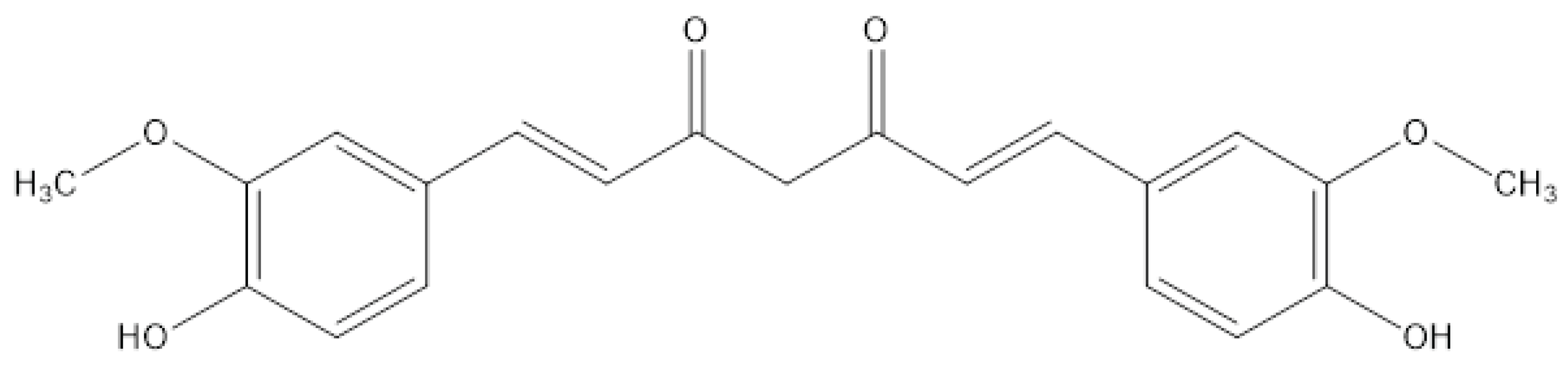
Figure 2.
Major biological properties and pathways of Curcumin (BioRender).
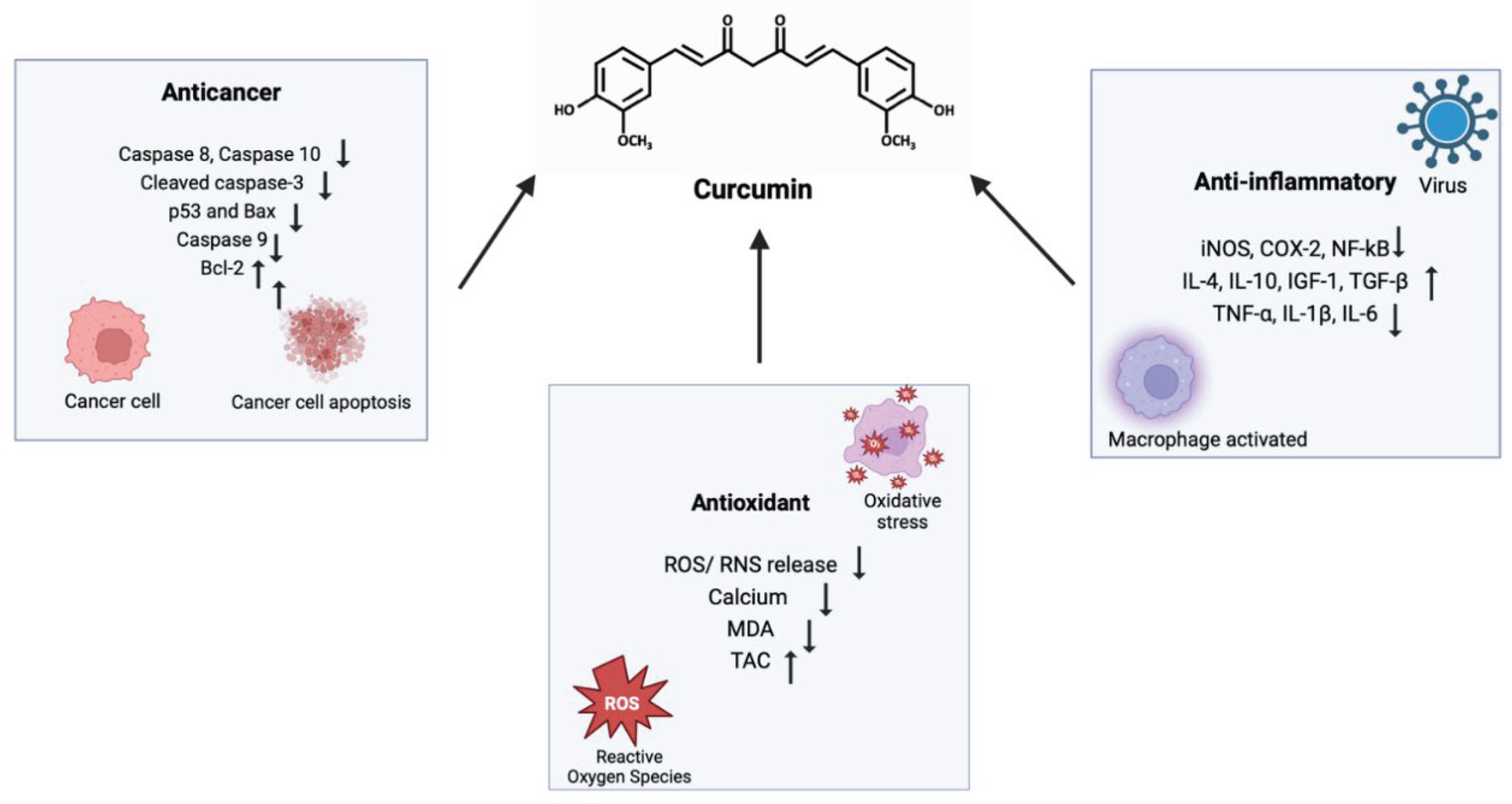
Scheme 1.
Structural analogues of Curcumin (1-8).
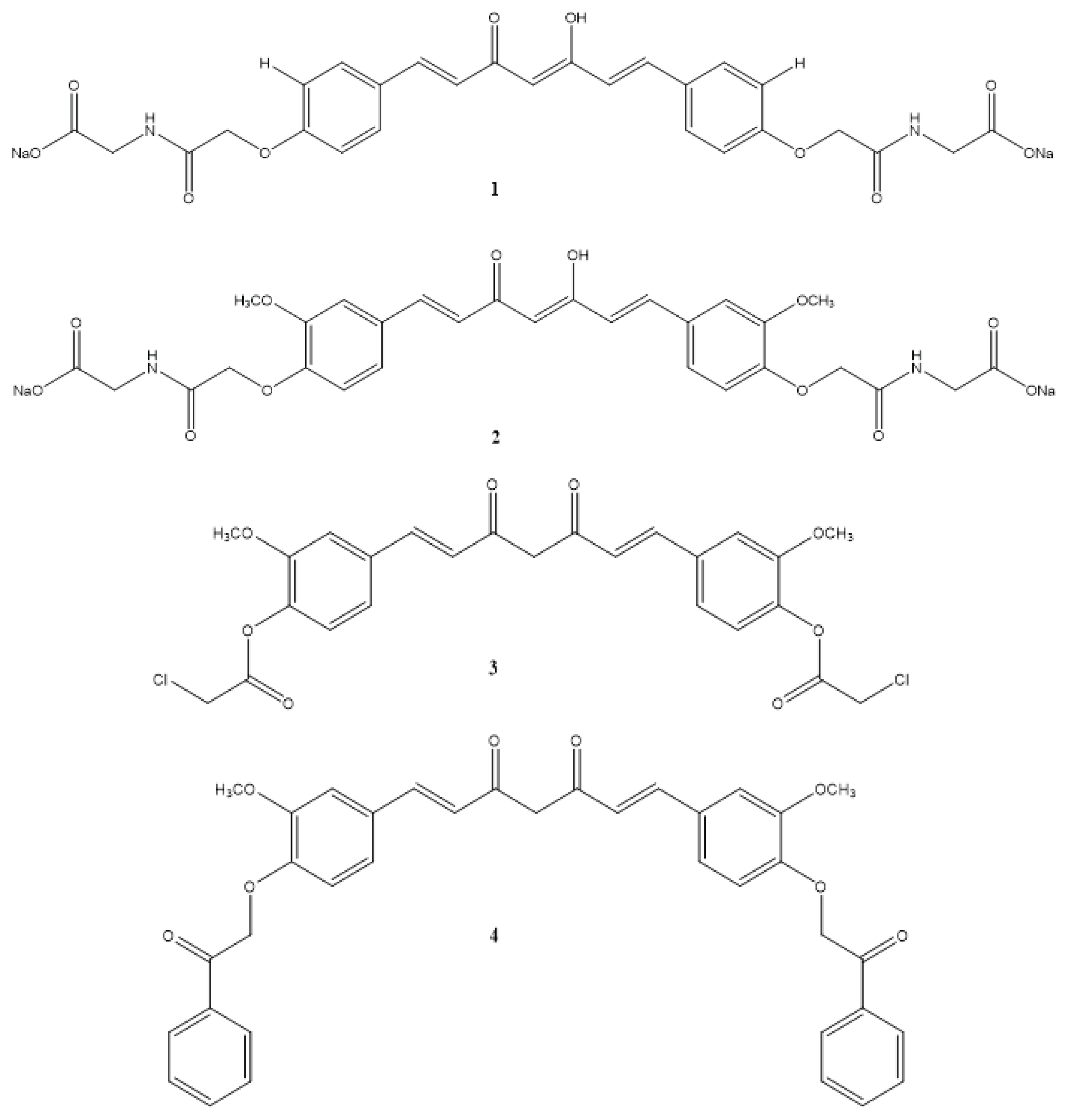
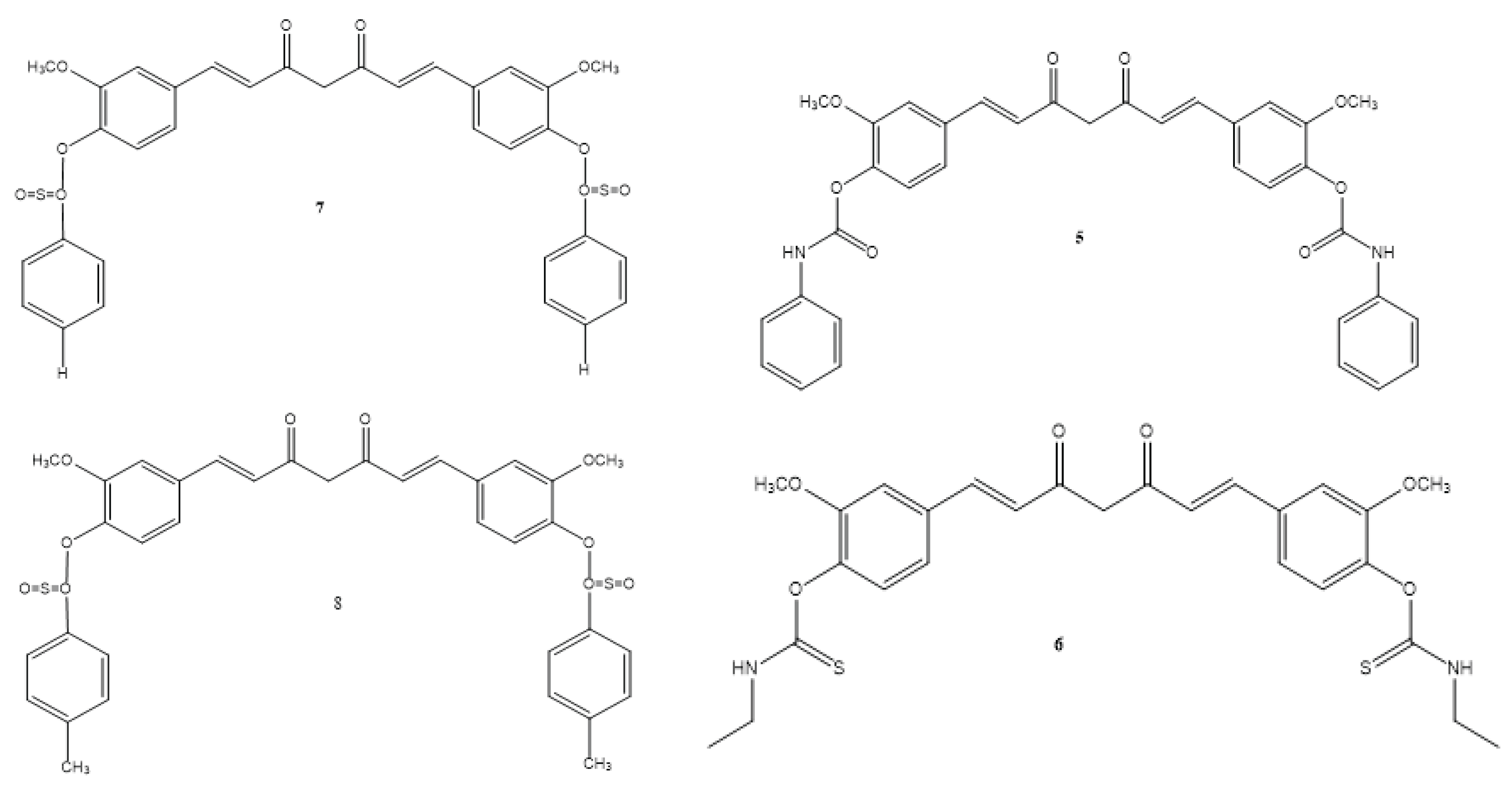
Table 1.
Biological activities of curcumin analogues - Anticancer, Antioxidant and Anti-inflammatory.
Table 1.
Biological activities of curcumin analogues - Anticancer, Antioxidant and Anti-inflammatory.
| Compound(s) | Biological Activity | Cell line tested (IC50 value - uM) | References | ||
|---|---|---|---|---|---|
| Antioxidant | Anticancer | Anti-inflammatory | |||
| 1 | – | + | – | HeLa - 0.5 ± 0.003 | Banuppriya et al.,2018 |
| 2 | – | + | – | HeLa - 0.5 ± 0.005 | Banuppriya et al.,2018 |
| 3 | + | – | + | Not reported | El-Gazzar et al., 2016 |
| 4 | + | – | + | Not reported | El-Gazzar et al., 2016 |
| 5 | + | – | + | Not reported | El-Gazzar et al., 2016 |
| 6 | + | – | + | Not reported | El-Gazzar et al., 2016 |
| 7 | + | – | + | Not reported | El-Gazzar et al., 2016 |
| 8 | + | – | + | Not reported | El-Gazzar et al., 2016 |
| 9 | – | + | + | MDA-MB-231 - 2.67 ± 0.18 HCT-116 - 3.91 ± 0.27 PC-3 - 3.90 ±0.08 |
Hsieh et al., 2017 |
| 10 | – | + | – | A549 - 23.9 ± 2.5 MCF-7 - 36.2 ± 1.99 SKOV3 - 12.8 ± 0.21 H460 - 21.75 ± 0.55 |
Raghavan et al., 2015 |
| 11 | + | + | – | SKOV3 - 5.58 ± 2.0 | Ciochina et al., 2014 |
| 12 | + | + | – | SKOV3 - 3.51 ± 0.74 | Ciochina et al., 2014 |
| 13 | + | + | – | H460 - 3.4 ± 0.84 RH460 - 2.6 ± 0.25 K562 - 6.3 ± 0.95 K562 Doxorubicin - 2.73 ± 0.61 |
Rodrigues et al., 2017 |
| 14 | – | + | – | Hep G2 - 0.31 LX-2 - 0.62 SMMC-7721 - 0.81 MDA-MB-231 - 0.52 |
Cao et al., 2014 |
| 15 | – | + | – | HT29 - 41.56 | Rao et al., 2014 |
| 16 | – | + | – | MCF-7 - 0.51 Hep G2 - 0.58 LX-2 - 0.63 3T3 - 0.79 |
Feng et al., 2015 |
| 17 | – | + | – | MCF-7 | Kanwar et al., 2011 |
| 18 | – | + | – | Not reported | Lien et al., 2015 |
| 19 | – | + | – | Hep G2 - 23 | Borik et al., 2018 |
| 20 | – | + | – | MCF-7 | Borik et al., 2018 |
| 21 | – | + | – | Caco-2 - 7.8 HT-29 - 4 EA.hy926 - 3.3 |
Vreese et al., 2016 |
| 22 | – | + | – | GBM - 0.87 GBM2 - 1.43 GBM3 - 1.45 GBM4 - 1.26 GBM5 - 0.92 GBM6 - 2.32 U373 MG - >5 U87 MG - 0.38 U251 MG - 0.33 |
Hacker et al., 2016 |
| 23 | – | + | – | Not reported | Tu et al., 2017 |
| 24 | – | + | – | K562 | Fan et al., 2017 |
| 25 | – | – | – | Not reported | Wu et al., 2015 |
| 26 | – | + | – | DLD-1 - 5.063 ± 0.09 | Rišiaňová et al., 2017 |
| 27 | – | + | – | DLD-1 - 5.101 ± 0.11 | Rišiaňová et al., 2017 |
| 28 | – | + | – | DLD-1 - 5.064 ± 0.12 | Rišiaňová et al., 2017 |
| 29 | – | + | – | MCF-7 - 1.5 ± 0.7 | Sirvastava et al., 2016 |
| 30 | – | + | – | MDA-MB-231 - 5.37 MDA-MB-231 - 2.67 Doxorubicin-resistant MDA-MB-231 - 5.70 |
Chui et al., 2021 |
| 31 | – | + | – | Not reported | Lu et al., 2023 |
| 32 | – | + | – | 22RV1 cells 48 h - 8.791 72 h - 8.516 |
Gong et al., 2024 |
| 33 | + | – | – | Not reported | Zarei et al., 2024 |
| 34 | + | – | – | Not reported | Zarei et al., 2024 |
| 35 | + | – | – | 1.92 (%) | Zarei et al., 2024 |
| 36 | – | + | – | SUM149 - 11.20 MDA-MB-231 - 18.00 |
Yin et al., 2022 |
| 37 | – | + | – | MDA-MB-231 - 0.52 | Yin et al., 2022 |
| 38 | – | + | – | MCF-7 - 73.4 | Yin et al., 2022 |
| 39 | – | + | – | MDA-MB-231 - EC50 - 0.42 | Yin et al., 2022 |
| 40 | – | + | – | MDA-MB-231 - EC50 - 0.78 | Yin et al., 2022 |
| 41 | – | + | – | MCF-7 | Yin et al., 2022 |
| 42 | – | + | – | SUM149 - 13.50 MDA-MB-231 - 15.00 |
Yin et al., 2022 |
| 43 | – | + | – | MCF-7 - 13.10 MCF-7R - 12.00 |
Yin et al., 2022 |
| 44 | – | + | – | MCF-7 - 2.56 MDA-MB-231 - 3.37 |
Yin et al., 2022 |
| 45 | – | + | – | MCF-7 - 34.99 | Yin et al., 2022 |
| 46 | – | + | – | MCF-7 - 5.80 | Yin et al., 2022 |
Disclaimer/Publisher’s Note: The statements, opinions and data contained in all publications are solely those of the individual author(s) and contributor(s) and not of MDPI and/or the editor(s). MDPI and/or the editor(s) disclaim responsibility for any injury to people or property resulting from any ideas, methods, instructions or products referred to in the content. |
© 2024 by the authors. Licensee MDPI, Basel, Switzerland. This article is an open access article distributed under the terms and conditions of the Creative Commons Attribution (CC BY) license (http://creativecommons.org/licenses/by/4.0/).
Copyright: This open access article is published under a Creative Commons CC BY 4.0 license, which permit the free download, distribution, and reuse, provided that the author and preprint are cited in any reuse.


