

Submitted:
18 March 2024
Posted:
19 March 2024
You are already at the latest version
Abstract
Global warming, exacerbated by greenhouse gas emissions from non-green product manufacturing, necessitates a shift towards green production to safeguard ecosystems and finite resources. The United Nations Environment Programme emphasizes the importance of environmental considerations in corporate ESG criteria. Despite the higher costs of designing and manufacturing green products, which deter some companies and lead to greenwashing, efforts persist to promote sustainable goods. This study explores enhancing consumer repurchase intentions for green products through social media marketing, emphasizing green values, environmental concerns, brand image, and involvement. Findings reveal social media's role in boosting these factors, thus encouraging green repurchases. Insights are valuable for green businesses, social media groups, environmental agencies, and future research.
Keywords:
Social media marketing activities
; green values
; environmental concerns
; brand image
; brand involvement
; repurchase intention
1. Introduction
The effects of global warming include: polar melting, sea level inundation of low-lying coastal lands, global climate change, resulting in heavy rains, droughts and even desertification [1,2]. Global warming threatens the ecosystem, food chain, water resources, human activities and life safety [3,4]. The main cause of warming is the emission of greenhouse gas, especially direct or indirect human emissions of carbon dioxide [5]. Carbon Brief, an organization that studies climate change, points out that most of the greenhouse gas emissions come from the combustion process of fossil energy and the manufacturing process of non-green products [6,7,8]. To provide for the diverse needs of the world’s 8 billion people, climate and environmental quality pay a heavy price. One of the main culprits is non-green products, so it is very important to promote green products. Green products are products that require less physical resources to manufacture [9] and energy [10]. After the product is sold to the consumer, it will eventually go back to the producer [11]. The design must prohibit or restrict the use of toxic substances, consider the recyclability of waste, the proportion of recycling, durability, and maintainability [12,13]. In order to promote the production and sale of green products to reduce the carbon emissions of enterprises and the impact of production lines on the environment, as well as to improve energy efficiency, the United Nations Environment Programme (UNEP) released Who cares wins. The report mentions that operators or investors should not be obsessed with profit while ignoring their responsibilities. It is also clearly pointed out that companies should pay attention to ESG, which are Environmental Protection, Social Responsibility and Corporate Governance [14]. Among them, environmental protection includes the norms to be considered in the design and manufacture of green products.
Although the United Nations Environment Programme (UNEP) and various environmental NGOs around the world have called for and promoted the production and marketing of green products [15,16]. However, the study also pointed out that the proportion of consumers actually buying green products is still not high [17]. For example, Park and Lin [18] pointed out that many consumers have a positive attitude towards green, sustainable products, and their consumer awareness has indeed increased. Also, Tanuwijaya and Balqiah [19] discovered that even though the Indonesian government has enacted regulations to reduce the price and tax rate of EVs, and consumers have high expectations for reducing air pollution, there has been no significant improvement in the penetration of EVs in Indonesia. There are many more studies providing similar results [20,21,22]. There are even some companies or organizations that invest a lot of money in image advertising in the name of environmental protection, instead of investing resources in the design and manufacture of green products, in order to meet the requirements of environmental regulations or just to meet the environmental awareness of consumers. This phenomenon is known as Greenwashing [23,24]. These studies show that ESG’s focus on sustainable corporate development, rising consumer awareness, and governmental environmental regulations are leading companies to transform their production of green goods. However, the design and manufacturing of green goods require higher costs, and higher costs will inevitably lead to higher prices and lower product competitiveness. In order to prevent enterprises from being reluctant to switch to green goods production due to higher costs, or to make greenwashing behavior in order to meet the requirements of environmental protection regulations, the most direct solution is to Increase consumers’ purchasing behavior of green goods, which in turn increases enterprises’ willingness to produce green goods, make enterprises, consumers and environmental protection win-win.
The Theory of Planned Behavior (TPB) proposed by American psychologist Ajzen [25] suggests that an individual’s specific behavior is influenced by his or her behavioral intention. Therefore, this study proposes to enhance the intention to re-purchase green goods according to TPB. Many studies have mentioned how to increase the purchase intention of products. First, Wibowo, et al. [26] empirical study confirms that Social Media Marketing Activity (SMMA) positively and significantly affects consumers’ purchase intention. Many studies have addressed how to increase product purchase intention. First, empirical research confirms that Social Media Marketing Activity (SMMA) positively and significantly affects consumer purchase intention. Sanchez and Lacap [27] showed that the millennials’ green values influence their green purchase intention. Secondly, Sanchez and Lacap [27] stated that the increase in environmental concerns among students of Azad Islamic University of Yazd will increase their attitude towards green products and thus increase their purchase demand for green products. Furthermore, Situmorang [28] mentioned that brand image has a moderating effect on the repurchase intention of green brand positioning goods and green brand attitude. In addition, Aziz and Ahmed [29] suggested that the level of brand involvement of customers affects their brand engagement and through that brand engagement affects their purchase intention of the product.
The mentioned studies show that social media marketing activities, green values, environmental concerns, brand image, and brand involvement are significantly associated with repurchase intention (RI) or purchase intention. Although the mentioned research context is different from the green brand industry, these variables may also have a causal relationship in the green brand industry. Therefore, this study armed the members of social media green product groups in Taiwan as the target population, with social media marketing activities as the independent variable and green values, environmental concerns, brand image, and brand involvement as the mediating variables, to investigate their effects on the repurchase intention of green goods. The research data will be collected through questionnaires, and the results will be analyzed by statistical methods to test whether the research hypotheses are valid. Based on the results of the study, we will provide practical suggestions to the enterprises, relevant organizations and government for promoting green products in Taiwan, as well as references for subsequent related studies.
2. Literature Review
2.1. Social Media Marketing Activities
Al-Rahmi, et al. [30] reviewed several related papers and proposed that social media is defined as an Internet channel used by individuals to communicate, collaborate, and exchange information; social media can be an effective strategy to reach and engage potential consumers, as well as to encourage interaction between companies and consumers and among consumers [31]. In addition, Clark, et al. [32] argue that social media is a type of electronic communication, specific apps, and websites, through which users create and share information, ideas, and personal information in an online community. Social media is considered to be part of integrated marketing communication that provides a platform that allows interaction between like-minded people. Furthermore, Suharto, et al. [33] define social media marketing as the use of social media technologies such as blogs, Facebook, Twitter, Instagram, and Youtube to communicate, deliver, and exchange relevant products and services to the marketing of business interests. To better represent the marketing executed in social media, many studies have proposed social media marketing campaigns [34,35,36]. Ibrahim, et al. [37] define social media marketing activities as those activities that aim to market or promote goods and services through social media. Guha, et al. [38] suggest that social media marketing activities make it easier for social users to interact, collaborate, or share content on an online platform for the purpose of increasing product impressions and sales. In summary, this study defines social media marketing activities as activities that promote various green products through interaction, sharing, and marketing of green products in social media groups.
There are many studies on social media marketing campaigns. First, Almohaimmeed [39] investigated the effect of social media marketing activities on product purchase intention and brand loyalty. The study’s results showed that social media marketing activities significantly impact customer purchase intention and brand loyalty. Secondly, Balakrishnan, et al. [40] studied the effect of social media marketing on the purchase intention of products among Generation Y students in Malaysian universities. The results indicated that social media marketing affects product purchase intention. Among them, online word-of-mouth (IWOM), an observed variable of social media marketing, had the greatest effect on product purchase intention. In other words, social media members’ favorable and unfavorable opinions about products affect the purchase intention of Generation Y students. Furthermore, Moslehpour, et al. [41] investigated the effect of brand trust and brand image on the purchase intention of online car-hailing customers through social media marketing campaigns. The results of the study showed that social media marketing activities influenced purchase intention. The most significant direct effect on purchase intention was found for the subcomponents of social media marketing activities, entertainment, and word of mouth. In addition, social media marketing campaigns indirectly influence customers’ purchase intentions through brand trust and brand image referral effects. According to Olson, et al. [42], Silva, et al. [43], and Aman and Hussin [44], the popularity of social media has become a business strategy because of its high intensity of use and high marketing effectiveness. It is clear that marketing products and services on social media is relatively low-cost and efficient, and is an excellent channel to increase product purchase behavior.
2.2. Green Values
Furchheim, et al. [45] defined green values as the tendency of individuals to express the importance of environmental protection through their purchasing and consumption behaviors. In addition, Hamzah and Tanwir [46] define green values as the moral sense of individuals who respect pro-environmental actions honoring pro-environmental actions and perceive that these actions benefit them by reducing environmental damage and energy costs. Consumers who share green values will try to reduce, avoid or reject consumption that damages the environment [47]. Individuals with higher green values reduce or avoid environmentally harmful products by choosing environmentally friendly alternatives [45,48]; leading simpler lifestyles, and use products for as long as possible before replacing them [49]; and are more aware of the physical and psychological benefits of green products [50]. Hur, et al. [51] further suggest that consumers’ green values increase their satisfaction with goods and reduce their price sensitivity. That is, green values make individuals less concerned about high prices and make producers more willing to produce higher-cost green goods. In summary, this study defines green values as the extent to which members of the green product community media group identify with pro-environmental behaviors, environmentally friendly alternatives, and simple lifestyles.
Studies have shown that marketing environmental or green products on social media affects the green values of social media users. For example, McQueen and Turner [52] examine the factors that influence sustainability and green values among senior managers in UK energy companies. The findings suggest that social media marketing not only influences customers’ green values but also increases managers’ willingness to produce sustainable energy. Secondly, Kane, et al. [53] studied how social media affects users’ purchasing behavior toward green products and services. The results of the study showed that the use of social media affects the users’ green attitudes and green values. Furthermore, Barboza and Filho [54] analyzed the relationship between the use of social media mobile applications and green consumption. The results of the study showed that the green values of social media users are related to the use of social media. In addition, Dabija and Bejan [55] investigated the relationship between millennial consumers’ green values, green tendencies, and green reuse motivations. The study mentions that marketing green products through social media can help promote personal care and attention to nature, adoption of sustainable products, and motivate the purchase of green products. Sanchez and Lacap [27] studied the effect of green product beliefs on green values, attitudes, and green purchase intentions. The study suggests that companies and marketers should use integrated and effective marketing communication strategies to establish green brand positioning in the minds of consumers and that the use of social media marketing is an effective way to communicate corporate green values. The above study revealed that the marketing activities of social media related to green products would influence or contribute to the green values of social media members. Therefore, the following hypotheses are proposed:
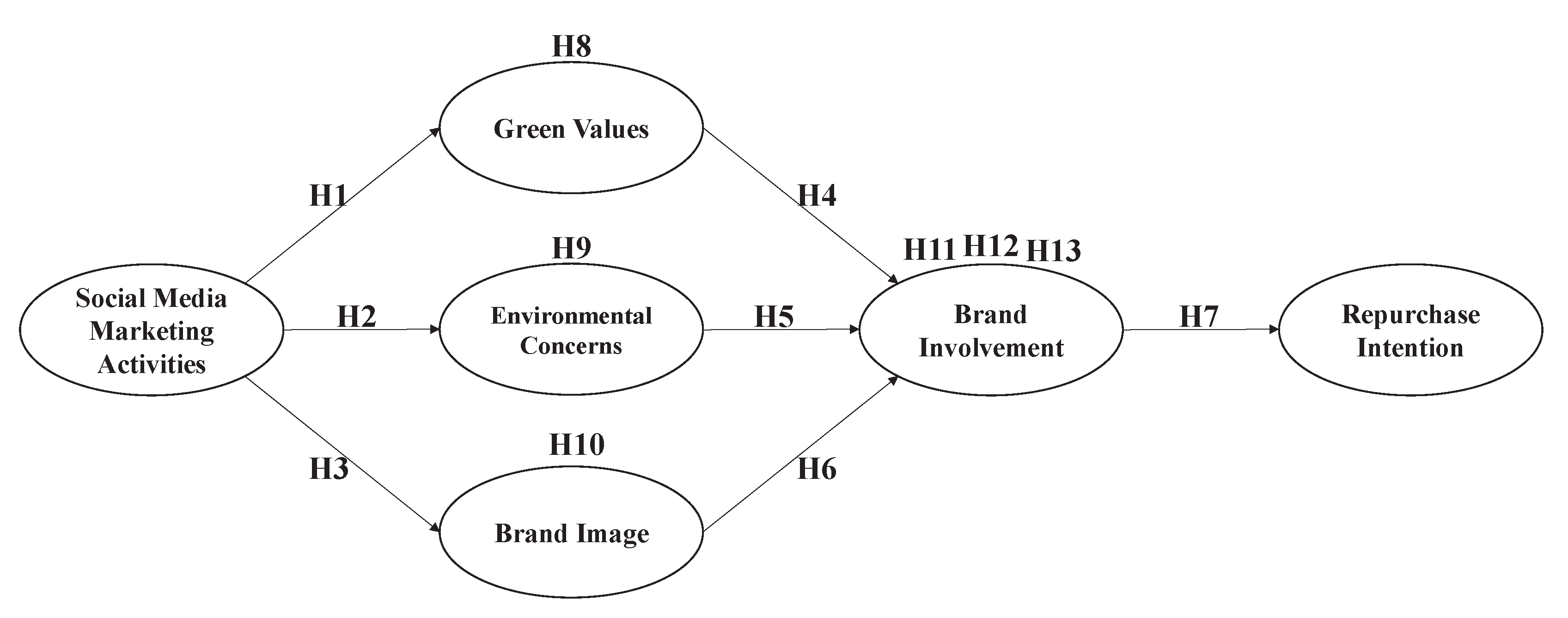
H1: Social media marketing activities positively influence the green values of their members
2.3. Environmental Concerns
Borusiak, et al. [56] defined environmental concern as the degree of concern for the importance of environmental issues, an attitude of concern for eco-friendly behavior, and an environmental concern attitude that will influence their green purchase intention together with Subjective Norm and Perceived Behavioral Control [57,58]. Secondly, Febrianti and Permana [59] defined environmental concern as a tool to identify the purchase behavior of environmentally friendly products and environmental concern is a major factor in the green fee process. Furthermore, Ruslim, et al. [60] defined environmental concern as the degree of emotional involvement in environmental issues. Moreover, environmental concern is an important factor in predicting the purchase of green products [61]; individuals with high environmental concerns tend to purchase products that are environmentally safe [62]. Related studies also mentioned environmental concerns including the following. Balance of Nature, which refers to the individual’s belief that the balance of nature is highly vulnerable to disruption by human activities [63]; Limit to Growth, which refers to the individual’s belief that the resources that exist on Earth are limited [64]; Anti anthropocentrism, which refers to the idea that nature not only satisfies human needs but also the needs of other organisms [65]; anti-exemptionalism, which refers to the belief that human life cannot be separated from the rules and laws of nature [66]; and eco-crisis, which refers to the belief that humans are causing harmful effects on the physical environment. is the belief that humans are causing harmful damage to the physical environment [67]. In summary, this study defines environmental concern as the extent to which members of the green product community media group are concerned about environmental issues including environmentally friendly products, the balance of nature, and ecological crises.
Studies have shown that marketing eco-friendly or green products on social media affects the environmental concerns of social media users. For example, Farhat, et al. [68] investigated how social media influences green purchasing behavior through environmental concerns and ecological concerns. The results showed that social media influences green purchasing behavior through users’ environmental concerns. The study also pointed out that social media marketing must emphasize the benefits of green products to consumers in order to shape green purchasing behavior. Also, social media marketing must be designed to emphasize an environmentally conscious attitude in order to create positive green purchasing behavior among customers. Secondly, Ali, et al. [69] pointed out that social media plays an important role in promoting green products. In particular, social media influences the environmental concerns of young users, including the increased intention for a sustainable environment, which leads to lower carbon emissions. This in turn influences their green purchase intention and green consumption behavior. Furthermore, Sultan, et al. [70] investigated the impact of social media marketing of sustainable green tourism products on the environmental behavior of ecotourism. The results of the study showed that social media marketing content influenced the environmental concerns and attitudes of travelers and made important contributions to responsible environmental behavior. The above study revealed that the marketing activities of social media related to green products would affect or contribute to the environmental concerns of the social media members. Therefore, the following hypotheses are proposed:
H2: Social media marketing activities positively influence the environmental concerns of their members.
2.4. Brand Image
Shafa and Hidayat [71] defined a brand image as the consumer’s perception of a brand, and companies can position their brand image through social media marketing campaigns. Communicating information about a brand or product through social media not only allows consumers to directly engage in marketing activities but also strengthens consumers’ image of a particular brand [72]. Secondly, Deniz and Onder [73] defined brand image as a set of perceptions about a brand that consumers reflect through brand associations. The study also defines green brand image as a brand perception associated with environmental commitment and environmental concern in the minds of consumers. Green brand image is more important for companies, especially in areas where consumers are environmentally conscious [74]. Further, Bashir, et al. [75] defined green brand image as a set of brand perceptions related to environmental issues and commitments in the minds of consumers. Chen [76] stated that in the context of green marketing, a green brand image is defined as a set of impressions, concepts, and considerations of a brand in the memory of customers. A green brand image is associated with sustainability and eco-friendly concerns [77]. In summary, this study defines brand image as the perception of a green product brand by members of the green product community media group, including the brand’s perceived level of environmental commitment and environmental concern.
Studies show that marketing products on social media affects the brand image of social media users. For example, Sanny, et al. [78] analyzed the effect of social media marketing on brand image, brand trust, and product purchase intention. The results of the study showed that social media marketing had a significant effect on brand image and brand trust. In addition, brand image and brand trust also had a significant effect on product purchase intention. Secondly, Jasin [79] studied the effect of social media marketing and Internet word of mouth on purchase intention through brand image. The results demonstrated that social media marketing had a positive and significant effect on brand image; the brand image had a positive and significant effect on purchase intention. Social media marketing positively and significantly influenced purchase intention through brand image referral. Furthermore, Putra and Aprilson [80] analyzed the effect of social media marketing on brand image and purchase intention of the hotel industry. The results of the study showed that social media marketing had a positive and significant effect on brand image; the brand image had a positive and significant effect on purchase intention; and social media marketing had a positive and significant effect on purchase intention through the intermediary effect of brand image. The above study revealed that the marketing activities of social media related to green products would affect or contribute to the brand image of green products. Therefore, the following hypotheses are proposed:
H3: Social media marketing activities positively influence the brand image of their members.
2.5. Brand Involvement
Zaichkowsky and Simpson [81] defined Involvement Involvement as the degree of perceived relevance of an object based on needs, values and interests. Brand involvement occurs when the object is a brand. Thus, brand involvement is defined as the perception of brand relevance [82]. Secondly, Wang, et al. [83] define brand involvement as the propensity of individuals to purchase specific branded products and the extent to which they associate with connections. The concept is similar to brand commitment [84]. Yu, et al. [85] suggest that brand involvement is an emotion that influences consumers’ reactions to a brand or product. The study mentioned that consumers are usually reluctant to be the first to try a new product, especially if the product is expensive. Therefore, it is necessary for marketers to build customer involvement with a brand in order to stimulate consumer buying behavior. Furthermore, Chowdhury and Khare [86] define brand involvement as the extent to which consumers expect and recognize the current brand product; for example, a particular brand is purchased because of its ease of use, good quality, unique design, or efficient functionality. In summary, this study defines brand involvement as the extent to which members of a green product social media group purchase a specific green brand product or perceive the relevance of a specific green product brand based on their needs, values, and interests.
The study suggests that consumers’ green values affect their brand involvement in green products. For example, Khare, et al. [87] investigated the impact of pro-environmental clothing product brand involvement, organic clothing knowledge, and materialistic materialism on the willingness of Indian consumers to purchase organic apparel. The study mentioned that consumers’ commitment to green values was associated with pro-environmental apparel brand involvement. Secondly, Rizomyliotis, et al. [88] investigated the effect of green consumption values on green brand loyalty and brand-related factors. The study mentioned that green consumption values help to enhance the product involvement of green brands. Furthermore, in order to understand the relationship between the implementation of green policies by the Macau government and the actual level of participation in green activities, Wong, et al. [89] analyzed the influence of green values of green activity participants on green consumption. In this study, it was mentioned that people’s green consumption values were related to their level of involvement in green products. The above study shows that green values or green consumer values are related to the brand involvement or product involvement of green products. Therefore, the following hypotheses are proposed:
H4: The green values of social media members positively influence their brand involvement in green products
Studies have shown that consumers’ environmental concerns affect their brand involvement in green products. For example, Huang, et al. [90] studied the relationship between green brand positioning, green brand attitudes, and green purchase intentions. The study found that the more environmentally concerned consumers were, the higher their brand involvement in green products; consumers’ ability to evaluate the products offered by green brands also increased. In other words, the more environmentally concerned consumers are, the more they are involved in environmental issues. Second, Tucker, et al. [91] studied the effect of personal environmental attitudes on green product advertising. The study found that consumers’ personal characteristics, such as their concern for environmental issues, were related to their involvement in green product brand advertisements and influenced their green brand attitudes. Furthermore, Baiquni and Ishak [92] analyzed the effect of green branding factors on the purchase intention of green products. The study mentioned that as consumers become more environmentally conscious and concerned, their involvement in green products will increase and their attitude will be more positive, which will in turn affect their purchase intention of green products. The above study revealed that environmental concerns are related to the brand involvement of green products or their brand advertising. Therefore, the following hypotheses are proposed:
H5: The environmental concerns of social media members positively influence their brand involvement in green products
Related studies have pointed out that the brand image of green products will affect consumers’ brand involvement in green products. For example, Bouhlel, et al. [93] studied the influence of brand personality on consumer decisions. The results showed that brand image is related to brand involvement. Secondly, Srivastava and Kamdar [94] investigated the relationship between brand image formation and consumers’ involvement in the brand. The results of the study indicated that the higher the consumer’s involvement in the brand, the more consistent their brand image profile is and there is a correlation between the two. Furthermore, Gorgulu [95] investigates how digital influencers can help companies market their brand image, and brand involvement, and increase consumer loyalty through Instagram. The results of the study show that when brand image increases, brand involvement also increases. The above study shows that brand image is related to brand involvement. Therefore, the following hypotheses are proposed:
H6: The brand image of green products positively influences social media members’ brand involvement in green products
2.6. Repurchase Intention
The Theory of Planned Behavior (TPB), proposed by Ajzen [96], suggests that a person’s behavior can be predicted by Behavioral Intention. Behavioral intention is defined as an individual’s perception of performing a specific behavior [97]. Balla, et al. [98] defined repurchase intention as the extent to which an individual perceives to repurchase the specified products [99,100], services [101,102] from the same company, considering the current possibilities. Herjanto and Amin [103] defined repurchase intention as the likelihood of self-reported future repurchase behavior by customers. From the perspective of online purchases, Ali and Bhasin [104] define repurchase intention as the subjective probability that an individual will continue to purchase a product from an online vendor or store in the future. Further, from the customer’s perspective, repurchase intention may be a result of the customer’s attitude and commitment to repurchase a specific product [105]. In addition, Amoako, Kutu-Adu, Caesar and Neequaye [105] defined green purchase intention as the degree of likelihood and willingness of environmentally conscious consumers to choose products that are more environmentally friendly than conventional products. In summary, this study defines the likelihood and willingness of social media group members to repurchase green products from the same company.
Studies have shown that consumers’ brand involvement in products affects their repurchase intentions. For example, Smith, et al. [106] investigated the influence of online and offline purchases and the impact of fashion brand involvement and online brand involvement on the purchase intention of social media products. The results of the study showed that online brand involvement directly influenced the purchase intention of social media products. The pre-purchase influence was also found to influence product purchase intention through the mediating effect of fashion brand involvement. Secondly, the aforementioned study Bouhlel, Mzoughi, Hadiji and Slimane [93] also mentioned the purchase moderation effect of brand involvement; Martín-Consuegra, et al. [107] had similar results. Furthermore, Hanzaee and Taghipourian [108] investigated the effect of brand credibility and prestige on consumers’ purchase intention at different levels of product involvement. The findings suggest that product involvement affects product repurchase intention through brand credibility and prestige. The above study shows that the brand involvement of the product affects the purchase intention of the product. Therefore, the following hypotheses are proposed:
H7: The brand involvement of social media members positively influences their repurchase intention
In summary, this study also concluded that social media marketing activities affect brand involvement through the mediating effects of green values, environmental concerns, and brand image. Moreover, green values, environmental concerns, and brand image will affect their repurchase intention through the mediating effect of brand involvement. Therefore, the following mediating hypotheses are proposed:
H8: Green values mediate the relationship between social media marketing activities and brand involvement
H9: Environmental concerns mediate the relationship between social media marketing activities and brand involvement
H10: Brand image mediates the relationship between social media marketing activities and brand involvement
H11: Brand involvement mediates the relationship between green values and repurchase intention
H12: Brand involvement mediates the relationship between environmental concerns and repurchase intention
H13: Brand involvement mediates the relationship between brand image and repurchase intention
3. Methodology
3.1. Conceptual Framework
In this study, repurchase intention was used as the dependent variable, social media marketing activities as the independent variable, and green values, environmental concern, brand image, and brand involvement as the mediating variables to investigate their effects on the repurchase intention of green products. Based on the literature review, the conceptual framework of this study is drawn as Figure 3-1.
Figure 3-1.
Conceptual Framework.
3.2. Research Subjects and Data Collection
This study investigates the repurchase intention factors of members of social media green product groups in Taiwan. The survey was conducted by means of an online electronic questionnaire, and research data were collected. The period of distribution is 2022/11/01~2022/11/30, a total of xx questionnaires were collected. After removing invalid questionnaires, the total number of valid questionnaires is xx. According to Creative Research Systems [109], with a statistical confidence level of 95% and a confidence interval of 5%, for the total population of Taiwan, a sample size of 384 was required. The sample for this study met the requirement.
3.3. Measurement
The scale investigated the basic personal information of the study subjects, including gender, marriage, education level, and monthly income. A five-point Likert scale was also used to measure their opinions on all study variables ranging from strongly disagree (1) to strongly agree (5). After the scale questions were designed, experts and scholars were invited to review the questions and give their opinions.
3.3.1. Social Media Marketing Activities Scale
The social media marketing campaign scale was referenced to the same constructs of the Wibowo, Chen, Wiangin, Ma and Ruangkanjanases [26] and Ebrahim [110] studies. Both studies categorize social media marketing activities into five subcomponents: entertainment, interaction, trending, customization, and word-of-mouth, based on Kim and Ko [34]. Among them, Wibowo, Chen, Wiangin, Ma and Ruangkanjanases [26] investigated the effect of social media marketing activities and customer experience on purchase intention. Ebrahim [110] examined the impact of social media marketing campaigns on brand loyalty through brand trust and brand equity. The social media marketing activity scale was adapted to the context of this study to include questions such as “I buy green products on social media because the content is interesting”, “I buy green products on social media because it allows me to share information with others”, and “I am willing to pass on information about green brands and green products/services on social media to my friends”. A total of eleven items were developed.
3.3.2. Green Values Scale
The green values scale refers to Dumont, et al. [111] individual green values and Chou [112] personal environmental norms scale. In this study, the green values scale was adapted to the study context to include questions such as “I feel obligated to conserve energy as much as possible”, “I feel morally obligated to conserve energy regardless of what others do”, and “I should do my best to reduce energy use”. A total of five items were developed.
3.3.3. Environmental Concern Scale
The environmental concern scale was referenced from Pattanapomgthorn, et al. [113] and Yadav and Pathak [114] for the same construct name environmental concern scale. In this study, the environmental concern scale was adapted to the study context to include questions such as “When humans interfere with nature, there are often disastrous consequences”, “Humans must live in harmony with nature in order to survive”, and “Humans are seriously abusing the environment”. A total of five items were developed.
3.3.4. Brand Image Scale
The brand image scale was referenced from Gómez-Rico, et al. [115] and Gomez, et al. [116] for the same construct name brand image scale. In this study, the brand image scale was modified according to the study context to include questions such as “I think green brand products have high quality”, “I think green brand products have high competitiveness” and “I think green brand products are attractive”. A total of five items were developed.
3.3.5. Brand Involvement Scale
The brand involvement scale was referenced from Duong, et al. [117] and Leckie, et al. [118] for the same construct name brand involvement scale. In this study, the brand involvement scale was adapted to the study context to include questions such as “I think I must buy green brand products because of my personal attitude”, “I think I must buy green brand products because of my personal values” and “When buying a product, I think it is very important that the product is a green brand”. A total of five items were developed.
3.3.6. Repurchase Intention Scale
The repurchase intention scale was referred to Ali and Bhasin [104] and Tandon, et al. [119] for the same construct name repurchase intention scale. In this study, the repurchase intention scale was adapted to the study context to include questions such as “I intend to continue buying green brand products”, “I intend to give preference to green brand products in my future purchases”, and “I intend to recommend green brand products to others. A total of five items were developed.
3.4. Data Analysis
In this study, the questionnaires were analyzed, descriptive statistics and inferential statistics were examined by SPSS 23.0 for the valid samples collected. The data analysis methods include the frequency distribution analysis, the distribution and percentage of the number of times the sample was obtained by gender, marriage, education level, and month. Then, the mean and standard deviation of each component will be calculated to understand the degree of concentration of each variable. After that, the reliability analysis of the questions and constructs will be examined through the confirmatory factor analysis. The convergent and discriminate validity will be tested. Finally, the structural equation modeling will be conducted to examine the modal fit, the direct effect, and the mediating effects, respectively.
4. Results
4.1. Descriptive Analysis
The gender of the respondents was mainly male 292 people accounted for 66.7%; the marriage was mainly married 347 people accounted for 79.2%; the education level was mainly graduate school and above 317 people accounted for 72.4%; the monthly income was 70,001 and above 304 people accounted for 69.4%, as shown in Table 1.

Table 1.
Frequency distribution.
| Category | Label | Frequency | Percentage |
|---|---|---|---|
| Gender | Female | 146 | 33.3 |
| Male | 292 | 66.7 | |
| Marriage | Married | 347 | 79.2 |
| Unmarried | 91 | 20.8 | |
| Education level | University | 104 | 23.7 |
| Master’s degree and above | 317 | 72.4 | |
| Junior college | 17 | 3.9 | |
| Monthly income | 30,000 and below | 10 | 2.3 |
| 30,001-50,000 | 52 | 11.9 | |
| 50,001-70,000 | 72 | 16.4 | |
| 70,001 and above | 304 | 69.4 |
4.2. Structural Equation Modeling
4.2.1. Measurement Model Test
1. Convergent Validity
According to Anderson and Gerbing [120], a complete Structural Equation Model (SEM) analysis should be divided into at least two stages, with the first stage consisting of the Measurement Model and the second stage followed by the evaluation of the Structural model. Confirmatory Factor Analysis (CFA) is equivalent to measurement model evaluation and is part of Structural Equation Model (SEM) analysis. The evaluation and reduction of the number of CFA measurement models in this study were modified according to the two-stage model proposed by Kline [121]. If the measurement model fit is acceptable, the complete SEM model report can be performed next. The measurement model was estimated using the Maximum Likelihood Estimation (MLE) method, and the estimated parameters included factor loadings, reliability, convergent validity, and discriminant validity. Table 4-2 provides the standardized factor loadings, composite reliability, and Average Variance Extracted (AVE). According to Fornell and Larcker [122] criterion for convergent validity: First, standardized factor loading for each variable is higher than 0.50. Second, composite reliability is higher than 0.60. Third, Average Variance Extracted is higher than 0.50.
As shown in Table 2, the standardized factor loadings ranged from 0.549-0.942, all of which were within a reasonable range, indicating that each question had reliability. The composite reliability of the constructs ranged from 0.858 to 0.939, all of which exceeded 0.7 and met the criteria suggested by Nunnally [123], indicating that the six constructs were internally consistent. Finally, the AVE range was 0.552-0.756, all above 0.5, which is in line with the criteria of Hair and Anderson [124] and Fornell and Larcker [122], indicating that the constructs have good convergent validity.
Table 2.
Convergent validity.
| Constructs | Standardized Factor Loading | Composite Reliability | Average Variance Extracted |
|---|---|---|---|
| Social Media Marketing Activities Green Values |
0.701-0.835 | 0.934 | 0.564 |
| 0.603-0.827 | 0.858 | 0.552 | |
| Environmental Concern | 0.549-0.886 | 0.893 | 0.632 |
| Brand Image | 0.747-0.817 | 0.896 | 0.633 |
| Brand Involvement | 0.764-0.929 | 0.928 | 0.722 |
| Repurchase Intention | 0.824-0.942 | 0.939 | 0.756 |
2. Discriminant Validity
In this study, discriminant validity was examined by applying the rigorous AVE method. Fornell and Larcker [122] suggested that discriminant validity should also consider the relationship between convergent validity and construct correlation, and therefore suggested that the square root of AVE for each construct should be greater than the correlation coefficient between the constructs, which indicates that the model has discriminant validity. As shown in Table 3, the root square of AVE for each diagonal component of this study is greater than the off-diagonal correlation coefficient, thus this study has discriminant validity.
Table 3.
Discriminant validity for the measurement model.
| AVE | SMMA | GV | EC | BI | BV | RI | |
|---|---|---|---|---|---|---|---|
| SMMA | 0.564 | 0.751 | |||||
| GV | 0.552 | 0.476 | 0.743 | ||||
| EC | 0.632 | 0.295 | 0.664 | 0.795 | |||
| BI | 0.633 | 0.674 | 0.469 | 0.305 | 0.796 | ||
| BV | 0.722 | 0.540 | 0.595 | 0.534 | 0.667 | 0.850 | |
| RI | 0.756 | 0.555 | 0.469 | 0.336 | 0.624 | 0.719 | 0.869 |
Note: SMMA=Social Media Marketing Activities; GV=Green Values; EC= Environmental Concern; BI=Brand Image; BV=Brand Involvement; RI=Repurchase Intention. Note: The items on the diagonal on bold represent the square roots of the AVE; off-diagonal elements are the correlation estimates.
4.2.2. Structural Model Test
1. Goodness-of-Fit
The Goodness-of-Fit indices in this study are based on the 194 SSCI papers examined by Jackson, et al. [125] as a blueprint for applying analysis. The nine most widely used indices are used to examine the Goodness-of-Fit. Since the SEM sample is larger than 200, the cardinality value is too large, resulting in poor fit, so the fit value should be corrected by Bootstrap method [126]. The results of the Bollen-Stine Bootstrap modified Goodness-of-Fit are shown in Table 4. After the modified Goodness-of-Fit, all the fit indicators of this study passed, indicating that the results of this study are acceptable.
Table 4.
Goodness-of-Fit.
| Fit Indices | Allowable range | Fitness | Model Adaptation |
|---|---|---|---|
| Chi-square | 763.082 | ||
| Degree of freedom | 587 | ||
| CFI | >.9 | 0.987 | Passed |
| RMSEA | <.08 | 0.026 | Passed |
| TLI | >.9 | 0.986 | Passed |
| GFI | >.9 | 0.945 | Passed |
| NFI | >.9 | 0.945 | Passed |
| χ2/df | <3 | 1.300 | Passed |
| AGFI | >.8 | 0.937 | Passed |
2. Path Analysis
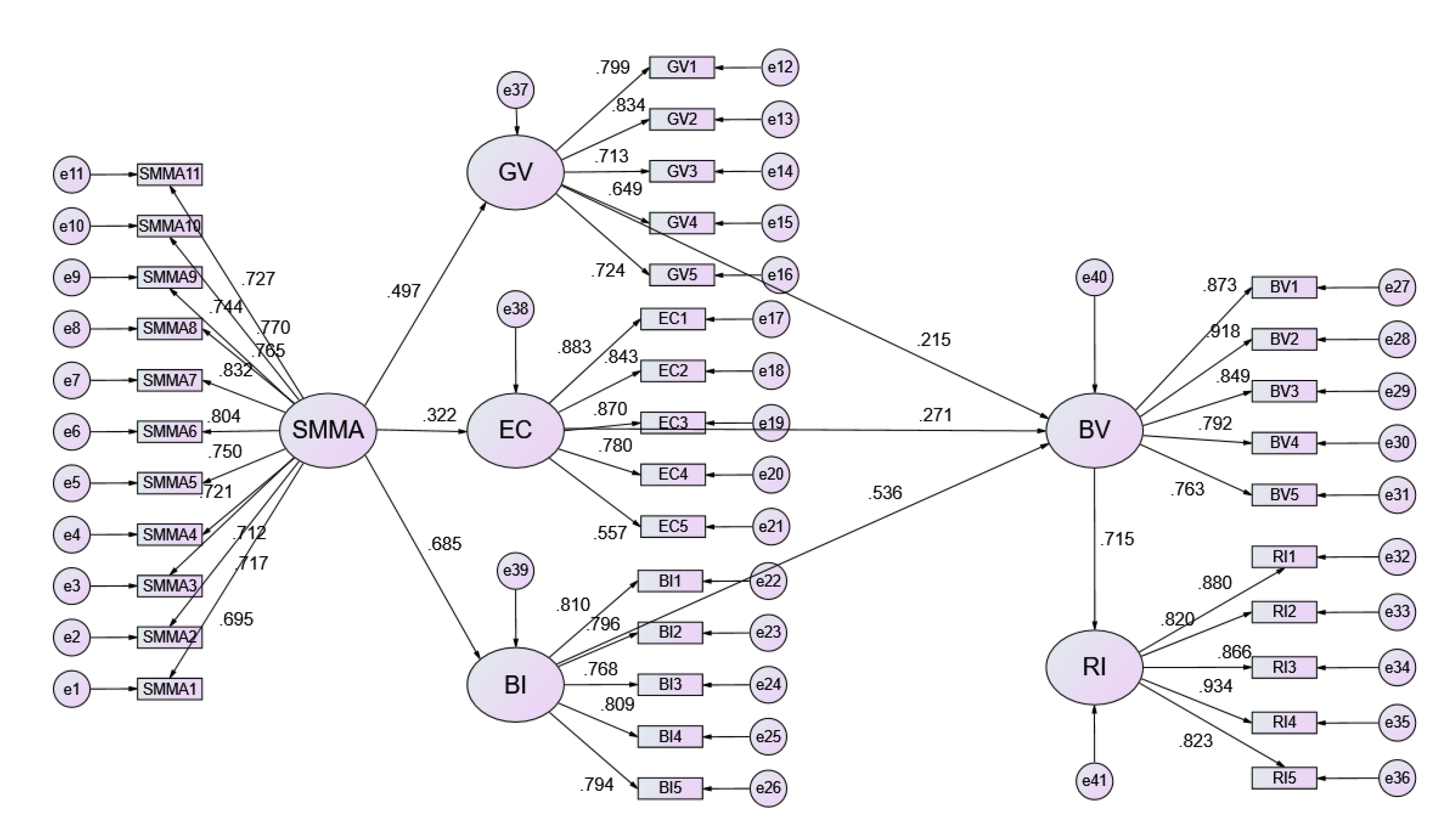
The results of the path coefficients can be seen in Table 5. Social media marketing activities (b=0.390, p<0.05) significantly influenced green values. Social media marketing activities (b=0.359, p<0.05) significantly influenced environmental concerns. Social media marketing activities (b=0.743, p<0.05) significantly influenced brand image. Green values (b=0.302, p<0.05) significantly influenced brand involvement. Environmental concern (b=0.268, p<0.05) significantly influenced brand involvement. Brand image (b=0.545, p<0.05) significantly influenced brand involvement. Brand involvement (b=0.645, p<0.05) significantly influenced repurchase intention. The results of the study support the research questions of the model. Social Media Marketing Activities can explain 24.7% of Green Values. Social Media Marketing Activities can explain 10.3% of Environmental Concerns. Social Media Marketing Activities can explain 47.0% of Brand Image. Green Values, Environmental Concerns, and Brand Image can explain 56.8% of Brand Involvement. Brand Involvement (BV) can explain 51.1% of Repurchase Intention.
Figure 4-1.
SEM statistical model diagram.
4.2.3. Structural Model Test
The indirect effect of Social Media Marketing Activities→Green Values→Brand Involvement, P<0.05, and the confidence interval does not contain 0 [0.018 0.224], which means that the indirect effect holds. Social Media Marketing Activities→Environmental Concern→Brand Involvement P<0.05, the reliance interval does not contain 0 [0.028 0.175], indicating that the indirect effect holds. Social Media Marketing Activities→Brand Image→Brand Involvement, P<0.05, and the reliance interval does not contain 0 [0.319 0.509], indicating that the indirect effect holds. Green Values→Brand Involvement→Repurchase Intention, p<0.05, the reliance interval does not contain 0 [0.022 0.416], indicating that the indirect effect holds. Environmental Concern→Brand Involvement→Repurchase Intention, P<0.05, the reliance interval does not contain 0 [0.047 0.273], indicating that the indirect effect holds. Brand Imagen→Brand Involvement→Repurchase Intention, P<0.05, the reliance interval does not contain 0 [0.252 0.485], indicating that the indirect effect holds, as shown in Table 6.
5. Discussion and Conclusion
This study uses social media marketing activities as independent variables and green values, environmental concerns, brand image, and brand involvement as mediating variables to investigate their effects on the repurchase intention of green products. The research model and related direct and indirect hypotheses are proposed. After collecting data from the questionnaire survey, the model was tested and the hypotheses were verified using Structural Equation Modeling
5.1. Theoretical Contributions
After empirical analysis, the results of this study validate that social media marketing activities positively affect the green values of their members; these two direct effects are consistent with the results of previous studies by McQueen and Turner [52] and Kane, Chiru and Ciuchete [53]. In addition, social media marketing activities positively affect the environmental concerns of their members; these two direct effects are similar to the results of previous studies by Farhat, Aslam and El Alfy [68] and Ali, Ullah, Ahmad, Cheok and Alenezi [69]. Furthermore, social media marketing activities positively affect the brand image of green products; these two direct effects are similar to the results of previous studies by Sanny, Arina, Maulidya and Pertiwi [78] and Jasin [79], respectively. The direct hypotheses on brand involvement of green products were examined as follows. First, social media members’ green values positively affect their brand involvement in green products; these two direct effects were found to be the same or similar to the results of previous studies by Khare, Sadachar and Manchiraju [87] and Rizomyliotis, Poulis, Konstantoulaki and Giovanis [88], respectively. Second, the environmental concerns of social media members positively influence their brand involvement in green products; these two direct effects were found to be similar to the findings of previous studies Huang, Yang and Wang [90] and Tucker, Rifon, Lee and Reece [91], respectively. Furthermore, the brand image of green products positively influences consumers’ brand involvement in green products; these two direct effects were found to be similar to the results of previous studies Bouhlel, Mzoughi, Hadiji and Slimane [93] and Gorgulu [95], respectively. In terms of mediating effects, green values, environmental concerns, and brand image mediated the relationship between social media marketing activities and brand involvement. Moreover, brand involvement mediated the effect between green values, environmental concern, brand image, and repurchase intention; all were similar to the results of previous studies.
5.2. Practical Contributions
The results of the study showed that social media marketing activities positively influenced group members’ green values, environmental concerns, and brand image of green products. Green product group members will increase their green values and environmental concerns through various green product marketing and promotion contents of the group, including interactive, cooperative, or sharing activities, and then increase their intention to repurchase green products through the mediation of brand involvement. Therefore, this study proposes the following practical directions to strengthen social media marketing activities, green values, environmental concerns, the brand image of green products, and green brand involvement to increase the repurchase intention of green products.
First, this study proposes to involve green values, environmental concerns, the brand image of green products, and green branding in social media marketing activities. Providing data on the environmental friendliness of green products, the use of no or less non-recyclable raw materials, the confidence of consumers in green products, the manufacturing, design, and raw material compliance, the recycling mechanism at the end of product life, the flat packaging to save on shipping costs, and to let consumers know that companies are committed to reducing carbon emissions. In addition, through the social media video, it promotes respect for nature, enough to replace more, protection of diversity, design according to nature, and consequences of disrespecting nature; and asks members what they think and whether they want to see the sequel. Ask open-ended environmental questions that will start a dialogue. For example, what green products are you most interested in? Invite a friend to a green product event and get an extra bonus. In addition, green product enterprises, community group administrators, and stakeholders must set an example of environmental protection and encourage social media members to engage in environmentally concerned behavior. Through social media marketing activities to strengthen the intention of re-purchasing green products, we not only let the group members consider green and environmental protection as an attitude of life but also promote the concept of coexistence with nature.
Second, recruiting channels in social media. After promoting the company’s commitment to energy saving and environmental protection, and gaining the approval of social media group members, we can recruit like-minded channels. By allowing suppliers who are willing to invest in improving the environment and equipment to join the green supply chain, we may get more orders and more sales. By promoting corporate green initiatives, we can create more business opportunities. More companies will invest in it. In this way, more people will understand that energy saving and environmental protection are not contrary to each other, but rather complementary, thus creating a four-win situation for enterprises, suppliers, consumers, and the environment.
Third, the green enterprise should recruit social media digital influencers and key opinion leaders to help promote green products. Green products can use the charisma and influence of digital influencers and key opinion leaders to create momentum for green brands and achieve marketing goals. The community can first hold a poll to select the green key opinion leaders and invite them to present an easy-to-understand green point of view after training but in the interest of the environment. Green key opinion leaders must use products that have obtained the green label and the carbon footprint label in real life. Through the promotion of social media digital influencers and key opinion leaders, not only can the green products reach more social consumers quickly and effectively, but also attract public attention to the green brand. This will enhance the company’s green reputation and build up a green trust relationship with consumers in the community.
5.3. Limitations and Future Research
This study focuses on the members of green product social media groups in Taiwan and will be expanded to include other social media groups in the future. For example, we will include members of environmental protection, resource recycling, minimalism, earth care, second-hand goods, energy saving, and carbon reduction groups as research subjects. The study will also compare the impact of different types of social media groups on green and environmental protection-related intentions. Secondly, the identity of community group members may affect their willingness to fill out the questionnaire, for example, group administrators and members who are more frequently involved in group activities may be more willing to fill out the questionnaire, which may affect the validity of the results. In addition, this study focuses on the intention to repurchase green products. Due to the time constraints of this study and the fact that all the variables used in this study are positive factors, the results of this study may not present the reasons for the reduction of intention to repurchase green products. In the future, the negative impact will be investigated using the suppressed green intention variable and a more detailed sampling method will be used.
Author Contributions
Conceptualization, C.M., T.L. and C.H.; methodology, C.H.; software, C.H.; validation, C.M., T.L. and C.H; formal analysis, C.H.; investigation, C.H.; data curation, C.H.; writing—original draft preparation, C.H.; writing—review and editing, C.M., T.L. and C.H; visualization, C.H. All authors have read and agreed to the published version of the manuscript.
Institutional Review Board Statement
Not applicable.
Informed Consent Statement
Not applicable.
Data Availability Statement
The data supporting the findings of this study are openly available in the Zenodo data repository with the digital object identifier (DOI) 10.5281/zenodo.10091702 at https://zenodo.org/records/10091702.
Conflicts of Interest
The authors declare no conflicts of interest.
References
- Mashwani, Z.-u.-R. Environment, climate change and biodiversity. In Environment, climate, plant and vegetation growth; Springer: 2020; pp. 473-501.
- Loucks, D.P. Impacts of climate change on economies, ecosystems, energy, environments, and human equity: A systems perspective. In The impacts of climate change; Elsevier: 2021; pp. 19-50.
- Rossati, A. Global warming and its health impact. The international journal of occupational and environmental medicine 2017, 8, 7. [Google Scholar] [CrossRef]
- Val, A.L.; Almeida-Val, V.M.F.d.; Fearnside, P.M.; Santos, G.M.d.; Piedade, M.T.F.; Junk, W.; Nozawa, S.R.; Silva, S.T.d.; Dantas, F.A.d.C. Amazonia: Water resources and sustainability. In Waters of Brazil; Springer: 2017; pp. 73-88.
- Nguyen, L.; Moseson, A.J.; Farnam, Y.; Spatari, S. Effects of composition and transportation logistics on environmental, energy and cost metrics for the production of alternative cementitious binders. Journal of Cleaner Production 2018, 185, 628–645. [Google Scholar] [CrossRef]
- Brief, C. GUEST POSTS 19 October 2020 16:00.
- Guest post: Demand for cooling is blind spot for climate and sustainable development. Available online: https://www.carbonbrief.org/guest-post-demand-for-cooling-is-blind-sport-for-climate-and-sustainable-development/ (accessed on).
- Carfí, D.; Donato, A.; Schiliró, D. Coopetitive solutions of environmental agreements for the global economy after COP21 in Paris. Journal of environmental management 2019, 249, 109331. [Google Scholar] [CrossRef] [PubMed]
- Szyba, M.; Mikulik, J. Energy Production from Biodegradable Waste as an Example of the Circular Economy. Energies 2022, 15, 1269. [Google Scholar] [CrossRef]
- Janssen, M.A.; Jager, W. Stimulating diffusion of green products. Journal of Evolutionary Economics 2002, 12, 283–306. [Google Scholar] [CrossRef]
- Lakatos, E.-S.; Nan, L.-M.; Bacali, L.; Ciobanu, G.; Ciobanu, A.-M.; Cioca, L.-I. Consumer Satisfaction towards Green Products: Empirical Insights from Romania. Sustainability 2021, 13, 10982. [Google Scholar] [CrossRef]
- Wei, D. Modeling and simulation of a multi-agent green supply chain management system for retailers. Journal Européen des Systèmes Automatisés 2020, 53, 549–557. [Google Scholar] [CrossRef]
- Liao, A. Sustainable Design. In Warranty Chain Management; Springer: 2022; pp. 401-427.
- Jugend, D.; Pinheiro, M.A.P.; Luiz, J.V.R.; Junior, A.V.; Cauchick-Miguel, P.A. Achieving environmental sustainability with ecodesign practices and tools for new product development. In Innovation strategies in environmental science; Elsevier: 2020; pp. 179-207.
- United Nations Environment Programme. Who Cares Wins. Available online: https://www.unepfi.org/fileadmin/events/2004/stocks/who_cares_wins_global_compact_2004.pdf (accessed on).
- Berger, J. Signaling can increase consumers’ willingness to pay for green products. Theoretical model and experimental evidence. Journal of consumer behaviour 2019, 18, 233–246. [Google Scholar] [CrossRef]
- Kuang, D.; Li, X.-F.; Bi, W.-W. How to Effectively Design Referral Rewards to Increase the Referral Likelihood for Green Products. Sustainability 2021, 13, 7177. [Google Scholar] [CrossRef]
- Islam, S.B.; Darzi, M.A. Understanding the Impact of Situational Factors on Green Purchase Intention in Retailing: A Study of Young Consumers. Asian Journal of Economics, Business and Accounting 2022, 22, 273–286. [Google Scholar] [CrossRef]
- Park, H.J.; Lin, L.M. Exploring attitude–behavior gap in sustainable consumption: Comparison of recycled and upcycled fashion products. Journal of Business Research 2020, 117, 623–628. [Google Scholar] [CrossRef]
- Tanuwijaya, A.; Balqiah, T.E. Enhancing purchase intention of electric vehicle: Implementing theory of planned behavior and green purchase behavior. In Proceedings of the Proceeding of the International Conference on Family Business and Entrepreneurship; 2022. [Google Scholar]
- Rajper, S.Z.; Albrecht, J. Prospects of electric vehicles in the developing countries: A literature review. Sustainability 2020, 12, 1906. [Google Scholar] [CrossRef]
- Hinnüber, F.; Szarucki, M.; Szopik-Depczyńska, K. The effects of a first-time experience on the evaluation of battery electric vehicles by potential consumers. Sustainability 2019, 11, 7034. [Google Scholar] [CrossRef]
- Scorrano, M.; Rotaris, L. The role of environmental awareness and knowledge in the choice of a seated electric scooter. Transportation research part A: Policy and practice 2022, 160, 333–347. [Google Scholar] [CrossRef]
- De Freitas Netto, S.V.; Sobral, M.F.F.; Ribeiro, A.R.B.; Soares, G.R.d.L. Concepts and forms of greenwashing: A systematic review. Environmental Sciences Europe 2020, 32, 1–12. [Google Scholar] [CrossRef]
- Szabo, S.; Webster, J. Perceived greenwashing: The effects of green marketing on environmental and product perceptions. Journal of Business Ethics 2021, 171, 719–739. [Google Scholar] [CrossRef]
- Ajzen, I. From Intentions to Actions: A Theory of Planned Behavior. In Action Control: From Cognition to Behavior; Kuhl, J., Beckmann, J., Eds.; Springer Berlin Heidelberg: Berlin, Heidelberg, 1985; pp. 11–39. [Google Scholar]
- Wibowo, A.; Chen, S.-C.; Wiangin, U.; Ma, Y.; Ruangkanjanases, A. Customer behavior as an outcome of social media marketing: The role of social media marketing activity and customer experience. Sustainability 2020, 13, 189. [Google Scholar] [CrossRef]
- Sanchez, J.; Lacap, J. Influence of Green Behavior on Purchase Intention of Kapampangan Millennials. Journal of Marketing Advances and Practices 2021. [Google Scholar]
- Situmorang, T.P.I.; Simatupang, F.; Rintar Agus Soesanto, H. Brand positioning and repurchase intention: The effect of attitude toward green brand. The Journal of Asian Finance, Economics and Business 2021, 8, 491–499. [Google Scholar]
- Aziz, M.A.; Ahmed, M.A. Examining antecedents of customer engagement: The role of customer engagement towards driving purchase intention of fashion apparel brands. Foundation University Journal of Business & Economics 2021, 6, 147–168. [Google Scholar]
- Al-Rahmi, W.M.; Alias, N.; Shahizan, M. Social media used in higher education: A literature review of theoretical models. INSIST 2016, 1, 38–42. [Google Scholar] [CrossRef]
- Mpandare, M.; Li, G. Utilising enterprise social media for product innovation: The role of market orientation. Sustainability 2020, 12, 3913. [Google Scholar] [CrossRef]
- Clark, D.L.; Raphael, J.L.; McGuire, A.L. HEADS 4: Social media screening in adolescent primary care. Pediatrics 2018, 141. [Google Scholar] [CrossRef]
- Suharto, S.; Junaedi, I.; Muhdar, H.; Firmansyah, A.; Sarana, S. Consumer loyalty of Indonesia e-commerce SMEs: The role of social media marketing and customer satisfaction. International Journal of Data and Network Science 2022, 6, 383–390. [Google Scholar] [CrossRef]
- Kim, A.J.; Ko, E. Do social media marketing activities enhance customer equity? An empirical study of luxury fashion brand. Journal of Business research 2012, 65, 1480–1486. [Google Scholar] [CrossRef]
- Yadav, M.; Rahman, Z. The influence of social media marketing activities on customer loyalty: A study of e-commerce industry. Benchmarking: An International Journal 2018.
- Khan, I. Do brands’ social media marketing activities matter? A moderation analysis. Journal of Retailing and Consumer Services 2022, 64, 102794. [Google Scholar] [CrossRef]
- Ibrahim, B.; Aljarah, A.; Ababneh, B. Do social media marketing activities enhance consumer perception of brands? A meta-analytic examination. Journal of Promotion Management 2020, 26, 544–568. [Google Scholar] [CrossRef]
- Guha, S.; Mandal, A.; Kujur, F. The social media marketing strategies and its implementation in promoting handicrafts products: A study with special reference to Eastern India. Journal of Research in Marketing and Entrepreneurship 2021. [Google Scholar] [CrossRef]
- Almohaimmeed, B.M. The effects of social media marketing antecedents on social media marketing, brand loyalty and purchase intention: A customer perspective. Journal of Business and Retail Management Research 2019, 13. [Google Scholar] [CrossRef]
- Balakrishnan, B.K.; Dahnil, M.I.; Yi, W.J. The impact of social media marketing medium toward purchase intention and brand loyalty among generation Y. Procedia-Social and Behavioral Sciences 2014, 148, 177–185. [Google Scholar] [CrossRef]
- Moslehpour, M.; Ismail, T.; Purba, B.; Wong, W.-K. What makes GO-JEK go in Indonesia? The influences of social media marketing activities on purchase intention. Journal of Theoretical and Applied Electronic Commerce Research 2021, 17, 89–103. [Google Scholar] [CrossRef]
- Olson, E.M.; Olson, K.M.; Czaplewski, A.J.; Key, T.M. Business strategy and the management of digital marketing. Business horizons 2021, 64, 285–293. [Google Scholar] [CrossRef]
- Silva, S.C.; Duarte, P.A.O.; Almeida, S.R. How companies evaluate the ROI of social media marketing programmes: Insights from B2B and B2C. Journal of Business & Industrial Marketing 2020, 35, 2097–2110. [Google Scholar]
- Aman, K.; Hussin, N. The Effectiveness of Social Media Marketing in Higher Education Institution. International Journal of Academic Research in Business and Social Sciences 2018, 8, 827–834. [Google Scholar] [CrossRef]
- Furchheim, P.; Martin, C.; Morhart, F. Being green in a materialistic world: Consequences for subjective well-being. Psychology & Marketing 2020, 37, 114–130. [Google Scholar]
- Hamzah, M.I.; Tanwir, N.S. Do pro-environmental factors lead to purchase intention of hybrid vehicles? The moderating effects of environmental knowledge. Journal of Cleaner Production 2021, 279, 123643. [Google Scholar] [CrossRef]
- Wisetsri, W.; Vijai, C.; Chansongpol, T.; Thaisaentha, K. Green Marketing: A Study On Environmental Concern And Consumer Perception. Journal of Positive School Psychology 2022, 6, 7366–7375. [Google Scholar]
- Rahahleh, A.H.; Moflih, M.A.; Alabaddi, Z.A.; Farajat, J.; Nawaf, S. The Impact of Green Marketing on Green Consumer Behavior in Jordan. Int. J. Bus. Manag 2020, 15, 36–48. [Google Scholar] [CrossRef]
- Uvarova, I.; Atstaja, D. Collaborative circular business models in the tyre recycling. International Journal of Green Economics 2022, 16, 76–100. [Google Scholar] [CrossRef]
- Khare, A. Green apparel buying: Role of past behavior, knowledge and peer influence in the assessment of green apparel perceived benefits. Journal of International Consumer Marketing 2019, 1–17. [Google Scholar] [CrossRef]
- Hur, W.M.; Kim, Y.; Park, K. Assessing the effects of perceived value and satisfaction on customer loyalty: A ‘Green’perspective. Corporate social responsibility and environmental management 2013, 20, 146–156. [Google Scholar] [CrossRef]
- McQueen, D.; Turner, A. Emerging Green Values in the UK Energy Sector: Ecotricity as Deep-Green Exemplar. In Values and Corporate Responsibility; Springer: 2020; pp. 129-163.
- Kane, K.; Chiru, C.; Ciuchete, S.G. Exploring the eco-attitudes and buying behaviour of Facebook users. Amfiteatru Economic 2012, 157–171. [Google Scholar]
- Barboza, M.N.L.; Filho, E.J.M.A. Green consumption values in mobile apps. Journal of International Consumer Marketing 2019, 31, 66–83. [Google Scholar] [CrossRef]
- Dabija, D.-C.; Bejan, B.M. A cross-generational perspective on Green Loyalty in Romanian Retail. In Proceedings of the Griffiths School of Management and IT Annual Conference on Business, Entrepreneurship and Ethics; 2017; pp. 1–23. [Google Scholar]
- Borusiak, B.; Szymkowiak, A.; Pierański, B.; Szalonka, K. The Impact of Environmental Concern on Intention to Reduce Consumption of Single-Use Bottled Water. Energies 2021, 14, 1985. [Google Scholar] [CrossRef]
- Liu, M.T.; Liu, Y.; Mo, Z. Moral norm is the key: An extension of the theory of planned behaviour (TPB) on Chinese consumers’ green purchase intention. Asia Pacific Journal of Marketing and Logistics 2020. [Google Scholar] [CrossRef]
- Joshi, Y.; Uniyal, D.P.; Sangroya, D. Investigating consumers’ green purchase intention: Examining the role of economic value, emotional value and perceived marketplace influence. Journal of Cleaner Production 2021, 328, 129638. [Google Scholar] [CrossRef]
- Febrianti, L.; Permana, D. The Effect of Theory of Planned Behavior and Environmental Concern on The Selection of Merries Brand Baby Diapers. European Journal of Business and Management Research 2021, 6, 121–124. [Google Scholar] [CrossRef]
- Ruslim, T.S.; Kartika, Y.; Hapsari, C.G. Effect Of Environmental Concern, Attitude, Subjective Norms, Perceived Behavioral Control And Availability On Purchase Of Green Skincare Products With Intention To Purchase As A Mediation Variable. Jurnal Ilmiah Manajemen dan Bisnis 2022, 8, 120–137. [Google Scholar] [CrossRef]
- Wang, B.; Li, J.; Sun, A.; Wang, Y.; Wu, D. Residents’ green purchasing intentions in a developing-country context: Integrating PLS-SEM and MGA methods. Sustainability 2019, 12, 30. [Google Scholar] [CrossRef]
- Ahmed, R.R.; Streimikiene, D.; Qadir, H.; Streimikis, J. Effect of green marketing mix, green customer value, and attitude on green purchase intention: Evidence from the USA. Environmental Science and Pollution Research 2022, 1–23. [Google Scholar] [CrossRef]
- Alibeli, M.; Nair, S. Joining the Global Environmental Protection Movement: An Exploration of Public Environmental Concern in the UAE. Perspectives on Global Development and Technology 2021, 19, 676–697. [Google Scholar] [CrossRef]
- Garforth, L. Environmental Futures, Now and Then: Crisis, Systems Modeling, and Speculative Fiction. Osiris 2019, 34, 238–257. [Google Scholar] [CrossRef]
- Chen, M.; Martens, P. Environmental Concern and Public Attitudes toward Marine Life in Coastal China. Anthrozoös 2022, 1-20.
- Schiller, B.; Tönsing, D.; Kleinert, T.; Boehm, R.; Heinrichs, M. Effects of the COVID-19 pandemic nationwide lockdown on mental health, environmental concern, and prejudice against other social groups. Environment and Behavior 2022, 54, 516–537. [Google Scholar] [CrossRef]
- Lau, J.L.; Hashim, A.H. Mediation analysis of the relationship between environmental concern and intention to adopt green concepts. Smart and Sustainable Built Environment 2019. [Google Scholar] [CrossRef]
- Farhat, K.; Aslam, W.; El Alfy, S. Green Purchasing Behavior on Social Media: A Goal-Framing Theory Perspective. In Sustainable Development Through Data Analytics and Innovation; Springer: 2022; pp. 17-31.
- Ali, M.; Ullah, S.; Ahmad, M.S.; Cheok, M.Y.; Alenezi, H. Assessing the impact of green consumption behavior and green purchase intention among millennials toward sustainable environment. Environmental Science and Pollution Research 2022, 1–13. [Google Scholar] [CrossRef]
- Sultan, M.T.; Sharmin, F.; Badulescu, A.; Stiubea, E.; Xue, K. Travelers’ responsible environmental behavior towards sustainable coastal tourism: An empirical investigation on social media user-generated content. Sustainability 2020, 13, 56. [Google Scholar] [CrossRef]
- Shafa, K.A.; Hidayat, A. Social Media Marketing Activities, Brand Awareness, and Brand Image of Commitment on Somethinc Product Tiktok Account. Enrichment: Journal of Management 2022, 12, 1613–1619. [Google Scholar]
- Monica, S.W.; Soebandhi, S.; Wulandari, A. The Influence of Brand Images, Social Media Marketing, Prices and Reference Groups Towards Buying Decision In Swiwings Narotama Outlet Surabaya. Quantitative Economics and Management Studies 2020, 1, 230–236. [Google Scholar] [CrossRef]
- Deniz, A.; Onder, L. Determinants of brand equity in green products: The relationships among green brand image, green trust and green satisfaction. International Journal of Arts Humanities and Social Sciences 2017, 2, 1–8. [Google Scholar]
- Adeola, O.; Edeh, J.N.; Adisa, I. Green Marketing Planning in an Emerging Market Context: A People Perspective. In Green Marketing and Management in Emerging Markets; Springer: 2021; pp. 95-112.
- Bashir, S.; Khwaja, M.G.; Rashid, Y.; Turi, J.A.; Waheed, T. Green brand benefits and brand outcomes: The mediating role of green brand image. Sage Open 2020, 10, 2158244020953156. [Google Scholar] [CrossRef]
- Chen, Y.-S. The drivers of green brand equity: Green brand image, green satisfaction, and green trust. Journal of Business ethics 2010, 93, 307–319. [Google Scholar] [CrossRef]
- Butt, M.M.; Mushtaq, S.; Afzal, A.; Khong, K.W.; Ong, F.S.; Ng, P.F. Integrating behavioural and branding perspectives to maximize green brand equity: A holistic approach. Business Strategy and the Environment 2017, 26, 507–520. [Google Scholar] [CrossRef]
- Sanny, L.; Arina, A.; Maulidya, R.; Pertiwi, R. Purchase intention on Indonesia male’s skin care by social media marketing effect towards brand image and brand trust. Management Science Letters 2020, 10, 2139–2146. [Google Scholar] [CrossRef]
- Jasin, M. The Role of Social Media Marketing and Electronic Word of Mouth on Brand Image and Purchase Intention of SMEs Product. Journal of Information Systems and Management (JISMA) 2022, 1, 54–62. [Google Scholar]
- Putra, E.Y.; Aprilson, L. The Effect of Social Media Marketing on Purchase Intention in Improving Tourism Sector in Batam. Jurnal Manajemen dan Bisnis 2022, 11, 41–54. [Google Scholar] [CrossRef]
- Zaichkowsky, J.L.; Simpson, R.N. The effect of experience with a brand imitator on the original brand. Marketing Letters 1996, 7, 31–39. [Google Scholar] [CrossRef]
- Ningrum, N.K.; Ayem, S. The congruency between self and brand. HOLISTICA–Journal of Business and Public Administration 2019, 10, 139–147. [Google Scholar] [CrossRef]
- Wang, S.S.; Lin, Y.-C.; Liang, T.-P. Posts that attract millions of fans: The effect of brand-post congruence. Electronic Commerce Research and Applications 2018, 28, 73–85. [Google Scholar] [CrossRef]
- Riorini, S.V.; Widayati, C.C. Brand relationship and its effect towards brand evangelism to banking service. International Research Journal of Business Studies 2016, 8. [Google Scholar]
- Yu, Z.; Klongthong, W.; Thavorn, J.; Ngamkroeckjoti, C. Understanding rural Chinese consumers’ behavior: A stimulus–organism–response (SOR) perspective on Huawei’s brand loyalty in China. Cogent Business & Management 2021, 8, 1880679. [Google Scholar]
- Chowdhury, T.G.; Khare, A. Matching a cause with self-schema: The moderating effect on brand preferences. Psychology & Marketing 2011, 28, 825–842. [Google Scholar]
- Khare, A.; Sadachar, A.; Manchiraju, S. Investigating the role of knowledge, materialism, product availability, and involvement in predicting the organic clothing purchase behavior of consumers in the Indian market. Journal of International Consumer Marketing 2020, 32, 228–242. [Google Scholar] [CrossRef]
- Rizomyliotis, I.; Poulis, A.; Konstantoulaki, K.; Giovanis, A. Sustaining brand loyalty: The moderating role of green consumption values. Business Strategy and the Environment 2021, 30, 3025–3039. [Google Scholar] [CrossRef]
- Wong, I.A.; Wan, Y.K.P.; Qi, S. Green events, value perceptions, and the role of consumer involvement in festival design and performance. Journal of Sustainable Tourism 2015, 23, 294–315. [Google Scholar] [CrossRef]
- Huang, Y.-C.; Yang, M.; Wang, Y.-C. Effects of green brand on green purchase intention. Marketing Intelligence & Planning 2014.
- Tucker, E.M.; Rifon, N.J.; Lee, E.M.; Reece, B.B. Consumer receptivity to green ads: A test of green claim types and the role of individual consumer characteristics for green ad response. Journal of Advertising 2012, 41, 9–23. [Google Scholar] [CrossRef]
- Baiquni, A.M.; Ishak, A. The green purchase intention of Tupperware products: The role of green brand positioning. Jurnal Siasat Bisnis 2019, 1–14. [Google Scholar] [CrossRef]
- Bouhlel, O.; Mzoughi, N.; Hadiji, D.; Slimane, I.B. Brand personality’s influence on the purchase intention: A mobile marketing case. International Journal of Business and Management 2011, 6, 210. [Google Scholar] [CrossRef]
- Srivastava, M.; Kamdar, R.M. Brand image formation as a function of involvement and familiarity. Paradigm 2009, 13, 84–90. [Google Scholar] [CrossRef]
- Gorgulu, V. Investigating consumer trust in Instagram influencers and its impact on brand related characteristics and purchase intention. Uluslararası Halkla İlişkiler ve Reklam Çalışmaları Dergisi 2019, 2, 118–130. [Google Scholar]
- Ajzen, I. The theory of planned behavior. Organizational behavior and human decision processes 1991, 50, 179–211. [Google Scholar] [CrossRef]
- Ajzen, I.; Fishbein, M. Attitude-behavior relations: A theoretical analysis and review of empirical research. Psychological bulletin 1977, 84, 888. [Google Scholar] [CrossRef]
- Balla, B.E.; Ibrahim, S.B.; Ali, A.H. The impact of relationship quality on repurchase intention towards the customers of automotive companies in Sudan. British Journal of Marketing Studies 2015, 3, 1–15. [Google Scholar]
- Bojei, J.; Hoo, W.C. Brand equity and current use as the new horizon for repurchase intention of smartphone. International Journal of Business & Society 2012, 13. [Google Scholar]
- Loh, Z.; Hassan, S.H. Consumers’ attitudes, perceived risks and perceived benefits towards repurchase intention of food truck products. British Food Journal 2021. [Google Scholar] [CrossRef]
- Santoso, A.; Aprianingsih, A. The influence of perceived service and e-service quality to repurchase intention the mediating role of customer satisfaction case study: Go-Ride in Java. Journal of Business and Management 2017, 6, 32–43. [Google Scholar]
- Pandiangan, S.M.T.; Resmawa, I.; Simanjuntak, O.D.P.; Sitompul, P.N.; Jefri, R. Effect of E-Satisfaction on Repurchase Intention in Shopee User Students. Budapest International Research and Critics Institute-Journal (BIRCI-Journal) 2021, 4, 7785–7791. [Google Scholar]
- Herjanto, H.; Amin, M. Repurchase intention: The effect of similarity and client knowledge. International Journal of Bank Marketing 2020. [Google Scholar] [CrossRef]
- Ali, A.; Bhasin, J. Understanding customer repurchase intention in e-commerce: Role of perceived price, delivery quality, and perceived value. Jindal Journal of Business Research 2019, 8, 142–157. [Google Scholar] [CrossRef]
- Amoako, G.K.; Kutu-Adu, S.G.; Caesar, L.D.; Neequaye, E. Relationship marketing and repurchase intention in Ghana’s hospitality industry: An empirical examination of trust and commitment. Journal of Relationship Marketing 2019, 18, 77–107. [Google Scholar] [CrossRef]
- Smith, D.; Hernández-García, Á.; Agudo Peregrina, Á.F.; Hair Jr, J.F. Social network marketing: A segmentation approach to understanding purchase intention. In Proceedings of the Proceedings of the 7th 2016 International Conference on Social Media & Society, 2016; pp. 1-10.
- Martín-Consuegra, D.; Díaz, E.; Gómez, M.; Molina, A. Examining consumer luxury brand-related behavior intentions in a social media context: The moderating role of hedonic and utilitarian motivations. Physiology & behavior 2019, 200, 104–110. [Google Scholar]
- Hanzaee, K.H.; Taghipourian, M.J. The effects of brand credibility and prestige on consumers purchase intention in low and high product involvement. Journal of Basic and Applied Scientific Research 2012, 2, 1281–1291. [Google Scholar]
- Creative Research Systems. Sample Size Calculator. Available online: https://www.surveysystem.com/sscalc.htm (accessed on).
- Ebrahim, R.S. The role of trust in understanding the impact of social media marketing on brand equity and brand loyalty. Journal of Relationship Marketing 2020, 19, 287–308. [Google Scholar] [CrossRef]
- Dumont, J.; Shen, J.; Deng, X. Effects of green HRM practices on employee workplace green behavior: The role of psychological green climate and employee green values. Human resource management 2017, 56, 613–627. [Google Scholar] [CrossRef]
- Chou, C.-J. Hotels’ environmental policies and employee personal environmental beliefs: Interactions and outcomes. Tourism management 2014, 40, 436–446. [Google Scholar] [CrossRef]
- Pattanapomgthorn, J.; Sutduean, J.; Keohavong, B. Impact of genetically modified food knowledge, environmental, and food safety concerns on purchase intention of genetically modified food in mediating role of perceived risk: An empirical study in Thailand. World Food Policy 2020, 6, 23–41. [Google Scholar] [CrossRef]
- Yadav, R.; Pathak, G.S. Young consumers’ intention towards buying green products in a developing nation: Extending the theory of planned behavior. Journal of Cleaner Production 2016, 135, 732–739. [Google Scholar] [CrossRef]
- Gómez-Rico, M.; Molina-Collado, A.; Santos-Vijande, M.L.; Molina-Collado, M.V.; Imhoff, B. The role of novel instruments of brand communication and brand image in building consumers’ brand preference and intention to visit wineries. Current Psychology 2022, 1–17. [Google Scholar] [CrossRef]
- Gomez, M.; Lopez, C.; Molina, A. A model of tourism destination brand equity: The case of wine tourism destinations in Spain. Tourism management 2015, 51, 210–222. [Google Scholar] [CrossRef]
- Duong, G.H.; Wu, W.-Y.; Le, L.H. The effects of brand page characteristics on customer brand engagement: Moderating roles of community involvement and comedy production contents. Journal of Brand management 2020, 27, 531–545. [Google Scholar] [CrossRef]
- Leckie, C.; Nyadzayo, M.W.; Johnson, L.W. Antecedents of consumer brand engagement and brand loyalty. Journal of Marketing Management 2016, 32, 558–578. [Google Scholar] [CrossRef]
- Tandon, U.; Kiran, R.; Sah, A.N. Customer satisfaction as mediator between website service quality and repurchase intention: An emerging economy case. Service Science 2017, 9, 106–120. [Google Scholar] [CrossRef]
- Anderson, J.C.; Gerbing, D.W. Structural equation modeling in practice: A review and recommended two-step approach. Psychological bulletin 1988, 103, 411. [Google Scholar] [CrossRef]
- Kline, R.B. Principles and practice of structural equation modeling; Guilford publications: 2015.
- Fornell, C.; Larcker, D.F. Evaluating structural equation models with unobservable variables and measurement error. Journal of marketing research 1981, 18, 39–50. [Google Scholar] [CrossRef]
- Nunnally, J.C. Psychometric theory 3E; Tata McGraw-hill education: 1994.
- Hair, A.; Anderson, R. Tatham, and Black, 1998, Multivariate Data Analysis. New Jersey, USA 1998.
- Jackson, D.L.; Gillaspy Jr, J.A.; Purc-Stephenson, R. Reporting practices in confirmatory factor analysis: An overview and some recommendations. Psychological methods 2009, 14, 6. [Google Scholar] [CrossRef]
- Bollen, K.A.; Stine, R.A. Bootstrapping goodness-of-fit measures in structural equation models. Sociological Methods & Research 1992, 21, 205–229. [Google Scholar]
Table 5.
Path Analysis.
| Dependent Variable | Independent Variable | Unstandardized Regression Coefficient | Standard Error | C.R | P | Standardized Regression Coefficient | R2 |
|---|---|---|---|---|---|---|---|
| GV | SMMA | 0.390 | 0.044 | 8.867 | 0.000 | 0.497 | 0.247 |
| EC | SMMA | 0.359 | 0.058 | 6.158 | 0.000 | 0.322 | 0.103 |
| BI | SMMA | 0.743 | 0.062 | 11.901 | 0.000 | 0.685 | 0.470 |
| BV | GV | 0.302 | 0.059 | 5.142 | 0.000 | 0.215 | 0.568 |
| BV | EC | 0.268 | 0.039 | 6.943 | 0.000 | 0.271 | |
| BV | BI | 0.545 | 0.047 | 11.478 | 0.000 | 0.536 | |
| RI | BV | 0.654 | 0.041 | 15.813 | 0.000 | 0.715 | 0.511 |
Note: SMMA=Social Media Marketing Activities; GV=Green Values; EC= Environmental Concern; BI=Brand Image; BV=Brand Involvement; RI=Repurchase Intention.
Table 6.
The analysis of indirect effects.
| Parameter | Estimate | Lower | Upper | P |
|---|---|---|---|---|
| Social Media Marketing Activities→Green Values→Brand Involvement | 0.118 | 0.018 | 0.224 | 0.026 |
| Social Media Marketing Activities→Environmental Concern→Brand Involvement | 0.096 | 0.028 | 0.175 | 0.010 |
| Social Media Marketing Activities→Brand Image→Brand Involvement | 0.405 | 0.319 | 0.509 | 0.002 |
| Green Values→Brand Involvement→Repurchase Intention | 0.198 | 0.022 | 0.416 | 0.029 |
| Environmental Concern→Brand Involvement→Repurchase Intention | 0.175 | 0.047 | 0.273 | 0.013 |
| Brand Imagen→Brand Involvement→Repurchase Intention | 0.356 | 0.252 | 0.485 | 0.002 |
Disclaimer/Publisher’s Note: The statements, opinions and data contained in all publications are solely those of the individual author(s) and contributor(s) and not of MDPI and/or the editor(s). MDPI and/or the editor(s) disclaim responsibility for any injury to people or property resulting from any ideas, methods, instructions or products referred to in the content. |
© 2024 by the authors. Licensee MDPI, Basel, Switzerland. This article is an open access article distributed under the terms and conditions of the Creative Commons Attribution (CC BY) license (http://creativecommons.org/licenses/by/4.0/).
Copyright: This open access article is published under a Creative Commons CC BY 4.0 license, which permit the free download, distribution, and reuse, provided that the author and preprint are cited in any reuse.


