
Submitted:
17 March 2024
Posted:
18 March 2024
You are already at the latest version
Abstract
Smart cities are a new approach to facilitating urban development and transformation, driving coordinated development between regions, and achieving sustainable urban development. In the era of smart cities, industrial cloud platforms, as a concrete representation and carrier of “industrial brains”, are gradually becoming one of the core competences of urban manufacturing industries. Case study and qualitative comparative analysis (QCA) of a knitting industrial platform in Yiwu City, China are carried out. The following conclusion can be drawn: the construction mechanism and path of the manufacturing “industrial brain” in the smart city are divided into three stages according to the construction of the industrial platform. These include: functional development (FD), trust-building (TB), and value co-creation (VCC). The research conclusion helps to more deeply understand the effects of industrial platforms on constructing “industrial brains”. It provides effective transformation strategies and guidance for the manufacturing industry in the smart city, and pushes the industry to develop towards an intelligent, efficient, and environmental-friendly one. The research provides useful reference for applying the industrial platform to other industries and fields. Exploring the construction mechanism and path of the manufacturing “industrial brain” in the smart city can also contribute to the establishment of a new industrial ecosystem in the era of smart cities.
Keywords:
Smart city
; Industrial brain
; fsQCA
; Case study
1. Introduction
Smart cities are a form of modern cities when developing to a certain stage and they have become a new driver for the growth of urban economy [1]. Relying on the advanced Internet of things (IoT), cloud computing, and big data analysis, novel smart cities make cities safer, sustainable, efficient, beneficial to the people, and livable via real-time monitoring, data analysis, and intelligent decision. Smart cities are a new approach to facilitating urban development and transformation, driving coordinated development between regions, and achieving sustainable urban development. In the era of smart cities, industrial cloud platforms, as a concrete representation and carrier of “industrial brains”, are gradually becoming one of the core competences of urban manufacturing industries [2,3,4]. Industrial platforms not only provide all-around digital services and solutions to enterprises, but also speed up industrial chain coordination, resources integration and innovation, and facilitate the manufacturing industry to develop efficiently, intelligently, and sustainably. This will help to save resources and optimize resources allocation in cities, thus accelerating the construction of smart cities.
According to the China Digital Economy Development Report (2023) released by China Academy of Information and Communication Technology, digital economy in China remained a booming trend in 2022. The scale of digital economy reached 50.2 trillion yuan, which increased by 4.68 trillion on year-on-year basis. This represented year-on-year nominal growth of 10.3%, which was 4.98 percentage points higher than the nominal GDP growth rate and accounted for 41.5% of the national GDP. Digital economy becomes more prominent as a pillar of the national economy. In the context of “Internet of Everything”, platform economy has boomed in China and become a new engine of economic growth. Zhejiang, as a province with the highest level of digitization in China, is also ranked the first in terms of the comprehensive level of digitization. Oriented as the “small commodity capital of the world”, Yiwu City is enhancing the top-level design, giving great impetus to facilitating construction of smart cities, and striving to build a data-fused and innovative smart city. It aims to establish the “Yiwu benchmark” for novel smart cities in China and the “Yiwu model” of international smart cities. Since 2021, the knitting industry in Yiwu City has been included in the first batch of new intelligent manufacturing pilots for industrial clusters in Zhejiang Province. In the resulting “industrial brain”, the most representative one is the knitting industrial platform of Yiwu Yingyun Technology Co. Ltd.
The aim of the present research is to perform a case study and qualitative comparative analysis (QCA) on the knitting industrial platform in Yiwu City to deeply reveal the construction mechanism and path of the manufacturing “industrial brain” in the smart city. The research helps to more deeply understanding the effect of the industrial platform on the construction of the “industrial brain”. It provides an effective transformation strategy and guidance for the manufacturing industry in the smart city, and promotes the industry to develop towards an intelligent, efficient, and environmental-friendly one. Revealing the construction mechanism and path towards this manufacturing “industrial brain” in the smart city also contributes to the building of a new industrial ecosystem in the era of smart cities.
2. Literature Review
2.1. Industrial Platforms
The theoretical core in the concept of industrial platforms is derived from the industry platform proposed by Gawer and Cusumano (2014), and it is the industrial application of platform architecture [5]. Industrial platforms are different from previous platforms that only lay emphases on transactional efficiency. They highlight the enabling characteristics, deconstruct and reconstruct transaction and innovation activities of various enterprises on industrial chains, and help enterprises to improve their efficiency and develop new modes of doing business; however, many platforms still use the operational logic of consumer Internet platforms and pursue rapid, unilateral growth, so they fail to create value for enterprise users and therefore their development is unsustainable. This is associated with the situation in which most of the existing research focuses on consumer Internet platforms represented by the two-sided market, which mainly involves topics such as price subsidy and network effects (McIntyre and Srinivasan, 2017; Xing et al., 2018) [6,7]. Whereas, different from the common two-sided market, industrial platforms are meta-organizations depending on the resource capability and technical regulation and innovated by ecological complementors on the industrial platforms (Chen et al., 2022; Stonig et al., 2022) [8,9]. With strong innovation, industrial platforms are not simply making a match. Instead, they need to conduct digital reconstruction to greater depth within the industrial chain, which renders the establishment of such platforms more difficult (He, 2020) [10].
2.2. Platform-Based Ecosystem and Industrial Cloud Platform
The correlation between the platform-based ecosystem and digitization has been tighter in industrial practice (Xin et al., 2019; Chen et al., 2020), so theoretical crossover research is urgently needed. Although the direct correlation between platform-based enterprises and industrial ecology is seldom studied, some researchers have found certain interactions: for instance, Zheng (2011) found the necessity of establishing a regional innovation platform to drive regional innovative development and solve the insufficient innovative impetus. Gawer and Cusumano (2014) noticed interaction between platform-based enterprises and industrial ecological innovation across levels, and considered platforms as systems aggregated by lots of modules that can innovate independently. Chen et al. (2015) stated that the novel public entrepreneurship platform oriented to widespread entrepreneurship plays a key part in facilitating further innovation of industrial technologies. By combining platform theory and a case study, Wu (2016) explored the upgrading of industrial clusters dominated by leading enterprises. Wang and Cai (2018) established an ecological upgrading process model for clusters based on a dual-platform architecture (Process Model). The model offers a new idea for the study on industrial digitization, that is, platform and ecosystem transformation of industrial clusters in the scenario of digital economy. Yu et al. (2019) enriched the mechanism to achieve the spillover effect of the platform architecture by carrying out empirical research based on relevant economic data. They considered that the rise of the platform economy is significant for implementing policies aimed at industrial transformation and upgrading.
2.3. Empowering Mechanism of Industrial Platforms
Existing studies of empowerment by industrial platforms mainly focus on concept connotation and generally suppose that platforms have output capacity. However, recent research underlines the necessity of cooperation of multiple agents in the establishment of platforms. Establishing an industrial platform is a co-evolution process of functional development (FD) and trust-building (TB) behaviors, which drives spiral growth of platforms (Jin et al., 2023) [11]. Learning from the concept of empowerment in psychology, platform empowerment originally places emphasis on co-creating value and energy interaction between organizations and individuals, so as to impart corresponding skills and abilities to the empowered (Zhou and He, 2021) [12]. As the Internet develops and the organizational and management modes are transformed, enterprises and organizations have changed from the mechanical design into more diversified modes, and organizational empowerment begins to come into focus (Luo et al., 2017) [13]. Research on organizational empowerment considers that platform-based enterprises are able to empower production, innovation and competition of platform participants by means of technology transfer, interactive scene expansion, and opened platform interface. This thus promotes resources integration and optimal configuration of two parties in supply chains (Hao and Yin, 2018) [14]. The underlying mechanism of traditional platforms in empowering digital transformation of enterprises can mainly be divided into three types: eradicating information asymmetry, optimizing resources allocation, and facilitating complementation and innovation (Yang and Wang, 2022) [15]. In recent years, studies on platform empowerment have gradually combined with those on platform ecology, begin to pay attention to the relationship between platforms and enterprises in the ecosystem, and discuss establishment of platform-based ecosystem by interaction with participants.
In summary, researchers have yet to explore the establishment mechanism and path of industrial platforms. At the industry level, different industries differ from each other while empirical research cases remain rare, therefore, selecting typical cases to explore the action mechanism of industrial platforms in specific industries via qualitative research is significant for providing a reference for other industries.
3. Research Design
3.1. Methods
3.1.1. Case Study
Case study is in-depth and detailed research on specific phenomena or events, thereby revealing the internal relationships and practical experience therein. Yiwu Yingyun Technology Co. Ltd (Yingyun Tech) was selected as the research object here. Through case study, relevant data and textual data of the company in the digital transformation process were collected. These include the development course of the company, strategic planning of digital transformation, establishment and application of the industrial platform, and effects of digital transformation. By understanding the digital transformation practice of the company, the mechanism and path used by the industrial platform to empower digital transformation of the traditional manufacturing industry can be understood.
Yingyun Tech is a pioneering professional platform and service provider of the Chinese knitting industry. The parent company of Yingyun Tech is Chemtax Industrial Co. Ltd. with the headquarters established in Hong Kong. As a famous textile machinery and equipment agent in Europe and Asia, Chemtax has committed to marketing and maintenance services of Italian Santoni seamless knitting machines and associated equipment for years. Yingyun Tech spares no effort in building the knitting cloud, an industrial Internet platform, by building and integrating various platforms relying on more than 20 years of industrial experience, excellent product supply chains, and strong technique power. The platforms include the supply chain management platform, industrial talent sharing platform, innovative joint research and development (R&D) platform, and intelligent weaving service platform. The industrial Internet platform integrates the industrial material utilization and R&D, design of functional products, “Internet+” based industrial supermarkets in supply chains, intelligent weaving, brand promotion, Internet celebrity base, and intelligent logistics. Focusing on R&D, design, and intelligent weaving links, the platform builds the industrial, innovation, and service chains of the knitting industry to activate the ecosystem. It realizes “one-stop service for the whole industrial chain” by online-to-offline (O2O) platforms, thus continuing to empower high-quality development of the knitting industry.
Yingyun Tech, as the pioneering professional platform and service provider of Chinese knitting industry, has taken root in the industry for 24 years. Therefore, it has accumulated abundant experience and achievement in digital transformation of the company and application of the industrial platform. Located in Yiwu City, the company grows in a market with a thriving knitting industry, so it is an ideal case for studying the application of digital transformation to the traditional manufacturing industry. The platform of Yingyun Tech, as an organization integrating industrial innovation platforms and industrial innovation services, has developed from initial start-up, to rapid development, and finally to initial mature in less than five years under energetic support from government, industry, and colleges and universities. It adjusts strategies of the organization according to industrial variation and timeously adjusts its organizational structure, which changes the scale of the platform quickly, making it suitable for adoption as a case study.
3.1.2. QCA
QCA is a research method in social science proposed by American sociologist Charles C. Ragin in the 1980s. Based on set theory and Boolean operation, QCA is case-oriented and aims to verify how different antecedents lead to specific outcomes by different paths. QCA has an advantage in dealing with complex cause-and-effect questions and offers a configuration perspective, that is, assessing influences of antecedent combinations on specific outcomes.
According to difference in the types of variables, QCA can be divided into crisp-set qualitative comparative analysis (csQCA), fuzzy-set qualitative comparative analysis (fsQCA), and multi-value qualitative comparative analysis (mvQCA). Because five-point Likert scales have been used for questionnaires in the proposed research, fsQCA is regarded as the most suitable data processing and analysis method. fsQCA allows antecedents to take continuous values, that is, be evaluated between “complete membership” and “complete non-membership”. It can be applicable to research with the full-range sample size, including research with small, medium, and large sample sizes.
Data sources of fsQCA include textual cases, questionnaire, or secondary data. Researchers need to determine the final data sources according to the research topic and effectiveness of data acquisition. This method provides a systematic analytical framework, which helps to understand how antecedents interact to yield specific research results.
After comparing the traditional quantitative methods and QCA, we chose to use QCA to discuss the action mechanism of the empowering platform for digital transformation of industrial clusters. The analysis of the applicability of the method is described as follows:
1) QCA provides a novel research idea, emphasizes the multiple concurrent relations between antecedents and outcomes, and breaks through the limitation of traditional quantitative methods in exploring the influence of a single dependent variable. When solving problems with complex antecedents, QCA shows its unique advantages and is unrestricted by correlations between multiple antecedents. In comparison, traditional quantitative methods can only show the cumulative effect of multiple antecedents on the outcome while fail to provide comprehensive explanation in practical scenarios. Analysis results based on the grounded theory have shown that there are diverse and complex factors influencing the empowering mechanism for digital transformation of industrial clusters by platform-based organizations, so QCA is more applicable to the present research.
2) QCA considers that not only one path can cause specific outcomes and highlights the diversity and globality. Compared with traditional quantitative methods that can only explain simple paths, QCA ascertains all antecedents that cause a certain outcome through use of the set theory and Boolean operation based on the configuration theory. This renders research results more realistic and provides more practical guidance for corporate governance. By using QCA, the research aims to construct all antecedent combinations influencing the empowering mechanism used by the platform-based organization to empower digital transformation of industrial clusters. This helps to more comprehensively understand relationships of influencing factors.
3) The in-depth interview reveals that the influence of a same factor on the empowering platform for digital transformation of industrial clusters may change due to its combination with other factors. QCA is more suitable for such a scenario because it breaks the traditional assumption of causal consistency. By using QCA, researchers can better understand changes in the empowering mechanism underlying digital transformation of industrial clusters by platform-based organizations under combinations of different factors. This provides a more comprehensive perspective for deeply understanding the empowering mechanism of platform-based organizations.
4) The core idea of QCA, namely, asymmetric causalities, offers a new way of thinking for the research. In many actual scenarios, causalities are asymmetric. QCA analyses the causalities through Boolean operation and the degree of membership of sets, which subverts the traditional concept of symmetrical causalities. Selecting QCA to discuss factors influencing the empowering platform for digital transformation of industrial clusters arises out of its concern for asymmetrical causalities, the more accurately to reveal complex correlations between influencing factors.
3.2. Variable Selection and Measurement
According to existing research results and findings arising from the case study, finally three factors are determined to be involved in the empowering mechanism for digital transformation of industrial clusters by the platform-based organization. They are FD, TB, and value co-creation (VCC), which are adopted as the antecedents of fsQCA. Measured items of the same, or similar, variables in studies in China and abroad are referred to; additionally, combining with the open coding results in the analysis based on grounded theory and the characteristics of empowering platform for digital transformation of industrial clusters, scales applicable to the research are finally designed.
3.3. Pre-Survey of the Questionnaire
The questionnaire method was used as the data collection method to collect case data for fsQCA. Each questionnaire represents a case. Before releasing the formal questionnaire, pre-survey of questionnaire in a small scale was conducted on the Wenjuanxing platform.
The whole questionnaire includes three parts: questionnaire description, basic information, and measured items. All items are measured using the five-point Likert scale to ensure acquisition of more detailed ideas from, and attitudes of, interviewees. To guarantee the quality of questionnaires, relevant questions are set in the basic information part to screen target research group relating to the knitting industrial Internet platform of Yingyun Tech.
In the questionnaire design, negatively-worded items were also set to verify the accuracy of the responses. Questionnaires that were answered in the absence of relevant experience, had contradictory replies, had identical answers, or were answered too quickly were all deemed invalid. After screening, 50 effective questionnaires were obtained.
Some interviewees proposed problems pertaining to the difficulty in understanding some items and to the description accuracy of items in the questionnaire. Through repeated consideration and correction, the questionnaire was modified. The formal questionnaire was then released using the online Wenjuanxing platform, to ensure the reliability and effectiveness of the data.

Table 1.
Design of measurement indices of each conditional variable.
| Variable | Code | Measured item |
| FD | FD1 | The supply chain service platform of Yingyun Tech can accurately identify the common demands and sore points of the industry. |
| FD2 | The supply chain service platform of Yingyun Tech can meet the demands of enterprises in clusters. | |
| FD3 | The knitting industrial Internet platform of Yingyun Tech helps enterprises to break through their capacity bottleneck. | |
| FD4 | The knitting industrial Internet platform of Yingyun Tech optimizes its architecture and improves user experience. | |
| FD5 | The value proposition of the knitting industrial Internet platform of Yingyun Tech tallies with the user demand. | |
| FD6 | The digital and intelligent manufacturing service platform of Yingyun Tech increases the operating efficiency of enterprises in clusters. | |
| TB | TB1 | The knitting industrial Internet platform of Yingyun Tech has a well-established system. |
| TB2 | Users trust Yingyun financial services and use them as needed or under conditions allowed. | |
| TB3 | Users are willing to share their real business data on the knitting industrial Internet platform of Yingyun Tech. | |
| TB4 | The knitting industrial Internet platform of Yingyun Tech maintains close interaction with users. | |
| TB5 | The service ability of the knitting industrial Internet platform of Yingyun Tech is reliable. | |
| TB6 | The knitting industrial Internet platform of Yingyun Tech has appeal in the industry. | |
| VCC | VCC1 | The joint R&D platform of Yingyun Tech raises the R&D efficiency of the knitting industry. |
| VCC2 | The talent training platform of Yingyun Institute meets the talent demand of the knitting industry. | |
| VCC3 | The Yingyun Youfu talent sharing platform facilitates the sharing of human resources in the knitting industry. | |
| VCC4 | The knitting industrial Internet platform of Yingyun Tech contributes to the tight connection in the knitting industry. | |
| VCC5 | The knitting industrial Internet platform of Yingyun Tech can timeously take measures and respond to feedback. | |
| Effects | E | The knitting industrial Internet platform of Yingyun Tech drives the overall development of the knitting industry. |
3.4. Data Collection
The researchers released 150 questionnaires to the target research group via social media including WeChat and microblog on 10 and 20 January 2024 and all questionnaires were returned (a recovery rate of 100%). Through careful screening of questionnaires according to the inclusion principle in the above pre-survey of questionnaire, 123 valid questionnaires were retained as the sources of data analysis, so the effective recovery rate is 82%; because the number of cases needed in QCA is related to the number of selected conditions and theoretically there are 2k combinations under k conditions, three antecedents were selected in the research. The number of actual cases (123) is larger than the number theoretically required (23 (8)), which to some extent avoids the problem of limited diversity (limited sample cases do not necessarily satisfy all combinations).
4. Data analysis
4.1. Descriptive Statistical Analysis of Samples
Males account for a larger proportion (65.04%) than females (34.96%) in the samples. The data show that interviewees with a bachelor’s degree account for the highest proportion (65.85%), followed successively by those with a master’s degree (14.63%), college degree (8.94%), high school degree or below (7.32%), and doctoral degree (3.25%). On the whole, those with a bachelor’s degree or above occupy the largest proportion in the interviewees, reaching 83.73%.
Platform party is the most common identity correlated with the knitting industrial Internet platform of Yingyun Tech, accounting for 283%. This is followed by others (49.59%), which means that quite a few people select the “others” option to describe their correlation with the knitting industrial Internet platform of Yingyun Tech. Customers and governmental agencies separately account for 11.38% and 5.69%, which are relatively common identities. In comparison, the proportions of suppliers, partners, and investors are low, at 0.81%, 4.07%, and 1.63%, respectively. Among all options of occupations, the “student” option is selected by most people, with a proportion of 35.9%. Other occupations are relatively dispersed in terms of the number, without any significant tendency to concentration. Among all options, the number of customer service staff is the lowest (0%).
In summary, a platform party is the identity that most closely correlates with the knitting industrial Internet platform of Yingyun Tech, and a certain proportion of people also select the “others” option. This indicates that a comprehensive target group is covered. In addition, diverse occupations are involved, which helps to more comprehensively understand the action mechanism of the empowering platform for digital transformation of industrial clusters.
Table 2.
Demographic characteristics of samples.
| Sample characteristics | Measured item | Sample size | Percentage |
| Gender | Male | 80 | 65.04% |
| Female | 43 | 34.96% | |
| Education background | High school degree or below | 9 | 7.32% |
| College degree | 11 | 8.94% | |
| Bachelor’s degree | 81 | 65.85% | |
| Master’s degree | 18 | 14.63% | |
| Doctoral degree | 4 | 3.25% | |
| Related party | Platform party | 33 | 283% |
| Customers | 14 | 11.38% | |
| Suppliers | 1 | 0.81% | |
| Partners | 5 | 4.07% | |
| Governmental agencies | 7 | 5.69% | |
| Investors | 2 | 1.63% | |
| Others | 61 | 49.59% | |
| Occupation | Technical/R&D personnels | 22 | 17.89% |
| Managers | 15 | 12.20% | |
| Production personnels | 1 | 0.81% | |
| Salesmen | 6 | 4.88% | |
| Marketing/public relations practitioners | 2 | 1.63% | |
| Customer service staff | 0 | 0% | |
| Administrative/support staff | 10 | 8.13% | |
| Human resources | 2 | 1.63% | |
| Financial auditors and accountants | 3 | 2.44% | |
| Clerks | 17 | 13.82% | |
| Students | 45 | 359% |
4.2. Reliability and Validity Tests
Items in the scale are mainly self-developed according to analysis results based on grounded theory, reliability and validity tests are deemed important. It is worth noting that measured items in the research only include reflective indicators. Reflective indicators are an external manifestation of the connotation of constructs and deleting a certain indicator does not influence the core connotation reflected by the constructs. In the research, “FD”, “TB”, and “VCC” that represent the empowering mechanism of the platform and the “effects” of platform empowerment are all reflective constructs.
4.2.1. Cronbach Reliability Analysis
Software SPSSAU was used to conduct reliability tests on sample data. The academic circle generally measures the stability of measurement results by testing the Cronbach’s α coefficient that reflects the internal consistency. When the Cronbach’s α coefficient is greater than 0.7, the research data are regarded reliable; the data are regarded to have good reliability and good internal consistency if the coefficient exceeds 0.9.
Table 3.
Cronbach reliability analysis.
| Item | Corrected item-total correlation (CITC) | α coefficient after deleting the corresponding item | Cronbach α coefficient |
| FD1 | 0.855 | 0.976 | 0.978 |
| FD2 | 0.850 | 0.976 | |
| FD3 | 0.832 | 0.977 | |
| FD4 | 0.857 | 0.976 | |
| FD5 | 0.847 | 0.976 | |
| FD6 | 0.817 | 0.977 | |
| TB1 | 0.855 | 0.976 | |
| TB2 | 0.818 | 0.977 | |
| TB3 | 0.813 | 0.977 | |
| TB4 | 0.816 | 0.977 | |
| TB5 | 0.839 | 0.976 | |
| TB6 | 0.806 | 0.977 | |
| VCC1 | 0.822 | 0.977 | |
| VCC2 | 0.819 | 0.977 | |
| VCC3 | 0.858 | 0.976 | |
| VCC4 | 0.850 | 0.976 | |
| VCC5 | 0.833 | 0.976 | |
| E | 0.853 | 0.976 | |
| The standardized Cronbach α coefficient: 0.978 | |||
The above table shows that the reliability coefficient is 0.978, which is greater than 0.9, which means that the research data are highly reliable. It can be seen from the column entitled “α coefficient after deleting the corresponding item” that the reliability coefficient does not increase obviously after deleting an arbitrary item, so the item should not be deleted. The CITC values of analyzed items all exceed 0.4, indicative of good correlations between analyzed items and high reliability. In summary, the reliability coefficient of research data is higher than 0.9, which comprehensively indicates that data are reliable and can be used for further analysis.
4.2.2. KMO Validity Analysis
Validity research is to used judge whether the items are reasonable and meaningful or not. A data analysis method, factor analysis, is used in the validity analysis. Factors including the Kaiser-Meyer-Olkin (KMO) value, communality, percentage of explained variance, and factor loading were used to perform comprehensive analysis, so as to verify the validity of data. The KMO value is used to judge the appropriateness of information extraction; communality is adopted to eliminate unreasonable items; the percentage of explained variance is used to describe the information extraction level; factor loading is utilized to measure the correspondence of factors (dimensions) to items. It can be seen from Table 4 that the communality corresponding to all items is higher than 0.4, suggesting that information in the items can be extracted. Additionally, the KMO value is 0.947, which is larger than 0.6, which means that information can be extracted from data. Moreover, the percentage of explained variance of a single factor is 73.115%, and the cumulative percentage of explained variance of the rotated factors is 73.115% (> 50%). It implies that the information can be extracted from the items. Finally, the correspondence of factors (dimensions) to items is determined combining with the factor loading, so as to verify whether it meets expectations or not. If it meets expectations, it means that the data have validity; otherwise, information extraction needs to be adjusted. The options are regarded to have correspondence to factors as long as the absolute value of factor loading exceeds 0.4.
KMO and Bartlett tests were used to verify the validity. Table 4 shows that the KMO value is 0.947, which is larger than 0.8, indicating that the research data are suitable for extracting information (evincing the good validity, albeit indirectly).
5. QCA
5.1. Data Calibration
Before calibrating the data, the values of each conditional variable and outcome variable should be calculated. With regard to reflective variables, the mean values of measurement indices can be used to directly represent the indices.
Before fsQCA, the collected data need to be calibrated. Calibration refers to assign certain membership to the condition of each case. The subset relations of necessity and sufficiency cannot be further analyzed before calibrating the original data of cases into the set membership. Ragin put forward a direct calibration method that can directly calibrate the initial values into the membership in fuzzy sets. The method defines three important anchors: thresholds separately of complete non-membership (membership = 0.05), intersection (membership = 0.5), and complete membership (membership = 0.95). The set membership after calibration is in the range of 0 to 1. Data in the research are mainly questionnaire data with a large sample size and each item is measured using the five-point Likert scale. Whereas, researchers found that data pertaining to some items show positively skewed distribution, under which if using three values (5, 3, and 1) as the anchors, negative cases in the samples are not enough, such that reduced solution cannot be obtained. Considering this, the anchors for the three conditional variables and the outcome variable are separately set to 95%, 50%, and 5% quantiles. The specific calibration anchors are listed in Table 6. It is worth noting that it should avoid membership of 0.5 of all cases under a certain condition. This is because as long as the membership under a condition is 0.5, the case will be ruled out of the analysis range as it cannot be classified. As a result, a certain number of cases are lost, which may influence the analysis. To solve this problem, some researchers have proposed the following method: if the membership is 0.5, it is replaced with a figure increased or decreased by 0.001. As for the practical situation in the research, 0.499 is uniformly assigned to the membership of 0.5 after calibration.
5.2. Analysis of Necessary Conditions
Before fuzzy-set configuration analysis, analysis of the necessary conditions is required, that is, to determine which antecedents are necessary conditions resulting in consumers’ high or low satisfaction with collaborative services of the empowering platform. It in essence reflects the capacity of single antecedents in explaining the outcome variable. Judging whether a certain antecedent is the necessary condition of the outcome or not follows this standard: the consistency score of the antecedent exceeds 0.9 and it can be interpreted that the outcome variable is more than 90% subjected to the antecedent from the perspective of sets. Here, it needs to be further stated that if the necessary condition is absent, the outcome will never arise; the presence of the necessary condition also does not mean that the outcome is bound to arise. Furthermore, researchers need to judge whether the necessary condition will combine with remaining conditions to incur the composite effect to influence the outcome in a configuration form.
Software fsQCA3.0 is used for data processing and analysis. By selecting the “Necessary Conditions” option in the software, various antecedents as well as the non-set consistency and coverage are calculated; because QCA adopts asymmetric causalities, conditions that lead to high and low satisfaction were calculated respectively. Table 7 lists the results.
As shown in Table 7 and Table 8, only one antecedent conditional variable has consistency exceeding 0.9 in influencing the high effect, so it serves as the necessary condition. The consistency of antecedent conditional variables in influencing the high or low satisfaction is always not higher than 0.9, so they are not necessary conditions. The detection results of necessary conditions for the low effect show that the consistency of ~PD, ~TB, and ~VCC all exceeds 0.8, which indicates that, although the three conditional variables are not necessary conditions for the low effect, they show strong explanatory power. Therefore, these antecedents need to be incorporated into fsQCA in the next step to explore configurations that lead to high and low effects.
5.3. Analysis of Sufficient Conditions
5.3.1. Truth Table Construction
The truth table is used to study the sufficiency of conditional variables, in a bid to explore configurations that can lead to certain outcomes. A truth table is a fuzzy-set membership matrix after assignment of the conditional variables and outcome variable. After running the truth table algorithm in software fsQCA, the truth table results present all valid conditional configurations, the number of cases matching with configuration results, and some reference indices, such as consistency and PRI consistency. To obtain the final truth table, the most crucial step is to set the frequency threshold of cases, original consistency threshold, and PRI consistency threshold. Multiple samples and cases are involved in the research, so the frequency threshold of cases can be appropriately improved. The frequency threshold of cases is set to 2 in the research (cases below the threshold are considered logical remainders). Finally, more than 75% of cases are retained, which conforms to the principle generally followed by the academic community. Meanwhile, the original consistency threshold and the PRI consistency are set to 0.8 and 0.7, respectively, 1 is assigned to the outcome variable of cases meeting the above condition, and 0 is assigned to the outcome of remaining cases. In this way, the truth table is finally constructed. It can be seen from the truth table that diverse combinations of causes can lead to the high or low effect of the platform, that is, it is proven that the antecedents and outcomes have complex causalities, and the outcome is not simply caused by a single condition.
5.3.2. Standardization Analysis
After constructing the truth table, three types of solutions to the outcome variable can be obtained through standardization analysis, namely, the complex solution, simple solution, and intermediate solution. Therein, the complex solution is the solution that does not contain any logical remainder; despite the fact that, with logical remainders, the simple solution lacks theoretical or practical knowledge to support its rationality. In comparison, the intermediate solution is generally deemed reasonable and moderately complex. This is because the intermediate solution only incorporates logical remainders meeting the theoretical or practical knowledge into the outcome while not eliminating the necessary condition. Therefore, it is preferred in the report of QCA research. Moreover, it is necessary to determine the core and edge conditions that cause a certain outcome by combining the simple and intermediate solutions. Therein, conditions in the simple solution are called core conditions of the configuration, implying strong causalities with the outcome of concern; remaining conditions appearing in the intermediate solution while not appearing in the simple solution are considered as edge conditions, which have weak causalities with the outcome and only play an auxiliary role. The configuration results finally leading to the high and low effects determined by standardization analysis are listed in Table 9 and Table 10.
5.4. Configuration Analysis and Result Interpretation
5.4.1. Configuration Result Analysis of High Platform Effects
Through fuzzy-set standardization analysis, four configurations that cause high platform effects are finally determined (Table 9). The consistencies of the four configurations are separately 0.905527, 0.949912, 0.953221, and 0.939818, indicating that the four configurations are all sufficient conditions leading to a highly satisfactory effect. Meanwhile, the consistency of solution is 0.895589, which means that the four configurations can cover the majority of original cases and generate a highly satisfactory outcome on the whole. The original coverages of each configuration are 0.903826, 0.826811, 0.854144, and 0.835607, respectively. According to the order of original coverages, the explanatory power of each configuration for the high platform effect can be determined. In this way, configuration 1 is determined to be most important, that is, it is the first path that contributes to the majority of high platform effects. On the whole, the coverage of model solutions is 0.914542 (the threshold of which is not strictly stipulated and is generally not lower than 0.1). This means that the four configurations explain causes for the majority of high platform effects.
5.4.2. Configuration Result Analysis of Low Platform Effects
Considering the asymmetrical causalities of QCA, the presence and absence of a certain outcome need to be discussed and explained separately using different conditional combinations (causes). Therefore, the more comprehensively to explore the action mechanism of the empowering platform for digital transformation of industrial clusters, configurations that lead to low platform effects are further estimated (Table 10). Through fuzzy-set standardization analysis, three configurations that cause the low platform effects are finally determined, of which the consistencies are 0.798256, 0.887042, and 0.890856, respectively. This indicates that the three configurations are all sufficient conditions for low platform effects. Meanwhile, the consistency of the solution is 0.880543, suggesting that the calculated three configurations can cover the majority of original cases and are sufficient to cause the outcome of low platform effects. Moreover, the original coverages of each configuration are 0.798256, 0.835863, and 0.817635. According to the order of the original coverages, the explanatory power of each configuration for the low platform effect can be ascertained. Thus, configuration 2 is determined to be most important, that is to say, most of the low platform effects arise from the second path. Generally, the coverage of the model solutions is 0.855242, indicating that the three configurations explain the majority of causes for low satisfaction.
5.5. Robustness Tests
Following the suggestion of Ragin, 0.75 is used as the acceptable lowest threshold of original consistency. When the original consistency is identical to 0.8, the configuration shows good explanatory power for the outcome; if the original consistency is 0.85, the configuration exhibits better explanatory power. In the above analysis of sufficient conditions, the consistency threshold is set to 0.8, and 1 is assigned to the outcome variable of cases meeting the standard. The further to verify the robustness of the final research results, the original consistency threshold in the data processing is set to be 0.85, followed by reassignment of the outcome variable. Finally, standardization analysis is performed on the conditional combinations influencing the outcome variable. Results show that the final simple and intermediate solutions do not change after improving the threshold of original consistency, indicating that the configuration results obtained are highly robust.
6. Conclusions and Enlightenments
The industrial Internet platform, as a leader of industrial digital transformation, aims to empower users in both the supply and demand sides on the industrial chain. It drives the industrial transformation and upgrading while benefiting platform users in both the supply and demand sides. Based on research results related to industrial platforms (My et al., 2020; Du et al., 2021; Chen et al., 2022; Jin et al., 2023) [17,18,19], in the present research we further analyzed and verified the construction mechanism and path of the industrial platform in three stages using fsQCA according to the construction process of the industrial platform. The three stages include FD, TB, and VCC.
6.1. Platform Establishment Stage: FD
FD is the initial stage of the industrial platform. The establishment of the industrial platform should mainly take adaptive action. That is, it should adapt to the appeal of users and partner enterprises by improving the operation efficiency and enterprise revenue and dig sore points of enterprises in the demand side during production and operation. After identifying the bottleneck problems that impede users’ experience, the formation of data value proposition represented by enterprise users in the demand side is promoted via VCC behaviors such as refinement of platform architecture and connection of users. This thus improves the users’ experience and drives the process of optimizing the quality of platform services and improving the user experience. This process can be decomposed into three stages (analyzed in Section 6.1.1 to 6.1.3).
6.1.1. Demand Analysis of Enterprises in Clusters
Demand analysis of enterprises in clusters means that the subject of operation of the industrial platform goes deep into enterprise users in the industrial cluster to extract demands and difficulties during development of enterprises in clusters. Considering the small scale and dispersive and disordered distribution of enterprises in clusters, the platform cannot implement one-to-one services according to concrete scenarios of different enterprises in the initial stage. It also encounters difficulty in providing comprehensive service schemes of the empowering platform for industrial clusters, and the common demands of the industry have to be extracted to facilitate the development of clusters. In view of this, market survey needs to be performed to identify problems in the development of enterprises in clusters. For example, Yingyun Tech made efforts to create the supply chain service platform in the initial stage, which takes the knitting industry as the core and allows all entities along the supply chain (manufacturers, suppliers, distributors, and retailers) to maintain close cooperation and relationship for common prosperity. With a focus on the core business value of the platform, these entities can reduce operation cost and risk, improve their comprehensive strength and core competitiveness, and finally realize prosperity and win-win results across the business circle. The company uses its self-supporting mall to provide related supporting facilities, including all kinds of equipment, parts, yarns, and technical services for the knitting industry. By integrating supply chains in the industry, it helps middle and small-sized knitting enterprises to cut their operating costs and enhance their competitiveness.
6.1.2. Identification of Capacity Bottlenecks of Enterprises
To improve the targeted empowering level of the industrial platform, the platform identifies capacity bottlenecks of enterprises in clusters after in-depth industry survey and demand analysis of enterprises. The industrial Internet platform is established by following the idea of vertical (specialized) development of the industrial platform, adapts to the appeal of enterprises in clusters for improving the operation efficiency, and binds various interested parties. On the premise of deeply digging technical services for production equipment in the knitting industry, Yingyun Tech builds a networked digital service platform for weaving machines by combining its technological advantages. The platform helps enterprises to manage all states of production equipment. Its specific functions include: connecting all machines, planning and managing production, monitoring operation state of all machines, real-time checking of the working efficiency of all machines, managing halting and waste, organizing labor, improving product quality, directly transferring fashion-style files, and saving and using production data.
6.1.3. Formation of Data Value Proposition and Streamlining of the Platform Architecture
Formation of data value proposition is a process in which the subject of operation of the industrial platform and users innovate jointly to propose the proposition of establishing the empowering platform for enterprises in clusters and clarifying the value proposition of the platform. At first, the service development direction of the platform is determined. Based on the previous user survey and feedback incorporation, the integration of enterprises in clusters and relevant service organizations is focused on trying to set the value goals shared by multiple parties. In the process, the platform reduces risks and improves the operation efficiency based on data acquisition and analysis. Even if there is a risk, the platform can also negotiate with large-scale enterprises over subsequent solutions and set the corresponding benefit sharing mechanism. By doing so, the values of multiple parties become compatible. Finally, the architectural complexity of the platform should also be considered when clarifying the user demand. The platform architecture should be optimized and streamlined focusing on key user demands, thus decreasing the platform complexity, improving users’ experience, and forging a relationship-based cross-boundary network effect of the platform.
6.2. Platform Growth Stage: TB
Jin et al. found that the construction of an empowering platform for industrial clusters is the co-evolution of FD and TB behaviors, which facilitates the spiraling growth of the platform. To be specific, it involves three stages: “unifying value cognition of the platform”, “accumulating data resources of the platform”, and “extracting data value of the platform”. At first, the platform is established by starting from “unifying value cognition of the platform”; “institutional trust building” is facilitated to attract angel users to join in the joint innovation and acquire value feedback by FD behaviors including “digging sore points of platform users” and “forming the data value proposition”. Then, through FD behaviors including “acquiring platform data” and “accumulating platform data”, the stage of “accumulating data resources of the platform” is propelled to form digital tools that serve “relationship trust building”. This thus promotes joint innovation of the platform and users and strengthens the data acquisition depth. Finally, efforts are made to “extract the data value of the platform” and FD behaviors such as “data-driven efficiency improvement” and “data-driven business innovation” are taken to support “computing trust building”. This can rapidly scale-up user data and then provide services for the continuous upgrading of the platform functions.
In the stage, VCC behaviors of the industrial platform and user enterprises should be dominated by bridging behaviors, that is, linking with existing users and developing new users and business in the commercial relationship sets of existing users. New business and the volume of business can be increased continuously in tandem with appropriate value measurement, value distribution, and value communication activities. Through iterations, the industrial Internet has upgraded from its preliminary version to the intermediate version. The industrial platform interacts with user enterprises that have joined therewith. While attracting more enterprises to join the platform, it constantly attracts new industry-related enterprises and links upstream and downstream enterprises to the platform, thus creating more bonds and interactions. With the constant introduction of new business, the bond density and the linkage intensity are both constantly enhanced. This strengthens trust between various subjects and constantly increases the number and scale of enterprises joining the platform.
6.2.1. Institutional Trust Building
Unifying the value cognition of the platform is not a unilateral act of the subject of operation of the platform. Instead, it calls for joint innovation involving both the platform and its users, which requires the platform be trusted by users. On the one hand, exploration of the platform for FD behaviors can guide the emphasis of TB of the platform. The initial establishment stage of the empowering platform for industrial clusters involves formulation of new operating specifications in industrial clusters, so as to rapidly enhance users’ trust in the platform, that is, promoting institutional trust building. Institutional trust refers to the legitimacy trust in the overall political, legal or economic framework as well as informal rules (Suchman, 1995; Welter, 2012) [20,21]. On the other hand, institutional trust can attract angel users to participate in joint innovation, to obtain feedback from users and make the data value proposition of the platform more adaptive to user demand. This is mainly shown in three aspects: 1) it directly hits the sore points to attract enterprises in clusters to join and form joint venture companies. The value proposition of the platform formed by studying users, digging sore points, analyzing demand in the early period is aligned with the policy orientation of local government. 2) By using the value-driving mechanism, the platform undertakes and cooperates with government in public services. The platform clarifies its FD direction and it is expected to help enterprises in clusters to relieve financial stress for purchasing raw materials via empowerment based on digital technique and compensate for the inadequate marketisation of the traditional method. The platform helps users to recognize the legality of the platform by deepening its cooperation with the government and institutional design. 3) The platform obtains users’ feedback and modifies the value proposition. Institutional trust building helps the platform to extract enterprises’ demands and obtain feedback pertaining to enterprises’ views of the platform, allowing the platform can adjust its services and business. The matching of value propositions of the platform and users can be promoted and the mutual benefit realized by business linkages.
6.2.2. Relationship Trust Building
Relationship trust building means that the platform enhances its interaction with users, so that the identity of the platform can be recognized by the users, thus improving the level of trust. The accumulation of data resources of the platform needs users to join in the platform and be willing to share their real-time dynamic data, which calls for support of a high level of trust. On the one hand, the platform provides a visual tool for users based on the acquired data, which facilitates interaction with users. The continuous interaction between the platform and users (Rousseau et al., 1998) [22] can improve the relationship and trust therein. On the other hand, the improvement in the level of trust helps the platform to achieve more in-depth data.
6.2.3. Computing Trust Building
Computing trust building means that the empowering platform for industrial clusters earns the trust of platform users based on its professional ability and performance. Enlarging the data scale is an important basis that braces the empowering platform to give full play to its value, which requires the platform to gain the trust of many users (and do so rapidly). On the one hand, the platform helps enterprises to optimize production, which, combined with typical service cases, supports computing trust building of the platform in clusters. On the other hand, a large number of potential users can be rapidly attracted to participate based on the level of trust in the underlying computing, which enlarges the scale of the data, renders data analysis of the platform more accurate, and optimizes both the functions and services of the platform.
6.3. Platform Expansion Stage: VCC
Inspired by business practice, researchers have found that the focus of VCC of platform-based enterprises in the era of digital economy is shifting from the R&D department to the interaction between companies and customers, namely, VCC (Prahalad and Ramaswamy, 2000) [23]. In addition, the business logic is also changing into service-led logic (Vargo and Lusch, 2004) [24] and customer-led logic (Prahalad and Ramaswamy, 2004) [25], thus forming two logic bases of VCC. The “value” in the theory of VCC refers in particular to the value of terminal consumers. The ideal state of VCC is to meet personalized demands of all consumers. To this end, the B2C mode in the traditional industrial age needs to be overturned and the whole business link should be reconstructed based on the Internet platform. The traditional supply chain management needs to experience a revolution towards the business paradigm of VCC of industrial Internet platforms.
6.3.1. VCC Mode Based on “Bonds”
Many market entities are present in a market-oriented economy. In a simplified market, there are four types of discrete entities (not considering the government and competitor): the manufacturer, supplier, retailer, and customer. They are initially related in a general way by transactions on the supply chain. This is the primary form of VCC of Internet platforms, corresponding to the initial stage of Internet platforms. The VCC activities in the value creation process should be dominated by adaptive behaviors, that is, behaviors adaptive to the appeal of trading partners for improving operational efficiency. The VCC mode based on “bonds” is built on the trust gained in previous trades and is adaptive to the appeal of trading partners for improving the operation efficiency using the idea of vertical (specialized) development of the Internet platform. It binds various interested parties using the Internet technology, thus establishing the (preliminary) Internet platform.
6.3.2. VCC Mode Based on Linkage
“Linkage” is also shown as the interaction of the Internet platform, existing users, and new users, and design and incorporation of value-added services. The joining of new users generally can increase the level of digitization of regular and new users. The digitization of new users generally can bring out new business to the Internet platform. Even if only migrating old business to new users, it can also increase the volume of old business.
According to the aforementioned idea, the business-driven VCC mode based on linkage can be constructed, as shown in Figure 1. In the value creation process of the mode, the VCC activities should be dominated by bridging behaviors, that is, linking with existing users and developing new users and new business in the business relationship set of existing users. Combined with appropriate value measurement, value allocation, and value communication activities, new business and the volume of business can be constantly increased. Through iterations, the industrial Internet platform has been upgraded from its preliminary version to an intermediate version.
6.3.3. VCC Mode Based on the United Ecosystem
With the constant implementation of the VCC mode, the level of digitization of enterprises joining in the platform gradually rises. The value creation capacity of the platform increases abruptly based on its accumulated strength with the growing level of digitization of enterprises participating. The growth rates of the volume and type of business tend to increase slowly at first, then rapidly. Meanwhile, the value shared by enterprises joining the platform also grows faster in the VCC process, which impels enterprises to accelerate digitization of their own volition and participate in more VCC business on the platform. In the meantime, as increasingly more enterprises join, more business is undertaken, more data are generated, and more VCC opportunities are generated, and the platform becomes increasingly attractive. This attracts other digital service platforms (possibly consumer Internet platform or industrial Internet platform) to participate actively in, and cooperate with, the platform intelligently to co-create derivative business. The VCC of the industrial Internet platform gradually gets better with self-organizing and self-circulating ability. Through cyclic evolution, the platform gradually becomes a “united ecosystem” with co-created and shared value. The appearance of self-organizing VCC activities of the Internet platform marks the platform’s entry to its advanced stage. Organizers always need the platform to provide consultancy services for design of “bond/linkage-based VCC modes” when developing new users (business) for the platform either in their own transaction relationship set or in the transaction relationship set of other users on the platform. Therefore, when exploring and practicing the VCC mode based on the united ecosystem, the platform has to consider the digital module of the “bond/linkage-based VCC mode”. Such evolution of the VCC mode is displayed in Figure 2.
Acknowledgments
This research is supported by the National Social Sciences Foundation of China (Grant No. 20BGL294) ,and the Key Projects of Soft Sciences Research in Zhejiang Province (Grant No. 2023C25005) .
References
- Zhouxiaomin, lilianyou. Can smart city construction become a new driving force for economic growth J]. Economic longitude and latitude, 2020 (6): 10-17.
- Keqingqing, mawenjun, Zhou fan, etc Zhejiang Province "fishery industry brain" - Exploration and Practice on the construction of fishery industry public intelligent digital platform [j] Fishery science and technology information, 2023, 50 (06): 397-402. [CrossRef]
- Xuqiang Deeply focus on scene innovation and promote the construction of industrial brain -- take the construction of digital scene of "ten thousand mu and hundreds of billions" new industrial platform as an example [j] Informatization construction, 2021, (12): 31-33.
- Zhangxinggang "Technology brain" set off a storm of innovation and transformation Zhejiang Modern Textile Research Institute provides a technology research and development platform for Shaoxing textile industry cluster [j] Zhejiang today, 2011, (07): 24-25.
- Jin Yanghua, Shi Rongrong, Wu Bo, et al. Where does the enabling platform of industrial clusters come from: from the perspective of function development and trust building [j]. management world, 2023, 39 (05): 127-145. [CrossRef]
- Zhouwenhui, he Qisong. The impact of entrepreneurship Incubation Platform empowerment on resource allocation optimization -- a case study from the perspective of mechanism design [j]. research and development management, 2021, 33 (01): 162-174. [CrossRef]
- Luozhongwei, lixianjun, Songxiang, et al. The evolution of enterprise organizational structure from "empowerment" to "empowerment" -- a case study of handu Yishe [j]. China industrial economy, 2017 (09): 174-192. [CrossRef]
- Haojinlei, Yin Meng. Sharing economy: empowerment, value co creation and business model innovation -- a case study based on zhubajie.com [j]. business research, 2018 (05): 31-40. [CrossRef]
- Yangdapeng, Wang Jiexiang. Research on the mechanism of platform enabled enterprise digital transformation [j]. contemporary finance and economics, 2022 (09): 75-8. [CrossRef]
- Wangfengbin, zhengtenghao, wangshuwen. Enterprise customer identity differentiation and the formation of business ecosystem -- a multi case study based on Haier Group's innovation and entrepreneurship [j]. Journal of management, 2019, 16 (05): 633-643.
- [11]Gawer, A. and Cusumano, M. A., 2014, “Industry Platforms and Ecosystem Innovation”, Journal of Product Innovation Management, 31(3), pp.417~433. [CrossRef]
- McIntyre, D. P. and Srinivasan, A., 2017, “Networks, Platforms, and Strategy: Emerging Views and Next Steps”, Strategic Management Journal, 38(1), pp.141~160.
- Xing Daning, zhaoqilan, Gao Honghu: Research on pricing strategy of logistics information platform based on bilateral market theory, business economics and management, 2018, issue 6.
- Ma Yongkai. Value co creation model of industrial Internet [j] Managing the world, No. 8, 2020, pp. 211-221.
- Chen, L., Tong, T. W., Tang S. and Han N., 2022, “Governance and Design of Digital Platforms: A Review and Future Research Directions on A Meta-Organization”, Journal of Management, 48(1), pp.147~184.
- Stonig, J., Schmid, T. and Müller-Stewens, G., 2022, “From Product System to Ecosystem: How Firms Adapt to Provide an Integrated Value Proposition”, Strategic Management Journal, 43(9), pp.1927~1957. [CrossRef]
- Hejun: competitive strategy of innovation platform: Frontier progress and expansion direction, economic management, 2020, issue 8.
- Duhuayong, wangjiexiang, liqiyuan: value co creation mechanism of industrial Internet platform -- a case study based on Hongtu intelligent logistics [j] Business Economics and management, No. 3, 2021, pp. 5-18.
- Chenwu, chenjian'an, LiYanping Industrial Internet platform: connotation, evolution and empowerment [j]. economic management, 2022 (5): 189-208.
- Suchman, M. C., 1995, “Managing Legitimacy: Strategic and Institutional Approaches”, Academy of Management Review, 20(3), pp.571~610.
- Welter, F., 2012, “All You Need Is Trust? A Critical Review of the Trust and Entrepreneurship Literature”, International Small Business Journal, 30(3), pp.193~212. [CrossRef]
- Rousseau, D. M., Sitkin, S. B., Burt, R. S. and Camerer, C., 1998, “Introduction to Special Topic Forum: Not So Different After All: A Cross-Discipline View of Trust”, Academy of Management Review, 23(3), pp.393~404.
- Prahalad, C.K., and Ramaswamy, V., 2000, “Coopting Customer Competence”, Harvard Business Review, 78(1), pp.79~88.
- Vargo, S. L. and Lusch, R. F., 2004, “Evolving to a New Dominant Logic for Marketing”, The Journal of Marketing, 68(1), pp.1~17. [CrossRef]
- Prahalad, C. K. and Ramaswamy, V., 2004, “Co-creating Unique Value with Customers”, Strategy & Leadership, 32(3), pp.4~9.
Figure 1.
Business-driven VCC mode based on linkages. (Data source: Ma Yongkai, Li Shiming, Pan Jingming, The value co-creation mode of the industrial Internet. Journal of Management World, 2020, 8, 211-221).
Figure 1.
Business-driven VCC mode based on linkages. (Data source: Ma Yongkai, Li Shiming, Pan Jingming, The value co-creation mode of the industrial Internet. Journal of Management World, 2020, 8, 211-221).
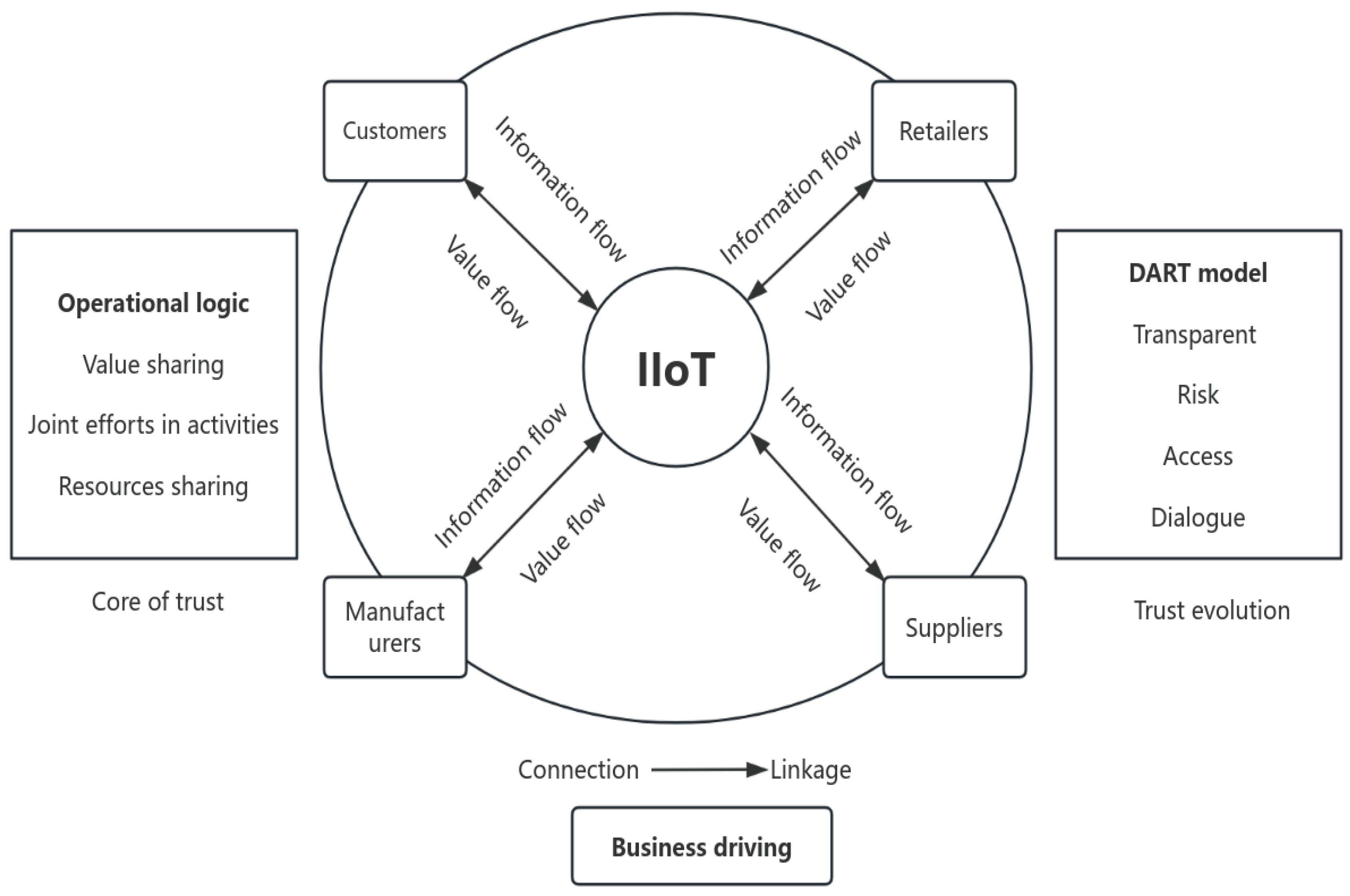
Figure 2.
Evolution of VCC based on the bond, interaction, and united ecosystem. (Data source: Ma Yongkai, Li Shiming, Pan Jingming, The value co-creation mode of the industrial Internet. Journal of Management World, 2020, 8, 211-221).
Figure 2.
Evolution of VCC based on the bond, interaction, and united ecosystem. (Data source: Ma Yongkai, Li Shiming, Pan Jingming, The value co-creation mode of the industrial Internet. Journal of Management World, 2020, 8, 211-221).
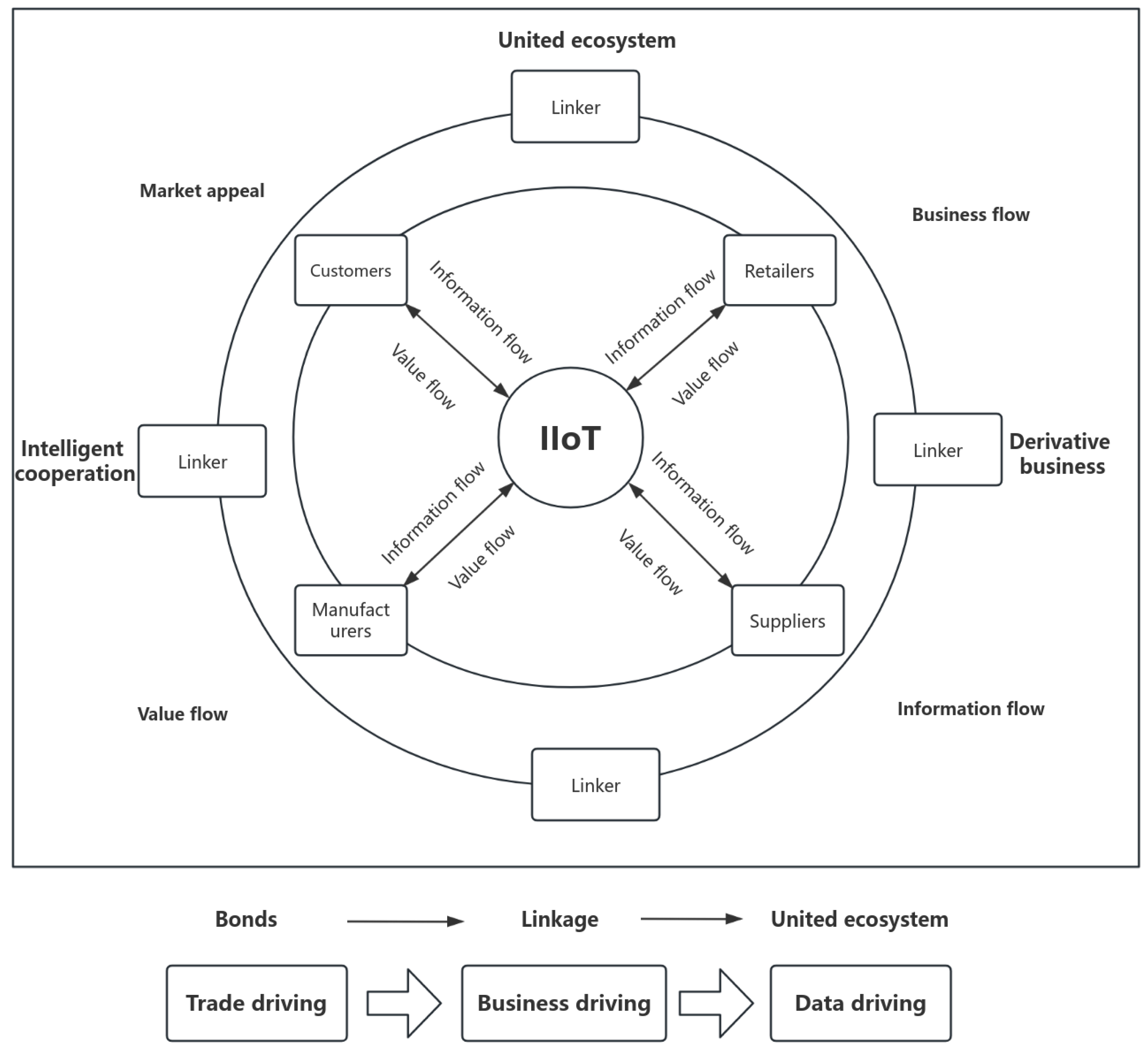
Table 4.
Validity analysis results.
| Item | Factor loading | Communality (common factor variance) |
| Factor 1 | ||
| FD1 | 0.875 | 0.765 |
| FD2 | 0.869 | 0.756 |
| FD3 | 0.851 | 0.724 |
| FD4 | 0.873 | 0.762 |
| FD5 | 0.867 | 0.752 |
| FD6 | 0.840 | 0.705 |
| TB1 | 0.871 | 0.759 |
| TB2 | 0.839 | 0.704 |
| TB3 | 0.834 | 0.695 |
| TB4 | 0.837 | 0.700 |
| TB5 | 0.859 | 0.738 |
| TB6 | 0.826 | 0.683 |
| VCC1 | 0.842 | 0.709 |
| VCC2 | 0.839 | 0.704 |
| VCC3 | 0.874 | 0.764 |
| VCC4 | 0.868 | 0.753 |
| VCC5 | 0.853 | 0.727 |
| E | 0.872 | 0.760 |
| Characteristic root (before rotation) | 13.161 | - |
| Percentage of explained variance % (before rotation) | 73.115% | - |
| Cumulative percentage of explained variance % (before rotation) | 73.115% | - |
| Characteristic root (after rotation) | 13.161 | - |
| Percentage of explained variance % (after rotation) | 73.115% | - |
| Cumulative percentage of explained variance % (after rotation) | 73.115% | - |
| KMO value | 0.947 | - |
| Bartlett sphericity value | 2030.034 | - |
| df | 153 | - |
| p value | 0.000 | - |
| Note: If data in the table are colored, blue indicates that the absolute value of factor loading is larger than 0.4; red means that the communality (common factor variance) is smaller than 0.4. | ||
Table 5.
KMO and Bartlett tests.
| KMO value | 0.947 | |
| Bartlett sphericity tests | Approximate chi-squared | 2030.034 |
| df | 153 | |
| p value | 0.000 | |
Table 6.
Calibration anchors of conditional variables and outcome variable.
| Variables | Anchors | |||
| Complete membership | Intersection | Complete non-membership | ||
| Conditional variables | FD | 5 | 4 | 3 |
| TB | 5 | 4 | 3 | |
| VCC | 5 | 4 | 3 | |
| Outcome variable | E | 5 | 4 | 3 |
Table 7.
Detection of the necessary conditions for high effects.
| Conditional variables | Outcome variable High effect (E) |
|
| Consistency | Coverage | |
| PD | 0.876536 | 0.914508 |
| ~PD | 0.528462 | 0.679193 |
| TB | 0.853382 | 0.914185 |
| ~TB | 0.516405 | 0.643044 |
| VCC | 0.903826 | 0.905527 |
| ~VCC | 0.481011 | 0.651397 |
Table 8.
Detection of necessary conditions for the low effect.
| Conditional variables | Outcome variable Low effect (E) |
|
| Consistency | Coverage | |
| PD | 0.661108 | 0.508035 |
| ~PD | 0.888748 | 0.84132 |
| TB | 0.610811 | 0.481949 |
| ~TB | 0.89124 | 0.817426 |
| VCC | 0.650508 | 0.480034 |
| ~VCC | 0.871976 | 0.869758 |
Table 9.
Configuration results causing the high effect.
| Conditional variables | Configuration 1 | Configuration 2 | Configuration 3 | Configuration 4 |
| PD | ● | ● | ● | |
| TB | ● | ● | ● | |
| VCC | ● | ● | ● | |
| Consistency | 0.905527 | 0.949912 | 0.953221 | 0.939818 |
| Original coverage | 0.903826 | 0.826811 | 0.854144 | 0.835607 |
| Unique coverage | 0.0877311 | 0.0107158 | 0.0380487 | 0.0195115 |
| Consistency of solution | 0.895589 | |||
| Coverage of solution | 0.914542 | |||
Note: “●” represents presence of conditional variables.
Table 10.
Configuration results causing the low effect.
| Conditional variable | Configuration 1 | Configuration 2 | Configuration 3 |
| PD | ⊗ | ⊗ | |
| TB | ⊗ | ⊗ | |
| VCC | ⊗ | ⊗ | ⊗ |
| Consistency | 0.798256 | 0.887042 | 0.890856 |
| Original coverage | 0.798256 | 0.835863 | 0.817635 |
| Unique coverage | 0.798256 | 0.0376078 | 0.019379 |
| Consistency of solution | 0.880543 | ||
| Coverage of solution | 0.855242 | ||
Note: “⊗” indicates absence of conditional variables.
Disclaimer/Publisher’s Note: The statements, opinions and data contained in all publications are solely those of the individual author(s) and contributor(s) and not of MDPI and/or the editor(s). MDPI and/or the editor(s) disclaim responsibility for any injury to people or property resulting from any ideas, methods, instructions or products referred to in the content. |
© 2024 by the authors. Licensee MDPI, Basel, Switzerland. This article is an open access article distributed under the terms and conditions of the Creative Commons Attribution (CC BY) license (http://creativecommons.org/licenses/by/4.0/).
Copyright: This open access article is published under a Creative Commons CC BY 4.0 license, which permit the free download, distribution, and reuse, provided that the author and preprint are cited in any reuse.


