

Submitted:
11 August 2024
Posted:
14 August 2024
You are already at the latest version
Abstract
This paper addresses the pressing concern of corporate tax evasion recognized by several nations, employing insights from public choice theory and tax compliance theory. The research aims to evaluate the ramifications of corporate tax evasion on public revenue, public expenditures, tax rates, and the prevailing budget deficit. Methodologically, the study utilizes questionnaire data and employs structural equation modeling for analysis. The findings indicate that tax evasion is significantly influenced by multiple factors, encompassing tax income, public expenditures, tax rates, and the budget deficit. The article offers a comprehensive exploration of both theoretical frameworks and practical implications, contributing valuable insights to the ongoing discourse on corporate tax evasion and its multifaceted impact on fiscal dynamics.
Keywords:
Tax evasion
; Public revenue
; Public expenses
; Tax rates
; Budget deficit
; Overall Budget
; Taxation
1. Introduction
Taxation plays a pivotal role in enabling the government's economic management and the provision of public services (Jiménez and Iyer, 2016; Demirhan, 2019). Governments utilize taxes to finance their development initiatives in the social and economic spheres, aiming to enhance public well-being through improved public services like education and healthcare, as well as strengthening critical infrastructure such as roads and public projects (Guironnet et al., 2016; Ruane et al., 2020). Therefore, taxes are essential for the state to fulfill its responsibilities, and tax evasion undermines this function by causing substantial financial losses, prompting legislators to establish criminal statutes to deter such evasion (Tresch, 2022).
Moreover, tax is a mandatory financial obligation imposed by the government on individuals without exception to meet fiscal commitments (Moldogaziev et al., 2017). Tax evasion is an unlawful practice in public finance where individuals or corporations intentionally avoid their actual tax liabilities. It involves the deliberate act of either fully or partially failing to fulfill tax obligations, without transferring the responsibility to others. This behavior significantly impacts the state's tax collection and is widely considered one of the most serious criminal offenses (Houben and Snyers, 2018).
The intricacy and challenges associated with taxation regulations, tax collection processes, and the escalating tax burdens borne by authorities contribute to the proliferation of tax evasion (Varotsis and Katerelos, 2020). In Jordan, the economy contends with resource scarcity and fiscal deficits in its budget, with tax revenues forming a primary source to bridge this deficit (Alasfour, 2019; Youssef, 2019; Beck and Richter, 2021). Tax evasion in Jordan has resulted in substantial losses in tax revenue, exacerbating the gap between government income and expenditure, ultimately leading to budgetary imbalances (Alqtish et al., 2018). The Jordanian economy grapples with limited natural resources and ongoing fiscal instability, making it challenging to secure the necessary funds for economic and social growth initiatives (Alsheikh et al., 2016; Alshira’h, 2018).
Determining the extent of tax evasion presents challenges due to factors such as smuggling, high tax rates, the substantial informal economy, unregistered labor, and the methods used for accounting, which can mask significant funds allocated to cover public expenditures, especially in sectors like water and energy (Vanhoeyveld et al., 2020). Notably, tax evasion in developing countries often surpasses that in developed nations, illustrating the magnitude of the issue (Avi-Yonah and Xu, 2016). Tax revenues are typically viewed as the most traditional and accessible means of financing a nation's treasury, with most economies relying on them to meet their financial needs (Kodali et al., 2017; Luciani, 2015). Consequently, taxation proves to be a practical approach for governments to generate revenue to support their developmental endeavors (Althaus et al., 2022).
The study of tax evasion is of paramount significance due to its severe impact on the public treasury's resources. This criminal activity results in the loss of funds that could have been allocated for the public good and the development of sophisticated tax evasion techniques. Moreover, tax evasion disrupts the principle of tax justice in distributing the fiscal burden among citizens (Lindsay, 2016). Meanwhile, there is a need to modify income tax regulations without adversely affecting business profits or state revenues (Beer et al., 2018). This study aims to analyze the impact of business tax evasion on the decline in budget revenues through a case study of Jordan's overall budget.
The structure of the paper is divided into distinct sections. In Section 2, a theoretical framework is established to investigate the correlation between variables, encompassing a literature review and the formulation of hypotheses. Section 3 outlines the research methodology, and Section 4 presents the study's design. This section utilizes a descriptive-analytical approach, analyzing data, validating hypotheses, discussing results, and drawing theoretical and practical implications. Finally, Section 5 delves into the conclusion, offering insights into potential future research avenues and acknowledging the study's limitations.
2. Literature Review and Hypothesis Development
Tax evasion has gained significant attention in recent years, particularly following the global financial crisis of 2008 (Chowdhury and Zuk, 2018) and the widespread impact of the COVID-19 pandemic (Al-Qudah et al., 2022). This heightened focus has spurred efforts to combat tax evasion, driven by the urgent need for revenue and funding without resorting to introducing new taxes (Brownlee, 2016). The reasons for tax evasion in Jordan, as highlighted in various studies, including this one, align with those observed in other countries. These reasons can be broadly categorized into moral, technical legal, and economic and social factors.
Individuals with higher moral standards tend to exhibit a heightened sense of responsibility, a strong commitment to the public interest, and a dedication to fulfilling their duties as prescribed by regulations and laws within the community (Alkurdi and Mardini, 2020; Abu Orabi et al., 2024). These individuals are more likely to comply with tax laws, recognizing their role in contributing to the collective well-being. The complexity and volatility of the tax system, coupled with frequent amendments to related laws, can contribute to difficulties in understanding tax regulations (Martins et al., 2018). This lack of clarity can lead to inadvertent non-compliance and may encourage individuals to seek loopholes or avoid tax obligations altogether.
Citizens' perception of high tax rates is a significant motivator for tax evasion (Shafer et al., 2020; Albalawee et al., 2024). When individuals perceive taxes as excessive or unfair, they may be more inclined to engage in non-compliant behavior. Economic hardships and a lack of trust in government institutions can further exacerbate tax evasion tendencies.
Effectively addressing tax evasion requires a comprehensive approach that tackles the underlying factors driving non-compliance. This includes promoting ethical values, simplifying tax regulations, enhancing taxpayer education, and fostering trust in government institutions. Additionally, strengthening tax administration and enforcement mechanisms can deter tax evasion and ensure that all citizens contribute their fair share.
2.1. Tax Revenue and Public Revenues
Tax revenue is an essential and indispensable source of government funding for the economic advancement of a nation. Nevertheless, tax evasion poses significant challenges for tax authorities in effectively collecting revenue from taxpayers. Tax evasion refers to the unlawful practice of minimizing one's tax liabilities by contravening legal regulations and departing from societal norms (Rashid, 2020). It represents a substantial loss of government revenues, hindering the smooth provision of public services due to declines in state budget revenues (Erdoğan et al., 2020).
While combating tax evasion can undoubtedly increase treasury revenues, it alone is not a sufficient or reliable strategy for addressing long-term economic challenges (Morgan, 2021). Zucman (2014) emphasizes that success in curbing tax evasion does not guarantee sustained revenue growth due to the influence of other factors. Some revenues from evaders settling their obligations may be considered "one-time" and may not recur at the same volume.
Tax evasion's direct impact on government tax revenues has been observed in various countries. Alkhatib (2019) asserts that tax evasion directly results in a loss of government tax revenues in Palestine. In Egypt, the tax evasion situation may worsen as government revenues rise faster than the underground sector (Udoh, 2015). Vietnam experiences an increase in total tax evasion despite public revenues growing more slowly than the formal economy (Ivanyna, Moumouras, and Rangazas, 2016). Accurately measuring tax evasion in Pakistan is crucial due to its potential impact, as other indicators like national accounts, unemployment rates, and inflation rates could be misleading to policymakers (Kemme, Parikh, and Steigner, 2017; Mügge, 2016). Bethencourt and Kunze (2019) explore the relationship between tax evasion and public revenues, finding a positive connection between the declared tax rate and tax evasion, and a negative connection with tax revenues allocated to tax auditing.
Effectively addressing tax evasion requires a multifaceted approach that tackles the underlying factors driving non-compliance. This includes promoting ethical values, simplifying tax regulations, enhancing taxpayer education, strengthening tax administration and enforcement mechanisms, and fostering trust in government institutions. Additionally, embracing technological advancements, such as data analytics and e-tax systems, can streamline tax collection and enhance tax compliance (Abu Huson et al., 2024; Demirhan, 2019).
2.2. Tax Revenue and Public Expenses
The literature pertaining to tax evasion and the contentment of taxpayers with government policy, specifically in relation to the supply of public goods and overall public spending, is extremely pertinent to our topic. Empirical studies repeatedly show that taxpayers are more prone to participate in tax evasion when they perceive mishandling of their cash (D'Agostino et al., 2021; Kiow et al., 2017). In their empirical study, Casaburi and Troiano (2016) examined the influence of local efficiency on tax evasion in Italian towns. They utilized public spending and taxation perspectives as indicators of tax evasion. Their research uncovered that deficiencies in public expenditure are a contributing factor to the escalation of tax evasion, particularly in cases where public spending is reduced (World Bank, 2019).
It is important to recognize that official statistics on the formal sector do not include the impact of tax evasion resulting from inflating deductible expenses, underreporting taxable income in corporate tax calculations, transferring profits to other countries, and local taxes on goods and property (Ioniţă and Brezeanu, 2017). Both rich and developing countries are significantly affected by tax evasion and fraud, which have a substantial influence on state finances and government spending. The extent of this impact is contingent upon various aspects, including economic progress, tax rates, tax revenue composition, taxpayer views, education, bureaucracy, and other relevant considerations (OECD, 2015; Al-Raggad et al., 2024; Taing and Chang, 2021).
Nevertheless, the beginning of 2017 experienced a decrease in tax evasion as a result of lowered thresholds for determining required social security payments and the introduction of the mandatory micro-enterprise tax system for enterprises generating less than five million euros in sales. Possible measures to enhance the suppression of tax evasion encompass the implementation of graduated income tax rates, the removal of assessments linked to VAT operations, and the compulsory revelation of individual assets (Ioniţă and Brezeanu, 2017).
2.3. Tax Evasion and Tax Rate
Slemrod (2019) highlights a significant body of research exploring the link between tax evasion and tax collections. Empirical studies, exemplified by Paulus (2015) in the United Kingdom, consistently indicate a positive correlation between tax evasion and both after-tax income and the marginal tax rate. These studies utilize cross-sectional data and employ a Tobit model to scrutinize the relationship between these two variables. In the United States, Dean (2012) tackled this issue by examining a change in the tax rate for higher income levels in both 2015 and 2020. His findings unveil a surprisingly substantial negative impact of the marginal tax rate on tax evasion, with income showing no statistically significant influence.
Research grounded in microeconomic principles emphasizes a high tax burden as a primary driver of tax evasion (Chiarini et al., 2013). This research complements the macro-level evidence supporting the relationship between tax rate and tax evasion. For instance, the findings of the Bank of Italy's Survey on Household Income and Wealth in 2004 revealed that nearly half of the respondents (46%) attributed tax cheating to excessively high tax rates (Gokalp et al., 2017). Moreover, for a tax system to function effectively, it must provide incentives for taxpayers, both individuals and corporations, to comply with the law. In the absence of such incentives, taxes would not be willingly remitted in a competitive economy (Awasthi and Engelschalk, 2018). Empirical evidence demonstrates that tax evasion and fiscal corruption remain significant global challenges with far-reaching detrimental consequences. Even in highly developed industrialized nations, tax evasion accounts for a substantial portion of the worldwide shadow economy (Alm et al., 2016).
2.4. Tax Evasion and Budget Deficit
Tax evasion, an intentional act involving the payment of less than the required amount of taxes, can significantly impact government revenue, thereby contributing to the budget deficit. When taxpayers effectively evade paying taxes, it diminishes the government's income, creating a larger gap between revenue and expenditures. This, in turn, hinders the government's ability to fund crucial public services like healthcare, education, and infrastructure.
Efficient tax avoidance occurs when taxpayers use lawful methods to minimize their tax obligations, aligning with the stated objectives of relevant laws. However, if tax evasion leads to a reduction in taxes contrary to the goal of decreasing the budget deficit, it raises concerns about the legitimacy of such actions (Langenmayr, 2017).
While it is acceptable to take advantage of all eligible tax deductions within legal limits, engaging in tax evasion is likely to have a negative long-term impact on the budget deficit (Alm, 2019; Qudah et al., 2024). This phenomenon is evident in Palestine, where a significantly elevated level of tax evasion plays a substantial role in a budget shortfall amounting to about 30% of the overall government expenditures in 2018 (World Bank Group, 2019).
In the United Kingdom, the tax gap resulting from tax evasion is anticipated to lead to an annual loss of £122 billion to the state budget (Murphy, 2014). This substantial deficit is nearly equivalent to the yearly budget of the National Health Service (NHS) and could fund the entire education budget of the UK with more than £20 billion remaining. Hence, policymakers should prioritize addressing tax evasion.
The tax gap in the United Kingdom represents the difference between the amount of tax that should be paid and the amount actually collected. It encompasses tax that is avoided, evaded, uncollected but known, or paid late. Bird and Davis-Nozemack (2018) emphasize the essential need for tax reform and the suppression of tax evasion for any administration to effectively tackle the budget deficit. As the level of debt continues to rise to unprecedented heights, addressing the budget deficit becomes a significant challenge. According to Cowx et al. (2022), governments are exploring various methods to increase public revenues and reduce fiscal deficits, often exacerbated by high levels of tax evasion. The goal of these efforts is to improve the quality of life for citizens by implementing salary increments, enhancing living conditions, and fulfilling government responsibilities.
After reviewing the previous studies and the theories related to the subject of this research, and based on the research question and its objectives, this study is based on the following hypotheses:
H1: There is a negative relationship between tax evasion and public revenues in Jordan.
H2: There is a negative relationship between tax evasion and public expenses in Jordan.
H3: There is a negative relationship between tax evasion and the tax rate in Jordan.
H4: There is a positive relationship between tax evasion and budget deficits in Jordan.
3. Research Methodology
The research employs a quantitative research strategy to investigate the impact of corporate tax evasion on the reduction of budget revenues, with a specific focus on Jordan's overall budget. Quantitative methodologies are widely considered appropriate for examining relationships between variables and conducting hypothesis testing. This approach allows for the empirical examination of theories and specific research inquiries, making it well-suited for studying tax behavior in both emerging and developed nations (Nardi, 2018; Al-Rahamneh & Bidin, 2022). The decision to use a quantitative methodology is particularly relevant for complex investigations involving multiple variables. The utilization of pre-established tools and questions with limited response options simplifies the investigation, enabling the implementation of statistical methodologies to analyze the collected data (Creswell & Creswell, 2017).
The case study on Jordan's general budget involves collecting preliminary data from the study sample through the questionnaire list approach. This approach includes disseminating surveys, either electronically or through face-to-face interviews, to gather insights into the influence of corporate tax evasion on the decline in budget revenues. The research population for this study comprises tax collectors employed by the Ministry of Finance in Jordan.
To create a sample accurately representing the population, the study employs simple random sampling. In this process, 264 questionnaires were distributed, and 250 meeting the necessary criteria were collected. The sample size, ranging from 30 to 500 samples, is considered adequate for the majority of investigations (Saidan et al., 2017). The proportion of questionnaires analyzed out of the total issued is established at 94%. The study uses a convenience sample technique, collecting data from individuals who are easily accessible and willing to participate. In this instance, 250 surveys are disseminated, and a sample size of 250 is deemed suitable for statistical analysis.
The key demographic, consisting of tax collectors employed by the Ministry of Finance in Jordan, is crucial in understanding the elements influencing the behavior of evading sales tax. The survey employs a five-point Likert scale for measuring responses, where a rating of 1 indicates strong disagreement, and a rating of 5 indicates strong agreement. Questionnaire items assessing sales tax evasion, public revenues, public expenses, tax rate, and budget deficit are derived from multiple sources. The study incorporates eight items related to sales tax evasion, sourced from Alqtish (2018) and Benk (2015). Additionally, five items on public revenues are derived from Ababneh & Rawabdeh (2018) and Adenya & Muturi (2017), four items on public expenses from Al-Hiyasat (2014), five items on tax rate from Alshirah et al. (2021), and five items on budget deficit from Al-Naimat (2013) and Mitrakos (2016).
3.1. Demographic Characteristics of the Sample
In terms of respondent profiles based on various demographic characteristics, the majority of participants were male, comprising 62.4% of the total, while females made up 37.6%. The distribution of ages among respondents showed that 1.1% were in the 21-30 age group, 29.0% fell within the 31-40 age range, 53.8% were in the 41-50 age category, 16.1% belonged to the 51-60 age range, and a marginal 1.1% were below 60 years old. Regarding educational attainment, a significant portion of respondents held Bachelor's degrees, constituting 77.4%, followed by those with Master's degrees at 19.4%, and individuals with PhDs at 3.2%. In terms of professional experience, respondents with 2-4 years of experience constituted 9.7%, those with 5-7 years represented 25.8%, individuals with 8-10 years accounted for 50.5%, and those with less than 10 years of experience comprised 14.0% of the total. This detailed breakdown provides a comprehensive insight into the composition of survey participants across gender, age, education level, and professional experience categories. Consequently, the demographic profile of the respondents indicates that they possess sufficient experience and knowledge to actively engage in the survey, thereby contributing reliable data to this study.
3.2. Data Analysis and Results
Assessment of the measurement model
We employed causal-predictive structural equation modelling (SEM) with the assistance of SmartPLS 4 software to assess and calculate the linear and interactive connections between the variables under study. Partial least squares structural equation modelling (PLS-SEM) is a distinct approach that differs from covariance-based SEM (CB-SEM) in how it handles latent scores. CB-SEM is based on factor score indeterminacy, as described by Rigdon et al. (2017), whereas PLS-SEM depends on fixed latent scores and prioritizes optimizing the prediction of endogenous constructs rather than model fitting, as elucidated by Hair et al. (2019). Partial Least Squares Structural Equation Modelling (PLS-SEM) demonstrates versatility in managing intricate structural models, second-order models, and limited sample sizes, without a strong requirement for data normality.
The PLS-SEM approach has a prediction-focused attitude, allowing researchers to assess the predictive accuracy of the findings, as recommended by Sarstedt et al. (2017). Figure 1 illustrates the external loadings of the scale items, beta estimates in the internal model, and R2 values within the blue circle. Furthermore, Figure 1 depicts the degree of significance for each scale item in the outer model, as well as the significance level of the correlations between the variables in the inner model.
The outer model loadings displayed in Figure 1 exceeded the (0.7) criterion for the most part. The statistics reported in Table 1 include Cronbach's alpha (α) greater than (0.70), composite reliability (CR) greater than (0.70), and average variance extracted (AVE) greater than (0.50). Moreover, Table 2 demonstrates that the Fornell-Larcker requirement has been met, since the squared value of each variable's average variance extracted (AVE) exceeds the inter-correlations. Therefore, we have determined that the measurement model exhibits internal consistency, convergent validity, and discriminant validity.
The previous sections have proved the dependability and validity of the models. The estimation coefficients for the structural model are presented in Table 3. The empirical findings indicate that tax evasion has a positive and significant impact on the budget deficit (β =.743, ρ =.000). Additionally, tax evasion has a negative and significant effect on public expense (β = - .746, ρ =.000) and public revenue (β = -0.685, ρ =.000). Finlay, tax evasion has a strong and considerable negative impact on the tax rate (β = -.780, ρ =.000). Consequently, we accepted all theories.
4. Discussion
Statistical analysis provides robust support for hypothesis H1, which posits a negative relationship between tax evasion and public revenues in Jordan. This finding aligns with the broader literature, as Rashid (2020) defines tax evasion as an illegal act that diminishes government revenues. Zucman (2014) emphasises that while curbing tax evasion can increase treasury revenues, it may not be a comprehensive solution for long-term economic challenges. Alkhatib's (2019) work in Palestine directly links tax evasion to a loss of government tax revenues. Bethencourt and Kunze (2019) further support the positive relationship between the declared tax rate and tax evasion.
However, caution is warranted, as successful measures against tax evasion may not guarantee sustained revenue growth, and settlements from evaders may constitute "one-time" revenues (Zucman, 2014). The findings highlight the need for comprehensive strategies in Jordan, including ethical promotion, regulatory simplification, taxpayer education, and technological advancements, to achieve sustained fiscal health.
Statistical analysis supports the acceptance of hypothesis H2, which suggests a negative relationship between tax evasion and public expense in Jordan. This finding aligns with existing literature, as Casaburi and Troiano's (2016) empirical study in Italian municipalities highlights that inefficiencies in public expenditure contribute to increased tax evasion. The relationship is further supported by the World Bank's (2019) findings, emphasizing that higher tax evasion occurs when public spending is lower.
However, it is crucial to note that formal sector figures may not capture all forms of tax evasion, as emphasized by Ioniţă and Brezeanu (2017), who point out that tax evasion can result from various practices, including overreporting deductible expenses and underreporting taxable income. The decline in tax evasion observed in early 2017, attributed to policy changes, indicates the potential effectiveness of reforms in curbing evasion (Ioniţă and Brezeanu, 2017). Overall, the positive relationship between tax evasion and public expense underscores the importance of efficient public expenditure management in mitigating tax evasion in Jordan.
Statistical analysis validates the acceptance of hypothesis H3, indicating a negative relationship between tax evasion and tax rates in Jordan. This finding resonates with existing literature that has extensively explored the connection between tax evasion and tax rates. Empirical studies, such as Paulus's (2015) investigation in the United Kingdom and Dean's (2012) analysis in the United States, reveal a positive correlation between tax evasion and both after-tax income and the marginal tax rate. The insights from these studies align with micro-founded research, emphasizing that a high tax burden, as highlighted by Chiarini et al. (2013), can drive tax evasion. Furthermore, the Bank of Italy's Survey on Household Income and Wealth underscores the perception among respondents that excessively high tax rates contribute to tax evasion (Gokalp et al., 2017). The need for an effective tax system that incentivizes compliance is emphasized by Awasthi and Engelschalk (2018). In the Jordanian context, this positive relationship underscores the importance of tax policy considerations in influencing individuals' decisions regarding tax evasion.
The study validates Hypothesis H4, demonstrating a significant positive correlation between tax evasion and the budget deficit in Jordan. This discovery aligns with global trends, highlighting the adverse impact of intentional tax underpayment on government fiscal health. While legal frameworks may allow for effective tax evasion, its problematic nature arises when it contributes to heightened budget deficits, a phenomenon observed in regions like Palestine and the UK. The research underscores the imperative for Jordanian policymakers to address tax evasion as a pivotal factor influencing the country's budget deficit. Prominent references supporting this viewpoint include the works of Langenmayr (2017), Alm (2019), World Bank Group (2019), Murphy (2014), and Bird and Davis-Nozemack (2018). These findings underscore the necessity for strategic fiscal measures in Jordan to navigate the challenges posed by increasing indebtedness.
4.1. Practical and Theoretical Implications
The empirical investigation into corporate tax evasion and its influence on Jordan's overall budget produces practical and theoretical consequences that transcend Jordan's boundaries, providing useful insights for policymakers and researchers globally.
From a pragmatic standpoint, authorities in Jordan should contemplate implementing all-encompassing approaches to address tax evasion, with a focus on promoting ethical behaviour, streamlining regulations, educating taxpayers, and embracing technology improvements. It is important to exercise caution when depending only on successful efforts to reduce tax evasion, as the money collected from evaders may only be a one-time source of revenue. Ensuring a varied range of income streams and enhancing the control of public spending are crucial elements for maintaining long-term fiscal well-being. Furthermore, the study emphasises the importance of thoughtful deliberation on tax policy, creating mechanisms that encourage adherence to tax regulations, and acknowledging the complex connections between tax rates, government expenditures, and income.
The contribution to tax literature yields theoretical implications by giving empirical evidence that supports wider theoretical perspectives on tax evasion, while also supplying context-specific insights. The analysis confirms established theories that propose a direct correlation between tax evasion and other circumstances, so strengthening our comprehension of how these elements interplay within the specific context of Jordan. The research methodology and findings provide a foundation for future studies, prompting researchers to investigate more factors, improve measurement models, and carry out cross-country comparisons. Moreover, the study reveals a reciprocal relationship between theoretical discoveries and practical legislation, enhancing the field of tax behaviour research.
In summary, these implications have broader relevance beyond Jordan's specific situation, offering useful insights for policymakers and researchers dealing with the problem of corporate tax evasion and its impact on worldwide budget revenues. The report emphasises the significance of implementing comprehensive solutions to address tax evasion, acknowledging the complex nature of the problem, and creating tax systems that encourage adherence to regulations. Moreover, it underscores the importance of adopting a comprehensive strategy for fiscal management that encompasses both the diversification of revenue sources and the enhancement of public expenditure efficiency.
5. Conclusion
This paper empirically investigates the intricate relationship between corporate tax evasion and the decline in budget revenues in Jordan, employing a robust quantitative research design. The research methodology involved distributing questionnaires to tax collectors within the Ministry of Finance, yielding 250 valid responses that constituted a representative sample.
The results discussion delves into the implications of these findings, aligning them with existing literature and emphasizing the need for comprehensive approaches to tackle tax evasion in Jordan. The inverse correlations between tax evasion and public revenues, public expenses, and tax rates, coupled with the positive correlation between tax evasion and the budget deficit, underscore the complexity of the issue presented by tax evasion. Concerns were raised about the long-term sustainability of revenue growth, even with effective anti-tax evasion measures, and the necessity to address inefficiencies in managing public spending.
The study's findings provide valuable insights for Jordanian policymakers, indicating the importance of not only reducing tax evasion but also implementing comprehensive reforms. These reforms should encompass ethical promotion, regulatory simplification, taxpayer education, and technological advancements. This study enhances our understanding of the factors influencing budget revenues in the context of tax evasion and emphasizes the urgent need for sound fiscal policies to address the challenges arising from the increasing debt levels in Jordan.
Tax evasion impedes the state's ability to mobilize resources and generate the necessary revenues for financing public expenditure. Consequently, this can diminish the quality of public services, hinder investment prospects in essential infrastructure and facilities, and impede government policies aimed at fostering economic growth and development. Due to insufficient resources and a budget shortfall, the government is compelled to increase the tax burden on individuals, including employees and wage earners, whose income taxes are deducted at the source. These individuals lack means to evade or reduce their tax obligations, hindering the establishment of an equitable tax system that allocates the responsibility of public expenditure fairly and proportionally based on individuals' ability to contribute. Therefore, without justice and considering the sentiments of various societal groups perceiving social injustice and discrimination, the tax becomes invalid and unjustifiable.
The study's limitations revolve around the sample strategy and data gathering methodology. The data collected from the questionnaire survey is insufficient to provide a comprehensive explanation of tax evasion in Jordan's overall budget. Future researchers should consider alternative data collection methods, such as employing mixed methods. Subsequent research could expand the scope of tax evasion causes to incorporate unexplored features or variables yielding conflicting outcomes. Additionally, future research could introduce mediating variables to examine their potential impact on tax evasion.
References
- Abu Huson, Y.; Sierra-García, L.; Garcia-Benau, M.A. A bibliometric review of information technology, artificial intelligence, and blockchain on auditing. Total. Qual. Manag. Bus. Excel. 2024, 35, 91–113. [Google Scholar] [CrossRef]
- Abu Orabi, T.; Al-Hyari, H.S.M.; Almomani, H.M.; Ababne, A.; Abu Huson, Y.; Ahmed, E.; Albanna, H. A bibliometric review of job satisfaction and organizational commitment in businesses area literatures. Hum. Syst. Manag. 2024, 43, 407–430. [Google Scholar] [CrossRef]
- Alasfour, F. Costs of Distrust: The Virtuous Cycle of Tax Compliance in Jordan. J. Bus. Ethic- 2019, 155, 243–258. [Google Scholar] [CrossRef]
- Albalawee, N.; Abu Huson, Y.; Budair, Q.; Alqmool, T.J.; Arasheedi, N.M.K. Connecting legal compliance and financial integrity: A bibliometric survey of accounting practices in the corporate supply chain. Uncertain Supply Chain Manag. 2024, 12, 893–906. [Google Scholar] [CrossRef]
- Alkhatib, A. A., Abdul-Jabbar, H., Abuamria, F., & Rahhal, A. (2019). The effects of social influence factors on income tax evasion among the palestinian SMEs. https://dspace.alquds.edu/handle/20.500.12213/5064.
- Alkurdi, A.; Mardini, G.H. The impact of ownership structure and the board of directors’ composition on tax avoidance strategies: empirical evidence from Jordan. J. Financial Rep. Account. 2020, 18, 795–812. [Google Scholar] [CrossRef]
- Alm, J. (2019). Tax compliance and administration. In Handbook on taxation (pp. 741-768). Routledge.
- Alm, J.; Martinez-Vazquez, J.; McClellan, C. Corruption and firm tax evasion. J. Econ. Behav. Organ. 2016, 124, 146–163. [Google Scholar] [CrossRef]
- Alqtish, A.; Alqirem, R.; Kasem, F. The Impact of Electronic Tax Auditing on the Reduction of Tax Evasion from the Perspective of the Income and Sales Tax Department in Jordan. Journal of Accounting, Finance and Management Strategy 2018, 13, 77–104. [Google Scholar]
- Al-Qudah, L.A.; Qudah, H.A.; Abu Hamour, A.M.; Abu Huson, Y.; Al Qudah, M.Z. The effects of COVID-19 on conditional accounting conservatism in developing countries: evidence from Jordan. Cogent Bus. Manag. 2022, 9, 2152156. [Google Scholar] [CrossRef]
- Al-Raggad, M.; Al-Raggad, A.; Al-Raggad, M.; Al-Mahasneh, A.; Abu Huson, Y. Examining Bribery as a Financial Crime in the Private Sector within the Framework of Jordanian Penal Legislation. Pakistan Journal of Criminology 2024, 16, 635–648. [Google Scholar]
- Al-Rahamneh, N.M.; Bidin, Z. The Effect of Tax Fairness, Peer Influence, and Moral Obligation on Sales Tax Evasion among Jordanian SMEs. J. Risk Financial Manag. 2022, 15, 407. [Google Scholar] [CrossRef]
- Alsheikh, E.Y.; AlAdham, M.A.A.; Qasem, M.F.; Yousef, A.A. Factors Affecting Corporate Tax Evasion: Evidence from Jordan. Int. J. Innov. Educ. Res. 2016, 4, 1–15. [Google Scholar] [CrossRef]
- Alshira’h, A. F. A. (2018). Determinants of sales tax compliance among Jordanian SMEs: the moderating effect of public governance (Doctoral dissertation, Universiti Utara Malaysia). [CrossRef]
- Althaus, C. , Ball, S., Bridgman, P., Davis, G., & Threlfall, D. (2022). The Australian policy handbook: A practical guide to the policymaking process. Taylor & Francis.
- Arnold, B. J. (2019). International tax primer. Kluwer Law International BV.
- Arnold, B. J. , Ault, H. J., and Cooper, G. (Eds.). (2019). Comparative income taxation: a structural analysis. Kluwer Law International BV.
- Avi-Yonah, R.S.; Xu, H. Evaluating BEPS: A Reconsideration of the Benefits Principle and Proposal for UN Oversight. Harv. Bus. L. Rev. 2016, 6, 185. [Google Scholar]
- Awasthi, R. , and Engelschalk, M. (2018). Taxation and the shadow economy: how the tax system can stimulate and enforce the formalization of business activities. World Bank Policy Research Working Paper, (8391).
- Beck, M. , and Richter, T. (2021). Pressured by the decreased price of oil: Post-2014 adjustment policies in the Arab Gulf and beyond. In Oil and the political economy in the Middle East (pp. 1-35). Manchester University Press.
- Beer, S. , Klemm, M. A. D., & Matheson, M. T. (2018). Tax spillovers from US corporate income tax reform. International Monetary Fund.
- Bethencourt, C.; Kunze, L. Tax evasion, social norms, and economic growth. Journal of Public Economic Theory 2019, 21, 332–346. [Google Scholar] [CrossRef]
- Bird, R.; Davis-Nozemack, K. Tax Avoidance as a Sustainability Problem. J. Bus. Ethic- 2016, 151, 1009–1025. [Google Scholar] [CrossRef]
- Brownlee, W. E. (2016). Federal Taxation in America. Cambridge University Press.
- Casaburi, L.; Troiano, U. Ghost-House Busters: The Electoral Response to a Large Anti–Tax Evasion Program *. Q. J. Econ. 2016, 131, 273–314. [Google Scholar] [CrossRef]
- Chiarini, B.; Marzano, E.; Schneider, F. Tax rates and tax evasion: an empirical analysis of the long-run aspects in Italy. Eur. J. Law Econ. 2013, 35, 273–293. [Google Scholar] [CrossRef]
- Chowdhury, A.; Żuk, P. From crisis to crisis: Capitalism, chaos and constant unpredictability. The Economic and Labour Relations Review 2018, 29, 375–393. [Google Scholar] [CrossRef]
- Cowx, M. , Silva, F. B. G., and Yeung, K. (2022). Government Deficits and Corporate Tax Avoidance. Available at SSRN 4060416.
- D’agostino, E.; De Benedetto, M.A.; Sobbrio, G. Tax evasion and government size: evidence from Italian provinces. Econ. Politi 2021, 38, 1149–1187. [Google Scholar] [CrossRef] [PubMed]
- Dean, J. (2012). The communist horizon. Verso Books.
- Demirhan, H. (2019). Effective taxation system by blockchain technology. Blockchain economics and financial market innovation: Financial innovations in the digital age, 347-360.
- Erdoğan, S.; Yıldırım, D. .; Gedikli, A. Natural resource abundance, financial development and economic growth: An investigation on Next-11 countries. Resour. Policy 2020, 65, 101559. [Google Scholar] [CrossRef]
- Falk, R. F. , & Miller, N. B. (1992). A primer for soft modeling. University of Akron Press.
- Gokalp, O.N.; Lee, S.-H.; Peng, M.W. Competition and corporate tax evasion: An institution-based view. J. World Bus. 2017, 52, 258–269. [Google Scholar] [CrossRef]
- Guironnet, A.; Attuyer, K.; Halbert, L. Building cities on financial assets: The financialisation of property markets and its implications for city governments in the Paris city-region. Urban Stud. 2016, 53, 1442–1464. [Google Scholar] [CrossRef]
- Hair, J. F., Risher, J. J., Sarstedt, M., & Ringle, C. M. (2019). When to use and how to report.
- Houben, R. , and Snyers, A. (2018). Cryptocurrencies and blockchain: Legal context and implications for financial crime, money laundering and tax evasion.
- Ioniţă, C. , and Brezeanu, P. (2017). THE IMPACT OF TAX EVASION AND TAX FRAUD ON THE PUBLIC EXPENSES ALLOCATED TO THE DEFENCE OF ROMANIA. In International Scientific Conference" Strategies XXI" (pp. 237-246). " Carol I" National Defence University.
- Ivanyna, M.; Moumouras, A.; Rangazas, P. The culture of corruption, tax evasion, and economic growth. Economic inquiry 2016, 54, 520–542. [Google Scholar] [CrossRef]
- Jimenez, P.; Iyer, G.S. Tax compliance in a social setting: The influence of social norms, trust in government, and perceived fairness on taxpayer compliance. Adv. Account. 2016, 34, 17–26. [Google Scholar] [CrossRef]
- Kemme, D.M.; Parikh, B.; Steigner, T. Tax Havens, Tax Evasion and Tax Information Exchange Agreements in the OECD. Eur. Financial Manag. 2017, 23, 519–542. [Google Scholar] [CrossRef]
- Kiow, T.S.; Salleh, M.F.M.; Kassim, A.A.B.M. The Determinants of Individual Taxpayers’ Tax Compliance Behaviour in Peninsular Malaysia. Int. Bus. Account. Res. J. 2017, 1, 26–43. [Google Scholar] [CrossRef]
- Kodali, N. , Abernethy, J., Hays, J., and Kira, Z. (2017). On convergence and stability of gans. arXiv:1705.07215.
- Langenmayr, D. Voluntary disclosure of evaded taxes—Increasing revenue, or increasing incentives to evade. Journal of Public Economics 2017, 151, 110–125. [Google Scholar] [CrossRef]
- Lenz, H. Aggressive Tax Avoidance by Managers of Multinational Companies as a Violation of Their Moral Duty to Obey the Law: A Kantian Rationale. J. Bus. Ethic- 2020, 165, 681–697. [Google Scholar] [CrossRef]
- Lindsay, I.K. Tax Fairness by Convention: A Defense of Horizontal Equity. Fla. Tax Rev. 2016, 19, 79. [Google Scholar] [CrossRef]
- Luciani, F. G. (2015). Allocation vs. production states: A theoretical framework. In The rentier state (pp. 77-96). Routledge.
- Martins, A.; Dinis, A.; Lopes, C. Interpretative complexity and tax law changes: the taxation of corporate expenses in Portugal. J. Appl. Account. Res. 2018, 19, 537–551. [Google Scholar] [CrossRef]
- Moldogaziev, T.T.; Kioko, S.N.; Hildreth, W.B. Impact of Bankruptcy Eligibility Requirements and Statutory Liens on Borrowing Costs. Public Budg. Finance 2017, 37, 47–73. [Google Scholar] [CrossRef]
- Morgan, J. A critique of the Laffer theorem’s macro-narrative consequences for corporate tax avoidance from a Global Wealth Chain perspective. Globalizations 2021, 18, 174–194. [Google Scholar] [CrossRef]
- Mügge, D. Studying macroeconomic indicators as powerful ideas. J. Eur. Public Policy 2016, 23, 410–427. [Google Scholar] [CrossRef]
- Murphy, R. (2014). The Tax Gap. Tax Evasion in 2014-and what can be done about it.
- Nardi, P. M. (2018). Doing survey research: A guide to quantitative methods. Routledge.
- OECD. (2015). Update on voluntary disclosure programmes: a pathway to tax compliance.
- Paulus, A. (2015). Tax evasion and measurement error: An econometric analysis of survey data linked with tax records (No. 2015-10). ISER Working Paper Series.
- Qudah, H. A. A. (2021). Credit risks measurement in Islamic banks study model. Journal of Sustainable Finance and Investment, 1-19.
- Qudah, H.; Malahim, S.; Airout, R.; AlQudah, M.Z.; Al-Zoubi, W.K.; Abu Huson, Y.; Zyadat, A. Unlocking the ESG value of sustainable investments in cryptocurrency: a bibliometric review of research trends. Technol. Anal. Strat. Manag. 2024, 1–15. [Google Scholar] [CrossRef]
- Rashid, M.H.U. Taxpayer's attitude towards tax evasion in a developing country: do the demographic characteristics matter. International Journal of Applied Behavioral Economics (IJABE) 2020, 9, 1–19. [Google Scholar] [CrossRef]
- Rigdon, E.E.; Sarstedt, M.; Ringle, C.M. On comparing results from CB-SEM and PLS-SEM: Five perspectives and five recommendations. Marketing: ZFP–Journal of Research and Management 2017, 39, 4–16. [Google Scholar] [CrossRef]
- Ruane, S.; Collins, M.L.; Sinfield, A. The Centrality of Taxation to Social Policy. Soc. Policy Soc. 2020, 19, 437–453. [Google Scholar] [CrossRef]
- Saidan, M.N.; Abu Drais, A.; Al-Manaseer, E. Solid waste composition analysis and recycling evaluation: Zaatari Syrian Refugees Camp, Jordan. Waste Manag. 2017, 61, 58–66. [Google Scholar] [CrossRef]
- Sarstedt, M.; Ringle, C. M.; Hair, J.F. Treating unobserved heterogeneity in PLS-SEM: A multi-method approach. Partial least squares path modeling: Basic concepts, methodological issues and applications 2017, 197–217.
- Sassenberg, K.; Matschke, C.; Scholl, A. The impact of discrepancies from ingroup norms on group members' well-being and motivation. Eur. J. Soc. Psychol. 2011, 41, 886–897. [Google Scholar] [CrossRef]
- Shafer, W.E.; Wang, Z.; Hsieh, T.-S. Support for Economic Inequality and Tax Evasion. Sustainability 2020, 12, 8025. [Google Scholar] [CrossRef]
- Slemrod, J. Tax compliance and enforcement. Journal of Economic Literature 2019, 57, 904–954. [Google Scholar] [CrossRef]
- Taing, H.B.; Chang, Y. Determinants of Tax Compliance Intention: Focus on the Theory of Planned Behavior. Int. J. Public Adm. 2021, 44, 62–73. [Google Scholar] [CrossRef]
- the results of PLS-SEM. European Business Review, 31(1), 2-24.
- Tresch, R. W. (2022). Public finance: A normative theory. Academic Press.
- Udoh, E.J. Taxing the informal economy in Nigeria: Issues, challenges, and opportunities. International Journal of Business and Social Science 2015, 6, 160–175. [Google Scholar]
- Vanhoeyveld, J.; Martens, D.; Peeters, B. Value-added tax fraud detection with scalable anomaly detection techniques. Appl. Soft Comput. 2020, 86, 105895. [Google Scholar] [CrossRef]
- Varotsis, N.; Katerelos, I. Tax behaviour relating to the review of a revised regional tax policy: a study in Greece. J. Econ. Struct. 2020, 9, 1–16. [Google Scholar] [CrossRef]
- World Bank Group. (2019). Economic Monitoring Report to the Ad Hoc Liaison Committee. World Bank.
- World Bank. (2019). Republic of Cabo Verde Public Expenditure Review: Revisiting the Efficiency of Public Spending to Reduce Debt and Improve Education and Health Outcomes. World Bank.
- Youssef, E.A. The Role of Tax Administration on Raising Government Revenue. Journal of Economic Structures 2019, 7, 17–28. [Google Scholar]
- Zucman, G. Taxing across Borders: Tracking Personal Wealth and Corporate Profits. J. Econ. Perspect. 2014, 28, 121–148. [Google Scholar] [CrossRef]
Figure 1.
Items Loading.
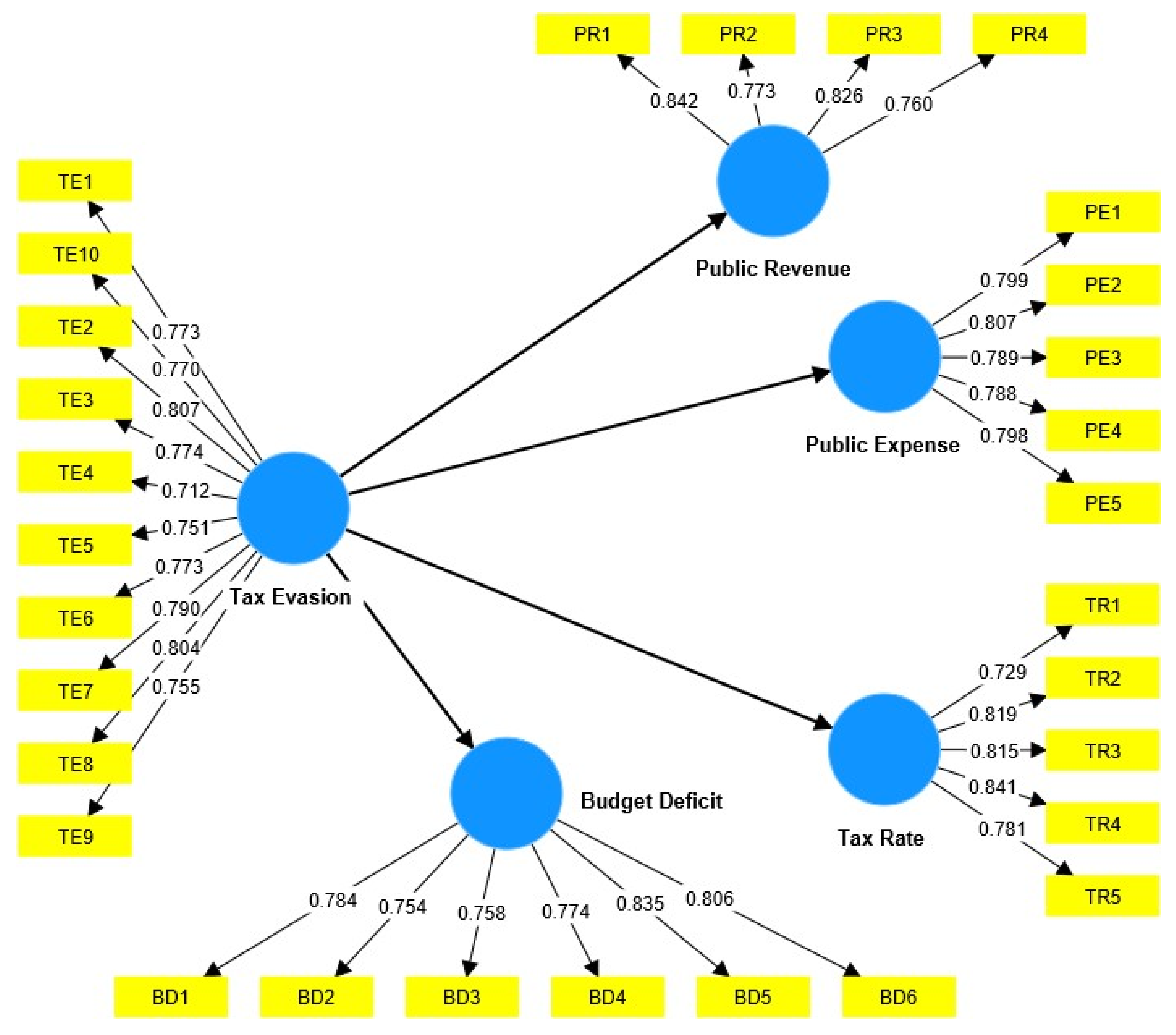

Table 1.
Reliability, validity, CR, AVE.
| Instruments | α | CR | AVE | R2 |
| Public Expense | 0.856 | 0.857 | 0.634 | 0.557 |
| Public Revenue | 0.813 | 0.816 | 0.642 | 0.469 |
| Tax Evasion | 0.924 | 0.924 | 0.595 | - |
| Tax Rate | 0.857 | 0.865 | 0.637 | 0.608 |
| Budget Deficit | 0.877 | 0.886 | 0.617 | 0.552 |
Table 2.
divergent validity based on the Fornell–Larcker approach.
| Instruments | 1 | 2 | 3 | 4 | 5 |
| 1.Budget Deficit | 0.786 | ||||
| 2.Public Expense | 0.593 | 0.796 | |||
| 3.Public Revenue | 0.584 | 0.701 | 0.801 | ||
| 4.Tax Evasion | 0.743 | 0.746 | 0.685 | 0.780 | |
| 5.Tax Rate | 0.672 | 0.766 | 0.624 | 0.771 | 0.798 |
Note: Square root of AVE in bold.
Table 3.
Direct effects.
| Relationships | β | ρ | Decision |
| Tax Evasion -> Budget Deficit | 0.743 | 0.000 | Accepted |
| Tax Evasion -> Public Expense | - 0.746 | 0.000 | Accepted |
| Tax Evasion -> Public Revenue | - 0.685 | 0.000 | Accepted |
| Tax Evasion -> Tax Rate | - 0.780 | 0.000 | Accepted |
Note: β, beta value; ρ, ρ-value.
Disclaimer/Publisher’s Note: The statements, opinions and data contained in all publications are solely those of the individual author(s) and contributor(s) and not of MDPI and/or the editor(s). MDPI and/or the editor(s) disclaim responsibility for any injury to people or property resulting from any ideas, methods, instructions or products referred to in the content. |
© 2024 by the authors. Licensee MDPI, Basel, Switzerland. This article is an open access article distributed under the terms and conditions of the Creative Commons Attribution (CC BY) license (http://creativecommons.org/licenses/by/4.0/).
Copyright: This open access article is published under a Creative Commons CC BY 4.0 license, which permit the free download, distribution, and reuse, provided that the author and preprint are cited in any reuse.


