

Submitted:
06 March 2024
Posted:
07 March 2024
You are already at the latest version
Abstract
: Controlling the distribution of water and wastewater between industrial processes is very vital in rationalizing water and preserving the environment. In this paper, a mathematical technique is proposed to optimize water-wastewater networks; a nonlinear program is introduced to minimize the consumption of freshwater, and consequently, the flowrate of the wastewater dis-charge will be also minimized. A general mathematical model, able to handle industrial plants containing up to eight sources and eight sinks, is developed using LINGO optimization software to facilitate dealing with complex case studies. The introduced model can handle single contam-inant networks as well as multiple contaminants cases. The optimal water network is synthe-sized through two steps; the first step is to introduce the case study data to the developed mathematical model. The second step considers using the optimal solution produced after run-ning the developed LINGO model as feed data for a pre-designed Excel sheet able to deal with these results and simultaneously draw the optimal water-wastewater network. The proposed mathematical model is applied to two case studies; The first case study includes actual data from four fertilizer plants located in Egypt; the water resources and requirements are simultaneously integrated to obtain a sensible cutting in both freshwater consumption (lowered by 52.2%) and wastewater discharge (zero wastewater discharge). The second case study is for a Brazilian pet-rochemical plant; the obtained results showed noticeable reductions in freshwater consumption for the second case study by 12.3 % while the reduction percentage of wastewater discharge is 4.5%.
Keywords:
Wastewater networks
; Multiple contaminants
; Mathematical model
; Optimization
1. Introduction
Careful use of water in mass exchange networks between processes or plants will reduce both freshwater consumption and wastewater discharge. Various mathematical programming based methodologies were presented last decades for minimizing both freshwater consumption and wastewater discharge. A relaxed linear model aiming to design an optimal wastewater distribution network was firstly proposed in 1998 by Galan and Grossmann; they used different treatment technologies to decrease the contaminants in the network and get the maximum reuse of wastewater streams in the plant [1]. Gabriel and El-Halwagi introduced a linear program aiming to decrease the concentrations of contaminants and maximize the reuse and recycle of wastewater through the optimal design of water interception network [2], while a mixed integer linear program, directed to design water-wastewater networks, was presented by Faria and Bagajewicz for the best handling of water allocation problems [3]. A mixed integer nonlinear programming (MINLP) model was proposed by Galan and Grossmann to design a wastewater network that includes five contaminants with thirteen types of technologies to decrease the concentration of contaminants [4]; their proposed model was applied on a mining plant in Turkey and an optimal wastewater network with minimum cost was designed. Many other researchers have optimized the water networks by MINLP, but for different application, such as Buabeng and Majozi [5] who aimed to maximize the reuse of wastewater by using regeneration-reuse and regeneration-recycle in the hollow fiber reverse osmosis membrane to minimize the cost of freshwater consumption. A MINLP model was also proposed by Padron et al for the design of wastewater network that includes treatment units to decrease the concentration of contaminants and get the minimum consumption of freshwater [6]; they presented a case study of Mexico City to show the validity and effectiveness of their presented model. Lots of other mathematical based methodologies have been introduced over the years; Nejad et al [7] presented a mathematical model and applied it on a case study in Tehran oil refinery to minimize water and wastewater flowrates; their study included three parameters in water quality; chemical oxygen demand, suspended solids and hardness. Hansen et al [8] introduced a mathematical program directed to minimize the freshwater consumption between several operations, including cooling systems and washing processes; they applied their proposed model in a petrochemical plant. The priority of sources-sinks matches was determined by using a ranking matrix technique [9]; three case studies of single and multiple contaminants are introduced to show the applicability of that technique. A closed-loop supply chain was launched by Mohammad et al [10] to control the shortage of water in the Azerbaijan city in Iran country by using Social Engineering Optimizer (SEO); their model showed a lowering in freshwater consumption. Arola et al [11] presented a mathematical approach to maximize the reusing of wastewater by decreasing the concentration of contaminants such as phosphorous, chemical oxygen demand (COD) and total oxygen carbon (TOC) in the treatment of waste water; the study included a membrane bioreactor as a regeneration process to decrease the concentration of the contaminants. A mathematical technique was suggested by Chin et al [12] to optimize the total cost of freshwater consumption and design the optimal water integration network in multiple contaminant systems. Tuba et al [13] introduced a review for mathematical programming based methodologies used for water minimization in industrial processes.
Graphical based techniques are also considered in several studies to improve the distribution of water and wastewater in the design of water networks; Irene et al [14] used a graphical technique to minimize the waste flowrates and fresh resources in the design of an inter-plant resource conservation network. Sahu et al [15] introduced a graphical method with adding a treatment unit to minimize the concentrations of contaminants and maximize the reuse of wastewater with minimizing the cost of treatment. Another graphical technique was proposed by Farrag et al [16] for the analysis and design of wastewater network using the composition driving forces; they studied the effect of the mass load of contaminants on the maximum mass recovery. The pinch technique was presented also to minimize wastewater discharge in industrial plants. Many other pinch based techniques have been introduced last decades to solve the problem of wastewater network optimization for minimizing freshwater and wastewater discharge in industrial plants [17,18,19,20,21,22,23,24,25]. However, pinch and graphical based methods are suitable only for solving simple case studies; when the plant includes a high number of streams, it would be difficult to be solved via graphical based methods. Another group of research works used combined pinch and mathematical programming techniques were introduced to overcome the limitation of graphical methods for optimizing water-wastewater networks [26,27,28,29,30].
To date, no simple ready model capable of solving simple as well as complex case studies, having a large number of streams and contaminants with simultaneous drawing of the optimum network has been introduced. In this paper, a generalized mathematical model is proposed to minimize both the freshwater consumption and the flowrate of wastewater discharge; nonlinear equations based on overall mass balance and component mass balance between several sources (up to eight sources) and several sinks (up to eight sinks) are formulated to be solved by LINGO software; Excel software is responsible for drawing the water-wastewater network in automated technique. Two case studies of single and multiple contaminants are presented to show the effectiveness of the suggested model in order to minimize the flowrate of total freshwater consumption and wastewater discharge in the network.
2. Methods
Given a set of source streams, up to eight sources, with flowrate (FSK) where K is the source number in the network design. It is assumed that each source has multiple contaminants (up to three contaminants) with concentrations (XSKA, XSKB, and XSKC). The limiting contaminants’ concentration in the discharged wastewater of flowrates (gk-waste) are XSAwaste, XSBwaste, and XSCwaste.
Given sets of sink streams, up to eight sinks, with flowrates (GQ), where Q is the sink number in the network design; each sink is assumed to have up to three contaminants with concentrations ZQAin, ZQBin and ZQCin. Freshwater of flowrate (FWQ) is distributed to each sink according to the limiting mass load with concentrations XA, XB, and XC. Figure 1 represents the flowchart for the proposed model.
The procedure for getting the optimum design of water-wastewater network is shown in Figure 1; overall mass balance is applied for each source stream of flowrate (FSK), which is equal to the sum of the flowrates from that source to sinks (gK-Q) in addition to the partition of that stream which may be discharged to waste (gK-Waste).
Overall mass balance is applied to each sink; the inlet flowrate for each sink is GQ, which depends on the flowrate of freshwater fed to each sink (FWQ) and the flowrate from each source to that sink, gK-Q. Component mass balance is applied on each sink of the three contaminants (A, B and C), where the limiting concentration of contaminants A, B, and C in each sink are ZQAin, ZQBin and ZQCin respectively. Freshwater flowrate (FWQ) is assumed to be mixed with the feed water to each sink to optimize the inlet mass load.
Overall mass balance is applied for the total waste discharge flowrate (GWaste) which depends on the discharge waste flowrate from each source (GK-Waste); component mass balance is applied to the discharged wastewater with concentrations of XSAwaste, XSBwaste and XSCwaste for contaminants A, B and C respectively. The limiting contaminant concentration of discharged wastewater is restricted by environmental law.
3. Case Studies
The proposed mathematical model is applied to two case studies to show its effectiveness in minimizing freshwater consumption and reducing the total wastewater discharge flowrate. The following subsections describe in detail the considered case studies.
3.1. Case study 1
The first case study of this work is composed of four fertilizer plants (phosphoric acid plant, concentrated phosphoric acid plant, single super phosphate plant, and triple super phosphate plant), which contain eight sources with contaminants: hydrofluorosilicic acid (H2SiF6), sulfuric acid (H2SO4), and phosphorus pentoxide (P2O5). In the existing case study, some source streams are completely discharged as waste. Furthermore, several sinks are completely supplied with their water needs by freshwater; this consequently results in more consumption of freshwater and extra discharge of wastewater. Figure 2 clarifies the source and sink streams which are not integrated into the network in the current actual case study.
Before applying the proposed mathematical model, as shown in Figure 2, source 5 (separator of phosphoric acid) discharged all its wastewater (20 m3/hr) to waste according to its high concentration of H2SiF6. Four of the sinks (dilution mixer of sulfuric acid in phosphoric acid plant, dilution mixer of sulfuric acid in single super phosphate plant, washing filter cake in phosphoric acid plant, and washing filter in Phosphoric acid plant) are supplied only by freshwater with a flowrate of 270 m3/hr.
The flowrates and concentrations of the eight sources are shown in Table 1; the flowrate of source 1 (Condenser of Phosphoric acid plant) is 280 m3/h with normal concentrations of H2SiF6, H2SO4and P2O5 (14, 0.3, and 4 Wt% respectively); the flowrates of sources 2,3, and 4 (Reaction Vacuum Pump 1 of phosphoric acid plant, Filter Vacuum Pump 1 of phosphoric acid plant, and Filter Vacuum Pump 2 of phosphoric acid plant) are 15, 18, and 18 m3/h respectively and they have the same concentrations of H2SiF6, H2SO4 and P2O5 (8, 0.1, and 3 Wt% respectively).
Source 5 (Separator of the phosphoric acid plant) has a high concentration of H2SiF6 (30 Wt%), so its wastewater flowrate (20 m3/hr) is discharged to waste. Source 6 (Cooling water of phosphoric acid plant) has wastewater flowrate of 120 m3/hr with concentrations of H2SiF6, H2SO4, and P2O5 as 10, 0.6,5 Wt% respectively.
Source 7 (Cooling water of single super phosphate plant) has flowrate of 160 m3/hr with concentrations of H2SiF6, H2SO4, and P2O5 as 12, 0.4, 5 Wt% respectively, while source 8 (Condenser of concentrated unit in phosphoric acid plant) has high flowrate (250 m3/h) with a high concentration of H2SiF6 (20 Wt%) and normal concentrations of H2SO4 and P2O5 (0.2, and 4 Wt% respectively).
The limiting flowrates and concentrations of the three contaminants (H2SiF6, H2SO4, and P2O5) of the seven sinks are shown in Table 2; the flowrate of sink 1 (Dilution mixer of sulfuric acid in the phosphoric acid plant) is 10 m3/h with limiting concentrations of H2SiF6, H2SO4, and P2O5 as 12, 0.5, and 4.5 Wt% respectively.
The data for three gas scrubbers in the three different plants are shown in Table 2; sink 4 (gas scrubber in phosphoric acid plant) and sink 5 (gas scrubber in single super phosphate plant) have the same flowrate; 280 m3/h, but the limiting concentrations of H2SiF6, H2SO4, and P2O5 to sink 4 and sink 5 are 14, 3, 5 Wt% and 16, 3, 6 Wt% respectively. Sink 6 (gas scrubber in triple super phosphate plant) has a flowrate of 180 m3/h with limiting concentrations of H2SiF6, H2SO4, and P2O5 as 11, 3, and 5 Wt% respectively.
The washing filter in the phosphoric acid plant (sink 7) has a flowrate of 70 m3/h with limiting concentrations of H2SiF6, H2SO4, and P2O5 as 14, 5, and 4 Wt% respectively.
The objective function of the model constructed for handling the fertilizer plants case study is to minimize freshwater consumption as well as wastewater discharge.
3.2. Case study 2
The Brazilian Petrochemical Plant presented by Hansen et. al. [8] is the chosen second case study for the current research work. This case study includes eight sources (clarified water, filtered water, cooling water 1, cooling water 2, cooling water 3, cooling water 4, bearing water 1, and bearing water 2) and six sinks (cooling water 1, cooling water 2, cooling water 3, cooling water 4, bearing water 1 and bearing water 2) with considering the COD parameter as the only contaminant. The limiting flowrates and concentrations of COD in each plant stream are shown in Table 3.
4. Results and Discussions
After applying the data given of sources and sinks of the investigated two case studies on the suggested mathematical model (using LINGO Software), the obtained results show the optimum flowrates from sources to sinks, the freshwater consumption in each sink, and the wastewater flowrate from each source. After that, the obtained results are sent simultaneously to the predesigned Excel software where the drawing of the optimal wastewater network is automatically achieved. The introduced approach aims to minimize freshwater consumption and reduce wastewater discharge for the two case studies under investigation.
4.1. Results and discussions of case study 1
The data given of the fertilizer plants (case study 1) are introduced to the designed mathematical model and solved by LINGO optimization software. The obtained results show the flowrates from sources to sinks (Gk-Q), flowrates from sources to waste, and freshwater flowrates to sinks; these results are listed in Table 4.
The obtained total freshwater flowrate (FW) is 129 m3/h; this amount of freshwater is distributed to Sink 1, Sink 2, Sink 3, Sink 4, Sink 5, and Sink 6 by flowrates of 4.0201, 24.8, 21.738, 14.175, 26.684 and 37.581 m3/h respectively. Zero wastewater discharge is obtained in this case study. The obtained results then are sent to Excel software for achieving the optimal wastewater network draw of the investigated fertilizer plants, as shown in Figure 3. By Comparing the obtained results with the original case study data, the freshwater consumption is reduced from 270 m3/h to 129 m3/h by a reduction percentage of 52.2 %, and the total flowrate of wastewater discharge is decreased from 20 m3/h to zero discharge.
4.2. Results and discussions of case study 2
By feeding the data given of the considered second case study (Brazilian petrochemical plant) to the proposed model, the optimum flowrates from sources to sinks and waste can be determined. The obtained results listed in Table 5, are used as feed data for the Excel software to get the automated drawing of the optimum water-wastewater network shown in Figure 4.
The clarified water source and filtered water source are considered as freshwater sources because the concentration of contaminants in these sources is zero. Regarding the results, addressed in Table 5, the clarified water flowrate of 966.54 m3/h is distributed between sinks K1, K2, K3, K4, K5, and K6 with flowrates of 623.57, 233.6, 57.213, 35.85, 3.06 and 13.25 m3/h respectively. However, the filtered water source feeds only the third sink (k3) by a flowrate of 15 m3/h. The cooling water 1 source stream supplies six sinks (K1, K2, K3, K4, K5, and K6) and waste by flowrates of 78.43, 43.4, 13.79, 9.15, 2.94, 1.75 and 567.54 m3/h respectively. On the other hand, cooling water 2, cooling water 3, and cooling water 4 sources discharge their water to the waste by 277, 92, and 45 m3/h respectively. The bearing water 1 source feeds only k 3 by flowrate 6 m3/h, while the bearing water 2 source feeds only sink 1 by a flowrate of 15 m3/h. The total wastewater discharge flowrate of 982 m3/h is collected from S3, S4, S5, S6, S7, and S8 sources with flowrates of 567.54, 277, 92, and 45 m3/h respectively.
By comparing the results of the proposed mathematical model and those of the original case study, it is observed that the clarified water flowrate is reduced from 1102 m3/h to 966.54 m3/h with a reduction percentage of 12.3 %. It is also noticed that the filtered water flowrate is reduced from 18 m3/h to 15 m3/h by a reduction percentage of 16.5 %. Additionally, the wastewater discharge is decreased by 4.5 % from 1029 m3/h to 982 m3/h.
Regarding the abovementioned results of the two investigated case studies, it is clear that the introduced approach is an effective and economical technique for designing an optimal water-wastewater network. These results show that the achieved water-wastewater networks of the considered case studies are economically effective and more profitable compared to the current networks through minimizing freshwater consumption and reducing wastewater discharge. Moreover, the proposed technique can be applied to other case studies to optimize their existing water networks.
5. Conclusions
The Water requirement increases within industrial processes in chemical equipment; the industrial water is used for washing, cooling, diluting, and processing in chemical plants. In this work, a mathematical model (LINGO Program) is proposed to minimize both of freshwater consumption and wastewater discharge. The applied equations of overall mass balance and component mass balance are formulated as a nonlinear program. Two steps are established to design the optimal mass exchange networks; the first step is to pass the data given of sources and sinks (flowrates and limiting contaminant concentrations) into LINGO Software and then, the obtained results are used in the second step as feed data for the proposed Excel Software which is responsible for achieving automatically the optimal water-wastewater network draw. The proposed mathematical approach was applied to two case studies, including fertilizer plants and a Brazilian petrochemical Plant. The obtained results of these case studies showed a reduction in freshwater consumption by 52.2 and 12.3 % respectively. Furthermore, the wastewater discharge is reduced to zero discharge in the fertilizer plants (case study 1), while the reduction percentage of wastewater discharge of the Brazilian petrochemical plant (case study 2) is 4.5%. Based on the results of the investigated case studies, it is obvious that the proposed strategy is a successful and cost-efficient method for developing optimal water-wastewater networks. It is also noticed that the obtained water-wastewater networks are more efficient and profitable than the present networks. This can be attributed to the reduction of freshwater consumption and wastewater discharge. Furthermore, the proposed approach can be used easily and can be applied for different industries includes fertilizer plants and petrochemical plants.
Author Contributions
Conceptualization, A.S., M.H. and A.B.; methodology, A.S. and M.H.; software, A.S., A.A.; validation, A.A., A.S. and A.B.; formal analysis, A.A. and M.H.; investigation, A.A. and A.G.; resources, A.S. and A.B.; data curation, A.A. and A.G..; writing—original draft preparation, A.A.; writing—review and editing, A.S., A.G. and A.B.; visualization, A.S., M.H. and A.G..; supervision, A.S., M.H. and A.B; funding acquisition, A.G. and A.B. All authors have read and agreed to the published version of the manuscript.
Funding
This work was supported and funded by the Deanship of Scientific Research at Imam Mohammad Ibn Saud Islamic University (IMSIU) (grant number IMSIU-RG23020).
Data Availability Statement
Data are available upon request through the corresponding author.
Conflicts of Interest
The authors declare no conflict of interest.
References
- Galan, B.; Grossmann, I.E. Optimal Design of Distributed Wastewater Treatment Networks. Ind. Eng. Chem. Res. 1998, 37, 4036–4048. [CrossRef]
- Gabriel, B.; El-Halwagi, M. Simultaneous Synthesis of Waste Interception and Material Reuse Networks: Problem Reformulation for Global Optimization. American Institute of Chemical Engineers. 2005, 24, 171–180. [CrossRef]
- Faria, D., C.; Bagajewicz, M. A new approach for the design of multicomponent water/wastewater networks, Comput. Aided Chem. Eng. 2008, 4, 43–48. [CrossRef]
- Galan, B.; Grossmann, I.E. Optimal Design of Real-World Industrial Wastewater Treatment Networks. Comput. Aided Chem. 2011, 37, 1251–1255. [CrossRef]
- Buabeng, E.; Majozi,T. Effective Synthesis and Optimization Framework for Integrated Water and Membrane Networks: A Focus on Reverse Osmosis Membranes. Ind. amp; Eng. Chem. Res. 2015, 54, 9394–9406. [CrossRef]
- Padron, J.I.; Almaraz, S.; Martinez, A.R. Sustainable Wastewater Treatment Plants Design Through Multi objective Optimization. Comput. Chem. Eng. 2020, 140, 106–122. [CrossRef]
- Nejad, S.M.; Ataei, A.; Reza, G.; Mehrdadi, N.; Ebadati, F.; Lotfi, F. Water Pinch Analysis for Water and Wastewater Minimization in Tehran Oil Refinery Considering Three Contaminants Environ. Monit. Assess. 2012, 184, 2709–2728. [CrossRef]
- Hansen, E.; Rodrigues, M.A.; Aragao, M.E.; Aquim, P.M. Water and Wastewater Minimization in a petrochemical Industry Through Mathematical Programming. J. Clean. Prod. 2017, 12, 959–981. [CrossRef]
- Li, Z.; Majozi, T. Optimal Design of Batch Water Network with a Flexible Scheduling Framework, Ind. Eng. Chem. Res. 2019, 99, 1–34. [CrossRef]
- Mohammad, A.; Ahmadi, A.; Mirzapour, S.M. Sustainable closed-loop Supply Chain Network for an Integrated Water Supply and Wastewater Collection System Under Uncertainly. J Environ Manage. 2020, 275, 111–128. [CrossRef]
- Arola, K.; Manttari, M.; Kallioinen, M. Two-Stage Nanofiltration for Purification of Membrane Bioreactor Treated Municipal Wastewater – Minimization of Concentrate Volume and Simultaneous Recovery of Phosphorus, Sep. Purif. Technol. 2020, 20, 317–344. [CrossRef]
- Chin, H.H.; Jia, X.; Sabev, P.; Klemes, J.; Liu, Z.Y. Internal and Total Site Water Network Design with Water Mains Using Pinch-Based and Optimization Approaches. ACS Sustainable Chem. Eng. 2021, 9, 6639–6658. [CrossRef]
- Duhbaci, T.B.; Ozel, S.; Bulkan, S. Water and energy minimization in industrial processes through mathematical programming: A literature review. Journal of Cleaner Production. 2021, 284, 124752. [CrossRef]
- Irene, M.L.; Dominic, C.Y. Flowrate Targeting Algorithm for Interplant Resource Conservation Network. Part 2: Assisted Integration Scheme. Ind. Eng. Chem. Res. 2010, 49, 6456–6468. [CrossRef]
- Sahu, G.C.; Garg, A.; Majozi, T.; Bandyopadhyay, S. Optimum Design of Waste Water Treatment Network. Ind. Eng. Chem. Res. 2013, 52, 5161–5171. [CrossRef]
- Farrag, N.M.; Kamel, D.A.; Ghallab, A.O.; Gadalla, M.A.; Fouad, M.K. Graphical Design and Analysis of Mass Exchange Networks Using Composition Driving Forces, S. Afr. J. Chem. Eng. 2021, 36, 94–104. [CrossRef]
- Khezri, S.M.; Lotfi, F.; Tabibian, S.; Erfani, Z. Application of water pinch technology for water and wastewater minimization in aluminum anodizing industries. Int. J. Environ. Sci. Tech. 2010, 7, 281–290. [CrossRef]
- Mughees, W.; Al-Ahmad, M. Application of water pinch technology in minimization of water consumption at a refinery. Comput. Chem. Eng. 2015, 73, 34–42. [CrossRef]
- Liu, Z.Y.; Yang, Y.Z.; Zhang, Y. Determination the pinch point and calculating the freshwater target for water-using systems with single contaminant. Chem. Eng. Res. Des. 2007, 85, 1485–1490. [CrossRef]
- Chin, H.H.; Liew, P.Y.; Varbanov; P. S.; Klemes, J. J. Extension of pinch analysis to targeting and synthesis of water recycling networks with multiple contaminants. Chem. Eng. Sci. 2022, 248, 117223. [CrossRef]
- Kim, Y.; Lim, J.; Shim, J.Y.; Lee, H.; Cho, H.; Kim, J. Optimizing wastewater heat recovery systems in textile dyeing processes using pinch analysis. Applied Thermal Engineering. 2022, 214, 118880. [CrossRef]
- Skouteris, G.; Ouki, S.; Foo, D.; Saroj, D.; Altini, M.; Melidis, P.; Cowley, B.; Ells, G.; Palmer, S.; Odell, S. Water footprint and water pinch analysis techniques for sustainable water management in the brick-manufacturing industry. Journal of Cleaner Production. 2018, 172, 786–794. [CrossRef]
- Souifi, M.; Souissi, A. Simultaneous water and energy saving in cooling water networks using pinch approach. Mater. Today. 2019, 13, 1115–1124. [CrossRef]
- Zhang, Q.; Yang, M.; Liu, G.; Feng, X. Relative concentration based pinch analysis for targeting and design of hydrogen and water networks with single contaminant. J. Clean. Prod. 2016, 112, 4799–4814. [CrossRef]
- Deng, C.; Feng, X.; Sum, D.K.; Foo, D.C.Y. Process-based Graphical approach for simultaneous targeting and design of water network. AICHE J. 2011, 57, 3085–3104. [CrossRef]
- Mabitla, S.S.; Majozi, T. A hybrid method for synthesis of integrated water and regeneration networks with variable removal ratios. J Environ Manage. 2019, 231, 666–678. [CrossRef]
- Quintero, V.; Quiroga, A.G.; Delgado, A.D.G. A hybrid methodology to minimize freshwater consumption during shrimp shell waste valorization combining multi-contaminant pinch analysis and superstructure optimization. Polym. 2021, 13, 1–13. [CrossRef]
- Karthick, R.; Kumaraprasad, G.; Sruti, B. Hyprid optimization approach for water allocation and mass exchange network. Resour. Conserv. Recycl. 2010, 54, 783–792. [CrossRef]
- Cao, K.; Feng, X.; Ma, H. Pinch multi-agent genetic algorithm for optimizing water-using networks. Comput. Chem. Eng. 2007, 31, 1565–1575. [CrossRef]
- Esmaeeli, A.; Sarrafzadeh, M. H. Reducing freshwater consumption in pulp and paper industries using pinch analysis and mathematical optimization. J. Water Proc. Engineering. 2023, 53, 10364. [CrossRef]
Figure 1.
Procedure for achieving an optimum design of water-wastewater network.
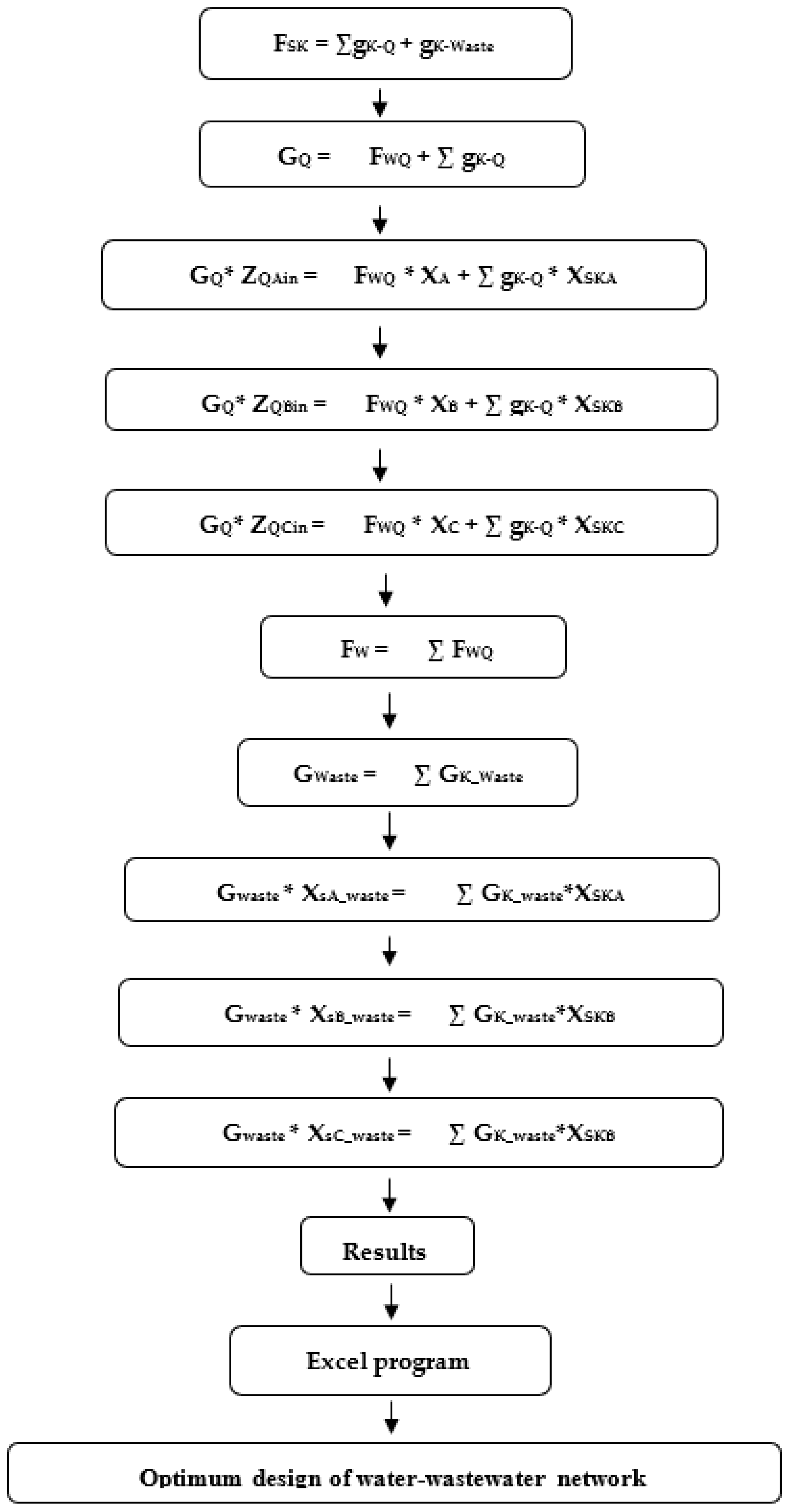
Figure 2.
Source and sink streams not integrated into the existing water network.
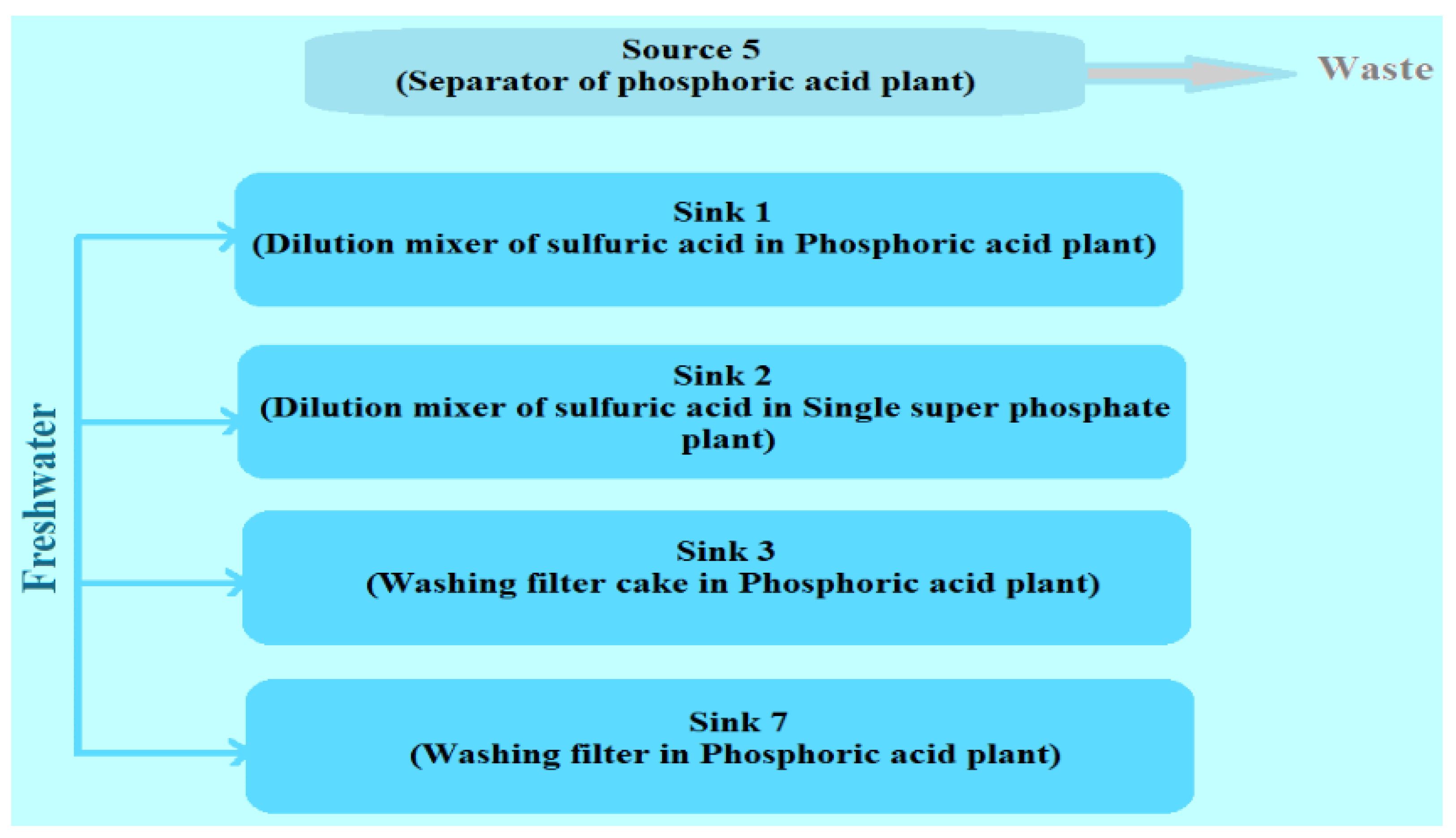
Figure 3.
Design of water-wastewater network of fertilizer plants case study.
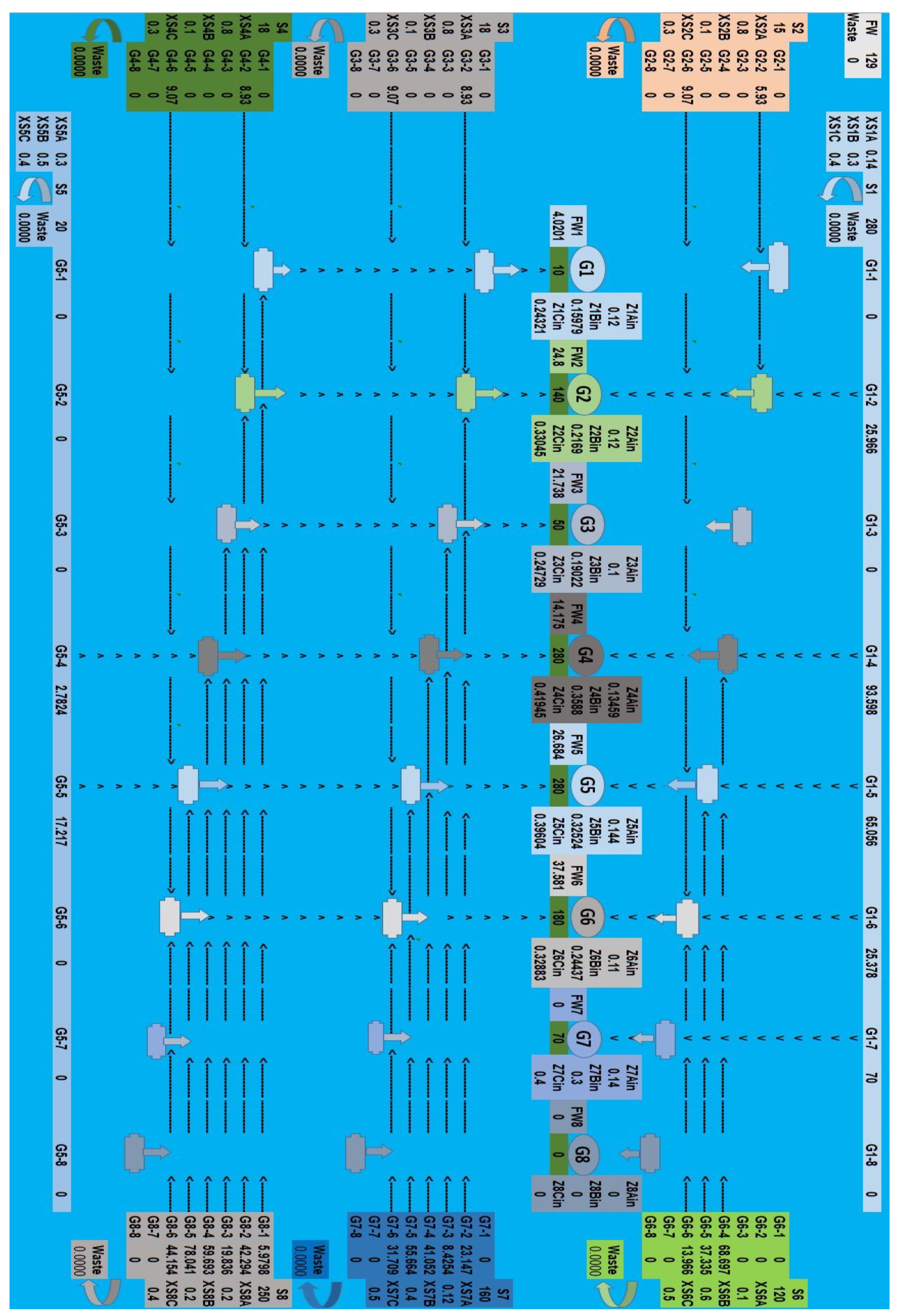
Figure 4.
Design of a water-wastewater network of the Brazilian petrochemical plant (case study 2).
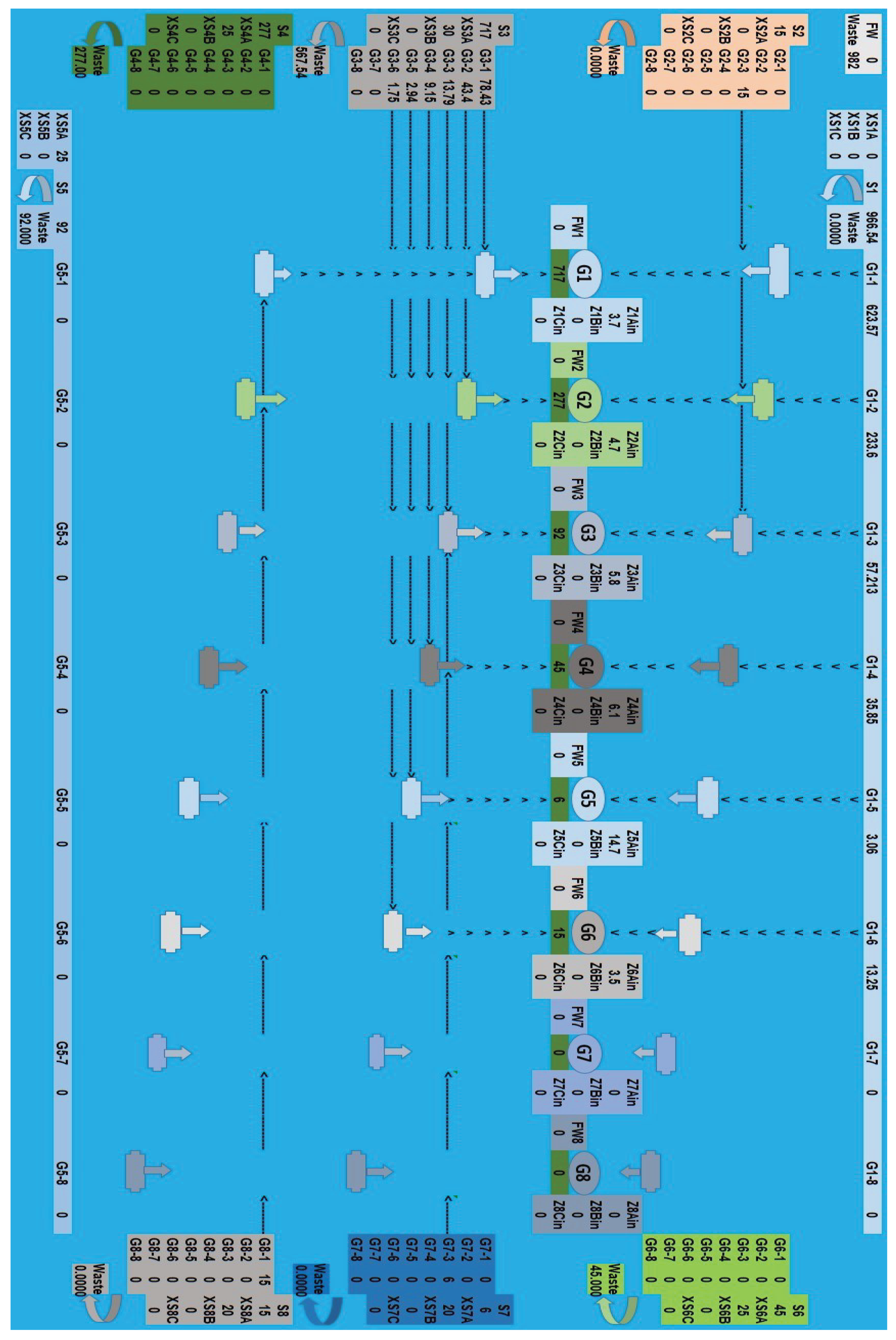

Table 1.
Data given of sources in the investigated fertilizer plants case study.
| Sources | Flowrate (m3/h) | H2SiF6 (Wt%) | H2SO4(Wt%) | P2O5(Wt%) |
| Source 1 (Condenser of Phosphoric acid plant) | 280 | 14 | 0.3 | 4 |
| Source 2 (Reaction Vacuum Pump 1 of the phosphoric acid plant) | 15 | 8 | 0.1 | 3 |
| Source 3 (Filter Vacuum Pump 1 of phosphoric acid plant) | 18 | 8 | 0.1 | 3 |
| Source 4 (Filter Vacuum Pump 2 of phosphoric acid plant) | 18 | 8 | 0.1 | 3 |
| Source 5 (Separator of the phosphoric acid plant) | 20 | 30 | 0.5 | 4 |
| Source 6 (Cooling water of phosphoric acid plant) | 120 | 10 | 0.6 | 5 |
| Source 7 (Cooling water of Single super phosphate plant) | 160 | 12 | 0.4 | 5 |
| Source 8 (Condenser of concentrated unit in the phosphoric acid plant) | 250 | 20 | 0.2 | 4 |
Table 2.
Data given of sinks in the considered fertilizer plants case study.
| Sinks | Flowrate (m3/h) | H2SiF6 (Wt%) | H2SO4 (Wt%) | P2O5 (Wt%) |
| Sink 1 (Dilution mixer of sulfuric acid in Phosphoric acid plant) | 10 | 12 | 0.5 | 4.5 |
| Sink 2 (Dilution mixer of sulfuric acid in Single super phosphate plant) | 140 | 12 | 0.8 | 3.69 |
| Sink 3 (Washing filter cake in Phosphoric acid plant) | 50 | 10 | 3 | 5 |
| Sink 4 (Gas scrubber in Phosphoric acid plant) | 280 | 14 | 3 | 5 |
| Sink 5 (Gas scrubber in Single super phosphate plant) | 280 | 16 | 3 | 6 |
| Sink 6 (Gas scrubber in Triple super phosphate plant) | 180 | 11 | 3 | 5 |
| Sink 7 (Washing filter in Phosphoric acid plant) | 70 | 14 | 5 | 4 |
Table 3.
Data given of sources and sinks of the considered Brazilian petrochemical plant.
| Sources | Flowrate (m3/h) |
COD (mg/L) |
Sinks | Flowrate (m3/h) |
COD (mg/L) |
|
Clarified water |
1131 | 0 |
Cooling water 1 |
717 | 3.7 |
|
Filtered water |
21 | 0 | Cooling water 2 | 277 | 4.7 |
|
Cooling water 1 |
717 | 30 | Cooling water 3 | 92 | 5.8 |
| Cooling water 2 | 277 | 25 | Cooling water 4 | 45 | 6.1 |
| Cooling water 3 | 92 | 25 | Bearing water 1 | 6 | 14.7 |
| Cooling water 4 | 45 | 25 | |||
| Bearing water 1 | 6 | 20 | Bearing water 2 | 15 | 3.5 |
| Bearing water 2 | 15 | 20 |
Table 4.
The optimum flowrates of sources to sinks and waste of fertilizer plants case study.
| Stream | Flowrate (m3/h) | Stream | Flowrate (m3/h) | Stream | Flowrate (m3/h) |
| FW | 129 | G4-6 | 9.0697 | G8-2 | 42.29 |
| GWaste | Zero | G5-4 | 2.7824 | G8-3 | 19.84 |
| G1-2 | 25.966 | G5-5 | 17.217 | G8-4 | 59.69 |
| G1-4 | 93.598 | G6-4 | 68.7 | G8-5 | 78.04 |
| G1-5 | 65.056 | G6-5 | 37.34 | G8-6 | 44.15 |
| G1-6 | 25.378 | G6-6 | 13.97 | FW1 | 4.0201 |
| G1-7 | 70 | G7-2 | 23.15 | FW2 | 24.8 |
| G2-2 | 5.9302 | G7-3 | 8.425 | FW3 | 21.738 |
| G2-6 | 9.0697 | G7-4 | 41.05 | FW4 | 14.175 |
| G3-2 | 8.9302 | G7-5 | 55.66 | FW5 | 26.684 |
| G3-6 | 9.0697 | G7-6 | 31.71 | FW6 | 37.581 |
| G4-2 | 8.9302 | G8-1 | 5.98 |
Table 5.
Flowrates of sources to sinks and waste of the studied Brazilian petrochemical plant.
| Sinks | Sources flowrates (m3/h) to be distributed between sinks and the waste | |||||||
|
S1 (Clarified water) |
S2 (Filtered water) |
S3 (Cooling water 1) |
S4 (Cooling water 2) |
S5 (Cooling water 3) |
S6 (Cooling water 4) |
S7 (Bearing water 1) |
S8 (Bearing water 2) |
|
| K1 | 623.57 | 0 | 78.43 | 0 | 0 | 0 | 0 | 15 |
| K2 | 233.6 | 0 | 43.4 | 0 | 0 | 0 | 0 | 0 |
| K3 | 57.213 | 15 | 13.79 | 0 | 0 | 0 | 6 | 0 |
| K4 | 35.85 | 0 | 9.15 | 0 | 0 | 0 | 0 | 0 |
| K5 | 3.06 | 0 | 2.94 | 0 | 0 | 0 | 0 | 0 |
| K6 | 13.25 | 0 | 1.75 | 0 | 0 | 0 | 0 | 0 |
| waste | 0 | 0 | 567.54 | 277 | 92 | 45 | 0 | 0 |
| Source Total flowrate | 966.54 | 15 | 717 | 277 | 92 | 45 | 6 | 15 |
Disclaimer/Publisher’s Note: The statements, opinions and data contained in all publications are solely those of the individual author(s) and contributor(s) and not of MDPI and/or the editor(s). MDPI and/or the editor(s) disclaim responsibility for any injury to people or property resulting from any ideas, methods, instructions or products referred to in the content. |
© 2024 by the authors. Licensee MDPI, Basel, Switzerland. This article is an open access article distributed under the terms and conditions of the Creative Commons Attribution (CC BY) license (http://creativecommons.org/licenses/by/4.0/).
Copyright: This open access article is published under a Creative Commons CC BY 4.0 license, which permit the free download, distribution, and reuse, provided that the author and preprint are cited in any reuse.


