

Submitted:
13 January 2026
Posted:
14 January 2026
You are already at the latest version
Abstract
We present a geometric reinterpretation of cosmic expansion in which expansion is treated as an effective spatial dimension whose projection governs observed distances, time evolution, and physical interactions. By modelling the actual path followed by light through this expanded geometry, we introduce a spiral distance that reproduces observed luminosity and angular-distance relations without requiring accelerated expansion or an additional dark-energy component.Within this framework, gravity emerges as a local suppression of expansion, producing time dilation and curvature consistent with general relativity in the weak-field limit. Expansion is shown to be closely tied to the flow of time itself, with proper time corresponding to progression along the expansion direction and deviations from this trajectory giving rise to gravitational and kinematic time dilation. When applied consistently to both Type Ia supernova luminosity data and the angular scale of the cosmic microwave background, the framework naturally reduces the apparent discrepancy between late- and early-universe determinations of the Hubble constant.Extending the model to the quantum domain, we propose that wave–particle duality, spin, and probabilistic behaviour arise from partial delocalization within a finite temporal window. Electric charge is interpreted as a time-phase asymmetry associated with motion in the expansion dimension, with the electromagnetic coupling strength naturally linked to a dimensionless geometric ratio consistent with the fine-structure constant. Quantum entanglement is reinterpreted as a shared time-phase structure, preserving all experimentally verified predictions of quantum mechanics while providing an intuitive geometric explanation for nonlocal correlations without violating relativistic causality.The framework suggests several testable signatures, including limits on entanglement across extreme temporal separations, time-domain interference effects, and cross-scale correlations between quantum phenomena and gravitational time dilation. While fully compatible with existing observations, this approach offers a unified geometric interpretation connecting cosmology, gravity, time, and quantum behaviour, and motivates further theoretical development and experimental investigation.
Keywords:
cosmic expansion
; gravity
; wave-particle duality
; electromagnetism
; fine- structure constant
1. Introduction
The probabilistic behaviour of matter described by quantum mechanics and the geometric description of gravity embodied in general relativity stand as two foundational yet conceptually distinct pillars of modern physics. Quantum mechanics governs the microscopic world, where particles exhibit superposition, interference, and wave–particle duality, while gravity dominates the macroscopic regime, where mass and energy curve spacetime and shape the large-scale structure of the universe. Despite their extraordinary empirical success, the relationship between these two frameworks remains one of the most profound open questions in physics.
Over the past decades, numerous approaches have sought to reconcile quantum mechanics and gravity within a single unified framework. While quantum field theory provides an exceptionally accurate description of non-gravitational interactions, and general relativity continues to pass increasingly precise experimental tests, attempts to merge them have faced persistent conceptual and technical obstacles. Existing approaches often require additional dimensions, new particles, or regimes that remain experimentally inaccessible, leaving the fundamental connection between quantum behaviour, spacetime geometry, and cosmic expansion unresolved.
In this paper, we revisit and extend a framework introduced in an earlier study [1]. Rather than attempting a direct quantization of gravity or modification of quantum mechanics, we adopt a geometry-first perspective rooted in observational cosmology. By analysing luminosity-distance data using minimal geometric assumptions about light propagation in an expanding universe, we infer an effective radial expansion rate and use this result as a foundation for a broader reinterpretation of spacetime structure.
This approach leads naturally to a unified conceptual framework in which cosmic expansion, time evolution, gravity, and quantum phenomena are understood as different projections of a common geometric structure. Expansion is treated as an effective spatial dimension, with observable consequences for distance measures, time dilation, and particle behaviour. Without altering the established mathematical formalisms of general relativity or quantum mechanics, the framework provides an interpretive “container” that links large-scale cosmology to microscopic quantum effects, offering new insight into wave–particle duality, charge, entanglement, and the apparent acceleration of the universe.
2. Method of Analysis
Stellar luminosity data compiled by Scolnic et al. [1] were used as the primary observational dataset in this work. In most previous analyses, these data are presented and interpreted within the context of a specific cosmological model, typically a variant of the standard ΛCDM framework, with model parameters inferred through global fits.
Here, we adopt a minimally parametrized, geometry-driven approach, based on a small number of physically motivated assumptions, in order to analyse the luminosity–distance data without imposing a specific dynamical expansion history a priori. This allows us to examine how geometric interpretation alone influences inferred expansion behaviour.
Premises
Premise 1: The expansion of the universe is well described observationally as a large-scale isotropic stretching of spatial separations, first identified by Hubble and subsequently confirmed by a wide range of cosmological probes. On sufficiently large scales, this expansion may be characterized by a rate of increase of physical distance per unit time, commonly parameterized by the Hubble constant, currently measured to be of order . In the standard picture, this expansion acts uniformly in all spatial directions.
Premise 2: For the purposes of this analysis, the expansion itself is treated as an effective geometric degree of freedom, distinct from the spatial directions in which angular separations are observed. Photon propagation is assumed to follow null geodesics at the invariant speed c. Exploiting the isotropy and homogeneity of the background geometry, the problem may be reduced to a two-dimensional subspace consisting of one spatial direction and the expansion degree of freedom. Without loss of generality, the photon trajectory is taken to lie within a plane perpendicular to the observer at the time of reception, allowing expansion-induced path length and observable transverse separation to be analyzed independently (Figure 1).
This construction does not introduce additional physical dimensions but provides a geometric framework for separating expansion-induced path length from observable transverse separation.
Gravitational deflections of light caused by intervening mass distributions are treated statistically and assumed not to bias the ensemble luminosity–distance relation on cosmological scales. Under these assumptions, each photon may be represented by an effective path constrained to the surface of an expanding sphere. While individual photons traverse different spatial trajectories, the geometry of expansion implies that each can be treated equivalently when analysed as a function of source distance alone.
If one considers two points on the surface of a sphere whose radius increases with time, light emitted from one point and received at the other can be represented, when projected onto the expansion–space plane, as following an effective spiral-like path. This representation captures the combined effects of light propagation at speed c and the continuous increase of the sphere’s radius during transit.
The resulting effective path length along the expanding surface may be written as
Where and are the radii of the sphere at points A and B, and denotes the radial expansion speed (we have used H in to denote that this is the observed expansion velocity derived from Hubble expansion). There is the assumption here that the speed of light itself is not changed by the expansion.
The redshift observed for any point around the spiral will be directly related to the size of the universe at that point, i.e., the circumference. As the circumference of our expansion sphere is directly proportional to the radius, the stretching effect or redshift, z, is:
The magnitude of the observed light (expressed as the distance modulus m-M) of any object is related to the luminosity distance by:
where is the luminosity distance in Mpc and can be defined as
L is the intrinsic luminosity of the object, and F is the observed flux. For nearby objects (those for which the time that has passed is minimal and there has been little increase in radius), this would approximate to the distance around an arc of our spiral model, . For objects that are further away, then distortion will occur through two effects:
As the light stretches, the energy of the light diminishes, which causes a reduction in intensity. The wavelength of light will increase relative to , as the circumference becomes proportionally larger for the same angle, so consequently, the energy of the light will drop in intensity relative to /. Second, the stretch will mean that the photon arrival rate within a beam of photons will be reduced again according to /.
As the luminosity distance is proportional to the square root of the flux received and to account for the angular distance the light moves on the sphere then the luminosity distance (the apparent distance as seen in the measured data)
We then fitted the above against the measured luminosity data, varying only to determine the radial speed of expansion of the universe.
3. Results
Figure 2 shows the results of our fit to the Type Ia supernova luminosity data of Scolnic et al. [2]. Although a constant velocity of expansion (as shown by the green dashed line) fits reasonably well for nearby objects, the best fit is obtained by allowing the velocity of expansion to vary with time. We fitted the speed of expansion using a double exponential decay function of the expansion velocity from time zero, as we wanted a function that could allow the velocity to behave naturally
The expansion velocity versus the radius of the expansion sphere used in this model can be seen in Figure 3 over the range for which data are available. The utilization of the exponential decay function in this context is not intended to represent an exact mathematical depiction of reality. Instead, it is simply an algorithm employed to ascertain the pattern of changes in the expansion speed within the specified region of interest.
The parameters obtained from our fit were as follows = -0.01506, =0.9910, C=0.02411 (expressed as fractions of c, the speed of light), r=96.1 Mpc, k=0.1827 and k’=0.0265.
When interpreted using standard luminosity distances, the tail of the fitted curve appears to increase at large radii, mimicking accelerated expansion, consistent with ΛCDM-based analyses. [2,3,4] The right-hand pane in Figure 2 shows our fit using Friedmann–Lemaître–Robertson–Walker (FLRW) metric:
with the best fit being obtained from the data with and with other parameters zero.
The fit using the double exponential fit results in a current average expansion rate, =6.88 ± 0.36 × 10⁶ ms-1, which results in a Hubble expansion rate constant of 71.55 ± 3.7 km/s/Mpc, in broad agreement with standard determinations [5,6].
Re-Modelling the universe’s expansion
The preceding analysis includes the two standard flux-reduction effects—photon energy redshift and arrival-rate reduction—leading to an overall factor . If Premise 2 is correct, however, an additional geometric effect must be considered: partial spreading of the photon wavefront into the expansion direction itself.
Taking the spiral distance from Eq. (2.1) as the actual path length travelled by the photon, the observed flux may be written as
with representing an effective wavefront dimension, reduced from 2 due to partial projection of the photon wavefront into the expansion direction. The observer will see a luminosity distance related to the spiral distance by:
What this effectively means is that the photon wavefront behaves as if it lives in 2 dimensions but the ruler we use to measure distance (our light on an increasing spiral) encodes some of one of those dimensions such that
In this formulation, is constant, which we can use as a fitting parameter. Mathematically this is the same as
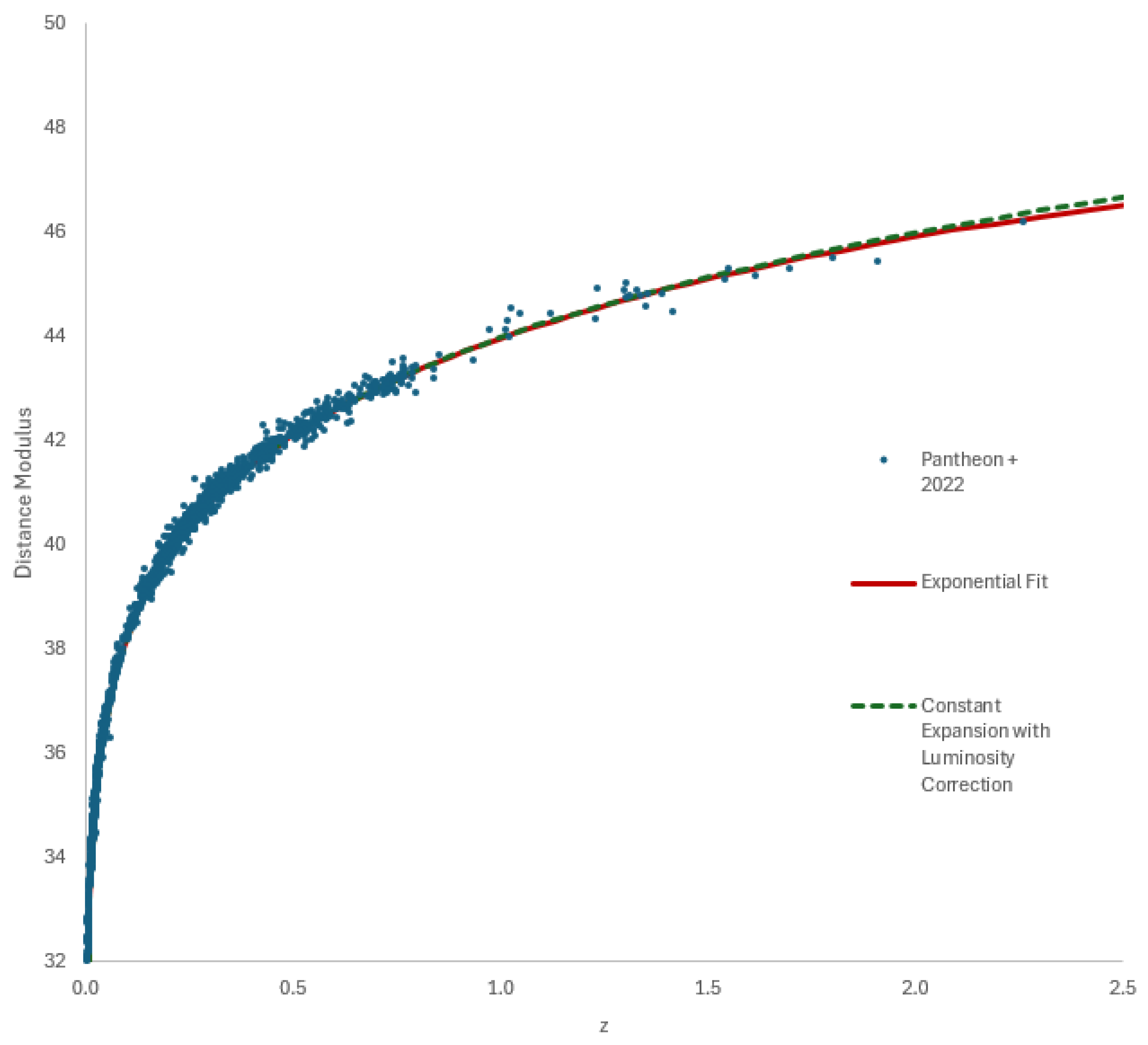
Using the above model we find an excellent fit to the Type Ia supernova luminosity-distance data with a constant velocity of expansion vH of 6.87 ± 0.03 × 10⁶ ms-1 and and , yielding of 814.45 over the 1701 points marginally improving upon the best fit FLRW value of 819.54. (Note that vH and are degenerate parameters; we therefore seeded the value of vH following a simple Pythagoras extrapolation of the observed Hubble constant.) Figure 6 shows the luminosity fit for visual comparison:
Figure 4.
Best-fit luminosity–distance models including the geometric luminosity correction described in the text. The green dotted line shows a constant expansion speed with correction, while the red solid line shows the varying expansion speed model derived from the earlier analysis.
Figure 4.
Best-fit luminosity–distance models including the geometric luminosity correction described in the text. The green dotted line shows a constant expansion speed with correction, while the red solid line shows the varying expansion speed model derived from the earlier analysis.
The second term of Equation 3.5 governed by is giving the fraction of transverse wavefront expansion that projects into the expansion dimension and is therefore not observable by a surface-bound observer. This tends towards 0.5 as we near r=0 which represents the geometric upper bound for transverse leakage into a single additional spatial direction as seen in Figure 5.
The results of our adjusted model are consistent with an early high-energy, radiation-dominated phase of the universe in which photon densities were sufficient for matter creation. The creation of this matter slowed the expansion down rapidly and left us with near constant expansion at the isotropic level. The model does not conflict with an early inflationary phase [7] and is consistent with a rapid initial expansion followed by a transition to near-constant expansion.
The appearance of accelerating expansion when distances are inferred from luminosity measurements is a geometric distortion effect caused by partial wavefront spreading into the expansion dimension itself.
The framework presented here does not modify the local physics governing photon propagation, redshift, or energy conservation, nor does it alter the Friedmann equations at the dynamical level. In particular, the relationship between redshift and scale factor, , is preserved, and photons are assumed to propagate locally at the invariant speed c, following lightlike trajectories determined by the global geometry, without modification to their fundamental dynamics. The model therefore remains compatible with the kinematic foundations of standard cosmology.
Where this approach differs from the conventional FLRW interpretation is in the geometric interpretation of distance inferred from luminosity measurements. In the standard model, the observed dimming of distant sources is attributed to a combination of redshift, photon arrival rate reduction, and the growth of the transverse wavefront area on a two-dimensional spatial hypersurface. This leads naturally to the definition of the luminosity distance , where is the transverse comoving distance.
In contrast, the present model allows for the possibility that part of the transverse expansion of the photon wavefront occurs in the expansion dimension itself, contributing to path length and redshift but not to observable transverse separation. As a result, the effective dimensionality of wavefront spreading is reduced, and the luminosity distance inferred by a surface-bound observer differs from that predicted by a purely two-dimensional transverse geometry. Importantly, this effect is geometric in origin and does not require dark energy or an accelerating expansion of the scale factor.
Under this interpretation, the observed luminosity–redshift relation of Type Ia supernovae can be reproduced with a near-constant expansion rate, with the apparent acceleration arising from a distance–flux misinterpretation rather than from a change in the underlying expansion dynamics. The model is therefore complementary to standard cosmology: it reproduces the same observables while offering an alternative geometric explanation for their interpretation.
Impact on the Cosmic Microwave Background
A key observable derived from cosmic microwave background (CMB) measurements is the angular size of the sound horizon,
From Planck observations, this quantity is measured to be radians [8]. The comoving sound horizon is determined by early-universe physics and is approximately Mpc, with photon decoupling occurring at redshift .
In our framework, the angular diameter distance is not identified with the photon path length but rather with the effective transverse separation imprinted on the observed angular scale. Since photon trajectories follow spiral paths along the expanding surface, part of the expansion contributes to path length without increasing transverse separation. As a result, neighbouring photon trajectories diverge more slowly than in isotropic expansion.
We therefore relate the angular diameter distance to the spiral path length via
where parameterizes the fractional contribution of expansion into non-transverse directions. Fitting this relation to the observed value of yields . Importantly, this fit employs the same spiral distance and constant expansion rate used to model the Type Ia supernova data, illustrating how a unified geometric interpretation can reduce the apparent discrepancy between late- and early-universe determinations of .
The above means that most expansion at high redshift increase path length rather than angular spreading with only about 17% of the expansion contributing to the effective transverse photon separation at recombination.
Note, the parameters γ, β, and δ are effective geometric descriptors of wavefront projection, not new physical dimensions or degrees of freedom
4. Discussion
Implications for the Hubble Tension
A long-standing challenge in observational cosmology is the tension between late-universe measurements of the Hubble constant, primarily inferred from Type Ia supernovae and local distance ladders, and early-universe determinations derived from cosmic microwave background observations under the assumption of the standard FLRW framework. In the present model, both datasets are interpreted using the same underlying expansion geometry and a single, near-constant expansion rate. The apparent discrepancy between early- and late-time inferences arises not from a change in the expansion dynamics, but from a geometric misinterpretation of distance measures that assumes purely transverse wavefront spreading. By allowing part of the photon wavefront expansion to project into the expansion dimension, the framework modifies the relationship between luminosity distance, angular diameter distance, and redshift in a manner that remains fully compatible with local photon physics. When applied consistently, this interpretation reproduces the observed supernova luminosity–distance relation and the CMB angular scale without requiring accelerated expansion or additional dark-energy components, thereby naturally reducing the inferred Hubble tension. While further observational tests are required, the results suggest that at least part of the tension may reflect geometric projection effects rather than new physics or unaccounted systematic errors.
Mass out of expansion and First Light
Premise 2, which underpins the geometric consistency of our analysis, treats cosmic expansion as an effective geometric dimension. This dimension contributes to distances and stretching in the same way as ordinary spatial dimensions, while photon propagation remains confined to the conventional three-dimensional spatial slice. Motion along the expansion dimension is assumed to obey the same physical principles—such as momentum conservation—as motion in ordinary space. Within this framework, deviations from purely longitudinal expansion naturally manifest as observable effects in three-dimensional space.
To illustrate this idea, consider an object that is stationary in ordinary space but progresses along the expansion dimension, as shown schematically in Fig. 4. If this object splits into two parts, momentum in ordinary space remains conserved, while the total momentum along the expansion dimension is also preserved. The resulting motion of the fragments can then be understood as a combination of continued progression along the expansion dimension and a projected velocity within three-dimensional space.
Figure 6.
Illustrative vector diagram showing the effect of transverse motion on momentum conservation in a geometry with one spatial (horizontal) and one expansion/time (vertical) direction. The example depicts an object breaking apart into two identical masses moving with equal and opposite spatial velocities while conserving total momentum along the expansion direction.
Figure 6.
Illustrative vector diagram showing the effect of transverse motion on momentum conservation in a geometry with one spatial (horizontal) and one expansion/time (vertical) direction. The example depicts an object breaking apart into two identical masses moving with equal and opposite spatial velocities while conserving total momentum along the expansion direction.
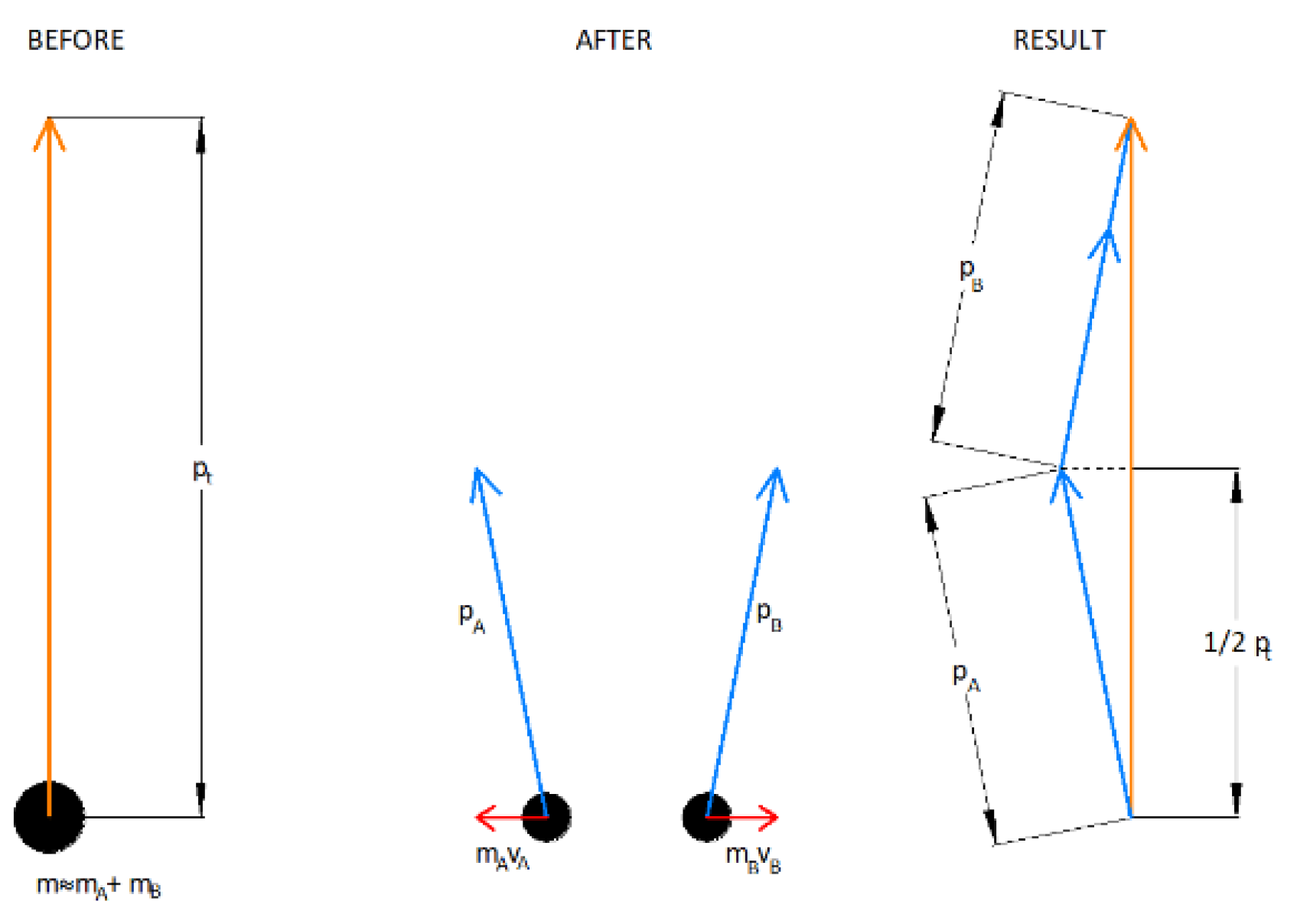
Formally, if denotes the unperturbed rate of progression along the expansion dimension, the projected spatial velocity, and and the effective masses before and after the deviation, momentum conservation leads to
This relation shows that the apparent mass in 3D space increases as a result of sideways motion projected from the expansion dimension, without invoking new physical forces. The corresponding kinetic energy associated with this projected motion is
In the limiting case where the initial effective mass is zero, corresponding to radiation-dominated degrees of freedom, the projected energy associated with a deviation from pure expansion becomes
This expression is formally analogous to the relativistic mass–energy relation, but here it arises as a geometric consequence of momentum redistribution between longitudinal and transverse directions, rather than as a statement about intrinsic particle kinematics in ordinary space. The parameter represents the characteristic rate associated with progression along the expansion dimension, not a measurable spatial velocity.
In the early universe, the energy density was dominated by radiation propagating at the invariant speed c along null geodesics in three-dimensional space. In this regime, momentum is overwhelmingly aligned with the expansion direction, with only negligible transverse components. As interactions and scattering redistribute momentum into transverse degrees of freedom, effective deviations from purely longitudinal expansion emerge. Within the geometric framework adopted here, this corresponds to the transition from purely spherical expansion to the spiral photon paths discussed earlier, in which path length grows more rapidly than observable transverse separation.
Because radiation propagates exclusively at the invariant speed c, the expansion dimension in the earliest universe is naturally normalized to this same invariant scale. In this sense, c sets the fundamental rate associated with motion along the expansion dimension, even though this motion is not directly observable as a spatial velocity. As the universe cools and structure forms, momentum redistribution progressively reduces the effective expansion rate observed in three-dimensional space, leading to the lower, approximately constant expansion rate inferred from current observations.
In this picture, mass may be viewed as emerging from deviations away from pure expansion flow. Radiation represents the limiting case in which all momentum lies along the expansion direction, while massive particles correspond to states in which part of that momentum has been redirected into transverse dimensions. The early universe is therefore naturally interpreted as a radiation-dominated phase in which the expansion proceeds at the invariant rate c, followed by a rapid redistribution of momentum that gives rise to mass, structure formation, and the expansion behavior observed today.
Gravity
It follows naturally from this framework that each distinct object in the universe follows its own trajectory within the global expansion flow. When objects remain isolated, these trajectories diverge according to the background expansion. However, when matter clumps and multiple objects coalesce into a single bound system, their relative separation ceases to increase and they are instead forced onto a shared expansion trajectory.
This convergence has a direct geometric consequence: the local expansion flow is reduced relative to the background. In the language of the present model, the expansion dimension becomes locally distorted, producing a dilation of time relative to regions that continue to follow the unperturbed expansion. As a result, more massive, gravitationally bound systems occupy positions further “behind” the mean expansion wavefront.
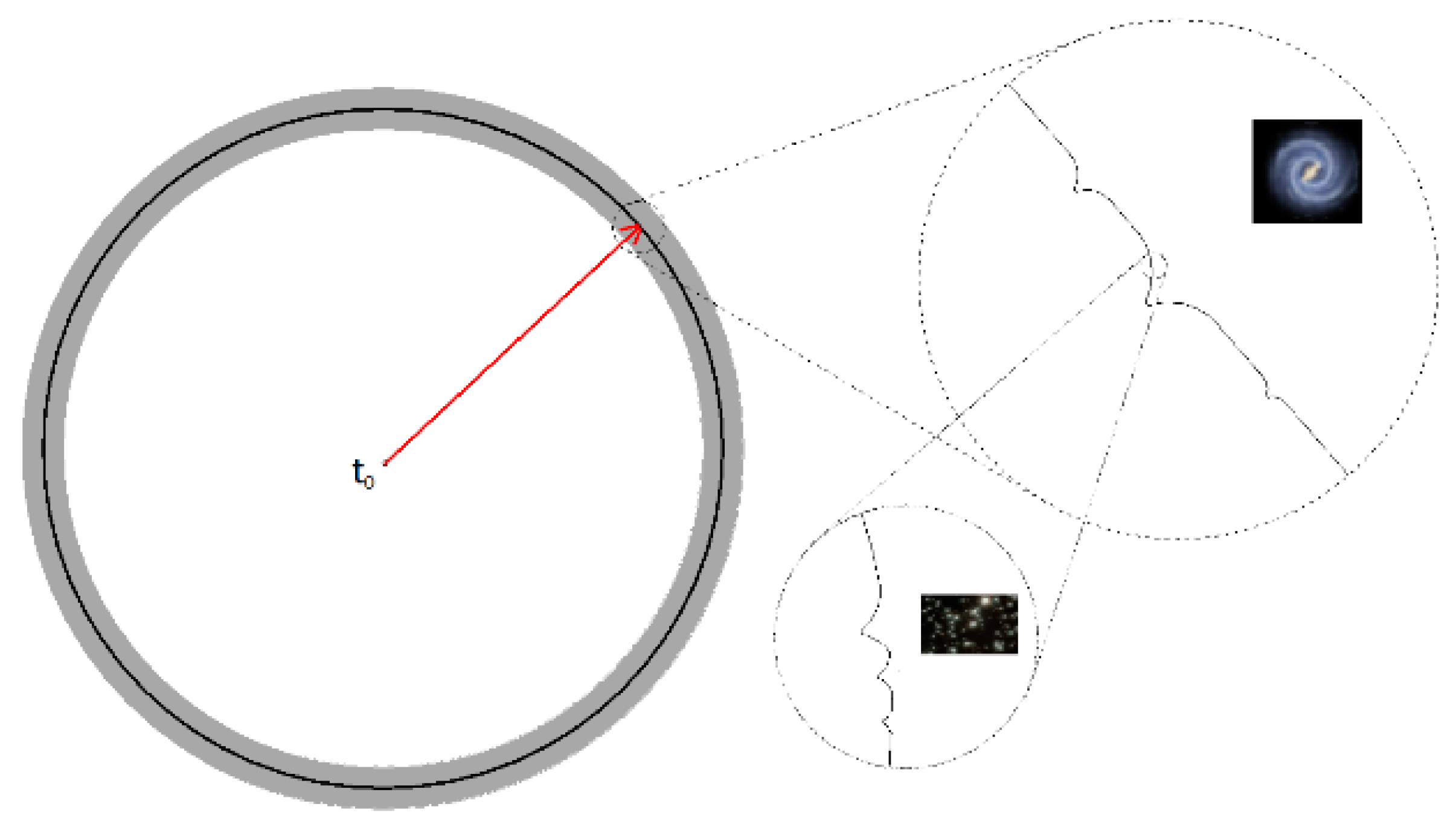
Geometrically, this manifests as a local depression—or dimple—in the expansion wave, as illustrated in Figure 6. Because time progresses more slowly within this region, any nearby object with mass experiences an effective acceleration toward the clump. This reproduces the observed attractive behaviour associated with gravity.
Importantly, as additional matter accelerates toward and joins the bound system, it further deepens the local distortion of the expansion flow, reinforcing the effect. Regions of significant mass accumulation therefore correspond to areas of greater time dilation and reduced expansion relative to the cosmological background.
This gravitational mechanism is distinct from the earlier “mass-from-expansion” effect associated with radiation being redirected out of the expansion dimension. Gravity, in contrast, is a cumulative phenomenon arising from the coalescence of objects that already possess mass. By forcing multiple trajectories to merge, gravitational binding locally slows the expansion flow, producing time dilation and an effective attractive force consistent with standard gravitational dynamics.
In this sense, the present description does not introduce a new force, but provides a geometric reinterpretation of gravitational attraction consistent with the role of spacetime curvature and time dilation in general relativity.
Field-Theoretic Consistency
In FLRW cosmology, spacetime evolution is described by
where encodes homogeneous expansion. In our framework, the expansion is instead expressed through a local expansion phase field,
specifying a worldline’s position within the expansion wave. In homogeneous regions, reduces to the standard FLRW description.
Local concentrations of energy suppress the rate of expansion relative to the background, producing gradients in . Test particles follow geodesics determined by the effective metric
so that spatial gradients in produce accelerations consistent with Newtonian gravity in the weak-field limit. Momentum conservation along the expansion dimension is automatically ensured via
Interactions that redirect momentum from the expansion direction into transverse spatial directions correspond to the emergence of rest mass, consistent with .
Time as Expansion
In this framework, cosmic expansion defines the flow of time. Progression along the expansion direction corresponds to maximal proper-time evolution, while deviations—through transverse motion, interactions, or gravitational binding—reduce proper-time advancement, producing time dilation.
- Motion aligned with expansion → maximal aging
- Motion transverse to expansion → reduced aging
- Strong gravitational binding → deeper “lag” in expansion phase → slower clocks
This is a geometric reinterpretation of time dilation, fully consistent with relativity. Massive objects sit deeper in the expansion wave and age more slowly, aligning gravitational and kinematic time dilation with the expansion field.
Spiral Distance and the Expansion Phase
The spiral distance, DSpiral, represents the actual path travelled by light along the expansion wave, taking into account both the transverse 3D motion and the effective propagation along the expansion dimension. In the time-expansion framework, this can be expressed in terms of the expansion phase field as:
where is the infinitesimal spatial displacement along the light path, and locally scales the path according to the expansion phase. In regions of mass accumulation, is suppressed, stretching the spiral distance and reducing the apparent transverse flux.
The luminosity distance is then related to DSpiral by
where parameterizes the fraction of the wavefront expansion projected into the observable 3D space. Here γ is an effective geometric parameter describing wavefront projection, not a new physical dimension. Light propagating along regions with suppressed effectively experiences additional path length and reduced flux, reproducing both the apparent Hubble expansion and the distortions commonly attributed to dark energy.
In the weak-field limit, gradients in Φ reproduce gravitational acceleration, while itself determines the local rate of time progression. Thus, the spiral distance formalism unifies cosmic expansion, time dilation, luminosity distance, and gravity within a single geometric framework:
- DSpiral encodes the full trajectory of light along the expansion wave.
- Suppression of Φ near mass concentrations stretches DSpiral and slows proper time.
- Apparent luminosity and angular separations observed are naturally derived from the spiral geometry.
This establishes a direct mathematical link between the empirical spiral-distance fits and the underlying geometric phase field, showing that your SN1a and CMB results are fully consistent with the field-theoretic description of expansion, gravity, and time.
Black Holes
In general relativity, black holes harbour singularities, where spacetime curvature and density formally become infinite. In the time expansion framework, a black hole can instead be interpreted as a deep dimple in the expansion wave front, created where matter has conglomerated to extreme density. Light crossing this region effectively disappears into the dimple, entering a part of the expansion dimension that is not directly observable. Unlike a singularity, the dimple is a finite feature of the expansion geometry, and information within it is not destroyed—rather, it resides temporarily in a region of the expansion phase inaccessible to outside observers.
As the universe expands, the local expansion wave stretches, and the dimple could decrease in effective density. This provides a conceptual mechanism by which previously trapped information could, in principle, become observable once the effective density is reduced below a critical threshold (e.g., analogous to the Schwarzschild radius). This perspective complements existing ideas, such as Hawking radiation [9], which addresses information conservation for particles near the event horizon. Time expansion theory extends the principle to particles that have already crossed the black hole boundary, suggesting a geometric pathway for information conservation without requiring singularities.
Dark Matter and Dark Energy
In standard cosmology, dark matter and dark energy are invoked to explain observations that cannot be accounted for by visible matter alone. For example, the outer regions of spiral galaxies rotate faster than expected, motivating the postulation of unseen dark matter. Dark energy is proposed to drive the apparent accelerated expansion of the universe.
In the time expansion framework, these “dark” phenomena can be interpreted geometrically. Observers exist on a single crest of the cosmic expansion wave, but matter distributed elsewhere along the expansion dimension—either behind (dark matter) or ahead (dark energy) along the wave—may influence the dynamics we observe. Large, massive objects can locally depress the expansion wave, effectively interacting with otherwise hidden matter along the wavefront. This mechanism naturally accounts for the higher orbital velocities of galactic outskirts [10] without requiring additional unseen mass.
Dark energy, in this framework, is not required as an independent component to account for the observed luminosity–distance relations or the apparent acceleration of the universe. These effects arise naturally as geometric projection effects associated with photon propagation through the expansion dimension itself, which modifies the relationship between path length, transverse separation, and observed flux. In this sense, the phenomena commonly attributed to dark energy can be interpreted as consequences of distance misinterpretation rather than evidence for a new dynamical force.
That said, the present framework does not preclude the existence of a physical component corresponding to dark energy. If such a component exists, it may be associated with matter or energy located slightly ahead of our observable position on the expansion wave, interacting only indirectly through its influence on the global expansion geometry. In this interpretation, dark energy would not act as a repulsive force within three-dimensional space, but would instead reflect the presence of degrees of freedom beyond our immediate temporal slice of the expansion.
Linking to the Quantum World
In our model, time corresponds to the distance our portion of the universe expands divided by the speed of expansion. Objects are effectively gravitationally locked into a “time window” defined by the local expansion wave, with nearby matter sharing overlapping timelines. It is plausible that the universe possesses a finite temporal window within which objects can interact and experience the time dimension. For macroscopic objects much larger than this window, variations in position within the time slot are negligible. However, for microscopic particles, this degree of freedom becomes significant.
Within this framework, a photon traveling along the surface of the expansion sphere can resonate or oscillate slightly in the expansion dimension. From the particle’s perspective, this direction behaves as a spatial dimension. From our viewpoint, this allows the photon to exist in multiple locations simultaneously, manifesting wave-like and probabilistic behaviour, consistent with quantum mechanics.
If there exists a fundamental quantum of time, it is likely related to Planck’s constant, , which represents a quantum of action. Since time in our model is given by the expansion distance divided by the expansion speed , the related action for a particle of mass traveling a distance at velocity satisfies:
Where n is the quantum number. Applying this to an electron, the resulting characteristic distance is approximately 1.06 10-10m, remarkably close to the Bohr diameter of the hydrogen atom. This suggests that the most favourable electron orbit emerges naturally from the expansion-driven temporal framework, with higher quantum states corresponding to additional time quanta.
This also links the velocity of time to the fine-structure constant :
where the factor arises from the geometric projection of the expansion dimension. This provides a quantifiable bridge between cosmic expansion and quantum phenomena.
An important consequence is that either has varied over cosmic time, or the expansion rate has remained largely constant after an initial rapid decline from . Observational evidence strongly supports the constancy of since the early universe [11,12], reinforcing our earlier conclusion that the expansion has been nearly constant over cosmological history.
Wave‒Particle Duality
The classical Young double-slit experiment [13] demonstrated that light exhibits wave-like behaviour, producing an interference pattern when passing through two spatially separated slits. Later, Einstein’s explanation of the photoelectric effect established that light must also be exchanged in discrete packets of energy, or photons, revealing its particle-like nature. These two results form the basis of wave–particle duality.
A particularly striking feature of this duality is revealed when the double-slit experiment is performed at extremely low intensities such that photons pass through the apparatus one at a time. Even under these conditions, the familiar interference pattern gradually emerges. This indicates that interference cannot be explained as interactions between different photons, but rather that each photon interferes with itself. Despite the empirical success of quantum mechanics in predicting these results, the underlying physical interpretation remains the subject of ongoing debate.
Within the time-expansion framework, a more geometric interpretation becomes possible. In this picture, a photon is treated as a localized packet of energy whose trajectory lies predominantly along the expansion (time) dimension, with only a partial projection into the observer’s three-dimensional spatial slice. As a consequence, the photon is not sharply localized at a single instant of time from the observer’s perspective. Instead, its presence is distributed over a finite interval of the expansion dimension.
This effective extension in the time direction allows a single photon to sample multiple spacetime paths simultaneously, producing interference patterns even when photons are emitted individually. In this sense, the photon’s wave-like behaviour arises from its partial delocalization in the expansion dimension rather than from any intrinsic spatial spreading alone.
When a photon interacts with matter that is fully localized within three-dimensional space—such as in the photoelectric effect—this oscillatory or delocalized behaviour is interrupted. The interaction constrains the photon to a specific expansion phase, collapsing its distributed presence and transferring its energy in a localized, particle-like manner. Thus, particle-like behaviour emerges naturally when the photon is forced into full overlap with the observer’s spacetime slice.
This interpretation also provides an intuitive account of which-path experiments. When an apparatus is introduced to determine through which slit the photon passes, the interaction effectively locks the photon into a specific expansion phase associated with that path. This suppresses its delocalization in the expansion dimension, eliminating the conditions required for self-interference and causing the interference pattern to disappear.
Further support for this viewpoint comes from recent experiments in which interference has been demonstrated in the time domain rather than in space [14]. By rapidly modulating the transmission properties of a material, researchers have shown that light can interfere with itself across different emission times. Within the time-expansion framework, this result follows naturally: if the photon’s state extends into the expansion dimension, then interference across time is no more surprising than interference across space.
In this way, time-expansion theory does not alter the quantitative predictions of quantum mechanics, but offers a geometric interpretation of wave–particle duality. Wave-like behavior arises from partial delocalization in the expansion dimension, while particle-like behavior appears when interactions constrain the photon to a specific expansion phase. Quantization emerges as a consequence of how energy couples between the expansion dimension and three-dimensional space, rather than as an independent postulate.
Electron Spin
The mechanisms described above extend naturally to subatomic particles that possess mass in three-dimensional space. Experimental evidence shows that electrons, like photons, exhibit wave-like behaviour, including the formation of interference patterns when passed through narrow slits [15]. Within the time-expansion framework, this behaviour arises because electrons—owing to their small spatial extent—can oscillate partially within the expansion (time) dimension. As a result, electrons, though massive, retain wave-like properties analogous to those of photons, albeit to a lesser degree.
In this picture, wave–particle duality emerges because particles intermittently project in and out of the observer’s effective time window. Photons represent the limiting case, being largely aligned with the expansion dimension and therefore experiencing no proper time, while subatomic particles with mass resonate within a narrow temporal window due to their finite size. This partial delocalization allows quantum interference effects to arise without requiring a particle to be simultaneously localized in multiple classical spatial positions.
The finite width of the temporal window further implies that particles may occupy discrete rotational or oscillatory states relative to the expansion direction. This naturally introduces quantization. Particles may therefore be categorized by how their internal motion is oriented with respect to the expansion dimension, leading to distinct and stable quantum states. In this sense, the time-expansion framework provides a geometric container for quantum mechanics, supplying an intuitive physical context while leaving its mathematical structure unchanged.
Electron spin provides a particularly illustrative example. In conventional quantum mechanics, spin is treated as an intrinsic property of particles—one that carries angular momentum and produces magnetic effects yet cannot be interpreted as literal spatial rotation. In the present framework, however, the existence of an expansion dimension allows for a physically meaningful form of rotation: spin within the time dimension.
If an electron undergoes rotational motion involving the expansion dimension and one spatial dimension, it acquires angular momentum without requiring spatial rotation in three dimensions. Such rotation may occur in one of two orientations relative to the expansion direction—clockwise or anticlockwise—naturally producing two distinct spin states. This provides a geometric interpretation of the two-valued spin outcomes observed in the Stern–Gerlach experiment [16], without invoking additional assumptions.
Spin states aligned perpendicular to the expansion direction correspond to stable configurations with no net energy difference, consistent with the observed degeneracy of electron spin states. Rotational modes that involve forward or backward components along the expansion dimension may instead couple to energy exchange between the temporal and spatial sectors, offering a possible geometric link to charge-related phenomena and fine-structure effects.
Thus, within this framework, electron spin emerges not as an abstract intrinsic quantity, but as a consequence of constrained rotational degrees of freedom made possible by the expansion dimension. While this interpretation does not alter the formal predictions of quantum mechanics, it provides a physically intuitive account of spin, quantization, and wave–particle duality rooted in the geometry of spacetime itself.
Relation to Standard Quantum Mechanics
The time-expansion framework presented here is intended as an interpretational complement to standard quantum mechanics rather than a modification of its formalism. All experimentally verified predictions of quantum theory—such as interference patterns, quantization of energy, and probabilistic measurement outcomes—remain unchanged. In this view, the quantum wavefunction may be understood as encoding the projection of a particle’s state across the expansion dimension into the observer’s spacetime slice. Wave–particle duality, uncertainty, and measurement-induced localization arise naturally from the geometric relationship between the expansion dimension and three-dimensional space, while the mathematical structure of quantum mechanics continues to provide the correct statistical description of outcomes.
Charge as Time-Phase Asymmetry
It has been shown experimentally that an electron–positron pair can be created from the collision of two sufficiently energetic photons [17]. Such processes must therefore have occurred frequently in the early universe. The photon itself carries no electric charge, yet the resulting particles possess equal and opposite charges, ensuring that the net charge remains zero. This strongly suggests that electric charge is not created arbitrarily, but instead emerges as an antisymmetric property of the pair at the moment of formation.
Within the time-expansion framework, this antisymmetry is interpreted as arising from the internal motion of particles relative to the expansion (time) dimension. At the instant of creation, the parent photon may be viewed as occupying a resonant state within this dimension. When it splits, the resulting particles inherit opposite orientations of this internal motion: one dips slightly backward along the expansion wave, while the other dips forward. Once separated, this orientation becomes frozen into the particle’s structure.
In this picture, electric charge corresponds to the direction of rotation or phase orientation in the expansion dimension. A negatively charged particle is one whose internal motion reaches backward relative to its mass baseline, while a positively charged particle reaches forward. A neutral particle corresponds to a configuration in which forward and backward components cancel. Because electrons and positrons are always created in opposing pairs, overall charge neutrality is naturally preserved.
This time-phase asymmetry provides an intuitive explanation for attraction and repulsion without requiring direct contact. Particles with complementary phase orientations overlap within the expansion dimension before they overlap in three-dimensional space. If their combination leads to a more energetically favourable configuration—corresponding to reduced mass and increased expansion—an effective attraction arises. If the overlap would increase energy or suppress expansion, the interaction is unfavourable and manifests as repulsion. In this way, field-like behaviour emerges as a geometric consequence of how particles “see” one another through the expansion dimension.
Importantly, this picture does not introduce new forces. Electromagnetic interactions arise from gradients and phase relationships associated with motion in the expansion dimension. If the internal time-phase is a periodic degree of freedom, rotations in this phase define a natural symmetry, and charge conservation follows directly from the preservation of this symmetry, in the same way that conservation laws arise from symmetries in conventional field theory.
The strength of this interaction must be governed by a dimensionless coupling. Earlier, we found a natural relationship linking the velocity associated with the expansion dimension, , to the electromagnetic fine-structure constant,
While this relation does not constitute a derivation of Maxwell’s equations, it demonstrates that the framework admits a coupling of the correct magnitude arising purely from geometry. In this sense, the time-expansion picture provides a consistent normalization for electromagnetic interaction strength, while leaving the detailed field-theoretic structure to be developed further.
Finally, this interpretation offers a natural context for the probabilistic description of charged particles in quantum mechanics. Because electrons and other subatomic particles blur slightly forward and backward in the expansion dimension, their interactions cannot be described deterministically in three-dimensional space alone. The resulting uncertainty and wave-like behaviour are therefore not fundamental mysteries, but consequences of motion through a finite temporal window. Charge, interaction, and probability all emerge from the same underlying geometric structure.
Future work: Electromagnetic Field Completion
To complete this picture, a full field-theoretic formulation is required. A natural next step is to identify the time-phase as a periodic variable and promote it to a local symmetry. Local invariance under phase rotations would imply the existence of a compensating gauge field, analogous to a U(1) gauge potential. Spatial and temporal variations of the phase would then give rise to field strengths governing electromagnetic interactions, with charge conservation emerging directly from the symmetry via Noether’s theorem.
Within such a formulation, the electromagnetic field would represent the geometric response of spacetime to gradients in the expansion-time phase. The inverse-square behaviour of electromagnetic forces would follow from flux conservation in three-dimensional space, provided that field propagation remains confined to the observable spatial dimensions. The coupling strength would be fixed by the geometric normalization previously identified through the fine-structure constant.
This approach does not seek to replace quantum electrodynamics, which has been verified to extraordinary precision. Rather, it aims to provide a geometric foundation for the origin of charge and coupling strength, embedding electromagnetic interactions naturally within the broader expansion-based interpretation of spacetime. Developing this field-theoretic completion remains an important direction for future work.
Quantum Entanglement and Time-Phase Correlation
In quantum mechanics, when two particles are described by a single joint wavefunction, they are said to be entangled. In such a state, measurement outcomes are correlated in a way that cannot be explained by classical statistics. Historically, two broad interpretational approaches were considered. One proposed that particles determine their properties at the moment of separation through hidden variables, a view originally advocated by Albert Einstein. The alternative, which forms the basis of standard quantum mechanics, holds that these properties are not fixed until measurement.
The latter interpretation leads to correlations that appear to be established instantaneously, even when the entangled partners are separated by large distances. John Bell formalized this distinction through Bell’s inequalities [18], which place quantitative limits on any theory based on local hidden variables. Subsequent experiments, most notably those by Alain Aspect, confirmed the quantum-mechanical predictions and ruled out a wide class of local hidden-variable theories.
Within the time-expansion framework, these results can be interpreted geometrically. We propose that the joint wavefunction of an entangled pair extends partially into the expansion (time) dimension, allowing the correlated state to persist beyond the moment of spatial separation. Rather than requiring information to propagate faster than light, the correlation is maintained through a shared extension in the time-phase dimension, which is not directly observable within three-dimensional space.
In this interpretation, the apparent nonlocality of entanglement arises because the separation of the entangled partners is not sharply defined in time. The partners remain partially overlapped within the expansion dimension for a finite interval, during which their correlated properties are maintained. Measurement collapses this shared time-phase structure, revealing correlated outcomes without requiring superluminal communication or violation of relativistic causality.
Importantly, this framework does not imply that entanglement correlations can be maintained indefinitely. If the separation in time or interaction history exceeds the extent of this temporal overlap, the correlated phase structure would become fixed, and the outcomes effectively determined. In this sense, the model occupies an intermediate position between classical hidden-variable theories and the standard quantum interpretation: correlations are neither pre-assigned at creation nor communicated instantaneously, but arise from a finite, geometric extension in the time dimension.
Thus, the time-expansion framework provides a physical interpretation of quantum entanglement that preserves all experimentally verified predictions of quantum mechanics while offering an intuitive explanation for nonlocal correlations. It suggests that quantum entanglement reflects the geometry of time itself, rather than the existence of superluminal signals or fundamentally acausal processes.
4. Final Conclusions
In this work, we have presented a geometric reinterpretation of cosmic expansion in which expansion is treated as an effective spatial dimension whose projection governs observed distances, time evolution, and physical interactions. By focusing on the actual path followed by light through this expanded geometry, we introduced a spiral distance that naturally reproduces observed luminosity and angular-distance relations without requiring accelerated expansion or an additional dark-energy component.
By reproducing both supernova luminosity distances and the CMB angular scale using a single expansion geometry and constant expansion rate, the framework alleviates the long-standing Hubble tension between early and late-universe measurements.
Within this framework, gravity emerges as a local suppression of expansion, producing time dilation and curvature consistent with general relativity in the weak-field limit. Expansion is shown to be closely tied to the flow of time itself, with proper time corresponding to progression along the expansion direction. Deviations from this trajectory—through motion, mass formation, or gravitational binding—lead to time dilation, providing a unified geometric account of gravitational and kinematic effects.
Extending this picture to the quantum domain, we argued that wave–particle duality, spin, and probabilistic behaviour arise naturally from partial delocalization within a finite temporal window. Electric charge was interpreted as a time-phase asymmetry associated with motion in the expansion dimension, with electromagnetic interactions emerging from gradients and phase relationships of this internal structure. The appearance of a dimensionless coupling of the correct magnitude, consistent with the fine-structure constant, supports the physical relevance of this geometric interpretation, while a full field-theoretic formulation remains an important direction for future work.
Quantum entanglement was likewise reinterpreted as a manifestation of shared time-phase structure rather than instantaneous nonlocal communication. This preserves all experimentally verified predictions of quantum mechanics while providing an intuitive geometric explanation for entanglement correlations without violating relativistic causality.
The framework makes several testable predictions. In particular, it suggests that quantum correlations are supported by a finite temporal overlap rather than unlimited nonlocality, motivating experiments that probe entanglement across extreme temporal separations. Time-domain interference experiments, precision quantum measurements in strongly time-dilated environments, and high-redshift constraints on fundamental constants provide additional avenues for empirical investigation.
Importantly, the approach does not modify the established mathematical formalisms of general relativity or quantum mechanics. Instead, it offers a unifying geometric interpretation that connects cosmological expansion, time, gravity, and quantum phenomena within a single conceptual structure. Whether this interpretation ultimately proves fundamental or emergent, it provides a coherent framework that bridges physics across scales and suggests new directions for both theoretical development and experimental testing.
References
- Scolnic, D.; Brout, D.; Carr, A.; Riess, J.; Pantheon+ Team. Pantheon+ Type Ia Supernova Distance Measurements [Data set]; Zenodo, 2022. [Google Scholar] [CrossRef]
- Riess, AG; et al. 1998 Astron.J. 1998, 116, 1009–1038. [CrossRef]
- Betoule, M; et al. 2014 Astron Astrophys 568(A22), 22–53. [CrossRef]
- Pulmetter, S; et al. 1999. [CrossRef]
- Planck Collaboration. 2016 Planck 2015 results XIII. Cosmological parameters. A&A 2016, 594, A13. [Google Scholar] [CrossRef]
- Riess, AG; Casertano, S; Yuan, W; Macri, LM; Scolnic, D. 2019, 876(1), 85. [CrossRef]
- Sato, K. 1981 Mon. Not. R. Astron. Soc. 1981, 195, 467. [Google Scholar] [CrossRef]
- Planck Collaboration, A&A 2020, 641, A6 DOI. [CrossRef]
- Hawking S. Nature 1974, Vol. 248(No. 5443), 30–31.
- Corbelli, E; Salucci, P. January 2000; Volume 311, Issue 2, pp. 441–447. [CrossRef]
- Gonçalves, Rodrigo S. JCAP06. 2020. [Google Scholar]
- Wilczynska, Michael R.; et al. Four direct measurements of the fine-structure constant 13 billion years ago. Sci. Adv. 2020, 6, eaay9672. [Google Scholar] [CrossRef] [PubMed]
- Young, T. Proc. R. Soc. Lond 163–67. [CrossRef]
- Tirole, R; Vezzoli, S; Galiffi, E; Robertson, I; Maruice, D; Tilmann, B; Maler, SA; Pendry, JB; Sapienza, R. Nature Physics Volume 19, 999–1002. [CrossRef]
- Merli, P G; Missiroli, G F; Pozzi, G. Am. J. Phys. 1976, 44, 306–7. [CrossRef]
- Stern, O. Zeitschrift für Physik 1921, 7, 249–253. [CrossRef]
- Adam, J.; et al. (STAR Collaboration). Rev. Lett. 127, 052302. [CrossRef] [PubMed]
- Bell, J. S. Physics 1964, 1(3), 195–200. [CrossRef]
Figure 1.
Schematic visualization of a two-dimensional cross section through the expanding geometry, showing the expansion degree of freedom (represented by the radius) and a single spatial dimension (represented by the circumference). The expansion wave originates at time t0 and reaches time t1, indicated by the dark outer curve. Photon trajectories are analyzed within this projected cross section to separate expansion-induced path length from observable transverse separation.
Figure 1.
Schematic visualization of a two-dimensional cross section through the expanding geometry, showing the expansion degree of freedom (represented by the radius) and a single spatial dimension (represented by the circumference). The expansion wave originates at time t0 and reaches time t1, indicated by the dark outer curve. Photon trajectories are analyzed within this projected cross section to separate expansion-induced path length from observable transverse separation.
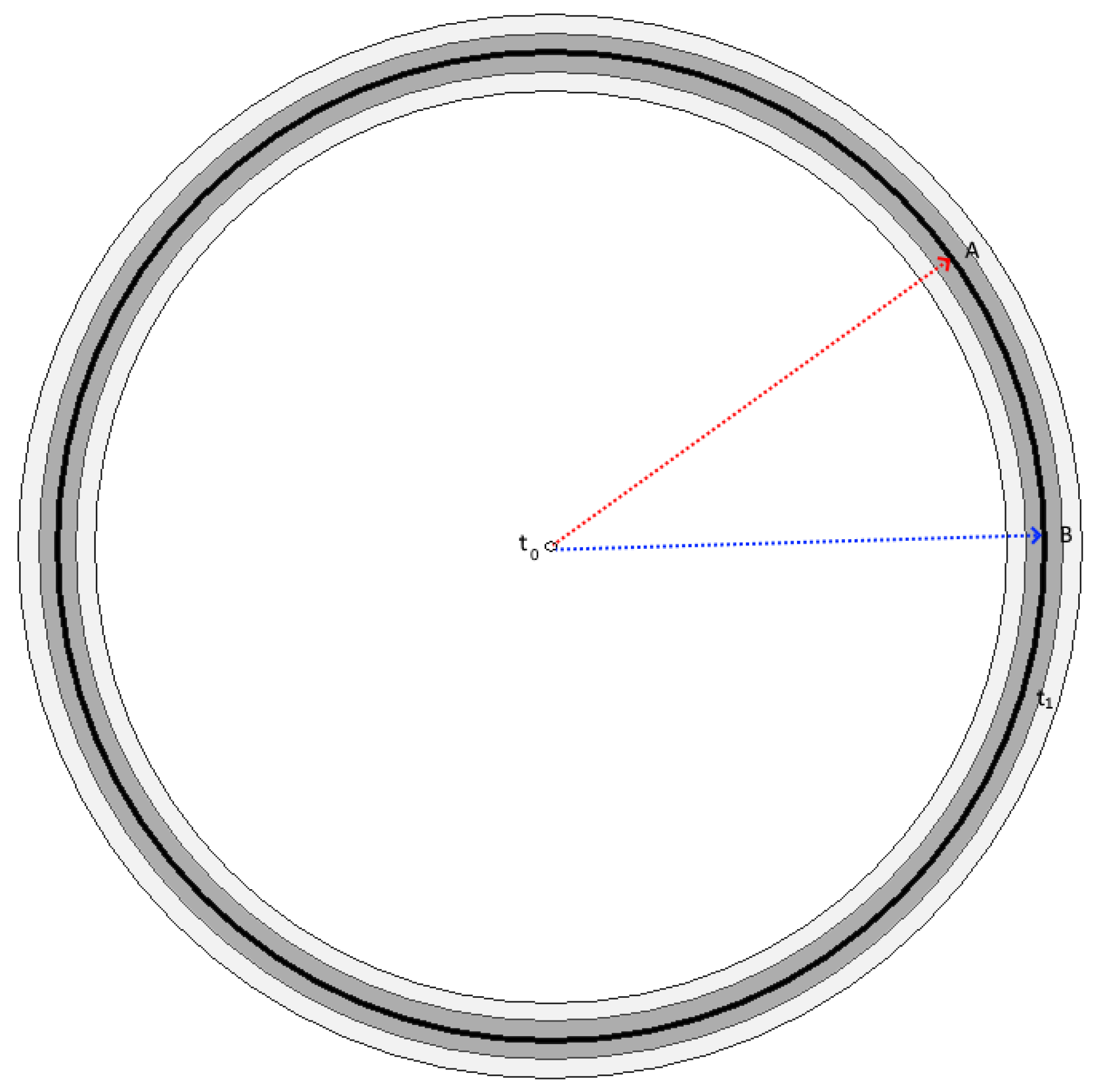
Figure 2.
Best-fit luminosity–distance models for the Type Ia supernova data of Scolnic et al. (2022). The left panel shows fits assuming a fixed expansion speed (green dotted line) and a varying expansion speed (red solid line). The right panel shows fits using the FLRW metric with different cosmological parameter choices, as described in the text. Observational data points are shown in both panels.
Figure 2.
Best-fit luminosity–distance models for the Type Ia supernova data of Scolnic et al. (2022). The left panel shows fits assuming a fixed expansion speed (green dotted line) and a varying expansion speed (red solid line). The right panel shows fits using the FLRW metric with different cosmological parameter choices, as described in the text. Observational data points are shown in both panels.
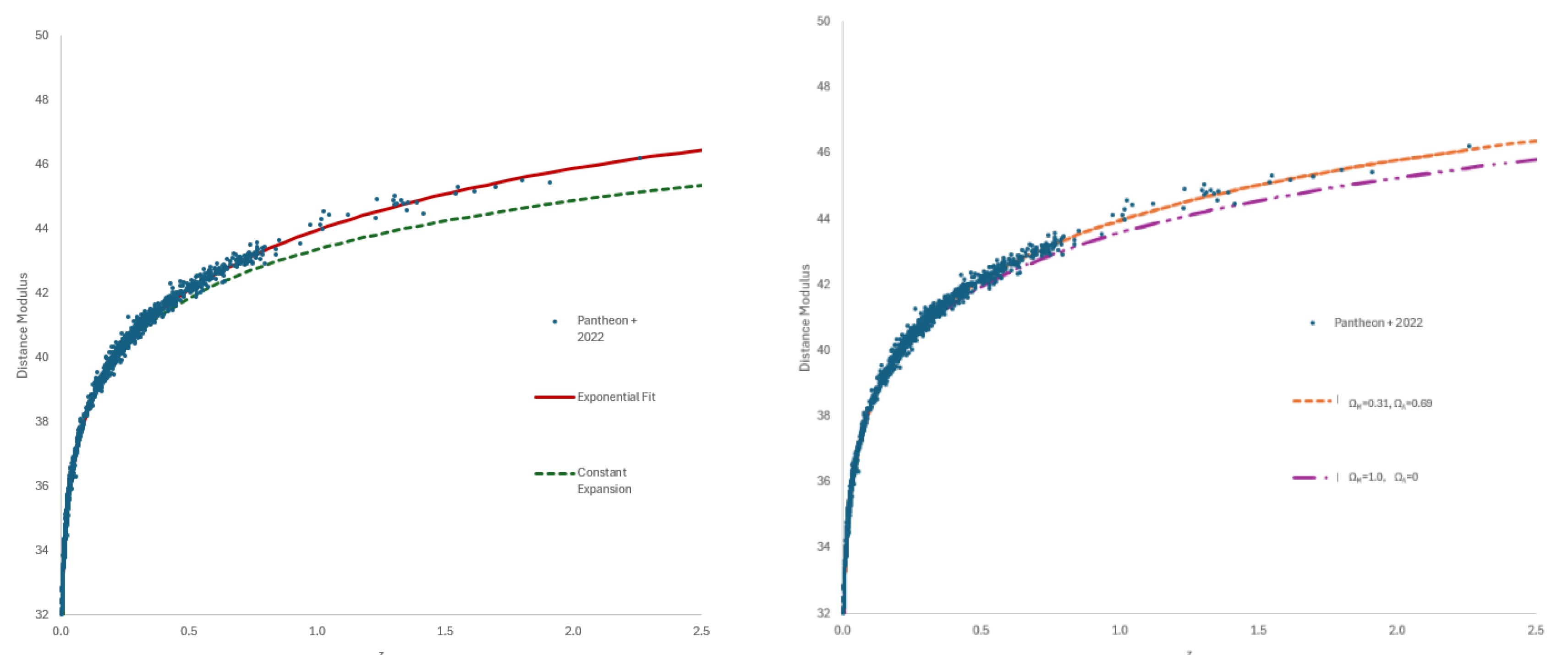
Figure 3.
Best-fit expansion velocity as a function of the radius of the expansion sphere, corresponding to the variable expansion model shown in Figure 2.
Figure 3.
Best-fit expansion velocity as a function of the radius of the expansion sphere, corresponding to the variable expansion model shown in Figure 2.
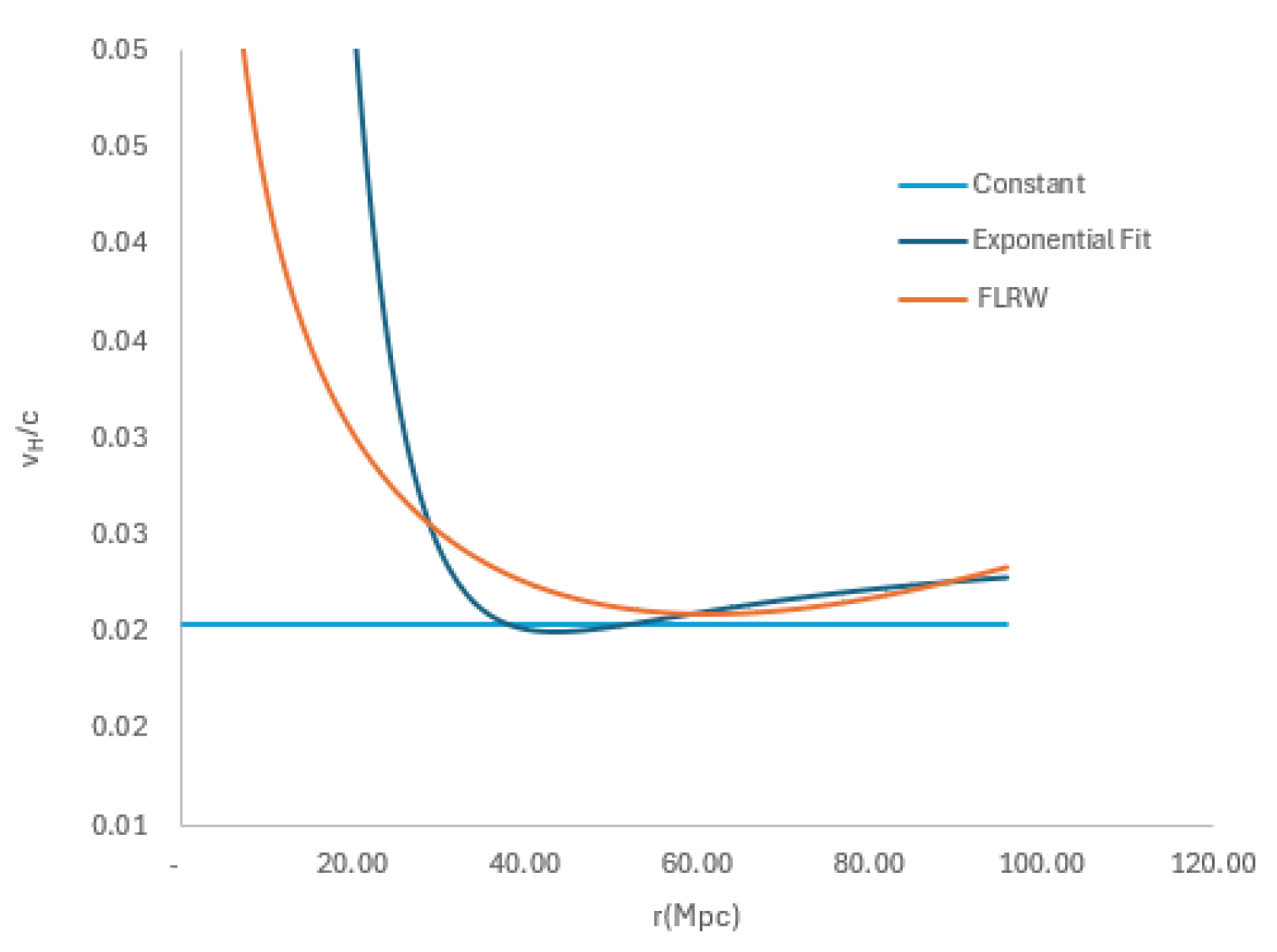
Figure 5.
The quantity βln(1 + z)/ln(Dspiral) as a function of the expansion-sphere radius, showing a clear tendency toward 0.5 as r → 0, corresponding to the geometric upper bound for transverse wavefront leakage into a single additional direction.
Figure 5.
The quantity βln(1 + z)/ln(Dspiral) as a function of the expansion-sphere radius, showing a clear tendency toward 0.5 as r → 0, corresponding to the geometric upper bound for transverse wavefront leakage into a single additional direction.
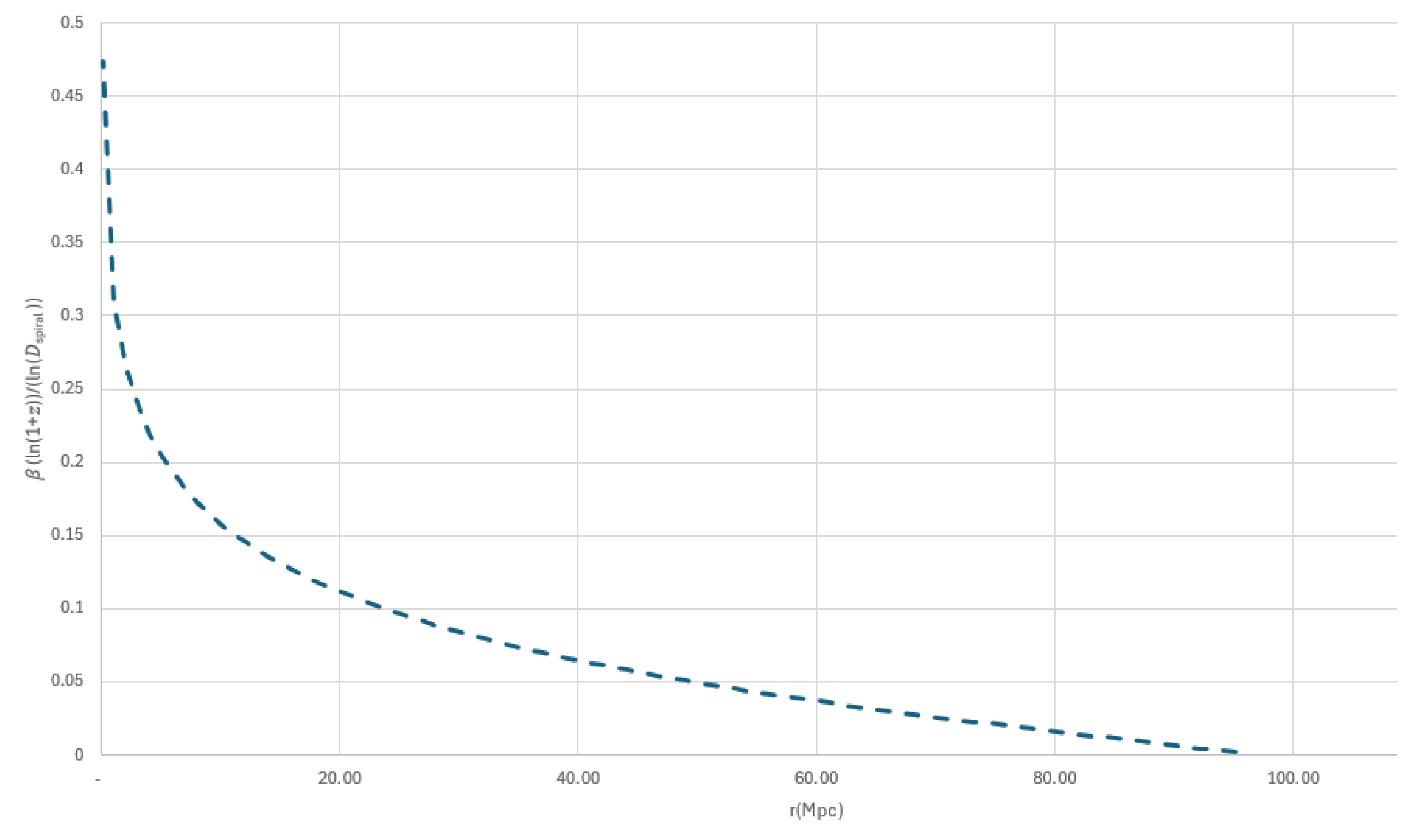
Figure 7.
Visualization of a two-dimensional cross section through the expansion degree of freedom (radius) and a single spatial dimension (circumference). The expansion wave originates at time t0 and reaches time t1, indicated by the dark outer curve. Gravitationally distinct objects separate spatially as the expansion progresses, while mass clustering produces local dimples in the wavefront. The thin black line denotes the observer’s instantaneous time slice, with grey regions illustrating the possibility of matter existing outside the observable temporal window.
Figure 7.
Visualization of a two-dimensional cross section through the expansion degree of freedom (radius) and a single spatial dimension (circumference). The expansion wave originates at time t0 and reaches time t1, indicated by the dark outer curve. Gravitationally distinct objects separate spatially as the expansion progresses, while mass clustering produces local dimples in the wavefront. The thin black line denotes the observer’s instantaneous time slice, with grey regions illustrating the possibility of matter existing outside the observable temporal window.
Disclaimer/Publisher’s Note: The statements, opinions and data contained in all publications are solely those of the individual author(s) and contributor(s) and not of MDPI and/or the editor(s). MDPI and/or the editor(s) disclaim responsibility for any injury to people or property resulting from any ideas, methods, instructions or products referred to in the content. |
© 2026 by the authors. Licensee MDPI, Basel, Switzerland. This article is an open access article distributed under the terms and conditions of the Creative Commons Attribution (CC BY) license (http://creativecommons.org/licenses/by/4.0/).
Copyright: This open access article is published under a Creative Commons CC BY 4.0 license, which permit the free download, distribution, and reuse, provided that the author and preprint are cited in any reuse.


