

Submitted:
22 February 2024
Posted:
23 February 2024
You are already at the latest version
Abstract
Due to the increasing risk of extreme events caused by climate change (i.e. floods, fires, hurricanes) or wars, European veterinary public health may need some improvement. Utilizing a mix of qualitative (participatory observation) and quantitative methods (Internet mining), we analyzed the Greek media responses to the millennial flood in Thessaly (September 2023), focusing on animal health (including wild, companion animals and livestock) and public sentiment towards epizootic/epidemic threats. The study revealed a gap in crisis management plans regarding veterinary-related issues, emphasizing the need for comprehensive emergency response strategies. Our findings show how: (i) lay-referral system is projecting perception of epidemic threats into the population; (ii) emotional load of images of animal carcasses is misused by media creators aiming for big audience; (iii) pets owners are creating on-line communities for searching and treatment of their pets. Our results stress the importance of integrating crisis communication in consecutive phases of the discourse, such as (i) weather change; (ii) acute flood; (iii) recovery; (iv) outbreaks, into veterinary practices to better prepare for such disasters.
Keywords:
crisis management
; veterinary public health
; animal health
; perception of animals
; One Health
1. Introduction
During disasters such as floods, livestock, wild and companion animals can face significant challenges and dangers. Crisis management plans mainly concern agricultural and human health issues [1] and veterinary-related issues are less covered. Even though there are guides for veterinary and humanitarian professionals to plan emergency responses for the care and welfare of animals for various topics on disasters, such as principles of disaster management, operation planning, team deployment [2], the European perspective seems to be missing. Our experience from the Storm Daniel in September 2023, and other events such as the Oder river disaster [3,4], showed that the communication is of a big concern and must be taken into account. According to official estimates [4], around 250 000 livestock (75723 sheep and goats, 21342 pigs, 6709 cattle and 131795 birds) disappeared in Thessaly during the first wave of flooding (7-12.09.2023). Most of them drowned, since animals unable to find higher ground or to safely escape became submerged and drifted away from rising waters. To mitigate the impact of floods on animals also in the One Health context, multiple efforts were taken. This includes providing proper shelter, securing food and water supplies, and having sophisticated evacuation plans in combinations with intelligent monitoring systems. Precision farming is widely used by Greek farmers. This allows to monitor the impact of the Daniel storm on crops and livestock [5]. Besides, we analyze human gastroenterological disease dynamics using real-time syndromic surveillance systems [6].
2. Materials and Methods
Our study employs both qualitative and quantitative methods to assess Greek digital traditional and so called “new” media during September 2023. We collected 13873 mentions [7] related to the flood using Brand24 (supply of information) and Google Trends (demand of information). The goal of this analysis is to investigate the social reaction [8] to the threat (bottom-up approach), regarding animal health [9]. For the sake of triangulation, a participatory observation perspective (by EM and AJ) was included.
3. Results
The information supply reached approximately the entire national population at the peak week, resulting in almost millions of searches and thousands of mentions in Greece.
3.1. Time series analysis of search queries, mentions, reach and sentiment.
Figure 1 (a) shows, for the period of time when the Daniel storm occurred in Thessaly, Greece, the number of flood-related mentions, sentiment (percentage of negative mentions), the related social and traditional media reach. The latter is measured as the percentage of the Greek Internet users population. For example 100% would mean that on average every inhabitant of Greece was exposed to flood information at once. Figure 1 (b) describes flood, animals and (both human and animal) health-related google queries in Relative Search Volume (RSV). It is evident that a peak occurs during the period of the storm and most of the news have a “negative” sentiment, since they describe the response (“rage”) of the people who (i) got affected by the storm and (ii) were observing the situation via the mentions. There is no clear increase in discussion on animal and epizootic related issues in Google trends (with slight peak of searches on animal health after the first wave of the flood). Based on the inspection of the sources, health and animal-related issues (only 1330 mentions being 9.6% of the sample) are secondary to topics such as governmental incompetence, which is similar to other studies [9]. Most of the mentions refer to farmers who not only lost their livestock but also the equipment (building, machinery) and animal feed. In Greece, livestock (sheep, goats, cattle, pigs) keeping farmers are usually cultivating land too, e.g., corn (animal feed) and cotton (as an extra crop) production. Early October is harvest time, thus many acres of crops ready to be harvested were destroyed.
3.2. Topics and information gap
Most of the mentions refer to the extent of the damage and also point out the need for a proper management of the situation being of the major public health concern.
There is no clear increase in discussion on animal and epizootic related issues in Google Trends (with a slight peak of search queries on animal health after the first wave of the flood).
The observed negative sentiment related to the situation can be attributed to the fact that Greece, since 2012 is experiencing a financial crisis. To this end, many discussions about farmers income and also tax happened. Besides, public authorities related also to insurance organizations, do not have the ability to intervene and compensate the losses to the farmers (long tail of negative emotions after the flood).
We observed an information gap between veterinary epidemiologists’ opinions and the interest among the general public [Table 1] for various visible ailments. This gap might be explained by the concept describing the behavior of patients, known as the lay-referral system [10]. It is the process by which people seek health care advice and treatment from non-professional sources, such as family, friends or community members – whom they trust – as opposed to a professional system in which the trust is limited [10]. Patients tend to be guided by their own subjective perception of ailments. It is similar to the perception of epidemic threats, which could be subdivided into imaginable and visible threats. The latter might replace (cognitive dissonance) threats that are difficult to imagine. The lay-referral system is a network of informal relationships that people use to obtain health care information and advice. For this reason, we see that it is particularly important to properly inform citizens about actual threats, thus eliminating the impact of mistakes generated by the lay-referral system. It may also be useful to use networks of non-professional actors (e.g. by creating local community-based information centers) to disseminate accurate information.
3.3. Phases of animal and disease discourse
Theory and practice of crises management with animals involved usually separate the following phases: i) Pre-catastrophe, ii) Emergency response, iii) Information dissemination, iv) Post-catastrophe infectious disease outbreaks, v) Recovery and rebuilding, vi) Reflection and lessons learned [2,3,8,11].
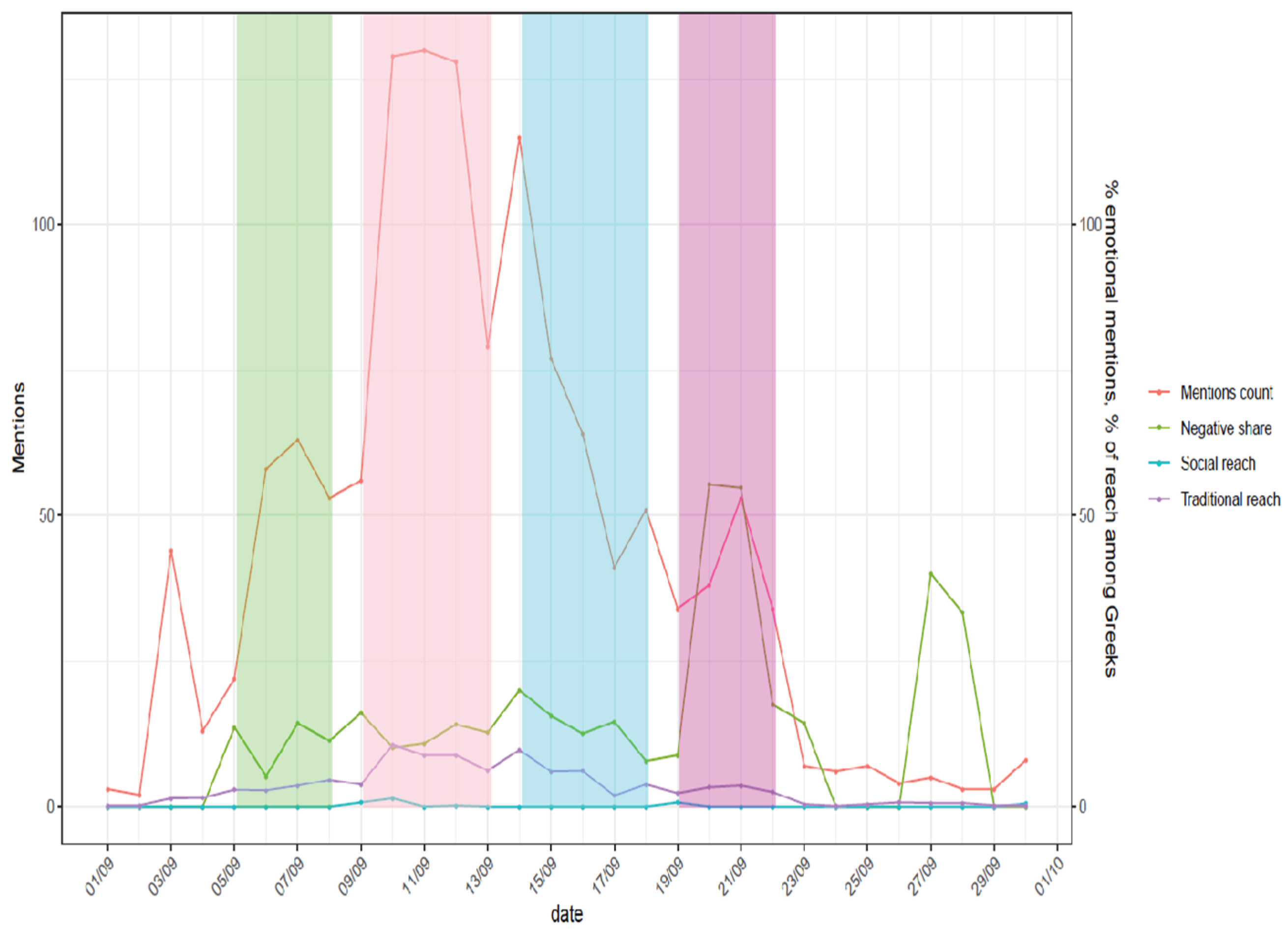
Figure 2.
Interest on the Internet for human and animal health (i.e. diarrhea) related to the flood as measured by mentions count (left axis), social and traditional reach (right axis) and the corresponding sentiment of disease-related ideas (right axis).
Figure 2.
Interest on the Internet for human and animal health (i.e. diarrhea) related to the flood as measured by mentions count (left axis), social and traditional reach (right axis) and the corresponding sentiment of disease-related ideas (right axis).
We can empirically distinguish the following phases [11]: (i) Daniel storm phase (discussion on weather, little concern about animals and diseases [Figure 1, 2, green]); (ii) acute flood phase (when animal rescue actions were going on with massive flow of information without the emotional load [Figure 1 a, pink]), (iii) recovery phase (when carcasses were removed and losses calculated [Figure 1 a, 2, blue]), (iv) flood-related outbreaks phase with the peak on 21.09 related to animal diseases after feeding at flooded areas [Figure 1 b, 2, purple].
4. Discussion
Due to climate change [12] and anthropogenic impact [13], Europe is expecting more and more threats for One Health (especially for veterinary issues) in the future. We demonstrated where information gaps may appear between veterinarians and the general public (e.g. concerning complex associations between flood and diseases). The change in perceptions of the environmental crises through climate change is observable globally, but locally, further research using the social science apparatus is needed [14,15] to understand local vulnerabilities and resilience for building good early warning systems [16].
Our results regarding topics, phases and the information gap are substantial and in the context of veterinary science, entirely new for Europe. In the wake of disasters like floods, fires, and hurricanes, it becomes evident that livestock and companion animals face considerable challenges. While there are guides for veterinary and aid workers on disaster management and animal welfare (i.e. [2]), a European perspective, as evidenced in the Thessaly flood response, is conspicuously absent. The study highlighted three crucial findings and lessons learnt for better preparation during such events [17]:
- The influence of the lay-referral system in projecting perceptions of epidemic threats (general public versus experts in epizootiology). During the analysis, it turned out that in crisis management it may be useful to use networks of non-professional actors (e.g. farmers or other animal owners) – by creating local community-based information centers i.e. veterinarians [18] – to disseminate accurate information and fill the information gap in almost real time.
- The media influence on shaping discourse (e.g. sensationalizing reports on animal carcasses and neglecting other topics). The professionals must be aware that their intensive work in movement/treatment of livestock will be ‘invisible’ for the general population and the mainstream media which select message topics according to their reach potential, which is not always the same as relevance.
- The formation of ad hoc online communities or networks (i.e. networks of pet owners for search and treatment efforts). Overall, this should be assessed positively, as it creates networks [19] of lay support (among farmers and pet owners), but it is also likely that these networks will be able to spread misinformation or disinformation.
These insights underscore the necessity for comprehensive emergency response strategies that include animal care.
Our analysis has all limitations of an ecological type of study design (type of observational study that examines the relationships between variables with data at the population or group level rather than at the individual level). Additionally, proprietary algorithms involved in data selection for both mentions and searches may be biased. Moreover, an increased incidence in Summer/Autumn 2023 of vector borne diseases such as West Nile Fever [20] particularly in Thessaly was discussed after the investigated period.
5. Conclusions
To mitigate the impacts of disasters on wild, livestock and companion animals, it is essential for the authorities in charge to not only have emergency plans in place [21], but also to possess crisis communication skills and action plans for the local communities in this matter. This includes early warning systems or media monitoring activity during a catastrophic event. Because local veterinary authorities, animal welfare organizations, and animal breeders may play a crucial role in rescue and relief efforts during disaster events, the aforementioned issues should be included in the veterinarian curriculum.
Author Contributions
Conceptualization, A.J., E.M., S.M.; methodology, A.J., E.M., S.M., V.B.; software, E.M., A.J.; validation, V.B.; formal analysis, E.M., A.J.; investigation, E.M., A.J.; resources, A.J.; data curation, A.J.; writing—original draft preparation, A.J.; writing—review and editing, A.J., E.M., S.M., V.B., P.K.; visualization, A.J., V.B.; supervision, V.B., P.K; project administration, P.K., V.B.; funding acquisition, P.K. All authors have read and agreed to the published version of the manuscript
Funding
Field and digital observations, as well as the analysis were financially supported via HARMONY COST-Action. The APC was funded by (to be filed if known).
Institutional Review Board Statement
NOT APPLICABLE
Informed Consent Statement
NOT APPLICABLE
Data Availability Statement
Data (https://zenodo.org/doi/10.5281/zenodo.10451064) and tutorial to use media listening for veterinarians is available https://github.com/ajarynowski/flood.
Acknowledgments
We thank communities such as "Practices towards animals in the 21st century. Let's give voice to the fish", “International Communication in the Network Society: Global Threats and Challenges in Environmental Communication and Climate Diplomacy” and “Polish Society of Veterinary Sciences” for constructive feedback.
Conflicts of Interest
The authors declare no conflicts of interest. AJ and EM were involved in post-flood activities, but that did not have any influence on crisis management decisions.
References
- Gawlik-Kobylińska, M. Current Issues in Combating Chemical, Biological, Radiological, and Nuclear Threats to Empower Sustainability: A Systematic Review. Appl Sci. 2022 Aug 19;12(16):8315.
- Verma S, Prem HT, editors. Management of Animals in Disasters. Singapore: Springer Nature. 2022. [CrossRef]
- Jarynowski, A. Katastrofa na Odrze ukazała dysfunkcjonalność działania instytucji państwa. THINKZINE. 2022; 146:9-13. Available from: https://nowakonfederacja.pl/katastrofa-na-odrze-ukazaladysfunkcjonalnosc-dzialania-instytucji-panstwa/.
- HKA. First report regarding post-disaster remediation of 2023 Thessaly flooding [Internet]. 2023. Available from: https://www.government.gov.gr/wp-content/uploads/2023/11/HVA-Fact-Finding-Mission-Report-on-Thessaly-Post-Disaster-Remediation.pdf.
- He K, Yang Q, Shen X, Dimitriou E, Mentzafou A, Papadaki C, et al. Brief communication: Storm Daniel Flood Impact in Greece 2023: Mapping Crop and Livestock Exposure from SAR [Internet]. Atmospheric, Meteorological and Climatological Hazards (Preprints). Available from: https://nhess.copernicus.org/preprints/nhess-2023-173/.
- Kostoulas P, Meletis E, Pateras K, Eusebi P, Kostoulas T, Furuya-Kanamori L, et al. The epidemic volatility index, a novel early warning tool for identifying new waves in an epidemic. Sci Rep. 2021 Dec;11(1):23775.
- Oelke J, Jarynowski A, Belik V. The curious case of the lion from Berlin in summer’ 23: how Internet media shapes risk perception from wildlife-human conflict. E-Methodol. 2023 Nov 30;9(9):127–36.
- Alexander, D. Social Media in Disaster Risk Reduction and Crisis Management. Sci Eng Ethics. 2014;20(3):717–33.
- Jarynowski A, Semenov A, Belik V. Perception of infectious diseases with animal and human hosts on the Polish internet. In Berlin: ISAH proceedings; 2022. pp: 24-32.
- Freidson, E. Client Control and Medical Practice. Am J Sociol. 1960 Jan;65(4):374–82.
- Kaniasty K, Norris FH. Mobilization and deterioration of social support following natural disasters. Curr Dir Psychol Sci. 1995;4(3):94–8.
- Reichstein M, Riede F, Frank D. More floods, fires and cyclones — plan for domino effects on sustainability goals. Nature. 2021 Apr 15;592(7854):347–9.
- Holtze S, Gruetzmacher, K, and Prylutska, A. Animal Ethics in Times of Crisis. Journal of Applied Animal Ethics Research. 2023; 5(1): 1-3. [CrossRef]
- Kuhlicke C, Madruga De Brito M, Bartkowski B, Botzen W, Doğulu C, Han S, et al. Spinning in circles? A systematic review on the role of theory in social vulnerability, resilience and adaptation research. Glob Environ Change. 2023 May;80:102672.
- Rockström J, Gupta J, Qin D, Lade SJ, Abrams JF, Andersen LS, et al. Safe and just Earth system boundaries. Nature. 2023 Jul 6;619(7968):102–11.
- Adamopoulos I, Frantzana A, Syrou N. Climate Crises Associated with Epidemiological, Environmental, and Ecosystem Effects of the Storm, from Flooding, Landslides, and Damage to Urban and Rural Areas (Extreme Weather Events Daniel in Thessaly, Greece). EasyChair (Preprint). 2023.
- World Health Organization. One health joint plan of action (2022‒2026): working together for the health of humans, animals, plants and the environment. 2022. Available from: https://www.who.int/publications/i/item/9789240059139.
- Widma N, Bir C, Lai J, Wolf C. Public Perceptions of Veterinarians from Social and Online Media Listening. Vet. Sci. 2020, 7, 75. [CrossRef]
- Jarynowski A, Romanowska M, Maksymowicz S, Belik V. One Health Multimodal surveillance in time of climate change - lessons NOT learnt from case study of A/H5N1 spillover to mammals in Gdańsk metropolitan area. European Journal of Translational and Clinical Medicine. 2024 in press.
- National Public Health Organization (Greece). Weekly epidemiological reports – West Nile Virus disease. 2023. Available from: https://eody.gov.gr/en/epidemiological-statistical-data/weekly-epidemiological-reports/weekly-epidemiological-reports-west-nile-virus-disease/.
- NSW. GET READY ANIMALS. 2024. Available from: https://www.ses.nsw.gov.au/get-ready-animals/get-ready-animals-splash-page/get-ready-animals/.
Figure 1.
(A) The flood in traditional and social media daily (extracted using Brand24). Daily count of mentions and their reach. (B) Google search queries as normalized daily values (relative search volume, RSV).
Figure 1.
(A) The flood in traditional and social media daily (extracted using Brand24). Daily count of mentions and their reach. (B) Google search queries as normalized daily values (relative search volume, RSV).
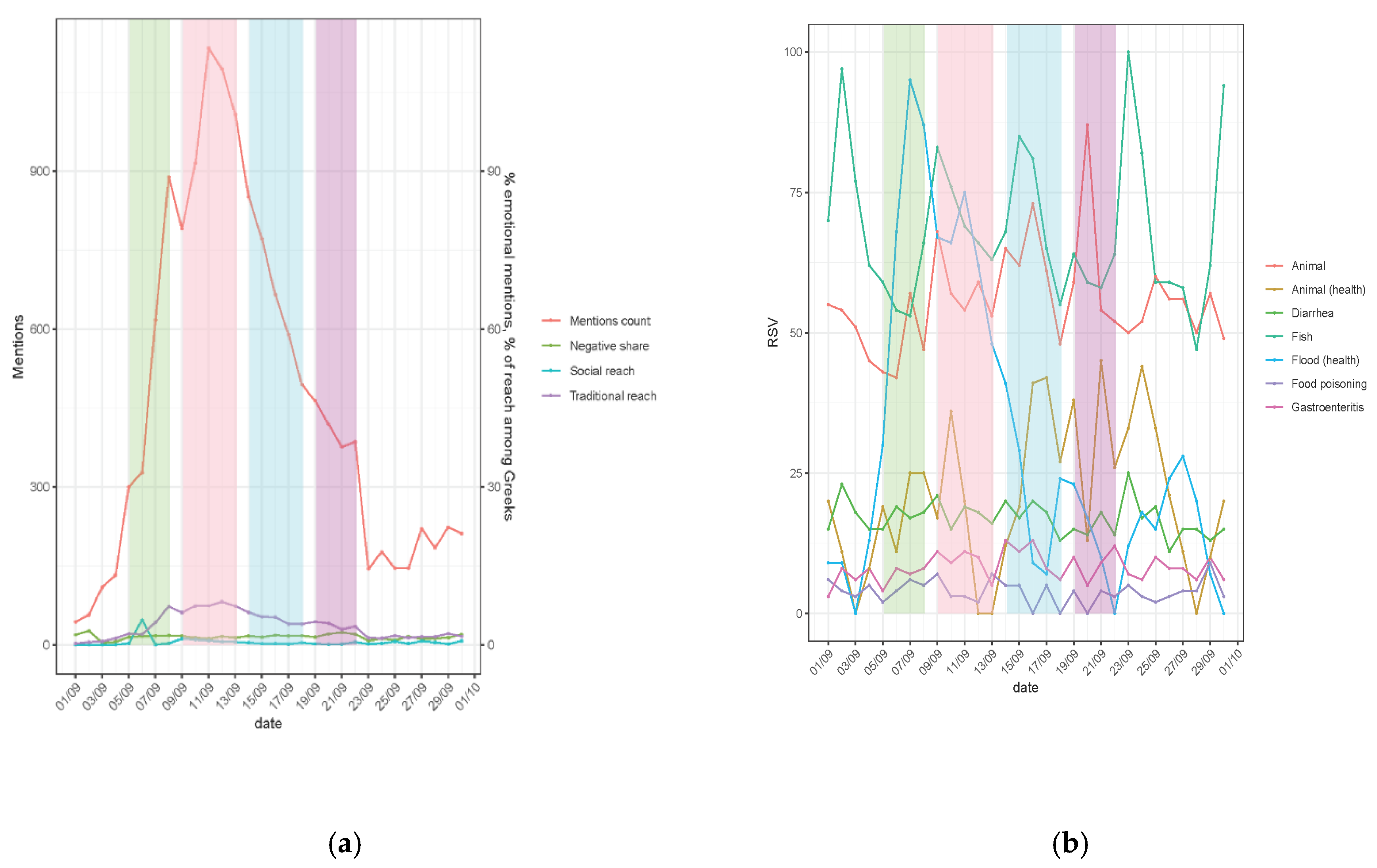

Table 1.
Characteristics of discourse in main animal related topics.
| Topic | Standard characteristics | Nontrivial characteristics |
|---|---|---|
| Missing and displaced animals | Focus mainly on missing companion animals shared on social media. Limited discourse on displaced livestock. | Uncommon absence of wild animal discussion compared to the discourse on other catastrophes or animal-related issues [7]. |
| Dead animals | Articles may not mention animals in the text but use emotionally charged images of carcasses. On the other hand, discussion on dead animals often accompanied calculations of economic losses. Farmers not only lost their livestock but also equipment (buildings, machinery) and animal feed. | Use of dead animal images for emotional impact (clickbait) despite the lack of relevant content in the mentions. Loss of animal-related accessories (feed and tools) is more important to farmers than livestock. |
| Infectious diseases and health issues | Multiple discussions of epidemiological and epizootiological threats, post-flood topics include human and animal gastroenterological diseases, food/feed contamination, and water pollution concerns. Animal owners exchanged information about animal treatment. Many mentions refer to the extent of the damage and also point out the need for a proper management of the situation, given that it is of a major public health concern. | Broad coverage of health threats, and sophisticated discussions of potential risks (e.g., West Nile fever, leptospirosis which incidences raised after the flood or possible re-emerging diseases such as cholera, malaria, dengue fever) not widely acknowledged by the general population, which was interested in gastroenterological diseases and acute treatment of their animals only. Mentions about incompetence of authorities are seen in post-acute phases of the flood. |
Disclaimer/Publisher’s Note: The statements, opinions and data contained in all publications are solely those of the individual author(s) and contributor(s) and not of MDPI and/or the editor(s). MDPI and/or the editor(s) disclaim responsibility for any injury to people or property resulting from any ideas, methods, instructions or products referred to in the content. |
© 2024 by the authors. Licensee MDPI, Basel, Switzerland. This article is an open access article distributed under the terms and conditions of the Creative Commons Attribution (CC BY) license (https://creativecommons.org/licenses/by/4.0/).
Copyright: This open access article is published under a Creative Commons CC BY 4.0 license, which permit the free download, distribution, and reuse, provided that the author and preprint are cited in any reuse.


