
Submitted:
21 February 2024
Posted:
22 February 2024
You are already at the latest version
Abstract
Directive 2018/844/EU on energy efficiency claims almost 80% of final energy consumption in EU is used within the buildings. Subsequent Directive (EU) 2023/1791 introduced in 2023 expected 68% of the World population living in urban areas. Both Directives enhanced the role of energy management (EM) applied on the city buildings. The study introduces the development of energy management in Czech municipalities between the years 2009 and 2023. The main goal of this article is to present selected results of the unique national survey focused on the energy management in Czech municipalities conducted in 2023 and compare it with results of national surveys implemented in 2009 and 2018. The main method is the evaluation of deep survey conducted among the municipal representatives or energy managers in the past with the new survey conducted in 2023. The results show that EM became notably more important issue for the most Czech municipalities. The number of cities implementing EM significantly grew and the number of city energy managers increased too. On the other hand, the used potential of energy savings triggered by establishing EM is insufficient. This article should be applied to stress power of municipal EM in performing energy efficiency and RES projects and encouraging government to support municipal energy managers in their complex role.
Keywords:
Energy management
; management
; municipalities
; ISO 50001
; supporting schemes
; SECAP
1. Introduction
As legal entities, municipalities own high number buildings, large street lighting and other energy facilities, consequently municipalities influence their citizens and local enterprises. It is natural that municipalities search for ways to minimize costs for energy consumed. Efforts to achieve better energy management are further supported by the current policies of reducing greenhouse gas emissions. Number of EU regulations covers enhancing of energy savings and reducing GHG emissions. The Energy Efficiency Directive (2023/1791) obliges the Member States to increase energy efficiency and reduce energy consumption and greenhouse gas emissions [1]. The Directive includes obligation of Member States to support municipalities technically and financially in their effort of increasing energy efficiency. Nonetheless, there is no clear provision expressing specific steps of their support even if their role is crucial.
The transposition of Energy Efficiency Directive to the Czech legislation is coordinated by the Ministry of Industry and Trade (MIT). The MIT revealed several acts and government ordinances to rule the energy performance and energy management. Except of this the MIT offers subsidy programs for the municipal energy management (EM) establishing, energy performance enhancing and energy education, mainly the subsidy program EFEKT. The other important source of subsidies focusing on energy performance measures is the Operational Program Environment ruled by the Ministry of Environment.
Although the municipalities should be pioneers of the EM, the legal power of municipalities is insufficient for energy sector; the 18% of municipalities in the United Kingdom (UK) have no project nor plan to implement local energy innovations [2]. Increasing a city’s energy efficiency can influence many dimensions of its competitiveness, spanning economic, social, environmental, and innovation and technology facets. Striving for energy efficiency is a strategic approach that can benefit the city as well as its communities and businesses [3].
The reported energy savings show that the conventional methods can be as effective as innovative and emerging approaches. However, ease of installation, scalability, life cycle assessment, and cost benefits are the main drivers/factors in studying and identifying new energy conservation methods [4]. Energy savings and emissions reduction targets can be achieved at lower costs if behavioral changes occur, proving that “soft measures” are an essential lever for the implementation of “hard” technological measures [5].
1.1. Definition of EM in Municipalities and its Presenting
The necessary prerequisite to spread the EM among the municipalities is its clear definition which is understandable even for people without any previous knowledge about this matter, which are very often mayors or decision-makers in the cities. The research area ‘urban energy management’ combines many additional research areas, including energy efficiency, economic efficiency, environmental protection, the use of modern technologies in energy infrastructure and construction, urban spatial planning, and public transport [6].
The definition should be attractive for municipality leaders and briefly explains what EM means and which benefits brings. If a municipality does not have an established track record on implementing effective environmental policy and is not supported in this by its electorate (assuming a democracy), it is unlikely that its politicians will be ready to move forward with the aggressive policies necessary [7]. After the EM implementation the municipality obtains reliable information of energy expenditures. Based on this the municipality can adopt appropriate measures and avoid technical and financial risks.
The mapping of urban building energy plays a crucial role in understanding the multitude of agents that take part in the energy performance of buildings and thus in setting up the benchmarks in different districts for various stakeholders [8].
The importance of energy management for a given municipality can be measured primarily by the share of energy and water expenditure on total municipality expenses. In case of cities, towns, municipalities, regions and organizations with mainly administrative operation, these expenses usually reach around 10% of total operational expenses [9]. Energy management implementation is a systematic and not capital-intensive step. The objective is to gradually reach substantial energy savings and improve work organization [10]. Energy management is a set of activities which contribute to long-term improvement of energy performance within a given energy system [11]. There is a variety of energy saving measures and energy management seems to be one of the key instruments for reaching the savings [12]. Energy management system is a set of interrelated or interacting elements to establish an energy policy and energy objectives and processes [13]. The Association of German Engineers released a definition which includes the economic dimension: Energy management is the proactive, organized and systematic coordination of procurement, conversion, distribution and use of energy to meet the requirements, taking into account environmental and economic objectives [14].
The EM should be considered as an important instrument of the life cycle costing, because the EM is the way how to reduce operational costs in the buildings. The better building’s design is the lower operational cost are. Especially Czech municipalities are still forced by the legal risks to tender buildings renovations on the lowest bidding price. The private owners commonly use maximum performance as the key criterium. The maximum value for money could be achieved if all cost included over the whole life span are evaluated. Running costs (operation costs, maintenance and renovation costs) are an important section of investment during the life cycle [15].
The most significant factors influencing the EM were identified lack of technical skills, disinterest in energy efficiency improvements and non-functional regulation [16]. The lack of knowledge of building practitioners can easily lead to risk of not achieving of operational savings and reducing the financial effectiveness of a particular building asset [17]. The plain decision that organization will reduce the energy consumption does not mean it has an energy management system. Understanding how, where and why energy is being used is essential when devising an EM, whatever the motives may be for trying to use less energy [18].
The increase in number of energy managers in municipalities and improvement of specialized qualification of the present managers should be supported by an e-learning course designed for municipal managers. The course has been available on the EFEKT program website since 2015 [19]. Municipalities with more than 10,000 inhabitants can apply for a subsidy to fund the EM implementation from subsidy program EFEKT. The subsidy covers development of key EM elements such as: municipality tailored EM description, process organization (definition of processes, responsibility, information flow, etc.), and energy consumption assessment. The subsidy does not cover the EM certification but it is assumed that the implemented EM would meet the standard ISO 50001 or requirements of the system of environmental procedure and EMAS audit [20]. The extension of the standard ISO 50001 among Czech municipalities was supported also by an illustrative handbook published by Energy agency DEA explaining the use of the ISO 50001 standard in a clear and comprehensible way using specific examples from the life of an energy manager [21].
1.2. The Base for Municipal EM Implementation
The subsidy programs are important for municipal EM establishing. However, the administrative work of both sides (funding body and beneficiary) is perceived as significant barrier for applying. The transaction costs in energy efficiency subsidy programs are of non-negligible levels, altogether averaging at 11% – 14% of the total subsidy allocation [22]. Should the administrative costs of an average application be 520 € and the smallest types of application for subsidies in the value of 2200 € it appears that while sustaining the existing method of administration and approval, such administration is ineffective [23].
The Czech municipalities follow the Act no. 406/2000 Coll. About Energy management which order to apply energy audit to whole municipal property consuming energy or adopt the energy management system based on the international standard ISO 50001 [24]. The ISO 50001 standard provides a guide on implementation, maintenance and further development of the energy management system. The standard is based on a gradual improvement cycle according to the plan – do – check – act rule. The standard ISO 50001 has been available in the Czech Republic since February 2012. After the standard ISO 50001 adopting the energy savings of more than 10% were achieved in some cases within one year [25].
Implementation of EM at municipal level is indirectly supported by current EU’s efforts to mitigate climate change in municipalities. Municipalities striving for climate change mitigation can join the European co-operation movement Covenant of Mayors (CoM). This movement encourages its members to sign a declaration to take measures leading to climate change mitigation, reducing energy consumption, reducing greenhouse gas emissions and transition to a low carbon economy. Municipalities which signed the Covenant of Mayors have committed to reduce their CO2 emissions by 40% by 2030, comparing to the chosen baseline year from the past. The procedure leading to reduction of CO2 emissions shall be described in the Sustainable Energy and Climate Action Plan (SECAP). The previous version of this document did not emphasize the climate so much and was called just Sustainable Energy Action Plan (SEAP). Introduction of energy management on municipal property is obviously a relevant tool for SECAP implementation. Drawing up SECAP for Czech municipalities can be funded from the subsidy repeatedly revealed by the Operational Program Environment governed by the Ministry of Environment. Some European cities and municipalities implemented EM when drawing up SECAP.
In general, cities do not have the authority to implement carbon pricing policies. It follows that they do not have the opportunity to use carbon pricing revenues to run major subsidy programs for energy efficiency or energy-switching technologies either. Cities also tend to have negligible authority to regulate the sale of the technologies (furnaces, vehicles) and energy forms (gasoline, natural gas) that cause most urban GHG emissions [7]. Local authorities in UK have no direct energy mandate. In addition, UK local authorities have had no significant role in energy supply for the last century. Municipal energy effectively ended with early 20th century nationalization and centralization; privatization followed in the 1980s and 1990s. Lack of local statutory powers and resources for energy, and the absence of consistently supportive policy frameworks for implementation, result however in plans having limited material impacts [2].
The EM is extremely depending on human factor with perhaps most noteworthy factor being the unpredictability of the people and departments that eventually assume leadership in the smart projects. Arguably, the sustainability outcomes also depend on citizens' uptake of the smart agendas, and may involve continuance and worsening of existing habits [26]. It also shows the necessity to involve occupants in energy management through data sharing and regular information about the consequences of overheating on energy consumption and health. It constitutes a valuable support for decision-makers to set up efficient strategies for the optimal energy management in old buildings through a smart transformation of the social buildings and occupant involvement [27]. There is no one definition for citizen engagement in cities. Citizens play an active role in defining issues, finding solutions, and identifying priorities for action. However, involving citizens is voluntary for cities, and such an inclusion process varies between cities and may be even lacking completely in certain cities [28].
The CoM’s ambition is to gather local governments voluntarily committed to achieving and exceeding the EU climate and energy targets [29].
1.3. The Problems of SECAP Implementation in the Small and Middle-Sized Municipalities
In many cases municipalities are encouraged to develop sustainable energy and climate action plans, but eventually they do not know how to properly work with data and make evidence-based decisions [30]. To fulfill the obligatory structure of SECAP given by the CoM is not easy especially for medium and small-sized cities [31]. The most signatories of CoM (98% in terms of submissions and involving 40% of the EU population) are small and medium cities (less than 250,000 inhabitants), where inadequacy of skills of municipal stuff is certainly a widespread problem [32]. The lack of personnel availability and capacity for funding of sustainable energy projects and the availability of training schemes is confirmed [33]. The technical staff of small and medium-sized municipalities do not possess specific expertise for SECAP creation. To overcome this problem, the SECAP preparation is frequently outsourced, which may produce in the local governments some critical shortcomings [34]. The recommended measures to reduce energy consumption mentioned in SECAP usually are using of renewable energies, improving energy efficiency in buildings; optimization of public lighting; improvements in air conditioning and ventilation systems; improving the efficiency of small electrical equipment and improved efficiency of industrial processes and equipment [35]. Most of municipalities could not distinguish how much financial resources is used for SEAP activities and for most of them there is no specific budget for it. SEAP implementation is seen as a side effect from the municipal budget point of view [36].
1.4. The SECAP Coherence with National Energy Planning
The main activities against the climate change should be done by the cities, however these activities should be coordinated by national governments in order to maximal the synergy effect. In case each city approaches to the problem regarding its own needs only, the final result could be sum of isolated cities instead of developed society with reduced carbon footprint. The relationship between local and national government are important elements in local climate action [37]. The municipal energy plans should be allied with the other types of urban planning [38]. In order to successfully implement the municipal energy plans (and national energy objectives), it is necessary to restructure the energy planning system. This entails a move from “parallel energy planning” to “strategic energy planning” in which an alignment of national energy objectives, municipal energy planning and the necessary instruments for implementation can take place on a continuous basis [39]. Regional and municipal efforts for climate and sustainability appear not aligned [40]. There is a need for coordination in aligning local efforts to successfully contribute to the decarbonization of national energy systems [41]. The production of planned RES however does not only exceed what there is room for in the grid but also what is an appropriate share from a national perspective. A clear sign that not only should planning permission involve grid considerations, but it should also include consideration for national developments and appropriate shares across municipalities [42]. Accurate monitoring and verification is needed, but far from only being a “technical” exercise. This needs to check actual progress in energy efficiency and effectiveness of national policies and measures. Monitoring of the impact and progress of the strategies remains a weak point [43]. The decision support tools are needed because of increasingly ambitious climate protection goals. These help to identify local conditions and support local decision-makers in the formulation of energy system transformation strategies [44]. The principle of Energy Efficiency First, one of the most important leverages to achieve the decarbonization is not sufficiently addressed. The Member States privilege investment in new technologies [45].
2. Goals of the Study
The main goal of this article is to present selected results of the unique national survey focused on the energy management in Czech municipalities conducted in 2023 and compare it with results of national surveys implemented in 2009 and 2018. For the survey purposes is the energy management defined as a systemic approach which has its own aims, practices, documentation and staffing and is organized by the municipality and is focused on municipal equipment. The systematic EM is far away from serial of ad hoc energy measures implemented on selected municipal buildings, though these may lead to significant energy savings.
The subsequent goal is to describe evolution of energy management in municipalities in the Czech Republic between 2009 and 2018. In the year 2009 the very first survey of municipal energy was conducted. The same survey was repeated in 2018.
The third goal is to describe the most frequent approach to the EM in the inspected cities. The systematic approach to the EM can be based on the standard ISO 50001 or on own developed and tailored system. However, the Czech version of standard ISO 50001 was published in 2012. Each systematic EM existing before standard revealing is inevitably based on another rules. The pre-ISO system could be replaced by ISO or the ISO can be refused and the pre-ISO system can successfully continue within the municipality.
The final goal is an evaluation of the findings and formulating recommendations for further improvement of EM in Czech municipalities.
3. Materials and Methods
First original information source is the survey which was carried out by independent energy advisory Porsenna Ltd. in 2009. This survey focused on towns and municipalities resulted in 53 completed questionnaires out of 279 which had been sent out in total. This outcome represents a 19 % response rate, which is a common result with surveys organized this way.
The second original information source is the survey conducted by the independent energy advisory SEVEn, The Energy Efficiency Center. This research contained among others the questionnaire examining the EM in municipalities in the year 2018. The survey covered 129 municipalities with more than 10,000 inhabitants, 22 municipal districts of Czech capital city Prague and 13 municipal districts of second largest Czech city Brno, i.e. a total of 164 respondents. This survey gathered data from 50 questionnaires, with the response rate of 30,4%. The most questions in this survey (37 from 39) were formulated as close-ended and the respondents had to choose the most suitable answer out of several options. The close-ended questions limit respondents´ possibilities to express their opinion. Reducing the number of possible answers is acceptable without the risk of distortion of the data obtained if the respondents are homogenous group and types of their replies can be predicted because of previous experience with such type of respondents. The three questions were formulated as open-ended and allowed to reply in more detail by respondent’s own expression.
In both cases (Prosenna 2009 and SEVEn 2018) electronic questionnaires were sent to email addresses of energy managers or relevant persons dealing with energy issue in the municipalities. The response rate of the questionnaires in both surveys is sufficient to consider both surveys to be representative samples. The next text is based on the survey conducted in 2018 partially compared with the previous survey done in 2009. Both surveys overlap because some of their questions were identically formulated so the responses can be easy compared. Responses to the questions were used to describe the development of the municipal approach to energy management. The survey 2009 could not investigate the standard ISO 50000 implementation.
The third information source is survey done in 2023 which was focused on the municipalities with 10 000 -100 000 inhabitants. The 62 replies were obtained and the return rate was 50%.
3.1. Methods used in the Reserch Conducted in 2023
The survey conducted in 2023 reflected the both previous surveys, however could not just repeat the same questions. The situation within the Czech municipalities has significantly changed because of energy crisis in 2021 and consequences of Ukraina war. Before the survey conducting the preliminary characteristics were defined, which reflect the essential parts of EM. The questions to energy managers were formulated based on these characteristics. Preliminary characteristics influencing the costs and the maturity of EM are the following ones:
a) The number and variability of energy delivery points (DP) affect two basic types of costs of EM. The first type of these costs is salary of energy manager. The high DP number or the variability of different types (electric, gas, heat, water) of DP imply the high workload for EM and consequently higher salary cost.
b) The second type of cost is the expenditure for specialized software. The increasing DP number cannot be administrated by the common office computer programs and the specialized software should be implement. The SW is used for energy consumption recording, invoices storage, revisions report archiving, various alerts and other services for EM. The SW outputs allows to compare energy performance of different buildings, make the graphs of consumption etc. The software using implies the cost of purchasing and the expenditures for annual licenses, and possibly the payments for software modification according to user (municipality) requirements.
c) The modus of EM personal covering implies the different high of salary costs of energy manager. If the work position of energy manager is established as new one not derived from other work position, then salary costs will be incurred. The alternative approach is the EM is assigned to an existing magistrate employee as an additional task to their current job duties. In this case the EM duties are very often not mentioned in the work contract or the formulation is very fuzzy. The workload measured in work hours per week or the extra salary for these duties are missing very often as well. This approach is typical for municipalities where EM is not yet perceived as serious issue. There are other variables influencing the salary cost. The level of energy mangers education affects the costs because the salaries of municipal employees are derived from the government ordinance about salaries. The higher education results to higher salary. The different specialization by same level of education means different salaries e.g. master of electrical engineering is used to be paid better than master of mechanical engineering. The level and specialization of energy managers were investigated.
d) A formalized description of the EM, i.e. in particular the responsibilities, authorities and job descriptions for the employees who are significantly involved in the EM. A formalized description of responsibilities indicates the maturity of EM. The EM needs correct formal description to work properly. The correct description is the result of continual development of EM and during this development the maturity of EM gets higher. In case the EM not described but is based on every daily routine, it collapses at the moment when key persons leave. The period of EM re-establishing after key persons disappearing is often connected with harms and extra payments because of missing know how.
e) Purchasing energy on the commodity exchange. This type of energy purchasing is considered the most efficient way to secure electricity and gas suppliers. If the EM is able to purchase on the commodity exchange, then this provides a benefit to the city in the form of cheaper electricity or gas price. The prerequisite for such purchasing is the list of delivery points (gas or electricity) including the records about previous energy consumption, circuit breaker value (for electric DP), type of measurement, the electric tariff ect. The existence of such list is evidence of certain maturity of EM. The energy exchange purchasing leads to lower unit prices and therefore is popular among the cities. In addition, this type of purchasing is significantly easier than conventional approach according to Public Tender Act.
f) EM based on the standard ISO 50001 or the EM excluding the ISO. According to the Czech Act no. 406/2000 Coll. About Energy management the municipality must implement the EM based on ISO 50001 or conduct the energy audits including the whole municipal equipment with significant energy consumption. If the municipality prefers to establish an EM according to ISO 50 001, it may generate costs for the consulting company and surely generates costs for an EM certification by independent certification body. If the city decides to conduct energy audit, then there will be costs for an energy expert, because the energy audits must be elaborated by the official person only.
g) The period of energy consumption recording. The recording of energy consumption is essential part of EM. The recording is a basement for decision making about measures to reduce energy consumption. After the measure is done, the consumption recording is necessary to prove the measure meets the expectations. The long period of recording indicates the higher maturity of EM. In case of many DP the consumption recording is not trivial task and needs several years to be established well. The maintenance of the database of records is not trivial as well.
3.2. Implementation Phase of the Research 2023
The research was based on the questionnaire survey among energy managers or other municipal staff responsible for energy in their cities. The questionnaire made by Google Forms was linked in the clarifying email which was sent to the magistrate Secretaries of the investigated towns with an appeal to forward it to the municipal staff member in charge of energy. This approach was used because the emails of the municipal energy managers were not to find on municipal web pages in many cases.
The research was focused on the cities with a population of 10,000 – 100,000 inhabitants. According to the Czech Statistical Office, there are 125 such towns in the Czech Republic. Cities with a lower population were omitted because the municipalities with less than 10,000 inhabitants have few owned buildings, paucity public lighting and other facilities with significant energy consumption compared to larger cities. Therefore, the design of EM in such small towns is qualitatively different. The cities with more than 100,000 inhabitants were also excluded. The cities over 100 000 inhabitants are divided into municipal districts and each of them implements EM separately.
3.3. Wording and Number of Questions
Several surveys have been conducted in the past about EM in Czech cities. Experience shows the length of the questionnaire for energy managers has proved to have a significant impact on the return rate and the number of questions answered. A questionnaire with 21 questions had a return rate of 40% [46]; the SEVEn survey (2018) contained 39 questions, none of the respondents answered all of them and its return rate was 30%. A study prepared by SEMMO (2020) contained a questionnaire with 134 questions and the return rate dropped to 8.5% (62 responses out of 724 respondents).
Regarding this, the questionnaire was limited to 18 main questions, with one or more additional questions added in 16 cases. The first four questions were answerable by number. The remaining questions were open-ended. The last question was open-ended and encouraged the respondent to add any voluntary comment. The formulation of the questions was consulted with the energy managers of several cities (České Budějovice, Rožnov pod Radhoštěm, Prostějov), who were subsequently among the respondents.
4. Results
4.1. Research Conducted Between 2009-2018
The questionnaires used by the SEVEn, The Energy Efficiency Center were fulfilled by 50 respondents.
Figure 1.
Have you implemented energy management and have you used the Standard ISO 50 001? Has your municipality employed someone who deals with energy savings?
Figure 1.
Have you implemented energy management and have you used the Standard ISO 50 001? Has your municipality employed someone who deals with energy savings?
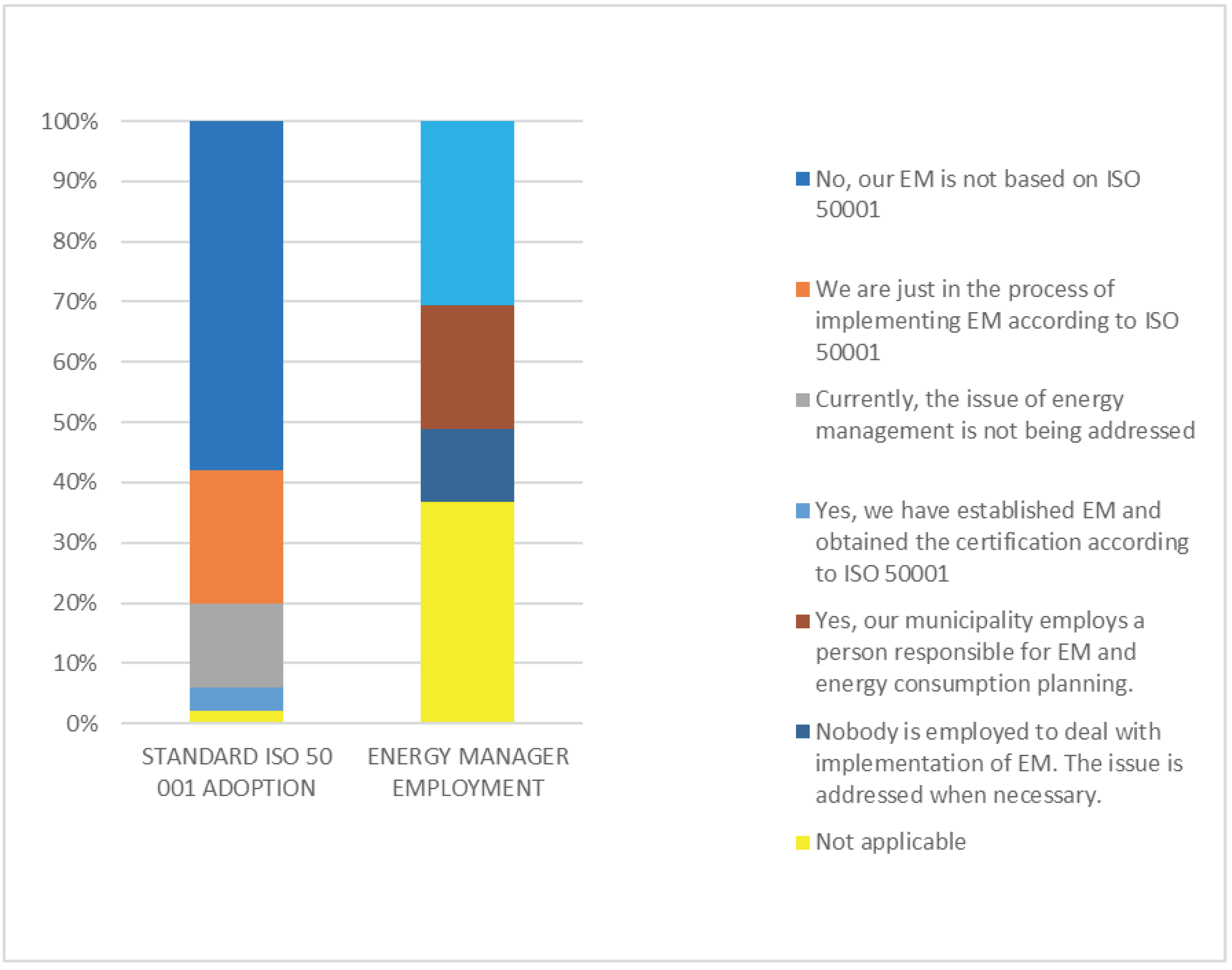
The majority of respondents (58%) states that they developed own EM which is not based on the standard ISO 50001. The 22% of respondents state that energy management according to ISO 50001 is just being implemented. The 14% of respondents (i.e. 7 municipalities) or municipal districts do not address the issue of energy management at all. Only 4% reported they had implemented energy management according to ISO 50001 and have been certified by independent certification body. One municipality did not reply this question.
The half of the respondents (50%) said that their municipality had an employee responsible for energy management and energy consumption planning. By contrast in 36% of investigated municipalities this issue is addressed ad hoc if necessary. The following 12% of municipalities collaborate with energy specialists. This question is an interesting complement to the previous one. Except one municipality without answer all the respondents admitted they dealt with energy savings. The differences among municipalities are the personal cover for this issue and the level of systematic approach to deal with it.
Figure 2.
When did you implement the energy management in your municipality? Did the implementation of energy management contribute to energy savings?
Figure 2.
When did you implement the energy management in your municipality? Did the implementation of energy management contribute to energy savings?
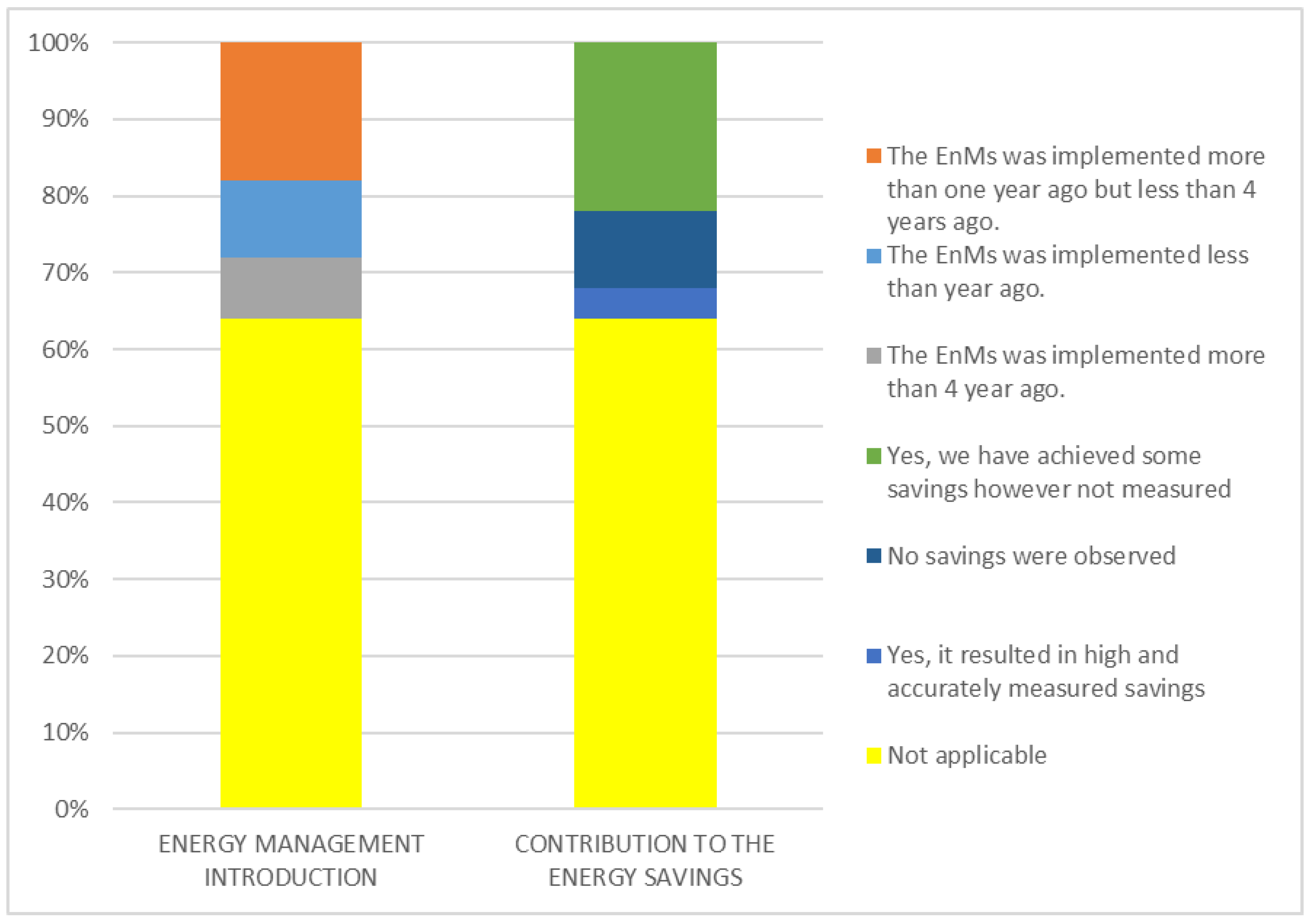
The moment when the EM is correctly implemented is hard to exactly express. In case the EM is based on ISO 50001, the certificate obtaining can be seen as a finish of the EM implementation. In case the EM is developed independently to ISO the moment of finished implementation is fuzzier because is defined by the energy manager himself. Regarding these all limitations the respondents were asked when they implemented EM. For the most municipalities (64%) this question was not applicable because their EM is not based on ISO 50001. The 18% of respondents implemented EM more than one year ago but less than 4 years ago. The 10% had shorter than one year experience at the time the survey was conducted. Only 8% of respondents revealed they implemented the EM more than 4 years ago.
The majority of respondents (64%) avoided to tell if their EM contributed to energy savings. This contrasts to their previous expressions about energy consumption monitoring or ISO 50001 implementing. The 22% of respondents revealed the EM contributed to the energy savings however these could not be exactly expressed. The 10% of respondents claimed the EM has not yet generated any energy savings. Only 4% of respondents claimed high and exactly measure energy savings. None of them was certified according to ISO 50001. The energy managers from certified cities claimed that EM implementation resulted to certain savings however these were not exactly measured.
Figure 3.
Is the complexity related to implementation and maintenance of energy management according to ISO 50001 a barrier to its implementation? Is the implementation and maintenance of energy management complicated and less sustainable according to ISO 50001?
Figure 3.
Is the complexity related to implementation and maintenance of energy management according to ISO 50001 a barrier to its implementation? Is the implementation and maintenance of energy management complicated and less sustainable according to ISO 50001?
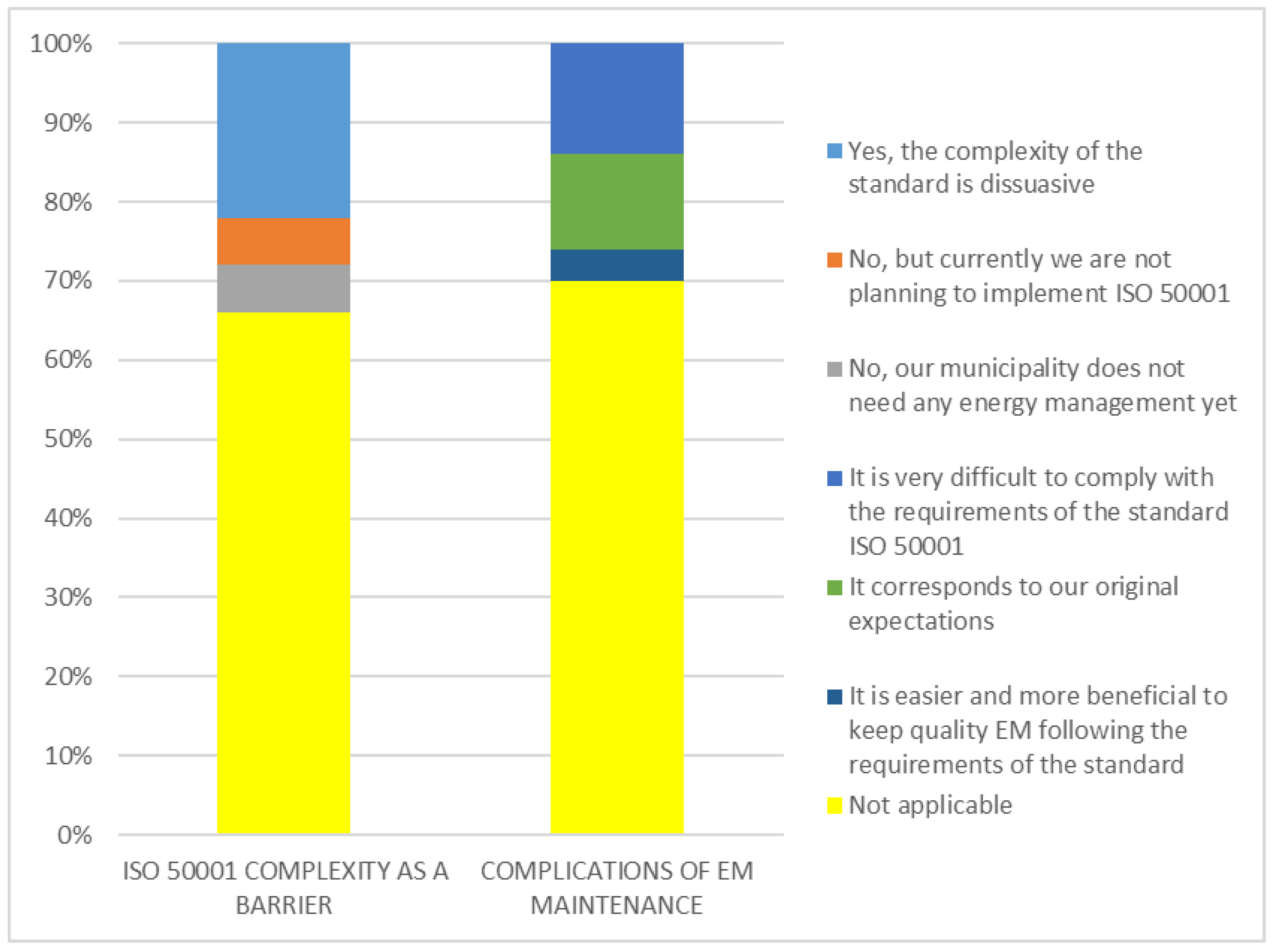
According to replies to previous questions only 4% of respondents implemented the standard ISO 50001 and 22% of respondents were just in process. That means most respondents had not any direct experience with ISO 50001. Therefore 66% of respondents was not able to reply the question if the complexity of ISO 50001 is the barrier of implementation. The 22 % respondents found the standard dissuasive due to its complexity. 6 % of potential users did not want to implement energy management according ISO 50001, regardless of its possible complexity. The remaining 6 % of municipalities did not address the issue of energy management whatsoever.
The 70% of respondents were not able reply the question about complications of EM maintenance because of absenting experience with the ISO 50001. The 14% of respondents agreed that it is difficult to comply fully with the requirements of the standard. The 12% claimed that energy management according to ISO 50001 fulfilled the original expectations. Unfortunately, the answer does not specify what exactly these expectations were. Only 4% of respondents hold the opinion that thanks to using the ISO 50001 standard it is easier and more beneficial to keep quality energy management. In their view, it is easier to keep energy management by following the requirements of the standard than without it.

Table 1.
The comparation of energy management surveys conducted in 2009 and 2018.
| Question | 2009 53 replies [%] |
2018 50 replies [%] |
2018 vs. 2009 |
|
| a | Does the energy issue belong to the priorities of your municipality? | 73 YES | 87 YES | + 19 % |
| b | Does your municipality employ somebody to deal with energy savings? Does your municipality collaborate with an energy specialist? | 40 YES | 63 YES | + 57 % |
| c | Do employees in your municipality take part in educational activities in the field of energy savings? | 42 YES | 63 YES | + 50 % |
| d | Does your municipality support renewable energy sources? If so, in what way? | 25 YES | 35 YES | + 40 % |
| e | Does your municipality collect data on energy consumption and on energy production from local renewable energy sources? | 17 YES | 66 YES | + 288 % |
| f | Does your municipality motivate entities in city-owned buildings to energy savings? | 72 YES | 61 YES | - 16 % |
| g | Does your municipality have a database of city-owned buildings together with data on their energy performance? | 68 YES | 85 YES | + 25 % |
| h | Does your municipality collect data on energy consumption related to street lighting annually? | 96 YES | 68 YES | - 29 % |
| i | Have you applied or are you in the process of applying for a subsidy for funding projects focusing on energy savings? If so, which programs did you choose? | 70 YES | 85 YES | + 21 % |
| j | Would you be interested in a comparison of your essential energy data with other municipalities? | 77 YES | 85 YES | +10 % |
The increased number of employees in charge of energy management by 57% is significant. The question is formulated in a very general way and it is not possible to tell from the answers whether the city employs a separate energy manager or has only delegated energy management to one of its current employees. The increase in data collection on energy consumption and RES energy production is also significant, up 288%, but this is an increase from a small base and is therefore relatively high. Lack of qualified staff was cited as one of the barriers to EnMS development and systematic data collection is a necessary condition for an effective EnMS. Somewhat unclear is the weakening of the motivation of the entities managing the city's facilities to save energy. Their motivation probably decreased after the insulation of the building envelope, as this led to a significant reduction in energy consumption. Users were under the false impression that there was no need to pursue further energy savings because the maximum had been reached. The same is likely to be the case with regard to the decrease in monitoring of lighting consumption.
The research on the state of energy management of municipalities in 2018 raised some questions which should undergo further examination:
- The overwhelming majority of respondents (65 %) answered that they do not support RES. What is the main cause of rejecting RES which enjoys generous political support and ever decreasing investment costs nowadays?
- The 15 % of municipalities responded that they have never applied for a subsidy to get funds for projects improving energy efficiency. Why such a large proportion of municipalities have not submitted any application despite the long-term availability and variety of subsidy schemes? Is it excessive administrative burden or reluctance of responsible workers in particular municipalities?
- The number of municipalities motivating the users their building to energy saving behavior has shrunk (from 72 % to 61 %). Undoubtedly, motivation is an essential factor in this field and its appropriate form can lead to significant improvement.
- The decline in number of municipalities (from 96% to 68%) which collect data on street lighting energy consumption is unusual as well and it warrants closer examination and validation.
4.2. Research Conducted in 2023
The 124 cities were contacted and 62 completed questionnaires were returned what means return rate of 50.0%.
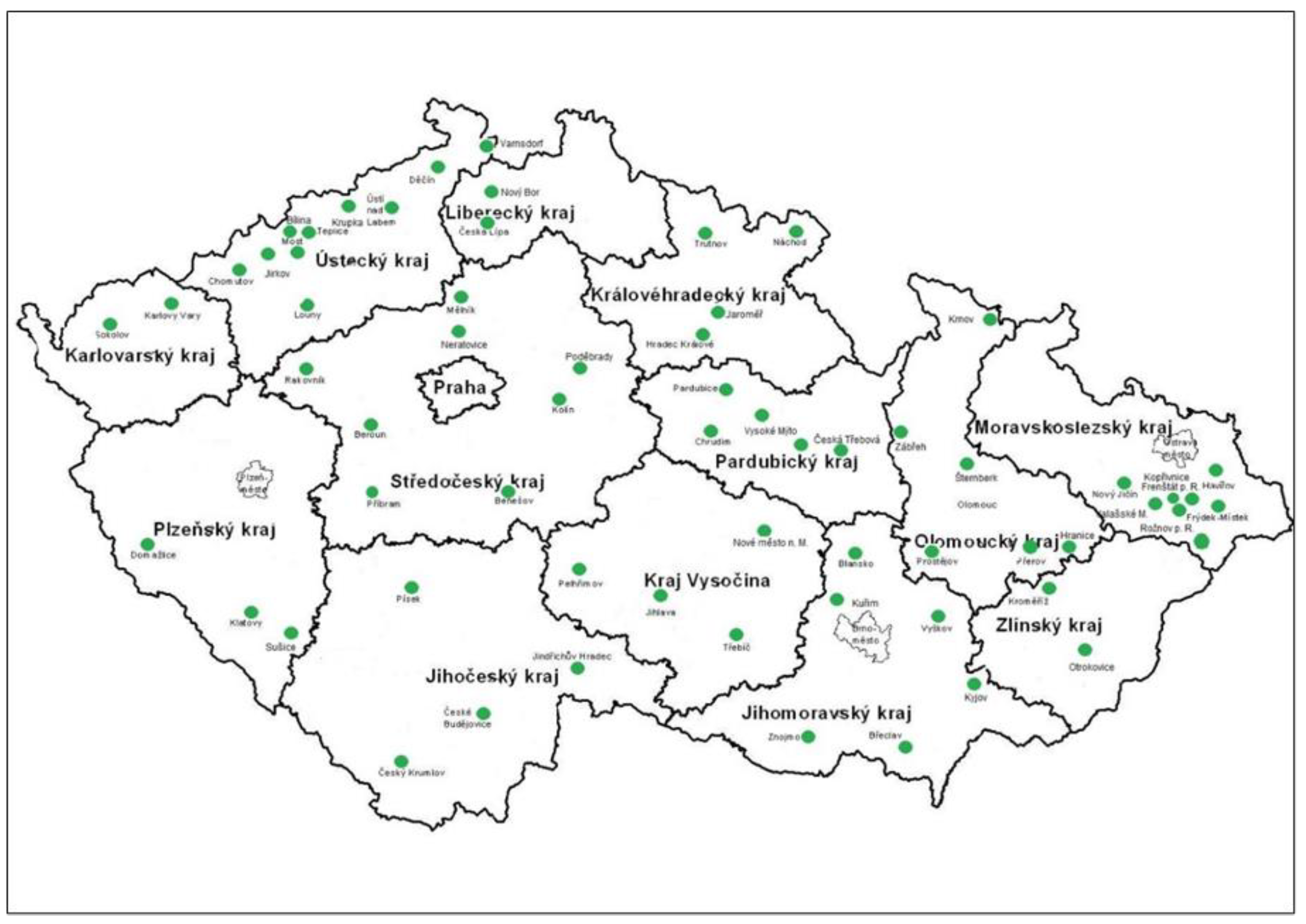
Figure 4.
Distribution of municipalities participating in the survey 2023.
The initial questions investigated the numbers of delivery points of different forms of energy (electricity, gas, heat). These numbers implicate the workload of EM and the necessity to use specialized software.
Two-thirds of respondents (66.1%) indicated that a municipal staff member with primary responsibility for EM had been appointed. Only half (21) of them have a full-time job, and for the rest, the work load allocated to EM varies from 0.1 to 0.8 full-time equivalent. Interestingly, one of investigated cities had two employees in this position, an Energy Manager and an Assistant of Energy Manager, with each having a 0.5 full-time equivalent. Some respondents indicated that a work position has not been explicitly appointed and that energy issues are handled by city staff member as additional part of their job duties. In this case, it is not possible to speak of a full-fledged EM.
Table 2.
The energy manager employment.
| Energy manager | Frequency | Portion |
|---|---|---|
| is employed | 41 | 66,1% |
| not employed | 15 | 24,2% |
| just in process | 2 | 3,2% |
| other reply | 4 | 6,5% |
The responses showed very diverse mix of educational backgrounds in terms of fields of study and degrees attained. Slightly more than half (32) of the energy managers were university educated. The most common education was a Master's degree in economics followed by an electrical engineering degree. Surprisingly, civil engineer was represented only once. Other types of university degrees were also included, e.g. forestry engineering, training, administrative, safety and legal, chemistry, sports management, environmental regional administration, and physics. For secondary education, there was also a significant variation: electrical engineering, mechanical engineering, textile specialist, industrial technologist.
Table 3.
The energy managers education and specialization.
| Degree | Specialization | Frequency | Portion |
|---|---|---|---|
| master degree | electrical engineering | 6 | 9,7% |
| civil engineering | 1 | 1,6% | |
| economy engineering | 10 | 16,1% | |
| other engineering | 11 | 17,7% | |
| bachelor degree | specialisation not divided | 4 | 6,5% |
| high school | specialisation not divided | 11 | 17,7% |
| no EM | - | 19 | 30,6% |
Based on the questionnaire, it was found that 25 cities, i.e. 40% of respondents, do not use any specialized software. The remaining 37 cities use a total of 11 different types of SW and of these, only two SWs are used in more than three cities. These results show that the use of SW for EM purposes is not yet established and that even in a relatively small market there are a large number of producers operating. A gradual stabilization and reduction in the variety of SW producers can be expected, because the requirements of cities regarding to SW for EM do not significantly differ and once developed SW can be used in more cities without significant further adaptations.
Table 4.
Type of used SW for EM.
| Type of Used SW | Frequency | Portion |
|---|---|---|
| no SW | 25 | 40,3% |
| Energy Broker | 16 | 25,8% |
| e-manager | 7 | 11,3% |
| own developed sw | 3 | 4,8% |
| MS Excel sheeds | 2 | 3,2% |
| SW from other 7 diff. producents | 9 | 14,5% |
The vast majority (69,4%) of respondents reported that the city does not have a document defining employees participated on the EM and t their responsibilities. The reasons for the lack of a document: the city is just starting with EM; responsibilities have been communicated to staff but not formalized; only one staff member is dedicated to EM. In less than 15% of surveyed cities, an internal document had been developed, most often a directive of the magistrate, an order of the Secretary or a modification of the organizational regulations. Less than 10% of respondents reported having document according to the requirements of ISO 50 001.
Table 5.
Existence of basic formal document of EM.
| EM Basic Document | Frequency | Portion |
|---|---|---|
| no document exists | 43 | 69,4% |
| document according to ISO | 6 | 9,7% |
| internal magistrate document | 9 | 14,5% |
| other type of document | 4 | 6,5% |
Purchasing energy (natural gas and electricity) on the energy exchange is considered as cost-effective way of securing energy supply. The 84% of investigated cities claim to purchase on the energy exchange. This contrasts to the fact that energy manager was employed just in 66,1% of them. There are two registered exchanges (PXE Praha and ČMKB Kladno) which dominate. Some respondents (8,1%) did not want to reveal which exchange they preferred. Two respondents used both exchanges. The rest respondents (16,1%) purchase the energy without exchange.
Table 6.
The preferred energy exchange by Czech municipalities.
| Exchange Purchasing | Frequency | Portion |
|---|---|---|
| ČMKB Kladno | 24 | 38,7% |
| PXE Praha | 21 | 33,9% |
| unknown exchange | 5 | 8,1% |
| both possibilities | 2 | 3,2% |
| without exchange | 10 | 16,1% |
According to the requirements of Act 406/2000 Coll. on Energy Management as amended, cities must implement an EM certified by an independent certification body or conduct an energy audit (EA) on their entire energy management. Each city can choose one of the two legal options. The largest portion of responses (32.3%) admitted to not comply with the requirements of the act because it did not conduct neither energy audit nor had certified EM. Conducting an EA was significantly more popular than certifying an EnMS to ISO 50 001 (30.6% vs. 9.7%). Some respondents (14.5%) claimed that the city was just in the process of preparing the certification of EM. The small portion of cities (4,8%) were deciding between EM certification and commissioning an EA.
Table 7.
Do you prefer EM certified according ISO 50001 or energy audits?
| Certified EM or Energy Audits | Frequency | Portion |
|---|---|---|
| both posibilities negative | 20 | 32,3% |
| energy audits | 19 | 30,6% |
| ISO certification is not planned | 8 | 12,9% |
| EM cerfified according ISO | 6 | 9,7% |
| EM certification just in process | 6 | 9,7% |
| considering between both possibilities | 3 | 4,8% |
According to replies the most cities record the energy consumption. The energy crisis in 2021 motivated many cities to start with consumption recording. The 12,9% of cities revealed that they do not keep the records about energy consumption. It means they are far away from any form of effective EM.
Table 8.
The records about consumption in different municipalities.
| Consumption Is Recorded Since | Frequency | Portion |
|---|---|---|
| 2000 | 2 | 3,2% |
| 2010 | 4 | 6,5% |
| 2015 | 10 | 16,1% |
| 2017 | 9 | 14,5% |
| 2018 | 9 | 14,5% |
| 2019 | 5 | 8,1% |
| 2020 | 3 | 4,8% |
| 2021 | 1 | 1,6% |
| 2022 | 6 | 9,7% |
| 2023 | 5 | 8,1% |
| no records | 8 | 12,9% |
4. Discussion
The comparison of surveys from 2009 and 2018 indicates that the importance of municipal energy management is on the rise. The 86% of municipalities deal with energy management. The 9,7% of municipalities were in process of certification by ISO 50001 and 4,8% were thinking about it. Totally 9,7% cities were certified at the time of survey conduction. The number of energy managers has increased by 57%, employees of magistrates and municipally budget organizations are being trained in the field of energy savings and the interest in using renewables has risen as well. The energy consumption is monitored even in the cities where the EM is not addressed. As a result, municipalities submit more subsidy applications for energy projects and energy consumption is better monitored.
The research indicates that municipal energy management is an important topic and its development worth observing. Based on the surveys’ results and author experience as energy manager in middle-size city, the following measures can be recommended:
- o The independent work position of municipal energy manager should be established. This newly organized work position needs to clarify some basic characteristics: the expected type of education, the job duties description without duties which are not related to energy management, the expected results.
- o The energy managers should be regularly educated using among others the examples of good practice from successful municipalities. The good practice should cover both the processes of effective energy management in municipality and the measured results.
- o The benefits of EM for municipalities should be communicated to the mayors and decision-makers at the municipal level.
- o The barriers for RES using should be revised and minimalized by the relevant ministery in order to support the RES expansion in the municipalities.
- o The condition of application for subsidiary in programs ruled by MIT and the Ministry of Environment should be revised and potential barriers should be minimalized.
- o The EM in municipalities should be longitudinal monitored and researched in order to identify potential problems and find the appropriate solutions as soon as possible.
There is relatively lower comparability of the results reached in 2009 and 2018 compared to those in 2023 due to the different goals and methodology. Due to the changes in approach the research in 2023 led to the 50% return rate, which very high compared to the other questionnaires in the field.
5. Conclusions
The comparison of surveys conducted in 2009, 2028 resp. 2023 revealed that energy management become more popular among the Czech cities. There are two basic approaches to the EM. The first approach is focused on energy performance and find the ways how to reduce the energy consumption. It can be based on the standard ISO 50001 although the useful EM can be developed without the standard as well. The second approach emphasizes the energy production from the renewable energy sources and reducing the CO2 emissions. It is obvious that both approaches can be naturally mixed in order to maximal their potential. Regardless the chosen approach the municipal energy management is based on the energy managers and their performance.
The survey revealed that maturity of EM among Czech municipalities is very variable. There are cities with long lasting EM beside the cities where the EM is just at the beginning or totally absents. The work position of energy manager is not covered in significant part (24,2%) of Czech cities. Some cities solve this issue as additional task to job duties for some of current municipal employee. This solution is without perspective, because EM is too complex to be ensured as overwork given to employee with full time job of other duties. The very variable education and workload of existing energy managers indicated that this work position is not commonly established. The third of Czech municipalities do not meet the legal requirements because they neither conduct the energy audits nor have EM certified by ISO 50001.
The increasing unit price of energy on the one hand and the pressure to reduce CO2 emissions on the other hand will ensure that the EM become an ordinary part of municipal duties in near future. The work position, workload, education and job description of energy manager become standardized. This process can be accelerated by the knowledge transfer from the experienced cities to the beginners.
Supplementary Materials
Original data of the input questionnaire are presented together with the paper.
Author Contributions
Conceptualization J. K., M.B., data collection 2018 L.K., J.K., data collection 2023 M.B., writing original draft M.B., conclusion chapter M.B. J.K., All authors have read and agreed to the published version of the manuscript.
Funding
This research was funded by the Czech Technical University in Prague, Czech Republic, grant number Grant SGS20/154/OHK1/3T/11.
Data Availability Statement
Not applicable.
Acknowledgments
The authors gratefully acknowledge the financial support for the research that led to this paper that was provided by the Czech Technical University in Prague, Czech Republic Grant SGS20/154/OHK1/3T/11 and the Ministry of Industry and Trade the Program EFEKT 2 for the support of the research in the year 2018.
Conflicts of Interest
The authors declare no conflict of interest.
Appendix A Questionnaire used in 2023
The questions on the organizational provision of EM were intended to find out the material conditions for EnMS in the city under study:
1. How many delivery points for electric, gas and heat are placed in your city?
2. Is there any binding document describing how many employees of the city, contributory organizations and possibly other organizations managed by the city are dedicated to EM and what specifically they are supposed to do for EM?
3. If you use any software for EM purposes, please specify: since when is it used, from which supplier and for what purposes?
4. How does the city provide its energy supply? If by purchasing from a energy exchange - since when, what energy, on what exchange?
5. Since which year have regular records of energy consumption been kept for most city buildings?
6. Is your EM system ISO 50 001 certified or do you conduct energy audits? If you have ISO 50 001 in place, in which year was the certification done? Alternatively, when do you plan to certify?
Appendix B
1. Does your city have a staff member who is responsible for energy saving? Or does the municipality work with an energy expert?
2. Does the municipality's staff participate in energy saving training?
3. Does your city promote energy savings? If so, in what ways?
4. Does your city support renewable energy? If yes, in what way?
5. Does your city collect data on energy consumption and generation from local renewable energy sources?
6. Have you applied or are you applying for grants to fund energy efficiency projects? If yes, in what programs?
7. Would you be interested in comparing your city's baseline energy data with other cities?
8. How long have you had an energy management system in place through the implementation of energy management?
9. Is implementing and maintaining an energy management system according to EN ISO 50 001 complex and difficult to sustain?
10. Has the implementation of energy management resulted in energy savings?
11. Is your city trying to reduce energy expenditure within the city's operational expenditure?
12. Does your city motivate entities managing city facilities to save energy?
13. Does your city have a database of city-owned buildings with data on their energy performance?
14. Does your city keep records of the energy class of its buildings according to the energy performance certificate?
15. Does your city collect data on energy consumption in public lighting on an annual basis?
16. Are you interested in implementing energy management according to EN ISO 50 001?
17. Is the complexity of implementing and maintaining energy management according to EN ISO 50 001 a barrier to implementing energy management?
References
- European Commission. DIRECTIVE (EU) 2023/1791 OF THE EUROPEAN PARLIAMENT AND OF THE COUNCIL of 13 September 2023 on energy efficiency and amending Regulation (EU) 2023/955 (recast) (Text with EEA relevance). Available online: https://eur-lex.europa.eu/legal-content/EN/TXT/PDF/?uri=CELEX:32023L1791 (accessed on 16 December 2023).
- Tingey, M.; Webb, J. Governance institutions and prospects for local energy innovation: Laggards and leaders among UK local authorities. Energy Policy 2020, 138, 1–13. [Google Scholar] [CrossRef]
- Grabowski, J.; Ropęga, J.; Walecka, A.; Wiśniewska, M. Using Energy Policies to Shape Local Competitive Advantages. Energies 2023, 16. [Google Scholar] [CrossRef]
- Kamel, E.; Memari, A.M. Residential Building Envelope Energy Retrofit Methods, Simulation Tools, and Example Projects: A Review of the Literature. Buildings 2022, 12. [Google Scholar] [CrossRef]
- Salvia, M.; Simoes, S.G.; Herrando, M.; Čavar, M.; Cosmi, C.; Pietrapertosa, F.; Gouveia, J.P.; Fueyo, N.; Gómez, A.; Papadopoulou, K.; et al. Improving policy making and strategic planning competencies of public authorities in the energy management of municipal public buildings: The PrioritEE toolbox and its application in five mediterranean areas. Renew. Sustain. Energy Rev. 2021, 135. [Google Scholar] [CrossRef]
- Modrzyński, P.; Karaszewski, R. Urban energy Management—A systematic literature review. Energies 2022, 15. [Google Scholar] [CrossRef]
- Jaccard, M.; Murphy, R.; Zuehlke, B.; Braglewicz, M. Cities and greenhouse gas reduction: Policy makers or policy takers? Energy Policy 2019, 134. [Google Scholar] [CrossRef]
- Quintana, S.; Huang, P.; Mengjie, H.; Zhang. X. A Top-Down Digital Mapping of Spatial-Temporal Energy Use for Municipality-Owned Buildings: A Case Study in Borlänge, Sweden. Buildings 2021, 11. [Google Scholar] [CrossRef]
- Šafařík, M.; Energetický management pro veřejnou správu. Příručka pro energetické manažery. 2016. Available online: https://www.mpo-efekt.cz/upload/7799f3fd595eeee1fa66875530f33e8a/prirucka-em-porsenna-efekt-30012017_1. pdf (accessed on 10th December 2023).
- Klusák, J. Indikátory udržitelné energetiky pro rozhodování měst a obcí: Výzkum a aplikace sady místních indikátorů se zaměřením na energetiku, ekonomiku a životní prostředí, 1st ed.; Porsenna: Praha, The Czech Republic, 2009; p. 2. ISBN 9788025459959. [Google Scholar]
- SEVEn Energy, s.r.o. SYSTÉMY MANAGEMENTU HOSPODAŘENÍ ENERGIÍ – Zkušenosti a doporučení pro jejich úspěšnou implementaci v průmyslu. 2015. Available online: https://www.mpo-efekt.cz/upload/7799f3fd595eeee1fa66875530f33e8a/efekt-2015-rozhodnuti-c.122d14200-5520-publikace_.pdf (accessed on 10th December 2023).
- Špaček, T.; et al. Vývoj energetiky za podmínky naplňování cílů energetické náročnosti. 2017. Available online: https://www.mpo-efekt.cz/upload/7799f3fd595eeee1fa66875530f33e8a/efekt-vyvoj-energetiky-18_1.pdf. (accessed on 10 December 2023).
- International Organization for Standardisation. ISO 50001:2011(en) Energy management systems — Requirements with guidance for use. Available online: https://www.iso.org/obp/ui/#iso:std:iso:50001:ed-1:v1:en:fig:1 (accessed on 12th December 2023).
- Verein Deutscher Ingenieure. VDI-Guideline VDI 4602, Beuth Verlag: Berlin, Germany, 2007; 3.
- Schneiderova Heralova, R. Life Cycle Cost Optimization Within Decision Making on Alternative Designs of Public Buildings. Procedia Eng. 2014, 85, 454–463. [Google Scholar] [CrossRef]
- Kangasa, H.L.; Lazarevic, D.; Kivimaaa, P. Technical skills, disinterest and non-functional regulation: Barriers to building energy efficiency in Finland viewed by energy service companies. Energy Policy 2018, 114, 63–76. [Google Scholar] [CrossRef]
- Dobiáš, J.; Macek, D. Leadership in Energy and Environmental Design (LEED) and its Impact on Building Operational Expenditures. In: Proceedings of the Creative Construction Conference, Prague, The Czech Republic, 21-24.6.2014. Available online: https://2014.creative-construction-conference.com/proceedings/CC2014_proceedings.pdf.
- Field, A. ISO 50001: A Strategic Guide to Establishing an Energy Management System, 1st ed.; IT Governance Ltd.: Ely, The United Kingdom, 2019; p. 13. Available online: https://ebookcentral.proquest.com/lib/techlib-ebooks/detail.action?docID=5996788.
- Ministerstvo průmyslu a obchodu [MIT]. Kurz komunálního energetika. Available online: http://moodle.baolab.cz/course/view.php?id=2 (accessed on 17th December 2023).
- Ministerstvo průmyslu a obchodu [MIT]. VÝZVA č. 10/2019 k předkládání žádostí o dotaci v rámci Státního programu na podporu úspor energie na období 2017-2021 - program EFEKT II. pro rok 2019. Available online: https://www.mpo-efekt.cz/upload/6cd6d069e64a28ff10122424d61b29ea/ 19_efekt_vyzva_10_2d_2_management.pdf. (accessed on 12th December 2023).
- Chudoba, T.; et al. Implementace normy ISO 50 001 ve veřejné sféře. Available online: https://www.mpo-efekt.cz/upload/7799f3fd595eeee1fa66875530f33e8a/ef13 _3109_dea_impl. (accessed on 10th December 2023).
- Valentová, M.; Lízal, L.; Knápek, J. Designing energy efficiency subsidy programs: The factors of transaction costs. Energy Policy 2018, 120, 382–391. [Google Scholar] [CrossRef]
- Karásek, J.; Pavlica, J. Green Investment Scheme: Experience and results in the Czech Republic. Energy Policy 2016, 90, 121–130. [Google Scholar] [CrossRef]
- Parliament of The Czech Republic. Act no. 406/2000 Col. About energy management. Available online: https://www.zakonyprolidi.cz/cs/2000-406. (accessed on 18th December 2023).
- Kaselofsky, J. , Rošā, M., Jekabsone, A., Favre, S.; et al. Getting municipal energy management systems ISO 50001 certified: A study with 28 european municipalities. Sustainability 2021, 13, 1–17. [Google Scholar] [CrossRef]
- Håvard, H.; Marikken, W.W. Are smart city projects catalyzing urban energy sustainability? Energy Policy 2019, 129, 918–925. [Google Scholar] [CrossRef]
- Jnat, K.; Shahrour, I.; Zaoui, A. Impact of Smart Monitoring on Energy Savings in a Social Housing Residence. Buildings 2020, 10. [Google Scholar] [CrossRef]
- Zarrin, F.; Pollmer, U.; Santala, S.S.; Kontu, K.; Ticklen, M. Citizens and Positive Energy Districts: Are Espoo and Leipzig Ready for PEDs? Buildings 2021, 11. [Google Scholar] [CrossRef]
- Global Coventant of Mayors for Climate and Energy. EU Covenant of Mayors for Climate & Energy. Available online: https://eu-mayors.ec.europa.eu/en/about/objectives-and-key-pillars. (accessed on 18th December 2023).
- Jekabsone, A.; Kamenders, A.; Rosa, M. Implementation of certified energy Management System in municipality. Case study. Environ. Clim. Technol. 2020, 24, 41–56. [Google Scholar] [CrossRef]
- Reckien, D.; Salvia, M.; et al. How are cities planning to respond to climate change? Assessment of local climate plans from 885 cities in the EU-28. J. Clean. Prod. 2018; 191, 207–219. [Google Scholar] [CrossRef]
- Corrado, S. , Delponte, I. Renewable energy sources in local sustainable energy action PLANs (SEAPs): Analysis and outcomes. Energy Policy, 2021; 156. [Google Scholar] [CrossRef]
- Spyridaki, N. A. , Kleanthis, N. et al. A city capability assessment framework focusing on planning, financing, and implementing sustainable energy projects. Sustainability 2020, 12. [Google Scholar] [CrossRef]
- Cignini, F. , Cosimi, E.; et al. ENEA PAES: A Web Platform for Supporting Italian Municipalities in Sustainable Energy Action Plan. Data Sci. J. 2023, 22, 37. [Google Scholar] [CrossRef]
- Coelho, S. , Russo, M. et al. Sustainable energy action plans at city level: A Portuguese experience and perception. J. Clean. Prod. 2018; 176, 1223–1230. [Google Scholar] [CrossRef]
- Jekabsone, A. , Kamenders, A.; et al. Assessment of the implementation of sustainable energy action plans at local level. Case study of Latvia. Rigas Teh. Univ. Zinat. Raksti 2019, 23, 36–46. [Google Scholar] [CrossRef]
- Salvia, M. , Reckien, D. et al. Understanding the motivations and implications of climate emergency declarations in cities: The case of Italy. Renew. Sustain. Energy Rev. 2023; 178. [Google Scholar] [CrossRef]
- Gerundo, R. , Marra, A. A decision support methodology to foster renewable energy communities in the municipal urban plan. Sustainability 2022, 14. [Google Scholar] [CrossRef]
- Sperling, K. , Hvelplund, F., Vad Mathiesen, B. Centralisation and decentralisation in strategic municipal energy planning in Denmark. Energy Policy 2011, 39, 1338–1351. [Google Scholar] [CrossRef]
- Colocci, A. , Gioia, E. et al. The role of sustainable energy and climate action plans: Synergies with regional sustainable development strategies for a local 2030 agenda. Environ. Dev. 2023; 47. [Google Scholar] [CrossRef]
- Muñoz, I. , Hernández, P. et al. How can cities effectively contribute towards decarbonisation targets? A downscaling method to assess the alignment of local energy plans with national strategies. Energy Strategy Rev. 2023, 49. [Google Scholar] [CrossRef]
- Nielsen, S. , Østergaard, P., A., Sperling, K. Renewable energy transition, transmission system impacts and regional development—A mismatch between national planning and local development. Energy, 2023; 278. [Google Scholar] [CrossRef]
- Economidou, M. , Ringel, M., Valentova, M. et al. Strategic energy and climate policy planning: Lessons learned from European energy efficiency policies. Energy Policy, 2022; 171. [Google Scholar] [CrossRef]
- Kleinebrahm, M. , Weinand, J. M.; et al. Analysing municipal energy system transformations in line with national greenhouse gas reduction strategies. Appl. Energy 2023, 332. [Google Scholar] [CrossRef]
- Perissi, I. , Jones, A. Investigating european union decarbonization strategies: Evaluating the pathway to carbon neutrality by 2050. Sustainability, 2022; 14. [Google Scholar] [CrossRef]
- Špačková, L. Energy Management of Cities in the Czech Republic. Diploma thesis 2018, Czech Technical University in Prague; available at: https://dspace.cvut.cz/handle/10467/74259.
Disclaimer/Publisher’s Note: The statements, opinions and data contained in all publications are solely those of the individual author(s) and contributor(s) and not of MDPI and/or the editor(s). MDPI and/or the editor(s) disclaim responsibility for any injury to people or property resulting from any ideas, methods, instructions or products referred to in the content. |
© 2024 by the authors. Licensee MDPI, Basel, Switzerland. This article is an open access article distributed under the terms and conditions of the Creative Commons Attribution (CC BY) license (http://creativecommons.org/licenses/by/4.0/).
Copyright: This open access article is published under a Creative Commons CC BY 4.0 license, which permit the free download, distribution, and reuse, provided that the author and preprint are cited in any reuse.