

Submitted:
20 February 2024
Posted:
20 February 2024
You are already at the latest version
Abstract
This study examines the dynamic relationship between Green Human Resource Management (Green HRM), Environmental Performance (EP), Green Employee Behavior (GEB), and Environmental Knowledge and Awareness (EKAW) within the Egyptian hospitality sector context. Using Pearson correlation coefficients and regression analyses on a sample of 400 staff members from hotels and tourist villages in Egypt, the study examines Green HRM practices’ influence on EP, mediated by GEB and moderated by EKAW. The findings reveal significant positive correlations between Green HRM practices and these mediators, indicating that comprehensive environmental strategies and incentive management are pivotal in promoting eco-friendly practices among employees. The study further confirms GEB and EKAW’s substantial mediating role in enhancing EP. The results also suggest that while EKAW and GEB independently contribute to EP, their interaction and the role of environmental awareness as a potential moderator warrant further examination. This research contributes to the literature on sustainable business practices by underscoring human resource strategies’ integral role in achieving environmental sustainability goals, highlighting the importance of incentivizing green practices, and cultivating an organizational culture that prioritizes EKAW. These insights are particularly valuable for organizations seeking to enhance their ecological footprint through effective Green HRM practices.
Keywords:
Green Human Resource Management
; Green HRM
; Environmental Performance
; Green Employee Behavior
; Environmental Awareness
; Egyptian Hospitality Sector
1. Introduction
Companies have been under increasing pressure to decrease their impact on the environment in today’s business climate; thus, organizational practices are being examined critically because of the emphasis on sustainability, giving rise to new research domains in social research and management, e.g., business ethics (BE), environmental management (EM), sustainability strategies (ST), and socially responsible consumption (SRC) (Shrivastava & Berger, 2010; Schuler et al., 2017). As a critical aspect of sustainable practices, Green HRM has gained prominence swiftly, in which EM is incorporated into human resources (HR) practices to develop a workforce that possesses both skills and environmental awareness. Because of the need to evaluate environmental performance (EP), Green Human Resource Management’s (Green HRM) which refers to the process of integrating environmental aspects into human resource activities is significance in encouraging sustainable business activities has been highlighted in various studies, e.g., Nisar et al. (2021) and Ahmad (2015). Other extant studies, such as Kim et al. (2019) and Hameed et al. (2020), have focused on improvements in an organization’s EP elicited by Green HRM practices, which the present study also examines.
Comprehending green employee behavior’s (GEB) impact on the association between Green HRM and EP is a significant aspect of the present study. Recycling, sustainable resource usage, and energy conservation are examples of such behavior. Dumont et al. (2017) and Chaudhary (2020) have emphasized how implementation of effective Green HRM practices can generate significant effects from such behaviors. The present study also highlights the mediating role that environmental awareness plays, i.e., how employees’ degree of knowledge about environmental issues can affect Green HRM practices’ success. Darvishmotevali and Altinay (2022) and Zhu et al. (2021) explained how environmental awareness affects employee behaviors––and, ultimately, the organization’s overall EP.
The present study has the following key objectives:
- To evaluate how Green HRM affects environmental performance.
- To examine the mediating role of green employee behaviors and environmental awareness on environmental performance.
- To determine Green HRM strategies’ degree of success.
In the next section, an extensive literature review is presented to explain the present study’s theoretical basis and delineate the areas that have not yet been examined in extant literature. The third section presents the study’s methodology, including an overview of the techniques used for data collection, the sample’s attributes, and the statistical approaches used to analyze the data. The empirical outcomes are evaluated in the subsequent section, in which the results are contrasted with earlier studies. In the final section, the key findings are outlined briefly, and their significance for policymaking is examined. Recommendations for further research on this topic also are provided.
2. Literature Review
2.1. Applied Organizational Theories
The convergence of theories in the HRM field essentially supports the idea that Green HRM drives improvements in EP by fostering GEB and increasing Environmental Knowledge and Awareness (EKAW). According to Kellner et al. (2019), the ability, motivation, and opportunity (AMO) framework provides a structured method for assessing Green HRM efficacy to ensure that staff members are capable and motivated to participate in environmentally friendly activities. According to this model, Green HRM makes the greatest impact on performance when employees' motivation, skills, and opportunities to use them are in line with the organization’s sustainability goals.
According to resource conservation theory, people are more likely to invest their resources when they have more of them (Hobfoll, 1989). Green empowerment and training are some examples of Green HRM activities used commonly within organizations to help workers become more environmentally conscious (Chen et al., 2015; Ren et al., 2018), thereby encouraging them to adopt green behaviors to a greater extent (Chen & Wu, 2022). According to stewardship theory, as explained by Davis et al. (1997), inherently motivated individuals’ behavior as stewards of the environment inevitably will be aligned with the organization's long-term goals, particularly if these goals are in line with their beliefs. This inner motivation functions as a robust mediator between HR procedures and EP in terms of Green HRM.
Furthermore, Gladwin et al.’s (1995) sustainability theory presents a thorough approach to creating an equilibrium between environmental, social, and economic demands. According to this theory, in addition to being strategic, Green HRM is an essential operational requirement for long-term sustainability, which is expressed as enhanced EP. This method emphasizes how integrating sustainable practices into business culture is strategically critical, particularly in sectors such as hospitality, in which environmental stewardship is ingrained.
These theoretical frameworks collectively highlight HRM activities’ varied effects on motivating a knowledgeable and behaviorally aligned workforce that inherently is driven toward environmental stewardship, thereby ensuring that the organization’s sustainability goals are attained.
2.1. Green HRM
Organizations have been under increasing pressure to enhance their environmental and social sustainability. With rising global awareness regarding environmental protection, businesses have been compelled to adopt Green HRM practices (Renwick et al., 2008).
Green HRM aims to cultivate practices to create environmentally conscious employees, thereby benefitting businesses/industry, society, and nature (Hristova & Stevceska-Srbinovska, 2020). Ahmad (2015), Deshwal (2015), and Rani and Mishra (2014) emphasized the need to create an eco-friendly culture within organizations that recruits employees who are conscious about creating a green environment, offers eco-awareness training, integrates environmental objectives into performance assessments, and implements eco-friendly incentive programs (Nisar et al., 2021; Hameed et al., 2020; Dumont et al., 2017; Darvishmotevali & Altinay, 2022; Saeed et al., 2019). Nisar et al. (2021), Hameed et al. (2020), Chaudhary (2020), and Kim et al. (2019) also determined that these techniques improve EP, instill eco-friendly behavior, and develop green intellectual capital within workforces. Thus, the Green HRM approach enables businesses to create an environmentally conscious workforce that comprehends and acknowledges environmental programs (Hhdnp & Arulrajah, 2014).
Innovation, sustainable performance, and beneficial environmental effects are all green HRM outcomes, creating a green psychological environment within the organization that motivates employees to align themselves with the organization’s eco-friendly standards. Zhang et al. (2019), Zhu et al. (2021), Awwad Al-Shammari et al. (2022), and Munawar et al. (2022) presented these findings. Leadership styles, such as servant leadership, and managerial outlook on the environment determine Green HRM’s efficacy (Darvishmotevali & Altinay, 2022; Ababneh, 2021). According to Ababneh (2021) and Saifulina et al. (2020), employee involvement and specific personality traits play a crucial role in encouraging environmentally friendly behavior through implementation of Green HRM practices.
Zhang et al. (2019) and Awwad Al-Shammari et al. (2022) further emphasized that technological developments and pioneering HR practices enhance Green HRM’s efficiency and environmental sustainability. A close link also was found between Green HRM and corporate social responsibility (CSR) & ethical behavior within organizations, highlighting their devotion to environmental sustainability (Sabokro et al., 2021; Saeed et al., 2019). Green HRM also has made a significant contribution to employees’ development, health, well-being, and satisfaction (Ari et al., 2020; Ehnert, 2009), as it increases employees’ ability to elicit change (Shipton et al., 2012) and ensures that competent employees are attracted and retained because of the organization’s sustainability image (Jabbour & Jabbour, 2016; Renwick et al., 2013, 2016).
2.2. Green Employee Behavior
Green employee behavior (GEB) is characterized as prosocial inherently (Chou, 2014) and involves actions that employees take to preserve natural resources and protect the ecological environment, along with efforts to address environmental degradation and improve environmental quality (Norton et al., 2015; Steg & Vlek, 2009). GEB plays a crucial role in sustaining the organization's EM system (Fawehinmi et al., 2020). Researchers have been acknowledging such behavior’s significance and examining management strategies that organizations can implement to motivate their employees to adopt environmentally friendly practices (Chen & Wu, 2022). The HRM behavioral literature has indicated that HRM influences employee work attitudes and behavior and, thus, affects organizational performance (Becker & Huselid, 2006; Wright et al., 2001).
Top of Form
According to the HRM behavioral literature, HRM attributions significantly influence employees’ outcomes due to HRM practices (Nishii et al., 2008). Consequently, how an employee views organizational support for environmental concerns is crucial to motivating GEB. Various approaches––such as environmental policies, performance appraisals, and encouraging employee participation––can reinforce this perception (Shen et al., 2018). Bos-Nehles et al. (2013) indicated that Green HRM affects employees’ dedication and motivation to achieve organizational objectives, particularly initiatives related to environmental sustainability.
Dumont et al. (2017) suggested that the focus of Green HRM practices––e.g., performance management, training, and rewards––was on sustainability, a key requirement of GEB. Chaudhary (2020) analyzed the correlation between Green HRM and GEB, the results of which support the idea that organizational practices can motivate employees to act in an environmentally responsible manner. In environmental sustainability (ES) programs, employees are the key sources of expertise, knowledge, and innovation (Sanyal & Haddock-Millar, 2018; Renwick et al., 2013). Involving employees in green initiatives is crucial to ensuring that the organization’s EM efforts are successful (Tang et al., 2018) because employees’ goodwill and individual actions ultimately determine the success of most environmental initiatives, e.g., recycling waste material, switching off lights, efficient utilization of resources, or turning off electronics at the end of the day (Boiral et al., 2015). Thus, management needs to ensure that employees are willing to play a part in the environmental cause with their hearts and minds, instead of mandating compliance (Renwick et al., 2013). Saeed et al. (2019) and Sabokro et al. (2021) examined green behavior’s wider effects on CSR and organizational sustainability.
2.3. Environmental Knowledge and Awareness
A person’s awareness of environmental issues and how to address them is reflected in their environmental knowledge (Zsoka et al., 2013), indicating their understanding and behavioral attitudes regarding environmental concerns and beliefs about the environment (Arcury & Johnson, 1987). According to Ziadat (2010, p. 136), environmental awareness refers to “the extent of knowledge possessed by distinct groups of individuals regarding the seriousness of environmental issues and their response or interaction with the environment.” Various extant studies have asserted that the terms environmental knowledge and environmental awareness are interchangeable in some contexts (Sinha Ateal, 2008; Kwatra et al., 2014).
Greater environmental knowledge increases Green HRM practices’ impact on GEB and environmental knowledge development. Green HRM facilitates development of sustainable environmental behavior (Saeed et al., 2019). Employees should be encouraged to take part in EM programs through knowledge and attitude development, which is vital to aligning Green HRM with EM (Fawehinmi et al., 2020). When employees develop environmental protection awareness, they also realize the value of greening the workplace (Bhattarai et al., 2023). As a source of external influence, Green HRM may affect employees’ cognition and inherent attributes, thereby encouraging GEB (Chaudhary, 2020).
Environmental knowledge and awareness facilitate sustainable practices within organizations. Darvishmotevali and Altinay (2022) examined the relationship between Green HRM and environmental awareness. Fawehinmi et al. (2020) examined it further, particularly academics’ green behavior, and recognized Green HRM and environmental knowledge’s role in this field. Increased cognitive and interpersonal capabilities are required to implement Green HRM practices, including employees’ environmental knowledge (Ren et al., 2018), which can be developed when they experience the psychological willingness to obtain such knowledge (Markey et al., 2019). Thus, to develop responsible green behavior and ensure effective implementation of Green HRM practices (Ren et al., 2017), environmental knowledge and awareness need to be improved (Fawehinmi et al., 2020).
2.4. Environmental Performance
Organizations increasingly are recognizing that they need to contribute to sustainability, as they are part of a rapidly evolving environment that requires adoption of management practices aligned with developing Institutional Pressures for Sustainability (IPS) (Baker & Schaltegger, 2015). Thus, businesses must reassess their activities and exhibit greater responsibility (Epstein et al., 2010). Elkington (1994) described sustainability as extending the corporate perspective to include environmental, social, and economic dimensions. Schaltegger and Wagner (2006) put forth another definition in which they characterized sustainability performance as an organization’s performance in all the aspects and drivers of corporate sustainability. An increasing number of companies currently are pursuing sustainability goals by incorporating green initiatives into their business models (Teixeira et al., 2012). They depend on their HRM departments, a key internal resource, to execute their sustainability vision (Wirtenberg et al., 2007). HRM plays a key role in addressing various pressures from governmental and international organizations, including institutions, organizational renewal, evolutionary developments, and organizational efficacy (Bombiak & Marciniuk-Kluska, 2018). As a result, HRM department managers tend to focus on driving change and improving their companies’ sustainability efforts (Gim et al., 2021) by influencing employees’ motivations, attitudes, and behaviors, which their perceptions of HRM predict (Tian & Jiang, 2021).
Green HRM in EM plays an influential role, as the HR function is vital to achieving green corporate objectives (Jabbour & Santos, 2008; Paillé et al., 2020). Employees’ eco-friendly behavior determines the success of an organization’s EM, which collectively enhances the organization’s EP (Daily et al., 2009; Lo et al., 2012). Understanding how Green HRM influences employees’ eco-friendly behavior is critical for a company to attain ecological sustainability, with this behavior consequently affecting the company’s EP (Kim et al., 2019). Hameed et al. (2020) demonstrated that Green HRM practices can make a direct impact on employees’ EP, establishing a robust correlation between HR practices and the organization’s environmental outcomes (Kim et al., 2019). Thus, the research hypothesis has been confirmed through creation of a direct relationship between Green HRM, eco-friendly employee behavior, and EP.
Literature Gap and Hypotheses
While studies such as Dumont et al. (2017) and Zhu et al. (2021) have examined Green HRM’s influence on employee behavior, these behaviors’ specific mediating role in translating Green HRM into tangible EP has not been examined extensively. Such research could provide deeper insights into how employee behavior bridges the gap between HRM practices and environmental outcomes. Furthermore, studies such as Darvishmotevali and Altinay (2022) have touched on environmental awareness. Still, its role as a moderator in the relationship between Green HRM, GEB, and EP has been examined less often. This research could shed light on how different environmental awareness levels within an organization influence Green HRM practices’ efficacy.
By addressing these literature gaps, the present study could contribute significantly to understanding how Green HRM practices influence EP, mediated by GEB and moderated by EKAW. This could provide valuable insights for practitioners and policymakers looking to enhance organizations’ environmental sustainability. To add depth and specificity to the extant body of knowledge, this study’s hypotheses can be expressed as follows:
- -
- A statistically significant relation exists between Green Human Resource Management and Environmental Performance through the mediator variable Environmental Knowledge and Awareness.
- -
- A statistically significant relation exists between Green Human Resource Management and Environmental Performance through the mediator variable Green Employee Behaviors.
- -
- A statistically significant relation exists between Green Human Resource Management and Environmental Performance through interaction between the mediator variables Environmental Knowledge and Awareness and Green Employee Behaviors.
3. Methodological Framework
3.1. Measures
All scales used in the study were translated into Arabic using Brislin’s (1976) back-translation technique. A Likert-type scale ranging from “strongly disagree (1)” to “strongly agree (5)” measured each item of the Green HRM, GEB, EKAW, and EP variables. Dumont et al.’s (2017) scale was used to measure Green HRM. Aboramadan (2022) and Bissing-Olson et al.’s (2013) scale was used to measure GEB. Saeed et al.’s (2019) scale was used to measure EKAW. Yong’s (2020) methods were used to measure EP.
3.2. Sample
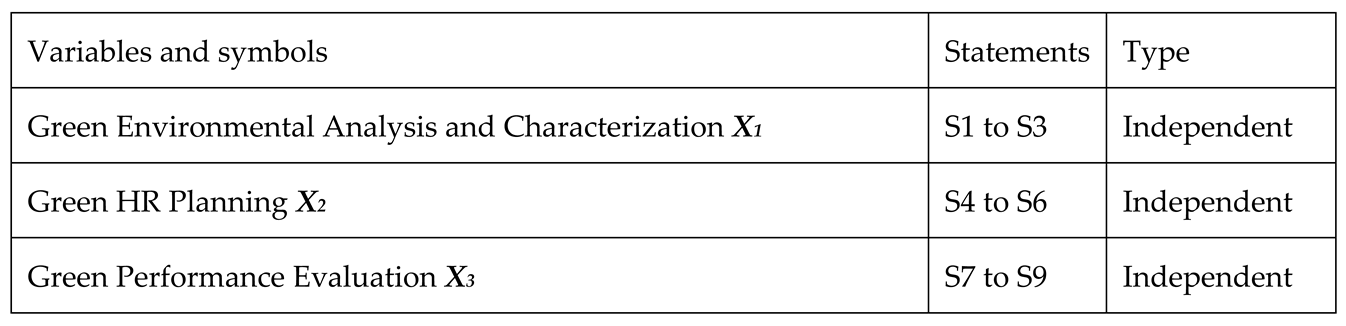
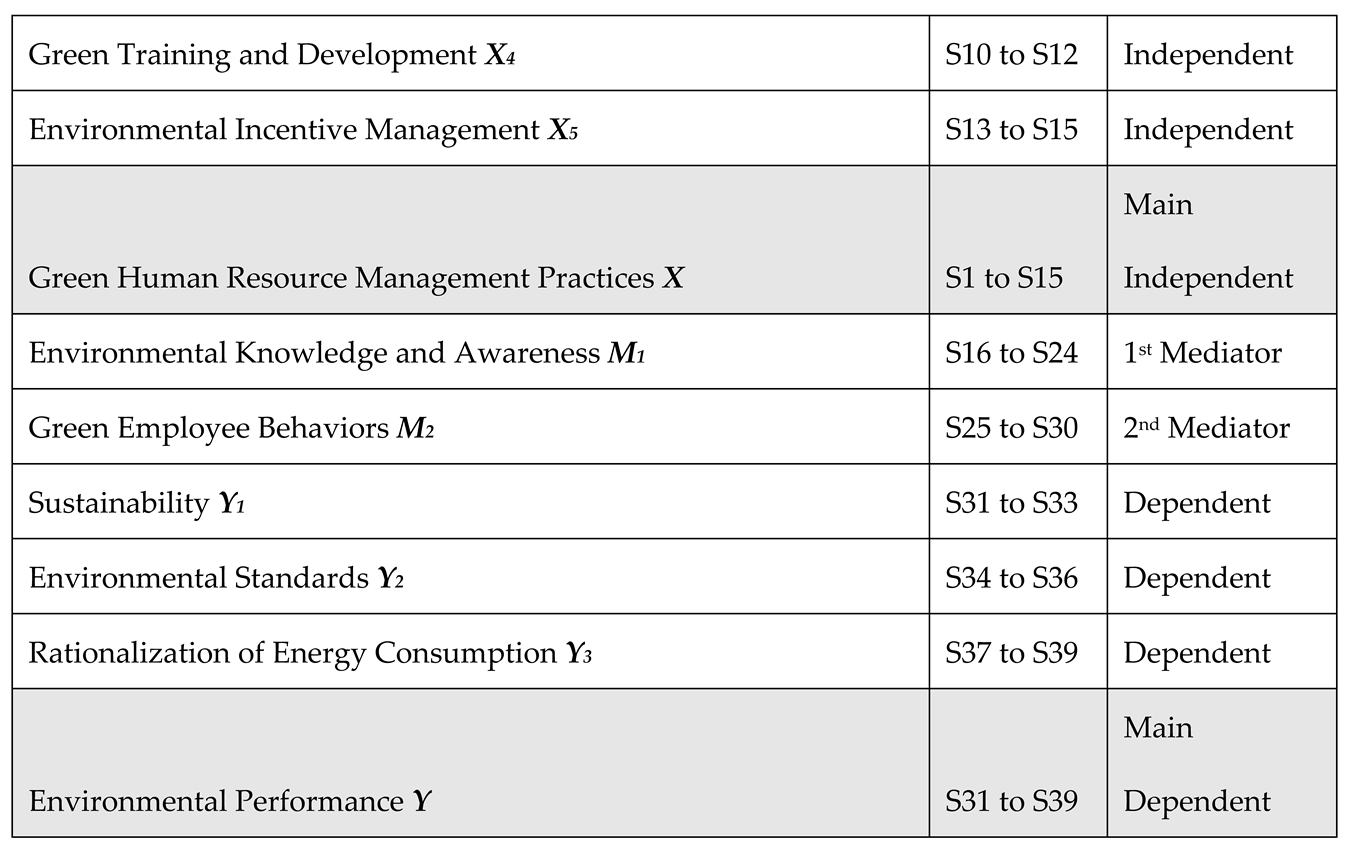
A field study was conducted on the target population (senior and middle management levels): those working in hotels and tourist villages in Egypt. Senior management staffs in hotels and tourist villages comprised 1,600 individuals. The sample size was determined using Cochran's formula for finite population. The researchers determined that a sample of at least 400 from the target population was needed.The statements in the questionnaire were closed-ended, using a Likert-type scale with five levels. The questionnaire contained 39 statements divided into 10 variables. The researchers set up the study variables to reflect the research axes by calculating the weighted mean of the responses to the statements that pertained to each variable. This calculation aimed to convert the collected data from ordinal to ratio data so that parametric techniques can be applied to analyze the data, such as the Pearson correlation coefficient, regression analysis, etc. The study’s variables and suggested estimated models are presented in Figure 1 below.
Table 1. below presents the study variables and statements that pertain to each variable (the arithmetic mean was calculated to represent the study variables) and the type of each variable.
3.3. Descriptive Statistics Analysis
The researchers used the statistical analysis program STATA 9.02 to conduct statistical analyses in the following stages:
- -
- Cronbach’s alphas were used to verify the stability and reliability of the expressions for each variable in the whole data set.
- -
- Tests of normality were conducted for each study variable.
- -
- The diagnostic tool Pearson correlation coefficient was used to identify the strength and direction of the relationship between each pair of variables.
- -
- Multiple regression models were applied to estimate the best model to explain the data effectively.
3.3.1. Reliability and Validity Test
Table 3 below presents Cronbach’s alphas and validity coefficients for each variable mentioned in the questionnaire.
Table 3 indicates that the minimum Cronbach's alpha coefficient value was 0.977, and the minimum validity coefficient value was 0.989, thereby providing statistical evidence with a 95% confidence interval that the collected data’s reliability and validity are acceptable. The statistical analysis and test hypotheses were based on the collected data set.
3.3.2. Test of Normality
To apply the parametric analysis (correlation and regression) the following assumptions must be met:
- Normality: The data in each group should be distributed normally (Shapiro-Wilk test).
- Equal Variance: The data in each group should have equal variance (Levene’s test).
Table 4. below presents Shapiro-Wilk normality and Levene’s test results for all study variables.
Table 4 indicates that all Shapiro-Wilk and p-value results were greater than 0.050, indicating that all study variables were distributed normally with equal variance. Furthermore, the p-value of Levene's Test was greater than 0.050, thereby providing statistical evidence that all study variables had equal variances.
3.3.3. Test of Hypotheses
To test the hypotheses, the researchers analyzed the Pearson correlation coefficient between each pair of study variables, and the results are laid out in Table 5 below:
Table 5 indicates that the Sig. values of the mediator variables and each independent variable are smaller than the significance level of 5%, so the researchers have statistical evidence that a significant and positive relationship exists between the mediator and independent variables, with a confidence interval of 95%. Furthermore, the Pearson correlation coefficient was estimated to discover the relationships between the mediator variables and the dependent variables, as presented in Table 6 below.

Table 6.
Correlation coefficients between dependent and mediator variables.
| Dependent Variables/Moderate Variables | Environmental Knowledge and Awareness M1 | Green Employee Behavior M2 | |
| Sustainability Y1 | R | 0.410 | 0.556 |
| Sig. Value | 0.000 | 0.000 | |
| Environmental Standards Y2 | R | 0.205 | 0.207 |
| Sig. Value | 0.000 | 0.000 | |
| Rationalization of Energy Consumption Y3 | R | 0.221 | 0.174 |
| Sig. Value | 0.000 | 0.000 | |
Table 6.
Correlation coefficients between main independent and dependent, and mediator variables.
| Variables | GHRM X | EKAW M1 | GEB M2 | |
| EKAW M1 | r | 0.653 | ||
| Sig. | 0.000 | |||
| GEB M2 | r | 0.675 | -0.063 | |
| Sig. | 0.000 | 0.207 | ||
| EP Y | r | 0.921 | 0.635 | 0.622 |
| Sig. | 0.000 | 0.000 | 0.000 |
Table 6 indicates that the Sig. value for each mediator variable and each dependent variable was smaller than the significance level of 5%, so the researchers have statistical evidence of a significant and positive relationship between the mediator and independent variables with a confidence interval of 95%. Furthermore, the Pearson correlation coefficient was estimated to determine the relationships between the main independent variables, two mediator variables, and main dependent variable, as presented in Table 7 below.
Table 7 indicates that a positive and significant relationship exists between the main independent variable, GHRM X, and the first mediator variable, EKAW M1 , and the second mediator variable, GEB M2 , which are 0.653 and 0.675, respectively. A positive and significant relationship was found between the main dependent variable, EP Y, and the mediator variables 0.635 and 0.622, respectively. Notably, no significant relationship was found between the two mediator variables.
3.3.4. Testing Mediation with Regression Analysis
A mediation model approximates the relationship between an independent variable, X, and a dependent variable, Y, when a mediator variable, M. is included. The mediation model assumes that X Influences M, which, in turn, influences Y. It also allows for an additional effect from X directly on Y over and above the effect on M. A popular method for testing for mediation is that of Baron and Kenny (1986). Using this method, the seven linear regression models below are fit.

A significant relationship was found between the independent and mediator variables, and between the dependent and mediator variables, so they created three new variables, as follows: (1) a new independent variable that represents the set of independent variables, designated by the letter X to denote GHRM; (2) a new dependent variable that represents the set of dependent variables, designated by the letter Y to denote EP; and (3) a new mediator variable that represents the two mediator variables, designated by the letter M to denote (EKAW M1 and GEB M2).
3.3.5. Testing the Mediated Effect
The total, direct, and indirect effects are all of interest in mediation analysis, but the main hypothesis to be tested is whether the indirect effect, ab, is significant. MacKinnon (2008) demonstrated that this can be conducted using the Large Sample Wald test, which can be used to test whether ab is zero (first-order standard error)(Sobel, 1982).
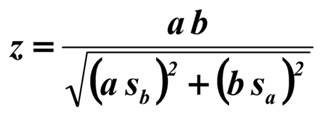
3.1.6. Bootstrapping
Efron and Tibshirani (1993) developed bootstrapping to provide standard errors and confidence intervals in situations in which standard assumptions are invalid. The bootstrap sampling process has provided B estimates of ab, and the standard deviation of these B estimates is the bootstrap estimate of the standard error of ab. Using this estimate, a Wald-type z-test can be constructed.
Calculating the indirect effect can be approached in two ways: (1) Judd and Kenny’s (1993) approach and (2) the Sobel (1982) product approach.
- (1)
- Judd and Kenny’s (1993) approach
This approach involves subtracting the partial regression coefficient obtained in Model 4, β1 , from the simple regression coefficient obtained in Model 1, β, given that both parameters represent the effect of X on Y, but that β is the zero-order coefficient from the simple regression, and β1 is the partial regression coefficient from the multiple regression. The indirect effect is the difference between these two coefficients:
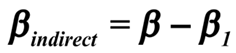
- (2)
- Sobel (1982) product approach
Calculate the indirect effect by multiplying two regression coefficients from Models 2 and 4. Given that Model 2 involves the relationship between X and M, the indirect effect, according to Sobel’s (1982) product approach, is the product of these two coefficients.
Our models are represented in the Figure 2 below.
In this model, the researchers examined the direct and indirect effects of X on Y. If the direct effect of X on Y is reduced, and the indirect effect (through M) is significant, then M is said to play a mediating role in linking X to Y indirectly. If the direct effect of the independent variable on the dependent variable is significant, when the mediator variable, M, enters the model, then the direct effect would be reduced because some of the effects have shifted through the mediator. The mediation effect is called a “partial mediation” if it is reduced, but still significant. However, if the direct effect is reduced and no longer significant, the mediation is called “complete mediation.” In this model, the researchers examined the direct and indirect effects of X on Y. If the direct effect of X on Y is reduced, and the indirect effect (through M) is significant, then M is said to mediate in linking X to Y indirectly.
In the next section, the researchers present the analysis of variance in regression models for each mediator variable and for the main mediator variable to check each model’s significance, the regression coefficient for each model to check the mediator variables’ direct and indirect effect, and the direct, indirect, and total effects for each model. Table 8 below presents a summary of the analysis of variance for each estimated regression model (refer to Table A1 in the Appendix).
Table 8 presents the following results:
- -
- Model 7: A confidence interval of 95% was detected, indicating that the main independent variable, GHRM (X), significantly affects the main dependent variable, EP (Y ), as the coefficient of determination reached 84.90%, and this model’s Sig. value was smaller than 0.050.
- -
- Model 1: The first mediator variable, EKAW (M1), was added in this model, which is still significant, with Sig. values of 0.000 and 0.027 for each variable smaller than 0.050. Furthermore, the coefficient of determination for the main independent variable, GHRM (X), reached 44.80%, and for EKAW (M1), 0.20%. One can conclude that the first mediator variable, EKAW (M1), directly affected the dependent variable, EP( Y ).
- -
- Model 2: Statistical evidence with a confidence interval of 95% was found, indicating that the first mediator variable, EKAW (M1), significantly affected the main independent variable GHRM (X), as the coefficient of determination reached 42.70%, and this model’s Sig. value was smaller than 0.050.
- -
- Model 3: The second mediator variable, GEB (M2), was added in this model. The Sig. value of the GEB (M2) was 0.964, greater than 0.050, so this variable did not affect the dependent variable, EP, (Y). Furthermore, the coefficient of determination for the main independent variable, GHRM (X), reached 46.20%, and for GEB (M2), 00%. One can conclude that the second mediator variable did not affect the dependent variable, (EP) Y .
- -
- Model 4: This model represents the effect of GHRM (X) (IV) on the second mediator variable, GEB (M2) (DV). This model is significant because the Sig. value is smaller than 0.050, and the coefficient of determination reached 45.50%. Thus, a significant relationship was found between GHRM (X) and GEB (M2).
- -
- Model 5: This model represents the effect of the main independent variable, GHRM (X), and the main mediator variable, EKAW & GEB (M), on the main dependent variable, EP (Y ). The model is still significant, and the Sig. values were 0.000 and 0.000, respectively, with each variable smaller than 0.050. Furthermore, the coefficient of determination of the main independent variable, GHRM (X), reached 1.70% and 84.24% for EKAW and GEB (M), respectively. One can conclude that the main mediator variable exerts a direct effect on the dependent variable, EP (Y ).
- -
- Model 6: This model represents the effect of EKAW and GEB (M) on EP (Y ). Statistical evidence with a confidence interval of 95% was found, indicating that the main mediator variable, M, significantly affects the main dependent variable, EP (Y ), as the coefficient of determination reached 93.90% and the Sig. value of this model was smaller than 0.050.
The coefficient of each regression model, standard error, t-statistic, and 95% confidence interval for each parameter are listed in Appendix Table A2. From this table, the estimated regression models are listed below:







- In the first step, the researchers begin by modeling the simple effect of GHRM (X) on EP (Y) (Model 7).
- In the second step, they entered the first mediator variable, EKAW (M1), into the model to test the direct effect of GHRM (X) on EP (Y) (Model 1).
- The third step estimated the simple effect of GHRM (X) on the first mediator variable, EKAW (M1).
- The second and third steps were repeated for the second and main mediator variables.
Table 9 below presents path coefficients and their significance.
The direct effect of GHRM (X) on EP (Y) in Table 8 indicates that c3 is 1.049 and significantly affects Y (Sig. value < 0.050). After entering the first mediator variable, EKAW (M1), into the model, the coefficient decreased from 1.049 to 1.007, so the direct effect on Y is significant (Sig. value = 0.000). Then the requirement for complete mediation was met for the first mediator variable. Furthermore, after entering the second mediator variable, GEB (M2), the coefficient c3 notably did not change, i.e., GEB (M2) did not significantly affect EP (Y). However, the main mediator variable made a big change to the coefficient, which decreased from 1.049 to 0.596, i.e., the main mediator variable exerted the greatest effect on EP (Y).
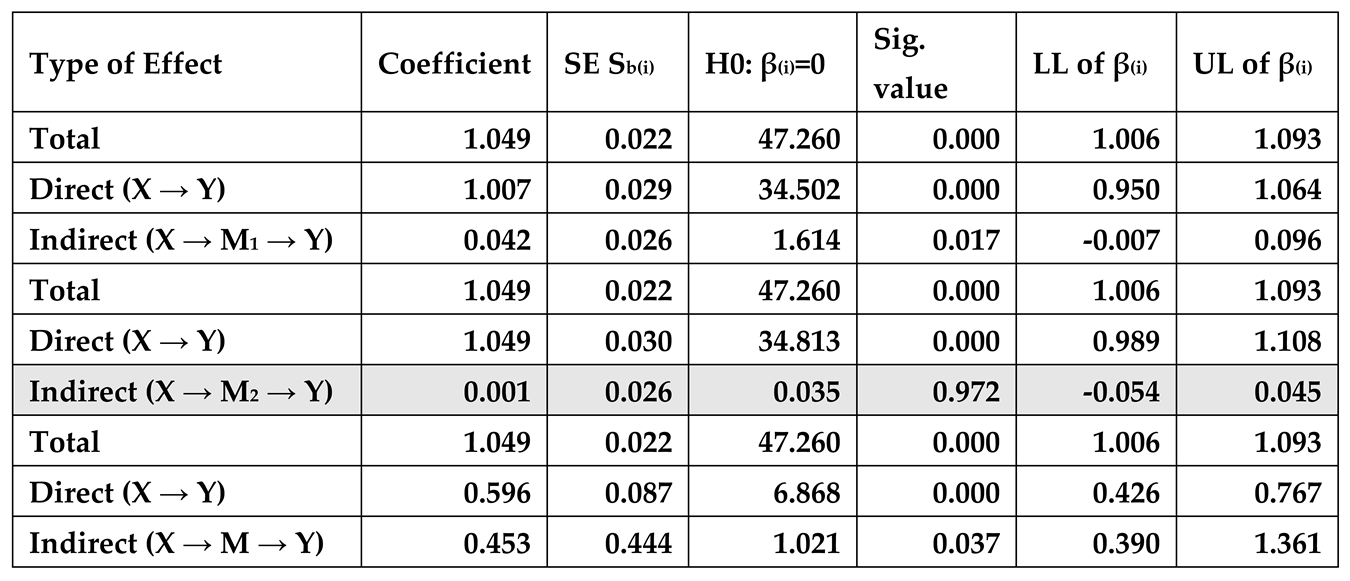
The researchers calculated the direct and indirect effects using the bootstrap method:
Table 10 presents the three mediator variables’ total effect, direct effect, and indirect effect using the bootstrap method.
Table 10 presents statistical evidence with a 95% confidence interval, indicating that the second mediator variable, GEB, exerted no significant effect on the dependent variable. Meanwhile, the main mediator variable exerted the greatest effect on the dependent variable.
4. Discussion
This study aimed to unravel the intricate relationships between Green Human Resource Management (Green HRM), Environmental Performance (EP), Green Employee Behaviors (GEB), and Environmental Knowledge and Awareness (EKAW). The empirical results were derived from Pearson correlation coefficients and regression analyses to provide a compelling narrative on these variables’ dynamics.
The statistical evidence from Table 5 indicates a significant positive correlation between Green HRM practices (e.g., environmental analysis and characterization, HR planning, performance evaluation, training and development, and incentive management) and both mediators––EKAW (M1) and GEB (M2). This aligns with Nisar et al.’s (2021) findings, which underscored the importance of green intellectual capital and pro-environmental behavior in green hotels. Similarly, Dumont et al. (2017) highlighted the role of psychological green climate and employee green values in shaping workplace green behavior. Furthermore, Bhattarai et al. (2023) found that understanding environmental conservation heightens employees' awareness of the significance and benefits of implementing green practices in the workplace. Ren et al. (2018) agreed that Green HRM practices require enhanced cognitive and interpersonal abilities, such as environmental knowledge, to impact performance in green job roles effectively. The substantial correlation coefficient, particularly for Environmental Incentive Management, X5, suggests that incentivizing green practices might be particularly effective in enhancing knowledge and behaviors related to environmental sustainability.
The results presented in Table 6 and Table 7 further affirmed the significant role of EKAW (M1) and GEB (M2) in mediating the relationship between Green HRM practices and various facets of EP, including sustainability, environmental standards, and rationalization of energy consumption. Comparing these findings with similar research outcomes, e.g., Chaudhary (2020), emphasizes employee behaviors’ role in achieving environmental goals. This result is consistent with Kim et al. (2019), who found a significant correlation between an organization’s human resource practices and environmental results. Furthermore, Fawehinmi et al. (2020) also agreed that increasing environmental knowledge and awareness is crucial for fostering responsible green behavior development. Hameed et al. (2020) found that a positive relationship between EKAW and GEB with EP reinforces the notion that Green HRM practices are instrumental in enhancing employees' EP through these mediator variables.
These findings have profound implications. First, they reinforce Green HRM’s critical role in not just directly enhancing EP, but also in fostering an environment of knowledge and behaviors conducive to sustainability. Second, incentive management’s significant impact suggests that organizations might benefit from structuring rewards and recognition around sustainability goals. Finally, the independence of knowledge and behavior as mediators indicates that organizations should adopt a dual strategy that focuses on awareness creation and behavioral encouragement to maximize their green potential.
4. Conclusion and Recommendations
This research contributes to the growing literature on Green HRM by empirically validating its positive impact on EP, mediated by employee behavior and awareness. While it also confirms that GEB and EKAW play a significant role, it also opens up new avenues for examining how these mediators interact and how environmental awareness might shape these dynamics further. Future research might focus on disentangling these complex relationships and understanding how various organizational contexts might influence these findings. The ultimate goal remains to equip organizations with the knowledge and tools needed to implement effective Green HRM practices, fostering a more sustainable future.
Author Contributions
Conceptualization, S.S.A and A.A.Q and F.M.H.A; methodology, S.S.A and A.A.Q and F.M.H.A; software, S.S.A; validation, S.S.A; formal analysis, S.S.A; investigation, F.M.H.A; resources, A.A.Q; data curation, S.S.A and A.A.Q; writing—original draft preparation, S.S.A and A.A.Q; writing—review and editing, S.S.A and A.A.Q; visualization F.M.H.A; supervision, S.S.A and A.A.Q and F.M.H.A. All authors have read and agreed to the published version of the manuscript.
Funding
No funding was received.
Data Availability Statement
The data supporting this study’s findings were based on surveys conducted as part of the research. The raw data collected from these surveys have not been made publicly available due to privacy and ethical considerations, as they contain information that could compromise the respondents’ confidentiality. However, the authors created aggregated data that do not reveal any personal or sensitive information and are available only upon reasonable request. Interested researchers can contact the corresponding author for details on the data's accessibility, subject to compliance with ethical standards and any applicable privacy regulations. The survey instrument and methodology used for data collection in this study were rigorously designed to ensure comprehensive and accurate insights into the research objectives.
Disclosure statement
The author(s) reported no potential conflicts of interest.
References
- Ababneh, O.M.A. How do green HRM practices affect employees’ green behaviors? The role of employee engagement and personality attributes. Journal of Environmental Planning and Management 2021, 64, 1204–1226. [Google Scholar] [CrossRef]
- Aboramadan, M. The effect of green HRM on employee green behaviors in higher education: the mediating mechanism of green work engagement. International Journal of Organizational Analysis 2022, 30, 7–23. [Google Scholar] [CrossRef]
- Adeel, M.; Mahmood, S.; Khan, K.I.; Saleem, S. Green HR practices and environmental performance: The mediating mechanism of employee outcomes and moderating role of environmental values. Frontiers in Environmental Science 2022, 10, 1001100. [Google Scholar] [CrossRef]
- Ahmad, S. Green human resource management: Policies and practices. Cogent business & management 2015, 2, 1030817. [Google Scholar] [CrossRef]
- Ari, E.; Karatepe, O.M.; Rezapouraghdam, H.; Avci, T. A conceptual model for green human resource management: Indicators, differential pathways, and multiple pro-environmental outcomes. Sustainability 2020, 12, 7089. [Google Scholar] [CrossRef]
- Awwad Al-Shammari, A.S.; Alshammrei, S.; Nawaz, N.; Tayyab, M. Green human resource management and sustainable performance with the mediating role of green innovation: A perspective of new technological era. Frontiers in Environmental Science 2022, 10, 901235. [Google Scholar] [CrossRef]
- Baker, M.; Schaltegger, S. Pragmatism and new directions in social and environmental accountability research. Accounting, Auditing & Accountability Journal 2015, 28, 263–294. [Google Scholar]
- Baron, R.M.; Kenny, D.A. The mediator–mediator variable distinction in social psychological research: Conceptual, strategic, and statistical considerations. Journal of Personality and Social Psychology 1986, 51, 1173–1182. [Google Scholar] [CrossRef]
- Becker, B.E.; Huselid, M.A. Strategic human resources management: where do we go from here? Journal of management 2006, 32, 898–925. [Google Scholar] [CrossRef]
- Bhattarai, U.; Lopatka, A.; Devkota, N.; Paudel, U.R.; Németh, P. Influence of green human resource management on employees' behavior through mediation of environmental knowledge of managers. Journal of International Studies 2023, 16, 2071–8330. [Google Scholar] [CrossRef]
- Bissing-Olson, M.J.; Iyer, A.; Fielding, K.S.; Zacher, H. Relationships between daily affect and pro-environmental behavior at work: The moderating role of pro-environmental attitude. Journal of Organizational Behavior 2013, 34, 156–175. [Google Scholar] [CrossRef]
- Boiral, O.; Paillé; P; Raineri, N. The nature of employees’ pro-environmental behaviors. The psychology of green organizations 2015, 12–32.
- Bombiak, E.; Marciniuk-Kluska, A. Green human resource management as a tool for the sustainable development of enterprises: Polish young company experience. Sustainability 2018, 10, 1739. [Google Scholar] [CrossRef]
- Chaudhary, R. Green human resource management and employee green behavior: an empirical analysis. Corporate Social Responsibility and Environmental Management 2020, 27, 630–641. [Google Scholar] [CrossRef]
- Chen, D.; Heyer, S.; Ibbotson, S.; Salonitis, K.; Steingrímsson, J.G.; Thiede, S. Direct digital manufacturing: definition, evolution, and sustainability implications. Journal of Cleaner Production 2015, 107, 615–625. [Google Scholar] [CrossRef]
- Chen, T.; Wu, Z. How to facilitate employees’ green behavior? The joint role of green human resource management practice and green transformational leadership. Frontiers in psychology 2022, 13, 906869. [Google Scholar] [CrossRef] [PubMed]
- Chou, C.J. Hotels' environmental policies and employee personal environmental beliefs: Interactions and outcomes. Tourism management 2014, 40, 436–446. [Google Scholar] [CrossRef]
- Daily, B.F.; Bishop, J.W.; Govindarajulu, N. A conceptual model for organizational citizenship behavior directed toward the environment. Business & Society 2009, 48, 243–256. [Google Scholar]
- Darvishmotevali, M.; Altinay, L. Green HRM, environmental awareness and green behaviors: The moderating role of servant leadership. Tourism Management 2022, 88, 104401. [Google Scholar] [CrossRef]
- Davis, J.H.; Schoorman, F.D.; Donaldson, L. Toward a stewardship theory of management. Academy of Management Review 1997, 22, 20–47. [Google Scholar] [CrossRef]
- Deshwal, P. Green HRM: An organizational strategy of greening people. International Journal of applied research 2015, 1, 176–181. [Google Scholar]
- Dumont, J.; Shen, J.; Deng, X. Effects of green HRM practices on employee workplace green behavior: The role of psychological green climate and employee green values. Human resource management 2017, 56, 613–627. [Google Scholar] [CrossRef]
- Efron, B.; Tibshirani, R.J. (1993) An Introduction to the Bootstrap. Chapman and Hall, New York.
- Ehnert, I.; Ehnert, I. (2009). Sustainable human resource management. Physica-Verlag.
- Elkington, J. Towards the sustainable corporation: Win-win-win business strategies for sustainable development. California management review 1994, 36, 90–100. [Google Scholar] [CrossRef]
- Epstein, M.J.; Buhovac, A.R.; Yuthas, K. Implementing sustainability: The role of leadership and organizational culture. Strategic finance 2010, 91, 41. [Google Scholar]
- Fawehinmi, O.; Yusliza, M.Y.; Mohamad, Z.; Noor Faezah, J.; Muhammad, Z. Assessing the green behaviour of academics: The role of green human resource management and environmental knowledge. International Journal of Manpower 2020, 41, 879–900. [Google Scholar] [CrossRef]
- Gim, G.C.; Ooi, S.K.; Teoh, S.T.; Lim, H.L.; Yeap, J.A. Green human resource management, leader–member exchange, core self-evaluations and work engagement: the mediating role of human resource management performance attributions. International Journal of Manpower 2022, 43, 682–700. [Google Scholar] [CrossRef]
- Gladwin, T.N.; Kennelly, J.J.; Krause, T.S. Shifting paradigms for sustainable development: Implications for management theory and research. Academy of Management Review 1995, 20, 874–907. [Google Scholar] [CrossRef]
- Hameed, R.; Rehman, N.; Tufail, S. Green human resource management and environmental knowledge: A moderated mediation model to endorse green CSR. Frontiers in Environmental Science 2023. [Google Scholar] [CrossRef]
- Hameed, Z.; Khan, I.U.; Islam, T.; Sheikh, Z.; Naeem, R.M. Do green HRM practices influence employees' environmental performance? International Journal of Manpower 2020, 41, 1061–1079. [Google Scholar] [CrossRef]
- Hobfoll, S.E. (2011). Conservation of resources theory: Its implication for stress, health, and resilience. The Oxford handbook of stress, health, and coping, 127, 147.
- Hristova, S.; Stevceska-Srbinovska, D. (2020). Green HRM in pursuit of sustainable competitive advantage.
- Jabbour, C.J.C.; de Sousa Jabbour, A.B.L. Green human resource management and green supply chain management: Linking two emerging agendas. Journal of cleaner production 2016, 112, 1824–1833. [Google Scholar] [CrossRef]
- Jabbour, C.J.C.; Santos, F.C.A. The central role of human resource management in the search for sustainable organizations. The International Journal of Human Resource Management 2008, 19, 2133–2154. [Google Scholar] [CrossRef]
- Kellner, A.; Cafferkey, K.; Townsend, K. (2019). 21. Ability, Motivation and Opportunity theory: a formula for employee performance?. Elgar introduction to theories of human resources and employment relations, 311.
- Kwatra, S.; Pandey, S.; Sharma, S. Understanding public knowledge and awareness on e-waste in an urban setting in India: A case study for Delhi. Management of Environmental Quality: An International Journal 2014, 25, 752–765. [Google Scholar] [CrossRef]
- Lo, C.K.; Yeung, A.C.; Cheng, T.C.E. The impact of environmental management systems on financial performance in fashion and textiles industries. International journal of production economics 2012, 135, 561–567. [Google Scholar] [CrossRef]
- Markey, R.; McIvor, J.; O'Brien, M.; Wright, C.F. Reducing carbon emissions through employee participation: evidence from Australia. Industrial Relations Journal 2019, 50, 57–83. [Google Scholar] [CrossRef]
- Nishii, L.H.; Lepak, D.P.; Schneider, B. Employee attributions of the “why” of HR practices: Their effects on employee attitudes and behaviors, and customer satisfaction. Personnel psychology 2008, 61, 503–545. [Google Scholar] [CrossRef]
- Norton, T.A.; Parker, S.L.; Zacher, H.; Ashkanasy, N.M. Employee green behavior: A theoretical framework, multilevel review, and future research agenda. Organization & Environment 2015, 28, 103–125. [Google Scholar]
- Paillé, P.; Valéau, P.; Renwick, D.W. Leveraging green human resource practices to achieve environmental sustainability. Journal of Cleaner Production 2020, 260, 121137. [Google Scholar] [CrossRef]
- Ren, S.; Tang, G.; Jackson, S.E. Green human resource management research in emergence: A review and future directions. Asia Pacific Journal of Management 2018, 35, 769–803. [Google Scholar] [CrossRef]
- Renwick, D.W.; Jabbour, C.J.; Muller-Camen, M.; Redman, T.; Wilkinson, A. Contemporary developments in Green (environmental) HRM scholarship. The International Journal of Human Resource Management 2016, 27, 114–128. [Google Scholar] [CrossRef]
- Renwick, D.; Redman, T.; Maguire, S. Green HRM: A review, process model, and research agenda. University of Sheffield Management School Discussion Paper 2008, 1, 1–46. [Google Scholar]
- Renwick, D.W.S.; Redman, T.; Maguire, S. (2013), “Green human resource management: a review.
- Sabokro, M.; Masud, M.M.; Kayedian, A. The effect of green human resources management on corporate social responsibility, green psychological climate and employees’ green behavior. Journal of Cleaner Production 2021, 313, 127963. [Google Scholar] [CrossRef]
- Saifulina, N.; Carballo-Penela, A.; Ruzo-Sanmartín, E. Sustainable HRM and green HRM: The role of green HRM in influencing employee pro-environmental behavior at work. Journal of Sustainability Research 2020, 2. [Google Scholar]
- Sanyal, C.; Haddock-Millar, J. (2018). 3 Employee engagement in managing environmental performance. Contemporary Developments in Green Human Resource Management Research: Towards Sustainability in Action?
- Schaltegger, S.; Wagner, M. Integrative management of sustainability performance, measurement and reporting. International Journal of Accounting, Auditing and Performance Evaluation 2006, 3, 1–19. [Google Scholar] [CrossRef]
- Shen, J.; Dumont, J.; Deng, X. Retracted: Employees’ perceptions of green HRM and non-green employee work outcomes: The social identity and stakeholder perspectives. Group & Organization Management 2018, 43, 594–622. [Google Scholar]
- Shipton, H.; Budhwar, P.S.; Crawshaw, J. HRM, organizational capacity for change, and performance: A global perspective. Thunderbird International Business Review 2012, 54, 777–790. [Google Scholar] [CrossRef]
- Steg, L.; Vlek, C. Encouraging pro-environmental behaviour: An integrative review and research agenda. Journal of environmental psychology 2009, 29, 309–317. [Google Scholar] [CrossRef]
- Tang, G.; Chen, Y.; Jiang, Y.; Paillé, P.; Jia, J. Green human resource management practices: scale development and validity. Asia pacific journal of human resources 2018, 56, 31–55. [Google Scholar] [CrossRef]
- Tian, Q.; Robertson, J.L. How and when does perceived CSR affect employees’ engagement in voluntary pro-environmental behavior? J. Bus. ethics 2019, 155, 399–412. [Google Scholar] [CrossRef]
- Wirtenberg, J.; Harmon, J.; Russell, W.G.; Fairfield, K.D. (2007), “HR’s role in building a sustainable.
- Wright, P.M.; Dunford, B.B.; Snell, S.A. Human resources and the resource based view of the firm. Journal of management 2001, 27, 701–721. [Google Scholar] [CrossRef]
- Yong, J.Y.; Yusliza, M.Y.; Fawehinmi, O.O. Green human resource management: A systematic literature review from 2007 to 2019. Benchmarking: An International Journal 2020, 27, 2005–2027. [Google Scholar] [CrossRef]
- Zhang, Y.; Luo, Y.; Zhang, X.; Zhao, J. How green human resource management can promote green employee behavior in China: A technology acceptance model perspective. Sustainability 2019, 11, 5408. [Google Scholar] [CrossRef]
- Zhu, J.; Tang, W.; Wang, H.; Chen, Y. The influence of green human resource management on employee green behavior—a study on the mediating effect of environmental belief and green organizational identity. Sustainability 2021, 13, 4544. [Google Scholar] [CrossRef]
- Ziadat, A.H. Major factors contributing to environmental awareness among people in a third world country/Jordan. Environment, Development and Sustainability 2010, 12, 135–145. [Google Scholar] [CrossRef]
- Zsóka, Á.; Szerényi, Z.M.; Széchy, A.; Kocsis, T. Greening due to environmental education? Environmental knowledge, attitudes, consumer behavior and everyday pro-environmental activities of Hungarian high school and university students. Journal of cleaner production 2013, 48, 126–138. [Google Scholar] [CrossRef]
Figure 1.
The relationship between the study variables and the suggested models.
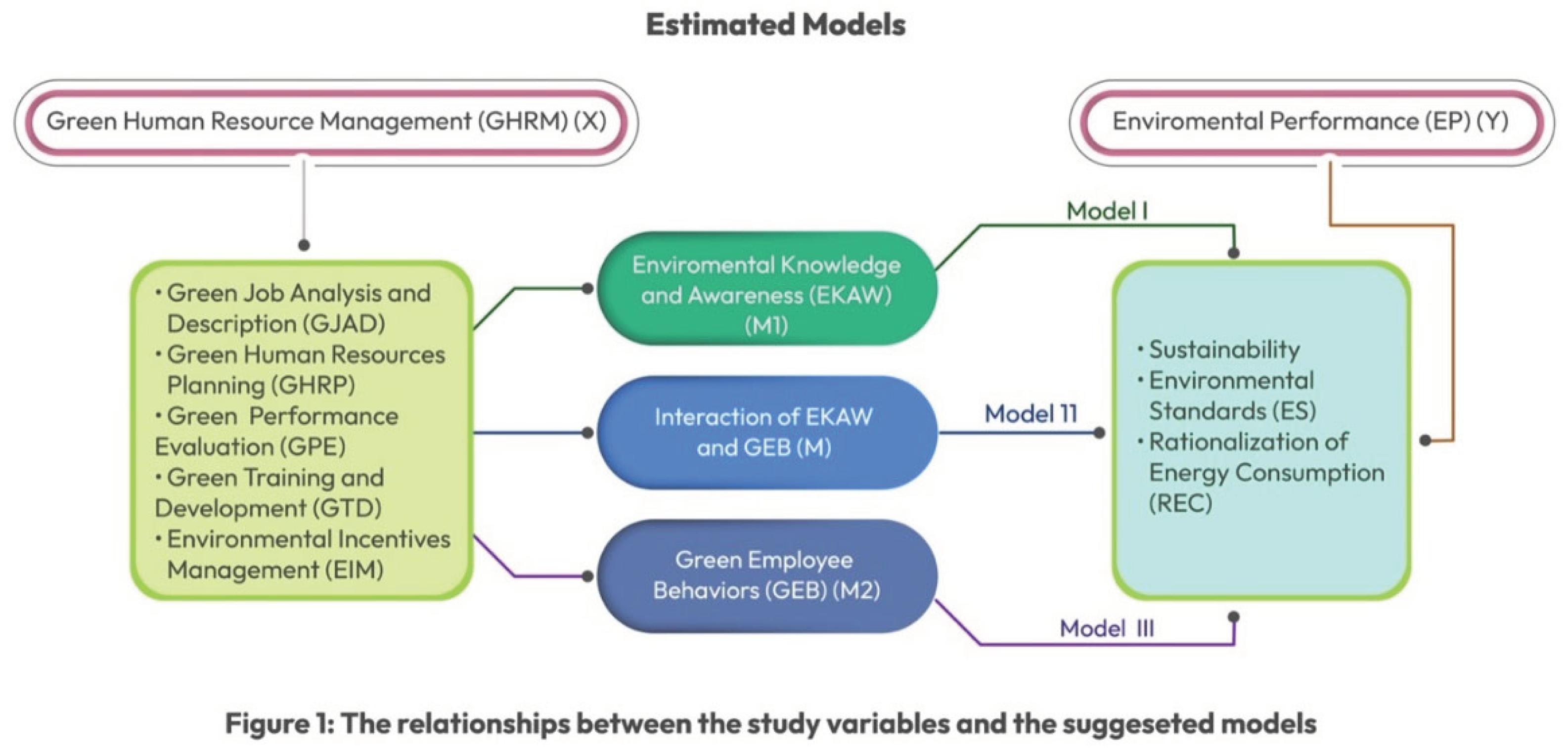
Figure 2.
Modeling the mediator in the structural model.
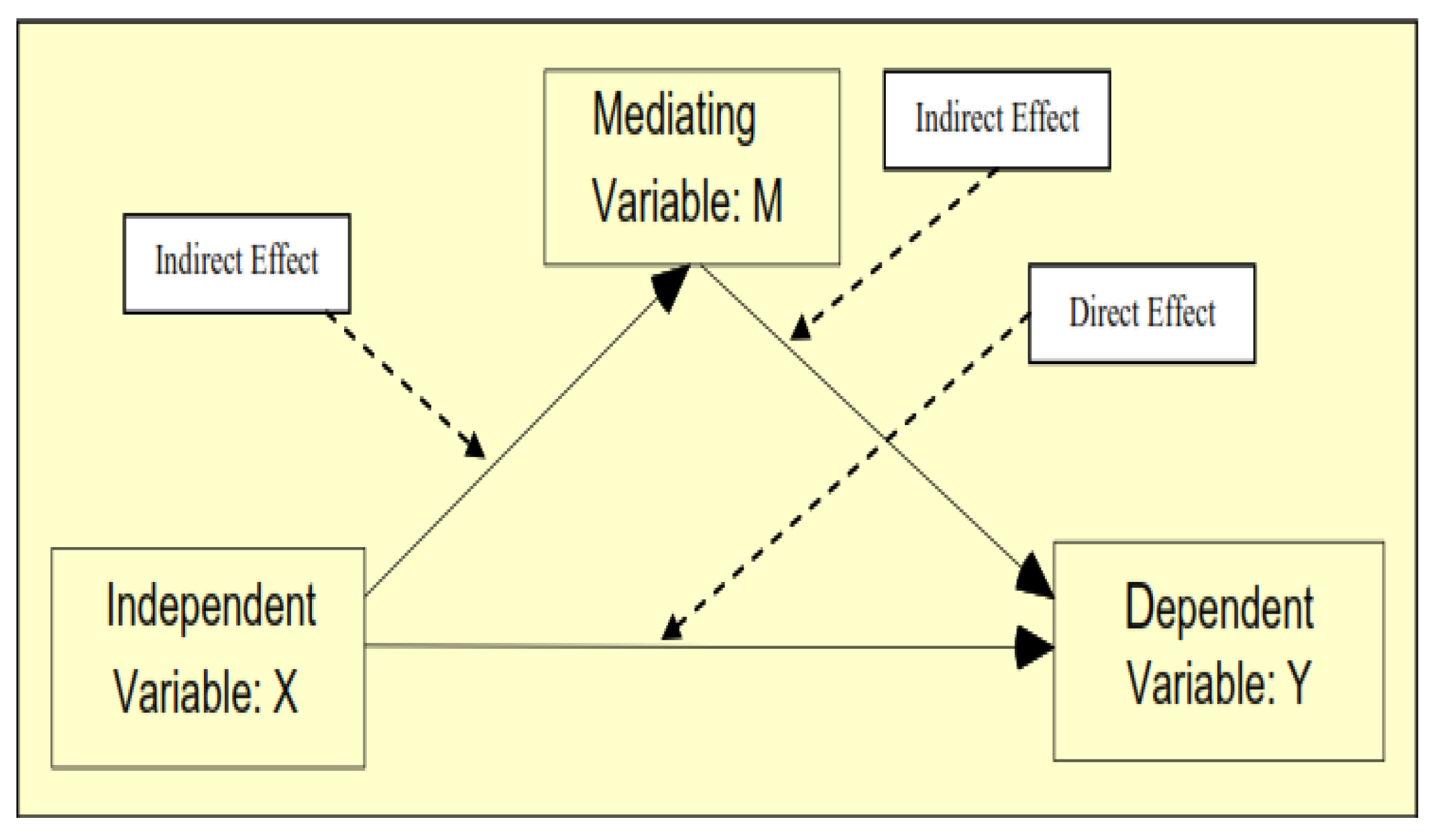
Table 1.
List of study variables, corresponding statements, and symbols.
|
Table 2.
Cronbach's alphas and validity coefficients for each variable.
| Variables and Symbols | Cronbach's Alpha | Validity |
| Green Environmental Analysis and Characterization X1 | 0.978 | 0.989 |
| Green HR Planning X2 | 0.980 | 0.990 |
| Green Performance Evaluation X3 | 0.977 | 0.989 |
| Green Training and Development X4 | 0.978 | 0.989 |
| Environmental Incentive Management X5 | 0.978 | 0.989 |
| Green Human Resource Management Practices X (Main independent) | 0.978 | 0.989 |
| Environmental Knowledge and Awareness M1 | 0.989 | 0.995 |
| Green Employee Behaviors M2 | 0.989 | 0.995 |
| Sustainability Y1 | 0.977 | 0.989 |
| Environmental Standards Y2 | 0.978 | 0.989 |
| Rationalization of Energy Consumption Y3 | 0.977 | 0.989 |
| Environmental Performance Y (Main Dependent) | 0.977 | 0.989 |
| Minimum Value | 0.977 | 0.989 |
Table 3.
Shapiro-Wilk and Levene's test results.
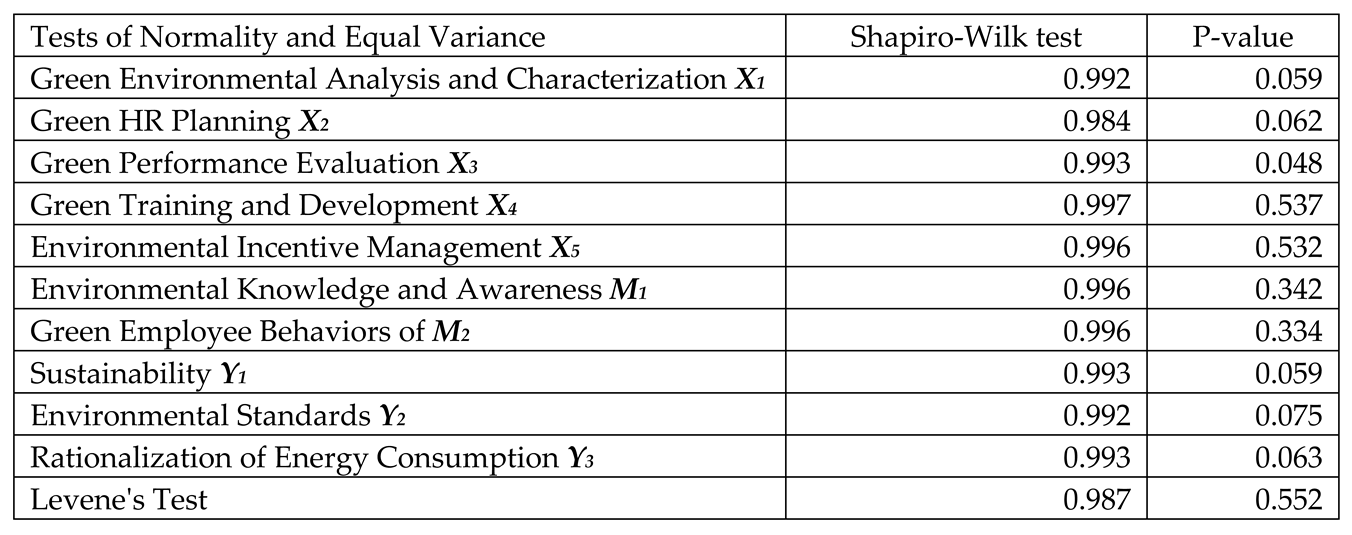 |
Table 4.
Correlation coefficients between independent and mediator variables.
| Independent Variables/Mediator Variables |
Environmental Knowledge and Awareness M1 | Green Employee Behaviors M2 |
|
| Green Environmental Analysis and Characterization X1 |
R | 0.354 | 0.378 |
| Sig. Value | 0.000 | 0.000 | |
| Green HR Planning X2 | R | 0.339 | 0.435 |
| Sig. Value | 0.000 | 0.000 | |
| Green Performance Evaluation X3 |
R | 0.398 | 0.374 |
| Sig. Value | 0.000 | 0.000 | |
| Green Training and Development X4 |
R | 0.402 | 0.431 |
| Sig. Value | 0.000 | 0.000 | |
| Environmental Incentive Management X5 |
R | 0.641 | 0.537 |
| Sig. Value | 0.000 | 0.000 | |
Table 7.
Summary of analysis of variance of regression models for each mediator variable.
| Models | Dependent Variables | Independent Variables | R2 | Sig. |
|---|---|---|---|---|
| Model 7: Y = f(X) | Y | GHRM (X) | 84.90% | 0.000 |
| Model 1: Y = f(X, M1) | Y | GHRM (X) | 44.80% | 0.000 |
| EKAW (M1) | 0.20% | 0.027 | ||
| Model 2: M1 = f(X) | EKAW (M1) | GHRM (X) | 42.70% | 0.000 |
| Model 3: Y = f(X, M2) | Y | GHRM (X) | 46.20% | 0.000 |
| GEB (M2) | 0.00% | 0.964 | ||
| Model 4: M2 = f(X) | GEB (M2) | GHRM (X) | 45.50% | 0.000 |
| Model 5: Y = f(X, M) | Y | GHRM (X) | 1.70% | 0.000 |
| EKAW & GEB (M) | 84.24% | 0.000 | ||
| Model 6: M = f(X) | EKAW & GEB (M) | GHRM (X) | 93.90% | 0.000 |
Table 8.
Path coefficients and their significance.
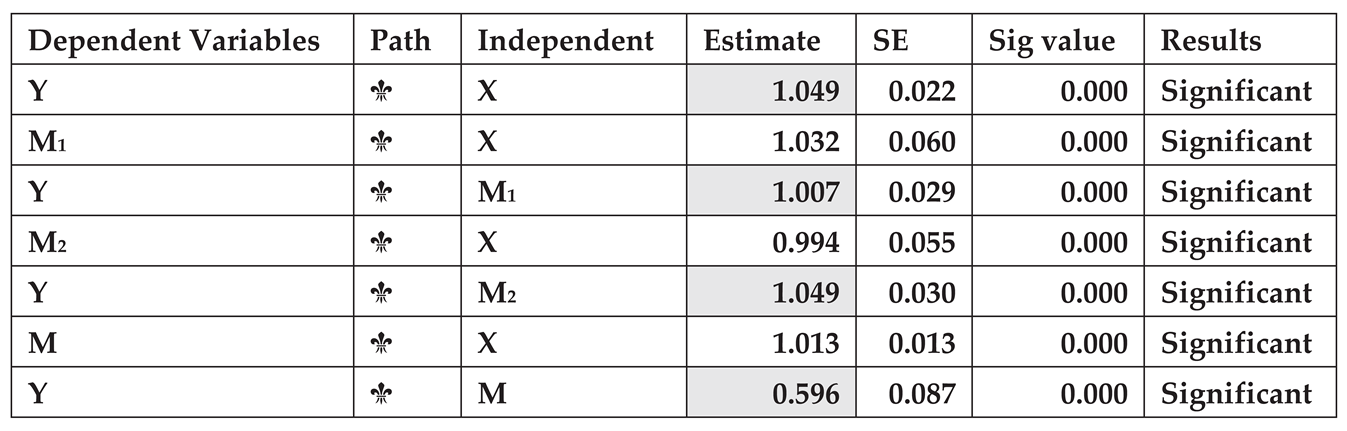 |
Table 9.
Direct, Indirect, and Total Effects Using Bootstrapping.
 |
Disclaimer/Publisher’s Note: The statements, opinions and data contained in all publications are solely those of the individual author(s) and contributor(s) and not of MDPI and/or the editor(s). MDPI and/or the editor(s) disclaim responsibility for any injury to people or property resulting from any ideas, methods, instructions or products referred to in the content. |
© 2024 by the authors. Licensee MDPI, Basel, Switzerland. This article is an open access article distributed under the terms and conditions of the Creative Commons Attribution (CC BY) license (http://creativecommons.org/licenses/by/4.0/).
Copyright: This open access article is published under a Creative Commons CC BY 4.0 license, which permit the free download, distribution, and reuse, provided that the author and preprint are cited in any reuse.


