
Submitted:
17 February 2024
Posted:
20 February 2024
You are already at the latest version
Abstract
The goal of the study presented in this article is to investigate interconnection issues of the Intelligent Electrical Networks (IENs) with the existing ones, as well as the deployment of the appropriate load forecasting demand techniques. The concept of IENs has recently emerged as a potential solution to the global energy problem, due to the more flexible dispersed production units that are involved. In the same context, additional issues, such as the reduction of production-transfer-distribution costs as well as power losses are analyzed as well, via the penetration of Renewable Energy Sources (RESs). To this end, it is necessary to use appropriate advanced infrastructure, where in combination with modern telecommunication networks will make possible the full exploitation of IENs. Moreover, to make the electricity system more efficient, to avoid voltage and frequency imbalance issues and to implement optimal production and consumption planning, the Electric Load Forecast (ELF) is a vital process and plays a key role in the planning as well as in the management of electricity systems. Therefore, recent state of the art approaches in ELF methods are discussed as well.
Keywords:
Smart Grid
; Renewable Energy Sources
; Electric Load Forecast
; Intelligent Electric Networks.
1. Introduction
The power grid traces its roots back to the late 18th century. In the last decades of the 20th century there was an increase in electrical demand due to the introduction of various new consumers and load types, such as the industrial ones. With the emerging challenges and issues in the energy market of the 21st century, a holistic transformation in the electrical system is inevitable. The current electrical infrastructure is a quite complex system characterized by centralized power generation, one-way power flow and significant lack of user-utility interaction which in turn leads to energy loss, overload conditions, power quality issues, incorrect peak load management, improper renewable energy management and manual business processes [1]. All the above, along with the projected decline in the availability of fossil fuels, rising fuel costs, related environmental issues such as global warming from greenhouse emissions, and growing electricity demand, require a rethinking of the traditional electricity grid. To address the above problems, smart grid (SG) technologies are a key solution and therefore an important part of many countries' national energy strategy [2,3]. SGs modernize the traditional concept and functionality of electricity grids by using information technology to receive grid data, from energy producers to consumers, and manage them in the best possible way to maximize system efficiency and reliability.
The main contests to remain overwhelmed in the electricity subdivision are supply scarcity, variations in oil market prices, new procedures of energy production and the current disorganization of distribution systems [4]. The usage of renewable energy sources (RESs) will make it likely to upsurge energy efficiency in all timber subdivisions of the electricity system, if progressive and well-informed technologies for electricity grid distribution, monitoring and management are combined [5]. A smart power grid is used to improve the efficiency, sustainability, flexibility, reliability, and safety of the electrical system by allowing the grid to be observable, controlled, automated and fully integrated. Unlike existing networks, intelligent ones have a digital structure, two-way communication, distributed generation, a plethora of sensors, self-monitoring, self-management, remote controls/testing, and multiple clients. Smart metering systems measure consumption and other relevant charging parameters at predetermined intervals. The measured data is configured according to the communication protocol and transmitted to the management system via wired or wireless networks. Advanced metering infrastructure (AMI) could be considered the developed version of traditional automated meter reading (AMR) and automatic meter management (AMM) systems (smart meters -SMs) [6,7].
Recent advances in control, Information and Communication Technologies (ICTs) will enable the traditional electricity network to be transformed into a SG that ensures productive interactions between energy (utilities), consumers and other interested parties. These multiple and improved interactions will help to resolve the problems that arise on the existing networks. In this context, data collected directly from the network can be used for the training of machine learning (ML) approaches to achieve large scale network optimization and efficient load forecasting [8,9]. In line with the characteristics and functions of the SG, it becomes necessary to create custom design and generally personalized solutions to build a secure, accessible, and resilient communication infrastructure. ICTs need to be equipped with dedicated security platforms to ensure secure data transfer. Therefore, the development of a global single standardized framework for secure data communication and the development of new protocols for SG applications or modification of existing ones is of utmost importance [10].
The research community is mounting new submissions, communication protocols and simulation models to add control, intelligence, automation, and communication skills to the prevailing traditional electricity network system. For example, the new IT infrastructure in the SG standard involves of computing resources such as computing servers, storage servers, network policies and smart grid applications. These applications are delivered as services that perform fault tolerance, self-correction, demand response, load balancing and optimal electricity supply in an efficient and economical way [11]. The rapid development of SG technologies increases the randomness in network operations and makes it more prone to instabilities. In addition, due to extreme weather conditions, there is a need to recover (in case of a general shutdown), in a flexible and efficient way. With the introduction of a new sophisticated communication infrastructure, the vulnerability of the SG to cyberspace is further expanded. The flexibility of the network, on the other hand, is a property that allows it to react better to adverse conditions. For example, flexibility in the form of device-specific programming and microgrid island results in optimal network responsiveness to dynamically evolving scenarios. To this end, the microgrid is a self-correcting property, allowing different areas to operate independently until the fault is repaired. Finally, scientific progress in adjacent field of ICT, such as large-scale data manipulation and processing via decentralized computational approaches can leverage real-time responses in critical conditions [12].
Various works in recent years have dealt with deployment issues regarding SGs. In this same context, the work in [13] explores the use of distributed generation to power multiple microgrids in emergency situations, fully ensuring grid operations and requirements, in real time, until the fault is repaired. Yuan et al. [14] proposed a robust optimization-based strategy to design distribution networks that are resilient to natural disasters such as hurricanes. The authors investigate mixed problems based on linear programming and optimize critical load errors, keeping in mind how network functionality should not be affected. An analysis based on controlling the behavior of distributed microgrids produced from renewable energy sources has also been studied in the literature [15,16].
Converting the existing distribution network into an automated SG benefits greatly from an efficient, flexible, and reliable communication technology that can support advanced and autonomous network operations on Neighborhood Area Networks (NANs). NANs are the communication infrastructure used to manage and control the distribution (at medium voltage) of energy from its production and transfer (at high voltage) to the end user (at low voltage). Communication on the electricity distribution grid already exists locally to support basic small-scale automatic operations. However, large-scale operations involving long-distance deployments, e.g., wide area monitoring and control systems, continue to rely on extensive human intervention [17].
A number of recent survey papers have dealt with all recent technological advanced in the field of SGs. To this end, the work in [2] summarizes all recent development on the integration of internet of things (IoT) technology in modern SGs for large scale data collection and optimization. As the authors correctly point out, an open issue is the deployment of efficient security protocols that can run on lightweight IoT devices to prevent unauthorized access and data manipulation. In [6], all aspects of smart metering infrastructures are investigated, including communication technologies and security aspects. In [9], ML approaches are investigated for the optimization of power quality and load forecasting in SGs. In [11], research and analysis of modern communication technologies available for SMs is carried out. In [18], an extensive analysis is carried out on SG technologies, recent developments, key challenges as well as future directions according to current requirements. The work in [19] reviews both challenges and solutions to improve SG cybersecurity.
A categorization of the aforementioned studies is also depicted in Table 1, along with our work, which focuses on all aspects related to the modernization of traditional grids to SGs. Extensive reference is made to the structure and the technologies/means required for the needs of telecommunications interconnection. Methods and models for electrical load forecasting are highlighted and described as well, as it is a vital process for the planning of the electricity sector and plays a key role in the planning as well as management of electricity systems.
The rest of the article is organized as follows: We begin by describing the use of applications to enhance energy efficiency and active demand management as well as the shift to RESs (Section 2). We then analyze Intelligent Energy Grids by detailing the definition, structure, and telecommunications interconnection, comparing them with existing electrical grids (Section 3). We are also looking at the forecast of load demand in SGs (Section 4). In Section 5 we draw general conclusions on the whole article, while in Section 6 we provide proposals for further future research.
2. Integration of Renewable Energy Sources to Smart Grids
The use of renewable energy sources increased significantly immediately after the first major oil crisis in the late 70s. Although in most power generation systems, the main energy source (the fuel) can handle, this is not the case for solar, hydroelectric and wind power. The main problems with these renewables are cost and availability, wind, hydro, and solar power are not always available where and when needed. The aim is to increase the share of local "green energy" production while keeping efficiency degradation low and without compromising average data center performance [20].
Integrated REs alone have a good impact on the grid system, defined in three positive aspects: (i) Positive environmental aspect, since the integration of renewables into the grid system allows fossil fuel power plants to reduce CO2 emissions, (ii) Social positive aspect, since when many individuals isolate their own power source, they receive many advantages, such as selling the extra energy to utilities, using their independent source in case of a power grid failure, and iii) Positive economic aspect: Integrated renewable/sustainable energy plays a key role in economic sectors by creating new job opportunities. Despite the benefits of integrating renewables into the grid, there are several challenges that become necessary for the integration of renewables, such as:
- Power quality: When RESs are integrated into the grid system, there are various deviations in the rated voltage and frequency, since energy production from RESs also entails intervals of reduced production, because it is based on natural phenomena.
- Power availability: One of the main challenges as well as one of the most important disadvantages of RES is to address the instability of electricity production. Therefore, the possibility of occurrence of detrimental breakdowns during the operation of the system lies.
- Variation in energy production and its speed: As mentioned above, renewable energy technologies do not guarantee stable energy production for the grid, so appropriate measures should be taken in order to avoid major disruptions to the grid. Also, the speed of fluctuation of energy production presents difficulty for this integration.
- Forecast: It is related to electricity production, which is not stable in case of integration of RESs into the grid system.
- Location of renewable energy sources: RES plants depend on climatic conditions, the geographical location of the area and their distance from the grid in terms of cost and performance. Therefore, these settings pose a contest if they are combined into the network system.
- Cost issue: This issue is related to the position of RES stations in the grid system. In fact, most RES plants are located away from the grid system and require energy transmission and consequently transmission lines that depend on the voltage level. Thus, it is very costly to produce electricity through the integration of the RES grid.
3. Intelligent Energy Electricity Systems
3.1. The Traditional Electricity System
Traditionally the system is divided into generation, transmission, substations, distribution, and consumers, as shown in Figure 1.
Some of the key features of this conventional system that will be most affected by the edits essential to contrivance the SG are: (i) Main sources of energy production, (ii) One-way energy flow, from source to consumers, (iii) Real-time monitoring and control is mostly contained to production and transmission and only certain services of general interest are extended to the distribution system, and (iv) The system is not flexible, therefore it is difficult either to import electricity from alternative sources anywhere along the grid, or to efficiently and sustainably manage new services desired by electricity users.
3.2. The Future Electricity System
A universal scheme of the future electricity system is occurred in Figure 2.
The basic requirements of this system will allow the following transformation operations: i) Integrating RESs to tackle global climate change, ii) Enhanced energy flow to decrease energy losses and costs and iii) Completion of communication and control throughout the energy system to forward interoperating, rise security and operational suppleness [20].
A SG is an idea of transforming an electricity grid using sophisticated communications and information technology with automated control, bearing in mind that it requires cost justification at every step before implementation, then testing and verification before extensive deployment. It integrates new innovative tools and uses two-way, secure cyber communications technologies and computational intelligence in an integrated way throughout electricity generation, transmission, substations, distribution, and consumption [21].
It should be pointed that the SG does not overwrite the applicable electrical system but relies on the available foundation to increase the use of existing ingredients and strengthen the application of the new operability. For instance, aggregated sources of production will continue to play a significant part in the SG and important wind and solar energy production, where costs are warrant, will be the primary parts of the production combination. Table 2 presents a general summary of the characteristics of the traditional and smart grid.
3.3. Infrastructure
3.3.1. Introduction to Advanced Measurement Infrastructure (AMI)
A two-way communications network is created by the integration of several technologies, such as SMs, advanced sensors, control systems, standard software interfaces and information management systems that enable the compilation and spreading of information between users and utilities are known as Advanced Measurement Infrastructures (AMIs). AMIs can provide utilities with energy consumption-related data for billing purposes, power quality data as well as voltage and load profiles. It can provide remote meter management (remote connection / disconnection) and outage detection. Also, the AMI will enable the functionality of demand management to meet the demand of users in near real time. Electricity theft and non-technical losses are an important issue of the distribution of the power system; therefore, AMI can help detect and reduce problems of theft of electricity. Some of the most important features are concluded in Figure 3.
3.3.2. AMI Security Challenges
Security challenges in the AMI [22] system can normally happen from three diverse features: Protection of personal data of end users, flexibility of the system alongside cyber-attacks and theft of energy. The practical challenges to be spoken by the SG are the resulting:
- End-user privacy: The routine of patrons can be unprotected by material found from shoppers' electricity ingesting, subsequent in a critical location. Cases of serious info seepage can be in the form of terror and safety schemes used, quantity of people existing in a house, tenure time, kinds of devices, sanctuary, and medical crises.
- System resilience against cyber-attacks: Cybersecurity is acquisition status in SGs due to the snowballing likelihood of cyber-attacks and occurrences. Since the idea of opinion of vulnerability, the aggressor could arrive a smart network and invent mechanisms to subvert the network in several ways that are extremely impulsive. The cybersecurity threats that exist for the security of AMI are as follows:
- Confidentiality: Privacy is unspoken to guard the discretion of shopper data and the way in which it is expended [22]. So, the organization must stipulate for the discretion of ingesting data to be upheld.
- Responsibility: It mentions to the detail that information receivers will not waste to obtain information and vice versa. Time harmonization and precise timestamping of data are vital in the AMI net to safeguard answerability.
- Power theft prevention: The incidence of electrical losses can occur at any of the phases of production, transportation, distribution, and use. Losses happening throughout production are technically more effortlessly defensible than those that happen throughout transportation and distribution. Losses can also be classified as technical and non-technical losses. The usage of SMs in mixture by the AΜΙ in SGs has caused the removal or discount of these issues [23,24].
3.3.3. Smart Meter Features
SMs supply real-time or adequately frequent data on the energy consumed and produced by the user, as well as the aptitude to control demand and production [25]. The primary advantage provided by SMs is the aptitude to change the load on consumers. This decreases pressure on the network through distribution system operators, since the demand can be matched with supply availability, which in turn reduces the need to enhance the network and optimizes overall network efficiency [26]. A standard smart metering system consists of measurement and communication infrastructures, as shown in the Figure 4.
The measurement module of a SM includes a time-to-time billing check, a data management system, and an Automatic Meter Read (AMR) box. The communication infrastructure should provide a two-way data flow to allow the SM to receive data about the customer and utility network. Therefore, the communication part of a SM contains network connection and control infrastructure [27].
3.3.4. Phase Measurement Unit (PMU)
High-speed sensors called synchro phasors or Phase Measurement Units (PMUs) are reserved to tracking - controlling load distribution, amount and power flow on measurements bases on the range and phase angle of voltage, current and frequency, tracing faulty lines and recovery power systems in real time [28]. It is worth noting how in addition to the above-mentioned measuring devices, there are and are used for more accurate measurement of other devices–systems such as, smart Intelligent Electronic Devices (IEDs), Home Energy Management System (HEMS) and Distribution Management System (DMS).
3.4. Blockchain Technology Infrastructure
3.4.1. Introduction to Blockchain Technology
Modern electricity systems face dissimilar provocations, such as the ever-growing demand for electricity, the bulk growth in RESs, the immense-scale adaptation of IoT devices, emerging cyber-physical security risks and the primary objective of maintaining the solidity and trustworthiness of the system. These challenges make extreme pressure to find advanced technologies and sustainable workarounds for the safe and trusted operation of the electricity system. Blockchain is one of the latest technologies that has obtained particular attention in dissimilar applications, including the smart grid for its peculiarity and decentralized nature [29].
The three main blockchain types are: public, private, consortium. The public blockchain is open to all users. Anyone can engage and add anything as they wish. Therefore, it can create new blocks as it wishes. On the other hand, in private only a few users can validate and add to the blockchain. Nevertheless, everyone on the network can see the situation on the blockchain. Finally, in consortium a single group can be permitted to view, validate, or add to the blockchain. Hence, it is controlled only by licensed nodes [30]. The incorporation of RESs, energy storage devices and electric vehicles into the electricity grid has played a diverse part in new control systems to address these issues. The diverse and desirable advantages of blockchain technology have created considerable interest in exploring and establishing this technology on smart grids. Blockchain applications on the SG could be divided through different parts of the SG as follows:
- Energy production–In this case blockchain technology provides dispatching organizations with full awareness about the total operating status of an electricity grid in real time. This allows them to growth mission projects that would maximize profits.
- Transmission and distribution of electricity - Blockchain systems allow automation and control centers to have decentralized systems that go beyond the primary challenges noticed in traditional central systems.
- Energy Consumers - Like the production and transmission side, the blockchain could be advantageous on this side under supervision the energy trade between prosumers and various energy storage systems, as well as electric vehicles. Deregulation of the electricity grid has directed to the decentralization of electricity markets around the world. Therefore, a blockchain-based energy trading system is wished-for, which will be secure and reliable to encourage long-term investment [31].
The blockchain implementations amplify security for the electrical system and offer increased resilience. Nevertheless, the introduction of the SG has created many vulnerabilities as many of its shares can be manipulated or assaulted. Cyber-physical attacks vary in type, form, and impact, such as time synchronization attacks, DoS, and attacks False Data Injection (FDI). To avoid such attacks, it is appropriate to integrate advanced cryptographic mechanisms [32]. A main disadvantage to current grids is the absence of safety about transactions provoked by the participation of intermediaries resulting in high operating costs with low operating performance. Instead, a blockchain-based commercial infrastructure proposals a decentralized platform that allows peer-to-peer (P2P) to be able to trade (energy trade) between consumers and prosumers in a safe way using 'Virtual Currency', 'Credit Transactions' and 'Smart Contracts'.
In the sense of Virtual Power Plants (VPPs) on SGs, energy can be generated nearer to loads without the requirement to transmit power over long-distance transmission lines to diminish power losses. They simplify the accumulation of energy from various dispersed energy sources and deliver operations that allow direct trade in energy on the market and intraday energy between utilities, prosumers, and consumers. Consequently, blockchain is a possible choice for VPPs to maximize their operational presentation. Blockchain networks simplify the sacrosanct supervision of status data, the consensual intention of character slashes to guarantee conviction and decentralization, and cryptocurrency-based enticement instruments to recompence or penalize prosumers and utilities [33].
Each day carries more indication of the ongoing shift and growing towards a renewable grid based on a wide variety of decentralized energy sources, comprising solar panels, fuel cells, microturbines, batteries, and so on. These countless microgrids can be related to each other through the blockchain system. With no compromising data excellence or transparency, the blockchain network expects to improve security and discretion in microgrid operation. The energy generated, the power to be transferred with other microgrids, etc., are all encompassed in the data block. Respectively, newly created microgrid data block is proved by a harmony method to guarantee its correctness. After the block is inveterate, it is added to the blockchain and the network. Blockchain nodes need appropriate algorithms to agree on the nature of the energy transferred, the value of the power sold, etc. Blockchain is understood as a gifted explanation to renewable microgrids for effectual process, such as multipart point-to-point contacts concerning producers, traders, and users who use complex algorithms to legalize, protect, and record these transactions.
Over the last years, several works have reflected blockchain in the context of microgrids. In [34], Xu et al. proposed to utilize random forest classification algorithms to separate the attack data packets in terms of certain packet features (e.g. packet size, access frequency, access time and so on). In [35], Zhang et al. addressed the security issue for users and energy flow. An online double auction-based energy market structure was presented by Gourisetti et al. in [36]. The work in [37] used a consortium blockchain with pre-determined book-keeping nodes to implement this system.
3.5. Telecommunication Interface
Two-way communication takes place between supplier and consumer to improve the preservation, demand administration and design capacity of supplier. Figure 5 clarifies a block diagram of the wired and wireless communication architecture used on the SG.
The main parts of Figure 5 involve a Measurement Data Management System (MDMS) that performs data storage and processing tasks. MDMS items include the Operational Interruption Management System (OMS), the Geographical Information System (GIS), the Consumer Information System (CIS) and the Distribution Management System (DMS), where each system is committed to the collaboration of communication and management systems. The OMS demands data acquisition when the power quality is optimum for a customer. GIS and CIS systems are required to gather data, such as smart meter (SM) and consumer billing information. The DMS system is liable for observing the quality of power and load demand percentages for the management and forecasting of [1].
3.5.1. Wired Line Communication Technologies
Wired technologies using copper and fiber optic cable are trusted and secure data transfer options. Nevertheless, the costs associated with wired solutions render them unpractical for large-distance deployments, e.g., when connecting Distributed Energy Resources (DERs) to the future electricity grid, as well as to condensed urban areas [17].
- Power Line Communication (PLC): PLC communication is mainly used for metering applications in internal HANs networks [17]. PLC communication operates in frequency bands from 0.3kHz to 3kHz for ultra-narrow band. However, there are two major PLC communication technologies that operate at different bandwidths, such as Narrowband communication (NB-PLC) and Broadband communication (BB-PLC). Communication (NB-PLC) can be used on both low and high voltage lines with bandwidths ranging from 10kbps to 500kbps and frequency bands from 3kHz to 500kHz. While communication (BB-PLC), operates at significantly higher bandwidths of up to 200Mbps and higher frequency bands from 2MHz to 30MHz [4]. The most important advantage of PLC communication is reliability and sensitivity to interference, while the main problems encountered with PLC communication include interference, noise issues, attenuation and signal distortion caused by distribution transformers, limiting the suitability and widespread use of PLC communication in NANs networks. To overcome this, hybrid grid solutions are proposed where SMs are connected to a data concentrator via power lines and then, in a second stage, wireless technology, e.g. mobile telephony, is used to transfer the aggregated data to the utility data center [17].
- Communication via Fiber Optics (FO): Fiber optic cables offer the potential for relatively long-distance communication without the need for intermediate relays or amplification and are inherently immune to electromagnetic interference. Fiber optics provide data rates (155Mbps - 50Gbps) and a coverage range of 100km. They are advantageous due to their high capacity and reliability, while on the contrary they are disadvantaged in terms of cost and regular maintenance.
3.5.2. Wireless Communication Technologies
The wireless network involves of hierarchical networks that use wireless Local Area Networks (LANs) to interact with electrical appliances. The most suitable AMIs are the NANs and HANs networks. While wireless networks have various advantages in terms of installation, the primary problem that needs to addressed is susceptibility to limited bandwidth.
- Wireless Local Area Network (WLAN) and Wi-Fi: Wireless Local Area Network (WLAN), which is based on IEEE 802.11, uses spread spectrum technology so that users can occupy the same frequency bands causing minimal interference between them. WLAN is suitable for applications with relatively lower data rate requirements and low interference environments. 802.11-based networks are the most popular for use on a LAN with maximum data rates of 150Mbps and a maximum transmission range of 70m indoors and 250m outdoors. WLAN based on IEC 61850 can enhance the protection of distribution substations through intelligent monitoring and control using sensors and smart controllers with wireless interfaces. Communications for monitoring and control at substations can be made more reliable using wireless connections alongside fiber optics. Wi-Fi is one of the most important technologies based on IEEE 802.11 and used in HAN networks, mobile phones, computers, and many other electronic devices. Wi-Fi technologies operate at 2.4GHz providing maximum data rates of 11Mbps with latency of 3.2-17ms. Data rates up to 600Mbps can be obtained via 802.11n using the multi-input-multi-output (MIMO) scheme [38].
- WiMAX: WiMAX is one of the IEEE 802.16 series standards designed for Metropolitan Area Wireless Network (WMAN) and aims to achieve global interoperability in bandwidth (2-66GHz). WiMAX is characterized by low latency (< 100ms), high data rates, coverage range of tens of kilometers, low development costs, and the ability to cope with normal and extraordinary conditions [38].
- ZigBee: ZigBee is a wireless network based on the IEEE 802.15.4 standard and is an efficient and cost-effective solution. However, it offers a low data rate for Personal Area Networks (PANs). This technology can be widely used in device control, building automation, remote monitoring, healthcare, etc. Estimated data rates are 250kbps per channel on the 2.4GHz unlicensed band, 40kbps per channel on the 915MHz band, and 20kbps per channel on the 868MHz band. ZigBee supports 10-75 m point-to-point and usually 30 m internal and unlimited distance in bronchoid network. Bronchial networks are decentralized, and each node is able to dynamically self-route and connect to new nodes. The features along with low power consumption and low development costs make ZigBee very attractive for home area smart grid (HAN) applications [38].
- 6LoWPAN: 6LoWPAN allows IEEE 802.15.4 (WPAN) and IPv6 to work together to achieve low-power Internet Protocol (IP) networks including sensors, controllers, etc. 6LoWPAN uses loop topology to support high scalability. For example, hierarchical routing is one of the routing protocols used in 6LoWPAN to increase network scalability.
Table 3 presents the advantages and disadvantages of the main wired and wireless communication technologies.
3.5.3. Smart Grid Communication Architecture (WAN, NAN, HAN)
The IEEE 2030-2011 standard defines the structure/architecture of telecommunications services in the SG [38]. A trusted, evolutionary, and safely two-way communication network architecture needs hopeful delay and frequency scope to meet the communication requirements of each SG item. Smart grid communications in terms of geographical area addressed are classified as follows: HAN, NAN, and WAN.
The HAN is used by utilities to widen the scope of communication to endpoints within the end user or business. HANs involve two-way communications (P2P) between appliances such as SMs, smart appliances within home installations, power storage devices, In-home monitors, and controllers. The Institute of Electrical and Electronic Engineering (IEEE) has defined different standards for Bluetooth (802.15.1a), ZigBee (802.15.4b) and Wi-Fi (802.11g). The Internet Engineering Task Force (IETF) has imported the 6LoWPAN standard to achieve low-power communications with IPv6 capability. Also, the Z-Wave, which is a privately solution, is considered for comparison objectives [7].
NANs use wireless or wired communication lines and incorporate a compilation of numerous HANs networks evolved in residential/commercial buildings and industrial plants. The NAN network is mainly used for AMI, as well as for managing all information between the WAN and HAN network using medium voltage lines. The following technologies are mainly used in Neighborhood Area Networks (NANs): WiMAX, 2G-GSM, 2.5G-GPRS, 3G-UMTS-CDMA2000-EDGE and 4G-LTE [39].
Wide Area Networks (WANs) are typically used as the head communication system of the SG and supply broadband services in a widespread geographic area. The WAN network is the communication bus between the network operator and the data concentrator. It is a network that links an AMI to the LAN and a concentrator that gathers data over the network from a smart meter aggregation and sends it to the AMI. On the other hand, AMI manages information exchanges between external systems.
4. 5G Network
4.1. Network Evolution 1G − 5G
The following figure shows the evolution procedure and data rates from 1G to 5G.
Figure 6.
The evolution procedure and data rates from 1G to 5G.
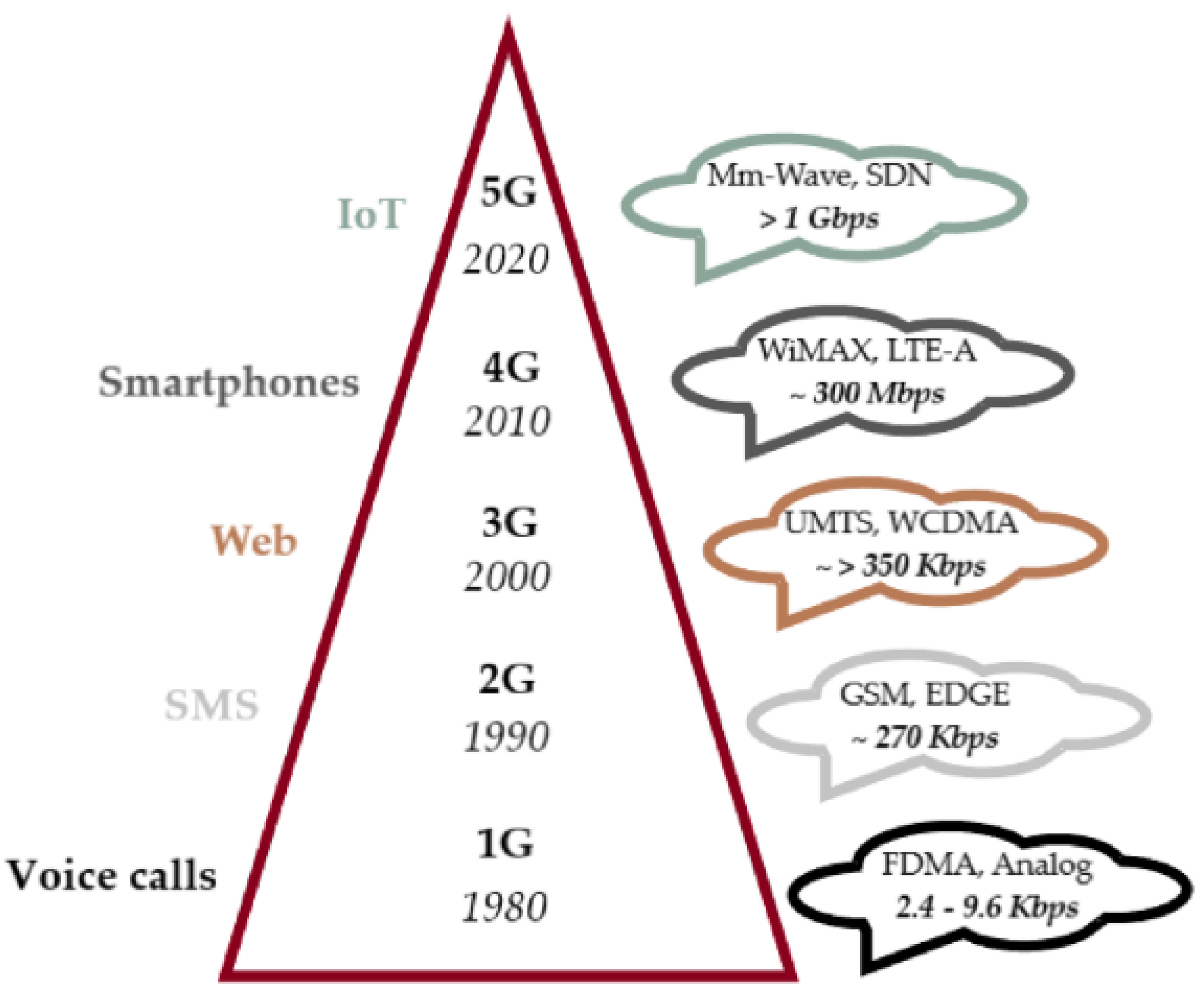
Today, fourth-generation (4G) technology is extensively used and can deliver up to 300Mbps with the latest advancements. By using the speed of fast transfer, it is suggested that IoT devices connect further appliances and accomplish smart system operations such as smart electrical and energy systems/grids. Nevertheless, although the rate of data carry of 4G is much soaring than that of previous generations, there are still some issues that hinder the prevalent implementing of IoTs, e.g., information safety to ensure consumer confidentiality. To avoid these matters, 5G technology is proposed to achieve quicker data transfer, low latency communication, high security, and a massive number of connected apparatuses. 5G networks rely on the integration of various cutting-edge technologies both in the physical and network layer, such as millimeter wave (mmWave) transmission [40], network function virtualization (NFV) [41] and software defined networking [42].
4.2. Main 5G Network Implementation Scenarios
The main 5G implementation scenarios include ultra reliable low latency communications (URLLC) and mass machine-type communications (mMTC) [43]. URLLC aims to accomplish remote control with extraordinarily little latency and high trust. In mMTC the number of appliances plugged to a 5G network can reach 1 million/km2, making it possible to develop smart homes, buildings, and cities. 5G can be extremely important towards the application of demand response (DR) to SGs. The latter term refers to the ability to adjust users' energy consumption (e.g., water heaters, air conditioners, refrigerators, washing machines) to sustain the balance of the power system, reduce the peak load dispute and increase the social well-being of the electricity system.
5G technologies have plenty advantages for use on SGs to assure DR, such as mass and flexible load connectors for DR. Because the number of apparatus connected to a 5G network can reach 1 million/km2, all devices can be linked and controlled by terminal controllers. In this way, several loads can be accurately monitored, managed, and adapted. For example, air conditioners currently are mostly controlled for the provision of DR by switching between on-and-off-states periodically, but with 5G networks they could be adjusted by adapting the defined temperatures or operating frequencies of compressors. Against to the on-off control method, the specified method of setting up the temperature or frequency of the compressor has fewer impact on consumer convenience and the life of the devices.
In addition, 5G networks can be highly applicable in advanced scenarios, such as the charging of autonomous electric vehicles [44]. In this context, autonomous driving can be supported by a high-speed network where dynamic update of road traffic takes place. Moreover, individual loads of charging stations can be identified as well in order to support uninterrupted operation.
5. Studying and Forecasting of Electrical Loads
5.1. Introduction to Study and Prediction
The primary purpose of the operation of an electrical company is to serve consumers in the most quality, reliable, and economical way. Consumers of an electricity system are divided according to the behavior of their electricity demand into different categories such as: industrial, commercial, rural, household, etc. The total electrical demand or the load of the system consists of the sum of the demands of individual consumers. In the long term, the electricity service must be able to meet the maximum demand of the system and have sufficient reserve to be able to cope without problem with the loss of a production unit. These requirements for the long-term and short-term planning of the production of the system also need corresponding forecasts of the overall demand of consumers. It is therefore necessary to study and analyses the behavior and forecasting process of the electrical charge.
5.2. Load Curve
The graph of the requested power as a function of the time of a system is called a load curve. The following diagram shows the annual load curve of a system. The term demand for power usually refers to the average demand power of consumers over an hour [45]:
where 𝐿(𝜏) is the instantaneous demand for power at the time τ. The smoothing achieved by completion results in the clearing of small, high-frequency fluctuations present in instantaneous loads, so the load curve is presented as a smooth curve like that of the diagram below.
Figure 7.
Annual demand for electricity system load for the year 2020 in Greece, where the data were taken into account by the source [46].
Figure 7.
Annual demand for electricity system load for the year 2020 in Greece, where the data were taken into account by the source [46].
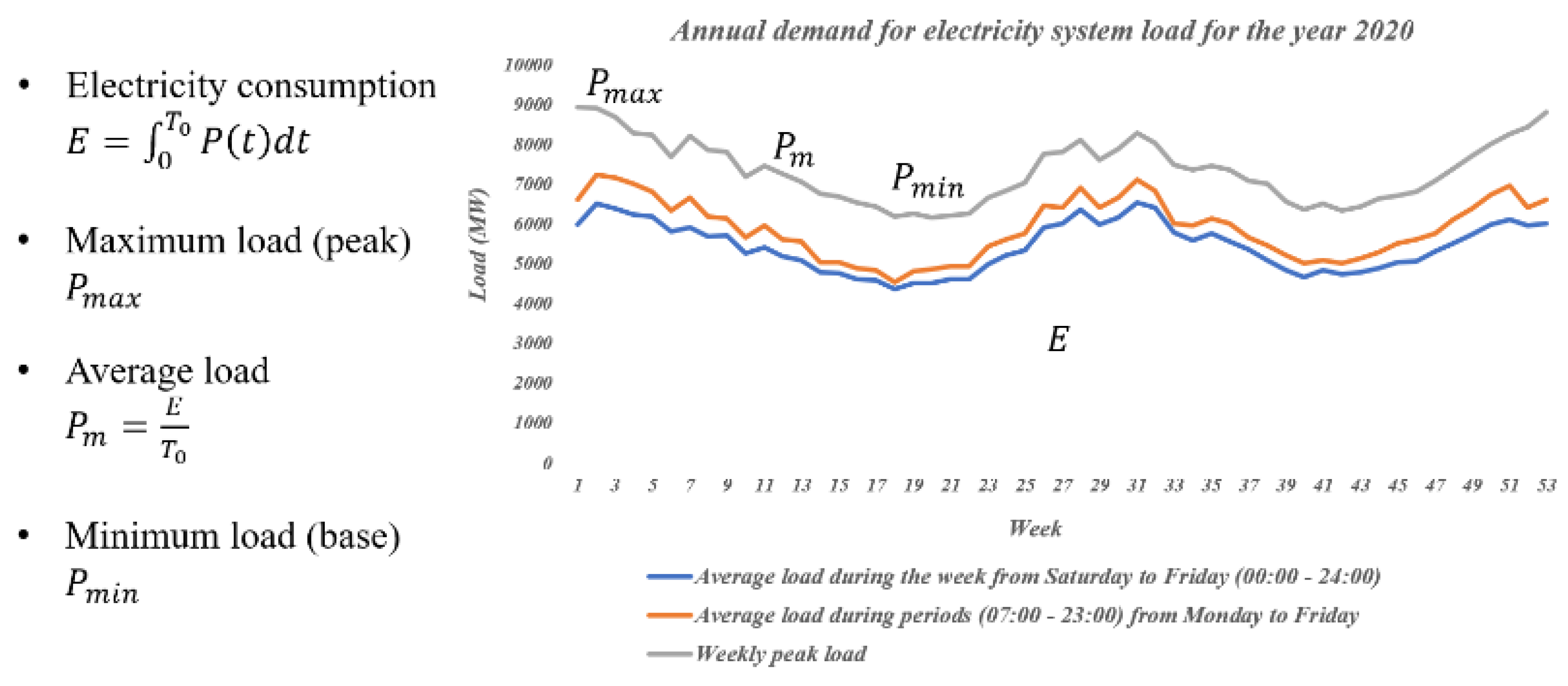
Depending on the performance time, 𝛵0, the load curve is classified as a daily (𝛵0 = 24 ℎ), weekly (𝛵0 = 168 ℎ), monthly (𝛵0 = 720 ℎ), or annual (𝛵0 = 8760 ℎ) [46].
5.3. Load Forecast
For the control and economic functioning of the system, continuous monitoring of the load from production to consumption is a basic requirement of the operation of electricity systems as it must be carried out continuously and over a wide range of time intervals. The load forecast is mainly classified into four groups [47]: long-term forecasts, medium-term forecasts, short-term forecasts, and very short-term forecasts. Within a few minutes, the Economic Load Allocation shall ensure that the total load of the system is allocated to the units already integrated into the network in the most economical way. At intervals of a few hours or days, covering the load for such periods of time requires the start of production or power exchange units with neighborhood systems. Short-term production planning functions such as Economic Integration of Production Units, Hydrothermal Cooperation and Economic Power Exchanges, ensure that the load is covered for periods ranging from a few hours until next week. For periods of up to five years fuel, water resource use and plant maintenance shall be planned in such a way as to ensure reliable coverage of the load with the units already installed on the network. Finally, for long periods up to the next 25 years, the integration of new units into the system is planned to cover a possible increase in the load of the system.
5.4. Blockchain Applications in Load Forecast
Consumers' electricity pressure differs exactly to many considerations, e.g., weather conditions, time of day, service valuing simulations and limitation actions and events. Blockchain technology cannot be implemented directly to predict load demand on a smart grid. Nevertheless, integrating blockchain with dispersed storage systems (such as IPFS) supports system operators predict future load demand by accessing precise and resilient historical demand data. Also, the simplicity and readiness of chronological demand outlines offer main system workers with truthful data that will support them in preparation and organization electricity generation without depend on a middle effectiveness assistance. Blockchain can also permit prosumers and utilities to acquire prior customer demand data that can assist them design future DR strategies. Nevertheless, the confident countryside of blockchains will continuously guarantee that solitary dependable and fiddle-proof data is kept in the dispersed stowage nets [30,31,32,33].
5.5. Methods and Models for Electrical Load Forecasting
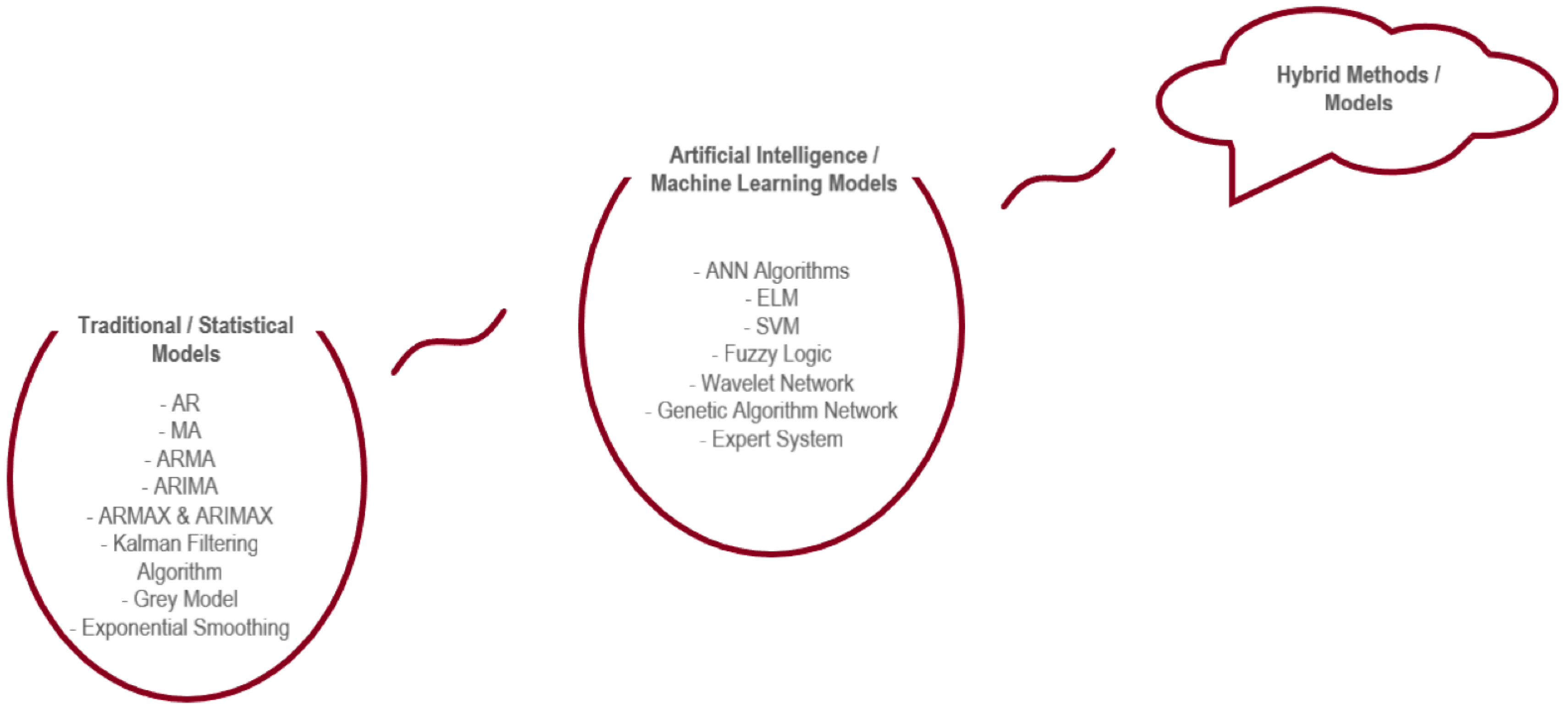
Although several forecasting methods and models are created to make an accurate prediction, the process of finding an appropriate forecasting model is difficult and none of the models listed below can be generalized for all demand models. The main methods of predicting electrical load are multi-factor forecasting methods & time series prediction methods. The multi-factor prediction method focuses on the search for causal relationships between different influencers and forecast values. On the other hand, the time series forecasting method is based primarily on historical "series". The most used time series prediction models are divided into three subcategories, Statistical Models (Static and Dynamic)}. The statistical model is a mathematical model that incorporates a set of statistical assumptions about creating sample data. Some of the first traditional statistical models include Autoregressive (AR), Moving Average (MA), Autoregressive Moving Average (ARMA), Autoregressive Integrated Moving Average (ARIMA), ARMAX and ARIMAX and are described in the following paragraphs Methods [48].
- Autoregressive (AR): The sequences of an auto regurgitated model signifies the aggregate of information essential to predict a predictable signal that can be represented by AR constants. Short-duration acceleration data can certainly be a type of permanent accidental indicator. Consequently, it makes a lot of reason to use the AR model to explain increase of velocity signals. We can then use the AR model measurements as assigns to implement endeavor recognition. The assortment of the model order in AR model is a detailed problem, too low an instruction is a levelled assessment, while too enormous an order affects illegitimate mountains and widespread statistic variability. An AR model is based on special features to recognize activity from triaxial acceleration signals. AR coefficients corresponding to different activity patterns are discriminatory. Also, AR factors can provide sufficient distinction between different types of human activity and provide new feature options for activity recognition [49].
- The MA model is a linear regression model that expresses the declination, of the process as a finite, weighted sum of white noise terms. The unkind model accepts that the top predictor of what will transpire tomorrow is the average of the whole thing that has occurred up until now. The random walk model undertakes that the unsuitable predictor of what will happen tomorrow is what transpired today, and all previous antiquity can be overlooked. Spontaneously there is a range of prospects in involving these two limits. Why not take an average of what has occurred in some window of the latest prior? That’s the concept of a “moving” average [50].
The method for building an ARMA model is slightly multifaceted and necessitates a profound acquaintance of the method. Accordingly, construction an ARMA model is often a trying task for the user, necessitating preparation in statistical analysis, a good knowledge of the field of application, and the obtainability of an relaxed to use but multipurpose specialized computer program. The number of series to be analyzed is often large. It is vital to note, that nowadays, the most used advertisement tools for the time-series forecasting (Stat graphics, SPSS, etc.) required intervention of an human expert for the definition of the ARMA model [51].
The AR, MA or ARMA models, mentioned above, can only be used for fixed time series data. In terms of application, the ARMA model is insufficient to properly describe non-fixed time series. ARIMA modelling or the Box-Jenkins method was named after the two statisticians who introduced this approach in 1976. ARIMA is the mixture of the autoregressive and moving average models. There are a little essential key vital in ARIMA modelling, such as stationarity, invertibility and carefulness. Stationary means that the nasty, alteration, and covariance of the series remains continual over time. This can be accomplished by logarithmic transformation and by differencing either combined to the order one or two. Box and Jenkins assumed that economical models supply expert forecast slightly than an over-parameterized model with further measurements that would concern the quantities of autonomy. Invertibility is another implied condition in ARIMA in which the evaluated alterable necessity demonstrate a convergent autoregressive process or designated by a restricted order moving average. The three stages in ARIMA modelling as advocated by Box and Jenkins are (a) identification; (b) estimation; and (c) diagnostic checking. Therefore, seasonal variants of the ARIMA model are known as models (SARIMA). Another useful generalization of ARIMA models is the automatic fractionally integrated moving average (ARFIMA) model, which allows non-integer values of the different parameter d. ARFIMA has useful applications in time series modeling with a large memory capacity [52].
In the ARMAX model, the current value of the time series is expressed linearly based on its previous values, in terms of current and previous noise values, and in addition, in terms of present and past values of the exogenous variable(s). The forecasting precision of ARIMA model is increased by adding of weekdays and weekends relationship that practices to ARIMAX model. Due to dynamical nature of the load, there exists a very durable association with the input variable star picked. Therefore, the forecasting carrying out of the ARIMAX model dedicatedly be governed by on the input variable quantity selected and the input variables are to be chosen in such a way that the forecasting error of the developed model is minimized. Hourly load changes from one day to another day of the week concerns the load pattern and therefore becomes an significant influence to be measured and involved in the recommended ARIMAX model [53].
The following models are also used for further accuracy, such as:
- The Kalman filter (KF) is established as an ideal repair estimator for a linear system. Founded on nonflavored transformation (UT), the UKF algorithm is advanced for nonlinear systems as a recursive state estimator. The unscented transform (UT) is a deterministic sampling technique, which utilizes a set of 2n+1 sample points (called “sigma points”) for the approximation of statistic characteristics of the changed variable. Forecasts, especially long-term ones, are marked by a high layer of uncertainty due to their high reliance on socio-economic agents, so a level of error of up to 10% is permissible. Applying a Kalman algorithm can significantly minimize the average model error. The KF is a set of mathematical equations in the state space that can provide efficient, computational means for estimating the state of an observed process. In addition, this filter is very powerful in various other aspects such as: support for assessing past, present and future situations, but also for controlling noisy systems [47,48].
- A system is called a white system if all the evidence linked with that system is known, and conversely, it is called a black system if all the information is undetermined. Hence, the grey system is a system with partially known and partly unknown information. There are several systems in this world in which social information is either incomplete or challenging to gather. The simplest form of the grey sculpting approach is the Grey Model (GM) (1, 1). The first ‘1’ signifies the order of the differential equation, and the second ‘1’ suggests the number of variable stars. This theory can trade with noticed systems that have semi unknown parameters, as grey models need only a partial amount of data to assess the conduct of the unknown system. GM’s are suitable for all four types of load forecast [54].
- The exponential smoothing (ES) method describes a class of forecasting methods. Each has the property that forecasts are weighted combinations of past observations, where recent observations are given relatively more weight than older ones. The double exponential smoothing (DES) is an extension of ES designed for trend time series. Exponential Smoothing (ES) is a realistic approach to prediction, according to which the forecast can be made from the exponentially weighted average of previous comments. ES models are between the most public and widespread methods of statistical forecast due to their precision, austerity, and petite cost [55].
Traditional / Statistical models are restricted and can occasionally lead to insufficient solutions. The cause is the extremely high number of computational capabilities that lead to long solution times and the sophistication of some nonlinear data motifs. Therefore, machine learning and artificial intelligence methods offer a promising and attractive alternative to intelligent energy networks. An important ML model is the use of artificial neural networks (ANNs). This system is the interconnectedness of “neurons” that can compute quantities from inputs consuming facts via system. The ANN method was originally used as an alternative mechanism for predicting time series and was successfully applied in several different areas, for prediction and classification reasons. Regardless, several guidelines are available in the literature to provide future modellers with a systematic way of developing ANN models. The model development process is divided into eight main steps: (1) data collection, (2) data pre-processing, (3) selection of input variables (or predictors), (4) data splitting, (5) selection of model architecture, (6) determination of model structure, (7) model training, and (8) model validation [41]. This model handles real time records as input of error adjustment style and simulation findings directs that Mean Average Percentage Error (MAPE) of 0.72% which is reliable than conventional system.
Extreme learning machine (ELM) is a training algorithm for single hidden layer feedforward neural network (SLFN), which converges much faster than traditional methods and yields promising performance. They usually appeal to a single-hidden layer of FF neural network. In ELM, the weights of hidden flat nodes are selected randomly, and the least squares solution can determine the ELM's output weights in detail. ELM models have a positive effect on the next day's load forecast because they have better forecast accuracy than other models [47].
Support Vector Machine (SVM) is proposed to solve system level electricity load prediction problem. Vector support machines (SVM) are regression and classification mechanisms, which were first introduced by Vapnik in 1992. A binary SVM model is developed using three different data sampling methods and nineteen predictor variables, four of which are first introduced in this study. The model is configured by regulating the penalty parameter, selecting the most appropriate kernel function, and setting the best value for the kernel function's parameter. A novel combination of goodness-of-fit metrics is used to more realistically evaluate the model accuracy to predict built and unbuilt land cells as well as changed and unchanged land cells in the whole study area. This approach uses weather forecasting and historical electricity usage data as inputs and predicts the next daily load of electricity in the system (air conditioning, lighting, electricity, and other equipment) [56].
Fuzzy set theory can be considered as a generalized classical set theory. Normally, in classical set theory an element can either belong to a particular set or not. Therefore, the degree of being a member of that set is its crisp value. However, in fuzzy set theory, the degree of membership of an element can be continuously varied. Fuzzy set maps from the universe of discourse to the close interval {0, 1}. In the field of electrical load prediction, unclear logic is dedicated to modeling and forecasting with a particular focus on computational and artificial intelligence approaches, including Fuzzy Logic models. The use of Fuzzy Logic models gives results that are quite promising, as they reduce error in at least half in classic methodologies.
Figure 8 shows the basic chart block diagram of the methodology of Fuzzy Logic for short-term load forecasting. The inputs to the unclear set relies on classification, i.e., hourly data of the predicted temperature and time are specified to the unclear conclusion system through a block of fuzzification. The system of conclusions completes the task of forecasting by using the unclear basis of rules resulting from the forecast. Then, the conclusion system gives, output, the defuzzification block converts the unclear output to the output that may appear further in a chart known as the load curve.
Figure 9 demonstrates the streaming of short-term load forecast using Fuzzy Logic. The exit received is compared to the real load and the error in the load forecast is used to enhance the rule base for future forecasts. The above improvement increases the accuracy of the load forecast [57].
Fuzzy Logic applies primarily to device-mode controllers. A typical example is the relevant applications to the public, such as the operation control of the washing machines with fuzzy control where the washing machine regulates the speed, type and quantity of detergent as well as the temperature of the water, depending on the strength, type and quality of the clothes that counts with appropriate sensor systems, achieving savings of water and energy consumption, as well as in the prediction of load and energy.
Wavelet Neural Network’s (WNNs) are powerful for approaching nonlinear operations. To accurately record the characteristics of the load at multiple frequencies, a WNN technique is used to decompose the loads into various frequency elements. Then each element is transformed, normalized, and properly fed with time and date indicators in a neural network so that the characteristics of the individual elements are correctly recorded. Predictions from individual neural networks are then altered and combined by the final predictions. The WNN method is used to predict very short-term loads for a time horizon of one hour in the future at 5-minute intervals.
A new approach to very short-term forecasting could be Advanced Wavelet Neural Networks (AWNNs). It customs an advanced wavelet transformation with randomness price purpose to choose the greatest wavelet improper for data putrefaction, joint information for ear assortment, and neural networks for forecast. The presentation of the AWNN is methodically assessed by means of control weight data for one and multi-step forecasts gaining and likened to numerous orientation algorithms and standards. Finished wavelet decomposition it is likely to discovery a customary of best incidence mechanisms to signify the data and then brand the suitable forecast in each of these rudiments distinctly. By identifying these elements and predicting them separately, there is a good chance to create more accurate forecasting models [58]. They are often suitable in nonlinear systems and conduct a particular optimization based on the natural selection of optimal solutions resulting from a wide range of candidate prediction models. This kind of optimization based on genetic algorithms is usually developed during the model selection process, when the most appropriate parameters of the prediction model need to be found.
Because it is very difficult to solve objective functions that in turn contain discontinuous functions, using traditional methods, as well as that the load may shift–change, we aim to use the genetic algorithm (GA), as it enables us to solve the above functions in a more optimal way. We seek optimal transportation and distribution with the lowest possible production costs. There is a lot of research that proves that through polynomial functions and with the help of the genetic algorithm, end users benefit greatly in terms of electricity bills [59]. This is a new field emerging because of developments in artificial intelligence. Specialized systems are new techniques that have emerged because of advances in the field of artificial intelligence (AI). An Expert System is a computational program that can explain, understand, and expand the knowledge base to new information that they become available. Specialized systems combine rules and procedures used by experts to create appropriate software, making them able to automatically make predictions, without human assistance Numerous hybrid methods that syndicate the expert system with additional load forecasting models for load forecasting. For example, fuzzy logic and expert system are mutual with a hyphenate.
Hybrid or combined models and methods can achieve enhance prediction efficiency than the single model by integrating the advantages of diverse individual forecasting models and are therefore used in many forecasting areas. Thus, new studies have moved their primary research focus to the development of efficiently hybrid models in the hope of improving predictive performance. The following figure shows cataloging of models for electrical load forecasting.
Figure 10.
Cataloging of models for electrical load forecasting.
5.6. Contributions of Methods and Models for Electrical Load Forecasting
In this paper we have made extensive reference to many methods and models of electric charge prediction. However, using methods and models with several reduced capabilities, problems arise in the process of predicting electricity load. The goal is to predict accurate electric charge prediction using an electrical load dataset. To solve this problem, it is possible to apply some more specialized models, such as the SVM model. The SVM model, as described above, is a "classifier" that divides data into appropriate categories by creating a hyper layer between them. The SVM part of the classifier has the advantage of defining the hyper level between these classes. SVM is a capable method, however, the following challenges must be considered for better accuracy in electricity load prediction, such as:
- High computational complexity: SVM has sharp computational complication and uncertain in processing the indeterminate data [60]. In electricity load forecasting, surplus aspects in data improve the computational difficulty of SVM in its guiding means and lowers the forecast truth.
- Hard to tune parameters: Tremendous parameters of SVM influences the concert of SVM in forecasting. Those parameters are Cost penalty, kernel parameter and reason loss meaning. It is challenging to locate the precise quantities of these parameters for higher precision.
Some of advantages and disadvantages of different state-of-art forecasting methods & models is given in Table 4.
6. Conclusions
Even with the experiences and technologies available for reference, the pursuit of smart grids is an investment in time, money and continuous research and testing. The exact future of the smart grid may be difficult to predict, but recent innovations show a dynamic fusion of sectors, engineers, and societies.
It should then be noted that the smart grid does not replace the conventional electrical system but relies on the available infrastructure to increase the use of existing components and strengthen the application of the new functionality. Smart Metering Infrastructures is basic public service equipment that enables the provision of products and services to users and allows better management of electrical networks and all components associated with them. Advanced Metering Infrastructure (AMI) is a relatively new concept, where together with other advanced smart network technologies, such as Blockchain technology, will be able to shape the behavior of energy consumption with grouping techniques so that various energy efficient programs can be implemented. The two-way wired–wireless communication used on the smart network takes place between supplier and consumer to improve the maintenance, management, and demand of the supplier. It is noted that 5G networks will be crucial to achieving an optimized demand response (DR) in Smart Grids (SG).
The Electric Load Forecast (ELF) is a vital process for the design of the electricity sector and plays a key role in the planning as well as in the management of electricity systems. Therefore, the accuracy of the electrical load forecast is of the utmost importance for capacity planning and energy system management.
Due to the high complexity of smart grids, a small disruption can lead to large-scale failure, in reliant smart grids. A solitary disappointment container causes a network outage, instantaneously touching the paired nodes in the communication network and ultimately causing a smash. Substantial-scale malfunctions could cause sequential fault failures, which should also be taken into credit when fixing smart grids. Some of the after problems need to be tackled. How to identify and manage the entrance goals and lines of cyber/ entity-attacks; How to alleviate the dissemination of flowing collapse in reliant smart grid network; How to enhance toughness and flexibility with reliant smart grid networks.
As a result of all the analyses carried out in this paper, many critical problems, and challenges such as data protection and automation of the distribution system have been revealed. Therefore, we conclude that further examination and resolution is needed with a view to building more efficient smart grids in the future.
7. Proposals for Future Research
7.1. Smooth Transition to the Future Smart Grid (SG)
Figure 11 reviews the development from premature automatic measurement (Phase I), characterized by one-way communication, to Advanced Measurement Infrastructure (AMI) (Phase II), which contains two-way communications, and to the Smart Grid (Phase III) with intelligent apps and communication infrastructure via advanced sensor networking technologies i.e., PHEV / EVs, R.E.S. (Solar–Hydro–Wind).
7.2. Future Research
While many technologies, systems, devices, methods, and processes have emerged that enhance smart grids, there is a huge potential for future research, among them: New time series forecast methods for smart grids, new communications infrastructure for self-repairing networks, improved reliability, and power quality studies, Practical methods for integrating large-scale renewable energy sources. Integration of nanotechnologies for the production and storage of energy of the future: Photocatalysts that reduce emissions (CO2), Nanomaterials that directly convert light and water to produce hydrogen through ther nonchemical solvents, Nano-Fuel Cells that reduce costs by 10-100 (times) and provide low starting temperature, High-current quantum cables (QWs) which will reconnect the transmission network, allow the global transmission of electricity and will also contribute to the replacement of aluminum and copper cables, particularly in the coils of electric motors and generators.
It is proposed that a hybrid network should be set up, resulting from the addition of advanced communication networks to the electricity grid, to enable cooperation between power and communication. A management and support system will therefore be required to enable trust and safety. The result will be a multi-level network and protocols that integrates several technologies such as wireless, fiber optic, Ethernet, and internet protocols.
As 5G enters the trading development phase, investigation institutions around the world have begun to attend to 6G, which will be developed around 2030. The 6G network is due to boost the performance of info impart - maximum data rates of up to 1Tbps and exceptionally short latency in microseconds. It will have terahertz frequency communication and a spatial multiplex, supply 1000 times upper occupancy than 5G networks. One of 6G's objectives is to reaching broad connectivity by incorporating satellite communication networks and underwater communications to provide global coverage. Promising 6G network technologies that are expected to improve communication are formulated below, such as: Communication spectrum methods.
Spectrum constitutes the necessary element of mobile communications and since the anode of mobile networks in the 1980s, we have seen huge extend of spectrum resources in every new generation due to the endless search for data rates. Terahertz (THz) and visible light technologies are attractive frequency spectrums: New communication templates (Molecular / Quantum communication).
A latest nature-inspired communication model shall be deemed a possible solution that uses biochemical signals to carriage info, referred to as molecular communications (MC). In MC, biochemical signals are generally small particles of some nanometers in a few micrometers in size, for instance lipid vesicles and particles, which are usually multiplied in aqueous or gaseous means. Thus, MC systems are anticipated to connect to the Internet and mobile networks and the two foremost challenges are the interfaces between the electrical and chemical sectors and the methods of ensuring secure. Quantum communication (QC) is also another hopeful pattern of communication with unconditional safety.
In addition, promising 6G network technologies are Fundamental techniques such as: (i) Blockchain technology for decentralized security, (ii) versatile/flexible and intelligent materials and (iii) energy management [61].
Abbreviations
The following abbreviations are used in this manuscript:
| AMI | Advanced Metering Infrastructure |
| AWNNs | Advanced Wavelet Neural Networks |
| AI | Artificial Intelligence |
| ANN | Artificial Neural Network |
| AMR | Automated Meter Reading |
| ARFIMA | Automatic Fractionally Integrated Moving Average |
| AMM | Automatic Meter Management |
| AR | Autoregressive |
| ARIMA | Autoregressive Moving Average |
| ARMA | Autoregressive Moving Average |
| CIS | Consumer Information System |
| DR | Demand Response |
| DERs | Distributed Energy Resources |
| DMS | Distribution Management System |
| DES DTC |
Double Exponential Smoothing Decision Tree Classifier |
| ES | Exponential Smoothing |
| ELF ELM FDI |
Electric Load Forecast Extreme Learning Machine False Data Injection |
| GA | Genetic Algorithm |
| GIS GM |
Geographical Information System Grey Model |
| HAN | Home Area Network |
| HEMS HFSEC HFS |
Home Energy Management System Hybrid Feature Selection, Extraction and Classification Hybrid Feature Selection |
| ICTs | Information and Communication Technologies |
| IENs | Intelligent Electrical Networks |
| IEDs | Intelligent Electronic Devices |
| IRENA | International Renewable Energy Agency |
| IETF | Internet Engineering Task Force |
| IoT | Internet of Things |
| KF | Kalman Filter |
| LAN | Local Area Network |
| mMTC | Mass Machine-Type Communication |
| MIMO | Massive Multiple-Input Multiple-Output |
| MAPE | Mean Average Percentage Error |
| MDMS | Measurement Data Management System |
| mmWAVE | Millimeter-Wave |
| MA | Moving Average |
| NAN | Neighborhood Area Network |
| OMS | Operational Interruption Management System |
| PMU | Phase Measurement Unit |
| QWs | Quantum Cables |
| RESs RFE |
Renewable Energy Sources Recursive Feature Elimination |
| uRLLC | Reliable and Low Latency Communications |
| SLFN | Single Hidden Layer Feedforward Neural Network |
| SG | Smart Grid |
| SM | Smart Meter |
| SVM | Support Vector Machine |
| UT | Unscented Transform |
| VPPs WNN XGBOOST |
Virtual Power Plants Wavelet Neural Network Extreme Gradient Boosting |
References
- Mohussel, R. – R.; Fung, A.; Mohummadi, F.; Raahemifar, K. A survey on advanced metering infrastructure. Electrical and Power Energy System 2014, 63, 473 – 484. [CrossRef]
- Goudarzi, A.; Ghayoor, F.; Waseem, M.; Fahad, S.; Traore, I. A survey on IoT-enabled smart grids: Emerging, applications, challenges, and outlook. Energies 2022, 15, 6984. [CrossRef]
- Moreno Escobar, J.J.; Morales Matamoros, O.; Tejeida Padilla, R.; Lina Reyes, I.; Quintana Espinosa, H. A comprehensive review on smart grids: Challenges and opportunities. Sensors 2021, 21, 6978. [CrossRef]
- Jiang, X.; Wu, L. Residential power scheduling based on cost efficiency for demand response in smart grid. IEEE Access 2020, 8, 197324-197336. [CrossRef]
- Olivares, D.E. et al. Trends in microgrid control. IEEE Trans. Smart Grid 2014, 5, 1905-1919. [CrossRef]
- Kabalci, Y. A survey on smart metering and smart grid communication. Renewable and Sustainable Energy Reviews 2016, 57, 302 – 318. [CrossRef]
- Colak, I.; Sagirogla, S.; Fulli, G.; Yesilbudak, M.; Covrig C. – F. A survey on the critical issues in smart grid technologies. Renewable and Sustainable Energy Reviews 2016, 54, 396 – 405. [CrossRef]
- Chen, Y.; Bhutta, M.S.; Abubakar, M.; Xiao, D.; Almasoudi, F.M.; Naeem, H.; Faheem, M. Evaluation of machine learning models for smart grid parameters: Performance analysis of ARIMA and Bi-LSTM. Sustainability 2023, 15, 8555. [CrossRef]
- Kuppusamy, R.; Nikolovski, S.; Teekaraman, Y. Review of machine learning techniques for power quality performance evaluation in grid-connected systems. Sustainability 2023, 15, 15055. [CrossRef]
- Priyanka, E.B.; Thangavel, S.; Gao, X. Z. Review analysis on cloud computing based smart grid technology in the oil pipeline sensor network system. Petroleum Research (Elsevier) 2021, 6, 77 – 90. [CrossRef]
- Hassan, A.; Afrouzi, H. N.; Siang, C. H.; Ahmed, J.; Mehranzamir, K.; Wooi, C. – L. A survey and bibliometric analysis of different communication technologies available for smart meters. Cleaner Engineering and Technology (Elsevier) 2022, 7, 100-424. [CrossRef]
- Gkonis, P.; Giannopoulos, A.; Trakadas, P.; Masip-Bruin, X.; D’Andria, F. A survey on IoT-edge-cloud continuum systems: Status, challenges, use cases, and open issues. Future Internet 2023, 15, 383. [CrossRef]
- Chen C.; Wang J.; Qiu, F.; Zhao, D. Resilient distribution system by microgrids formation after natural disasters. IEEE Trans. Smart Grid, 2015, 7(2), 958-66. [CrossRef]
- Yuan, W.; Wang, J.; Qiu, F.; Chen, C.; Kang, C.; Zeng, B. Robust optimization-based resilient distribution network planning against natural disasters. IEEE Trans. Smart Grid, 2016, 7(6), 2817-26. [CrossRef]
- Chen J, Zhu Q. A game-theoretic framework for resilient and distributed generation control of renewable energies in microgrids. IEEE Trans. Smart Grid, 2016, 8(1), 285-95. [CrossRef]
- Das, L.; Munikoti, S.; Natarajan, B.; Srinivasan, B. Measuring smart grid resilience: Methods, challenges and opportunities. Renewable and Sustainable Energy Reviews 2020, 130, 109-918. [CrossRef]
- Kalalas, C.; Linus, T.; Zarate, J. A. Cellular communications for smart grid neighborhood area networks: A survey. IEEE Access 2016, 4, 1469-1493. [CrossRef]
- Dorji, S.; Stonier, A.A.; Peter, G.; Kuppusamy, R.; Teekaraman, Y. An extensive critique on smart grid technologies: Recent advancements, key challenges, and future directions. Technologies 2023, 11, 81. [CrossRef]
- Alsuwian, T.; Shahid Butt, A.; Amin, A.A. Smart grid cyber security enhancement: Challenges and solutions—A Review. Sustainability 2022, 14, 14226. [CrossRef]
- Abdul Baseer, M.; Alsaduni, I. A novel renewable smart grid model to sustain solar power generation. Energies 2023, 16, 4784. [CrossRef]
- Naamane, A.; Msirdi, N.K. Towards a smart grid communication. Energy Procedia 2015, 83, 428 – 433. [CrossRef]
- Kua, J.; Hossain, M.B.; Natgunanathan, I.; Xiang, Y. Privacy preservation in smart meters: Current status, challenges and future directions. Sensors 2023, 23, 3697. [CrossRef]
- Ghosal, A.; Conti, M.; Key management systems for smart grid advanced metering infrastructure: A Survey. IEEE Commun. Surv. Tutor. 2019, 21(3), 2831-2848. [CrossRef]
- Leiva, J.; Palacios, A.; Aguado, J. A. Smart metering trends, implications, and necessities: A policy review. Renewable and Sustainable Energy Reviews 2016, 55, 227 – 233. [CrossRef]
- Wang, Y.; Chen, Q.; Hong, T.; Kang, C. Review of smart meter data analytics: Applications, methodologies, and challenges. IEEE Trans. Smart Grid 2019, 10(3), 3125-3148. [CrossRef]
- Asghar, M. R.; Dan, G.; Miorandi, D.; Chlamtac, I. Smart meter data privacy: A Survey. IEEE Commun. Surv. Tutor. 2017, 19(4), 2820-2835. [CrossRef]
- Dileep, G. A survey on smart grid technologies and applications. Renewable Energy 2020, 146, 2589-2625. [CrossRef]
- Hojabri, M.; Dersch, U.; Papaemmanouil, A.; Bosshart, P. A comprehensive survey on phasor measurement unit applications in distribution systems. Energies 2019, 12, 4552. [CrossRef]
- Aderibole, A. et al. Blockchain technology for smart grids: Decentralized NIST conceptual model. IEEE Access 2020, 8, 43177-43190. [CrossRef]
- Alladi, T.; Chamola, V.; Rodrigues, J.J.P.C.; Kozlov, S.A. Blockchain in smart grids: A review on different use cases. Sensors 2019, 19, 4862. [CrossRef]
- Waseem, M.; Adnan Khan, M.; Goudarzi, A.; Fahad, S.; Sajjad, I.A.; Siano, P. Incorporation of blockchain technology for different smart grid applications: Architecture, prospects, and challenges. Energies 2023, 16, 820. [CrossRef]
- Liu, C.; Zhang, X.; Chai, K. – K.; Loo, J.; Chen, Y. A survey on blockchain-enabled smart grids: Advances, applications and challenges. RIET The Institution of Engineering and Technology WILEY, IET Smart Cities 2021, 3, 56 – 78. [CrossRef]
- Chu, T.; An, X.; Zhang, W.; Lu, Y.; Tian, J. Multiple virtual power plants transaction matching strategy based on alliance blockchain. Sustainability 2023. 15, 6939. [CrossRef]
- Xu, G.; Guo, B.; Su, G.; Zheng, X.; Liang, K.; Wong, D. S.; Wang, H. Am I eclipsed? A smart detector of eclipse attacks for Ethereum. Elsevier Computers & Security 2020, 88, 101604. [CrossRef]
- Zhang, Y.; Shi, Q. An intelligente transaction model for energy blockchain based on diversity of subjects. Alex. Eng. J. 2021, 60, 749-756. [CrossRef]
- Gourisetti, S.N.G.; Sebastian-Gardenas, D.J.; Bhattarai, B.; Wang, P.; Widergren, S.; Borkum, M.; Randall, A. Blockchain smart contract reference framework and program logic architecture for transactive energy systems. Appl. Energy 2021, 304, 117860. [CrossRef]
- Zhang, X.; Fan, M. Blockchain-based secure equipment diagnosis mechanism of smart grid. IEEE Access 2018, 6, 66165-66177, . [CrossRef]
- Etimad, F.; Gungor V.C., Nassef Laila, Akkari Nadine, Malik Abbas M.G., Almasri Suleiman Akyildiz Ian F. A survey on wireless sensor networks for smart grid. Computer Communications 2015, 71, 22 – 33. [CrossRef]
- Lee, S.; Azfar Yaqub, M.; Kim, D. Neighbor aware protocols for IoT devices in smart cities—Overview, challenges and solutions. Electronics 2020, 9, 902. [CrossRef]
- Al-Saman, A.; Cheffena, M.; Elijah, O.; Al-Gumaei, Y.A.; Abdul Rahim, S.K.; Al-Hadhrami, T. Survey of millimeter-wave propagation measurements and models in indoor environments. Electronics 2021, 10, 1653. [CrossRef]
- Adoga, H.U.; Pezaros, D.P. Network function virtualization and service function chaining frameworks: A comprehensive review of requirements, objectives, implementations, and open research challenges. Future Internet 2022, 14, 59. [CrossRef]
- Hussain, M.; Shah, N.; Amin, R.; Alshamrani, S.S.; Alotaibi, A.; Raza, S.M. Software-defined networking: Categories, analysis, and future directions. Sensors 2022, 22, 5551. [CrossRef]
- Siddiqi, M.A.; Yu, H.; Joung, J. 5G Ultra-reliable low-latency communication implementation challenges and operational issues with IoT devices. Electronics 2019, 8, 981. [CrossRef]
- Skouras, T.A.; Gkonis, P.K.; Ilias, C.N.; Trakadas, P.T.; Tsampasis, E.G.; Zahariadis, T.V. Electrical vehicles: Current state of the art, future challenges, and perspectives. Clean Technol. 2020, 2, 1-16. [CrossRef]
- Stamatellos, G.; Stamatelos, T. Short-term load forecasting of the greek electricity system. Appl. Sci. 2023, 13, 2719. [CrossRef]
- Independent Power Transmission Operator (IPTO) in the Greek System, https://www.admie.gr/en.
- Khan, A. R.; Mahmood, A.; Safdar, A.; Khan, Z. A.; Khan, N. A. Load forecasting, dynamic pricing and DSM in smart grid: A review. Renewable and Sustainable Energy Reviews 2016, 54, 1311-1322. [CrossRef]
- Hammad, M. A.; Jereb, B.; Rosi, B.; Dragan, D. Method and models for electric load forecasting: A comprehensive review. Logistics & Sustainable Transport 2020, 11(1), 51-76. [CrossRef]
- Gao, Y.; Mosalam, K.M.; Chen, Y.; Wang, W.; Chen, Y. Auto-regressive integrated moving-average machine learning for damage identification of steel frames. Appl. Sci. 2021, 11, 6084. [CrossRef]
- Su, Y.; Cui, C.; Qu, H. Self-attentive moving average for time series prediction. Appl. Sci. 2022, 12, 3602. [CrossRef]
- Rojas, I.; Valenzuela, O.; Rojas, F.; Guillen, A.; Herrera, L.J.; Pomares, H.; Marquez, L.; Pasadas, M. Soft-computing techniques and ARMA model for time series prediction. ScienceDirect 2008, 71, 519-537. [CrossRef]
- Haiges, R.; Wang, Y. D.; Ghoshray, A.; Roskilly, A.P. Forecasting electricity generation capacity in Malaysia: An Auto Regressive Integrated Moving Average approach. ELSEVIER ScienceDirect 8th International Conference on Applied Energy, Energy Procedia 2016, 105, 3471-3478.
- Shilpa, G. N.; Sheshadri, G. S. ARIMAX model for short-term electrical load forecasting. International Journal of Recent Technology and Engineering (IJRTE) 2019, 8(4), 2277-3878.
- Faheemullah Shaikh, Qiang Ji, Pervez Hameed Shaikh, Nayyar Hussain Mirjat, Muhammad Aslam Uqaili. Forecasting China’s natural gas demand based on optimized nonlinear grey models. ELSEVIER, Energy 2017, 140, 941-951.
- Lifeng Wu, Sifeng Liu, Yingjie Yang. Grey double exponential smoothing model and its application on pig price forecasting in China. ELSEVIER Applied Soft Computing 2016, 39, 117-123.
- Karimi, F.; Sultana, S.; Babakan, A. S.; Suthaharan, S. An enhanced support vector machine model for urban expansion prediction. Computers, Environment and Urban Systems (Elsevier) 2019, 75, 61-75.
- A. Taifour Ali, Eisa B. M. Tayeb, Zaria M. Shamseldin. Short Term Electrical Load Forecasting Using Fuzzy Logic. International Journal Of Advancement In Engineering Technology, Management and Applied Science (IJAETMAS) November 2016, Volume 03 – Issue 11, 131 – 138.
- Mashud Rana, Irena Koprinska. Forecasting electricity load with advanced wavelet neural networks. ELSEVIER Neurocomputing 2016, 182, 118-132. [CrossRef]
- C. Bharathi, D. Rekha and V. Vijayakumar. Genetic Algorithm Based Demand Side Management for Smart Grid. CrossMark Wireless Pers Commun 2017, 93, 481-502.
- Zhu, Q., Han, Z., Basar, T. A differential game approach to distributed demand side management in smart grid. IEEE International Conference on Communications 2012, pp. 3345-3350.
- Tongyi Huang, Wu Yang, Jun Wu, IEEE Member, Jin Ma, Xiaofei Zhang, And Daoyin Zhang. A Survey on Green 6G Network: Architecture and Technologies: IEEE Access 2019, Volume 7. [CrossRef]
Figure 1.
Traditional / Conventional Electric Grid.
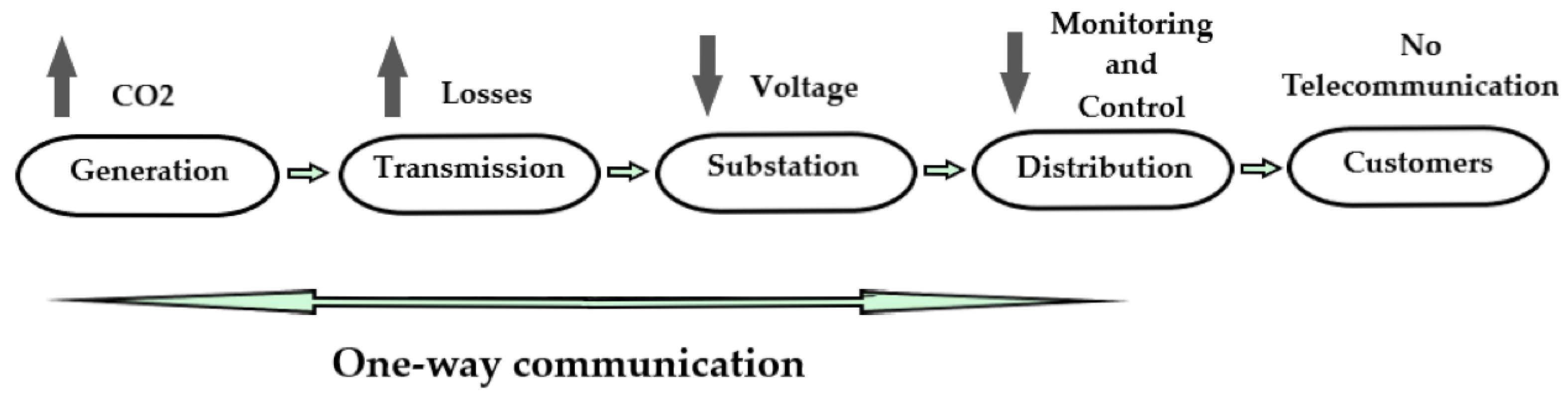
Figure 2.
The Smart Grid concept.
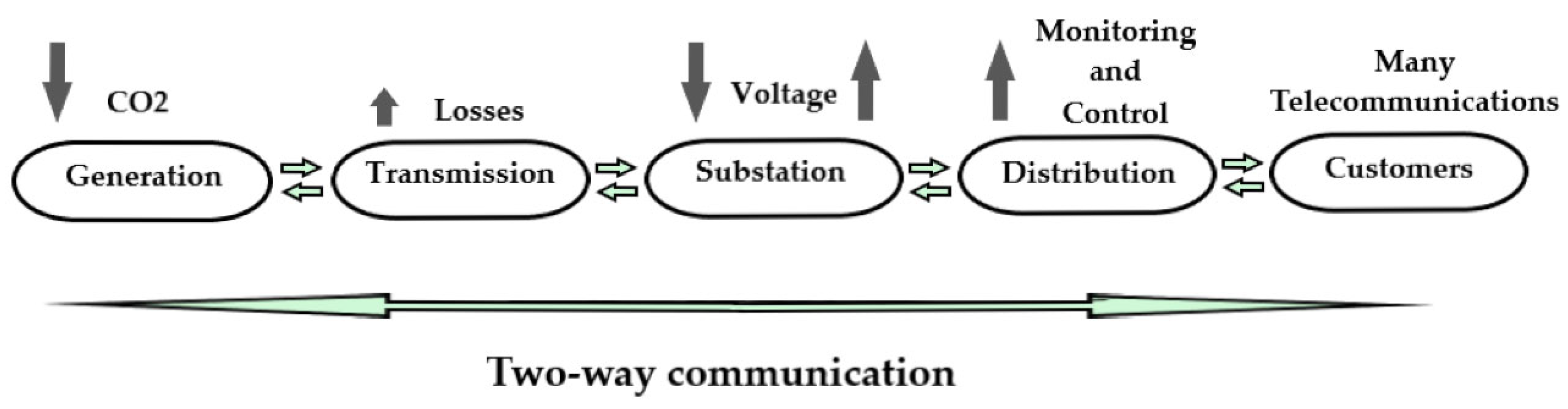
Figure 3.
The characteristics of Advanced Metering Infrastructure (AMI).
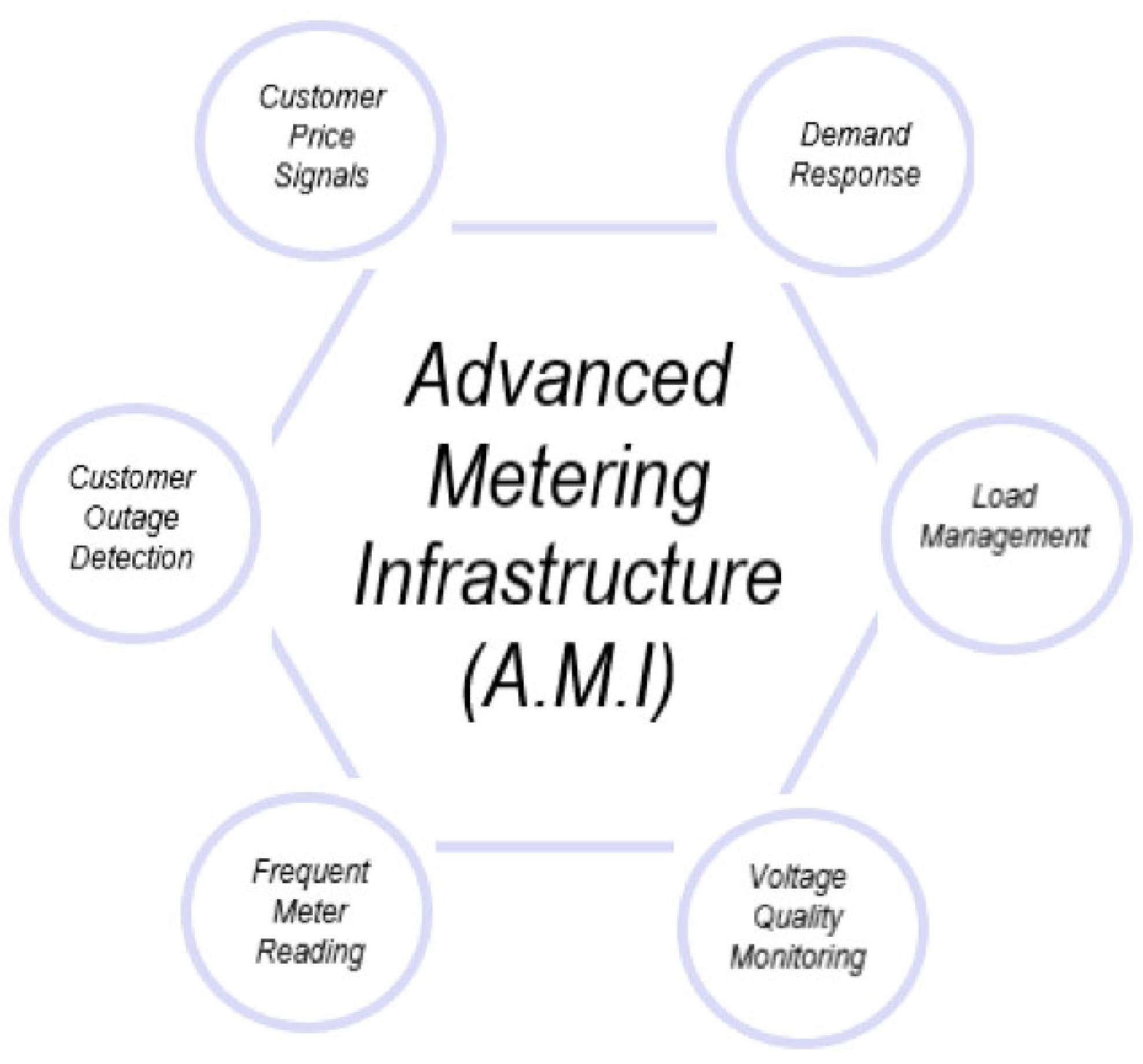
Figure 4.
A Smart Grid standpoint with all elements.
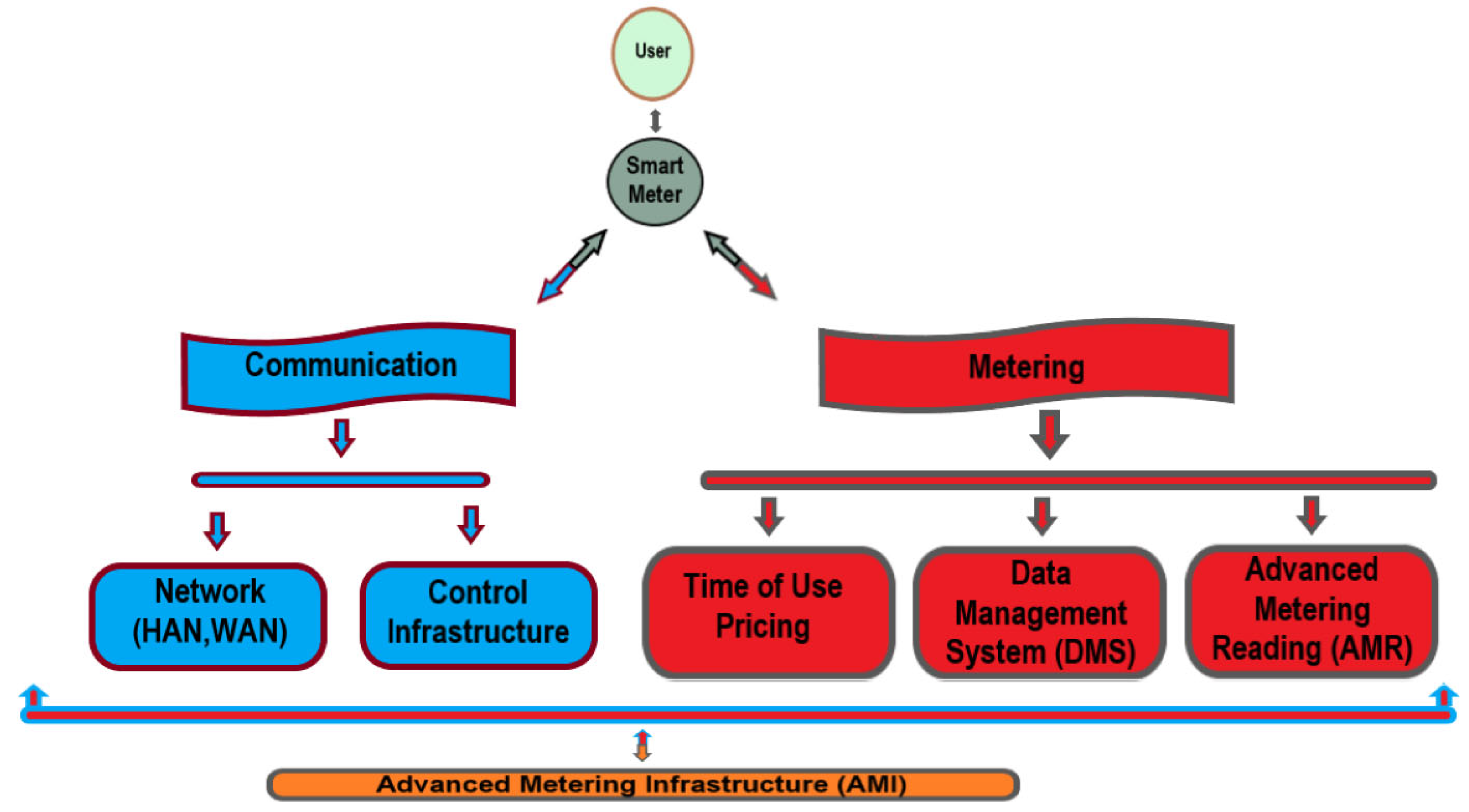
Figure 5.
A dispersed communication and adjusting structural design for Smart Grid.
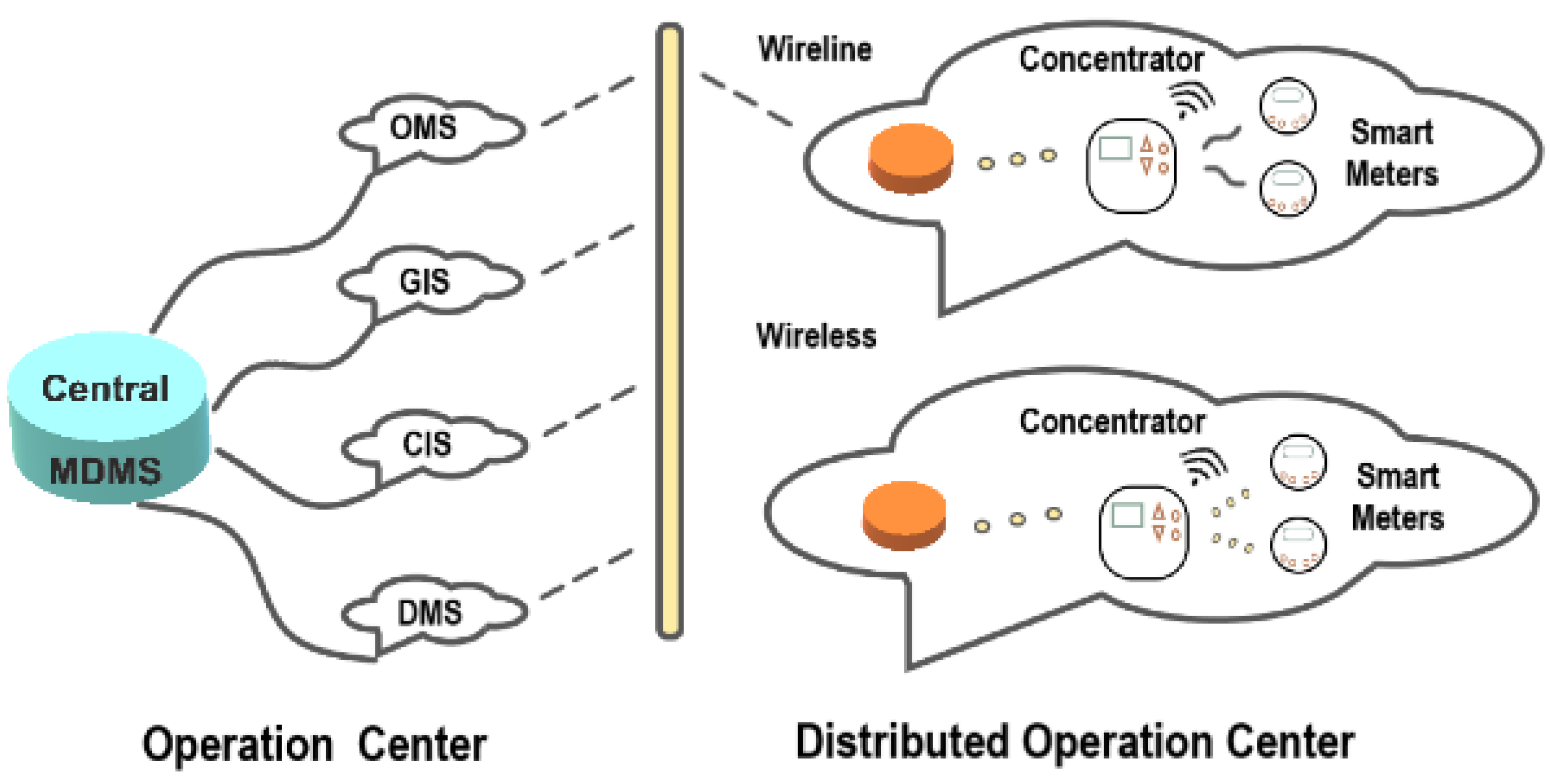
Figure 8.
Basic chart block of the procedure of Fuzzy Logic, where the data were taken into account by the source [48].
Figure 8.
Basic chart block of the procedure of Fuzzy Logic, where the data were taken into account by the source [48].
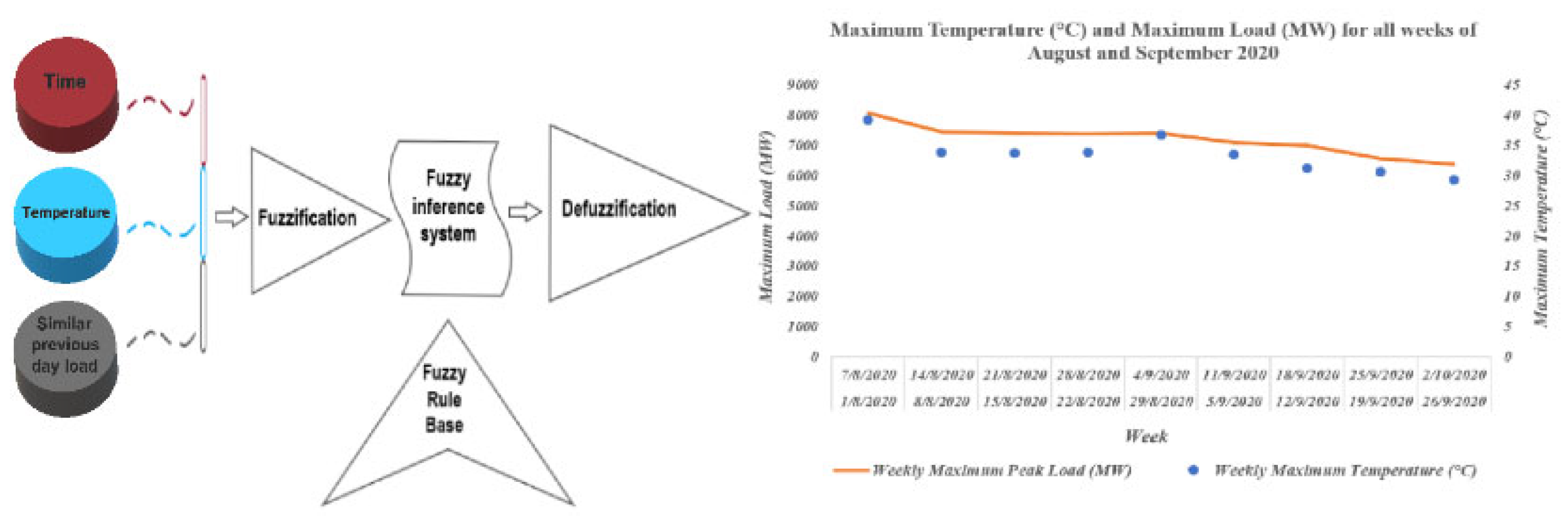
Figure 9.
Flow diagram using Fuzzy Logic.
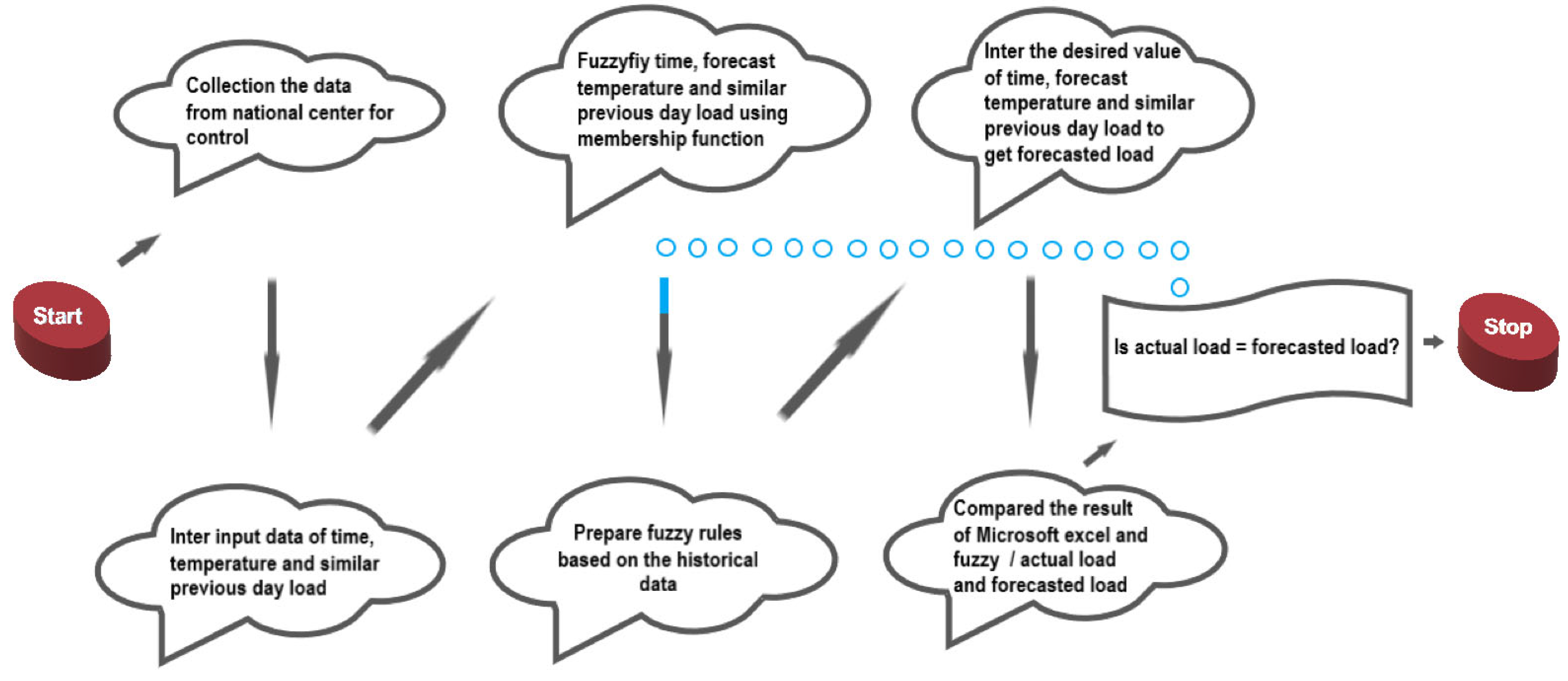
Figure 11.
Checking the current, short - term and future state of Electricity Systems.
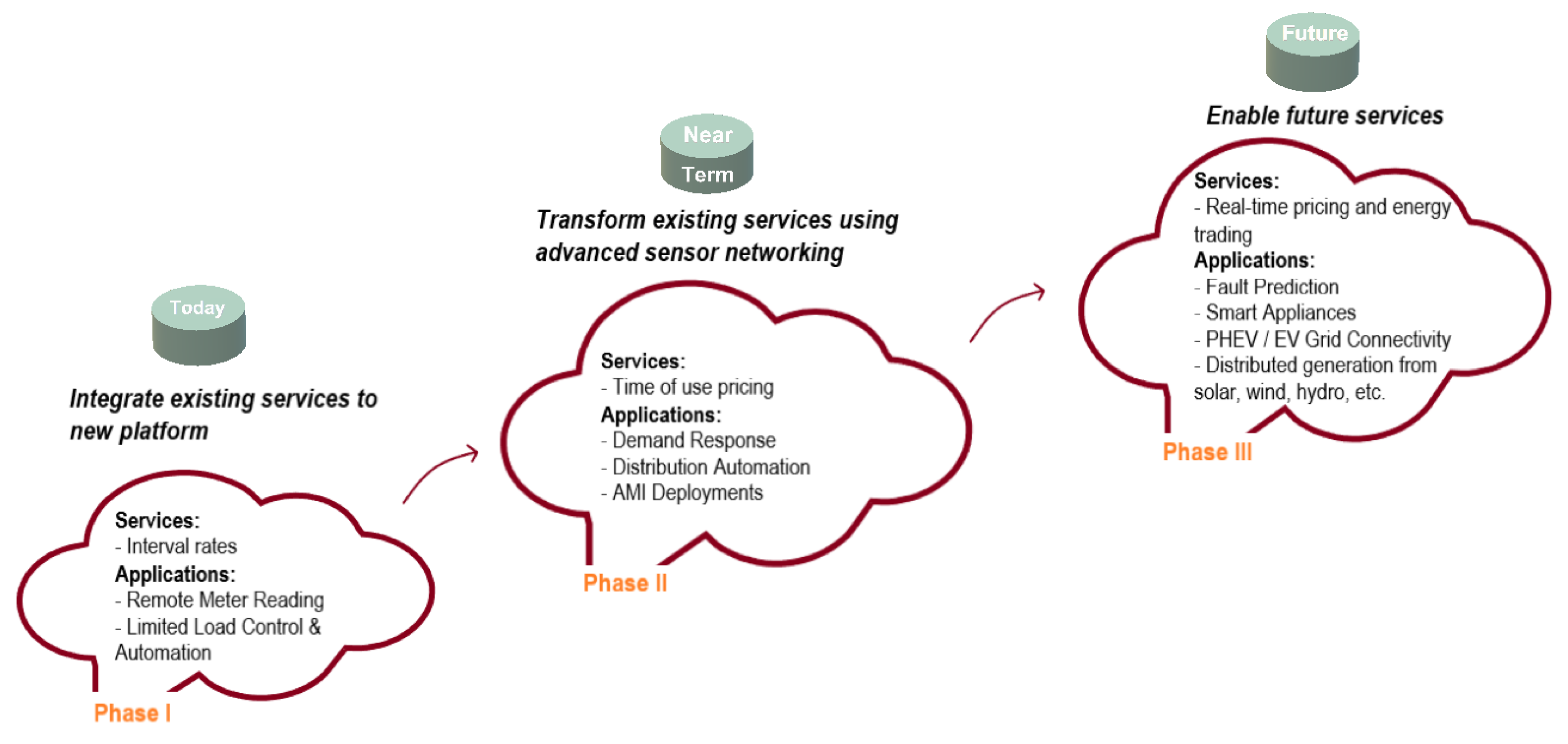

Table 1.
Categorization of indicative recent studies on SG issues.
| Work | Publication Year | Key Contributions |
|---|---|---|
| [2] | 2022 | IoT and SGs |
| [6] | 2016 | Smart metering in SGs |
| [9] | 2023 | ML for load forecasting and power quality improvement |
| [11] | 2022 | Research and analysis of modern communication technologies available for SMs. |
| [18] | 2023 | SG technologies, recent developments, key challenges. |
| [19] | 2022 | Challenges and solutions to improve SG cybersecurity. |
| Our work | - | Communication technolgoies and electric load forecasting for SGs |
Table 2.
Comparison of Traditional vs Smart Grid.
| Traditional Grid | Smart Grid |
|---|---|
| One-way Communication | Real-time two-way communication |
| Central Electricity Production Slow Response to Emergency Situations (Manual Control) Limited Control Radial Network Human Intervention in System Disorders Less Data |
Distributed Electricity Production Quick Response to Emergency Situations (Automatic Control) Extensive Control System Dispersed Network Adaptive Protection Large Amount of Data |
Table 3.
Comparison of Wired and Wireless Communication Technologies.
| Technology | Achievable Data Rate | Coverage Range | Advantages | Disadvantages |
|---|---|---|---|---|
| Wired Technologies | ||||
| PLC | NB-PLC: 1-10kbps for low data percentage PHYs BB-PLC: 1-10Mbps (up to 200Mbps at a very short distance) |
NB-PLC: 150km or more BB-PLC: ~1,5km | 1. Existing Infrastructure 2. Economics 3. Wide Availability |
1. Channel Noise 2. Interference 3. Attenuation |
| Fiber Optics | ||||
| 155Mbps - 50Gbps | 100km | 1. High Capacity 2. High Reliability 3. High Availability 4. Enhanced Security | 1. High Cost 2. Low Extensibility 3. Development Restrictions 4. Regular Maintenance |
|
| Wireless Technologies | ||||
| Wi-Fi | 11Mbps - 300Mbps | 100m for indoor | 1. Low Cost 2. High Data Rate | 1. Small Range 2. Interference 3. Low Security |
| WiMAX |
|
48km | 1. Low Latency Time 2. Scalability 3. High Data Rate |
1. Non-Wide Use 2. Exclusive Infrastructure 3. Limited Access to Approved Spectrum |
| ZigBee | 20 - 250kbps | 10m - 75m | 1. Low Cost 2. Low Energy Consumption 3. MESH connectivity |
1. Low Data Rate 2. Small Range 3. Interference |
Table 4.
Advantages and Disadvantages of Forecasting Methods & Models.
| Forecasting Methods & Models | Advantages | Disadvantages |
|---|---|---|
| Statistical Methods | ||
| Uncomplicated and less computationally expensive. Use to determine relationship between predicted power and weather features. |
Less reliability for large and non-linear data in dataset of energy. Difficult to control complex weather conditions. |
|
| Machine Learning | ||
| Simple and can deal with large datasets. | Less reliability for large and heterogeneous data issues, produce point predictions. | |
| Hybrid Methods | ||
| Highly accurate and scalable. Integrate different model’s weight to improve the performance of model by conserving the advantages of approach | Specific uses. Highly computationally expensive. Face issues of stable prediction due to their complex learning structure. May have long duration of training, under fitting problem and low efficiency. | |
| ARIMA | ||
| Usable for non-linear model. Forecast a regression model and develop a fit. |
Data linearization is needed. Suited to stationary data. Need of data preprocessing. Chance of loss of information. Less accurate for time series data. | |
| ANN | No needs of extra expertise for statistical training. Ability to observe the interaction between independent and dependent variables. Ability to detect all relationships among predictor variables. Can control non-linear interaction in load consumption by adjustment of weight in training process. | Black box in nature. Need of large quantity of datasets to train the model and its complexity. Need data pre-processing and neural networks. |
| Time Series Analysis | Have ability to adopt seasonal effects. | Numerical instability. |
| Fuzzy Inference System | Quick and accurate in execution. | Trail and error-based selection of membership function in the formation of rule. |
Disclaimer/Publisher’s Note: The statements, opinions and data contained in all publications are solely those of the individual author(s) and contributor(s) and not of MDPI and/or the editor(s). MDPI and/or the editor(s) disclaim responsibility for any injury to people or property resulting from any ideas, methods, instructions or products referred to in the content. |
© 2024 by the authors. Licensee MDPI, Basel, Switzerland. This article is an open access article distributed under the terms and conditions of the Creative Commons Attribution (CC BY) license (http://creativecommons.org/licenses/by/4.0/).
Copyright: This open access article is published under a Creative Commons CC BY 4.0 license, which permit the free download, distribution, and reuse, provided that the author and preprint are cited in any reuse.


