

Submitted:
17 February 2024
Posted:
19 February 2024
You are already at the latest version
Abstract
Solar photovoltaic (PV) generation suffers from multiple serious issues, for example shading effects directly affect the performance of installed PV arrays. By studying these issues, it can play a key role in improving the limitations and performance of PV panels. The study of PV arrays under partial shading conditions is mentioned in many papers as a part of other studies and as an independent phenomenon. Therefore, it is essential to improve these studies and update them with new research and study this problem in detail to know how to limit the effects of partial shading irradiance conditions on PV arrays performances, including economical aspects. This paper proposes to study the effects of different partial shading irradiance conditions for a PV array in various configurations. The analysis is proved in detail through the simulation of the proposed PV array in the Matlab/Simulink environment. The obtained results show the performances of interconnected PV arrays under different partial shading irradiance and temperature conditions, including the solar array I-V and P-V characteristics. In addition, different PV array configurations with and without bypass and blocking protection diodes improve and minimize the effect of partial shading conditions and avoid the reductions in output power.
Keywords:
photovoltaic (PV) arrays
; solar power generation
; partial shading
; bypass diodes
; simulation
; modeling
1. Introduction
Solar photovoltaic (PV) power is one of the main most important emerging renewable energy sources [1]. The PV solar arrays absorb the sunlight and generate electricity into the power grids [2]. Various control techniques of PV systems [3] like the maximum power point tracking (MPPT) control [4,5,6,7,8,9,10,11,12], solar tracker [13], power quality and reactive injection capability [14], anti-islanding [15,16,17,18], and fault detection and diagnosis [19,20] are developed to support the solar power generation to become more competitive. Electricity production from PV solar arrays depends very much on environmental and weather conditions, such as solar radiation and ambient temperature [21,22,23,24,25,26,27,28,29,30].
The partial shading represents a condition when the PV solar arrays receive nonuniform solar irradiance (unevenly distributed) [31,32]. Thus, the total or partial shading can be produced by the shadows of passing clouds, dust, trees, buildings (or nearby buildings), and by part of the system itself (self-shading) [8,33]. The partial shading directly affects the performance of PV solar arrays [34], causing significant power losses and can even lead to hot spot formation and module damage [35]. The PV systems use bypass diodes to prevent hotspot formation and heating and minimize the energy deficiency because of partial shading [39,45] and blocking diodes to restrict the reverse flow of electricity [39]. Bypass diodes protect the solar PV modules by redirecting the current when there is negative voltage on a substring of solar PV cells, to avoid damage to individual solar PV cells because of overcurrent [41,42].
However, bypass diodes have some limitations [40] and induce multiple local maximum power points (LMPPs) in the output P-V characteristics of the solar PV arrays under partial shading conditions [43,44,45] implying energy losses and low efficiency [44]. To improve the energy harvesting during partial shading and mitigate its effects various reconfiguration strategies for PV solar arrays are developed, like [32,36,37,38,39,40,41,42,43,44,45,46,47,48,49,50,51,52,53,54,55].
All these aspects of partial shading influence the economy of the PV power plants, especially in the case of large PV solar arrays with a lot of PV solar panels. Most important PV economic parameters involved are the total costs of installing PV systems, electricity price, and power energy payback time [56,57,58,59,60,61].
The study of PV solar arrays under partial shading irradiance operating conditions is an important topic in green power generation (electricity production from renewable energy sources). There are many papers that analyze the effects of partial shading of PV arrays, like [62,63,64,65,66,67,68,69,70]. Earlier studies with partial shading in real PV systems are presented as a part of another research or as a separate phenomenon. Therefore, it is necessary to improve and update these studies with new research through the detailed analysis of the effects of partial shading irradiance operating conditions on performances of PV solar arrays, including the main economic aspects. At this moment, the practical solution to avoid partial shading and attenuate its unwanted effects is using bypass and blocking diodes.
To overcome these limitations and the main drawbacks of bypass diodes, this article introduces the configurations of PV arrays with both bypass and blocking protection diodes to minimize the effect of partial shading operating conditions, avoid the overheating and associated power losses, and reduce the impact on the economics of solar PV power.
The main scope of this work is to enhance the performances, limit the effects, and protect at partial shading solar irradiance operating conditions into the large, interconnected PV solar arrays or PV solar power plants focusing on irradiance and temperature.
The paper aims to analyze the PV solar arrays under partial shading to maximize the energy production, reduce power losses, and avoid overheating. The objective/goal of this paper is to improve the performance of PV solar arrays under shading and limit its effects.
The main contribution of this paper is performance analysis of different system configurations with and without protection diodes for solar PV systems considering solar irradiance and the ambient temperature of solar PV modules under partial shading mode. The studied configurations are evaluated and analyzed in different conditions and partial shading scenarios. Moreover, the impact of the proposed configuration on the total system efficiency in terms of produced electric power is also studied.
The main purpose of this paper is to study and analyze the effects of partial shading and PV solar cell junction temperature in large solar PV arrays or interconnected solar PV power plants to limit the power losses in the system in various configurations (system topologies) with and without bypass and blocking protection diodes. The study of these issues can improve the PV solar arrays operations in terms of power yield and even for the economic parameters.
The paper's main contribution can be the didactic approach to adding a valuable new perspective in studying this subject through modeling and simulation of PV solar arrays under partial shading in Matlab/Simulink. This analysis aims to prove which of these configurations with and without bypass protection diodes is suitable for PV solar arrays in case of analysis depending on environmental conditions like irradiance and temperature considering the partial shading operating conditions to choose the best choice when an analysis is wished about the energy maximization produced by the PV solar arrays under partial shading depending on the irradiance and temperature.
The paper is organized as follows. Section 2 describes the analyzed PV solar array under different partial shading irradiance conditions in various configurations with and without bypass and blocking diodes. Section 3 presents and discusses the results and effects of partial shading irradiance conditions in analyzed configurations of PV solar arrays with and without protection diodes concerning the electrical power production in each case and scenario. Section 4 discusses and interprets the results of suggested PV solar array configuration from the perspectives of existing studies in literature. Finally, the main conclusions that can be extracted from this study are presented in Section 5.
2. Materials and Methods
This section describes in detail the proposed simulation model of the studied PV solar array in multiple configurations with or without bypass and blocking protection diodes under different partial shading irradiance conditions. To allow replicating and building of the obtained results in this paper, all Matlab/Simulink models, computer code to plot I-V and P-V characteristics of PV array under partial shading irradiance and temperature variations, and simulation data associated with the paper are available on IEEE DataPort in [71]. The proposed PV solar arrays are validated in the Matlab/Simulink environment and the implemented model can be used to verify the obtained results in real-time power hardware-in-the-loop (HIL) testing and simulations.
The PV solar arrays emulators are usually used for testing and reproducing the desired weather conditions in laboratories in a controlled and repeatable manner instead of real PV panels [72]. Most commercial PV emulators (with a single I-V characteristic at fixed solar irradiance and temperature conditions) present limitations [73] and cannot reproduce the variation of I-V and P-V characteristics parameters over the time in fast irradiance transitions [74], while the advanced PV solar arrays emulators with dynamic partial shading capability are expensive [75]. Thereby, the implemented model allows evaluating the behavior of proposed PV solar arrays under different partial shading irradiance and temperature conditions without costly physical prototypes. Modeling of PV solar panels and arrays and an implementation of a PV solar array simulator in Matlab/Simulink are presented in [76].
In this paper, the operation of a PV solar array connected to a variable DC source with partial shading is presented to prove the I-V and P-V comportment at maximum power point (MPP) under such irradiance conditions involving different by-pass protection diodes configurations. The implemented simulation setup is given in Figure 1.
The PV solar array strings implement a home installation system of 6 x LG Electronics Inc. LG400N2W-A5 PV solar array modules connected in series and parallel (3x2) that can generate 2400 W of electric active power under standard test condition (STC) at 1000 W/m2 solar irradiance and 25°C ambient temperature and 1.5 air mass (AM). The main electrical properties of a single PV solar module under STC are given in Table 1. A LG NeON® 2 PV solar module is formed by 72 series-connected solar cells [77].
The variable subsystem diagram of the studied PV solar array under system test is depicted in Figure 2. The PV solar array is formed by 6 PV panels under various shading irradiance conditions. Throughout the simulation only one subsystem is active, e.g., “Without Shading”, as depicted below.
The implementation of the studied PV solar array without shading for case study 1 is depicted in Figure 3.
The implementation of the studied PV solar array with partial shading and without protection diodes for case study 2 are depicted in Figure 4.
In Figure 5 are represented the implementation of the studied PV solar array with partial shading and bypass protection diodes for case study 3.
Finally, the implementation of the studied PV solar array strings with partial shading and both bypass (on each PV solar module) and blocking protection diodes (on each series string of PV solar modules) for case study 4 are depicted in Figure 6.
The I-V and P-V characteristics of the analyzed PV solar array under different irradiance and temperatures are shown in Figure 7.
PV string P-V characteristic of studied solar PV array under partial shading operating conditions are illustrated in Figure 8 [71]. At 1000 W/m2 solar irradiance on all PV solar modules and 25°C ambient temperature, the PV solar power system generates 2400 W electric power. Under partial shading operation (obtained by reducing the solar irradiance on some PV solar modules), the PV solar array produces 920 W electric power at 225 V PV string voltage. As can be seen from Figure 8, on the PV curve characteristic, the system is working at a LMPP but not at the global maximum power point (GMPP). At the GMPP point the PV solar array generates 1365 W at 168 V PV string voltage.
Global I-V and P-V characteristics of the entire studied 2.5-kW PV solar array under partial shading irradiance conditions are exemplified in Figure 9. All these characteristic curves are presented because it is especially important to know and better explain the real influence of the variation of temperature and solar irradiance during exploitation of PV power system installations machines during partial shading.
The implemented script and PV solar power plant model generates the current-voltage (I-V) and power-voltage (P-V) characteristics of the studied PV solar power plant or module (PV solar array) under the partial shading irradiance condition. The I-V and P-V curves are especially important for PV inverter design and to evaluate the effectiveness of the MPPT algorithm. Ideally, given the solar irradiance level and PV solar panel temperature, the PV solar array always operated at peak power.
3. Results
This section supplies the obtained simulation results, as well as their interpretation.
Analyzed case studies illustrate the performance of PV solar arrays under partial shading in different configurations with and without bypass protection diodes. To evaluate whether the studied PV solar array configurations are effective under partial shading irradiance conditions, the I-V and P-V characteristic curves given by the studied configuration are presented in the following graphics for each considered case study. All PV solar cells are similar, and the junction temperature is uniform across the PV solar array.
3.1. Case 1: Without Shading
The simulation results in case study 1, without shading and without any bypass protection diodes under uniform solar radiation and temperature are plotted in Figure 10.
3.2. Case 2: Partial Shading and Without Protection Diodes
In Figure 11, the simulation results in case 2 with partial shading and without protection diodes and different solar radiation across the PV solar modules is presented. As can be seen from the obtained simulation results in this case study, the maximum output power of the PV solar array is significantly reduced.
3.3. Case 3: Partial Shading and Only Bypass Diodes
Figure 12 illustrates the simulation results in case 3 with partial shading and only bypass diodes and different solar radiation across the PV solar modules. There is an improvement in the PV solar array maximum output power. From the obtained simulation results, multiple (three) LMPPs with bypass diodes can be seen. This effect is especially important while evaluating the performance of the MPPT control algorithms (in future studies).
Figure 12 reveals that all PV solar modules in the PV solar array strings generate electric power close to the highest voltage (i.e., in the case of large resistive loads). In the middle voltage range, the 3rd solar PV module in the PV solar array string with the lowest radiation input is bypassed by the diode. In this case study, in the lower voltage range (i.e., in the case of low resistance loads) only the first PV solar module with the highest solar radiation input generates electrical power to the load, while the remaining PV solar modules are bypassed.
3.4. Case 4: Partial Shading and Both Bypass and Blocking Protection Diodes
Figure 13 presents the simulated I-V and P-V characteristics of the studied PV solar array with both bypass and blocking protection diodes under partial shading with different radiation across the PV solar modules. As can be seen from Figure 13 and Table 2, in which are centralized the output results, the partial shading reduces the voltage and maximum output power of the PV solar array because of voltage drop across the blocking protection diode. In this case study, the power obtained is higher than in case study 2 (Figure 11).
The above graphics have shown the shaded I-V and P-V characteristics curve of the studied PV solar array with and without protection diodes. The output maximum power, MPP voltage, and MPP current for each case scenario at 25°C solar cell junction temperature are listed in Table 2. It can be concluded that the protecting diodes improve the output power of the PV solar arrays under partial shading operating conditions, but the shaded I-V and P-V characteristics have many LMPPs, as was shown in Figure 12.
As a result, to extract the largest amount of energy from the PV solar arrays under partial shading conditions and connecting them to electricity networks, it is needed a good MPPT algorithm in the inverter control to follow the GMPP.
4. Discussion
This section discusses and interprets the findings and implications of obtained simulation results from the context and perspective of earlier studies concerning partial shading of PV arrays from literature and considered working assumptions.
Overall, the simulation results verified the efficiency of the proposed PV solar array configurations under different solar irradiance temperatures in partial shading operating conditions, which are the environmental key factors in electricity production from PV power systems.
The energy production from the PV solar arrays is the highest in the proposed configuration with bypass and blocking protection diodes and which is higher than other existing configurations applying into PV solar arrays under partial shading from existing studies in literature [32,36,45,49]. It results in high electricity production, which makes it suitable for implementation in large-scale PV power plants. Moreover, compared to other configurations [48,64,70], the power losses are significantly reduced. In general, any change in the solar irradiance that affects the power losses of PV solar array can be found and electrically separated from the PV solar array with bypass and blocking diodes.
The use of such a system can improve the yield of power and reduce the factor of production cycle (the cost of production), or minimize the economic charges usually known in such classical power systems.
5. Conclusions
In this paper, the behavior of PV solar arrays subjected to partial shading irradiance operating conditions has been investigated. Several case studies were presented to cover the resulting behavior and effects subject to different partial shading operating scenarios. It has been revealed that there are some simple methods implemented with bypass and protection diodes by which the performance of PV solar arrays under partial shading can be significantly enhanced. The proposed combined configuration of PV solar arrays with bypass and blocking protection diodes has been shown to minimize the effect of partial shading operating conditions, avoid the overheating and associated power losses, and reduce the impact on the economics of solar PV power. Simulation results prove the performances of PV solar arrays in proposed configuration with bypass and blocking protection diodes under different partial shading solar irradiance and temperature operating conditions. Future studies will involve the analysis and improvement of a complete grid-connected PV system under partial shading by changing the MPPT control system of its inverter to follow the GMPP.
Author Contributions
The authors contributed equally to this work. Conceptualization, I.V.B., Fadila Barkat, M.I., and J.M.G.; methodology, I.V.B., Fadila Barkat, M.I., and J.M.G.; software, G.C., P.L., and D.A.A.; validation, Fadila Barkat, Roxana Grigore, P.G.P., S.G.V., and Ioana Plescau; formal analysis, I.V.B., Fadila Barkat, M.I., J.M.G., G.C., Roxana Grigore, and P.L.; investigation, I.V.B., Fadila Barkat, and J.M.G.; resources, G.C. and Roxana Grigore; data curation, P.G.P., D.A.A., S.G.V., and Ioana Plescau; writing—original draft preparation, I.V.B., Fadila Barkat, M.I., J.M.G. and Ioana Plescau; writing—review and editing, I.V.B., M.I., J.M.G., G.C., Roxana Grigore, and P.L.; visualization, P.G.P., D.A.A., S.G.V., and Ioana Plescau; supervision, M.I., J.M.G., G.C., and P.L.; project administration, I.V.B., M.I., G.C., P.L., and Roxana Grigore; funding acquisition, G.C. All authors have read and agreed to the published version of the manuscript.
Funding
This work was supported by VILLUM FONDEN under the VILLUM Investigator Grant (no. 25920): Center for Research on Microgrids (CROM); www.crom.et.aau.dk. The “Vasile Alecsandri” University of Bacau funded the APC.
Data Availability Statement
The data presented in this study are openly available in [71].
Conflicts of Interest
The authors declare no conflict of interest. The funders had no role in the design of the study; in the collection, analyses, or interpretation of data; in the writing of the manuscript; or in the decision to publish the results.
References
- Blaabjerg, F.; Iov, F.; Teodorescu, R.; Chen, Z. Power Electronics in Renewable Energy Systems. In Proceedings of the 2006 12th Int. Power Electron. and Motion Control Conf., IEEE, Portoroz, Slovenia; 2006; pp. 1–17. [Google Scholar] [CrossRef]
- Dixon, A. Modern Aspects of Power System Frequency Stability and Control; Academic Press, Elsevier, 2019; ISBN 9780128161395. [Google Scholar] [CrossRef]
- 3. Orłowska-Kowalska, Teresa; Blaabjerg, F.; Rodríguez, J. In Advanced and Intelligent Control in Power Electronics and Drives. Studies in Computational Intelligence; Springer: Cham, Switzerland, 2014; Volume 531. [CrossRef]
- Ahmed, S.; Mekhilef, S.; Mubin, M.; Tey, K. S.; Kermadi, M. An Adaptive Perturb and Observe Algorithm With Enhanced Skipping Feature for Fast Global Maximum Power Point Tracking Under Partial Shading Conditions. IEEE Trans. Power Electron. 2023, 38, 11601–11613. [Google Scholar] [CrossRef]
- Kumaresan, A.; Tafti, H.D.; Beniwal, N.; Gorla, N.B.Y.; Farivar, G.G.; Pou, J.; Konstantinou, G. Improved Secant-Based Global Flexible Power Point Tracking in Photovoltaic Systems Under Partial Shading Conditions. IEEE Trans. Power Electron. 2023, 38, 10383–10395. [Google Scholar] [CrossRef]
- Kahani, R.; Jamil, M.; Iqbal, M. T. An Improved Perturb and Observed Maximum Power Point Tracking Algorithm for Photovoltaic Power Systems. J. Mod. Power Syst. Clean Energy 2023, 11, 1165–1175. [Google Scholar] [CrossRef]
- Fan, Z.-K.; Lian, K.-L.; Lin, J.-F. A New Golden Eagle Optimization with Stooping Behaviour for Photovoltaic Maximum Power Tracking under Partial Shading. Energies 2023, 16, 5712. [Google Scholar] [CrossRef]
- Wang, Y.; Dai, S.; Liu, P.; Zhao, X. A Hybrid Particle Swarm Optimization with Butterfly Optimization Algorithm Based Maximum Power Point Tracking for Photovoltaic Array under Partial Shading Conditions. Sustainability 2023, 15, 12402. [Google Scholar] [CrossRef]
- Sajid, I.; Gautam, A.; Sarwar, A.; Tariq, M.; Liu, H.-D.; Ahmad, S.; Lin, C.-H.; Sayed, A.E. Optimizing Photovoltaic Power Production in Partial Shading Conditions Using Dandelion Optimizer (DO)-Based MPPT Method. Processes 2023, 11, 2493. [Google Scholar] [CrossRef]
- Shang, L. , Guo, H.; Zhu, W. An improved MPPT control strategy based on incremental conductance algorithm. Prot Control Mod Power Syst 2020, 5. [Google Scholar] [CrossRef]
- Banu, I. V.; Istrate, M. Modeling of maximum power point tracking algorithm for photovoltaic systems. In Proceedings of the 2012 Int. Conf. Exp. on Electrical Power Eng., IEEE, Iasi, Romania, 25-27 October 2012; pp. 953–957. [Google Scholar] [CrossRef]
- Patel, H.; Agarwal, V. Maximum Power Point Tracking Scheme for PV Systems Operating Under Partially Shaded Conditions. IEEE Trans. Ind. Electron. 2008, 55, 1689–1698. [Google Scholar] [CrossRef]
- Engin, M. Controller Design for Parallel Mechanism Solar Tracker. Machines 2023, 11, 372. [Google Scholar] [CrossRef]
- Sekar, R.M.; Murugesan, S.; Devadasu, G.; Salkuti, S.R. A Coyote Optimization-Based Residual Attention Echo State Reactive Controller for Improving Power Quality in Grid-PV Systems. Machines 2023, 11, 384. [Google Scholar] [CrossRef]
- Banu, I.V.; Istrate, M. Islanding Prevention Scheme for Grid-Connected Photovoltaic Systems in Matlab/Simulink. In Proceedings of the 2014 49th Int. Univ. Power Eng. Conf. (UPEC), Cluj-Napoca, Romania, 02-05 September 2014; pp. 1–6. [Google Scholar] [CrossRef]
- Barkat, Fadila; Cheknane, A. ; Guerrero, J. M.; Lashab, A.; Istrate, M.; Banu, I. V. Hybrid islanding detection technique for single-phase grid-connected photovoltaic multi-inverter systems. IET Renew. Power Gener. 2021, 14, 3864–3880. [Google Scholar] [CrossRef]
- 17. Barkat, Fadila; Cheknane, A.; Guerrero, J.M.; Lashab, A.; Istrate, M.; Gavrilas, M.; Motas, Justina G.; Banu, I.V. Review, analysis, and performance evaluation of the most common four active methods for islanding detection in grid-connected photovoltaic systems. Electr. Power Syst. Res. 1089. [CrossRef]
- Banu, I.V.; Barkat, Fadila; Istrate, M. ; Guerrero, J.M.; Culea, G.; Livinti, P.; Motas, Justina G.; Neagu, B.; Andrioaia, D. Passive anti-Islanding protection for Three-Phase Grid-Connected photovoltaic power systems. Int. J. Electr. Power Energy Syst. 2023, 148, 108946. [Google Scholar] [CrossRef]
- Bouhafs, A.; Kafi, M.R.; Louazene, L.; Rouabah, B.; Toubakh, H. Fault-Detection-Based Machine Learning Approach to Multicellular Converters Used in Photovoltaic Systems. Machines 2022, 10, 992. [Google Scholar] [CrossRef]
- Abubakar, A.; Almeida, C.F.M.; Gemignani, M. Review of Artificial Intelligence-Based Failure Detection and Diagnosis Methods for Solar Photovoltaic Systems. Machines 2021, 9, 328. [Google Scholar] [CrossRef]
- Maoulida, F.; Djedjig, R.; Kassim, M.A.; El Ganaoui, M. Numerical Study for the Evaluation of the Effectiveness and Benefits of Using Photovoltaic-Thermal (PV/T) System for Hot Water and Electricity Production under a Tropical African Climate: Case of Comoros. Energies 2023, 16, 240. [Google Scholar] [CrossRef]
- Almukhtar, H.; Lie, T.T.; Al-Shohani, W.A.M.; Anderson, T.; Al-Tameemi, Z. Comprehensive Review of Dust Properties and Their Influence on Photovoltaic Systems: Electrical, Optical, Thermal Models and Experimentation Techniques. Energies 2023, 16, 3401. [Google Scholar] [CrossRef]
- Abuzaid, H.; Awad, M.; Shamayleh, A. Impact of dust accumulation on photovoltaic panels: a review paper. Int. J. Sustain. Eng. 2022, 15, 264–285. [Google Scholar] [CrossRef]
- Zsiborács, H.; Pintér, G.; Vincze, A.; Hegedűsné Baranyai, N. A Control Process for Active Solar-Tracking Systems for Photovoltaic Technology and the Circuit Layout Necessary for the Implementation of the Method. Sensors 2022, 22, 2564. [Google Scholar] [CrossRef]
- Aslam, A.; Ahmed, N.; Qureshi, S.A.; Assadi, M.; Ahmed, N. Advances in Solar PV Systems; A Comprehensive Review of PV Performance, Influencing Factors, and Mitigation Techniques. Energies 2022, 15, 7595. [Google Scholar] [CrossRef]
- Jaen-Cuellar, A.Y.; Elvira-Ortiz, D.A.; Osornio-Rios, R.A.; Antonino-Daviu, J.A. Advances in Fault Condition Monitoring for Solar Photovoltaic and Wind Turbine Energy Generation: A Review. Energies 2022, 15, 5404. [Google Scholar] [CrossRef]
- Manasrah, A.; Masoud, M.; Jaradat, Y.; Bevilacqua, P. Investigation of a Real-Time Dynamic Model for a PV Cooling System. Energies 2022, 15, 1836. [Google Scholar] [CrossRef]
- Usman, Z.; Tah, J.; Abanda, H.; Nche, C. A Critical Appraisal of PV-Systems’ Performance. Buildings 2020, 10, 192. [Google Scholar] [CrossRef]
- Zefri, Y.; ElKettani, A.; Sebari, I.; Ait Lamallam, S. Thermal Infrared and Visual Inspection of Photovoltaic Installations by UAV Photogrammetry—Application Case: Morocco. Drones 2018, 2, 41. [Google Scholar] [CrossRef]
- Cristaldi, L.; Faifer, M.; Rossi, M.; Toscani, S.; Catelani, M.; Ciani, L.; Lazzaroni, M. Simplified method for evaluating the effects of dust and aging on photovoltaic panels. Measurement 2014, 54, 207–214. [Google Scholar] [CrossRef]
- Ishaque, Z. , Salam, Z. A review of maximum power point tracking techniques of PV system for uniform insolation and partial shading condition. Renew. Sustain. Energy Rev. 2013, 19, 475–488. [Google Scholar] [CrossRef]
- Deshkar, S.N.; Dhale, S.B.; Mukherjee, J.S.; Sudhakar Babu, T.; Rajasekar, N. Solar PV array reconfiguration under partial shading conditions for maximum power extraction using genetic algorithm. Renew. Sustain. Energy Rev. 2015, 43, 102–110. [Google Scholar] [CrossRef]
- Hadwan, M.; Alkholidi, A. Assessment of factors influencing the sustainable performance of photovoltaic water pumping systems. Renew. Sustain. Energy Rev. 2018, 92, 307–318. [Google Scholar] [CrossRef]
- Patel, H.; Agarwal, V. MATLAB-Based Modeling to Study the Effects of Partial Shading on PV Array Characteristics. IEEE Trans. Energy Convers. 2008, 3, 302–310. [Google Scholar] [CrossRef]
- Ye, C.-E.; Tai, C.-C.; Huang, Y.-P. Disperse Partial Shading Effect of Photovoltaic Array by Means of the Modified Complementary SuDoKu Puzzle Topology. Energies 2023, 16, 4910. [Google Scholar] [CrossRef]
- Yadav, V. K.; Behera, A.D.; Singh, R.; Maheshwari, A.; Ghosh, S.; Prakash, A. A novel PV array reconfiguration technique based on circular array data structure. Energy 2023, 283, 128505. [Google Scholar] [CrossRef]
- Fathy, A.; Yousri, D.; Babu, T.S.; Rezk, H.; Ramadan, H.S. An enhanced reconfiguration approach for mitigating the shading effect on photovoltaic array using honey badger algorithm, Sustain. Energy Technol. Assess. 2023, 57, 103179. [Google Scholar] [CrossRef]
- Li, S.; Zhang, T.; Yu, J. Photovoltaic Array Dynamic Reconfiguration Based on an Improved Pelican Optimization Algorithm. Electronics 2023, 12, 3317. [Google Scholar] [CrossRef]
- Yadav, V.K.; Yadav, R.; Singh, R.; Mishra, I.; Ganvir, I.; Manish. Reconfiguration of PV array through recursive addition approach for optimal power extraction under PSC. Energy Convers. Manag. 2023, 292, 117412. [Google Scholar] [CrossRef]
- Bauwens, P.; Doutreloigne, J. Reducing partial shading power loss with an integrated Smart Bypass. Solar Energy 2014, 103, 134–142. [Google Scholar] [CrossRef]
- Goss, B.; Cole, I.R.; Koubli, E.; Palmer, D.; Betts, T.R.; Gottschalg., R. Modelling and prediction of PV module energy yield. In The Performance of Photovoltaic (PV) Systems, 1st ed.; Nicola Pearsall; Woodhead Publishing, 2017; pp. 103–132. ISBN 9781782423362. [Google Scholar] [CrossRef]
- Alkan, S.; Ates, Y. Pilot Scheme Conceptual Analysis of Rooftop East–West-Oriented Solar Energy System with Optimizer. Energies 2023, 16, 2396. [Google Scholar] [CrossRef]
- Lappalainen, K.; Valkealahti, S. Number of maximum power points in photovoltaic arrays during partial shading events by clouds. Renewable Energy 2020, 152, 812–822. [Google Scholar] [CrossRef]
- Liu, H.-D.; Lin, C.-H.; Pai, K.-J. ; Wang, C-M. A GMPPT algorithm for preventing the LMPP problems based on trend line transformation technique, Solar Energy 2020, 198, 53–67. [Google Scholar] [CrossRef]
- Osmani, K.; Haddad, A.; Jaber, H.; Lemenand, T.; Castanier, B.; Ramadan, M. Mitigating the effects of partial shading on PV system’s performance through PV array reconfiguration: A review. Therm. Sci. Eng. Prog. 2022, 31, 101280. [Google Scholar] [CrossRef]
- Hou, S.; Zhu, W. Dynamic Reconfiguration Method of Photovoltaic Array Based on Improved HPSO Combined with Coefficient of Variation. Electronics 2023, 12, 2744. [Google Scholar] [CrossRef]
- Merino, S.; Martinez, J.; Guzman, F.; Lara, J.d.D.; Guzman, R.; Sanchez, F.; Heredia, J.R.; Sidrach de Cardona, M. Dynamic Reconfiguration to Optimize Energy Production on Moving Photovoltaic Panels. Sustainability 2023, 15, 10858. [Google Scholar] [CrossRef]
- Katiki, D.; Yammani, C.; Salkuti, S.R. Improved-Odd-Even-Prime Reconfiguration to Enhance the Output Power of Rectangular Photovoltaic Array under Partial Shading Conditions. Electronics 2023, 12, 427. [Google Scholar] [CrossRef]
- Rajani, K.; Ramesh, T. Reconfiguration of PV Arrays (T-C-T, B-L, H-C) Considering Wiring Resistance. CSEE J. Power Energy Syst. 2022, 8, 1408–1416. [Google Scholar] [CrossRef]
- Tatabhatla, V. M. R.; Agarwal, A.; Kanumuri, T. A Chaos Map Based Reconfiguration of Solar Array to Mitigate the Effects of Partial Shading. IEEE Trans. Energy Convers. 2022, 37, 811–823. [Google Scholar] [CrossRef]
- Karmakar, B. K.; Karmakar, G. A Current Supported PV Array Reconfiguration Technique to Mitigate Partial Shading. IEEE Trans. Sustain. Energy 2021, 12, 1449–1460. [Google Scholar] [CrossRef]
- Vijayalekshmy, S.; Bindu, G.R.; Iyer, S.R. A novel Zig-Zag scheme for power enhancement of partially shaded solar arrays. Solar Energy 2016, 135, 92–102. [Google Scholar] [CrossRef]
- Tabanjat, A.; Becherif, M.; Hissel, D. Reconfiguration solution for shaded PV panels using switching control. Renewable Energy 2015, 82, 4–13. [Google Scholar] [CrossRef]
- Rani, B. I.; Ilango, G. S.; Nagamani, C. Enhanced Power Generation From PV Array Under Partial Shading Conditions by Shade Dispersion Using Su Do Ku Configuration. IEEE Trans. Sustain. Energy 2013, 4, 594–601. [Google Scholar] [CrossRef]
- Velasco-Quesada, G.; Guinjoan-Gispert, F.; Pique-Lopez, R.; Roman-Lumbreras, M.; Conesa-Roca, A. Electrical PV Array Reconfiguration Strategy for Energy Extraction Improvement in Grid-Connected PV Systems. IEEE Trans. Ind. Electron. 2009, 56, 4319–4331. [Google Scholar] [CrossRef]
- Celik, B.; Suryanarayanan, S.; Roche, R.; Hansen, T. M. Quantifying the Impact of Solar Photovoltaic and Energy Storage Assets on the Performance of a Residential Energy Aggregator. IEEE Trans. Sustain. Energy 2020, 11, 405–414. [Google Scholar] [CrossRef]
- Steffen, B. Estimating the cost of capital for renewable energy projects. Energy Economics 2020, 88, 104783. [Google Scholar] [CrossRef]
- Ramakumar, R.; Butler, N.G.; Rodriguez, A. P.; Venkata, S.S. Economic aspects of advanced energy technologies. Proceedings of the IEEE 1993, 81, 318–332. [Google Scholar] [CrossRef]
- Cucchiella, F.; D’Adamo, I.; Gastaldi, M. Economic Analysis of a Photovoltaic System: A Resource for Residential Households. Energies 2017, 10, 814. [Google Scholar] [CrossRef]
- Palz, W.; Zibetta, H. Energy Pay-Back Time of Photovoltaic Modules. Int. J. Sol. Energy 1991, 10, 211–216. [Google Scholar] [CrossRef]
- Kato, K.; Murata, A.; Sakuta, K. Energy Payback Time and Life-Cycle CO2 Emission of Residential PV Power System with Silicon PV Module. Prog. Photovolt.: Res. Appl. 1998, 6, 110–115. [Google Scholar] [CrossRef]
- Abdulmawjood, K.; Alsadi, S.; Refaat, S. S.; Morsi, W. G. Characteristic Study of Solar Photovoltaic Array Under Different Partial Shading Conditions. IEEE Access 2022, 10, 6856–6866. [Google Scholar] [CrossRef]
- Lyden, S.; Haque, M.E. Modelling, parameter estimation and assessment of partial shading conditions of photovoltaic modules. J. Mod. Power Syst. Clean Energy 2019, 7, 55–64. [Google Scholar] [CrossRef]
- Satpathy, P. R.; Sharma, R.; Dash, S. An efficient SD-PAR technique for maximum power generation from modules of partially shaded PV arrays. Energy 2019, 175, 182–194. [Google Scholar] [CrossRef]
- Al-Smadi M., K.; Mahmoud, Y. Analysis of Photovoltaic Systems Power Losses in Partial Shading Conditions. In Proceedings of the IECON 2018 - 44th Annu. Conf. of the IEEE Ind. Electron. Soc., Washington, DC, USA; 2018; pp. 1699–1704. [Google Scholar] [CrossRef]
- Tubniyom, C.; Jaideaw, W.; Chatthaworn, R.; Suksri, A.; Wongwuttanasatian, T. Effect of partial shading patterns and degrees of shading on Total Cross-Tied (TCT) photovoltaic array configuration. Energy Procedia 2018, 153, 35–41. [Google Scholar] [CrossRef]
- Das, P.; Mohapatra, A.; Nayak, B. Modeling and characteristic study of solar photovoltaic system under partial shading condition. Materials Today: Proceedings 2017, 4, 12586–12591. [Google Scholar] [CrossRef]
- Mohammadnejad, S.; Khalafi, A.; Ahmadi, S. M. Mathematical analysis of total-cross-tied photovoltaic array under partial shading condition and its comparison with other configurations. Solar Energy 2016, 133, 501–511. [Google Scholar] [CrossRef]
- Salem, F.; Awadallah, M. A. Detection and assessment of partial shading in photovoltaic arrays. J. Electr. Syst. Inf. Technol. 2016, 3, 23–32. [Google Scholar] [CrossRef]
- Tabanjat, A.; Becherif, M.; Hissel, D. Reconfiguration solution for shaded PV panels using switching control. Renewable Energy 2015, 82, 4–13. [Google Scholar] [CrossRef]
- Banu, I. V. ; Barkat, Fadila; Istrate, M.; Guerrero, J.M.; Culea, G. PV Solar Arrays Under Partial Shading. IEEE DataPort. 2024. [Google Scholar] [CrossRef]
- Patrao, I.; González-Medina, R.; Garcerá, G.; Figueres, E. An Algorithm for Emulating Photovoltaic Strings With Dynamic Partial Shadowing Capability: A Practical Study. IEEE Ind. Electron. Mag. 2023, 17, 61–69. [Google Scholar] [CrossRef]
- Sanchis, P.; López, J.; Ursúa, A.; Gubía, E.; Marroyo, L. On the testing, characterization, and evaluation of PV inverters and dynamic MPPT performance under real varying operating conditions. Prog. Photovolt: Res. Appl. 2007, 15, 541–556. [Google Scholar] [CrossRef]
- Ayop, R.; Tan, C. W. Rapid Prototyping of Photovoltaic Emulator Using Buck Converter Based on Fast Convergence Resistance Feedback Method. IEEE Trans. Power Electron. 2019, 34, 8715–8723. [Google Scholar] [CrossRef]
- Akinyele, D.; Belikov, J.; Levron, Y. Challenges of Microgrids in Remote Communities: A STEEP Model Application. Energies 2018, 11, 432. [Google Scholar] [CrossRef]
- Banu, I. V.; Istrate, M.; Machidon, D.; Pantelimon, R. Study regarding modeling photovoltaic arrays using test data in MATLAB/Simulink. UPB Sci. Bull. C: Electr. Eng. Comput. Sci. 2015, 77, 227–234. [Google Scholar]
- Available online: https://www.lg.com/us/business/download/resources/BT00002151/LG400N2W-A5.pdf.
Figure 1.
Diagram of 2.5-kW solar PV array installation under partial shading irradiance conditions.
Figure 1.
Diagram of 2.5-kW solar PV array installation under partial shading irradiance conditions.
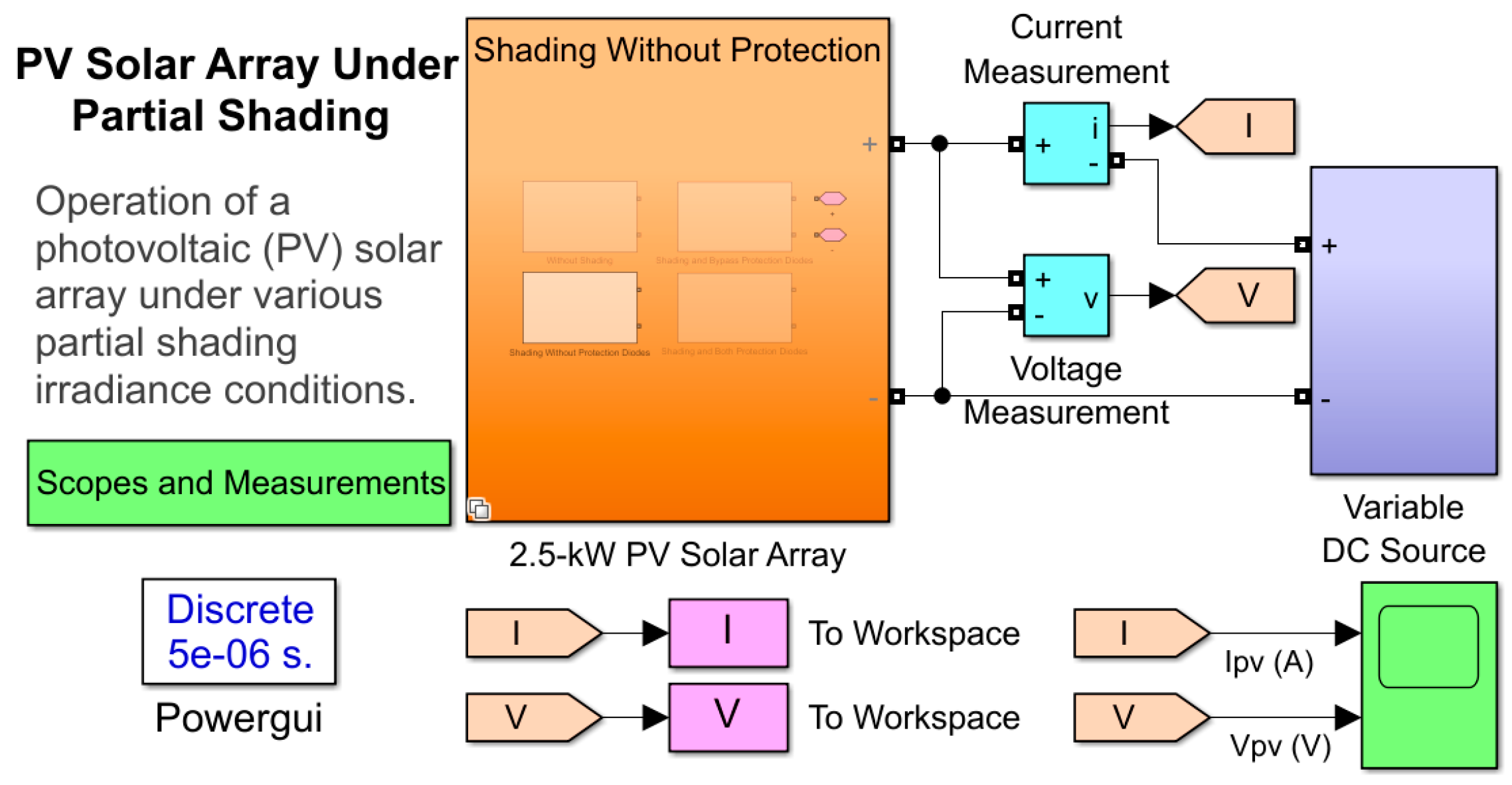
Figure 2.
Diagram of variant subsystems of 2.5-kW solar PV array during studied case studies.
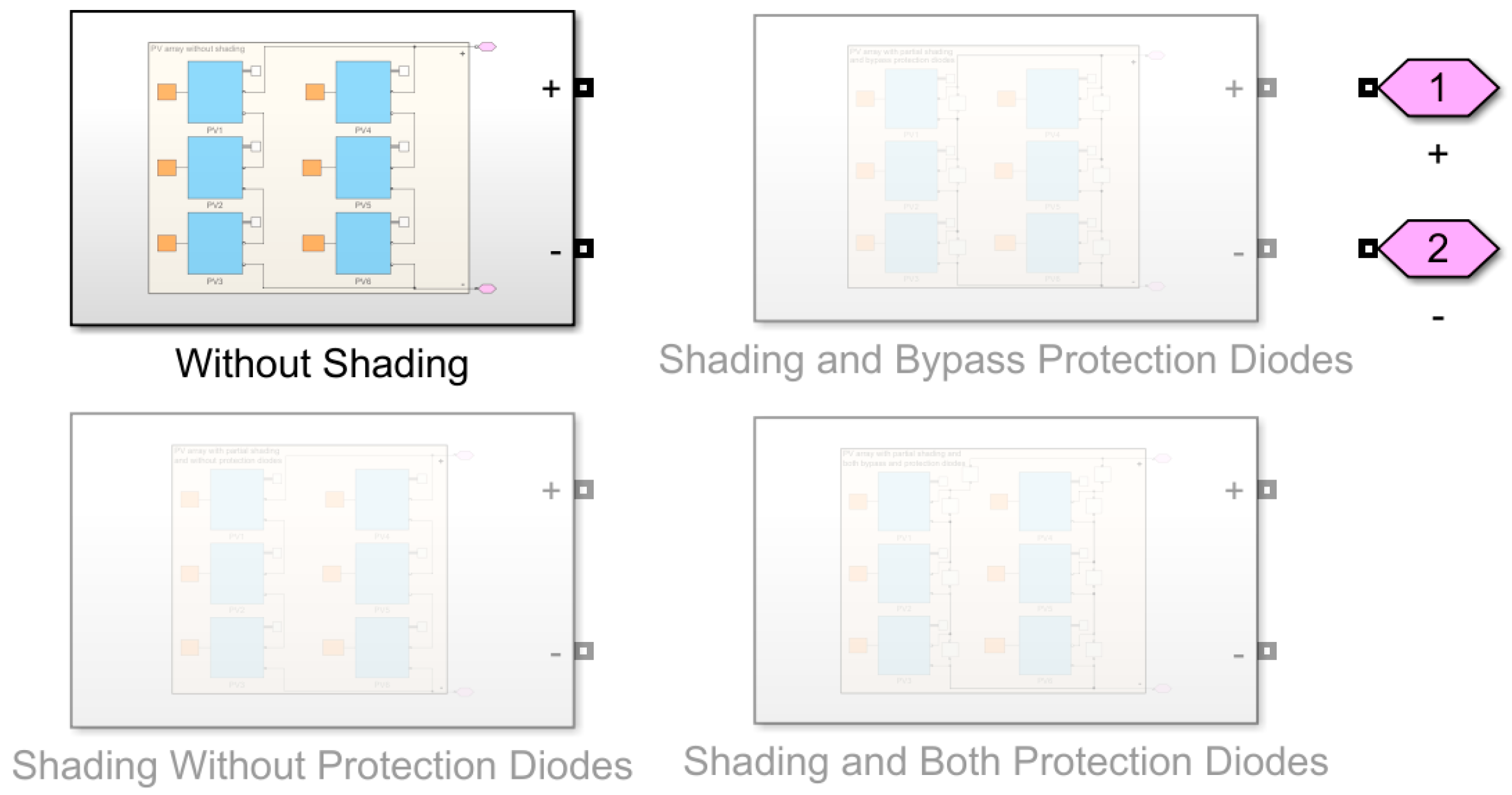
Figure 3.
Diagram of implemented subsystems of 2.5-kW PV solar array strings without shading (case study 1).
Figure 3.
Diagram of implemented subsystems of 2.5-kW PV solar array strings without shading (case study 1).

Figure 4.
Diagram of implemented subsystem of 2.5-kW PV solar array strings with partial shading and without protection diodes (case study 2).
Figure 4.
Diagram of implemented subsystem of 2.5-kW PV solar array strings with partial shading and without protection diodes (case study 2).
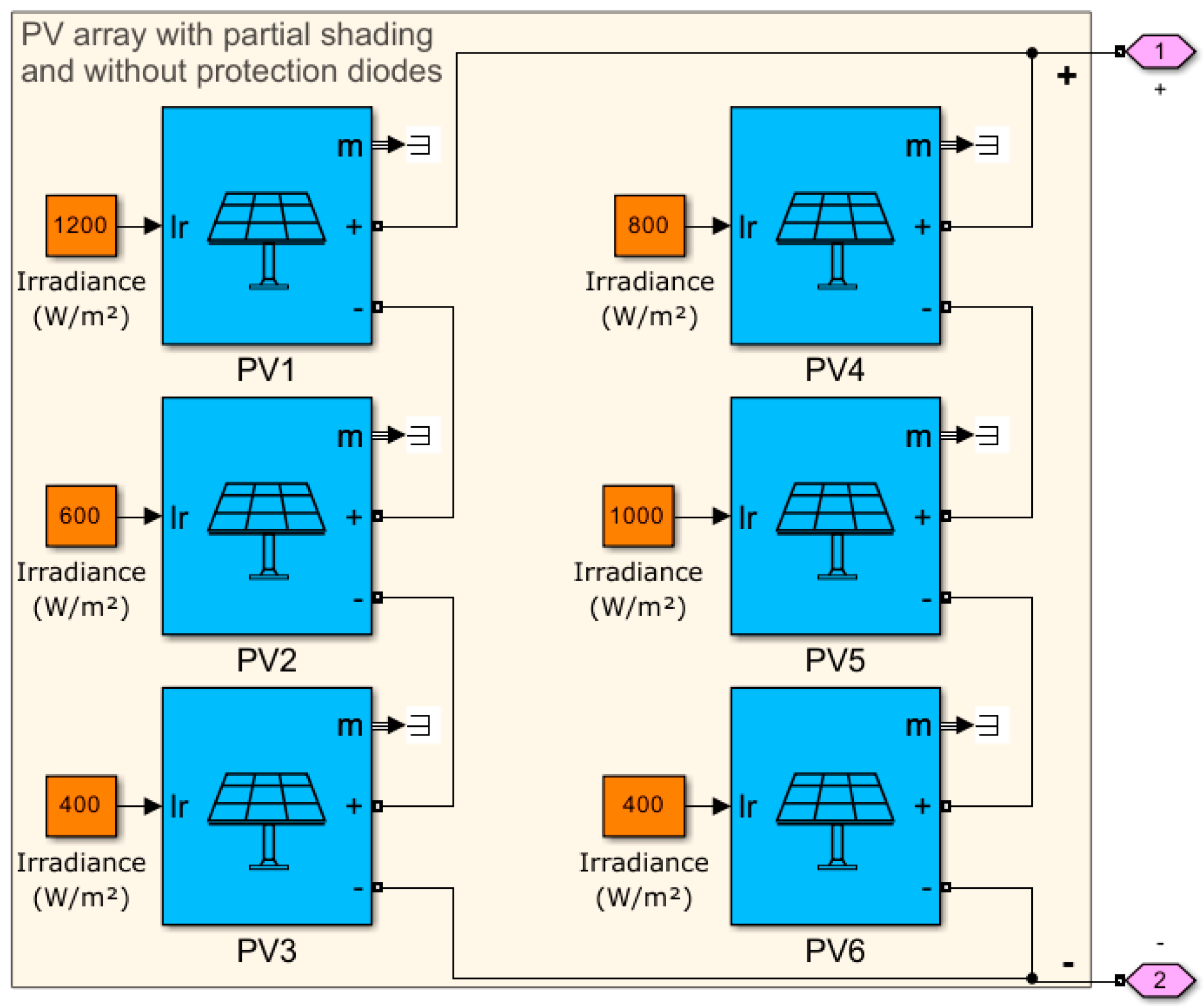
Figure 5.
Diagram of implemented subsystem of 2.5-kW PV solar array strings with partial shading and bypass protection diodes (case study 3).
Figure 5.
Diagram of implemented subsystem of 2.5-kW PV solar array strings with partial shading and bypass protection diodes (case study 3).
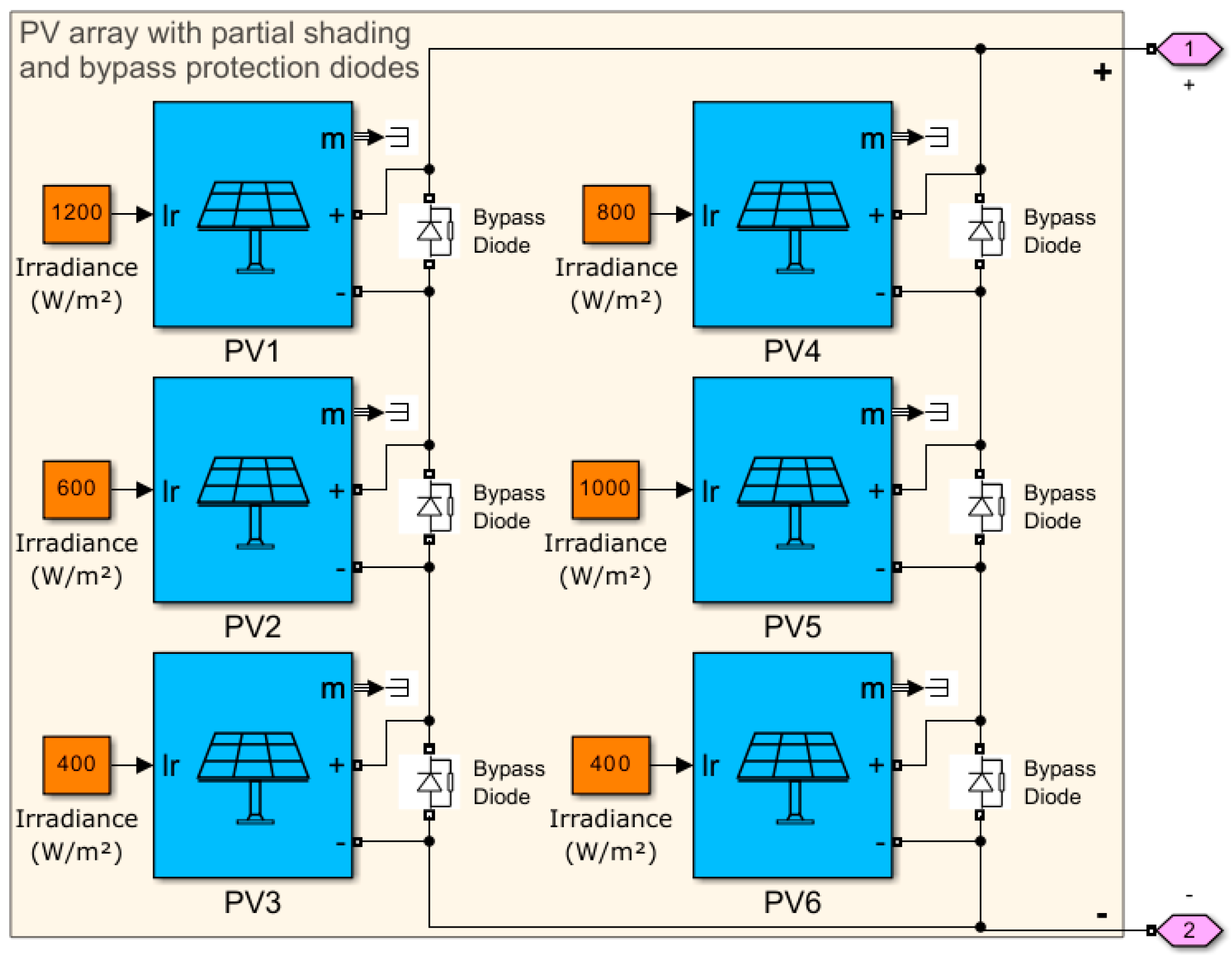
Figure 6.
Diagram of implemented subsystem of 2.5-kW PV solar array strings with partial shading and both bypass and blocking protection diodes (case study 4).
Figure 6.
Diagram of implemented subsystem of 2.5-kW PV solar array strings with partial shading and both bypass and blocking protection diodes (case study 4).

Figure 7.
I-V and P-V characteristics of the studied 2.5-kW PV solar array: (a) PV solar array under different irradiances; (b) PV solar array under different temperatures.
Figure 7.
I-V and P-V characteristics of the studied 2.5-kW PV solar array: (a) PV solar array under different irradiances; (b) PV solar array under different temperatures.
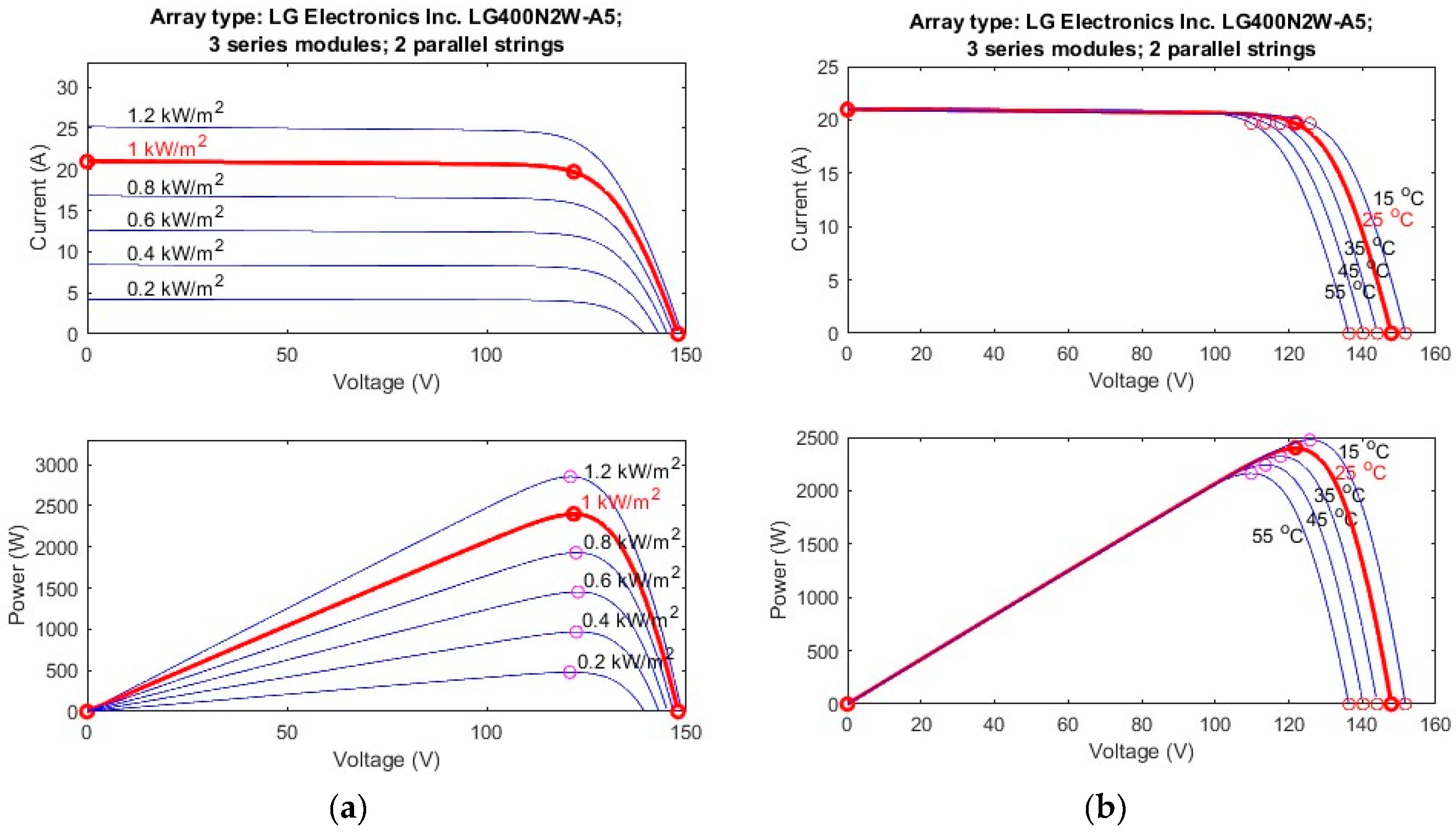
Figure 8.
P-V characteristic of studied solar PV array under partial shading conditions.
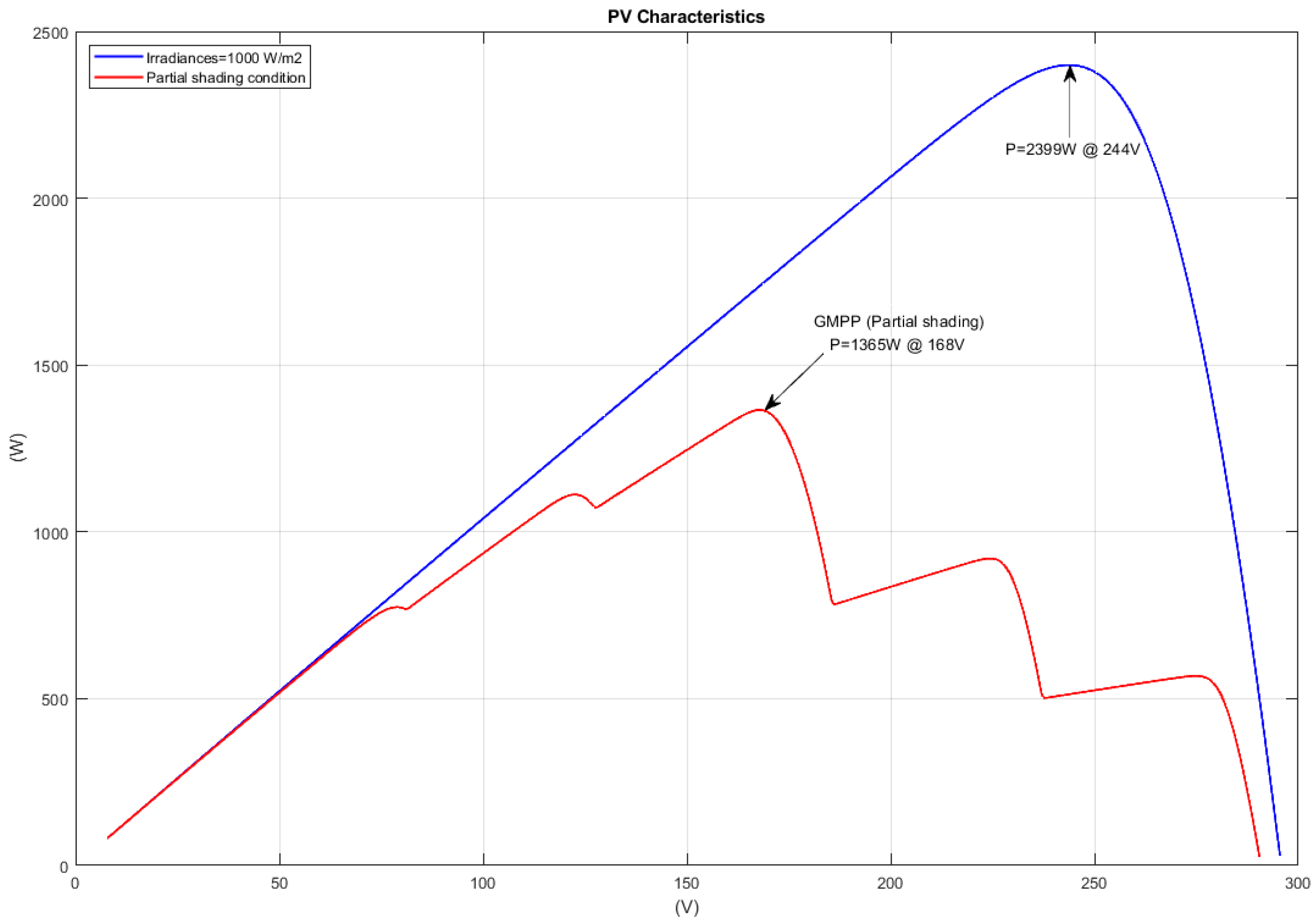
Figure 9.
Global I-V and P-V characteristics of studied solar PV array under partial shading.
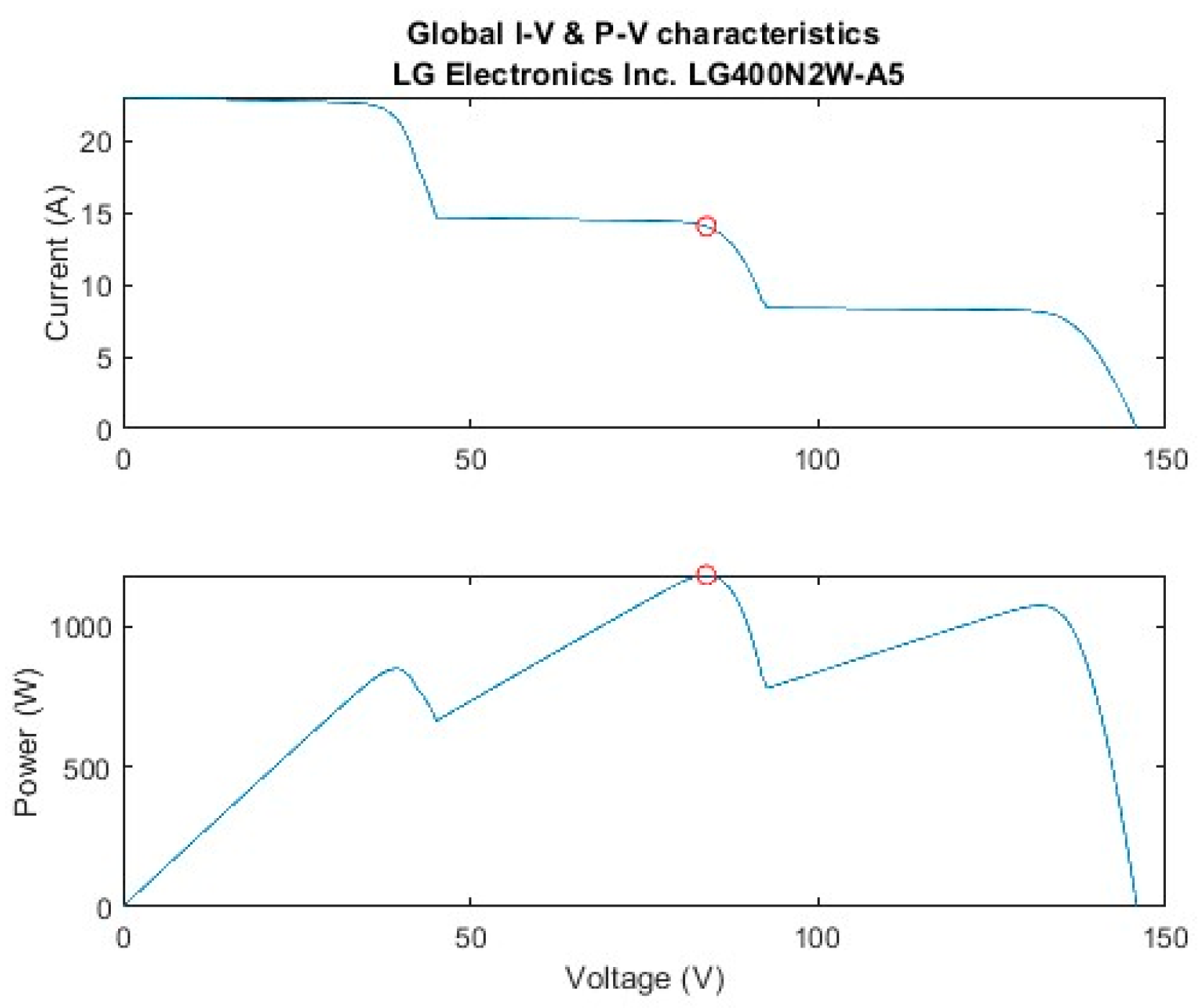
Figure 10.
I-V and P-V characteristics of studied PV solar array without shading under uniform irradiance and temperature.
Figure 10.
I-V and P-V characteristics of studied PV solar array without shading under uniform irradiance and temperature.
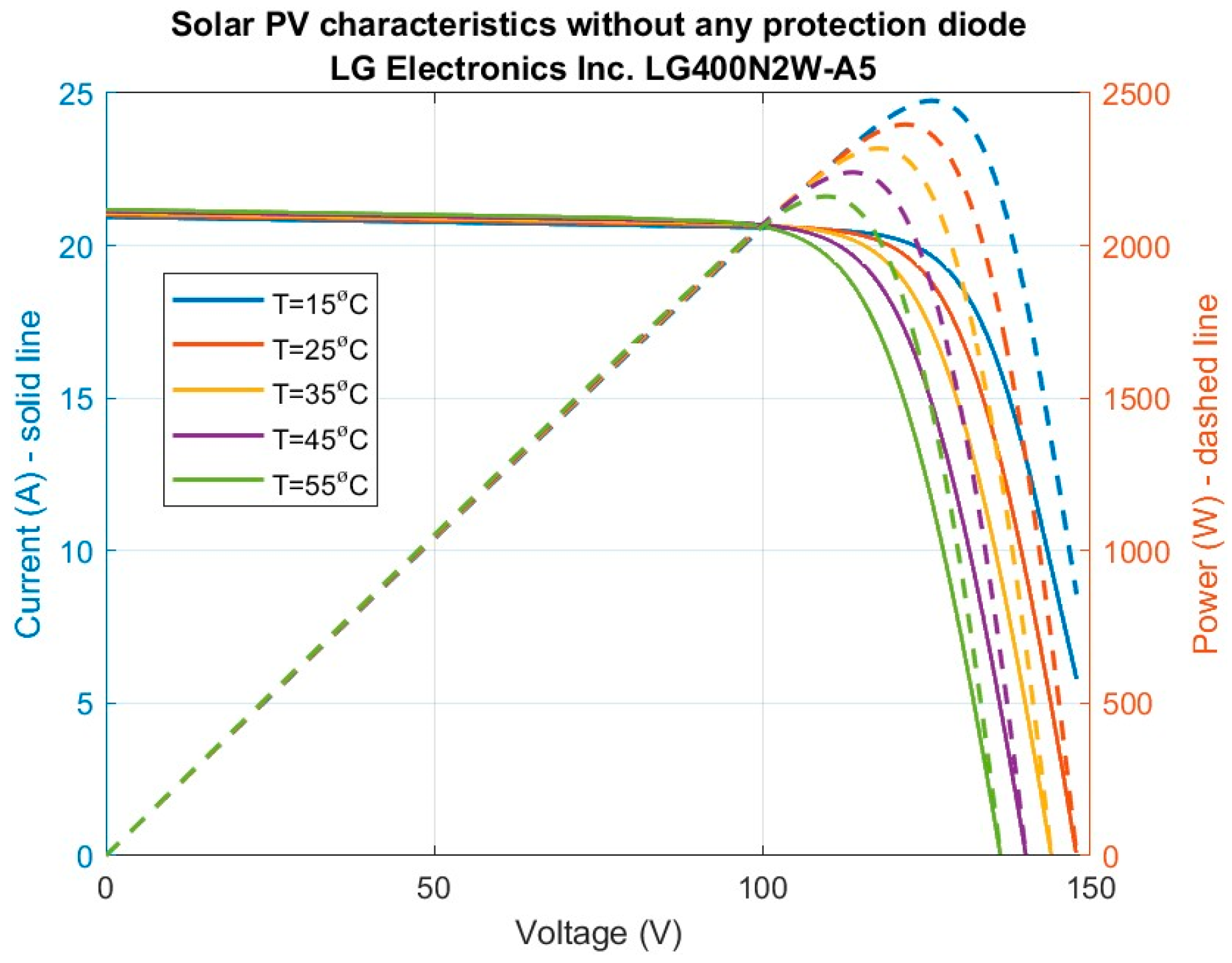
Figure 11.
I-V and P-V characteristics of studied PV solar array under shading and without protection diodes and different solar radiation across the PV solar modules.
Figure 11.
I-V and P-V characteristics of studied PV solar array under shading and without protection diodes and different solar radiation across the PV solar modules.
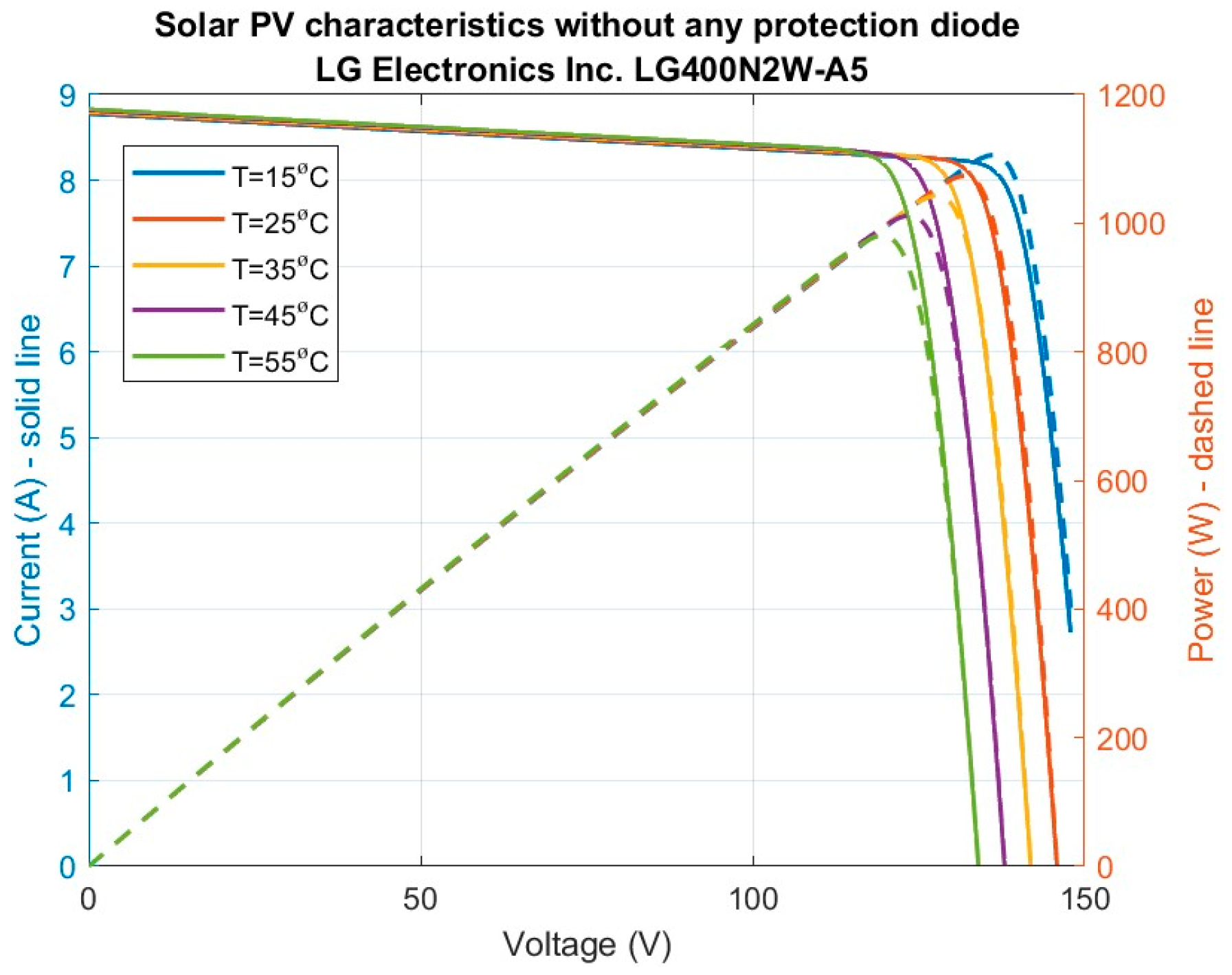
Figure 12.
I-V and P-V characteristics of studied PV solar array under shading and bypass protection diodes and different solar radiation across the PV solar modules.
Figure 12.
I-V and P-V characteristics of studied PV solar array under shading and bypass protection diodes and different solar radiation across the PV solar modules.
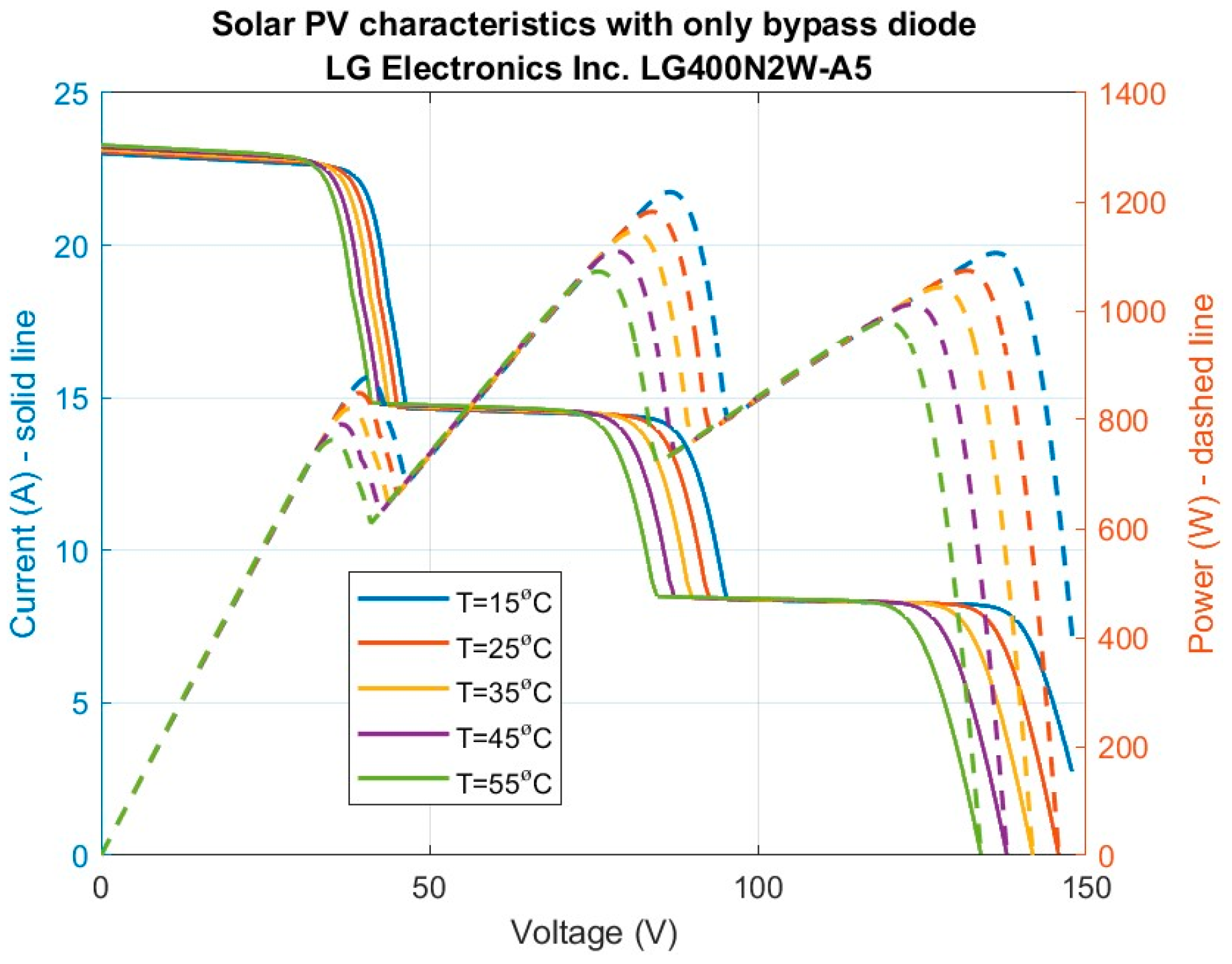
Figure 13.
I-V and P-V characteristics of studied PV solar array under shading and both bypass and blocking protection diodes and different solar radiation across the PV solar modules.
Figure 13.
I-V and P-V characteristics of studied PV solar array under shading and both bypass and blocking protection diodes and different solar radiation across the PV solar modules.
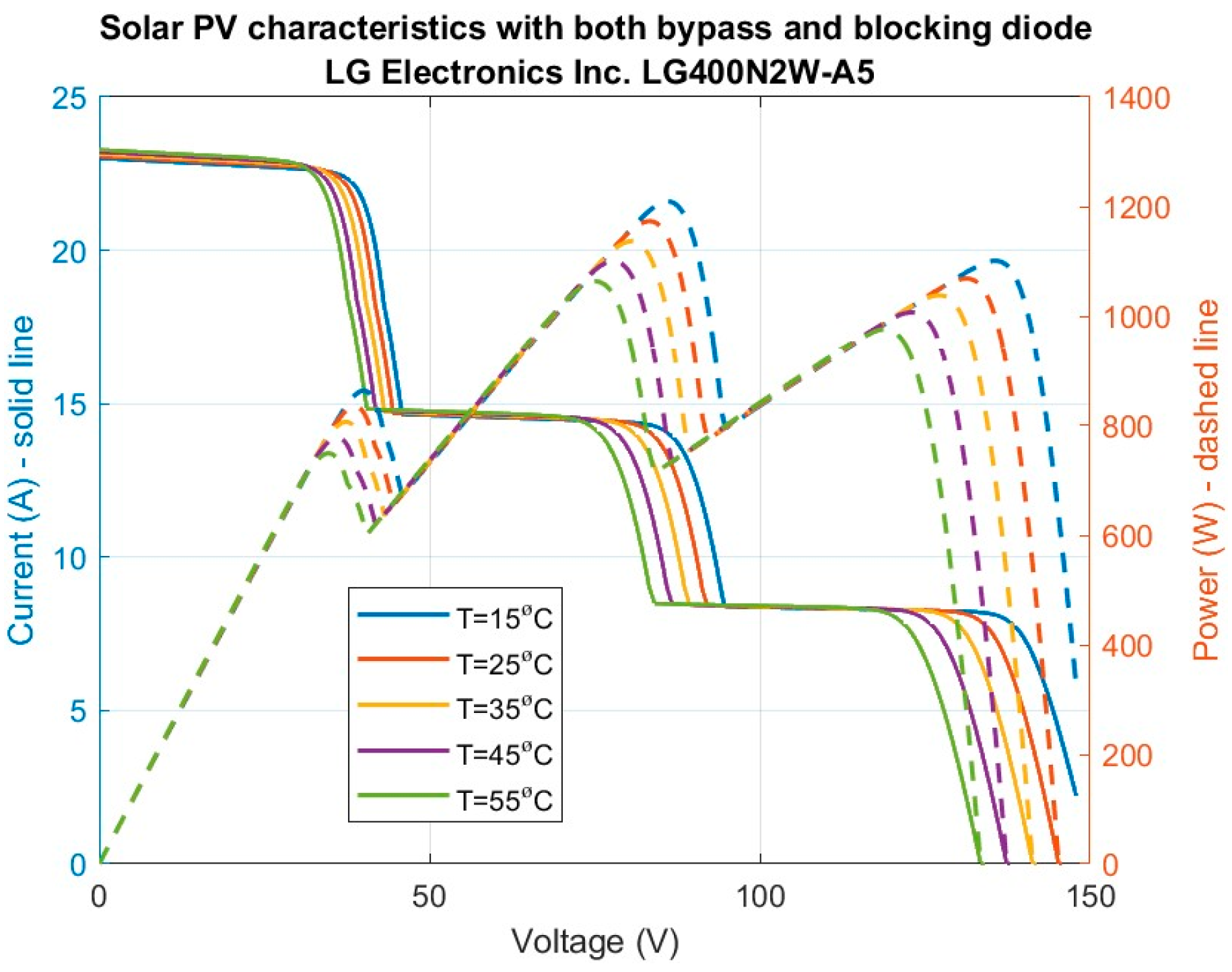

Table 1.
Electrical properties of LG Electronics Inc. LG400N2W-A5 PV solar module under STC.
| Parameter | Value |
|---|---|
| Maximum power (Pmax) | 400 W |
| MPP voltage (Vmpp) | 40.6 V |
| MPP current (Impp) | 9.86 A |
| Open circuit voltage (Voc) | 49.3 V |
| Short circuit current (Isc) | 10.47 A |
| Module efficiency (η) | 19.3% |
| Power tolerance | ±3% |
Table 2.
Output maximum power, voltage, and current of the studied PV solar array under partial shading conditions with and without protection diodes.
Table 2.
Output maximum power, voltage, and current of the studied PV solar array under partial shading conditions with and without protection diodes.
| Output Parameters | Case 1 | Case 2 | Case 3 | Case 4 |
|---|---|---|---|---|
| Maximum power (Pmax) | 2397.2 W | 1073.4 W | 1181.6 W | 1173 W |
| MPP voltage (Vmpp) | 121.92 V | 131.88 V | 83.958 V | 83.366 V |
| MPP current (Impp) | 19.662 A | 8.1393 A | 14.074 A | 14.071 A |
Disclaimer/Publisher’s Note: The statements, opinions and data contained in all publications are solely those of the individual author(s) and contributor(s) and not of MDPI and/or the editor(s). MDPI and/or the editor(s) disclaim responsibility for any injury to people or property resulting from any ideas, methods, instructions or products referred to in the content. |
© 2024 by the authors. Licensee MDPI, Basel, Switzerland. This article is an open access article distributed under the terms and conditions of the Creative Commons Attribution (CC BY) license (http://creativecommons.org/licenses/by/4.0/).
Copyright: This open access article is published under a Creative Commons CC BY 4.0 license, which permit the free download, distribution, and reuse, provided that the author and preprint are cited in any reuse.


