

Submitted:
15 February 2024
Posted:
16 February 2024
You are already at the latest version
Abstract
This study introduces a novel nanocomposite coating composed of PANI/CeO2 nanocomposite films, aimed at addressing corrosion protection needs. Analysis through FTIR spectra and XRD patterns confirms the successful formation of the nanocomposite films. Notably, the PANI/CeO2 nanocomposite films exhibit a hydrophilic nature. The bandgap energy of the PANI composite film measures at 3.74 eV, while the introduction of CeO2 NPs into the PANI matrix reduces the bandgap energy to 3.67 eV. Furthermore, the electrical conductivity of the PANI composite film is observed to be 0.40 S.cm-1, with the incorporation of CeO2 NPs leading to an increase in electrical conductivity to 1.07 S.cm-1. To evaluate its efficacy, electrochemical measurements were conducted to assess the corrosion protection performance. Results indicate a high protection efficiency of 92.25% for the PANI/CeO2 nanocomposite film.
Keywords:
corrosion protection
; protonated polyaniline (PANI)
; cerium dioxide (CeO2)
; optical bandgap energy
; electrical conductivity
Introduction
The corrosion of metals has been one of the essential problems that faced scientific and industrial societies. There is a lot of attention from these societies to develop long-life corrosion protection coating [1,2].
Polyaniline (PANI) is one of the most promising conductive polymers that is used in the fabrication of corrosion protective coating due to its good redox recyclability, variable electrical conductivity, and good environmental stability [3]. PANI nanocomposites is used as an exhilarating technique to enhance the corrosion protection performance significantly. This could be attributed to the fact that PANI composite coating triggers the redox action in an extensive range of pH values and increases corrosion protection performance [4,5,6].
Several works have elaborated on techniques to enhance the corrosion protection of PANI coating by introducing ceria nanoparticles (CeO2 NPs) [7]. M. Hosseini and K. Aboutalebi [8] reported that incorporating epoxy coating with CeO2@PANI@MBT significantly enhances the corrosion protection performance of mild steel substrates. In addition, M. Montemor et al. [9] and L. Calado et al. [10] reported that modifying silane film and siloxane film by CeO2NPs enhances corrosion protection and film stability. Y. Lei et al. [11] concluded that PANI/CeO2 nanocomposite coating could be a potential candidate to improve the protection performance of the epoxy coating on carbon steel.
In our research, we introduce an innovative nanocomposite coating comprising PANI/CeO2 nanocomposite films tailored for corrosion protection applications. We delve into a comprehensive analysis of the chemical, structural, morphological, and surface wettability properties of these PANI/CeO2 nanocomposite films. Furthermore, we explore the impact of incorporating CeO2 into the PANI matrix on the thermal stability of the composite. Detailed investigations into the optical and electrical properties, including absorption coefficient, bandgap energy, and electrical conductivity, provide valuable insights. Additionally, we conduct a thorough examination of the corrosion protection performance of PANI/CeO2 nanocomposite films across varying temperatures, shedding light on their efficacy in real-world conditions.
2. Methods
2.1. Materials
The samples used in this study were prepared from the following materials: Polyaniline (PANI, emeraldine base, 50,000 g/mol), camphor sulfonic acid (CSA, 232.30 g/mol), N-Methyl-2-Pyrrolidone (NMP, 99.133 g/mol), Ferric oxide nanoparticles (Fe3O4NPs, 50-100 nm particle size), cerium dioxide nanoparticles (CeO2NPs of size less than 50 nm). All the materials were purchased from Sigma Aldrich (formally Millipore Sigma).
2.2. Synthesis technique
To prepare PANI composite solution, 0.5 g Polyaniline and 0.12 g CSA were dissolved in 100 mL NMP. The mixture was subjected to a vigorous magnetic stirring overnight at 55 °C. To obtain a homogenous solution,
PANI composite solution was sonicated at 55 °C for three hours. Moreover, solution mixed method was utilized to synthesize PANI/CeO2 NPs nanocomposite solutions. Under magnetic stirring for five hours, five wt.% of CeO2 was added separately to PANI composite solution at room temperature.
The resulting PANI/CeO2 nanocomposite solutions were sonicated for 3 hours at room temperature. To obtain the desired investigated structures, we employed casting technique to deposit PANI and PANI/CeO2 nanocomposite films on ITO and steel substrates. To prevent any modifications on the surface morphology and to ensure complete drying of all residuals, the deposited films were dried at 40 °C at ambient condition overnight
2.2. Characterization methods
The chemical, structural, and morphological characterizations were conducted using FTIR microscope (HYPERION 3000 Bruker), XRD (Malvern Panalytical Ltd.), and SEM micrographs (Quanta FEG 450), respectively. Thermogravimetric analysis (TGA, NETZSCH) was utilized to investigate thermal stability of the as prepared PANI and PANI/CeO2 thin films. A UV–Vis spectrophotometer (Hitachi U-3900H) with a total internal sphere was used to obtain and interpret the optical properties. A four-point probe (Microworld Inc.) hocked up to a high-resolution Keithley 2450 Sourcemeter was employed to measure and interpret the electrical conductivity. The corrosion protection performance was investigated using the polarization method.
3. Results and Discussion
The chemical, structural, and morphological characteristics of PANI and PANI/CeO2 nanocomposite films were investigated and interpreted using the FTIR absorbance spectra (Figure 1), XRD patterns (Figure 2), SEM images and water contact angle measurements (Figure 3). Figure 1 displays the FTIR spectra of PANI and PANI/CeO2 nanocomposite films in 500-4000 cm-1 spectral range. For protonated PANI film, the C = N iminoquinone vibrational band appears at 660 cm-1 [12]. Additionally, the absorption band at 825 cm-1 is assigned to the aromatic rings. This is a strong evidence of the formation of the polymer [13]. The vibrational band that appears at 950 cm−1 refers to group, ratifying the PANI protonation with CSA. Furthermore, the in-plane C - H bending vibrations within the quinoid unit (N = Q = N) appear at 1125 cm−1. Also, the aromatic C − N stretching vibrations appear in the 1300-1500 cm-1 spectral range [14]. The C - N stretching vibrations inside benzenoid (N - B - N) and quinoid (N = Q = N) rings are located at 1541 and 1651 cm-1, respectively. The absorption bands beyond 3000 cm-1 indicate the N - H stretching vibrations [14]. Incorporation of CeO2 NPs into the protonated PANI films strongly moved the vibrational bands to the higher region of the spectrum. This strong shift is mainly attributed to the difference in the electronegativity between CeO2 NPs and the PANI molecules.
Figure 2 shows the XRD patterns of PANI and PANI/CeO2 nanocomposite films in the 10°-50° angular range. Clearly, the crystal structure of PANI is mainly determined by the synthesis conditions and the type of the protonic acid [15]. Protonated PANI film shows diffraction peaks at 14.97°, 20.72°, and 25.38° corresponding to (011), (001), and (110) diffraction crystallographic planes [16]. Additionally, a diffraction peak located at 27.86° associated with the CSA, confirming the protonation of PANI. The semi-crystalline protonated PANI with CSA has two phases. Namely, the phase in which the polymer chains are ordered (crystalline phase), and the phase in which the polymer chains are randomly distributed (amorphous phase) [17]. On the contrary, the protonated PANI/CeO2 nanocomposite film exhibits an amorphous phase.
Figure 3 demonstrates the 1 μm scaled-SEM micrographs and water contact angle (WCA) measurements for PANI and PANI/CeO2 nanocomposite films. As can be clearly seen, the protonated PANI film shows a rod-like shape with a WCA of 38°, indicating that the protonated PANI film has a hydrophilic nature (Figure 3a). Adding CeO2 NPs into the PANI matrix leads to the decrease of the grain sizes as well as the WCA (24°) (Figure 3b).
The absorption spectra of PANI and PANI/CeO2 nanocomposite films were investigated. The absorption coefficient can be expressed as, [18,19]. The parameters , , and stands for the transmittance, reflectance, and film thickness, respectively. The parameter exhibits a sudden decrease from 0.01 to 0.003 as incident wavelength increases from 300 to 350 nm. Beyond , it attains a constant vales as demonstrated by Figure 4. The vibration band appears between 400 and 480 nm is related to the superposition of the π-π* transition within the benzoin ring with the confined polarons (polaron-π*) transition [20]. Introducing CeO2 NPs into the PANI composite matrix increases in the visible region and shifts the absorption edge into the red region. The bandgap energy of both PANI and PANI/CeO2 nanocomposite films was calculated using the Tauc plot method[21,22]. The bandgap energy of the PANI composite film was calculated to be 3.74 eV. Introducing CeO2 NPs into the PANI matrix decreases the bandgap energy to 3.67 eV.
The two PANI and PANI/CeO2 nanocomposite thin films samples are characterized electrically
By measuring electrical conductivity using a 4-point probe at 12 distinct points. The measured electrical conductivity of the PANI composite film is found to be 0.40 S.cm-1. The considerably large conductivity could be attributed to the strong acid-doping of CSA, which provides additional charge carriers by protonating the imine nitrogen of the PANI backbone [23]. Incorporation of CeO2NPs into the PANI composite film more than doubles the electrical conductivity to 1.07 S.cm-1. To obtain a deeper insight into electrical conductivity values, the electrical conductivity maps (1 cm x 1 cm) of PANI and PANI/CeO2 nanocomposite films are measured and presented in Figure 5. Careful examination of (Figure 5a) indicates significant variation of the conductivity across PANI composite film caused by substantial surface morphology alterations as well as the quality and conditions of the growth process. Introducing CeO2NPs into the PANI composite matrix considerably changes the conductivity distribution. This could be attributed to the dispersion of each type of nanoparticle in the PANI matrix (Figure 5b).
Polarization method was used to elucidate the corrosion rate of PANI and PANI/CeO2 nanocomposite films. The corrosion test was evaluated in 3.5 wt.% NaCl solution at a temperature of 298 K (Figure 6a). The corrosion potential () and corrosion current () were evaluated at the junction where the tangent of the anodic and cathodic polarization curves intersect. The corrosion rate of the nanocomposite films can be calculated using [24,25], where is a parameter equals to , stands for the molecular weight of carbon steel, is the density of carbon steel. The parameters , and CR of electrochemical measurements are tabulated in Table 1. It can be seen that the corrosion rate of PANI-coated carbon steel is lower than the corrosion rate of bare carbon. In addition, incorporating PANI with CeO2 decreases the corrosion rate. The lowest corrosion rate is found for PANI/CeO2 nanocomposite films (0.112 mm/year). The protection efficiency ((%)) can be calculated using , where the parameter represents corrosion current of bare carbon steel and stands for the corrosion current of the nanocomposite coated carbon steel [26]. The higher protection efficiency was obtained for PANI/CeO2 nanocomposite films with a value of 92.25%.
The corrosion rate of PANI and PANI/CeO2 nanocomposite films were calculated in the 298-338 K temperature range (Figure 6b). As the temperature of the electrochemical reaction is increased, the corrosion rate for all nanocomposite films increases. This increase is a direct consequence of the enhanced electrochemical reaction rates as well as the increase in the kinetic energy of the molecules in the electrolyte solution. Therefore, the diffusion rate of the molecules is significantly increased. To clarify the thermal activated processes of the corrosion reactions [27], the corrosion rates of PANI and PANI/CeO2 nanocomposite films versus the reciprocal of temperature (1000/T[K]) are illustrated in Figure 6c. As can be clearly seen, corrosion rates exhibit Arrhenius-like behavior () [28]. This means that the corrosion rate of bare carbon steel and carbon steel coating by PANI, PANI/ZrO2, PANI/Fe3O4, and PANI/(ZrO2-Fe3O4) nanocomposite films are thermally activated. The activation energies deduced by Arrhenius fitting are tabulated in Table 1. Obviously, the highest activation energy is obtained for PANI/CeO2 nanocomposite film. Thus, the effect of temperature on the corrosion rate of PANI/CeO2 nanocomposite film is more pronounced than for other investigated samples.
Figure 7 illustrates the effect of coating on the Nyquist and the Bode plots of PANI and PANI/CeO2 nanocomposite films immersed in 3.5 wt.% NaCl at 298 K. In the Nyquist plot, the curves have single capacity arcs with large radii for PANI/CeO2 nanocomposite films compared to bare carbon steel and PANI film (Figure 7a), indicating the resistance of these nanocomposites is very high. The coating has an exceptional physical barrier influence on the electrolyte. The Z value in the Bode diagram at 0.1 Hz increases from 652 Ω.cm-2 for bare steel to 1900 Ω.cm-2 for PANI/CeO2 nanocomposite film. Thus, coating the carbon steel by PANI/CeO2 nanocomposite film enhances the corrosion resistance (Figure 7b).
4. Conclusions
This work reports the results on a novel nanocomposite coating of PANI/CeO2 nanocomposite film for corrosion protection applications. FTIR spectra and XRD patterns confirm the formation of the nanocomposite films. Water contact angle measurements confirm that PANI/CeO2 nanocomposite film has a hydrophilic nature. Therefore, the films are capable of interacting with water through hydrogen bonding. Optical measurements reveal that bandgap energy of the PANI composite film is 3.74 eV. Introducing CeO2 NPs into the PANI matrix decreases the bandgap energy to 3.67 eV. Consequently, bandgap engineering in PANI/CeO2 nanocomposite film could be a powerful technique for the design of new materials and devices based on this novel material. In addition, band diagrams with continuous bandgap variations can be generated in heterojunctions designed from this novel material and fabricated using techniques such as molecular beam epitaxy. The electrical conductivity measurements reveal that PANI composite film exhibits an electrical conductivity of 0.40 S.cm-1. Introducing CeO2 NPs into the PANI composite film increases the electrical conductivity by more than two-fold to 1.07 S.cm-1. The corrosion protection performance was investigated using electrochemical measurements. The protection efficiency of PANI/CeO2 nanocomposite film is 92.25%. In general, the efficiency of an inhibitor increases with an increase in inhibitor concentration. Obtaining excellent inhabitation for incorporating 5 wt.% of CeO2 in PANI nanocomposite films is very promising for corrosion protection applications.
Author Contributions
Conceptualization: Ahmad Alsaad, Mohannad Al-Hmoud, Ahmad D. Telfah; Methodology: Ahmad Alsaad, Mohannad Al-Hmoud, Mohammad W. Marashdeh, Ahmad D. Telfah; Investigation: Ahmad M. Alsaad, Mohannad Al-Hmoud, Taha M. Rababah, Mohammad W. Marashdeh, Mamduh J. Aljaafreh, Sharif Abu Alrub , Ayed Binzowaimil , and Ahmad Telfah; Data curation: Ahmad M. Alsaad, Mohannad Al-Hmoud, Taha M. Rababah, Mohammad W. Marashdeh, Mamduh J. Aljaafreh, Sharif Abu Alrub , Ayed Binzowaimil , and Ahmad Telfah; Formal analysis: Ahmad Alsaad, Mohannad Al-Hmoud, Ahmad D. Telfah; Writing – original draft: Ahmad M. Alsaad, Mohannad Al-Hmoud, Taha M. Rababah, Mohammad W. Marashdeh, Mamduh J. Aljaafreh, Sharif Abu Alrub, Ayed Binzowaimil, and Ahmad Telfah; Writing – review & editing: Ahmad M. Alsaad, Mohannad Al-Hmoud, Taha M. Rababah, Mohammad W. Marashdeh, Mamduh J. Aljaafreh, Sharif Abu Alrub, Ayed Binzowaimil, and Ahmad Telfah; Funding acquisition: Ahmad Alsaad, Mohannad Al-Hmoud; Project administration: Ahmad Alsaad, Mohannad Al-Hmoud; Resources: Ahmad M. Alsaad, Mohannad Al-Hmoud, Taha M. Rababah, Mohammad W. Marashdeh, Mamduh J. Aljaafreh, Sharif Abu Alrub, Ayed Binzowaimil, and Ahmad Telfah; Supervision: Ahmad Alsaad, Mohannad Al-Hmoud, Ahmad D. Telfah; Validation: Ahmad M. Alsaad, Mohannad Al-Hmoud, Taha M. Rababah, Mohammad W. Marashdeh, Mamduh J. Aljaafreh, Sharif Abu Alrub , Ayed Binzowaimil , and Ahmad Telfah; Visualization: Ahmad M. Alsaad, Mohannad Al-Hmoud, Taha M. Rababah, Mohammad W. Marashdeh, Mamduh J. Aljaafreh, Sharif Abu Alrub , Ayed Binzowaimil , and Ahmad Telfah. All authors have read, reviewed and agreed to the submitted version of the manuscript.
Data Availability Statement
The data that support the findings of this study are available on request from the corresponding author, [Ahmad Alsaad].
Conflicts of Interest
All the authors of this manuscript declare no conflict of interest.
Data availability
Unprocessed data were available upon request from the corresponding author.
Acknowledgments
This work was supported and funded by the Deanship of Scientific Research at Imam Mohammad Ibn Saud Islamic University (IMSIU) (grant number IMSIU-RP23104).
References
- Ramezanzadeh, B.; Moghadam, M.M.; Shohani, N.; Mahdavian, M. Effects of highly crystalline and conductive polyaniline/graphene oxide composites on the corrosion protection performance of a zinc-rich epoxy coating. Chemical Engineering Journal 2017, 320, 363–375. [Google Scholar] [CrossRef]
- Taheri, N.N.; Ramezanzadeh, B.; Mahdavian, M.; Bahlakeh, G. In-situ synthesis of Zn doped polyaniline on graphene oxide for inhibition of mild steel corrosion in 3.5 wt.% chloride solution. Journal of industrial and engineering chemistry 2018, 63, 322–339. [Google Scholar] [CrossRef]
- Natarajan, T.S.; Tsai, C.-H.; Huang, H.-L.; Ho, K.-S.; Lin, I.; Wang, Y.-F. Fabrication of polyaniline coated plasma modified polypropylene filter for antibioaerosol application. Aerosol and Air Quality Research 2016, 16, 1911–1921. [Google Scholar] [CrossRef]
- Qiu, G.; Zhu, A.; Zhang, C. Hierarchically structured carbon nanotube–polyaniline nanobrushes for corrosion protection over a wide pH range. Rsc Advances 2017, 7, 35330–35339. [Google Scholar] [CrossRef]
- Ramezanzadeh, B.; Bahlakeh, G.; Ramezanzadeh, M. Polyaniline-cerium oxide (PAni-CeO2) coated graphene oxide for enhancement of epoxy coating corrosion protection performance on mild steel. Corrosion Science 2018, 137, 111–126. [Google Scholar] [CrossRef]
- Hayatgheib, Y.; Ramezanzadeh, B.; Kardar, P.; Mahdavian, M. A comparative study on fabrication of a highly effective corrosion protective system based on graphene oxide-polyaniline nanofibers/epoxy composite. Corrosion Science 2018, 133, 358–373. [Google Scholar] [CrossRef]
- Abdeslam, M.; Hichem, B.; Youcef, H. Synthesis of polyaniline/CeO2 nanocomposites as inhibitor coating on zinc: Evaluation of the corrosion behaviour. Proceedings of International Conference on Scientific and Innovative Studies; pp. 282–288.
- Hosseini, M.G.; Aboutalebi, K. Enhancement the anticorrosive resistance of epoxy coatings by incorporation of CeO2@ polyaniline@ 2-mercaptobenzotiazole nanocomposite. Synthetic Metals 2019, 250, 63–72. [Google Scholar] [CrossRef]
- Montemor, M.; Ferreira, M. Cerium salt activated nanoparticles as fillers for silane films: Evaluation of the corrosion inhibition performance on galvanised steel substrates. Electrochimica Acta 2007, 52, 6976–6987. [Google Scholar] [CrossRef]
- Calado, L.M.; Taryba, M.G.; Carmezim, M.J.; Montemor, M.F. Self-healing ceria-modified coating for corrosion protection of AZ31 magnesium alloy. Corrosion Science 2018, 142, 12–21. [Google Scholar] [CrossRef]
- Lei, Y.; Qiu, Z.; Tan, N.; Du, H.; Li, D.; Liu, J.; Liu, T.; Zhang, W.; Chang, X. Polyaniline/CeO2 nanocomposites as corrosion inhibitors for improving the corrosive performance of epoxy coating on carbon steel in 3.5% NaCl solution. Progress in Organic Coatings 2020, 139, 105430. [Google Scholar] [CrossRef]
- Daikh, S.; Zeggai, F.; Bellil, A.; Benyoucef, A. Chemical polymerization, characterization and electrochemical studies of PANI/ZnO doped with hydrochloric acid and/or zinc chloride: differences between the synthesized nanocomposites. Journal of Physics and Chemistry of Solids 2018, 121, 78–84. [Google Scholar] [CrossRef]
- Kulkarni, M.V.; Viswanath, A.K.; Marimuthu, R.; Seth, T. Spectroscopic, transport, and morphological studies of polyaniline doped with inorganic acids. Polymer Engineering & Science 2004, 44, 1676–1681. [Google Scholar]
- Chamroukhi, H.; Hamed, Z.B.; Telfah, A.; Bassou, M.; Zeinert, A.; Hergenröder, R.; Bouchriha, H. Optical and structural properties enhancement of hybrid nanocomposites thin films based on polyaniline doped with Zinc Oxide embedded in bimodal mesoporous silica (ZnO@ SiOX) nanoparticles. Optical Materials 2018, 84, 703–713. [Google Scholar] [CrossRef]
- Mazzeu, M.A.C.; Faria, L.K.; Cardoso, A.d.M.; Gama, A.M.; Baldan, M.R.; Gonçalves, E.S. Structural and morphological characteristics of polyaniline synthesized in pilot scale. Journal of Aerospace Technology and Management 2017, 9, 39–47. [Google Scholar] [CrossRef]
- Diggikar, R.S.; Deshmukh, S.P.; Thopate, T.S.; Kshirsagar, S.R. Performance of polyaniline nanofibers (PANI NFs) as PANI NFs-silver (Ag) nanocomposites (NCs) for energy storage and antibacterial applications. ACS Omega 2019, 4, 5741–5749. [Google Scholar] [CrossRef]
- Bhadra, S.; Khastgir, D. Determination of crystal structure of polyaniline and substituted polyanilines through powder X-ray diffraction analysis. Polymer Testing 2008, 27, 851–857. [Google Scholar] [CrossRef]
- Dhahri, I.; Ellouze, M.; Labidi, S.; Al-Bataineh, Q.M.; Etzkorn, J.; Guermazi, H.; Telfah, A.; Tavares, C.J.; Hergenröder, R.; Appel, T. Optical and structural properties of ZnO NPs and ZnO–Bi2O3 nanocomposites. Ceramics International 2022, 48, 266–277. [Google Scholar] [CrossRef]
- Hassanien, A.; Abdelhaleem, S.; Ahmad, R.; Schuster, M.; Moustafa, S.; Distaso, M.; Peukert, W.; Wellmann, P. Effect of fast annealing on structural characteristics and optical properties of Cu2ZnSnS4 absorber films deposited by doctor-blade technique. Journal of Nanoelectronics and Optoelectronics 2019, 14, 1394–1400. [Google Scholar] [CrossRef]
- Al-Bataineh, Q.M.; Shpacovitch, V.; Sadiq, D.; Telfah, A.; Hergenröder, R. Surface Plasmon Resonance Sensitivity Enhancement Based on Protonated Polyaniline Films Doped by Aluminum Nitrate. Biosensors 2022, 12, 1122. [Google Scholar] [CrossRef]
- Hassanien, A.S.; Neffati, R.; Aly, K. Impact of Cd-addition upon optical properties and dispersion parameters of thermally evaporated CdxZn1-xSe films: discussions on bandgap engineering, conduction and valence band positions. Optik 2020, 212, 164681. [Google Scholar] [CrossRef]
- Hassanien, A.; Atta, A.; Ward, A.A.; Ahmed, E.M.; Alsubaie, A.; El-Nahass, M.; Altalhi, T. Investigation of structural, electrical and optical properties of chitosan/fullerene composites. Materials Research Express 2019, 6, 125304. [Google Scholar] [CrossRef]
- Al-Gharram, M.; Jum'h, I.; Telfah, A.; Al-Hussein, M. Highly crystalline conductive electrodeposited films of PANI-CSA/CoFe2O4 nanocomposites. Colloids and Surfaces A: Physicochemical and Engineering Aspects 2021, 628, 127342. [Google Scholar] [CrossRef]
- Yang, S.; Zhu, S.; Hong, R. Graphene oxide/polyaniline nanocomposites used in anticorrosive coatings for environmental protection. Coatings 2020, 10, 1215. [Google Scholar] [CrossRef]
- Lin, Y.-T.; Don, T.-M.; Wong, C.-J.; Meng, F.-C.; Lin, Y.-J.; Lee, S.-Y.; Lee, C.-F.; Chiu, W.-Y. Improvement of mechanical properties and anticorrosion performance of epoxy coatings by the introduction of polyaniline/graphene composite. Surface and Coatings Technology 2019, 374, 1128–1138. [Google Scholar] [CrossRef]
- Al-Amiery, A.A.; Mohamad, A.B.; Kadhum, A.A.H.; Shaker, L.M.; Isahak, W.N.R.W.; Takriff, M.S. Experimental and theoretical study on the corrosion inhibition of mild steel by nonanedioic acid derivative in hydrochloric acid solution. Scientific Reports 2022, 12, 4705. [Google Scholar] [CrossRef]
- Almashhadani, H. Synthesis of a CoO–ZnO nanocomposite and its study as a corrosion protection coating for stainless steel in saline solution. Int. J. Corros. Scale Inhib 2021, 10, 1294–1306. [Google Scholar]
- Telfah, A.; Kalfe-Yildiz, A.; Al Bataineh, Q.M.; Jum'h, I.; Tavares, C.J.; Hergenröder, R. Thermal-dependent morphological evolution effect on ion transportation in polyethylene oxide films. Polymer 2023, 288, 126440. [Google Scholar] [CrossRef]
Figure 1.
The FTIR spectra of PANI and PANI/CeO2 nanocomposite films in the 500-4000 cm-1 spectral range.
Figure 1.
The FTIR spectra of PANI and PANI/CeO2 nanocomposite films in the 500-4000 cm-1 spectral range.
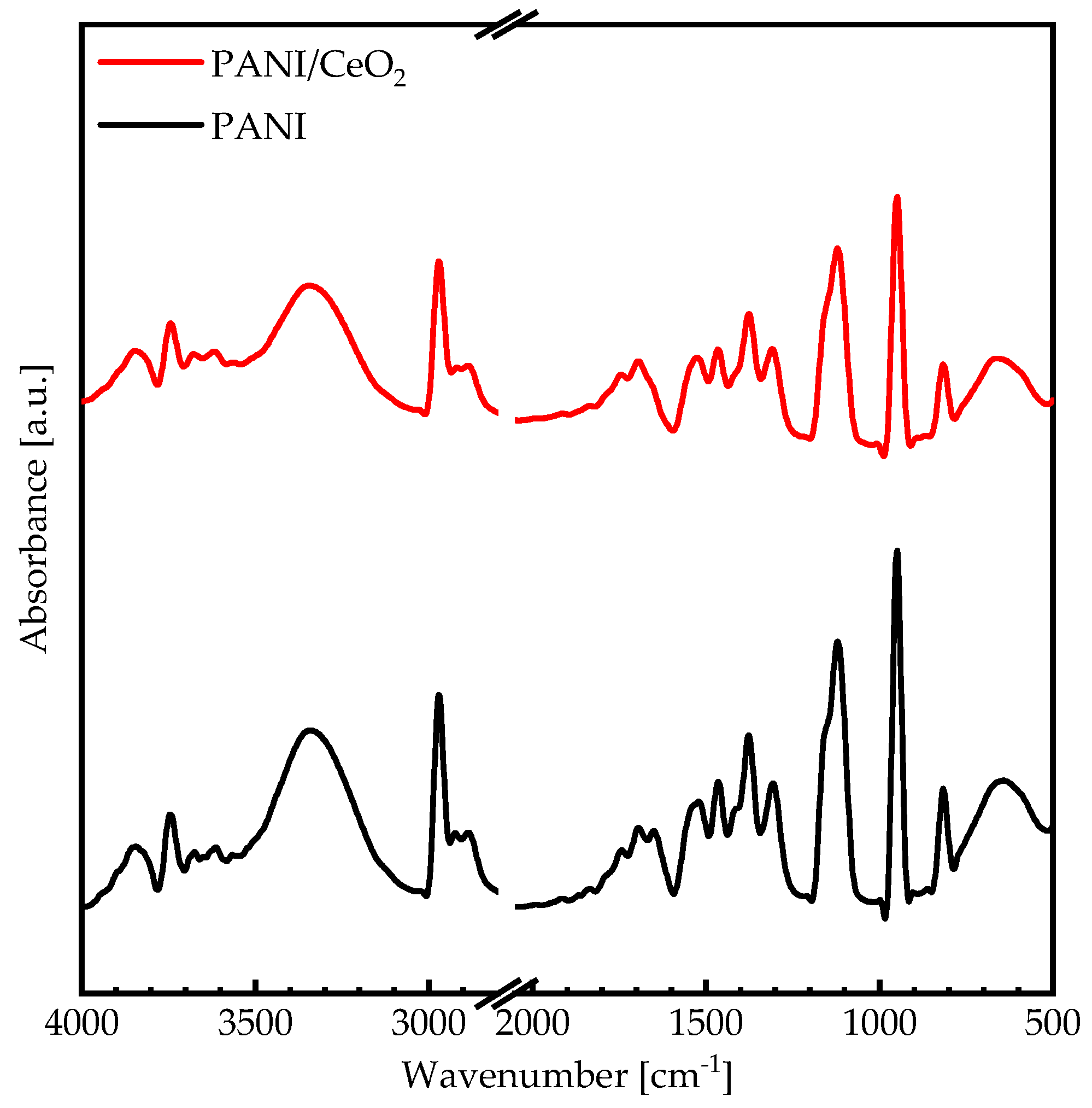
Figure 2.
The XRD patterns of PANI and PANI/CeO2 nanocomposite films in a diffraction angle range of 10°-50°.
Figure 2.
The XRD patterns of PANI and PANI/CeO2 nanocomposite films in a diffraction angle range of 10°-50°.
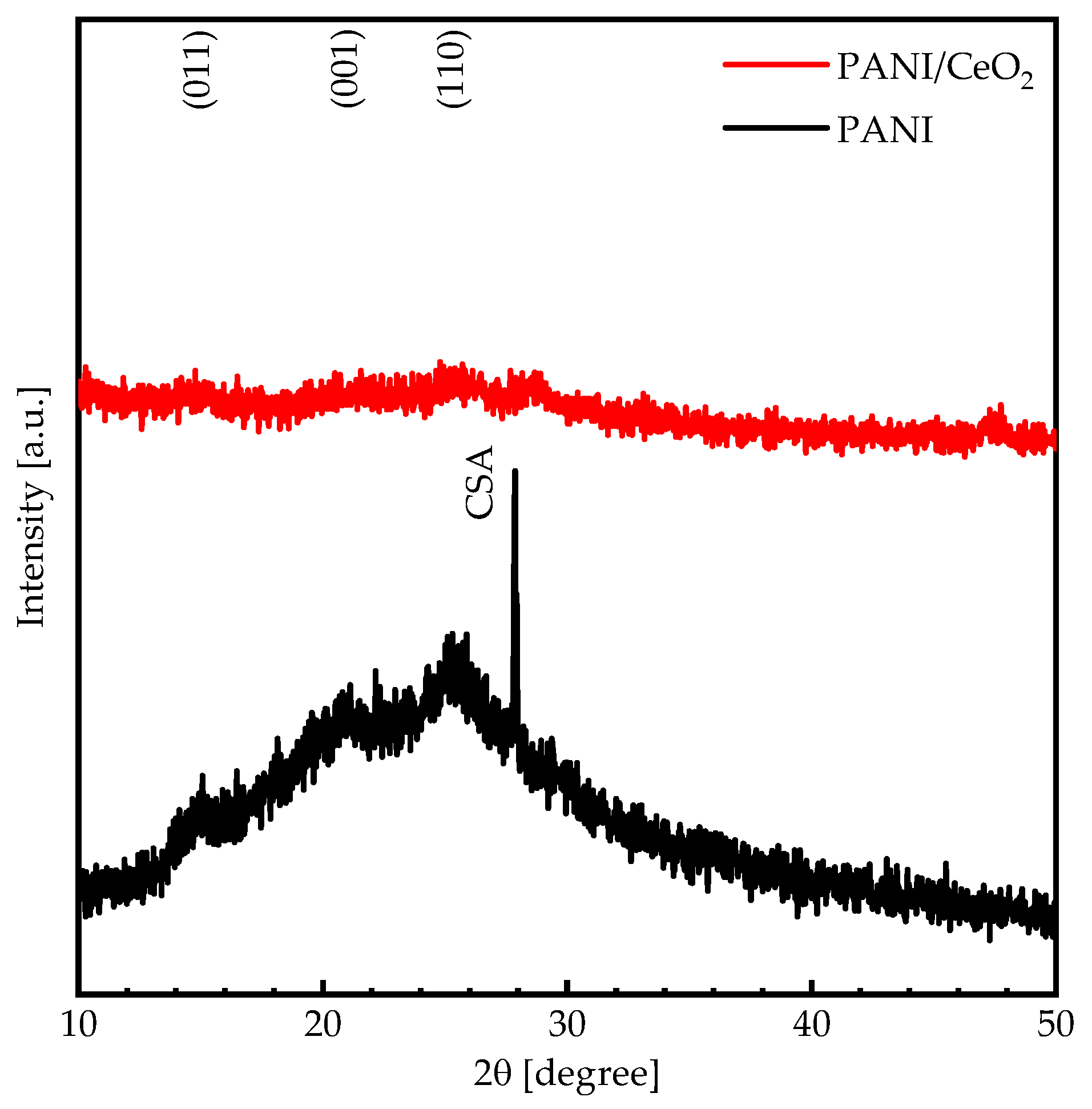
Figure 3.
SEM images of (a) PANI and (b) PANI/CeO2 nanocomposite films at 1 μm scale.
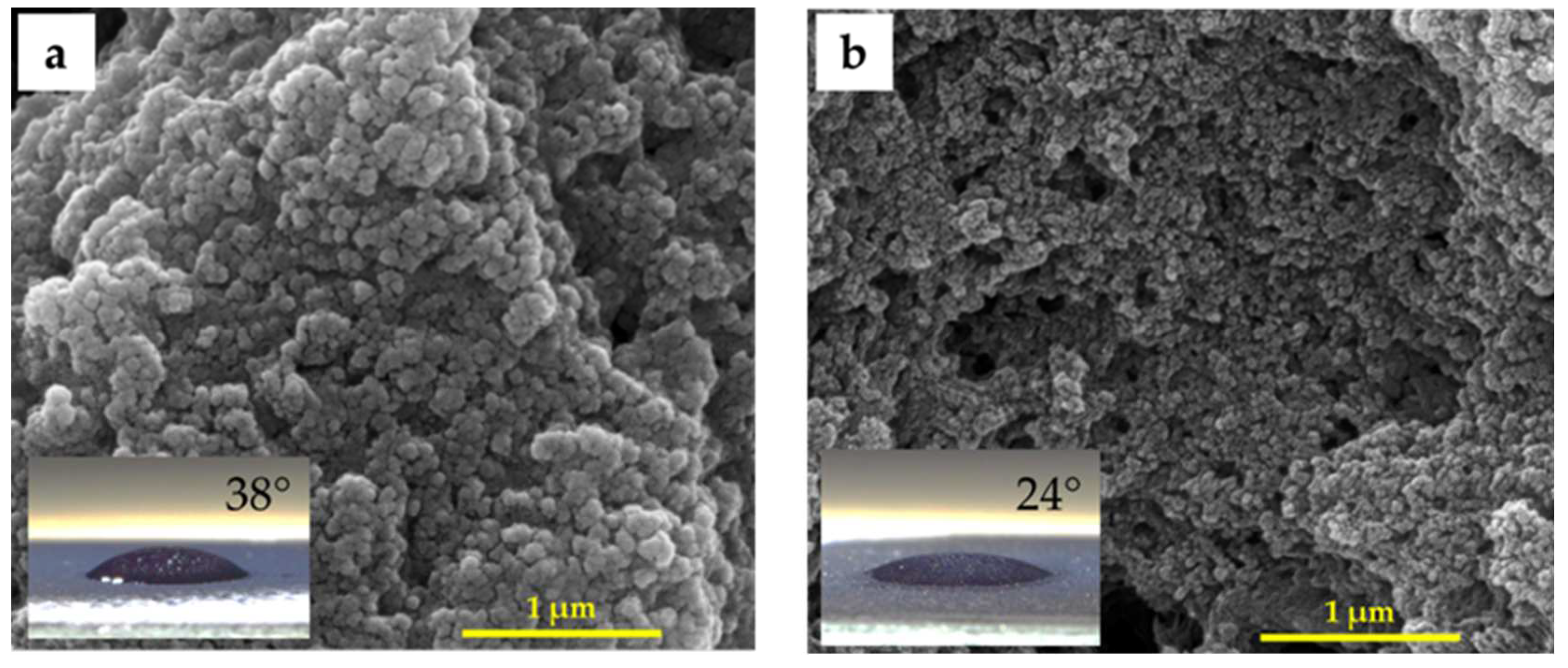
Figure 4.
Absorption coefficient spectra of PANI and PANI/CeO2 nanocomposite films.
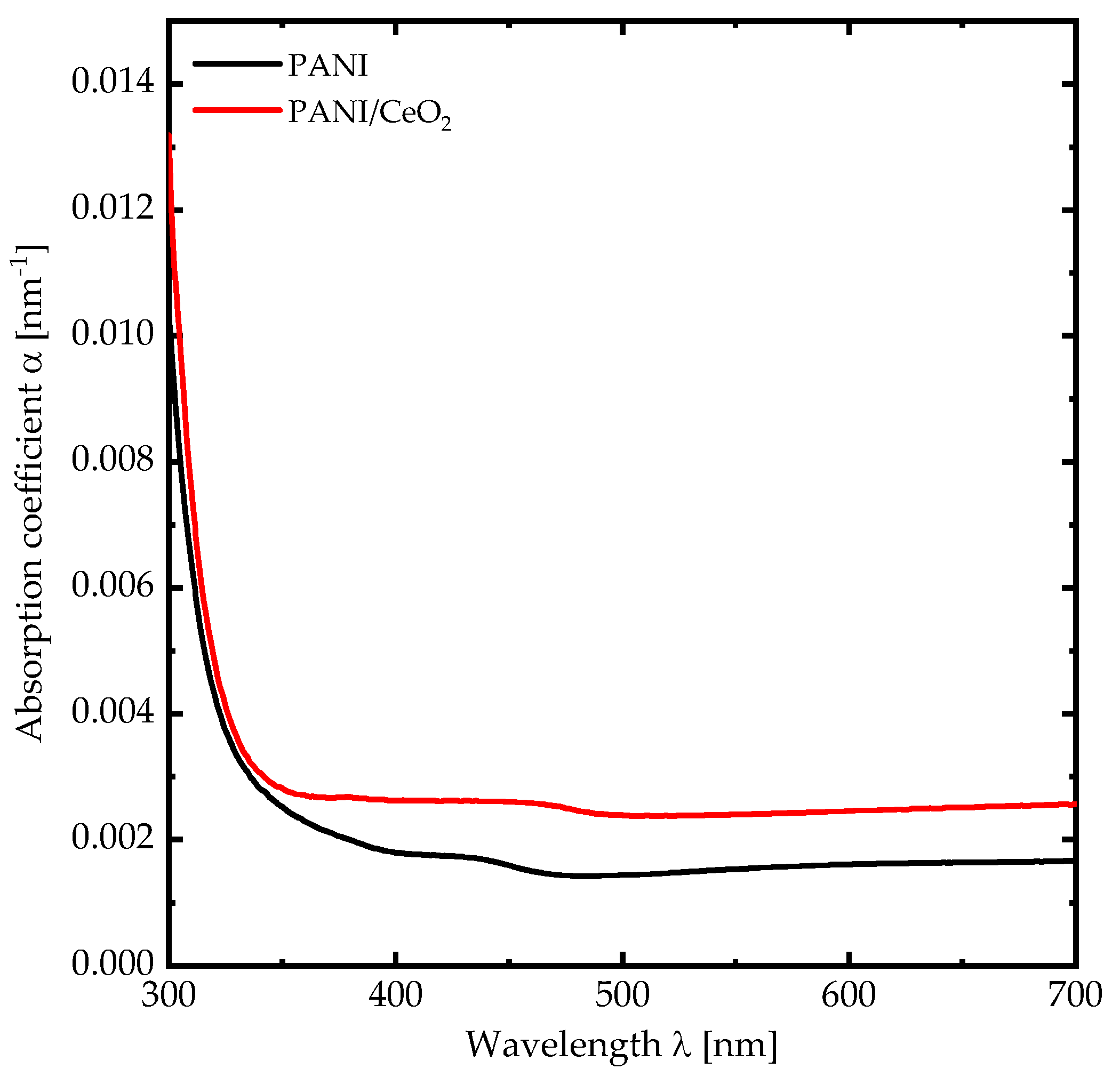
Figure 5.
The electrical conductivity maps of (a) PANI and (b) PANI/CeO2 nanocomposite films.
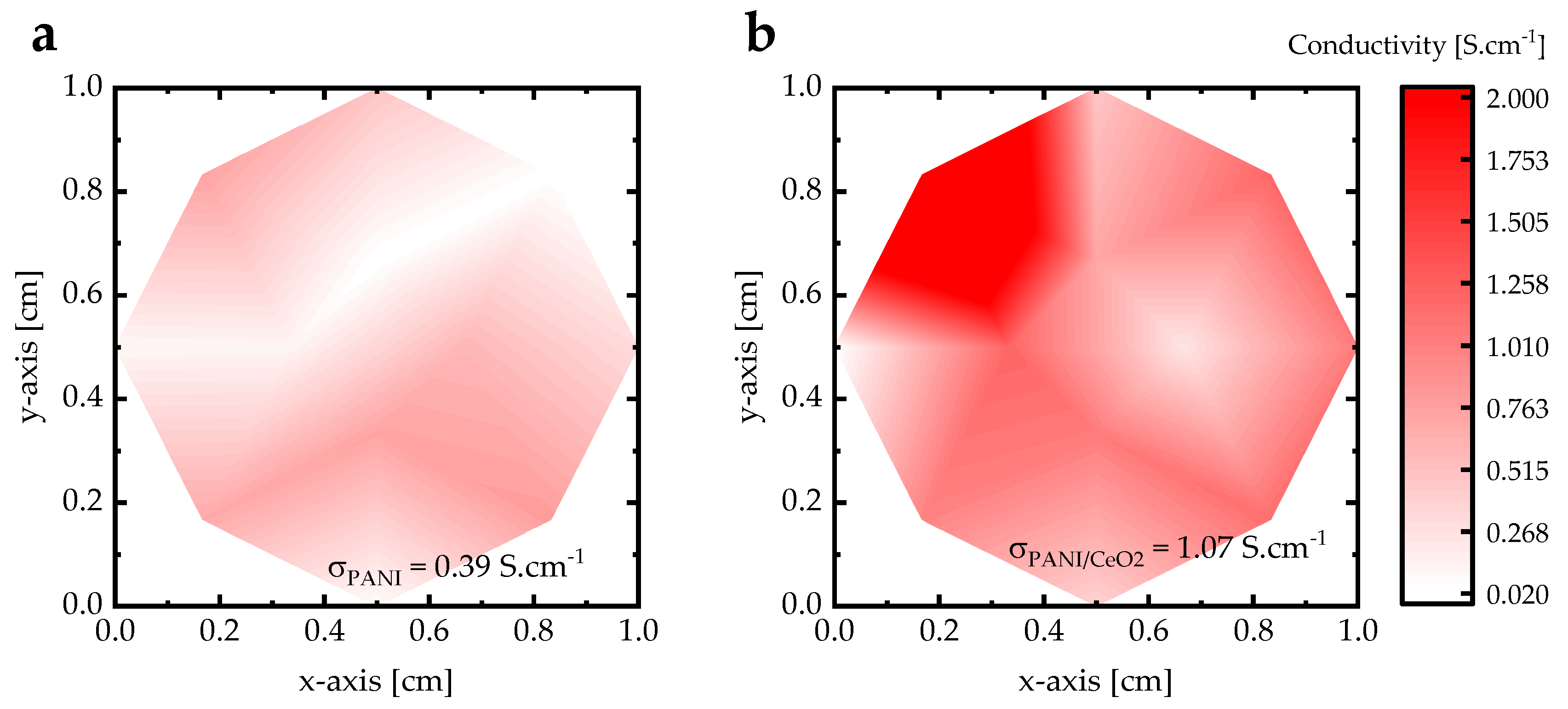
Figure 6.
(a) Tafel curve of carbon steel coated with PANI and PANI/CeO2 nanocomposite films at 298 K, (b) corrosion rate of carbon steel coated with PANI and PANI/CeO2 nanocomposite films as a function of temperature [K], and (c) corrosion rate of carbon steel coated with PANI and PANI/CeO2 nanocomposite films as a function of 1000/temperature [K] fitted to Arrhenius function.
Figure 6.
(a) Tafel curve of carbon steel coated with PANI and PANI/CeO2 nanocomposite films at 298 K, (b) corrosion rate of carbon steel coated with PANI and PANI/CeO2 nanocomposite films as a function of temperature [K], and (c) corrosion rate of carbon steel coated with PANI and PANI/CeO2 nanocomposite films as a function of 1000/temperature [K] fitted to Arrhenius function.
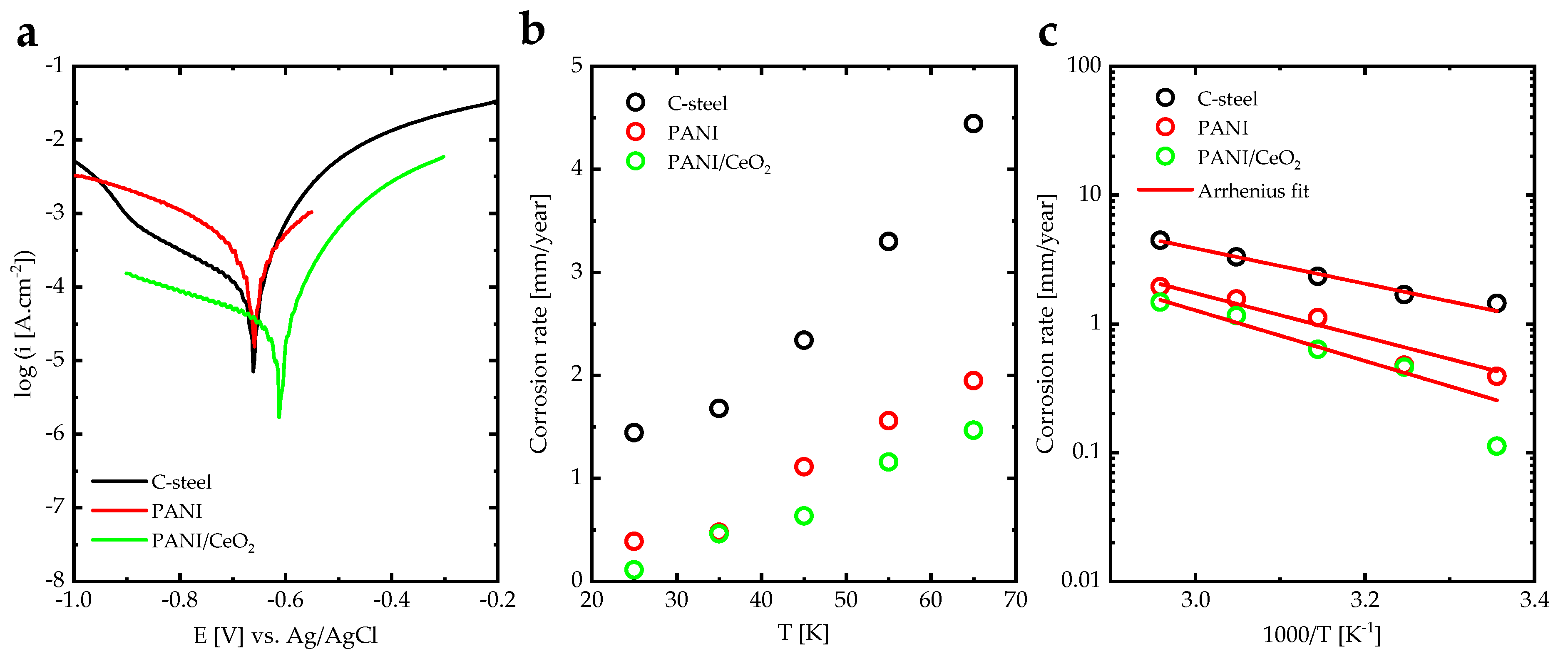
Figure 7.
(a) Nyquist and (b) Bode plots of carbon steel coated with PANI and PANI/CeO2 nanocomposite films at 298 K.
Figure 7.
(a) Nyquist and (b) Bode plots of carbon steel coated with PANI and PANI/CeO2 nanocomposite films at 298 K.
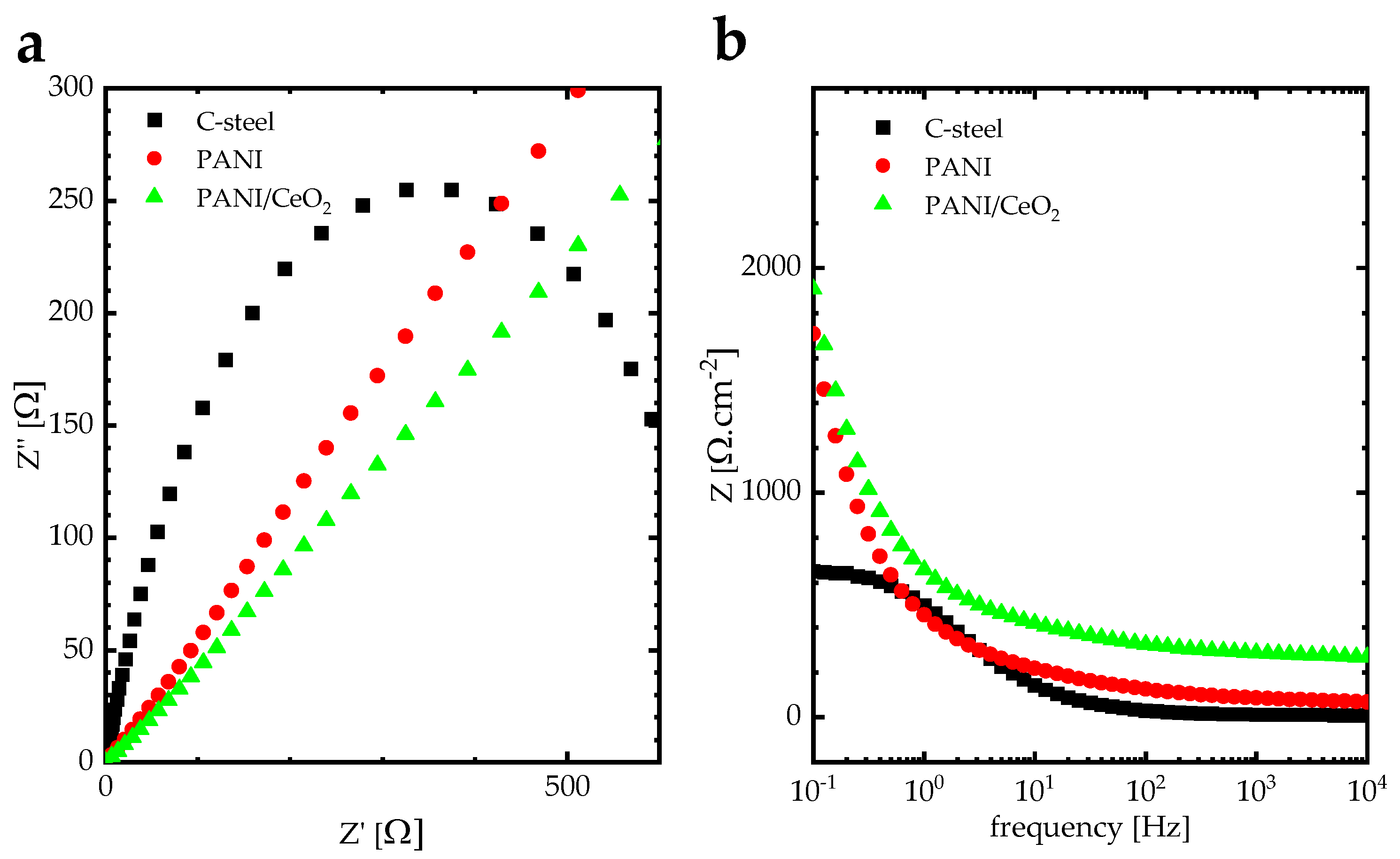

Table 1.
Electrochemical parameters values for carbon steel coated with PANI and PANI/CeO2 nanocomposite films at 298 K values calculated from Tafel plots.
Table 1.
Electrochemical parameters values for carbon steel coated with PANI and PANI/CeO2 nanocomposite films at 298 K values calculated from Tafel plots.
| C-Steel | PANI | PANI/CeO2 | |
|---|---|---|---|
| CR [mm/year] | 1.445 | 0.390 | 0.112 |
| (%) | -- | 72.90 | 92.25 |
| [eV] | 0.27 | 0.34 | 0.39 |
Disclaimer/Publisher’s Note: The statements, opinions and data contained in all publications are solely those of the individual author(s) and contributor(s) and not of MDPI and/or the editor(s). MDPI and/or the editor(s) disclaim responsibility for any injury to people or property resulting from any ideas, methods, instructions or products referred to in the content. |
© 2024 by the authors. Licensee MDPI, Basel, Switzerland. This article is an open access article distributed under the terms and conditions of the Creative Commons Attribution (CC BY) license (http://creativecommons.org/licenses/by/4.0/).
Copyright: This open access article is published under a Creative Commons CC BY 4.0 license, which permit the free download, distribution, and reuse, provided that the author and preprint are cited in any reuse.


