

Submitted:
08 February 2024
Posted:
09 February 2024
You are already at the latest version
Abstract
Snakebite envenomations (SBE) are a significant global public health threat due to their morbidi-ty and mortality. It is a neglected public health issue in many tropical and subtropical countries. Brazil is in the top ten countries affected by SBE, with 32,160 cases reported in Brazil only in 2020, posing a high burden for this population. We describe the data structure of the Snakebite data on Notifiable Disease Information System (SINAN) made available by the Brazilian Minis-try of Health from 2007 to 2020. In addition, we also provide R scripts that allow a quick and automatic updating of data from the SINAN according to its availability. The data presented in this work is related to clinical and demographic information of SBE cases. Also, data on out-comes, laboratory results, and treatment is available. The database is available and freely acces-sible; however, preprocessing, adjustments, and standardization are necessary due to incom-pleteness and inconsistencies. Regardless of these limitations, it provides a solid basis for as-sessing different aspects and the national burden of envenoming.
Keywords:
Snakebite envenomations
; information system
; database
1. Summary
Envenomation by snakebites is a significant global public health threat, especially in tropical countries, due to their morbidity and mortality 4.5–5.4 million people get bitten by snakes annually, 1.8–2.7 million develop clinical illnesses, and 81,000-138,000 die from complications (1,2).Despite the high mortality, the World Health Organization (WHO) still classifies envenomations as neglected due to low investments in research, control, and elimination (3,4). Brazil reports the highest number of snakebite cases in Latin America (5) and, unsurprisingly, is one of the countries with the most significant experience in diagnosing and treating snake envenomation. In 2020, 32,160 cases and 138 deaths by snake envenomation were recorded (6).
Envenomation from snakes, spiders, scorpions, caterpillars, bees, fishes, beetles, and ants requires compulsory notification in Brazil (5). Consequently, epidemiological data on envenomation, including clinical, laboratory, treatment, and demographic information, are available in the Information System of Notifiable Diseases (SINAN) from the Brazilian Ministry of Health platform through the Department of Informatics of the Unified Health System (DATASUS) (7–9). SINAN is available for health units across Brazil to both enter and query data. The system allows continuous data consolidation and supports health surveillance and prevention efforts, identifying public health concerns, providing valuable morbidity and risk assessment information, and prioritizing and evaluating control action impact (9). The microdata is made publicly available with no sensitive data (10). Therefore, it can be widely used in several epidemiological studies without submitting it to ethical boards (1,11). Despite the high availability, the data quality must be assessed for inconsistencies and completeness before any analysis (12,13). The data descriptor presented here aims to improve the availability of a high-quality, comprehensive national snakebite dataset, thus allowing for greater standardization and reproducibility of epidemiological studies.
2. Data Description
All data and R scripts associated with the dataset are stored in the figshare repository (15).
The final dataset consists of 74 attributes grouped into socio-demographic and clinical/laboratory variables detailed in Tables 1 and 2, respectively. The socio-demographic and clinical/laboratory characteristics are presented in Table 3. The envenomations occurred mainly in men (307,979/400,848 [77%]) and rural environments (317,749/395,686 [80%]). The prevalent local and systemic manifestations were pain (344,075/359,740 [96%]), edema (276,752 / 359,714 [77%]), neuroparalysis (23,258/66,150 [35%]), and vomiting and/or diarrhea (23,655/66,147 [36%]). Health care mainly was administered within six hours (316,011/390,644 (80.89%)); death caused by envenomation was the main outcome (1,615/362,643 [0.4%]) followed by cure (346,650/362,643 [96%]) and deaths from other causes (156 / 362,643 [<0.1%]).
As shown in Figure 2, slight variations can be seen along the timeline with an increase in the last two years (2019 and 2020). Also, most of the envenomation occurred among adults and was caused by the Bothrops genus, although significant numbers of other genera and non-venomous bites have been reported. Many cases without information on the specific snake were reported (Figure 3).
Figure 1.
presents the dataset processing steps. Legend: a) data gathering – original database divided by years and States (378 datasets), b) extraction and joining, c) intermediate dataset (2,422,825 records), d) filtering, e) intermediate dataset (400,848 registers), f) variable selection, g) intermediate dataset (74 variables), h) labeling, standardizing and final adjustments, and i) final dataset.
Figure 1.
presents the dataset processing steps. Legend: a) data gathering – original database divided by years and States (378 datasets), b) extraction and joining, c) intermediate dataset (2,422,825 records), d) filtering, e) intermediate dataset (400,848 registers), f) variable selection, g) intermediate dataset (74 variables), h) labeling, standardizing and final adjustments, and i) final dataset.
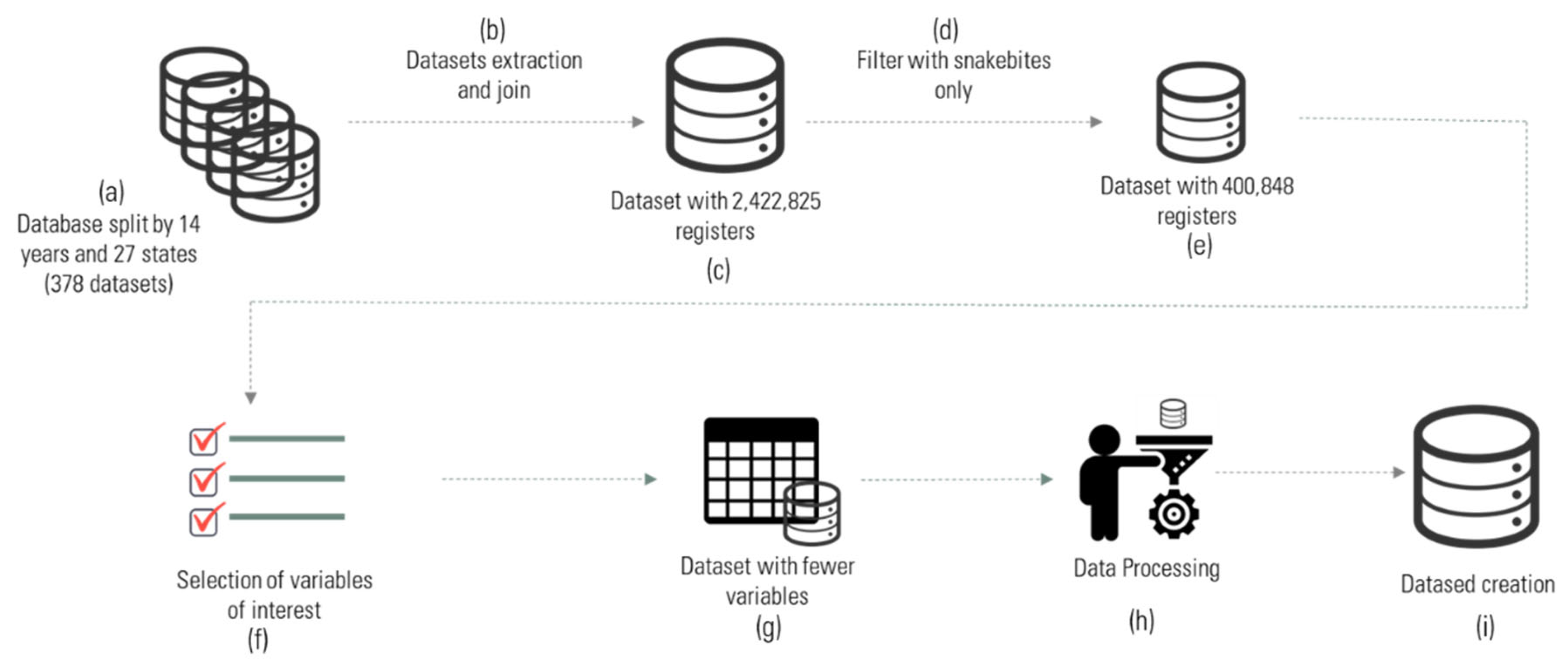
Figure 2 shows the number of records in the dataset by type of snakebite reported in Brazil from 2007 to 2020. Bothrops envenomations were frequent in all years. In 2020, the highest number of total cases (32,160) were recorded; the lowest number of total cases during the 14 years was recorded in 2014. The high frequency of ignored snake envenomation cases is noteworthy.
Figure 3 shows the age structure of reported cases in this dataset, divided into three categories: young (up to 18 years of age), adults (age between 20 and 59 years), and elderly (60 years and over).
Most cases were reported in the north and central west. As previously stated, most reports are from Bothrops and Lachesis genera (Figure 4).
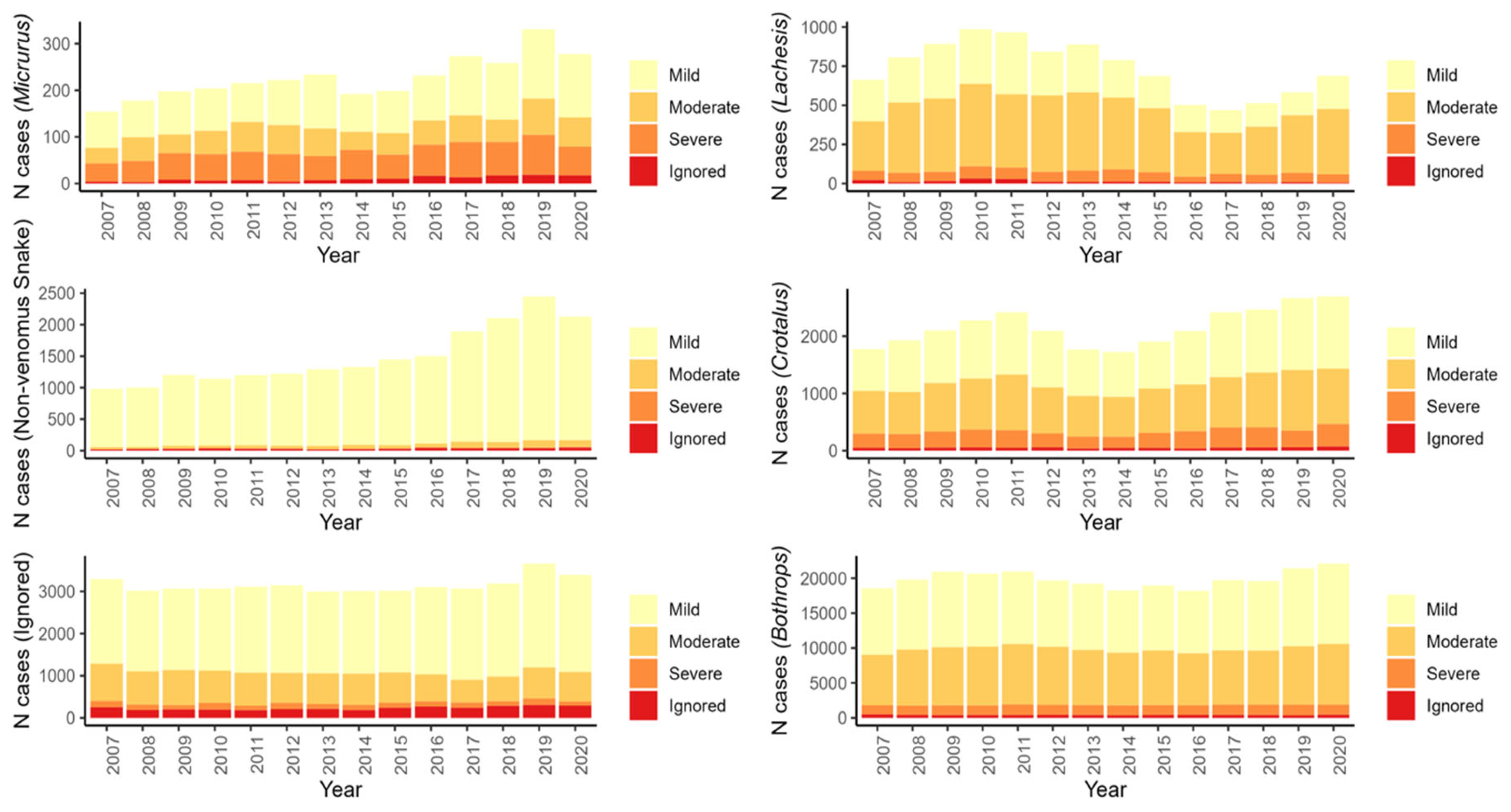
There is little change in severity over time. There are increasingly fewer reports of severe cases for Micrurus across the whole timeline, however, for Lachesis, Crotalus, and Bothrops, there is an increase in the proportion of severity over time (Figure 5). The most severe cases with bad prognoses can progress to death. In this regard, most of the deaths were caused by Bothrops, with an increase in frequency and proportion in the last two years (Figure 6).
Figure 5 represents the distribution of severity by type of snakebite. Non-venomous envenomations are classified as mild, although those from Micrurus have a higher proportion of severity. Lachesis and Crotalus cases are responsible for moderate cases. Bothrops are associated with symptoms between mild and moderate cases.
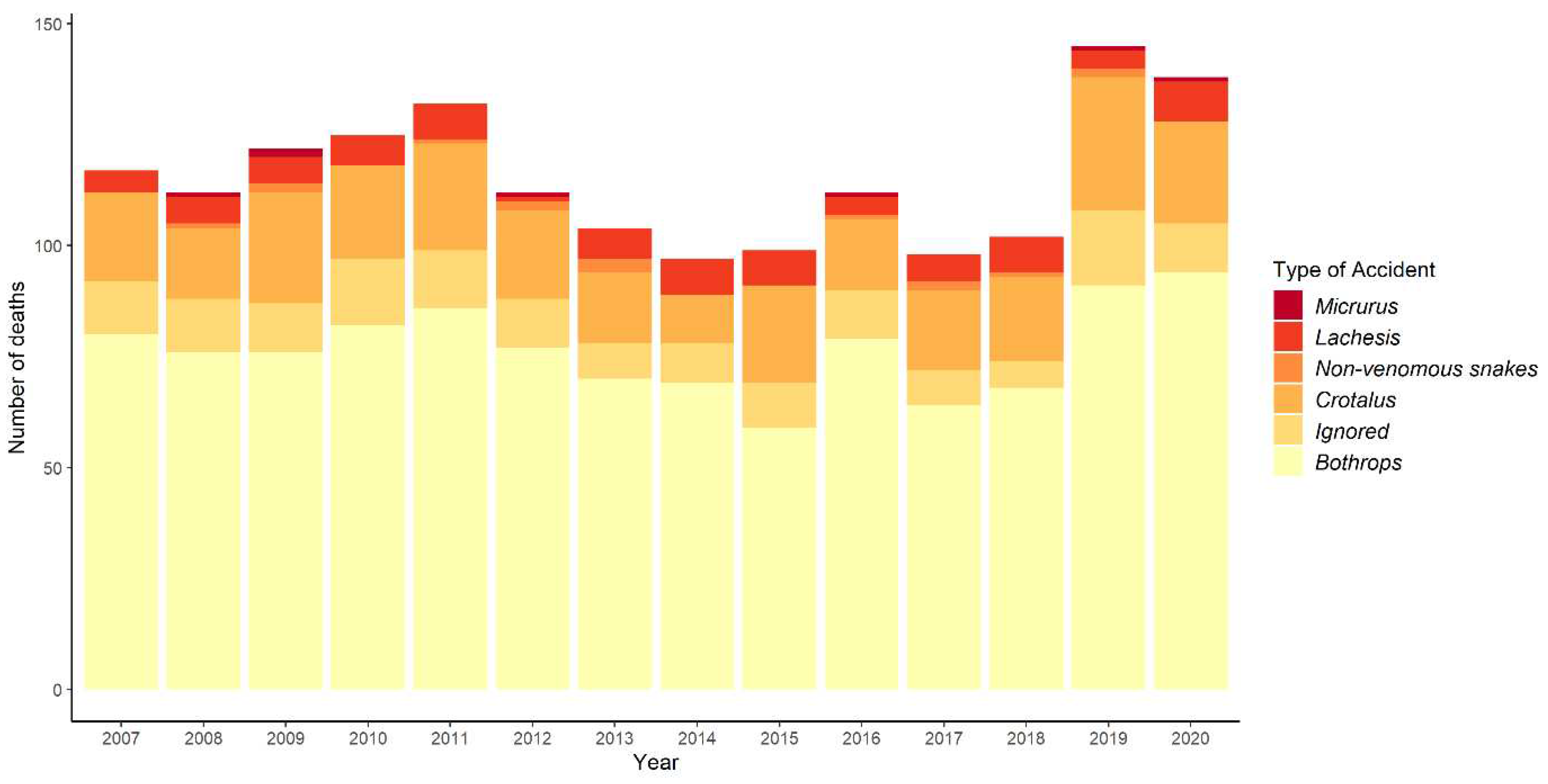
Figure 6 represents the number of deaths from envenomations over the focal period. The highest and lowest frequencies of envenomations were reported in 2019 (145 deaths) and 2014 (97 deaths), respectively. The primary cause of death is envenomation by Bothrops sp.
Figure 6.
represents the number of deaths from envenomations over the focal period. The highest and lowest frequencies of envenomations were reported in 2019 (145 deaths) and 2014 (97 deaths), respectively. The primary cause of death is envenomation by Bothrops sp.
Figure 6.
represents the number of deaths from envenomations over the focal period. The highest and lowest frequencies of envenomations were reported in 2019 (145 deaths) and 2014 (97 deaths), respectively. The primary cause of death is envenomation by Bothrops sp.
3. Methods
The data were collected from the SINAN; files are available at https://datasus.saude.gov.br/transferencia-de-arquivos/ in DBC format, a compressed version of DBF files.
To download the files, the following procedures were performed: 1) in the “Fonte” (source) option, “SINAN - Sistema de Informações de Agravos de Notificação” was selected; 2) in “Modalidade” (modality), the option “Dados” (data) was selected, 3) in “Tipo de Arquivo” (File type), the option “ANIM - Acidente por animais peçonhentos” (Venomous animals accidents) was chosen, 4) in “Ano” (year) the period from 2007 to 2020 was selected and 5) in “UF” (acronym for Brazilian states) all the options were selected. The data sets obtained comprise 378 organized files (representing the 27 states and 14 years of study). No individually identifiable information is made available in the dataset.
All data processing was performed using the “R 4.3.2” language in its integrated development environment (IDE) “RStudio 2023.09.1-494” (14). We imported and decompressed the datasets through the “read.dbc” library and then merged them into one single dataset using the “tidyverse” library, function “bind_row”. This resulted in a dataset with 2,422,825 records. After filtering for snakebites, a dataset of 400,848 was produced. This second dataset was processed to create labels and standardize the variables through the “Hmisc” library, resulting in the final database. For the graphics, the “ggplot2” library was used. The maps required the use of municipal and state boundaries provided by the “rgdal” library.
The information system database (SINAN) undergoes constant changes related to system update processes, so it is important to provide a processed database in the backup format. For this reason, we make the originals available on figshare in a compressed folder called “ANIMAC.zip” (15). Tables 1 and 2 describe each variable in the database according to the codebook provided by the Ministry of Health (https://portalsinan.saude.gov.br/acidente-por-animais-peconhentos). The information in Table 3 comes from the database processed using the “R_script_for_Silva-Neto_et.al.05.07.2022.zip” script (15). Table 3 and the final database in CSV format, “DATA_BASE.csv”, is available on figshare (15).
The information generated can be corroborated by reports published by the Ministry of Health of Brazil and previous publications (16,17).
Figure 1 presents the dataset processing steps. Legend: a) data gathering – original database divided by years and States (378 datasets), b) extraction and joining, c) intermediate dataset (2,422,825 records), d) filtering, e) intermediate dataset (400,848 registers), f) variable selection, g) intermediate dataset (74 variables), h) labeling, standardizing, and final adjustments, and i) final dataset.
The variables removed from the raw dataset were:
TP_ACIDENT - filtering for snakebites, only a single value remained.
CLI_LOCA_1 and CLI_OUTR_3 - open field variables that present (i) lack of standard filling procedures, (ii) subjectivity in the filling, (iii) presence of special characters that can cause loss of records when exporting data to other formats.
ANI_TIPO_1, ANI_ARANHA, and ANI_LAGART - removed due to the low percentage of completeness caused by the filter and the presence of records related to envenomation from sources other than snakes.
4. User Notes
Snakebites are responsible for significant social and economic impacts associated with sequelae and deaths (18,19). In Brazil, between 2007 and 2020, 400,848 cases of snakebites were reported to SINAN across the country, a number considered relatively high when compared to other Latin American countries (20). The wide distribution of snakes in Brazil is responsible for many snakebite cases (21). To meet the needs of epidemiologists and health managers, we offer this dataset with a script in open "R" language that allows standardization for future studies generating evidence for decision-making in public health. Knowing the vulnerability to snakebites, information about the clinic, treatment, and access to snakebite serum is essential for improving the service and reducing morbidity and mortality.
Supplementary Materials
following supporting information can be downloaded at the website of this paper posted on Preprints.org.
Author Contributions
Alexandre Vilhena da Silva-Neto was mainly responsible for the general planning to organize the dataset; Professors Vanderson de Souza Sampaio, Wuelton Marcelo Monteiro,Patricia Takako Endo, Djane Clarys Baia-da-Silva, and Theo Lynn were responsible for planning, writing and reviewing the manuscript; Tatyana Costa Amorin Ramos and Patricia Carvalho da Silva Balieiro were responsible for collecting the dataset; Gabriel dos Santos Mouta and Jady Shayenne Mota Cordeiro were responsible for annotating the dataset, Antônio Alcirley da S. Balieiro was responsible for reviewing the scripts. The dataset manuscript was reviewed by all authors.
Funding
This research received no external funding.
Informed Consent Statement
Not applicable.
Data Availability Statement
All the code to create the dataset is available at figshare (15).
Acknowledgments
CEPCLAM research group and the data analysis laboratory LaBData Manaus.
Conflicts of Interest
The authors declare no conflicts of interest.
References
- Friedrich, M.J. Efforts to Address Snakebite. JAMA. 17 de julho de 2018, 320, 227–227. [CrossRef]
- The Lancet. Snake-bite envenoming: a priority neglected tropical disease. The Lancet. 1o de julho de 2017, 390(10089):2. [CrossRef]
- Mohapatra, B.; Warrell, D.A.; Suraweera, W.; Bhatia, P.; Dhingra, N.; Jotkar, R.M., et al.; et al. Snakebite mortality in India: A nationally representative mortality survey. PLoS Negl Trop Dis. abril de 2011, 5. [CrossRef]
- Chippaux, J.P. Snakebite envenomation turns again into a neglected tropical disease! J Venom Anim Toxins Trop Dis [Internet]. 28 de setembro de 2017 [citado 15 de março de 2022];23(1). Disponível em: http://www.scielo.br/j/jvatitd/a/sxkGNpcwpLYmYPcMWY9hP5P/?lang=en.
- Roriz, K.R.P.S.; Zaqueo, K.D.; Setubal, S.S.; Katsuragawa, T.H.; da Silva, R.R.; Fernandes, C.F.C.; et al. Epidemiological study of snakebite cases in Brazilian Western Amazonia. Rev Soc Bras Med Trop. 1o de abril de 2018, 51, 338–46. [CrossRef]
- Brasil. SINANWEB - Dados Epidemiológicos Sinan [Internet]. [citado 16 de novembro de 2023]. Disponível em: http://portalsinan.saude.gov.br/dados-epidemiologicos-sinan.
- Rocha, M.S.; Cavalcante, M.V.; Medeiros, F.C.D.; Codenotti, S.B.; Pelissari, D.M.; Andrade, K.B.; et al. Sistema de Informação de Agravos de Notificação ( Sinan ): principais características da notificação e da análise de dados relacionada à tuberculose. Epidemiol E Serviços Saúde. 2020, 29, 1–13. [CrossRef]
- Brasil. Guia de vigilância epidemiológica. 2005. p. 17–34 Guia de Vigilânica Epidemiológica.
- Brasil. Sistema De Informação De Agravos De Notificação - Sinan: Normas E Rotinas. Ms; 2007. (Série a. Normas E Manuais Técnicos).
- Base Legislação da Presidência da República - Lei no 12.527 de 18 de novembro de 2011 [Internet]. [citado 22 de maio de 2022]. Disponível em: https://legislacao.presidencia.gov.br/atos/?https://legislacao.presidencia.gov.br/atos/?tipo=LEI&numero=12527&ano=2011&ato=dc1UTUU1UMVpWT65a.
- Heukelbach J, Chichava OA, de Oliveira AR, Häfner K, Walther F, de Alencar CHM, et al. Interruption and defaulting of multidrug therapy against leprosy: Population-based study in Brazil’s Savannah region. PLoS Negl Trop Dis. maio de 2011, 5(5). [CrossRef]
- Queiroz OV de, Guerra Júnior AA, Machado CJ, Andrade ELG, Meira Júnior W, Acúrcio F de A, et al. A construção da Base Nacional de Dados em Terapia Renal Substitutiva (TRS) centrada no indivíduo: relacionamento dos registros de óbitos pelo subsistema de Autorização de Procedimentos de Alta Complexidade (Apac/SIA/SUS) e pelo Sistema de Informações sobre Mortalidade (SIM) - Brasil, 2000-2004. Epidemiol E Serviços Saúde. junho de 2009, 18, 107–20. [CrossRef]
- Braga, J.U. Vigilância epidemiológica e o sistema de informação da tuberculose no Brasil, 2001-2003. Rev Saúde Pública. setembro de 2007, 41, 77–87. [CrossRef]
- RStudio Team (2022). RStudio: Integrated Development for R. RStudio [Internet]. [citado 16 de novembro de 2023]. Disponível em: http://www.rstudio.com/.
- Silva-Neto AV, Cordeiro JSM, Balieiro AA da S, Sampaio V de S. Description and quality of the snakebite database in Brazil from 2007 to 2020 [Internet]. figshare; 2022 [citado 16 de novembro de 2023]. Disponível em: https://figshare.com/articles/dataset/Description_and_quality_of_the_snakebite_database_in_Brazil_from_2007_to_2020/19369463/6.
- Magalhães SFV, Peixoto HM, Moura N, Monteiro WM, De Oliveira MRF. Snakebite envenomation in the Brazilian Amazon: a descriptive study. Trans R Soc Trop Med Hyg. 1o de março de 2019, 113, 143–51. [CrossRef]
- Chippaux, J.P. Epidemiology of envenomations by terrestrial venomous animals in Brazil based on case reporting: from obvious facts to contingencies. J Venom Anim Toxins Trop Dis [Internet]. 2015 [citado 29 de maio de 2022];21(1). Disponível em: /pmc/articles/PMC4453217/.
- Liblik K, Byun J, Saldarriaga C, Perez GE, Lopez-Santi R, Wyss FQ, et al. Snakebite Envenomation and Heart: Systematic Review. Curr Probl Cardiol. setembro de 2022, 47, 100861. [CrossRef]
- Suhita R, Begum I, Rashid M, Chandran VP, Shastri SA, Kantamneni R, et al. Systematic review and meta-analysis of global prevalence of neurotoxic and hemotoxic snakebite envenomation. East Mediterr Health J Rev Sante Mediterr Orient Al-Majallah Al-Sihhiyah Li-Sharq Al-Mutawassit. 1o de dezembro de 2022, 28, 909–16. [CrossRef]
- Lancet, T. Snakebite — emerging from the shadows of neglect. The Lancet 2019, 393, 2175. [Google Scholar] [CrossRef] [PubMed]
- chneider, M.C.; Min, K.D.; Hamrick, P.N.; Montebello, L.R.; Ranieri, T.M.; Mardini, L.; et al. Overview of snakebite in brazil: Possible drivers and a tool for risk mapping. PLoS Negl Trop Dis. 2021, 15, 1–18. [Google Scholar] [CrossRef]
Figure 2.
shows the number of records in the dataset by type of snakebite reported in Brazil from 2007 to 2020. Bothrops envenomations were frequent in all years. In 2020, the highest number of total cases (32,160) were recorded; the lowest number of total cases during the 14 years was recorded in 2014. The high frequency of ignored snake envenomation cases is noteworthy.
Figure 2.
shows the number of records in the dataset by type of snakebite reported in Brazil from 2007 to 2020. Bothrops envenomations were frequent in all years. In 2020, the highest number of total cases (32,160) were recorded; the lowest number of total cases during the 14 years was recorded in 2014. The high frequency of ignored snake envenomation cases is noteworthy.
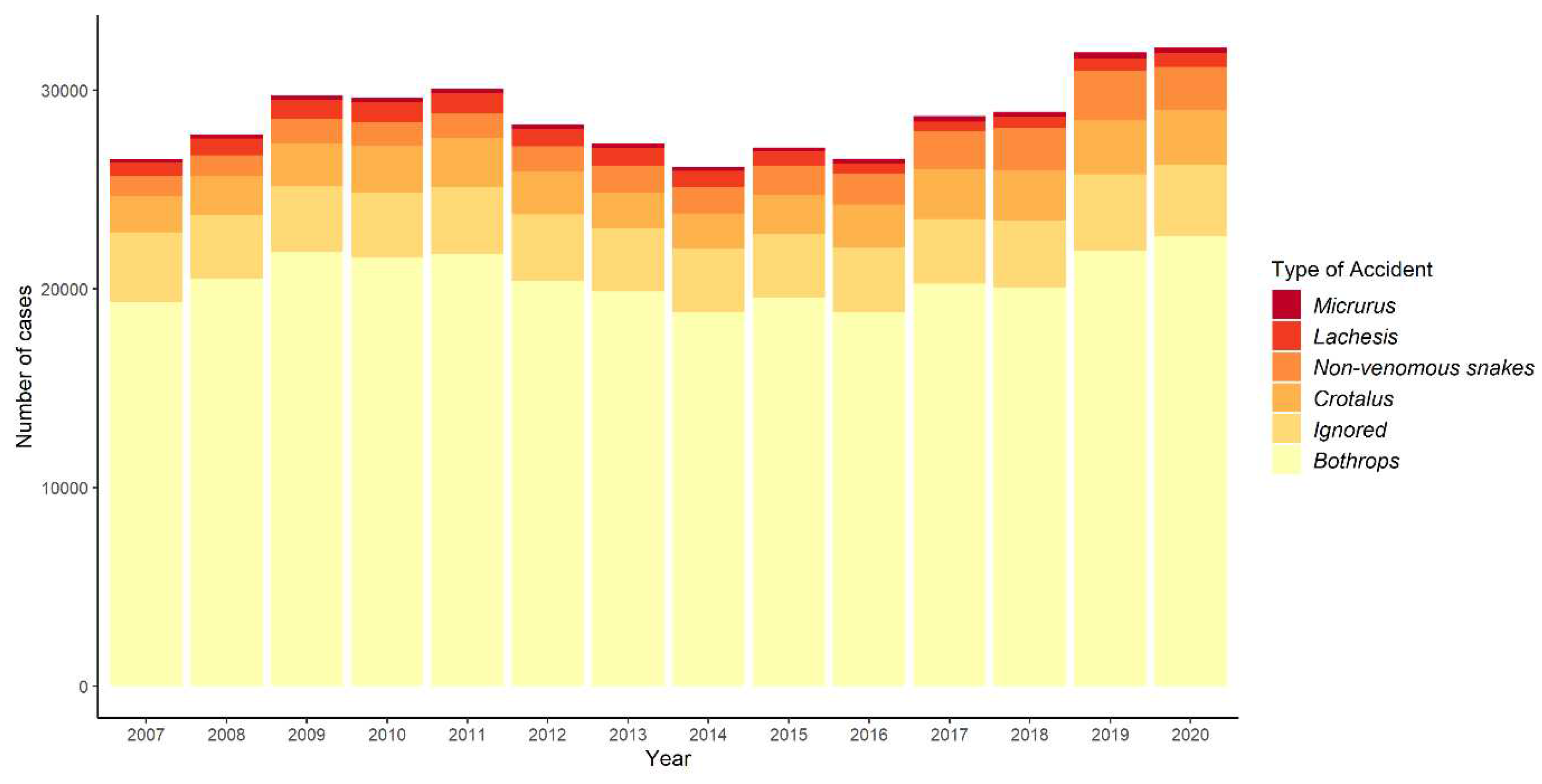
Figure 3.
shows the age structure of reported cases in this dataset, divided into three categories: young (up to 18 years of age), adults (age between 20 and 59 years), and elderly (60 years and over).
Figure 3.
shows the age structure of reported cases in this dataset, divided into three categories: young (up to 18 years of age), adults (age between 20 and 59 years), and elderly (60 years and over).
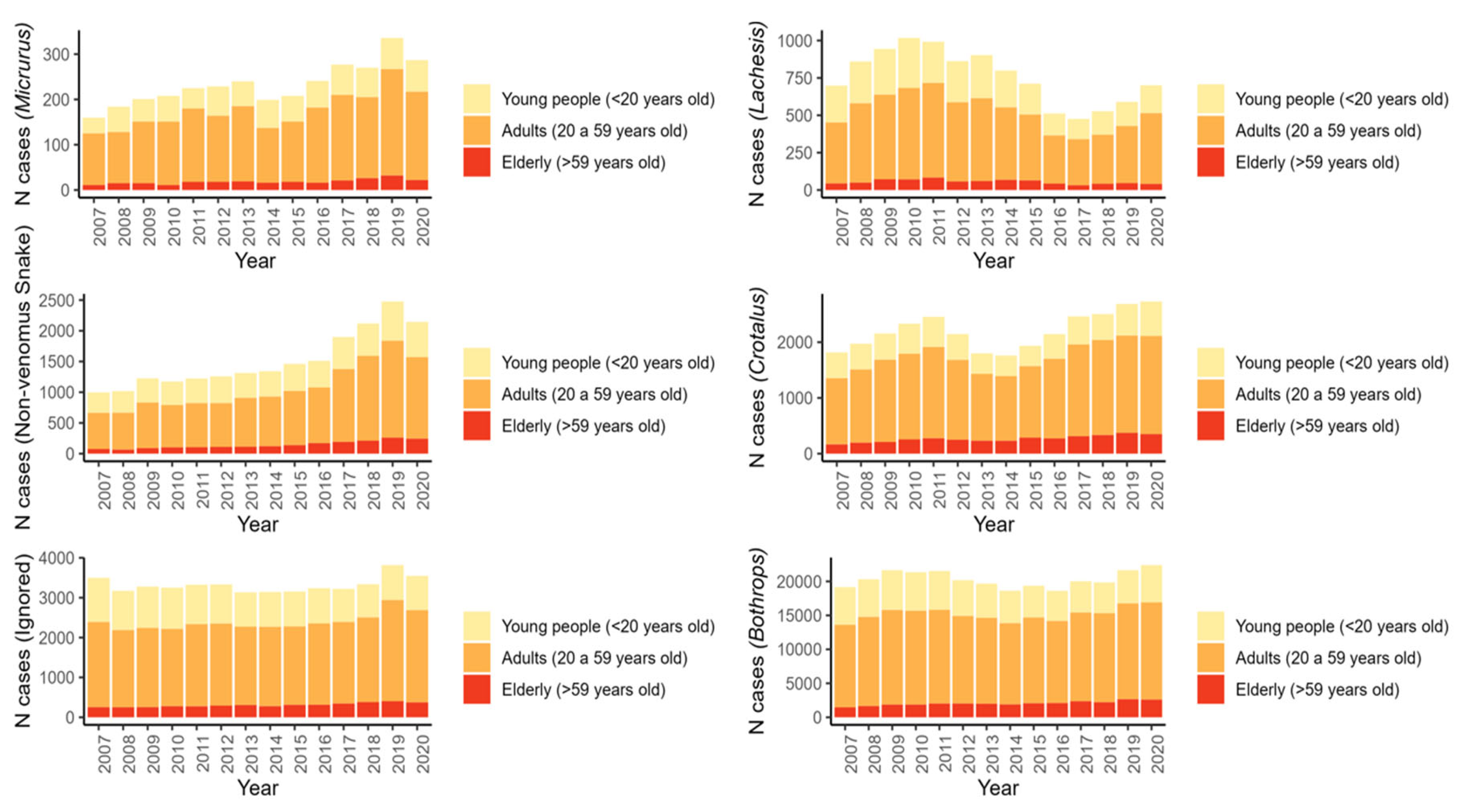
Figure 4.
The number of reported snakebite cases by type of snakebite and municipalities in Brazil. Color intensity is related to the frequency of cases. The northern region has the highest number of cases, mainly caused by Bothrops and Lachesis genera.
Figure 4.
The number of reported snakebite cases by type of snakebite and municipalities in Brazil. Color intensity is related to the frequency of cases. The northern region has the highest number of cases, mainly caused by Bothrops and Lachesis genera.
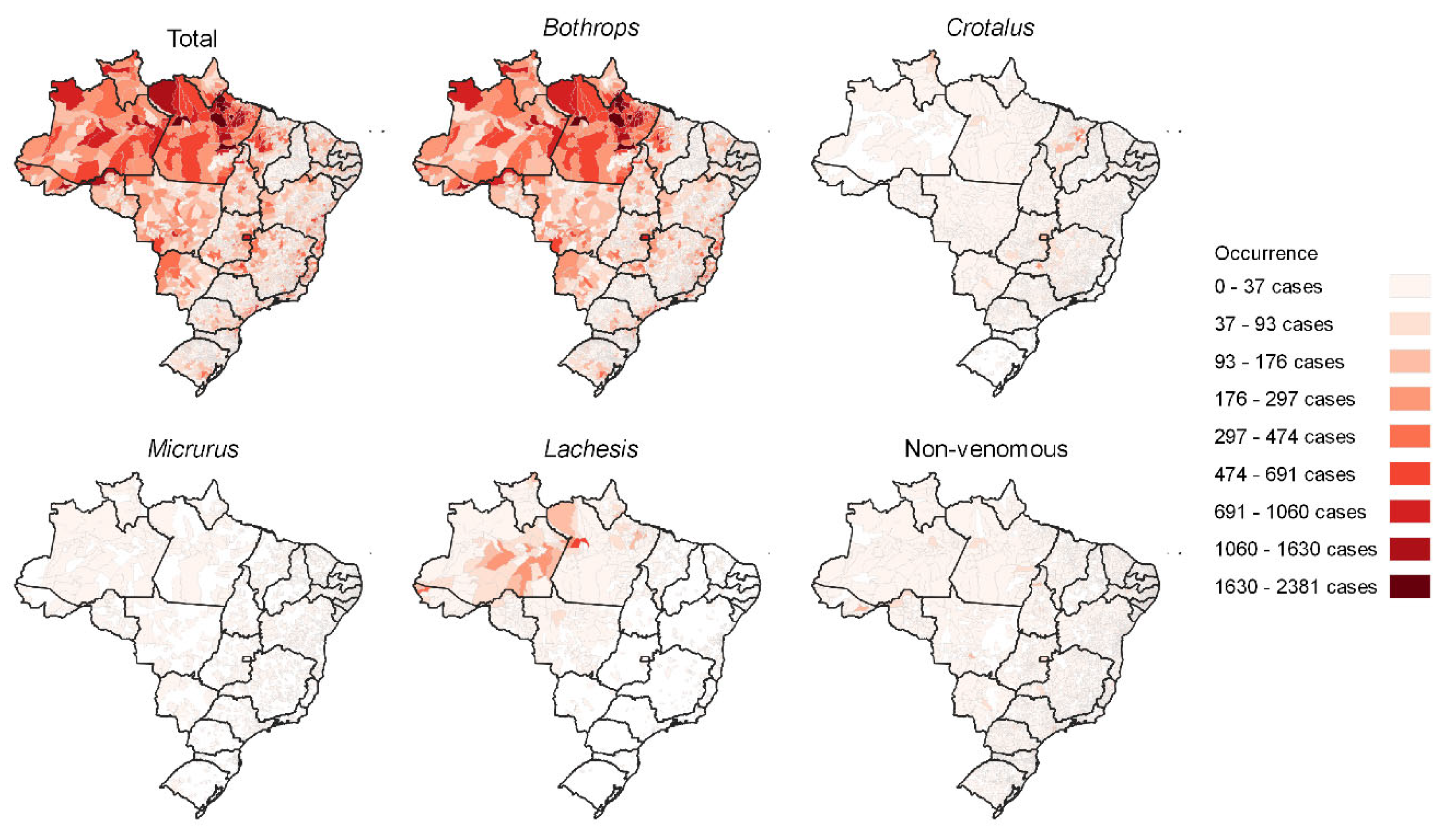
Figure 5.
represents the distribution of severity by type of snakebite. Non-venomous envenomations are classified as mild, although those from Micrurus have a higher proportion of severity. Lachesis and Crotalus cases are responsible for moderate cases. Bothrops are associated with symptoms between mild and moderate cases.
Figure 5.
represents the distribution of severity by type of snakebite. Non-venomous envenomations are classified as mild, although those from Micrurus have a higher proportion of severity. Lachesis and Crotalus cases are responsible for moderate cases. Bothrops are associated with symptoms between mild and moderate cases.
Disclaimer/Publisher’s Note: The statements, opinions and data contained in all publications are solely those of the individual author(s) and contributor(s) and not of MDPI and/or the editor(s). MDPI and/or the editor(s) disclaim responsibility for any injury to people or property resulting from any ideas, methods, instructions or products referred to in the content. |
© 2024 by the authors. Licensee MDPI, Basel, Switzerland. This article is an open access article distributed under the terms and conditions of the Creative Commons Attribution (CC BY) license (http://creativecommons.org/licenses/by/4.0/).
Copyright: This open access article is published under a Creative Commons CC BY 4.0 license, which permit the free download, distribution, and reuse, provided that the author and preprint are cited in any reuse.