

Submitted:
06 February 2024
Posted:
07 February 2024
You are already at the latest version
Abstract
In a concrete beam initially crack is generated at the tension side under the effect of flexure, shear and torsional loadings. Accordingly, these weak concrete members require repair and/or strengthening to increase or restore their internal load capacity. In the current experimental and numerical investigations on concrete beam having different width to depth ratio of notch on its ultimate flexural load under one-point loading was considered. Further, the flexural behavior performance of notch concrete beam repaired with the three repair materials cement mortar, bacterial mortar and adhesive was also examined. Consequently, a comparative study is imple-mented between the experimental and numerical results. Concrete Damage plasticity (CDP) model was used for finite element numerical analysis of beam. The differences in numerical and experimental measured results ranges from 0.65 - 22.20 % for the ultimate load carrying capacity. As the notch size increases the ultimate load carrying capacity of beam was reduced. Addition-ally, linear regression model is used to predict the ultimate load values at an interval of 5 mm notch width up to maximum width of notch 100 mm. It can be observed that the ultimate load capacity for repaired beam is increased as compared to the notch beam for all the three repairing materials under consideration. The maximum ultimate load was increased in case of notch beam repaired using adhesive. As compared to the cement mortar the performance of the bacterial mortar in terms of the ultimate load was more. The bacterial mortar is found more sustainable and more durable as a repair material for the concrete structures.
Keywords:
Bacterial mortar
; Concrete beam
; Concrete Damage plasticity
; Flexural Behavior
1. Introduction
Nowadays, the sustainability of the present-day civil infrastructure is being given more attention and significance. When considering the conservation of resources both financial and environmental point of view and the reduction of the construction industry’s overall carbon footprint, repairing and/or strengthening is a more sustainable option than simply destructing and rebuilding the civil infrastructure [1]. Moreover, maintenance should be prioritized over construction. Also in case of historical era monuments it is not possible to demolished and replace them, thus repairing and/or strengthening are sustainable choice to preserve them. Concrete is widely employed in the construction of the majority of civil engineering structures because of its superior shielding ability, fire rating, long service life under normal and accidental conditions, ease of construction and relative affordability. Despite these prominent characteristics, the majority of concrete structures may get damaged, when subjected to adding of structures, overloading, accidental loads, error in design or during the erection process, environmental conditions etc. Consequently, these weak concrete members require repair and/or strengthening to increase or restore their internal load capacity, to
resist additional external loads [2,3]. After the repair or strengthening work is completed successfully, the structural member’s safety, serviceability and durability performance can be enhanced.
A concrete beam is horizontal member in civil engineering structures subjected to external vertical loading. Due to these loading beam deflects and flexural, shear and torsional stresses are developed. Over the past two to three decades researchers have been endeavoring to develop numerous repair and/or strengthening techniques for concrete beams as shown in Figure 1. When selecting any repair and/or strengthening techniques, there are a number of factors to taken into account such as repair time, localized changes in the stiffness of the member, strength, ductility, cost, minimizing disturbance to occupants during repair, preserving the aesthetical appearance of structure, preserving or enhancing durability and work safety [4,5]. Table 1 gives the various repair and strengthening materials used for concrete structures. Some of the materials are epoxy resin, synthetic rubber emulsion, epoxy modified cementitious, fiber reinforced polymer (FRP) used in form of spray, sheets, laminates, rods.
The review of previous experimental and numerical studies had been conducted on concrete beam are discussed herewith. A numerical investigation of rectangular and T section concrete beam for bending moment capacity has been carried out by [5]. An experimental investigation of prestressed concrete beam for flexural strength has been done by [6,7] suggested that in plain concrete a brittle failure occurred due to flexural crack. In higher strength concrete beam brittle failure is responsible due to shear force and development of diagonal crack. The different types of opening reduce the stiffness of RCC beam [8]. [9] suggested that load carrying capacity and stiffness of pre-cracked RC beam can be increased by providing CFRP at tension side of beam and investigated the failure of concrete cover and the debonding between the CFRP fabric and concrete. [10] carried out the experimental behavior of deep beam with web opening under four-point load. It was found that as size of web opening increases shear strength of concrete deep beam decreases. As discussed in Figure 1 various techniques used like jacketing [11,12]FRP [13,14].
Researchers generally investigates the performance of any repair and strengthening as discussed above, by imitate damage, defects, or cracks in the concrete beam by embedding a notch mostly in the middle of the beam. The notch embedded in U, V or key-hole shapes [15] The notch formation simulates the cracks or damages and then repair techniques are studied using experimental and also numerical approaches. Table 2 shows the review of some of studies where effect of notch on concrete beams was studied. Recently, [16] carried out the experimental investigation on notched concrete beams under three-point loading for constant width and varying depth of beam section. The results were presented in the form of size-effect, fracture energy, failure modes, peak loads, and load responses analysis.
Recent decade’s bacterial mortar and concrete are also used as sustainable materials for repairing micro cracks and increasing self-healing property of concrete. It is organic material, its properties don’t change with time and used for healing internal micro-cracks deeply. The cracks more than 0.8 mm can be easily healed [24] The bacteria that are rich in calcium are added in mortar or concrete during mixing. These bacteria precipitate calcium carbonate in the event that cracks emerge in the concrete. Thus, seal the cracks and repair it. The bacterial mortar or concrete will have a higher strength and durability than normal concrete [25]. [26] used Bacilus Cohni biologically can increase durability and mechanical strength without producing any harmful gas. The encapsulation of the bacteria spore and nutrient by expended perlite and crack were healed, when 20% of fine aggregate replace by expanded perlite by weight. [27] used bio based repaired mortar for concrete beam. The flexural and compressive strength and dry shrinkage were measured. The performance of the bio based repair mortar was studied through restrained shrinkage and pullout tests. [28] presented detailed review on various types of bacteria used for healing concrete and discussed the different concrete properties affected due to addition of bacteria. [29] used cultured bacillus subtilis in spore powder form and culture form in mortar concrete. From the experimental works, it was concluded that compressive strength increases and also find evidence of ettigrate in pores which is responsible for form high concentration of Ca+ ion calcium silicate hydrate. [30] microbial precipitated the calcite which filling micro crack by which responsible to increase compressive strength and decrease the water absorption. Permeability of cracked concrete in wet dry cycle condition decrease because of crack heals by calcium carbonate precipitated by microbes. Table 3 list out the types of bacteria, preparation curing specimens, test methods and major remarks based on the previous researchers on bacterial mortar and concrete. In case of bacterial mortar or concrete the bacteria used for the bio-precipitation process is an important stage.
From the literature review it can be seen that no comparison had been conducted on the cement and bacterial mortar and also the commonly used adhesive materials. In the present experimental and numerical investigations on concrete beam having different width to depth ratio of notch on its ultimate flexural load under one-point loading was studied. Further, the performance of flexural performance of notch concrete beam repaired with the three repair materials cement mortar, bacterial mortar and adhesive was also investigated. Consequently, a comparative study is implemented between the experimental and numerical results. Concrete Damage plasticity (CDP) model was used for finite element numerical analysis of beam.
2. Experimental study
Concrete beam specimens are fabricated with the specific composition for each constituent material for M40 grade as per IS 10262 (2019). The strength for cement belonging to pozzolana Portland cement (PPC) having standard consistency 31.5% and specific gravity are and 3.14, Narmada river sand as fine aggregates confirming to confining zone II of IS 383 (2016) and maximum size of 20 mm coarse aggregates were used. The SIKA plasticizer was used as an admixture. The mix proportion cement: fine aggregates: coarse aggregates adopted was 1 : 1.52: 2.72 with a water-cement ratio 0.40 and admixture 1.1% by weight of cement. The cement content 445 kg/m3 and workability with 0.85 compaction factor was used. The fresh concrete mixed workability as per the mix design proportion was first investigated, further concrete beams of size 100 mm × 100 mm × 500 mm were casted. The solid concrete beam specimens were cast as shown in Figures 2a and 4a. The beam specimens were removed from their moulds after 24 hours after casting and then cured in water at room temperature for 28 days. Further, rectangular shape notch were cut on the middle span of the concrete beam on tension side (bottom face) with a steel saw after 28 days curing of hardened concrete beam as shown in Figure 2b. The notch was considered to simulate the failure or crack or defect in the beams that were in necessity of repairing. The different width to depth ratios 0.33, 1.66 and 3.33 of notch were considered in the present investigation. The rectangular notch having width 10 mm, 50 mm and 100 mm with constant depth of 30 mm at center on the tension side of beam was considered.
Further, in order to study the effect of three repairing materials, cement mortar, bacterial mortar and adhesive, the notch were filled with repairing materials and also 10 mm thick layer of material was placed on the tension side as shown in Figure 2c. The effect on the repairing material on the flexural strengthening resistance of concrete beam was studied. In case of cement mortar the cement sand of proportion 1:3 with water cement ratio is 0.50 was used and cured for 28 days.
In case of bacterial mortar, Bacillus cohnii (MTTCC3616) were procured from IMTECH, CSIR Labs Chandigarh, India. All revival cells were incubated in calcium precipitate culture for 72 hours using a shake flask incubator at 37 ℃ and 150 rpm as shown in Figure 3. After incubation time culture are mixed with cement and sand 1:3 proportion and the culture to cement ratio 0.5. Figure 3 depicts the step-by-step procedure for preparing the bacterial mortar and used as a repair material. Similarly, to the above protocol the bacterial cement mortar specimens are prepared. The specimens are cured in water with 0.1 Mol calcium lactate powder solution, in order to provide the external calcium resource to the bacteria used in the mortar. The third repair material thixotropic epoxy adhesive was used and after its application it was kept for drying for at least 15 days at room temperature. In order to eliminate the uncertainty of the concrete material, three concrete beams were casted for each case solid beam, notch beam and beam with repair material.
The concrete beam specimens were mounted simply-supported on a servo-hydraulic testing machine and point load was applied at the middle length (one-point load) of the concrete beam specimen as shown in Figure 4e. The reaction was provided by the two roller-supports near the ends of the concrete beam specimen. The strength tests on concrete beam specimens were conducted as per IS 516 (1959). The values for the ultimate flexural load for each specimen were recorded and flexural behavior was studied as shown in Figure 4f.
3. Numerical study
Further in the present work the numerical study is also carried out. The numerical study is more efficient and economical tools as compared to experimental study for the structural analysis and various engineering research. Thus, numerical study can capture the complex damage behavior accurately. The finite element modeling of beams were done using the commercial software ABAQUS (ABAQUS Analysis User’s Manual 2021). Concrete are modeled using smeared crack concrete model and concrete damage plasticity (CDP) model. The purpose of the model is to calculate beam performance during experimental testing. In the present study concrete damage plasticity (CDP) model was used. This model is based on [42] and Lee and Fenves [41] models, which can simulate the tensile cracking and compressive crushing of concrete materials, considering the isotropic elastic damage and plastic behavior of materials.
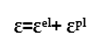
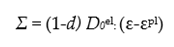
The total strain tensor ε has comprised of the elastic part εel and the plastic part εpl.
The stress strain relations are governed by scalar damaged elasticity.
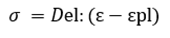
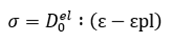 where D_0^elis the initial (undamaged ) elastic stiffness of the material ;
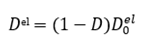
The damage plasticity constitutive model was based on the following stress-strain relationship. The nominal stress with the degraded elastic tensor from Equation (4) could be rewritten as follows.
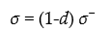
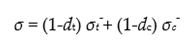 Delis the degraded elastic stiffness, and d (dt and d c) is the scaled stiffness degraded value which can take values in the range from zero (undamaged material) to one (fully damaged material). The damage associated with the failure mechanics of the concrete (cracking in tension and crushing in compression) there for results in a reduction in elastic stiffness. The cracking in tension and crushing in compression of concrete has been modeled by two hardening variable designated as 〖ε'〗_t^(pl,)and 〖ε'〗_c^(pl,), which cite as equivalent plastic strain.
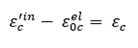
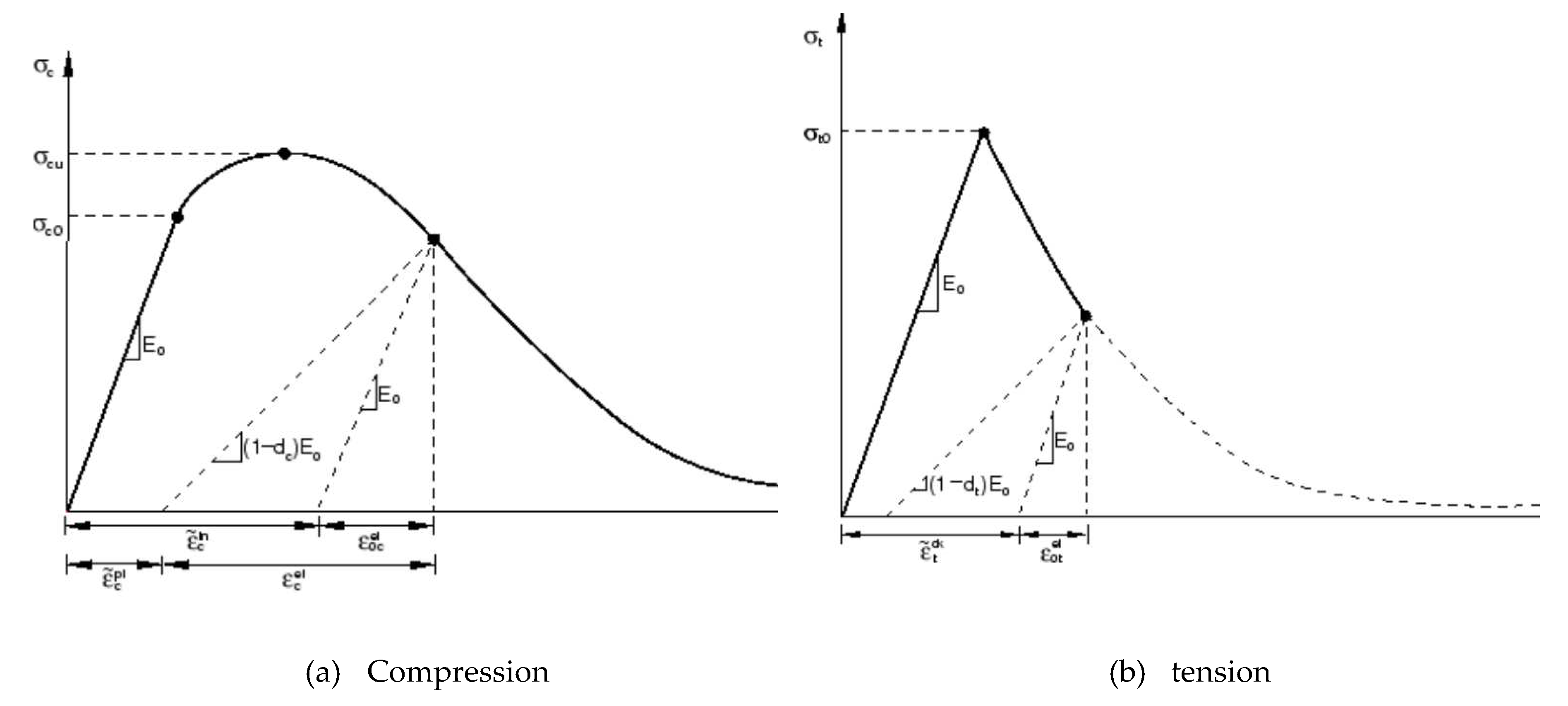
The stress strain value of plain concrete outside the elastic for uniaxial compression load has been used in tabular form as function of inelastic strain ε_c^('in,). The stress strain curve can be defined beyond the ultimate stress, into the strain-softening regime. Hardening data are given in terms of an inelastic strain ε_c^'in, instate of plastic strain ε_c^('pl,).the compressive inelastic strain is defined as the total strain minus the elastic strain correspond to undamaged material.
 where
where  define in Figure 5
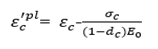
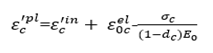
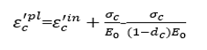
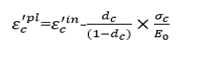
define in Figure 5
Uniaxial compressive stress strain curve can be characterized by experimentally or [42]) parabolic constitutive model equation given below
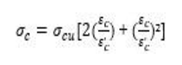
The value of εc, is fixed as 0.002.
Where σc and εc are nominal compressive stress, and respectively σcu and εc area ultimate compressive stress and strain.
The cracking strain is defined as the total strain minus the elastic strain correspond to the undamaged material; that is,
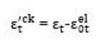 where
where  as shown in Figure 5
as shown in Figure 5ABAQUS automatically convert the cracking strain value to plastic strain values from equation.
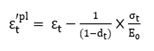
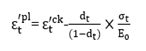
Figure 5.
(a). [42] model for stress-strain behavior of concrete in compression.
Figure 5.
(a). [42] model for stress-strain behavior of concrete in compression.
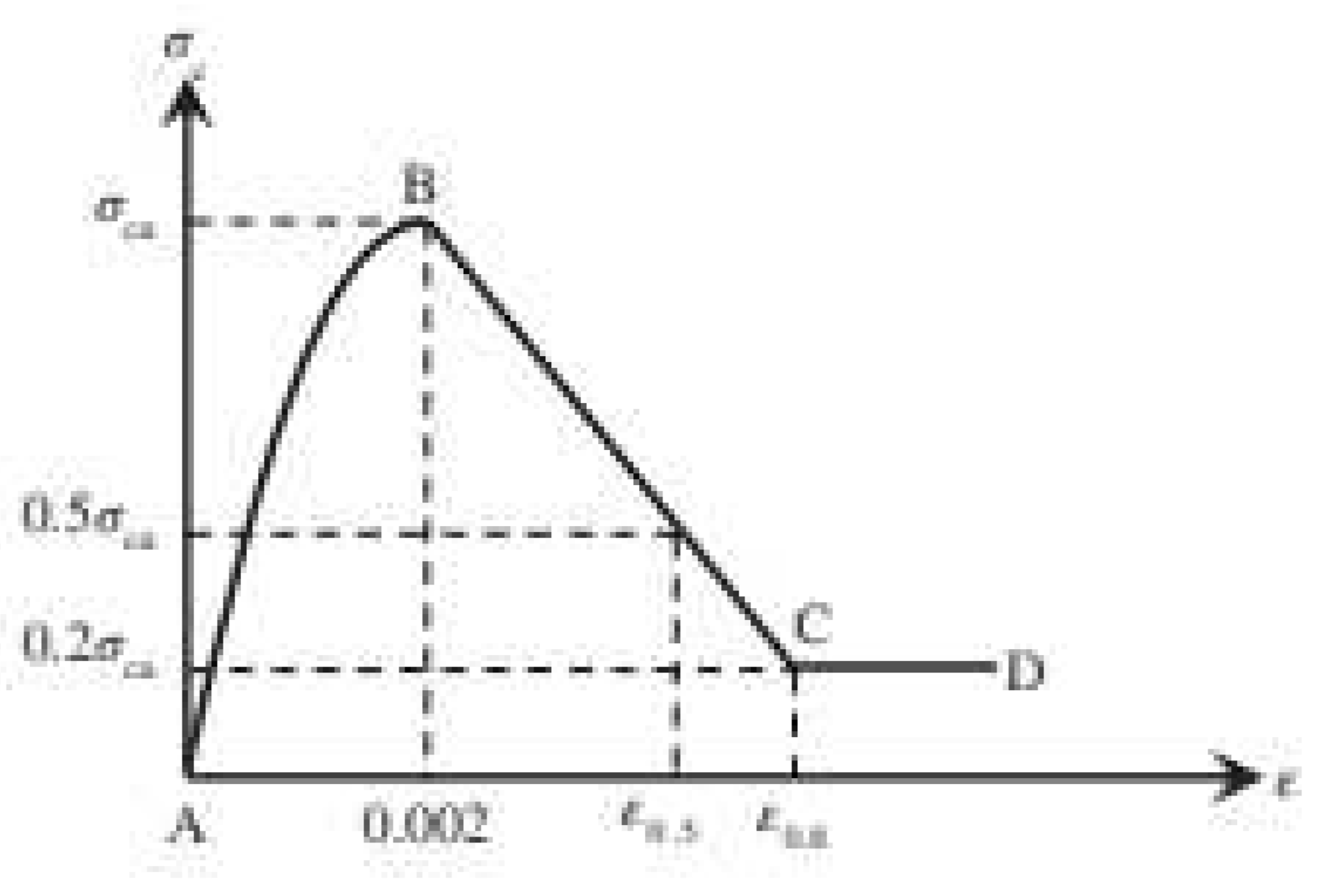
Figure 5.
(b). Behavior of concrete to uniaxial loading stat. [45] confined and unconfined concrete [42].
3.1. Validation of the numerical model
The present numerical model was validated with published results in the literature. Table 4 shows the comparison of the on-point maximum failure load with the published results and present numerical study. The percentage difference is negligible and a good agreement has been achieved between both results.
3.2. Present Numerical Study
Further, the concrete beam is modeled using 8-node linear brick C3D8R element having six faces with reduced integration with hourglass control as shown in Figure 6. A simple-supported beam having two hinged support at a distance of 50 mm from each end side of beam are modeled. The central point load is applied at the mid-span top of the beam. Based on the convergence study the 20 mm mesh size was considered and a fine meshing of 10 mm was considered near the notch portion. All material properties in CDP model for M40 grade of concrete were adopted from [45] (2017)[13]. The mechanical properties for M40 grade of concrete are given in Table 5 and also Table 6 gives the mechanical properties of repairing materials.
4. Results and Discussions
In the current experimental and numerical investigations on concrete beam having different width to depth ratio of notch on its ultimate flexural load was studied. Further, the performance of flexural performance of notch concrete beam repaired with the three repair materials cement mortar, bacterial mortar and adhesive was also investigated. The experiment’s validity and accuracy are demonstrated by the strong agreement between the numerical and the experimental observations.
4.1. Effect of notch
The effect of the different width to depth ratios 0.33, 1.66 and 3.33 of notch were considered in the present investigation. The rectangular notch having width 10 mm, 50 mm and 100 mm with constant depth of 30 mm at center on the tension side of beam was considered. Figure 7 shows the ultimate flexural load versus displacement behavior of solid beam and notch beam having different notch sizes. By the experimental study in case of solid beam the ultimate load capacity is 12.33 kN and by numerical study the load obtained is 10.09 kN. Thus, the percentage difference in the both is the experimental and numerical study is 0.65 - 22.20 %. Figure 8 shows the comparison of ultimate load between experimental and numerical study. Thus, CDP model can accurately simulate the flexural behavior of the concrete beam.
The notch beam having a notch size 10 × 30 mm was having 0.6% reduction in volume as compared to the solid beam volume, the percentage reduction in load carrying capacity was observed to be 41.20%, similarly in case of the notch beam having a notch size 50 × 30 mm was having 3% reduction in volume as compared to the solid beam volume, the percentage reduction in load carrying capacity was observed to be 50.04%. Further, the notch beam having a notch size 100 × 30 mm was having 6.0 % reduction in volume as compared to the solid beam volume, the percentage reduction in load carrying capacity was observed to be 67.56 %. It can be observed that as the notch size increases the ultimate load carrying capacity of beam was reduced. Thus, the defects, cracks reduce the load performance capacity of the beam. Thus, in case of notch beam the ligament area can be enhanced by decreasing the width to depth ratio of notch, which will raise the resistance to flexural damage and increase the flexural capacity of the concrete beam.
A relationship between and ultimate load carrying capacity of concrete beams was found based on the proposed experimental and numerical results. [49,50,51] also predicated the load capacity of the concrete beams. Further, the experimental and numerical results were used for applying a prediction model linear regression (LR) for precise notch width for 30 mm constant depth. For applying LR model firstly existing experimental and numerical ultimate load values for notch width (10 mm, 50 mm and 100 mm) are used to validate the LR regression model. In second stage the LR model is used to predict the ultimate load values at an interval of 5 mm notch width up to maximum width of notch 100 mm as shown in Figure 9. The LR mathematical model is defined as
where p1 and p2 are linear regression coefficients. The predicated coefficients with proposed linear regression model are presented in Table 7. It can be seen that the correlation coefficient R2 with experimental and numerical results shows a difference of nearly 1.12%. The root mean square errors (RMSE) for experimental and numerical results are 0.288 and 0.522, respectively.
4.2. Effect of repairing materials
The flexural load carrying capacity of notch beam repaired with the three repair materials cement mortar, bacterial mortar and adhesive was also investigated. For this case the notch beam having a notch size 10 × 30 mm was considered and repaired with cement mortar, bacterial mortar and adhesive. After repair the ultimate flexural load of the beam was determined experimentally and also numerically. Figure 10 illustrate the ultimate load-displacement curve for repaired concrete beam for all the three repair materials under consideration. It can be observed that the ultimate load capacity for repaired beam is increased as compared to the notch beam.
In case of cement mortar the ultimate load was observed to be 7.60 kN as compared to the notch beam with an ultimate load of 7.25 kN. The maximum ultimate load was increased in case of notch beam repaired using adhesive as 12.24 kN. Figure 11 shows the comparison of ultimate load in repaired beam for different materials and also a comparison between the experimental results and numerical CDP model results. It can be seen that CDP model can explicitly model the repairing material. The numerical result depends on the precision of the input data of the material. Figure 12 shows the numerical simulation results for the repaired beam. The adhesive repair material initial gives more load capacity but they are costly and also with respect to time the performance decreases and also the variation in the properties due to environmental conditions. As compared to the cement mortar the performance of the bacterial mortar in terms of the ultimate load was more. The bacterial mortar is more sustainable and more durable as a repair material for the concrete structures.
5. Conclusions
In the current experimental and numerical investigations on concrete beam having different width to depth ratio of notch on its ultimate flexural load under one-point loading was studied. Further, the performance of flexural performance of notch concrete beam repaired with the three repair materials cement mortar, bacterial mortar and adhesive was also investigated. Consequently, a comparative study is implemented between the experimental and numerical results. The following conclusions can be summarized:
- There is an excellent correlation between the experimental and finite element numerical results at every loading stage to failure to predicate the flexural behavior of the concrete beam. Also the FE numerical platform can overcome the drawback of experimental testing.
- The differences in numerical and experimental measured results ranges from 0.65 - 22.20 % for the ultimate load carrying capacity.
- As the notch size increases the ultimate load carrying capacity of beam was reduced. The notch volume from 0.6% - 6% for which the percentage reduction in load carrying capacity was observed to be in a range of 41.20% - 67.56%.
- A linear regression (LR) model is proposed to predict the ultimate load values at an interval of 5 mm notch width up to maximum width of notch 100 mm. It can be observed that the ultimate load capacity for repaired beam is increased as compared to the notch beam for all the three repairing materials under consideration.
- It can be seen that the correlation coefficient R2 with experimental and numerical results shows a difference of nearly 1.12%. The root mean square errors (RMSE) for experimental and numerical results are 0.288 and 0.522, respectively.
- The maximum ultimate load was increased in case of notch beam repaired using adhesive. Also the FE numerical platform can be used to simulate the repair materials and can study their performance. As compared to the cement mortar the performance of the bacterial mortar in terms of the ultimate load was more. The bacterial mortar is more sustainable and more durable as a repair material for the concrete structures.
- While selecting any repair and/or strengthening material depends on repair time, localized changes in the stiffness of the member, strength, ductility, durability, cost, and work safety.
Author Contributions
F Author Contributions: Waseem Khan: Investigation, Methodology, Validation, Visualization, Writing-original draft. Saleem Akhtar: Conceptualization, Writing-review & editing. Aruna Rawat: Conceptualization, Methodology, Writing-review & editing. Anindya Basu: Conceptualization, Writing-review & editing.
Funding
No funding agency, self.
References
- Raza, S.; Khan, M.K.I.; Menegon, S.J.; Tsang, H.H.; Wilson, J.L. Strengthening and repair of reinforced concrete columns by jacketing: State-of-the-art review, Sustainability. 2019, 11, 3208. [CrossRef]
- Obaid, W.A.; AL-asadi, A.K.; Shaia, H. Repair and strengthening of concrete beam materials using different CFRP laminates configuration, Materials Today: Proceedings. 2022, 49(7), 2806-2810,. [CrossRef]
- Hassan, R.F.; Latief, A.F. Repairing and strengthening techniques of RC beams: A review, 3rd International Conference for Civil Engineering Science (ICCES 2023), IOP Conf. Series: Earth and Environmental Science, 2023, 1232, 012032. [Google Scholar] [CrossRef]
- Martinola, G.; Meda, A.; Plizzari, G.A.; Rinaldi, Z. Strengthening and repair of RC beams with fiber reinforced concrete. Cement and Concrete Composites. 2010, 32, 731–739. [Google Scholar] [CrossRef]
- Pešić, N.; Pilakoutas, K. Flexural analysis and design of reinforced concrete beams with externally bonded FRP reinforcement, Materials and Structures/ Materiaux et Constructions. 2005, 38, 183–92. [CrossRef]
- Balsamo, A.; Nardone, F.; Iovinella, I.; Ceroni, F.; Pecce, M. Flexural strengthening of concrete beams with EB-FRP, SRP and SRCM: Experimental investigation, Composites Part B: Engineering. 2013, 46, 91–101. [CrossRef]
- Słowik, M. The analysis of failure in concrete and reinforced concrete beams with different reinforcement ratio, Archive of Applied Mechanics. 2019, 89, 885–895. [CrossRef]
- Sharaky, I.A.; Ahmed, S.E.; Alharthi, Y.M. Flexural response and failure analysis of solid and hollow core concrete beams with additional opening at different locations, Materials. 2021, 14(23). [CrossRef]
- Dong, Y.; Ming, Z.; Ansari, F. Failure characteristics of reinforced concrete beams repaired with CFRP composites, Proceedings of the third International Conference on Composites in Infrastructure (ICCI’02). 2002, 51-65.
- Rahim, N.I.; Mohammed, B.S.; Al-Fakih, A.; Wahab, M.M.A.; Liew, M.S.; Anwar, A.; Amran, Y.H.M. Strengthening the structural behavior of web openings in RC deep beam using CFRP, Materials. 2020, 13, 2804. [CrossRef]
- Maraq, M.A.A.; Tayeh, B.A.; Ziara, M.M.; Alyousef, R. Flexural behavior of RC beams strengthened with steel wire mesh and self-compacting concrete jacketing- Experimental investigation and test results, Journal of Materials Research and Technology. 2021, 10, 1002-1019. [CrossRef]
- Chalioris, C.E.; Pourzitidis, C.N. Rehabilitation of shear-damaged reinforced concrete beams using self-compacting concrete jacketing, ISRN Civil Engineering. 2012, 816107. [CrossRef]
- Mostofinejad, D.; Shameli, S.M. Externally bonded reinforcement in grooves (EBRIG) technique to postpone debonding of FRP sheets in strengthened concrete beams, Construction and Building Materials. 2013, 38, 751–58. [CrossRef]
- Sirisonthi, A.; Julphunthong, P.; Joyklad, P.; Suparp, S.; Ali, N.; Javid, M.A.; Chaiyasarn, K.; Hussain, Q. Structural behavior of large-scale hollow section RC beams and strength enhancement using carbon fiber reinforced polymer (CFRP) composites, Polymers. 2022, 14, 1–22. [CrossRef]
- Grégoire, D.; Rojas-Solano, L.B.; Pijaudier-Cabot, G. Failure and size effect for notched and unnotched concrete beams. International Journal for Numerical and Analytical Methods in Geomechanics. 2013, 37, 1434–1452. [Google Scholar] [CrossRef]
- Ameli, Z.; Rahman, M.M.; Carloni, C. Largest experimental investigation on size effect of concrete notched beams, Journal of Engineering Mechanics ASCE. 2023. [Google Scholar] [CrossRef]
- Nunes, L.C.S.; Reis, J.M.L. Experimental investigation of mixed-mode-I/II fracture in polymer mortars using digital image correlation method, Latin American Journal of Solids and Structures. 2014, 11(2), 330-343. [CrossRef]
- Huang, X.; Wang, J.; Zhang, F.; Niu, S.; Ding, J. An experimental investigation on the failure behavior of a notched concrete beam strengthened with carbon fiber-reinforced polymer, International Journal of Polymer Science. 2015. [Google Scholar] [CrossRef]
- Kadela, M.; Cińcio, A.; Kozlowski, M. Degradation analysis of notched foam concrete beam, Applied Mechanics and Materials. 2015, 797, 96-100. [CrossRef]
- Rahman, N.A.; Jaini, Z.M.; Rahim, N.A.A.; Razak, S.A.A. An experimental study on the fracture energy of foamed concrete using V-notched beams. In: Hassan, R., Yusoff, M., Alisibramulisi, A., Mohd Amin, N., Ismail, Z. (eds) InCIEC 2014. Springer, Singapore. 2015. [CrossRef]
- Benarbia, D.; Benguediab, M. Propagation of cracks in reinforced concrete beams cracked and repaired by composite materials. Mechanics and Mechanical Engineering. 2017, 21, 591–601. [Google Scholar]
- Lacidogna G. Piana G. ,Accornero F. , Carpinteri A. Experimental investigation on crack growth in prenotched concrete beams. Proceedings 2018, 2, 429. [CrossRef]
- Valdez Aguilar, J.; Juárez-Alvarado, C.A.; Mendoza-Rangel, J.M.; Terán-Torres, B.T. Effect of the notch-to-depth ratio on the post-cracking behavior of steel-fiber-reinforced concrete, Materials. 2021, 14, 445. [CrossRef]
- Luo, M.; Qian, C.; Li, R. Factors affecting crack repairing capacity of bacteria-based self-healing concrete. Construction and Building Materials. 2015, 87, 1–17. [Google Scholar] [CrossRef]
- Kunamineni, V.; Murmu, M.; Deo, S.V. Bacteria based self healing concrete- A review, Construction and Building Materials. 2017, 152, 1008–1014. [CrossRef]
- Kumari, C.; Das, B.; Jayabalan, R.; Davis, R.; Sarkar, P. Effect of nonureolytic bacteria on engineering properties of cement mortar, Journal of Materials in Civil Engineering, ASCE. 2017. 29, 06016024. [CrossRef]
- Sierra-Beltran, M.G.; Jonkers, H.M.; Schlangen, E. Characterization of sustainable bio-based mortar for concrete repair, Construction and Building Materials. 2014, 67 (Part C), 344-352. [CrossRef]
- Kumari, C.; Das, B.; Jayabalan, R.; Davis, R.; Sarkar, P. Effect of nonureolytic bacteria on engineering properties of cement mortar, Journal of Materials in Civil Engineering, ASCE. 2017. 29, 06016024. [CrossRef]
- Kunamineni, V.; Murmu, M. Effect of calcium lactate on compressive strength and self-healing of cracks in microbial concrete, Frontiers of Structural and Civil Engineering. 2019, 13, 515–525. [CrossRef]
- Abo-El-Enein, S.A.; Ali, A.H.; Talkhan, F.N.; Abdel-Gawwad, H.A. Application of microbial bio cementation to improve the physical mechanical properties of cement mortar. HBRC Journal. 2019, 9, 36–40. [Google Scholar] [CrossRef]
- De Belie, N. Application of bacteria in concrete: A critical evaluation of the current status, RILEM Technical Letters. 2016, 1, 56–61. [CrossRef]
- Tziviloglou, E.; Wiktor, V.; Jonkers, H.M.; Schlangen, E. Bacteria-based self-healing concrete to increase liquid tightness of cracks, Construction and Building Materials. 2016, 122, 118–125. [CrossRef]
- Gupta, S.; Dai, P.S.; Wei, K.H. Autonomous healing in concrete by bio-based healing agents – A review, Construction and Building Materials. 2017, 146, 419–428. [CrossRef]
- Alazhari, M.; Sharma, T.; Heath, A.; Cooper, R.; Paine, K. Application of expanded perlite encapsulated bacteria and growth media for self-healing concrete, Construction and Building Materials. 2018, 160, 610–619. [CrossRef]
- Morsali, S.; Isildar, G.Y.; Zar gari, Z.H.; Tahni, A. The application of bacteria as a main factor in self-healing concrete technology, Journal of Building Pathology and Rehabilitation. 2019, 4, 1–6. [CrossRef]
- Priyom, S.N.; Islam, M.M.; Islam, G.M.S.; Islam, M.S.; Rahman, M.A.; Zawad, M.F.S.; Shumi, W. Efficacy of Bacillus Cereus Bacteria in Improving Concrete Properties through Bio-precipitation. Iranian Journal of Science and Technology, Transactions of Civil Engineering. 2023, 47, 3309–3320. [Google Scholar] [CrossRef]
- IS 10262 (2019), Concrete Mix Proportioning – Guidelines, Bureau of Indian Standards, New Delhi.
- IS 383 (2016), Coarse and fine aggregates for concrete-Specifications, Bureau of Indian Standards, New Delhi.
- IS 516 (1959), Methods of Tests for Strength of Concrete, Bureau of Indian Standards, New Delhi.
- ABAQUS Analysis User’s Manual, 2021.
- Lee, J.; Fenves, G.L. Plastic-damage model for cyclic loading of concrete structures, Journal of Engineering Mechanics. 2018, 124, 892–900. [CrossRef]
- Lubliner, J.; Oliver, J.; Oller, S.; Onate, E. A plastic-damage model, International Journal of Solids and Structures. 1989, 25, 299–326. [CrossRef]
- Hafezolghorani, M.; Farzad, H.; Ramin, V.; Jaafar, M.S.B.; Karimzade, K. Simplified damage plasticity model for concrete. Structural Engineering International. 2017, 27, 68–78. [Google Scholar] [CrossRef]
- Jin, C.Y.; Li, Y.Q.; Zhu, J.C.; Li, Y. A finite element analysis on compressive properties of ECC with PVA fibers. IOP Conf. Ser. Mater. Sci. Eng. 2019, 544, 11–16. [Google Scholar] [CrossRef]
- Hognestad, E. Study of combined bending and axial load in reinforced concrete members. Engineering Experiment Station, Illinois: University of Illinois at Urbana Champaign, College of Engineering. 1951.
- Huang, X.; Wang, J.; Zhang, F.; Niu, S.; Ding, J. An experimental investigation on the failure behavior of a notched concrete beam strengthened with carbon fiber-reinforced polymer, International Journal of Polymer Science. 2015, Article ID 729320. [CrossRef]
- Tejaswini, T.; Raju, D.M.V.R. Analysis of RCC Beams using ABAQUS. Int. J. Innov. Eng. Technol. 2015, 5, 248–255. [Google Scholar]
- Isa, M. Flexural Improvement of Plain Concrete Beams Strengthened With High Performance Fibre Reinforced Concrete. Niger. J. Technol. 2017, 36, 697–704. [Google Scholar] [CrossRef]
- Almusallam, T.H. Analytical prediction of flexural behavior of concrete beams reinforced by FRP bars, Journal of Composite Materials. 1997, 31, 640–657. [CrossRef]
- Murad, Y.; Tarawneh, A.; Arar, F.; Al-Zu'bi, A.; Al-Ghwairi, A.; Al-Jaafreh, A.; Tarawneh, M. Flexural strength prediction for concrete beams reinforced with FRP bars using gene expression programming, Structures. 2021, 33, 3163–3172. [CrossRef]
- Zhong, A.; Sofi, M.; Lumantarna, E.; Zhou, Z.; Mendis, P. Flexural Capacity prediction model for steel fibre-reinforced concrete beams. International Journal of Concrete Structures and Materials. 2021, 15, 28. [Google Scholar] [CrossRef]
Figure 1.
Various repair or strengthening techniques.
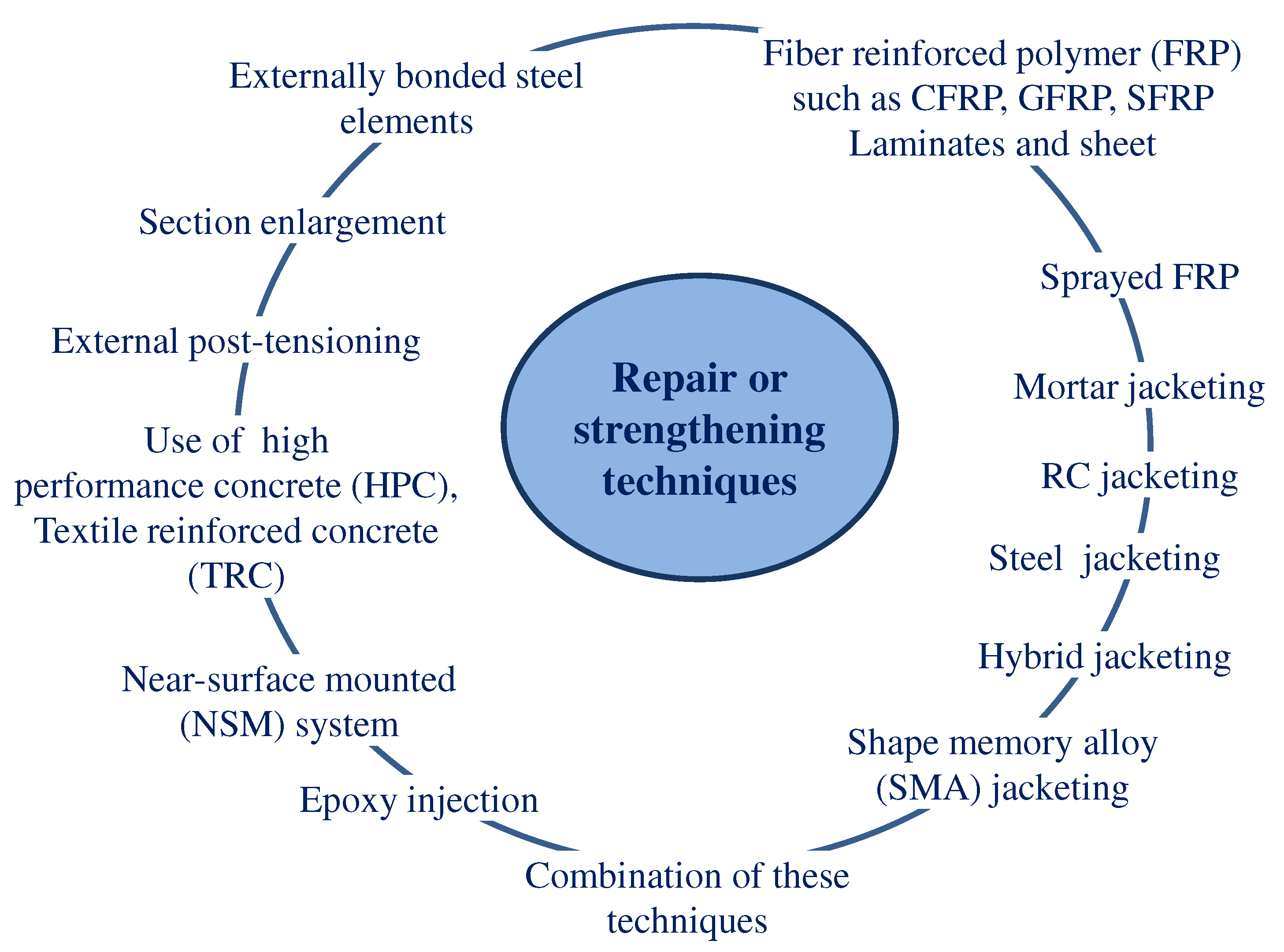
Figure 2.
Concrete beam specimens.
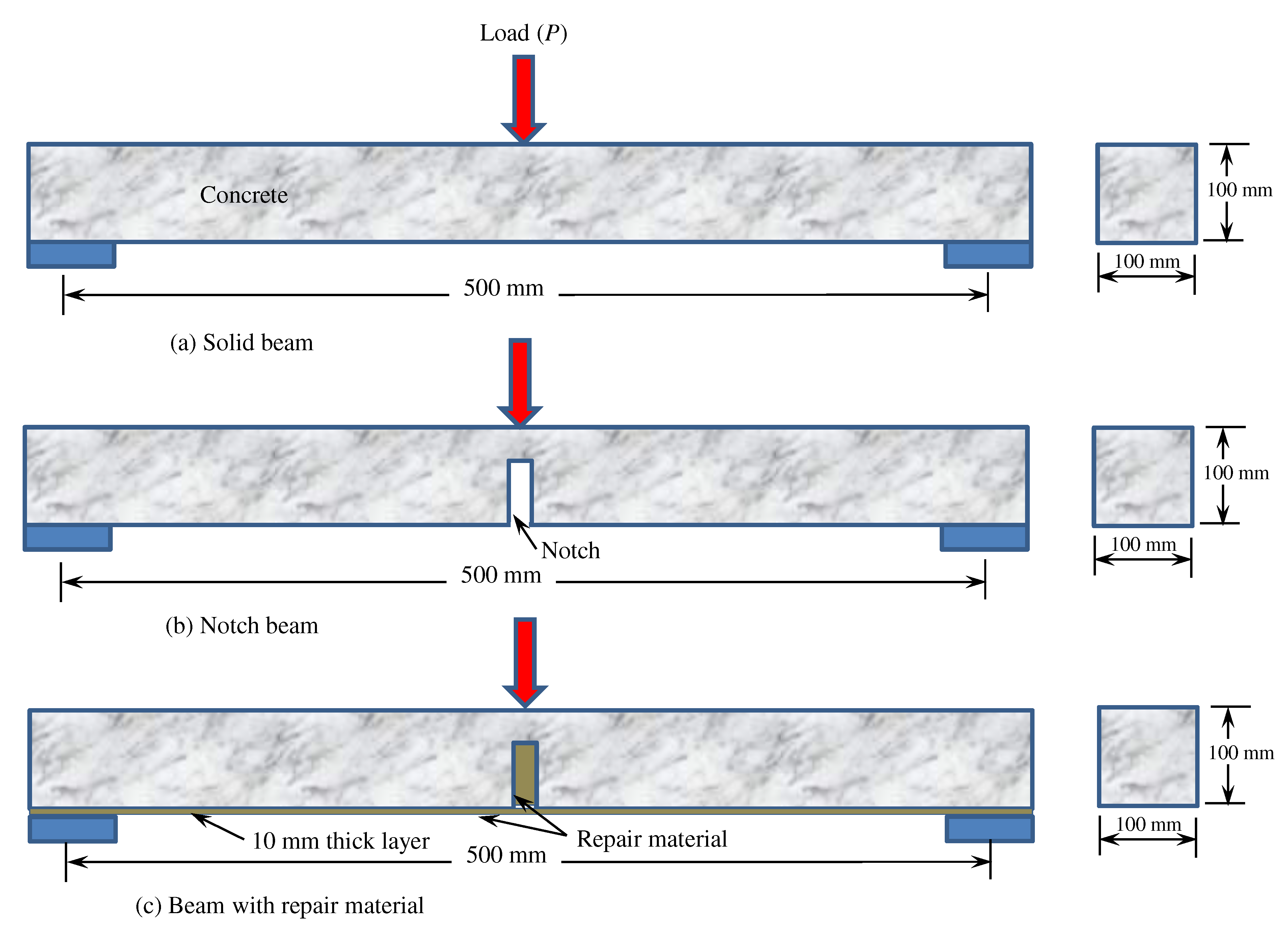
Figure 3.
Bacterial mortar.
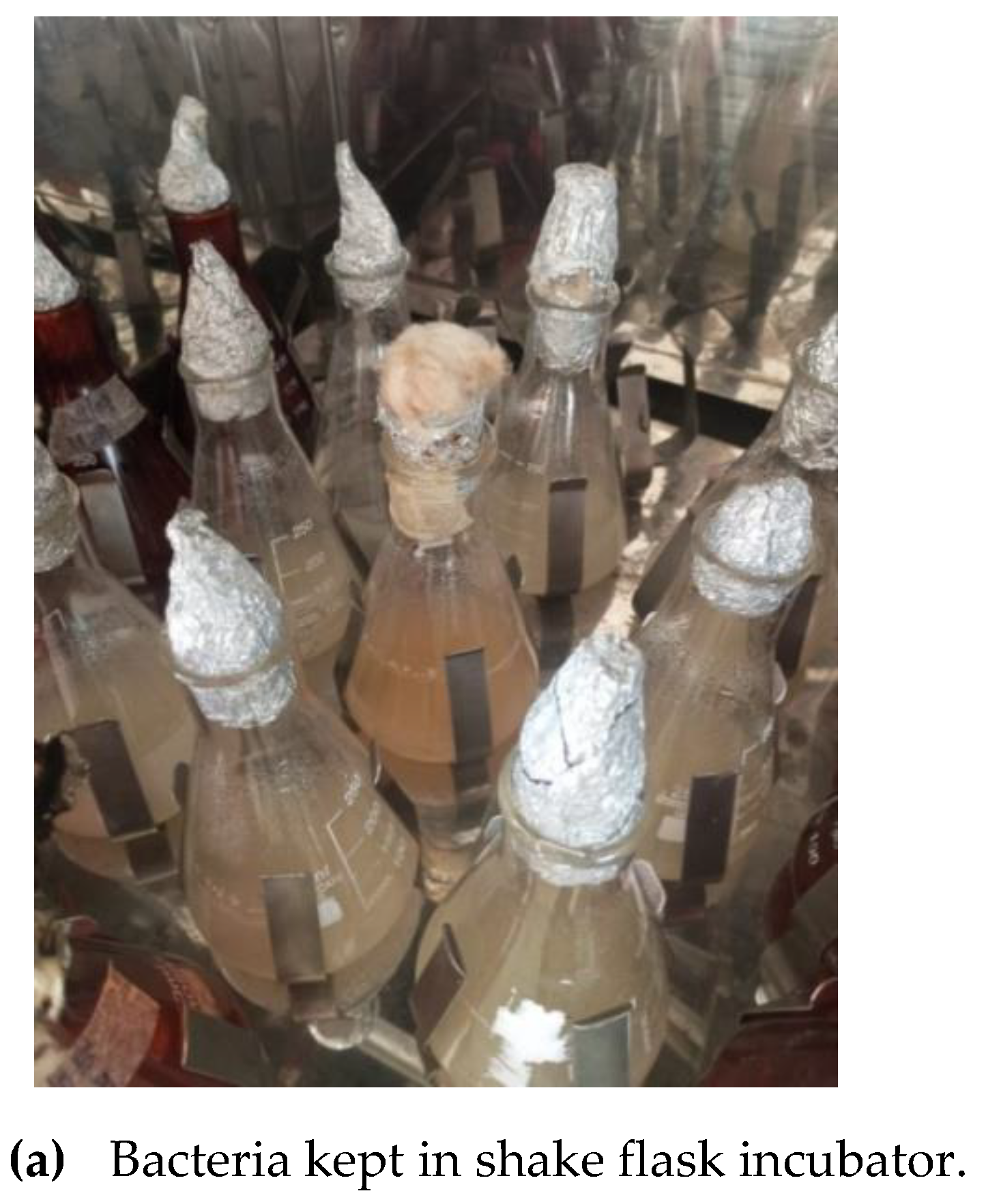
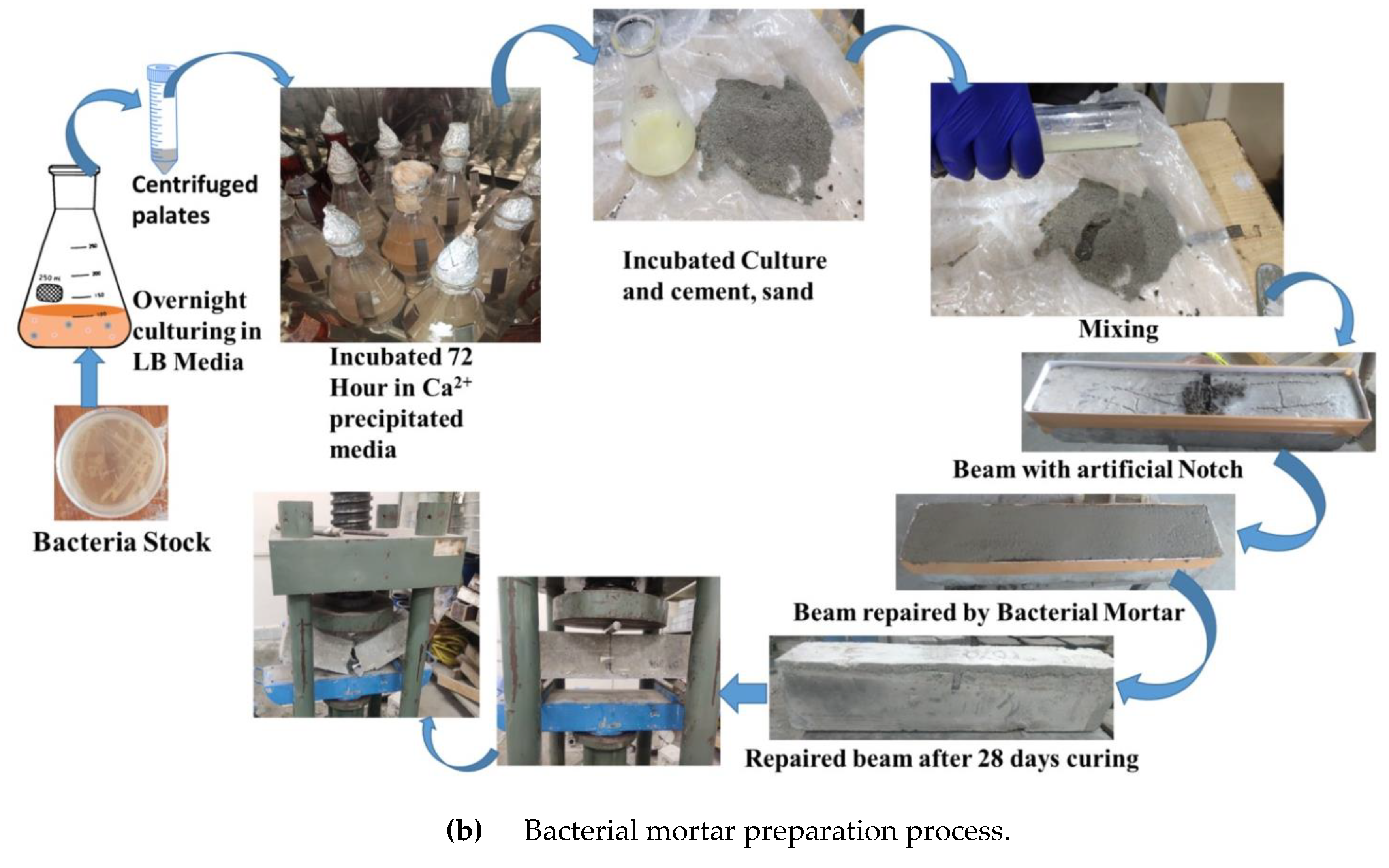
Figure 4.
Experimental study.
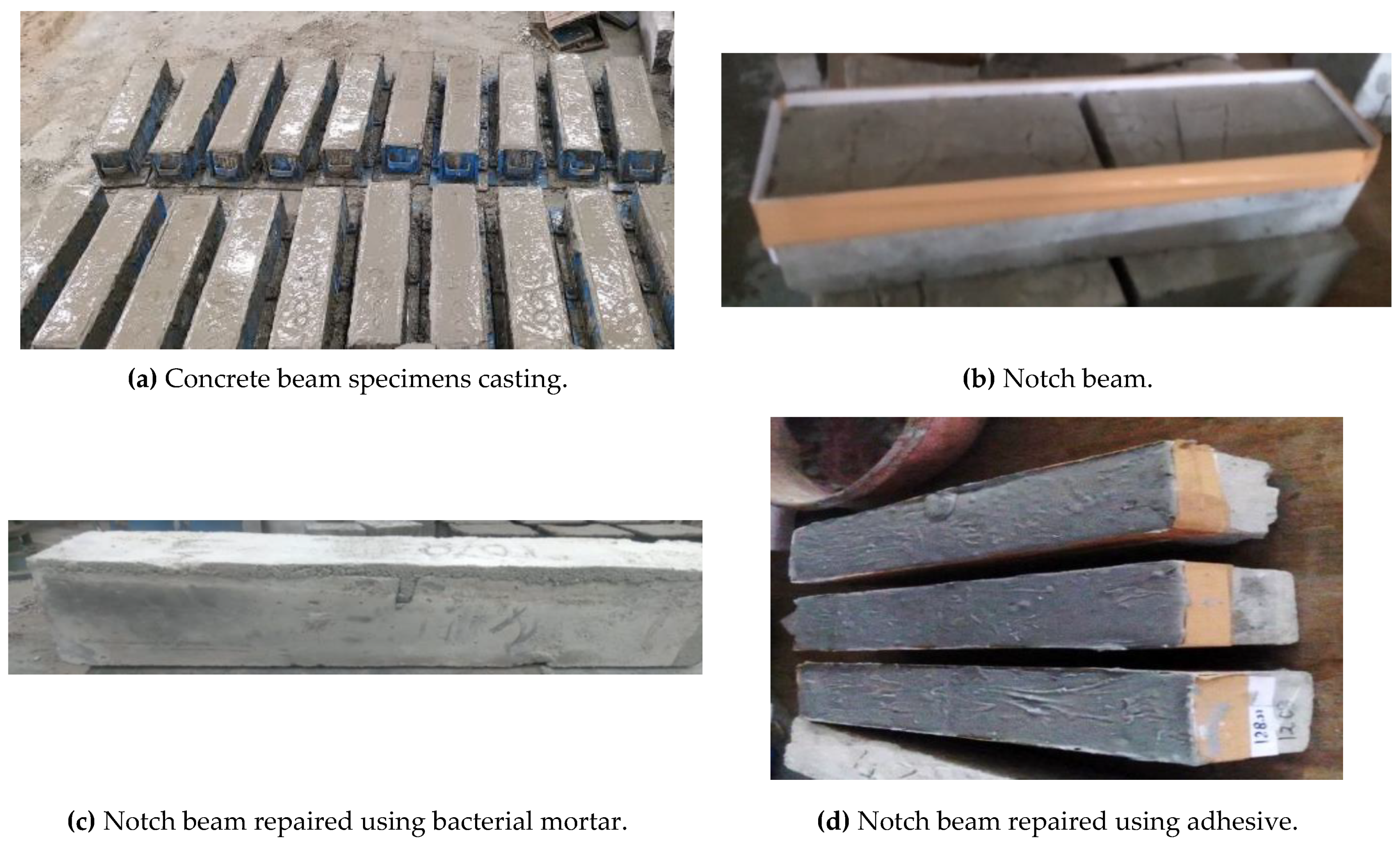
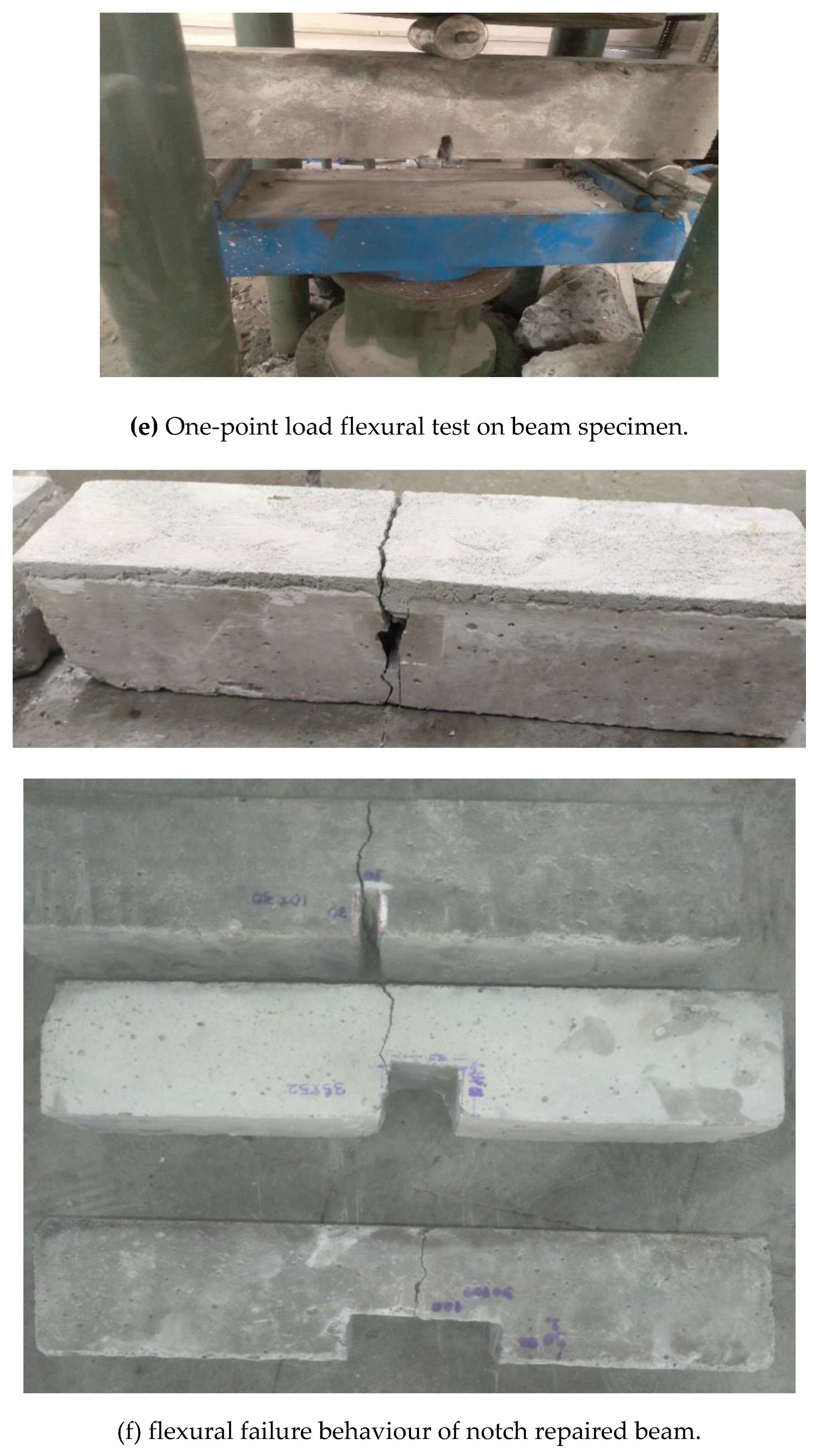
Figure 6.
Numerical models.
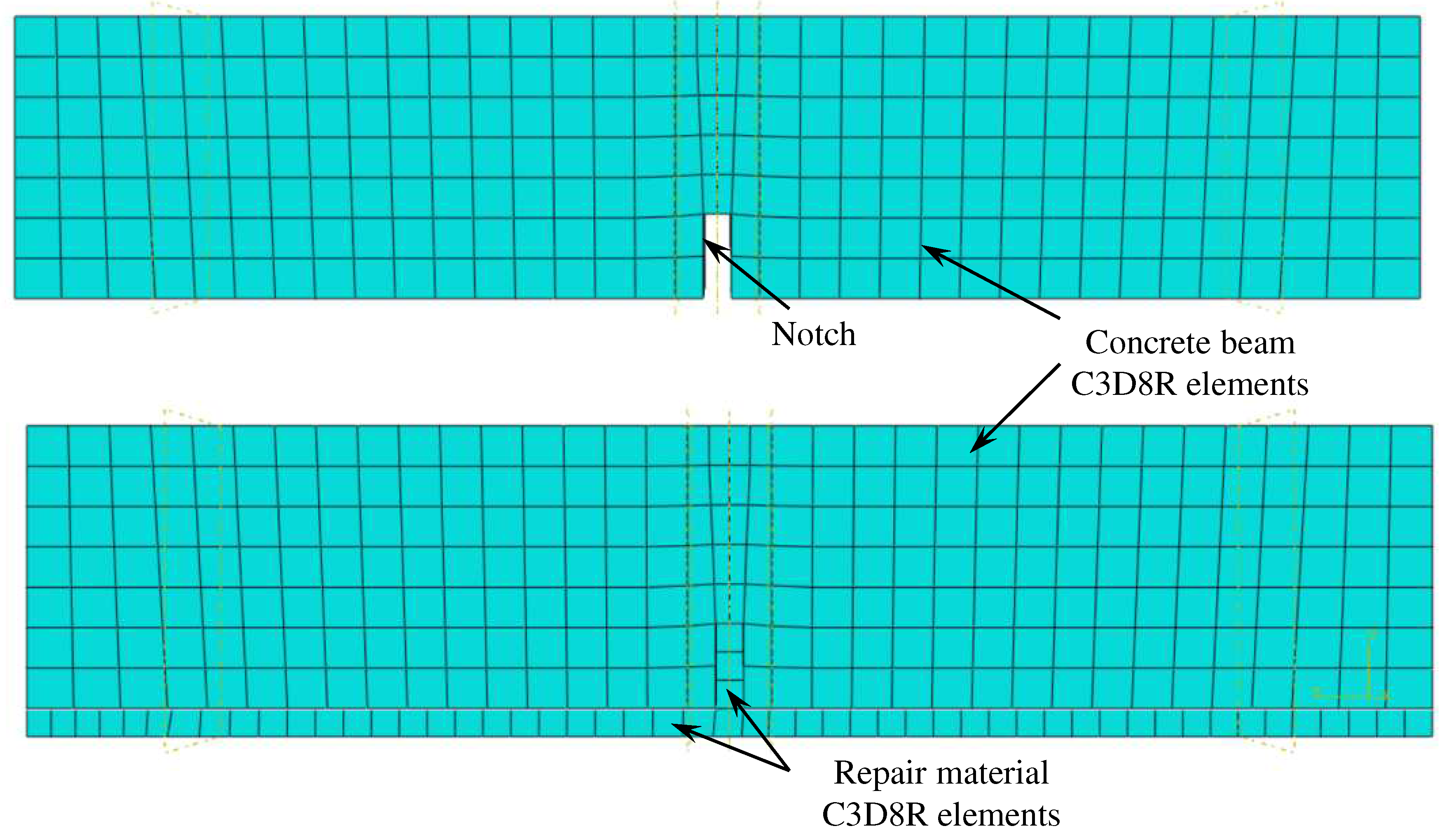
Figure 7.
Ultimate load-displacement behavior for concrete beam.
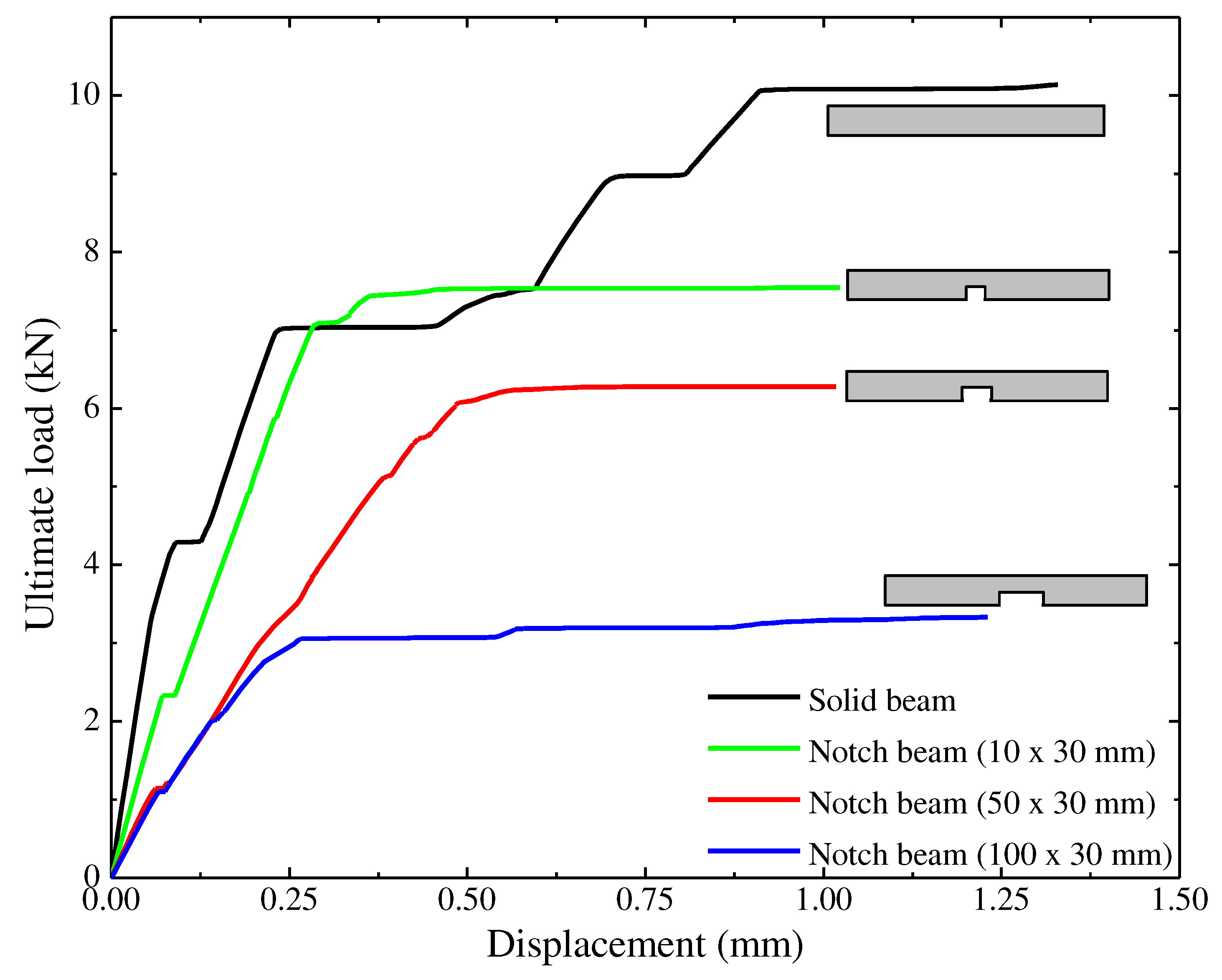
Figure 8.
Comparison of ultimate load between experimental and numerical study.
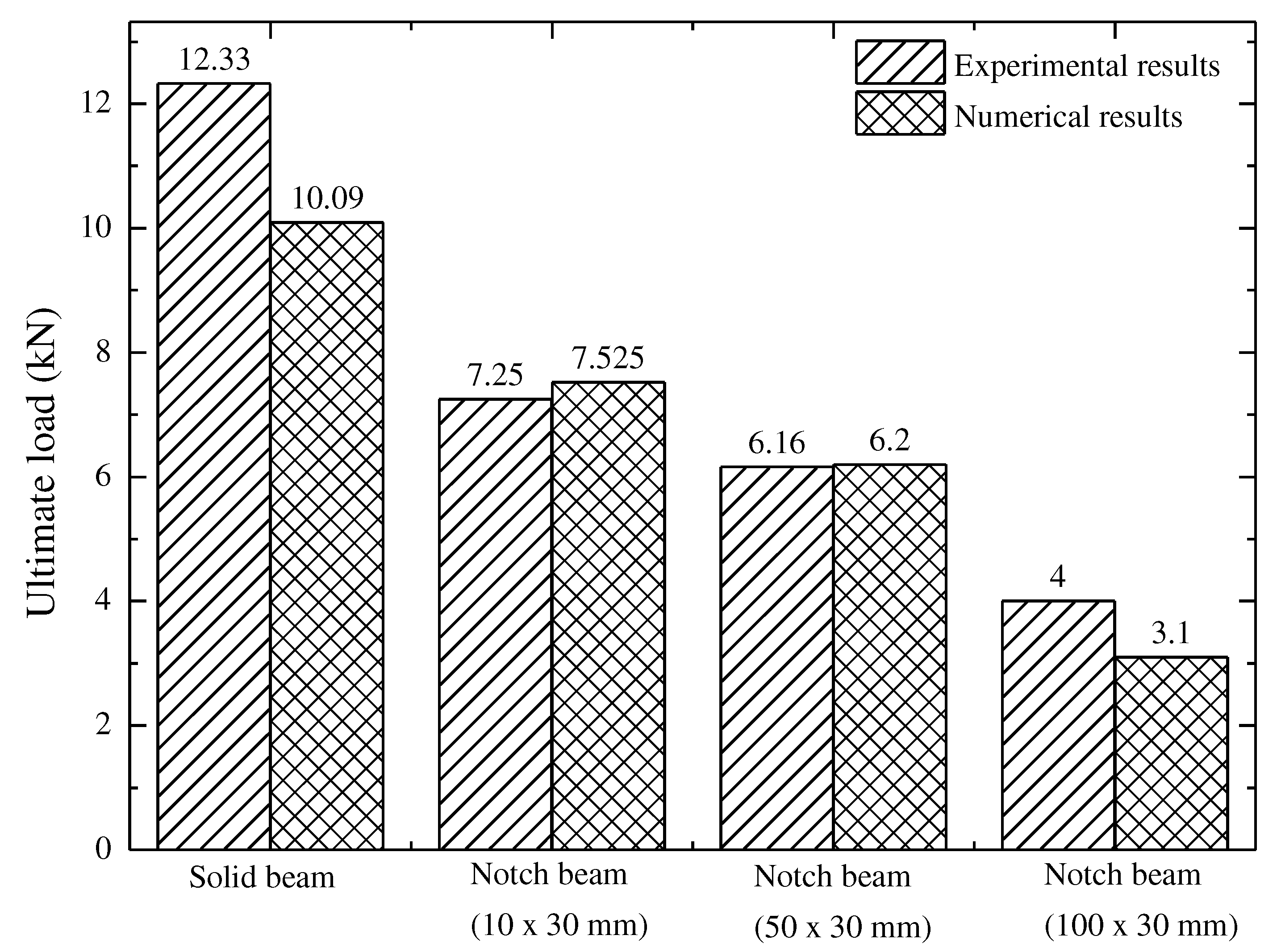
Figure 9.
Predicted experimental and numerical results.
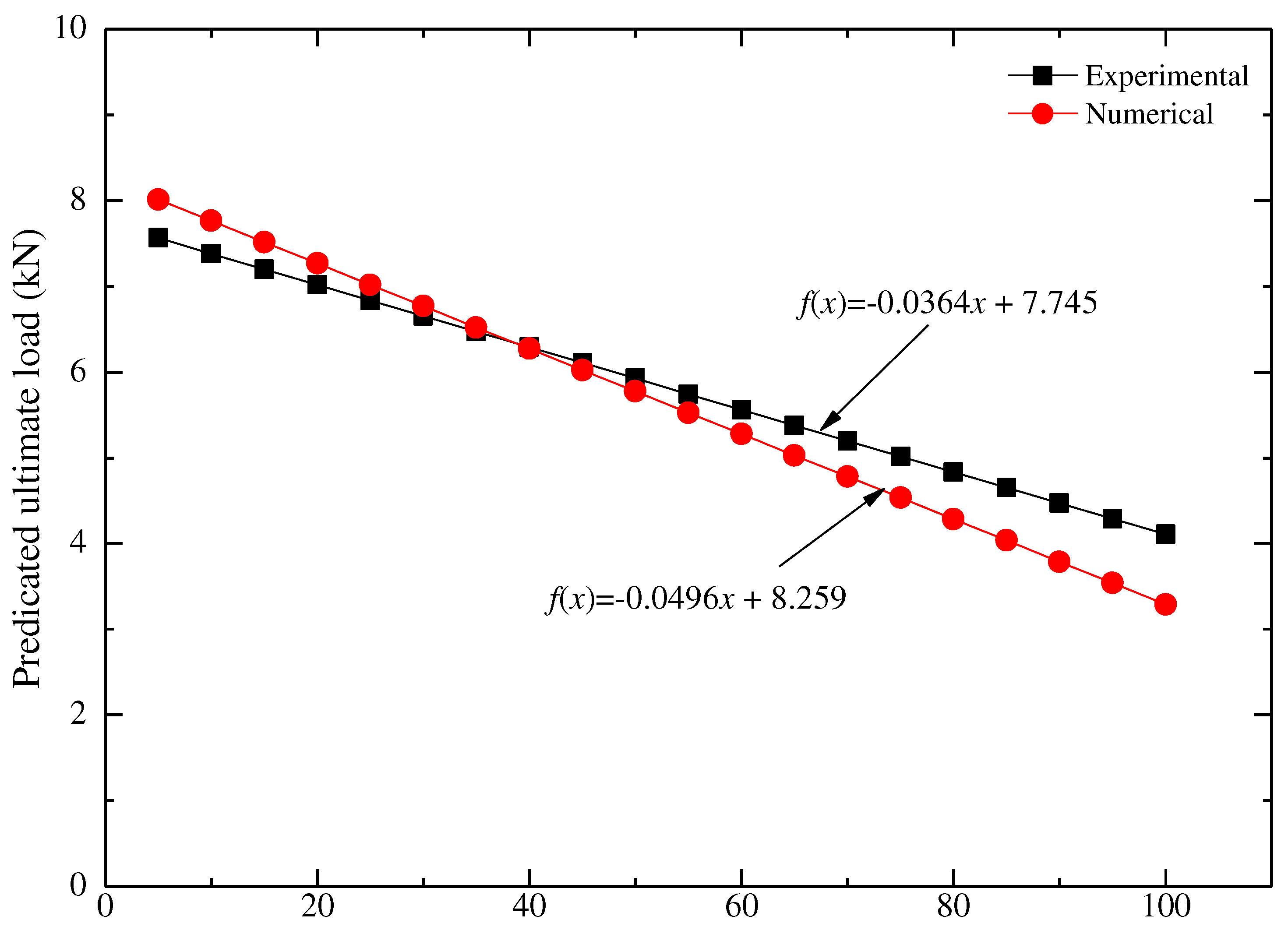
Figure 10.
Ultimate load-displacement behavior for repaired concrete beam.
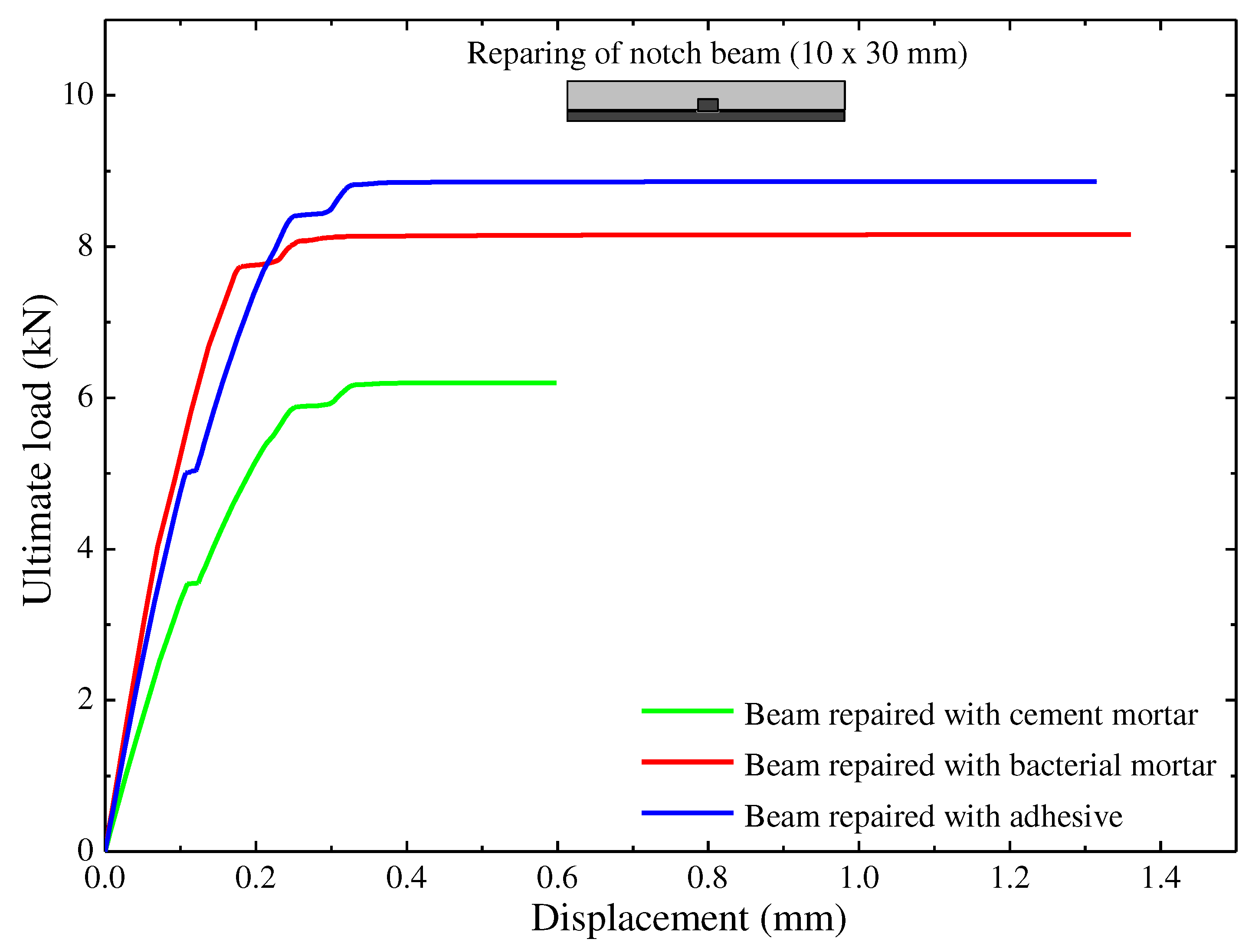
Figure 11.
Comparison of ultimate load in repaired beam for different materials.
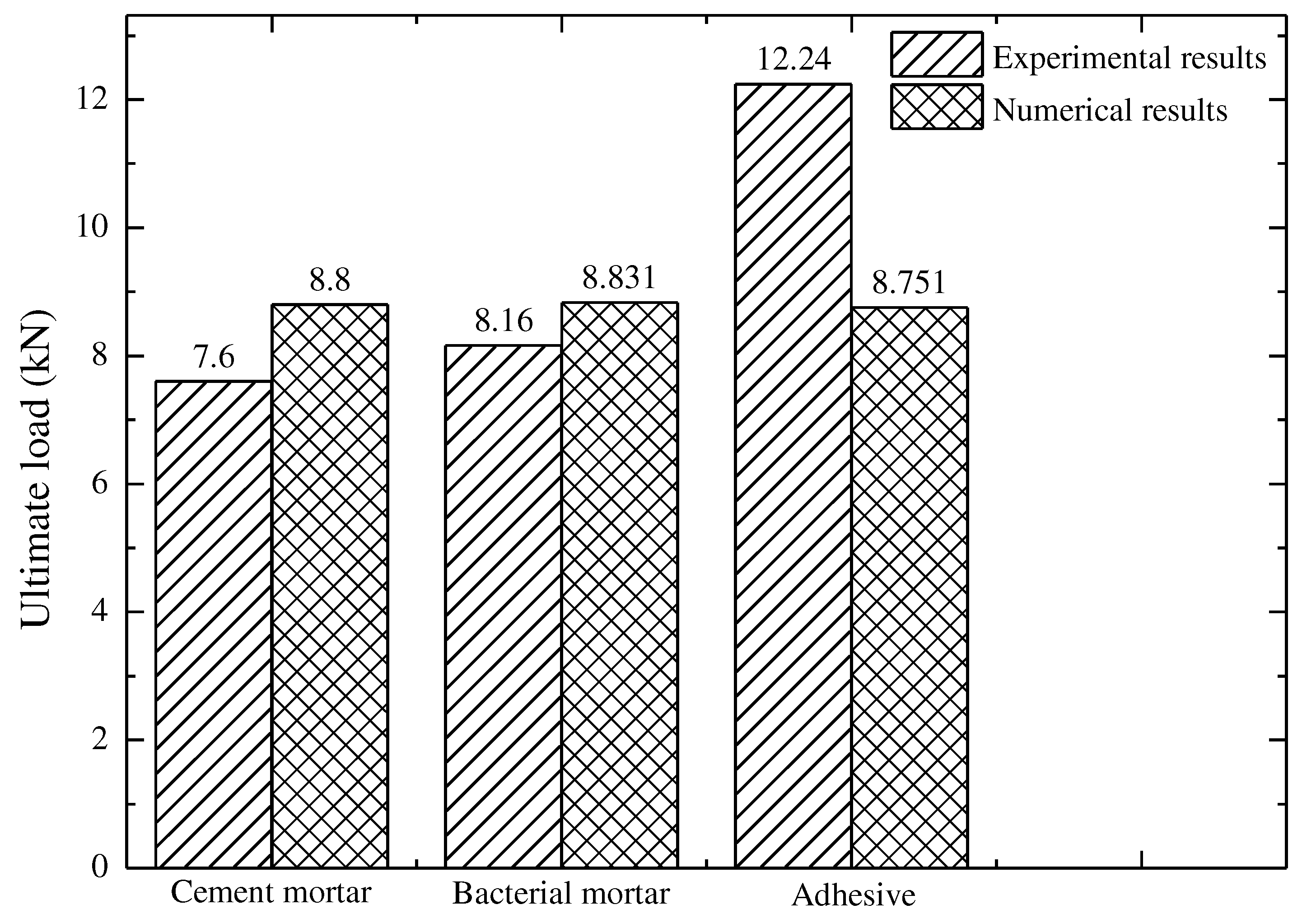
Figure 12.
Repaired beam.
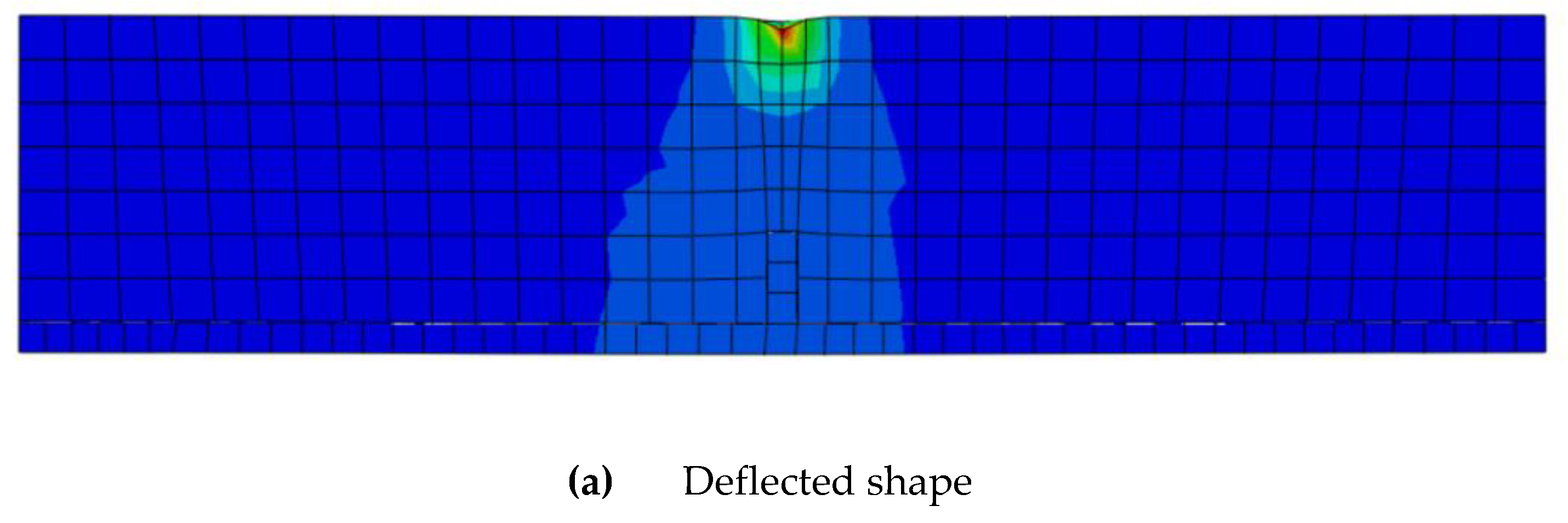
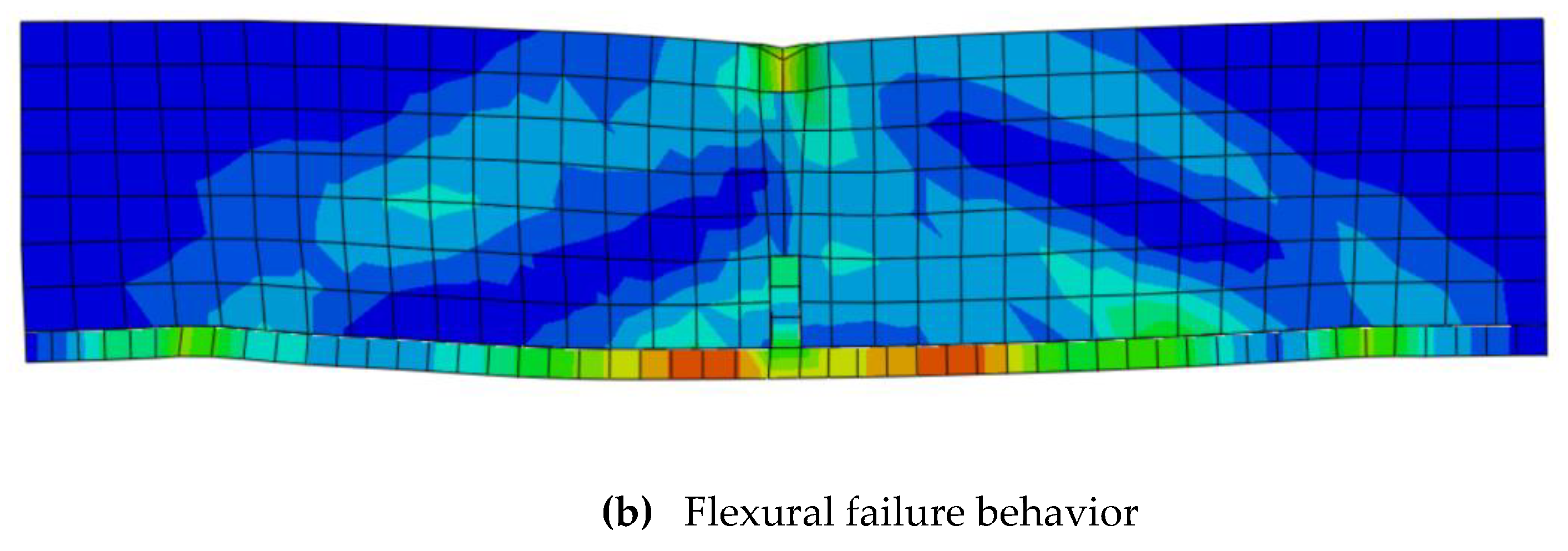

Table 1.
List of repair and strengthening materials.
| Sr no. | Types of material | Specification | Applications |
| A. Concrete repair | |||
| 1 | Bonding primer | epoxy resin | used as bonding agent between old and new concrete structures |
| 2 | Crack repair | low viscosity injection resin | moisture incentive for sealing cracks> 5 mm |
| 3 | Site batch mortars | synthetic rubber emulsion | used for good adhesion and water resistance. |
| 4 | Smoothing mortars | epoxy modified cementitious, thixotropic, fine textured mortar | used for levelling and finishing of concrete, mortar or stone surfaces. |
| 5 | Structural injection material | low viscosity injection resin | moisture incentive for sealing cracks> 5 mm |
| B. Structural strengthening | |||
| 1 | Prefabricated CFRP plates | pultruded carbon fibre reinforced polymer (CFRP) laminates | strengthening concrete, timber, masonry, steel and fiber reinforced polymer structures. |
| 2 | FRP fabrics | uni-directional woven carbon fiber fabric | strengthening concrete, timber, masonry, steel and fiber reinforced polymer structures. |
| 3 | Structural adhesives | epoxy impregnation resin | structural strengthening application |
| C. Repairing Mortar | |||
| 1 | Cementitious mortars | polymer modified | repair mortar |
| 2 | Epoxy mortar | epoxy resin | for surface sealing, patch repair / filling mortar |
| 3 | Additives for mortars | synthetic rubber emulsion | for waterproofing and repair |
Table 2.
Review on effect of notch on concrete beams.
| Authors | Type of material | Specimen size | Loading | Properties of material | Remarks |
| [17] | Polymer mortars | 250 mm × 60 mm ×30 mm. and having notch 2 mm thick at different position 0, 24 mm, 48 mm and 72 mm towards the support. | Three-point load | - | Crack mouth opening displacement, crack tip opening displacement and values of energy release rate |
| [18] | Concrete and CFRP plate | 100mm×100mm×500mm Beam with notch at center which having depth 10mm, 20 mm & 30 mm, and wrapped with CFRP plates having length 100 mm, 200mm & 350 mm. Thickness of CFRP 1 mm and Adhesive 0.5 mm |
Three-point load |
fck=41.4 MPa EC=32.89 GPa ECFRP= 150 GPa Adhesive=4.3 GPa MIConcrete=8.3×106 mm4 |
with and without CFRP laminated plates, visually analysis the brittle failure, shear failures and delaminate failure. |
| [19] | Foamed concrete | Foamed concrete beam 840 mm×100mm×100mm having notch (5 mm thick 42 mm height ) at center. | Three-point load test of Beam |
EFoamed Concrete=1000 GPa µFoamed Concrete= 0.2, ε = 0.2, φ = 15° |
XFEM model of foamed concrete |
| [20] | Foamed concrete | Foamed concrete beam 750 mm×150mm×150mm having V-notch 30 mm long at center. | Cube compressive strength and three point load test | ρconcrete =2400 kg/ m3 , ρfoamed concrete=1400-1600 kg/ m3 | compressive strength of cube and fracture energy of foam concrete is lower |
| [21] | RCC Beam, CFRP & Adhesive | RCC beam 3000 mm ×200 mm×300 mm with notch at center of beam and CFRP plates 4 mm thick apply with 2 mm thick layer of adhesive. | Three-point load | EC=30 GPa ECFRP=140 GPa EAdhisieve=3 GPa µc=0.18 µCFRP=0.28 µAdhesive=0.35 |
CFRP plates bonding with surface of Beam and significantly enhance the stiffness and ultimate load |
| [22] | PCC beam | 1640 mm × 200 mm × 400 mm with notch at center (a/d = 0.5). | Three point load bending test |
EC=30,570MPa fck=21.9 MPa ftk=2.4 MPa |
Acoustic Emission (AE) and Digital Image Correlation (DIC) techniques. |
| [23] | PCC beam with steel fiber hook | 600 mm × 150 mm × 150 mm plain concrete beam with different notch depth 13 mm, 25 mm and 50 mm at center and a/d ratio is 0.08, 0.16 and 0.33. | Three point load | Size of steel fiber 50 mm length and diameter 1 mm and tensile strength 1130 MPa. water cement ratio is 0.55 and cement :sand: aggregate ratio is 1:2.93:2.31 |
a/d ratio notch is increase 0.08., 0.16 & 0.33 load carrying capacity decrease. Due to presence of high volume of steel fiber fracture energy increases with increases a/d ratio |
Table 3.
Review based on bacterial mortar and concrete.
| Authors | Materials | Name of bacteria | Preparation of specimen and curing | Test method | Result and discussion |
| [31] | Cement, sand, aggregate, bacteria liquid, Cyclic En riched Ureolytic powder (CERUP), and activated compact denitrifying Core (ACDC) granules | B.Cohni | Specimens cured in water for 28 days | Compressive strength , water absorption and recovery of water tightness | Compressive strength increase by 25%, water absorption decrease, due to aerobic oxidation of organic carbon O2 consumption by bacteria so it will reduce the rebar corrosion |
| [32] | Cement, sand, aggregate, with ratio of 1:2.5 water Bacterial Liquid Clay ball. |
Genus. Bacillus | Specimens cured in water and wet/dry cycle 28 and 56 days. | Crack water permeability Recovery of water-tightness Oxygen consumption measurements and ESEM analysis |
Cracked permeability lower than normal concrete |
| [28] | Portland slag cement and fine sand ratio of 1:6, Bacterial solution w/c 0.55 |
B.Cohni | Specimen cured in water for 28 days | Standard consistency, Setting time, soundness cement, compressive strength, sorptivity, drying shrinkage, microstructure and morphology, field emission scanning electron microscope (FESEM), X-ray diffraction (XRD) techniques | 28 days compressive strength increased by 49.8% and sorpvity decrease |
| [29] | Portland cement, sand fly ash, silica fume, calcium lactate, calcium acetate and encapsulated material. | S. Pastteurii and others ureolytic bacteria. | Specimen cured for 28 days. | setting time of concrete, Compressive strength, permeability, Chloride ion permeability, and microstructure Calcite. | Compressive strength increase and permeability decreases. |
| [33] | Cement send bacteria liquid encapsulated material | Ureolytic bacteria | Specimen cured in buffer solution for 7 and 28 days. | Scanning electron microscope, Compressive strength, permeability |
Permeability decrease |
| [34] | Portland flyash cement sand with ratio 1:3 bacteria perlite, sodium silicate, water, calcium acetate, yeast extract and w/c 0.5. | B.pseudoformu | Specimens cured in controlled environment then after demoulding specimen cured in water at 20 °C until 28 days. Cracked sample cured in moist and humid environment for 165 days |
Surface water absorption and visualisation of crack healing | water absorption decreases |
| [30] | OPC, sand w/c 0.46 and buffer solution | B.Pasturi | Specimen cured in humidity chamber with relative humidity 100% for 24 h. After demolding bacterial specimen were cured in buffer solution for 28 days | Compressive strength and water absorption | 28 days compressive strength increased by 33% and water absorption |
| [35] | Portland cement, sand water, encapsulation | Ureolytic bacteria | Specimen cured for 28, 60, 90, 365, 730 days | Compressive strength, flexural strength and water absorption | Compressive strength and flexural strength increases, Construction cost increase but maintenance cost decrease |
| [36] | Portland cement, sand water, encapsulation | Bacillus Cereus | Specimen cured for 180 days | compressive and split tensile strength, ultrasonic pulse velocity and water absorption capacity | compressive and split tensile strength were improved and reducing water absorption capacity |
Table 4.
Verification of the numerical results.
| References | Material properties | Dimensions | One-point maximum failure load (N) | % difference | |
| Published results | Present study results | ||||
| [46] | E= 32.89 GPa and fck=41.2 MPa | 500mm×100mm×100mm, notch 10 mm ×10 mm× 100 mm. |
6933.3 | 6606 | 4.72 |
| [47] | fck=38.24 MPa | L=1200mm, d=200 and b=100mm. | 11200 | 10770 | 3.83 |
| [48] | fck=54MPa, ftk=3.16 | L=1400 mm, d=230 mm and b=140 mm. | 16000 | 15963 | 0.23 |
Table 5.
Mechanical properties for M40 grade of concrete [45].
Table 5.
Mechanical properties for M40 grade of concrete [45].
| Material | fck (MPa) | ftk (MPa) | Modulus of elasticity (MPa) | Density (kg/m3) | Poisson’s ratio | Dilation Angle | Viscosity |
| Concrete | 40 | 4.6 | 32890 | 2400 | 0.2 | 31⁰ | 0.00001 |
Table 6.
Mechanical properties of repairing materials.
| Repairing material | Density | Compressive strength (N/mm2) | Modulus of elasticity (MPa) | Poisson’s ratio |
| Cement mortar | 2200 (kg/m3) | 36.22 in 28 days | 14108.08 [44] | 0.2 |
| Bacterial mortar | 2200 (kg/m3) | 63.43 in 28 days | 30387.43 | 0.2 |
| Adhesive | 1.8 (kg/L) | 65 in 15 days | 11000 | 0.25 |
Table 7.
Parametric values of the prediction model.
| Parameters | Experimental | Numerical |
| Coefficients | p1 = -0.0364, p2 = 7.745 | p1 = -0.0496, p2 = 8.259 |
| R2 | 0.984 | 0.973 |
| RMSE | 0.288 | 0.522 |
Disclaimer/Publisher’s Note: The statements, opinions and data contained in all publications are solely those of the individual author(s) and contributor(s) and not of MDPI and/or the editor(s). MDPI and/or the editor(s) disclaim responsibility for any injury to people or property resulting from any ideas, methods, instructions or products referred to in the content. |
© 2024 by the authors. Licensee MDPI, Basel, Switzerland. This article is an open access article distributed under the terms and conditions of the Creative Commons Attribution (CC BY) license (http://creativecommons.org/licenses/by/4.0/).
Copyright: This open access article is published under a Creative Commons CC BY 4.0 license, which permit the free download, distribution, and reuse, provided that the author and preprint are cited in any reuse.


