

Submitted:
06 February 2024
Posted:
06 February 2024
You are already at the latest version
Abstract
In this study, we evaluated the antibacterial effect against Staphylococcus aureus and Salmonella Typhimurium in fried fish paste using floating electrode-dielectric barrier discharge (FE-DBD) plasma (1.1 kV, 43 kHz, N2 1.5 m/s, 1-60 min). In addition, quality evaluation (pH, VBN) of fried fish paste was conducted after FE-DBD plasma treatment. When FE-DBD plasma was treated for 1, 5, 10, 20, 30 and 60 min, S. aureus decreased by 0.16-1.13 log10 CFU/g, and S. Typhimurium decreased 0.25-1.13 log10 CFU/g. Both decreased > log10 CFU/g at 60 min. The D-value was 58.92 and R2 was 0.97 for S. aureus using first-order kinetics, and the D-value was 43.60 and R2 was 0.97 for S. Typhimurium using the Weibull model. There was no significant difference in pH after FE-DBD plasma treatment (p > 0.05). However, volatile basic nitrogen (VBN) significantly decreased as the treatment time increased (p < 0.05), and it was the lowest at 60 min to 3.46. Therefore, FE-DBD plasma treatment could be considered as a technology for preserving the quality of processed foods.
Keywords:
fried fish paste
; FE-DBD plasma
; first-order kinetics
; Staphylococcus aureus
; Salmonella Typhimurium
; Weibull model
1. Introduction
Surimi-based products are among the processed seafood items that are frequently anticipated as an accessible source of protein with the expansion of convenience foods due to the diversification of dietary patterns and particularly, in situations where raw materials for processing livestock are limited, such as in Korea [1]. Fish paste is a processed meal made with reasonably sophisticated technology from seafood surimi. It may be used as raw fish meat from a variety of fish species and also has convenience food qualities [2].
There are many issues with hygiene preservation, and even in the case of vacuum-packed fried fish pastes, the number of days available for distribution is as little as 12 days. However, fish paste produced in Korea is not packaged or packaged in various forms, and distributed at room temperature or low temperature. Additionally, fried fish paste sold in traditional markets are more likely to be contaminated by microorganisms than it produced in factories because they are immediately fried and left on display until sold to consumers. Fried fish paste is treated as a hygienic and storable food because it is heated at high temperature (160-170 °C) during the manufacturing process, but most of it is distributed in a non-vacuum state, and lipid trans formation can occur because of lipid rancidity and high temperature treatment. Additionally, it can be easily deteriorated due to residual harmful microorganisms that have not been sterilized or enter during packaging and distribution process [3]. Therefore, the inactivation of harmful microorganisms is essential to ensure the hygienic stability of food. Studies have been conducted to extend the storage period of fish paste using techniques such as chlorine dioxide treatment [1], gamma-ray irradiation [4], bactosis treatment [5], and acetic acid treatment [6].
Plasma is one of the four basic states for matter, along with solids, liquids, and gases. It is similar to gaseous states or a state of matter in which electrons in an atom are no longer bound to an atomic nucleus and can move freely [7]. Plasma is composed of electrons, ions, and nonionized particles. It can be produced by direct contact with water, and is frequently employed in the production of gaseous reactive species [8]. Plasma can be classified by the degree of ionization, it can also be classified based on the thermal equilibrium state of the particles. Based on this, plasma is classified into two types: thermal and nonthermal. In thermal plasma, electrons and heavy particles are in thermal equilibrium, whereas in nonthermal, heavy particles are approximately at almost room temperature, and electrons obtain a much higher temperature than in thermal plasma (TP). Therefore, the overall temperature of the nonthermal plasma is kept relatively low [9,10].
Nonthermal plasma is a technology that inhibits microorganisms from contaminating food at low temperatures and is a new sterilization technology with considerable potential for food preservation due to its high efficiency and limited side effects. Floating Electrode Dielectric Barrier Discharge (FE-DBD) plasma is distinct from conventional DBD plasma. In this form, NTP can be discharged by air into the atmosphere [11,12]. Therefore, plasma is generated on the surface of the skin without external gas injection, and the plasma generation area is much larger than that of plasma jet [13]. The term “floating electrode” implies that a metal object is separated from the ground. These techniques are used in skin care because of its ability to prevent cavities and burn damage. Additionally, by applying FE-DBD plasma, a complete skin sterilization effect can be achieved without blood clotting and damaging surrounding tissues, and its ability to sterilize microorganisms has recently been proven [14]. Therefore, FE-DBD plasma is currently used in FE-DBD treatment for HuNoV GⅡ.4 in salted clams [10] and the control of highly resistant methicillin-resistant Staphylococcus aureus (MRSA), Escherichia coli and Bacillus stratosphericus [15,16]. However, there have been no studies confirming the effectiveness evaluation of FE-DBD plasma treatment on S. aureus and Salmonella Typhimurium in fried fish paste.
Hence, in this study, the antibacterial efficacy of the FE-DBD plasma therapy against S. aureus and S. Typhimurium on fried fish paste was verified. Additionally, the physicochemical characteristics of plasma-treated fried fish paste were evaluated in this study.
2. Materials and Methods
2.1. Sample preparation and bacteria inoculation
The fried fish paste was purchased from an online market (Busan, Korea). Before the experiment, each sample was cut into 3.0 × 3.0 × 0.3 (L × W × H). To completely remove microorganisms, disinfect the surface of the sample with 70% ethanol before inoculation.
S. aureus (ATCC 6538 and ATCC 12600) and S. Typhimurium ATCC 14028 were obtained from the American Type Culture Collection (ATCC, America) and used for inoculation. Stock cultures were stored at -80 °C in tryptic soy broth (TSB, Difco Laboratories, Detroit, MI, USA) containing 30% glycerol. Each strain was incubated at 37 °C for 24 h in 5 mL TSB and centrifuged at 5400 xg for 10 min at 4 °C. Repeat this process twice so that the bacteria can be activated well. S. aureus was resuspended in 9 mL of sterile NaCl saline (0.85%) by mixing the two pellets.
Both S. aureus and S. Typhimurium were spot-inoculated at 100 μm on the surface of the fried fish paste. The initial titer of S. aureus and S. Typhimurium were about 4-4.2 log10 colony forming unit (CFU/g). After inoculation, it is leave it for 1 h in a biological safety cabinet (CHC Lab Co. Ltd., Daejeon, Korea) so that the inoculated bacteria can be absorbed well into the sample.
2.2. Sample preparation and bacteria inoculation
A schematic diagram of the FE-DBD plasma device used in this study is shown in Figure 1. A 0.7 mm thick glass was used as a high voltage electrode, a silver electrode was screen-printed to a thickness of 10 μm, and a dielectric material composed of SiO2 was screen-printed to a thickness of 100 μm. FE-DBD plasma discharge mainly occurred at 1 kV, and the maximum discharge current was measured at 16 mA. The power consumption was measured at 0.55 W, and the RMS (root mean square value) voltage and current were measured at 2.0 kV and 13.5 mA, respectively. N2 gas for FE-DBD plasma generation was allowed to flow through the gas inlet at 1.5 L per min, and plasma was generated between the glass under the powered electrode and the surface of the fried fish paste serving as a virtual ground. The distance between the plasma emission electrode and the sample during plasma treatment was maintained at 3 mm. FE-DBD plasma on the surface of fried fish paste was treated for 1, 5, 10, 20, 30, and 60 min.
2.3. Quantification of bacterial analysis
It was conducted based on the Ministry of Food and Drug Safety (MFDS)[17] to quantitatively detect S. aureus and S. Typhimurium in samples, after FE-DBD plasma treatment. Samples inoculated with S. aureus and S. Typhimurium were placed in a sterile stomacher bag (Korea, Seoul, Korea 3M) with 0.85% sterile NaCl and homogenized. 1 mL of homogenized solution was diluted with 9 mL of 0.85% sterile NaCl solution. 1 mL of diluted sample was added to Petri dish and mixed with tryptic soy agar (TSA, Difco Laboratories, Detroit, MI, USA). Thereafter, S. aureus and S. Typhimurium were incubated at 37 °C for 48 h and 24 h, respectively.
2.4. Modeling of decimal reduction times
The first-order kinetics model was used to calculate the D-value for the reduction of S. aureus. The D-value represents the FE-DBD treatment time required to reduce 1 log10 CFU of microorganisms. The closer the R2-value is to 1, the better the data point fits the regression line.
- N0 is the initial microbial population (CFU/g)
- N is the microbial population by FE-DBD plasma treatment time (CFU/g)
- t is the FE-DBD plasma treatment time (min)
- k is the reduction rate constant
To calculate the D-value of S. Typhimurium, the Weibull model, a two-parameter nonlinear model, was used. The calculation formula is as follows:
- Nt is the number of microorganism (log CFU/g) after the FE-DBD plasma treatment time t
- N0 is the initial microbial population (log CFU/g)
- t is the FE-DBD plasma treatment time (min)
- b is indicating the time needed to reduce the population for one log unit
- n (parameter) is indicating the shape of the survival curve
The n value of 1 corresponds to a linear survival curve, and n values correspond to downward and upward concavity, respectively.
To obtain the D-value from the Weibull parameters, the equation was used by Buzrul and Alpas. [18]:
D represents the time required to decrease microorganism by 90%. The Weibull model was analyzed using the software GraphPad Prism for Windows version 5.0 (GraphPad Software, San Diego, CA, USA).
2.5. Physicochemical quality evaluation [pH value, VBN]
For pH measurement, 3 g of FE-DBD plasma-treated fried fish paste and 30 mL of distilled water were mixed in a sterilized bag. Then homogenized for 1 min using a stomacher (Bagmixer, Interscience, Troy, USA). The pH value was measured using a pH meter (A211, Thermo Orion, Benchtop, MI, USA).
VBN was analyzed using the Conway microdiffusion method [19]. It was repeated three time per sample, and the blank was distilled water as a sample. Sample 2 g, 20% Trichloroacetic acid (TCA), and 16 mL of distilled water were put into a stomacher bag. After homogenization, 1 mL of the filtered sample solution was put into the left side of the outer chamber of the Conway unit, and 1 mL of 50% K2CO3 was added to the right side of the outer chamber of the Conway unit. Then, put 1 mL of 0.01N H3BO3 into the inner chamber of the Conway unit and close the lid tightly so that there is no gap. Then, mix the sample with K2CO3. After being left at room temperature (25 °C) for 100 min, titration was performed using 0.01N HCl.
2.6. Statistical analysis
All results were performed in triplicate each sample, and the data are represented as the mean ± standard deviation (SD). Statistical analysis was conducted to find out the significant difference between the average reduction (log CFU/g) of S. aureus and S. Typhimurium, the D-value, pH and VBN of the two bacteria over time after FE-DBD plasma treatment. Statistical program performed ANOVA and Duncan’s multiple range tests using SPSS version 12.7 software (SPSS Inc., Chicago, IL, USA). It was verified with a significant difference at the probability level at 5% (p < 0.05).
3. Results
3.1. Reduction and D-value of S. aureus and S. Typhimurium in fried fish paste after FE-DBD plasma treatment
To confirm the sterilization effect of FE-DBD plasma, the reduction of S. aureus and S. Typhimurium in fried fish paste were confirmed (Table 1). S. aureus and S. Typhimurium showed tended to decrease significantly as the treatment time increased (p < 0.05). When the fried fish paste was treated for 1, 5, 10, 20, 30 and 60 min, S. aureus was identified as 0.16, 0.24, 0.36, 0.43, 0.86, and 1.13 log reduction, respectively. No significant difference until 10 min (p > 0.05). However, a significant difference was observed at 20 min (p < 0.05), and highest decreased compared to a control group (4.22 log10 CFU/g) at the maximum treatment time. The results for S. aureus and S. Typhimurium by FE-DBD plasma treatment were obtained using two models: first-order kinetic model and Weibull model. Based on the survival curve of S. aureus, a first-order kinetics model was applied (Figure 2). The R2 and D-values are shown in Table 2. The D-value was 58.92 min and R2 value was 0.97. The fit of the log-linear kinetic model for S. aureus was estimated to be R2. Therefore, it was close to 1.0, indicating that it is appropriate for determining slope and the D-value.
The reduction in S. Typhimurium levels by FE-DBD plasma was significantly decreased (p < 0.05). After being treated with FE-DBD plasma for 1, 5, 10, 20, 30, 60 min, the reduction was 0.25, 0.35, 0.77, 0.83, 0.85, and 1.13 log10 CFU/g, respectively. It was confirmed that it gradually decreased as treatment time increased. It significantly decreased from the 5 min of treatment (p < 0.05), and decreased gradually at 20, 30, and 60 min, but there was no statistically significant difference (p > 0.05). The reduction effect of FE-DBD plasma on S. Typhimurium was evaluated, and the results were applied to the Weibull model (Figure 3). The parameters (b, n, R2, D) of the Weibull model are shown in Table 2. The value of R2 and D were 0.97 and 43.60, respectively. Because the R2 value of S. Typhimurium was close to 1.0, this model was appropriate for the survival curve. Although the experimental reduction effects of the two bacteria were almost similar or the same in FE-DBD plasma at 30 and 60 min of treatment when microbial survival modeling was applied, S. aureus and S. Typhimurium showed linear (Figure 2) and non-linear concave downward survival pattern (Figure 3), respectively.
3.2. Quality (pH and VBN) of fried fish paste after FE-DBD plasma treatment
The pH and VBN of fried fish paste were measured according to the FE-DBD plasma treatment time (Table 3). The pH of fried fish paste was 5.37 at all plasma treatment times, and no significant difference was observed between samples (p > 0.05).
For VBN, no significant difference when the control group (8.15) was treated for 5 min (p > 0.05). When plasma was treated for 10, 20, 30, and 60 min, VBN values were 6.98, 4.71, 3.48, and 3.46, respectively. From the 10 min treatment, it decreased significantly compared to the control group (p < 0.05).
4. Discussion
The consumption of fish-based products is not high compared to that of other foods because they are cumbersome to preprocess and cook despite their excellent nutritional and health benefits. However, fish pastes, which are easy to cook and have the fish odor removed, have shown a gradual increase in production in the 2000s [3]. These products are anticipated to be protein resources with the increased consumption of convenience foods according to changes in dietary patterns and raw materials for processing livestock are difficult to obtain in Korea. Fish paste is a processed food that can be easily consumed. Its consumption is high because it is relatively inexpensive. There are various type of fish pastes, but among them, fried fish paste is treated as a food that can be stored for long periods. Therefore, it has the highest preference among fish pastes. Additionally, as high-temperature heat treatment (160-170 °C), it is generally considered hygienic and safe from microorganisms. However, it can easily deteriorate because of residual harmful microorganisms that have not been completely sterilized during the manufacturing process or enter during storage and distribution processes. The shelf life of vacuum-packed fried fish paste is only approximately 10 days when stored at low temperatures [1].
Deterioration of food caused by microbial contamination results in food poisoning or quality degradation. Hence, the inactivation of harmful microorganisms is essential to ensure the hygienic stability of food. Moreover, in the case of fried fish paste, its hygienic stability must be ensured immediately as they are street foods. Therefore, in addition to the treatment of bactosis [5], many studies are currently suggested extending their storage period by preserving the hygienic quality of fish pastes. A study on chlorine dioxide treatment of fish pastes [1] reported that microorganisms decreased as the chlorine dioxide treatment concentration increased. Another study on gamma-irradiation treatment [4] reported that the total aerobic bacteria were effectively reduced at 2.5 kGy and that the detection limit (2 log CFU/g) was significantly reduced at 7.5 kGy. In spite of these studies, sterilization and microbial reduction studies on fish paste are still insufficient, particularly on nonthermal methods for microbial inhibition.
Chen et al. [20] showed that when chub mackerel was treated with atmospheric cold plasma (ACP) at an optimal voltage (60 kV), total viable count decreased by 3.15 log CFU/g-1 decrease in 60 s. Furthermore, ACP treatment was reported as a potential and promising alternative to seafood conservation technology. According to Abdi et al. [21], microorganisms were reduced after the exposure of L. sativa seeds to FE-DBD plasma. Moreover, no bacteria were detected after 40 min of treatment; FE-DBD plasma treatment effectively controlled the microorganisms. Jeon et al. [10] reported that the human norovirus in Jogaejeotgal (a Korean traditional fermented food) decreased as the processing time increased after FE-DBD plasma treatment, and decreased the most from 30 min to about 1-1.30 log10 CFU/g. However, in this experiment, S. aureus and S. Typhimurium were reduced by about 1.13 log10 CFU/g when treated for 30 min. Both the aforementioned studies showed a greater decreased than this study. Fish paste is gelled by steaming, boiling, baking, or frying after mixing a small amount of salt into meat paste dough, which is ground meat mixed with starch and other ingredients [22]. Therefore, the bacterial reduction may have been decreased because it has a harder structure than Jogaejeotgal. Additionally, plasma treatment can affect the inhibitory effect differently depending on several factors such as the species of microorganisms, exposure type, injected gas type, and number of cell layers in the sample [23].
Floating electrode dielectric barrier discharge plasma breaks covalent bonds with cations, anions, electrons, and ultraviolet (UV) photons; it is brought into contact with chemically activated species, resulting in microbial sterilization. Among several active species, active oxygen species such as oxygen radicals can affect cells by reacting with various macromolecules [23,24]. Active species cause the formation of unsaturated fatty acids and peroxides, which damage the lipids and proteins in the cell membranes of microorganisms and sterilize them while spreading into cells. The active species (ROS and RNS) generated by plasma can create air pollutants that are harmful to humans [8,25]. However, in addition to Mann et al. [26], many studies have reported that the permissible exposure limit is not exceeded during plasma treatment time, the risk due to the plasma treatment is expected to be low.
Mathematical models such as first-order kinetics and Weibull models improving food safety by predicting the survival characteristics of pathogenic microorganisms. Reduction kinetics modeling is useful for assessing the risk of quantitative microorganisms [27]. First-order kinetic is utilized to determine inactivation data such as D-values and are based on linear microbial survival curves [28,29]. However, microbial survival curves may not always be linear; hence, the Weibull model applied in this study to determine the D-values based on nonlinear microbial survival curves [28,30]. As the R2 values of S. aureus and S. Typhimurium among fried fish paste using FE-DBD plasma were close to 1, two models were utilized to determine the most appropriate survival curve model. In the case of S. aureus, R2 and D-values were 0.97, and 58.92, respectively, which were obtained with a linear model. However, S. Typhimurium had a R2 value of 0.97, and a D-value of 43.60, which were more appropriate for the Weibull model, a nonlinear curve, than the linear model.
The pH and VBN of the fried fish paste were measured after FE-DBD plasma treatment based on setting time. The pH was not significantly different (p > 0.05), and the sample quality was not significantly affected. Jeon et al. [10] also reported that the plasma treatment did not affect the pH of the FE-DBD plasma treatment of Jogaejeotgal. Additionally, VBN is a measure of the amount of nitrogen produced during the process of protein decomposition into amino acids and inorganic nitrogen as the deterioration of fish paste progresses; it is mainly produced by bacterial decomposition [31,32]. Although the VBN content of the initial fish paste was within the fresh meat range (5-10 mg/%), it decreased further as the plasma treatment time of the fried fish paste increased. This is because the treatment with FE-DBD plasma deactivates the activity of endogenous enzymes and spoilage bacteria that form compounds such as ammonia and trimethylamine, which are the primary substances of odor [31,33]. Therefore, nonthermal plasma treatment can the quality of processed foods as well as fish-based products.
5. Conclusions
In this study, the effect of FE-DBD treatment on S. aureus and S. Typhimurium on fried fish paste was investigated. Both decreased the most to 1.13 log10 CFU/g in the 60 min plasma treatment. The survival curve for S. aureus was fitted with a first-order kinetic model (R2 = 0.97), and the D-value was 58.92. The Weibull model was appropriate for S. Typhimurium (R2 = 0.97) and its D-value was confirmed to be 43.60. Although no significant difference (p < 0.05) was observed in the pH of fried fish paste based on plasma treatment time (0-60 min), VBN significantly decreased (p > 0.05) from 8.15 to 3.46 mg/%. The results suggest that FE-DBD plasma treatment is an effective technique for ensuring microorganisms safety and preserving food quality.
Author Contributions
For research articles with several authors, a short paragraph specifying their individual contributions must be provided. The following statements should be used “Conceptualization, X.X. and Y.Y.; methodology, X.X.; software, X.X.; validation, X.X., Y.Y. and Z.Z.; formal analysis, X.X.; investigation, X.X.; resources, X.X.; data curation, X.X.; writing—original draft preparation, X.X.; writing—review and editing, X.X.; visualization, X.X.; supervision, X.X.; project administration, X.X.; funding acquisition, Y.Y. All authors have read and agreed to the published version of the manuscript.” Please turn to the CRediT taxonomy for the term explanation. Authorship must be limited to those who have contributed substantially to the work reported.
Funding
This research was supported by the Basic Science Research Program through the National Research Foundation of Korea (NRF) funded by the Ministry of Education (2021R1I1A3A04037468).
Conflicts of Interest
The authors declare no conflicts of interest.
References
- Shin, H.Y.; Lee, Y.J.; Park, I.Y.; Kim, J.Y.; Oh, S.J.; Song, K.B. Effect of chlorine dioxide treatment on microbial growth and qualities of fish paste during storage. J. Korean Soc. Appl. Biolo. Chem. 2007, 50, 42–47. [Google Scholar]
- Bashir, K.M.I.; Kim, J.S.; An, J.H.; Sohn, J.H.; Choi, J.S. Natural food additives and preservatives for fish-paste products: A review of the past, present, and future states of research. J. Food Qual. 2017, 2017, 31. [Google Scholar] [CrossRef]
- Ryu, H.S.; Choi, N.D.; Lee, S.Y. Food quality and shelf-life of Korean commercial fried Kamaboko. Korean J Fish. Aquat. Sci. 2014, 47, 211–219. [Google Scholar] [CrossRef]
- Kim, J.H.; Jeon, J.Y.; Ryu, S.R.; Kim, Y.J.; Suh, C.S.; Lee, J.W.; Byun, M.W. Microbial quality and physiochemical changes of grilled fish paste in a group-meal service affected by gamma-irradiation. Korean J. Food Preserv. 2004, 11, 522–529. [Google Scholar]
- Kang, J.H.; Ra, C.H.; Kim, S.H.; Shon, H.W.; Chung, H.Y. Effects of bactocease treatment on microbial growth and quality of fried fish paste during storage. Food Eng. Prog. 2022, 26, 19–26. [Google Scholar] [CrossRef]
- Kim, J.S.; Cho, M.L.; Heu, M.S. Quality improvement of heart-induced surimi gel using calcium powder of cuttle, Sepia esculenta bone treated with acetic acid. J. Kor. Fish, Soc. 2003, 36, 198–203. [Google Scholar] [CrossRef]
- Butscher, D.; Van Loon, H.; Waskow, A.; von Rohr, P.R.; Schuppler, M. Plasma inactivation of microorganisms on sprout seeds in a dielectric barrier discharge. Int. J. Food Microbiol. 2016, 238, 222–232. [Google Scholar] [CrossRef] [PubMed]
- Liao, X.; Liu, D.; Xiang, Q.; Ahn, J.; Chen, S.; Ye, X.; Ding, T. Inactivation mechanisms of non-thermal plasma on microbes: A review. Food Control 2017, 75, 83–91. [Google Scholar] [CrossRef]
- Graves, D.B. The emerging role of reactive oxygen and nitrogen species in redox biology and some implications for plasma applications to medicine and biology. J. Phys. D.: Appl. Phys. 2012, 45, 263001. [Google Scholar] [CrossRef]
- Jeon, E.B.; Choi, M.S.; Kim, J.Y.; Choi, E.H.; Lim, J.S.; Choi, J.S.; Ha, K.S.; Kwon, J.Y.; Jeong, S.H.; Park, S.Y. Assessment of potential infectivity of human norovirus in the traditional Korean salted clam product “Jogaejeotgal” by floating electrode-dielectric barrier discharge plasma. Food Res. Int. 2021, 141, 110107. [Google Scholar] [CrossRef]
- Adil, B.H.; Al-Shammari, A.M.; Murbat, H.H. Breast cancer treatment using cold atmospheric plasma generated by the FE-DBD scheme. Clin. Plasma Med. 2020, 19, 100103. [Google Scholar] [CrossRef]
- Svarnas, P.; Giannakopoulos, E.; Kalavrouziotis, I.; Krontiras, C.; Georga, S.; Pasolari, R.S.; Papadopoulos, P.K.; Apostolou, I.; Chrysochoou, D. Sanitary effect of FE-DBD cold plasma in ambient air on sewage biosolids. Sci. Total Environ. 2020, 705, 135940. [Google Scholar] [CrossRef]
- Kim, J.H.; Park, C J. ; Kim C.K. Atmospheric pressure floating electrode-dielectric barrier discharge (FE-DBDs) having flexible electrodes. Korean J Chem. Eng. Res. 2019, 57, 432–437. [Google Scholar] [CrossRef]
- Arserim, E.H.; Salvi, D.; Fridman, G.; Schaffner, D. W.; Karwe, M.V. Microbial inactivation by non-equilibrium short-pulsed atmospheric pressure dielectric barrier discharge (cold plasma): Numerical and experimental studies. Food Eng. Rev. 2021, 13, 136–147. [Google Scholar] [CrossRef]
- Cooper, M.; Fridman, G.; Fridman, A.; Joshi, S.G. Biological responses of Bacillus stratosphericus to floating electrode-dielectric barrier discharge plasma treatment. J. Appl. Microbiol. 2010, 109, 2039–2048. [Google Scholar] [CrossRef] [PubMed]
- Joshi, S.G.; Paff, M.; Friedman, G.; Fridman, G.; Fridman, A.; Brooks, A.D. Control of methicillin-resistant Staphylococcus aureus (MRSA) in planktonic form and biofilms: A biocidal efficacy study of non-thermal DBD plasma. Am. J. Infect. Control 2010, 38, 293–301. [Google Scholar] [CrossRef]
- Ministry of Food and Drug Safety (MFDS). Standard for Food. 2022. Available online: http://various.foodsafetykorea.go.kr/fsd/#/ext/Document/FC (accessed on 30 June 2022).
- Buzrul, S.; Alpas, H. Modeling inactivation kinetics of food borne pathogens at a constant temperature. LWT-Food Sci. Technol. 2007, 40, 632–637. [Google Scholar] [CrossRef]
- Cho, H.S.; Kim, K.H. An evaluation of the physicochemical properties of salted and fermented shrimp for HACPP. J. East Asian Soc. Diet. Life. 2009, 19, 395–400. [Google Scholar]
- Chen, J.; Wang, S.Z.; Chen, J.Y.; Chen, D.Z.; Deng, S.G.; Xu, B. Effect of cold plasma on maintaining the quality of chub mackerel (Scomber japonicus): biochemical and sensory attributes. J. Sci. Food Agric. 2018, 99, 39–46. [Google Scholar] [CrossRef] [PubMed]
- Abdi, S.; Moslehishad, M.; Dejam, L. Effect of atmospheric pressure floating-electrode dielectric-barrier discharge (FE-DBD) plasma on microbiological and chemical properties of Nigella sativa L. J. Bas. Res. Med. Sci. 2020, 7, 61–69. [Google Scholar]
- Park, Y.K.; Kim, H.J.; Kim, M.H. Quality characteristics of fried fish paste added with ethanol extract of onion. J. Korean Soc. Food Sci. Nutr. 2004, 33, 1049–1055. [Google Scholar] [CrossRef]
- Song, H.P.; Kim, B.; Choe, J.H.; Jung, S.; Moon, S.Y.; Choe, W.H.; Jo, C.R. Evaluation of atmospheric pressure plasma to improve the safety of sliced cheese and ham inoculated by 3-strain cocktail Listeria monocytogenes. Food Microbiol. 2009, 26, 432–436. [Google Scholar] [CrossRef]
- Fujii, J.; Homma, T.; Osaki, T. Superoxide radicals in the execution of cell death. Antioxidants 2022, 11, 501. [Google Scholar] [CrossRef] [PubMed]
- Lu, H.; Patil, S.; Keener, K.M.; Cullen, P.J.; Bourke, P. Bacterial inactivation by high-voltage atmospheric cold plasma: influence of process parameters and effects on cell leakage and DNA. J. Appl. Microbiol. 2014, 116, 784–794. [Google Scholar] [CrossRef]
- Mann, M.S.; Tiede, R.; Gavenis, K.; Daeschlein, G.; Bussiahn, R.; Weltmann, K.D.; Emmert, S.; Woedtke, T.V.; Ahmed, R. Introduction to DIN-specification 91315 based on the characterization of the plasma jet kINPen® MED. Clin. Plasma Med. 2016, 4, 35–45. [Google Scholar] [CrossRef]
- Choi, M.S.; Jeon, E.B.; Kim, J.Y.; Choi, E.H.; Lim, J.S.; Choi, J.S.; Park, S. Y. Impact of non-thermal dielectric barrier discharge plasma on Staphylococcus aureus and Bacillus cereus and quality of dried blackmouth angler (Lophiomus setigerus). J. Food Eng. 2020, 278, 109952. [Google Scholar] [CrossRef]
- Park, S.Y.; Kang, S.J.; Ha, S.D. Inactivation of murine norovirus-1 in the edible seaweeds Capsosiphon fulvescens and Hizikia fusiforme using gamma radiation. Food Microbiol. 2016, 56, 80–86. [Google Scholar] [CrossRef] [PubMed]
- Calsolari, A. Microbial death. In Physiological Models in Microbiology; CRC press: Boca Raton, Florida, USA, 2018; pp. 1–44. [Google Scholar]
- Buzrul, S. The Weibull model for microbial inactivation. Food Eng. Rev. 2022, 14, 45–61. [Google Scholar] [CrossRef]
- Bahmani, Z.A.; Rezai, M.; Hosseini, S.V.; Regenstein, J.M.; Boehme, K.; Alishahi, A.; Yadollahi, F. Chilled storage of golden gray mullet (Liza aurata). LWT-Food Sci. Technol. 2011, 44, 1894–1900. [Google Scholar] [CrossRef]
- Qian, Y.F.; Cheng, Y.; Ye, J. X.; Zhao, Y.; Xie, J.; Yang, S.P. Targeting shrimp spoiler Shewanella putrefaciens: Application of ε-polylysine and oregano essential oil in Pacific white shrimp preservation. Food Control 2021, 123, 107702. [Google Scholar] [CrossRef]
- Liao, X.; Su, Y.; Liu, D.; Chen, S.; Hu, Y.; Ye, X.; Wang, J.; Ding, T. Application of atmospheric cold plasma-activated water (PAW) ice for preservation of shrimps (Metapenaeus ensis). Food Control 2018, 94, 307–314. [Google Scholar] [CrossRef]
Figure 1.
Schematic diagram of FE-DBD plasma used for fried fish paste.
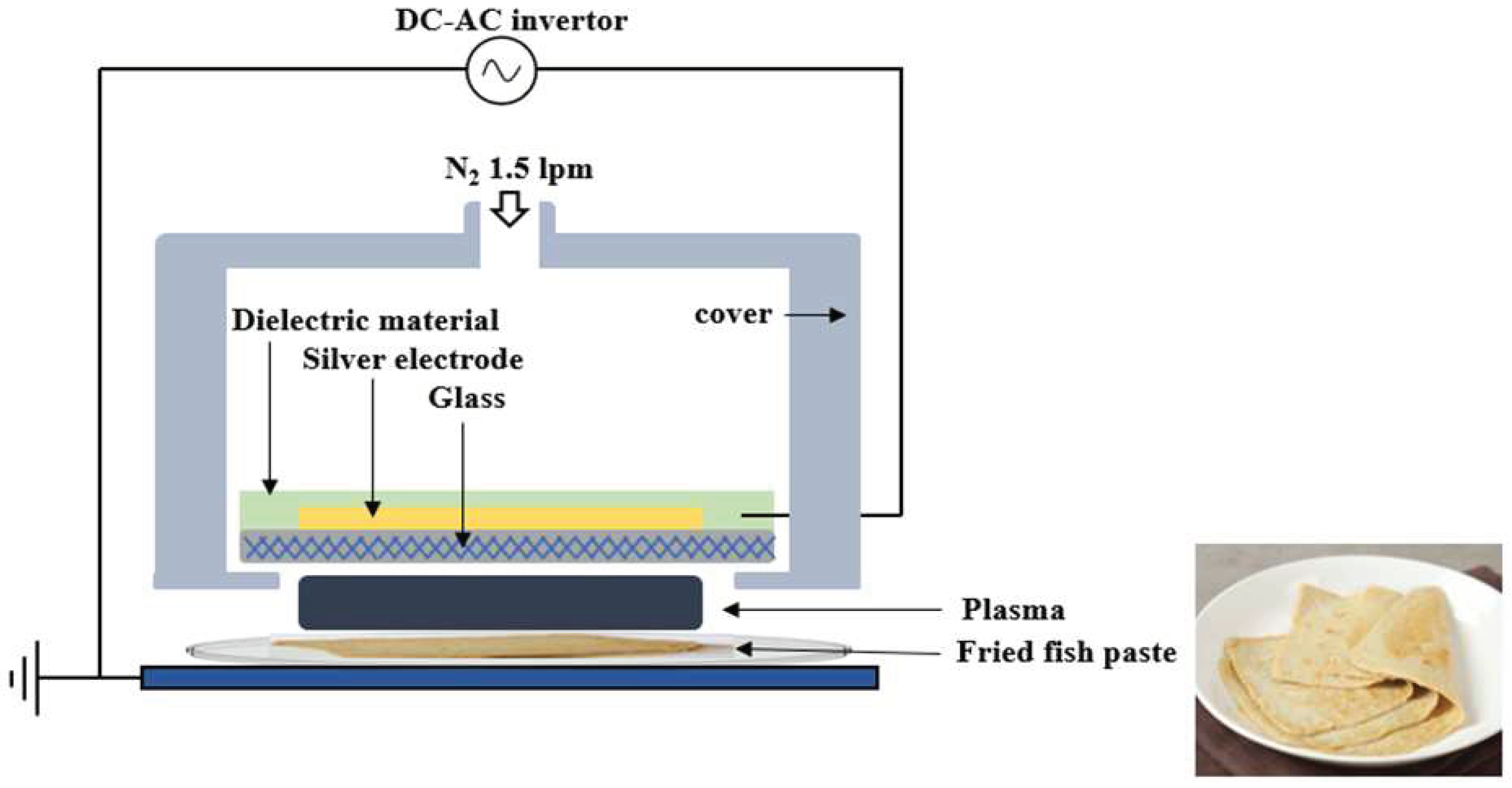
Figure 2.
Effects of FE-DBD plasma treatment on S. aureus on fried fish paste and fitted survival curves by the first-kinetics model. The letters a, b, and c represent significant differences (p < 0.05) in reduction after FE-DBD plasma treatment.
Figure 2.
Effects of FE-DBD plasma treatment on S. aureus on fried fish paste and fitted survival curves by the first-kinetics model. The letters a, b, and c represent significant differences (p < 0.05) in reduction after FE-DBD plasma treatment.
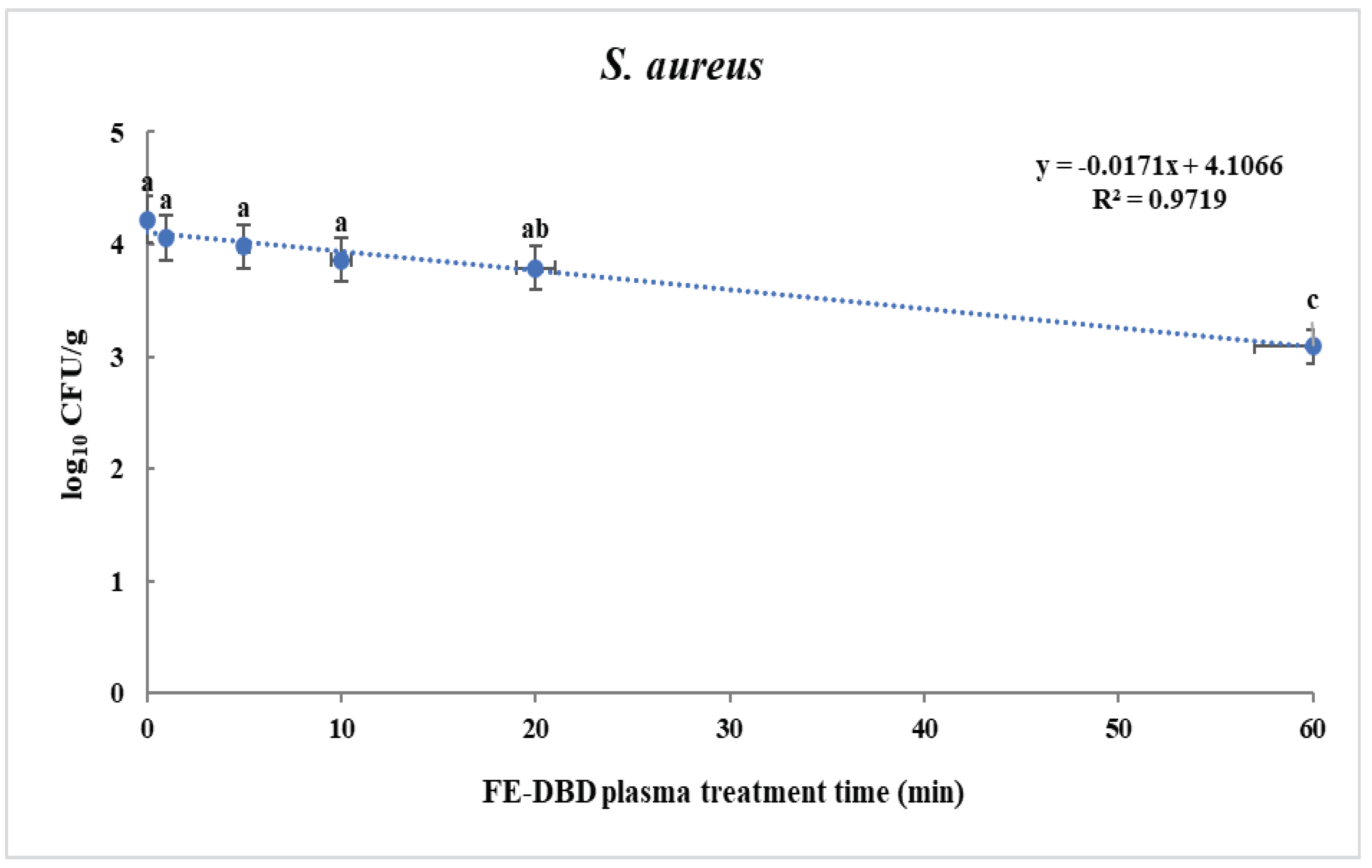
Figure 3.
Effects of FE-DBD plasma treatment on S. Typhimurium on fried fish paste and fitted survival curves by the Weibull model.
Figure 3.
Effects of FE-DBD plasma treatment on S. Typhimurium on fried fish paste and fitted survival curves by the Weibull model.
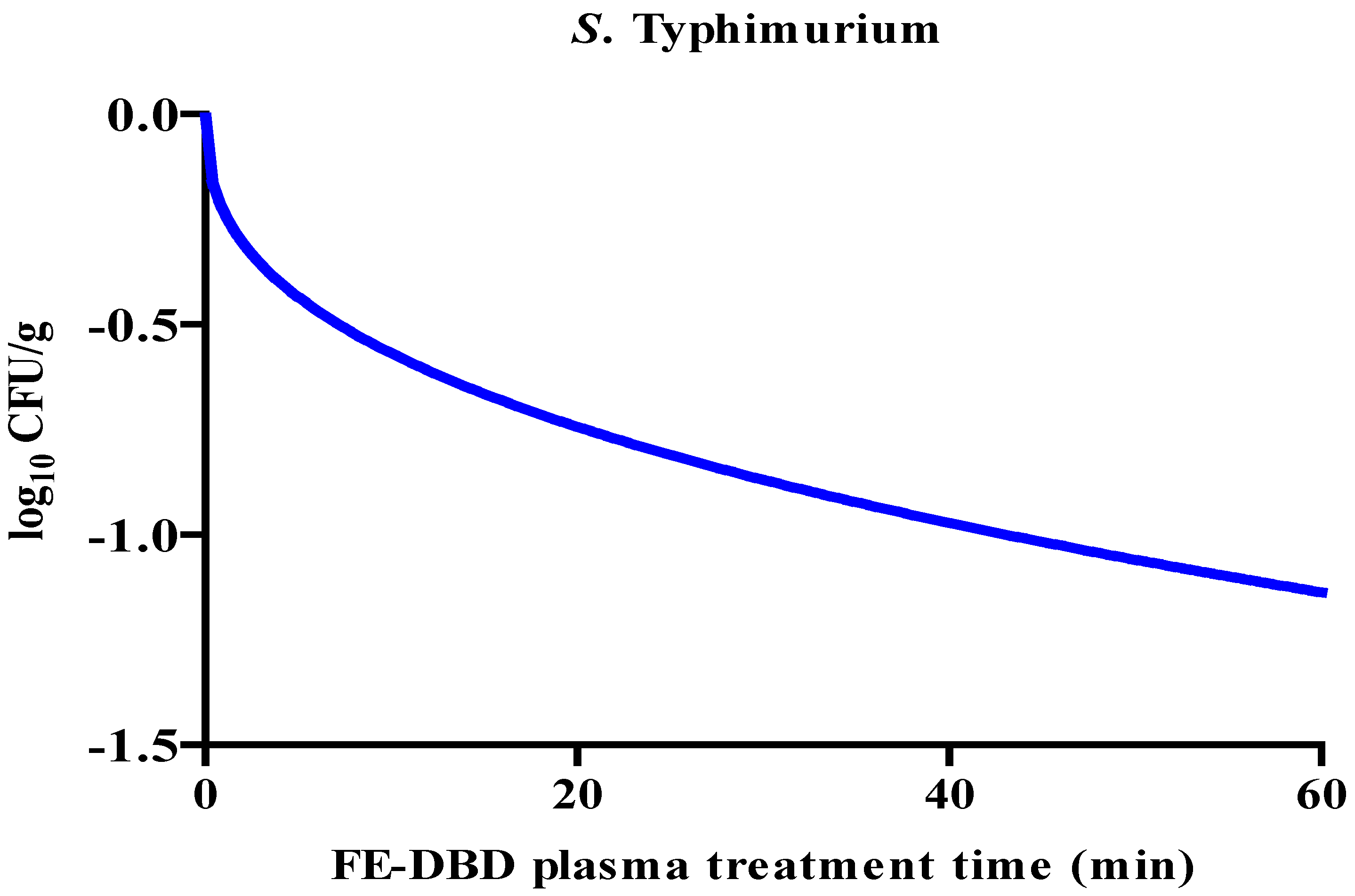

Table 1.
Reduction of S. aureus and S. Typhimurium on fried fish paste using FE-DBD plasma.
| Microorganism | FE-DBD plasma treatment (min) |
Mean±SD (log10 CFU/g) |
Log reduction (log10 CFU/g) |
|---|---|---|---|
| S. aureus | 0 | 4.22±0.42a | - |
| 1 | 4.06±0.26a | 0.16±0.26B | |
| 5 | 3.98±0.20a | 0.24±0.2B | |
| 10 | 3.86±0.13a | 0.36±0.13B | |
| 20 | 3.79±0.10ab | 0.43±0.1B | |
| 30 | 3.36±0.33bc | 0.86±0.33A | |
| 60 | 3.09±0.13c | 1.13±0.13A | |
| S. Typhimurium | 0 | 4.09±0.24a | - |
| 1 | 3.84±0.22a | 0.25±0.22C | |
| 5 | 3.74±0.25ab | 0.35±0.25BC | |
| 10 | 3.32±0.26bc | 0.77±0.26AB | |
| 20 | 3.26±0.16c | 0.83±0.16A | |
| 30 | 3.24±0.23c | 0.85±0.23A | |
| 60 | 2.96±0.35c | 1.13±0.35A |
The letters (a~c, A~B for S. aureus and a~c, A~C for S. Typhimurium) in a column represent significant differences (p < 0.05) in reduction after FE-DBD plasma treatment. Values mean ± standard deviations (SD) of triplicate determination. Duncan’s multiple range test at a 5% level of probability.
Table 2.
Model parameters of S. aureus and S. Typhimurium on fried fish paste using FE-DBD plasma.
| Microorganism | Model Parameters | R2 | D-value ± SD (min) | |
|---|---|---|---|---|
| S. aureus | Decay slope | 0.018 | 0.97 | 58.92±1.63a |
| S. Typhimurium | b±SD | 0.233±0.025 | 0.97 | 43.60±0.76b |
| n±SD | 0.387±0.030 | |||
S. aureus was calculated the D-value using the first-order kinetics. S. Typhimurium was calculated the D-value using the Weibull model. b, scale parameter; n<1, concave upward survival curve; n>1 and n=1, concave downward; R2, correlation coefficient; The letters (a,b) in a column represent significant differences (p < 0.05) in D-value by t-test. Values mean ± standard deviations (SD) of triplicate determination.
Table 3.
Physicochemical quality evaluation of fried fish paste after FE-DBD plasma treatment.
| FE-DBD plasma treatment (min) | pH | VBN (mg/%) |
|---|---|---|
| Control | 5.37±0.01NS | 8.15±1.67a |
| 1 | 5.37±0.02 | 8.12±0.07a |
| 5 | 5.37±0.02 | 7.49±2.44a |
| 10 | 5.37±0.01 | 6.98±1.58ab |
| 20 | 5.37±0.02 | 4.71±1.65bc |
| 30 | 5.37±0.01 | 3.48±0.01c |
| 60 | 5.37±0.00 | 3.46±0.00c |
The letters (a~c) in a column represent significant differences (p < 0.05) in quality evaluation. Values mean ± standard deviations (SD) of triplicate determination.
Disclaimer/Publisher’s Note: The statements, opinions and data contained in all publications are solely those of the individual author(s) and contributor(s) and not of MDPI and/or the editor(s). MDPI and/or the editor(s) disclaim responsibility for any injury to people or property resulting from any ideas, methods, instructions or products referred to in the content. |
© 2024 by the authors. Licensee MDPI, Basel, Switzerland. This article is an open access article distributed under the terms and conditions of the Creative Commons Attribution (CC BY) license (http://creativecommons.org/licenses/by/4.0/).
Copyright: This open access article is published under a Creative Commons CC BY 4.0 license, which permit the free download, distribution, and reuse, provided that the author and preprint are cited in any reuse.


